Sarah Teather Seeks More Parental Choice On SEN
I have often written here about my feelings on special education, and my experiences of life at mainstream schools with SEN. I won’t repeat myself now, but I will say that I agree with Sarah Teather. I have always said that parents know their children better than anyone else, and with children with disabilities and SEN, this means that parents, not education authorities, should be allowed to decide how and where children are taught.
The children’s minister says parents should have more choice over special educational needs provision in England, as she seeks input for a Green Paper.
Sarah Teather said the current system for determining the help children get was too “adversarial”.
A fifth of school age children have some form of SEN, ranging from physical disabilities to emotional problems.
Parents complain of a battle for help, while it is claimed schools inflate figures to boost league table scores.
About 3% of children have severe special needs and are assessed by their local authorities and then given “statements” of their needs.
The authority must then provide for the child’s education.
Disability and special needs charities have long said some parents face long and difficult battles to have their children’s needs documented and provided for adequately.
Ms Teather said parents should be more involved in deciding which schools their children go to – “rather than just being told their child is going here and it’s tough luck if they don’t like it”.
“Children with special educational needs and disabilities should have the same opportunities as other children. But the current system is so adversarial that too often this doesn’t happen,” she said.
However, the majority of children with SEN have less severe problems and are diagnosed by their schools, which can then apply for extra resources to help support the children.
Ms Teather said she has heard from parents who suggested their children may have been given statements so that the schools could get additional funding, and others who thought it was a way of dealing with poor behaviour.
Also, one of the statistical measures used in school league tables, “contextual value added”, takes account of the proportion of pupils with SEN.
An expert and senior government adviser, Philippa Stobbs, has said this encourages schools to over-diagnose.
But others argue that rising numbers of children with SEN are simply a sign that schools are becoming better at identifying problems.
Ms Teather said she wanted to “completely overhaul and streamline assessments”.
A government-commissioned inquiry said last December that parents of children with special needs should be given more support.
The Labour government tried, under a policy of “inclusion”, to place pupils with special educational needs in mainstream schools wherever possible.
Under its rule, the number of state and private special schools in England fell by 7% from 1997 to 2005.
The Conservative-Liberal Democrat government says, in its coalition agreement, that it will “prevent the unnecessary closure of special schools, and remove the bias towards inclusion”.
Submissions for the Green Paper will be accepted from Friday until 15 October.
Ministers are examining a range of options including how to:
- Give parents a choice of schools for children with SEN and disabilities,
- Transform the funding mechanisms in the system
- Prevent the “unnecessary” closure of special schools
- Support young people aged over 16 with disabilities
- Improve diagnosis and assessment.
Government Denies That £2.5BN ESA Cut Was Agreed
The government has played down reports that ministers have agreed to cut £2.5bn from benefits paid to those who are too sick to work.
A letter leaked to the Observer suggests ministers have agreed to cut the money by 2014-15 from the employment and support allowance.
The government says the letter, written in June, is out of date. Minister Danny Alexander said: “Things have moved on”.
Labour’s Yvette Cooper said it would hit “the sickest people”.
Chancellor George Osborne announced last week that the government was planning to cut a further £4bn from the annual welfare bill, on top of the £11bn announced in June.
The Observer claims that, in a leaked letter written by Chancellor George Osborne to Work and Pensions Secretary Iain Duncan Smith on 19 June, Mr Osborne said cuts had been agreed to the budget for Employment and Support Allowance (ESA) – the successor to incapacity benefit.
Mr Osborne wrote: “Reform to the Employment Support Allowance is a particular priority and I am pleased that you, the prime minister, and I have agreed to press ahead with reforms to the ESA as part of the spending review that deliver net savings of at least £2.5bn by 2014/15.”
Shadow work and pensions secretary Yvette Cooper told the BBC: “I think this is deeply unfair because this is not about getting people into work, this is about hitting the people who the government has itself agreed are those who are genuinely too sick or disabled to work.”
She said if the letter was just part of negotiations “then it’s a pretty crude and nasty way to go about negotiations”.
A Department for Work and Pensions spokesman said “no figure had been agreed” and the letter was “part of the ongoing negotiations” taking place ahead of the spending review.
‘Fair’ savings
Chief Secretary to the Treasury Danny Alexander told Sky News that as welfare spending made up nearly £200bn – it had to be looked at in the context of the comprehensive spending review.
“The context is one where we have to make significant savings in public spending to deal with the huge deficit that we inherited from the previous Labour government,” he said.
“But things have moved on since June, in the sense that Iain Duncan Smith has published an excellent consultation paper looking at much wider and more radical reform of the welfare system.”
He added: “Of course we are looking for significant savings in the welfare system. Savings that are fair; savings that encourage people to get out to work.”
October’s spending review is likely to be the toughest in a generation, with most government departments having been told to prepare packages of cuts worth between 25% and 40%.
BBC – Deaf pupils in postcode lottery
Vodpod videos no longer available.
Call To Save MS Respite Centres
Volunteers are calling on a multiple sclerosis (MS) charity not to abandon four residential respite care centres.
The centres in York, Surrey, Warwickshire and East Lothian face closure if they are not taken over by other organisations.
A vote of no confidence in the MS Society’s board has been tabled for its annual general meeting.
The charity says its review aims to give patients and carers “more choice and control”.
The centres offer day care and holidays for MS sufferers.
Guests can take part in group activities and outings, while carers are reassured by the presence of round-the-clock nursing.
The MS Society says 1,385 people stayed at the centres in 2008/9 – but it estimates around 30,000 people need respite care.
It says more than 20 organisations have expressed an interest in taking over the centres.
But campaigners fear closure is more likely, because the centres have equipment – such as ceiling-mounted hoists – which is highly specialised for MS patients.
Protests will be staged at the charity’s annual general meeting on 25 September.
“Scandalous waste”
Martin Rantzen, a retired farmer from Warwick, was a volunteer driver at the centre near him for seven years.
He said: “It’s a specialist nursing home with incredibly talented staff. If it were taken away, there wouldn’t be anything else to replace it – and I’m sure that goes for the other centres too.
“Most of the guests I fetched in for the first time used to be very nervous and apprehensive – as were the carers, who were left at home.
“That was on the way in. After they’d had a week or two of a wonderful holiday, the conversation on the return journey was invariably about how soon they’d be able to come again.
“The Helen Ley care centre in Warwick was built from charitable donations. To abandon this huge investment of voluntary funds would be nothing short of a scandalous waste.”
The MS Society has praised the “professionalism and dedication” of staff and volunteers at the centres.
But it says a more flexible approach is needed – because the locations of the centres mean they’re hardly ever accessed by patients from Wales and Northern Ireland.
Anger and anxiety
The charity’s chief executive, Simon Gillespie, said: “We really hope these facilities won’t be lost, and we’re working hard to make that happen.
“We understand the anger and anxiety this change has caused. Respite is very important to people.
“But we think there needs to be a much wider spectrum of activities than residential care.
“We want to make sure people have an appropriate range of choices. In some cases, it might be helpful for them to have cash so they can access quality services.
“This isn’t about saving money. We want to spend a similar amount of money supporting people across the UK in the future.”
RNLI Bravery Award Winner Was DLA Fraud
A man has been prosecuted for claiming disability benefits while working as a member of a North Sea lifeboat crew.
Mason Bentley, 34, of Thornton-le-Dale, Pickering, was a member of Flamborough Lifeboat team between 2006 and 2009.
He received a top RNLI bravery award for rescuing a swimmer in bad weather, Bridlington magistrates heard.
But Bentley admitted he was claiming Disability Living Allowance at the same time. On Friday, he was ordered to pay back false benefit claims of £9,900.
Magistrates also gave him a six-month tagging order and ordered him to pay costs of £70.
‘Dreadful conditions’
Bentley, also known as Alistair Docherty, formerly of Ogle Road, Flamborough, pleaded guilty on 3 September to failing to notify a change of circumstances affecting his entitlement to benefits.
He admitted claiming disability living allowance between 6 December 2006 and 14 April 2009.
In 2008, he was among a three-man crew which was given the RNLI’s top award for the most daring rescue of the year.
The mission on 22 August 2007 involved rescuing a swimmer in “dreadful conditions” close to rocks off Flamborough Head.
Commenting on the conviction, an RNLI spokesman said: “Alistair Docherty, as he was known to the RNLI, was a volunteer crew member at Flamborough for only a year and we have had no contact with him for two years.
“The RNLI co-operated fully with the Department for Work and Pensions to help with them with their investigation.”
Stem Cell Doctor Faces Being Struck Off
A doctor who offered controversial stem cell treatments to multiple sclerosis patients faces being struck off by the General Medical Council.
Dutch-trained Dr Robert Trossel teated nine men and women with stem cells not designed for human use.
A GMC hearing has found his fitness to practise was impaired and that he breached “good medical practice”.
It will decide later this month whether to remove him from the medical register or impose a lesser penalty.
The GMC panel said Dr Trossel had exaggerated the benefits of treatment based on “anecdotal and aspirational information”.
‘Not dishonest’
Dr Trossel had consulting rooms in Wimpole Street, London as well as his Preventief Medisch Centrum clinic in Rotterdam.
The nine patients involved in the case are James McCorrisken, Malcolm Pear, Stephen Murphy, Rebecca Parker, Catherine Neal, Tracy Wagstaff, Karen Galley, Deborah Sandford, and Anita Knowles – although the allegations against Dr Trossel in relation to Ms Neal and Ms Knowles were found not proved at an earlier hearing.
The doctor was found to have offered treatments which were “unjustifiable” on the basis of evidence, inappropriate, not in the best interests of patients and were “exploitative of vulnerable patients”.
He also failed to warn of potential risks, according to the panel.
It also found that Dr Trossel failed to respect the rights of patients to be fully informed and that he “abused” his position as a doctor.
But he was not found to be dishonest because the panel accepted the doctor believed the claims he made.
It had heard, after a previous hearing in April, that the doctor had experienced a “change of heart” and that he had been “too enthusiastic” about the use of stem cell therapy.
But panel chairman Professor Brian Gomes da Costa, said: “It [the panel] notes that this is a case in which there is a consistent and potentially unsafe thread running throughout its course.
“Despite your assertions that you have reflected on your failings, the panel is concerned that you have demonstrated little insight into the seriousness of your misconduct and the effects this may have had on your patients.
“It cannot conclude that the misconduct found proved will not be repeated.
“The panel has determined that the totality of the facts found proved constitute repeated and serious breaches of many of the essential tenets of ‘Good Medical Practice’.”
Ryder Cup For Golfers With One Arm Begins In Wales

An international tournament which is the equivalent of the Ryder Cup for one-armed golfers is taking place.
The Fightmaster Cup tees off at the St Pierre Club in Chepstow, Monmouthshire, a few miles from next month’s Ryder Cup venue, the Celtic Manor at Newport.
The North American One Armed Golf Association will take on the Society of One-Armed Golfers, representing players from the rest of the world.
Society team captain Malcolm Guy said there was a “Ryder Cup atmosphere”.
Mr Guy called it “very competitive”.
“This week it’s been sort of friendly practice matches and a friendly get together with small competitions.
“But once it starts… that’s it – it’s competitive hats on and each guy is out to win.”
Players in the Chepstow event will include this year’s one-armed golf world champion Darren Grey, from Darlington, and the seven-time world champion Nicolas Champness.
The first Fightmaster Cup took place two years ago and the competition has won the support of international golf champion Sergio Garcia.
Garcia said: “I have great admiration for these golfers who chase their dream and focus on their abilities instead of disabilities.
“The first Fightmaster Cup was a great success two years ago, and we should all look at this event as a great example of the strength of the human spirit and sportsmanship.
Mr Guy said one-armed golf was “like any sport”.
“You’ve got to persevere with it to become good. And the guys we’ve got here are in the top 24 guys in the world for one-armed golf .
He said the challenges faced by the players were just the same as those faced by able-bodied golfers.
‘Green to the tee’
“You’ve got to get that ball from the green to the tee in as least strokes as possible.”
The inaugural Fightmaster Cup took place in Louisville, Kentucky in 2008 and was won by the USA.
The competition is organised by the Society of One-Armed Golfers, which was set up in 1932, initially for servicemen who had lost an arm in World War I.
Members now include players with birth defects, those who have had industrial accidents, and others who have had a stroke.
Mr Guy said: “This is a great opportunity to compete as a team against the world’s leading one-armed golfers.
“We are a strong team and I hope we can demonstrate the passion from our team players and win this year.”
Meanwhile, the Ryder Cup takes place at Celtic Manor Resort, Newport, from 1 to 3 October.
Blind Activist Chen Guangcheng Freed In China
A blind activist jailed after revealing rights abuses under China’s one-child policy has been freed after a four-year prison term, rights groups say.
Chen Guangcheng accused officials in Shandong province of forcing 7,000 women into abortions or sterilisations.
Chinese Human Rights Defenders said he was released from jail in the city of Linyi, where he had helped people sue over the injustices.
Mr Chen, 39, is a contender for this year’s Nobel Peace Prize.
Mr Chen, who lost his sight in childhood, has no formal legal training as the blind were not permitted to attend college.
He has also advised farmers in land disputes and campaigned for improved treatment of the disabled.
International criticism
The BBC was unable to immediately contact relatives of Mr Chen or his lawyer to confirm his release.
However, activist lawyer Teng Biao told the BBC he had received a text message from an unknown source confirming that Mr Chen had been freed.
“I have not changed at all… I want to thank all the friends who have been concerned about me,” Mr Chen was quoted as saying by the Chinese Human Rights Defenders on his release.
Mr Chen was reportedly escorted to his village early on Thursday. He is said to be weak and thin, and is suffering from chronic gastroenteritis.
Human rights groups say that although Mr Chen has been freed he is likely to remain under tight guard by the authorities.
His family has been under close surveillance and the mobile and landline phones services of several relatives have been cut, his relative Yin Dongjiang told the Associated Press.
“There’s a lot of people in the village right now and the family isn’t allowed to leave their home,” said Mr Yin was quoted as saying.
Mr Chen was sentenced to four years and three months in prison after being convicted of damaging property and disrupting traffic.
The charges were made after a rally by supporters of Mr Chen who were angered by police treatment of him.
Supporters clashed with police during the rally outside Mr Chen’s home while he was under house arrest in 2006.
The sentence drew international criticism, with campaigners and supporters claiming that the prosecution was politically motivated.
Papworth Trust Campaign About Failure Of The WCA
I have been asked to post the below by Helen Sampson at Papworth Trust:
Papworth Trust is leading a coalition of disability charities declaring that the Work Capability Assessment, which examines people’s fitness for employment, isn’t working.
Charities are being overwhelmed by evidence showing the assessment to be inaccurate and often unfair to the nation’s most vulnerable people. The assessment is too focused on physical capability, meaning that people with serious mental health issues, learning disabilities and fluctuating health conditions are often marked as fit to work.
Wendy, a Nurse Manager who had a breakdown and tried to commit suicide after being overwhelmed with stress, has been assessed as fit to work. Wendy says “I went from being a capable person to someone who couldn’t even make simple decisions such as what to eat. I was like that for several months.”
Her assessment was carried out by a nurse rather than a psychiatrist or psychologist. Because Wendy could wash, dress, walk and talk coherently, she was determined fit to work. Wendy says “Our financial worries are a major stress factor. I’ve always paid into the system and have never claimed for anything before. I desperately want to go back to work but am still unwell. I need time and support to recover before I can hold down a full-time job again.”
Papworth Trust believes that the independent assessors have not been sufficiently trained to recognise the full range of disabilities, causing people dealing with serious health conditions to be reported as work ready.
Matthew Lester, Work and Learning Director of Papworth Trust says that “While we back the government’s aim to sort those who can work from those who can’t, it is crucial that those genuinely unable to work continue to get the support they need. The current process causes massive uncertainty and stress for those already struggling with their health. We believe that people should be supported before, during and after the assessment, with advice available at every step.”
For anyone concerned about the Work Capability Assessment, please contact Papworth Trust on 0800 952 5000 option 2, Monday-Friday 9am-4pm.
There are thirty six organisations in the coalition including MIND, the MS Society and Remploy. They met in London on 28th July and are now submitting evidence to Professor Harrington’s review. Please email helen.sampson@papworth.org if you would like to see the submission.
About Papworth Trust:
Papworth Trust provides a wide range of services for disabled people. It has doubled in size over the last three years.
Each year the Trust helps over 17,000 people from the East of England and beyond through a wide range of services covering Employment, Vocational Rehabilitation, Housing, Personal Support and Learning for Life and Work. The Trust also works with the Government, employers, service providers and commissioners to promote disability equality and good practice.
Vitamin May Help Prevent Spina Bifida
Scientists have begun a study to determine if an everyday vitamin supplement could help prevent one of Britain’s most common birth defects.
Every year about 100 children in the UK are born with spina bifida and other neural tube defects.
Prospective mothers are advised to take folic acid as a way of preventing the condition.
However, scientists think the vitamin inositol, taken with folic acid, may be more effective at preventing defects.
Despite taking folic acid, also known as vitamin B9, some woman still go on to have children with neural tube defects.
Many more pregnancies are terminated when the condition is diagnosed by ultrasound scan.
Scientists think inositol could prevent these extra cases.
Tests on mice suggest it stimulates tissue growth in the embryo to prevent neural tube defects.
Dr Nick Greene is one of the researchers working on the project at the Institute of Child Health, University College London.
“Inositol is a naturally occurring molecule a bit like glucose”, he said.
“It’s in meat, fruit and vegetables.
“We don’t think the women are deficient in inositol in their diets but from our experimental work we know inositol can stimulate cells in the developing embryo to proliferate more quickly, and that corrects the defect that would develop in spina bifida.”
Anne Marie Hodkinson’s daughter, Yasmin was born with spina bifida, despite the fact Anne Marie took folic acid for two years before getting pregnant.
She said: “We went for the 22-week scan, and it was quite a long scan, and at the end of it they told me that there was a problem.
“They said the baby had spina bifida.
“In all the books I had read, I read about spina bifida and then read about folic acid and turned the page, thinking, ‘that’s fine, done that’, so it was quite a shock.”
When Anne Marie decided to have another baby she enrolled in the clinical trial and is now seven months pregnant.
Although she doesn’t know whether she’s been taking inositol or a placebo, antenatal tests have shown her second baby is free from the condition.
“Everything’s fine, which is lovely,” she said.
“Had this little one had spina bifida as well, we’re pro’s now so it would have been fine, but nobody wishes that on anybody so it’s lovely that this one’s ok.”
Dr Greene is now looking for more women from all over the UK who’d be willing to take part in the trial.
“We’ve invited women who’ve had a pregnancy affected by spina bifida or another neural tube defect and who are planning another pregnancy to contact us.
“The trial is conducted by telephone and e-mail so people don’t need to come to us in London to take part.”
Further trials are needed but if the evidence suggests inositol can prevent spina bifida, it could be combined with folic acid as a simple and cheap supplement available to all women of childbearing age.
The Association for Spina Bifida and Hydrocephalus provides support and advice for England, Wales and Northern Ireland.
The Scottish Spina Bifida Association’s helpline giving advice on spina bifida-related births can be contacted on 08459 11 11 12.
David Cameron’s Father Ian Cameron Dies On Holiday In France
I have just heard that David Cameron’s father Ian has died in hospital, following heart problems, while on holiday in France.
Political views aside, my thoughts are with the Cameron family on this very sad and difficult day.
Machine That Converts Thoughts Into Speech Could Help Locked In People
Researchers have been able to translate brain signals into speech using sensors attached to the surface of the brain for the first time.
The breakthrough, which is up to 90 per cent accurate, offers a way to communicate for paralysed patients who cannot speak and could eventually lead to being able to read anyone thou
“We were beside ourselves with excitement when it started working,” said Professor Bradley Greger, a bioengineer at Utah University who led the team of researchers.
“It was just one of the moments when everything came together.
“We have been able to decode spoken words using only signals from the brain with a device that has promise for long-term use in paralysed patients who cannot now speak.
“I would call it brain reading and we hope that in two or three years it will be available for use for paralysed patients.”
The experimental breakthrough came when the team attached two button sized grids of 16 tiny electrodes to the speech centres of the brain of an epileptic patient. The sensors were attached to the surface of the brain The patient had had part of his skull removed for another operation to treat his condition.
Using the electrodes, the scientists recorded brain signals in a computer as the patient repeatedly read each of 10 words that might be useful to a paralysed person: yes, no, hot, cold, hungry, thirsty, hello, goodbye, more and less.
Then they got him to repeat the words to the computer and it was able to match the brain signals for each word 76 per cent to 90 per cent of the time. The computer picked up the patinet’s brain waves as he talked and did not use any voice recognition software.
Because just thinking a word – and not saying it – is thought to produce the same brain signals, Prof Greger and his team believe that soon they will be able to have translation device and voice box that repeats the word you are thinking.
What is more, the brains of people who are paralysed are often healthy and produce the same signals as those in able bodied people – it is just they are blocked by injury from reaching the muscle.
The researchers said the method needs improvement, but could lead in a few years to clinical trials on paralysed people who cannot speak due to so-called “locked-in” syndrome.
“This is proof of concept,” Prof Greger said, “We’ve proven these signals can tell you what the person is saying well above chance.
“But we need to be able to do more words with more accuracy before it is something a patient really might find useful.”
People who eventually could benefit from a wireless device that converts thoughts into computer-spoken words include those paralysed by stroke, disease and injury, Prof Greger said.
People who are now “locked in” often communicate with any movement they can make – blinking an eye or moving a hand slightly – to arduously pick letters or words from a list.
The new device would allow them freedom to speak on their own.
“Even if we can just get them 30 or 40 words that could really give them so much better quality of life,” said Prof Greger.
“It doesn’t mean the problem is completely solved and we can all go home. It means it works, and we now need to refine it so that people with locked-in syndrome could really communicate.”.
The study, published in the journal of Neural Engineering, used a new kinds of nonpenetrating microelectrodes that sit on the brain without poking into it.
The first was attached to the face motor cortex, which controls facial movement and is on the top left hand side of the brain.
The second was attached to the Wernicke’s area, an area just above the left ear that acts as a sort of language translator for the brain.
Because the microelectrodes do not penetrate brain matter, they are considered safe to place on speech areas of the brain – something that cannot be done with penetrating electrodes that have been used in experimental devices to help paralysed people control a computer cursor or an artificial arm.
The researchers were most accurate – 85 per cent – in distinguishing brain signals for one word from those for another when they used signals recorded from the facial motor cortex.
They were less accurate – 76 per cent – when using signals from Wernicke’s area.
Last year, Prof Greger and colleagues published a study showing electrodes could “read” brain signals controlling arm movements.
David Cameron Misses Prime Minister’s Questions To Be With His Father After Stroke
David Cameron has missed prime minister’s questions after his father suffered a stroke.
“The prime minister was informed this morning that his father Ian is seriously ill after suffering a stroke and heart complications while on holiday in France,” No 10 said.
After talking to doctors at the hospital, the PM decided to fly to be with his father and mother Mary.
Deputy Prime Minister Nick Clegg stood in for Mr Cameron.
Mr Clegg said he was sure MPs from all parties would want to offer Mr Cameron, his father and their family their “best wishes at this difficult time”.
Wednesday’s session was the first prime minister’s questions since the end of July, when Parliament rose for the summer recess.
In Mr Cameron’s absence, acting Labour leader Harriet Harman also stood down from the half-hour session.
‘Right decision’
She was replaced by shadow justice secretary Jack Straw who said he was “absolutely certain” the prime minister had made the “right decision” to be with his family.
BBC’s political correspondent Laura Kuenssberg said Mr Cameron had often spoken of the close bond between him and his parents.
His father, 77, was born with both legs deformed, and endured repeated operations in an attempt to straighten them and ease his pain.
Despite his disability Ian Cameron forged a successful career as a stockbroker and is a former director of estate agent John D Wood.
The prime minister said before the general election that his father was a “glass half-full” person with a “sense of optimism”.
Downing Street said Mr Cameron’s sister and brother were also travelling to France.
Disabled Water Skiing World Champion Janet Gray Breaks Ankle
World Disabled Water-Skiing Champion Janet Gray will miss the European Championships after suffering a recent training accident.
The Lisburn woman broke her ankle in three places on her final training run before she was scheduled to head to the European Championships.
Gray suffered life-threatening injuries in a training accident in Florida six years ago.
However, she recovered to win further world titles.
Despite her latest injury, Gray, now aged 47, is already planning for next year’s World Championships.
UK Extradition Laws To Be Reviewed
Regular readers may know that I am following Gary McKinnon’s case closely, and that I hope he will not be extradited to the US to face trial. So I am very pleased to read this article today:
An independent review of the UK’s extradition laws is due to be announced by the home secretary.
Theresa May is expected to say it will focus on the controversial treaty between the UK and the US.
Campaigners say the agreement is biased against Britain and is being used for offences it was not originally intended to cover.
The review follows a series of high-profile cases, including that of computer hacker Gary McKinnon.
‘Even-handed’
The Conservative-Liberal Democrat coalition had promised to take a fresh look at extradition arrangements between the countries.
In its policy programme document, the parties said the government was to “review the operation” of the Extradition Act and the 2003 US/UK extradition treaty “to make sure it is even-handed”.
Critics of the treaty, agreed between Washington and London in the aftermath of the 9/11 attacks of 2001, say it is easier to extradite people from the UK than the US.
They say the arrangement is not reciprocal because the US does not need to present evidence to a British court to request extradition, while the UK still needs to present evidence to an American court.
The treaty was originally designed to make it easier to bring terrorist suspects to justice but campaigners say it is being used to seek extradition for other offences such as fraud and drug trafficking.
Conservative MP David Davis said Mr McKinnon’s case and others showed “how ill thought out” some aspects of the agreements were.
“This review should also incorporate the proposed European Investigation Order which has further scope for unintended miscarriages of justice in which British citizens are penalised for actions which are not breaches of British law,” he said.
Shami Chakrabarti, director of civil rights group Liberty, said Britain’s “rotten extradition system” was in urgent need of an overhaul.
“No-one should be parcelled off to a foreign land without due process or when they could be dealt with here at home – people in the UK have been vulnerable to accusation and transportation across the globe for far too long,” she said.
Former Home Secretary David Blunkett, who signed the Extradition Act, has recently admitted he might have “given too much away” to the Americans.
Decision delayed
Glasgow-born Mr McKinnon, who has Asperger’s syndrome, is accused of hacking into US military computer systems.
Mr McKinnon, 43, of Wood Green, north London, does not deny hacking into systems but insists he was seeking evidence of UFOs.
Both Prime Minister David Cameron and Deputy Prime Minister Nick Clegg have publicly condemned plans to extradite Mr McKinnon to the US – where he faces up to 60 years in jail.
American authorities allege that between February 2001 and March 2002, Mr McKinnon hacked into dozens of US army, navy, air force and Department of Defense computers, as well as 16 Nasa computers.
They also say Mr McKinnon altered and deleted files at a US naval air station not long after the 9/11 attacks.
In May, the home secretary agreed to an adjournment to a High Court decision on whether his extradition could go ahead.
Just Because- A Children’s Book Starring A Wheelchair User
This article by special mother Rebecca Elliott in today’s Independent describes her life with her daughter, Clemmie, and promotes her children’s book, Just Because, which stars a wheelchair user.
Study Shows ME Virus Link
A study on children has found further evidence that ME, or Chronic Fatigue Syndrome, could be caused by a virus.
Scientists at the University of Dundee study found abnormalities in the white blood cells of children with ME/CFS, suggesting they had been fighting off infection.
ME (Myalgic Encephalomyelitis), also known as Chronic Fatigue Syndrome (CFS), causes debilitating tiredness.
About 150,000 people in the UK have ME/CFS, 15,000 of whom are children.
The condition is characterised by physical and mental exhaustion following normal activities. Symptoms can include muscle pain, sore throat, tender lymph nodes, multi-joint pain and headaches.
In the study, funded by ME Research UK and The Young ME Sufferers (Tymes) Trust, 25 children aged between seven and 14 with ME/CFS were assessed, along with 23 children of a similar age in a control group.
The report, published in the Archives of Paediatrics and Adolescent Medicine, said abnormalities were found in the blood of all the children with ME/CFS.
The results were similar to those previously identified in adults with the condition.
Samples taken from youngsters with ME/CFS contained higher than normal levels of free radicals – molecules that can damage cells, tissues and organs.
Virus debate
A much greater number of neutrophils, the most common type of white blood cells, were also found to be at the end of their lifecycle.
The report said the high turnover of neutrophils indicated the body’s need to fight infection.
There is a continuing debate among scientists over whether ME/CFS is caused by a virus.
Several studies in adults have found evidence of a virus in people with the condition, but so far research has not proved conclusive.
Some doctors have said that the idea that different types of chronic fatigue are all caused by a single virus is not plausible.
Professor Jill Belch, an expert in vascular medicine at Ninewells hospital in Dundee who led the latest research project, said: “What we’ve found are blood changes that suggest chronic inflammation.
“This is important because it’s showing an abnormality that we might be able to devise a treatment for, but it’s also important because some people do suggest that ME is a disease of the mind and here we are showing that it is a disease of the body.”
Dr Neil Abbot, of ME Research UK, said it was ” fascinating to discover evidence of a persistent or reactivating viral infection”.
“Although the cause of ME is unknown, more than half of all patients say their illness started with an infection,” he said.
“The study undoubtedly adds greater scientific weight to the existence of a condition which, sadly, many still fail to acknowledge in spite of its severity.”
According to Tymes Trust, children with ME can be treated with “scepticism” by the healthcare system.
‘School refuser’
Jozef Mackie, 14, from Fortrose, near Inverness, was a sporty child who loved skiing, until the symptoms of ME began when he was nine years old.
His mother, Donna, said: “He was the boy whose battery wasn’t working very well. He had to take more and more time off school.
“The other children were able to run around and do things after school and Joseph had to come home and lie on the settee.”
For two years Jozef was labelled a “school refuser” and told it was “all in his head”.
He was finally diagnosed with ME when he was 11.
“I haven’t been treated very well,” said Jozef. “I haven’t been believed. They just think I’m putting it on.
“It’s sore to get in and out of the car and I can’t walk long distances.”
Jane Colby, from Tymes Trust, added: “The medical profession must now take the consequences of ME in children seriously, and research into prevention and treatment must be given a high priority.”
Discussion: The ‘R’ Word Versus The ‘I’ Word And The ‘M’ Word
@funkyfairy22 asked me an interesting question today. It got me thinking, and I thought it was worth bringing up here.
She had had a comment at her blog asking why she found ‘the “r” word’ more offensive than words like idiot, moron, etc. So, she asked me if I had any ideas why DisAbled people find the ‘r’ word more offensive than other similar words.
I suggested that the reason could be that the ‘r’ word has an old association with ‘mental retardation’ meaning a lack of intelligence. Words like ‘idiot’ and ‘moron’ don’t have that association as far as I know, so they are more ‘light’ and ‘playful.’
So, readers, what do you think? Am I right? Am I wrong? Can you think of any other reasons why the ‘r’ word is the worst of its kind? Comments welcome, as always.
Blogging For Scope!
We Can All Do Better On Disability, Says Naomi Jacobs
I’m very pleased to be able to link to Naomi Jacobs’ second contribution to CIF.
The article is about the piece of research published by Scope last week, which found that 90% of non disabled Britons had never had a disabled person in their house for a social occasion.
That’s what they think, says Naomi- but since not all disabilities are visible, do they really know?
Vodpod videos no longer available.
Campaigners React To Mortgage Aid Cuts For Disabled Homeowners
Disability and housing organisations are accusing the government of potentially forcing thousands of disabled homeowners into arrears or even having their properties repossessed because of cutbacks in mortgage benefits and care packages.
The most scathing attack comes from the National Housing Federation (NHF). It says some 64,000 people with disabilities now get monthly help through the Support for Mortgage Interest (SMI) system. This is a complex calculation, paid directly every four weeks by the government to mortgage lenders on behalf of disabled borrowers, currently at the rate of 6.08%.
If the 6.08% is in excess of the interest payable on a disabled person’s mortgage, the “extra” goes towards paying off the principal debt; if it is less, the borrower must make up the difference or slide into arrears.
But the method of calculating the SMI – which is also paid to people who have lost their jobs – is changing and from October the amount will be set at a level equal to the Bank of England’s published monthly average mortgage interest rate, currently 3.63%. This is still well above some current mortgage interest rates but far below others, even before expected base rate rises in late 2010 or in 2011.
Ministers announced the SMI change in the June emergency budget, but campaigners have only recently realised the effect. .
Some SMI beneficiaries are first-time buyers while others are existing owners who may have recently suffered a physical or mental impairment and whose properties now require substantial modification. Potential SMI income is considered by some lenders when they decide whether to grant a loan to a disabled applicant.
It is thought that the SMI recalculation will hit about 5,000 owners with profound physical and mental disabilities who have used the payments to secure niche – and expensive – mortgages on shared ownership homes. For these properties, the mortgage covers a share of 25% to 75% and the owner pays rent to a housing association for the remaining share of the property.
“This policy will hit thousands of people with disabilities, cutting off many from the prospect of owning their own home. The fact that ministers have not carried out a comprehensive impact assessment into such a major decision is very disquieting,” says NHF chief executive David Orr.
Ray Boulger of mortgage broker John Charcol says the government may be financially justified in making the change, but believes the process is being mishandled.
“The 6.08% figure existed in 2008 when typical interest rates were running at 5% so there is an argument for change given the sharp reduction in rates since that time. But by not tailoring the SMI rate to the individuals’ needs, there will always be some who get too much and some too little. It’s disappointing that the coalition has just changed the figure and not changed the process into one that’s fairer,” says Boulger.
Disability Alliance, a charity working to help disabled people out of poverty, says it is discussing the SMI change with the government. “The reality is that this is just one of a series of disadvantages that disabled people have. First, it’s difficult for them to find appropriately accessible property, then it’s very hard to obtain a mortgage because there may be reduced earning potential,” says its policy director, Neil Coyne.
Some disabled home owners and their families are now suffering additional financial problems thanks to council cutbacks. As part of attempts to cut public spending, many authorities are reviewing their facilities grants. These are discretionary sums, often a few hundred pounds, paid to owners who must install ramps or fit stairlifts when a household member becomes disabled.
Anastasia Kelly, executive director of the Sheffield Centre for Independent Living, an advice body for the disabled and their carers, says: “There’s an inconsistent response from different local authorities because there are no national guidelines on how payments are made. Now we have to help a lot of people who are finding it harder to get these grants as councils review spending,”.
The proposed SMI changes will also worsen the problems of those with disabilities who rent their homes.
“Because of the high cost of housing and the difficulty in getting a mortgage, especially if the earning potential is limited through disability, the majority of disabled people rent rather than own. The lower SMI payments mean even fewer disabled will secure mortgages, so the pressure on the rented sector will rise still further,” says Conrad Hodgkinson of the Accessible Property Register.
He set up the register in 2003 to publicise homes on sale that have modifications for physically impaired owners, but he says the crisis for many is in the “pretty dire” rented sector.
“There’s a lack of supply of homes to rent to begin with, plus a lack of information about whether the homes are adapted for disabled residents. Now there’s the severe financial problems, made worse by the SMI issue and other cutbacks,” he says. “The picture is absolutely desperate for many disabled people.”
Judith Hamer
Exeter’s Judith Hamer is not only one of Great Britain’s most promising young wheelchair basketball players.
Alongside holding down a job and training five days a week, the 19-year-old finds time to act as a role model for other disabled youngsters, encouraging them to get involved with Paralympic sports.
Hamer was born with one leg significantly longer than the other and endured many operations to correct the problem before deciding to have her right limb amputated in 2006.
Fast-forward four years and Hamer is now part of the GB wheelchair basketball squad, whilst also using her experiences to a positive effect – persuading others in her position that playing sport to a highly competitive standard is possible.
Hamer said: “I was really lucky that Paralympics GB saw me and wanted me to help, get involved and encourage new people to join in with sports.
“Sport can be a really great thing for a lot of people – it opens a lot of doors.
“I was only playing for two years before I joined the GB squad.
“2012 will be the biggest thing I ever do, and I won’t be able to play at a home Paralympics ever again.”
In July, Hamer was part of the GB squad that finished sixth at the Wheelchair Basketball World Championships, and is now hoping to build on that experience in the run up to the London Paralympics:
“We’re aiming higher than that now,” she said.
“We’re seeing this cycle as a development cycle, to improve our ranking at 2012, so now our target is third or fourth, so that’s a big step up from eighth at the Beijing Olympics.
 |
She added: “All the major tournaments I’ve been to have been on home soil, so I’m used to playing in front of a home crowd, and it’s definitely an advantage.”
At club level, Hamer has recently joined Aylesbury-based Super League club, The Aces, where with the help of head coach Haj Bhania she is hoping to increase her ability on the court even further.
She said: “I was playing in division two for the past two years and that was really good for me to get used to playing and learn how to play, but now I have to move to a higher division to push myself further.”
Liberty Festival In Trafalgar Square
From the event’s Facebook page:
Liberty Festival
Saturday 4th September 1 – 5pm
Trafalgar Square
FREE
The Liberty Festival is an annual event, celebrating the contribution of Deaf and disabled people to London’s culture.
Liberty Festival welcomes everyone and is friendly and accessible.
Come and enjoy an afternoon of music, street arts, aerial performance, sport & arts, comedy & cabaret and children’s arts, plus stalls and displays.
Liberty will include a special dedication to the life and work of David Morris, 1958-2010, who made an invaluable contribution to the development of the festival.
Rowen Jade Dies
I’ve just read on Twitter via @wideaware that Rowen Jade, Chair of Equality 2025, has died.
This is of course very sad news. My thoughts are with all who knew Rowen.
Jail For Benefit Fraud ‘Single’ Mother Of Downs Man
A Flintshire woman who claimed £63,000 in benefits while pretending to be a single mother has been jailed.
Mold Crown Court heard that Marianne Williams from Bagillt had been living with a partner for six years when she was caught out.
The court heard the payments helped feed a gambling addiction and cannabis habit.
She was given a 20-week prison sentence after admitting failing to notify benefit agencies of changes at home.
The court heard that 40-year-old Williams began making fraudulent claims for income support, housing and council tax benefits in 2004 when her then partner, Mark Francis, moved into her home.
The pair lived as husband and wife, the court was told, while Williams cared for her 19-year-old son who had Down’s syndrome.
Investigation
But following an anonymous tip off, a joint probe was launched last year by benefit agency officials and Flintshire council.
Surveillance showed that Mr Kelly was living at Williams’ address at Riverbank, Bagillt.
Checks with his employer, a loan company and a TV service provider also gave Williams’ address as his home.
First College For Students With Asperger’s Opens In Wales
The first specialist college for young people with Asperger syndrome in Wales has opened its doors.
Priory Coleg Wales in Pontypool, Torfaen, will cater for students aged between 16 and 25.
Its courses aim to boost pupils’ independence and improve their chances of getting a job and enjoying a better quality of life.
Some places at the college will be funded by the assembly government, social services and the NHS.
Ten students begin day courses this year, with plans for 50 or 60 in the future.
While the students will initially be from south Wales, it is hoped the co-educational college will have a residential capacity from September 2011, when it will be able to take youngsters from further afield.
Priory Coleg Wales is in the grounds of Coleg Gwent, the largest further education college in Wales.
Its launch follows a report by the assembly government in May 2009 which concluded 58% of schools did not feel there was adequate further education provision for young people on the autism spectrum in Wales.
Priory Coleg Wales principal Simon Coles said: “It’s the first specialist provider for young people with Asperger syndrome in Wales.
“Many of these students will have found mainstream school very difficult, will have been out of education for some time or may have mental health problems as a result.
“These are young men and women who do not understand the world and the world does not understand them – they may spend a lot of time in their bedrooms on the computer, or under the duvet.
“We hope to be able to give them the social skills, understanding and independence needed to function in the world.”
All students will have access to the standard Coleg Gwent curriculum, including more than 150 academic and vocational courses, A levels and GCSEs.
The philosophy of the college is to provide as many learning opportunities within mainstream educational settings as possible.
Students will also receive counselling, therapy and help with tackling everyday tasks.
It has been welcomed by the National Autistic Society Cymru, which in 2007 called for better support and services for young people during transition between school, higher education, training and employment.
National coordinator Shirley Parsley said: “We hope it will go some way towards providing much needed person-centred support for young people with Asperger syndrome locally.
Work-based learning
“People with Asperger syndrome can have average or above average intelligence, fewer problems with speech, but may still have difficulties with understanding and processing language.
“Because of this, pupils with the condition will often have specific support requirements, such as social skills training, or help with essential life skills.
“All too often, this type of low-level support is not available, which can prevent pupils with Asperger syndrome from reaching their academic potential.
“Parents are always telling us that this is down to a lack of awareness, so we hope the Priory Coleg Wales will become a good practice example for both mainstream and specialist colleges in Wales.”
Pupils will benefit from work-based learning and work experience to help with transition and preparation for further study or employment.
The group already has similar institutions in Swindon, Wiltshire, and Frome, Somerset.
Stannah Free Stairlift Competition
From an email I have just received from Jo Morley, on behalf of Stannah:
I am getting in touch as we frequently read your blog and thought your other readers might be interested in the fantastic competition we are currently running.
We are offering the chance to win a choice of one of our brilliant, brand new, slim-line and bespoke Stannah Stairlifts! They come with a 2 year warranty and 24/7 servicing.
The competition will only be running until the end of October and is very easy to enter. Just visit the Stannah Stairlifts Facebook page at http://www.facebook.com/stannahstairlifts?v=app_4949752878&ref=sgm and enter your details. Couldn’t be simpler!
Best of all, you can enter for a relative or friend who you know would love to stay in the home they love but perhaps couldn’t normally afford a Stannah. This means the competition can be entered by anyone, even if they personally don’t have access to the internet.
We would love the winner to be someone who could truly benefit from the independence a stairlift can bring and would be very grateful if you could help us get the message out that we are running this competition. Stannah also have a range of stairlifts made especially for children. http://www.stannahstairlifts.co.uk/en/other-products/child-seat.html
Arrests In Assisted Suicide Probe
Two people have been arrested on suspicion of assisting the suicide of a disabled man from South Tyneside.
Retired engineer Douglas Sinclair, 76, had been suffering from the debilitating disorder multiple system atrophy for two years, his solicitor Christopher Potts said.
Mr Sinclair died at the Dignitas Clinic in Zurich on 28 July, Mr Potts added.
The woman and man arrested in connection with his death have been bailed pending further inquiries.
Mr Sinclair, a father-of-one, was being cared for at a care home in Jarrow, South Tyneside, when his conditioned worsened, earlier this year.
‘Very sharp’
Mr Potts, of South Shields-based Patterson, Glenton & Stracey, said: “I’ve known Dougie for years and he contacted me when his condition worsened.
“He’d made this decision that he wanted to die and wanted legal advice.
“I made him aware of the legal position and that there could be arrests if he was helped to die.
“He was a keen golfer, but by the end he had lost the use of his legs and was in a wheelchair, although his mind was still very sharp.”
A Northumbria Police spokesman said: “A 47-year-old woman and a 48-year-old man from South Shields have been arrested on suspicion of intentionally doing an act to assist or encourage suicide following the death of a 76-year-old man in Switzerland.
“Both have been bailed pending further inquiries.”
Stephen Hawking Says God Did Not Create The Universe
There is no place for God in theories on the creation of the Universe, Professor Stephen Hawking has said.
He had previously argued belief in a creator was not incompatible with science but in a new book, he concludes the Big Bang was an inevitable consequence of the laws of physics.
The Grand Design, part serialised in the Times, says there is no need to invoke God to set the Universe going.
“Spontaneous creation is the reason there is something,” he concluded.
‘Planetary conditions’
In his new book, an extract of which appears in the Times, Britain’s most famous physicist sets out to contest Sir Isaac Newton’s belief that the universe must have been designed by God as it could not have sprung out of chaos.
Citing the 1992 discovery of a planet orbiting a star other than our Sun, he said: “That makes the coincidences of our planetary conditions – the single Sun, the lucky combination of Earth-Sun distance and solar mass – far less remarkable, and far less compelling as evidence that the Earth was carefully designed just to please us human beings.”
He adds: “Because there is a law such as gravity, the universe can and will create itself from nothing.
“Spontaneous creation is the reason there is something rather than nothing, why the universe exists, why we exist.
“It is not necessary to invoke God to light the blue touch paper and set the universe going.”
The book was co-written by US physicist Leonard Mlodinow and is published on 9 September.
In his 1988 bestseller, A Brief History of Time, Prof Hawking appeared to accept the role of God in the creation of the Universe.
“If we discover a complete theory, it would be the ultimate triumph of human reason – for then we should know the mind of God,” he said.
Frankie Boyle’s New Show Will Not Have A Disablist Title
I am as happy to read this as the people from Respond were. Thanks to them for sharing the info on Facebook.
Apparently Frankie Boyle’s new one-man show for Channel 4 was originally going to be titled Deal With This, Retards, but this title was later changed to the much less offensive Tramadol Nights. Ironically, it’s named after a painkiller!
I am not even going to start on the pain that is caused to me every time I think about disablist people like Frankie Boyle being allowed anywhere near an audience. For more information, just ask the wonderful Sharon Smith. The only way to kill that pain would be to take Frankie Boyle and all others like him out of the spotlight forever.
Frankie Boyle claims that the title was changed because Channel 4 felt that advertisers might be put off by the original one.
Advertisers, and disabled viewers, Mr Boyle. But hang on- you lost all those already when you upset Sharon Smith!
Channel 4 must also have realised that running a show with such a disablist title while promoting Paralympic sport really wouldn’t have been the best of ideas.
Anyway, I see this as a small victory for all those of us who fight against disablism. It should be celebrated!
@goldencaesar sent me a message on Twitter this morning that has led to an interesting discussion between us. I thought it was worth bringing up here.
She had seen a Tweet (Twitter post) by a disabled person who was upset because she had been asked to show her Disabled Person’s Rail Card on a train. The post was quite insulting towards the railway worker who had made the request.
Goldencaesar asked me what I thought. I responded that if the person thought she was being asked for proof of her disability, that would be frustrating and insulting. I had a similar experience on a bus once, where a passenger asked me if I had a Disabled Person’s Bus Pass. My disability means it is very difficult for me to use public transport. I rarely do, so I don’t have a Disabled Person’s Bus Pass. I was upset and quite insulted at the question as I don’t think it is anyone’s business to ask for proof of my disability. So I can understand the feelings of the disabled person Goldencaesar was talking about.
Goldencaesar doesn’t see anything wrong with being asked to show Disabled Person’s Rail Cards as they are discount cards that have to be paid for so every disabled person will not necessarily have one. She agreed that this is an interesting debate.
So, how do you feel about being asked to show proof of your disability on public transport? Please share your views and experiences below. Thanks!
Woking Cycle Plan Puts Disabled At Risk Say Campaigners
A plan to allow cyclists to use pedestrian areas in a Surrey town has been criticised by campaigners representing disabled people.
The campaigners from nine disabled groups across the county have said the plan will make Woking town centre a “no-go” area for disabled people.
Protesters are set to lobby Woking councillors at a meeting on Thursday.
Woking council said the “shared space” had operated on a trial basis without any incidents.
Disabled ‘feeling vulnerable’
A joint statement issued by Surrey Disabled People’s Partnership, representing all nine organisations, said people used a shared space by making eye contact to establish who goes first.
It said the system “obviously” put blind and partially-sighted people in danger, and posed a risk to disabled and elderly people.
A spokeswoman for Woking council said the plan was different to other towns’ shared spaces which included motorists, because this was only for cyclists and pedestrians.
She said people from the disabled community had said they felt vulnerable, but the plans would be discussed at the meeting on Thursday.
Paul Fishwick, Cycle Woking project manager, said the scheme had been running for 17 months on an experimental basis and there had been no reported incidents.
He said a temporary order allowing the scheme only lasted for 18 months, and the decision now being made was whether to make the scheme permanent.
The groups opposing the shared space scheme are Action for Carers Surrey; Age Concern Surrey; Surrey Independent Living Council; Surrey Association for Visual Impairment; Surrey Coalition of Disabled People; Surrey Link; Surrey Access Forum; Social Information on Disability; and the Alzheimer’s Society.
Disabled Are Socially Excluded, Says Scope Survey
Nine out of 10 people in Britain have never had a disabled person in their house for a social occasion, claims a survey from a disability charity.
Scope says the survey shows that disabled people are socially excluded.
While the survey found widespread backing for equal opportunities, in practice few people have any personal dealings with people with disabilities.
The charity’s chief executive, Richard Hawkes, says disabled people are “invisible in day-to-day life”.
The Scope survey, based on a sample of more than 2,000 adults across Britain, suggests public support for the rights of disabled people to be part of mainstream society is not matched by everyday experience.
It suggests people with physical and mental disabilities remain excluded from many people’s social or work life.
‘Fringes of society’
According to the Scope survey, almost two in five people do not know anyone outside of their own family who is disabled.
And only a fifth of people in the survey have ever worked with a disabled person.
According to Scope, about one in 10 of the non-pensioner population is disabled.
The survey did not ask people why they had not invited disabled people to their social events, but a spokeswoman for the charity suggested that reasons could include worries about physical access and also an “embarrassment factor”.
“It’s not that people are nasty, but they might not know what to say. The less familiar they are with disabled people, the more the embarrassment. The unwillingness to offend can cause the exclusion,” she said.
Mr Hawkes described the survey’s findings as “shocking evidence” of the extent to which disabled people are pushed to the “fringes of society”.
He warned that any government spending cuts could isolate disabled people even further.
“The government needs to carry out a full impact assessment before making any cuts to ensure they understand the full consequences of reductions in critical support such as Disability Living Allowance and Incapacity Benefit. These form a vital lifeline for many disabled people and their families.”
Article In Disability Now
Dear Readers
Yes, you read that right. In their latest issue, Disability Now magazine have published a whole article by little old me! It’s my first one for them, so, as you can tell, I am very excited! You can read it here. Here’s hoping there are more to come…
Best wishes
Samedifference1
JK Rowling Gives £10M For Edinburgh MS Centre
So, not only is JK Rowling easily the most talented children’s writer of her time, she is also extremely generous and knows how to use her success, high profile and money for the right reasons. She has created a wonderful tribute to her mother that will help many other people in similar situations. What could be better than that?
Author JK Rowling has donated £10m to the University of Edinburgh to set up a multiple sclerosis research clinic.
The Harry Potter writer, whose mother Anne had the disease and died aged 45, said the funds were to help attract top researchers to seek a cure for MS.
The Anne Rowling Regenerative Neurology Clinic will aim to put patients at the heart of the research process.
Rowling stood down as patron of the MS Society Scotland last year saying the charity was split by internal rows.
Work at the new clinic will also focus on other degenerative neurological conditions, including Alzheimer’s, Parkinson’s disease, Huntington’s disease and Motor Neurone Disease.
Multiple sclerosis affects about 100,000 people in the UK, while Scotland has one of the highest rates of MS in the world, with some 10,500 people with the condition.
Ms Rowling said: “I cannot think of anything more important, or of more lasting value, than to help the university attract world-class minds in the field of neuroregeneration, to build on its long and illustrious history of medical research and, ultimately, to seek a cure for a very Scottish disease.”
She added: “I have just turned 45, the age at which my mother, Anne, died of complications related to her MS.
“I know that she would rather have had her name on this clinic than on any statue, flower garden or commemorative plaque, so this donation is on her behalf, too; and in gratitude for everything she gave me in her far-too-short life.”
The clinic will be based in a purpose-built facility at the university.
Academics will work closely with researchers studying neurodegenerative disorders already based at the university, as well as training a new generation of researchers.
The university set up a Centre for Multiple Sclerosis Research in 2007, which has also received support from Rowling.
Professor Charles ffrench-Constant, the centre’s co-director, said: “We can only find improved treatments if we can truly understand diseases and the biological processes behind them.
“The Anne Rowling Regenerative Neurology Clinic will enable us to carry out studies that can inform laboratory research and, in turn, this knowledge can be translated back into treatments for patients.”
MS Severity Changes With Seasons Says New Research
The severity of multiple sclerosis (MS) may change with the seasons, say US researchers.
Brain scans of patients compared with weather patterns at the time showed higher levels of disease activity in the spring and summer.
The US researchers said the findings had implications for testing new medicines, which may show up different results depending on the time of year.
It is not clear why warmer weather would have this effect.
Other studies have shown that vitamin D from exposure to sunlight may have a protective effect against MS – a long-term inflammatory condition of the central nervous system.
For the study, researchers compared MRI brain scans of 44 people taken from 1991 to 1993 to daily temperature, solar radiation and precipitation measurements over the same time.
The adults in the study, who had untreated MS, had eight weekly scans followed by eight scans every fortnight then six monthly check-ups – an average of 22 scans per person.
After one year, 310 new brain lesions were found in 31 people, they reported in Neurology.
The lesions were up to three times more likely to appear in the warmer spring and summer months.
Further analysis also showed that there was a link between both new disease activity and intensity of disease activity and the warmer months.
Trial results
Study leader Dr Dominik Meier, from Brigham and Women’s Hospital in Boston, said: “Not only were more lesions found during the spring and summer seasons, our study also found that warmer temperatures and solar radiation were linked to disease activity.”
He pointed out that clinical trials often use MRI (magnetic resonance imaging) to assess the effectiveness of a drug and studies commonly last between six and 12 months, which may have implications for how effective a new medication seems.
In an accompanying editorial Dr Anne Cross, from Washington University School of Medicine, added: “This is an important study because it analyses records from the early 1990s, before medications for relapsing MS were approved, so medicines likely could not affect the outcome.
“Future studies should further explore how and why environmental factors play a role in MS.”
Dr Susan Kohlhaas, research communications officer at the MS Society, said more research was needed.
But added: “This small study is intriguing and, if validated in larger studies, has the potential to influence the way clinical trials are designed.”
Disabled Fans Could Boost Trade In 2012, Says Report
I strongly agree with the findings of the report described in this article. I said something very similar in my post for Left Foot Forward last week.
Companies could boost business by improving disabled access ahead of the London 2012 Paralympics, a government report has said.
More than one million disabled visitors are expected in London for the games.
The report, commissioned by the Business Department and Office for Disability Issues, found the disabled market is worth up to £80bn a year.
Disabled People Minister Maria Miller called the games an “opportunity to reach out to disabled customers”.
The report found disabled customers may account for up to 20% of a firm’s customers – but 32% of disabled people have difficulty getting goods and services they want to use.
The report claimed this meant small companies could be losing one in five of their customers.
Disabled People And Tubes- Two Links
Today’s Guardian letters page includes a long letter from Transport For All about how travel cuts will affect disabled Tube users.
I wrote a post for Left Foot Forward last week about accessible transport during the 2012 Paralympics.
Derbyshire Council Goes Crazy
Residents receiving adult care services in Derbyshire could be asked to cover some of their own costs.
A consultation has started asking people their opinions on contributing to care services from disability and living allowances.
Cabinet Member for Adult Care, Councillor Charles Jones, said if no action was taken, Derbyshire could face a £90m budget shortfall in five years.
The consultation is due to run until the end of November.
“We can no longer afford to carry on as we are and have no choice but to make changes,” said Conservative County Councillor Jones.
“We think our plans offer the fairest and best solution. No one currently receiving our care services will lose them without a full assessment of their future needs.”
The plans include raising the level at which some people qualify for some forms of care, asking people to take out a warranty to cover the cost of maintenance to stairlifts, hoists and lifts and ending automatic top-up grants for major adaptions to disabled people’s homes.
Mr Jones reassured people they would not be paying more than £23.90 from their disability living or attendance allowance and that no income-related benefits, pensions or value of main homes would be taken into account.
“The number of elderly people is growing and we need to secure the long-term future of these vital services in Derbyshire,” he said.
Mother Wins £90000 MMR Compensation
The mother of a Cheshire teenager who was left severely brain damaged by the MMR vaccine has won a compensation award from the government.
Robert Fletcher, 18, from Warrington, suffered a fit 10 days after he had the vaccination when he was 13 months old.
His mother Jackie received the £90,000 payout from a medical assessment panel last week.
The family successfully appealed after their application for compensation was originally turned down in 1997.
They had originally applied through the Government’s Vaccine Damage Payment Scheme.
Robert has frequent epileptic fits, is unable to talk, stand unaided or feed himself, but is not autistic.
‘Outstanding safety record’
Mrs Fletcher always believed that her son’s epilepsy was triggered by the combined measles, mumps and rubella vaccine.
The ruling and compensation award was made by a jury made up of a judge and two doctors.
It said the ruling had no relevance to the question of a link between the vaccine and autism.
Dr Andrew Wakefield was the lead author of the controversial study, published in The Lancet in 1998, which suggested there may be a link between MMR and autism and bowel disease.
His comments and the subsequent media furore led to a sharp drop in the number of children vaccinated against these diseases.
The study has since been discredited and The Lancet has said it should not have run it.
Mrs Fletcher has campaigned for justice for her son for the past 16 years.
She said: “I feel vindicated by it because over the years I’ve been labelled anti-vaccine and a scaremonger and all sorts of things, when all I’ve been trying to do is highlight what’s happened to my son, to help safeguard other parents’ children.
“What I’m hoping now is that other parents whose children have suffered a similar reaction to Robert can maybe go down the same route that we’ve gone down to achieve justice for their children.”
A Department of Health spokesperson said: “This decision reflects the opinion of a tribunal on the specific facts of the case and they were clear that it should not be seen as a precedent for any other case.
“The safety of MMR has been endorsed through numerous studies in many countries. Thankfully, more parents are having their children vaccinated with MMR and consider it as safe as other childhood vaccines.”
He added: “MMR vaccine has been used extensively and safely around the world for over 30 years. Over 500 million doses have been given in over 100 countries.
“The World Health Organisation recognises MMR as being a ‘highly effective vaccine which has (such) an outstanding safety record’.
“Parents and carers should continue to get their children immunised when called to do so.”
Early Downs Syndrome Screening Not Available In Wales
Pregnant women in Wales are still waiting for access to a screening test two years after it was recommended.
A health guidance body said in 2008 all pregnant women should be offered, on the NHS, a combined scan and blood tests for foetal chromosomal problems.
But currently, women are only offered a different blood test after 15 weeks.
The assembly government said implementing guidelines took time but it hoped to have screening in place by April next year, depending on funding.
The recommended test is a specialised ultrasound scan checking for raised levels of fluid at the back of the foetus’ neck, which can indicate chromosomal abnormalities such as Down’s or Edward’s syndromes.
It is done alongside a blood test which looks for raised levels of certain proteins and hormones, which can also suggest a problem.
It has to be done between 11 weeks and 13 weeks plus six days of a pregnancy.
At least 60% of trusts in England already offer the combined test.
The National Institute for Clinical Excellence (Nice) said in its revised guidelines in June 2008 that the test seemed to have a higher detection rate for Down’s syndrome and a lower false positive rate compared with other combined screening tests.
Antenatal tests in Wales are coordinated by Antenatal Screening Wales, but it said it could only set up standards and guidelines for screening programmes once the decision to go ahead was taken by the assembly government.
Funding is given directly to the six NHS health boards in Wales which administer antenatal screening.
Jane Fisher from the charity Antenatal Choices and Results (ARC) said she wanted to see the screening “inequity” ended.
“We regularly hear from women on our helpline from Wales and parts of England where the hospital does not offer this test,” she said.
Major changes
“They can only access it if they are able to pay to go privately.
“ARC is keen that all pregnant women are offered a high-quality first trimester Down’s syndrome screening service so we can end the current inequity.”
A spokesman for the assembly government said it took time to implement Nice guidelines as they could involve major changes to service delivery.
“Costed plans are being developed to implement the Nice and UK National Screening Committee recommendations of introducing a combined test (blood test and scanning) in addition to the current routine blood test,” said the spokesman.
“As part of the plans, further education and support will be provided to health professionals caring for pregnant women, including sonographers, to undertake this screening as well as changing when the tests and screening are conducted so they can be done at the same time as receiving the ultrasound scan.
“Subject to the development of the plans and availability of funding, we aim to deliver the screening from April 2011.”
Same Difference featured the case of Harry Crowther, 11, in April this year. I am very pleased to read this article today, saying that Harry is now preparing to start secondary school. I am linking it here for anyone who may be interested.
Disabled Soldier’s Stolen Bike May Be Replaced
A Worcestershire businessman has offered to replace a quad bike which was stolen from a disabled soldier.
L/Cpl Tom Neathway, of Worcester, who lost both legs and an arm when a bomb exploded in Afghanistan, discovered the bike had been stolen on Wednesday.
He said he was “gutted” about the theft of the bike, which was worth about £6,000.
Ed Dunn, who is one of Worcester Warriors’ sponsors, said he would like buy him a new one.
“I was pretty shocked to hear it,” Mr Dunn said.
“And I wondered how we can help him out, this poor chap, and I thought, ‘let’s get him a new one’.”
Adapted car
Mr Dunn said he hoped the new vehicle would help give the soldier back some of the freedom he had lost as a result of the theft.
L/Cpl Neathway, who now works at RAF Brize Norton, was injured by a booby trap bomb in Kajaki, Helmand Province, on 22 July 2008.
Asked how important the bike was to him, he said: “At first it was like massively important, because I had to wait for quite a while to get a car adapted and with the quad bike it’s easy.
“It didn’t need adapting whatsoever, so it gave me that freedom to get back on the road.”
L/Cpl Neathway has learnt to walk using prosthetic limbs and was able to stand to receive his campaign medal from Prince Charles in December 2008.
Woman Has Single Cochlear Implant Fitted To Both Ears
Looks like this could be a real step forward for people who would like to be able to hear.
The UK’s first operation to fit a single cochlear implant to radically improve the hearing of a severely deaf woman took place today.
The procedure to implant the electronic device and make it possible for the woman, from the Isle of Wight, to hear sound in both ears was undertaken at Southampton General Hospital.
One wire went into one inner ear and the other under her scalp from the single implant into her other ear. Fine tuning is needed over the coming week to see if the four-hour operation was a complete success, but it should give the 44-year-old woman much improved bilateral hearing.
Usually adults only have an implant fitted in one ear which leads to problems in noisy situations or finding where the sound is coming from.
The Royal National Institute for Deaf people (RNID) welcomed the news of the operation.
Audiology specialist for the charity, Crystal Rolfe, said: “There is evidence to show that hearing in both ears helps more than in one ear. As this device is a lower cost than having two implants, it may mean that more adults can receive bilateral implants.
“As this is the first operation of this kind in the UK we look forward to seeing the outcomes and more research into the benefits of these devices.’
A cochlear implant is an electronic device that can help both adults and children who have a severe to profound hearing loss.
It has two parts: an internal receiver/stimulator package and electrode array, and an external speech processor that looks like a hearing aid.
The device uses small electrical currents to directly stimulate the hearing nerve, which then sends signals to the brain where they are interpreted as sound.
The procedure has been developed at the South of England Cochlear Implant Centre (SOECIC), based at the University of Southampton.
Joint head of the centre Julie Brinton said: “Some adults and children have already received two implants, with one in each ear. The difference with the device being used today is that, although information is delivered to each ear, there is only one implant.”
Although around 40 of these devices have been implanted in patients in Europe, this is the first of its kind in the UK, the centre said.
The operation was carried out by Mike Pringle, consultant otolaryngologist based at Queen Alexandra Hospital in Portsmouth.
Mr Pringle said: “This is different to other types of implant as it is one implant going into both ears. It’s not unusual for children to have two implants, one in each ear, but adults usually just have one.
“This type of device has an internal receiver/stimulator with two wires. One will go directly into one inner ear and the other will go over the top of the head, under the scalp, to reach the other inner ear. There will be a microphone on each ear collecting sounds from both sides.
“The advantage is that it allows adults to have bilateral hearing. Having two ears working makes it easier to hear in noisy backgrounds and also helps with localisation, or hearing where sounds are coming from.
“Also, because there is only one processor and one internal receiver stimulator, this makes this device significantly cheaper than two separate implants.”
The recipient of the implant, who wishes to remain anonymous, has been deaf all her life and used hearing aids until now.
BBC SPORT | Other sport… | Disability Sport
Vodpod videos no longer available.
David Allen Gets Bank Access
Same Difference featured the case of David Allen, now 19, last November. I am thrilled to read this article today and of course, David and his family still have my best wishes.
A teenage wheelchair user from Sheffield has paid his first cheque into his local bank after a four year battle to get access.
David Allen, 19, took the Royal Bank of Scotland to court after it failed to provide disabled access at its Church Street branch.
In November 2009 judges dismissed the bank’s appeal against a ruling ordering it to pay damages and install a lift.
The estimated cost for installing the platform lift was £200,000.
David’s mother, Ceri, said: “We are absolutely thrilled about it.”
She said the lift was very good and added: “David will be able to come and do his own banking. And a young man of 19 should be able to do their own banking business.”
The Church Street branch is a 19th century listed building where access to all entrances was by flights of stone steps.
Some Thoughts On Treatment Systems
Disabled people and their parents usually search for cures or treatment systems for their disability everywhere possible, right from the time of diagnosis. This is very good and perfectly natural. However, unfortunately, every treatment system for a particular disability does not work for every person who has that particular disability. It is, of course, very painful when you realise that a particular treatment system doesn’t or hasn’t worked for you or your child.
However, there are two things to remember if and when such a thing happens to you.
The first is that just because one thing hasn’t helped you, that doesn’t mean nothing will. Never give up hope of finding a suitable treatment system or cure for yourself or your child. If you haven’t found it yet, keep looking. Keep up with research into your particular disability- new ideas are always being developed. One of them might be the one that helps you or your child.
The second thing to remember is that just because something hasn’t worked for you or your child, that doesn’t mean it will not work for someone else. Try not to criticise something that hasn’t worked for you too strongly- if you must criticise a treatment system, make it clear that you are speaking from personal experience.
Locked In Syndrome Man Learns To Walk Again
A Sussex man facing a lifetime of paralysis has defied medical experts and learnt to walk again.
Graham Miles, from Brighton, was diagnosed with “locked-in syndrome” after suffering a stroke in 1993.
He was fully conscious but could not move any part of his body apart from blinking his eyes.
Most people never recover but Daniel Cleal, a Dorset movement therapist, helped Mr Miles walk again through corrective exercise and movement.
‘You were dying’
Mr Miles has been told he is one of very few cases in the world where somebody with locked-in syndrome has recovered substantially to be able to walk again.
Many people die within the first few months.
“Initially, even thinking was exhausting in the first few days,” Mr Miles said.
“Some months afterwards when I could talk with a few words I asked a nurse why they wouldn’t attend to me.
“She said: ‘We were told not to because you were dying’.”
Mr Miles said he was determined to not to spend the rest of his life in bed and began to concentrate on trying to move a part of his body.
“I kept on doing it, day in, day out, week in, week out, and one day it moved in my brain. I looked down and nothing moved.
“But I kept on doing it and one day it flickered.”
Since 1993 his recovery has been long and slow but in 2007 he met Mr Cleal who took him on “as a project” and started working with him during weekly sessions for free.
Today Graham is able to walk short distances without using his sticks.
Mr Miles said: “Daniel seems to have a particular skill by identifying a muscle weakness or a body alignment and looking over the total picture.
“When I walk away after the session I can feel the muscles that have been worked and what they’re doing to improve my posture.”
Mr Cleal, who works from Brighton, said his patient’s skills were “exceptional”.
“When I heard about his situation I believed more could still be done.
“Other therapists had said recovery was going to be limited in the future, but because he did regain motor function I believed those neuro-pathways could be enhanced and worked on.”
Locked in syndrome is typically caused by a lesion in the pons, effectively the part of the brain stem that acts as a bridge between brain and body. The most common cause is a stroke.
Public awareness of locked-in syndrome today is largely a result of The Diving Bell and the Butterfly, a book by French magazine editor Jean-Dominique Bauby, later turned into a film.
Lab Made Cornea Offers New Hope For Restored Vision
Corneas made in the laboratory have markedly improved the sight of 10 Swedish patients with significant vision loss.
Produced entirely from synthetic collagen, the implants offer the tantalising possibility for a replacement to human donor tissues.
The custom-made corneas work by prompting regeneration of the nerves and cells in the eye.
This is the first time vision has been restored in this way.
Our ability to see depends on the cornea, the transparent layer that covers the pupil, iris and front of the eye. Made entirely of collagen, it refracts light to focus images on the retina.
Damage to the cornea is the second biggest cause of blindness worldwide, affecting nearly 10 million people.
In countries where tissue banking is possible, corneal damage and disease is treated by implanting human donor corneas. But there is a worldwide shortage.
The “biosynthetic” implants were made from a synthetic version of human collagen designed to mimic the cornea as closely as possible. Fibrogen, the company that made the implants used yeast and human DNA sequences to create the custom corneas.
Diseased tissue was removed from the corneas of 10 patients and replaced with the implants. They were then followed for two years after surgery to monitor how well the implants were incorporated into the eye.
In six of the patients, vision improved from about 20/400 to 20/100 which means they could see objects four times further away than before the operation.
Sight was restored in all 10 patients who received the artificial implants. However, a number of the patients needed additional assistance from contact lenses.
They were all on the waiting list in Sweden to receive human donor grafts. Dr May Griffith, professor of regenerative medicine at Linkopings University in Sweden was one of the authors of the two year study. She told BBC News she was surprised by its success.
“Our goal was actually just to test the safety of these corneas in humans so the improvement in vision was a real bonus for us.”
‘Recreate a cornea’
The success of the implants is down to their ability to allow tissues in the eye to regrow. “The patients’ own cells and nerves that grow back into this prefabricated scaffold recreate a cornea which resembles normal healthy eye tissue. So essentially it’s stimulating regeneration.”
The patients all recovered their sight as well as if they had received human donor corneas. In some respects, recovery of the eye was better than when compared to a human graft.
“Nerve regeneration was faster in all patients than it would have been if they had received a human graft.” Professor Griffith told BBC News.
The patients did not experience any problems of rejection of the implant and they did not need long term immune suppression. Both are serious side effects associated with the use of human donor corneas.
Because the cornea is responsible for controlling light that enters the eye it needs to be transparent so has no blood supply. It gets its oxygen from tear fluid. All the biosynthetic corneas were able to produce normals tears as well as becoming sensitive to touch.
Prosthetic corneas made from synthetic plastic are already used for patients who have previously had unsuccessful donor grafts but these can be difficult to implant and can cause infection, glaucoma and detachment of the retina.
The authors are keen to stress this is only an initial clinical study on 10 people but are optimistic about its potential once further clinical trials are done.
The research is published in the journal Science Translational Medicine.
Women Jailed For Attacking Disabled Man In Gloucester
Two women who attacked a disabled man in Gloucester have each been sentenced to four-and-a-half years in prison.
Zena-Cheri Gormley, 21, and Laura Ramsey, 23, admitted causing grievous bodily harm with intent at a previous hearing at Gloucester Crown Court.
The court heard Gormley, of Lorne Street in Kidderminster, and Ramsey, of The Green, Ashleworth, Gloucester, had been on a night out with the victim.
It heard the 43-year-old was left with life-changing injuries.
Both women had been drinking heavily and said they had little memory of the assault, which took place in Pitt Street in the early hours of 17 June.
Det Ch Insp Rachel Williams said: “The CCTV from this case was one of the most disturbing pieces of footage I have seen.
“These women launched a totally unprovoked and vicious attack on a vulnerable man who was not able to defend himself.
“The impact on the victim and the list of the injuries he received is shocking – he currently needs permanent care and can’t remember anything from the last few years, let alone the night of the attack.”
Redcar Councillor Helps Motor Neurone Disease Patients
A councillor who suffers from a muscle wasting illness has donated money for equipment which will make the lives of other patients easier in hospital.
Redcar and Cleveland councillor Mike Findley was diagnosed with motor neurone disease in 2005, and has been fundraising ever since.
He has donated £3,000 to the James Cook University Hospital in Middlesbrough to buy a special nurse paging system.
The devices are so sensitive they can be activated by blowing.
Consultant neurologist Dr Peter Newman said: “Mike is an inspiration to us all and has been an ardent supporter of this hospital over the last five years.
“We have given a lot of thought to how we could best use this money for our patients.
Raising awareness
“These switch devices support people with extremely limited movement and should provide the practical support they need and give them a sense of independence and security.”
Mr Findley realised he was ill when he was unable to keep his arm up while shaving.
After diagnosis, he set up the Mike Findley MND Fund and has raised more than £64,000 through sponsored events.
He said: “As long as people keep giving their generous support, my MND fund will continue raising funds and raising awareness of this terrible disease.”
Neurological ward sister Emma March, who is based at the James Cook Hospital, said: “We need to give our patients more independence, control and security and this will mean they aren’t relying on shouting someone or asking the patient next to them to call a nurse.”
Guard Suspended Over Disabled Ramp Row In Manchester
A train conductor has been suspended after a disabled passenger filmed him refusing to help him board a carriage.
Qamar Khaliq captured the guard’s refusal on his mobile phone as he pleaded with him to provide a ramp so he could board a train at Manchester Piccadilly on Saturday.
Northern Rail has since emailed the 35-year-old to apologise for “the problems” he faced during his journey.
A company spokesman said a full investigation is under way.
Mr Khaliq, however, has said the suspension of the train conductor has not made a difference to how vulnerable he now feels.
“I know there were a couple of other people involved in what happened to me and I am still going to avoid travelling by train,” he said.
“I don’t feel as safe anymore by any means. Also I still don’t know why he would not let me on, that has not yet been explained.
“The company are investigating so hopefully it will be revealed then.”
‘Extremely rare’
Mr Khaliq said the 10-minute journey back home to Guide Bridge in Audenshaw ended up taking him nearly two hours because he had to travel home by bus.
“When I asked for his assistance he made a no sign at me and said ‘I can’t take you, you will have to get the next one’.
“When I asked him why he refused to answer me and then refused to speak at all and just ignored me.”
Pete Myers, head of service quality for Northern Rail, said in the email to Mr Khaliq: “I know that nothing I can say will reassure you at this stage, but we do take incidents like this very seriously indeed, and thankfully they are extremely rare.
“Incidentally I can confirm that we have taken steps to suspend the conductor from duty while our investigation progresses.
“I do hope that you can travel with us in confidence in the future and that once our investigations are complete we can meet together.”
Originally posted at Where’s The Benefit? by @incurablehippie.
Disability Now posted on twitter that the BBC is looking for families with disabled children to feature in a new documentary focusing on the effets of benefit cuts.
They have sent me further information so that I could post the request here, in case any readers are interested in taking part.

[Image text reads: MY LIFE DOCUMENTARY. BBC One is making a film about children growing up in low income families. We are looking for chatty children, happy to talk about family life, having fun, where they live, school, hopes and dreams…
If you are, or if you know a child aged 7-12 years who you think might like to take part, then please call / text Tim on 07968 721299 and I’ll call you right back!
Check out www.truevisiontv.com/mylife for more details.]
BBC ONE: My Life (1hr)
True Vision is a BAFTA award-winning production company renowned for making documentaries about important and often sensitive social issues. Our films have led to concrete political and social change regarding homelessness, unemployment, addiction and domestic violence – please visit http://www.truevisiontv.com for more details.
Eleven years ago our BBC documentary ‘Eyes of a Child’ compassionately told the story of children growing up on the edges of society. It caused a sensation and in the following weeks Tony Blair announced a raft of measures designed to eradicate poverty in the UK by 2020 – with an interim target of halving the number by 2010.
While some excellent work has been achieved with those closest to the poverty line, it is still estimated that 4 million children still live in poverty today. ‘My Life’ will provide 4-5 children living in households where the family struggle to make ends meet, (throughout the UK) the opportunity to present their world through their eyes, highlighting the things that affect them including housing, their local area, unemployment and access to education as well as their hopes and dreams despite living in tough circumstances.
It will be a powerful and important film which will give a voice to the children who are facing the toughest start in life compared to most. It will also help to ensure that child poverty remains at heart of future social policy in this historical year.
We are looking for children aged 8-12 (perhaps up to 14) throughout the UK who have plenty to say about their lives, their homes and their family. The filming would follow them over a couple of months (in short sensible bursts of filming that best tell their story) so that we can present a narrative for each which the audience can really engage with. Parents and siblings may well be involved but the vast majority of filming would focus on one or two of the children.
Given the nature of this documentary, we have a child protection policy which has been approved by the BBC for this project. All staff involved have been CRB-checked, have signed up to a strict protocol and solid experience working with children and families. At all times, whether gathering research in an informal capacity through to filming with a child, their safety and wellbeing is paramount
****
Firstly I’d like to say that we are acutely aware of how difficult is to find contributors willing to discuss some very personal difficulties, furthermore ones that they may not be proud of – but I can honestly say that our previous contributors have all been happy with the final films, because they take a long time to make allowing a strong level of trust to develop. I also accept that not everything needs to be out in the public domain, so certain details can be withheld and we also show the film to contributors for fairness and accuracy prior to broadcast.Recently there have been several documentaries made regarding social imbalances – perhaps most notably ‘How the Other Half Live’ – although the programme fulfils a purpose, I have to admit some personal dissatisfaction about the format used. We are perhaps slightly old-school and rather than have a life-swap scenario or celeb come in and view life through their experiences, our intention is to give the microphone to the kids and hear their voice, their thoughts and witness their lives – ultimately achieving a more ‘real’ picture of what life is like.
The film is meant to be a statement on Child Poverty/Social Deprivation – I cannot hide from this, or find contributors who are unaware of this – but I suppose my approach to potential contributors is to target the specifics underneath these banners, ie housing, education, family life, health, aspirations etc. Hopefully it won’t be all doom and gloom though, and I’d like it to be a process that the kids enjoy, and can feel a strong sense of achievement & satisfaction from.
Finally I also wish to acknowledge that there is good work being done to alleviate social problems, I would say that there has been a lot of investment to improve certain parts of the country and perhaps the timing of this film will be important as expected cutbacks will hinder ongoing progress.
So if you are interested, check out their website, or call or text Tim on 07968 721299.
Handing GPs control of the health budget and commissioning of hospital services would be “disastrous”, a medical charity has warned.
Health Secretary Andrew Lansley believes family doctors are best placed to understand patients’ needs and wants them to decide where money is spent.
But a Muscular Dystrophy Campaign study seen by Newsnight found many GPs had no knowledge of muscle-wasting conditions.
This would result in inappropriate referrals, the charity says.
The research comes as Unison launched legal action against the government’s plans for a major shake-up of the NHS system in England.
The UK’s largest public service union claims ministers failed to ask the public if it wanted such fundamental changes in the first place.
‘Poor diagnosis’
Currently, about 80% of the £100bn annual NHS budget is given to local health managers working for 152 primary care trusts, which in turn commission services for their areas.
The proposals in the health White Paper would hand the responsibility for commissioning most of these health services to groups of GP practices that would work together in consortia – a move long championed by Mr Lansley.
|
 Our report has shown exactly why GP commissioning of specialised services cannot work for patients with rare diseases, and we would urge the government to consider very carefully the impact this reform could have Our report has shown exactly why GP commissioning of specialised services cannot work for patients with rare diseases, and we would urge the government to consider very carefully the impact this reform could have Robert Meadowcroft
Muscular Dystrophy Campaign |
But the Muscular Dystrophy Campaign’s research for its State of the Nation report found almost 50% of 650 patients surveyed did not receive a correct or prompt diagnosis from their GP.
More than half said they felt GPs did not have a good understanding of muscular dystrophy and almost a third said they were not correctly diagnosed for more than five years – with one patient waiting 68 years.
The charity’s report also concluded that millions of pounds spent on admitting people to hospital could be saved if a small amount of it was invested in specialist care for the condition – such as physiotherapy.
The Muscular Dystrophy Campaign’s acting chief executive, Robert Meadowcroft, said these patient experiences confirmed “how disastrous a move to GP commissioning could be”.
“Neuromuscular services have been neglected for years and this could make the situation even worse,” he said.
“It is unacceptable that a patient should be delivered such a devastating diagnosis and then not offered the best possible care and advice straight away, or in some cases not given a definite diagnosis at all.”
He added: “Our report has shown exactly why GP commissioning of specialised services cannot work for patients with rare diseases, and we would urge the government to consider very carefully the impact this reform could have.”
‘Expert guides’
About 70,000 children and adults in the UK have muscular dystrophy or related conditions, which cause muscle weakness or wasting.
Jane Field, from Droitwich, said her 12-year-old son Murray was misdiagnosed on two separate occasions.
“I never go to see our GP – why would I? I know far more about the condition than they do. GP commissioning would be catastrophic.”
|
When GP consortia take responsibility for commissioning, specialised treatment such as this will remain in the hands of specialists Dr Laurence Buckman
British Medical Association’s GPs Committee |
But Dr Laurence Buckman, chairman of the British Medical Association’s GPs Committee, said the Muscular Dystrophy Campaign’s fears were unfounded because the commissioning of treatment for such rare conditions would remain the responsibility of specialists.
“Muscular dystrophy is a rare and distressing condition. There are very few people in the NHS, including GPs, who have expert knowledge of it,” he said.
“This is why, when GP consortia take responsibility for commissioning, specialised treatment such as this will remain in the hands of specialists and will not take place in the way the Muscular Dystrophy Campaign fears it will.”
He added: “Patients with muscular dystrophy deserve specialist advice and care, and GP consortia will want to ensure that they get it.”
A spokeswoman for the Department of Health said GPs would act as “expert guides” through the health system, but would not be working alone.
“In this role, GP consortia will work closely with secondary care, community partners and other health and care professionals to design joined-up services that are responsive to patients and the public,” she added.
Responding to Unison’s legal challenge to the government’s White Paper, the department said the government was engaging fully with the public, healthcare professionals, local authorities and unions on how its proposals will be implemented.
The government’s consultation on how the NHS changes would be implemented ends on 5 October 2010.
Watch Newsnight’s report in full on Tuesday 24 August 2010 at 2230 BST on BBC Two, then afterwards on the BBC iPlayer and Newsnight website.
Cochlear Implants
This is a guest post by Arron Brown. Thanks to Arron.
Definition of a Cochlear Implant
A Cochlear implant is a small surgically implanted device which helps improve the hearing abilities of profound or entirely deaf people. The device does not restore or replicate normal hearing, but it gives the user a sense of sound which is enough to help them understand speech.
There are over 200,000 cochlear implants in use worldwide, generally found in the West due to the costs associated with the materials and technology, the implant surgery and the post-implantation therapy needed. In recent years, bilateral implants are becoming more commonplace (one implant in each ear).
The device comprises of a;
• Microphone that can pick up sounds from the environment,
• Voice processor which selects sounds picked up by the microphone
• Transmitter and stimulator which receives sound signals from the voice processor and convert them into electric impulses,
• And an electrode array which is a group of electrodes that collects the impulses from the stimulator and sends them to the cochlea to be carried to the brain via the scala tympani.
The actual implant is placed beneath the skin behind the ear, and the transmitter and the electrode array is placed in position so that external movement will not misplace them. Externally, the microphone covers this location, connected to the voice processor, which usually fixes behind the ear like any other hearing aid. Some voice processors are too large for this location, so can be worn in a pouch, on the belt, or on a collar. The larger the voice processor, the greater the ability of a system to pick out and amplify the relevant speech sounds. Because electronic technology is improving at a rapid pace, it is expected that these larger voice processors will soon become outdated. There are also far advanced models that can be fully implanted, but not without problems (battery replacement, microphone location), however they are not suitable for wide scale use yet.
The current method for transmitting the data is through radio frequency. The microphone is held in place over the implant via a magnet in the implant. There is no physical connection of the two parts whilst the device is working to limit the change of infection. This also means that the device can be removed for sleeping, battery replacement and upgrades.
With regards to education, there are currently many Schools in the UK that cater for hearing impaired pupils, one of which is St Johns’ Catholic School based in Leeds. The School caters for ages 3 – 19 and has three main educational departments, one of which is the Primary Department which caters for the needs of deaf children aged from 3 to 11 years of age.
How do Cochlear Implants Work?
A Cochlear Implant differs from the previous technologies available, such as conventional hearing aids. Cochlear Implants directly stimulate the Cochlea and the auditory nerve whereas hearing aids only amplify sounds so that they can be detected by damaged ears.
Sounds in the air lead to resonant vibrations on the basilar membrane in the Cochlea. High pitch sounds create vibrations that do not pass very far over the membrane, whereas low pitch sounds create vibrations that stretch further. These vibrations cause disturbance to microscopic hair around the membrane, which can be picked up by surrounding nerves. The brain is able to interpret which area of the membrane is vibrating, so can therefore represent the correct sound that is being made.
Hearing aids, by increasing the sound volume can give the user an idea of the sounds that are around them so that damaged hairs can still be stimulated if the volume is high enough. Cochlear Implants send a different type of signal to the brain via the same nerve systems. This means those who get an implant will have to learn or relearn how to process this information. Once learnt, sounds can be recognised quite well, to an extent, and users can enjoy a relatively normal life of hearing.
Who has a Cochlear Implant?
Children and Adults of any age can be fitted with, and benefit from a Cochlear Implant. The youngest recipient of an implant was just 5 months old, and there is no upper age for implantation. Adults with post-lingual deafness have had very good experiences of recognising the new senses and relating them to sounds they remember meaning they are comfortable with communication normally, based on using just the device alone. Young children who have pre-lingual deafness generally may need to learn an additional sign language, speech reading, lip-reading or cued speech technique to help them understand the senses that they are feeling.
Children who receive the implant early, and have the correct amount of post implantation therapy can go on to learn speech, a language and social skills. The majority of children who get the implant are between 1 and 5 years old. Children who receive it earlier will be exposed to sounds that are beneficial during the critical period when children learn speech and language skills.
Who can be considered for an implant?
In the UK, Cochlear Implants will be considered for anyone who cannot gain any useful input from hearing aids, and must instead rely solely on lip reading or sign language to communicate. Your family doctor should always be your first contact when looking to discuss this procedure.
Some children who have received implants early in life have had a sufficient benefit from them and had no problem joining mainstream education and living an ordinary life. If you are an adult and have been advised to look into cochlear implants, you should look for one of the 20 implantation centres across the UK. There, the staff will carry out the necessary tests and predict the benefits that the surgery may bring. As the technology develops, the criteria for deciding whether somebody might be a suitable candidate for a cochlear implant also change.
In the United States, the decision to receive an implant should involve discussions with medical specialists, like in the UK, including an experienced cochlear-implant surgeon. Due to the different healthcare systems between the countries, it can be very expensive for a Cochlear Implant in the US.
A person’s healthcare insurance may or may not cover the expense, so it is worth checking with your healthcare insurer. Some individuals may choose not to have a cochlear implant for a variety of personal reasons. Surgical implantations are almost always safe, although complications are a risk factor, just as with any kind of surgery. Another issue to consider is the post implantation therapy that is needed. The user will have to take time to learn the sounds the implant generates and the senses that the user feels when it is activated and picking up sounds. This process takes time and practice. Speech-language pathologists and audiologists are frequently involved in this learning process. Prior to implantation, all of these factors need to be considered.
What does the future hold for Cochlear Implants?
Technological advances promise to keep this industry developing at an almost alarming rate. Electronic devices will become smaller and cheaper, making them even more accessible to a greater number of people, for a wider number of reasons.
Currently, scientists and University researchers are looking at different uses for the technology, based on studies of users who already have implants. The quality of sound is being researched – sounds will in the future become more like normal hearing by including a higher density and amount of electrodes. Currently, there are around 24 electrodes in a device, but scientists are looking at devices with 240 electrodes. Also, smaller electrode arrays will provide different purpose devices that can be used to target hearing loss in different frequencies – repairing the sense of sound for people who cannot hear high pitched noises.
As previously mentioned, the wholly internal implant is being developed, which will in the long term offer an internal microphone and a lifetime battery. This is some years away, but as technology advances it, in theory, should be possible.
England Finish Fourth At Blind Football World Cup
England bowed out of the World Blind Football Championship with a 1-0 defeat as China clinched third place through a Ya Feng Wang goal at Hereford.
Wang, a constant threat for the visitors, slotted home from close range to put his side ahead before the break.
Dave Clarke and Jon Gribben went close as Tony Larkin’s side pushed for the equaliser, but China held on to win.
Brazil scored either side of half-time in the final to beat Spain 2-0 and lift the trophy for a third time.
Wang, who was named as the young player of the tournament after the final, was only denied by last-ditch challenges from Clarke and Keryn Seal before opening the scoring against England.
A fine save from Lewis Skyers prevented him adding another in the second half, but the hosts could not find a way through a packed defence at the other end.
“We were unlucky not to finish up with a medal,” said coach Larkin.
“We are a young side and finishing fourth in a World Cup is fantastic achievement for everyone involved.”
Alves and player of the tournament Goncalves found the net for Brazil as they beat the competition’s only other undefeated side in the final.
Naomi Jacobs Joins Comment Is Free
Blogger and Disability Rights Campaigner Naomi Jacobs has just had her first article published at the Guardian’s Comment Is Free. Titled Disabled People Do Have Sex Lives. Get Over It, this fantastic piece of writing takes the thoughts right out of my mind. I’d like to congratulate Naomi on joining CIF, and hope that this publication there is the first of many for her.
Chester Zoo Carer Fee Under Fire By Disability Groups
I remember going to Madame Tussauds in London a few years ago with family. My family had to pay, but I got in for free. At the time, I was slightly insulted that they singled me out. However, after reading this article, I realise I shouldn’t have been surprised or upset at all. My experience at Madame Tussauds makes me wonder which ‘other attractions’ Chester Zoo has consulted.
Disability rights campaigners have criticised Chester Zoo for introducing a policy of charging carers.
The zoo, which attracts 1.3 million visitors a year, decided to start charging carers accompanying disabled people two years ago.
The Muscular Dystrophy Campaign’s Trailblazers group said the decision charges people for their independence.
Chester Zoo said that after consulting other attractions it “felt that was the right thing to do”.
Carers and disabled people are charged the concessionary rate of £15.25 for entry in high season – a discount of £1.65 on the full-priced ticket.
Catherine Alexander, 19, from Thingwall, Wirral, who has muscular dystrophy and is a member of its Trailblazers campaign group said: “I don’t see why I should have to pay for someone to come with me when there’s no way I would be able to go by myself. This is not my choice.”
“They never used to charge for carers but when I went recently I had to pay for myself and and a carer which is unacceptable.
“I didn’t used to have a carer to come with me, but it’s now more a necessity than anything,” said Miss Alexander, a student at Lancaster University who now requires 24-hour carers to help her live with her progressive disability.
Chester Zoo’s head of marketing, Martin Clancy, said that the charge was introduced in 2008 following consultation with other UK zoos and attractions.
Free admission
“We have come into line with other attractions. After carrying out consultation we felt that this was the right thing to do.”
He added that groups of disabled people and carers could use the zoo’s group discount scheme.
Trailblazers spokesman Bobby Ancil said: “Charging for carers is is making disabled people pay for their independence.”
He said visitor attractions should follow the example of the Cinema Exhibitor’s Association, which has produced a card to allow carers free admission to cinemas.
England Lose To Brazil In Blind Football Semi Final
If England couldn’t win, I hope they come third in the play-offs!
England’s hopes of reaching the final of the World Blind Football Championship are over after they lost 5-1 to Brazil in the semi-final.
Brazil, who are unbeaten in the tournament, outclassed England and will face the only other unbeaten side, Spain, in Sunday’s final.
The Spaniards left it late to beat China 1-0 in the second semi-final.
France beat Colombia on penalties to win the fifth place play-off, Argentina beat Japan and Greece beat South Korea.
“Brazil were superb and worthy winners and Sunday’s final ensures we have the only two unbeaten teams in it,” said tournament director Jon Dutton.
“The stage is set for a spectacular game and the third place play-off gives England a chance to sign off in style.”
Easyjet Criticised Over Wheelchair Policy
I’ve never liked Easyjet or Ryanair much, and this article has just reminded me exactly why. You are, as always, welcome to leave your comments, or share your experiences of flying with equipment, below.
The airline easyJet has come under fire for preventing thousands of disabled people from flying on its planes by refusing to allow most powered wheelchairs onboard.
The airline refuses to carry in one piece wheelchairs that weigh more than 60kg without their batteries. Trailblazer, a campaign group for people with muscular dystrophy, claims this restriction excludes most powered wheelchairs, which weigh an average of 100kg with their batteries detached.
EasyJet blames the weight restriction on health and safety rules, which limit the amount each baggage handler is allowed to lift. A spokesman said that because the airline operated only short-haul flights and did not carry cargo, it did not have the aircraft or equipment necessary for lifting and carrying heavy objects.
“EasyJet welcomes more than a quarter of a million passengers with reduced mobility every year and we regularly carry powered wheelchairs, provided they can be collapsed into separate parts weighing less than 60kg each. This is a necessity to protect the health and safety of the baggage handlers who have to lift the wheelchair into the aircraft.
“The Civil Aviation Authority recognises that the carriage of such wheelchairs is difficult for airlines since they have to meet health and safety requirements, and considers that their carriage requires co-operation between passengers and the airline as to what is practicable.
“EasyJet follows this advice and therefore asks passengers with heavy wheelchairs to inform us at least two days in advance via our contact centre, of the total weight of their mobility aid and also bring the operating instructions with them to the airport.”
He admitted that some passengers may have been misinformed that wheelchairs above the weight of 60kg were prohibited.
“We would like to apologise for those who have been incorrectly advised. This has now been clarified with our call centre staff and on our website so that everyone is clear about the policy,” he said.
Disabled travellers, however, were not appeased. Hannah-Lou Blackall, a social worker from Hull who has congenital muscular dystrophy and uses a battery-powered wheelchair weighing 120kg, was hoping to fly from Gatwick to Krakow in Poland in September. Easyjet is the only airline which flies this route direct, but Blackall is unhappy about allowing anyone to dismantle her expensive and complicated wheelchair while she is travelling.
“It’s not our choice to have to take a wheelchair,” she said. “But as we do need to take one, we want it to be easy.”
She said dismantling the wheelchair “causes stress for us and for everyone travelling with us”.
Other airlines allow disabled passengers to take wheelchairs on to aircraft without weight restrictions, although Ryanair does have size limits written into its terms and conditions. BA allows passengers to take two wheelchairs on board, and says it simply uses extra staff to lift wheelchairs into the hold when necessary.
In its report All Inclusive?, Trailblazer also criticises airlines including Ryanair, which does not allow customers to use their own oxygen canisters, instead charging a £100 “tax on breathing” for those who require permanent ventilation.
It urges EeasyJet to change their rules in line with other airlines and for all airlines to follow the lead of those which provide oxygen service free of charge, such as British Airways and Virgin.
More than half of the 100 young disabled people surveyed for the report said that travelling by plane was so inaccessible that they were unlikely to choose it as an option, while many of those who had chosen to fly revealed experiences of discrimination.
Several travellers said they had landed in a foreign country to find their wheelchair had been broken by careless handling, while others said toilets on planes were so inaccessible that they were unable to use them, leaving one passenger unable to go for 11 hours.
Jagdeep Sehmbi, who has limb girdle muscular dystrophy, flew to Canada last summer and was disappointed with the way her wheelchair was handled. She said: “I was devastated when I saw my electric chair at baggage reclaim. The back was bent out of shape and the headrest was completely broken. I filed a complaint with the airline as this is the second time this has happened. Previously my chair had been put onto the conveyor belt and after falling off it had broken apart, with the batteries, control box, and other parts lying all over the airport floor.
“It is very upsetting when a piece of equipment that I am dependent on for independence on a day-to-day basis is damaged because of a lack of care or ignorance on the part of an airline company.”
Trailblazers is calling on airlines to allocate specific places on planes where seats can be removed and wheelchairs can be clamped into place, providing greater comfort for many wheelchair users and ensuring wheelchairs are not at risk of being damaged.
Trailblazers project manager, Bobby Ancil, said: “It is totally unacceptable and discriminatory for leading airlines to impose rules making it impossible for disabled people to use their service. Powered wheelchairs are essential for many disabled people, not least many of the 70,000 people affected by muscle diseases. Suggesting that these people can travel without this vital equipment would be nonsense.”
Wheelchairs on planes
What Easyjet says: You will be permitted to take up to two portable items of mobility equipment free of charge. If you are taking a battery-powered mobility aid, you must ensure that its weight, excluding battery does not exceed 60kg. This is to comply with weight and size limitations in and around our aircraft and health and safety regulations that protect our staff. The batteries must be of the dry or gel, non-spillable, sealed type and they must be disconnected safely before it is loaded onto the aircraft.
What Ryanair says: Wheelchairs, mobility scooters and walking frames are carried free of charge. The 32kg maximum single item weight does not apply to mobility equipment. Restrictions apply to the transportation of battery-operated wheelchairs. Electric wheelchairs can only be accepted on the basis that the battery is a dry or gel cell and the dimension of the wheelchair when collapsed will not be greater than the combined dimensions of more than 81cms (height), 119cms (width) and 119cms (depth). The passenger must show how the battery power is to be isolated and ensure that exposed terminals will be protected from short-circuiting. The battery must also be securely attached to the wheelchair or mobility device.
What BA says: You can take up to two wheelchairs free of charge in addition to your free checked baggage allowance (per person with reduced mobility). Wheelchairs will be carried irrespective of weight. If your wheelchair weighs over 32kgs (70lbs), please notify us at the time of making your booking, or contact us later but at least 24 hours before you fly.
What Flybe says: If you or any of your party require special assistance either at the airport or on the flight please let us know at the time of making your reservation by contacting the Flybe Customer Call Centre or, if you are booking online, please email specialassistance@flybe.com. We will require at least 48 hours notice of any special requirements. Flybe works with passengers on a case-by-case basis in determining whether we can carry motorised wheelchairs. Our rule of thumb is simple: if the wheelchair can fit in our hold, its weight can be supported by the aircraft and it is safe to transport, then we will carry it.
Seven Hundred Children Born With Genetic Disabilities Every Year Because Of Cousin Marriages
The problem is worst among children born in Britain’s Pakistani community, where more than half of marriages are between first cousins, and children are 10 times more likely than the general population to suffer genetic disorders.
The medical risks of first cousin marriages include higher rates of infant mortality, birth defects, learning difficulties, blindness, hearing problems and metabolic disorders.
As adults, the children born from first cousin marriages are at increased risk of miscarriage or infertility. A third of children affected die before their fifth birthday.
An investigation by Channel 4‘s Dispatches programme found that although more than 70 British studies have proved the risks, and 700 British Pakistani children are born with associated genetic diseases every year, many people deny the dangers.
Ann Cryer, the former Labour MP for Keighley, suffered abuse for trying to highlight the problems.
“It’s a public health issue and we deal with public health issues by raising awareness, by talking about subjects such as obesity, such as drug addiction, such as alcohol,” she said.
“But for some reason we’re told that we mustn’t talk about cousin marriages because this is a sensitive issue.
“I think it’s absurd, we have to talk about it in order to find solutions.”
Research shows the number of cousin marriages has risen dramatically in the UK over the last three decades, mainly between British Pakistanis, but also between first cousins in the British Bangladeshi community in which nearly a quarter of people marry their first cousins, and in some Middle Eastern and East African communities.
Dispatches: When Cousins Marry will be broadcast on Channel 4 at 8pm tomorrow.
BBC News – England team explain how to play blind football
Vodpod videos no longer available.
Author Backs RNIB Book Campaign
An award winning author has backed a campaign to make more literature accessible to people with sight loss.
Kate Atkinson will read from her latest novel Started Early, Took My Dog at a Book Festival event organised by RNIB Scotland.
The charity said only 5% of books published in the UK are ever made available in braille or audio formats.
Ms Atkinson said she was “delighted” her new novel had been transcribed just a day after its mainstream publication.
RNIB director John Legg said: We would like to see many more books made available in accessible formats for blind and partially sighted people.
“But it costs between £1,000 and £2,500 to record a RNIB talking book, so we do very much need the support of the public.”
Ms Atkinson said: “I fully support the campaign to make more books available in formats such as braille and audio.”
The launch of the campaign has been sponsored by Glasgow-based construction firm City Building, whose workforce includes 30 workers with sight loss.
Managing director Willie Docherty said: “We operate one of Europe’s largest supported employment factories with some 260 workers, over 50% of whom have a disability, and all of whom do exactly the same job as their sighted colleagues.
“That is why we are delighted to support a campaign that makes more literature accessible to people with sight loss.”
Jennifer Aniston Uses R-Word On TV
Thanks to @dontplaymepayme for tweeting this:
Jennifer Aniston has waded into fresh controversy – after using the word ‘retard’ in a TV interview.
While promoting her new film The Switch on American talk show Live With Regis And Kelly, the US actress accidentally let the word slip as she was chatting about the Harper’s Bazaar photo shoot where she channelled Barbra Streisand.
“I play dress up, I do it for a living, like a retard,” she said.
Jennifer – who also caused a furore after claiming women don’t need men to raise healthy families – has already been given a talking to from Special Olympics and The Arc charity, who called her comment “extraordinarily offensive and inappropriate”.
“Frankly, someone in her position ought to know better. She is using language that is offensive to a large segment of the population in this country,” Peter Bern, CEO of The Arc, said in a statement to E! News.
“Every time folks hear that word, it kind of reminds them of all the discrimination and oppression they’ve experienced in their lives. Even if it wasn’t intended to insult them, that is the effect of it.”
Special Olympics also replied in a statement to E! News: “Special Olympics is always disappointed when the R-word is used, especially by someone who is influential to society.
“The pervasive use of the R-word, even in an off-the-cuff self-deprecating manner, dehumanises people with intellectual disabilities and perpetuates painful stereotypes that are a great source of suffering and negative stigma.”
GB Paralympic Swimmers Finish World Championships On A High
Great Britain ended the IPC Swimming World Championships with a total of 18 gold medals after Daniel Pepper added to the tally on the final day.
Pepper added gold to the title he won in the 100m breaststroke.
He was fourth at the halfway point in the S14 200m freestyle but he came back and overtook the field on the final 50m to win in two minutes 2.18 seconds.
“I didn’t think that I would win that race but I put my head down and have come away with gold,” said Pepper.
Great Britain produced a number of strong performances throughout the week including Eleanor Simmonds winning four gold medals and Sascha Kindred continuing his unbeaten run in the 200m individual medley.
Pepper was joined by nine other medallists including paralympic champion Kindred and Paralympian James Crisp on the last day of competition in Eindhoven.
“That gold was quite unexpected,” Pepper added.
“I just knew I had to focus and if I did then I would have success.
“I am really happy with the way this week has gone. I think it has been so good and my races went to plan.”
The S6 50m butterfly saw world champion Kindred add silver to his 200m IM title after touching in a new European record time of 32.26secs.
Paralympian Crisp won silver in the men’s S9 100m backstroke with a strong swim to announce his return from injury in 1:03.52sec.
The S9 100m backstroke saw Stephanie Millward have to settle for silver behind Natalie du Toit in 1:10.31.
The women’s 34 point 4x100m medley relay was the last race of the evening and the team, which featured Millward, Harriet Lee, Claire Cashmore and Simmonds, won the silver just behind the Americans in 5:00.93.
Matthew Walker won silver in the men’s S7 50m butterfly in a new personal best of 32.00, James Anderson won his third medal of the week in the S2 100m freestyle in 2:29.02.

Please turn on JavaScript. Media requires JavaScript to play.
//
Natalie Massey, who is making her World Championships debut, secured bronze in the S14 200m freestyle in 2:17.81 while Rhiannon Henry finished off with bronze in the S13 100m freestyle after touching in 1:01.13.
National performance director John Atkinson said: “There have been many pleasing aspects of the week for me.
“We saw 12 individuals win individual golds which shows the depth of talent that we have in the team.
“This has been a great and professional team and one of the best that I have seen or worked with.”
Preethi Manuel On The Dramatic Rise In Black Pupils With SEN
I found this article very educational (no pun intended) since I had never really thought about the issue it raises, until now. I’m linking it for any of you who might be interested.
BBC News – Surfing aids autistic youngsters
A group of parents from Swansea whose autistic children receive surf lessons say they had to overcome considerable prejudice before finding an outdoor pursuits school that would take them.
They also warn that the future of the classes, which they pay for themselves, is in doubt because they only have several weeks of funding left.
Tom Singleton reports.
Vodpod videos no longer available.
Council Awards More Work To Ban Bid Taxi Firm
Glasgow City Council has given more work to a controversial private taxi firm, despite being in the process of trying to ban it.
BBC Scotland has learned that Network Private Hire has successfully increased its share of a contract ferrying disabled children to and from school.
In April, the council denied Network an operators licence after police argued it had links to organised crime.
The company is appealing the decision and is entitled to continue trading.
Glasgow Council has streamlined the amount of school runs it funds from 2000 to 1400, and invited taxi firms to bid for the work.
Glasgow Taxis, the main hackney operator who had the majority of the contract until now, is the biggest loser, being outbid on about 60% of its original share.
‘Increased share’
Network and several other taxi firms including Southside cars will pick up a significant amount of the work.
Network was already on the council’s list of preferred suppliers before the licensing board’s decision to deny its operators licence. But the decision to award extra work to the company took place recently.
A spokesman for Glasgow City Council confirmed that Network had increased its share, but refused to say by how much.
The spokesman said: “Network Private Hire has a contract to provide taxis for council business which predates the recent decision of the Licensing Committee to refuse a licence for their booking office.
“This decision is now subject to appeal and therefore Network Private Hire is legally entitled to continue trading while that appeal is pending.”
Network’s licence was denied after police lodged objections linking the firm’s handyman James Baxter to allegations of a shooting incident and witness intimidation.
This is part of the debate on DisAbility And Parenting.
She said social services should be supporting her daughter, who has learning difficulties, rather than “attacking” her and her husband and interfering in their private lives.
The woman asked why the authorities had not considered the human rights of her daughter, who faced being removed from her home by police, forcibly sedated and given birth control against her will until a judge blocked the move.
“Don’t human rights come in here? How far can social services take it?” asked the woman’s mother.
“Social services should definitely be supporting her, not attacking her. I just think it’s unfair.
“I’m extremely sad that social services are not there to support her. My daughter is scared to death of them.”
As The Daily Telegraph disclosed, the 30 year-old woman has an IQ of just 53 and has previously had two babies taken away from her and adopted over fears she could not look after them.
Her local council began proceedings last year to have contraception forced on her, as social workers believed she had stopped taking birth control on the orders of her husband, who has an IQ of 65.
The authority told the Court of Protection, which can rule on the financial affairs and personal welfare of people judged to lack mental capacity, that she was unable to understand the consequences of not using contraception, and there were fears she was suffering abuse at the hands of her husband.
Mr Justice Bodey agreed the woman, known only as Mrs A, lacked capacity and said her decision to stop taking birth control was “not the product of her own free will” because of the “coercive pressure” placed upon her by her husband.
But he declined to make an order as to her best interests, adding: “It is obvious on the facts of this case, that any step towards long-term court imposed contraception by way of physical coercion, with its affinity to enforced sterilisation and shades of social engineering, would raise profound questions about state intervention in private and family life. Whilst the issue of the use of force has not been argued out at this hearing I cannot, on these facts, presently see how it could be acceptable.”
Mrs A’s mother contacted this newspaper to insist that her daughter and husband are in a loving relationship, and that they manage to live independent lives including doing some charity work despite the council’s claims about her low intelligence.
“He loves her and I know he does, otherwise he wouldn’t have married her,” she said.
“She gets phone calls threatening this and that, they want to take her away from her husband and force her to by put out and sterilize her. It’s so scary.
“She has learning difficulties and it’s hard for me to sit and explain these awful things that have been said to her. It’s not her fault she has these difficulties.”
Mrs A’s mother said it was “heartbreaking” for her daughter to have her two babies taken away, and that she still asks why it happened.
She added: “What she wants is to be with her husband and not to be taken away from him. It’s so sad when she rings me in tears and says they’re going to take me away.”
Paralympic Swimming World Championships: Day 5 Results
Great Britain’s Ellie Simmonds won her fourth title of the IPC World Swimming Championships when she took gold in the S6 100m freestyle.
The 15-year-old turned second after 50m before producing a superb second length to touch first in a world record time of one minute 15.97 seconds.
Fellow Briton Watkin beat Natalie du Toit at the third time of asking this week when she won the S9 50m freestyle.
Paralympic champion David Roberts won gold in the S7 100m freestyle.
Simmonds said she was delighted to have broken another record, in Eindhoven.
|
|
“I am on such a high right now,” Simmonds said.
“I have won four gold medals and I am so happy. I haven’t broken that world record since 2009 and I feel really good to have done it here.
“It was good to come into the race and get the gold and back up my success from Beijing.”
Meanwhile, Watkin was ecstatic after having beaten 10-time Paralympic swimming champion Du Toit.
“I am just speechless. This is such an amazing feeling and I just don’t want it to end. I saw her at the halfway point and just wanted to make sure I beat her.”
Roberts, who has won 11 Paralympic golds, turned in fifth at halfway before touching out Australia’s Matthew Levy at the wall in 1:01.80.
“After the year I have had I am pleased with that,” he said.
“I wanted that win and the way my week has gone I thought it may not come off tonight but I just put my head down and went for it.”
Rhiannon Henry lowered the British record when taking silver in the S13 400m freestyle in 4:37.08 and the women’s 4x50m medley relay team won bronze.
From an email I’ve just received:
Dear Friends,
I am writing to you in the hope that you will be able to donate generously to finance the medical costs and rehabilitation of Samar (31) and Juwariya (25) Atique whose young lives and hopes were brutally crushed in October 2009 by two men who threw a jug of acid on their faces as the women were returning home from a day’s work in a rickshaw. Their crime – Juwariya had turned down a marriage proposal from one of the men!
They sustained severe burns and injuries to their faces, their eyes and their upper bodies. In acid attack cases, the victims should be hosed down gently with a continuous stream of water immediately to stop the acid continuing to burn into their flesh. But they did not get treatment for five hours after the incident because the woman doctor was threatened with a similar attack by these men and their families. Their eyes were infected and continually pouring out pus. They may be blind for life. They will need to have reconstructive surgery on their noses and lips. Their eyelids were burnt away so they also suffer from itching and dryness in the eyes. Their first operation did not take place till 5 months after the event. To date they have had 3 operations and they will need many, many more. They live in Delhi but they have to travel to a hospital in Chennai, nearly one and a half thousand miles away, where they are getting subsidised treatment. One of the sisters is suicidal, they are both suffering from depression but neither of them has had any counselling sessions as yet. Post-operative care and rehabilitation will take years.
They were independent working women, whose incomes contributed to the expenses of a joint family of 11 people. Samar worked for an IT company and Juwariya, ironically ran her own beauty parlour. One other sister and brother have had to give up their jobs in order to look after them leading to a loss of four incomes. The reduced family income is less than the monthly cost of routine medical expenses like bandages, antibiotics and painkillers, let alone the cost of going to Chennai for surgery, let alone the costs of daily life. So far, they have managed with donations and loans from family and friends. Poverty has compounded the consequences of violence.
This case came to the attention of Southall Black Sisters earlier this year. Although we do not usually have the capacity to run international campaigns, we felt that the horrific nature of this particular attack served as a salutary reminder of the extreme violence that women round the world continue to face should they make the smallest strike for freedom and assert their most basic rights, in this case, the right to choose their own partner/spouse.
The immediate target for fundraising is £21,000 for microsurgery to be carried out on Samar’s eyes. There is some hope that her sight may be saved although Juwariya’s is irretrievable. Of this sum £11,000 has already been raised. However the very rough total estimated costs of all surgery, including longterm rehabilitation, are: £250,000. It is impossible to be precise partly because every decision for futher surgery depends on preceding operations. The following are some examples of costs:
Average monthly cost of care: £1350 (bandages, medicines, nursing, local hospital visits, nutritious food)
Each visit to the Chennai hospital: £12,000 (based on their previous trip)
Every return flight to Chennai costs: £985 (for 3 people)
Counselling: £30 per session
We attach photos of the women before, after the attack and after surgery. These are stomach-churning pictures and we are circulating them, not for the purposes of sensationalism, but at the request of the family who want the wider society to confront the horror of violence against women.
It is very easy (and secure) to donate online. Please click on the Justgiving link below and follow the instructions. If you are a UK taxpayer at the basic rate, they will even reclaim 28p for every £1 from the government, increasing the value of your donation by 30%. If you would like to donate, please donate first before forwarding this email to your contacts as your donation will encourage them to donate as well.
Thank you.
Rahila Gupta
(on behalf of Southall Black Sisters)
Any thoughts on this, readers? It is part of the debate on DisAbility And Parenting.
Mr Justice Bodey said it would not be “acceptable” for police to take the married woman from her home before doctors sedated her and imposed birth control on her, against her will.
He said the local authority’s plan, to stop the 29 year-old having more children, “would raise profound questions about state intervention in private and family life”.
However the judge agreed that she lacked the mental capacity to make important decisions about her medical treatment, paving the way for the council to make a further request for force to be used.
It is the latest in a series of rulings published by the Court of Protection, which until recently always kept its judgements secret, that highlight the power that town halls and judges have over people with learning difficulties or dementia.
Earlier this year a High Court judge sitting in the Court ruled that a woman suffering from cancer, who has a phobia of hospitals and needles, should be forced against her wishes to undergo life-saving treatment.
The Court, which was given the power to decide on personal welfare cases under the Mental Capacity Act 2005, can also order the withdrawal of life-support from patients as well as making them have abortions or undergo “innovative treatment”.
In the latest case, a council in the Midlands initially wanted to force contraception on a married woman who has an IQ of 53. None of those involved can be named.
She has already had two babies, both of whom were taken away from her at birth by social services and put up for adoption over fears she would not be able to look after them.
The woman, known in the judgement as Mrs A, is now married to a man with an IQ of 65, and attends college as well as taking part in voluntary work.
A year ago social workers feared that she was suffering violence at the hands of her husband, and also that he had forced her to stop taking contraception because he wanted a baby, so the council began Court of Protection proceedings to “protect her interests”.
Solicitors, doctors and psychiatrists interviewed Mrs A in order to find out whether she understood the choices she had regarding birth control, and their implications.
The council argued that she was unable to understand the consequences of not using contraception such as the Pill or a coil, or to envisage what is involved in raising a child.
But the Official Solicitor, representing the woman, argued that such a wide approach would mean many first-time mothers would appear to lack capacity.
The judge agreed that deciding whether a woman “understood enough about the practical realities of parenthood” would veer into a “paternalistic approach”.
On the narrower medical issue, he agreed that Mrs A lacked the capacity to decide whether to have contraceptive treatment.
The judge said her decision to stop taking birth control was “not the product of her own free will” because of the “coercive pressure” placed upon her by her husband.
However he said that the council’s application was no longer for “force and restraint” to be used “so that contraception could be urgently administered”.
The judge said Mrs A’s social worker admitted “there would need to be police involvement” and it would be a “horrendous prospect” for her to be “physically removed from the family home and taken to have contraception under restraint and anaesthesia”.
He declined to make an order as to her best interests, leaving it for the council to assess the couple’s parenting abilities if she did become pregnant and then take “appropriate” steps.
The council said it “reserves the right” to argue that force should be authorised in the future.
But the judge said: “It is obvious on the facts of this case, that any step towards long-term court imposed contraception by way of physical coercion, with its affinity to enforced sterilisation and shades of social engineering, would raise profound questions about state intervention in private and family life. Whilst the issue of the use of force has not been argued out at this hearing I cannot, on these facts, presently see how it could be acceptable.”
David Hewitt, a specialist in mental health law at Weightmans, said: “It seems from the judgment that, at least at the outset, the council thought it might need to have the police enforce an order that the woman take her contraceptive medication. That seems quite striking, yet because of the route the judge chose to take, it’s still in prospect.”
Paralympic Swimming World Championships: Day 4 Results
Great Britain’s Ellie Simmonds won her third title of the IPC World Swimming Championships as she surged to gold in the 200m individual medley.
Simmonds was sixth at 100m mark but dominated in the second half of the race to set a new world record time.
Sascha Kindred matched his team-mate’s achievement as he lowered the world mark in the 200m individual medley.
Jonathan Fox and Daniel Pepper added two more British golds in the 100m backstroke and 100m breaststroke.
Simmonds’ turn of speed over the breaststroke and freestyle legs helped her overhaul Verena Schott to clock a time of three minutes 9.04 seconds – 1.72 seconds ahead of the German and 1.88 seconds clear of fellow Briton Natalie Jones.
“I was so nervous before the race because I really wanted to go and win and get the record,” said Simmonds.
“I am really happy to be on top of the podium again. I went into it thinking that it was going to need a world record to win that race and to do that is great.”
Kindred came home in two minutes 42.18 seconds to beat China’s Yuanrun Yang by more than five seconds.
“I wanted that record tonight I am happy to have got in and come away with the gold medal and the record,” he stated.
“I have been undefeated in the race since 1999 and I am really happy to have continued my success here.”
|
Fox’s powerful start to the 100m backstroke earned him a lead that he never looked like surrendering.
“”I wanted that world record so much and I just went into the race hungry for it. I went into this meet wanting success and I am happy with how my racing has gone,” he said.
World Championship debutant Pepper turned in a gutsy performance to hold off a late charge off the final turn from Australia’s Richard Eliason and secure gold by only four tenths of a second.
Ipods Led To Surge In Teen Hearing Loss
The study of thousands of 12 to 19-year-olds found the number of them suffering from partial hearing loss jumped by 30 per cent between the early 1990s and 2005-06.
The prevalence of partial hearing loss rose from 14.9 per cent to 19.5 per cent – a relative jump of almost a third, found the authors of the study, led by Dr Josef Shargorodsky, of Brigham and Women’s Hospital in Boston, Massachusetts.
The incidence of slight hearing loss jumped by 77 per cent.
The study, published in the Journal of the American Medical Association (JAMA), also found that boys were more likely to experience hearing loss than girls.
Emma Harrison, director of public engagement at the Royal National Institute for Deaf People (RNID), said: “This study highlights the widespread concern felt over the risks personal music players, together with loud music at gigs and clubs, pose to hearing.”
She said two-thirds of people who used iPods and other in-ear audio players, had used them to listen to music at louder than 85 decibels “which according to the World Health Organisation, can cause permanent hearing damage over time”.
The RNID has launched its ‘Don’t Lose the Music’ campaign to highlight the problem.
In June Dr Hannah Kempler, of Ghent University, Belgium, described such music players as “potentially damaging” after conducting a study into the short term effects on listening at high volumes.
Volunteers were asked to listen to loud music using earphones in six one-hour blocks, and their hearing assessed after each hour.
Hearing was affected after just one hour, she found, while “significant threshold shifts were observed between almost every session”.
John Callahan Obituary From The Guardian
In an interview with the small magazine Emergency Horse, the cartoonist John Callahan, who has died aged 59 of respiratory failure, stated: “I like everything that has to do with the extreme, with angst or suffering or intensity in life. My subjects are all very intense – religion, politics, disease. The real mild things in life I’m not interested in.” But what distinguished Callahan, a quadriplegic, was that he was genuinely funny about these subjects. A classic cartoon shows a sheriff and posse surrounding an empty wheelchair. The caption reads: “Don’t worry, he won’t get far on foot.”
Unable to control a pen single-handed, Callahan worked on a tablet on his knees, holding the pen with two hands and drawing from the shoulders. Like that other great humorist, the partially sighted James Thurber, Callahan succeeded in channelling his limitations to create a distinctive style in drawings peopled by characters that he described as “kind of demented, as I think most people are”.
As disability was his primary subject, Callahan frequently came under attack from the people he described as “self-righteous assholes who presume to defend the disabled”, and delighted in publishing these letters on his website.
Born in Portland, Oregon, Callahan was adopted by an Irish Catholic family at the age of six months. He grew up in the Dalles, a small port on the Columbia river. With a rigid ex-army father, and educated by nuns, he started to rebel. He showed a talent for illicit, often obscene, caricatures of teachers and classmates.
Aged 12, he stole a bottle of gin at his grandmother’s wake and thereafter descended rapidly into alcoholism. (He was later to blame this in part on having been sexually abused at the age of eight by a female teacher.) In 1972, he let himself be driven by a friend who was as drunk as he was, who hit a telegraph pole. Callahan’s spine was severed.
He continued drinking in rehab and afterwards, until in 1978 he had an epiphany, described in his autobiography: “I knew with utter certainty that my problem was not quadriplegia, it was alcoholism.” He went to counselling, joined Alcoholics Anonymous, and never took another drink. (This journey was the subject of his 1989 animation I Think I Was an Alcoholic.)
 John Callahan delighted in publishing his hate mail on his website. Photograph: Levin Represents/John Callahan
In 1979, John enrolled in Portland State University, where he gained a bachelor’s degree in English. In 1981, he returned to cartooning, initially for Portland State’s student magazine, the Vanguard, and received his first hate mail after creating a drawing of a street beggar with a sign reading: “Please help me. I am blind and black but not musical.”
After graduating in 1983, he started submitting professionally and eventually sold to Penthouse a cartoon of a construction site with a sign: “WARNING! THIS AREA PATROLLED BY LESBIANS.” He was soon selling to magazines such as National Lampoon, Omni and Forum.
At this point, like many artists with disabilities, Callahan experienced problems balancing a fluctuating freelance income with welfare payments. But the rise of political correctness created an environment in which Callahan was able to flourish, with such gags as: “This is a feminist bookstore! There is no humour section!!!” His career kept growing, he found an agent, and was eventually syndicated in some 50 publications, winning the praise of such fans as Gary Larson, PJ O’Rourke, Matt Groening and Camille Paglia.
In 1989 he published a first volume of autobiography, Don’t Worry, He Won’t Get Far On Foot, followed in 1998 by Will the Real John Callahan Please Stand Up?
Callahan originated two television series. Pelswick, which ran from 2000 until 2002, was a children’s series about a 13-year-old wheelchair user. The cartoonist was creator and executive producer of John Callahan’s Quads (2001), a raucously politically incorrect series made by the Canadian animation house Nelvana.
For the last 12 months, Callahan had been dealing with complications from pressure sores, a constant danger for anyone with spinal cord injury. He is survived by his mother, Rosemary, three brothers and two sisters.
• John Michael Callahan, cartoonist, born 5 February 1951; died 24 July 2010
Paralympic World Swimming Championships: Day 3 Results
Ellie Simmonds was one of three teenagers to win gold as Great Britain enjoyed a superb day three at the IPC World Swimming Championships.
Simmonds won her second gold of the meet in the 50m freestyle while 19-year-olds Thomas Young and Harriet Lee were also victorious.
Young triumphed in the 400m freestyle while Lee beat fellow British teenager Louise Watkin in the 100m breaststroke.
They helped GB to 12 medals, including seven golds.
There were also wins for Fran Williamson in her 50m backstroke, Matt Walker in his 50m freestyle, Nyree Lewis in her 100m backstroke and Rhiannon Henry in her 100m butterfly.
Simmonds took her second gold of the week after her win in the S6 400m freestyle, edging ahead of world record holder Mirjam de Koning-Peper of the Netherlands in the final 10 metres.
The Dutchwoman had missed Sunday’s longer event with a rib injury but she started strongly before the late charge from the Swansea-based 15-year-old with Britain’s Natalie Jones putting in a strong swim for bronze.
“I knew it would be tough because Mirjam is the world record holder and it was difficult,” she told BBC Sport afterwards.
“I’m now so used to racing over 400m and having to pace it is different, but this is just all-out max effort.”
Young, 19, who was born missing his right hand and forearm, has come on strong after narrowly missing out on a place at the Beijing Paralympics.
“I’ve been training hard and I’m really happy,” he said. “I had a personal best in my breaststroke on Monday so I regrouped for this race and I’m really pleased with how it all worked out.”
Lee marked her first major international meeting by edging out her team-mate Watkin by 1.10 seconds.
“It’s amazing. I’ve been working hard for the past six months and it has all paid off,” said the delighted Cambridge swimmer.
“My legs were burning at the end but this has been the best experience of my life.”
Walker was overjoyed after beating great rival and 11-time Paralympic gold medallist Dave Roberts for the first time at a major championship and shed tears of joy on the podium.
It was 12 years since the 32-year-old from Stockport had won gold at his first World Championships in New Zealand in 1998.
“I wanted to win this race so badly, and I just had to put my head down and I did.
“I’ve done a lot of work this year and it has all paid off.”
Two Tales Of Two Christys
I recently read two books about two Irish men. Both were called Christy and both had CP. Both are also very talented writers.
One has inspired me all my life. You see, growing up with CP in the 1990s, My Left Foot was all anyone could talk about. Well, actually, Christy Brown’s left foot. Mine only took footsteps- his did everything but- from picking up pens to writing books.
Christy Brown’s left foot is even the subject of a Hollywood movie. It was to this movie that my mainstream school teachers turned to teach my classmates about CP. It was only after reading the book that I realised how much this movie, like all others, had been fictionalised.
From the book, I learned that Christy Brown’s family loved him as much as he loved them and didn’t, as the movie suggested, lock him in a little bedroom under the stairs! His love for his family is obvious throughout, too, although he says he has so many brothers and sisters that he feels he doesn’t know half of them!
The part of the book that doesn’t explain how he learnt to write with his beloved left foot describes his adventures with the brothers who were closest to his age. With their help, he rode around in an old-fashioned wheelchair named Henry, feeling just like everyone else- until Henry broke.
He even fell in love with a local girl, Jenny, who didn’t return his feelings, and with his teacher Miss Delahunt, who married a man who, says Christy Brown, ‘was kind, but I was very jealous.’
Another constant theme in My Left Foot is treatment and the search for a cure. Christy Brown describes the people he met on a trip to Lourdes, which left him disappointed. He describes trips to London to meet specialist doctors, and his physiotherapy centre, one of the first in Ireland, where ‘the people in the cool white coats have very warm hearts.’ In the end, they teach him to use his hands and tell him to stop using his left foot- but he sometimes uses it in secret anyway!
My Left Foot was, I have always thought, the only book of its kind- about life with CP, by a person with CP. I thought nothing could be better, until I read Under The Eye Of The Clock. When I heard that this was a book about a wheelchair user with CP, I had a picture in my head of a boy parked under a clock in a wheelchair. I wasn’t far wrong- the clock in the title was at the entrance to Christy Nolan’s mainstream school, Mount Temple. But it, like his wheelchair, is hardly mentioned in the book.
Instead, he describes in detail his love for his parents and the sister who loves him at times a little too much- once with embarrassing results! He describes family holidays around Ireland and the very simple things- breakfast in the family kitchen- with real skill.
Any reader who has ever been to a mainstream school will smile, laugh and cry at his descriptions of the adventures he shared with his many friends. They even helped him smoke behind the science blocks! I recalled forgotten memories, and truly sympathised, when he described how he hated being stuck in traffic in the mornings and missing the beginning of the school day.
Margaret Drabble calls Christy Nolan ‘a writer, a real writer.’ He is one of those from the start. He describes his joy at winning writing competitions run by the (then) Spastic Society and his trips to London to collect awards and give speeches. As a writer with CP who can only dream of this moment myself I shared his joy when he described the day the first copy of his first published book arrived in the post!
Unlike Christy Brown, Christy Nolan doesn’t seem to be looking for a cure for CP. However, also unlike Christy Brown, Christy Nolan constantly refers to the pain he feels for the ‘crippled brothers and sisters who had gone before him’ who could never share in his positive experiences. I couldn’t help wondering if he might have been referring to every CPer’s original inspiration- Christy Brown.
After all, although Under The Eye Of The Clock may be more relevant to the experiences of people with CP today, we must never be allowed to forget that the world’s recognition of our intelligence started with Christy Brown’s left foot.
BBC News – Cerebral Palsy football kicks off
Vodpod videos no longer available.
No Prosecutions In Caroline Loder MS Death Probe
Three people arrested over the suicide of a multiple sclerosis sufferer will not face prosecution, it has emerged.
Caroline Loder, 48, who was known as Cari, took her life at her home in Silo Road, Farncombe, on 8 June 2009.
Right-to-die campaigner Libby Wilson, an 84-year-old former GP, and two men were previously arrested in connection with her death.
The Crown Prosecution Service (CPS) said no charges were to be brought against the trio.
Dr Wilson, a member of pro-euthanasia group Friends At The End (Fate), was arrested by Surrey Police in September.
She was questioned on suspicion of aiding, abetting, counselling or procuring a suicide.
Two men, one in his 70s from Godalming, Surrey, and one in his 50s from west London, were also arrested in connection with the death of Ms Loder, an academic.
The CPS said there was not enough evidence to prosecute one of the men.
A spokeswoman added it would not be “in the public interest” to pursue a prosecution against the other man and Dr Wilson.
She said Dr Wilson had offered “minimal” assistance to Ms Loder in giving some advice.
Jail term
“Ms Loder had plainly intended to commit suicide, and there is no evidence that the advice given contributed significantly to the outcome,” she added.
The spokeswoman said the man had helped Ms Loder in her preparations but it was clear he had acted out of compassion.
In a statement, Fate said Dr Wilson, who lives in Glasgow, was “relieved” to learn of the decision.
Under current legislation, assisting suicide is illegal and carries a jail term of up to 14 years.
Last September, the director of public prosecutions Keir Starmer QC spelled out the range of factors that would be taken into account when deciding on cases.
These include whether there was a financial motive and looking into how the decision to die was made.
Paralympic Swimming World Championships: Day 2 Results
British duo Charlotte Henshaw and Liz Johnson were outshone by American Mallory Weggemann on the second day of the IPC World Swimming championships.
Henshaw, who improved her own world record in the heats, and Paralympic champion Johnson both came into their breaststroke final hoping to win gold.
But Weggemann destroyed the field to smash Henshaw’s mark by four seconds with Henshaw second and Johnson third.
“I’m disappointed, but I want to take away the positives,” Henshaw said.
“The final went by in a blur and it was an amazing race to compete in. I can’t grumble about setting a world record in my first World Championships in the heats.”
It was Weggemann’s second gold medal of the championships after winning her 400m freestyle race on Sunday, breaking her old world record set last year by almost eight seconds.
The 21-year-old American was a talented able-bodied swimmer but was left paralysed after complications following an epidural to treat back pain.
But since joining the US Paralympic squad, she has become one of their star names and will be a force to be reckoned with in 2012.
Johnson added: “Weggemann was good at last year’s World Short Course championships in Rio so we knew she would be good.
“I’ve tried a lot of new stuff so aerobically I feel well but I am missing that top gear which I hope I can find again but it is good to have a domestic rival in Charlotte because it pushes us both on.”
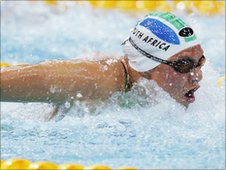
Du Toit is one of Paralympic swimming’s best-known figures
|
Claire Cashmore and Louise Watkin won two silvers apiece – Cashmore in her breaststroke race behind Paralympic champion Olesya Vladykina from Russia and Watkin behind South African great Natalie du Toit in the medley before they linked up with Stephanie Millward and Ellie Simmonds in finishing second to the USA in the 4x100m freestyle relay.
Du Toit, 26, who has won nine Paralympic gold medals over her career and competed in the open water event at the Beijing Olympics, also revealed to BBC Sport that she will retire after the London 2012 Paralympics.
“I’m going out in 2012 so I want to compete in the Olympics and also swim and medal in all the events I can in the Paralympics,” she said.
“I know that in the backstroke and breaststroke events I won’t win the gold but to go out in all seven races I can is a challenge for me, but hopefully I can do it.”
The British men’s 4x100m freestyle relay team took bronze behind Australia and Brazil in their race.
BBC News – “I recovered from ‘locked in’ syndrome”
A woman who recovered from ‘locked in syndrome’ says she was determined to get better for her children.
Kerry Pink was paralysed and unable to speak for 18 months, but she was able to hear what was going on around her.
When doctors told her husband she was going to die, Mrs Pink told Stephen Nolan on BBC Radio 5 live Victoria Derbyshire show that she wanted to tell them: “I’m going nowhere, I’m going home, I’m going to be with my babies”.”
Locked in syndrome” is a condition where a patient is conscious, but totally mute and paralysed apart from eye movements.
Vodpod videos no longer available.
Wheelchair User Carried Up And Down Snowdon
A former hill walker with multiple sclerosis has been carried in his wheelchair up and down Snowdon, Wales’ highest mountain.
Martin Williams, 52, said it was all worth it after about seven hours’ slog.
He took on the challenge with his team of supporters 15 years after he was diagnosed with the neurological condition.
Mr Williams, from Cardiff, now wants to repeat the feat on Scotland’s highest peak, Ben Nevis, in September.
The 16-strong team took turns to carry the wheelchair, working in groups of four during Saturday’s ascent and descent.
“They were changing over very frequently to make sure everything was OK,” said Mr Williams.
The journey up took about 3 hrs 25 mins, while the trip back down was a few minutes longer.
“That was far less than we anticipated,” said Mr Williams. “It was absolutely superb and well worth doing.”
He set himself the task because he wanted to show that disability was no bar to the outdoors.
Mr Williams, who lives at the Leonard Cheshire home, Dan y Bryn, in Radyr, also hopes to raise money for a charity providing disability care, and is on course to raise a couple of thousand pounds.
He said he was determined to break down obstacles for people such as him.
“You put a barrier in front of me and I’ll jump around it if I can,” he said.
Another mountain he is aiming to scale is Scafell Pike in England, which would give him the three highest peaks in the UK.
Record Breaking Win For Ellie Simmonds
Paralympic champion Ellie Simmonds added the 400m freestyle world title to her honours on the opening day of the IPC World Championships in Eindhoven.
Simmonds improved her own S6 world record by almost four seconds with a new time of five minutes 27.64 seconds.
“I’ve been training hard but to come here and break a record by four seconds is really good and I’m delighted,” she told BBC Sport afterwards.
“I just wanted to go out as hard as I could and I did that.”
Natalie Jones finished third behind Simmonds in 5:55.94 to help the Great Britain team to a total of 10 medals on the first day of the six-day event.
The 11-time Paralympic champion Dave Roberts of Wales suffered a surprise defeat in his 400m freestyle event, finishing second to Croatia’s Mihovil Spanja.
Spanja took control of the race and Roberts was unable to chase him down with the Croatian also beating the Welshman’s old world record clocking a time of 4:47.39 with Roberts finishing in 4:48.11 and Jonathan Fox in third
Roberts, who has had some injury problems over the past 12 months, was left disappointed by his performance, despite recording a personal best in his S7 category.
“I let Spanja get away and it was a schoolboy error. I’m frustrated because I know I’m better than that,” he said.
“I lost control of the race and as soon as you do that it is hard to get it back. It was tactically naive and to come second hurts but you live and learn.”
There were also silvers for Matt Whorwood in his S6 400m freestyle and Fran Williamson in her 50m freestyle.
Thomas Young (S8 100m backstroke and SM8 individual medley), Stephanie Millward (S9 100m butterfly) and Jim Anderson (S2 50m freestyle) all claimed bronzes.
Using Personal Budgets For Pleasure
I’m not quite sure what to think of this article:
One local authority is using its budget to pay for the services of a prostitute in Amsterdam, while others have said visits to lap dancing clubs are permissible under new policies which transfer funds directly to those who receive care from social services.
Holidays abroad, subscriptions for internet dating and driving lessons have all been funded by the taxpayer under a national initiative introduced by the last Government.
The £520 million scheme promised to give elderly people and those with disabilities more control over the care they received, by passing on cash so individuals could choose the services they needed, such as home help, or mobility aids.
An investigation by The Sunday Telegraph can disclose that exotic holidays, internet dating subscriptions and adventure breaks, as well as visits to sex workers and lap dancing clubs have been permitted under the system.
One local authority has agreed a care plan including payment for a 21-year-old with learning disabilities to have sex with a prostitute in Amsterdam next month.
His social worker, who spoke on condition of anonymity, said social services were there to identify and meet the needs of their clients – which, in the case of an angry and frustrated young man, meant paying for sex.
Another care worker said staff at her council had been told that trips to lap dancing clubs could be funded, if it could be argued that it would help the “mental and physical well being” of their client.
In response to Freedom of Information (FOI) requests, four local authorities describe themselves as “condoning” the payment of sex workers by disabled clients, using money transferred from their budgets.
Other councils said they took no moral judgement about the use of funds, but said care money could be spent on anything, as long as it was not illegal.
Paying for sex is not against the law but soliciting sexual services, kerb crawling and paying for sex with women who have been coerced into prostitution is.
In Greater Manchester and Norfolk, councils say payments to social care clients can be used to pay for internet dating subscriptions.
In the course of 12 months, one man with mental health problems from Norwich received a holiday in Tunisia, a subscription to an internet dating site, driving lessons, and expensive art materials.
Department of Health documents describe how the man received the funding on top of his state benefits, after suffering from psychiatric problems when his wife asked for a divorce.
In the report on his case, the man says he needed “some time out, some rest and a change of scenery” after suffering marital problems and says the break in Tunisia with a friend was cheaper than a week in institutional care.
Trafford council, in Greater Manchester, says its budgets cannot be spent on anything illegal, or anything that would bring the council into disrepute. It suggests personal budgets could be used for holidays, adventure breaks, subscriptions to dating agencies, horse riding or to buy a pet.
The FOI survey, by The Outsiders and TLC Trusts – two groups which campaign for the sexual rights of people with disabilities – found most local authorities said they did not “condone” transfer of their funds to pay for sex.
But of 121 councils who responded, 97 per cent said they had no policy on the topic, allowing discretion for social workers and junior managers about how to manage such requests.
Several councils contacted by this newspaper said they did not know if they had ever funded visits by disabled people to sex workers.
Stockton-on-Tees borough council said it did not think it had funded sex workers for clients. A spokesman said people “in receipt of our care can do whatever they wish, though we would not condone or be involved in anything illegal”.
A spokeswoman for Knowsley council said requests for funding to access sexual services would be “looked at on a case by case nature”.
Doncaster council said that so far it had not funded any requests for sexual services, but said future decisions would depends on the needs of the individual.
Norfolk county council said it did not believe it had funded any visits to sex workers, but Di Croot, assistant team manager for learning disabilities in North Norfolk said such requests would be looked on “favourably” with staff encouraged to be “as free thinking as possible” about how to ensure all the needs of clients were met.
Zoe Grace Cozens, who wrote the council’s policy on learning disability and sexuality, said the authority also had a duty of care to ensure that those with learning disabilities were not being exploited financially, if they paid for prostitutes from their own money.
“That could mean care workers phoning to check what rate sex workers were charging,” she added.
Belinda Schwer, a legal consultant who advises councils, said many local authorities agreed support plans for clients which did not specify how funds would be used, once they passed out of their hands.
“From what I have seen, at least one quarter of local authorities are doing support plans which only state what outcome should be achieved – not which services are being employed.”
In the case of someone given funds to go to a sex worker, such documents might set out an intended emotional outcome, rather than the means by which it was achieved, she suggested. “If you have got a happy and calm person who was previously frustrated and angry, that might achieve a good outcome, but the case law says councils should be setting out which services are being used,” she said.
Neil Coyle, director of policy at Disability Alliance, said most people with disabilities did not want or expect the state to pay for sexual services.
He said: “When people go to councils for help, they are looking for essential services to maintain some level of dignified existence – help to dress and wash. Given that councils have been drawing the most basic support from those who need it, I do not think this is the biggest concern of people with disabilities.”
Liz Sayce, chief executive of disability network Radar, said the desire for sexual relations was a matter of human rights, meaning cases involving payments should be carefully examined on a “case by case” basis.
Matthew Elliot, chief executive of The Taxpayers’ Alliance said it was “deeply worrying” that public money had been spent on the services of prostitutes, lapdancing clubs and to pay for holidays.
He said: “Many taxpayers will be appalled and offended that money intended for social care has been used in this way. What’s more, it’s deeply worrying that this scheme has been so vulnerable to these abuses. It’s essential that where public funds are involved, there are the sort of checks and balances in place that prevent money being wasted in this way”.
A small part of me can understand what Matthew Elliot is saying. He is, after all, hopefully not disabled. To him and many other able bodied taxpayers, ‘social care’ means only driving, washing, bathing, cooking etc. The thought that disabled people actually want a social life too, or that we actually understand what romance and sex are, is probably too surprising for him to have twice.
However, another, bigger part of me agrees with Liz Sayce’s view. As long as the disabled person is able to understand exactly what is going on, why should they not be allowed to use their personal budgets for anything they like? As I’ve said before on Same Difference, disabled people have all the same romantic feelings as everyone else. If they wish to act on these feelings, why shouldn’t they? They can’t help having their disability. They can’t help the fact that their disability stops them working and makes them live on state benefits, or as mainstreamers prefer to call it, ‘taxpayers’ money.’ If they were able to earn and wanted to go to Amsterdam, who would stop them?
If one of the ‘many taxpayers’ that Matthew Elliot refers to became disabled tomorrow, would their sexual feelings suddenly disappear? I sincerely doubt it- nor would anyone expect them to. If they had a disabled child who became a teenager and expressed romantic and sexual feelings, would they then be ‘appalled and offended’ and think twice about spending that child’s state benefits for anything that gave their child pleasure? I sincerely hope not.
Have these ‘many taxpayers’ ever thought that if more people considered having romantic relationships with disabled people, maybe then we wouldn’t need to consider paying for our romantic pleasure at all!
World Blind Football Championship 2010
For those of you who are interested in following the world Blind Football Championship, the event’s official site with news and results is here.
BBC SPORT | Other sport… | Disability Sport
South African Paralympic star Oscar Pistorius sets a new 400m world record at the Diamond League meeting in London.
Vodpod videos no longer available.
BBC SPORT | Other sport… | Disability Sport
David Weir just misses out after a enthralling battle with Switzerland’s Marcel Hug in the T54 1500m at the London Diamond League meeting at Crystal Palace
Vodpod videos no longer available.
Easyjet Disabled Passengers Inquiry Planned
France’s Transport Minister Dominique Bussereau, has called for an inquiry into allegations that low-cost airline Easyjet barred disabled passengers from flying unaccompanied.
He ordered the move after reports that Easyjet had refused to fly disabled passengers on safety grounds.
They were told they must be accompanied by another passenger in order to board the plane.
Easyjet said they were simply complying with safety regulations.
“European safety regulations require that all passengers are able to evacuate an aircraft within 90 seconds and therefore we require that some passengers with reduced mobility have a travel companion,” a spokesman for the company said.
“We are already in discussion with the French government to find a workable solution for our passengers without compromising safety.”
‘Severe sanctions’ threat
On the airline’s website, it says it that unaccompanied disabled passengers must be “self-reliant in emergency and evacuation situations”.
“In reality, this means that you should be able to undo your own seatbelt, put on your own oxygen mask, lifejacket and make your own way to your nearest emergency exit unaided.”
In a statement on the French transport ministry’s website, Mr Bussereau said the airline should not be allowed to “hide behind safety regulations”.
“It must implement solutions adapted to each case, as most companies do. Otherwise it must be sanctioned with the greatest severity,” he said.
Mr Bussereau has asked the French civil aviation authority DGAC to conduct the investigation.
Britain’s top disabled swimmers, including Ellie Simmonds, Stephanie Millward and Charlotte Henshaw, will be looking to continue their build-up to the London 2012 Paralympics at the IPC Swimming World Championships which begin in Eindhoven on Sunday.
Vodpod videos no longer available.
Sister Anger At Carer Theft From Disabled Man
The twin sister of a disabled man whose care worker stole £56,000 from him and another young man says she is angry she got away with it for so long.
Yolande Howells, 40, from Gorseinon, near Swansea, is beginning a two year jail term after admitting fraud.
Merthyr Crown Court heard the care company manager in Rhondda funded a luxury lifestyle of Caribbean cruises, cars and clothes with the cash.
Julie Williams said it had been an “absolute nightmare”.
Her brother Anthony, 49, who has Down’s Syndrome had £22,000 stolen.
She sad: “(I’m) very, very angry that she got away with it for so long.
“I’m just relieved now that it’s all over as it has been an absolute nightmare for the past 12 months.
“Especially after finding out she could actually do something to vulnerable people, and especially my brother.”
Merthyr Crown Court had heard that Howells, who had been a regional manager for healthcare firm Shaw at a complex in Treorchy, Rhondda, was a “compulsive spender”.
Prosecutor Rachel Knight said: “Howells spent the money on cars, catalogues, clothes – she had a compulsion to buy anything.
“Although she helped herself to tens of thousands of pounds from the two young men she was still in debt at the time of her arrest.”
Howells took £22,000 from Mr Williams, and another £34,000 from the second man after making them write cheques.
She forged Julie Williams’ signature on the cheques.
The court heard one of Howell’s colleagues suspected something was wrong and raised his concerns with the Cardiff-based care company.
Howells resigned before her arrest after suffering a breakdown from the “guilt” over the missing money.
Judge John Curran said Howells had been “deliberately and persistently deceptive”.
After the case Julie Williams said: “I realised something was wrong and went through the bank statements which I then passed onto her bosses.
“She is meant to be a professional carer not a thief stealing from the vulnerable. I’m just glad in one way that Anthony isn’t aware of what has gone on.”
A spokesman for Cardiff-based Shaw healthcare said police were called in after fears were raised about Howell’s spending.
He said: “The welfare of vulnerable people in our care is, and remains, our highest priority.
“We totally condemn any actions that undermine the trust between service users and our employees.”
Wheelchair User Left In Busy Road
I completely agree with the policeman!
Two young boys pushed a wheelchair user onto a busy road before running off and leaving him there.
The man, who has cerebral palsy, was approached by the boys who switched off his electric wheelchair.
They then pushed him onto Dundee Street, close to Edinburgh’s Fountainpark leaisure complex.
The incident happened at 1615 BST on Wednesday. The suspects are said to be about nine or 10 years old.
Members of the public who saw what had happened helped the victim get back onto the pavement.
The boys were described as being white and wearing jeans and t-shirts.
A police spokesman said: “Officers are keen to speak to anyone who was in the area and witnessed the incident to come forward.
“What these boys did was not only extremely cruel and insensitive, but incredibly dangerous.”
Charities Could Be Included In Cameron’s ‘Big Society’
The voluntary sector could offer “gain without pain” to councils and NHS agencies if it was entrusted with the care and support of more disabled people, a report suggests.
Millions of pounds of savings could be made by charities already responsible for care contracts worth more than £1bn a year, according to the report by the Institute of Public Care at Oxford Brookes University.
However, the umbrella body that commissioned the report is warning that many council and NHS commissioners must change their attitudes, and embrace a culture of collaboration with the voluntary sector, if the full potential for savings is to be realised.
Bill Mumford, chairman of the body, the Voluntary Organisations Disability Group, said: “The cuts in public spending make it all the more necessary to find new ways of working and we need the public sector to work with us, not against us.”
The report studies 10 examples of care and support being taken over by voluntary groups and made both more cost-effective and more innovative and personalised.
In one case, the Papworth Trust was found to have saved £385 a week for each person with a learning disability who was moved from long-term NHS care into their own homes in Suffolk and Bedfordshire.
In a second case, the charity MCCH was found to have achieved net savings to the public purse of £117,000 a year after it took over and modernised services for learning disabled people in Bexley, south London,
The highest potential savings identified were in Bath and North East Somerset, where Neurological Commissioning Support, a joint venture of the MS Society, Motor Neurone Disease Association and the Parkinson’s Disease Society, has worked with state agencies to improve end-of-life care. In one instance, at-home care for people with motor neurone disease who have breathing difficulties is costed at £1,000 each a month, compared with £45,000 a month for unplanned hospital treatment.
Mumford said the report chimed with the spirit of the “big society” being encouraged by the coalition government, cutting bureaucracy and costs while responding creatively to people’s needs.
“David Cameron says building the big society is his great passion. My passion is showing how the voluntary sector can be central to this vision and how, in spite of the financial crisis, disability charities can provide imaginative, cost-effective services that do what service users ask of them. Gain can be achieved without pain.”
Significantly, the report is endorsed by the Association of Directors of Adult Social Services, representing local authority social care commissioners.
In a foreword, association president Richard Jones says: “The journey we are on in terms of transformation is a shared enterprise and requires all of us to collaborate and learn if we are to achieve reform and avoid retrenchment. More of the same will not work.”
This is just a quick post to plug this article by my good friend, the journalist, Disability Rights campaigner and special parent, Preethi Manuel.
The article is about the UK’s ‘reservations’ on Inclusive Education. Please take a few minutes to read it, especially if you are interested in this topic.
Where’s The Benefit?
Where’s The Benefit is a brand new group blog about disability benefits. It’s run by some DisAbled bloggers who all have experience of claiming disability-related benefits. All of them are scared of what the upcoming ‘cuts’ will mean for disabled people and their families.
Please drop in on them and share your thoughts and experiences of disability benefits.
This week, Channel 4 began its search for disabled presenters for their coverage of the Paralympics and have discussed the increased profile of their disabled onscreen talent over the past year. I’m one of them, having been diagnosed with multiple sclerosis not long after I joined Channel 4 News as technology correspondent.
Even though most of the time, our viewers will have no idea of my disability, how best to handle it on screen and off has been a gradual and sometimes difficult learning process. I imagine similar situations have occurred for most disabled presenters.
As I was diagnosed just a few months into my stint on Channel 4 News, ITN (which makes Channel 4 News) responded with caution. At first they weren’t sure if I should write about my diagnosis and so in many ways it was quite hidden.
This was because they wanted me, a relative newcomer to broadcast news to be known as a credible technology journalist, not a disabled journalist. In a sense, this is the trap that the new Channel 4 disabled presenters could encounter: are they there because they are excellent onscreen performers in their own right, capable of presenting mainstream programmes, or there in a tokenistic fashion?
Because I was diagnosed after joining, I know I was hired because I was the best person for the job, not to fill a quota. (Although I had disclosed to ITN I had suffered an MS-like attack in the past.)
We struggled with how to deal with the physical manifestation of MS on screen, primarily with a view on the aesthetics. When my hands didn’t function very well, my fingers would get stuck together and my hands shook involuntarily when I was live in the studio. A viewer actually phoned in to complain, saying it was distracting and that given I was explaining quite a complicated story, I shouldn’t be allowed to be in front of the camera. We listened to the feedback, but decided the suggested approach wasn’t the right one.
When I was struck by optic neuritis, effectively leaving me partially sighted in my left eye for about six months, I found it easiest to deal with it by wearing a black eye patch over the eye – which blocked the blurred and painful mess I saw when I looked through it. When I was reporting on location, it was pretty easy to take it off momentarily to record my “piece to camera”, but the problem was much worse in the studio where I’m normally on camera for a couple of minutes with particularly bright lights.
On a particular day, I was supposed to be appearing live in the studio to discuss bank charges. There was no plan of what to do about the eye patch. Should I wear it? If so should we make reference to it? Would viewers be so distracted by a reporter wearing a patch that they’d miss what I was supposed to be explaining? Would I be comfortable with revealing my disability on screen?
In the end, after discussing it with the director, programme editor and item producer, we made the decision that I wouldn’t wear the patch on screen. We put the viewer first – and the focus on the content and substance of the report – and while no harm was done, I think if we were to encounter the same scenario again then perhaps we would feel differently. We’ve seen CBBC hire a disabled presenter, Cerrie Burnell, and despite claims her disability (she was born without a right hand or right forearm) was scaring children, it is unquestionably good for young people to have disabled role models and see beyond perceived physical deformity.
A lot has changed from when I was first diagnosed. I asked a now departed senior producer if it would matter if I was to end up in a wheelchair. Would I still be allowed to be on screen? “We’d need to think about that if it came to that,” was the reply. It was incredibly depressing because with the exception of Frank Gardener (also disabled after hiring), there’s no network news correspondent in a wheelchair.
The answer to my question would certainly be different were I to ask it now. These instances show that it’s been a learning curve for me, my bosses and for many people in the newsroom. I don’t think we’ve made the right call every time, but we’ve certainly worked hard to find the right balance on meeting our audience’s expectations without shying away from being open about my disability.
Aside from Gary O’Donoghue there are no other disabled news presenters I know of. But perhaps that’s because no one has gone out searching for one. Channel 4 News used to have a disabled trainee scheme and the addition of those trainees and me (and another fellow MS sufferer) in the newsroom has given the programme a different perspective of disability, the NHS and the benefit system. It has allowed us to better reflect a society where there are over 10 million disabled people.
What Channel 4 are proposing on paper is a good idea; we need to have more disabled talent on screen. So long as the talent is talented, of course – the worst-case scenario is that it becomes positive discrimination, something I’m inherently uncomfortable with.
My hope – and, I’m sure the channel’s aim – is that the initiative will allow talent with myriad disabilities, far more visible than mine, to show that audiences are sophisticated enough to see beyond “distractions” of disability and to the energy and soul of a presenter. Some amazing new talent may emerge, capable of breaking out into mainstream broadcasting, simply because Channel 4 have given them this chance. Channel 4 do have the challenge of ensuring that they do not end up ghettoising the coverage of a sporting event already watched by millions. But, unquestionably, the proposal is a positive thing, so long as these potential pitfalls are avoided.
Why The Next Paralympics Will Be The Greatest Ever
The news that Channel 4 is going to spend millions on the London 2012 Paralympics and give it 150 hours of coverage is a landmark moment. The BBC did a fantastic job of increasing the Paralympics’ profile, but it usually ended up on BBC2 – second fiddle to the Olympics. I only found out about the Paralympics when I was 14 – before then I didn’t know it was possible for someone in a wheelchair to compete in a global sports event. The C4 coverage will forever change the way people look at the competition.
Over the next two years they are going to bombard the public with quality programming about the athletes themselves, which will help the public to get to know people like David Weir, one of our best wheelchair atheletes. This year he did the marathon in an hour and 37 minutes – nearly 30 minutes faster than the able-bodied men’s world record.
Great Britain has got a really good history in Paralympic sport. We’re definitely in the top two. I think the men’s basketball team is one of our best opportunities to win a gold. Gaz Choudhry, Jon Pollock and Ian Sagar will be key. In women’s basketball there’s Helen Freeman, who is only 19, and I think she’s going to make a huge impact.
Having competed in two Paralympics, I’m concentrating on my broadcasting work for Channel 4. When I was growing up, there weren’t any black presenters on television, let alone ones with disability. It’s brilliant that 50% of the Paralympic presenters will be disabled. If you watch Match of the Day, you’re going to listen to what Gary Lineker has to say because he’s an ex-footballer. Why shouldn’t former Paralympians be doing the same?
• Ade Adepitan is a wheelchair basketball player and TV presenter. That Paralympic Show starts on 28 August on Channel 4
Leeds Man Calls For Better Cinema Seating For Disabled
A man with muscular dystrophy and his mother are campaigning for better seating for disabled people in cinemas.
Christopher Beaumont, 21, who uses a wheelchair, was told he must move from the end of an aisle at a Vue cinema in Leeds because of fire regulations.
His mother Lynne said they had been sitting there because her son could not see the film properly from the disabled seating area.
The cinema has apologised, but said it must comply with fire regulations.
Ms Beaumont said when they went to watch a film at the cinema on Kirkstall Road they had originally sat in the disabled area, but her son had to turn his neck to see the screen.
‘Very angry’
Because of this, they moved to the end of an aisle. they were then told by a member of staff that they had to move because they were a “fire risk”.
Ms Beaumont, 53, said: “It was ridiculous, given that the cinema was almost empty.
“I was very angry. My son had paid full price for that ticket and so he should have been able to see the film properly.”
Ms Beaumont and her son are now seeking advice from the Equality and Human Rights Commission.
Steve Knibbs, chief operating officer for Vue Entertainment, said they had written to Ms Beaumont and her son “to apologise for any upset or frustration caused by the experience”.
He added that they must comply with fire safety regulations.
“We are investigating both Vue sites in Leeds to ensure we are providing the best possible experience for all of our customers.”
David Cameron On Carers
From PM Direct in Manchester yesterday:
2.38pm: A father with two grown-up disabled children asks about support for families like his.
Cameron thanks the father for what he does. He says some severely disabled children do not grow up. Sadly, his lovely disabled child died, he says. But now more disabled children are growing up. If parents give up, the state will have to pay for everything. Cameron says that if parents could get just a fraction of the money the state would have to spend if it took full responsibility for their children, they would find it easier to cope.
He offers to help the father “bash down the walls” so that the social workers listen to what he wants. (The father complained that he was not getting the support he required.)
I saw this bit live, and I’m sure I heard him say that disabled children are now living too long for the state to cope with. Please correct me if I’m wrong- I’d love to be wrong on this one.
The question is if medical improvements are allowing more of us to grow into adulthood, why shouldn’t the state do everything they can to support us and our parents for as long as we live- which, unfortunately, still isn’t nearly long enough.
This is 21st century England, where medicine has improved beyond recognition. It claims to be a developed country. This is allowing able-bodied elderly people to live longer. No one seems too surprised about that. So why do they seem so surprised at the thought that disabled children might just grow up after all? Surely we deserve to live for as long as possible just as much as anyone else does- don’t we?
Tragically many disabled people in England still die far too young, but surely the state doesn’t set its age limits on our support services by the expectation that we will all be dead before we reach them, anyway? If they do, I’m really and truly scared.
I’d say I want to leave the country if that’s true, but where else can I go? Who wants me to be alive now that I’m over 18? If a country that claims to be developed has a state system that works on such thoughts, then is there anyone left, anywhere, who will support me and my family enough to allow me to lead the life I deserve for as long as possible?
Brain Scan Test For Adult Autism
A brain scan that detects autism in adults could mean much more straightforward diagnosis of the condition, scientists say.
Experts at King’s College London said the test identified tiny but crucial signs of autism, only detectable by computer.
Current methods of diagnosis can be lengthy and expensive.
But some experts say further research will be needed before the new technique can be widely used.
Autism Spectrum Disorder affects an estimated 1 in every 100 adults in the UK, most of them men. It varies from mild to very severe, and people with the condition can find the world appears chaotic and hard to understand.
Conventional diagnosis involves a team of experts who analyse behaviour and make a complex series of assessments.
The Medical Research Council study looked at 20 healthy adults and 20 adults with Autism Spectrum Disorder (ASD).
They were initially diagnosed using traditional methods, and then given a 15 minute brain MRI scan. The images were reconstructed into 3D and were fed into a computer, which looked for tiny but significant differences.
The researchers detected autism with over 90% accuracy, the Journal of Neuroscience reports.
“What the computer can do very quickly is to see that a patient has autism,” said Professor Declan Murphy from the Institute of Psychiatry, who supervised the research, “even though their brain, to the naked eye, looks very normal.”
Dr Christine Ecker, who led the study, said she hoped the findings might result in a widely available scan to test for autism.
“It could help to alleviate the need for the emotional, time consuming and expensive diagnostic process which ASD patients and families currently have to endure,” she said.
Once a patient has a diagnosis, he or she is able to access help and support with managing the condition.
Visible confirmation
Joe Powell was diagnosed with Asperger’s syndrome, a form of autism, 14 years ago. Before his diagnosis, he didn’t speak at all.
Since then, he says he’s made big progress in managing his condition.
His brain scan confirms his ASD. He says seeing his diagnosis charted in black and white made a big difference to him.
“You need to physically see it,” he says.
“I know the autism is still there. The progress I’ve made in managing my condition is real, but it’s still there.”
The research team is now looking at whether the test would be effective on children.
Nicholas Joy describes what an Asperger’s diagnosis meant for his health and treatment
The findings have been welcomed by the National Autistic Society, who say they add to the understanding of the condition. They say adults can find it very difficult to get a diagnosis of autism, and this may help.
However, they say without more awareness among doctors, it may be of limited use.
“There’s still a woeful lack of awareness in GPs’ knowledge of autism,” said NAS centre director, Carol Povey.
“People with autism are often dismissed when they go to their GPs for help, so we have to make sure front-line professionals have awareness of autism so they can make appropriate referrals.”
Professor Uta Frith from UCL Institute of Cognitive Neuroscience, said much more work would be needed before the scans could be used for diagnosis. “This study shows that the subtle brain abnormalities associated with autism show a distinctive pattern,” she said. “It is crucial that we learn more about what the brain abnormalities mean.”


