
With many thanks to Benefits And Work.
The Labour Party is knowingly hugely discriminating against women by using its 4 point or higher rule to reduce the number of personal independence payment (PIP) awards. Currently, daily living component award rates for males and females are just 0.7% apart, but from November 2026 under Labour’s plans, 32% of male claimants are likely to get an award, compared to 25% of female claimants, a ten times greater difference
The shock effect of the proposal that only claimants who get 4 points or more for at least one PIP daily living activity will be eligible for an award was revealed in the response to a Freedom of Information Act request by Winnie Clark.
The DWP’s answer shows that, of those who currently receive an award of the daily living component of PIP:
1,307,000 are male, of whom 39% (507,000) are awarded less than 4 points in all daily living activities.
1,584,000 are female, of whom 52% (818,000) are awarded less than 4 points in all daily living activities.
If these claimants all receive the same points scores on review, it will mean that the number of awards to males will reduce by 509,730 whilst the number of awards to females will reduce by 823,680.
The result will be that instead of 277,000 more women than men being in receipt of PIP, when all the reviews are completed 800,000 current male claimants will still be getting PIP daily living whilst only 766,000 women will have an award.
Male PIP awards will outnumber female awards for the first time.
According to the DWP’s StatXplore tool, at present award rates by gender are almost identical:
Male: 47.77% of claimants get an award of the daily living component.
Female: 47.08% of claimants get an award of the daily living component.
This is a difference of 0.7%
But from November 2026:
32% of new male claimants are likely to get an award of the daily living component.
25% of new female claimants are likely to get an award of the daily living component.
This is a difference of 7%, ten times larger
So, any MP who votes in favour of Labour’s 4 point rule will knowingly be creating a benefits system that puts disabled female claimants at a very significant disadvantage compared to disabled male claimants.
It would be a shocking outcome for any MP to choose to support.
A garden inspired by a young boy from Dumfries and Galloway has won a RHS Silver Gilt medal at this year’s Chelsea Flower Show.
Scottish-based designers Duncan Hall and Nick Burton said they were “over the moon” to be presented with the award for the “Down’s Syndrome Scotland Garden”, which was inspired by Hall’s eight-year-old nephew Liam.
The designers said the garden aimed to celebrate the joyful, unique qualities that people with Down’s syndrome bring to society while highlighting some of the daily challenges and barriers they face.
It will be on show in London until 24 May before it is relocated to its permanent home in Palacerigg Country Park in North Lanarkshire.Media caption,
Liam inspired the garden at Chelsea Flower Show
Designed for the Scottish charity Down’s Syndrome Scotland, the garden is part of a collection of show gardens being displayed at the prestigious flower show.
Hall said his nephew Liam was the perfect inspiration for the garden.
“He’s full of joy, compassion, he’s very affectionate and encapsulates all the things in our garden that we are trying to express,” he said.
Hall and Burton said the garden incorporates a weaving path that takes visitors to two distinct areas reflecting the contrasting moods of calmness and playfulness.
On this path, a water pool appears to be a barrier to progress, symbolising the daily challenges faced by people with Down’s syndrome.
However, a submerged bridge within the water pool allows the ‘barrier’ to be overcome and allows visitors arrive at a welcoming shelter designed to look and feel like a warm and comforting ‘hug’.
The ‘hug’ has been designed to reflect the compassion, kindness and joy that comes naturally to so many people with Down’s syndrome, the designers said.
Hall and Burton said they where delighted to win their first silver gilt medal, and hoped visitors would take a moment to look a little closer and see the deeper meaning behind what the garden stands for.
Hall said: “We hope our garden will allow people to reflect on the daily challenges faced by people with Down’s syndrome, so they can reconsider misconceptions about their abilities, and appreciate the many joyful, positive qualities they bring on a greater level to society.”
Eddie McConnell , the chief Executive of the charity Down’s Syndrome Scotland, said: “Duncan and Nick have captured the spirit of people with Down’s syndrome brilliantly in their garden design while not shying away from some uncomfortable truths.
“People with Down’ syndrome, like so many disabled people, still face prejudice and discrimination and that needs to stop.”
Inkfire
When Imali Chislett set up a marketing agency in 2018, she never imagined it would turn into an award-winning champion of workplace inclusion.
All she knew was, as a wheelchair user and living with chronic illness, the traditional workplace was not for her.
Ms Chislett and her husband, Cameron, launched Bournemouth-based Inkfire, which claims to be the UK’s first disability-led marketing and tech agency.
As part of its services, it has helped more than 200 businesses embed inclusivity into their operations.Media caption,
Inkfire is entirely staffed by people with disabilities and chronic illnesses
“I had some really terrible experiences, as did my husband, in the workplace,” said Ms Chislett.
“We both realised that traditional nine-to-five working didn’t suit us. We knew we needed something different and tried to build jobs that worked for us.
“In doing that, we had so many positive conversations where people said ‘we need this too’.
“We didn’t fully perceive how far it would get at the beginning but it has developed and morphed into this incredible space that we have now.”
Last month, Inkfire was named winner of the Inclusive Workplace Experience category at the Disability Smart Awards, hosted by the Business Disability Forum.
The award recognises small organisations that value the health and wellbeing of workers and have inclusive practices.
Ms Chislett said: “Our entire team have disabilities and chronic illnesses and everybody has lived experience, so we very much bring that knowledge to the table when we approach work.
“It’s good to show businesses that this is what you can achieve.
“Our message is, talk to people with disabilities, find out how you can help.
“Don’t guess what somebody will need because we are here and more than happy to chat.”
Shoes Designed For People With Foot Drop
Jeanette Russell has never been more delighted with a new pair of shoes.
They were created by a skilled designer but they are not the latest in high-end fashion.
The shoes have been specially designed to stop Jeanette falling over – and they are life-changing.
The black boot-like creations are for people like Jeanette who suffer from foot drop, a condition caused by her MS that makes it difficult for her to walk unaided without tripping or falling over.
“I just put the boots on and I can drive, I can do the gym I can go hill-walking,” says Jeanette.
“I can walk over terrain that is really rough and can walk normally down the street with confidence and strides, when before I had a rolling gait which gave me a really sore back.
“I haven’t had any falls since I’ve been wearing the shoes.”
Foot drop, which is also known as drop foot, affects many people who have conditions affecting the nervous system, like MS or cerebral palsy, or people who have had a stroke.
They struggle to keep their toes lifted, making walking difficult and tiring. As a result, they are more likely to fall.
Now researchers at Queen Margaret University (QMU) in Edinburgh have invented a shoe which they hope will tackle this problem by providing the right kind of support to the foot, keeping the wearer upright and safer.
Prof Derek Santos is one of the QMU researchers who designed the shoe.
He says the concept is quite simple but very effective. The use of adjustable Velcro straps helps the shoe to fit each user and support at the ankle.
“You can adjust the elastic depending on your disability,” he said.
“If you have a weaker muscle or a totally paralysed muscle you can actually activate the elastic to compensate for these things.
“You can also tighten the elastic more on one side than the other.
“If you have a foot that inverts, sometimes people tend to trip over, so the boot will actually put your foot in a much better position by simply adjusting the tension in the elastics.”
The research team believe the new footwear could improve the wearer’s walking and prevent hundreds of thousands of falls in the UK.
But as it is a global problem, Dr Kavi Jagadamma, senior lecturer at QMU, says they want to help people around the world and adapt the shoe to individual needs.
“We are particularly interested in developing simple designs like sandals where this could be integrated for people in hot countries or people living in low income countries, where people can’t afford expensive boots,” he said.
“The simple sandals might be more accessible and also culturally more normal to wear. So that’s our ambition going forward.”
Professor of physiotherapy Cathy Bulley is also part of the QMU research team. She says the fact that it looks like a normal piece of clothing is a big advantage.
“We felt we needed another option for people that was more comfortable to wear, easier to put on and generally that people are more likely to keep using.
“We’ve been working on the clever but low-tech solution.”
Jeanette, a former army nurse, says her physical confidence has been restored by the shoe. She has even been able to return to the challenging hill-walks she loves.
“I’m looking forward to getting a hiking boot in this design so I can get up Ben Nevis.
“I’m also hoping to be marching past the cenotaph this November, with pride in my boots. “
What causes foot drop?
Foot drop – or drop foot – usually affects one foot and can have an impact on a person’s ability to walk.
It can be a temporary condition that may get better on its own or with treatment, but for some people the condition is permanent.
It can be caused by damage to a nerve that runs down the leg making it difficult to lift or move the foot and toes, often from a sports injury, slipped disc in the spine, lack of movement, or nerve problems caused by diabetes.
According to the NHS, less common causes of foot drop include:
- inherited conditions like Charcot-Marie-Tooth disease
- muscle weakness caused by muscular dystrophy, spinal muscular atrophy or motor neurone disease
- damage to the brain or spinal cord caused by a stroke, cerebral palsy, Parkinson’s disease or multiple sclerosis
Story Of Sign-Language Educated Pair ‘Remarkable’
The story of the first two people known to have been educated by sign language is “remarkable” and should be better known, according to the author of a book on the pair.
While this would not be unusual today, John and Framlingham Gaudy, from West Harling, near Thetford, Norfolk, were born in the mid-17th Century.
The brothers went on to be trained as artists at Bury St Edmunds, Suffolk, and at the London studio of the royal court’s favourite portrait painter, Sir Peter Lely.
Peter Jackson, curator of The Deaf Museum and Archive in Manchester and author of a book on the brothers, admitted it “really annoys” him that their achievements were so little known.
“The book I’ve written on them is the only one that I know about,” he said.
John (1639-1709) and Framlingham ((1641-1673) were born into a wealthy land-owning family, which included MPs and lawyers.
They realised the siblings, who were deaf and unable to speak, could not follow their older brothers to grammar school in Bury St Edmunds.
Instead, they turned to the well-read West Harling parish priest and teacher, John Cressener.
“A letter says he found ‘a most remarkable book’ which had a finger-spelling sign system,” said Mr Jackson, from the British Deaf History Society.
“He educated the boys alongside his own hearing sons and daughters, all educated together in his home.”
While there is evidence of deaf people being taught through lip-reading at this time, this was the earliest evidence he had found of people being educated using an early version of British Sign Language, he explained.
It proved successful and the brothers began their art training with a distant cousin Matthew Snelling, part of the artists’ colony in Bury St Edmunds.
Mr Jackson said: “When they went on to Sir Peter Lely’s studio in London, they were actually trained by George Freeman, who also had deaf daughters and knew how to sign.”
John was considered the more talented of the pair, but as he did not sign his work, there is only one painting known to have been by him.
This is a self-portrait, which the British Deaf History Society was able to acquire in 2016, thanks to a grant from the Art Fund.
It shows him as a 17th-Century gentleman, wearing an elaborate wig, with lace at his neck.
“Framlingham was more academic; he preferred to write his own letters, whereas John found it a chore,” said Mr Jackson.
“He was known for wearing a thick black coat with deep pockets in which he’d carry a piece of slate and chalk, so when he met people he could communicate by writing – lots of deaf people still use that method, but with paper and pen.”
He died in 1672 having written his own will, which was signed by a barrister.
Mr Jackson said: “It’s the first will handwritten by a deaf person that I know of in the world – there are other wills for deaf people, but they all say ‘written on behalf of’ the person.”
It was the discovery of the will that sparked the curator’s research because it was “proof that deaf people could indeed read and write before deaf education started in 1760”.
John gave up painting, except for pleasure, after he became his father’s heir, inheriting the estate in 1669 and becoming Sir John Gaudy.
Mr Jackson said: “John Cressener’s son Henry, who had been educated alongside Sir John using sign language, became his interpreter. With his support, he took two of his tenants to court and won when they refused to pay their rent.”
His son Bassingbourne inherited the estate, but it was sold after he died without an heir.
Mr Jackson spent years digging out the details from family papers held in the British Library and Norfolk Record Office, which he published in a book called The Gaudy Manuscripts.
So, why does he feel the story is so little known?
“It’s partly because John Cressener was a nobody; just a priest in a remote church in the middle of nowhere,” he said.
“I thought the story was remarkable and I think it’s a shame it’s not better known.”
Major Disability Golf Championship Tees Off
Some of the world’s most talented golfers have arrived in Buckinghamshire for the third staging of The G4D Open.
The golfers, who have varying disabilities, compete over the Duchess Course at Woburn in Milton Keynes.
Michelle Lau, who has a world ranking of 93 and plays at Cambridge Country Club, said the sport helped her become “more settled in myself as an autistic individual”.
She added while the disabilities “are how we get classed in this tournament… first and foremost it’s the golf that matters”.
The inclusive championship began in 2023 and features nine sport classes over multiple impairment groups.
About 80 men and women players, both amateur and professional, compete for three days from Thursday to Saturday across 54 holes
Ms Lau started playing golf in 2021 as she had struggled with the “social side” and noise of other team sports.
She said: “Golf really helped because it does build confidence and it is somewhere I feel I can completely be myself.
“I can stim, I can make noises, I can fidget, I can do whatever and most people understand that is how I process the world.
“The other side is it’s an outdoor sport. I have a lot of sensory issues and that makes it challenging because of the noise or temperature changes… but it’s putting myself out there and just seeing what I can do.”
Professional golfer Brad Smith, from Norfolk, said he had lost his leg after he was diagnosed with bone cancer about eight years ago.
He said he was amazed at how inclusive the sport could be, adding events like G4D showcased “how good disabled players are” and how they work around limitations.
“The world’s best players turn out and play. This is our major championship and brings the best in the world,” he said.
“Hopefully it inspires kids even adults thinking of taking up the game.”
The director of golf development at the R&A, which helps organise the event, said the life stories of the golfers were “inspirational”.
Kevin Barker added the competition provided the opportunity to change perceptions of the sport and show its inclusivity.
Players range in age from 18 to 79 and 20 countries are represented at the competition.
A handicap system is also in place.
Chris Foster, 92nd in the world, said it was “the pinnacle for disability golf, this is basically the open for us.”
“We have all been classified based on the disability we have. I’m in standing one as a through hip leg amputee, but it doesn’t mean I’m with other amputees
“It’s essentially kind of the level that it is when you wear the prosthetic.”
Guide Dog User Warns Taxi Drivers To Follow Law
A man with a severe sight impairment has issued a warning to taxi drivers telling them they have to accept guide dogs by law.
Nathan Major-Kershaw, 29, from Hull, said he had experienced drivers complaining when he had brought his dog Jackson into their cars, with one saying he could refuse to accept him as a passenger.
The BBC has contacted the taxi firm he uses for a response.
In a social media post headed “this is a message for the city’s taxi drivers”, Mr Major-Kershaw said: “If you do refuse to take a guide dog, you can, and will if it happens to me, be reported to licensing and have your licence revoked.
Mr Major-Kershaw said, when he took a taxi in Hull, the driver complained he would have to clear dog hair from his vehicle after the journey.
He said the driver told him he had the right to refuse to take him as a passenger if he chose.
The Equality Act 2010, external states taxis must carry guide dogs and other assistance dogs.
On its website, the charity Guide Dogs states, external: “If the passenger is a guide dog owner, it is a criminal offence to refuse to carry their dog or to charge extra for doing so.
“The only exception to this is if the driver has a medical exemption certificate from the licensing authority due to a genuine medical condition that is aggravated by exposure to dogs.”
Mr Major-Kershaw said he asked the taxi driver if he had an exemption certificate but he did not.
In his post he said: “If you’re going to drive a taxi, learn your legal obligations when it comes to disabled passengers”.
Mr Major-Kershaw said he had since got in touch with the taxi company which said it would talk to the driver.
Gold-Winning Paralympic Equestrian Star Dies Aged 76
Paralympic equestrian star Anne Dunham died on Sunday at the age of 76.
Ms Dunham, from Wiltshire, was a world champion rider with a career spanning 23 years.
Starting at the Atlanta Games in 1996, Ms Dunham won 10 Paralympic medals, six of them gold.
Ms Dunham had grown up with a love of horses, working in a stables from an early age, and she was determined not to give up on the sport when she was diagnosed with multiple sclerosis at the age of 27.
Ms Dunham’s Paralympic golds included five team wins between Atlanta and Rio and an individual gold in Beijing in 2008.
She won 32 major World Championship dressage medals, including 19 golds.
Ms Dunham retired in 2017 at the age of 68.
She said it had been a “hard decision”, but she knew it was right and “time to give others a chance”.
She was awarded an OBE in the same year for services to Para-sport.
‘Passion and professionalism’
Penny Briscoe, the Paralympics GB chef de mission, said in a statement: “Anne was a wonderful, dedicated and devoted member of the Paralympics GB team whom I had the absolute pleasure of knowing since 2002.
“While her remarkable achievements over 20 years in Para dressage speak for themselves, what always stood out for me was her commitment to being her absolute best and encouraging the best from those around her.
“Anne really was a team player and represented the heart and soul of Paralympics GB with passion and professionalism.
“The world of Para sport will miss her greatly and my deepest sympathy goes out to her family and friends.”
‘I Am Deaf’ Cards Issued By Police For Emergencies
A police force has issued small cards that deaf people can use during an emergency to communicate with others.
The cards from Cambridgeshire Police say “I am deaf” and are being distributed by the Cambridgeshire Deaf Association (CDA).
They have a QR code on the back that links to a video service, which offers remote interpretation via a video call.
Matthew Wheeler, from the CDA, said the cards were a “great first step” in allowing deaf people to express themselves.
He said many deaf people found it “really hard to communicate with the police and there’s a lot of barriers”.
Mr Wheeler said the card could be kept on hand in case of emergency and shown to the police, who would then understand to use the sign video service.
“You have an interpreter wherever you are, even if anything happens like a car crash or you need to ask a police officer something, you can have a conversation,” he said.
PC Jake Weldon, from Cambridgeshire Police, said the force began working with the CDA to better understand how it could support people who were deaf or hard of hearing.
“Some [people] have had really positive experiences of this, some have had more negative ones,” he said.
“We can make it easier and simpler for the police to understand this person has this need.”
Mum Who Campaigned For Cannabis Law Change Dies
A campaigner who fought for permission to treat her son’s epilepsy with cannabis has died aged 45, after being diagnosed with cancer.
Hannah Deacon’s son Alfie, from Kenilworth, Warwickshire, would have 150 seizures a week before he started taking medical cannabis.
In 2018, his family celebrated with other campaigners as the government legalised the use of the drug.
Ms Deacon’s website said: “We are heartbroken to share that Hannah Deacon died on Tuesday 6 May, surrounded by those who loved her, after a short and brutal illness.”
It added she was “remarkable, determined, tenacious, and fiercely compassionate”.
“Her fight to find treatment for her son Alfie’s rare and severe epilepsy led to a breakthrough that changed his life and ultimately changed the law.”
Nearly six weeks ago on Instagram, Ms Deacon said in order to focus fully on her health, she was stepping down as chair and trustee of Medcan Family Foundation, which works on behalf of families to access “life-saving cannabis derived medications”.
She said she was also temporarily stepping back from her responsibilities with Maple Tree Consultants, which describes itself as a group of UK medical cannabis experts, and the Medical Cannabis Clinicians Society.
Alfie became front and centre of campaigns for the use of cannabis oil when he was aged seven.
It came about when Ms Deacon petitioned the government in March 2018 after she found his condition improved when he was given a cannabis-based medication in the Netherlands, where it was legal.
In 2022, Ms Deacon said her son, then 10, had been free of seizures for two years since using medical cannabis.
The statement on her website said she transformed the lives of “thousands of patients and families, never stopping in her work to push for better access, better care, and a better understanding of medical cannabis”.
It added: “More than anything, Hannah’s most proud and important role was being a mum.”
The website also said the “devastating loss” to her partner, Drew, and children was “impossible to put into words”.

A range of stylish loungewear at best comfortable for lounging around, but stylish at the time, especially for those chronically ill girlies that want to lounge around, but still be stylish sexy and everything in between https://amzn.to/43eqW5W


https://amzn.to/42X2vbJ
The affiliate links from me being Amazon associate are back who liked them when I used to do them because I am enjoyed affiliating products for you so I thought I’d bring it back from today. You first thing of it being back is a top and bottom set, but please let me know if there is any item. You would like me to affiliate next. Otherwise I will be bringing out a range of items for you. Every week and they will be different every month. This could be things to clean your home hobbies such as arts and craft kits or clothing, shoes, jewelry, or even a handbag is


Paralympian Breaks Marathon Record On Crutches
A former Team GB Paralympian has broken the record for running a marathon on crutches in the fastest time.
David Wetherill, who played table tennis at three Paralympic Games, has used crutches every day since he was 10 due to having a bone condition called multiple epiphyseal dysplasia (MED).
Mr Wetherill, who lives in Plymouth but grew up in Torpoint, in Cornwall, completed the London Marathon on Sunday in 5:59:05, beating the previous record of 6:11:11.
He said beating the record, combined with raising money for charity, made it “one of the most beautiful days of my life”.
‘A bit dazed’
“It was unbelievable, honestly, probably the best achievement I’ve ever done”, he told John Acres at Breakfast on BBC Radio Devon.
“That sense of achievement is unparalleled it was incredible.”
Mr Wetherill said the aim of completing the race in under six hours was motivating him towards the end of the marathon.
“When I crossed the line I was a bit dazed,” he said.
“To beat it by 12 minutes in the end, obviously in the back of my mind that was driving me forward.
“The reason why we were doing this though was driving me much, much more.”
He added: “Yesterday was one of the most beautiful days of my life, if not the most beautiful.”
Mr Wetherill ran the marathon to raise money for type 1 diabetes charity Breakthrough T1D.
“I have unbelievable gratitude and thanks to everyone who has supported us,” he said.
“We have raised about £15,000 and that’s what it’s all about really and that has just blown us away.
“The time and getting to the finish line is just beyond what we could have ever dreamt.”
Paralympian Missing In Las Vegas Found – Police
A British Paralympian who went missing in Las Vegas has been found safe, police in the USA have confirmed.
Sam Ruddock, from Rugby in Warwickshire, was reported missing by friends and family after he was last heard from on 16 April.
He had travelled to the US on 13 April to watch a Wrestlemania event, with his disappearance reported to Las Vegas police on 24 April.
A statement from the force said Ruddock, who has competed in shot put, cycling and sprinting, had been “located safe”.
His friend Lucy Hatton had described his disappearance as “really, really out of character” and that she and his family were desperate for information.
Posting on social media on Monday evening, she celebrated that he had been found.



Blind Veteran Makes Candles For VE Day
“Making candles allows me to channel my thoughts and emotions into something beautiful.”
Tony Haskey has made a batch of candles to commemorate the 80th anniversary of VE Day.
The 65-year-old from Poole is selling them in aid of Blind Veterans UK, which has supported him since he became visually impaired.
“I hope that people can burn a candle, think of those who laid down their lives for us, and know that the candle is burning in their memory,” he says.
“It would be a wonderful thing for me and my heart,” he adds.
Mr Haskey has adapted his candle-making process because of his sight loss.
“I use talking scales to weigh up the fragrance, I’m using and I purchase wax in blocks of certain weights so I can cut them to the right size, consistently,” he explains.
Mr Haskey joined the Royal Marines aged 16.
But later, on an overseas operation, he felt something amiss with his vision, and a medic told him he had an incurable eye condition.
He says: “I was feeling low, I had to return to the UK alone and leave my unit and comrades behind.”
He was diagnosed with retinitis pigmentosa, a condition which worsens over time.
Retinitis pigmentosa
It is an inherited eye condition that affects the photoreceptor cells responsible for capturing images from the visual field.
These cells line the back of the eye in the region known as the retina and help with low light, peripheral vision, and seeing detail and colour.
As these cells die there is a gradual decline in vision.
More than 80 causative genes have been identified, and faults in any one of these can cause the disease.
Mr Haskey was 27 when he was diagnosed, and he says his world “fell apart”.
“I was absolutely devastated by the news,” he recalls.
“I went home from the hospital and started to contemplate what I’d been told. I got depressed and felt that was the end for me.
“The career I’d set up to do well in had come to an end. I didn’t know what job opportunities were available to me.
“I was frightened and alone.”
But Blind Veterans UK sent him to its rehabilitation centre in 1993 to learn about basic housekeeping, cooking and computer literacy skills.
He says when he arrived he was in a “deep void with no self-confidence, no self-worth and no self-belief” but that each day there was a “new beginning”.
Half of the profits for his candles will go towards the charity.
Speaking about VE Day’s anniversary, he says: “As someone who is still fortunate to be here today, I look back at the legacy that the young men and women left behind and fail to see how anyone couldn’t acknowledge their worth.
“We have our liberty today because of their sacrifice.”


British Paralympian Reported Missing In Las Vegas
Friends and family of a British Paralympian who went missing in Las Vegas are appealing for help in finding him.
Sam Ruddock from Rugby in Warwickshire, who has competed in shot put, cycling and sprinting, had travelled to the United States to watch a WrestleMania event and was last heard from on 16 April.
His close friend Lucy Hatton said his disappearance was “really, really out of character” but that he had not “been in quite the right head space” recently.
She said Las Vegas police were aware and were treating him as a missing person.
Ms Hatton said her friend, who has cerebral palsy, was a “fantastic human being” who enjoyed going into schools to “inspire the next generation”.
She said she drove him to the airport on 13 April and knew he had been staying at a hostel in Las Vegas before the big wrestling event.
Mr Ruddock was “very active on social media”, she said, so when all contact stopped on 16 April, she said “it started to raise flags”.
His mother, Fran Ruddock from Lincoln, said he normally spoke to her every day and was usually “very sociable”.
She asked anyone who might know him, in the UK or United States, to get in touch if they had information.
“Anything at all to piece together the gaps,” she said.
Along with his mother, Ms Hatton said she alerted the police in the UK and they raised the case with police in the United States and with Interpol.
She said she had also spoken to the hostel where he had been staying and was told he had not checked out, but his possessions had been left in his room.
British Cycling said it understood he had been reported missing to police in the United States and the UK.
A spokesperson added: “We urge anyone who has been in contact with Sam since 16 April or may have any information of his whereabouts to contact their local police department as soon as possible.”
Lincolnshire Police confirmed there was an active missing persons investigation.
A Foreign Office spokesperson said: “We are supporting the family of a British man reported missing in Las Vegas and are in contact with the local authorities.”

Pass the Pig Game
Played pass the pig game with Izzy before our wacky wheels group finish for Easter? She attended the group with me. Did this with blowup pigs that we threw and then whatever side it landed on it gave us a score, depending on which way it landed. Pass the pig is a great game, if any of you want to try even for those with limited hand function because the pigs are large and inflatable so will not injure anyone. Take a look at this video and see if you would like to play with some of your friends or groups.

Disability PAs turn hairstylist. My PA style of this month

Prescott’s Son To Run London Marathon For Dementia
The son of John Prescott is running the London Marathon to raise money for dementia research in memory of his father.
The former deputy prime minister died at the age of 86 in November 2024 after living with Alzheimer’s disease for a number of years.
David Prescott said as well as fundraising, he was taking part in the race to raise awareness of the condition.
“It’s the biggest killer of people in the UK,” he said.
“For every one dementia researcher there’s four researchers looking into cancer research.
“So there’s a big inequality in terms of funding and in terms of mindset,” said Mr Prescott.Media caption,
David Prescott: Dementia research needs more money
Speaking on BBC Radio Humberside’s Breakfast Show, Mr Prescott admitted that he did not know much about the disease prior to his father’s illness.
He said that dementia needed to be “put at the heart” of the new NHS 10-year plan.
“We need to have the same vigour that we tackled Covid with,” he said.
In a statement, the Department of Health and Social Care said it was committed to providing high-quality care to people with dementia.
“We will put Britain at the forefront of transforming treatment for dementia, continuing to fund high-quality research into the disease and ensuring that new clinically and cost-effective treatments are rolled out in a safe and timely way,” a spokesperson said.
Lord Prescott was first elected as Labour MP for Hull East in 1970 and held the seat for almost 40 years. He served as deputy prime minister between 1997 and 2007.
His funeral service at Hull Minster in January was attended by most of the Labour cabinet, including Prime Minister Sir Keir Starmer and former prime ministers Tony Blair and Gordon Brown, who all gave eulogies.
Mr Prescott said the floods of tributes paid to his father had made him feel like he was “being hit by a Tsunami”.
“To see the kind of response from people on social media, coming up to us at work, when I’m out and about and just hearing the tributes from everyone really whose lives were touched by him was just overwhelming,” he said.
“It was just lovely to see that kind of response from the people of Hull.”


The Blind Sailor
A woman who has helmed a blind sailing team representing Great Britain says the sport gives her a “sense of freedom”.
Sally Rodrigues, 47, from Bristol, was born fully sighted, but was diagnosed with an eye inflammation condition called uveitis aged six. It left her with almost no vision.
Ms Rodrigues, however, is a self-avowed “adrenaline junkie” – and has always loved the sea. This combination led her to join Britain’s blind sailing group, GBR Blind Sailing, in 2008, through which she has competed in various international races.
“I’ve got a very positive brain,” Ms Rodrigues said. “My blindness has not crushed that in any regard. I’m utterly irrepressible.”
Describing how she uses her other senses to help her navigate at sea, she said: “Your hearing and your sense of wind on your face and your body awareness of where the boat is going, you can feel all that through your body.”
Her team took second place at the Blind Match Racing World Championships in France in 2024.
Ms Rodrigues, who trains at Horfield Leisure Centre in Bristol, is now hoping to qualify for another sailing competition, which is being held in October.
“I think it takes more to shock or scare if you don’t have one of your senses,” she said.
“Sailing is a complete break from reality. If you don’t concentrate fully you could potentially have quite a nasty accident, which is mentally and physically exhausting but is something you train for.
“My trainer always says: Get comfortable being uncomfortable.”
Blind content creator and TikTok star Lucy Edwards says she’s “so excited” to be on a health kick to undergo IVF, but reveals the dilemma she faced in deciding to screen out the very gene that made her blind.
“I’m so broody,” the 29-year-old tells the BBC Access All podcast.
Lucy and her husband Ollie married at Kew Gardens two years ago and are now ready to start a family – but there are complications to consider.
Lucy has the rare genetic condition Incontinentia Pigmenti (IP) and lost her sight due to this aged 17, just months after meeting Ollie.
The condition runs through the female line – Lucy’s mum has IP although isn’t blind, her Grandma did too and her great-aunt was blind in one eye.
Lucy is totally blind, but, if she had been a boy, she may not have survived.
The abnormal IP gene is located on the X chromosome. Women have two X chromosomes, while males have X and Y, meaning the appearance of the gene can be more catastrophic in male pregnancies.
“My grandma actually had nine miscarriages,” Lucy says.
This is one of the facts that played into the complicated decision Lucy and Ollie made to opt for pre-implantation genetic testing, a special type of IVF where embryos are created outside of the body and screened for the genetic condition. Only those embryos which are not affected by the condition are placed back into the womb.
Without medical intervention, Lucy says there would be four potential outcomes to any pregnancy she carried: A healthy and unaffected boy or girl, an affected boy she would likely miscarry or who would be born with severe brain damage or an affected girl.
She pauses, then laughs: “That sounds horrible, doesn’t it? That’s me.”Media caption,
Blind influencer Lucy Edwards on writing and IVF
And that’s the quandary. IVF will edit out the very thing that has made Lucy who she is today – a journalist, advocate, author and broadcaster.
It is an emotive topic of debate. The most well-known conversation is around Down’s syndrome and the number of women who choose to abort a pregnancy once their baby is tested and diagnosed as having the condition. The question is around the value people place on other peoples’ lives which may not look like our own.
In 2021 campaigner Heidi Crowter, who herself has Down’s syndrome, challenged legislation allowing foetuses with the condition to be aborted up until birth. She took her case to the High Court arguing the rules were discriminatory to disabled people who could live a good life. She lost the case and the subsequent argument she made at the Court of Appeal. The European Court of Human Rights (ECHR) later rejected it as well, but Heidi continues to campaign to have the law overturned.
It is something Lucy is very aware of and she and her husband have spent a long time considering.
“It’s understanding that it is removing that part of me that makes me, me,” Lucy says. “It’s such a personal decision and I know that I’m opening myself up for possible designer baby discussions, but I know I’m doing it for the right reasons.”
Lucy says first being diagnosed with IP and then losing her sight as a teenager were both traumatic events and she wants to minimise the likelihood of miscarriage to limit any future traumatic load.
She says she found it impossible to “knowingly” consider having a baby naturally once she knew the science was available to give a baby the healthiest start possible.
“If I had a baby and, unknowingly, I had a gorgeous, gorgeous baby with disabilities, I would be so thankful, so happy and amazed but knowingly having this gene? That’s why we’re having IVF.”
IP doesn’t just cause blindness, it can also cause severe epilepsy and more difficult outcomes. Lucy says having the option to ensure complications were not passed on felt like both a responsibility and a privilege previous generations did not have.
“Whether we like it or not, we have to be responsible here. Maybe a responsible issue for you, if you have IP or another genetic disorder, is to have a child naturally and we are not judging you in any shape or form, this is just our decision.”
In response to their openness around this decision comments were overwhelmingly positive from Lucy’s fans which she thinks might be because she is so “disability positive” in her everyday life – “I love being blind,” she frequently states.
But Lucy says responses have been different around the world. When she was working in Japan and her content was reaching audiences unfamiliar with her story, she faced a lot more trolling.
“I got a lot of abusive comments that go into my spam filter questioning why I would be a mother,” she says. “I know that I’m going to get a lot of abuse, but I’m just going to block them.
“I’m going to be OK. All I think about is the other mothers that have come before me who are competent, capable and resilient.”
Lucy, who is known for her How Does A Blind Girl… series of videos, is overjoyed by the prospect of IVF but she has also been frank about the fact she currently does not qualify, owing to her current weight, a sensitive element of IVF treatment that many keep to themselves.
NHS guidelines specify your Body Mass Index (BMI) must be 30 or under to qualify – a healthy BMI is considered to be between 18.5 and 24.9.
“I need to be a BMI of 30 and I’m very open that I need to lose 9kg,” Lucy says. “I’ve already lost 15kg.”
Her health journey has involved swimming, lifting weights and many runs with Ollie tethered to her as her sighted guide. She has also found a love for batch cooking nutritious meals which she posts about on all of her channels on Instagram, TikTok and YouTube and the workarounds she has developed as a blind cook.
“I wanted a positive representation of losing weight online because it’s all about this blinking jab,” she says, referring to weight loss injections. “I just wanted to lose it healthily, have lots of nice food, talk about meal prep and just smile and run.”
Once she hits the required BMI, Lucy will qualify for three rounds of IVF on the NHS.
She will contact her consultant, after which she has to “spit in a cup” and offer up her DNA for genetic testing and analysis.
Over a period of about three months, a genetics team will “make a bespoke test to find the gene within my eggs,” Lucy explains.
Meanwhile Lucy will inject herself with trigger shots to stimulate the follicles within her ovaries to increase the number of eggs produced which will be retrieved, and then made into embryos with Ollie’s sperm.
The embryos will then be tested so only ones without the IP gene will be possible candidates. Those embryos will be “shuffled about” so Lucy and Ollie don’t know which will be selected in terms of gender or other genetic qualities, and implanted into Lucy, who will carry the baby to term.
Lucy can’t wait for the moment she holds her baby in her arms.
“It will never stop being a thing within my mind that this gene is being eradicated,” she admits. “But I am very happy in my decision.”
A few days ago Lucy posted on Instagram, her cardigan tightened at the back with a hairband to make it smaller and fit.
“I’ve lost so much [weight] that my clothes are too loose now so we had to tie it up with a bobble,” she tells her followers.
“Fingers crossed [we’re] only a few weeks away from ringing the clinic.”
‘You Don’t Look Like Someone Who Gets An MBE’
Disabled people should be more fairly recognised in the honours system as part of the government’s push to make awards reach a wider range of people, says Carly Jones, an advocate for the rights of autistic women and girls.
But she tells BBC News she has seen firsthand how people’s attitudes need to change, including after she was appointed MBE in 2018.
Carly remembers being at a doctors’ surgery where there was a call for a Miss Emby.
“We’re all looking round and I said: ‘Is it Jones MBE’?” realising the award had been mistaken for a surname.
“You don’t look like the sort of person who would have one,” Carly was told.
“I don’t know what that meant,” says Carly, who campaigns to help women with autism in education, employment and health services.
Not only was Carly appointed MBE, she’s on one of the honours committees that decides who else should receive an award, such as knighthoods, CBEs, MBEs and OBEs, in the New Year and King’s Birthday Honours.
As a disabled woman herself, she wants to make sure the charity and community work of people with disabilities isn’t overlooked and taken for granted.
An important part of that is to encourage more people to put forward nominations.
“Everyone knows someone who deserves an honour,” says Carly, who wants to “challenge the myth that this is a system for the elite”.
In terms of the honours committee, she says: “We can only look at what’s put in front of us.”
There is also a concern, she says, that people shouldn’t think that someone has received an award just because of a disability – “because that would devalue the system”.
There is scrutiny to make sure that those receiving awards of all types have personally worked very hard for good causes. “It can’t just be someone who donates a million pounds and then gets a knighthood,” she says.
Carly, who wasn’t diagnosed with autism until she was an adult, experienced homelessness and lived in a hostel, and she wants the honours to reflect those who have come from a difficult position but have made a big difference helping others.
The Cabinet Office says the number of people with mental and physical disabilities receiving awards has been increasing over the past decade – from 6.3% of recipients in the New Year Honours in 2015 to 15% in the list for 2025.
These were not broken down by type or level of award, but overall it is the highest number to date of disabled award winners.
It’s a positive sign in the push for the honours to be more representative, but it is still below the proportion of people with disabilities, with the 2021 census figures suggesting almost 18% of people in England and Wales had a disability.
Sir Stephen Timms, Minister for Social Security and Disability, said he was “delighted to see more disabled people rightly recognised and celebrated for their remarkable achievements”.
But the government has accepted there are wider problems with many groups being under-represented in the honours – in terms of geography and social class – particularly in the higher awards, such as knighthoods, damehoods and CBEs.
An independent chair is going to be recruited to improve diversity and outreach within the honours process – and Carly says they will be checking through all levels of awards.
It follows a BBC analysis revealing that in the most recent New Year Honours only 6% of higher awards went to people in the north of England and 4% to people from working-class backgrounds.
The most recent New Year Honours had been presented as recognising “unsung heroes” and “community champions”. But in practice the higher awards were heavily skewed towards people from wealthier backgrounds, particularly in London and the south-east.
Prime Minister Sir Keir Starmer says he wants the honours system to be “properly diverse and reflective of UK society”.

Paralympic Star In Hotel After No-Fault Eviction
A Paralympic champion who faced homelessness after a no-fault eviction has said the stress of it has left her with debilitating headaches.
Megan Giglia, who won gold for Team GB in track cycling at the 2016 Paralympics, told the BBC she and her nine-year-old child had to leave her rented Stockport home in March after being given notice by her former landlord.
After seeking help from Stockport Council’s homelessness prevention services, she has moved into a hotel funded by Stockport Homes while she applies for homes on the housing register.
The provider, which manages the authority’s social housing, said it knew the situation was “distressing and frustrating” and had done everything to help.
Giglia suffered a stroke and brain haemorrhage in 2013 which left her with weakness on her right side and difficulties with balance.
Stockport Homes said she needed a level access flat or bungalow with a level access shower after an assessment of her medical needs.
However, she said she disagreed over the type of social housing property she needs and would be happy with a house with stairs.
“They’re not allowing me a choice,” she said.
She said she was at a loss as to how the situation had come about.
“I just don’t know how I’ve ended up in this,” she said. “I get severe headaches from the stress of it all. It’s not great, but I manage because I have to.”
She said the situation had also impacted her sporting career and she had to leave a talent academy for the British shooting team where she was aiming to compete at the “highest level”.
The 40-year-old moved to Greater Manchester from Kent for access to sports and training facilities.
Her win in Rio de Jainero was Team GB’s first medal of that event and came just months after she won two golds at the UCI Para-cycling World Championships.
She was made an MBE in the 2017 New Year Honours for services to cycling.
A Stockport Homes representative said decisions around housing offers were “never taken lightly”.
“Sadly, this challenge isn’t unique to Stockport,” they added.
“Unfortunately there simply isn’t the accommodation available in the numbers needed to meet the demand.”
What’s A Sign Name? Rose Ayling-Ellis Explains
I found this interesting and I thought you might too, readers.
“I made a real decision when I was, like, 11 that I wasn’t gonna be like a typical teenager,” says Bella Ramsey.
Talk about an understatement.
By the time Bella was 13, they had been cast in the world’s biggest TV show at the time, Game of Thrones.
And when the actor, now 21 years old, speaks to BBC Newsbeat, it’s the night after walking the red carpet at the London premiere of The Last of Us season two.
The smash-hit adaptation of the PlayStation video game was a critical and ratings success, launching the young star to full-on leading role status.
“I think it’s quite a unique experience,” Bella, who’s originally from Nottingham, England, modestly admits.
The rest of this article contains spoilers for The Last of Us season one.
Bella, who uses gender-neutral pronouns, plays Ellie in the HBO drama, set in a post-apocalyptic future where humanity has been almost wiped out by cordyceps.
The deadly parasitic fungus turns humans into zombie-like creatures, but Ellie is immune from infection and is humanity’s last hope for a cure.
In the first season viewers saw a father-daughter relationship slowly blossom between Ellie and mercenary Joel, played by Pedro Pascal.
After escorting the 14-year-old on a dangerous journey across the USA to meet doctors working on a vaccine, it becomes apparent Ellie must die for a potential remedy to be produced.
Rather than sacrifice her, Joel kills the medics and flees with the unconscious teenager.
When she awakes, he lies to her about what happened, and season one’s cliffhanger ending leaves viewers with the strong impression that Ellie is well aware of the deception.
So when the new season begins, five years later, “obviously there’s tension in that relationship,” says Bella.
“It was quite horrible to play.”
Young Bella’s vow to not be a “typical teenager” was actually less about their career and more about their relationship with their parents, they say.
No screaming matches, no slamming doors.
“So I never went through that with my dad,” says Bella. “Me and my dad are great.”
“So it was kind of sad to do that with Ellie and Joel.”
But, Bella adds, Ellie “is very justified in her feelings about everything”
Ellie is 19 in season two, not too much younger than Bella, who began shooting the first series back in 2021.
Number two was delayed by the 2023 Hollywood strikes, so a lot has happened for Bella in the meantime.
There’s symmetry there.
“It’s so fun getting to step back into a character but with kind of new revelations about her and about me in my own life,” says Bella.
“There’s always like a merging of me and whatever character I’m playing and that happens times 10 with Ellie because I’m spending so much time in her skin.”
Bella’s recently spoken publicly about being diagnosed with autism while working on the first series of the show.
“It was something that I didn’t really think about too much before,” Bella starts.
“Actually, no, that’s a lie. I did, because I said that I was neurodiverse before, and then I was like, ‘Why don’t I just say what it actually is, which is, yeah, I’m autistic.”
Bella says opening up has allowed them “to be a bit more free” and hopes it will inspire others.
“You can be in industries like this and openly say that you’re autistic, why there shouldn’t be sort of such a stigma around that and such a fear around that,” says Bella.
“So I’m very proud to be able to say it out loud and also just to bring more awareness.
“Autism comes in all different shapes and sizes, and and I’m not someone that people would maybe typically see and go like ‘oh, you’re autistic’.”
Bella also identifies as non-binary, and the new series of The Last of Us more deeply explores Ellie’s same-sex relationship with Dina, played by Isabella Merced.
“I feel like we’re still figuring out how to portray queer storylines in the media in a way that feels very authentic but that also feels very genuine in terms of the story,” says Bella.
“That’s what The Last of Us does so well, I think, with Ellie and Dina.
“It doesn’t feel like it’s like representation added on top to check a box – it really feels like it’s just a part of the story.
“So that was what was exciting about getting to portray this sort of relationship in this medium.”
The Last of Us has already been commissioned for a third series after a positive critical reception for season two, so Bella – and Ellie – will still be growing up in the public eye for a while yet.
It’s something that “comes with pros and cons,” says Bella.
“But it’s kind of lovely that my growth and development has been immortalised on-screen.
“I feel very grateful for that.”
But Bella says there’s one thing that doesn’t get any easier.
“The more that you grow up, you just realise how little you know, I think. And I think that’s something that Ellie is also discovering.”
The Last of Us Season two launches on Sky and streaming service NOW on Monday 14 April.
Wheelchair Basketball Club Receives £24k Donation
A wheelchair basketball club described by its members as “a family” is set to thrive, thanks to a £24,045 donation.
The funding will support the Bath Romans, a team of young wheelchair users, by covering training, coaching, and tournament costs for the next three years.
The donation also includes new home and away kits which the young players helped design and will wear at tournaments.
The donation came through Omaze, an organisation that runs charity prize draws.
Bath Romans is part of Nova Sports, a not-for-profit organisation offering inclusive sporting opportunities for young people with disabilities, neuro-divergences, and their siblings.
In just four years the club has built a strong, vibrant community of players and families.
Jenny Johnson, who co-founded Nova Sports with her husband Alex, called the funding a “fantastic boost.”
She said: “This will not only mean our players will turn up to matches looking the part and feeling confident, but the main benefit is the security it brings.
“We now know we can enter the tournament series again next season and we can commit to these kids that their club isn’t going anywhere.”
Jenny and Alex, who met while studying sport and social sciences at the University of Bath in 2012, have dedicated their lives since 2017 to developing inclusive sports programmes in the region and launched Bath Romans in 2021.
Mr Johnson, who coaches the team, said: “Many of these kids don’t join PE at school because they’re not catered for.
“We create a space where they can thrive, make friends and feel proud. They go back to school with medals and stories – it gives them something they haven’t had before.”
Chrissie, whose 14-year-old daughter Ana joined the club in 2021, said the transformation has been remarkable.
 Feather boa Friday
When the entertainers that we had in on Friday, but for the barrels with them feather boa Friday Feather boa Friday 
Wheelchair Accessible Crazy Golf Is ‘UK’s First’
It is claimed a new wheelchair-height attraction is the ‘UK’s first purpose-built outdoor destination for accessible crazy golf’.
The 12 hole, Alice In Wonderland themed obstacle course is a blend of crazy golf and snooker, with participants using a cue instead of a putter.
Fairytale Farm in Chipping Norton was opened in 2013. It has been designed around the needs of children with sensory, learning and physical disabilities but built for all young people to enjoy.
Owner Nick Laister said the new attraction “underlines why we launched Fairytale Farm in the first place: to provide a space where everybody – regardless of their disability or background – can join in and have fun.”
Mr Laister said “Crazy golf and snooker are two popular family sports in the UK, and as far as we know, there are no other outdoor attractions that have merged the two sports together in the way that we are doing.
“My daughter, Olivia, has cerebral palsy, and so I know how much of a difference fully accessible attractions can make to helping families create fun and joyful memories together.”
Nick and Nicola Laister spent almost five years creating Fairytale Farm, which was opened by former Prime Minister David Cameron.
The farm also features adventure playgrounds, and animals including ponies, pigs, alpacas, goats and rheas, a species of bird from South America.
Tributes After Death Of Councillor Frank Letch
Tributes are being paid to the chairman of a district council who died on Tuesday.
Frank Letch was chairman of Mid Devon District Council, the Devon County Council member for Crediton, and was appointed an MBE for his charity and community work.
Letch, a father of five, was born without arms and went on to a successful career as a teacher while also exhibiting dogs at Crufts and campaigning for several charities while serving as a councillor.
Colleagues at Mid Devon said throughout his career he would advocate “for fairness and representation for everyone”.
‘Close to his heart’
Luke Taylor, Liberal Democrat leader of Mid Devon District Council, said: “Frank poured his heart and soul into local politics and would always represent his communities to the highest of standards, as he would expect from us all.
“He never shied away from stepping forward to represent others, be that through his role as a local councillor or through supporting charities and organisations close to his heart.”
Letch was mayor of Crediton for 13 years and served on Mid Devon District Council from 2015 and on Devon County Council from 2021.
Taylor said: “This council will be a poorer place without Frank’s dedication and enthusiasm to local politics and he will be missed by elected members from across all parties.”
Letch was born in June 1944 in London. He studied French and Italian at Birmingham University and lived in Wales and Scotland before moving to Devon in the mid-1990s.
The council said his response when asked about his disability was: “Most people know that I was born without arms.
“Nobody knows why and it doesn’t really matter if they do because it won’t change anything, will it?”
Letch had roles with several charities, including Reach, Devon in Sight, the Jubilee Sailing Trust and a local preschool and was awarded the MBE in the New Year’s honours list in 2015 for his work in the local community.
Letch had five children with his wife Helen, who died in 1990. His second wife Natalia is a member of Mid Devon District Council.
Devon County Council will hold elections on 1 May and a full list of all of the candidates is available here.
Publicising with pleasure on behalf of CPotential.
Join Our Dance Study for Children and Young People with Cerebral Palsy
Ricarda Tillmann is an Advanced Clinical Practitioner in paediatric neuro-orthopaedics at the Royal London Hospital and is currently pursuing a PhD at Queen Mary University of London. Her research is supervised by Professor Dylan Morrissey and Dr Manuela Angioi (QMUL), alongside Professor Jane Simmonds (UCL).
Ricarda is now recruiting children and young people with Cerebral Palsy (CP) to take part in a unique research project involving:
- A 10-week inclusive dance programme
- A one-week accelerometer wear study to monitor activity levels
We are looking for: 15 children (ages 5–12)
 15 adolescents (ages 13–18)
Why Is This Study Important?
Children and young people with CP are often less physically active and are three times more likely to develop health issues such as diabetes, stroke, or cardiorespiratory conditions later in life.
Dance is a fun, expressive, and engaging form of physical activity that could help improve health, fitness, and overall wellbeing.
Who Can Take Part?
We’re looking for participants who: Are aged 5–18 years Have a diagnosis of Cerebral Palsy (GMFCS I–III) (GMFCS IV may be eligible if able to participate in a 1-hour session using a walker) Can take part in group dance sessions independently
Mobility aids such as walkers, crutches, or sticks are absolutely fine — you can also use a wheelchair outside of class.
Who Cannot Take Part?
Children and young people will not be eligible if they have: Received Botulinum toxin in the 3 months before or during the study Had surgery within 6 months before or during the study period
When and Where?
 Dance classes will begin in the first week of May, most likely on Wednesdays
 All sessions and assessments will take place in East London (Mile End Hospital / Campus)
Interested in Joining?
Please get in touch with: Ricarda Tillmann
 r.tillmann@qmul.ac.uk
We look forward to hearing from you!
Writer Proud Of ‘Groundbreaking’ Bilingual Show
The writer of a “groundbreaking” new bilingual thriller which uses both British Sign Language (BSL) and spoken English has said he is “proud” to see the show on the screen.
The four-part series, called Reunion, was written by William Mager from Bristol and stars actors Eddie Marsan and Rose Ayling-Ellis.
The show follows a deaf man determined to right his wrongs while unearthing the truth behind the events that led him to be jailed.
Mr Mager, who is also deaf, said he wanted to write something “thrilling” that “just happened to include a deaf character”.
The screenwriter said the show feels like a “new way of telling these stories”.
“We’ve had stories before that have deaf characters in them, but having a group of deaf actors and deaf characters and hearing characters who use sign language as well is unusual,” he said.
“Scenes with two deaf characters conversing one another together in sign language and subtitles for hearing viewers – I think that’s groundbreaking maybe.”
Mr Mager said he is “really proud” of the script, which he said he wrote for himself.
“I wanted to write something thrilling and appealing that just so happened to include a deaf person who uses sign language,” he added.
Bristol actor and radio BBC Radio Bristol presenter Joe Sims, who also stars in Reunion, said he is “absolutely delighted” to be part of the show.
“Billy is a good friend of mine. I read it [his script] and it was absolutely incredible,” he said.
The four-part series aired on Monday evening and can be watched on the BBC iPlayer.
Disability Groups ‘Stepping Back’ Over Benefit Cuts
A number of Deaf and Disabled People’s Organisations have told the BBC they are considering stepping back from working with the government over proposed benefit cuts.
The organisations, known as DPPO’s which are run for and by disabled people, say there has been a lack of genuine engagement from the Labour government.
It comes as it launches accessible formats of the consultation on the cuts, triggering a 12-week period for people to give their views.
Sir Stephen Timms, Minister for Social Security and Disability, said the government needs the opinions of disabled people to move forward.
Appearing on the BBC’s disability and mental health podcast, Access All, Sir Stephen said: “I very much hope that they will carry on talking to me because I need to know what they think about these proposals.
“I want to make sure that the views and voices of disabled people are at the heart of what we do in this area, [as well] as elsewhere across the government.”
Ms Hadi said: “Currently, Disability Rights UK, continues to have dialogue with Ministers, as we believe it is important to express the depth of opposition to Government plans.
“Having said this, we will reconsider our position, should the wider disabled people’s movement decide to take a different stance.”
Svetlana Kotova, director of campaigns and justice at Inclusion London, another DDPO, said it was also “”considering its position on engagement”.
She said: “Massive cuts to financial support will push disabled people, including children, into poverty, the government is not even consulting on the most significant cuts”
Suspended Labour MP, John McDonnell, who represents Hayes and Harlington in Parliament and previously held the position of Shadow Chancellor, also told Access All of his “shock and anger” at the plans, and said he was “praying” for a government U-turn.Media caption,
Listen to Sir Stephen Timms, Minister for Social Security and Disability, talk about the controversial benefit cuts
Initially, the government’s reforms to benefits were intended to make savings of £5bn a year by 2030, but the Office for Budget Responsibility has revised government figures, projecting a lower net saving of £3.4bn.
The government says that without radical reforms to the benefit system it could cost the tax payer as much as £70bn annually by the end of the decade.
To make savings, other planned changes include freezing extra payments for existing claimants of Universal Credit and almost halving them for new applicants.
The government says some of the money saved will be reinvested into work programmes targeting youth unemployment.
Alongside the 12-week consultation, which ends on 30 June, the government has announced the formation of “collaboration committees” which will involve civil servants working with disability experts and those with lived experience to “provide discussion, challenge, and recommendations” to inform government proposals.
New Scheme Lets Shoppers Spend A Penny For Free
Visitors to a market town can now use shop toilets without the pressure of buying anything.
The community group About Dereham said its new Spend a Penny, external scheme was launched in response to the Norfolk town only having one public loo.
The scheme, backed by Norfolk County Council, came after a Liberal Democrat investigation found that the number of public toilets in Britain fell, external by 14% between 2018 and 2023.
Glynn Burrows, chair of About Dereham, said: “At the moment, we have a dozen businesses, organisations, churches…we are just hoping during the year other businesses do come on board.”
Mr Burrows claimed the town’s only public toilet was down a “horrible alleyway”.
“It was the victim of an arson attack on a bin, which damaged the toilet as well,” he said.
“It’s not a nice place to go, but then again, most public toilets are not nice places to go.”
Places signed up to the scheme have put a large penny sign in their window to show their support.
Ian Odgers from Dereham Aid Centre said they decided to take part as it was a good use of the centre’s facilities.
“It’s all about getting them into the town and them not feeling any pressure to come in and use the facilities,” he said.
“There’s wonderful places to visit and the longer people can spend in the town centre, the better.”
Raymond Martin from the British Toilet Association welcomed the new initiative.
“Councils around the country do not legally need to provide public toilets, but they want to look after people with accessibility issues, families with young children, families coming into the towns, but there is a severe lack of money and a severe lack of investment,” he said.
“Every person around the country when they leave home, when they go away from home they are going to need to use the toilet at some point therefore we must get our sanitation and hygiene sorted out.”
Accessible Play Area Like ‘Weight Has Been Lifted’
The mum of a boy with autism said taking her son to a charity’s accessible play facilities feels like “a weight’s been lifted”.
Gympanzees, a Bristol charity offering play spaces to children and young adults with disabilities, is building a new fully accessible exercise, play and social centre next to Severn View Services, in South Gloucestershire.
Michelle, 37, said the facility will give her and son Conor, who was diagnosed with autism a few years ago and is non-verbal, a place to properly relax.
The charity has so far raised £4.5m of the £8m it needs to finish building the specialist centre, with the hope of opening it in June 2026.
‘Heartbreaking’
Once built it is believed it will be the first of its kind in the UK.
“When you become a parent to a child with a disability, you realise how the world is not set up for our children. It’s heartbreaking.
“But Gympanzees is different because it gives us the opportunities we don’t get anywhere else, from the equipment to the staff, everything is just not available anywhere else,” Michelle said.
“For me personally, it’s a relief. When you walk through that door, you know you can relax, we know that Conor is safe,” she added.
Jen, 45, who works for Gympanzees, said she wants to help raise awareness of the charity on World Autism Day, to support the new specialist facility.
Her son Flynn, 10 was diagnosed with autism in 2022 and has a severe expressive and receptive language disorder, which means he struggles with social interactions.
Although Flynn can often mask his challenges in public he expresses his true feelings at home, with the world a “really challenging place for him,” Jen said.
“It’s tricky with autism and other neurodivergent conditions, their actions get mistaken as bad behaviour and tantrums but it’s not the case.”
So, she said, even if just one person can look at our family and feel compassionate, that is a win.
‘Incredible’
Jen said Gympanzee’s is the one place Flynn can come and be “truly relaxed, and he’s exercising and having fun without even realising it”.
The new centre will feature 11 fully inclusive rooms, a horizontal climbing wall accessible for all children and two storey soft play with a wheelchair lift.
“I think it’s a shining example of acceptance and individuality and nobody falls out of place [here], which is hugely important.”
“Gympanzees is the most incredible place ever,” Flynn added.
Couple Face Deportation From Australia Over MS
A British couple who face being deported from Australia after one of them was diagnosed with multiple sclerosis (MS) have said it is not fair the life they built could be taken away “any minute”.
Jessica Mathers was told the potential cost to health services of treating her condition meant her 2023 application for permanent residency alongside boyfriend Rob O’Leary was rejected.
The 30-year-old, a project manager and DJ from Macclesfield who has lived in Sydney since 2017, said the couple had been “living in a state of uncertainty” for years as they waited for an outcome of an appeal against the decision.
The Australian Department of Home Affairs said it cannot comment on individual cases.
Ms Mathers and Mr O’Leary, 31, from East London, met while backpacking in the country in 2017 and have lived there ever since.
He started a business in the carpentry and construction trade three years ago, and said the couple had “made the most of our lives here”.
But Ms Mathers’s diagnosis of the relapsing-remitting variant of MS in 2020 has led to a visa battle with authorities that could see the pair thrown out of the country.
Symptoms are typically mild for this form of MS, according to the NHS, but about half of cases can develop into a more progressive form of the disease.
She has received treatment in Australia under a reciprocal health agreement with the UK and said her condition had been “well managed” so far.
But the couple’s requests for permanent residency were rejected in 2023 due to the costs associated with her medical care.
Non-citizens entering Australia must meet certain health requirements, including not having “unduly increasing costs” for the country’s publicly-funded healthcare service Medicare.
The couple lodged an appeal with the Administrative Appeals Tribunal after the visa rejection in 2023, and have been waiting for the past two years for an outcome.
Mr O’Leary said they had offered to pay the medical costs themselves or take out private insurance, “but the law is black and white, and the refusal is based on that, it’s really hard for us”.
They have started an online petition to call for Australia’s Minister for Home Affairs to review their case and look into immigration policies that “unfairly target individuals with well-managed health conditions”.
Mr O’Leary said the couple were “not asking for special treatment” but a chance to continue “working hard to contribute to this country in meaningful ways”.
He said: “We’ve always paid tax, we’ve always worked, Jess has done heaps of charity work.”
Ms Mathers said the couple had been “stuck not knowing what to do” as they waited for the outcome of their appeal, which had made it difficult for her to find anything other than temporary work.
She said: “It’s held up our whole life, it’s really upsetting.
“We know that we could get a refusal from the tribunal and then get given 28 days to leave the country, at any minute.
“We’ve got so much opportunity in Australia, and to walk away from it would be so sad.”
Deaf Woman Models Cochlear Implant In British Vogue
A young woman with a hearing impairment has featured in British Vogue, modelling designer hearing aid covers.
Imy Harris, 22, from Cheltenham, was featured in the February edition of the world-famous fashion magazine, published on January 15, after working with designer Destiny Pinto, who creates fashionable medical devices.
Ms Pinto recently won the Vogue and BMW Future Creators competition and Ms Harris was chosen to model her designs.
“I had massive imposter syndrome, but it was incredible,” said Miss Harris, who has also appeared on this year’s series of Channel 4’s Great Pottery Throw Down. “So many people will look at that magazine and be able to relate.”
Miss Harris was born deaf and had two hearing aids but she said she mostly relied on lip reading.
She explained that growing up she did not see anyone like her on television or social media until her late teens.
When face masks were introduced during the Covid-19 pandemic, it meant she found it very difficult to understand people.
She did not want to get a cochlear implant because she was “embarrassed to have something so visual” and “didn’t want to embrace it”.
However, since having her operation in December 2023, she has felt “amazing”.
She said it made her feel “stronger and happier”.
“In the last two years I have accepted who I am because I can either be unhappy for 80 years of my life, or accept it and make some change,” she added.
Unlike hearing aids, a cochlear implant does not amplify sounds, it sends sound signals directly to the auditory nerve, bypassing damaged parts of the inner ear.
It has external parts including a microphone and speech processor, but it also has an internal receiver which is implanted under the skin behind the ear into the cochlea.
‘Barriers can be overcome’
When she was recovering from her operation, she decided to apply for season eight of The Great Pottery Throw Down, which aired on 5 January, and made it through the audition process.
“On the first day I was there, they connected my implant, by bluetooth, to the microphone the judges were wearing.”
This meant that even if she sat on a far away table she could still hear them.
She said this was a huge positive because “these barriers can be overcome, and people who don’t have disabilities get the opportunity to learn about someone who is different”.
She added that her mother had supported her the whole way through each journey and that she “wouldn’t be here” without her.
Product of the day
‘I Was Lucky To Lose My Leg’, Says Disabled Racer
A driver at a West Sussex disability motorsport team has said he never thought he would realise his racing dream “in a million years”.
Paul Fullick races for Team BRIT, an all-disabled competitive racing team, based near Washington.
Paul, who lost his leg in a motorcycle accident in 2021, said: “I wanted to be a car racing driver ever since I was a little kid but it was always out of reach financially.
“I was really lucky to lose my leg because it gave me this amazing opportunity to come and do this racing with these amazing people.”
Team BRIT held a behind-the-scenes day on Friday, welcoming a group of race marshals to tour their headquarters, with the aim of educating them on how best to work with disabled drivers – particularly in crashes.
Paul said in a previous crash he’d had a marshal help him who didn’t know he had lost a leg.
“She was unaware I was an amputee and thought that that had just happened. She started to panic, I started to panic,” he said.
“We look back and laugh now but that communication is really key with all involved to get the safety where we need it to be.”
Team BRIT was first set up to help rehabilitate ex-servicemen and women, who had suffered injuries, through go-kart racing.
The team has since expanded to several cars and competes alongside able-bodied drivers.
Engineering director Al Locke said: “It’s been quite a journey. It’s the most rewarding thing that I’ve ever not only done, but seen done, in motorsport. Working with these people is everything to us.”
Racing driver Aaron Morgan said Team BRIT had a big year planned.
“We’re able to compete on a completely level playing field. We go out there to win. Me and the rest of the team are absolutely buzzing for the season to kick off,” he said.
‘Nothing Stops Me,’ Says Surfer With One Leg
“Nothing stops me when I set my mind to it.”
Pegleg Bennett, 55, grew up surfing with one leg and has conquered some of the biggest waves in the world.
Now his story, along with many others, is part of Surf!, a celebration of 100 years of surfing in Cornwall.
Born with a birth defect that led to the amputation of his foot at 13 months old, Pegleg learned to surf without a leg, initially using a beach activity leg provided by the NHS.
“I didn’t want to be sat on the beach, I wanted to be involved,” he said.
He even drilled holes in his prosthetic leg to improve its functionality, much to the dismay of his prosthetist.
“The kit we are using now, from carbon fibre and titanium, has taken my surfing to another level,” he said.
Para surfing has undergone a revolutionary transformation, according to Pegleg, who changed his name by deed poll.
The turning point came in 2015 when the International Surfing Association (ISA) hosted the first Adaptive Surfing World Championships, bringing together surfers from around the globe.
Since then, the sport has exploded in popularity, said Pegleg, with the adaptive surfing, or para sufing, community becoming the fastest-growing segment of the surfing world.
Team England para surfing team is now ranked seventh in the world, its highest-ever placing, with world champions among its ranks.
“When surfing began in Cornwall in the 1960s, there wasn’t any recognition for para surfing,” said Phil Williams, Team England para surf manager.
“There was a lack of understanding, equipment, and support, making it quite challenging. Thankfully, that’s changed now.”
English para surfing has consistently performed well on the international stage and the sport is thriving in Cornwall, with athletes like Melissa Reid, a three-time world champion in the visually impaired category, and two-time world para surfing champion Charlotte Banfield.
“It’s in good shape. we have some amazing athletes coming through,” said Williams.
The Surfing England Para Surfing Roadshow, showcasing the world of para surfing to newcomers, kicks off on 10 May in Bournemouth, with further sessions on dates through to September at The Wave in Bristol, Scarborough, Bude, Croyde and South Shields.
Pegleg said he was “honoured” to have his surfboards and a prosthetic leg and other items exhibited Surf!, at the National Maritime Museum in Falmouth until January 2027.
Charlotte Banfield’s adaptive board and gold medal both also feature in the show.
Sam Bleakley, who curated Surf!, said: “Adaptive and para sports have really flowered in the last 15 years, and what’s fantastic about surf culture in Cornwall is that we have world champions from the para community.”
Although para surfing narrowly missed out on the 2028 Los Angeles Games, there is strong hope for its inclusion in the Paralympics in Brisbane in 2032, and the opportunities that could bring for extra funding.
As for Pegleg, the waves keep rolling and he is still chasing swells.
“As far as my competition life goes, I’m gonna keep competing as long as I can, until my body says you’ve had it or the purse strings go,” he said.
“I just want to keep surfing forever.”
Me and hello Kitty celebrating the character and shows birthday in the hello Kitty café on Saturday me hugging the hello Kitty
‘Makaton Has Made Our Bond So Much Stronger’
“Since we’ve been able to communicate, our bond has become so much stronger”, says mum Tasha of her son TJ.
Tasha, from Derby, is now learning to become a Makaton tutor after she mastered the language programme to communicate with TJ, who has Down’s syndrome, is autistic and non-verbal.
She decided to share her journey of learning Makaton with TJ on TikTok in 2023 and has since gained over 360,000 followers, whilst raising awareness of children with special educational needs (SEN).
Speaking to BBC Radio Derby, Tasha said: “A lot of my followers are parents, carers of the SEN community themselves. I’ve had people tell me that they have learnt lots of things from us, it’s been amazing.”
‘Changed our life’
Tasha said TJ, now aged 15, “spent a lot of his first years” in hospital.
“The doctors said he’d never walk, never talk, and we were told he would be lucky to reach his teenage years, but he’s proved every professional wrong,” said Tasha.
Before learning Makaton with TJ, Tasha found it “extremely hard” to communicate with her son.
“When he was around nine months old, he went to nursery, and we tried to use very basic sign language to communicate with him,” she explained.
“He then learnt more sign language at primary school, but I wasn’t being taught what he was, so I had no idea what he was trying to tell me,” she added.
Tasha then discovered Makaton through music, which she said “changed our life”.
Different to British Sign Language (BSL), Makaton is a language programme that uses symbols, signs and speech to enable people to communicate.
It is used in the CBeebies show, Something Special.
The symbols are simple black and white drawings that show what words mean.
They make it easier to communicate a message and can be used by people who prefer not to sign.
Now able to speak to TJ fluently, Tasha said sharing their journey on social media had been “amazing”, with followers from the US, Australia and New Zealand.
She said she originally started posting on TikTok for a fundraiser to help build a sensory garden for TJ.
“As time went on, I decided I didn’t want to use TikTok to ask for help; I decided I wanted to give back,” said Tasha.
“Everyone has seen us start as a mum and son that didn’t know how to sign together properly, to being a mum and son who are signing together fluently.”
Having a chip in your brain that can translate your thoughts into computer commands may sound like science fiction – but it is a reality for Noland Arbaugh.
In January 2024 – eight years after he was paralysed – the 30-year-old became the first person to get such a device from the US neurotechnology firm, Neuralink.
It was not the first such chip – a handful of other companies have also developed and implanted them – but Noland’s inevitably attracts more attention because of Neuralink’s founder: Elon Musk.
But Noland says the important thing is neither him nor Musk – but the science.
He told the BBC he knew the risks of what he was doing – but “good or bad, whatever may be, I would be helping”.
“If everything worked out, then I could help being a participant of Neuralink,” he said.
“If something terrible happened, I knew they would learn from it.”
‘No control, no privacy’
Noland, who is from Arizona, was paralysed below the shoulders in a diving accident in 2016.
His injuries were so severe he feared he might not be able to study, work or even play games again.
“You just have no control, no privacy, and it’s hard,” he said.
“You have to learn that you have to rely on other people for everything.”
The Neuralink chip looks to restore a fraction of his previous independence, by allowing him to control a computer with his mind.
It is what is known as a brain computer interface (BCI) – which works by detecting the tiny electrical impulses generated when humans think about moving, and translating these into digital command, such as moving a cursor on a screen.
It is a complex subject that scientists have been working on for several decades.
Inevitably, Elon Musk’s involvement in the field has catapulted the tech – and Noland Arbaugh – into the headlines.
It’s helped Neuralink attract lots of investment – as well as scrutiny over the safety and significance of what is an extremely invasive procedure.
When Noland’s implant was announced, experts hailed it as a “significant milestone”, while also cautioning that it would take time to really assess – especially given Musk’s adeptness at “generating publicity for his company.”
Musk was cagey in public at the time, simply writing in a social media post: “Initial results show promising neuron spike detection.”
In reality, Noland said, the billionaire – who he spoke to before and after his surgery – was far more optimistic.
“I think he was just as excited as I was to get started,” he said.
Nonetheless, he stresses that Neuralink is about more than its owner, and claims he does not consider it “an Elon Musk device”.
Whether the rest of the world sees it that way – especially given his increasingly controversial role in the US government – remains to be seen.
But there is no questioning the impact the device has had on Noland’s life.
When Noland awoke from the surgery which installed the device, he said he was initially able to control a cursor on a screen by thinking about wiggling his fingers.
“Honestly I didn’t know what to expect – it sounds so sci-fi,” he said.
But after seeing his neurons spike on a screen – all the while surrounded by excited Neuralink employees – he said “it all sort of sunk in” that he could control his computer with just his thoughts.
And – even better – over time his ability to use the implant has grown to the point he can now play chess and video games.
“I grew up playing games,” he said – adding it was something he “had to let go of” when he became disabled.
“Now I’m beating my friends at games, which really shouldn’t be possible but it is.”
Noland is a powerful demonstration of the tech’s potential to change lives – but there may be drawbacks too.
“One of the main problems is privacy,” said Anil Seth, Professor of Neuroscience, University of Sussex.
“So if we are exporting our brain activity […] then we are kind of allowing access to not just what we do but potentially what we think, what we believe and what we feel,” he told the BBC.
“Once you’ve got access to stuff inside your head, there really is no other barrier to personal privacy left.”
But these aren’t concerns for Noland – instead he wants to see the chips go further in terms of what they can do.
He told the BBC he hoped the device could eventually allow him to control his wheelchair, or even a futuristic humanoid robot.
Even with the tech in its current, more limited state, it hasn’t all been smooth sailing though.
At one point, an issue with the device caused him to lose control of his computer altogether, when it partially disconnected from his brain.
“That was really upsetting to say the least,” he said.
“I didn’t know if I would be able to use Neuralink ever again.”
The connection was repaired – and subsequently improved – when engineers adjusted the software, but it highlighted a concern frequently voiced by experts over the technology’s limitations.
Big business
Neuralink is just one of many companies exploring how to digitally tap into our brain power.
Synchron is one such firm, which says its Stentrode device aimed at helping people with motor neurone disease requires a less invasive surgery to implant.
Rather than requiring open brain surgery, it is installed into a person’s jugular vein in their neck, then moved up to their brain through a blood vessel.
Like Neuralink, the device ultimately connects to the motor region of the brain.
“It picks up when someone is thinking of tapping or not tapping their finger,” said chief technology officer Riki Bannerjee.
“By being able to pick up those differences it can create what we call a digital motor output.”
That output is then turned into computer signals, where it is currently being used by 10 people.
One such person, who did not want his last name to be used, told the BBC he was the first person in the world to use the device with Apple’s Vision Pro headset.
Mark said this has allowed him to virtually holiday in far-flung locations – from standing in waterfalls in Australia to strolling across mountains in New Zealand.
“I can see down the road in the future a world where this technology could really, really make a difference for someone that has this or any paralysis,” he said.
But for Noland there is one caveat with his Neuralink chip – he agreed to be part of a study which installed it for six years, after which point the future is less clear.
Whatever happens to him, he believes his experience may be merely scratching the surface of what might one day become a reality.
“We know so little about the brain and this is allowing us to learn so much more,” he said.
Disabled People Slam ‘Terrifying’ Changes To PIP
Two people with multiple sclerosis (MS) have told the BBC that government plans to reform disability benefits are “terrifying”.
The government is planning to change the eligibility criteria for Personal Independence Payment (PIP) as part of its reforms to try and save £5bn.
PIP is paid to people in England and Wales who have difficulty completing everyday tasks or getting around as a result of a long-term physical or mental health condition.
Phoebe Day, from Alton in Hampshire, said the benefit was “a lifejacket for those of us who are drowning with the rubbish situation of having a disability”.
Ms Day, who is in her 30s, works for a charity but her MS and severe fatigue have forced her to cut her working hours.
“MS is trying hard to take my career away from me but I am clinging on to it,” she told the BBC.
“If I was to lose PIP, I’d have to work another day and ultimately my body would get tired and I’d probably not be able to work at all.”
She accused the government of “trying to rip” PIP from disabled people.
“PIP is not a luxury. This is an absolute necessity and it’s terrifying and un-stabling, the idea of having it pulled away,” she added.
Under the government’s plans, the eligibility criteria for the benefit will be tightened up from November 2026, potentially resulting in reduced payments for many.
Work and Pensions Secretary Liz Kendall said the government would not “shy away from the decisions that we believe are right to give opportunities to people who can work” but would also maintain “security for those who can’t”.
She added the changes would ensure “trust and fairness in the social security system, and to ensure it’s there for people who need it now and for years to come.”
But pensioner John Stainton, also from Hampshire, asked: “Why are people put under such stress and strain when they have a diagnosed disability?
“It’s important people work for their own sense of purpose and achievement yes, but we do need to make sure there is a safety net so disabled people are OK.”
Mr Stainton, who also has MS, was forced to retire in his early 60s due to ill health.
He was initially refused PIP, before successfully taking the Department of Work and Pensions to court.
He said the benefit “just means I don’t have to worry about spending more on small things which improve my quality of life”.
Dance-Off Raises £36k For Down’s Syndrome Charity
A Strictly Come Dancing-style event has raised more than £36,000 for a charity that supports children and families affected by Down’s syndrome.
The dance-off saw 11 amateurs pair up with experienced dancers to wow some 600 people at Wicksteed Park in Kettering, Northamptonshire, on Saturday.
Among those taking part after months of training was 18-year-old Dylan Smith, who won the audience vote with dance partner Megan Roberts.
“We had an incredible night, it was heartwarming to see the dedication of all the dancers,” said Dylan’s mum, Karen, who founded Ups n Downs with husband Christian.
All monies raised will fund the Kettering-based charity’s activities and support across the county, including speech and language therapy, one-to-one swimming lessons and an advocacy support service.
Lucy Bronze Has Autism
Lucy Bronze always knew she was different.
When she was growing up, the England international, who has won almost every accolade in women’s football, attempted to copy her team-mates’ behaviour in order to fit in.
The 2019 Ballon d’Or runner-up has since enjoyed outstanding success both at home and abroad, winning 22 major trophies while representing Liverpool, Manchester City, Lyon, Barcelona and Chelsea.
A Euro 2022 winner and 2023 World Cup runner-up with England, the 33-year-old is an inspiration to millions of young players and fans. But stats and honours aren’t the only things that make a person.
Her mum had long suspected she may be autistic, but it wasn’t until four years ago that Bronze was officially diagnosed as having autism, external and ADHD , external(attention deficit hyperactivity disorder).
Speaking exclusively to BBC Sport before Neurodiversity Celebration Week, Bronze opened up for the first time about her diagnoses and the impact they have on her life on and off the pitch.
‘I saw things differently to others’
Although Bronze was only diagnosed as autistic in 2021, the news did not come as a huge surprise to her.
“It was something I always knew about in a way,” she says. “My mum had spoken about it from a very young age and noticed things in me.”
At school her condition manifested itself in her struggle to read and spell, and she was diagnosed with dyslexia.
Since childhood Bronze has struggled to sleep, something a sleep expert suggested could be remedied by writing in a journal before bed.
“I’d end up writing a book then,” Bronze says with a smile. “My brain is like 100mph, even when laying in bed.”
Bronze struggles to make eye contact with people during conversation, while her habit of touching her hair during games has been noticed by team-mates and fans alike.
“People think ‘she’s always messing about’, but that’s just me calming myself down without even realising it,” reflects Bronze.
It was during a Lionesses training camp that Bronze learned she had ADHD and autism.
“It didn’t change anything essentially, but it was a bit of an eye opener,” Bronze says.
“I just learned more about myself, understood why in certain situations I saw things differently to other people or acted in a different way to other people.
“Getting to sit down and actually speak through my traits and how it affects me, situations that make me feel good or bad, that was the thing that really clicked in my head and made me feel so much better.”
‘I couldn’t speak to anyone’
Bronze describes how she “copied the behaviour of others” all through her 20s to mask her autism.
The National Autistic Society defines masking as a strategy used to “consciously or unconsciously appear non-autistic”, in an attempt to ‘fit in’ in a neurotypical society.
It can have devastating impacts on mental health, sense of self and access to an autism diagnosis.
“When I first joined up with England I could not speak to anyone,” Bronze says.
“[I remember] Casey Stoney said to me, ‘You’ve never looked me in the eye when speaking to me’, and I was like, ‘It’s not because of you, it’s me’.
“I would watch Jill [Scott] and how she speaks to people. I thought I’d copy her a bit. I’m better at it now but I feel a bit uncomfortable sometimes.
“Hugging people, making eye contact when you speak, those two things I had to learn because they’re seen as the norm, and I found them so difficult.”
Luckily for Bronze, she has always had friends and family around her who understood what makes her feel uncomfortable.
“I’ve got to a point now where people know I don’t like hugs, so they don’t judge me for not doing it,” she adds.
“Before it was so frustrating because I felt I had to do that to make other people feel comfortable, but it made me feel more uncomfortable.
“It’s important for everyone to understand the differences in people.”
‘I’m obsessed with football – training is amazing for me’
Bronze has found that some of her differences have been her strengths.
“How I process things, being super-focused. People always say, ‘Oh, you’re so passionate about football’,” Bronze says.
“I don’t know if I’d say I’m passionate, I’m obsessed. That’s my autism, it’s my hyper-focus on football.”
As someone who started playing senior football at 16, it is remarkable that Bronze is still performing at the highest level at 33.
She says she partly has autism to thank for her longevity.
“Something that is really good for ADHD and autism is exercise. Having that focus, something to do, keeping moving,” she says.
“Training every day is amazing for me. Some of the other girls will be like: ‘Are you sure you’re 33 because you don’t stop?’ All the things I have because of autism have worked in my advantage.”
‘It’s about getting rid of the stigma’
Bronze says that “a diagnosis is not going to change who you are, but understanding who you are is such a good thing”.
She has become an ambassador for the National Autistic Society to help with “raising awareness” and “getting rid of the stigma” around it.
“There were times in my life where things might have been easier for me if there wasn’t a stigma, if I felt I could be more open about it,” Bronze says.
“Being misunderstood when you’re younger is so difficult, which is why I wanted to join the charity.”
Bronze says football has helped her, giving her something to focus on every day and the chance to be constantly active. But what happens when she retires?
“People say they’re worried about what I’ll do when I don’t have football, but I’ll find something else,” she says.
“Even now with football, my head is everywhere with it because I’m so obsessed.
“Not even just playing but the boardroom, the coaching, the physios. I’m obsessed with it all.”
Braille Sign Unveiled At Railway Station
A sign spelling out Colchester in Braille has been unveiled at the city’s main railway station.
The blue and white plaque – which features tactile lettering – is part of an exhibition of artwork created by blind and partially-sighted people.
The exhitibition, called Do You See What I See?, coincides with the 200th anniversaries of both Braille and the birth of the modern railway.
A similar sign has been unveiled at Norwich station.
The exhibition – which aims to raise awareness of how sight loss impacts people differently – has been designed by the Essex Sight Loss Council and was funded with £5,000 from Greater Anglia’s Customer and Community Improvement Fund
The artwork represents a number of different eye conditions, such as peripheral vision loss, and cloudy or hazy vision, based on descriptions from blind and partially-sighted people on the ways they perceive the world.
Visitors can scan a QR code to listen to an audio description of each piece of artwork and the eye condition it represents.
Samantha Leftwich from the Thomas Pocklington Trust, which funds the Essex Sight Loss Council, said the unveiling of the Braille sign was “very exciting”.
“It is tactile, so we want people to come and feel it as well as look at it and admire it for its beauty,” she told the BBC.
“We would like to encourage people to use Braille and certainly tactile lettering more, so that we can also access the information that sighted people get from a visual sign.”
Jonathan Denby of Greater Anglia said: “Having this [artwork] in the waiting room at Colchester is a chance to showcase the role and contribution of blind and partially-sighted people in a rail context.”
Mr Denby told the BBC the heritage railway sign was “the first time that some sort of Braille-related artwork has been put in place on the rail network”, adding the signs showed “how important the rail network is to those people who are blind and partially-sighted in living their lives normally”.
A similar art exhibition has been unveiled at Norwich railway station, with another due to be opened at Broxbourne, Hertfordshire, in the near future.
Upcoming Changes To PIP And UC
The government has unveiled sweeping changes to the benefits system, aimed at saving £5bn a year by 2030.
Work and Pensions Secretary Liz Kendall said the overhaul would create a more “pro-work system” to encourage people to take up jobs, while protecting those who cannot work.
The changes will make it harder for people with less severe conditions to claim disability payments. Extra benefit payments for health conditions will also be frozen for current claimants and nearly halved for new applicants.
And people aged under 22 could be prevented from claiming universal credit top-up payments for health conditions.
The government has not given a precise breakdown of the forecast savings but the bulk are expected to come from changes to eligibility for disability payments.
The overall benefits bill will continue to rise – but Kendall told the BBC the changes would put welfare on a more “sustainable footing” by getting people into work.
Spending on health and disability-related benefits has ballooned since the Covid pandemic, and has been forecast to increase from £65bn a year currently to £100bn by 2029.
The proposals, external are the result of months of work but they have become more urgent with the worsening economic backdrop, which has made it more difficult for the government to meet its self-imposed rules on borrowing and spending.
Charities and some Labour MPs are worried benefit cuts will push disabled people into poverty.
The government responded to their concerns by scrapping plans to freeze personal independence payments (Pips), which provide extra living costs for people who have a long-term physical or mental health condition.
But Kendall said eligibility for Pips – the main disability benefit in England, Wales and Northern Ireland – would be tightened from November 2026.
It will become harder to qualify for the daily living component of Pip, which is for people who need help with everyday tasks and starts at £72.65 a week.
There will be no change to the mobility component, for those who need help getting around.
Kendall told the BBC details on how many people would be affected would be set out alongside Chancellor Rachel Reeves’ Spring Statement next week.
The Resolution Foundation think tank has estimated between 800,000 and 1.2 million people could lose support because of restrictions on claiming Pip.Media caption,
Liz Kendall: There is a Labour case for welfare reform
Kendall also announced work capability assessments, which are used to determine whether someone is fit to work and if they can receive additional benefits payments because of a health condition or disability, would be scrapped in 2028.
She said the assessments were “complex, time-consuming and often stressful for claimants”, as well as being based “on a binary can-can’t work divide”.
In the future, financial support for health conditions will only be available through the Pip assessment, based on the impact of someone’s health condition rather than their capacity to work.
Reassessments to determine whether someone is still eligible for benefits will increase, although those with the most severe conditions that will never improve will not be reassessed.
From April next year the extra amount of universal credit for a health condition or disability will be frozen for existing claimants until 2029/30 and cut by almost half for new claimants.
There will be an additional premium for people with severe, lifelong conditions that mean they will never work.
Meanwhile, there will be a permanent, above-inflation rise to the standard allowance of universal credit – equivalent to a £775 annual increase in cash terms by 2029/30.
The government will also introduce a “right to try” to guarantee that people who try out a job will not lose their existing benefits if it does not work out.
The Disability Benefits Consortium, which represents more than 100 charities and organisations, said: “These immoral and devastating benefits cuts will push more disabled people into poverty, and worsen people’s health.”
The SNP said the measures would “harm the most vulnerable” and “mark the start of a new era of austerity cuts”.
Debbie Abrahams, the Labour MP who chairs the Commons work and pensions committee, argued there were “more compassionate ways to balance the books rather than on the back of sick and disabled people”.
However, other Labour MPs agree with the government that there is a moral case for reforming the welfare system to encourage people into work.
The Conservatives said the changes were “too little, too late” and needed to be “tougher”.
Shadow work and pensions secretary Helen Whately asked why the government was only planning to save £5bn annually, when the total bill for health and disability benefits is forecast to rise to more than £100bn a year by 2029/30.
Liberal Democrat work and pensions spokesman Steve Darling said: “If the government was serious about cutting welfare spending it would get serious about fixing health and social care and the broken Department of Work and Pensions.”
Some of the changes will require new legislation, raising the prospect of a rebellion by some Labour MPs during votes in Parliament.
However, the size of the government’s majority limits the threat from a vote.
Disney’s live-action remake of Snow White is set to be released in UK cinemas next week, marking the latest efforts by the film studio to revive a beloved old classic.
But the film, which stars Rachel Zegler and Gal Gadot, has faced several issues throughout its production.
The movie is being released amid a debate about how the seven dwarfs are represented on screen, while Zegler has made headlines for critical comments about the original 1937 film.
The European premiere was held on Wednesday at a castle in Northern Spain, instead of a more traditional and high-profile location such as London’s Leicester Square.
Dwarfism debate
The debate around the film began making headlines in January 2022, when Game of Thrones star Peter Dinklage, an actor with Dwarfism, described the decision to retell the story of “seven dwarfs living in a cave” as “backward”.
Disney has used computer-generated dwarfs in the remake and said it would “avoid reinforcing stereotypes from the original animated film”.
But this week, other actors with Dwarfism have said they would have liked the opportunity to play the roles.
Speaking to the Daily Mail, performer Choon Tan said the decision to use CGI was “absolutely absurd and discriminating in a sense”.
“There really is nothing wrong casting someone with dwarfism as a dwarf in any given opportunity,” he said.
“As long as we are treated equally and with respect, we’re usually more than happy to take on any acting roles that are suitable for us,” he added.
Another performer, Blake Johnston, told the newspaper that “we have plenty of dwarf actors out there who are dying for roles like this”.
He said he also said he believed Disney had “succumb to peer pressure on political correctness, which has now given top dwarf actors less work”.
Dinklage, who has a form of dwarfism called achondroplasia, criticised the film in 2022 during an interview with podcaster Marc Maron, external.
“I was a little taken aback by [the fact] they were very proud to cast a Latina actress as Snow White,” he said, referring to Colombian-American actress Zegler.
“You’re progressive in one way, but then you’re still making that backward story about seven dwarfs living in a cave together? Have I done nothing to advance the cause from my soapbox? I guess I’m not loud enough.”
The actor had previously spoken about the representation of dwarfism, saying it was “bad writing” to make it a “dominant character trait”.
In a statement released after Dinklage’s comments, Disney said they were “taking a different approach with these seven characters” and had made their decision to use CGI after “consulting with members of the dwarf community”.
Pared-down premiere
The film’s European premiere took place on Wednesday at a remote castle in Spain, which was the inspiration behind the castle in the 1937 original animated film.
Zegler performed a rendition of original song Waiting On a Wish at the event on Wednesday evening in Segrovia, north-West of Madrid.
Most media outlets were not invited to the medieval castle, and Zegler instead performed to a relatively small crowd.
The Los Angeles premiere, meanwhile, will be reportedly smaller than usual for a film of this magnitude, with the stars only expected to pose for photographs and speak to Disney’s in-house crews.
News journalists have not been invited, external to attend the red carpet and therefore will not have the opportunity to interview the film’s cast and creatives.
However, the cast are taking part in a few select sit-down interviews with some outlets as part of a press junket which is taking place this week.
Other controversies
The debate about the seven dwarfs is not the only controversy which has surrounded the film, which has reportedly cost £217m to make.
Early in the film’s production, there was controversy around Disney’s decision to cast Zegler, a Latina actress, in the role of a character deemed to have skin “as white as snow”.
It was part of a drive by Disney to cast a more diverse range of actors to play updated versions of some classic characters.
Halle Bailey, a black actress, was cast in another recent Disney live-action movie, The Little Mermaid. Both actresses faced abuse online after their casting was announced.
Zegler also made headlines after she made critical comments about some elements of the previous animated film.
“The original cartoon came out in 1937, and very evidently so,” Zegler said in 2022. “There’s a big focus [in the original] on her love story with a guy who literally stalks her. Weird! So we didn’t do that this time.”
Zegler also called the original film “extremely dated when it comes to the ideas of women being in roles of power,” adding: “People are making these jokes about ours being the PC Snow White, where it’s like, yeah, it is – because it needed that.”
Elsewhere, fans have speculated that there may have been a behind-the-scenes rift between Zegler and Gadot, who plays the wicked stepmother, because the actresses have opposing views on the Israel-Palestine conflict.
Zegler has publicly taken a pro-Palestine stance, whilst Gadot is Israeli and served in the country’s army for two years.
However, others have said rumours of a rift are misguided, noting Gadot and Zegler have appeared publicly together on several occasions, including when they jointly presented an award at last week’s Oscars.
Snow White and the Seven Dwarfs is the latest in a long line of classic animated Disney stories which have been remade as live-action films.
Other recent live-action remakes the studio has produced include Aladdin, Beauty and the Beast, The Little Mermaid, The Lion King, Dumbo and The Jungle Book.
Deaf Actress Brings Sign Language To Shakespeare
The first deaf actress to have graduated from the acting school RADA says she hopes her experience has paved the way for other deaf actors in theatre and television.
Sophie Stone has appeared on Doctor Who, Two Doors Down and Casualty.
She is now enjoying her latest role on stage in a production of William Shakespeare’s Macbeth at the Lyric Hammersmith.
She says better ways of working will mean that, in the future, it will be easier for deaf talent to come to the fore.

Action shots of me, taking part in the chalk and pesto drawing workshop with be creative last Sunday
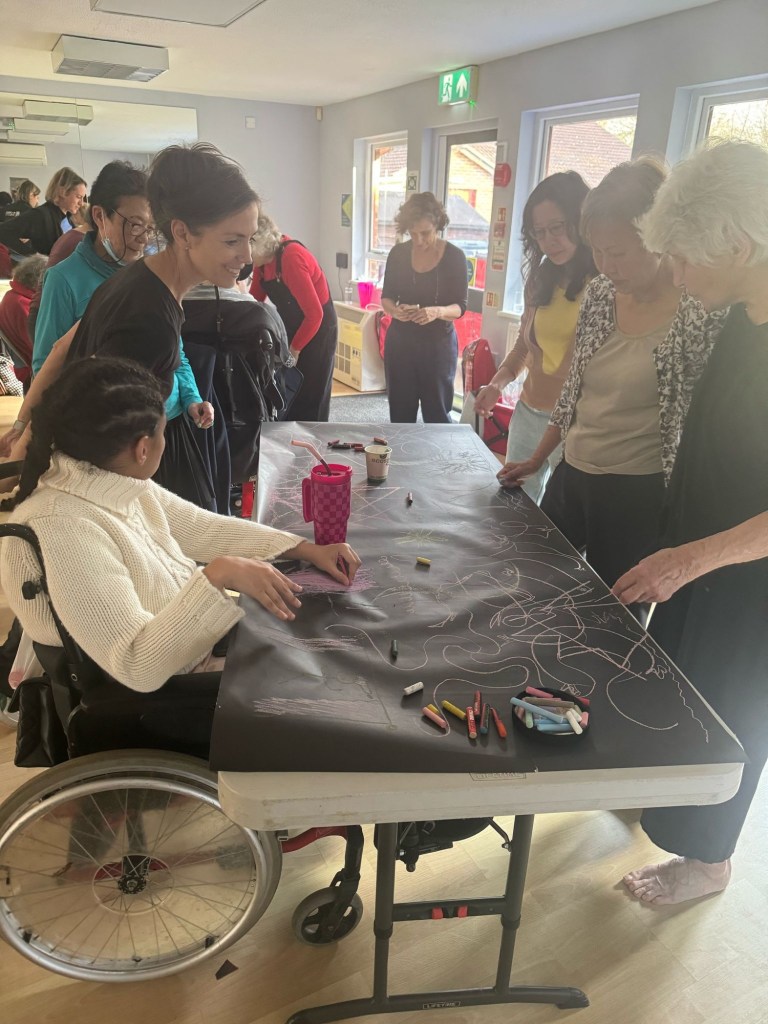
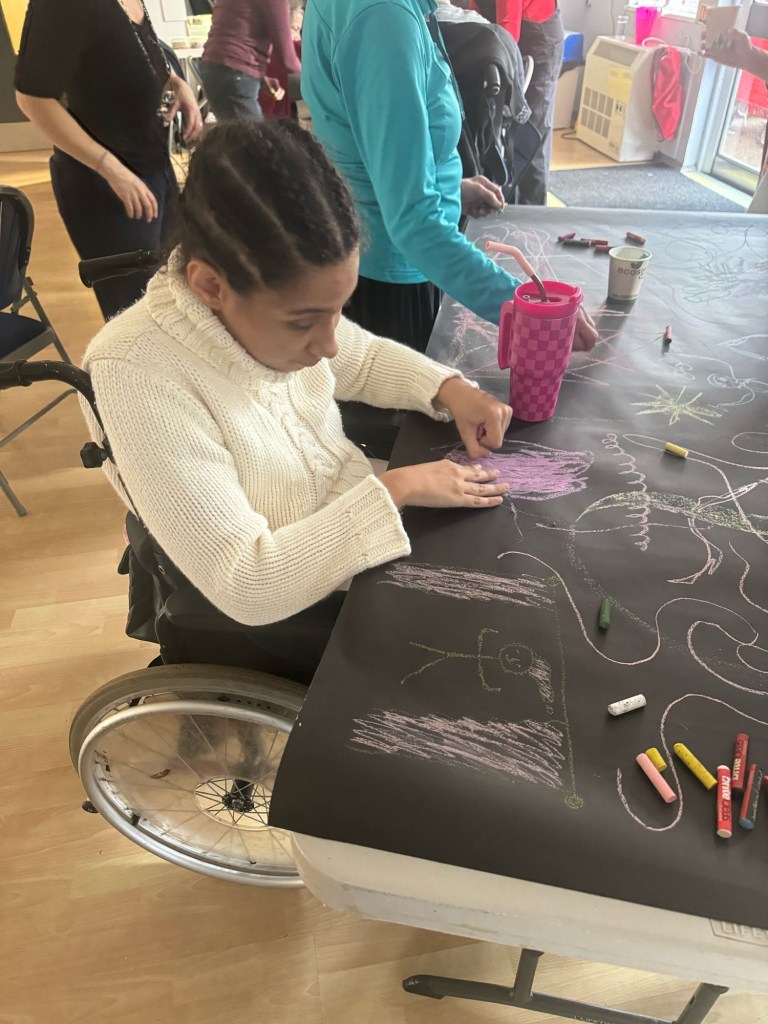
Deafblind Student Adventurer Picked To Start Race
A university student who is deaf and blind has been chosen to fire the starting gun at a city’s half marathon this weekend.
Karolina Pakenaite, who studies at the University of Bath, will perform the honour before joining thousands of others to take part in the 13.1-mile (21.1km) run on Sunday.
The PhD student, who is originally from Southport, Merseyside, is a keen athlete and adventurer. She has previously completed the London Marathon and has scaled the Three Peaks in less than 24 hours.
“I want to break the stereotype around blindness and bring a better understanding,” she said.
Ms Pakenaite has Usher syndrome, a rare degenerative genetic condition that affects sight, hearing and sometimes balance.
When she was diagnosed at the age of 19, she was told her vision and hearing would fade over time.
She has said her guide dog has helped her regain confidence as she has limited peripheral vision and struggles to see in low light.
For the half marathon on Sunday, Ms Pakenaite will be accompanied by a guide, Tom Hutchison.
The pair have only been running together for a week after her previous guide suffered a knee injury, but they said their training is going well.
“The challenges will probably be things we can’t expect,” Mr Hutchison said.
“Things will happen in the race, people will be in front, somebody might fall over, so we just have to be flexible.”
Ms Pakenaite’s ambition is to become the first deafblind person to summit Mount Everest.
She hopes to complete the challenge in 2026.
NHS To Offer Take-At-Home Tablet For MS
Thousands of NHS patients in England with multiple sclerosis (MS) will soon be offered a “take at home” tablet to manage their condition, sparing them hospital visits for injections or infusions.
Cladribine can help people with the active relapsing-remitting version of the disease, as well as more severe, highly active MS, for which it is already used, says drug advisory body NICE.
Broadening access to the drug should give more patients freedom from hospital and free up clinic time, say experts.
The NHS is the first healthcare system in Europe to roll out the treatment.
NICE is expected to issue final guidance for England in April, with access in Wales and Northern Ireland likely to follow. Scotland is also considering it.
There are more than 150,000 people living with MS – a condition that affects the brain and spinal cord – in the UK.
Although it cannot currently be cured, treatment can slow the disease and ease symptoms.
Trials show cladribine can reduce the number and severity of relapses.
The drug targets certain immune cells involved in inflammation and myelin damage in MS.
It is given in two treatment courses, 12 months apart, which would mean patients would take about 20 tablets at home.
The list price is around £2,000 per tablet, but it is not clear how much the NHS is paying since it can negotiate discounts with drug companies.
It is estimated about 2,000 patients could be offered the treatment over the first three years.
Clare Elgar, 37, from Southampton, has taken cladribine for her relapsing MS, which was diagnosed in January 2021 after experiencing loss of function in her right arm and numbness across her face.
Clare says: “Being able to take the treatment at home meant I could maintain my day-to-day routine and not have to travel to hospital. I’m thrilled that the new criteria will now give others like me the opportunity to benefit from this life-changing medication.”
Laura Thomas, head of policy at the MS Society, said: “This decision could particularly benefit people who’d struggle to go into hospital regularly, like younger working-age adults.”
It will also benefit patients considering starting a family, as it’s safe to get pregnant six months after the final course of treatment – which is less restrictive than many other options – according to Ms Thomas.
“We’re so glad that more people with MS will now be able to choose an effective treatment which suits their lifestyle.”
Dragons’ Den Stars To Help Cosmetics Entrepreneur
An accessible cosmetics entrepreneur who got what was labelled the “best deal ever” on Dragons’ Den, has said she wants the industry to become more inclusive.
Millie Flemington-Clare, 26, from Bristol, who has a rare condition called cystinosis, pitched her brand of inclusive make-up products on the BBC One show.
Although she was unable to secure investment, she was given offers of help from three of the dragons.
“I have ambitions of accessibility across industries and products and creating real societal changes,” said Ms Flemington-Clare.
Her range includes anti-roll packaging, sensory-friendly formulas and audio descriptions via QR codes.
“I want an investor who really shares my values and my beliefs and wants to, kind of, change the world with me,” Ms Flemington-Clare said.
She explained she would like to see a large retailer “take the chance and show people the future of beauty is accessible”.
“I would also like to see other brands working with me because I’m not gatekeeping accessible beauty,” she added.
Cystinosis is a rare genetic metabolic disorder that causes crystals to form in many organs of the body, firstly in the kidneys and the eyes, and later in the muscles, pancreas, thyroid gland and white blood cells.
According to the charity Cystinosis Foundation UK, there are only two or three new cases diagnosed each year in the UK.
Ms Flemington-Clare, who is 4ft 7in (1.4m) tall, had to be tube fed until the age of 18 and has had two kidney transplants in the past four years.
“At school I definitely felt different because of my height, and I’ve used make-up as a form of therapy through times of bad health,” she explained.
“This has made me really passionate about making sure everyone can experience the power of make-up like I have.
“It doesn’t have to be crazy innovation because a lot of the time that type of innovation is inaccessible in terms of price, so little changes can make it easier for everyone to use.”
Ms Flemington-Clare had been hoping for a £50,000 investment from one of the dragons, with a 20% share in her business.
On the programme, dragon Steven Bartlett said it was a “really inspiring story” and while it was not a financial investment for him, he was willing to help and invited her to his office to explore how he could support her.
Fellow Dragons Touker Suleyman and Peter Jones also offered to help, while Deborah Meaden said it could be the “best deal” she had ever seen in the den.
“You’ve given away none of your business and you’ve got loads of help,” she said.
Ms Flemington-Clare said: “Being in the den was a challenging, but a pinch me, moment.
“I have been watching the show since I was seven years old and to be on there representing the disabled community and advocating for the change I never saw, is a lifelong achievement.
“This is a turning point for me. I can’t do it on my own and now’s the time that I need to ask for support and get people on board to be able to make my vision become a reality.”
Neighbours Superfan With CP Launches Petition To Save Show
This has not been written about our editor, but it might as well have been!
A Neighbours superfan from Devon said he is desperate to save his favourite Australian soap opera which is set to be cancelled at the end of the year.
Alex Christmas, from Yelverton, launched a petition to rescue Neighbours after it was cancelled again, two years after it was saved by Amazon MGM Studios.
The petition for the show – which first aired in 1985 and was shown on the BBC until 2008 – has received about 1,500 signatures.
Mr Christmas, who has cerebral palsy, said the programme had acted as a “comfort blanket” for him.
Neighbours has aired more than 9,000 episodes since its debut.
Mr Christmas said: “I don’t even see it as a guilty pleasure, it’s an absolute pleasure.”
‘Iconic institution’
The Neighbours fan, who requires 24-hour care, said he watched episodes when they went live at 07:00 GMT on Amazon Prime Video as it gave him the “best start” to his day.
“It might sound ridiculous, but when I’m watching Neighbours, it feels like I’m watching my friends and catching up with mates,” Mr Christmas said.
He said his favourite characters included Karl and Susan Kennedy, Paul Robinson and Roxy Willis.
“I see it as more than a TV show, it’s an iconic institution,” he said.
“It’s also a lifeline because it’s helped cheer me up in my darkest moments.”
Amazon MGM Studios said it was “very proud” to have played a part in the history of Neighbours.
Executive producer Jason Herbison said he was hopeful another broadcaster would step forward to take over the show.
He said: “We value how much the fans love Neighbours and we believe there are more stories of the residents of Ramsay Street to tell in the future.”
‘I Prepare For Hours As A Sign Language Performer’
Before Rebecca Palmer steps onstage, she dedicates hundreds of hours to prepare for her performances.
The 20-year-old, from Penkridge, Staffordshire, is a sign language performer in her spare time, helping to make events more accessible for deaf people.
From analysing scripts and researching song lyrics to rehearsing and visually recreating sound effects, Ms Palmer said preparing for shows was “very complex”.
“There is a misconception that performing sign language involves just stepping on stage but it’s a lot more than that,” she said.
The full-time sound engineer said that using sign language to become every single character during a performance was a “great challenge” that she really enjoyed.
“Engaging with different audiences at every single performance is just magical.”
Ms Palmer started learning British Sign Language (BSL) 10 years ago, before combining her love for the language with theatre to become a performer during her teenage years.
Since then, she has featured at more than 20 events across the West Midlands including at The Alexandra theatre in Birmingham and Wolverhampton Grand Theatre.
She said that sign language was like “creating an art form” and was her favourite way to express herself.
“Once I’m on stage, my head is in the game and I’m in another world, it’s something I absolutely love,” she said.
She recently took on the script of a brand new play Honest Lies at the Lichfield Garrick Theatre which she described as an “extraordinary challenge”.
It involved analysing unfamiliar characters, topics and storylines to depict motherhood and relationships, she said, which was a “privilege” to be a part of.
“This was one of the most rewarding processes and I feel so lucky to share the stage with such talented actors, directors, stage managers and technical team.”
Ms Palmer said that learning sign language had given her the opportunity to learn about deaf culture and the beauty of creating visual interpretations of the world.
“It provides access to a whole new community of people that I really value and love,” she said.
She hoped that the arts would become accessible to all, through providing BSL captioning, audio description and touch tools.
Cinema Offers Subtitle Glasses To Deaf Film Fans
A Kent cinema has become the first in the South East to offer subtitle glasses to deaf and hard of hearing customers.
The Kavanagh in Herne Bay has two pairs of Watchword glasses, which contain mini projectors in each arm that beam a film’s subtitles into the lenses.
The cinema has been trialling the technology since before Christmas and is confident filmgoers with hearing impairments can enjoy all current releases.
“Most modern films now incorporate subtitles this way,” said owner Robert Johnson.
He added: “We used to show films with whole screen subtitles once a month but it wasn’t very popular and we were losing money.
“Now people can see a film with friends whenever they like.”
The glasses cost more than £1,000 each and can have the text broadcast to the user at either of the Kavanagh’s screens, thanks to a Watchword controller box that reads the film soundtrack in the projector room.
“The glasses are unobtrusive but so far we haven’t had anyone accidentally forget they are wearing them and walk out after a performance”, said Mr Johnson.
“It’s made the cinema more accessible to those who previously could not enjoy a night at the movies.”
One regular subtitle glasses user is Janet Blake from Herne Bay, who said she finds them much better than a previous system that involved headphones.
“I’m used to watching subtitles for television programmes so I can catch everything people are saying,” she said.
“They make a big difference and the last film I used them for was Conclave – it’s well worth seeing!”
Mr Johnson said he hopes to purchase more of the subtitle glasses in the future depending on demand and hopes other cinemas follow suit.
“If the major chains start buying these units then it will hopefully bring the purchase price down for all cinemas,” he said.
The Watchword subtitle glasses are available to be booked in advance for most film releases at The Kavanagh Cinema in Herne Bay.
Communication Boards To Help Non-Verbal Visitors
Communication boards have been installed at a popular Dorset beach to help non-verbal children and adults express their needs.
The boards, on Lyme Regis beach, display 144 commonly used words and numbers to assist anyone who has difficulty with speech.
Lyme Regis Town Council said it had also installed the signs in Anning Road and Henry’s Way play areas.
Similar boards are already on display in Dorchester’s Borough Gardens and on Weymouth seafront.
The town council said the signs were particularly beneficial for individuals with autism spectrum disorder (ASD), developmental disabilities, or conditions affecting speech and language skills.
A spokesperson said: “Incorporating communication boards into public areas like the seafront and play areas is a meaningful step toward creating environments where everyone, regardless of their communication abilities, can participate fully and enjoyably.”
Disability Snooker Champion Brings Back Gold
A snooker star from Sheffield has claimed the top spot in the first World Disability Snooker Championship.
Gary Swift, who has used a wheelchair since he was 14, represented Great Britain at the contest in Nonthaburi, Thailand.
He secured a 3-1 victory against Thailand’s Numpol Thongpusawan in the Group 1 final.
Returning home after 40 hours of travelling, Swift said he was “tired but feeling great”.
There was rivalry between the two finalists, as opponent Thongpusawan had scored a 3-1 win of his own against Swift during the group stages.
Each had then secured 3-0 wins against their opponents in the semi-finals, before meeting again for the title-deciding match, which would last more than six hours.
Thongpusawan initially took the lead by winning the first frame, putting Swift on the back foot.
But he was able to turn the tables, taking the following three frames and sinking the last pink to be crowned champion.
“I had to dig in deep and fight, but I came back well,” he said.
“It’s every player’s dream when they turn professional to win a world championship, and no-one’s ever won a world championship from Sheffield.”
‘Very inspiring’
He said the victory was “more special” because he shared a home with the city’s Crucible Theatre, which has hosted the non-disabled Snooker World Championship since 1977.
He also hoped that one day the disability championship could make its way to the UK.
Coach Stephen Harrison, who runs his own disability snooker academy, called Swift’s achievement “very inspiring”.
“He’s such a great player, we’ve got like 200 members each week, and they’re looking up to him – kids in wheelchairs, stuff like that – to see they can achieve so much more.”
He added that the pair were campaigning for the reintroduction of disability snooker in the Paralympic Games – it was first introduced in 1960, but dropped after 1988.
“This world championship is a massive movement towards that,” he said.
Shopping For A Wedding Dress With A Stoma Bag
A woman is documenting her experiences living with a stoma bag – including shopping for a wedding dress – because she wants to “normalise it and break the stigma”.
Poppy Williams, 27, from Cardiff, was left with a stoma after emergency surgery in December 2021 and initially thought her “life was over”.
“But then I thought, my stoma isn’t going away. So I can either live with this, in secret, or I can project it to the world and see how it goes,” she said.
Ms Williams said the reaction has been “amazing” and she wants to help other people going through similar experiences.
Stomas are an opening in a person’s abdomen with a pouch placed over it to collect faeces or urine in a stoma bag.
Ms Williams, a supply teacher, said after being diagnosed with ulcerative colitis, she was “terrified” about the potential of having a stoma bag.
But it is now part of her life, and she has been considering what type of wedding dress will look best with it, as she looks forward to the big day in summer 2026.
Looking back on her journey, she described being rushed to hospital for emergency surgery more than three years ago.
It was there she was told that without one being fitted, “it’s unlikely you will leave the hospital alive”.
She told BBC Radio Wales Breakfast that she initially struggled with it.
“I was lying in hospital after my stoma bag [operation], thinking that my life was over and that I couldn’t possibly live a normal life with a stoma bag,” she said.
But she said her mindset then changed, and she wanted to help others who had experienced the same “horrible, lonely feeling” she had after the operation.
She said she put out a post on her Instagram page about her experience, which got an “amazing” response.
“And I thought, that’s what I needed when I was lying in that hospital bed, so how can I help other people on their path?” she said.
She now has thousands of followers on her page, which offers advice and education about what it is like to live with a stoma.
A recent post shared advice about what it is like to shop for a wedding dress when you have a stoma.
Ms Williams said she needed to consider how the outline of a stoma bag would look in a wedding dress, and how tight the dress would be against the bag.
She admitted she “had a good cry and felt very emotional” before shopping for her dress.
“I thought if I didn’t have my stoma bag, what sort of wedding dress would I pick? And growing up, you always have that vision of you in a white dress,” she said.
But she described it as a positive experience.
She said she accidentally wore a black stoma bag on the day of her fitting, instead of a nude one.
“But actually it was helpful because I could see it through the dresses. I could see where it was fitting, when it would fill up, things like that,” she said.
She hopes talking about her experiences will help other people who might be having similar experiences to her.
“There are so many people that don’t know what a stoma is so I just want to open up the pathway for people who are having surgery today to make it easier for them,” she said.
Disabled Life In Ukraine After Three Years Of War
To mark the third anniversary of Russia’s full-scale invasion of Ukraine, we catch-up with Oleksii and Raisa who previously spoke to Access All.
Oleksii has learning disabilities and, after initially re-locating to Denmark, returned to his group home in Ukraine a few months ago. Raisa runs a nearby respite centre for disabled people.
And we hear from Sara Cincurova, a human rights journalist, who has recently visited a specialist school in Ukraine for disabled children.
This episode also shines a spotlight on teen actress Niamh Moriarty, who has cerebral palsy and was thrilled to break away from the stereotype of disabled characters and play a bully in her new film, September Says.
Plus we hear how surf therapy is becoming a craze for the over 50s in Wales with mental health challenges.
The concert that I’ve got to enjoy last night
🤩🎶🎶🎶🎶🎶🎶
Snooker Legend Davis Surprises Fans With Visit
A group of adults with learning disabilities have spent the day with their snooker “hero” as part of a surprise visit.
Retired snooker player Steve Davis dropped in to Apsley House in Bristol to play with residents who are huge fans of the sport.
Staff at the supported living space, which is home to 14 residents, organised the visit of the former world number one.
“It’s really nice to meet people because then all of a sudden you stop being their hero and you become their friend, which is far more important,” Mr Davis said.
Paul has been living at Apsley house since 1993.
He is a keen snooker player and frequently practices his skills at the pool table in the dining room.
He used to watch Mr Davis play on TV and said he was shocked to see his “hero” walk through the door on Wednesday.
“He’s a legend… I couldn’t believe it,” Paul said.
Fellow resident Adrian first got into snooker 11 years ago and has participated in local tournaments.
“What I like about pool is you get to meet different people,” he said.
“I met Steve Davis today and he’s a top man, a top snooker player and also he’s very good at doing his BBC commentary on the snooker.”
Adrian added that he was “glad” to have played a game with the “legend”.
Mr Davis said it was “lovely” to be described as a hero by others.
“You don’t really realise over the years what people have been watching or how they perceive you,” he said.
“It’s a lovely thing when you realise immediately that you’re amongst friends.
“The barriers are down and that’s really nice. It keeps your feet on the ground… I don’t think you realise sometimes how important it is to be one of the lads,” he added.
Mr Davis also complimented Paul and Adrian’s snooker skills, adding that there was “some good talent” in the room.
Bex Skinner, the service manager from Hft, the charity that runs the house, said the visit had been “fabulous”.
“To have somebody of Steve’s calibre come to visit us puts our name out there and gets [Hft] known,” she added.

Double Amputee Scales Highest Summit Outside Asia
A Gurkha veteran who lost both legs serving in Afghanistan has set a new record becoming the first double above-knee (DAK) amputee to summit the highest peak outside of Asia.
Hari Budha Magar, from Canterbury, made history when he reached the summit of Mount Everest in 2023, becoming the first DAK amputee to attempt and complete this challenge.
He has now set another world first after making it to the top of the 6,961m (22,837ft) Mount Aconcagua, in the Andes mountain range in Argentina, on Saturday.
Mr Budha Magar, who is aiming to climb the highest peak in each of the seven continents by the end of the year, said completing this challenge had given him the confidence to finish the final two.
Speaking at Plaza de Mulas base camp at Mount Aconcagua, Mr Budha Magar said: “I’m very pleased that we made it.”
The father-of-three set out with his team from Mendoza, Argentina, on 9 February, completing the challenge in under two weeks.
Mr Budha Magar joined the Royal Gurkha Rifles at the age of 19. While serving in Afghanistan he stepped on an improvised explosive device (IED) and lost both legs in 2010, aged 31.
He was made a Member of the Order of the British Empire (MBE) in the King’s Birthday Honours for services to disability awareness last year.
“I’m trying to do my bit to give some hope and optimism to the people with disabilities or people who are feeling low,” he said.
“I’m trying to raise awareness of disability all around the world, because disabled people can do anything.”
For his Seven Summits challenge he has already climbed Mont Blanc, the highest mountain in Europe, Mount Kilimanjaro, the highest peak in Africa, Mount Everest the highest peak in the world, Mount McKinley, the highest mountain peak in North America, and now Mount Aconcagua.
Later this year, he will take on Puncak Jaya in Indonesia, and Mount Vinson, Antarctica, to complete his challenge.
“After summiting the second highest mountain [out of the Seven Summits challenge peaks], I think this will give me more confidence to complete the other two I have left,” he said.
First Place In British Isles Set To Approve Right To Die
A law to give terminally ill adults on the Isle of Man the right to end their own lives is entering its final stages, making it potentially the first jurisdiction in the British Isles to legalise assisted dying.
Anyone over the age of 18 and with a prognosis of 12 months or fewer to live would be eligible, under the legislation being debated in the Manx parliament.
The Bill will not be passed yet, since the isle of Man’s lower house, has rejected an amendment that would have meant people would only need residency on the island for one year to take advantage of the legislation.
The House of Keys continued to insist on five year residency and have sent the legislation back to the upper house.
The move comes as MPs in Westminster are scrutinising a bill that would legalise assisted dying in England and Wales. A separate bill is under discussion in Scotland.
People on the Isle of Man eligible to request assisted dying would have to:
- Be terminally ill and “reasonably expected” to die within 12 months
- Be over the age of 18
- Be registered with an Isle of Man GP
- Have the legal capacity to make the decision
- Have the decision verified by two independent doctors
The measures have been a matter of strong debate in Tynwald, the island’s parliament.
It is likely the bill will receive Royal Assent and become law, with the scheme possibly up and running by 2027.
Jersey – a self-governing territory like the Isle of Man which can make its own laws – is also moving ahead with legislation to establish an assisted dying service.
‘A long and careful process’
Former GP Dr Alex Allinson introduced the private members bill to Tynwald and has been pivotal in ushering it through the legislative process.
He hopes this will be the last time it will need to be debated by the directly elected chamber.
“The passage of this bill has been a long and careful process starting in 2022 and has been properly consulted on, scrutinised and put through a full parliamentary process,” Dr Allinson says.
“It lays the basis for further work to implement a service on the Island for those facing a terminal illness who would like more autonomy and dignity at the time of their death.”
Among the key clauses in the most recent version of the bill are measures on age and length of prognosis.
How does the Isle of Man legislation differ from the Westminster bill?
The Terminally Ill Adults (End of Life) Bill,, external introduced by backbench Labour MP Kim Leadbeater, is currently being scrutinised by MPs in Westminster.
If passed it would become law in England and Wales.
It has some similarities to the Isle of Man legislation – people must be terminally ill, over 18 and registered with a GP.
Both bills spell out the need for patients to have the mental capacity to make the choice and be deemed to have expressed a clear, settled and informed wish, free from coercion or pressure.
The Isle of Man bill says people would be expected to have fewer than 12 months to live, but the Leadbeater bill has adopted a more conservative six months.
The Manx suggestion of needing five years of residency on the island to be eligible is to try to stop people going there to take advantage of the scheme, as people do by travelling to Switzerland’s Dignitas clinic.
On the Isle of Man, two independent doctors will need to agree the request for assisted dying, but Leadbeater has recently suggested that cases in England and Wales could be approved by a panel of experts rather than a single judge, as was originally proposed.
That change has proved controversial, but is one of about 300 amendments being considered by a cross-party committee of MPs.
Meanwhile, the legislation being proposed in Jersey has very similar restrictions to the Westminster plans. However, it has a proposal that would extend the right to die for terminally ill adults with six months or fewer left to live to 12 months for people with neurodegenerative conditions
As with the Westminster legislation, the Isle of Man has experienced some passionate campaigning both for and against the proposed new law.
A third of doctors who responded to an Isle of Man Medical Society survey in 2023 said they would consider leaving if the legislation was introduced.
Some doctors fear the legislation will be a “slippery slope” that will see the scope of the laws extended.
Isle of Man GP Dr Martin Rankin is a member of the Medical Society and is worried about the dangers of coercion, where vulnerable people are pressured to end their lives early.
“The safeguards that are in place on this one, I’m not going to know if somebody has been coerced by a relative into ending their life sooner than they wish.
“So I really won’t be getting involved in it.”
However, there have been some passionate campaigners who have spent years fighting for this legislation.
Millie Blenkinsop-French lost her son James to neck cancer, aged only 52.
It was a very difficult, painful death that cemented her belief in assisted dying for the terminally ill.
“Nobody in their right mind would be against assisted dying if they had to sit, like I did, and watch my son die.
“I wish with all my heart and soul that assisted dying had been in then, I really do, because he would have opted for it. He wasn’t a stupid boy, he was a very intelligent young man.
“And it’ll give an awful lot of people the chance that James didn’t have, give an awful lot of people the chance to say, you know, ‘enough is enough, let me pass over’.”
The Isle of Man legislation now looks set to become law, but as politicians in Jersey, Westminster and Holyrood also consider their own proposals, the wider debate about assisted dying is far from over.
‘My Son Inspired Me To Make Comic Cons Inclusive’
A mum has launched inclusive comic conventions across the country for people with disabilities after being inspired by her son who is autistic.
Zoe Crofts, from Milton Keynes, founded Bolt Events and hosted her first inclusive convention in Northampton in 2022 after she felt other events were not accessible for children with hidden disabilities.
“I have a son who is autistic and I have always found as a parent we couldn’t always do the things we wanted to do,” the 48-year-old said.
To make her events more accessible, they were hosted in smaller locations outside of London and designed to be held in less busy environments where individuals can enter early to adjust to their surroundings.
“We would rather take less vendors and have bigger aisles so people in wheelchairs can come through,” she explained.
“And, if you just need a time out, we will always find a room for you.”
In September, Nicola Nenadovic attended one of the events in Bedford with her son, daughter and two nephews.
Her 10-year-old nephew, Jack, has the rare genetic disorder KPTN syndrome, along with autism and ADHD.
Ms Nenadovic said: “Jack finds crowded situations very scary, but he desperately wants to enjoy these things. He just struggles to understand them.
“He was always really scared of people dressed up.”
To help him feel more comfortable at the event, Ms Crofts explained to Jack that he had the power to control Spider-Man, Iron Man and other characters who were at the event in costume.
She told all the characters to turn around and they were not allowed to look at him until he gave permission. He then walked around with his camera and took photos of all the characters until he was comfortable.
Ms Nenadovic said: “Zoe worked to help him feel comfortable, it was real lovely and he really enjoyed it – it was a job to get him out of there.
“2024 was the first year he wanted to meet Santa and have a photo with him. This had a lot to do with the comic con event and conquering his fears there.
“He keeps asking when can he see Spider-Man again.”
The events featured a retro gaming zone, cosplayers, cars from films, workshops, and more than 100 exhibitor tables full of geeky memorabilia and handmade crafts.
This year, Ms Crofts was scheduled to run 31 events across the country and will visit Daventry, Luton, Ipswich and Walsall.
Ms Crofts hoped her family-run events could set an example that showed conventions could be safe spaces for everybody.
She said: “It’s not just for the child; it’s for the parents and the stress it causes the parents.
“They know someone has their back – if the child has an autistic meltdown, we are there to support them.
“I want to help, I want to make it accessible for others, and I want them to have a bit of fun.”
Quadriplegic Countdown Contestant Hopes To Inspire
The first quadriplegic contestant to appear on TV quiz Countdown hopes he will inspire others like him to apply to play.
Martin Wild, from Whitchurch in Shropshire, appeared on the long-running, Channel 4 word and numbers game on Wednesday.
The player, who was paralysed in an accident at home in 2018, said his participation showed “you can achieve things and you’re not completely washed up just because of your injury”.
He added: “Hopefully that will lead to others perhaps applying and appearing on the show as well.”
‘Pressure of the cameras’
Mr Wild visited the TV studio before filming to discuss what adaptions were needed.
He said he was not able to write down answers before declaring them because he had no functional use of his hands.
Instead, he said, he had to store all the information in his mind and that was not always easy.
Mr Wild described how he might see a seven-letter word in the letters selection, and could then go hunting for an eight or nine-letter word, but “by the time the clock’s finished, I’ve forgotten what my seven-letter word is”.
“It’s so easy to do that with the pressure of the cameras and obviously the competition itself which you want to win,” he explained.
“It becomes far more difficult to store that information and retain it, so I found that quite difficult – [it was] much more of a challenge than I thought it would be.”
After he narrowly missed out on winning, Mr Wild said he was happy he had taken part because he had always wanted to appear on Countdown, adding: “It does show to others that it can be done.”
Open bodies on TikTok, please join my team team icon 
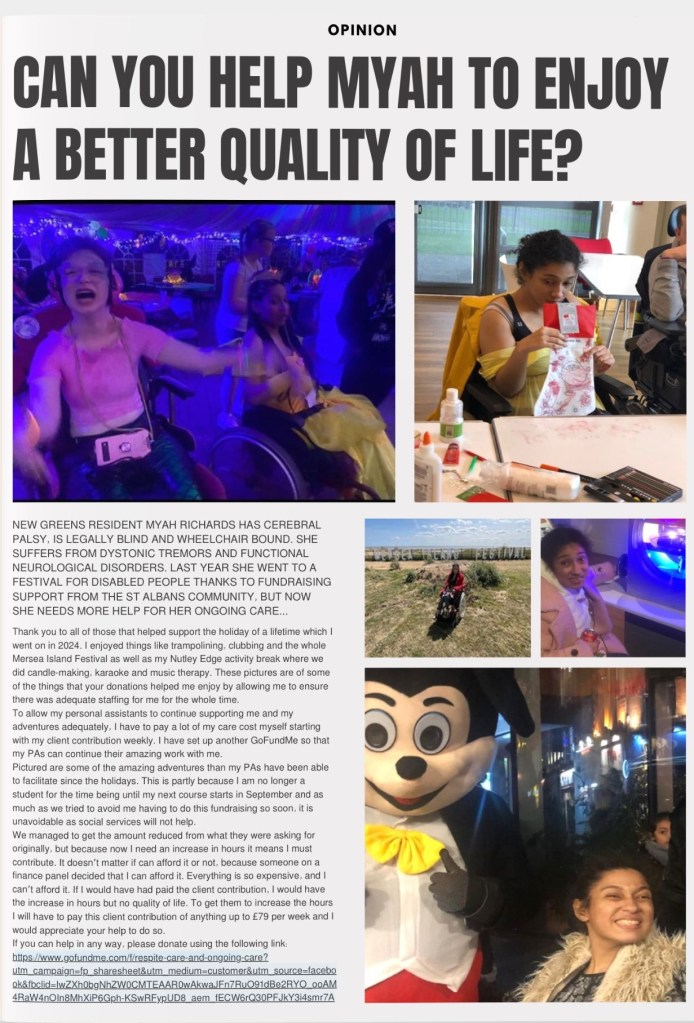
Hotel Turns Away Paralympian Because Of Wheelchair
A Paralympic fencer said he was not allowed to use a hotel room he had booked and paid for when staff saw he was using a wheelchair.
Tokyo gold medallist Piers Gilliver, from Wiltshire, was told he could not stay on the upper floors of the Ibis Rotherham East on Saturday.
Staff said it was hotel policy, Mr Gilliver said, adding he did not need an accessible room or help, and the way he was treated was “not acceptable”.
An Ibis spokesperson has apologised and said the chain was taking “immediate corrective action” and staff were being retrained.
Mr Gilliver said he told the hotel’s staff: “I’m not asking anything of you, I want to get to the room I paid for.”
His partner, who also uses a wheelchair, was with him at the time of the incident.
The staff member went to speak to a manager, Mr Gilliver added, but came back with the same answer.
“They wouldn’t budge,” he said.
The couple were told that because they were wheelchair users, they could not stay on the upper floors as it may cause issues with insurance or in case of fire.
But Mr Gilliver, from Trowbridge, said he could see there was a lift and an evacuation chair, and the couple’s wheelchairs were narrow enough to fit through standard doors.
Despite explaining he travels a lot and often stays in multi-storey hotels, sometimes with hundreds of other athletes with disabilities, Mr Gilliver says the couple were still asked to leave.
‘We sincerely apologise’
A spokesperson for the hotel said: “We sincerely apologise for the experience this guest had at our hotel, which is in no way reflective of our core values and expectations.”
The spokesperson added staff “regrettably” did not follow procedure or “clearly communicate” that there was an alternative option at a nearby hotel.
“We are taking immediate corrective action. The entire hotel team is being fully retrained on the correct procedures and expected levels of service in such circumstances, to avoid any future miscommunication.”
While Mr Gilliver said this hotel experience was unusual, he said he and his partner come across other issues in daily life due to being wheelchair users.
“For example a couple of weeks ago three taxis pull up, saw me in a wheelchair and drove off,” he said.
“I’ve always kind of kept quiet about this kind of stuff. We just want no more, no less than the average person.
“It is really encouraging how society has knocked down so many barriers in recent years but I feel like the area around disability is one that’s hugely left behind.”
He added: “To be honest, you get tired for feeling like a second-class citizen where your basic needs really aren’t being catered for.”
Communities Minister Introduces Bill In Sign Language
Communities Minister Gordon Lyons has used sign language in the Stormont Assembly to introduce the second stage of the Sign Language Bill.
The bill recognises and promotes both British Sign Language and Irish Sign Language.
Mr Lyons was addressing members of the deaf community who were sitting in the gallery.
Violinist Determined To Thrive Despite Disability
A hearing impaired man from West Sussex who was gifted his first violin by The Osmonds has refused to let his disability get in the way of his dreams.
Matthew English, 19, was born with microtia atresia – a condition which means a person has no ear or ear canal.
Mr English, who hails from Lancing but lives in Kent in order to be a full-time carer for his grandfather, says that balancing those responsibilities with his music is a “tough task”.
“It’s quite hard work, but I wouldn’t want to have it any other way. I have [the] joy of giving him care and making sure he’s happy,” he said.
Mr English’s musical journey began after a chance meeting with The Osmonds.
While he longed to play the violin, he was unable to take private lessons or be taught at school.
However, he caught the attention of Jimmy Osmond while watching the band perform in Croydon in 2012 and was invited onto the band’s tour bus to meet other members, where he told his story.
Five months later, he was gifted his first violin by Merrill and Justin Osmond at a charity gala in Leeds.
Then in January this year, Donny Osmond gave Matthew a One Big Thank You on BBC’s The One Show in recognition of the years he has spent playing for charities and in care homes.
Mr English said performing in care homes was the “most rewarding” gig around.
“I could play in pubs, clubs, festivals – whatever. But you never get the same enjoyment as you do in a care home,” he told BBC Radio Sussex.
He is also a regular speaker at Microtia UK and other charity events for people with the condition.
Libraries To Share Hidden Stories Of Disability
An installation, writing workshops and dramatic performances, created by adults with disabilities, will be touring Buckinghamshire libraries this spring.
Called The Other Library, they have been produced by the Freewheelers Theatre and Media Company and feature 17 individual projects and three group projects, each presented in a physical or digital book.
Buckinghamshire is one of five local authorities involved in the scheme, part of a wider three-year Rekindle project funded by the National Lottery.
“The mission is to share hidden stories of disability within the county using physical and interactive books,” said Katie de Joux, culture and outreach services manager at Buckinghamshire Council
People will be able to explore the world and stories of artists with disabilities at High Wycombe, Chesham, Aylesbury and Buckingham libraries up until 23 April.
Each library will feature a bookshelf installation and host a creative workshop by author and screenwriter Sara Clifford, along with two performances by disabled artists at weekends.
“Some of the performances will be a story told; there will be some dancing,” said Ms de Joux.
“It is a little bit of everything and changes from location to location as well. So you never quite know what you are going to get, but it is half an hour of being blown away.”
It is hoped the tour could be expanded to cover libraries across the country one day.
Clive Harriss, the council’s Conservative cabinet member for culture and leisure, said: “The Other Library goes beyond paper text; it is a multimedia experience where some stories are told through dance, some through music and others are told through poetry.
“I would like to encourage residents to pop along to one of the events listed below and explore the bookshelves and discover the stories for themselves.”
Snooker Player Gets Flight Wheelchair Go-Ahead
A disability snooker player has been given the green light to take his electric wheelchair on an aeroplane, allowing him to travel to the world championships.
Matt Lester, who has cerebral palsy, is set to play in the upcoming World Disability Snooker Championship in Thailand.
The 36-year-old from Doncaster spent five weeks attempting to get confirmation from Thai Airways his wheelchair could be stored in the aircraft’s cargo hold.
Mr Lester said: “To eventually have it all sorted and be able to concentrate on playing in the world championship, I just feel completely elated.”
His electric wheelchair has a battery which cannot be removed and taken in hand luggage, so he had required the airline’s approval to take it in the plane’s cargo hold.
“I think it’s a lot more than a coincidence that my story got told by the BBC and then, all of a sudden, it’s sorted,” he said.
Mr Lester said he could now focus on the inaugural tournament, adding he felt “quietly confident”.
“My preparations, although I’ve been a bit sidetracked, are still going really well,” he said.
Valentine’s Movies With A Disability Theme
This Valentine’s Day I thought we’d publish a fun post.
So I’m linking to my reviews of three movies in which disabled people find love.
Disabled man meets sex therapist.
Man gets polio in adulthood. Marriage lasts through severe disability.
The life story of Stephen and Jane Hawking.
Readers, take your Valentine, fire up Netflix and remember, disabled people can find love too!
Hundreds Turn Out For Dying Guide Dog’s Final Walk
Hundreds of people – and their pets – have paid tribute to a terminally ill guide dog by joining him on his final walk.
Red fox Labrador retriever Ian was recently diagnosed with cancer and given only weeks to live, said his trainer and volunteer puppy walker Gemma Fairhurst.
Struggling to walk very far, eight-year-old Ian was initially pushed in a pram along Blackpool Promenade before he was given a “guard of honour” by well-wishers and dozens of dogs.
“I was a wreck,” said Ms Fairhurst, from Chorley in Lancashire, before thanking everyone for the love and “overwhelming” support they had shown towards Ian.
Ian was a working guide dog when he was diagnosed in early January with an inoperable sarcoma in his chest and lymphoma in his lymph nodes.
He holds a special place in Ms Fairhurst’s heart because he was the first of nearly 20 guide dogs the 40-year-old has trained.
She told BBC Radio Lancashire she had always agreed with Ian’s owner, guide dog user Mark Fielding, to look after him when he retired aged 10.
Following the dog’s terminal diagnosis, she said she was now looking after Ian for whatever time he had left.
“Unfortunately he isn’t going to get the retirement he deserves… so I decided to arrange this walk for him,” she said.
She said she had been “overwhelmed” by people travelling from as far afield as Liverpool to join Ian on his final walk on Sunday.
Ms Fairhurst said they were joined by about 80 dogs, including other guide dogs she had trained.
She said the guard of honour had been “so lovely” and that it was “very fitting to have it on Blackpool Promenade, where Ian has lived his guide dog life” with his “dad” Mr Fielding.
The walk – called 5,000 steps for £5,000 – raised money to train another guide dog.
Ms Fairhurst said he would also be named Ian in tribute to her “special boy” and “carry on his amazing doggy legacy”.
More than £6,000 has so far been raised.
Snooker Player Left Waiting Over Aeroplane Access
A disability snooker player has said he has been left in the dark by the airline he has booked to take him to the inaugural world championships in Thailand.
Matt Lester, who has cerebral palsy, is due to play in the World Disability Snooker Championship in less than a fortnight, but has yet to receive confirmation he can keep his electric wheelchair in the cargo hold.
The 36-year-old from Doncaster said he had attempted to resolve the situation for a month but was yet to gain a response from airline operator Thai Airways.
The airline has been contacted by the BBC for a comment.
Mr Lester said his wheelchair’s battery could not be removed and taken in hand luggage, therefore he required the green light from the airline to transport his wheelchair in the cargo hold.
“It isn’t an option for me not to go,” he said.
“If I have to book a different flight then I have to book a different flight I’ll fly with someone else,” he said, but this would mean paying for two sets of tickets.
He believes, out of all the forms of public transport he has used, planes are “15 to 20 years behind everybody else in terms of accessibility.”
“I’ve never known anything like it,” he said.
Despite the situation, Mr Lester’s staying positive: “If anyone’s got Richard Branson’s phone number, tell him I’ll put a badge on my waistcoat and he can sponsor me to go,” he joked.
He discovered disability snooker on TV when he was 13 years old, and has since travelled across the the globe to compete in the sport.
In October, he narrowly missed out on a bronze medal at the European Disability Snooker Championship in Portugal.
The World Championship is the first of its kind and will be held in the city of Nonthaburi between 23 February and 2 March.
This time he is going for the top spot.
“I don’t want to go to Thailand for a bronze medal, I want to come back and be the world champion,” he said.
“But on top of all my preparations, I’ve had to put up with this.”


 Same Difference