Skip to content

Stephen Sutton To Get Posthumous Pride Of Britain Award

September 30, 2014

Cancer fundraiser Stephen Sutton is to be the first person to be awarded a posthumous Pride of Britain award.

The 19-year-old, from Burntwood, Staffordshire, died in May after launching an appeal in aid of the Teenage Cancer Trust.

It raised almost £5m, of which £2.9m has been used to set up specialist cancer units for young people.

The award will be presented to his mother, Jane, at a televised ceremony next week.

She said her son would have been “honoured” to get the award.

Organisers said they had been “overwhelmed” with nominations for Stephen on social media sites, receiving over 20,000 in one 48-hour period.

Stephen became famous for items on his “bucket list” – which included hugging an elephant

His award will be presented by Teenage Cancer Trust supporters including Who frontman Roger Daltrey and comedian Jason Manford.

Mr Manford said: “He was an amazing lad and a credit to humanity – he is the Pride of Britain.”

Stephen was diagnosed with terminal cancer aged 15. He drew up a “bucket list” of things he wanted to achieve before he died.

This led to him completing a skydive and playing drums in front of 90,000 people before the Uefa Champions League final at Wembley.

He also set a target of raising £10,000 for the Teenage Cancer Trust.

The trust said £1.2m of the money raised would be invested in training future cancer nurses and support staff.

The money will also fund 50 care scholarships at Coventry University over five years “in recognition of [Stephen’s] ambition to have a medical career”, it added.

A further £700,000 will be spent on improving the charity’s cancer information services and helping patients attend its annual weekend conference.

Tories Would Freeze ESA, But Only For The WRAG

September 29, 2014

Many thanks to Benefits And Work.

If the Conservatives win the next election they will freeze most working age benefits for two years from April 2016, the chancellor George Osborne has announced. Disability benefits, including personal independence payment and disability living allowance will not be affected, however. The chancellor also announced that those who inherit large sums in pension funds are to be given a tax cut.

Benefits that will be frozen include:

  • The work-related activity component of employment and support allowance
  • Jobseeker’s allowance
  • Local housing allowance
  • Universal credit
  • Tax credits
  • Child benefit
  • Income support

Benefits that will not be affected include:

  • Disability living allowance
  • Personal independence payment
  • Maternity and paternity pay
  • Statutory sick pay
  • Statutory adoption pay

Osborne expects to save up to £3.2bn a year from these cuts.

Meanwhile, tax cuts for those who inherit pension funds of up to £1.25 million will cost the taxpayer around £150 million a year.

London Live Discussion On Disabled Students Allowance

September 29, 2014

I’ve been on London Live’s politics programme Headline London today discussing the DSA. You can watch my appearance here.

Disabled Girl ‘Slept In Dog Cage’ Because Council Wouldn’t Provide Bed

September 29, 2014

This is shocking.

A disabled child had to sleep in a dog cage because a council refused to provide a special bed, it has been claimed.

Sadie Fenton Hunt, 10, has a rare form of epilepsy and can’t be allowed out of bed at night in case she hurts herself.

Her mum Effie used a dog cage to keep her safe after the local authority said they would not supply the special padded cot she needs, the Daily Record reports.

Effie said: “The dog pen was basically a metal cage with mesh panels which you link together. It was horrible to see my daughter in a dog cage but we didn’t have any choice.

“Social services said they didn’t think it was safe. But what was the alternative?”

Sadie, who can’t speak or communicate, was given a customised bed by her local authority while the family were living in Northumberland.

When they moved to Chesser in Edinburgh to be nearer Effie’s mum in January, the city council said they would provide a special chair and bath for Sadie – but not a bed.

Learning support teacher Effie, 41, added: “Sadie has West syndrome.

“She has little understanding of the world. Her frustration at being unable to express herself affects how she behaves. She bangs her head against walls and things.

“Sadie doesn’t sleep well and can be awake a lot during the night. She needs a bed where she can’t get out.”

The bed Sadie used in Northumberland, which was like a huge cot with padded sides, meant the family could rest, knowing she was safe.

In Edinburgh, Effie propped the dog pen up around an inflatable mattress and clipped it to the walls.

She added: “Special beds are essential for someone with needs like Sadie. It’s so difficult caring for her and doing that without sleep makes it so much harder.”

Children’s disability charity Newlife said there was a “postcode lottery” in the UK when it comes to the provision of special equipment.           

Operations manager Stephen Morgan said: “It shouldn’t matter where a child lives – we should be making provision for equipment like this on a national basis.”

John Cowman, of charity Young Epilepsy, said: “Young people with epilepsy are being let down by inconsistent levels of care across the UK.”

Labour MSP Michael McMahon, convener of the cross-party group on disability, said the provision of equipment was “very patchy”.

He added: “There is a lack of funding for local authorities and a postcode lottery over the funding available.”

Newlife have given Sadie a bed on a temporary basis and, with her family, they are fundraising for a permanent replacement costing £4259.

A City of Edinburgh Council spokesman said: “Sadie didn’t meet our criteria for a cot bed. However, we’ve supported the family by helping her mother apply for charity funding in a  bid to get one.”

Found Fit For Work With Epilepsy, Depression, Brain Damage And Heart Disease

September 28, 2014

AN EPILEPTIC, his carer and their determined neighbour will fight the Government to the “very end” after the disabled man’s incapacity benefits were cut.

Geoffrey Wilkinson, 53, of Wheatfield Way, Chelmsford, also suffers from depression, brain damage, impaired memory, ischaemic heart disease and ongoing thrombosis.

Yet he was deemed fit to work around January following reassessments by government contractors Atos, despite medical advice, leading to a reduction in his monthly allowance from about £700 to £300.

“It felt like someone had smashed me over the head with a sledgehammer,” said Geoffrey, who takes 16 lots of medication a day.

Geoffrey and carer Peter Harrison, who is also his brother, are monitoring a third appeal to the Social Security and Child Support Tribunal over the decision and along with neighbour Christine Mitchell, met with Simon Burns MP on Friday.

Peter says his brother has been left to live on £298 a month in Disabled Living Allowance (DLA) and temporarily £143 in Employment and Support Allowance (ECA)

“We want to take on the government and rip them to bits for what they’re doing to Geoff and thousands of others,” said Peter.

“It’s quite a lot of money we’ve lost. At the end of the day we are lucky if we have a meal.

“Christine had to lend us £10 for food the other day.

“He is not fit to work. What employer will deem my brother fit to work? If he worked now as a groundsman and parked up his tractor, walked away, he would forget where it was.”

Geoffrey, once a groundsman and labourer, fell out of work after a carbon monoxide poisoning incident in 1995 and has since been admitted to mental health service the Linden Centre.

In April 1998, five doctors wrote that he “will never work again”, while on this occasion his doctor Shahzad Ahmad has written: “I very much feel that Mr Wilkinson is not really fit to work.

“He would be a risk to himself and his colleagues with the medical condition he has.”

Springfield Hospital neurologist Dr Peter Bradbury has also written: “He is yet another victim of the inability of Atos to cope with more sophisticated neurological problems.”

The two approached Christine, their neighbour, who is more used to tackling government bureaucracy, when Geoffrey’s DLA was not paid. After two days of calls she found it was paid to Geoffrey’s old bank account.

“It’s such a damn mishmash,” she said.

Christine added: “We will fight it to the very end.

“The man is clearly being denied his just dos by an over-zealous government who think they can make laws to suit themselves.

“As far as I am concerned that man needs nurturing, not punishing.”

A Letter Going Around To Claimants In Support Group

September 28, 2014

I don’t know what to say.

LJ Duut’s Heartbreaking Letter To Her MP

September 27, 2014

Read it to the end… it is heartbreaking…


And here’s the video she mentions…


I’m really starting to fear for LJ’s life if this stuation isn’t sorted out soon.

How Legal Aid Cuts Affect Sick/Disabled People

September 26, 2014

With many thanks to Benefits And Work:

The number of claimants getting legal aid to help with welfare benefits has plunged from 88,380 in 2012-13 to just 149 in 2013-14 due to coalition cuts. In addition, not one single application for exceptional case funding has been granted. The Lib Dems have expressed concern about the effect of their own legal aid cuts on children, but not about the effects on sick and disabled claimants.

Legal aid has been abolished for almost all welfare benefits issues, including appeals to first-tier tribunals, but is still available for appeals to the upper tribunal.

In addition, in theory, exceptional case funding is available where a claimants human rights or European Union rights would be breached if they did not get funding to bring their case. However, although 11 applications were made for exceptional case funding in 2013-14, every single one was refused.

The Lib Dem family justice minister has now called for a review of legal aid cuts that affect children, according to the Guardian, but no minister has shown similar concern about the effect of legal aid cuts on sick and disabled claimants.

Legal aid for other areas of law likely to affect sick and disabled claimants has also been almost wiped out in the same period. This includes debt, which has fallen from 81,993 funded cases to 2,584 and employment, which has fallen from 16,157 to 32.

You can download the latest statistics from this link.

Fewer Than 15% Of Disabled People Have A Degree Finds Study

September 26, 2014

This is a real shame. And cuts to Disabled Students’ Allowance will lower that figure even more.

Campaigners say they fear that without help disabled students will be unable to cope with University life.

There has been an increase in disabled undergraduates in recent years but fewer than 15% of disabled people have a degree, a much lower percentage than the general population.

The government is also making changes to disabled students’ allowances, which the National Union of Students is fighting.

John Maguire reports from Norwich.

Learning, Literacy Difficulties, Must Do Jobsearch Online With No Help

September 26, 2014

Today, I met up again with Eddie (name changed), a 51-year-old Kilburn man who has mild learning difficulties. He currently signs on for JSA. He has worked all his life in hotels and in kitchenwork, but has been unemployed for four years now. He wants another job, but is struggling to find one.

Eddie doesn’t read or write very well. He has no computer at home, which I know for a fact because I’ve been to his flat (it’s the tiny, one-room place you can see in the video below). Anyway, he was upset because at his jobcentre session today, he was given a sheet of paper which listed possible places for seasonal work this Christmas. You can see the list in the photo here – the place of business, the job and then a link to the job and an application form online.

Christmas jobslist

The problem is that Eddie struggles to read and write, as I say. He doesn’t have a computer. He said the jobcentre hadn’t offered to help him apply for any of the posts on the list, or to help him fill in the forms. This means that Eddie is stuck. He was worried about what would happen next. If he can’t show that he’s applied for jobs, he risks sanctions. These things were very much on Eddie’s mind.

The upshot of all of this is that I’m going around to Eddie’s place next week with my laptop to show him how to open some of the links. I’ve already tried some of them this evening. The Argos one takes you to a list of jobs, then more about the job itself and the company offering it (Habitat – £7.06 an hour), then the company website, then the application form. That’s four clicks to get to the form and a mass of text to wade through – a real difficulty for someone who struggles with text.

Full story at Kate Belgrave.

Disabled Man Gets £6000 Compensation From G4S And Hopes His Case Will ‘Open Floodgates’

September 25, 2014

A 79-year-old disabled former serviceman has been awarded £6,000 damages after a judge ruled that he was humiliated by G4S prison officers who handcuffed him during a 14-day stay in hospital.

Peter McCormack, of north Wales, was chained to a prison officer even when using the toilet and shower, while he was in Royal Liverpool University hospital after a heart attack in March 2012. At the time he was on remand at the G4S-run Altcourse prison in Liverpool, awaiting sentence for offences relating to inspections of bouncy castles he carried out that did not comply with health and safety regulations.

Judge Graham Wood QC ruled on Wednesday that for eight days, during which McCormack was in his own room on a hospital ward with only one door, he was subjected to degrading and inhuman treatment prohibited under article 3 of the European convention on human rights.

“The presence of one officer at the door to prevent escape of a 77-year-old person with significant heart complaint, facing a modest criminal sentence at best for breach of a regulatory offence in relation to his business would have been, in my judgment, a reasonable and proportionate restraint,” said Wood in his written judgment, read out in the high court in Liverpool. “During this time he was humiliated and his dignity was affronted.”

McCormack, who has a disability as a result of being shot through the knee while serving with the Royal Engineers during the 1956 Suez crisis, was awarded £6,000, plus costs.

The judgment is the latest in a series of controversies to hit the major government contractor G4S. Last year, a jury found that an Angolan man, Jimmy Mubenga, who died after being restrained by three G4S guards as he was being deported from the UK, was unlawfully killed. In March, the company agreed to repay £109m plus VAT for overcharging the Ministry of Justice for the electronic tagging of offenders.

McCormack, who represented himself in court, spent 14 days attached by his wrist to a 2.5 metre closet chain, despite having been described as a model prisoner. It was removed only briefly for him to take off his upper clothing, and when he was under heavy sedation undergoing an angioplasty procedure.

Twice in reviews of McCormack’s risk assessment during his stay in hospital, the report author wrote in a box relating to recommended handcuffing arrangements: “uncuffed one officer present throughout”. The judge criticised the evidence of G4S’s head of security at the time, Yvonne Forth, who, explaining to the court why these arrangements were not implemented, suggested the form entries were “hypothetical”.

Wood said he found Forth’s evidence to be “less than impressive. It is a reasonable conclusion that she simply ignored a recommendation from a security manager.” He said she failed to find out why he was imprisoned and that the risk assessment process was undertaken in a number of respects “without any separate consideration of the circumstances of this prisoner”.

McCormack told the Guardian he hoped the case would open the floodgates to claims against G4S. “On one occasion I was having a shower chained to a female officer,” he said. “I feel G4S should be barred from running prisons and be barred from having anything to do with any contracts in this country. They have an appalling reputation.”

Hear! Hear!- The Autobiographical Dance Show By Deaf Men Dancing

September 25, 2014

The autobiographical dance show which tells audiences of experiences unique to deaf people.

“I ran over to the piano and put my hand on it to feel the vibrations of the music,” remembers Mark Smith. Diagnosed as deaf at four years old, his first encounter with rhythm and dance was at his sister’s ballet class.

Smith couldn’t hear the music but was able to establish a rhythm from what he could feel. He says: “I began to copy the movements and the teacher encouraged me to join.”He went on to study dance at degree level and has worked as a choreographer for the past 20 years. Now Smith uses those early experiences to teach other deaf people how to dance.

In the absence of a piano, Smith encourages his students to place their hand on a speaker to experience the pulses from the audio. “The vibrations move through their arms and into their bodies,” he says. And when the students move away from direct contact with the sound, they maintain contact with the rhythm via the vibrations in the wooden floor. “That’s why we always dance barefoot,” he adds.

In 2010, Smith formed an all-male ensemble which he calls Deaf Men Dancing. It is made up of four professional dancers with varying levels of hearing loss.

He says deaf people are constantly alert to visual cues throughout the day and so his dancers are naturally tuned to what the others are doing, rather than taking cues directly from the music. He believes that this ability makes deaf dancers better at communicating with each other on stage than hearing dancers.

Deaf Men Dancing’s latest show Hear! Hear! looks at hidden or little-known aspects of deafness in a way that Smith hopes a hearing audience will be able to relate to.

He integrates British Sign Language, an artistic device he often uses in his shows. But instead of dancers making the shapes with their hands, the whole body plays a part. He says that deaf and hearing dancers interpret the movements differently.

Having more connections with the language, he observes that deaf dancers tend to perform his routines with lots of emotion whereas hearing dancers are strong at the more technical side.

The show also plunders Smith’s childhood memories. His first hearing aid was a big box which attaches to the chest with a harness. Dancers wear these during the performance, which he says is a very visible badge of deafness and “gives them a bit of a superhero look”.

The music in Hear! Hear! is encoded with sounds and patterns which aren’t usually known to people with typical hearing. The first act includes noises that people with tinitus commonly hear from Deafboy One, a singer and guitar player who is hard of hearing. The score for the second act, by Michael England, is a piece of electronic classical music based on Smith’sown hearing test charts – he struggles to hear high frequency sounds like birdsong, dripping taps and rustling leaves. The second time the melody is played the higher frequencies are taken away, giving the audience a sense of how he hears music.

Deaf Men Dancing perform Hear! Hear! at Sadler’s Wells on Sunday 28 September as part of the =dance series.

Disabled Delegates ‘Forced Out Of Front Row’ At Labour Conference For ‘Party Suits’

September 24, 2014


This is unbelievable. Same Difference would be very interested to know what Kate Green has to say about it.

HEARTLESS Labour chiefs forced a group of disabled delegates to give up their seats for “party suits” minutes before Ed Miliband’s speech yesterday, the Morning Star can reveal.

Delegate and Morning Star contributor Bernadette Horton tripped and fell as she was shifted so some “bright young things” could be in place to shake the Labour leader’s hand.

“As I was going up the stairs I just lost my footing and fell,” said Ms Horton who walks with a crutch.

“I was really upset and shaken.”

Venue stewards told the party worker the seats had been specially assigned to the 15 disabled delegates but were overruled.

Ms Horton said: “The people in suits saw this but didn’t say anything. I said ‘if you’re Labour you should be ashamed.’  

“We’re like pariahs in our own party. It has to stop.”

Ms Horton is set to raise the issue today in a meeting with shadow minister for disabled people Kate Green.

Wheelchair User Called Fire Riisk By ATOS Has Benefits Reinstated

September 24, 2014

A disabled man who was refused a benefits assessment because his wheelchair was deemed a safety risk, has had his payments reinstated.

Charles Foreman, from Leicestershire, who has a back condition, had his benefits stopped in 2011.

The 53-year-old was turned away from an assessment on the first floor of a health centre in 2013 because providers Atos said his chair was a “fire risk”.

Atos’s contract ended early in March over “significant quality failures”.

‘Depressed’

Mr Foreman, from Market Harborough, said he was “ecstatic” after the hearing in New Walk, Leicester.

“It’s been hell – it’s like being buried. I’ve been depressed – I haven’t been eating,” he said.

Mr Foreman has had back problems since in 1982 which eventually forced him to stop working 12 years later.

He started claiming disability benefits a decade later after he was told he had a degenerative back condition.

But his benefits were stopped in 2011 after a doctor assessed him at his home.

Last year he was turned away from a fresh assessment at a building in Rutland Street, Leicester, because Atos was “unable to allow access” to people with walking aids.

It claimed the number of stairs they would need to descend in a fire posed a fire risk.

At the tribunal, he was told his benefits will be reinstated and backdated to 2012.

In 2010 the government began phasing out incapacity benefit and required all claimants to be assessed before switching to Employment and Support Allowance.

Atos was heavily criticised over the number of assessments it made and lengthy waiting times before the government ended its contract early in March.

Reality of One Person’s Experience of the Delays and Chaos With PIP and the Terrible Stress

September 23, 2014

From the WOW Campaign Forum:

I became disabled after a TVT-O bladder sling operation went wrong in September 2013.
I had nerve damage and could not move any part of my left leg- I took 6 months to learn to walk again, suffer lack of sensation and bladder sensation, 24/7 extreme pain and live on opiate drugs which I have adverse reactions to.
I waited 3 months as told to and applied for PIP. I was told to wait 16 weeks. At 20 weeks I was told it was a postcode lottery and to wait the new time of 26 weeks. At 26 weeks I was told I could wait another 26 weeks as postcode lottery the fairest way for assessment dates.
Under legal guidance I was told to write a complaint and sort to get legal aid for a public law case.
Once the complaint and intent to legal action was submitted I was written to within a week and given a assessment date on a day I said in my application I could not do. I was told if I did not attend I would lose my right to PIP. I spoke to the person heading my complaint and was given another date.
After an assessment whereby I came in a wheelchair and walked no more than a metre- I was told I had to wait 12 weeks for a reply. My public law claim found others had been told 3 weeks.
After 4 weeks I was given a lower PIP rate, whereby several points were challenge-able and contradicted what was said at the assessment and in my paperwork. One of these was that I could walk 20 to 50 metres. But there were many more.
Also I was not offered back pay to last year when I first applied but start a low pip payment in November 2014 and only get PIP for 2 years before I gave to go through this process again. ( fair enough as I have a complex operation and 2 year recovery to see if disability is going to be permanent- however the thought of going through this again makes me suicidal )
I now have to appeal the PIP and argue the start date to get the back pay I was promised I would get last November 2013.
Now we are having to do the same all over again, while I a) have the stress of a complex operation ahead and b) have to help my 9 year old son overcome the fear that he might lose his only parent, his mother, in this complex removal operation, where other mothers have died. ( research TVT removal and we are mesh survivors )
The process has been an exhausting one, set up to ensure it is dragged out as long as possible, and where at any point to make you fail, it will. At a time when one should be working on healing and making the best chance possible to recover and work again, one is chained to constant paperwork coming through the door, I’m now so confused I have NO idea what or why I am being given or not given help.

Along with this IDS ( Ian Duncan Smith) who has lost £19 million in EU courts over PIP and benefit cases- merely states he is disappointed and working on what he can do to change the situation. This you would think is sorting out a failing system to ensure vulnerable people are cared for quickly – but instead, it was to replace the 50m to 20m, change the law on legal aid to make it more difficult for people to take them to court and to continue to ignore that people are suffering. ( and many more little changes for max impact)
Now on a debt management plan for the first time in my life not able to work, and first time ever in debt, I fear the war on disabled people and those in the unfortunate position to not be able to care for themselves, has begun with callous hearts and no empathy and will continue… While others drink Moët at ever increasing rates.
The saying you become who you associate yourself with or you see life through the perspective of your experienced, is very true.
Listening to debates on TV, it seems perfectly reasonable what the reforms that government are trying to achieve… But like in the battlefields of war, to experience the pain, suffering and struggle is a different reality – one that would make anyone with a soul question their actions.

Terminally Ill Man Asks For Jail Sentence- So He Can Eat Three Meals A Day

September 23, 2014

A terminally ill man thanked the chairman of magistrates who jailed him for eight weeks for smashing windows at Bradford Crown Court.

Derek Joinson, 56, of Spring Road, Keighley, appeared at Calderdale Magistrates’ Court today (Monday) and pleaded guilty to breaking two windows, estimated to the value of £500, at Bradford Crown Court on September 21.

The court heard that Joinson had intended to cause the damage to the building. He handed himself in and asked to be jailed during his police interview.

Joinson, who has chronic renal failure and angina, stated that he only gets £50 a week in benefits and urged the court to send him to Armley Prison so he could get three meals a day and a plasma television.

Shiraz Hussain, defending, said: “It is a sad state of affairs that Mr Joinson finds himself in. He has asked for a custodial sentence and he isn’t willing to comply with a community order.”

Robin Kempster, chairman of magistrates, said that Joinson had left them with “very few options” and that a custodial sentence was the only alternative.

Trevor Dakard- Hung Himself Under Threat Of ESA Cut

September 23, 2014

A man with permanent brain damage and ‘uncontrolled’ epilepsy hanged himself after being ordered to take part in ‘work related activity’ or risk his benefits being cut.

Trevor Drakard was panic-stricken at the thought he would have to find a job when he could suffer a severe attack at any time.

The shy 50-year-old suffered from meningitis at five months old which left him brain damaged, causing severe epilepsy first seen when he was just six.

He suffered countless attacks throughout his life, never went 10 days without a fit and would fall ‘like a tree’ to the ground.

Despite heavy medication, he was regularly taken to hospital and had suffered a broken nose, cheekbone, jaw, lost his front teeth and split his head open after hitting pavement during attacks.

Even disabled employer Remploy – where he worked for six years – deemed his condition so severe he had to leave.

Yet ConDem reforms meant he received a letter saying his Incapacity Benefit was being replaced with £112.05-a-week ‘Employment and Support Allowance’.

It stated he had to attend a ‘Work Related Activity Group”, or his benefits could be hit.

Shortly before his suicide, he wrote a heart-rending note begging DWP chiefs not to change his status.

He told them: “I have never been able to work due to my epilepsy. I had a job at Remploy but I lost my job because they could not longer cope with my attacks.”

But a June 23 standard Benefits Agency letter informed him his appeal had been rejected.

His family struggled to gain detailed medical records of his multiple hospital visits down the years to make a second appeal.

He was given a month to get the information, and, as the deadline approached, became more and more worried.

On July 19, anxious parents Doreen, 80, and Tom, 86, went to his home in Sunderland, Tyne and Wear – and made the horrific discovery of his body hanging in his bedroom.

They say there is ‘no doubt whatsoever’ the stress of the benefits changes caused his suicide.

Tom, a retired marine engineer, said: “Trevor had meningitis as a baby, and it was caused by the scar on his brain. He had his first epileptic attack when he was six.

“He did not know when a fit would come, it was completely random. He would have two or three in a short space of time, he did not go ten days without one.

“Trevor would get so anxious about little things, that was a feature of this condition – we would tell him not to worry, but he just could not help it.”

His parents had been helping with the second appeal to the DWS on the eve of his suicide.

“They asked for his full history but he had countless attacks in his life time, it was despicable really,” said Doreen, who ran a wool shop as well as bringing up Trevor and siblings Michael, 51, and Pam, 48.

“He often hit the pavement when he fell, there must have been hundreds of occasions when he ended up in hospital.

“On the day he died, we went around for him to sign the appeal letter we had been working on the day before.

“The door was open, the curtains were closed, so I thought he must have been poorly.”

Fighting back tears, her husband added: “He was here on the Friday, and we went around the next morning and we found him like that…

“It was such a shock, what shocked us more than anything the way he did it. He had panicked because of the benefit changes.

“There is no doubt that is why he did it. You cannot bring him back.”

The Drakards agreed to speak out to raises awareness of benefit cuts, and how devastating their impact can be on the vulnerable in society.

Trevor worked at Remploy until he was 30, but his condition was deemed so severe he left after six years. He had saved up enough to buy his own home, and with the help of around £100-a-week in Incapacity Benefits, lived an independent life.

The first letter about the change in his benefits arrived in March this year. Due to his condition, Trevor was ‘beside himself’ with worry over it.

Doreen explained: “We went to Citizens Advice Bureau, we explained we could never get his medical records together in a time needed to appeal.

“He was on the bare minimum really, but the benefits agency said they intended to change it because he needed to look for work.

“He had to attend a job interview, and this work group, or his money could be stopped.

“Trevor did not know from day to day how he was going to be, and if he would take a fit, so this just stressed him even more.

“He was worried about taking a job in case he had attacks. He lost teeth, broke his jaw, cheekbone, he was always in accident and emergency with his injuries.

“We tried to explain, his GP had just retired and so had his consultant in Sunderland, it made it hard to get his history.”

His family helped make his home ‘safe’, with a specially made bed, cushions scattered to break any falls, and child-safe furniture.

“He had been alone for 19 years, he never had a girlfriend but he had helped us, did gardening, wood work, loved bird watching, photography and walking,” added Tom, a grandfather-of-five.

“He wrote his own letter of appeal – but they told him they would not change their minds.”

Trevor’s brother Michael, of Leeds, added: “The system is not appropriate for someone like Trevor, who really needs help.

“It was never about the money. He did not drink, smoke, he had the most frugal existence – he probably had about ten shandies a year.

“He may have ended up on about the same in benefits. But he could not cope with the stress of thinking he had to make himself available for work.

“There is no doubt whatsoever that is what caused his death.”

Olive Marrs, 65, a retired social worker, said she and Trevor’s other neighbours were ‘disgusted’ at how he had been treated.

She added: “He was a lovely man. He was quite obviously vulnerable, so depressed about his benefits.”

Coroner’s officer Neville Dixon told the inquest into Trevor’s death earlier this month that he had been warned his benefits could be stopped.

He added: “He had been feeling very down, due to the stress.”

Senior Sunderland coroner Derek Winter was satisfied beyond all reasonable doubt that Mr Drakard had been responsible for his own death.

The city’s Labour MP Julie Elliot said: “Sadly, the removal of benefits to genuinely sick people is becoming all too common, having a devastating impact on people’s lives and in this case a tragic outcome.

“The system is not fit for purpose. The Government needs to act now to stop anymore tragedies occurring and causing unnecessary hardship to people.”

In celebration of International Week of the Deaf, Al Jazeera and Qatar Charity host their first ever deaf conference

September 22, 2014

A press release:


Al Jazeera, in partnership with Qatar Charity, hosted an inaugural forum on “The Reality and Challenges facing the Deaf Community in the Arab World: Gaza as a Model.” The forum saw deaf participants from all over the Arab world and beyond come together to discuss the issues that most matter to them.

Al Jazeera premiered its special episode “Stronger than Words”, telling the inspirational story of Gaza’s deaf community, impaired in their everyday lives and especially vulnerable in times of violence – a group that feels the attacks, rather than hears them.


“This is a really exciting day for Al Jazeera – to host a forum and provide a platform completely dedicated to the deaf community in the Arab world, a group often marginalized, is something we are really proud of,” said Ahmad Alsaqatri, Deputy Managing Director of Al Jazeera News Channel.

In his speech, Qatar Charity CEO Yousef bin Ahmed Al Kuwari said that Qatar Charity’s interest in such events stems from its belief in the necessity of collaboration and integration among organizations concerned in humanitarian affairs related to the deaf community; a matter which is actively fostered and sponsored by the State of Qatar. Al Kuwari emphasized the significance of the partnership with Al Jazeera in raising the awareness on the difficulties and challenges that the deaf encounter in the Arab world.

Despite the focus on Gaza, the forum saw a lively discussion between the film’s director, diverse members of the deaf community in the Arab World, as well as representatives from the World Federation of the Deaf (WFD) and other local and regional NGOs .The forum also showcased interesting projects and future initiatives aimed at the deaf community in the Arab World, especially those in Gaza struggling to cope in the aftermath of the recent war.

The conference is only one part of Al Jazeera’s greater corporate social responsibility (CSR) in raising awareness on the situation of the deaf community in the Arab world. Al Jazeera has long stood by this cause by being the first Arab media outlet to offer bulletins in sign language and by publishing the Arab world’s first deaf dictionary.

Throughout the week, Al Jazeera Arabic and its online platform (aljazeera.net) will showcase extensive coverage and reports on deaf communities in different Arab countries, focusing on the obstacles and challenges they face in their everyday lives.  Al Jazeera’ s renowned Media Training & Development Center will also be offering courses in sign language to both Al Jazeera staff and the greater public.


Qatar Charity is considered the largest and oldest humanitarian organization in Qatar with 18 offices around the world. It has partnerships with a wide range of local, regional and global organizations and dedicates its programs to those with special needs in its quest  to have a positive impact in their lives.

Stronger than Words will be available on Al Jazeera English on Tuesday, 30th September 2014.


Life after #Atos: Good news for Deborah

September 22, 2014

Ann McGauran's avatarAnn McGauran

Deborah successfully challenges the decision by #Atos to deem her 'fit for work'. Deborah successfully challenges the decision by #Atos to deem her ‘fit for work’.

What a difference a couple of days can make. Last week Deborah came into this London Trussell Trust food bank in despair . She ‘d had  a face-to-face Atos work capability assessment (WCA) back in June, and despite her multiple chronic health problems, she was awarded zero points. This meant that from July 24 this year, she lost her employment and support allowance (ESA). This single parent of 51 – with one of her four children still at school and a dependent – was forced to accept a voucher for the food bank from a social worker.

By last Friday, things had improved massively. Deborah came into the Greenwich food bank to tell us that her application for a mandatory reconsideration has been successful. Following this review of  her health issues and the original assessment, she’s now…

View original post 851 more words

Benefit Sanctions Are Political Admits Welfare To Work Boss As Housing Charities Flee Work Programme

September 22, 2014

johnny void's avatarthe void

sanction-sabsThe Chief Executive of ERSA, the trade body established to lie on behalf of the welfare to work industry, has said that benefit sanctions are ‘political’ and called for a better evidence base for the current regime.

Kirsty McHugh made the comments in an interview with Inside Housing magazine discussing the number of homelessness charities and Housing Associations that have ended their involvement with Iain Duncan Smith’s Work Programme.  According to McHugh:

“(Work Programme) Providers want to be able to make a judgement themselves as to whether there is good reason why a client has or hasn’t broken the conditions of their benefit. But right now the system does not allow this.

“For political reasons, this government likes a “stick”, but I think we need a better evidence base.”

This flies in the face of the DWP’s current position, which is that benefit sanctions ‘help’ people gain work, even…

View original post 558 more words

Francesca Martinez On Woman’s Hour Today

September 22, 2014

I’m listening as I type. You can listen here.

Woman Of Flowers

September 22, 2014

Sophie Stone was a young deaf single mother when she won a place at the Royal Academy of Dramatic Art, and is now getting recognition for her theatre and TV work.

About to start a tour in the UK, Sophie Stone is the lead actress in a new play Woman of Flowers. The production features a mixture of spoken and visual language, which echoes Stone’s own confusing journey in communication as a deaf person.

Disabled playwright Kaite O’Reilly created the play with Stone in mind. Based on a Welsh myth, Woman of Flowers uses music, movement, speech and a sign-like visual language to tell the story of a farmer’s wife who has forgotten her past but wants a different future to the one chosen for her by her husband and his uncle.

Looking back at Stone’s own past, it might be considered surprising she’s ended up doing what she does now.

It’s been 10 years since, as a 24-year-old single mother living in East London, she became the first deaf person to study at Rada.

Stone has since performed at the National Theatre and with Deafinitely Theatre company, and has appearances in TV’s Midsummer Murders, Casualty and Marchlands under her belt.

She says she developed the ability to communicate later than most and didn’t start to express herself properly until joining a local drama club.

“I was a very frustrated, repressed and angry child, who couldn’t articulate thoughts and feelings,” she says.

She says that facial expressions, breath, touch and relationships with others on stage helped her release those tensions. From that point, she began to talk and use words. “I loved the feeling of words in my mouth, learning how to say them and how to affect people with them.” On stage she now revels in the ability to connect and tell stories to others.

With echoes of Stone’s own childhood language difficulties, Woman of Flowers doesn’t use sign language or English exclusively. Most lines are spoken but Stone’s character Rose’s internal monologues are delivered physically using movement and theatricalised sign – a dramatic form of physical expression based on British Sign Language. The play is surtitled throughout, with the dialogue displayed on a screen close to the stage.

Stone’s language journey began in what deaf people refer to as the “oral tradition”, using lip-reading and spoken English as her main medium of communication. Born into a hearing family and educated in English, she didn’t use sign language much until she started at a boarding school for deaf children. Here, she says she met an incredible crowd who she fell in love with: “I felt like I was finally understood and I was in a place where people got me.”

Stone believes she now has a sense of the power of both worlds though doesn’t always fit in to one or the other.

At 19, she had a baby daughter, Angel. She says that she felt very lost around the time of her pregnancy and didn’t know who she was: “There was a general feeling from everybody around me that I was doomed and that my future had been taken away before it had even started. During the nine months of being pregnant I made the conscious decision not to live up to anybody’s expectations, and to be exactly what I wanted to be.”

She says she put all of her focus into being a mother until her daughter started at nursery then she had space to think.

“Theatre was my love and I wanted to go back into acting so I asked my mother if she would support me. She helped me with childcare and has been absolutely incredible, a real hero. Juggling it all was crazy but I wouldn’t change it for the world. It made me and my daughter stronger, a real partnership. She allows me to be me.”

At almost 15, Angel already knows she wants to direct films. “So I’ll be in front of the camera and she’ll be behind it,” says Stone.

Woman of Flowers tours the UK until 1 November 2014.

Are Disability Hate Crimes Ignored?

September 22, 2014

A former director of prosecutions has said victims of disability hate crime are being failed by the police and the courts.

Lord Ken MacDonald described the issue as a “scar on the conscience of the criminal justice system”.

Figures show that of the people who felt they were targeted because of their disability, only 1% of cases were treated as a hate crime by the courts.

Nikki Fox reports.

Former Home And Away Star Tessa James (Nicole Franklin) Battling Cancer

September 21, 2014

I sincerely wish her well. Her character was always a favourite of mine.

The DWP Compliance Team Takedown Trilogy

September 21, 2014

With many thanks to The Sanctioned JobSeeker:


Nathan Hartwell- Hounded To Death By DWP For Charity Bike Ride, Says Partner

September 21, 2014

The family of a man stripped of disability allowance because he did a charity bike ride say ­benefits bosses hounded him to death.

Nathan Hartwell, 36, died of heart failure after an 18-month battle with the ­Department for Works and Pensions.

They stopped his allowance, accused him of lying about his condition and demanded £11,000 after learning he had cycled from John O’Groats to Land’s End and back to raise £2,000 for Help for Heroes.

The DWP pursued Nathan even after prosecutors dropped a benefits fraud charge against him.

Reports by two surgeons said although walking caused him pain, he could ride a bike.

The former IT salesman had contracted a flesh-eating bug aged 15 and needed vein transplants. He was forced to give up work at 27.

His disability was so bad he was told by doctors before one operation that he might lose a leg.

Girlfriend Karen Colam said: “The DWP carried out a sustained campaign against Nathan and the pressure killed him. He had never had heart problems.

“Giving up work devastated him but he was in terrible pain every day. He could barely walk 10 yards. He thought he was making a difference to war heroes when he did that ride.”

Nathan was found dead hours before a Citizens Advice appointment about his case in January. Karen said: “My world fell apart.”

His dad Rob, 60, added: “We’ve no doubt he gave up as he couldn’t face the stress.”

Nathan was on morphine as he spent three months in 2010 on his 2,000-mile ride.

Karen of Perranporth, Cornwall, said: “Nathan’s pain was immense so I’ve no idea how he managed to finish it but he was determined.”

When the DWP found out two years later they stopped his £105 a week and demanded benefits dating back to his ride.

They ignored the collapse of the court case against him, including doctors’ evidence, and started pursuing him under civil law.

Consultant Harvey Chant, of the Royal Cornwall Hospital, said in his report: “I see no medical reason why he would be unable to cycle long distances using his thighs and buttock muscles, but still find walking painful because of calf muscle activity.”

His colleague Simon Ashley, of Nuffield and Plymouth Hospitals, added that Nathan rode despite the “very real belief” he might lose his leg.

Nathan’s Advice Plymouth case worker Nick Dilworth said: “The DWP has got it wrong. I am helping Nathan’s family dispute the civil case.”

A DWP spokesman said: “Higher rate DLA Mobility is paid to help people with severe disabilities who are either unable to walk or virtually unable to walk.

“Support goes to those who need it most.”

Asthma Still A Stigma In Asian Families

September 20, 2014

Asian children with asthma are five times more likely to end up with serious health problems than white children according to new research.

A large study carried out in Leicester involving three British Universities also found the NHS is sometimes failing to meet the needs of Asian youngsters.

Researchers say more needs to be done to tell people about the symptoms.

Our Health Correspondent Rob Sissons reports.

Blind Woman Told To Look For Work ‘Because She Can Cross Road With Guide Dog’

September 19, 2014

A blind woman said she will fight to have her benefits reinstated after being told to get a job.

Natasha Pogson was called up to a controversial ‘fit-to-work’ assessment – part of the government’s overhaul of the welfare system.

The 28-year-old was born blind as a result of being premature – arriving at 26 weeks and weighing just 1lb 11oz.

But an assessor ruled she was not eligible for help and told her she must actively look for work through Jobseeker’s Allowance (JSA).

Natasha’s previous benefits amounted to £162 a week under the disability allowance scheme but this will fall to £72.40 under JSA.

Natasha is in the process of appealing against the decision and slammed the system for making her feel like a benefits cheat.

“They make you feel so small, almost suggesting I am making my disability up,” she said.

“The reason for me not qualifying is apparently because I can cross a road with a blind dog in a place I am familiar with, but that isn’t always the case.

“There has been times I have fallen over in the street and not been able to get my bearings until someone comes, even with my dog there.”

Natasha, of Malvern Road, Billingham, is among thousands of people who have had to take part in the assessments.

Those who claimed incapacity benefit, income support for illness or disability or severe disablement allowance, are transferred to a new payment called employment and support allowance (ESA).

The tests, carried out on behalf of the Department for Work and Pensions (DWP), decide whether claimants are still eligible to receive support.

Participants must score 15 to be deemed unable to work. Natasha scored nine and was told she was “no longer assessed as having limited capability for work”.

“The assessors ask questions such as how many fingers are they holding up, or they would lift their arms and ask if I could do the same without telling me what they were doing. I felt stupid.”

Dad Karl, 47, is Natasha’s main carer. He said he was disgusted by the answers his daughter received.

He said: “Natasha has enough problems without people questioning her ability and intention.

“I understand the Government is trying to get people off benefits, but you have to live in the life of a blind person to know what they go through.

“For Natasha to qualify for JSA she has to be able to travel for up to 90 minutes on her own, which is completely unrealistic.”

A Department for Work and Pensions spokesman said: “The assessment is designed to look at what work someone can do with the right support – rather than just writing people off on sickness benefits as happened in the past.

“The decision on entitlement is made after considering all the evidence, including evidence from a claimant’s GP, and people have the right to submit extra evidence or appeal as part of the process.”

Nigel Evans Obituary From Today’s Guardian

September 19, 2014

From today’s Guardian:


My friend and former colleague Nigel Evans, who has died aged 71, made more than 40 documentaries championing the rights of disabled and marginalised people. We made our first films together in the late 60s, following a small group of heroin addicts struggling to overcome their addiction. Two years later, we made an Omnibus film for the BBC, Seeds of a New Life, about a drama teacher, Dorothy Heathcote, who worked with disabled people.

In 1973, Nigel was awarded a Churchill scholarship to explore new approaches to working with marginalised communities. He founded the charity One Plus One, which supported volunteers in working with patients in psychiatric hospitals. This began in four hospitals, but by 1978 the number had grown to 21. His film Silent Minority (1981) exposed the neglect and abuse of psychiatric patients.

In 1980, Nigel became a member of the steering committee that launched Channel 4, and in 1982 he worked with Stephen Frears on Walter, the feature film chosen for the channel’s opening night. This was followed by Skin Horse, a film essay exploring the emotional and sexual needs of disabled people, which won a Royal Television Society award. Pictures in the Mind (1987) was the first drama-documentary in sign language. In the 1990s, Nigel decided to train as a psychogeriatric social worker.

Born in Guilford, Surrey, to Air Chief Marshall Sir Donald Randell Evans and his wife Pauline (nee Breach), Nigel was educated at Wellington college, Berkshire, and enrolled at the Sorbonne in Paris during the birth of French new wave cinema. Enthused by what was happening in Paris, he returned to England and became part of a group of independent film-makers and producers who were recording real-life stories.

Later in life, he turned to writing, first with The White Headhunter (2003), published under the name Nigel Randell, the story of a 19th-century sailor. This led him to research his next book, Boy From the Sky (2013), in Tonga, where he met his second wife, Cindy. They lived there for 10 years until his illness last year, and married in June this year. She survives him, as do three children, Andrew, Katie and Gaby, from a previous marriage to Donna, which ended in divorce, and a stepson, Dominic.

DWP Say They Will Publish ESA Death Stats- But Won’t Say When

September 18, 2014

Many thanks to Benefits And Work.

The DWP is continuing to use delaying tactics to block publication of ESA death statistics, whilst claiming that they intend to release them at an undisclosed future date, we can reveal. This is the same claim that the DWP have been making for well over a year and the refusal to publish the figures is now the subject of a further challenge by Benefits and Work.

In July 2012 the DWP released a set of statistics which campaigners argued showed that around 73 people were dying every week after being found fit for work or placed in the work-related activity group.

The figures covered the period up to November 2011. Blogger and activist Mike Sivier then made a Freedom of Information Act request for updated figures for 2012. This request was refused and Sivier finally managed to get the case before an information tribunal in May 2014.

However, the tribunal ruled against Sivier on the grounds that he had urged readers of his blog to submit similar requests for the information, saying that ‘There is strength in numbers’. This action, in the view of the tribunal, made the request a vexatious one which could properly refused.

Nonetheless, the tribunal also found that had Sivier not tried to get others involved, his request would have been reasonable and even adding that “We have considerable sympathy for the Appellant”.

Based on this decision, Benefits and Work made an application to the DWP for exactly the same information contained in the original request and drawing the DWP’s attention to the tribunal’s findings.

That request was made on 15 May 2014 and should have received a response by 23 June. In fact, we received absolutely no reply to the request or to a subsequent reminder to the DWP. We then asked for a review of the DWP’s apparent decision to refuse to respond to our request.

On 10 September we finally received two responses from the DWP, one to our review request and one to the original enquiry.

The DWP apologised for the delay in replying but offered absolutely no explanation for their repeated failure to do so.

In relation to the request for the information about ESA deaths the DWP pointed out that they published the total number of deaths in July of this year.

However, those figures do not give a breakdown of how many of the claimants were found fit for work or how many had been placed in the work-related activity group. The response went on to say that:

“We can confirm that we do intend to publish further statistics on this topic and these will answer a majority of your questions. As the statistics are intended for future publication this information is exempt from disclosure under the terms of Section 22 (Information intended for future publication) of the FOIA. “

However, the DWP added that “We do not have a definite publication date at this stage but we will pre-announce the agreed date here: https://www.gov.uk/government/statistics/announcements

We have now requested a review of this decision and made it clear that if we do not receive a response within the statutory period we will immediately forward the correspondence to the Information Commissioner without further notice. We’ll keep readers posted.

WAITING FOR A PIP ASSESSMENT FROM CAPITA – BEWARE

September 18, 2014

jaynel62's avatarjaynelinney

On Wednesday at around 1.pm,  I received a phone call from a woman informing me she was coming to assess me at home that day at 2.30.pm – It turned out she was from Capita.

I refused, explaining I’d had no notice of the appointment and I wasn’t prepared, after her attempts to persuade me to go along with the visit failed, I immediately phoned Capita. The woman I spoke with there stated a letter about this appointment had been sent on September 6 – I’m still waiting.

The assessment has been rearranged for October and a letter is on its way, but…as the only mail I’ve received from Capita took 2 weeks+ to arrive – I’m not holding my breathe.

I immediately posted this up in Facebook and have received several comments saying others had had similar experiences, below is one example

“i had nurse just turn up at my door wanting to do…

View original post 183 more words

Mark Harper Admits PIP Delays Are Unacceptable

September 18, 2014

The delays facing some claimants of a flagship government welfare scheme are “unacceptable”, a minister admitted as the latest update was published.

Data released by the Department for Work and Pensions showed that of the 529,400 cases registered for the Personal Independence Payment (PIP) between April 2013 and the end of July this year, just over 206,000 had been cleared – either awarded, declined or withdrawn.

The figures do not reveal how long individuals had been waiting within that 16-month period, but Mark Harper, minister for disabled people, accepted that for some it had been too long.

He said: “Unlike the old system, PIP includes a face-to-face assessment and regular reviews to ensure support goes to those who need it most.

“Today’s figures show just that, with nearly 23% of people getting the highest level of support, compared with 16% under Disability Living Allowance (DLA).

“We accept that the delays faced by some people are unacceptable, and we are committed to putting that right.

Between May and July we have doubled the number of claims processed and we are working hard to continue to make further improvements.

“By the end of the year we expect that no-one will be waiting for an assessment for longer than 16 weeks.”

According to the statistics, PIP has been awarded to 51% of new claimants since April 2013.

Since October 2013, it has been granted in 72% of reassessment cases, namely people previously on DLA.

They also showed 106,000 people had a PIP claim in payment as of 31 July, an increase of 20,000 on the previous month.

Reacting to the figures, chief executive of disability charity Scope Richard Hawkes called on the government to do “everything in its power” to address the delays, which he said were causing financial uncertainty, distress and anxiety.

He added: “Scope’s helpline has been inundated with disabled people phoning for advice on their PIP claims. Many are facing extreme delays of well over six months.

“Life costs more if you are disabled. Buying a wheelchair, higher energy bills – Scope research shows all this adds up to an extra £550 per month.

“Some costs can’t be avoided, but too often disabled people continue to pay over the odds for everyday items and services.

“PIP is the financial lifeline that disabled people rely on to help meet these costs.

“It was reassuring to hear the minister for disabled people state last week that resolving the ongoing issues with PIP is his top priority.”

PIP was introduced in April 2013 to replace DLA for 16- to 64-year-olds.

Payments are worth between £21 and £138 a week and support people with long-term ill health or disability.

In June, the Commons Public Accounts Committee said the implementation of PIP had been “rushed” and described the impact as “shocking”.

Chairwoman Margaret Hodge called it “nothing short of a fiasco”.

PIP Backlogs Continue To Grow Despite Promises To Fix Problem

September 17, 2014

Many thanks to Benefits And Work.

The waiting list for personal independence payment (PIP) assessments is continuing to grow, according to statistics released by the DWP today, in spite of claims by ministers that the problem would be fixed by the Autumn.

The latest figures from the DWP show that the number of PIP assessments being carried out each month increased dramatically from just under 20,000 a month in April and May this year to just under 40,000 a month in June and July.

However, the same statistics also show that a total of 41,600 new claims and transfer claims from disability living allowance (DLA) to PIP were lodged in June 2014and 43,800 in July. This means that PIP claims are still coming in faster than they are being processed and the backlog of claims is still growing, though more slowly than before.

Up to the end of July this year 529,000 claims for PIP had been lodged and 206,000 had been cleared, suggesting that there was still a backlog of 323,000 claims. At current clearance rates this means an average wait of around 35 weeks.

In February of this year, when the National Audit Office condemned the delays, the backlog stood at just 92,000 claims.

In August of this year Mark Harper, the minister for disabled people told the Mirror:

“The delays faced by some people are unacceptable, and we are committed to putting that right. By the Autumn, we anticipate that no one to be waiting for an assessment for longer than 26 weeks and by the end of the year no one to be waiting longer than 16 weeks”.

It now seems extremely unlikely that these targets will be hit unless there has been another doubling of the monthly rate of assessments since July.

The full PIP statistics can be downloaded from this link.

Number of People Claiming Sickness Benefits Hits Two Year High

September 17, 2014

johnny void's avatarthe void

ESA-claims1The number of people claiming out of work sickness or disability benefits has hit a two year high provisional statistics from the DWP show.

2,510,000 people are estimated to have been claiming either Employment Support Allowance, or the benefit it is replacing Incapacity Benefit, in July 2014.  This is around 70,000 higher than a year earlier and the higest number since Summer 2012.

With Atos assessments finding people with cancer and other serious health conditions ‘fit for work’, there can be no doubt that these claims are genuine.  Yet despite hundreds of thousands of people having benefits slashed due to the bungled health tests, it seems that people are still getting sick.

This is hardly suprising.  Despite the endless propaganda from the DWP, the UK did not have significantly more people on out of work sickness or disability benefits than comparable economies even before the current callous regime was introduced. …

View original post 334 more words

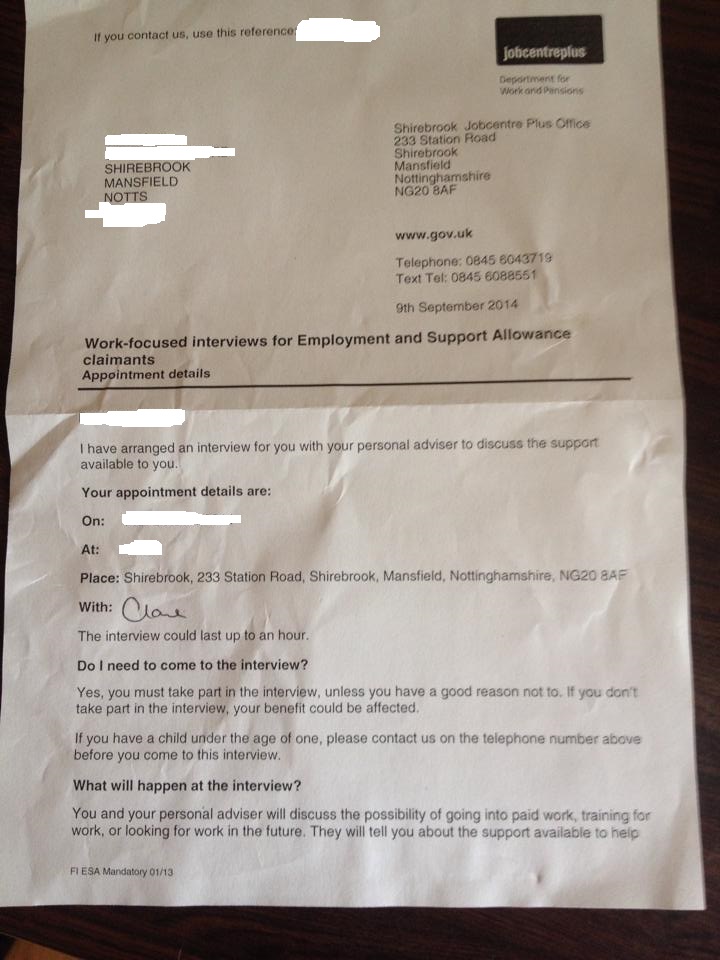
More Details Of The Shirebrook JobCentre Situation

September 17, 2014

Remember this post, readers?

I’ve just recieved full details of the situation from Paul Yates at the Welfair Foundation:

Hi,
 
Not sure if there is anything in particular you would like to know, if 
there is then please don’t hesitate to ask. The more information that 
gets out about this the better.
 
Please feel free to post any or all of the following information on 
online.
 
A local lady (Shirebrook) recently received a letter from Shirebrook 
Jobcentre giving her an appointment for a work-focused interview. She is 
in the Support Group of ESA and in receipt of both the care component 
and mobility component of PIP at the enhanced rate. She is severely 
disabled and very frightened about what lies ahead for her now in 
regards to sanctions/workfare etc.
 
She telephoned Shirebrook Jobcentre to enquire whether there had been a 
mistake and they informed her that all ESA claimants, including those in 
the Support Group, now have to attend work-focused interviews to discuss 
returning to work.
 
We were present at the second telephone call that she made to Shirebrook 
JC and she was again told that all Support Group claimants in Shirebrook 
were being called in for the interviews and anybody not attending will 
have their benefits sanctioned.
 
We have no idea why they are calling Support Group claimants in. When 
the lady contacted the JC the second time, whilst we were present, the 
JC refused to give the lady an email address for the manager and said 
“There is nothing you can do to change the appointment. You have to 
attend”.
 
This is absolutely bizarre and we have never heard of his happening 
before. I have made a Freedom of Information request to the DWP 
regarding Support Group claimants having to attend work-focused 
interviews and I am considering raising this matter with our local MP 
who handily happens to be Dennis Skinner.
 
I have attached the letter in question for your perusal.
 
Thank you for publicising this issue and helping us to spread the word 
about this.
 
Kind regards,
 
Paul Yates

Shirebrook job centre scan 1

How Will Scots With Learning Disabilities Vote Tomorrow?

September 17, 2014

From yesterday’s Guardian:


At the Learning Disability Alliance Scotland we have been determined that people with learning disabilities should have every chance to be involved in the country’s political debate.

We have run 52 workshops across Scotland with more than 700 people looking at issues surrounding independence and how to vote. We started from the basis that there should be no “understanding” test. Often people with learning disabilities are told by support staff, “you don’t really understand, and therefore you shouldn’t vote”. But if they like the look of a particular politician and want to trust them, why not?

But we also wanted to make sure people with learning disabilities could explore different ways of deciding on more complicated issues. Yet neither the yes nor the no camp published “easy read” information until late into the campaign. So some of our activist groups prepared their own.

Others went off to the Scottish parliament to interview Labour’s Jackie Baillie, who runs the cross-party group on learning disabilities, and the SNP’s Joan McAlpine, whose sister has Down’s syndrome. They made a short video outlining what difference the referendum would make for people with learning disabilities.

Those taking part found the workshops fun with lots of questions to think about. Who likes Flower of Scotland and who likes God Save the Queen? Who thinks that losing the pound is a good reason for voting no? Will the oil make us rich? Everyone gets a voting handset, just like in Who Wants to Be a Millionaire, and the answers come up on the screen. We knew we were on to a winner when someone told us: “You’re better than that lot on the telly.”

But this wasn’t information being delivered from above. The workshops were continually changed, depending on feedback from the people taking part. The participants told us what they wanted to know more about and then we went to Yes Scotland and Better Together to get the answers. A video was produced in which 20 people with learning disabilities give their opinion on the referendum, and it was used to help people decide.

But this is not just about the referendum, it is the latest stage in a process of increasingly engaging people with learning disabilities on mainstream issues. At the later workshops more people have been coming along wearing campaign T-shirts and badges.

And the results: 37 workshops went for yes, 10 for no and five were a dead heat. The total count was:

yes – 400 (56%)

no – 207 (29%)

don’t know – 114 (16%).

Deborah, her ATOS debacle, and the missing coat mystery

September 16, 2014

Ann McGauran's avatarAnn McGauran

Deborah Ruby, who had her ESA stopped, despite her multiple chronic health issues. Deborah Ruby, who has had her ESA stopped, despite her multiple chronic health issues. Deborah Ruby struggled into this London Trussell Trust food bank with her voucher. She’s a 51-year-old lady with multiple health issues. These include, but are not limited to, arthritis in the lower spine, hips, neck and knees, depression, severe Irritable Bowel Syndrome and congenital heart problems. She has been separated from her husband for 12 years and has four children – the youngest of whom is still at school.

A social worker gave her a voucher for the food bank after her employment and support allowance (ESA) was stopped on July 25. This stoppage followed her ATOS work capability assessment in June. Atos Healthcare is of course making an early exit from its contract to carry out “fit for work” tests on disability claimants. If Deborah’s experience is typical, the ATOS assessment process is if possible…

View original post 734 more words

From The Comments: Reader’s Son (In WRAG) Told To Start Business Or Look For Work

September 16, 2014

Reader Hugosmum70 sent in the following comment, which I thought should be in a post of its own so that it could be easily answered.

Hi, can they force someone on ESA in the WRAG group to start own business or look for work? they are trying to force my son into starting a photography business which hes already tried before and failed due to his fibromyalgia problems. this time hes to 1. come up with a business plan 2. think of a name for it 3. apply for a loan which he has no way of paying back ever.to cover for equipment. the camera he has is fine for normal use but not for taking professional shots.he lives in a 1 bedroomed first floor flat. his daughter lives with him,also not working, and no real space for taking photographs of people there.is looking for bungalow so he can get out more. at the moment if he has a flare up he cant even get down the stairs. can they actually force him to do this? or look for jobs? hes never gonna get any better unless they find a cure for it.

They have told him he has to have applied for this loan by time he has his next interview. of course the pressure now means he cant even think straight.ive tried helping him come up with a suitable name but its impossible.theyve told him if he doesnt do this then they will force him to look for work.

Does anyone know if this is a common thing? Have you had a similar experience?

Waiting For A PIP Assessment? BEWARE

September 16, 2014

Jayne Linney has just shared her personal experience on Facebook:

WAITING FOR A PIP ASSESSMENT – BEWARE

I’ve literally just had a phone call from a woman telling me she is coming to assess me at home today at 2.30pm – WITHOUT Capita sending a Letter.

I refused and its been arranged for October but…as Capita letters take 2 weeks + to arrive – WATCH OUT

What is a bedroom – There is a minimum size and specification…from the coalition

September 16, 2014

Why I Hope For A Yes Vote #IndyRef

September 16, 2014

Readers, I don’t live in Scotland. So it has taken me a long time to really think, to really care, about the Independence Referendum.

However, I kow many disability campaigners from Scotland through Facebook. Recently, I’ve started following their arguments about how much better an independent Scotland would be for disabled people. An independent Scotland, they’ve been saying, wouldn’t need to follow the welfare ‘reforms’ that have made life so difficult for disabled people in England.

I am, at my roots, a disabled person. Anything that improves the lives of any disabled people, anywhere in the world, has to be a good thing in my eyes.

So, readers, I thought it might be nice to have a Yes vote, but still, I don’t live in Scotland, so I didn’t really care.

Until this popped up in my email inbox:

Confirmation that disabled people in an independent Scotland will not be transferred to PIP, but will get to keep DLA.

Readers, the welfare ‘reform’ that has upset me most of all has been the introduction of PIP and the phasing out of DLA. Unleess government policy changes significantly very soon, this ‘reform’ will affect me personally. The thought scares me stiff.

So now I hope against hope that there is a Yes vote on Thursday, so that disabled people in Scotland won’t have to face my worst financial fear.

DWP Making Nearly £120,000 From Helpline Phone Calls

September 15, 2014

Iain Duncan Smith’s department has raked in nearly £120,000 from calls to Government helplines.

Pensioners and redundant workers are among people forced to pay the rip-off phone charges.

Work and Pensions Secretary Mr Smith – already under fire over his discredited Bedroom Tax – may now have to explain why his department still has 0845 numbers for its helplines.

The Government has pledged to stop using the numbers, which cost up to 41p a minute from a mobile phone.

But Labour MP Roger Godsiff has discovered the DWP has made £117,000 during the past five months from the high-rate numbers.

Among the DWP helplines with the 0845 prefix is the Future Pension Centre which gives pension statements and information.

Higher rates are also charged on the Redundancy Payments helpline.

The DWP gets 0.3p per minute from every call to its 0845 numbers, which is then spent on operating ­other phonelines.

But Mr Godsiff said: “People are ­being hammered by unnecessary phone call costs.

“This is all part of IDS’s relentless pursuit of reducing the benefits bill ­irrespective of the devastating impact on people’s lives.”

David Hickson of the Fair Telecoms Campaign said: “The continuing use of expensive numbers by Government and businesses is a rip-off.” Landline calls to 0845 numbers are no more expensive than normal.

But 15 per cent of the population do not have landlines and use mobiles.

A DWP spokesman said: “We have negotiated a ­rebate from our phone line providers, generating a better deal for the taxpayer.

“We make no money from call charges and this rebate does not mean extra charges for claimants.”

Peter Duut’s Widow Now Left Penniless By DWP- Even Without Dutch Survivor’s Pension.

September 15, 2014

Same Difference has been back in touch with LJ Duut, widow of Peter Duut, whose situation, very sadly, apears to be getting worse.

Earlier today, Monday 15 Sept, LJ Duut posted this on Facebook:

OK- as the situation stands- all benefits ceased in the UK and no Survivors benefit paid from the Netherlands. Not too bothered yet although I am not quite sure what time banks close there now? as it is an hour ahead. Well done UK gov yet again! stopping all benefits before waiting to see if I actually received anything?

Then this a couple of hours later:

It is now 18.02hrs in the Netherlands- nothing went into my account today. Therefore I have been honest yet the UK gov has jumped the gun and stopped everything even saying they ‘ want’ anything I receive- before waiting to see if I actually did get anything – therefore the UK has left me penniless.

When  offers to fundraise flooded in from her concerned friends she added:

Lots of people have kindly offered to give me money through paypal- which I am very grateful for and your kindness shows – yet! There will be many out there with no computer as we know -starving as we speak. I have food in my cupboard and I have a roof over my head ‘for now’ – most of all I am alive. I will not be treated any differently to anyone else as IDS wants it this way as he is in control of his department? I presume. Therefore I shall not buy food from others struggling themselves. I have camping cooker and gas. I am organised– prepared about the best a person can be. BRING IT ON. I must say that after what they did to Peter – I am not impressed at all. It is now a battle for freedom and justice. – As you know all I wanted was a headstone for Peter. I have been told twice by two different people in two different telephone calls ” I don’t think so we want it” meaning- money awarded for a widow of a Dutch National that the UK denied any benefit to – after working so very hard leaving him to starve as we know. Truly evil. But I will not betray anyone else or be treated differently to anyone else and WE are in this together. I do not mean with the regime we are under- I mean their killing games. I think that is all I need to say on the matter. I’d like to thank the UK Government for their greed and haste in stopping my ESA and housing and council tax benefit and simply assuming that I would receive monies said as I was told over the telephone from the Dutch department. They were so very wrong in their actions.

Which just shows her selfless nature and her strength. I am becoming increasingly concerned for LJ. All she wants is her story shared and readers, I will certainly continue to share her story and keep you updated.

Shirebrook Jobcentre Calling Support Group Claimants For Work Focused Interviews Under Threat Of Sanctioning

September 15, 2014

Readers, my intention in sharing this Twitter thread is to try to find out whether this is happening at any other JobCentres. I don’t mean to worry or scare anyone. If you haven’t heard about it, that’s a good thing so please don’t worry!

https://twitter.com/Welfair_F/status/510808636290269185

https://twitter.com/Welfair_F/status/511465744937152512

https://twitter.com/Welfair_F/status/511513272332210176

https://twitter.com/Welfair_F/status/511517774040924160

Refuted seem to be suggesting that Shirebrook JobCentre are going against DWP guidelines, in which case they need to be named and shamed.

Council Tells Arm Amputee To ‘Lose Another Limb’ To Qualify For Blue Badge

September 15, 2014

A one-armed man been refused a disabled parking permit – after being told he needed to lose ANOTHER limb to qualify.

Roy Sowerby, from Middlesbrough, is registered disabled after he lost his arm when it was crushed in an industrial accident 11 years ago.

And Mr Sowerby, 58, has had the Blue Badge permit for his car for the last three years. But when he went to renew it this year, he was told he could not have one.

The dad-of-five, who drives an automatic car, told the Evening Gazette : “I’d like the council to tell me how I am not disabled.”

“They said if I lost another arm or a leg then I would qualify for one.

“So do I have to cut off my legs or my arm or my head to qualify for one? They said I can’t have one because I can carry a bag but I can’t carry anything bulky or heavy or big.”

He said wielding a shopping trolley was a challenge and he needed to park close to the supermarket to make it easier.

Middlesbrough Council said Mr Sowerby is no longer eligible under new rules drawn up in 2012 by the Department for Transport (DfT).

The authority said Blue Badges are issued for three years and, under current rules, applications for the discretionary permits are “required to undergo independent assessment to determine their eligibility”.

“Those applying for a discretionary Blue Badge must have a severe disability in both arms or a permanent and substantial disability that causes inability to walk or very considerable difficulty in walking,” a spokesman for the council said.

“The criteria for eligibility in the first instance are that the applicant has a severe disability in both arms, regularly drives an adapted or non-adapted motor vehicle regularly, and also considerable difficulty in operating parking meters.

“To qualify for a Blue Badge all three criteria must be met. The DfT state that ‘in no circumstances should anyone who does not satisfy all three of the conditions set out above receive a badge’.

“The guidance adds that ‘in particular, a badge should not be issued to a person who travels solely as a passenger or a person who has difficulty carrying parcels, shopping or other heavy objects such as luggage’.”

Disability Rights UK Independent Living Helpline Closed Until Thursday

September 15, 2014

Just in case any of you need this:

The Disability Rights UK Independent Living telephone line will be unavailable on Monday 15th September

In the meantime please email independentliving@disabilityrightsuk.org and we will respond within five working days. The Independent Living telephone line will reopen on Thursday 18th September.

– See more at: http://www.disabilityrightsuk.org/news/2014/september/our-independent-living-helpline-closed-today?utm_source=twitterfeed&utm_medium=twitter#sthash.YPRXWjsQ.dpuf

Talkitt- A Life Changer For Those With Speech Impairments

September 15, 2014

This is a guest post by Nicole Caron. Thanks to Nicole.

Have you ever wondered what it’s like to not be able to express and communicate your thoughts and feelings? This is an everyday reality for millions of people (1.5% of the Western World’s population) who suffer from speech disabilities. This is very hard and frustrating for them and affects much larger circles in society such as families, caregivers, friends and society as a whole. These individuals are unable to be socially included in schools and work places and enjoy social activities; simple interactions a normally functioning individual would take for granted.

Until now the approach taken by developers of assistive technology for people with speech disabilities has completely bypassed voice, opting to use other modes of communication including communication boards that replace speech with symbols and images, head-tracking, eye-tracking, and switches. These solutions are often expensive, awkward and unnatural to use and degrade natural speech. There are no products on the market today that allow people with speech disabilities to communicate using their voice. This is the gap Voiceitt is trying to fill. Voiceitt is developing Talkitt, an innovative speech technology which is able recognize unintelligible language and translate it into understandable speech. Ultimately, Talkitt is giving individuals with speech impairments their voice back! Talkitt’s slogan is “This is my voice”.

TalkItt is a voice to voice application that will translate distorted pronunciation into understandable speech. For example, a person can say “o-ko-la” and software will translate it to “chocolate”. The software is in the development stage. Talkitt is speaker dependent and requires the user to create and maintain a dictionary of utterances and associated text and/or icons. The creation of the dictionary is the calibration phase. Once a dictionary is ready, a recognition stage may begin the application will perform pattern matching with enhancement of intonation features. If the user puts a word into the dictionary then the application will be able to recall that word at a later date and relay what the person is trying to say. The user will be able to access the application without help because during the recognition phase it is fully voice activated. The dictionary can be categorized so as to reduce to reduce mistakes by the machine. There is a possibility for having the same word in several different situations making the application dynamic.

Our approach is based on simultaneous exploitation of both the content and the intonation of a speaker voice. Talkitt is based on multi-domain signal processing, and pruning of dynamic voice pattern classifier search space, boosting recognition by adaptive learning of speech pattern. An example for one of VoiceItt’s innovative approaches is adaptive framing – an approach based on speech events that enables the division of speech to homogenic frames – this approach results with frames that contain the same vocal information but with varying durations. This duration is determined by the vocal information itself, thus allowing a much more accurate modelling and classification steps.

Talkitt does not require hardware and can run on any computerized device (PC, tablet or smartphone) and can be integrated in Apps (browsers, games, communication boards) and assistive devices (smart phone, wheelchairs, emergency calls). This software-based solution gained enthusiasm from field expert’s worldwide (speech therapists, University professors, occupational therapists) and has the potential to dramatically improve the quality of life of millions of people. Please visit our indiegogo crowdfunding campaign to see Talkitt in action! https://www.indiegogo.com/projects/talkitt-this-is-my-voice


Video Of The Kanye West Sydney Wheelchair Incident

September 15, 2014

I have found a video of the incident reported yesterday:

My best friend (non-disabled) says this is reason enough to boycott him!

I’ve never been a fan of his music, but I’ve never thought much about him either. Now I dislike him strongly as a person.

The Day The Tide Turned

September 15, 2014

A sad, sad story and madness at the JCP from The Sanctioned JobSeeker. The audio recording mentioned can be heard here.

As readers of this website and JSUK News will know, I have offered my help to people who cannot complain or appeal to the Jobcentre Plus/Department for Work and Pensions, and have successfully helped many people in getting justice.

Over the past week I have been trying to help a 52 year old lady, who I shall call “Lilly”, who had her Employment and Support Allowance (ESA) stopped in April 2014 when she was too ill to attend an interview, which both her doctor and cardiologist confirmed, and she subsequently suffered a heart attack in July due to the stress inflicted upon her by the DWP as they said they would not pay her until she had attended the assessment interview.

She subsequently suffered a heart attack in July due to the stress inflicted upon her by the DWP

Her doctor and cardiologist have both instructed her that she must not correspond with the DWP at least until after completing her 26 weeks of cardiac rehabilitation she has to endure due to the heart attack caused by the stress of having no money and having to fight tooth and nail to try get it back from the DWP. All they keep saying is that she must attend the assessment interview before they can pay her, which is taking the pettiness of bureaucracy to a whole new level considering she is now unable to do anything until well into the new year, all thanks to the DWP.

Anyway, Lilly sent me a letter of authority by email and I had attempted to get this to my local Jobcentre Plus at Crossfield House in Halifax so they could send it onto whomever dealt with such things. A few days passed and I still hadn’t heard back from the Jobcentre Plus so I decided to go back to the office and take the letter of authority again, except this time I would insist that they confirm the authority with Lilly while I was present in the Jobcentre Plus office.

I went to the office on Thursday the 11th of September 2014 and I also took a Subject Access Request for myself, and I had the foresight to also prepare a Cease and Desist letter to give to them as I was fed up of the continuous harassment and victimisation I experienced practically every time I had to interact with the Jobcentre Plus or DWP. As these documents were quite important, I decided to record the entire visit so I could later rely on it as evidence, if required.

I got to the Jobcentre Plus at Crossfield House, Halifax (wearing my “No Benefit Sanctions” protest t-shirt, of course) and made an appointment to see an adviser. I wasn’t waiting too long before I was called over by an adviser named Jan. I gave her the letter of authority from Lilly and explained that I wanted her to call Lilly while I was there and confirm that I had authority to handle the claim on Lilly’s behalf.

Jan said she couldn’t accept the letter as it wasn’t signed and I asked her to call Lilly to confirm her details and then speak to me about the claim. She said that she wasn’t willing to do so as she claimed that I “could have just written that email” but I quickly informed her that that is why I asked her to call Lilly to confirm the details. I could quickly see that she was simply treating me like most of the other staff treat me so I asked her to get a manager, which is the point at which I realised my camera wasn’t recording so I quickly got my phone out and put it onto record the audio, which can be heard below.

  The manager came over and it was the same manager who referred me to the food bank (Marcus at Jobcentre Plus, Crossfield House, Halifax). He practically repeated, word for word, what Jan said and after a short debate I concluded that they weren’t going to do the right thing and simply ring Lilly to verify her details so I moved onto my next point of business.

The Subject Access Request (SAR)

Marcus then asked me if there was anything else he could help with (he knew there was as he could see me waiting to pass on the next letters). I told him that there were two more things and handed him the Subject Access Request (SAR) which I had printed out just prior to going to the Jobcentre Plus as I wanted all my information sending to me for use as evidence in the legal case I and others are building against the Department for Work and Pensions.

They accepted the letter and I then handed over the £10.00 fee which can be requested to cover the costs of providing the information requested in the Subject Access Request. Jan said that she couldn’t accept the money so I tried to give it to Marcus and he then informed me that they didn’t charge a fee for SARs. I asked them if they would put that in writing for me as if they requested a fee later, the 40 day time limit for responding only starts when that fee is paid, and I don’t trust the DWP after how they have previously treated me.

Both Jan and Marcus refused to put it in writing for me and stressed the point that there wasn’t a fee to pay. I then turned and said I would have to get the people sat behind me to bear witness that both Jan and Marcus said there was no fee payable and Jan said “we’re not involving third parties”, so I then turned to a man sat behind me and asked if he would witness the fact that they said no fee was payable. At that point, Jan stood up and said she was calling security and refused to continue the interview.

Jan stood up and said she was calling security and refused to continue the interview.

Security came over and asked me to leave, but I told them that I wasn’t being unreasonable, yet Jan said that she thought I was being unreasonable. Fortunately, the security guard was the guy who liked my “No Benefit Sanctions” protest t-shirt and only halfheartedly asked me to leave as he actually supported my cause. I asked if there was another adviser who was prepared to conduct the interview as all my requests were legitimate and I wasn’t acting in any manner which would warrant security removing me from the premises. Marcus continued the interview and security hung back for a while. By this point there were four burly G4S security guards (*any resemblance is purely coincidental. And possibly fake) surrounding me, waiting for Marcus to finish so they could “escort” me from the building.

I then explained to Marcus that I wanted confirmation that no fee was payable due to not wanting any delays with the response as the 40 day response limit only starts from the day you pay the £10.00 fee. He was stunned into silence and simply repeated his earlier response that he was going to send it to the “district office”. He then further refused to accept the £10.00 fee and claimed he couldn’t take the money from me, which is incorrect in law; any employee or representative of the company from which you request the data has to accept the Subject Access Request and the fee and then send it on to the nominated Data Protection Officer for that organisation.

Security then asked me to leave as they thought my business was concluded, however, I still had one last letter to give them. A Cease and Desist letter.

The Cease and Desist Letter

I appealed to the semi-friendly security guard with a “come on?!”, as if to let him know that I knew he knew there was no valid reason to ask me to leave. Marcus was still confirming that there was no charge and I informed them that I had one last letter to give them. By this time, the three most burly security guards were within inches of my face but I refused to be intimidated as I knew that the next letter was going to knock them for six.

I handed Marcus the Cease and Desist order and all went silent as I told them that now he had accepted the letter on behalf of the Department for Work and Pensions, any further harassing, bullying or victimising behaviour, including being asked to leave for no valid reason. After a moment, security then tried to get me to leave but I insisted on waiting until Marcus had read the letter, and I also informed them of more details of the Cease and Desist order, which made the security team take a good few steps back and they all had fear in their eyes as I eyeballed each and everyone of them to make sure they knew that the order applied to them too.

I then concluded my business by requesting that the letter of authority issue be taken forward and Marcus responded with the party line of “bring it in with a signature and we will gladly sort it out for you”. I then informed Marcus that I would be doing something more about it and then I left of my own free will and the security staff didn’t bother “escorting” me as they were still reeling from being slapped with the threat of criminal charges if they dared to “escort” me off the premises.

Game, set and match to Harper. And you know what? They have treat me with the utmost respect since then ;)

Too Obese To Work? IDS Considered Recommending Celebrity Diets

September 14, 2014

Welfare for the seriously overweight has ballooned by 70 per cent from £29million in 2012 to £40million last year, figures reveal.

Now the Work and Pensions Secretary has asked his department to “investigate the possibility” of introducing the liquids-only Cambridge Diet for almost 8,000 benefit claimants who are obese.

He has also written to the Health Secretary Jeremy Hunt voicing his concern at the growing cost of British obesity.

The move comes after Mr Duncan Smith met his constituent Ruth Barber, a Cambridge Diet consultant, and Professor Anthony Leeds, Cambridge Weight Plan medical director.

At the meeting this month, they said the £45-a-week rapid weight loss plan has helped obese people return to work. Mr Duncan Smith subsequently wrote to Ms Barber confirming he was considering the Cambridge Diet.

In the letter, seen by the Sunday Express, the Work and Pensions Secretary wrote: “I have written to the Health Secretary to make him aware of the Cambridge Weight Plan.

It is good that the DWP is looking at ways to help the overweight and clinically obese

Rob Flello

“I have also asked my department to investigate the possibility of introducing this as an option for those who are too obese too work.”

Earlier this year, the National Institute of Health and Care Excellence advised that slimming clubs, such as WeightWatchers, should be made available free on the NHS.

Swedish research shows meal replacement therapies with as little as 500 calories a day can achieve weight loss of two-and-a-half stone, getting five out of six dieters back into work in under three months.

More than a quarter of British adults are obese and the number of diabetics has risen by a million in seven years.

Last night Labour MP Rob Flello, chairman of an all-party group studying obesity, said: “It is good that the DWP is looking at ways to help the overweight and clinically obese.”

Celebrity backers of the diet include Towie star Lauren Goodger, 27, and actress Jennifer Ellison, 31, who earlier this year lost two stone in two months by restricting her intake to only 800 calories a day.

Last night the DWP distanced itself from the claims in Mr Duncan Smith’s letter.

A source in his department said: “DWP is not looking into this.

“Iain raised it with Department of Health as a constituency MP.”

Kanye West stops show to make sure everyone is standing up, including fan in a wheelchair

September 14, 2014

A Tombstone For A Son Who Used A Wheelchair

September 13, 2014

I saw this on Facebook and am so moved by it that I had to share it with you.

Meet MAXIMUS – the new ATOS (but even worse)

September 13, 2014

Tom Pride's avatarPride's Purge

(not satire – it’s the UK today!)

Here’s one that got in under the radar.

The coalition government has chosen a VERY controversial US private company to run its new health assessment service to be called the Health and Work Service.

In less than 2 months time any employee who is sick enough to have to claim sick leave from work for more than 4 weeks will be assessed – mostly by phone – by employees of a US firm called MAXIMUS.

Apart from the ludicrous assumption that sick people can be assessed over the telephone, for some reason, when the UK government decided to hand the lucrative contract to run the service over to MAXIMUS, they also decided to ignore the numerous scandals involving the company in the US.

Here are just a few examples:

Lawmakers lash out at Maximus for questionable expenses payments

Medical workers allowed to keep practising despite failing drug…

View original post 143 more words

Waterloo Plans To Switch Off Tannoy- But The Blind Will Lose Out

September 13, 2014

Waterloo is planning to become the first major London rail terminus to switch off its Tannoy, following complaints from passengers and locals that it is making the station too noisy.

The decision to silence the announcements comes two years after South West Trains spent almost £3million on a new 90-decibel system, comprising 1,000 speakers, which  it said would deliver “better and clearer” information.

The move has angered accessibility campaigners, with one charity for the blind saying it would result in loss of independence for those it represents.

South West Trains has told passenger groups it is suspending the audio announcements of train information for a two-week trial from October 6.

The only exception will be a message every 10 minutes targeted at blind and partially sighted passengers, followed by a security message. The Standard understands they will be told: “Visually impaired people please seek assistance from travel information points.”

The Royal National Institute for the Blind has asked South West Trains  to scrap the proposal.  Fazilet Hadi, director of engagement at RNIB, said: “Any proposal to turn off announcements is wholly unacceptable.

“Forcing people to seek assistance from travel information points takes away independence and can make journeys harder than they need to be.”

London Assembly transport committee chair, Liberal Democrat Caroline Pidgeon said: “This is one of the most absurd decisions by a train company I have ever come across. Visual and audible announcements are vital… and it would be a scandal if such an important station as Waterloo was made inaccessible to any of its passengers.”

A spokeswoman  for the South West Trains/Network Rail Alliance said: “We’ve been engaging with a range of passenger representatives and local residents about London Waterloo station announcements.

“We understand the diverse needs of customers using our network and are committed to ensuring they can continue to easily access our services.”

EastEnders’ John Bardon (Jim Branning) Dies Aged 75 After Stroke

September 12, 2014

RIP Sir. I never saw you on screen but your character is often mentioned.

Written Statement By Greg Clark MP On Disabled Students’ Allowance

September 12, 2014

Same Difference has been sent the following statement by the Liberal Democrat Disability Association:

In a Written Ministerial Statement on 7 April 2014 the then Minister for Universities and Science announced proposed changes to Disabled Students’ Allowances which are available to Higher Education students from England.

Disabled Students’ Allowances are non-repayable grants that assist with the additional costs incurred by disabled students in relation to their study in higher education. Disabled Students’ Allowances finance a range of support, including the purchase of computers and specialised equipment, assistance with travel costs and the provision of support workers where necessary. In 2011/12 Disabled Students’ Allowances provided support of over £144 million to 61,000 students, funded from the Higher Education Budget. Disabled Students’ Allowance continues to be available to support disabled students studying in higher education.

During the Summer I and the Minister of State for Disabled People have listened carefully to suggestions from representatives of disabled students. I have also listened to the views and concerns of representatives across the higher education and disability sectors, as well as receiving representations from Honourable Members.

We are determined to ensure that disabled students should be able to make use of and develop their talents through higher education and that there should be no cap on their aspirations.

There was widespread agreement that universities should discharge their duties under the Equality Act to make reasonable adjustments to accommodate disabled students, as other organisations do. However, concern was conveyed that some universities may not be able to meet their obligations in full by the beginning of the 2015/16 academic year, given their need to invest in additional support for their students.
With students applying now for places at the beginning of that year it is important that any disabled student should be confident that an institution to which they are considering applying will be able to meet their needs satisfactorily.

Accordingly we have agreed to give Higher Education Institutions until the beginning of the 2016/17 academic year to develop appropriate mechanisms to fully deliver their statutory duty to provide reasonable adjustments, in particular non-medical help, and to improve the processes by which disabled students can appeal against a Higher Education Institution’s decision that an adjustment would not be reasonable.

We will explore how this might be supported in institutions’ Access Agreements with the Office for Fair Access for 2016/17.
For the academic year 2015/16, we will continue to provide Disabled Students’ Allowance funding to help with the additional cost of a computer and assistive software if needed solely because of the student’s impairment. This will be subject to the student contributing the first £200 of the computer’s cost – broadly equivalent to the cost of a basic computer. For future academic years we will explore a bulk purchasing scheme for such computers to keep costs down.

Additional items such as printers and consumables will not be automatically provided, with alternative provision in the form of university provided services such as printing services and books and journals in electronic format to be considered as alternatives.
Funding will remain available towards the additional costs of specialised accommodation for disabled students, other than where the accommodation is provided by the institution or an agent of the institution.

A number of commentators made proposals to streamline the assessment process for Disabled Students’ Allowance to reduce the burden for students, universities and the taxpayer. The Minister of State for Disabled People and I will invite representatives to consider how that might be achieved.

The changes summarised in this Statement other than non-medical help changes will apply to all full-time, full-time distance learning, part-time and postgraduate students applying for Disabled Students’ Allowances for the first time in respect of an academic year beginning on or after 1 September 2015. This provides sufficient time for us to work with institutions and stakeholders to ensure the changes are introduced effectively. All changes are subject to the ongoing Equality Analysis.

Continuing students already claiming Disabled Students’ Allowances and students claiming for 2014/15 entry will remain on the current system of support for 2015/16.

We are grateful to universities, students and their representative bodies for their assistance in informing these changes.

Same Difference warmly welcomes the statement, which proposes a small but significant piece of progress for all who support inclusive education.

BBC: IPC ‘Won’t Stand In Way’ If Pistorius Wants To Resume Career

September 12, 2014

I’ve just heard this reported on the BBC. I can’t hide my surprise.

I’ve been saying that from the start.


A Complaint To The BBC

September 12, 2014

Any thoughts on this, readers?

DWP Figures Reveal Shocking Delays In ESA Decisions

September 11, 2014

Many thanks to the Welfare News Service.

Only 19% of sick and disabled people have received an outcome on their sickness benefit claims they made last year, damning new figures reveal.

Government figures released today show that 40% of Employment and Support Allowance (ESA) claims between October 2013 and December 2013 were still undergoing assessment – no final decision has yet been made.

Despite signs of improvement, by March 2014 around a third of ESA claims (33%) were still in progress. The DWP said “additional cases from any original caseload would be cleared in subsequent periods”.

Figures also show that 41% of claimants decided to close their claim rather than be forced to attend stressful and degrading face to face assessments.

The Department for Work and Pensions says the delay in final decisions is due to changes in the decision-making process. Under changes introduced to the benefits appeal process in October 2013, sick and disabled people who disagree with a decision must first ask the DWP to look at the decision again – before they can apply to appeal to a social security tribunal. The figures exclude decisions made after tribunal appeals.

Of the 19% who had received a final outcome on their claim for ESA 73% were entitled to the benefit while only 27% were found ‘fit for work’. The number of people entitled to the benefit has risen sharply from a low of 35% in January to March 2009.

Source: DWP
Source: DWP

Of those who received a favourable outcome on their claim 15% were placed in Work Related Activity Group (WRAG) and 58% were placed in the Support Group. Those in the WRAG are not ready to return to work but may be at some point in the future. The Support Group is for sick and disabled people who are unlikely to be able to return to work in the foreseeable future.

The DWP say that “cases where decisions are made earlier tend to be more likely to be entitled to ESA than not”.

Source: DWP
Source: DWP

In related news, the new Minister for Disabled People has admitted that the disability benefit Personal Independence Payment (PIP) “is not in good shape”.

Despite a pledge to speed up the claims process Mark Harper admitted that disabled people will still face a wait of up to six months before they receive vital benefit cash.

Dame Anne Begg, chair of the Work and Pensions Committee, asked: “Do you think that’s an acceptable length of time for someone who has developed a disability, and suddenly has a lot of associated costs?”

In response Mark Harper said: “I’d like it to be faster – but there’s no point getting ahead of ourselves. It’s moving in the right direction”.

The government has blamed the delays on private contractors Atos and Capita. However, Labour MP Debbie Abrahams suggested the delays were due to the DWP sacking 1,000 workers – including 600 benefit assessors. Noel Shanahan, director general of operations at the DWP, said they were bringing in additional staff to help deal with the delays and that the sacked workers “would have been at the wrong grade”.

Atos recently announced that they would be withdrawing from a £500 million a year contract to deliver Work Capability Assessments for ESA when that contract ends in 2015. The DWP has yet to announce a replacement.

BREAKING: Pistorius GUILTY Of Culpable Homicide (Manslaughter)

September 11, 2014

After a day and a bit of delivering her verdict, the judge has just found Oscar Pistorius guilty of culpable homicide (manslaughter) today- Friday, Sept 12.

Reactions are still to come, and I’m sure there will be many. It would not be right for me to comment any further on the legal case.

However, I would like to link back to the post I wrote back in February last year about the tragic events of Valentine’s Day.

I tried my best to provide a summary of charges and verdicts over the two days:


Friday 12/9/14:

  • Pistorius guilty of negligently handling a firearm in a restaurant.


  • But not guilty of second firearms charge of firing a gun from his car.


  • Not guilty of illegal possession of ammunition.


  • Bail extended until sentencing on 13th October.

NHS Psychotherapist Discusses The Rise In Depression Among Victims Of Benefit Sanctions

September 11, 2014

Jordanne Whiley Completes Wheelchair Doubles Grand Slam

September 10, 2014

Britain’s Jordanne Whiley won the women’s wheelchair doubles at the US Open to complete a Grand Slam in 2014.

The 22-year-old and Japan’s Yui Kamiji beat Dutch defending champions Jiske Griffioen and Aniek van Koot 6-4 3-6 6-3 at Flushing Meadows in New York.

Birmingham-born Whiley became the first Briton to win the same event at all four Grand Slams in the same year.

“I can’t believe it. There’s a mixture of emotions. I felt sick at one point, I felt enjoyment at another,” she said.

“Now it’s a little bit of relief and pure happiness. I think it will sink in later when I can relax and celebrate with the people that I love. I need to call my parents because they don’t know yet.”

After most of the match had been played in stifling heat, the players were forced off court when it began raining heavily with Whiley and Kamiji leading 4-3 in the deciding set.

“I was a bit worried because I’m not good at rain delays, especially when I was just getting into my groove in the third set,” Whiley said.

“But we went down to the locker rooms, played some music and we busted out some moves. It kept us lively and it worked.”

She and Kamiji also hold the Australian, French and Wimbledon titles.

But there was no joy for Scotland’s Gordon Reid in the men’s doubles final as he and Dutch partner Maikel Scheffers lost in a third-set tie-break to top seeds Stephane Houdet and Shingo Kunieda.

Reid and Scheffers fought back from losing the opening set to dominate the second and then had two match points at 6-5 up in the third and deciding set before Houdet and Kunieda won 6-2 2-6 7-6 (7-4).


Jobcentre Orders Woman To Repay 30p Due To Staff Error

September 10, 2014

Because sometimes we all have to laugh…


Racheal Walton, 42, was shocked to recieve a Job Centre letter giving her weeks to pay a debt of 30p due to a staff error at the Job Centre.

After attending a CV clinic at her local Job Centre in Devon she claimed back the cost of her £3.30 bus fare  but staff accidentally paid her £3.60.

Ms Walton claims that when she went to sign on her adviser informed her she owed 30p. Despite trying to offer 30p there and then she was forced to fill in forms at reception.

She  said: “I thought nothing more of it until I went in to sign on last week and the lady said ‘Do you realise that you owe us 30p?’

 “I said ‘I’ll give you the 30p now’ but she said ‘I can’t take it. You have to fill out a form in reception’.


“I just found it amusing that they went to the trouble of sending this letter. They had to pay someone to write it and pay for the postage which must have been 53p second class.

“I am sure it’s happening to other people. She was very embarrassed about it but they are just doing what the government tell them to do.”

A spokesman for the Department of Work and Pensions said: “We apologise to Ms Walton for any inconvenience caused.”Incidents of this kind are extremely rare, but it’s standard practice to inform people when an overpayment has occurred.”

Sainsbury’s Creates Trolleys For Disabled Children Thanks To Mother’s Campaign

September 10, 2014


PARENTS of children with disabilities will find the supermarket run has been made easier thanks to a Crawley family.

Maria Box, whose son Ryan is autistic, campaigned for safer shopping trolleys to be introduced for children with disabilities.

As a result of her appeal Sainsbury’s has now announced it is going to roll out a brand new trolley for children with special needs by the end of this year, to make the shopping trip easier.

Mrs Box, from Bristol Close in Pound Hill, has been using a prototype at the West Green store since April and has helped with the final design.

She said: “I now know Ryan is safe and secure, and importantly he is happy.

“He is supported in the seat so if he gets anxious he can’t kick out at anyone or hurt himself by hitting his head.

“I still have to be careful and keep an eye out for him grabbing items from the shelves, but there is no longer the danger of a row of baked beans getting trashed.

“Using this trolley has also helped to raise awareness of autism. It is a hidden disability. People look at Ryan and don’t think there is anything different about him.

“Now they take a look at the trolley and get an understanding that there could be a reason why Ryan is distressed.

“It stops autistic children from wrongly being labelled as simply a ‘naughty child’.”

As many as 15 families in Crawley make use of the trolley in the Crawley Avenue store, with another on trial in a Manchester store.

Mrs Box has given some pointers on how the prototype can be improved even further, including adding a hook so bags can be hung off the trolley to create more shopping space in the basket.

The finished trolley is expected to be introduced within two months, and then brought into Sainsbury’s branches across the country by the end of the year.

Mrs Box writes a monthly column in the Crawley News about life with Ryan, who is five and a pupil at Manor Green Primary School, and one of her articles earlier this year sparked the quest for a solution.

In it she called for trolleys to be adapted to include harnesses so children with autism could be securely strapped in, preventing them from falling out or knocking items off shelves.

Following her article, which specifically mentioned Sainsbury’s in West Green, a member of the supermarket’s head office contacted the Crawley News with a possible solution.

The supermarket offered to come up with a prototype trolley with a five-point harness.

The trolley also has a larger seat, so older autistic children can use it.

Oliver Hellowell- Photographer With Downs Syndrome

September 10, 2014

Photographer Oliver Hellowell has Down’s syndrome, which his mother says means he sees the world differently from most people.

Oliver’s unique way of capturing the natural world has recently gained him a lot of fans.

Just over a year ago, his mother Wendy O’Carroll set up a Facebook page for the 18-year-old’s photography. That page now has more than 10,500 followers.

“It’s not just the numbers that have surprised the family, it’s the range of people,” says Wendy. The page has fans from Brazil to Alaska.

Oliver hopes that photography – particularly of birds – can become his full-time profession.

To watch a subtitled version of this video, click here.


Peter Duut’s Mother In Law Speaks Out About Her Daughter’s Current Situation

September 9, 2014

Same Difference has been in touch with the mother-in-law of Mr Peter Duut, who has asked for the following to be published exclusively, and shared with those who might remember his quite high-profile case.

I am the mother of Mrs Laurel Joanna Duut, the widow of Peter Duut, who died tragically in October 2011, after financially supporting my disabled daughter for years preciously in Holland, and also in the UK after all of her benefits ceased in 2002 after she had cared for her terminally ill father – we have never been given any reason as to why her benefits had ceased.

In the months before his death, Peter was denied benefits even though he had worked very hard in the Netherlands and the UK paying tax and National insurance in both countries. He was refused benefits and advised that he had no right to reside in the UK. As a member of Iain Duncan Smith’s constituency, I visited the said gentleman in his surgery in North Chingford, for support and help for my daughter and her husband. He told me he could do nothing to assist them. With insufficient money to live on, Peter Duut and Laurel starved. Peter suffered more than Laurel as he was a very tall man and needed more food to sustain him than Laurel did. Laurel nursed Peter until the end and had to leave the law course she was studying at Cambridge to do so. When Peter finally passed away, he knew that he was not respected for all he had worked for in the UK, and that no authorities cared about him. Peter said that he had died stateless. Peter even went to the local newspaper himself about this as he was so distraught.

Laurel was too young to receive a widow’s benefit and so no funeral could be arranged until Laurel was able to scrape together some money for the purpose. After he died, Peter was sent two weeks ESA benefit. So that helped to bury him, leaving Laurel in much debt. There is still no headstone on his grave.

Since Peter’s death, life has been a nightmare for Laurel. She no longer had the support of Peter and struggled alone. But she did have a fight to keep the house and to eventually receive some benefits herself , although not enough to enable her to pay the bedroom tax and eat properly nor heat her property. A couple of years ago she learnt that she was eligible to receive the British DLA benefit for 2007 that she applied for while living in Holland after an ECJ ruling made in 2007, but Iain Duncan Smith has refused to allow this to be awarded to her, even though it was agreed on in Court. Instead she is awaiting a Supreme Court hearing on another case.

My daughter’s husband Peter had worked all his life and as a Dutch citizen had contributed to Insurance to support him and his wife if necessary. So the Dutch Government have been studying his case and Laurel received a communication from them a few days ago, announcing that as she was his wife and is more than 45% disabled, she is eligible for a Dutch Survivor’s benefit, which will be backdated to the time of Peter’s death in 2011 and continue from now. She has not received anything of this as yet. As she is responsible, Laurel has sought legal advice and has also informed the DWP.

Their reaction has been to tell her that she will very likely have to hand over all of the insurance money to them and that all her benefits (ESA, Housing, Council tax etc ) have now been stopped altogether until the DWP make a decision on her case. When she asked for this to be looked into, she was told that the very earliest she would hear anything would be 22nd September. So now we are back again to her receiving no benefits , so unable to buy food or pay the bills and possibly becoming homeless.

I personally am disgusted at the way my daughter has been treated through the years. In 2002 she suddenly , for no reason, had all her benefits stopped, even her child allowance, even though I visited the Benefits Office with her, nothing was changed. She had to leave her home in the UK as Peter could only find employment at that time in haste in the Netherlands, for a few years, staying in a derelict property until she was able to return back to the UK with Peter to their family.

Ms Anita Lincoln

WARNING: DWP Destroy Disability Campaigner’s Medical Records

September 9, 2014

People need to be aware of this…

Welfare News Service Editor Calls For Creation Of New Union For Benefit Claimants

September 9, 2014

Sharing because Steven Preece of WNS has asked for his supporters to share…

At Least 212,000 People ‘Beaten Up For Being On Benefits’ Finds Study

September 9, 2014

Many thanks to the Welfare News Service.

Up to 212,000 people have been ‘beaten up for being on benefits’ as a direct result of the despicable ‘scrounger’ rhetoric in the media and ‘poverty porn’ TV programmes, a shocking new survey reveals today.

A survey by YouGov reveals the devastating impact of newspaper benefits propaganda, and ‘poverty porn’ programmes like Channel 4’s Benefits Street, on some of Britain’s poorest and most vulnerable citizens.

The YouGov survey shows that up to 212,000 people have been attacked for being on benefits, while 11% had even been shunned by their own families.

YouGov asked 2,352 benefit claimants: “Have you ever been verbally or physically abused because you are on benefits? 15% said they had experienced verbal abuse and 4% admitted they had been physically assaulted.

If the survey had asked every single benefit claimant in the UK it would suggest that nearly 212,000 have been physically assaulted.

6% of respondents said their children had been victims of bullies, while 16% said they had been turned down for a home for being in receipt of benefits.

Campaigners and charities are now calling on the media and the government to end their use of socially divisive language, which is turning British society against itself.

Philipp Newis from the Who Benefits? campaign told the Daily Mirror:

“We’ve heard a lot of negative talk from politicians about benefit claimants, even though these are people who might need support for all sorts of reasons.

“Around 4.3million families receiving benefits are in work, but earning too little to get by.

“Many others are ill, caring for a loved one or have lost their job. It could happen to any one of us.”

The survey was carried out by YouGov on behalf of a number of charities including Gingerbread, MIND and the Children’s Society.

Its findings will be sent to a report which is investigating whether benefit claimants are being treated like second-class citizens.


Find out more: Daily Mirror

Lib Dems Want NHS To Take Over WCA

September 9, 2014

The NHS could be asked to take over the Government’s hated fit-to-work tests for disabled people following the Atos fiasco, Lib Dem chiefs said today.

Party manifesto boss David Laws admitted the work capability assessments undertaken by French firm Atos have been “unacceptable” and that another private contractor may not be the answer.

Atos’s contract will be cancelled next year but the Government plans to bring in another private firm – leading to fears little will actually change.

“We have big concerns about the way the assessments have been carried out,” Mr Laws said.

“We want to test the option of bringing these back in house, as well as using private sector providers.

“We’re willing to look at that, if that is what it takes to get this right.”

Mr Laws made clear the way disabled people have been treated by Atos as they wait for vital benefit payments has not been acceptable.

“They are leaving many people in a state of uncertainty and on very low income for totally unacceptable periods of time,” he fumed.

It is among a raft of possible manifesto policies the Lib Dems will debate at their autumn conference next month.

The party will also “consider” supporting the relaxation of drug laws and plan to clobber the rich with a raft of new taxes.

The Lib Dems will also promise a ‘young people’s bus pass’ for 16-to-21-year-olds and a guaranteed 15 free hours’ of free childcare for all two-year-olds.

Mr Laws warned the Tory plan to slash spending without more tax hikes could see “millions” driven into poverty.

“Without (tax rises) we believe key public services such as education, the NHS and the police would be at risk of an unacceptable deterioration – or welfare cuts would have to be so severe that millions of people would be forced into poverty,” Mr Laws said.

Lib Dem leader Nick Clegg stressed the party was not advocating outright legalisation of drugs, but will keep an “open mind” on relaxing current laws.

“I am very anxious the debate about drugs doesn’t descend into a cardboard cut-out polarisation between those who say the way to deal with the drugs issue is just to lock everybody up in jail, and another bunch of people saying ‘you just need to legalise everything under the sun’,” the Deputy PM said.

He said the UK should draw lessons from countries such as Portugal and states in the USA which have recently decriminalises certain drugs.

“We need to look with an unprejudiced mind about the initiatives that other countries and states in America are doing,” he said.

“Quite a lot of these things are very recent changes indeed, so it is far too early to tell what lessons they teach us.

“But I think as long as you keep an open mind about things, that’s one thing, but we are not advocating (decriminalisation) now and won’t be advocating that as a definite step in our next manifesto.”

Scandal! Are These DWP Fat Cats The UK’s Biggest Benefit Scroungers?

September 9, 2014

johnny void's avatarthe void

Howard Shiplee relaxes after another exhausting day spending our money. Howard Shiplee relaxes after another exhausting day spending our money.

At a time when disabled people are being driven from their homes due to the Bedroom Tax, DWP mandarins are being paid huge sums of our money to implement bungled welfare reforms.

The department have just released the salaries of their senior staff  and there is no sign of austerity for those running beneits system. Four senior staff are paid over £150,000 a year, with Universal Credit boss Howard Shipley the highest paid at a whopping £195,000 plus. This huge salary comes despite the fact Universal Credit has been a disaster and Shiplee is believed to have spent most of the year on the sick.

The gormless civil servant in charge of the DWP, Robert Devereux, is the second highest paid, earning a minimum of £180,000 per year. This is almost 50 times more than a single adult on…

View original post 188 more words

Bone marrow transplant patient could lose her Motability car under DWP rules

September 8, 2014

Ann McGauran's avatarAnn McGauran

“Lesley” is petrified. She needs a bone marrow transplant at the end of this month. Trying to deal with Myelodysplasia – a serious blood disorder that causes a drop in the number of healthy blood cells – is tough enough already, and she is very anxious about the transplant. But now she’s worried she’ll lose her Motability vehicle at the very time she needs it most. The decision by the Department for Work and Pensions (DWP) to stop paying the mobility component of the Disability Living Allowance (DLA) or Personal Independence Payment (PIP) to the Motability Scheme when people end up in hospital for more than 28 days has added an extra level of concern.

The 47-year-old divorcee depends on the leased car for her 40-mile round trip to the NHS centre of excellence where she’s being treated. She expects to be in hospital for four to six weeks post-transplant…

View original post 901 more words

Man Jailed For 14 Years After Homophobic Attack Left Flatmate With Brain Damage

September 8, 2014

A man who left his gay flatmate with brain damage after attacking him with a claw hammer has been jailed for 14 years.

Joseph Williams, 21, attacked 18-year-old Connor Huntley with a claw hammer as he slept, in the two bedroom flat they shared in Margate, Kent.

Mr Huntley miraculously survived the “life threatening” injuries, but was treated for a depressed skull fracture and traumatic brain injury.

Following an operation to remove the claw hammer from his skull, as well as bone fragments and a blood clot, Mr Huntley was left with brain damage.

Standing trial at the Old Bailey, Williams was found guilty of attempted murder and jailed for 14 years, including time in a secure psychiatric unit.

The court heard that Williams was from a Catholic background and had been known to make anti-gay remarks, while Mr Huntley was gay and often cross-dressed.

According to the Evening Standard, prosecutor Philip Bennetts said the attack was in part caused by
Williams’ “views on homosexuality and Mr Huntley’s appearance and sexual orientation”.

He added: “Williams attacked Mr Huntley with a hammer as he slept.

“There were at least two blows with the hammer and the hammer remained embedded in Mr Huntley’s skull.

“To hit someone more than once with a hammer in their sleep hard enough for the hammer to be embedded in their head clearly demonstrates an intention to kill them.”

A statement from Mr Huntley’s family said: “Whilst Connor is making slow but steady progress from this horrific ordeal, we feel he has been handed his own life sentence by this hideous act.

“No one deserves to be so viciously attacked in such an evil manner, regardless of race, age, gender or sexuality.

“Whilst we are grateful for all your kind and meaningful get well wishes, as a family we would ask that you respect ours and Connor’s privacy at this horrendous point in our lives and allow us the time and space to concentrate on Connor’s physical and mental rehabilitation.”

Eddie Redmayne Admits Stephen Hawking Role Fear

September 8, 2014

Eddie Redmayne, who plays Professor Stephen Hawking in a new movie, has admitted the pressure of playing the physicist filled him with fear.

“To tell a story as extraordinary as this and depict someone as charismatic, brilliant and funny as Stephen was totally the dream,” he told the BBC.

“But with it came high stakes so it was a mixture of a dream and utter fear.”

The Theory of Everything details the life of Hawking, who was diagnosed with motor neurone disease aged 21.

Speaking at the film’s world premiere at the Toronto Film Festival, director James Marsh praised Redmayne, who portrays Hawking’s physical deterioration over a 25-year period.

“It’s an amazing performance – I’m so proud of what he did on the film,” he said.

“Eddie had to give us a progressive disability, so on any given day on our shoot he could be walking, in a wheelchair, or on two sticks.

“Each has its own details so it comes from an enormous amount of preparation and hard work.”

The Theory of Everything has already sparked murmurs of Oscar success

The director added Hawking had seen the film and had given it his approval.

“I think he was surprised it wasn’t terrible,” he said.

“He saw the film when it was almost finished and one of the first things he said was he wanted to give us his real voice.”

With the production team having previously created a voice similar to Hawking’s, the 72-year-old subsequently recorded the script’s lines using his computerised voice system.

The film has already attracted Oscar buzz, but Marsh refused to be drawn on its chances saying: “We shall see.”

Felicity Jones, who plays Hawking’s wife Jane – and whose memoir is the basis of the film – said it “would be so lovely” to be recognised during the forthcoming awards’ season.

“You’d be crazy to say that wasn’t a great thing but at the moment, we just want to keep our heads and take it one step at a time,” she added.

The film will be released in the US on 7 November and in UK cinemas on 1 January.

Brandon Trust holds UK’s biggest ever conference for people with learning disabilities

September 8, 2014

A press release:


Adults with learning disabilities want more support to meet new people and play an active role in the community. This was one of the main conclusions of the UK’s biggest ever conference for people with learning disabilities and autism, held in London this weekend (Saturday 6 September).

Hosted by leading learning disability charity Brandon Trust, which celebrates its 20th anniversary this year, the ‘100 Voices’ conference involved more than 200 people and their support workers and took place at the Emirates Stadium, home of Arsenal Football Club.

Brandon Trust’s unique annual event focussed on hearing first-hand the priorities and challenges for people with learning disabilities and autism in today’s society. This year’s special 20th anniversary conference explored how far society has come in relation to people with learning disabilities and autism in the last 20 years, and what the goals and priorities should be for the next two decades.

Having a greater sense of freedom and personal control over their lives was one of the main themes from the day, with many people indicating that this was something they were already experiencing with the help of Brandon Trust. But delegates also clearly stated that they would like more support to meet new people, take part in new activities and hobbies and seek work opportunities.

Stephen Williams (see image), who lives in supported living in Bristol, run by Brandon Trust and also works at one of the charity’s community cafes, said:

“It’s been a great day. It’s good to be listened to. I feel like I have a say in how things work and what I do.”

Brandon Trust chief executive Lucy Hurst-Brown added:

“100 Voices is by far the most important date on our annual calendar and this year’s special 20th anniversary event was the biggest and the best.  It was fantastic to get so many of the people we support in one place to hear direct from them what they are proud of, what they want to see more of and what they would like to change or improve.

“Many people taking part expressed a clear desire for freedom and self determination – which are core values for us at Brandon Trust. They also said they want more support to meet new people and build meaningful relationships.

These conclusions are hugely valuable in informing our work moving forward and ultimately to help reach Brandon Trust’s long term goal of making paid support a last resort.”

100 Voices’ specially created programme was designed to help people with learning disabilities express their views in a friendly, supportive and inspiring environment. All input has been recorded and will help inform the charity’s work both in terms of service provision and in influencing government policy and support.


Scotland Referendum: The Voting Influence Of Disabled Scots

September 8, 2014

Disability, dear friends, is everywhere!

Disabled people in Scotland have said they feel they’ve been ignored in Scottish referendum campaigning by both sides. But how are disabled people voting, if at all, and why? BBC Scotland reporter Ian Hamilton looks at the situation with just over a week to go until the polls open.

The last UK census showed one in five of Scotland’s population claims to have a disability or long term health condition – that’s one million people. That’s a sizeable enough community to influence the outcome of the 18 September referendum on independence.

In August, Disability Agenda Scotland, a consortium of six of the nation’s largest disability charities, found that 73% of disabled people didn’t feel engaged with the forthcoming referendum. This figure was the result of a survey of just over 100 disabled people. Not a huge number and not representative of the whole population admittedly, but the only number we have in the absence of any bigger disability focused polls recently.

Billy Watson, chief executive of the Scottish Association for Mental Health (SAMH) says: “For people with a disability, the outcome of the referendum could have profound and far reaching implications, touching on the services that they depend on much more than most Scots. Services such as health, social services, welfare and transport, for instance.”

So how might disabled people vote? We can’t assume that all disabled people in Scotland are a homogenous like-minded group, because clearly they are not. But many will be on benefits and so potentially affected by the recent cuts from the coalition government.

Why might disabled people vote “Yes”? Some of those I spoke to believe the welfare changes coming from Westminster were having a disproportionate impact on them, so by voting for independence they would help create a fairer society.

A couple of disabled voters went as far as to say: “What have we got to lose by voting ‘Yes’ when you think of the further proposed cuts?”

It’s clear that welfare changes are having as unsettling an impact on disabled people north of the border as they are elsewhere across the UK. The difference here in Scotland is that some disabled people feel they can actively avoid further changes by voting “Yes”.

The Scottish government says they will halt the rollout of Universal Credit, stop the change from Disability Living Allowance to the new Personal Independence Payments and end the controversial Work Capability Assessments. They believe Scotland can easily afford to look after the poorest in society through a better distribution of wealth, plus getting more people into work and increasing Scotland’s population.

And what about the disabled “No” vote? Those disabled people who would prefer Scotland to remain part of the Union say that the Scottish government’s plans for welfare after independence are unclear and unaffordable. Given that the UK is struggling to maintain a large welfare bill, they ask, how could Scotland, with a population of five million, maintain disability payments for the one million who need that extra financial assistance?

Speaking on this month’s disability talk show from BBC Ouch, Pipa Riggs, a blind voter who intends to vote “No” to independence, said: “It’s all well and good the SNP and the Scottish Parliament giving us everything at the moment to show us how nasty the UK government has been, but once, and if, they become our ‘supreme rulers’, the shoe will be on the other foot, they will be the one having to watch their spending and possibly tightening their belts.”

Two of the Better Together parties, the Liberal Democrats and Labour, have pledged to pledged to reverse cuts in housing benefit which have reportedly hit disabled people the hardest. So if Scotland remains part of the UK, some of the controversial welfare changes may be abolished after the general election next May depending on the outcome.

Perhaps curiously, it’s only recently that we’ve seen the Yes Scotland and Better Together campaigns target the sizeable disabled population as voters to be won over.

Hundreds of disabled people attended an event in Glasgow last week to question representatives from both sides of the debate. But is this attempt to communicate with disabled people coming too late in the game?

Other minorities have been courted: there are images of people of all races and backgrounds in campaign material from both sides, but none to my knowledge reflecting Scotland’s large disability community. Also, perhaps further reflecting the lack of effort put into attracting the disability vote, some disabled people have complained about poor access at campaigning events and lack of accessible information.

Much of the campaigning has been done via social media, but there is also a grassroots movement taking us back to an old fashioned form of politics which has been filling town halls across Scotland, and disabled people feel as though they have missed out on much of this.

It’s estimated that one million people will vote either for the first time or for the first time in many years. They’ve been dubbed the “missing million”. The “Yes” campaign argues that these groups previously didn’t feel the political process was for them, but the independence debate has succeeded in engaging them.

We know that the poorer the area you live in, the more likely you are to have a disability or a long-term health condition and so it could be that a significant proportion of the “missing million” are disabled.

Polling expert Prof John Curtice has urged caution over concluding that poorer groups could have a significant effect as it emerged that there are now fewer voters on the electoral register than 2012 in deprived areas of Scotland.

I’ve heard disabled people say it’s up to both sides to work at including disabled people in any campaign strategy, and express the opinion that they could have a major impact on the outcome of the referendum. However, with two weeks to go, is it too late?

Drew Carey Offers Reward To Find Those Who Covered Autistic Boy With Urine And Faeces

September 8, 2014

If These Spasms Could Speak: Upcoming Performances

September 8, 2014

Posted by request of Robert Softley Gale.


I saw this show last week and can assure you you will enjoy every minute!

Mark Serwotka Needs Heart Transplant

September 7, 2014

I didn’t know he was sick until I read this in today’s Guardian.

About 40 minutes after we have sat down, Mark Serwotka starts beeping. Not a mobile, nor an iPad: it is coming from his waist. “Need to change my battery,” sighs Mark. And he gets up, and peels off a belt, a bumbag and two chunky batteries. Into my hand is plonked the spent pack: it fills my palm and weighs as much as an M&S takeaway lunch. This is what has kept him alive for the past six hours.

You probably know Mark Serwotka. He’s a “strike baron” (The Sun), a “Scargill fan” (Daily Mail) and, as head of the Public and Commercial Services union, the biggest civil service trade union, he is ultimately responsible for calling the strikes that shut down job centres and tax offices across the country.

What you probably do not know is that four years ago he suffered a mysterious heart failure – which eventually led this spring to massive surgery, where Serwotka was implanted with a device that pumps blood around his body. From the pump, a cable runs under his ribs, out of his stomach and into the controller in that bumbag.

Serwotka now has no pulse. He relies instead on this left-ventricular-assist device. Called Vads for short, only between 140 and 150 people in the UK are walking around with one. They save lives, are relatively new (the type of Vad given to Serwotka has only been fitted in the past six years), and are pricey – each installation costs around £130,000.

Toting a four-and-a-half pound life-saving belt is “a pain in the arse”. The electrics mean no more baths or showers. Train journeys are a no-no: “I wouldn’t want to be on a Virgin to Liverpool, unable to get a seat and carrying around batteries, belts and wires.” Tube rides are out too, in case the coil snags on a passing backpack. “If we pulled out the plugs anything could happen. You might feel really shit, or you could drop dead.”

He carries everywhere not just the bumbag, but a see-through handbag of spares. “When I’m watching telly, I plug myself into the mains to charge the batteries. When I’m driving, I use the cigarette lighter.”

And when the batteries beep, he changes them.

Apart from the public-sector strikes of 10 July, the leader of Britain’s sixth-largest union has been invisible for the past six months. But later this month, he and his Vad will be back at work. After everything he has been through, despite all the restrictions he now faces daily, Serwotka wants to be back in frontline politics.

When he fell seriously ill in 2010, the PCS issued a statement so tight-lipped it “could have been North Korean. It was almost, ‘The Dear Leader is alive and well.” With the Vad however, Serwotka has been far more open with staff. His heart problems have been discussed on a couple of blogs and, he says: “I read on Twitter eight weeks ago that I was dead.”

Yet of all the contacts and associates I spoke to for this piece, only one knew anything much about Serwotka’s illness. This is the first time he has spoken about it to the press.

What follows is a remarkably frank conversation, with more peaks and troughs than the Rockies. Over the course of an afternoon, the 51-year-old veers from discussing how decades have been lopped off his life expectancy, to railing at fellow trade union leaders for their limp response to David Cameron’s spending cuts. “When history is written, up to this point the unions will be seen to have failed. They haven’t been up to the task.”

Coming on the eve of the TUC conference, his comments will make some of those gathering in Liverpool wince. But as Kevin Curran, former head of the GMB, observes: “Other union leaders think they’re managing an institution; Mark wants to change things. And he wants to improve things for all working people, not just his own members.”

Mark that acclaim, especially because it comes from a unionist as ideologically distant from the PCS leader as John Smith was from Tony Benn. Plenty of others will be unsettled by his return. For some vintage Serwotka, look up a YouTube clip of him taking on Francis Maude on Newsnight in 2011. In just a few minutes, the unionist first quotes the government stats with greater precision than the minister managed, orders “do your homework” then calls him a liar. Maude turns blacker than a Norwegian winter, while Jeremy Paxman appears to be choking on a Werther’s Original.

This afternoon, there is none of what Labour’s Tom Watson calls “the brilliantly rhetorical speeches”. (Again, note the unlikely admiration: as Gordon Brown’s cabinet office minister, Watson took his share of Serwotka-ing). Sat in his Surrey home, in a light-blue zip-up sweater and stonewashed jeans, the propagator of “fundamentalist leftist politics from a different planet” (Peter Hain) looks more as if he’s heading out to a parents’ evening.

His son Rhys pops in to discuss A-levels and his drum’n’bass collection (my faltering attempt to find common ground earns the tart putdown: “Yeah, lots of the best records are from the 90s”.). In the kitchen, wife Ruth is cooking along to Radio 4. Next door, Serwotka details how he went from the firebrand of tabloid imagination to joining the elite of the unwell.

The best guess, he says, is that it started in spring 2010, while out walking his black labrador, Scampi. It rolled in something disgusting, Serwotka washed it down – and the next day “my face, my legs, everything had swollen”. The GP’s antihistamines seemed to sort that out – until a week later, when Serwotka and his family were having his birthday tea.

“I suddenly felt my heart going crazy.” By the time he got to hospital, it was doing 220 beats per minute, and doctors assumed it was a heart attack. But on checking the MRI scans, specialists found something else: heavy scars suggesting the virus from the week before had attacked his internal organs, including his heart.

After five weeks of investigations, staff at the London Heart hospital concluded that Serwotka’s heart muscle was now too weak to pump blood around his body. Although serious, the condition is not uncommon and he left hospital with meds and a special defibrillator pacemaker – similar to the one fitted in former Bolton midfielder, Fabrice Muamba. Any irregular beating, and the pacemaker gave his heart an electric shock.

Over the next couple of years, Serwotka became one of the most important voices in the anti-austerity movement. His members – immigration officials, border agents, court workers – had already seen their pay lag behind inflation: now they were fighting to keep their jobs.

Then came summer 2013, and a steep decline: “I couldn’t walk 50 yards without being sick. I would retch 20 times a day.” His heart had got so weak that per minute it was pushing only two litres of blood around his body, rather than the five pumped by an average heart.First came denial. He could live like this, he thought: throwing up, unable to leave his desk. But finally Serwotka was referred to Papworth, the world-leading heart transplant hospital outside Cambridge.

Even then, he and Ruth assumed that he would be given a change of drugs, or – the outside and very worst prospect – that he would require a heart transplant. Yet after two and a half days of continuous tests, doctors delivered the news: Serwotka did need a heart transplant, but he could not have one. Because of his weak heart, his lungs had become so ravenous for blood that they were now exerting huge pressure. Any transplant would fail. At the same time: “If I didn’t get treatment. I’d have between one and three years,” he says. “Probably nearer one.”

Shocked, he and Ruth got back to Surrey late that night. “I came home thinking it’s even worse than the worst: I know what I need, but I can’t have it.This was the darkest period. Serwotka’s health deteriorated fast and his kidneys began packing up. He could barely sleep, let alone work, and the family was in turmoil. His daughter Imogen put off going to university. “For Ruth it was just horrible.”

The final option was to put in the Vad, and hope the pressure from his lungs would eventually ease enough to allow a transplant. When he finally went in for surgery this spring, staff declared he was just two days away from complete kidney failure. Then came the surgery: risky, long (around six hours), and painful (the doctors had to cut through his sternum and bend his ribs in order to complete the procedure).

“And when you come round, you’ve got four chest drains beside the bed draining your chest and your lungs of all the gunk, you’ve got this Vad, and a tube coming out of your abdomen.” For a week, Serwotka was spaced out “on morphine and tramadol and God knows what else”.

“Then I woke one day and suddenly felt amazingly well, as if everything had cleared.” Two weeks later and he was back home. Helping to distract from the wounds was the world cup: Merthyr Tydfil-born Serwotka had a Cardiff City season ticket until last autumn.

He ladles praise on the 40 or so medical staff, “brilliant people”, who looked after him. Papworth is a “phenomenal place”; his consultant cardiologist, Jayan Parameshwar, is the “most amazing bloke”.

Even so, he must now learn to live with a bulky electronic device attached at all times to his stomach.

“At first, I went to the bathroom and thought, ‘What do I do with this?’” He mimes holding the Vad aloft in one hand, while brushing his teeth with the other. New and elaborate routines have been established. To stave off the risk of infection through the cable, Ruth changes his dressing every couple of days. His repeat prescription of supporting drugs runs to four pages.

As long as the pressure from his lungs comes down, Serwotka hopes to be off the Vad and onto a new heart in a year or two. His doctors think it could take nearer three years: they simply do not get enough heart donations. In the meantime, says Parameshwar, his patient will have “an OK life, but not a normal life”. How does he define the difference? “He’ll get tired much more easily; he can’t do things like go for a run.”

Fresh from a week on the Welsh coast, Serwotka reels off his new accomplishments: he can walk a couple of miles, he goes for hour-long cardio sessions at the local hospital, and now the only thing that wakes him up is when the Vad starts beeping..

Yet he admits that even with a heart transplant, it will be touch and go for the first year. One in 10 patients die in the first 12 months, most within 30 days. Patients typically live for another 12-13 years. Serwotka doesn’t smoke, barely drinks and is a trim man in his early 50s.

“You can say, ‘Shit, I wish I’d never taken the dog out that day.’ You can wonder, ‘Why me?’ But I’m one of those who thinks the glass is half-full, rather than half-empty – even when it’s only a quarter-full.”

From most other people, this would sound put on. But Serwotka’s biography reads like a short history of resilience. Adopted from an orphanage in Cardiff, he began work as a benefits clerk aged 16. When, as a 38-year-old, he stood for election as PCS general secretary in 2000, he promised Ruth he had no chance of winning. His victory came as a shock to the couple and, so it was reported, a blow to Blair’s Downing Street.

Under him, a previously sleepy trade union has become increasingly active and leftwing. Alongside his late friend Bob Crow, Serwotka has often been pegged as a member of organised labour’s “awkward squad”: not Labour-affiliated and keen to push the union movement leftwards. Were he to step back from the PCS, which must be possible given the uncertainties over his health, the result would be yet another big blow for the British left.

From the day he came around from the op, and straight away began checking emails, Serwotka has planned to return to work. Over the last few months, he has been texting or phoning the office daily. On 10 July, he spoke at the rally in Trafalgar Square, slipping the Vad into what he terms with residual middle-aged suspicion as “a man bag”. “I was showing it to friends, saying, ‘Meet my new heart.’”

Provided Serwotka’s health allows it, the non-Labour left has regained one of its best pugilists. Even amid discussions of mortality, Ed Miliband gets a biff on the nose. “He’s missing the opportunity of a lifetime.”

“With Mark’s return, you can expect to see someone standing up to Labour, a unionist who can think for himself,” says Matt Wrack, head of the Fire Brigades Union. “He’s going to make a big difference.”And Serwotka’s priorities? First, he wants to turn a planned town hall workers’ walk-out on 14 October into a much bigger public-sector strike. Then, “we should combine these set-piece big political strikes with really effective targeted action that will really hurt them”. By which he means the parts of the public sector that could grind everything else to a halt. “Meat-hygiene inspectors. The Inland Revenue. The Borders Agency. The unions have got millions in their strike funds: let’s use them.”

He is on a roll now, all thoughts of the Vad set aside. And then? Well, then he is hoping that Len McCluskey and Unite might just force Labour to get more radical, or even formally divorce from it.

Listening to this, I start arguing: the unions always go quiet before an election, so as not to embarrass the party; Unite have got a 100-year history with Labour; you’re turning puddles into oceans.

Then I stop. Because this torrent of plans is remarkable enough from a man who, a few months ago, was stumbling over how his family would manage without him. And because, well, if Serwotka did listen to the Eeyores, would he really be better off today?

Cruel Bullies Dump Urine And Faeces On Autistic Boy During ‘Ice Bucket Challenge’

September 7, 2014

I thought the ice bucket challenge was safer than Neknomination. But sadly, like all these things, there have been cases of it going badly wrong- though few as sick as this one.

Cruel bullies dumped faeces, urine and spit on a 15-year-old boy with autism who thought he was taking part in the ALS Ice Bucket Challenge, his family have claimed.

Police and school authorities are investigating after footage emerged which allegedly shows the teenager standing in his pants in a driveway while a bucket of bodily fluids was thrown on him.

The 15-year-old, who has not been named, was reported to have been asked to take part in the challenge by a group of other young people.

His mother Diane said: “I want these kids held accountable for what they did to him and they targeted somebody who just didn’t really understand what was going on.”

The footage was discovered by the boy’s family on his mobile phone after those responsible uploaded it to the social media site Instagram.

Diane, of Bay Village, Ohio, said: “He was embarrassed because he did not know what the contents were until afterwards and then he didn’t want anybody to know.”

Jacob, the teenager’s brother, revealed his shock over finding the video and called for those responsible to be held to account.

He said: “I mean, the first thing that popped into my mind was like, why could someone – how could someone do this? How could someone really be this cruel to someone?”

Police confirmed they had been contacted about the footage and had launched an investigation while the school where the teenager goes said they were working hand-in-hand with officers.

A Bay High School spokesman said: “Obviously, if possible, we do want to hold those individuals accountable for their actions.”

The ALS Ice Bucket Challenge has been credited with raising more than £60 million for the ALS Association in America.

The charity supports people with Amyotrophic Lateral Sclerosis – known in the UK as motor neurone disease – and raises funds for research into the condition.

Disabled Man Taking Health Secretary And NHS To Court Over Closures

September 7, 2014

Jeremy Hunt is facing an unprecedented High Court challenge over the potential closure of dozens of GP surgeries in inner-city areas, as the Government comes under increasing criticism for failing to bring down GP waiting times.

The lawsuit, brought by a disabled Londoner whose surgery has warned patients it could close by April next year because of cuts to its government funding, claims that the NHS in England and the Health Secretary have acted unlawfully, by failing to take into account the impact of potential practice closures on deprived areas and on patients with disabilities.

Changes to the way GP surgeries are funded have threatened up to a hundred practices with closure, potentially affecting 700,000 patients. The changes, which will see a funding stream called the minimum practice income guarantee (MPIG) scrapped, and more funding going to areas with older populations, will disproportionately affect surgeries in inner-city areas with deprived patient groups, opponents say.

The Department of Health says that millions of pounds of funding will be reallocated more fairly across the country.

The Jubilee Street Practice, in the east London borough of Tower Hamlets, had to warn patients at the end of last month that it might have to close next year because NHS England had not yet delivered on a promise of financial support to save the surgery and others like it from the impact of losing MPIG funding, which will be phased out over the next seven years.

The practice told patients that “funding is now being transferred to other GP practices which, by and large, serve more prosperous patients and communities”.

Now a patient at Jubilee Street, 35-year-old wheelchair-user Danny Currie, who has cerebral palsy, schizoaffective disorder, and epilepsy, has launched a lawsuit against NHS England and the Secretary of State for Health. He told The Independent on Sunday that the closure of the practice, which has catered for his complex health needs for 30 years, would severely affect the quality of care he would receive.

“People who might visit their GP on an infrequent basis may not realise the lifeline it is to those of us with more complex medical needs who need to visit more regularly and rely on seeing a GP who understands our needs and will accept us on to their lists,” he said. “The shutting of the Jubilee practice would be a body blow for me and for the very many people who use the surgery.

“I just don’t know where I could go if it closes and how far I’d have to travel, as another five GP practices in Tower Hamlets are at risk if these funding cuts continue.”

Richard Stein, a partner at the Leigh Day law firm, which is representing Mr Currie, said that, in bringing in the GP-funding reforms, the Government and NHS England had not paid due regard to commitments to reduce inequalities made in the Health and Social Care Act 2012 and the NHS Act 2006.

“They are phasing out MPIG without any arrangement… [for] the particular issues around deprivation and health inequalities,” he said. “They are saying they will put money back into general GP capitation payments, which effectively means they are moving money from areas of deprivation to more healthy patients …. The effect of not having proper GP services for someone in Danny’s circumstances is that he ends up needing more hospital care, and that costs the NHS much more. It’s very shortsighted.”

The Jubilee Street Practice, which has a list of 11,000 patients, has provided medical care in east London for 75 years, has achieved all government targets and has a 94 per cent patient-satisfaction rate.

It is one of 98 practices identified by NHS England as being at risk of closure because of changes to GP funding. The British Medical Association (BMA) believe the number could be even higher, with student medical practices and surgeries serving remote rural areas with small patient lists also at particular risk.

GPs and patients delivered a petition to No 10 last week to protest against the threatened closures.

The dispute comes amid increasing concern that GP surgeries are struggling to cope with ever-growing patient demand. The BMA has warned that two-week waits for appointments have become commonplace at many practices, particularly at inner city surgeries with long patient lists. The Royal College of General Practitioners (RCGP) has told the Government that GPs need a greater slice of the total £110bn NHS budget. At the moment, they are receiving a record low of 8.39 per cent of the NHS budget, despite carrying out 90 per cent of patient contacts, the RCGP claims.

The Department of Health said that it could not comment on Mr Currie’s legal action. Formal letters before claim have been sent to Mr Hunt and to NHS England.

NHS England did not respond to a request for comment.

Benefit Claimants To Get ‘Attitude Tests’ Reveals McVey

September 6, 2014

Benefits claimants will undergo interviews to assess whether they have a psychological resistance to work, the employment minister reveals today.

Unemployed people will be subject to attitude profiling to judge whether they are “determined”, “bewildered” or “despondent” about taking a job, under plans prepared by Esther McVey.

Those that are less mentally prepared for life at work will be subject to more intensive coaching at the job centre, while those who are optimistic – such as graduates or those who have recently been made redundant – while be placed on less rigorous regimes.

“It will be scales of eager, despondent, maybe apprehensive. There are factors within that: somebody who is apprehensive but willing is different from someone who is reticent but disengaged,” Ms McVey said in an interview with The Telegraph.

“For a mum coming back to work after a long time, it could be about self-confidence and self-esteem. It is a tailor-made, far more sophisticated system.”

Ms McVey’s “segmentation” programme has been inspired by the work of Therese Rein, the wife of the former Australian Prime Minister Kevin Rudd, whose firm has used attitude profiling in back-to-work schemes since the 1990s.

Ms McVey will brief her Australian counterpart at the gathering of G20 employment ministers in Melbourne this week on measures taken by the UK to tackle youth unemployment.

Interviewers will assess jobseekers’ attitudes, behavioural norms and levels of self-belief by asking them to describe what they regard as the “risks of going to work”, the “value of work” and how confident they are of finding a job.

This will be combined with a profile on their background, looking at whether they come from a troubled family, whether their spouse will help them in looking for a job and when they last worked.

A pilot is taking place in three job centres at the moment, and if successful it will be subjected to a voluntary trial involving 27,000 jobseekers in 27 cities, which will assess whether the tests can accurately predict whether someone will take a job.

Ms McVey said she expects the test to be a “de rigeur” part of the process of signing on for benefits.

It is likely to be used to select candidates for the work programme, under which claimants have to work in order to receive benefits. It will also be used to recruit to a new scheme obliging the long-term unemployed to spend 35 hours a week at the Jobcentre as they learn to write cover letters and sit interviews.

Ms McVey suggested the new assessments would prevent such cases such as that of Cait Reilly, the unemployed geology graduate who took ministers to court claiming that a mandatory work experience programme in Poundland amounted to “slave labour”.

“What we don’t want to do, you’ll have heard in the past of people being put on courses,” she said. “Did they need that course? No, so what were they doing on it? There will be a much more sophisticated placing of people onto the support they need.”

The programme has been encouraged by businesses who are willing to take on jobseekers provided they have “the get up and go, the right attitude, the right team play”, Ms McVey added.

The initiative comes as unemployment falls at a record rate and the Coalition shifts its focus from handling mass joblessness to “honing in” on the long-term unemployed.

The Department for Work and Pensions is working on plans to “map” the jobs Britain will need in 2055, and ministers are preparing plans for more in-work training to ensure those who have left the dole queue can enjoy “meaningful careers”, Ms McVey revealed.

But the minister, who was promoted to the Cabinet table in July’s reshuffle, rejected George Osborne’s call to divert spending from welfare to rail and other infrastructure projects that will generate a “real economic return”, describing it as “black and white”.

The Chancellor has pencilled in £12 billion of welfare cuts after the next election, but Ms McVey insisted spending on back-to-work schemes generates a “virtuous circle” for the taxpayer that was not fully understood in Government.

Asked what she thought of Mr Osborne’s remarks, she said: “Gosh, when you paint it like a picture of black and white like that.

“They’ve all got to be seeing that bigger picture that they all interlinked. If you liberate that person so they are not on benefits and they are earning money and paying into the tax system that can feed in, they can then pay in to transport and health. That’s what you’ve got to understand.”

The death of the Saturday job and paper rounds – in part due to a focus on school work – has left young people struggling to find jobs as they grow up, Ms McVey added.

Mandatory government work placement schemes that were regarded as “terrible” when introduced four years ago are now highly sought after by young people who lack workplace skills after a 15-year fall in part-time work.

“Young people have changed to say I’d like to do that, because society has fundamentally changed, and things like the Saturday job, the paper round, the things they would have got, or where young people would have got work experience in, they are saying they are not really doing that,” she said.

Ashya King Parents ‘Discussing’ Plans To Fly To Prague From Malaga

September 6, 2014

The family of Ashya King is to meet with medics to discuss plans for him to be sent to Prague for treatment.

The hospital in Malaga where Ashya is being treated said the Kings will “imminently” meet doctors and members of the local health authority.

Doctors have now seen documents showing the Prague clinic has accepted the five-year-old as a patient.

A hospital spokeswoman said transport arrangements were “still to be decided”.

Parents Brett and Naghemeh King were given permission by the High Court to take him to the Czech Republic for Proton Beam Therapy.

She said doctors would not release Ashya from their care until they were completely happy suitable arrangements were in place.

The Proton Therapy Centre in Prague said it would be ready to treat him four to five days days after they have carried out further tests and adapted a new treatment plan.

Sick And Disabled People To Wait 7 Days Before Claiming Benefits

September 5, 2014

With many thanks to the Welfare News Service.

The Government has today (4 September 2014) rejected a recommendation from the Social Security Advisory Committee (SSAC) to exempt sick and disabled people from a new seven-day wait to claim unemployment benefits.

Under the current system people who lose their jobs, or become too sick or disabled to continue working, have to wait three days before they make a claim for benefits.

New rules coming into force from 27 October this year will force people, including the sick and disabled, who lose their jobs to wait seven days before they can make a claim for Jobseeker’s Allowance (JSA) or Employment and Support Allowance (ESA). ESA is an out-of-work benefit for sick and disabled people who are unable to continue working.

The Tory-led coalition argued that such an exemption would “reduce the financial savings from the change”, implying that saving money is more important than the welfare of vulnerable and disabled people.

The government estimates that the seven-day wait for benefits will save £165 million in 2016/17, insisting that “it is reasonable to expect the great majority of ESA and JSA claimants to support themselves during the first 7 days of sickness or unemployment”.

Concerns have also been raised about the potential impact of the change on newly unemployed people’s ability to pay housing costs. However, the government’s response to the recommendations says “82% of JSA claimants and 74% of ESA claimants who are required to serve waiting days do not receive Housing Benefit in the month of their claim.”

The Trade Union Congress (TUC) said that the change was a “food banks-first policy”, which will “push disabled people into hardship”. Adding that the introduction of Universal Credit could result in newly unemployed people having to wait up to five weeks before they receive any money.

Responding to today’s announcement, TUC General Secretary Frances O’Grady said:

“It’s cruel to push disabled people into hardship and debt by making them wait a week before they can claim benefits.

“It’s cynical of the government to seek financial gains from the hardship of people who paid their national insurance to protect their family if ever disaster strikes. This is a food banks-first policy that undermines the safety net and puts us all at risk of hunger and debt if we fall on hard times.

“Things will get worse still under plans to replace benefits with a new Universal Credit, which will be paid a whole month in arrears. This will leave most people waiting more than five weeks before they receive any cash help. It’s right to deal with the minority who abuse the system, but the reality of welfare reforms like these is that they abuse vulnerable people who need support.”

Tory MP Guto Bebb Tells Autistic Man ‘Not To Comment’ Because Of MH Issues

September 5, 2014

This is unbelievable. He should be named and shamed and should apologise publicly, if not resign.


A Tory MP told an autistic man not to comment on public affairs due to his mental health issues.

Insensitive Guto Bebb also dismissed Dylan Barlow’s Asperger’s syndrome as a “sob story” in a series of emails after his constituent raised questions on foreign matters.

The MP for Aberconwy, North Wales, wrote: “If you have mental health issues then you should possibly refrain from commenting in the public domain since it might create problems for you.”

Mr Barlow, 27, later said the MP was living “in the dark ages” and fumed: “We live in an age of free speech and for a politician to believe otherwise, goes to show the problems we face in our daily struggles.”

Mary Wimbury, Labour’s general election candidate for Aberconwy, said the Tory MP’s comments were inexcusable.

She said: “This lack of courtesy and respect towards constituents is clearly an inappropriate way for any MP to behave – he should think long and hard about his future behaviour.”

Mr Bebb denied his comments were derogatory.

He said: “If Dylan claims that some of his online comments should be understood in the context of his mental health issues then I think it was a generous piece of advice for him to think twice before he posts such comments.

“I do have a close family history of mental health issues and find the idea that I would be derogatory of such an illness highly offensive.”

Review: If These Spasms Could Speak

September 5, 2014

Robert Softley Gale writes, directs and performs plays. He also has Cerebral Palsy.

Put the two together and the result is titled If These Spasms Could Speak– a piece created after he asked other disabled people, some with other disabilities, how their disabilities, and their bodies, made them think about themselves. In parts, Gale includes his own personal memories, experiences and feelings.

The set for this one-man show is simple- a sofa and a stage. However, Gale uses up a fair amount of physical energy as he plays several different characters, requiring him to move around on stage often, and quite fast. Some of these ‘characters’ are shown in photos displayed on a white board behind him, making it clear that they are all real people.

Disability is the main theme of this show and that can never be forgotten, or ignored. As a person who shares Gale’s disability, I fully related to his horror when he described the time an insensitive doctor asked him if he could do buttons and shoelaces- very difficult tasks for most with CP. He also related his dislike for having students observing his medical appointments- another thing I’ve always shared!

However, as a disabled adult, I was very pleased, if slightly surprised, to find that sex, dating and relationships were also major themes of the piece. These are not themes, sadly, that many non-disabled people expect us to know anything about- but this is a myth!

The experiences described on this theme were ‘normal’ ones. Some first dates, including Gale’s own. He describes in humorous detail how he ate spaghetti- a ‘universal first date no-no’ which, to his great surprise, made his partner respect him more for having guts!

Some of the characters describe sexual experiences. The ways in which disability made these challenging are related with great humour that can be easily understood by anyone- disabled or otherwise.

Two particularly funny stories from other characters stick in my mind- the woman with restricted growth who went to a party wearing a revealing top, thinking that because she was disabled, everyone would be too busy looking at her wheelchair to notice. She was wrong- men were too busy looking at her chest to notice her wheelchair!

The other was from a disabled parent who had a non-disabled child and lived a very short distance from her primary school. However the girl was ‘crap at getting up in the morning’ and would use the support her mother needed as an excuse for her lateness, even though this was not the truth! This, I found myself thinking, is an excuse any non-disabled child would love to have available to them.

The show has a fitting soundtrack- a song called Skinny Legs and Take My Breath Away, which was, apparently, playing on the radio as Gale visited his brother in hospital after a severe asthma attack. That was one of the rare moments at which I didn’t know whether to laugh or cry!

Another theme was how the characters’ thoughts changed over time. They all clearly accepted their disabilities and limitations more as they got older- something which I personally could relate to.

The show ends with a long, jumbled list of words on the white board, all of which the characters have used to describe themselves to Gale while he was interviewing them. The list, fittingly, ends with ‘okay’ which, at the end of it all, was the point of the piece- to show us that although disability brings with it sadness, pain and embarrassment, disabled people really are okay.

Hyperplexia Boy Starts School

September 4, 2014

A four-year-old boy with a rare genetic condition, which can literally leave him scared stiff, is starting school.

Jacob Madgin has hyperekplexia, known as startle disease, which causes his body to overreact to shocks and make his muscles tense up.

His father Allan, from Wallsend, North Tyneside, said some seizures and spasms could lead him to choke as his throat went rigid.

Nevertheless, Jacob is starting school on Thursday.

He is attending Battle Hill Primary thanks to an improvement in his condition brought about by muscle-relaxing drugs.

The neurological disease was diagnosed when he was eight months old – being breast or bottle fed would cause him to spasm if his nose touched the teat so he had to be tube-fed.

As he got older, other incidents such as seeing a dog or horse could send him into a spasm which could stop him breathing.

‘Great burden’

Mr Madgin, 56, said he had “lost count” of the number of times Jacob had been rushed to hospital.

Mrs Madgin, 48, said: “Starting school is a massive step, but it is a natural progression that you would expect for any boy.

“The big thing is the choking risk, but the school has been absolutely brilliant.”

Prof Robert Harvey, from University College London (UCL), who is involved in research into hyperekplexia, said the number of people affected was unknown, but he believed it was underreported and in some cases misdiagnosed as epilepsy.

He said it had been linked to infant death and placed a “great burden” on those affected.

“You can imagine for this little lad, these triggers cause great stiffness and it can affect breathing, so life is very difficult for people who suffer from it,” he said.

He and colleagues from UCL and Swansea University are researching possible causes of the disease.

Margarita, With A Straw

September 4, 2014

This will be playing on October 17-18 at the London Film Festival:

Actor Kalki Koechlin delivers a compelling performance in this funky, stereotype-busting coming-of-age tale of a Punjabi teenage girl with cerebral palsy, based on a true story. In spite of her disability, Laila is a high achiever at her high school in Delhi, but struggles with people either ignoring her or making tokenistic efforts to highlight her disability. She seeks solace in her best male buddy and her ever vigilant mum. Winning a scholarship to study in New York, Laila is excited to break for the border. As her carer mum heads back to Delhi, confident Laila starts to grow emotionally and explore this new world and its liberal sexualities. She accidentally joins in a NY street demonstration where she meets and soon falls for a young Pakistani, but love and discovering one’s own true identity is a road hard won and returning to India her emotional ties – new and old – are put to a bitter test.

eHealth website, Pow Health, launched in Ireland to assist people living with MS

September 4, 2014

A press release:


New website provides MS users with one-stop personal online health centre

Pow Health supported by MS Ireland and Teva Pharmaceuticals Ireland

A new eHealth website, Pow Health, was officially launched in Ireland yesterday (Wednesday) by Deputy Mary Mitchell O’Connor T.D. The launch, supported by MS Ireland and Teva Pharmaceuticals Ireland (Teva), had a particular focus on people living with Multiple Sclerosis (MS) because of Pow Health’s capacity to help those with MS, their carers’ and healthcare professionals better manage their condition and engage with others with MS.

Pow Health is a unique eHealth platform which can help users monitor their conditions (over 11,000), symptoms and progress; manage health records; track medications; set personal goals or monitor emotional and physical wellbeing.

For people living with MS, PowHealth.com allows you to manage all your health needs in one place, including tracking your general wellness and long term health condition. Pow Health’s comprehensive health trackers can monitor and record a multiple of relevant areas such as specific treatments and medications, symptoms, lab test results, blood pressure and weight etc. Pow Health is unique in that it provides a one-stop personal online health centre without the need to use individual health trackers from differing sites.

The results and outputs from these trackers can then be shared, reviewed and discussed with healthcare professionals such as neurologists or MS specialist nurses’ during each patient’s healthcare appointments and check-ups. These trackers will ensure that medical professionals will have the most up-to-date and relevant information available to them to assist in making the most informed decisions on behalf of their MS patients.

A recent survey found that almost a third of Irish people living with MS currently engage with others with MS on social networking sites such as Facebook. The survey also found an overwhelming desire amongst people with MS, at 86%, for increased online services to help them better manage their condition and provide greater opportunities to engage with others also impacted by MS.

To address this need, Pow Health offers users a social outlet by allowing both those with MS, their carers’ and family members to engage online with others also living with MS and to share their experiences and insights on the condition, through a variety of chat forums.

Ava Battles, Chief Executive MS Ireland, speaking at the launch noted:

“MS Ireland is delighted to partner with Teva to launch this eHealth platform in Ireland to help people living with MS.  Our recent survey showed a strong demand amongst those with MS to have greater online resources and supports, both medical and social. While MS Ireland is already active in engaging with our members and supporters online, Pow Health’s offering will further enhance the supports and services currently available to those with MS by giving them greater individual control over the management of their condition.”

Ifty Ahmed, founder and CEO of Pow Health added:

“By encouraging patients to become more efficient at tracking and monitoring changes in their health, doctors can get a more accurate and faster understanding of the patient’s experience of their condition and their quality of life. A longer-term perspective of health, from a physical and mental perspective is attainable with the potential to inform the treatment pathway undertaken.” 

Addressing the specific needs of MS Patients, Ahmed continues: “MS is a complex illness that needs a more rounded approach. We found that health management tools do not take a holistic approach to health and simply address a specific need, e.g. a glucose tracker for someone managing diabetes. In the case of patients with MS they may need to manage hypertension or keep a symptom diary to track if particular foods, activities, weather or even their moods affect their symptoms. By allowing people access to all the tools they will ever need, now and in the future, delivered through a consistent and intuitive user-experience, means a smarter and easier way to manage health.”

Sandra Gannon, General Manager of Teva, commented:

“The launch of Pow Health for Irish patients synchronises with the wider trend in healthcare where patients globally are increasingly encouraged to take greater personal control of their health.  Developments in technology and eHealth initiatives in particular can actively facility such patient empowerment.

Teva has always been to the forefront in promoting advances in healthcare and in supporting our patients in achieving optimal health and well-being. The treatment of MS is an important part of our healthcare portfolio and supporting MS patients through eHealth and online services is a natural part of developing broader and more convenient services for those with MS.

Pow Health will empower people living with MS to better able manage their condition and to ensure any health issues which arise can be treated much earlier and in a more informed way. This is good news for patients, their families and carers, healthcare professionals and the wider health service,” added Ms. Gannon.

The initiative with MS Ireland is just one example of the innovative partnerships and support system that Pow Health can create for patient-focused charities and organisations. In the UK, Pow Health has also created partnerships with many leading and smaller charities, including; Epilepsy Society, Breakthrough Breast Cancer, Target Ovarian Cancer,  Pancreatic Cancer Action, Heart UK, Sickle Cell Society and others.

Keen to extend and build further relationships with charitable organisations, Ahmed adds:

“We believe that Pow Health will become an invaluable bridge for communication and understanding between patients, health charities and healthcare professionals. The service has been designed to be flexible enough to engage patients with specific symptoms or particular disorders or with the whole health and wellbeing community on the site. Organisations will be able to promote key messages, carry out research and even engage audiences for clinical trials. More importantly, we’re a free service for charities and our users”

Pow Health is a completely free service and is currently available by joining www.PowHealth.com

Regular updates and comment are also available on:

www.facebook.com/PowHealth  www.twitter.com/PowHealth

Watch the video tour:

https://www.youtube.com/watch?v=mAXVgYqbnkc


Watch the launch event in Ireland:

https://www.youtube.com/watch?v=_zVrscGEc68

ENDS.


Gina is chased for a £732 working tax credit ‘debt’: ‘It’s another form of sanction’

September 4, 2014

Ann McGauran's avatarAnn McGauran

Gina Lomax says it is "immoral" that she has been told to pay back £732 in working tax credit. Gina Loxam says it is “immoral” that she has been told to pay back £732 in working tax credit. When is a debt not a debt? When it’s £732 that the government says is now owed by Gina Loxam in Working Tax Credit (WTC).

Gina, a single woman of 58 from the north-west of England, had been on WTC – a means tested payment for those in low-paid work – including self-employed people. It’s paid by HM Revenue and Customs (HMRC). Unfortunately Gina, who lost her beloved pet shop business in the recession, became very ill with depression. Following an assessment by ATOS, she was placed on employment and support allowance (ESA) in the work-related activity group. Because she was receiving WTC, this amount was deducted from her ESA to ensure she only got £100 per week.

She did her WTC return only to discover she was no longer entitled…

View original post 793 more words

Black Triangle Website Back Online After Daily Mail Has It Shut Down

September 3, 2014

The Daily Mail was successful in shutting down the Black Triangle Campaign website by serving the disability campaign a ‘cease and desist’ letter from their lawyers.

Daily Mail Shuts Down BlackTriangle WebsiteThe Daily Mail ran a story about Nina Charbecks, claiming that she works four jobs/35 hours per week, and is £400 a month worse off than she would be if she received disability benefit. Online Bloggers found inconsistencies about this report and blogged about it.

After writing a blog on this issue, BlackTriangle received an email from their hosting company, Orange, informing them that their website is suspended until  “… any pages referring to Nina Charbecks the person. This is a breach of privacy laws displaying photos without permission. Your account is suspended until you make contact and change this.”

With the website suspended, Black Triangle simply could NOT gain access to their website to edit any of their website.  Since then, it has been made clear to BlackTriangle that Orange – their hosting company – has received a ‘cease and desist’ letter from the lawyers involved in this case.

This is an outrageous infringement of our rights to free speech. The Daily Mail has the money, the power and the platform yet, when they are challenged on the accuracy of their stories, they cowardly hide behind a legal system which favours the powerful.

Think about this for a second – the Daily Mail is using its financial muscle to silence ordinary folk who are only after the truth. If they can do this to BlackTriangle then who is next?

Black Triangle will never be silenced from telling the truth. Anyone who defames disabled people can expect us – it’s in our name” – Black Triangle Anti-Defamation Campaign in Defence of Disability Rights

Black Triangle’s website has now back online after Orange allowed access to the BlackTriangle webmaster to remove the offending article but this shows how low the right-winged press will go to continue their attacks on the disabled community in the UK.

LIFE-IN-A-WHEELCHAIR EXPERIENCE FOR COMPANY’S ABLE-BODIED NEW RECRUITS.

September 3, 2014

A press release:


Staff joining a Hampshire-based business specialising in insurance for wheelchair users will go through an induction and training course which will include becoming a wheelchair user for a day to appreciate what it’s like to be dependent upon mobility equipment.


Blue Badge Mobility Insurance (www.BlueBadgeMobilityInsurance.co.uk), based in Petersfield, was established by businessman Mark Effenberg after he struggled to find insurance cover for his teenage son who relies on a wheelchair.


“I have a son who uses a wheelchair, but I recently had a knee operation which also put me in a wheelchair for several weeks and which really brought home to me how different life and life’s challenges are when you try to live normally with mobility issues,” said Mark Effenberg.


“To help my team better understand the challenges of being wheelchair-reliant we’ve introduced a policy whereby new recruits must spend a day with a wheelchair. As it is sometimes as challenging being a carer for somebody in a wheelchair as it is being in that wheelchair, they will be sent off in pairs – one in the chair, one pushing or helping when necessary.


“We’ll simply set them a task. For instance, go and buy a specific item from a shop in Oxford Street, London, or Portsmouth, or Winchester.


“They’ll also note people’s reactions and the obstructions they come up against, plus the additional costs and delays they incur as a wheelchair user compared to an able-bodied traveller and shopper.


“We’re not looking to catch anybody out or expose shortcomings, simply to enable our team to better understand mobility issues.”


Hampshire-based Blue Badge Mobility Insurance will provide policies covering use, protection and liability relating to scooter, wheelchair and home equipment, and will price-match like-for-like policies currently on the market. Other care-related insurance products will be launched throughout 2014 – all aimed at people who want to remain independent and receive care at home, and for those that care for them.


Typical guideline premium prices will be £24 a year for wheelchair cover, and from £59 for electric wheelchairs and mobility scooters.


http://www.BlueBadgeMobilityInsurance.co.uk/

Black Triangle Campaign Website Suspended.

September 3, 2014

BREAKING: Ashya King’s Parents To Face No Further Action, Says CPS

September 2, 2014

A very welcome victory for common sense, parental rights and the strength of parental love.

The parents of Ashya King will face no further action and should be reunited with their son, say prosecutors.

The Crown Prosecution Service’s announcement came after Hampshire’s chief constable described Ashya’s situation as “not right”.

Prosecutors went to the High Court to seek to withdraw the arrest warrant that enabled Spanish police to hold Brett and Naghemeh King in custody.

Prime Minister David Cameron welcomed the moves to reunite the family.

In a tweet, Mr Cameron said: “I welcome the prosecution against #AshyaKing’s parents being dropped.

“It’s important this little boy gets treatment & the love of his family.”

‘Reunited soon’

The CPS confirmed in a statement that it was taking steps to withdraw the arrest warrant against Mr and Mrs King.

“We are now in the process of communicating this decision to the Spanish authorities so that they can be reunited with their son as soon as possible,” it said.

Calls for Ashya’s parents’ release have grown since their arrest on Saturday.

They are currently being held in a prison on the outskirts of Madrid, while their five-year-old son is in hospital in Malaga, after they took him out of hospital in Southampton against medical advice, last Thursday.

The plan to withdraw the arrest warrant was made by prosecutors (CPS) at a hearing brought by Portsmouth City Council applying for a judge to make Ashya a ward of court.

‘Secure Ashya’s safety’

Ahead of the hearing, Hampshire’s chief constable Andy Marsh said in a letter the arrest warrant was only applied for in order to assist the search for Ashya.

“Our intent was to secure his safety not to deny him family support at this particularly challenging time in his life,” he wrote.

“Irrespective of what has happened, it is our view that Ashya needs both medical treatment and for his parents to be at his side.”

Deputy Prime Minister Nick Clegg suggested earlier that the full force of the law had not been appropriate in this case.

Exposed: Jobcentre Benefit Sanctions Culture Revealed – Whistleblower

September 2, 2014

With many thanks to the Welfare News Service.


I worked for DWP for many years, in various roles including management and adviser positions, and can verify that Jobcentre Plus did and do talk about benefit sanction targets/expectations.

Benchmarks did exist, but there was no pressure to meet them until around October 2010. Prior to 2010, sanctions were rarely discussed and staff from my experience did not feel under pressure to make referrals to the Decision Maker.
A benchmark is “a standard by which something can be measured or judged” so does not precisely imply a target. A benchmark level is not a target directly, but indirectly policy to meet a benchmark level is a target that is set to meet the minimum standard.

“Performance expectations” serve as a foundation for communicating about performance throughout the year. They also serve as the basis for assessing employee performance. When a business and an employee set clear expectations about the results that must be achieved and the methods or approaches needed to achieve them, you establish a path for success.

Report to the Secretary of State for Work and Pensions Iain Duncan Smith (pdf).

CAB staff reported that their caseloads began to increase significantly to year ending 2011; this was during the same period when the 6% benchmark/target was enforced. Ruth Owen said at the time, “targets create perverse behaviour” and hence the reason targets/benchmarks were removed from staff appraisal objectives.

However, targets were still discussed, despite staff being informed there were no Stricter Benefit Regime measures. In my district the target/benchmark at the time was 6% of the live load of unemployed people on the office register. Furthermore, initiatives were introduced that were not always intended to help people, but to achieve the 6% target. I felt this behaviour was unethical and I decided to resign from a job I once enjoyed, because I was extremely unhappy with the new ethos and the welfare agenda. The situation has worsened since my departure.

Following the Guardian’s DWP whistle-blower story sanctions took a dip from July 2011, but they began to rise again during 2012 and have continued to rise significantly ever since. This can only happen if staff are being encouraged and are expected to make more and more referrals to the Decision Maker (870,793 claimants were subject to an adverse decision to lose their benefit during an 8 month period in 2013); the highest level since the Baldwin government’s campaign against the unemployed in the 1920s, which saw disqualifications of over 2 per cent per month for the very similar, not genuinely seeking work from October 1928 to March 1929 and in April-May 1929. This reason for disqualification was ended by a Labour Party backbench revolt resulting in abolition in March 1930.

In all my years as a public servant, I have never witnessed the bureaucratic excessiveness which currently exists within the welfare system today. The impact of the harsher regime, which also includes longer sanctions (which range from 1 month to 3-years), is devastating for claimants who are already under enormous financial pressure and emotional strain; claimants must now contribute to Council Tax, which has resulted in a circa 4% cut in a claimant’s income and in some cases there is the Bedroom Tax to pay too, resulting in a further 19% cut on average. In addition, benefits have not increased in line with the cost of food and utilities. The EU advice to the UK is, benefits are inadequate.

The sick, the unemployed and those on low incomes are now paying for the failures in the banking system.

The system was and can never be perfect, due to the ever-changing demands of ministers. However, I believe it is now failing many of the people it is intended to help and support, particularly the vulnerable. The support on offer is often insensitive to a claimant’s needs and many people are referred to multiple courses inappropriately at the tax papers’ expense.

To cite one example, an older claimant with arthritis (which Jobcentre Plus knew about) was referred by Jobcentre Plus to attend an unpaid work opportunity that entailed travelling on 3 buses for 90 minutes each way and then to spend up to 30 hours per week picking up cans. It is, therefore hardly surprising that claimants find the current regime bewildering, frightening and confusing. The professionals including claimant representatives are frequently dismayed by the irrational and insensitive treatment our clients are subjected to by, Jobcentre Plus as well as the private contractors delivering the welfare programme.

The reason I initially became involved was due to my family and friends being hurt by the system; I felt I had to assist and things snowballed from there. The current regime has led to my increasing anger and lack of confidence in the organisations administering the current welfare policies; the people I help feel the same. A number of vulnerable claimants I assist physically shake and/or perspire with fear when they cross the threshold of the Jobcentre or the Work Programme provider premises. It must feel like a cruel game of Russian Roulette – “will I, won’t I get my benefit stopped today” and for those people who have had their benefit sanctioned wrongly for doing more than is required of them by law, their anxiety is further heightened.

In my view and from experience sanctions do not work; they create excessive anxiety, which is not conducive to productive job search. When I assist a claimant achieve a more relaxed agreement and fairer treatment, they tell me they feel less stressed and undertake more productive and quality job search; many with several disadvantages have found work.

Furthermore, there is a shortage of sufficient and suitable employment opportunities available for everyone. Therefore, a proportion of the population will be unemployed at any given time and no government has successfully eradicated this problem, despite the billions of pounds that has been spent trying to tackle this particular issue. This leads me to conclude, that most people will take responsibility for their own affairs and require little intervention from the state.

I believe the cost of poverty and administering the sanctioning machine is a further drain on the public purse, due to the wider impact on society; the associated crime such as food theft, increasing debt plus child poverty. The additional cost to service providers must be taken into consideration too, namely; social services, welfare/debt agencies, food banks, schools, the police, HMCS and the NHS who must pick up the pieces. A number of claimants I help feel suicidal and there has been a recent death reported in the media as the consequence of sanctions being applied.

I am shocked by the very poor treatment of vulnerable claimants. However, more recently I have been assisting professionals who have been sanctioned repeatedly without any justification; these cases have been overturned because the decision was unlawful and/or natural justice, human rights as well as EU law were not applied in many cases. Other welfare workers mirror my concerns; some of these issues may be addressed by the Mathew Oakley review, but in the absence of the immediate removal of sanctions altogether the process as a whole needs to be examined and in particular the quality and accuracy of decision-making. Examples of poor as well as perverse decision-making are littered all over the Internet by MPs and welfare agencies.

DWP has a duty to get their decisions right first time (pdf) and this must start at the coal face by, the adviser preparing a reasonable and lawful agreement and establishing all the facts fully before raising a doubt. The evidence I have collected indicates that Jobcentre staff and Decision Makers’ fail to follow their internal quality and training manuals too frequently.

“Things done well and with care, exempt themselves from fear.” William Shakespeare

Discretion must also be applied for those claimants who are clearly vulnerable and/or are not wilfully refusing or failing to fulfil their responsibilities.

A client agreed to a Jobseeker’s Agreement (re-named Claimant Commitment) that required them to take 9 steps to seek work; they took more than 40 quality steps, but a sanction was still applied.

Clients have had their benefit stopped indefinitely on the basis that they were not available for work due to the withdrawal of their telephone number and email address from the Jobcentre computer system. There is no requirement in legislation to provide a telephone number or email address to Jobcentre Plus or the Work Programme to prove availability for work. I have since discovered via Freedom of Information, that this is happening in more than one area.

Claimants are being informed by some Jobcentres and Work Programme providers that everything is mandatory and they are being directed indiscriminately to carry out all activities under a threat of a sanction. Some claimants are also being mandated to give access to their Universal Jobmatch account or to provide their login details; this is unlawful. Mandates for non-mandatory activities were only ever issued as a very last resort. A 57-year-old client who has worked all her life recently told me; “she feels Jobcentre Plus treats her like a school child who cannot be trusted to do her homework without the threat of a severe punishment.” This oppressive regime will not inspire or motivate her to find work more quickly, but it does make her feel angry, stressed and humiliated.

It appears that respect, fairness, reasonableness as well as proportionality have been thrown right out of the window.
The public are told that claimants can access the Hardship fund, but this is not accessible to everyone and many claimants are not made aware of it, because they are not issued with the appropriate paperwork or even told their benefit has been stopped. If a four-week sanction is applied, most claimants who are over 25 year of age* and not in a vulnerable group (people with health issues, children or expectant mothers) will have nothing to live on for 2 weeks and then only circa £43 for the remainder of the sanction period. This money must cover all their bills, food and travel costs to the Jobcentre, which can exceed £5 in many areas; it simply is not possible.

* JSA rate £72.40 for claimants 25 years and over, £57.35 for 18-24 year olds.

The consequences are several fold; debt which may lead to high interest lending and/or theft not to mention the physical and mental impacts that can significantly affect a person’s ability to seek work effectively or to find the energy or confidence to appeal. Who would decide to inflict this pain upon themselves, let alone others? I am also aware some claimants are not receiving travel expenses on their non-signing days, which creates further hardship and more so if they are being forced unreasonably to attend the Jobcentre daily.

These are typical remarks that I read and hear in the course of my voluntary activities to assist claimants:

“I am poverty-stricken. I have no electricity; food and no friends or family close by, can you assist me?”

“I was sanctioned for not doing enough job searches even though I have been told my job search activity is good.”

“I am being forced to participate in an activity that does not support me back to work and makes my health condition worse, but Jobcentre Plus/the private contractor refuses to listen to me.”

There are some good people administering the welfare system, but I believe from the available public evidence that they are being placed under pressure (reference: PCS conditionality questionnaire) to implement the very harsh conditionality regime and, as a consequence a perverse culture is cultivated. A personal Freedom of Information request can reveal improper behaviour. Further, there are several research papers that counter the government’s view about the effectiveness of benefit sanctions.

Poor treatment and service can also result in Jobseekers claiming sickness benefit (Employment Support Allowance) to escape the stress of attending the Jobcentre or the private contracted provision; this outcome is classified as a positive off-flow and during the period of a sanction Jobseekers are not counted as unemployed, because they are not in receipt of Jobseeker’s Allowance.

I would urge all claimants to appeal every sanction and make a complaint to their MP at the same time about their poor treatment. I would also urge the unemployed, the sick, low paid and the agencies that witness first-hand what is happening to come together to stop this merciless treatment.

British people are in the main, compassionate and civilised. I also believe most people would be as horrified as I am if, they witnessed first-hand the consequences of the punitive measures being meted out to fellow citizens in order to attain performance measures and/or to frustrate people off the unemployment register.

When I talk to people about welfare many people are in favour of the government’s tougher stance via enhanced conditionality. However, when I explain how the welfare policy is being administered and the human impacts, they are shocked. I also find it very distressing that poverty related diseases are also on the rise in the UK, placing further pressure on the NHS. I am sure many readers of this story will be equally disturbed by these findings.

The UK ‘is the first country to face UN inquiry into disability rights violations‘.

I am not politically motivated and made a conscious decision not to vote in the past 2 elections. I am simply a very concerned UK citizen who is struggling to comprehend why fellow human beings are being treated so appallingly and why the gap between the haves and have-nots is continuing to widen. The current regime simply cannot be allowed to continue in a society which claims to care for the welfare of all its’ citizens.

It makes me want to weep the depths which have been plunged. The increasing volume of very poor quality decisions made by local Jobcentre staff and DWP Decision Makers’ is of great concern. If everyone appealed and complained many more sanctions would be overturned, thus making their very existence unjustifiable.


Sender has requested anonymity.

£2 in every £3 of welfare benefit spend goes to pensioners IDS confirms

September 2, 2014

Reunite Ashya King With His Parents!

September 2, 2014

Nick Clegg has today joined the call for Brett and Negemah King to be released from police custody and reunited with Ashya.

You can sign the main petition calling for this here. I signed it yesterday.

Mike Sivier has a very good article on the case here, which I can’t put better, so I won’t even try. It includes a link to a Facebbook group, Fight For Ashya King.


Berlin Memorial To T4 Programme Opens Today

September 2, 2014

We must always remember. We must teach our children, disabled or otherwise, because they must always remember.

A memorial to the victims of the Nazi T-4 euthanasia program will open on Tuesday September 2 in Berlin near the central Tiergarten park.

The Times of Israel reported that a memorial to the approximate 300,000 physically and mentally disabled people who were murdered by the German regime between 1939 – 45, was approved in November 2011 and will open on September 2. The article stated that:

“The murder of tens of thousands of patients and residents of care homes was the first systematic mass crime of the National Socialist regime,” said Uwe Neumaerker, director of the memorial foundation.

“It is considered a forerunner of the extermination of European Jews.”

The Times of Israel told the story of Benjamin Traub who at the age of 16 was diagnosed with schizophrenia who died in the gas chamber at the Hadamar Psychiatric hospital at the age of 27.

In 1941, he was taken to a clinic nearby in the town of Hadamar which had been transformed into a factory of death. There, immediately after his arrival, Traub was sent to a gas chamber and murdered with carbon monoxide.

His parents received word from the clinic that their son “died suddenly and unexpectedly of flu with subsequent meningitis.”
Because he suffered from a “serious, incurable mental illness,” the letter continued, the family should see his death as “a relief.”

The article describes the T4 euthanasia program:

In an elegant villa at Tiergartenstrasse 4, more than 60 Nazi bureaucrats and like-minded doctors worked in secret under the “T4″ program to organize the mass murder of sanatorium and psychiatric hospital patients deemed unworthy to live

Between January 1940 and August 1941 doctors systematically gassed more than 70,000 people — the physically and mentally handicapped, those with learning disabilities, and people branded social “misfits” — at six sites across the German empire.

Protests by members of the public and leaders of the Catholic Church ended the T4 program but the killing went on.

From August 1941 until the war’s end in 1945, tens of thousands more died through forced starvation, neglect or fatal doses of painkillers such as morphine administered by purported caregivers.

The memorial will be opened by government leaders and Helmut Traub, Benjamin’s nephew.

The Times of Israel article concludes:

Few of the killers were brought to justice after the war, despite high-profile trials like those of doctors at Nuremberg 1946-47, and many of the implicated medical professionals simply continued with their careers.

Meanwhile both West Germany and the communist East did little to recognize or compensate survivors.

Smaller plaques and markers have been installed at relevant sites across Germany in recent years but the T4 site is the first national memorial to honor these victims.

… unlike other groups, the “euthanasia” victims lacked a “strong lobby.”

“Many were forgotten for decades and still are, even by their own families”

Updated 3pm: The BBC reports that the memorial is a blue, glass wall.

DVLA Website STILL Lets People Check Neighbours’ Benefits

September 1, 2014

Many thanks to Benefits And Work for keeping us updated on this very important story.

The DVLA is still letting visitors to its website find out if their neighbours are claiming certain disability benefits, in spite of assuring the Information Commissioner’s Office (ICO) that it is no longer doing so after the ICO held that “releasing this information unnecessarily reveals the personal circumstances of individuals using their vehicle”. The DVLA vehicle check service is now receiving over 1.5 million visitors a month.

At the beginning of July we warned readers that a new vehicle check service on the DVLA website allows visitors to find out whether their neighbours, friends or relatives are receiving the higher rate of the mobility component of disability living allowance (DLA) or either rate of the mobility component of personal independence payment (PIP).

We argued that disclosing this information was a breach of the data protection laws. Initially, DVLA denied that this was the case.

However, after multiple complaints to DVLA and the ICO by Benefits and Work readers it seems that DVLA have now quietly made changes to their site. Unfortunately, we have been contacted by several members already to say that the changes have made no difference.

It appears that the tax class category has now been removed from the DVLA look-up service.

But at the top of the screen there is an entry entitled:

Vehicle excise duty rate for the vehicle.

For people in the disabled tax class this, we understand that this states:

12 month rate: £0.00

There are only very specific circumstances, other than disability, where £0.00 is charged for vehicle tax. Primarily these are that a vehicle has very low emissions and so is in tax Band A or it is in one of a very limited number of other exempt classes, such as classic cars or agricultural vehicles.

So, unless a disabled person’s car is very new or looks like a classic car or a tractor, it will still be possible to learn the disabled status of the keeper, or the person for whom the car is solely used, just from the information that the vehicle attracts £0.00 tax.

In other words, personal data about the keeper or user of the vehicle rather than the tax band of the vehicle itself is still being displayed.

We contacted DVLA about this and a spokesperson told us that:

“ We have been speaking to the ICO as part of our regular discussions we have with them.”

They went on to say that:

“Our Vehicle Enquiry Service is a simple and effective way for customers to check online what information we hold about a vehicle. It is proving very popular with more than 1.5 million visits every month. The service does not provide any personal information but displays details about a vehicle such as colour, engine size and when the tax is due.

“The service is currently being tested with the public. Having listened to feedback about vehicles in the disabled tax class, we have temporarily removed the tax class from the service and are currently considering alternatives.”
We contacted the ICO and told them of members’ continued concerns. We also asked them whether the changes to the DVLA site were agreed with their office and when their report into the was issue is due to be published. The ICO initially told us:

“We understood the DVLA have responded to our data protection concerns and were going to stop releasing tax information through the vehicle enquiry service. We have been clear from the start, that releasing this information unnecessarily reveals the personal circumstances of individuals using their vehicle. In many cases, these would be circumstances that the individual would not routinely choose to disclose and so this change is to be welcomed.

“We are still in contact with the DVLA on the subject.

“There isn’t a report into this issue.”

We then pointed out that the ICO had refused to accept further complaints from a number of our readers in July, on the grounds that they were already looking into the matter and instructed our readers to check the ICO website for updates. The ICO then responded:

“We raised concerns with the DVLA that their new online vehicle enquiry service could reveal personal information relating to an individual using the vehicle. We are pleased the DVLA has responded and has removed the tax class from the service. We will look into any concerns that the current information still unnecessarily reveals personal information.”

“We are currently not planning a statement as we are still in discussions with the DVLA.”

Readers who are concerned that their personal data is still being made available in this way may want to contact DVLA and the information commissioner’s office and insist that this matter is looked into again immediately.

Mum And Dad- And Mum

September 1, 2014

This will be on Newsnight tonight.

Alana Saarinen loves playing golf and the piano, listening to music and hanging out with friends. In those respects, she’s like many teenagers around the world. Except she’s not, because every cell in Alana’s body isn’t like mine and yours – Alana is one of a few people in the world who have DNA from three people.

“A lot of people say I have facial features from my mum, my eyes look like my dad… I have some traits from them and my personality is the same too,” says Alana.

“I also have DNA from a third lady. But I wouldn’t consider her a third parent, I just have some of her mitochondria.”

Mitochondria are often called the cell’s factories. They are the bits that create the energy all of our cells need to work, and keep the body functioning. But they also contain a little bit of DNA.

Alana Saarinen is one of only 30 to 50 people in the world who have some mitochondria, and therefore a bit of DNA, from a third person. She was conceived through a pioneering infertility treatment in the USA which was later banned.

But soon there could be more people like Alana, with three genetic parents, because the UK is looking to legalise a new, similar technique which would use a donor’s mitochondria to try to eliminate debilitating genetic diseases. It is called mitochondrial replacement and if Parliament votes to let this happen, the UK would become the only country in the world to allow children with three people’s DNA to be born.

line

Nucleus: Where the majority of our DNA is held – this determines how we look and our personality

Mitochondria: Often described as the cell’s factories, these create the energy to make the cell function

Cytoplasm: The jelly like substance that contains the nucleus and mitochondria

line

Alana was born through an infertility treatment called cytoplasmic transfer.

Her mum, Sharon Saarinen, had been trying to have a baby for 10 years through numerous IVF procedures.

“I felt worthless. I felt guilty that I couldn’t give my husband a child. When you want a biological child but you can’t have one, you’re distraught. You can’t sleep, it’s 24-7, constantly on your mind,” she says.

Cytoplasmic transfer was pioneered in the late 1990s by a clinical embryologist Dr Jacques Cohen and his team at the St Barnabus Institute in New Jersey, US.

“We felt that there was a chance that there was some element, some structure in the cytoplasm that didn’t function optimally. One of the major candidates that could have been involved here are structures called mitochondria,” he says.

Cohen transferred a bit of a donor woman’s cytoplasm, containing mitochondria, to Sharon Saarinen’s egg. It was then fertilised with her husband’s sperm. As a little bit of mitochondria was transferred, some DNA from the donor was in the embryo.

Seventeen babies were born at Cohen’s clinic, as a result of cytoplasmic transfer, who could have had DNA from three people.

But there was concern about some of the babies.

“There was one early miscarriage, considering there were twelve pregnancies that is an expected number,” says Cohen.

He and his team believed that miscarriage occurred because the foetus was missing an X chromosome.


“So that’s two out of the small group of foetuses that was obtained from this procedure. This did worry us and we reported that in the literature and in our ethical and review board that oversees these procedures,” he says.

At the time of birth, the other babies were all fine. A year or two later, another of the children was found to have “early signs of pervasive early developmental disorder which is a range of cognitive diseases which also includes autism.” Cohen told me.

He says it’s difficult to know if the abnormalities happened by chance or because of the procedure.

Other clinics copied the technique and Cohen estimates that around 30 to 50 children worldwide were born who could have DNA from three people as a result.

But in 2002 the American regulator, the FDA (Food and Drug Administration) asked clinics to stop doing cytoplasmic transfer due to safety and ethical concerns. All of them did.

“There was a reaction from scientists, ethicists, the public at large, I think most of it was supportive, some of it was critical – I think this is normal, every time an experiment is done in medicine there is a reaction – what are the risks here?” says Cohen.

At the time, some were concerned because they felt this was germ line genetic modification. What “germ line” means is that a child like Alana would pass her unusual genetic code down to her children. And their children, would pass it to their children and so on.

Because we inherit our mitochondria only from our mothers, only female children would pass their unusual genetic code on. Crossing the germ line as it is known has never been done before so very little is known about what the outcome could be.

Due to a lack of funding, Cohen says, it hasn’t been possible to find out about how any of the children like Alana who were born from cytoplasmic transfer are doing. But the St Barnabus Institute is now starting a follow up study to check their progress.

Sharon Saarinen says her daughter Alana is a healthy, typical teenager

“I couldn’t ask for a better child. She is an intelligent, beautiful girl inside and out, she loves math and science … she does really well in school. She helps me around the house… when she’s not texting!”

“She has always been healthy. Never anything more than a basic cold, or a flu every now and then. No health problems at all.”

The health of the children, like Alana, born from cytoplasmic transfer is under scrutiny now because of the UK’s decision to consider legalising mitochondrial replacement, where the mitochondria of a donor woman will be used to create a child.

It would not be available for people with fertility problems but for those who carry diseases of the mitochondria and would otherwise pass down these genetic abnormalities to their children.

Exactly how it is done still needs to be determined as there are two ways of doing the procedure, depending on when the eggs are fertilised.

line
  • Eggs from a mother with unhealthy mitochondria and a donor with healthy mitochondria are collected
  • The nucleus, containing the majority of the genetic material, is removed from both eggs. The donor nucleus is destroyed
  • The mother’s nucleus is inserted into the donor egg – it now has healthy mitochondria. The egg is then fertilised by the father’s sperm
line
  • Both the mother’s and donor’s eggs are fertilised with the father’s sperm to create two embryos
  • The pronuclei, the nuclei during the process of fertilisation, contain the majority of the genetic material. They are removed from both embryos. The donor’s is destroyed
  • A healthy embryo is created by putting the parents’ pronuclei into the donor embryo
line

“Mitochondrial diseases tend to involve tissues or organs which are heavily dependent on energy,” says Prof Doug Turnbull from The University of Newcastle. He has treated people with mitochondrial disease for decades and is one of those who has developed these new techniques to try to cure these debilitating diseases.

“The conditions can therefore involve the heart, the brain or sometimes the skeletal muscle,” he says.

“People can have very bad heart problems which can cause the heart to fail eventually, they can be very weak and require respirators or be in a wheelchair. With the brain, they can get epilepsy, strokes and eventually severe dementia.”

Turnbull estimates that around 1 in 3000-5000 people in the UK have a mitochondrial disease. “We can treat the symptoms. We can improve the quality and length of peoples’ lives but we can’t cure them.”

The mitochondria carry some DNA, around 13 “important genes” says Turnbull.

That compares to the “23,000 important genes” in the nucleus where most of our DNA is held. This is the DNA that determines our traits and personality.

“We’re not trying to create some characteristic that makes this person a stronger person or [someone who] will have blonde hair. We’re trying to prevent disease and I think that is the only justification for doing this,” he says.

Sharon Bernardi, from Sunderland in the North of England, is someone who mitochondrial replacement could have helped.

“I have babies in three different cemeteries,” she told us in her sitting room, surrounded by photographs of all her children.

“That is not the way you plan your life when you’re trying to have a family. I have lovely photos and lovely memories but obviously that’s all I have got now.”

The doctors didn’t know why Bernardi’s babies kept passing away only hours after they were born. So that’s why she kept trying, hoping she would have a healthy child.

With her fourth child, Edward, at first everything seemed different. He was healthy until he was about four and a half. But it was then that he was diagnosed with Leigh’s disease, a type of mitochondrial disease, and his health deteriorated throughout the years.

“From the age of 20 Edward [found] getting around more difficult. He started to get new symptoms – spasms. He’d start screaming… four, five, six hours at a time. His muscles used to tense up, his hands, his face. It was like dystonic spasms – a really bad spasm. [For] eight hours he’d be in pain, screaming. His face would twist up and his hands would get really stiff. It was hard to see.”

Edward Bernardi passed away three years ago, when he was 21.

“My life was totally for Edward. Even now sometimes if I have gone to sleep, I still wake up, and think, ‘It’s very quiet.’ I have to slip back into reality and think, ‘Don’t be silly, Edward’s not there. He’s not in his room’.”

“Without a heartbeat I would have gone for this [mitochondrial replacement]. I hope this is a new option. I hope people take it seriously and it’s approved.

“I don’t want my son to have just died for nothing. I want him to have made a difference.”

“His life was robbed at 21. We’re trying to stop this. People have to understand this is a life disease. We’re trying not to pass it on to children and make it better for future families.”

But some people believe this technique could set us on a slippery slope towards genetically modified humans.

“These regulations would authorise the crossing of a rubicon for the first time. It would authorise germ line therapy… to alter the genes of an individual. This is something defined by the EU Charter of Fundamental Rights as effectively constituting eugenics,” says British MP Fiona Bruce who chairs the All Party Parliamentary Pro-Life Group.

“We will have approved a technique and what that technique could be used for in the future who knows. We’re opening a Pandora’s box.”

The regulator in the UK, the HFEA or Human Fertilisation and Embryology Authority, has held three independent reviews to scrutinise the safety of this technique. The conclusions were that mitochondrial replacement is “not unsafe”.

That means “it would be reasonable, with some additional experiments, to take it into clinical practice if all circumstances are fulfilled” says Peter Braude, emeritus professor of obstetrics and gynaecology at Kings College London. He sat on all three HFEA scientific reviews.

“In any move from science to clinical practice there is a leap of faith – it has to be done,” he says.

He adds that many of the concerns being raised now about this are the same as the ones cited in the early days of IVF. The UK has for decades been a leader in assisted reproduction science and is where the world’s first test tube baby, Louise Brown, was born in 1978.

“The headlines then were ‘playing God’ and ‘genetically modified humans’,” says Braude.

“There have been few episodes I’m aware of in the history of assisted reproduction that have had to be stopped because of hazard. It’s all gone pretty swimmingly as far as I’m aware.”

Braude says that mitochondrial replacement has gone through much more scrutiny than previous, now well established, assisted reproduction techniques did, such as IVF.

“Whereas the original techniques were used with only [experiments from] mice, rabbits, lab animals… the big difference here is we also have issue of human embryos and this work has been tested in macaque monkeys in primates. All those were very useful, reassuring… hence why we came to the conclusion that this is not unsafe.”

The experiments done on macaque monkeys were done in Oregon, US and the monkeys are now five years old and seem to be healthy.

Braude also points out that having a third person’s DNA in your system is “nothing particularly new”.

“Think about bone marrow transplants, let’s say unfortunately you have leukaemia and you have to have your bone marrow radiated for the cancer to be killed and then it is replaced by bone marrow from someone else – say me. Effectively from that time onwards, you will have circulating in your body DNA from me. You won’t be related to me, you may be grateful to me, but you will have DNA from a third person circulating in your body.”

What is different, say critics, about mitochondrial replacement, is that DNA from the donor will be passed down future generations.

Dr Ted Morrow, an evolutionary biologist from the University of Sussex, and colleagues have carried out mitochondrial replacement experiments on other animals. He raised safety concerns about mitochondrial replacement to the scientific reviews.

“For mice, there were changes in cognitive ability… to learn and do things using their brain. In fruit flies and seed beetles there were changes in male fertility, changes in ageing, a range of different traits were effected in various experiments,” he says.

The HFEA’s scientific reviews dismissed Morrow’s findings as not relevant to humans because they were done on inbred animals.

Morrow stands by his research and says the scientific panels should not have dismissed his findings so quickly.

It is Morrow’s evidence that critics such as Fiona Bruce cite when saying this technique is not safe enough.

She has has called a debate in the House of Commons today to discuss mitochondrial replacement. She does not believe there has been enough debate about what the UK is proposing to do. “The technique itself could allow the child to inherit untried untested medical complications,” she says.

Morrow says that all the coverage of his research has been “a rather odd experience”.

“In the press it’s sometimes portrayed that the scientists think this, and the pro-life group this. I’m a scientist but I’m not a pro-lifer. I think this is a genuine safety concern – that’s it.”

Alana and Sharon Saarinen have been watching the debate in the UK with interest.

“I wish I could meet her, the donor, to tell her I am so grateful for what she did for us. How can you thank someone for giving you a life? That’s impossible,” says Sharon.

Alana agrees with her mum. “I think it would be nice to thank her. But I wouldn’t want to have a relationship or connection with her. The DNA I have of her is just so small.”

“I know she might have another person’s mitochondria, [but] look what a great person she turned out to be, and healthy. Just because she’ll pass it on to her children it won’t bother me in the least. I know it was the right thing to do. I have the living proof every day to see how great it turned out.”