Skip to content

Desmond Tutu Backs Assisted Dying

July 13, 2014

In today’s Observer.

During all my years of pastoral care, I have never had the privilege of being with someone when they die. I’ve visited dying colleagues and friends at St Luke’s hospice, Cape Town, in the last period of their lives; I’ve witnessed their being cared for beautifully – but I’ve never been there at the exact moment of passing. I’ve been asked why I consider it a privilege to be present when temporal death takes place. It comes from my belief system. It is the wonder of a new life beginning, the wonder of someone going to meet their maker, returning to their source of life. In some ways, death is like a birth; it is the transition to a new life.

I am myself now closer to my end than to my beginning.

Dying is part of life. We have to die. The Earth cannot sustain us and the millions of people that came before us. We have to make way for those who are yet to be born. And since dying is part of life, talking about it shouldn’t be taboo. People should die a decent death. For me that means having had the conversations with those I have crossed in life and being at peace. It means being able to say goodbye to loved ones – if possible, at home.

Recently I discussed my wishes with my youngest daughter, Mpho: my choice of the liturgy, the hymns, and who should preach. I’d like to lie overnight in St Mary’s Cathedral in Johannesburg. It was such an important place in my life; it’s where I became a deacon, where so many important things happened. I would like to be cremated; some people are not comfortable with that idea. I’d like my ashes to be interred at St George’s Cathedral, Cape Town.

There are certain African traditions I am not comfortable with: the turning of photos to face the wall, the clearing of furniture from the bedroom and placing of straw mats for the women to sit on for days. I am comfortable that on my passing these traditions should not be followed. It concerns me how people get into debt at funerals, buying expensive caskets, slaughtering animals they can ill afford to pay for. I want to role model modesty. I would like a simple coffin, the one of plain wood, with the rope handles. I would like modest refreshments after my funeral. If people want to slaughter an animal as part of traditional ritual, I’d be happy with a sheep or a goat – it doesn’t need to be a big animal. My memorial stone should also be modest. My concern is not just about affordability; it’s my strong preference that money should be spent on the living.

This takes me to the question of what does it mean to be alive. What constitutes quality of life and dignity when dying? These are big, important questions. I have come to realise that I do not want my life to be prolonged artificially. I think when you need machines to help you breathe, then you have to ask questions about the quality of life being experienced and about the way money is being spent. This may be hard for some people to consider.

But why is a life that is ending being prolonged? Why is money being spent in this way? It could be better spent on a mother giving birth to a baby, or an organ transplant needed by a young person. Money should be spent on those that are at the beginning or in full flow of their life. Of course, these are my personal opinions and not of my church.

What was done to Madiba (Nelson Mandela) was disgraceful. There was that occasion when Madiba was televised with political leaders, President Jacob Zuma and Cyril Ramaphosa. You could see Madiba was not fully there. He did not speak. He was not connecting. My friend was no longer himself. It was an affront to Madiba’s dignity.

It is important for all of us to talk about death and our dying. A survey was done of doctors in the UK in 2008. As many as two-thirds of them said they had difficulty discussing end-of-life care with their patients. Physicians were once healers of life and easers of death. In the 20th century the training for the latter has been neglected.

Death can come to us at any age. The clearer we are about our end-of-life preferences, the easier it will be for our loved ones and our doctors. I am coming to understand the importance of having a living will or advance directive, as some people call it. I do not want artificial feeding or to be on an artificial breathing machine – I don’t want people to do their damnedest to keep me alive.

I’ve learned there are wider societal benefits to living wills. In La Crosse, Wisconsin, where physicians campaigned for decades for all adults to sign their end-of-life preferences, one benefit has been the savings, for families, for the government and healthcare companies – savings now used more creatively elsewhere. The second upside is that having discussions earlier in life seems to put people’s minds at rest and they live longer – how else do you explain that life expectancy in La Crosse is now statistically higher than other similar geographies?

I was asked recently what I would wish for myself if I had a terminal illness and my quality of life was seriously deteriorating. This year I followed the case of the French doctor Nicolas Bonnemaison, who assisted several people to die. It was anticipated that there could be a heavy prison sentence. Several witnesses, family members included, wrote to support the doctor’s actions as compassionate. The doctor was acquitted. There were jubilant celebrations. And Britain’s supreme court recently ruled that a ban on assisted suicide is incompatible with human rights.

We need to revisit our own South African laws which are not aligned to a constitution that espouses the human right to dignity. On our own soil Craig Schonegevel, after 28 years of struggling with neurofibromatosis, decided his quality of life was too poor. He’d had so many surgical procedures the thought of enduring more was unbearable. He could find no legal assistance to help him die. On the night of 1 September 2009, he swallowed 12 sleeping pills, put two plastic bags over his head tied with elastic bands and was found dead by his parents the next morning. Craig wanted to end his life legally assisted, listening to his favourite music and in the embrace of his beloved parents, Patsy and Neville. Our legal system denied him and his family this dignity.

I am coming to understand the importance of language on this sensitive issue. The words euthanasia and suicide carry negative connotations. Suicide is considered a premature death often accompanied by mental instability. Craig’s thinking was crystal clear; he wanted autonomy and dignity.

Some say that palliative care, including the giving of sedation to ensure freedom from pain, should be enough for the journeying towards an easeful death. Some people opine that with good palliative care there is no need for assisted dying, no need for people to request to be legally given a lethal dose of medication. That was not the case for Craig Schonegevel. Others assert their right to autonomy and consciousness – why exit in the fog of sedation when there’s the alternative of being alert and truly present with loved ones?

I have been fortunate to spend my life working for dignity for the living. Now I wish to apply my mind to the issue of dignity for the dying.

I revere the sanctity of life – but not at any cost. I confirm I don’t want my life prolonged. I can see I would probably incline towards the quality of life argument, whereas others will be more comfortable with palliative care. Yes, I think a lot of people would be upset if I said I wanted assisted dying. I would say I wouldn’t mind actually.

On Mandela Day on Friday we will be thinking of a great man. On the same day in London, the House of Lords will hold a second hearing on Lord Falconer’s bill on assisted dying. Oregon, Washington, Quebec, Holland, Switzerland have already taken this step. South Africa has a hard-won constitution that we are proud of that should provide a basis to guide changes to the legal status of end-of-life wishes to support the dignity of the dying.

On our continent of Africa, dying as an elderly person is a privilege. We are sadly too familiar with the early deaths of loved ones. War, violence, HIV/Aids and socioeconomic diseases take their toll. We need a mind shift in our societies. We need to think. We need to question. What is life? And isn’t death part of living – a natural part of life?

Desmond Tutu is archbishop emeritus of Cape Town and a Nobel peace laureate. He is chair of the Elders, an international group of former political leaders brought together by Nelson Mandela to work for peace, justice and human rights


Jobcentres To Pilot Mental Health ‘Work Support Schemes’

July 13, 2014

The government is piloting ways to get more people with mental health problems into work by combining earlier treatment with employment support.

Ministers want to cut benefits spending and get more people into jobs.

Thousands of Employment and Support Allowance (ESA) claimants could be affected by the changes.

The Department for Work and Pensions said treatment would not be mandatory in the pilot scheme but that remained an “idea” for the future.

Those seeking to claim ESA – income support for people who are too ill or disabled to work – currently undergo mandatory tests carried out by a doctor or healthcare professional.

‘Caused distress’

These are known as Work Capability Assessments and are aimed at discovering if people are eligible for benefits, or if they are actually fit enough to work.

Critics of the checks say delays and wrong decisions have caused distress to disabled and vulnerable people.

These new pilot schemes will now see mental health assessments, focusing on such issues as anxiety and depression, included in that process. Any subsequent therapy recommendations are not currently mandatory.

It has been reported that some 260,000 ESA claimants have mental health issues.

Several government programmes already assess and support those with mental health difficulties into work or keeping their job, but the new schemes are intended to be conducted earlier than is currently the case.

A report published by the DWP in January said there were “significant challenges” in current provision of services.

The first of four government pilots is being trialled at four job centres – Durham and Tees Valley, Surrey and Sussex, Black Country and Midland Shires.

This pilot will test whether combining talking therapy with employment support based on the “individual placement and support” model works better than the usual jobcentre or mental health support for ESA claimants, said the DWP.

Talking therapy usually involves a one-to-one discussion with a therapist.‬

The other pilots will begin later this year. The government has not yet said what form these will take, but the DWP’s January report suggested:

  • Using group work “to build self-efficacy and resilience to setbacks” faced by job seekers
  • Providing access to online mental health and work assessment and support
  • Third parties, commissioned by Jobcentre Plus, to provide telephone-based psychological and employment-related support

In the Sunday Telegraph, Lib Dem health minister Norman Lamb moved to quash speculation that the counselling could be mandatory and come with a threat to withdraw people’s benefits, saying that “simply won’t work”.

“It is not a question of whether tough love is a good concept,” he told the newspaper.

‘Ideas stage’

“You actually need someone to go into therapy willingly.”

Tom Pollard, policy and campaigns manager at Mind, said: “If people are not getting access to the support they need, the government should address levels of funding for mental health services rather than putting even more pressure on those supported by benefits and not currently well enough to work.

“Talking therapies can be effective, but it is often a combination of treatments which allow people to best manage their symptoms and engaging in therapy should be voluntary.”

A DWP source described the policy as “very much at the ideas stage” and a spokeswoman said there had not yet been any discussion as to how the pilots might be expanded or the costs involved in doing so.

People on ESA currently receive up to £101.15 a week if they are placed in the work-related activity group, where an adviser assists with training and skills.

Those placed in the ESA support group, because of severe restrictions caused by illness or disability, receive up to £108.15 a week.

The government says it spends around £13bn a year on ESA and incapacity benefits.

It estimates that it could save £1.41 for every £1 it spends on this new mental health treatment.

‘It is cheaper to help people die rather than support them to live’

July 13, 2014

Mike Sivier's avatarMike Sivier's blog

Lord Carey: He may be demonstrating the amount of thought he has given to what unscrupulous people will do with his "change of heart". Lord Carey: He may be demonstrating the amount of thought he has given to what unscrupulous people will do with his “change of heart”.

A “change of heart” by a former Archbishop of Canterbury over ‘assisted dying’ has dismayed at least one campaigner for the rights of people with disabilities.

Mo Stewart has been researching and reporting what she describes as the “atrocities” against the chronically sick and disabled in the UK for the last four years. She said Lord Carey’s decision to support legislation that would make it legal for people in England and Wales to receive help to end their lives would “play right into the hands of this very, very dangerous government”.

Justifying his change of position, Lord Carey said: “Today we face a central paradox. In strictly observing the sanctity of life, the Church could now actually be promoting anguish and pain, the very opposite…

View original post 656 more words

Disabled Woman Dies In Flat Fire During Strikes

July 13, 2014

A disabled woman has died in a blaze at a flat in Peterborough.

It happened in Risby, North Bretton, about an hour and a half before members of the Fire Brigades Union (FBU) were due to end strike action on Thursday afternoon.

The woman, who was aged in her 50s, died at the scene.

Cambridgeshire Fire Service said its contingency plan meant the same number of crews arrived within the same time as during normal working.

Three crews went to the flat, with the first firefighters arriving on the scene 11 minutes after the 999 call was received at 17.38 BST, a spokesman said.

The fire was extinguished within an hour. The cause is not yet known.

‘Maximum efforts’

Chief fire officer Graham Stagg said: “Three crews – one from Dogsthorpe, one from Stanground and an on-call crew – responded to the incident immediately and arrived in the time we normally would, with the same number of crews as usual, had FBU members not been striking.

“The on-call crew was returned to base as it was not required at the scene.

“Unfortunately a disabled female resident was already deceased on our arrival.”

Sir Peter Brown, chairman of Cambridgeshire and Peterborough Fire Authority, said: “I know the members of our service reacted in their usual professional way to this call and maximum efforts were made to deal with the incident.”

The FBU has announced eight further days of national strike action from 14 July over proposed pension and retirement reforms.

Cambridgeshire Fire Service urged residents to take extra care to help reduce the chances of a fire or road traffic collision happening during the strikes.

Assisted Dying: One Family’s Experience

July 13, 2014

Former Archbishop of Canterbury Lord Carey says he will support an assisted dying bill for terminally ill people in England and Wales.

Lord Carey says he has dropped his opposition to the bill “in the face of the reality of needless suffering”.

The current Archbishop of Canterbury Justin Welby said the assisted dying bill was “mistaken and dangerous.”

Assisted dying is legal in Holland, where Marc Vlessing’s family lives. Last month, his mother, Rietje Bakker-Vlessing, took the decision to end her life.

Marc Vlessing from London:

“My mother of 81, a terminal cancer patient in The Netherlands with maybe a few painful months ahead of her, opted for assisted dying a few weeks ago.

It was the most beautiful, life affirming way for us as a family to see her go.

There was nothing vulnerable about any of it; she loved life till the end and celebrated it to the full by leaving it with a smile.

We experienced the Dutch system in the round and concluded that it has all the appropriate checks and balances to ensure that things work the way they were meant to.

‘A very individual concern’

Lord Carey is to be thanked that he has switched sides in this crucial debate; we should show the same faith in our public institutions as the Dutch have placed in theirs.

Holland is a post Christian society. It benefits from strong cultural cohesion and faith in its public institutions.

Having the right to legal euthanasia is deemed to be a pillar of society, as is having a system that manages this sensitive issue so carefully.

You have to go through the proper process. The GP refers you to a scan doctor who is in turn accountable to the ethics committee that reviews cases.

The case can be overturned by that committee and people are drawn from a broad spectrum of society to sit on it.

The process itself is a very individual concern.

The rest of the family doesn’t get a say.

We thought it would be unwise if we became intimately involved in the doctor-patient relationship and we were on our guard against it.

‘Totally supported’

Did we talk to our mother about it? Yes of course.

The only thing I really said when she told me about her decision was, are you doing this because you want to do it, or because your family seems to you to be under too much strain coping with your illness?

She said she wanted to do it for herself.

My father totally supported her in that decision.

Anecdotally speaking, a lot of people who apply for the right to have euthanasia don’t see it through when it comes down to it.

The doctors and all the professionals are very much on their guard to ensure that at the slightest sign of doubt the patient is removed from the euthanasia system.

My mother wasn’t religious but she had such a strong character, and while she was physically weakened at the end, obviously because she was very ill, she was fully compos mentis until the last.

‘The manner of their death is so crucial’

When my mother was in the hospice lying on her bed with me, my father and my sister stood around her, what she saw was the overflow of compassion by people who loved her. It was an entirely united act.

My mother wasn’t one for long speeches, so we used the time we had with her on our last visit to jump start her into anecdotes.

‘Do you remember the time when…’ had us all laughing and having such a good time.

But when the doctor came in she snapped straight back into her resolve of “Yes, I can live for weeks to come but there isn’t any use for it and that isn’t the way I want to go.”

Before you have lost a parent you can’t imagine what it is like.

The manner of their death is so crucial to how you cope with it afterwards.

It summarises their character in all kinds of ways but if it is a good death, it also relieves you of a sense of guilt that you did what you could and were supportive to the end and didn’t have to sit alongside someone who suffered unduly and who was no longer in control.

She did not die in a terrible state and that is a beautiful gift to give someone.”

Rietje Bakker-Vlessing died on 13 June 2014 aged 81 in Hospice Zutphen in the east of Holland.

Shocking Treatment Of Thalidomide Woman At London M&S Store

July 12, 2014

This is absolutely shocking. Mamy thanks to Geoff Adams-Spink for the info.


Thalidomide Woman Demands Apology and Accountability From M&S CEO Following Degrading and Humiliating Treatment From Staff At Its Flagship Store

LONDON – A thalidomide woman – with lower limb disabilities caused by the morning sickness drug thalidomide – is urging the Chief Executive of one of the UK’s largest and most respected retailers to apologise and make amends for what she describes as “degradation and humiliating treatment” experienced at the company’s flagship Marble Arch store in London.

Faith Russell-Taylor

Faith Russell-Taylor was born with extremely short legs and hand deformities as a result of her mother having taken the morning sickness drug. On a visit to London – accompanied by three of her adult daughters – she visited M&S’s Marble Arch store on May 20 to do some shopping for her grandchildren.

What followed demonstrates a catastrophic failure on the part of the company to meet the needs of disabled customers. In the course of doing her shopping, she realised that she needed to visit an accessible toilet facility and was directed to the basement. Finding the toilet occupied, she waited for some 20 minutes and eventually asked a member of staff for assistance.

The assistant refused, and said that only a manager would be able to help. Eventually, a non-disabled woman emerged with her child (there was a parent and child facility nearby) and apologised to Mrs Russell-Taylor. By this time, she was unable to contain herself and both she and her wheelchair was soaked in urine.

Having cleaned herself up as best she could, she proceeded to the womenswear department as her lower garments had to be discarded. She used her jacket to protect her modesty. She quickly selected a pair of denim shorts and asked to use an accessible fitting room in order to put them on.

Flagship store – second rate service

The fitting room assistant refused to ask the non-disabled customer to vacate the facility in order for Mrs Russell-Taylor to be able to use it. By now, she was feeling not only feeling degraded but extremely violated. She never thought she would experience such disrespect and disregard from a company that so readily boasts of its excellent customer service.

The fitting room attendant refused to intervene, and informed Mrs Russell-Taylor that, “we don’t get many people like you here”.

Having had to wait several minutes for the customer to vacate the accessible fitting room, Mrs Russell-Taylor entered, put on the denim shorts and wheeled herself back to the attendant. Mrs Russell-Taylor informed her in a low voice that she had put on the shorts and that she was now proceeding to the cashier in order to pay.

At this point, the attendant spoke loudly and clearly in front of a crowd of customers and insisted upon accompanying Mrs Russell-Taylor to the cashier.

“I couldn’t believe what was happening to me,” Mrs Russell-Taylor said. “Not only had I wet myself, travelled quite some distance within the store to reach the fitting room, but now I was being accused of being a potential thief, and I am sure this was because I am a black woman.”

Mrs Russell-Taylor completed her purchase and asked to see a manager who offered her ‘a nice cup of tea’. However, by now, she felt too distressed to stay in the store and returned by taxi to her hotel, the Wembley Hilton. Her trip and holiday plans with her daughters were all now ruined. “All I could do was cry,” she said.

There she was contacted by one of the management staff, Neil Lazenby, who – upon hearing about the incident – dispatched two members of staff to speak to Mrs Russell-Taylor at the hotel.

They apologised profusely, gave Mrs Russell-Taylor a bunch of flowers, a box of biscuits and a £100 M&S gift voucher.

“These representatives assured me that these gifts were not from the company but from themselves,” said Mrs Russell Taylor. “If they had been from the company, I would not have accepted them.”

Mr Lazenby subsequently contacted Mrs Russell-Taylor and her daughter and explained that the company would do ‘whatever it took’ in order to remedy the situation.

The matter was then escalated to Marks & Spencer’s Chief Executive, Marc Bolland. Having reviewed the case and put in place some measures to avoid a recurrence of the episode, Marc Bolland’s office informed Mrs Russell-Taylor that the matter was now at an end. In his opinion, the company had already made amends and refused to do anything further.

Faith Russell-Taylor – determined to succeed

Mrs Russell-Taylor is part of a volunteer network of people affected by thalidomide, assisting survivors in North America. She was born in Jamaica and now lives in Florida. During the last days of her London trip, she had planned to take her three daughters to see Paris and had already purchased tickets for the Eurostar.

“I was so upset and humiliated that I felt completely unable to leave my hotel, never mind embark upon the short excursion to Paris,” she said.

When the Thalidomide Trust’s then director, Dr Martin Johnson heard about the incident, he was shocked by the change in Faith’s normally strong character:

“A vibrant outgoing personality suddenly afraid of going out in public – all because a major retailer does not think it necessary to protect the minimal provision they make for disabled people from their non-disabled customers,” he said.

“I reassured Mrs Russell Taylor that ‘Marks and Spencer are a good store, they will make it up to you’, mistakenly as it now seems.”

Mrs Russell-Taylor contacted fellow thalidomider and disability equality expert, Geoff Adams-Spink. He is now representing Mrs Russell-Taylor (on a pro-bono basis) and is urging the company to do the right thing by her and to undertake a root-and-branch review of the way other disabled customers are treated.

“Companies that are not confident around serving disabled customers frequently make mistakes – but this is an order of magnitude I have never encountered,” Mr Adams-Spink said.

“The letter written to Faith from the Chief Executive’s office is quite curt, mentions a few rather inadequate measures put in place by the company and then compounds the insulting and humiliating behaviour that she encountered by telling her that ‘we feel that our gesture by way of an apology, the £100 M&S gift voucher, flowers and box of biscuits already offered to Mrs Russell-Taylor demonstrates our regret about the poor service that she received’.”

Mrs Russell-Taylor has asked M&S simply to refund the Eurostar tickets and to pay for a short trip for her and her three daughters the next time that she visits London in the spring of 2015.

“American customers are, quite rightly, used to high standards of public service and considerable compensation when companies fall short of providing that,” said Mr Adams-Spink. “What Faith Russell-Taylor is asking for is minimal compared with the sort of awards that an American court could reasonably be expected to make.”

Mrs Russell-Taylor says that unless the company meets her representative and engages in meaningful dialogue, with a view to bringing the whole sorry episode to a satisfactory conclusion, she will have little option but to start an online petition, demonstrate outside the Marble Arch store and take legal advice.

Geoff Adams-Spink has started a petition to the CEO of M&S calling for an apology for Faith Russell-Taylor. I’ve signed it with pleasure. If you share my shock at the way she was treated, please do the same.

Beggars To Be Grassed Up To DWP On New Scheme, Can The Salvation Army Sink Any Lower?

July 12, 2014

johnny void's avatarthe void

jesus-beggar3

The entire homelessness industry has questions to answer about how they are treating those they claim to support, but none has sunk so low as Jesus’ little fucking helpers in the Salvation Army.

A local paper in York reports that the Salvation Army are now teaming up with the police in a scheme which will could see homeless people grassed up  to the DWP if they are caught begging.

According to the paper, Salvation Army members, along with the police and local council busy-bodies will be patrolling the streets of York hunting for beggars.  The charity claim they will provide housing advice whilst the police will be ‘reminding people’ that begging is against the law, no doubt by arresting them.  Not to be outdone, representatives from York Council say they will inform the DWP if people found begging are receiving any benefits.  Which means their benefits will be stopped. …

View original post 136 more words

Archbishop Justin Welby Speaks Out In Opposition Of Assisted Dying

July 12, 2014

The Archbishop of Canterbury has spoken out in opposition of assisted suicide, claiming that legalising it would leave a “sword of Damocles” hanging over the heads of “every vulnerable, terminally-ill person in the country.”

The Archbishop’s first intervention in the debate comes as his predecessor, Lord Carey, dramatically came out in favour of the right to die.

While the former Archbishop says that by opposing the reform the Church risks “promoting anguish and pain”, the Most Rev Justin Welby said that the opinions of the bill’s supporters were “mistaken and dangerous”.

The clash came as both men wrote opinion pieces in National newspapers days before the House of Lords considers a Bill tabled by Lord Falconer allowing doctors to prescribe terminally ill patients a lethal dose of drugs.

Writing in the Times, Archbishop Welby said he understood how seeing a loved one suffer prompted the desire to “do almost anything” to alleviate their suffering.

He cited the agony he suffered seeing his own seven-month-old daughter Johanna, who was fatally injured in a car crash in France, die in 1983.

But he warned that “even in the face of such agony” the “deep personal demands” of one situation should not blind people to the needs of others including more than a half a million elderly people who are estimated to be abused every year in the UK.

He accused the Assisted Dying Bill of being “naive” in the suggestion that doctors could recognise every time a person was put under pressure to end their life.

He wrote: “Abuse, coercion and intimidation can be slow instruments in the hands of the unscrupulous, creating pressure on vulnerable people who are encouraged to “do the decent thing”.

“Even where such pressure is not overt, the very presence of a law that permits assisted suicide on the terms proposed by Lord Falconer of Thoroton is bound to lead to sensitive individuals feeling that they ought to stop “being a burden to others”.

“What sort of society would we be creating if we were to allow this sword of Damocles to hang over the head of every vulnerable, terminally ill person in the country?”

He summarised the argument in favour of the right to die as a belief in compassion – that some dying people face unbearable suffering and therefore it is compassionate to provide help and therefore the law should be changed.

However, the Archbishop wrote: “

Archbishop Welby added: “Even if we leave to one side major difficulties in determining what legally constitutes “unbearable suffering” and “terminal illness”, the above argument is deeply flawed.

“Were it to be presented by a candidate in a GSCE religious education exam, I should expect an examiner to take a dim view of it.”

Under Lord Falconer’s plan doctors would be able to provide a fatal dose of drugs to patients judged to have less than six months to live. Patients would administer the substance themselves but could receive help if unable to do so. The process would require two doctors’ signatures.

Lord Carey Speaks Of His Support For Assisted Dying

July 12, 2014

Lord Carey, the former Archbishop of Canterbury, is supporting moves to legalise assisted dying, it has emerged.

His intervention is a dramatic breach with the official line of the Church of England. It comes days before the House of Lords considers a Bill tabled by Lord Falconer allowing doctors to prescribe terminally ill patients a lethal dose of drugs.

Lord Carey is expected to argue that upholding the sanctity of human life without regard to suffering caused in the process could go against the spirit of Christian teaching.


He will point to the fact that Christians already rely on the ethical principle of “double effect” to justify giving terminally ill patients doses of painkillers which will ultimately kill them.

The former primate, who publicly championed traditionalist arguments on issues such as gay marriage, has previously spoken against relaxing the law on dying.

In the Lords in 2006, during a previous attempt to change the law, he warned that if assisting someone to end their life was allowed, it would soon be “treated as casually as abortion”. While many opponents of the proposal argue that Christianity forbids any assisted suicide, Lord Carey has been persuaded that the commandment “Thou shalt not kill” should not mean prolonging suffering.

The Church of England distanced itself from his position yesterday but Lord Falconer, the Labour former lord chancellor, said it demonstrated that the Church’s official opposition to the Bill was not necessarily representative of its wider membership.

It is understood that Lord Carey was moved by the case of Tony Nicklinson, the locked-in syndrome sufferer who fought a legal battle to be allowed to die, before starving himself.

The Bill would not have directly applied to Mr Nicklinson as he was not terminally ill but it is understood that his case prompted Lord Carey to reconsider the wider issue.

Last month, following a case brought by Mr Nicklinson’s widow, Jane, the Supreme Court urged Parliament to review the blanket ban on assisted dying or face possible intervention by the courts on human rights grounds.

Under Lord Falconer’s plan, modelled on the system in the US state of Oregon, doctors would be able to provide a fatal dose of drugs to patients judged to have less than six months to live. Patients would administer thesubstance themselves but could receive help if unable to do so. The process would require two doctors’ signatures.

Lord Falconer said: “The number of people who support this Bill is quite substantial even from practising and active members of the Church of England and also other churches such as the Roman Catholics as well as for example the Jewish community.

“The Anglican church at the very top, by which I have in mind the bishops in the House of Lords, has been quite opposed, but it has not been the feeling that they represent their congregations.”

Opponents of the Bill said they were “flabbergasted” at Lord Carey’s change of position. Dr Peter Saunders, of the Christian Medical Fellowship, said: “There is no biblical precedent or justification for compassionate killing.

“There is a world of difference – ethically, legally, philosophically and theologically – between helping someone to kill themselves with a lethal drug on the one hand and proportionate pain relief or withdrawal of meddlesome treatment on the other.” Bishop Michael Nazir Ali, the former Bishop of Rochester, and a friend of Lord Carey, said: “We must not assume that we know when people are going to die. Lord Carey himself knows of individuals, that I also know of, who were given six months to live and lived for years afterwards.”

A spokesman for the Church of England said: “The Church of England is opposed to assisted suicide.” He said that the General Synod passed a motion in February 2012 which “expresses its support for the current law on assisted suicide as a mean of contributing to a just and compassionate society in which vulnerable people are protected”.

Ministers Humiliated Over Cumulative Impact Assessment #WOWPetition

July 11, 2014

With many thanks to the Disability News Service.

Work and pensions ministers are facing acute embarrassment after losing their main excuse for refusing to assess the overall impact of their welfare cuts and reforms on disabled people.

Ministers have repeatedly insisted that such a cumulative impact assessment (CIA) would be too difficult and the results would be meaningless.

To defend their position, they repeatedly claimed that this view was shared by the “authoritative” Institute for Fiscal Studies (IFS).

But this week – in a humiliating reversal for the Department for Work and Pensions (DWP) – IFS published research which included just such an analysis, which looked at the impact of 35 benefit and tax changes on disabled people.

It was included in an updated IFS report on the “distributional effects” of the UK government’s tax and welfare reforms in Wales since the coalition came to power in 2010.

Once the package of reforms has been rolled out – including the delayed move from disability living allowance to personal independence payment (PIP), and the much-delayed universal credit – the report calculates that working-age households in Wales with someone eligible to claim disability benefits will see a loss of nearly £34 a week (or 6.5 per cent of net income).

This compares to an average of nearly £10 a week (1.5 per cent of net income) among other working-age households.

Although the research does not include cuts to spending on public services – because it believes that would be “very difficult” – IFS confirmed to Disability News Service (DNS) that the report does provide a CIA. 

David Phillips, senior research economist for IFS, who wrote the report, said it was unclear where the government’s view about the organisation’s position on CIAs had come from.

He said: “We can’t find anything we have written down saying we can’t do a CIA. Perhaps someone asked us about it at one of our events a couple of years ago – at that time we weren’t modelling all the disability benefit reforms.

“Maybe it was an impression someone in government got from an informal conversation with one of our researchers.

“But we do think it is possible to do a CIA of tax and benefit changes for the disabled population as a whole.

“What we probably wouldn’t want to do would be to split results by disabled and non-disabled households and by income distribution at the same time.

“That’s because the way we model some reforms, such as the introduction of PIP, isn’t accurate enough to do that.”

He added: “We have looked at the impact of all the tax and benefit changes coming into effect between June 2010 and April 2015, and also looked at things that were meant to come in, but were then delayed – universal credit and PIP – so yes, it is the impact of a whole package of reforms.”

IFS has modelled the impact of tax and benefit changes both with the introduction of the universal credit and PIP and without them.

The report will further increase the mounting pressure on DWP to carry out a CIA.

Experts commissioned by the Equality and Human Rights Commission are to publish a report this summer which will include an assessment of the cumulative impact of tax, welfare and other spending cuts on disabled people and those with other “protected characteristics” during the 2010-15 parliament.

Disabled activists and other campaigners have been demanding since at least 2011 that DWP carries out a CIA, even though three work and pensions ministers have previously ridiculed the idea.

Activists and opposition politicians say ministers fear that such research will show clearly how disabled people have borne the brunt of the coalition’s spending cuts.

Mark Hoban, at the time the Conservative minister for employment, said last July that a CIA would be “so complex and subject to so many variables that it would be meaningless”.

Esther McVey also dismissed the idea, telling DNS that the information gathered would be “incoherent and inconsistent”.

And Mike Penning, her successor as minister for disabled people, told MPs that a CIA was not possible because there were “no real results that can be broken down and are reliable enough to show the effect on disabled people”.

A DWP spokeswoman refused today (Thursday) to say whether ministers accepted the IFS’s figures on the impact of their reforms on disabled people in Wales; whether they believed a CIA was now possible; or whether ministers would now commit to carrying out a CIA by the end of the year.

10 July 2014 

Emmerdale Leo Dingle Actor, Harry Whittaker, Dies Aged 3

July 11, 2014

Three-year-old Harry Whittaker, who played Leo Dingle on soap opera Emmerdale, has died, ITV has confirmed.

The broadcaster said he died on 1 July, although the cause of death has not yet been announced.

The actor was honoured at the end of Thursday’s episode with a message which read: “For Harry, with love”.

Mark Charnock, who played Leo’s on-screen father Marlon Dingle, called Harry “our superhero”, adding he “lit up our lives.”

“We were lucky to know you and hear you laugh,” he tweeted.

Charnock later thanked fans for their messages of condolence: “We’ll all pass on your overwhelming response to Harry’s amazing family. Thank you for all your kind words.”

Harry, who had Down’s syndrome, first appeared on the soap in May 2011, after a storyline in which his on-screen parents, Marlon and Rhona Goskirk, had to decide whether or not to keep a child diagnosed with the condition.

He was one of two child actors to play the character, alongside Theo Tasker.

An Emmerdale spokesperson said: “Very sadly we can confirm Harry Whittaker’s passing last Tuesday, 1 July.

“We will all miss him greatly and have offered our sincerest condolences to his family at this very sad time.”

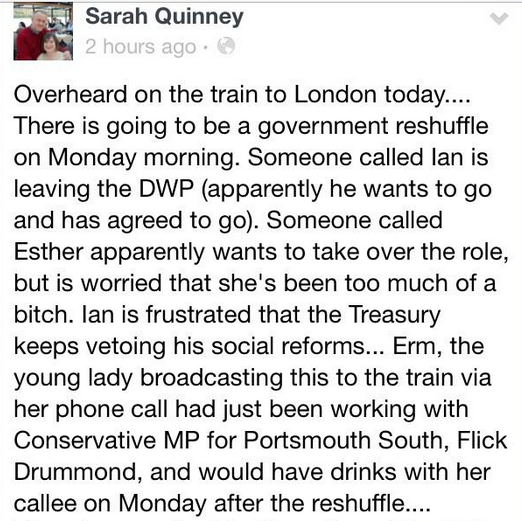
Proof Iain Duncan Smith is about to be replaced by Esther McVey?

July 11, 2014

Tom Pride's avatarPride's Purge

(not satire!)

A commuter on a train, Sarah Quinney, has posted a conversation she overheard from a “20 something brunette, with a very posh voice” talking about a possible cabinet reshuffle on Monday:

esther and iain

There has already been speculation that Cameron is about to have a surprise cabinet reshuffle. So might be worth a bit of a flutter.

Mind you – if you want a good price at the bookies –  better be quick before it gets all over the internet!

.

Please feel free to comment.

View original post

Living With Aphasia

July 11, 2014

This is a guest post by Ndifreke Ekaette.


Living with Aphasia

Connect – the communication disability network is a charity that helps people with Aphasia, a communication disability which occurs when the communication centres of the brain are damaged. Aphasia is usually caused by stroke, but can also be caused by brain haemorrhage, head injury or tumours.

Every 11 minutes three people in the UK have a stroke about a third of these people will have Aphasia. This amounts to over 367,000 people in the UK, a figure that increases by 20,000 each year. There are more people living with Aphasia than MS and Parkinson’s disease combined.

Aphasia can affect the ability to read, write, speak or use numbers. It affects each person differently. It can affect anyone at any time and at any age. When aphasia strikes it changes people’s lives in an instant. Aphasia can lead to isolation, the breakdown of relationships and at times depression. At Connect we make sure that people with aphasia are at the centre of everything we do. They act as trustees, trainers, advisors, staff members, volunteers, interviewers, service deliverers, co-facilitators, activist and hub members. Connect has a very strong peer-led philosophy. We work in equal partnership with people with aphasia, to develop and offer services that are run by people with aphasia for people with aphasia. An example of our peer-led philosophy in practice is our weekly drop-ins at our London centre, our befriending schemes and our special interests groups.

Below Carol tells her story. Carol Griffiths had a stroke in 2007 when she was 42. She was leading a busy life as a MENCAP carer, teaching assistant and foster mother.

“One day out of the blue I had a stroke and in an instant and my ability to talk was wiped out. I felt so isolated and confused because I could not communicate with people. I felt depressed and very anxious about how I could parent my children properly. I lost most of my old friends, as people lost patience with me. I felt trapped, with my confidence destroyed. I couldn’t carry on with my old life.

Connect helped me to come to terms with what had happened to me. They helped me understand that I didn’t have to go through this process alone. Step by step with diligence and patience they taught me how to communicate and recover my life back. Meeting other people who know what aphasia is like is the key to feeling like I can be myself again. It also is the key to unlocking my potential in helping others and being independent. That’s what Connect and the Connect Cornwall project is all about. With new hope and confidence I wanted a new purpose in life and to ensure that people didn’t become isolated like I did. That’s why I trained to be a Connect befriender.

The first person I visited was Kay. She lived by herself after having aphasia for four years and had little therapy or support. I have helped encourage her to communicate again and in our own way, we chatted about lots of things. I got huge satisfaction from seeing Kay blossom and was delighted when she felt confident enough to train to be a befriender like me.

Since befriending, I’ve gone from strength to strength. I have recently qualified as a teacher and am due to start work soon. Imagine that! I now love standing up and talking to people. When I first came to Connect I couldn’t say ‘Boo’ to a goose.

 
Connect has launched its new fundraising campaign called Connect with Friends! Connect is looking for 1,000 people to join our campaign and help us reach our target of £25,000.

We want you to pick a date. Invite your friends and family for a get together over food, coffee or a drink. You choose. Then celebrate the good time you’ve had with a shared donation of £25 to the aphasia charity Connect.

Upload a picture of the time you shared with your friends to our Facebook page. Search: ‘connect –the communication disability network’. Or alternatively send your picture to cwf@ukconnect.org.

All images will be entered into a prize draw held on 20/11/2014 with the winner enjoying an afternoon or baking class, courtesy of Giuliana’s kitchen. ‘You will be learning nothing but the best of British’ with Giuliana in her 1860s London home. http://www.afternoontealessons.com

Your involvement in the campaign would mean we can reach more people like Carol, helping people with aphasia to reconnect with life and empower them to help other people with aphasia realise their potential.

So sign up today at http://www.ukconnect.org/2014-campaign and be that
#1inathousand!


One Million Hits!!!

July 10, 2014

Dear Readers,

Today, Same Difference reached a milestone I thought would never come. The site has had just over one million hits, or pageviews to the techies, in total, since it’s beginning in June 2007.

This day, this milestone, is something that until now, I have only ever thought about in my wildest dreams. But, readers, I cannot deny that I am absolutely thrilled to have reached it.

Over the years, Same Difference has gone through several changes in direction, based on new developments in the disability world, and most importantly, based on the popularity of topics and posts.  Currently, my focus is on welfare reforms in the UK, particularly how these are affecting sick and disabled people.

But readers, I would like to take this opportunity to let you know that I keep a close track of what interests you most. I have always tried very hard to write about what you tell me you want to read, based on your comments and suggestions, and my statistics. I would like to take this opportunity to promise you that I will try my very best to keep doing this for as long as this site is online.

So, your suggestions for topics you want to see covered more (or less!) are always welcome.

Please know that I read every single comment you post on this site, and I always welcome new comments- please keep them clean!

Most of all, readers, I am writing this post to sincerely thank every single one of you. If you hadn’t come here, if you hadn’t kept coming back here, I wouldn’t be here today, writing this.

So thank you all. I hope you continue to find enjoyable, interesting and useful material here, and here’s to the next million hits!!!

With my very best wishes,

Samedifference1


Unemployed Man Suing PM For £1 Million In Freedom Of Speech Battle

July 10, 2014

An unemployed Holton-le-Clay man is suing Prime Minister David Cameron for £1 million in a battle over freedom of speech.

Jobseeker Harvey Stone claims he was unlawfully prosecuted for sending the government an email protesting against their treatment of the unemployed.

The father of one,of South View, says his struggle to find a job has been made infinitely harder after he sent a “protest email” to the government over George Osbourne’s “Help to Work” scheme, and was charged with a criminal offence as a result.

Mr Stone, who is married with a 16-month old daughter, says he was charged with an offence under the Malicious Communications Act 1988, after sending the email, protesting against the Chancellor’s controversial plans to make the unemployed perform unpaid labour.

The family man, who says the Tory leader has “allowed his government to discriminate against and criminalize the unemployed”, through the much-criticised policy, claims his human right to freedom of expression has been violated.

He has now launched a High Court bid for £1 million in damages, claiming his reputation and future chances of gaining employment are in tatters as a result of the furore.

In a writ lodged at London’s High Court, Mr Stone’s sets out his case, saying:

“Prime Minister David Cameron has allowed his government to pursue a course of action designed to discriminate against and criminalize the unemployed, breaching the Human Rights Act 1998 Article 4, the prohibition of slavery and forced labour.

“This prompted a protest email from myself, for which I was arrested and charged under the Malicious Communications Act 1988.”

Mr Stone claimed that the arrest and charge breached his human right to free speech, and caused loss and damage to himself and his struggling family.

“Everyone has the right to freedom of expression. The negligent actions of David Cameron’s government could lead to a criminal record for myself making it hard to find a job,” he said.

Mr Stone is claiming £500,000 in lost future earnings and a further £500,000 for damage to his reputation, “and the stress his government has caused to myself and my family, as I try to support my wife and my 16-month old daughter.”

Emphasizing the gulf in status between himself and the Prime Minister, Mr Stone also adds in the writ: “I have no money…I am unemployed, do not own property or anything of financial value and have to support my wife and daughter on benefits.”

He concludes: “The issues raised are of general public importance. Only too often the litigant in person is regarded as a problem for judges and for the court system, rather than the person for whom the civil justice system exists.”

Mr Cameron’s lawyers have acknowledged receipt of the claim against him but his defence to the action was not available from the court. Mr Stone’s case has yet to be tested in evidence before a judge.

Top Dutch Regulator To UK Government: Legalising Euthanasia Leads To Mass Killing Of The Sick

July 10, 2014

My letter to the Speaker of the House of Commons on the Universal Credit lies

July 10, 2014

Mike Sivier's avatarMike Sivier's blog

130905universalcredit

Yet again UK government ministers, having painted themselves into a corner, have tried to manoeuvre out of trouble by misleading other MPs and the general public.

Readers of this blog – and its writer – were disgusted (although not surprised) to hear Iain Duncan Smith protesting innocence on behalf of his absent employment minister, Esther McVey, in a statement and short debate on Universal Credit in the House of Commons yesterday (July 9).

We have all endured too much of this. It is time honesty – or at least, more of it than is currently evident – returned to the corridors of power.

With this in mind – in hope more than expectation – I have written to John Bercow, Speaker of the House of Commons, to request action. He chairs debates; it seems likely that he should be the one who puts and end to dishonest practices. The letter runs…

View original post 753 more words

Mark Serwotka Says ‘Benefits Offices’ Workers On Strike Today

July 10, 2014

I’ve just heard Mark Serwotka on BBC 5 Live saying workers from our ‘benefits offices’ are going on strike tomorrow, along with people from many other professions.

All the striking workers are hoping to improve their ‘living standards.

DWP workers: What about the living standards of benefit claimants, like the one who wrote to a Facebook group worried about the strike affecting their money coming through, because they are due to get paid tomorrow?

Will those due to sign on tomorrow be sanctioned, because you want your living standards to improve?

How many of you care that when you go on strike, you leave sick, vulnerable people extremely worried, possibly starving?

Greenwich food bank manager tells APPG: No-one at job centre understands the system

July 9, 2014

Ann McGauran's avatarAnn McGauran

Manager of Greenwich food bank Alan Robinson, who gave evidence to the All Party Parliamentary Committee on Hunger and Food Poverty Manager of Greenwich food bank Alan Robinson, who gave evidence to the All Party Parliamentary Committee on Hunger and Food Poverty

The manager of  the Greenwich food bank Alan Robinson has been particularly busy recently. Not only is food bank use up by a very worrying 500% in Lewisham and Greenwich, but last week he was called to  a Westminster evidence session of  the All Party Parliamentary Group on Hunger and Food Poverty. This APPG  is proactively investigating the underlying causes of hunger, food poverty and the huge increase in demand for food banks across Britain. The group was established by MP for Birkenhead Frank Field, and he is co-chair, alongside the Bishop of Truro Frank Thornton.

The inquiry was launched in April this year at Lambeth Palace, with the aim of posing a series of key questions to each of the political parties in the lead up to the…

View original post 934 more words

Jobcentre Manager: “There Are Now Targets For Bullying Claimants Off ESA”

July 9, 2014

Many thanks to Benefits And Work for their very useful summary of a very important article.

Earlier this month Benefits and Work reported that there had been a massive and unexplained rise in the number of ESA sanctions, with the total quadrupling in the course of a year.  The Guardian’s Polly Toynbee, however, has interviewed an anonymous jobcentre manager who claims that they now have targets for bullying claimants off ESA.

Polly met the jobcentre manager, in secret, who told her how the sick are treated and what harsh targets she is under to push them off benefits.

“I just met a jobcentre manager. It had to be in secret, in a Midlands hotel, several train stops away from where she works. She told me how the sick are treated and what harsh targets she is under to push them off benefits. A high proportion on employment and support allowance have mental illnesses or learning difficulties. The department denies there are targets, but she showed me a printed sheet of what are called “spinning plates”, red for missed, green for hit. They just missed their 50.5% target for “off flows”, getting people off ESA. They have been told to “disrupt and upset” them – in other words, bullying. That’s officially described, in Orwellian fashion, as “offering further support”. As all ESA claimants approach the target deadline of 65 weeks on benefits – advisers are told to report them all to the fraud department for maximum pressure. In this manager’s area 16% are “sanctioned” or cut off benefits.

“Of course it’s not written down anywhere, but it’s in the development plans of individual advisers or “work coaches”. Managers repeatedly question them on why more people haven’t been sanctioned. Letters are sent to the vulnerable who don’t legally have to come in, but in such ambiguous wording that they look like an order to attend. Tricks are played: those ending their contributory entitlement to a year on ESA need to fill in a form for income-based ESA. But jobcentres are forbidden to stock those forms. These ill people’s benefits are suddenly stopped without explanation: if they call, they’re told to collect a form from the jobcentre, which doesn’t stock them either. If someone calls to query an appointment they are told they will be sanctioned if they don’t turn up, whatever. She said: “The DWP’s hope is they won’t pursue the claim.”

“Good advisers genuinely try to help the mentally ill left marooned on sickness benefit for years. The manager spoke of a woman with acute agoraphobia who hadn’t left home for 20 years: “With tiny steps, we were getting her out, helping her see how her life could be better – a long process.” But here’s another perversity: if someone passes the 65-week deadline, they are abandoned. All further help is a dead loss to “spinning plates” success rates. That woman was sent back to her life of isolation: she certainly wasn’t referred for CBT. For all this bullying, the work programme finds few jobs for those on ESA.”

Read Polly Toynbee’s full article in the Guardian here

I’ve Been Linked By A Mainstream Newspaper

July 9, 2014

Readers, usually when I write that headline, it is because I am thrilled. But this time, sadly, the thrill of knowing my blog was read by a mainstream journalist is tinged with pain.

Because the link to one of my posts is a part of a piece titled The ‘10,600 people died within six weeks of being declared fit to work by Atos’ stat is simply wrong.

Tell me for yourselves, readers, what you think of the Telegraph piece.

The piece makes the point that the DWP says “the large, presumably overwhelming, majority of those 10,600 people died, and then their claims ended because they were dead.”

But I ask- should terminally ill people have ever been made to wait so long for their claims to be processed in the first place, that they sadly died before their outcome?

The only acceptable reason I can think of for anyone to claim the stat is wrong is that more than 10,600 people have died as a result of the Work Capability Assessment process since that picture, now slightly outdated but still extremely powerful, was taken and made public.

The List

July 9, 2014

Last Year, John Pring of Disability News Service set out to write a list of today’s most influential disabled people in the UK.

The results have finally been published and I’m proud to say the list includes many  friends of Same Difference– though sadly not little old me!

Stephen Green- The Parish Councillor With Downs Syndrome

July 9, 2014

Stephen Green, 49, is one of just a handful of parish councillors with a learning disability in the United Kingdom.

Elected onto Nuthall Parish Council in Nottinghamshire last year, Green has Down’s syndrome and his dad, Grenville Green, assists him to be an active member of the community.

Parish councillors help organise events, fundraise for local charities and fix problems such as the classic pothole in the road.

Some may be surprised to hear that a man with Down’s syndrome can partake in community activities like this but is this because they fundamentally can’t do it, or because there isn’t enough support and access for equal participation?

Councillor Green says his greatest success has been to save the popular monthly Men’s Breakfasts in his parish by volunteering to gain a food hygiene certificate and so allow the early morning club to continue.

Government attempts to demonise disabled failing says DWP research

July 9, 2014

Kevin sanctioned on Work Programme and now begging for food

July 8, 2014

Ann McGauran's avatarAnn McGauran

Kevin Jobbins, who's living on £7 a fortnight for food, following a benefit sanction Kevin Jobbins, who’s living on £7 a fortnight for food, following a benefit sanction

How does it feel to be “living” on a budget for food of £3.50 a week? Kevin Jobbins is doing exactly that, but the more you think about it, the less appropriate the concept of  existence or survival seems in this context. To survive  conjures up images of Everest expeditions  – involving a set of risks voluntarily  endured  by explorers who’ve personally opted to challenge their own physical and emotional limitations.

Kevin, on the other hand, came into the Greenwich Foodbank   because  he’s  not  surviving. The Department for Work and Pensions (DWP) has failed to reinstate his benefits following a sanction in April. Kevin is 39, and is  receiving employment and support allowance (ESA). He’s waiting to go into detox treatment for drug and alcohol issues and is also on the waiting list for surgery…

View original post 617 more words

Legal Aid Cuts Cause Benefits Appeals To Fail

July 8, 2014

Many thanks to Benefits And Work.

Nine out of ten Citizens Advice Bureaux (92 per cent) are finding it difficult to refer people to the specialist legal advice they need since cuts to legal aid came into effect last year, the charity has found, leading to benefoits appeals failing because of lack of written submissions and supporting evidence.

Citizens Advice is reporting it is now extremely hard to get legal aid around issues such as housing, relationship breakdown or employment disputes. Where limited provision of legal aid remains people have to meet very stringent criteria. The length of time it takes to get legal aid means people’s situations often become far worse than they would have had there been earlier intervention.

In some cases legal aid is now simply not available, such as to help with getting employers to pay outstanding wages or challenging unfair benefit decisions.

Chief Executive of Citizens Advice Gillian Guy will today share this evidence with the Justice Select Committee inquiry into the impact of changes to civil legal aid. Guy will call for a Government strategy on funding of advice, to ensure that people can access the right level of advice, at the right time, in the right way for them.

Citizens Advice also reveals a 62 per cent increase in people seeking online advice about help with legal costs.

Gillian Guy, Chief Executive of Citizens Advice, said:

 “Cuts to legal aid have created an advice gap, stranding people with nowhere to turn. At precisely the time when people’s need for specialist advice on issues such as housing and welfare increased, provision for this support has been slashed.

“Modern life presents increasingly complex problems and people need help to understand, adjust to, and in many cases challenge decisions affecting their income, housing and work status.

“In a rapidly changing world, where people’s expectations of services are rising, accessing the right advice at the right time will be critical to help people solve problems and understand what government changes mean for them.”

In the year before changes introduced under the Legal Aid, Sentencing and Punishment of Offenders Act (LASPO) came into effect Citizens Advice Bureaux provided specialist advice in approximately 136,000 cases to help people struggling with legal problems. Changes introduced under LASPO have withdrawn support for approximately 120,000 of these cases.

A CAB in the North West reported:

“Benefits appeals are failing as clients are unable to pay for supportive medical evidence and/or are attending on their own without submissions. There have been problems with referring clients to specialist advice to challenge decisions on benefit entitlement and overpayment issues, including assembling specialist medical evidence to support ESA and DLA/PIP claims and preparing cases for appeal.”

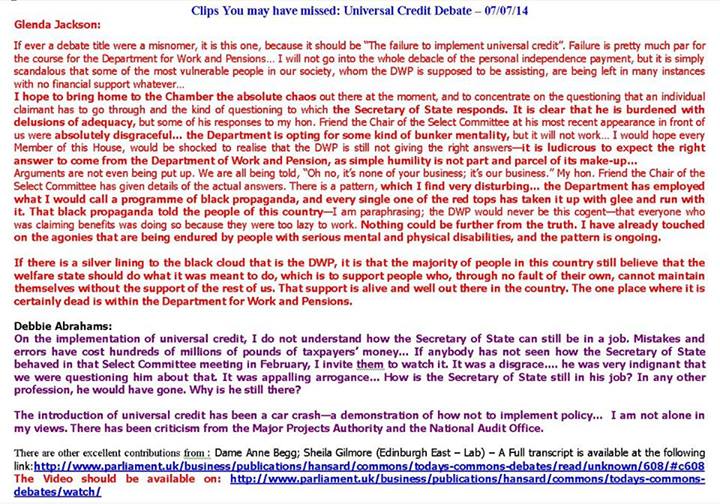
Clips From Yesterday’s UC Debate

July 8, 2014

Spotted on Facebook.

uc speech


Tory Councillor Wants Return Of Workhouses For Mentally Ill

July 8, 2014

With many thanks to Political Scrapbook.


Forget the 1950s, for Tory councillor Michael Hytche Britain’s golden age was, errr, the 1850s. This was his contribution to Torbay Council Health Scrutiny Board, who had met to discuss the provision of “mental health and learning disability services” against a background of cuts:

“Since the workhouses have been closed down, what has been put in their place? As far as I can see, nothing has been.”

The retired councillor would presumably have enough time on his hands to read the briefing.

BLINDSPOT. DENIED THE RIGHT TO VOTE

July 8, 2014

thelovelywibblywobblyoldlady's avatarThe lovely wibbly wobbly old lady

Reposted from 38 degrees.org

Are you as disgusted as I am by this? If so sign the petition. 

In less than 12 months the General Election will take place. However two groups will not be allowed to vote, prisoners and people who are blind or partially sighted.

Current leglislation allows a significant number of  blind and partially sighted people to be treated the same as criminals

Why is this important?

UK legislation does not allow people with sight impairment to use technology, which we use in our normal daily lives to maintain independence, to vote It is not always possible for someone with sight loss to get to a polling station and if they do, only 25% are accessible. We want ballot papers to be sent to us via email attachment or CD, complete those using electronic devices (with the aid of assistive software) such as Smartphone, Tablets or a…

View original post 414 more words

Tania Clarence Admits Manslaughter

July 7, 2014

A mother has admitted killing her three disabled children.

Tania Clarence, 42, pleaded guilty to the manslaughter of her three-year-old twin sons and daughter, aged four, on the grounds of diminished responsibility.

At the Old Bailey, the mother from New Malden, south-west London, denied their murder.

The children, who all had type 2 spinal muscular atrophy, were found at their home on 22 April.

The genetic condition leaves children with little control of their movements and can drastically shorten life expectancy.

Ms Clarence was treated for cuts at St George’s Hospital in Tooting, south London, and charged on 24 April.

She was remanded to a secure mental hospital and a provisional trial date has been set for 23 February next year at the same court.

Wheelchair Wimbledon 2014 Had A British Winner!

July 7, 2014

Britain’s Jordanne Whiley and Yui Kamiji of Japan defeated Dutch pair Jiske Griffioen and Aniek van Koot to win the Wimbledon ladies’ wheelchair doubles title.

Whiley and Kamiji, the number one seeds, avenged their loss in the 2013 final with a 2-6 6-2 7-5 victory to secure shared prize money of £12,000.

Whiley, 22, became the first British woman to win a Grand Slam wheelchair title at the Australian Open.

The duo have since won the French Open.

Victory at the US Open, which begins on 25 August, would complete the Grand Slam.

“I was really nervous and disappointed the first set didn’t go our way,” Whiley told BBC Sport.

“I put a towel over my head, thought that I will only get one shot at a Wimbledon final and that was the turning point.

“There’s pressure now because we’re three-quarters of the way to a Grand Slam, but I’ll be working hard until then.”

Whiley, from Halesowen, and 20-year-old Kamiji were a break up in the final set, only for the number two seeds to level at 5-5.

But, after another break in game 11, Whiley served out for the match.

Euan’s Guide

July 7, 2014

With thanks to BBC Ouch.

Why is Euan’s Guide, a disabled access review website and app, capturing attention and support where others have failed?

When Euan MacDonald became disabled due to Motor Neurone Disease diagnosed 10 years ago, he got frustrated that the only way to discover if a venue was fully accessible was by visiting it himself.

Married with two young children, MacDonald has a ventilator, speaks with a speech synthesizer and uses a powered wheelchair to get around

To help him, the family of the 39-year-old started to note down the accessible venues in his home city of Edinburgh. Soon they had the beginnings of Euan’s guide, a disability review website and smart phone app.

600 places have been reviewed by disabled people in 250 towns across the UK with 400 more reviews by the venues themselves. Six people now work for Euan’s Guide, including MacDonald’s sister Kiki MacDonald, who recently gave up her job in investment management to focus on the project because she’s “passionate” about it.

It’s a free service and there’s no advertising because Euan’s Guide is funded entirely by the MacDonald family.

It has been endorsed by JK Rowling whose mum had MS and Professor Stephen Hawking, who, like Euan, has MND.

Euan MacDonald hopes the guide will cut out hours of phone calls and research for users and that it’ll remove the “fear of the unknown” when visiting somewhere for the first time.

He wrote answers to Ouch’s questions using a computer system which he controls by eye movement:

What makes Euan’s Guide different to all the access guides before it?

It allows users to visit new places with confidence, after learning from the experiences of someone with a similar disability. For example, I can find out what venues in Edinburgh another powerchair user has reviewed and learn what they thought of them. Another key difference is that we don’t just feature accommodation, restaurants and tourist attractions – the site allows users to review places that they go to every day, such as stations, supermarkets and post offices – you can even review outdoor spaces such as parks or well-known locations such as London’s Piccadilly Circus. Venues can give more detailed information on their accessibility features, like whether they have an induction loop, Changing Places toilet or offer relaxed performances.

What is the future of Euan’s guide?

The future of the site is being driven by the users. We’re on the third version and with each new iteration, we are improving functionality and accessibility. the site is designed to work on different devices and different platforms and our app has been well received. We know that there is always room for improvement, but we do spend a lot of time testing the site to ensure compatibility with software such as JAWS and for different technologies including eye gaze, which I use. We also hope that the site could be a stepping stone towards digital inclusion. Perhaps some disabled people who don’t currently use the internet might start if they know that a resource like Euan’s Guide exists.

And beyond the site?

In terms of the guide, we would like to develop an offline community. We held our first Euan’s Guide event a couple of months ago where we encouraged disabled people, their families and friends, to meet each other, make new friends and share their experiences of good & bad disabled access. We’ve also had days where a few of us have got together and reviewed venues, which was great fun. Finally, I’d like to invent a brain controlled wheelchair! This may sound futuristic and science fiction but it is currently being worked on by several universities.

  • Before Euan’s Guide, MacDonald helped to establish the Euan MacDonald Centre for MND Research at Edinburgh University. Later, he helped launch the centre’s Voicebank Study, which aims to generate a personalised voice for use in a comunication aid by people who will eventually lose the ability to speak.

Data Protection Expert Agrees DVLA Is Breaching Rights Of Disabled Claimants

July 7, 2014

Many thanks to Benefits And Work for keeping us updated on this story.

A national expert in data protection has supported our argument that DVLA is breaching the rights of disabled claimants, calling our analysis ‘excellent’ and adding ‘I hope the DVLA will rethink.’

Last week Benefits and Work revealed that a new vehicle check service on the DVLA website allows visitors to find out whether their neighbours are receiving the higher rate of the mobility component of disability living allowance (DLA) or either rate of the mobility component of personal independence payment (PIP).

We believe the system is likely to be in breach of data protection laws and will be of enormous concern to many disabled claimants.

Jon Baines, is Chairman of NADPO , the National Association of Data Protection and Freedom of Information Officers. He writes and trains regularly on data protection issues and blogs at informationrightsandwrongs.com

In a post published on 6 July – DVLA, disability and personal data – he wrote:

“When I first looked at the reports that the DVLA’s Vehicle Tax Check service enabled people to see whether the registered owner of a car was disabled, I thought this might fall into the complex category of data protection issues. On reflection, I think it’s relatively straightforward.

“I adopt the excellent analysis by the benefitsandwork.co.uk site”

Baines then goes on to quote our argument that the data DVLA is publishing is not about the vehicle, but is personal data about the individual who currently owns the car or for whom the car is solely used.

He adds: “It’s difficult to argue against this, although it appears the DVLA are trying . . .”

Baines goes on to quote guidance that is supported by a Court of Appeal judgement:

“As the Information Commissioner’s guidance (commended by Moses LJ in Edem) says

“Is the data being processed, or could it easily be processed, to: learn; record; or decide something about an identifiable individual, or; as an incidental consequence of the processing, either: could you learn or record something about an identifiable individual; or could the processing have an impact on, or affect, an identifiable individual.”

Baines is in no doubt that this is the case in the example given in our original article:

“Ultimately benefitsandwork’s example (where someone was identified from this information) unavoidably shows that the information can be personal data: if someone can search the registration number of a neighbour’s car, and find out that the registered keeper is exempt from paying the road fund licence for reasons of disability, that information will be the neighbour’s personal data, and it will have been disclosed to them unfairly, and in breach of the DPA (because no condition for the disclosure in Schedule 3 exists).

“I hope the DVLA will rethink.”

We also hope that DVLA will rethink their decision to make this information available to any neighbour, relative or work colleague who wishes to obtain it.

But as they seem determined not to, you may want to pass a link to this article on to DVLA and the information commissioner’s office if you decide to make a complaint about your data rights being breached.

The link to Jon Baines’ article is:

http://informationrightsandwrongs.com/2014/07/06/dvla-disability-and-personal-data/

‘Chemo Brain’

July 7, 2014

Seventeen-year-old Lily Anderson used to be an avid reader. But after she was treated for Hodgkin’s Lymphoma at 14, her enjoyment of books became a rarity.

“I used to read a book a day. It’s getting easier now but I couldn’t read at all before.

“I kept re-reading the same sentence and my memory and concentration were awful.”

Lily, from Suffolk, is now cancer-free, after being treated with chemotherapy, radiotherapy and a stem cell transplant, but the treatment has taken its toll.

When she tried to go back to school after her treatment had finished just after her 16th birthday, her brain felt exhausted.

She found it impossible to focus on anything for more than half an hour and learning new things was very difficult. A year off school followed.

The changes in memory and concentration which Lily experienced following cancer treatment are often referred to as “chemo brain” or “chemo fog”.

They were first reported by women who had been treated for breast cancer, but it is still not known why the changes occur or if they are caused by chemotherapy.

Cancer Research UK describes the symptoms of “chemo brain” as forgetting things that you normally remember, difficulty thinking of the right word and following the flow of a conversation, trouble concentrating and feelings of confusion and mental fogginess.

The charity’s website says “the changes are often mild and very subtle. But if you have them they can reduce your quality of life”.

Preliminary results of new research, to be announced at a conference on teenage and young adult cancer this week, suggests that a significant number of young cancer patients suffer memory-related side effects from chemotherapy.

Lily Anderson Lily’s cancer was diagnosed when she was 14

The University of Manchester study – which is not yet published – compared the results of memory tests on young adults who had gone through chemotherapy with those of young adults who had not had chemotherapy.

From a study of 75 cancer patients, aged 16 to 50, after treatment, it found that more than a half experienced a drop in performance on spatial ability tests and a quarter performed worse in long-term verbal memory tests after treatment.

These effects can last for up to five years after treatment has ended, the initial findings suggest.

Previous research had only looked at memory problems in people who had developed cancer in late adulthood or survived childhood cancers.

Helen Thompson, senior cancer information nurse at Cancer Research UK, said it was important to better understand the impact on teenagers.

“Adding the physical and emotional burden of treatment on top of a changing body and school exams can be difficult.

“This preliminary research should help us learn more about how this affects memory in teenagers so they can be provided with the right support.”

Nigel Revell, from Teenage Cancer Trust, said the findings confirmed what they had long suspected.

“Start Quote

This is of particular interest for us as most young people with cancer are still in education and want to continue down this path once their chemotherapy is over.”

Nigel Revell Teenage Cancer Trust

“As we work with young people with cancer this is of particular interest for us as most of them are still in education and want to continue down this path once their chemotherapy is over.”

Mild cognitive impairment, which describes the symptoms of “chemo brain”, is a huge challenge when you are entering sixth form, as Lily discovered.

“The memory problems were a bit of a shock. I thought it was just hair loss and sickness I had to worry about.”

Oana Lindner, author of the Manchester study, says just when young cancer survivors want their lives to return to normal, they can find themselves dealing with another setback.

However, she says recognising that “chemo brain” can affect them is a good thing because it encourages research on how to prevent and treat it.

“Counselling might help reduce the problems or help them cope, and cognitive training strategies could help increase their memory performance.”

Lindner says it is obvious that chemotherapy does something to the brain of some cancer patients, but research is still ongoing to find out how the mechanism works and why.

She says larger studies are needed to find out how long lasting these effects are, the impact of different chemotherapy drugs and different doses on patients.

There are also other factors which have to be taken into account, such as the impact of depression and tiredness on cancer patients’ cognitive functions, and their low quality of life during and after treatment, which is common.

Lily is planning to return to school in September and move on with her life. She knows her teachers are very understanding and will give her as much support as she needs during her sixth form.

As for the future, she has her heart set on becoming a nurse because “it would be an amazing way to help others”.

Welfare Reforms Break CRPD, Say Campaigners

July 7, 2014

The UK government is risking “systematic violation” of international human rights law in its treatment of disabled people, charities claim.

Britain is a signatory to a binding UN convention on the rights of people with disabilities, and the international covenant on economic, social and cultural rights.

Austerity measures and welfare reforms such as the bedroom tax mean the rights of disabled people to independent living, work, and social security have been undermined, causing significant hardship, say campaigners.

A report publishedby Just Fair, a consortium of 80 national charities including Amnesty International, Save the Children, and Oxfam, says the UK is in clear breach of its legal obligations.

Support structures for many disabled people have disappeared or are under threat as local authorities cut social care budgets, while cuts to benefits will leave many disabled people without crucial help for daily living.

Jane Campbell, a cross-bench peer who is disabled said: “It is both extremely worrying and deeply sad that the UK – for so long regarded as an international leader in protecting and promoting disabled people’s rights – now risks sleepwalking towards the status of a systematic violator of these same rights.”

The government vigorously denied the claim. Disability minister Mike Penning said: “It is simply not true to say we are breaching our legal obligations to disabled people. We spend around £50bn a year on disabled people and their services and our reforms will make sure the billions spent give more targeted support and better reflect today’s understanding of disability.

“We are fixing a broken welfare system, which trapped tens of thousands of people on incapacity benefit for more than a decade with little done to see if their condition had improved and support them into work.”

The report calls for a right to independent living to be enshrined into UK law, so that government and public bodies are obliged to ensure policies and practices support – rather than compromise – independent living.

Aoife Nolan, professor of International Human Rights Law at the University of Nottingham and a trustee of Just Fair said government policies were compromising disabled people’s human rights.

“Not only do these policies cause significant hardship and anxiety, but they also amount to impermissible backward steps in relation to disabled people’s human rights, contrary to the UN human rights framework.”

The report will be submitted to the United Nations, which is in the process of reviewing UK compliance with its obligations to the rights of disabled people.

Flowers For The Fallen Of ATOS

July 7, 2014

A powerful photo I spotted on Twitter yesterday. A flower for every person that died within 6 weeks of ATOS finding them fit for work.

flowers for atos

More smears from the Mail against UN official who is trying to help the poor

July 6, 2014

Mike Sivier's avatarMike Sivier's blog

The victim: Raquel Rolnik, the United Nations' expert Special Rapporteur on Housing is once again the victim of a baseless Daily Mail smear piece. The victim: Raquel Rolnik, the United Nations’ expert Special Rapporteur on Housing is once again the victim of a baseless Daily Mail smear piece.

Yet again, the Daily Heil has been using the tactics of its best friend Adolf Hitler – the ‘Big Lie’ – to attack a United Nations official whose job is to point out that Coalition government policies are harming the innocent poor.

The Flail‘s tone was Nurembergian – and almost entirely fact-free – as it denounced ‘Brazil Nut’ Raquel Rolnik for imaginary crimes against Iain Duncan Smith’s benefit cuts – the homicidal, if not genocidal, measures that are driving hundreds of thousands of people into destitution and despair.

You see, the Fail is fine with destitution and despair for the poor – its readers are all rich middle- or upper-class housewives who pass their days spending their husbands’ vast fortunes (this is not entirely…

View original post 1,051 more words

Penny Pepper On The #ILF And Her Mum #SaveILF

July 6, 2014

Westminster Abbey protest: Police launch inquiry over treatment of protesters

July 5, 2014

Mike Sivier's avatarMike Sivier's blog

Image: @TheSilentAnon

By John Pring, Disability News Service

The Metropolitan police have launched an inquiry into the policing of a five-hour protest outside Westminster Abbey, apparently following allegations that officers prevented disabled activists from receiving food, drink and medication.

It is just the latest inquiry to examine how the force has dealt with disabled people who have taken part in anti-austerity protests since the coalition came to power in 2010.

Saturday’s protest at Westminster Abbey was aimed at drawing attention to the government’s decision to close the Independent Living Fund (ILF), and included about 10 ILF-recipients, all disabled people with high support needs.

A heavy police presence arrived minutes after activists from Disabled People Against Cuts (DPAC) began setting up a camp on private land belonging to the abbey, with the support of the mainstream grassroots groups UK Uncut and Occupy London.

Some of the activists were not able to enter the…

View original post 213 more words

Hearing Dog Gives Sam, 13, Confidence

July 5, 2014

Hearing dogs can help many deaf people feel less isolated and withdrawn from the world, according to Hearing Dogs UK.

The charity trains dogs to respond to important sounds like an alarm clock, doorbell and fire alarm.

13-year-old Sam Russell, who is severely deaf, told BBC Radio 5 live’s Breakfast that hearing dog Ember had turned his life around.

“Before I had Ember I struggled to get to sleep and I couldn’t interact and socialise with people as well as I do now,” he said.

Police Gathering Protestors’ Details For Databases

July 4, 2014

Police are gathering the personal details of thousands of activists who attend political meetings and protests, and storing their data on a network of nationwide intelligence databases.

The hidden apparatus has been constructed to monitor “domestic extremists”, the Guardian can reveal in the first of a three-day series into the policing of protests. Detailed information about the political activities of campaigners is being stored on a number of overlapping IT systems, even if they have not committed a crime.

Senior officers say domestic extremism, a term coined by police that has no legal basis, can include activists suspected of minor public order offences such as peaceful direct action and civil disobedience.

Three national police units responsible for combating domestic extremism are run by the “terrorism and allied matters” committee of the Association of Chief Police Officers (Acpo). In total, it receives £9m in public funding, from police forces and the Home Office, and employs a staff of 100.

An investigation by the Guardian can reveal:

• The main unit, the National Public Order Intelligence Unit (NPOIU), runs a central database which lists thousands of so-called domestic extremists. It filters intelligence supplied by police forces across England and Wales, which routinely deploy surveillance teams at protests, rallies and public meetings. The NPOIU contains detailed files on individual protesters who are searchable by name.

• Vehicles associated with protesters are being tracked via a nationwide system of automatic number plate recognition (ANPR) cameras. One man, who has no criminal record, was stopped more than 25 times in less than three years after a “protest” marker was placed against his car after he attended a small protest against duck and pheasant shooting. ANPR “interceptor teams” are being deployed on roads leading to protests to monitor attendance.

• Police surveillance units, known as Forward Intelligence Teams (FIT) and Evidence Gatherers, record footage and take photographs of campaigners as they enter and leave openly advertised public meetings. These images are entered on force-wide databases so that police can chronicle the campaigners’ political activities. The information is added to the central NPOIU.

• Surveillance officers are provided with “spotter cards” used to identify the faces of target individuals who police believe are at risk of becoming involved in domestic extremism. Targets include high-profile activists regularly seen taking part in protests. One spotter card, produced by the Met to monitor campaigners against an arms fair, includes a mugshot of the comedian Mark Thomas.

• NPOIU works in tandem with two other little-known Acpo branches, the National Extremism Tactical Coordination Unit (Netcu), which advises thousands of companies on how to manage political campaigns, and the National Domestic Extremism Team, which pools intelligence gathered by investigations into protesters across the country.

Denis O’Connor, the chief inspector of constabulary, will next month release the findings of his national review of policing of protests. He has already signalled he anticipates wide scale change. His inspectors, who were asked to review tactics in the wake of the Metropolitan police’s controversial handling of the G20 protests, are considering a complete overhaul of the three Acpo units, which they have been told lack statutory accountability.

Acpo’s national infrastructure for dealing with domestic extremism was set up with the backing of the Home Office in an attempt to combat animal rights activists who were committing serious crimes. Senior officers concede the criminal activity associated with these groups has receded, but the units dealing with domestic extremism have expanded their remit to incorporate campaign groups across the political spectrum, including anti-war and environmental groups that have only ever engaged in peaceful direct action.

All three units divide their work into four categories of domestic extremism: animal rights campaigns; far-right groups such as the English Defence League; “extreme leftwing” protest groups, including anti-war campaigners; and “environmental extremism” such as Climate Camp and Plane Stupid campaigns.

Anton Setchell, who is in overall command of Acpo’s domestic extremism remit, said people who find themselves on the databases “should not worry at all”. But he refused to disclose how many names were on the NPOIU’s national database, claiming it was “not easy” to count. He estimated they had files on thousands of people. As well as photographs, he said FIT surveillance officers noted down what he claimed was harmless information about people’s attendance at demonstrations and this information was fed into the national database.

He said he could understand that peaceful activists objected to being monitored at open meetings when they had done nothing wrong. “What I would say where the police are doing that there would need to be the proper justifications,” he said.

DVLA Refuse To Back Down Over Revealing Benefit Details Online

July 4, 2014

Many thanks to Benefits And Work for this update on this story.

DVLA are refusing to back down over publishing details of who gets certain disability benefits in a vehicle registration look-up service on their website.

Yesterday Benefits and Work revealed that a new vehicle check service on the DVLA website allows visitors to find out whether their neighbours are receiving the higher rate of the mobility component of disability living allowance (DLA) or either rate of the mobility component of personal independence payment (PIP).

We asked DVLA for a statement, which we have now received.

A DVLA spokesperson told Benefits and Work:

“The Vehicle Enquiry Service does not include any personal data. It allows people to check online what information DVLA holds about a vehicle, including details of the vehicle’s tax class to make sure that local authorities and parking companies do not inadvertently issue parking penalties where parking concessions apply.

“There is no data breach – the information on a vehicle’s tax class that is displayed on the Vehicle Enquiry Service does not constitute personal data. It is merely a descriptive word for a tax class.”

Unfortunately, this doesn’t seem to be much of a defence.

The road tax for a car in band F, for example, is £145. The car will be in band F regardless of who owns it.

But if you get the higher rate of the mobility component of DLA then you will be exempt from paying that £145 tax. If someone else buys the car off you, however, and they do not receive a mobility benefit then they will pay the full band F tax.

What DVLA is doing is not publishing the car’s tax class – that remains the same whoever the owner is – they are publishing details of the exempt status of the individual who currently owns it.

That is personal data about the individual, not data about the vehicle.

The claim that it is necessary to make this information public to ensure that local authorities and parking companies do not apply parking penalties is extremely questionable.

If that was the sole purpose, then the database could be on a site where access is restricted only to local authorities and parking companies. There is simply no reason for this information to be made available to the entire population – except that it is cheaper and more convenient to do so

From 1 October tax discs are being phased out and there will no longer be a requirement for you to display one on your vehicle. So, the only way that anyone will be able to discover if you are exempt from paying vehicle tax on the grounds of disability will be to access the new DVLA database.

There are many people who clearly have a condition that would allow them to claim DLA or PIP mobility. But there are also many other people with conditions such as ME/CFS where it will not be apparent at all –  and they may prefer the fact that they are disabled to remain unknown to their neighbours.

In addition, many thousands of claimants are eligible for the standard rate of PIP mobility solely because they have an ‘invisible’ mental health condition which, again, they may not wish their neighbours to be aware of.

One of the most common tips for surviving life on benefits sent to us by claimants earlier this year was never to tell anyone who didn’t need to know that you were claiming benefits. There is such a degree of prejudice and hostility towards sick and disabled claimants that many people wish to keep their benefits status confidential.

DVLA, however, have decided that for the sake of their convenience those people will have to put up with this information being made available online.

If the DWP were to provide a similar service on their website allowing you to look up who is getting disability benefits there would be an outcry.

What DVLA are doing is no different – and no more defensible.

Readers who are concerned that their personal data is being made available in this way may want to contact DVLA and the information commissioner’s office.

Man Regrets Not Helping Wife To Die

July 4, 2014

A man who lost his wife to cancer says he regrets being unable to end her suffering and wants a change in the law on assisted suicide.

Steve Riley-Snelling’s wife Tracy, 49, died at their home in Milton Keynes in October, seven weeks after their wedding.

He is giving his backing to a new bill on assisted dying, which is due to go before the House of Lords in two weeks’ time.

Neil Bradford reports.

Bionic Soldier Learns To Run On Splints

July 4, 2014

A soldier, paralysed by a sniper’s bullet in Iraq, has learned to run again with the aid of bionic splints.

Jon Le Galloudec, from Hawkeridge, Wiltshire, was dragged to safety by a friend, who died saving him.

L/Cpl Le Galloudec now wants the splints to be available on the NHS.

DPAC Independent Living Tea Party

July 4, 2014

DPAC is delighted to extend an open invitation to celebrate Independent Living Day with us on the 4th of July at the ‘Independent Living Tea Party ‘.

The party will begin at 2pm at the DWP, Caxton House in Tothill Street SW1. There will be fun & games, and entertainment; and of course, some civil disobedience.

We have come a long way since the demand for Independent Living was first made nearly 50 years ago. Then, as now, IL was our solution for how society supports disabled people to take our place as equals. For how society addresses inaccessible institutions, structures and process it created, which do more to disable people than their impairments ever could.

There are many strands of Independent Living, and all are under threat. Cuts to:

  • Support funding – such Social Care, the ILF & Disabled Students Allowance;
  • Education – in areas like the wholesale destruction of SEN Statements and the continued segregation of disabled children into ‘special’ schools;
  • Transport – the withdrawal of Taxi-cards, freedom passes and the halting of planned works to make infrastructure more accessible, amongst a host of other cuts combine to make disabled people second-class citizens in society.

But we have fought this fight before – and won. Our Disabled Peoples Organisations, legal gains and the policy victories we have won previously are testament to the power, know how and skills disabled people have to develop solutions to problems created by society.  We must celebrate these achievements and remind ourselves that each of these successes have had to be earned, no-one ever gave them to us without a struggle.

So celebrate with us, or alternatively create your own party. Get together with friends and supporters, and create the kind of vibrant, positive spaces we have always created. Bring the noise – bells, whistles, drums, pots & pans etc. Bring food to share. Bring your enthusiasm.

if you are planning your own party, here are some suggestions:

1) Choose your target –

focus on the important issues locally; support, education, transport etc – its up to you. Identify what you want to celebrate and who represents the biggest threat to that locally. Is it your local council or Uni? Is it a transport provider? Or is it someone else?

2) Tell everyone –

yes, EVERYONE. Media, campaign networks, activists, local people. DONT FORGET TO TELL DPAC so we can list and support your action!

3) Be heard, be seen –

make your event loud and proud. Bring music, choirs, drum, bells, whistles. Remind everyone out there that we won‘t be separated from society, we are society. We won ‘t go quietly.

4) We’re also holding a Twitter Party on the Hashtag
#IL4JULY so that people at the DWP and at other events round the country
can tweet in pictures of their events and we can all join in. Further
details to follow, watch this space.

The famous Boston teaparty led to a revolution against the British government let’s see where our teaparty leads…..

My Apologies Mr Cameron

July 4, 2014

leonc1963's avatarDiary of an SAH Stroke Survivor

Today Mr Cameron I would like to give you my apologies, you see I have not grown up to aspire to what you want out of me.

I apologise for becoming very gravely ill at an early age of just 27 years old suffering from an SAH/STROKE that so nearly killed me perhaps it may of suited you better if I did die, but then that was not my fault either as I was looked after by the excellent NHS you seek to destroy.

I apologise for needing to take 18 months off work to enable me to recover enough to go back to work but I did ensure that this was the least time needed given the severity of my disabilities as I would have taken more time to ensure I was fully fit before I returned but do understand that by doing that it did not fit to…

View original post 702 more words

Sesame Sponsor Merseyside Man in Edinburgh-Land’s End Wheelchair Challenge

July 3, 2014

A press release:


Sesame Access, the country’s premier provider of wheelchair access solutions and disabled lift platforms, have announced that they are sponsoring an incredible fundraising event in the coming months, as one brave man attempts to travel from Edinburgh to Land’s End – using just a wheelchair.

Non-disabled person Stuart Williams of Wallasey will be wheeling himself across the country for national disabled children’s charity, Whizz-Kidz, which helps to provide vital mobility equipment and life skills support for disabled children across the UK. Sesame are thrilled to be supporting Stuart in his mission to raise £20,000; a figure which could potentially transform the lives of up five disabled children.

With a background in health, sport and coaching, Stuart aims to highlight the inclusive nature of sport for disabled and able-bodied people – as non-disabled person undertaking such a massive challenge in a wheelchair, he hopes to demonstrate what can be accomplished with the help of the right mobility equipment.

Stuart says, “Firstly, I love a challenge. But most importantly – and most personally – my young cousin Michael was disabled from birth, and his family had to buy specialist mobility equipment for him year in, year out. Without this mobility equipment, Michael’s family would have struggled to give him the active and independent childhood that all kids need and deserve. With my background in health and sport, I completely appreciate the freedom we have to exercise, have fun and be independent; all kids deserve to have that same feeling. That’s why I’m working so hard to fundraise for Whizz-Kidz.”

Stuart’s journey will begin in July 2014 – he’ll be wheeling himself from Edinburgh to Land’s End in a standardised wheelchair, propelling himself around 700 miles over the span of 25 days. He’s expected to arrive at Land’s End on the 31st July after covering 30 miles per day using nothing but his trusty wheelchair.

Steven Lyons, Managing Director of Sesame Access, says, “We’re thrilled to be supporting Stuart as he undertake this mammoth challenge for a wonderful cause. The team at Whizz-Kidz do a fantastic job of helping disabled children all over the country, and we are honoured to be helping Stuart to reach his £20,000 target.”

He adds, “We’re dedicated to providing disabled access for all with our integrated wheelchair lifts all over the country, and we love hearing about individual acts of courage and sheer determination to raise awareness and funds for the most worthy of causes. We provide the access, people like Stuart raise the funds, and if we all pitch in, we can help ensure that people with disabilities are empowered to live a free and independent life.”

For more information about Sesame Access Systems, and to take a look at their product range, visit their website: http://www.sesameaccess.com/

About Sesame Access Systems: Sesame Access designs, builds and installs bespoke ‘invisible’ wheelchair lifts into stunning listed and non-listed buildings, both in the UK and in Europe. We provide our unique retracting stair lifts and invisible platform lifts to ensure that access is available to all, without affecting the wonderful interiors of these protected architectural marvels.

An Open Letter to Leader of the Opposition Mr Ed Miliband

July 3, 2014

DVLA Website Lets Visitors Check On Neighbours Benefits

July 3, 2014

Many thanks to Benefits And Work.


A new vehicle check service on the DVLA website allows visitors to find out whether their neighbours are receiving the higher rate of the mobility component of disability living allowance (DLA) or either rate of the mobility component of personal independence payment (PIP).  The system is likely to be in breach of data protection laws and will be of enormous concern to many disabled claimants.

Unhappy member
The issue was brought to our attention yesterday by a very unhappy member who emailed us to say:

“My neighbour was able to tell me that I was on the higher rate of disability living allowance.

“She found out that people on the higher rate of disability living allowance and other similar high rate benefits get free road tax.

“The DVLA vehicle check system has been revamped and is now displaying taxation class as DISABLED on every vehicle where the registered taxation class is disabled.

“ It never used to be like this it was just blank .

“Anyone can put your car registration number into the system and do a vehicle check just like my neighbour did and find out you are on benefits and what type as a result of the taxation class DISABLED being on display

“What is the purpose of this system being open to the public to do a vehicle check on any vehicle they want?

“It’s a system of no use to anyone other than malicious people intent on causing problems for people on benefits”

Our member asked us to notify disabled people of the issue and lobby to have the data removed from the DVLA website.

We did our own check on cars in the street outside using the DVLA website and were indeed able to discover that the owner of one vehicle has a disabled tax disc and is therefore in receipt of benefits, as the screenshot below taken from the DVLA website shows.small tax details

Exemption grounds
Exemption from vehicle tax on the grounds of disability is only available for people on Higher Rate DLA Mobility Component, War Pensioners Mobility Supplement, Enhanced Mobility PIP (100% exemption) or Standard Mobility PIP (50% exemption).

The vehicle doesn’t have to belong to the disabled person, but it must be only used for their benefit. The vehicle’s registered keeper can be the disabled person or someone else who uses the vehicle only for the disabled person’s needs.

At present the tax disc displayed on a car in these circumstances will show a cost of £0.00. But there are other grounds, apart from disability, for getting exemption from vehicle tax.

In addition, where a disabled person keeps their car on a private drive or in a garage, neighbours will not be able to see the details on the tax disc.

Tax discs to disappear
More importantly, from 1 October of this year you will no longer need to display a tax disc on your vehicle at all.

In addition, when you sell a car from October 2014 the tax cannot be passed onto the new owner. Instead, the previous owner will get a refund and the new owner will have to tax the car themselves.

There seems, therefore, no obvious reason for information about the tax status of a vehicle to be displayed online.

Data protection
The issue here appears to be one of data protection.

The information that DVLA are making available is not about the vehicle itself. Instead they are publishing personal information about the benefits received by the individual who currently owns the car or for whom the car is solely used.

We spoke to a staff member at the DVLA press office yesterday evening and asked them if they were aware that they were making this information available and if they would suspend the look-up service as a matter of urgency, as it appears to be in breach of data protection laws.

We have yet to receive any response.

Readers who are concerned that their personal data is being made available in this way may want to contact DVLA and the information commissioner’s office and insist that it is removed immediately.

12 Years Old And Caring For Mum

July 3, 2014


I’ll be watching this tonight.

Powerful documentary profiling three of the 250,000 children in the UK who care for a parent with a chronic illness or disability. One of those featured is a 13-year-old from Manchester who is a talented archer with ambitions to represent her country. She juggles her training with caring for her mum, whose fibromyalgia means that she is often exhausted and in pain.

Another girl, 12, from Lincolnshire, looks after her mother who has the rare and terminal condition Multiple Systems Atrophy. Increasingly, she in unable to do basic things for herself such as washing and dressing, and must rely on her daughter.

Finally, the programme meets an 11-year-old boy from Kent who has been looking after his mum since she was left virtually paralysed down one side after having an abscess removed from her brain. Through the use of video diaries shot by the children themselves, the programme gives a raw but often uplifting insight into the everyday lives of these extraordinary families.

Iain Duncan Smith In The Dock Again Over Unlawful Atos Assessments

July 3, 2014

johnny void's avatarthe void

MHRNThe DWP are back in court next week for the closing part of a successful challenge to the despised Work Capability Assessment (WCA).

This is the test run by Atos which is used to find people ‘fit for work’ and stop their sickness or disability benefits.  It is mired in chaos with a huge backlog of appeals and an ever growing number of tragic deaths linked to the process.  Even Atos themselves are pulling out of the assessments after fierce campaigning saw their carefully managed corporate identity demolished due to their involvement in the cruel and bungled system.

The WCA has also had its share of legal problems after a Judicial Review last year ruled the assessments are unlawful under the Equalities Act for those with a mental health condition.   Rather than accept this defeat and improve or scrap the tests for this group of claimants – or better still…

View original post 520 more words

IDS Reacts To Glenda Jackson

July 3, 2014

This one is about body language, please watch closely and read…


Public money is being thrown away on government-contracted scroungers

July 2, 2014

Mike Sivier's avatarMike Sivier's blog

workprogramme1

It turns out that some people really do get to lie around all day, doing nothing apart from watching the money rolling in.

Bloody scroungers.

I’m sorry to swear – and you know I’m not usually rude – but these Work Programme provider companies really get my goat.

The revelation that companies such as Ingeus, A4e and Working Links were getting undeserved ‘incentive’ money (see also the BBC’s article), rather than being paid by results as has been claimed loudly and repeatedly by Tory ministers and backbenchers, is nothing new to Vox Politicalwe first pointed out the problem in November 2012, more than 18 months ago.

You see, not only has this been going on ever since the Coalition government established welfare-to-work in its current form –

Not only have government ministers and backbenchers been lying to you about the payouts given to the profit-driven privately-owned…

View original post 602 more words

ESA: Massive Increase In Sanctions

July 2, 2014

Many thanks to Benefits And Work.

Employment and support allowance (ESA) claimants in the work-related activity group (WRAG) are being subjected to a massively increased sanctions regime that deliberately targets the most vulnerable. Sanctions, primarily aimed at claimants on the work programme who have mental health conditions or learning difficulties, have quadrupled in the course of a year, even though referrals to the programme have fallen by 43%.

The number of sanctions rose from 1,102 a month in December 2012 to 4,789 a month in December 2013, the most recent date figures are available for.

The vast majority of sanctions are imposed for failing to participate in work-related activity whilst on the work programme, which thousands of ESA claimants are forced to join every month in spite of overwhelming evidence that it does not improve their chances of getting a job.

The massive rise in sanctions, however, cannot be explained by a sudden huge surge in the number of claimants in the WRAG.

In fact, the number of claimants in the WRAG increased by just 21% between November 2012 to November 2013, from 460,160 to 558,960.

Indeed, between August and November 2013 the number of claimants in the WRAG actually fell slightly, from 562,620 to 558,960. Yet the number of claimants sanctioned in this period shot up by a staggering 75% from 2,193 to 3,837.

Nor can the rise in sanctions be explained by a corresponding increase in the numbers of ESA claimants being forced onto the work programme.

In fact, the rate at which ESA claimants get pushed onto the work programme has fallen dramatically over the same period. 8,290 claimant were put onto the work programme in December 2012. This fell to just 4,700 in December 2013, a drop of 43%.

Yet sanctions increased fourfold.

And the main targets of those sanctions are claimants with mental health conditions or learning difficulties. Back in April we pointed out that the proportion of this group receiving a sanction had risen from 35% of sanctioned claimants in 2009 to a massive 58% by June 2013.

That figure has now increased again to 62% in December 2013, even though claimants with these conditions make up just 50% of the work-related activity group.

Also back in April the DWP told us:

“It’s only right that people should do everything they can to move off benefits and into work if they are able. Sanctions are only used as a last resort and we have robust procedures in place to protect vulnerable people, with a number of safeguards built into the system.

Yet many people will wonder, if sanctions are only being used as a last resort, what possible explanation there can be for the sudden massive increase in the number being handed out?

And if safeguards are built into the system, why are claimants with mental health conditions increasingly over-represented on the roster of sanctioned individuals?

The DWP also told us in April:

“Everyone has the right to appeal a sanction decision if they disagree with it.”

Which is entirely true. But a Citizens Advice Scotland report on sanctions released yesterday reveals that “many people who are hit by a sanction are not told the reason for it, or how to appeal against it”.

The DWP have good reason to keep people in the dark about their appeal rights. According to the ‘Fulfilling potential? ESA and the fate of the work-related activity group’ report released last month by Mind, tribunals now uphold almost nine out of ten ESA and JSA sanctions appeals.

Such a huge proportion of overturned decisions is ample proof of the savagery of the sanctions regime. But for many people, especially vulnerable claimants suddenly struggling to survive on drastically reduced benefits and no longer able to get legal aid for help with tribunals, coping with the complex new appeal system is an impossibility.

According to the Mind report, written by Catherine Hale, – herself an ESA claimant:

“ . . . findings suggest that the regime of conditionality and sanctions has left participants in the WRAG fearful , demoralised and further away from achieving their work-related goals or participating in society than when they started.”

The report also found that in 87% of cases of claimants failing to participate in a mandatory work-related activity, the reason was related to their health condition, including 19% who had missed an activity because of a medical appointment.

Such cynical targeting of vulnerable claimants is clearly counter-productive in terms of moving them off benefits and into work.

But there is one very likely explanation for the increasing use of sanctions.

Leaked documents obtained by the BBC last month revealed that the DWP expect the cost of ESA to rise by almost £13bn by 2018/19. The documents warn that the increase is “one of the largest fiscal risks currently facing the government” and could cause it to breach its self-imposed benefits cap.

One of the documents also warns that, in terms of cutting costs, there is “not much low-hanging fruit left”.

ESA claimants with mental health conditions are, however, one remaining low-hanging fruit that IDS and his increasingly vicious and shambolic department are determined to pluck as heavily and as quickly as they possibly can.

Living With Your Partner- And Their Full Time Carer

July 2, 2014

If your partner is disabled, they might also have a full-time carer. So how easy is life with an outsider always in your home?

“It took me a while to get used to waking in the morning to see a stranger lift my girlfriend out of bed and dress her,” says Will Iles, a market analyst from London. He and his girlfriend Zoe Hallam were living in halls at Oxford University back then and the situation with the stranger, her care assistant, was made even more cosy because it was a single bed the couple were sharing.

Hallam, a charity worker, hasn’t much strength in her arms and legs and, in order to live independently, employs a small team of personal assistants to help with the things she can’t do. Funded by government and her local authority, she has people on hand 24 hours a day, most days.

Before they got together, Hallam had deliberately not told Iles about her needs and support because she was trying to make a good impression. “But when you go from being friends to being in a relationship, that barrier has to come down,” she says.

When a disabled person with high care needs starts to date someone new, thoughts turn to how to get privacy and quality time with that person without losing independence or dignity.

Just days into their relationship, Hallam had to make a decision that most people don’t have to think about. “Would it be more awkward for me to ring my carer to come and help me use the bathroom,” she says, “or for this guy, who I’ve only been seeing for a week or so, to have to do it?”

In a family home, things get more complicated. Lizzy Gwilliam, a mother of two from Devon, describes on her blog what her personal assistants do. “[They are people who] you rely on, not for administrative duties but for ordinary things everyone does… getting food for your daughter, helping you on and off the toilet in a supermarket, or putting your hair up so you actually look a little less hedgerow.”

Her partner, Tom Bunton, needs her to be as independent as possible because he works full time. They choose new PAs as a team, Gwilliam says, because Bunton will also have to share his living space with them, and an assistant will be close to the couple’s very young children. “They have to understand that it is his life too,” says Gwilliam.

Though they may come into contact with family members, a personal assistant is there to help the disabled person and to facilitate them in all their roles, be that as an independent human being, a wife or a mother, and to understand relationship boundaries.

“When my first daughter was born, there was quite an awkward situation because my then PA overstepped the mark as far as parenting was concerned,” says Gwilliam. “My partner found it very frustrating because he knew I hated the fact that she could get down on the floor with the baby whereas it’s much harder for me to do that.

“It got to the point where my daughter preferred to be with her, than with me,” she says.

Gwilliam manages her personal assistants day to day, while Bunton helps out with the considerable admin which comes with employing staff, including payroll and organising holiday cover. She says her partner wants to get involved when he sees things going wrong but he knows that Gwilliam has to be the one who manages awkward situations when they arise.

Zoe Hallam has had similar problems and says that in the past she has let lots of matters go because she doesn’t like conflict; she says disabled people get used to things not being quite right, or that don’t quite work. “I’m selective in what I fight about,” she says, “otherwise, I suck it up”.

Now four years into their relationship and having to negotiate around her carer, Hallam says that her boyfriend still isn’t sure about who does what chores in the house. “He always feels bad leaving the washing up for the PA, and sometimes he creates a lot of it when he’s cooking.” Hallam says that, to share the load and make their relationship more equal, she reminds him it’s OK to leave some work for her assistant because she would do those chores if she were able herself.

In order to have some private time alone as a couple, Hallam chooses not to have an assistant in the house at weekends – this is when her boyfriend takes over in the care role. “He knows more instinctively what I need,” says Hallam, “but I can’t expect the same speed of response as I’d get with a PA who gets paid.”

Half of Zoe Hallam’s care package is paid for by the Independent Living Fund, a central pot of money which the government has announced will be abolished in 2015. The funds have been “devolved” to councils who the government now says should pick up all care costs. The money has not been ring-fenced for this purpose, however, and campaigners are anxious it may result in them having a lower quality of life or being moved into residential care.

Gwilliam appreciates that bringing someone else into your home causes extra difficulties but that help is essential to her. “My partner’s favourite thing to say is that having PAs is weird,” she says.

“It isn’t just like having someone come and stay. They see you every morning when you still have messy hair and bad breath. They help me do Tom’s washing, even his pants. We are just used to it now and we get on with it.”

Tell us your experiences of having a partner and a full-time carer. Email ouch@bbc.co.uk

John McDonnell MP On #ILF, 30 June 2014

July 2, 2014

Glenda Jackson MP Speech On IDS, 30 June 2014

July 2, 2014

I’ve always liked her, and I’ve just been reminded why!

Vigil to support judicial review for ESA claimants with mental health issues

July 2, 2014

Mike Sivier's avatarMike Sivier's blog

Vigil: This was taken when the case was appealed in October 2013. Vigil: This was taken when the case was appealed in October 2013.

Does anybody fancy helping create a stir outside the Royal Courts of Justice next week? Don’t worry, you shouldn’t get arrested.

The courts will be the venue for the judicial review of government policy regarding claimants of Employment and Support Allowance who have mental health issues, from July 7-9. That’s between Monday and Wednesday next week.

On Tuesday (July 8), the Mental Health Resistance Network, supported by Disabled People Against Cuts, will be holding a vigil at the front entrance of the Royal Courts of Justice building on The Strand, between midday and 2pm.

The aim is to highlight the important issues around the case.

This should help: Buses 4,11,15,23,26,76,172 and 341 all stop at the front of the Royal Courts of Justice, 171, 188, 243, 521 and X68 stop at Kingsway and Aldwych Junction nearby. The nearest…

View original post 684 more words

DWP And Homelessness Charities Link Up To Bully Homeless Benefit Claimants

July 2, 2014

johnny void's avatarthe void

HomelessThe homelessness industry is today welcoming an upcoming change in the law which could see homeless people forced to live in unsuitable or unsafe accommodation or face losing eligibility for benefits.

Homeless Link and St Mungo’s Broadway have published a gushing press release cheering amendments to the rules for Jobseeker’s Allowance set to come into force next month.  The changes mean that newly homeless people may only be considered meeting the criteria for benefits if they take “such steps as are reasonable for him (sic) to take to find living accommodation.”

Homeless people will have an easement of jobseeking requirements if they follow these conditions, but this will usually only last four weeks, despite the average length of hostel stays being significantly longer than that.  The minimum length of stay in one of St Mungo’s Central London hostels is eight weeks, with most residents staying an average of six…

View original post 339 more words

#DWPChaos Parked on ESA WRAG for a year now out of system ……..

June 30, 2014

leonc1963's avatarDiary of an SAH Stroke Survivor

………Indeed this was Iain Duncan Smiths GOAL all along.

http://diaryofansahstrokesurvivor.wordpress.com/2012/09/25/esa-claim-update/

http://diaryofansahstrokesurvivor.wordpress.com/2013/02/23/david-willetts-who-fails-his-first-obligation-to-his-constituent-duty-of-care/

http://diaryofansahstrokesurvivor.wordpress.com/2013/03/14/update-to-my-complaint-to-my-mp/

http://diaryofansahstrokesurvivor.wordpress.com/2013/12/15/complaint-to-jc-using-the-recent-tribunal-court-case/

http://diaryofansahstrokesurvivor.wordpress.com/2014/01/15/update-to-complaint-to-jc-using-the-recent-tribunal-court-case/

http://diaryofansahstrokesurvivor.wordpress.com/2014/01/25/unfairly-knocked-of-esa-sickness-benefit/

http://diaryofansahstrokesurvivor.wordpress.com/2014/03/07/a-clear-case-of-disability-benefit-denial/

http://diaryofansahstrokesurvivor.wordpress.com/2014/03/27/a-clear-case-of-disability-benefit-denial-scandelous-update/

http://diaryofansahstrokesurvivor.wordpress.com/2014/05/07/willful-denial-of-appeal/

http://diaryofansahstrokesurvivor.wordpress.com/2014/05/24/the-shit-hits-the-fan-letter-before-action/

http://diaryofansahstrokesurvivor.wordpress.com/2014/06/19/dwp-shambles-round-3/

Right my complaint has been ongoing ever since migration from Incapacity Benefit and indeed it has turned into a giant of a complaint spanning a couple of years as the blogs above show (they are spread all over this blog so decided to bring them all onto one page) .

There are moral points of view regarding this complaint which as you know our government does not take into consideration and thus it is my believe that this is partly why they are going wrong also after all not everyone fits in the same bag but that is what they are trying to do.

There has to be some understanding, compassion and empathy shown but what we are seeing is lies and brutality and that has to stop anyway I…

View original post 586 more words

Labrador Buddy Lives Up To Name For Jacob

June 30, 2014

Loyal labrador Buddy is never far from the side of his owner Jacob, a 10-year-old boy with autism. But their inseparable partnership almost came to a tragic end when Buddy scoffed some chocolates, which can be lethal for dogs.

Their friendship began in July last year, when Buddy joined the family home in Gillingham, Kent. Jacob’s mum, Christine Steady, was keen to find a support dog to help Jacob, who has difficulties socialising and communicating.

“Jacob was very withdrawn, rarely laughed or engaged with us and spent much of his time in his room alone,” said Christine. “It was heart-breaking.

“As Jacob asked for a ‘yellow dog’ I found a local litter of golden labradors. It would have been too overwhelming for Jacob to visit all the puppies together, so we arranged a video call and Jacob spotted Buddy sitting at the back by himself, something I think he immediately identified with.

“Jacob also loved Buddy’s brown nose, so we invited the eight-week-old puppy into our home. I hoped the companionship would help Jacob, but I never could have guessed how much it would transform his life – they are a perfect match! My son has so much more confidence now and he talks about Buddy all the time, which really helps him to socialise.”

But at just eight months old, Buddy got his paws on four Christmas selection boxes and gobbled the lot, leaving no trace of the chocolate treats, only the empty wrappers. Knowing that chocolate can be poisonous for dogs, Christine took him straight to the PDSA in Gillingham, where Buddy was given emergency treatment.

Head vet nurse Jennie Keen said: “Buddy had eaten a lot of chocolate, including two boxes of dark chocolate, which contains a high level of theobromine, an ingredient which is toxic to many animals.

“It was touch and go and we really didn’t know if Buddy would survive. All we could do was give him all the support and care possible to help him flush the toxin from his body, and hope that he was strong enough to pull through.”

Christine added: “Jacob was overjoyed to have his playmate back but is now incredibly protective of Buddy, and Buddy is now extra protective of Jacob.

“Buddy has given Jacob a reason to go outside – they love going to the park and playing football or hide-and-seek in the woods. Jacob also communicates so much more now because he wants to talk about Buddy, and it’s given him more responsibility as it’s his job to feed his dog. Buddy really has turned Jacob’s life around in so many ways.

“When Buddy was sick it would have cost us hundreds of pounds for his treatment, which we just couldn’t have afforded. I’m so grateful to PDSA: they’ve saved Buddy’s life, which has made all the difference to Jacob’s life too.”

PDSA provides free veterinary care for the sick and injured pets of eligible people in need and is funded entirely by the generous support of the public. For more information or to make a donation, visit www.pdsa.org.uk.

Gal Sont Codes To Help Disabled People Communicate Faster

June 30, 2014

A programmer suffering from motor neuron disease (MND) has developed low-cost communication software that can be controlled by eye movements.

As the disease progresses sufferers often become paralysed and only have control over their eyes.

Gal Sont – co-founder of Click2Speak – tells BBC Click why he hopes the software will allow people with disabilities to lead fuller lives.

Art attack on Coalition policies that drive people to their deaths

June 29, 2014

Mike Sivier's avatarMike Sivier's blog

140629artattack2

A UK artist has created an art installation as a memorial to the suicide victims of welfare reform.

Melanie Cutler contacted Vox Political regarding her piece – ‘Stewardship’ – a few weeks ago, asking, “Do you think I’ll be arrested?”

The response was that it should be unlikely if she informed the media. The artworks have been displayed at the Northampton Degree Show and are currently at the Free Range Exhibition at the Old Truman Brewery building in Brick Lane, London, which ends tomorrow (June 30).

Entry is free and the installation will be located in F Block, B5.

“I have become an artist later on in life,” Melanie told Vox Political. “I was a carer for my son and, a few decades later, my father. I have worked most of my life too, raising three children.

“Only recently, while studying fine art at University I found my health…

View original post 397 more words

Artist Taxi Driver On Yesterday’s Protests

June 29, 2014

Breaking News: Arrests At Westminster Abbey #SaveILF protests!!

June 28, 2014


http://bambuser.com/v/4740235

Benefit Claimant Bashing- The New Bloodsport

June 28, 2014

BlueAnnoyed's avatarblueannoyed

Today it been reported  that ‘White Dee’ who has been vilified in press after the CH4  ‘Benefits Street’ programme as a scrounger has been assaulted while on holiday with friends. This woman was attacked viciously for having a holiday which is allegedly paid for by her good friends. The Jeremy Kyle stereotyping of claimants is a falsehood and while some may not be the brightest they are still afforded the tag of scrounger, undeserving etc, which to my mind is unacceptable.

I have seen people of all walks of life comment on these kind stories and the lack of compassion and humanity (even amongst other claimants) is not only shocking but downright appalling. Claimant fraud is actually less than 1% of the whole welfare budget in actual fact the correct figure is 0.7% while government error is 4.3%. The likes of the Daily Mail, Telegraph, The Sun, and many more Murdoch tory…

View original post 513 more words

IDS Loses Legal Appeal To Keep UC Problems Secret

June 27, 2014

Many thanks to Benefits And Work.


Iain Duncan Smith’s latest effort to prevent the publication of documents warning of the dangers of universal credit has been dismissed by a judge.

The information commissioner ruled the Department of Work and Pensions (DWP) should release documents about the progress of universal credit, an assessment of independent reviews and a record of problems with it. He ruled against the release of a risk register – a department document listing possible problems with the scheme – but a tribunal overruled him and said it too should be published.

The DWP insisted publication would have a “chilling effect” on the working of the department. The information tribunal ruled there was no evidence of that but that there was “strong public interest” in publication.

IDS appealed. The DWP’s first argument was that the tribunal misunderstood the nature of the chilling effect and the evidence needed to support that argument.

Judge Wikeley gave it short shrift.

“[The chilling effect] is a well known concept, and I can see no support for the argument that the tribunal misunderstood its meaning…[it] applied its expertise and reached a decision that the chilling effect argument was unpersuasive.”

The DWP’s second argument is for ‘perversity’. This states that the tribunal reached a decision which no reasonable tribunal, on a proper appreciation of the evidence and the law, would have reached. It’s obviously a very high threshold which they did little to reach.

Judge Wikeley found:

“This challenge, in my assessment, does not get near clearing this high hurdle. The tribunal identified the relevant issues, analysed the material evidence, made its findings and in that context reached its conclusions, explaining why it had done so. It seems to me its approach was entirely sustainable. The perversity ground is not arguable.”

Finally they tried to argue that the tribunal had not given due weight to the expertise of the DWP’s witness. This was irrelevant, Judge Wikeley found. He said:

“An appeal to the upper tribunal is confined to a point of law… I conclude it is not arguable.”

No-one knows how much taxpayer money has been dedicated to making these frivolous legal appeals – all in a bid to save the work and pension’s secretary’s blushes.

When there are disability benefits which need cutting, every pound counts. When it’s the secretary of state who needs saving, the government’s wallet bursts at the seams.

It will still be possible for IDS to keep fighting this ruling through the courts, possibly for years, and ultimately to issue a ministerial veto to prevent publication regardless of what the courts say.

Read the full commentary in Politics.co.uk

Our thanks to Papasmurf for spotting this story for us

A Tribute To Mumsnet Member Ruth Hayllar

June 26, 2014

I’ve recieved a sad email from Mumsnet. Mumsnet member and blogger Ruth Hayllar passed away from bowel cancer on Friday 20th June.

Mumsnet members are leaving their tributes at this thread.

I am sharing this very sad news in case any of you had online connections with Ruth. I shared membership of the Mumsnet bloggers’ network with her, so you could say I did, although we never had direct interaction.

My thoughts are with all those who knew her better than I did.

Nick Farmer- Make My Heart Your Home

June 26, 2014

This lovely song has been written and performed by Nick Farmer, who has Cerebral Palsy. According to the Bournemouth Echo, Nick Farmer is looking for love, and he has written the song especially for his Miss Right.

I think this song, and the story behind it, should go viral!

The Debt Trap: End The Damage To Children

June 26, 2014

I’m sharing this because it could affect anyone and anyone’s children…


Did Disabled Workers Have More Rights In The Past?

June 26, 2014

Has the modern age actually made it more difficult for disabled people to find work? Disability historian David Turner says that although times may have been hard in centuries gone by, disabled workers sometimes enjoyed more equal rights than they do today.

Although welfare policy since Tudor times has provided for those incapable of labour either through age or impairment, documents show that disabled people expected, and were expected to, earn their living as far as possible.

Life was not easy prior to the Industrial Revolution, but the agricultural economy provided opportunities for people with disabilities to work in their own homes and at their own pace – something we often hear disabled people calling for today, so they can contribute and not be entirely reliant on benefits.

An account of the Shropshire village of Myddle written around 1700 described one of its inhabitants, Anne Parkes, as being unable to walk until the age of 19, because of rickets. She supported herself by knitting gloves and stockings.

A hundred years later, a survey of the poor inhabitants of Cumwhitton near Carlisle described a 45-year-old man with a “lameness” who earned “a little money” by making baskets and beehives to support himself and his elderly mother. His status as a caregiver reminds us that not all work undertaken by disabled people, either now or in the past, is paid.

The industrial revolution is often seen as a turning point for disabled workers. The coming of factories and heavy, mechanised industry, together with greater regulation of working hours and demands for increased productivity, meant that they were less able to compete in a labour market that was unresponsive to their needs.

But new research on Britain’s coal industry challenges the extent to which disabled workers were excluded.

Coal production expanded to meet the demands of Britain’s industrial cities in the 19th Century, and it was a physically demanding industry with high rates of accident and death.

A Victorian coal mine might be the last place one would expect to find disabled workers, yet there are accounts of miners with physical impairments working underground.

In 1865 an explosion at the Upper Gethin Colliery, Merthyr Tydfil, claimed more than 30 lives, among them brothers David and Griffith Ellis. As the miners fled the suffocating firedamp (flammable gases) that followed the blast, David turned back to fetch his brother who had a prosthetic limb. Sadly neither made it out alive.

In some areas miners worked in family groups. David Ellis had supported his brother, so they could both work at hewing coal.

One journalist described the lifeless body of the “poor lad with a wooden leg” as one of the most affecting sights of the disaster. But no reporter questioned the presence of disabled men working underground in a dangerous and demanding occupation, nor did they hail the amputee as “inspirational” in the way today’s press might do.

Victorians differentiated between “total” disability that prevented a person from working – and thus made them liable for state support under the Poor Law – and “occupational” disability that prevented a person returning to their old job, but who was still able to work.

Men who were disabled in the mining industry may have been able to take lower-paid work on the surface, or even return underground as supervisors.

Thomas Haswell, killed in an underground explosion at Thornley Colliery near Sunderland in 1841, was an experienced coal hewer but had been working as an overman (supervisor) after breaking both legs in a rock fall the year before. Though newspaper reports of the disaster described him as a “cripple”, Haswell’s impairments may have marked him out as a survivor, earning the respect of the young crew who worked for him.

Since the late 19th Century, disabled people have faced greater obstacles in the workplace. The expansion of legislation to provide greater compensation for injured workers, beginning with the Employers’ Liability Act of 1880, hardened attitudes towards risk and made it less likely that bosses would take disabled people on.

At times of national crisis such as the two world wars, demand for disabled workers increased due to the lack of available labour. But in times of economic difficulty – the depression of the 1930s for instance – unemployment was high and disabled people were less successful at competing for jobs.

There is no evidence that disabled people in history have been unable or unwilling to work. Their ability to do so has depended on the structure of working environments, availability of resources, supply and demand in the labour force, and on the support and the attitude of employers, particularly towards risk.

Much more needs to be known about how disabled men and women fared in the workplaces of the past. The history of disability and work – paid or not – is not one of people heroically overcoming their limitations, but of the common struggle to get by.

Dr. David Turner is a historian at Swansea University. He was advisor on BBC Radio 4’s Disability: A New History

Educating Dr Litchfield – a few facts about the Work Capability Assessment

June 26, 2014

Mike Sivier's avatarMike Sivier's blog

Dr Paul Litchfield. Dr Paul Litchfield.

Ignorance is most definitely not bliss for Dr Paul Litchfield.

The man was hand-picked by the Coalition government to review its hated Work Capability Assessment system of handling Employment and Support Allowance claims, amid rumours that previous incumbent Professor Malcolm Harrington had been unhappy with political decisions that ran against his findings. But he delivered a woeful performance to the House of Commons’ Work and Pensions committee last month.

He claimed to have no information about the staggering number of people who have died after going through the assessment system he is being paid to review, totalling 10,600 between January and November 2011 – that’s 220 per week or three every four hours. “I don’t have any information of that type; I haven’t seen numbers on that. Clearly every case would be a tragedy,” he said.

Clearly this expert has yet to gain access to some very…

View original post 267 more words

Michael Hilton Deserves Leniency

June 25, 2014

Please sign this and share it widely.

Dear Prosecutor, Judge, Lord Chief Justice and Lord Chancellor,

Please release Mr Michael Hilton and drop the charges against him.
Why is this important?
This concerns every person living in Britain. What happened to Mr Hilton can happen to anyone in Britain, whether we’re aware of it or not.

The following took place.

Mr Hilton of Meadoway, Church in East Lancashire felt very vulnerable and grew increasingly upset when he was threatened with eviction from the home in which he’d been living for 30 years. He responded by threatening to blow up his home.

The reason for the eviction was that Mr Hilton developed rent arrears as a result of what PM David Cameron euphemistically and callously calls the withdrawal of the spare room subsidy, and what I see as an instrument of a feudal aristocracy, the so-called bedroom tax.

We all tend to assume that when someone else is threatened with eviction, the person could make this ‘go away’ if only they would act. Because we have no choice but to believe that if it happened to us, we would make it go away. Because we, we would act. That is how threatening the idea of an eviction is to most of us. Losing our home…

In reality, however, there is often very little a person can do against an eviction for arrears if the person has no money. In cases of rent arrears caused by the so-called bedroom tax, it is safe to assume that if the person was unable to do anything about the bedroom tax, he or she is equally unable to do anything about the eviction. Effectively, Mr Hilton was being threatened with homelessness after having lived in his home for 30 years.

I don’t know Mr Hilton and he may have been seriously mentally ill.

If he was merely terribly stressed, then chances are that he did not stick his head in the sand, but simply felt there was nothing he could do and was convinced that his housing association could not do anything for him either. I think that he threatened to blow up his home because he could not accept the idea that there was absolutely nothing he could do to stop the eviction.

He did not blow up anything at all, and no one got hurt. He just yelled. He was arrested because he had made many people worried which can be seen as a disturbance. He has been in custody since the beginning of June 2014. The plea hearing is set for 22 August 2014 and his trial hearing is scheduled for 12 November 2014.

A little earlier, namely in May 2014, David Garbett of Sunderland took similarly drastic steps when he chained himself and his wheelchair to the railings of Southwick JobCentre. In his case, his Employment Support Allowance had stopped which meant that he became unable to buy food and pay bills.

After he chained himself to the JobCentre, Mr Garbett’s claim was settled, and his payments were backdated. Mr Garbett was not in danger of losing his home, but he too was desperate so he did something desperate.

When austerity has already been part of your daily life for years, there is no room for more austerity.

It is believed that Mr Hilton was eligible for exemption from this wretched bedroom tax, but apparently did not know how to obtain this exemption. It is also believed that Mr Hilton had been in bad mental health for some time.

So here we have two men who apparently both had health problems. One was losing his home and spoke desperate words that others felt threatened by, but did not carry out his threats. The other one was fed up with having to go to the food bank and being unable to pay his bills and did not threaten but took desperate action.

One is now in prison and has lost his home. The other one’s claims were reinstated and backdated.

Mr Hilton – the man in prison – is a victim, not a criminal. He deserves leniency.

Jane Nicklinson And Others Lose Latest Right-To-Die Legal Battle

June 25, 2014

Campaigners have lost their appeal at the UK’s highest court over the right to die but say they are hopeful that change will come.

Justices ruled against Paul Lamb and Jane Nicklinson by seven to two.

A third man, Martin, lost his attempt to have the current prosecution guidance on assisted suicide clarified.

But five justices concluded the Supreme Court had the “constitutional authority” to declare the current law breaches the right to a private life.

The cases involve the family of the late Tony Nicklinson, of Wiltshire, who had locked-in syndrome, and Paul Lamb, of Leeds, who was paralysed in a road crash.

They wanted the law changed to allow doctors to assist patients to die.

Nine justices had to decide whether a prohibition on assisted suicide was compatible with the right to respect for private and family life under the European Convention on Human Rights.

Five concluded the court had the “constitutional authority” to make a declaration, and two of the five said they would have done so.

‘Positive step’

Mr Lamb and Mrs Nicklinson, the wife of Tony Nicklinson, said the conclusions were a “positive” step in the fight for change.

“I am very proud of myself,” said Mr Lamb, 58. “I know it is going to change.”

Mrs Nicklinson, from Wiltshire, whose husband Tony died aged 58 last year, added: “I am disappointed that we lost. But it is a very positive step. Parliament will have to discuss this. I think Tony would be very pleased at how far we have come.”

Commenting on the ruling, Andrea Williams of Christian Concern, said: “This is good news for the many vulnerable people who would have been at risk if the attempt to weaken the law on euthanasia and assisted suicide had been allowed by the Supreme Court.

“The murder law is there to set the highest priority on the importance and value of life and to protect it.”

A third man, known only as Martin, was seeking clarification of the Director of Public Prosecutions’s (DPP’s) guidance on the position of health professionals who assist a suicide.

Martin wants it to be lawful for a doctor or nurse to help him travel abroad to die with the help of a suicide organisation in Switzerland. His wife and other family want no involvement in his suicide.

The Supreme Court unanimously allowed the DPP’s appeal against the Court of Appeal’s ruling in Martin’s favour.

Legal battle

Mr Lamb has been almost completely paralysed from the neck down since a car accident more than 20 years ago and says he is in constant pain.

He has called for the law to be changed so any doctor who helped him die would have a defence against the charge of murder.

Tony Nicklinson was paralysed from the neck down after suffering a stroke while on a business trip to Athens in 2005.

After losing his High Court battle last year, he refused food and died naturally, aged 58, a week later at his home in Wiltshire. His widow, Jane, is continuing his legal battle.

FORMER ROYAL BLIND SCHOOL PUPIL RECEIVES FIRST CLASS HONOURS DEGREE

June 25, 2014

A press release:

A former pupil of the Royal Blind School in Edinburgh who is blind, deaf and has mild cerebral palsy has defeated all odds and received a first class honours degree in Spanish from the University of the West of Scotland.

Jennifer Murray, aged 24, attended the Royal Blind School from August

2002 to June 2008. She has mild cerebral palsy and was born blind due to a premature birth. She also wears two hearing aids.

As part of her degree in Spanish, she spent third year teaching English in Murcia in south east Spain as part of the British Council English Language Assistants Programme. Jennifer then wrote her University dissertation on the Spanish education system and the integration of blind pupils.

Elaine Brackenridge, Head Teacher at the Royal Blind School said:

“I am over the moon for Jennifer – she is an inspiration to us all! I taught Jennifer from the age of five at another special school for pupils with visual impairment and was delighted when she later joined the Royal Blind School as a pupil.”

Jennifer is planning to return to Spain to teach English again. She said:

“This time I am going to work in Granada, Andalucía. I have applied to the British Council’s English Language Assistants programme again in order to teach English in a Spanish school. I wanted to go somewhere not too touristy where Spanish is the first language spoken.

“When I received the results letter from the University telling me that I have a First class degree in Spanish, I could not believe it! I really wasn’t expecting to get a First, I did not want to build up my hopes because if I had done that, I could have been disappointed with my final result. It feels absolutely amazing and I am still trying to take it all in!”

For more information please contact:

Davina Shiell, Marketing and Fundraising Manager, Royal Blind

Tel: 0131 229 1456 Email: davina.shiell@royalblind.org

Corinne Hutton- First UK Woman To Have Double Hand Transplant

June 25, 2014

A Scottish woman is to become the first person in the UK to have a double hand transplant, BBC Scotland can reveal.

Corinne Hutton had her hands and feet amputated last summer after a pneumonia infection led to blood poisoning.

She will become the second person in the UK to have a hand transplant, and the first to have both hands replaced.

Prof Simon Kay, who will lead the surgical team at Leeds General Infirmary, said: “I think the result will be exceptional.”

He added: “I think she’ll get very good function very quickly, and partly this is a tribute to the team in Glasgow who removed Corinne’s hands in a way that would facilitate transplantation later.”

Corinne, from Renfrewshire, lost her hands and feet last summer following a Streptococcus A infection, which caused pneumonia and sepsis.

 Corinne’s new hands will have some sensation almost immediately and will fully settle down within 16 months

Her chances of survival were put at just 5%. Her life was saved by a specialist team who travelled to Scotland from Leicester with an ECMO machine to oxygenate her blood.

“One of the consultants told me afterwards that, as they flew up, they weren’t expecting to take me,” said Corinne.

“When they arrived my condition was worse, but it was the weekend and he wasn’t answerable to anyone else, and as I was going to die anyway he had nothing to lose. So they decided to take me.”

‘No worse off’

However the infection, along with the drugs Corinne needed, starved her hands and feet of blood, effectively causing gangrene. Her feet were amputated above the ankle, but doctors were able to save her wrists.

“I thought with a transplant they’d cut away my wrists and if it failed I’d be much worse off,” she said.

“But they said the donor’s hands would attach to my wrists and therefore if it fails I’m no worse off.”

 Corinne lost her hands and feet last summer following a blood infection

Skin from the donor’s forearms will also be retained and used to cover up extensive scarring on Corinne’s arms, in an operation which will involve four surgical teams.

“This operation from a technical point of view is much more complex,” said Prof Kay, who carried out the UK’s first hand transplant on Mark Cahill.

“In Mark’s case we had to replace three nerves, whereas in Corinne’s case it’ll be more like 10, plus all the tendons need to be repaired individually. So from a technical point of view it’s much more complex, but the concept is the same.”

Corinne has undergone psychological testing as well as tissue testing ahead of her operation. Although the transplant team will try to find a good match, her new hands will always look different.

Stranger’s hands

Doctors want to make sure she is psychologically strong enough to cope with seeing a stranger’s hands at the end of her arms.

“I’ve been told that it’s psychologically tough,” said Corinne. “I like to think that I’d be grateful to whoever had given me those hands. I spoke to Mark and he agreed that was his angle on it.”

She is expected to have some sensation from her new hands straight away, but it will take 14-16 months for the transplants to settle down. She will also have to take immuno-suppressants for the rest of her life, which carry some health risks.

Surgery is expected to take place this autumn and is being funded by the Scottish government.

Corinne also hopes her story will help to raise funds for the Finding Your Feet charity which was originally set up to raise funds for her recovery but which now helps other people who have limbs amputated.

NEW MOBILITY INSURER MAKES COVER FOR WHEELCHAIRS LEFT IN CARS A STANDARD POLICY FEATURE

June 25, 2014

A press release:


Newly-launched mobility scooter and wheelchair insurer Blue Badge Mobility Insurance (www.BlueBadgeMobilityInsurance.co.uk), which is writing new policies ahead of target, is to include cover for wheelchairs left in locked cars overnight.

“We need to bring mobility equipment insurance into the 21st century, and recognise what’s important for users, so one of the first things we’ve done is to include in our policies – as standard – cover for wheelchairs and mobility equipment left locked in cars overnight,” said Mark Effenberg, Chief Executive of Blue Badge Mobility Insurance.

“It seems to be something that the insurance industry is reluctant to cover, but a combination of real-world need and a recognition that, generally, cars are more secure means we and our underwriters are extremely comfortable offering such cover – and we’re selling policies at a rate ahead of forecast as a consequence of such an approach.”

“We’re determined to establish a service standard and pricing benchmark that has been absent so far in mobility equipment insurance.

Hampshire-based Blue Badge Mobility Insurance will provide policies covering use, protection and liability relating to scooter, wheelchair and home equipment, and will price-match like-for-like policies currently on the market. Other care-related insurance products will be launched throughout 2014 – all aimed at people who want to remain independent and receive care at home, and for those that care for them.

Typical guideline premium prices will be £24 a year for wheelchair cover, and from £59 for electric wheelchairs and mobility scooters.

“We’ll be applying the business and customer service principles established in our other online insurance businesses since the mid-late 1990s: put simply, we have low overheads because we are a 100% online insurer, we have exceptional underwriters in UKGI acting on behalf of Ageas Insurance and team who are not just experienced, but also multiple winners of customer service awards. We work hard to see or deliver the positive and hassle-free whenever possible,” said Mark Effenberg.

http://www.BlueBadgeMobilityInsurance.co.uk/


Exclusivity Clauses To Be Banned In Zero Hours Contracts

June 25, 2014

Many thanks to Welfare News Service.

The coalition government is to unveil plans to ban ‘exclusivity’ clauses in zero-hours contracts, the Business Secretary Vince Cable has revealed.

Exclusivity clauses prevent employees on zero-hours contracts from working with another employer, even if they haven’t been given any hours, and ‘undermines choice and flexibility for the individuals concerned’.

The move comes after a government consultation into the controversial use of zero-hours contracts, which resulted in 83% of 36,000 respondents saying ‘exclusivity’ clauses should be banned.

It is believed that the ban will affect around 125,000 workers currently on zero-hours contracts and trapped under ‘exclusivity’ clauses by ‘unscrupulous employers’.

The government say the move will allow those individuals to look to work elsewhere and ‘boost their income’.

Business Secretary Vince Cable said:

“Zero hours contracts have a place in today’s labour market. They offer valuable flexible working opportunities for students, older people and other people looking to top up their income and find work that suits their personal circumstances.

“But it has become clear that some unscrupulous employers abuse the flexibility that these contracts offer to the detriment of their workers. Today (25 June 2014), we are legislating to clamp down on abuses to ensure people get a fair deal.

“Last December (2013), I launched a consultation into this issue. Following overwhelming evidence we are now banning the use of exclusivity in zero hours contracts and committing to increase the availability of information for employees on these contracts.

“We will also work with unions and business to develop a best practice code of conduct aimed at employers who wish to use zero hours contracts as part of their workforce.”

Vince Cable also announced plans to consult with the public on how to ensure that employers don’t look for ways of evading the ban.

According to the government, the ban will form part of the Small Business, Enterprise and Employment Bill, which is being introduced to Parliament today (25 June 2014).

Commenting on the announcement, Tim Thomas, Head of Employment Policy at EEF, the manufacturers’ organisation, said:

“Zero hours contracts occupy an important space in the labour market where, properly used, they provide flexible employment in job roles where open-ended contracts are unsuitable.

“For manufacturers where skills are in scarce supply, zero hours contracts can help employers to tap into specialist skills when they are needed, such as drawing on the experience of older workers.

“The way forward set out in the Small Business, Enterprise and Employment Bill treads a fine line between supporting the majority of workers who want to continue to work on their zero hours contracts and limiting their use where they are neither necessary nor appropriate.”

Commenting on the government’s zero-hours consultation, Chuka Umunna MP, Labour’s Shadow Business Secretary, said:

“Under David Cameron’s government we’ve seen a rising tide of insecurity. Zero-hours contracts, which were once a niche and marginal concept, have become the norm in parts of our economy as families have been hit by the cost-of-living crisis.

“The Tory-led government has watered down people’s rights at work and have failed to match Labour’s plans to outlaw zero-hours contracts where they exploit people.

“Labour will ensure that people at work get a fair deal and proper protections so they are not forced to be available around the clock, are paid if shifts are cancelled at short notice and are able to demand a full contract if, in practice, they are working regular hours.”

To the dismay and anger of campaigners and opponents, both the government and Labour have stopped short of saying they would ban the use of zero-hours contracts completely.

In April, Citizens Advice Chief Executive Gillian Guy, slammed the use of zero-hours contracts which were “playing havoc with people’s ability to make ends meet”.

She added: “There needs to be more clarity around holiday pay and redundancy rights for workers on casual and zero-hour contracts”, and also that the controversial contracts should “come with minimum pay or minimum hours agreements so that employees know where they stand”.

TUC General Secretary Frances O’Grady said:

“The ban is welcome news but it’s not nearly enough to really tackle the problem. A lack of certainty is the real issue. Far too many employees have no idea from one week to the next just how many hours they’ll be working or more importantly how much money they’ll earn. This makes managing household budgets stressful and organising childcare very difficult indeed.

“The one change that would really make a difference would be for employers to have to guarantee their staff a minimum number of paid hours each week. And as the economy continues to grow that would give many zero-hours workers struggling to get by a much-needed pay rise.”

Latest DWP lie: Millions ‘unspent’ in support for ‘welfare reform’ victims

June 24, 2014

Mike Sivier's avatarMike Sivier's blog

Fraud: This man wants you to believe DWP austerity measures are succeeding, in order to win votes at next year's general election. They aren't. He is a liar. Fraud: This man wants you to believe DWP austerity measures are succeeding, in order to win votes at next year’s general election. They aren’t. He is a liar.

The Department for Work and Pensions is merrily claiming that more than £13 million allocated to help people who have been hit be the government’s unfair ‘welfare reforms’ via Discretionary Housing Payments has gone unclaimed. Lord Freud wants you to think “recent scare stories about councils running out of money were grossly exaggerated”.

He was – of course – lying through his teeth.

A quick look at the facts reveals that Discretionary Housing Payment was overspent by £3,505,582 during the 2013-14 financial year. That’s two per cent more than the government allocated.

The £13,285,430 underspend quoted in the press release refers to just 240 out of the 380 councils that distribute DHPs. It completely ignores the £16,791,012 overspent by 127…

View original post 476 more words

David Blunkett: Hacking Took Me Close To A Breakdown

June 24, 2014

As Andy Coulson is found guilty and Rebekah Brooks cleared, I’ve found a very small disability link in the phone hacking trial.

Thanks for info Labourlist.


Under Pressure GPs Striking Off Thousands- Are They Targeting Those Who Need The Most Care?

June 24, 2014

Thousands of patients are being arbitrarily struck off by GPs who say they can no longer cope with spiralling numbers.

Doctors warned last night that a recruitment crisis has left surgeries with too few staff.

This means they are being forced to ‘deregister’ patients – many of whom are elderly and have been with the same practice all their lives.

Yesterday the Daily Mail highlighted the case of 95-year-old Lily Dove, one of 1,500 patients randomly struck off by a surgery in Watton, Norfolk, which is under pressure from rising immigration and retirees.

The widow, who has lived in the area since 1919 and remembers when the doctor would visit her family in a horse and trap, has a number of health problems.

But senior GPs say her case is far from isolated and illustrates a national problem. They say other practices in England have been forced to deregister up to 100 patients at a time.

Doctors’ leaders argue that they have no choice but to remove patients because the lack of GPs means they cannot provide care that is safe and of high quality.

But relatives and patients fear vulnerable patients are being deliberately removed from lists because they take up the most time and require such dedicated care.

Other patients furious to have been kicked off their doctor’s books yesterday included an 80-year-old widow, a double amputee and a mother of 11 children.

In another example, a practice deregistered a nursing home of 59 residents, many of whom have Alzheimer’s, because of a ‘big change in workload’.

GPs say the profession is facing a recruitment crisis as their colleagues opt for early retirement or a move abroad. They are not being replaced by younger staff, who are often opting for hospital-based careers.

In the case of Watton, which is about 20 miles west of Norwich, surgeries are under pressure from a sudden rise in retirees and immigrants moving to the area.

Last night health minister Earl Howe intervened in the case of Mrs Dove, who lives alone, and urged NHS England to ‘urgently’ look into the circumstances of her being struck off. He told GPs to ensure they provided ‘excellent care’ for all their patients, particularly the over-75s and those with long-term health conditions.

But it has since emerged that Mrs Dove’s surgery, Watton Medical Practice, has also removed other vulnerable patients including a 47-year old former soldier who has lost both legs due to severe diabetes.

Dave Pendry, who is wheelchair-bound, now faces a 14-mile round trip to see his new GP in the village of East Harling.

Kirsty Hutchinson, a mother to 11 children, will have to travel 16 miles every time one of them is ill or needs an injection.

And two elderly widows said they now faced difficult journeys down dangerous country roads to see their doctor.

Other GPs warned that more surgeries would follow suit. Referring to the case in Watton, one GP partner wrote anonymously on the Pulse magazine website: ‘Just wait for the domino effect…’

The practice which has deregistered a nursing home of 59 elderly residents is the Bellevue Medical Centre in Edgbaston, Birmingham – the practice of Professor Steve Field, the chief inspector of GPs.

It says it has been forced to remove a total of 75 patients who live the furthest away since a doctor retired.

The decision has upset some relatives who fear the surgery has deliberately targeted the nursing home because the residents require so many visits.

One said: ‘I think the real reason is that nursing home residents are often difficult to manage, lots of health problems, on a lot of medication. I’m sure that if they were “easier” patients, the surgery would keep them on.’

The surgery’s executive partner Dr Sukdev Singh insisted the reason was because there had been a ‘big increase in workload’ following the retirement of a doctor.

He added that about 75 patients were being removed from the list as they lived outside the practice’s boundary.

He said: ‘It’s a national problem. We are struggling to recruit doctors and we do not have the necessary funding.’

There are no national figures for the numbers of patients who have been removed from surgery lists because of GPs’ workload.

But Dr Chaand Nagpaul, chairman of the British Medical Association’s GP Committee, said it was important that surgeries did not ‘discriminate’ against certain patients who may require more time and care.

‘It would not be appropriate for practices to pick and choose,’ he said. Referring to cases highlighted by the Mail, he added: ‘I do not know the circumstances here but these decisions must not be taken lightly and practices must ensure they do not discriminate against certain patients.

‘If there are boundary issues, the practice needs to make sure all patients outside the boundary are taken off the list not just one care home.’

In Watton, parish council leader Richard Leighton said: ‘There’s immigration, because people are coming to work in the abattoir and food factories around here.

‘British people are also moving here because there’s work about, and there are retired people who sell up in London and buy a cheaper home here.

‘They keep building homes here because the Government says the area can take more people, but the infrastructure can’t cope.’

Gillian Childerhouse, 80, who is being struck off after being on the surgery’s register for almost 50 years, said: ‘I’ve never been much trouble to them as I’m pretty fit but I’ve been dumped along with the rest of them. Older people are not very important in this country. They don’t want us. We’re just a damned nuisance.’

Referring to the case of Mrs Dove, Earl Howe said: ‘We have asked NHS England to urgently look into the case reported in the Mail. We expect practices to work with their patients and NHS England to make sure that residents get the excellent care they need from local GPs, particularly those over 75 or with long-term conditions.’

Cancer specialist Dr Clive Peedell, co-leader of National Health Action Party, said: ‘I’ve certainly heard that up and down the country patients are being removed from practice lists because they can’t deal with the workload. The pressures are enormous at the moment.

‘There are real staffing issues and we are extremely worried about the lack of funding. The Royal College of GPs says they are short of 8,000 GPs.’

Families, elderly and disabled are told: You must find a new GP

The mum of 11

As a mother of 11, Kirsty Hutchinson already had trouble juggling her time without the logistics of travelling much farther to a new surgery.

Her family will now travel around 16 miles in total, compared to seven miles before.

The only crumb of comfort is that the service at Watton had become so poor that it can only be better at the new practice.

Mrs Hutchinson, 40, who is married to teaching assistant Simon, and whose eldest child is 18, said: ‘The service at the Watton surgery had got pretty bad anyway because there wasn’t time for people.

‘We had a letter through last week and it just said, “We’ve got to reduce the number of people on our books so in the next two weeks can you find a  new surgery”. It doesn’t  seem fair.’

The amputee


Double amputee Dave Pendry feels like he has been ‘swept under the carpet’ after being told to join another surgery.

The former soldier, 47, lost both legs because of diabetes and a bone infection. Wheelchair-bound,  he is particularly reliant on a local surgery.

Now he is facing a 14-mile round-trip every time he needs to see a doctor, compared with six miles to Watton and back.

‘Why should we be dropped and swept under the carpet after all we have been through?’ he said.

The widow

Doreen Baker did not sleep for days when she found out she would be de-registered from the Watton surgery.

The 78-year-old widow is terrified at the prospect of driving to her new practice in East Harling on a notoriously dangerous road but cannot afford a cab.

Mrs Baker, who had been with Watton for 24 years, said: ‘I’m really worried about how I’ll get to the new surgery.

We’ve got no public transport out here so I don’t know what I’ll do.’

The All In The Mind Awards

June 24, 2014

The small gestures of help and support can make a huge difference to someone with mental health problems. It can be the difference between life and death. Here, some of those who have been helped describe their own personal turning points.

Mike Henderson was first arrested at the age of 12. By 14 he had had his first stint in prison, and two years later he was addicted to hard drugs, including cocaine.

A life of petty crime followed to fuel his addiction. He was described by the police as “a one-man crime wave”.

But he says: “I didn’t know I’d been battling with anxiety and depression. I didn’t know I would now suffer a dual diagnosis with the onset of drug induced psychosis.”

He was labelled a trouble-maker early on and when he did begin to seek help, he felt treated like “a threat that needed sedation”.

“I didn’t understand addiction. I just smoked drugs like my peers… I just did what I needed to do to survive.”

‘Acceptance’

Then almost two decades ago he met mental health worker Pat Rose at the charity Nilaari, which offers support and counselling to ethnic minority adults who experience mental health problems.

She worked with him for 15 years, while he progressed and relapsed and sent him poems and cards of encouragement when he was in prison.

“She accepted me. I had never had a relationship that was not undermined by my race, their fear or the perceived threat of violence.

“I was the big, dangerous, drug-using, mentally-unwell, aggressive black man. But Pat did not fear me.

“I was locked out of hope, and she opened a door,” says Mike.

Without her, there would have been one of three outcomes, he says: “Jail, institution or death”.

Mike was one of over 700 people who wrote in to nominate Pat for the BBC’s All in the Mind awards.

Now three years clean – and out of prison – he wants others to recognise the important part she played, going above and beyond her job, in turning his life around. He now works with young people who are in a similar situation to the one he was in.

‘He saved my life’

Another charity put forward was Maytree, which offers a four-day stay for those who feel suicidal.

James was a resident there and says Maytree is a place where suicide is not a taboo or a dirty word.

“My essential needs were catered for so that I could concentrate on trying to live. One night I felt very suicidal and wanted to leave, a volunteer sat with me for hours.

“Sometimes we talked, sometimes we didn’t, but he saved my life that night. I’ve never met him since, I can’t remember what his name was but the belief in me and the quiet but persistent trust that I could survive this experience, was magical.”

A false accusation had resulted in his breakdown and he felt like his “soul had been obliterated” by depression.

But the stay gave him hope and helped him get his life back. He’s now working again and says he is much better at asking for support.

It was completely different from any stay in a psychiatric hospital, he says. And, crucially, talking about suicide was the norm, which he felt unable to do with friends and family.

But unlike professionals or charities who deal with difficult issues on a daily basis, friends and families of those with mental health issues often find it difficult to know how to respond.

‘A bag of bones’

Getting this balance right was the key for Maya’s survival. She battled with anorexia nervosa which she says “invaded every single aspect of my life”.

It was, she says “a monstrous creature” but her mum helped fight her demons. She now wants her mum to be recognised for going over and above her role as a parent.

“She has sat with me as I sobbed over a small piece of dry toast, encouraged and supported me for the hour it took for it all to be eaten.

“She always made it clear that she was frustrated with anorexia and not me, which is really important because otherwise you can end up feeling more awful about yourself,” she told the BBC’s All in the Mind programme.

But most important of all, she says, her mum never stopped cuddling her even when she was little more than a bag of bones “all pointy edges and cold”.

It was her mother’s belief in her ability to recover that was crucial, even during intense arguments.

“Without this faith, I’m pretty sure I would not have made it so far. But she has dragged me through, even when I was kicking and screaming. She carried me on her shoulders when it seemed anorexia would drown me. She continues to do this all everyday, with unwavering faith.”

Listen to more stories of those nominated for the All in the Mind awards and hear the winners on 24 June at 21:00 on BBC Radio 4.

PIP: Call For Evidence For First Independent Review

June 23, 2014

Many thanks to Benefits And Work.


As required by law, the Department for Work and Pensions (DWP) has commissioned Paul Gray CB to undertake an independent review of how the Personal Independence Payment (PIP) assessment is working.

The call for evidence is aimed at organisations and individuals who have information that is relevant to how the PIP assessment is operating both for new claims and Disability Living Allowance (DLA) reassessment claims. This includes claims made under the Special Rules for terminally ill people.

The deadline for responses is 5 September 2014.

The full ‘call for evidence’ document, including how to respond, can be found here

Cumulative effect of welfare reform revealed – deprived areas hit much harder than the rich

June 23, 2014

Mike Sivier's avatarMike Sivier's blog

Deprived parts of Glasgow were worst-affected by 'welfare reform' according to The Courier [Image: thecourier.co.uk]. Deprived parts of Glasgow were worst-affected by ‘welfare reform’ according to The Courier [Image: thecourier.co.uk]. The headline should not come as a surprise – of course changes that cut benefits for the poor are going to harm them more than rich people.

But do you remember David Cameron’s claim that his government would be the most transparent ever?

Isn’t it interesting, then, that the independent Equalities and Human Rights Commission (EHRC) has found a way to compile information on the effects of tax, social security and other spending changes on disabled people, after the government repeatedly claimed it could not be done?

It seems Mr Cameron has something to hide, after all.

We already have a taste of what we can expect, courtesy of our friends in Scotland, who commissioned the Centre for Regional Economic and Social Research at Sheffield Hallam University to study the relationship between…

View original post 406 more words

Footage From Saturday’s ‘Austerity No More’ Demo

June 23, 2014

Many thanks to Job Seekers UK.


How Do Colour Blind People See Art?

June 23, 2014

In its latest exhibition, the National Gallery examines how generations of painters have created and used colour. But how do people who are “colour-blind” view art?

Visitors to the Making Colour exhibition, which opened in London this week, can feast their eyes on the rich tones of lapis lazuli, vermilion and verdigris.

In the National Gallery’s colour-themed show, the paintings include a blue room containing Claude Monet’s Lavacourt under Snow (1878-81) and – in the red room – Edgar Degas’s Combing the Hair (La Coiffure) from 1896.

But to anyone who has a colour vision deficiency, commonly known as colour blindness, the bold reds that dominate the Degas work may look very different.

The subject of colour blindness is tackled in an interactive part of the exhibition devoted to the science behind colour vision.

Claude Monet's Lavacourt under Snow (1878-81) is also part of the exhibition Claude Monet’s Lavacourt under Snow (1878-81) is also part of the exhibition

The retina at the back of eye contains light sensors called cones. The three cone types – red, green and blue – are stimulated by different wavelengths of light.

Most colour-blind people have three types of cone, but they are sensitive to a different part of the spectrum.

line break

By Tim Masters – who has first hand experience of colour blindness

The earliest sign that I was colour-blind was, according to my parents, when I drew a picture of Doctor Who’s Tardis – and made it shocking pink.

When I tell people I’m colour-blind some assume I see the world in black and white.

That’s far from the truth. I can see rainbows. I just don’t see them in the same way as most people.

Walking around the Making Colours exhibition, I was dazzled by the ultramarine blues and daffodil yellows.

But was that a big patch of green in Degas’s La Coiffure? The sign said it was red, but my eyes said something different.

Apart from a fashion faux pas involving some burgundy trousers, I’ve never found my colour blindness to be much of a problem. It’s never detracted from my enjoyment of art.

Just don’t ask me for sartorial advice – or to repaint a police box!

line break

Joseph Padfield, a conservation scientist at the National Gallery, is one of the experts who devised the interactive show.

It uses cutting edge LED technology to replicate different light conditions that can change the way the brain perceives colour.

Shades of grey

Close-up of three duplicated eyes
  • Colour blindness is the reduced ability to distinguish between certain colours
  • Most common form is red/green colour blindness, where red and green are confused
  • Usually inherited and affects about one in 12 men and one in 200 women
  • Achromatopsia is a rare vision disorder which includes colour blindness

Through a neat piece of video trickery at the exhibition, the reds in the Degas hair painting can be made more vivid by changing the colours that surround the artwork.

“The reason why we can almost make the painting dance is that not all of the red pigments are the same,” Mr Padfield explains.

“But under certain light conditions they will all look the same – even to people with normal colour vision.”

According to the Colour Blind Awareness organisation, colour blindness affects approximately 1 in 12 men (8%) and 1 in 200 women in the world.

In Britain there are approximately 2.7m colour blind people, most of whom are male.

Am I colour blind?

Blobs of colour in a test for vision deficiency

Can you see a number in the image above? If not, you may suffer from colour blindness.

Most people inherit deficient colour vision from their mother, although some people become colour-blind as a result of disease, ageing or through medication.

Most colour-blind people still see a world of vibrant colour. The most common form results in confusion between red and green.

Does it matter that they don’t see works of art in exactly the same way as others?

“Art is about individual taste,” says Kathryn Albany-Ward, who founded Colour Blind Awareness.

“Everyone knows someone who’s colour-blind and think they get on fine.”

Her concern is that a lack of knowledge about the condition in schools can lead to colour-blind children feeling a lack of confidence in the classroom – especially when it comes to art.

“If they haven’t had their crayons marked up with the right colour they might colour the sky partly blue and partly purple.

“It’s that kind of issue that can make people embarrassed. Children at school can be laughed at and it puts them off art potentially.”

One colour blind-man who wasn’t put off is artist Justin Robertson, who is based in Fife, Scotland.

Lima Rose by Justin Robertson This work by colour-blind artist Justin Robertson illustrates how he once avoided the use of natural colour

He’s been making a living from mainly Pop Art-style creations for 10 years but admits he spent the early years working mainly in back and white due to a lack of confidence about colour.

The colours he has problems with are red, brown, blue, purple, green and yellow.

“About three years ago I started experimenting with skin tones,” he says.

“I do still get stuff wrong. I did a Paul Weller painting last year. I thought I’d got the skin tones – and it turned out he was green.”

His art tutor at college encouraged him to use his colour blindness as a unique selling point.

Jim Morrison and Bonnie Scotland These works by Justin Robertson show how he moved from contrasting colours towards real world colours

“It has been hard over the years – not being able to offer customers portraits in colour has held me back, but now that’s changed and I can offer the same kind of service as other artists,” he says.

“I’ll try my hand at anything. I haven’t had a complaint yet.”

As the science experts at the National Gallery point out, people shouldn’t really be called colour-blind – they just “see the world differently”.

Making Colour is at the National Gallery in London until 7 September

Jordanne Whiley Going For Third Title In Wimbledon Wheelchair Tournament

June 23, 2014

Fresh from her victory at Roland Garros, the wheelchair tennis player Jordanne Whiley is hoping to secure her third consecutive grand slam title in the doubles at Wimbledon.

After wrapping up 2013 with a win at the Doubles Masters alongside Yui Kamiji, Whiley went on to claim victory at the Australian Open in January before the French Open this month. After reaching the Wimbledon semis two years in a row, Whiley is hoping her recent triumph will be the boost required to finally win at SW19. “I think having two slams will have a major impact on my game – it’s given myself and my partner a lot of confidence and drive,” she says. “The past two years we came so close, so hopefully we’ll be third time lucky.”

Whiley’s presence has been palpable on the wheelchair tennis circuit, given that the sport has largely been dominated by the Dutch – until now.

Her performance at the London Paralympics earned a bronze medal, an achievement upon which she hopes to improve in 2016. “I already have a countdown calendar to Rio on my iPad,” she says. Ranked second in the world for doubles and fifth in the world for singles, the UK top seed has already achieved a great many feats throughout her career – but the road to success has been anything but easy.

Born to Julie and the Paralympian Keith Whiley, Jordanne was diagnosed with osteogenesis imperfecta – or brittle bone disease – at three months old. Whiley has broken her legs 26 times but, despite doctors telling her she would never be able to play sports, she adopted tennis at the age of three after watching her father play a match. “Someone spotted me on the sidelines, sort of mimicking every move, and gave me a racket.”

After picking up the sport, Whiley became the youngest person to win the national championships singles event at the age of 14. As well as her many sporting achievements she recently became an ambassador for RGK Life, the manufacturer of her wheelchair.

Whiley credits a large amount of the recent success to her coach, Paul Seymour. “Before Paul, I didn’t have a permanent coach. I just trained whenever and wherever I could, and it was quite stressful,” she says. “As soon as I met Paul and started training regularly, I was just happier playing tennis, and I think that’s shone through in my game.”

Looking ahead to Wimbledon, Whiley is not only hoping to use the momentum garnered at Roland Garros, but also to increase the profile of the sport. “Wheelchair tennis is definitely getting more exposure than it was,” she says, “but it’s going to be a slow process. I’ve noticed since the Olympics the coverage has been upped slightly, and the crowds at the grand slams are definitely much bigger. We still have a long way to go, but it’s on the right path.”

Having been a fixture at Wimbledon for the past four years, the one place Whiley will not be short of support is the All England Club. “It’s so nice to be British and play in a grand slam in front of a home crowd. The fans are absolutely amazing, and people are starting to know me more now that I’ve played in the semis twice,” she says. “Wimbledon is without a doubt my favourite tournament in the world.”

The Wimbledon wheelchair tennis doubles event runs from Friday 4 July to Sunday 6 July.

Kerry And Mark McDougall Had Their Children Removed Yesterday

June 22, 2014

I can’t believe my eyes, readers. I’ve followed this case very closely for years, as you will see if you visit my DisAbility And Parenting section.

Today, I come online to find that Kerry McDougall and husband Mark had their children removed yesterday.

Thanks to Alice: Through The Looking Glass for the details:

A Facebook group was opened on 21 June 2014 in support of Ben and Lochlan, the two sons of Kerry and Mark McDougall whose boys were removed from their care by social services on the same day. A member reports that:

This group is not owned, moderated or otherwise controlled by the family. It is completely independent.

This afternoon, after a five hour wait with police sitting in their living room keeping them under house arrest (without an arrest, of course) Fife Social Services came and took Ben and Lochlan McDougall into their custody. This will be a terrible long fight and both boys will need your help and support for them, and for Kerry and Mark. The boys have been removed. No one knows why. The police turned up at midnight last night with Social Workers who asked if the family were going to return to Ireland (Where Social Workers deemed the family fine). Mark asked if they could go out and visit the grandparents today. Social Worker said they could go wherever they pleased, there was nothing to stop them.

Today, police turned up at approx 1pm. Asked Mark and Kerry to remain in the house until Social Workers arrived. Social workers did not turn up for over five hours. When they did, they took both boys away.

Mark and Kerry, devastated. As ever, no evidence of neglect. None. I’ll update you on the paperwork whilst I can. Please propagate, share, tell everyone. We are legally allowed to speak right now. That may not be the case, come Monday.

By: Morgan Gallagher

Group at https://www.facebook.com/#!/groups/249731588558370/

Please join the group and show your support for this loving family.

Happy Birthday, Same Difference!

June 21, 2014

My blog, my online home, my website, my creation, is 7 today.

In the last year, it has grown beyond my wildest dreams. That would never have happened without you, my readers.

So this is a simple little post of thanks and celebration. Here’s to the next 7 years!

A Tribute Post For BBC Ouch And Ouch Too Member Deb Viney

June 21, 2014

Yesterday, I recieved a very sad email from Ouch Too moderator Sunshine. She wrote informing members that a fellow member, Deb Viney, has sadly passed away.

Please see this thread http://ouchtoo.org/index.php?topic=7903.0

Deb gave a lot of time and energy to people on Ouch Too. Supporting and giving advice via the message boards and PMs. She could be a night owl and often offered comfort to those still awake worried and scared. I will miss seeing those replies which were often some of the first I read each morning.

Thank you Deb (Devine 63)

Kind regards,
Sunshine

When I informed Sunshine that I wished to write this small tribute post for Deb, in case any of you, readers, had online connections with her, Sunshine replied saying that she felt it was important to get the word out to people who knew her on BBC Ouch or moved on from Ouch Too.

Personally, I didn’t know Deb. But our community is a strong one and so the news that we have lost one of our own always affects us all.

This very small tribute post goes out for Deb with that sentiment in mind. And to those of you who knew her better than I did, my thoughts are with you.


ESA Is A Failure Admits DWP

June 20, 2014

And it gets better- the BBC have covered the story! Many thanks to Benefits And Work for the summary below.

The BBC has obtained DWP internal memos which says that employment and support allowance (ESA) is worse than incapacity benefit at helping people back into work and now poses one of the biggest financial risks faced by the government. The memos also imply that the jobseeker’s allowance (JSA) sanctions regime is partly to blame for the rising number of ESA claimants.

According to the BBC, the leaked memos say that the DWP is struggling to deliver ESA and that claimants now face an average nine month wait for assessment rather than the intended three months. Although one of the main aims of ESA is to move claimants back into work via work-related activities, the memos say that ESA is less effective at doing this than incapacity benefit was. In addition, the cost of ESA is expected to rise by £13bn by 2018/19.

The BBC says that the documents claim that one of the reasons for the rise in numbers is the restrictions placed on JSA. Whilst this comment is not clarified by the BBC, it seems likely that the implication is that the extraordinarily harsh sanctions regime is pushing people into making a claim for ESA when they would otherwise have remained on JSA.

The BBC says that:

“Too many people find themselves as long-term recipients of the benefit, the document says, and more people than expected are becoming eligible for it.”

Mike Penning, DWP minister for the disabled responded by claiming that the coalition had inherited the problem from Labour.

In fact, after a period of stability under Labour, the DWP’s own figures show that the proportion of claimants being put in the support group has increased almost sixfold – from 10% to 57% – under the coalition. Meanwhile, the percentage of claimants being found fit for work has more than halved. And this is not a recent phenomenon: the proportion of claimants going into the support group has risen every single quarter since the coalition came to power.

Moreover, Penning made no attempt to explain why, if they already knew there were unsolved problems with ESA, the government chose to introduce the massively complex new universal credit and attempted to replace most disability living allowance claims with personal independence payment.

Read the full story on the BBC website.

First Ever Relaxed Performance Of Matilda Staged

June 20, 2014

Taking children with learning disabilities on a theatre trip can be a challenge for families.

The restrictions of sitting quietly in a dark auditorium can be difficult and stressful for everyone involved.

The Royal Shakespeare Company presented their first “relaxed performance” of Matilda: The Musical at The Cambridge Theatre.

Noise levels were reduced and lighting adjusted to soften the impact on the audience.

Before coming to the show families were sent a visual story to help them get to know the plot, characters and setting.

BBC News went to see how the musical was staged – and how it went down with the audience.

DWP Worker: ‘We Want To Work, But There Is No Work To Do’

June 19, 2014

I’ve just seen this on Twitter.

Not sure if true or not as yet so treat as unverified

I actually work in the tribunals office, for DLA, ESA, etc etc, I will be quite honest and tell you that we have had no work at all for the past 6 months, this is why no one are having appeals, or reassessments done. At the end of last year our office recruited and trained, 32 extra staff to deal with appeals, these people have now been dismissed, because of the lack of work, many of the experienced staff in our department have been advised to apply for voluntary redundancy, or apply for a posting in a different department.
The reason why we have no work is because ATOS will not release all the medical files that they have, until their contract has been resolved. ATOS were not up to doing the job, they did not realise how difficult it will be. We have some people on our system that have been waiting for 3/4 years for answers, and we can not do anything about it.
Our bosses told us this morning, that this is going to be like this for at least another 6 months. And in the meantime, the trained staff are leaving for other postings, and when the work does start coming in. There will be no staff capable of doing the job everyone will have to start from scratch. It is so damned annoying, all I do all day is play solitaire on the computer, or read magazines, I want to work, but there is no work to do.
This is the reason why the decisions are being overturned, we know that we do not have the paperwork to fight an appeal, so until things change people are being allowed to keep there benefits

The Fault In Our Stars- A Review

June 19, 2014

The Fault In Our Stars is not a story about cancer so much as it is a story about difference. Three young teenagers, who are all different from other teenagers, meet, understand each other, hang out and simply become best friends.

From that point onwards it becomes simply a story of true friendship and true love- a love felt very strongly and made even stronger and deeper by the knowledge that it will not last forever.

The couple. Hazel Grace and Gus, and their best friend, Isaac, have all faced many challenges in their very short lives. But they go on picnics, read books and write to authors, and make wishes come true for themselves and for each other. They even egg the house of Isaac’s serious girlfriend after she ends the relationship! They are, after all, simply just ordinary teenagers, and through everything, we never forget this. They don’t let us.

You may enter this movie thinking that you will spend two hours crying- but in fact you will smile and laugh for the first hour and a half. The script is full of humour, the young characters are at once charming and innocent.

The ending is not the expected one. It is far from happy but yet, somehow appropriate as it answers some questions, but leaves others unanswered.

Yet this is without doubt the best Hollywood movie I have seen for ages. I highly recommend it to anyone, of any age, who simply likes a good teenage romance.

Angela’s Late Night Trip To Asda

June 18, 2014

With many thanks to Kate Belgrave.

This one goes out to every prat MP and commentator who says we must keep hacking away at social security until there is nothing left to cut. I like to think this story will remind those people about some of the crap that disabled people have to put up with as they take the brunt of cuts:

Video: I didn’t have a carer and I was so thirsty I went to Asda at 5am in my wheelchair to get a drink with a straw and help

A week or two ago, I again accompanied Angela Smith of Wembley as she travelled to her jobcentre and work programme appointments in her wheelchair. (I first went with Angela to Wembley jobcentre about a month ago). Angela has a master’s degree and worked for about 20 years in policy and disability support until she was made redundant in a couple of years ago. Angela has cerebral palsy. She must sign on once a fortnight at the jobcentre and once a fortnight with her work programme provider, which is the Reed Partnership in Harrow. She uses public transport – the bus – to get to both places.

So. When I arrived at Angela’s house before we set off to Wembley jobcentre, Angela told me that she was very tired. There was a reason for this. She’d woken up very early – at 4am – because she’d been very thirsty. There was a reason for this, too. Angela’s afternoon carer had been off sick the day before, which meant that Angela had not had anything to drink since 2pm the previous afternoon. She finds getting a drink for herself very challenging: the involuntary movements of her head and arms makes co-ordination and turning on the watertaps difficult. Her afternoon carer usually leaves her something to drink, but didn’t on this occasion, because she didn’t come to work. So Angela woke up at about 4am, thirsty. By about 5am, Angela was so thirsty that she decided to get out of bed, climb into her motorised wheelchair and travel down the road to the 24-hour Asda to buy a drink. She said that staff at Asda helped her – “they are very nice over there.” Angela showed me the receipt from that excursion – you can see the date and 5.14am time stamped on it:

Receipt from Asda 5.14am

You see where I’m going here. This is the sort of reality that disabled people get to enjoy while career twats like George Osborne, Chris Leslie and Andrew Rawnsley blather on about social security cuts being an unavoidable fact of modern life. They leave disabled people in a dangerous position indeed. I asked Brent council for a comment on this Asda situation and on Angela’s care and the council’s care and cover systems generally. That was about ten days ago and I haven’t heard a single thing back. I understand that the council has since had a meeting with Angela, but a response this way would be welcome, too. Angela is embroiled in an ongoing battle with the council about care services. The whole thing is a complete mess.

I’ve seen plenty of correspondence about it. Angela doesn’t like the agencies the council uses, or some of the carers that agencies send. She doesn’t like the restrictions placed on her direct payments spending (this is a point that several disabled people have raised with me recently). She has made formal complaints. The council argues in its correspondence that it makes adequate provision to cover care and that Angela could hire her own carers with direct payments. Angela’s point is that she doesn’t want cover from agencies that she doesn’t trust and that it’s hard to hire good people in an ongoing way when you only have a small amount of hours and money to offer.

The upshot of all this is that Angela’s younger brother is now her carer, more or less. He has been coming around in the morning to get her out of bed, washed, dressed and fed. He’s certainly been there most mornings when I’ve visited. It may be that sometimes, family is easier to negotiate, or work with or rely on. I’ve fed Angela breakfast on days when her brother has had to leave early. I fed Angela lunch on the day of the 4am Asda journey, because if I hadn’t, she would not have had lunch that day.

This is the sort of thing that happens. The care system is under enormous stress and the people who must use it really are at the rough end of it. There’s a real you-have-to-take-it-or-leave-it aspect to things for disabled people now: people are sent carers they don’t like, or different carers who they have to train anew, or carers who must rush through their hour with you to get along to their next job. If disabled people don’t like it, they’re told that they’re difficult, rude, aggressive, etc. Angela says (as many disabled people say) that it’s particularly difficult to get personal assistants after about 7pm from care agencies and/or funding to pay for personal assistants at night (Independent Living Fund recipient Sophie Partridge talks about that here). That means disabled people are put into their pyjamas and prepared for bed by about 6pm, for all the world as though they were babies.

You can see why people prefer to give all that a miss and to rely on friends and family, or people at the local 24-hour Asda. You can also see why disabled people who receive Independent Living Fund money are prepared to fight to the death for it. Those people generally use their ILF money to pay for the extra care hours that councils can’t afford. That money makes it possible for people to hire the personal assistants they choose themselves and to give those people enough hours and pay to make an income out of one job. With stable care from consistent personal assistants who understand a disabled person’s specific needs and situation, people’s health can stabilise – a point that ILF recipient Kevin Caulfield has made several times to me. Without that stability – tough shit. You have to shut your face and take what you’re given – and if you complain, you’ll be told that you’re the problem. That’s care for disabled people in the 21st century, folks – a fraught and underresourced shambles. And a dangerous one.

–———

Anyway. That was the morning. The next stage was the trip to Wembley jobcentre where Angela has to sign on. Angela uses public transport to get to her fortnightly signing-on day and also to see her work programme provider at Reed Partnership in Harrow. She describes both of these sessions as a complete waste of time. She is right. Absolutely nothing of note or use happens at that visit to the jobcentre. Going there is pointless in the extreme. We get on the bus, travel for about 15 or 20 minutes into Wembley, wait at the jobcentre for another 15 minutes for someone to attend to us and then hand over a piece of paper which shows evidence of Angela’s jobsearch activities.

That’s it. We had the same experience (perhaps I should say “non experience”) last time. There were no offers to help find work, to make calls to recruiters, or to fill in application forms – nothing. The great irony of it all was that Angela was actually writing out a job application that very day. She had to complete the application (the form was detailed) and send it off by the following Monday to meet the application deadline. She’d done a lot of work on it – before we left the house, she showed me the person specifications she’d completed on her computer. Angela showed the jobcentre staff the job ad, but the bloke we saw just sort of nodded at it. Nobody offered to help her fill in an application. Just think about that for a moment. Angela basically had to put off working on a job application to go to her jobcentre and apply for nothing. Once she had her visit to the jobcentre out of the way, she could get back to applying for a job. This “system” really is the living end.

So that was the jobcentre. Next up was a long bus ride through the rain to the Reed Partnership at Harrow – a trip which took the best part of 45 minutes. The bus driver here was very good and very helpful – quite different from the guy we got last time. That bloke left Angela sitting in her wheelchair in the doorway and then shut the doors on her foot. This driver walked down the bus and asked people to fold their buggies to make room for Angela’s wheelchair. He did have to move the bus backwards and forwards to find the right angle to lower the ramp (I think that was the problem), but we got there in the end.

Whether getting there was worth it for the meeting we had at the end of the ride was debatable. Very. The work programme guy at Reed Partnership was pleasant enough, but we wondered again at the point of it all. He booked Angela on to some sort of “employability” course. He did offer to look at the job application she was working on and told her to email it through when she got home…which meant we’d just taken a challenging 45-minute trip from Wembley to Harrow to be told to go home and email a document through…gah.

We got back on the bus and were back at Angela’s by about 4pm so that she could continue with her job application. We’d left her house at about 11am. Guess that’s a day neither of us will get back.

Read more about the fight to save the Independent Living Fund with Disabled People Against Cuts.


Couples With LD Still Face Wedding Bans

June 18, 2014

Sarah Thompson Drayton sings me the hymn she walked down the aisle to last summer, as her mum, Lesley Thompson, looks on proudly in the family home in Poole, Dorset.

It was a hard-fought battle to get there. Both the 34-year-old bride and her groom, Daniel Drayton, 26, have severe learning disabilities and for almost a year, their local adult social care services tried to stop them from marrying.

“They said Daniel could be charged with raping Sarah. They told us our vicar could be in trouble too,” says Thompson.

Six months after the local authority’s adult social care team were first notified about Thompson Drayton’s wedding, she received a capacity assessment. The assessment was carried out against her and her mother’s wishes. It was designed to determine whether she was sufficiently able to have sexual relations and get married without a high risk of abuse or exploitation.

She failed the assessment, despite the assessors acknowledging that she had a strong understanding of relationships and marriage.

According to section 1 of the Mental Capacity Act, a person must be assumed to have capacity until it is established that they do not, and a person is not to be treated as unable to make a decision unless “all practicable steps”, such as speaking to the person at the time of day when they are most alert and in the setting they are most comfortable in, perhaps with family present to reassure them, have been taken without success, explains Alex Rook, a partner at Irwin Mitchell, a law firm specialising in mental-capacity and community-care law.

“We often find, however, that the opposite is true and people assume that because someone has a learning disability, they will therefore lack the capacity to marry or to have sexual relations,” says Rook.

Dan Scorer, head of policy at Mencap, accuses Poole council of an “invasive assessment when there was very little evidence that it warranted that”.

He says its action reflects a much wider issue of professionals’ poor grasp of the Mental Capacity Act. “There’s often little or no awareness of the act or how to use it,” he points out.

Mencap’s chief executive, Jan Tregelles, says: “For someone with a learning disability to have their right to marry so seriously interfered with is not only heartbreaking for the couple and their families, but a denial of their basic human rights. Professionals and wider society are too quick to make prejudiced and ill-informed judgments about what people with a learning disability can and can’t do.

Sexual health charity FPA ran a campaign a few years ago to highlight the rights of people with learning disabilities to have relationships. Its education services manager, Mark Breslin, says that professionals fear being tied into the consequences if something goes wrong in a relationship.

The fight for the right to marry is part of a wider battle for people with learning disabilities to have a family. Mencap has launched parent pioneers, a Department of Health-funded project, to help local authorities support parents with learning disabilities, who are up to 50 times more likely than other parents to have their children taken into care.

“It powerfully shows the prejudice around disabled people’s right to a family,” says Scorer. “Marriage, children, relationships – these issues overlap… It’s all assumptions over the capacity and capabilities of disabled people.”

It was intervention from Mencap and a legal precedent from a 2004 case in Sheffield of a couple with learning disabilities marrying that made Poole adult social care services relent in its opposition. The happy couple married two months later in August 2013.

“Sarah knew exactly what she wanted for her wedding. She even knew she wanted to keep her surname,” says Thompson.

Her daughter smiles widely. “I had a perfect wedding. Daniel wore a red bowtie. I wore a lovely wedding dress and I had white and red flowers.”

“I like being married,” she adds, sitting in the small flat above the family garage that the couple have moved into.

David Vitty, head of adult social care services at Poole council, says: “Whilst we do not comment on individual circumstances, we consider every case on an individual basis. We work closely with clients, their family members and professionals to ensure that any recommendations are fully informed, and consider the feelings of those involved. The decision to allow weddings like this to proceed is generally taken by those performing the ceremony – our role is to provide support and advice.

He adds: “It is absolutely right that people with a learning disability are free to exercise choice about their future. The local authority does, however, have a duty to protect vulnerable people from exploitation or harm. When we support people to make life-changing decisions such as whether to get married, it is important to know that all parties understand the nature of the commitment they are making.”

Thompson says of the couple’s struggle to wed: “My daughter had a right to fall in love like anyone else.”

Wigan Aspergers Teen Beaten Up- Horrific Injuries

June 18, 2014
Michael Disley after his attack

Michael Disley after his attack


THESE are the terrible injuries inflicted by thugs during an attack on a disabled Wigan teenager.


Michael Disley has today bravely spoken out about the attack earlier this month, the second of its kind in less than eight months.

The 19-year-old was walking along Lancaster Road to his mother’s house in Hindley on June 4 when two people pushed him to the ground, causing him to smash his face on the pavement.

As Michael – who has learning disabilities and Asperger’s syndrome – tried to get to his feet the thugs then punched him back down.

He said: “I was walking back from my ex-girlfriend’s and they jumped me from behind.

“They didn’t say anything at all. I felt a hand push me and I went down and smashed all my face.

“I tried getting back up and they punched me back down. I ran off and the police must have been on another job and they saw me and took me home.

“I went to hospital and the police came in and took a statement.”

Sadly, this isn’t the first time Michael has fallen victim to a mindless and brutal assault.

Just eight months ago, on the same road, he was chased and assaulted by three men.

It is having a huge impact on the teenager’s confidence. Despite his disabilities, Michael is independent and enjoys going out and socialising as much as possible.

It was his decision to move to sheltered accommodation in nearby Platt Bridge but he has now temporarily moved back in with his mother and step-father who have also spoken out about the attack.

They are unhappy those caught for the last assault went away unpunished.

His step-father Les Watkinson said: “When they arrested the other blokes for the first attack it didn’t get to court because they apologised.

“It cost Michael £140 for a new pair of glasses and now he has to go through it all again because they have been smashed again.

“We said to the police this time that we’re not letting this one go even if it’s just to pay for his glasses.

“Michael is a vulnerable adult, he has learning difficulties and Asperger’s which is why he’s being targeted.”

The teenager’s mother, Diane Disley, added: “We don’t want to bad-mouth the police because we were just lucky they were there but something needs to be done.

“He’s not a trouble-maker, he doesn’t have a fighting bone in his body which is why he can’t defend himself.

“They know Michael around Hindley and know he’s not a fighter so they will get a kick out of that and he’s targeted because of his disability. It’s just sick isn’t it?

“We just want anyone who saw anything that night to come forward now and help catch those responsible.”

Michael admits that the two attacks have had an effect on him.

All he wants to do is lead a full and independent life but now feels he is being prevented from doing so.

“It scared me last time but I got over it and now it has happened again,” Michael added.

“I’ve got my own place in Platt Bridge but my mum wants me to stay at her house for a bit now.

“I’ve been getting lifts to and from my friends now so I’m safe.

“I love going out, I’m never in, I go roller-skating on Fridays and Saturdays.

“Before these attacks, I’ve never really had anything too bad.

“I had silly name calling but that didn’t get to me and I was bullied all the way through school. Before this I used to just go to the skating rink and no-one had problems with me.

“Now I’ve been attacked twice, both in Hindley and not where Platt Bridge where I live, I don’t get it.”

Sadly, Michael didn’t get a great look at his attackers but did see there were two of them and they were wearing hoodies.

Police are appealing for anyone who may have seen anything in the area of Lancaster Road to come forward,

A GMP spokesman said: “At 11.55pm, officers were alerted to a man who said he was going to his mum’s when two men pushed him to the ground from behind.

“When he tried to get up, they punched him back down. Unfortunately he can’t identify anyone and there is no CCTV showing the assault.

“We are appealing to anyone who may have been in the area at the time to come forward and help find those responsible”

Anyone with any information is asked to call 101 or independent charity anonymously on 0800 555111.

Mike Penning MP Accuses Judge Robert Martin Of Conflict Of Interest

June 18, 2014

With many thanks to Benefits And Work.

Mike Penning, DWP minister for disabled people has accused Judge Robert Martin of a conflict of interest following the judge’s attacks on the DWP’s hugely inaccurate forecasts about how many appeals the tribunals service should prepare for.

Judge Martin, the recently retired president of the social entitlement chamber, which deals with benefits tribunals, has claimed that the work capability assessment (WCA) process has virtually collapsed and that DLA claimants are having their awards extended, rather than looked at again. It is this, he believes, as well as the more recent introduction of mandatory reconsideration before appeal, which led to a massive drop in the number of appeals being lodged compared with the number the DWP had told the tribunals service to prepare for.

Penning, however, told the work and pensions committee last week that:

“You have probably heard some of the judges complaining that they are not getting as many appeals as, perhaps, they would like. I must add that the judges get paid for the number of appeals that they sit on, so I think there might be a slight conflict of interest there, but I want appeals down because I want the decisions right . . . “

The chair of the Work and Pensions Committee asked Penning:

You have said there that anybody who gets paid for a service has a conflict of interest. That is what you seem to imply.

Penning replied:

“I will need to clarify this. There is some press out there again today about the judges who sit on tribunals. One of them has just retired and is clearly complaining that there are not as many cases coming through. Now, unlike judges who sit in the High Court—and I have been to the tribunals and discussed this with them—they get paid on demand, so, in other words, they turn up to do a case review. Judges complain that there are fewer cases coming through on appeal but, actually, I think that is a good thing, because I do not want so many appeals; I want us to get the decisions right. That is the point I was trying to make.”

In fact, some tribunal judges get paid for each session they sit at, others are full-time salaried judges who get paid regardless of how many hearings they preside over.

The outgoing president of the social welfare chamber was very definitely on a salary.

Moreover his anger was about the fact that, based on DWP advice, they had taken on large numbers of sessional members and, more importantly, salaried support staff and also hired new venues to cope with increased demand, at considerable cost to the taxpayer.

Many of those staff are now either left with no work or have been made redundant, again at considerable expense to the taxpayer and considerable personal distress.

But it would perhaps be unreasonable to expect a DWP minister to either get their facts right or to care about the fate of mere admin workers. Especially when there’s an opportunity to sneer at the judiciary available.


DWP demand access at random to your home and documents

June 18, 2014


Cross posted from Latent Existence, where it was originally posted yesterday, with many thanks to Steven Sumpter.

In today’s scary news, it has emerged that the DWP are claiming the right to enter the home of people in receipt of a variety of benefits, demand to see their ID and financial documents, and interrogate them for an hour or more. All without prior warning.

While the DWP have always had teams that investigate fraud – including spying on people through their windows from parked cars – the idea that they can select you at random and turn up unannounced appears to be new. What happens if you turn the DWP officer away is not stated.  While the website says “You can reschedule your appointment if you need to” it also says  “You won’t always get a letter in advance telling you about the visit.” Of course this is very likely to be backed up with the usual “you do not have to comply but if you do not then your benefits may be affected.” When confronted with the idea of losing all their income most people will obey against their will.

As many people have pointed out to me, plenty of sick people cannot cope with this intrusion or unpredictability. (Including myself.) Others may not have the ability to find the documents or to think well enough to provide the answers demanded. Carers who know all the details may not be present.

I suspect that the random selection and the entry into the home without warning  may breach the human rights act. I’d appreciate if someone knowledgeable could check this for me.

It is notable that the text claims that the DWP will check you if you are on Housing Benefit. That benefit is implemented by the local authority and not the DWP. This leads me to believe that this update is mostly posturing for the tabloids on the part of the SPADs that churn out propaganda for the DWP Press Office.

A page on the gov.uk website carrying a date of 2 June 2014 sets out what the DWP are threatening. The current contents of that page in full:


Home visit to check your benefits payments

You may get a visit from a Department for Work and Pensions (DWP) officer to check that your benefits payments are correct. A Performance Measurement review officer may visit you if you’re claiming:

  • Employment and Support Allowance
  • Housing Benefit
  • Income Support
  • Jobseeker’s Allowance
  • Pension Credit
Your name is selected at random to be checked. You won’t always get a letter in advance telling you about the visit.

What to expect

The officer will interview you in your home and will want to see 2 forms of identification. They’ll also ask to see documents about money, savings and rent, eg:

  • payslips
  • bank, building society or Post Office accounts
  • rent book or tenancy agreement
  • benefits and tax credit awards

Visits usually last up to an hour but may be longer. You can reschedule your appointment if you need to.

Check their identity

You can check the identity of the Performance Measurement review officer by:

  • asking to see their photo identity card
  • calling the Business Support Team and giving the review officer’s name
Business Support Team Telephone: 0191 216 8050 Monday to Friday, 9am to 5pm

Planned Closures Of Residential Homes Scare Disabled Residents

June 17, 2014

Thirteen residential homes caring for disabled adults are scheduled to close because the charities that run them argue their occupants will be better off living in the community.

The BBC’s Zoe Conway visits one of these homes – Hampton House in Northampton – to speak to occupants who are concerned about how the plans might affect them.

First broadcast on BBC Radio 4’s Today programme on Tuesday 17 June.