Skip to content

Google Gets Driverless Car Licence In Nevada

May 8, 2012

This is really exciting for me, because if these hit the roads in England in my lifetime, I’ll be able to drive, which is a dream for me right now.


Claire Lomas Completes the London Marathon

May 8, 2012

And some good news about a DisAbled challenger! Very well done Claire Lomas.

A paralysed Leicestershire woman has become the first person to complete a marathon in a “bionic” suit.

The £43,000 device allows Claire Lomas to walk by detecting shifts in her balance.

Ms Lomas, from Eye Kettleby near Melton Mowbray, was paralysed from the chest down when she broke her back and neck in a horse-riding accident in 2007.

The 32-year-old crossed the finish line at 12:50 BST – 26 days after starting the race with 36,000 other people.

She was met by cheering onlookers as she walked beneath an arch of red balloons.

So far she has raised about £80,000 for Spinal Research, a charity which funds medical research around the world to develop treatments for paralysis caused by a broken back or neck.

Ms Lomas has walked around two miles a day, accompanied by her husband Dan, mother Joyce and 13-month-old daughter Maisie.

Organisers have been criticised for insisting that Mrs Lomas would not appear in the official results or receive a medal when she finishes, as rules state competitors have to complete the course on the same day.

Mrs Lomas broke her neck, back and ribs and punctured a lung when her horse threw her off as she took part in the Osberton Horse Trials in Nottinghamshire.

Walking With The Wounded Abandon Everest Climb

May 8, 2012

This is a shame. I hope they are able to try again sometime soon.

A group of injured UK soldiers has been forced to abandon an attempt to climb Mount Everest because of safety fears.

The charity Walking with the Wounded said unseasonably warm weather had increased the risk of avalanches.

Expedition manager Martin Hewitt said he was “gutted”, but to carry on would risk “certain serious injury and potential loss of life”.

The five soldiers had suffered gunshot wounds, burns and amputated limbs while serving in Afghanistan and Iraq.

They arrived in Nepal at the end of March and had hoped to reach the summit of Everest – at 8,848m (29,028ft) above sea level – towards the end of this month.

‘Totally amazing’

Prince Harry, who is patron of the expedition, told of their frustrated attempt as he collected a humanitarian award at the Atlantic Council in Washington on Monday night.

Despite the setback, he said: “The mere fact that they are up there on that fearsome peak, I find totally amazing.”

In his blog, Mr Hewitt, 31, said the Khumbu icefall – already one of the most treacherous parts of an Everest ascent – was at its most dangerous for more than a decade.

“This route has become a gauntlet running exercise… We’ve witnessed avalanches at all hours including many at nightfall,” he wrote.

“Despite attempts to minimize the risk to climbers we’ve had narrow escapes from direct hits as we’ve passed through.”

Mr Hewitt, a former captain in the Parachute Regiment from Widnes in Cheshire, was shot twice through his right shoulder in Afghanistan in 2007, paralysing his arm.

He said the soldiers were “used to accepting high levels of risk”, but added: “There comes a point when one has to swallow a little pride and deal with a short term set back in order to prevent what one feels would be certain serious injury and potential loss of life.”

He said other smaller teams may choose to go on with the climb, but “our team is large and has a significant logistical tail, thus requiring many trips through the dangerous areas of this mountain and greater risk”.

‘Office-sized blocks’

Capt David Wiseman, 29, from Tadcaster, North Yorkshire, was shot in the chest during a firefight with the Taliban in Afghanistan in 2009.

He said the expedition’s leader Russell Brice felt the conditions were the worst he had ever seen them.

Capt Wiseman said “huge, deadly pieces of ice” were raining down on climbers, breaking off from “office-sized blocks” overhanging the route.

The rest of the team is made up of Captain Francis Atkinson, Private Jaco van Gass and former private Karl Hinett.

Capt Atkinson, 31, from Swindon, Wiltshire, suffered a serious gunshot wound to his right arm while serving as a doctor in Afghanistan.

Pte van Gass, 25, from Middleburg, South Africa, had his left arm blown off in an explosion in Afghanistan.

And Mr Hinett, 25, from Tipton, West Midlands, sustained 37% burns to his hands, legs, arms and face when his Warrior tank was hit by a petrol bomb in Iraq in 2005.

Walking with the Wounded raises money to help retrain wounded servicemen and women looking to enter a new career.

Co-founder Edward Parker said: “The decision not to aim for the summit was not an easy one, but it is the right decision to be made.

“The team are very low as they have worked so hard over the last nine months to achieve the target, but they do understand why we have made this decision and they were involved in the process.”

Unpaid Carers ‘Being Pushed To Breaking Point’

May 8, 2012

I’m going to link to this. It’s nothing we don’t already know- just proof that carers really need to have their allowances raised and to be given access to more emotional support.

Documentary Follows Learning Disabled Man’s Dream

May 8, 2012

Mission To Lars tells the story of Tom Spicer, who travelled 5000 miles to meet his favourite musician, Metallica drummer Lars Ulrich.

This reminds me a bit of My Name Is Khan, a Bollywood movie in which a man with Aspergers crosses America to meet President Obama and inform him that he is not a terrorist.

So, readers, a fun question for you on this cold, wet Tuesday: which famous person would you travel 5000 miles  to meet, and would you say anything special to them?

Leveson Is Showing ‘Willful Blindness’ Towards Disabled People

May 8, 2012

When the Murdochs were accused of ‘willful blindness’ last week, Katharine Quarmby couldn’t help but smile…

Thalidomiders Plea For Annual Grant Extention

May 8, 2012

People affected by the drug thalidomide have urged the government to agree to a permanent financial settlement to help meet their rising healthcare costs.

The Thalidomide Trust wants an annual Department of Health (DoH) grant due to end next year extended indefinitely.

Some 472 men and women live in the UK with birth defects caused by the drug for morning sickness taken by their pregnant mothers in the 1950s and 60s.

The DoH says it is aware it needs to provide clarity for those affected.

Despite still receiving some compensation from the company – Distillers – that distributed the drug, many of those affected by thalidomide face financial hardship as their health worsens.

The government admitted a history of being at fault over the drug in 2010, and agreed to a three-year pilot project which distributed more than £25m in grants.

Much of the money was spent by survivors on adapting their houses, buying wheelchairs and funding personal care.

‘Devastating’

But as the victims reach 50, many are now in chronic pain as their muscles and bones deteriorate.

Thalidomide Trust chairwoman Mikey Argy said she was worried the scheme may not continue next year.

“The fear of losing the health grant, I’m aware from many of us thalidomiders, would be devastating,” she told the BBC.

“We have come to rely on it so hugely, we have evidence to show that we’re finally being able to catch up and use the money for our health needs. Our health needs are hugely expensive.”

Thalidomide was marketed as a mild sedative and a cure for morning sickness, but by the time it was withdrawn in 1961, more than 10,000 babies worldwide had been born with a range of disabilities caused by the drug.

This included shortened arms and legs, blindness, deafness, heart problems and brain damage.

The DoH said it was aware of the need to provide clarity for survivors and their families in good time before the end of the pilot process.

A spokesperson said: “The department has already met with members of the National Advisory Council to the Thalidomide Trust and is considering the best way forward for the future of the grant.”

Liam Byrne MP Calls IDS ‘Ignorant And Heartless’ After Remploy Remarks

May 7, 2012

The Work and Pensions Secretary said that disabled Remploy workers were “not doing any work… just making cups of coffee”

 Iain Duncan Smith was branded “ignorant and heartless” yesterday after saying that disabled Remploy workers were “not doing any work… just making cups of coffee”.

The Work and Pensions Secretary wants to shut 36 specialist factories across the country – axing 1,518 jobs – to save money and get more people into “proper jobs”.

But Labour’s Liam Byrne called his remarks “utterly unacceptable”.

The Shadow Work and Pensions Secretary said: “You should issue a written apology to everyone involved with Remploy, and to the many more people you have offended with your ignorant, heartless and foolish comments.”

Remploy worker Phil Brannan, 60, from Glasgow, said: “The man is nothing but a bully-boy moron. He’s a bully boy because he is determined for ideological reasons to push these closures through, and a moron because his mind will never be open enough to assess the good that Remploy does.”

But a Government spokesman said yesterday the best way to help ­disabled people into work was “not to hide them away in factories” and “the decision was not taken lightly”.

Welsh Assembly Member Calls For IDS To Be Sacked After Remploy Comments

May 7, 2012

Welsh Government Education Minister Leighton Andrews has called for the Work and Pensions Secretary Iain Duncan Smith to be sacked after comments he made to the Sunday Express about his reasons for closing Remploy factories, which employ disabled staff.

The Tory MP is quoted in the paper saying “Is it a kindness to stick people in some factory where they are not doing any work at all? Just making cups of coffee? I promise you this is better. Taking this decision was a balance between how much do I want to spend keeping a number of people in Remploy factories not producing stuff versus getting people into proper jobs.”

Leighton Andrews AM has hit back at the comments and is now calling on Iain Duncan Smith to be sacked. He says “I have visited every factory in Wales, since the Tory closure announcement, so unlike Iain Duncan Smith I actually have a clear idea of the good work that goes on in many of these factories. It is not just the callousness of these remarks that are shocking – I would expect little else from this Government – it’s the ignorance behind the remarks that is really troubling.”

It is not just the callousness of these remarks that are shocking… it’s the ignorance behind the remarks that is really troubling.

– Leighton Andrews AM

Leighton Andrews went on to say In Wales we are absolutely clear that the decision to close all Remploy factories is wrong on social grounds, and wrong on economic grounds too. The DWP, and the tax payer, will end up paying out more for the Remploy workers if the factories close as they will be forced to take the dole.

The Department for Work and Pensions have hit back over the criticism, saying that the Sunday Express has “deliberately mis represented the arguments on this very important issue.”

We believe that the best way to help disabled people into work is not to hide them away in factories but give them every assistance in supporting them into mainstream employment.

Ministers and the Secretary of State are clear – the specialist employment budget is £320m a fifth of which is presently spent on loss making Remploy factories and should instead be moved into programmes like Access to Work. There will be no cut to funding.

We appreciate that Remploy has been an important part of many disabled people’s working lives and this decision was not taken lightly.

– DWP Spokesperson

Daily Express Phone-In Poll To Sack IDS

May 6, 2012

Again, thanks to Gemma Roulston for sharing this on Facebook. Let’s get it out there and see what might just happen!

the Daily Express are conducting a phone-in poll asking whether IDS should be sacked for what he has said against remploy workers. The message reads:

“Phone 0901 792 5312 (36p from BT landline) before midnight, to Vote Sunday Express poll for IDS to be sacked”.

Sunday Express Reveals What IDS Really Thinks Of Disabled People

May 6, 2012

Thanks to Gemma Roulston of the Lib Dem Disability Association who linked to the image in their Facebook group.

I am shocked- but I wish I could be more surprised.

Cairn Trust

May 5, 2012

Small business, big idea. Something some readers may find useful to know about.

Luton Council Shocked At Dementia Woman Left On Bus Overnight

May 4, 2012

Luton Borough Council has said it is “deeply shocked” that a woman suffering from Alzheimer’s was left locked on one of its minibuses overnight.

The woman, who is in her 80s, was picked up from the Hockwell Ring Day Centre in Luton on Monday.

She should have been taken back to her sheltered accommodation but was found on Tuesday morning at Kingsway depot.

Chief executive Trevor Holden said: “Something has gone so seriously wrong. Action will be taken.”

The woman was discovered in the vehicle at 07:00 BST on Tuesday by a driver in the council’s Passenger Transport Unit.

‘Seriously wrong’

The council confirmed that an internal investigation began shortly afterwards, and the original driver of the minibus was suspended.

A meeting of relevant organisations took place on Wednesday to investigate how the woman was left on the minibus and why the alarm was not raised earlier.

A temporary procedure has also already been put in place to ensure every passenger transport vehicle is checked before the end of each day and this will remain in force until further notice.

Mr Holden said: “Senior officers from the council met with our client’s family as soon as possible on Tuesday to make sure everything is being done for her continued welfare and to express how very, very sorry we are that this appalling incident took place.

“We are deeply shocked that something has gone so seriously wrong and we will do everything we can to find out exactly what took place and ensure it cannot happen again.

“We deeply regret the distress caused to everyone affected.”

Bedfordshire Police will also conduct an investigation and each of the organisation’s involved will carry out internal inquiries.

Rebecca McKeown Trial Hears Of Brother’s Criminal Record

May 3, 2012

The brother of a disabled girl who died after an alleged sexual assault has convictions for assault, indecency, and burglary, a court has been told.

The details emerged as Stewart McKeown testified as a witness at a manslaughter trial in Belfast.

His grandparents are accused of the manslaughter of 14-year-old Rebecca McKeown who died in March 2001, five days after they had looked after her.

David and Sarah Johnston, from Carwood Drive in Glengormley, deny the charges.

‘Terrifying’

Under cross-examination from a defence barrister on Thursday, it emerged that he had a number of criminal convictions, including assaulting police.

The court heard that in August 2002 he broke into a 71-year-old woman’s bedroom through the window.

He admitted to the court that he had subjected the woman to “quite a terrifying experience” and she was a “vulnerable person”.

He said he could not remember the incident because he was on drink and drugs.

Mr McKeown was 16 when Rebecca died, and the trial has already been told that he was once arrested on suspicion of murdering her.

He has never been charged in relation to the death of his sister.

On Thursday, Mr McKeown told the court he was alone in the family home with Rebecca for only two or three minutes on the day she was allegedly sexually assaulted.

He said he brushed her hair away from her eye, and that was the only physical contact he had with her.

He said he did not take drugs before Rebecca’s death.

A defence lawyer suggested that when the witness got into trouble he “played the sympathy card, by putting it down to Rebecca having died.”

Mr McKeown replied: “I don’t think so…it was fact.”

The court heard that when he was arrested in January 2008 on suspicion of murdering Rebecca, Mr McKeown told police he did not do it.

Later, a defence barrister questioned Mr McKeown about events on 19 March 2001, the day Rebecca was allegedly sexually assaulted.

The lawyer asked: “Is it not right something did happen when Rebecca was in your charge?”

Mr Stewart responded: “That’s not right.”

The barrister said: “If you didn’t actually do something, you know more about it than what you’re saying.”

Mr Stewart responded: “That’s wrong again.”

Rebecca died in hospital from pneumonia, which the prosecution claim she contracted after an alleged sexual assault.

Mr and Mrs Johnston have been charged with her manslaughter and a further offence of child cruelty.

Electronic Retinas For Blind British Men

May 3, 2012

Two British men who have been totally blind for many years have had part of their vision restored after surgery to fit pioneering eye implants.

They are able to perceive light and even some shapes from the devices which were fitted behind the retina.

The men are part of a clinical trial carried out at the Oxford University Eye Hospital and King’s College Hospital in London.

Professor Robert MacLaren and Mr Tim Jackson are leading the trial.

The two patients, Chris James and Robin Millar, lost their vision due to a condition known as retinitis pigmentosa, where the photoreceptor cells at the back of the eye gradually cease to function.

The wafer-thin, 3mm square microelectronic chip has 1,500 light-sensitive pixels which take over the function of the photoreceptor rods and cones.

The surgery involves placing it behind the retina from where a fine cable runs to a control unit under the skin behind the ear.

‘Magic moment’

When light enters the eye and reaches the chip it stimulates the pixels which sends electronic signals to the optic nerve and from there to the brain.

The chip can have its sensitivity altered via an external power unit which connects to the chip via a magnetic disc on the scalp.

Chris James from Wroughton in Wiltshire said there was a “magic moment” when the implant was switched on for the first time and he saw flashing lights – showing that the device was functional.

“I am able to make out a curve or a straight line close-up but I find things at distance more difficult. It is still early days as I have to learn to interpret the signals being sent to my brain from the chip.”

Mr James, a motor-racing enthusiast, says his ambition is to be able to make out the silhouettes of different cars on the race-track.

Prof MacLaren, who fitted the first implant in the UK at the Oxford Eye Hospital, said:

“It’s the first time that British patients who were completely blind have been able to see something.

“In previous studies of restorative vision involving stem cells and other treatments, patients always had some residual sight.

“Here the patients had no light perception at all but the implant reactivated their retina after more than a decade.”

The chip results in the brain receiving flashes of light rather than conventional vision – and it is in black and white rather than colour.

Colour vision

But in an unexpected development, the other British man to have the implant says he is now able to dream in colour for the first time in 25 years. Robin Millar says he is also able to stand in a room and detect light coming through windows.

Prof MacLaren said the results might not seem extraordinary to the sighted, but for a totally blind person to be able to orientate themselves in a room, and perhaps know where the doors and windows are, would be “extremely useful” and of practical help.

In 2010 a Finnish man who received the experimental chip was able to identify letters, but his implant worked only in a laboratory setting, whereas the British men’s devices are portable. The implant was developed by a German company, Retina Implant AG.

‘Pioneering’

Mr Tim Jackson, eye surgeon at King’s College Hospital who has also fitted one of the devices, said:

“This pioneering treatment is at an early stage of development, but it is an important and exciting step forward, and may ultimately lead to a much improved quality of life for people who have lost their sight from retinitis pigmentosa.

“Most of the people who receive this treatment have lost their vision for many years, if not decades. The impact of them seeing again, even if it is not normal vision, can be profound, and at times quite moving.”

Both surgeons stress that the chip is not a treatment but part of a clinical trial. Up to a dozen British patients will be fitted with the implants.

Although it could ultimately benefit patients with the most common form of progressive blindness, age-related macular degeneration, they are not eligible for the study at present.

Nor are patients with glaucoma or optic nerve disease.

Acting Opportunity For Boys With CP

May 3, 2012


https://twitter.com/#!/ScopeVIPSupport/status/197972419330310144

Polls Apart Hashtag

May 3, 2012


https://twitter.com/#!/incurablehippie/status/197972692538896385

Chen Guangcheng Wants To Leave China

May 3, 2012

Dissident Chen Guangcheng was not put under pressure to leave the US embassy, its ambassador says, as the activist said he wanted to leave China because he feared for his life.

Mr Chen said he left his refuge in the US embassy after Chinese officials made threats to his family members.

But US envoy Gary Locke said Mr Chen had appeared “eager” to leave.

The issue continues to overshadow two-day US-China talks attended by US Secretary of State Hillary Clinton.

In an interview with CNN, Mr Chen appealed to US President Barack Obama to help him.

“I would like to say to President Obama – please do everything you can to get our family out,” he said.

The activist said he was disappointed with the US government.

“The embassy kept lobbying me to leave and promised to have people stay with me in the hospital. But this afternoon as soon as I checked into the hospital room, I noticed they were all gone.”

Yuan Weijing, Mr Chen’s wife, echoed his appeals for help, describing the situation as “very dangerous”. “If they ever get us back home, they would put us in an iron cage,” she said.

But Ambassador Locke, speaking on Thursday morning in Beijing, rejected the idea that pressure had been put on Mr Chen to leave the US embassy.

“I can tell you unequivocally that he was never pressured to leave. He was excited and eager about leaving,” he said.

State department spokesman Mark Toner earlier also defended the embassy’s treatment of Mr Chen.

“At no time did any US official speak to Chen about physical or legal threats to his wife and children, and nor did any Chinese officials make any threats to us or through us,” he said.

Unidentified US sources quoted in several media reports on Thursday said American officials were in touch with Mr Chen and his wife to clarify his wishes.

A Chinese foreign ministry spokesman said he had “no information” on Mr Chen’s request to leave China.

‘Universal rights’

The row continues to overshadow the high-level US-China talks taking place in the capital.

Both Hillary Clinton and US Treasury Secretary Timothy Geithner are attending the annual two-day talks, which had been expected to focus on North Korea and Syria.

Mrs Clinton has previously expressed her support for Mr Chen, who has been held under house arrest for almost two years.

As the talks opened, she did not mention him by name but addressed the topic of human rights.

“The United States believes that no state can legitimately deny the universal rights that belong to every human being – or punish those who exercise them,” the top US diplomat said.

“A China that protects the rights of all its citizens will be a stronger, more prosperous partner for the United States.”

President Hu Jintao, also speaking at the start of the talks, said it was not possible for China and the US to see “eye to eye on every issue”.

“We should properly manage the differences by improving mutual understanding so these differences will not undermine the larger interests of China-US relations,” he said.

Chinese officials on Wednesday accused the US of interference in their domestic affairs and demanded an apology for housing Mr Chen at the embassy.

Prominent activist

Mr Chen had been at the US embassy for almost a week after escaping from house arrest in his home village in the eastern province of Shandong.

He left the embassy on Wednesday, and initial statements from his lawyer suggested the activist had been released after receiving assurances about his safety.

But Mr Chen, 40, later said he left the embassy only after he heard of threats being made to his wife and children.

Mr Chen had planned his escape from house arrest for months. On 27 April, he scaled the wall the authorities had built around his house and was then driven hundreds of miles to Beijing.

The activist spent seven years in prison or under house arrest after he exposed human rights abuses, including the way thousands of women were forced to have abortions under China’s “one-child-policy”.

Several people involved in Mr Chen’s escape have been detained or have disappeared in recent days.

Man Charged With Peter Lewis Murder

May 3, 2012

A 31-year-old man has been charged with the murder of a Cardiff pensioner with learning difficulties.

Peter Lewis, 68, died from a stab wound after being attacked. He was found in the communal hallway outside his flat in Claude Road, Roath, in the early hours of Saturday.

A local man was arrested on Monday and questioned at Cardiff Bay police station.

He is expected to appear at Cardiff Magistrates’ Court later.

Paul Hewitt, senior crown prosecutor for the Crown Prosecution Service in Wales, said: “The Crown Prosecution Service has been working closely alongside South Wales Police as their investigation into this murder has progressed.

“We can now confirm that, having carefully examined a file of evidence provided by South Wales Police, we have concluded that there is sufficient evidence to charge William Stephen Jones with the murder of Peter Lewis and that it is in the public interest to do so.

“Accordingly, we advised South Wales Police to charge him.”

CP Girl, 13, Gets £4M Compensation

May 3, 2012

A schoolgirl left brain damaged by birth injuries at an Oxford hospital has won more than £4m in compensation.

The 13-year-old, who cannot be named, was born “white and floppy and not breathing”, her QC Lord Faulks told the High Court in London.

The girl’s lawyers alleged negligence by medical staff at The John Radcliffe Hospital in delaying her delivery despite evidence of foetal distress.

The hospital’s NHS trust admitted liability for the child’s injuries.

‘Huge regret’

When the girl was born she needed emergency resuscitation to get her breathing.

She has cerebral palsy and needs intensive support for the rest of her life, Judge Patrick Moloney QC heard.

Oxford Radcliffe Hospitals NHS Trust’s QC Neil Block apologised to the girl and her family.

He said: “It is a matter of huge regret that mistakes were made which resulted in the disabilities she has.”

Lord Faulks said the settlement will be a £4,375,000 lump sum, plus annual payments to cover the enormous costs of her care for as long as she lives.

Judge Moloney said the girl had been “dealt a bad hand”.

He added he had “deep admiration” for her parents, who have helped the teenager come to terms with her disabilities.

The girl’s parents said they felt “a huge sense of relief that, as a result of this outcome, the future is now far more positive”.

They added the compensation would allow them to “make the vital adjustments needed” for their “beautiful child”.

Chen Guangcheng Left Embassy After Threats Against His Family

May 3, 2012

Chinese dissident Chen Guangcheng says he gave up his refuge in the US embassy in Beijing after Chinese authorities made threats to family members.

He initially appeared to accept assurances of a safe future with his family, but later said he feared for them and now wanted to leave China.

The US said it had no knowledge of Chinese threats and that Mr Chen had at no point asked for asylum.

US Secretary of State Hillary Clinton is in Beijing for high-level talks.

Mr Chen had been at the US embassy for a week after escaping from house arrest in his home village in Shandong province.

The blind activist’s case has threatened to overshadow the bilateral talks, which are due to focus on issues like Syria and trade.

Earlier Mr Chen’s lawyer said the activist was “happy” after receiving “clear assurances” from Beijing.

But Associated Press quoted Mr Chen, 40, as saying he had been told by US officials of the threat from the Chinese authorities and “got the feeling that the US government and the embassy was quite supportive of me leaving as well”.

US officials had accompanied Mr Chen to a Beijing hospital, where he was reunited with his wife and two children.

US state department spokesperson Victoria Nuland later said: “At no time did any US officials speak to Chen about physical or legal threats to his wife and children. Nor did Chinese officials make any such threats to us.”

But she added: “Chinese officials had indicated to us that his family would be returned to Shandong, and they would lose their opportunity to negotiate for reunification.”

CNN said it had spoken to Mr Chen and he said he felt let down by the US and wanted to leave China with his family as soon as possible.

“I would like to say to President Obama – please do everything you can to get our family out,” CNN quoted him as saying.

‘Please help me’

The BBC’s Michael Bristow in Beijing says both US and Chinese officials initially said Mr Chen had left the embassy of his own volition, but a more complicated story soon began to emerge.

A close friend of Mr Chen, Zeng Jinyan, herself an activist in Beijing, told the BBC she had spoken to Mr Chen and confirmed he had opted to stay in China to protect his family.

Ms Zeng said that Mr Chen “had no choice” because “thugs with sticks” were waiting for him and his family in their home village in Shandong.

She said: “It’s impossible, he couldn’t do anything. He said, ‘please help me’.”

Bob Fu, of Texas-based rights advocacy group ChinaAid, said reliable sources had also told it that Mr Chen had left the embassy because serious threats to his immediate family members were made by the Chinese government.

“We are deeply concerned about this sad development if the report about Chen’s involuntary departure is true,” Mr Fu said.

Hillary Clinton had earlier issued a statement saying: “I am pleased that we were able to facilitate Chen Guangcheng’s stay and departure from the US embassy in a way that reflected his choices and our values.

“Mr Chen has a number of understandings with the Chinese government about his future, including the opportunity to pursue higher education in a safe environment,” she said.

“Making these commitments a reality is the next crucial task. The United States government and the American people are committed to remaining engaged with Mr Chen and his family in the days, weeks, and years ahead.”

Ms Nuland later said that “at no point during his time in the embassy did Chen ever request political asylum in the US. At every opportunity, he expressed his desire to stay in China, reunify with his family, continue his education and work for reform in his country”.

But AP quoted Mr Chen as appealing to the US to “help my family and me leave [China] safely”.

US-based China activist Yaxue Cao told the BBC she was angry at the US for reaching a deal with China.

She said: “If past indications are anything to go by, can you for a minute think China will guarantee Chen Guangcheng’s safety? Is the state department kidding?”

‘Free citizen’

Mr Chen had been driven from the US embassy to a VIP section of Chaoyang Hospital for a check-up.

He was accompanied by US officials, but Mr Chen later told Britain’s Channel 4 News: “Nobody from the [US] Embassy is here. I don’t understand why. They promised to be here.”

Some 20 police officers ordered journalists to leave the hospital and detained one protester carrying a banner reading “Free Guangcheng. Democracy for China”, Agence France-Presse news agency reported.

Earlier, Mr Chen’s lawyer, Li Jinsong, said he had spoken to his client on the phone. He said Mr Chen was “very happy and wants to hug all his friends”.

Mr Li said the dissident had told him he now had “true freedom”, his rights were now protected by the national law and he was “a free citizen”.

The affair has strained US-China relations at a delicate time.

Chinese foreign ministry spokesman Liu Weimin said: “What the US needs to do is to stop misleading the public and stop making every excuse to shift responsibility and conceal its own wrongdoing.”

Mr Liu earlier said China was “strongly dissatisfied” and that the US should apologise.

Mr Chen had planned his escape for months, scaling the wall the authorities had built around his house and then being driven hundreds of miles to Beijing, where activists say he stayed in safe houses before fleeing to the embassy.

Several people involved in Mr Chen’s escape have been detained or have disappeared in recent days.

Rebecca McKeown’s Mother Tells Court Of Her Years Of Hell

May 3, 2012

The mother of a severely disabled teenager who died after an alleged sexual assault has told a court she has suffered “11 years of living hell”.

Cheryl McKeown was giving evidence for a fourth day at the trial of her parents, David and Sarah Johnston.

The accused, who are 88 and 86 and from Carwood Drive in Glengormley, have denied the manslaughter of Rebecca in March 2001.

They also deny a further charge of child cruelty.

Mrs McKeown also said her late husband Stephen – Rebecca’s stepfather – tried to take his own life five or six times before he killed himself in March 2008.

She told the court that her son Stewart – who was arrested in connection with Rebecca’s death – was an “A* student” before his sister died, but then turned to drugs.

Mrs McKeown said there were arguments and fights between her husband and son as Stewart struggled to cope with his sister’s death and the circumstances of it.

She admitted police had been called to the former family home in the Cloughfern area of Newtownabbey “around a dozen times” due to domestic incidents but said Stewart had never attacked her.

Rebecca, 14, died in hospital five days after she had been looked after by her grandparents.

The teenager used a specially designed wheelchair and could neither walk, talk nor eat for herself. She died after developing pneumonia.

The prosecution alleges this came as a direct result of a sexual assault she suffered at the hands of one or other grandparent.

The case continues.

The Trouble With Mobility Scooters

May 2, 2012

Is that sometimes, able bodied people use them as a cheap alternative to a car, according to this!

Care Worker Sacked For Giving Dementia Resident A Dog Biscuit

May 2, 2012

A care worker at an old people’s home has been sacked for feeding a patient a dog biscuit, it has emerged.

The incident happened at the Bupa-run Kirknowe home in Wishaw, North Lanarkshire, in September last year.

The male patient, who is in his 80s and has dementia, was given the biscuit by a worker during a therapy session involving a dog, the healthcare organisation said.

Bupa care services director Kenny Valentine said: “This was a very unfortunate but isolated incident that took place last year during a therapy session involving a dog. We immediately launched an investigation and the member of staff was dismissed.

“We apologised to residents and their relatives at the time.”

An insider at the home told the Daily Record newspaper: “One of the residents kept dog biscuits for anyone visiting with a dog, so she had a few with her that she was wanting to give the visiting dogs as a treat.

“The member of staff in question then gave a resident a biscuit which quite a few staff didn’t find amusing.

“She said to the resident: ‘Here’s a dog biscuit’.

“But he took it and ate it. The man wouldn’t have known what he was eating as his dementia is very severe. It’s a disgusting thing to do.”

Most dog biscuits are hard and dry with manufacturers claiming the texture helps clean dogs’ teeth. They are not designed for human consumption.

Opening Ceremony Of Paralympics Will Be Called Enlightenment

May 2, 2012

The opening ceremony of the Paralympic Games will be called Enlightenment, organisers have revealed.

The event will showcase the skills of disabled artists, with a cast of 3,000 adult volunteers including injured soldiers and past Paralympic athletes.

Co-artistic director Jenny Sealey said blood, sweat, tears and a lot of pain was going into the rehearsals.

“We have a duty to make sure what we present is exquisite,” she said of the 29 August event. “We don’t want pity.”

She and co-artistic director Bradley Hemmings said the event would be a spectacular celebration of the inspirational spirit of the Paralympic Games that challenges perceptions of human possibility.

“We are on a rollercoaster of a journey and with us we have an awesome creative team, a wonderful professional cast and an extraordinary team of volunteers,” she said.

Ford plant

The Paralympic opening ceremony will begin at the Olympic Stadium in Stratford at 20:30 BST with a fly past by Aerobility, a British charity that trains disabled people to become pilots.

Some 50 of those performing at the ceremony will also take part in an eight week circus skills training programme at Circus Space in Hackney, funded by Arts Council England.

These skills will help them perform on a 35m high rig at the opening ceremony.

The cast will include 100 child volunteers and some 100 professional deaf and disabled artists.

Many of the children hail from the Games host boroughs of Barking and Dagenham, Greenwich, Hackney, Newham, Tower Hamlets and Waltham Forest.

Organisers also announced Barking and Dagenham would host a key rehearsal site for the London 2012 ceremonies, with the crew and cast starting rehearsals at the disused Ford plant in Dagenham on 19 May.

The formerly derelict site will now be transformed into a thriving, fully operational rehearsal unit, they said

Seb Coe, chairman of Games organisers Locog, said: “This is undoubtedly a fantastic opportunity to showcase talents to the world and I’m delighted that the host boroughs have such an important involvement.’

The Paralympics will run from 29 August until 9 September 2012. The Games originated in the UK as the Stoke Mandeville Games in 1948.

Chen Guangcheng In Medical Facility

May 2, 2012

Blind Chinese activist Chen Guangcheng is in a Beijing medical facility and will be reunited with his family, a senior US official said today.

He did not give any additional details on Mr Chen’s whereabouts or condition.

Mr Chen, who fell foul of local government officials for exposing forced abortions and other abuses, escaped from house arrest late last month and was believed to have been in Beijing under US protection.

The Chinese government’s news service, Xinhua, reported that Mr Chen left the US Embassy after staying there for six days.

His flight into US hands had handed Washington and Beijing a delicate human rights crisis at a time when they are trying to shore up rocky relations.

The resolution of the fate of Mr Chen came shortly after US Secretary of State Hillary Clinton arrived in Beijing for two days of annual strategic talks which threatened to be overshadowed by the self-taught lawyer’s fate.

Xinhua said Mr Chen left the US Embassy “of his own volition”.

The news service also said in the brief English-language report that the Chinese Foreign Ministry has demanded the US “apologise for a Chinese citizen’s entering” the embassy.

Should Family Carers Be Paid?

May 2, 2012

The Guardian are running a poll today asking whether family carers should be paid. I think they should, and I’ve said so with my vote in the poll.

You are welcome to leave comments below.

Have You Seen Nellie Herriot?

May 2, 2012

Specialist police teams are searching an area of Brighton where a 96-year-old woman was last seen nearly a week ago.

Nellie Herriot, who has Alzheimers and lives alone, was last seen getting off a 1a bus in Whitehawk on 24 April.

Two Neighbourhood Watch search teams, a Sussex lowland search and rescue team and lowland search dogs began combing the area at 11.30 BST.

Members of the public have been asked not to try to join the police teams but to check gardens and outbuildings.

The search, which began at the junction with Whitehawk Way and Whitehawk Road, is planned to continue until the evening.

Police said it was not known whether Ms Herriot had any money with her, but her bus pass was found in her flat.

Det Sgt Duncan Elliott said officers were investigating 35 reported sightings of her since 24 April.

Ms Herriot was wearing a blue coat, a black hat, pale coloured trousers and shoes, and was carrying a beige bag when she was last seen.

CCTV images showing her wearing the same clothing three days earlier have been released by Sussex Police.

“Due to the length of time that has now passed, we are extremely concerned for her welfare and hope that today’s search will find her safe and well,” said Mr Elliott.

“These search teams are specially trained and I would appeal to the general public to please not try and join the police search teams.”

Rebecca McKeown’s Stepfather Committed Suicide

May 2, 2012

The stepfather of a disabled girl, who died following an alleged sexual assault by a grandparent, took his life four years ago, a court has heard.

The evidence emerged during the trial of David Johnston, 88, and his wife Sarah, 86, of Carwood Drive in Glengormley.

They deny the manslaughter of Rebecca McKeown, 14, in March 2001 and a further offence of child cruelty.

Rebecca’s mother, Cheryl, said he had twice previously tried to kill himself.

Under cross-examination from a barrister representing Mrs Johnston, Cheryl told Belfast Crown Court her husband, Stephen, took his own life seven years after Rebecca’s death.

Mrs McKeown confirmed there had been serious rows between Stephen and her son, Stuart.

She said this had started after Stephen had suffered a stroke in 2002. She said the stroke had left Stephen with “mental problems” and his personality had changed.

Mrs McKeown was also questioned about a statement she made to a social worker in March 2001.

The defence barrister put it to Mrs McKeown that she “felt something had happened” to Rebecca when Rebecca was examined by a locum doctor at her home, before she was admitted to hospital.

Mrs McKeown confirmed this was the case at the time she made the statement to the social worker.

She said Rebecca was not distressed before the examination, but cried out in pain during it.

Rebecca, who was severely disabled, died after contracting pneumonia which, according to the prosecution, came as a direct result of a sexual assault.

Court Of Protection Rules Man’s Life Can End

May 1, 2012


A High Court judge has ruled that the life of a 67-year-old man who has motor neurone disease can “peacefully end” after concluding that he had made a “valid” decision to refuse treatment.

Mrs Justice Theis was told at a hearing in London how a carer raised concerns about whether the man, who communicates through eye movement, had agreed to an “advance decision” not to have life-prolonging treatment.

But after hearing evidence from medics, carers and the man’s wife, the judge said she was “entirely satisfied” that the man had possessed the capacity to make the “advance decision” when documentation was drawn up in November 2011.

Lawyers said the case was the first of its kind to come before the High Court. They said the man’s family would now decide when treatment should be withdrawn.

Mrs Justice Theis told the man’s relatives, following a two-day hearing in the Court of Protection, which is part of the High Court: “I hope the next stage proceeds as well as can be expected.”

The judge stressed the need for clarity when advance decision documents are drawn up and said health authorities should investigate any issues about the validity of advance decisions as a “matter of urgency”.

Mr Justice Theis heard how the man’s wife had found a template for an advance decision – a declaration which used to be called a living will – on the internet. The man had used eye movements to communicate his consent in front of witnesses, including his wife, a doctor, a social worker and a carer.

Another carer had raised concerns about whether the man – referred to in court as XB – had “communicated his agreement”. But the judge said lawyers had established that the carer who raised concerns had not been present when the document was agreed.

Mrs Justice Theis was told that the man had been diagnosed with motor neurone disease at the age of 57.

She said the question of “what life-sustaining treatment he would receive” had been discussed with him a number of times in 2010 and in 2011 he had indicated that he wished such treatment to be withdrawn. The man’s wife told the judge he “wanted to be allowed to peacefully end his life”.

The Leveson Inquiry- Failing Disabled People?

May 1, 2012

This Huffington Post article by the writer and campaigner Katharine Quarmby explains how a group of DPOs and disabled individuals submitted evidence to the Leveson Inquiry about how the press writes about disabled people. They have been told this is not considered important enough for an oral session!

Blogging Against Disablism Day 2012

May 1, 2012

It’s Blogging Against Disablism Day 2012! As usual, my contribution is an original poem:

Listen To The Silence

Please listen to my language, if you can
It sounds nothing like yours, though I’m still a man.
It’s not the language of love, of a cat or of a dog
It’s a language called silence, and no, I am not a frog!

I’m a girl like any other
With a bright smile for my mother.
My electric wheelchair is my new toy
Sitting in it, my eyes light up with pure joy.

Do you notice the joy in my eyes, as I drive my brand new wheels
Does the thought fill you with surprise, that right now I understand how passing a driving test feels?
Or can you understand the truth in my smile
At the thought that now I can drive, even if it is only at one mile
A minute?

Our speed limits are worse than yours by far
Oh, how I wish I could have your sports car!
Or, even better, I long for your feet
Wheels, you see, are no use in snow or sleet!

But enough about my chair
Lovely as it is, I’ve more to say, much more to share.
Five thirty five on BBC1
Neighbours theme tune blares out as I wait for my fun.

With a light in my eyes and a smile on my face
Ramsay Street is a beautiful place!
Closely followed by Summer Bay
Six PM? It’s time for Home and Away

Turn off the TV, for there’s homework to be done
I’m just like you, and I don’t always find it fun
So I put it away, cause I long for a detention
Please stop laughing, for I hate special attention.

Next day I’m wheeled into English class
The only one I know I’m going to pass!
The girl on the other side of the room
Does she know I’m watching her, or that my heart’s going BOOM
In the process?

Does she understand my silent smile?
Or only see my chair and long to run a mile?
Does she understand the strength of my love
Or does she think she’s far above

The boy in the electric chair
Who’s life is just so unfair
Unfair it is, but you can change
That when you understand that we’re not strange

We speak a different language, but then who does not
A written vocabulary we haven’t got
But we understand yours, maybe better than you do
We answer your questions with smiles of friendship true.

Please stop and take the time to read my face
I’ll take you to a beautiful place
Comfort me with words when you see that I’m in pain
You might just make me smile once again.

Return a smile to share my joy
Tell me that you love me and make me feel like a boy
Not a stranger from a foreign land
Please, listen to the silence, and try to understand.

I’m just like you
It may be strange but still it’s true.
I’m not a stranger from a foreign land
Please, listen to the silence, and try to understand.

Callum Smith

May 1, 2012

One of three Leicester brothers diagnosed with a rare inherited disorder has died.

Callum Smith, 12, had adrenoleukodystrophy (ALD), a disease which only affects boys and was made famous through the 1992 film Lorenzo’s Oil.

Nicola and Scott Smith made the decision to switch off their son’s life support machine on Thursday.

Connor Smith, one of Callum’s brothers, said he loved him very much.

Milly Evans

May 1, 2012

A Lincolnshire girl who suffered serious injuries at birth and needs 24-hour care has been awarded compensation worth £10.8m.

A judge at London’s High Court approved the award to Milly Evans, 11, the daughter of a former Red Arrows pilot.

Milly was born at Lincoln County Hospital on 1 March 2001, but later suffered a seizure.

United Lincolnshire Hospital NHS Trust admitted liability, but had previously contested the amount of damages.

Her parents, Andy Evans, 45, and his wife Kate, 41, of Cranwell, claimed that if the baby’s heart had been properly monitored, the midwife would have spotted her foetal distress sooner and would have been delivered earlier without suffering catastrophic injury.

Milly suffers from cerebral palsy and requires 24-hour care and help with all aspects of daily living.

She is confined to a wheelchair and unable to speak, although her intellect has remained intact and she communicates through sophisticated eye-gaze equipment.

Susan Rodway, QC, representing the family, told the judge, Sir Robert Nelson: “It is yet another incident of an avoidable accident at birth which caused devastating injuries.”

Changed practices

The judge approved a settlement involving a lump sum of £5.866m and lifelong periodic payments rising to £204,000 a year.

Sir Robert told Mr Evans, a former squadron leader in the RAF and member of the Red Arrows display team, who was unable to continue his career because of Milly’s disabilities, that he and his wife, Kate, had both done a “fantastic” job.

Paul Rees QC, for the trust, offered them an unreserved apology for the events surrounding Milly’s birth.

A statement from the United Lincolnshire Hospital Trust said that guidelines and practices had changed significantly in the 11 years since Milly’s birth.

The family’ said Milly would now be able to have a specially-adapted home, with hoists and a hydrotherapy pool, which would be big enough for her to access all rooms.

Peter Lewis ‘Had A Brilliant Brain’

May 1, 2012

The family of a pensioner with learning difficulties murdered at his home in Cardiff have paid tribute to him as someone with a “brilliant brain”.

Peter Lewis, 68, died after being stabbed in a communal hallway outside his flat in Claude Road, Roath.

His sister Anne Wood and brother Michael Lewis said he did not regard disability as “inability”.

Detectives want to trace a man seen running near the scene of the crime in the early hours of Saturday.

‘Walk with God’

In a tribute released by South Wales Police, his siblings said: “Peter was born in a time when special needs were not addressed in the respectful way that we are now used to.

“He had a brilliant brain and an excellent memory, and went to school in Gabalfa, then Pengam in Cardiff.

“The little talent that Peter had, he used it to the limit; far more than an able bodied person would with all of their talent. Peter always used to say that disability is not inability.

“Peter was known and will always be remembered for his Christian walk with God, after joining the Boys Brigade and becoming a Christian.

“Peter has always looked forward to eternal life, and described what he practised, not as religion, but as a relationship with God.

“Peter was snatched from us so prematurely, but we know he is happy in heaven now.

“Even though Peter’s life was so full of pain and suffering, he always kept a smile on his face and made everyone around him smile too.

“There will be hundreds of people mourning Peter; he was such a special man. He was loved and will be sorely missed.”

Mr Lewis died in hospital from a single stab wound following an incident in the communal hallway of a terraced house which had been converted into flats.

Detectives are trying to trace a man who was seen in nearby Oakfield Street at about the time of the incident at 02:40 BST on Saturday.

He is described as white, wearing a light-coloured hooded top and trainers, and was running towards Newport Road.

Police are also appealing for information from anyone who saw or heard anything suspicious in Claude Road and Oakfield Street areas on Saturday morning between 01:00 and 03:00 BST.

Ch Supt Alun Thomas, South Wales Police divisional commander for Cardiff, said: “Our thoughts remain with Mr Lewis’ family who continue to have our full support during this terrible time.

“I wish to reassure the people of Cardiff, and in particular Roath, that everything is being done to arrest the person responsible.”

Witnesses or anyone with information are asked to contact the incident room at Cardiff Central police station on 029 20571530 or the independent charity Crimestoppers anonymously on 0800 555 111.

Rebecca McKeown’s Grandparents At Her Bedside During Death

May 1, 2012

A couple accused of killing their granddaughter were at her bedside when she died, a court has been told.

David Johnston, 88, and his wife Sarah, 86, of Carwood Drive in Glengormley, deny charges of manslaughter and child cruelty following the death of Rebecca McKeown, 14, in March 2001.

Under cross-examination from a barrister representing Mr Johnston, Rebecca’s mother, Cheryl, confirmed the accused had been present when Rebecca died in hospital.

Cheryl McKeown also said that in the days following Rebecca’s death, social services imposed restrictions on Mr and Mrs Johnston.

They were not allowed to see any of Rebecca’s three siblings without an adult present, the court heard.

The jury was shown a note which Mrs McKeown wrote to her father in late 2001, in which Mrs McKeown said she, her husband and their children should not have any contact with Mr and Mrs Johnston until the police had resolved the matter.

Rebecca, who was severely disabled, died after contracting pneumonia which, according to the prosecution, came as a direct result of a sexual assault.

The case continues.

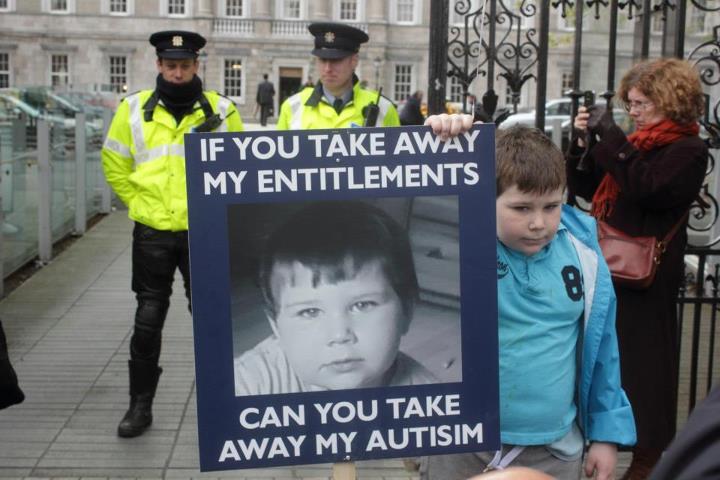
Can You Take Away My Autism?

May 1, 2012

A photo that just says it all.

Brimstone And Treacle

April 30, 2012

Few things date more quickly than outrage. Works once viewed as unperformably perverse – Stravinsky and Nijinsky’s The Rite of Spring, Strindberg’s Miss Julie – are now a good night out for the bourgeoisie. When the young theatre director Amelia Sears, hunting for her next production, came across a copy of a play called Brimstone and Treacle by Dennis Potter, she had, she admits, “no idea of the controversy there was around it. I’d done a production of Potter’s Blue Remembered Hills and I found this in a library and thought: why hasn’t it been done?”

The revival Sears is now directing at the Arcola theatre in London will be a test of whether a text that provoked a fat file of newspaper headlines in the 1970s and 80s – including Satan Rape Play Banned by BBC – remains contentious; it is another important stage in the curent re-examination of Potter’s work. Television dramatists, in the medium’s early years, made a devil’s deal: their work would reach a size of audience unimaginable to a theatre playwright but it would, in all probability, be seen only once and live on only in the memories of those who had been impressed. Now, DVDs and rerun channels are giving TV plays an afterlife; The Singing Detective has just had an acclaimed repeat on BBC4.

Brimstone and Treacle was commissioned by the BBC in 1974, but production was delayed for two years because of executive tremors. The play is a savage parable about religion, in which a young man called Martin charms his way into the house of a conservative suburban couple, Mr and Mrs Bates, who care for a daughter left speechless and paralysed by a hit-and-run accident. It is possible that Martin may be the devil incarnate; in the television version, he removes his shoes to reveal claw-like feet. In the scene that made the script notorious, he rapes the disabled young woman, an act that restores her to health and speech.

As elsewhere in his work, Potter seems to have been exploring the relationship between good and evil – in this case, a positive outcome arising from a negative act. In one of several articles he wrote during the controversy, the writer explained that “the sort of ‘religious drama'” he wanted to write was “based on the feeling that religion is not the bandage but the wound … I suspect that, if the neat, polite and unctuous young man had been ‘an angel’, the play would not have met so much trouble.”

Recorded in 1976, the play was referred to the then BBC director of television programmes, Alasdair Milne. In his memoirs, Milne records that a screening made him “almost physically sick”. While stressing the brilliance of the writing and acting, Milne ruled that the drama would be found “repugnant” by much of the audience and so could not be shown.

But in culture, the banned rapidly becomes contraband, and attempts are made to smuggle it out. Potter adapted his censored text for the Sheffield Crucible theatre in 1977. David Leland, who directed it, retains vivid memories of the playwright (who had stayed away from rehearsals) coming to see the production. “He sat beside me and it was visibly an incredibly uncomfortable experience for him. He was literally wringing his hands. I think he was shaken by the impact of seeing the play at such close range, in the way I had staged it.” He thinks Potter had expected the play to be performed at a safe distance, behind a curtain or arch, and was disturbed to find the stage almost in the middle of the audience. But, though it shocked the author, this first stage version caused no wider disturbance. “Funnily enough,” says Leland, “1977 was also the year that international snooker was played at the Crucible for the first time. And I remember there being far more concern among the theatre governors about the snooker than about us putting on Brimstone and Treacle.”

Even so, a moment such as the rape scene is always potentially more shocking in the theatre than on TV, especially in a small studio space such as the Arcola, where the audience is almost physically in the living room. And while a film director can control the point of view through camera angles and cuts, theatre-goers have much more choice in how they watch graphic action and the actors’ bodies. “That is an issue,” Sears says, “especially in a very confined space. But rape is seen so often in cinema and television that it seems ironic to put so much emphasis on this one scene.”

Potter’s script was published to coincide with the Sheffield premiere, and predicted a transfer to London’s West End in 1978; this never happened, though the play did have a fringe production. A cinema version, directed by Richard Loncraine and starring Sting as Martin, was released in 1982, making little impact on the box office (though more on the charts, through Sting’s recording of the ballad Spread a Little Happiness, played under the closing credits). Then, in 1987, Michael Grade (who had commissioned The Singing Detective for BBC1) pulled Brimstone and Treacle from the naughty shelf and screened it.

Sears and Rupert Friend, who plays Martin at the Arcola, have avoided watching both the TV and cinema versions ahead of their production. “I might look at them afterwards,” says Sears, “but I very much wanted to approach it as a theatrical piece.” Wasn’t Friend intrigued to see what Sting had done with the role? “With the greatest respect, really not. It’s better not to know.”

The most intriguing aspect of this revival is that the play may be more contentious now than it was 35 years ago. Its television ban was prompted by the fear that the plot might offend Christians; in 2012, the propriety of depicting a sexual assault on a quadriplegic woman is the more likely source of protest.

“I’ve had to think about this, from a woman’s point of view,” says Sears. “What, morally, is this suggesting? A woman gets raped and she is apparently healed. So that has been a challenge.” Potter was often accused of misogyny and even sexual perversion in his work. Sears points out that contemporary audiences may be more understanding because of the revelation, in Humphrey Carpenter’s 1998 biography, that Potter was sexually abused by an uncle. Does the writer’s status as a victim of sexual abuse explain or excuse the rape scene? “I don’t think it excuses it,” says Sears. “But it does make you think about why he wrote the scene and what he was saying: that he was not making a simple equation that rape equals healing.”

Friend has come to the conclusion that Martin’s confusions are also partly the result of sexual abuse. And, while the original objection to the play was that the girl’s recovery is presented as a warped miracle, director and cast have explored with neurologists the possibility that the girl’s silence and paralysis were caused by trauma rather than brain damage, and so were potentially reversible by a further shock. Experts on satanism have also come into the rehearsal room to help Friend explore whether Martin is or isn’t the devil; in the stage version, there is no giveaway glimpse of his feet. “I don’t want to give too much away,” Friend says, “because I think Potter intended the ambiguity. But we have explored in great depth the psychological reasons why someone might think they were the devil.”

Unaware of the play before he was offered the role, Friend says he was not particularly shocked by the content: “It reminded me of [Pedro] Almodóvar’s film Talk to Her, in which a man rapes a comatose woman.” He argues that it is important the play not be reduced to a single, brief, controversial scene. “When I’m doing it, I mustn’t think about it as That Scene. I would find it very debilitating to put neon quotation marks around that moment. The play has to be a whole journey. It’s clear that some of the company find the idea of the scene uncomfortable, but I just can’t.” (Leland, the play’s first director, would agree. “Regardless of its reputation, I actually see it, in a very black and bizarre way, as a very funny play. I think it’s about the gullibility of parents – a very rich and common theme.”)

Some of Sears’ audience will no doubt be drawn by the persistent smoke trail of outrage, but she would prefer theatre-goers not to come – or leave – for that reason. “I don’t worry about people walking out,” she says, “because, really, we see worse things than this every day. I wanted to do the play because Potter has a thrilling and original voice. I don’t think there will be anything else like this around in theatre.”
George Pepper Revisited

April 30, 2012

If you had told 30-year-old George Pepper, from Leeds, a few years ago that he would travel round the world, he wouldn’t have believed you.

That his girlfriend would accompany him and return as his fiancée, was a little less of a surprise – for him at least.

“We were in Florianopolis in Brazil. I’d got the ring beforehand, there was a really nice beach…,” he says, voice tailing off as he recalls the romantic proposal.

George’s trip was particularly special because he was diagnosed with multiple sclerosis when he was 22.

Getting used to his diagnosis was difficult and the uncertainty of how the condition would progress was frightening.

In the first two years, he had seven relapses. He experienced blurred vision, difficulty walking, vomiting, extreme fatigue and a lack of feeling on his left side.

George has Relapsing Remitting MS, which meant that the symptoms only lasted a number of weeks at a time, but he did have to stop working for several months.

“But I’d always wanted to go travelling. The more I heard about it, the more I wanted to do it,” George says.

“I’m quite stubborn. I didn’t want to look back and regret anything.”

Months of careful planning and years of saving funds followed.


‘Alone’

In the meantime he founded a website, shift.ms, for young people with the neurological condition, because he felt alone and isolated in those early days.

A grant from the Wellcome Trust to improve communication between MS researchers and young MS sufferers followed.

As a result, a busy online forum and a real community of friends has now built up around the website, which has become a valuable support network for young people.

Before George set off on his world tour he had another relapse, losing his hearing in one ear for eight weeks. He also had co-ordination issues, kept losing his balance and felt extremely tired.

At the same time it was suggested that he change his treatment from daily drug injections to monthly intravenous infusions – a move which dramatically improved his health.

To maintain this treatment schedule, his doctors in Leeds suggested stopping off at hospitals in Melbourne, Australia, and Sao Paolo, Brazil, to receive the required drugs dose – an arrangement that worked perfectly.

But there were other considerations too.

“I was very nervous about the heat and humidity before we left, a common issue for people with MS.

“So we always planned activities in the early morning or evening – and took lots of drinks breaks.

“And we tried to put in lots of rest days in our itinerary, and paid a bit more for comfier seats on long-distance bus journeys.”

‘Incredible journey’

After recently returning from his long-awaited six-month journey to places like India, Japan, Indonesia, New Zealand and South America, George is elated by all the things he has done and seen.

“It was incredible. I feel very lucky. I look back and think ‘what an experience’.”

George is just one of more than 100,000 people in the UK who have MS.

Most are diagnosed between the ages of 20 and 40 and yet a new report from the MS Society found that few young people were aware of this fact.

The report surveyed over 1,400 people with MS, and over 2,000 without MS.

Almost one in three people couldn’t name any of the common symptoms of MS, which include problems with balance, vision, fatigue, bladder, bowel, speech, memory and muscle spasms.

Simon Gillespie, chief executive of the MS Society says multiple sclerosis is poorly understood, even by those who know people with MS.

“Because it is poorly understood, living with MS can turn a simple shopping trip or social event into an ordeal where strange looks and hurtful remarks can all be part of everyday life.”

Social impact

The survey found that more than half of people with MS find it harder to socialise since their diagnosis, with around two-thirds saying their MS has hampered their ability to enjoy everyday social activities.

Yet people with MS want the same things as everyone else, like a successful career and an active social life.

Before his travels, George worked for a marketing agency in Leeds but he has now decided to concentrate full time on shift.ms, and on helping other people achieve their goals.

“There are plenty of people less fortunate than me. I feel fine now. The side effects from the drugs are minimal and I’m getting married next spring.”

His condition didn’t stop him enjoying a wonderful trip, partly because MS was way down his list of priorities.

There were slow days and tiring days, he admits, and a bout of tonsillitis in New Zealand, but keeping busy was important.

“MS doesn’t mean giving up on your ambitions, it just means rethinking how to achieve them,” he says.

New ESA Rules Take Effect Today

April 30, 2012

It all began with a telephone call. Earlier this month, Malcolm Parker, who has not worked since his spine collapsed three years ago, was rung out of the blue by an official from the Department of Work and Pensions. There was only one question: did his wife work more than 24 hours a week? Yes, said Parker, reasoning honesty was the best policy.

A fortnight later a letter dropped on the Parkers’ doormat. The department wrote bluntly to say his contributory employment and support allowance (ESA) would disappear on Monday.

Parker was taken aback. Having worked for 44 years in the construction trade and diligently paid his national insurance, he had expected to be protected should the worst happen. His wife Ruth was at first perplexed and then increasingly angry. Although her husband can visit the toilet by himself, with some difficulty, she comes home every lunchtime to feed and check on him.

“Malcolm is in a wheelchair. He’s 62. He can’t drive. He can’t concentrate and gets horrendous headaches because of the medication he’s on. He really cannot have a long conversation. To be honest he spends a lot of time on the sofa. I can’t see how he could work.”

She says the £99 a week her husband received from the state was a “lifeline. It’s not right that Malcolm paid into the system and now he needs help it is not going to pay out.”

This week, about 70,000 seriously ill, disabled people will lose some or all of their £99-a-week allowance, in perhaps the most swingeing welfare cut proposed by ministers.

In the past the public were told that by paying into national insurance, they would be guaranteed benefits should they find themselves unable to work due to sickness or disability.

From Monday, the government will limit receipt of the contributory allowance to just 365 days. It marks the end of a welfare state that rested on William Beveridge’s central idea that social security was “first and foremost a plan of insurance – of giving in return for contributions benefits up to subsistence levels”. It’s what Labour leader Ed Miliband calls the “something for something” welfare state.

Instead the government aims to test claimants’ ability to work “some time in the future” using the controversial work capability assessments (WCA). If a disabled person is judged to be able to do some “work-related activity”, then the household is means-tested for contributory benefits. In the Parkers’ case, Malcolm has been put in the “work-related” category and the new regulations mean Ruth’s full-time work – as an accounts manager in a solicitors’ firm earning £33,000 a year – rules out any benefits.

“How would we manage if I were to stop working?” says Ruth. “There’s a mortgage still to pay. We should move into a bungalow because Malcolm can’t climb stairs. But we cannot get another mortgage. At this rate we’ll end up in a mobile home.”

By 2015 almost 300,000 people will lose out – saving the public purse almost £2bn a year. It will also mark the end of the idea that the welfare state is a piggy bank to be emptied in hard times. Citizens Advice chief executive Gillian Guy calls this a “betrayal” and argues for a rethink.

“About 300,000 people will be losing almost £100 a week even when they continue to be assessed as being too ill too work. Citizens Advice bureaux are already seeing clients worried about being able to pay their mortgage or meet basic living costs,” she says.

“Many of those affected have paid national insurance all their lives – sometimes over three or four decades – believing that this will protect them if they become too ill to work. They are feeling very betrayed and frightened by what seems a very unfair change.”

Mark Young, 54, had to leave his job in a foundry after falling and shattering his kneecap. Convinced he would return to his job, he instead ended up “marooned and isolated”, unable to work for three years – his first spell of unemployment since he was 20.

Within weeks of an operation, his broken knee got infected and Young found himself incapacitated, swiftly losing confidence. He put on weight and began to feel afraid to leave the house alone. His wife’s earnings of a little over £10,000 a year means the household income is too high, under the new rules, to continue to get the benefit.

Young says: “I have been on ESA for 18 months. I get disability living allowance. I want to work for my own sanity. But my condition means I need to keep my legs raised. What job can I do with my feet on the desk?

“We need the money. I can’t sleep thinking about it.”

Perhaps the most concerning aspect of the welfare cut is that in an age of austerity stress and anxiety spreads through the population. For those who are depressed, the danger is that cutting benefits can jeopardise recovery and risks pushing people away from work.

Paul Farmer, chief executive of the mental health charity Mind – who earlier this month quit the government advisory panel responsible for monitoring the WCA – warned: “Most people with mental health problems need longer than 12 months of support before they are ready to seek employment. It is very alarming therefore that thousands of people are going to have this support cut off, putting a huge financial strain on them as well as on their families.”

Jenny Wheatley was signed off sick from work with “anxiety and depression” in January 2011 and was made redundant on medical grounds two months later. She got a letter last month saying her ESA would end, as her husband earns £18,000 a year.

“I called them and was basically told that I couldn’t claim income support as my husband is trying to keep us afloat. Because of this I can’t claim jobseekers’ allowance or any other benefit and, in the operator’s words, ‘your husband will have to support you’,” she says.

Wheatley faces having to live off the family’s meagre savings. “We don’t go on holiday. It makes me really angry. I have an illness you cannot see. I am not sitting on my backside watching Jeremy Kyle.”

Many experts question the limit of 365 days, which is double that given to able-bodied people claiming jobseekers’ allowance, but which, they say, does not recognise how difficult it is for disabled people to find a job, especially in a recession.

According to the government’s own estimates, 94% of people in the “work-related group” on contributory ESA will continue to need support for longer than 12 months. Stephen Timms, Labour MP and the party’s welfare spokesman, said two years was a “more realistic timeframe”.

The government said a two-year cut-off would cost taxpayers £2bn. A spokesman for the DWP said: “The time limit of one year strikes the best balance between recognising that some people need extra help to enter the workplace and that the taxpayer cannot afford to support people indefinitely who could return to employment.”

Campaigners say many claimants are often assessed incorrectly and that the government should accept that many sick and disabled people have such severe health problems that there is no current prospect of their being able to undertake work or work-related activities.

Such was the outcry when it emerged that seriously ill cancer patients will be forced to take medical tests and face “back to work” interviews, despite assurances from ministers that they would not make it harder for the sick to get welfare support, that in the face of strong opposition in the House of Lords the government accepted that some conditions would need “monitoring”.

The cut will also disproportionately affect those least able to afford it as the poor spend more of their lives with a disability. The average difference in “disability-free life expectancy” is now 17 years between those at the top and those at the bottom of the economic ladder.

Neil Coyle, director of policy at Disability Rights UK, says “unfairness will undo the policy”. He points out that under the new rules even average earners will pay in more in taxes annually (£5,800) than they will be able to take out in ESA (£5,200) in the event of being disabled.

“When the public see who is affected, then the government will lose support for this policy. Is it fair to give you back less in support than what you paid in a year?”

MS Week 2012

April 30, 2012

Multiple Sclerosis Week 2012 starts today in the UK and runs until 6th May. If you have MS, celebrate yourswelf in some way this week. If you know someone with MS, please use this week to celebrate them.

Mark Sparrow

April 29, 2012

Will lose his ESA tomorrow. And he’s scared.

Peter Lewis

April 29, 2012

An elderly man with learning difficulties was fatally stabbed in the hallway of the flats where he lived in Cardiff, say detectives.

Peter Lewis suffered a stab wound to his stomach in the communal hallway of the terraced house in the Roath suburb.

Mr Lewis, 68, who died in hospital, was described as “a vulnerable adult with learning difficulties” by police leading the hunt for his killer.

Police called the murder “despicable” and said there was no apparent motive.

Mr Lewis, who had family in Cardiff and elsewhere, was described as well respected.

He lived in a ground floor flat in Claude Road in the Roath district. The street includes a number of houses with flats and bedsits and the area is popular with students.

Police, who held a media conference on Sunday, still want to speak to a man seen running along nearby Oakfield Street around the time Mr Lewis died, in the early hours of Saturday.

Divisional Commander for Cardiff, Ch Supt Alun Thomas, said: “Our thoughts are with Mr Lewis’s family who have our full support during this terrible time.

“It is understandable that the people of Cardiff, and in particular Roath, will be shocked and worried that such a serious incident taken place.

“I wish to reassure them that everything is being done to arrest the person responsible.”

Police said Mr Lewis was stabbed at around 02:40 BST on Saturday.

He was taken to the University Hospital of Wales in Cardiff where he later died.

A major incident room has been set up at Cardiff Central Police Station.

The investigation is being led by Det Supt Stuart McKenzie, who said a dedicated team of officers is working “around the clock” on the inquiry.

Det Supt Stuart McKenzie and Ch Supt Alun Thomas appealed for help from the public and outlined more details of the case

Supt McKenzie said: “Officers immediately attended the scene where they tended to Mr Lewis before he was taken to hospital by ambulance where he sadly died.

“I am anxious that the person responsible for his murder is apprehended and would urge anyone with information to contact the incident room or Crimestoppers anonymously.”

Police want to trace a man seen in Oakfield Street at 02:45 BST.

He was wearing a light-coloured hooded top and trainers, and was running in the direction of Newport Road.

Detectives want to hear from the man, who was white, or anyone who may have seen him.

They are also appealing for information from anyone who saw or heard anything suspicious in Claude Road and Oakfield Street areas on Saturday morning between 01:00 and 03:00 BST.

South Wales Police have asked for witnesses or anyone with information is asked to contact the incident room at Cardiff Central Police Station on 02920 571530 or Crimestoppers anonymously on 0800 555 111.

Katie Hopkins

April 29, 2012

Twitter was on fire yesterday discussing Katie Hopkins’ comments about disability benefits. Here they are, from her blog, and they’re awful:

I am fairly certain if the privilege of state support was handed out at the top of a good few flights of stairs, far fewer claimants would bother to pitch up. Equally, I am sure a good few of the disability benefit masses would jog on up there with a spring in their step.

And this from a person who has epilepsy!

In response, I say: Those disability benefit claimants who are lucky enough to be able to take a footstep would limp up flights of stairs, holding rails, to get their benefits if they had to.That’s what you do when you have no other way to eat.

Autism Centre To Be Built At New Secondary School

April 28, 2012

A specialist centre for children with autism is to form part of a new school being built in Derbyshire.

Derbyshire County Council has approved plans for the facility at the £14.5m Tibshelf Community School which is due to open in January 2014.

The centre will feature specialised teaching staff working with up to 15 autistic pupils aged 11-16.

The unit is designed to give children from the autism unit at Pilsley Primary School a secondary school option.

Mike Longden, cabinet member for education, said Tibshelf Community School had expressed interest in housing a specialist autism centre when the county council agreed to open the new unit at Pilsley two years ago.

Its existing building was not deemed suitable but the authority has agreed the facility can be incorporated into the new school’s design.

He said: “The children will have specialist attention on one hand – dedicated teaching staff with the skills to deal with these special needs.

“But equally they will have the provision of a good secondary school that will allow them to be educated within the mainstream structure.”

KFC Must Pay £5M To Poisoned Australian Girl

April 28, 2012

KFC has been ordered to pay eight million Australian dollars (£5.1 million) to the family of a Sydney girl left brain damaged after eating one of the fast food giant’s chicken wraps.

Monika Samaan’s family sued KFC, claiming the then-seven-year-old girl contracted salmonella poisoning from a KFC chicken wrap in 2005.

She was in a coma for months and left with brain damage.

New South Wales Supreme Court Justice Stephen Rothman ruled last week that KFC was responsible for the food poisoning. Now he has ordered KFC to pay the damages plus legal costs.

KFC denied responsibility and said it would appeal.

Samaan’s lawyer, George Vlahakis, said the family was relieved the court battle was over, but is upset about KFC’s plans to appeal.

Chen Guangcheng ‘In US Embassy’ After Escape From House Arrest

April 28, 2012

China dissident Chen Guangcheng is in the US embassy in Beijing following his dramatic escape from house arrest, fellow activist Hu Jia has told the BBC.

Mr Hu said Mr Chen – who is blind – had scaled a high wall and was driven hundreds of kilometres to Beijing.

The US state department has refused to comment on the claim.

Mr Chen escaped on Sunday, activists say, and has since released a video addressed to Prime Minister Wen Jiabao.

In it he makes three demands, including that Mr Wen investigate what Mr Chen calls the brutal beating up of his family members.

Since his escape, his brother and nephew have reportedly been detained, along with a supportive activist.

Mr Chen, 40, was placed under house arrest at his home in Dongshigu town, Shandong province, after being released from a four-year jail sentence in 2010.

Reports suggest authorities only realised Mr Chen had escaped on Thursday.

Escape ‘long-planned’

Mr Hu – a friend of Mr Chen and himself a prominent activist and dissident – said he had met Chen Guangcheng in the last 72 hours, since Mr Chen’s escape.

Mr Hu’s wife, from whom he is separated, released a photo of the two men together on Twitter.

Mr Hu told the BBC Mr Chen had “planned this escape for a long time, he even attempted to dig a tunnel to escape”.

“That failed and this time he tried not to appear in the daytime to create the impression for the guards that he never appears in the day. So that won him time, a few days, to climb over all the walls. So he planned this for a long time and made sure the guards had no idea.”

He said a night-time escape was not a problem for a blind man, but “of course he did fall a few times”.

He said he had critical help from “volunteers”.

Mr Hu said Mr Chen had fled to the US embassy in Beijing. The US embassy has not commented, and the US state department told reporters in Washington it had “no information” for them.

Other activists have stated simply that Mr Chen is in a “safe place” in Beijing.

Chen demands

In his video addressed to Prime Minister Wen, delivered from a darkened room, Mr Chen said outwitting his guards had not been easy.

In the appeal, posted online by Boxun, a Chinese dissident news website based in the United States, he asks that:

  • Prime Minister Wen investigate and prosecute local officials Mr Chen says beat up his family members
  • The safety of his family be ensured
  • Corruption in general in China be dealt with and punished according to the law

Mr Chen names some local officials who told him that they “do not care about the law” and that “a few hundred people” were hired by the local government to “lock down” the village he lives in.

The Chinese authorities have come under international criticism for their treatment of him. At one point his daughter was barred from school. Many sympathisers who have tried to visit his home say they have been beaten up.

In the video, Mr Chen says: ”I may be free but my worries are for my family… my wife, my child, my mother. Perhaps because of my leaving, they may become the target of more brutal abuse.”

A self-schooled legal activist, Mr Chen is known for revealing rights abuses under China’s one-child policy and has accused officials in Shandong province of forcing 7,000 women into abortions or sterilisations.

The plight of Mr Chen has become famous around the world. US Secretary of State Hillary Clinton has repeatedly called for his release and is due to visit Beijing next week.

Relatives held

The authorities appear to be moving against those believed to have been involved in Mr Chen’s escape.

Reports on Friday said local authorities had surrounded the house of Mr Chen’s brother, Chen Guangfu, and Guangfu’s son, Chen Kegui, also in Dongshigu, near Linyi.

Blogger Yaxue Cao says he spoke to Chen Kegui on Friday at about 01:30 local time (Thursday 17:30 GMT), and he has transcribed the interview on his blog Seeing Red in China.

The transcript suggests that at the time of the interview Chen Guangfu had already been detained.

Chen Kegui was awaiting police arrest, having initially resisted an attempt to detain him by unidentified men less than two hours before by slashing at them with kitchen knives.

“Around midnight, about two hours ago, they entered our property by jumping over the enclosed walls, they pried open the locks and kicked on the doors. I heard my mother crying inside, helplessly: ‘Please don’t come in! Please don’t come in!'”

Chen Kegui, who often sobs during the interview, insists: “I did not take knives to go out to kill anyone. I was defending myself in my own home. They attempted to apprehend me without showing any warrant.”

The interview ends with Mr Chen saying: “I don’t know whether the police are coming. Perhaps they will send a sniper to kill me. They would accuse me of killing. It’s all possible.”

Reports on Chen Kegui’s current whereabouts were unclear, with activists saying he had been detained but the county government saying he was still at large.

He Peirong, another China-based activist who had also campaigned for Chen Guangcheng, has also been detained at her home in Nanjing according to other activists.

The Chen affair comes at an unwelcome time for China’s leaders, who have been embroiled in a lurid political scandal involving disgraced former party boss Bo Xilai.

Rupert Murdoch Called Ivan Cameron ‘Retarded’ During Leveson Inquiry

April 27, 2012

Dear, valued readers, disability really is everywhere! I know Rupert Murdoch talked a lot of rubbish during his time at the Leveson Inquiry this week- but I didn’t hear it all, and so I have only just found out quite how much rubbish he talked.

Dean Andrews- Europe’s Oldest Person With Progeria

April 27, 2012

Europe’s oldest sufferer of a rare ageing disease has told how in just 20 years his body has become that of a 160-year-old. 

Dean Andrews’ body has aged eight times faster than normal due to a rare condition called Hutchinson-Gilford progeria.

He is one of just four progeria sufferers in the UK and out of only 74 cases worldwide, Dean is thought to be the second oldest survivor. 

Now Dean has decided to tell the story of his life so far in the hope of providing inspiration to other sufferers.

He said: ‘I’ve never let my condition hold me back. I’ve always tried to do what everyone else does and even if I failed, at least I tried.

‘My family have kept me going and I’ve got very supportive friends. I’m very lucky as they do everything they can to make me happy.’

Dean weighs just 3st 10lbs – but his small body holds a big personality.

In his 20 years, Dean has learnt to drive, been engaged, got four tattoos and once even started a mechanics course at college. However, he was forced to quit when he was unable to get his tiny 4ft 1in frame over the cars’ bonnets.

Nevertheless, his achievements are astounding considering that when he was diagnosed with progeria at the age of seven, his mother Dawn Thomas, 41, was told he would not live beyond his early teens. 

Back then, the condition was so poorly documented that most doctors had never even heard of it.

Dawn said: ‘When Dean was about six months old I noticed he was a lot smaller than he should have been. He was still wearing clothes for a 0-3-month-old baby but the health visitors told me not to worry.

 ‘They said he was just small and there was nothing wrong with him but I carried on taking him to the doctor regularly because his appetite was small.’

In other ways Dean’s development was quite normal, but when he started walking at the age of 18 months, Dawn noticed that he would tire more easily than her other children

Dawn said: ‘We would be walking along the street and he would complain that his legs were hurting. At first I just thought he was lazy but then I noticed there were certain things he couldn’t do, like cross his legs during assembly at school.’

The mystery was eventually explained when a geneticist broke the news that he had progeria.

Dawn said: ‘The day before we were told, the doctor rang up and told us to come in and said that I should bring someone with me. I knew then that it was bad. I thought it might even be cancer because his hair used to fall out so easily.

‘There was so little information available about progeria at that time that I basically had to teach myself everything. All we were told was that Dean was ageing eight times faster than normal and that he would probably not live past 13.

‘I didn’t know how to break it to Dean at that time because he was so young. I just told him that he had a growth problem.

‘It was really hard to take and I ended up on anti-depressants but it was Dean himself who gave me hope, he never let anything get him down.’

Dawn lives in Birmingham with Dean, her husband Wayne, 43, and children Sophie, 15, and Lewis, 12. She also has an older son Nathan, 23, a warehouse assistant, and fosters her niece Annabel Timby, 14.

She split with Dean’s father Mark Andrews, at that time an airport baggage handler, in 1998 and met Wayne around the time of her son’s crushing diagnosis.

Now both Dawn and Wayne devote their lives to Dean’s full-time care at their council terrace home in Erdington.

 She said: ‘We have just tried to make every moment count for him as best we could. I’ve never tried to treat him any differently or tell him that he couldn’t do something, if he wanted to try something he would have a go.’

Dean said: ‘When I was at primary school I wasn’t really aware that there was anything different about me.

‘I only really became aware of my condition when I was about 13 and it was decided that I should go to a special school.’

Progeria causes rapid ageing and sufferers of the genetic disease are prone to arthritis, eye problems, heart disease and baldness.

By the age of 10, most progeria children look like octogenerians. They are said to age at eight times the normal rate, meaning Dean has survived the equivalent of 160 years of ageing.

Dean’s poor prognosis meant doctors expected him to be profoundly disabled before he hit his teens, so Dawn and Wayne decided to send him to special school where the facilities were adapted for wheelchairs.

However, Dean defied medics’ grim predictions and excelled at school, helping his teachers with the other students’ needs and taking part in plenty of after-school activities.

Dean added: ‘I had a lot of friends at school and I took part in a lot of after-school clubs. I also did swimming competitions and we went on trips.

‘The only time it ever bothered me were when my friends wanted to go theme parks, which I loved, but I was not tall enough to go on most of the rides so I would just stay at home.

‘I loved hockey and skateboarding and riding my bike – all the same things as other teenagers.

‘I also loved playing football and even though some of the other kids were a bit taller than me, I never let it hold me back.’

Dawn was wary of letting doctors use her son as a guinea pig for untested treatments. She did not want him to receive hormone treatment to kickstart his growth and, at the age of 14, Dean himself refused invasive surgery to correct his jaw. 

Apart from an operation to repair damage caused by frequent ear infections, Dean’s health was relatively good all through his teenage years and he amazed doctors with his progress.

He said: ‘When I got to about 15, I noticed that I couldn’t lift my legs high enough to peddle my bike anymore but I just rode my little sister’s one instead.

 
 ‘My friends all had mini-motorbikes around that time too and I struggled to sit comfortably on one. But I still had a go at everything from quad biking to skateboarding.

‘If my mate jumped over a wall I would be there right behind him, trying to scramble over it.’

A Birmingham City fan his whole life, Dean was named the club’s disabled supporter of the year and presented with an award by Emile Heskey in 2005.

As a fan of fast cars, Dean began driving lessons at 17 and passed his test first time. He then found love with a girl named Emily, who would later become his fiancee, although sadly the relationship ended earlier this year.

Dean was living life to the full, but then in November last year tragedy struck.

After suffering frequent breathlessness Dean was admitted to hospital with suspected pneumonia. But when doctors investigated, they found he was suffering from irreversible heart failure. 

He now spends most of his days at home where Dawn tends to his every need.

Doctors cannot say how much longer he has left and he must take a cocktail of medications every day. Nevertheless, Dean remains characteristically upbeat.

He said: ‘I went to the progeria reunion last year and met Hayley Okines, Harry Crowther and Ashanti Smith – the other three sufferers in the UK. It was great to be able to show them what I’ve done with my life and to give them a bit of inspiration.

‘Heart failure has changed my life a lot and I can’t do a lot of the things that I used to, but I have my family and friends around me and they keep me going.


‘There’s nothing they would not do for me and I’m very lucky to be so loved.’

Dean says there are some things he would like to do in the time he has left. He would love to meet his idol comedian Leigh Francis – known for his character Keith Lemon – and he hopes to make it to the next progeria reunion in September, which takes place in Italy.

These days, he loves nothing more than relaxing in a jacuzzi to soothe his swollen limbs – a side affect of the heart failure – but the NHS withdrew his hydrotherapy funding last year. He is currently trying to find somewhere local that will allow him to use their facilities.

Dawn said: ‘We are so proud of Dean and everything that he has achieved but I also feel he has missed out on so much.

‘Now we are just trying to make the time he has left as comfortable and as happy for him as possible.’

Andrew Bull’s Employment Tribunal Win

April 27, 2012

A former soldier blinded by an IRA bomb has been awarded £200,000 compensation by an employment tribunal after it found he had been bullied at work.

The tribunal in Cardiff ruled that Andrew Bull, 48, had also been harassed and eventually lost his job at Blaenau Gwent council due to his disability.

Council chief executive David Waggett said he apologised to Mr Bull, from Ebbw Vale.

He was blinded in Northern Ireland in 1983.

Dementia Friendly Devices Revealed

April 27, 2012

Scent sprays to trigger appetite and wristband alarms are among key innovative designs which have been unveiled to help people with dementia.

Mains-powered plugs would emit fragrances three times a day to spark hunger while Buddiband bracelets would alert an emergency centre if wearers suffered a fall. Research is also being carried out into the possibility of training “dementia dogs” that could help support people with the illness with medication and hydration by learning their normal behaviour patterns.

New online groups to ease the care burden and help carers find flexible work are also being looked at.

The prototypes, created under a competition staged by the Department of Health and the Design Council, were revealed as the first meeting of the Dementia Friendly Communities Champion Group, which will help pioneer the Government’s plans announced earlier this year to create areas more responsive to the needs of people with the illness, was staged.

Care Services Minister Paul Burstow, who unveiled the designs, said: “Fear of dementia can leave people feeling powerless and trapped, leaving them isolated and unsupported. That is why we have worked with the Design Council to drive innovation in dementia care. The five winning ideas have the potential to make a big difference for people with dementia and their families.

“The Design Council work is part of our wider drive to make our country dementia-friendly. Today we go further with our partnership with the Alzheimer’s Society to challenge cities, towns and villages up and down the land to lead a revolution in how people think about dementia.

“Working with businesses, councils, the local NHS and community groups, our immediate goal is a network of 20 dementia-friendly cities, towns and villages to lead the way.”

Around 670,000 people in England have dementia and the number of people developing the disease is increasing.

Jeremy Hughes, chief executive of Alzheimer’s Society, said: “So many companies signing up to be dementia-friendly shows a real commitment to improving people’s lives. From helping people with their shopping to making it easier to do their banking, these organisations are incredibly well placed to push forward real change.

“We now need to see more organisations getting involved. Together from bus drivers to businesses, we all have a role to play in making communities more dementia-friendly.”

Rebecca McKeown: Brother Was Once Suspected Of Her Murder

April 26, 2012

The trial of two grandparents accused of the manslaughter of their severely disabled granddaughter 11 years ago has heard their grandson was once arrested on suspicion of murdering her.

Rebecca McKeown, 14, died in 2001. Her mother has been giving evidence.

David Johnston, 88, and his wife Sarah, 86, from Carwood Drive in Glengormley, deny manslaughter and child cruelty.

Cheryl McKeown said she was shocked when she was first told in 2008 that the case was being reopened.

Under cross-examination from a defence barrister, she said she was interviewed in January 2008 about Rebecca’s death.

The barrister said she may have been in shock because she had just found out that her eldest son Stewart was about to be arrested on suspicion of murdering Rebecca.

Stewart McKeown was never charged in relation to the death of his sister, who used a specially designed wheelchair and could neither walk, talk nor eat for herself.

She died in hospital after developing pneumonia.

The trial of Rebecca’s grandparents is expected to last until mid-June.

Is This The Year Of Disability On TV?

April 26, 2012

Asks Damon Rose here. Any thoughts, readers?

Louis Theroux Writing On Dementia

April 26, 2012

Ahead of tonight’s documentary.

With an ageing population, a wave of dementia is approaching. Caring for those afflicted isn’t easy, writes Louis Theroux.

Nancy Vaughan is a charming and lively conversationalist, a friendly host, and at nearly 90, still has much of the sparkle and attractiveness that must have turned many heads when she was in her heyday as a model in New York.

But she also has trouble remembering her own name, or the fact that she is married (62 years and counting), or indeed, much of the time, some of the basics of the English language.

Nancy is in the advanced stages of Alzheimer’s.

On a sunny late autumn day I visited Nancy and her husband, John, at their home in Phoenix, Arizona. We made friendly conversation in the kitchen and for moments I could have believed that she was mentally well.

Her smile is still engaging, she is physically fit, and she can sometimes carry on brief exchanges. When I asked if she had any problems with her memory, she said an emphatic “no”.

But when John posed the question directly “Nancy, what is your name?” she looked a bit baffled. Asked for her surname, Nancy said “Bread”, a little uncertainly. I wondered whether this might be her maiden name, but was told that was Johnson.

Nancy and John’s life has become surreal and stressful in many ways. John has taken to wearing a name tag with his name on it to help Nancy identify him.

He has also stuck a copy of their wedding photo up in the kitchen so that, in her confused moments, he can prove to her that they are married.

John cares for Nancy fulltime. They have no children, so there is no family help take the strain – and they are not in the financial position to have Nancy go into a care home.

Aged 88, John is the full-time carer for someone with many of the same needs as an adult-sized toddler.

John and Nancy are by no means exceptional. There is a slow-moving tsunami of dementia advancing towards us as our population ages.

It’s reckoned that one in eight Americans aged 65 and over has Alzheimer’s – the most common cause of dementia. Nearly half of the over 85s has the disease. As medical science has become better and better at prolonging our lives, the mental side of things hasn’t kept pace.

Nowhere is this more in evidence than in Phoenix. For years Phoenix has been a mecca for America’s elderly, who are attracted by the year-round sun and dry desert heat.

Now increasingly it is a kind of capital of the forgetful and the confused.

Not coincidentally, Phoenix is also pioneering the way dementia sufferers are cared for and treated.

One of the top destinations for people in need of round-the-clock care is Beatitudes, a gated retirement complex, which has, tucked among its many buildings, a memory support annex.

Most of the residents at Beatitudes have seriously impaired memories, to the point where they can no longer look after themselves, are quite often confused, and occasionally have delusions.

It’s not uncommon for a resident to imagine that they’ve seen a non-existent intruder, or to suppose that because they cannot find a purse or wallet, that someone has stolen it.

Partly under the influence of a Bradford University-based psychologist, Tom Kitson, Beatitudes’ carers have a policy of not contradicting – and even playing along with – the delusions of the residents, avoiding confrontations, de-escalating conflicts, and “redirecting” the attention of those in distress, using distractions and pleasurable activities.

Beatitudes staff use medication as little as possible. They try to be flexible and adapt to the quirks of the residents and the symptoms of their condition, letting them wander the corridors at night should they feel urge, letting them bathe, eat and sleep on their own schedule, and offering them snacks and chocolate at any time of the day or night.

I spent the best part of two weeks at Beatitudes, observing their practices first-hand.

One of the people I got to know was Gary Gilliam. A 69-year old, Gary had been a successful dentist in his younger years, as well as doing time in the army.

He’d been at Beatitudes several months when I met him, and though his memory came and went, he spent much of his time under the misapprehension that he was still a practising dentist, stationed at a military base.

Gary was genial and playful, constantly cracking jokes, and so it took me a while to realise quite how advanced his dementia was.

He told me he’d been having some problems with his short-term memory but he had no idea he might be in any kind of care home. But rather than contradict him, the staff would gently go along with Gary’s version of reality.

Quite often, especially in the evening, Gary would imagine that his time on “the base” was up. He’d pack his bags and start looking for the exit.

Staff would cajole him into staying another night, saying it was a little late now, it was dark out, better to leave it until morning. Or they might ask Gary to look at their teeth, at which point he would switch into dentist mode and forget his plan.

Gary also had a habit of forgetting that he was married, despite the fact that his wife of nearly 30 years, Carla, was alive and well, and a frequent visitor.

Being one of the few men on his unit, Gary’s company was much in demand. He had two girlfriends, who enjoyed cuddling with Gary, though the exact extent of their intimacy wasn’t clear.

I had the chance to observe this rather odd love triangle – or “love square”, if you include the second girlfriend – when I accompanied Carla on a visit. To my surprise, she suggested that Gary bring one of the girlfriends with him.

She said this would make the visit run more smoothly – seeming to imply that Gary might prefer the company of his new friends over hers – but I was also struck that Carla was keen for me to see and understand the pain and the strangeness of loving someone with Alzheimer’s.

Perhaps the most extreme visit I observed during my time at Beatitudes took place between a young man called David Watson and his mother Gail.

Though she wasn’t very old, Gail’s dementia had progressed very quickly. She was on the fourth floor of the Beatitudes memory support building, home to the most advanced cases.

Gail could no longer speak at all, though she was physically well, and would wander the corridors often picking up objects and approaching people, endlessly repeating a sound that sounded like “gulla”.

David tried showing old photos to his mum. He tried stopping her on her perambulations for a hug. There wasn’t much sign of recognition that I could see.

David explained that his sisters no longer visited. “Because this is hard,” he said. But then, a moment later, David’s mother leaned in and held his face in her hands. “So that’s why I come and visit,” he said, visibly moved. “Because sometimes that happens, and then that’s good.”

Near the end of my stay in Phoenix, egged on by John, I volunteered to care for Nancy for half a day, hoping to give him some small respite but more importantly to have a small glimpse of what John goes through on a daily basis.

I discharged my duties as carer with mixed results. We played ball in the kitchen and broke a glass. We started a walk and then abandoned it.

Some of the time, she was baffled as to who I was and exactly what I was doing in the house. But along the way, we also managed to enjoy ourselves, listening to music, eating lunch together, looking at photos, and indeed chuckling together over the minor calamities that befell us.

When John returned and relieved me of my position, I asked him how much of Nancy he thought was left. He answered in the spirit of the engineer he’d been, with an exact number.

“Thirty per cent,” he said, and then he tapped his head, and said that the rest was still preserved safely in his memory.

It was an oddly romantic moment.

The ravages of dementia can be unbelievably upsetting to see. No one would wish the confusion and forgetfulness that goes along with the disease on another person – though sadly, for demographic reasons, they are likely to be an ever-increasing part of our lives.

But my stay in Phoenix also taught me to be mindful of certain positives.

However much is taken by dementia, something always remains. There can still be a person beyond their words and their memories, a spirit, for want of a better word, and a continuity with the person they were.

Faced with the disease, and with the right support, most people can learn and adapt, finding new ways to love their parents and partners.

Able Radio: Panorama And The Undateables

April 26, 2012

Yesterday on Able Radio, George Johnson and I discussed Monday’s Panorama programme on elderly care. The programme also includes an interview with a member of the European Disability Forum about The Undateables.

Loius Theroux- Extreme Love: Dementia

April 26, 2012

It seems fitting that this is being broadcast tonight at 9pm on BBC 2. I’ll be watching.

Louis travels to Phoenix, Arizona – the capital of dementia care. He spends time at Beatitudes, a residential institution, and also with those looking after loved ones at home to try to understand the struggle of living in a world of encroaching shadows – and of keeping relationships alive in circumstances that can be among the strangest and most challenging imaginable.

Facebook Told Mother To Remove Photos Of Downs Syndrome Son, 7

April 26, 2012

I can’t believe this.   It seems Facebook told this mother to remove photos of her son with Downs and other special children having fun. If this was done because the children are disabled, it’s outrageous.

Grandparent Trial: Girl’s Mother Gives Evidence

April 25, 2012

The mother of a severely disabled girl has been giving evidence in the trial of the child’s grandparents who are accused of her manslaughter.

Rebecca McKeown, 14, died in hospital in March 2001.

David Johnston, 88, and his wife Sarah, 86, from Carwood Drive in Glengormley, deny manslaughter and child cruelty.

Cheryl McKeown said her daughter was bleeding from an intimate area after returning from her grandparents’ home.

Close relationship

Rebecca died in hospital five days after she had been looked after by her grandparents, and Mrs McKeown has been giving evidence about the day when she left her daughter in her grandparents’ care.

She told Belfast Crown Court that Rebecca had multiple disabilities, but because of their close relationship she was able to tell if she was in pain by looking in her eyes.

The teenager used a specially designed wheelchair and could neither walk, talk nor eat for herself. She died after developing pneumonia.

The prosecution alleges this came as a direct result of a sexual assault she suffered at the hands of one or other grandparent.

Mrs McKeown testified that when she informed her parents that Rebecca had been sexually assaulted there was “no reaction, no shock”.

The trial is expected to last until mid-June.

Prospect Of Drug For Autism Raised After Study

April 25, 2012

I know I have several readers with an interest in autism- any thoughts on this?

The prospect of a drug to treat autism has been raised after symptoms of the condition were reduced in experiments on mice that were performed by the US National Institutes of Health.

There is no cure for the condition.

The results published in Science Translational Medicine showed increased social skills and less repetitive behaviour in animals taking a drug.

However, treatments which work in mice frequently fail in humans and potential medication would be years away.

Autism spectrum disorder is thought to affect around 1% of children. It ranges from mild to severe and symptoms include social problems, delayed language and repetitive movements such as hand tapping.

Autism is mainly treated with specialist education, speech and behavioural therapies.

‘Hopeful’

Researchers at the National Institutes of Health said autism had been thought to be untreatable by drugs. The theory was that any problems would be “hardwired” into the brain.

However, they said there was evidence that in some cases autism could be down to the way cells in the brain communicate with each other at synapses, the gaps between individual brain cells.

They tested a drug, GRN-529, which interferes with the chemical glutamate, which helps two brain cells talk to each other.

Mice with “autistic behaviours” – this is not the same as mice actually having autism – were used.

“Autistic mice” are less social and communicate less with other mice. They also spend huge periods of time repetitively grooming themselves.

After the injection the mice spent less time grooming and also showed improvements in social levels.

The researchers said their findings “raise the possibility” that a drug could be used in autism.

Dr Jacqueline Crawley, one of the researchers from the National Institute of Mental Health, said: “Given the high costs – monetary and emotional – to families, schools and health care systems, we are hopeful that this line of studies may help meet the need for medications that treat core symptoms.”

Uta Frith, a professor of cognitive development at University College London, said: “Processes at the level of the synapse have long been suspected in the origin of autism.

“However, it will be a long time until these findings can be translated for human patients. Tampering with the synapse may well result in undesirable side effects.

“Despite hopeful signs for a future drug treatment of at least some autistic behaviours, it would be sad if too much pressure was now put on researchers to rush into applications.”

Richard Mills, the director of research at the National Autistic Society, said: “The NAS welcomes all research that improves our understanding of the neurobiology of autism.

“Research using animal models is important but it is not always easily translated into our understanding of autism in humans.”

Bionic Suit Helps People Walk Again

April 25, 2012

People who have been paralysed are trying out battery-powered suits to help them to walk again.

Andrew Glenie, 42, from Sissinghurst in Kent, has been paralysed since injuring his spine in a motorbike accident in 1993.

He is being treated with the £100,000 exoskeleton at a clinic in Cambridge. The device, developed in America, has motors to help people stand up and then mechanically moves their legs.

Ciara Paczensky

April 25, 2012

A six year-old girl from Kent has a skin condition so serious, every knock or bump results in her skin blistering or completely shearing off.

Ciara Paczensky, from Dartford, suffers from the genetic condition Epidermolysis Bullosa (EB).

She has to wear bandages to protect her from even the slightest contact.

Her father Grant Paczensky said: “It affects one in 17,000 children and is quite restricting on the things that Ciara can do.

Very rare condition

“It limits her ability to interact with everyone else because you have to be careful of bumps, knocks, bruises, the slightest touch can basically shear her skin off.

“If you can imagine the most painful blister you have ever had, multiply the pain by 10 and increase the size [of] the blister to the size of a tennis ball, then you are some way to understanding what Ciara goes through on a daily basis.”

According to the NHS, EB is a very rare genetic condition and it is estimated that currently 5,000 people in the UK are living with it.

Both Ciara’s parents carried the gene responsible for EB but had no symptoms and were unaware of the condition.

They have since been told that there is more chance of winning the lottery than two carriers meeting and having a child with the condition.

Currently there is no cure for EB, according to the NHS, so treatment aims to relieve the symptoms and prevent complications developing, such as the blisters becoming infected.

The family get help from local charity chYps and a nurse visits Ciara daily to help change her bandages.

Despite her condition, Ciara’s parents say she is determined to live as normal a life as possible.

Maggie Paczensky, Ciara’s mother, said: “I don’t think there is an ‘I can’t’ in Ciara’s vocabulary – she will just try anything.”

Autism Drop In Centre Opens In Cornwall

April 25, 2012

A new drop-in centre for people with autism has opened in Cornwall.

The Pearl Centre – People Experiencing Autism Research & Learning – will provide information for children and adults with autism and their families.

The centre, run by Spectrum, will offer support and advice on benefits, access to specialists and provide a place to meet.

The centre, based in Cathedral Lane in Truro, will operate during week-day business hours.

‘Completely in the dark’

Mary Simpson, chief executive of Spectrum, said: “This is a vital part of making sure parents have somewhere they can go, get good quality information and levels of support.”

Yvonne Nelson, whose daughter has autism, said: “When you first have a child that’s different you’re completely in the dark.

“You know your child’s different, but you don’t know why or how you can help them.

“To have somewhere to come and get some expertise and help will be absolutely wonderful.”

The charity currently operates 25 residential homes around the county and has opened the centre as part of its 30th anniversary.

The Challenge Of Inspecting Home Care

April 25, 2012

Reading this, I’m more than a little worried. I realise that inspecting care provided to disabled or elderly people in their own home is a challenge. That’s not my worry.

My worry is that if inspecting home care is a challenge, and care workers in care homes don’t always treat their clients with the deserved respect, what are elderly and disabled people to do?

We can’t live with family forever- this puts a strain on the carers’ lives and may end up straining family relationships. Yet, if we see or hear of more Winterbourne Views or Ash Courts, we will be left scared to put our loved ones in care homes, or scared at the thought of needing to be put into care homes.

If we live independently, and have carers coming in, then the points raised in the article are all very true.

So what should we do? Move to Australia while health allows? Or simply go to a certain clinic in Switzerland for the rest of time?

This is almost enough to make me think that maybe the UK’s law on assisted suicide should change after all…

Blinded Diplomat: Police Release CCTV Image

April 25, 2012

Police investigating a robbery which left a UK diplomat blind in one eye have released a CCTV image of a man they wish to trace.

George Fergusson, 56, was assaulted at about 19:30 BST on Friday while taking a shortcut through Margravine Cemetery and Park in Hammersmith, west London.

A small quantity of cash was taken by his attacker.

The image was taken near the cemetery around the time of the robbery, said Scotland Yard.

Police said they wanted to hear from anyone who might recognise the man and can help in his identification.

A 29-year-old man was arrested on 22 April on suspicion of robbery in connection with the inquiry and bailed to return on 7 June.

The suspect is described as black, in his 20s or 30s, and about 5ft 10ins tall. He wore a dark hooded top and dark glasses.

Mr Fergusson was discharged from the Western Eye Hospital in Marylebone, north-west London, on Sunday.

Winterbourne View Bought, To Reopen As Rehabilitation Centre

April 25, 2012

It seems somehow appropriate to be ‘revisiting’ Winterbourne View now, after Monday’s Panorama on Ash Court. It’s fitting that this news should come so soon after Panorama has covered yet more abuse in a care home.

A private hospital near Bristol, where residents were secretly filmed being abused, has been bought and will become a neurological rehabilitation centre.

Glenside Manor Healthcare Services said it would invest £1.5m in refurbishing Winterbourne View which is expected to reopen as Glenside Bristol in 2013.

Nine people have admitted ill treating residents following the filming by the BBC’s Panorama.

Two more face trial at Bristol Crown Court.

The hospital was owned by Castlebeck at the time of the abuse.

‘Support and rehabilitation’

Twenty-four patients were transferred from Winterbourne View near Hambrook following the BBC investigation and the hospital was closed last June.

Dr Nick Moffatt, an independent consultant clinical psychologist who has worked with the Glenside team for 20 years, welcomed the move which will create about 100 jobs.

“Glenside already runs successful facilities in Salisbury and the services it offers are extremely beneficial to individuals and families faced with a brain injury to a loved one,” he said.

Dr Moffatt added that in the Bristol area there was “a real need for the many levels of support and rehabilitation” Glenside provided.

Glenside will also provide training opportunities for nurses, allied health professionals and psychologists.

Grandparents Deny Killing Severely Disabled Teenage Girl

April 24, 2012

The grandparents of a severely disabled teenage girl have gone on trial accused of killing her.

Fourteen-year-old Rebecca McKeown died in hospital in March 2001, five days after she had been looked after by her grandparents.

David Johnston, 88, and his wife Sarah, 86, from Carwood Drive in Glengormley, County Antrim, deny her manslaughter and charges of child cruelty.

The trial is expected to last until the middle of June.

The barrister for the prosecution warned the jury that aspects of the case would be distressing and unpalatable.

During the opening of the trial at Belfast Crown Court, the court heard harrowing details of the injuries suffered by the 14-year-old which the prosecution claims were inflicted by her grandfather during a sexual assault.

Cardiff City Community Foundation Begins Blind Football Sessions

April 24, 2012

Football sessions for visually impaired players have begun as part of Cardiff City’s Community Foundation programme.

The introduction completes the club’s disability programme, which has been praised by a trust overseeing disabled football at 47 clubs.

The foundation now claims to have one of the most comprehensive schemes in the UK for disabled players.

Organisers hope soon to be able to play against local rivals Swansea City, and then enter leagues.

The sessions are for children, adults with different degrees of sight issues.

Monday’s official launch follows the 100-day countdown to the 2012 Paralympics.

Cardiff already runs coaching for children and adults with physical disabilities, deafness and hearing impairment, Down’s syndrome, learning disabilities and those in wheelchairs.

Cardiff City Community Trust disability project manager Rob Franklin said: “We’re casting the net wide, and inviting along anyone with any degree of visual impairment (VI) from age five upwards.

“Competitive VI football is broken up into four sight categories, ranging from B1 people who are totally blind, to B4, who’d be able to see players, if not the ball, at the other end of the pitch.”

“But initially at least we’ll be running the coaching sessions alongside each other, until we get a better idea of players’ sight level and ability.”

“Swansea City already have a VI team, and our first task is to recruit enough players to be able to arrange matches against them over the next few months.

“After that, if the interest and numbers are there, we can look at entering Cardiff City teams in the various VI football leagues.”

‘Goodwill and effort’

“But it’s important to stress that these sessions aren’t just for people who want to play serious, competitive football. Disability sport can also be an important means of improving mobility and self-confidence, or simply a fun way of keeping fit.”

The club’s disability football is run by its community trust under the umbrella of the Every Player Counts scheme funded and administered by the Football League Trust (FLT), which covers 47 league clubs in England and Wales.

Mike Evans, general manager of the FLT, considers Cardiff’s programme to be in the top 10 of all disability provision across the league.

Every Player Counts was established three years ago and in that time has worked with around 40,000 disabled people, 12,000 of those regular players, at a cost of £4.6m.

Mr Evans said the three-year funding cycle was coming to an end and they were actively searching for new sponsors or supporters.

He explained that clubs did not directly put money into the teams and training but instead provided facilities and support through player or coaching staff participation, although the community trusts at club level also employ people through the money they raise themselves.

Cardiff’s trust raises around £20,000 through charitable giving which the council then match funds.

Mr Evans was keen to stress the unpaid work that keeps the scheme afloat.

He said: “A lot of it is support by volunteers. We have 1,300 volunteers across 47 clubs. There’s a lot of goodwill and effort that goes in on people’s behalf.”

The sessions are suitable for for blind and visually impaired children over five and adults and will be held every Monday at Fitzalan High School indoor sports hall from 18:00 – 19:00 BST.

Anyone who wants further information can contact Rob Franklin on 07580 434534 or email disability.football@cardiffcityfc.co.uk

She Is…

April 24, 2012

Well, readers, I did watch yesterday’s Panorama. It reminded me strongly of an original poem I wrote several years ago:

She Is


To you

She is

A mouth to feed

A form to fill

A file to read

The one sitting still

In a filled bed, or a chair on wheels.

You would never believe that she longs to wear high heels…


She is your statistic

Your percentage

Your number

Your target

Your aim

Your nine o’clock

You are just objective…

To you… she is just an object.


To us

She is

The daughter of who we dreamed

The baby girl who screamed

The much loved sister

Whose only fault is that

She can’t play Had! Or Twister

The treasured friend

Whose love will never end.

The much loved wife

Who promised love for life.

The favourite aunt

Who gave the favourite potted plant.

The mother like no other

Who loved one son and then his brother.


She is a member of our family

A part of our lives

We know her feelings, her hopes and her dreams.

We know her favourite colour, song and football teams.

To us… she is… a person.

The Ballad Of Nihal Armstrong- 11th June, 7PM

April 23, 2012

 The Nihal Armstrong Trust is holding a fundraising event in London on 11th June at 7pm.

A performance of The Ballad Of Nihal Armstrong- a very moving dramatic monologue written by Rahila Gupta about the triumphs and struggles of life with her son, Nihal Armstrong, who had severe Cerebral Palsy.

For full details please click the image below.


Practical details
Nothing could be easier than paying via Virgin Money giving. Keep your debit or credit card ready.
Click on this link: https://uk.virginmoneygiving.com/fundraiser-web/donate/makeDonationForCharityDisplay.action?charityId=1003938

You will be taken straight to our donations page,  enter all the names of your group in the message box and your own name in the box.

Let Adam Go To School

April 23, 2012

Same Difference covered Adam Bojelian’s poetry last year. Having CP and being a lover of poetry myself, he really impressed me. So I was very sad to receive the press release below:

This is part of the Inclusion Rules Debate. Let Adam Go To School!

Multi-award winning young poet 12 year old, Adam Bojelian from Edinburgh  is fighting to be allowed to regularly attend school.

Adam is educationally very bright (top of the class in mainstream school) despite having very severe cerebral palsy and multiple serious health problems.  His recent school report described the standard of some of his schoolwork as “fantastic” and his teacher told his parents at a recent parents’ meeting that the teacher reads some of Adam’s work to the rest of his class to show them the standard to which they should be aiming.

Adam’s local education authority (Edinburgh City Council) pay his health board (NHS Lothian) to provide a nurse to accompany Adam to school.  Adam has such complex health problems that he cannot attend a school unless a nurse goes with him.  NHS Lothian, despite employing thousands of nurses (several hundred of whom know Adam personally as he has spent more of his life in hospital than out), often fail to provide a nurse, meaning Adam cannot attend school.  NHS Lothian tell Adam’s parents that the complexity of Adam’s health problems makes him too complex for most nurses to care for him.  Adam is usually in hospital or too unwell to attend school in the autumn and winter months, so it is all the more important that he is able to attend school in the summer months.  NHS Lothian managers have said that no nurse will be provided from Monday 23rd April 2012 for a week and a half.  Adam having to stay at home because NHS Lothian has not provided a nurse has been a common problem since Adam started school six years ago.

Zoe, Adam’s mum says “NHS Lothian have had six years to put in place a sustainable system so that nurses are available.  They could have trained a doctor from scratch in that time, let alone up-skilled a small pool of nurses, to support Adam and other children in the region with similar needs.

NHS Lothian managers keep letting Adam down, time and time again.  It is clear that their publicly stated commitment to disability equality is hollow.  I doubt they would think it acceptable for a non-disabled child to repeatedly miss school in this way.  Last June Adam missed weeks of school because no nurse was available.  NHS Lothian promised me and Adam, it would never happen again. Adam has already missed several days this year because a nurse has not been made available and now we are told there is no cover for the next week and a half.   At this time of year it is crucial for Adam to attend school, because he spends so much of the autumn and winter in hospital”. 

“Part of the problem seems to be lack of willingness to find a nurse.  NHS Lothian state publicly that they are doing all they can and even going to agencies, but they do not go to agencies as soon as they know there is a gap.  They wait until it is too late to fill the shift don’t go at all.  Clearly if NHS Lothian are using agencies to support Adam and the other children in the region needing a nurse to accompany them to school, it does beg the question whether the fact that they save money every time a child stays at home, is an incentive to them not to find a nurse?”

“NHS Lothian seem to be oblivious to their legal obligations to Adam and the fact that they have a legal duty to provide a nurse not an option, as the email I received from them yesterday shows”

“It is also ironic that I received the email cancelling all Adam’s nursing cover on the very day that the Westminster government were proposing that parents should be fined if their children do not attend school.  Perhaps service providers should likewise be fined by the government, it they fail to meet their legal obligations in this way”.

“ It is heartbreaking that a bright 12 year old who loves being at school and has shown he can do really well educationally, when given the chance, is being denied the opportunity to fulfill his potential in this way and indeed to have fun with his classmates, like any other 12 year old”.

A facebook group Let Adam Go To School has been set up and attracted over 400 members within 24 hours. Group members include very senior Scottish politicians.  Senior politicians have also taken up Adam’s case with NHS Lothian, as has Edinburgh City Council.

Here is a link to the Facebook page, where you can read more about Adam and his fight to go to school.

https://www.facebook.com/groups/331776460219176/

The Edinburgh Evening News covered Adam’s story earlier this week:-

http://www.scotsman.com/edinburgh-evening-news/edinburgh/nhs-must-give-adam-the-help-he-needs-1-2240626

Adam has several awards for writing including a Brit Writers Award for writing poetry, and a Gold Blue Peter Badge. He was a runner up in the Scottish Book Trust Jacqueline Wilson Short Story Writing Competition. He is a finalist in the Sunday Mail Young Scot Awards to be held at the Glasgow Hilton this Thursday. One of Adam’s poems (he writes them all by communicating by blinking) has been used by the Scottish Government as a teaching aid of their Glow Website for schools.  He has received letters of congratulation for his achievements from 10 Downing Street; the Queen and Alex Salmond. In August 2010 Scotland’s First Minister Alex Salmond wrote to Adam:-

“Your poetry is all the more remarkable because of the time and effort that you put into writing it. It is truly inspiring to hear of your determination, you are truly deserving of recognition“.

Adam’s poetry blog has had almost 7,000 hits from every continent of the world. http://intheblinkofaneyepoemsbyadambojelian.blogspot.co.uk/

Pageviews by Countries

Total Hits 6,983United Kingdom

4,233

United States

1,413

Germany

179

Russia

92

France

84

Canada

78

Australia

68

Ireland

48

Spain

46

India

44

Adam loves attending school and is very popular with his classmates, who miss him when Adam is not in school.

Adam moves to High School next year and the consensus is he has the ability to do well academically, but he will not be able to, if NHS Lothian repeatedly prevent him from attending school.

NHS Lothian state on their website:-

Equality, diversity and equal opportunities

“NHS Lothian is committed to eliminating discrimination and improving equality of opportunity. This means improving the way we deliver our services and the way we employ our staff. We want to be at the level of Scotland’s best NHS Boards in our work to address health inequalities and as a welcoming, caring employer.”

Relevant Law

Article 2 of Protocol 1 of the European Convention of Human Rights states that “No person shall be denied their right to education”.  The European Court of Human Rights confirmed in the leading case of Belgian Linguistics (No.2) [1968] 1 EHRR 2525 that the right to education in the first sentence of P1-2 guarantees the right of access to education.

As a public body NHS Lothian are required by law Human Right Act 1998 to abide by the European Convention

The UK is also a signatory to the United Nations Convention on the Rights of the Child.  The right to education in the Convention states:-

Article 28 UNCRC:-

1. States Parties recognize the right of the child to education, and with a view to achieving this right progressively and on the basis of equal opportunity, they shall, in particular:

(a) Make primary education compulsory and available free to all;

Article 29

1. States Parties agree that the education of the child shall be directed to:

(a) The development of the child’s personality, talents and mental and physical abilities to their fullest potential;

.NHS Lothian publicly state their commitment to the Children’s Convention on their website saying:-

“Royal Hospital for Sick Children is collaborating with a number of children’s hospitals and child health institutions to promote the rights of children and young people. This group, the Taskforce on Health Promotion for Children and Adolescents in and by Hospitals and Health Services, is composed of members from Europe, North America and Australia. The Taskforce’s first programme of action is to evaluate the level of compliance with the UN Convention on the Rights of the Child (UNCRC)….”

For further information about Adam’s fight to go to school you can contact Adam’s mother Zoe on 0131 556 4714 or email ZPicton@me.com

Shakespeare In Sign Language- The Festival Has Opened

April 23, 2012

Last year, Same Difference reported on a festival that would see Shakespeare plays performed in many different languages- including BSL. This festival opened today at the Globe in London, in case anyone is interested.

CQC Criticised After Abuse Of Elderly Woman Filmed At Ash Court Care Home

April 23, 2012

The Care Quality Commission is being criticised for failing to take sufficient action after undercover filming showed an 80-year-old woman being slapped by a care worker.

Jane Worroll secretly filmed her mother’s room in Ash Court, London.

She recorded care worker Jonathan Aquino slapping her mother six times.

Aquino was convicted of assault. The CQC said the home still “ensures people who use the service are protected from abuse or the risk of abuse”.

Prior to the assault, the CQC had rated the home as “excellent” .

Alarm clock camera

Ms Worroll placed a secret camera hidden in an alarm clock in her mother’s bedroom, after suspecting she was being mistreated.

Maria Worroll suffers from Alzheimers and arthritis, and requires around-the-clock care.

Six weeks after her mother moved into Ash Court, Ms Worroll noticed bruises on her arms and legs.

She secretly filmed her bedroom on 17 and 21 June 2011.

The footage, acquired by BBC Panorama, shows care workers feeding Maria Worroll too quickly, manually rolling her over and hauling her roughly into bed – an action that should have been performed using a hoist.

Ms Worroll also filmed one care worker, Jonathan Aquino, slapping her mother six times.

She was deeply upset by the footage. She told Panorama: “[My mother] is just so vulnerable; she can’t get up, she can’t call for help. [The assault] is just totally sadistic.”

All five of the main carers Ms Worroll filmed were sacked. Jonathan Aquino was arrested and sentenced to 18 months in prison in April 2012.

Forest Healthcare, which manages the home, say the assault was an isolated incident, and that Ash Court is “committed to working closely with all families and residents” and that they receive positive feedback on their care, which is subject to “continual improvement”.

Inquiry

The CQC visited the home twice following the assault to assess the quality of care. It concluded: “Ash Court ensures that people who use the service are protected from abuse, or the risk of abuse, and their rights are respected and upheld.”

Ms Worroll said she felt let down by the inquiry. She told the BBC: “When I read [the report] it was just another slap around the face. I just felt like they’d basically given [Ash Court] a clean bill of health again, bar two minor adjustments.

“It makes me worry for other people who are potentially about to put a relative into a care home.”

Judy Downey, head of the Relatives & Residents Association, a charity that supports care home residents and their families, also criticised the CQC report.

She said: “It doesn’t say that a member of staff has been charged. It is not an honest document, it isn’t a helpful document.

“This is really an area where the CQC can do so much if it uses its powers. They can actually cancel the provider’s registration if they’re shown not to be fit. We would suggest that that provider was very clearly shown not to be fit.”

The CQC told Panorama in a statement that its report into Ash Court made clear a “serious incident” had taken place. It visited again recently, and said that it was “confident” it had “acted swiftly and correctly in light of the evidence” available.

Panorama: Undercover Elderly Care is on BBC One, Monday 23 April at 20:30 BST. Watch online afterwards (UK only) at the above link.

Panorama: Undercover-Elderly Care

April 23, 2012

I think I’ll be watching this tonight. Surely it can’t be worse than Winterbourne View?


Panorama reveals the appalling treatment of an elderly care home resident with dementia, captured on film after a concerned relative hid a secret camera. The abuse – in a care home passed as “excellent” by the national regulator, the Care Quality Commission – has led to five care workers being sacked, with one pleading guilty to assault. It was recorded by a secret camera placed in the elderly woman’s bedroom by her daughter, who speaks for the first time about what happened. Fiona Phillips, whose parents suffered from dementia and whose mother died in a care home, investigates whether the regulator and care home provider did enough to prevent such abuse and asks whether the system of elderly care itself can be trusted.

Here’s MSN’s preview.


Mugging Blinds Diplomat In One Eye

April 22, 2012

How sad.

A UK diplomat has been mugged, leaving him blind in one eye, the Foreign and Commonwealth Office (FCO) has said.

George Fergusson, 56, was assaulted and robbed at about 19:30 BST on Friday while walking in Margravine Cemetery and Park, in Hammersmith, west London.

Metropolitan Police officers are appealing for information.

Mr Fergusson, who lost a small amount of cash in the mugging, works for the Foreign Office and is due to take up the post of governor of Bermuda.

The governor acts as the Queen’s official representative in Bermuda.

A spokesman for the FCO said Mr Fergusson had had surgery and lost the sight in his left eye.

He said: “He was supposed to take up his next post in May and that is still the plan.”

Mr Fergusson, who lives in Lambeth, south London, with his wife Margaret, previously served as governor of the Pitcairn Islands, as well as high commissioner to New Zealand and Samoa.

He was taking a short cut to a friend’s house when he was attacked, the FCO said.

The suspect in Friday’s mugging has been described as a black man, thought to be aged between 25 and 35, who was wearing a dark, hooded top and dark glasses. He is about 5ft 10in tall.

No arrests have been made.

A Metropolitan Police spokesman said: “The victim made his own way to hospital. He had suffered facial injuries, including a serious injury which threatens the sight in his left eye. He remains in hospital.”

Anyone with information can call Hammersmith and Fulham CID on 020 8246 2413 or contact Crimestoppers on 0800 555 111.

London Marathon 2012: Wheelchair Race Results

April 22, 2012

Congratulations David Weir on your 6th men’s wheelchair race win!

The Londoner makes a dash with 200m to go to break through the tape in 1:32:23, equalling Tanni Grey-Thompson’s record of six London marathon victories. Only a slight wince from the 32-year-old at the finishing line for a slight indication of the effort needed to win that race. “That was perfectly timed and well executed,” says Grey-Thompson in the commentary box. “It shows that David Weir is in the best form of his life.”

Congratulations Shelly Woods on your victory in the women’s wheelchair race!

“It’s absolutely amazing what Shelly Woods has done today,” says Tanni Grey-Thompson, as the Brit saunters to the finishing line almost three minutes ahead of her nearest rivals, raising her arms in the air and then coolly giving the cameras a wave as she crosses the line. “This is technically the best she has ever pushed,” adds Grey-Thompson.

David Starkey’s Disabled?

April 22, 2012

I blinked when I read the words ‘David Starkey’ in a headline on the Guardian’s disability web page. It took me a good section of the article to realise why he’s there- he was born with two club feet and infantile polio.

I first really heard of David Starkey after the 2011 London riots, when he made unnecessary racist comments on an episode of  Newsnight. I disliked him then, and discovering his disability has not changed my feelings. However, I can’t deny he’s famous, and some may be interested to learn that he is also disabled. So- something I never thought would happen is happening- I’m blogging about him.

Tributes To Lord (Jack) Ashley

April 22, 2012

Here is a collection of tributes to Lord Ashley, who sadly passed away on Friday night aged 89. Everyone from Cabinet members to disability charity workers have shared their memories and thoughts about him, his life and his political career.

Lord (Jack) Ashley, England’s First Deaf MP, Dies Aged 89

April 21, 2012

Disabled rights campaigner Lord Ashley of Stoke has died aged 89.

The former Labour MP for Stoke-on-Trent died on Friday night after a short battle with pneumonia, his family said.

The country’s first deaf MP, Jack Ashley represented Stoke-on-Trent for 26 years until 1992 when he was made a Labour peer.

Born in Widnes, Lord Ashley was best known as a vigorous campaigner for disabled rights and was a supporter of those affected by the drug Thalidomide.

Laura Bear: Asthma Awareness

April 21, 2012

I recently read about Laura McPhee and her family in Pick Me Up Magazine.When Laura, then 9, tragically died of an asthma attack last December, her family created Laura Bear, a children’s character, to raise awareness of this very serious condition. They wrote a series of children’s books about how Laura Bear copes with asthma and still has adventures.

This is a great idea that says a lot about this family. Please do check out the site, especially if you have children with asthma in your life.


Claire Lomas

April 21, 2012

Six years ago, professional horse-rider Claire Lomas was told that she would never walk again but now she is attempting to walk more than 26 miles (42km) at Sunday’s London Marathon thanks to a pair of “robot legs”, which have transformed her life.

When Claire was told she would spend the rest of her life in a wheelchair after a spinal injury, she wanted to get back on her feet as quickly as possible and regain her independence.

For the past three months she has been training intensively for the marathon using a robotic walking suit to prove she is just as determined as in her sporting days.

When Claire sets out with participants on Sunday she knows that most will aim to finish in hours. For her, it will take about three weeks.

A former event-rider who had competed at the highest level, Claire thought that the Burghley Horse trials, a four-star horse-riding event for top-class riders in Stamford, Lincolnshire, would be her greatest test.

“I didn’t think I’d ever get to that level. But the marathon is a bigger challenge. I was wrong.”

In the beginning she could only take two steps. Just a few weeks ago, she could only walk 30, making the marathon a near impossible feat.

But Claire’s sporting background has provided her with the resilience she needs to keep going. Following gruelling training sessions three times a week at a Yorkshire clinic, she can now cover longer distances of up to a mile in one session.

It takes at least two-and-a-half hours for her to complete a mile but she hopes to improve her speed as the weeks pass, staying in a hotel at night-time and starting afresh every morning from the point where she left off the night before.

In 2006, Claire’s horse Rolled Oats clipped his shoulder, flinging her from the saddle into a nearby tree. The fall broke her neck, back and ribs and left her paralysed from the chest down.

Claire first saw the “robot legs”, or ReWalk bionic walking device, while researching her condition on the internet. She jokingly likens the device to Wallace and Gromit’s “wrong trousers”, and with the help of her friends and family raised the £43,000 necessary to get them.

But walking in “techno trousers” is not as quite as easy as in the Nick Park animation – while the “wrong trousers” walk on their own, Claire’s require patience, perseverance and intense effort.

She says: “Not feeling my body makes it so hard. I don’t know what my feet are doing.”

Claire relies on motion sensors to help her move and lift her legs and one of the most difficult things for her has been simply learning to stand on two feet again.

“To start with I just had to find my balance without wobbling.”

The London marathon is not the only race Claire is competing in, as she and her one-year-old daughter, Maisie, are battling it out to see who will be the first to walk unaided.

“We’ve had this competition all along so we’ll see. She can do 10 steps on her own now. I’m as wobbly as her.”

Claire hopes to raise more than £50,000 for Spinal Research, a charity which funds medical research to develop treatments for paralysis.

Former rugby player Matt Hampson, who was paralysed after a rugby accident, will provide moral support for part of her marathon journey, as will retired tennis player Tim Henman and former champion British equestrian Lucinda Green.

“There’s a lot of people who are worse off than me and haven’t got the support I’ve got, so I want to raise as much as I can.”

But, when the marathon is over, Claire thinks that for the first time in six years, she will be delighted to return to her wheelchair.

When I Die- Short Film By Phillip Gould

April 20, 2012

Youtube says ‘share the film.’ So that’s what I’m doing.

Deaf Rapper Signmark’s New York Flashmob

April 20, 2012

A Finnish deaf rapper has performed a flash mob performance in New York.

Singmark, who was the first rapper to sign a record deal with Warner Music, uses hip-hop artist Brandon’s vocals in his songs.

The 34-year-old musician told the New York crowd that he wasn’t taken seriously when he first showed an interest in music.

The King’s Speech To Close In West End

April 20, 2012

I saw this play last weekend and really enjoyed it, because it focuses much more on speech therapy than the movie did. So I think it’s a shame that it’s closing so soon.

The stage version of The King’s Speech is close less than two months after its West End premiere.

The producers admitted that the play had followed too quickly after last year’s Oscar-winning film, starring Colin Firth.

“At the start of this year, we believed that enough time had passed between the film and our opening,” said a producer statement on Friday. “This clearly was not the case.”

The play will close on 12 May.

Written by David Seidler before the film version, The King’s Speech opened at London’s Wyndham’s Theatre on 27 March to strong reviews.

Its world premiere, at Guildford’s Yvonne Arnaud theatre in February, was also a critical hit.

“It is a cracking good story and Seidler deserves credit for seeing its dramatic potential,” said Michael Billington in his four-star Guardian review.

The cast includes Charles Edwards as King George VI, Jonathan Hyde as maverick Australian speech therapist Lionel Logue, and Emma Fielding as Queen Elizabeth.

Joss Ackland plays King George V and Ian McNeice is Winston Churchill. The play is directed by former RSC artistic director Adrian Noble.

The full statement from the producers said: “Two years ago, originating producer Michael Alden was ready to put the play on and the film came along and blocked its path.

“At the start of this year, we believed that enough time had passed between the film and our opening. This clearly was not the case.

“We are extremely proud of what we have accomplished. It is a production of genuine quality that has been critically and publicly acclaimed across the board.”

Seidler began researching his storyline for The King’s Speech throughout the 1970s and 80s but abandoned it after the Queen Mother asked him not to pursue the project during her lifetime.

After the Queen Mother died in 2002, Seidler returned to writing the play. It was in 2005, at a script reading in London, that film director Tom Hooper’s mother spotted its movie potential and told him she’d found his next project.

The film was an international hit, making $414m (£261m) at the global box office. It won four Oscars in 2011.


My First Post For Lib Dem Voice

April 20, 2012

Shameless personal plug here readers, but Lib Dem Voice agreed to publish a post about my Taxicard campaign. If you’re interested, you can find it here.

Rickets Baby’s Parents: Don’t Jump To Child Abuse Conclusions

April 20, 2012

Unfortunately, this is not the first case of this kind that Same Difference has covered.

A young couple acquitted of murdering their four-month-old son have called for an inquiry into two London hospitals responsible for his care.

Rohan Wray, 22, and Chana Al-Alas, 19, of London, were accused of abusing baby Jayden but his fractures were later found to have been caused by rickets.

They told the BBC that the Great Ormond Street and University College hospitals should have diagnosed the disease.

The hospitals have defended their care of Jayden before his death in 2009.

A University College Hospital spokesman said its clinicians “acted with Jayden’s interests at heart”.

“We regret that we were unable to reverse his deteriorating condition despite our intensive efforts in the short time he stayed with us. We would like to offer our sincere condolences to Jayden’s parents,” he said.

Great Ormond Street said the rickets abnormalities had been less obvious to hospital radiologists than at the later autopsy and that it regretted the family’s distressing time.

Criminal charges against Jayden’s parents were dropped in December 2011, after witnesses were unable to agree on the cause of the boy’s death. But civil action was then taken by the local authority, Islington, which said Jayden had died from trauma inflicted on him by his parents.

‘Horrible two years’

On Thursday, family court judge Mrs Justice Theis cleared Jayden’s parents of responsibility for the death of their son and criticised the two hospitals for what she described as sub-optimal care.

Jayden had a fractured skull and died from brain damage and swelling. He had been suffering from severe rickets, a disease caused by vitamin-D deficiency that causes bones to become soft.

In their first broadcast interview, given to BBC Radio 4’s Today programme, Jayden’s mother and father voiced their anger at Great Ormond Street and University College hospitals.

They described being asked at University College Hospital (UCH) if they knew how Jayden’s injuries had occurred.

“I said apart from him rolling over in his cot and hitting his head on the side of the bars I can’t think of any other explanation because we haven’t dropped him, nothing’s dropped on him,” Mr Wray said. “The look from them was that simply they didn’t believe my explanation.”

The couple said they believed that Jayden would still be alive had his condition been correctly diagnosed at UCH and that they blamed both hospitals for his death.

Ms Al-Alas said they were prevented from seeing Jayden after he was transferred to Great Ormond Street and later learned the hospital had spent four hours getting his injuries scanned.

“He wasn’t being treated then. They didn’t know his brain readings – they wasn’t checking that – they was just concentrating on getting the right pictures and he could’ve been treated then as well.” Lessons needed to be learned, she said.

Mr Wray said it had been a “horrible, horrible two years”.

“I really feel that they didn’t really know what they were doing and they just pre-judged us way too early,” he said. “You should actually be treated as innocent until proven guilty and not guilty until proven innocent.”

‘Nightmare went on’

In a statement, the Great Ormond Street Hospital spokesman said that the decision to prosecute Jayden’s parents was taken by the Crown Prosecution Service after rickets had been diagnosed following Jayden’s death.

“It is therefore fair to say that GOSH’s radiological opinion was not the determining factor in that decision. Nor would a diagnosis of rickets at GOSH have altered the clinical outcome,” he said.

“It is not for the trust to decide legal issues of criminal responsibility. We never took any position on whether any specific person caused these injuries.”

 In her High Court ruling, Mrs Justice Theis said she could not be satisfied “on the balance of probabilities” that any of the fractures or the “traumatised fissure” were “as a result of inflicted deliberate harm caused to Jayden by either of these parents”.

Mrs Justice Theis concluded that more research was needed on the impact of vitamin D deficiency and rickets on babies aged under six months.

The couple’s daughter, who has been in the care of Islington since her birth in October 2010, has now been returned to them.

SIMON WESTON OBE TO OFFICIALLY OPEN NAIDEX NATIONAL

April 20, 2012


The organisers of Naidex National 2012 (1st-3rd May Birmingham NEC) are proud to announce that Falklands War veteran Simon Weston OBE will be officially opening the show at 10am on Tuesday 1st May. Visitors to the UK’s largest disability exhibition will now have the chance to see Simon as we commemorate the 30th anniversary of the conflict that changed his life forever. He will be giving a talk in the Strategic Theatre shortly after 10am followed by a Q&A session so make sure you are there to get your questions answered.


In 1982 the Sir Galahad was destroyed in Bluff Cove on the Falkland Islands. On board was Simon Weston, Welsh Guardsman, whose struggle to overcome his injuries (46% burns) and endure years of re-constructive surgery, including 70 major operations and surgical procedures, has been closely followed by the entire nation. Visiting Naidex National is the perfect way to pay respect to Simon’s courage and determination and be inspired by his heroic story.  Entry is free and visitors can register for tickets at www.naidex.co.uk/national


Simon commented: “I am delighted to be officially opening Naidex National and am really looking forward to seeing all of the innovative products on display to promote independent living. Without events like this many people would not be aware of what support is out there so I hope that everyone comes to take full advantage of what is on offer at this fantastic, free event.”


Naidex National is an excellent opportunity to test and compare hundreds of products under one roof. From paediatric care and wheelchair accessible vehicles to clothing, home adaptations and mobility aids, there really is something for everyone. There will also be a wealth of free help and advice available, with healthcare professionals on hand to give their expert opinions on all sorts of topics and issues. Don’t miss your chance to see Simon Weston and experience all that Naidex National has to offer by registering for free tickets at www.naidex.co.uk/national and quoting priority code EP17

Men Jailed For Life For Shooting That Left Girl, 5, Paralysed

April 19, 2012

Three men have been jailed for life for a shooting in a south London shop which left a five-year-old girl paralysed.

Thusha Kamaleswaran was shot in the chest and Roshan Selvakumar, 35, was also shot in Brixton, last March.

Nathaniel Grant, Kazeem Kolawole and Anthony McCalla were convicted of causing both victims grievous bodily harm with intent and attempted murder of rival gang member Roshaun Bryan.

Grant was told he would serve at least 17 years and Kolawole and McCalla 14.

Judge Martin Stephens QC said the crimes were “of the utmost gravity”, adding: “Not one of you has, in my judgment, shown a sliver of remorse.”

Last month’s Old Bailey trial heard the three cycled up to Stockwell Food and Wine and Grant opened fire.

‘Terrible deeds’

A bullet hit Thusha in the chest and passed through the seventh vertebra of her spine, leaving her paralysed.

The court heard the gunmen were trying to shoot Mr Bryan when Thusha and Mr Selvakumar got caught in the crossfire.

The girl, now six, went into cardiac arrest twice in the wake of the shooting and had to undergo emergency surgery both in the shop and at hospital to keep her alive.

She has only recently been discharged from hospital.

Mr Selvakumar was hit in the head but survived with a piece of bullet remaining in his head.

Judge Stephens said the trio posed “a significant risk to members of the public of serious harm in the future”.

‘Attack on society’

“You, Grant, were the gunman and the other two your fully supportive lieutenants backing up all your actions to the hilt and giving you the support and encouragement to carry out these terrible deeds,” he added.

“Shooting into a shop, a confined space where it was known there were people present, is an attack on society itself by men who saw themselves as outside the law and above the law.”

He said the convictions would not have been possible without CCTV and he hoped Thusha could go on to lead as full a life as possible.

Thusha’s mother mother Sharmila Kamaleswaran said in a victim impact statement that seeing her daughter, who dreamed of being a dancer, in a hospital bed “took my heart away”.

Det Supt Gordon Allison said the only time the men had apologised or shown any remorse was when they were seeking to reduce their prison sentences.

He added: “The images of Thusha dancing happily in Stockwell Food and Wine are images that many of us will struggle to erase from our memories.

“Today, McCalla, Kolawole and Grant will have many years in prison to reflect on the damage they caused to an innocent five-year-old girl and her family but also Roshan and the community that is London as a whole.”

A team of detectives who investigated the case will take on the Three Peaks Challenge in September to raise money for the vital care and equipment Thusha now requires.

They have already raised more than £130,000.

Channel 4’s Ad Campaign For The Undateables Cleared By ASA

April 19, 2012

I’m not at all surprised that the complaints were received.

Channel 4‘s ad campaign for controversial show The Undateables has been cleared by the advertising watchdog, despite more than 20 complaints that it is offensive toward disabled people and encourages sterotyping and bullying.

The ad campaign for the show, which has been a hit for Channel 4 attracting almost 3 million viewers, featured photographs of people from the programme with the advertising strapline “Love is blind, disfigured, autistic … “.

The Advertising Standards Authority received 21 complaints that the ads were offensive towards disabled people, implying that they were “inevitably dateless and incapable of having a personal relationship”.

Some complainants said that they felt that the ads were irresponsible, harmful and offensive because they could encourage bullying, reinforced prejudices and stereotypes and generalised disability.

The ASA weighed up the complaints but decided not to launch a formal investigation to see if the ad campaign potentially broke the UK advertising code.

“We acknowledged that the ads would not be to everyone’s taste but considered they reflected the tone and content of the programme they promoted and were not likely to cause serious or widespread offence for the reasons suggested,” said a spokesman for the ASA. “After careful consideration, ASA Council decided we will not be taking any further action.”

In February the ASA cleared Channel 4’s ad campaign for Big Fat Gypsy Weddings, despite more than 300 complaints from members of the public and the Traveller community that it was offensive and racist.

Your Chance To Play With Timocco At NAIDEX National

April 19, 2012

A press release:

If you have not already experienced the fun of playing with Timocco then Naidex National (1st-3rd May Birmingham NEC) is your chance as the game will be demonstrated on two stands during the show – F32 with OM Interactive and C8 with QED Inclusive Technology.


Timocco is a unique product that has been created to assist with cognitive and motor development of children with a wide range of abilities and ages. It is based on body motion tracking technology and has achieved amazing results when used in schools and homes across the UK.


There are various versions of Timocco available depending on the intended use of the game. The Home Edition of Timocco gives parents a fantastic opportunity to enhance parent and child interaction at home in a safe, friendly and fun way and the Plus and the Pro editions have been designed to be used by healthcare professionals and SEN teachers in a professional environment. The non-competitive games are played using body movements which are tracked by Timocco’s unique software and hand held body tracking controllers.


To ensure children maintain their interest in Timocco the games are set in different colourful environments such as the sky, the beach and the garden and feature numerous activities including popping bubbles and catching falling fruit.  Each game has been carefully designed to ensure every activity helps develop the child’s motor and cognitive skills while at the same time allowing them to have fun.  For example, playing with both hands up in the air will strengthen a child’s shoulders and arms while popping bubbles encourages them to use both hands in the correct sequence together, therefore improving coordination.


If you would like more information on Timocco just visit http://www.timocco.com or call 01444 215 555 and make sure you are at Naidex to try it out for yourself! Register for free tickets to the show at www.naidex.co.uk/national


Jessica Thom On Radio 4’s Today- ‘Tourettes Can Be Funny’

April 19, 2012

The unstoppable verbal and physical tics of Tourette’s Syndrome leads to “amazing conversations”, according to Jess Thom, who has the condition.

She told Today presenter James Naughtie how her website Touretteshero.com aims to celebrate the creativity and humour of Tourette’s.

Her condition means she repeats certain words and phrases involuntarily – particularly the word “biscuit”- but she explained that it can change over the course of a person’s life and even over the course of a day.

She said that it only about 10% of people with Tourette’s have tics involving swearing, although this is often associated with the condition.

This is an extended version of the broadcast item.

Loius Theroux Writes About Autism In America Ahead Of His Extreme Love Programme

April 19, 2012

With autism diagnoses rising more and more parents are plunged into a battle to understand the condition and find their child the right treatment, writes Louis Theroux.

Joey Morales-Ward is a 13-year-old kid who lives in suburban New Jersey. He likes playing on his computer, making books that he illustrates himself, and drawing in coloured chalk on his parents’ front drive.

Joey also has violent tantrums on a daily basis, which often involve him hitting himself, punching holes in the walls all through the house, and assaulting his mother, leaving her bruised and shaken.

Joey has been diagnosed with autism.

People with autism vary widely in terms of their symptoms. Some are above average intellectually, though many are below average and struggle in mainstream schools.

Commonly, people on the autistic spectrum have trouble with social interaction – using speech, recognising emotions (their own and other people’s), body language. They also often have repetitive behaviours and routines and can appear locked in their own worlds.

For reasons that aren’t fully understood, diagnosis rates for autism have gone steadily upward in America in recent years. New Jersey is at the forefront of the trend. Latest figures put the autism rates among boys in New Jersey at one in 29 (rates for girls tend to be much lower).

Despite its increasing levels of diagnosis, autism is still poorly understood. Indeed, it is not clear if the real rates of autism are climbing. Some say there are more cases due to improved detection, or, some believe, an overly expanded set of criteria.

In the popular mind, the condition is forever linked to the Dustin Hoffman character in Rain Man, an autistic savant whose idiosyncratic behaviour – obsessive routines, strange vocal mannerisms – was offset by a host of “savant” abilities. He could memorise a phone book and beat the casinos in Las Vegas.

In fact, savant abilities are rare among those with autism.

For my part, my interest in the condition stemmed from an interest in the unique nature of the relationship between parents and their diagnosed kids.

Raising a child on the autistic spectrum presents a very demanding, though often rewarding, set of challenges.

As a father of two young boys, who are in psychiatric parlance “neuro-typical”, I know first-hand how hard it can be when your four-year-old refuses to eat his vegetables or goes through weird phases of waking every few hours; the tantrums over certain clothes and the squabbles over who was playing with what first.

But raising a child with autism puts my stresses in the shade.

Carol has a cot next to Joey’s bed where she sleeps most nights, to stop him getting out of bed and wandering around.

Children with autism sometimes sleep erratically into their teens. In terms of sleepless nights, many parents of diagnosed children remain in a kind of “newborn” mode for 10 or 15 years.

Language can develop incredibly slowly, or barely at all. Even sometimes, when the communication skills are there, an autistic child may seem to have no interest in communicating.

There can also be tantrums and outbursts.

It’s not always clear what is causing a tantrum. It might be that a kid’s playtime has been refused or brought to an end, but it might be something more obscure – a thought or a memory.

Nor is it always clear how best to handle a tantrum once it’s started. When I first met them, Carol would lie on top of Joey to stop him from smashing up the place, sometimes in tandem with her husband Tadeo who would pin down his legs.

A few weeks later, she implemented a new regime of giving him boxing gloves to soften his self-inflicted blows and keeping him in his room until the tantrum had blown over.

As a TV presenter, the subject of autism also put me in a tricky position. I had to figure out how to get to know children, some of whom could only speak a handful of words, and whose way of interacting socially was very different to the ones I was used to.

But this, in a way, was the point – that I should get a little glimpse of the strains, and the pleasures, of having a relationship with someone diagnosed with autism.

On the positive side, kids on the spectrum can make massive strides in their progress, in rare cases losing the diagnosis entirely.

With its high rates of autism, New Jersey is home to some of America’s best services, including a remarkable school, the Developmental Learning Center in Warren, NJ. The DLC Warren lavishes resources on the 250 or so kids who go there, almost all of them diagnosed with autism. The student/teacher ratio is about 1/1.5.

One of the children I met, Nicky Ingrassia, had been non-verbal until the age of six, and yet was now highly articulate, not to mention curious and humorous. Nicky had progressed to the point that he was being moved to a more mainstream school.

But Nicky’s level of progress is not the rule.

Just as typical was the story of the Englehard family.

Josephine Englehard’s son Brian was eight when he burned down the family house. As he grew older, he began assaulting Josephine, often when she refused him certain items of food. Sometimes he chased her around the house and pulled her hair out in clumps.

After one particularly violent incident Josephine called the police. Brian was sent to a psychiatric hospital. From there, he moved to a group home where he still lives, aged 20.

Brian spends Saturday and Sunday back in the family home. One Saturday I went with Josephine as she picked him up. Having heard so much about Brian’s tantrums, I was a little nervous about meeting him.

But over the course of the afternoon, using body language and a little bit of speech, Brian and I seemed to strike up a bit of a rapport. I found Brian outgoing, mischievous, and – especially after everything I’d heard about autism – surprisingly interested in me.

Josephine told me that, although it had been a huge wrench moving Brian out of the house, he was now much calmer and seemingly much happier – a change she partly put down to the effect of the correct use of psychiatric medication.

Sure enough, by the end of the visit, in the early evening, it was Brian who volunteered that he wanted to go back. In the car on the drive to the home, we listened to some merengue music on a Latin radio station, and the two of us grooved together sedately in the backseat.

Joey’s future remains uncertain.

Carol says she is praying for a miracle for him, that he will somehow emerge from his autism.

At the moment he is not on medication. Should his behaviour become even more disruptive as he gets bigger, Carol has resolved to try drugs as a first resort. If this doesn’t help, a move to a group home like Brian’s is not out of the question.

In the end, I came away from my trip in New Jersey impressed, more than anything else, by the patience and love shown by the parents of the autistic children.

The demands made of parents whose children are diagnosed with autism can be immense.

Though Carol was praying for a miracle, in the course of spending time with her I felt she was performing a small miracle of her own simply by keeping going.

Disabled Protestors In Trafalgar Square

April 18, 2012


Disability activists blocked one of central London‘s busiest road junctions on Wednesday with a line of wheelchair users chaining themselves together in the latest in a series of direct action protests against welfare cuts.

The protesters used metal chains and security locks to block two junctions around Trafalgar Square bringing traffic to a standstill for more than two hours.

The demonstration was organised by Disabled People Against the Cuts (Dpac) which has taken the lead in several direct action anti-cuts protests over the past two months.

“We are fed up with being vilified as scroungers by successive governments,” said Dpac co-founder Debbie Jolly, from Leicester. “We are sick of hearing about disabled people who have died from neglect and lack of services or who have committed suicide because services and benefits were withdrawn from them. We want to make sure politicians know we will not accept these attacks on our lives any longer.”

Planned cuts to the Disability Living Allowance could see 500,000 disabled people losing money, the charity Mencap has said.

Around 100 people took part in the demonstration and police armed with bolt cutters tried in vain to clear the road. The protesters eventually called an end to the demonstration at around 4pm

“It has been great,” said Adam Lotum, 49, a father who recently lost his Disability Living Allowance due to the cuts. “People are talking about the issue now and we hope that that message is getting through to government – the message that they have picked on the wrong group – we are not going to stand for it any longer.”

Lotum said that since the welfare reforms, government ministers had given the impression that disabled people were “scroungers or work-shy”, and that had led to growing hostility in the street.

“Many times I have been at a road crossing waiting for a traffic light and I have been pushed into the path of oncoming traffic. I’ve had doors shut in my face when I am using my walking-stick, I’ve had it kicked away from me. People have sworn at me, accused me of being a fraudster and a criminal and accused me of taking money away from them.”

Lotum, from Reading, said he wanted the government to realise the impact the cuts were having on ordinary people.

“What I would like to achieve from this protest is to see the government and all interested parties talking to real people on the street and in their homes. Finding out how they are being affected by the cuts, how their lives have changed and how they are being discriminated against.”

Stafford Hospital Wheelchairs To Be Operated Like Supermarket Trolleys

April 18, 2012

This seems like a good idea to me.

A supermarket-style coin-operated system for wheelchairs is being introduced at Stafford Hospital following the theft of some of them.

About 50 of them will have the device after Mid Staffordshire NHS Foundation Trust received complaints as a result of not having wheelchairs available.

People inserting a £1 coin to release a chair will have the money refunded once it has been returned.

Wheelchairs will be kept at four locations under the initiative.

The trust said it hoped the system would encourage patients and visitors to return wheelchairs to their original location after being used.

Associate director of estates and facilities Chris Eccles added that aside from theft costs, its porters spend “a considerable amount of time hunting around the hospital site trying to find wheelchairs”, which was not the “best use of their time”.

He said the trust hoped patients and visitors would understand why the system had been implemented.

Facilities have been installed at the main entrance, in the corridor to the left of the reception desk and on the first and second floors. Trolley tokens can also be used to release the chairs, instead of cash, under the system.

DLA Protest In Central London Today

April 18, 2012

Adam Lotun, 49, a father who recently lost his disability living allowance due to welfare reforms, will be among those protesting in central London on Wednesday against benefit cuts affecting disabled people, changes to care funding and the loss of Remploy jobs.

He explains how losing the allowance, which equated to 60% of his income, will affect his family and why he is joining the protest by Disabled People Against Cuts. Those demonstrating are meeting at 1.30pm on 18 April close to McDonald’s on Leicester Square, London.

Disabled Young People’s Public Transport Journey Marks Disability Wales’ 40th Birthday

April 18, 2012

Four young disabled people have started a journey on public transport to mark 40 years of the Disability Wales charity.

The group, which set off from Haverfordwest, hopes to highlight problems faced on buses and trains.

They will visit Wrexham, Bangor, Porthmadog, Machynlleth, Aberystwyth and Carmarthen over four days.

Network Rail said the industry was keen for more improvements to make travel more convenient for disabled users.

Last month, Baroness Grey-Thompson called for better public transport services for disabled people after she had to crawl off a train in London.

The four people from Pembrokeshire, aged between 18 and 20, have learning difficulties and one is a wheelchair user.

They left Haverfordwest station, with two support workers, at about 09:00 BST.

The project is one of several activities planned to celebrate the charity’s achievements over 40 years.

Miranda French of Disability Wales said: “They’re going to be making about six stop-offs along the way across the country, heading north and then back down on Friday for a celebratory event in the afternoon, where they will share their experiences of the journeys they’ve had.

“For many disabled people transport is a major issue and that is finding accessible transport that meets their impairment requirements.”

Last month, Baroness Grey-Thompson called for better public transport services for disabled people after revealing she had to crawl off a train in London.

The Paralympian gold medallist, a regular commuter from north-east England, said she was left stranded at King’s Cross station at midnight.

The baroness, who was born with spina bifida, said she had requested assistance in advance but none arrived.

Train operator East Coast apologised, citing factors outside its control.

Ms French added: “Unfortunately her case isn’t isolated.

“There is a service where people can book assistance in advance, but often, not always, it doesn’t work.

“It can become a very undignified and humiliating experience for lots of people.”

She said there had been a vast amount of investment to improve railways stations, and many positive developments had taken place over the years.

Continue reading the main story

“Start Quote

The rail industry remains keen to see further improvements in making rail travel even more convenient for disabled users”

Network Rail spokeswoman

“There is work going on, but we need to go much further with this,” Ms French added.

Arriva Trains and Buses is one of the sponsors of the young people’s project, called the All Aboard Transport Challenge.

Arriva commercial director Mike Bagshaw said: “By carrying out journeys between Haverford West, Bangor, Porthmadoc, Aberystwyth and Carmarthen, we hope that the group and Disability Wales will provide us with a better understanding of the experience of disabled people using public transport in Wales.

“We are proud of the work we have already delivered and continually look at new ways in which we can improve access to our network.”

Network Rail said it was working with the Welsh government and Arriva Trains Wales (ATW) to improve access for disabled people at railway stations.

It said Prestatyn, Wrexham, Bridgend and Severn Tunnel Junction were among the stations set to benefit or have benefited from various schemes, including the national access for all programme.

A spokeswoman added: “The rail industry remains keen to see further improvements in making rail travel even more convenient for disabled users and will continue to work hard with the support from government to help us achieve that.”

Geoff Holt Opens Accessible Pontoon

April 18, 2012

Disabled sailor Geoff Holt was guest of honour at a ceremony to open an accessible pontoon at Oxford Sailing Club.

The yachtsman, from Portsmouth, who was paralysed in a swimming accident in 1984, opened the £500,000 facility at Farmoor Reservoir in Cumnor Road.

The pontoon will make it easier for disabled sailors to use the reservoir.

It is the culmination of ten years work by the club, Oxford Sailability and Thames Water volunteers.

Geoff Holt was the first quadriplegic sailor to sail solo across the Atlantic and was made an MBE in 2010 for his services to sailing.

Louis Theroux-Extreme Love: Autism

April 18, 2012

This is on BBC Two tomorrow at 9pm:

Louis visits one of the best schools in America for autism. He meets the students and their families to get a glimpse of what life is like for them and to experience the pleasures and the strains of one of the most extraordinary kinds of relationship.

Why Do Disabled People Struggle To Go Compare?

April 17, 2012

I think online shopping is the best thing since electric wheelchairs in the lives of disabled people who are unable to handle a physical shopping trip. Unfortunately, research has revealed today that the same cannot be said for price comparison websites.

Do you have thoughts or experiences to share on this? I’ve never used a price comparison website myself, so it would be interesting to hear from disabled people who have.

Johnny Depp Being Sued By Disabled Woman

April 17, 2012

Johnny Depp is being sued by a disabled woman who claims his security wrestled her to the ground after she tried to return to her seat in the VIP section of the Hollywood Palladium in Los Angeles last

Johnny Depp is being sued by a woman who claims his security removed her from her seat at a concert.

The ’21 Jump Street’ actor attended an Iggy Pop concert at the Hollywood Palladium in Los Angeles last December and the woman – named only as Jane Doe in the lawsuit filed yesterday (16.04.12) – alleges he instructed his minders to grab her wrists and wrestle her to the ground after she tried to return to her seat in the VIP section of the venue.

She claims she was moved so roughly that her clothes were “disheveled”, her shoes came off and her pants came down, “exposing her buttocks” to other concertgoers, according to court documents obtained by E! News.

The unidentified woman also alleges Johnny and his security detail were “huddled and speaking to one another” while looking at her and the actor was “supplying direct supervision and management of his security guards and directing their current and future actions”.

The UC Irvine medical professor – who says her phone was ripped out of her hand “one finger at a time” – states that she suffered “injuries to the extreme and outrageous humiliation”.

Johnny, 48, and the Hollywood Palladium are being sued for unspecified damages for a list of offenses, including negligence, assault, battery, false imprisonment, intentional infliction of emotional distress and discriminatory practices in public accommodations.

Chris Birch: I Woke Up Gay

April 17, 2012

Following a stroke, Chris Birch’s personality and sexuality altered dramatically. Now he is trying to rediscover who he is and why these changes may have happened.

“It’s like looking at somebody else, but with my face only younger, and in all fairness, if I met myself I’d probably carry on walking.”

Looking at past pictures of himself, 27-year-old Chris Birch struggles to remember or identify with his old self. He used to be a 19-stone, beer-swilling, party-loving rugby fan from the Welsh valleys, the life and soul of a party. He worked in a bank and loved sport and motorbikes.

After a freak accident in 2011, he says he underwent a big change to his personality. He believes that he has gone from being straight to gay.

“I was doing a forward roll down a grass bank one day and cut off the blood supply to my brain which caused a stroke to happen. It was from there, while I was recovering, that I realised I’d changed,” says Birch.

“The Chris I knew had gone and a new Chris sort of came along. I came to the realisation that the stroke had turned me gay.”

A stroke occurs when the blood, and therefore, oxygen supply to the brain is disrupted. Without oxygen, any part of the brain can be destroyed as brain cells die, leaving the brain to make new connections, which can affect how a person thinks, moves or feels.

Stroke patients have a 40% chance of suffering another stroke and Mr Birch takes medication to prevent any such reoccurrence. He still has regular brain scans and cannot remember much of his life before the accident. He has also noticed physical changes to his body, for instance when he is tired, his left eye droops.

When Birch’s story hit the headlines last year it sparked a media frenzy and the story went viral. However, some – including media organisations and those close to Mr Birch – questioned whether a stroke could alter a person’s sexual orientation.

There are few known cases of a stroke turning a straight person gay, and major personality changes in stroke sufferers are rare. Even Jak Powell, Birch’s fiance, believes his partner may always have been gay.

“I’ve still got the same opinion that it was just something that was always there,” says Powell.

“People grow up not knowing they are gay and have families and then they realise they are gay, but they don’t have a stroke to realise that.”

Yet Birch disagrees and is convinced that, neurologically, it was the stroke that altered his sense of self. The moment he realised his feelings towards men had changed was a scary period in his life.

“It was a sort of lonely time. It was a time I was afraid to tell anybody because that wasn’t who I used to be, so it shouldn’t be who I am now,” he says.

“You’re afraid to tell people, you’re afraid to have that conversation or even talk about the possibility that I have even changed in some way, and I suppose I dealt with it by moving out of my family home by myself and having to realise who I was all over again.”

A change in sexual orientation in a stroke sufferer is a controversial issue that can divide scientific opinion.

Dr Qazi Rahman of Queen Mary, University of London, an expert in human sexual orientation, has researched the neurological differences between gay and straight men and women.

He has tested hundreds of lesbian, gay and straight volunteers and discovered certain key patterns which reveal if a person might have been born gay or straight, despite their current lifestyle choice.

He says the brains of gay men could be organised differently to those of straight men.

He invited Birch, who has swapped banking for hairdressing, to undergo the computer-based tests to see if he may, indeed, have been born gay. On half of the tests, Birch performed in the “expected direction” for a gay man, and for the other half was within the range of a straight man.

“The bulk of the evidence in the biological sciences of genetics and psychology and neuroscience suggest that sexuality is something you are born with and it develops later on through life,” says Rahman.

“Sometimes it takes something like a neurological insult – which is what a stroke is – to make you reassess those feelings, perhaps that are lying dormant, and bring them into the front of your mind and it is possible that is what has happened with [Birch]”.

Yet consultant neuro-psychiatrist Dr Sudad Jawad has worked with young people who have had strokes and has come across a similar case in his practice of a man whose sexuality changed from homosexual to heterosexual.

“Just like a stroke can change you as a person, your behaviour, your personality, the way you think, why not sexual orientation, it is part of the personality of the individual,” says Jawad.

Birch’s case brings to mind other examples of those whose personality has radically altered after a change in their medical history.

Tommy McHugh suffered a stroke in 2001 which unlocked his creative side. He used to be a builder and is now an artist, sculptor and writes poetry.

However before the stroke, McHugh had no interest in art apart from the tattoos on his arms.

In 2008, Cheryl Johnson claimed her personality and taste in literature had changed after a kidney transplant. She swapped popular novels for high-brow books by Dostoevsky.

Debbie McCann, a grandmother from Glasgow, suffered a stroke in 2011 and began speaking with an Italian accent, although she had never been to Italy.

One of the first cases of a personality change after a head injury dates back to 1848, with the case of Phineas Gage. While working as a railroad construction foreman, an explosion propelled an iron bar into his head. He survived the accident but suffered behavioural changes and was reported to have permanently lost his inhibitions.

Although science may never be able to reveal what happened after Birch’s accident and the lasting effect of the stroke, he is continuing to rediscover himself and move on with his new life.

He has put away previous pictures of himself – and with them the “old Chris”.

“I’m convinced more than ever looking at these photos that the stroke did turn me gay, because there is no way that I was gay before. I have photos as proof and I have friends as proof and now I have memories as proof.”

“I’m happier now than I ever have been, why would I want to change?”