a picture of a cheeky boy that are you fool to Dial A when he visited my hair. The other week has taken Charles spaniel.

Doctor Who Brought To Life For Visually Impaired Fans
The world of Doctor Who has been brought to life for blind and visually impaired people thanks to a fundraising campaign by a fan from Bradford.
Louis Moorhouse, 22, lost his sight as a child as a result of complications from cancer.
The lifelong Whovian raised nearly £25,000 for charity Living Paintings to help create tactile images and accompanying audio of the show’s world.
Mr Moorhouse said it was “amazing” to know other fans would benefit.
The charity has created tactile and audio resources for blind and visually impaired children and young people to help them “create a picture in their mind and ‘see’ through touch,” a spokesperson said.
Mr Moorhouse approached the organisation with the idea of creating a Doctor Who series in 2021 and thanks to his fundraising efforts, the charity was able to launch the guides.
“I’ve been a Doctor Who fan for as long as I can remember, but I’ve never fully met the weird and wonderful characters, aliens, monsters and devices until now,” he said.
“In my own way, I’m able to see the Tardis, the Daleks, Cybermen and so much more. Knowing that this will benefit so many other fans, and maybe inspire new ones, is amazing.”
The packs are free and include audio descriptions to help people guide their fingers over raised images of the show’s iconic characters, props and sets.
The resources feature audio by actors Tom Baker, Sir Derek Jacobi and Katy Manning, as well as Nick Briggs who voiced the Daleks and Cybermen.
Liz Davies, publishing manager at Living Paintings, said it had been “an honour” to work with Mr Moorhouse on the project.
“Beyond his incredible work raising the funds to make the project happen, he’s also been involved in the production process every step of the way,” she said.
“His wealth of knowledge and infectious passion have been invaluable to us.
“What we’ve created together has been a labour of love and we’re so incredibly proud to release it into the world during the show’s 60th anniversary celebrations.”
Further packs featuring more characters would be released next year, she said.
a party trials item of Rivne
https://amzn.to/47AvHqe
call, mole word for women
play emoji away item of the day
winter autumn of the
item of the day party, she
move pictures of my little kitten he is the new pet enough am I
affiliate marketing update for Saturday for the Pinterest
pan pacific item of the
we to the person Paula I come
Fiance’s shock at bride-to-be’s walk down aisle at East Yorkshire wedding
A bride with a rare disorder affecting her mobility surprised her husband-to-be by walking down the aisle on their wedding day in East Yorkshire.
Carrie Redhead, 27, was born with the digestive condition intestinal lymphangiectasia, or Waldmann’s disease, which causes the loss of special proteins from sufferers’ intestines.
Two years ago her condition deteriorated, leaving her having to use a wheelchair.
But at their wedding ceremony in Faxfleet in October, her fiance, Joel Redhead, had no idea she was determined to walk down the aisle.
With a video of Mrs Redhead’s walk having now been viewed online millions of times, she says she wants to inspire and empower people facing similar situations.
Paul product to pamper yourself and treat yourself when using about
ball pamper set for women and girls
sparkly women were item of the evening
krugerrand weigh of the evening, ma’am I go
Pamper gift set item of the morning
Winter passion, Prime, multiple images, winter fashion gifts that
When supporting your passion item of the evening or Thursday?
My First Year As A Disabled Astronaut
We head to Cologne, Germany, where we catch-up with the man they dubbed the parastronaut – former Paralympian and surgeon John McFall. He was recruited by the European Space Agency one year ago to work out how space travel might be different for disabled people. He tells us about his findings so far and we ask about recent headlines which claim his prosthetic leg would poison those aboard a space station.
Gogglebox’s Simon Minty, and former host of Ouch, joins us and chats about growing up with his non-disabled sister and fellow Goggleboxer Jane and how in recent years he has been competing at the World Dwarf Games…and winning medals!
Plus Nikki Fox, host and BBC Disability Correspondent, is given 60 seconds to round-up the latest benefits situation introduced in the chancellor’s Autumn Statement.
Prime for tomorrow as I have College in the morning, then I will come back and do an afternoon of posting but won’t be posting a lot of content tomorrow as I have my allergy awareness and then I will come and As I am a full-time student alongside my clocking out here, so I don’t have a Maps broking freedom as I have people in terms of my schedule and work. I have to do in the day as my focus is my qualifications at the moment. The journey of my life as it progresses changes and develops with cerebral palsy complex support. Me and severe anxiety disorder and I will continue fundraising for the best but that I need and deserve so thanks for your understanding and I hope you understand my And I hope you understand that my focus at the moment is my education to get me to the Korea eventually the third one and the University degree in end of life care which I really want to go to go and determine despite my disability. I will have a car, I will
Affiliate marketing post on my page, Jane Reidi program, smart trousers, gift, sets and many more. I can say go over to my affiliate marketing Pinterest page which have the same name as this blog page and check it out and purchase something today. More items that are No items are updated on the page and added multiple times a day to give you the most choice of items possible
You said item of the day and the evening
https://www.amazon.co.uk/dp/B08K84JDHW/ref=cm_sw_r_as_gl_api_gl_i_B33QE79QS498VSGPKWKC?linkCode=ml2&tag=findtheabilit-21
Pamper argument of the day for you for you to purchase it if you would like to interview for yourself or Africa
Product of the morning for you Wednesday morning
Disabled Student Recognised For Pioneering Work
A university student has been recognised as one of the most influential disabled people in the UK.
Lucinda Ritchie, a final year student at the University of Southampton, was a finalist in the national Disability Power 100 awards for her pioneering work supporting communication using eye movement.
The 31-year-old communicates using a piece of technology that detects eye movement through a camera or tracker.
She has been recognised for her work as an ambassador for a charity called SpecialEffect, where she helps to test, refine, demonstrate and advocate Eye Gaze Technology.
Disability Power 100 is an initiative by the Shaw Trust that recognises and celebrates the 100 most influential and trailblazing people in the country with a disability.
Ms Ritchie was one of 10 national finalists in the digital and tech category.
She said: “I feel so happy to be a finalist, I still can’t believe it.
“It’s an honour to be recognised alongside other pioneers and changemakers.
“I’m also looking forward to continuing to contribute to this area of supporting people with disabilities to communicate.”
She emphasised the importance of the technology, explaining that it had enabled her “to study, take part in meetings, talk with friends, and have independence”.
TV presenter, campaigner and businesswoman Dr Shani Dhanda, who was named in the number one spot, said: “I really hope that non-disabled people are taking note and stop having low expectations of us, because we are flipping amazing!”
Christmas table, centrepieces origin of the day and evening :-) :-) :-)
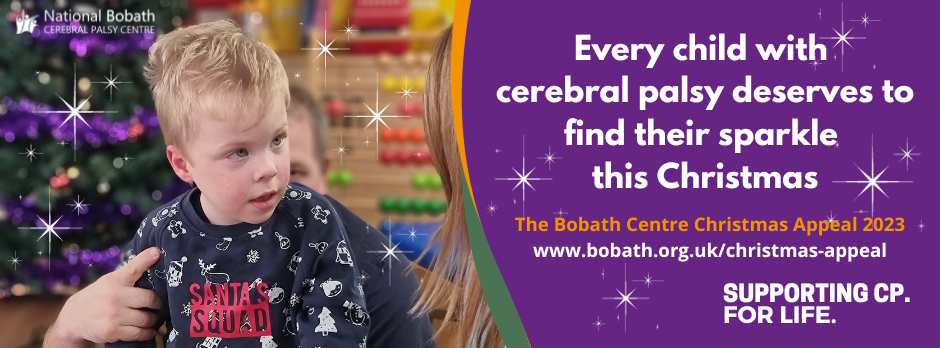
National Bobath Cerebral Palsy Centre Christmas Appeal
Readers, consider this a personal request from our editor to support a very good cause.
Dylan is one of 200 children with cerebral palsy who got the chance to shine this year with support from our Bobath Therapy team.
When Dylan came to The Bobath Centre he already had great support from his family, friends, nursery and physio.
After some sessions with our Bobath Therapy Team Dylan began to turn pages in his favourite book using his right hand, and said ‘more’, for the first time.
It’s moments like that, when children find their sparkle, that make The Bobath Centre so special. We think every child with cerebral palsy deserves to sparkle.
With your help, we can make that happen because more children deserve that chance.
Donate today and gift children with cerebral palsy some sparkle this Christmas.
Job Sharing Apps
I just thought that those readers who can work may find this interesting.
After entering a bit about myself and what I’m looking for into a matchmaking website, the details of two potential partners are immediately shared with me.
First there is Alejandro, dressed in a sharp suit, and sporting a big smile. He has an impressive master’s degree, and an interest in jogging.
The other is Susan, who is less academically qualified, but her profile is more relatable. And perhaps more importantly, she says she is quite tolerant of any mistakes that someone else might make.
On paper, at least, I feel that Susan is better for me. I’m keen to see if we have any chemistry, if I can see ourselves together.
You might think that I’m trying out a new dating platform, but instead I’m experimenting with a website that links people who want to job share.
The idea behind Switzerland-based WeJobShare is that instead of having to find a friend or colleague to share a job with, you can instead match up with a complete stranger, and therefore considerably increase the pool of potential candidates.
US start-up Job Share Connect works in a similar way, inviting those who can’t find a job sharing partner to make use of its “robust talent pool”.
Meanwhile, the UK and mainland Europe division of carmaker Ford now has its own in-house “matchmaking tool” for employees who want to job share with a colleague.
Ford introduced its platform in September 2022. Interested employees enter details including their current expertise, what they are looking for in a partner, what they would like to do next position wise, and overall career goals.
An algorithm then assesses this information to formulate matches which are presented to the user with a percentage match score.
The scheme helped Emma Wright find her job share partner in the lead up to her return to Ford this year after her second period of maternity leave.
Ms Wright, who works in the company’s UK finance department, had gone part-time after her first maternity leave. However, she found that the role, because it was a part-time position, was not as challenging or as fast-paced as she would have liked.
So this time around she sought out a job share, hoping for a more interesting role.
“I’ve seen job sharers working in finance who are really successful and well regarded, and I wanted to be a part of that,” she says.
At WeJobShare, co-founder Irenka Krone says the aim is to help connect women in particular. This is because they are more likely to be working part-time than men, due to factors such as childcare.
Its users start by creating a profile, entering details such as where they are based, the type of role they are looking for, how many hours they ideally want to work per week, and whether they are looking for someone with similar or complementary skillsets.
Then there is a short survey, which asks questions including “how do you react to stress?”, “how innovative are you?”, “how risk averse are you?”, and “how tolerant would you be to a partner’s mistakes?”.
Based on that data, the company’s software then generates potential matches. Its website is currently only available in Switzerland, and so far it has helped 2,500 people find a job share partner.
“Companies are starting to realise that if you want to keep the best women in your business, you need to have new employment models,” says Ms Krone, who runs the business with her own job sharing partner, Razvan Oprea.
“They are trying to keep women, who might be at a certain stage of their life and want to leave the sector, so they’re investing money in keeping them, by suggesting they think about job sharing.”
The small but growing trend of job sharing apps comes as gender equality campaigning organisation Empower said this year that job sharing is a “critical solution to many of the issues women most commonly face in the job market”, such as childcare responsibilities hindering career progression.
This is because a job share involves doing half of a full-time role, rather than a part-time position that is likely to come with less responsibility, pay and chance of promotion.
Sharon Peake, founder and boss of London-based corporate gender equality consultancy Shape Talent, says she feels optimistic about the potential of any tools that will make job sharing more popular.
However, she’s also concerned that biases can find their way into job sharing software systems. “There is a risk of strong [female] candidates being screened out… because algorithms will favour historic candidates for stem [science, technology, engineering, and mathematics] roles, and these are more likely to be men.”
Ms Peake is also not convinced that the tech can match essential soft skills like teamwork and communication, nor two people’s chemistry.
Jess Baker, a UK business psychologist and author, says that anyone considering a job share with someone they do not previously know should really find out if they have compatible personalities. “I’d strongly recommend you each complete a personality profiling tool, to increase your level of self-awareness of psychological characteristics, like how you each cope under pressure, how you make decisions, and how you relate to others.”
But could an employer simply turn down job sharing candidates to avoid having double the HR and payroll work? UK employment solicitors Davidson Morris say that job sharing requests from existing employees “must be considered in a reasonable manner and should only be refused if there is a good business reason for so doing”.
Fellow business psychologist Stuart Duff says that in most cases firms can benefit from having employees in job sharing roles. “On the surface, job sharing can appear to create all sorts of challenges, yet in reality the advantages will often easily outweigh any added bureaucracy.
“Many bosses can hold rigid views of the best person to be in a particular role, based on little more than stereotypes or ‘gut feel’, so having two different people with different experiences and styles of working can challenge fixed expectations, and broaden perceptions of what is possible.”
women’s perfume, I come up with me
lounge and night item of the evening
, grand heart with on call to Grandma, who struggle not to spill
affiliate marketing Pinterest page update for you for Monday
item of the day🥳🛍️🛍️
🌙💕
https://vm.tiktok.com/selfie of the day, video ZGedBG9tm/
The Rap Game UK’s Lickz On Rap And Neurodivergence
Music has always felt like a safe space for 18-year-old rapper Lickz.
“When I was younger, I would sing with my mum in church,” she says. “My mum and dad used to rap before I was born.”
Writing lyrics has been a way to process the world and her feelings. “I think it’s kind of like people who write diary entries,” she says. “I just write the first thing that comes to my head.”
Based in Croydon, South London, Lickz is one of seven MCs on the fifth season of The Rap Game UK, vying for a £20,000 injection into their career and a spot on Radio 1Xtra’s daytime playlist. She’s also neurodivergent.
“Being autistic, I feel like there’s a lot of people who don’t really understand me,” she says. “And when I try to communicate certain things, it takes a while to get there.”
Lickz, who describes her music as “love songs on drill beats”, shares her experiences of autism on the show, even rapping about it to judges Krept and Konan and music legend DJ Target, along with the other contestants.
She raps on the show: “Look I got ASC, so I see the world differently. And I done took the mask off my face, so sometimes I am hard to read.
“And I am different, I know that I differ from those who live neurotypically.”
ASC stands for Autism Spectrum Condition – an overarching term used to describe a group of conditions related to how our brains develop differently.
‘Communicating through music’
In real life, not many people know she is autistic, she says.
People “just think ‘oh she’s quiet’ but writing how I feel and communicating through music is a lot easier,” she says.
Music has been a source of support throughout her life.
“There was a time when my mental health was really quite bad,” she shares. “Music was the only thing that helped.”
Many neurodiverse people find support in music, according to Pippa Sargent from The Brain Charity, an organisation that helps people with all forms of neurological conditions.
“Creating music can be a wonderful form of self-expression for anyone, but particularly for those who are neurodivergent as it engages sensory and cognitive processes which support communication,” she says.
Pippa goes on to say that in a world built for neurotypical people, communicating effectively can be a challenge, but music can give people who are neurodivergent tools to communicate and means they don’t have to rely on speech.
“There is also a vast range of research which tells us that participating in music-based activity can support positive mental health and decrease anxiety,” she says.
But Lickz’ experience of being an artist with autism is mixed.
“I definitely think there’s a balance of [autism and music] being helpful and it not being helpful,” she says.
Things like song writing can be tricky because it can take longer to decide on language.
But, she adds on the show: “Recognising patterns is part of my autism, so when it comes to flows and how I switch them, how I set them up – that does play a part.”
‘Proud of myself’
But one thing she’s conscious of is the attention artists get.
“I find that with my autism, generally I walk around looking like I’m mad a lot of the time, until you start speaking to me, and then I start smiling. And I’m very straightforward.”
People assume she’s rude as a result, she says. “So I just have to think about things like that when I’m putting myself out into the public.”
But maybe one of the greatest gifts the show has given her is a newfound appreciation for herself.
“I’m definitely proud of myself,” she says.
“Because I think if this was maybe me last year, I don’t think I would have done it. I think I would have been too scared, too worried about what people think about me.”
Her advice to anyone entering the music industry is: “Just trust yourself, and be confident in yourself before anything.”
Winterwarm woollies for your item of the day as winter warmer
to purchase and give as a gift. If you would like for someone 💜you know it’s Christmas.


