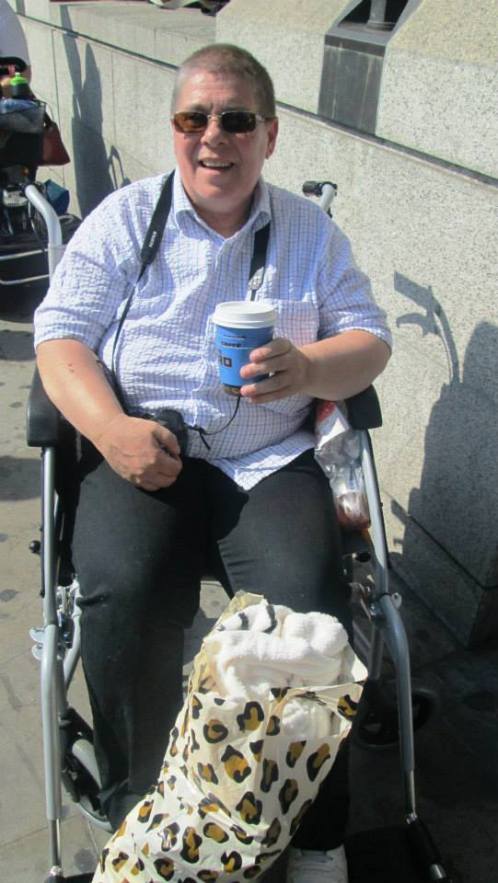
Silent Witness star Liz Carr says she has left the programme on a high after her “best series ever” – and is set to appear in her first Hollywood film.
The actress, who has played forensic examiner Clarissa Mullery since 2012, bowed out this week at the end of the 23rd season of the hit BBC crime drama.
She revealed on the BBC Ouch podcast that she will be seen in her first major movie – the sci-fi drama Infinite – later this year, alongside Mark Wahlberg.
Carr who uses a wheelchair, says she is proud of how Silent Witness improved the representation of disabled people on screen, although it had not always been easy.
She says the BBC seemed “terrified” about what to do with a disabled actor in primetime drama when she first started, but she made sure her voice was heard.
“I think over the eight years I’ve kind of policed the show quite a lot and worked to make sure it was better and refused to say certain lines that I thought were problematic.
“I was asked recently if I was proud of what we achieved in terms of representation in Silent Witness – Oh, my goodness, of course I am.”
Prior to Silent Witness, Carr was probably best known as a comedian, disabled rights activist and presenter of the BBC Ouch podcast.
But her continuing role as Clarissa has made her one of the most high-profile disabled actors in Britain.
Carr says she first indicated she wanted to leave Silent Witness back in October 2018.
“It must seem like a ridiculous decision”, she says. “But I was just doing the same thing [in terms of storyline] and, as an actor, that just wasn’t that interesting.”
She says the “irony” was that having made the decision to leave, a new producer was brought in who promised her “the most challenging series that you’ve ever had” and “he’s delivered,” she said.
In the latest series, Carr was at the centre of a storyline in which her character, Clarissa, had to make heart-breaking decisions about the care of her mother who had dementia and terminal cancer.
Carr praised writer Lena Rae, whose two-parter called Hope was her Silent Witness debut.
“There’s a lot of stuff there that we’ve not seen before. I think about that relationship of an aging parent with a disabled child. But equally, seeing a disabled woman as the carer,” Carr says.
“It was everything about disability and it was nothing about disability. And it connected us in a way that said: ‘We all experience this’. We’re all going to lose parents or somebody that we love.”
Carr says she was especially touched by the audience reaction to her portrayal of the storyline with many saying they could “relate” to Clarissa’s predicament.
The actress’ own father died last year, shortly before she filmed her final episodes, and her performance in Hope drew heavily on that experience.
“I’m not sure that I was acting,” she says. “I think I was almost re-enacting and reliving being at my dad’s bedside when he died. He died in hospital. He had Parkinson’s and vascular dementia.”
Like her onscreen character, who has just resigned as a forensic examiner, so Carr felt the need for a change in her own life – “I just want to go out there and take a leap of faith”.
That leap has landed her in Hollywood blockbuster, Infinite, alongside A-listers Wahlberg and Chiwetel Ejiofor.
The summer release has been directed by Antoine Fuqua whose other films include Training Day and the Equalizer movies.
“It’s a great role. I’m ecstatic,” Carr says after admitting she was surprised to get the part.
“I thought, I bet they’re just going to audition wheelchair-users and then they’re going to give the role to Tom Cruise.”
However, heady dreams that she would have to relocate to Hollywood were somewhat thwarted when she discovered filming would take place in west London.
But she is certain playing a major character in a successful BBC drama convinced the casting team she had the requisite experience for the, currently secret, role.
“I’ve gone and had the most incredible opportunity to develop and get better and learn and learn and learn. And there are very few disabled actors internationally who have that experience.”
She says she hopes her success will encourage TV and film makers to give other disabled actors “a break”.
“Unless you can show how good you are, people aren’t going to see what amazing talent is out there.”
In December, the BBC announced a string of new shows with the aim of producing a more “authentic and distinctive” representation of disabled people on screen.
Carr herself will perform one of a series of “challenging” monologues, curated by fellow, former BBC Ouch presenter Mat Fraser as part of that.
She’s also set to return to our screens in an upcoming episode of Who Do You Think You Are? the BBC One show which delves into family history.
Carr says this really took her out of her comfort zone.
“I don’t really like surprises,” she says. “So it’s a difficult show to do. But actually there are things that happened that stunned me. And I loved it.”
Waltham Forest residents with learning disabilities are dying decades earlier than average, often from preventable and treatable conditions.
Data from the Learning Disabilities Mortality Review Programme shows learning disabled residents in the borough have an average life expectancy of 57 for men and 55 for women.
This means, on average, learning disabled men are dying 22 years earlier and learning disabled women are dying 29 years earlier than their non-disabled counterparts.
A report presented to the adult social care scrutiny committee on January 23 stated: “These deaths are not always due to complex co-morbidities but frequently to do with preventable and treatable conditions.”
Almost a third of deaths in people with a learning disability were due to respiratory conditions, while almost a fifth were caused by circulatory system diseases.
The NHS Long Term Plan aims to reduce these preventable deaths by improving the uptake of annual health checks for learning disabled residents.
There are approximately 5,000 adults in Waltham Forest with a learning disability. They are statistically more likely to live in Leyton and Leytonstone than Chingford.
Waltham Forest Council chose not to comment on life expectancy among learning disabled residents, stating the meeting was intended to examine their life chances.
A Russian para-athlete who started working as a food delivery courier has unwittingly put state support for athletes with disabilities under the spotlight amid speculation that he is trying to raise money to participate in sporting events.
Videos on social media showing Mikhail Astashov, who’s been missing parts of his upper and lower limbs since birth, wearing a delivery service uniform, prompted a flurry of support and praise for the athlete, as well as criticism for state authorities.
The food service, based in the city of Yekaterinburg said Mr Astashov was “very motivated to work“.
Many social media users were convinced his motivation was powered by his desire to fulfil his dream and raise funds to travel to the 2020 Tokyo Paralympic Games.
‘Bewildered by the interest’
Some pointed out that Astashov told fellow athlete Anton Shipulin recently that he needed 350,000 roubles (over 5,500 dollars) to attend the Paralympic qualifiers in Australia and the UAE. Mr Shipulin in turn said that Mr Astashov needs to write a “very sorrowful” letter to get money from potential patrons.
Mr Astashov’s coach Anatoly Reshetov told the Ura.ru website that the athlete wanted to buy equipment for his performance at the Paralympic Games, including bicycle parts and sports shoes.
“The problem is”, Mr Reshetov added, that the man who won the 2019 Paratriathlon World Cup “doesn’t have a technical sponsor but he has to buy something constantly”.
Mr Astashov posted a video on Instagram, addressing supporters and the media. In it, he explained that he’s been overwhelmed and bewildered by the unexpected interest, before going on to tell his story.
“Training is what matters the most to me and I would like to eventually make it to the Paralympics,” he said, adding that he receives funding from a local businessman.
He explained that he applied for the delivery job “not for the hype or money”, but to gain new experience and boost his self-confidence.
Smiling throughout, he spoke of his surprise and gratitude for getting the job, given that he had been rejected in the past. “And now”, he ended, “I don’t know what to do with the popularity”.
‘Example to follow’
People on social media say they’ve been moved by his “strong will”, with some calling him “an example to follow” and others offering him money to fund his endeavour.
Sports journalist Yevgeny Slyusarenko, wrote in a Facebook post that “If the lad decided to earn money for better preparation, then we should cheer for him, understanding the reality in which he lives, and that he is doing something, instead of moaning.”
Mr Slyusarenko also stated that no para-athletes in countries participating in the Paralympic Games are fully funded by their state.
Meanwhile, two Russian regions which Mr Astashov represents in national championships – Sverdlovsk Region and the Republic of Buryatia – have tried to downplay his need for cash, saying they both allocated 240,000 roubles for him each.
At the height of his illness, doctors told Dynamo, whose real name is Steven Frayne, that he may never be able to use his hands to perform magic again.
“I was like, I’m Dynamo, I’ve got to figure out a way to do it,” he told The Travel Diaries podcast.
“I do the impossible. I’m not going to go out like this.”
He decided to put the magic in the audience’s hands, and “try and empower them”, he told podcast host Holly Rubenstein.
“But over time I started to get the use of my hands back. I had all these new skills that I’d developed in my hospital bed – and the old skills coming back too. So although I’m not 100% healthy yet, I am technically 150% better at magic.”
Dynamo’s health forced him to step back from the limelight at the height of his success, having played arena tours and starred in TV shows including Dynamo: Magician Impossible.
In 2018, he addressed a dramatic change in his appearance, explaining that his medication regime caused him to “put on quite a lot of body weight” and develop a rash.
He told The Travel Diaries he used two months in hospital to conceive his forthcoming Sky One series, Beyond Belief.
“I was on a lot of heavy medication, which made me go a little bit crazy. But some of the ideas that came into my head were out of this world. I wrote them down in my little black book and this series brings those ideas to life.”
The three-part special shines a light on Dynamo’s journey towards recovery, as well as taking viewers across the globe as he performs “heart-stopping magic”.
As far as his own travels are concerned, Dynamo recently shared photos from his time gorilla-trekking in Rwanda.
“I almost died a year and a half ago. I [didn’t] want to wait too long to tick off the number one thing on my bucket list.”
Jane Mathieson is conducting research for her dissertation, which aims at reflecting on current experiences of those of us with invisible disabilities claiming disability benefits. She is exploring how Universal Basic Income (UBI) may improve our quality of life, potentially addressing social and political prejudice, removing barriers from disabled peoples’ socioeconomic inclusion and participation.
Universal Basic Income is a regular payment made to every individual, which is not means tested, non-withdrawable and is paid without work conditions.
It would:
Guarantee everyone a secure base
Replace the draconian, complex benefits system with a scheme fit for the 21st century
Provide us all, including people who need extra income related to illness, disability and housing, with the freedom to develop our potential, to be included in society, to contribute our talents and to have the dignity we all deserve.
UBI would greatly reduce the ghastly punitive bureaucracy of the welfare system and…
Ministers have accused opposition MPs of scaremongering over universal credit after being forced to delay the full roll-out of their flagship benefit system for a further nine months at a cost of £500m.
The Department for Work and Pensions admitted that the delay until 2024 – which means universal credit will be at least seven years behind its original completion date – was caused in part by claimants being too scared to sign up to the new benefit.
Universal credit has been linked to increased rent arrears, debt, stress, and food bank use among its low-income claimants, who are forced to wait five weeks for a first payment after moving on to the benefit, and in many cases find themselves worse off and facing volatile monthly payments.
Formally announcing the latest delay in parliament on Tuesday – the previous delay came in October 2018 – work and pensions minister Will Quince said that fewer claimants than expected were moving on to universal credit, which he credited to more people being in work.
But in a BBC documentary to be broadcast on Tuesday evening, parts of which have been previewed by BBC news, the director general of universal credit, Neil Couling, tells fellow senior officials in the summer of 2019 that claimants were positively reluctant to move on to the new system.
He says: “We’ve got a lot of anecdotal evidence of people being scared to come to universal credit. It’s a potentially serious issue for us, in terms of completing the project by December 2023, but I’m urging people not to panic.”
A few weeks later in September 2019 Couling decides to delay full roll-out, saying it would be safer for claimants to do so, even if it might prove controversial. “Three, six or nine months, it doesn’t matter – the headline will be: ‘Delay, disaster’,” he says, adding: “I’ll take the beating [for the delay decision].’”
Asked why the decision had been kept under wraps for so long, Quince told the Commons on Tuesday that senior officials discussed issuing advice on the delay to ministers in late 2019 with final discussions with ministers taking place earlier this year.
Scottish Nationalist party MP Neil Gray, who lodged an urgent question on the issue, said: “Ministers say that this delay is caused in part because people are scared to go on to universal credit. They say it like they are surprised.”
He added: “The great irony in all of this is if this Tory government would listen and do what expert charities and those in receipt of universal credit say, then these delays would not be needed.”
Margaret Greenwood, the shadow work and pensions secretary, told MPs the delay was “hugely embarrassing” for ministers: “The government has been forced to delay universal credit yet again because people do not have confidence in the system.”
Responding, Quince said the problems facing universal credit would be lessened “if the party opposite desisted with their scaremongering”.
About 2 million people are in receipt of universal credit, which bundles six working-age benefits into a single monthly payment. More than 6 million will be on the benefit by the time it is fully rolled out by the new completion date of September 2024.
Although ministers have promised income protection for claimants who find themselves worse off after moving to universal credit, this only applies to those who move under the managed transfer scheme starting later this year. The thousands who switch to universal credit from legacy benefits because of a change of personal circumstances – moving house, for example – do not qualify for protection.
Concerns about plunging public confidence in universal credit led the DWP to launch a £225,000 newspaper advertising campaign to “detoxify” universal credit last May. However, it was subsequently banned by the Advertising Standards Authority for being misleading.
A recent study of the impact of universal credit by the Resolution Foundation thinktank found that nationally, 46% of claimants would be worse off on universal credit and 39% better off, though this varied, with families in the most deprived areas more likely to lose out financially after moving on to the benefit.
Da da-da-da da da-da … Vivaldi’s Four Seasons is no longer the soundtrack to millions of people’s frustrated interactions with welfare bureaucracy, after the Department of Work and Pensions decided to drop it as the hold music on its telephone helplines.
A 30-second loop of the “Spring” section of the Italian composer’s classic concerto has for more than a decade kept callers company – and often driven them to distraction – while waiting to speak to a DWP adviser about a benefits problem.
Officials finally decided to ditch the track after discovering some callers found its repetitiveness disturbing. Millions of claimants put on hold while trying to speak to social security staff have been subjected to millions of hours of Vivaldi since the track was introduced in 2006.
“We had some feedback that the Vivaldi clip caused anxiety for claimants and in particular had an impact on autistic callers,” said a DWP spokesperson.
The official average helpline on-hold time is eight minutes but waiting times can be anything up to an hour, meaning callers could hear the snippet dozens of times. It is not uncommon for callers unable to hang on that long – possibly “Vivaldi’d out” – to abandon calls altogether.
Vivaldi is being replaced by a 20-minute mix of eight unnamed musical tracks that according to the DWP aims to reduce anxiety and ensure the experience of waiting is as far as possible relaxing by evoking “a steady neutral pace and reducing the issue of repetition”.
“We tested it with claimants in jobcentres and they overwhelmingly preferred it,” a DWP spokesperson explained. “It was seen as more calming and peaceful and light. One person said ‘I loved the Four Seasons, it’s a lovely piece of music’, but most preferred the new music.”
In classic DWP fashion, the choice of the Vivaldi track was, as a freedom of information request revealed eight years ago, driven by the “desire to obtain a cost-effective solution”. It had obtained a groupwide licence to play the music for free and any alternatives would, it concluded, have cost the taxpayer money.
There appeared to be little consideration as to whether the work’s intended pastoral evocation of murmuring streams, softly caressing breezes, and flower-strewn meadows would have a positive psychological effect on stressed benefit claimants hovering on the edge of destitution in 20th-century Britain.
The Vivaldi loop quickly became a talking point among callers – and not always positively. Although some found it pleasantly soporific, others found it a jarring reminder that their own critical problem – non-payment of universal credit, perhaps – was not being regarded with quite the same urgency by the DWP.
Five years after its introduction, a welfare rights advisers’ talkboard discussion suggested a key skill for anyone wishing to join their profession should include “the ability, while on the phone, to refrain from turning to your colleagues and saying ‘If I hear Vivaldi’s Four Seasons one more effin’ time …”
An unsuccessful online parliamentary petition was lodged in 2014 demanding that the DWP scrap the Four Seasons. “Anyone who rings the DWP with a query has to listen to Vivaldi’s Spring on repeat for 45 minutes. If being unemployed or disabled was a choice, people would get jobs just so that they don’t have to listen to it,” it said.
Callers’ experience was captured in a 2019 Channel4 documentary called Skint, which recorded the despair of blind universal credit claimant David, who had been left with £5 to last him a month after his benefits were sanctioned. He was filmed distraught in Middlesbrough phone box, sobbing to the strains of Spring after officials put him on hold.
The RightsNet talkboard would occasionally discuss possible alternatives to Vivaldi. Suggestions included You Keep Me Hangin’ On by the Supremes, Cliff Richard’s We Don’t Talk Anymore, Blondie’s Hanging on the Telephone, and the Smiths’ Still Ill.
Two officials in China have been removed from their posts after a teenager with cerebral palsy died when his father – and sole carer – was quarantined for suspected coronavirus.
Yan Cheng, 16, was found dead on Wednesday, a week after his father and brother were placed in quarantine.
The boy was fed only twice during this time, according to reports.
Both the local Communist Party secretary and mayor in Huajiahe town have been dismissed over the case.
Yan Cheng’s story has been trending on social media websites.
The family lived in China’s central Hubei province, the epicentre of the coronavirus outbreak.
According to local media, the teenager’s father had posted on Chinese social media platform Weibo appealing for help and explaining that his son had been left alone without food or water.
Cerebral palsy is the name for a group of conditions that appear in early childhood, and affect movement and co-ordination. Symptoms vary, and can include tremors, stiff or weak muscles, problems swallowing, and trouble with vision, speech and hearing. Those affected may be severely disabled.
Officials had previously announced that an investigation would be carried out into the boy’s death.
In China, 361 people have died of coronavirus and more than 17,000 cases of the virus have been confirmed. There have also been more than 150 confirmed cases of the virus outside China, including one death in the Philippines.
The World Health Organisation (WHO) has warned the number of cases is likely to rise further, and Chinese authorities have introduced a number of measures to try to halt the virus’s spread.
Figures released by the DWP show that Atos yet again failed to meet its target for acceptable PIP assessment reports in 2019. Only 64% of reports were fully acceptable without any qualification.
The figures show that 4% of all reports that were audited were deemed unacceptable. The target for Atos is for less than 3% of all reports to be unacceptable.
A further 16% were acceptable only with amendments.
Another 16% were acceptable, but it was considered that the health professional required feedback to improve the quality of their reports.
This means that just 64% of all PIP reports by Atos were deemed acceptable without any qualification.
It should be noted that the Work and Pensions Committee has said of the standards:
“The Department’s quality standards for PIP and ESA set a low bar for what are considered acceptable reports. The definition of “acceptable” leaves ample room for reports to be riddled with obvious errors and omissions.”
So, even the figure of 64% acceptable is likely to be a long way from what most people would regard as the truth.
Just 13 people have been moved during the first six months of the pilot for the managed migration of claimants of legacy benefit such as employment and support allowance (ESA) onto universal credit (UC), it was revealed this week. The timetable for the full roll-out of managed migration now looks under threat
The shock figures were revealed by Will Quince, parliamentary under-secretary for Work and Pensions, answering a commons question on the managed migration pilot.
The pilot was pushed through by the last government and began on 24 July 2019.
It is taking place in Harrogate and is intended to cover 10,000 households.
However, Quince admitted that hardly any claimants have so far been piloted:
“The numbers are relatively small at the moment: just under 80, with around 13 having moved on to universal credit. [Interruption.] I can see that she is shocked, but it has been rather deliberate. My clear instruction to officials was to take this slow and steady, and to go at the pace the claimant requires. I want us to ensure that we have the information necessary to roll out universal credit without leaving anybody behind. We have to get it right.”
Last year the government were planning for the full roll-out of managed migration to take place between November 2020 and late 2023.
However, with such an extraordinarily slow start for the pilot, it now seems possible that managed migration will be considerably delayed.
Whilst this may be a relief to many ESA claimants, the concern is that thousands more will lose out on transitional protection because they will be forced by changes of circumstances to naturally migrate to UC before managed migration affects them.
A woman in a wheelchair was stripped of her disability benefits on the basis that she was able to walk four steps during an assessment.
Michelle Wyatt, 45, who had been diagnosed with chronic fatigue syndrome (ME) 23 years ago, was forced to survive on £1 ready meals and without heating after her Personal Independence Payment (PIP) was stopped.
The York resident said the withdrawal of her disability benefit – which amounted to £75 a week and which she had been receiving since 1998 – had left her feeling suicidal.
The decision to stop her support came after a benefit assessor visited her home in December and concluded that she was no longer eligible for PIP – a disability benefit that replaced Disability Living Allowance (DLA) in 2013 – because she was able to walk “four steps” from her wheelchair to her sofa.
The assessment report stated that Ms Wyatt was “able to rise unaided from the electric chair and transfer unaided to the sofa” and went on to conclude that it was “therefore reasonable to suggest she is able to rise and walk more than 200 metres unaided”.
Ms Wyatt, who on top of her disability had a battle with breast cancer last year, said her life would be “over” and she would lose her independence without her electric wheelchair, which she could not afford without the benefit payments.
“When there is zero money coming into your bank, the first thing you think is switch off your heating, you don’t use the hot water. Even for cooking food you’re thinking this is using gas and electric,” Ms Wyatt told The Independent.
“I’ve been eating low-quality ready meals. I was put in a position where I’m going to experience intense physical de-conditioning through lack of physical movement.”
The 45-year-old continued: “Without my electric chair life would be over. With it, I go out every day into my local city. I meet friends, go to cafes, art galleries, all sorts. I can get on a bus in the chair and go to the seaside and sit by the sea in a deckchair. I can even get on a train and go to London,” she said.
“Without it, my world would become very tiny. I would never leave my flat unless someone were to push me in a manual wheelchair.”
Days after Ms Wyatt was informed that her PIP was stopping, she said she received notice that her Employment Support Allowance (ESA) and housing benefit had subsequently been suspended. They were reinstated 10 days later, but during that time she said she felt suicidal.
“I was hysterical all weekend. Believing I was going to lose my home. I got my friend to come round and got them to put all my stuff in boxes and take it to the charity shop,” she said.
“I was feeling suicidal, and I thought if I take my life my parents will be deeply upset and I didn’t want them to have to deal with all my stuff. I was clearing my flat so that if I died it wouldn’t be too strenuous for them.”
After being contacted by The Independent on Friday, the Department for Work and Pensions (DWP) said they had reviewed Ms Wyatt’s case and reinstated her PIP.
She said: “I still feel I cannot work with PIP and have an open straightforward conversation about how to move forward within the confines of my illness. I have received no communication that shows they have any interest in being anything other than a ‘lie detector machine’.
“I wish to work with PIP to maximise my quality of life and independence, but I am not getting any positive communication in favour of this from the DWP. It feels like at the moment people with illnesses that are complicated cannot physically move without being punished.”
Campaigners said the case highlighted that the current assessment process for PIP was “unfit for purpose”, with “hundreds of thousands” of disabled people having lost out since the system was introduced.
The latest government figures show nearly three in four (73 per cent) people who appeal refusals for PIP are successful, which campaigners warn does not include many rejected claimants who do not challenge the benefit decision because the process is too stressful.
It emerged in May last year that the number of complaints to the government about the PIP assessment process had surged by more than 6,000 per cent in three years, with 9,320 complaints received in the year to February 2019.
Varun Kanish, campaigns manager at Turn2us, said the PIP assessment model was “unfit for purpose” and that vulnerable people were subsequently being failed by government, with many suffering further physical and mental health complications as a result.
“[PIP assessments] are relentless, cruel and all too frequently inaccurate. We know this from the fact that two-thirds of decisions are overturned at tribunals. We urge the DWP to oversee a radical overhaul of benefit tests, with a focus on compassion and medical understanding,” he said.
A spokesperson from Disability Rights UK, meanwhile, said: “Hundreds of thousands of disabled people have lost out since the introduction of PIP; this at a time when austerity and other cuts have made day-to-day life more difficult for disabled people.
“We strongly urge people to get advice when they are claiming benefits, and use the independent appeals process if they are turned down for benefits they think they are entitled to.”
A DWP spokesperson said: “We are committed to ensuring that disabled people get all the support they are entitled to. We have reviewed this case and, with further information from Ms Wyatt, have reinstated her entitlement to PIP, with a light-touch 10-year review.”
The family of a “cheeky” three-year-old from Harrow, diagnosed with a rare genetic disorder, are appealing for more people of Asian descent to sign up as stem cell donors. Working with blood cancer charities Anthony Nolan and DKMS, the family want to diversify the stem cell register and give their little boy a fighting chance of finding the best possible donor.
Veer Gudhka is one of only a few hundred people in the UK to have inherited a life changing illness called Fanconi Anaemia which results in a decreased production of all types of blood cells.
He was diagnosed in August “by chance”, after a period of being very lethargic in December 2018, which led to the discovery that he had low blood platelets. Veer’s energy levels returned to normal in the new year. However, investigations continued, and in August he was diagnosed with the serious genetic disorder. Veer is currently able to carry on as ‘normal’, while remaining ‘under-observation’ by Great Ormond Street Hospital.
“The news came to us as a big shock. We were distraught” recalled Veer’s father, Nirav. “We didn’t expect anything of that nature when we were called back in August. All of a sudden, our otherwise perfect little world was turned upside down.”
Veer’s doctors have predicted that he’s extremely likely to need a stem cell transplant quite soon. Veer’s mother Kirpa, father Nirav and five-year-old sister Suhani were all tested but unfortunately none of his family are a match for him. So the family are now campaigning hard to find the matching unrelated donor that Veer needs to survive
“Veer is a cheeky boy, for sure! He creates strong bonds with everyone he interacts with, young and old. He’ll chat to anybody! He is an adventurous and energetic three year old, and will try his hand at anything,” explained Nirav. This is evident in the short HelpVeerNow campaign video that the family have produced to share Veer’s story and appeal for people to join the donor register.
“He’s been a real soldier through his numerous blood tests and other procedures. He definitely lives up to the meaning of his name (Veer means brave).”
Speaking of the impact Veer’s illness has had on his family, Nirav said: “Veer’s a little brother. His big sister Suhani is five and knows that Veer has got Fanconi Anaemia, and so needs ‘new blood’. She’s too young to understand the full extent of Veer’s condition but has comprehended that he needs a generous donor to help him.
“As much as we don’t want it to take over our lives, it has. We know that finding a donor is like finding a needle in a haystack, so we are campaigning hard.”
Only 2% of the UK population is currently on the stem cell register. Currently, only 69% of patients can find the best possible match from a stranger, and this drops dramatically to 20% if you’re a patient from a black, Asian or ethnic minority background. Veer’s Asian heritage means it’s more difficult for him to find a matching stem cell donor. His chances of finding a match improve every time someone joins the donor register, especially if they are of Asian origin.
A stem cell match could be found from anywhere in the world, so the family are campaigning globally. In December 2019, a weekend-long swab drive was held in Veer’s ancestral town in India. Once a potential donor signs up in their respective country, they join a worldwide register. However, only 0.4% of the world population are registered as potential blood stem cell donors.
“It’s shocking that the stats are so low, given how straight forward both registering and donating are. There couldn’t be an easier way to save someone’s life, so why aren’t there more donors? There’s clearly a lack of awareness, particularly within Asian communities, so we are trying our best to increase awareness, to help not only Veer, but countless other people from all backgrounds. That’s why we’re sharing our story – it’s not just for Veer.” said Nirav.
“All I’m asking is that people look into it.” [joining the register] “From there there’s no reason why you wouldn’t.” As Kirpa appeals in the campaign video, “You have the rare opportunity to save the life of someone like Veer, so why not take it? There really couldn’t be an easier way to save a life.”
There is an urgent need to diversify the donor registers so the #HelpVeerNow campaign is raising awareness among different communities through social media, encouraging people to join the register, and organising swab drive events across the UK and beyond.
There have been several high profile cases in recent years of British Asians seeking stem cell donor matches. “We were delighted to hear the news that at the end of 2019, young Jayden Dhillon found a match”, said Nirav. “It proves that campaigns like these do work, and gives us hope that through our efforts we can find a match for Veer, or others like him.”
Every person who joins the register has the potential to give hope to someone like Veer in need of a lifesaving stem cell transplant.
Anthony Nolan recruits people aged 16-30 to the stem cell register as research has shown younger people are more likely to be chosen to donate and offer better survival rates for patients.
They also carry out ground-breaking research to save more lives and provide information and support to patients after a stem cell transplant, through its clinical nurse specialists and psychologists, who help guide patients through their recovery. Every day Anthony Nolan gives three people a second chance at life.
It costs £40 to recruit each potential donor to the register, so Anthony Nolan relies on financial support.
For more information, please call the Anthony Nolan Press Team on 0207 424 1300 or email press@anthonynolan.org. For urgent out of hours media enquiries, call 07881 265 285.
DKMS recruits people in the UK aged 17-55 and in general good health.
DKMS is an international non-profit organisation that has registered more than 8 million people as potential donors. The vision of DKMS is to ‘delete blood cancer’ and other blood disorders.
It costs £40 to recruit each potential donor to the register, so DKMS relies on financial support.
The government has suffered a humiliating court defeat after it was found to have unlawfully discriminated against thousands of severely disabled people who were left financially worse off after moving on to universal credit.
The court of appeal dismissed a challenge by the Department for Work and Pensions to two previous high court decisions that protected claimants in receipt of severe disability premium against a drop in income under the new benefit.
The cases were brought by two disabled individuals, known as TP and AR, who had sought justice after their benefit income was reduced by £180 a month when they were required to claim universal credit after moving house into a different local authority area.
Responding to Wednesday’s decision, AR said: “We hope that the court of appeal ruling will finally bring an end to our fight for severely disabled people not to be disadvantaged by universal credit. It is still so shocking to us that we have had to fight so long and so hard just to get the government to see that their policy is unfair.”
Tessa Gregory from the law firm Leigh Day, which represented AR and TP, said the ruling was a “wake-up call” for the DWP.
“We hope that the government will waste no more time or resources fighting this legal case and will instead get on with what it should have been doing in the first place: protecting this acutely vulnerable cohort of claimants and overhauling universal credit to make it fit for purpose.”
The DWP has seven days to decide whether to continue its attempt to overturn the two judgments by applying to the supreme court. A DWP spokesperson said: “We will continue to make transitional payments to those previously receiving the severe disability premium where eligible, and have already paid £51.5m to more than 15,000 people. We are carefully considering this judgment.”
The court ruled in the first case in June 2018 that the cut was unlawful because claimants who had moved to a different local authority area where universal credit was in operation had been treated differently to those who had moved within their home borough where the new benefit had not yet arrived. TP and AR were awarded compensation plus continuing £180-a-month payments to meet their benefit shortfall.
The government subsequently proposed new regulations to prevent other severely disabled people moving on to universal credit and to compensate those who already had done so. But it decided those who had moved on to the new system before 19 January 2019 would get just £80 a month in compensation.
TP and AR launched another legal challenge to this decision and in May 2019 the high court ruled this was unlawful, as the estimated 10,000 people who moved before 19 January would receive significantly less in compensation than those who moved afterwards, despite their needs being the same.
While appealing against both judgments in July, the government increased the proposed top-up payments to £120 a month, and a third legal challenge to this is pending, depending on whether the DWP decides to appeal the case further.
Michael Bates from Central England Law Centre, which represented a third claimant in the second case, said: “There is no justification for the way these vulnerable claimants have been discriminated against and they [the government] should think very carefully about how to properly protect people in the transition to universal credit.”
Severe disability premium and the enhanced disability premium are benefit supplements specifically aimed at meeting the additional care needs and costs of severely disabled people living alone with no carer. They were scrapped under universal credit.
An investigation by Disability Horizons into Adult Social Care choice policies has uncovered that a number of councils may be breaching disabled people’s human rights by arbitrarily restricting opportunities to live independently.
Disabled journalist Fleur Perry made a Freedom of Information request to more than 200 councils. Her findings are concerning and, in some instances, potentially unlawful.
Last June (2019), a Freedom of Information request was made to councils who provide social care, asking: “Please could you send all current policy documents relating to Adult Social Care and choice over in which setting care is to be provided to a person.” 172 replied. Of these:
· 137 didn’t give a clear answer or said they followed current guidance
· 14 seemed to promote choice or Independent Living
· 21 seemed to restrict choice or oppose Independent Living.
All notes can be found in the Adult Social Care choice policies responses database attached.
An example of a most transparently concerning policy came from Bedford Borough council: “The maximum weekly cost to Bedford Borough council will be no more than the net weekly cost to Bedford Borough council of a care home placement that could be commissioned to meet the individual’s assessed eligible needs.”
This seems a lot like a cost cap, although Bedford Borough Council claims it isn’t. If it follows this policy, people could be automatically placed in care homes, even against someone’s choice to stay in their own home. We don’t think that’s OK.
There were also issues around hospital discharges, the way that Personal Budgets are set, and the eligibility criteria for Adult Social Care.
Read the full Who Chooses Where You Live? report attached, which contains analysis and recommendations for councils and Government.
This isn’t the first time we’ve seen a decision-making body moving away from Independent Living.
In 2017, the Disability Horizons team investigated Clinical Commissioning Groups (CCGs) – NHS bodies that fund care – and spoke out about possible Human Rights breaches caused by cost-caps.
The Equality and Human Rights Commission took up the issue and wrote to 44 CCGs asking them to explain themselves, make certain their policies were lawful, or face legal action. Policies changed.
We’re going to be writing to the councils concerned, and reporting back, as well as writing to the Department for Health and Social Care to ask some legal questions.
We cannot help but wonder: would the policymakers themselves be satisfied in a situation where they were subject to their own policy? Is this the best we can do?
A legal right to Independent Living would prevent so many of these arguments, and would strengthen protection of disabled people’s right to choose where and with who they live.
These are choices that non-disabled people make at key points throughout their lives without asking permission or defending their human rights – it’s automatic.
Disabled people deserve to be able to make those key choices without undue pressure or restriction, and instead of being able to focus on the important stuff – friends, family, and real-life lived in your own way.
Motability is a helpful scheme created to help people with a variety of disabilities go out and about their daily lives with ease by providing them with cars that meet their particular needs — in 2018, 625,000 people participated in the Motability scheme in the UK.
Many of us may be aware of what Motability is, but not many of us could distinguish whether or not we would be entitled to it, or what the scheme actually entitles you to. This article sets out to quash any myths around Motability to make sure you’re informed about your rights.
Figures are likely higher today. Can I Get a Car Even if I Don’t Drive? Yes, if you consider yourself to have the disability but you don’t have a driver’s licence nor the ability to drive, you’re still entitled to get a car on the scheme — many people who participate in the scheme don’t drive themselves.
The scheme allows three named drivers to be on the leases’ insurance, which allows your family, carer, or friend drive the vehicle, accommodating your needs and requirements to travel comfortably.
1. What If I’m a Learner Driver?
If you’re a learner driver with a provisional licence, you can lease a Motability car and be named as a permitted driver on the leases’ insurance. However, when learning to drive your Mobility car, you must be in the presence of a driver who is over the age of 21 and has had a licence for a minimum of three years.
This nominated person must also be named on the leases’ insurance in case of the event that they must take the car in their own control. You don’t want to be learning to drive without an experienced driver to make sure you and others on the road are safe.
2. Am I Eligible?
You’re eligible for the Motability scheme and could choose from many car brands and models including Ford disability cars if you receive any one of these allowances:
War Pensioners’ Mobility Supplement (WPMS)
Enhanced Rate of the Mobility of Personal Independence Payment (PIP)
The Higher Rate Mobility of the Disability Living Allowance (DLA)
Armed Forces Independent Payment (AFIP)
3. Do I Get a Blue Badge Too?
No, if you participate in the Motability scheme, you’ll need to apply for the Blue Badge scheme separately to get parking benefits — head to the government website to apply in your local area. You can apply only online if you live in England and Wales. If you have a Blue Badge and it is due to expire soon, apply for a new one as soon as possible as it can take a few weeks to arrive.
After August 30th 2019, changes were made to Blue Badge eligibility, which became more inclusive of people with non-visible disabilities. Read here to find out if you can qualify for a Blue Badge.
4. Can I Trade in My Car for the Mobility Scheme?
Yes, you can take your privately owned vehicle to most Motability Scheme dealerships. Trading in your old car can help fund your advance payment or extras for your lease. This can be useful if your mobility allowance doesn’t cover the cost for larger or more expensive cars.
5. Can I Make Adaptions to My Lease?
Yes, you can make adaptations to your lease to improve your driving experience, which includes a range of devices connected to your car. The Motability scheme provides 500 different options for adaptations to suit different disabilities at no extra cost.
Adaptations typically fit under three categories:
Stowage adaptations to stow wheelchairs, scooters, or other equipment to help
Driving adaptations to make it easier to drive
Access adaptations to assist getting in and out of the car
6. What If I Can’t Afford Breakdown Cover?
Don’t worry, your lease includes full breakdown assistance for the entirety of your lease provided by RAC Motability Assist on 0800 73 111 73. This includes recovery of your vehicle which may either be fixed roadside or taken to a nearby repairer, onward travel of up to eight people to a single destination you were headed, and a replacement vehicle until yours is fit to drive.
If you’re eligible for Motability, visit a dealership participating in the scheme to arrange a test drive and begin the process or ordering you your car. If you know what sort of car you want, you can search on online dealerships.
A man with cystic fibrosis is concerned about the availability of respirator masks due to the coronavirus outbreak.
Byron Wright, 37, who has had a lung transplant and has a suppressed immune system, uses the masks to try to protect against viruses in public.
His wife, Glesni, from Gwynedd, said a virus increases the risk of his body rejecting the new organ.
She said it was harder and more expensive to buy the masks online since the outbreak in China.
Public Health Wales said there was “insufficient evidence” to suggest there was any benefit to people from wearing a face mask, unless they had been directed to do so by a doctor.
On Sunday, Mrs Wright, 36, who is her husband’s full time carer, went online to order respirator masks, but she was refunded her money as the company could not fulfil the order.
Following more searching online, she was able to buy some masks, but she said prices had increased due to demand.
Surgical masks were first introduced into hospitals in the late 18th Century but they did not make the transition into public use until the Spanish flu outbreak in 1919.
Using them to prevent infection is popular in many countries around the world but virologists are sceptical about their effectiveness against airborne viruses, although there is some evidence to suggest they can help prevent hand-to-mouth transmissions.
A pharmacy in Cardiff told BBC Wales that, while it does not stock face masks, it had received up to 30 queries in recent days.
Coronavirus has caused more than 130 deaths, spreading across China and to at least 16 other countries.
It has prompted people in the affected areas to wear the masks when in public in the hope it helps stop the spread of the virus.
But the increase in demand has caused problems for the Wrights, who live in Manod, Blaenau Ffestiniog.
“Since the coronavirus started we are taking more precautions and wanted to make sure we had enough masks,” said Mrs Wright.
“I started to look on other websites and saw that many are out of stock and the ones available had significantly increased in price.
“You could get 10 masks for £10 but now they are around £6 to £10 each. This is a worrying time for people like us who depend on these types of masks.
“Some people don’t care if they get a cold or a virus, they go to work as usual, but it can change our lives forever.”
But a Public Health Wales (PHW) spokesman said: “There is insufficient evidence to suggest that there is any benefit to members of the general public from wearing a face mask.
“The risk to the general public from the N-CoV infection remains low.
“Public Health Wales would not encourage people to buy or start wearing face masks unless they have been directed to do so by a clinician.”
A Boots spokesman added: “The best way to help prevent catching a virus is by making sure you regularly wash your hands with soap, and avoid touching your eyes, nose or mouth to prevent transmission from surfaces, especially after blowing your nose, sneezing and coughing.
“Antiviral hand foams and gel can also be useful when you are out and about.”
A woman with a rare heart condition, which can cause her to collapse unpredictably at any moment, has spoken about her battle with the Department for Work and Pensions (DWP) to get the support she desperately needs.
Gail Ward was told that she did not qualify for Personal Independence Payment (PIP), despite living with the potentially life-threatening heart condition called Prinzmetal’s angina, a rare form of angina where attacks can occur even when she is resting. Remarkably, Gail was told by the DWP that she doesn’t qualify for PIP.
Prinzmetal’s angina can cause arteries in the heart to spasm during times of stress or cold weather, which severely limits a person’s independence and can also be life-threatening. It causes cardiac arrhythmias and can lead to heart attack if the blood flow to the heart deprives the organ of oxygen. The condition may sometimes arise when…
The family of Errol Graham, the vulnerable 57-year old grandfather who died of starvation months after having his welfare benefits stopped, has demanded the government act urgently to minimise the chances of such tragedies happening again.
The case of Graham, who had a long history of mental illness and weighed just four and a half stone (28.8kg) when he was found dead at his home in Nottingham, has focused attention on how the social security system cares for vulnerable claimants.
A coroner subsequently concluded that the removal of his benefits for failing to attend a fit-for-work test was a “devastating stressor” that had significantly affected his mental health and may have contributed to his death.
After finding that Department of Work and Pensions (DWP) and NHS staff had missed opportunities to save Graham in the months leading up to his death, the coroner Dr Elizabeth Didcock concluded: “The safety net that should surround vulnerable people like Errol in our society had holes within it.”
Alison Turner, 31, Graham’s daughter-in-law, demanded the DWP overhaul its safeguarding system which she said was inadequate, outdated and could not guarantee the safety of the most vulnerable claimants.
Turner, who represented Graham’s family and was a formal witness under oath at the inquest into his death, revealed that the DWP had not apologised or been in contact with her to discuss the case since then, despite it having promised at the inquest to learn from families and their representatives.
“I’m not letting Errol die without answers and without the system changing. He was failed left, right and centre,” she told the Guardian.
Labour’s shadow work and pensions secretary Margaret Greenwood last night called for a fully independent inquiry into benefit-related deaths. “This is a tragic case. The government must now ensure that Errol Graham’s family receive answers about exactly what happened.”
She added: “This does not appear to be an isolated case and we now need a fully independent inquiry into deaths that may be linked to a social security decision. The government must do all in its power to prevent any further tragedies of this kind.”
Graham’s death, which came to light earlier this week, is the latest in a series of tragedies involving the deaths of highly vulnerable people who had their benefits stopped for failing to comply with DWP requests, often because they were ill at the time.
Turner said she wanted to understand why DWP officials had not done more to establish her father-in-law’s health and state of mind before cutting off his unemployment and housing benefits in October 2017, leaving him without income.
While the DWP carried out two visits to Graham’s home to establish why he had not responded to a DWP letter requesting him to come for an appointment, it seemed incomprehensible that it made no further checks given what they knew of his mental state, she said. “Warning signs should have been ringing off like alarm bells in their heads.”
She said it should be compulsory for social security officials to inform a vulnerable claimant’s next of kin or GP, or a police officer, when they were considering a drastic curse of action like stopping benefits. “They should not be able to stop the money until they have made that welfare check,” she said.
Ministers should consider banning all use of financial sanctions on individuals in receipt of incapacity benefits, and look at whether claimants with long-term conditions that are highly unlikely to improve should be exempted from being put through stressful and often unnecessary fit-for-work tests, Turner added.
The DWP’s chief psychologist David Carew told Graham’s inquest in June 2019 that the DWP were “currently undertaking a safeguarding review” and committed the department to “listen to clients and those representing them … to ensure that the DWP were focused on support and safety for vulnerable people.”
In her inquest report, Didcock insisted Carew’s commitment be turned into robust policy for DWP staff. “There must be guidance that ensures that all evidence that can reasonably be gathered is put together about a client before a benefit is ceased.”
The DWP last night refused to comment on whether it accepted the coroner’s recommendation, or whether or when the review mentioned by Carew might be published. It has set up a case review panel, comprised of DWP officials, to investigate the Graham case and others like it.
Turner said she had not been notified by the DWP of the existence of the Serious Case Panel, nor invited to contribute to its safeguarding review. “Errol’s family ought to be given the opportunity to speak and highlight where things went wrong. That I wasn’t even told about the panel tells you all to need to know about the DWP.”
The BBC has suspended the closure of its Red Button text service after protests, a day before it was due to have started being phased out.
The news comes days after a petition, organised by the National Federation of the Blind of the UK (NFBUK), was handed in to the BBC and Downing Street.
The service was due to have been closed over the next few weeks.
BBC director general Tony Hall said he would examine the concerns and make “a fresh decision” in the spring.
The NFBUK called the news “fantastic” and said it was looking forward to working with Mr Collins, the BBC and the British Deaf Association “for a better resolution”.
Its petition expressed concerns that the removal of the service would “leave many people, who are already vulnerable, further isolated and marginalised from society”.
‘To be explored in more depth’
In a letter to Damian Collins MP, Lord Hall said the BBC had heard from organisations, MPs and members of the public about its decision to phase out the service.
“People have expressed their concern that the closure of Red Button text service could negatively affect elderly people and people with disabilities,” the letter read.
“These are issues which I feels [sic] deserve to be explored in more depth… so we have decided to suspend its closure pending further work in that area.”
Lord Hall said the service would continue “as close as possible to its current state for the time being”.
His pledge was echoed by Matthew Postgate, the BBC’s chief technology and product officer, who said the corporation would “listen carefully and with an open mind to the views which have been expressed”.
He wrote on the BBC blog: “We will look at all this, along with other evidence, and make a fresh decision in the spring.”
Red Button text – which enables headlines, football scores, weather and travel news to be read on TV sets – launched in 1999, taking over as Ceefax was phased out.
Last year a BBC spokesperson said the decision to close the service had not been taken lightly and that the resources that maintained it would go towards “even better internet-based services”.
A profoundly deaf primary school teacher in north London has been awarded for her outstanding contribution to teaching.
Alysha Allen teaches pupils at Brimsdown Primary School in Enfield using sign language and lip reading, and many of the students are now fluent in signing as a result.
She was presented with the Special Contribution Award by the Ivy Learning Trust, which is a collection of schools in north London and Hertfordshire.
MPs and campaigners have called for an independent inquiry after it emerged a disabled man with a long history of mental illness starved to death just months after welfare officials stopped his out-of-work and housing benefits.
Errol Graham, a 57-year-old grandfather, and in his younger days a keen amateur footballer, weighed just four and a half stone (28.5kg) when his emaciated body was discovered by bailiffs who had broken down his front door to evict him for non-payment of rent.
A coroner’s report into the tragedy found that Graham, who suffered from severe social anxiety and had cut himself off from family and friends, had died of starvation. When he was found, his Nottingham flat had no gas or electricity supply. There was no food in the property apart from two tins of fish that were four years out of date.
Graham’s family this week blamed the Department for Work and Pensions for his death in June 2018, saying it should not have cut off the financial lifeline of a man it knew to be highly vulnerable. “He would still be alive. He’d be ill but he’d still be alive,” said his daughter-in-law Alison Turner.
The findings of an inquest into Graham’s death in June 2019 were brought to light by Turner via the independent website Disability News Service. The inquest found that DWP and NHS staff had missed opportunities to save Graham. “The safety net that should surround vulnerable people like Errol in our society had holes within it,” said the coroner, Elizabeth Didcock.
Campaigners say the tragedy – the latest in a series of cases where vulnerable claimants have died after having their benefits cut off – showed serious shortcomings in the DWP’s treatment of highly vulnerable claimants. They called for an overhaul of its safeguarding systems and a halt to benefit sanctions against disabled claimants.
The Labour MP Debbie Abrahams, who raised the case in Parliament on Monday, said: “Particularly worrying are the deaths of vulnerable claimants like Errol, following the DWP stopping their payments. This is in spite of departmental procedures which are meant to protect vulnerable people. This has to be looked at as a matter of urgency.”
The DWP said it took Graham’s death seriously and had referred the case to a newly created serious case panel process to learn lessons. The panel’s terms of reference had not been formalised, but its members would be DWP civil servants. A DWP spokesperson said: “This is a tragic, complex case and our sympathies are with Mr Graham’s family.”
Graham’s case follows that of Jodey Whiting, a vulnerable 42-year-old woman from Stockton who took her own life in 2017 after the DWP stopped some of her benefits for failing to attend a fit-for-work test. It turned out that at the time of the appointment she had been in hospital with pneumonia.
A DWP investigation last year into the case of Stephen Smith, 64, from Liverpool, who was denied benefits in 2017 despite multiple debilitating illnesses and weighing just six stone, found officials had missed “crucial safeguarding opportunities” although policy had been followed. Smith died in April last year.
Graham’s benefits were cut off in October 2017, just weeks after he had failed to attend an appointment for a DWP fit-for-work test. Turner called it a “cruel and dysfunctional” response. “They took the money off someone who was highly vulnerable and they knew he was highly vulnerable.”
Graham had been on incapacity benefits since 2003 after his father died, and had a spell in a psychiatric hospital in 2015. He had been reassessed as unfit for work in 2013 and had been on employment and support allowance (ESA) when the DWP called him for a retest in 2017 “as the claimed level of disability was unclear”.
The inquest heard it was standard DWP procedure to stop the benefits of a claimant marked on the system as vulnerable after two failed safeguarding visits. It made two visits on 16 and 17 October. Graham’s ESA payment due on the 17th was stopped on the same day.
There was no formal requirement for DWP staff to seek more information about Graham’s health or how he was functioning before ceasing his benefits, and it had not done so, the inquest heard. It concluded that at the time of the visits “it is likely that [Graham’s] mental health was poor”.
Didcock described this as “a hugely important decision to make, especially with the knowledge that [Graham] had longterm illness that was unlikely to have improved significantly – also that he was reliant on this benefit as his sole income”.
She could not demonstrate that the loss of benefits had led directly to Graham’s death, but she concluded: “The sudden loss of all income, and the threat of eviction that followed from it, will have caused huge distress and worry, and significant financial hardship.”
Graham had no other money to pay for food or utilities, she noted. He was “vulnerable to life stressors” and she concluded that it was “likely that this loss of income, and housing, were the final and devastating stressors, that had a significant effect on his mental health”.
She added: “He needed the DWP to obtain more evidence at the time his ESA was stopped to make a more informed decision about him, particularly following the failed safeguarding visits. If anyone had known he was struggling, help could have been provided.”
Ken Butler, a welfare rights and policy adviser at Disability Rights UK said: “The tragic and unnecessary death of Errol Graham again shows that the DWP is failing in its safeguarding responsibilities towards vulnerable disabled people.”
More stories are being told on stage by artists with disabilities. But the biggest problem is the architecture of theatres. Even if you have the talent to perform in some of these venues, just getting in the building is impossible. Actors and writers are told they can earn their stripes at the fringe level. How do you do that when accessible rehearsal rooms are the most expensive and every pub theatre is up a flight of stairs? I ended up opening my own rehearsal space, run by my production company, Aegis Productions.
A huge step forward would be to establish quotas in West End ensembles. Ensembles, by definition, are meant to be everyone, so they should be inclusive. There is no reason why an ensemble for a musical can’t include a performer with a disability. These shows have the money and they should have the imagination. We need mainstream theatre organisations and producers to rise to the challenge of equal representation for disability.
My show at the Finborough, Scrounger, was inspired by a case of discrimination I experienced when I was about to fly from London to Glasgow but ended up being removed from the flight, directly because of my disability. When the airline returned my wheelchair, it was damaged. The fallout from that incident made me very aware of the everyday injustices that are perpetrated by ordinary people. People who mean well often stand in the way of progress, because they are afraid of conflict. You see a lot of micro-aggressions and silencing, people saying things like: “Oh, it will be fine, don’t make a fuss.”
And actually it won’t be fine, trying to get along and avoid conflict is how every political horror starts. This is a culture that prides itself on being progressive but also on avoiding conflict. I’m sorry, but you can’t have both. Progress and equality always mean confronting the status quo and that will always create conflict. I don’t like it, but I have to let go of the egotistical desire to be liked by everyone in order to not be complicit in the world’s injustice.
Venues need to employ deaf and disabled people – that is the best way to improve access. It’s about getting the experts in. Deaf people are really good at shouting and changing things because we have to be. We can’t be passive.
I’m a writer and actor, and since 2013 I’ve self-described as a deaf cyborg. After I got my cochlear implant, I felt proud and decided to own my new identity.
I didn’t train at drama college but started performing in nightclubs, pubs and galleries. I was going deaf when I made my early theatre work and I used interpreters in rehearsals, but I could not follow BSL-interpreted theatre. I preferred subtitles. I was conscious that I couldn’t enjoy the same cutting-edge productions that my peers could because of the lack of subtitled performances.
At this time – around 15 years ago – there weren’t many shows that integrated subtitles into the stage design. I didn’t want anyone to feel the same sense of exclusion so I modelled best practice and made sure my work was creatively captioned.
Even with my implant, I often need captions to properly engage with the performance. In big old theatre buildings such as the Old Vic, I can’t follow without captions; in mid-size theatres such as the New Wolsey in Ipswich, I can follow everything. It all depends on the acoustic.
In Augmented, my latest show, we have a really amazing lighting and projection designer, Joshua Pharo. He has the unique skillset of being able to do both lighting and video projection – that ensured our captioning was part of the show’s overall design. It’s exciting that more theatre-makers are playing with access as a theatrical form, like Midnight Movie did at the Royal Court. The Court now offers more than one captioned show per run, too. It just shows that we can change things. Access can be liberating and uplifting for everyone.
Theatre is powerful and has a way of changing people’s perceptions. There is a social and civic responsibility here. As a director – and deputy artistic director of Birmingham Repertory theatre – I am passionate about representation, particularly those voices who have been marginalised historically.
Things are changing – slowly. There is deaf and disabled representation on primetime TV, whether for one-off series or recurring characters. Is it enough? Absolutely not, but 10 years ago you didn’t see such breadth of characters. It’s the same on our stages. But we need to do more than just talk about how well we are doing. Recently, the Stage released a report on leadership of the top 50 theatres – with people of colour at 8%, which is shocking. How many of the top 50 are being led by a deaf and disabled person? Or the top 100? Or top 150? There’s a phrase that disabled people often use, which is: “Nothing about us without us” and it is paramount we now put this into practice, starting with leadership.
The Rep is part of a consortium of six venues (including Nottingham Playhouse, Stratford East, Sheffield Theatres, New Wolsey in Ipswich and Leeds Playhouse) which, with the company Graeae, have collaborated on the Ramps on the Moon programme. This is a commitment to having one mainstage show each year which is predominantly cast with deaf and disabled performers, as part of their season. That kind of commitment makes a real impact – off and on stage. If you were to remove a Ramps production, you would see the gap in work being presented at that scale. When Ramps finishes, what then? It needs to be a catalyst for all our theatres to make a genuine commitment to deaf and disabled artists, and audiences, in our big spaces.
The next generation of deaf and disabled artists need to feel like there are opportunities for them to act, write, direct, design and produce just like their non-disabled counterparts. There’s much work to do. We can’t let them down.
Jenny Sealey: ‘Everyone can make shows accessible’
As the artistic director of Graeae I surround myself with tales from deaf and disabled artists who bring with them diverse communication and access requirements. Together, we weave this into a theatrical narrative so it becomes an aesthetic artform.
Graeae, along with other deaf and disabled-led companies, have been pushing the agenda for years. Since Reasons to be Cheerful (our Ian Dury-inspired musical by Paul Sirett) hit middle-scale stages, other directors have seen the richness of our aesthetic and the skill and talent within our community. This led to the Ramps on the Moon consortium. Things are moving on. Derby theatre, the Royal Shakespeare Company, the Globe and the National Theatre and are also casting more disabled actors and starting to work with disabled writers and directors.
It comes down to attitude and a concern that employing deaf and disabled actors, writers and directors is going to cost more. It does cost more, but that is when Access to Work comes in. This government scheme supports the cost of audio describers, access workers, creative enablers (a term coined by Graeae where the conversation between enabler and artist is a creative collaborative process) and sign-language interpreters – although there is a cap on how much is paid out, which is very limiting. I work with interpreters almost constantly, so I have to have a “dry period” when my allowance has run out.
To improve accessibility and representation throughout our industry, the answer is very simple – employ deaf and disabled people across the organisation (front of house, bar, marketing, senior management, board, etc) as well as on stage and backstage. Work with all creative teams to embed captioning, signing and audio description into the heart and design of all productions so that deaf and disabled audience members can enjoy any show they like rather than just on the “access night”. Graeae has been making every show accessible for more than 20 years and we are a small company. If we can do it, everyone can. Access is a human right – not a tag-on.
Devised from 40 hours of interviews with members of the deaf community, Ad Infinitum’s Extraordinary Wall [of Silence] tells the contemporary narratives of Helen, Alan and Graham, setting their coming-of-age stories against a history of violence and oppression suffered by those who are deaf. Directed with precision and care by George Mann, it is part history lesson and part lecture on deafhood, but also a subtle interrogation of theatre itself.
The show is performed by an ensemble of three deaf actors (David Ellington, Matthew Gurney and Moira Anne McAuslan) and one hearing actor (Deborah Pugh). Pugh speaks aloud much of the text as the actors articulate three stories through different forms of expression: sign language, speech and physical movement. But this is more than translation. It questions how meaning is made and who gets to make it. Hands cannot sign when they are tied behind one’s back.
The show creates its own visual vocabulary. The actors use physical gestures for different objects: for trees, they stand, head down, arms outstretched, bent at the elbow; for desks, a slight squat with a forearm straight out in front. Though this performance style could become reliant on cliche and exaggeration, there is a neat tension between the obviousness of some gestures and the nuance of others: the holding of a small powder compact is mimed with absolute precision, leading to a lovely moment of self-actualisation.
Often, this feels subtly profound. While the characters’ stories are told in British Sign Language and spoken English, they are also expressed through light and music, facial expressions and touch, and a series of props that represent quite different objects (a spanner is used as microphone in a speech therapy session). The work reminds us that theatre allows, and perhaps demands, that worlds can be conjured anew each time: we can find new symbols and signs to tell stories, and both terror and beauty can be realised through shared codes and gestures.
Benefits and Work has heard several accounts lately of awards of the mobility component of PIP being refused based on allegedly bogus observations of claimants walking in assessment centres. We have now been contacted by a disability group to ask if such cases are on the rise?
One claimant posting a comment on the Benefits and Work website recently about an assessment centre warned:
“It is a few feet along a corridor, maybe 2 metres or less, then a small waiting area. The office I went into was no more than 4-5 metres from my seat. The office was quite small. Somehow I was “observed walking 15 metres in 10 seconds”. which is ludicrous because there is not a 15 metre length to walk in there, so take note of the distance. Disabled spaces right at the door, not sure about the car parks.”
A disability organisation has also been in contact with us in relation to a claimant who was allegedly observed walking 50 metres at an assessment centre. They are certain there was no corridor of anything like that length in the centre.
Another poster, in relation to a different centre warned that :
“There are markings on the floor to measure how far you can walk either aided or unaided.”
There is nothing legally wrong with health professionals observing how far a claimant walks and using that as evidence. From that point of view, having markings on the floor could aid accuracy.
However, even if the distance and time are correctly measured, there are many other issues that need to be taken into account.
For example, can the claimant cover the distance reliably and repeatedly? Do they suffer pain or severe discomfort? Could they walk a similar distance on pavements outdoors where there are uneven surfaces or kerbs?
If the assessor bases their entire opinion on mobility on a snapshot of the claimant on the day, walking indoors in the assessment centre and without asking any questions about issues such as whether they are experiencing pain or discomfort, then their evidence is of little value.
A tribunal is likely to take all of this into account. There is nothing new about questionable or incomplete observations by health professionals.
But is such evidence being increasingly relied upon?
If the DWP are refusing many more claims on the basis of unreliable observations, we know that a very large percentage of claimants will not go on to appeal, even though there is a very strong probability they would win.
Up to 192,000 claimants may have had their PIP claim unlawfully stopped because letters sent out did not make it clear that failure to attend an assessment without good reason would definitely result in their claim ending.
An upper tribunal judge ruled last week that PIP appointment letters sent out by Atos were flawed and that a claimant who failed to attend without good cause could not lawfully have their PIP claim closed for non-attendance.
Judge Wikeley was ruling in relation to a claim made in February 2017.
The claimant had a number of medical conditions including severe epilepsy, severe depression and anxiety as well as daily faecal incontinence and used a colostomy bag.
The claimant was being moved from DLA to PIP.
They cancelled their first assessment appointment three days before it was due to take place.
They were given a second appointment which they failed to turn up for.
The claimant said they had missed the second appointment because of an epileptic fit which had resulted in an overnight hospital stay.
They said they would provide medical evidence of the hospital stay but did not do so.
A decision maker found that they had failed to attend their PIP assessment without good cause and stopped their claim.
The claimant appealed but the tribunal upheld the DWP’s decision.
The claimant then appealed to the upper tribunal.
Judge Wikeley held firstly that the original tribunal’s decision was wrong because they had not seen the appointment letter the claimant was sent. This in itself was an error of law.
But Judge Wikeley did have a copy of the letter and went on to consider whether it was legally enforceable.
The letter from Atos said:
“It is important that you attend this appointment. If you fail to attend without good reason the decision maker at the Department for Work and Pensions is likely to disallow your claim. If you can’t attend please contact our Customer Service Centre straightaway on [phone number to be inserted].”
The judge found that it was not sufficiently clear that the Atos letter involved the imposition of a legal requirement on a claimant to attend the assessment.
This is because it only said it was ‘likely’ that the decision maker would disallow the claim if there was not a good reason for not attending. This suggested that there were some circumstances where failure to attend, even without a good reason, would still not result in a claim being stopped.
The judge held that the letter ought to have said something like: “You must attend this appointment. If you fail to attend without good reason the decision maker at the Department for Work and Pensions will disallow your claim.”
The DWP, rather outrageously tried to claim that it was out of concern for claimants that they had been ambiguous:
“The letters are addressed to persons with a disability, many of whom will be vulnerable. It is necessary to strike a balance between clear communication which stresses the need to attend the assessment, and the likely consequences of failure to attend, but without frightening claimants into being so fearful of punitive action that they will attempt to attend an appointment even if the nature of their health condition or disability makes this difficult or impossible.”
Many claimants who have been threatened with sanctions will know only too well how little the DWP cares about “frightening claimants into being so fearful of punitive action”.
The judge dismissed the DWP’s argument, pointing out that the letter could have explained how to change an appointment and also that it was wrong to argue that “politeness” should take precedence over clarity.
The judge overturned the decision of the first-tier tribunal and awarded the claimant the enhanced rates of both components of PIP.
Up to October 2019, 192,000 claimants had been refused PIP due to failure to attend an assessment. It now seems that many of those refusals were unlawful.
We should stress that this absolutely does not mean that you can simply fail to attend an assessment without fear of consequences.
But it does mean that if you are refused PIP because of failure to attend an assessment without good cause then, depending on the precise wording of the letter, you should seek advice because you may be able to get the decision overturned.
The Paralympic Games will remain on free-to-air television after the government added it to the ‘crown jewels’ list of protected events.
Both the summer and winter Games will be added in the first change to the list – which includes the Olympics and football World Cup – in 20 years.
In 2016, 31.6 million watched at least 15 consecutive minutes of Rio coverage.
“I am delighted the Paralympic Games has been added,” said Paralympic champion Baroness Tanni Grey-Thompson.
“When you look at the other events it will now sit alongside, it means so much to athletes, current and retired, to know the level that the Paralympic Games has reached in the public consciousness and how much it means to everyone.”
The Department for Digital, Culture, Media and Sport is also expected to announce a decision on whether the women’s equivalents of men’s events already on the list will be added.
“The Paralympic Games is one of the highlights of the sporting calendar, as the country comes together to support our world-class Paralympic athletes,” added sports minister Nigel Adams.
“So it is only right the event is available on free-to-air television for all to enjoy. Adding the Games to the crown jewels list of major sporting events guarantees it the platform it deserves every four years that will help inspire the sporting stars of the future.”
Officially known as the Ofcom Code on Sports and Other Listed and Designated Events, the so-called ‘crown jewels’ list was first created in 1991.
It was then revised in 1999 and split into two categories, A and B, with events on the A list being those which must offer live rights to free-to-air broadcasters at a “fair and reasonable” cost. Events on the B list must offer highlights packages.
The revised list of free-to-air listed events is as follows:
Group A (full live coverage protected)
The Olympic Games
The Paralympic Games
The Fifa World Cup finals
The European Football Championship finals
The FA Cup final
The Scottish FA Cup final (in Scotland)
The Grand National
The Wimbledon Tennis finals
The Rugby World Cup final
The Derby
The Rugby League Challenge Cup final
Group B (secondary coverage protected)
Cricket Test matches played in England
Non-finals play at Wimbledon
All other matches at the Rugby World Cup
Six Nations Rugby matches involving England, Scotland, Wales and Ireland
The Commonwealth Games
The World Athletics Championship
The Cricket World Cup – the final, semi-finals and matches involving England, Scotland, Wales and Northern Ireland
Amy Winehouse’s mother is among a group of campaigners who have demanded that Boris Johnson make urgent changes to the benefits system.
Janis Winehouse delivered a letter signed by over 21,000 people asking the prime minister to amend the process for claiming Personal Independence Payments (PIP), which replaces the disability allowance.
Although PIP is designed to alleviate extra costs for those living with a long-term health condition or disability, campaigners have raised concerns about the assessment process and the complexity of claims forms.
Winehouse, who suffers from secondary progressive multiple sclerosis (MS) and is an MS Society ambassador, said she wants to support people living with MS “whose voices aren’t being heard”.
She said: “Some of my closest friends have been through the exhausting and demoralising process of claiming PIP, and it can’t go on any longer. MS is relentless, painful and disabling, and right now PIP is costing many people their independence rather than giving it to them.”
A spokesperson from the Department for Work and Pensions defended the payment system, saying that the government was paying £84m more annually than it was a decade ago. He said: “We will do more to help PIP claimants by introducing a minimum reassessment period and we’ve scrapped unnecessary reviews for pensioners and those with the highest needs.”
Ashley Arundale, 29, a veterinary nurse in Leeds who suffers from a relapsing form of MS, said the PIP process is “designed to trip us up at every turn”. “I’m not an angry person, but it makes me really angry – the total lack of knowledge was alarming. I thought about appealing, but was afraid of making a fuss and losing the award altogether, which I know has happened to others. Right now I don’t feel supported by the system at all.”
Jonathan Blades, head of campaigns and external relations at the MS Society, said he hoped the prime minister would “read this letter carefully”. “The UK’s welfare system is in crisis, leaving thousands of disabled people suffering as a result,” he said. “A process that was designed to protect society’s most vulnerable is now too often doing the opposite.
“More than 100,000 of us live with MS in the UK, and we need common-sense changes to PIP now so people can get the basic support they need.”
On 7 February 2018, 32-year-oldTyrone Givans was remanded in custody, charged with possession of a knife and breach of restraining order. A court custody officer noted his history of self-harm and completed a suicide and self-harm warning form. The person escort record (PER), which went with him to Pentonville prison, noted that Givans had a history of self-harm, misused alcohol and cannabis, and had depression. Givans was profoundly deaf and did not have his hearing aids with him.
At Pentonville, he told an officer he had no thoughts of suicide or self-harm, and, though this differed from the information on his PER, the officer took him at his word and he was not placed on an at-risk register. Neither was he referred to the prison’s equality officer, who had expertise in working with deaf prisoners.
The next morning, he saw a prison doctor, who noted Givans’ deafness, but did not refer him for new hearing aids or try to get hold of his old ones.
On 21 February, Givans’ mother, Angela Augustin, visited him and brought one of his hearing aids with her; she had been unable to obtain both. Givans told her he did not feel safe on the wing he was on. He said his mattress had been slashed and he was worried because he could not hear anyone entering his cell. His mother reported her son’s fears to staff, who later said they had tried to move him, but there was no space in the overcrowded jail.
On 26 February, Givans’ cellmate returned to the cell from attending court with an officer to find that Givans had killed himself. His was the eighth self-inflicted death at the north London jail in 30 months.
At his inquest, last January, the jury concluded that numerous systemic and individual failures led to his death and that his “needs were not met”. And the independent investigation by the prisons and probation ombudsman in 2018 found a catalogue of errors. These included an “over-reliance” on Givans’ assurances that he was OK, an “absence of meaningful contact” with him, as well as a failure to consider his disability, or to document, let alone act on, Givans’ concerns that he was under threat.
A spokeswoman for the MoJ says that since Givans’ death, HMP Pentonville has introduced an improved referral system for new arrivals – and works with the local authority and the healthcare provider to ensure that individual needs are met.
Augustin says Givans “was scared without his hearing aids” and believes he would still be alive if staff had taken notice of his distressed state. “Now he cannot see his child grow up,” she says, “which is not normal – any more than it is for a parent to suffer the death of a child.” Lisa Smith, Givans’ former partner and mother to his daughter, is also deaf. She says she can’t understand how prison staff could not see how vulnerable a deaf person without hearing aids would be. “Putting him in prison without hearing aids was like putting him in a hole in the ground,” she says.
Christmas is a wonderful time to reflect and think about what you want to achieve in the year to come. It may be the case that when spending some quality time with loved ones and having that time to reflect on how life is currently that you wish to investigate medical treatment that you feel hasn’t turned out the way you hoped.
If that is the case and you feel ready to approach a lawyer to investigate treatment for you we suggest a handy checklist before you make that first contact:
When did you receive the treatment in question or when did you think that something had gone wrong? Clinical Negligence claims have a 3 year ‘limitation’ meaning that a claim has to be brought to Court within 3 years from either the date of the alleged negligent treatment or from the date you thought something had gone wrong, whichever is later. This does not means every case goes to Court, quite the reverse but it means we have to be wary of protecting your position to bring a claim. If you are thinking about investigating further there are time limits to be aware of.
Do you have a clear recollection of the timeline of events? When investigating a claim we will of course obtain your medical records but it is really helpful to have as much information from the outset of a claim to allow us to investigate thoroughly. Things such as; was the treatment provided through the NHS or on a private basis, which hospitals did you go to, how many times did you visit your GP and did you make use of the NHS 111 service are all very useful pointers that help guide initial investigations.
Have you made a complaint about your treatment? If so, do please let us have the response. It can be the case that clinicians can be more open prior to the involvement of lawyers and this can aide investigations. It is also useful to understand any arguments that might be raised to defend any care that was provided so those arguments can be assessed as early as possible.
What questions do you want answered and what do you want to achieve through litigation? Ultimately we are here to represent you and investigate the care you have received on your behalf. It is therefore vital to us that we get answers to the questions that you have and try and achieve the outcome that you want. Compensation is the main focus of a claim but for some clients an apology makes a world of difference or acknowledgement that processes have changed so the same thing does not happen to anyone else. If you can tell us the questions you have and what you want to achieve from the outset that will become the centre of what we do for you.
Bringing a claim is a big decision and we appreciate the emotional impact this has on our clients and as lawyers we are with them every step of the way to provide support and most importantly answers.
James Anderson, Solicitor in the Clinical Negligence team at Lime Solicitors
Wife Sharon said: “It’s not a death sentence but it affects certain nerves in your body. You have a good day, a good day, then a really bad day.”
Ozzy added it was hard to tell whether the numbness symptoms he had were from the Parkinson’s or the fall.
The singer said: “It’s been terribly challenging for us all.
“I did my last show [on] New Year’s Eve (2018). Then I had a bad fall. I had to have surgery on my neck, which screwed all my nerves.”
He said he was now on medication for Parkinson’s and nerve pain following the surgery he had after his fall.
Rumours had been circulating about his health, but Ozzy said: “I’m no good with secrets. I cannot walk around with it any more ’cause it’s like I’m running out of excuses, you know?”
He added that he was grateful to his fans. “They’re my air, you know. I feel better. I’ve owned up to the fact that I have… a case of Parkinson’s. And I just hope they hang on and they’re there for me because I need them.”
It was his son Jack and daughter Kelly who first realised that something wasn’t right with their dad. “The hardest thing is watching somebody that you love suffer,” Kelly said.
Jack, who was diagnosed with multiple sclerosis in 2012, said he could relate to his father.
“I understand when you have something you don’t want to have – but if he wants to talk… and if not, I try to slip in information,” said Jack.
Ozzy said his health was improving. “I’m a lot better now than I was last February. I was in a shocking state.”
Sharon said the next step was to consult doctors outside the US and explore other possible treatments.
“We’ve kind of reached a point here in this country where we can’t go any further because we’ve got all the answers we can get here,” she said.
“So in April, we’re going to a professional in Switzerland. And he deals with… getting your immune system at its peak.”
Digital Spy recently caught up with Amy for an insight on what’s next for Courtney following the emotional scenes.
How is Courtney going to react to Jesse’s death?
“It’s total devastation and heartbreak, so for me as an actor, it’s having to play that grief. In the build-up, Courtney and Jesse have had this lovely and joyful relationship together. Hopefully, if we’ve done our jobs correctly, the audience will have wanted them to have a happy ending.
“Jesse’s death is a situation where it’s so shocking to begin with and then we explore the devastation of it. For me to be able to play that, and show that vulnerable side, is challenging but also an absolute gift.”
How did you find out that Jesse was being killed off?
“The producers called me up to tell me that it was going to happen. First of all, I was just so shocked. You can never really predict these things.
“I thought it’d be so sad, especially when I found out exactly how it would happen, because it’s such a real situation. It’s not one of these really far-fetched events that is just built up for the drama of it. That’s where the heartbreak lies, because you could imagine something like this happening in real life.”
Are you glad the show is raising awareness over the dangers of binge drinking?
“Yes, very much so. People will have been drinking more over the festive period and maybe this will make people think more about it and how your body might react. You could be fine one day and not the next. That’s the case here.
“Jesse is not a drinker and we haven’t seen him with alcohol much before, but it’s just one night and that’s it. It will be a shock to people, but it will make them think.”
Will this have a big impact on Courtney?
“Absolutely it does. Courtney is a strong character, who’s there for the people she cares about. I think you’re going to see her vulnerable side, although at first she’s trying to fight that. It’s her instinct to just carry on, keep going and everything will just move on.
“But when you’re talking about grief, which isn’t a simple or linear thing, it doesn’t work out that way. I hope, as long as I’ve done my job correctly, we’ve built this relationship that everybody likes and the outcome will be very hard to watch.”
Have you heard much about plans for Courtney in the longer-term?
“There’s certainly a lot of ways it could go and a lot more for Courtney to give. Definitely for now, if we’re playing the truth of the situation, she’s going to be sad for a bit.
“We don’t want her to just be fine straight away, because it’s not the reality of it. We’ll see her low and vulnerable for a while.”
Did Luke get a good send-off from the cast?
“Yeah, he had a big leaving party. I was his ‘wife’, so I took on the responsibility to plan it, which was so stressful! (Laughs.) But it was so much fun and it was an honour to do that for him.
“I feel like I’m grieving for him in real life now, although we will stay in touch. Our friendship will definitely carry on. I can’t wait to see what he goes on to do.
“Luke is a great writer too. He’s got a lot of talents. I’m sure he’ll absolutely fly and do really well. I’m just excited to see what he does, as I’m his biggest fan.”
Will we see more of Courtney with the Lomax family?
“Yeah, I love the Lomaxes and working with Kirsty (Leela) and Ruby (Peri). They were involved in the wedding episodes, so it was nice to work with them more again. I hope Courtney uses Leela and Peri as a help throughout this.”
“That would be amazing. Courtney is also a teacher at the school, so it would be appropriate. We’re working with all those young cast, which is such a joy because they’re so talented. I’ve had a few scenes with Billy (Sid) recently within the school and it’s so much fun.
“I’d love to do more of that. I know that story is going to be really exciting and important and I hope to be part of it.”
How did you feel about getting a big soap wedding?
“It was so exciting. Those scenes are always so fun to film, because there are so many guests and you have supporting artists as well. So often in a soap you do two-hander scenes, or there’ll be three or four people in a scene at the most. To see how it works on that bigger scale was exciting.
“Obviously with any soap wedding there’s drama that comes along with it, so it was exciting to play that too. The scenes require long days, so it was tiring but I really enjoyed it. It was good to be able to work with different people too.”
Hollyoaks airs weeknights at 6.30pm on Channel 4, with first look screenings at 7pm on E4.
The percentage of claimants who complain about ATOS (now known as IAS) has risen over the last 12 months and almost doubled in the course of the last four years.
In answer to a parliamentary question last week, Justin Tomlinson revealed that in 2019 there were 6,140 complaints against ATOS, who carry out PIP health assessments on behalf of the DWP.
This represents 0.91% of the total number of assessments carried out by ATOS last year.
The figures for previous years were:
2016 0.49%
2017 0.69%
2018 0.8%
Tomlinson also revealed that there were 3,640 complaints last year against Maximus (also known as CHDA), who carry out work capability assessments. This represents 0.45% of the total number of assessments.
Claimants who complain to the Independent Complaints Examiner (ICE) about the DWP are having to wait on average over a year before their case is even looked at, it was revealed last week.
ICE is an independent body which looks at complaints where a claimant is not happy with the response they have received when complaining directly to the DWP or one of the organisations that work for it, such as health assessment providers.
ICE has the power to award small amounts of compensation, usually up to £200, as well as make recommendations about how the DWP should deal with similar matters in the future.
However, in response to a parliamentary question last week, it was revealed that:
“In the first six months of 2019 (January to June 2019) it took the Independent Case Examiner’s Office an average of: 59 weeks to commence an investigation (from the point at which the complaint was accepted for examination); and 23 weeks to complete an investigation (from the point at which it was allocated to an investigation case manager).”
That means that on average, if a claimant managed to get ICE to take up their complaint, it took an average of 82 weeks, well over a year and a half, to get a decision.
The number of complainants contacted within 10 working days to discuss next steps is now at 93.9%
And the number of complaints resolved within 8 weeks of accepting them for examination is at 76%.
But the number of investigations cleared within the target of 20 weeks from the start of the investigation is only at 35%. This is still an improvement on the 30% it stood at six months earlier.
Tellingly, there does not appear top be any target at all for how long it takes between accepting a complaint for investigation and actually beginning the investigation. Which is why ICE can keep claimants waiting over a year before even starting work.
A mother who was wrongly accused of trying to kill her disabled daughter by medical staff is to sue the hospital where the claims were made.
Kirsteen Cooper was accused of causing infections and cutting a feeding tube attached to her daughter Baillie.
This led to police charging her with attempted murder and access to her daughter being restricted for two years.
After accusations were disproved by medics, the charges were dropped.
Now Mrs Cooper, 42, is preparing a legal case against NHS Greater Glasgow and Clyde.
‘The worst thing you could imagine’
She claims she “wanted to die” after being wrongly accused. She was arrested and placed in a cell overnight after staff at the Royal Hospital for Children (RHC) in Glasgow wrongly accused her of stealing blood from her daughter Baillie “to make her anaemic”.
Speaking of the moment police arrested and charged her on 20 July 2017, Mrs Cooper told BBC News: “My first reaction was that I didn’t want to be here any more.
“Baillie and my children are my absolute world, my complete life. So to be accused of anything, let along the worst thing you could imagine in the world, and the most special person to you in the world, you just feel like your life is not worth living if that’s what someone can accuse you of.”
The hospital accused Mrs Cooper of having suspected fabricated induced illness (FII), formerly known as Munchausen’s syndrome by proxy.
According to the NHS website, FII is a rare form of child abuse where a parent or carer exaggerates or deliberately causes symptoms of illness in the child.
Mrs Cooper said that in January 2017, she and her husband Craig were worried that Baillie, who has cerebral palsy, was continually catching infections in hospital. They had concerns about the hospital which they believed were a factor in their daughter being unwell.
They made a formal complaint to the hospital.
She said: “In February, Baillie’s feeding tube leaked in hospital and they accused me of deliberately cutting her tube so she couldn’t be fed.
“That night, social work appeared at Baillie’s room and removed us from the hospital saying we were not allowed to be with her any more. And that went on for two years.”
Baillie was discharged from hospital in May 2017 and was to stay at her aunt and grandmother’s home. She was not allowed to return to the family home where her two older sisters remained and her parents were only allowed supervised contact.
In July Ms Cooper was questioned by police.
She said: “I was arrested and charged with the attempted murder of Baillie. I was put in a cell overnight then taken to court.”
Several months later, criminal charges were dropped and no further action taken.
During the course of the investigation, Mrs Cooper was only allowed to see her daughter in supervised visits of two hours at a time, which was increased over several months to 10 hours.
It is the missed time with her young daughter that she says has made her go ahead with the civil case.
Lawyers for the Cooper family are expected to serve a writ on NHS Greater Glasgow and Clyde this week, reported the Daily Record on Monday.
Mrs Cooper said: “What we have all been put through as a family is unbelievable.
“The reason I want to pursue it is because the time and the memories we lost with Baillie we can never get back. Special times like starting school that we were not allowed to be on our own with her.
“We want to ensure this never happens to another innocent family. We want things to be put in place that before children can be removed from their parents, there must be some kind of solid evidence of why it is happening so children don’t have to go through this trauma.
“We watched Baillie go through trauma every night in hospital for months – hysterical crying being taken away from us.”
Baillie was admitted to RCH in December 2016.
RCH is part of the £842m Queen Elizabeth University Hospital (QEUH) campus in Glasgow, which is the focus of a public inquiry over safety fears and patient deaths from infections. The hospital is currently under “special measures” from the Scottish government which allow for greater supervision of its operation and performance.
An NHSGG spokeswoman said: “We are unaware of any legal proceedings. The board does not comment on individual legal cases.”
The family is now rebuilding their lives.
Mrs Cooper fears she will never fully recover from the ordeal says she is still trying to come to terms with what happened.
She said: “We just feel like information wasn’t gathered properly, the relevant people weren’t spoken to when they should have been spoken to at the time, and it has all gone a lot further than anybody would have anticipated.”
Charities have called on the government to speed up a promised review of welfare support for terminally ill patients after it emerged that 2,000 people have died over the past six months while waiting for benefit payments.
They accuse the government of making practically no progress in the six months since it announced a “fresh and honest evaluation” of the benefit system would ensure it was more responsive to the needs of patients nearing the end of their life.
Campaigners had demanded law changes after thousands of people who had just months to live were unable to access benefits, often finding their claims bogged down in bureaucracy and unnecessary health assessments.
Current benefit rules state that claimants can only get their benefits fast-tracked if a doctor says they have less than six months to live – campaigners argue this is too restrictive, and want the definition widened to ensure benefits can be accessed as soon as a terminal illness diagnosis is made.
Government figures suggest 10 people a day in England, Wales and Scotland die before receiving their Personal Independence Payment benefits – a sum designed to help ill and disabled people with the extra costs of their conditions.
The then work and pensions secretary Amber Rudd promised in July to review the policy in consultation with claimants and doctors. She said she wanted people “to have confidence in what we do at the Department of Work and Pensions (DWP), ensuring no one is suffering unnecessary hardship at this especially difficult time”.
However, charities are becoming frustrated with what they consider the glacial pace of progress at the DWP, especially as the Scottish government is introducing a law change this year to ensure anyone diagnosed with a terminal illness can get fast access to benefits.
Matthew Reed, chief executive of the Marie Curie charity, said the new government’s clear Commons majority meant it had “no excuse not to act fast to stop 10 more people dying every day without the support they need. It’s time now to get this done.”
Jo Lynton spent months unsuccessfully trying to claim benefits for her husband, Mark, before he died in July 2019 after just 23 weeks with motor neurone disease. “It was very frustrating, very upsetting and emotionally it was a very difficult time,” she said.
“Claiming benefits was horrendous. We were entitled to claim income support of £50 a week and council tax benefits. I couldn’t get either of those because I couldn’t get anybody from universal credit to answer the phone.
“We were on hold for 50-60 minutes and I couldn’t be on hold for 50 or 60 minutes because my husband could choke on his own saliva so what was I supposed to do? Tell him to choke quietly as I’m waiting on the phone to get £50 a week?
“I would just sit and cry because there was nothing I could do. We needed the support and we just couldn’t get it and there was nothing I could do about it.”
Sally Light, chief executive of the Motor Neurone Disease Association, said: “The announcement of the review into access to benefits for people with terminal illness, including MND, gave us some optimism that things would change. But, six months on, we are no further forward and people are still dying without the financial support they need and are entitled to.”
A DWP spokesperson said: “We recognise how devastating dealing with a terminal illness can be, and the impact it can have on families. This evaluation of support for people nearing the end of life is an absolute priority for us.
“This vital work is well under way and we are working closely with medical professionals and charities like Motor Neurone Disease Association and Marie Curie.”
Five thousand people died before they could be reimbursed for a government error that left chronically ill and disabled benefit claimants thousands of pounds out of pocket, it has emerged.
Approximately 70,000 claimants were originally estimated to have been underpaid about £340m between 2011 and 2014, after being transferred from older benefits on to the employment and support allowance (ESA) during a government overhaul of incapacity benefits.
Figures released on Thursday, which showed 5,000 ill and disabled people died before receiving the money they were owed, were described as a “national scandal” by Marsha de Cordova, the Labour MP and disability rights campaigner.
The government has been conducting a review of cases potentially affected by the error, which arose when some people who were receiving incapacity benefit and severe disablement allowance had their claims converted to contributory ESA.
However, officials at the Department for Work and Pensions (DWP) failed to follow their own legal guidelines governing the transfer process, meaning that in many cases they failed to properly check claimants’ full entitlements. The review has been looking through 600,000 potential cases of those who missed out. Some 122,000 people have now been repaid £5,000 each on average, according to the new figures.
The ESA failure was overseen by the then Conservative former secretary of state for work and pensions, Iain Duncan Smith, who was in post for all but the last few months of the period covered by a damning public accounts committee (PAC) report. The current housing minister, Esther McVey, was a DWP minister between 2013 and 2015.
Evan Odell, a researcher at Disability Rights UK, said: “That 5,000 disabled people were denied the proper support to live independently before they died is scandalous, as is the 112,000 people who had had to wait years for these errors to be corrected.
“To make matters worse, the problems with the employment and support allowance system that have led to hundreds of millions of pounds of arrears payments are still present. Seventy-five per cent of ESA applicants who appeal DWP decisions to the social security tribunal win; this case is merely one more piece of evidence showing how ESA is not fit for purpose.”
Marsha de Cordova MP said: “It is a national scandal that a decade of delay has meant that 5,000 ill and disabled people have died before receiving the money that they were owed as a result of ESA underpayments.
“The government must now speedily complete the remaining reassessments for the thousands of people still waiting so that everyone who has lost out receives payment as quickly as possible.
“The Conservatives have consistently failed sick and disabled people. The continued delay in righting this wrong is disgraceful.”
The department said it has finished processing 97percent of potentially affected cases and so far around one percent of these have resulted in an arrears payment in respect of a claimant who has passed away.
A DWP spokesperson said: “We have worked hard to ensure that anyone affected by this issue receives the benefits they are entitled to, and in the minority of cases where a claimant has sadly died we have paid their next of kin.”
The cost of fixing the error, which the PAC report said stemmed from a string of avoidable management failures, was expected to cost the DWP at least £340m in back payments to claimants and £14m in administrative costs.
The figures showing that 5,000 of those affected date from 12 January 2020. The DWP expects them to change as staff continue to work on the exercise to check potentially affected cases.
The DWP say that they have begun reassessing every one of the 600,000 claimants who may be eligible for a back-payment of employment and support allowance (ESA).
The underpayments came about because the DWP failed to award income-related ESA to many thousands of claimants who were transferred from incapacity benefit to contribution-based ESA from 2011 onwards.
581,000 claimants have now had their assessment completed.
In total £589 million has been paid out so far, with payments averaging £5,000 per claimant.
Around 50,000 claimants were not contacted during the reassessment process because the DWP say it was clear from the paperwork that they were not entitled.
The DWP also say that an undisclosed number of claimants did not respond to multiple attempts to contact them over an eight week period and so their cases were closed.
If those claimants do subsequently get in touch their case will be reopened.
If you believe that you missed out on payment of premiums such as the enhanced disability premium when you were transferred from IB to ESA and you have not been contacted by the DWP you should get advice or contact the DWP directly.
Sadiq Khan has kickstarted his bid for a second term as London mayor by pledging free travel on the city’s transport for anyone accompanying a disabled person.
The promise came on the same day as rail passengers nationally were hit with annual fare increases, this year averaging 2.7%.
The pass would provide free travel for anyone accompanying a disabled person on all services including the tube, Overground and buses.
Although he is consistently polling better than his closest challenger, the Tory candidate Shaun Bailey, over the last 12 months Khan has been criticised for the capital’s rising crime rates and knife crime. His personal popularity ratings nosedived to their lowest ever in the summer of 2019.
Travel is a traditional battleground for mayoral candidates, with transport and making the capital more accessible a key part of Khan’s pitch to voters before May’s election.
Khan said: “My job is to stand up for all Londoners. I want to ensure everyone in our city can access our fantastic transport network, and that travel in the capital is inclusive and affordable.
“The companion pass is intended to make a big difference to disabled Londoners. It will help them to move around our city more easily and take advantage of all the fantastic opportunities London has to offer.
He boasted of freezing Transport for London fares for four years in a row under his leadership and rolling out his “hopper” bus fare, which provides unlimited travel within a one-hour period.
He said if he won the 2020 race he would instruct TfL to work closely with disability and accessibility groups as well as London councils to draw up details of the proposal.
It is expected that anyone with a disabled persons’ or older persons’ freedom pass who also requires a companion in order to travel will be able to apply for the new pass. It would be issued to the person who needs assistance so it could be used by different family members, friends or carers.
Alan Benson, the chair of Transport for All, which provides advice for disabled transport users, said: “Transport for All have been calling for a companion pass for disabled people on public transport for many years, so we are delighted that this policy will lead Sadiq Khan’s campaign. The rights of disabled people are rarely put front and centre by policymakers, so this is a welcome change.
“The provision of a companion pass is an access requirement, in the same way as a lift is; without it, many disabled people simply cannot travel as they can’t travel alone.”
Khan described the battle for London as a two-horse race against Bailey. YouGov/Queen Mary University London polling this autumn put Khan on 45%, Bailey on 23% and the independent candidate Rory Stewart – a former Tory secretary of state – on 13%.
The Liberal Democrat candidate, Siobhan Benita, will hope to improve on the party’s showing in 2016 when it achieved 4.6% of the vote. The Green candidate, Siân Berry, who is running in 2020, was third at the last election with 5.8% of the vote.
The number of parents and carers taking councils to tribunal for refusing support to children with disabilities has almost tripled in the past five years.
Since 2014, legal battles over decisions – which include not assessing children’s particular needs or providing them adequate help at home or school – have increased by 176%.
The figures from 2014-15 and 2018-19, which the Guardian acquired through Freedom of Information Act requests, are from 71 local authorities in England and Wales.
Educational support is offered to all children with special educational needs and disabilities (Send) at schools and colleges. However, councils can create education, health and care plans (EHCPs) for those with more complex needs. EHCPs are legal documents that describe a child or young person’s needs and set out the extra help that will be provided by the local authority to meet them.
Dedicated teaching assistants, access to speech therapists and placements at schools that have the provisions to look after children with Send – such as smaller class sizes and specialist facilities – are among the resources that can be written into a plan.
Sarah White, head of policy at Sense, a charity for people with complex disabilities, criticised the knock-on effects that inadequate educational support could have on children with Send further down the line.
“If children aren’t getting the support that they need, they’re potentially not able to attend school. Or, if they’re attending school, they might not be getting the level of support they need so that can have an impact on educational progress and potentially their ability to make friends and engage and take part in activities,” said White.
In 2018-2019, local authorities were taken to tribunal 3,274 times, in comparison with 1,186 times over 2014-15.
council, the largest local authority in Europe by population, was taken to Send tribunals 985 times between 2014 and 2019, which was more than any other local authority. Cases against the council increased by 273% over the period.
A spokesperson for the council said: “While the vast majority of appeals are resolved without the need for a hearing, we recognise that there are long-standing issues, particularly with regard to communication with families and waiting times for assessments, which we are working to address.”
Kent county council, which participated in 859 tribunal hearings, and Essex county council, which was taken to tribunal 829 times – a 219% increase in five years – also had among the largest number of proceedings. A spokesperson from Essex council said the increase corresponded with rising numbers of children with Send.
Although many appeals against council decisions are resolved before the hearing date, the process can be lengthy and expensive for parents.
Of the hundreds of parents and guardians who responded to a Guardian callout on Send tribunals, many said they had spent tens of thousands of pounds on legal representation to bolster their chances of winning, despite the fact it is not common practice to have a lawyer at hearings.
A mother from Derby said her family had spent over £200,000 taking the city council to three tribunals andthe high court to ensure suitable educational provision for her autistic daughter.
Others described the significant mental strain that had been placed on both them and their children while they waited to receive support.
A father from the Isle of Wight said his 13-year-old son had tried to end his life on a number of occasions after years of being bullied and feeling isolated at a mainstream school without assistance.
Earlier this year, three families brought action against the government at the high court, claiming its budget decisions had left councils unable to fulfil their obligation to provide an education to children with Send. But they lost after Mr Justice Lewis ruled there had been “no unlawful discrimination”.
Data from the Department for Education showed the number of children and young people with Send statements or EHC plans has increased by 34,200 (11%) since 2018.
Reforms introduced in 2014 to improve the experiences of Send pupils were criticised by a cross-party committee of MPs earlier this year for being poorly implemented.
However, the last year has seen a radical rethink in our understanding of how to design for disability. The rise in adaptive fashion – clothing specifically designed for those with disabilities and chronic conditions – reflects newfound awareness of inclusive design. In fact, searches for adaptive clothing saw an increase of 80% over 2019, according to global fashion search platform Lyst. This encompasses everything from discrete elasticated waistbands, which are pinch-free when seated, to magnetic fastenings for independent dressing. All aspects of the garment are fabricated with the wearer’s everyday challenges in mind. So, for many of the UK’s 13.9 million disabled people, it is welcome progress.
The pioneers of adaptive fashion
As the first mainstream brand to launch an adaptive fashion line, Tommy Hilfiger has illustrated – with aplomb – the power of creating stylish clothing for consumers who have been historically overlooked. Unveiled at New York fashion week in September, the latest Tommy Hilfiger X Zendaya collection features 10 adaptive styles. Think 70s-style metallic gold turtleneck with hidden zipper and houndstooth blazer featuring magnetic closures.
Likewise, earlier this year Nike launched their Air Zoom Pegasus 35 FlyEase trainers in the UK – a model with revolutionary adaptive technology. A wraparound zip at the back of the shoe connects to cables that tighten the laces – allowing the wearer to put on the shoe with one hand. With the 2020 Paralympics on the horizon, Nike recently announced a new partnership with Handsfree Labs Inc, a pioneer in hands-free footwear technology. This whole endeavour was sparked by a letter from an American student with cerebral palsy sharing his dream of tying shoe laces independently.
Consumer demand was also the catalyst for Seasalt’s Easy On line, which launched in March after customers of the Cornish-lifestyle brand requested inclusive options. The adaptive collection features sleeve loops to help pull garments on, large zip-pulls and magnetic fastenings on their popular styles.
New start-ups offering disability-friendly fashion
In February, a Manchester-based start-up Kintsugi joined the adaptive fashion market. Its name draws on the Japanese art form of repairing broken pottery with gold lacquer—reflecting the brand’s philosophy that all individualism is beautiful. The founder Emma McClelland believes we cannot underestimate the importance of chic yet accessible clothes: “The brand is about empowerment – it’s a middle finger to the fashion industry’s reluctance to represent people who fall outside its narrow limits.”
This idea of design bias is also the driving force of FFORA, a new accessory line for wheelchair users. Since July, FFORA has launched leather bags, lifestyle products and minimalist attachments for mobility aids. Created by Welsh-born Lucy Jones, whose thesis collection for disabled people landed her on the Forbes 30 Under 30 list – it is a masterclass in modern, inclusive fashion.
Likewise, a new London-based lingerie brand Elba – “Able” spelt backwards – focuses on front-fastening bras for individuals with limited mobility or difficulty dressing. Their patented magnetic closure is concealed at the front to balance the need for functionality with sleek styling.
Designing for disability
This year, ongoing conversations about diversity in fashion have provoked questions such as: how can brands better cater to all minority groups? But when it comes to designing for a wide range of disabilities, this simple question is still considered a Herculean task. The design process is multifaceted and often demands medical input.
According to Stephanie Thomas, disability stylist and founder of Cur8able, there are three vital requirements – a garment must be accessible when dressing, medically safe, and all-importantly look fashionable. Ten years in the making, her trademarked Disability Fashion Styling System has become the definitive guide for adaptive fashion design. “As a woman with a disability I want to shop brands that are in line with my aesthetic … I like adaptive clothing that’s beautifully designed with disability in mind.”
A financially lucrative market
For many forward-thinking brands, offering inclusive fashion is not just a moral decision. It is based on the knowledge that disabled shoppers represent £249bn of spending power. Known as the “purple pound”, they remain the largest untapped consumer market. This year, Coresight Research even estimated the adaptive clothing market will reach $288.7bn globally in 2019. But, more than ever, consumers want to align themselves with brands that make a positive impact. Whether it is sustainability or inclusivity, social consciousness is the hottest trend right now.
What’s next for adaptive fashion?
In the last year, activists such as Selma Blair and Sinéad Burke have proved that disability and style are not mutually exclusive. But the high street does not yet reflect this shift. Unlike the US, where a handful of mainstream stores have adaptive lines, UK retailers remain slow to enter the market. Designers must also address the unmet demand for disability-friendly workwear and occasionwear –because even sport-luxe sweatpants can’t take you everywhere.
A disabled woman has been awarded £5,000 in an out-of-court settlement after being called a “lying bitch” by a welfare official in formal legal papers after challenging a decision to cut her disability benefits.
The claimant, who suffers from a degenerative condition affecting her heart and lungs, took legal action against the Department for Work and Pensions (DWP) in the summer after it accepted the slur had caused her “severe distress and hurt”.
The “lying bitch” phrase was discovered by her welfare rights adviser in the text of DWP papers submitted to her Personal Independence Payment (PIP) benefit appeal tribunal. The submission suggested her claim of restricted mobility was false.
She formally complained to the DWP, and after the Guardian reported the “lying bitch” comments in March, the DWP accepted it had breached its professional standards and offered her a “special consolatory payment for gross inconvenience” of £250. It also reversed its earlier decision to reduce her PIP payment.
The claimant, a mother from south London, subsequently sued the DWP under the Equality Act 2010, claiming direct discrimination and harassment. After initially refusing a £3,000 offer from the DWP, she accepted £5,000 plus legal costs and an apology.
“I just want to put it all to bed now. I didn’t get any answers from the DWP about why it happened or how it would prevent it happening again,” she told the Guardian. “I have done what I have done to prove a point.”
She felt the DWP had constantly mistreated her, belittled her and refused to accept medical evidence of her condition. The scheduled tribunal had been the third time in five years she had been forced to appeal to overturn incorrect decisions relating to her entitlement to PIP.
It is understood that a civil servant has been dismissed as a result of the incident, which the DWP regards as gross misconduct. Why the slur was inserted is not clear. The claimant’s welfare advisor, Derek Stainsby of Plumstead Community Law Centre, previously called it evidence of “a canteen culture of contempt” in the DWP.
Stainsby had brought the comments to light with the agreement of the claimant after discovering them buried in DWP court papers. They were inserted into a passage which implied that because she was a full-time carer, her claims of restricted mobility must be contrived.
The DWP official had written: “In this lying bitches [sic] case she is receiving the mid-rate carers [sic] allowance component for providing day time supervision to another disabled person. The tribunal may wish to explore this further.”
The DWP declined to comment on the out-of-court settlement, although it had previously written to the claimant apologising for the failure of its customer service standards and the “severe distress and hurt caused to you by the unprofessional comments made in the appeal submission”.
Robyn Taylor, a solicitor for Deighton Pierce Glynn, who represented the claimant in the legal action, said: “Although the facts of the case are unusual, it does highlight a general issue that disabled people are experiencing a hostile environment in the benefits system.”
Daphne Hall, the vice-chair for the National Association of Welfare Rights Advisors, said: “Nothing will take away the distress caused to the claimant in this case but we are pleased that the DWP has acknowledged this and agreed to compensate her.”
It is understood that the £5,000 settlement will be treated as a personal injury payment rather than capital or savings, meaning that the claimant will not have it deducted from future benefit payments. The DWP has a £6,000 savings threshold, above which recipients of some benefits would see their benefit income clawed back at the rate of £1 a week for every £250.
The Tribunals Service is introducing further changes to the appeal process as part of its drive to move tribunals online.
New paper appeal form
Later this month a new paper appeals form, the SSCS1PE, will replace the current SSCS1 form for people who do not make use of the ‘Appeal a decision online’ service.
The layout of the new paper form will mirror the sequence of screens used in the online form. This will allow appeal forms to be bulk scanned and digitised by the Tribunals Service and then forwarded to the DWP by email.
The new forms will be sent to a different address, that of the bulk scanning supplier.
Old forms sent to the old address will still be accepted, but will take longer to process.
Submit Your Appeal (SYA)
The Submit Your Appeal (SYA) service, which allows claimants to submit their appeal online rather than on paper, already accounts for over half of all new PIP, ESA and UC appeals.
There is now a ‘Save and Return’ feature which allows claimants to pause and revisit part completed appeal requests later.
DWP digital submissions
The Tribunals Service and the DWP have been working on a system which will allow the DWP to make their appeal submission entirely in digital format. The system is currently being tested and is expected to be rolled-out across the country this year.
Manage Your Appeal (MYA)
Manage Your Appeal (MYA) will allow appellants not only to submit and track their appeal online but also to carry out other actions that are currently only possible on paper. This will include submitting further evidence and withdrawing an appeal. Appellants will still be able to write letters and submit paper evidence even if they have signed up for MYA. The new service is due to go live soon.
Figures released by the DWP last month show that almost six out of ten new employment and support allowance (ESA) claimants were placed in the support group.
Statistics for the quarter to June 2019 show that, for new claimants:
58% were placed in the support group, up 5% on the previous quarter.
17% were placed in the work-related activity group (WRAG), down 4% on the previous quarter.
26% were found fit for work, unchanged from the previous quarter.
However, the vast majority of ESA assessments are now repeat assessments rather than new claims.
In the most recent quarter, 85% were repeat ESA assessments, 15% were new ESA claims and less than 1% were incapacity benefit reassessments.
For repeat ESA assessments:
80% were placed in the support group
13% were place in the WRAG
6% were found fit for work.
The number of mandatory reconsiderations in relation to ESA has plummeted in recent years. It was at its highest in March 2017, with 22,000 requests. In October 2019 it had fallen to just 3,500.
The number of ESA appeals has fallen even more massively since the introduction of mandatory reconsiderations in 2013.
In the quarter to September 2018 there were just 600 appeals heard in relation to fit for work decisions, compared to almost 15,000 prior to the introduction of mandatory reconsiderations.
The success rate for personal independence payment (PIP) and employment and support allowance (ESA) appeals has risen yet again, statistics published last month by the Tribunals Service reveal.
The success rate for claimants who appeal against a PIP decision now stands at a colossal 76%. The rate has risen by 1% per quarter every quarter since the beginning of 2018/19.
For ESA, the figure is even higher. The success rate has jumped 2% since the last quarter and now stands at 77%.
For DLA the success rate is 69%.
For UC the figure is 61%.
However, the total number of appeals being lodged has fallen considerably. Overall, the number of social security appeals has dropped by 22%, compared to the same quarter a year ago.
The most dramatic fall has been in ESA appeals, which have fallen by 54%. In part, this can be explained by the replacement of some ESA awards with UC.
But PIP appeals have also fallen by 15%.
PIP appeals now make up 60% of all social security appeals, with ESA accounting for a further 16%.
The average time taken for a social security appeal to be dealt with is now 30 weeks, an increase of one week on the same period last year.
Almost half of disability living allowance (DLA) to personal independence payment (PIP) claimants have had their benefit reduced or stopped altogether according to data published by the DWP last month.
According to the statistics, by the end of October 2019, 1,424,000 DLA reassessment claims to PIP had been cleared.
Of these, 47% had their benefit reduced or stopped.
The full breakdown of the figures is as follows:
556,000 (39%) had their benefit increased
200,000 (14%) had their benefit left unchanged
306,000 (22%) had their benefit decreased, but not stopped altogether
293,000 (21%) were disallowed after referral for assessment
58,000 (4%) were disallowed before referral for assessment
9,000 (1%) withdrew their claim.
413,000 (29%) of claimants were awarded PIP at the highest rate (enhanced daily living and enhanced mobility components). This compares with 226,000 (16%) under DLA.
Claimants with learning difficulties were the most likely to receive an increased award (54%).
Claimants most likely to have their awarded stopped were those with psycho neurosis (40% stopped) and psychosis (38% stopped).
Figures released by the DWP last month reveal that the vast majority of new personal independence payment (PIP) claimants receive only a short-term award of up to two years.
According to the figures, 71% of new PIP claimants were given a short-term award of 0-2 years in October 2019.
Just 7% of new claimants get an ongoing award, meaning that they will have just a ‘light-touch’ review after 10 years.
By comparison, 54% of DLA to PIP claimants get an ongoing award.
New claimants with psychiatric disorders are most likely to get a short-term award, followed by claimants with musculoskeletal conditions.
New claimants with a malignant disease are the least likely to get a short-term award and the most likely to claim under the special rules for terminal illness.
The success rate for new personal independence payment (PIP) claims continues to plummet according to figures released by the DWP last month. Only 30% of new claimants got an award in October 2019, down from an average of 42%, with no explanation from the DWP as to why this is happening.
Back in September 2019 we revealed that the latest figures showed that the award rate for new claims was falling. Since then the decline has become even more pronounced.
In the last three months for which figures are available the award rates for all new claims, excluding terminal illness, has fallen dramatically:
August 2019 37%
September 2019 32%
October 2019 30%
The overall award rate since PIP began is 42%, so the current level is extremely low.
For new claims where the claimant made it as far as an assessment, so excluding all those who were removed at an earlier stage, the success rate is also on a downward path.
August 2019 49%
September 2019 47%
October 2019 47%
The overall award rate for this group since PIP began is 57% so, again, the current level is considerably lower.
In fact, as we noted in September, awards following assessment have been on an unusually steady downward path for many months.
In January 2018 the success rate was 57%. Since January 2018 there has been only a single month when the award rate went up. Apart from March 2019, for every successive month the award rate has either remained the same or fallen.
The fact that award rates are falling so steadily suggests a definite drive on the DWP’s part to methodically reduce awards.
It appears to be a two pronged attack on claimants.
The first prong is to remove a much higher number of claimants before they get as far as an assessment.
This could involve such measures rejecting forms that are allegedly received late or not at all.
The second prong is to make the assessment itself increasingly difficult to pass, but without actually changing the criteria. This could be done, for example, by ensuring that health assessors had their work reviewed in such a way as to make it clear that criteria had to be applied as harshly as possible.
At this stage, this is merely speculation, we have no evidence to explain why award rates are dropping.
All we have is hard evidence that award rates for new claims are falling remorselessly and the DWP is offering no explanation for the changes.
Meanwhile award rates for DLA to PIP reassessments have remained much steadier.
August 2019 69%
September 2019 68%
October 2019 69%
The overall award rate for this group since PIP began is 71% so although there has been a fall, it has been much smaller. A big drop in award rates for this group would have been much more quickly noticed and politically risky.
But the fact that the same assessment system is producing continually falling rates for new claims and stable rates for reassessments adds to the suspicion that something underhand is happening.
Same Difference officially returns from today, slightly later than planned. We plan to bring you some disability news highlights from the first half of January today, along with the latest news and benefit information.
We hope you will continue to find useful, interesting content here in 2020 and beyond.
Same Difference is taking an extended end-of-year break this year.
We will be offline from today and will return on January 16th, by which time we hope to have a new UK Prime Minister!
Brexit and the General Election made 2019 a slow year for disability news. However we hope that 2020 will be better. Next year we will, as we always do, try our best to bring you news, views and information about the disability world and the issues that affect us all.
For now, Season’s Greetings, readers. Have a safe, healthy and happy holiday season, whatever you are celebrating.
It means the Russia flag and anthem will not be allowed at events such as the Tokyo 2020 Olympics and football’s 2022 World Cup in Qatar.
But athletes who can prove they are untainted by the doping scandal will be able to compete under a neutral flag.
Wada’s executive committee made the unanimous decision in a meeting in Lausanne, Switzerland.
It comes after Russia’s Anti Doping Agency (Rusada) was declared non-compliant for manipulating laboratory data handed over to investigators in January 2019.
It had to hand over data to Wada as a condition of its controversial reinstatement in 2018 after a three-year suspension for its vast state-sponsored doping scandal.
Wada says Rusada has 21 days to appeal against the ban. If it does so, the appeal will be referred to the Court of Arbitration for Sport (Cas).
Wada president Sir Craig Reedie said the decision showed its “determination to act resolutely in the face of the Russian doping crisis”.
He added: “For too long, Russian doping has detracted from clean sport. The blatant breach by the Russian authorities of Rusada’s reinstatement conditions demanded a robust response.
“That is exactly what has been delivered.
“Russia was afforded every opportunity to get its house in order and re-join the global anti-doping community for the good of its athletes and of the integrity of sport, but it chose instead to continue in its stance of deception and denial.”
But Wada vice-president Linda Helleland said the ban was “not enough”.
“I wanted sanctions that can not be watered down,” she said. “We owe it to the clean athletes to implement the sanctions as strongly as possible.”
A total of 168 Russian athletes competed under a neutral flag at the 2018 Winter Olympics in Pyeongchang after the country was banned following the 2014 Games, which it hosted in Sochi. Russian athletes won 33 medals in Sochi, 13 of which were gold.
Russia has been banned from competing as a nation in athletics since 2015.
Despite the ban, Russia will be able to compete at Euro 2020 – in which St Petersburg will be a host city – as European football’s governing body Uefa is not defined as a ‘major event organisation’ with regards to rulings on anti-doping breaches.
How did we get here?
Rusada was initially declared non-compliant in November 2015 after a Wada-commissioned report by sports lawyer Professor Richard McLaren alleged widespread corruption that amounted to state-sponsored doping in Russian track and field athletics.
A further report, published in July 2016, declared Russia operated a state-sponsored doping programme for four years across the “vast majority” of summer and winter Olympic sports.
In 2018, Wada reinstated Rusada as compliant after the national agency agreed to release data from its Moscow laboratory from the period between January 2012 and August 2015.
However, positive findings contained in a version courtesy of a whistleblower in 2017 were missing from the January 2019 data, which prompted a new inquiry.
Wada’s compliance review committee (CRC) recommended a raft of measures based “in particular” on a forensic review of inconsistencies found in some of that data.
As part of the ban, Russia may not host, or bid for or be granted the right to host any major events for four years, including the 2032 Olympic and Paralympic Games.
In my work as a journalist I am lucky enough to meet some brilliant people and learn about exciting advances in technology – along with a few duds.
But every now and then I come across something that resonates in a deeply personal way.
So it was in October 2018, when I visited a company called Medopad, based high up in London’s Millbank Tower.
This medical technology firm was working with the Chinese tech giant Tencent on a project to use artificial intelligence to diagnose Parkinson’s Disease.
This degenerative condition affects something like 10 million people worldwide. It has a whole range of symptoms and is pretty difficult to diagnose and then monitor as it progresses.
Medopad’s work involves monitoring patients via a smartphone app and wearable devices. It then uses a machine learning system to spot patterns in the data rather than trying to identify them by human analysis.
In its offices we found one of its staff being filmed as he rapidly opened and closed his fingers – stiffness in these kind of movements is one of the symptoms of Parkinson’s.
As we filmed him being filmed, I stood there wondering whether I should step in front of the camera and try the same exercise.
For some months, I had been dragging my right foot as I walked and experiencing a slight tremor in my right hand.
Getting to grips
I had first dismissed this as just part of getting older, but had eventually gone to see my GP.
She had referred me to a consultant neurologist, but at the time of filming I was still waiting for my appointment.
As we left Medopad, I clenched and unclenched my fingers in the lift and reflected on what I had seen. A few days later my coverage of the project appeared on the BBC website.
Three months on, in January this year, I finally met the consultant.
She confirmed what I had long suspected – I was probably suffering from idiopathic Parkinson’s Disease. The “idiopathic” means the cause is unknown.
As I got to grips with the condition and started a course of medication, I quickly found out that there are all sorts of unknowns for people with Parkinson’s.
Why did I get it? How quickly will the various symptoms develop? What are the hopes of a cure?
There are no reliable answers.
My response has been to take a great interest in how the technology and pharmaceutical industries are investigating the condition.
Developments in artificial intelligence, coupled with the availability of smartphones, are opening up new possibilities, and this week I returned to Medopad to see how far it had progressed.
I asked the firm’s chief executive, Dan Vahdat, whether he had noticed anything that suggested I might have a special interest in Parkinson’s when I first visited.
“I don’t think we noticed anything specifically,” he said.
“But – and that’s weird for me to tell you this – I had this intuition that I wanted to get you to do the test.”
That, of course, did not happen but over the last year there has been a clinical trial involving London’s King’s College Hospital.
People with Parkinson’s have been given a smartphone app, which their relatives use to record not just that hand-clenching exercise but other aspects of the way they move.
“We think this technology can help to quantify the disease,” Dan explained.
No instant impact
“And if you can quantify the disease, it means you can see how the disease progresses.
“It gives you lots of opportunities, in terms of treatment adjustments, interventions at the right time, potentially screening a larger cohort of patients with the technology in ways that were not possible before.”
This made me think about my own situation.
Since February, I have been prescribed Sinemet – one of the most common Parkinson’s drugs – in the form of two tablets taken three times a day.
While some patients see an instant impact, I cannot say I notice much effect.
If anything my main symptom, dragging my right foot, has got slightly worse. When I see my consultant every four months we discuss whether the prescription should be adjusted, but it is difficult for me to quantify my symptoms.
Dan told me this was exactly the kind of scenario they are trying to address.
“We think you will end up having a more continuous observation via machine and the doctors can look at it remotely. And with that they will be able to adjust your treatment, if needed, because potentially right now you’re either overdosing or underdosing.”
I am now going to get access to the trial app and look forward to finding out what it says about me.
This is just one of many projects run by a variety of companies where real-time data is collected from people with Parkinson’s and other conditions via their handsets.
The search for a cure to Parkinson’s goes on. We appear to be a long way off, but in the meantime quantifying a condition like mine could do a lot to improve how I and many others cope with the symptoms.
What is exciting to me is that the smartphone revolution, which I have documented since watching Steve Jobs unveil the iPhone in 2007, now promises to change healthcare just as it has transformed many other aspects of our lives.
And I hope to continue reporting on that revolution for many more years.
When Lucy Edwards found out she had been chosen to be a presenter on Radio 1, she spent the day “jumping up and down like a bunny rabbit”.
“But then I was like, ‘Right, let’s do this’,” she says.
Lucy, 23, will be Radio 1’s first-ever blind presenter.
She will be taking over the late morning slot on 28 and 29 December and says she wants to create a show that feels “like family”.
“We’ve got my lovely guide dog Olga at my feet. We’ve got cute cuddly vibes. We’ve got some amazing tunes to be played.”
Lucy came through Radio 1 and 1Xtra’s search for new presenters – which will see 35 guests taking over the airwaves for five days over Christmas.
Among them are students, podcasters, a tattooist and a shop manager.
Lucy – who has a YouTube channel and is a freelance reporter and presenter – will have the honour of playing Radio 1’s greatest hits during her slots.
And there’s one artist she’s told her producers to get on the playlist.
“We need to have Katy Perry. Because I just think she’s a babe, really.”
‘A small, blind, ginger woman from Birmingham’
Lucy – who’s had to keep the job secret for a couple of weeks – says she feels “a sense of responsibility” as the first blind presenter on Radio 1.
“I’m so excited to be representing the blind crew, the disabled community,” she says.
“I personally think it’s really important to stand up and be out there as a blind person saying, ‘Hey, I am really really proud of my disability’.
“I’m proud to be who I am. I’m a small, blind, ginger woman from Birmingham.”
Lucy has a condition called Incontinentia Pigmenti which affected her eyesight at a young age.
She lost sight in her right eye at the age of 11, and in her left eye at 17.
Lucy has been presenting for a few years.
As well as her YouTube channel, she’s worked on the BBC’s Ouch podcast about living with disabilities and Radio 4’s programme In Touch – which is about blind and partially-sighted people.
So what advice does she have for others who want to become presenters?
“Always take every opportunity. You don’t want to miss anything that comes to you in life,” she says.
“I never want to say no to things – building your portfolio is really important.
“Get your microphone out where you are. Maybe even make your own podcast, your own YouTube channel.
There are approximately 1,130,000 adults with a learning disability in the UK, charity Mencap says.
The Electoral Commission estimates though that one in four of them are not registered to vote.
Cast members of Take A Bow, a drama group for adults with learning disabilities based in Wolverhampton, say politicians need to do more to communicate their policies to learning disability voters.
Like its title character, Teenage Dick is sneaky. What begins as a gleeful, knowing reboot of Richard III in an all-American high school, gradually skews darker. Richard, a disabled 17-year-old, connives against the school jock to become senior-year president – but like his Shakespearean predecessor his rise is also a fall.
Many of us are shadowed by our unhappy teenaged selves. American playwright Mike Lew hoped to “channel the frustrations of being that age. It’s a really vulnerable age, and where you put those insecurities was interesting to me. That age is so traumatising, it’s very easy to fall back.”
Daniel Monks, taking the title role in the British premiere, also carries his adolescent self with him. Despite becoming head boy of his Australian high school (not, he clarifies, by Richard’s “nefarious means”), he found growing up difficult. “I struggled with being a disabled teenager and a gay teenager and a gay, disabled teenager. Experiencing so much shame for anything that makes you perceived as different – I totally identify with a lot of the friction and pain in the play. Being a teenager just sucks.”
I sit in on a rehearsal at London’s Donmar Warehouse where the cast and director Michael Longhurst dig into the characters. It’s like a hilarious gossip session about everyone’s imaginary friends. Lew, at one end of the table, keeps his counsel – arms crossed, eyes down. Monks, in contrast, is disarmingly jolly as he reads – a wide, guileless smile above a bright red T-shirt. You realise how underrated Richard might dodge everyone’s defences.
After hearing Monks in a reading of the play (“I fortunately didn’t realise it was a low-key audition”), Lew has been more than willing to tailor the role. “Daniel was like, ‘You’ve written this character with cerebral palsy, and I can play that – but I have hemiplegia.’ I embraced that, because I’ll always see what actors are giving me and try to make it bespoke.”
The text includes a non-negotiable casting note – Richard and his friend Buck must be played by disabled actors. “Teenage Dick is meant to be a little bit of a poison pill, in that it seems so digestible,” Lew explains, “but in order to produce it successfully, you have to rethink how you go about your daily business.” Or, as Monks puts it, “you can’t get the disabled narrative for free. You need to employ disabled actors to get it.”
Of course Richard III, with his oft-exaggerated hunchback and murderous instinct, is hardly a poster boy for disability. “We’ve been talking about this a lot,” Monks says, “how, historically, disabled people were seen as marked by the devil. The reaction to that was that they’re objects of pity – saintly or vulnerable. You very rarely have a chance to play a complex human being. It’s a joy for an actor, exploring what it is to be a disabled person in a society that isn’t made for you.” With more than one disabled character in the play, Monks doesn’t need to represent what he calls “an ambassador for the community. I want to make messy, complicated, fucked-up art.”
As a prominent Chinese-American playwright, does Lew embrace an ambassadorial role? “No,” he says. Nonetheless, he is mindful of representation. “A lot of the conversations I had with my friend Gregg Mozgala, who commissioned the play [it premiered off-Broadway in 2018], came out of the parallels between our roles in our communities.” He hopes writers from perceived minorities will “overwhelm the market with a volume of different takes, so that no one piece has that burden, of containing the entirety of an experience”.
Lew and his wife, Rehana Mirza, are joint writers-in-residence at California’s La Jolla Playhouse, and are currently collaborating on something even more ambitious – a trilogy about British colonialism. “A lot of American theatre is very ahistorical,” he explains. Alongside this mighty project, he’s also tackling wrenchingly personal material: their baby daughter’s time in a neonatal intensive care unit after her premature birth earlier this year. Details of the experience are already receding, he says: “Your brain is protecting you.”
Monks was an acting-obsessed kid (“insufferable, attention-seeking, living for the applause,” he says cheerfully) before a botched operation at age 11 left him paralysed on his right side. Playing the lead in his debut film Pulse renewed his passion for performance. He is happy to parse his identity. “I feel like having a lived experience of two minorities helps me critique the two communities. For example, the gay male community is over-sexualised and the disabled community is desexualised, so living between those is really strange. I’ve experienced more ableism in the gay male community than anywhere, even the mainstream, whereas the disabled community is much more inclusive, because it really knows what it is like to be excluded.” Now based in London, he says he’s a “better, richer actor” because of the experiences he’s gone through: “Instead of acting for attention I’m acting because I have stories to tell.”
The BBC has pledged to include more disabled entertainers and actors on its mainstream panel shows, documentaries and dramas in an attempt to improve the representation of people with disabilities on screen.
The broadcaster is asking programme makers to provide “authentic and distinctive disabled representation on-screen” in programmes that are not specifically about disability such as Who Do You Think You Are?, Eat Well For Less?, and high-profile dramas such as His Dark Materials. There will also be a new disabled actor in Silent Witness.
Disabled people trying to break into the TV industry will also be offered the chance to apply for paid training contracts on more than a dozen of the BBC’s leading programmes as part of an initiative called BBC Elevate.
Disabled people struggling to gain experience in the competitive media industry will be offered the chance to apply for contracts offering paid placements on BBC shows including EastEnders, Line of Duty, The One Show, Countryfile, Pointless and Call the Midwife.
The BBC also announced a slate of programmes involving disability. Being Frank will feature the broadcaster’s security correspondent Frank Gardner, who will reflect on how his life changed when he was paralysed aged 42 after being shot by an al-Qaida gunman in Saudi Arabia.
Alex Brooker, the Last Leg host, will present a documentary called Disability and Me where he will “confront the true nature of his disability for the first time and attempt to unpack his disabled identity”.
BBC One has also commissioned a one-off 90-minute drama called But When We Dance about a couple with Parkinson’s, written by the Vicar of Dibley co-writer Paul Mayhew-Archer, who himself has the degenerative condition.
The announcements were made as part of International Day of People with Disabilities, as all of the UK’s major broadcasters come together at an event in Salford co-hosted by the BBC and ITV to share best practice on how to improve representation of disabled people on and off-screen.
The BBC has committed to increasing the number of disabled people in its workforce from 8% in 2016 to 12% in 2020. In an effort to improve conditions for disabled workers, disabled staff will be able to create a central record of their disability for BBC managers to access and understand their specific needs. This will enable disabled staff to move between jobs without having to go through the potentially awkward experience of explaining their needs all over again.
The data underlines the struggle facing many disabled workers, the Chartered Institute of Personnel and Development (CIPD) said.
“Too many disabled people continue to face prejudice and struggle to get into employment or to remain in work, and are less likely to progress to senior management roles or to work in professional occupations,” said the CIPD’s Dr Jill Miller.
“Businesses that aren’t inclusive – and don’t manage health and disability effectively – risk missing out on hard-working and talented individuals, and damaging their reputation among staff and customers.”
Angela Matthews, head of policy and research at Business Disability Forum, added: “Disabled workers are not ‘one group’. Some people with disabilities do not experience many barriers in work, and others experience many, multiple barriers.
“But we know that unjustified attitudes about what various groups of disabled people can and can’t do are still widespread, and affect many employment related issues, including equal pay, bonus pay, and pay increases,” Ms Matthews said.
The ONS report is the first analysis of disability pay gaps in the UK using newly reweighted earnings data from the Annual Population Survey.
To define disability, the ONS uses the Government Statistical Service (GSS) definition. This identifies “disabled” as a person who has a physical or mental health condition, or illness that has lasted or is expected to last 12 months or more, that reduces their ability to carry out day-to-day activities.
The ONS said disabled females were in general paid 10.1% less than non-disabled females in 2018 – narrower than the pay gap between disabled and non-disabled male employees who had a gap of 11.6%.
However, employment rates for disabled men and women were similar at 51.7% and 50.4%.
The ONS also found that those disabled employees with mental impairments had the biggest pay gap at 18.6%, while the gap was 9.7% for the physically impaired.
Much of the difference in pay can be put down to factors such as what employees do and how qualified they are, the agency said.
Using the GSS definition of disability, the ONS said 18.9% of people in the UK aged 16 to 64 years were disabled in 2018. Women were more likely to be disabled than men, at 21.1% and 16.6%, respectively.
But for lots of disabled children they can be a no-go – the fiddly doors require dexterity to open, sweets may not be allowed for medical reasons and the concept might not make any sense to them. But rather than miss out, some parents have found ingenious ways for them to join in
When I was a child, my parents hung an advent calendar at the foot of the stairs. It was a square-ish quilt my mother had made with a big Christmas tree at the top and 24 numbered pockets underneath.
Every night my parents placed an ornament and a small gift into a pocket and every morning I – or one of my sisters – would run downstairs to hang the ornament on the tree and examine the small present.
I now have my own family and my own advent quilt, also made by my mother, but I have struggled to continue this tradition.
My four-year-old daughter has a severe learning disability caused by a rare disease – she can’t crawl, talk or see very well. Katy can’t hang the ornaments on the tree or eat any sweets.
In fact, there aren’t many small gifts that she really enjoys. Last year I tried putting some Christmassy hair-slides in the calendar, but the only thing Katy hates more than getting dressed is people touching her hair, so it was no fun for her.
Since Katy doesn’t understand Christmas, gifts, or advent I began to ask myself who the calendar was for – her or me?
That’s when I went online and saw that special needs families around the world had found many ways to include their children in advent.
Festive physio
Australian blogger Julie Jones is mother to Braeden, now 24, who has cerebral palsy.
“As he was growing up I was just really frustrated because there were so many things around Christmas that were traditional, and which he couldn’t participate in,” says Julie.
“The traditional advent calendars have little poky boxes and you have to be able to open them, and they require fine motor skills that he just didn’t have.”
Julie’s solution was to hang up a set of sparkly gift boxes, engineered to be opened with a drawstring. Inside were knick-knacks like bouncy balls and toy cars.
It still wasn’t easy for Braeden to get at these goodies – but it was doable, and he had a great incentive to try. Julie says that over the years Braeden’s fine motor skills improved because of the daily round of festive physio.
Melanie Mills’s advent calendar is like mine – it’s made of fabric with rows of pockets. But instead of ornaments she gives her nine-year-old son Marshall little fabric cut-outs with Velcro on the back.
Marshall, who has learning difficulties and other medical issues, can stick these on the calendar to create a picture – in theory.
“At the beginning Marshall would always try to put them all on top of each other, so you’d have this nice big snow scene with 24 little things all stuck in the same place,” recalls Melanie, laughing. “Whereas a neurotypical child would have put the sleigh with reindeer and that kind of thing.”
Marshall has gradually learned to spread the ornaments out in a more conventional way. More importantly, in the last couple of years he’s understood that the reappearance of the calendar means Christmas is on its way.
This year, as well as the craft activity, Marshall will get cold hard cash. Every day he will get £1 to drop into a Christmas-tree-shaped coin run that empties into a bucket. Marshall loves shopping, so after Christmas he’ll hit the sales to spend his £24.
In aiming for simple inclusion, the special needs community is compelled to be creative. We often end up giving our children meaningful experiences that able-bodied kids don’t get to enjoy.
Glancing at my online network, I see one mum has found an advent cabinet and gets her son, Alfie, to “eye-point” to the right day whereupon she reads him a joke. Another mother sets her child riddles and a treasure hunt.
Sally Collett says she would love to be able to buy an advent calendar in a shop that could be enjoyed by her 13-year-old son Adam, who has multiple disabilities. Last year was the first time she felt she had the time and energy to create something herself.
She sought out 24 scented candles, and loosely wrapped them in crinkly paper that she knew Adam would enjoy playing with. In the evening, while he was taking his medication, he picked out a candle, which the family lit to enjoy together.
“I always think this time of year is more poignant than others, to think about how lucky you are,” she says. “To me the meaning of Christmas is family, and you’ve got another year with your child – that’s so important.”
Alongside ingenuity there is realism. For some autistic children, the countdown to Christmas isn’t fun but frightening. Others become too obsessed with their calendars, or can’t stop themselves from gobbling all the chocolates at once. Parents of these kids lock the calendars away or dispense with the tradition altogether.
“The challenge we’ve had in the past is that 24 days is long enough to establish a new routine, and then on day 25 it changes again,” says Rachel Wilson, mother of two children with autism. “I don’t think we could introduce something new into the routine at all, so I think it would be more about adapting part of the day.”
Rachel and her husband, Andrew, wrote The Life You Never Expected, a memoir about caring for disabled children, written from a Christian perspective. While the couple’s son Zeke has developed enough to read a book of bible stories, their nine-year-old daughter Anna has a reasoning and conceptual ability that Rachel describes as “pre-toddler”.
For Anna, Rachel is thinking about changing bath-time during advent to give it a special feel, with some candles and music and maybe some plastic nativity figurines to play with.
When I confess to Rachel my worry that maybe I’m just doing advent for my own benefit she tells me: “Even if you are doing it for yourself, it’s still legitimate and it’s still important to have those traditions in place.”
She says: “I have similar worries, particularly on Anna’s birthday, when I think ‘Who is this for?’ But actually, I need to mark it. A lot of taking care of special needs children is trying to manage those moments for yourself.”
Last week, my wife and I found a calendar that might just fulfil this need in me and still be enjoyable – perhaps, one day, meaningful – to Katy.
She loves music and nursery rhymes, and online we found a little plastic gramophone that comes with 24 “records”. We can tuck these into the pockets of mum’s calendar and we’ll help Katy retrieve them each morning to play.
If it’s a hit we’ll be getting it out for many Christmases to come. If it’s not… well… we can always light some smelly candles.
A look at the relationships involving para-athletes. Partners, coaches, team mates and even guide dogs… And who better to do it with than visually-impaired cyclist and married couple Lori & Neil Fachie.
A year ago Nina Thair was living in her own home and working as a teacher at a secondary school in Brighton.
She had overcome many challenges after being diagnosed with multiple sclerosis in her late 20s – 17 years ago.
But she was still able to live independently with the help of walking aids.
After a deterioration in her condition, all that changed.
A lack of support in the community meant she had to be admitted to hospital.
And from there, she was transferred to a care home for the elderly as she needed a wheelchair and could no longer cope with the stairs at her home.
“The care was fantastic – the system is full of people doing their absolute best in very challenging circumstances,” Ms Thair says.
“But I should not have been there. I am a 46-year-old woman and I was in a bed that was meant for a dementia patient.
“There are just not the services available for working-age adults like me.”
‘My money is not my own’
In the end, Ms Thair spent 10 months in the care home before being able to move into a specially adapted flat.
While in the home, she had to sell her flat for much less than it was worth and she has now started paying the cost of her care.
“I have always worked full time despite my MS, saving and paying in to a mortgage,” Ms Thair says. “But I’ve had to take early retirement now. I always had a dream of going travelling and writing and blogging about my experience.
“But I’ve now realised that is not possible – all my money has to go on my care. Because of my disability, my money is not my own. It is massively unfair.
“I’ve probably gone through half of it [my money] in the past six weeks and in another six to eight weeks the rest will be gone.
“I am not saying I should not contribute – but everything I planned to do is gone. It breaks my heart.
“You see the same with elderly people who have saved all their lives and want to give their family an inheritance. People should be entitled to care if they need it. Politicians just do not understand it.”
When Ms Thair’s money does run out, she will be once again reliant on what local services can be provided. Currently, she has help from two carers but fears this may not continue in the long term.
“Soon I will not have any money,” she says. “I will be back at the sharp end of it fighting to get the care I need.”
Widespread concern
It is a fight that is becoming increasingly difficult. There are more than one million adults reliant on social care provided by councils.
A survey of nearly all directors of social care across England indicates 94% have little or no confidence they will be able to meet their statutory responsibilities next year, with 90% saying they have concerns they have insufficient capacity to cope this winter.
Association of Directors of Adult Social Services (ADASS) president Julie Ogley said it was clear the situation was “getting worse”.
And the problems accessing care were causing people to end up in hospital, go without care or rely on friends and family.
“Good care and support transforms lives,” she added.
Election campaign
ADASS said the system was “desperately short of funding” but has also called for wider changes.
During the election campaign, all three main parties in England – social care is devolved – have promised to act.
The Tories and Lib Dems want to see a cross-party approach adopted to come up with new proposals.
And the Tories have made an explicit commitment no-one should have to sell their own home to pay for care.
Labour, meanwhile, has called for free personal care to be introduced for those who need help washing or dressing.
It has said this would be targeted at older people first, before being rolled out to working-age adults.
Louise has paranoid schizophrenia. When she was admitted to a mental health unit, she didn’t think she would be allowed to vote. But the hospital helped her cast her ballot in the last election.
The vast majority of mental health service users have the right to vote.
If they are voluntary patients, they can leave the hospital to attend the polling station, but if they have been detained in hospital, they must apply for a Section 17 notice to go to the booth, or vote by post.
Patients convicted of committing a criminal offence cannot vote.
Debbie was born a girl and lived most of her life this way.
But almost two decades ago, aged 44, she sought help to transition from a woman to a man.
Debbie underwent a full female-to-male surgical transition, which included having a phalloplasty – where a penis was constructed from skin on her forearm.
She changed her name to Lee and spent 17 years on testosterone – masculinising hormones that can lead to changes such as more facial hair and more muscle developing.
She believed transitioning would allow her to “become accepted in the world”. But now, aged 61, she’s detransitioning back to the gender she was assigned at birth.
The number of people openly questioning their gender identity has increased rapidly, with demand for NHS specialist gender-identity services in England – for both children and adults – at an all-time high.
Many who transition to a gender different from the one they were assigned at birth will live happy lives. But BBC News has heard from others who, like Debbie, have reversed the process.
“I was what would be considered a pretty gender-nonconforming child,” said Thain, now 40.
“And then there was the fact I was attracted to girls… and I just didn’t know anybody who was lesbian.”
Once in her teens, Thain said the growing discomfort she had felt around her identity had convinced her she was transgender.
At 26, Thain sought help from the NHS and was prescribed testosterone. But after two years, she decided to stop taking the hormones and detransition.
“It wasn’t until I discovered a community who were affirming to gender nonconforming people, which is the radical feminist community, that I really made the decision to stop,” Thain told BBC News.
Charlie Evans, 28, also struggled with her gender identity from a young age. At 15, she started to identify as a boy, shaving her head, binding her breasts and using male pronouns.
She never took testosterone and after several years, went back to identifying as a woman.
She has since set up a support network for detransitioners and said she had been contacted by about 300 people, including some who had surgically transitioned. She admitted she could not verify all their stories.
“Most of us are same-sex attracted,” she told BBC News. “Most of us identify as either lesbian or bisexual and a lot of us are autistic.”
Charlie said many of these women felt at the time they had sought treatment, “they were not in a state that they were able to give consent [to medically transition] because they felt so unwell with eating disorders or depression”.
Lui Asquith, from Mermaids, which supports transgender and gender-diverse young people, warned such experiences should not be used to imply the system was lacking rigour or people were being dealt with in a way that “suggests they’re being pressured or made into being trans”.
“That’s incorrect,” they said. “You can’t make someone be trans.”
There is no official data for the number of people who detransition. Some studies have suggested 2%, while others suggest lower. But experts have told BBC News the studies are flawed.
Psychotherapist James Caspian has worked with transgender adults for more than a decade. More recently, he’s been contacted by dozens of detransitioners.
“This whole area of transgender medicine is very under researched,” he said. But he has spotted certain common themes among the detransitioners he has spoken to.
“Quite a lot of them seem to have had a very negative experience of being female in a female body – sexual harassment, even abuse,” he said.
Debbie believes she transitioned as a way of dealing with the sexual abuse she endured as a child.
“I thought I was going to be on a journey to becoming a different person… I’d morph into someone else and leave that traumatised woman completely behind,” she said.
But through counselling, she added, it had become apparent “the transition was a way of trying to escape”.
Detransitioning is a controversial topic. Christopher Inglefield, who specialises in transgender surgery, explained why parts of the trans community might be “very nervous” about detransitioning becoming a prominent story.
“Any reversal of that transition starts to make society question the whole transition process in the first place,” he said.
And this could lead to people questioning the funding and support for much needed gender services.
“What’s really important is to ensure that this experience [of detransitioning] isn’t used to pressure other people,” said Lui Asquith, from Mermaids.
“It shouldn’t be used to tell those who are trans, those that are gender diverse, that they are wrong or different. It’s about creating a system that makes everybody feel validated.”
The Gender Identity Development Service (Gids) is the only NHS clinic in England that treats under-18s questioning their gender identity.
Children can be offered puberty-blocker drugs, which work on the brain to stop the eventual release of oestrogen or testosterone
Meanwhile, adults can begin transitioning through taking cross-sex hormones.
NHS England said adult patients were required to live for at least a year in their desired gender before they became eligible for surgery.
The Tavistock and Portman NHS Foundation Trust, which runs Gids, said its evidence suggested detransition was “very rare” and it was important not to equate all detransitions with regret.
The trust – which also runs the adult Gender Identity Clinic (GIC) – said those pursuing physical interventions to transition and adults wishing to detransition were offered “psycho-social support” throughout.
But two former Gids clinicians are publicly raising concerns about the support available to this vulnerable group, for the first time.
Anna Hutchinson, part of Gids’ senior team from 2013-17, said when patients sought help from professionals, they had expectations about the outcome they wanted.
“Many of them are very clear that they want the medical intervention,” she said.
“The people for whom that pathway hasn’t worked, in retrospect, will say that what they wished they had was therapy.
“So we’ve got a bit of a dilemma where perhaps what some of this patient group need may not be what they want at this time.”
Detransitioners were a “particularly isolated group of people”, she said.
“They’re having to self-organise to find help and seek treatment.”
Psychotherapist Anastassis Spiliadis, who left Gids last month after four years, said he was worried there was not always a proper assessment of an individual’s background.
A Gids assessment “usually comprises of three to six appointments”, according to its website.
“I know clinicians who are really thoughtful and really cautious in their approach,” Mr Spiliadis said. “But I worry how much actually could be explored by clinicians who believe in a three-session assessment model.”
Gids said its clinicians “work thoughtfully on an individual, case-by-case basis”.
Mr Spiliadis, who also works privately, said social isolation, depression and anxiety were common among the detransitioners he was treating – some of whom had been seen at Gids – and some had been diagnosed with autism spectrum disorder.
“They used to make sense of all these difficulties through the gendered kind of lens,” he said.
The Tavistock and Portman Trust said it expected private clinicians “to liaise with relevant NHS services who may have supported them in the past” to best help each young person.
“All patients with gender dysphoria have extensive access to regular psychotherapy and counselling support,” an NHS England official said.
You can watch Newsnight on BBC Two at 22:30 on weekdays. Catch up on iPlayer, subscribe to the programme on YouTube and follow it on Twitter.
Listen to Going back: The people reversing their gender transition, on File on 4, BBC Radio 4 at 20:00 on Tuesday. Listen again here.
Figures released under the Freedom of Information Act show that only 40% of universal credit (UC) claimants get the full amount they are entitled to.
The data shows that the other 60% of claimants are having their UC cut to pay off debts and loans, including advance payments.
This means that over a million of the current 1,759,000 UC claimants are having to survive on less than their already low UC entitlement.
The reality is probably even worse as the figures do not include claimants who are receiving less than their full amount because they have been sanctioned.
The average amount that UC claimants owe to the DWP is £903.
To watch Tilly Moses perform her folk music on stage, there are no visual clues she’s disabled – although the message is there loud and clear in some of her lyrics.
A year ago, Moses was diagnosed with fibromyalgia, a chronic condition that causes pain and fatigue. It often comes after a big shock to the immune system: Moses, who grew up in Stanton, Suffolk, had meningitis when she was 11.
She says her fibromyalgia can leave her so tired she passes out. It also affects her cognitive function and she can be in a lot of pain, and she sometimes has to use a walking stick or a wheelchair.
“When people see me, because I’m young and I’m performing, people assume you can’t be those things and be disabled.”
The misconception annoyed her and so she started writing songs about it.
Moses, 21, says it wasn’t until she started to class herself as disabled that she felt “liberated”, although she’s been shocked by the responses of some people.
“Disabled people aren’t represented in the media fairly; there’s a lot more to being disabled than what people think,” she says. “It’s a societal issue; there’s this attitude that a disability is something to overcome.”
On one occasion when she had her walking stick, she sat on one of the disabled seats on a bus. A woman was talking loudly about her, saying she must have been faking it because her makeup was done so nicely, she says.
“It’s as if we’re not full people and that we live such tragic lives that we wouldn’t think about makeup and dressing nicely. I couldn’t believe what I was hearing; I was gobsmacked.”
Another time, she was at an airport and her boyfriend was pushing her in a wheelchair. He was messing around and pushed her quickly down a ramp, causing her to laugh because it was funny, she says.
“A man looked at me and was so perplexed. There’s a perception that my life must be tragic and why would I be laughing. My life is fine, I wouldn’t change anything.
“I’m happy but people find that really perplexing, as if being disabled is almost worse than being dead. I’ve got friends, family, a boyfriend, a career, my music. Sometimes I can’t get out of bed but that’s fine.”
The University of York politics graduate, who released her first album in 2017, says she built up an audience base and enjoyed some “minor success” before her diagnosis. She hopes to use her platform to continue to talk positively about disability, and share people’s stories and ideas that “don’t get aired in a musical capacity”.
“I’m making a small difference where I can and I’m really honoured to be in that position,” she says.
Disabled academic Gill Loomes, who has multiple conditions including fibromyalgia, says what Moses is doing is “really quite important”.
“One of the things that amazes me is how she manages to get some quite complex political social theory into song lyrics and makes them lyrical and accessible without losing the context. A “stand-out” song for her is The Social Model.
“I am not broken nor a problem to solve, I am not a learning tool to make you more evolved,
“I’m a passion and a person, I have ambition, love and drive,
“I could be free of all the shackles you draw on me in your mind if you’d let me be.”
“To have someone in Tilly’s position, who not only has a grasp of the condition with all its nuances and complexities but also can put it in a way that grabs people’s attention, is a really achievement,” says the 36-year-old, from Halifax. “It’s almost an agenda for disability rights politics; it’s great to have somebody actually putting these issues on the public agenda.”
For Moses, who says she’s “really proud” to have written songs that resonate, her music doesn’t just give her a voice – it also helps to muffle the negativity faced by disabled people.
“I find it empowering to stand up on stage, singing about my life and what it’s like to be disabled without fear of anyone interrupting me and telling me I’m wrong.”
The government has removed the EU emblem and its 12 gold stars from British disabled drivers’ parking badges even though the UK has not left the bloc, it has emerged.
It has caused concern among disabled drivers who fear their blue badges will no longer be accepted in the EU because of the absence of the stars, which demonstrate the car driver has EU rights. The Department for Transport has refused to say when it removed the stars, who took the decision or why it was deemed appropriate.
The DfT has claimed it is barred from disclosing such details because it would breach purdah rules that bar civil servants from releasing any information that could influence the general election.
Blue badge holders say they are worried it means the badge will no longer be valid for holidays in Europe.
Linda Joanes, from Northumberland, said: “Very surprised to find my new blue badge has no EU symbol. I have used my badge in France – large supermarket car parks etc – and last year it was also very useful, for example in giving priority boarding on the international ferry across Carlingford Lough between Northern Ireland and the Irish Republic. Was not expecting this change and no information or warning given.”
The old blue badge was emblazoned with the letters “UK” encircled by 12 gold stars on a blue background, the symbol of the EU. This has been issued to approximately 2.5 million people in the UK to limit the amount of walking between their vehicle and their destination.
The new badge retains the blue background but is stripped of stars and the words “European communities model”.
One retired person who is applying for a disabled parking badge said he was concerned decisions like this were being taken behind closed doors before the UK has left the EU, is still a full member of the EU, and there is still a chance it will remain in the bloc depending on the result of the election.
“Has the blue badge scheme quit the EU before the rest of the UK?” he says, asking “on whose authority” the redesign was undertaken. “What if the government changes and we remain/revoke article 50? Another big redesign? Seems to me that some of the most vulnerable in Britain should be made aware.”
A spokesman for the DfT said they could not answer questions on the matter but confirmed the redesign. “The new blue badge design was rolled out earlier this year. These badges are still valid in the EU,” he said.
Asked if the badges were valid in the EU in a deal situation, or a no-deal situation, the DfT declined to answer, citing purdah rules.
Earlier this year, Sajid Javid, the then home secretary, was forced to defend the redesigned British passport, saying it was “sensible and efficient” to remove the words “European Union” from the cover.
The move angered those applying for new passports who were hoping to hold on to an emblem of EU membership.
Sinead Burke is all about fashion and equality and in September appeared on the front cover of British Vogue.
At three-and-a-half feet tall, she describes herself as a “little person”.
But what if the most fashionable choice of clothes you have are in the children’s department and have “Daddy’s Little Princess” printed on them?
In this month’s Ouch podcast, Sinead explains how she uses people’s interest in fashion to shine a light on inclusive design in fashion, public spaces and equality.
It’s also led to other opportunities such as attending the prestigious Met Gala and the launch of her own podcast series with guests including Victoria Beckham.
One of the programme’s hosts, Simon Minty, is also a little person and delves into areas most interviewers wouldn’t dare go into which brings about plenty of wicked humour.
Project Understood aims to improve voice recognition software for users with Down’s syndrome.
The programme is a partnership between the US technology company Google and the Canadian Down Syndrome Society. But anyone with Down’s syndrome can take part in Project Understood.
So @AtaxiaUK are running a campaign called disordered not drunk, where disabled people recount their stories of mistakenly being labelled drunk. Tonight I seem to have a new one. I went for a meal with my girlfriend, and as I was walking back to my car, someone apparently 1/2
Because disability can affect balance and motor skills. It’s hard to tell sometimes. But maybe the easiest thing to do is ask. The police were fantastic- really understanding, and they let me go on my way very quickly, but it could have easily been avoided with a simple question
Helen Mountfield QC, representing Mr Azamati, had said there were ongoing talks with the union over what steps it could take to address the “failings” exposed by the case.
Image copyrightPAImage caption The Oxford Union intentionally resembles the House of Commons
In a letter to the standing committee, posted on Oxford Union’s Facebook page, Mr McGrath said: “For all my shortcomings, and all of my mistakes, I apologise profusely and unqualifiedly.”
He said managing the response to Mr Azamati’s eviction from the debate had been “the most difficult thing I’ve ever been charged with”.
He added he had been asked by those present to bring the disciplinary complaint against him on behalf of a staff member but added he “should have recognised a wider obligation”.
“The right response would not have begun with prosecution and apportioning blame; it would have addressed immediately the extreme distress of all involved,” he continued.
Before signing his resignation, he added he had proposed “a full, public and independent review” of the union’s policies in relation to disability, how it trains its staff and whether the current security system “is fit for the purpose of a student society”.
The Oxford Union, which is independent from the university, has a tradition of hosting debates and speakers stretching back to 1823.
The university previously tweeted its support for Mr Azamati, and said it shared “the widespread outrage regarding the unacceptable treatment” of the student.
Stephanie uploaded her first video on Sunday (November 17) and titled it “I Have High Functioning Autism. This is me”, where she also spoke candidly about her struggles with social anxiety.
Reflecting on her diagnosis, Stephanie said: “I’ve guessed I just went under the radar with this, but it explains a lot to me. I think since knowing I’m more aware of what I’m doing, but I’ve struggled my whole life with it, it’s actually quite sad.
“My mum felt a bit gutted for me because she was like, ‘I knew that you struggled with these things, but I didn’t even think…’ I think she felt upset at the way my little head must’ve been struggling for many years.”
Revealing that she decided to start the blog as a way of helping others and spreading awareness, the actress is also hoping to receive “help and tips”.
In the video, Stephanie discusses how she’s always picked up on people’s traits and attempted to copy them, while also talking about why she struggled to get on the school bus as a child.
Writing on Twitter, Stephanie added: “I’m at the moment trying to get to know my self for the first time ever. It’s like the jigsaw pieces have finally fitted together…
“People say to me why share everything, but I feel like, what’s the point in going through everything I have if I can’t share it when I KNOW it will help others?
“I’ve already helped so many with my experiences in life and I feel like that’s my calling.”
A woman who was not informed that her father had a fatal, inherited brain disorder has told the High Court that she would have had an abortion if she’d known at the time of her pregnancy.
She is suing three NHS trusts saying they owed a duty of care to tell her about her dad’s Huntington’s disease.
Any child of someone with the condition has a 5on’s 0% chance of inheriting it.
Doctors suspected the diagnosis after her father shot dead her mother and was detained under the Mental Health Act.
The father tested positive for Huntington’s Disease, which is caused by a faulty gene and leads to the progressive loss of brain cells, affecting movement, mood and thinking skills. It can also cause aggressive behaviour.
He told doctors he did not want his daughter told about his diagnosis, fearing she might kill herself or have an abortion if she found out.
50:50 chance
The claimant is known as ABC in order to protect the identity of her own daughter, who is now nine.
ABC only found out about that her father had Huntington’s Disease, a progressive, incurable condition, four months after giving birth.
At the High Court she said she’d been told about her father’s condition by accident.
“I was utterly traumatised by the way I was told”, she said. “I had no family support and was left to Google the condition.”
ABC eventually had a test and found that she also carries the faulty gene. Her daughter, who’s not been tested, has a 50:50 chance of inheriting it from her.
The symptoms of Huntington’s Disease usually appear between the ages of 30 and 50.
ABC, who’s now in her 40s, told the court: “I’m now the prime age to get unwell. The future is absolutely terrifying.”
She told the High Court that had she known during her pregnancy that she has the gene for Huntington’s she would definitely have had an abortion.
She is suing St George’s and two other NHS Trusts involved in the family’s care, for £345,000 in damages.
In written submissions Philip Havers QC on behalf of the trusts, said the question for the court was whether there was “a duty to disclose to her confidential information about her father against his express wishes” which he said was “plainly not the case”.
The court heard that after ABC had found out about her father’s disorder, her sister also became pregnant.
Philip Havers QC for the trusts said ABC had asked doctors not to tell her sister that their father had tested positive for Huntington’s.
Mr Havers said it was “a bit rich” for ABC to be bringing this claim for damages.
He said she could have told her sister in time for her to have a termination, but that was what she was complaining about for herself.
ABC said at the time, she’d been “utterly terrified” about the impact on her sister adding that the situation should have been managed by health professionals.
Huntington’s disease
About 8,500 people in the UK have Huntington’s disease and a further 25,000 will develop it when they are older
It is a rare inherited disorder that damages certain nerve cells in the brain
Huntington’s generally affects people in their prime – in their 30s and 40s – and patients die about 10 to 20 years after symptoms start
Some patients describe it as having Parkinson’s, Alzheimer’s and motor neurone disease rolled into one
This case was first argued at the High Court in 2015 when a judge ruled that a full hearing should not go ahead.
The judgement said there was “no reasonably arguable duty of care” owed to ABC.
But in 2017, the Court of Appeal reversed that decision and said the case should go to trial.
She is now suing St George’s Healthcare NHS Trust in south-west London and St George’s Mental Health NHS Trust and Sussex Partnership NHS Foundation Trust for damages.
If ABC wins the case, it would trigger a major shift in the rules governing patient confidentiality, and raise questions over the potential duty of care owed to family members following genetic testing.
A spokesperson for St George’s Healthcare NHS Trust said: “This case raises complex and sensitive issues in respect of the competing interests between the duty of care and the duty of confidentiality.
“It will be for the court to adjudicate on those issues during the trial.”
Ebenezer Azamati was “accosted” by a security guard when he tried to return to a seat he had earlier reserved before the debate on 17 October.
He said he was “very pleased” that claims of “false violent disorder” were retracted by the Oxford Union.
The union has been asked for comment.
The postgraduate student from Ghana said his treatment made him feel “unwelcome in the union, Oxford and even the country”.
The Oxford Union, which is independent from the university, has a tradition of hosting debates and speakers stretching back to 1823.
Mr Azamati, who is visually impaired, was “forcibly and violently prevented from re-entering the union to resume his seat” before a debate, according to the university’s Africa Society.
It said he arrived to the union in Frewin Court early to reserve his seat in the chamber before the debate and then returned to his college.
The student was then confronted by a security guard when he tried to return to his seat so Mr Azamati sat in another seat offered by another member before staff attempted to remove him.
The society said: “Even if he had re-entered when the debate had started, such poor treatment through violent means remains unjustifiable.”
Nwamaka Ogbonna, president of the Oxford University Africa Society, said a security guard had told Mr Azamati he could not enter the chamber because “the union was full” despite the student having apparently reserved a seat.
Ms Ogbonna said: “The argument that he had to leave because there were not any seats is invalid. People are allowed to stand.
“I think everyone is quite perplexed.”
‘Not human enough’
Video footage shared online showed an argument between security and Mr Azamati in the chamber before staff appeared to manhandle him.
Mr Azamati was attending the debate in which the motion “This house has no confidence in Her Majesty’s Government” was discussed by members and politicians from various parties.
The St John’s College student, who studies International Relations, said he was “treated as not being human enough to deserve justice and fair treatment”.
Helen Mountfield QC, who represents Mr Azamati, said there were ongoing talks with the union over what steps it can take to address the “failings” exposed by the case.
The university tweeted its support for Mr Azamati, and said it shared “the widespread outrage regarding the unacceptable treatment” of the student.
It added: “The union is an entirely independent club not governed by the university, but this student’s treatment goes against our culture of inclusivity and tolerance.
“We are pressing the union for answers on how they plan to remedy the issue and ensure this does not happen in future.”
Cerebral Palsy (CP) is a devastating diagnosis that not only changes the life of the sufferer but their entire family. Children with Cerebral Palsy have very specific and wide ranging care needs and, although far from perfect, the NHS provides families with much need assistance in providing care.
Cerebral Palsy does not disappear in adulthood. The care needs for sufferers remain just as complex and extensive. However, the assistance from the NHS often appears to vanish. The National Institute for Health and Care Excellence (NICE) has recently reviewed the health services available for adults with CP and have found that services that are available for children are often not open to adults in many parts of the country. Suddenly families are left with a void to fill once those vital services are no longer available. The lack of services then impacts on quality of life of for these individuals and puts additional strain on families who have to deal with the day to day consequences.
NICE are responsible for improving outcomes for people using the NHS and other public health and social care services. They try to achieve this goal mainly by developing the guidance and quality standards for care that are used in England but also by ensuring services are equally available across the NHS. In theory this should mean that all services are equally available across the country with the same standard of care throughout. However, NICE have noted that whilst children have access to specialist services designed for their condition and clear care pathways are in place adults do not always have the same experience.
Many care professionals in this area will no doubt have experience of the drop off in services available to adults with cerebral palsy despite knowing all too well that the care needs for such individuals remains just as complex throughout their lives.
NICE’s recent report emphasises that “many adults with cerebral palsy need ongoing specialist management” and “that this is particularly important for people experiencing change or deterioration in function and when surgical procedures are planned.” Anyone who has been involved with adults with cerebral palsy will appreciate that the care required is very individual and is ever changing. NICE’s proposal is that once a patient reaches adulthood they are referred to a multi-disciplinary team (MDT) made up of different specialisms experienced in the management of neurological impairments. The MDT would then be the central point for ensuring a holistic and complete assessment of care needs is carried out on a regular basis and more importantly that the care provided and services involved are working together in a co-ordinated way.
This will no doubt be music to the ears of many health professionals who would welcome a collaborative approach to providing care to such complex individuals. I have seen first-hand the huge benefit for my Clients in having a case manager involved in complex cases co-ordinating care and treatment and ensuring that the various health professionals work in a collaborative way to maximise the positive effect of their efforts. One could only hope that the MDT approach being suggested by NICE would create the same effect.
I have also had the pleasure of working with Client’s with CP and their families, experiencing first-hand the level of specialist care and therapy that is required to properly support suffers. Experts in areas such as care, speech and language therapy, accommodation, occupational therapy, assistive technology and physiotherapy are required almost universally to properly assess the care needs of a Cerebral Palsy sufferer. When dealing with the future care needs of Clients with Cerebral Palsy we have the benefit of claiming the costs of any care or treatment on a private basis to ensure that where NHS services are not available our Clients can source what is required privately. This experience brings to light the financial costs in providing suitable care to both children and adults with Cerebral Palsy and in the current environment of austerity and cuts to health budgets in the name of finding efficiencies leaves individuals relying upon social services extremely vulnerable to losing that support which helps provide them with a decent quality of life.
I have sadly also seen the immense impact that caring for a child with CP into adulthood has upon the families providing that continuous care. When we are working with Clients and their families we can ensure that provisions are put in place to maintain a continuous level of care especially when the parents of sufferers advance in years themselves and cannot provide the level of care that they used to. Again one can only hope that the MDT approach being suggested would also take in account the circumstances of individuals and their families providing a more holistic view of the needs of everyone involved.
Looking into the future I hope that NICE implement the suggestions detailed in their review as soon as possible. It is disappointing to hear that patients suffering with such a life changing condition fall out of the system when they reach adulthood whilst their care needs remain just as challenging and ever changing. In the meantime parents and families of adults with CP may wish to push for regular reassessment to ensure that services such as physiotherapy, speech and language therapy and occupational therapy are engaged if required to ensure sufferers maintain their highest quality of life. Health professionals may also benefit from the co-ordinated approach seeing more benefit for patients arising from the great effort they put into their care.
James Anderson, Solicitor in the Clinical Negligence team at Lime Solicitors
One in two people who appealed in court against a decision to deny them disability benefits was successful, analysis of five years of data shows.
In total, more than 550,000 people won an appeal over their benefits at tribunal between 2013 and 2018.
Ann Barker, who has bipolar disorder, said she was tempted to give up, but had twice fought a decision at tribunal and won.
The government said only around 5% of disability decisions were overturned.
Benefits assessments are carried out on behalf of the Department for Work and Pensions (DWP) by the private contractors Capita, the Independent Assessment Services (formerly called Atos) and Maximus.
The success rates showed benefits assessments were beset by “poor decision-making” and “obvious inaccuracies”, charities said.
In 2018, the Commons Work and Pensions Committee said failings in disability benefits assessments had led to a “pervasive lack of trust” in the system. It said ministers should consider taking the process back in-house.
Daphne Hall, the vice chair of the National Association of Welfare Rights Advisers, said: “The reason for the high success rates [at tribunals] is because of the poor assessments carried out by health professionals.
“The DWP tend to base their decision purely on these assessments and disregard other evidence sent in by the claimant.
“However, tribunals will weigh up all the available evidence and talk to the claimant further, which enables them to make much more reasoned and balanced decisions.”
The BBC’s Shared Data Unit analysed figures from Freedom of Information responses from HM Courts and Tribunals Service and Northern Ireland’s Department for Communities (DfC).
Most of the appeals concerned Employment Support Allowance (ESA), which is paid to people unable to work because of illness or disability; the Disability Living Allowance (DLA), which is paid to people with extra care or mobility needs; and Personal Independence Payment (PIP), which was introduced to replace DLA
It found:
About 553,000 successful appeals were heard at tribunal about disability, sickness and incapacity benefits out of 981,000 from 2013 to 2018
Last year, around two thirds of cases heard in Great Britain found in favour of the claimant. In Northern Ireland, the figure was around 54% in 2018-19
What is the appeal process?
Since 2013, people seeking to overturn a benefits ruling must complete a written challenge within a month, known as a mandatory reconsideration. If unsuccessful, people can appeal against the decision at tribunal.
The DWP said mandatory reconsiderations were introduced to ensure claimants received the right decision without having to go to court.
Critics say the process is confusing, stressful and does not give claimants enough time to gather evidence to support their appeal.
‘I was down to my last tin of food’
Stephen Naish, 60, from Poole in Dorset, was a sheet metal worker for 16 years but was forced to quit work following a motorcycle accident that left him paralysed in his right arm.
He now has curvature of the spine, a frozen shoulder, carpal tunnel syndrome, and damaged tendons in his left arm.
Last year, his Employment Support Allowance was removed following a health assessment.
“My income was something like £30 to £40 a month less than my outgoings, without my travel and food,” Mr Naish said. “I was literally down to my last tin of potatoes.
“I had to go to a food bank and I was very lucky as I borrowed money from my wonderful mother and a good friend. It was stressful.”
The government declined to overturn the decision following his written appeal, but he won at tribunal in May.
Judges heard he was unable to pick up a £1 coin with either hand.
‘I kept wanting to give up’
Ann Barker, from Norwich, who has bipolar disorder, psoriasis, arthritis and lower back pain, has twice taken the government to tribunal and won.
In 2013, she appealed against a decision to refuse her the mobility and care components of Disability Living Allowance.
Then she challenged a second time when she was refused an application for a Personal Independence Payment.
Ms Barker said: “I kept wanting to give up, saying to myself I don’t want the money, I will manage.
“They were asking me if I could find a place of work and I was saying on a bad day [when she is depressed], I can’t leave my bedroom.
“They have a protocol but it’s all geared towards physical health disabilities. The last tribunal obviously heard me, they knew I had hidden disabilities.”
Emma Carrington, advice and information manager at Rethink Mental Illness, said: “We’ve heard from countless people living with mental illness that challenging welfare decisions is long and extremely bureaucratic.
“This process can be stressful and often demeaning, and many people don’t have the energy to challenge the decision.
“Many assessors don’t understand the fluctuating nature of mental illness.”
The DWP said the health assessments were carried out by professionals with the “right clinical experience”.
Drop in appeals
The rise in the percentage of successful appeals came despite a drop in the overall number of cases being heard at court.
Charities said the introduction of mandatory reconsiderations and cuts to legal aid had deterred people from appealing.
“If someone is already struggling to navigate the labyrinthine benefits system, then they are probably going to struggle to navigate the courts system without help,” said Polly Neate, chief executive at anti-homelessness charity Shelter.
Kamran Mallick, the chief executive of the Disability Rights UK charity, said he had not been able to walk since the age of three but was asked to try and stand up at his own PIP assessment.
He said: “I was asked if I could try standing up. That’s just crazy, because I can’t. And yet despite that, I was asked to try harder.
“It’s kind of dehumanising, degrading. It feels like you are being told that you are not telling the truth. “
The Ministry of Justice said it was “pure speculation” to suggest a decline in the number of benefit appeals was down to legal aid changes.
A spokesman said it would pilot a scheme next year offering early legal advice to people with social welfare problems.
Drop in all benefits appeals to First-tier tribunal
The DWP said it had been improving the assessment process.
It said of 3.3 million PIP decisions taken from 2013 to 2019, only 5% were overturned at appeal, while of 4.4 million ESA decisions made between 2014 and 2019, only 4% were overturned at appeal.
A spokesman said: “We are committed to ensuring people get the support they are entitled to and spend £55bn a year supporting disabled people and those with health conditions.”
The Department for Communities in Northern Ireland said about 10% of all of the PIP decisions it handled were appealed, with about 2.5% of the overall number of cases successful.
Capita and Maximus said the majority of people were satisfied with the process and they were working with charities and disability organisations to improve their services further.
Six years ago Alex caught a cold that led to a life-threatening illness, multiple amputations and an infection that also affected his face.
In defiance of his physical condition, the 39-year-old from Stockbridge in Hampshire, has continued to push his own limits and been involved in ground-breaking projects.
He says he pushes himself to show his eight-year-old son Sam that his disability never stopped him doing the things he wanted.
But reaching the summit of the 4,550m tall Ras Dashen in Ethiopia, using a specially-adapted buggy, proved to be a new level of challenge.
Readers, for a few days, I will only be posting links with relevant titles. This is due to not having access to a computer. I will still do my best to bring you content.
The work and pensions secretary has come under fire for backing a Tory candidate in a marginal seat who wrote on social media that people on the reality TV programme Benefits Street needed “putting down”.
The Conservative party has refused calls to drop Francesca O’Brien, who is standing in a key target seat in Gower, south Wales, despite anger after her Facebook comments were exposed by the Guardian.
Thérèse Coffey, the minister in charge of the country’s benefits system, said it was a “matter for the people of Gower” on whether O’Brien should be the constituency’s next MP.
In posts unearthed by the Guardian that have since been deleted, O’Brien, 32, wrote in January 2014: “Benefit Street..anyone else watching this?? Wow, these people are unreal!!!” Advertisement
In response to a friend’s comment, she wrote: “My blood is boiling, these people need putting down.” In further comments under her post, O’Brien apparently endorsed a friend’s suggestion for “twat a tramp Tuesday” to “take your batts [sic] to the streets”.
Asked whether O’Brien should be a candidate given her comments, Coffey told BBC Radio 4’s Today programme: “What she said is clearly wrong, clearly wrong. I’m led to believe it was early in 2014. I don’t know Francesca at all.
“She has apologised I’ve been told, that is important. And I recognise that these comments are not ones with which I would associate myself in any way.”
Pressed again on whether she should be standing, Coffey added: “I think that will be a decision for the people of Gower to make the choice on who they want to be their next member of parliament.”
A spokesman for the Conservatives confirmed the party was standing by O’Brien despite her comments prompting widespread outrage.
The Labour party’s chair, Ian Lavery, said: “Removing a candidate who used such vile language about people on benefits should be a no-brainer.
“The cuts to benefits and universal credit programme that Thérèse Coffey and her party are responsible for have forced people into poverty.
“It is shameful that Boris Johnson is allowing Francesca O’Brien to stand for his party in Gower. This reveals the Conservatives’ contempt for the less well-off.”
Benefits Street, which highlighted the lives of benefits claimants on a road in Birmingham, prompted controversy when it aired in 2014. The programme attracted 4 million viewers but also more than 100 complaints to regulator Ofcom of unfair, misleading and offensive portrayals of benefits claimants, alleged criminal activity and excessive bad language.
After being approached by the Guardian, O’Brien – who was selected last month in an open primary – apologised for the comments which she said were “off the cuff”. She added: “These comments were made off the cuff, a number of years ago. However, I accept that my use of language was unacceptable and I would like to apologise for any upset I have caused.”
Gower was won by Labour by little more than 3,000 votes at the 2017 general election and is a key marginal that the Conservatives will be targeting. It was won by the Tories in 2015 by just 27 votes.
Top Gear presenter Paddy McGuinness has spoken about the anger he felt after a stranger questioned why he had parked in a space reserved for the disabled.
The TV star, whose six-year-old twins Leo and Penelope have autism, said he was dropping his children off at a play centre when the man approached.
McGuinness admitted wanting to “bounce [him] off every car” but instead opted to “handle the situation calmly”.
“I tried to explain to him that not all disabilities are the same,” he tweeted.
“The ignorance and sheer pomposity of telling someone they don’t look disabled really makes my blood boil,” he continued.
“If you ever find yourself in a similar situation, stay calm, take the deep breath and educate the ignorant,” he wrote.
McGuinness and his wife Christine revealed their twins have autism in 2017. They also have a three-year-old daughter, Felicity, who was born in 2016.
Last year the Take Me Out host revealed he and Christine had finally managed to have a family holiday for the first time in four-and-a-half years.
Speaking on BBC Breakfast on Monday, Christine McGuinness revealed she faced situations like the one her husband wrote about “every weekend”.
“I try and educate people as much as I can,” she said. “I’ll take any opportunity to tell people about autism, because it’s the only way we can help people understand.”
Mrs McGuinness said it felt “awful” to have to explain the nature of her children’s disability and that it was “difficult enough” without having to deal with situations like the one her husband described.
“I would expect adults to understand a little bit more,” she went on, calling for people to be “a little bit more kind and polite”.
The National Autistic Society said the incident McGuinness described was “another example of how far we have to go before autistic people are understood and accepted in society”.
“Only 16% of autistic ppl [people] feel the public understand them in a meaningful way,” they tweeted after McGuinness, an ambassador for the charity, made his experiences public.
To attend my PIP tribunal I had to pass through airport-type security. A guard checked my bag, lurking within which was my deadly knitting (a jumper for my grandson). This was confiscated and I was given a receipt. Then a bottle of water was discovered, cleverly concealed on the top of my bag. It could only be returned to me if I took a large swig, and presumably did not keel over having ingested some noxious substance. It took me quite a while to recover from all this.
It also took a while to recover my knitting – mercifully intact. Mo Hutchison Maidstone, Kent
Almost 30 years ago, you exploded into our lives. Exploded is an appropriate term because we had no warning about your condition. It is fair to say that I was devastated. I felt I had been catapulted into a world in which I did not want to belong.
My early memories of that time are painful. I remember a nursing assistant in the hospital picking you up from your cot without permission and announcing, “Ooh, I love Down’s babies!” Well-wishers looked at me pitifully as they asked, “Didn’t you have the test?”
They were dark times and it was not an easy transition, but your older sister, who was two when you were born, welcomed and adored you. Your younger brother was born two years later and then, after three more years, there was another sister for you. Family life was chaotic. There were a lot of fun times, but also embarrassment and frustration, such as the time you took off your clothes in a department store, or flushed your sister’s makeup down the toilet.
Your learning disability is such that you have no spontaneous language and require 24-hour supervision and support. Your additional needs demand a rigid structure and routine.
Your brother and sisters have now grown up and live in their own homes. Your dad and I got divorced, an unfortunate casualty, in part, of the pressures of raising a disabled child. You are living with me, still enjoying Postman Pat and Disney.
I wonder how you make sense of all the changes? I know your quiet acceptance masks a much deeper understanding of human nature than any of us could hope to achieve. Your dad and I enjoy a good relationship now and he continues to be a big part of your life. Your siblings are always popping in for an audience, and an essential hug from you. You say little, but your presence is immense. You are their counsellor and their mentor. For them, you reinforce the essential simplicities of life, things we often lose in the chaos and mundanity of everyday existence.
The positive contribution you have brought to our lives is immeasurable, and that extra chromosome I so despised in the early days of your life is now revered, with gratitude, as an integral feature of the wonderful person to whom it belongs: you.
You are the glue that binds our unique, amazing family together. I feel privileged to be your mum.
The human rights of many young people with learning disabilities and autism in mental health hospitals in England are being breached, MPs and peers say.
The Joint Committee on Human Rights says hospitals can inflict “terrible suffering on those detained… causing anguish to their distraught families”.
Its report urges an overhaul of mental health law and hospital inspections.
“It must not be allowed to continue,” said Harriet Harman, who chairs the committee.
By law, young people with learning disabilities or autism detained in mental health hospitals must have treatment that is necessary, appropriate and available.
But the inquiry, launched in January, heard evidence of “a significant increase in distress and a worsening of symptoms for those detained, particularly where segregation and restraint have been used”.
“We are concerned that a very broad approach has been taken to the ‘appropriate medical treatment’ requirement… and the approach appears to be that the most basic provision of care satisfies this test,” the committee says.
“We consider the human rights of many of those with a learning disability and/or autism are being breached in mental health hospitals.”
‘Bone snapped’
One young man told the inquiry: “I did not know what was happening.
“Looking back at it now, it does not feel real. It feels like some sort of nightmare.
“It was not a safe place. It was not a treatment room. I got no assessment or treatment done.
“There was no care. I was just put in this room and I lay there and went to sleep.”
Another had his arm broken in a restraint, according to his mother. “His arm was wrenched up behind his back until the bone snapped. He was not then taken to accident and emergency for 24 hours even though his arm was completely swollen,” she said.
Another mother said her son had been kept in isolation for up to nine hours at a time.
“The rule was that he could not leave until he was quiet,” she told the inquiry.
“With his anxiety and sensory presentation, there was no way this was possible.
“He started to bang his head against the wall and would bite the wood in the doorframe out of desperation.”
Too often, families are excluded from decision-making and when they try to intervene are viewed as hostile and a problem, which is unacceptable, the report says.
Families must be recognised as “human-rights defenders”, it says.
The committee says it has “lost confidence that the system is doing what it says doing”, while the regulator, which should be a “bulwark” against abuses, is failing and in urgent need of reform.
The MPs and peers also say they have no confidence government targets to reduce the number of people with learning disabilities or autism in mental-health hospitals will be met.
They demand:
a special No 10 unit to safeguard the human rights of young people with learning disabilities and autism
an overhaul of inspections, to include covert surveillance and unannounced visits at night and weekends
only individuals who will benefit from treatment are detained in mental hospital
families are fully involved in decisions
“This inquiry has shown with stark clarity the urgent change that is needed and we’ve set out simple proposals for exactly that,” Ms Harman said.
“They must be driven forward urgently.”
Ian Trenholm, chief executive of the Care Quality Commission, which regulates health and social care services in England, said many of the report’s recommendations relating to the watchdog were already under way, “although we are clear there is much still to be done”.
Mr Trenholm said an independent review of the CQC’s regulation of mental health hospitals had been commissioned and the findings would be used to strengthen this work.
“We know we need to improve how we regulate mental health, learning disability and/or autism services so we can get better at spotting poor care and at using the information people give us,” he said.
“We are working hard to improve and we want to involve people, families, carers and stakeholder organisations to ensure we get it right.”
Whether it’s the requirement to call premium rate help lines, or having to provide evidence of their disabilities, the experience has put many fans off.
Now Ticketmaster is introducing a new system that allows gig-goers to book tickets online “like anyone else”.
BBC reporter Alex Taylor, a wheelchair user who regularly attends concerts, called the move a “huge step forward”.
Ticketmaster’s scheme allows fans to submit details of their disability online. Once validated, the information is bound to their profile, meaning they can book tickets for all future gigs without extra effort.
In participating venues, accessible seats will be clearly labelled on the seat map like any other ticket – whether that’s in the range of a hearing loop, or in a wheelchair-friendly zone, with a free companion ticket.
“It’s something we’ve been seeking to address for some time now,” Ticketmaster’s MD, Andrew Parsons, told the BBC. “Fundamentally, all fans deserve equal access to live entertainment.
“The plus side of this system is that, in the future, the fans won’t have to do anything. They will be able to buy their tickets like anyone else.”
The booking system was soft-launched in two venues, Glasgow’s SEC and Cardiff’s Motorpoint Arena, a fortnight ago.
“The feedback’s been really, really positive,” said Parsons. “We’re very keen to roll it out to a host of new venues now; and I’m challenging all of our teams on that.”
He said that arenas in Sheffield, Leeds and Newcastle would be enrolled in the scheme by the end of the year, with more venues in more countries to follow in 2020.
Ticketmaster’s new system is a huge step forward for the disabled community – the end of a needless digital divide. The traditional accessible ticket line route (specialist phone numbers open at set hours), is not only laughably cumbersome and time-consuming in the digital age, but also the opposite of accessible for disabled people, especially those who may have difficulty using the phone.
Now, finally, a major player has begun to take the plunge (albeit tentatively), helping explore technology’s full potential as an accessibility tool. Of course this is not before time and could’ve happened sooner. Research by the UK charity Attitude is Everything has been vital in highlighting the issue and forcing companies to take their earplugs out. Enabling disabled customers makes financial sense: The purchasing power of the community, known as the purple pound, was estimated to be worth around £249bn to the economy in 2017.
But more work needs to be done. Launching at SEC Hydro, Glasgow and Motorpoint Arena, Cardiff shows willing but far from a full UK-wide commitment (Birmingham, London?), although Ticketmaster promise further roll-outs.
Ultimately, this is a first-step, a warm-up to a headline act of ticketing equality that I, as a wheelchair user, have longed for my whole life. The whole point of music, and art as a whole, is that it is accessible to all – and most powerful live.
Ticketing shouldn’t be a barrier, but a route in. I’ll meet you at the front.
More than three million disabled people attend a concert every year and disabled music fans make up 11% of the live music audience, according to government statistics.
But the UK charity Attitude is Everything, recently found that 82% of deaf and disabled music lovers had faced difficulties attending live music events, while 83% had been discouraged from buying tickets because of inaccessible booking systems.
But if someone came to your door with a blue pumpkin – would you know what it means?
Some parents want to spread awareness of autism by turning their pumpkins blue, or having blue plastic pumpkin containers.
The idea is it signifies a person trick-or-treating might have some specific needs.
According to the NHS, people with autism can experience problems with social interaction and communication.
The blue pumpkins are well known in the USA but they are growing in popularity here too, with some high street stores selling them.
There are also teal pumpkins which indicate food allergies – so instead of sweets or food children are given glow sticks.
The National Autistic society says there are things everyone can do to be mindful some trick or treaters could be autistic.
Tom Purser, Head of Campaigns at the National Autistic Society, said, “Halloween is an exciting time of year for many autistic children and adults.
“But it can be really difficult for autistic people who struggle with unexpected changes or who have sensitivities to noise, touch and light.”
Here are some of their suggestions:
One tip is to go trick or treating during the day.
Going out when it’s dark might trigger anxiety so the National Autistic Society suggests trick or treating during the day could be better.
Plan your trip together and create a visual map of the route and help prepare for the houses you’ll visit and who might answer the door.
Use apps to help prepare them.
You can also pre-arrange visits to a limited number of houses – so they know what to expect.
Dressing up can be fun for some but if the costume isn’t comfortable it can make it harder.
The advice is to pick something the child is passionate about and it doesn’t have to fit in with the “scary” theme.
It’s good to get them involved in planning.
The charity says the public can play a big part in helping to make it easier for people with autism.
It says if a child is distressed it can be made even harder by judgemental tuts and stares from other people, who see someone acting differently.
Try and be patient and understanding; they may need more time to process information or to be asked what kind of treat they’d like.
Tom Purser from the charity says, “Autistic children and adults make up a large part of our community – around 1 in 100 people – and should be able to enjoy Halloween just like everyone else.”
The National Audit Office announced last week that it is to investigate how the DWP monitors suicide by claimants, after ministers refused to release figures.
Frank Field, chair of the work and pensions committee, asked ministers for details of any data they held on suicide by claimants, but was met with a wall of silence.
Field wrote: “I struggle to believe that, given the time it must take to put together evidence for inquests, attend court hearings, and internally review the decisions, that there is no record of such.
“It shocks me even more that the DWP is apparently unconcerned with the most drastic efforts of its policies and conducts no internal monitoring of the tragedies in which it is complicit.”
The NAO have said that they will ask the government to reveal any information they hold on the issue and that they will consider trying to create the data themselves if the DWP continue to refuse.
The level of attempted suicide amongst disabled claimants who are unable to work is believed to have more than doubled since the introduction of employment and support allowance and the work capability assessment in 2008.
A survey of data collected by the NHS in 2007 and again in 2014 showed that the percentage of claimants who had tried to take their own life was 21% in 2007, compared with 6% of the general population.
In 2014 this had leapt to 43%, compared to 7% of the general population.
Pam Bebbington met her husband, Mike, through a personal ad in her local paper. She’s been married for 21 years, and appreciates having a soulmate. “Relationships are important because they give you a life companion,” she says. “You can share things and cuddle up.”
But Bebbington, a consultant at self-advocacy charity My Life My Choice (MLMC), says many of her learning disabled peers struggle with relationships. “Finding the right person is hard. Parents and carers can get in the way and curfews [such as in supported housing], money and travelling all make it difficult.” She says care staff must “allow people to have a relationship and encourage them to do so”.
Supported Loving originally began two years ago as a social media campaign. Since then it has grown according to demand, offering good practice resources developed by support organisations and people with learning disabilities, some of whom feature in videos used in training.
Claire Bates, Supported Loving founder, says the campaign’s ultimate aim is mandatory training in sex and relationships.
She believes supporting someone’s emotional and intimate needs should be par for the course in social care. “This shouldn’t be [in] the ‘too difficult’ pile,” she says. “People with learning disabilities are often so far away from having a sexual partner, they need support to meet someone first. We need to help people have meaningful friendships and from that will come a sexual relationship, if they want one.” Advertisement
Supported Loving’s latest development is an online toolkit contributed to by a range of organisations, including family planning associations, care providers, specialist dating agencies, and staff working in relationship and sex education. There is practical advice on topics including contraception, sexual health, masturbation, online dating, LGBT relationships and sex workers.
There are also plans to publish a charter promoting the relationship rights of learning disabled people, which MLMC, Supported Loving and social inclusion charity National Development Team for Inclusion are developing.
One of the toolkit’s guides outlines how relationship support should be a vital part of a care professional’s role. The tips and examples, contributed by training organisation Paradigm, suggest staff receive face-to-face guidance on how to have conversations about and support people in exploring sexuality, love and relationships. There must be clear policies around relationships rather than incorporating this issue into safeguarding training. Staff must also not assume people lack the capacity to form loving bonds or have sexual relationships.
Such online guidance is available alongside quarterly meetings that take place across the country. These aim to discuss issues and share best practice on everything from sexual abuse to online dating, with participants including people with learning disabilities or autism, family members and professionals working in social care and health.
Supported Loving is also complemented by research at the Tizard Centre University of Kent (Bates is the project’s honorary research associate). Michelle McCarthy, the professor leading the work, says of social attitudes: “Historically we didn’t expect people with learning disabilities to have rich, emotional lives – as if they were somehow ‘other’, and if they were physically cared for that was enough. That attitude hasn’t entirely gone.”
McCarthy’s project, which included four advisers with learning disabilities, explored the views of 40 learning disabled adults and 40 family carers and support staff. The research has yet to be published but emerging findings illustrate the very specific barriers created by social care services. These include a lack of one-to-one support, restrictions about overnight visitors and safeguarding concerns.
McCarthy explains: “The way services are structured and run is that they themselves can be barriers to people. So if you’ve only got only a few staff you can’t offer people one-to-one support to go and meet someone to have a date.”
The comments from learning disabled people gathered by McCarthy and her researchers underline just how vital it is to achieve progress in this area. When asked about why relationships are important, one learning disabled participant replied: “Sometimes I get lonely and I think if I’ve got somebody who I could trust it would make me happier.”
As Bates says: “It is people’s human right to have a relationship. It shouldn’t be a ‘nice to have’, but something that adds value to people’s lives. We are social animals; if you don’t see someone in that way, then you don’t see them as human.”
A formal complaint by the Met’s disability independent advisory group (DIAG) says members are “disappointed and angered” that the force failed to engage with them over the policing of the protests, and says it may have caused “irreparable damage” to relations with disabled people.
Anne Novis, the chair of the DIAG, told the Guardian it was the first formal complaint issued by the Met’s disability advisers in more than 20 years working as “critical friends” of the force. “We were on the point of resigning because we were hearing so many bad stories from people,” she said. Advertisement
The complaint comes after a series of confrontations between disabled activists and police during XR’s “autumn uprising” protests. A number of disabled people taking part in the protests have said they believe they were deliberately and aggressively targeted by police.
In one incident, police arrested a carer who came to help a seriously ill woman in a wheelchair adjust her oxygen tank as she protested outside New Scotland Yard. “After about an hour, I needed a carer to come and adjust my supplemental oxygen and get some medication that was in the bag on the back of my wheelchair,” said Nicki Myers, an organiser of the XR Disabled Rebels group.
“[Another wheelchair user] came down to do that for me and as soon as they arrived, we became an illegal assembly under section 14 and were arrested.”
Myers and other disabled people had been demonstrating to demand the return of independent living equipment confiscated by the Met during the initial stages of the XR protests. Equipment confiscated by police included wheelchairs, disability ramps, noise-cancelling headphones, specially adapted toilets and other items intended to make protest sites accessible to disabled people, according to sources within XR.
In their letter to the Met, the DIAG said: “The actions of the MPS [Metropolitan police service] have not been received well by the disabled and deaf community, many of whom now fear that their legal right to participate in peaceful protests can no longer be exercised if their mobility equipment is to be confiscated, and personal assistants/carers arrested.
“The effect on the relationship between the MPS and members of our community is at risk of irreparable damage. The actions in the last few weeks will have long-lasting consequences for our community and will take many years to heal.”
Novis said she had heard “horror stories” from disabled people taking part in the demonstrations, some of whom she thought may have cases against police for discrimination or violation of human rights. In one case, she said, a blind protester was released without his white cane and left to make his own way home.
Martin Marston-Paterson, an XR legal observer and a member of the Rainbow Rebels group, said information collected by the legal team suggested police were targeting disabled protesters as a “deliberate intimidation tactic”.
“In the legal team, we were prepared for violence and collating reports of police violence,” he said. “What we had not anticipated was that most of those reports would be against disabled protesters, and that is a definite pattern we have determined coming through.”
In response, the Met said it “does not single out or disproportionately target any group or community. If those involved in an assembly to protest break the law they are liable to arrest.”
Since then Disabled people’s human rights have been steadily eroded and Conservative austerity measures have hit disabled people of all ages including families with a disabled child and disabled grannies and granddads 9 times harder than other groups and for those with the highest needs 19 times harder.
The problem
Although it is not possible to be exact about the numbers due to the way the government record statistics an estimated 120,000 disabled and older people have died due to cuts to social care funding and many, many thousands more have been driven to suicide or died an unnecessary death due to cuts to social security payments or the imposition of sanctions leaving them without any money. Estimates of 130,000 deaths is an often used figure which is half a million disabled people who have died unnecessarily due to austerity cuts.
One such person was David Clapson, an ex-soldier. The coroner said that when he died he had no food in his stomach. His benefits had been stopped as a result of missing one meeting at the jobcentre. He was diabetic, and without the £71.70 a week from his jobseeker’s allowance he couldn’t afford to eat or put credit on his electricity card to keep the fridge where he kept his insulin working. Three weeks later Clapson died from diabetic ketoacidosis, caused by a severe lack of insulin. His family and other’s families are still fighting for justice which they have not had.
The UK government is the first in the world to be investigated by the UN Disability Committee, following work by DPAC, who found that disabled people’s human rights are being gravely and systematically violated by first the coalition and then the Conservative government. The chair of the committee described what is happening to disabled people in the UK as a “human catastrophe.” Hard fought for rights which earlier campaigners won are simply being stripped away.
Following on from this unique investigation into the UK government and a periodic review of the UK’s adherence to the United Nations Convention on the Rights of Disabled People the next year (2018) the UN Disability Committee has once again taken an unprecedented step requiring the UK government to report on the progress of our rights each year. . This requirement does not apply to any other country in the world because the UNCRPD commits governments to progressively improve disabled people’s human rights.
The Solution To maintain our complete independence we have no central or local government funding and rely entirely on donations and one-off fundraising. At the moment we also have no paid staff and are run entirely by volunteers. Overall national strategy is decided by a steering group and we now have about 40 local groups who organise autonomously. We work closely with many other activist groups.
We believe that for too long disabled people have been living in fear and that we must intensify our campaigning to ensure disabled people are able to live safely and are no longer forced to live in fear: fear of the brown envelope arriving, fear of having to have repeated assessments carried out by incompetent and failing corporations paid millions of pounds of taxpayers money regardless of their failings, fear of cuts to care and support funding at each annual review, and fear of going out due to the massive rise in disability hate crime which the rhetoric of successive Tory governments has caused.
What We Need Funding For
We are particularly in need of funding to help us campaign in the next general election and beyond. We believe that regardless of which party is elected we will still need to fight for disabled people’s rights and DPAC is not aligned to any one political party.
All of this will cost money and the more money we have available the more visibly we can fight back – both on the streets, in parliament and through Social Media. In the last General Election we used facebook adverts very effectively in marginal constituencies and of course we’d like our activists to be able to visit some of those constituencies to help unseat the Tory MPs there.
Here we are in Wirral helping get rid of Esther Mcvey and Chingford trying to get rid of IDS whose majority is now very small. (We are reminding him that he claimed expenses, paid for with your taxes, for laundering his underpants.)
and here is a video of us in parliament trying to raise the issue of the closure of the Independent Living Fund
In particular we always need funding for British Sign Language as do our local groups so that we are able to fully involve deaf people in our activities but this is expensive and a morning session alone can cost about £200-£250. Having funding to translate important documents into Easy Read is also essential for inclusion of those supporters with learning difficulties.
Here is an example of a document translated into easy read
We would also like funding to design, produce and distribute resources to our local groups and other supportive organisations.
We would like money to fund facebook adverts in the run up to an election. In 2017 we spent £10,000 on these but we reached a massive number of voters through these.
We also need funding to promote our new strategy for independent living which has now been adopted by the TUC and Labour Party Conference.
This sis what has been developed by disabled people
Most of our supporters are on low incomes so we would also like to raise money to cover their costs for travel and when necessary accommodation for our on-street protests and direct actions.
To meet all of these needs we are therefore hoping to raise a minimum of £15,000.
One morning eight years ago, as I was preparing to go to work, I had an unexpected brain haemorrhage. It was like being hit by a train from the inside. I fell to the floor in agony and somehow didn’t die. The bleed squashed a part of my visual cortex, leaving me permanently visually impaired. Doctors called it a sight deficit (deficit was a trendy word at the time).
I began to have bouts of stress, anxiety and depression. I would need several operations on my brain to prevent me from having a second, fatal bleed. To help me in day-to-day living I was awarded the lowest rate of disability living allowance (DLA). When I wrote a novel, Animal Lovers, I gave my main character a sight deficit as well.
In January 2018 I was told that my DLA was being scrapped. Presumably this was punishment for the notorious role disabled people played in the financial crisis. I would now have to apply for personal independence payment (PIP).
An assessor came to visit. She seemed nice. I did my best to be good company, in the hope that this would help. She asked me if I carried a white stick. I told her I had been given one but it was too short and made me look like Sooty. She laughed at this, then stopped laughing and made a note. Advertisement
Her report said that I had no visual impairment and could see well enough to drive. I was surprised by this, as I hadn’t been able to drive even when I could still see. It said I did not suffer from stress and anxiety, on the grounds that I was engaging, made eye contact and “seemed calm”. While this was flattering it didn’t consider that I had tried my best to be all these things because I was meeting someone with the power to ruin my life. The report complained that I went regularly to the theatre, without mentioning that I’d been working in a theatre and had to quit because of my condition.
It also observed that I “had written a novel”. This was my biggest mistake. Novelists are famously free from mental health problems and bad eyesight. What’s more, we are liars. I wondered if Department for Work and Pensions (DWP) staff had read my book for proof of fraudulence, like FBI agents going to John Lennon concerts in hippy wigs.
The report concluded that I was ineligible for any payments. I lodged an appeal and waited. I’ve been waiting for 80-odd weeks.
During this wait my eyesight has got worse. I have had three more operations on my brain. I have written another novel and have done my best not to starve. I have got used to the panic when an unexpected bill has arrived, the sleepless nights from dreading an undetermined future. The DWP said that long delays were to be expected, were par for the course. I moved to a cheaper, grottier flat and told the DWP – twice, to be safe.
My stress and anxiety fluctuated but got worse whenever I spoke to the DWP. A system designed to contribute to disabled people now seemed designed to contribute to our disabilities. I felt too scared to ask what was happening with my appeal. Maybe the DWP would test my eyesight by challenging me at archery. Maybe it wanted me to have another haemorrhage to see if that made any difference.
Eventually I called. I was told that an initial appeal had already taken place. There was surprise that I hadn’t attended; it was felt that my not being there didn’t help my result. The DWP said it had sent the summons to my old address. Giving it my new address hadn’t made much difference. Maybe its staff thought if I was genuinely visually impaired, I’d not see the letter wherever they sent it.
It was at this point I realised I was dealing with an entire organisation of frustrated comic novelists. Sometimes you just have to realise when you’re outclassed. They wrote to me asking, more in sorrow than anger, why it had taken so long to chase the results of my appeal. The fact that I didn’t know it was happening only added to their suspicion.
It feels odd, for someone who grew up in a welfare state, to shake off the idea of a safety net, the notion that in hard times the state will be there to help. Being accused of faking my visual impairment was my first experience of being treated like a criminal. I began to fear the state more than I feared poverty. In periods of joblessness I resisted signing on, to avoid the threat of sanctions. I may have known my rights but it felt safer not to assert them.
Still, I wonder if persuading vast numbers of people that the state is now their enemy is liable to backfire. The vulnerable have votes and one day they may use them. Then again, they might not. More than 17,000 people have reportedly died while waiting to hear if they were eligible for PIP. Sometimes if you avoid tackling a problem for long enough, the problem goes away.
Fast forward to 2019, and she has appeared on the cover of Vogue, and owns a bespoke wardrobe including items from Burberry, Gucci and Prada.
The writer and disability advocate talks to BBC 100 Women and BBC Ouch about her mission to make fashion – and the world – more inclusive.
Sinéad Burke is one of the BBC’s 100 Women 2019. BBC 100 Women names 100 influential and inspirational women each year and shares their stories. Find us on Facebook, Instagram and Twitter, and use #100Women.
Police also said they were investigating criminal damage at the Cardiff home of Cheryl Matthews.
Mrs Matthews said the assessor, employed by Capita, dismissed claims she had felt suicidal as “irrelevant”.
Capita said a worker had been suspended, it had apologised to Mrs Matthews and offered her compensation.
She said he also shouted at her 22-year-old son when he told him to leave.
Mrs Matthews, who is 45 and has long-term health conditions, said Capita had also paid her £600 in compensation within hours of lodging a complaint.
She has the painful condition fibromyalgia, cranial hypertension, and a degenerative spinal condition.
She said she had already been receiving a Personal Independence Payment of £327 a month but needed a new assessment, carried out by Capita on behalf of the Department for Works and Pensions (DWP).
“Capita wrote to me and offered to carry out the assessment in my home,” she said.
“It was a huge relief as my anxiety and poor mobility make it difficult to get around.” Image copyright Hook News/Cheryl Matthews Image caption Mrs Matthews, pictured with her husband Paul, said her health had become worse recently
She said the assessment took place in her bedroom on 16 October, but the interview deteriorated rapidly.
“I tried to explain that a few weeks earlier I’d been in so much pain, I wanted to take my life,” she said.
“I’d gone as far as visiting the GP and begging them for pills because I didn’t want to be here any more.
“The assessor just laughed, saying ‘irrelevant, irrelevant, irrelevant’.” Image copyright Hook News/Cheryl Matthews Image caption Police said they were investigating an allegation of criminal damage relating to a child safety gate
Mrs Matthews said her 22-year-old son intervened and told the assessor to leave.
She said the man pushed her son and as he went downstairs, told him: “You want a fight do you mate? I can give you a fight.”
Mrs Matthews said the man then kicked a child safety gate kept across the front door “out of the frame” and into the garden, yelling at her son: “I’ll be back for you mate – clearly you want a fight.”
In a statement, Capita said it had apologised to the family, suspended an assessor “pending an investigation” and offered Mrs Matthews compensation.
South Wales Police also confirmed it was investigating an allegation of criminal damage at the property, but added no arrests had been made.
A DWP spokesperson said: “We take these allegations extremely seriously. The assessor in this case was immediately suspended while Capita is carrying out their investigation.
“We expect the highest standards from our providers and all claimants must be treated with dignity and respect.”
Souleyman Bah was the first disabled contestant on BBC One’s The Apprentice.
But just three weeks into the season he was fired by Lord Sugar and told he was “brave” for being there – how did he feel when he was served up with that cliché from the famous businessman? And what was it like behind the scenes?
The Vacuum Cleaner, aka James Leadbitter, has run his mental health project Madlove for five years. It’s all about giving people a say in what their care should look and feel like. He tells Ouch about his new project where he has taken over a former branch of Argos in St Helens, Merseyside, and turned it into a mental health sanctuary, complete with its own blend of tea.
How hard is it to be green when you’re disabled and have to use more taxis and avoid the easy to use products with throwaway packaging, for instance. Sam Little gives us some tips and tricks on being environmentally friendly.
And we take a wry look at the newly published power list of disabled people from Shaw Trust.
The Belgian wheelchair racer (also a Paralympian) chose to end her life through euthanasia because she was suffering constant pain and seizures.
Ollie has a similar neurological condition and says it’s “important that people don’t just see the medals.”
The swimmer feels people don’t fully appreciate the daily challenges faced by athletes with disabilities.
“People are inspired by Paralympian’s medals, but even getting to the starting line is incredible.” Image copyright Getty Images Image caption Marieke Vervoort previously told the BBC ” I’m not afraid to die any more.”
The 24-year-old has a condition known as neuromuscular myopathy.
He won a gold medal on his Paralympic debut in London, then went on to win two more at the Rio games in 2016.
Speaking to BBC Radio 1 Newsbeat he said: “The news of Marieke’s death really hit close to home.
“It’s difficult to get your head around. I feel an enormous amount of empathy.
“Pushing yourself to the limit when you’ve got a neurological condition is so difficult. There are some days that I wake up in so much pain.”
Marieke Vervoort spoke to the BBC in 2016 about how the pain she had suffered meant she had to stop racing.
She said: “My mind says yes, go further, you still can do it. But my body cries, says help, stop training, you break me.”
Ollie agrees that balancing a rigorous training schedule with a debilitating illness can make it very hard.
“What is takes for your body to train is really difficult, when you’ve got a neurological condition it really can take it out of you.
“I’ve had two really tough days of training and today honestly I feel ill. That’s the reality of the situation.” Image copyright Getty Images
Reflecting on how Marieke coped with that, he said she was “an absolute warrior”.
“I think she’s so strong for not only excelling in a sport, but kind of just getting through day-to-day living.
“It’s important that people hear her story and are inspired by her spirit, that she carried on and was so strong for so long.
“And something that I’m really inspired by is everything was in her control. And I think she had a really, really positive look on what was a really difficult situation.”
A BBC poll conducted by ComRes after the 2012 Paralympic Games suggested 79% of non-disabled people think attitudes changed towards people with disabilities afterwards.
Ollie is pleased about that but said he hopes that people who were inspired by those athletes understand the “full story”.
He said that Marieke’s own story shows that it “takes a toll on not only the body but the mind”.
The expected number of employment and support allowance (ESA) claimants who are due back payments because they were underpaid when they were transferred from incapacity benefit has fallen by over 40%, the DWP has revealed.
The underpayments came about because the DWP failed to award income-related ESA to many thousands of claimants who were transferred from incapacity benefit to contribution-based ESA from 2011 onwards
The DWP now estimates that only around 120,000 people will receive payments. This is down from the original estimate of 210,000, a fall of almost 43%.
The amount paid out will also be reduced from an estimated £920 million to £610 million.
The main reasons for the decrease in the number of awards, according to the DWP, are:
The actual levels of entitlement to arrears payments are lower than expected. The average award in arrears payments is estimated to be around £5,000
A high percentage of claimants are in the work-related activity group and not receiving awards of qualifying benefits such as PIP and so are not entitled to the relevant premiums.
The process of identifying claimants who may be entitled to a payment has almost been completed.
570,000 claimants who moved from incapacity benefit to ESA have now been contacted, with just 30,000 left to contact.
The DWP has announced that some PIP decisions will be checked to see if claimants are entitled to additional payments, dating back to 2016.
The decisions to be checked relate to claimants who need help to follow a special diet and also to claimants who need help with both managing medication and with monitoring a health condition.
Special diet If you need help or supervision to follow a special diet prescribed or recommended by a health professional you may score points under the PIP descriptors for managing therapy.
You might need help to ensure you don’t eat certain foods, for example, or to make sure that you eat the right sort of food regularly throughout the day.
The review of decisions only applies to those made on or after an upper tribunal decision dated 28 November 2016, which found that such help might count as supervision, prompting or assistance to be able to manage therapy.
Prior to that date the DWP did not consider that help with managing a special diet counted as therapy.
The DWP now admits that they continued to make the wrong decisions even after the upper tribunal decision.
They will now be looking again at any awards they think might be affected, including some made on or after 28 November where PIP was not awarded.
Because it would make no difference to the award, DWP will not be looking at claims where the enhanced rate of the daily living component has been awarded:
continuously since 28 November 2016
from the start of your claim if you claimed PIP after 28 November 2016.
Any awards the DWP make will be backdate to 28 November 2016, or to the start of your claim if your award began after this date.
The DWP are not planning to carry out any face-to-face assessments as part of this review.
Managing therapy or monitoring a health condition The other change to the law relating to managing therapy or monitoring a health condition was only in existence for a short time.
The law changed as the result of the same upper tribunal decision above and applied for decisions made on or after 28 November 2016.
The judge held that where a claimant needed supervision, prompting or assistance to both manage medication and monitor a health condition they should score points for needing help to manage therapy. This leads to awards of 2 points or more.
Prior to that date the DWP had only awarded one point in total where claimants needed help with both these activities.
However, the DWP changed the law to reverse this part of the upper tribunal decision. So it stopped applying from 16 March 2017.
This means that the DWP’s review of decisions only relates those made between 28 November 2016 and 15 March 2017.
And any additional payment will only relate to that period, before the law changed back again
As above, because it would make no difference to the award, the DWP will not be looking at claims where the enhanced rate of the daily living component has been awarded:
continuously since 28 November 2016
from the start of your claim if you claimed PIP after 28 November 2016.
The DWP are not planning to carry out any face-to-face assessments as part of this review.
RSS Error: A feed could not be found at `https://tools.prnewswire.com/en-us/live/25821/rss`; the status code is `404` and content-type is `text/html; charset=utf-8`