Skip to content

Is Drinking While Pregnant A Crime Against The Unborn Baby?

March 12, 2014

There has been a court case going on for some time which is now set to be heard in the Court of Appeal.

A council located somewhere in the north-west of England, which cannot be named for legal reasons, has argued that a six year old girl who was born with Foetal Alcohol Syndrome should be given a compensation payment for being the victim of a crime.

A judge argued that because the child was unborn at the time, she was not legally a person and so a crime against her could not have been committed.

However, the case has reignited the debate over drinking in pregnancy. Is drinking too much during pregnancy a crime against the unborn baby?

Readers, I can understand where the case is coming from. Let me make one thing clear- I do not think drinking, or smoking, for that matter, during pregnancy when you know you are pregnant is a good idea.

However, the website drinkaware.co.uk says that timing is an important factor in the development of Foetal Alcohol Syndrome. The site says:

A baby’s facial features are formed during weeks six to nine of pregnancy. Professor Neil McIntosh, an Edinburgh-based neonatologist, says scientific evidence shows that mothers who drink during this three-week window are more likely to have babies with the facial deformities associated with FAS. Damage to the baby’s organs through drinking is most likely to happen in the first three months.

Readers, I have lost count of the number of women I have heard of who have not known they were pregnant for at least the first three months of pregnancy. In some cases, women do not know they are pregnant until they go into labour.

If those women choose to drink while being pregnant and not knowing it, readers, how can they be accused of committing a crime against their unborn baby?

Yet, readers, I fear, cases like this one will lead to this accusation being made against women who drank while not knowing they were pregnant- whether their child is born disabled or not. I fear cases like this one will lead to women who drank while not knowing they were pregnant being blamed for any disabilities their child may unfortunately be born with.

There is another thing that worries me deeply about this debate. Drinkaware.co.uk says that FAS causes Cerebral Palsy.

That may well be very true, readers, but Cerebral Palsy, in most cases, is caused by a difficult labour. Cerebral Palsy, in most cases, cannot be detected during pregnancy, and there is nothing that can be done during pregnancy to prevent it. How do I know this? I have known it since the day I was born- with Cerebral Palsy.

I don’t know whether my mother drank while she was pregnant with me. But I do know that I would have had CP whether she did or not. I have never blamed, and will never blame, my mother for my disability.

However, I fear that cases like this one may lead to women whose children are born with CP as a result of a difficult labour, who may also have been drinking during the early  stages of pregnancy, being blamed for their child’s disability.

This could have all kinds of serious consequences for mothers of disabled children, and within their  families.

I imagine a mother who drank while not knowing she was pregnant, who went on to have a child with CP as a result of a difficult labour, would feel very guilty at the thought that she might have prevented her child’s disabilities by not drinking during her pregnancy- even though there would not be any truth in this thought at all.

Family blame could affect the relationship between the parents of a child with CP, and could even lead to that relationship breaking down. Worse, relationships between the mother and any non disabled children she may have could be affected when they start blaming her for causing their sibling’s disability.

A child with CP who does not understand the causes of their disability may, when they hear that their mother drank during her pregnancy,  start to blame and resent their mother for somehow causing their disability. This will affect this most important relationship.

Worst of all, mothers who fear Foetal Alcohol Syndrome may not drink any alcohol at all during pregnancy or when trying for a pregnancy- and may still, unfortunately, have a child born with CP or another lifelong condition.

So, readers, while I do not personally agree with drinking while you know you are pregnant, I also do not personally think that drinking while pregnant can be considered a crime.

As for compensation payments, if there is no blame, there is no reason to ask for a compensation payment.

Most jobseeker agreements ruled unlawful – and the DWP doesn’t care

March 12, 2014

SKWAWKBOX's avatarSKWAWKBOX

A reader of my blog has written to me with an update about a case that I referred to her for her expert help some time ago. The appeal against draconian sanctions that she helped our mutual contact to conduct was successful, with the judge ruling that the ‘conditionality’ imposed on a jobseeker was unreasonable – and that the benefit sanction (immediate stoppage) used to punish the supposed miscreant was therefore unlawful.

But the Tory-led government is so single-minded in its determination to penalise benefit claimants for failing to find jobs that don’t exist that it is knowingly ignoring the judicial ruling and the precedent it sets, in order to continue what can only rightly be called persecution of the disadvantaged and vulnerable.

Here’s what she wrote to me:

I am a keen follower of your blog and thought you may be interested in this story…
I have recently helped…

View original post 1,749 more words

Could Care.Data Add To Disability Discrimination?

March 12, 2014

Last night, a very interesting point was raised in the comments below this post.

London Image wrote:

a strange thought came while i was reading this, if insurance companies get this data and say for instance 6 people in your immediate area have similar conditions, and this hikes local insurance premiums. What prevents your local brainwashed joe public from wanting you and your fellow sufferers moved from the area. Could this add to the discrimination that disabled people are facing?


I hadn’t considered this before at all. But, it does need to be considered.

And it makes me shiver.


Family Of Brain-Damaged Gran, 51, To Sue NHS

March 12, 2014


THE family of a Scots gran left brain-damaged after coming back from the dead are set to sue the NHS.

And an expert believes they could get a £5million payout – enough to care for Lorna Baillie for the rest of her life.

Doctors at Edinburgh Royal Infirmary told Lorna’s family she was “technically dead” after a heart attack in 2012.

They turned off her life support machine and moved her to a private room so her loved ones could say their goodbyes.

Then the family noticed signs she was still alive.

A nurse told them they were seeing after-effects of electric shock treatment.

But they persisted. And after 45 minutes, doctors admitted Lorna was breathing.

She was put back on life support, but her brain had been starved of oxygen and badly damaged.

The 51-year-old mother of four, from Prestonpans, East Lothian, can now neither walk nor talk. She needs 24-hour care.

Lorna’s eldest daughter Leanne, 33, said the lawsuit was designed to make sure the family could afford to look after her throughout her life.

She added: “The health service had a duty of care to our mum and that failed.

“It’s heartbreaking. She doesn’t really know who we are. She doesn’t remember we are her daughters.

“She knows my name now, but to her I’m just someone called Leanne that she kind of knows.”

Lawyer Peter Todd, who specialises in brain and spinal cord injuries, said the family could expect a payout of more than £5million.

He estimated that a court would award £200,000 for the injury Lorna suffered – and a further £250,000 per year for the next 20 years to pay for her care.

Peter added: “To have a claim, you have to show there was negligence on the part of the healthcare staff and that this resulted in the injury.”

NHS Lothian said they were unable to comment on the case.

Dr Jacky Davis Explains The Hospital Closure Clause To The Artist Taxi Driver

March 11, 2014

Gang Of Girls Attack Learning Disabled Teen In Hastings

March 11, 2014

Police are appealing for witnesses after a teenager was attacked and pushed in front of a car by a group of girls in Hastings.

The victim, who has a mild learning difficulty, was walking in Rye Road near Hastings Academy at 3.05pm on Friday (28 February) when she was shoved into the road from behind by a girl.

A passing car had to swerve to avoid hitting the 15-year-old as a nearby group of about 15 girls cheered. One of the girls then walked up to the victim and punched her in the stomach. Glue was also thrown in her hair before she could walk away.

When she got home her mother called police.

PC Jodie Walter said: “This must have been a terrifying incident for the victim. What began as nasty verbal abuse became a violent assault that on another day could have seen her being knocked down and seriously hurt.

“I need to speak to anyone who saw any part of the incident or the group of girls before or after the attack. I particularly need to trace the driver of the car who swerved to avoid the victim. He may not have realised that the victim was being attacked at the time.

“We need the help of the public to identify those responsible so they can be punished before they target anyone else.”

Anyone with information should call 101 quoting serial 974 of 28/2, email 101@sussex.pnn.police.uk or call the independent charity Crimestoppers anonymously on 0800 555111.

Dave West’s Story- In His Own Words

March 11, 2014

I think this video is a must watch and should be shared widely.

Care.Data- Why Disabled People Should Be Worried

March 11, 2014

From Where’s The Benefit. Cross posting with thanks to David G.

In the eyes of the law, a government department, a university researcher, a pharmaceutical company, or an insurance company is as entitled to request and receive de-identified data for limited access as a clinical commissioning group, as long as the risk that a person will be re-identified from the data is very low or negligible. Furthermore, all such organisations can make good use of the data. Access to such data can stimulate ground-breaking research, generate employment in the nation’s biotechnology industry, and enable insurance companies to accurately calculate actuarial risk so as to offer fair premiums to its customers. Such outcomes are an important aim of Open Data, an important government policy initiative. 
HSCIC Information Governance Statement
When I wrote an article about the risks of Care.Data for disabled people a fortnight ago I put it on my own blog, because I didn’t think it overlapped with the disability and benefits focus of Where’s The Benefit. Unfortunately the last fortnight has absolutely changed my mind. I now think that not only is Care.Data one of the worst fiascos of the current government, but that it represents a very real threat to disabled people and particularly to the confidentiality of their medical records, so here is a briefing on Care.Data that hopefully will allow you to decide for yourself whether Care.Data is something you need to opt-out of.
This is quite a long piece, and an incredibly messy tale of woe, if you lack the spoons to read all the way through it, I suggest skipping down to the (almost) last section What Should I Do Now, where I give a recommendation on how to proceed.
What is Care.Data?
Care.Data (note the dot!) is a government scheme to integrate hospital and GP medical records in order to make it available for both NHS governance and planning, and research by outside organisations. This will take the form of a huge database to be run by the Health and Social Care Information Centre (aka HSCIC), an NHS agency that replaced the NHS Information Centre (NHSIC) after the Health and Social Care Act 2012 set all this in motion.
See A simple guide to Care.data for a more in depth background at Wired (when a technology magazine files a health service informatics story under ‘Politics’, you know things are in a mess). There is also the comprehensive http://care-data.info/ which is run by a concerned GP.
(N.B. Care.Data won’t include all the consultant’s letters, scrawled doctor’s notes and other stuff that tends to be haphazardly wedged into whatever kind of folder your GP uses for your records, it will just be the clinical codes that they type into their PC to indicate disagnoses, prescriptions, consultants and the like.)
So That’s Good, Right?
In theory, yes. The study of mass health data promises to be absolutely revolutionary (and it’s why personally I’m not quite giving up on Care.Data yet). What is an interesting anecdote in one patient’s records, such as the slightly odd reaction I just had to Gabapentin, could become the key to understanding a major risk, or a major opportunity, when extended across the entire patient population of England – Scotland, Wales and Northern Ireland are going their own way on this, and Dr. Margaret McCartney (who was behind an excellent expose of the attitudes of Atos towards disabled patients) has an article on why their approaches to the same issue are better, which is available in the BMJ: Care.data: why are Scotland and Wales doing it differently? Potential uses which have been discussed include not just pure statistical research, but using the data for recalls of medical devices (c.f. the 2011 breast implant scandal), and during healthcare emergencies. Less positive is the potential applicability of the data to ‘NHS commissioning’, i.e. privatisation.
So Why Am I Just Hearing About This?
Initially HSCIC seemed to be of the opinion that we shouldn’t worry our little heads about this. The NHS England National Director for Patients and Information, Tim Kelsey, who has an extraordinarily convoluted background in this story, has openly stated in the past that people using a public service should not have the right to opt-out of sharing their data. Having been thumped a few times by, amongst others, the Information Commissioner’s Office (ICO), responsible for enforcement of the Data Protection Act (which incidentally Care.Data has partial immunity from), HSCIC agreed to provide an opt-out and to send out a leaflet to every household in the country explaining the issues with Care.Data. This leaflet was duly distributed by the Royal Mail along with all the other junk mail, but most people either never received it or never noticed it, and it was eventually revealed that, unlike most other government mail shots, HSCIC had failed to sign up to the scheme that overrides junk-mail opt-outs. Amongst the people who never saw it was, rather ironically, the Information Commissioner who had insisted it be sent out in the first place. Nor was ICO happy with the content, stating on Today “We’re not sure without further explanation on the website and very clear views, that people will understand what that means”, a statement Tim Kelsey was forced to agree with. Which is hardly surprising as a leaflet supposed to brief people on what Care.Data was, the risks, and how to opt out, consisted solely of a PR puff-piece on how important Care.Data was, no mention of any risks, and an unexplained statement saying that if people wanted to opt-out then they should contact their GP
Assuming their leaflet was distributed at all, disabled people then faced the problem of accessibility. There were Braille, Large Print, Screen-Reader Friendly and Easy-Read versions of the leaflet available, which is good, better performance than we are used to from DWP, but to know about the Accessible versions you had first to read the small print on the non-accessible version of the leaflet…. How people intellectually unable to give informed consent to Care.Data are intended to proceed appears to have been left completely unaddressed. 
There are inline links to the screen accessible versions in the text above, for Braille you need to ring 0300 456 3531 or the text phone number 0208 742 8620 and request the Better Information Means Better Care leaflet, I believe a spoken word version should also be available through the first number. Quickest turn around on delivery of a braille version I’ve heard of was 5 weeks, other people are still waiting.
The Fiasco Unfolds
The first domino to fall was on Tuesday 18th February, when HSCIC announced that the gathering of Care.Data would be postponed from April to October as there were a few concerns over whether people had been provided with enough data. Computer Weekly, however reported Legal straits forced NHS delay on Care.Data, suggesting that the inadequate information provided to patients meant HSCIC had actually created a situation in which GPs might be in breach of the Data Protection Act if they allowed Care.Data access to their records (even though the Health and Social Care Act 2012 was supposed to have excluded Care.Data from most DPA provisions). Disturbingly there are reports of at least one NHS trust threatening GPs that they would be in breach of contract if they did not opt patients in to Care.Data and that a GP had been ordered to take down a statement on his surgery web-site saying he was concerned with the scheme.
Next domino to fall was on Sunday 23rd February, and it was a doozy. The Daily Telegraph reported that 13 years worth of all records of hospital in-patient admissions from HES, the predecessor to Care.Data, 47m records in all, had been sold to the ‘Staple Inn Actuarial Society’  (SIAS), which it turns out is a combination of a) a trade body/professional society for actuaries (the people who do big-data number crunching for the insurance industry), and b) a convenient not-for-profit front for the insurance industry. The Telegraph went on to reveal that the data had been analysed and combined with data from consumer credit companies – meaning that they had been able to narrow cases down to at least post-code areas, to allow insurers to review their prices for health insurance in the case of various health issues (the threat warning sensors of any disabled person who has ever tried to get travel insurance, never mind life insurance, should be twitching already). SIAS’s own report made it clear that they had been able to identify individual patients, by saying they were able to link multiple admissions, and then link those patients to consumer credit information, which would have required at least partial post-code matching, but this may have fallen a step short of full identification to a named individual. 
The first response from HSCIC was that the story involved their predecessors NHSIC and in any case was legal (first say it was someone else’s fault, then claim there isn’t a problem anyway, absolutely classic Cover Your Backside 101). The second response from HSCIC again emphasised that it was NHSIC at fault (never mind NHSIC became HSCIC), but admitted the transaction was illegal, though precisely how it was illegal it seemed to find impossible to explain (it now appears they may not even have taken legal guidance on the issue, so the legal situation is anyone’s guess). HSCIC also tried to argue that this was all right as SIAS is a not-for-profit organisation, seemingly completely unaware that not-for-profits are often used as fronts for for-profit organisations, such as in the case of, oh, SIAS and the insurance industry. 
It was later revealed that SIAS paid precisely £2,220 (or should that be 2,220 pieces of silver?) for the data, suggesting no-one in government has the slightest idea of what this information would be worth to Big Pharma and the like (Care.Data apparently charges on a cost-recovery only basis). I don’t like having my personal health information ripped off, having it ripped off for a fraction of its value does not make me feel better.
Suggesting a carefully timed story on the part of the Telegraph (and possibly a carefully timed leak by unknown parties), HSCIC was due in front of the Health Select Committee on Tuesday 25th February to discuss concerns over Care.Data, a session which was recorded and which is available here. The performance of Tim Kelsey, Max Jones, Director of Information and Data Services, HSCIC, and Dr Dan Poulter, MP, Undersecretary of State for Health, was thoroughly underwhelming (except when it was overwhelmingly arrogant), whereas the privacy advocates who also appeared were clearly passionate over patient confidentiality, openly accepting of the value of Care.Data and fully on top of their briefs.
The appearance by the HSCIC team was a car-crash, the minister appeared not to know his brief and all three were persistently evasive. It rapidly became clear that they couldn’t answer questions on what was allowable because they hadn’t yet written their code of practise (for a system supposed to go live in April), something which was required by the Health and Social Care Act 2012 when it created HSCIC and Care.Data. They blamed this on only (only?!?) having had 10 months since taking over from NHSIC. When asked to provide data on previous decisions by NHSIC they equivocated, despite it being the predecessor organisation from which they acquired staff, facilities, and records. When asked to provide access to NHSIC decision makers, who should largely still be working for HSCIC they were even more equivocal. Amid all this farce, being asked why, if it was a NHSIC decision, HSCIC had allowed their logo to appear on the SIAS report, was almost lost in the background noise. One particularly disturbing moment from the disability rights point of view was when Barbara Keeley, MP for Worsley and Eccles South, raised the issue of data referencing patient Mental Health being subject to substantial stigma, the possibility it might end up with potential employers and therefore surely requiring the same protection as AIDS or STD status, only to be told by Dr. Dan Poulter “That’s absolutely daft”. When the HSCIC team protested that any misuse of data would be subject to fines of up to £500,000 from the ICO, Barbara Keeley noted “That’s small change to Big Pharma.” (Incidentally the ICO were recently lamenting the inability of judges to understand the consequences of privacy breaches and their refusal to impose realistic fines). The appearance culminated in the witnesses being told by Rosie Cooper, MP for West Lancashire, that she had already opted-out because, pointing at Kelsey, Poulter and Jones, “I don’t trust you.”
To complete the farce, Public Health Minister Jane Ellison, having told parliament the data released by the HSCIC was “publicly available, non-identifiable and in aggregate form”, none of which were true, but amply demonstrating the lack of understanding of Care.Data at ministerial level, had to raise a point of order the following day and apologise for misleading parliament, (at least she did apologise, which is a step up on the usual performance from IDS and the DWP).
As if one catastrophic data release wasn’t bad enough, it then became apparent on Monday 3rd March that an even worse one had occurred, with PA Consulting (who have form for losing confidential government data, having once lost a data-stick containing unencrypted data on every prisoner in the country) admitting that they had uploaded the complete HES data-set onto Google in order to see what they could do with it:  NHS England patient data uploaded to Google servers Tory MP says. The fact that they were putting it onto data-servers that weren’t protected by UK or EU data-protection law, in likely breach of the Data Protection Act, appears never to have crossed their tiny minds. Initial reports that the data was un-pseudonymised and un-anonymised are now being denied, however reference to producing maps from the data in PA Consulting’s own report implies they had at least partial postcode data available.
Care.Data cock-ups appear to be running about one story a day at the moment: a company specialising in geographic information systems (potentially just about a perfect platform for breaking anonymisation) were offering access, for a price, to a system which would show you which hospital people seeking particular treatments had selected, with the implication that this was again HES data. HSCIC had them take the system down, but it was then claimed that they were only using mock data, which would make a) the fact they were charging for access, and b) the fact that HSCIC could make them take it down, particularly bizarre. Another company were offering HES data combined with their information on what sort of people lived in a particular post code. Both these operations would require at least partial post-code information to function, raising definite re-identification worries.
After multiple requests in parliament, HSCIC were finally forced to announce on 5th March that they would release an audit of all information released by themselves or NHSIC, with the HSCIC data out in April and NHSIC in May. 
Amendments have now been proposed to the Care Bill to patch up the Care.Data loopholes, but as the proposal allows releases “for the purposes of the provision of health care” it doesn’t actually rule much out – even the SIAS case could have been phrased to imply it was to ensure people with particular illnesses weren’t disadvantaged when applying for insurance. 
Pseudonymisation, Anonymization and Re-Identification
When it comes to release of data HSCIC has adopted a traffic-light system. “Green data” is anonymous or aggregated and should be immune from re-identification; “Amber data” contains individual data and is supposed to be pseudonymised before release, and “Red data” is personal and confidential information which is supposed to be anonymised if it is released at all. Both anonymisation and pseudonymisation are supposed to prevent data being reverse-engineered to reveal original identity, but the truth is that re-identification is possible, and in fact the nature of health data will make this rather easier than with other data sets due to the degree of individuality introduced by personal patterns of disability and other health issues.
Identifiable data is only supposed to be released with patient consent, however there is a provision to override this using a ‘section 251 approval’. Even opting-out will not guarantee that data is inaccessible in these cases as the data will be harvested from GPs and delivered into the Care.Data database whatever your individual opted-in or -out status, it will simply have a flag applied once there to state if you have opted-out, which will restrict it from commercial and research disclosures, but not from a ‘section 251 approval’ or the law-enforcement back-doors into the database (it isn’t clear if these are using section 251 or another mechanism). Rather disturbingly it came out during the session that there was a group within the NHS dedicated to advising how to arrange a ‘section 251 approval’ and openly tweeting that it can provide this service.


Transatlantic Data Sharing, Risks and Opportunities (for Lawyers that is)
The Data Protection Act makes it illegal to export personal data outside the European Economic Area (EU + EFTA), but ‘Green’ data doesn’t count as it is aggregate not individual, and ‘Amber’ data might be exportable given pseudonymisation. There is already a memorandum of understanding in force between HSCIC and the US Department of Health with stated aims that include ‘Liberating Data and Putting It to Work’ and ‘Priming the Health IT Market’.
In theory data exported to the US, which has notoriously lax data protection legislation, is protected under the Safe Harbor agreement between the US and the EU, which mandates that US companies holding data on EU citizens protect it to levels equivalent to EU law. Unfortunately the Snowden revelations have made it clear that the NSA has a tendency to treat US databases as an all-you-can-eat buffet, particularly if that data relates to non-US citizens, and happily shares that data back with its partners in the Five Eyes network (the US, UK, Canada, Australia and New Zealand). Cases of confidential medical data of Canadian citizens turning up in the possession of low-level US officials have already been noted (see Disabled woman denied entry to U.S. after agent cites supposedly private medical details). In practise Safe Harbor may be no safer than Pearl Harbor on the morning of 7th December 1941 and the EU is already considering suspending it to force concessions from the Americans over the Snowden revelations.
Specific Risks for Disabled People
I mentioned I had an odd reaction to Gabapentin earlier. It was actually so subtle I didn’t identify it until I came off the drug and realised that there was a change in my behaviour, but in trying to get my GP to understand what it was, and why I wasn’t prepared to go back onto Gabapentin, a note was made in my medical records, and that note was ‘mild depression’. Now I hadn’t once told her I was depressed, I certainly wasn’t feeling any more down than usual, but my ‘a psychologist would probably call it a lack of agency’ wasn’t a description she was comfortable with (I’m not sure she even understood it), even if it did describe the sudden fall-off in what I was getting done. So my medical records now say I’ve had an incident of mild depression, even though I haven’t. There is a very real stigma attached to depression in the wider community. It is absolutely normal for people to imply that anyone with depression is inadequate, frequently tied into an allegation that depression isn’t a real disability, which no doubt is commonly extended to any other disabilities the person in question may have.
God knows what other inaccuracies are in my medical records, the physical bundle is about six inches thick, and there is the electronic data on top. My GP often brings up potential diagnoses for my main disabilities which were considered and discarded years ago, in some cases decades ago (I stay with her because she’s usually, eventually, willing to recognise that I’m an expert patient and know exactly what I need). There is, as I understand it, a theoretical right to examine your medical records and demand that inaccuracies are corrected, but for many of us that may be a right that is effectively impossible to enforce, for instance due to issues of Mental Health or Learning Disabilities, never mind the potential damage in patient-GP relations – always a worry for patients with long term disabilities.
Care.Data is supposed to pseudonymize (Amber data) or anonymize (Red data) individual data. The particular problem faced by disabled people over Care.Data is that many of us are uniquely identifiable by our individual combinations of disabilities. Take me: I have Dyspraxia, Hypermobility Syndrome, Chronic Pain Syndrome, and some of the symptoms of Aspergers, though apparently I don’t quite qualify as an Aspie. Now that combination isn’t unique, it’s probably true for about half the hypermobile types I know, but people with that combination living in my postcode, with my age? Even if you broaden out the postcode (first three characters not all six) and smudge the age into a range, you’re probably not going to get more than one hit. If you happen to know who my doctors are, then that data becomes even more identifiable, whether it includes my name and NHS number or not.
This might seem like a fairly obscure concern, but disabled people face massive discrimination in recruitment, making it a real concern as to whether or not we declare our disabilities, or all of our disabilities. Some we obviously have to declare, it’s difficult to hide the crutches I walk into the interview room with, but with invisible disabilities this becomes a more nuanced decision. Declare, and somehow fail to get the job, or don’t declare, miss out on the legal protection that declaring gives, and face problems when finally it becomes essential to declare? The ‘Consulting Association’ (and the ‘Economic League’ before them) famously ran a blacklist for major construction companies such as MacAlpine and Balfour Beatty, listing potential employees who were believed to be union activists, ‘troublemakers’, or dangerous radicals who wanted health and safety provisions enforced, and this only stopped when they were raided by the Information Commissioner’s Office in 2009. It is reported one manager working on the Crossrail project made 900 checks against the blacklist in 2008 alone. With the open discrimination against disabled people by many employers and recruiters it is easy enough to imagine someone with a bootleg copy of Care.Data setting up a black-market disability check service for recruiters and HR execs to access under the counter: ‘He declared X, I wonder if that’s all? Depression? Oh, really? Well he’s out, then….” Even anonymization may not be enough to beat this, breaking anonymisation for one record is difficult, for 65 million sets of records it’s a minor automization problem, or a business opportunity. If they do it from the States it isn’t even illegal.
The campaign group medConfidential have an article showing what’s being done with some of the data that has been released. Full identification from the information shown would be comparatively trivial when done on a mass basis, or with background information on the individual in question.
Ben Goldacre gives an example of how to identify someone even without a prominent disability in his article The NHS plan to share our medical data can save lives – but must be done right (the article is in favour of Care.Data but predates the Telegraph revelations, Goldacre has to be complemented for admitting he was wrong in a second article Care.Data is in Chaos a week later)
GP Trust Issues
A point which has been raised by patient advocates, but seemingly failed to gain any traction in the debate between ‘the great and the good’ is that this system could result in a huge breakdown in trust between patient and GP. There are already tensions in the system when insurers can insist on access to medical records before issuing a policy, but the potential for outside commercial bodies, law enforcement, or DWP to gain access to extremely private medical data, such as AIDS or STD status, details of mental health or other disabilities, and other information towards which stigma exists such as abortions or teen pregnancy has the potential to cause irreparable loss of trust. Just today I saw a suggestion that Care.Data, and potential exposure of the results to insurers, provided a good reason for refusing to take the blood test for dementia that was in the news.
They’re Excluding AIDS and STDs, but Nothing Else?
Care.Data apparently recognises that compromising the confidentiality of medical data indicating AIDS or STDs is potentially disastrous, so proposes to exclude it from release, but, as noted earlier, when asked by  Barbara Keeley on the Health Select Committee if that exclusion should not also be extended to mental health indicators, given the marked stigma around them, Dr Dan Poulter, the junior health minister, responded “That’s daft!” 
Disabled people will be well aware that it is not just AIDS status, or MH status that may result in not just stigma but active discrimination, it is the possession of any disability of any kind whatsoever. HSCIC and the Department of Health appear either unaware of this, or simply not to care. Disclosure of any disability information whatsoever has the potential to stop a disabled person getting a job, or to destroy a career, and we urgently need Care.Data to address that.
They Gave My Data to WHO?!?
DWP are reported to have applied for access to HES, the Care.Data predecessor in order “to obtain access to confidential patient data to be linked to information about employment, tax credits and benefits claims”. While it is possible that this was in pursuit of high level statistical information, the wording appears to specifically indicate that this was a clear attempt to gain access to individual medical records in order to cross-check with data provided during Employment Support Allowance applications, Work Capability Assessments, or DLA/PIP applications. Any discrepancy would likely then be followed by sanctions, or, in the worst case, prosecutions. HMRC are also reported to have requested and been refused access.
While it is encouraging that these initial requests were refused, the problem for disabled people is that the desire to access Care.Data on the part of DWP has been demonstrated, and HSCIC has shown a clear tendency to approve rather than deny access, associated with a wish to further extend the sharing of information. We cannot be sure that future attempts will be denied.
A Guardian article Police will have ‘backdoor’ access to health records despite opt-out, says MP, reports that former Shadow Home Secretary David Davis has established in a Parliamentary answer from Dr Dan Poulter that the police ‘and other government departments’ will be allowed warrantless access to Care.Data. ‘and other government departments’ most likely means the National Crime Agency and the Security Services, but it could mean DWP, or it could be extended to mean DWP. A backdoor for law-enforcement agencies is also very likely to include HMRC, who were previously expressly denied access to HES.
HSCIC have also stated: “Where informed consent is not feasible, a legal basis allowing the sharing of confidential information should be explored. … Confidential information can be disclosed to support the detection, investigation and punishment of serious crime.” Releasing information to support the detection of crime would appear to presuppose use of Care.Data in fishing expeditions where no crime has been demonstrated to exist.
Amongst other entities known to have applied for access to HES, the Care.Data predecessor, are private healthcare companies BUPA and Doctor Foster and the right-wing think-tank the Institute for Fiscal Studies. Some of these were refused, some were passed on the nod without ever going to the full authorisation committee. They do rather aptly demonstrate just how interesting the data is to a range of commercial interests. And all the while Big Pharma is waiting in the wings.
WHO Did You Say is Going to Extract the Data? Atos!?!
The contract to run the ‘General Practice Extraction Service’, GPES, which will pull the Care.Data info out of GP’s medical records for transmission to HSCIC, has been given to Atos. In theory this should be an automated process and shouldn’t involve anyone at Atos looking at any identifiable medical records, but in practise problems happen and programmers may need to look at raw data to understand what the issue is, and they may do that without ever realising it is an issue. In fairness to HSCIC they gave the contract to Atos two years ago and probably didn’t have a clue how toxic Atos’ reputation would be by now, but even allowing for that it is clear that just the possibility of Atos and their medical records coming into contact will be profoundly distressing to many disabled people. I’m certainly not happy with it, and that is as a software engineer who understands it is an automated process.
Interestingly the Atos CEO, Thierry Breton, is in the news after describing Big Data as “a digital gold mine, the oil of the future“. 
The Proof of the Problem is in the People
A few select quotes from the NHS side of the debate:
Tim Kelsey, NHS England National Director for Patients and Information (and once upon a time founder of private health care informatics company Doctor Foster, for 50% of which the NHS paid £12.5m):
“No one who uses a public service should be allowed to opt out of sharing their records” Kelsey seems to have been forced to back away from this statement in his role at the NHS, but it likely remains his core belief, and that means any information governance system is likely to gain only grudging support at best. And a system which isn’t supported by the man at the top is fatally compromised from the start.
“You can object and your data will not be extracted and you can make no contribution to society” Kelsey answers a critic on twitter and reveals that his thinking really hasn’t changed very much, even if he has been forced to make concessions.
“If 90 per cent of patients opt out of care.data, we won’t have an NHS.” Ridiculous hyperbole is such a compelling argument, particularly when made to the Health Select Committee, who immediately call you on it.
Doctor Dan Poulter, Undersecretary of State for Health:
“That’s absolutely daft” on being told that there is a stigma surrounding Mental Health and that information on it needs to be protected. (In fairness he was addressing the need to develop additional information on MH, but he did it by dismissing the risk implicit in Care.Data).
HSCIC says access to individual patients records can “enable insurance companies to accurately calculate actuarial risk so as to offer fair premiums to its [sic] customers. Such outcomes are an important aim of Open Data, an important government policy initiative.” This is in its own information governance assessment, which in effect means it thinks there should be full disclosure of identifiable patient information to commercial entities for their own gain, effectively no information governance whatsoever. Interestingly Kelsey has been described by Ben Goldacre as having “drunk more open-data Kool-Aid than anyone I’ve ever met”.
Sarah-Jane Marsh, Chief Executive of Birmingham Children’s Hospital, speaking on a panel with Tim Kelsey at Health and Care Innovation Expo, just last week and after the fiasco became clear:
“Security trumps patient safety every time. It is our duty to challenge this principle.” Er, no, it is your duty to implement both simultaneously!
Never Fear, Jeremy Hunt Will Save Us
Yeah, right, the Health Secretary has such an unblemished record on commercialization of the NHS – never an opportunity missed – that it seems odd that we should be reliant on him to put things right. Having watched the fiasco unfold, Hunt has decided to ban the release of pseudonymized ‘Amber’ data unless there are clear health benefits, and to ban the release of data for commercial purposes, while subjecting HSCIC to audit by the ICO. The problem is that HSCIC and its predecessor have repeatedly blurred, or deliberately obfuscated, the barriers between commercial purposes and health benefits, the SIAS release being a case in point. There is an upcoming EU General Data Protection Regulation that should be less subject to ideological bias towards business, however the Coalition, in the form of Lib Dem Justice Minister Simon Hughes, have been trying to systematically weaken this. However both of these fail to address the systematic security risks of concentrating all patient data in a single national database, creating a Holy Grail for hackers, security risks once the data is redistributed, and the whole re-identification issue. A complete solution to the risks these are not. Also, relying on Jeremy Hunt? Something of an oxymoron.
So What Should I Do Now ?
If you are a hopeless optimist like me, and see value in the basic aims of Care.Data then hang on for a few months in the hope that HSCIC pulls off a miracle and gets a proper system of governance in place. As this involves 1) Jeremy Hunt, 2) Tim Kelsey and 3) HSCIC, all of whom are currently in denial that there are governance issues at all, then just imagining the possibility of a miracle is probably hopelessly optimistic, in which case follow the instructions in the next two paragraphs at some point before Care.Data goes live.
If you are a realist, concerned about your medical confidentiality, concerned about any of the organisations listed above trying to access your medical data, or worried that your health means that you may not be in a fit state to make decisions in a few months, then my reluctant recommendation is that you opt out now, and that you opt out the rest of your family. There is an interesting ethical dilemma for anyone in a guardianship position, and I wonder if that doesn’t mean they are ethically obliged to opt-out the person they are guardian to, whatever they decide for themselves.
Details of how to opt out of Care.Data are available at several sites, the clearest explanation I’ve found, additionally offering the opt-out letter in multiple formats, is on the Big Brother Watch site.
And Finally
If you read all of this, then you deserve a break, I recommend the excellent Care.Data Downfall parody.

Councils Using, Or Planning To Use, LIE DETECTOR TESTS On Benefit Claimants

March 10, 2014

A new low. Share. Cover. Shame.

More than 20 councils have used or plan to use controversial lie detector tests to catch fraudulent benefits claimants, despite the government dropping the technology because it was found to be not sufficiently reliable.

Responding to freedom of information (FOI) requests, 24 local authorities confirmed they had employed or were considering the use of “voice risk analysis” (VRA) software, which its makers say can pick out fraudulent claimants by listening in on calls and identifying signs of stress.

Although in 2010 the Department for Work and Pensions (DWP) announced it had given up VRA software, the FOI responses show councils have been spending, in some cases, millions of pounds on the technology.

Local authorities have continued to use the system to check whether people are honestly claiming the single person council tax discount, which allows single adults to pay 75% of the amount levied on a family.

Tory-controlled Derbyshire Dales said it had taken part in a county-wide review of council tax in 2011 that had used the technology – a contract worth £280,000 to Capita.

The same company was hired by Labour-run Southwark in south London and was paid £2.5m over three years. The council says VRA technology “was used as one tool to assist in determining the customers’ eligibility for the discount”.

The council said it did not record how effective the scheme had been but did say that its real worth was in making the public aware that it would crack down on benefit cheats. A council minute last year records: “Although [VRA was] used in a minority of cases, a significant amount of publicity was received that assisted in communicating to residents the council’s intention to remove discounts if property occupancy could not be evidenced.”

VRA is supposed to detect signs of stress in a caller’s voice by analysing short snippets of speech, and is still used in the insurance industry to catch fraudsters. Critics say the system is not powerful enough to distinguish cheats from honest callers.

A number of councils – Redcar, Middlesbrough, West Dorset and Wycombe – said they were convinced of VRA’s merits and were considering use of the system in the future.

False Economy, the trade union-funded campaign group that put in the freedom of information requests to more than 200 local authorities, told the Guardian: “It says a lot about council outsourcing – and the benefits-bashing agenda – that this pseudo-scientific gimmick is now making its way in through the back door. Capita is a firm with a long rap sheet of expensive failure. Neither they nor their technological snake oil should be trusted.”

There have been complaints from claimants who were assessed using the technique. In South Oxfordshire two people formally protested after having their voices tested in 2013. The council says that Capita’s system helped reduce the number of people claiming the single person discount by 3%, and would consider using it again.

Voice risk analysis has been mired in controversy since scientists raised doubts over the technology soon after it reached the market. In 2007, two Swedish researchers, Anders Eriksson and Francisco Lacerda, published their own analysis of VRA in the International Journal of Speech, Language and Law. They found no scientific evidence to support claims for the device made by the manufacturer.

Lacerda, head of linguistics at Stockholm University, told the Guardian that VRA “does nothing. That is the short answer. There’s no scientific basis for this method. From the output it generates this analysis is closer to astrology than science. There was very good work done by the DWP in the UK showing it did not work, so I am surprised.”

However, the Local Government Association, which represents English and Welsh councils, said the tool was used to help identify possible fraud. Peter Fleming, chair of the LGA’s improvement board, said: “Councils detect almost £200m-worth of benefit fraud committed every year. Every pound fraudulently claimed by people trying to cheat the system is a pound less that councils have to help those who need it most.

“No one is going to be prosecuted for benefit fraud on the result of voice analysis tests alone. But, in a small number of areas, councils use this technology as part of a wider range of methods to identify cases which may need closer scrutiny.”

The DWP told the Guardian: “Local authorities are free to design their own approaches to preventing benefit fraud.”

In a statement Capita said that, when it “undertakes a council tax single person discount review, councils can choose to use voice risk analysis technology as part of the process. The technology is never used in isolation. It is only used in cases which are deemed ‘high risk’, when earlier stages of the review have indicated that more than one person may be living at the property.”

Capita added: “The selective use of VRA technology is a useful additional tool in the validation process of identifying potentially fraudulent claims for single person discount.

“The decision of whether to revoke benefits is made by councils, based on the range of information gathered during the review process. The removal of claimants receiving discounts that they are not entitled to reduces council spend, enabling money to be directed to those who really need the council’s support.”

Sue Marsh Speech At York TUC Protest 8.3.14

March 10, 2014

This should be shared widely.

DWP Cuts Putting Welfare ‘Reforms’ At Risk

March 10, 2014

The government’s ambitious welfare reform strategy is at risk because of the speed and depth of the cuts imposed on Iain Duncan Smith‘s work and pensions department, according to a leaked internal review.

The document reveals that the Department for Work and Pensions (DWP) is struggling to meet “extremely challenging” demands for over £1bn of efficiency savings over the next two years and these pressures could disrupt plans to roll out benefits reforms.

Too crude an approach to future cuts would affect the quality and capacity of the DWP’s “public-facing” services to vulnerable pensioners, jobseekers and benefit claimants, it warns.

It is understood that separate internal DWP modelling shows that, as universal credit is expanded in the months before the general election next year, the cuts will diminish the department’s capacity to keep on top of rising customer demand in jobcentres and benefit offices.

Most of the more straightforward cuts have been made over the past two years, the DWP review says, and further savings can be achieved only by radical measures, such as outsourcing core services to the private sector, investing heavily in new IT systems, and moving to digital-only customer services.

The review, carried out in tandem with the Treasury and the Cabinet Office, points out that the DWP, which is Whitehall’s biggest department, has made £2bn of savings since 2009. Almost 30,000 posts (24% of the workforce) have been cut, with thousands more expected through voluntary redundancy schemes in the next few months.

The review warns, however, that future cuts of over £1bn could jeopardise the department’s capacity to roll out reforms including those of pensions, child maintenance and disability benefits. The flagship universal credit programme, which is beset by delays and IT problems, is not part of the review.

It says a future cuts strategy has to take into account the quality and effectiveness of the DWP’s services, not just the level of efficiency savings: “Going too far and too fast on the latter risks stymieing the former, which will in the end lead to increased overall costs and is also a risk for delivery of the department’s reform agenda.”

It adds: “DWP faces a massive challenge to plan in a way that allows the department to live within its spending envelope.”

A DWP spokesperson said: “The department already has a track record of delivering significant reforms at the same time as achieving £2bn in efficiency savings, and we’ll continue to do so. Unemployment is falling, employment is at a record high and we are reforming welfare to make sure work pays.”

Ironically, the review points out that new demands from ministers have made it harder to make savings. Decisions to tighten the conditions on jobseekers by making them attend jobcentres more regularly meant many local offices earmarked for closure had to be kept open, preventing officials from making £40m of savings.

Without detailing an exact figure, it says the introduction of the claimant commitment by ministers last October – an eight-page document that jobseekers have to sign up to and renew on a regular basis – had a “significant impact” on costs.

New cost-cutting proposals include ditching paper-based form-filling and moving rapidly to an online-only approach to customer services as a way of cutting administrative costs. In time this may extend to jobcentres, under a model pioneered by the Canadian government.

The department intends to stop paying benefits into Post Office card accounts – basic cash accounts used by nearly 3 million people, including 1.5 million pensioners, many of whom do not have ordinary bank accounts. This could prove politically controversial because it would undermine the financial viability of rural post offices.

The card accounts are expensive and not flexible enough to handle universal credit benefit payments, the review says: “DWP recognise that there are wider cross-government considerations, such as maintaining the footfall and associated income in rural post offices. However, this is not for DWP to address by paying for products not needed and which for some people are not suitable.”

Another potentially unpopular proposal is to make claims for attendance allowance (AA) – payments made to disabled people over 65 to help with their living costs – online only. Although just 2% of AA claims are currently done online and the claimants are more likely to be digitally excluded than average, the review says huge savings can be made, and suggests carers and friends will be able to help claimants fill in the form online.

The review says officials are scrutinising all arrangements with external private suppliers, including companies involved in the work programme, to check for potential overcharging on hundreds of millions of pounds’ worth of contracts, and to examine the potential to ratchet down prices in future contracts.

The Institute for Government (IfG) thinktank, which has warned that all Whitehall departments are embarked on risky “high stakes” cuts programmes, said it was important that the DWP was planning ahead for severe cuts. “If people were not having these conversations, that would be a worry,” said the IfG deputy director, Julian McCrae.

Mark Serwotka, the PCS union general secretary, said the review reflected staff fears that pensioners and vulnerable people would see services suffer as a result of cuts.

“This again gives the lie to David Cameron’s pre-election claim that frontline services would be protected, and exposes the failings and cruelty of austerity. It is abundantly clear that DWP is unable to cope with these cuts and needs urgent investment to ensure sick, disabled and unemployed people get the support they need and deserve.”

Congratulations Kelly Gallagher!!! #paintitgoldforkelly

March 10, 2014

GB’s first ever WINTER PARALYMPIC GOLD!!!

Will Royal Mail #paintitgoldforkelly?

I’ve just started a petition asking them to, lets see if we can get it to take off. Please sign and share.

An Update On Kaspar, The Robot For Autistic Children

March 10, 2014

Remember Kaspar, readers? Three years on, he’s back in the news,  and is being used in schools.

A robotic companion is helping children with autism learn and develop communication skills.

Kaspar has deliberately simple features and repetitive phrases and gestures, and teachers say they have noticed improved communication skills in some of the children who play with him.

Ricky Boleto reports.

Gateway- Be Aware

March 10, 2014

Spotted on Facebook. Something to be aware of, please share.

GATEWAY – be aware!!!

Please make sure that if you are asked to join Gateway to NOT allow the jobcentre/DWP to view your activities.

I went for my usual sign on and my booklet (which you complete to show how many times and how you have tried to find a job) and it showed that I had used Gateway, the lady at the desk said “right, lets have a look then” she looked shocked when she couldnt access my account and said “can you tell me why you wont allow us to see your searches, if you allowed us I wouldn’t have to read your booklet” (like reading my booklet is such a hard task!).

I said “well, my booklet shows that all the posts I have seen on Gateway were either false, had no options to apply for the post, were closed vacancies or didn’t exist at all. Furthermore they often asked for a word document – I do not have Word nor do i have the means to buy it.” Suggesting I use the library is an impossible ask,I was on ESA but the delightful people at ATOS deemed me fit to work – I can only go to my sign on in my mum takes me and she works full time so I would be unable to get there.
My booklet showed that I had used other means to find employment (because I am able to tie my daughters hair and was well presented i was deemed fit to work and i know local companies are just crying out for well dressed people to fit bobbles onto nine year olds…) If she just looked at Gateway and ignored my booklet it would look like I had done very little – this use this to sanction you, if it shows little activity or if the dates don’t match up (I have poor memory so dates never match up!) they use it as evidence to show you aren’t looking.

Please be aware and make sure you do not allow them access!

Norman Lamb Backs Move To Legalise Assisted Suicide

March 10, 2014

What are your thoughts on this, readers?

The care minister Norman Lamb has said he will back moves to legalise assisted dying in the UK.

The Liberal Democrat made his commitment after it emerged the government would give MPs a free vote on a bill that would allow doctors to prescribe lethal drugs to terminally ill patients should they chose to die.

The proposed legislation, drawn up by the former Labour lord chancellor Lord Falconer, will be put before parliament in the coming months.

A Ministry of Justice spokeswoman said: “The government believes that any change to the law in this emotive and contentious area is an issue of individual conscience and a matter for parliament to decide rather than government policy.”

Several previous attempts to change the law in England and Wales have failed and both David Cameron and Nick Clegg have said they personally oppose such a change.

However, Lamb said there appeared to be “quite widespread public support” for ending what was a “cruel” system that left relatives unsure if they would be prosecuted.

Following the case of Debbie Purdy, who succeeded in arguing she had the right to know whether her husband would be prosecuted for accompanying her to the Swiss clinic Dignitas where she would end her life, the director of public prosecutions issued new guidelines in 2010. These indicated that anyone acting with compassion on the will of a dying person was unlikely to face criminal charges. Since then around 90 such deaths have occurred without anyone being prosecuted.

Lamb said onSunday that his own conversations with terminally ill patients had swung his opinion in favour of legalisation that included sufficient safeguards.

“What an invidious situation to leave people in,” he told Sky News. “Can we really be comfortable with a situation where people, acting out of compassion for a loved one who is dying, are left uncertain as to whether they will face prosecution? 

“There need to be proper safeguards – that’s critically important,” he added.  “You have absolutely got to guard against relatives or others seeking to get control of the estate. We have to be certain that it is an individual decision. I think you can meet those safeguards.”

But critics – including doctors, disability campaigners and churches – warn that a formal change in the law would leave people vulnerable to pressure from family and others to end their lives.

Richard Hawkes, chief executive of the disability charity Scope, said the present legal ban was a “crucial protection” and should not be dropped. “The ban on assisted suicide sends a really powerful message countering the view that if you’re disabled it’s not worth being alive, and that you’re a burden,” he said.

He said the debate “tells us a lot about attitudes to disability. Why is it when someone who is not disabled wants to commit suicide we try to talk them out of it, but when a disabled person wants to commit suicide we focus on how we can make that possible?”

The issue has split the House of Lords in recent debates, with Lady Campbell of Surbiton, who has spinal muscular atrophy, among those warning of the dangers. But the former Commons speaker Lady Boothroyd said it was vital to change a system that added “cruelly to the suffering of people who want to die with dignity”.

Under Lord Falconer’s proposals, two doctors would have to sign off the fatal dose. Lamb said it remained “very hard to judge” whether it would be supported in the Commons.

The foreign secretary, William Hague, warned about the dangers of creating a “grey area” but indicated he remained open to be persuaded to reverse his previous opposition.

“I am always very concerned … that we don’t create some new grey area in the law that can be misused,” he told Sky. “In past years I have voted against these proposals but we’ll see, I will look at it afresh, I will read the letters that come from my constituents and decide how to vote.” 

Elephants in the studio: Andrew Neil interviews Iain Duncan Smith

March 9, 2014

Mike Sivier's avatarMike Sivier's blog

140309sundaypolitics

Today’s Sunday Politics interview was an almost reasonable attempt at getting facts from the slippery Iain Duncan Smith.

Most of the information provided by the Work and Pensions Secretary wasn’t factually accurate, but at least Andrew Neil had the guts to ask some of the questions this blog did not expect from him.

Let’s be honest, though – he bottled the Big One. The Elephant in the Studio was the number of people who have died due to the Incapacity Benefit/ESA sanctions regime imposed by Iain Duncan Smith (never mind Labour’s early involvement; it’s a Tory baby now) and policed by Atos (although the firm has realised this is commercial suicide and is trying to get out of the contract).

Oh, you thought the reference to elephants was aimed at Messrs Neil and Duncan Smith themselves? No – they might be large, lumbering monsters but the largest pachyderms in the…

View original post 2,072 more words

Sanctioned for Working- and being honest about it!

March 8, 2014

Smiling Carcass's avatarSMILING CARCASS'S TWO-PENNETH

My son was recently offered a day’s work; just over two weeks ago, it happens and on his signing day. The offer was made out of office hours, with no opportunity to notify the benefits agency, but he took the day’s work and notified the benefits agency at the earliest opportunity- the next day that he had done the day’s work and that this was the reason he was unable to attend the benefits office to sign on at his regular day and time.

He was interviewed and signed on that day.

Yesterday, his normal payday, his benefits had not been paid. When he telephoned to ask why, he was told he had been sanctioned for late signing!

We talked about the options and he said he was going to appeal, made the relevant ‘phone calls and was told they would ring him back later.

Whoever called him back obviously…

View original post 114 more words

Paddy Power Have Stopped Taking Bets On Oscar Pistorius Trial

March 8, 2014

I’ve picked up on this a bit late, but I’m so glad to read it.

PADDY POWER HAS stopped taking bets on the Oscar Pistorius trial, as the “Money Back If He Walks” campaign had “run its course”, a spokesperson said this evening.

The bookmakers confirmed this evening that the promotion was pulled, despite having received over 1,000 bets on the outcome of the Paralympian’s trial.

Over 5,000 people lodged complaints about the advertisements, with more than 100,000 signing an online petition against it.

All bets taken will still be honoured, a spokesperson said.

Complaints

The advertisement for the bet was pulled following an order from the British Advertising Standards Authority (ASA), who had received a record number of complaints.

The unusual decision was taken by the watchdog as it considered that the ad could “be seriously prejudicial to the general public on the ground of the likely further serious and/or widespread offence it may cause”.

The Advertising Standards Authority of Ireland has also received a number of complaints about the advertisement.

Why Sarah Teather Is On Hunger Strike Today

March 8, 2014

Tomorrow I shall be fasting as part of the End Hunger Fast Relay. I pick up the baton from the Bishop of Salisbury tonight and pass it on to a Quaker leader on Sunday as we take part in an act of community solidarity with the thousands of British people who go hungry each day because they cannot afford to buy food.

I must admit to being a little nervous about it. It isn’t just that food plays such a central role in my social and work life, or even that I am frightened of hunger (though I don’t mind admitting I am). It is just that I get awfully ratty when I don’t eat, and I’ve had a few accidents before when I skipped meals, including a rather messy fainting one on an escalator (don’t ask).

When Church Action on Poverty first approached me to take part in this fasting relay I had all of the above on a long list of reasons why it couldn’t possibly work. But none of my excuses cut it. My neighbours are hungry. And that should demand a response from me. I know my constituents are skipping meals. They come into my constituency office and tell my staff their stories every day of the week. Some of them no doubt feel faint when they don’t eat. Many struggle to be patient with their children when they skip meals so they can feed them first. Some care for relatives in demanding physical ways in spite of lack of food. Others go to work each day on an empty stomach, earning their way but still with inadequate resource to pay for food, rent and heating.

It is a national scandal. And I look at my full fridge and the bags of out of date food which I all too often tip into my green bin on a Saturday morning before I do my weekly shop and feel a real sense of personal shame. I have more than enough to waste and others in homes just a few doors from mine are hungry.

But this is as nothing to the anger I feel about my own Government’s wilful indifference to the hunger of its citizens. Much of the desperation my staff and I see in my constituency is caused directly by benefit changes and sanctions. Cuts, caps, and changes to eligibility criteria have all hit people hard and often in cumulative ways, all exacerbated by the new attitude towards claimants, which is driven right from the top. An attitude that presumes each person who claims benefit is scrounging, work shy, or just plain lying about their need for support. An attitude that justifies revoking benefits with no notice and no investigation and delaying correcting the error for months on end.

The stories of inhuman cruelty and anguish this causes for real people should shake everyone’s pride in Britain today. Take the young woman from my constituency who had all her benefits revoked last year when six months pregnant and not reinstated until weeks after she had given birth. But her troubles did not end there, as just a few months later, they were revoked again on the same erroneous charge and she had to begin appealing from scratch. Another constituent had her income support and carer’s allowance suspended, apparently for failing to turn up to a compliance meeting, which she could not have attended because she was in hospital receiving surgery for a tumour. She has appealed but has been without benefits for three months.

Another with profound mental health problems and learning difficulties has been sanctioned for failing to keep appointments, when it is her very vulnerability which means she is on benefits in the first place. She has been entirely without financial support since November last year. The local replacement for the social fund will not pay out unless you are in receipt of a qualifying benefit so our attempts to find her alternative support have been unsuccessful.

For these vulnerable people, the safety net of the welfare state has been entirely dismantled and removed. The result is profound poverty, hunger, and even complete destitution. Only the food bank stands between them and starvation. For those unfortunate enough to have to contend with the benefits system today it often means shame, fear and degradation with long lasting impacts on physical and mental health.

Taking part in the End Hunger Fast is about standing in solidarity with those who can’t afford to pay for food. It is about challenging the shame that is heaped on those in poverty and saying,” we, your neighbours, think you deserve better and we want things to change”. It simply isn’t good enough for political leaders to bury their heads in the sand and accuse others of exaggerating the problem. Please sign up to the fast and take part. It is within the Government’s grasp to do something about this. No one should be forced to go hungry in Britain today.

Honeyhill Pupil Referral Unit Allows Pupils To Smoke

March 8, 2014

Personally, I can see this from both sides. I can see where the teachers are coming from but I still don’t agree with teachers allowing children under 16 to smoke.

Teachers are adults, in a position of authority over children, their pupils.The law of the country says you have to be aged at least 16 to smoke in a public place.

I realise the article says the children are given off site smoking breaks, supervised. But when they go offsite, they must be standing out in the open air, in public. So, for 14 and 15 year olds to smoke offsite is illegal.

A more serious point- the legal minimum age for buying cigarettes is 18. So, are the 14-16 year olds allowed to buy the cigarettes themselves?

Personally, I hope not. I would hate to think that my teenage child’s teachers were allowing, or encouraging, them to break the law, no matter what the circumstances.

The head teacher of a school for children with behavioural issues has defended her decision to permit pupils to smoke.

Students aged 14 to 16 at the Honeyhill Pupil Referral Unit in Peterborough are allowed two supervised off-site smoking breaks each day, with parental consent.

Claire George said allowing smoking stopped some pupils from “absconding”.

Peterborough MP Stewart Jackson said he had asked the city council, which runs the unit, to review the policy.

Ms George said: “Pupils who attend Honeyhill do so because they have failed, many more than once, in mainstream education.

“They are amongst the most challenged and challenging young people within the city and most have complex issues.”

The school’s approach to keeping them in the education system therefore had to be “different”, she said.

“Our approach is that pupils who already smoke on admission can, with parental consent, have up to two 10-minute, off-site, fully supervised smoking breaks a day.

“We appreciate that some people will not agree with this approach, but we have found it far more effective than simply banning smoking, which our experience shows us leads to pupils not attending school or absconding during the day to smoke unsupervised, often in dangerous situations.

“All pupils are required to hand in smoking-related materials at the beginning of each day,” she said.

‘End the practice’

The pupils were also offered support to stop smoking, Ms George added.

A spokesperson for anti-smoking group Action on Smoking and Health (Ash) said: “If the unit does not allow alcohol or drugs, why would they allow smoking?

“It is totally out of kilter with current health advice and they should think seriously about reversing the policy.”

The Conservative Mr Jackson said: “I’ve asked the city council to review this with the school and try to find a way to end the practice.”

The questions that Sunday Politics WON’T ask Iain Duncan Smith

March 7, 2014

Mike Sivier's avatarMike Sivier's blog

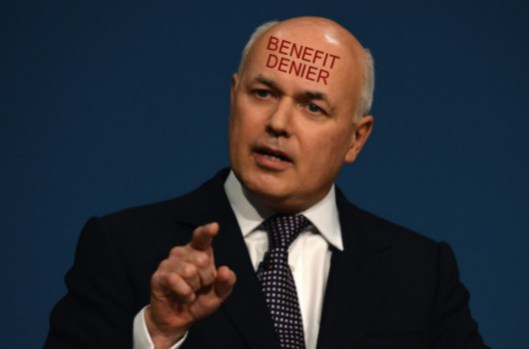
131010benefitdenier

Like it or not, politics in the UK is far more nuanced today than it has been at any time in the last 100 years. How can it be anything else? All the main political parties are trying to occupy the same, narrow, centre-right ground.

Even so, one man has emerged as the pantomime villain of British politics: Iain Duncan Smith.

ConservativeHome readers regularly vote him into the top slot as the most popular cabinet minister – but it seems that anyone who has ever had dealings with his Department for Work and Pensions has the exact opposite opinion of him. He has been nicknamed IDS, but this blog calls him RTU instead – it stands for ‘Returned To Unit’, a military term for serving soldiers who have failed in officer training and have been returned in disgrace to their original unit (the implication being that his claim of a…

View original post 970 more words

DWP Paid £53M In Bonuses To Staff

March 7, 2014

Who treat their customers like swearwords!

How many years of benefits would that pay for, for disabled people and carers?

The Department for Work and Pensions (DWP) paid more than £53m in performance related pay and bonuses last year – including over 100,000 vouchers of at least £25.

In total £51,274,006 was paid in cash to staff in in-year and end of year bonuses between April 2012 and March 2013.

And a minimum of £2.56m was also paid in 102,349 voucher payments valued between £25 and £50.

This total could be as high as £5.12m if all vouchers handed out were for £50 and would take the total bonus pool to £56.4m.

Senior civil servants (SCS) received the highest awards – 61 of 242 eligible staff (25.2%) received a median bonus of £10,000 each, although the maximum paid out was £15,000.

The vast majority of non-senior staff eligible for an end of year bonus (91%) received one, with the top value being £1,705 and median value £475.

One in five (19.6%) of eligible staff members also received an in-year bonus, with the highest being £2,250, although the median amount was £100.

According to the official DWP data, the bonus pool amounted to 3.2% of the annual £20.4m pay bill for senior civil servants.

And it represented 1.8% of the £2.76bn total pay for the 104,000 non-senior eligible employees at the department.

Government Advisor Plots Two Tier NHS Waiting Lists For People In Work

March 7, 2014

What the???

johnny void's avatarthe void

billboard-poster-david-cameron A shocking proposal from a so-called expert at the Department of Health has suggested that people in work should be given priority for treatment in the NHS.

In a move which could hit pensioners, disabled people, lone parents and unemployed people, government advisor Dame Carol Black has said: “I personally think we should perhaps be more honest and debate more fully if we would prioritise such patients if it was a question of getting them back to work.” 

In other words if you are currently without a job, for any reason, then forget about accessing healthcare as you are pushed down to the bottom of NHS waiting lists.  Black’s comments even seem to suggest that the sicker you are, and the less likely to be able to go back to work, then the longer you might have to wait for NHS treatment.

Dame Carol Black made the comments – which…

View original post 133 more words

Disability Rights UK Statement On ILF Closure

March 6, 2014

Disabled people will be impacted by the closure of the ILF but it will close anyway.

Despite the heroic efforts of some users of the Independent Living Fund (ILF) in successfully challenging the Government’s original decision to close the Fund in April 2015, today the Government announced that, following undertaking a new Equality Impact Assessment the Fund will close in June 2015.

The Equality Impact Assessment acknowledges the likelihood that ILF users will face a reduction in their care and support packages with some disabled people losing all their support if there needs are considered to not to fit with their local authority’s exacting eligibility criteria.  However the assessment goes on to claim that this may be mitigated by ‘more care services being paid for directly’.

The impact assessment goes on to claim:-

“It is simply not possible to quantify accurately how the closure of the ILF would impact on individual care and support packages or how any funding cuts would translate into the loss of independence or reduce choice and control over their daily lives. “

Commenting on the announced closure Sue Bott, Director of Policy and Development for Disability Rights UK said: –

“I know many of our members will be very disappointed and worried following this decision.  The Equality Impact Assessment whilst acknowledging there will be an adverse impact dismisses such concerns on the grounds that they can’t be quantified accurately, or the Care Bill will make everything in the garden rosy again, or – extraordinarily – some concerns are simply the result of an outdated view of local authorities.  The fact is that social care is chronically underfunded and this decision will only exacerbate that situation.”

She went on to say: “The priority now must be to ensure that all ILF recipients get the best package possible from their local authority.  We will do what we can to assist through independent living information on our website and through our independent living helpline.  We would take issue with the Minister’s assertion that disability has become better understood in the last 20 years.  As far as independent living is concerned there is a need to renew the debate and give disabled people a right to independent living as contained in Article 19 of the UN Convention on the Rights of People with Disabilities.”

The Independent Living Fund Will Close On 30 June 2015

March 6, 2014

From 30 June 2015, the Independent Living Fund (ILF) will close, Minister of State for Disabled People Mike Penning announced today (6 March 2014), and funding will be transferred to local authorities and the devolved administrations.

Current users of the fund – which was first set up as a transitional arrangement more than 20 years ago – will then receive support through the mainstream adult social care system.

Minister of State for Disabled People Mike Penning said:

Our understanding of disabled people has changed over the past 20 years, and along with it there have been significant developments in how we provide social care to disabled people so they can live independent lives.

We continue to spend £50 billion a year on disabled people and the services provided to them, and as part of the government’s long-term economic plan, we want to make sure that disabled people are given the support that allows them to fulfil their potential.

There are approximately 18,000 ILF users across the UK. The fund was permanently closed to new applicants in December 2010, and the government consulted on the best way forward for existing users in 2012.

Since then, DWP has carried out a new equality analysis to enable ministers to make a new decision about the future of the fund.

Nearly 1.6 million disabled people in England alone already receive support through local authority social care arrangements. In future ILF users in England will receive all their support under the same system.

The devolved administrations in Scotland, Wales and Northern Ireland will decide how ILF users in their areas will be supported.

The government, local authorities, the devolved administrations and the ILF will work closely with disabled people to ensure the transition is as smooth as possible for current ILF users.

All disabled people, including those transferring from the ILF, will continue to be protected by a safety net that guarantees disabled people get the support they need.

Family Of Ben Baddeley To Take Legal Action Over SDR Denial

March 6, 2014

I’ve covered Ben Baddeley before and have followed him with interest over a few years.

I share his disability and was sad to read that he has been denied SDR– something his family clearly want for him and believe will help him. I wish them well in whatever happens next.

The furious family of cerebral palsy boy Ben Baddeley is to take legal action against the hospital that axed his life-changing operation due to cuts.

Mum Amy said she believed another child had the £20,000 surgery just days after her nine-year-old son’s was suddenly cancelled.

The 29-year-old said: “I was so angry when I found out they were operating on other children on the waiting list, but not on Ben.

“It is just so wrong to choose one over another. It is playing at God.

“I am going to see my solicitor about taking legal action.

“I do not believe you can give a child a date for an operation, take it away, then continue to do it for other children.


“I don’t think it is lawful.”

Ben, of Silverdale, Staffs, was booked into Queen’s Medical Centre , Nottingham, on February 20 to prepare for selective dorsal ­rhizotomy surgery, which could help him walk unaided.

But the Tories cut funding.

Nottingham ­University ­Hospitals Trust pledged to operate on “those already with a date or those fully prepared”.

That angered Amy and Ben’s dad Gary, 37.


Amy added: “How can they tell my son his date was not the start of treatment when he was to have a ­catheter in his spine and go into theatre?

“He has taken so long to prepare for this. He had 18 months of gruelling physiotherapy.”

The trust’s neurosciences chief James Hunter said: “It would be unfair on our patients and their families to continue a process which may not result in surgery.

“We are in contact with the Baddeleys to discuss alternative ­arrangements and funding options.”

‘Third Of A Million’ Universal Jobsmatch Vacancies Fake, Fraud Investigators Called

March 6, 2014

Fresh doubts have emerged over the Government’s controversial welfare reforms amid claims that a third of a million vacancies advertised on the new Universal Jobmatch website could be bogus.


The Department for Work and Pensions confirmed it was investigating 179 employers for potentially breaching the rules on the site.

The disclosure comes as it emerged that national fraud investigators are examining allegations of a scam in the North West of England in which job seekers responding to adverts were asked to hand over £65 for background criminal checks for positions which did not exist.

Universal Jobmatch was set up in November 2012. Since March last year anyone claiming jobseekers’ allowance can be required to apply for a minimum number of jobs through the site each week to prove they are actively looking for work – or facing losing benefits.

Whilst Government figures show more than half a million employers have advertised on the site, it was recently claimed that as many as one in three of the vacancies could be fake.

Labour MP Frank Field, who obtained the figures, has asked the National Audit Office to investigate. He said: “The heart of the government’s welfare reform programme is bedevilled with fraud and, in its current state, it is out of control.

“Anyone can place an advertisement on the site in the space of five minutes by ticking a few boxes. Ministers need to get a grip before more people fall victim to fraudsters preying on them with the helping hand of a major government department.”

Among the breaches uncovered so far are employers promoting franchise opportunities or pyramid selling schemes which require applicants to part with money up front. While not illegal, they do flout Jobmatch terms and conditions and are removed.

In another instance, positions advertised on Universal Jobmatch for trainee child counsellors with salaries of £18,500 a year rising to £34,000. Greater Manchester, Lancashire and Merseyside Police have all received complaints from job seekers who claim they were duped after attending interviews.

In Liverpool successful applicants claimed they turned up for work but were told that the company did not exist. The matter has been referred to the national fraud agency Action Fraud.

Under the terms of the deal advertisers are permitted to conduct interviews in Jobcentre Plus premises.

In a letter obtained by Mr Field last month, the DWP said: “Currently there are 179 accounts advertising 352,569 jobs which potentially breach the terms and conditions (of Universal Jobmatch) and those organisations are being contacted to seek evidence of compliance.

“If evidence is not provided the accounts will be terminated within five working days and all associated vacancies removed from Universal Jobmatch. It is anticipated that this exercise will take around three weeks to complete.”

In a recent Parliamentary written answer, DWP minister Esther McVey said it would be too expensive to keep records of the number of people finding work through the site or how long they had remained employment.

A DWP spokesman said millions of vacancies had been posted since 2012 and problems of bogus adverts were common to all on-line job sites.

“The truth is that the vast majority of employers post genuine jobs, and we crack down on those who don’t play by the rules.  We also regularly monitor the site and remove jobs that don’t meet our rules, such as duplicate advertisements or jobs for franchises,” he added.

Paddy Power Ordered To Remove Pistorius Advert

March 6, 2014

We won. And so did common sense. And decency. And… well just about everything really. Now, I just hope they stop taking bets on the trial verdict.

Paddy Power has been told to withdraw its Oscar Pistorius advert with “immediate effect” after it became the most complained-about UK campaign ever.

The Advertising Standards Authority has ordered the bookmaker to remove the newspaper advert, which offers “money back” on bets if the South African athlete is found not guilty of murder.

More than 5,200 complaints have already been made, the ASA said.

Mr Pistorius is accused of murdering his girlfriend Reeva Steenkamp.

The ASA ordered the removal of the advert after “an unprecedented number of complaints”.

It said it was investigating whether the ad is “offensive for trivialising the issues surrounding a murder trial, the death of a woman and disability”.

The ASA is also investigating whether it “brings the good reputation of advertising generally into dispute”.

Paddy Power’s advert featured a photograph of Mr Pistorius, a double amputee Olympic racer and a Paralympic gold medallist, mocked up as an Academy Award statuette.

‘Offensive’

“We consider the ad may be seriously prejudicial to the general public on the ground of the likely further serious and/or widespread offence it may cause”, the ASA said.

“We are also concerned that the good reputation of the advertising industry may be further damaged by continued publication of this ad.”

ASA chairman, Lord Smith said it had taken the “unusual step” of directing the advertiser to withdraw the campaign before the outcome of an investigation.

The campaign was run to coincide with the Oscar ceremony in Los Angeles and the first day of Pistorius’ trial in South Africa, for which the bookmaker is offering odds.

Prosecutors allege Pistorius, 27, shot his model and reality TV star girlfriend through the bathroom door at his home on Valentines’ Day in 2013. Pistorius claims he mistook her for an intruder.

An online petition, claiming that making money from the trial is “vile” and “offensive”, has been signed by 120,000 people.

The number of complaints to the ASA has already surpassed a 2005 Kentucky Fried Chicken advert, which was the previously the most complained-about UK advert.

It featured call centre workers singing with their mouths full and drew 1,671 complaints.

Why Same Difference Fully Supports The #SaveBBC3 Campaign

March 5, 2014

Readers, I’ve just read news that has made me very sad. The BBC are planning to axe BBC Three.

Now, readers, I may be just a little too old to be a member of their intended audience, but, I have a confession to make. I love BBC Three.

Why? Not for its comedies. Well, except Way To Go, which manged, somehow, to make assisted suicide funny, respectfully.

No, I love it for its current, cool, disability documentaries, which have launched the careers of some young disabled people.

Without BBC Three, I would never have seen:

In fact, they made Jono Lancaster into a star.

  • Dancing On Wheels (Carolyne went on to star in The Undateables and winner James is now a Paralympic swimmer.)

There are reports that BBC Three might become an online only channel. However, as much as I personally love the Internet, that would make it completely inaccessible to those young people too disabled to use the Internet, or those who can’t afford Internet access. You can see for yourselves, by the size of the list above, what a great shame it would be to make the channel inaccessible to young disabled people.

I will be doing everything I possibly can, through Same Difference, to #savebbc3.

For myself, and for the next generation of Ruths, Jono Lancasters, James’s and Carolynes.

Lisybabe’s Phone Call From The Job Centre

March 5, 2014

@Lisybabe- campaigner Lisa Egan- had a phone call from the Job Centre yesterday that really worried me, and that should go viral.

She posted it yesterday at Where’s The Benefit.

Woman from my local Job Centre: We’re just updating our notes. So what are your aims?
Me: I thought these kinds of questions were only for people in the Work Related Activity Group?
JC: No, we’re asking people in the Support Group. It’s because you’re in the Support Group that we’re doing this over the phone rather than asking you to come in in person.
Me: Well I don’t have any aims. Given the state of my health, aspiring to do something would just be false hope.
JC: It says here that you’re interested in stand up comedy…
Me: Yes, that’s what I used to do before I became too ill to carry on.
JC: Was you like on TV? Or comedy clubs?
Me: I only got to do stand up for two and a half years before I became too ill to carry on. No-one makes it onto TV in only two and a half years.
JC: So, has your health deteriorated?
Me: Not really since my last Atos assessment in December 2012. I’ve gotten a couple of new diagnoses, but nothing significant.
JC: [slightly concerned] But you’re OK though, right?
Me: Not really, no!
JC: OK. That’s fine. If you ever come in here ask to see me, [name].

Police Officers ‘Attacked Man With Autism,’ Claim Family

March 5, 2014

A public meeting has been held in Luton to discuss allegations that a man with severe autism was beaten in the street by two Bedfordshire Police officers.

The family of Faruk Ali say he was helping binmen outside his Luton home when the police officers carried out an unprovoked attack.

They say he has been left “scared” and “agitated” by the what happened.

Bedfordshire Police says it is investigating and has placed the officers on “restricted duties”.

  It is alleged that Faruk Ali was injured and his coat torn in the incident

According to his family, Mr Ali likes routine and helps the binmen every Thursday.

They say he was doing this on 20 February when two officers got out of a police car and grabbed him, saying he looked suspicious.

Musthafa Hussain told BBC Look East he saw the incident.

“They dragged him, they punched him, they held him hard,” he said. “It was outrageous.”

A statement from Bedfordshire Police said the force was “sorry for the distress Mr Ali and his family feel regarding the actions officers took due to their concerns for Mr Ali’s wellbeing”.

“This incident is being taken seriously and an investigation has been launched by the Beds, Cambs and Herts Professional Standards Department which will be supervised by the IPCC.”

The meeting at Bury Park Community Centre, organised by Mr Ali’s family, was attended by Assistant Chief Constable Nigel Trippett, of Bedfordshire Police.

Job Centre Scams: Have You Been Affected By John Sothern?

March 4, 2014

 Job Centre Scams

‘Recently there has been a plethora of reports that Job Centre Plus and Universal Job Match are knowingly advertising bogus Jobs. Currently a number of NW constabularies are investigating John Sothern who has defrauded a number of people using a criminal records scam to extract money from hopeful job seekers. After the candidates part with their cash and personal details no jobs materialise. Job Centre plus were aware of this situation and still allowed this man to operate in their premises.
Another scam involves a midlands man advertising bogus positions and then uses the submitted CVs to sell on to other agencies for the candidates personal details.

Have you been subject to similar incidents? Please let us know your experiences. ‘
https://www.facebook.com/groups/1410545949204124/?fref=ts

Chris Lawton Tries To Cancel Sun+ Membership

March 4, 2014

You may like to post this: I just cancelled my free month membership with the sun and had this conversation with an online advisor:

Chris Lawton: I wish to cancel my membership asap please
Chad: Hello, you’re chatting with Chad. I’m here to help you with any questions you may have about Sun+.
Chad: To enable me to process the cancellation, please could you provide me with the reason for wanting to cancel today?
Chris Lawton: several reasons – I do not like the fact you have gob on legs Katie Hopkins on your team, the fact you support the tory government and also I have financial problems so cant afford it
Chad: In order to assist you today I just need to ask a few security questions. Please can you confirm your name, email address, post code and date of birth?
Chris Lawton: ******************
Chad: One moment please, I’ll just look into that for you.
Chris Lawton: THANKS
Chad: As requested I have cancelled your membership for you. Please be advised that if you are cancelling 5 days before your next billing date you may still be charged. A cancellation email will be sent to your registered email address within the next 24 hours.
Chris Lawton: Thank you
Chad: Is there anything else?
Chris Lawton: yes – will the sun stop supporting this evil government and sack katie hopkins?
Chad: More than likely not. Can I help you further with Sun+?

FOI: JSA And ESA Sanctions, Oct 2012-June 2013

March 4, 2014


FOI request 20th Jan 2013 Re Sanction statistics Oct 2012 to June 2013


A. With regards to your document published 6th Nov 2013 “JSA Sanction Decision Levels by Jobcentre Plus Regional Group and District 22nd October 2012 to 30th June 2013”, please can you clarify the following


1. What is a ‘non-adverse decision’? If this is a decision not to apply a sanction, would the claimant have been receiving JSA or ESA whilst the decision was being made?


2. What is an ‘adverse decision’? Does this show the total number of people who have received sanctions, even if the sanction was removed on appeal? If not, what does it show?


3. What is a ‘reserved decision’


4. What is a ‘cancelled decision’? Does this refer to cancellation after an appeal? On average how long does it take between a sanction being imposed and its being cancelled


B. What is the total number of people in Great Britain who were under sanction for JSA or ESA during June or Part of June 2013


DWP response


In response to your question A:


1. A ‘non-adverse’ decision is when a case has been considered and a decision was made not to apply a sanction. The claimant is usually still in receipt of benefit when the decision is made, however on occasions they may have stopped claiming during the decision making process.


2. An ‘adverse decision’ is a decision found against the claimant, i.e. a sanction or disallowance is applied. It can be made at the original decision making point, at reconsideration, or on appeal. If an adverse decision is overturned following a reconsideration or appeal, it will appear as a ’non adverse decision’ in the table to which you refer.


3. A ‘reserved decision’ normally applies when a sanction is appropriate, but can’t be applied because the claimant does not have a current claim. These cases are re-referred to the Decision Maker if the claimant reclaims within a timescale set by the Decision Maker in their

reserved decision, or equal to the maximum sanction period applicable for the case.


4. After a case has been referred to a Decision Maker the referral can be cancelled before a decision is made. A ‘cancelled decision’ does not refer to the cancellation of a sanction after an appeal has been made.


In response to your question B:


The information requested about the total number of people who were under a sanction for JSA or ESA during June or part of June 2013 is not readily available and to provide it would incur disproportionate cost.


The Department does hold some information on the duration of Jobseekers Allowance (JSA) sanctions. This includes the date the sanction was applied but we do not hold readily available information on the actual length.


To provide an answer would require us to combine data on multiple sanctions and overlapping decisions accounting for differences in dates (e.g. when a claim ends during a sanction; when a sanction is reserved for application against a future JSA claim; when circumstances change during or after a sanction).


Although theoretically possible it is estimated that this would take in excess of 5 working days and would therefore incur disproportionate cost.


I can however provide you with the number of decisions made to apply a sanction during June 2013. This is shown in the sanctions publication of 6th November. There were 68,170 JSA decisions and 2,100 ESA decision to apply a sanction in June 2013, the link for reference is provided below:


https://www.gov.uk/government/uploads/system/uploads /attachment_data/file/ 255568/sanctions-nov2013-update-2.xls

“We’re taking control of our future.” Ground breaking manifesto for blind young Londoners launched.

March 4, 2014

A press release from RLSB:


London based youth forum for blind young people unveils Britain’s first ever manifesto, highlighting the realities blind young people face around employment, education, transport and diagnosis support.


The comprehensive document tackles issues such as the fact that a quarter of this group are dissatisfied with their life and that 90% of those who lose their sight in youth won’t work for more than six months in their life.


This last challenge is an experience keenly felt by 19-year old forum member Amy Hawkins who was told by one organisation that they wouldn’t give her a job because she would be a “health and safety risk”. 24-year old Courtney Nugent, another forum member, was told by her careers advisor at school that “blind people couldn’t go to university” and that she needed to rethink her career options. Other facts include:


  • Only 8% of blind and partially sighted people reported they were offered any formal counselling at the point of diagnosis.
  • Only 44% of vision impaired students got 5 A*-C at GCSE compared to 70% without a special education need.
  • Nine out of 10 employers rate blind and partially sighted people as either ‘difficult’ or ‘impossible’ to employ.


In response to these actualities the RLSB Youth Forum have suggested a number of solutions they hope government, businesses and the public will adopt to turn the statistics around.


Suggested changes in the manifesto include maximising emerging technologies to improve banking accessibility and experiences in the classroom; enhancing post diagnosis support and working with transport agencies to advance their accessibility policies.


The youngest member of the forum, 17-year old Agatka Cienciala, has high hopes for the manifesto:


“We are proud to be able to launch this document. It’s one of a kind that I hope will make people sit up and listen to us. I’m really excited about the employment pack which will set employers straight about the abilities of young people like me and what support they can get for adaptive equipment we might need. I hope that anyone who reads it will support us.”


The Youth Forum works alongside The Royal London Society for Blind People which is presided over by Minister of State for Business and Enterprise, Rt Hon Michael Fallon MP.


Mr Fallon said of the manifesto: “It is fantastic to see blind young people being active and vocal about the difficulties they face with employment, transport and accessible technology. The RLSB Youth Forum and their manifesto really is the Big Society in action – young people working together with the community to try and overcome their challenges and raise awareness for blind young people and I am delighted to support them as President of the RLSB.”


Dr. Tom Pey, RLSB Chief Executive added: “There is no one better qualified to speak on behalf of vision impaired young people than young people themselves. This is a manifesto that is straight from the heart and goes straight to the heart of the challenges they face. It and they deserve serious consideration by every politician and person who can influence the solutions they are asking for.”


A full copy of the manifesto can be read at rlsb.org.uk/youthmanifesto Supporters of the manifesto can pledge their support at change.org


Jean Hatchet, Paddy Power And Tom Watson MP On BBC 5 Live

March 4, 2014

I’ve just heard them discussing the Pistorius petition. Here are some Tweets to sum the discussion up.


https://twitter.com/K_IngalaSmith/status/440750018576658432

(The fact they know it is a pun on his disability makes things even worse. No matter what there is no excuse for disablism against Pistorius.)


https://twitter.com/K_IngalaSmith/status/440750375771963394


https://twitter.com/K_IngalaSmith/status/440751174212284417


https://twitter.com/there_runsMary/status/440752200009392128


“We Were Feeding 30 A Week, Now It’s 1600”

March 4, 2014


It used to be a last-ditch stop for a few dozen struggling and desperate families. But now the queue outside this food bank in Newcastle is regularly hundreds of people long.

From feeding 30 people a week less than a year ago, when the centre opened, today it is one of the busiest in the country with 1,600 in desperate need of supplies.

At each two-hour session for handouts, hundreds queue with vouchers – mums with babies, pensioners, men and women of all ages, patiently waiting for bags of basic food items.

The long line of the hungry which snakes behind the Church of the Venerable Bede in the city’s West End
is a depressing sign of the times. But latest evidence suggests they are only a small sample of hundreds of thousands hit by vicious Tory benefit changes.

Times are so tough, volunteers are being forced to supply “kettle boxes” for those no longer able to use a cooker due to soaring energy costs. Instead, they receive instant soup, Pot Noodles, mash and porridge – food which can be prepared by boiling a kettle.

The volunteers here see the struggles people face time and again with many families saying new sanctions on Job Seekers Allowance (JSA) are forcing them to make a stark choice to “heat or eat”.

Unable to pay for gas, electricity and food at the same time, the poorest in society now need charity to survive.

In Newcastle they join the food bank queue after missed appointments – or simply turning up late – at Job Centres. In the past year, 900,000 people in the UK have faced benefit sanctions, the highest figure for a 12-month period since 1996, when JSA was introduced.

But 58% have overturned Department for Work and Pensions rulings on appeal. Before 2010, the success rate of appeals was 20% or less.

Newcastle project leader Michael Nixon said: “We know that the problem is growing as a result of the DWP and this Government. We are currently feeding 1,600 people every week. When we started 11 months ago, it was just 30 a week. More than half of those asked for food vouchers as a result of benefit changes.

“We are seeing thousands of people hit by the benefit sanctions and hundreds more hit by the agency which assesses disability, ATOS.

“If someone is five or 10 minutes late for a benefits appointment now, they face sanctions which mean they do not receive benefits for up to six weeks. Whole families are being made to suffer because of an error by the main claimant.

“They just stop giving them money and those hit cannot afford to feed themselves and their children properly.

“If I did not provide food for my dog for six weeks I would probably be jailed. So we are treating large numbers of the population of our country worse than we are permitted to treat our animals.”

Visiting the project, affiliated to the Trussell Trust, clients were desperate not to be identified. The stigma created by popular TV shows such as Benefits Street has fuelled a fear of being labelled a scrounger. Yet research suggests 90% come “in desperate need”.

“We are not creating demand but satisfying demand already in existence,” added Michael. “We did a sample study of 1,275 people who visited us in the last six months and 52% needed only one gift of emergency food.

“They do not come back for more than they need.”

It is the young who appear to be suffering most. Newcastle Council for Voluntary Service revealed 31.4% of children are living in poverty in the city. Many end up at the food banks.

One young mum, 22, needs help for her two kids, both under the age of three. They wrestle for her attention in a buggy as she explains: “I get income support, child tax credit and child benefit. It is just over £100 a week. But I struggle to pay the bills and get enough food for the kids.

“I have a key card for my electricity and have to keep topping that up. That is at least £10 a week. Then I pay another £40 a week for water, my TV licence, my regular payments. I pay them using my benefits card. I am juggling money all the time. I came here because I needed food for the children, it is baby food mainly.”

The elderly, too, are hard hit. One pensioner, 70, said her topping up key card meant all her pension was going on heating. Her energy bills were so high, there was not enough left at the end of the week to feed herself.

Michael, a former construction manager, explained: “Around 60 agencies refer people to us.
Some of the things we see in Newcastle you would associate with a Third World country.”

The food bank is so over-subscribed a team of 60 volunteers – hospital consultants, doctors, surgeons, lawyers, former service users – busy themselves in the church hall, packing bags for clients.


Supermarkets and food manufacturers donate generously and Greggs gives stock worth £100,000 a year to this one food bank alone. Michael, a lay minister, recalled: “We had one woman in her late 50s who came to the UK from Nigeria in 2007 when she saw her husband and children butchered in front of her.

“She developed cancer and had to have a breast removed. In the op her left arm was nerve damaged and she was partly paralysed by it.

“ATOS suggested she could get a job which just used the other arm. Benefit changes and forms are so complicated the people who are hardest hit are the least able to defend themselves.

“We are in danger of turning into the Third Reich with such tactics. The most vulnerable in our society are being given a clear message – they are not wanted.”

Last month, 27 Anglican bishops wrote to the Daily Mirror slating David Cameron for creating a “national crisis” in which 500,000 visited UK food banks.

The Government austerity programme, along with the DWP’s “punitive sanctions”, were blamed.

It sparked a heated debate, with Robin Aitken, a food bank pioneer, claiming that demand for hand-outs had nothing to do with benefit cuts.

“If you provide a service, people will use it,” he said.

But even the Government’s own Department of Environment, Food and Rural Affairs says this is not the case.

The Trussel Trust said: “A report by Defra this year confirmed this is not about demand fuelled by our service.The numbers being referred have increased since last April’s benefit changes and the introduction of benefit sanctions.”

Michael has no doubt about why the demand has increased to such an extent. “The Mirror letter from church leaders reflected our experiences on the front line,” he said.

“I hear people talking about his issue but they do not provide proof to back up their arguments. What I know is what I am seeing with my own eyes.

“People need us because there is nowhere else left to turn.”

  • Donations can be made at www.newcastlewestendfoodbank.org.uk or directly at food bank sessions, Monday and Thursday, Benwell Grove, Newcastle. Money is welcome as well as food.

White Dee On Newsnight

March 4, 2014

Panorama- Hungry Britain, A Review

March 4, 2014

I’ve just watched tonight’s edition of Panorama, Hungry Britain, on food banks.

If you missed it, you can watch it here through iPlayer.

I don’t know which bullet point to put in bold, readers, so I’m going to put them all in bold.

  • The man who had to live on £2.75 for a fortnight.
  • The new mother too malnourished to breastfeed.
  • The fact that after everything she has said about them in the past, Edwina Currie was filmed in a food bank.
  • Oh yes, and then there was the Job Centre that has a chart stuck on its wall, showing targets for sanctions.

Thank you, Panorama– always showing us the truth about important issues, so no one else has to.

You Won’t Believe What They’re Planning For Your Local Hospital

March 3, 2014

ATOS denies in public it is ATOS

March 3, 2014

Tom Pride's avatarPride's Purge

(not satire – it’s ATOS!)

Government statistics reveal that between January 2010 and January 2011, 10,600 sick and disabled people people died within six weeks of their benefits having been ended after being wrongly assessed as fit for work by ATOS.

As an example of how toxic the name ATOS has become even to itself – ATOS recently changed its name in the UK to OH Assist as an attempt to distance itself from the scandal.

And in a surreal, Kafkaesque comment worthy of the best satirist, OH Assist has taken to denying it is ATOS – while at the same time admitting it is ATOS.

Here’s a reply from OH Assist to a critic on Facebook:

ATOS is not ATOS

In fact, OH Assist is not just ‘ran’ by ATOS – it is ATOS. Here’s a screenshot from the OH Assist website:

ATOS OH Assist

Mind you, can’t blame ATOS really. If I’d…

View original post 168 more words

Proof That The DWP Don’t Read What We Write To Them On Facebook

March 3, 2014

What more proof do we need, readers?

dwp

Paddy Power Taking BETS On Pistorius Trial Verdict

March 3, 2014

Readers, Paddy Power have come up with some awful advertising campaigns in their time.

But this surely has to be the worst yet, and the worst thing they have taken bets on yet.

Oscar-744x1024

Is it even legal to bet, or accept bets, on the outcome of a legal trial? Regardless, in this, a murder case,  it is in terrible taste.

Please join me in complaining to the ASA.

And please tell me, how can I complain to Paddy Power for taking bets on this at all?

Many thanks for info go out to reader Del Pickup.

Updated 2am: I’m very pleased to see that the Independent covered this yesterday and that there is a petition we can sign to MPs, asking them to tell Paddy Power to pull it.

Huffington Post also covered it, for which they must be thanked.

On trying to do therapy when your patient has no food or money

March 3, 2014

Oxfam: People Giving Food Back To Food Banks- Because They Can’t Afford To Cook It

March 2, 2014

Desperate families are so strapped for cash that they can’t even afford to cook the food they have been given by food banks.

Oxfam Scotland have warned that some people are handing back food because they don’t have enough credit in their electricity meters to switch on their cooker.

The Scottish Parliament’s welfare reform committee will discuss food banks at a meeting at
Holyrood on Tuesday.

In a letter to the committee, Oxfam Scotland’s Francis Stuart said: “One of the most shocking pieces of evidence we have seen is people who use food banks have started giving back items that need cooking because they can’t afford to turn on the electricity to cook the food they desperately need.”

The number of hard-up Scots families turning to food banks has reached record levels, with 7700 asking for help in January – half the number for the whole of 2013.

Last month, Scotland’s biggest food bank, Glasgow City Mission, shut after running out of food.

Welfare reform committee convener Michael McMahon said: “It is vital we get on the record the situation on the ground from the people staffing food banks and supporting our most vulnerable.

“It is simply unacceptable that our society needs to step in and help feed our fellow citizens.”

Home For Rent- Note The Preferences

March 2, 2014

This should go viral. Thinking it in your head is one thing, but writing it out loud is quite another, especially in the UK in the 21st century.

Thanks to reader Kim Cross.

rent

rent

IDS Doesn’t Know What Child Poverty Is

March 1, 2014

The bedroom tax is helping to reduce child deprivation, ministers have claimed.

A new draft child poverty strategy for 2014-17, which was launched by Iain Duncan Smith and education minister David Laws yesterday, lists the ‘removal of the spare room subsidy’ as one of the measures that is helping to improve the living standards of low-income families.

The document, which is out for consultation, says: ‘The removal of the spare room subsidy provides an incentive to tenants with spare rooms to move to smaller homes, while the introduction of HomeSwap Direct is helping tenants with too many and too few rooms to help each other.’

Matthew Reed, chief executive of the Children’s Society, said the inclusion of the bedroom tax in the strategy was ‘alarming’.

‘We know from our direct work with families that this will only make children poorer, for example by displacing more families,’ he said.

Yesterday charities condemned the government for putting on hold plans to overhaul the way child poverty is measured.

Reports suggest the Conservatives and Liberal Democrats had reached a deal on introducing new measurements for child poverty – taking factors such as education and decent homes into account – but these were blocked by the Treasury.

The strategy lists existing policies designed to reduce child deprivation and restates the government’s commitment to ending child poverty by 2020.

Alison Garnham, chief executive of Child Poverty Action Group, said: ‘After a long wait, we’re disappointed to see a list that contains little new, or likely to make a dent in the numbers of children growing up in poverty.’

Mr Duncan Smith said in an article for the Guardian yesterday: ‘This is such an important issue – it is vitally important that we take the time to get it right.’

This is the same person who once wanted to measure child poverty in step-parents. I wouldn’t listen to him on this topic if he was the last living person on Earth.

Video: Dennis Skinner, WOW Debate, On ATOS

February 28, 2014

Mike Penning MP Finally Admits ESA Repeat Assessment Suspension

February 28, 2014

Mike Penning, minister for disabled people, finally admitted in the WOW debate yesterday that the DWP have suspended the sending of employment and support allowance (ESA) claimants to Atos for repeat medical assessments, as Benefits and Work revealed on Monday.  He also did not deny the two year length of the suspension for those affected, which we disclosed on Wednesday.

On Monday we broke the news that the DWP have told staff that due to a growing backlog at Atos all current ESA claimants who have not already been referred to Atos will be left on the benefit, without further medical checks, until another company can be found to do repeat work capability assessments (WCAs).  On Wednesday, following contact from a DWP insider, we also revealed that claimants due to be referred to Atos were being given a two year repreive.

Until yesterday, however, neither the government nor the DWP would confirm this information. But in the WOW debate yesterday, Kate Green MP asked Penning point blank about the issue [column 472] :

“My point is on the WCA, and I hope that the Minister will address the question that I and my hon. Friend the Member for Edinburgh East (Sheila Gilmore) raised about the suspension of reassessment of ESA claimants for the next two years. Will he tell us why the Department appears to have decided not to inform claimants or Members of Parliament about that?”

Penning responded:

“If we were to inform claimants and Members of Parliament about the minutiae of every single change in policy, we would be here a lot longer. As most Members know, I am not hugely party political, but I must point out that the previous Administration did not offer that level of information either. That is not how Governments work. We are trying to deal with the delays, and to ensure that people get what they are entitled to as quickly as possible and that nobody will be worse off while we are doing that. We are, however, in the middle of a really difficult negotiation with Atos over the WCA.”

Penning’s response is a welcome, but grudgingly given, confirmation of the news broken on Monday by Benefits and Work. However, it also displays his extraordinary lack of understanding of what it is like to be a sick or disabled claimant dreading the post arriving every day, for fear it will include a summons to an Atos medical. To actually know when your medical is likely to happen is not ‘minutiae’, it is a matter of enormous importance.

The suspension of referrals does not, unfortunately, affect claimants who have already been referred to Atos by the DWP. As Atos made clear on their website yesterday, having been inundated with calls about this issue:

“Any WCA repeat referrals that we have already received from DWP will also continue through the WCA process as they would before.

“You can normally tell that this process has started because you receive a Limited Capability for Work questionnaire, or ESA50. You should still return forms, supply additional evidence or attend appointments for a face to face assessment as necessary.”

Mark Wood: Had Food Phobia, Starved To Death After Atos Decision

February 28, 2014

A “VULNERABLE and fragile” man starved to death four months after most of his benefits were stopped and he was left with just £40 a week to survive on.


Atos Healthcare – which assesses peoples’ ability to work on behalf of the Government’s Department for Work and Pensions (DWP) – ruled that 44-year-old Mark Wood, from Bampton, was fit to work.


But at an inquest into his death, Oxford Coroner’s Court heard testimony that Mr Wood was far from fit to hold down a job.


Weighing just 5st 8lbs when he died of malnutrition in August last year, Mr Wood had obsessive compulsive disorder, Aspergers syndrome, phobias of food, pollution, paint fumes, and social situations, and cognitive behavioural problems.


His GP Nicolas Ward told yesterday’s proceedings: “He was an extremely vulnerable and fragile individual who was coping with life.


“Something pushed him or affected him in the time before he died and the only thing I can put my finger on is the pressure he felt he was under when his benefits were removed.”


Dr Ward, from Bampton Medical Practice, said he had not been contacted by either Atos or DWP about Mr Wood’s medical history, and revealed that if they had asked for his professional opinion he would have said Mr Wood was unfit for work.


Mr Wood had been receiving housing benefit, employment and support allowance, and disability living allowance of £40 a week and had been living independently since 2006.


But in January last year Atos Healthcare ruled that Mr Wood was healthy and able to work. Following its assessment, in about April last year, Mr Wood’s housing benefits and employment support allowance were stopped by the DWP, leaving just the disability allowance.


The inquest heard he was not able to pay his rent of utility bills.


Mr Wood’s family claim their “gentle and sweet” son and brother would still be alive if his benefits had not been stopped.


His sister Cathie Wood, 48, from North Oxford, told the Oxford Mail: “Atos are completely to blame. If they had not evaluated him as normal he would have carried on in his own way and would not have died last summer.”


His mother Jill Gant, from Abingdon, explained to the coroner that the family only found out Mr Wood did not have any money a few weeks before he died and sent him £250.


Ms Wood said: “By then it was too late, he was so fragile and unstable. We didn’t realise how bad things were.


“He found it difficult to accept help from his family because he tried to live independently so he gave the money away.


“He had a lot of problems, but he was very gentle and sweet.”


At the inquest, Mrs Gant said: “I think he died of the severe effects of malnutrition, but there were precipitating causes.


“Extreme stress and lack of money caused by the removal of his benefits led to his eating problems, and malnutrition led to his death.”


Between April – around the time his benefits stopped – and his death his body mass index plunged from 14.1 to about 11.5. A BMI of 18.5 to 24.9 is considered healthy.


Pathologist Clare Verrill told the court a BMI below 13 could kill a man but a cause of death could not be given because his body had decomposed. Mr Wood had last been seen alive on July 29 but his body was not discovered until August 9.


Oxfordshire Coroner Darren Salter gave a narrative verdict at the inquest. He said: “Mr Wood had an eating disorder and food phobia. It is likely that this caused or contributed to his death as he was markedly underweight and malnourished.”


He added: “I accept the evidence about something pushing him over the edge heard by the GP Mr Ward.


On the other hand we do know cash was provided prior to death, but because of his phobias he didn’t use that cash to buy food.”


His family are meeting Oxford West and Abingdon MP Nicola Blackwood next Friday to try to find out why he was declared fit for work. Ms Wood said they may consider legal proceedings.


Atos Healthcare spokeswoman Tessa David said: “Our thoughts are with the family of Mr Wood at this difficult time.


“We carry out the Government’s Work Capability Assessment as professionally and compassionately as possible.”


DWP spokesman Ann Rimell said: “A decision on whether someone is well enough to work is taken following a thorough assessment and after consideration of all the supporting medical evidence from the claimant’s GP or medical specialist.”


DWP figures show that between October 2010 and March 2013, more than 1,000 people across Oxfordshire stopped receiving employment and support allowance benefits.


Suzy Drohan, joint manager of Barton’s Oxfordshire Welfare Rights, said: “It is terrible, I’m really concerned about how Mr Wood has fallen through the cracks.”


Between January 2012 and January this year Oxfordshire Welfare Rights took 312 cases to tribunal appeals against DWP decisions, and 281 were successful.

Sheridan Smith To Play Blogger Lisa Lynch In ‘C Word’ TV Drama

February 28, 2014

I followed Lisa Lynch online for quite some time. I’ve only just found out, through this article, that she has passed away. The TV drama of her life will be a wonderful tribute. I’ll watch it with interest.


Actress Sheridan Smith will play journalist Lisa Lynch, in a BBC adaptation of The C-Word, the book which chronicled her fight with cancer.

Lynch, who died last year at the age of 33, personally asked Smith to play her in the drama after the pair became friends on Twitter.

“Her zest for life was infectious and I was moved and inspired by her courage and bravery,” said Smith.

“I couldn’t help but love her. That’s why I want to tell her story.”

Lynch – a former magazine editor – began writing a blog when she was first diagnosed with breast cancer in 2008.

The blog quickly gained a cult following and was acclaimed by critics, leading to the publication of a book, The C-Word, in 2010.

Although she survived breast cancer, a secondary cancer was diagnosed in 2011. Lynch continued to write her blog until weeks before her death on 11 March 2013.

‘Ballsy’

Smith, who won a Bafta playing the wife of the Great Train Robber Ronnie Biggs, said she wanted to tell Lynch’s story “for her husband Pete, for her family and for everyone whose lives are touched by cancer”.

“I’m so sad that Lisa won’t get to see the finished drama, having been so involved in the development of it.

“I’m honoured and humbled that she wanted me to play her on screen, and I hope that I will make her proud.”

BBC One controller Charlotte Moore called it a “defiant, ballsy account of a 28-year-old woman who is newly married, life is all going very well, and then her life absolutely explodes with this diagnosis.”

WOW Debate VS MP Payrise

February 27, 2014

This photo speaks a thousand words.

wowpayrise

Does anyone have a full list of the MPs who didn’t show up today?

‘WoW’ debate on sickness and disability benefits live blog

February 27, 2014

WE WON. WE WON. WE WON.

Mike Sivier's avatarMike Sivier's blog

Today's the day: The WoW Petition is being debated in Parliament today, having won the support from MPs necessary to trigger a debate. Today’s the day: The WoW Petition is being debated in Parliament today, having won the support from MPs necessary to trigger a debate.

That concludes today’s live blog. Thanks to everybody who visited and pressed ‘F5’ to keep up with events.

2.38pm The motion for the government to commission a cumulative impact assessment has been passed – resoundingly – after the debate. Admittedly very few people attended but the result was what the 104,000 people who signed the ‘WoW’ petition wanted.

However, there now arises the question of what the government will do. As was noted in the debate, the Conservative-Liberal Democrat Coalition has been defeated three times in succession over social security benefits – and has done absolutely nothing about the motions that have been passed.

Those who believed Labour would abstain have been proved wrong by today’s result; we must now judge the government by its actions in…

View original post 4,650 more words

Housing Benefit Will Be Sanctioned For Part Time Workers Under UC

February 27, 2014

Thank goodness, this will only apply to those not eligible for ESA.

However it could still affect many disabled people. Some disabled people are not able to work full time, but are able to work part time if suitable work becomes available.

The fear that their housing benefit could be sanctioned if they do not ‘try hard enough’ to look for full time work will cause extremely high levels of stress, particularly because they genuinely cannot do full time work and will never be able to.

It may even discourage disabled people who are able to do part time work from applying for any. They may choose instead to do no work and claim ESA or JSA as these benefits are not affected by this rule. Wouldn’t that go against everything the Government says they are trying to do?

Part-time workers judged to be doing too little to find full-time work face having their benefit for housing costs sanctioned by the government for the first time under universal credit.

Under the present system housing benefit is paid direct to landlords and sanctions can only be applied to out-of-work benefits, such as jobseeker’s allowance or employment support allowance.

Landlords, already concerned by the prospect of universal credit being paid directly to tenants, have been lobbying the government to exempt the housing element of the single payment from sanctions in all circumstances.

However, the Department for Work and Pensions has confirmed to Inside Housing that under the government’s flagship welfare reform, where a tenant is working less than 35 hours a week at minimum wage and is not eligible for JSA or ESA, the housing element can be sanctioned instead.

Landlords are concerned that by extending ‘in-work conditionality’ to the housing element, if the DWP deems claimants to not be doing enough to find full-time employment and applies sanctions, rent arrears could increase.

Sue Ramsden, head of policy for neighbourhoods at the National Housing Federation, said that until now, it has been unclear whether the DWP would allow housing costs to be exempt. ‘We are pressing for DWP staff to have regard for the need for an alternative payment arrangement to be put in place at the same time that the sanction is imposed,’ she said.

Sam Lister, policy and practice officer at the Chartered Institute of Housing, said there was concern about the effect of sanctions on arrears at a time when the housing benefit caseload for in-work claimants continued to rise, but much depended on how the policy was implemented. He added: ‘It will depend on the instructions given to DWP administrators about how strictly the sanctions are implemented in the case of part-time workers who are in receipt of benefit as a contribution to housing costs.’

No research has been carried out on the impact sanctions could have on arrears. More than 1 million people are currently in work but reliant on housing benefit to meet their housing costs, up from 691,000 in 2010.

A DWP spokesperson said: ‘It is only right that people claiming benefits should be aware that not sticking to the rules can have a consequence. Any reductions to benefits as a result of a sanction are applied to the universal credit benefit as a whole rather than a particular element of it.’

Watch #WOWdebate Live On BBC Parliament

February 27, 2014

Here.

Just to let you know that from that link, you can rewind by a maximum of two hours. If you’ve been out, as I have, then at time of typing you’ve only missed the very start if you choose to use this function.

“When Your Government Makes You Vulnerable, You Have No Choice But To Fight”

February 27, 2014

The WoW Debate is in a couple of hours, readers. Ahead of it, Frances Ryan has written this piece for Comment Is Free. Thanks again for the coverage, Guardian.

National Audit Office Report On PIP Implementation

February 27, 2014

Here is the Guardian’s take on the NAO’s report on PIP implementation. The NAO report was mentioned in the Channel 4 news report last night.

Sick and disabled people trying to claim a new benefit introduced by Iain Duncan Smith are facing “distress and financial difficulties” because of mismanagement by civil servants and the outsourcing firms Atos and Capita, a spending watchdog has found.

The National Audit Office discovered that the new personal independence payment, which will replace the disability living allowance, will cost almost three and a half times more to administer and take double the amount of time to process.

It has released a report into the new benefit as the government’s £500m contract with Atos comes under increasing scrutiny. Disability minister Mike Penning described the contract with the benefits testing firm Atos as a “mess”. Atos says that it wants to pull out of the contract early because of the death threats being made against its staff.

The department for work and pensions [DWP] had budgeted to pay £200m to administer the new benefit but pays Atos and Capita £127m to conduct face-to-face consultations or paper-based assessments.

The report shows that within six months of the introduction of PIPs in some areas of the north of England in April 2013, a backlog of 92,000 cases had built up, almost three times the number expected. The DWP had made decisions in only 16% of the expected number of cases, the report found.

Poor operational performance in the early stages of Duncan Smith’s flagship programme have forced his department to stagger the full national roll-out of PIPs and increased the risk that it will not deliver value for money in the long term, said NAO head Amyas Morse.

Atos is singled out for criticism in the report. In October, the DWP postponed the rollout of the benefit because of fears that Atos could not reduce backlogs or manage higher volumes of cases.

Contractually, assessment providers should complete 97% of assessments within 30 days. By the end of October, Atos and Capita had completed 55 and 67% respectively, the report disclosed.

Claimants were waiting an average 107 days – and terminally ill patients 28 days – for a decision on their cases, an NAO report has found, rather than the predicted processing times of 74 days and 10 days respectively.

Delays in assessments have cut by £140m expected savings over the course of this parliament, with the DWP now forecast to save £640 million a year by 2015, rather than its prediction of £780m, said the NAO. However, the DWP still expects to achieve annual savings of £3bn by 2018/19, with 3.6 million claims assessed by 2018.

Each new PIP claim – worth between £21 and £134 a week to disabled claimants – costs an average £182 to administer, compared to £49 under the disability living allowance, said the report.

Morse said: “Claimants face long and uncertain delays and the department has had to delay the wider roll-out of the programme. Because it may take some time to resolve the delays, the department has increased the risk that the programme will not deliver value for money in the longer term.”

The chair of the House of Commons public accounts committee, Margaret Hodge, said that the current backlog and delays in processing claims are unacceptable and will cause distress for vulnerable claimants.

“Once again we see the DWP under-performing – and we have little faith that costs will not increase down the line as it tries to get things under control.

“The Department needs to understand the causes of this backlog to develop a clear plan on how they are going to work with contractors to clear it, and ensure there are suitable processes in place to make sure this does not happen again,” she said.

A DWP spokesman said that the NAO acknowledges this reform started on time and on budget, and that the department has reduced risk by rolling it out in phases. “This has enabled us to adjust our plans as we learn from the initial phases, well before the roll-out to the majority of existing Disability Living Allowance claimants next year,” he said.

The Channel 4 News Report On PIP Implementation

February 26, 2014

This is a must watch. Channel 4 news report from tonight on the disaster that is PIP implementation.

Many thanks go out to Channel 4 for the coverage, and to Facebook page JobSeekers UK for the video.

DWP Insider: Repeat ESA Medicals Deferred For Two Years

February 26, 2014

Two. Years. Two years. TWO WHOLE YEARS. Two. Whole. Stress free years for the most severely disabled people in Britain. Two. Whole. Stress free years for the carers of the most severely disabled people in Britain.

The news of the deferring was big enough in itself. When I finished celebrating that news, I did wonder what the exact time frame was. As brilliant as ‘while we clear the backlog’ sounds at first, it does leave people wondering, and hanging. In matters of money, that wondering causes confusion, and fear, and stress.

Which according to the ‘DWP mole’ who revealed the rest of the memo to the brilliant Benefits and Work, was the DWP’s intention all along.

But, readers, thanks to the brilliant Benefits And Work, and the kind whistleblower, disabled people beat the DWP.

We found out what they didn’t want us to know. That’s a victory for us all. We should celebrate it and share the news widely.

It is also a victory for Same Difference, where I’ve said several times before that repeat assessments are, in most cases, a waste of Government time and taxpayers’ money.

So while the DWP go off and save taxpayers’ money for two whole years, I have only one thing left to say.

My dear readers, the party’s at Same Difference!!

Did Mike Penning MP Mislead Commons Over WCA?

February 26, 2014

Many thanks to Benefits and Work.

Following Benefits and Work’s revelation that a decision was made over a month ago that all repeat medicals for ESA claimants were to be stopped, we are now asking:  did the minister for disabled people deliberately mislead the commons over the issue?

On 24 February during DWP oral questions, Mike Penning, minister for disabled people was asked by conservative MP Anne Marie Morris:

“Will the Minister inform the House of what steps he is taking to address the significant backlog that has been created by the delays in claimants receiving their work capability assessments? In my constituency, individuals say that they have been waiting for up to six months, which has a real impact on their financial circumstances.” (Column 5)

Penning replied:

“The issues to do with the work capability assessment and the unacceptable backlog that Atos has built up over the years are due to capacity and quality. The quality, which was very poor earlier on, has been improved. That means that there is now a huge backlog, which is why we are currently in negotiations with Atos.”

Penning was directly asked what steps he was taking to address the backlog and chose not to reveal that over a month previously a decision had been made to stop referring ESA claimants to Atos for repeat assessments until a new provider could be found.  

This postponing of repeat medicals was a huge step and was taken solely to address the Atos WCA backlog.  It was also a step that flew in the face of government policy, which is to repeatedly test claimants to ensure eligibility for benefits and end the so-called ‘something for nothing culture’ .

For the minister to have admitted the change would have been embarrassing.  But was failing to reveal it, in the face of a direct question, deliberately misleading the Commons?

We have asked Debbie Abrahams to pursue the matter for us.  The MP, who sits on the Work and Pensions Committee, told Benefits and Work that:

‘Although I am pleased that the Work Capability Assessment for disabled people has been suspended, why didn’t the Disabled Minister, Mike Penning, tell the Work & Pensions Select Committee that was his intention when he came to give evidence to the Committee before Christmas? This is further chaos, confusion and deceit from W&P Ministers and I intend to take this further.”

Guardian Interview Francesca Martinez

February 26, 2014

Ahead of the WOW Debate.

Thank you Guardian for the coverage of this very important event.

The debate scheduled for 11.15am in Westminster on Thursday represents a significant parliamentary milestone – the first debate secured by disabled people for disabled people.

The motion, set down by the War On Welfare (WOW) campaign group, calls for an assessment of the cumulative impact of the government’s welfare reforms on sick and disabled people, and demands an immediate end to the work capability assessment (WCA), the test that determines fitness for work.

Comedian Francesca Martinez has spent a year campaigning to get the 100,000 signatures required to trigger a parliamentary debate on the issue, motivated by concern that the true impact on disabled people of the government’s welfare reform programme has never been measured.

Although the fact that the debate has been called represents a considerable triumph, Martinez is concerned the government may try to sweep the event under the carpet. “If the government does try to brush it aside, it will leave you thinking, ‘well, what democracy is there?’,” she says.

Mike Pennington, the minister of state for disabled people, will speak in the debate but MPs are not obliged to attend or turn up to vote. The petition has been supported by 250 MPs, who include only three Liberal Democrats and no Conservatives.

Martinez, who has a well-established career as a standup comedian, and has cerebral palsy, agreed to get involved with launching the WOW petition because of her anger about the direction of welfare reform.

“It seems we’re living in a country at the moment where if you do get sick or if you do become disabled, not only have you got to deal with those challenges but you have to deal with the fact that the vital safety net that society provided for many decades is being eroded away,” she says. “Disabled people around the country are dying from these policies.” She cites the figure of 10,600 people who died within weeks of being found fit for work by a WCA test. “Many more are falling into destitution and being subjected to humiliation and being targeted in a really awful way.”

She contests the argument that welfare reform is driven by a need to cut costs, and points out that since so many people are going to court to appeal against decisions to remove benefits, the savings are negligible. “We have to challenge the government rhetoric on the money-saving argument,” she says.

Martinez was granted lifetime eligibility for disability living allowance (DLA) in recognition of the fact that her disability means she needs extra support to live independently. Under the reforms, her eligibility will be repeatedly reassessed, although improvement in her condition is a medical impossibility.

“Reassessing people like me every few years is going to cost millions and it is actually entirely wasted money,” she says. She points to the government’s willingness to declare money no object in helping victims of the recent floods as further evidence of the weakness of the argument that welfare needs to be reformed on cost grounds. “We need to correct the distortion that there’s not enough money in this country. There’s more than enough money – there’s just not the will to spend it.”

Announcing its reform of DLA in 2010, the government said it wanted to cut the cost of the benefit by 20% – a decision that Martinez says will eventually prove more expensive because people will find it harder to get the support they need to work. Her early success as a comedian rested on the fact that DLA helped to pay for a car, allowing her a degree of independence she could never otherwise have had.

“Already, with the benefits, a third of disabled people live in poverty. Now that figure is just going to rise,” she says. “Half of disabled people are unemployed. For a lot of people, these cuts mean that they can’t leave their house. They will be making decisions like: do I eat, or do I pay for a taxi to get me out of the house? Also many disabled people need extra support to be able to work. So, ironically, by taking away this support network, disabled people are going to be less able to go and contribute and live full lives. On every level it doesn’t make sense. You’re going to make disabled people more vulnerable and less independent.”

The debate is timely, coming a week after the announcement by the private company, Atos, contracted to carry out fitness for work assessments, that it was seeking an early exit from the contract, after criticism about the accuracy of its testing process and reports that staff had been sent death threats.

The company’s retreat provides little cause for celebration, Martinez says. “Atos is not the key problem; it is just going to be replaced by another company willing to carry out the government’s work.” She would prefer people to be assessed by their GPs for eligibility to sickness benefits. “A private company is far more likely to adhere to targets than a doctor will. You want private companies out of this. You need profit out of this.”

She is angry at the way that support for disability benefits has been reduced by a campaign of media misinformation. She dislikes the way the very word “benefit” suggests something positive and extra, rather than simply a levelling of an unequal playing field. “I hate the word benefit because it suggests a bonus,” she says. “I get benefits because I can’t walk out of my house on my own. I can’t make myself a sandwich. If you say to someone: ‘would you rather get £90 a week, or would you rather walk?’ No one is going to opt for the £90 a week.

“The rightwing press has had a huge impact on demonising claimants and demonising disability and disabled people as burdens on the state – useless parasites; we have seen a sustained attack over the last few years. Look at the increase in the use of words like ‘scrounger’ in relation to disability in news stories – there has been a three-fold increase. The media is rigorously pushing the government agenda on this. It has a profound effect on public perceptions of disabled people.”

She points to the proliferation of stories about fraudulent claimants. “Fraud is a non-issue, tiny, under 1% in these benefits. We never hear the truth. The truth is most disabled people really want to work but can’t, and all they ever think about is: ‘I wish I could work; I wish I could provide for my family; I wish I could feel like a fulfilled active citizen’. It’s not a dream of disabled people to sit at home doing nothing. I think that’s something we’ve really got to shift in terms of perception.”

Martinez hopes the parliamentary debate will be a chance for Labour to clarify its position on welfare reform. Aware that the WCA was launched by Labour, she knows the party’s support for her campaign is far from guaranteed.

“Labour clearly aren’t going to play the role of knight in shining armour. They are not going to change anything unless there is huge reason to do so. I don’t know where [Ed] Miliband stands on any of this – but slowly we are getting it on the agenda. I’d like the debate to make the top guys in Labour take this on seriously, for Miliband to say: ‘if we get to power, we will scrap the WCA’,” she says.

Virtual Arm To Ease Phantom Limb Pain For Amputees

February 26, 2014

Doctors have devised a new way to treat amputees with phantom limb pain.


Using computer-generated augmented reality, the patient can see and move a virtual arm controlled by their stump.


Electric signals from the muscles in the amputated limb “talk” to the computer, allowing real-time movement.


Amputee Ture Johanson says his pain has reduced dramatically thanks to the new computer program, which he now uses regularly in his home.


He now has periods when he is free of pain and he is no longer woken at night by intense periods of pain.


Mr Johanson, who is 73 and lives in Sweden, lost half of his right arm in a car accident 48 years ago.


After a below-elbow amputation he faced daily pain and discomfort emanating from his now missing arm and hand.


Over the decades he has tried numerous therapies, including hypnosis, to no avail.


Within weeks of starting on the augmented reality treatment in Max Ortiz Catalan’s clinic at Chalmers University of Technology, his pain has now eased.


“The pain is much less now. I still have it often but it is shorter, for only a few seconds where before it was for minutes.


“And I now feel it only in my little finger and the top of my ring finger. Before it was from my wrist to my little finger.”


Mr Johanson says he has noticed other benefits too. He now perceives his phantom hand to be in a resting, relaxed position rather than a clenched fist.


“Can you imagine? For 48 years my hand was in a fist but after some weeks with this training I found that it was different. It was relaxed. It had opened.”


Mr Johanson has also learned to control the movements of his phantom hand even when he is not wired up to the computer or watching the virtual limb.


Max Ortiz Catalan, the brains behind the new treatment, says giving the muscles a work-out while being able to watch the actions carried out may be key to the therapy.


“The motor areas in the brain needed for movement of the amputated arm are reactivated, and the patient obtains visual feedback that tricks the brain into believing there is an arm executing such motor commands. He experiences himself as a whole, with the amputated arm back in place.”


He says it could also be used as a rehabilitation aid for people who have had a stroke or those with spinal cord injuries.

Newcastle Council Attempting To Bribe Tenants Away From #BedroomTax Tribunals

February 26, 2014

Readers, I don’t know if I’m allowed to do any more than link to this story. So I won’t take any chances.

However, I do know it’s well worth a read.

I’ll sum it up in a sentence. Newcastle Council are offering DHPs to tenants who have appealed against bedroom tax decisions and are suggesting that they reconsider their benefit tribunal appeals.

I don’t think that’s very fair, do you?

One Punch, One Son’s Life- Just 4 Years Jail

February 26, 2014

1 punch 1 life 4 yrs

I’m covering this case because Andrew Young had Asperger’s. The act of his killing doesn’t appear to be linked in any way to his disability- however his disability is relevant because it could explain why he approached his killer in the first place.

Here is a CCTV video of the moment Andrew Young was punched, along with full details of the case.

Understandably, Andrew Young’s mother thinks the 4-year sentence is very lenient. Do you have any thoughts on this, readers? Comments welcome below.

Connor Sparrowhawk’s Death ‘Preventable’ Finds CQC

February 25, 2014

I have been following this case for quite some time. However, I have not covered it before, because it was, until now, an ongoing legal case and I didn’t wish to break any rules by covering it unless it got more recognised media coverage, which, now, it has.

The death of a teenager being cared for at an Oxfordshire in-patient unit for people with learning difficulties was “preventable”, a report has concluded.


Connor Sparrowhawk, 18, was found unconscious in the bath at the unit in Slade House, Headington, on 4 July and died the same day in hospital.


The independent Verita report, published on the trust’s website, found it had “failed significantly” in his care and treatment.


The trust has issued an apology.


The report follows a scathing review of the assessment and treatment unit by the Care Quality Commission (CQC), published in November, which found it failed on a number of standards, including patients feeling unsafe.


The unit has been closed to new admissions since the CQC report.


Connor had epilepsy and experienced seizures.


A post-mortem examination showed he died as a result of drowning, likely to have been caused by a seizure.


The report said the failure of staff to respond to and risk-assess Connor’s epilepsy led to a “series of poor decisions around his care”.


It added there had been no “comprehensive care plan” in place to manage his epilepsy, which was also not considered as part of his risk assessment – breaching National Institute for Health and Care Excellence (Nice) epilepsy guidelines.


The report also found the 15-minute observations in place at Connor’s bath times were “unsafe”.


It said the unit “lacked effective clinical leadership” and described the team working there as “weak”.


Katrina Percy, chief executive of the Southern Health NHS Foundation Trust, said she was “deeply sorry” it had “failed to undertake the necessary actions required to keep him safe”.


“We are wholly committed to learning from this tragedy in order to prevent it from happening again and I would like to apologise unreservedly to Connor’s family,” she added.


She said the trust would work to address the findings and recommendations of Verita’s report and said a number of actions had now been taken, including reviewing staff training in relation to the care and risk assessments of patients with epilepsy.


In a statement issued by Bindmans’ solicitors, on behalf of Connor’s family, his mother Sara Ryan encouraged people to read the report and said “remember that Southern Health were quick to write Connor’s death off as natural causes”.


“He should never have died and the appalling inadequacy of the care he received should not be possible in the NHS,” she added.

Ofcom To Investigate Benefit Street!!!

February 25, 2014

Personally, I’ve been waiting for this for some time. I didn’t make a complaint about the programme, but I always hoped OfCom would get involved.

The biggest problem I have with the process of the programme was that the name of James Turner Street was revealed on air. This led to all the threats towards the residents and the fear and bullying they experienced. I think that was wrong, and I hope that once OfCom investigate, they agree.

Channel 4‘s controversial documentary series Benefits Street is to be investigated by media regulator Ofcom after it generated more than 1,800 complaints from viewers.

The show will be scrutinised over accusations that its portrayal of the residents of James Turner Street in Birmingham was unfair and did not do enough to protect children living on the street.

It will also be investigated over claims that it showed crimes being committed and taught viewers how to shoplift.

The five-part Channel 4 series, made by Love Productions, prompted a storm of protest after its first episode aired on 6 January this year.

The programme, based around a street on which Channel 4 said more than half the residents claimed some form of benefit, polarised opinion between critics who said it demonised the poor and unemployed, labelling it “poverty porn”, and those who said it highlighted a social security system in urgent need of reform.

As well as being controversial, it was also hugely popular, watched by more than 5 million viewers, making it Channel 4’s biggest-rating programme since the Paralympics in 2012.

Benefits Street prompted 960 complaints to Ofcom, the majority of them during its first two weeks on air, and more than 800 to Channel 4.

The complaints are understood to cover a broad range of issues in relation to the show, including the protection and portrayal on TV of people under the age of 18, the way in which the James Turner Street residents were depicted, and the portrayal of crime.

It will be Ofcom’s most high-profile investigation into a TV programme since it cleared Channel 4 of unfair racial stereotyping in Big Fat Gypsy Weddings.

That decision, which followed a year-long inquiry, is being opposed by The Traveller Movement, a campaigning group representing the Gypsy and Traveller communities. It is seeking a judicial review, claiming the investigation was flawed.

The producers of Benefits Street and Channel 4 are now working on a second series of the show, although it will not be based on James Turner Street.

The broadcaster looked to meet criticism of the show with an hour-long debate hosted by Richard Bacon addressing some of the issues around the show last week, as well as a 30-minute programme in which some of the residents discussed the media and public response to the series.

A spokesman for Ofcom said: “Following the conclusion of Benefits Street, Ofcom can confirm that it has launched an investigation into the series.”

A Channel 4 spokesperson said: “We are confident there has been no breach of the Ofcom code and will be providing a detailed and robust response to the investigation.”

Greae’s Threepenny Opera

February 25, 2014

An empty television studio in Nottingham, currently the rehearsal space for the disability-led theatre company Graeae, contains a selection of items you could only find in a Graeae production. A row of saxophones sits next to a prosthetic limb. A length of rope replaces the usual floor-tape, for the benefit of cast members who are blind. In one corner, the props department is busy transforming an electric wheelchair into a polystyrene horse.

“The remarkable thing about this room is that absolutely nothing here is taboo,” says Graeae’s artistic director, Jenny Sealey. “We were practising some of the prosthetic arm gags in the pub last night. It gave some of the city types in there quite a turn.”

This is Sealey all over – funny, irreverent, yet deadly serious in her mission to bring mainstream acceptance to disabled performers. Sealey, who lost her hearing in a classroom accident at the age of seven, was awarded an MBE in 2009 and gained national prominence as co-director of the opening ceremony of the 2012 London Paralympic Games. Her current project – a production of Bertold Brecht and Kurt Weill’s Threepenny Opera – is Graeae’s most ambitious to date: a shared initiative between the New Wolsey theatre in Ipswich, Nottingham Playhouse, West Yorkshire Playhouse and Birmingham Rep.

Graeae already has a close relationship with the New Wolsey, having collaborated on productions of Richard Cameron’s Flower Girls and the Ian Dury musical Reasons to be Cheerful. The theatre’s artistic chief, Peter Rowe, is co-directing the work and explains how the collaboration came about. “We were looking for a piece that would take exposure for disabled actors to another level,” Rowe says. “The Threepenny Opera is a satire of the gross inequalities in society, and our inspiration came from the Occupy movement. Our beggars are a group of contemporary activists who take over the theatre and put on a version of The Threepenny Opera that reflects their own diversity.”

In Brecht’s opera the beggar-master, Peachum, issues his workforce with artificial limbs in order to elicit extra sympathy. Yet Graeae’s version contains a further twist. “In this production, the character who complains that he has been given a defective stump is played by a non-disabled actor,” Sealey says, “though Peachum himself is in a wheelchair. And Mrs Peachum is played by a blind opera singer, though she is the one character in the piece who sees everything.”

Just don’t call it the alienation effect. “People frequently tell me that I have a Brechtian directing style, but I don’t pretend to know what that means,” Sealey says. “I’m no great Brecht expert – I just follow my instincts. But whenever you put a group of talented and empowered disabled actors on stage it demands that an audience think twice about what they are seeing. Some people cannot cope and disconnect. Yet the overall effect isn’t alienating – quite the opposite in fact. It dissipates the fear of disability and difference.”

Even so, The Threepenny Opera was written to be provocative, and Graeae’s version contains elements that are bound to prove controversial. The setting has been updated from Victorian London to a point in the near future in which the homeless foment plans to disrupt the coronation of Charles III. Jeremy Sams has revised his lyrics, originally written for the 1994 Donmar Warehouse production, to include references to sex-pest priests and paedophiles within the BBC.

“Jeremy has come up with quite an ingenious new rhyme for ‘fix it’,” Rowe says.

“Which becomes even more graphic when you see it in British Sign Language,” Sealey adds.

The participation of four major regional theatres marks what Sealey perceives as “an attitudinal shift” towards disabled performers. The National Theatres of Scotland and Wales have employed disabled actors and creative teams; and in January this year the Royal Shakespeare Company and National Theatre held the first joint round of open auditions for disabled actors. Yet there’s a long way to go before the playing field becomes level. “It’s still regarded as perfectly acceptable to see non-disabled actors ‘crippling up’,” Sealey says. “I know a performer who was recently told by a drama school to come back when she was cured. As if anyone would dare to say ‘come back when you’re white’.”

Then, of course, there’s the Paralympic effect. Sealey recalls the day of the opening ceremony as the proudest of her life. “It was pure euphoria,” she says. “It was a massive statement: ‘We’re here, we did it, and we’re not going away.’ And yet, when it was over, there was a horrible, horrible silence. We went back to being benefit scroungers and undesirables. I had to be assessed for how many hours I could have an interpreter.”

Sealey is particularly proud that several cast members of The Threepenny Opera took part in the Paralympic ceremony. “I had a once-in-a-lifetime chance to build up a company of world-class deaf and disabled artists in the biggest circus-training initiative ever. Yet there were times over the past year when I truly felt it could all go to waste. So thank God for The Threepenny Opera. It’s restored my faith.”

DisabledGo Launches Competition with The Adventures of Wheelchair Boy

February 25, 2014

 A press release from DisabledGo:

DisabledGo, the UK’s leading provider of online access guides, has teamed up with disability blogger Glen Shorey from The Adventures of Wheelchair Boy to give away a £50 voucher for their online store. The competition runs until March 16th on The Adventures of Wheelchair Boy, and is open to UK residents only.


In addition to the competition, DisabledGo is also running a launch offer throughout the month of February, with up to 64% off selected items in the online store. The store is part of a new-look DisabledGo website, which serves up 120,000 disability access guides to over 35,000 unique visitors a month.


Catriona Lasselin, Head of Digital & Brand Marketing at DisabledGo, said: “We’ve been following Glen’s blog for a while now – we love his matter of fact, ‘tell it how it is’ attitude. Glen goes to a lot of concerts and TV recordings, and so it’s great to see what he thinks about some of the venues that we cover.”


Full terms and conditions for the competition can be viewed on the competition page, and entrants can gain additional entries whilst showing their support by following DisabledGo and The Adventures of Wheelchair Boy on Facebook, Twitter and other platforms.


-Ends-


For more information or to arrange an interview please contact Catriona Lasselin, Head of Digital and Brand Marketing, DisabledGo, 01438 842 710 or catriona.lasselin@disabledgo.com.


About DisabledGo:


1. DisabledGo was founded in 2000 by Dr. Gregory Burke, a wheelchair user since the age of 16. Gregory’s aim was to find a way of breaking down barriers which disabled people face when trying to access leisure, education, employment and other services in their community.


2. Our first access guide was launched in 2002 following an unprecedented national consultation exercise among disabled people and representatives.


3. 11 years on from the launch of our very first guide, we now publish access information to well over 120,000 places of interest across the UK, working in partnership with local authorities, universities, colleges, NHS Trusts and private sector organisations. We continually consult with disabled people to ensure we are collecting the information that is important to them.


4. Developed by disabled people for disabled people, we aim to give you more ‘independence and choice’. We give our users the information they need to decide whether a particular venue is right for them – we don’t attempt to judge a venue’s accessibility on their behalf.


5. We send one of our specially trained surveyors to visit every single venue featured on our website in person. Our surveyors use the same high standards to assess each venue so you can be confident in the consistency of the information we publish.


6. All of our access information is available free of charge on our website http://www.disabledgo.com where we also publish disability news and a calendar of disability events. Our website also features an online shop, offering an extensive range of specialist mobility and daily living aids, an exclusive range of financial services dedicated to the needs of disabled people and a job search portal featuring employment opportunities with inclusive companies.


7. We also provide a range of inclusive solutions for business partners, including: bespoke surveying services, online training solutions, specialist accessibility consultancy and recruitment services.


About The Adventures of Wheelchair Boy:


The Adventures of Wheelchair Boy is written and created by blogger Glen Shorey, who suffers from Friedreich’s Ataxia. Glen writes multiple times a week about everything from disability news and opinions to concerts, TV shows and Arsenal F.C.

Royal Family Cashing In On Housing Benefits

February 25, 2014

Wrong. Just wrong.

Royal Family Cash In On Housing Benefits

Press Release from Sheila Gilmore MP: Statistics watchdog slams Iain Duncan Smith over benefits figures

February 25, 2014

Published with thanks to Sheila Gilmore MP.

Work and Pensions Select Committee member Sheila Gilmore MP today welcomed a letter from the UK Statistics Authority that described figures published by Iain Duncan Smith’s Department as ‘potentially misleading’ and questioned their status as ‘National Statistics’.

The figures relate to Employment and Support Allowance (ESA), the benefit which provides support  for people who cannot work due to a health condition or disability. Since it replaced Incapacity Benefit in 2008, data from the Department for Work and Pensions has shown that, of all claimants declared as ‘Fit for Work’, one in ten are subsequently awarded ESA after a formal appeal.

However research by campaigners suggested that the number of Fit for Work decisions and successful appeals have been artificially suppressed. This is because figures that supposedly showed the number of people awarded benefit immediately after assessment and before ANY appeals actually already took into account the results of informal appeals against refusals.

Sheila Gilmore raised practice with the UK Statistics Authority in a letter dated 20 December, and this was subsequently acknowledged in a response from the Chair, Sir Andrew Dilnot, on Friday 21 February.

Sheila Gilmore said:

I regularly meet sick and disabled people who are unable to work but who have been declared fit to do so following a flawed ESA assessment.

Until recently we thought that the assessment was getting about one in ten fit for work decisions wrong – far too many in most people’s eyes – but now we know the Government have been fiddling the figures, the reality could be much much worse.

Ministers had led us to believe they were publishing figures that showed the number of people awarded benefit immediately after assessment and before ANY appeals. It now turns out that informal appeals to officials – as opposed to formal ones to judges – were being included in the figures.

Now that the UK Statistics Authority have described these figures as ‘potentially misleading’ and questioned their status as ‘National Statistics’, Iain Duncan Smith should now get on with fixing the test to reduce the number of incorrect decisions, rather than fixing the figures to downplay the problem.

Sheila Gilmore paid tribute to campaigners who brought this issue to her attention:

I want to pay special tribute to the campaigners who brought this issue to my attention. Nick Dilworth from the ilegal network deserves particular credit.

Notes to Editors:

All Repeat WCAs To Be Stopped While Backlog Cleared

February 24, 2014

Many thanks to Benefits and Work.

In an urgent memo obtained by Benefits and Work, the DWP have told staff that due to a growing backlog at Atos all current employment and support allowance (ESA) claimants will be left on the benefit, without further medical checks, until another company can be found to do repeat work capability assessments (WCAs). The memo, dated 20 January, goes on to say that this will reduce the number of claimants moving off ESA, but that there are no plans to inform claimants or MPs about the change.

Benefits and Work obtained the memo from the DWP via a Freedom of Information request. It is headed: ‘FOR URGENT CASCADE. Control of the Referral of Repeat work Capability Assessments’.

The memo explains that back in July a ministerial statement announced that:

“in the drive to continually improve the Work Capability Assessment process and bring down waiting times for claimants, DWP had decided to seek additional capacity to deliver Work Capability Assessments.

“We are working towards having new provision in place – it will of course take some time for that to become fully operational.”

However, the memo goes on to explain that:

“The number of cases currently with Atos Healthcare has grown. A decision has therefore been taken to control the referral of repeat work capability assessments. Therefore, with effect from 20 January 2014, further routine repeat assessments referrals to Atos will be deferred until further notice.

“Controlling the volume of repeat Work Capability Assessments should help us to reduce delays for new claimants and those that have already been referred.”

The memo goes on to say that staff must still refer claimants for reassessment where there has been a reported change in condition, giving the example of a claimant placed in the Work Related Activity Group whose condition worsens and who might be expected to move into the Support Group.

Aside from this, however, reassessment of existing claimants is to end until further notice, with no new cases being referred to Atos from 20th January.

The memo is keen to point out that the decision to stop repeat assessments by Atos is not ‘linked to the quality issues outlined in July 2013’ which the DWP ‘has been working closely with Atos to resolve’. It also reassures readers that the change will have no impact on Atos’ ability to carry out personal independence payment assessments.

It does, however, admit that the result of the change is that the number of people coming off ESA each month will reduce because:

“the Work Capability Assessment is the main trigger for off-flows from the Employment and Support Allowance load. We will continue to assess the potential for alternative interventions on those whose repeat Work Capability Assessments are deferred to seek to manage this consequence.”

No details of what those ‘alternative interventions’ might be is given.

It is clear, however, that the DWP is not keen for people to be aware of the ever more disastrous state of medical assessments for benefits by Atos. The memo explains that claimants who enquire about when their next WCA will be, should only be told that:

“Although the Department will periodically review a person’s Limited Capability for Work, there is no set date for this to happen.

“The timing of this review is at the discretion of the Decision Maker acting on behalf of the Secretary of State and is influenced by the evidence available to them, which can mean on occasion longer periods between face to face assessments. “

In addition, the memo explains that as this is simply an ‘operational decision’ and not a ‘policy change’ there are no plans to notify ‘external stakeholders such as claimants, claimant representative groups, Members of Parliament, etc.’

It is hard to imagine that IDS and his fellow DWP ministers believed that they could keep this further Atos-related failure secret for long: you can’t stop reassessing thousands of claimants a week without anyone noticing. If, however, they could have kept it secret at least until they found a new company to take on the repeat assessments, it would have been easier to explain away and not added to the ever mounting pressure for a complete overhaul of the WCA.

“Yes, there was briefly a problem” IDS could have said “But we now have a new provider and it is no longer an issue.”

As it is, this news is simply further proof that the WCA is not fit for purpose, because as soon as the DWP attempts to impose proper quality controls a massive backlog results. It is, we hope, another nail in the coffin of a completely discredited system.

And, for all those claimants with static or degenerative conditions who continue to be forced to undergo repeat assessments, often followed by repeat appeals, on an annual basis, the news will come as a welcome respite.

JobCentre Worker: “We Keep The Good Jobs For People Who Have A Chance”

February 24, 2014

Send it viral and shame this person for the way they think about the people they are supposed to be helping!

jcplus

RIP Terry McGarvey

February 24, 2014

How many people have done what he did in the past and not gone to the media?

A SERIOUSLY ill man died hours after he was hauled into an Atos fit-for-work assessment.

Terry McGarvey knew he wasn’t well enough to attend the hearing. But he was terrified his benefits would be stopped if he didn’t turn up.

He dragged himself to the assessment but had to be taken to hospital in an ambulance. Terry, 48, died the next day.

His brother Charlie, 50, said: “He said he felt terrible and didn’t think he could leave the house.

“But he was worried they’d take his benefits away if he didn’t go.

“When he went in, he sat down with a young woman who started asking him questions.

“I pointed out that he needed an ambulance, not a medical.

“They put us into a room next door and lay him on a bed. We waited more than an hour for the ambulance without anyone coming in to even ask how he was.”

Terry, who had blood disorder polycytheamia, died in Glasgow’s Victoria Infirmary from pneumonia last month. His death certificate also lists liver disease.

Charlie, from Glasgow, said Atos’s trained medical assessors should have realised his brother, a former lorry driver, was dangerously ill.

He added: “I think that if they had a doctor in there, they would have got an ambulance immediately.

“The girl who was supposed to be doing the examination never brought out a stethoscope or anything. They just put him in the room next door and that was the last we saw of her.”

An Atos spokesman said: “We would like to express our condolences to Mr McGarvey and
his family.

As soon as we were made aware that Mr McGarvey had taken ill, we offered our assistance and called for an ambulance.”

A spokesman for the Scottish Ambulance Service said: “The call was clinically triaged as a non-emergency based on detailed information provided by the caller.

“The caller was advised that the response to a non-emergency call at that time could take up to an hour but to call 999 again if the patient’scondition deteriorated.”

On Friday, victims of fit-to-work tests welcomed the news that Atos are ending their contract to carry out
Work Capability Assesments for the Department for Work and Pensions.

Thousands of seriously ill and vulnerable people have been deemed fit to work by the tests, only for the verdicts to be overturned on appeal.

Please Complete This ESA Survey

February 24, 2014

Spotted here. Posted in the interests of viralness.

We all know that ESA is broken. We look at the volume of appeals and their success rate, the inaccuracies and untruths in Atos reports, the stress and hardship, the small numbers getting work, and it all says ESA doesn’t work. 

But the flaws are deeper. It’s not just that the assessment is poorly applied or that it’s too strict, it’s that the whole system is set up on flawed principles.
Now is the time for us to say that. The cross party Work and Pensions Committee has opened a review into ESA, and they want people to submit evidence.
Spartacus will be responding, but as ever we don’t want to say what a few people think. We want to know what YOU think. You can help us by completing our survey here
http://www.stefbenstead.co.uk/index.php/esa-survey.It would seem that Atos will be removed from the equation. Both Labour and now the coaliton have pledged to remove the ESA contract from them by 2015. But will this help? Will it solve any of the problems? As we’ve warned repeatedly, it’s very unlikely indeed. 

Because the DWP control everything. From the “descriptors” that are used to measure ability to work to the details of the letters Atos send out. From the style of the WCA interviews  to the accessibility (or not) of the centres they use. 
Successive governments also did little or nothing to define the nature of “work” with a long term illness or disability. Can you work full-time? Can you work part-time? Is how much you can do work just about your health? Or is it also about whether you have to travel? If you have to commute to work does that reduce how many hours you can do? Do you have to interact with anyone in any way? That can be more tiring. Do you have to work at set times? Does fitting life around that and adding in extra rests if the set time coincides with a flare-up mean you can’t work as many hours as if you were allowed to work at hours of your choosing that vary from day to day and week to week?
If the work is pressured, can you guarantee to meet deadlines? Will attempting to do so mean pushing your body beyond its limits? Could that make your health worse in the long term?
None of that is captured in the descriptors, and it can’t be captured by points, because it is so dependent on so many factors.
Then there’s the issue of how the assessment should be made. One-off appointments with people specialised in neither your area of employment nor your health condition is known internationally to be a poor system.
There’s no time to build rapport or trust; there’s no opportunity to consider variation in ability over time; there’s no expertise at understanding you or what you can do; there’s no understanding of your specific situation and health.
Reading the international evidence on what works and what doesn’t and then comparing it to ESA is a bizarre experience. It’s like the government chose to do exactly the opposite of everything that was recommended. Get a specialist? No, leave it to anyone with basic medical training. Build a relationship of trust? No, build one of mutual distrust and sanctions. Build up an assessment over time? No, use a snap-shot. Look at wider factors? No, deliberately ignore them. Actually identify what job with what support can be done? No, be absolutely determined NOT to do that.
I know that it might seem like the government and others have all the evidence they could possibly need that ESA is failing. But it’s their game we’re playing and they make up the rules. Refusing to play it at all won’t achieve any change at all. 
All we can do is keep on submitting evidence, keep on speaking out, keep on explaining until they face the inevitable. 
PLEASE. Don’t give up now, now that we’re so close. Take a little time to complete our short survey and make sure that YOUR voice is heard. Make sure that you can say “I was part of the resistance.”
Click     HERE   to complete the survey and please, encourage others to complete it too by posting it on forums or websites that you use and sending it to as many contacts as you can.

TOWIE’s Sam Faiers Diagnosed With Crohn’s

February 24, 2014


Sunday People Front Page: 23 Feb 2014

February 23, 2014

Embedded image permalink

The full story.

FINED by a Judge for failing to turn up for UNPAID WORK

February 22, 2014

leonc1963's avatarDiary of an SAH Stroke Survivor

This morning my Son pointed out something to me which he could not believe in the Court Round Up in the local Portsmouth News paper.

A young man of no fixed abode and thus effectively homeless which itself brings issues was

FINED FOR FAILING TO TURN UP FOR UNPAID WORK.

Yes that is right he was fined £250 plus £50 Court costs for failing to turn up for unpaid work.

FINED

Now this could be due to say failing to turn up to a previous order of say a Community Service Order but the article does not ay that it clearly says UNPAID WORK.

The very thought you could be fined for failing to turn up for work and be FINED should send shivers down your spine and probe many to further research as I will but we should also take into accunt this man may very well already be under…

View original post 47 more words

Guardian Cartoon On ATOS And Ukraine

February 22, 2014

I couldn’t resist a smile at this:

Martin Rowson 22.2.14

Dr Christian Jessen Tweets On ATOS

February 22, 2014

Thanks to ATOS Miracles. My favourite reply comes from Mark McAndrew! In fact I’m going to use that as my headline for the post I write the day their contract finally ends…

Paralympic Snowboarder Matthew Robinson Dies Aged 28

February 21, 2014

Some very sad news, particularly just before the Winter Paralympics.

Harnaam Kaur- ‘Bearded Woman’ Says She Is Confident

February 21, 2014

I know PCOS causes hair growth, but I didn’t think it could get to the level she describes. She must be severely affected.

Personally, I think she has shown strength, even DisAbility, by turning what most would see as a disadvantage to her advantage. She’s even using the condition to strengthen her religious beliefs!

All I can say is wow.

A 23-year-old woman, who has a full beard has told the BBC Asian Network: “I’m confident and I love myself.”


Harnaam Kaur has polycystic ovary syndrome ,which has caused the excessive hair growth, and has been letting her facial hair grow for seven years.


Speaking after interviews and videos of her appeared on social media around the world she said: “I’m trying to separate myself from the norms of society.


“I don’t want to look like a typical woman.”


Harnaam’s outlook hasn’t always been so positive.


She was 11 when a beard started to appear on her face and the hair quickly spread to her chest and arms.


The condition made her the victim of bullying, she said: “All through secondary school I was bullied by I would say the whole school.


“It was absolutely horrible. I hated waking up.”

‘I was imprisoned’

During her early teens, Harnaam was so ashamed of her beard that she resorted to waxing twice a week. She also tried bleaching and shaving.


But, she says, it only made the problem worse with the hair becoming thicker and spreading to larger areas of her body.


She became so self-conscious that she refused to leave the house, started self-harming at the age of 14 and even considered taking her own life.


“I would say I was imprisoned in my bedroom where I kept myself,” she said.


“It was about a year on when I thought to myself ‘Right, this is not helping me in any sort of way’.


“It [self-harming] caused me a lot more emotional harm than it did good.”

Harnaam described growing up as hard.


“I think unless someone actually steps into your shoes they’re not going to realise what you’re going through,” said Harnaam.


“As a teenager I would look at magazines I would see beautiful women on TV and I would want to look like them.


“It was horrible to see my friends having boyfriends and having no-one who was attracted to me.


“I walked around thinking ‘Wow, you are one ugly ducking’.”

‘I think I’ve blossomed’

Harnaam, who says she had a lot of support from her younger brother and friends, stopped using her razor for good after being baptised as a Sikh at 16.


The practice of allowing hair to grow naturally, without cutting it, is seen as a symbol of respect for the perfection of God’s creation.


“I battled so much with the concept of keeping my hair,” she said.


“Even after I still used to remove, but that was only for about a month or so afterwards. I realised the deep meaning of not removing facial hair.


“It was probably from that moment that I thought to myself ‘I’m going to stop, I’m going to throw away this razor’.”


She said that her religion has given her a lot more confidence.


“I think I had finally found myself in my natural form.


“As my self-confidence has soared I’m more open to talking to new people. I think I’ve blossomed in a way.”

JobCentre Gave Staff Gold Stars For Sanctioning

February 21, 2014

Political Scrapbook reports:

DWP’s denials that it uses targets to force Jobcentre staff to sanction benefits claimants is struck yet another blow this evening — with Scrapbook having seen photographic evidence of a ‘scoreboard’ where the staff record the number of sanctions they have made using shiny gold stars.

The department’s work services director, Neil Couling, told the DWP select committee last March:

“We do track sanctions. We are quite keen to avoid any misunderstandings that there are targets attached to these”

But this claim was undermined in December when reports emerged that Jobcentre staff had been placed on performance review for not issuing enough sanctions. Scrapbook can now publish excerpts from emails from Jobcentre managers and staff.

Having placed one of their highest performing members of staff on review, a manager threatens them with further action if they don’t sanction more claimants:

“I confirmed I am treating this as an informal dip in performance but if you do not meet the expectation by the 4 week review I will have no option but to enter the formal capability process.”

Another manager listed sanctions as one area where a staff member should “improve her performance” before adding:

“I did discuss that if improvements are not made, it could result in formal action being taken”

Here a manager themselves is placed on review for failing to punish staff for a low number of sanctions:

“As there were no targets, I cannot quantify what is enough but to my mind things are moving in the right direction. She verbally stated at that [performance meeting] that this will now form part of an improvement plan.”

But perhaps the most damning evidence comes in a sanctions performance chart filled with shiny stickers, above which is written:

“As an office we should be looking to make 8 refs to [decision makers] a day”

No sanctions targets, eh?

Five Disabled People Lose #BedroomTax Court Of Appeal Challenge

February 21, 2014

Five disabled social housing tenants have lost their Court of Appeal bid to have benefit cuts for those with spare bedrooms ruled unlawful.


Judges said the court could not intervene in the government’s “controversial” housing benefit changes – dubbed a “bedroom tax” by critics.


Lawyers for the group had argued the regulations applying in England, Wales and Scotland failed to reflect the accommodation needs of disabled people.


They said they planned to fight on.


The court also ruled against two lone parents who claimed the government’s cap on the total benefits paid to families violated human rights laws and common law because of its impact on vulnerable families.

Stringent test

Lord Dyson, Master of the Rolls, said the legal challenges were to two of “the government’s most controversial measures” relating to state benefits.


He said the court could intervene only if the measures “were manifestly without reasonable foundation” and he ruled that that stringent test was not satisfied and both challenges must fail.


But Ugo Hayter, who represents two of those fighting the changes, said they were “baffled” by the Court of Appeal’s findings and were considering taking the case to the Supreme Court.


“The court recognised that our clients and thousands of disabled people across the UK had a need for accommodation not provided for by the new housing benefit rules, however the court decided that disabled tenants should not have their housing needs met on an equivalent basis to their able-bodied counterparts, just because they are disabled.


“Instead disabled tenants are being forced to rely on short-term and discretionary payments.”


And Anne McMurdie, whose firm represents three of the appellants, said: “Disabled tenants are not asking for extra funds – they are asking for housing benefit to be paid at a level which meets their needs – for the same right as others. Discretionary payments are not the answer.”


The Department for Work and Pensions, which was a defendant in both cases, welcomed the rulings.


“Reform of housing benefit in the social sector is essential to ensure the long-term sustainability of the benefit. But we have ensured extra discretionary housing support is available for vulnerable people,” a spokesman said.


Referring to the benefit cap, the spokesman added: “We are pleased that the courts have ruled again that the benefit cap complies with the European Convention on Human Rights.


“The benefit cap sets a fair limit to what people can expect to get from the welfare system – so that claimants cannot receive more than £500 a week, the average household earnings.”

Mobility equipment

Since April last year, people deemed to have one spare bedroom have had their housing benefit reduced by 14% while those with two or more spare bedrooms have seen reductions of 25%.


The challenge to the change originally concerned 10 families but five cases involving disabled children are no longer being pursued because they have since become subject to an exemption from the benefit cut.


The group includes wheelchair user Richard Rourke, 46, from Bakestone Moor, Derbyshire, who says he needs an additional bedroom to store mobility equipment.


Among the others involved in the case is Charlotte Carmichael, from Southport, Merseyside, who says her spina bifida means she is unable to share a bedroom with her husband, who is also her full-time carer.

ATOS Want Out!!!

February 21, 2014

Of their DWP contract.

And readers, they announce this one working day after a nationwide protest.

Readers, we did that. We did. Us. Us lot. We won.

Okay, so they haven’t actually gone yet. But this proves they heard our voices when we called them.

We scared ATOS.

From our wheelchairs and walking frames and by waving white sticks, we managed to scare those who are supposed to be in power and authority.

They tried hard to scare us, but it didn’t work.

Instead, we managed to scare the mainstream.

Readers, as someone disabled since birth, I have waited too many years for the mainstream to listen to me.

I have waited too many years for a moment just like this one.

I can’t describe my feelings, readers. So I’m simply going to shout from the top of this little old blog:

ATOS Miracles are possible!!!

atos demo

Woman Chained Herself To ATOS Brighton As Part Of Demos Yesterday

February 20, 2014

Readers, this is what we have to do to get media coverage!

A woman chained herself to Atos offices in Dyke Road, Brighton, this afternoon in protest at the company’s role in assessing whether disabled people are capable of working.


The demonstration is one of more than 140 planned across the UK by campaign groups such as Disabled People Against Cuts and Black Triangle.


Atos has come under fire for wrongly assessing thousands of people as fit for work, leading to their benefits being stopped.


Leelee, pictured, travelled to Brighton to take part in the peaceful protest. She said: “I didn’t plan to handcuff myself, but we’ve had enough and this can’t keep going on.”


More than 40% of people who have appealed their assessments have had the decision overturned. 


Protesters say the methods being used are not fit for purpose, and that assessors are not medically trained.


Unite assistant general secretary Steve Turner said yeseterday: “The government’s own figures last year showed that 10,600 people died within six weeks of being declared ‘fit for work’ by Atos. This alone should have set alarm bells ringing that the assessments were not fit for purpose.


“We are calling on the government to stop this degrading policy and introduce a fairer transparent system that restores dignity to the sick and disabled.”


A DWP spokesman said: “The WCA was introduced in 2008 by the previous Government, which appointed Atos as the sole provider. We have made, and continue to make, significant improvements to the WCA process.


“However we think it’s right to see what work people can do with the right support, rather than write people off on out-of-work sickness benefits as sometimes happened in the past.”


A spokesman for Atos Healthcare said: “We absolutely respect people’s right to peaceful protest, and we are well aware that being assessed for benefit entitlement can be a difficult experience. However, lobbying against Atos will have no impact on welfare policy. It is not, nor has it ever been, our role to make decisions on who can or cannot receive benefits.


“We carry out assessments following strict guidelines and criteria written by Government. For the parts of the process we are responsible for, we work hard to treat people with care and respect.”

Humpty Dumpty- The ATOS Version, By Sienna, 8

February 20, 2014

I’ve just spotted this on Facebook and I think it is very well written and drawn.

humpty dumpty atos

Sienna, 8, was demonstrating in Gloucester yesterday.

She has more sense than many adults. I think we should send this photo viral to show our appreciation for her giving up a day of half term to fight for our cause!

Rise In Children On Adult Mental Health Wards

February 20, 2014

Do you have any thoughts on this, readers?

An increasing number of under-18s with mental health problems in England are being treated on adult psychiatric wards, it has emerged.


And many children are having to travel hundreds of miles across the country to receive hospital treatment.


Treating young people in such units should happen only in exceptional circumstances. The Department of Health had promised this would stop by 2010.


The DoH said children and young people’s mental health was a priority.


Using Freedom of Information requests, the BBC and online journal Community Care found the number of under-18s being treated in adult units was in its hundreds – and rising.


Data returned by 51 of the 58 NHS mental health trusts in England showed that 350 under-18s have been admitted so far to adult mental health wards in 2013-14, compared with 242 two years earlier.


‘No children allowed’

Rachel Johnston, now 22, said she was admitted to an adult psychiatric ward at the age of 17 after taking two drug overdoses.

“It was shocking,” she said.

“The first day I got there I remember just not knowing what to do. My mum and dad were told they had to leave more or less straight away and it was very strict.

“My friends weren’t allowed on the ward to visit me because no children were allowed on the ward, so that was even harder.”

She said she was on the adult ward for about eight weeks before being moved to a “more appropriate unit”.

“As soon as I got on to the adolescent unit the treatment was much better,” she said.

“There’s no way I’d ever go back into an adult psych ward.”


The figures also reveal that 12 under-16s have been admitted so far in 2013-14, compared with just three in 2011-12.


Of 18 trusts that provided out-of-area placement data, 10 had sent children more than 150 miles away for care.


The furthest distance was from Sussex to Bury, Greater Manchester – 275 miles. Sussex Partnership NHS Foundation Trust said it had to make the admission because there was no bed available nearer home.


Data obtained from the Care Quality Commission confirmed that the social care regulator had received an alert about a 12-year-old being admitted to an adult psychiatric unit.

‘Inappropriate facilities’

Dr Michael McClure, consultant child psychiatrist and clinical director of children’s and adolescents’ mental health services at Central and North West London NHS Foundation Trust, said doctors were faced with this problem every week.


“Sometimes we have to make 50 to 100 phone calls around the country looking for a bed. They [young people] shouldn’t be shunted around into inappropriate facilities, however much the staff there try to help them,” said Dr McClure.


“It may be the first time they’ve had a breakdown. They need to stay in touch with the people they know and love, and if they’re having to move 200 or 300 miles, it’s very difficult for the family to stay in touch.”


Dr McClure said funding for mental health services had been cut, particularly for child and adolescent services in the community.


“That means there is more difficultly in looking after these young people in the community so there is greater pressure on the inpatient services,” he said.


Under-18s admitted to adult mental health wards

  • 2013-14: 350 (to date)
  • 2012-13: 257
  • 2011-12: 242

Under-16s admitted to adult mental health wards

  • 2013-14: 12 (to date)
  • 2012-13: 3
  • 2011-12: 3


One mother, who did not want to be named, said her 12-year-old daughter was sent from Hull to a psychiatric unit in Stafford, 130 miles away.


“One time she got upset because she didn’t want me to go and they had to prise her off me,” the mother said.


“They put her in a room and as I was leaving the unit she was shouting out the window, ‘Mummy, Mummy, don’t leave me, please. Don’t leave me, Mummy’.


“It’s not just like breaking an arm, it’s emotionally draining. And to cope with that as well as having to travel – it’s the most difficult thing a mother could ever have to deal with.”

‘A strange place’

Nicola Mattocks, 16, from London, has been admitted to a mental health ward on four occasions. The first time was when she was 14.


Each time she was sent more than an hour from home, making it difficult for her father – her primary carer – to visit and impossible for her friends.


She said it was “uncomfortable and unsettling” and often frightening.


“I couldn’t see my dad as often as I’d like and my friends couldn’t get there as it was so far away. I felt quite alienated,” she said.


‘Unacceptable’

A DoH spokesman said the experience could be “very distressing” for children and their families.


“Our mental health crisis care concordat reinforces the duty on the NHS to make sure that people under 18 are treated in an environment suitable for their age, according to their needs,” he said.


He said the DoH had invested £54m to improve services “through better monitoring, sharing best practice and improving access to specialist talking therapies for young people”.


Dr Jacqueline Cornish, NHS England’s national clinical director for children, young people and transition to adulthood, said treating children with mental health problems in adult settings was “totally unacceptable in the majority of cases”.


NHS England is conducting a three-month “rapid review” into the situation, she added.


Marjorie Wallace, chief executive of mental health charity Sane, said: “The traumatisation of young people exposed to often frightening conditions on adult wards is another symptom of the crisis in the mental health system and is the predictable result of both the acute shortage of beds for all ages and the cuts to local community services.


“There is little point in the pledges being given by health ministers if they do not make it possible for trusts to reopen closed units and ensure that young people receive treatment before they become too seriously ill.”


Sarah Brennan, chief executive of the charity Young Minds, said the increase in children placed on adult wards was predictable following cuts to early intervention services over the last four years.


“The lack of help early on means we are letting children’s problems escalate to serious levels,” she said.


“This, alongside the lack of accurate data about the mental health needs of our nation’s children and young people, means commissioning has been based on out-of-date, inaccurate information, leading to out-of-date provision.”

Tory MP Philp Davies On Benefit Street’s Dee TV Interviews: ‘The Only Person Who Should Be Depressed Is The Taxpayer’

February 20, 2014

Readers, this is the same person who once said ‘us lot’ should work for less than the minimum wage.

Which certainly doesn’t make his jibe on Dee any less cruel. It just might help to explain the general size of his brain.

A Tory MP has questioned how Benefits Street ‘star’ White Dee can make repeated live television appearances while she is unable to work because she is depressed.

The unemployed single mother-of-two was accused of being ‘bone idle’ today after she was interviewed by Eamonn Holmes and Ruth Langsford on ITV’s This Morning.

The 42-year-old appeared to be have had her hair coloured and had make-up put on before appearing on the show.

White Dee – whose real name is Deirdre Kelly – went on the show just two days after she appeared on Channel 4’s Benefits Britain: The Live Debate.


There have also been rumours that she is being lined up to appear on Celebrity Big Brother which will net her a minimum fee of £60,000.

The 42-year-old insists that she has been unable to work since her mother died because she has been suffering from depression.


She said in a recent interview on Channel 5: ‘I haven’t been on benefits my whole life. At the moment I am not in a place where (I can work). I suffer with depression and I am being assessed for bipolar disorder. 


‘I have a good day, I have three bad days and then I have two good days. What sort of employer would I ring up and say “sorry I can’t come in for three days – I’m low”.’

Conservative MP Philip Davies accused White Dee of not being interested in finding a job.

‘If the people from Benefits Street are going to make these public appearances hopefully they are going to be paid for it so the taxpayer can get some of their money back,’ he said.

‘I think every time people look at White Dee make an appearance hopefully it will serve as a reminder to people of the mess the benefits system is in and how badly Iain-Duncan Smith’s reforms are needed.

‘White Dee is bone idle and doesn’t want to work another day in her life and has no intention of finding a job. She expects the taxpayer to fund her life on benefits.

‘The only person who should be depressed is the taxpayer who has to pick up the bill.’

Mr Davies spoke out today as separate figures revealed 800,000 people on Jobseeker’s Allowance have had their benefits suspended because they had not done enough to find work.

White Dee admitted that she receives ‘about £200 per week’ in state handouts to live off.
The money she receives consists of child tax credits, child benefit and Employment Support Allowance (ESA).
As a mother-of-two, she receives £20.30 per week for her first child 16-year-old Caitlin plus £13.40 for her second child Gerrard, aged seven.

She is also eligible to receive £5,995 per year in child tax credits – which works out as £115 per week.
Finally she receives ESA, which is paid to people who are sick. White Dee could receive up to £100.15 per week. However, this can be reduced if the individual does not attend support group sessions.In order to qualify for the ESA, she would have had to fill out A 56-page form giving full details of her medical condition.One of the questions on the form asks: ‘Do you know when you will be well enough to work again? Yes or No’.

Claimants are required to give brief details of their illness plus provide contact details for the doctor who signs off their medical statements.Once the form is submitted, White Dee will have been assessed by workers from Atos who would have ruled that she is unfit to work because of her depression.
White Dee has insisted that depression means she cannot work – because she would be forced to take regular days off sick.
During a recent television interview on Channel 5, she said: ‘I haven’t been on benefits my whole life. At the moment I am not in a place where (I can work). I suffer with depression and I am being assessed for bipolar disorder.
‘I have a good day, I have three bad days and then I have two good days. What sort of employer would I ring up and say “sorry I can’t come in for three days – I’m low”. I would prefer to be working.’

800,000 PEOPLE HAVE WELFARE PAYMENTS CUT BY GOVERNMENT

More than 800,000 people have had their Jobseeker’s Allowance payments suspended by the government because they are not doing enough to look for work, new figures revealed today.
Tough new rules were introduced in October 2012 as ministers made it clear what claimants had to do in return for their benefits.
Payments have been suspended a total of 818,000 times since then if claimants failed to attend an appointment, rejected a job offer or were not doing enough to find work.
Work and Pensions Secretary Iain Duncan Smith said: ‘This Government has always been clear that in return for claiming unemployment benefits jobseekers have a responsibility to do everything they can to get back into work.
‘As part of the Government’s long-term economic plan, we are ending the something for nothing culture and supporting those who want to work hard and play by the rules.‘
‘People who are in a job know that if they don’t play by the rules or fail to turn up in the morning, there might be consequences, so it’s only right that people on benefits should have similar responsibilities.‘Sanctions are used as a last resort, but it’s only right that there is a penalty if people fail to play by them.’


White Dee has revealed she receives around £200 a week in handouts which consist of Employment Support Allowance (ESA) because of her condition, child benefit and child tax credits.

In order to get her ESA benefits for depression, White Dee will have been assessed by Atos workers who would have signed her off as unfit to work. During the process, she may have provided a GP’s note confirming that she is sick.

As a mother-of two she is entitled to £33.70 child benefit per week, a maximum of £100.15 ESA payments because she is ‘depressed’, plus £115 per week child tax credits.

The Benefits Street matriarch has been living off handouts after being sacked from her job as a council administrator seven years ago. She narrowly avoided prison after being caught stealing £13,000.

Speaking on This Morning today, she said that although she appeared jovial on screen, Channel 4 did not do enough to show how bad her condition is.

She said: ‘It’s a horrible stigma, depression – just because you suffer from depression, you don’t suffer from it twenty four hours a day. They (Channel 4) were let into the house when I was sleeping, so they did see both sides of it. And in reality they could have put more of that out.’

She added: ‘It started off as a bereavement depression when I lost my mum – the most important person in my life – was just gone.’

The mother, who has children Gerrard, seven, and Caitlin, 16, also said that she appeared on Benefits Street thinking it was going to show off the community spirit in James Turner Street where she lives.

‘I think we went into it very naively to be honest,’ she said.

‘Obviously we went into it believing it was community spirit – I know people are probably sick of hearing us say that now – but we were told that how we live were how children used to live years ago, where they could all play out together, where we all helped each other, when someone is ill, someone else looks after their children.’


She appeared on television today after accusing Channel 4 of ‘manipulating’ her and her neighbours during a live television debate on Monday.

She said: ‘You (Channel 4) spent up to 18 months, up to two years, to film people that were working, you filmed old age pensioners, you came to parties, you filmed open days, community spirit and boom (you showed)… five of us.’

The single mother – who chewed gum during the live show – added that on-screen life on handouts was made to look like fun.

‘It looks great, it looks like a right barrel of laughs. It looks like you are having a great crack,’ she said.

‘Obviously it is just a programme that they put together into 40 minutes that they had spent 18 months filming.’

Marjorie Wallace, chief executive of the mental health charity SANE, said that people with depression have good days and bad days.

‘Mental illnesses like depression can fluctuate from day to day and the current way people are being assessed for benefits takes no account of the reality of these conditions,’ she said.

‘Our own experience at SANE is that most people with depression really want to work. But they are simply unable to take the stress of a full working week to overcome the exhaustion and debilitation which are symptoms of the illness.

‘White Dee is right that this makes it exceptionally difficult for employers and potential employees who may not be able to fulfil the demands of a full working week. We need a benefits system flexible enough to protect both.’

Charity Helping Deaf People In India Work

February 20, 2014

It is the afternoon at the DLF Place shopping centre in Delhi. Well-dressed Indians cruise its lofty atrium, sipping lattes, trying on designer sunglasses or the latest Indian couture.


It is the last place you would expect to find Haider Ali.


Mr Ali, 32, has been deaf since birth. His childhood and adolescence were spent trapped in a mute world where no-one taught or spoke sign language.


There are 1.2 million deaf Indians, according to census figures. Yet India has few specialised schools for them.


Hearing teachers sometimes even force deaf children to parrot speech. As disability is seen in India as a curse for sins committed in a past life, it is no surprise that the country invests little in disabled facilities.


“In my school, the teachers treated us very badly. It used to make me angry,” Mr Ali says through a sign language interpreter.


“They would just write on the board but they could not explain what they were writing. It was very difficult to learn.”


Most deaf Indian children reach adulthood with a vocabulary of just 50-odd words, and little ability to understand or cope with the world. They are rarely employable.


But at Joost, a juice bar offering more than 30 mixes, Mr Ali takes orders with a ready smile.


“Hi, can I order something?” says a middle-aged man before noticing Mr Ali’s sign language. “Oh, I’m sorry.”


Mr Ali quickly gives the man a menu and points to the options, using his hands to indicate small, medium or large before scooping up fresh fruit and ice cubes into an industrial blender and ringing up the order.

‘It’s high-energy’


He and hundreds of other deaf people found jobs through the Noida Deaf Society (NDS), a charity that runs a primary school and five employment training centres around the Indian capital.


At its headquarters in a Delhi suburb, there is almost complete silence, even though several English and computer classes are in full swing.


All the instructors are hearing-impaired, and sign language is used along with flat-screen TVs and visual aids to conduct lessons.


“Students are not to use mobile phones in class,” reads a sign on the walls.


“It’s not a joke,” says Ruma Roka, the charity’s founder.


“Most of these kids have phones and they’re communicating with each other through texting, Facebook or video chat.


“With one hand they’re holding the phone and the other hand they’re signing, talking to friends across the country.


“The teacher often complains to me that the minute he turns to the blackboard, they’re chattering away – who’s wearing what, who likes who. It’s high-energy here.”


‘A business case’

NDS turns no-one away and charges students no fees, relying instead on private sponsorship.


Many students come from impoverished families, but even middle-class children find help is not available elsewhere in India.


“Start Quote

When I look at it from an HR perspective – the attrition rates – these people are hardworking. So it’s a win-win situation”

Manpreet Singh FIS Global Business Solutions


After 18 months’ intensive sign language, written English and computer skills, students receive assistance in finding jobs.


But Ms Roka insists hers is not a charitable model.


There are areas in the IT industry, banks and retail, she says, that suffer from a high attrition rate, or staff turnover, she says: “Up to 60% in some companies, so we made a business case.


“We said, you employ some of our deaf kids and the company will make indirect money – because the attrition rate drops from 60% down to 5%.”


So far, Ms Roka has placed 828 students in companies as diverse as animation studios, hotels, coffee bars and banks.


“They’re not working as menial labour. They’re working in formal industry,” she says.

Morale boost

Can disability even be an asset?


FIS Global Business Solutions, based in Gurgaon, a key Indian finance and industrial centre near Delhi, hired two full-time deaf employees last year.


The company, which processes sensitive financial data for US banks, believes the ability to filter out distractions leads to greater accuracy.


“This is high-end work,” says Manpreet Singh, head of employee relations at the Indian headquarters of FIS.


“They are looking at scanned images of personal cheques. Any transaction that goes wrong would mean money getting debited from the wrong account and affects our service levels.”


Mr Singh is also convinced that, long-term, hiring disabled employees is a good bet.


“When I look at it from an HR perspective – the attrition rates – these people are hardworking. So it’s a win-win situation.”


The International Labour Organization (ILO) says there are a billion disabled people around the world, about 15% of the global population.


They are more likely to be unemployed, even though hiring disabled workers has tangible economic benefits.


According to Barbara Murray, ILO disability specialist, a study of data in 10 Asian and African countries shows a loss of 3-7% of GDP when disabled workers are excluded from the workforce.


“It’s very significant,” she says, adding that her research supports claims that disabled workers have lower attrition and accident rates and that they even boost workplace morale.

Changing attitudes


Meanwhile, Mr Ali is just happy to be working.


As his infant son, Azhar, plays in the home that Mr Ali shares with his extended family, he explains that before he found work he constantly worried about supporting them financially.


His younger brother, also born deaf, works at a KFC restaurant, also thanks to the Noida Deaf Society’s help.


And while Haider Ali’s monthly salary of $150 (£90) may not seem like much, it is good by Indian standards and a sign that negative Indian attitudes towards disability, at least in the corporate world, are slowly beginning to change.

RNIB Threatens DWP With Court Action For Not Catering For VI People

February 20, 2014

The Royal National Institute of Blind People (RNIB) is threatening the Department of Work and Pensions with court action for suspending the benefits of a blind man after he missed appointments which he was only informed about through letters he was not able to read.

The RNIB has prepared five legal cases against the DWP and said it was looking into a further 50, which relate to the department’s failure to send out benefits letters in braille or large print format . In a number of cases, the DWP suspended recipient’s benefits leaving them in desperate circumstances, the RNIB said.

The charity’s intervention emerged as the DWP published figures showing the total number of sanctions against benefit claimants in the year to September 2013 was 897,690, the highest figure for any 12-month period since jobseeker’s allowance (JSA) was introduced in 1996.

The figures published by the Department for Work and Pensions cover employment support allowance (ESA) and JSA.

The figures published yesterday also showed that independent tribunals were upholding nine out of 10 appeals against the DWP. Before the coalition, the number of successful tribunal appeals in any 12-month period was well under 2,000. It has risen to more than 14,000.

The RNIB said one claimant – a blind man in his 30s who only wanted to be named as Robert – was forced to take out payday loans to feed himself after DWP advisors stopped his ESA and housing benefit on numerous occasions over a two-year period.

After having worked most of his adult life, the man from Essex began receiving ESA in October 2011 and asked the DWP to send him communications in braille. But discrimination lawyer Samantha Fothergill who is representing Robert in the county court for full financial damages and injury over his benefit suspension, said he was only ever sent regular print letters which demanded further information and his attendance at appointments.

The deadlines for the DWP’s demands lapsed before Robert could get outside help to read the correspondence and his benefit payments were stopped.

“His benefits got suspended but the letters also telling him they were suspended weren’t accessible to him. So he didn’t know. The first he heard about it was when his direct debits from his bank account stopped getting paid.”

Racking up bank charges, and extra payments, Fothergill was eventually forced to take out a payday loan at a steep interest rate to pay for food. He eventually received backdated payments plus a consolatory payment of £50 but remains “very angry”.

“We get these complaints all the time,” Fothergill said. She added that the DWP’s system for sending out accessible information was “appalling” and “not fit for purpose”. The DWP were “making blanket decisions” to sanction people rather than looking at their individual circumstances.

The DWP said it could not comment on individual cases but that forms were available in braille or large print and that advisers were “on hand to help”.

“Anyone who has their benefits suspended should contact us and can, if necessary, appeal,” the spokesperson added.

The RNIB’s threat of legal action comes as Archbishop Nichols, the most senior Catholic in England and Wales, said the Coalition’s benefits system was becoming increasingly “punitive” and was leaving people destitute.

Responding in the Telegraph on Wednesday, David Cameron rebuffed the criticisms saying that benefit reforms introduced by Work and Pensions Secretary Iain Duncan Smith, were part of a “moral mission”.

The total number of JSA sanctions in the year to 30 September 2013 was 874,850, the highest since the payment was introduced in 1996. It compares with 500,000 in the year to 30 April 2010, the last month of the previous Labour government.

In the year to 30 September 2013, there were also 22,840 sanctions imposed on claimants of ESA – the chief benefit for the sick and disabled – in the work-related activity group. This is the highest for any 12-month period since sanctions were introduced for claimants in October 2008.

The figures were taken from the latest quarterly set of sanctions totals published by the DWP. Ministers have conceded the issue needs addressing by setting up an independent inquiry into how benefit sanctions are communicated to claimants. Critics claim the DWP is operating a culture of fear with jobcentre staff given implicit targets to sanction claimants.

The large numbers come before the government introduces tougher rules that will require claimants to do more to prove they are actively seeking work.

The success rate of those sanctioned claimants who take their cases to an independent tribunal ran at 20% or less under the previous Labour government. Under the coalition, it has risen dramatically to 87% in the 3 months to 30 September 2013.

Duncan Smith said: “This government has always been clear that, in return for claiming unemployment benefits, jobseekers have a responsibility to do everything they can to get back into work. Research by the Disability Benefits Consortium, the RNIB said, showed an increasing number of disabled people are becoming reliant on food banks as a result of sanctioning policies.

Steve Winyard, RNIB’s head of campaigns and policy, said that thousands of disabled people were losing payments as a result of sanctions, and that included many blind and partially sighted people.

“Too often DWP and its agencies are not providing people with the information on what they need to do to receive benefits in accessible formats, like braille or large print. RNIB has won cases against DWP for these very failures. But sanctions have led to blind and partially sighted people being forced to rely on food banks whilst they wait for the government to correct its own mistakes,” Winyard said.

ITV News Covered Yesterday’s ATOS Protests!

February 20, 2014

“Out in the streets, there was such a clatter, that the mainstream came out to see what was the matter” Copyright little old me, 2011.

They are listening! This should be celebrated because the mainstream watch and read the mainstream media. When the mainstream media gives us coverage, there is a very little ray of hope that someone, somewhere, who has some power might watch or read this coverage, and stop, and think, and maybe start to help us in a small way.

Demonstrations took place outside Atos offices around the country today including in Southampton, Brighton and Canterbury.

There’s been widespread anger that the company – which tests disability claimants to see if they are fit for work – has been too harsh.

Charlotte Wilkins speaks to Caroline Lucas, Green MP for Brighton Pavilion and Wayne Humprhies who is suffering from Leukaemia.

Thank you ITV. Thank you.

Jobseeker Sanctioned- For Attending FATHER’S FUNERAL

February 19, 2014

Many thanks to Political Scrapbook for this extremely shocking piece of information.

Responding to criticism from top clergy, David Cameron defends his ”social and moral mission” of benefits cuts in the Telegraph today:

“For me the moral case for welfare reform is every bit as important as making the numbers add up”

Let’s see what all that morality means in practice. With the government on the back foot over their harsh benefits sanctions regime, Scrapbook can reveal that one unemployed man had his Jobseekers’ Allowance cut by the DWP for attending his father’s funeral.

The man from Greater Manchester was forced to miss his regular appointment at the Jobcentre in order to attend the family service — but was subject to financial sanction even though he informed DWP staff in advance.

Ministers have insisted that the penalties are “proportionate”.

Isn’t this going against the human right to family life? Deeper than that, it goes against plain, simple, human decency.

So either the staff at that JobCentre are not human, or they don’t think we are. Toss a coin to decide which is more true, readers.

This Is What Protestors Found Outside ATOS Weston Super Mare Today

February 19, 2014

It’s terrible and disgusting of the staff at that ATOS office.

atos wsm 19 feb


But the protestors are stronger than that. This is how they reacted.

Danielle Brown MBE, Paralympic Gold Medallist 2012, Reclassified

February 19, 2014

According to this she is no longer eligible to compete as a Paralympian, although she can participate in able-bodied competitions.

Video Clips From The London ATOS Demo

February 19, 2014

Are here.

If you spot a video stream of any other demo, please send it to me. I would be interested in publishing a link roundup tomorrow.

The Bedroom Tax violates a parent and child’s right to a family life – what an appeal win!!!

February 19, 2014

Music And Poetry For The ATOS National Demos

February 19, 2014

Readers, today there is a National Day of Demonstrations against ATOS.

I cannot participate in person, but I send out my best wishes to everyone who is participating, and I share this song in tribute to them all, and to everyone who has had negative experiences with ATOS.

I also take this chance to share some links to ATOS-related songs and speeches I’ve written in the past:

Danny Boy

Strange Fruit

One Day After Heartbreak

I Have A Dream For Disabled People


Fit For Work- Deadbeat Descendant

February 18, 2014

A rap song about ATOS/WCA!

Watch: Victoria Derbyshire Stumps Nadim Zahawi MP On Newsnight

February 18, 2014

Thanks for the info Political Scrapbook, who have a written transcript of the conversation.

Here’s the video, from Newsnight’s Youtube channel.

I’ve always loved Victoria Derbyshire. And yesterday she made possible what I like to call a ‘classic’ moment of TV!

Justice For Ray Davies

February 18, 2014

Readers, this post is very long, and it has a lot of complicated, bank related detail in it. So I’ll sum it up.

Dementia sufferer. 72. War veteran. Scammed and granted a 40 year mortgage. Banks returned title deeds of his home but broke promise of financial compensation.

It’s a terrible case and although I’ve only just found out about it, I hope this tiny little article is of some help to the campaign.