Skip to content

Ofcom Proposes Time Delay To Live Programmes To Improve Subtitles

May 17, 2013

This might interest readers who can’t hear.

Broadcasting watchdog Ofcom is proposing a time delay to live programmes in order to improve the quality of subtitles.

The regulator has released a list of proposals it hopes will address viewers’ concerns.

Subtitles are used by more than a million people with hearing impairments to watch television.

Viewers have complained about subtitles that are delayed, freeze or disappear or which contain inaccuracies.

These can range from minor spelling errors to major omissions and misleading subtitles.

Ofcom said that as pre-prepared subtitling is generally of a good quality, they are asking broadcasters on the feasibility of delaying live programmes for a short period of time.

Under the current rules, broadcasters must report to Ofcom on the amount of subtitling they provide. The watchdog is now proposing they also report on the quality of their subtitles.

The watchdog is also proposing to publish reports every six months on subtitling standards and to monitor the number of programmes that are delivered late, resulting in live subtitling.

Seventy TV channels now provide subtitling in the UK. Ofcom’s consultation on subtitling will close on 25 July 2013.

Benefit Tests ‘Unfair’ Says Former ATOS Doctor

May 16, 2013

A doctor who worked for the private company which assesses people for disability benefits says its methods are “unfair”.


Greg Wood, a former Royal Navy doctor, resigned from Atos earlier this month, after working as an assessor for two-and-a-half years.


He told the BBC the system was “skewed against the claimant”.


But Atos Healthcare says it submits “clinically justified reports” and completely refutes Dr Wood’s claims.


Atos, which has been criticised in the past by disability campaigners and MPs, carries out work capability assessments (WCAs) on behalf of the Department for Work and Pensions (DWP).


Claimants have to score a required number of points in order to qualify for the full sickness benefit under the Employment and Support Allowance (ESA).


In a statement, Atos said: “We never ask healthcare professionals to make any changes to a report unless there are specific clinical quality issues identified within it.


“We do not deviate from government guidelines in our training. We do not have targets for getting people on or off benefits.


“We have a large team of fully trained doctors, nurses and physiotherapists who provide a professional and compassionate service through what we recognise can be a difficult and emotional process for people…


“We are a professional and ethical organisation.”

‘Compelled to speak’

In an interview with the BBC, Dr Wood says he believes Atos assessors are not free to make truly independent recommendations.


He said he felt compelled to speak out because it was “embarrassing to be associated with this shambles”.


“It’s very unfair on the people making claims, they deserve a fair assessment and as a taxpayer I’m pretty cheesed off about the £100m plus that’s being sprayed away on this dog’s breakfast,” he said.


The assessments – or fit to work tests – sparked protests from disability campaigners after their introduction in 2010.


But Dr Wood has criticised some of the tests which he says contain “dubious concepts and shaky reasoning”.


He claims assessors are told that if a claimant can walk from the kitchen to the sitting room, it proves they can walk 200m (650ft); and if a person can dress themselves once during the day that is proof they have enough concentration and motivation to hold down a job.


He insists these rules are not published in handbooks and guides, instead they are simply spoken about in training sessions.


Mr Gibson said the rules detailed by Dr Wood were incorrect and several questions were asked to build up a complete picture, alongside the medical evidence.


Dr Wood, who was given special responsibility to champion mental health at Atos, said: “I was instructed to change my reports, to reduce the number of points that might be awarded to the claimants. I felt that was wrong professionally and ethically.


“My view is the government has tried to catch more people in the net than the current test allows by pulling strings behind the scenes to get the result they most desire,” he added.


Mr Gibson said a report was only changed if there was insufficient medical evidence to back it up.


There were “no targets to take people off benefits” and that had always been the case, he added.

‘Highest level’

Dr Wood says the people being most adversely affected by the system have significant, mid-ranging disabilities, such as Parkinson’s disease, mental illness, and head and spinal injuries.


He also claims some of the most severely disabled people are being asked to attend face-to-face assessments, instead of the normal practice of examining their application on paper.


He says he saw a lot of people who had suffered severe strokes and brain damage.


“There was a man with a motor neurone condition who I actually put in the terminal illness group,” he said. “He should not have come for a face-to-face assessment. It was cruel and he was hopping mad.”


The DWP said between March and May 2012, 58% of decisions to award the full sickness benefit were made on paper only, so did not require a face-to-face assessment.


Employment minister Mark Hoban says the evidence speaks for itself.


“When we came to Office one in 10 people were getting the highest level of support. That has now gone up to three in 10,” he told the BBC.


“What’s important to me is to make sure the decisions which are made are good quality decisions and people are getting the right support.”


He said the assessments had undergone several independent reviews and were devised in conjunction with health professionals and charities.


“The percentage of people entitled to ESA is now at its highest level with over half of people completing an assessment eligible for the benefit,” a DWP spokesman added.


Labour MP Tom Greatrex, who has asked a series of Commons questions on the assessments, said Dr Wood’s allegations were “serious and shocking” and he had written to the prime minister asking for an investigation.


“The head-in-the-sand approach Tory ministers are adopting isn’t good enough,” he said.


“They need to get a grip on this chaotic process which is not only causing misery for some of the most vulnerable members of our society, but also costing taxpayers a fortune at a time when we can least afford it.”


Atos senior vice president Wayne Gibson told the BBC it was “surprised and concerned that someone thinks we are unethical”.


“We don’t make the decision about who gets a benefit or not.


“Our role in the process is to do an assessment, gather the medical evidence and write a report that goes to the department, upon which they can gather more evidence and make a decision.”


In a later statement, the company said the claims were “false and damaging”.


It added: “Clinical judgement is the foundation of our part of the Work Capability Assessment process. We send the DWP independent, clinically justified reports to help the department’s decision makers make a decision on benefit entitlement…


“We are a professional and ethical organisation which has carried out this work on behalf of the department for over a decade.


“Atos Healthcare conducts its business based on a code of ethics and a strong legal compliance culture.”

Mother Asked To Repay Compensation After Son With Spina Bifida Dies

May 16, 2013

Readers, I’ve covered many cases of families of disabled children being given compensation by the NHS over the time I’ve been blogging. I’ve heard of cases before that.

I wrote in detail on my personal views on compensation payments here. That post focuses on Cerebral Palsy but, of course, applies to all disabilities.

Whatever my personal, sentimental views on compensation, I have never denied that these payments are very well deserved by disabled children and their families.

Very sadly, sometimes, severely disabled children who are awarded compensation die before they reach adulthood.

Very sadly, this is what happened to Calum Mackay, who passed away aged six two years ago. He was born with spina bifida and was awarded £705,000 compensation after doctors failed to spot his disability.

Now, his mother Deborah, 33, has been told she has to pay back over half the amount- £375, 000- because the payout was to pay for Calum’s care until the age of 10, which he very sadly did not reach.

Deborah Mackay told the BBC she is “devastated” by the decision but has “learned to accept” it.

Bedford Hospital NHS Trust,which made the payout, says it has a “responsibility to manage the public purse.”

Ms Mackay says she “understands” why she has to return the money. But she fears becoming homeless, as she has to sell the home where she lived with Calum, which she adapted to meet his needs, to do so.

Ms Mackay says Calum “loved” the house, and that she has ” so many beautiful memories” of being in it with him.

Now, what I would like to know is- are families often asked to return compensation after death? I’ve never heard of a family being asked to do this before, and personally, I don’t think it should happen.

Of course, compensation is awarded for the care of the disabled child. But, particularly when the child is very young, the payment is made to the family. As far as I have always understood it, part of the reason families get compensation is to cover loss of earnings when they have to give up work to care for the child.

That’s why, even though a small part of me can understand the hospital’s point, particularly in these times of cuts to so many public services, I think Ms Mackay surely deserves to keep the money, and the home where her son lived.

I wish there was something that could be done to help her.


Disabled Man Stu Wyatt’s Call To Plymouth City Council

May 16, 2013

Stu Wyatt, a disabled man, recently phoned Plymouth City Council. He has given full permission for his recording to be used anywhere if it gets the message out. Please listen to it.

Young Carers Job And Education Opportunities ‘Permanently Damaged’ Finds Report

May 16, 2013

Children caring for a relative could have their education and job prospects permanently damaged, a charity warns.


The Children’s Society says one in 12 young carers in England spend more than 15 hours a week caring for a parent or sibling, and one in 20 miss school.


Its new report says that young carers are 50% more likely to have special educational needs or an illness.


A Department for Education spokeswoman said schools have a “key role in supporting young carers”.


Census figures due out on Thursday will show how many young people are carers.


But the Children’s Society warns any official figure is likely to be “just the tip of the iceberg” and calls for more government support and recognition for these young people.


“Many young carers remain hidden from official sight for a host of reasons, including family loyalty, stigma, bullying, not knowing where to go for support,” the charity says in its report, Hidden from View.


The study, funded by the Big Lottery Fund, analyses government data that tracked 15,000 children in England aged 13 and 14 between 2004 and 2010.

GCSE results

It found young carers had “significantly lower” educational attainment at GCSE level – the equivalent to nine grades lower overall – than their peers.


The study found average annual income for families with a child carer was £5,000 less than families that did not have a young carer.


Young carers were more likely than the national average to be “not in education, employment or training” (Neet) between the ages of 16 and 19.


Young people from black, Asian or other minority ethnic communities – and for whom English is not a first language – were twice as likely to be a young carer.


The Children’s Society says that, despite improved awareness of the needs of young carers, there is no strong evidence that young carers are any more likely than their peers to come into contact with support agencies.


The report says: “Children must be allowed to thrive and enjoy their childhoods, not be forced to take caring roles that are too often inappropriate.”


Children’s Society chief executive Matthew Reed said: “Our new analysis shows that caring can cost children dearly. They are missing out on their childhoods and school, gaining fewer qualifications and therefore are less likely to earn a decent living.


“All children must be allowed to thrive and enjoy their childhoods. One young person remaining under the radar, out of sight of the very authorities there to support them, is one too many.”


A Department for Education spokeswoman said: “Schools have a key role in identifying and supporting young carers. We must ensure that every child has the opportunity to meet their full potential.


“We recently announced that young carers will be involved in the training of school nurses, so they know exactly what support they should offer and can champion their needs.


“We are also funding the Children’s Society and Carers Trust to encourage children’s and adult’s services to adopt ‘whole family’ approaches to supporting young carers and we have created a specific training guide for teachers to help them to better identify and support young carers.”

Disabled Boy, 7, Feared Collin Brewer Wanted To Kill Him

May 16, 2013

Please read this and share it everywhere. Readers, this child has said what we all think of Collin Brewer in such simple, yet powerful, English.

collin brewer news


I’m Moving To America To Work At Disney World

May 15, 2013

Readers, the last two days have been busy ones here at Same Difference. But that doesn’t mean I’ve missed this.

Yes, I found something disability-related that wasn’t meant to make me laugh, but did. (Don’t tell Frankie Boyle).

There’s work- well paid work- suitable for disabled people. Especially those in wheelchairs. But do me a favour, please, readers. Don’t tell the UK Government. Because the work’s in America, and they’ll only wonder why we haven’t left yet.

The story is simple. Rich mothers from Manhattan reportedly hire disabled people as ‘tour guides’ when taking their own little princes and princesses to Disney World- because disabled people don’t have to wait in queues, don’t you know.

I’ve seen several reactions to this on social media since yesterday that made me smile. I’m going to try and link to as many as I can here. If you’ve seen, or written, one, please do send it over.

And once the list is complete, I’m moving to America, wheelchair in suitcase, to whizz through Disney World, rich crying child for company, because I’ve always loved theme parks. And dwarves. And mermaids. Cause they’re disabled, too. And I hear Disney World has a few of them around somewhere.

Can someone give Thorpe Park, Alton Towers and Chessington World of Adventures this information, so that the UK can keep some disabled people, and they’ll have jobs too?


Erb’s Palsy Baby Girl Sanika Ahmed Has Had Operation

May 15, 2013

Some very good news to report for those who remember the case of Sanika Ahmed. She’s had her operation after the hospital changed its mind. A victory for common sense.


A baby girl who was refused NHS surgery to save the use of her arm because of her parents’ immigration status has had the operation, their solicitor said.


Sanika Ahmed, from Southsea, Hampshire, has Erb’s palsy and needed surgery on her arm by the age of nine months.


The Royal National Orthopaedic Hospital in Middlesex initially refused because her Bangladeshi-born parents did not have the right to live in the UK.


The family now has a six week wait to see if the operation was successful.


Sanika was born in Portsmouth in July with nerve damage caused by birth trauma to her shoulders.

‘Very sad’

Her father Muhammad Ahmed, from Bangladesh, worked legally in the UK from July 2008 to August 2009, but stayed illegally after his work permit expired. The family has since applied for permission to stay.


After Sanika’s birth, the Ahmed’s were told NHS rules on overseas patients meant the hospital could only offer the operation if the family paid for it. But the family said they could not afford to pay.


Mr Ahmed and his wife Syeda engaged law firm Swain and Co. Solicitors to seek a judicial review but the hospital changed its stance and agreed to carry out the operation on 22 April before the review took place.


“Before Sanika’s operation took place I was very sad and very tense and apprehensive but when I got the appointment I started to hope something good was going to come out of this and feel it has,” Mrs Ahmed said.

The age limit for an effective nerve graft is not universally agreed but Jackie Dewdney, trustee of charity the Erb’s Palsy Group, said: “Nine months is generally seen as the cut-off point.”

Murray Hambro- Double Leg Amputee Racing Superbikes At 150MPH

May 15, 2013

Murray Hambro is no ordinary motorcycle racer.


For a start, the 33-year-old is racing in a national championship after just a handful of races.


Secondly, he and his team are all novices.


Finally, he is a double amputee, with no legs from just below the knee.


In December 2010, Hambro was serving as a Lance Corporal in the Second Royal Tank Regiment in Afghanistan  when his tank drove over a 65kg roadside bomb.


Hambro, who was at the top of the tank in the turret, was sent flying by the force of the explosion. So was a passenger in the tank.


“The explosion blew all the doors off and the passenger was projected out of the vehicle,” explains Hambro.


“He lost one of his legs and his spleen. I was sent 40 feet up in the air, came down and landed on my side. My injuries included breaking all the bones in my feet, breaking my pelvis, ripping my liver and spleen, six fractured vertebrae at the top of my neck, and the all-important one, I cut my nose.


“It was a pretty big one.”


The driver was also injured, suffering a broken arm and a broken ankle. “He got lucky,” says Hambro.


First on the scene was a colleague from the vehicle directly behind.


“He leapt out and did the whole Baywatch  thing,” Hambro recalls. “Running in slow motion through the dust and dirt.


“He gave me first aid and just sorted me out. He told me not to look at my legs and made sure I got out of there alive.”


Hambro gave his son Harley, who was born in March 2013, the middle name Nicholas, after the friend who risked his life to give him that first aid.


After being evacuated under fire to Camp Bastion in Helmand Province  and then being transported on to the new Queen Elizabeth Hospital in Birmingham, Hambro remembers the feeling of relief when he was told by a consultant he had fractured both feet in the explosion.


“I was happy with that,” he says. “I thought: ‘Well, a bit of plaster for maybe six to eight weeks and I’ll be up and about again.’


“But then he said: ‘The right one is a no-brainer, it’s got to come off. We could try to rebuild the left but you will be in and out of hospital for the next two to three years and the end result could be you lose it anyway.’


“So I thought: ‘While they’re at it they may as well have both feet.’ Within 48 hours of getting to hospital, I was a double amputee.”


The naturally optimistic Hambro admits having “a few bad days” coming to terms with losing his legs. After 11 years in the army, he was facing an uncertain future but was determined to walk again by August 2011, in time for his wedding.


In fact, he managed to take his first steps by the end of February, just three months after his double amputation.


He was back out on the roads on a newly-modified motorbike by April of that year, against the advice of his surgeons.


“After my operation, the surgeon asked me what my hobbies were,” he remembers. “I told him: ‘I ride motorbikes.’ He looked at me and told me to get a new hobby.”


But Hambro, who had started riding motorbikes at the age of seven in fields near his home, was not to be deterred. After a particularly bad day of pain and discomfort, he treated himself to a new Triumph motorbike.


He did not know if he would even be able to ride without legs but set about finding out.


The rear brake, which is normally operated by the right foot of a motorcyclist, is now housed on the right handlebar and is controlled by Hambro’s thumb.


The gear lever, usually operated by a rider’s left foot, has been replaced by up and down shift buttons on the left handlebar. A similar system is used on Hambro’s race bike.


Moving about on the bike was the biggest problem, as he found his feet were slipping off the footpegs. So he drilled a hole in his boot to allow him to ‘attach’ it to the bike. That helped a lot.


Being back on the road was an important step in proving that his disability would not prevent him leading the life he wanted to.


“I was nervous the first time I went out on the road,” Hambro says. “I didn’t know what to make of it.


“But my family were just as keen for me to get out on the bike as I was. My wife and I used to go out together a lot before, with her on the back, so to be able to do that again was great. She loves it. It gave us some normality back.”


After getting married, Murray was introduced to Phil Spencer, who asked if he would be interested in joining his race team, True Heroes Racing.  Hambro had never ridden competitively before.


The team is run in association with the Afghan Heroes charity  , which was set up by Denise Harris, the mother of a soldier killed in Afghanistan, and aims to help wounded service personnel who have returned to the UK.


Despite admitting that they had no real idea what they were doing, Spencer and Hambro managed nine weekends of club racing last year before securing a place in this season’s Triumph Triple Challenge,  a support class in the British Superbike championship.


“My first race was very daunting,” Hambro admits. “I still had my road riding head on, guys were coming up to lap me and I was just pulling over and letting them through.


“I didn’t know what to expect to be honest. I then got chatting to the other racers and they told me I had to be more aggressive and hold my lines. So I adopted that philosophy and stuck to it.


“Overtaking my first rider felt like a race win.”


This season has not been straightforward for True Heroes Racing. They have suffered technical problems, struggling to set up a new bike after it arrived late, while Hambro slid into a tyre wall at Thruxton  after an 80 mile-per-hour crash.


He has approached all these obstacles with the same black humour. After all, this is a man who has “LEGLESS” embroidered on the back of his race leathers and a tattoo of himself being blown up on his back. He also has a personalised number plate that spells out “No Feet” on his car.


When he says he doesn’t do “self-pity”, he certainly means it.


True Heroes Racing are already looking to expand next season and hope to be able to help other injured serviceman who are coming through rehab get a new lease of life.


“My job used to involve people throwing grenades at me. so I guess it makes racing less scary,” Hambro says.


“I still get nervous on the track but you’d be crazy if you weren’t. I know that nothing serious will happen to me. The worst-case scenario is a broken bone or two.”


He says his naturally positive mindset and “sick” sense of humour have been key in adapting to his new life.


“In Afghanistan, everyone is out to kill you so it’s a different ball game altogether,” he says. “There are low points, days when it is painful and you struggle to get up and think: ‘Why isn’t this working?’ But I don’t have too many.


“If I feel like I’m having a bad day, then I do something to cheer myself up. The team name is True Heroes, but I don’t consider myself a hero at all. If anything, I was stupid enough to get blown up.”

#Bedroomtax Legal Challenge To Begin At High Court Today

May 15, 2013

A legal test is set to begin into the government’s decision to cut housing benefit for recipients living in properties that have a spare room.

The move – dubbed a “bedroom tax” by critics – will be challenged at the High Court by a group of disabled people and their families.

They say the changes discriminate against them because they need extra rooms to cope with their disability.

Ministers say they are confident their changes are legal.

About 660,000 working-age social housing households that have spare bedrooms have lost an average of £14 per week since their benefit was cut at the beginning of April.

Human rights and equality

Ten families, all disabled or the parents of disabled children, are going to court to challenge the changes.

Their lawyers will argue that the benefit cut is discriminatory and violates both the Human Rights Act and Equality Act.

They say discretionary payments the government has made available to help those most affected by the benefit cuts are insufficient.

The judicial review is going ahead after the government lost an attempt to have the action thrown out last month.

The cut is dubbed a “bedroom tax” by its critics but is a “spare room subsidy” for its supporters.

The government says it wants to bring social housing tenants into line with its provision in the private sector.

Intended to reduce a £21bn annual housing benefit bill, the measure is also aimed at encouraging greater mobility in the social rented sector.

Lord Falconer To Table Assisted Suicide Bill

May 15, 2013

Labour peer Lord Falconer is to table a private members bill that will seek to legalise assisted suicide for the terminally ill.


Under the bill, assisted dying would be allowed in “strictly defined circumstances”.


It is expected only those aged 18 and over and who have had a terminal illness diagnosed would be able to request help to end their lives.


The government has said the issue is a matter of conscience for each MP.


Lord Falconer’s bill aims to legalise physician-assisted suicide for people who are terminally ill and mentally capable.

Doctor assessment

They would have to prove they have the mental capacity to make a voluntary and informed choice, were not being unduly influenced by others and had a “settled intention” about their wish to die.


Before proceeding, their condition would have to be independently assessed by two doctors as well as other healthcare professionals.


They would also have to be informed about alternative treatments and end-of-life care options.


Other safeguards being proposed include guarantees about the storage and transportation of lethal medication, the reporting of assisted deaths and the powers for cases of non-compliance to be investigated.


Last year a commission chaired by Lord Falconer, the former lord chancellor, concluded that a small number of people felt the extreme suffering caused by their condition could be relieved only by ending their own life or the knowledge they could do so.

Split opinion

The bill is supported by some groups, such as Dignity in Dying.


However, it is opposed by others who point to rises in assisted suicides following legalisation in places such as Oregon in the US.


Assisted suicide is illegal in England and Wales, and peers rejected calls for legalisation in 2006 and 2009.


Any change in the law is likely to be strongly opposed by Church of England bishops sitting in the House of Lords.


The British Medical Association has also rejected calls for it to soften its opposition to assisted dying.


Private members’ bills rarely become law unless they are supported by the government of the day.


Assisted suicide is legal in Switzerland, the Netherlands, Belgium and Luxembourg.

Mencap Creates Poster Calling For Collin Brewer To Stand Down

May 14, 2013

Thank you Mencap! Share share share readers please!

mencap ollin brewer

Police To Investigate Collin Brewer’s Comments To Disability News Service

May 14, 2013

A piece of progress, UK readers.

Police officers have confirmed they are looking in to comments made by controversial Cornwall councillor Collin Brewer last week, in which he compared disabled children to deformed lambs.

A spokeswoman confirmed today the police had received a number of complaints about Mr Brewer following an interview with Disability News Service published on Friday. 

In the interview, Mr Brewer, who was re-elected by just four votes at the recent council elections, also repeatedly raised concerns about the “burden” of disabled children and compared the costs of looking after them to the maintenance of public toilets.

The Wadebridge East councillor had resigned from the former council before the recent elections after it was revealed in February that he told a charity worker in 2011 that disabled children should be put down.

A second protest against him by campaigners, following one last Wednesday, has been scheduled in the wake of the fresh comments and Cornwall Council leaders moved to distance themselves from them last night.

Devon and Cornwall police today confirmed to the Western Morning News that they had received a number of complaints about his comments and would be investigating them to see if an offence had occurred.

A spokeswoman said: “We are aware of the update and people have contacted us. This matter has now been formally reported to Devon and Cornwall police.

“We will now look in to the comments made to see if an offence has been committed and will be contacting those who have reported this matter to us to update them.”

Claire Lomas Completes 400 Mile Bike Ride

May 14, 2013

Claire Lomas, a paralysed athlete who has just completed a 400-mile bike ride, has said she is already planning her next fundraising challenge.


Mrs Lomas, from Melton Mowbray in Leicestershire, lost the use of her legs after a horse riding accident in 2007.


Last year she became the first person to complete the London Marathon in a robotic suit.


The Nottingham-to-London ride, on an arm-powered bike, took three weeks.


On completion of the route – which took in 161 towns – Mrs Lomas said: “This has been the toughest mental and physical challenge of my life, a lot harder than last year’s London Marathon.


“I’m relieved to have finished but so grateful to everyone that has text donated along the way, it’s what kept me going through the really hard days.


“My cycle may be over but the search for a cure for paralysis isn’t, so after a few days of rest, I’ll start planning my next fundraising challenge.”


During the cycle challenge she also visited schools to raise awareness about the work of Spinal Research and the Nicholls Spinal Injury Foundation, for which she has so far raised £72,000.


As Mrs Lomas neared the end of her ride in central London, Prime Minister David Cameron tweeted: “@claire80lomas sped past Downing St this morning on her 400m handbike cycle around Britain, raising money for @SpinalResearch & The Nicholls Foundation @TNSIF #Clairescycle”


The fundraiser was left paralysed when she broke her neck, back and ribs and punctured a lung in a riding accident at the Osberton horse trials in Nottinghamshire.


She walked up to two miles a day to complete the London Marathon course, accompanied by her husband Dan, mother Joyce and daughter Maisie and finished the route in 17 days.

Motivate East Launches Your Story Competition

May 14, 2013

From an email I’ve just received:


I’m emailing on behalf of our client Motivate East, an East London based

initiative that works to inspire disabled people in the Olympic host

boroughs to get into sport.


We’ve launched a competition to win 2 tickets to the Sainsburys Anniversary

Games event and we thought you might know someone who’d want to enter.  


The tickets will go to the best and most inspirational disability sports

story uploaded before the competition closes on the 31st May. Entries

can come from sports participants themselves, but also coaches,

volunteers or maybe family members of those involved in disability sport

 at any level. The competition will be judged by the Motivate East

ambassadors and GB Paralympic legends Claire Harvey and Danny Crates.


If you know of anyone who’d be interested in entering they can upload

their story of up to 500 words via the Motivate East website. More

details and instructions here:


http://motivateeast.co.uk/2013/05/got-an-inspirational-disability-sports-story-win-2-tickets-to-sainsburys-anniversary-games/


If you can help us spread the word via email, your website or social media

 channels we’d really appreciate it – as well as giving away a great

prize, we’re hoping to build a bank of really inspirational stories that

 will encourage more disabled people to become involved in sport.


You can follow the project here


Website


http://motivateeast.co.uk/


Facebook


/MotivateEast


https://www.facebook.com/MotivateEast


Twitter


@MotivateEast


https://twitter.com/motivateeast


 /* Style Definitions */
 table.MsoNormalTable
	{mso-style-name:"Table Normal";
	mso-tstyle-rowband-size:0;
	mso-tstyle-colband-size:0;
	mso-style-noshow:yes;
	mso-style-priority:99;
	mso-style-qformat:yes;
	mso-style-parent:"";
	mso-padding-alt:0cm 5.4pt 0cm 5.4pt;
	mso-para-margin-top:0cm;
	mso-para-margin-right:0cm;
	mso-para-margin-bottom:10.0pt;
	mso-para-margin-left:0cm;
	line-height:115%;
	mso-pagination:widow-orphan;
	font-size:11.0pt;
	font-family:"Calibri","sans-serif";
	mso-ascii-font-family:Calibri;
	mso-ascii-theme-font:minor-latin;
	mso-fareast-font-family:"Times New Roman";
	mso-fareast-theme-font:minor-fareast;
	mso-hansi-font-family:Calibri;
	mso-hansi-theme-font:minor-latin;}

Ministers Pledge To Close Health And Social Care Gap By 2018

May 14, 2013

Ministers are promising an end to the era of vulnerable people being passed around the health and care systems.


The pledge forms part of a shared commitment being set out by NHS and local government leaders to close the gap between the two systems by 2018.


A series of pioneer projects will be launched at the end of the summer.


These will explore new ways of pooling budgets, speeding up discharge from hospitals and streamlining assessments.


The commitment has been signed up to by the Department of Health, NHS England, the Local Government Association and the umbrella bodies for directors of child and adult social care.

Delays

Care and support minister Norman Lamb said: “People don’t want health care or social care, they just want the best care.


“This is a vital step in creating a truly joined up system that puts people first.


“Unless we change the way we work, the NHS and care system is heading for a crisis.”


Local Government Association chairman Sir Merrick Cockell said members would be working hard to play their part.


“Councils have a key role to play in integrating services to both improve the quality of care and support that people receive and help find new ways of addressing the long-standing concerns around the future funding of care services.”


It comes as figures show elderly hospital patients are facing increasing delays for social care help.


The analysis of government figures by Age UK showed that hospital patients were waiting for more than 30 days on average for a care home place – 13% longer than three years ago.


Those needing social care packages at home are waiting 27 days on average – again 13% longer.


As well as being inconvenient for patients, the delays are costly for the NHS.


For example, a hospital bed costs £250 a day compared with just over £500 a week for a care home place.


Age UK released the figures to illustrate the growing disconnect between the health and social care systems.


Last week directors of social services warned their budgets were likely to be reduced again this year – on top of the two years of cuts already seen.


Michelle Mitchell, of Age UK, said: “Waiting in hospital needlessly not only wastes NHS resources but it can also undermine an older person’s recovery and be profoundly upsetting for them and their families as a result.”

Protest For Collin Brewer’s Resignation

May 14, 2013

24th May, outside County Hall in Truro.

Passing Driver Who Tried To Save Stephanie Bottrill Begs Government To Scrap Bedroom Tax

May 14, 2013

It’s tragic that it took a suicide for people to start listening. How long will it last?

A driver last night told how he tried to revive Bedroom Tax victim Stephanie Bottrill after she jumped in front of a lorry.

Mike Wallis braved traffic to reach her stricken body, but his efforts to resuscitate the mum of two failed.

And he begged David Cameron to scrap the tax to prevent any more householders taking their lives as Stephanie did because she could not afford to pay.

The 27-year-old said: “It’s disgusting. I only found out yesterday she had committed suicide over the Bedroom Tax.

“It’s so shocking that it has put someone up to do something so extreme. These ­politicians sit in cushy offices in London not realising the impact they have on people’s lives.

“They should have given it more thought.” ­

Stephanie left a suicide note blaming the Government for her dire financial plight after she was hit with an £80 Bedroom Tax bill.

Her children had left the council house in Solihull, West Mids, leaving two spare rooms.


The 53-year-old had the crippling muscle disease Myasthenia Gravis and was too weak to work.

Stephanie was already struggling to get by.

But Mr Cameron’s hated tax tipped her over the edge and she killed herself in the early morning of May 4 on the M6 near her home.

First aider Mike, of Birmingham, spotted ­her lying on the road as he drove to work.

The Waitrose shift manager said: “The lorry driver was in the cab. She was on the ground.

“I gave her chest compressions to try to bring her back but there seemed to be a lot of internal injuries. She didn’t say anything. I think she had gone.”

The boss of the firm whose lorry hit Stephanie told how the driver, a man in his 50s, was left ­traumatised by the incident.

Ray Bartram, of Ely, Cambs, said: “He’s a good guy and this has been horrible for him. People shouldn’t forget the driver in this.”

Online Condolence Book For Stephanie Bottrill

May 14, 2013

Readers, there is an online condolence book for Stephanie Bottrill.

She was the first known person to decide to end her life because of the Bedroom Tax. Disabled people fear she won’t be the last, but she should not be forgotten. We who are left should do everything possible to make sure our worst fears are not allowed to come true.

The Ballad Of Nihal Armstrong At The Cockpit Theatre, 3-22 June

May 14, 2013

Second stop on a tour of the UK for this wonderful play. Must see if possible, readers.

NIHAL cockpit eflyer


Petition Calling For IDS To Be Sacked Over Stephanie Bottrill Death

May 13, 2013

This is a new petition that has been started, calling on David Cameron to sack Iain Duncan Smith over the case of Stephanie Bottrill. I’ve signed, and hope you will do the same.

Thanks to Henry Page, who started the petition and left the link in the comments of another post. Things like this deserve posts of their own!

Channel 4’s Paralympic Coverage Wins BAFTA For Best Sport And Live Event

May 13, 2013

A moment disabled people can and should celebrate.

The Paralympics beat the BBC’s coverage of the Olympic opening ceremony, Super Saturday and the men’s Wimbledon final.

Ade Adepitan, who co-presented the award-winning Paralympic coverage with Clare Balding, thanked Channel 4 for “allowing us to show the Paralympics warts and all” and for “allowing us to be ourselves”, referring to his fellow Paralympic athletes.

Right To Die Cases Due At Court Of Appeal Today

May 13, 2013

Two severely disabled men will go to the Court of Appeal later to try and change laws governing the right to die.


Paul Lamb, from Leeds, was paralysed from the neck down in a car accident and wants a doctor to help him to die.


The 58-year-old, who has taken up the case begun by the late Tony Nicklinson, is seeking a ruling that would give doctors a defence to a murder charge.


The other man, known only as Martin, is seeking a change to the prosecution of assisted suicide.


The High Court in August last year turned down the challenges to the law in England and Wales, saying such decisions were for Parliament to decide.


The Court of Appeal hearing before the Lord Chief Justice, Lord Judge, and two other judges, is expected to last several days.


The family of the late Tony Nicklinson is also a party in the case.


Mr Lamb is seeking a court declaration that any doctor who killed him would have a defence known as “necessity” against such a charge – that it was necessary for the doctor to act to stop intolerable suffering.


He has no function in any of his limbs apart from a little movement in his right hand after a car accident in 1990.


Mr Lamb says he has been in pain for 23 years, needs 24-hour care and his life consists of “being fed and watered”.


His paralysis means he could not physically take the final steps to assist in his own suicide and would need a doctor to kill him, which would amount to murder in the eyes of the law.


The divorced father-of-two, said is was not depressed and just wants to end his life in a dignified way, with his loved ones around him.


His case is being supported by the British Humanist Association, which wants to establish the right to doctor-assisted death in certain circumstances.


Mr Nicklinson, 58, who was paralysed by a stroke in 2005 and suffered from locked-in syndrome, died from pneumonia at his home in Melksham, Wiltshire, a week after the High Court ruling.


Martin is hoping his legal action will force the director of public prosecutions to allow health professionals assist him to end his life.


Current guidance makes it clear friends or family assisting a suicide out of compassion are unlikely to be prosecuted. But Martin’s wife does not wish to be actively involved in his suicide.


BBC legal correspondent Clive Coleman says the challenges are being seen as the most ambitious attempt yet to change laws governing the right to die.


Other cases in the past included Diane Pretty, who was terminally ill with motor neurone disease and died in 2002. She wanted the courts to give her husband immunity from prosecution.


Debbie Purdy, who has severe multiple sclerosis, challenged the lack of clarity on the law on assisted suicide. She won her case and guidance was issued in 2010, but the law did not change.


Disability rights group Scope and anti-euthanasia campaigners have argued that current laws protects vulnerable people.


In Scotland there is no specific law on assisted suicide, although in theory someone could be prosecuted under homicide legislation. The law in Northern Ireland is almost identical to that in England and Wales.

Petition Calling On IDS To Resign Over Tragic Death Of Stephanie Bottrill

May 13, 2013

UK readers, the petition is here. Lets see if we can make it as much of a success as the recent ‘£53 A Week’ one was.

Updated 14/5: There is also a Facebook page for this petition. Please ‘like’ it.

Disabled Grandmother Stephanie Bottrill Commits Suicide In Bedroom Tax Fears

May 12, 2013

Says it all, readers. I wish I could say ‘there can never be another Stephanie Bottrill’ but instead, I have to ask ‘How many more Stephanie Bottrills will there be?’

Ten days ago Stephanie Bottrill sat in the redbrick terrace house which had been home for 18 years to write notes to her loved ones, the Sunday People reports .

She ripped the pages from a spiral-bound notebook and placed them neatly in little brown envelopes.

There was one for her son. Another for her daughter. Her mother. Friends. And a very special one for the year-old grandson she doted on.

Then in the early hours of last Saturday Stephanie, 53, left her home for the last time, leaving her cat Joey behind as the front-door clicked shut.

She crossed her road in Meriden Drive, Solihull, to drop one of her letters and her house keys through a neighbour’s letterbox. Then she walked 15 minutes through the sleeping estate to Junction 4 of the M6.

And at 6.15am she walked straight into the path of a northbound lorry and was killed instantly. Stephanie Bottrill had become the first known suicide victim of the hated Bedroom Tax.

In the letter to her son, Steven, 27, she had written: “Don’t blame yourself for me ending my life. The only people to blame are the Government.”

Stephanie was tormented over having to find £20 a week to pay for the two under-occupied bedrooms she had been assessed for.

Days before her death she told neighbours: “I can’t afford to live any more.”

Solihull council Labour group leader David Jamieson, who knows the family well, said: “I’m absolutely appalled this poor lady has taken her own life because she was worried how she would pay the Bedroom Tax.

“I hope the Government will take notice and reconsider this policy.”

The police came to Steven’s door at 9.30 last Saturday morning. They were there with his sister Laura, 23, and he knew something terrible had happened. They told him his mum had taken her own life.

He said: “It was a shock at first. You just ask why? The policeman told me she had left notes. I was on my own, looking after my little boy.

“I just wanted to keep looking after him, to keep it all in. I told the police to keep the note. I was still getting my head round it.”

So it was not until Sunday that Steven was ready to read the note.

He said: “I couldn’t believe it. She said not to blame ourselves, it was the Government and what they were doing that caused her to do it.

“She was fine before this Bedroom Tax. It was dreamt up in London, by people in offices and big houses.

“They have no idea the effect it has on people like my mum.”

On the Thursday before she died – when she wrote the farewell letters –  Stephanie had phoned her son to say she was struggling to cope.

He promised to get help and next day phoned her GP.

Stephanie came home from the GP’s surgery with sleeping tablets.

That Friday teatime, Steven came to see her after he finished work. He tried to reassure her, telling her everything would be OK. He says now he should have hugged her but he thought it might upset her.

On the way home he resolved to take her to A&E next day and stay there until she got the help she needed.

That evening a neighbour took Stephanie some dinner. Like Steven, she thought Stephanie would cope. But neither saw her again. 

In the early hours of Saturday, Stephanie headed downstairs, past boxes of her things packed up and ready to go.

Boxes marked “kitchen” and “bedroom”. Stephanie had nowhere to go. But she had packed anyway so when the council found her a smaller place she would be prepared.

Steven said: “She didn’t want to go but she knew she had to. She couldn’t afford to stay. It was too hard.

“She wasn’t eating properly. There wasn’t any proper food. There were about 30 tins of custard.”

Stephanie had lived in her £320-a-month home for 18 years, but couldn’t cope with the extra £80 she had to find every month.

She needed to downsize but nothing suitable was offered to her.

And she was upset she would have to leave the home in which she raised her two children as a single mother.

The well-kept back garden was Stephanie’s pride and joy. She had buried her favourite pet cats there and she liked to sit out there in the sun and remember them.

Steven remembers they didn’t have much as they grew up. His mum would struggle to afford clothes and food but they were happy and always well-turned out.

As a child Stephanie was diagnosed with the auto-immune system deficiency, Myasthenia gravis.

The illness made her weak and she had to take constant medication.

Steven said she wanted to work, but there was no way she could.

Doctors had told her she was too ill to hold down a job, but she had never been registered as disabled, so she lived without disability benefit. After splitting with the children’s father, Stephanie raised Laura and Steven on her own.

Steven, an HGV driver, said: “Even though it was difficult for Mum bringing us up on her own, we were really happy here.”

Eventually, Steven left to set up in his own place with his own family.

It was close enough to visit his mum and he came round whenever he could.

Then two months ago Laura also moved out and into a flat with her long-term partner. It happened quickly and Stephanie struggled at first.

It also meant that instead of losing 14 per cent of her housing benefit for one spare bedroom she would now lose 25 per cent for two rooms.

But friends and family rallied round and she began to adjust on her own.

She took the decision to tell the council she was living in a three-bedroomed house on her own.

The £80 per month extra she would have to pay was too much for her. She would have to leave her home.

Steven said: “She was sad about Laura going but she had got over that and was coping. Being asked for the extra Bedroom Tax money was just too much for her.”

Stephanie told her next-door neighbour Tracey Hurley: “I cannot afford to live any more.”

She was visited by officials, who told her she would be charged for any repairs to her property.

That would whittle away the £2,000 she had been offered by the council to move home. It meant Stephanie had to strip wallpaper and lift carpets herself. She also had to mend her back fence.

And they failed to find a suitable property for her – the bungalow they offered was a 30-minute walk from a bus stop and miles from her family and friends.

So Stephanie was trapped in a house she couldn’t afford.

And neighbours did their best to help as she faced losing her home.

Neighbour Tracey, 49, said: “Her garden meant so much to her.

“She called it her special place and the one place she felt at peace.

“But they were going to take that from her. She just couldn’t stand it.” Tracey did her best to care for her friend and saw her on the Friday before she died. She said: “Stephanie hadn’t eaten for three days. She was desperate.

“We were having a barbecue and she popped her head over the fence to say hello. She didn’t want to socialise so I took her some dinner.

“When I went round I hugged her and told her to just come and knock on the door if she needed me.

“I told her not to do anything stupid. The council would have to help her. She asked me for another hug. Then in the morning the police came. I couldn’t believe it.”

Other neighbours on the estate are being hit with the Bedroom Tax.

Tracey said: “They are making me pay it and it’s going to be tough but people don’t have any choice.

“This is not just politics, this is people’s lives.”

Next Friday, Tracey will be among friends and family at the funeral.

The family were struggling to pay so the Sunday People has made a contribution.

Stephanie’s death didn’t make headlines locally. But her friends know exactly what happened to her.

And they believe the shock of her death will be felt far outside her community.

Tracey added: “There’s no way Stephanie is going to be the last to die because of this Bedroom Tax. She’s not going to be the only one.”

Collin Brewer: “Good Argument” For Killing Some Disabled Babies

May 11, 2013

Why did he apologise for his original comments? This proves he doesn’t mean his apology.

A councillor who won re-election despite having to apologise for suggesting disabled children should be “put down” to save money has told Disability News Service (DNS) he believes there is a good argument for killing some disabled babies.

Colin Brewer apologised and resigned as an independent member of Cornwall Council in February after his original comments became public, but decided to stand again and won re-election to the ward of Wadebridge East by just four votes in last week’s elections.

Now, in an interview with DNS, he has spoken at length for the first time on what he really thinks about the cost of funding disabled children’s care and support, at a time when mainstream services such as toilets, leisure centres, and the maintenance of coastal paths, are at risk from the government’s austerity programme.

In the interview, Brewer repeatedly indicated that he believed there was a good argument for killing some disabled babies with high support needs, because of the cost of providing them with services.

Disability Cornwall, the disabled people’s organisation to which he made the comment that led to his original resignation – at a council equality and diversity event in October 2011 – has been shown a transcript of the interview.

A Disability Cornwall spokesman said that, if the comments were accurate, they were “frightening”, and showed that his original apology was prompted “not by any genuine regret, but in fact by his own self-serving political ambitions”.

Brewer is currently on sick leave from his duties as a councillor, because of medication he is taking for a long-term health condition.

His poor health meant he was not at County Hall in Truro this week while a demonstration of about 70 people against his re-election was taking place outside the building.

Brewer tried in the telephone interview with DNS to justify the comment he made in 2011. He said he had had a series of strokes before the incident, which might explain why he “flared up”, and he added: “People have said I have changed since those strokes.”

But he also explained why he had raised the issue of the cost of supporting disabled children, in the comment he made to a member of Disability Cornwall staff.

He said: “I had just been to a council meeting which was discussing finance. When you are talking about having to close toilets, facilities for everyone, and perhaps the coastal footpath for everyone, then I have got to question individual budgets to individual people.”

He added: “People are not on this earth for very long. My main concern is planning and environmental [issues] and landscape. In that context, people are just transient. I have heard of terrific amounts of money being spent on specific individuals.”

He did call for more facilities for disabled people to be built in Cornwall, to save the cost of sending them to expensive out-of-area placements, and also praised the move away from the use of “massive institutions” for people with mental health conditions.

But he then compared the £250,000 that it would cost to keep 10 public toilets open with similar sums paid out to support just one disabled person.

When asked if he sometimes found it difficult to see some of the large personal budgets given to individual disabled people, he said: “I don’t sit on any health committees, but it is a concern. It is not only a concern of mine.”

Brewer insisted that he was a Christian, and believed that “all life is precious”. But he then told DNS that a retired doctor had walked up to him two weeks ago and told him that he was “perfectly right” to have said what he said in 2011.

Brewer added: “Presumably it would depend on the degree of the disablement. I knew him. I was an acquaintance in the past. He is a medical man. He knows his business, presumably.”

When DNS asked whether that meant there was some truth in what the doctor was saying, he said: “If that is what he said, there must be.”

He also spoke about a farmer in his ward who had approached him about his comments, and made it clear that he “didn’t see a lot wrong with what I said, because it is something they do every day”.

Brewer said:  “If they have a misshapen lamb, they get rid of it. They get rid of it. Bang!”

He added: “He’s certainly got a point. We are just animals. He’s obviously got a point… You can’t have lambs running around with five legs and two heads.”

When DNS asked if he believed there was not much difference between putting down a lamb and a child with two heads, he said: “I think the cost has got to be evaluated. It is not something I would like to do but there is only so much in the bucket.

“If you are talking about giving services to the community or services to the individual, the balance has got to be struck.”

Asked if he believed it might be kinder to kill a child with two heads, he replied: “Is that one child or two? I would hope that, although I don’t like the idea of it, long before it is born that this problem is [dealt with] and it will probably be aborted in some way.”

When asked what should happen if the child was not killed, he said: “Then if it wasn’t, then, well, what happens?”

When reminded that the lamb would be put down in that situation, he agreed, and said: “It [the lamb] would be put down, smashed against the wall and be dealt with.”

And asked if a child with a similar impairment should be killed after birth, he said: “That would be up to the decision of whoever is there at the birth.”

When asked by DNS whether there might be a good argument for killing a disabled child with high support needs, because it would free up more resources for the wider community, he said: “I am not making that judgment. There may be a case. I haven’t a clue how much they cost.

“When people complain to me about the state of our finances, I say, ‘well, we can’t afford to do it.’ We might be forced to close our beaches. That’s a service to us all. It is a dilemma and it is going to get increasingly a problem with budget cuts.”

Asked again whether there was therefore a good argument for killing some disabled children with high support needs in order to save money, he said: “Yes. That is why I keep as far away from health in the council as I can.”

Brewer said that “complete strangers” had come up to him in recent weeks and shaken his hand, which “made me feel that I am not the ogre that I have been painted”.

He also said that he had concerns about the “burden” of disabled people who are left to rely on council services after their parents die.

He said: “Who shoulders the burden after they have looked after them for so many years?”

After DNS shared a transcript of the interview with Disability Cornwall, a spokesperson for the organisation said: “If the contents of this conversation are true, it proves beyond any reasonable doubt that the apology offered by Cllr Brewer was prompted, not by any genuine regret, but in fact by his own self-serving political ambitions.

“It is sadly no surprise to us that his views are echoed by others, but it’s particularly frightening these views may be held by those who have the positions and power to make life and death decisions.

“It is a sad indictment of our so-called ‘civilised’ society that disabled children are increasingly discussed within a context of affordability, as if they were goods on a shelf that can be picked up and discarded at will, dependent upon what’s in the public purse.

“Colin Brewer and others, it would appear, believe a disabled child has the same value as a deformed lamb and should be dealt with in the same way.”

Warwick Davis Welcomes Star Wars’ UK Return

May 11, 2013

The latest Star Wars film is to be made in the UK, producer Lucasfilm has said.

The seventh movie in the sci-fi series is due to start production next year and is scheduled for release in 2015.

Actor Warwick Davis, who played an Ewok in Return of the Jedi, said it was great news for Britain.

“It’s Star Wars coming back to its roots.”

Asked whether he would like a role in the new film, he said he liked the idea of playing a villain with a light sabre in his hand.

Jacob Barnett: The Autistic Teenager Tipped To Win A Nobel Prize

May 10, 2013

A teenager who was diagnosed with autism and told he would never be able to read has been tipped as a future Nobel prize winner.

Jacob Barnett, who was diagnosed with moderate to severe autism at two years old, is now studying for a Master’s degree in quantum physics.

Experts say the student from Indiana has an IQ higher than Albert Einstein’s.

His mother Kristine Barnett, author of The Spark: A Mother’s Story of Nurturing Genius, told BBC Breakfast she initially found it hard to get Jacob the right education.

As Seen On Screen?

May 10, 2013

A press release I’ve just received.


AS SEEN ON SCREEN?

A season of films highlighting representations of d/Deaf and disabled people in partnership with UK Disability History Month

AT PICTUREHOUSE CINEMAS


Picturehouse Education are very pleased to present a series of screenings across London  in May and June that begin to explore how disability has been represented in cinema. Focusing on Hollywood dramas that explore love, war, sex and societal attitudes from the 1940’s to today, this selection of films and talks delves into the history of disability on screen.

The AS SEEN ON SCREEN? programme is part of the Access Cinema programme supported by Film London through National Lottery Funding on behalf of the BFI.

The selection of films and talks has been curated by Richard Rieser, Coordinator of the UK Disability History Month and author of the BFI publication ‘Disabling Imagery’.

UKDisability History Month runs from 19th November to 22nd December 2013 and the theme this year is ‘Celebrating Independent Living –No Return to the Institution’. All the films in this season are about challenging stereotypes of disability  that frame how disabled people were treated in the past and still are. The discussions after the films will provide an opportunity to explore these ideas.


The films being screened are:


COMING HOME (18) USA, 1978, 123mins (in English with HOH subtitles)

12th May, 1pm

Clapham Picturehouse

Director: Hal Ashby. Starring: Jon Voight, Jane Fonda, Bruce Dern

Examining the impact of the Vietnam War on the “war at home” among the men who fought it and the women in their lives, COMING HOME focuses on the experiences of a

Marine, the wife he leaves behind to fight in Vietnam and a V.A. hospital patient who has returned from ‘Nam a bitter, angry, and disillusioned paraplegic.

One of the first films to tackle the issue of sex and disability and that of soldiers coming home after fighting in Vietnam, the stunning performances from Fonda and Voight earned them both an Academy Award.

Screened with subtitles

Speaker: Richard Rieser, co-ordinator of UK Disability History Month

CHILDREN OF A LESSER GOD (15) 1986, USA, 116mins (in English with HOH subtitles)

Monday 10th June

Greenwich  Picturehouse

Director: Randa Haines. Starring: William Hurt, Marlee Matlin, Piper Laurie

When a speech teacher falls for the custodian in a small New England school for the deaf, their conflicting views on deafness make him question his role and attitude to his students.

Notable not only for its subject matter but for its social context, CHILDREN OF A LESSER GOD featured the only deaf actor to win an Oscar – at 21 Marlee Matlin was also the youngest person ever to win the Best Actress Academy Award.

Speaker: Christine O’Mahony, disability equality and diversity expert


THE BEST YEARS OF OUR LIVES (U) 1947, USA, 172mins (in English with HOH subtitles)

Sun 16 June, 1pm

Hackney Picturehouse

Director: William Wyler. Starring: Myrna Loy, Fredric March, Dana Andrews

Following three United States servicemen as they try to piece their lives back together and face the changes that they and their families have gone through both physically and mentally after coming home from World War II.

This multi-award winning film (including Academy Awards for Best Picture, Best Director, Best Actor and Best Supporting Actor) is a post-war classic and still relevant to audiences today.

Speaker: Lucy Mason, youth trainer and disability equality campaigner

THE SESSIONS (15) USA, 2012, 95 mins (in English with HOH subtitles)

Thur 13 June, 8.30pm

The Ritzy

 Director: Ben Lewin. Starring: John Hawkes, Helen Hunt, William H. Macy

In this sensitively humorous and entertaining film, John Hawkes (WINTER’S BONE) plays a quadriplegic, while Helen Hunt (AS GOOD AS IT GETS) gives arguably her boldest performance yet as the sex therapist he hires to help him lose his virginity.

Speaker: Richard Rieser, co-ordinator of UK Disability History Month


Further Information:                           Leah Byrne

                                                            07918745267

                                                            leah.b@picturehouses.co.uk

The Public Sector Needs Sign Language Interpreters

May 10, 2013

Says Jim Edwards in this piece at Guardian Professional.

Accessible Tools For Disabled Gardeners

May 10, 2013

If you’re disabled and gardening is your thing, you might find this useful.

Don’t Wake Me: The Ballad Of Nihal Armstrong At Chickenshed Inclusive Theatre, 22-25 May

May 9, 2013


Readers, I highly recommend this beautifully written, very moving piece of drama. It will make you both laugh and cry.

Chickenshed_DontWake_for nihal

My Live TV Debut: Stephen Nolan Show 8/5/13

May 9, 2013

Yes readers, little old me was on live TV last night. The Stephen Nolan Show on BBC Northern Ireland. People asked for the Iplayer link, so here it is and it will be available for a week.

I was discussing my views on disabled people using sex workers. The discussion starts 42 mins in.

For those who remember him, one of the studio guests was Benedict from Big Brother.

Updated 14/5/13: Many thanks to reader Dan McIntyre who has very kindly put my 2 minutes of fame on Youtube.

updated 19/5/13: And here is the Youtube version of the whole 15 minute discussion.

Youtube Removes Ad For Porn Site Aimed At Disabled People

May 9, 2013

I have written quite a bit, here and elsewhere, about my views on disabled people using sex workers and sex therapists. Porn is another choice that should be open to disabled people, just as it is a choice that is open to non disabled people. I wouldn’t use the site myself, but I’m glad it’s out there.

However, it is easy to see where Youtube, a family friendly site, is coming from. I’ve never seen any porn videos on Youtube and personally, I’m glad about that.

What do you think, readers?

The makers of an online commercial advertising Come4 – a not-for-profit website promising “a new vision of sex” – have expressed disappointment after it was withdrawn from YouTube because the video-hosting site judged that its content violated its “terms of service”.

The provocative film – which is still viewable on Vimeo – opens with an unseen narrator relating an early episode of unrequited love before going on to talk about his experiences with prostitutes. As the imagery becomes increasingly explicit, the mystery voice describes visiting brothels with his father and reveals that together they take time to choose the “right one” and explains that he “loved his first time so much, he decided to come back with his friends”.

This frank series of admissions is being provided by disability rights campaigner Asta Philpot, who is describing a trip he made to a Spanish brothel with a group of disabled virgins – the subject of a 2007 documentary broadcast by the BBC.

Philpot, who was born with arthrogryposis, a condition that places severe restrictions upon his movement, argues that disabled people have as much right to a sex life as anyone else and says that if they have to pay to have “an intimate experience with another human being, then that’s fair enough”.

He describes YouTube’s decision as “pretty disgusting” and feels that if they’d seen “beyond the naked breasts” and recognised the message behind the film, they’d have realised that “it’s actually ethical. A friend of mine died without ever having a [sexual] experience and I don’t ever want to let that happen again.”

Philpot says he has no illusions about the problems of human trafficking and criminality that beset the sex industry, but feels that greater openness and legalisation are the answer: “If it was cleaned up, women wouldn’t be forced into it because it would be properly governed.”

Alasdhair Macgregor Hastie – chief creative officer at Being/TBWA in France, the advertising agency behind the commercial – believes that YouTube “are paranoid about showing anything that could possibly instigate negative press”, and says that “nudity immediately sets their lawyers’ teeth on edge”.

But he adds that he hopes “they’ll look at the film properly … recognise that it’s a subject that needs talking about and put it back up again”.

The commercial’s director, Jeppe Rønde, became involved in this project because he believes it’s important to persuade people to talk more openly about these issues and is hopeful that YouTube’s ban may widen the debate.

The democratising nature of human sexuality appeals to the Danish director. “We can all have a fantasy and it can be a provocative fantasy,” Rønde says.

So when it’s revealed in the commercial that we’re hearing Asta Philpot’s fantasy, he hopes people will think: “Why shouldn’t he be allowed to have his fantasy?”

A YouTube spokesperson said the company “has community guidelines which govern what content is acceptable to post on the site. When people see content that they think is inappropriate they can flag it and it is reviewed by our staff. If the content breaks our guidelines, we remove it.”

Stephen Hawking Faces Vile Abuse Over Views On Israel

May 8, 2013

There are no words, readers.

https://twitter.com/bananarahmana/status/332158826323251200

Police Shoot Suspect In Wheelchair In Leg

May 8, 2013

A man in a wheelchair has been shot in the leg by police following an armed stand-off near Bristol.


The officers were called to Minsmere Road, Keynsham, at 18:00 BST on Tuesday and “threatened with the firearm,” Avon and Somerset Police said.


A man in his 40s was taken to Frenchay Hospital with non life-threatening injuries.


The incident has been referred to the Independent Police Complaints Commission.


David Jenkin, who lives nearby, said: “I could see two policemen crouching behind their vehicle with rifles pointing at a house.


“They told us to get down and just a moment later I saw a gun poking out of the house at the police.

‘Ducked behind car’

“They started shouting ‘Put the gun down, put it down’ and then they let off a couple of rounds and then they charged towards the guy.


“They got within about six feet and he let off a round from a shotgun I think and I ducked behind a car.”


Ch Supt Geoff Spicer, district commander for the Bath and North East Somerset area, said: “We were called to a domestic incident last night involving a firearm in Minsmere Road in Keynsham.


“When we attended the address our officers were threatened by a man with a firearm.


“The man was injured and taken to hospital where he is in a stable condition.”


Eyewitness Thomas McCallum said the police had been shouting at his neighbour’s house telling him to come out.


“I know the gentleman who lives there and his condition – he’s disabled in a wheelchair – so I shouted to the police that he’s disabled,” he said.


“Within a space of five to 10 seconds there were words shouted by the police officer and a shot was fired from the police officer’s gun and then two further shots were fired from the police officer.”


The force said a man had been arrested on suspicion of firearms offences.

Social Care System Collapse Feared, Finds Survey

May 8, 2013


More older people and citizens with disabilities will be denied state-funded care support over the next two years as local authority finances continue to take a battering from funding cuts, social care chiefs have warned.

The scale and severity of the financial squeeze is laid bare in a survey which shows that by April councils in England will have stripped out £2.7bn from adult social care services since 2010 – equivalent to 20% of their care budgets – even as demand for services continues to rise.

Many recipients of basic state-funded care such as help with washing and eating, or meals on wheels, could face a reduced service, while others will lose out on care support altogether.

Sandie Keene, president of the Association of Directors of Adult Social Services (Adass), which carried out the survey, said that although councils had made substantial savings through making services more efficient it was increasingly difficult to shield vulnerable people from the cuts.

She said: “Some of the people we have responsibilities for may be affected by serious reductions in service – with more in the pipeline over the next two years.”

Councils plan to make £800m in adult social care savings over the next 12 months alone. Around £104m of this would be made though the “direct withdrawal of services”. Keene said continued reductions on this scale were unsustainable, despite the transfer to local authority budgets of around £850m of NHS funds this year and the prospect of further such transfers in future. Councils say they are facing year-on-year rises in “demography pressures” of 3% – the demands on care services caused by an ageing population and severely disabled people living longer.

The Adass survey comes as the government prepares to publish its Care and Support bill, which aims to clarify people’s rights to social care. This may herald closer working between social care and NHS services but is unlikely to solve the wider care funding problems faced by councils. The bill, which will be announced in the Queen’s speech today (Wed), also sets out the government’s proposals to cap care fees at £75,000.

The survey of adult social care directors in 150 English local authorities, which received a near 100% response rate, suggests that the current system is under severe strain. A third of directors believed people who would qualify for care support were already unable to access it as a result of spending cuts and tightenming eligibility criteria. Asked whether they agreed that in two years time more people will be denied care, that figure rose to 50%.

As well as cuts, future savings were likely to come from reducing service users’ personal care budgets, and switching care services to cheaper providers, the survey found. Relatively few directors saw increasing charges for to service users as a major source of savings this year.

Cllr Zoe Patrick, Chair of the Local Government Association Community Wellbeing Board, said: “The stark reality is that if such vast sums of money continue to be taken out of the care system it could be in very real danger of collapse.”

The Department of Health said the government had prioritised social care. Many authorities were “innovating and achieving much greater integration between health and care services, thereby improving care for people and optimising use of resources available”.

Richard Hawkes, Chair of the Care and Support Alliance of 70 disability and social care charities said: “These latest findings from Adass paint a damming picture of the true scale of the social care crisis that is engulfing councils. Councils have been placed in the impossible position of having to provide support to growing numbers of people who need care, at a time when they are facing unprecedented cuts to their budgets.”

The impact of shrinking social care budgets is also being felt by private care homes and other care providers such as domiciliary home care firms, as more councils refuse to raise fees. Nearly half of directors reported that providers were “facing financial difficulty.”

“I’m Not A Monster, I’m A Mummy” A Moving Message To The Makers Of Moshi Monsters

May 7, 2013

This is a guest post by Victoria Wright.

My 2 year old daughter has just started nursery. Recently when I went to pick her up, a little boy aged 3 or 4 years old came up to me and started asking me questions about my facial disfigurement.

“Why is your chin big?”

“Because I was born with a poorly face sweetheart. But it doesn’t hurt and there’s no need to be scared of me because I’m a nice person”

“Why are your eyes big?”

“Because I was born with a poorly face darling. Have you met my daughter yet?”

A confused look flashed across his face.

“Like a monster?”

“No sweetheart, I’m not a monster. I’m a mummy”

He walked off and I continued to get my daughter ready to go home.

What the little boy said was with complete innocence. He was not being insensitive. He was not being cruel. I could see in his face that he was just trying to understand why Emmy’s mummy looks strange and the only way he could do this was by linking me to some ‘monsters’ he’d probably seen in books or cartoons.

Or perhaps as toys?

A few days later I was chatting to a friend with a disfigurement who is also a mum to a little girl and I told her what had happened.  She told me about a range of children’s toys called Moshi Monsters and said there were some characters who clearly had facial disfigurements. She wondered if that was where the little boy had picked up the idea that I was like a ‘monster’.

I assumed from the name ‘Moshi’ that they were probably made by a Japanese company. That evening, I googled Moshi Monsters and this is what I discovered.

The company that make them are called Mind Candy. They’re not Japanese, they’re British. They have made nearly a quarter of a billion pounds from Moshi Monsters.


According to Wikipedia:


“Mind Candy created the online world of Moshi Monsters, which has over 75 million users around the world and has expanded offline into best selling toys, the number one selling kids magazine in the UK, a best selling DS video game, top 5 music album which has gone gold in the UK, books, membership cards, trading cards and much more. In July 2011, Mind Candy was valued at $200 million.”


Basically, Moshi Monsters are an online game for children and young people with a huge range of merchandising. Stores including John Lewis and Argos sell Moshi Monsters in the UK.

There are apparently dozens of different Moshi Monster characters. But I’ve found that at least 3 have what would be considered in the ‘real world’ to be ‘disfigurements’ and they’re from a sub-range called the Glumps.

There’s about 12 Glumps in total but there are 3 in particular that have ‘disfigurements’ – Bruiser, Pirate Pong and Freakface. They are the bad guys in the Moshi Monster world – like Bond villains for kids!


Bruiser has a facial scar. Bruiser


This is what the Moshi Monsters website says about Bruiser:

‘Cheer up Bruiser, you look like you’ve been dragged through a hedge backwards. What’s that you have? Oh dear, it’s probably because you can’t help causing mayhem with your Scarface Smashes and Scowling ScrimScrams.’

Pirate Pong has a missing eye and wears an eyepatch. Piratepong


‘Poo, what’s that smell? Oh, it’s Pirate Pong, the stinkiest Glump in town. Capable of clearing a room in seconds with a Stinky Winky Squint, this pongy pirate reeks of rotten fish and hot trash, so keep your distance.’

Freakface has a droopy right eye and dribbles. Freakface


‘This greenish globbish Glump must have graduated with honours from the School of Drool because it can’t stop dribbling. Not that manners matter because Freakface is a master of the Burbling Gurgling Gobstopper. Yeew, slimy!’

Now compare them to a Moshi Monster called Poppet and spot the difference. poppet


To paraphrase a woman who tweeted me in response to my blog, you look at Moshi Monsters like Poppet and think ‘Nah, nothing wrong with them!’ Then you look at the Glumps listed above and think ‘hmmmmm…’.


According to the official Moshi Monsters website, there was a ‘Name that Glump’ contest in 2011.

Presumably the people who won the naming competition were mostly children and young people. But the person listed as naming Glump No 12 as Freakface is listed as ‘Mr Moshi’. I looked on the website and found that Michael Acton Smith, the founder of Mind Candy and the creator of Moshi Monsters, is AKA Mr Moshi and so it was he who came up with the delightful name of Freakface for a children’s toy.

I doubt that Mind Candy who invented Moshi Monsters purposely sat in the boardroom one day, doing a bit of creative mind mapping, and thought ‘hey! Let’s invent some characters with facial disfigurements and make them the bad guys!’ They probably just thought coming up with monsters with strange faces, including one with an eye patch, one with a facial scar, and one with a droopy eye and dribbling mouth called Freakface, was funny and would appeal to the kids. To give them the benefit of the doubt, I’m sure it’s an ‘awareness’ thing rather than intended to cause offense.

According to the parents sections of the website, “The three core elements at the heart of Moshi Monsters are FUN, EDUCATION and SAFETY”.  I would like to know how creating 3 characters with disfigurements, calling one of them Freakface and aiming these toys at children fits into their ‘education’ element.

The bullying of children with facial disfigurements is a very serious matter. I realise that Moshi Monsters are just toys and seem pretty innocuous. But if a child with a disfigurement attends a school where children are playing a popular online game featuring a character called Freakface, how long do you think it will be till that kid gets a new nickname?

I don’t blame the little boy for what he said to me. I have no way of knowing if he plays with Moshi Monsters and I realise that ‘monsters’ with strange, wonky faces crop up throughout children’s literature, animated films and so on.

But I do think the makers of Moshi Monsters have a responsibility for the impression their toys can have on young children.  Creating toys which clearly perpetuate damaging myths about facial disfigurement – that having an unusual face means you’re baddie, a monster, a ‘Freakface’ – was a misjudgement.

As I said to the little boy last week, “I’m not a monster – I’m a mummy”.

Since writing this blog, I have tweeted the CEO of Mind Candy who has responded by saying “Sorry if any offend. That’s not the intent”. I’m sure that was the case but I’m hoping that my blog has at least made him aware that toys like Bruiser, Pirate Pong and Freakface can have an impact on how young children think and treat people with facial disfigurements. I hope that Mind Candy will take this into consideration when they design their future toys.

The Guardian Interview Rosa Monckton

May 7, 2013

On diamonds, documentaries and disability campaigning.

Lack Of BSL Interpreters In Hospitals

May 7, 2013

It is traumatic enough being rushed to hospital in an emergency, but what if you couldn’t understand the doctors talking to you about what was wrong – and you woke up after an operation still not knowing the full story? That is what happened to profoundly deaf patient Elaine Duncan when she was admitted to Dundee’s Ninewells hospital. Although British Sign Language is her first language, Duncan wasn’t given access to a sign language interpreter at any point during her 12-day stay, which included surgery to remove her appendix. “I repeatedly pointed to an interpreter services poster on the wall, and I handed staff a BSL interpreter’s card on two separate occasions, but I was left abandoned and ignored,” she explains. “It was a terrifying experience, leaving me feeling scared and alone, like I was in prison.”

Duncan’s experience is one of many examples of deaf people being put at risk because they are not given the interpreters they need to communicate with doctors, police and other public sector professionals, says charity Signature, which campaigns to improve standards of communication for deaf and deafblind people. It says the problem is partly caused by a national shortage of BSL interpreters. Latest figures suggest there are 800 registered interpreters for 25,000 sign language users in the UK. But Signature chief executive Jim Edwards says there is also an attitude problem among public service professionals, who expect deaf people to be able to lip-read or to use the written word. “For a deaf person, that won’t be their first language, and they won’t always follow it,” he says. “Sometimes they might have a member of their family there, but their sign language may be limited – and is it appropriate that they should be interpreting when they may be distressed themselves? You need someone independent and professionally trained.”

Equality legislation requires “reasonable steps” to be taken to ensure deaf people are not at a “substantial disadvantage”. But Signature is urging the government to make the provision of regulated BSL interpreters a legal requirement across the public sector. Edwards says the Francis report into the Mid Staffordshire hospital scandal – which recommended regulation for all those who directly care for patients – provides added impetus. “In the future, if you’re a sign language user, the doctor treating you will have to be regulated, but the person affecting your communication – where it really can all go wrong – won’t have to be,” he points out.

Duncan’s case was taken to the Scottish Public Services Ombudsman, which upheld her complaint. NHS Tayside says it has since improved its procedures. But Alana Trusty, manager of the Deaf Links advocacy service, which supported Duncan with her case, says: “This is happening all the time, across all types of service provision. If you were in hospital in France, would you be able to read a consent form or understand someone speaking French at your bedside? That’s what it’s like for deaf people.”

Petition To Extend Access To Work Scheme To Voluntary Work, Internships And Apprenticeships

May 7, 2013

UK readers may already have heard of the Government’s Access To Work  scheme. For those who haven’t yet heard of it, Access To Work is a programme which helps disabled people of working age pay for “practical support” so that they can get to work and have their needs met while they are doing their job.

The scheme covers things like the cost of transport to the workplace for those who can’t use public transport, and any speciallist equipment which may be required by a disabled person at work.

So far, so good.

However, there has always been one thing wrong with Access To Work. It is linked to paid employment.

When I had a part time, paid job outside my home, the scheme was a great help to me. I have supported it ever since I first heard of it.

However, when my paid job ended, I felt discouraged from looking for voluntary work outside my home, because Access To Work could not cover any travel costs.

That’s why I’m so pleased to have just found this e-petition, calling for the Government to  “extend Access to Work to all work experience, placements, internships and traineeships undertaken by disabled people of working age.”

I know I am not the only disabled person of working age who feels discouraged from voluntary work because of the costs involved. If you live in the UK, and agree that Access To Work should cover the costs of voluntary work placements, please join me in signing the petition.

Lidia Efrem Found Safe And Well

May 7, 2013

A girl with severe learning difficulties who had been missing for five days has been found.

Lidia Efrem, 17, who is also known as Tulisa, failed to return to her home in Canning Town, east London, from school last Wednesday afternoon.

The last confirmed sighting of her was at 20:30 BST on Thursday, when she was spotted talking to a man with a suitcase on Romford Road in Manor Park.

Police said she was found safe and well on Monday night.

Petition To Make Cllr Collin Brewer Stand Down From Cornwall Council

May 7, 2013

Send this viral, UK readers, please.

Artist Born Without Arms Denied Entry To UK- Because He Didn’t Give Fingerprints

May 7, 2013

Readers, you couldn’t make it up!

A Kazakh artist who was born without arms says he could not get permission to enter the UK last month because he could not give fingerprints.

Karipbek Kuyukov planned to attend an anti-nuclear conference in Edinburgh.

But he got a letter from the British Consulate in Istanbul saying his “biometrics were of poor quality” and asking him to resubmit his application.

The UK Home Office said his visa was not refused and it may have been the result of a “miscommunication”.

Mr Kuyukov, 44, who was forced to cancel his attendance at the conference, spoke of his disappointment.

‘Did not understand’

“Maybe they did not understand that I am disabled or check the information provided,” said the artist.

“But in my online visa application it was written that I am an artist and that I don’t have hands. I paint by holding a brush in my mouth and between my toes.”

Mr Kuyukov was born in the region of Semipalatinsk, the former Soviet Union’s main nuclear testing ground.

Many thousands of children were born with disabilities during the nuclear test programme.

Mr Kuyukov has used his painting to campaign for nuclear disarmament for the past 20 years.

Carers And Care Homes To Feature In Queen’s Speech

May 7, 2013

Hundreds of thousands of carers will be promised new rights in the Queen’s Speech tomorrow as the number of elderly and vulnerable people being looked after by family members continues to soar.

The move is designed to relieve the pressure on people – mainly women – who have to give up jobs to care for ailing relatives. But it is likely to be greeted sceptically by councils facing cuts to care budgets running into billions of pounds as austerity bites.

With the population rapidly ageing, the number of people caring for an elderly relative with dementia is forecast to grow by more than 150,000 by the year 2021.

There are estimated to be almost seven million people in Britain who spend some time looking after a relative, many of whom suffer depression and exhaustion as a result of the strain.

A Health and Social Care Bill will give them the statutory right to ask for support in the form of financial support, back-up help from professional carers or adaptations to their home to relieve the burden.

If their requests are turned down, councils will have to give a detailed explanation of their decision. About £150m will be allocated by the Government to cover the costs of extra assistance for carers.

The Bill will also promise to simplify the eligibility system under which carers are entitled to support and councils will be instructed to step up efforts to publicise the help available to carers.

“This would be the very first time that carers will be given the same right to support as the person they look after,” a Government source said.

“It will be people in their 40s, 50s and 60s already trying to balance their day job with raising their children who will be faced with an additional responsibility for caring.”

The Bill will set in place a new system of social care funding from 2017 under which the taxpayer picks up the bills after someone has spent £75,000 of their own money on their care.

Separate legislation is expected to prevent a repeat of the scandal at the Winterbourne View care home, near Bristol, where employees were secretly filmed assaulting residents.

Under the plans, care home managers would face prosecution if they failed to pass on complaints of abuse by staff.

Legislation will also be set out to guarantee continuity of care for people if their care provider goes out of business.

Ministers – conscious that the Coalition government is struggling to reach out to female voters – say the social care plans, as well as a shake-up of pensions, will particularly benefit women.

A Pensions Bill will overhaul the state pension system by creating a flat-rate pension of about £144 to come into effect in three years’ time. The Government will argue that the move will benefit 750,000 women who reach pension age between 2016 and 2026 by an average of £9 a week.

The Bill will also prevent people living abroad claiming British pensions even if they have paid nothing into the system or have not even visited this country.

Steve Webb, the Pensions minister, confirmed yesterday it would end the practice of women being able to claim solely on the basis of their husband’s contributions or vice versa. The move will coincide with the introduction of the flat-rate pension.

The annual cost to the taxpayer of these foreign pay-outs, which can be worth up to £3,500 a year, is estimated to be £410m.

Mr Webb said: “We’re not saying we care who you marry – that’s your choice. What we are saying is; don’t expect in the future that when you marry somebody they acquire rights in the British system even if they haven’t put in.”

Last night the think-tank Reform accused political leaders of “running scared” of elderly voters as they are much more likely to vote than younger age groups. It challenged David Cameron to include measures in the Queen’s Speech to cut the cost of pensions and benefits for older people.

Reform said the proposed single-tier pension would not save money until the 2040s and described benefits such as the winter fuel allowance, free bus passes and free television licences as poor value for money.

It also said politicians should not be afraid to begin a debate on the future of National Health Service spending.

Have You Seen Lidia Efrem?

May 7, 2013

A girl with severe learning difficulties has been missing for five days, police have said.

Lidia Efrem, 17, who is also known as Tulisa, failed to return to her home in Canning Town, east London, from school last Wednesday afternoon.

The last confirmed sighting of her was at 20:30 BST on Thursday, when she was spotted talking to a man with a suitcase on Romford Road in Manor Park.

Police and her family are increasingly concerned for her safety.

A Metropolitan Police spokesman described Lidia as Afro-Caribbean, slim and with shoulder-length dark brown hair with blonde streaks.

She may be wearing glasses and is known to visit Westfield Shopping Centre and Stratford Park.

Anyone who has seen her is asked to contact the force.

Joining Jack

May 6, 2013

The parents of five-year-old Jack Johnson, who suffers from a rare disease, say there is an urgent need for experimental treatments to be made available for patients like their son.

Jack has Duchenne muscular dystrophy (DMD) and Sir Bradley Wiggins, together with charities and MPs have written to a Sunday newspaper calling for change.

Jack’s parents Andy and Alex have set up a charity, Jumping Jack, to find a cure for DMD and discussed its work with the BBC’s Roger Johnson and Sian Lloyd.

Writing Competition Looks For Disabled Superhero

May 6, 2013

Calling those of my readers who are writers! This might interest you, or someone you know.

Web Therapy May Prevent Bipolar Relapse

May 6, 2013

“I tend to think I am in a film – it’s like The Truman Show. I’m the star of the film, off on my own planet.

“It’s quite pleasurable for me, but a bit strange for other people.”

Michael, 29, from Cheshire, was diagnosed with bipolar disorder after experiencing these feelings during his “most severe high” while travelling after university.

A spell in hospital a few years ago led to weekly sessions of therapy for a year which helped him manage the impact mood has on his life.

But research into web therapy being carried out at Lancaster University may hold the key to ensuring he does not relapse.

As a teenager, Michael had noticeable mood swings to the extent that his GP thought he had ADHD (attention deficit hyperactivity disorder).

But it wasn’t until 2007 that he could put a name to the periods of mania which characterise his type of bipolar disorder.

Stabilising his moods and controlling the triggers for his condition are a daily challenge, and yet being bipolar is clearly part of who he is.

“I’m a very productive person. I have to keep busy and stimulated. People say I’m like a machine sometimes.”

Many jobs

Michael has had 30 or 40 jobs since he was 16. He currently combines three different part-time jobs and he writes poetry and tutors in English during his spare time.

He can experience weeks of low mood too, but the extreme highs tend to dominate.

Michael says having access to an online psychological resource, which has been developed by a research team at the Spectrum Centre for Mental Health Research in Lancaster, was invaluable because he could tailor it to his own needs.

Prof Steve Jones, who led the study, says web therapy provides an alternative to traditional face-to-face therapies which few people with bipolar actually access.

A controlled trial of 100 people with bipolar, half of whom used the interactive web tool, has produced some encouraging findings, he says.

“We provided them with information about what the disorder is and strategies to improve their mood, then we looked at their experiences of recovery and getting on with their lives.

“There was a significant increase in people’s self-reported recovery. They also felt more positive and optimistic.”

Limited knowledge

He puts this down to a limited knowledge of bipolar disorder among GPs and other medical professionals which means there is often a delay in diagnosis and a lack of information about the nature of the disorder.

“It still takes 10 to 15 years to get a diagnosis in most cases,” he says.

“Some clinicians will just tell people what to do without giving any rationale why. As a result people are half-hearted about the treatment and it doesn’t seem to work because they don’t know what’s in it for them.”

By giving individuals more information they in turn gain more autonomy and can learn to manage their own symptoms.

Offering it online makes it accessible to more people too.

Michael has given his boyfriend and his family access to the online resource so that they can support him in managing his disorder – something he says has been beneficial to them as well.

He says being able to keep his bipolar disorder under control has meant making simple changes to his life.

“If I need to eat, I just need to go and do it. If I need to take a break from work, I have to take one.

“When it’s mental health, you can’t regulate emotions.”

He also tries to maintain a routine and a good work-life balance.

Another study being carried out at the Centre will look at how best to help parents with bipolar disorder.

“If you are living with a disorder characterised by instability then parenting becomes much more of a challenge than for the rest of us,” explains Prof Jones.

By creating a multi-media resource for people to increase their confidence in parenting, the aim is to encourage more stable parenting too.

The knock-on effect may be that their own moods are stabilised and their children become less likely to develop the same bipolar symptoms, which evidence shows is possible in families.

Boy, 13, With Aspergers Wins Adult Cell Ruling

May 4, 2013

Child protection rules were breached when a teenager with learning difficulties was held in a court cell for adults, the High Court has ruled.

Insufficient arrangements were made to prevent 13-year-old “T” associating with adult inmates while in custody at Birmingham Magistrates’ Court.

This led him to become “incredibly distressed” following his arrest for for breach of a bail condition in 2011.

He was placed in adult cells because the local youth court was closed.

Although he was alone, he was surrounded by cells occupied by “shouting” adults, the court heard.

‘Particular vulnerability’

The teenager, who has Asperger’s syndrome and attention deficit hyperactivity disorder (ADHD), also suffered distress when taken to an interview room and had fleeting contact with at least two adult inmates.

Ian Wise, QC told the court T’s solicitor, Steven Jonas, had to calm him down in an interview room and adults were shouting in the busy cell area.

Sir John Thomas, president of the Queen’s Bench Division, and Mr Justice Cranston ruled that T’s treatment amounted to a breach by the Justice Secretary, who has responsibility for those in custody, of Section 31 of the Children and Young Persons Act 1933.

This requires arrangements be made to prevent young people associating with adult defendants.

In a joint ruling, the judges said: “The evidence is that this 13-year-old claimant, with his particular vulnerability, was in a cell for some three hours, with a glazed door opposite the custody desk, had transitory contact with at least two adult prisoners in the corridor and could hear adults shouting either at him or at other prisoners.”

After the ruling, Mr Jonas, said: “This ruling will have a significant impact on the way young people are dealt with in future when in custody in both magistrates’ courts and in police stations.”

Collin Brewer Re-Elected To Cornwall Council

May 3, 2013

Sadly, I have to report this. A sad day for Cornwall and for disability campaigners everywhere.

A Cornwall county councillor who quit after saying disabled children should be “put down” has been re-elected to the unitary authority.

Collin Brewer, 68, won the Wadebridge East ward as an independent candidate with 335 votes, a majority of four after resigning in February.

He said he stood again because he was asked to by people in the ward.

Disability Cornwall said it was “shocked beyond words” and that it was a “sad day for Cornwall”.

The announcement of Mr Brewer’s election was greeted by a mixture of boos and cheers.

‘Proud to stand’

He said he had decided to stand again because he was asked to by people in the ward and “all over the county”.

“I have apologised, the people in Wadebridge wanted me to stand and I’m proud to stand for them.

“People said with their votes they knew I didn’t mean that. I resigned because of unbearable media pressure.

“The people of Wadebridge put me back. They know me.”

Mr Brewer said the comments, made to a Disability Cornwall member at a stall at County Hall in Truro in 2011, were only to “provoke debate”.

He said disabled children should be put down because they cost the authority too much money.

The comments came to light following a report by the council’s standards committee after the charity made a formal complaint.

Mr Brewer faced strong criticism and he apologised to the charity, resigned as a councillor and said it was unlikely he would be a candidate in the May elections.

When submitting his candidacy, Mr Brewer said he was re-standing because he had a “good record” of service as a district, county and Cornwall councillor stretching back more than a quarter of a century.

‘Staggered and confused’

Disability Cornwall chairman Steve Paget said he was “staggered” and “appalled” at the election result.

He said: “I’m just confused that anyone who advocated putting disabled children down in any context could be re-elected as a public figure in Cornwall.”

In a statement, the organisation said many members were “deeply saddened to hear this, and worry what this could mean for us all, with such discriminatory views held by the ‘leaders’ of our county”.

It said: “This incident caused outrage when it was featured throughout the press in the UK and beyond, because, like us, people were truly shocked and saddened by it.

“Truly, a sad day for Cornwall.”

Sex On Wheels

May 3, 2013

This is the programme that was originally going to be titled Can Have Sex, Will Have Sex. 

It is now going to air on 09 May at 10pm on Channel 4.

Sex is everywhere. But what if something stood in the way of your experiencing a fulfilling sex life? There are over 10 million people living with disabilities in the UK and 85% of them are sexually active.

This sensitive and honest documentary takes a candid look at the sex lives of four disabled individuals, from the recently paralysed Karl, who is coming to terms with life without an erection, to Pete, who has cerebral palsy.

Pete’s hoist helps him into every conceivable sexual position and he has ambitions to be the UK’s first disabled porn star.

Leah, a 24-year-old woman with brittle bone disease, won’t let her body’s limitations get in the way of an adventurous sex life.

Twenty-six-year-old John has learning difficulties and he and his mother have taken the momentous decision to hire an escort to help him lose his virginity.

The film also follows Laura Lee, an escort who specialises in working with men with disabilities. She is immensely proud of what she does and sees herself as providing a unique and necessary service to men who might struggle to have an ordinary sexual relationship.

ILL Abilities- The Disabled Hip Hop Group

May 3, 2013

His nickname is Lazylegz but he is quite a mover. Born with a rare joint and muscle disorder, Canadian Luca Patuelli even uses his crutches in his act. And, having shown that physical virtuosity is by no means restricted to the able-bodied, Patuelli went on to form ILL-Abilities, an international supercrew of b-boys who all have some kind of physical limitation, but who have all managed to translate their disabilities into a unique movement style.

Formed in 2007, the troupe now perform – and compete – around the world. Ahead of their return to London this weekend, Patuelli and three other dancers speak about dancing through deafness and cancer – and the maverick potential of crutches.

Jacob ‘Kujo’ Lyons (US)

Nothing is freer, nothing is more chaotically sublime, than this 40-year-old mess that is hip-hop dance. Hip-hop becomes the person who does it. Ballet can be hip-hop. Circus can be hip-hop. Postmodern dance can be hip-hop. Through hip-hop, I’ve come to study all these forms – and more.

I was born with hearing loss in my right ear and, from the age of four, suffered infections and head injuries that ruined the hearing in my left. Although I can hear music, it is only as a dissonant, static drone. I have to play it loudly to myself then memorise it – and when I’m dancing, I follow visual clues like the movements of others in the group. But I don’t worry too much, because there’s an unexpected freedom in not being able to hear: I can dance independently of the music, meaning my movements are off-beat, figuratively and literally.

Deafness diminishes your ability to speak clearly and I grew up with tremendous speech impediments, including a stutter. Dancing gave me the confidence to overcome it.

I was raised in a poor part of Pasadena, in Los Angeles, during the 1980s and I was always around urban culture. There was something powerful about the music and the dance that I was too young to articulate. It wasn’t until high school that I stumbled upon a group of hip-hop dancers who showed me a few moves. As a deaf person I felt isolated, though, and I had to find my own artistic voice. When I surrender to the moment, it can be amazing.

Redouan ‘Redo’ Ait Chitt (Netherlands)

I have been extremely active all my life. Not only do I play soccer and basketball, I also practice various martial arts, from judo to jiu jitsu – despite the fact I have a total of five fingers, two on the right hand, three on the left. My right arm is short and lacks an elbow joint, too, and I’m missing my right hip. That leg is shorter and I walk with a prosthetic. When I discovered b-boying in my first year at high school, I fell in love with it. It allowed me to be myself and be respected for that. You learn to strive to get the best out of your body.

Tommy ‘Guns’ Ly (US, currently living in Japan)

I always wanted to learn popping and locking, but after my leg was amputated – there was a tumour in my tibia – I focused on b-boying. It’s such a captivating dance, especially the signature power movements like head-spins, windmills and air-flares. Some aspects are very leg-intensive, like top-rocking; and there’s footwork which involves transferring your weight from one foot to the other while making step patterns. I’ve had to be clever and creative, expanding the possibilities of what I can do with just one leg.

People in the hip-hop community have shown nothing but love for ILL-Abilities. We see each other as dancers first; other characteristics come after, or are irrelevant. Because every member has a different physical ability, it’s a challenge creating choreography all of us can do. But it also means we stand out in our solos – by default, we all have a unique style.

Luca ‘Lazylegz’ Patuelli (Canada)

I’ve had 16 operations and use crutches to walk and dance. I was born with a rare joint and muscle growth disorder that primarily affected my legs and shoulders. When I was 15, some skateboarding friends introduced me to b-boying and I was hooked immediately. There’s a lot that I’m not able to do, but the beauty of this style of dance is that I can adapt the movement to my capabilities.

Walking with crutches has built up my upper body, which helps with my moves. But the crutches themselves have opened up my creativity. That’s what inspires me as a dancer and also as a teacher, passing the artform on to younger generations.

• Breakin’ Convention is at Sadler’s Wells, London EC1, from Saturday 4 May.

BBC Interview Lauren Wigglesworth Who Was Refused Flight Because Of Blindness

May 2, 2013

Her case shocked me and many others when it came to public attention yesterday. Lauren and her mother were interviewed on BBC Breakfast this morning. If you missed the interview, it is here, along with a discussion on the issues the case raises.

Thanks to the BBC for covering this case in such detail. Hopefully Thompson and other airlines will stop and think twice before this happens again.

Find A Carer Online, Like A Date, With Care Pair

May 2, 2013

A new internet service has been set up which uses online dating techniques to help disabled people find the perfect carer – but it has bigger ambitions.

When you sign up to Care Pair, you are asked to choose food, music and film preferences to help you find the right person for the right situation.

“You can choose from how much you like curry from 1 to 5, or Italian,” says its creator Russell Smith. “Then in the film section there’s horror films and comedy and things like that.”

The former special needs teacher is 29 and based in Coventry. He has muscular dystrophy and years of experience of employing his own carers using the Direct Payments system from social services, where you are given a budget to buy-in your own care.

“One of the big problems is that a lot of the time you’ll get people who are probably very good at being a carer, doing the general day-to-day washing, dressing, that sort of thing but, being still reasonably young, I like to go to gigs and festivals and all that.”

He once employed an agency carer to assist him at a Maximo Park rock concert in Birmingham. She was in her 50s and Smith recalls it was very loud and full of people in their late teens and early 20s.

“She was sat there at one point with her fingers in her ears looking absolutely distressed at being there. I don’t think it was something she would ever do herself.”

Smith felt uncomfortable that he’d made her go, and believes his website and smartphone app can help both parties have a good time if matched correctly.

As well as questions to help you find a good personality match, the service also asks if you want your carer to have a CRB check, to drive, do manual handling and other more traditional questions.

At present care assistants are often found using local council bulletin boards, but smarter internet matching solutions like Smith’s could help democratise the carer/cared-for marketplace, allowing carers to find many new clients and fill their whole day with jobs. Disabled people could find on-tap potential carers at a competitive price.

If your contacts book lets you down and you resort to using a care agency, Smith says it can cost three times the amount you would pay a carer privately. Employing carers from agencies in emergency situations could mean you use up your allocated Direct Payments budget too early, leaving little or no money to purchase support towards the end of the month.

The idea to open up the carer/cared-for market was born of a difficult situation when Smith’s regular carer injured herself and couldn’t work, giving just three hours notice.

Like many disabled people, Smith lives independently and the carers he employs with his care budget help him to do this. “I need pretty much everything doing for me,” he says, so it’s very difficult if his regular carers or stand-bys aren’t able to turn up.

“I rang up Coventry Council’s emergency social work team and all they could do was suggest I rang up all the carer agencies in Coventry. They emailed over a list of about 50 agencies that were available. After ringing, literally, all 50 of them, none of them had any staff available. So I asked the duty social worker what the options were, and all they could suggest was that I got admitted to hospital.”

This was an option Smith did not want to take.

“I was lucky enough that I could go back to my family, so I just stayed at my mum and dad’s for the weekend,” he says. “But if I didn’t have that back-up then getting admitted into hospital was the only option.

“It dawned on me that I know there are lots of disabled people in Coventry that employ their own carers, so if there was a way of harnessing and tapping into their care staff as well, then it’d be much more of a useful system for people to use.”

About 90 people are currently signed up to the service. Smith makes no profit from it, but hopes advertising will fund it in future.

Russell Smith is currently exhibiting Care Pair at Naidex National, a disability resources and equipment event, 30 April to 2 May at NEC Birmingham.

Disabled People Put Off Government Energy Schemes

May 2, 2013

Older and disabled people are put off the government’s flagship energy efficiency programmes because of their complexity and fear of taking on debt, unpublished government research shows.

Focus groups commissioned by the Department for Energy and Climate Change (Decc) to assess the “perceptions” and “potential take-up” of the green deal and Energy Company Obligation (ECO) found significant concerns, a freedom of information request has revealed.

The green deal facilitates loans – paid back via energy bills – to allow property owners to make energy-saving improvements. The ECO was introduced in January to work alongside the green deal to force energy companies to help low-income and vulnerable groups to make similar improvements.

National Energy Action, a charity funded by Decc, conducted focus groups in March of “older people, families and households with disabilities and long-term health conditions”. The research found that “many of these households are struggling to heat their homes; they are concerned about taking on a debt/further financial commitment like a green deal in the current financial climate; they are put off by the complexity of the ECO; and they consider local authorities and voluntary organisations to be trusted sources of advice and information”.

In January 2012, the NEA conducted focus groups made up of officials from local authorities. They gave a “mixed response” to the green deal and ECO, with “some seeing strategic benefits, some identifying operational challenges and some making practical recommendations for delivery”.

The summary added: “The research found general acceptance of the pay-as-you-save principle behind the green deal. However, there was less enthusiasm in the private rented sector, where tenants were reluctant to participate in a pay-as-you-save mechanism to improve the energy efficiency of their landlord’s property. The public underlined the importance of high standards of work, good communications and local businesses involvement in delivering the green deal.”

Decc said the results will be published formally “shortly”, with a spokeswoman adding:: “Vulnerable householders and those on low incomes will receive around £540m of support per year, under the Energy Company Obligation, to help with energy efficiency improvements. Unlike a normal loan that follows the householder wherever they go, green deal loans stay with the property. So if the householder moves out, the new bill payer takes on responsibility for repayments, because the new resident gets the benefits.”

Blind Friends Refused Flights By Thompson Holidays

May 1, 2013

Two blind friends said they felt “disgusted” after being refused flights because of safety concerns.


Lauren Wigglesworth, from Urmston in Greater Manchester, and Stephen Sherwood, from Hereford, planned to fly to Majorca in Spain on 8 May.


When the pair requested help putting on life jackets, Thomson Holidays told them they were unable to fly.


The travel company said all passengers must be able to put on a life jacket and oxygen mask without assistance.


After returning their special assistance forms, the pair – who are friends from the Royal National College for the Blind – were given two options, to take a sighted person to assist them or cancel the holiday.


“I was disgusted with Thomson. I felt very let down,” said 27-year-old Ms Wigglesworth.


“Taking someone with me defeats the object of going abroad for the first time without parents and we can’t really afford to take anybody with us.”

‘Safety-related actions’

When the holiday was booked, she said a Thomson assistant reassured her mother a disability team would ensure the pair’s safety during the flights.


Ms Wigglesworth’s mother Dawn said: “They said they could look after Lauren from the minute she got on the plane at Manchester Airport to the minute she landed back home, and all her needs would be catered for.”


In a statement, Thomson said: “We are sorry to hear of Ms Wigglesworth’s disappointment at not being able to travel to Majorca.”


The company said the pair had informed it they were unable to carry out “safety-related actions” including putting on a life jacket without help.


The statement said the requirements were part of “the Department of Transport’s Code of Practice that has been confirmed by the UK Civil Aviation Authority, to which Thomson and every other UK airline must adhere”.


“Unfortunately, as Ms Wigglesworth and [Mr Sherwood] are not able to complete these without assistance, we are not able to allow them to travel unaccompanied.


“We have therefore offered Ms Wigglesworth a full refund or the option to add a passenger to her booking who could assist her and [Mr Sherwood] on their trip.”


Natalie Doig, campaigns officer for the Royal National Institute of Blind People, said current flight regulations did not specify that blind people needed to be accompanied.


“They basically say that any blind or partially sighted person has the right to board a plane and fly on that aeroplane anywhere in Europe.


“They may need an air steward just to show them exactly where the life jacket is underneath their seat… and just describe to them how to put it on,” she said.


“There must be hundreds of blind or partially sighted people flying every day in this country. I really think this makes a nonsense of the regulations.”

A Little Tribute To Fellow Disability Blogger Elizabeth McClung #BADD2013

May 1, 2013

Readers, it is with shock and sadness that I have just found out that disability blogger Elizabeth McClung died on Monday, April 29th.

When I started Same Difference almost 6 years ago, Screw Bronze was one of my favourite fellow disability blogs to read and one I regularly kept up with. Elizabeth was a disability blogger I admired, since she had ‘got there first’ and ‘been there longer.’

I sadly lost touch with Screw Bronze over the years, as the disability blogging community in the UK grew, but I always remembered it and Elizabeth with affection.

Screw Bronze has always had a place on the Same Difference blogroll. The best tribute I am able to give to Elizabeth is that it will forever stay there.

Elizabeth was a regular contributor to Blogging Against Disablism Day, which just happens to be today. So it seems somehow appropriate that we, who ‘met’ her through her blogging, heard the very sad news of her death on this day.

Our fellow disability blogger Goldfish, who runs BADD each year, has dedicated this year’s event to Elizabeth’s memory. I’m sure I speak for a lot of my fellow bloggers when I say that my thoughts today are with all who knew Elizabeth offline, and all who gained something from following her life through Screw Bronze.

Religious Brits ‘Support’ Assisted Suicide Finds Survey

May 1, 2013

The majority of British people who follow a religious faith support the law being changed to allow assisted suicide, research suggests.

Overall 70% of those questioned said they backed a change in the law, with 16% opposing it.

YouGov conducted an online poll of 4,437 British adults for the organisers of the Westminster Faith Debates.

A public debate on assisted suicide is being held by that group in London.

Any new government legislation would potentially make it possible for someone to help a terminally-ill person die without the possibility of prosecution for doing so.

The poll also says only Baptists, Muslims and Hindus do not have a majority in favour of a change.

Of those supporting a change in the law, 82% agreed that an “individual has the right to choose when and how to die”.

Almost 60% of those opposed to a change in the law agreed that “vulnerable people could be, or feel, pressured to die”.

Changing attitudes

Roman Catholics leaders have been particularly vocal against assisted suicide, yet among those who follow that religion 56% supported a change in the law.

But the poll also suggested that support for a law change fell among religious people who actively participate in church or religious group.

Only the Anglican, Jewish and Sikh faiths had a majority in favour of a change in the law in this category.

And support fell to 44% of Roman Catholics who actively participate in a church or religious group.

Professor Linda Woodhead, professor of sociology of religion at Lancaster University and co-host of the Westminster Faith Debates, said modern medicine advances had seen a change in people’s attitudes about death.

“We are used to having more control over our lives and I think that is partly why there is this overwhelming number of people saying that they have a right to decide for themselves,” she said.

Blogging Against Disablism Day 2013- I Took My Parents To Holland

May 1, 2013

It’s Blogging Against Disablism Day 2013. 

This year, my contribution is called I Took My Parents To Holland. Enjoy!

I Took My Parents To Holland

It’s been over twenty years now since I took my parents to Holland. They had been planning a trip to Italy for some time. There weren’t many guide books for visitors to Italy where they came from at the time, but they asked their friends to teach them some useful words of the language. They made wonderful plans. The Mona Lisa. The rivers of Venice. The leaning tower of Pisa. It was all very exciting.

After months of eager anticipation, the day finally arrived. My parents packed their bags, and off they went. Several hours later, the plane landed. A stranger greeted my parents and said “Welcome to Holland.”

“Holland?” My parents asked in confusion. “Why are we in Holland? We signed up for Italy! We’re supposed to be in Italy. All our lives we’ve dreamed of going to Italy.”

But there was a change in the flight plan. They had landed in Holland and there they had to stay.

They soon realised that Holland was not horrible, filthy, or disgusting. They were not left alone to starve. No, Holland was just a different place.

My parents went out and bought new guide books. They learnt a new language. They met a whole new group of people who they would never otherwise have met, and those people became their special friends.

And the best part about my parents and their unexpected trip to Holland was that, with their great patience, and with great love, they read the guide books to me. They taught me the language of Holland. They introduced me to their special friends, and very soon, those same people became my special friends, who I would not have met if I had lived in Italy.

Holland is just different to Italy. It’s slower-paced than Italy. It’s less flashy than Italy. But when we had all been there for a while, we caught our breath. And when we looked around Holland, we found lovely windmills, colourful tulips, and paintings that looked, to us, better than the Mona Lisa.

But everyone my parents knew had started coming and going from Italy. So sometimes, my parents would say “That’s where we were supposed to go. That’s what we had planned.” And sometimes, I, too, wished we had all gone to Italy.

And the pain of that will never, ever, completely go away, because the loss of that dream is a very, very significant loss for all of us. Sometimes, I still wish we hadn’t lost that dream.

But it’s not as if we have spent all our time mourning the fact that we didn’t get to Italy. We are all free to enjoy the very lovely, special things about Holland.

The slow pace of Holland has been an unexpected gift. We have all learnt to slow down in ways too, and look closer at things, with appreciation for Holland and its windmills, tulips, and paintings better than the Mona Lisa. We have all come to love Holland and call it Home.

Some of our very special community of friends have moved away from Holland. We think they may have gone to Italy. But they come back to Holland from time to time for visits. They remember their time living in Holland with great affection. They even want to come back to stay. They tell us that Italy is not all it used to be.

Holland is slower paced and less flashy than Italy. But Holland is a place that, once you land, catch your breath and look around, few people ever really want to leave.

I took my parents to Holland. Today, all of us call Holland home, and we wouldn’t have it any other way.

Ramps At 19 More London Tube Stations

April 30, 2013

Ramps to help wheelchair users bridge the gap between the platforms and trains have been extended to an additional 19 Tube stations in London.

The boarding aids were first introduced at 16 stations for the Olympics, and will now be available a total of 35 of the 66 stations with step-free access.

Transport for London said over the next eight years another 27 stations would have step-free access from the street.

Up to 1.3 million journeys are made by disabled people in London every day.

Mike Brown, managing director of London Underground, said: “Much of the Tube network dates back to an era where accessibility was not considered in the design of stations.

“We are rectifying that – making 27 more Underground and London Overground stations step-free over the next eight years, and rebuilding key stations like Victoria and Tottenham Court Road.”

Two Words Can Change The World

April 30, 2013

I’ve been asked to publicise this new campaign film by Scope.

Neil Barker: IQ Of 125, Businessman, So Why Won’t The Court Of Protection Let Him Control His Own Money?

April 30, 2013

I’ve covered several Court of Protection cases on Same Difference over the years. This strikes me as one of the more unusual ones. Surely, in some cases, a person can recover the mental capacity to control money and make their own decisions? The Court should recognise this.

A secret court is controlling £2billion of assets of thousands of elderly and mentally impaired people and paying them a paltry rate of interest, the Mail reveals today. The controversial actions of the Court of Protection, which one MP has criticised as ‘bordering on malpractice’, are supposed to uphold the interests of 16,000 vulnerable people – but many claim they destroy the value of savings. Here SUE REID tells the story of Neil Barker, a successful businessman whose finances have been at the mercy of the court since he was injured in a horrific accident.

Neil Barker is, in many ways, a lucky man. At 36, he has a loving girlfriend, Valeria, a five-bedroom house overlooking the park in a smart West London suburb — and he’s made a dramatic recovery from a motorbike crash ten years ago which left him with brain injuries.

All he wants to do is to get on with his life as a successful computer consultant and property restorer — without interference from the State.

But a huge sum of his money is lying in a State bank account controlled by a hidden corner of the legal system: the astonishingly powerful Court of Protection, which has decreed that Neil’s accident means he lacks the mental capacity to handle his own financial affairs.


Neil, who is chatty and clearly lucid, told me last week: ‘It is very stressful to be told by the State that I am not able to make decisions about my own money or investments, especially when that is untrue and I have recovered my health.

‘I was given £1.8 million in compensation by the insurance company after my accident. A lot of that has been frittered away over time by the Court of Protection and I am powerless to do anything to stop it.’

His story is shocking. But Neil is just one of thousands of people whose financial assets are being managed by the Court of Protection (CoP), which was set up by New Labour’s 2005 Mental Capacity Act to make decisions for ill, confused or elderly people deemed to lack the ability to do so for themselves.

The CoP has draconian and sweeping powers. Judges, sitting alone and in secrecy, deal with thousands of cases a year, making far-reaching rulings about almost every aspect of citizens’ lives — and often those of their relatives, too.

They can compel people to undergo surgery, use contraception or have abortions.

They can decide if a life-support system is switched off, where a person lives and with whom — even if their marriage should be annulled and whether their last will and testament is torn up.

Equally controversially, the CoP judges can authorise what are called Deprivation of Liberty Safeguards (DOLS), which allow council or NHS officials to restrain someone in a hospital, care home or re-training facility for as long as the State deems it to be ‘in their best interests’.

The Lib Dem MP John Hemming, who is campaigning for more openness in the CoP,  estimates that there are hundreds of these ‘secret prisoners’ across the country.


And while it might seem essential to have a court taking decisions to protect the vulnerable, the secrecy with which the CoP operates — with the public barred from hearings and the Press forbidden from identifying people involved in cases — is deeply disturbing.

Individuals who have disobeyed the court’s rulings or spoken out about what has happened to them or their relatives — even to their local MP — have been threatened with, or sent to, prison.


A legal expert who regularly attends CoP hearings says that the numbers imprisoned for falling foul of the court in the past five years may run into hundreds.


Just last week, the Mail revealed the case of Wanda Maddocks, who was sentenced to five months in prison by the CoP when she objected to her father, John, being sent to a care home against her will.

She has been able to reveal her story only because her father has died.

There is another power of this court that is also highly contentious. Astonishingly, £2 billion of vulnerable  people’s money is now under the  control of the CoP.

This enormous sum is held by another State offshoot, the Court Funds Office (CFO), which has the role of ‘providing a safe place’ for the funds.

Extraordinarily, as I have discovered, the money is in fact being used to help reduce our national debt  figure.

The CFO has sent the £2 billion to the UK Debt Management Office, an agency of the Treasury, where the funds are set against the billions that this country owes.

Furthermore, the life savings of those suffering from dementia, incapacitating diseases, or even old age — as well as people like Neil Barker, who have received accident compensation pay-outs and are deemed unable to run their financial affairs — are paid a paltry interest rate for the use of their money by the State: currently 0.5 per cent, just a third of the rate paid by National Savings.

Understandably, many of those who are caught up in the system object that they are left badly out-of-pocket. 

Some families find that even though the CoP is in charge of their loved ones’ multi-million-pound negligence or accident awards, the money is not earning enough interest to cover their needs — even though its investment is meant to fund a lifetime of care.

Once the COP decides a person is incapable of handling their finances, a so-called deputy is appointed to make day-to-day decisions about their money.

The deputy is appointed by the judge and can be a family member. If no relative is suitable, then the court will choose a local authority representative, often a social worker, or a solicitor to carry out the task.


Many families are left in the unenviable position of having to ask the officially appointed deputy for money to care for their loved ones — and appeal to the CoP if they disagree with the decision.

Needless to say, thousands have complained about the court since 2007, when it began operations.

There are allegations of its officials — including some deputies — charging exorbitant fees, over-riding the wishes of relatives, frittering away money, raiding the elderly’s homes searching for documents and intercepting personal emails.


In a depressingly typical case, children’s author Heather Bateman was forced to seek permission from the court to use family funds after an accident left her journalist husband Michael in a coma.

She wrote a moving account of her family’s ordeal in Saga magazine: ‘Michael and I were two independent working people.

‘We had been married for 28 years. We had separate bank accounts and most of the bills were paid from Michael’s account.

‘Now, to continue living the way we had always done, I needed to access the money in his account.

‘The Court of Protection brought almost as much anger, grief and frustration into my life as the accident itself.

‘It is an alien, intrusive, time-consuming and costly institution, which was completely out of tune with what we were going through. It ruled my waking moments and my many sleepless nights.’

Mrs Bateman even had to apply to the court for permission to pay the couple’s daughter’s university fees.

‘I could write as many cheques as I wanted up to £500. But if I needed more, I had to ask the permission of the court.’

Fury over the CoP has erupted on social networking sites and on help forums set up by charities.

Only recently the Alzheimer’s Society received this heartbreaking plea for help: ‘My family is having severe problems with a solicitor who has been appointed by the CoP as deputy for my mother of 87, who unfortunately suffers from dementia.

‘They have managed to make a complete mess of my mother’s affairs. She had capital of £40,000 and income of £850 a month.

‘Her expenditure (predominantly on carers) was approximately £2,500 a month, meaning that, by now, she should have £27,000 of her capital left.

‘However, we are in a situation where her bank account is overdrawn. There are unpaid bills and direct debits.

‘The carers have not been paid so, understandably, some are reluctant to continue working. This means my mother is not receiving the care she needs.

‘We are at our wits’ end, trying to find out why there is no money to meet her obligations. What really frightens me is what would happen to someone with no family to support them?’

This family is not alone. Stories of incompetence and even possible fraud have emerged in blogs and forums about the CoP.

In particular, there are tales of exorbitant fees charged by deputies. One retired lawyer was asked for £4,100 in fees to withdraw £5,800 of her own money.

In another case, the proceeds of the sale of a house, authorised by the CoP deputy, were paid into the wrong account.

And one family was charged £42,000 in fees for the legal paperwork to transfer a sick  daughter’s care to her mother after the father died.

But not all the grievances are about money. Take the case which emerged last year of pensioners Norman Davies and Peggy Ross, who were looking forward to going on their annual cruise when Cardiff Council intervened.

The council argued that it was not in the ‘best interests’ of 82-year-old Mrs Ross, who has dementia and lives in a care home, to go on the holiday.

Mrs Ross’s social worker decided the pensioner lacked the capacity to make a decision about whether she should go on the £3,200 cruise because ‘her ideas were not based in reality’.

She said the council was worried that Mrs Ross might wander off on the ship or fall overboard.

Just before the holiday, the council went to the CoP to obtain a DOLS to prevent Mrs Ross leaving her care home.

The judge, to his credit, refused to make the order, which has allowed details of the case to become public. The couple duly enjoyed a 16-day cruise around the Mediterranean.


However, lawyers and MPs have said it illustrates how the CoP is being used by council apparatchiks — social workers and care home workers, in particular — to  meddle with and control people’s lives.

Mr Davies, a lucid 81-year-old former engineer, who lives near Newport, said after the holiday: ‘They tried to strip Peggy of her rights completely. The whole thing was disgusting from start to finish.’

He is not the only person to think that of the CoP. At one recent hearing, a desperate mother asked the court to allow the life-support machine keeping her brain- damaged daughter alive to be switched off.

As is standard in the court, the daughter was referred to only by the letter ‘M’ to protect her identity.

But the judge also issued a Draconian injunction imposing secrecy for as long as  ‘M’ lived.

The ruling barred the media or anyone interested in the case from approaching a list of 65 people who play, or had played, some part in the girl’s life.

And it stifled any reasonable debate on the moral issues of the case and stopped her own family publicly expressing their views on what should happen or why.

The injunction made clear that those who made such inquiries, apart from to the solicitors of ‘M’, would be sent to prison or have their assets seized as a punishment.

This would probably not come as a surprise to Neil Barker. He says his life is being ruined by the CoP and that the court has lost him thousands of pounds.

This week, he told me that, after his motorbike crash in April 2003, he struggled to carry out everyday tasks because of a brain injury. Even going to the shops to buy groceries was a major challenge.

His family, to whom he is still close, were worried that he would not be able to manage his own money.

And when he won £1.8 million in a personal injury claim after the accident, they agreed that Neil’s pay-out should be placed in a CoP-controlled account.

A solicitor from the firm which dealt with the injury claim was appointed as his deputy by the CoP to make financial decisions on his behalf.

Neil says: ‘I thought at the time it would be nice not to worry about money, that it would be like an ordinary bank account with added security. But I was wrong.

‘Now I have made a full recovery, but the CoP refuses to let go.

‘I have trained as a computer engineer. I have renovated a house successfully and sold it for a profit.

‘I am well enough to run my own business, to manage my own finances, but I am not being allowed to do so by this court and the deputy.’

Neil explains that his own home was bought with £1.2 million from his pay-out — money the CoP agreed to release for the purchase.

But he adds: ‘The rest of the funds have been allowed to dwindle away. The interest rate on the money at the Bank of England account is so low that I estimate I have lost £75,000 over the years.’

At one stage — before the banking collapse and interest rates fell — Neil discovered that the bank where he was fixing the computers would have paid him eight times more in interest than what he was receiving from the CoP account.

That is not his only grievance. During his fight to free himself — and his money — from the clutches of the CoP, he has undergone a series of independent medical examinations which, he claims, prove he has fully recovered from his brain injury.

The DVLA has also tested his  driving and found him completely capable of driving a car. The cost of £4,500 for these checks had to be paid for by Neil himself.

Yet, still the CoP and the deputy have prevaricated and refused to release his money.

‘The most recent medical tests were two years ago by an eminent doctor who said I was like any other normal person,’ says Neil now. ‘My IQ was found to be more than 125, which is well above average.’

Speaking with the permission of his solicitor this week — who says his story is in the public domain because of a BBC interview he gave two years ago — Neil added, with some anger: ‘I am quite capable of managing my financial affairs, yet I am still being told by the court and the deputy that it is not the case.

‘I am continuing my fight and I am starting legal proceedings against the CoP.’

It will be an epic battle, but one that most people in Britain must surely hope he wins.
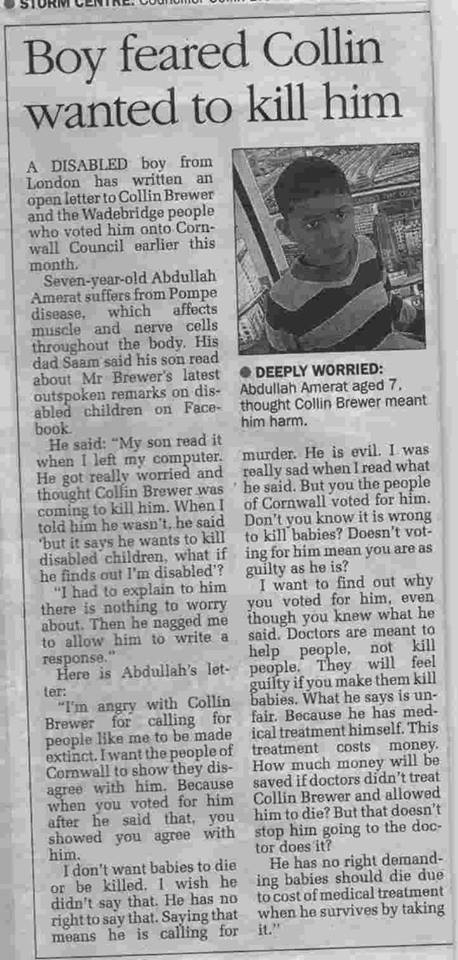


Crimewatch: Gary Hayward Attempted Murder

April 30, 2013

On the 2 October 2011, Gary Hayward was seriously assaulted in New Addington by a group of around 20 youths. Gary was defending his father and consequently has been left severely brain damaged, blind in one eye and unable to care for himself.

On the day of the attack, Gary’s Mother, Wendy, held a BBQ for family and friends at her home in New Addington, Croydon. Her ex-husband, John, left early and returned to his flat at approximately 18:15.

Later that evening, John went to a shop on Central Parade called Booze Bank to buy some beer. En route, he encountered some youths in the alleyway between the leisure centre and library and was subjected to verbal abuse. After an exchange with them, John was followed to the shop and at around 19:00 he telephoned his ex-wife Wendy to say he was scared about going home by himself. Wendy sent her one son up to the parade in his car to collect John and take him home, which he did. Wendy also contacted her other son Gary Hayward by telephone to tell him what was going on. As Gary was in close proximity he also went to meet his father at his flat. Wendy too made her way to John’s flat in her car with her daughter and her boyfriend.

The family gathered outside John’s flat and Gary spotted some youths nearby that John confirmed may have been involved. With this, Gary went after the group through the alleyway towards the parade. John followed on foot but was not very fast due to a leg injury. The other family members got into their vehicles to drive around and join them.

At the parade, John saw Gary in a confrontation with a group of youths, where Gary was pulled to the ground and kicked. As John approached, the group ran away and Gary, despite John trying to stop him, ran after them towards the leisure centre car park. John followed as he best he could, even more youths had approached armed with pieces of wood. At this point, John saw Gary on the floor being hit around the head and beaten. As he got to the car park, John was also hit and fell to the floor. It’s believed around 20 youths may have been involved in the attack. The other family members did not witness this incident.

The youths ran off prior to police arrival. Gary was found with severe head trauma and John also had head injuries that required hospital treatment.

It was established that John had been the victim of intimidating and anti-social behaviour directed at him by local youths for a number of months leading up to this incident. However, he has not been able to identify the youths involved.

Gary is now in a specialist rehabilitation unit.

Appeal points

  • £20,000 reward to the arrest, charge and prosecution of the person or persons responsible
  • A silver 12 Megapixel Fuji camera was subsequently stolen during the attack – what happened to it?
  • Lots of witnesses who have not yet come forward – police are keen to trace these witnesses and are appealing for them to come forward
  • Need the community to come out and support Gary’s family
  • John had been targeted in the past with intimidating and anti-social behaviour towards him. Do you have any information that links this attack?
  • All information suggests persons responsible are local – do you know of anyone involved?

Contact the programme about this case

Crimewatch: Help Find Martina McGrath

April 30, 2013

Police want to speak to 22-year-old Martina McGrath in connection with an assault on a man with Asperger’s syndrome who was attacked with a hammer, a wooden stick and an extendible police baton.

McGrath, who is from the travelling community and has links to Essex and Croydon and to Waterford in Ireland. She has an Irish accent.

Anyone with any information about Martina McGrath should contact Essex Police on 0300 333 44 44 or call Crimestoppers in confidence on 0800 555 111.

Contact the programme about this case

High Court Rejects Barnet ‘easyCouncil’ Legal Challenge

April 29, 2013


Campaigners against Barnet council’s radical plan to outsource hundreds of millions of pounds worth of services, dubbed easyCouncil, are to take their case to the appeal court after a judge ruled their objection to a £320m contract had come too late.

Lord Justice Underhill, sitting in the high court, ruled against a severely disabled Barnet resident, Maria Nash, who challenged the north London council’s proposed contract with Capita on the basis that it failed to consult before outsourcing. She also said it had failed to comply with the public sector equality duty and the council had breached its fiduciary duty by failing to properly consider other options. He said the appeal was out of time, but found that the council had failed to consult residents.

Lawyers for Nash, whose case was backed by an alliance of concerned residents, trade unions and activist bloggers, had accused the Conservative-controlled council of creating a “smokescreen” around its alleged failure to consult residents. Counsel for Nash had told the court: “There is nothing here that comes to an even measurable distance of compliant consultation on letting a contract of this kind.”

In a verdict handed down on Monday, Underhill found the challenge had come too late after Barnet said it would outsource services in June 2011. But he found the “council never set out to consult about its outsourcing”. He continued: “The representatives should have been given the opportunity to express views or concerns about outsourcing the functions or services in question.”

Barnet is preparing to outsource services via two contracts which together amount to around £600m over 10 years, accounting for 15.5% of the council’s budget. It is one of the most radical experiments in privatisation of local authority functions in the face of deep cuts. Under the contracts, 790 full-time jobs would be transferred to the private sector. The customer services and back-office contract with Capita was due to come into effect in April, but has now been delayed pending the appeal. It is set to be followed later this year by a second £290m contract to outsource planning, cemeteries, highways, environmental health and other services.

The leader of Barnet council, Richard Cornelius, celebrated “a clear and complete victory for the council”.

“It is very good news for Barnet residents, Barnet taxpayers and, in particular, for anyone who relies on Barnet council services,” he said. “We can now get on with making budget savings of £12m a year in our back-office costs while investing in service improvements and protecting our frontline services. The alternative cuts to frontline services we would have had to make would have been horrendous.”

Cornelius urged Nash not to appeal.

“This judicial review has already cost the council in excess of £300,000 and I would rather be spending that money on services to residents,” he said. “The applicant’s legal costs are also being met from the public purse as she is legally aided.”

“We are going to appeal,” said Gerald Shamash, solicitor for Nash. “There is a very damning finding in the judgment over the failure of Barnet to consult. He found against them in relation to that and he found against us in relation to delay.”

He said the challenge would focus on whether the case was really out of time since the final decision to award the contract to Capita only came on 6 December 2012.

Marie Fleming Loses Right-To-Die Appeal

April 29, 2013

A terminally ill Irish woman has lost the latest legal challenge in her fight to win the right to take her own life, with the assistance of her partner.

Marie Fleming, who has multiple sclerosis, is unable to end her own life and wants her partner to help her die without risk of prosecution.

She lost her case at the High Court in Dublin in January, but then launched an appeal.

On Monday, the Irish Supreme Court rejected her appeal.

‘Tragic case’

It ruled that while the Irish constitution guarantees a right to life there is no corresponding right to die with the help of others.

Delivering the judgement, Chief Justice Susan Denham described it as a “very tragic case”.

In the Republic, suicide was decriminalised in 1993.

However, assisting another person to kill themselves can lead to a jail sentence of up to 14 years.

Ms Fleming, a former lecturer from County Wicklow, was diagnosed with multiple sclerosis in 1986.

She is cared for by her partner, Tom Curran, and has two adult children.

The four-day appeal hearing was told that she is in the final stages of MS, can only move her head, cannot swallow and lives in constant pain.

Her legal team argued that the ban on assisted suicide is discriminatory towards severely disabled people.

Lawyers for Ms Fleming told the court that she should be given the same right to die by suicide as an able-bodied person.

She took the case against the state, the Irish attorney general and the director of public prosecutions (DPP).

Ms Fleming’s legal team claimed the Section 2.2 of the Criminal Law (Suicide) Act, which renders it an offence to aide, abet, counsel or procure the suicide of another, was unconstitutional.

They argued that it breached her personal autonomy rights under the Irish constitution and the European convention on human rights.

Nottingham City Council Admits Significant Child Neglect Failures In Learning Difficulty Mother Case

April 29, 2013

Any comments, readers?

Two children suffered “significant neglect” due to the failings of Nottingham City Council, the Local Government Ombudsman has ruled.

It said the council wanted to keep the children, now six and eight, with their mother, who had learning difficulties, resisting a move to their grandmother.

One child suffered facial injuries and both were found to be unwashed.

The council admitted it had tried to work with the mother for too long but said it had since changed its policies.

Compensation recommended

The authority became involved in 2005 when the first child was born.

The report found the mother, known as Miss M, had been at best indifferent and at worst hostile to the council’s support,

It also highlighted the fact officials had resisted attempts by the grandmother to care for the children, even challenging independent assessments of her as a suitable carer.

City councillor David Mellen said: “This is a case where we persevered for too long with efforts to help a mother remain as the carer of her children.

“However, there were periods of improvements in care by the mother which were identified by all the key agencies involved.”

A court granted the grandmother special guardianship in July 2010. Her complaint prompted the review.

The ombudsman recommended compensation of £5,000 each to the children and £1,000 to grandmother for the distress suffered.

The council said it was committed to maintaining high standards for the care and safeguarding of children and regretted any upset caused to the family.

MS Patients Missing Out On Drugs Finds Society Study

April 29, 2013

Only 40% of people eligible for drugs to combat multiple sclerosis in the UK are actually taking them, says a report from the MS Society.


A survey of more than 10,000 adults with MS showed that many were missing out on the seven licensed medicines approved for use.


The charity said a lack of information and access to specialists was to blame.


It is calling for the government to provide a personalised care plan to every person with MS.


The MS Society’s survey and accompanying report showed that there were differences in access to disease-modifying treatments (DMTs) across the four nations of the UK.


These are medicines that can reduce the frequency and severity of MS attacks, and in some cases can slow the progression of the disabling condition.


Someone living in Northern Ireland with MS was twice as likely to be taking a DMT (68%) than someone with the condition in Wales (30%), for example.


Access to treatment in Scotland and England was only a little higher at 36% and 40%.


In Europe, additional research shows that only Poland and Romania have a smaller proportion of people with MS taking licensed medicines.

Routine assessment

The charity’s report said that being well informed about the medicines available was crucial.


Those who felt they had enough information about medicines were 32% more likely to be taking a DMT, the survey found, and those with access to a specialist MS nurse or neurologist were more than twice as likely to be taking the appropriate drugs.


Northern Ireland is the only place in the UK where most people with MS are routinely invited every six months to see a neurologist or MS nurse for a review.


This means that people with MS are constantly having their treatment options assessed, the report says.


As a result, they are more likely to get the information they need and discuss issues such as side-effects.


Yet this may not be the only solution. Forty-one per cent of those who said they did have enough information about drug treatments still did not take a disease-modifying treatment.


The report concluded: “This could be due to barriers to accessing medicines; because individuals make an informed decision not to take them; or because they don’t know what information is out there that they could have access to, such as around new treatments or new evidence of efficacy.”

New policy

Nick Rijke, director for policy and research at the MS Society, said people with multiple sclerosis were facing a lottery.


“These findings worryingly suggest that the likelihood of someone receiving a life-changing treatment is often based on luck – like where they live or how helpful their healthcare professional is – rather than their genuine clinical need.


“When it comes to prescription rates, the UK ranks 25th out of 27 European countries. Given the relative wealth of the UK this is simply unacceptable.”


The MS Society is now calling on all four governments in the UK to ensure every person with MS has a personalised treatment, care and support plan, with two comprehensive reviews each year.


Ed Holloway, head of care and services research at the MS Society, said that because some MS drugs were costly, they were often not offered when they should be because of restricted NHS budgets.

‘Speak to doctor’

A spokesman for NHS England, which has recently taken on the commissioning of treatment for MS from primary care trusts, said a new policy from 1 April would mean that people across England would have the same access to treatment.


“By making decisions nationally about specialist treatments, we are confident that patients will now be able to receive the treatment they need, irrespective of where they live.


“As with all policies, we will continue to collect and review the outcome of treatments for patients and consider them when our policy is reviewed.


“If a patient has concerns about the treatment they are receiving we would urge them to speak to their GP or consultant.”

UK Appointed Disabilities & Claimants Anti Discrimination Task Force For ATOS Public Inquiry

April 29, 2013

I was sent a link to their Facebook page yesterday and thought UK readers might be interested to know this is out there.

On the authority of the Worldwide Chair and within the Constitution of The International Human Rights Commission a task force has been set up to collate information, monitor, investigate and press for public enquiry and Justice.

Under the leadership of and in conjunction with The sub commission International Human Rights Commission for Children, Youth and Women’s Issues under The Presidency of His Lordship, Sir Leslie R Angell, High Commissioner of the IHRC and Ambassador to The United Kingdom of Great Britain and Northern Ireland.

There is much concern about assessments orchestrated by DWP and made by ATOS whereby claimants benefits have been refused, cut, refused or incorrect. In many cases Courts of Coroners Enquiry have found that people may have taken their own lives following assessments and rulings by ATOS assessors.

Allegations have been made that assessments have been unfair, incorrectly carried out and over 34% have been overturned on appeal with many claimants just not bothering to go through the unacceptable protocols and red tape that the appeals process entails.

This task force as authorised by The world wide chair after some months of consideration is to work with pressure groups and other organisations whom are working independently, it is therefore the wish of this organisation to allow a cohesive enjoining together to call for public enquiries and policy/protocol changes to ensure that people’s rights under Human Rights legislation are enforced and maintained.

Seven Olivier Awards For Curious Incident

April 29, 2013

Readers, I think the stage might have found its Left Foot!

The stage version of hit children’s novel The Curious Incident Of The Dog In The Night Time, in which the lead character is a teenage boy with Asperger’s Syndrome, tonight won no less than seven Olivier Awards!

These were:

  • Best Actor for Luke Treadaway
  • Best Actress In A Supporting Role for Nicola Walker
  • Vest Lighting Design
  • Best Sound Design
  • Best Set Design
  • Best Director
  • Best New Play

Same Difference sincerely congratulates all involved.

If you would like to read about the other award winners, you can do so here.

Reporting ‘Mate Crime’

April 29, 2013

Lyndsey Rolston thought the group of children who lived near her West Midlands home were her friends.


But things changed.


The children, as young as four, started climbing up a tree near the Walsall home of Lyndsey, who has severe learning disabilities, shouting abuse at her and taking photos on mobile phones. They also smashed her collection of garden ornaments.


“I felt devastated,” said 39-year-old Lyndsey’s mother Patricia, who is also disabled.


“Lyndsey got so upset by it. She can’t talk, and she would sit quietly on the sofa.


“It was just because she was different that they picked on her.”


Across the West Midlands, there were 2,849 incidents catalogued as “hate crimes” in 2011-12.


Out of those 2,531 were connected to race, 52 to religion, 46 to disability and 10 to transgender people.


Police here now unusually want to see some crime statistics rise – by encouraging more people, particularly those with disabilities, to report bullying and anti-social behaviour.


In November, two sisters from Birmingham were jailed after plying a 22-year-old man with learning disabilities with cider and threatening him with a fake gun before forcing him to strip and sexually abusing him.


Nineteen-year-old Yasmine Notice and her 20-year-old sister Whitney filmed the abuse, which happened in February 2012 at their Nechells flat, on a mobile phone.


The photos were passed around friends, which led to them being caught by the police.

Difficult to detect’

“The sad thing is that it takes horrendous cases to happen to change things,” PC Gary Stack, West Midlands Police’s dedicated hate crime officer.


“This was an example of ‘mate crime’ – when the vulnerable person puts their faith in someone who then goes on to abuse them, and it makes it very difficult to detect.”‘


Last month, a national review into police, probation and the Crown Prosecution Service in England and Wales found disability hate crime was often “overlooked” and “under-reported”.


The report was prompted after Fiona Pilkington killed herself and her disabled daughter Francecca Hardwick in Leicestershire in 2007 after repeated complaints to police about harassment by youths.


Disability charity Mencap has estimated as many as nine out of 10 people with a learning disability has been a victim of a hate crime.


“The people we work with can often have suffered bullying for most of their lives,” said Jonathan Kean, from Creative Support, an organisation which provides social care services for people with learning disabilities, mental health issues and other needs.


“That’s what they’ve come to expect and they don’t see people making their lives a misery as unusual.


“That’s what’s so tragic.”


The Creative Support staff are some of the latest to be trained by PC Stack on how to report hate crime on behalf of those who do not want to themselves – or are unable to.


More than 20 “third-party reporting centres” are now either running – or planned – across Birmingham for communities targeted by abusers, including the Deaf Cultural Centre, Mencap, the Healthy Gay Life group, the Handsworth Sikh Community and the Birmingham Chinese Society.


The advisors are trained to look out for signs of abuse and tell police on behalf of the victims.


“A lot of people don’t know they can report crimes anonymously,” said PC Stack.


‘Spitting on him’


“And in many cases the victims just don’t want a lot of fuss.


“One man who was blind who went to the Action For Blind centre, and while there mentioned he’d had some problems with some kids pushing past him at a bus stop and spitting on him.


“He said he’d sorted the problem himself – by buying a raincoat.


“Someone at the centre told us and we put PCSOs on bus routes, and the local school put teachers at the bus stop in the evenings and the abuse stopped. Even now, he doesn’t know the police got involved.”


West Midlands Police’s success in improving the reporting of hate crime is now being copied by other forces, including Sussex Police who are now setting up similar contact centres.


However, officers say there is still a lot of work to be done.


“Many crimes – particularly targeting disabled people and also transgender people – still are under-reported,” said PC Stack.


“Some of that is through distrust of the police, the fact they might not even realise they’re being abused or they don’t think anything can be done.


“When you speak to a transgender person, they will tell you they can experience five or six incidents a day – they’re unlikely to report each of those.”


For Mrs Rolston, reporting what happened to her daughter was the best thing she could have done.


“Lyndsey was put on the ‘vulnerable persons list’, which meant if there were any problems again they’d treat it as an emergency,” she said.


“The police told the council, which cut back the tree, and the kids’ parents were talked to.


“It improved things so much for us – I hope everyone gets the same opportunities.”

Dear Facebook, Don’t You Like Blind People?

April 28, 2013

This was recently posted on the Same Difference Facebook page. I think it should go viral!

Dear Facebook

Thank you for your service. As a severely sight impaired user, your Service has provided me with a window to the world and the ability to maintain contact with my friends, peers and current event taking place around the globe.

However

Do you not like blind people?

I use an iPhone, this is because it has many functions that allow me to continue using a mobile. Android devices, whilst I am sure have similar functions are not as user friendly.

Many of the apps I use allow me to to use the speech function on the device to “read” there web pages.
It’s a simple thing. Highlight the text and the phone does the rest in a very convincing and soothing voice. In fact my interaction with many web pages, BBC news App, Twitter, Google browser etc allows me to use the web whilst I am out and about (mainly, hospitals, Doctors and clinic’s).
But, for some reason, known only to you, the Facebook app has now stopped this function.

So do you not like blind people?

We are humans, we do what most people do, we communicate, we are part of society but YOU seem to think that Facebook is not for us.

First it was disabling sideways typing. This helped us because the keyboard was made bigger. We got around this by typing our status updates in notes. I use 54 font so I can see better (you do not allow the font to be changed so its just as well) then we paste it in… Sorted

Then you disabled the copy function on status’s. This meant we could no longer read out the status updates of others. We got around that by taking a screenshot of the screen, opening photo stream and then blowing up the status update… I laugh at some of my friends updates, they are great.

NOW by disabling the standard copy function in status replies, replacing it with a copy delete slide menu, you have taken away the last usable speech function from the app.

Thanks

Taking screen shots of every update is just not practical.

Therefore my witty and insightful updates, my moans and groans, my comments on others and the general use of the app, that prevents me withdrawing from society fully has been withdrawn. This due to me not just being blind but also an MS sufferer and due to my body eating it self, I don’t walk so good.

So cool beans and kudos to you. Facebook “A social utility that connects people with friends and others who work, study and live around them. People use Facebook to keep up with friends”(your words)
Unless if you are blind, or severely sight impaired and use a smart devise it seems.

So back to my point.

Do you generally just not like us?

Or is it a commercial consideration that will exclude the blind, severely sight impaired, due to us not being able to see Adverts on the screen????.

Are you punishing us for not being able to see them? (ignoring the fact they appear anyway and you are fulfilling your advertisement requirement)

Or

Did nobody think for one second that this would be an issue?????

Yours

Typing on a big button keyboard, in huge font from my PC that, unless I can drag around attached to a mobile generator, with constant WiFi access (see the MS bit about not walking so good) is stuck in my living room for ever more as I will be if I wish to use your service.

Peter Springarse Strudwick

Steve Topley Has Been Granted Bail!

April 26, 2013

Very good news, readers!

BoneBridge Ear Created For Deaf Man Brian Hogg

April 26, 2013

A piece of rib and a bone conduction implant have been used in a pioneering operation to treat an Edinburgh man’s hereditary deafness.


Brian Hogg, 29, was fitted with an implant called a Bonebridge and given the new ear by NHS Lothian surgeons.


Mr Hogg is the first person in the UK to have the procedure.


NHS Lothian said the specialist implant operation was carried out in December 2012 at the Lauriston Building in Edinburgh.

Ear drum

The Bonebridge device is fitted in the ear and is used when a patient is unable to have a conventional external hearing aid fitted.


Alex Bennett, an NHS Lothian ear, nose and throat consultant performed the procedure.


Mr Bennett said: “This is a truly innovative procedure and I’m sure the device will make a significant difference to Brian and many other patients like him.


“The Bonebridge implant is intended to improve hearing by replicating the actions of the ear drum.


“A discreet audio processor, which is attached to the patient’s head, picks up sound waves which are then amplified by the implant and passed to the inner ear through the skull bone.


“These sound waves are then interpreted by the brain as sound.”


Mr Hogg was born with Treacher Collins Syndrome, meaning he could not wear conventional hearing aids as they are styled to fit in and around the top and middle of the ear.


Mr Hogg said: “After the new implant was been fitted I’ve noticed a huge difference in the range of sounds I can hear.


“The sound quality is much better and I can hear noises at a distance now, which my previous device didn’t pick up.


“The Bonebridge implant is so light, it’s practically weightless. It’s tailored to most closely match my normal hearing range.


“When you think about how far mobile phone technology has come in the last 10 years, there have been similar advances in hearing aids.


“The new implant is a really big step forward in technology and I’m very grateful to the team of consultants for fitting the implant for me.”


Dr Ingeborg Hochmair, managing director of MED-EL, which designed the implant, said: “Our innovative development of the Bonebridge will considerably improve the lives of patients.


“We consider this new development a great success. The Bonebridge is the culmination of decades of experience gathered in the development of hearing implant solutions.”

Free Steve Topley!

April 25, 2013

Steve Topley, 49, has now been held in police custody in Nottingham for two weeks after comments he allegedly made during his ATOS assessment. His family insist he is innocent. They have not been allowed to visit him in custody and are concerned that he is not being administered correct medication.

There is a demonstration in support of Steve tomorrow at 9.30am outside Nottingham Crown Court. Please spread the word.

Boston Marathon Dancer ‘Will Dance Again’ Despite Left Foot Amputation

April 25, 2013

A ballroom dancer who lost her left foot in the Boston Marathon bombings has vowed that she will dance again.

Adrianne Haslet had been running in the race when a bomb exploded right next to her.

Ms Haslet said she felt there was something wrong with her foot and looked down to see ”blood everywhere”.

Despite her injuries she said she still “has so much left” and is determined to run the marathon next year.

MP’s Son’s Tweet About Harvey Price Causes Fury

April 25, 2013

THE son of an MP has been slammed over a sick gag involving Katie Price’s disabled son Harvey.


Ian Lavery Jnr, 24, sent a tweet describing Harvey as a “vegetable” while making a crude reference to his mother.


Last night Sun columnist Katie, 34, blasted Lavery Jnr and his MP dad Ian Lavery, who is patron of brain injury charity Headway.


She said: “This makes me sick to my stomach. Not just that someone could be so vile as to think such a thing, but also could think it clever to repeat to the world on Twitter?


“What kind of father, what kind of MP, is Ian Lavery? He’s the patron of Headway — yet he brings his son up to think and act like this?


“These disgusting comments aimed at Harvey all too often get aimed at other disabled children and the poor souls his father’s charity rightly campaigns for. This is just as much a hate crime as racism and should be treated as such.”


Mr Lavery, 50, Labour MP for Wansbeck, said: “I’m absolutely appalled by it but I cannot police my kids and I have no intention to. They have to learn how to behave in the big wide world like I did.”


Lavery Jnr, from Newcastle, reacted angrily when initially confronted on Twitter. He said: “Does no f***** listen? Yes it was a sick joke that’s why it got deleted! Obviously some t*** managed to take a pic before it was deleted. Stop going on about it for f*** sake!”


But last night he said he was “ashamed” and apologised “unreservedly” to Katie, adding: “I feel so stupid. I didn’t actually find it funny.”


Harvey, ten, was born with septo-optic dysplasia, causing blindness and growth hormone deficiency.


He also suffers from Prader-Willi syndrome, a rare genetic disorder which can lead to obesity and diabetes.


Sun columnist Frankie Boyle was cautioned by Ofcom in 2010 over a joke about Harvey on C4’s Tramadol Nights.

Fire Sprinkler Call For London Care Homes

April 25, 2013

There are more than ten fires a week in the London’s care homes and sheltered accommodation, the London Fire Brigade (LFB) has revealed.

Last year there were 540 fires in such homes – with two people killed and 26 injured as a result.

The LFB says reducing the number is a top priority and warned too many homes are not being fitted with sprinklers.

The brigade said the vast majority of care homes in the capital do not have the devices.

Deputy Commissioner Rita Dexter said: “Older people, people with mental health problems and those with mobility issues are the group most at risk from fire.

“We are concerned by the number of vulnerable people like this who are still harmed or killed by fire in places where they should be safe.

“That’s why we want to see all residential care homes fitted with sprinklers.”

The latest figures from the Care Quality Commission show there are about 900 care homes for older people and other vulnerable groups in London.

In 2011 BBC London revealed how dozens of care homes were ordered to improve after failing to achieve even basic fire safety standards.

The MMR Scare: The Story Behind The Story

April 25, 2013

Last week the Daily Mail reported that 2 million children risked catching measles as a result of the MMR scare. It is a scare that the paper knows all about, having been in the forefront of running a series of articles over the years that urged parents to beware of the multiple vaccination and its supposed links to autism.

The Mail’s headlines speak for themselves: “MMR killed my daughter”; “MMR fears gain support”; “New evidence ‘shows MMR link to autism'”; “MMR safe? Baloney. This is one scandal that’s getting worse”; “Scientists fear MMR link to autism”; “Why I wouldn’t give my baby the MMR jab”. This is but a small proportion of the negative articles published by the paper.

But the Mail, though the most forceful and repetitive of newspapers, was certainly not alone in the media in making too much of the opinions advanced in 1998 by the now discredited Andrew Wakefield, the doctor whose research led to fears about a link with autism.

Editors were able to have a sense of confidence about his credibility because his views were based on a research paper (now retracted) carried in the Lancet, one of the most respected of the medical journals that publish peer-reviewed articles.

There were plenty of anti-MMR stories in the Daily Express, the Sun, the Daily Telegraph and elsewhere, including regional papers, such as the South Wales Evening Post, which is based in Swansea, where the latest measles outbreak has occurred.

Part of the reason was a conviction that the medical authorities, which were advocating MMR, might be wrong. And those authorities were, of course, linked to the government. It was abundantly clear that the rightwing press’s championing of Wakefield was based on its hostility towards Tony Blair’s Labour government. There was an unsavoury attempt to press the prime minister into saying whether or not he had allowed his son, Leo, to have the vaccine, which he refused to do, arguing that it was a private family matter.

A 2003 paper by the Economic and Social Research Council found that, in the period between January and September 2002, 32% of all the stories about the MMR scare mentioned Leo Blair.

It was not until 2004, following an investigation by reporter Brian Deer in the Sunday Times, that the Lancet admitted Wakefield’s research was flawed.

Even so, newspapers continued to give his views credence by carrying stories suggesting there was a link between the MMR vaccine and autism. It’s fair to say that the readers of all newspapers, including those who read the Guardian, were exercised by the media mood music.

In July 2007, when Wakefield was facing a General Medical Council hearing, the Observer ran an article headlined: “New health fears over big surge in autism”. It also carried an interview with Wakefield – referring to him as the doctor at the heart of the autism row – in which he maintained he had “told the truth”.

Two weeks ago, the Independent ran a front-page story headlined: “MMR scare doctor: this outbreak proves I was right”. In response to a storm of protest, its editor, Chris Blackhurst, said the paper should have made clear its contempt for Wakefield. It showed that the public had, at last, turned against the doctor – and the media that give him disproportionate coverage.

Patrick Kane Gets Mobile App-Controlled Bionic Arm

April 24, 2013

Remember him, readers? What a nice update this is!

A teenager has become the first person in the UK to be fitted with a bionic arm which can be controlled by a mobile phone app.

Patrick Kane, 16, from London, who lost his left arm and right leg to meningitis as a baby, said the new i-limb was “priceless”.


The biosim app gives users of i-limb 24 pre-programmed hand positions.


Users can control the movements by choosing hand positions using the app, or by contracting muscles.


Patrick has been using a previous version of i-limb, developed by Touch Bionics, since 2010. He said the new version provided more movement in the thumb.


Visiting the firm’s headquarters in Livingston, West Lothian, Patrick said: “Previously, I would have to say ‘excuse me, would you mind if you tied my shoe lace for me?’


“I am still very good if I am not wearing the arm but it gives me that extra level and now I can really do anything that I want with it.


“It will allow me to do things that I could do previously but quicker, more efficiently and more fluidly.”


The i-limb is placed over his arm and two sensors, located over muscles, read the contraction of those muscles. This allows Patrick to control the movement of the arm and the thumb, which previously had to be moved manually by the other arm.


The “powered rotation” of the thumb allows it to turn automatically when directed by the phone app or muscle contraction.


Patrick said he “couldn’t stand” having to wear a prosthetic arm but the bionic arm was different.


“If anything I love talking about it to people. It stands out and I don’t want it to blend in because I’m quite proud of it.”


Ian Stevens, chief executive of Touch Bionics, said the technology gave users extra “unparalleled dexterity and control”.


He added that it enabled wearers to “more easily perform activities of daily living and thus increase their quality of life”.

Five Disabled People Lose ILF Court Challenge

April 24, 2013

Five disabled people have lost their High Court challenge over the government’s decision to abolish the Independent Living Fund (ILF).


Their lawyers had asked the court to declare “unlawful” the consultation process that led to the proposed axing of the £320m fund.


The five are among 19,000 people who receive money from the ILF, which the government plans to scrap in 2015.


The scheme aids independent living and the average pay-out is £300 a week.


The government has said that councils, which administer most social care, will take over funding this help.


On Wednesday, a judge dismissed the application, saying the consultation process had been lawful.


The claimants feared that disabled people could be forced out of independent living arrangements and into residential care, or trapped at home by the fund’s closure.


At a hearing in March, they had argued that there have not been clear reasons given for closing the fund; the consultation featured inadequate information on the differences between the fund and local authority assessment and provision; and there had not been proper assessment of the impact of the change on disabled people’s ability to live and work independently.


The Department for Work and Pensions has previously said that help for disabled people has been fundamentally changed by personal budgets, intended to give recipients more control, and that it makes sense to have a single system administered by local authorities.


The ILF was established in 1988, but the government decided in 2010 that it had become “no longer appropriate or sustainable” to keep running the scheme outside the mainstream social care system.


The fund closed to new applicants soon afterwards.


One of the five applicants, Gabriel Pepper, from Walthamstow, east London, has accused the government of imposing “appalling cuts” which were “a vicious attack on the disabled”.


The claimants have said the money enables them to employ personal assistants to help them with their personal needs and to “go out and have a full life”.


Richard Hawkes, chief executive of the disability charity Scope, said: “Expecting councils to pick up the tab when they are facing the biggest funding cuts in history is an impossible ask.”


“Not getting the support to wash, dress and leave your home is unacceptable.”

Paralympic Opening Ceremony Dancer Dave Toole Hits New Heights

April 24, 2013

Dancer and actor Dave Toole, who lost his legs as a child, had a starring role in the London 2012 Paralympic Games Opening Ceremony. Now his story is being told in his home city of Leeds.


If you were one of the 146 million people who watched the London 2012 Paralympics Opening Ceremony, you may remember Dave Toole.


He performed a haunting solo dance on his arms before taking off and taking part in an “aerial ballet” high above the stadium.


“I had to look at the girl who played Miranda, who was coming up the other way,” he recalls. “We’d been told, ‘Don’t smile, don’t react’.


“We just wanted to laugh because it was the most insane thing we’ve ever done. But we couldn’t because the world’s watching.”

‘Crazy’ moments

Eleven million people out of the global TV audience of 146 million were in the UK, giving Channel 4 its highest ratings for a decade. And then there were the 80,000 in the stadium itself.


Toole has been a professional dancer for 20 years, but the Paralympics were on a different scale to anything he had done before.


“You have these moments – you’re waiting to go on and you’ve got Sir Ian McKellen on one side and Stephen Hawking on the other, and you go, this is just crazy,” he says.


The 48-year-old was born with sacral agenesis, meaning his legs did not develop properly, so were amputated when he was 18 months old.


After university, he spent nine years working in a post office in his home city of Leeds. “It was basically sitting at a desk all day typing postal codes as letters flew by you. Very boring.”


But his life changed when a friend, knowing he was “a bit of a show-off”, passed him a leaflet for a dance workshop.


He went along and “just did things that would seem natural to me”.


“I got around on my hands at home, standing on one hand to reach up to turn lights on and off and things, so I used things like that in performing,” he says.


“It looked amazing, but to me it was no big deal. But it looked good. Things like that worked in my favour and I never questioned it because I seemed to be good at something.”


Relieved to escape the routine of the Post Office, Toole jumped at the chance to join the Candoco dance company and describes the seven years he spent touring the world with them as “like being in a rock group”.


He became known for routines in which he would move, swing and balance on his arms, often playfully exploiting his stature rather than being restricted by it.


“People have said they’ve watched me and it’s like I’m weightless and I can fly,” he says. “A lot of dancers aim for that and don’t necessarily get it. I don’t necessarily aim for it but it’s just there in the way I move. It’s just what I do.


“That’s the way I’m built with my centre of gravity. Everything works in my favour. Every dancer brings something to the table. I just bring something different.”


Toole has also worked as an actor, and his acting is to the fore in his new show. He tells the story of 1930s US performer Johnny Eck – who also lost his legs through sacral agenesis – while Toole’s own story is told in parallel.


The Johnny Eck and Dave Toole Show is being staged at Leeds Royal Armouries by the Slung Low theatre company as part of the West Yorkshire Playhouse’s annual experimental Transform season.


For Eck, the only place he could use his natural performing talent was in a freak show. That led to a part in 1932 cult classic film Freaks and a stint wearing bird costumes in Tarzan films.


“He came before any of us and he opened the door for the other disabled people who are out and about and performing now, so he deserves the respect,” Toole says.


“So the show is about me trying to tell his story and other people trying to tell my story, because I don’t blow my trumpet about the things I’ve done.”


Toole does things other dancers cannot – but is he comfortable with the fact he attracts attention precisely because he is different?


“After 20 years, anybody who actually knows who I am and does come to a performance, they’ve already gone past all that,” he replies. “They know what they’re getting.


“In the early days, certainly with the Candoco stuff, people were coming because it was billed as integrated dance – disability and non-disabled – so we had to accept there was a novelty or curiosity value.


“But after about a year or so, people started looking at the work rather than the make-up of the company. So we were treated as a serious company.


“That’s pretty much what any disabled artist wants. We just want to be seen as an artist, not necessarily a disabled artist. You can’t ignore the fact. I can’t ignore the fact that you wear glasses, but that’s not what you are.


“I am an actor or dancer who just happens to have a disability. That’s not important to me. If it’s important to other people there’s not a lot I can do about that.”


I ask whether he has every had any negative reactions to his performances.


“Not to my face,” he replies. “I’ve read some bizarre reviews. I’ve been described as all kinds of things. I’ve been described as moving like a squirrel on ball bearings. Which was interesting.


“And also ‘midget sized castle ghost’. Not necessarily negative. I find them quite amusing.


“If I ever write a biography I will call it Squirrel On Ball Bearings. That’s the working title.”


The Johnny Eck and Dave Toole Show is at the Royal Armouries, Leeds, until Saturday 27 April.

Samsung Working On Mind Control Tablet

April 24, 2013

Wow! First the Galaxy S4 and now this. Who needs Apple, readers?

Samsung is experimenting with a mind-controlled tablet that it hopes will shake up the way people interact with devices.


The South Korean firm, along with US researchers, has demonstrated how people can launch an application and make selections on a Galaxy tablet by concentrating on a blinking icon.


Users need to wear a cap studded with EEG-monitoring electrodes.


Such a device would be invaluable to people with mobility issues.

Playing music

Samsung’s lead researcher Insoo Kim told news website MIT Technology Review that thought control was a natural transition for interacting with devices.


“Several years ago, a small keypad was the only input modality to control the phone, but nowadays the user can use voice, touch, gesture and eye movement to control and interact with mobile devices.


“Adding more input modalities will provide us with more convenient and richer ways of interacting with mobile devices.”


Samsung’s Galaxy S4 smartphone already allows users to control the screen using their eyes. Using “smart pause” the user can pause a video by looking away from the screen while another feature uses eye movements to scroll through content.

Accuracy

The smartphone maker demonstrated a person using the mind-control system to select a music application and play and pause a classical music track.


Mr Kim said that the speed with which a user can control the tablet averaged about one selection every five seconds with an accuracy of 80% to 95%.


Researchers from Samsung’s Emerging Technology Lab worked with Roozbeh Jafari, an assistant professor of electrical engineering at the University of Texas.


Prof Jafari is also working on a way to make EEG headsets more user-friendly. Current caps have wet contact electrodes that require liquid to be placed between the scalp and the sensor.


He plans to develop a dry version that is also less intrusive.

Gauging mood

Technology companies are beginning to look at mind-controlled devices and there are already headsets on the market from firms such as NeuroSky and Emotiv that measure moods and allow users to interact with apps and games.


IBM is also experimenting with mind control headsets. Kevin Brown, a senior inventor at IBM’s emerging technology lab, has done a series of experiments with Emotiv headsets.


“Everyone finds it incredibly hard work on focus on controlling devices,” he said. One experiment in which he sent an email using mind control took 20 minutes.


“These things are nowhere near usable by the general population but these experiments give us a feeling for where the technology may take us, to help with things such as locked-in syndrome, for instance.”


He also envisages a future where mind-control headsets are used to gauge moods – so a focus group may use it to get a sense of how a crowd is responding to a politician, for example.

Autistic Pupil, 13, Left ‘Terrified’ By Scene From 15-Rated Film Psycho Shown In Music Lesson

April 23, 2013

Readers, I have to say, I agree with the mother here. Personally I wouldn’t want to show any scene from a 15-rated film to any 13 year old.

In this case, at least, permission could have been taken so that the mother could have explained the situation to her child in a way he would not have found distressing before he was put through this very negative experience.

I, like the mother, am pleased that the school will not use that scene in the lesson again. Surely the same concept can be explained to children just as clearly using any scene from an age-appropriate film, anyway.

A 13-year-old autistic boy was left traumatised after seeing the shower murder scene from the film Psycho at his school, says his mother.


Douglas Parr attends mainstream classes at Comberton Village College in Cambridgeshire.


His mother Kate Bourne said no consent was requested from parents for the 15-certificate film to be shown and the scene had made her son sick.


Mrs Bourne has accepted an apology from the teacher.


The school said it was “very regrettable” that the pupil found the film distressing and added it was “reviewing this particular scheme of work”.


The famous scene from the 1960 Hitchcock film shows Anthony Perkins, as the troubled Norman Bates, stabbing Janet Leigh through a shower curtain.

‘Sensitive to noises’

In the email to Mrs Bourne, the teacher said the clip had been used to illustrate how music was integral to the mood of a film – but it would not be used again.


Mrs Bourne said: “Dougie came flying through the door after school on Monday saying, ‘I had to watch the bloody shower scene from Psycho in music, today’.”


He then told her he had been sick.


“Dougie is quite sensitive to noises, so even if his teachers had just played the soundtrack it might have distressed him,” Mrs Bourne said.


Douglas’s teaching assistant had made a note in his school diary – which details work the pupils have done during the day – informing his mother that he had been upset by a film.


She had removed him from the classroom and he had been sick, the note said.


Mrs Bourne emailed the school, saying: “I cannot for the life of me understand why this has been shown.


“The film carries a certification of 15 years. Dougie is 13.

Teacher training

“This is the most violent and vicious scene in the entire film and is not a suitable scene to be shown to children in school.”


Mrs Bourne said Douglas was unable to eat and was terrified of going to bed on Monday night.


She added: “I’m happy to accept the teacher’s apology and delighted that he said he would change his teaching plan and not use the film again.


“But, basically it’s a certificate-15 film being shown to 13-year-olds and you should use your loaf and get consent before showing it.”


Peter Law, one of the school’s head teachers, said: “The scene was explained to pupils before being shown, and afterwards it was evaluated to look particularly at how the music was integral to the mood.


“This particular lesson is one that the teacher was first shown on a music teacher training course over a decade ago, and has been used many times with different classes.


“It is very regrettable that a pupil found this distressing, and a full apology and explanation has been given to the parent who highlighted this concern and will also be made to the pupil.


“We are now reviewing this particular scheme of work to ensure that we can continue to offer stimulating and challenging lessons without potentially causing upset to any pupils.”

VICTORY! Government Not Scrapping Section 3 Of Equality Act!

April 23, 2013

I’ve just seen this on Facebook:

Last week I asked anyone willing to write to their MP to ask them to vote against scrapping part of the Equality Act. I know many of you did, and thank you because yesterday the House of Lords voted again to keep in Section 3 – a really important summary of the general equality duty. In turn, the government announced they were no longer going to try to scrap it.

It’s a great victory and shows how important it is for so many of us across the county to get involved with these campaigns and stand up for our rights.

We won, readers. It is possible!

Kent Lacks Special School Places Finds Report

April 23, 2013

Children with special needs in Kent are not getting the necessary support, according to a new report from the county council.

The report said there was a lack of spaces in mainstream schools, children travelled “considerable distances” and there were assessment delays.

Kent County Council said an extra 650 places at special needs schools would be created over the next three years.

Kent Parents as Equal Partners said staff needed to have more training.

The Kent County Council draft strategy for children with special educational needs, said: “In many schools, pupils with special educational needs do not make good enough progress and there are wide achievement gaps between them and other learners.”

It said some children were being transported “considerable distances”, and it cost the council £17m each year to get 4,000 pupils to specialist schools and units.

‘Travel too far’

Patrick Leeson, director of education at Kent County Council, said: “We need to do more and we need to do better.

“It is an issue that children should not have to travel too far from home. There is a gap between the needs that we’ve got and the number of places.”

Of the 233,000 children in Kent schools, more than 6,500 are subject to a statement of special educational needs (SEN). Almost 23,000 children are registered disabled.

Kent County Council said more than 400 children went to independent and non-maintained schools because their needs could not be met by a local authority Kent school, with 40 going to schools outside the county.

The council runs 23 special schools and one academy.

‘Lack of resources’

Kent Parents as Equal Partners was set up in 2008 to help parents of children with special educational needs and disabilities.

Debs Aspland, who has three children with special educational needs, said: “I think there’s a total lack of resources, and there has been a total lack of consultation with parents and children and young people themselves.

“I don’t think there is the staff cover and I don’t think there is the appropriate staff training.”

Mr Leeson said more children were being diagnosed with autism and emotional and behavioural needs.

He said: “We need to make sure there are more staff in mainstream schools who are better trained to meet those needs in any school as well as special schools.”

There will be 650 additional spaces at special schools, over the next three years, with money saved on transport costs being spent on specialist education, he said.

“Many children who have to go to schools outside the county, some on a residential basis, will no longer have to do that,” he added.

Rethinking The Universal Wheelchair Icon Of Access And Disability

April 23, 2013

Readers, I’ve just been sent this Facebook page for a new campaign aiming to rethink the universal symbol of disability.

The campaign page says: The wheelchair icon is the worldwide, generic symbol of disability. HOWEVER, the overwhelming majority of icons depict the chair user in rigid, upright mode, compounding stereotypes of inactivity and dependency. It is time for this to change.

As we all know, this is the current universal symbol of access for disabled people:

wheelchair symbol original


And this is what the campaign would like to see it changed to:

wheelchair symbol new

An image of a wheelchair user trying to be more active, pushing the chair for themself.

What a good idea.

Your comments and suggestions very welcome below, on these symbols or any others you may have in mind.


Abby And Brittany: Joined For Life

April 23, 2013

Readers, you may remember that last year I first heard and wrote here about American conjoined twins, Abby and Brittany Hensel. At the time, their reality TV series was about to be shown in America.

Well, I’ve just found out that the three part series, UK title Abby And Brittany: Joined For Life,  is to be shown on BBC Three starting on Thursday at 9pm.

This is the BBC Three series website. I look forward to watching the programmes.

Singer Chrissy Amphlett Dies Aged 53

April 22, 2013

Chrissy Amphlett of Australian band the Divinyls, known for their hit I Touch Myself, has died aged 53.

Husband and former Divinyls drummer Charley Drayton said the singer died after battling breast cancer and multiple sclerosis.

Russell Crowe, who starred alongside Amphlett in a 1988 production of Blood Brothers in which she played his mother, has led tributes.

He said he will remember her “loving life and reciting verse”.

The Oscar-winning Australian actor said: “Dear Chrissie, the last time I saw you was in the Botanic Gardens… That’s how I’ll remember you, your boy, R.”

Amphlett founded the Divinyls in 1980 in Sydney and they went on to record five studio albums between 1982 and 1996, when they split.

I Touch Myself was released in 1991 and was a number one hit in their native Australia. It climbed the charts in Britain to number 10 and number four in the US Billboard Hot 100.

It was featured in the 1992 film Prelude to a Kiss and 1997’s Austin Powers: International Man of Mystery. Pop singer Pink covered the song in 2009 on her Funhouse Tour.

‘Passion and creativity’

“Chrissy’s light burns so very brightly,” said Drayton. “Hers was a life of passion and creativity; she always lived it to the fullest”.

The statement on the Australian Recording Industry Association’s (ARIA) website added: “With her force of character and vocal strength she paved the way for strong, sexy, outspoken women.”

Amphlett announced she had multiple sclerosis (MS) in 2007 and made public her battle with breast cancer in 2010.

She wrote on her Facebook page last March: “Unfortunately the last 18 months have been a real challenge for me, having breast cancer and MS and all the new places that will take you.

“My illnesses have really exhausted this little body of mine that I have thrown from one end of a stage to another and performed thousands of shows.”

“Chrissy expressed hope that her worldwide hit I Touch Myself would be utilized to remind all women to perform annual breast examinations,” said Drayton.

Claire Lomas Starts 400 Mile Bike Ride

April 22, 2013

She has my very best wishes, as always.

A paralysed athlete who became the first person to complete the London Marathon using a robotic suit has set off on a 400 mile bike ride.


Claire Lomas, from Melton Mowbray, lost the use of her legs after a horse riding accident in 2007.


But she completed the marathon course in 17 days on foot using the specially designed suit.


Mrs Lomas now hopes to raise £400,000 for spinal research charities hand cycling from Nottingham to London.


The disability rights campaigner and fundraiser said: “It will be a real test of strength and endurance but all for two very good causes.”


During the challenge she will also visit schools to raise awareness about the work of Spinal Research and the Nicholls Spinal Injury Foundation.


She said: “After the marathon I was invited to go to quite a few schools and I’ve just loved it – the kids have reacted so well, so I thought I’d combine it with my next challenge.”


Mrs Lomas set off from Nottingham Trent University earlier.

Whittington Hospital Admits ‘Failing’ Brain Abscess Man With Mental Age Of 7

April 22, 2013

A hospital has admitted it “failed” a man with learning difficulties who died from a brain abscess after he was sent home from hospital twice.

The family of Gerald Yilmaz, from north London, who had the mental age of seven, took him to Whittington Hospital in Islington when he complained of headaches and was confused.

On a third trip he was correctly diagnosed, but died a week later.

Following an inquest the coroner said it was likely that earlier treatment would have prevented his death.

BBC London’s Warren Nettleford spoke to Gerald’s brother Muhammed, Richard Jennings from the hospital and Beverley Dawkings from Mencap.

Poem Against ATOS

April 21, 2013

UK readers, you may have heard of the recent project Poets Against ATOS. I am a contributor, and my contribution was published today. If it interests you, you can read it here.

London Marathon 2013: Wheelchair Race Results

April 21, 2013

Men’s Wheelchair Race: Congratulations Kurt Fearnley!

Women’s Wheelchair Race: Congratulations Tatyana McFadden!

New Paralympic Races For London Marathon

April 21, 2013

I’m so pleased to read this. I hope I’ll be able to bring you the results of all these races once they are in.

If you enjoyed the Paralympics last summer and have been looking out for more para-sport action on your telly ever since, the wait is over.


The London Marathon is on BBC One early on Sunday morning and is going beyond what it did before in disability sport. Here I will attempt to explain some of the complexities you may have forgotten about in the intervening seven months.


We’re used to seeing the likes of British wheelchair racers David “Weirwolf” Weir and Shelly Woods in the much-loved road race but this year more disabled athletes – who aren’t in chairs – are joining the throng.


Amputees and visually impaired athletes will now also be running the 26-mile, 385-yard, route. Announced last September just after the summer games, the new parallel event is known as the IPC Athletics Marathon World Cup and is another example of a post-Paralympic legacy. Competitors will share the start gate with the wheelchair athletes but their starting pistol goes off three minutes later.


You may remember from the Paralympics that each athlete is classified by impairment to ensure fairness – a kind of codified handicapping system (we won’t bring up the irony if you don’t).


The limb-impaired athletes are male and from the T42-T46 classification range.


The visually impaired athletes are male and female with T11-T13 classifications.


There are no female limb-impaired athletes running on this occasion.


The British interest is Richard Whitehead. He’s a double-amputee “bladerunner” and you’ll have seen him at the London Paralympics where he won gold in the 200 metres. He’ll be wearing the number 111.


Though others will be eligible for a medal, Whitehead won’t be. He’s a T42 class and no one else of that class is running on Sunday. He’s doing it for the experience and to try and get his time down – his personal best is 2:42:52. At least he’ll definitely win his class.


Only T45, T46, T11 and T12 athletes will get bronze, silver or gold on Sunday because there are more than three racing in those classes. So bear that in mind when juggling the rest of the algebra on the day.


Whitehead will receive a standard participant’s medal.


The lack of women and the small field of athletes signposts the reason why this new race exists. The International Paralympic Committee (IPC) is keen to extend road racing opportunities and grow the number of marathon runners at future Games.


Other limb-impaired athletes are from countries such as Brazil, Canada, and Germany. There are no visually impaired athletes from the UK competing at the event.


It’s the first time that “standing up” athletes have run in a city marathon along with the now well-established wheelchair racers.

When and where

09:20 BST: Elite wheelchair athletes, men and women, begin their races at the blue starting point at Shooters Hill Road.


09:23 BST: IPC Athletics Marathon World Cup, men and women, visually impaired and limb-impaired begin their race at the blue starting point on Shooters Hill Road.


Watch BBC One from 08:30 BST on Sunday if you’re not there in person. Paralympian and London Marathon veteran Tanni Grey-Thompson is on the commentary team.

BBC Radio Presenter Val Armstrong Wins Tribunal Against DWP

April 20, 2013


A BBC radio star has beaten the Government in a tribunal after they wrongly claimed she was fit to work as she recovered from intensive chemotherapy and losing both breasts.

Val Armstrong, of Carlisle, Cumbria, challenged the Department For Work and Pensions (DWP) after they unfairly cut her benefit.

The 48-year-old was diagnosed with breast cancer for the second time in August 2010 and as a result underwent a double mastectomy.

In pain from chemotherapy, the BBC Cumbria presenter was off work sick for two years and also suffered from insomnia.

With an active sick note, the DWP allowed her to claim contribution based employment support allowance but put her into a work related activity group for people who they feel are able to return to work.

In March 2012 Val had to undergo a work capability assessment. During this medical she was awarded points according to her condition.

Val needed to accumulate 15 points to continue to receive employment support however she was awarded 0 points.

In April 2012 the DWP deemed her fit for work and were to stop her benefit unless she appealed.

Val who has worked for the BBC for 31 years, said: ‘My wage had stopped and my £96 a week was cut to £71 per week. I wasn’t getting much to start with and of course this caused financial stress.

‘I was lucky that I had put money aside and I had family who could help me financially but not everybody has family who can help them.

‘At a time when I was battling to try to get back to full health, hurdles and obstacles were put in my way which made it very difficult.’

In March 2012 Val had to undergo a work capability assessment. During this medical she was awarded points according to her condition.

Val needed to accumulate 15 points to continue to receive employment support however she was awarded 0 points.

In April 2012 the DWP then deemed her fit for work and were to stop her benefit unless she appealed.

Val teamed up with her Macmillan Cancer Support adviser to lodge one, as she knew she would struggle financially, especially as she cared for her mother.

Six months later she received a phone call from civil servants saying she still did not have enough points for the full benefit.

But after doing her homework Val soon found a regulation which stated that DWP hadn’t followed their own rules.

She then took the DWP to a tribunal on April 3, 2013 which she won, and will now receive a back payment, and has returned to work.

She said: ‘I am hoping that the people who genuinely feel that they have a case will find their voice and will take it all the way.

‘I’m not fazed by the system and I know some people are but I totally believe that if people are being treated wrongly they they should take it all the way.’

A DWP spokesperson said: ‘A decision on whether someone is well enough to work is taken after consideration of all the supporting medical evidence provided by the claimant, but everybody has the right to appeal a decision if they disagree with it’.

How Roger Ebert Inspired Scott Jordan Harris

April 20, 2013

And other disabled people. By Scott Jordan Harris for the BBC.

Roger Ebert, who died this month, was one of the world’s most respected film critics. He was also an inspirational figure for disabled people, says Scott Jordan Harris, a writer with ME.


Since he died on 4 April, so many articles have been written about the American film critic Roger Ebert, that even those who had not previously heard of him, now know he was the most famous and acclaimed film critic in the world. Many of the tributes say how admirably he faced the cancer that eventually killed him.


But far less attention has been given to the inspirational example he set for disabled people.


In 2006 – after repeated surgery which was only partly successful – Ebert lost the ability to speak and to eat. Suddenly, he had to be tube-fed. And, due to a series of attempts to reconstruct his jaw and throat using bone, skin and tissue taken from his arms, legs and back, he encountered painful mobility issues. But he kept working.


And in 2007, Forbes magazine declared Ebert “the most powerful pundit in America”. His reputation increased after he became disabled. To the Pulitzer Prize he earned in 1975 while able-bodied, he added a star on the Hollywood Walk of Fame three years after cancer first struck. And four years after he lost the power of speech, he won a Webby award as the internet’s “person of the year”. President Obama acknowledged his death.


As disabled people, we are often told we have the opportunity to participate in any profession. But seldom, if ever, are we told we can rise to its peak. Ebert proved you can be severely disabled and still be the best in the world at what you do. His profile grew after becoming disabled. He could no longer talk on television, which had made him a star, so he reached an even larger audience by speaking through his blog, Facebook and his beloved Twitter.


He embraced inventions that had the potential to ease his physical difficulties like feeding tubes which he quickly adapted to. In a blog post on the way to a man’s heart is through his stomach, he complained that his wife and nurse “squirrel me away in a private place” to feed him and said that “the less mystery we make about life and illness, the better”.


Alan Bennett has written that cancer made him a prolific writer. It had a similar effect on Ebert, who wrote more reviews in the final year of his career than in any of the previous 45.


I benefited directly from Ebert’s new take on disability. I’m a film critic but have to turn down the majority of jobs offered to me. My disabilities often leave me housebound, something which prospective employers cannot, or will not, accommodate.


When Ebert first endorsed my writing, he didn’t know I was disabled. When he found out, he never allowed me to be marginalised because of it. He published my work on his website, the most-read film critic’s site in the world, and treated me as an equal among its contributors.


His writing urged the world to behave as well towards disabled people as it does towards the able-bodied, and his actions demonstrated how that should be done.


Since his death, there have been many questions about the best way to commemorate Ebert’s life. The answers are simple. If you are a filmmaker, the best tribute is to make good movies. If you are a film critic, it is to write good movie reviews. If you are a film fan, it is to watch good movies.


And if, like me, you are disabled, the best tribute to Roger Ebert is to remember what he taught us – there is no adversity that cannot in some way be turned to our advantage. There is no prejudice that cannot, through openness and honesty, be disproved.


And there is no disability so severe it can force us to be silent.

Stanbridge Earls School: Headteacher Peter Trythall Resigns

April 19, 2013

The head teacher of a Hampshire school criticised for its handling of a pupil’s allegation that she was raped twice by students has resigned.


Peter Trythall has stepped down from Stanbridge Earls School for children with special needs, near Romsey.


The 191-pupil school was threatened with closure after an emergency inspection by education watchdog Ofsted uncovered serious failings.


An educational tribunal raised “grave concerns” about safeguarding.


The school was accused in January of failing to protect a pupil who claimed to have been raped twice by fellow students.


It was also found to have discriminated against the pupil, who cannot be identified for legal reasons, by excluding her following the allegation.

More investigations

In a joint statement following Mr Trythall’s resignation, the school’s governors said: “[The governors] acknowledge the difficulties he has faced during these last few months, and respect his decision which he has taken in the best interests of the school.


“They are indebted to him for the many things that he has achieved during his tenure of office.”


The school is to be managed by two deputy head teachers, supported by a specialist special educational needs consultant under the guidance of the chairman of governors until an interim head teacher is appointed.


Ofsted inspectors are to return in May.


Meanwhile regulator the Charity Commission is now conducting an inquiry into the school.


And Hampshire Constabulary is probing its officers’ handling of the pupil’s allegations and investigating whether offences were committed against other children attending the school.

Paul Lamb, 58, Takes Up Tony Nicklinson’s Right To Die Fight

April 18, 2013

A man paralysed from the neck down is taking up the legal challenge previously mounted by the late Tony Nicklinson for the right-to-die with the help of a doctor.


Paul Lamb, 58, from Leeds, has joined forces with the family of Mr Nicklinson, who died in August 2012, a week after his legal bid had failed.


Earlier this year, his widow Jane won permission to appeal against the High Court ruling in her own right.


Mr Lamb says he is “worn out, trapped”.


The two cases will now be heard in the Court of Appeal on 14 and 15 May.


In England and Wales, it is an offence to encourage or assist a suicide or a suicide attempt. The law is almost identical in Northern Ireland.


In Scotland there is no specific law on assisted suicide, although in theory someone could be prosecuted under homicide legislation.

‘Pointless life’

In March, the Court of Appeal granted an order allowing Mr Lamb, who has waived his right to anonymity, to take over Mr Nicklinson’s claims.


He is seeking a court declaration that any doctor who killed him would have a defence against such a charge.


The defence is known as “necessity”, meaning it was necessary for the doctor to act to stop intolerable suffering.


Mr Lamb, who was severely injured in a car accident in 1990, has no function in any of his limbs apart from a little movement in his right hand. He says he has been in pain for 23 years, needs 24-hour care and his life consists of “being fed and watered”.


In a statement to the courts, the father-of two said: “I am in pain every single hour of every single day. I have lived with these conditions for a lot of years and have given it my best shot.


“Now I feel worn out and I am genuinely fed up with my life. I feel I cannot and do not want to keep living. I feel trapped by the situation and have no way out.


“I spend my day sitting in my wheelchair. My daily routine is tedious, monotonous and pointless. I often go to bed at 5pm – such is the pointlessness of it all.


“I am fed up of going through the motions of life rather than living it. I feel enough is enough.”


Mr Lamb, who is divorced from his wife, said he was not depressed and just wanted to end his life in a dignified way, with his loved ones around him.

‘Family’s distress’

“I would like a doctor to help me die, without pain and suffering, preferably by a lethal injection with my family around me in my own home,” he said.


His solicitor Saimo Chahal said it was an “important moment” when he was allowed to join the proceedings started by the Nicklinsons.


“The fact the court has agreed to this is a recognition of the very wide significance of the issues and the public interest in having a decision on the right to die with dignity issue,” she said.


In January, Mrs Nicklinson won permission to continue her husband’s campaign and appeal against the High Court ruling that refused to grant him permission to seek medical assistance to die.


The Court of Appeal ruled she was able to pursue a claim in her own right under Article 8 (the right to respect for private and family life) of the European Convention on Human Rights.


She says she suffered pain, distress and injury as a result of her having to witness the distressing life that her husband suffered.


Mr Nicklinson was paralysed from the neck down after a stroke in 2005 and suffered from locked-in syndrome. After refusing food and fluids, the father-of-two died from pneumonia at his home in Melksham, Wiltshire, on 22 August 2012.


He was one of several people to challenge the current laws on assisted dying. Diane Pretty, who was terminally ill with motor neurone disease and died in 2002, wanted the courts to give her husband immunity from prosecution.


Debbie Purdy, who has severe multiple sclerosis, challenged the lack of clarity on the law on assisted suicide. She wanted to understand how prosecutors would make a decision on whether or not to prosecute her husband if he was to assist her to get to Switzerland to be helped to die.


Ms Purdy won her case and guidance was issued in 2010, but the law did not change.

#BritainCares launch of new social care campaign

April 18, 2013

A press release from Scope:


Today Scope and other organisations are launching a major new campaign because too many disabled people are being denied essential support to do things like washing, dressing and getting out of the house to work, study and have a social life.

The Government has a choice.  Now.  Will they right this wrong, or make it even worse?  It depends on whether they see people care enough to speak out.


The campaign aims to use a powerful demonstration of public backing to encourage the Government to put in place the funding to make sure disabled people get vital social care.


Can you get involved?  There are two main ways to take part:

–          Upload a photo saying “I care!” or “We care!” at www.britaincares.co.uk where you can email it to your MP with a message

–          If you have experience of the importance of social care yourself, please share your story with your MP – we urgently need to get them to understand more about the importance of social care combined with all the other cuts – see http://www.britaincares.co.uk/tell-us-your-story


The campaign could make a direct difference to the lives of more than 100,000 disabled people through getting the Government to provide social care.


At the same time, the campaign is about trying to show there are lots of people in Britain with shared values of fairness and freedom, and we want to live up to those values by making sure disabled people can live their lives like everyone else.  We want to challenge the Government by showing them this.


Please get involved in Britain Cares today or tweet with the hashtag #BritainCares!