Readers, I’ve just read that ministers are facing calls to make British Sigh Language count as a Modern Foreign Language at GCSE Level.
Personally, I can hear. However, I’ve always thought that more hearing people should have the option to learn BSL. I have always wanted to learn it myself. I wish it had been open to me as a GCSE subject, and maybe even a subject at secondary school level.
As I got older, and developed my interest in all disability issues, I learnt that there is a community of Deaf people who do not see themselves as disabled, but rather as part of a ‘linguistic minority.’ Readers, there are plenty of ‘linguistic minorities’ whose first spoken language is studied at school level- why can’t BSL speakers be added to the list? Why shouldn’t they? If they have the great strength and extremely positive outlook that it takes to think of themselves as a linguistic minority while being at what some would consider a great disadvantage, why should we who can hear not support that outlook by giving them the linguistic status they are asking for?
I’m very interested to learn that a modern language is defined, in England, as a language that can be spoken or written. Since BSL does not have a written vocabulary, it cannot currently be classed as a modern language under that definition.
However, deaf awareness charity Signature points out that sign language is included on the education curriculum in Sweden, Norway and Finland. Swedish students can study Swedish sign language at GCSE level.
The Government has said that if a British Sign Language GCSE was created it would count in league tables as a measure of broader achievement.
Signature is developing such a GCSE course. They are working with the independent exams regulator, Ofqual, which approves new GCSEs, to gain approval and they want the subject to be introduced as a foreign language under the new national curriculum, which is currently being finalised.
But Signature argues that BSL deserves the same status as other minority languages such as Gaelic and Welsh.
The charity’s communications director Paul Parsons told the BBC: “If we believe that one of the reasons for teaching a modern foreign language is because it can bring long term economic value, then there’s no reason why BSL should be disregarded.”
He added that such a change would open up career opportunities for young deaf people by enhancing their employability and allowing them to look at career opportunities not previously considered.
He went on to say: “If deaf students are able to gain a qualification in their first language whilst still at school, they will feel more comfortable and confident about going to university. We need to do all we can to create an environment of inclusion, widen participation and increase access before it’s too late.”
Although there is currently no GCSE level qualification available in BSL, there are other qualifications on offer, including some at degree level.
A spokesman for the Department for Education told the BBC that Signature and Ofqual were working together to ensure that any GCSE in BSL is of the right quality and reflects the richness of it as a language.
They explained: “All new GCSEs will count towards the ‘best eight’ performance measure, which will encourage schools to maintain a broad curriculum for all students. This could include a new GCSE in British Sign Language, if an exam board produces a qualification that is deemed of suitably high quality by Ofqual.”
Personally, I sincerely hope Ofqual gives their approval for a GCSE course in BSL. I will follow the progress of these plans with great interest, and keep readers updated with any developments.
Why Mandy Mugford Secretly Filmed Her Mum’s Care
A third of care and nursing homes in England do not meet all the necessary standards, according to the Care Quality Commission.
The regulator said it was determined to identify poor care earlier.
As well as introducing specialist inspectors and gathering more information from families and staff, it has told Panorama it will look at death rates in homes.
Mandy Mugford was so worried, she chose to secretly film the care of her mother, Margaret.
Architect Neil Platt was just 33 with a baby on the way when he was diagnosed with motor neurone disease (MND).
The condition, which leaves sufferers unable to move, to swallow and eventually to breathe, had already claimed the lives of his father and his grandfather.
To date, there is no known cure for MND and few who are diagnosed live beyond four years.
Knowing he had only a short time to live and concerned about what that would mean for his young son Oscar, Neil put together a letter and memory box for him.
He also resolved to share his disease with the world on a blog Plattitude, which documented his thoughts and feelings, often lacing his writing with black humour.
It was that blog that would eventually lead to the new documentary I Am Breathing, set to have its European premiere at the Edinburgh International Film Festival later this week.
The film was co-directed by Morag McKinnon and Emma Davie.
Film-maker McKinnon was friends with Neil and his wife Louise while the three studied at art school in Edinburgh. They kept in touch in the years afterwards and when Platt was diagnosed with MND in 2007, she was one of many friends who visited him.
But it was Neil himself who instigated the project using his blog as a means of raising awareness of MND.
McKinnon, who describes the documentary as having resulted through a “network of friendship”, says: “He basically said he wanted to take some action and he asked his readers ‘anything you can do… anyone you know’.”
McKinnon, a director of short films and dramas, immediately contacted her friend Emma Davie – a documentary maker.
However, even with a willing subject on board, Davie admits a number of ethical concerns made her initially reluctant.
“I really felt I couldn’t do this for a number of reasons,” she explains. “I wasn’t sure if it was ethically the right thing to do. Even if someone wants to be filmed, sometimes I feel that they might not be aware of the complexity of how that will affect their life.”
A year later in 2008, both directors were confident they could make the film and started shooting, but it was McKinnon who struggled.
She now admits her closeness to the family was a genuine obstacle as she tried to maintain the dispassionate eye of the documentarian.
“I had real difficulty in the beginning,” she explains. “Because I had visited a number of times beforehand to do the dishes or make cups of tea and I just went into this default mode of trying to help.
“Emma had to rein me in and say ‘No we’re here to do something else and it’s just as useful in the long term’.”
Rather than referring to her subject, McKinnon calls Neil a “collaborator” who took an active interest in how a film he would never live to see was being put together.
He even offered his suggestions about the soundtrack. It was Neil who suggested the film should open and close with the sound of the ventilator which helped him breathe “because it’s what I hear from morning to night”.
Davie agrees with McKinnon, saying that from very early on, it was Neil who was was much in the driving seat.
“Neil was really clear that there were no holds barred and he wanted us to film whatever we felt was right, even towards the very end he would have been happy for us to film him.”
I Am Breathing is not an easy watch but the film isn’t without moments of black humour as Neil describes trying to end his mobile phone contract.
“Can we offer three months more for free sir?” he is asked.
When Neil’s power of movement leaves him, voice-activated software helps him dictate his blog. Never losing his sense of humour, he describes his disease as continuing to be “a right royal pain in the arse”.
In the heart-wrenching final scenes, a barely conscious Neil dictates his last blog entry to Louise in a whisper. It treads close to the line of taste but MacKinnon insists it was Neil who again demanded the camera be present.
“There was a point when we stepped away and we didn’t feel it was appropriate to be there – but those last bits of filming weren’t filmed by us. They were filmed by the family and that was Neil’s choice.”
MacKinnon continues: “The camera falls away as Neil starts choking and he says ‘Camera’ and that was him saying, ‘I’m still focused on the filming even though I’m in this dreadful situation.
“That’s how great his need to communicate the disease was.”
The cause of MND is still unknown and for some 10% of the 5,000 people in the UK suffering from it, it is a genetic condition.
Half of those people die within 14 months of diagnosis. The film’s production notes reveal that while more than £300m is spent annually on cancer research in the UK, the average spending on MND research is £2m.
Yet the film-makers have chosen to avoid turning I Am Breathing into a political tool.
“Neil, when we first began filming, was talking a lot about the need for more funding and we had long chats and told him it was great what he was saying, but those were facts that could be said in a newspaper article,” says Davie.
“I said the power of film is that it can show you as a human, trying to be a father, trying to live as best you can while this disease is ravaging your body. I said let’s show you as you are rather than trying to be a campaigner and that paradoxically will make it more effective.”
The film will be screened internationally on 21 June – MND Global Awareness Day – which will coincide with its release in UK cinemas.
Visitors to the website are encouraged to set up their own screenings and, to date, screenings are happening in places such as China, Bahrain, India and Kosovo.
“People are being very creative, someone’s showing it in a boat, there are screenings in Canada, houses in Yorkshire, town halls and churches in America.
“It’s truly inspiring,” says Davie.
MDP Syndrome
Baffled doctors are nothing new to 23-year-old budding Paralympic cyclist Tom Staniford, from Exeter.
He has an extremely rare condition that means he is unable to store fat under his skin.
Although he was born a normal weight, he lost all the fat around his face and limbs during his childhood, and yet his body still thinks he is obese, meaning he has type 2 diabetes. His hearing also deteriorated when he was 10 and he has worn hearing aids since.
Staniford’s condition had never been identified – until recently, when a research team set about mapping and analysing his DNA to pinpoint the precise gene mutation responsible.
Finally, Staniford has discovered he is one of just eight people in the world with MDP syndrome.
But he says the diagnosis will have little impact on his daily life because he has worked out a routine that allows him to control his diabetes, study for a degree in law and French, and race his bike while staying healthy.
“But it is reassuring to know that there are other people with the condition and that we can lead relatively normal lives,” he says.
Low fuel
However, Staniford’s cycling abilities are anything but normal. He was the British national paracycling circuit race champion in 2011 and his ambition is to become Paralympic champion at Rio 2016.
Training at high intensity to fulfil that ambition while coping with his condition has not been easy, he says.
“I have just 40% of the muscles of an average male. I struggle to metabolise sugar and carbohydrates efficiently due to the diabetes – and I struggle to recover due to lack of immediate fuel sources, low testosterone etc.
“My muscles have a very narrow margin of efficiency and they’re also tight, stiff and inflexible because I don’t have fat to perform that role.
“This is why I have to constantly experiment and attempt to find, through trial and error, what works.”
When scientists at the University of Exeter got involved, they used the most recent genome sequencing technology to find out what genetic change had occurred in Staniford.
This was only possible after a second person with the same condition was found.
‘Predicting long-term impact’
Prof Andrew Hattersley, senior investigator on the study – published in Nature Genetics – at the medical school at Exeter, says this meant they could compare the genomes of the two patients and their families, who were not affected by the disorder.
He says: “We had to look at thirty million base pairs in Tom’s DNA, and similar numbers in his family members and the other patient’s, to identify the single mutation.
“Identifying the gene responsible has implications both for predicting the long-term impact of the condition on Tom’s health and – equally importantly to him – on his sporting career.”
The research team, which included scientists from the University of Cambridge, and from India, Italy and the US, found an abnormality in the POLD1 gene on chromosome 19. They found that a single amino acid was missing from an enzyme that is crucial to DNA replication.
“All Tom’s features can be explained by this one specific change,” says Prof Hattersley.
“And now we have a diagnostic test for it.”
He thinks the genetic mutation would have occurred in the sperm of the athlete’s father or very early in Staniford’s life.
Armed with this knowledge, he hopes to identify therapies that could help people with this syndrome and find out more about how the body works when it lacks fat in crucial places.
Staniford, however, remains very realistic about how gene therapy could help him.
He finds he can manage his diabetes very effectively using a combination of training, diet and experience.
“Spending so much time on the bike, I essentially use my cycling to self-medicate for diabetes. I find that by eating certain foods and doing certain cycling sessions it gives me much more stable insulin control.”
One immediate advantage of the diagnosis is that Staniford will be more accurately classified in paracycling competitions.
“In the past, due to so little being known of my own condition and its effects on my functional cycling ability, I have always been placed in a ‘harder’ class than perhaps my disability should warrant.” he explains.
Staniford is not about to dwell on the rarity of his condition or use it as a reason for reassessing his future cycling ambitions, even though there are very few diabetic athletes around.
“Don’t we all possess certain characteristics or groupings of ‘symptoms’ which only a few others share?
“The only real difference is that my symptoms may be slightly off the beaten track, or unusual in their severity.
“I’m unique – just like everybody else on the planet.”
You can follow Tom Staniford’s progress via Twitter @tomstaniford.
I can’t believe this please send Facebook a message and help thanks.
Stop The Closure Of The Pines!
I’ve just been sent this Government e-petition.
The Pines – Wigan
Responsible department: Department for Communities and Local Government
We want the government and/or Wigan Metropolitan Borough Council to stop the closure of The Pines – Kitt Green, Wigan.
The Pines provides accommodation for 24 people living with disability, in particularly learning disability. There are also five places for respite care.
The Pines has provided adapted accommodation for many years and disabled residents, carers, families and workers are extremely concerned and worried about the consequences of the proposed closure.
Many residents have lived with each other for many years and have developed strong bonds and friendships providing each other much valued support.
The residents and their families want to continue to live at The Pines so that they can continue with their settled accommodation.
We believe all other options should be considered to ensure the project remains open.
I have signed it, because I know the importance of respite care and of strong friendships, particularly with other disabled people. I’m writing this post to ask you to do the same.
Andrea Begley Through To The FINAL Of The Voice UK
Readers, I’m so, so pleased for Andrea Begley! She’s through to the final of The Voice and I hope she wins!
The song she sang in the semi finals, One Of Us, is available on Itunes. If you love her as much as I do, you can buy it here.
It’s not yet available on Youtube, but as soon as I see that it is, I’ll put it up.
Paralympian Crosses US By Wheelchair
In my eyes, there’s no excuse for this. Robert Gale just wanted what any young man wants- a night out with his partner and friends. The Polo Lounge should make its premises wheelchair accessible. If that’s not possible, what Robert Gale was trying to do- crawl up the stairs- was not a good enough reason for the police to be called.
Sam Evans- Welsh Deaf Big Brother Contestant
Yes, readers. There’s another disabled Big Brother contestant. Well, at least some would say so- he can’t hear. And he’s played Deaf football for Wales and GB.
Mosaic Care Suspended By UK Healthcare Association
The firm at the centre of a row about the poor care of an elderly woman in her home has been suspended by trade body, the UK Homecare Association.
The UKHCA says it is investigating Mosaic Community Care and that the suspension means it will not recommend Mosaic to elderly or disabled people.
Footage recorded by the family of Muriel Price, 83, showed carers not turning up for visits or arriving late.
Mosaic says it is working with the UKHCA to remedy the situation.
Insulin dependent
Regulator the Care Quality Commission has announced it will bring forward the date of Mosaic’s next inspection in light of the footage, which was broadcast by the BBC on Thursday.
Mrs Price’s grandson installed two CCTV cameras in her house in Blackpool, Lancashire, to monitor her so she could be helped if she fell while at home alone.
However, their recordings showed carers failing to turn up when they should and behaving inappropriately on occasions.
In footage seen by the BBC, which covered a period of nearly a month, carers turned up late or not at all on at least 12 occasions.
Several other visits were much shorter than the one hour the carers were contracted for.
‘Shocking and depressing’
While some carers were professional, the footage shows examples of others who were not.
The footage shows one carer sticking her fingers in food to check its temperature, while another changes incontinence pads in full view of the street.
And though Mrs Price is an insulin dependent diabetic with special dietary requirements, one carer admits to not being able to cook.
The UKHCA says it wants to ask Mosaic “what steps they’ve taken to address the care workers’ behaviour recorded in the CCTV footage and that these have been effective”.
When the BBC showed the CCTV footage to Care Minister Norman Lamb, he said it was “shocking and depressing”.
In a statement, Mosaic Community Care said: “Following the BBC investigation surrounding former Mosaic Care user Muriel Price, UKHCA has temporarily suspended our membership.
“This suspension, which is standard practice, is pending satisfactory evidence that as an organisation, we took immediate action following the incidents highlighted – that we were aware of.
“We are working with UKHCA to remedy this situation and will be providing them with the relevant documentation and case history surrounding the case, along with evidence of the action we took to prevent this situation being repeated.
“As the professional association for homecare, UKHCA continue to support Mosaic Care with advice and training to address the issues raised by the footage.”
Alex Spourdalakis Dies, Mother Charged With Murder
Readers, I am very very sad to have just found out that Alex Spourdalakis was found dead on Wednesday.
You may remember that I covered Alex in March, when his family were trying to find appropriate hospital treatment for him.
Alex was 14 and severely autistic.
According to the report linked above, his mother and a female carer are charged with his murder- he was found stabbed several times. Reportedly, the two women planned the killing for a week.
Readers, there is absolutely no excuse for anyone to kill anyone but- for a mother to kill her own child is, in my personal opinion, more unforgivable than any other crime.
Alex was just a teenage boy. Most teenage boys I know love and trust their mothers more than anyone else they know. For disabled children, the bond with their mother is, in many cases, even stronger.
As someone who was once a disabled child, I have to wonder if Alex knew who was killing him. I have to hope he didn’t, because I can’t think of anything that would make me feel worse than the knowledge that my own mother was trying to kill me.
I feel sick that I ever tried to support a woman who went on to commit such an action.
Solar Centre: Abuse Carers Jailed
Two care assistants found guilty of mistreating severely disabled patients in their care have been jailed.
James Hinds and Susan Murphy humiliated and assaulted vulnerable adults attending the Solar Centre at St Catherine’s Hospital in Doncaster.
A jury had earlier found Hinds, 59, and Murphy, 43, guilty of a total of 25 counts of ill-treating outpatients
Hinds and Murphy were each given jail sentences of two years and nine months at Sheffield Crown Court.
At their trial in Sheffield in May, Hinds and Murphy were found guilty of ill-treating 12 different outpatients between them at the centre.
Hinds was acquitted of a further nine charges and Murphy was cleared on five counts.
Care assistant Julie Burge, 48, and physiotherapy assistant Michael Barnard, 50, were cleared of all charges.
‘Appalling abuse’
All those abused were extremely vulnerable adults with limited communication abilities and a range of physical disabilities including blindness.
Many of the attacks involved patients being slapped and hit around the head.
Hinds threw one man into a wheelchair, dragged another to the toilet and hit another with a microphone, a jury heard.
Murphy locked one woman in a cupboard, the court was told.
The attacks happened between January 2005 and March 2007.
Police were called in after a member of staff left in March 2007 and made formal allegations about the mistreatment of patients.
After the pair were convicted, prosecutors said they were guilty of “an appalling abuse of trust”.
The Solar Centre is run by Rotherham, Doncaster and South Humber NHS Foundation Trust (RDaSH).
Thomas Birch
A royal marine who had to re-learn how to walk and talk after he plunged off a cliff in a Land Rover in Afghanistan has won his fight for damages.
Thomas Birch, from Heanor, Derbyshire, was an 18-year-old lance corporal in Helmland Province in 2006 when he lost control of the vehicle and fell 100ft.
Mr Birch, now 25, suffered skull, brain and internal injuries in the crash.
The Court of Appeal ruled in favour of Mr Birch and his claim for compensation from the Ministry of Defence (MoD).
Charity award
He began legal action against the MoD last year, claiming that a fault in the vehicle was to blame and that he had been allowed to drive without a licence or military permit.
The High Court dismissed Mr Birch’s claim for damages, finding that the crash could not be put down to a mechanical defect and that Mr Birch “must take responsibility for his own decision to drive”.
On Friday morning, Lord Justices Longmore, Tomlinson and Lewison reversed the decision and entered judgement in Mr Birch’s favour.
A figure for compensation is yet to be decided.
The Armed Forces Compensation Scheme awarded Mr Birch a lump sump of £318,000 and annual tax-free payments of £27,000.
However, Mr Birch’s barrister Amanda Yip QC said these amounts would “only be a fraction of his entitlement” following the favourable ruling.
In 2009 Mr Birch won “achiever of the year” in brain charity Headway’s annual awards.
He battled back from serious injury to qualify as a personal trainer.
I have just read about the Inclusive Mosque Initiative, a group that was set up in November 2012.
The group wants to open ‘alternative Mosques’ in the UK that, according to its UK co-ordinator Tamsila Tauqir, “will not discriminate against anyone.” She also said: “We want to offer Muslims an alternative space in which they can pray and meet.”
At these new Mosques, men and women will be allowed to pray side by side, where at traditional Mosques they pray in separate rooms. Women will also be allowed to lead the prayers. People following all denominations of Islam will be welcomed.
Gay people will also be allowed to attend.
This is part of a growing global network, with sites in India, Malaysia, the US, Canada, South Africa, Australia and Sweden. Their ultimate aim is to set up a network of Mosques internationally. In the UK, the main language used in their Mosques will be English. They are not trying to discourage traditional community languages, as Tamsila Tauqir told BBC 5 Live, but want to be more applicable to converts as well as younger Muslims.
The plans have been criticised by imams and practising Muslims, with one Muslim man telling the BBC “I don’t think homosexuals should be allowed in to the mosque, they are not Muslims. How can they go for prayers?”
No Muslim will be surprised to see these plans being criticised, since all Muslims know how strongly Muslims feel about tradition and about most of the groups the IMI plan to welcome. However, personally, as a lifelong Muslim who believes in equal opportunities and is not very religious, I think the IMI Mosques sound like a very good idea.
As a lifelong Muslim who has also been disabled since birth, the comment on the IMI’s plans that most interested me came to the BBC from a practising Muslim man in Lancashire who said: “I think it’s a good idea, it promotes equal opportunities especially for the disabled. Provision should have been made for them a long time ago but it hasn’t.”
In 2008, I covered on Same Difference the case of Mohamed Khatria, a blind Muslim man from Leicester, who was not able to take his guide dog into his local Mosque, because dogs are considered unclean in Islam. This meant, of course, that he could not access the Mosque himself- until he asked imams to change the rule.
They agreed, and the Shariah (Islamic Law) Council UK passed a law allowing guide dogs inside Mosques, but not into prayer rooms.
I wonder if the IMI’s planned Mosques will take this big piece of progress one step further and allow guide dogs into the prayer room?
I certainly hope any IMI Mosques will be fully wheelchair accessible and that Muslims in wheelchairs will be welcomed and made to feel comfortable by everyone while praying.
This has got me thinking about one more disability-related point. I wonder how Deaf Muslims pray at traditional Mosques? I hope any IMI Mosques will translate the call to prayer, any religious speeches or lectures, and prayers into British/Arabic Sign Language.

This is terrible. This link will take you to three videos.
The BBC has obtained footage showing multiple failings in the home care provided by a company to one woman – as ministers warn the next abuse scandal may come in the sector.
The videos, recorded by the family of Muriel Price, 83, show carers failing to turn up for visits or turning up late, causing Mrs Price great distress.
The company involved say they were never informed the family had concerns.
They say the care of patients is of paramount importance to them.
Care minister Norman Lamb is hosting a summit with domiciliary care providers and carers on Thursday in an attempt to improve standards within the industry.
Mrs Price’s grandson installed two CCTV cameras in her house in Blackpool, Lancashire, to monitor her movements and to provide help should she fall when she was home alone.
‘Absolutely disgusting’
Instead they recorded carers failing to turn up when they should and behaving inappropriately on occasions.
One scene shows Mrs Price in great distress prior to her carer arriving. The grandmother, who is incontinent, had been in bed for 13 hours as her carer was nearly one hour late. She had tried and failed to contact her care company, carers, family and neighbours for help.
“Disgusting this is, absolutely disgusting,” she is heard to cry out. “It’s not good enough, I can’t put up with it much longer.”
One piece of video shows Mrs Price becoming increasingly distressed as she waits for her carer to arrive
She then quietly sobs before crying out for Les, her husband of 63 years. He was her primary carer prior to his death.
“I’ll be here till 12 o’clock until the next one comes along, I bet. It’s always the same.”
Eventually a carer does appear, 55 minutes late.
In the footage seen by the BBC, which covers a period of nearly a month, carers turn up late or not at all on at least 12 occasions. Several other visits are much shorter than the one hour the carers are contracted for.
While some carers were professional, the footage shows examples of others who clearly were not.
The footage shows one carer sticking her fingers in food to check its temperature, another changes incontinence pads in full view of the street.
‘No dignity’
And though Mrs Price is an insulin dependent diabetic with special dietary requirements, one carers admits to not being able to cook. “I can’t fry an egg. I am really that rubbish at cooking. Why they send me to people at dinner time; its beyond me,” she can be heard saying.
“The way they treat old people is wrong, just wrong,” says Mrs Price, looking back on her experience. “You’d be waiting for your tea and you didn’t get any tea cause they never turned up, they never bothered. And you’d ring them up and they’d say we’ll be sending someone along but they never did.”
Her grandson, Darryl Price, who arranged for the care company to look after Mrs Price, looks back with regret.
“To see someone in your family treated with no respect, no dignity, you question yourself and in a way you feel guilty. You’re the one who’s put that home care company in there, you’ve trusted this company to look after them.”
The BBC showed the footage to Norman Lamb ahead of his meeting with domiciliary care providers and carers. He said the current system resulted too often in poor care, low wages and neglect.
“It’s just shocking and depressing because this is neglect in your own home,” said Mr Lamb in reaction to the videos.
Talking about the wider domiciliary care sector, he went on: “We know this is not an isolated case. There is some very good care, and we should celebrate that, but where poor care exists we should not tolerate it.”
The company who provided Mrs Price’s care is Mosaic Community Care, based in Preston. The family say they repeatedly contacted the company with their concerns and have provided phone records to the BBC which indicate that calls were made.
But in a statement, Mosaic said it was an award-winning care provider.
It went on: “At no time were any issues raised with Mosaic by the family. Any concerns would have been dealt with via the appropriate channels.
“Mosaic go above and beyond their legal requirements when employing carers to ensure all staff are capable of delivering quality care to their clients. The care of patients is of paramount importance to Mosaic.”
Referring to the telephone records, it says: “The length of a call does not provide conclusive evidence as to the content of the call.”
Muriel Price is now happily living in a care home. “I’m lucky I have a family to look after me,” she says. “Those that haven’t got a family, God help them, poor devils.”
US CF Girl Sarah Murnaghan Gets Lung Transplant
I’ve been following her case through her family’s petition on Change.org, so I’m very pleased to read this.
A severely ill 10-year-old girl to whom a US judge granted a prime spot on the adult transplant list despite her youth has received a new set of lungs.
Sarah Murnaghan’s family said they were “thrilled” the six-hour surgery to implant adult lungs went smoothly and that she had done “extremely well”.
The family had challenged a US policy relegating under-12s to the bottom of the adult organ donation list.
Analysts have warned the judge’s decision set a dangerous precedent.
The Obama administration declined to intervene in Sarah’s case, arguing transplant policy should be made by doctors and scientists rather than the government.
Children under 12 have priority for paediatric lung donations, but far fewer paediatric lungs are donated than adult lungs.
‘Close to the end’
Sarah’s surgery began around 11:00 local time (15:00 GMT) on Wednesday in Philadelphia.
“Her doctors are very pleased with both her progress during the procedure and her prognosis for recovery,” the family said in a statement about seven hours later.
Her aunt Sharon Ruddock told reporters the lungs had been resized to fit her small body, but her recovery time would probably be extensive because the girl had been unconscious and breathing through a tube since Saturday as her condition deteriorated.
Complications from lung transplants can include rejection of the new lungs and infection.
Some analysts warned the intervention of politicians and judges in the cases would set a dangerous precedent.
Dr Arthur Caplan, a bioethicist at New York University Langone Medical Center, said children fared worse than adults after lung transplants, one of the reasons for the existing policy.
“In general, the road to a transplant is still to let the system decide who will do best with scarce, lifesaving organs,” Dr Caplan said.
“And it’s important that people understand that money, visibility, being photogenic… are factors that have to be kept to a minimum if we’re going to get the best use out of the scarce supply of donated cadaver organs.”
Before Sarah, only one lung transplant from a donor older than 18 to a recipient younger than 12 had taken place in the US since 2007, according to US government data.
Non-Convulsive Epilepsy
Life with non-convulsive epilepsy can be a challenge. Helen Purves recalls some of the more unusual and even dangerous things she’s done during the lengthy seizures that affect her brain but not her body.
“Tramp sit touch hit bite smell.”
It’s not your average text message, but many of the people on my contacts list have become worryingly accustomed to receiving this kind of thing from me over the years.
It’s not due to late night drunken binges. It happens because I have epilepsy.
I was diagnosed with something they call simple and complex partial epilepsy when I was 22, although I’ve probably had it for most of my life.
Like many others with hidden disabilities, I mistook my condition for madness. It’s thought that Joan of Arc may have had it – she believed she’d been touched by God, which might have been a more comforting or attractive belief.
When people think of epilepsy, they tend to imagine someone convulsing painfully and uncontrollably on the floor. As someone with a non-convulsive variety, I do lose control – but much more interestingly.
I stay wide awake for two or three, very long, minutes, while the world spins around me. I see unearthly shapes appear in front of my eyes and I have no power to control them.
That’s the simple variety. The complex episodes last much longer – up to half an hour, if I’m unlucky – and during them I wander around like someone completely detached from reality. I do retain the power to speak, although my brain can’t hold much more than a sentence.
So I can talk, I can text and it seems I can also turn into a shopaholic during a complex seizure.
On one occasion I came crashing down to earth in the middle of a Tesco Express while reaching for a packet of pork chops. I hate pork chops.
Once the episode had passed, I found myself with a shopping basket filled with dozens of different washing-up liquid bottles. Interestingly, none were yellow.
Another time, I woke up on my sofa surrounded by empty crisp packets and 34 pints of milk. There were also several unopened tins of formula milk.
In my slightly panicked, post-ictal state (a scientific term which roughly means “an epilepsy hangover”) I took the lot to a local cafe, claiming to have run an unsuccessful coffee morning. I never visited the cafe again.
My most creative shopping spree seizure happened shortly after entering a large supermarket. I was walking home before I came to my senses, and found I was carrying bags containing three melons, seven lemons, black hair dye, shoe polish and Mexican food.
Most of the time I can’t remember my complex partial seizures after the event – but I have had tiny flashbacks of that particular trip, and they’re not memories I cherish.
I recall being in the fresh fruit and veg area next to the melons and trying to communicate with the woman standing beside me.
“Melon,” I said, gesturing towards a melon. Then I pointed at myself: “Helen.”
I carried on. “Helen, melon… melon, Helen,” until she tentatively passed one to me.
If you replace melon with lemon and repeat, you’ll get a good sense of how the evening continued.
Of course, it’s all terribly funny – until someone gets hurt. However hilarious my antics may be, the knowledge that I could lose control of my own brain and body if I miss even one dose of my medication is incredibly scary at times.
Recently I woke up in A&E (luckily I was completely fine) but a neighbour had found me standing in the middle of a road in Manchester asking strangers how I could get home to my parents in Lincolnshire.
Awareness of non-convulsive epilepsy is low to non-existent, so I find myself having to fend off questions about my sanity more regularly than I’d like.
Luckily my friends, colleagues and family all look out for me. But if you ever find me wandering the street with bags full of cabbages, feel free to intervene – I’m not scary, just scarily epileptic.
Being A Woman With A Disability In The Lingerie Industry
I’ve just seen this article on Facebook, and thought I’d share it here for my female readers. It’s an interview with a disabled woman who runs a lingerie business- and has a disability which means she can’t wear knickers.
The police watchdog has passed a file of evidence to the Crown Prosecution Service (CPS) after a blind man was Tasered by police in Lancashire.
Colin Farmer, 63, was stunned by a police officer who was looking for a man walking through Chorley with a samurai sword on 12 October last year.
The officer is claimed to have mistaken Mr Farmer’s white stick for the sword.
An IPCC spokesman said the CPS will now decide whether there is enough evidence for criminal charges to be brought.
Tasers are designed to temporarily paralyse a target by delivering electric shocks of up to 50,000 volts.
Damages claim
Mr Farmer, who is registered blind and has suffered two strokes, was walking to a pub to meet friends at the time of the incident.
He said the electric shock forced him to drop his stick and fall to the ground. Mr Farmer was taken to hospital for treatment and later discharged.
A man carrying a samurai sword was later arrested on suspicion of being drunk and disorderly.
In January, Mr Farmer’s solicitor said a claim had been lodged for damages from the Lancashire force.
The incident was investigated by the IPCC after a referral by Lancashire Police.
Daniel Bidace Anthony has been jailed for a minimum of 42 years after being found guilty of trying to kill a double leg amputee while she lay in bed.
Anthony, 30, of Earl’s Court, was found guilty of murder, attempted murder and possession of a firearm with intent to endanger life at the Old Bailey.
Letter To Michael Gove On Teaching Assistants
This is just a beautiful piece of writing. Please share it!
Gunman Guilty Of Trying To Kill Amputee Amy Ashitey
A gunman has been found guilty of trying to kill a double leg amputee as she lay in bed, after shooting her partner dead over a drug deal.
Daniel Bidace Anthony fired two shots at Amy Ashitey. One bullet pierced her lung and remains in her body while the other missed.
The Old Bailey heard Bidace Anthony had already killed her partner, Dothan Gordon, in the couple’s home
Bidace Anthony wanted to kill Miss Ashitey because she recognised him.
Jurors found Bidace Anthony, 30, of Earl’s Court, guilty of murder, attempted murder and possession of a firearm with intent to endanger life by a majority verdict after 10 hours of deliberations.
Another defendant, Antonie Joseph, was cleared of assisting an offender.
The shootings happened at the couple’s home in Ealing, west London, last June.
‘Cold-blooded execution’
In a statement read to the court, Miss Ashitey paid tribute to her partner, who was known as Sunny, as the father of their “two beautiful girls”.
“He was such a huge part of my life,” she said.
Miss Ashitey was confined to a wheelchair after falling from a building in a failed suicide attempt but she said she had hoped to walk down the aisle with Mr Gordon at a wedding ceremony planned for August last year.
In her statement, Miss Ashitey added the bullet in her body was a “constant reminder” of what had happened.
Prosecutor Jonathan Rees QC previously told the court Mr Gordon was shot in the back of the head as he tried to act as a middle man in a £100,000 drugs deal.
“This case involved the cold-blooded execution of a man and the callous attempted murder of a double amputee lying in her bed when she was shot.
“The man was trying to kill her because she had recognised the killer.”
Det Ch Insp Dave Rock said: “Bidace has shown no remorse for murdering Dothan, neither has he shown any remorse for the injuries he has inflicted on Dothan’s partner.
“I would like to pay tribute to the victim; she has shown a tremendous amount of courage to attend court and to give evidence against Bidace to ensure that he is brought to justice.”
Judge Timothy Pontius adjourned sentencing until Wednesday morning.
First Leg Transplant Man Has Legs Amputated
The world’s first double leg-transplant patient has had his legs amputated, a Spanish hospital has confirmed.
The amputation was carried out after an unrelated illness forced the man to stop taking anti-rejection drugs, according to Valencia’s Hospital La Fe.
The hospital said treatment of the unspecified illness was “more urgent”.
The transplant was carried out in July 2011 by surgeon Pedro Cavadas, who also led a team that carried out the first double hand transplant in 2006.
The man who received the double leg transplant, who was in his 20s at the time and has not been named, initially lost his legs above the knee in a road accident.
‘Vital organ’
Mr Cavadas and his team of more than 50 at Hospital La Fe took more than 10 hours to attach the new legs, a procedure that included connecting nerves, blood vessels, muscles, tendons and bone structure.
The patient was expected to take immuno-suppressant drugs for the rest of his life, but had to stop because the medicine was complicating the treatment of an illness he contracted, doctors said.
“In these cases the protocol is that, if the transplanted organ is not a vital organ, it should be removed from the patient so as to allow treatment of the illness that is more serious and urgent,” the hospital said in a statement.
Mr Cavadas is referred to as a “miracle doctor” by parts of the Spanish media for his pioneering procedures.
New Look GCSEs, No Coursework: What Will This Mean For Disabled Children In Mainstream Schools?
Readers, I have just found out that later today, new-look GCSEs for schools in England are to be unveiled, with exams graded from eight to one rather than A* to G.
There will be no coursework, except for Science, where pupils will be tested on practical aspects of the subject.
Readers, Michael Gove has been trying to reform GCSEs since September last year. He has always said that in any new qualification, there would be less emphasis on coursework.
Last year, when Michael Gove announced the first of these ideas, the English Baccalaureate, I wrote here on what a lack of coursework at GCSE level would mean for disabled children, and children with special educational needs, in mainstream schools. Rather than repeat myself, I’ll link to it below.
Then, in February this year, Gove made a U-turn on the EBC. However, it was made clear to the public at the time that there would still be less emphasis placed on coursework in any new GCSE level qualification.
Now that plans for new GCSEs are to be confirmed, with the first exam courses to start from 2015, my worries about the lack of coursework at GCSE level have returned and are stronger than ever.
It seems that it is now too late to stop these reforms. However, I would hope that the Government will consider very carefully what the reforms to GCSEs would mean for students with Special Educational Needs in mainstream education. I hope that this will be clarified to the public at the earliest opportunity.
Reforms to GCSEs may be required, but the Government must ensure that once reformed, the qualifications remain fully accessible to candidates with special educational needs and physical disabilities. Otherwise, I, for one, fear that my worst fears will come true, and that we might be taken back several years, to a time when even those disabled children who had the intelligence were prevented from sitting age appropriate exams.
Readers, that would be a great shame.
Why Aren’t There Any Special Faith Schools In The UK?
Readers, on my latest visit to Twitter, I noticed an account I’ve never seen before, called @JewishSpecialEd. According to the profile, this account belongs to a “Jewish Special Educator who knows each of us is created B’tzelem Elohim (in God’s image). Leads workshops to help others develop more inclusive communities.”
Now, I don’t have any way of finding out whether this person only teaches Jewish people about special educational needs and inclusion, or whether they only teach Jewish children with special educational needs and/or disabilities. Most likely, the ‘Jewish’ is simply a reference to the person’s own faith and religious beliefs, which are clearly an area of their life that is very important to them.
Now, the real point of this article. When I first saw the account’s name, I thought it was owned by a Jewish faith school for children with SEN and disabilities. When I realised it wasn’t, I started thinking.
I started wondering if there are any special faith schools in the UK, for SEN and disabled children of any religion.
I know there are mainstream faith schools which accept SEN and disabled children. A few too many years ago, even though I’m not Catholic, a Catholic school accepted me.
A quick google search for ‘faith special schools’ later, all I could find were a few lines on how mainstream faith schools accept and treat SEN and disabled children. The fact that mainstream faith schools accept disabled children is, in my personal opinion, a very positive thing.
However, during that quick google search, I discovered something which I didn’t know, and which came as an unpleasant surprise to me. According to the British Humanist Association, “It is unlawful for a special school to be formally designated with a religious character” in Britain.
So- this got me thinking about the overlap between disability and religion. About the religious identities of disabled children of school age, and their families.
I am a person disabled since birth who also likes to think of herself as a Muslim. By choice, my family and I are not overly religious. However, my parents taught me about my faith from a young age.
I coped fairly well in mainstream classrooms, so I didn’t need a full special education. I’ve never personally experienced a need for a special faith school, but what about those families who might have such a need?
What about those parents of children with SEN and disabilities who are religious? Those who do want their children to attend a faith school and be around children who share their faith? What if a special school would be the best place to meet the educational needs of a child who came from such a family?
What about children who are able to understand and follow their religion, but have SEN or disabilities? Don’t they, or their parents, have the right to choose a special school?
Readers, I wonder why it is unlawful in Britain to have special schools that are also formally faith schools. Do you think this should be illegal?
The basic question is- don’t disabled children have a right to a faith-appropriate education? Or must those who choose to meet their children’s special educational needs also really sacrifice meeting their religious needs to do so?


AN amputee has fallen foul of the hated Bedroom Tax rules because his elderly mother has been forced to move to a care home.
Andrew McIntyre now has to find an extra £50 a month because he lives alone in a two-bedroom housing association flat.
Andrew, 50, who receives disability allowance, shared the flat with mum Agnes, 78, for seven years until her dementia meant she had to move to the care home last year.
Now Andrew has been told by his local housing association in Ibrox, Glasgow, that he must pay extra for the vacant bedroom in the two-bed flat in Brand Street.
However, his initial payments will top £50 per month because the fees are backdated to April.
Andrew, a former shop worker – who had lived with Agnes all his life – said: “If my mum’s dementia had not got to the stage where she had to go into a home, this would never have happened, so it has been a double blow really
”I’ve got no choice now but to try to find this extra money from my benefit.
“It means I’m going to have to do without other things but I’m so stunned I’ve not even been able to work out the money side of things yet.
“I don’t blame the housing association for this – their hands are tied. I’m to be penalised simply because my mum has had to move out to receive the proper care she needs.
“The blame for this situation lies squarely with the Westminster Government and Work and Pensions Secretary Iain Duncan Smith in particular.
“I’d like him to try to live in my position for about a couple of months.
“He is a millionaire, like the rest of the Cabinet, so £40 or £50 a month is nothing to him. But, to me, this is going to have a significant impact on my quality of life.”
Wheelchair user Andrew had to have his left leg amputated at the knee two-and-a-half years ago after bad circulation led to gangrene setting in.
A new system of benefit payments affecting disabled people has started rolling out across Britain.
Personal Independence Payments (PIPs) are replacing Disability Living Allowance (DLA) as part of the government’s welfare reforms.
The government claims PIPs will target resources more effectively towards those who need it most.
But a charity warns that almost a fifth of claimants – 600,000 people – could eventually lose their benefits.
Since April, thousands of new claimants in the north of England have already applied for PIPs. Now, new claimants of working age in the rest of Britain will also have to apply for a PIP, rather than DLA.
Northern Ireland will join the system later.
From October, PIPs will be extended further, when the government will start to re-assess existing claimants, but only those who circumstances have changed.
The vast majority of the 3.2 million people who currently claim DLA will not be re-assessed until 2015 or later.
Many disabled people fear having to be put through the new in-person tests to test their eligibility.
Phil Sumner, a former postman who has multiple sclerosis, told the BBC that the prospect of an interview is “quite intimidating”.
“It’s like being judged again. Filling out forms is bad enough. Face-to-face, I don’t like anyway,” he said.
Savings
Figures from the Department of Work and Pensions (DWP) suggest that 450,000 will no longer be able to claim the benefit by 2018.
But the disability charity Scope said that – including those who would have claimed in the meantime – 607,000 people will miss out in total.
The government claims the new system will better target those who need help.
Under DLA, most people filled in their own application forms, and did not have to re-apply, even if their health improved.
“Seventy-one percent would have indefinite awards, without regular checks,” the disabilities minister, Esther McVeigh, told the BBC.
“So this is about targeting billions of pounds a year at the people who need it most.”
Analysis
Before PIP launched, the government promised disabled people a simpler application process. The 55-page DLA form was not only long, but also complicated.
To start a claim, applicants must ring DWP. This causes problems for those unable to use the phone.
“I’ve had deaf people contact me on Twitter asking what on earth they are supposed to do,” disability rights campaigner Kaliya Franklin says. “There’s a textphone number but most deaf people don’t have the technology. They send text messages instead these days but there’s no option for that.”
You can appoint someone to make the detailed 15 minute-long phone call on your behalf.
But Ms Franklin is concerned for those with mild to moderate learning difficulties, who live independent lives but would struggle to understand the three-step PIP claims process. The difficulty, she says, is that “most of these people fly under the radar”.
However Scope believes the main motive is to spend less.
“Disabled people believe this reform is an excuse to save money,” said Richard Hawkes, Scope’s chief executive.
“It doesn’t help that the minister is able to predict exactly how many disabled people will receive support before they have even been tested,” he said.
Expenditure on DLA has gone up by 32% in the last 10 years.
But the government insists the introduction of PIPs is not about saving money.
Expenditure is still expected to rise from £12.6bn in 2009/10, to £13.8bn in 2015/16.
However, with 450,000 fewer people expected to receive the benefit by 2018, the cost to the taxpayer will be much smaller than it otherwise would have been.
Interviews
Under the new assessment system, 75% of applicants will be required to attend face-to-face interviews.
Those interviews will look at people’s ability to wash, dress, cook and make journeys. But they will also assess reading and verbal communication skills. The government says they will therefore test mental, as well as physical health.
But Scope says the planned test is “deeply flawed.”
Scope claims it will be a “tickbox-style medical assessment”, which will not achieve the desired objective. It is worried that there could be a repeat of problems that occurred with the fitness-to-work test, known as the Work Capability Assessment.
Thousands have appealed successfully against their adjudications in such cases.
But Capita, one of the firms carrying out the assessments, has tried to ease fears about the tests. “It is more of an interview than a medical assessment,” said Stephen Duckworth, the head of Capita’s PIP programme.
“Applicants could be asked to bend over and touch their toes, but it will not be more complicated than that,” he told the BBC.
An independent review will examine the new PIP payments in 2014, before most people are reassessed for the benefit.
It’s Carers’ Week 2013!
Carers’ Week 2013 starts today. So please use this week to celebrate your carer or the carers you know. They all deserve all the celebration they can get!
Labour Takes Aim At Disability Poverty
Labour today launched a new taskforce led by Sir Bert Massie, to look at ways to break the link between disability and poverty.
Launched as Disability Living Allowance is abolished nationally, the taskforce will review ways of helping disabled people meet the extra costs that disability imposes and recommend changes to the social security system to maximise disabled peoples’ control over their own lives. The taskforce will focus on better use of existing resources.
The launch of the taskforce follows Ed Miliband’s speech on modernising social security in which he said a Labour government will reform the government’s failing programmes to help support more disabled people into work.
Recent figures revealed disabled people are twice as likely to live in low income households than non disabled people – yet the government’s ‘strivers tax’ will push 50,000 more disabled people into poverty while the DWP’s Work Programme is failing to get 98.7 per cent of disabled people into jobs.
The taskforce will be headed by Sir Bert Massie CBE. Sir Bert is disabled and was previously the CEO of The Royal Association for Disability and Rehabilitation (now Disability Rights UK) and Chairman of the Disability Rights Commission. He is currently a Governor of Motability and of Liverpool John Moores University.
Anne McGuire MP said:
“Many of the Government’s changes to social security aren’t helping disabled people, they are pushing them into poverty. I am delighted that Bert Massie has agreed to chair the taskforce. The members of the group bring a wealth of experience, either as disabled people or those who have worked with disabled people. I am sure they will throw down some interesting challenges to us as we seek to improve the lives of disabled people.”
Sir Bert Massie said:
“Even in an age of limited resources there are more humane and better ways of supporting disabled people than this government’s unprecedented assault which has left millions of disabled people facing greater poverty. I welcome the determination of the Labour Party to seek ways of enabling disabled citizens to play a full role in society and to provide the support to bring this about. The report of the taskforce will suggest ways forward.”
Independent Living Fund- 25th Birthday Protest
I’m disappointed to have just found this out. I hoped he would win, because he’s hilarious.
Here’s his final performance- that is, performance in the final. I’m sure not the final time we’ll see him perform!
So-called relaxed performances at theatres and cinemas are a welcome innovation for families with a disabled member who finds it difficult to be silent. One Yorkshire couple are taking accessibility even further, with a disability-friendly music festival.
“Many mainstream events make concessions and allowances for disabled people,” says Caroline Sutton, who runs the festival in Ilkley with her husband Richard. The inspiration for their accessible event came from speaking with families they’d met since having a disabled child.
Both long-time fans of live music events, the Suttons call their festival Disability Rocks.
As well as the expected accessible toilets and ramps, there is a sensory tent, changing facilities for adults and children, the space to spread out on the ground, as well as designated quiet areas for those who get sensory overload.
At mainstream rock festivals, it’s noisy and very crowded. Caroline knows the feeling of needing a space where you can just be yourself and have fun without worrying about what others might consider anti-social.
“If their child has a meltdown in the supermarket, parents get looks from staff and customers implying that they are not a good parent or that their child is badly behaved,” she says.
“If someone does the same at Disability Rocks, no-one bats an eyelid.”
Many families with a disabled member feel a day out is impossible or “not for them” but the little extras at this festival are designed to make it more achievable.
One supportive touch is a team of 60 expert volunteers, known as Helping Hands, who mingle like the Olympic Games Makers ready to help where needed.
“The volunteers push wheelchairs, help with directions and round up runaways,” explains Richard. When families get settled, it can be disruptive to move. He says: “The volunteers will fetch food and drinks for groups and help out with toilet trips.”
The event features local bands, singing – accompanied by Makaton sign language – and DJ workshops. There is also a disabled comedian, Francesca Martinez.
Disability Rocks is funded through ticket sales, stall fees and grants, including one from the Arts Council. It’s the second year for the festival. Last year drew a crowd of 750.
“While mainstream access at events is great,” says Caroline, “families sometimes feel more relaxed when disability is the rule, rather than the exception.”
Disability Rocks takes place on Saturday 8 June at Nell Bank in Ilkley, West Yorkshire.
George Rolph: A Website To Follow His Hunger Strike
George Rolph’s sister has set up a website, through which you can follow his hunger strike and any media coverage, etc.
A press release I’ve just received:
Join us at Picturehouse for a series of screenings exploring how deafness and disability has been represented in cinema. Focusing on Hollywood dramas exploring love, war, sex and societal attitudes from the 1940’s to today, this selection of films and talks delves into the history of disability on screen.
The programme has been curated by Richard Rieser, Coordinator of the UK Disability History Festival and author of the BFI publication ‘Disabling Imagery’.
The films being screened are all closed captioned and are:
CHILDREN OF A LESSER GOD (15)
Greenwich Picturehouse: Monday 10th June, 6.20pm
Director: Randa Haines. Starring: William Hurt, Marlee Matlin, Piper Laurie
When a speech teacher falls for the custodian in a small New England school for the deaf, their conflicting views on deafness make him question his role and attitude to his students.
Notable not only for its subject matter but for its social context, CHILDREN OF A LESSER GOD featured the only deaf actor to win an Oscar – at 21 Marlee Matlin was also the youngest person ever to win the Best Actress Academy Award.
Speaker: Christine O’Mahony, disability equality and diversity expert
Book here: http://www.picturehouses.co.uk/cinema/Greenwich_Picturehouse/film/Children_Of_A_Lesser_God/
THE SESSIONS (15)
The Ritzy : Saturday 15 June, 2pm
Director: Ben Lewin. Starring: John Hawkes, Helen Hunt, William H. Macy
An unlikely subject – the sex life of a quadriplegic – provides insights into the mind of a man unable to translate his emotions into physical responses.
Himself incapacitated by polio, writer-director Lewin handles the subject frankly but with sensitivity and considerable humour.
In casting Hawkes (WINTER’S BONE, MARTHA MARCY MAY MARLENE) as the 38-year-old graduate obliged to spend half his life in an iron lung and the rest of it inert and horizontal, Lewin chose one of the most enigmatic actors of his generation, while Helen Hunt gives one of the finest and arguably the boldest performance of her venerable career (AS GOOD AS IT GETS, WHAT WOMEN WANT) as the sex therapist he hires to help him lose his virginity.
Unfailingly entertaining, THE SESSIONS may also change your views on disability.
Speaker: Richard Rieser, co-ordinator of UK Disability History Month
Book here: http://www.picturehouses.co.uk/cinema/Ritzy_Picturehouse/film/The_Sessions/
THE BEST YEARS OF OUR LIVES (U)
Hackney Picturehouse: Sun 16 June, 1pm
Director: William Wyler. Starring: Myrna Loy, Fredric March, Dana Andrews
Following three United States servicemen as they try to piece their lives back together and face the changes that they and their families have gone through both physically and mentally after coming home from World War II.
This multi-award winning film (including Academy Awards for Best Picture, Best Director, Best Actor and Best Supporting Actor) is a post-war classic and still relevant to audiences today.
Speaker: Lucy Mason, youth trainer and disability equality campaigner
Book here: http://www.picturehouses.co.uk/cinema/Hackney_Picturehouse/film/The_Best_Years_Of_Our_Lives/
The Keyring Network
An alternative to residential care, supported housing but still the key to freedom.
Updated 5pm: Sadly, I have to link to the obituary of this organisation’s founder. This post seems like an appropriate place to do so.
Sharing this, just because it literally made me laugh out loud!
Any ‘saints’ out there who have one of us lot in your lives? Anything to add to the list? Maybe I’ll make one of my own…
This is awful. I’ve written here in the past about what a help Access To Work was to me when I worked outside my home, so I can completely understand her fears.
And she is doing great work, teaching BSL to hearing people. I can hear, but I’ve always wanted to learn BSL and thought it should be taught to more hearing people. The word should be spread and something done to help her.
With the stroke of a pen faceless bureaucrats are cutting her funding, destroying her life’s work teaching British Sign Language in a move that could kill the hopes of thousands of deaf people
Sandra Duguid doesn’t want to cry. It’s not her style. But as she fixes me with clear blue eyes and talks about the destruction of her life’s work, the tears come. And they won’t stop.
“For as long as I can remember I’ve had to fight for what I want,” she says, looking away embarrassed by the emotions she can no longer control.
“But I don’t think I have any fight left in me. I’ve always been proud of the fact I’m a fighter, a survivor, a worker, but now I just feel like giving up,” says the woman for whom “giving up” has never been an option.
Only now it might have to be because Sandra, who was born profoundly deaf, and who for 44 years has fought tooth and nail to create a life for herself in the hearing world, is about to have that life “stolen”.
She will still breathe, still function. But her life – a life that has taken every ounce of her strength to build – is to be snatched away by a bunch of faceless bureaucrats who know nothing of her struggle and her courage. And care even less.
Isolated
With the stroke of a pen this Government is consigning her business – teaching British Sign Language (BSL) to hearing people – to the dustbin.
And with it will go the hopes of thousands just like her who will be forced back into their isolated world, denied the lifeline of communication.
And all in the name of austerity.
“I’ve learned to cope with the fear in people’s eyes and their embarrassment when they come face-to-face with me,” says Sandra, who is talking to me through an interpreter.
“I know it’s almost impossible for people like me to make friends or have relationships with people in the hearing world unless they can sign.
“I’ve learned how to live unable to talk, listen to the radio, hear music, answer the phone, and go
shopping without help. I’ve accepted all that because it’s always been my life.
“But I can’t cope with having what I’ve made of my life snatched away by a Government that doesn’t understand how important communication is to deaf people.
“I’ve never wanted pity or handouts. It’s a matter of dignity for me. I’ve spent my whole life with people telling me that I couldn’t do things. But I did them anyway because I was never going to let my deafness defeat me.
“But if the small amount of funding I get is stopped, my business BSLworks will collapse and hundreds of people who depend on me will be denied the chance to learn to communicate with each other.
“As a child I was lonely and depressed. The only time I ever felt alive was at boarding school, because I was with other deaf children who could sign. I don’t ever want another deaf child to feel as frustrated and isolated as I did.
“I don’t want other parents to feel as hopeless as mine did because they couldn’t sign to their little girl.”
Sandra’s business made just £6,000 profit last year and she has to live hand to mouth on just a few hundred pounds a month, with no luxuries, no holidays, no outings.
“I don’t care that I have to live on an overdraft,” she says. “I’m not in it this for money.
“I just want to pass on what I know. Because only when deaf people can communicate with hearing people can they really start to live a ‘normal’ life. Communication is freedom and I want to give them that.
“People might not know this but one of the biggest struggles deaf people face is with depression, simply because they can’t communicate.
“More than 40 per cent suffer from mental health issues their entire lives simply because hearing people can’t communicate.”
Sandra’s business depends on just a small amount of money every month from the Government’s Access To Work scheme, which she uses to pay BSL interpreters, communication support workers and a firm, Signvideo, which helps her to answer emails and phone calls.
“An interpreter can cost between £30 to £50 an hour, but you have to hire them for a minimum of three hours.
“Now my funding is being cut I can only hire two interpreters for three hours in a whole month, and to pay for that I would have to triple my course fees. The people I teach could never afford that so I just don’t know what I’m going to do,” she says. And, again, the tears come.
“Please don’t think I’m weak because I’m crying,” she says.
“There are so many things which are good about my life but this is so wrong. All my life all I’ve ever wanted wanted is to work.
” But if my business goes down I’ll be thrown on the dole and it will cost the Government more to keep me on benefits than it would to let me earn my own living and pay them taxes. And that’s stupid.
“I’m a survivor, but the stress of this is killing me. I don’t sleep any more because I know so many people are depending on me.” Sandra only has funds to survive one more month: “How can the government abandon people who need help so badly?
“In getting rid of sign language training centres or schools like mine they are consigning thousands of deaf people to a life of loneliness and isolation and for what… a small amount of money a month. I feel I’m being pushed over the edge of a cliff and no one cares… ”
Sandra has been desperately trying to get in touch with the so-called “adviser” who deals with her annual funding contract. But the adviser doesn’t live in London where Sandra lives. She’s in Manchester and works just three days a week, 8am to 2pm.
“I just can’t get to talk to her,” says Sandra. “I keep trying but on the days she’s supposed to be there she doesn’t pick up. I’m not a person to these people. I’m just a number… a number they’re about to slash. For them this about money. To me it’s about people’s lives.
“Truly, I don’t know what I’m going to do. But I can’t give up. And even though I’ve never asked for anything, I’m asking now.”
The irony of all this is that Sandra is talking to me with the help of one interpreter and one communication support worker, both of whom have given their services for free – so she can tell me what will happen to the people she teaches if the Government pulls the plug on her business.
And when I look at this woman, when I see the guts it takes to get her through every day, when I hear about the hurdles she’s had to drag herself over in her lifetime to get where she is, I’m ashamed we live in a country where people like her have to beg for help to help other people.
This is a woman who has it in her power to give the gift of communication to hundreds, maybe thousands, of people yet she is being forced to beg to make that happen.
Sandra Duguid has faced more in her life than most of us will ever have to, yet because of a Government that doesn’t care or understand what she does, she is now teetering on the edge of a precipice.
And they’re about to push her over…
Petition Asking For Commons Debate On George Rolph
Please sign it. I just did.
Jack Carroll On BBC Breakfast
14-year-old Jack Carroll is through to the final of Britain’s Got Talent and is tipped to win.
He has overcome cerebral palsy to forge a career on stage and uses his disability as the source of many of his jokes and one-liners.
BBC Breakfast’s Bill Turnbull and Susanna Reid spoke to him ahead of the final.
New York Adopting New Disability Symbol

A press release from Phil Evans:
- · Autistic Achievers will be a specialist online recruitment agency for adults, supported by The Prince’s Trust and Michael Fabricant MP, the Member of Parliament for Lichfield, on the autistic spectrum that is set to launch on Monday 24th June 2013.
- · Only 15% of autistic adults in Great Britain are finding employment, while 79% have no success with 59% of the unemployed believing they will never find a job.
- · Phil Evans, the founder of Autistic Achievers, found employment during his time at university in Southampton, Great Britain and in Lichfield, Great Britain.
Developed by Phil Evans, a 26-year-old man with Asperger’s Syndrome, a form of autism, Autistic Achievers will be an online specialist recruitment agency that will advertise tailored job vacancies for autistic adults who are 18-years-old or over.
Based in Lichfield, Staffordshire, employers of a small, medium and large nature from across Great Britain will be invited to develop job roles that can be adapted for the comfort of people with autism.
Taking employment qualities such as persistence in working on a task until it is completed to the highest standard, the possession of a sense of justice and integrity and a reliable and honest nature into account, autism will be positively showcased as a disability that is largely misunderstood.
Initially, £60 will be charged for a work experience placement on the website, with £50 being charged for a part-time vacancy and £40 being charged for a full-time vacancy in a mission to charge smaller amounts for a greater amount of opportunity that is handed to an employee.
Two packages will also be on offer with £800 buying five placement advertisements, 10 part-time vacancies and 10 full-time vacancies, where £600 would buy 10 part-time and 10 full-time vacancies.
All Autistic Achievers vacancies will be advertised through its website until they are filled or removed by the employer involved.
Phil was lucky enough to find work himself as a Residence Assistant at Southampton Solent University and as a Retail Assistant at Iceland Foods, after managing to grow up in a mainstream school education and then earn a BA (Hons) degree in Sports Journalism at Southampton Solent University in July 2012.
The Way We Are: Autism in 2012, a report that was published by The National Autistic Society as a part of their 50th anniversary celebrations in 2012, stated that 79% of all autistic adults who are looking for work with assistance from out-of-work benefits are struggling to find work.
With support being offered by Michael Fabricant MP and funding being offered by The Prince’s Trust, Philip hopes that Autistic Achievers can close the cavernous gap between the 15% who are employed and the vast amount that are not.
You can follow Autistic Achievers on Twitter here.
American Blind Group Slams ‘Captcha’ Security
The National Federation for the Blind says its members are unable to sign an e-petition calling for printed material to be more accessible to the visually impaired because of “Captcha” security.
A Captcha is a graphic or sound of a random word or number users must key in to prove they are human.
The petition, on the White House website, has received just 8,200 signatures.
The White House says the site complies with US accessibility standards.
Chris Danielsen of the US-based Federation for the Blind told the Politico website that he realised there was a problem after publicising the petition.
“We had asked people to sign the petition and we’re getting these emails saying that people can’t,” he said.
“The constitution allows all of us to petition our government for a redress of grievance. It says nothing about needing to be able to see in order to do so.”
Damon Rose, editor of the BBC’s Ouch blog for people with disabilities, said: “Captcha graphics are a nightmare – visually impaired people use screen readers to interpret their computer rather than their eyes and the screens can’t manage them.
“Ironically if I see an audio capture I tend not to bother with it because it’s usually such a poor experience… some of them sound like aliens talking and they put weird background noises over them. They are a bit of a joke in the blind community. I’ve spent half an hour on some and had to give up.”
As a result, many visually impaired people could not contribute to debate and discussions on messageboards and blogs, Mr Rose added.
At the beginning of the year, ticketing service Ticketmaster removed Captchas from its sales website.
“It is generally speaking the one of the most hated pieces of user interaction on the web,” said Aaron Young, from user experience consultancy Bunnyfoot at the time.
Cross posted from here to show my support of George Rolph’s right to a Facebook account.
George’s CALL TO ACTION letter is below.
Today, 3rd June, 2013, George Rolph was banned from Facebook, without reason. He is in Day 14 of his Hunger Strike, which he is doing for others going through what he has had to endure, whilst also trying to get the general public to wake up to what is happening to the most vulnerable people in the United Kingdom, a country which once cared for all those less fortunate than ourselves.
He will not stop this Hunger Strike until the British Government and ATOS stop their Persecution of the Sick, the Disabled, the Poor, the Carers, the Unemployed, even if it means he has to die in doing so.
Please, share his story out, and please note that the government, are pushed, albeit unwillingly, by the public’s reaction,and have now reinstated George the benefits due to him, but he remains on Hunger Strike until this horror stops, for so many have already been driven to take their own lives, and many have died because they are ill and cannot cope with the strain of a revolving door process: having the money they need to survive on taken from them, repeated assessments and appeals. It’s wicked persecution and bullying of the worst kind, and directed at our most vulnerable citizens.
“***URGENT NOTICE***
To People Across the UK and The World Please Read and Hear UK Hunger Striker George Rolph’s Call to Action Read Publicly at St. George’s Hall, Liverpool, June 1st, 2013! Today is Day 13 of George’s Hunger Strike and He Asks “Will You Fight With Me?” “We all know about the growing disconnect in this country between those who claim to lead us and the people they want to lead. We have all seen the ever more intrusive nature of government poking into our daily lives. Right now you are on cameras that are watching you closely. Give them a wave and a cheer. We have witnessed the awful corruption going on, both here in the UK, and in the EU.
We have sat and gasped as politicians have openly led us into illegal wars in other lands. All of these things and much more than I have mentioned here leave us feeling soiled as a people. As if we have been dragged unwillingly in some perverts private party. It feels like our land is not our land any more. It has been stolen from us and we are just drones who keep it all ticking over so others can benefit from your labours, while you get fed in drips and drabs, the little bits that fall from the table. We watch as the London Mayor and other politicians take our money to build huge expensive projects, so they can strut around looking proud and having massive ego trips in front of the cameras.
Yet, in the midst of this financial splurging, we see the same people hammering the poorest and most vulnerable people in the land. Energy prices are zooming through the roof. That drives all prices up. Yet, at the same time, benefits for the poor are either cut or done away with. A new bedroom tax is imposed which is making people homeless or causing massive problems for people who have to find the money in the face of shrinking income. Make no mistake. This is not accidental. The politicians know EXACTLY what they are doing and they are following a script, the details of which they have hidden from us, but which they are feeding to us a little at a time. Did you notice, for example, that just before the new welfare reforms for the sick and disabled were announced, the media had a propaganda blitz on people faking sickness to scrounge dole money? It is called social psychology and you and I are the targets of it.
When those reforms came in I went happily to the ATOS assessment interviews, because I had nothing to hide. I was sick. I was not scrounging anything. I needed help, that is all. Three times I passed. Three times I answered the same questions the same way and passed unfit to work. On the forth time, despite the questions and answers being the same, they took all of my benefits away. Someone, to meet a target set by government, decided to ignore the other three assessment reports and single me out for another kind of treatment. The imposition of total poverty! I knew what was coming to me then, but I was too shocked to think about it.
No money to pay rent. No money to pay gas or electricity bills. No money to pay council tax demands. No money to pay the phone bill. No money to buy clothes. No money to buy food. I was facing bailiffs, eviction, hunger and homelessness at 60 years of age. I knew I would not live long on the streets. I knew they were condemning me to certain death. I only had two things left. My dignity and my fighting spirit. I decided to fight back! I decided I would not just tug my forelock and accept my fate as I backed away from my “masters” in government. I decided I did not like the idea of being their serf! I decided to use what they had planned for me, against them.
If they wanted me dead OK. I would die, but I would do it exposing them for what they are, and I would do it for all the other sick and disabled people they had already driven to suicide, despair or were about to hurt. I went on hunger strike. I went on Facebook and I began to yell the place down. People began to come and see what all the noise was about. At first a few. Then more. Then more. Then more. I have told them NOT to copy me but to fight with me. I have told them the same truth I am going to tell you now. THIS LAND DOES NOT BELONG TO THE POLITICIANS AND NEITHER DO YOUR LIVES. THIS LAND IS YOURS AND YOUR LIVES ARE YOURS TOO. NO ONE OWNS YOU. NO ONE HAS A RIGHT TO ABUSE AND MANIPULATE YOU THROUGH SOCIAL PSYCHOLOGY OR ECONOMIC TERRORISM.
There is however an even deeper truth and it is simply this: YOU, ARE WHERE THE REAL POWER LIES and if you will stand together as one, you can make those politicians that are hurting and killing our people in the name of ideology or profit, back into the public servants they really are. STAND TALL. STAND PROUD. STAND STRONG. You do not need to be violent. You only need to be united. Tell these corrupted, ruthless and vile politicians that you DEMAND your country back. You DEMAND that they take care of our weakest. You DEMAND they withdraw their poverty creating taxes. I am willing to give my life to help those who cannot help themselves.
Not because I am special. Or a hero. Or because I want to be famous, but because I have a heart that bleeds for them and I cannot bare what these vermin in Westminster and beyond are doing to our nation. WE MUST STOP ATOS AND WE MUST DO IT FAST. Don’t let them fool you. You do not need to gain power. YOU ARE THE POWER UNDER GOD IN THIS LAND. WILL YOU HELP ME TO FIGHT FOR YOU BY FIGHTING BESIDE ME? God bless you all. Look me up on Facebook and lets get to work.”
George Rolph 6-1-2013 Alteri serviens consumor – “In serving others, I myself destroy:”
Today, 3rd June, 2013, George Rolph was banned from Facebook, without reason. He is in Day 14 of his Hunger Strike, which he is doing for others going through what he has had to endure, whilst also trying to get the general public to wake up to what is happening to the most vulnerable people in the United Kingdom, a country which once cared for all those less fortunate than ourselves. We once celebrated the achievements of people with disability, but we are no longer a civilised society that values the equal worth of all of it’s citizens.
George will not stop this Hunger Strike until the British Government and ATOS stop their Persecution of the Sick, the Disabled, the Poor, the Carers, the Unemployed, even if it means he has to die in doing so.
This must stop. The persecution and deaths must stop.
Please, share his story out.
With thanks to Lizzie Cornish for the narrative, which I’ve added to.
DWP Madness: 98-Year-Old Woman With Dementia Ordered To Pay Back Pension Overpayment Until She Is 120
This is absolute madness. IDS should definitely look into this personally. I would go as far as to say David Cameron should, too.
AN elderly dementia sufferer has been ordered to pay back benefits to the Government – until she is 120.
The Department for Work and Pensions are to deduct £10 a week from Peggy McGinlay’s pension for the next 22 years after insisting that she has been paid £12,000 too much.
Peggy, 98, lives in a care home in Rutherglen, near Glasgow, and suffers from severe dementia.
According to the DWP, she was overpaid £12,000 in pension credit between 2007 and last year.
Her son George said: “It’s not the money that annoys me. It is the demanding letter that my mother should pay it back until she is 120. It is ludicrous.
“How much do they expect to claim back from a woman who is 98 and in a care home? Frankly, it is insulting.
“It is hard enough seeing my mum suffer from dementia without this nonsense.”
Peggy, from Bridgeton, Glasgow, was born in 1915 and never met her war hero father who died in the Battle of the Somme in 1918.
She married her husband Thomas in 1931 and they had six children.
During World War II, Thomas served in the Highland Light Infantry while Peggy was a lamplighter, switching on
lights in tenement closes in the evening and putting them out in the morning.
Thomas passed away in 1970 at the age of 56 and Peggy continued working until she was 72.
George, 63, said: “I have been unable to get a straight answer from the DWP about how my mum owes £12,000.
“I can’t believe they are taking £10 a week off a woman who is nearly 100.
“If I had worked for the DWP and this case had landed on my desk, I would have chucked it in the bin.
“My mum contributed to society all her working life. She never claimed a penny in benefits and never had any debts. She would be horrified if she knew someone was demanding £12,000 from her.”
Rutherglen and Hamilton West Labour MP Tom Greatrex has urged Work and Pensions secretary Iain Duncan Smith to “apply common sense” over Peggy’s case.
He said: “To hound a 98-year-old lady living in a care home is just plain wrong.
“The fact the DWP have set out a repayment plan lasting till 2035 – when Mrs McGinlay would be 120 – just adds insult to injury.
“The welfare state was designed to help those in need, particularly older people. The approach of the Government here is far removed from those founding principles.
“I have asked Tory welfare minister Iain Duncan Smith to personally look into this case, which wasn’t Mrs McGinlay’s fault, and apply some common sense.”
The DWP said: “When an appointee has been nominated for an elderly person, they are legally responsible for providing us with correct information about the individual’s circumstances.
“If this does not happen, then any over-payments of benefit can be recovered, which will be done at a gradual and manageable rate.”
George Rolph Has Had His Benefits Restored!
Readers, I’ve just read very good news in Facebook group Poets Against ATOS:
Now, I don’t know which ‘other page’ that information came from. If you do, please do let me know so that I can link to the original post.
Meanwhile, all I can say is that this is very good news for George Rolph. I hope he will now end his hunger strike.
Readers, it’s been a good week for DisAbled talent show contestants! First Jack Carroll and now Andrea Begley. Enjoy her latest performance!
Britain Cares: Angela’s Story
Please watch the video and sign the petition:
Bedroom Tax Madness: Disabled Mother Threatened With Eviction From Home Adapted For Disabled Son
How can we help her, readers? Any ideas, especially from those of you in Scotland?
A MUM faces being thrown out of the home she had specially adapted for her severely disabled son – because of the bedroom tax.
Louise Rennie, 40, had her home extended and kitted out with specialist equipment for Luis,
seven, who has cerebral palsy and is registered blind.
Dumfries and Galloway Housing Partnership spent about £60,000 adapting the Stranraer home for them three years ago – but now demand that Louise stumps up £80 a month for the two extra rooms created by the extension.
She is deemed to live in a four-bedroom property and faces eviction if she fails to pay the controversial charge imposed by the Department for Work and Pensions.
One of the “spare” rooms is used to store equipment for Luis, who can’t walk unaided and has various wheelchairs and walking frames to help him get around.
The other is a sitting room where Louise can grab a few moments on her own when respite carers come in to look after Luis.
Louise said yesterday: “DGHP were magnificent when it came to adapting the house, and I got everything I needed to help with Luis.”
The housing association built the extension and fitted a lift, so Louise can get her son into the house, as well as a tracking hoist to take him from his bed to a specially adapted bathroom.
Louise explained: “Luis sleeps in his room in the extension, and I sleep in the other bedroom downstairs.
“One of the rooms upstairs is used to store Luis’s stuff.
“He has a wheelchair, a working chair, pushchair, standing frame and a walking frame.
“None of them fold away, and they are chunky pieces of equipment, so they take up an entire room on their own – and they’re all essential.
“The other room I use for respite.”
Louise has fibromyalgia, which means she suffers chronic, widespread pain, as well as post-traumatic stress disorder, after a break-in at her former home.
She said: “I was given this house on medical grounds but now I am worse off than before.
“I’ve been bombarded with letters saying I have to pay the tax for two extra bedrooms.
“They are penalising me for having two rooms which aren’t even bedrooms and are threatening to evict me.”
Former drug project worker Louise vowed not to pay the charge.
She said: “It’s not my fault I’m on benefits. I worked full-time but am now a carer for Luis.
“It would cost the Government a lot more if I wasn’t looking after him and they had to put him somewhere that could accommodate his needs.
“Why spend the money on my house, then three years later come along and penalise me for having it?”
Louise added: “I’m grateful for the money I do get but every pound in my purse is accounted for.
“With these demands, something has to give. Is it going to be heating or food?
“I will not be going without things my son needs to pay this bedroom tax. If my baby is cold, I will put on my heating.
“If I need to put an extra tenner in the meter for heating or pay the bedroom tax, then the meter will get the money every time.
“I’ve never been in debt, and have always paid bills on time, but I can’t afford to pay the bedroom tax.
“There are people out there going without food because of this very unfair tax.
“I would say to others in the same position as me, ‘Don’t pay the bedroom tax.’”
Louise also blasted the heartless Con-Dem Government.
She said: “I can’t believe that David Cameron had a disabled child himself, and yet still chooses to prey on some of the most vulnerable people in society before looking at taxing rich people living in fancy big mansions.”
The Daily Record has been at the forefront of campaigning against the bedroom tax.
Yesterday, we reported how East Ayrshire Council have done a U-turn over threats to evict blind widow Helen Sockell from her Kilmarnock home. It came after we highlighted her plight.
A mass rally will take place in Glasgow’s George Square tomorrow, with protesters expected from all corners of Scotland.
Former MSP Tommy Sheridan will be one of the speakers at the Axe the Bedroom Tax demonstration, which starts at 11am.
First the Autistix. Now the Stars. Readers, do you know of any other bands made up of people with learning DisAbilities?
ATOS To Amputee: Will Your Arm Grow Back Soon?
A ONE-ARMED man trying to claim disability benefits said staff asked if he thought his limb might grow back.
Gary Swift, whose right limb is missing from below the elbow, says he faced the question while being medically assessed.
He had applied for an employment and support allowance — paid to people who can’t work through disability — and went to the meeting with his carer mum Tracey Perkins.
They say the interviewer asked: “Do you expect your condition to improve? Do you expect your arm to grow back within the next two years.”
Gary, 30, of Chesterfield, Derbys, said: “I replied, ‘Well it’s not grown back in the last 30 years, so I can’t see it happening over the next two’.”
ATOS Healthcare, who assessed Gary for the Department for Work and Pensions, said last night: “That question would never be asked. Staff carrying out the assessment are trained doctors, nurses and physiotherapists.”
Gary said he was later sent on a job seekers’ gardening course — and handed a spade.
He said: “If it wasn’t so ridiculous it would be laughable.”
The Secret Button At The Traffic Lights
Readers, did those of you with eyesight know that there is a secret button at pedestrian crossings that spins when those without eyesight can cross safely? I have eyesight, and I didn’t!
Regular readers will know that I have never agreed with assisted suicide. I don’t think I ever will. However, that is a very personal opinion. You are welcome to share any thoughts on this case, or the issues it raises, below.
A British man has become the first dementia sufferer to die at a controversial suicide clinic.
The 83-year-old man ended his life at Dignitas in Switzerland because he could not face the agony of the progressive, incurable disease.
He also wanted to spare those closest to him from any burden and strain his illness might put on them.
The unnamed man, said to be from a wealthy professional background, was in the early stages of dementia.
He is believed to be the first to use the clinic’s services solely because of dementia.
And last night it was claimed his family, including his widow, backed his decision “100 per cent”.
The man took with him a report from a psychiatrist stating he was mentally competent to choose to kill himself.
And last night one campaigner told how the pensioner was “so grateful at the end.”
Retired GP Michael Irwin, 81, had arranged for him to see a psychiatrist to produce a report saying he was mentally competent.
He revealed that the man’s wife had made the travel arrangements for the trip to Zurich.
Mr Irwin, who did not travel with the couple, said yesterday: “His family were 100% behind him.
“I have spoken to his widow since and she felt that it was handled in a very dignified and proper manner.”
“She is extremely happy about how everything was arranged.”
He added: “I have been four times with people to Switzerland.
“Two were terminally ill, one was very disabled and one was in her mid 80s so I have seen how it is handled by the Swiss. It is a very dignified procedure.
“You have got to be a very determined person to be able or willing to make that kind of journey.
“He knew of how things would deteriorate and took what I think is a sensible decision… both for himself and his family.”
But news of the assisted suicide will cause outrage among right-to-life and healthcare campaigners.
Critics claim it carries the implication that those with dementia should consider killing themselves.
Experts point out that sufferers can live for years with the condition.
It is also likely to widen the debate over the circumstances in which assisted suicide should be permitted.
The vast majority people who have chosen to die at Dignitas are those with terminal illnesses such as cancer or severe physical disabilities.
Campaign group Care Not Killing described the development as “alarming”.
Mr Irwin – nicknamed Dr Death – claims to have helped at least 25 people to die at the clinic. In the past he has been interviewed by police, but never arrested.
Although legal in Switzerland, assisted suicide is a criminal offence in the UK and carries a maximum prison sentence of 14 years.
More than 800,000 people in Britan suffer from dementia – around one in ten of all those between 80 and 84.
Mr Irwin defended the pensioner’s right to take his life before his condition deteriorated.
He said: “It takes three or four months on average from the day you make an application until the actual day you die in Zurich.
“So when people have a chronic problem or a slow-developing condition such as motor neurone disease, dementia or are severely disabled you have a crucial time factor.
“It’s important to stress that with early dementia, you are still then mentally competent for quite some time to make a decision about going to Dignitas.
“It’s important that diagnosis is made at an early time to give an individual that choice.”
Lord Falconer, a former Lord Chancellor, launched a private member’s bill in the Lords earlier this month to make assisted dying legal for the terminally ill.
Novelist Sir Terry Pratchett, 65, who was diagnosed with Alzheimer’s in 2008, is also a supporter and has become a flagbearer in the campaign to change the law.
Mr Irwin, co-ordinator of the Society for Old Age Rational Suicide, says the legal right should be extended to elderly people suffering from medical conditions and those who are severely disabled or enduring unbearable suffering.
He added: “This topic of old-age rational suicide should now be openly discussed. Lord Falconer’s bill will be focusing only on the terminally ill.
“The other two categories, the severely disabled and the elderly with medical problems, should be equally well discussed nowadays, especially with an ageing population.”
The number of dementia victims in the UK is set to rise to more than a million by 2021 – and 1.7 million by 2050.
Mr Irwin argues that elderly sufferers may prefer thousands of pounds that would be spent on their care to go to their grandchildren.
He said: “The desire to ‘stop being a burden’ on one’s family, and to avoid squandering financial resources perhaps better spent on grandchildren’s further education, could become the final altruistic gesture, especially when combined with a wish to stop prolonging a life that is both futile and very unpleasant.”
He claimed: “Part of what makes a patient’s suffering intolerable could be the realisation that it is ruining other people’s lives.
“Then, a doctor assisted suicide could be a rational moral act.”
But critics fear that if euthanasia was legalised there would be pressure to widen the category of people to be included.
A spokesman for Care Not Killing said: “It’s hugely alarming and shows the real agenda of those seeking a change in the law.
“What they are looking for is assisted suicide or euthanasia almost on demand.
“We’ve been warning about an incremental approach, as once you change the law you get more and more cases like this, which is why we are so worried.
“We know that people who are vulnerable, disabled and terminally ill will be most under pressure.”
More than 200 Brits have died at Dignitas since it first opened in 1998.
Broadcaster Melvyn Bragg has previously said he plans to kill himself if he begins to suffer from dementia.
The arts presenter, 73, whose mother had Alzheimer’s disease until her death last year aged 95, said: “Legal or illegal, I will do it.”
He added: “We can’t keep sending people to Switzerland. We should say, given certain conditions, it’s fine.”
George Rolph: A Disabled Man On Hunger Strike Against ATOS, Who Should Not Be Allowed To Die
Cross posting this to show my support.
George Rolph is on hunger strike because Atos have stripped him of his benefits. He demands that his benefits and the benefits of all those disabled people who are in the same position, be restored. He cannot win this fight alone and he needs massive public support. While I applaud his bravery I personally would ask George to suspend his hunger strike while all those who support him try and build up the momentum of his campaign. No harm must come to George no matter how just his cause. It is up to all of us who care to ensure his safety by sharing his story worldwide.
WOW Petition have interviewed George. They said:
“George Rolph began a hunger strike last week because his benefits were stopped due to a DWP/ATOS decision. WOW Petition were contacted by George, we have tried to talk him out of it, as our position remains that no more life should be lost due to welfare cuts and we are glad he is now taking liquids. Yet George is determined despite visits by paramedics and police and we are releasing this in the hope that he will get the help he needs to change his mind.”
You can hear the interview here.
This is his Facebook page: http://www.facebook.com/george.rolph.50
Forum: http://dwpexamination.org/forum/political-soap-box/
Atos Victims Group News: http://atosvictimsgroup.co.uk/2013/05/25/atos-think-george-rolph-should-end-his-hunger-strike/
Samedifference1 adds: . I have heard that a BBC TV crew are at his house. I’ll be looking out for him on the news and I hope they cover it.
This is the funniest thing I’ve seen written about ATOS for some time!
A German student who killed an arts blogger he thought was “the devil” has been detained indefinitely.
Tim Sommer, 19, admitted the manslaughter of Dr Douglas Hutchinson, 60, from West Hampstead, on the grounds of diminished responsibility.
The Old Bailey heard that Sommer followed Dr Hutchinson home from the National Gallery last November and punched and stamped on him.
He was ordered to be detained at Broadmoor secure hospital indefinitely.
The court heard that Dr Hutchinson was a well-known campaigner for arts access for sight-impaired people and blogged as Professor Whitestick.
‘Angel’ belief
Sommer followed Dr Hutchinson home from the gallery in central London to his home in Goldhurst Terrace, West Hampstead.
He then punched him to the ground in his front garden and neighbours said they saw Sommer stamp on his head a dozen times. Dr Hutchinson died two weeks later.
The court was told that after the attack, Sommer told police “there was something about his eyes. He was the devil”.
Edward Brown QC, prosecuting, said: “Mr Sommer said he was at that time an angel and that he thought Dr Hutchinson was the devil.”
He added that Dr Hutchinson had been killed in a “ferocious and unprovoked” attack.
Here you go, readers. A Tuesday Treat.
I’m off to watch the results. I hope he gets through to the final.
Updated 11pm: HE’S THROUGH! I hope he wins the competition.
People are trying to get #fergusguidedog trending on Twitter tonight to raise awareness of attacks on guide dogs after the case of Fergus came to public attention.
In honour of all guide dogs, and because I know the value of the independence they give to their owners, I’m posting the story here.
A Penryn woman who is losing her sight due to an untreatable disease could be left without her guide dog after it was mauled by a pit bull.
Kay Kitto was walking to the supermarket on Saturday morning when a loose dog dashed out of a house on Little Oaks and attacked her guide dog, Fergus.
“It went straight for Fergy’s neck,” Kay said, “it’s gone straight in for the kill.”
The harness worn by Fergus helped repel some of the initial attack, but the pit bull then went for the guide dog’s backside. It “kept yanking on his leg” and “wouldn’t stop,” Kay said.
Nigel, Kay’s husband, was forced to step in to stop the mauling.
“It was hard as a rock when I picked it up,” he said, “it was not a soft, spongy dog at all – it was a muscly, horrible nasty dog.”
After a short struggle Nigel and the owner of the loose animal, described as a “staffie” or pit bull type breed by the police, managed to shut it inside – but the damage had already been done.
Fergus was limping from a “nasty puncture wound to his left hind flank,” Kay said, and required immediate treatment for this and other wounds to his ankle and neck.
He is now on a course of antibiotics and painkillers after several visits to the vets, but his injuries are not the only concern.
“He will mend physically, but it’s whether he will mend mentally,” Kay said.
Neil Howe, from the Guide Dogs for the Blind Association, said they were horrified to hear about the attack.
“Dog attacks can be devastating for the people and the dogs involved and can result in the guide dog becoming so nervous that it cannot continue working,” he said.
“If this happens the guide dog owner, who relies on their dog as a mobility aid, can be housebound until they have been matched with a replacement dog.”
Kay suffers from a rare disease known as punctuate inner choroidopathy and was registered as severely sight impaired two years ago.
She needs Fergus, who she has only had for ten months, in order to be independent.
“I’m feeling sick to the stomach with worry that he will be retired,” Kay said, “[because without him] I will have to rely totally on my husband.”
It could take up to three years to find Kay a replacement dog.
Anyone who knows anything about the attack can contact the police on 101 ref GP/13/948.
Share A Smile Becky Was Discontinued Two Years Ago
Readers, I have just found out, with a good amount of sadness, that Share A Smile Becky, Barbie’s wheelchair using friend, was discontinued two years ago by manufacturers Mattel.
Why? Because she couldn’t fit into Barbie’s dream home.
They tried to modify Becky, but when that wasn’t enough, instead of modifying her plastic environment to fit a wheelchair, they soon gave up and discontinued the doll altogether.
I wrote here in 2008 about my Share A Smile Becky, why I loved her and why dolls with disabilities are important toys for all girls, and boys, to play with.
Goodbye, Share A Smile Becky, from a girl who thought you were a big piece of progress while you lasted. I, for one, was pleased and proud to play with you.

May Barbie make another friend in a wheelchair in the very near future, and may she be able to fit through Barbie’s front door.
Updated 30/5/13: More of my thoughts on disabled toys here.
Sue Marsh On Disneyland Paris Disability Policy
Readers, Sue Marsh has recently returned from Disneyland Paris. She was pleasantly surprised by their disability policies, so she has written this brilliant blog post and asked her friends to share it.
Readers, last Wednesday afternoon, I shared the absolute shock of the whole country at the tragic events in Woolwich that led to the death of serving soldier, Drummer Lee Rigby.
Drummer Rigby’s family has quite rightly received the full support of the media, and the whole nation, over the last few days.
Readers, every time a soldier is killed in action, the nation hears the tragic news, and feels for their family and friends for a time, however brief. The army, quite rightly, provides fallen soldiers with military funerals and tributes that are extremely well deserved.
Readers, in this week in which the nation has lost a soldier, Drummer Rigby, in such a tragic way- in this week in which we have watched his family’s unimaginable grief reveal itself so clearly on our television screens- in this week in which we have been united in sharing their shock- the revelation of how our government treats those soldiers who return from action alive, but seriously injured, has hit me particularly hard.
The Independent reports that thousands of former servicemen and women are being found fit for work by Atos, the company appointed by the government to carry out Work Capability Assessments- and pushed into poverty.
It is no secret to anyone who has followed disability issues over the last five years that Atos are a company strongly disliked by many, many disabled people and carers.
No one who has followed disability issues over the last five years would be at all surprised if the revelations of how serving soldiers are treated during these Work Capability Assessments made disabled people and carers dislike Atos even more strongly than they already do. Coming as they do in this tragic week for the Army, it might be reasonable to suggest that these revelations will make people who have had no previous experience of disability, WCAs or Atos strongly dislike both Atos and the assessments as well.
Atos have incorrectly found many disabled and seriously ill people fit for work in the past. The number of such decisions overturned on appeal goes just some way to proving how seriously flawed the assessments are. Readers, anyone who has followed disability issues over the last five years can tell you that there are many others in the same situation who have been unable to appeal incorrect decisions.
Readers, it is bad enough that ordinary sick and disabled people are being put through WCAs. It is bad enough that ordinary sick and disabled people are being treated with, at times, extreme insensitivity during these assessments. It is bad enough that ordinary sick and disabled people are being found fit for work incorrectly by the results of these assessments.
But now, readers, the Independent reports that veterans’ charities are condemning the assessments because of an “unbearable situation” in which severely disabled veterans from Iraq and Afghanistan are being told they no longer qualify for disability benefits under WCA rules.
Danny Greeno, chief executive of the Veterans Charity, said: “It should not be happening to people who have served their country. The people doing these assessments need to be properly qualified.”
The treatment of Lance Corporal Mark Dryden, 35, during his Work Capability Assessment is particularly shocking and, in my personal opinion, unforgivable.
When the former soldier, who lost his right arm to a roadside bomb in Iraq in 2005, entered the room for his assessment, the doctor asked him if he was right handed. Lance Corporal Dryden responded by asking the doctor “do you see a right hand on my body?” To which the doctor replied: “I’ll take that as a no.”
Lance Corporal Dryden described his assessment as “totally and utterly degrading.”
Personally, I strongly agree with Danny Greeno. I find it very difficult to understand why injured war veterans, people who acquired lifelong disabilities serving our Government, carrying out the orders of our Government, are being put through these assessments at all.
Why are our injured veterans, on their return home, being asked to prove they are entitled to financial support to adjust to a new life outside the Army?
Why aren’t our injured veterans exempt from Work Capability Assessments? Why can’t our injured veterans be made exempt from Work Capability Assessments?
Readers, is putting all our injured veterans through exchanges like the one Lance Corporal Dryden experienced with the doctor really the way our Government wants to pay tribute to Drummer Lee Rigby and the many, many others who have given their lives for this country?
I, for one, think making injured veterans exempt from WCAs would be the best possible tribute our Government could pay to all fallen soldiers.
Five seriously disabled stroke patients have shown small signs of recovery following the injection of stem cells into their brain.
Prof Keith Muir, of Glasgow University, who is treating them, says he is “surprised” by the mild to moderate improvements in the five patients.
He stresses it is too soon to tell whether the effect is due to the treatment they are receiving.
The results will be presented at the European Stroke Conference in London.
Complete paralysis
BBC News has had the first exclusive interview with one of the patients involved.
They are taking part in a small clinical trial involving nine patients in their 60s, 70s and 80s at Glasgow’s Southern General Hospital to assess the safety of the procedure which involves injecting stem cells into the damaged brain part.
It is one of the first trials in the world to test the use of stem cells in patients.
Results to be presented on Tuesday show that there have been no adverse effects on the patients so far and there have been improvements to more than half participating in the trial.
However, at this stage it is not possible to say whether the improvements are due to the close medical attention the patients are receiving. It is well documented that the feeling of wellbeing resulting from such attention, known as the placebo effect, can have a positive effect on people’s health.
But it is thought that stroke patients do not recover after the first six months of their stroke. All the patients involved in the trial had their strokes between six months and five years before they received the treatment.
The recovery of any one of them – let alone five – was not expected, according to Prof Muir, who is in charge of the trial.
“It seems odd that it should all just be chance and a placebo effect,” he told BBC News. “We are seeing things that are interesting and somewhat surprising.
“We’ve seen people who now have the ability to move their fingers where they have had several years of complete paralysis,” Prof Muir said.
“We have seen some people that have been able to walk around their house whereas previously they had been dependent on assistance and we have had improvements that have enabled people to recognise what is happening around them.”
‘Temporary change’
These improvements have made it easier for the patients to do day-to-day tasks such as dressing themselves, walking and being more independent.
“My expectation had been that we would see very little change and if we did see change it would be a relatively short-lived temporary change. (But) we have seen changes that have been maintained over time,” Prof Muir said.
Among the patients to have shown improvements is 80-year-old Frank Marsh, who had a stroke five years ago.
Prior to his attack Mr Marsh, a former teacher, was fit and active: a member of the Glasgow Phoenix Choir and a keen piano player. The stroke left him with poor strength and co-ordination in his left hand and poor balance.
He needs a walking stick to help him move around the house and he can no longer play the piano.
After the injection of stem cells into the damaged area of his brain, his balance and mobility improved as did his hand strength. He can now also tie up his shoe laces.
Mr Marsh said he believed the operation had gradually led to improvements.
“I can now grip things that I couldn’t grip before, like the hand rails at the swimming baths,” he said.
Phase two trial
His wife, Clare, also a teacher, said that the small improvements had made him more independent. “He had reached a plateau and wasn’t really improving (after his stroke). But following the operation he is able to do things he couldn’t do before, such as make coffee, dressing and holding on to things.”
Mr Marsh added that he hoped the improvements would continue: “I’d like to get back to my piano. I’d like to walk a bit steadier and further.”
However, Mrs Marsh felt that there would be no further progress for her husband, but hoped that others might benefit from the clinical trial that he is participating in.
“The great potential is what it is going to do for the future,” she said. “I told Frank at the beginning that this may not help you, but it might help your grandson.”
Mrs Marsh is right in that even if it is proved that the stem-cell treatment really works it will be a long time before any treatment might be widely available.
The results so far pave the way for a so-called phase two trial later this year which will be desirable to determine whether any improvement is due to the treatment.
If the phase two trial does show that the stem-cell treatment is the cause of the improvements, it could still take many years before it becomes widely available. Larger phase three trials will be needed to assess who the treatment is most suitable for and at what stage it might be most effective.
Ethical approval
Commenting on the research, Dr Clare Walton of the Stroke Association said: “The use of stem cells is a promising technique which could help to reverse some of the disabling effects of stroke. We are very excited about this trial; however, we are currently at the beginning of a very long road and significant further development is needed before stem cell therapy can be regarded as a possible treatment.”
The stem cells were created 10 years ago from one sample of nerve tissue taken from a foetus. The company that produces the stem cells, Reneuron, is able to manufacture as many stem cells as it needs from that original sample.
It is because a foetal tissue sample was involved in the development of the treatment that it has its critics.
Among them is anti-abortion campaigner Lord Alton. “The bottom line is surely that the true donor (the foetus) could not possibly have given consent and that, of course, raises significant ethical considerations,” he said.
Reneuron says the trial – which it funded – has ethical approval from the medicine’s regulator. It added that one tissue sample was used in development 10 years ago and that foetal material has not been used since.
Dean Symmons- The Boy Walking For His New Wheelchair
A paralysed teenager is attempting a one-mile walk, to fund a lightweight wheelchair to help him with his voluntary work teaching people wheelchair skills.
Dean Symmons, from St Neots in Cambridgeshire, injured his spine two years ago, twisting to hit a softball while at school.
The freak accident resulted in paralysis, leaving him unable to walk.
He is walking with “Forrest Gump-style callipers and a Zimmer frame”, he said.
Dean was 15 at the time of the accident, which initially felt like “just a twinge” in his back.
However, the following day, while sitting an exam at school, the pain increased and Dean collapsed while trying to walk out of the examination hall.
Those were the last steps he took.
‘Unknown quantity’
At the spinal injuries unit at Stoke Mandeville hospital in Buckinghamshire, a spinal stroke – or clot – was diagnosed.
Dean underwent months of rehabilitation, during which time his family set up the Dean Symmons Trust to raise funds for equipment or specialist help he might need in the future.
He currently volunteers with a charity at spinal units around the UK, teaching newly-injured people how to use their new wheelchairs effectively.
“I have to drive all over the place and my current chair is very heavy to lift in and out of the car,” he said.
“I have limited abdominal muscles and the weight of the chair on my shoulders is really taking its toll.”
Dean, who has undertaken a number of fund-raising challenges in the past, said the latest was “probably the biggest unknown quantity”.
The callipers he will strap to his legs for the walk between Eaton Socon and St Neots, were given to him by Stoke Mandeville to help him stand for occasional exercise, however, Dean admitted he rarely used them.
‘Finish line’
“I can only walk a very short distance using them and it is very difficult and tiring,” he said.
“I haven’t actually trained for this – and perhaps I should have – but I like to work for my money.
“Of course we’re very grateful for donations but it’s nice to think you’ve earned the money.”
He said he had no idea how long the one-mile walk would take, but said he hoped it would not be more than three hours.
“I haven’t got a clue. But I will cross the finish line,” Dean said.
Readers, I wonder if we can help in any way by sharing this everywhere possible? Why hasn’t it had mainstream coverage?
Just two weeks after Hackney Homes forced a sick epileptic boy out of his home despite doctors’ warnings the upheaval could trigger life-threatening fits, he is fighting for his life in hospital.
George Hawkins, 16, who suffers from degenerative autistic condition Dravet Syndrome, began having unusual seizure activity and spasms last Saturday, but stopped breathing and turned blue after taking a dose of Midazalam, an emergency medication to stop seizures, the following night.
He has spent the last few days on a ventilator in the Royal London Hospital, and doctors are trying out various strong drugs to control his fits – which have still not worked to bring them under control.
His mum Debbie Hawkins said he stopped breathing 10 times before ambulance crew arrived on Sunday.
“I really thought I had lost him,” she said.
“George has not had to be ventilated since he was three-years old, so this whole episode from seizures to stopping breathing is not normal for him.
“Although I could never prove it I’m sure all the upheaval and confusion has caused this, but this has happened 100 times worse than any of us expected.”
Mrs Hawkins believes living in four different places within the space of two weeks triggered George’s fits, and is angry with Hackney Homes for ignoring doctors’ advice and evicting the family.
Jon Wheater, director of care and family services at Richard House children’s hospice, where George sometimes stays for respite care, had written to Hackney Homes warning: “George needs stable surroundings as the likelihood of increased seizures and challenging behaviours will increase over periods of change and will very likely lead to him requiring higher levels of supervision, medication re-assessment and more direct care.”
He added: “I know from my senior staff members supporting George over this stressful period that he is becoming more anxious and we are assessing his stability and number of seizures.”
And Adelaida Martinez, consultant paediatric neurologist from the Royal London Hospital who has cared for George since he was a toddler, had told them: “George has intractable epilepsy, severe global developmental delay, severe behavioural problems and also the risk of being aggressive. If there are any changes to his daily routine, he could have increased seizure frequency and anger outbursts.”
She continued: “I am aware of the tenancy rules that the borough has but I feel this is the time when the rules need to be able to accommodate people who are in desperate need of a stable home.
“I would very much appreciate if all of the above is taken into consideration and the family is allowed to remain at the maternal family home.”
The family was evicted on Tuesday May 7, but just three days after the Gazette contacted Hackney Homes about the situation, a suitable home was found for the Hawkins family, and they moved in on Thursday May 16.
But by that time George had spent time in four different properties within the space of two weeks – his old family home in Upper Clapton, Richard House children’s hospice, the temporary accommodation in Forest Road once funding for the hospice ran out, and then the new home.
“When we got keys to new house and I felt I sigh of relief thinking the nightmare was over. Little did I know that my nightmare was about to begin only 48 hours,” said Ms Hawkins.
“I have absolutely no energy left at the moment. I just can’t get over what is happening.
“My younger children are being passed round to friends and family while I’m here.
“It really is like watching someone else’s life fall apart then suddenly realising, “Oh no it’s my life that its happening to.””
Bureaucratic rules meant Ms Hawkins and her three children were told to leave the council home her parents had inhabited for the last 40 years in Morton Close, Upper Clapton, after her father’s death two years ago.
Hackney Homes’ rules do not allow her to take over her father’s tenancy.
The family was entitled to a larger four-bedroom council property, and Hackney Council insisted that they needed to vacate their current home and move into temporary accommodation until a suitable house with disabled access became available.
A faulty heating system operating at full blast at the temporary accommodation in Forest Road meant the family had to be split up, with George staying at Richard House because his fits can also be triggered by heat.
A spokesman for Hackney Homes said their thoughts were with George and his family.
The arms-length housing management organisation has apologised and is now reviewing what went wrong.
Readers, I’m so pleased to read this story.
There’s a rock band of three young men from Camden, North London, who all have Autism. They’ve called themselves The AutistiX.
Now, they are about to set off on their first tour. It will be an international one, no less. They’re going to Spain.
Luke Steels, 17, plays electric guitar and bass. Jack Beavan-Duggan, 18, plays electric guitar and Saul Zur-Szpiro, 20, plays drums. The band practices at least once a week. They have played gigs including the Beatles Day in Hastings.
They are managed by Saul’s mum, Susan Zur-Szpiro. She told the BBC: “They started producing their own music and creating these very beautiful, quite biographical songs.”
The band, she added, are not looking for sympathy. They just happen to have Autism, which makes them an interesting and quirky act.
Jack is their lyricist. He has written songs including The Good And Bad In All Of Us and Hard To Reach. For Jack, music is about “writing songs and showing who I am.”
Jack’s dad, John, and Saul’s dad, Michael, join the band on stage, along with musician Jim Connelly.
This week, they will play three gigs with Spanish band Motxila 21- who all happen to have Down’s Syndrome.
But it hasn’t all been international flights and bright stage lights for the AutistiX.
Saul, says his mum Susan, was blind and “really very low-functioning.” He still needs help with everyday tasks such as dressing and feeding himself, but “he’s the drummer and it’s mostly learning through his auditory skills, he hears something and he knows it.”
The band will be relocating each day. This was one of the main things to consider before they set of as, says their manager: “”Change is an issue because they like the familiar and they can be thrown by anything changing.”
So, she adds, they will do “all the major transitions” during the day so that they can adjust and see each town. They will each have a parent or carer with them for “continuity” and they saw Motxila 21 on Youtube, to know what they look like.
It’s going to be hard work, she continues, but “it should be amazing.”
There are other benefits for the band, too. They are each other’s social network and the centre of each other’s lives.
“And there’s no drinking and drugs going on, that just doesn’t happen,” adds their manager.
Another thing that doesn’t happen to these boys is stage fright. They don’t have any concept of being judged and, as for Saul, says Susan, he loves being on stage and “has music in every cell of his body.”
Once the band return to London, they will be looking forward to releasing their first album, Butterflies and Demons, which they recorded at EMI Roundhouse in February.
All I have left to do is wish the band and their parents the best of luck for the tour- and to say, look out for this band, readers. After all, they share a home town with a certain Amy Winehouse.
Here’s hoping they will soon share her fame and fortune, too!
NextGen’s Bedroom Tax Song- F The Bedroom Tax
How have I taken so long to find this hilarious piece of music?
A councillor who said disabled children should be “put down” should resign, the new chairman of the council has said.
Collin Brewer, who made the comments in 2011, was re-elected to Cornwall Council at the election on 2 May.
Councillor John Wood said at a protest by disabled people: “It’s damaging him, it’s damaging the council and it’s damaging these good people as well.”
Mr Brewer, 68, a Wadebridge councillor, was unavailable for comment. He previously said he had been ill.
‘Out of context’
Mr Wood, leader of the Independent group on the Liberal Democrat-Independent controlled authority, spoke outside the council headquarters in Truro where protesters called for Mr Brewer to step down.
In 2011, Mr Brewer, an independent councillor, told a charity worker “disabled children cost the council too much money and should be put down”.
Cornwall Council is investigating Mr Brewer’s remarks to see if there has been a breach of its members’ code of conduct.
In a later interview he apparently linked disabled children to farmers killing deformed lambs.
Mr Brewer’s remarks were allegedly made during an interview with the Disability News Service (DNS).
Police investigation
In an article published on its website, DNS said Mr Brewer “repeatedly indicated that he believed there was a good argument for killing some disabled babies with high support needs, because of the cost of providing them with services”.
Following the publication of the article, Mr Brewer told BBC News he valued all human life and his views had been taken out of context.
“I didn’t intend to offend anyone and people will know that I really am a good man and I was just indicating an example of what’s happened in the past,” he said.
“I’ve always said I’m a Christian and I believe in the sanctity of all life.”
Mr Brewer is being investigated by police after complaints about the DNS interview.
Cornwall Council confirmed Mr Brewer had not attended any council meetings since his re-election this month.
Benefit Fraud Mother Jailed For Four Years
A mother of eight who fraudulently received £350,000 in benefits and tax credits has been jailed for four years.
Amanda Webber, 43, claimed five of her children had disabilities and medical conditions affecting their mobility.
But Brighton Crown Court heard the children were active and took part in drama and dance. Some even auditioned for ITV’s Britain’s Got Talent show.
Webber was told she was guilty of one of the biggest single benefit fraud overpayments ever recorded.
She received the benefits over an eight-year period from 2002.
On Thursday Webber, from Sussex, was found guilty of 23 out of 24 charges she faced, including fraud, obtaining a money transfer by deception and obtaining property by deception.
She was cleared of one count of making a false representation.
A student has designed an artificial limb with a changeable cover to reflect the wearer’s mood, inspired by a friend who lost a leg.
Nottingham Trent University undergraduate Jonathan Bradshaw wanted to provide amputees with an affordable way of reflecting their sense of style.
It followed research in which he found appearance to be as important as comfort among younger people.
School friend and amputee Amy Bosley described it as “a stroke of genius”.
Jonathan’s prototype features a removable casing system which provides protection to the prosthetic leg’s internal components.
It has aluminium brackets and the casing clips on and off by hand with a quick release mechanism.
The changeable covers are attached to the casing with press studs and the quick release casing allows people to change the covers with ease by avoiding the need to bend down.
The different looks can be changed in a matter of minutes and the fabric is washable.
It will go on public display at the university’s Art and Design Degree Shows at the city site campus between 31 May and 8 June.
The 23-year-old came up with the idea for a product design project after becoming intrigued by some amputees who use wheelchairs rather than artificial legs.
Jonathan said: “It’s my aim to increase the amount of choice people have so they can wear different covers for different occasions.
“I really wanted to create something which amputees could link with their own style to give them a better image of their own prosthetic.”
He added: “For instance, people might like to have graphics on their limb for a night out, or have a skin tone cover for a more formal occasion.
“Others might like to wear a colour which matches their clothes, while some may want one with a leather finish.
“The beauty of the product is that it allows people to wear a variety of colours, patterns and textures to suit an occasion, their personality or how they feel on the day.”
He said he was unaware of any firm offering a similar service other than a company in the US which can charge thousands of dollars – something out of reach of the NHS and most people.
Amy, 24, from Thatcham in West Berkshire, opts to use a wheelchair rather than wear a prosthetic.
She said: “It gives amputees the option to be individual and to change their leg depending on their mood; a bit like someone would change their shoes to fit what they fancy.
“The options available at the moment are limited and so any development in prosthetics would be a bonus.”
A mother of eight has been found guilty of fraudulently receiving more than £350,000 in benefits and tax credits.
Amanda Webber, 43, claimed five of her children had disabilities and medical conditions which affected their care and mobility.
But prosecutors told Brighton Crown Court the children led active lives, taking part in PE and activities including music, drama and dance.
Some even auditioned for ITV’s Britain’s Got Talent show.
Some of the children attended fee-paying schools and performed in professional TV and stage productions including Les Miserables, The Wizard of Oz and Billy Elliot.
Prosecutor Andrew Evans told jurors during the five-week trial trial that the acting, dancing and singing required for the roles were inconsistent with the care and mobility described in claims for disability living allowance (DLA).
Webber received an overpayment of benefits to which she was not entitled of about £353,000 over an eight-year period from 2002.
At the time of her arrest she lived in a seven-bedroom property in Sussex.
The false payments related to DLA, carer’s allowance, tax credits and housing and council tax benefit.
Webber denied 24 counts including fraud, obtaining a money transfer by deception and obtaining property by deception but was convicted on all but one count, of making a false representation.
During her defence, she told the court that sending some of her children to stage schools helped their self-esteem.
She said she felt the claims she made were genuine to help bring up her “extraordinarily difficult and demanding children with their myriad problems”.
She was remanded in custody for sentencing on Friday and was warned she would face a substantial custodial sentence.
“You have been very dishonest for a long period of time,” the judge told her.
“You are a highly intelligent woman.
“You must have realised how dishonest you were being and the time has come to face up to the consequences to your actions, those actions impacting on your wholly innocent children.”
Visually Impaired Man Set On Fire In Brighton Street
This is shocking. Please share everywhere- this should have mainstream media coverage.
A visually-impaired man was set on fire in a random attack after being stopped in the street and asked what it was like to be blind.
The 38-year-old victim was on his way back from a conference and was due to meet his partner when he was stopped in quiet Guildford Road in Brighton at 4.45pm on Friday.
An older man, believed to be in his 60s, approached him and asked about his disability.
He reportedly referred to him as a “poor blind man”, but then set him on fire as he walked away.
A police source told The Argus there was no altercation before the incident and the suspect and victim did not know one another.
The victim, from Portslade, who has no peripheral vision, felt the older man brush his arm before flames shot up his arm.
It is believed an accelerant was used to start the fire and tests are being carried out on the victim’s clothes.
The police source said: “He was going to meet his partner when the suspect engaged him in a brief chat.
“The conversation was something along the lines of, ‘You are blind. You poor blind man’.
“The suspect then walked off and brushed the victim’s arm.
“He felt heat on his arm and then realised he was on fire.
“Luckily he was not injured, but obviously he was very shocked.
“It was totally random.”
The victim, who walks with a cane, managed to extinguish the flames himself.
Detective Constable Darran Newman said: “This is a shocking attack on a vulnerable member of our community. Thankfully he was not injured, but could have been badly burnt if he had not been able to extinguish the flames himself.”
The suspect is described as white and slim. He was wearing pale-coloured clothing which included an open jacket.
Anyone with information should call Sussex Police on 101.
The Undateables Turned Raymond Johnson Into A Star
I remember him! And I smiled when I read that he shares my opinion on the show’s title!
Gig Buddies
Just a quick post to point out Gig Buddies- a service in Essex allowing people with learning disabilities to go to music events- and stay out late at them.
Two Win WCA Legal Challenge
Two people with mental health problems, who claimed the test for sickness benefit would discriminate against them, have won their legal challenge.
A judge ruled the Work Capability Assessment puts people with mental illness, autism and learning difficulties at a substantial disadvantage.
The process is too difficult for many to navigate, a court heard.
The Department for Work and Pensions has said it will appeal the decision.
Work Capability Assessment tests, which measure a person’s entitlement to Employment and Support Allowance, were introduced in 2008 and are carried out on behalf of the government.
The law requires the government to make reasonable adjustments to avoid discrimination.
At Wednesday’s hearing, the Upper Tribunal – which is equivalent to the High Court – was told people who have conditions that mean they lack insight can struggle to gather the right documents, including doctors reports, needed for a successful claim.
Lawyers for the two, whose identities have been protected, argued that where a claim is from someone with a mental health problem, it should be the government’s responsibility to seek additional medical evidence.
Bipolar Woman Granted Right To Have Abortion
Readers, I absolutely can’t believe this. I don’t have the words to describe my feelings.
As a person who has been disabled since birth, I have heard of many people who have said crazy things about disabled children.
I was shocked in 2009, when I heard what Jeffrey Marshall said after the sad death of Ivan Cameron.
Virginia Ironside’s comments about disabled children on Sunday Morning Live in 2010 made me very angry and upset.
I cried and screamed at my radio in 2011, when I first heard the opinions of Claire Khaw on disabled children.
I was shocked and upset yet again this year, by Cornwall councillor Collin Brewer who said something terrible about disabled children and then recently made it worse.
Readers, all those people will always make me angry, upset and shocked- because their views are outdated, and because they are in public attention and should know that outdated views should be kept to themselves on screen, on air and in print.
However, readers, I never, even in my worst nightmares, thought I would hear a parent of a disabled child say, on national TV, that if her son was a dog, she would have him put down.
Jenny Young was told she had ADHD in her mid-forties. She has four children, two now in their twenties, one 19, and one 10, who all have the condition. The 10 year old, Ryan, also has severe learning disabilities and ‘the mental age of a two-year-old.’
He is often violent towards Jenny, who says he bites, scratches and punches her and can knock her glasses off. She says his behaviour is ‘unpredictable.’
Jenny told ITV’s This Morning today that if Ryan was her husband, they would have been divorced by now.
She added that because she is Ryan’s mother, and ‘not a pet owner’ she has to ‘put up’ with his behaviour. If Ryan was a dog, she said, she would have him put down.
She said she used the shocking example of putting a dog down because she has a family member who went through the ‘traumatic experience’ of having their dog euthanised after they could not control its violence.
She said the family who put the dog down went through a ‘horrendous, traumatic experience,’ and ‘worked really, really hard and did everything they could possibly do’ for the dog before they made the choice to have her put down.
She added ’I don’t liken Ryan and the dog exactly but there is a choice. When you have a dog that behaves [violently] and might attack you any minute, you have a choice.’
She went on to say that there is ‘no choice’ for parents of children like Ryan and that ‘there isn’t a refuge for battered mums.’
I know many other disabled people both online and offline. I know many parents of disabled people, two of them being my own.
Parents of disabled children do not have easy lives. Everyone knows that- including their children, whether they can express this knowledge verbally or not. Parent carers need a lot of support, and they deserve all the support they can get.
I understand Jenny Young’s situation, and I hope she gets appropriate support for herself and Ryan.
However, as a disabled ‘child,’ my first reaction is to feel sad and sorry for Ryan, who, like all children with similar disabilities, cannot help his violent outbursts- because his mother has described him in such a shocking way on national television.
While I understand Jenny’s frustrations, I cannot understand her use of the shocking example of putting down a dog. I would like to say to Jenny Young, and all parent carers out there, that comparing disabled children and their lives to animals and the lives of animals never helps anything.
Comments like these will only make disabled people, and their parents, strongly dislike you.
Disabled people are not dogs. We are not ‘deformed lambs’ whatever Collin Brewer and the farmers in his area would have us believe.
Getting the mainstream world to believe that we are not animals has been a long, difficult and painful struggle for disabled people in the UK.
After all our battles and struggles, if our own parents start comparing us to animals, on national television no less, then how can we blame Jeffrey Marshall, Virginia Ironside, Claire Khaw, and Collin Brewer- and any other public figures who might agree with them- for revealing their outdated opinions on disabled children?
If our own parents start comparing us to animals on national television, then what hope do we ever have of convincing the wider mainstream public that we are intelligent people with opinions who deserve equal rights in all areas of society?
Vasilli Kalisperas
A healthy baby has been left deaf, blind and locked inside his body because a trainee midwife did not recognise early signs of jaundice.
Vasilli Kalisperas from Malvern in Worcestershire had a condition called kernicterus, which is treatable with light therapy or a blood transfusion.
But the trainee who visited the family reassured his parents by telling them to place their son near a window.
Worcestershire Acute Hospitals NHS Trust has admitted liability.
Kernicterus is a condition caused by bilirubin, a yellowish substance found in bile.
Vasilli, who was born on 18 May last year, had a fairly common enzyme deficiency called G6PD which can speed up the process of kernicterus.
Cardiac arrest
When this is not removed from the blood it builds up in the body and can cross the brain barrier where it eventually causes brain damage.
His parents, Elena and Michael, said by the time their son was taken to hospital two days later, his bilirubin level, which causes the skin to turn yellow, was off the chart.
The National Institute for Health and Care Excellence (NICE) guidelines show bilirubin should be checked in all babies who have jaundice within 72 hours of birth.
Although the trust claimed it was normal practice for student midwives to visit patients on their own when they are in their final year of training, it said a new system meant no student midwife could make home visits alone unless their supervisor was confident they were fully competent.
The family were told by the hospital that in Vasilli’s case there had also been issues with the trainee’s previous placement.
His mother said that when he arrived at hospital on 20 May he was given phototherapy but went into cardiac arrest and had to be resuscitated.
She said: “When I saw him like that I just broke down.
“The amount of tubes that he had, I thought that he was not going to survive.
“I can’t put it into words. I would not want anyone to go through that.”
His father Michael said recent tests showed his son was completely deaf and may now have microcephaly, which means his brain will grow more slowly than his body, leaving him physically deformed.
“I see children who have passed milestones and it just upsets me so much to see that he has lost so much,” he said.
‘Deeply sorry’
Eddie Jones, from JMW Solicitors who specialise in Kernicterus cases, said children like Vasilli can make a full recovery if treated quickly.
The law company has dealt with several similar cases and believes they may be increasing because mothers and babies are being sent home earlier.
“There’s not the degree of monitoring in hospital over a period of days that there was several years ago,” he said.
“It is essential therefore that community midwives are vigilant.”
The trust has admitted liability and said it was “deeply sorry for the mistakes made in Vasilli’s care”.
In the future, Vasilli’s family will receive a multi-million payout that cannot be determined until the full extent of his disabilities are known.
I’m shocked by this. It shouldn’t happen in this century.
I have CP and I have friends with CP who have similar problems to Ryan Moss. I would hate to think any restaurant would ever treat one of us in this way.
A Trafford Centre restaurant refused to blend food for a severely disabled teenager – because it said it would break health and safety rules.
Staff at Zizzi refused to use a hand held-blender on a bowl of pasta Chris King ordered for stepson Ryan Moss.
The 17-year-old has a severe form of quadriplegic cerebral palsy and cannot eat solid foods.
His family, from Rochdale, always take a small, plug-in blender when they eat out, and say staff at the chain restaurant have never refused to use it before.
But Chris was stunned when a waiter told him the chef would not use it. He then spoke to the restaurant manager, who blamed the decision on health and safety rules.
Zizzi bosses have now apologised to the family and are investigating the incident.
Chris, 49, from Shelfield Lane, Norden, said: “I was more shocked than anything else.
“Wherever we go, Ryan goes. Whatever we eat, Ryan eats. Some families of children with special needs would come up against a hurdle like this and it would put them off eating out again.”
Chris and Ryan left Zizzi after the incident and ate at nearby Pesto, which accommodated their needs. Chris wrote about the incident on Facebook and was flooded with messages of support from families of other disabled children who had faced similar experiences when eating out. Ryan’s mum Paula, 46, said: “Things like this shouldn’t happen in this day and age.
“People like Ryan should be able to eat anywhere.”
Chris added: “We’ve never had a problem at this Zizzi, or the one in the Triangle in Manchester before – the staff there know Ryan. Food blending should be a simple thing to accommodate, it doesn’t need a trained chef.”
A spokeswoman for Zizzi said: “We were extremely sorry to hear about the incident in the Trafford Centre on Wednesday evening and have apologised to Ryan and his family for any distress this may have caused.
“We strive to offer the very best possible customer service at all of our restaurants and are looking into the incident as a matter of urgency to ensure levels are maintained in the future.”
Bipolar Woman’s Abortion Legal Battle
The High Court in London is judging whether a pregnant woman with bipolar disorder has the mental capacity to request an abortion.
The married 37-year-old, who cannot be identified for legal reasons, is 23 weeks into her planned pregnancy.
The court heard how she began asking for a termination after she is believed to have stopped taking her medication.
Her doctors say she is not sound enough of mind to decide for herself.
The woman, who has been detained under the Mental Health Act, had said she would probably kill herself if she was forced to give birth and “locked up”.
The judge, Mr Justice Holman, has been hearing evidence from a consultant psychiatrist involved in the woman’s treatment, from a lawyer representing her husband and from the woman’s mother.
The psychiatrist said he was “100% certain” that the woman lacked the capacity to make a decision about termination.
A lawyer representing her husband, who was at today’s hearing, said he agreed with the psychiatrist’s evaluation, and the woman’s mother told the judge: “I know my daughter when she is well and she is definitely not well.”
The hearing continues.
CLARION CLAIMS PRESTIGIOUS NATIONAL AWARD
A press release:
National deaf services provider, Clarion, is celebrating after winning the Supply Chain Partner of the Year category at the prestigious Employment Related Services Association awards.
The Employment Related Services Association (ERSA) is the trade body for organisations delivering services within the Welfare to Work sector and Clarion beat off competition from 170 other organisations to claim the award.
Boosted by endorsements from six of its national customers, Clarion was recognised for the innovative approach it takes to supporting deaf and hard of hearing people on the government’s Work Programme.
Clarion uses a completely freelance workforce to supply Prime Contractors with Communication and Employment Consultants (CECs) who are qualified communication professionals with employment advisor skills and knowledge. This entrepreneurial and unique service has turned tradition on its head, found people jobs and ensured Clarion has become the biggest company of its kind in the country.
Clarion’s National Operational Manager Bob Marsh said: “Even being nominated for the award was a huge achievement but to be recognised ahead of so many other innovative companies is fantastic for the business. It is testament to the unique employment solution that we have developed and the extraordinary customer service we have established with our partners that we are able to make sure the Work Programme is effective for deaf and hard of hearing people.”
It has been a triumphant period for Clarion after its Head of Business Development, Cheryl Cullen, was shortlisted for the ‘No Boundaries’ category in the Microsoft Dynamics Change Ambassadors Programme.
The award recognises individuals within an organisation who, through their skills, efforts and vision, have led significant change for their business and Cheryl was one of five who were recognised for their contributions.
Cheryl said: “I am thrilled to have been nominated but I really couldn’t have achieved the change without the support of my Business Development Team and the value-driven staff at Clarion. Everyone was excited to get on board and support an idea for change which had such a high social return for deaf and hard of hearing people.”
For more information on Clarion and the services it offers please visit: www.clarioncall.net
Lillian Boyd had been blind for more than 20 years, when she suddenly started seeing things.
It came as some surprise when two small black Labradors apparently appeared in her County Durham home, still more when she started to see little girls in pretty dresses, and men she did not recognise.
At the age of 86, her first reaction was the fear that if she talked about them people would think she was losing her mind.
“I was frightened to send for the doctor, because I thought, he’ll think I’ve got dementia, my age,” she said.
What she has got however, is Charles Bonnet Syndrome (CBS), a condition caused by eye disease, rather than psychiatric problems.
The hallucinations make no noise and you cannot feel them, but they can be a compelling sight.
“You cannot describe it very well. It’s a horrific thing,” Mrs Boyd said.
“I’ve had horses, a cow, men. And when you try to get up and walk about, even though this is in your eyesight, you can’t move, because you think you’re going to knock these people over.
“They’re real in one way, and yet when you get a good look at them – I just don’t know – I cannot describe the word for them. Unreal and yet they’re there – they seem real.”
She said the uninvited guests would often “stay around all day” and were less than welcome.
‘Bizarre images’
The syndrome occurs in people whose eyesight has deteriorated, when parts of the brain associated with vision begin to create their own images, having been starved of stimulus from the optic nerve.
Dr Dominic Ffytche, a senior lecturer at King’s College London’s Institute of Psychiatry, and an expert in CBS, said there were more than 200,000 cases of the condition in the UK.
However, with people often reluctant to admit having hallucinations, it is impossible to tell exactly.
It took Mrs Boyd a couple of weeks before she decided to speak about what was happening.
Luckily, her doctor had come across the condition before and was able to reassure her that the hallucinations were not psychiatric.
“He mentioned Charles Bonnet and he said he’d done the research on it, because his father had it,” Mrs Boyd said.
Dr Ffytche said there were various ways to distinguish CBS from hallucinations caused by psychiatric problems.
He said: “Hallucinations caused by eye disease tend to be quite detailed, with patterns and people in elaborate dress. They’re very bizarre images.
“People don’t mistake them for reality and they don’t see people they recognise.”
He said research around the condition is constantly developing.
‘Wonderful relief’
“What we don’t know yet is why some people never get it,” he said. “The latest research suggests it could be the way the brain is wired – the way it makes connections,” he said.
“It could be that your brain is adapting better to vision loss if you’re having hallucinations.”
There is no consistent cure for CBS, but medication used for other conditions, including epilepsy, dementia and schizophrenia, have been known to work on some people.
Dr Ffytche believes awareness of the condition is now much greater than it once was.
“It used to be that no one knew about it, but now it’s going the other way,” he said.
“People’s hallucinations are being put down to eye disease and other causes are being missed.”
A study carried out by Dr Ffytche and his colleagues found that in about 20% of cases, people actually enjoyed seeing the images, while about half were seen as neutral and the other 30% were unpleasant.
Mrs Boyd’s hallucinations, which have been visiting her now for as long as nine months, definitely fall within the final group.
She said she was more comfortable now she knew her visions were not signs of dementia, but she still described them as “disturbing”.
Thankfully, she had had some recent respite.
“I’ve not had any for two days, and I’m thinking, ‘Oh thank god for that’. It’s been a wonderful relief when they’re not there,” she said.
Disabled Woman Died After NHS Failures Finds Report
A catalogue of mistakes by an out-of-hours GP service and a hospital contributed to the death of a young woman with physical and learning disabilities, the NHS ombudsman says on Tuesday in a highly critical report that has led to fresh claims of prejudicial attitudes leading to poor care for such vulnerable patients.
The report, by NHS ombudsman Dame Julie Mellor, finds that Tina Papalabropoulos, 23, died in Basildon hospital in Essex of aspiration pneumonia in 2009 after a series of blunders by two NHS organisations.
Hospital staff let her drink, worsening her life-threatening illness, and even though fluids were leaking through her lungs.
Other failings included the refusal of an out-of-hours GP to visit Papalabropoulos when her parents requested a visit because their daughter’s condition was worsening, and crucial delays in diagnosing and properly treating her condition at the hospital.
Christine Papalabropoulos, the dead woman’s mother, and the charity Mencap both claimed that doctors provided such grossly inadequate care to her because of attitudes based on her disabilities. She had learning disabilities, epilepsy, a form of dwarfism called Russell-Silver syndrome and severe curvature of her spine.
“When your child becomes ill and you need professional help from doctors, you and your child are looked at and you can see their mind working: ‘Is there any point in trying to save this child’s life?’ You can see that they think ‘this child has an existence and not a life’,” said Christine Papalabropoulos. “Wrong! This child is loved by all the people, family and friends that they come into contact with. This child is a human being. They just happen to be born with a disability.”
Beverley Dawkins, Mencap’s policy manager, described Papalabropoulos’s death as “an avoidable tragedy”. She said: “Her family and Mencap believe that the failings that led to her losing her life at 23 were because doctors held the view that Tina’s life was not worth saving, due to her disability.”
The hospital trust issued a brief statement welcoming the ombudsman’s report but without any apology to the family or regret over the death. It simply said that since Papalabropoulos died in 2009 “the hospital has made significant improvements to the care and treatment we provide our patients with learning disabilities”.
In 2010 it appointed a dedicated nurse adviser specialising in learning disabilities to work with patients, their families and carers, and trust staff, it added.
Mencap says it has identified about 100 cases in which patients with learning disabilities have died after receiving poor care and estimates 1,200 such patients a year die because of neglect by the NHS. It is “deeply concerned” about three other deaths at Basildon hospital.
Dr Dan Poulter, the health minister, said it was “unacceptable” that anyone with learning disabilities received what he called the “substandard care” detailed by the ombudsman and said ministers were determined to improve the quality of care for such patients, to stop them dying avoidably early.
Papalabropoulos fell ill with a cough on 21 January 2009. A doctor from the family’s GP surgery visited, said she had an acute lower respiratory tract infection and advised her parents to ensure she kept taking antibiotics which had been prescribed the day before.
Three days later, in the early hours of the morning, Tina’s mother became so concerned by her daughter’s condition that she rang South East Essex Doctors Service (Seeds), the local out-of-hours GP service. “She asked for an urgent home visit, but the Seeds doctor declined to visit her. Instead the Seeds doctor said that he would send a message to the [GP] practice requesting a home visit the next morning. However, because the next day was a Saturday, the practice would not be open,” the ombudsman’s report found.
Mellor castigates the unnamed GP for not taking appropriate action to assess and treat the patient. As a result he “did not take reasonable decisions” and “his care fell so far below the applicable standard that this was service failure”. She found “no evidence that [the patient’s] rights under disability discrimination law were properly considered by the Seeds doctor.”
The ombudsman made four findings of “service failure” against Basildon hospital, part of Basildon and Thurrock University Hospitals NHS foundation trust. It was guilty of “a prolonged delay before [Paplabropoulos] received the treatment that her condition called for”.
Doctors should have given her intravenous antibiotics through a drip and intravenous fluids but did not do so, Mellor found. “They allowed [her] to carry on drinking, despite the risk of aspiration (that she might breathe in the fluids) and they tried to give her oral antibiotics, which her records show she was refusing to take.” Staff also failed to transfer her to a high-dependency unit.
The report also criticises the hospital for doctors not giving Tina’s parents the full picture during discussions with them, not implementing a care plan which should have guaranteed her better care, as they had dealt with her since she was young, and staff did not discharge their responsibilities under disability discrimination law.
A Theatre Production For Children With Autism
A new theatre production aims to make going to the theatre a better experience for adults and children with autism.
Most of us take going to the theatre or cinema for granted but for those with the condition it can be a seriously daunting prospect.
The National Theatre of Scotland has staged a special performance of its latest show for children.
BBC Scotland’s arts correspondent Pauline McLean reports on how more theatre companies and cinemas have realised they can improve the experience for audience members with autism by making a few minor adjustments.
Murder Accused ‘Tried To Kill Amputee’
A gunman tried to kill a disabled woman after he shot dead her partner, the Old Bailey has heard.
Daniel Bidace Anthony, 30, had already “executed” Dothan Gordon, 32, in his living room in Ealing, west London, before turning the gun on Amy Ashitey.
The 28-year-old double leg amputee was in bed when he fired fired two shots. One bullet pierced part of her lung and the other missed before the gun jammed.
The defendant denies charges of murder and attempted murder.
Prosecutor Jonathan Rees QC said: “This case involved the cold-blooded execution of a man and the callous attempted murder of a double amputee lying in her bed when she was shot.
“The man was trying to kill her because she had recognised the killer.”
Mr Rees said Mr Gordon, who was known as Sunny, was shot in the back of the head in June last year as he tried to act as a middleman in a £100,000 drugs deal.
Miss Ashitey was confined to a wheelchair after falling from a building in a failed suicide attempt.
A Thank You To Neighbours For Kyle’s Latest Storyline- WARNING Contains Spoilers For UK Viewers
Readers, I’ve loved Neighbours all my life. I’ve written several posts here over the years about my opinions on how they have covered various disabilities and disability storylines.
Now, in upcoming episodes in the UK, they are set to cover disability again when Kyle Canning goes blind after looking at the sun without protective glasses during the eclipse.
So far, nobody knows whether Kyle’s blindness will be permanent. Neighbours has had a character who was born blind in the past (Anne Baxter) though she had a short storyline that didn’t really focus on her blindness.
I will be watching with interest to see what happens next for Kyle, and would just like to thank Neighbours for covering blindness- and for giving the story to a regular and popular character.
I’ve just signed this as I think it is a great idea.
I’m glad 38 Degrees are supporting this and I thank them for their support of this important disability issue.
DeafHope UK- The First Deaf Women’s Refuge
I was very interested recently to find out about an organisation called DeafHope UK.
Established by SignHealth, this is the UK’s first specialist organisation for deaf women experiencing domestic violence. It was founded by Laraine Callow MBE in 2009.
DeafHope UK supports Deaf women who are experiencing, or who are survivors of, domestic abuse, and their children.
Their services include:
- Providing Deaf advocates to support women to access mainstream services if that is their choice.
- The direct service of a trained Deaf outreach worker.
- Referral to SignHealth’s specialist BSL therapy services.
DeafHope UK is also working to influence laws, policy and practice to ensure the needs of Deaf women and children experiencing abuse are recognized and fully met.
They work in partnership with key national and local agencies to develop guidelines for best practice for supporting Deaf women and their children.
They deliver specialist training programmes to front line staff of service providers.
They also run a Young DeafHope service, which provides workshops for Deaf people aged 11-30. These workshops aim to teach the young people what a healthy relationship is, and to prevent them copying abusive behaviour. There are also sessions on coping with bullying and staying safe.
As a disabled woman with an interest in women’s rights issues, I am very pleased to learn that a specialist service like DeafHope UK is available. I think it is a very good idea and hope that it is able to continue for a long time to come.
National Billboard Campaign Donated By Amscreen Against Bullying Of People With Autism Has Launched!
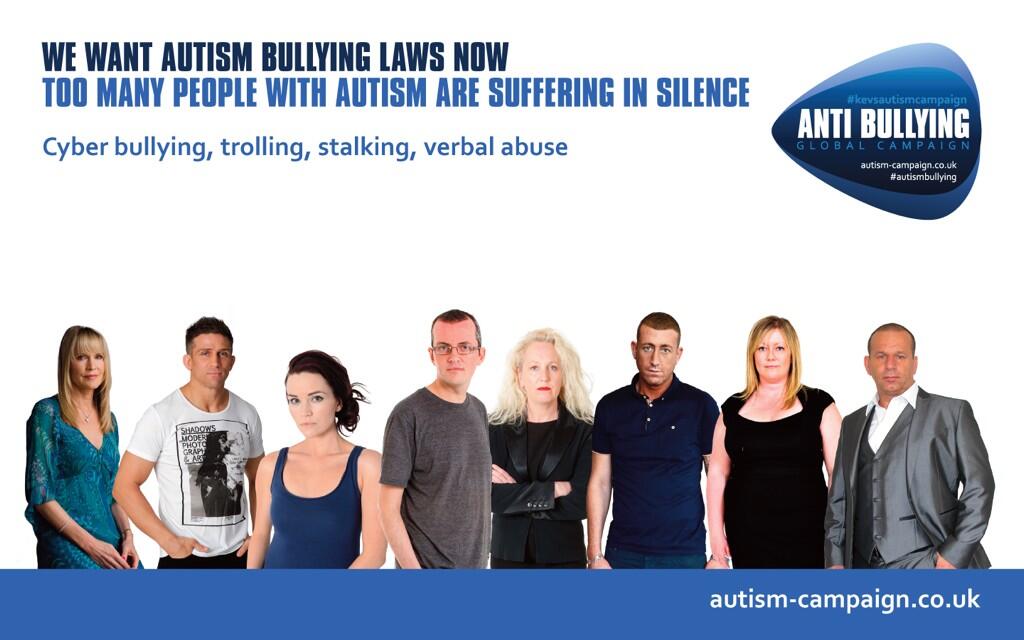
National billboard campaign donated by Amscreen has launched!
A national UK billboard campaign has launched, donated and supported by Amscreen, it is set to be the largest campaign for anti cyber bullying for autism.
Amscreen, the UK’s largest digital media owner, is screening the adverts on their digital outdoor network for free, reaching 20 million people per week for a two week period.
Amscreen is a flexible network of 5,000 screens located in a range of forecourts, local convenience outlets including WHSmith and doctors’ surgeries across the country.
Dr, Pam Spurr, Alex Reid, Holly Matthews, Deborah Douglas, Christopher Maloney, Dawn Lowe and Dave Gentry, who all thoroughly support the campaign and who have links to autism are lending their faces to the billboard.
The campaign is calling for laws to be changed to protect those with autism who are victims of cyber bullying, trolling, stalking and verbal abuse.
Kevin Healey, the campaign leader, who is also shown on the billboard, and who suffers from autism has been targeted by online ‘trolls’ since childhood, has set up the campaign to call for better support and services for those with autism, and other vulnerabilities.
Kevin says; “I am extremely grateful for Simon’s offer to help and his generosity and ongoing support is very much appreciated. The support I have received is overwhelming and I would like to thank all of the celebrities involved. It really does emphasise how important the campaign is.”
Amscreen CEO Simon Sugar said, “This campaign is for a great cause which we are proud to support. By screening the anti bullying messaging across our healthcare and forecourt networks across the UK for two weeks, we’re providing £150,000 of advertising, which we hope will significantly raise awareness of the campaign.”
Designed by Lance Burkitt and Dylan Moore, the billboard is being displayed in various locations throughout the UK and is already gaining national interest. If you require the image, please use the contact details below.
After Simon’s generous donation, Kevin is now seeking out a sponsor in order to pay for the billboard poster to be printed and advertising space. Kevin is looking for any digital advertising agencies to offer this sponsorship in return for promotional coverage and use of logo on the billboard.
If you would like to lend your support to Kevin and his campaign then please visit and sign his petition at https://www.change.org/en-GB/petitions/national-and-international-governments-autism-bullying-laws-to-change-anti-autism-bullying-laws-to-be-changed-nationally-and-internationally
For more information regarding Kevin or the campaign, please visit http://www.autism-campaign.co.uk/autism-bullying-campaign/
JP: “Talking about the incident in October 2011.”
CB: What I couldn’t get out because the lady (from Disability Cornwall) turned her back, it was very expensive. My concern was that children are being sent from Cornwall all over the country far away from their parents and carers, and is that what we wish for our children? My concern is that such facilities ought to be local. It fills in with the ideas of Whole Life. I thought that it would be cheaper to provide those facilities closer to home in Cornwall, or that could deal with Devon as well.
“Is their life of such low esteem that that might be it?
“I have never killed a fish in my life. I believe all life is precious, whatever animal it is.
“I had just been to a council meeting which was discussing finance. When you are talking about having to close toilets, facilities for everyone and perhaps the coastal footpath for everyone, then I have got to question individual budgets to individual people.
“People are not on this earth for very long. My main concern is planning and environmental and landscape. In that context, people are just transient.
“I have heard of terrific amounts of money being spent on specific individuals.”
JP: “Disabled individuals?”
CB: “I’m not sure.”
JP: “Some people have very high personal budgets?”
CB: “Yes.”
JP: “What’s the solution to that?”
CB: “The only way I can see it is more of a homes within the locality. When you look at people with mental health problems, for too long you have had all these massive institutions. Now at last people are beginning to see people with these disabilities in their locality… I really am not the ogre people are making me out to be.
“You are trying to make more of it than it was. I came out of a meeting talking about budgets very agitated. He had spoken to someone on another stand first. The he moved on to the Disability Cornwall stand.
“I think there were three people there. I was agitated and made that stupid remark for which I will always be sorry.
“The fact is that I think to keep 10 toilets open would cost about £250,000. That’s a service to the whole of the community. This is my concern. It is a balance which has to be made.”
JP: “As opposed to what?”
CB: “As opposed to a service to one person. I know for instance of a lady with two dogs and she has three carers and she gets around, she has a frame. These carers are principally to walk the dogs. Little things like that that people are aware of. It makes me frustrated because I tend to think that it is money that could be better spent on someone else.”
JP: “The council could provide funding of £250,000 for one person?”
CB “That comes into it. It is obviously part of the equation. You have to say when you are talking about something for economic development what is the payback. It is a major concern. You have limited budget and it is being cut all the time.”
JP: “So when there are limited budgets you find it difficult sometimes to look at some of the big personal budgets being given to disabled people for social care and that is just for one person? Is that where the source of the concern is?”
CB: “I don’t sit on any health committees but it is a concern. It is not only a concern of mine.”
JP: “So it is a widespread feeling in the council that the higher and rising costs of social care mean that there is less money for projects that could benefit the wider community?”
CB: “It is bound to be a concern. Because we are having to get rid of libraries, sports centres, and not maintain even our roads.”
JP: “Should there be more abortions of disabled children?”
CB: “I don’t agree with abortions. I am a Christian. All life is precious. It’s a dilemma that I have. It cannot be just me. I suppose it is an ethics question. If you were talking about getting rid of a person or a life it is not something I could condone.
“You will never believe it. Two weeks ago I walked up through a street and a retired doctor said I was perfectly right.”
JP: “That some disabled children should be put down?”
CB: “Presumably it would depend on the degree of the disablement.”
JP: “What did you say to him?”
CB: “I knew him. I was an acquaintance in the past. He is a medical man. He knows his business presumably.”
JP: “There must be something to what he was saying?”
CB: “If that is what he said, there must be.”
JP: “But he was obviously advocating some kind of euthanasia?”
CB: “All he said was I was right in my comment.”
JP: “How do you balance those two things?”
CB: “You just can’t.”
JP: “He quoted some extract from The Way of Life, which he said he had never told anyone before but that he read every morning. It’s about doing good/no harm.”
CB: “I try to abide by that.”
“The other problem is over-population. I see so many problems in the world regarding energy consumption, housing. We live in a finite environment. I am afraid that in a few generations we are going to be hit with terrible consequences of our breeding.”
JP: “So what is the solution?”
CB: “I think the Chinese had a way of doing it. One child family.”
JP: “But then if you have a disabled child?”
CB: “I really don’t know. No government is prepared to grasp it.”
JP: “So the solution might be easing those out of life who might be less productive?”
CB: “You mentioned abortion. Doesn’t this happen now anyway?”
JP: “Do you think something might be done along the lines of the doctor?”
CB “If nothing is done we are going to have terrible wars or famine.”
JP: “To ease out those unproductive members of society?”
CB: “We have a tax system that encourages people to breed like rabbits. If we had a tax system that encouraged one child or maybe two.”
JP: “Euthanasia might be a solution?”
CB: “No.”
JP: “Other people who agreed with you?”
CB: “My ward is partial urban but terrific rural area with a lot of farmers. A farmer didn’t see a lot wrong with what I said because it is something they do every day. If they have a misshapen lamb they get rid of it, they get rid of it. Bang! If you go to a farmer’s funeral there is not a lot of weeping because they are used to life and death. It is something they deal with on a daily basis.”
JP: “How did it make you feel? That you were right?”
CB: “He’s certainly got a point. We are just animals. He’s obviously got a point.”
JP: “You have some sympathy with him and the doctor?”
CB: “Of course I have. You can’t have lambs running around with five legs and two heads.
“People have also said that whilst they have a great sympathy with these [families], there is always the problem when the parents or carers leave this world. What does happen? It is a worry.”
JP: “They become a burden?”
CB: “Yes. Who shoulders the burden after they have looked after them for so many years. But I think society is getting a lot more tolerant in that respect.”
JP: “Has anybody else said they agreed with you?”
CB: “Strangely enough I have been up to other towns and people have come up and shook my hand. Complete strangers.”
JP: “How did that make you feel?”
CB: “It made me feel that I am not the ogre that I have been painted. I think a lot of them is sympathy for me.”
JP: “Sympathy?”
CB: “I think humans are animals.”
JP: “If other people are killing animals it is OK?”
CB: “Do you eat meat? [That is] killing of an animal.”
JP: “So the difference between putting down an animal who is severely disabled and putting down a child who is severely disabled is not that great then?”
CB: “Yes, you seem to forget that we kill, we rule the roost.”
JP: “There isn’t that much difference between putting down a lamb or a child with two heads?”
CB: “I think the cost has got to be evaluated. It is not something I would like to do but there is only so much in the bucket. If you are talking about giving services to the community or services to the individual, the balance has got to be struck.”
JP: “You might think then that if there was a child with two heads, that might be where the line is drawn. It might be kinder to put that child down?”
CB: “Is that one child or two? I would hope that although I don’t like the idea of it, long before it is born that this problem is [stopped] and it will probably be aborted in some way.”
JP: “And if it wasn’t?”
CB: “Then if it wasn’t, then well, what happens?”
JP: “The lamb would be put down.”
CB: “It would be put down, smashed against the wall and be dealt with.”
JP: “It might be as […] for a similar thing to be done for the child?”
CB: “That would be up to the decision of whoever is there at the birth. It makes me wonder that some children have been aborted, some abortions are so late that the child is there.”
JP: “Those are decisions about putting down a child with that degree of impairment might well mean more money for the wider community?”
CB: “It might. It probably will.”
JP: “It does make an argument and a good argument for maybe ending the lives of some severely disabled children with severe learning difficulties?”
CB: “I am not making that judgment. There may be a case. I haven’t a clue how much they cost. When people complain to me about the state of our finances, I say, well, we can’t afford to do it. We might be forced to close our beaches. That’s a service to us all. It is a dilemma and it is going to get increasingly a problem with budget cuts.”
JP: “Between services for disabled people and…?”
CB: “Between all services.”
JP: “It does make an argument for putting down some severely disabled children?”
CB: “Yes. That is why I keep as far away from health in the council as I can.
“I was a conservation man for Cornwall. Very much concerned with landscape and planning.”
JP: “Does it frustrate you that with all the money spent on people’s lives, so little is spent on the environment?”
CB: “We work according to the budget.”
JP: “Said he is currently off sick from the council. Had a series of strokes some time ago.”
CB: “You’re liable to flare up.”
JP: “Personality-wise?”
CB: “Yes. People have said I have changed since those strokes.”
Personally, I hope Julie Jaye Charles gets selected to fight the seat- and that she wins the seat. I know I’m not alone in this.
Readers, this is what most disabled people, and parents of disabled children, would call a ‘weekend fun’ story. I found it a bit late, but I think this is one of those times when old news is gold news.
I realise that the results of this study will not be seen as a pleasant thing by children who are overweight, or their parents.
However, as a disabled ‘child,’ now an adult, who went to two mainstream schools with too few children who ever wanted to be her friend, I see one part of the findings as a very positive piece of progress for young disabled children.
So, what’s the study?
Well, investigators from the University of Leeds carried out experiments on 100 primary school children aged four to seven. Led by Professor Andrew Hill, the research investigated young children’s ratings of, and choices between, story characters drawn as overweight, normal weight, or disabled.
The results suggest that young children reject story characters who are overweight- but not those who are disabled. Based on my personal experiences, that’s one study result I didn’t think I’d ever see coming out of mainstream primary schools.
The children were read a storybook which covered the same plot- a child and what happened when their cat got stuck in a tree. The books only differed in the way the main character was drawn.
The children said that the character called ‘fat Alfie’ was more likely to be naughty, and less likely to win a race, do good school work, be happy with the way he looks, or be invited to parties, than his friend Thomas, another character who was normal weight in all three versions of the story. Most importantly, few children said they would choose ‘fat Alfie’ to be their friend- while most said they would be friends with the slimmer version of the character.
The result that brought a smile to my face was that overall, the children were also more positive about a wheelchair using Alfie. I am sad, but not too surprised, to see that the children thought wheelchair-using Alfie was less likely to do good school work or get invited to parties than slimmer Alfie or Thomas.
Such changes in attitudes don’t take place overnight, however. Disabled people and their parents can take some comfort from the fact that wheelchair using Alfie was not marked down by the children to the same extent as fat Alfie. And importantly, the children were more likely to choose wheelchair-using Alfie as a potential friend than fat Alfie- but sadly for real disabled children, they also preferred Thomas as a friend to either wheelchair using or fat Alfie.
A female version of the story produced similar results. Fat Alfina was rejected as a potential friend by most of the children, in favour of her slimmer friend Holly. Importantly, children’s own gender did not affect their choices.
Professor Andrew Hill said “This research confirms young children’s awareness of the huge societal interest in body size. It shows that by school entry age UK children have taken on board the negativity associated with fatness and report it’s penalties in terms of appearance, school activities, and socially.”
He went on to say “This negativity was shared by another visibly different characterization, a child in a wheelchair, but to a far smaller extent. Children rejected the fat character regardless of whether the character was male or female.
Young children have negative perceptions of overweight that are not common to other visibly different conditions, and most apparent as social rejection. These responses are early indications of the views accepted as typical of older children and which may underpin weight-related victimisation of peers.”
My personal opinion is that, in an ideal world, adults should encourage children to be friends with other children of all shapes, sizes and physical abilities. All differences should be learnt about from an early age and celebrated in classrooms- and households- everywhere.
I hope that parents and teachers will be made aware of the results of this study, and that they will use them to encourage the children in their lives to develop positive attitudes about all differences, and to be friends with everyone in their classroom.
Nurse Who Abused Patients Faces Being Struck Off
A nurse who verbally and physically abused four frail and vulnerable care home residents faces being struck off.
Christina Cooper called one man an “animal” while working at Connaught Court care home in Fulford, near York.
She also held a soiled sheet close to his face and said “When dogs do this their owners rub their noses in it.”
Mrs Cooper has been suspended from the profession after a hearing at the Nursing and Midwifery Council (NMC). The panel will meet again on 29 July.
The NMC heard Mrs Cooper abused residents at the home, run by the Royal Masonic Benevolent Institution (RMBI), between October and November 2009.
All four victims she targeted suffered from dementia or some other cognitive impairment.
‘Entirely inappropriate’
On one occasion she was seen by colleagues “scooping up” an elderly resident with both hands to turn him over.
The NMC panel said the action constituted physical abuse.
Mrs Cooper was also heard to have verbally abused all four patients, including telling one woman “You’re acting like an animal”.
Claims she had tried to strangle a resident with a scarf were not found to have been proven.
Adjourning the hearing until 29 July, when the panel will consider sanctions, panel chair Judith Worthington said it was necessary to impose an interim suspension order to “protect the public and maintain public confidence in the profession”.
A spokeswoman for the RMBI said Mrs Cooper was immediately suspended from duty after the allegations surfaced and has since been dismissed for gross misconduct.
She said: “The RMBI fully condemns the actions and behaviour of Mrs Cooper during this period, which were entirely inappropriate and contrary to the high standards expected for all members of our staff.”
I can’t believe this, readers. I think it should be shared everywhere.
AXED Remploy workers are being held hostage in their jobs after being told their redundancies will be slashed if they take on other work.
Several staff at a threatened textiles factory in Dundee – who were told to find new work – are now being warned if they take up other positions their severance pay will be halved.
As a result, many have had to turn down job offers or face losing years’ worth of service money.
The factory is one of dozens of Remploy centres for the disabled under threat of closure after the UK government decided to withdraw funding last year.
The government said there were more effective ways of using the budget for disabled employment services, but many who worked at the factories have no other options for work.
Dundee West MP Jim McGovern said the company were effectively holding workers hostage as they tried to sell on the factory as a going concern.
The Labour MP said: “It beggars belief that after finding alternative work, due to being made redundant, Remploy’s staff have been told that they will lose their severance pay if they accept alternative offers of employment.
“The government promised that they would ensure Remploy’s staff would be helped into work but this means very little if those who do find work are financially punished for leaving.
“The government’s fine words for Remploy’s staff are not being matched by their actions.”
McGovern raised the Remploy concerns with Nick Clegg in the Commons and the Deputy Prime Minister said the Department for Work and Pensions would look into the case.
McGovern said: “This is an outrageous way to treat people who are doing the right thing and finding work. They did not choose to be made redundant by this government.
“The staff need cast-iron guarantees that when they leave Remploy, they will receive the severance pay they were promised.”
A Remploy spokesman said: “Our arrangements are more generous than in many businesses. If an employee at risk of redundancy decides to leave, they are regarded as having resigned.
“Remploy have an agreement with the trade unions that an employee at risk of redundancy who has found another job can leave the company with 50 per cent of their redundancy entitlement if their departure has no detrimental impact on the business.”
Carers Guilty Of Abuse On Severely Disabled Patients
Two care assistants have been found guilty of mistreating severely disabled patients in their care.
A jury heard that people attending the Solar Centre at St Catherine’s Hospital in Doncaster were abused and tormented by James Hinds and Susan Murphy.
Hinds, 59, was found guilty of 10 counts of ill-treatment and Murphy, 43, was found guilty of 15 counts.
Care assistant, Julie Burge, 48, and physiotherapy assistant Michael Barnard were cleared of all charges.
Judge Rosalind Coe told Hinds and Murphy they will be sentenced on 14 June.
She said: “You are both fully aware that custodial sentences are the likely outcome.”
Hit around head
Hinds was acquitted of a further nine charges and Murphy was cleared on five counts after the jury deliberated for two days.
Both were given conditional bail but were remanded in custody until their passports could be brought to the court and surrendered, as the judge heard they had been living in Spain.
Hinds and Murphy were found guilty of ill-treating 12 different outpatients between them at the centre.
All were extremely vulnerable adults, with limited communication abilities and a range of physical disabilities including blindness.
Many of the attacks involved patients being slapped and hit around the head.
Hinds threw one man into a wheelchair, dragged another to the toilet and hit another with a microphone.
Murphy locked one woman in a cupboard, the court heard.
The attacks happened between January 2005 and March 2007.
Police were called in after a member of staff decided to leave in March 2007 and made formal allegations about the mistreatment of patients.
The Solar Centre is run by Rotherham, Doncaster and South Humber NHS Foundation Trust (RDaSH).
Outside court, Dr Nav Ahluwalia, executive medical director for RDaSH said: “We fully apologised to service users and their families at the time of the incidents and we apologise again today for the actions of the individuals that have been found guilty.”


