Haiti Appeal Launched- Please Donate
The recent earthquake in Haiti changed countless lives locally and caused much shock and sadness worldwide. I am thinking, in particular, of all those who have been left disabled by the disaster.
Thanks to my friends at Left Foot Forward for this information:
Call: 0370 6060 900 or visit: http://tinyurl.com/haiti-appeal
Or donate directly to these specific aid agencies:
• Oxfam, who will provide clean water, shelter and sanitation
• UNICEF, who aim to help children affected by the earthquake
• Médecins Sans Frontières, whose teams on the ground report “significant damage to its medical facilities, injuries to patients and staff and an influx of wounded”, mobile phone networks down and road access hampered; and the
• Mercy Corps, who help survivors “meet their immediate needs and recover what they’ve lost”.
The Huffington Post has links to more sites, including:
• The Red Cross, whose staff and volunteers are on the scene carrying out search and rescue, providing first aid and distributing relief;
• Save The Children, who will be saving children’s lives by providing shelter, clean water, food and medical assistance; and the
• International Rescue Committee, who have deployed their emergency response team to Haiti, helping those devastated by the tragedy to rebuild their homes and communities.
New C4 Series- How To Look Good Naked With A Difference
Hot on the wheels of ‘mockumentary’ Cast Offs comes Channel 4’s latest attempt to show DisAbility on screen- Gok Wan’s latest series of How To Look Good Naked.
Titled How To Look Good Naked With A Difference, it sees Gok Wan meeting women with DisAbilities, starting next Tuesday, January 19th, at 8pm.
Until now, I’ve never seen How To Look Good Naked– or particularly wanted to, but I will definitely be watching this.
I’d like to thank Channel 4 and Gok Wan for bringing much-needed attention to the very important issue of DisAbled women’s body images. And here’s hoping the series is half as good as Cast Offs.
Tories Plan £1m Fund To Help Disabled People Become MPs
A £1m fund to help people with disabilities become MPs is being planned under Conservative moves to make parliament more inclusive.
The money would pay for transport and support costs to break down the barriers facing disabled people who want to work as MPs, local councillors or civil servants
It is part of Tory policy to encourage parliament to become more reflective of the country. At the moment one in five people in Great Britain has a disability, but only 5% of MPs are registered disabled. There are currently 126 women in the House of Commons compared to 519 men, and only 15 MPs from ethnic minorities.
Today’s move by the Conservatives would establish an access to public life fund, to be trialled immediately after a Tory victory at the general election. The funds would cover the costs of adapting premises to make them accessible, sign language interpreters, specialised equipment, travel and support workers.
The money – to be spent over four years – would come from efficiency savings made by the government equalities office from their existing £84m annual spending, including from the Equality and Human Rights Commission’s budget. Disability charities would be invited to tender to administer the fund.
Mark Harper, the shadow minister for disabled people, said: “Despite there being over 10 million disabled people in the UK, they are still under-represented in public life. It is important that we break down the barriers which prevent disabled people from standing for public office.
“Given the recent damage done to the standing of parliament and our politics, it is all the more important that we open up our democracy and set up this fund to ensure that disabled people are given a fair chance to enter public life.”
Earlier this week the Speaker published a report of a commission convened to consider the problem, which suggested that there should be quotas set for the number of women, people from ethnic minorities and those with disabilities.
The policy of all-women shortlists that Labour has adopted in some constituencies and David Cameron is considering for this year should be extended to black and minority ethnic groups, it said.
Abigail Lock, head of campaigns at the disability charity Scope, said: “We know many people want to be candidates and that money has been a barrier to that. Campaigning is prohibitively expensive so we welcome this move to break down those barriers.”
More at Left Foot Forward.
Teddy Pendergrass Dies
Soul singer Teddy Pendergrass has died at the age of 59 following “a difficult recovery” from colon cancer surgery, his son has told the AP news agency.
Teddy Pendergrass II said his father had died at a hospital in Philadelphia.
He was paralysed from the waist down in a 1982 car accident. In 2001, he went on his first tour since the accident.
Pendergrass enjoyed early success with Harold Melvin and the Blue Notes, whose hits included If You Don’t Know Me By Now, before going solo in 1976.
 |
 To all his fans who loved his music, thank you. He will live on through his music To all his fans who loved his music, thank you. He will live on through his music  Teddy Pendergrass’ son
|
He was the first black male singer to record five consecutive multi-platinum albums in the US.
Pendergrass, who has used a wheelchair since his accident, made a return to live performance at the Live Aid concert in Philadelphia in July 1985.
“To all his fans who loved his music, thank you,” his son said.
“He will live on through his music.”
Sex symbol
As lead singer with Harold Melvin and the Blue Notes, Pendergrass had his first US hit with I Miss You in 1972.
A string of successful singles in the US, as well as the UK followed, including If You Don’t Know Me By Now, later covered by acts including Simply Red, and Don’t Leave Me This Way – also a hit for Thelma Houston in 1976 and The Communards in 1986.

Pendergrass, centre, performed at Live Aid in Philadelphia in 1985
|
He quit the band in 1975 and went on to enjoy greater fame as a solo singer known for his soulful ballads. His hits included Love TKO, Close The Door and Turn Off The Lights.
Pendergrass became something of a sex symbol attracting the adulation of enthusiastic young women at his concerts.
After suffering a spinal cord injury in 1982, he spent six months in hospital before returning to the studio the following year to record the album Love Language.
He performed his first solo live dates in almost 20 years in May 2001 in Atlantic City, which were followed by concerts all over the US.
In 2006, Pendergrass told the BBC the tour took an enormous effort.
|
He was the background to all my canoodling when I was a teenager Chris, Northampton
 |
“For a start, I had to have a group of people with me to look after my health needs,” he said.
“But if you add to that the problems of transporting a wheelchair from airport to airport, it was all just too much effort.”
He later founded the Teddy Pendergrass Alliance to help people with spinal cord injuries “achieve their maximum potential in areas of education, employment, housing, productivity and overall independence”.
He is survived by his wife, his son, two daughters, his mother and nine grandchildren.
The finalists for this year’s Waterstone’s Children’s book prize have been revealed.
Real-life issues feature heavily on the nine-strong shortlist, with several authors tackling tough subjects for children.
Writer Laura Summers drew on her own experiences of raising a disabled child for her debut novel Desperate Measures.
The winner of the £5,000 prize will be revealed on 10 February at a central London reception.
Summers, a BAFTA-nominated writer of children’s television including The Story of Tracy Beaker and The New Worst Witch, wrote her novel after realising that very few children’s books have protagonists with learning disabilities.
|
SHORTLISTED BOOKS
Flyaway by Lucy Christopher
The Great Hamster Massacre by Katie Davies
The Girl Who Could Fly by Victoria Forester
Seven Sorcerers by Caro King
Love, Aubrey by Suzanne LaFleur
The Toymaker by Jeremy de Quidt
Desperate Measures by Laura Summers
Superhuman: Meteorite Strike by A.G Taylor
The Crowfield Curse by Pat Walsh
|
It tells the tale of twins Rhianna, who was brain-damaged at birth, and Vicky, and their brother Jamie, who are trying to stay together after their foster parents break-up.
Waterstone’s described the offering as “affecting, honest, and totally gripping”.
I hope Desperate Measures wins the prize!
Government To Apologise To Thalidomide Victims Today
The government will apologise later to the victims of the thalidomide scandal after agreeing a £20m support package.
Health minister Mike O’Brien will make the formal apology in an oral statement to MPs after announcing the funding in December, the government said.
Pregnant women were prescribed the drug in the 1950s and 1960s as a treatment for morning sickness or insomnia.
It was withdrawn from sale in 1961 after 2,000 babies were born with limb deformities and other damage.
The drug’s UK manufacturer, Distillers Biochemicals, paid around £28m compensation in the 1970s following a legal battle by the families of those affected.
The Thalidomide Trust, which distributes aid to sufferers, welcomed the new government support package last month, announced by Mr O’Brien as a “real benefit”.
It is hoped the pilot scheme, to be reviewed after three years, will give people affected by thalidomide more control over their long-term health needs as they get older.
There are currently 466 survivors in the UK.
Update: In the statement, Mr O’Brien said:
“The government wishes to express its sincere regret and deep sympathy for the injury and suffering endured by all those affected.
|
|
“We acknowledge both the physical hardship and the emotional difficulties that have faced both the children affected and their families as a result of this drug, and the challenges that many continue to endure often on a daily basis.”
Bollywood film 3 Idiots has broken box office records in India and globally, taking more than £43m worldwide since its 24 December release.
It has broken records for Indian films in the US, Australia, South Africa, Pakistan, Fiji and Kenya.
Cinemas in Indian have added extra showings of the film.
Leading Bollywood actor Aamir Khan, 44, who stars as a student who mysteriously disappears, said he was “so happy” with the film’s success.
|
The film is one of those rare Bollywood films that urges you to be a better human being Rajeev Masand
Entertainment reporter |
Producer Vidhu Vinod Chopra said: “I am thrilled and humbled that so many people all over the world have loved this film.”
The film, which was released at the end of a year of disappointing ticket sales for Bollywood, has been watched by more than 60 million people.
Indian entertainment reporter Rajeev Masand told BBC Asian Network: “The film is one of those rare Bollywood films that urges you to be a better human being.
“It questions the education system and what is wrong with our education style.
“It tells us why it is important to be good in life and I think that kind of reassurance is something that an Indian audience always looks for.
“I don’t think its one of the best films to come out of India, it’s certainly one of the most crowd-pleasing.”
I saw 3 Idiots recently, and I can describe it as an Indian version of Avatar. Not because it has any connection to science fiction, but because of the storyline. One of the characters ends up in a wheelchair for a short time after a failed suicide attempt- but most of the cinema, including me, was too busy laughing at the hilarious comedy to notice the wheelchair for very long!
The movie made me very happy because, after seeing it, I realised that Avatar, and Hollywood, are not alone in being able to feature disability without focusing on disability. This made me proud to be a fan of Bollywood movies. So I am very pleased to read that 3 Idiots has done so well at the box office.
By the way, everyone I know who has an interest in Bollywood loved the movie (and no one mentioned the wheelchair). So it is highly recommended to any of you who may be interested.
Car Bomb Officer Has Leg Amputated
A police officer injured in a dissident republican car bomb attack last week has had his right leg amputated.
Constable Peadar Heffron, 33, had surgery on Tuesday and remains critical, but stable.
He was injured when a bomb exploded under his car on the Milltown Road near Randalstown in County Antrim at about 0630 GMT on Friday.
The officer is an Irish language specialist for the PSNI and captain of the PSNI GAA team.
Mr Heffron has been in the police for 10 years and recently married. He is related to a senior Sinn Fein member.
He had been on his way to work at Woodbourne police station in west Belfast.
It is believed Constable Heffron had driven about a mile from his home when the bomb exploded and he was found breathing and conscious but bleeding heavily.
Dissident republicans have been blamed for the attack, but police have not yet said which grouping they believe were behind it.
Dissident republicans have been responsible for a spate of bomb attacks across Northern Ireland in the last year.
In October, a dissident group planted a bomb under a policeman’s car in east Belfast.
His partner suffered minor injuries in the attack.
High Court To Review McKinnon Extradition Decision
A High Court judge is to rule on whether Home Secretary Alan Johnson was wrong to allow the extradition of computer hacker Gary McKinnon.
The judicial review will examine Mr Johnson’s decision that a US trial would not breach his human rights.
Mr McKinnon, 43, who has Asperger’s syndrome, is accused of breaking into the US military computer system. He says he was seeking evidence of UFOs.
The Home Office said it had “noted” the court’s decision.
A hearing is likely to take place in April or May.
Mr McKinnon’s lawyer said she was “delighted” that they had been granted permission for judicial review, but warned that her client was in a “very poor mental state” due to stress.
Solicitor Karen Todner also appealed to Mr Johnson to reverse his decision and asked US President Barack Obama to withdraw the request for extradition.
“Mr McKinnon’s suffering has gone on long enough,” she said.
The Glasgow-born man’s mother, Janis Sharp, said she felt “incredible, indescribable” relief.
“I can’t believe it – some common sense at last. This judge has made such an honourable and decent decision.
“We’ve fought for so long for compassion and understanding. Gary’s health has badly declined, it’s been traumatic to see,” she said.
‘Heartening’
In November, Mr Johnson said he could not block the move to a trial in the US on medical grounds, saying he had “no general discretion” to refuse the request from the US government.
|
We should not be sending people to be tried in foreign courts and then, if convicted, imprisoned away from family and friends when it is perfectly feasible to try them in the courts in this country Isabella Sankey, Liberty
|
The computer systems Mr McKinnon, now of Wood Green, north London, is accused of breaking into include the Pentagon. If convicted, he faces 60 years in prison.
A Home Office spokesman said: “As the case is before the courts, we do not propose, pending the outcome, to comment further.”
Liberal Democrat Leader Nick Clegg said the judicial review was “heartening news”.
“Even now the Prime Minister and Home Secretary could step in to spare Gary McKinnon from this ordeal by ensuring that he is instead tried in a British court.
“It must be hoped that the courts prevent this unfair extradition and in doing so display more courage than our ministers,” he said.
Isabella Sankey, director of policy for human rights group Liberty, said the charity welcomed the decision.
“We should not be sending people to be tried in foreign courts and then, if convicted, imprisoned away from family and friends when it is perfectly feasible to try them in the courts in this country,” she said.
Mr McKinnon’s lawyers and family have fought a series of long-running court battles in an attempt to avoid extradition.
CF Sufferer Jessica Wales Dies
A cystic fibrosis sufferer from Kent who had a double lung transplant just after Christmas following a four-year wait has died at the age of 20.
Jessica Wales, from Westgate-on-Sea, received the donated organs in an “11th hour” operation through the night at Harefield Hospital on 27 December.
Her fight for life had touched many people, including the Prime Minister’s wife and pop singer Natalie Imbruglia.
She died on Tuesday night after her condition deteriorated.
A statement from the charity Live Life then Give Life said she had shown “great courage and determination, inspiring people across the country through her relentless campaigning and upbeat attitude”.
Twitter campaign
“Jess was not only a valued Live Life then Give Life advocate but also a great friend to many and we offer her family our sincere condolences at this sad time,” the statement added.
“We will continue to campaign for all those who wait for an organ transplant and, whilst not every outcome will be what we would wish, we hope that one day all those who need a transplant will get it when they are fittest and it is most likely to have a good long-term outcome.”
A campaign to raise awareness of the need for organ donation coupled with Ms Wales’ fight for life won the support of Sarah Brown, the Prime Minister’s wife, in a Twitter campaign as well as the pop star Natalie Imbruglia, who headlined a concert for her last October.
Speaking in the days following her double lung transplant, Ms Wales’ friend Sarah Milne said: “Jess’s story has touched everyone who knows her.”
Babies Wanted For Autism Research At Durham University
Experts at Durham University are trying to find out how babies see the world and are asking parents to volunteer their children for the research.
The study by psychologists based at the University’s Queen’s Campus in Stockton aims provide a better understanding on how the brain develops.
This should lead to greater insight into conditions such as autism.
Children aged up to two are required and all parents will be present during the “harmless and non-invasive” tests.
Each child will be fitted with a cap with sensors attached so their brain activity can be recorded.
Images will be shown and they will be observed and monitored for their behaviour and brain activity.
Identify problems
They will not be medically tested for autism, which the National Autistic Society describes as a lifelong developmental disability.
Dr Vincent Reid, who is leading the research, said: “We don’t yet know enough about how the brains of very young babies develop and how they react to things.
“It is vital we know more so we can identify problems and developmental delays much earlier which could lead to earlier diagnosis of conditions such as autism.”
He added: “It is important to stress that the procedure is non-invasive, harmless and painless.
“We are not doing any medical testing in this study but purely looking at babies’ brains from an academic point of view.”
The 10 years that Anna Rayner spent on incapacity benefit (IB) passed in a haze. Signed off work by her doctor after a nervous breakdown, she was under no pressure to think about returning to employment, and she says she felt her self-confidence shrivelling away.
“I tended to avoid mentioning that I was on incapacity benefit to people I didn’t know well,” she recalls. “It is something that’s very hard to admit to. It makes you feel like you’re a failure. I think people see claimants as lazy. I was going nowhere, and I felt guilty about it.”
Rayner, 41, was eased back into the job market two years ago, when she set up her own business as a complementary therapist. It was a progression made possible only with the intensive assistance of her local job centre, a community support centre and a welfare-to-work organisation.
Policymakers should take note of her experiences, because Rayner represents a new breed of modern IB claimants far removed from the stereotypical image of middle-aged, male, ex-industrial workers. If officials are to succeed in their drive to reduce the numbers of people claiming these benefits, they will need to tailor their strategies more directly towards the needs of women such as Rayner.
A study from Sheffield Hallam University, published this week, shows that the number of women on IB has soared since the early 1980s, rising more than threefold from 350,000 to 1.1 million, so that there are now almost as many working-age women on incapacity benefits as men.
The findings of the Women on Incapacity Benefits report will make essential reading for those in this and future governments charged with cutting the ballooning IB bill, which the Department for Work and Pensions (DWP) places at about £6.5bn annually, but which academics estimate rises as high as £14bn when all the associated benefits, such as housing benefit, are factored in.
Employees in the benefits advice sector have been aware of the changing profile of this group for many years, but the trend has been little understood. The researchers – led by Steve Fothergill, a professor in Sheffield Hallam’s centre for regional economic and social research – provide for the first time detailed analysis of the reasons behind the shift.
Female factor
Fothergill says: “It has long been accepted that in the 80s and 90s, job losses from industries such as coal, steel and engineering pushed many men on to incapacity benefits. This was characterised as a male problem. The high numbers of women claiming incapacity benefits in the same places had been a puzzle because job opportunities for women have mostly been increasing.”
Like men, the majority of women who claim IB (60%) tend not to have any qualifications and their previous work experience is primarily in low-grade manual jobs; some 40% have been out of work for more than 10 years.
The researchers found no evidence that women across the country were becoming sicker as a whole, and therefore more in need of IB. The increase was in part the consequence of growing numbers of women in the workforce as a whole, and in part a manifestation of “hidden unemployment”, they concluded. Where jobs are relatively readily available – in the south-east, for example – the number of claimants is lower. Where there are few jobs to be found, more people are directed towards this benefit. The researchers estimate that 430,000 of those women on IB could be expected to be in employment in a genuinely fully employed economy.
The rise is also attributed to a new blurring of the lines between typically male and female employment sectors. “Miners and steelworkers who were made redundant in the 80s and 90s were often reluctant to take what they considered to be ‘women’s jobs’,” Fothergill says. However, their sons have not had the same choice, and more men are now competing for the same jobs as women. “One of the long-term consequences of job losses among men has been to push more women out of the labour market and on to benefits,” Fothergill says. “Unemployed women with poor skills and poor health have ended up on incapacity benefits.”
Only a quarter of these women say they would be unable to do any sort of work, the report found, but just one in 20 are actively looking for work.
Historically, Fothergill argues, IB has been an attractive concept from almost everyone’s perspective. It suited the government, because it acted as a convenient way of hiding unemployment, and suited employers “because it has absolved them of the responsibility of hiring people who are less than totally in the best health”.
It has also suited claimants, Fothergill adds, because it is not means-tested, and so recipients who have working partners have been better off than they would be under jobseeker’s allowance.
The sickness benefits system is currently undergoing radical reform, as claimants are gradually shifted on to the new employment and support allowance (ESA), which was launched in 2008. A DWP spokeswoman, says it introduced ESA “to ensure that no one – man or woman – gets left behind to a life on benefits”. IB claimants are still not required to go through as many hoops to receive their money as people claiming income support.
The study recommends a two-pronged response from the government: ”sustained and intensive” support to help these women back to work, as well as physical and often mental rehabilitation. “These numbers will not be brought down just by hauling people in for work-focused interviews,” Fothergill argues.
The report also points out that since claimants are concentrated in areas of high unemployment, there is an urgent need for economic regeneration. “Unless there are jobs for these people to go to, we are not going to see a decrease in the numbers of people on incapacity benefit,” Fothergill says.
Given the harsh economic climate, the report questions the wisdom of extending compulsory back-to-work preparation schemes, in the light of the “often formidable obstacles to re-employment”.
Abi Levitt, marketing director of Tomorrow’s People, a charity that works with long-term unemployed people to get them back to work, says staff are seeing equal numbers of men and women on sickness benefit joining their motivation and confidence-building sessions. “We don’t take a different approach for women, she says. “The key issue for both women and men is loss of confidence.”
Rayner believes that she would never have had the courage to move off these benefits and into work without the support of a disability adviser at her local job centre, Milun Women’s Centre in Leeds, and assistance from welfare-to-work organisation A4e. “It’s quite a scary step to take, particularly when you don’t feel very confident, and there is a temptation to stay safe by doing nothing and remaining on benefits,” she says.
The decision to set up her Ray of Light holistic therapies company has improved her finances only modestly, but the step has given her a new sense of fulfilment. She says: “I feel that I have a sense of purpose in my life.”
Man Admits Murdering Disabled Woman
A man has pleaded guilty to murdering a disabled 62-year-old Essex woman as she sat in a car outside her home.
Jennifer North, also known as Jennifer Macaree, was stabbed in her Vauxhall Corsa in Hadley Grange, Harlow, in the early hours of 28 February 2009.
Scott Riley, 26, from Parsonage Leys in Harlow, admitted her murder at Chelmsford Crown Court earlier.
Riley was remanded in custody and will be sentenced at a later date, which has not yet been fixed.
Ms North was found in the car and taken to Princess Alexandra Hospital where she died a short time later.
Det Supt Tracy Hawkings said: “To this day Scott Riley has not given any reason why he stabbed Jennifer North.
“She was a disabled woman who would have been completely incapable of defending herself against such a frenzied attack.
“Her murder has left her family with many unanswered questions and without a much-loved mother, nan and great-nan.”
Channel 4 Needs A Reality Check
At the start of the last decade, Channel 4 brought us Big Brother. Teenagers all over the UK told their parents that they were watching it for Psychology or Sociology, or both. Few parents believed their teenagers, and, let’s face it, few teenagers were telling the truth. Big Brother soon became less Psychology experiment, more social chat and summer holiday TV. Channel 4 invented reality TV as we know it, and, by doing so, became the channel some fell in love with, some fell in love on, and others loved to hate.
Yes, I admit to being a Big Brother fan during my younger and less sensible years. And as those of you who read Same Difference during Big Brother 9 would know, I kept a particularly close eye on that series, which featured one blind and one partially sighted housemate. (Please forgive the pun). And I was thrilled that two DisAbled housemates had finally been featured on Big Brother.
Now, everyone knows that Big Brother hasn’t always been right. I’m sure you all remember the Jade Goody/Shilpa Shetty race row of Celebrity Big Brother 2007, for which Channel 4 received a lot of complaints and criticism.
This time, however, I think that even Channel 4 have gone too far. At the start of this decade, they have revealed that they are seeking a terminally ill patient to donate their body to be mummified, for a planned programme which will explore the mysteries of ancient Egyptian embalming.
Channel 4 said: “If the scientists are able to find a donor, we would be willing to follow the process.”
It is understood the project – which has been proposed by production company Fulcrum TV – is in its very early stages and may not actually be made.
The idea was uncovered when an executive producer from Fulcrum TV, Richard Belfield, spoke to an undercover journalist posing as a possible volunteer.
He was quoted as saying it had been suggested – although it was not obligatory – that the body be placed in a museum exhibition to enable people to understand the mummification process.
Now, the ancient Egyptian mummification process isn’t my cup of tea, but that’s not the reason for writing this. I’m not even here to question the wishes of people who donate their organs or bodies to medical or scientific research. However, surely making a reality TV programme using a dead body, even with the person’s permission, is more than a little unethical? Not to mention spooky.
As I said, personally, I think Channel 4 have gone too far this time. In my opinion, they need a reality check. I’d like to see Ofcom give them one about this programme.
Personally, I doubt they’ll have many volunteers. However, your views may well be different. Whatever they are, I would love to hear them. If anyone reading this is terminally ill, I would particularly appreciate your comments. Thanks!
Julie, 40, Hopes Lottery Win Can Buy Better Eyesight
Six members of a Tyneside syndicate are celebrating after winning a £10m double rollover National Lottery jackpot.
The group, made up of friends who used to meet at the Irish Centre in Newcastle, bought five lucky dip tickets for the New Year’s Eve draw.
They include partially-sighted Julie McGregor, 40, who hopes to spend some of her winnings on an operation to improve her vision.
Vodpod videos no longer available.
DisAbility-Friendly Tableware Designed
I’ve just read about Gregor Timlin, an able-bodied designer who has recently designed a range of plates, tablecloths, lighting and tables which are intended to help people with dementia to eat independently for longer and with more dignity. The designs were inspired by Mr Timlin’s maternal grandmother, who was very independent and loved cooking.
He has designed:
These products should be available from November. While they were intended for elderly dementia sufferers living in care homes, as a young disabled person who knows many young wheelchair users and their families, I am very pleased to read about these designs because I strongly feel that they will also be a great help to younger wheelchair users and visually impaired people. They may even enable disabled people of all ages to stay out of residential care homes for longer periods of time.
As any disabled person will no doubt tell you, all we and our families want is as much independence as possible for us for as long as possible. So I’m sure that we will all welcome these products when they are released. They will be a real step forward for disability. I must thank Gregor Timlin for designing these products, and for the sensitivity and understanding he has shown towards disability by doing so.
Heather Mills- DisAbled Dancing On Ice Contestant
Disability Bitch at BBC Ouch keeps a weekly watch on Heather Mills, but I always wondered why. I was surprised recently, when a friend told me that Heather Mills is an amputee.
So now that the new series of the BBC ice skating competition, Dancing On Ice, has started, with Heather Mills participating, I can’t let it pass without a blog post, even though I won’t be watching the programme myself.
I’ve just read on Ouch that on yesterday’s show Heather Mills’ dance partner said that she “has taken DISability and changed it into Ability.” I’m sure this is true, as it is what all disabled sportspeople and challengers do, in my opinion. I am also very pleased and proud to see an able-bodied person speaking my language!
I wish Heather Mills and her dance partner all the best for the competition, and I will be very happy if they win.
Welsh Blue Badge Scheme Overhauled
Plans to improve the blue badge scheme for disabled parking in Wales have been announced by the assembly government.
It includes extending eligibility to children aged under three, people with temporary conditions and to new groups of disabled people.
The overhaul will streamline the badge application process and improve systems to tackle abuse of the scheme.
Transport minister Ieuan Wyn Jones said it was time to “completely relook” at the badge, first introduced in 1971.
He said it would take up to five years to deliver the the whole programme for the around 230,000 badge holders in Wales.
But the minister said the assembly government would be able to prioritise some areas of improvement for the scheme.
|
BLUE BADGE SCHEME CHANGES
Extend eligibility to the under-threes with specific medical conditions and other new groups
Provide a temporary blue badge for people who experience major traumas, strokes or require joint replacements
Improve the application process and work to streamline administration
Reduce abuse with data sharing system
Improve security features and look at civil enforcement officers being able to seize badges used unlawfully
Work with partners to tackle parking abuse in private car parks
|
Those would include extending the scheme to children under three with specific medical conditions, as well as to people with severe congenital disabilities in both arms.
In November, toddler Elis Williams’s family from the Vale of Glamorgan had to fight for the right to have a disabled parking badge after being told she was ineligible because she was under the age of three.
Elis needs specialist equipment wherever she goes but was not entitled to a disabled parking permit because of the limitations to the scheme.
The scheme was first introduced to provide parking concessions for registered blind or severely disabled people nearly 40 years ago.
Mr Jones said: “The blue badge scheme has been going for nearly 40 years and has helped registered blind or severely disabled people to park close to the facilities and services they need.
“But we now feel it is time to completely re-look at the scheme to ensure it is fit for purpose, which is why we commissioned the wide-ranging consultation on which this action plan is based.
Reduce the abuse
“We have listened to what the people have said they need and taken on board the problems with the present scheme.
Mr Jones added: “We need to ensure that the people who are most in need of a blue badge are able to access the service quickly and efficiently, and we make best use of modern technology to reduce the abuse of the blue badge scheme.”
He said the assembly government was liaising with the UK government and other devolved administrations to ensure that a “cohesive scheme is developed across the UK”.
I’m very pleased to read this, particularly as I covered the case of Elis Williams last year. I’m sure her family must be thrilled at this news.
Gene Clue Provides Hope For AS
Two genes that have a strong connection to a spine-fusing type of arthritis have been identified by scientists.
Ankylosing Spondylitis (AS) can lead to people becoming fixed in a bent position looking at their feet.
The two genes are involved in inflammatory processes in the body and could help the development of a treatment for the condition.
A charity said the findings of the experts at Oxford, the US and Australia were “a long-awaited breakthrough”.
Current treatments only relieve the symptoms of the disease with physiotherapy and painkillers although some patients are being given an antibody treatment which costs £10,000 a year.
An international consortium of scientists led by Oxford University, the University of Queensland and the University of Texas, carried out a genome-wide study of 2,053 people with AS and 5,140 matched controls.
Inflammatory pathways
The study, published in Nature Genetics, found six regions of the genome that were associated with AS – the two strongest associations were with genes called ERAP1 and IL23R.
|
There are many theories as to what triggers this condition but understanding which genes are involved is a major step forward which could lead both to new treatments but especially earlier diagnosis which is badly needed in ankylosing spondylitis Professor Alan Silman
Arthritis Research Campaign |
ERAP1 is involved in important pathways in the body that are thought to have roles in controlling inflammation.
IL23R has also been implicated in psoriasis and inflammatory bowel disease, other conditions that also involve inappropriate inflammatory responses.
Lead researcher Professor Paul Wordsworth said: “We knew there was a strong genetic component to this disease, and we now have the foundation we need for future research to pin down the genetic causes of this condition.
“Cheaper or curative alternatives are a pressing need for this debilitating disease.”
|
ANKYLOSING SPONDYLITIS
AS is an inflammatory type of arthritis that affects up to 200,000 people in the UK and is a significant cause of work-related disability
It typically starts to cause problems for people in their 20s
It affects the spine, resulting in progressive stiffness, loss of movement and pain as the disease develops
It affects the spine, resulting in progressive stiffness, loss of movement and pain as the disease develops.
Treatment involves physiotherapy and pain killers and some sufferers are being given new antibody therapies that are effective in suppressing the symptoms but cost around £10,000 per year
|
Professor Alan Silman, medical director of the Arthritis Research Campaign, which co-funded the research, said the discovery of the six new genetic regions in AS was a long-awaited breakthrough in genetics research.
He said: “There are many theories as to what triggers this condition but understanding which genes are involved is a major step forward which could lead both to new treatments but especially earlier diagnosis, which is badly needed in ankylosing spondylitis.
“Some patients can wait up to a decade to be properly diagnosed.”
Professor Silman said the research had only been enabled by available new technology which had allowed the investigation of such a large number of genes.
Surgery Helps Charlotte, 3, To Improve Walking
A three-year-old girl from Dorset has undergone life-changing surgery in the US that could help her walk normally.
Charlotte Wakefield has cerebral palsy and was aided by a support frame.
The NHS offered the youngster, from Wimborne, surgery and follow up Botox injections to ease symptoms, but her family was against it.
Instead they raised £28,000 to travel to the US for a procedure to cut the nerves at the base of her spine, which has proved successful.
The operation, called selective dorsal rhizotomy, was carried out by surgeons at St Louis Children’s Hospital in Missouri.
It involved cutting the hyperactive nerves in Charlotte’s spine which were causing problems.
‘Straight legs’
Although the procedure is not a cure, it could allow her to walk more normally and learn how to run and dance in the future.
Her mother, Kim, said that before the operation her daughter had noticed her difficulty in walking.
“Charlotte’s feet bend in and her hips almost swing as she walks, because her muscles are so tight,” she said.

Charlotte underwent a three hour operation in the US
|
“She has little spasms every now and again where her legs jolt and we notice now she smacks her legs when it happens as if to say “you’re not doing that”.
In December the family travelled to the hospital where Charlotte underwent the three-hour operation.
The procedure posed some risks as any mistakes could have left the youngster paralysed.
But her family decided to go ahead with the treatment rather than continue with what had been offered in the UK, believing that Botox injections would just “deal with her symptoms.”
Surgeons in the US tested and cut about 70% of the sensory nerves at the base of Charlotte’s spine during the operation.
This reduced the signals to the muscles in her legs, allowing them to relax.
The operation has been carried out in the US for 23 years.
Charlotte began physiotherapy within 48 hours of the operation.
Her parents said that for the first time in her life she was able to stand properly with her feet flat and her legs straight.
The youngster will have to undergo a follow-up assessment in the US, but her parents have already noticed the difference in her movement.
Channel 4 To Broadcast 2012 Paralympics
I am very pleased and excited by reports today on Disability Now magazine’s website and BBC Ouch that Channel 4 has beaten the BBC to get the rights to show the 2012 Paralympic Games. Hopefully Channel 4 can give the Games more publicity and coverage than the Beijing Paralympics got in 2008 from the BBC. Whatever happens, I look forward to watching any coverage that they are given.
Discussion- Becoming DisAbled
Readers, something seems to be bringing lots of you to Same Difference recently. Whatever it is, I’m not complaining. This did, however, make me think that it could be the right time to post a topic for discussion. Please take some time to comment. The best comments will be turned into posts in themselves and placed on a debate page.
So- the topic is… becoming Disabled.
How do those of you who were born disabled see those who become disabled? Do you think of their problems as better or worse or the same as your own? Are they lucky to have had the ability for some time or unlucky to have had and then lost it? And do you think they should be welcomed into the ‘world of disability’ with open arms, or should they be treated differently and form separate groups?
How do those of you who have become disabled see yourselves? How has disability changed/affected your life? Would you like to go back to the way things were? How did you deal with becoming disabled? Do you think that those who are born disabled have it easier or are luckier than you? Do you still feel that there is a difference between yourself and someone who was born disabled?
Remember, although your comments are very welcome, you don’t have to comment. Please don’t comment just to say the discussion offends you- that’s a waste of time. The discussion topic is simply meant to encourage discussion- not to cause offense to anyone in any way. So if it does offend you, I am truly sorry.
BBC – ‘Going blind changed my life’
Vodpod videos no longer available.
Geoff Holt Achieves His Possible Dream
My congratulations and best wishes go to Geoff Holt who has today achieved his dream of becoming the first quadriplegic sailor to sail solo across the Atlantic. He has also shown the world his true DisAbilities by completing this challenge. He must now have realised the mistake he made in naming his yacht the Impossible Dream! I wish him a very successful career.
Details here.
Geoff Holt To Finish Voyage Today
A yachtsman hoping to become the first quadriplegic to sail across the Atlantic is due to finish later.
Geoff Holt, 42, from Southampton, began the 2,700-mile (4345km) voyage from Lanzarote to Tortola in the British Virgin Islands, on 10 December.
The sailor has battled light winds and mechanical problems aboard his boat, Impossible Dream, during the voyage.
As he crosses the line Mr Holt will be at the scene of a diving accident that left him paralysed him 25 years ago.
During the voyage he has been aided by a carer and filmed by a cameraman, but did all his own sailing in the 60ft (18m) purpose-built catamaran.
Hydraulic technology
He is expected to arrive at Cane Garden Bay, off Tortola island – where the accident happened – at about 1600 GMT.
This is the fourth time Mr Holt has sailed the Atlantic, but the first since his life-changing accident in 1984, which left him paralysed from the chest down.
He broke his neck, suffering a complete spinal cord injury, while diving into shallow water and has used a wheelchair ever since.
|
I’m emotional to return to the scene of the accident Geoff Holt
|
During his record attempt, Mr Holt has had to overcome engine problems and unexpectedly light prevailing winds.
He only has limited use of his arms and hands and used a hydraulic push button technology to sail the vessel on the 28-day voyage.
His wife Elaina and seven-year-old son Timmy will be joined by family and friends, who will be at the finishing line to meet him.
Earlier, Mr Holt said: “All these years and months of planning and I can’t believe it’s only hours away until I finish my Atlantic crossing.
“I’m emotional to return to the scene of the accident and excited to see my family and everyone waiting on the finish line.”
Mr Holt is already the first quadriplegic sailor to sail solo around Britain – a feat he achieved in 2007.
The Politics Of Avatar
I love this review of Avatar by mainstream political blogger Sunny Hundal. Do you know what the best part about it is? Sunny, an able-bodied person, saw this movie which stars a wheelchair user, who falls in love with someone who doesn’t use a wheelchair, and in a very well written review, he doesn’t mention this part of the story even once. This is exactly the kind of review that I hoped mainstream members of the public would give the movie. One that looks past the disability, and at the rest of the storyline. So thank you very much, Sunny. If only every future Hollywood movie that stars a wheelchair user can recieve similar reviews from the mainstream, no one will be happier than me.
DisAbled? Snow Trouble!
I never, ever imagined that I would agree with a council department about anything. As anyone who knows me knows, I hate councils. Usually. However, today, I am starting to think that Durham and Darlington PCT may have had a point last year, when they decided to give Durham County Council £1m over two years to help pay for road gritting.
At the time, an NHS governor, Kath Toward, resigned in protest at the decision, saying that the money should have gone to therapy services, and at the time, I agreed with her and thanked her for her actions. However, today, as I have spent the day looking out of windows at very heavy snow and watching constant news reports about councils who fear they will run out of grit, and since I’ve been reading the snowy stories of other DisAbled people through BBC Ouch’s Twitter tag, #disabilitysnow, I am starting to wonder whether the PCT may have somehow known about this freak weather, and been preparing for it at the time!
Anyway, today I’m very glad I’m not a wheelchair user, as I completely believe the Twitter user who told BBC Ouch that “wheels and snow don’t mix.” Please don’t use your wheels, whatever they’re attached to, until the snow melts unless you absolutely have to. And if you do, please be very, very careful and safe.
So, readers, while we’re all stuck inside, can I ask those of you in the UK who are on Twitter to follow @bbcouch and respond to #disabilitysnow with your stories, just for a bit of fun. If you’re in the UK and not on Twitter but still want to share your stories, you’re more than welcome to put them in the comments below. Thanks!
Study Finds No Proof That Virus Causes ME
UK scientists say they can find no proof that a particular virus is the cause of chronic fatigue syndrome (CFS) or ME, contrary to recent claims.
The Imperial College London team say they want to share the findings as some patients are pinning their hopes on drugs to fight the virus called XMRV.
They analysed blood samples from 186 patients with CFS and found none had the virus, PLoS One journal reports.
Experts said the latest findings would be a bitter disappointment to many.
They said more trials were under way and when these report in coming months, scientists will be able to draw more firm conclusions.
Work in the US, published in Science, had found the retrovirus in 68 of 101 CFS patients.
The UK team say the conflict between the two studies might be down to differences between the patients enrolled or the way the research was conducted.
|
We need to be extremely cautious until we know more Dr Charles Shepherd
The ME Association |
Or there might be different geographical types or strains of XMRV.
Regardless, they say potent antiretroviral drugs should not be used to treat CFS because there is not enough evidence that this is necessary or helpful.
The drugs may do more harm than good, they say.
Professor Myra McClure, one of the Imperial College London investigators, said: “We are confident that our results show there is no link between XMRV and chronic fatigue syndrome, at least in the UK.”
She said they had used extremely sensitive DNA testing methods, called polymerase chain reaction, to look for the virus.
“If it had been there, we would have found it.”
‘Disappointing’
Co-author Professor Simon Wessely said the findings did not invalidate all previous research, some of which has shown that CFS can be triggered by other infectious agents, such as Epstein Barr Virus.
|
ME FACTS
Causes chronic fatigue and muscle pain
Impairs immune system
Does not improve with sleep
Affects more women than men
A controversial condition that some have doubted as a genuine physical illness
|
The charity Action for ME said it was disappointing to hear about these findings, but said no single small-scale study could be conclusive.
Dr Charles Shepherd, of The ME Association, said it was important to remain open-minded.
“We need to be extremely cautious until we know more. There has been enormous interest in this from patients.
“Some have been led into believing the cause and a test has been discovered and that treatment is just round the corner and that is not the case.
“Over the next few weeks and months we will have more results and then we can come to a conclusion.
“If it turns out that XMRV is important, we will have to start looking at whether it is worthwhile testing for it and treating it.”
In a statement, the charity Invest in ME said the original study was of the “highest quality”, and that much more work was required before any firm conclusions could be drawn.
BBC News – ‘Disabilty hate crime’ filmed
Vodpod videos no longer available.
NHS bureaucracy blamed for prosthetic legs delay
The parents of a 10-year-old boy who lost all four limbs to meningitis criticised NHS bureaucracy today after delays in their son receiving two prosthetic legs.
Edward Bright, from Ripley, Derbyshire, has a badly-fitting set because funding for a more up-to-date pair has not been forthcoming.
Derbyshire Primary Care Trust says recent surgery to the youngster’s thighs has prevented a new set being fitted. But his parents Steve and Clare Bright blame bureaucracy, saying the trust should immediately provide the cash to Selly Oak Hospital in Birmingham so they can fit Edward with the two prosthetic legs.
Mr Bright, 41, said: “It’s a full-time job trying to organise everything that Edward needs and this should be done by the PCT, not by us. The trouble we are having is that it is taking weeks and weeks for the PCT to release the funding to Selly Oak hospital and it should take a week or two at the outside.
“I have no idea where Edward gets his strength from but he is a hell of a character and he won’t let this beat him. But if this goes on and on there’s only so much fight in him. We want to get this sorted now while he still has his enthusiasm.”
Mrs Bright, 40, added: “It’s not about getting the best, it’s about getting a service. I know the pressure the NHS is under but Edward should be running and walking but instead he is stuck.”
Edward, who has a twin brother William, lost all his limbs to blood poisoning after he was diagnosed with meningitis in 2007.
Helen Knight, Derbyshire primary care trust’s commissioning manager, said: “The prosthetic legs we originally had made for Edward he can no longer use following surgery, and recent treatment on his thighs has prevented us from fitting a new pair at this moment.
“Plans are in place to press on with getting him a new set of fully functional prosthetic legs as soon as he can tolerate them.”
Lottery Funding For Study Into Autism Hate Crime
Hate crime towards autistic people will be the subject of a new Big Lottery-funded research programme.
Carers, politicians and the police know adults with autism and other learning disabilities do suffer abuse from strangers, but have as yet been unable to determine how big of a problem it is.
However, a new project run by the Tizard Centre at the University of Kent aims to provide a better understanding of the hate crimes and victimisation targeted at such people.
Principal investigator Dr Julie Beadle-Brown – a senior lecturer in learning disability – explained the purpose of the project, which this week received almost £350,000 from the Big Lottery Research Programme.
She said: “It’s partly down to the fact that we have spent the past 30 years moving people out of institutions and into the community, allowing them to live where they like.
“But they can’t really be integrated if they can’t go out, are treated differently or worse if they are robbed or burgled. How often that sort of thing happens we don’t know, but what we do know is that it does happen.”
Titled ‘Living in Fear: Promoting Better Outcomes for People with Disabilities’, the Medway-based project will use local focus groups as well as web- and telephone-based national surveys to research hate crimes and how agencies like the police respond to them.
It will run for three years in partnership with Autism London and the learning disability charity MCCH, with an estimated 500 individuals and 20 organisations expected to benefit.
Organisers hope the project will serve as an evidence base to enable policymakers to improve the support on offer to vulnerable people.
Dr Beadle-Brown said: “Through a very small amount of research we know it is an issue, and one of the things we need to explore is just what the people are reporting.
“We believe it probably takes the same form as other types of abuse like racial harassment, but it might seem more severe to some people with learning difficulties.
“We don’t know how prevalent these attacks are so our aim is to explore that with sufferers, police and carers to see how often it happens and what the outcomes are.
“Medway is quite a well-defined area so we can explore the issues here fairly easily. There shouldn’t be any difference really with anywhere else in Kent.”
Maria Bremmers, network co-ordinator for Autism London, said the charity was delighted to receive the Big Lottery grant.
She added: “A number of excellent community safety initiatives can be found in the UK, and Kent is no exception.
“But there is little robust evidence to inform policy and practice, especially concerning the experiences of people with autism.
“There is a strong commitment from all the stakeholders in this project to make a real difference by filling the gaps in knowledge and, where necessary, making real and lasting change.”
Why Do You Hate Me?
Some disabled people in Wales are suffering abuse and threats for no other reason than their disability, an investigation by BBC Wales has found.
Secretly recorded footage for the documentary Why Do You Hate Me? shows a wheelchair user being mocked and threatened in a bar.
In another incident a mother and daughter film an attacker smashing every window on their mobility car.
In Wales in 2009, police recorded 116 such incidents, with 18 convictions.
The programme, to be shown on BBC One Wales on Monday evening, reveals how many such incidents go unrecorded.
|
I think we haven’t collectively picked them up and investigated and prosecuted them in the way we should Kier Starmer QC, director of public prosecutions
|
The Director of Public Prosecutions, Kier Starmer QC, admitted that the justice system did not always get it right when dealing with so-called disability hate crime.
He said: “I think there are lots and lots of incidents of disability hate crime.
“I think we haven’t collectively picked them up and investigated and prosecuted them in the way we should.”

A CCTV camera catches a vandal attacking Irene Miles’ vehicle
|
The programme is presented by Simon Green, a wheelchair user from Bridgend, who secretly filmed a couple of his nights out to expose the hostility and abuse he sometimes experiences.
During one evening he was confronted by a group of men who verbally abuse him, swearing at him and calling him a “cripple”, and suggesting he could really walk.
Mr Green, who has been a wheelchair user for six years, says during that time he has been physically, as well as verbally, assaulted because he is disabled.
‘Nuisance to them’
And though the law has got tough on people who abuse others on the grounds of their race or religion, the attitude towards often low-level but continued abuse of disabled people seems far behind, the programme found.
Mr Green also met Irene Miles, 77, who was born disabled. She and her daughter Lorraine, who is her full-time carer, say they have suffered years of abuse at their Newport home.

Simon Green went under cover to film for the programme
|
The most recent attack was captured by a CCTV camera and shows a hooded man running around their vehicle, smashing every window before disappearing down the road. The vehicle is a lifeline for the family.
They said they have contacted police 60 times in the last five years, but only this latest incident, which happened last November, has been categorised as a hate crime.
Lorraine said: “I feel as though the police think we’re a nuisance to them. I think now they’re sitting up and taking note but the help for me and my mum has come far too late.”
The family believe their case has similarities with the horrific story of Fiona Pilkington.
She killed herself and her disabled daughter, 18, in Leicestershire in 2007 after years of persistent abuse.
Gwent Police are now reviewing the handling of Lorraine and Irene’s case.
Chief Supt Paul Symes says, “I will do my upmost to ensure that this is not a Pilkington case for Gwent Police. I’m aware of what the learning was within Pilkington, part of that involved some criticism around some perception that agencies weren’t working together.”
Campaigners say disability hate crimes are too often unreported by victims and under recorded by police but that this needs to change.
Why Do You Hate Me? is shown on Monday, 4 January on BBC One Wales at 2030 GMT.
Disability Campaigners Outraged By New ‘Draconian’ Tests
Ministers are to change the way disabled people are assessed for benefits amid uproar over a “draconian” testing regime that aims to cut the welfare bill and get more people into work.
The Department for Work and Pensions is to review the work capability assessment test – a key part of its welfare-to-work programme – after being warned that it was deeply flawed and would lead to many disabled people, and those with genuine health problems, being unfairly penalised.
The government wants to slash the number of people on incapacity benefit – to be replaced by a new benefit, the employment and support allowance (ESA) – by one million from its current total of 2.7 million.
Over the next three years, it intends to test all those on incapacity benefit to find out if they are genuinely unable to work, and then place them on ESA, where payments differ according to levels of disability or illness.
Those who fail the test altogether and are judged fit to seek work will be placed on jobseekers’ allowance, which will mean considerably lower income. Once all 2.7 million have been tested, incapacity benefit will cease to exist.
Over recent months, however, ministers have been bombarded with complaints from disability groups and others about the new tests, which are already being used to assess new claimants for employment and support allowance.
Work capability assessment places claimants into different categories depending on needs and abilities. A higher payment of up to £108.55 a week will be made to severely disabled people who are not expected to work and a lower one of £89.90 goes to those who need tailored support to find work. Other, non-disabled people are expected to find work without support and receive JSA of £65 a week.
Disability groups, which had supported the reforms in the belief that they would tackle “disability poverty”, say the assessment does not reflect how an impairment impacts on someone’s everyday life or ability to work.
Neil Coyle, director of policy at Disability Alliance, said the tests were too rigid. “They do not measure ability to perform work functions (eg, typing, packing or sweeping) but are based on someone describing their average day and simple tasks like picking up a coin from the floor (to test movement, for instance),” said Coyle.
Evidence from the first tests for ESA showed that many people who needed help were being wrongly judged as fit to seek work. As a result, they were being placed on jobseekers’ allowance and denied access to programmes to help them find suitable employment, such as Pathways to Work, specifically set up to help those on incapacity benefit.
Mark Serwotka, general secretary of the Public and Commercial Services Union, said: “The government’s draconian approach of forcing people off incapacity benefit when they clearly can’t work is having tragic consequences and robbing people of help when they are in most need. The government needs to urgently review the employment and support allowance capability test.”
Figures for new claimants for ESA showed that, of the 193,800 people who made a claim between October 2008 and February 2009, 36% were found to be fit for work and therefore not eligible for the higher benefit.
A spokesman for the Department for Work and Pensions said: “The work capability assessment looks at what people can do, rather than what they can’t, to give them the support they need to get back to work and avoid ending up on long-term sickness benefits. For those who cannot work, they will receive additional support and help.
“This is a relatively new process, but we were very grateful to have organisations such as Disability Alliance involved in the consultation process and the development of the programme from the very start.
“We will be reviewing it to see where improvements and changes need to be made to ensure that it is working as it should be.”
In October, Jonathan Shaw, minister for the disabled, said about 15% of those tested would be “disallowed employment and support allowance”.
BBC News – New life with a prosthetic limb
Vodpod videos no longer available.
Review of the DisAbled Year 2009
Dear Readers
In a poem written exclusively for Same Difference, I revisit some of the highs and lows of 2009 in the world of DisAbility. We’ve made some real progress, don’t you think? Here’s to lots more in 2010!
Review of The DisAbled Year 2009
In January we met Graham Stringer, MP
Who asked whether dyslexia was really a DisAbility
In February we met Cerrie Burnell
For a successful career at the BBC, we wish her well
In March we laid Ivan Cameron to rest
For the next General Election we wish his dad the best
In April we met Susan Boyle
Her dream came true after years of toil
In May we met Christopher Myers
Of playing Boccia he never tires
In June the UK ratified a Convention
For Disability Rights, that hasn’t had enough attention
In July sport said goodbye to Danny Crates
Who once ran races, but never lifted weights
In August Riam Dean won her case
Against Abercrombie and Fitch, not the greatest workplace!
In September Ed Balls planned a review of SEN
We hoped it would happen, but didn’t know when
In October we met Kinder Chocolate’s new face
Isla, 4, who hoped to make the catwalk a disability friendly place
In November we were shipped to a desert island
With Channel 4’s Cast Offs, for sun, sea and sand
In December Geoff Holt set out to face his fear
What a high on which to end a DisAbility friendly year!
BBC News – Disabled sailor closes in on his ‘impossible dream’
Vodpod videos no longer available.
Happy New Year!
Dear Readers, Writers, Commentors, and Online Friends
I’d like to take this chance to wish you all a very Happy New Year and to thank you for the part you have played in helping Same Difference to grow over the past year. I’m very pleased to say that Same Difference continues to grow and, I hope, to improve, more than I ever imagined, every single day. It, and I, wouldn’t be where we are today without your support and suggestions.
I still welcome your comments. I still read each and every one of them, and respond whenever I can. I hope I will always be able to do this. So I hope you will continue to share your thoughts, experiences and ideas with me and all of us. Please also let me know what kinds of posts you do and don’t like, so that I know what to cover here and how to cover it.
In 2010, I hope to make better use of the Same Difference Twitter account, which you can follow @samedifference1, and to bring you much more of my own original writing. Most of all, I hope you continue to like what you see at this blog.
Here’s to another year of Same Difference!
Samedifference1
Some Disability-Related New Years Honours
My congratulations to, among many others, these special people who have recieved New Years Honours for reasons related to disability and DisAbility:
Susan Banton, who founded the charity Steps in 1980, which now offers help and support to thousands of families and individuals with lower limb disorders, recieves an MBE.
There is a CBE for Christopher Cohen, former Chairman of the Athletics Sports Assembly Executive Committee at the International Paralympic Committee and the recognised world authority in disability athletics.
Robert Douglas Greig, Chief executive of the National Development Team for Inclusion, also recieves a CBE for services to People with Special Needs.
The list is long and complicated, so I’m sure, and I hope, that there are some others who have recieved honours for similar reasons. If you know of anyone I’ve missed, please name them in the comments below.
Disability Sport – Review of the year
Vodpod videos no longer available.
The families of children with disabilities in England are to be given more support in finding childcare.
A £12.5m government-backed scheme will provide expert advice on what is available for parents locally when choosing services for their child.
The Disabled Children’s Access to Childcare Programme follows 10 successful pilot schemes.
The 142 local authorities who were not part of the original pilots will each get at least £59,000 in April 2010.
|
I know from talking to parents of disabled children how important short breaks can be Ed Balls
Children’s Secretary |
As part of the programme, parents who have experience of using childcare for their own disabled children in the local area, could help other parents understand the services and support available to them.
These “parent champions” would be recruited by local authorities across the country to promote the new services to other parents.
It is hoped they will give parents greater confidence in making the most of the services available and ensure they have someone to turn to about any concerns they may have.
The programme might also be used for specialist training for childminders who can then look after children with disabilities, or improving the information available to parents.
‘Specialist training’
Children’s Secretary Ed Balls said: “We want every child to have the opportunity to be happy and do well, no matter what their background is or the challenges that they face.
“I know from talking to parents of disabled children how important short breaks can be, both for the children and their families, and this funding backs up our commitment. Every child matters and that means every disabled child matters too.”
Each local authority will decide what is needed locally and how to use the funds.
But a national conference, featuring workshops run by representatives from the current pilots to promote good practice, will be held in February.
The £12.5m fund is being allocated across the country, with the remaining 142 local authorities who were not part of the original pilots each receiving at least £59,000 in April 2010.
The announcement has been welcomed by disability charities.
McKinnon & Shaikh- Two Men, Two Crimes, Two Disabilities
I was sad to read this morning that China has executed Akmal Shaikh, 53, from London, for drug smuggling in 2007. If you’ve watched the news over the last week in between all your Christmas celebrations, you will know that the British government tried everything possible to save Mr Shaikh’s life. You may also know that Mr Shaikh’s family say that he has bipolar disorder, and that he went to China believing that he could become a pop star.
If you’ve been reading this blog, or following the news, over the last four months, you will have heard about Gary McKinnon, 46. For those who don’t know, Mr McKinnon has been accused of hacking into the Pentagon’s computer system. The British government want to extradite him to America for trial. He has Asperger’s Syndrome, and his mother, Janis Sharp, believes that he should not be sent away from the support that she and his family can give him in England. She wants him tried here. However, despite the efforts of Ms Sharp, several MPs and members of the public, Gordon Brown and Alan Johnson, the Home Secretary, insist on extraditing McKinnon, claiming that the American government has assured them that his needs will be met there.
So, what is the difference between these cases? Why did the British government try so hard to save Mr Shaikh, using his mental illness as the reason why he didn’t know he was carrying drugs, when they seem to be happy to go against the wishes of Mr McKinnon and his mother, and his medical needs?
It’s simply about political relations between the countries. The British government, quite rightly, doesn’t support the death penalty. However, they also have very little to lose if they don’t have good relations with China.
They have more to lose if they keep Mr McKinnon in Britain, however, because they fear that would ruin their relations with America. The ‘special relationship’ that they have enjoyed for many years with the most powerful country in the world.
This is simply a case of double standards. The British government are risking Mr McKinnon’s health for their own political gain. But how can a relationship which makes a government risk the health and happiness of its citizens be special? Surely if Mr Shaikh’s life was worth fighting so hard to save, then Mr McKinnon’s health and happiness are also worth fighting for?
Politicians say they enter politics to help people. However, it seems that Gordon Brown and Alan Johnson have forgotten, somewhere along the way, that everyone is equal and should be treated equally. They need to be reminded that if, as a government, you try to help one person, you must then try to help all your people. Otherwise you are simply not being fair.
Research Shows Significant Rise In Diabetes Limb Amputations
The number of people having a limb amputated because of type-two diabetes has risen dramatically in England, a study shows.
Between 1996 and 2005, the number of below-ankle amputations doubled.
But, at the same time, the number of amputations in people with type-one diabetes dropped, Imperial College London researchers found.
A charity said more early diagnosis was needed, as type-one diabetes could go undetected for more than 10 years.
The number of people diagnosed with type-two diabetes had increased greatly in the past decade, which could partly explain the findings, the researchers said.
In the UK, 2.35 million people have type-two diabetes, which is caused by the body not properly responding to the insulin it produces, and is often a result of lifestyle factors such as obesity.
|
DIABETES AND AMPUTATION
Type-one diabetes is caused by the body failing to produce insulin
Type-two diabetes accounts for 90% of cases and is caused by the body not responding properly to insulin or not producing enough
Both types can impair blood flow to the feet
People with diabetes can also suffer nerve damage and might not immediately notice a problem
If left unattended a small injury could develop into a hard-to-treat ulcer that could become infected, leading to the need for amputation
|
Along with complications such as heart attacks and strokes, people with diabetes are far more likely to develop foot problems, including ulcers, which can become infected and lead to gangrene.
Writing in the journal Diabetes Research and Clinical Practice, the researchers said the number of the most major amputations, above the ankle joint, had risen by 43%.
And the average age of those having above-ankle amputations fell from 71 to 69 years, which followed the pattern of people being diagnosed younger, they said.
More men underwent amputations than women, a gap that widened during the 10-year period.
Study leader Dr Eszter Vamos said they had expected to see long-term complications of diabetes rising to some extent because the number of people diagnosed with the condition had increased.
“But at the same time there is very strong evidence that with a multidisciplinary team approach you can prevent up to 80% of the amputations.
|
The findings of this study are especially interesting because they indicate a particular rise in the number of type-two diabetes related amputations Sara Spiers
Diabetes UK |
“It highlights the importance of frequent foot checks and that it is very important to get glycaemic control and blood pressure and cholesterol control.”
Diabetes UK care manager Sara Spiers said there were about 100 diabetes-related amputations each week in the UK.
“The findings of this study are especially interesting because they indicate a particular rise in the number of type-two diabetes related amputations,” she said.
“This rise could be for a number of reasons, including type-two diabetes not being diagnosed early enough, people not getting the education they need to manage their condition effectively, and swifter treatment of foot problems, meaning people are more likely to have an amputation than die because of foot ulcers.”
She added more early diagnosis was needed, as the condition could go undetected for more than 10 years and most people already had complications when they were diagnosed.
Disability Reforms
This is a guest post by Rumbold. It was originally posted yesterday at Pickled Politics. Thanks to Rumbold.
Henrietta Spink, a disability campaigner who has two severely disabled boys, has set out what she thinks needs to be done to change disability provision in this country, including:
The 2001 Census suggests that there are 5.2 millions carers in England and Wales. Over £1.75 billion was spent on assessment and care management and £13.1 billion on adult social care by local authorities in 2007-8 across the UK…
Another key point of the campaign is the portability of care packages. At present we are trapped in Cornwall. My husband’s work is in the South East yet we have we no way of relocating, as to move would mean losing our care package. From our experience a new receiving local authority will not look at an existing care package and this is borne out by a letter we have from Ed Balls stating that the Welfare Bill makes no provision for rights to portable support, and that there is no guarantee about continuity of support, even for a transitional period.
Worth reading in full.
The Kids Who Are Different
Raise your glasses to the kids who are different
To the kids not allowed to get A’s
Raise your glasses to the kids who are different
To the kids who can not meet your gaze
Raise your glasses to the kids who are different
To the kids who can not wear high heels
Raise your glasses to the kids who are different
To the kids who sit in seats on wheels
Raise your glasses to the kids who are different
To the kids whose lives have not been a breeze
Raise your glasses to the kids who are different
To the kids with the dreadful disease
Raise your glasses to the kids who are different
To the kids who can not go to school
Raise your glasses to the kids who are different
To the kids who are so very cool
Raise your glasses to the kids who are different
To the kids who will never sing along
Raise your glasses to the kids who are different
To the kids who will never dance to a favourite song
Raise your glasses to the kids who are different
To the kids who can not kick a football
Raise your glasses to the kids who are different
To the kids who will professionally… fall
Raise your glasses to the kids who are different
To the kids who own guide dogs
Raise your glasses to the kids who are different
To the kids who will never have their own sprogs
Raise your glasses to the kids who are different
To the kids who can not hug their mums
Raise your glasses to the kids who are different
To the kids who can not do sums
Raise your glasses to the kids who are different
To the kids who can not use Yahoo! chat
Raise your glasses to the kids who are different
To the kids who can not stroke a pet cat
Raise your glasses to the kids who are different
To the kids who can not lift a pen
Raise your glasses to the kids who are different
To the kids who can not use MSN.
Raise your glasses to the kids who are different
To the kids who do not have a sister
Raise your glasses to the kids who are different
To the kids who will never play Twister
Raise your glasses to the kids who are different
To the kids who can not run for miles
Raise your glasses to the kids who are different
To the kids who express themselves with smiles
Raise your glasses to the kids who are different
To the kids who will never do art
Raise your glasses to the kids who are different
To the kids who are so very smart
Raise your glasses to the kids who are different
To the kids whose silence never ends
Raise your glasses to the kids who are different
To the kids who are my very best friends
Raise your glasses to the kids who are different
To the kids who will never drive cars
Raise your glasses to the kids who were different
To the kids who have now turned into stars
Raise your glasses to the kids who are different
To the kids who have never used the Internet
Raise your glasses to the kids who are different
To the kids we must never forget
Raise your glasses to the kids who are different
To the kids who are the only ones
Raise your glasses to the kids who are different
To the kids who are daughters and sons
Raise your glasses to the kids who are different
To the kids who will never read books
Raise your glasses to the kids who are different
To the kids who never get loving looks
Raise your glasses to the kids who are different
To the kids who can not return a sign of love
Raise your glasses to the kids who are different
To the kids who are gifts from above
Raise your glasses to the kids who are different
To the kids who have never had a phone call
Raise your glasses to the kids who are different
To show them that, really, they are not that different at all!
Geoff Holt Spends Christmas At Sea
A yachtsman bidding to become the first quadriplegic sailor to cross the Atlantic is spending Christmas at sea after battling early setbacks.
Geoff Holt, 43, from Southampton, left Lanzarote in the Canary Islands on 10 December to sail 2,700 miles (4345km) to the British Virgin Islands.
He is returning to Garden Bay, Tortola, where he was paralysed while diving but fuel problems delayed him by a week.
He said he missed his family but would celebrate Christmas with roast chicken.
Mr Holt is an experienced sailor, having travelled more than 30,000 miles at sea and crossed the Atlantic three times before his accident, in 1984.
Hydraulic technology
He damaged his spinal cord when diving into shallow water and was left needing a wheelchair and with only limited use of his arms and hands.
The 60ft (18m) catamaran Mr Holt is sailing, Impossible Dream, is owned by the disabled outdoor sports charity of the same name and uses hydraulic push button technology to operate the sails.
He had been hoping to complete the journey in about 17 days.
However, the boat’s fuel, needed when coming into land, proved to be contaminated and caused engine problems.

Geoff Holt and his crew are making the best of Christmas at sea
|
After he was forced to spend a week in the Cape Verde Islands while the yacht underwent repairs, his journey has been hampered by unseasonably light winds and he does not expect to arrive in the Caribbean until about 5 January.
“We haven’t made up much time. There’s barely a flutter of wind on the ocean and we’re going quite slowly,” he told the BBC.
While Mr Holt is sailing and navigating unaided, he is being accompanied by a carer and a cameraman.
“It’s going to be tough being away from family and friends at Christmas but I’ve got a great crew so we should have a roast chicken dinner, open our presents and maybe have a little drink or two,” he said.
Mr Holt is raising cash for the Ellen MacArthur Trust, which uses sailing as a way of helping young people to recover from cancer.
Paralympian Brian McKeever Set To Take Olympic Spot
Canadian cross-country skier Brian McKeever is a step closer to becoming the first man to compete at a Winter Olympics and Paralympics.
The four-time Paralympic gold medallist won an able-bodied 50km race in Alberta on Tuesday – a result he needed to be eligible for the Canadian Olympic team.
The 30-year-old has Stargardt’s disease and has less than 10% vision – all of it peripheral.
Cross Country Canada will name their team for Vancouver next month.
McKeever won Tuesday’s race by more than 12 seconds, crossing the line in two hours, 21 minutes and 8.5 seconds and was delighted with his performance.
“It’s the best race I could lay down today, and whatever happens, happens,” he said. “That’s all you can ask to have, the best race on the day when it matters.
“It’s out of my hands now. The goal was to try and win this particular race. I’ve prepared all year for it, even four years for it. I figured this was my best shot.”
McKeever, who began skiing aged 13, started losing his sight aged 19 and is guided in Paralympic events by his elder brother Robin, who was a member of the 1998 Olympic team and finished eighth on Tuesday.
|
606: DEBATE
|
The pair won two golds and a silver in Salt Lake City in 2002 and repeated the feat in Torino with gold in the 5km and 10km and silver in the 20km, also adding a bronze in the biathlon.
Three years ago, Brian finished 21st in an able-bodied men’s 15km race at the 2007 World Championships.
He skis without a guide in able-bodied events and has to memorise the course or follow another competitor.
Five athletes – all in summer sports – have competed in the Paralympics and Olympics – South African swimmer Natalie du Toit, American runner Marla Runyan, Polish table tennis player Natalia Partyka, Italian archer Paola Fantato and New Zealand archer Neroli Fairhall.
“The message is, you put your mind to it and you work really hard for it you can do anything,” McKeever added.
“To have a home games again in Canada, Olympics and Paralympics, it’s just fantastic.
“We’ve got a good product at the Paralympic Games and it’s good competition. It’s tight racing and everybody is training the same as their able-bodied counterparts.
“With a visual disability, the body is still 100% so I can push it pretty hard on the uphills. It shows we’re in top physical condition as well and hopefully people will come out and watch the Paralympics in Vancouver.”
Council Cancels School Trip Over Disability Discrimination Act Fears
A school trip for about 70 pupils has been cancelled because of potential legal action over the exclusion of a disabled child in the group.
The stay at an outdoor activity centre in the Cairngorms has been held annually for children at Inverness’s Crown Primary.
Highland Council has cancelled the trip to Craggan to avoid the action.
The girl’s mother Donna Williamson said her daughter was physically unable to take part in the activities planned.
She told BBC Scotland: “She cannot hold a bow and arrow for example, or go kayaking, because she has no upper body strength.
|
In the New Year there will be a concerted effort to provide an appropriate out-of-school excursion for all the children Highland Council spokeswoman
|
“My daughter would have been excluded in that she would have had to stay in the centre while all the kids went off to do the activities.
“When she wasn’t in the centre she would have been asked to film them kayaking and doing the things she would love to do but she cannot do and I thought that was psychologically a pretty cruel thing to ask a child to do.”
Another parent at the school, Donald Mackenzie, said he was worried the situation could lead to other activities such as music lessons being stopped.
He said there had be a “little bit of give and take” and the activities the children had expected to take part in were not themselves wrong.
Danny Alexander, Liberal Democrat MP for Inverness, Nairn, Badenoch and Strathspey, said he hoped the trip could still go ahead.
He said: “I think it is very sad that the Disability Discrimination Act has been interpreted in this overzealous way by Highland Council given the efforts that the school made to make reasonable adjustments to the trip.”
‘Tried hard’
An alternative trip to Glasgow has also been cancelled by Highland Council.
A council spokeswoman said: “In the light of legal advice relating to aspects of the Disability Discrimination Act and subsequent amendments, the decision was taken to cancel two trips organised by the school.
“The school has tried hard to accommodate the needs of pupils, but such is the complexity of the legislation governing disability discrimination that the council felt it had no alternative at this stage.”
She added: “In the new year there will be a concerted effort to provide an appropriate out-of-school excursion for all the children.”
I remember my school taking me on a similar trip a few too many years ago. I remember enjoying this trip very much. I also remember having to sit in a canoe with two teachers. I fell out of the canoe into (thankfully) shallow water. This, however, may have had less to do with my DisAbility than it had to do with the weight of one of the teachers who was with me. I think those canoes are designed for 10 year olds!
Anyway, special parents, I’d love to hear your thoughts on this. Is it a law in action, an effort to achieve real inclusion, or political correctness gone mad?
And special children/people, you are more than welcome to share your experiences of similar trips or, well, just school trips in general, in the comments below.
This post is part of the Inclusion Rules! debate at Same Difference.
Thalidomide Survivors To Get £20M
The government has awarded £20m of funding for people disabled after their mothers took the drug thalidomide.
An apology will also be made in Parliament in the New Year.
Campaigners have long battled for additional support for the 466 UK survivors disabled by drug, prescribed from 1958-61 for morning sickness.
The money will be dispensed through a three-year pilot scheme by the Thalidomide Trust – and if successful the deal could be extended.
|
THALIDOMIDE
Developed in Germany in the 1950s
Prescribed as a ‘wonder drug’ for insomnia, coughs colds and headaches. Also given to pregnant women to relieve the symptoms of morning sickness
Link with birth defects shown in 1961 leading to the drug being taken off the market
Affected babies commonly suffered missing or deformed limbs and severe shortening of arms or legs
The drug also causes malformations of the eyes and ears, heart, genitals, kidneys and digestive tract and many babies would have died before birth
Until earlier this year it had not been clear exactly how Thalidomide caused birth defects but scientists now believe it affects the growth of new blood vessels in the developing embryo
|
One campaigner, Guy Tweedy, said he was “delighted” by the news.
Health Minister, Mike O’Brien said the arrangement would help thalidomide survivors meet their “changing and increasing health needs” as they approach older age.
“I know that this will be a much-anticipated early Christmas present for all those involved.
“I would also like to pay tribute to the work of the Thalidomide Trust and its officers, and members of the National Advisory Council who have worked tirelessly to champion the cause of thalidomide survivors, and whose contribution in supporting them and their families cannot be overstated.”
Withdrawn
Thalidomide was withdrawn after 2,000 babies were born with limb deformities and other damage.
In the 1970s, the drug’s UK manufacturer, Distillers Biochemicals, paid out around £28m compensation following a legal battle.
Campaigners said they had wanted justice to help ease the lives of those who for 50 years have struggled daily with “terrible deformities”.
They also hope a further £5m could be provided if Scotland, Wales and Northern Ireland contribute to the fund.
The Thalidomide Trust will be responsible for distributing the £20m Department of Health grant to help meet the health needs of those affected.
The Department of Health said it will also look at how this approach – working through an expert national body – might be applied to other small groups of patients who have specialised needs but are geographically dispersed.
Mr Tweedy said: “This is a significant day in the long-running battle to get a fair and just settlement for the victims of this wicked drug.
“Our campaign, which was fought with dignity and determination, has always been about justice and not entitlement.”
Dr Martin Johnson, director of the Thalidomide Trust, said the present campaign team had been working for seven years to bring about today’s announcement.
“We’re absolutely delighted. The campaigners feel this is a very successful end.”
But he added: “2009 is the 50th year of the first thalidomide babies being born in Britain and the thalidomide disaster is the biggest peace time disaster to happen in this country so it is surprising it’s taken so long.”
He said the money would enable people to pay for health care not available on the NHS and help with car and house adaptations to prevent further deterioration of people’s mobility.
The Real Rain Man, Kim Peek, Dies
Kim Peek, the real Rain Man whose almost unimaginable powers of memory were coupled with severe disabilities and who inspired the Oscar-winning film role played by Dustin Hoffman, has died of a heart attack in his home town of Salt Lake City, aged 58.
Peek has been called a “mega-savant” for his ability to memorise to the word up to 12,000 books, including the Bible and the Book of Mormon. He could read two pages in about 10 seconds – the right page with his right eye and the left simultaneously with his left eye.
He knew phone books by heart, and could tell you what day of the week a particular date fell upon going back decades. One of his party tricks was to tell strangers the names of the people who used to live next door to them years ago.
At the same time, though, he had deep disabilities and relied on his father Fran for help dressing, brushing his hair and other simple motor skills.
News of his death led to an outpouring of expressions of gratitude from thousands of parents of disabled children who said that the film, and Peek’s many public appearances that followed it, had given them comfort and hope. “Kim taught us something about human potential beyond what most of us can even imagine let alone explain,” said one commentator on his local paper, Deseret News.
“His legacy can be summed up in one word: inspiration,” said Darold Treffert, a psychiatrist at the University of Wisconsin medical school who advised the makers of Rain Man and who was close to Peek for the past 20 years.
Peek was born on 11 November 1951 with damage to the cerebellum in which the corpus callosum, a bundle of nerves that connects the two sides of the brain, is largely missing.
At the age of two his severe disabilities almost landed him for life in an asylum.
In those days his condition was known as “idiot savant” and considered best treated in mental institutions. He was seen by a neurologist who famously could spare only five minutes as he was on his way to a golf course, and who concluded that the infant Kim would never be able to speak or learn and should be taken out of society.
Fran Peek, however, refused to accept that advice — after all by the age of two Kim could already read and memorise books. For the following 56 years, Fran acted as his son’s primary carer, guide and loyal friend. “My dad and I share the same shadow,” Kim once said.
Together, father and son toured the world, taking their story of the potential to overcome even seemingly intractable disabilities to more than 2 million people.
“You don’t have to be handicapped to be different. Everybody is different,” Kim would tell his audiences.
The Peeks lived in relative obscurity until 1984 when they attended a conference in Texas held by a group with the decidedly unreconstructed name Association for Retarded Citizens. There they met Barry Morrow, a Hollywood screenwriter who was looking for stories that had film potential.
“I was absolutely flabbergasted,” Morrow has said of that meeting. “I could not get this man out of my mind.”
When Hoffman was cast in the title role of the film Rain Man that Morrow wrote, based in spirit if not in detail on the life of Kim Peek, he spent time with Peek, imbibing his mannerisms and quirks. Film folklore has it that when Hoffman parted company with Peek, he said: “I may be the star, but you are the heavens.”
Rain Man went on to take four Oscars, including best actor for Hoffman.
The film propelled Peek himself into a global phenomenon, though it never seemed to change him. He once wryly said: “I wasn’t supposed to make it past 14 and here I am at 54, a celebrity.”
Audiences clamoured to hear him answer questions off the top of his head, such as who was the game winning pitcher of game three of the 1926 World Series (Grover Cleveland Alexander of the Cardinals). They were stunned by his ability to rattle off facts in about 15 different subjects, including history, literature, sport and the British monarchy.
Brain scientists were equally eager to study him in the search for clues as to his extraordinary powers. In 2004 Nasa scientists scanned his brain to look at what happened when Peek expressed and thought of things.
Neurologist Elliott Sherr was part of a team at the University of California that was working with Peek at the time of his death, trying to understand the impact of the damage to his cerebellum. “His gift to the world was that he was a source of hope to others wherever he went,” Sherr said.
Peek was initially diagnosed as having autism, but in recent years that view has been overturned.
Scientists remained intrigued by signs that over the years he seemed to acquire greater cognitive skills to interpret facts – something assumed to be lacking in savants.
He had begun to play the piano, and had developed something of a sense of humour. Before Rain Man he had shunned company and was incapable of looking people in the eye, but the film seemed to boost his confidence and social skills.
“He moved from holding this gigantic database of fact in his head to being able to join facts together,” Treffert said. “He became a living Google.”
Multi-talented
During the performance of a Shakespeare play, Kim Peek suddenly stood up and shouted out “Stop!” When an actor asked him what was wrong, he said: “You’ve missed out a word from that line.” The actor apologised and said he did not think anyone would mind. “Shakespeare would,” Peek replied. Peek showed an ability to read and memorise books before he reached the age of two. He would turn a book upside down when it was finished, a habit he retained to his death. His areas of expertise included American history, geography, baseball, basketball and football, films, calendars and dates, and Shakespeare. Name a city, and he could list roads, businesses, zip codes and historical data from the area. But he had difficulty buttoning up his shirts and didn’t master walking up stairs until he was 16. He would also get agitated at times, or have “pop-offs”, as his father Fran called them.
Thalidomide Victims Set For Deal
The Government is set to make an announcement on how it will help thalidomide victims amid reports of a historic deal, it emerged.
There are more than 450 people in the UK who were born with problems as a result of their mothers being prescribed the drug while pregnant.
According to the Sunday Times, the Government will make a public apology for the victims’ suffering over the past 50 years and provide annual payments of up to £8 million.
It follows a campaign backed by the paper to secure financial support for surviving “thalidomiders”, many of whom are unable to work and require adapted homes and cars.
They were born in the 1950s and 1960s with deformed and stunted limbs after their mothers took the medicine, which was used to treat morning sickness or insomnia.
Some babies were born with brain damage and other problems.
Thalidomide was withdrawn in 1961 and following a long campaign, and its UK manufacturer Distillers Biochemicals paid around £28 million compensation.
The money was paid in the 1970s to the Thalidomide Trust, which was set up to assist those living with disabilities caused by the drug.
It currently dispenses aid to 466 people.
Under the new settlement, the paper reported, the Department of Health will pay a grant of £20 million to the Trust.
Avatar- A Science Fiction Movie Starring A Wheelchair User
I’ve just read that Avatar, the latest movie by director James Cameron, best known for directing Titanic, stars a wheelchair user named Jake Sully, who is able to walk again through his “avatar” – a remote-controlled Na’vi hybrid that allows him to bond with the indigenous tribe.
This tribe of aliens earned the movie early nicknames like Dancing With Smurfs and Smurfahontas, as they have blue skin. They also have feline tails and are 10 feet tall- and, Hollywood being Hollywood- Jake Sully falls in love with one of them.
I’m thrilled to hear that such a famous director has made a Hollywood movie starring a wheelchair using character. I only wish he could have given the part to a DisAbled actor.
I won’t be going to see the movie, as I’m not particularly interested in science fiction, wheelchair users or not, but I hope it’s a hit. I think, if it is, it might just make people realise that disability can play a part in all kinds of storylines, and not just those that centre on disability and on ‘dealing’ with disability.
For those of you who are planning to see the movie, here’s some information you might find interesting:
It’s no secret that Cameron conceived Avatar before he made Titanic, but waited a decade for technology to catch-up with his vision.
Every aspect of the alien world Pandora – the plants, insects, mountains and clouds – is computer-generated, but looks photo-realistic.
Some geeky facts: The creation of Pandora required over a petabyte (1m gigabytes) of digital storage.
By comparison, it took 2,000 gigabytes to create and sink the Titanic – about 1/500th of the amount used for Avatar.
“The film espouses this love/hate relationship with technology,” says Cameron. “Obviously we use technology to tell this story that’s a celebration of nature, which is an irony in itself.
“It’s not that technology is bad, it’s not that technological civilization is bad, it’s just that we need to be in control of the technical process.
“We’re not going to be able to just rip our clothes off and run back into the wilderness – first of all, there’s not a whole lot of it left, secondly, that’s not going to work for eight billion people.
“So we’re going to have to think our way out of this, we’ll have to do it using technology and using science, but we’re also going to have to be very, very human about it.”
Cameron adds: “One of the themes of the film is symbolised by the fact that it begins and ends with the main character’s eyes opening – it’s about a change of perception, and about choices that are made once our perceptions change.”
Cameron has constructed his alien epic in 3D, which he sees as an important part of big screen spectacle.
He says “cinema has done very well compared to most businesses” during the economic downturn, but “we need something that kick-starts public enthusiasm for the cinema as an experience”.
“As people seem to be going down to smaller and smaller devices and watching movies on iPhones, we need to do something to reverse that trend or at least to balance it, so I’ve certainly set as my goal making the movie theatre back to the sacred experience it’s always been for me in my whole life, and 3D is part of that.”
Avatar opened across the UK on 17 December.
I Speak Silence
There is so much I want to say
But I can not, there is no way
I speak silence.
I want to tell him to take the bus
I want to tell her to spend more time with us
But I speak silence.
I want to tell her not to feel bad
I want to tell him he is the best dad
But I speak silence.
I want to ask him to play his drums
I want to tell him to do his sums
But I speak silence.
I want to ask her when it ends
I want to tell them they are my friends
But I speak silence.
I want to tell her to make it blue
I want to tell him I love him true
But I speak silence.
I want to tell him it is just a waste of time
I want to tell her to fix this crime
But I speak silence.
I want to play the game
I want to know her name
But I speak silence.
I want to know how winning feels
How I would love to move without these wheels
But I speak silence… no one understands.
There is so much I have to say
But I can not, there is no way
I speak silence.
All I Want For Christmas Is My Own Two Feet
Everybody stops and stares at me
For both my feet are gone
As you can see
I don’t know just who
To blame for this catastrophe!
But my one wish on Christmas Eve,
Is as plain as it could be!
All I want for Christmas is my own two feet,
My own two feet,
See my own two feet!
Oh if I could only have my own two feet
Then I could wish you Merry Christmas.
It seems so long since I could say
Let’s go outside and run and play
Oh how happy I would be
If only I could run and play
All I want for Christmas is my own two feet,
My own two feet,
See my own two feet!
Oh if I could only have my own two feet
Then I could wish you Merry Christmas.
Jingle Wheels
Dashing through the snow
In jingling chairs on wheels,
Over the fields we go,
With many excited squeals.
Bells on our wheels ring,
Making spirits bright
What fun it is to race and sing
A Christmas song tonight.
Jingle wheels, jingle wheels,
We don’t need high heels
Oh what fun it is to ride
In jingling chairs on wheels.
Now the ground is white
And nothing else is wrong,
Take your friends tonight
And sing this racing song
Just get a bell or two
And some wheelchairs of high speed
Hitch the bells to the wheels,
And then you take the lead.
Jingle wheels, jingle wheels,
We don’t need high heels,
Oh what fun it is to ride
In jingling chairs on wheels.
Stop Press! Santa’s DisAbled!
Ouch’s Tom Shakespeare has been reading some 19th century English literature, and has come away claiming that Santa Claus is DisAbled.
Now he’s made me take the time to blog something that’s been going around in my head for a little while. Is anyone or anything on Earth able-bodied, or have we, the DisAbled ‘minority’, finally taken over the world? Was anyone or anything in the world ever able-bodied, or is DisAbility the true normality? Or maybe DisAbility is simply finally in fashion. After all, everyone seems to have some kind of DisAbility these days!
Crippen’s Christmas Card Cartoon
I think the ‘Weekend Cartoon’ series as it was has come to an end now, but I still love Crippen’s cartoons. While waiting for snow, I thought I’d post this one. Thanks, as always, to Crippen.
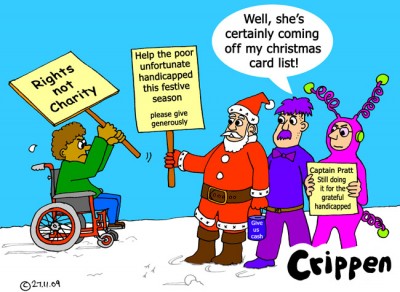
Frosty The Snowman
Frosty the snowman,
Had everything but feet
A carrot pipe,
Black button nose,
And a snowy four-wheeled seat.
Frosty the snowman
Is a fairy tale they say
He was made of snow
But the children know
How he came to life one day.
There must have been some magic in that
Old bike light they found
For when they placed it on a wheel
The seat it moved around.
Then Frosty the snowman
Was alive as he could be
And the children say
He could laugh and play
Just the same as you and me.
Whizz whizz!
Look at that wheelchair go
Whizz whizz!
Over the hills of snow.
Frosty the snowman knew
The sun was hot that day
So he said
“Let’s use these wheels
Now before they melt away”
Down to the village
With a broomstick in his hand
Whizzing here and there all
Around the square saying
Catch me if you can
He led them down the streets of town
Right to the traffic cop
And he only paused a moment when
He heard him holler “Stop!”
For Frosty the snowman
Had to hurry on his way
But he waved goodbye saying
“Don’t you cry
I’ll be back again some day”
Whizz whizz!
Look at that wheelchair go
Whizz whizz!
Over the hills of snow.
Rita Marcalo Didn’t Have A Seizure
Thanks to the BBC Ouch blog, where I have just read that Rita Marcalo, who planned to induce an epileptic seizure on stage last Friday, to raise awareness of epilepsy, was unsuccessful in her attempt to do this.
Autism Centre Back On Track
I covered this story earlier this year, so am very pleased to read the article pasted below.
An all-Ireland centre for children with autism is back on track after the Irish government ended a pause in funding.
Irish prime minister Brian Cowen said his government would return to backing the Middletown Centre of Excellence.
In May, the centre’s future was in doubt, when the Dail withdrew finances citing economic pressure.
The decision was announced at a meeting of the North/South Ministerial Council, which involved Mr Cowen, and NI’s First and Deputy First Ministers in Limavady.
Education departments in Northern Ireland and the Irish Republic have been equally financing the Middletown project.
The centre was approved in 2002 but has only opened in a limited way.
It is understood that £6m has already been spent on the centre.
It currently carries out research and training for professionals who work within the autism field, but the eventual aim had been to take children in.
The next stage of building a residential block for assessment and therapy, and employing extra staff, was at jeopardy because of the shortage of funds.
Parents Of Special Needs Children Need Help
Parents of children with special needs should be given more support, an inquiry is set to recommend.
A government-commissioned study by Brian Lamb says that a significant number of parents are not satisfied with the help they receive.
In response, the government will promise measures including a national support helpline and clearer information about rights to support.
Parents have complained that feel they have to “fight the system”.
The report by Mr Lamb will reflect calls for more parent-friendly support for families with children with special needs.
‘Huge battles’
It will say that parents want to know what help is available and to have clearer guidelines about what should happen in schools.
There will also be proposals that the Local Government Ombudsman should be funded to consider parents’ complaints against local authorities.
Special needs tribunals are also set to be improved and and there will be promises for more support for children who face bullying.
Special needs system ’causes suffering’
The National Autistic Society’s chief executive, Mark Lever, said: “A great many parents of children and young people with autism have to fight huge battles to get the education support that should be theirs by right, often at considerable emotional and financial expense.
“We hear terrible stories from parents of local authorities flouting the law by ignoring diagnoses, not meeting statutory timescales, failing to write statements properly, and even saying they ‘don’t do’ statements any more.
“It is hardly surprising then that parents have little confidence in the special educational needs system, and they could be forgiven for thinking that this report will do little to change what for them is an often complicated, intimidating, and sometimes infuriating system.”
More at Left Foot Forward.
McKinnon Supporters Write To The Queen
Supporters of Gary McKinnon today held a protest outside the Home Office to pressure Alan Johnson to stop the British computer expert’s extradition to America where he faces trial for hacking into Pentagon and Nasa computers.

Around 50 supporters, including Mr McKinnon’s mother Janis Sharp, Liberal Democrat leader Nick Clegg, Conservative shadow justice minister David Burrowes and former Labour minister Kate Hoey gathered in a show of support for Mr McKinnon.
The group, who were penned in by police barriers, waved placards and shouted slogans such as “No Way To The USA”.
A small number of them were later expected to go to Buckingham Palace to hand in flowers and a letter to the Queen, urging her to intervene.
Mr McKinnon, who suffers from a form of autism, is wanted to face computer hacking charges in Ameica using an “unfair” extradition treaty which the Conservatives have pledged to amend if they win power at the next general election.
Alan Johnson, the Home Secretary, has been criticised for ignoring fresh medical evidence about Mr McKinnon. That decision was challenged in the High Court last week.
Mr Clegg told The Daily Telegraph: “This treaty is wrong and Gary McKinnon’s extradition to the USA must be stopped. The Government can change this. We say to them: ‘You can do this if you have the courage of your convictions to do the right thing’.”
Mr Clegg said he had seen legal advice which suggested there was a loophole to allow Mr Johnson can intervene and prevent Mr McKinnon’s extradition.
Psychiatrists have given warning that the autism sufferer would kill himself rather than be extradited but Mr Johnson ignored their evidence, insisting he had no power to intervene.
Mr McKinnon, 43, allegedly hacked into Nasa and Pentagon computers and faces up to 60 years in a U.S. prison. He said he was seeking evidence of Unidentified Flying Objects.
Andrew McKinlay, a Labour member of the foreign affairs select committee, blamed the Government for agreeing to a “daft and crude treaty” in 2002, which had been intended to target terrorists but was being used for Britons accused of white collar crimes.
Kate Hoey, a former sports minister, added: “I have supported this campaign since it began. The more I hear about it the more ridiculous it is. Gary McKinnon should be tried here. The public want Gary to be tried here.”
Mrs Sharpe asked why it was that Hillary Clinton, the US secretary of state, could “stand up” for jailed killer Amanda Knox, when Mr Johnson was happy to stand by while Mr McKinnon was extradited.
She added: “Gary is terrified. He does not talk for days. How can any person live with this pressure for eight years?”
David Burrowes, the shadow justice minister and Mr Mckinon’s local MP, added: “We have to got to try we can to make sure that the home secretary knows the strength of feeling. The case for Gary increases each day.”
A Home Office spokesman said: “The Home Secretary has no general discretion to halt extradition proceedings — the sole issue was whether the latest representations demonstrated that to extradite would breach human rights.
“It is now for the court to decide whether to grant permission for a further judicial review. As the matter is before the courts, it would be inappropriate to comment further.“
Subtitles For Life- A Deaf Person’s Dream Comes True!
I’m linking this article from BBC Ouch, by Charlie Swinbourne, because I think it’s very well written and very funny. Enjoy!
Man Cleared of Mimicking Disabled Boy
A man accused of mimicking a five-year-old disabled boy has been cleared of harassment.
Steven Beavan, 35, of Rhyl, Denbighshire, had denied the charge and was cleared by a district judge at Prestatyn Magistrates’ Court.
The two-day trial had heard that police hid in a car with the disabled boy – who cannot be named – and saw Mr Beavan making ape-like expressions.
The court heard that Mr Beavan was in a long-running dispute with the family.
On Monday, the court heard that over a six-year period the couple had allegedly called Mr Beavan various abusive names including “vermin”, “scum”, “gayboy” and “gaylord”.
They had had leaflets addressed to “gaylord” sent to his house.
District Judge Andrew Shaw said he had “a very real doubt” about the case.
Prosecutor David Mainstone decided not to call the boy’s mother to give evidence because of her own “reprehensible” behaviour towards Mr Beavan.
She could not be relied on to be truthful, the court had heard.
Instead, he relied on the evidence of police officers who carried out a surveillance operation, accompanying the woman, her husband, and their son on their school run.
On several mornings, it was alleged Mr Beavan feigned a limp as they drove past, patted the top of his head and distorted his face.
Tom Bureau, defending, said it was vital in proving a harassment charge to show that the complainant had been upset by a course of conduct, but the woman had not given evidence on that point.
MP Andrew George Discusses Life With A DisAbility
Getting out of bed each morning is a painful struggle for MP Andrew George.
And bending down to put on his socks and shoes can be agony.
For the Liberal Democrat MP for St Ives and Isles of Scilly has the autoimmune disease Ankylosing Spondylitis (AS).
AS is a chronic condition that has no cure. It primarily affects the spine but can also affect other joints, tendons and ligaments, as well as eyes, lungs, bowel and heart.
In Andrew George’s case it has caused permanent eye damage.
Keep active
His answer to keeping his body moving – exercise and plenty of it.
“The answer to AS is to remain as fit and active as possible,” he said.
|
I have long-term damage to the iris Andrew George
|
“The pain is usually in my back or chest, but sometimes it can be in an arm or a hip.
“I find that if I have had a good cycle or even a good run I don’t usually get the symptoms within a day or two of the exercise.
“I do find the mornings hard to get up, it takes me a lot longer to get mobile in comparison to others like my wife who just jumps out of bed, well after I have made her a coffee anyway.
“I would love to paint myself as a hero in the face of adversity but I don’t want to play it up too much. I am just lucky I have a milder form of AS.”
Drug availability
Andrew takes basic anti-inflammatories, but says he has campaigned vigorously to get the expensive anti-TNF (tumour necrosis factor) drugs available to all.
And he has joined the National Ankylosing Spondylitis Society’s panel of experts to address the challenges for people with AS to remain confidently in work.
Although he admits to dislike taking his drugs: “I don’t mind taking them at night because it knocks out all the symptoms and you can sleep, but if you take them at the beginning of the day it can knock you out. “
He said the condition left him fatigued, although after a busy 80-hour working week it was difficult to know what is caused by what.
“I know two other MPs with AS, although obviously I am not going to mention their names.

Andrew George keeps himself fit
|
“It does not effect my work a great deal,” he said.
But he says he it influenced his life a great deal when he had the first symptoms as a teenager.
“It first started when I was 16. I had very painful hips which were very inflamed and I had limited mobility as well,” said the 50-year-old MP.
“I had been having trials for Cornwall at cricket and football and things like that and my dreams of going further in that field and in rugby came to an abrupt end.
“I didn’t understood what was going wrong then, but it was very frustrating especially for a young chap who was ambitious.
“It was very upsetting as well as perplexing because no-one could explain. I would say ‘I don’t know what it is but it is hurting here and there’ and people don’t believe you.
Future sight loss
“It took six years to diagnose it.
“They wrongly thought I had a slipped disc and various back problems.
“They said I had ‘growing pains’ and I had to go off in a hospital car to see a physio for stretching that went on for some time and never had any impact.”
|
ANKYLOSING SPONDYLITIS
AS is a chronic, autoimmune disease that has no cure and primarily affects the spine but can also affect other joints, tendons and ligaments, as well as eyes, lungs, bowel and heart
About one in 200 men and one in 500 women in Britain are affected by the disease
The disease typically affects people in their late teens and twenties
|
The course of AS is variable, but the majority of patients have continuous disease activity with episodes of acute pain, known as ‘flare-ups’, against a background of persistent symptoms.
There is a need for joint replacement surgery in some patients. In its most severe form, AS can result in complete spinal fusion, which can cause severe functional limitation and the potential for deformity over time.
But Mr George, who became an MP in 1997, said he knew the illness has always the potential to turn very serious.
His AS has caused serious problems with his eyes, which he has been told will cause him long-term damage.
“I had the first really scary bout of iritis – inflammation of the iris – when I was diagnosed. It almost blinded me. I have had it since and been told I have long-term damage to the iris. At the moment my eyes are quite good although I do need reading glasses.
“It will cause future sight loss though.”
People With Autism Have Problems With Self Awareness
Scientists have produced evidence that self-awareness is a big problem for people with autism.
Sophisticated scans showed the brains of people with autism are less active when engaged in self-reflective thought.
The findings provide a neurological insight into why people with autism tend to struggle in social situations.
The study, by the University of Cambridge, appears in the journal Brain.
|
Navigating social interactions with others requires keeping track of the relationship between oneself and others Michael Lombardo
University of Cambridge |
Autism has long been considered a condition of extreme egocentrism.
But research has shown the problem is people with the condition have trouble thinking about, and making sense of, themselves.
The researchers used functional magnetic resonance scans to measure brain activity in 66 male volunteers, half of whom had been diagnosed with an autistic spectrum disorder.
The volunteers were asked to make judgements either about their own thoughts, opinions, preferences, or physical characteristics, or about someone else’s, in this case the Queen.
By scanning the volunteers’ brains as they responded to these questions, the researchers were able to visualise differences in brain activity between those with and without autism.
They were particularly interested in part of the brain called the ventromedial pre-frontal cortex (vMPFC) – known to be active when people think about themselves.
The researchers found this area of the brain was more active when typical volunteers were asked questions about themselves compared with when they were thinking about the Queen.
However, in autism this brain region responded equally, irrespective of whether they were thinking about themselves or the Queen.
Researcher Michael Lombardo said the study showed that the autistic brain struggled to to process information about the self.
He said: “Navigating social interactions with others requires keeping track of the relationship between oneself and others.
“In some social situations it is important to notice that ‘I am similar to you’, while in other situations it might be important to notice that ‘I am different to you’.
“The atypical way the autistic brain treats self-relevant information as equivalent to information about others could derail a child’s social development, particularly in understanding how they relate to the social world around them.”
Dr. Gina Gómez de la Cuesta, of the National Autistic Society, described the study as “interesting”.
“We know many people with autism do want to interact with others and make friends but have difficulty recognising or understanding other people’s thoughts and feelings.
“This research has shown that people with autism may also have difficulty understanding their own thoughts and feelings and the brain mechanisms underlying this.”
Five Year Old Has MS
When Sam Blyth lost his eyesight his mother felt her worst fears were confirmed.
For weeks she had been going backwards and forwards to the GP saying he was ill.
Sam complained almost constantly that his head hurt, but Sandra said no-one seemed to think he was as ill as she feared and put his increasingly distressing symptoms down to a heavy cold.
“He had a cold but as soon as that went he started complaining of headaches and was always pointing to the same place,” she said.
Painful headaches
“Being a mum I knew straight away there was something wrong.
“He had never complained of a headache before and they just seemed so severe.
|
The specialist did say he has time on his side and if they get him started on the treatment then hopefully they can try to keep the MS at bay Sandra Blyth
|
“The pain was so bad the headaches would wake him up during the night.
“I went to the doctor about four to five times and they said it was just his cold and sent him away.
“I said it was not normal.”
On 3 March this year Sam became much worse.
“He started screaming that he could not see,” said his mother.
“I took him to casualty, burst into tears and said: ‘I think he has a brain tumour’.
“I said I was not leaving until I saw a paediatrician.”

MS causes damage to nerve cells
|
The doctors took bloods and a CT scan and decided that an MRI (magnetic resonance imaging) scan was needed.
Sam was then sent from his home in Dumfries and Galloway to Edinburgh where doctors diagnosed a condition called acute disseminated encephalomyelitis (ADEM).
It is an inflammatory disorder, similar to multiple sclerosis (MS), but only strikes once, and up to 75% of patients make a full recovery.
“We were jumping for joy, it was a miracle, our darling boy was going to be OK and he would be with us forever,” said Sandra.
Relapsed again
He was given steroids and recovered, but within months started showing worrying symptoms again.
At the age of just five the Blyths were told Sam had MS.
Dr Evangeline Wassmer, consultant paediatric neurologist at Birmingham Children’s Hospital said a lengthy delay for a diagnosis, like that experienced by Sam’s family, was not unusual.
“It is quite common that a diagnosis should take so long and that is because there are lots of other things that the MS can look like in children,” she said.
“The criterion used in adults is not always as helpful in paediatrics.
“Paediatric MS is rare: we don’t know the exact number of cases, but there could be about 45-300 children a year in the UK diagnosed with MS, probably on the lower side.”
Dr Wassmer said delivering a diagnosis to the parents of children like Sam was always distressing.
|
MULTIPLE SCLEROSIS
It is thought that 100,000 people in the UK – about one in 600 – have been diagnosed with MS
MS affects more women than men (by a ratio of 3:2) with symptoms usually becoming apparent in young adults (between the ages of 20 and 40) even though a firm diagnosis might not be made for many years
The youngest known cases of MS are just five years old but it is relatively rare for children to be diagnosed, although this is increasing year on year
|
“We think the disability is a slower process for those diagnosed as children,” she said.
“About 50% will need help with walking by the time they are 40.
“I find it devastating to tell them at 12 that by the time they are 40 they will have mobility problems.”
Sandra said the whole experience had been bewildering.
“I never thought children got MS,” said Sandra.
“I always thought it just affected adults in their 40s. I never thought he would have MS so soon or young, maybe when he was an adult but not at five.
“They don’t know what his future is – we have to take each day as it comes.
“He is on beta interferon injections three times a week and he is on steroids.
“It is just a case of time will tell. The specialist did say he has time on his side and if they get him started on the treatment then hopefully they can try to keep the MS at bay.”
Tomato Lichy and Paula Garfield Have Deafinitely Returned To This Blog!
Tomato Lichy and his partner, Paula Garfield, first appeared on this blog in March 2008, when they caught the attention of the mainstream media. Now, I’m pleased to welcome them back, for very different reasons, as members of theatre company Deafinitely. Creative spelling at its best!
They caused controversy with a show arguing that deafness wasn’t a disability, but theatre company Deafinitely don’t want to be defined by single-issue politics. They talk to Lyn Gardner.
 Deafinitely’s production of Double Sentence. Photograph: Sheila Burnet
There was an outcry in New York theatre recently over the casting of a hearing actor in the role of John Singer, the deaf-mute character in a stage adaptation of Carson McCullers’s The Heart Is a Lonely Hunter. Many deaf people believed that the role should have gone to a deaf actor, with Linda Bove, a deaf actor and board member of the Alliance for Inclusion in the Arts, raising the temperature of the debate by saying: “A hearing actor playing a deaf character is tantamount to putting a white actor in blackface”. The production proved to be a reminder that the deaf community is still marginalised and finding its voice in a largely hearing theatre world.
Here in the UK, we have some extraordinary deaf theatremakers and performers, including Sophie Woolley (creator of the cult one-woman show, Born to Run, and currently appearing as Gabriella in C4’s Cast Offs, a show about a group of disabled people marooned on an island), and the actor Caroline Parker, who will be in Signs of a Diva at the Theatre Royal Stratford East early next year (and who, over a long career, has tackled everything from comedy to the lead role in the 17th-century Jacobean revenge drama The Changeling). Even so, the stories of the deaf world are only just beginning to be heard.
One deaf-led company, Deafinitely Theatre, is doing its utmost to bring these stories centre-stage. “There are so many misconceptions about being deaf,” says Deafinitely’s artistic director, Paula Garfield. “We want people to understand what it means to be deaf, but also to see the potential of deaf artists.” That second point may be the crucial one. Later this week, at London’s Drill Hall, the company will be showing some of the work that has come out of its Deafinitely Creative initiative, a three-year programme that began in 2008, which is designed to train deaf playwrights to a professional level. The scheme is the first and only one of its kind in this country, and its success will be judged not just on its ability to play midwife to a generation of deaf playwrights, but on whether those writers can eventually find work in a hearing theatre world.
The plays will be written in English, then translated into British Sign Language – something that, for many deaf people, remains a problematic idea. “English is the language of oppression, of being forbidden to use sign language,” argues Deafinitely’s Tomato Lichy. For many years, deaf people were discouraged from learning to sign and instead told to concentrate their energies on learning to speak. As a result, many grew up isolated from both the hearing and the deaf, unable to communicate effectively with either.
Born to hearing parents who were advised by the medical profession that it was imperative that she not be taught to sign, Garfield felt that she was a failure by the time she was a teenager – as a profoundly deaf person, she failed to learn to speak in a way that could be understood in the hearing world. Lichy’s story is similar: after dropping out of university in his early twenties because of difficulties doing a course designed for hearing students, he became depressed, then homeless. He says he only emerged from that dark period when he threw away his hearing aids and learned to sign. Several years on, the couple couldn’t be happier, both as artists and as parents – they have a daughter, Molly, and a second baby on the way.
Not that this has made their work any less politically urgent. Nothing quite prepared me for Playing God, which opened at London’s Soho theatre in 2007. Inspired by their own experiences dealing with doctors who prized being able to hear over being able to communicate, it concerned a fictional couple at loggerheads over whether their deaf child should be fitted with cochlear implants. The story was very close to home; Molly is also deaf.
The use of implants is controversial in the deaf community because they don’t restore hearing, and many believe that in any case deafness should not be “fixed”. The play’s argument was most powerfully voiced by the child’s deaf father, who, when his daughter is fitted with implants, talks of watching “as my daughter’s deafness died”. But while Playing God set out to provoke discussion over the use of implants – and did so effectively – there was no doubt that the emotional argument to not fit the implants was biased in favour of the father’s viewpoint. It was a sad, angry play , and one that seemed to me extraordinarily one-sided.
The couple had plenty of reason to feel angry, says Lichy: “When our daughter was labelled a problem because she couldn’t hear, we were shocked. The doctors were only interested in how she could be repaired. Repaired! I told them, ‘My daughter doesn’t need repairing.'” “We’ve moved a long way since Playing God,” says Garfield. “I was a very angry woman around that time. I’m not any more.”
These stories are important, but over time, different narratives will appear too. Deafinitely is starting to develop a distinctive approach, combining the visual and physical, and not just producing issue-based theatre. The director of Soho’s writers’ centre, Nina Steiger, agrees. “The company is starting to think in theatre, and that’s a good sign.” She suggests that deaf theatre has sometimes been too focused on narrow political concerns. “There is a lot of dogma and politics in the deaf theatre world,” she says. “It can veer towards being isolationist, and I think that Playing God did have a tendency towards that.” But there’s nothing new in that; many of the most exciting theatre companies of the last 30 years have built on personal experience. “Back in the 1970s, in gay theatre, it was the coming-out narrative that dominated,” Steiger argues. “Today the deaf equivalent is throwing off your hearing aids and the articulation of a deaf world that exists independently of a hearing world.”
If society in general is biased towards the spoken word, then British theatre tradition has been even more so. Arguably, it’s only in the last few years that theatre in this country has woken up to the potential that visual and physical techniques can bring to productions of all kinds. So what’s next for deaf theatre? Jenny Sealey, herself a deaf artist, and the artistic director of the pioneering disabled-led theatre company Graeae, founded in 1980 by Nabil Shaban and Richard Tomlinson and which makes work that ranges from classical revivals to street arts, would like to see companies doing shows entirely in British Sign Language. Perhaps some Shakespeare, Beckett or even a big musical like La Cage aux Folles.
Certainly, British Sign Language is wonderfully visual, and has layers of metaphor that make English seem unexpressive and unwieldy. It is also economical in terms of its visual language, something that Steiger believes playwrights writing in English could learn from. Playwright Andrew Muir, who works as a dramaturg with Deafinitely and wrote Double Sentence, a play about a young deaf man sent to prison for 12 years who faces problems because of a lack of deaf access in the penal system, for Deafinitely concurs: “It took a week [for my play] to be translated from English to British Sign Language, and it made me realise just how much bullshit I write, and how much could be cut.”
Garfield is in no doubt that Deafinitely still has a long way to go, though, and that this week’s showcase of new plays by deaf writers is only a staging post along the way. “The rest of the theatre world has had hundreds of years to learn,” she says. “We are beginners – but we’re catching up fast.”
Beauty Queen On Blindness Fears
A beauty queen hopes to win the Miss Wales crown before a rare eye disorder robs her of her sight.
Nicola Thomas, 23, from Caerphilly, has been diagnosed with a rare eye disorder called Devic’s Disease, which will eventually leave her blind.
Determined to live life to the full and boost her confidence, she entered a beauty contest in her hometown and won.
She now goes on to compete in the Miss Wales competition and if she wins that she could qualify for Miss World.
Devic’s Disease is a disorder where the immune system attacks optic nerves.
Miss Thomas, an admin assistant, has already lost the sight of her left eye.
She first noticed her vision was going blurry while watching TV with her mum at home.
“I was just seeing less and less until one day I couldn’t see a thing in my left eye,” she said.
|
No-one knows for certain when I will go blind in my other eye but I’m just doing everything I can to make the most of life while I can see Nicola Thomas
|
“It was quite frightening – one minute I was living a normal life, the next I was facing life in complete darkness.”
She had to take sick leave from her job with a finance company and spent her days in bed listening to music until doctor’s diagnosed the disease.
“I felt trapped. I was used to going out every weekend and dancing with the girls,” she said.
“I’m usually so independent but I was losing my confidence. I felt useless and cried a lot through frustration.
“No-one knows for certain when I will go blind in my other eye but I’m just doing everything I can to make the most of life while I can see.
“I may not be able to see forever – but I’m going to cram my life so full that by time I go blind I will have enough memories to keep me going.”
On the list of Nicola’s ambitions was to enter the Miss Caerphilly contest in her home town.
She said: “It was a fantastic feeling to be up there with all these beautiful girls and absolutely to win.
“I could look out at my family and friends clapping and cheering.
“It was a brilliant sight and it will stay with me forever.”
She will now take part in the Miss Wales contest next summer.
Results of The New Face of Kinder Competition
In October, Same Difference publicised the attempt of Isla, 4, from Hampshire, to become one of the new faces of Kinder Chocolate. Today, readers, I am very pleased to be able to tell you that Isla, who has Down’s Syndrome, was selected as a winner of the competition, along with 5 other children from around Britain and Ireland.
The winners will see their face on the front of Kinder Chocolate Mini Treat packs in the New Year for a limited period of time.
This is the very first time that Kinder will change the current child’s face that has appeared on packs across the UK & Ireland. The aim of the Face of Kinder competition was to find humorous kids between the ages of 4 to 11 to feature on packs. Each entrant was required to submit a photograph along with an amusing quote. Following a public vote, the top 100 children were shortlisted to 30 by a panel of judges including Gaby Roslin, and the public then chose their 6 winning children.
Isla has proved herself to be truly DisAbled by participating in this competition, and I hope you will agree that her victory is real progress for every DisAbled person’s dream of inclusion into every area of mainstream society. Lets hope that seeing her face on packs of Kinder teaches the able bodied, and inspires the DisAbled, children to realise that modelling should be open to everyone, because everyone is beautiful in their own way. And, Down’s Syndrome or not, I hope you will agree that Isla is a beautiful child:
Ellie Simmonds Wins DisAbled Sports Personality of The Year Award
Congratulations to her! Very well deserved it is too!
British swimmer Ellie Simmonds added to her silverware when she collected an award at the annual Sports Journalists’ Association (SJA) British Sports Awards on Wednesday December 9, 2009.
Simmonds, who won two gold medals at the 2008 Paralympic Games, won the Bill McGowran Trophy for the disabled sports personality of the year along with yachtswoman Hilary Lister.
On her award Simmonds commented: “It is a great honour to win this award in front of so many amazing sports stars and sports professionals.
“It really has rounded off a great year for me and everyone involved within the sport. I won a few medals in relay events this year and I couldn’t have won this award without the team’s support.”
Gary McKinnon’s Lawyers Lodge Fresh Appeal
Computer hacker Gary McKinnon is mounting a fresh High Court challenge to stop his extradition to the US.
Solicitor Karen Todner said papers were lodged with the High Court seeking a judicial review of the home secretary’s decision not to block his transfer.
The home secretary has 14 days to respond before a judge considers it.
Mr McKinnon, 43, who has Asperger’s syndrome, is accused of breaking into the US military computer system. He says he was seeking evidence of UFOs.
The computer systems he is accused of breaking into include the Pentagon.
The Glasgow-born man, now of Wood Green, north London, faces 60 years in prison if convicted.
Last month Home Secretary Alan Johnson told Mr McKinnon’s family he could not block the move on medical grounds, leaving the way open for a trial in the US.
The latest legal submissions include an up to date medical report on his situation and two reports – one British, one American – about the ability of the US prison service to deal with his circumstances.
After the 14 days in which Mr Johnson can respond, the case will then go before a single judge to be considered on paper.
A court hearing may be needed before a decision is reached on whether a judicial review will be granted.
Quadriplegic Sailor Geoff Holt To Cross Atlantic
A yachtsman hoping to become the first quadriplegic sailor to cross the Atlantic has set off on his voyage.
Geoff Holt, 42, will travel 2,700 miles (4345 km) from Lanzarote in the Canary Islands to the Caribbean.
He will be returning to Garden Bay in Tortola, in the British Virgin Islands, where he suffered a diving accident that paralysed him.
Mr Holt, from Southampton, said he hopes the journey will help him “lay some ghosts to rest”.
He is already the first quadriplegic sailor to sail around Britain and will be accompanied by a carer and a cameraman on board his boat, called Impossible Dream.
However, he will do all his own sailing on board the specially-equipped boat.
‘Emotional journey’
Mr Holt, who only has limited use of his arms and hands, will use hydraulic push button technology to sail the 60 ft (18 metre) catamaran for the 17 days it is expected to complete the voyage.
He said it seemed “right” to sail back to where he had his accident.
“I feel I will be closing the circle from having my accident,” he said.

Cannot play media.You do not have the correct version of the flash player. Download the correct version
Geoff Holt: “It’s the next chapter of my life”
“I left there in an ambulance but I plan to return there as a transatlantic quadriplegic sailor and lay some ghosts to rest.”
Just before he set off, he told reporters: “(I’m) feeling really excited now and can’t wait to reach open water.
“I have said my goodbyes to my wife and son. It will be tough being away from them at Christmas but being reunited with them will keep me going across the 2,700 miles that lie ahead of us.”
Mr Holt’s only restrictions to sailing the yacht independently are those concerning his personal care.
Without help, he cannot get himself into bed, dressed or even into the shower.
|
Geoff is one of the most remarkable people I have ever met Dame Ellen MacArthur
|
But, once up and in his wheelchair, he can use his navigational and boat handling skills to sail the yacht, using the high-tech equipment.
Mr Holt’s care will be provided by his personal assistant, Susana Scott, 28, who is originally from New Zealand.
Record-breaking yachtswoman Dame Ellen MacArthur, from the Isle of Wight, gave her support to the challenge.
She said: “Geoff is one of the most remarkable people I have ever met.
“Not only has he already achieved the unachievable, but he is humble with it.
“I think few will understand just how important this challenge is to Geoff – perhaps in a way it is unfinished business.”
We Made The Pre Budget Report Too!
Yes, Alistair Darling announced plans in the Pre-Budget Report to increase disability benefit by 1.5% in April. Today, the Tories criticised him for not setting aside enough funding to pay for this rise for more than one year, to which he responded that the increase is not temporary.
As usual, we must sit and wonder whether we will really get a payrise next year, or whether the plans are just another way for Labour to collect the Blue Vote. We’ll find out in five months. Meanwhile, we can simply be glad to get a mention, and start dreaming of ways to spend the extra money!
The (DisAbled) Twelve Days Of Christmas
I was once asked, in one of the several talks I gave to the class at my mainstream schools, whether I got my DisAbility related equipment as Christmas presents! Of course I don’t, and I’m still laughing at the idea. But the memory returned when I read this, and inspired me to write a DisAbility-friendly version of The Twelve Days Of Christmas. I hope you enjoy it!
On the first day of Christmas, I found under the tree,
One Christmas card, written in Braille, cause I can’t see.
On the second day of Christmas, I found under the tree,
Two hearing aids, one for each ear, music to me!
On the third day of Christmas, I found under the tree,
Three copies of the British Sign Language Dictionary.
On the fourth day of Christmas, I found under the tree,
Four standing frames, now you just think, how tall I’ll be!
On the fifth day of Christmas, I found under the tree,
Five copies of All About Me, on DVD, thanks BBC!
On the sixth day of Christmas, I found under the tree,
Six chairs on wheels, all holding dolls, all called Becky.
On the seventh day of Christmas, I found under the tree,
Seven audiobooks, telling the tale, of a wizard called Harry.
On the eighth day of Christmas, I found under the tree,
Eight pairs of shoes, velcro, of course, thankfully lace-free!
On the ninth day of Christmas, I found under the tree,
Nine voice boxes, now I can talk, you can’t stop me!
On the tenth day of Christmas, I found under the tree,
Ten Boccia balls, five red, five blue, Paralympics, wait and see!
On the eleventh day of Christmas, I found under the tree,
Eleven wheelchairs, fast enough to race, who needs cars? Not me!
On the twelfth day of Christmas, I found under the tree,
Twelve copies of Disability Now, large print, of course, easy to see!
Drama Schools Must Do More To Attract Disabled Students
Drama schools are being urged to “open their doors” to disabled students as part of a nation-wide campaign aimed at encouraging people with disabilities to pursue a career in the arts.
The Don’t Play Me, Pay Me campaign has been initiated by Nicky Clark, an actress whose daughter, Lizzy, has Asperger’s Syndrome and recently appeared in the BBC children’s drama Dustbin Baby.
In the series, Lizzy played a character who has Asperger’s, which prompted her mother to launch the campaign and call on television dramas to cast disabled people in disabled roles.
As part of the campaign, Clark is urging drama schools to be more proactive in encouraging students with disabilities to enroll, which she said would increase the pool of actors from which producers can cast.
She said: “I went to drama school and what I want is for young people growing up with disabilities to be able to pursue their chosen creative path and for drama schools to open their doors.”
Clark said the issue had been increasingly brought to the fore recently, but said drama schools should be “opening up the debate” and allying themselves with disability groups to promote the fact they are open to everyone and that there is “equality in their remits”.
However, Clark claimed that there was a “vicious circle” in the industry, because TV programmes do not currently portray disability regularly, meaning young disabled people who would like to become actors do not consider acting as a career choice.
Clark argued that TV producers, writers and directors should be doing more to increase the visibility of disabled people on television and added that when disabled people are portrayed, it is usually by an able-bodied actor.
“I equate it to blacking up. The idea of a non-disabled person portraying a disabled character should be consigned to the past,” she said.
Responding to her calls, Judith Kilvington, chief executive of disabled-led theatre company Graeae, said there had been a “wind of change” at drama schools in recent years.
She said the theatre company had collaborated with RADA, Mountview Academy of Theatre Arts and Central School of Speech and Drama on initiatives to encourage disabled people to apply. Kilvington also said Graeae has a long-standing relationship with Rose Bruford College of Theatre and Performance and had been helping the school ensure its curriculum is “inclusive and accessible” and that its assessment techniques take into account disabled students.
“I think there is a lot that is going on. It has been slow, but there is a real sea change in terms of opening doors,” she said.
Scientists Unveil World’s First Bionic Fingers
Experts have unveiled what they claim are the world’s first bionic fingers which they hope will transform the lives of people with missing digits.
The motor-powered ProDigits have been developed by Touch Bionics, the Livingston, West Lothian company which made the bionic i-Limb hand.
The unit fits over the person’s palm to help people with any number of missing digits.
Those fitted with the device can bend, touch, pick up and point.
Developers hope the device will be a boost to the partial hand amputee population, which is estimated at about 52,000 in the EU and 1.2 million worldwide.
Phil Newman, marketing director of Touch Bionics, said: “There has been no solution like this for the partial hand amputee community.
“The ProDigits provide a powered device with a grip and it has returned these people to a level of functionality and independence.
“It is supporting a community that has never had support before.”
|
Even a simple thing like holding and lifting a glass of water to drink from was impossible before, but with ProDigits I can do it easily Maria Antonia Iglesias
Digit amputee |
It is estimated that a two-finger amputation leaves an individual with a 20%-40% hand impairment, depending on which fingers are affected.
The custom made ProDigits are fitted on to what remains of the hand, and can be controlled by myoelectric sensors which register muscle signals from the residual finger or palm.
Alternatively they can be controlled by a pressure sensitive touch pad, which relies on the remnant digit or tissue surrounding the metacarpal bone to provide the necessary pressure to activate the finger.
A special stall feature allows the device to detect when it has closed around an object so that it does not crush it.
This also allows users to point single digits and configure the hand in various grip patterns.
Skin covering
Patients can choose from a range of coverings, from hi-tech clear and black robotic skins to a more natural looking “living skin” option.
One of those fitted with ProDigits is former concert pianist, Maria Antonia Iglesias, from Catalonia, who underwent amputation of all extremities following pneumococcal septic shock of unknown origin in July 2003.
They have enabled her to write, hold cutlery and drink from a glass again, tasks she previously struggled to do.
The 42-year-old said: “I am very pleased to be part of this project and the benefits my new hand is giving me are like a dream.
“Even a simple thing like holding and lifting a glass of water to drink from was impossible before, but with ProDigits I can do it easily.”
The ProDigits prosthetics are tailor-made for each patient and cost around £35,000 to £45,000, which includes the cost of fitting, occupational therapy and the skin covering.
Most of those using them at the moment are privately funded but the company said it hoped to look at working with the national health service in the future.
Bollywood Shines Spotlight On Health Disorders
One of the main reasons why I am blogging the article below is that I love Bollywood movies. I have seen almost all of the movies mentioned in the article. I highly recommend Paa to anyone who watches Bollywood movies. Taare Zameen Par is another of my all-time favourites.
The opening of a film focusing on the rare Progeria disorder is the latest in a spate of Bollywood films about health disorders. The BBC’s Prachi Pinglay looks at why the Indian film industry is departing from its traditional formula to tackle weighty issues such as autism and Alzheimer’s disease.

Bollywood superstar Amitabh Bachchan plays a young boy with Progeria
|
Auro is 13, but looks 65. He has Progeria – a rare disorder which accelerates ageing in children.
Pia has been married to a man for over 20 years but she does not always remember him. She has Alzheimer’s disease.
Ishaan, eight, is a gifted painter but messes up his numbers and letters. He is dyslexic.
Sanjay Singhania cannot remember how his wife was killed, yet he wants to take revenge. He suffers from “short-term memory loss”, a type of amnesia developed after a traumatic incident.
What links these people?
They all have neurological conditions, and are the protagonists of mainstream Hindi films released in the last two years.
‘Social change’
Bollywood has long been known for stories with predictable beginnings and endings.
But now filmmakers are exploring seemingly different plots with films such as Taare Zameen Par (Stars on earth); U, Me Aur Hum (You, me and us) and Apna Aasman (Our sky) over the last two years.

U, Me aur Hum dealt with the issue of Alzheimer’s
|
The latest to join the list is Paa, which opened this weekend.
Bollywood’s biggest-ever star Amitabh Bachchan plays a 13-year-old boy with Progeria. His real-life son Abhishek Bachchan plays his father.
The reasons for making these films differ with each filmmaker.
Paa director R Balki says he wanted to make a film with Amitabh and Abhishek Bachchan and cast them in reversed roles.
“Once I saw Mr Bachchan joking with Abhishek, and Abhishek was behaving in a mature way. That is when I decided to make a film with the roles reversed. We consulted doctors and researched Progeria. The film is not about Progeria but about father-son relationship,” he said.
Amol Gupte, writer of Taare Zameen Par, said he made the film primarily “to take a re-look at parenting”.
In the film, eight-year-old Ishaan is dyslexic, but a gifted painter. However, he is always compared with his “normal” elder brother and goes through several ups and downs before his talent is finally recognised.
Mr Gupte, who says he makes films for “social change and sensitisation”, maintains dyslexia is not a disability but a neurological difference.
|
A feature film needs to entertain. This is not a medium for preaching. You have to connect with the audience Director R Balki
|
“It is called the gift of dyslexia. Problems are not in children. Problems are in the system. They are making patients out of children. You cannot be whipping a child into ‘ability’.”
These films can be broadly divided into two types: Tug-at-your-heart films where the underdog rises above the adverse situation, such as Taare Zameen Par, and Iqbal which has a deaf and mute protagonist; and thrillers such as Ghajini, where the protagonist has anterograde amnesia, and Bhool Bhulaiya, which deals with multiple personality disorder.
Most recently, super-hit Kaminey had the hero playing twin brothers – a pet Bollywood formula, but in this case one with a lisp and the other with a stammer.
More accepting
Trade analysts say audiences will accept a different film if it is entertaining.
Moreover, because of the growing number of multiplexes and the corporatisation of the film industry in the last few years, several production houses are producing cinema that is off-beat.
Sanjeev Lamba, CEO of Reliance Big Pictures which produced Paa, explains why they went ahead with financing the film.
“We think Paa is a wonderful, light-hearted family film at the core of which is a very warm and loving father-son relationship. We believe that audiences are rapidly building an affectionate relationship with the central character Auro. While the story is about an unusual child and a rare father-son relationship, the film is extremely entertaining with emotional high points grounded within a loving family.

Taare Zameen Par deals with dyslexia
|
“We have no doubt that audiences all over the world will embrace this story and its characters.”
Though the stories may be different, most of these films have bankable, popular mainstream stars like Aamir Khan, Kajol, Irrfan Khan and Amitabh Bachchan.
Experts feel the Indian audiences are better informed now and hence more accepting of different themes.
Taran Adarsh, a well-known trade analyst, says: “Earlier people were only aware of tuberculosis and cancer, but now people have access to information.
“Also, filmmakers are getting more realistic. They are going beyond “the revenge for father’s death” and “the love triangle” formula.
“Audiences also want to know more. Even if the backdrop is different, audiences can relate to it because they read about it. So if a film has Progeria as the backdrop, it is fine. Because it is there, it exists.”
As Amol Gupte says, “underdog overcoming difficulties” is the strongest theme in world cinema and choosing a medical condition as the backdrop is not uncommon to Western cinema.
More films are under production which have a central character with a certain medical condition.
For example, Bollywood superstar Shahrukh Khan is playing a man suffering from Asperger’s disease in an upcoming film, while Nana Patekar is directing his son in a film with autism. Another untitled film is based on a character who has a bipolar disorder.
Asked about the box-office performance of these films, director R Balki feels that as long as a film connects, it will work.
“A feature film needs to entertain. This is not a medium for preaching. You have to connect with the audience,” he says.
A Response To The Case of Rom Houben
I’ve just read this wonderful article, written by my good friend Rahila Gupta, in response to the case of Rom Houben, who was left trapped in a coma-like state for 23 years after a car accident in his home country, Belgium. She writes about her personal experiences with her son, my childhood friend, Nihal Armstrong. I am drawing your attention to this article because I believe that it should reach as many parents of disabled people as possible. I hope that you will find the article useful, and will be as inspired as I have always been by this truly special mother.
Another Famous Person Reveals A Recognised DisAbility
I couldn’t believe my eyes when, while reading this month’s issue of Disability Now, I discovered that Bill Gates is DisAbled. Yes, he has Asperger’s.
If you’re currently using an Apple computer to read this post, you may not be half as inspired by this discovery as I am. Personally, however, I have a lot to thank Bill Gates for. My lovely laptop, often referred to as my best friend, runs on one of his many wonderful inventions- Windows Vista. If he’d never started Microsoft, I don’t know if you’d be reading this blog at all! I now have an extra reason, as if I needed one, to buy Microsoft products.
On a more serious note, there’s no question that most of the world, DisAbled or not, knows of Bill Gates and thanks him for creating Microsoft, and will continue to do so for many years to come. He is truly DisAbled as he has used what many may now realise are the natural traits of a person who has Asperger’s Syndrome to create something truly irreplacable, earn a fortune, and achieve brilliant success and worldwide fame. He is a true inspiration to anyone with any DisAbility. May many mainstreamers, on learning of his Asperger’s, take a moment to stop and realise that if Bill Gates has a disability, then there must be many other people who have disabilities whose inventions and ideas deserve to be listened to, as they, too, may just make the world a far better place.
Schoolboy Wins Vitamin D Campaign
Pregnant women are to be educated about the importance of taking vitamin D supplements thanks to a campaign by a 14-year-old Glasgow schoolboy.
Ryan McLaughlin, whose mother Kirsten has multiple sclerosis, took his case to the Scottish Parliament’s petitions committee earlier this year.
He believes taking vitamin D can help prevent the condition.
In a written response, the Scottish government said it would put in place an action plan to increase awareness.
It said recent research had found there was an “urgent need” to provide information to all health professionals who work with pregnant women and young children about current guidance on vitamin D.
“There is also a need to educate women about the importance of taking vitamin D supplement when pregnant and the importance of giving their children a vitamin D supplement until the age of four,” the response added.
|
These actions will make a big difference to the health of generations of Scots Ryan McLaughlin
|
The Scottish government will now agree a co-ordinated programme of action with NHS Health Scotland, and has pledged to keep the McLaughlins informed of developments.
Mrs McLaughlin, a former European Taekwondo champion, was diagnosed with MS two years ago.
Ryan, from Drumchapel, said: “I am so happy to hear that the Scottish government are being so proactive and really getting behind my campaign.
“These actions will make a big difference to the health of generations of Scots, and it will go a long way to giving Scots children some protection against disease caused by vitamin D deficiency and gives parents proper advice.
“I am now looking forward to the summit next year when we’ll hopefully be able to tackle the recommended levels but this is such great news.”
Fortified milk
Ryan became the face of a YouTube campaign to publicise the use of vitamin D, and led hundreds of supporters down Edinburgh’s Royal Mile to Holyrood before he put his proposals to the petitions committee in June.
He told MSPs research into the genetic effect of vitamin D deficiency showed a link to the development of MS. Vitamin D, which the body needs for healthy, strong bones is largely gained through sunlight and food.
The Scottish government has already ruled out free vitamin D supplements for all pregnant and breastfeeding women, and said there were no plans to introduce the supplements in the form of fortified milk or other drinks at school.
Scotland is thought to have the highest rate of MS in the world.
BBC News – Scientists hail robotic hand ‘breakthrough’
A group of European scientists have successfully connected a robotic hand to an amputee, allowing him to feel sensations in the artificial limb, and control it by thought.
During a month of experiments, the patient made complex movements using only his brain. It is being heralded as a scientific breakthrough. Tom Donkin reports.
Vodpod videos no longer available.
Local authorities that fail to protect the rights of disabled people could face legal action, the Equality and Human Rights Commission said today, announcing an inquiry into disability-related harassment in England and Wales.
The investigation comes in the wake of the recent inquest into the death of Fiona Pilkington, who killed herself and her learning disabled daughter Francecca Hardwick by setting light to their car.
In September, a coroner criticised Hinckley and Bosworth borough council for failing to help the 38-year-old mother. Pilkington and her daughter had been abused by a gang of youths on their street in Barwell for more than a decade.
The EHRC said it had already gathered evidence that targeted violence of hostility towards disabled people, in particular those with learning disabilities or mental health conditions, was “widespread”. The aim of the inquiry is to investigate the true extent of disability-related harassment. Local authorities could then face action to force them to fulfil their legal obligations, the EHRC said.
“There have been many well-documented cases where targeted hostility, bullying and antisocial behaviour has escalated into more serious violence, murder or the death of disabled people,” said EHRC commissioner Mike Smith.
“The recent inquest into the tragic deaths of Fiona Pilkington and her daughter Francecca show that early intervention and preventative action are essential, and that public authorities have to work in partnership to tackle this problem effectively.”
A report on the safety and security of disabled people published by the EHRC earlier this year found that disabled people were four times more likely to be the victim of a crime than other people and twice as likely to be the victim of a violent attack.
The inquiry will look at the steps taken by public authorities to eliminate disability-related harassment and to address its causes, including prejudice and negative attitudes. It will also examine how they have ensured the involvement of disabled people in eliminating harassment and its causes.
Smith said some disabled people “become conditioned to hostile treatment, or are sometimes told to ignore it by those around them – including by public authorities. They may also go to enormous lengths to avoid putting themselves at risk which can limit their freedom and opportunities. These are unacceptable outcomes for anyone in our society”.
Ruth Scott, director of policy and campaigns at disability charity Scope, welcomed the inquiry. She said it should focus on increasing the confidence of disabled people to report harassment and training of public authority staff.
“We would also like to see the inquiry investigate how public authorities can take proactive steps to identify and confront particular types of harassment, either in specific geographical hotspots or against particular groups of disabled people, so that good practice and effective interventions can be shared,” said Scott.
The inquiry, announced on the United Nations International Day of Persons with Disabilities, will begin in early 2010 with the findings reported within a year.
The EHRC will consider how public authorities have complied with their obligations in relation to the Disability Equality Duty set out in the Disability Discrimination Act 1995, the Human Rights Act, and the UN Convention on the Rights of Persons with Disabilities. It has already produced guidance to help public authorities understand what its duties and responsibilities are and how the duties should be implemented.
Disgust Over Plans To Cut Service For Disabled Children In Wales
A service which provides free care for disabled children could be ended as part of a plan to try to save £5m.
Wrexham council believes it could save £31,000 by cutting the Daybreak service, which provides disabled child care during school holidays.
Independent councillor Mark Pritchard, who tried to block the proposals, said he felt “physically sick” at the plans.
The service is run by Wrexham-based charity Dynamic, but the council said no decision had yet been made.
The service provides free care for disabled children and their siblings for up to eight hours per week during school holidays.
|
I’m absolutely disgusted that as a council we are considering this as a budget cut Councillor Mark Pritchard
|
According to a council report which has identified potential savings in several areas, the service has been accessed by 100 children.
However, the report states: “It is proposed that the contract with Dynamic to provide its Daybreak Service is not renewed. This will generate a saving of £31k.”
The report added that “a significant proportion of the cost of the scheme is taken up with salary and admin costs,” and claims play services for disabled people have increased in Wrexham in the last two years.
Mr Pritchard tried to have the proposals scrapped at a meeting of the council’s executive board on Tuesday.
However, after a split vote of five for and five against council leader Aled Roberts made the casting vote to keep the proposals.
Mr Pritchard said: “This has made me physically sick. I’m flabbergasted.
“I’m absolutely disgusted that as a council we are considering this as a budget cut.
“Of course, I understand these are difficult times, but when we’re considering cutting a service that caters for disabled children for the sake of saving £31,000, it’s a disgrace.
Concerned parents
“Councillors who voted for this should hang their heads in shame.
“There are many, many ways to save money. Any of the local authorities in Wales looking to save money should look from the top down.”
Mr Pritchard said his phone had been “ringing off the hook” with calls from concerned parents, and vowed to fight the proposals.
Mr Roberts said: “The purpose of the executive board meeting was to provide members with more information on specific savings and pressures.
“Nothing has been decided yet and further work needs to be done before we come to a decision.”
Nobody from Dynamic was available to comment.
Susan Boyle Tops US Album Chart
Susan Boyle has topped the US charts, setting a first-week sales record for a female debut album.
Record sales tracker Neilsen SoundScan said I Dreamed A Dream shifted 701,000 copies in the US in its first week.
It is second only to Snoop Dogg’s debut Doggystyle, which sold 803,000 in its first week in 1993.
The Britain’s Got Talent finalist beat competition from American Idol runner-up Adam Lambert, whose debut charted at number three.
Today Is The International Day of Persons With Disabilities
This year’s theme is “Making the MDGs Inclusive: empowerment of persons with disabilities and their communities around the world”. Around 10% of the world’s population, or 650 million people, live with disabilities.
People are often unaware of the great number of persons living with disabilities around the world and the challenges they face. WHO’s mission is to enhance the quality of life for people with disabilities through national, regional and global efforts and to raise awareness about the magnitude and consequences.
The day aims to promote an understanding of disability issues and mobilize support for the dignity, rights and well-being of persons with disabilities. It also seeks to increase awareness of gains to be derived from the inclusion of persons with disabilities in every aspect of life.
Wheelchair User Shaken By Robbery Attempt In Londonderry
A young Londonderry woman with spina bifida has said she won’t go into the city centre on her own again after an attempt was made to steal her handbag.
The 23-year-old was in her wheelchair outside the Richmond Centre on Monday afternoon when a young man tried to snatch the bag.
“I actually thought I’d run over my bag and it was caught in the wheels or something,” she said.
“It wasn’t until I turned round that I saw he had the handle in his hand.”
She added: “There was four or five of them – I’m not actually sure, but there was a group of them – they were about in their early 20s.
“I just said ‘Oi’ like you do and they laughed and ran up the road.”
Alan Johnson Defends McKinnon Extradition Decision
The home secretary has defended his decision to allow the extradition of computer hacker Gary McKinnon amid criticism from some MPs.
Glasgow-born Mr McKinnon, 43, who has Asperger’s Syndrome, is accused of breaking into US military computers.
He says he was seeking UFOs, and is fighting a US trial on medical grounds.
Alan Johnson told the Commons the extradition would not breach human rights but accepted there were concerns over Mr McKinnon’s health.
But he insisted the US authorities had provided assurances that his “needs will be met”.
‘Wrong reasons’
Mr Johnson said he had carefully considered fresh representations about the health of Mr McKinnon, but said information provided by his lawyers was “not materially different” from that placed before the High Court earlier this year.
The evidence did not demonstrate that “sending Mr McKinnon to the US would breach his human rights”, he said.
|
I’m the only person who can make this decision and I have to make it on the basis of the facts and all the facts Home Secretary Alan Johnson
|
Mr McKinnon, who now lives in Wood Green, north London, has admitted hacking into 97 US government computers, including those of Nasa and the Pentagon, during 2001 and 2002. He faces a potential 60 years in prison if convicted.
His MP, David Burrowes, pointed to concerns about his constituent’s possible suicidal tendencies and accused Mr Johnson of being “spineless”.
Meanwhile the chairman of the Home Affairs select Committee Keith Vaz said it was the “wrong decision for the wrong reasons”.
MP Kate Hoey said the public would view the case as a government not standing up for a British citizen in a difficult situation, while Andrew MacKinlay MP described the extradition treaty as a “Blunkett blunder” and called for emergency legislation to change it.
‘No real risk’
Mr Johnson said last Thursday that he would not seek to block the US request for Mr McKinnon’s extradition.
Mr McKinnon’s legal team were given seven days from then to put a case for a judicial review, and have warned that if they are not granted this he could be extradited by Christmas.
|
[Alan Johnson] can wrap it up in lots of different language – the reality is that he hadn’t stood up for a UK citizen who’s extremely vulnerable to the point where he is suicidal Mr McKinnon’s MP David Burrowes
|
Mr Johnson told the House of Commons: “I am currently considering a request from Mr McKinnon’s lawyers for an extension of the seven-day time limit.”
He added it was clear there was “no real risk” that, if convicted, Mr McKinnon would serve any of his sentence in a “supermax” US prison, which hold the highest-security prisoners.
After being accused of being “spineless” by Mr Burrowes, who is also the shadow justice minister, Mr Johnson said: “This is a difficult decision.
“I’m the only person who can make this decision and I have to make it on the basis of the facts and all the facts, and it is a quasi-judicial decision.”
Mr Burrowes – who had tabled an emergency question on the case – later said: “He [Alan Johnson] can wrap it up in lots of different language.
“The reality is that he hadn’t stood up for a UK citizen who’s extremely vulnerable to the point where he is suicidal, and should – in the words of the psychiatrist – be physically contained because of the extent of his mental illness, aligned to his Asperger’s Syndrome.”
After last week’s decision Mr McKinnon’s mother Janis Sharp told the BBC her son had reacted “very badly”.
“To force a peaceful, vulnerable, misguided UFO fanatic like Gary thousands of miles away from his much-needed support network is barbaric,” she said.
13 Questions With Cast Offs’ Tom
BBC Ouch’s 13 Questions for this week were answered by Tim Gebbels, AKA Tom from Cast Offs. I’m linking the interview here for anyone who’s interested in reading it.
BBC News – Mapping the unborn baby’s brain in 3D
Baby Miller makes his first appearance on screen.
He can be seen moving and swallowing – a proud moment for parents-to-be Sian and Brian, and a welcome addition to their baby memorabilia.
The 3D scan shows that the baby is coming on well, and his development is normal.
But the scan is more than just a memento.
For the new Miller is one of the latest foetuses to be enrolled in a brain study at London’s Hammersmith Hospital, in collaboration with Medical Research Council.
Better detection
Using the scans doctors say they expect better diagnoses of brain disorders, including malformations, growth problems or injuries that can lead to cerebral palsy and sometimes autism.
The hospital – part of the Imperial College NHS Trust – is the first in the world to offer the high quality magnetic resonance imaging (MRI).
Other hospitals scan their babies using MRI technology, but because patients normally have to keep still for scans it has been notoriously difficult to get good quality scans of the foetus in the womb.
Professor Mary Rutherford said her team had got round this by taking multiple scans of the brain and then slotting them together to make a 3D image.
“This information will help obstetricians to decide whether a baby is likely to have severe problems with development or whether to deliver a baby sooner as brain growth may be better outside the womb,” she said.
Professor Rutherford said that all pregnant women at Hammersmith Hospital will be offered the opportunity to take part in the trial as this will enable the researchers to recruit a large number of normal and abnormal brains to study.
“Most women enjoy coming and benefit from the expertise and attention throughout their pregnancy,” said Professor Rutherford.
“What we are trying to do with the foetal MRI is to improve our way of understanding how the foetal brain develops both abnormally and normally so it gives us more information than ultrasound alone.
“It is giving us a really powerful tool to look at things in much more depth.
“We have been studying the brain in this way for nearly two years but are now also looking at specific problems such as intrauterine growth restriction which has a pretty high morbidity.
“This is a real problem in obstetrics. The babies that survive are often born prematurely and may be susceptible to brain injury and gut inflammation.”
And even if they escape early problems if you look at them at school they do not function as well as their peers so there is something is effecting their brain development.”
Professor Rutherford said they would then follow these infants with restricted growth for at least two years but hopefully also into school.
She said that by just looking at the brain it is possible to see areas of serious concern – a small cerebellum for instance plays an important role in learning and may be associated with autistic behaviour.
Large ventricles may be associated with learning difficulties.
But Professor Rutherford said that for most parents, whose babies have no problems, the scans are a positive experience.
“These are absolutely stunning pictures.
“We can get copies of a scan for the parent and they particularly love the movie clips. If their baby has died this might be the only visual image they might have to keep.”
Sian, who has lost six babies in previous pregnancies and has an 18-month-old son, said the scan could be wonderfully reassuring.
“We had this scan with our son Gene and we wanted to take part in this new study as well.
“Having had all the problems I have had I just wanted to help with research.
“I have worried every minute of every pregnancy so this scan, at 27 weeks, has been reassuring.
“It was lovely to see him on the scan, I could see him swallowing and moving. Everything in terms of the baby seems to be normal.”
Husband Brian agreed: “It is a great opportunity to help with the research and having the MRI scan like this is very reassuring.”
The research has been funded by the Moonbeam Trust and Action Medical Research.
Vodpod videos no longer available.
Disabled Man Killed By Bed Hoist
A disabled man choked to death after becoming trapped in a mechanical hoist which failed as he was using it to get into bed, an inquest has heard.
Michael Powell, 54, who was paralysed in a motorbike crash, became tangled in the hoist at his home in Newport and had no way of calling for help.
The hoist should have been inspected a month before his death on 2008. The council said a review was under way.
The jury at Newport coroner’s court returned a verdict of accidental death.
A post-mortem examination showed Mr Powell died from positional asphyxia and the effects of drinking alcohol. He was two-and-a-half times the drink-drive limit.
Mr Powell was trying to lower himself into bed when the hoist failed, either because of a loose connection or when a handheld controller became loose and fell to the floor.
He had no way of calling for help, and was forced to try to pick the controller up himself.
|
Mr Powell would have been panicking and goodness knows what was going through his mind David Bowen, coroner
|
Jeremy Ferraira from the Health and Safety Executive (HSE) said Mr Powell became trapped in the sling while trying to retrieve the controller.
He gave evidence that the controller was in a “poor condition” and fell from the flex attaching it to the system.
He added: “There was a significant risk the hand controller could inadvertently drop to the floor while Mr Powell was in the hoist.
“It’s most likely the hoist malfunctioned because the controller was dropped.”
Mr Powell’s brother Nicholas found the body suspended in the frame when he went to his home the following day after being unable to make contact on the phone.
Coroner David Bowen promised to write to Newport council asking for lone users of similar hoists to be given neck pendants so they could call for help in an emergency.
He said: “Newport Council should carry out an immediate assessment of all disabled patients who have use of hoists such as this without the assistance of carers to ensure they are supplied with some emergency means of summoning help.
“It seems to me that if Mr Powell had one of these emergency buttons he could have summoned help. He had no means of such help at all.”
He added: “Mr Powell would have been panicking and goodness knows what was going through his mind.”
Stress
The inquest heard Mr Powell, a former carpenter, was left in a wheelchair after a speedway crash in Weymouth in 1975.
He was a “fiercely independent” man who preferred to live alone in a bungalow following his divorce in 2002.
He had track hoists installed in 2000 to help him get in and out of bed after 25 years of moving himself manually put too much stress on his shoulder.
The model he used was supposed to be operated by a carer, the court heard.
In a statement, occupational therapist Sarah Williams said: “Mr Powell refused all offers of care.
“He was very happy with the hoists when they were installed as they allowed him to remain as independent as possible and, most importantly, remain in his own home without carers.
“He was assessed as independent and safe in his ability to use the slings and hoists.”
A Newport Council spokeswoman said: “A review is already under way relating to people who live alone and are supplied with equipment such as hoists or bath lifts.
“We will await the coroner’s recommendations and consider any further action required.”
Cara Readle Calls For More Disabled People On TV
Actress Cara Readle says it is important for disabled people to be seen on stage and screen as it represents real life.
The 18-year-old, who has appeared in children’s television series Tracey Beaker and more recently Casualty, has cerebral palsy.
Speaking to BBC Wales Nicola Smith at the rehearsal for Gorseinon College’s version of Alice and Wonderland she said that her disability had never held her back in achieving her goals and that more disabled people should be seen on British Television to accurately represent real life.
Paralympic Star Eyes Olympic Spot
I hope she’s successful. This would mean true inclusion, and if it’s possible and safe, as it seems to be, then why not?
Manchester’s Paralympic cycling champion Sarah Storey has revealed she wants to compete in both the Olympics and Paralympics at London 2012.
Her time in the individual pursuit at the Paralympic World Championships this month would have secured silver in the recent able-bodied World Cup event.
Storey told BBC Radio Manchester: “The British team is the hardest team in the world to make.
“To get to championships, you get rid of half the best British competitors.”
Earlier this year, Storey defended her individual pursuit title at the national championships – open to able-bodied athletes – in Manchester.
The 31-year-old clocked a time of three minutes 40.244 seconds to beat Hannah Mayho in the final.
The individual pursuit looks set to be dropped from the Olympic programme but the team pursuit, which involves three riders, is likely to be retained.
Storey was born with a deformed left hand and appeared at four Paralympic Games as a swimmer under her maiden name Bailey.
She added: “Although I’m ranked in the top handful of pursuit racers in the entire world – that’s able-bodied as well – basically, because the British team has got such strength in depth, to make the team is almost the hardest part.”
Weekend Cartoon
Thanks to Crippen.

Gary McKinnon Will Appeal Extradition Decision
The “devastated” lawyers for computer hacker Gary McKinnon are to challenge the home secretary’s decision not to block his extradition to the US.
They said they would make a last-ditch attempt after Alan Johnson said medical grounds could not prevent it.
Glasgow-born Mr McKinnon, 43, who has Asperger’s syndrome, is accused of breaking into US military computers. He says he was seeking UFO evidence.
Now of Wood Green, London, he faces up to 60 years in prison if convicted.
‘American poodle’
His lawyer, Karen Todner, said: “It’s a devastating blow but we are not going to give up. We are certainly coming to the end of the road.
“We’re just hoping at some point someone sees sense and steps in. All the legal team do know is we cannot give up because in some ways it’s like dealing with a death row case, and we genuinely believe that Gary’s life is at stake here.”
She said she would issue judicial review proceedings next week – a process she said she was given just seven days to complete, rather than the more normal three months.
If that failed, they would take the case to the European Court of Human Rights, she added.
Mr Johnson said he had carefully considered the representations but concluded that sending Mr McKinnon to the US would not breach his human rights.
“Due to legitimate concerns over Mr McKinnon’s health, we have sought and received assurances from the United States authorities that his needs will be met,” he said.
But Ms Todner said he had gone against independent legal advice which said he could have used his discretion.
Mr McKinnon admits hacking into 97 US government computers, including Nasa’s and the Pentagon’s, during 2001 and 2002.
|
The shoddy treatment of this vulnerable man should demonstrate that our rotten extradition laws need urgent reform Shami Chakrabarti
Liberty |
He has told the BBC he was on a “moral crusade” to prove US intelligence had found an alien craft run on clean fuel.
His mother, Janis Sharp, told the BBC she was “devastated” by the news and that her son, who has a form of autism, had reacted “very badly”.
“It’s a disgusting decision. Gary has been in a heightened state of terror for almost eight years.
“To force a peaceful, vulnerable, misguided UFO fanatic like Gary thousands of miles away from his much-needed support network is barbaric,” she said.
She said she was not comforted by the home secretary’s advice that her son would not be held in a “supermax” jail, which hold the highest-security prisoners.
Extradition treaty
Liberal Democrat home affairs spokesman Chris Huhne said it was appalling the government placed a higher value on a “deeply unfair” extradition agreement than on the welfare of a British citizen.
“The home secretary should stop being an American poodle and start being a British bulldog,” he said.
And Shami Chakrabarti, director of Liberty, said: “The shoddy treatment of this vulnerable man should demonstrate that our rotten extradition laws need urgent reform.”
Mr Johnson had last month agreed to study new medical evidence before deciding on the extradition. The High Court had previously refused permission to appeal to the Supreme Court.
Mr McKinnon has been the focus of a campaign to prevent his removal to the US.
Earlier this month, the Commons’ Home Affairs Committee said the move should be halted owing to his “precarious state of mental health”.
They concluded there was a “serious lack of equality” in the way the extradition treaty deals with UK citizens compared with US citizens.
Opinion: The Betrayal Of Gary McKinnon
Are aliens real? Does the US military think Gary McKinnon knows more than he says? Is there suppressed evidence of reverse-engineered UFO technology and “free energy”?
Sounds crazy but those were the questions I was left with after the home secretary, Alan Johnson, refused to stop the extradition of McKinnon – the autistic man accused of being “the biggest military hacker of all times” – despite McKinnon’s severe and very real secondary mental health problems diagnosed by the top experts in the field.
What other possible logical explanation is there for refusing to stand up for this British citizen clearly in need of professional help? Is someone pressuring our government into making a decision that is so obviously wrong?
Our law stipulates that we must protect the vulnerable. I’m not saying that because of his autism he should get off scot free. McKinnon broke the law, he admitted computer misuse and he should be tried. But he has the right to be tried fairly, by a court that will take into consideration all his conditions. And that is not likely to happen if he is extradited to US, judging by its track record when it comes to trial and conviction of people with mental health problems.
Take this American case, for example: William Cottrell‘s Asperger’s was not even allowed to be submitted during his trial in an environmental protest case, and even though he was acquitted on appeal on all charges but one – the conspiracy – he is still set to serve the majority of his 10 year sentence, with no allowance being made for his Asperger’s and no support.
Or in the case of John Allen Muhammad – the so-called Washington sniper – being executed on 11 November this year, despite being diagnosed with schizophrenia and paranoid delusional disorder, with another judge refusing to take it into consideration.
In Britain, rather than execute the mentally ill, we often declare them unfit to stand trial, opting for intense medical treatment instead. If he should be tried at all, McKinnon should be tried in UK where he will have his conditions recognised by the courts.
And isn’t it ironic how McKinnon was handed over to the US on Thanksgiving? Like some trophy, a “present”. How can any logical person comprehend the action of our top minister to hand over someone who is losing his grip on reality and will be, according to his family, “at serious risk of suicide” when his support base is lost?
Johnson said he found arguments against Mr McKinnon’s extradition “amazing”. And recently, the home secretary insisted the latest medical documents submitted by McKinnon’s lawyers didn’t amount to “a fundamental change in circumstances” and disputed the diagnosis that McKinnon’s condition had “dramatically deteriorated”.
But the worst thing about it is that Johnson seems to completely miss the point that McKinnon has developed other impairments on top of Asperger’s: he is clinically depressed and has paranoid delusions, as he actually believes in UFOs and aliens and is terrified that he’ll be tortured by aliens once he sets foot in US. That fear alone may push him over the edge, away from his only support and tireless advocate – his mother, Janis Sharp.
One might argue: so where was she when he was lost to the world, locked away in his ex-girlfriend’s aunt’s spare bedroom, drinking and obsessively searching for information on UFOs? The same place where all the other mothers of people with autism are: trying to help her child, unqualified in autism but driven by sheer love for her son, by alternating reaching out to him and giving him space, as any “grown-up” is entitled to.
But she didn’t reach him in time. The diagnosis came too late to help save McKinnon. It’s a tragedy so many other families touched by autism will no doubt fear. Who is to say it won’t happen to other autistic children? That it won’t happen to my own son with Asperger’s?
As intelligent as they are, the lives of people with Asperger’s are often blighted by disasters as they suffer greatly without the right support. This is often made worse by the lack of awareness among GPs and other health professionals and many go undiagnosed until major problems set in, like in the case of McKinnon: he was 42 when it was finally spotted and officially diagnosed, his intelligence and “good manners” masking a life-long problem. But even though the secondary mental health issues are common among unsupported autistic adults, not everyone with Asperger’s will develop them.
Having Asperger’s in society today feels like being a square peg trying to fit into a round hole, an outsider, often rejected, misunderstood and left behind.
The feeling I know only too well having been myself diagnosed with Asperger’s in 2006 aged 35 and only just starting to receive minimal support. Because ignorance about the condition is so widespread among the very people entrusted to protect the vulnerable in society – the health professionals, the social services, the police.
I’ve had my “obsessions” to cope with stress but luckily mine weren’t anywhere near as “dangerous” as McKinnon’s (I had a fascination with building waste metal skips which lasted for two years and resulted in my being arrested for breaking into building sites to take photos of my “objects of obsession”).
McKinnon should have been diagnosed much earlier and supported instead of abandoned and left to develop secondary mental health problems. Asperger’s syndrome was recognised in 1994 after Lorna Wing‘s translation of the original paper by Dr Hans Asperger, who discovered it. The opportunity was missed for McKinnon to be diagnosed before he accessed Pentagon computers in 2001.
That’s why I feel that McKinnon was betrayed long before Johnson refused to stop his extradition — Gary was failed, just like many other autistic adults are failed in this country.
Things are slowly improving for young children with Asperger’s and more support is available at universities. But there are 635,000 people on the autistic spectrum in the UK alone, and we need a radical overhaul of the way the system treats people with all disabilities. Recently, the Tories made all the right noises about supporting disabled people into work and helping their families, and I hope they keep their word if they get into power. Certainly, it gives us all hope now that an autism bill championed by Cheryl Gillan MP has made it into parliament.
But it may be too late for McKinnon, the sacrificial lamb of our “system” that seems to punish the most vulnerable in our society.
Gary McKinnon Faces US Trial
Computer hacker Gary McKinnon faces being tried in the US after requests to block his extradition were refused, the Home Office has confirmed.
Home Secretary Alan Johnson told Mr McKinnon’s family he could not block the move on medical grounds.
Glasgow-born Mr McKinnon, 43, who has Asperger’s syndrome, is accused of breaking into US military computers. He says he was seeking UFO evidence.
Now of Wood Green, north London, he faces 60 years in prison if convicted.
Mr Johnson said he had carefully considered the representations but had concluded that sending Mr McKinnon to the US would not breach his human rights.
As such, he had no discretion to block the extradition.
“Due to legitimate concerns over Mr McKinnon’s health, we have sought and received assurances from the United States authorities that his needs will be met,” he said.
Mr McKinnon admits hacking into 97 US government computers, including Nasa’s and Pentagon’s, during 2001 and 2002.
He has told the BBC he was on a “moral crusade” to prove US intelligence had found an alien craft run on clean fuel.
His mother Janis Sharp told the BBC she was “devastated” by the news and that her son had reacted “very badly”.
“It’s a disgusting decision. Gary has been in a heightened state of terror for almost eight years.
“To force a peaceful, vulnerable, misguided UFO fanatic like Gary thousands of miles away from his much-needed support network is barbaric,” she said.
She said she was not comforted by the home secretary’s advice that her son would not be held in a “supermax” jail, which hold the highest-security prisoners.
Judicial review
Their solicitor Karen Todner said they had seven days to put a case for judicial review and that she hoped that would be heard before Christmas.
If that failed, they would take the case to the European Court of Human Rights, she added.
Mr Johnson had last month agreed to study new medical evidence before deciding on the extradition. The High Court had previously refused permission to appeal to the Supreme Court.
Mr McKinnon has been the focus of a campaign to prevent his removal to the US.
Earlier this month, the Commons’ Home Affairs Committee said the move should be halted owing to his “precarious state of mental health”.
They concluded there was a “serious lack of equality” in the way the extradition treaty deals with UK citizens compared with US citizens.
Multiple Sclerosis Blood Blockage Theory Tested
US scientists are testing a radical new theory that multiple sclerosis (MS) is caused by blockages in the veins that drain the brain.
The University of Buffalo team were intrigued by the work of Italian researcher Dr Paolo Zamboni who claims 90% of MS is caused by narrowed veins.
He says the restricted drainage, visible on scans, injures the brain leading to MS.
He has already widened the blockages in a handful of patients.
The US team want to replicate his earlier work before treating patients.
Experts welcomed the research saying it was important to confirm the basic science before evaluating any therapy.
MS is a long-term inflammatory condition of the central nervous system which affects the transfer of messages from the nervous system to the rest of the body.
|
This is not something patients can expect as a treatment now. This is experimental work and is being tested A spokeswoman for the MS Society
|
The Buffalo team, led by Dr Robert Zivadinov, plan to recruit 1,100 patients with MS and 600 other volunteers as controls who are either healthy or have neurological diseases other than MS.
Using Doppler ultrasound, they will scan the patients to see if they can find any blockages within the veins of the neck and brain.
If they can prove Dr Zamboni’s theory of “chronic cerebrospinal venous insufficiency”, they say it will change our understanding of MS.
Rewriting science
Margaret Paroski, who is chief medical officer at Kaleida Health, where the Buffalo researchers are based, said the work could overturn prevailing wisdom that the damage in MS is predominantly the result of abnormal immune responses.
“When I was in medical school, we thought peptic ulcer disease was due to stress. We now know that 80% of cases are due to a bacterial infection.
|
I found the evidence of narrowing – narrowing of the veins just in MS patients Dr Zamboni
|
“Dr Zivadinov’s work may lead to a whole different way of thinking about MS.”
Dr Zamboni, of the University of Ferrara, believes the blockages are the cause rather than the consequence of MS and that they allow iron from the blood to leak into the brain tissue, where it causes damage.
He has performed procedures similar to angioplasty to unblock the veins and get the blood flowing normally again.
He claims this “liberation procedure” can alleviate many of the symptoms of MS and is due to publish his findings in the Journal of Vascular Surgery.
In an interview with CTV News in Canada he said: “I found the evidence of narrowing – narrowing of the veins just in MS patients.
“I’m fully convinced that this is very, very important for people.”
Early days
Kevin Lipp, an MS patient from the US, has been symptom-free since being treated by Dr Zamboni.
He said: “It’s only been 10 months. If nothing happens in the next two to three years, we’ll know it’s working.”
The BBC has heard anecdotally of other surgeons in Europe testing out the same treatment.
The MS Society said more research was needed to see if this was an avenue that should be explored further.
“This is not something patients can expect as a treatment now. This is experimental work and is being tested. We need to know more about its safety and effectiveness.”
Helen Yates, of the MS Resource Centre, said: “There is no doubt that this area warrants a great deal more study.
“This could represent a completely novel approach to MS research which, if proven to be relevant, could be a “sea change” in the understanding of the mechanisms involved in the condition.”
Cast Offs’ April Is Happy That Her Face Fits
A very well written article, especially considering she’s an actress.
Men in BMWs shouting out “Oi! Desperate Dan!” and complete strangers asking “Does your face make it hard for you to kiss?” are just some of the comments I’ve heard people make about my face. (And by the way, it’s “no”.) But I know I’m likely to be getting a few more stares now.
On Tuesday and Wednesday nights for the next three weeks, I will join a deaf actress, a blind actor, an actress with restricted growth, an actor who uses a wheelchair and an actor affected by Thalidomide in Cast Offs, Channel 4’s new drama series about six characters marooned on an island. I play April who, like me, has a condition called cherubism that affects the shape of her face. There’s no point denying that any character I play will always have cherubism, in the same way that any character Sarah Jessica Parker plays will always be thin and annoying.
Cast Offs, penned by writers from Skins and The Thick of It, was my first acting role and I was so clueless on set that I spent the first week wondering whether Channel 4 would decide to replace me with an ex- Hollyoaks blonde, and use computergenerated imagery to give her a facial disfigurement. I needn’t have worried. Not only was the team incredibly supportive, the budget didn’t stretch to special effects.
In addition to Cast Offs, in the past few months, we’ve seen a newsreader with a facial disfigurement presenting Channel Five’s lunchtime news, a woman whose lower right arm is missing presenting on the Cbeebies channel and a wheelchairuser buying drinks in the Queen Vic. But will these breakthroughs increase the number of disabled people we see on television? And how does the way TV portrays disability compare with real life?
In the series, April is shown having to deal with insensitive comments about her face, and it does happen, but it’s not common. Indeed a few years ago, when I first started talking about my experiences, a TV producer was so desperate to show me being victimised that I was plonked in a busy street in Central London with cameras poised to capture any staring and, fingers crossed, someone shouting names at me. Not a single person stared, glanced or gasped in my direction. The producer was so frustrated that he eventually filmed a colleague staring at me in the street.
That said, nasty comments do happen. When I was 12, an older boy came up to me and said: “Eww! What’s wrong with your face? You’re so ugly.” To which I replied: “I have a horrible disease which you’ll catch if I breathe on you,” as I blew in his direction.
Earlier this year, a little boy next to me on the bus, tugged my sleeve and told me he was scared of me. I told him that I was a kind person and that he didn’t need to be scared. He smiled and seemed to accept that. I’ve learnt that young children are often curious but accepting once you explain. It’s the grown ups who need educating.
Other than our faces, April and I are very different people. She’s a clever research scientist and likes beige jumpers. I do not. If I look pissed off in the group publicity photo for the series, that’s not me acting — that’s me pissed off because I had to stand next to Sophie Woolley, who plays deaf, pregnant Gabby, and was looking radiant in a wedding dress. But from now on if people do stare at me, I will assume it’s because they saw my photo in The Sun under the headline “There’s a lot of bonking … but it’s not a freak show” and have assumed I’m some sort of “alternative” porn star.
Disabled characters in films and on television have historically been portrayed as “sad and pathetic”, “tragic but brave” or “bitter and twisted”. Freddy Krueger and the James Bond villain Blofeld are classic examples of where facial disfigurement has been used to symbolise a character’s inner evil. So it was a real honour to be given the chance to redress these stereotypes and play a character who doesn’t have a penchant for sharp knives or an evil plan for world domination.
Another TV cliché is to use disability as a dramatic plot device, where a character suddenly acquires a disability and is either quickly written out or miraculously healed. This is particularly popular in Australian soap operas, which are to social realism what the BNP is to social inclusion. If you thought Bobby Ewing coming back from the dead in Dallas was far fetched, that’s nothing compared with the number of characters who become paralysed in Neighbours and start walking again four weeks later (“Strewth, I can’t feel my legs!”).
Cast Offs grabs hold of these clichés and gives them a good throttling. Not only are these disabled characters portrayed as imperfect, funny, sexual, quirky human beings, but there’s not a miracle in sight. By the end of the series, we’re all still gorgeously deaf, disabled and funny looking.
Whether Cast Offs will have a long-term impact on the way disability is portrayed in the media and increase the number of disabled people we see on television remains to be seen. If it achieves anything, I hope it’s to encourage more disabled young people who want to become writers, actors and presenters to pursue their dreams.
Children In Wales Wait Too Long For Wheelchairs
This is terrible. I hope this situation improves very soon.
Some children are having to wait so long for wheelchairs that when they finally arrive they are too small, a Welsh assembly committee has been told.
Children’s commissioner for Wales adviser Peter Hoskins said waits of up to 18 months were “far too long”.
He said there were particular problems in Powys, it stopped them playing, had a “significant effect” on development and breached their fundamental rights.
Ministers said AMs would be updated on a review of the issue this week.
The assembly’s health committee, which is conducting an inquiry into wheelchair services, was told by a parent, Joanne Davies, that next January she will have waited three years for a replacement wheelchair for her son, and the delay had had tragic consequences.
|
Families are at the mercy of the agencies Peter Hoskins, policy adviser to the children’s commissioner for Wales
|
“In the meantime, I had a chair that was too small,” she said.
“He was bowled around in the chair by a younger child, which was just something they do in the playground, because he was too big for the chair.
“The chair got tipped, he had a stroke-like episode… he was rushed to Hereford Hospital.
“It’s a human rights issue….[children’s] basic needs aren’t being met,” she added.
Mr Hoskins said there were particular problems for children living in Powys, served by the Artificial and Appliance Centre (ALAC) in Wrexham.
The Wrexham centre, and another one in Cardiff, assess and provide wheelchairs for all for Wales.
“Most people would agree that when they get a service it is reasonably good”.
“But the waiting times to get a wheelchair in the first place and also, occasionally, the waiting times to get repairs and adjustments made, are just too long.
Mike Butterfield has been fighting for a better wheelchair service for his son Morgan
“Sometimes it can be 15 [to] 18 months from asking for a wheelchair to getting a wheelchair – in which time the child grows, of course, and the child’s condition may also change.
“So sometimes, by the time the actual wheelchair arrives it is already not fit for use because the situation that the child is in, even the size, the development, of the child has changed.”
Mr Hoskins warned the committee the consequences for the children involved were very serious.
“If you had a child who couldn’t go out of the house because they didn’t have a pair of shoes to enable them to do so then the families would actually do something about that very, very quickly – no matter what it took.
“When it comes to the provision of wheelchairs, so that a child can get around and be mobile, families are at the mercy of the agencies that provide them… it has a significant effect.”
Mr Hoskins stressed the importance of play or social activity to the development of children.
“Children in wheelchairs who have no mobility aren’t able to go our and play [and] socialise with their peers, and this is a fundamental right [under the United Nations Convention on the Rights of the Child],” he said.
Evidence Mr Hoskins presented to the committee indicated that people served by the Wrexham ALAC were waiting on average 140 days before they were assessed for a wheelchair.
The standard waiting time was 21 days for the Cardiff ALAC and 161 days for complex cases.
Health Minister Edwina Hart told the assembly in July that the average waiting times for more complex needs were five months in south Wales and 15 months in the north.
Following the criticism of the service in the committee on Wednesday, an assembly government spokesman said: “Edwina Hart ordered a review of wheelchair provision in Wales and will be updating assembly members this week.”
In relation to funding, the spokesman added: “Funding of £18.608m was provided by Health Commission Wales for the Artificial Limb and Appliance Service in 2008/09.
“The £18.608m funds provision of all its services across Wales and includes funding for wheelchairs and other elements, such as limb prosthetics and electronic assistive technology.
“Between 1 November 2008 and 31 October 2009, 11,997 wheelchairs were provided, of which 1,098 were for children.”
Boy Thriving After Rare Surgery
A six-year-old Scottish boy with a rare muscle condition who travelled more than 300 miles to Derby for treatment is thriving weeks after surgery.
Hamish Cumming from Brechin, Angus, suffered from Poland’s Syndrome, a condition which left him with a lack of muscle in his chest.
He spent eight days at the Royal Derby Hospital where he had muscle from his back transferred into his chest.
His mother Rachael said the change in her son was “amazing”.
Ms Cumming added: “The change is absolutely huge, the physical appearance (after) the operation is just amazing.
“He’s now symmetrical and within himself he’s much happier and a lot more confident.
“Because he’s had it done at such a young age I can’t believe the difference in his confidence, just in five weeks.”
One-sided malformations
The six-hour operation was performed by specialist surgeon Mr Chris Bainbridge in October.
He had said: “One of the reasons he has come to Derby is because we have been doing procedures like this through endoscopes, which minimises the size of the scar.
“We have been using endoscopes for this type of operation for a couple of years and every time we do it the scar gets smaller and smaller.”
Mrs Cumming managed to find the surgeon with the help of the Poland’s Syndrome Support Group, which is based in Swadlincote, Derbyshire.
The syndrome affects one in 20,000 to 30,000 births.
The condition is a pattern of one-sided malformations that are present at birth.
Poland Syndrome is characterised by a defect of the chest muscle on one side of the body and sometimes webbing of the fingers of the hand on the same side.


