Tory Candidate With CP Takes A Leap Of Faith
I am truly inspired after reading the article posted below. Andy Stranack is well and truly DisAbled. I sincerely hope he becomes an MP at the next General Election.
Perched on a brown faux-leather sofa in the sparsely decorated front room of the church house he shares with other community workers, Andy Stranack tells the story of how doctors told him at the age of five that the cerebral palsy he was born with meant he would never be able to walk. By the age of seven he had proved them wrong.
He recalls it not to illustrate some schmaltzy notion of triumph over adversity, but rather his taste for surprising his peers with his sheer bloody-mindedness. “It’s almost like, if people tell me I can’t do something, I tend to, erm, push and do it,” he explains, with a nervous laugh.
So it was that, in 2001, Stranack ignored the concerns of his family (“They thought I was mad”), gave up his £30,000 a year council policy officer job in Croydon, south London, sold his maisonette, and moved to the borough’s deprived Monks Hill estate. He stayed there, living on the poverty line and doing church-backed community work, for six years. He only moved – just down the road – because of a threatening call from a local drug dealer.
Stranack, 39, is now preparing to do the same on an estate in Peckham. And the hoodie-wearing church worker, who earns just £4,600 a year and relies on disability living allowance to enable him to run a car, is standing in next year’s general election as an unlikely Tory prospective parliamentary candidate – up against the leader of the House of Commons, Harriet Harman, in Labour’s safest seat in London.
Stranack’s choice to live among the people he seeks to help is not unprecedented. The obvious parallel is with Bob Holman, the Christian socialist who in 1976 ditched his professorship at Bath University to live and work first in a poor area of the city and then on Glasgow’s Easterhouse estate.
For most of the time Stranack was living in Monks Hill, he had never heard of Holman. These days, the two men work together, wrestling with asylum policy for Iain Duncan Smith’s Centre for Social Justice (CSJ) thinktank.
They have a working relationship, Stranack says; they rarely talk politics or religion, despite the centrality of faith in the work of both, preferring instead to discuss the problems they are determined to solve. He expresses his admiration for Holman quietly yet forcefully, telling of an early meeting where the older man got up to fetch him a chair in front of a room of senior working group members. “That mix of humbleness with his drive and passion are character traits that I would love to emulate, really,” he says.
Stranack, the Croydon-born son of a teacher and a computer services manager, who saved up to send him to an independent school, studied hospitality management at Bournemouth.
In 1998, after fulfilling a drunken promise to attend an Alpha course meeting, he became a practising Christian, and through that began helping at a youth club in Monks Hill.
It was then, even as he was securing millions of pounds of lottery funding for a new swimming pool for the borough, that the doubt set in. Set against the poverty that confronted him on the estate, the achievements of his job seemed a little divorced from reality.
“Until you’ve seen it, you don’t know it,” Stranack says. “I remember early on going into someone’s home and there was a baby crawling round. There were animal faeces on the floor, and no curtains, no carpet. It was a real vivid picture for me. Having come from a fairly middle-class background, I just did not know that this deprivation was going on. I was thinking, ‘These things don’t marry up very well: I’m writing policy and I think things are getting better, but actually it’s not having much impact on these people’s lives.'”
Stranack was happy in his career in local government and says he would have probably become a director of leisure services by now. But he felt there was something more that needed to be done. So he took his “step of faith” and moved on to the estate, while also undergoing theology training, and set about working out what residents wanted him to provide.
Like Holman, he says, he believes in building from the bottom up. “You’re not trying to force anyone to do anything, but they actually see that whether it’s parenting skills or marriage or relationship skills, it’s something that they want, and they trust you enough,” he says.
Once the families on the estate had got over their initial cynicism, and Stranack had proved to them that he was there for the long haul, he settled in well.
But on 24 September 2004 – he recites the date in full not once but twice during our interview – his confidence was dealt a severe blow. That evening, a teenager he was working with was badly beaten in front of him. While Stranack sat by his bed in hospital, news came through that the boy’s cousin had been stabbed to death.
The events were probably the worst experience of his life, he says. They also marked the moment he decided he needed to take his work a step further. “I thought, ‘Something needs to happen at a policy level, something needs to happen higher up the ladder to change this situation.'”
Soon after, he attended a talk at the CSJ, where the speaker, an up-and-coming shadow minister, impressed him with his now familiar talk about how “There is such a thing as society, but it’s not just the state, it’s about the voluntary sector, and the private sector, working together to fix some of the problems we’re facing”. Stranack remembers: “I really engaged with that message. I thought, ‘This is where I’m coming from.'”
The fresh-faced, charismatic politician was David Cameron. Inspired, Stranack joined his local Conservative association and began working for the CSJ as a researcher. In 2006, he stood (unsuccessfully) for a seat on the local council in Croydon.
There is no substitute in social policy for those who hold power seeing with their own eyes what happens on the ground, Stranack believes. But, short of shipping politicians into poverty-stricken areas around the country, what is the solution?
Stranack says it’s about “rebalancing” the relationship between the state and the voluntary and private sectors, most notably putting more trust – and cash – into small, grassroots charities.
“In Peckham, the organisations that are helping people get back into work aren’t necessarily the jobcentre,” he says. “It’s local charities that build relationships with people, look at their holistic barriers to work, overcome them, and then support them back in the workplace.”
Slick operations
Too often, Stranack thinks, government commissions services from “people who talk like them” – the big charities with slick fundraising operations. “I’m not saying the big charities are bad, but the difficulty with that is that they’ve learned the language, they’ve got the funding officer, they know how to communicate. A lot of the people who are having a real impact don’t have that language.”
Stranack suggests the creation of a ranking system for charities in the style of eBay’s “buyer feedback” on whether sellers can be trusted, to be filled out by those people who charities seek to help. The government also needs to impose fewer restrictions on how charities use their funds.
He plans to stay on Peckham’s Pelican estate for at least 10 years “because it takes that long to have an impact”, starting, as he did at Monks Hill, by working with young residents. He is doing the work in conjunction with the Message Trust, a Manchester-based charity that sends volunteers into deprived communities around the UK.
While Stranack’s neighbourhood work is a given, his political career is less certain. The winnability of the Camberwell and Peckham seat is, he admits, “not promising”. But he refuses to give in, telling his campaign team, which includes Marjorie Thomson, the former chair of CND, they might have a “Portillo moment in reverse”.
The length of time Stranack spent in Monks Hill provides an easy rebuttal to anyone who suggests that his community work is a cynical election tactic. “I’m shocked that I’m in this position. If you’d asked me 10 years ago, ‘Are you going to be a candidate?’, I’d have gone, ‘No way!’ I wasn’t even particularly interested in politics. It’s my experience that has led me to this position.”
When he talks about the improvements on the estate – the council’s tenancy officer told him it had gone from being the hardest estate to deal with to the easiest – Stranack is keen to stress they are as much a product of the community itself and the rest of the church as they are of his efforts.
But his involvement is still pretty exceptional. Does he worry that people will think it’s all some kind of ego trip, even if he knows it isn’t? Stranack pauses, and fingers his church-supplied hooded top, with its quote from Isaiah Chapter 61 on the sleeve: “Renew the ruined cities that have been devastated for generations.” Then he replies: “I think people need to stand up and be noticed. And if nobody else is going to do it, I’ll be the one that will stand up and do it.”
It’s OK To Laugh At Cast Offs
If you associate marooning disabled people on a desert island with Long John Silver and Blind Pew, then a new Channel 4 series, Cast Offs, will have you thinking again.
From Benny in Crossroads to Chris in Emmerdale, representations of disabled people on television have usually left much to be desired. Stereotypes abound: the tragic but brave victim; the bitter and twisted cripple; or the supercrip, who overcomes his limitations to triumph in the end, often because of his compensatory abilities (anyone remember Ironside?). Every time, the focus is on the disability, although the characters have, ironically enough, usually been performed by non-disabled actors. Latterly, producers have tried to place disabled people in everyday situations, showing them as ordinary people rather than as extraordinary exemplars. In 2004 the BBC raised the stakes with a well-received drama, Every Time You Look at Me, featuring a romance between two disabled characters.
Now Channel 4 has brought disability representation into the reality TV age, with a six-part spoof drama based on a Survivor-style show in which characters, with a comprehensive range of disabilities, ranging from deafness via paraplegia to disfigurement, are sent to an “island off the British coast” and left to flirt, squabble and generally fend for themselves. Each episode tells the story of one character via flashback, as well as following the group as they work out how to cope in their new surroundings.
The set-up gives the writers, Jack Thorne, Tony Roche and Alex Bulmer, plenty of scope to parody cultural stereotypes (if not, sadly, the reality TV format itself). For example, when a friend tells Tom, the blind character played by Tim Gebbels, that there is some scientific basis to the idea of adaptive advantage, he remarks in disgust, “Well, I must just be a bit crap, then”, because his visual impairment has not been accompanied by a heightening of other senses.
The first episode has fun with well-meaning, non-disabled people, in the form of the right-on but anxious parents of the newly paralysed Dan (Peter Mitchell). Every disabled person will cringe in recognition. There are also some good examples of the black humour that often arises when disabled people come together. Deaf Gabriella (Sophie Woolley) complains that she can’t lip-read Carrie (Kiruna Stammell) because her mouth is too small: Carrie, of course, has restricted growth.
At this point, viewers of an anxious or progressive disposition might be wondering whether it’s all right for them to find this material funny. After all, we’ve all been brought up not to mock the afflicted. More recently ideas of political correctness have proscribed certain language and recommended a more respectful treatment of minorities. But here’s a programme with input from disabled writers, featuring disabled characters, making sick jokes about disability. So what’s going on?
If humour isn’t subversive, then usually it isn’t funny. Laughter is a common response to what we find uncomfortable, difficult or threatening. Laughter that makes us think — as with Lenny Bruce — has the potential to change attitudes. When Gabriella teaches blind Tom sign language it’s a funny situation, full stop, and only the most narrow-minded person could find it offensive. All disabled people are more than familiar with the ridiculous, and between ourselves our jokes are darker than anything you will see on Cast Offs. But there are limits, and there is something important about how jokes work and what consequences they have. For example, personally, I do find the comedian Jimmy Carr offensive. While he is an equal opportunities comic in that he is offensive to everyone, I think that disabled people remain so unequal in our society that it is dangerous to make us the butts of humour. Laugh with us by all means, but not at us, please.
But above all, offer laughter not lecture, something Cast Offs sometimes forgets. For example, the producers seem to be on a mission to explain to the non-disabled world that disabled people are sexual beings. Having witnessed the efforts of Dan’s wheelchair basketball team to get him laid in episode one, and Tom’s mixed success in episode two’s blind date, I fear that none of the characters will remain unentangled by the end of the series, such is the writers’ determination to challenge what is “the last taboo”.
While I hope that Cast Offs is a success, I also hope it is just a stage in the journey of TV representation of disability, not the end point. Channel 4’s commitment should be applauded, but not overhyped. After all, TV audiences have already been more than willing to vote for oddballs — as evidenced by people who win Big Brother despite their Tourette’s or unconventional sexualities.
While it’s great to normalise disability by having a prime-time comedy show featuring disabled characters, we don’t want ghettos. Remember Desmond’s, Channel 4’s African Caribbean comedy show of 15 years ago? Rather than segregating six disabled people on an island of their own, why don’t soap operas or continuing dramas feature incidental disabled characters, played by our many fine disabled actors? Why not a doctor with restricted growth, a blind lawyer, a wheelchair-using business man?
And in case you think these are improbable fictional stereotypes, they aren’t: they’re real people I know and work with. It’s time that such characters took their place on our TV screens, week in, week out, as unremarkable reflections of the diverse world in which we live, love and laugh.
Giving Birth May Slow The Progression of MS
Giving birth seems to slow the progression of multiple sclerosis (MS), Belgian and Dutch researchers say.
The researchers tracked 330 women with MS for 18 years and found that among those who had children, severe disability took longer to develop.
Writing in the Journal of Neurology, Neurosurgery and Psychiatry, they say previous studies have suggested a worsening of MS just after birth.
But the MS Society said the study was flawed and further research was needed.
MS is a long-term inflammatory condition of the central nervous system.
It affects the transfer of messages from the nervous system to the rest of the body.
Women are twice as likely to develop MS as men and many of the new cases will be among women of childbearing age.
 |
 It is difficult to form any meaningful conclusions from this research given the small size of the study and its flaws, but further studies will hopefully clarify the effects of pregnancy in women with MS It is difficult to form any meaningful conclusions from this research given the small size of the study and its flaws, but further studies will hopefully clarify the effects of pregnancy in women with MS Dr Susan Kohlhaas, MS Society
|
The researchers from Belgium and the Netherlands said all the women had been referred to one specialist centre and had had their first symptoms from the ages of 22 to almost 38.
Nearly a quarter of the women (24%) were childless; 170 had given birth before their symptoms developed (52%); 61 had their children after their symptoms developed (18%); and 19 had had children both before and afterwards (6%).
‘Speed of progression’
The researchers used the Kurtzke Expanded Disability Status Scale (EDSS) which runs from one to 10, where 10 is death from MS and six is when an individual needs a cane, a crutch or a brace to walk 100m.
After an average of 18 years living with MS, over half the women (55%) were categorised as EDSS six.
They found that both the likelihood and speed of progression were affected by childbirth.
Women who had given birth to one or more children at any point before or after the start of MS symptoms were 34% less likely to progress to EDSS six than childless women.
Women whose children had been born after their MS began were 39% less likely to progress to EDSS six than women who had not had children.
They said this held true even after taking account of the age at which symptoms began.
Women who had no children after their MS symptoms started progressed to EDSS six within 13 to 15 years on average.
But women who did have children took an average of 22 to 23 years to reach this stage.
‘Beneficial effect’
Dr Maria D’hooghe, from the National MS Centre in Melsbroek, Belgium, which co-ordinated the study, said it had shown for the first time the long-term effects of having a baby if you have MS.
She said: “It’s possible that the hormones released in pregnancy are having a beneficial effect on the immune system.
“Certainly, animal studies show that pregnancy can lead to less damage in their brains.
“The other possibility is that it is lifestyle changes caused by having a baby that are delaying the effects of MS perhaps through increased activity or changes in the way we deal with stress.”
But Dr Susan Kohlhaas, research communications officer for the MS Society, said it was a small study and they had not taken account of the fact that women with more severe MS may choose not to get pregnant because they are worried about a relapse or about taking care of a baby during a relapse.
She said: “It is difficult to form any meaningful conclusions from this research given the small size of the study and its flaws, but further studies will hopefully clarify the effects of pregnancy in women with MS.”
Why People With Learning DisAbilities Shouldn’t Have Children
A sister explains her views… comments very welcome below, as always. Part of the debate on DisAbility and Parenting.
When my little sister was a child in the 1960s, we never said to her that she was mentally handicapped; no one in our family would ever have considered doing so. One day, though, when she was about 10, she received a visit from a social worker, as she did occasionally, perhaps because my mother was receiving money from the council, and this person left my sister in tears. “She says I’m mentally handicapped,” said my sister, sobbing.
“What does that mean?” I asked, hoping the social worker had not said anything even more upsetting. “She says it means I can never get married and have children.”
My sister is now, like me, a woman of a certain age although, unlike me, she has never married. We are very close, although we live two hours apart. We speak on the phone at least once a day and recently she has begun to email me as well, with help from care workers. She is usually on my mind and never more so than last Thursday, when BBC2 transmitted a documentary called Emma and Ben, about a young couple with Down’s syndrome who are deciding whether or not to get married.
In the end, despite their obvious love and tenderness for each other, they decide against marriage, but they go through a lot of anguish along the way. One of Emma’s concerns is that she would not be able to cope with babies, although a care worker points out that getting married need not mean having children.
Even sadder than the fading of the couple’s dreams was, to me, Emma’s constant reflection on her predicament as someone with Down’s and on the limitations that she feels, which we, the viewers, come to understand a little. Anyone who has ever been close to such a situation, or to anyone like Emma or Ben, will be moved to tears by this film.
Its transmission coincides with a recent news story in Scotland about another young woman with a learning disability (LD) who very much wants to get married. Kerry Robertson, a pregnant girl of 17, fled with her fiancé from her home in Dunfermline to escape the powers of Fife social services. Local social workers made them cancel their church wedding in September, and all their plans for the flowers and the reception, on the grounds that Kerry lacks capacity, in the legal phrase, to understand the implications of getting married. They have also told Kerry they may take her baby away after birth because of her learning disability, in the baby’s interests.
All these things are unspeakably difficult. You don’t need much imagination to have some idea of the shock and misery of Kerry and her fiancé, or of Emma’s anguish or of my sister’s heartbreak. I myself have had so much experience of the frustrations and hardships — as well as the happiness and achievements — of people with learning disabilities that I can never think or write on this subject without intense feeling for those concerned. So it is with a heavy heart that I say I believe that, in most cases, it is probably a mistake for people with learning disabilities to marry and have children.
Every case and every person is different, of course, and in an ideal world everyone with LDs would have enough good and wise care workers to help them through all their choices in life. But this is not an ideal world, and in our real world, with its looming spending cuts, there are two glaring problems. One is the cost of care workers and another is the question of what happens to children born to a parent or parents who are intellectually impaired.
It is a point of principle in the disability lobby that all people with LDs have every right to have and to keep their children, and it is indeed a universal human right. I entirely sympathise with the underlying feeling, but I believe it is all too often wrong. A senior social work manager boasted to me once that his proudest professional achievement, in line with this rights-led and inclusive philosophy, was to facilitate the marriage of two people with LDs, one of them blind, who then had two babies.
When I asked what support they received, he said they needed 24-hour care, which involved three full-time trained workers on eight-hour shifts, with agency workers on top if anyone was sick. I hesitate even to try to put a cost on this.
Yet in the same organisation other people with LDs were having their modest care packages cut by hard-pressed councils, while countless others were getting no care at all, desperately though they needed it.
We live in a world of rationing and, with Britain’s frightening levels of debt, this is going to become ever harsher. Last week, for instance, the National Institute for Health and Clinical Excellence announced that liver cancer patients could not have a drug that might extend their lives, because it was too expensive; there are terrible choices to be made about the use of public money.
Even if money were no object, there is still the problem, with parents with LDs, of their children’s development. There is a growing body of evidence (across the entire population) that children whose homes are talk-poor, whose parents can’t or don’t communicate with them well and who can’t make careful plans and boundaries for them or help them with schoolwork, are children brought up to serious distress and exclusion.
It is hard enough to be an adequate parent with supposedly normal intelligence. For someone of very low intelligence it is even harder. That is presumably why so many — 50%-60% — of babies born to parents with LDs are taken away by social workers, a horrifying thing but arguably, in many cases, the least worst thing to do.
People with LDs who want children are said by their advocates in pressure groups to have “learning disabilities, not loving disabilities”. I think that avoids the issue. Love is not enough, although of course love is essential. Besides, a learning disability may in some cases involve emotional problems as well, including autism and challenging behaviour, which will make loving and consistent parenthood extremely difficult.
I hate to be someone who thinks social workers may be right, sometimes, in removing a child from parents with learning disabilities. I hate to be someone who thinks it is unwise and unfair to encourage people with LDs to have babies and I certainly wouldn’t attempt to stop anyone. But wishful thinking is sometimes at odds with a sense of responsibility, as I think Emma and Ben came to feel. There are some things in life that all the love you have cannot change and cannot make better.
Seven Year Old Girl Wins Multi Million Pound Compensation
A seven-year-old girl who suffered severe brain damage due to a medical error during her birth has won a multi-million-pound compensation payout.
Rhiannon Pridmore, of Swansea, was diagnosed with tetraplegic cerebral palsy after the umbilical cord wrapped around her neck at Singleton Hospital.
Her parents Jayne and Brian sued the Swansea hospital’s managers and they have agreed to a seven-figure payout.
The local health board also apologised during the case at London’s High Court.
Rhiannon was effectively dead for eight minutes before medics managed to resuscitate her after her birth.
She has been left entirely dependent on her family and carers as she cannot speak, walk or stand and cannot sit up unaided. She also has serious visual problems and profound learning difficulties.
Her family’s lawyers argued in court that Mrs Pridmore should have undergone continuous monitoring during her labour.
|
We thank the Lord that Rhiannon survived her birth and, when she smiles, it is just fantastic and makes up for all the hard work Brian Pridmore, father
|
Adrian Whitfield QC, representing the local health board, told Mrs Justice Dobbs: “I would like openly to apologise to Rhiannon and her parents for the wrong that has been done to them.”
He also paid tribute to the couple’s “extraordinary devotion” to their daughter.
Although the exact amount of her payout has been kept confidential, the money will be needed to fund her future care. It will take the form of a substantial lump sum, along with annual, index-linked and tax-free payments to cover the costs of her care for as long as she lives.
Approving the settlement, Mrs Justice Dobbs said she recognised the “heavy toll” seven years of “relentless care” must have taken on Mr and Mrs Pridmore, who also have a six week old daughter Ava.

The local community – including Royal Mail workers – raised money
|
Rhiannon’s legal team spoke outside court saying her local community had come together to help raise over £10,000 to pay for her to make the trip to Key Largo, where she received 10 physiotherapy sessions and swam with dolphins.
By the end of the trip, Rhiannon’s ability to make and communicate choices was increased and her ability to hold her head and visualise was improved.
Mr Pridmore said outside court: “This money will give us financial security to provide for all Rhiannon’s needs and enable us to make her life as happy as possible.
“We have been waiting for this outcome to be able to afford to make adaptations to our home that will make life easier for her.”
The former postman added: “We thank the Lord that Rhiannon survived her birth and, when she smiles, it is just fantastic and makes up for all the hard work. We are so proud of her.”
A spokeswoman for Abertawe Bro Morgannwg University Health Board said the error took place under the former Swansea NHS Trust.
“Since then a number of changes have been put in place to minimise the risk of something like this happening again,” she said.
“All staff involved in interpreting equipment used to monitor foetal and maternal heart rate now attend update training twice a year.
“In addition, the protocol for monitoring women in labour has been updated, and risk assessment management processes, to identify any problems early, have also been put in place.”
Paralympic Intellectual Disability Ban Ends
Athletes with intellectual disabilities can once again take part in the Paralympics after an International Paralympic Committee (IPC) vote.
They had been banned since it was found that most of Spain’s intellectual disability basketball team at the 2000 Sydney Paralympics were not disabled.
As a result, “sports intelligence” tests will form part of the new, more rigorous classification process.
ParalympicsGB said it “welcomed” the decision taken on Saturday.
Speaking at an assembly in Kuala Lumpur, IPC President Sir Philip Craven said: “Today’s achievement is the outcome of a unique and excellent co-operation between sports governance and the scientific community.
|
I know this wasn’t a simple decision
Tessa Jowell
Minister for the Olympic and Paralympic Games |
“I wish all intellectual disability athletes the best of success in their attempt to set world class performances at future competitions.”
Tessa Jowell, Minister for the Olympic and Paralympic Games, added: “I’ve been involved in this campaign for the last four years so I know it wasn’t a simple decision.
“But nobody who’s been at the Special Olympics would doubt that its competitors are every bit as committed as the Paralympians.”
A limited number of sports, including athletics and swimming, will now be included in the 2012 programme in London.
Intellectual disability athletes were barred from competing at both the Athens Games in 2004 and Beijing in 2008 following the scandal surrounding the Spanish team, but moves to welcome them back to the Paralympic fold have been in progress for some time.
The failure of a screening process to detect the absence of intellectual disability in several Spanish basketball players was extremely embarrassing for Paralympic organisers.
Spain beat Russia in the final to claim gold, but their players subsequently had to hand back their medals after an inquiry found that 10 of the 12-strong squad suffered no handicap.
|
This resolution brings this unfortunate episode to an end
Bob Price
President, Inas-Fid |
October’s IPC European Swimming Championships in Iceland, at which Britain won seven gold medals, marked the first IPC-run event where intellectual disability athletes were allowed to compete again.
The International Sports Federation for Persons with an Intellectual Disability (Inas-Fid) has been working with the IPC on the matter.
The two organisations jointly proposed a motion which stated the criteria for reintroducing athletes with an intellectual disability to the Paralympic Games had been met.
“We have lobbied hard for the re-inclusion of athletes with a learning disability subject to a robust classification system,” read a statement from Tim Reddish, the chairman of ParalympicsGB.
“We will now work hard with the sports to ensure that these athletes are best prepared.”
Bob Price, President of Inas-Fid, said: “I am delighted with the outcome of the vote. Even though they themselves did nothing wrong, intellectual disability athletes have been excluded from the Paralympic Games and other IPC-sanctioned competitions.
“This resolution brings this unfortunate episode to an end and reintroduces intellectual disability athletes to their proper place within the Paralympic family.”
Tracey McCillen, from the UK Sports Association for People with Learning Disability, told BBC Radio 5 live: “The Paralympic door has finally been opened.
|
HOW CLASSIFICATION WILL WORK
Correctly identifying and classifying intellectual disability has been the problem preventing athletes from competing. The IPC now believes it has a solution, as follows:
1. Committee reviews athlete’s medical file
2. If deemed eligible, athlete faces sport-specific panel
3. Panel conducts tests on “sports intelligence” ahead of event
4. Test results allow athlete to be appropriately classified
|
“There is a very robust classification system in place and that was at the heart of the decision-making process. It will be held up as a model of good practice and will become clearer over the next few months.”
Accurate classification, vital to all forms of disability sport, had been highlighted as a prerequisite for the return of intellectual disability athletes to Paralympic competition.
Under the IPC’s new plans, an eligibility committee established by Inas-Fid will review an athlete’s medical file and, if they are deemed eligible, issue a letter to the athlete which allows them to proceed to the next step of the classification process.
A separate panel appointed by the relevant sport’s governing body then tests the athlete on-site ahead of an event, focusing on what the IPC calls “sports intelligence”, including tests relevant to that sport.
The athlete’s scores in those tests will be compared to “minimal disability scores” in that sport, with the athlete appropriately classified as a result.
However, the IPC cautioned that “as of this autumn, no sport-specific minimal disability scores are available yet.
“This requires the full analysis of all data collected from the 2009 Inas-Fid Global Games and other competitions, and it is expected that criteria will be made available mid-2010.”
A Walk Through My World
Original writing today, just for you, my lovely readers. Enjoy!
A Walk Through My World
How can you tell me we’re stupid?
And say in our eyes the sun cannot shine?
If you’ll just take me by the hand, I’ll walk you through my world,
I’ll show you some things that might make you change your mind.
Do you see the young girl
In the seat on four wheels?
She’s dreaming of wearing
Your old high heeled shoes.
In her eyes, you’ll see a smile
And forever by her side
Is the mother who longs to see her walk a mile.
They’ll break and you’ll throw them away
While she wishes that she may
Walk just one mile in your old high heeled shoes.
So how can you tell me we’re stupid?
And say in our eyes the sun cannot shine?
If you’ll just take me by the hand, I’ll walk you through my world,
I’ll show you some things that might make you change your mind.
Do you see the young boy
Who sits silently on the seat
In a crowded classroom, he sits all alone
Dreaming of having their feet.
In his eyes you’ll see a smile
For he has done his homework
Inside his own head, he’s just a teenage boy
But the teachers think he knows nothing
So they treat him like a forgotten toy.
How can you tell me we’re stupid?
And say in our eyes the sun cannot shine?
If you’ll just take me by the hand, I’ll walk you through my world,
I’ll show you some things that might make you change your mind.
Do you see the young girl
Who has just left her wheelchair
She’ll struggle to walk to the end of the room
Many will watch her, but too few will care.
She’s walking to pick up her exam results
An A star in year ten.
In Maths no less, look closer and then,
In her eyes you’ll see a smile
For she knows that though she cannot fly
She’s passed with flying colours,
With a whole year to spare.
So how can you tell me we’re stupid?
And say in our eyes the sun cannot shine?
If you’ll just take me by the hand, I’ll walk you through my world,
I’ll show you some things that might make you change your mind.
Do you see the young girl
In her brand new wheelchair
She reads Harry Potter
When she has some time to spare.
In winter when it’s cold
She dreams of holding gold
But she’s telling her own story
To a world that might not care.
How can you tell me we’re stupid?
And say in our eyes the sun cannot shine?
If you’ll just take me by the hand, I’ll walk you through my world,
I’ll show you some things that might make you change your mind.
Do you see the mother
Holding her young son’s picture
In her eyes you’ll see a smile
As she remembers him wheeling his mile.
Her dreams for him were cut cruelly short
For someone one day did not care.
He spent his life in an old moving chair,
While she became his voice.
He told her just what to say, dreamed of saying it himself
But he couldn’t speak your language
And so he had no choice.
They are just like you and me,
I know this and so they’re my friends.
They can never leave these chairs
But they can understand,
Every little thing you do,
And they feel a love that never ends.
Do you still think we are stupid,
Think in our eyes the sun can’t shine?
You’ve helped me walk you through my world
But have I changed your mind?
BBC News – Disabled Cheerleaders Go For Gold
A group of disabled cheerleaders from Peterborough are planning to travel to the US to compete in a major competition.
The Unity Superstars need to raise thousands of pounds to attend the 2010 Cheerleading and Dance World Championships.
Vodpod videos no longer available.
Susan Boyle Makes Amazon CD History
Talent show discovery Susan Boyle has seen her new album become the biggest CD pre-order in the history of global online retailer Amazon.
The West Lothian singer’s debut album, I Dreamed A Dream, is to be released by Sony Music Entertainment on Monday.
Boyle became a star after her April appearance on “Britain’s Got Talent”, in which she eventually came runner-up.
Amazon said Boyle’s album was the biggest CD pre-order in the 14-year-history of its website.
Julian Monaghan, head of music buying at Amazon.co.uk, said: “Just eight months ago, no one was aware of the talents of Susan Boyle.
“Now, she has generated more Amazon pre-order CD sales globally than any other artist.
“That is an incredible achievement and is testament to the fact that she has captured the hearts of people all over Britain, America and the rest of the world.”
Steve Barnett, chairman of Boyle’s record label, Columbia Records, part of Sony Music, said: “One of the things that is so unique about Susan Boyle is her ability to touch people around the world.
“We’re excited that I Dreamed A Dream holds the new record for global pre-orders and that Amazon’s customers have supported her album in this way.”
RBS Loses Appeal Over Wheelchair Access Ruling
The Royal Bank of Scotland lost its appeal over a ruling that it failed to cater for the wheelchair access needs of a disabled teenager who was awarded £6,500 damages.
David Allen, 18, who has muscular dystrophy, took legal action after the bank failed to install wheelchair access at the Church Street branch in Sheffield, where he is studying creative writing at the city’s Hallam University.
Judges dismissed the bank’s appeal today and ordered it to carry out the necessary access work, which has been estimated as costing £200,000.
They also ordered the bank to pay Allen’s legal costs and refused permission to take the case to the supreme court.
Lord Justice Wall said in today’s ruling that Allen could not access the counter facilities at the bank and a duty “plainly thereby arose” under the Disability Discrimination Act. He said the bank could have taken steps to provide access for those suffering from disabilities.
“The bank did not take those steps, giving as its reason not the disproportionate cost of carrying out the work, but simply the fact that it would lose the use of an interview room.”
The Sheffield branch concerned is a 19th century listed building where access to all entrances is by flights of stone steps.
Judge John Dowse ruled at Sheffield county court in January that the bank had breached the Disability Act.
Richard Lissack QC, for RBS, argued at the court of appeal that the judge had got it wrong in relation to the part of the act concerning the duty of providers of services to make reasonable adjustments to help the disabled.
He told Lord Justice Dyson, Lord Justice Wall and Lord Justice Hughes that the bank was “acutely conscious” of the fact that he was not well treated and was “extremely sorry”.
“That apology was made at trial and the wrong done to him was recognised by the bank in correspondence long before that.”
He told the judges the case provided the first occasion in which an appeal court – and perhaps any court – had considered the application of the act to the provision of services which did not require attendance and, in particular, reasonable adjustment in respect of such services.
“It raises important issues of far wider application than just to this case, this bank, or the banking sector as a whole.”
The bank, which pledged not to deprive Allen of his damages if it won the appeal, said it had complied with the Disability Rights Commission’s code of practice and arranged access to three other branches, as well as offering Allen the use of telephone or internet banking services.
Robin Allen QC, for the teenager, said the case was about the fact that the student wanted to have banking facilities as close as possible, like any ordinary person who could walk in and do all the little transactions that arose from time to time.
He told the judges that Allen did not open an internet account, as he did not want that kind of a service.
Instead, he wanted the convenience of counter services and a relationship which enabled him to speak about banking issues.
Sheffield Law Centre, the solicitors representing Allen, said: “This was an important ruling – the first time a court had ever granted an injunction requiring building work as a ‘reasonable adjustment’ under the Disability Discrimination Act.”
The case was supported by the Equality and Human Rights Commission.
Good on David Allen! He has my best wishes for his time at university and in life.
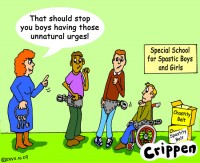
Weekend Cartoon
Thanks to Crippen.
Youtube Introduces Automatic Captions For Deaf Viewers
YouTube’s parent company Google has announced on its blog that automatic captions are to begin to roll out across the site.
The machine-generated captions will initially be generated in English. At first they will only be found on 13 channels.
These include National Geographic, Columbia, as well as most Google and YouTube channels.
The software engineer behind the technology, Ken Harrenstien, is deaf.
Currently YouTube offers a manual captioning service but video makers tend not to use it.
“The majority of user-generated video content online is still inaccessible to people like me,” Mr Harrenstien wrote in the Google blog.
His solution combines automatic speech recognition with the current caption system.
The translation is not always perfect (in a demonstration the phrase “sim card” becomes “salmon” in text), but Mr Harrenstien says that the technology “will continue to improve with time”.
Alternatively users can upload a transcript of their video and auto-timing algorithms will match the text to the words as they are spoken.
Vint Cerf, vice president at Google, is widely recognised as a founding father of the internet. He is also hard of hearing and has worn a hearing aid since the age of 13.
“One of the big challenges of the video medium is whether it can be made accessible to everyone,” he told news agency AFP.
An Original Way of Raising Awareness
A dance artist with epilepsy is to try to induce a seizure on stage – but has been urged to reconsider by a charity.
Rita Marcalo has stopped taking her medication ahead of the event at The Bradford Playhouse, which the audience will be invited to film.
Arts Council England, which is funding the performance, said it aimed to raise awareness about the condition.
But the Epilepsy Action charity expressed concerns and urged Ms Marcalo to reconsider the event.
Ms Marcalo, the artistic director of Leeds-based dance company, Instant Dissidence, plans to induce a seizure as part of the 24-hour Involuntary Dances event on 11 December, which will also include dance and poetry readings.
‘Public embarrassment’
If she has a seizure, an alarm will sound and the audience will be invited to film on their mobile phones.
Diane Horton of Arts Council England said: “This project raises awareness of a disability through the artist’s personal experience of epilepsy and we support this.
“We have made sure that a full risk assessment of the project took place, including medical advice, and that appropriate medical support is available during the performance.
“Rita is an important artist whose work deserves to be seen and the Arts Council both respects the creative decisions she makes in her work and supports her right as a disabled person to be heard.”
|
We would certainly ask the artist to reconsider Simon Wigglesworth, Epilepsy Action
|
About £2,000 of Arts Council funding has been provided for the 24-hour performance. The total includes £932 for medical risk assessment and support.
Bradford Playhouse director Eleanor Bradford said: “Rita has made a decision that she wants to explore her own relationship with epilepsy.
“Sometimes epilepsy is seen as a hidden disability and people with epilepsy have traditionally felt they have to hide when they have a seizure – it is associated with public embarrassment.
“Rita is doing is the opposite of that and is drawing attention to epilepsy in a very public way.”
Deputy chief executive of Epilepsy Action, Simon Wigglesworth, said: “Our concern is that anti-epilepsy medication is the cornerstone of treating people with epilepsy.
“Throwing away seizure control treatment trivialises the condition and does not respect the fact that some people have spent time trying to get it under control.
“It is this artist’s own decision as to what she might do but we are concerned that she is putting herself at risk and, if anyone else thought it was a good idea they would be putting themselves at risk.
“We would certainly ask the artist to reconsider.”
I think this idea is certainly an original one. I’m not sure about the safety of intentionally not taking tablets for that long though. I would love to hear your thoughts on this in the comments below. Is it total madness, pride at being DisAbled or something in between? Would those of you who have epilepsy, or any hidden condition which causes ‘attacks’ ever consider taking a similar step to raise awareness?
BBC Casts deaf actress In Lead Role For Upcoming Thriller
An untried deaf actress has been handed the lead role in a primetime BBC thriller.
Genevieve Barr will play deaf teenager Amelia Edwards, who witnesses a murder while staying with relatives in a new BBC1 four part series called The Silence. It is her first major role, which she won while on the Teach First training scheme, teaching in a challenging inner London school.
Last night Genevieve said: “The Silence is a fantastic opportunity to explore life through a deaf person’s eyes and I am thrilled to have been offered the role.
“I have my hands full with Amelia! I have had my first day of filming and it was exhausting but amazing playing my first scenes opposite Gina McKee, who plays my mother.”
Genevieve, 23, will be surrounded by an experienced cast for the production, including acclaimed actor Douglas Henshall, McKee and Hugh Bonneville.
Technology Failing DisAbled Net Surfers, Says Forum
Technology should be harnessed better to give the world’s estimated 650 million disabled people improved access to the Internet, experts said here on Tuesday.
“One of the fundamental problems has been not consulting persons with disabilities when designing technologies,” Cynthia Waddel of the Dynamic Coalition on Accessibility and Disability (DADC) told AFP.
Speaking at the Internet Governance Forum in the Egyptian resort of Sharm el-Sheikh, she stressed people with disabilities faced challenges of connectivity, affordability and accessible design.
DADC presented the forum a paper calling for more “education and training on accessibility and the consultation of persons with disabilities throughout all stages of design.”
Gerry Ellis, a consultant in the same field who is blind, used the forum to demonstrate two versions of the same website, one with technology that assists the disabled and one for the general public.
“It can be just as aesthetically pleasing but just as functional,” Ellis said of the website with the accessibility requirements.
This year’s governance forum has brought together more than 1,500 representatives of government, advocacy groups, non-governmental organisations and the private sector to discuss the future of the Internet.
Its third day was focused primarily on providing access to the Internet to millions of people who face constraints of language, connectivity, cost or disability.
Third of Adults With Autism Lack Income
A third of the 18,000 people with autism in Wales have no job and no benefits and are forced to rely on family and friends, says a charity.
The National Autistic Society Cymru said the majority wanted to work but lacked the help needed to find a job.
It said 80% of sufferers need help to apply for benefits and want it made easier for them to find work.
The Department of Work and Pensions said arrangements were in place to help those seeing advisers, if required.
The Don’t Write Me Off report found there was a lack of understanding of autism amongst employment and benefits advisors and a shortfall in specialist employment services.
Half of people with autism have spent time with neither work nor benefits, with a third currently in that situation.
|
Because some people with Asperger syndrome can achieve academically, we may still need more support than our peers David Penny, who has Asperger syndrome
|
Many were unaware they had the right to an advocate at benefits meetings, and in the worst cases parents were actively blocked from helping.
David Penny, 27, from Dinas Powys, has Asperger syndrome, a form of autism.
Mr Penny has a university degree but has had difficulty finding employment and had “significant” problems obtaining suitable benefits.
He now claims incapacity benefit and disability living allowance after a long battle to receive them.
He said: “Getting into university and completing the course was not easy, but the support I received from the disability officer was exemplary, and poles apart from the support and understanding I had since then.
‘Stress’
“Looking back at the application process and medical assessment for incapacity benefit in particular, I don’t think they were ever meant for people with my kind of disability.
“The questions asked failed to capture any of the difficulties I have in life.
“I was never offered a meeting with a disability employment advisor, and relied on my mum for support.
“This had an effect on my behaviour, because I have difficulty dealing with stress.
“Because some people with Asperger syndrome can achieve academically, we may still need more support than our peers.”
The Welsh Assembly Government published an autism spectrum disorder strategic action plan in 2008 and set up a task group to look at the needs of adults.
NAS Cymru wants the group to consider issues relating to employment before making final recommendations to the assembly government.
Task force
Shirley Parsley, the charity’s national coordinator, said: “People with autism say their experiences of the employment and benefits system are marred by anxiety, confusion, delays and discrimination.
“It is absolutely vital they are able to access the right help and services if seeking employment and are supported financially when they cannot work.
“We are also calling on the Welsh Assembly Government to act in order to improve the chances that people with autism have in gaining employment.”
In a statement, the Department for Work and Pensions (DWP) said: “We understand that people with autism have complex needs so we have arrangements in place to help, such as bringing along someone to represent them in adviser interviews if needed.”
‘Positive impact’
An assembly government spokesman said: “Wales is the only country in the UK to have a government-led strategy for autism. One of the key points of this plan is to look at training and employment opportunities for adults with autism.
“We are currently working with Job Centre Plus, Careers Wales and employers to develop awareness materials which focus on the positive impact of employing adults with autism and the benefits they can bring to a business.”
The Welsh launch of Don’t Write Me Off takes place on Wednesday evening.
Video: Channel 4 launches Cast Offs drama starring six disabled actors | Society | guardian.co.uk
Vodpod videos no longer available.
BBC NEWS | Wales | Blue badge fight for toddler
A family from the Vale of Glamorgan who have a disabled baby daughter are fighting to get a blue badge so they can use a disabled parking space.
The assembly government is consulting on a strategy to modernise the badge scheme but the Williams’ say they need the space because they carry heavy equipment for baby Elis.
Vodpod videos no longer available.
Intel Launches Text Reading Device
Chip giant Intel has shown-off a device designed to give vision-impaired and dyslexic people access to printed text.
The device, known as the Reader, captures text and then reads it aloud and displays it on its built-in screen.
The development is unusual because so-called “assistive technologies” are normally manufactured by specialist companies rather than global giants.
The Reader is the size of a paperback book and uses a high-resolution camera and Intel’s Atom processor.
The 600g (1.3lb) device was developed by Intel access technology director, Ben Foss, who is dyslexic himself.
“As someone who is part of the dyslexic community, I am thrilled to be able to help level the playing field for people who, like me, do not have easy access to the printed word,” he said.
‘Tactile scanner’
The Reader is being launched in the UK on 17 November at an event in London, after being unveiled in the US last week.
It is expected to sell for around £1,000.
Intel estimates that this technology could benefit as many as eight million people in the UK – if the six million people with dyslexia and other learning difficulties and the two million people with impaired vision are added together.
“The Intel Reader is a tool that can help give people with dyslexia, low-vision and blindness – or other reading-based disabilities – access to the resources they need to be successful in school, work and life,” according to Mr Foss.
|
So much information is delivered in a print format and a device like this will help to break down barriers to accessing information Steve Tyler
RNIB |
The Reader is being sold alongside a portable scanner – called the Portable Capture Station – which will process several pages at a time, or even an entire book.
The scanner is contained within a hard-shell briefcase.
The Reader is capable of playing back a variety of content including MP3 files, DAISY books – a special format used for blind, dyslexic and other disabled people – and text files transferred from a computer.
It can also generate audio versions of printed material that can be listened to using a standard MP3 player or computer.
The device is fitted with tactile buttons, to make them easy to identify, and the text menus are read out so that it is easily used by people with little or no vision.
Intel says that the Reader will have enough battery power for a typical day’s use.
The company’s move into the disability market has been welcomed by the Royal National Institute of Blind People (RNIB) and the British Dyslexia Association (BDA).
“This device has the potential to offer a great deal of independence to people who have a difficulty with reading,” said BDA chief executive, Judi Stewart.
“So much information is delivered in a print format and a device like this will help to break down barriers to accessing information,” added RNIB’s Steve Tyler.
The Reader will be available from the specialist assistive technology suppliers like HumanWare and Inclusive Technology as well as mainstream retailers like Amazon.co.uk.
What a brilliant idea!
Think About The Words You Use!
Scope suggest:
Avoid: The handicapped. Use instead: disabled people.
Avoid: Afflicted by, suffers from, victim of. Use instead: has (insert DisAbility)
Avoid: Confined to a wheelchair, wheelchair bound. Use instead: Wheelchair user.
Avoid: Mentally handicapped, retarded, subnormal. Use instead: Has a learning difficulty.
Avoid: Cripple, invalid. Use instead: disabled person.
Avoid: The disabled. Use instead: Disabled people.
Avoid: Spastic. Use instead: Person who has cerebral palsy.
Avoid: Able bodied. Use instead: Non-disabled.
I have to say I hate to be told that I suffer from CP. But feel free to say able bodied around me any time you like!
I’d love to hear your thoughts on these suggested politically correct words and phrases. Which do you agree with? Which do you disagree with? Can you think of any others to add to the list? Please let us know in the comments below.
Abuse of Visually Impaired People on The Rise
The number of visually impaired adults being abused in Newcastle has risen “dramatically”, according to a charity.
Newcastle Society for Blind People said its number of suspected cases of abuse had almost trebled in two years.
The charity said that it was having to refer at least one person a week, mostly on suspicion of psychological or financial abuse.
Newcastle City Council said the increase could be partly due to increased staff training to spot it.
Lilian Avison, from Newcastle, had £10,000 stolen from her by a bank cashier.
She said: “Bank statements stopped coming for my savings account and when I inquired I found out I did get a statement, and there was £10,000 taken from my account.

Newcastle Society for Blind People helps victims of abuse
|
“The person at the bank had taken it and had forged my signature.
“The person was dismissed straight away and my money was recovered.
“They knew my situation though and that I was visually impaired and every time I went into the bank they’d say, ‘come over here Lilian, I’ll deal with it’.”
In 2007, the charity referred 23 cases of suspected abuse to adult services, but in 2008 that number had reached 64.
‘Mind-boggling’
The charity has predicted that there will be another increase for 2009, based on its figures for the year so far.
Heather Niven, head of Newcastle Society for Blind People, said: “It’s mind-boggling that this abuse is taking place, it’s hard to accept this is happening.
“It’s not just a problem in Newcastle, it happens all over the country, but we’re the only local society that’s been asked to take part in national research by Comic Relief to plan national strategies for dealing with the problem.”
Margaret Lester, safeguarding adults co-ordinator for Newcastle City Council, said: “We expected an increase in referrals, which is partly due to better awareness of our citizens that abuse is wrong and that there is help to ensure that this stops.
“The increase is also due to increased training offered to all staff across the city in all services.”
According to the RNIB, there are 6,900 people registered as partially sighted or blind living in the Newcastle, Gateshead, North of Tyne, South of Tyne and Sunderland areas.
Family of Girl With CP Want £5m Compensation
The parents of a one-year-old girl born with cerebral palsy say medical negligence led to the condition and are calling for compensation.
Vicky Higgins and Jimmy Hanson, from Morthoe in north Devon, say their daughter Ruby will need a lifetime of care which could cost £5m.
They blame North Devon District Hospital for complications following a 30-hour labour.
A hospital investigation found that there had been delays in the delivery.
|
It’s not for us, it’s for her Jimmy Hanson
|
Ms Higgins told BBC News: “She has cerebral palsy for life, she might not be able to work or do normal things, so the money is going to help her.”
Mr Hanson said: “It’s a large amount of money, but it’s not for us, it’s for her.”
Northern Devon Healthcare Trust’s own investigation into the incident accepted that there were delays in delivering the baby, following a 30-hour labour, and that the doctor “failed to recognise the deteriorating situation”.
Independent medical experts will now decide whether the delivery was the cause of her cerebral palsy.
The couple’s legal team say compensation could amount to more than £5m.
Mike Roberts, the trust’s medical director, said: “We’ve always been open and honest about what happened.
“We gave a full investigation report to Ruby’s family and I talked them through what it meant.
“Like them, we’d like to see the case resolved as quickly as possible. It’s not in anybody’s interests, especially Ruby’s, for there to be any delay.”
VIPs Participate in Disability Access Challenge
A chief constable has joined an MP and a council chief executive in a challenge to highlight the problems faced by people with disabilities.
Ian Arundale, head of Dyfed-Powys Police, took part in Brecknock Access Group’s (BAG) “big challenge”.
He, local MP Roger Williams and Powys council’s Jeremy Patterson, were asked to find their way around Brecon in a wheelchair and then in dark glasses.
Alex Robinson of BAG was impressed by how well they handled the tasks.
Mr Robinson, the group’s vice-president, said: “We think today was really constructive and we got a lot of points across.”
Mr Robinson, a wheelchair user who was injured while serving in the Army, said: “They saw a lot of the problems we have to deal with and they were sympathetic and said they would try and fix them for us.
|
Whilst I feel access in our towns and villages across Powys has improved in recent years, it was obvious to me today that there is still work to be done to improve the current situation James Patterson, Powys council chief executive
|
“The chief constable is good and usually delivers what he promises.”
BAG said some people in Brecon did not take care parking their cars which often blocked drop-kerbs.
The charity also complained that its members were impeded by advertising boards and other items on pavements.
Mr Patterson said: “I was pleased to be able to take part in today’s big challenge.
“Whilst I feel access in our towns and villages across Powys has improved in recent years, it was obvious to me today that there is still work to be done to improve the current situation.
‘Simplest task’
“I am confident that the council will tackle these issues and will consult with the relevant stakeholders to ensure that the best possible results are achieved.”
Mr Williams said: “Even the simplest task of popping to town to buy a paper or a loaf of bread can cause difficulties for people with disabilities.
“Wheelchair users and people who are blind or partially sighted face particular problems when cars are parked on pavements or signs are placed in the way. New road layouts and shared surfaces also cause problems.”
Mr Arundale said Dyfed-Powys Police was working hard to ensure that “all aspects of diversity and equality are a core part of our day to day work and we recently launched a single equality scheme for the force that integrates all the strands”.
Baby RB Dies
Here is a statement from his mother, as printed in the Guardian.
The mother who fought an emotional high-court battle with the father of her severely disabled son over the infant’s fate has described how she and the father cuddled the child after his life support system was switched off.
The baby, who could not be named for legal reasons and was known as Baby RB, died on Friday, shortly after the machines that helped him breathe throughout his 13 months of life were turned off. Three days before that, the child’s father withdrew his objection to pleas by Baby RB’s mother and doctors that his life support system should end.
The dispute between the parents, who are in their 20s and are now separated, was argued before the high court in London for a week. The father then changed his mind.
Expert witnesses said RB, who was born with a form of congenital myasthenic syndrome, a rare neuromuscular condition that severely restricted his ability to breathe and move, was not able to show he was in pain, despite regular intrusive treatment, notably the suctioning of his airways to remove fluid. The father argued that since the child had seemingly normal brain functions he should be kept alive.
The mother told newspapers that both parents had held the infant as he died.
“When they took his tube out, I was cuddling him. It was so amazing to see him without it – it’s the longest we had seen his face properly,” she told the Mail on Sunday.
She told the Sunday Mirror: “I have no regrets. I didn’t want him to be in any more pain. All the tests he had to put up with. He was being prodded and poked. He must have been screaming inside, thinking, ‘Mum, why are you letting them do this to me?’ I’m grateful for every second we’ve had together. But it was time to let him go.
BBC NEWS | Wales | Charity thankful for centre space
As the Wales Millennium Centre in Cardiff Bay marks its fifth anniversary, a charity that has space in the building has attributed part of its success to being based there.
Touch Trust has a purpose-built multi-sensory suite in the centre which caters for people affected by autism and profound and multiple disabilities.
Executive co-ordinator Debbie Court said the charity originally had quite a small space in the centre when it opened in 2004, but now had a much larger one.
Vodpod videos no longer available.
Alastair Hignell on Life With MS
As England ended the 2007 Rugby World Cup in Paris in defeat, sports commentator Alastair Hignell breathed a sigh of relief – and not at the result.
He was bone-tired after a gruelling series of matches.
A former England rugby player himself – as well as a first-class cricketer – he knew his body well enough to know it was time to quit.
Despite his diagnosis with multiple sclerosis (MS) in 1999, he had flourished in his second career as a commentator.
But now the disease had progressed so far he could no longer do the job justice.
However, far from being bitter about his fate, Alastair says he feels “blessed” to have experienced the world from such radically different perspectives.
“I was finding it increasingly difficult to build up the energy needed to do the job and not fall apart doing it,” he says.
Tipping point
“The World Cup in 2007 was a fantastic event, but the last two weeks were hard.
“I was in France, but I just spent my time either going to matches and press conferences, or lying on my back on my bed.
“That was the tipping point and then England went to South Africa that summer.
|
When I was diagnosed and told I had an incurable disease and one that was going to be progressive and debilitating it was a huge huge shock to the system Alastair Hignell
|
“I came to the conclusion that I could not give the job the justification it needed or myself.
“I was taking so much out of myself it was hard to live a good normal life outside of it.
“One of the things with MS is the incredible fatigue.
“I found I was not approaching my job as well as I wanted to, or as it deserved to be done. I was looking at things like going to a stadium not in terms of ‘Great, I have a fantastic commentary to do on a match’, but more, ‘How difficult is it going to be physically for me to get up there?'”
So Alastair took medical retirement, bowing out the same day as former England captain Lawrence Dallaglio quit playing the game – 31 May 2008.
Alastair, who played rugby for Bristol and cricket for Gloucestershire, still writes a weekly newspaper column on sport, but said that apart from that he was happy to take an armchair view.
Diagnosis shock
He now uses a mobility scooter to get around. “I can’t walk very far and I can’t do stairs. I could walk to the end of the street but beyond that I would struggle – I’d probably fall or trip,” he says.

Alastair Hignell was made a CBE this year
|
“I’m resigned to a scooter to get me about and do everyday things, like attending physio, which is about one mile away.
“I go once or twice a week at the moment but I just wouldn’t be able to go without the scooter.
“When I was diagnosed and told I had an incurable disease and one that was going to be progressive and debilitating it was a huge huge shock to the system.
“I have only had two experiences of people with MS; one was my cousin who had been diagnosed with it seven years before and had not actually had any other symptoms.
“And on the other hand the wife of a friend of mine had died with it.
“She had a galloping form of MS which had taken her from active to wheelchair, to bed, to bedridden and then she died from influenza because her system could not cope with the problem.
“These were the two extremes and I was rather hoping I had the first rather than the second, but was sent scurrying to the internet to discover everything I could.”
Alastair had an MRI scan, eye test and lumbar puncture before being told he had the secondary-progressive form of the disease – which gets gradually worse.
|
MULTIPLE SCLEROSIS
MS is the most common neurological condition among young adults in the UK
Women are almost twice as likely to develop MS as men
Symptoms include a loss of sensation and balance, paralysis, pain and memory and vision problems
|
Before diagnosis Alastair, now 54, said his doctors had been baffled by a series of seemingly unconnected symptoms of headaches, drop foot, bladder problems, pins and needles and extreme fatigue.
He said his competitive nature had both helped and hindered his disease progression.
“The competitive nature of being a sportsman had me saying ‘I am going to take this on’, but of course that leads to frustration,” he said.
“Thinking you can beat something incurable, progressive and debilitating obviously leads to a lot of anger when you can’t beat it.
“You have to learn to go with the flow of it, to cope with it and manage it – to learn, as we say in the MS Resource Centre, ‘I have MS, but MS does not have me’.”
Treatment options
Alastair has tried a variety of treatments including the drug beta interferon, hyperbaric treatment (as used by deep-sea divers to counteract the bends), reflexology and physiotherapy.
“I set aside a Monday for treatments every week as a way of recharging my energy levels,” he said.
“I would not wish MS on anyone but I would wish the side effect – that you get exposed to people’s kindness and generosity.
“You are made aware of the love that there is in the world.
“I feel blessed to have MS, which seems a funny thing to say about a disabling progressive and incurable disease.
“But it has sent me on a journey I would never have had otherwise, and I think that it has enabled me to find out how good, loving and generous people are in general.”
Concerns Over Right To Die Law
Campaigner Debbie Purdy, who won a landmark court victory to have the law on assisted suicide clarified, says the guidelines are still not clear enough.
The multiple sclerosis sufferer, 46, from Bradford, wanted to know if her husband would be prosecuted if he helped her end her life in Switzerland.
In July, Law Lords ruled the Director of Public Prosecution must specify when a person might face prosecution.
Ms Purdy said she still had concerns and the law must be changed.
|
This cannot finish until we have changed the law Debbie Purdy
|
The Director of Public Prosecutions (DPP) Keir Starmer has published interim guidelines on when prosecutions could occur.
The issue has now been put out to public consultation and permanent policy will be published next spring.
Ms Purdy said: “He has said he’s more likely to prosecute where somebody makes a financial gain but what exactly does he mean by that?
“My husband and I own this house together. If I die, he inherits it.”
No one has been prosecuted for assisting someone’s death, although the law says they could potentially face 14 years in prison.
The House of Lords, the highest court in the land, said the law was not as clear and precise as it should be.
Lethal dose
Ms Purdy had previously lost challenges in the High Court and Court of Appeal. The Lords ruling was her last chance of success in the UK legal system.
Ms Purdy, who is married to Omar Puente, was diagnosed with primary progressive MS in March 1995. She can no longer walk and is gradually losing strength in her upper body.
She has suggested that at some point she may travel to Switzerland to take a lethal dose of barbiturates prescribed by doctors at the controversial Dignitas organisation.
More than 100 UK citizens have so far ended their lives at Dignitas, and no-one who has accompanied them has ever been prosecuted on their return to the UK.
However, the reasons why legal action has not been taken have never been clear.
Ms Purdy said: “This cannot finish until we have changed the law because it’s not just people like me who want the security of knowing that if life becomes unbearable there is the potential to end it and we won’t have a duty to suffer.”
The Ministry of Justice has previously said any change in the law was up to parliament.
Huge Rise In Birth Defects In Falluja
Doctors in Iraq‘s war-ravaged enclave of Falluja are dealing with up to 15 times as many chronic deformities in infants and a spike in early life cancers that may be linked to toxic materials left over from the fighting.
The extraordinary rise in birth defects has crystallised over recent months as specialists working in Falluja’s over-stretched health system have started compiling detailed clinical records of all babies born.
Neurologists and obstetricians in the city interviewed by the Guardian say the rise in birth defects – which include a baby born with two heads, babies with multiple tumours, and others with nervous system problems – are unprecedented and at present unexplainable.
A group of Iraqi and British officials, including the former Iraqi minister for women’s affairs, Dr Nawal Majeed a-Sammarai, and the British doctors David Halpin and Chris Burns-Cox, have petitioned the UN general assembly to ask that an independent committee fully investigate the defects and help clean up toxic materials left over decades of war – including the six years since Saddam Hussein was ousted.
“We are seeing a very significant increase in central nervous system anomalies,” said Falluja general hospital’s director and senior specialist, Dr Ayman Qais. “Before 2003 [the start of the war] I was seeing sporadic numbers of deformities in babies. Now the frequency of deformities has increased dramatically.”
The rise in frequency is stark – from two admissions a fortnight a year ago to two a day now. “Most are in the head and spinal cord, but there are also many deficiencies in lower limbs,” he said. “There is also a very marked increase in the number of cases of less than two years [old] with brain tumours. This is now a focus area of multiple tumours.”
After several years of speculation and anecdotal evidence, a picture of a highly disturbing phenomenon in one of Iraq’s most battered areas has now taken shape. Previously all miscarried babies, including those with birth defects or infants who were not given ongoing care, were not listed as abnormal cases.
The Guardian asked a paediatrician, Samira Abdul Ghani, to keep precise records over a three-week period. Her records reveal that 37 babies with anomalies, many of them neural tube defects, were born during that period at Falluja general hospital alone.
Dr Bassam Allah, the head of the hospital’s children’s ward, this week urged international experts to take soil samples across Falluja and for scientists to mount an investigation into the causes of so many ailments, most of which he said had been “acquired” by mothers before or during pregnancy.
Other health officials are also starting to focus on possible reasons, chief among them potential chemical or radiation poisonings. Abnormal clusters of infant tumours have also been repeatedly cited in Basra and Najaf – areas that have in the past also been intense battle zones where modern munitions have been heavily used.
Falluja’s frontline doctors are reluctant to draw a direct link with the fighting. They instead cite multiple factors that could be contributors.
“These include air pollution, radiation, chemicals, drug use during pregnancy, malnutrition, or the psychological status of the mother,” said Dr Qais. “We simply don’t have the answers yet.”
The anomalies are evident all through Falluja’s newly opened general hospital and in centres for disabled people across the city. On 2 November alone, there were four cases of neuro-tube defects in the neo-natal ward and several more were in the intensive care ward and an outpatient clinic.
Falluja was the scene of the only two setpiece battles that followed the US-led invasion. Twice in 2004, US marines and infantry units were engaged in heavy fighting with Sunni militia groups who had aligned with former Ba’athists and Iraqi army elements.
The first battle was fought to find those responsible for the deaths of four Blackwater private security contractors working for the US. The city was bombarded heavily by American artillery and fighter jets. Controversial weaponry was used, including white phosphorus, which the US government admitted deploying.
Statistics on infant tumours are not considered as reliable as new data about nervous system anomalies, which are usually evident immediately after birth. Dr Abdul Wahid Salah, a neurosurgeon, said: “With neuro-tube defects, their heads are often larger than normal, they can have deficiencies in hearts and eyes and their lower limbs are often listless. There has been no orderly registration here in the period after the war and we have suffered from that. But [in relation to the rise in tumours] I can say with certainty that we have noticed a sharp rise in malignancy of the blood and this is not a congenital anomaly – it is an acquired disease.”
Despite fully funding the construction of the new hospital, a well-equipped facility that opened in August, Iraq’s health ministry remains largely disfunctional and unable to co-ordinate a response to the city’s pressing needs.
The government’s lack of capacity has led Falluja officials, who have historically been wary of foreign intervention, to ask for help from the international community. “Even in the scientific field, there has been a reluctance to reach out to the exterior countries,” said Dr Salah. “But we have passed that point now. I am doing multiple surgeries every day. I have one assistant and I am obliged to do everything myself.”
Additional reporting: Enas Ibrahim.
Weekend Cartoon
Thanks to Crippen.
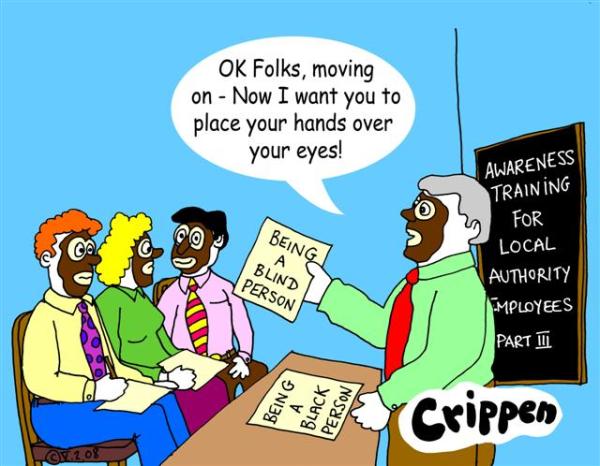
Radcliffe Denies Drug Allegations
Harry Potter actor Daniel Radcliffe has “categorically” denied newspaper allegations that he was photographed smoking cannabis.
The Daily Mirror published photos believed to be of the star, taken by a fellow reveller at a London party.
“Daniel does smoke the occasional roll-up cigarette, but he was not doing anything more than this,” said a spokeswoman for the 20-year-old actor.
Radcliffe is currently filming the last two parts of the Harry Potter series.
“We categorically deny the allegations regarding Daniel Radcliffe published in today’s Daily Mirror,” the spokeswoman said.
“We are considering our position and will be taking all necessary action in relation to such allegations,” she added.
DisAbility And Sex
This is a guest post by Rumbold, who blogs at Pickled Politics. It was originally posted at Pickled Politics today. Thanks to Rumbold.
In 2008 a survey came out claiming that 70% of people would never have sex with someone with disabilities. With that in mind, it is good to see that there is now starting to be much more discussion about the sexual needs (and requirements) of some people with disabilities:
[There is to be a] conference entitled “Disability: sex, relationships and pleasure”, which is being hosted by the Royal Society of Medicine in Central London. It aims to educate carers about the sexual needs of patients and to introduce disabled people to available support networks. It is backed by the Sexual Health and Disability Alliance (SHADA) and the Tender Loving Care Trust (TLC), which help to put disabled people in touch with appropriate sexual and therapeutic services, and offer confidential support and advice on sexual matters…
The TLC has helped hundreds of people with disabilities ranging from loss of limb to wasting diseases to learning difficulties. It has 55 sex workers registered on its site, all of whom have been vetted by the trust’s staff. The patients pay for the services themselves, although many sex workers offer a concession to disabled clients who genuinely cannot afford what they offer.
Hopefully the TLC has ensured that the sex workers are not in any way forced. And if it has, I don’t see anything wrong in this, especially given many people’s prejudices against finding disabled people attractive. No one is saying that people have to find all disabled people attractive, but to reject the possibility when there are so many different looking people out there is just bizarre.
Noise Worse For Dyslexic Pupils
Children with dyslexia find it harder to hear in noisy classrooms than those without the condition, a US study says.
Pupils with poor reading skills were also more likely to struggle to retain information when there was background noise, researchers reported in Neuron.
They said the findings, based on tests on 30 children, might help to develop new ways to diagnose the condition.
The team from Northwestern University, in Chicago, said pupils with dyslexia might also need extra support in class.
Wireless technology
They said placing children with dyslexia in front of the teacher could make a big difference.
And they suggested other steps, such as providing such pupils with wireless technologies and noise-reducing headphones to pick up information better.
Dyslexia is a neurological disorder which affects reading and spelling skills in between 5% to 10% of children.
|
I think it shows that extra support is needed, especially one-to-one support Dr John Rack, of Dyslexia Action
|
Recent research has suggested that children with the condition may struggle to process voices when there is competing noise.
The researchers set about testing the theory by getting children to watch a video with background noise, the journal Neuron reported.
At the same time, they were asked to repeat sentences they heard.
Lead researcher Professor Nina Kraus said the study was important in understanding the difficulties children with dyslexia face.
“The ability to sharpen or fine-tune repeating elements is crucial to hearing speech in noise because it allows for superior tagging of the voice pitch,” he said.
She said further research was now needed into the issue.
Dr John Rack, of Dyslexia Action, said the findings were “interesting”.
“This builds on what we already know. I think it shows that extra support is needed, especially one-to-one support.
“Busy, vibrant classrooms are a good thing and I would not want to see children with dyslexia taken out of them though.”
Sharon Osbourne Apologises For Insulting Susan Boyle’s Appearance
Sharon Osbourne has apologised to Susan Boyle for suggesting during a radio outburst that she was hit with an “ugly stick”.
The former X Factor judge also said Boyle resembled a “hairy a***hole” during a raucous interview in the US, during which she added that someone should give the Scottish singer “a Gillette razor”.
In a statement posted on the TV judge’s Facebook and Twitter page, the 57-year-old said sorry for trying to get a “cheap laugh” out of Boyle’s appearance.
She said: “Susan Boyle is a lovely, gracious woman and I took advantage of that by poking fun at her.
“I would never want to be responsible for hurting Susan and I must apologise for getting a cheap laugh at her expense.”
During the interview on Sirius XM’s Opie And Anthony show, Sharon was asked if she wished Britain’s Got Talent star Boyle all the best with her career.
She replied: “I like everybody to do well, even someone who looks like a slapped a**e.” Not holding back on her comments, Osbourne continued: “She does look like a hairy a***hole.”
The clip was posted on YouTube, leading to a backlash by Boyle supporters and resulting in Sharon’s mea culpa.
Viewers of the YouTube clip commented that Sharon’s words were “vile” and “nasty”.
Sources close to Boyle said: “Susan is a very dignified lady, I’m sure she will accept the apology.”
Susan Boyle may accept the apology, but I’m sure the remarks won’t hurt her any less even if she does. Why, oh why, do people, particularly able-bodied famous people, still not stop to think before making disablist comments?
Mikey Gets 54 Votes in Glasgow North East By Election
Despite my wishful thinking, I knew it was unrealistic to expect Mikey to actually even come close to winning the Glasgow North East by election. So I’m pleased to see him come 10th out of 13 candidates with 54 votes.
Labour’s Willie Bain won with over 12000 votes. Thankfully the BNP didn’t.
MP’s Want McKinnon’s Extradition Halted
The extradition to the US of computer hacker Gary McKinnon should be halted owing to his “precarious state of mental health”, MPs say.
The Home Affairs Committee also said there was a “serious lack of equality” in US-UK extradition arrangements.
But the Home Office said there was “no imbalance” and no need for a review.
Mr McKinnon, who has Asperger’s syndrome, is accused of breaking into the US military computer system but says he was just seeking UFO evidence.
The Glasgow-born 43-year-old, now of Wood Green, north London, faces 60 years in prison if convicted in the US.
‘Lack of equality’
The Commons committee is conducting an inquiry into the US-UK extradition treaty, which critics say does not treat American and British citizens equally.
A letter, from committee chairman Keith Vaz to Home Secretary Alan Johnson, said the MPs had received “clear, legal opinion” from two lawyers that the home secretary had greater scope to exercise his discretion in Mr McKinnon’s case than the minister believed.
The letter urged Mr Johnson to “comprehensively review” the operation of US-UK extraditions and “exercise your discretion in this case”.
There was a “serious lack of equality” in the way the extradition treaty deals with UK citizens compared with US citizens, the letter added.
But in response, a Home Office statement said: “There is no imbalance in the extradition arrangements between the UK and the US.
|
At this stage in the case the sole issue is whether extradition would, or would not, breach Mr McKinnon’s human rights Home Office statement
|
“As the home secretary told the Home Affairs Select Committee on Tuesday, the evidence that must be provided for a US extradition request to proceed in the UK is in practice the same as for a UK request to proceed in the US.”
It added: “The suggestion that the operation of the Extradition Act needs to be reviewed comprehensively is unnecessary.”
The home secretary is in the process of looking at new medical evidence on Mr McKinnon, which Mr Johnson has said he will consider “very carefully” before approving extradition.
He has also said he wants to give Mr McKinnon’s lawyers time to examine medical reports and make legal representations to the European Court of Human Rights in Strasbourg.
But the Home Office statement pointed out that the home secretary had “no general discretion to refuse extradition”.
“At this stage in the case the sole issue is whether extradition would, or would not, breach Mr McKinnon’s human rights,” it said.
“Unless the evidence shows that extradition would breach the European Convention on Human Rights it would be unlawful to refuse extradition.”
‘Lives ruined’
Mr McKinnon’s mother, Janis Sharp, has said her son “would rather be dead than extradited”.
Appearing before the Home Affairs Committee earlier in the week, she said: “We were told this treaty was to be used mainly for terrorists.
“People like Gary are not terrorists. We should stand up to America and say, ‘This is wrong.’
“This has ruined Gary’s life. It’s ruined our lives,” she said.
Mr Johnson responded by insisting that the US had a “proper, mature legal system”.
“It’s almost as if you are talking about an enemy state,” he said.
“In a world of international crime where criminals cross borders much more frequently, then you need to have proper arrangements in place.
“Extradition is not a statement of guilt or innocence. It’s quite proper for the US to ask to bring over people who have committed crimes against their country.”
Listen To The Carers!
My eldest daughter, Emmy, was epileptic in the womb. This means that the abnormal foetal movements during the last two months of my pregnancy were actually epileptic seizures. She had her first seizure outside the womb at three months, followed by many months in hospital, before being discharged into my completely untrained hands.
Emmy, 18, has what the professionals call PMLD – profound and multiple learning difficulties. She is quadriplegic, with cerebral palsy and intractable epilepsy. Basically that means that she is buggered. She cannot walk, talk, toilet herself, feed herself, etc. She can communicate in a fashion, by laughing, crying and smiling, but you cannot be sure that it is controlled. When she was 10 months old (1992) we were told by the wise and the wonderful at Great Ormond Street that she would die very soon. If she didn’t die very soon she would die a little bit later. If she didn’t die then she would probably be a vegetable for the rest of her “short” life. There was no counselling or support. We saw a geneticist who told us not to have any more children, and that was it. There was the usual gaggle of meetings with social services, who offered us residential care or possibly a bit of respite in the community, but they weren’t sure. Our GP was very kind, but she had never had a case like this before.
For the next 18 months I had to deal with the hugely complex array of appointments, whilst having this dreadful thought in the back of my head that my daughter was going to die.
She didn’t. I stopped believing the doctors. I started believing in my daughter.
And yet no one believed in me. There was no joined-up thinking. No early intervention, no support structure. No recognition of what that day at Great Ormond Street had done to us as a couple, or our little family.
When you give birth to a child whose life is going to be bombarded with medical complexity, you begin a journey that is impossible to be prepared for. For the first 10 years we simply existed. Every few months she would have a bout of pneumonia and we would prepare for her possible departure. It was a staggeringly difficult time. When she was four we found Helen House Hospice in Oxford, and thanks to them many of these interruptions were made more manageable. We came to understand what “life-limiting” meant. And how to come to terms with the fact that our gorgeous child was not going to live into adulthood.
We still had little or no support from our local authority. I think we got a respite weekend a month, for a child who could have up to 40 fits a day and was heavily medicated. Plus I had two more babies. We had a social worker, but to be honest I can’t remember her. I think I saw her twice a year to review the care package.
We also received little or no support from our families. My parents did a fair amount, when she was well. David’s family live in the US, which isn’t really convenient for babysitting.
Coming to terms with your child’s passing is a journey that is very difficult to explain. It doesn’t really happen overnight … well it didn’t for us. It wasn’t like there was one day when it dawned on us. But repeated events. The pneumonia and recovery, maybe it started to take a little longer. I couldn’t say. But even at eight or nine I think I was still fairly idealistic. I knew she could go, but I hadn’t really got my head round her handicaps. We had, after all, had several near misses already. But she was still such a baby in my eyes. And the steel cage I had built around myself to protect me from the so-called “professionals” worked very well. Unfortunately what it also did was block out my husband for a lot of the time.
Her brother and sister were also still very small. As they began to gain some independence reality began to strike. She was still here. I was still caring. All the time, three hospital appointments a week, often more.
But at no point was there one person who stuck with us, to catch me as I started to fall. Briefly there was one social worker who went above and beyond; but she got disillusioned and left the profession.
Because of the nature of my daughter’s diagnosis we, my husband and I, decided early in her life that we wished her care to be palliative. To most people this would mean end-of-life hospice care. But for us it means whole life care. Which means that her life is about quality now, rather than using medical intervention to keep it going. Therefore we do not wish her to be tube-fed, to be resuscitated, have intravenous medication other than pain relief, or any other intervention.
Her quality of life is about being able to make the very few decisions she can make herself. This includes eating, which is under her control. And breathing. She and I have “agreed” many times over the years that it is her call. She decides if she is going to wake up, not me. So far, she has chosen to wake up.
When we first asked for no intervention I don’t think we fully understood what we were saying. It was more a reaction to what everyone was doing and taking into account the fact that they kept telling us she was going to die. So if she was then let her. But now I do understand. She should never have survived. For whatever reason, she did. That does not make it right to keep that life going “just because you can”.
What a family like ours goes through is grieving for a very long time with the end never actually happening, and also caring. So two of the most stressful jobs wrapped up in one package. It appears to be taboo to admit how hard it is. As a society we don’t seem to want to admit to the hurt of watching our children live half-lives, quarter lives even. Does Emmy have a quality of life? I don’t know. Do I love her? Absolutely. Will I miss her? With all my heart. When she dies, will it be a relief? Without question.
Gradually you recognise that extending this life, it isn’t your call. You are simply a manager of a body. It is down to her if she wants to keep going. My job is to make sure she is comfortable. That she has a reason to smile when she can. That she is loved by her family, and at the end of the day her family have the energy and capacity to love her.
Society now appears to be about extending life. Ticking medical boxes and covering arses that enable life to be prolonged without necessarily asking the terribly important question. Who are we doing this for? Because it is not for me, or my family. We have been through quite enough. And I cannot imagine it is for my daughter. What she has had to go through does not bear thinking about.
And why is it still taboo to talk about this issue? Why, with an ageing population, and more babies surviving premature birth and birth trauma, is it still considered politically incorrect to tackle the really important and, lets face it, unavoidable issue, of who are we maintaining life for? I can only speak from the experience of my daughter. I do not know what it is like for anyone else. I would never claim to know. But I do feel that it shouldn’t be wrong to say what you really feel.
Why is there nowhere in this country that provides long-term palliative care for young people whose lives are not going to be improved by medical intervention? They are just going to be extended. Extension does not mean made better, it just means longer.
The decisions that have to be made are complex. But decisions have to be made, and this is clearly where a huge problem exists, because no one wants to make them. You are held hostage by a social welfare service that is not structured to provide care but to avoid spending money. And the sad reality is that children and young people with complex health needs cost money. Families can’t even be paid properly for the care that they provide.
My daughter is now 18. Were she not profoundly disabled she would be at college or something. Were she out of work she could claim housing benefit. But as a profoundly disabled 18-year-old living in an annexe of her parents’ house she is not allowed housing benefit because her landlord is her father and God forbid she may be abusing the system. No one will support her accommodation needs. Why? Well, that is the question they must answer, because we certainly didn’t realise that in her being at home we would be paying for her accommodation and that of her two carers as well. Maybe I am being petty here, but when my daughter was discharged from Hammersmith hospital in 1992 no one told me that I would still be fighting 17 years later. No one told me that my fight would get as ugly as it has done. No one told me that I would be judged by people who had/have never met her and have refused to meet her. Or who would twist the situation to avoid facing up to the horrific reality. We, her parents, have had to make decisions that no one else will face. Quality versus quantity. Palliative versus intervention. It is just adding insult to injury that my daughter becomes a box-ticking exercise rather than one of decision-making.
I am not alone in my outspokenness on these issues. But maybe right now I am just that little bit angrier that it is discretionary, not legal, whether Worcestershire County Council meets her housing needs. Discretion should not come into it.
If we are going to maintain life then we have to treat those who are managing those lives with respect. That includes the carers, the families and the individuals themselves.
We don’t do that. Our local authority has spent more avoiding their responsibilities than meeting them. And that is wrong.
When a Mother’s Love Is Not Enough
I have just watched this amazing BBC1 documentary, called When A Mother’s Love Is Not Enough, with my mother. It is about the reality of life caring for a disabled child. It includes an interview with David Cameron, and mentions the cases of Joanne Hill and Fiona Pilkington. I have shared a link to the programme on BBC iPlayer with you, my readers, because I believe that all parents of disabled children should take some time out to watch it, if possible. So, if you have an hour to spare, please click on the link. You are, as always, more than welcome to share your thoughts in the comments below.
Baby RB’s Father Drops Objections To Withdrawal of Life Support
It is difficult to explain how shocked and how deeply sad I am to read the article below. As anyone who has read my previous post on this case will know, I fully supported the father’s fight to keep his son alive.
A father who had been fighting to stop a hospital withdrawing life support from his seriously ill son has dropped his objections.
The one-year-old, known as Baby RB for legal reasons, was born with a rare, genetic muscle condition that makes independent breathing impossible.
The hospital was backed by the baby’s mother.
But the move had been strongly opposed by the child’s father at a High Court hearing.
|
It is, I suspect, impossible for those of us to whom such an event has not happened to do more than guess at the impact of it upon these two young parents Mr Justice McFarlane
 |
However, the father changed his mind after hearing medical evidence which suggested it would be in the best interests of the child if medical support was withdrawn.
Lawyers for the health authority caring for the baby in intensive care told Mr Justice McFarlane: “All of the parties in court now agree that it would be in RB’s best interests for the course suggested by the doctors to be followed.”
The judge welcomed the decision, describing it as a “sad, but in my view inevitable outcome”.
He said: “From the moment of the baby’s birth it was apparent he was profoundly unwell.”
Mr Justice McFarlane said it would now be lawful to withdraw life support from the child.
Tribute to parents
He also paid tribute to the parents, who he said had acted in an exemplary manner.
He said: “It is, I suspect, impossible for those of us to whom such an event has not happened to do more than guess at the impact of it upon these two young parents.
“In one moment all of the hopes and dreams that they will have had for their expected baby will have been dashed and replaced with a life characterised by worry, stress, exhaustion, confusion and no doubt great sadness.”
Both parents were in tears as the judge summed up the case, and the mother at one point left the court, but later returned.
A joint statement issued by lawyers representing RB’s parents and the hospital trust said: “Although RB’s parents separated, they have always been united in wanting the best possible care for their son so that he may have the very best possible quality of life.
“They have been at his bedside daily these last 13 months.
“The court has heard that RB is a dear little boy, adored by his parents, family and the hospital staff.
“Every party in this case has reached this agreement after careful, considered thought for what is in RB’s best interests.”
The statement said the decision to withdraw life support from the child had been “agonisingly difficult”.
“RB’s parents would now wish to spend what little time remains with their beloved son.”
Profoundly ill
Baby RB is thought to have a condition called congenital myasthenic syndrome (CMS), which severely limits the ability to breathe independently and limb movement. He has been in hospital since birth.
The hospital’s legal team argued during the hearing that the baby faced a “miserable, sad and pitiful existence” – even if tracheotomy surgery to relieve his breathing difficulties allowed him to return home.
They were particularly concerned that the child could not communicate whether treatment – such as regular suctioning of his airways to remove fluid – caused him pain.
Several experts told the hearing that the child was too profoundly disabled to enjoy any quality of life.
But lawyers for the father argued the baby’s brain was unaffected, and that he could see, hear, feel and recognise his parents.
The hearing also heard evidence that he was able to play with toys.
For legal reasons, none of the parties in the court case can be identified.
Learning Disabled Parents Losing Children To Adoption
Against a background of prejudice and out-of-date assessments, six out of 10 parents with learning disabilities are having their children removed for adoption, research by Bristol University suggests.
In Birmingham, where children’s services were described as “not fit for purpose” in a government report, social workers have told the BBC the system is loaded against the learning disabled who are more likely to lose their children than keep them.
A whistleblower in Birmingham City Council’s social services department said: “We frequently remove children from young mothers who continue to have children.
|
 |
“We frequently go back and remove one child after the other, but we’ll find there’s been very little or no work done with that mother from having a first child removed to giving birth to the second child.”
Anna Marriott, a researcher at the Nora Fry institute based at Bristol University, said the system discriminated against the learning disabled.
She told the BBC: “Rather than looking for any actual evidence of problems with parents coping, (social workers) just assume the parent won’t be able to cope.
“And rather than looking to put a support plan in place, they’ll look to initiate child protection proceedings.”
The Birmingham whistleblower agrees, claiming once one child has been removed, removal of the family’s next child is virtually automatic.
She added, once one assessment has been made by social workers and psychologists, the same assessments are likely to be re-dated and re-used for when another child comes along.
The whistleblower said: “Lots of people will copy over old info, not checking the primary source of material.”
‘Helping children’
Isabelle Plumstead, a leading family court judge said she had concerns about multiple child removals and wanted to see much more support put in place.
“If you help the parents, of course you are helping the children.
“And when you, as I have, come across the eighth, ninth, 10th, or even in one case the 14th child of a parent being in care proceedings, how much better if the thing could have been cracked at number one.”
Christine Spooner had two children removed from her care and placed for adoption by Birmingham Children’s Services.
At the time her condition, Aspergers syndrome, had not been diagnosed.

Family judge Isabelle Plumstead said she had concerns about the removals
|
She said: “They didn’t understand the person I was. They just seemed to look at the weakest parts, what I couldn’t do. They didn’t even try and think about what I could do”.
Support for learning disabled parents is available through organisations such as Citizen Advocacy South Birmingham (CASBA).
Specialist workers help to guide learning disabled parents through a complex legal process which can be emotionally draining.
CASBA serves the whole of South Birmingham but is staffed for only 58 hours per week.
Vice chair Sior Coleman said: “The harsh reality is that we don’t have enough money.
“There is an understanding from the authorities that it’s an important service, but it’s seen as a luxury – as an add-on.”
The whistleblower said she had been in meetings along with 17 professionals and one parent with no representation or support.
|
I’ve got to change that because I would agree with you that isn’t fair, that isn’t proper and that isn’t right Colin Tucker
director of Birmingham Children’s Services |
She said in some cases the parent had been identified as having issues with anger management, poor communication skills, or poor concentration.
She added: “So they have to sit and listen to the most intimate details of their lives and their children’s lives [being] discussed in a professional forum and they are expected to behave as professionals.
“And if they are not behaving in that way, they will be judged on that.”
The BBC put the social worker’s claims to the new director of Birmingham Children’s Services, Colin Tucker, who said: “I’ve got to change that because I would agree with you that isn’t fair, that isn’t proper and that isn’t right.
“I want to talk to parents with learning disabilities, not to patronise them or make excuses, but to genuinely listen to their stories and see how I can respond to that.”
It is too late for Christine Spooner, though, whose children have now been adopted and are with new families.
She has devoted herself to volunteer work, helping to support parents going through a similar experience, and is campaigning for change.
She said: “I’m sick and tired of the negative attitude and I want people to think more positively about learning disabled people.
“Realistically I would love to be a parent again, but what if it happens again? What if it goes on again?
“I don’t want to have my heart torn out the third time in a row. I’ve had enough pain in my life. I don’t want any more”.
This is part of the debate on DisAbility And Parenting.
Teenage Obesity Possible Link To MS in Women
Being obese as a teenager may be linked with an increased risk of multiple sclerosis as an adult, researchers say.
A 40-year study of 238,000 women found those who were obese at 18 had twice the risk of developing MS compared to women who were slimmer at that age.
Yet body size during childhood or adulthood was not found to be associated with MS risk, the US researchers report in Neurology.
But an MS charity warned more research was needed to confirm the findings.
|
Our results suggest that weight during adolescence, rather than childhood or adulthood, is critical in determining the risk of MS Dr Kassandra Munger
Harvard School of Public Health |
Researchers from Harvard School of Public Health used data from nurses taking part in a large study on diet, lifestyle factors and health.
Over the course of the study, 593 women were diagnosed with MS, a condition caused by the loss of nerve fibres and their protective myelin sheath in the brain and spinal cord, which causes neurological damage.
The researchers compared the risk of the disease with body mass index (BMI) – a ratio of weight to height – at age 18.
Participants were also asked to describe their body size using a series of diagrams at the age of five, 10 and 20.
The study showed that those with an “obese” BMI of 30 or larger at age 18 had more than twice the risk of developing MS.
There was also a smaller increased risk in those who were classed as overweight .
The results were the same after accounting for smoking status and physical activity level.
Body shape
When comparing the risk of MS with self-reported body shape, the researchers found no association between childhood obesity and the future chances of developing the disease.
They also found no risk associated with adult obesity.
But women who had a larger body size at 20 years of age also had almost twice the risk of MS compared to women who reported a thinner body size.
Previous research has linked high levels of vitamin D with a reduced risk of MS and the researchers point out that obesity is associated with low vitamin D levels in the body.
The researchers suggest fatty tissue produces substances that affect the immune system, which may also provide a link with the chances of developing MS.
Further research should look at confirming the findings in men and individuals from different ethnic groups as well as comparing with vitamin D levels, they said.
“Our results suggest that weight during adolescence, rather than childhood or adulthood, is critical in determining the risk of MS,” said study author Kassandra Munger, ScD, of Harvard School of Public Health in Boston.
“There’s a lot of research supporting the idea that adolescence may be an important time for development of disease, so what we have found is consistent with that.”
She added: “Teaching and practicing obesity prevention from the start – but especially during teenage years – may be an important step in reducing the risk of MS later in life for women.”
Susan Kohlhaas, research communications officer for the MS Society, said: “This study does not account for several other factors that may play a role in causing MS. Based on that, more work is needed.
“As such, it is difficult to determine whether teenage obesity could be a possible factor in causing MS in women.”
A Miracle Treatment For Cystic Fibrosis
Joe Dexter describes his band, Orange, as “Green Day meets The Cure”.
He wrote his first single at just 13 and three years later the American-based band had their first recording deal.
Now, still aged just 21, British-born Joe has released his third album and finished a tour.
His achievements are remarkable by any musical standards, but are even more so when you learn that Joe, who is the lead singer, has the lung condition cystic fibrosis – as well as asthma and diabetes.
“It never stops me from doing my music or pursuing any dreams I might have,” he said.
|
I do personally think that doing something like singing, which is a vocal and breathing exercise, is actually beneficial to your lungs Joe Dexter
|
And Joe even feels that being a singer might help him.
“I always find after a good hour or more of singing my lungs are a lot clearer and I can breathe easier.
“Maybe I’ve found the miracle treatment for cystic fibrosis!”
Joe takes a host of treatments every day including six tablets with every meal to help him digest his food, antibiotics three times a week to kill infections, and multi-vitamins.
He also takes daily drugs to control his diabetes and asthma.
Therapy
Caroline Elston, an expert in respiratory medicine at London’s Kings College Hospital, agrees that singing professionally can have positive benefits.
“There are a number of patients with cystic fibrosis who have gone into singing professionally,” she said.
“There is nothing to suggest it would do any harm and lots of theoretical reasons why it would do good.
“Professional singers train their breathing muscles and there should be some benefits in this.”

Orange were still at school when they got together
|
Research has suggested that singing might be beneficial in other lung conditions such as chronic obstructive pulmonary disease, Ms Elston said.
But she warned: “The downsides would be related to the time it takes to tour and the toll on the body, the physical exhaustion and [difficulty of] fitting the treatments in.
“It is finding a balance between the singing, the treatments and the touring.”
Joe Dexter agrees: “It is more of a challenge though, especially when it comes to touring.
“Doing something so physically demanding every night on top of having to deal with taking care of my lungs can be quite challenging.”
‘Living my dream’
“After most tours I end up in hospital,” the singer admitted.
“A lot of times when my friends and band mates are smoking, drinking and partying, I’ll be in my hotel room doing my treatments.
“Having cystic fibrosis affects everything I do, every day. My doctors are amazed that I seem to be capable of doing what I do. They often call me a ‘medical mystery’.
|
CYSTIC FIBROSIS
Cystic fibrosis (CF) affects more than 8,000 people in the UK and is the commonest inherited disease
It is estimated about five babies are born with CF each week in the UK
It affects the internal organs, especially the lungs and digestive system, by clogging them with thick sticky mucus. This makes it hard to breathe and digest food
|
“But I always try to take care of my health the best that I can and sometimes that can be limiting especially when it comes to touring.
“I use a lot of alternative remedies such as Bach flower essences and I also do Reiki on myself pretty regularly.”
Joe, who has been based in the US for 17 years, said: “I have never let having cystic fibrosis stop me from living my dream and I want to play music for the rest of my life. I will never let my health stop me.
“You need to truly believe in yourself because there are always people around who say you should not really do that and you can’t do that, but I have never listened to that and so far I am ok and still doing it.
“You just have to believe in yourself and be really positive.
“If you go by text books I probably shouldn’t be able to do what I do.
“I plan to keep on surprising people for as long as I can.”
Joe Dexter is clearly truly DisAbled, and an inspiration to anyone with any DisAbility. I wish him every success with his singing career and in life.
Care Home Driver Jailed For Abusing DisAbled Women
A residential home employee who sexually abused the disabled women in his care has been jailed.
Exeter Crown Court was told James Watts, from Chulmleigh in north Devon, thought he would not be caught because his victims could not communicate.
Watts was convicted of six offences against four physically and mentally disabled women, but cleared of seven other charges, including rape.
The 57-year-old was jailed for a total of 12-and-a-half years.
During the three-week trial, one of the victims gave her evidence by blinking her eyes – to answer “yes” or “no” to questions from prosecution and defence lawyers, while others used their heads to press buttons on their wheelchair headrests.
|
You descended to a level of depravity which is quite beyond comprehension Judge Graham Cottle
|
Judge Graham Cottle said it had been the most difficult case he had presided over.
He told Watts ordinary members of the public would view his offences with “utter revulsion”.
“You descended to a level of depravity which is quite beyond comprehension,” Judge Cottle said.
The court heard Watts worked as a driver at the residential home in north Devon, which cannot be identified, between 2005 and 2008.
The home’s residents, who were of both sexes and aged between 20 and 50, had severe disabilities.
Prosecutor Paul Dunkels QC told the jury Watts had abused four of the women residents who were unable to resist or give their consent because of their disabilities.
Three victims had cerebral palsy which meant they could not move unaided or stand and needed a hoist to be moved around.
‘Completely powerless’
A fourth victim who had made an initial statement to police was unable to give evidence because her condition had deteriorated before the trial began, and she could no longer communicate.
A Japanese woman, who volunteered at the home, gave her evidence via video link from Japan.
She told the jury she had seen Watts touch one of the victims inappropriately while he was feeding her.
Of the victim who blinked her answers, Mr Dunkels said:”We cannot ask her what happened, what did he do.”
But he said she was able to confirm that it was Watts who touched various parts of her body.
Watts had denied all the charges.
Video recorded
Judge Cottle said: “It is beyond the comprehension of normal people that somebody can behave as you did towards these four ladies – each one cripplingly disabled and wheelchair bound – completely powerless to prevent you from doing what you chose to do.”
Ann Hampshire from the Crown Prosecution Service (CPS) said it had been a particularly unusual case because of the victims’ severe disabilities and limited communication.
The CPS arranged to have the victims’ initial accounts video recorded and played to the jury.
Outside court, the families of two of the victims said: “The result of this case recognises that those who are most vulnerable do have a voice of their own and as much right to justice as any members of the public.”
Obviously Watts doesn’t know that communication doesn’t have to be verbal. I, for one, am thrilled, though not at all surprised, that his victims were able to prove him wrong.
Is Autism A Term of Abuse?
A French politician has used the term “autism” to criticise the Tory Party’s policy on Europe. Misunderstood or not, his choice of words highlights how the word is used in a negative way. How did that happen?

‘Autism’ is being used as a slang term
|
It is not the first time a politician has caused a furore by using the word autism. Three years ago the shadow chancellor, George Osborne, appeared to suggest Prime Minister Gordon Brown could be “faintly autistic”.
Now, France’s Minister for Europe, Pierre Lellouche, has accused David Cameron of “castrating” Britain’s position in Europe, adding that his approach was “pathetic”. He has since said his use of the word “pathetique” has been misunderstood and can mean sad or unfortunate in French.
But it was his use of the word “autism” which caused most offence. He says he did not realise the word “autism” could been seen as offensive in English and has retracted his remark.
Whatever way he meant it, “autistic” is often used as an insult and it’s insensitive to use a term that describes a disability or a condition in this way, says the National Autistic Society.
“I thought we’d got over that from the 1970s when people used to use the term ‘spastic’ in the playground,” says Benet Middleton from the society. “To have senior politicians doing that is thereby signalling that it’s ok and that is deeply worrying.”
‘Vogue’ term
For many the complex nature of autism makes the pejorative use of the term even more misguided and unhelpful. Alexis Miller was diagnosed with Asperger syndrome, a form of autism, 14 years ago.
“I want him to apologise and take it back. I think it’s wrong. Even if someone is autistic, it should not be used in an insulting way because he is basically calling us pathetic autistics. I’m not pathetic, I’m a person.”
More than half a million people in the UK have the condition which affects the way they communicate and relate to those around them. People with the condition often have difficulties with everyday social interaction.
Relatively unheard of or even recognised years ago, autism is now firmly in the public domain, partly due to films like Rain Man in 1988. And, some lexicographers argue its slang usage is down to it becoming a “vogue” term.
|
WHAT LELLOUCHE SAID
C’est pathétique. C’est juste très triste de voir la Grande-Bretagne, si importante en Europe, se couper du reste de l’UE et disparaître des écrans radar
Ils n’ont qu’une formule et ne font que la répéter. C’est une forme très bizarre d’autisme
Source: AFP
|
It has become part of people’s vocabulary following the same route slang often does. It is very often originated by teenagers at street or playground level.
“There aren’t many constraints on youngsters, especially when they’re talking to each other,” says Tony Thorne, Language and Innovation Consultant at King’s College London.
“What they say is meant to be traded among themselves and therefore anything goes. They use a lot of racist, sexist and ageist language.”
He explains it could also have originated from media slang which comes mainly from the United States and is a mixture of showbiz and therapy terms.
But what accounts for the use of the term by people in power, those, who it is deemed, should know better?
Offensive slang
“The minister hasn’t picked it up from street slang, he’s picked it up from the media and the current vogue-ish language for the purpose of rhetoric, for effect. You could say for cheap effect, both on behalf of George Osbourne and this French minister,” says Mr Thorne.
Lexicographers argue it is a powerful tool used to dramatise the idea of impaired communications, to taunt those deemed not able to articulate or understand a range of ideas.

Sufferers find social interaction hard
|
“People have very limited knowledge or awareness of autism and they think it’s something to do with the way people communicate and so they use that sometimes as a way to insult people if they think they’re communicating in a way that’s different,” says Mr Middleton.
And, once slang enters the public’s vocabulary it is difficult to eradicate. Some argue that it is only when whole societies undergo a process of sensitisation – what some might call political correctness – that certain terms are outlawed.
Much of the power of slang derives, undoubtedly, from its novelty. Experts say most terms have a shelf life of around three or four years. It eventually seeps into everyday language and then the people at the cutting edge, the inventors, abandon it and move on to something else.
“People think that slang kind of disappears. It doesn’t completely go away, it relapses into the slang underworld,” says Mr Thorne.
Weekend Cartoon
Thanks to Crippen.
Autism Is Not A Dirty Word
Pasted word for word with full links comes this brilliant CIF article by loving mother Charlotte Moore. She and her sons have my best wishes.
“They have one line and they just repeat one line. It is a very bizarre sense of autism.” Pierre Lellouche, the French minister for Europe, made headlines with his attack on the British Conservative party’s attitude to the EU. For us Guardian readers, sympathy with Lellouche’s frustration in his dealings with Hague and Cameron will be overshadowed by annoyance, even outrage, at his pejorative use of the word “autism”.
Wikipedia tells us that autism is “characterised by widespread abnormalities of social interactions and communication, as well as severely restricted interests and highly repetitive behaviour”. Doesn’t that describe the Tories in Europe to a T? We all know what Lellouche meant. He wasn’t trying to give a diagnostic definition; shouldn’t we accept his choice of words – as his spokesman has pleaded we should, since “President Sarkozy is called autistic every day” – simply as a colourful way of making a point?
No, we shouldn’t. One in a hundred of us have autism, and it is crucial to the health and happiness of this sizeable minority that their condition is seen in the most positive possible light. Autistic strengths and idiosyncrasies need to be celebrated; this can be done without overlooking the real problems and disadvantages the condition brings. As the mother of two autistic sons, I object to much of the language used to describe it in the media. The huge increase in the number of diagnosed cases is called an “autism epidemic”, as if it is a rampantly catchable disease. Indeed, I don’t think autism should be described as a “disease” or an “illness” at all, as it is neither contagious nor curable. We often read of someone “suffering” from autism, and while I would never deny that suffering is – too often – part of the autistic experience, I challenge the assumption that this is inevitably so.
When an intelligent man like Lellouche uses “autism” in a casually derogatory way, he adds to the burden of negative perception the word already carries. My playground spy – Jake, my neurotypical 11-year-old – has not yet reported the use of “autistic” as a term of abuse, but with the vast recent increase in public awareness of the condition it’s surely only a matter of time before it becomes as unusable as “spastic”, which in its youth only meant “a person with cerebral palsy”.
My grandfather was a medical officer of health; he inspected schoolchildren in the 1930s and 40s. I have his notebooks. He routinely refers to “idiots”, “cripples”, “morons”, and “feeble-minded” children. These were not insults but simple statements of medical fact. He would have used them in conversation as insouciantly as he wrote them – much as we could say “diabetic” or “asthmatic” without blinking. I couldn’t, though. When I read the notebooks my scalp crawls, even though I know my grandfather to have been innocent of negative intent. Language evolves, meaning shifts and our responses change with the times.
Actually, I’ve never been wholly happy with “autism”. To my astonishment, the portable OED I took with me to school in the 1960s defines it as “morbid self-admiration, absorption in phantasy”; my second son, Sam, has almost no sense of self – he has never looked in a mirror – and, as far as I can tell, no fantasy life either. If Sam is absorbed in anything, it is physical sensation. Whereas George, my eldest… I don’t have space to elaborate on the differences between my two boys; suffice it to say that “autism”, which derives from the Greek word for the self, has never seemed an accurate umbrella term for this complex condition that manifests itself in so many different ways. Perhaps, after all, I should be grateful to Lellouche, whose careless and insensitive use of the word might nudge us along in our search for a satisfactory replacement.
Mikey- From BB9 To Glasgow North East MP?
I have only just found out that Mikey Hughes, runner up on Big Brother 9 in 2008, is standing as an independent candidate in the Glasgow North East by election, which is to be held on November 12th.
His short profile on the BBC News website reads:

Glasgow North East – Mikey Hughes
The 35-year-old former Big Brother runner-up, who is from Ayrshire, is currently working as a presenter for Insight Radio.
Mr Hughes has been blind since an operation went wrong in 1998.
He has said he wants to become “the next David Blunkett”, and has pledged to focus on representing those with disabilities, impairments and health problems.
Of course I realise that there was much more chance of him winning Big Brother than there is of him even coming close to winning this election, but he still has my full support and best wishes, as always, and I hope the fame he achieved on Big Brother will be useful to him in the election.
I wonder why his campaign wasn’t given more publicity? I wish it had been.
Paralympic Swimmers Photo Wins Prize
An image of a teenage swimmer aiming for glory at the 2012 Paralympics has been named the winner of the Taylor Wessing Photographic Portrait Prize.
Paul Floyd Blake’s photo shows Rosie Bancroft from Oxford shortly after beating her personal best.
The swimmer, who had her right foot amputated at the age of 10 months, was captured on camera during a short interval in a busy training day.
Blake, 47, did not begin his career as a photographer until seven years ago.
The photographer from Hebden Bridge, West Yorkshire collected the £12,000 award at the National Portrait Gallery in London.
The winner will be among 60 photographs to go on display at the National Portrait Gallery from 5 November, running until 14 February.
The final shortlist of four was determined by a panel of judges from a total of 6,300 submissions from a mixture of established and emerging photographic talent.
Carers and Child Poverty Charities Welcome Government’s Change of Heart on Parents of Disabled Children
Lord McKenzie of Luton, The Parliamentary Under-Secretary of State, Department for Communities and Local Government & Department for Work and Pensions, recently issued a statement in the House of Lords that has been welcomed by carers of disabled children and child poverty charities.
He said:
We realise that lone parents caring for younger children who receive disability living allowance may find fitting work-related activity around their caring responsibilities more difficult. We have already introduced a number of safeguards to ensure that lone parents can balance these responsibilities. After careful consideration, we have now decided to ensure that lone parents on income support who have a child under the age of 16 and in receipt of any rate of care component of disability living allowance will not be required to undertake work-related activities. Of course, they will still be offered full support to help them to prepare for work, which they can take up on a voluntary basis. As it was previously our intention that the exemption relating to children in receipt of the middle and highest rate DLA care component be dealt with in regulations, it is our intention that this procedure be applied to cover the extension to children in receipt of the lowest rate care component of DLA.
Kate Green, Chief Executive of the Child Poverty Action Group, said:
“While there is much that we continue to disagree with in the current welfare reform bill we welcome this statement that recognises the difficulties some parents with disabled children would experience juggling caring responsibilities alongside fulfilling the requirement to engage in work-related activities. We appreciate the Government’s willingness to show such an open mind in this instance.
Lord McKenzie’s statement removes the prospect of lone parents with disabled children having their benefit sanctioned through no fault of their own. Awards from the DLA often fluctuate between the levels of DLA, particularly in the case of children with hidden disabilities such as autism and ADHD.
DLA provides valuable protection to families facing a high risk of poverty, and it made little sense to threaten such families with benefit sanctions. The amendment will not only make families lives easier, but it will render complex new systems easier to administer.”
I must agree with Kate Green and all those who welcome this statement. It is good progress for carers- those who already do such an important unpaid job, often with very little support and while experiencing a great deal of emotional pain at watching their children and family members live with the effects of severe disability. They all deserve all the support and appreciation they can get.
Thanks to Will Straw for the information.
Fresh Air, Clear Vision
| This year, for the fifth summer in a row, OneSight teamed up with the Fresh Air Fund to bring their travelling optical clinic to all five Fresh Air Fund camps.
Together with OneSight’s Vision Vans – and a team of local doctors and volunteers, OneSight provides free eye exams and eyewear to thousands of children in need each year. This summer at Fresh Air camp, OneSight’s staff screened 3,295 children and counselors, gave 1,757 eye exams, and made 1,629 pairs of glasses, with 1,458 of them on-site and 171 specially driven in. The team stayed at Camp Hayden-Marks for two camp sessions, to make sure every child who needed the gift of sight was screened. |
 |
Although you might think some children would be reluctant to be prescribed glasses, most of them are delighted. They’ve been missing out on the world around them for too long. (Being able to pick out their own frames helps, too.)
One boy at Camp Mariah ran to the Vision Van before the team had even begun setting up in the morning.
“You guys have the van, right,” he said, clapping and jumping up and down. “The one that I can get glasses from?”
They made a real difference to his life, and they deserve all the publicity and support they can get to allow them to continue to make a real difference in the lives of others too.
Charity Says 9% of DisAbled People Have Been Victims of Hate Crime
Almost one in 10 disabled people in the UK have been the victim of a hate crime, according to a leading disability charity.
For the first time, the 2009 version of an annual survey carried out by Leonard Cheshire Disability asked respondents whether they had faced a crime which they felt was motivated by their disability, with 9% saying they had.
“Even without a comparison for previous years, this is a shocking figure,” said Eleanor Gore, from Leonard Cheshire, who compiled the review. “It’s often hard to know how big a problem disability hate crime is as it tends to be very under-reported, and sometimes police and councils don’t recognise it properly.”
The charity said it had included the question after high-profile incidents in which disabled people had been targeted, notably the case of Fiona Pilkington and her 18-year-old daughter, Francecca. In September, an inquest jury criticised police and a council in Leicestershire for failing to help Pilkington after her family suffered years of abuse from gangs of youths. Pilkington killed herself and Francecca by setting the family car alight in a layby near their home.
The inquest heard that police and council antisocial behaviour officers failed to recognise the family’s torment as a potential hate crime, and did not know that Pilkington was caring for a severely disabled daughter and a son with more moderate learning difficulties, even though Pilkington rang police more than 30 times over the course of a decade.
The Disability Review, based on responses from 1,253 people, found 12% of disabled people had been the victims of a crime, although not necessarily a hate-motivated offence, over the last year.
It recorded evidence of increased financial hardship and discrimination faced by disabled people – 42% said they were finding it hard to live on their income. A similar percentage believed they had been turned down for a job because of their disability, a rise of seven percentage points from 2008, while more than half felt they had been discriminated against in a place of work.
Do You Have Some Spare Time? Want To Help A Good Cause?
The IMPERFECT campaign has been launched to challenge perceptions of disability.
It aims to celebrate diversity, drawing attention to individuals who have surpassed expectation and affected change in all areas of life. IMPERFECT also strives to raise awareness of the disability-based discrimination experienced by huge numbers within the UK on a daily basis and also to empower individuals to call an end to inequality.
The campaign will soon be creating a helpline, which will provide emotional support for those who feel ostracized or discriminated against.
IMPERFECT should be interpreted as a statement that enforces confidence in imperfection, a reminder that we are all imperfect in our own way and these unique and beautiful anomalies make us human – with the same rights as the next person. The helpline will reflect this and we hope to inspire and support disabled people to stand up against intolerance, stir confidence and self-empowerment as well as give comfort and advice.
The concept of inclusivity is often talked about but it is seldom acted upon. It therefore remains an ideal rather than reality. The IMPERFECT t-shirts act as a symbol of support, understanding and agreement of the cause and can be bought on the website. We believe that they are more than just a fashion item; they are a statement of inner confidence. The simple message can be worn by anyone as it surely implies to all of us, whichever way it is read!
A new clothing label is being developed to reinforce the IMPERFECT message, but our in-house designers have been getting creative and have customised the IMPERFECT t-shirts! Have a look at Britain’s Missing Top Model Kelly Knox modelling these creations on the site too!
We are now calling for volenteers for the Helpline and are looking for thw following –
Do you have any spare time (8 hours or more a week on a regular basis)?
Would you like to be a part of something significant and help support those who are in desperate need?
In return for your time you will learn new skills, gain experience, meet new people, and help us to support suffering and discrimination.
IMPERFECT will provide all our volunteers with induction training, continual support and travel expenses to the office in Wimbledon. This position will give you great satisfaction in being able to help someone who really needs it and give you an excellent insight into disability issues. See http://www.imperfect.uk.com for more information.
REQUIREMENTS
• Disabled and able-bodied volunteers who have an empathetic understanding of all disabilities.
• Reliable and committed as well as patient, considerate and effective listeners.
• Ability to commit to a minimum of 6 months and to attend trainings
• Live in London and able to travel to Wimbledon office. Opportunity to work from home also.
Please send CV to smorgan@imperfect.uk.com
Should Baby RB Live Or Die?
A one year old baby boy, who can be known only as Baby RB for legal reasons, was born with a rare genetic condition called congenital myasthenic syndrome and has been in hospital since birth.
Now, the hospital wants to withdraw Baby RB’s life support, because they claim that his quality of life is so low that it would not be in his best interests to try to save him. So his parents are going to the High Court- with his mother reported to be supporting the hospital’s bid. The parents are ‘amicably separated’ but both are reported to have spent long periods of time at their son’s bedside.
The father’s lawyers argue that Baby RB’s brain is not affected. He can see, hear and interact, and enjoys listening to music and being read to. They are submitting footage to the court, which they say shows Baby RB playing with his toys.
Christopher Cuddihee, a solicitor acting for the father, told The Sunday Telegraph: “This is a tragic case. The father feels very strongly that Baby RB has a quality of life that demands the trust should continue to provide life-sustaining treatment.
“The father clearly adores his son and hopes to demonstrate to the court that the trust’s application should be rejected.”
Now for my reactions to this case. I just can’t believe that the hospital would even consider withdrawing the life support, especially when you consider that people with Baby RB’s condition ‘can expect to live a relatively normal life with medication,’ according to BBC News. Yes, Baby RB appears to be severely affected by his condition, but the most important thing to remember is that this is not his fault. He did not ask to be born with his condition, and I certainly don’t think he deserves to die as a result of it.
As a disabled person, I know several people who are severely affected by disability. They cannot walk and don’t have verbal communication, but they are all extremely intelligent. Thanks to the support of their families, they have all led good lives, of which, I am sure, they would change very little. That’s why I have only good wishes for the baby, and I agree with and support his father’s efforts to keep him alive.
However, I understand and accept that this is a subject on which you may not agree with my opinion. So I’m asking you to share yours with us. Should Baby RB be allowed to live a life of the best possible quality for as long as possible, or should he die too soon, simply because a hospital is not prepared to provide him with the support he requires?
A Blind Person Who Loves The Night
Blind from birth, Peter White has always loved the night. This is his time to explore the world, to embrace every sensation, to play …

Illustration: cutitout.co.uk
I’ve never needed a lot of sleep (five hours normally is enough for me), and it’s never worried me. More time to read; more time to think; more time to listen to the excellent World Service in the middle of the night. Trouble is, it seems to worry the people who have to live with me.
My very first punishment was for waking up too early. Having been blind from birth, I had to go off to a pretty Dickensian boarding school to be educated. Even aged as young as seven, we slept in large dormitories, governed by prefects, big boys who had reached the great age of 16, with all the maturity to be expected from a 16-year-old boy. Apparently my constant tossing and turning early in the morning disturbed prefect Pete, who dished out 100 lines to me: “I must not wake up before the bell goes.”
The truth was that, for me, night-time at boarding school was a time of blessed relief: a time free from noise, free from smells, free from bullying (by bigger children and adults alike). It was a time when I got to think, to plan, to play strange mind games, to read braille books under the bedclothes, disturbed only by the snorts, sighs, whistles, farts and belches of my fellows. In fact “disturbed” would be the wrong word. I found their noises companionable, even entertaining. When they were asleep, they could do me no harm. As I did with almost everything around me at the time, I turned their night-time noises into a game, listening to their patterns of snoring interweave, and laying bets with myself as to whose rhythm would break first. This sport could be used to provide relief from the other more strenuous mind games that I played to keep myself amused during those night-time hours: working my way through the 92 English football league clubs in strict alphabetical order, counting backwards from 900, and, once I had mastered braille, reading the books for which I needed no night lamp.
There was an odd attitude to reading at our school. It was regarded as a slightly suspect activity, often prompting the question, from teachers as well as pupils: “Why aren’t you out playing?” I also had a penchant for reading books for which I would be mocked: particularly girls’ school stories: Mallory Towers, St Clare’s. I was particularly fond of The Youngest Girl in the Fifth by Angela Brazil, the doyenne of “hockey sticks” literature. I have never examined my motives, but others would have done, you can be sure, and I was careful therefore to read these books under cover of darkness; during the day I used to stick to more manly fare such as Biggles and Bulldog Drummond.
But night-time wasn’t good just for these internal, intellectual activities. Being a blind school, we were simply less concerned about the onset of darkness. True, there were children there with varying degrees of sight, but certainly for those of us who were either totally blind or, like me, had just a little bit of light perception, night-time was no reason to stop playing games of football or cricket with balls adapted to make noise, or playing “tag” or “London’s burning”. Indeed, it was a rather good time, because the supervision seemed to slacken for some reason as it got darker. I suppose we sensed that, actually, the darkness was a bit of a friend: it evened up the odds with those who had some sight.
Indeed, this was true at home as well. My brother was blind too, and I can still remember my dad, who used to come out and play cricket with us in the garden after work, pleading that it was nearly 10 o’clock and he could hardly see the ball. “Tough!” we laughed, and forced him to carry on.
The problem with the very tiny amount of sight that I have (and it really is minuscule, no good for identifying objects, just perceiving light) is that it’s never quite clear what we actually do “see”, and what I just “sense”. So, for example, there’s very little concept of gradualness: light is either there, or it’s not. Which is why I don’t really have a sense of the nights “drawing in”. So I miss out on that rhythmic but creeping change in the seasons that my reading of poetry and prose tell me is its charm.
I think I was more aware of this slow change as a child, but don’t really know whether that’s because my sight was a little better then (I’ve had two cataract operations since that have damaged, rather than improved my sight), or because in childhood I just had a sharper awareness of what sight I had.
Is sleep a particular problem for blind people? Conversations with blind friends and colleagues suggested that anecdotally it is: a lot of blind people we knew complained about erratic patterns of sleep, although they were not necessarily worried by it.
Mani Djazmi, my fellow presenter on Radio 4’s In Touch, reckons he gets his eight hours OK, but spread erratically over the 24, depending on what else is on his agenda; and surely, with the 24-hour society, this must be true for an increasing number of people. There has indeed been some research on the effect of the deprivation of melatonin, the naturally-occurring hormone that helps to regulate our 24-hour cycle, including our sleep patterns. The theory seems to be that because melatonin production is affected by different levels of light, people with no light perception at all find their sleep patterns can get out of kilter, causing them to sleep at odd times.
For me, the problem seems to be rather the other way around. I enjoy being awake, and it’s at night that I can get my most vivid picture of the world, through sounds. During the day there’s just too much going on – too much noise, which all merges together to form a mess of sound. But at night, the noises separate out. Again, though, I’m taken back to my childhood, where I seem to have been much more alive to what those noises were telling me. And, at the time, I didn’t realise consciously what those noises were telling me. It was only after reading an account of going blind by the theologian John Hull that I understood it. What he spelled out was that sounds tell you so much more than what is physically making that sound.
Take rain, for instance. What’s significant about rain is not the water itself, but what it’s falling on. Rain can paint a complete sonic landscape, a geography lesson that is hard for a blind person to get in any other way, because we can only touch one thing at one time. But rain falls everywhere, simultaneously. As it falls it can tell you about the texture of the roof; about where the guttering and the drainpipes are as it runs down them; about the trees in the vicinity as it falls through them; and about the different surfaces on the ground as it lands, sounding different on each one – gravel, grass, tarmac, wood. Wind can flesh out the picture: soughing through the branches, rattling doors and blowing around all kinds of flotsam and jetsam.
I know now that as a child I subconsciously absorbed all this information, but it needed someone who had lived through the experience of losing his sight as an adult to point it out for me. I still do this occasionally, especially on a particularly windy night, but I’m much less conscious of it. I suspect that double-glazing has got a lot to answer for. That, and the constant chuntering of my fellow broadcasters, who’ve drawn the short straw of pontificating from dusk till dawn.
Study Into South Asian MS Planned
When Shiv Sharma was diagnosed with multiple sclerosis he was the only South Asian he knew with the condition.
“I got a bit of a shock at the time,” he said.
“I honestly thought I was a bit of a freak. It took me a good few months to come to terms with it.”
Now, seven years later, about 12% of the MS patients treated at London’s Charing Cross Hospital are of a South Asian background.
Study hopes
Dr Omar Malik, a consultant neurologist at Imperial College NHS Healthcare Trust, said he now wanted to know why UK-born South Asians, such as Shiv, seem to be more susceptible than those who migrated to this country as adults.
“South Asian MS is now becoming a common problem in the UK,” he said.
|
The community feel that MS is one of the things that has brought shame on the community they believe they have either done something wrong in a current or previous life Shiv Sharma
|
But he said the reason for this had not been studied.
So he and colleagues at St James’s Hospital, Leeds, Luke’s Hospital in Bradford and Leicester Royal Infirmary, are recruiting 200 South Asians with MS to analyse their DNA.
And hopes are high that the study will not only result in a greater understanding of the role of genes but may eventually lead to new therapies and even preventative treatment.
Dr Malik said that, as well as studying the genes, the researchers would be looking into the role of Vitamin D deficiency (the sun is an important source for vitamin D) and the Epstein-Barr virus, which may increase the risk of developing MS.
“While genes in European and migrant European populations have been studied extensively, South Asian MS has received very little attention,” he said.
“The ‘speculation’ is that in Caucasians genes contribute approximately 40% to risk of MS and that 60% is environmental.
“We assume that South Asians may have an ‘intrinsically’ higher genetic risk but this is not exposed until the environmental factor is available.”
He added that exposure to certain environmental factors in the early years of life – up to the age of 12 – were likely to play a particularly important role in determining risk.
Dr Doug Brown, research manager at the MS Society, said: “We are hoping that this study, which is part of the MS Society’s innovative grant award scheme, will give researchers a better idea of how genes might play a role in MS susceptibility, with the eventual goal of opening up new avenues of research into the subject.”
Changes needed
Mr Sharma, 44, volunteers for the MS Society, trying to increase awareness among his community about the condition.
He said there urgently needed to be a sea-change in attitudes.
“I know from my work that MS in our community can be shunned and hidden,” he said.
“They don’t understand it or know the implications of it.
|
MULTIPLE SCLEROSIS
MS is the most common neurological condition among young adults in the UK
Women are almost twice as likely to develop MS as men
Symptoms include a loss of sensation and balance, paralysis, pain and memory and vision problems
|
“If you come out and say you have MS they are happy to give you their old remedies but if they have a family member with it they do not disclose it at all.
“They wrap a curtain round the outside world and do not tell anyone.
“I have met people who have been diagnosed with MS at a younger age than myself and who were still living with their parents when they were diagnosed.
“The parent’s reaction is not: ‘How well are they, or what is it?’ but: ‘How am I going to get my son or daughter married now?'”
Mr Sharma said there was a tendency to believe that MS brought shame on the community.
“They believe they have either done something wrong in a current or previous life,” he said.
“They feel that it is going to affect the marriage issue because women are more likely to get MS than men.
“And they wrongly worry that are going to pass on to their children. There is a lot of ignorance, misinformation and fairy tales.”
Weekend Cartoon- And 500th Post!
The weekend cartoon is back! Thanks, as always, to Crippen.
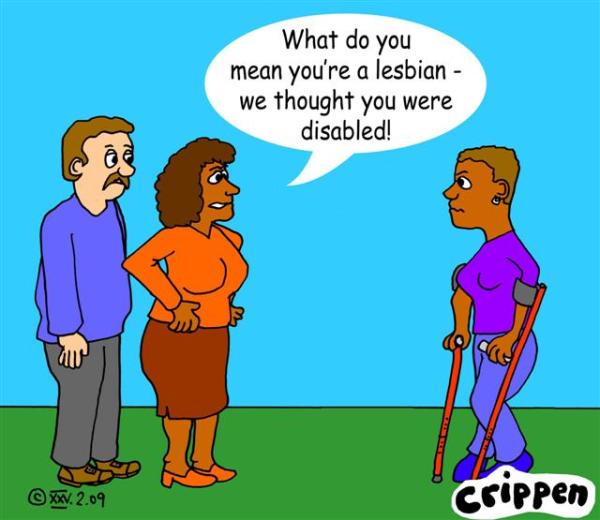
This is also this blog’s 500th post. I’m proud to say that Same Difference has continued to grow beyond my wildest dreams. Here’s to the next 500 posts!
BBC NEWS | UK | Special trolley for disabled girl
A mother from north Devon who has a severely disabled child has persuaded her local supermarket to provide a unique trolley for her daughter.
Vodpod videos no longer available.
Wheelchair Firm Wins Design Award
A disabled man who set up a company making wheelchairs because he was frustrated with the lack of choice available to users has won an award.
Mark Owen and his brother Jon established Nomad in Ciliau Aeron, near Lampeter, just six months ago.
The pair scooped a Design Management Europe (DME) prize, beating companies from France, the Netherlands, Luxembourg and Belgium.
It is believed to be the first mobility company to win a DME award.
The brothers picked up the award at a ceremony in Eindhoven, in the Netherlands, after winning the “first time design project” category for their wheelchairs.
Mark Owen, a wheelchair user, started Nomad with his brother in response to over a decade of “feeling frustrated by the choice of wheelchairs available to the market”.

Nomad make bespoke, lightweight wheelchairs
|
The DME awards recognise companies for the management of the complete design process, from product design to branding, marketing and literature.
Company director Jon Owen said: “Even to be judged against such strong mainstream and lifestyle companies is a huge compliment.”
Mark Owen started using a wheelchair after a road accident in 1996 left him paralysed from the chest down, and with the use of only his right arm.
Jon Owen said the award was “proof that it is possible to make the best of any situation, no matter how bad it seems at first”.
Help Call For Dyslexic Children in Welsh Schools
The level of support for dyslexic children in the Welsh language has come under fire from assembly members.
The enterprise and learning committee says there is a lack of consistency in screening of children in both English and Welsh medium education.
It says the problem is worse in the Welsh medium with some schools needing more support.
The Welsh Assembly Government welcomed the report and said it was committed to more research “in this important area”.
The committee’s report is a follow-up to its investigation into the provision of support for children with dyslexia in July 2008.
Recommendations in the latest report include:
- The provision of a specialist dyslexia teacher for every cluster of primary schools.
- Establishing courses to train teachers to develop expertise in dyslexia, not just additional learning needs.
- The training courses in dyslexia should be made available for all staff working with children in the classroom.
- All local authorities in Wales should provide a Welsh-medium service for screening and supporting children with dyslexia, including funding for the provision of standard norms for testing
- The assembly government should fund the Welsh Dyslexia Project to run a free helpline for users in Wales, in both the Welsh and English languages.
‘Early identification’
Dyslexia is commonly understood to be a term covering a range of types of learning difficulty where someone of normal intelligence has persistent and significant problems with reading, writing, spelling.
|
CASE STUDY
Gloria Jones, from Swansea, a teacher for 20 years. Ms Jones took a year’s course in dyslexia teaching two years ago and teaches at Ysgol Gymraeg Lonlas, near Llansamlet.
“Dyslexic children think differently in the way they read. Their brain processes information differently. What they are seeing is the letter reversed. Some actually see the letters jumping off the page. “Because they are not doing so well, they lose their self esteem. It’s a downward spiral. You have to get their confidence up again. “Perhaps it’s easier in Welsh because it’s phonetic but they still have these problems because they see the letters reversed. Every class has got some dyslexic children. Some are badly dyslexic. “The course was very beneficial. We had lots of lecturers showing the different games we could do and why it was good for the children.” |
Education minister Jane Hutt said she had recently agreed to provide £2m over three years to set up pilot schemes to reform the current system and establish additional learning needs co-ordinators.
Gareth Jones, AM, the chair of the committee said the assembly government should focus on early identification of people with dyslexia.
“While we are encouraged with the action taken by the minister since we published our report on support for people with dyslexia in July 2008, the committee believes the Welsh government should focus on ensuring that early identification of, and support for, people with dyslexia is available in both the English and Welsh languages,” he said.
The assembly government said: “It is crucial that children and young people have access to tests which are language specific, standardised and age appropriate.
“To fully achieve the committee’s recommendations and meet the needs of children and young people with dyslexia we have commissioned research, particularly in relation to available, valid and reliable screening and assessment, procedures for accurate identification and effective intervention programmes.
“As part of this work additional topics have been added to include a review of the cross-linguistic literature on dyslexia and existing work on dyslexia among speakers/readers of Welsh.”
Gene Therapy Cures Form of Blindness
Exhilarated scientists on Saturday announced they had used gene therapy to restore eyesight to children blighted by a rare, inherited form of creeping blindness.
Youngsters were able to walk unaided around dimly-lit obstacles, take part in lessons at school without extra help — and one child saw the colour of his father’s eyes for the very first time.
The revolutionary treatment targets a disease of light-catching retinal cells called Leber’s congenital amaurosis, or LCA.
Caused by flaws in any one of around 13 key genes, LCA triggers severe loss of vision and abnormal eye movements in early infancy, usually leading to total blindness in the twenties or thirties.
Doctors led by Jean Bennett of the University of Pennsylvania School of Medicine tested a way of tackling this tragedy by inserting a corrective gene in a disabled cold virus.
Their study was published online by The Lancet on Saturday, coinciding with a presentation at a conference of American ophthalmologists in San Francisco.
The modified virus was injected into the eyeball, and infected the diseased cells — in effect, acting like a Trojan horse to deliver the right DNA to the retina.
Twelve patients aged eight to 44 years were recruited in the small, experimental study, and were given the treatment in the eye that had the worst vision.
None of the patients recovered normal sight, but all of them had an at-least 100-fold increase in so-called pupillary light response, meaning the constriction of the pupil when exposed to light.
Six of the 12 recovered sufficient sight that meant they may no longer be classified as legally blind.
The best results were among four children aged eight, nine, 10 and 11.
All four gained vision that enabled them to walk unaided along a dimly-lit simulated street route.
“Another child, who since birth, could only see light and shadows, stared into his father’s face and said he could see the colour of his eyes. Later they played soccer together,” the university said in a press release.
Normally reserved, the researchers used such words as “dramatic” and “spectacular” to describe the outcome, even though the trial is only a Phase 1 test, the first and most cautious level of a three-phase process to assess prototype treatments for safety and effectiveness.
It comes less than six weeks after another breakthrough in gene vision therapy, in which two monkeys were cured of colour blindness.
Gene medicine is one of the most alluring areas of biotechnology, offering the theoretical promise of blocking or reversing inherited disease.
But this new frontier has also been hit by occasional setbacks, notably an unexpected or uncontrollable response from the immune system.
The pioneering treatment for LCA, though, has so far had no side effects and its benefits have remained unchanged two years later, say the researchers.
“These remarkable results have laid a foundation for applying gene therapy not only to other forms of childhood-onset retinal disease, but also to more common retinal degenerations,” said Bennett.
In an analysis also carried by The Lancet, Frans Cremers and Rob Collin of Radboud University Nijmegen Medical Centre in the Netherlands predicted a major boost for further gene therapy trials.
But, they wrote, many genetic disorders remained to be uncovered and at present there was little incentive to unearth the cause of minority disorders.
“Except in families in which the recurrence risk for future offspring needed to be known, there has been neither urge nor urgency to systematically identify genetic defects.
“Though the costs to identify the underlying [genetic] mutations are not excessive, in most cases they are not covered by health insurance,” they said.
Rise In Down’s Pregnancies
The number of Down’s syndrome pregnancies has risen by more than 70% over the last 20 years, University of London researchers say.
The sharp rise reflects the growing number of older women becoming pregnant, when there is a higher risk.
An increase in the number of subsequent abortions and more antenatal diagnoses means slightly fewer children are being born with Down’s syndrome.
Campaigners say better education about the condition will reduce abortions.
The number of Down’s syndrome pregnancies rose from 1,075 diagnoses in 1990 to 1,843 by 2008 in England and Wales.
Despite the higher number of Down’s pregnancies, the number of Down’s syndrome babies has fallen by 1%, from 752 to 743.
This is because improved antenatal screening means more Down’s pregnancies are being spotted and more abortions are taking place. Without the improved screening, the number of babies born with Down’s would have risen by 48%, according to the study.
|
Down’s syndrome
A genetic disorder named after the British physician John Langdon Down, who identified it in 1866.
Inhibits the ability to learn and develop mentally.
About 60,000 people have Down’s syndrome in the UK.
|
The proportion of couples diagnosed with a Down’s syndrome baby who decided to terminate has remained constant at 92%, say researchers at Queen Mary.
Older mothers
The risk of having a baby with Down’s syndrome is one in 940 for a woman aged 30. But by age 40, the risk rises to one in 85.
Joan Morris, professor of medical statistics at Queen Mary, led the research and she said: “What we’re seeing here is a steep rise in pregnancies with Down’s syndrome but that is being offset by improvements in screening.
“It was thought that these improvements would lead to a decrease in the number of births with Down’s syndrome. However, due to increases in maternal age this has not occurred.”
Professor Morris said the Down’s screening test had become more widely available over the last 20 years.
The report was published in the British Medical Journal.
Doctors told Natasha and Eddie Batha that there was a one-in-170 chance that their daughter Mia, who is now three, would be born with the condition.
Mr Batha told BBC Breakfast that their shock of learning that Mia did have Down’s syndrome soon gave way to the realisation that the condition was not as bad as they feared.
‘Another human being’
He said: “You’re led to believe that it’s the worst thing that could possibly ever happen to you.
“And then you realise it’s just another human being who happens to be a little bit different.
“She just takes a bit more effort and she is a bit slower to pick up on things.”
His wife agreed that many people were misinformed about Down’s syndrome and she thinks this has contributed to the high abortion rate.
She said: “Because you have a test [during pregnancy] you think that it must be a terrible thing if it happened.
“There’s no qualifying information and I think that would be really useful to get that and it might affect a lot of people’s decision as to whether they could live with that.”
Carol Boys from the Down’s Syndrome Association said the number of abortions would be reduced if parents were better informed about Down’s syndrome.
She said: “We realise that tests will continue to become more accurate at increasingly earlier stages of pregnancy.
“It is therefore even more important that families undergoing the screening process are given non-directive counselling and accurate, up-to-date information about Downs’ syndrome.”
Research Reveals Identical Twins More Likely To Both Have Autism
When one identical twin develops the developmental disorder autism, the risk of the other developing it is high — substantially higher than it is for fraternal twins, a new study confirms.
The study, which gathered information from 277 twin pairs in which at least one had an autistic disorder, found that when one identical twin developed an autistic disorder, the other one also did 88 percent of the time.
That compared with 31 percent among fraternal twins. Unlike identical twins, fraternal twins are no more genetically similar than non-twin siblings.
What’s more, researchers found, identical twins also had greater similarities in the form of autism that they developed, their level of day-to-day functioning and the risk of intellectual impairment.
The findings, reported in the Archives of Pediatrics & Adolescent Medicine, confirm the importance of genes in autism development.
Autism spectrum disorders (ASDs) include several developmental brain disorders that hinder a person’s ability to communicate and interact socially. ASDs range from the more-severe cases of “classic” autism to Asperger’s syndrome — where a person has normal intelligence and verbal skills, but difficulty socializing and understanding subtler forms of communication, like body language and vocal tone.
“Autism research has been guided by one important observation for the past several decades – that autism has a large genetic component,” Dr. Paul Law, of the Kennedy Krieger Institute in Baltimore, told Reuters Health in an email. “That observation was made through twin studies.”
This new study confirms those findings using a much larger sample of twins, according to Law. The data come from an online registry called the Interactive Autism Network, which Kennedy Krieger set up two years ago to connect parents of children with autism with researchers.
Of the twin pairs in the current study, 67 were identical and 210 were fraternal. Among identical twins, all females had been diagnosed with an ASD, whereas the “concordance” was 86 percent among males.
The pattern was different among fraternal twins. Among pairs in which at least one was female, when one sibling developed an ASD, the other did 20 percent of the time. That figure was 40 percent when both twins were male.
The findings also go beyond confirming concordance in identical twins’ odds of developing an ASD, Law pointed out.
“We show that important characteristics of ASD, such as the type of ASD, level of functioning and presence of other psychiatric disorders are more similar…among identical twins,” he said. “Thus not only are they more concordant overall, but the pattern of their disease is more concordant.”
The researchers also found that among identical twins, the second sibling was unlikely to be diagnosed with an ASD once a year had passed since the first sibling’s diagnosis.
“Basically,” Law said, “our data suggests that parents of identical twins can stop worrying after about 12 months have passed since the diagnosis of their first twin.”
In contrast, he said, fraternal twins still seem to have “some degree of risk” as much as four years after the first twin is diagnosed.
While experts generally agree that genetics plays a major role in autism spectrum disorders, they also believe that environmental factors conspire with genes to make certain children vulnerable. Researchers are still trying to figure out what those environmental factors are.
Frederiksen Goes For Gold In Iceland
Heather Frederiksen believes more world records are within her grasp at this week’s European Paralympic Swimming Championships in Iceland.
The Beijing gold medallist from Wigan has set three world and two European records already this year.
“I want to go out there and swim as close as I can to my personal bests, if not faster,” she told BBC Sport.
“I’ve set myself some tough standards in my events so we’ll have to see if I can match them.”
The 23-year-old was a talented able-bodied swimmer before an accident five years ago left her with reduced mobility down the right side of her body and she was told she would never swim again.
She left the sport but then decided she had some unfinished business to attend to and returned in 2006, working hard to be one of the stars of the British team in Beijing, winning a gold, two silvers and a bronze.
But with two major competitions for GB swimmers this year – the Iceland meet begins on Sunday and and is followed by the World Short-Course Championships in Brazil at the end of next month – Frederiksen has wasted no time in getting back to business.
“I’ve set three world records this year – I’ve got two more records than I had in Beijing so there is more pressure on me going into the championships but it can only make me stronger,” she admitted.
|
We need to race as much as we can before London 2012
Heather Frederiksen
|
“I thrive quite well on pressure although I still feel the nerves because people still expect to do a lot.
“I think everyone has moved on this year and everyone is chasing us after Beijing and we have to move with it
“If I hadn’t moved on this year I would have felt like I was a year behind everyone else so for me it has been a case of striving to improve so I can step up to the mark when I need to.”
Frederiksen will be competing in six events in Iceland – the 100m backstroke, 400m freestyle and 100m freestyle (where she holds world records) as well as the 100m butterfly and 200m individual medley, where she is the European record holder, as well as the 50m freestyle.
She will then have a couple of weeks before travelling to Brazil for the short course event and a battle with rival American Jessica Long.
“I’m still trying to improve in all my events but I’ve been working hard on my breaststroke for the medley because it’s the weakest of the four legs,” she said.
“Every time you break a record it feels just as special but I worked really hard for the 400m freestyle record and the 100m freestyle. I worked hard for the backstroke as well but the freestyle records are the ones I’ve had to spend most time on.
“At the moment I am 0.07 seconds away from the world and European 50m freestyle record so that is something I am looking at.
“I’ve improved a lot on the 200m medley and am about four seconds away from the world record and I regained the 100m butterfly European record earlier this year, which is good for something that isn’t really my main event.”

Frederiksen was told after her accident that she would never swim again
|
But having made her Paralympic debut in Beijing, Frederiksen says she is keen to be involved in 2012.
“As well as this year’s two events, the world long course is next year so it is all good competition but we need to race as much as we can before London. It can only be positive for us as we look towards 2012.”
Deaf children falling behind
Research carried out by the National Deaf Children’s Society shows that deaf children are falling behind their peers in the classroom.
New figures show that last year deaf pupils in mainstream schools were 30% less likely to achieve 5 GCSEs between grades A and C, compared to their hearing classmates.
The charity says better resourcing is needed and that schools need to provide a good acoustic environment for deaf children.
Vodpod videos no longer available.
Fundraisers Leave Wheelchair User Up Welsh Mountain
Rescuers had to help a man in a wheelchair down Snowdon after a group of people who had carried him there left him on his own during the ascent.
The six martial arts enthusiasts were taking part in a fundraising record attempt and had carried the man up Llanberis Path.
They decided to leave him before they reached the peak, and were too tired when they returned to carry him down.
They called out mountain rescuers, who criticised the group’s actions.
Llanberis mountain rescue team carried the 31-year-old man, who they said was cold, from the foot of Allt Moses to the mountain railway, and put him on a train to the foot of the mountain.
The group from Coventry had been attempting to see how many martial arts enthusiasts could climb the mountain at one time.
They were carrying the man as part of the attempt, but abandoned the effort when the hike along the path became too tough.
The rescue team said the call-out could have been avoided if the party had turned around with the wheelchair instead of continuing the ascent.
How totally insensitive of them! Surely they should have realised that the weight of his wheelchair would be tiring before agreeing to take him along on the climb?
McKinnon’s Extradition Put On Hold
A Briton accused of hacking into secret military and Nasa computers has had his extradition to the US put on hold as new psychiatric evidence is considered.
Glasgow-born Gary McKinnon, 42, was denied permission to appeal to the Supreme Court against his removal.
He then had 14 days to appeal to the European Court, but the Home Office has agreed to consider new evidence and has put that 14-day deadline on hold.
Mr McKinnon, who has Asperger’s syndrome, could face decades in jail.
‘Extremely vulnerable’
A Home Office spokesman said: “On 12 October his solicitors submitted further representations to the Home Secretary and we are considering what response to give to this latest material.
“In the meantime, we have confirmed to his solicitors that we do not consider the 14 days for a Strasbourg application as running.”
Karen Todner, Mr McKinnon’s lawyer, said she hoped Home Secretary Alan Johnson would “show some compassion to someone who is extremely vulnerable”.
|
It does not matter if it takes some time to consider it, as long as they give it proper consideration Karen Todner
|
Ms Todner said: “We appreciate the home secretary may feel otherwise, but very eminent lawyers have given the advice that he does have the power to intervene, in fact we would say he has a duty to intervene.
“We hope he will stop this extradition process, and of course there is still the option to prosecute him (Mr McKinnon) here.
“I do not know when we will hear from him. It does not matter if it takes some time to consider it, as long as they give it proper consideration.”
She added that they had to exhaust “all domestic remedies” if they were considering taking the case to Europe.
Mr McKinnon has admitted breaking into the computers, but says he sought information on UFOs and only got in because of lax security.
The US government, however, insists he committed a malicious crime – the biggest military computer hack ever.
They say he stole passwords, deleted files and left 300 computers at a US navy weapons station unusable immediately after the September 11 terrorist attacks.
Assisted Technology Provides Hope For Dyspraxic Children
Tom Powis has trouble writing, fastening buttons and tying shoelaces.
The youngest of triplets, 11-year-old Tom’s fine motor skills lag behind those of siblings Olly and Jack.
Despite the fact that he is academically above average, his handwriting problems mean he is often wrongly placed in a lower ability group.
His mother Gillian, a physiotherapist, explained that Tom’s dyspraxia – an impairment or immaturity of the organisation of movement – has left him frustrated and struggling.
Writing practise
He has to continuously practise his writing and movement – exercises that he finds difficult, boring and tiring.
But a new robotic arm could hold the answer.
For the last few weeks Tom has been using a hi-tech robotic arm to practise his fine movement skills.
|
DYSPRAXIA
A general deficit in motor skills, affecting coordination and movement
Children with dyspraxia struggle with skilful, controlled actions, making simple daily tasks such as buttoning their coat or using cutlery much more difficult
Problems with handwriting mean they struggle with school work, which can mean they get left behind or lose self-confidence
|
The system has been developed and tested by a Leeds University team, working in collaboration with colleagues at the universities of Aberdeen in Scotland and Indiana in the US.
It allows children with coordination problems to practise therapist-prescribed exercises at home using an interactive desk-top system, which can also monitor how they move, measuring things like smoothness and speed of movement.
The exercises involve children using a pen, guided by the robotic arm, to push objects along a 3D track shown on a computer screen.
And the techniques are already proving a big hit with Tom and the rest of the family.
“Tom is very keen to do the exercises,” said Gillian.
“Even though it it is early stages it is encouraging movement patterns and is a fun way to do repetition.
“Everyone wants to have a go, including his brothers.”
Home therapy
Lead researcher professor Mark Mon-Williams said one of the big benefits of the system is that it is portable and can be used at home.
Early trials of the robot have proved ‘very promising’ and Professor Mon-Williams said it could prove the answer to a shortage of therapists.
At least 5% of children – roughly one child in every classroom – are affected by dyspraxia.
The majority of these youngsters will not receive the level of help they need due to high demand on limited occupational therapy resources – some may be seen just once a year.

All three boys want to use the robot arm
|
“There aren’t enough therapists available for the number of children who have movement difficulties in the UK,” said Professor Mon-Williams.
“So increasingly we need to move towards assisted technologies to fill the gap.”
He said that in the past it had been assumed that children like Tom would ‘grow out’ of their dyspraxia, but this has turned out not to be the case.
“In the past people thought, ‘so you are not very good at handwriting or using cutlery, how much of a problem is that’?
“What we now know is that this is an enormous problem and that kids who have movement problems have difficulties.
“These kids really have a hard time and have a very poor outcome.
“But there is very good evidence that if you give these children therapeutic interventions that problems are decreased.”
‘Good fun’
Gillian, from North Yorkshire, said without this help that children like Tom can become frustrated and despondent by their lack of progress.
“Writing is so important,” said Gillian, adding that once a child dropped behind it was often difficult to catch up.
“But the robot is really good fun. Children need the intense input and using the robot with visual feedback makes it fun to learn and easier to learn.
The arm guides the child’s movements
|
“The potential for this is huge.”
Dr Yolande Harley, deputy director of Research at Action Medical Research, which has funded it, agreed.
“Providing therapy for children’s coordination problems will bring all-round benefits, helping them to do better at school, make friends and enjoy physical activities and hobbies,” she said.
Further tests are now planned to investigate how long the robot should be used to get the best outcome and which children could benefit the most.
The basic system, or a form of it, could be widely available by 2012.
Weekend Cartoon
Thanks to Crippen.
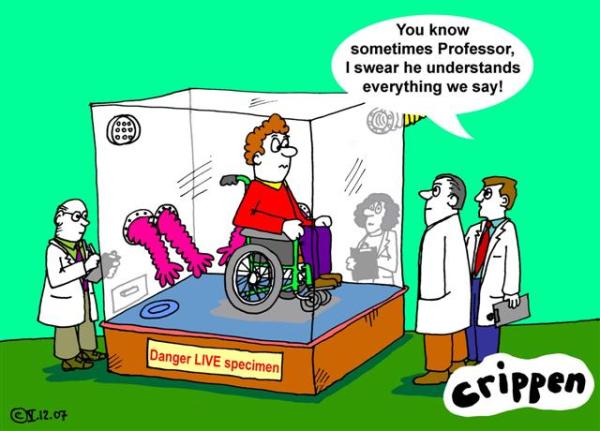
Adults With Autism Cast Adrift
Adults with autism in England are often not being diagnosed or supported properly, MPs say.
The Commons’ Public Accounts Committee said the lack of understanding about the condition among GPs and social care staff was a key problem.
But MPs also attacked the arrangements in place to oversee the transition from child to adult services which led to people being “cast adrift”.
The government said a new strategy for autism would be published next year.
There are about 400,000 adults in the country with the condition, split evenly between those with a learning disability, sometimes known as low-functioning, and those without one, known as high functioning.
|
Adults with autism are being left to fend for themselves with all the consequences this has for their access to further education, benefits or employment and for their mental health Edward Leigh, committee chairman
|
While children are often supported through the school system, adults require a very different network of help.
They will often need concerted and individual support across health, social care, housing, education and employment.
But the cross-party group of MPs said this was not happening.
They blamed the poor transitional services being run by local Connexions services, which provide integrated services for 16 to 24-year-olds.
Such services were often unaware of the needs of their clients, the report said.
There was also a basic lack of data on the number of adults needing help.
Just a fifth of local authorities and their NHS partners were aware of the numbers with low-functioning autism, while only 12% had details of those with the high-functioning form.
The MPs also identified a weakness in diagnostic services. It is estimated that GPs see two adult patients with undiagnosed autism in each six-month period, but previous research has shown eight in 10 GPs felt they needed extra training and guidance on the condition.
Less than a third of areas commissioned specialist diagnostic services to pick up those cases not identified in childhood, the report added.
Committee chairman Edward Leigh said: “Adults with autism are being left to fend for themselves with all the consequences this has for their access to further education, benefits or employment and for their mental health.”
Discrimination
Mark Lever, chief executive of the National Autistic Society, said: “The government cannot possibly ignore the recommendations of this influential group of MPs.
“Adults with autism have been telling us for some time that they are frequently misunderstood and discriminated against, whether it’s trying to get a diagnosis, a job or access to health and social care.
“Thousands are experiencing serious mental health difficulties as a result and just 15% are currently in full-time paid employment.
“This has profound consequences for individuals, families and the wider economy.”
A Department of Health spokesperson said measures were lined up to improve services for people with autism, along with research into the prevalence of autism among adults.
“Together this will help create a new approach which directly reflects the needs of people with autism and their families and will drive up standards of services.
“We will consider the detailed recommendations and make our formal response in due course.”
Compensation Awards Get Larger All The Time
I’ve just read about Harry Snowdon, 10, who has been awarded compensation of- wait for it- £7.1 million after medical negligence at birth which left him with severe brain damage.
He was paid a lump sum of- wait for it- £2.3 million, and the rest will be paid to him in annual payments for the rest of his life.
I have a few points to make about this case. Firstly, compensation payments seem to get larger every time a case is brought to public attention. I’ve known this for quite a while, but even I can’t believe the size of this payment!
Secondly, and more seriously, why, oh why, can’t the media simply call Harry’s condition what anyone with any interest in the subject knows it is- Cerebral Palsy?
And finally, I must agree with Harry’s mum, Debra Snowdon, who says: “We sincerely hope that the health service will start to take note of their mistakes and instead of paying out millions in negligence claims ensure that sufficient numbers of suitably trained staff are available to stop these types of accidents occurring in the future.”
As always in similar cases, Harry and his family have my best wishes.
Vote For Isla, 4, To Be The New Face of Kinder
A little girl called Isla is in the running to be the new face of Kinder Chocolate.
Isla has Down’s Syndrome.
Please vote for her and help to change people’s perceptions of disability.
Thanks to Christina Martin for the info.
Helping Jobseekers With Autism
People with autism are condemned to financial hardship by poor employment and benefits support, a charity says.
The National Autistic Society (NAS) is calling for a national strategy to help people with autism into work.
NAS chief executive Mark Lever said people with autism experienced “anxiety, confusion, delays and discrimination” when using services.
The Department for Work and Pensions said it was “determined to provide the best support possible” to them.
|
It is absolutely vital (people with autism) are able to access the right help and services Mark Lever, National Autistic Society
|
Launching its “Don’t Write Me Off” campaign, the NAS says a majority of the over 300,000 working age adults with autism in the UK want to work but only 15% are in full-time paid employment.
The charity says a key problem is a lack of understanding of autism among Jobcentre Plus staff, who determine eligibility for benefits and provide employment support.
It is calling for the government to introduce autism coordinators who would work with frontline staff, local employers and employment support services.
Mr Lever said: “It is absolutely vital [people with autism] are able to access the right help and services if seeking employment and are supported financially when they cannot work.”
‘Multitude of problems’
The charity says many people with autism are experiencing difficulties when applying for the new Employment and Support Allowance (ESA).
The ESA replaced incapacity benefit in October 2008. The change was designed to encourage more people into work if they are able.
But the NAS says many people with autism are experiencing a “multitude of problems”.
Paula Wharmby said she found the process of applying for the ESA inflexible and intimidating.
“It was clear nobody knew anything about autism and a report from my psychiatrist on my difficulties was completely ignored.
“I was denied the benefit and had to go to a tribunal to have the decision overturned.
“The system just isn’t working for people like me.”
In a statement, the DWP said it was working with the National Autistic Society and other groups to ensure help was available, and that the government would publish its Autism Strategy in due course.
The statement added: “We understand that people with autism have complex needs so we have arrangements in place to help, such as bringing along someone to represent them in adviser interviews if needed.
“We are determined to provide the best support possible to help them get into work, which is why our wide range of personalised support looks at what people can do, rather than what they can’t.”
Britain’s Got Talent Contestant To Repay Disability Benefits
A pensioner who showcased his breakdancing skills on television is paying back £3,000 after his disability claims were investigated.
Fred Bowers, 74, of Sutton Bonnington, near Loughborough, appeared on ITV1’s Britain’s Got Talent before being knocked out in the semi-finals.
The Department of Work and Pensions found he should not get cash from the Motability scheme, along with a car.
He is repaying the cash at £10 a week – and is still performing on dance shows.
Mr Bowers said: “I’ve agreed to pay the money back which I said I would in the first place.
“I just want to get on with my life now. I’ve got some shows coming up and I want to be able to do them without being upset by what people are saying.”
He said he never deliberately deceived anyone adding: “I would never do that.”
Bowers said he just wanted to carry on dancing, and may have another go at Britain’s Got Talent.
A spokeswoman for the Department for Work and Pensions (DWP) said: “Although the DWP does not comment on individual cases we do investigate and take seriously all accusations of fraudulent benefits claims.”
Gordon Brown Is Truly DisAbled!
I am astounded by the recent flurry of activity in the news, suggesting that Gordon Brown may not be fit for the job of prime minister due to his visual impairment.
I appreciate that he is in the hot spot politically, but attitudes like these only serve to perpetuate inaccurate negative perceptions of visually impaired people. I have lived in both the blind and sighted worlds and the one thing that I can say, with absolute certainty, is that the only thing now disabling me is ignorance.
I have a degenerative eye disease, retinitis pigmentosa. Although I currently have some useful vision, my eyesight continues to deteriorate. When I registered blind in 2007, Action for Blind People helped me navigate around the world of work and visual impairment. At first, I was pretty defeatist, fuelled by the negative perceptions of blind people that I am now committed to changing. I thought that it was the end of my career, but now with assistive technology and support from government-funded schemes, such as Access to Work, the gap that my impairment created has been bridged. Sure, I have had to make significant changes and it has been a difficult journey, but I look back now and think just how ludicrous it was for me to believe that being blind would ever stop me from having a rich and fulfilling career.
These negative perceptions, myths and stereotypes that, to my chagrin, still prevail are all born of a lack of understanding. I am ashamed to admit that before I registered blind, in my mind I just had this annoying eye disease, but did not know that I was “blind”. I thought that all blind people were, well, totally blind, and had no idea that the little treasure trove of gadgets and gizmos that I now have in my arsenal would be able to transform my life so profoundly.
I now know plenty of blind and partially sighted people just like me, working hard and going about their busy lives, with canes, guide dogs, support workers and assistive technologies in tow. I realise that none of these aids will bring back my eyesight, but they do provide me with an alternative route to wherever it is that I want to go and enable me to work and live alongside everyone else and enjoy the same freedoms and equal opportunities. After all, isn’t this a basic human right?
Whatever the outcome of this next election, I can only hope that votes are not cast based on archaic views about disability. I know that my eyesight may be deteriorating but my “vision” remains perfectly intact.
Weekend Cartoon
Thanks to Crippen.

Mckinnon Refused Permission To Appeal
Computer hacker Gary McKinnon has been refused permission to appeal to the UK Supreme Court against his extradition to the US.
The Glasgow-born 43-year-old is accused by the US of the breaking into its military computer system but he insists he was just seeking evidence of UFOs.
The Asperger’s Syndrome sufferer, of Wood Green, London, could face 60 years or more in a US prison if convicted.
In July, he lost a High Court bid to avoid extradition.
Blind boy uses his ears to ‘see’
Vodpod videos no longer available.
A seven-year-old blind boy has been taught to “see” using his ears.
Lucas Murray from Poole in Dorset has learned to use echoes to picture the world around him – similar to sonar techniques used by bats and dolphins.
He clicks his tongue on the roof of his mouth and from the sound that returns he tries to work out the distance, shape, density and position of objects.
The echolocation technique has helped Lucas, who was born blind, play basketball and rock climb.
He was taught the system by blind Californian Daniel Kish, 43, who founded the World Access for the Blind charity.
|
He does play basketball, he is able to make it in to the hoop by clicking, he is actually pretty good at that Daniel Kish
|
Lucas’s parents Sarah and Iain saw Mr Kish on TV and asked him to visit.
Mr Kish said: “Lucas is one of the first in the UK to use this technique.
“He is able to click his tongue and determine where things are around him and what things are around him and he is able to travel comfortably without holding on to people.
“The click basically emanates a sound which bounces off the environment a bit like the flash of a camera.”
‘Amazing mobility’
Lucas tells distance by timing how long the echo takes to return and he works out the object’s location by which ear the sound reaches first.
He picks up the density and shape of it by the intensity of the sound bouncing back.
An object moving away creates a lower pitch and one moving closer a higher pitch.
Mr Kish said Lucas determines the qualities of an object by the characteristics of the sound that comes back.
“He does play basketball, he is able to make it in to the hoop by clicking, he is actually pretty good at that,” Mr Kish added.
“He is doing very well and his mobility is amazing, the best for his age in the UK.”
Funding May Help MS Diagnosis
Scientists at Nottingham’s Queens Medical Centre have been given a financial boost to extend research into multiple sclerosis.
The grant of almost £130,000 will allow them to carry out tests on patients using a new scanner, which could lead to earlier diagnosis of the condition.
This could then help patients to have access to treatment much faster and help improve their quality of life.
The money has been awarded by the Multiple Sclerosis Society.
Multiple sclerosis – a condition of the central nervous system – affects about 100,000 people in the UK.
‘Major impact’
It is most often diagnosed in people between the ages of 20 and 40, and women are almost twice as likely to develop it as men.
The cause is not known and a cure has yet to be identified.
Dr Nikos Evangelou, consultant neurologist at Nottingham University Hospitals NHS Trust, said: “We have strong MS research capacity already in Nottingham, and this new project will complement this.
“The results of the study are likely to have a major impact on the diagnosis of MS.
“Our preliminary results have been extremely encouraging, highlighting the value of the initial grant.
“Many lines of evidence suggest that early diagnosis and early treatment is likely to result in improved long term outcomes with reduced disability, and in turn reduced costs to the NHS and society.”
Brooke Greenberg at 16 Years Old
I read about Brooke Greenberg yesterday in Pick Me Up magazine.
I have to say I was very frustrated when I finished the article.
Frustrated with her mother, for two reasons.
First, because her parents claim they don’t know whether Brooke has the mind of a 16 year old. I have several friends who can’t communicate verbally, but their parents have worked very hard over several years to find out that they do have perfect intelligence- possibly even better intelligence than your average able bodied person. Brooke’s mother, Melanie, says Brooke can smile and move her head and hands, so, has anyone tried to ask Brooke what she understands, or what she wants to learn, or even do? From the article, it seems that Brooke sits at home watching cartoons all day while her sisters are at school. Cartoons! Has anyone ever asked her if she wants to watch the news, or a movie? Has anyone ever asked her if she wants an education? If they had taught her the alphabet, she might be able to communicate using one of these:

an alphabet board
But has anyone she knows thought of this? It doesn't look like it from the article.

Secondly, Melanie Greenberg says she is proud to be Brooke's mother, yet,
when asked about Brooke's age by strangers,
she lies and says Brooke is a toddler.
She says she is trying to protect Brooke, and herself, from judgement.
Maybe that's understandable, but that doesn't seem like pride to me.

Maybe I'm being too harsh, but, as a disabled person with at least a reasonable amount of
intelligence and understanding of the world, I can only think that
if Brooke does have a 16 year old mind, then
she must be bored out of it, and she must hate to see her mother
lying about her age and, in the process, her disability.
I know how I would feel in her situation, and I wouldn't be happy at all.

Comments, as always, are very welcome below.
Down’s People At Higher Risk Of Dementia
Not enough is being done to support the growing number of people with Down’s syndrome who have dementia, say campaigners.
As many as 50% of all people with Down’s in their 50s may now have Alzheimer’s disease, as they often get the condition much earlier than others.
But critics say the issue was barely mentioned in a recent green paper on dementia care in England.
However, ministers said action was being taken to reform dementia care.
The Department of Health in England says it wants to make the system “fairer, simpler and more affordable – all of which should help people with Down’s syndrome”.
There are approximately 40,000 people with Down’s syndrome in the UK, and thanks to medical advances they are living longer.
However, they appear to be vulnerable to Alzheimer’s disease, because a protein thought to play a key role in the condition called amyloid tends to build up in their brains more quickly than in the rest of the population.
Professor Tony Holland, an expert in the psychiatry of learning disabilities at the University of Cambridge, said the issue had effectively been ignored by the government.
“We would like to see it acknowledged at a governmental level and then clear strategies put in place, which may vary across the country, that ensures they have access to the right services.”
Prof Holland said some areas already had very high levels of care – but others lagged behind.
Carers claim it can be a struggle getting the right kind of help.
‘Very distressing’
Nikki Lewis describes her brother Andrew as “warm hearted, loving and gregarious”.

Nikki had to fight for care for her brother
|
He had Down’s syndrome, but lived an independent life.
Then, in his 40s, his behaviour changed and his memory began to fail.
“It was very distressing, he hated not being able to find his words, he hated not being able to do all the things he used to do,” she said.
Nikki had to fight, first to get an accurate diagnosis, and then for the care Andrew needed. He died aged 52.
Seven years on she says the system has begun to improve.
“I think the levels of care now are becoming much more professional, it’s very gradual, some areas are far more progressive than others.”
Nikki is convinced the problem is not recognised at government level.
Some good care
Dr Karen Dodd, from the Surrey and Borders NHS trust, said there were examples of excellent care, including a Surrey County Council-run project known as The Cottage.
Doors are painted red to help clients who, because of their illness, lose the ability to distinguish colours.
There are pictures on each door to show what is inside the room, a toilet on one, a television on another, a bubbling pan on the kitchen.
But Dr Dodd said a lack of funding can mean people getting the wrong kind of care.
“You might have someone who is only 40 or 50 going into a nursing home with people in their 80s and 90s,” she said.
Care services minister Phil Hope said the green paper set out plans to redesign the care system so that it works better for everyone.
He said: “The green paper is based on making the system fairer, simpler and more affordable for everyone.
“Doing this will benefit people with Down’s syndrome as much as any other group.”
Mr Hope also said there were plans to improve healthcare for people with learning disabilities, for instance by offering annual health checks through the NHS.
Guide Dog Age Limit To Be Dropped


Guide dogs are going to be available for visually-impaired children in the UK for the first time – as the age limit is removed.
The Guide Dogs for the Blind Association is to begin training dogs to help blind or partially-sighted people under the current limit of 16.
The association says too many visually-impaired youngsters are lacking in independence and mobility.
“These young people end up isolated,” says chief executive, Bridget Warr.
The charity says many visually-impaired youngsters have only a limited social life and have to endure bullying because of their disability.
‘Barrier’
Giving some of them guide dogs at a younger age is intended to help them to widen their range of activities and to improve their sense of self-confidence and independence.

Charlotte is one of the youngest people to have had a guide dog
|
Guide dogs for these younger teenagers will begin to be provided from next year.
“The picture that emerges from our research is shocking. Children are being conditioned to expect to underachieve for the rest of their lives when in fact sight loss is no barrier to actively contributing to society when the right support is in place,” says Ms Warr.
There has been a pilot scheme to test the use of guide dogs with younger people.
Charlotte, aged 14, from Northampton, was among the youngest guide dog owners. She has been gradually losing her vision since the age of eight – and lost her sight completely this year. She has been assisted by a two-year-old Labrador retriever, Paris.
Charlotte used to have a long cane to help her move around but says having a dog allows her much more freedom and makes her feel safer.
At her school, St Paul’s Catholic School in Milton Keynes, there is a dedicated unit helping the school’s 12 vision impaired youngsters.
However the association says there is a worryingly patchy provision of services for young blind people across the UK and it calls for national minimum standards to be introduced.
As with adult blind and partially sighted people, only a small number of children are likely to be deemed suitable for a guide dog. Most will continue to rely on extra help and training from education and social services.
There are about 4,600 guide dogs helping people – with a Labrador-retriever cross the most commonly-used breed.
Weekend Cartoon
Thanks to Crippen.
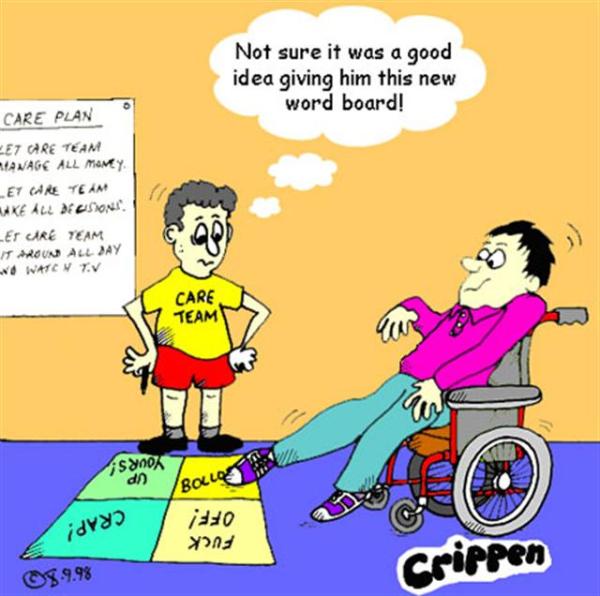
BBC NEWS | Scotland | One-legged golfer tees off at St Andrews
Golf is probably one of the most difficult games in the world to master – especially if you have only one leg.
But not for Manuel De Los Santos, who has been taking part in the Alfred Dunhill Championship at St Andrews.
The Dominican Republic player plays off three and can hit the ball 250 yards despite his disability.
Vodpod videos no longer available.
Adults With Autism
On first meeting, there is little evidence of the internal struggle Chris Goodchild faces daily as someone living with Asperger’s Syndrome, a high functioning form of autism.
“I don’t have the ability to put onto my face the distress that I feel,” says Chris, one of an estimated 500,000 people in the UK with autism spectrum disorder.
“Often we want to scream and shout, but most of us do so internally. The way we cope is to withdraw.”
Autism is a developmental condition characterised by problems in social communication with a lack of empathy towards others.
|
We can get bombarded with stimulation and information and can become easily confused and overwhelmed Chris Goodchild
|
People with the condition often engage in ritualistic and obsessive compulsive behaviours, as well as a very different way of thinking from the normal – that is neuro-typical – brain.
“The autistic brain is wired completely differently,” said Chris.
“We experience life with great intensity and have a very poor filtering system.
“We can get bombarded with stimulation and information and can become easily confused and overwhelmed.”
Autism was first identified in 1943 by child psychiatrist Leo Kanner in a group of boy patients.
A year later another Austrian psychiatrist Hans Asperger recognised a similar condition in children with special talents and high IQ.
This early understanding of autism meant that until recently, it was thought to be a childhood disorder.
Many adults went undiagnosed or were misdiagnosed with mental health problems, including severe illnesses such as schizophrenia.
Long struggle
Now 43, Chris was diagnosed with Asperger’s only 18 months ago.
|
I had to adapt to what other people thought was normal, to survive Chris Goodchild
|
For years he struggled with depression and anxiety as he tried to conceal his autistic traits behind a façade of learnt, socially-acceptable behaviour.
“I hid my unusualness, those feelings of being bad, mad, crazy, deranged,” he said.
“I had to adapt to what other people thought was normal, to survive.”
Adopted at six weeks old, he describes a ‘hunger to be loved and a fear of rejection’.
But he would recoil from being touched or hugged, as well as alarming those around him with strange mannerisms and self-comforting behaviour such as rocking.
At school, he was isolated and unable to concentrate because he found the environment noisy and confusing.
Neither his adoptive parents nor his teachers realised what was wrong and at 15, he left with no qualifications and started on a downward spiral of depression, ending up in a psychiatric hospital for a year on anti-psychotic medication.
For most of his adult life, Chris has found it difficult to hold down a job or maintain close relationships.
He has a young son whom he sees regularly, but found it impossible to live with the mother because of the stress of intimacy and his obsessive need for an ordered life of rigid routines.
Shared traits
When he was 20, he traced his natural father and was shocked to discover he shared what he later recognised, were autistic traits.
“Seeing him was like seeing Asperger’s unleashed,” said Chris.
“The man looked like Rasputin with long unwashed hair, dressed only in a pair of underpants with a sheet round him and cobwebs on the sheet.
“He had no desire to wash at all and was a hoarder with things piled up around him.
|
Without a diagnosis, I would have killed myself Chris Goodchild
|
“In many ways I saw myself without my façade or cloak of normality and it drove me further underground to be nothing like him at all.”
There is evidence from research, particularly with twins, that autism can be inherited.
On-going studies also indicate that hormones in the womb such as testosterone can influence development and MRI scans have revealed differences not only in brain structure, including increased numbers of nerve cells, but also in the way the brain works.
There are so many factors involved in autism that diagnosis is often difficult and needs lengthy clinical assessments and observation.
Chris only realised a few years ago that he might be autistic after meeting a boy with autism at his son’s birthday party.
Finally a diagnosis
After years of misdiagnosis with mental health problems, he had given up on the NHS and he turned instead to the National Autistic Society for help.
“I’d reached a point where I didn’t want to live any longer,” he said.
“I was depressed and self-harming because I couldn’t cope with this cloud of unknowing.
“Without a diagnosis, I would have killed myself.”
For Chris, diagnosis has been self-affirming.
“Having Asperger’s Syndrome is a gifted way of seeing the world,” he said.
“It can be a painful gift but I now have a framework to manage myself and the realisation that those parts of me, which I hid away, are not mad or bad.”
Adult autism is now high on the government’s agenda and a report is due for publication before the end of the year with the promise of a national strategy to improve the lives and opportunities for those living with something which Chris describes as “not a label or illness but a way of being “
‘Adults with Autism’ will be broadcast on BBC Radio 4 on Tuesday 29 September at 2100 hours, repeated on Wednesday 30 September at 1630 hours.
Balls To Announce Review of SEN Provision
Ed Balls, the schools secretary, will today announce new measures to provide better support for disabled children and pupils with special educational needs.
The proposals will aim to make the process of assessing a child’s needs easier and more independent, responding to complaints from parents that getting extra help for their children is often a difficult and protracted battle.
The government will look at taking assessment of pupils with special educational needs (SEN) out of the hands of local authorities, which, according to parents’ groups, consider the cost of a child’s education when assessing their needs.
The government recognised parents’ desire for clearer, more transparent assessments, said Balls. “I am keen that we look at greater communication between local authorities and parents on how we can make the process less stressful and whether an assessment process which is more independent can improve parental confidence,” he said.
A recent government-commissioned review of SEN services, conducted by Brian Lamb, recommended improving information for parents and highlighted major concerns about the system of “statementing” children with SEN.
In a letter to Balls, Lamb wrote: “Too many [parents] reported that the system was not on their side and said they had to ‘fight’ or ‘do battle’ with the system to get what they needed for their child.”
New pilots would give parents greater confidence in the system by introducing greater independence and more advice, said Lamb. “Accurate and transparent assessment is a crucial part of promoting parental confidence in the SEN system and ensuring children get the right support to achieve and thrive,” he said.
With children with SEN eight times as likely to be excluded from school, the proposals will also crack down on schools that exclude high numbers of students with SEN.
New statutory guidance will push behaviour and attendance partnerships (groups of secondary schools in one area that have come together to challenge poor behaviour and attendance) with high levels of exclusions of children with SEN to address the problem quickly.
Balls said: “The new behaviour guidance will make tackling exclusions of SEN pupils a priority. I expect behaviour partnerships to work hard to address the specific needs of pupils, and draw on the support of partners to tackle behaviour issues early.”
Lamb welcomed the move to counteract what he called the “worrying level of disproportionate exclusions” of children with SEN.
The new measures will also attempt to ensure there are enough teachers to meet the needs of pupils with severe learning difficulties. Benet Middleton, director of communications and public affairs at the National Autistic Society said: “So many tell us it’s a constant battle to get their child assessed and the right support in place for them in the right school.
“They find it confusing, intimidating and stressful and tell us they want a system that’s transparent and independent. All too often their child’s behaviour is put down to naughtiness or poor parenting rather than recognising that it arises as a result of a disability.”
Weekend Cartoon
Thanks to Crippen.
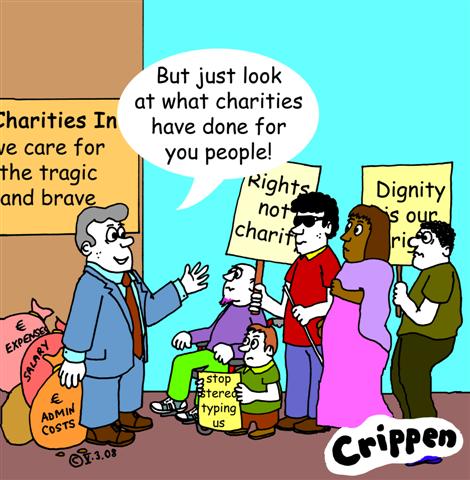
Autism Rates Back MMR Jab Safety
Latest autism figures should dispel any fears about the MMR jab being linked to the condition, say experts.
The NHS Information Centre found one in every hundred adults living in England has autism, which is identical to the rate in children.
If the vaccine was to blame, autism rates among children should be higher because the MMR has only been available since the early 1990s, the centre says.
This is the first time the rate in adults has been evaluated.
Tim Straughan, chief executive of The NHS Information Centre, said: “This landmark report is the first major study into the prevalence of autism spectrum disorders among adults to be carried out anywhere in the world.
|
The findings do not support suggestions of a link between the MMR vaccine and the development of this condition Chief executive of The NHS Information Centre Tim Straughan
|
“While the sample size was small and any conclusions need to be tempered with caution, the report suggests that, despite popular perceptions, rates of autism are not increasing, with prevalence among adults in line with that among children.
“It also suggests that, among adults, rates of autism remain broadly constant across age groups.
“The findings do not support suggestions of a link between the MMR vaccine and the development of this condition.”
Concern over the measles, mumps and rubella vaccine was sparked by a paper published in The Lancet in 1998 by Dr Andrew Wakefield.
‘Safe’ vaccine
This research has since been discredited.
But, until now, little was known about how autism affected people over the course of a lifetime.
For example, autism rates could have been lower among older age groups because people had gradually recovered from the condition or died prematurely.
The latest findings, based on nearly 7,500 adults, suggests that this is not the case, and that prevalence of autism spectrum disorder remains broadly level across all age bands.
While 1% of adults had an autism spectrum disorder, the rate for men was higher (1.8%) than for women (0.2%). This was in line with studies among child populations which show higher rates amongst boys.
And in line with recent report from the National Audit Office, the study also found many of these adults are failing to get the diagnosis and specialist help they need.
Mr Straughan said: “This does beg some questions about whether services, as currently configured, are meeting the needs of this group of people.”
Mark Lever, chief executive of the National Autistic Society, said: “The NAS has long campaigned to raise awareness of the fact that services and support for adults with autism are woefully inadequate.
“This study gives us further evidence to demand that more vital support is put in place.”
Sense Creative Writing Competition
I’ve been asked to post the below by John Gaddon at Sense.
Don’t miss this opportunity to EXPRESS YOURSELF!
The deadline for the Sense Creative Writing Competition has been extended to December 09.
Tell us your story
Do you feel you have something to say? Would you like to bring your thoughts and ideas to a wider audience? Are you looking for an outlet for your creative talents?
Why not write something for EXPRESS YOURSELF – Sense’s creative writing competition?.
We welcome any type of writing: life stories, poetry, humour, thriller, romance, political – whatever floats your boat!
The categories
There are five EXPRESS YOURSELF! awards for the best piece of writing by:
- a deafblind child or young person
- a deafblind adult
- a carer or family member (including siblings and grandparents)
- any individual on the subject of deafblindness.
There is also an award for the best creative piece presented in British Sign Language – with submissions made on video or DVD.
Entries are also accepted in Welsh as well as English.
Prizes and recognition
Each prize winner will receive their award at a ceremony in November. They will also receive:
- A prize of £100
- Their winning piece (or part of it) will be published in the Winter 2009 issue of Talking Sense.
- Their work will be added to the `Life Stories’ section of Sense’s new library. This is a growing collection of creative work produced by deafblind people and on the subject of deafblindness.
Extended deadline – Friday 18 December
Want to find out more?
If you want to find out more, or would like to register your interest please contact Colin Anderson at Sense. Or simply send in your entry and we will be delighted to read it.
Colin Anderson
101 Pentonville Road
London
N1 9LG
Tel: 0845 127 0060
Email: colin.anderson@sense.org.uk
Australian Dies After Court Win
An Australian quadriplegic, who last month won a landmark legal right to starve to death, has died.
Christian Rossiter, 49, died in a nursing home in Perth, West Australia, after developing a chest infection.
A former outdoor adventurer, he had won a legal battle to ask his carers not to give him food or water.
His case strengthened advocates of assisted suicide, in the week when Britain’s top legal officer is to issue new guidelines on the issue.
“I thank all those who have made Christian’s life, in his final years, as comfortable and as dignified as possible,” his brother Tim said.
Lawyer John Hammond, who five weeks ago won a court battle that allowed Christian Rossiter to refuse food and water, said his passing would have come as a “relief”.
“I think Christian will be remembered as someone who was very brave and took up a fight which will give a lot of people comfort,” Mr Hammond told local television.
“Essentially he won the right to refuse food and medication so he could die if he wanted to,” he said.
Western Australia’s chief judge Wayne Martin said Mr Rossiter had the right to direct his own treatment and that his carers, Brightwater Care Group, would not be criminally responsible if it complied with his wishes.
Mr Rossiter had asked the Brightwater Care Group at least 40 times to stop feeding and hydrating him through a tube to his stomach before he went to court to end a life he described as a “living hell”.
“I’m Christian Rossiter and I’d like to die. I am a prisoner in my own body. I can’t move,” he told reporters. “I have no fear of death – just pain. I only fear pain.”
Voluntary euthanasia or assisted suicide is illegal in Australia and Britain, but Britain will this week clarify when a person will and will not be prosecuted for assisting suicide.
In 1996, Australia’s outback Northern Territory introduced the world’s first voluntary euthanasia laws.
Four people used the laws to die by injection administered via a computer before the national government overturned the legislation in 1997.
Weekend Cartoon
Thanks to Crippen.

GB At The Deaflympics
Great Britain have come back with 10 medals, including one gold, from the Summer Deaflympics in Taipei.
The event, originally known as the World Games for the Deaf, was first held in Paris in 1924 and now includes 4,000 athletes from 81 countries.
Anthony Sinclair and Catherine Graham won the team’s sole gold in the tennis mixed doubles final.
There was also a silver and three bronzes for US-based teenage swimmer Hannah Fitton.
On the athletics track, Lauren Peffers won two silvers in the 400 and 800m while Serena Blackburn and Joanne Davidson claimed bronzes in the marathon and hammer respectively.
Rajeev Bagga, who was chasing his sixth consecutive individual badminton gold, had to be content with silver in the men’s singles.
Russia topped the medal table with 98 medals, including 29 golds, with Great Britain’s performance seeing them finish 26th in the overall standings.
Sinclair and Graham put in a superb display to beat Italian pair Gianpaolo Damiani and Barbara Oddone, who had held the title since 1989, 6-4 4-6 6-3.
It was Britain’s first gold medal in the mixed doubles event for more than 50 years.
“We are delighted to win gold, standing on the podium receiving our medals was our proudest moment,” said Graham.
“We have both worked so hard preparing for the Deaflympics and to come back with gold made it all worth it.”
Sinclair, who was runner-up in the men’s singles four years ago, added: “Winning silver four years ago in Melbourne was incredible, but to go one better in Taipei and get gold against the five-time champions is so special.”
UK Deaf Sport chair Craig Crowley, who is to take over shortly as president of the International Committee of Sports for the Deaf, congratulated the efforts of the British team.
“We are extremely proud of our athletes. To win 10 medals is a fantastic achievement when you consider that Team GB received no funding from the UK Government,” he said.
“Our athletes had to prepare and train for these Games with the uncertainty of whether they would actually be able to take part hanging over them.
“The standard of deaf sport is increasing and several nations are giving strong financial support to their deaf athletes.
“Britain is in danger of falling behind because our athletes are not supported by our Government or home country sports councils.”
Combine The Games
There’s a petition going around Facebook asking for the Olympics and the Paralympics to be combined. Sign if you’re interested, please. I already have.
Mother Seeks More Autism Support
Children with autism are often excluded from school and fall behind because their behaviour is taken for insubordination, MSPs will be told.
An Aberdeen parent is presenting a petition to Holyrood seeking a review of the education service for children with varying degrees of autism.
Annette Masson claims too few school staff have enough time and training.
The Scottish Government said laws were in place requiring local authorities to support children with autism.
Mrs Masson is presenting the petition to the Scottish Parliament on Wednesday.
She is appealing for autistic children to have more contact with staff trained in the condition, perhaps in specialist centres attached to local schools.
Aberdeen City Council has granted such a place to her 14-year-old son Michael.
Emergency Text System Goes Live
Trials are under way of a UK service allowing people to contact emergency services by text message.
The system is aimed at people who cannot make normal voice calls to the 999 service due to disability.
The service sends the text to a voice relay assistant who then speaks the text message to the emergency service and then texts back their reply.
If successful, the government initiative, which is backed by Ofcom, would become permanent in early 2010.
The scheme is a joint venture between various UK telecom firms.
The live trial involves people sending text messages in a real emergency. Administrators are looking for several thousand volunteers, with a preference for disabled users.
In an emergency, the user sends an SMS, spelling out the emergency service required, the nature of the emergency, and the location.
A receipt text is then sent, letting the user know the message is being acted upon and then further texts, with instructions or questions from the emergency services, are sent as needed.
People can register for the system by texting the word “register” to 999; without registering people who send a text message to 999 will receive an automated reply saying that they are not registered.
Weekend Cartoon
Thanks to Crippen.
Proud of Albert Square
EASTENDERS last night welcomed its first disabled character to use a wheelchair. David Proud made his soap debut as Adam Best, the son of Minty’s girlfriend Manda. David was born with spina bifida and cannot walk unaided. Despite the challenges, he has appeared in CBBC’s Desperado and ITV2’s Secret Diary Of A Call Girl. David, 26, who lives with his mum and dad in the Midlands, started dreaming of becoming an actor as a teenager. At 13 he pleaded for the part of Tiny Tim in a school play – because he could use a crutch. Here, David tells what landing the EastEnders role means to him.
MY first ever acting part was playing Tiny Tim, the character in Charles Dickens’ A Christmas Carol who uses a crutch.
I’d had an operation just before we performed the show and I had my leg in plaster and begged the hospital to put me in an old-fashioned cast so it fitted in with my part.

Quite a character … David Proud
BBC
I think I was too young to understand then, I just thought that I could be a good Tiny Tim and really wanted the part.
I can’t believe that 13 years on I am now in my dream job playing a “normal” character.
I never in a million years thought it would happen. My mum was so proud she burst into tears.
I have always been independent. I drive a specially adapted car and have lived on my own.
I love where I am from but because of my work commitments now with EastEnders, I am commuting loads so I may think about moving south some time in the future. When you are born with a condition you get more used to it.
It gave me the ambition to do what I would never have done if I was able bodied.
The stereotypical view of my condition is that it is a weakness.
But I think if you can learn to love what you have and learn to live with it then you can overcome it.
I don’t think I would have achieved half of what I have achieved without it.
Special
The BBC scriptwriters used my independent nature to shape their characterisation of Adam.
They have purposely avoided making his disability a storyline.
Far from being a person to feel sorry for, David’s character is a snobby Oxford graduate who looks down his nose at most of Albert Square’s residents.
Adam thinks his mother’s boyfriend Minty isn’t good enough for her and neither is the Queen Vic up to standard.
Not all disabled people are nice, so all characters shouldn’t be either. It’s a stereotype. People are people.
He is a multi-layered, rounded character and his story will unfold.
As a disabled actor, being in Secret Diary Of A Call Girl was a shock – I was one of Belle’s clients. It is not a part you ever think you will get.
Billie Piper was lovely, she put me at ease and took me out to lunch to get to know me. I have been lucky to get such interesting parts. Starting filming for EastEnders in mid-June was so exciting. Meeting Barbara Windsor was a special moment I won’t forget.
The Square is a 25-year-old set. They have tweaked it to give me as much access as I need but it was all done by the time I arrived.
We haven’t tackled the height of the Queen Vic bar yet but it’s representative. I mean, the world isn’t accessible and it’s important that the set highlights this for my character.
It was really strange seeing myself in the Square, this place that I have watched on TV growing up – and now I am there.
It’s exciting to work in a place where so many iconic characters were developed, such as Grant and Phil.
It is connecting with a whole group of people who want to see disabled people in normal scenarios.
And I have made my parents and sister very proud.
Joanne Hill Review Results
A review after a woman with mental health problems drowned her disabled daughter found “no serious failings” by health and social services.
Joanne Hill, 33, from Connah’s Quay, Flintshire, murdered Naomi, four, because she could not cope with the little girl’s mild cerebral palsy.
Simon Hill branded his wife “evil” as was jailed for life last year.
Flintshire Council has accepted the recommendations made by a serious case review it ordered after the case.
The findings of the review were made public on Tuesday.
Chairwoman of Flintshire’s local safeguarding children board, Susan Lewis, said in the report: “There are no serious failings identified within this review.”
|
REVIEW RECOMMENDATIONS
Carers of patients receiving mental health services should be more fully involved with those working with their relatives
More information should be sought from people making referrals to mental health teams
Crisis teams dealing with mental health emergnecies should have a clearer point of contact for patients and their carers
Midwifery services should give greater consideration to mental health issues
Source: Flintshire Council
|
Ms Lewis added: “The review looked in great detail at the history surrounding the circumstances leading up to the death of (Naomi), the knowledge of professionals directly involved with the child and also the mental health services experienced by her mother.
“Nevertheless, no matter how good our services are, we are never complacent.
“Accordingly, the authors have recommended, and we have accepted, a range of recommendations which we have already started to pursue in advance of this publication.”
Hill, who had a long history of mental health problems starting at 17, admitted killing Naomi, who walked with the help of calipers, after failing to convince her husband that she should be offered for adoption.
Her trial at Chester Crown Court heard that in early 2007 Hill suffered a serious relapse of her depressive illness and was being treated at home with nurses visiting her twice a day.
Joanne Hill had a history of mental health problems
|
On the evening of 26 November that year, after an apparent improvement in her condition, Hill got drunk and drowned her daughter in the bath by holding her head underwater for 10 minutes.
She then dressed Naomi in denim dungarees and a pink and yellow top before putting her in the family car along with her handbag and a bottle of wine.
She drove around the local area for the next eight hours , stopping to drink the wine, buy another bottle and petrol, while her dead daughter remained in the back seas.
Eventually, she drove to the Countess of Chester Hotel and carried the child into A&E, screaming for help.
Speaking after his wife’s conviction last September, Simon Hill said: “Joanne is a non-swimmer with a fear of water. To be held under water is her biggest fear.
“What she did to my princess Naomi was evil.”
The judge gave Hill a minimum term of 15 years saying there was no excuse for what she did.
MPs Appeal For McKinnon
A cross-party group of senior MPs are to meet Home Secretary Alan Johnson to ask him to block the US extradition of Asperger’s sufferer Gary McKinnon.
Labour MP Michael Meacher, former shadow home secretary David Davis and Lib Dem home affairs spokesman Chris Huhne will cite human rights concerns.
The 43-year-old Londoner faces a trial over what the US claims was the biggest military computer hack.
He says he was looking for UFOs, but lost a court bid to avoid extradition.
‘Grave health risk’
Mr Johnson has previously said he could prevent an extradition only in very specific circumstances, none of which applied in Mr McKinnon’s case.
He added “the crimes he is accused of are far from trivial” and Mr McKinnon “should be tried fairly for them in a court of law and in the country where the impact of those crimes were felt”.
But Mr Meacher said based on a leading counsel’s opinion: “Not only has the home secretary got the power but he has the duty to intervene in an extradition case even after the court process has ended if there is a real risk of a human rights breach should extradition proceed.
“Gary’s medical condition is such that medical experts have concluded there is a grave risk to Mr McKinnon’s health if he is extradited to the US.
|
The aim is to appeal to the home secretary’s better nature Chris Huhne, Liberal Democrats
|
“There is no reason why he cannot face charges in the UK for an act which took place in the UK.”
Mr Huhne said “the aim is to appeal to the home secretary’s better nature” but also said there “is now a clear legal view from leading advocates that contradicts the advice from the Home Office lawyers”.
“Given that Gary McKinnon has already confessed, he could be tried for his crime in Britain, which is where it was committed.”
‘We sit in hope’
Sabina Frediani, campaigns co-ordinator for human rights group Liberty, said: “The British public are behind the idea that extradition arrangements must incorporate basic safeguards before someone is shipped off across the world, away from friends, family and supporters.
“It is pleasing to see a cross-party group of MPs raising Gary’s case with the home secretary and we sit in hope of a change of heart.”
Glasgow-born Mr McKinnon admits hacking by accessing 97 government computers belonging to organisations such as the US Navy and Nasa, but denies it was malicious.
He also denies the allegation he caused damage costing $800,000 (£487,000).
He has always insisted he was looking for classified documents on UFOs, which he believed the US authorities had suppressed.
His supporters argue that when a crime occurs in the UK a British court should be able to refuse extradition.
Traffic Warden To Repay Benefits
A traffic warden has admitted wrongly claiming the higher rate of disability benefit after returning to work and will repay £7,336.
Peter Hollifield, 57, from Caerphilly, made a legitimate claim in 2005 but returned to work in May 2006.
He said he could walk only 10 yards very slowly when ill, but magistrates heard he walked up to four miles a day.
His defence team said the claim was an “oversight”, and he was sentenced to carry out 120 hours unpaid work.
The court heard that Hollifield admitted claiming the higher rate of Disability Living Allowance and was repaying what he had been overpaid at a rate of £100 a month.

Peter Hollifield is repaying the money he was overpaid
|
The highest level of allowance is only given to people who either cannot walk at all or can only walk a short distance, the hearing was told.
When Hollifield made his original claim, he said it took him two minutes to walk 10 yards.
But magistrates were told that he would walk three or four miles a day as a traffic warden.
Christopher Davies, defending, said Hollifield is still suffering with arthritis and back spasms after an accident 30 years ago.
The solicitor said it was while his client was off work that the medication he was taking – which included having morphine every 12 hours – began to take effect.
“Firstly he went to the office and then he went back onto the street for want of a better expression,” said Mr Davies.
‘There for all to see’
“He did not realise that by going back to work he was falling foul of the system.”
Mr Davies added: “He accepts that looking back in time he should have made it clear to the relevant department. The moment it was pointed out, he did not deny the offence. It is there for all to see.”
He said he had come to a repayment arrangement but it was unlikely he would be able to carry on working as a traffic warden as a result of his conviction.
Magistrates’ chairman Frank Cann sentenced Hollifield to a 12-month community order and ordered him to carry out 120 hours of unpaid work in the community.
After the case Brian Dunn, a team fraud investigator for the DWP, said they began tailing Hollifield after an anonymous tip-off.
“We have a national benefits fraud hotline and it is taking hundreds of calls every week,” he said.
“That is now the main source of our allegations.”
He added: “The nature of the job contradicted the award of disability living allowance.”
Asda Apologise After Refusing To Aid Blind Customer
SUPERMARKET giants Asda have been forced to issue an apology after a blind customer was refused help to do his weekly shop.
For years Les Gilmour shopped at his local store in Irvine, Ayrshire, where an assistant would help him locate what he wanted.
But last week he was stunned when he was told the service had been axed.
Les, 71, said: “It was obvious the staff were very uncomfortable telling me that they’d been ordered not to help me any more.
“Asda makes millions in profits but they were refusing to spare me someone to help for 10 minutes.
“It’s hard enough living with a disability without having the last vestige of independence snatched away from you.”
Jean Gilbert, 65, of the Scottish Disability Equality Forum, said: “I’m shocked.
“Asda have had a pretty good record for helping disabled shoppers.”
But the firm have since had a rethink.
An Asda spokesman said: “We’re very sorry for any inconvenience caused to Mr Gilmour and apologise because he is a valued customer.
“It is our policy that people with visual impairement should get assistance with their shopping and we have ensured this service will be available at all our stores, including Irvine”
Disabled Peer Dies
Baroness Nicky Chapman, the first person with a congenital disability to be appointed to the House of Lords, has died aged 48.
Born in Leeds with brittle bone disease she was elected to the House of Lords under the People’s Peer scheme in 2004.
Well known for her campaigning, wit and determination, Baroness Chapman was also chair of the Leeds United disabled supporters organisation.
She received an honorary doctorate from Leeds Metropolitan University in 2005.


