Skip to content

Only One UC Con Artist Preying On Claimants Prosecuted So Far

October 7, 2019

With many thanks to Benefits And Work:

Only one fraudster has so far been prosecuted for preying on claimants and stealing their universal credit (UC) advance payments, the government has admitted.

Back in July we reported on what had become a huge problem of claimants being defrauded of UC payments, with even the DWP admitting that a devastating 10% of all UC advance payments may be for fraudulent claims.

Fraudsters obtain claimants details by pretending they are applying for a government grant for them. They then apply for UC on the claimant’s behalf and pocket most or all of the advance payment.

According to messages on a private DWP board, fraudsters are mocking the DWP by making successful claims with ridiculous details, including:

Children named Ha, Ha and Ha;

Children named Lisa, Bart and Homer – of Simpsons fame;

Landlords called Harry Kane;

A 19 year old student with six blind children.

One DWP official claimed that in their region 200-300 claims a day are fictitious, with £1,200 to £1,500 in advance payments for each claim.

Yet, with many thousands of such fraudulent claims having been made, the DWP have admitted that they are investigating just 107 individuals in connection with the scam.

Worse still, so far only one person has actually been referred to the crown prosecution service (CPS). They were successfully prosecuted, but so far no other cases have even got as far as the CPS.

The DWP makes much of its National Benefit Fraud Hotline aimed at targeting claimants – very often absolutely unfairly.

Yet to have put just one con artist preying on claimants before the courts so far is dismal and will do little to deter criminals from continuing to defraud claimants.

The Fashion That Lets You Feel Music

October 4, 2019

Twin bloggers Hermon and Heroda lost their hearing when they were children but new clothing using haptic sensors means they can enjoy a night out dancing to music.

Special software captures the music, interprets it and then transforms it into touch data which is sent wirelessly to their shirts.

BBC Click finds out more.

Simon Baron-Cohen: We’re Failing Autistic People

October 3, 2019

As a graduate in the 1980s, Simon Baron‑Cohen taught autistic children at a special school in London. Little was known about autism then, and people often misheard him, assuming he taught “artistic children”.

“People would be ashamed if they had an autistic child, or ashamed of saying, ‘I am autistic’, whereas now it’s treated as more ordinary and there’s less judgment,” he says. “In the 1980s, autism was seen as categorical, so ‘you either have it or you don’t’ … nowadays, we talk about a spectrum.”

Today, Baron-Cohen, 61, is a world expert on autism, a Cambridge professor and director of the university’s influential Autism Research Centre. There is also greater awareness of autism, a lifelong condition affecting how people interact or process information.

Estimates suggest one in every 100 people is on the autism spectrum (700,000 adults and children), from those with severe developmental disabilities needing intense support, to those with milder traits. Well-known autistic people include campaigner Greta Thunberg (who calls her “difference” a superpower). As a cognitive neuroscientist, Baron-Cohen has helped focus attention, from his pioneering psychological studies (autism was first diagnosed in the 1960s in the UK) to founding the UK’s first diagnosis clinic in Cambridge 20 years ago with charitable funding (today the centre is NHS-run). Advertisement

Yet his latest research reflects how improved awareness and understanding of autism have not led to improvements in the lives of people with autism. In the studyexploring how autistic adults experience disproportionately more “negative life events”, 45% of the 426 participants say they often lack money to meet basic needs (compared with 25% of non-autistic people) and 20% have been sexually abused by a partner (compared with 9%). The research, involving questionnaires created with autistic people, suggests why those with autism may experience more depression.

These findings add more weight to existing evidence about the significant challenges facing autistic people. Diagnosis can take years; children face cuts to special educational needs provision; just 16% of autistic people had jobs in 2016 (compared with 80% of non-autistic people); and they are among those locked up in secure hospital-style units instead of living in communities. The Autism Act a decade ago obliged the government to create a strategy to improve support, but legislation has fallen short of promises.

“Many autistic people and their families will tell you that while the [government’s] autism strategy has raised awareness, nothing much has changed on the ground in the last 10 years. And, despite our research flagging up suicide risk and other kinds of vulnerability, too many autistic people are languishing unsupported because there’s no new money in social care for autism. This is unacceptable,” says Baron-Cohen.

He hopes his centre’s recent findings will encourage better practical help, such as a lifelong support worker, “so there’s a pathway from discovery in the lab through to changing people’s lives”.He says: “The old style of doing research was, without [us] realising it, arrogant, in that the scientists thought up the questions and then did it. The new way is to involve people from the outset … to codesign the studies, and check the relevance and wording.” Gaps between research and practice influenced plans for a £35m Autism Centre of Excellence by 2025. Aiming to be the UK’s first national clinical and research centre for autistic people, it will combine academic expertise with practical help. In theory, children or adults referred by a GP would get a diagnosis, then immediate support from specialists like psychiatrists, employment or benefits advisers. “Locally, we’ve got this research centre and world-famous university, and all around it people are sitting on waiting lists, unable to be seen, and they’re struggling, so it’s about closing that gap,” he explains.

Baron-Cohen’s late sister, Suzie, had severe learning disabilities. She was sent to an institution aged two (common advice from doctors at the time). Later in life, he moved her to supported housing near his own home. She died in 2014. In an emotive eulogy, he recalled of his sister: “Our lives were richer for having shared the journey with her.” He talks movingly of her and how she influenced his work. “Maybe because I had a sister with a disability I was already sensitised to and fascinated by people who think or develop differently,” he says.

He has won national and international awards for researching the biological, hormonal and genetic factors in autism. Yet Baron-Cohen’s theories remain controversial. The extreme male brain concept, outlined in his provocative book, The Essential Difference, describes men’s brains being wired for systemising and women’s for empathising. This led to criticisms of “neurosexism” and gender stereotyping, which could risk misdiagnosing or underdiagnosing autistic women, and also of fuelling the idea that people with autism have no cognitive empathy. In his defence, he stresses that “equality between the sexes is very important”, adding that his research explores groups of males and females “on average”, adding “this is not about individuals”. With empathy, he argues that while autistic people may struggle to imagine others’ emotions, they feel emotion if others are upset (the distinction between cognitive and affective empathy).

In future, he hopes the idea of neurodiversity becomes more mainstream. “Brains come in different types and they’re all normal,” he says. “What we want is that one day every workplace will be diverse – we already encourage that with gender and ethnicity, but the next frontier is neurodiversity and it will become ordinary. People won’t think twice about it.”

Beyonce’s Father Mathew Knowles Reveals Breast Cancer Diagnosis

October 2, 2019

Mathew Knowles, the father of pop singers Beyonce and Solange Knowles, has revealed he has been diagnosed with breast cancer.

The 67-year-old has spoken about his condition in an interview with Good Morning America, which will air on US TV network ABC later.

A teaser for the interview was posted on Tuesday to coincide with the first day of Breast Cancer Awareness Month.

Male breast cancer is rare and usually occurs in men over 60.

In the trail for the interview, Knowles is shown being asked how he broke the news to his family.

The entrepreneur and public speaker announced he would make “a special announcement” on Wednesday’s programme.

Knowles, a former Xerox salesman, is best known for putting together Destiny’s Child, the band that launched eldest daughter Beyonce to stardom. He also managed her solo career until 2011.

He divorced Beyonce and Solange’s mother Tina in 2011 and has since had two more children with his second wife Gena.

Breast cancer in men

It is much rarer than it is among women – in the UK, 319 men were diagnosed with breast cancer in 2017, compared with around 46,000 women, according to the Office for National Statistics.

The outlook for men varies depending on how far the disease has spread by the time it is diagnosed, the NHS says.

Signs of breast cancer in men can include a lump in the breast, the nipple turning inwards and fluid oozing from the nipple. Find out more on the NHS website.

Alexandra Adams On Discrimination As A Deafblind Medical Student

October 2, 2019

This is a clip from a 5 minute interview which aired in the last 10 minutes of today’s programme.

Parkinson’s At 30

October 2, 2019

A Londonderry man who was diagnosed with Parkinson’s at the age of 30 says more young people need to be aware of the disease.

Ronan Coyle first noticed the symptoms at 24 but only found out what the problem was six years later.

“People think I’m drunk when I walk down the street,” he told BBC Radio Foyle.

Now 37, Ronan plays golf and squash and likes to swim to take his mind off the disease.

A spokesperson for Parkinson’s UK said playing sport “helps ease the mind”.

Parkinson’s is thought to be linked to a chemical called dopamine, which is lacking in the brains of people with the condition.

There are more than 40 symptoms and these can include vomiting as the body struggles to process food in the gut.

Parkinson’s can also affect people’s mood. Often a person will feel they have got to grips with their condition and then a new symptom will emerge.

It was while studying for his Irish history and politics degree that Ronan first noticed the symptoms.

“I was writing notes for an essay and I couldn’t write properly,” he said.

“Come exam time, I was under a lot of stress. It got really bad.

“Then I noticed my walking was funny. I went to a couple of neurologists and they more or less said you have a tremor and that it was nothing to worry about.”

When Ronan turned 30 he was referred to a neurologist in Belfast. After a number of scans it was confirmed that he had the disease.


How people react

A survey of more than 2,000 people for Parkinson’s UK, to mark World Parkinson’s day, found that 87% of people with the condition had faced discrimination or harassment.

  • 24% of people had been told they were “too young” to have Parkinson’s
  • 22% said their slurred speech or poor balance had been mistaken for drunkenness
  • 32% said their less expressive facial expressions had been mistaken for unfriendliness
  • 10% said they had been laughed at

Click here for more information on Parkinson’s Disease.


“Once I left the office, I went into the car and cried for a couple of minutes and then phoned my mum,” Ronan said.

“I don’t particularly shake all that much. I would be rigid and stiff and my balance would be bad at times.

He added: “Whenever I was first diagnosed I didn’t want to know much about it and didn’t want to hear any horror stories. I kept myself in the dark more or less for a couple of years.

“It’s not a great thing to hear that you have Parkinson’s but it’s by no means the end of the world. You can live a full and happy life.”


Ronan works as a civil servant in Derry and he and his partner Elena, who is from Mexico City, got married this time last year.

He says Elena has been a rock for him throughout.

“I met her in Ballina, County Mayo. She was working there. We have been together for two and a half years.

“She helps me so much with my condition. She gives me an incredible amount of support.

“Always encouraging me. Always by my side.”

Tories Vow To Improve Universal Credit

October 2, 2019

With many thanks to Benefits And Work.

Therese Coffey, the secretary of state for work and pensions, told the Conservative Party conference today that she will work to improve universal credit, in stark contrast to Labour’s undertaking to abolish the benefit.

Coffey told the conference that:

“Universal Credit provides a safeguard for the most vulnerable in our society. It supports strivers, who are not content living a life on welfare.”

In contrast, she said:

“But Jeremy Corbyn would scrap our benefits system that makes work pay.

“With no alternative – from the Party that only knows how to trap people on benefits.”

Coffey said that her priorities for her department are:

“To continue to improve Universal Credit to ensure people get the money they need in a timely manner, are helped into work, and onto an escalator up to better work.

“To help with the cost of living across the country to ensure that people feel secure in their homes and can support themselves financially.

“To support everyone in society – especially disabled people – so we all can share in the success and prosperity of this county.”

Coffey ended with a promise to help claimants find their ‘dream job’:

“Which is I have today announced a further £4 million package to support people to find not just any job, but that dream job.”

Denise Welch Praised For ‘Brave’ Depression Videos

October 1, 2019

Actress Denise Welch has been praised after sharing her experience of the “unwelcome visitor” of depression.

The Loose Women panellist posted a series of videos on Twitter, in an attempt to explain depression “to those who are fortunate enough not to suffer”.

“As someone who professes to be a mental health advocate I have to share the bad times with you,” she said.

One mental health charity described Ms Welch as “courageous”.

Ms Welch, 61, said on Sunday that she began to feel unwell at the weekend after experiencing what she described as a changing atmosphere.

She said: “How I describe it is the colour goes out of my life and people I am around that I love being with I don’t want to be around.”

She added: “Things that I have to look forward to I don’t want to be a part of.

“And even just things I have to do this week, I start stressing about maybe having to withdraw from something and maybe letting somebody down.”

Ms Welch posted a follow-up video on Monday captioned: “Today is a better day. No swirls. He’s leaving I hope.”

“I think the visitor made a short visit and is on his way out,” she said.

The actress was praised by people on Twitter who said she was “increasing understanding”.

Another person wrote: “I’ve genuine tears in my eyes watching this, knowing the struggle all too well as someone who has clinical depression.”

‘Cruel, isolating, invisible’

Ms Welch said she wanted to “chronicle this journey” as her emotions changed.

“The fact that the video resonates with so many people… it is a horrible illness, it is cruel, it is isolating, it is in the main invisible, but it can be terminal,” she said.

“That is why it is very, very important for me to use the slight platform that I have to talk out.”

Simon Blake, chief executive of Mental Health First Aid England, told the BBC that Ms Welch’s videos “bring into the open” discussion about conditions like depression.

He said: “We often see Denise as a smiley, cheery person and it breaks the stigma about what a person with depression looks like.”

Mr Blake added that the reaction to the videos “also shows social media is a force for good” and that “it is brave and courageous to be open and vulnerable”.

Mental health charity Mind said it commended Ms Welch “for sharing such an intimate insight into her experience of living with depression”.

Ms Welch’s representative said she is being supported by her family and friends.

Updated PIP Guidance Should Improve Chances For Claimants With Chronic Pain

October 1, 2019

With many thanks to Benefits And Work.

Updated guidance issued to PIP health professionals (HPs) today should improve the chances of success for claimants who are managing chronic pain whilst trying to avoid becoming dependent on painkillers or who have other reasons for using only limited amounts of painkillers.

The latest update of the PIP Assessment Guide warns HPs that the level of analgesia ( pain relief medication) used by a claimant is not necessarily a reliable indication of how much pain they actually experience.

The guidance points out that GPs are encouraged not to prescribe strong painkillers for long-term pain because of the harm they can do the patient.

In addition, some patients may be intolerant to analgesics or they may be using other methods of controlling pain.

HPs are told that instead of relying solely on the amount of medication as evidence, they should expect the claimant to be able to describe:

  • the location,
  • type,
  • severity and
  • variability

of the pain they experience and the impact it has on their daily life.

If you experience chronic pain, whether you are using strong painkillers or not, it is important that you give as much information as possible about your pain and how it affects you.

If you give detailed evidence about your pain, preferably in writing throughout your ‘PIP 2 How Your Disability Affects You’ claim form, then it should now be harder for a HP to dismiss your pain on the grounds that you have not been prescribed strong pain killers.

The result should be, in theory at least, more claimants getting the correct award without having to go to an appeal tribunal.

The full, text at paragraph 1.6 on page 26 of part one of the PIP Assessment Guide reads:

HPs must also take into consideration the invisible nature of some symptoms such as fatigue and pain which may be less easy to identify and explore through observation of the claimant. HPs should be mindful that the level of analgesia used does not necessarily correlate with the level of pain. GPs are encouraged to avoid prescribing strong painkillers for long-term pain as the harms usually outweigh the benefits and there could also be specific reasons why painkillers are not prescribed e.g. intolerance, or the use of other methods of pain relief. When pain is a significant symptom we would expect the claimant to be able to describe the location, type, severity and variability of the pain they experience and the impact it has on their daily life. The HP can assess the disabling effect of the pain by considering such description (where applicable) along with all other aspects of the case, e.g. disease activity/severity, effect on daily activities, treatment, pain relief, pain management strategies, examination findings and informal observations.


Labour Would Scrap UC

October 1, 2019

With many thanks to Benefits And Work.

The Labour party have announced plans to radically reform universal credit (UC) before scrapping it altogether, if they win the next election.

Benefits proposals being put forward by the party include:

  • Removing the 5 week wait for a first payment of UC and making an interim payment after two weeks
  • Ending the requirement to claim UC online
  • Hiring an extra 5,000 advisers to help people unable to make an online UC claim
  • Scrapping the two child limit, the benefit cap and the bedroom tax
  • Ending benefits sanctions
  • Abolishing the DWP and replacing it with a Department for Social Security

According to Margaret Greenwood, shadow secretary of state for work and pensions:

“In an act of profound neglect, this uncaring government is pressing ahead with the roll out Universal Credit. This is despite the DWP’s own research that shows that nearly eight out of ten of those moving to Universal Credit are struggling with their bills.

“The Tories aren’t going to back down on this, but I am proud that the next Labour government will scrap Universal Credit and replace it with a social security system designed to end poverty, based on principles of dignity and universalism. The next Labour government will take action immediately and end the worst aspects of Universal Credit and abolish the two-child limit, which under the Tories is set to push up to 300,000 more children into poverty by 2024, and end the five-week wait.

“Labour will immediately suspend the Tories’ punitive sanctions regime that has eroded trust in the social security system and people’s right to support. Instead, we’ll replace it with a new system that emphasises tailored support, rather than meting out rigid requirements and punishments when they are not met.”

The Institute for Fiscal Studies, commenting on the proposals argued that they stop short of scrapping UC:

“The proposals specified today would, compared to current policy plans, top up the incomes of a significant number of low-income households – in some cases by £1000s per year. They do not, however, amount to anything close to a scrapping of universal credit. If that is ultimately the intention then we have yet to hear anything about what that would mean.

They went on to say, however, that the changes would improve the lot of hundreds of thousands of claimants:

“Reversing the two-child limit in means-tested benefits would mean that, in the long run, about 700,000 households with children would be better off than they would otherwise have been, by an average of £3,000 per year – implying a cost of about £2bn per year.

“Abolishing the benefits cap would benefit approximately 100,000 working-age families by an average of roughly £2,000 per year, costing around £200 million per year. The winners would be mostly people with several children or high housing costs, or both.”

Why Much Of The Internet Is Closed Off To Blind People

September 30, 2019

As our everyday world moves increasingly online, the digital landscape presents new challenges for ensuring accessibility for the blind. A recent court challenge against Domino’s pizza may be a watershed case guiding the rights of disabled people on the internet, writes James Jeffrey.

Each swipe 17-year-old Maysie Gonzales makes on her smart phone is accompanied by what sounds like the famous Stephen Hawking voice barking out orders at a relentless pace.

“Sometimes I speed it up to 350 words a minute, it depends what mood I am in,” says Ms Gonzales, who lost her sight when she was two years old through retinal cancer.

Screen readers translate on-screen information into speech or Braille. They have broken open the internet for people who are blind or visually impaired, and for those with other disabilities.

But the device only works effectively on websites that are compatible.

“Sometimes it can be horrible, it depends on how the website has been set up,” says Ms Gonzales.

If a website’s digital infrastructure hasn’t been correctly labelled, a blind person can be met with a barrage of “button! – button! – button!” or “link 1,752! – link 1,752! – link 1,752!” from that hyperactive mechanical-sounding voice. Image copyright James Jeffrey Image caption The pink markers on Maysie Gonzales’ laptop offer a tactile reference point from which she can better orientate herself

Hence the case Guillermo Robles, who is blind, brought against Domino’s Pizza after he was unable to use his screen reader to use the company’s website and mobile app.

A federal court agreed with him, and now Domino’s has petitioned the Supreme Court to hear Robles’ case, in what could prove a landmark battle over the rights of disabled people on the internet.


“This isn’t just about ordering the likes of pizza or surfing Amazon,” says Chris Danielson, a representative with the National Federation of the Blind (NFB). “People are doing everything online nowadays, so it’s about blind people being able to access the likes of online banking, applying for employment and doing the necessary online tests, accessing cloud-based tools in the workplace, and all the rest.”

It’s estimated that 7,600,000 Americans are technically blind – about 2.4% of the population – according to the NFB. Image copyright Joe Amon/Getty Images

“We’ve even been told by businesses before that they understand, but the fact is blind people are not a very big market,” Mr Danielson says. “That’s what we are dealing with.”

Nowadays signs designating access for shoppers with disabilities – from parking spaces to restrooms to dressing rooms – are a ubiquitous part of the retail landscape.

This is thanks to the Americans with Disabilities Act (ADA), the 29-year-old federal law that prohibits discrimination based on disability.

But ADA requirements that are relatively clear when applied to physical stores – such as determining where ramps should go and what height grab bars should be – become much more difficult to discern with a website.

“The online environment was never intended to be covered by the ADA,” says Stephanie Martz, senior vice-president and general counsel for the National Retail Federation (NRF), which along with other business groups like the Chamber of Commerce and the Restaurant Law Center has come out supporting Domino’s.

“The ADA took effect before the internet as we know it today existed, and more than 25 years later there is no clear objective guidance on what constitutes an ‘accessible’ website. There’s not enough clarity in the law to know what is accountable.”

But advocates like Mr Danielson counter that if one follows that logic then the whole US Constitution could be undermined. “If a 30-year-old law is deemed out of date and not applicable then that applies to a whole lot of laws.”

As e-commerce has grown, retailers are increasingly faced with ADA lawsuits over lack of accessibility, particularly for the blind or visually impaired.

Website accessibility lawsuits hit a record high in 2018, with retail being the most frequently targeted industry. More lawsuits were filed in court in the first six months of 2018 (1,053) than in all of 2017 (814), according to the NRF.

The likes of Visa and Target have lost such lawsuits, and earlier this year a class-action was filed against Beyoncé’s official website, alleging that Beyonce.com violates the ADA by denying visually impaired users equal access to its products and services.

“To be fair to businesses,” Mr Danielson says, “there are lawyers taking advantage of the situation, but cutting the legs from under the ADA is an overcorrection… and stops the flow of legitimate plaintiffs.”

Ultimately, those pushing for digital accessibility argue that businesses have no excuse for dragging their feet over it.

“It’s not hard to do, it should just be part of best practice, not an additional line item, just like making sure a website loads quickly is,” says Laura Kalbag, a website designer and author of Accessibility for Everyone.

“It basically just involves HTML coding, which even a blogger can do. If it is a huge website, it might take some time, but the work itself is not complicated.” Image copyright James Jeffrey Image caption A statue of a man and his guide dog interacting with a little girl outside the Texas School for the Blind and Visually Impaired

She adds it is a myth that making a website accessible makes it ugly, there is no correlation – you can still have snazzy images and graphics.

Ms Gonzales says that because she is also gluten intolerant, she likes to use Domino’s as it offers gluten-free pizzas, and she has managed to use its online site. But selecting toppings is tricky – and sometimes she has had to get her mother to step in.

That the courts are also stepping in is part of the problem, Ms Martz explains. “This should be dealt with by government and Congress amending the ADA.”

Any discussion of accessibility should look at the whole picture – a blind person can always ring Domino’s toll-free number and order that way, she adds.

“As a teacher who has to speak all day, sometimes, like everyone else, I don’t want to get into another conversation and just want to do it online,” Jeff Molzow, a blind instructor at the Criss Cole Rehabilitation Center which trains blind people to compete in the work force, says about why that toll-free number doesn’t always appeal.

“Also, I want time to peruse the menu and make up my mind – you can’t do that if you are speaking to someone on the phone.”

The Domino’s case is symptomatic, say many working with the blind, of the wider problem of how blind people, or anyone with a disability, are still not fully on society’s radar. Image copyright James Jeffrey Image caption Jeff Molzow at the Criss Cole Rehabilitation Center

“All the info is out there about digital accessibility. Tim Berners-Lee, the inventor of the internet, was discussing it in the mid-90s, and we have pushed it for years,” says Jim Allan, an accessibility coordinator at the Texas School for the Blind and Visually Impaired.

“But people still have low expectations of what blind people can do and don’t use their imaginations about the possibilities – until they are hit with the fire hose of info from the likes of us, after which they get it.”

The awareness of businesses and companies is improving but still slowly, says Mr Allan, noting that only federal and state websites are mandated to be fully accessible by all users. This despite digital accessibility being required by a much larger segment of society, especially as people age and start to lose sight and hearing.

“We treat disabled people as if they are different but that isn’t the case, as digital accessibility affects all of us,” says Ms Kalbag. “If nothing else, you should see it in a selfish way, as one day you will probably need this type of accessibility.”

It is the same in the physical realm, where the likes of wheelchair access ramps are gladly embraced by mothers with prams and cyclists.

But even when digital accessibility is achieved, challenges remain for blind people that are familiar to all.

“Sometimes I worry about using social media too much, like everyone else,” Ms Gonzalez says.

“But without my phone I would be very lost – I wouldn’t be able to do much and would be very dependent on others, when I prefer to do it on my own.”

Daisy-May Demetre At Paris Fashion Week

September 30, 2019

A nine-year-old girl who had both legs amputated walked in a show at the top of the Eiffel Tower for Paris Fashion Week.

Daisy-May Demetre, from Birmingham, is thought to be the first double amputee model to walk in the show.

Her father, Alex, said she “nailed it” and “is doing herself so proud”.

He said Daisy took homework with her to do around the show and after a “whirlwind” weekend was heading back to school as normal on Monday.

Daisy walked for Lulu et Gigi, whose founder, Eni Hegedus-Buiron, said she was “bringing awareness to the world”.

The nine-year-old was born with fibular hemimelia, where part or all of the fibula bone in the leg is missing, which led to her legs being amputated as a baby.

Mr Demetre said walking was “between five and seven times harder” for his daughter, “but you’d never know”.

He said there was no opportunity to practise her catwalk before the show, but Daisy was unshaken.

“She came out and posed really well, she just nailed it,” he said.

Daisy walked in New York Fashion Week earlier this year and Mr Demetre said they are exploring other modelling offers and opportunities for her.

She started modelling about 18-months ago and has worked for brands including River Islands, Matalan and Nike.

David Baddiel: Children’s Fiction Needs More Wheelchair Whizzkids

September 30, 2019

Disabled children have been “airbrushed” out of bestselling children’s fiction for more than a century in order to present an unrealistic version of the world, David Baddiel has said.

The comedian and children’s author criticised popular modern children’s books for featuring fewer disabled characters than were portrayed during the Victorian era, when children with disabilities often starred in bestselling novels, such as Tiny Tim in Charles Dickens’s A Christmas Carol.

Over the past 12 months, only one book in the top 100 bestselling children’s fiction titles featured disability and stated this in the descriptions provided by publishers, according to data from Nielsen Book research shared exclusively with the Observer. That book, about an amputee bank robber, was Bad Dad by David Walliams. Baddiel, who has just written his own novel starring a disabled child, said that among bestselling children’s stories “disabled characters aren’t represented enough, which is not just an issue for disabled people. In my opinion, it’s an issue for all children.”

He added: “Leaving [disabled people] out of children’s understanding of the world is wrong ethically and socially – and in terms of storytelling, because children do know what the world is like.”

Nielsen found that just 165 (or 0.2%) of the 77,000 children’s fiction titles sold in the past 12 months featured disability or disabled characters, according to the descriptions from their publishers. Nielsen also analysed the data about all the children’s fiction titles published since 1898 and found just 708 books containing these keywords in their descriptions.

Instead of excluding disabled characters from stories, which Baddiel describes as a “weird convention” of many children’s books, writers should be helping children understand that disabled people are not defined by their disability. “Somewhere in the children’s book universe, there exists a very old-fashioned notion that we mustn’t sully children’s innocence,” he said. “It’s not a question of teaching children about the world. It’s about reflecting the real experiences a child might have.” Baddiel was speaking ahead of the publication this month of his sixth novel for children, The Taylor Turbochaser. It stars Amy Taylor, an 11-year-old disabled petrolhead who transforms her motorised wheelchair into Baddiel’s version of the batmobile, but with added fish tanks, and drives her friends to Scotland on a cowpat-fuelled adventure.

Like Baddiel’s other children’s books, The Taylor Turbochaser is a story about a child whose wish comes true – not a novel about having a disability. And, unlike the disabled children in popular children’s classics such as Heidiand The Secret Garden, who miraculously learn to walk after they get some fresh air, Amy remains in her wheelchair at the end of the story. It is her unhappy, divorced dad who is healed most by her journey.

Baddiel was inspired by his memories of playing at driving his father’s Triumph Spitfire. He decided to write a novel about a child who could actually drive – and the idea of a disabled girl who wanted to “pimp her ride” popped into his head.

“Once I had that story idea, nothing could hold me back. The idea that you might not put a disabled character in a children’s book because of some weird convention – I don’t understand the point of that. You make your story richer by including diversity of experience. And, also, it’s real.”

He acknowledged that less famous writers may be more fearful about breaking conventions in case it alienates publishers or parents, and he feels lucky he can write about what he wants to. “Because I am a bestselling author, I have a certain licence.”

A report by the Centre for Literacy in Primary Education earlier this month further criticised the lack of diversity in children’s books. It found just 4% of new children’s books contain a minority-ethnic hero, and only 7% featured any BAME characters at all. The proportion of minority-ethnic pupils at UK schools is 33%.

Similar research, carried out by Guardian Books on the top 100 bestselling children’s picture books earlier this year, found that only five featured a BAME character in a central role. Only one included a disabled character, and she did not speak or play a main role in the story.

Other popular authors, such as Katherine Rundell, have also included disabled characters in their novels over the past year, and forthcoming titles from publishers suggest that in 2020 more writers will follow suit. In February, Walker Books will publish The Good Hawk, set in an alternative post-apocalyptic Scotland. One of the lead characters has Down’s syndrome. In April, Canongate will publish The Infinite, starring an autistic girl who is obsessed with numbers and can time travel.

Libby Clegg MBE To Become First Blind Contestant On Dancing On Ice

September 27, 2019

Scottish Paralympic sprinter Libby Clegg MBE is set to become the first blind contestant on Dancing On Ice when the show returns in 2020.

The athlete, who won a gold medal in the 100m at the 2016 Paralympic games in Rio, confirmed the news on Victoria Derbyshire on Friday morning (27th September).

“After Rio I achieved my ultimate goal and then I thought, ‘what else can I do?’ – this opportunity came about and I couldn’t pass it up,” she said. “I love challenging myself and experiencing new things.”

Sign up to receive television and entertainment email newsletters from our award-winning editorial team. You can unsubscribe at any time. For more information about how we hold your personal data, please see our privacy policy.

Clegg is registered blind: she has a deteriorating eye condition called Stargardt’s Macular Dystrophy, which gives her only slight peripheral vision in her left eye.

She joins already announced celebrities Maura Higgins, Michael Barrymore, H from Steps and Irish footballer Kevin Kilbane.

Each week, she and 11 other celebs will skate with professional partners in a bid to make it through to the final and be crowned the Dancing on Ice champion. This year judges Torvill and Dean, Ashley Banjo and newcomer John Barrowman will be overseeing the events.

Tokyo 2020: Robotic ‘Power Assist Suits’ To Be Used At Paralympics

September 27, 2019

Robotic ‘power assist suits’ will be used for the first time at the Paralympics at Tokyo 2020.

With some athletes lifting more than three times their body weight, staff will wear the suits to help them attach and remove weights from barbells.

The suits will also be used to transport heavy objects at the Olympics and Paralympics, and to load athletes’ luggage on to buses at airports.

They will also be used at World Para-powerlifting events.

Power assist suits were used at the 2017 Para-powerlifting Japan Cup.

The 2020 Paralympics will run from 25 August to 6 September, and the Olympics from 24 July to 9 August.

Disability Golfer Brendan Lawlor Turns Professonal

September 26, 2019

Leading disability golfer Brendan Lawlor has joined Niall Horan’s management company Modest after turning professional.

Dundalk native Lawlor enjoyed a stellar amateur career which included winning tournaments in Germany, Belgium and Scotland this year.

The 22-year-old also competed at the World Invitational at Galgorm Spa & Resort in August.

“I believe this is the right time to turn professional,” said Lawlor.

“I am delighted to have signed with Modest Golf and am very excited for what lies ahead.”

Lawlor, who was born with a bone growth disorder which leads to shorter limbs, becomes the latest player to join Modest’s growing stable, joining European Ryder Cup player Tyrrell Hatton and leading Irish duo Leona and Lisa Maguire.

“We are thrilled and very proud to welcome Brendan to Modest! Golf,” said Horan.

“Brendan is an incredible athlete and one of the best disability golfers in the world. He is an inspirational character and has a genuine winner’s mentality.

“We can’t wait to work with Brendan and support him in his professional golf journey.”

Lawlor has turned professional at the right time given the European Tour’s drive for greater inclusivity.

It has joined forces with the European Disabled Golf Association (EDGA) to provide opportunity at events such as the Scottish Open and the season-ending DP World Tour Championship at the Jumeirah Golf Estates in Dubai.

There are also plans to have a full European Disability Tour by 2021

We Need More Disabled Actors Says Storme Toolis

September 25, 2019

The media doesn’t yet have the talent pool to cast enough disabled actors, actress Storme Toolis, who has cerebral palsy, has told the Today programme.

“It is challenging when you have a disability… but it is becoming prevalent in the arts.”

She plays Josephine in the play “A day in the death of Joe Egg” about the experience of bringing up a disabled child, based on a true story.

Peter Dinklage’s Record-Setting Best Supporting Actor Win For Game Of Thrones

September 24, 2019

Review: A Day In The Death Of Joe Egg

September 23, 2019

A Day In The Death Of Joe Egg stars Storme Toolis in her West End debut. It is based on writer Peter Nicholls’ life with his daughter who, like the play’s protagonist, lived with Cerebral Palsy.

It shows the life of married couple Brian (Toby Stephens) and Sheila (Claire Skinner) and their severely disabled daughter, Joe Egg.

It was a very difficult play for me, as a person living with Cerebral Palsy, to watch. It is full of old fashioned and outdated attitudes towards disability and disabled people.

I particularly disliked the character of Brian and the couple’s friends, Freddie and Pam, who were particularly patronising towards Joe Egg, even trying to convince Brian and Sheila to have a ‘real baby.’

Knowing that the play is based on the writer’s personal experiences, I personally sincerely hope that he exaggerated the character of Brian a great deal.

There are moments of real humour in the script, especially Brian’s description of God as a rugby player!

Storme Toolis shows a great talent by playing a character far more severely affected by Cerebral Palsy than she herself is- and manages to steal the show, despite having the least lines to deliver.


A Day In The Death Of Joe Egg is at the Trafalgar Studios, London, until 30 November.


Booker Shortlist Is More Taxing For VI Readers

September 20, 2019

As a writer and a keen reader, our editor fully supports the campaign not to tax e-books and audiobooks.


If you want to plough through the Booker Prize shortlist before the winner is announced on 14 October, the pile of books in hardback will cost you just under £90.

But if you are blind or partially sighted and rely on audiobooks, you will pay around 50% more, in part due to the sales tax levied.

Publishers are calling for VAT on audiobooks and e-books to be axed.

They say it unfairly penalises those who struggle to read traditional books.

“It has been a long-standing principle that governments won’t seek to tax and provide a barrier to books, education and knowledge,” says Stephen Lotinga, chief executive of the Publishers Association.

A consumption tax of 20%, or Value Added Tax, is levied on all goods sold in the UK unless they are exempt, as are children’s clothes, most food, and traditional, printed books.

So while the higher price of audiobooks is partly down to the cost of hiring actors and studios to record them, they could be more affordable if they too were exempt.

Publishers are pushing for audiobooks and e-books to be treated the same way as printed books and hope that Chancellor Sajid Javid will make the change in this autumn’s Budget.

Forty-two senior figures from the UK’s publishing industry have signed a letter urging him to make the change.

In 2018, the UK publishing industry generated £3.6bn in total book sales, £2.9bn of which was from physical book sales and £653m from digital, according to the Publishers Association. Image copyright Ed Hill Image caption Mary Bish, who uses e-books, feels discriminated against on prices

At 88, Mary Bish still enjoys reading but suffers from macular degeneration and struggles to get to a bookshop or library due to mobility issues.

She says being able to get books on her tablet and enlarge the text is “absolutely brilliant”.

But she feels discriminated against when it comes to the price.

“It is unfair we should be taxed while people who read ordinary print books are not taxed,” she says.

“There are about two million people in the UK who are classified as visually impaired,” says Mr Lotinga.

“Obviously being able to listen to books or being able to manipulate the size of the text easily on a screen is hugely important to people who struggle to read.

“We want to make sure they’re not penalised on the basis of their disability.”

It is not only the partially sighted who would benefit, however, he argues.

The National Literacy Trust says one in eight disadvantaged children in the UK do not own any books.

Mr Lotinga says if books are available at low cost in digital formats, low-income families are much more likely to access them via their phones or tablets.

More than 100 MPs and several authors – including Stephen Fry, Helen Fields, Joanne Harris and Paula Hawkins – have expressed support for the campaign.

Family Faced £10K Bill To Move Away From Disabled Daughter’s Rapist

September 20, 2019

A mother who discovered her disabled daughter’s rapist had moved next door was told she would have repay £10,000 to a council to leave her property.

Leicester City Council said modifications made to her home would incur a fee if the woman left within 10 years of the changes being made.

But the local government watchdog ruled against the council, adding it should apologise.

The council said it was a “complex case” and it had accepted the ruling.

In a report, the Local Government and Social Care Ombudsman (LGO) detailed that in 2012 Leicester City Council gave the woman a Disabled Facilities Grant of £24,000 for improvements to the home.

But later the woman, who with diagnosed with cancer, found out a man who had raped her disabled daughter had moved next door, the Local Democracy Reporting Service said.

The LGO said he had “lived away for a long time” but moved back and was permanently living next door, prompting the mother’s decision to leave the property.

But she said the £10,000, which was expected to be repaid to the council restricted her opportunity to move.

After the daughter provided proof the rape did take place, the council changed its mind and granted an exception.

The LGO report concluded: “The last eight months have had an impact on both the mother and daughter’s mental health, with the daughter needing to seek support from the crisis team.”

It ruled Leicester City Council should apologise and provide proof of the apology.

A council spokesperson said the ombudsman initially found in the council’s favour.

They added: “The complainant then provided new information which we had not been able to consider before, and based on this new information we changed our decision and agreed for the £10,000 grant not to be paid back.”

They said initial evidence indicated repaying the £10,000 would not cause financial hardship to the family, but: “The Ombudsman then changed its report to find against the council, and instructed us to apologise for not taking all factors into consideration, and for delay, which we have done.”

A Disabled Victim Of Domestic Abuse Tells Her Story

September 19, 2019

To survive in the refuge, Sarah (not her real name) stores fruit and cereal bars to eat in her room. When we first talk in March, she has been there for a month after leaving her abusive husband. She had been sofa surfing with friends and family for a week while waiting for a place.

This is standard nowadays – research by Women’s Aid in 2017 found that 60% of referrals to refuges were declined, meaning that women escape abusive homes only to be turned away due to lack of space. But because Sarah is a disabled abuse victim, with several physical illnesses that leave her struggling to walk, as well as mental health problems, she at least got high priority.

Her husband, she explains, often used this against her. “He’d say that I ruined his life with my disability, that I couldn’t cope on my own.” Throughout their marriage, she was reliant on him to be her carer; a setup that became part of the abuse. He typically withdrew “care” – even food or water – if she broke one of his many rules, and threatened to call mental health services to get her sectioned if she didn’t do as he said. He was regularly violent, forcing her to stop taking antidepressants and other medication, while getting “angry with me for getting sick so much”. It was easy to isolate her: he would take away her Motability car, keeping her housebound for days or even weeks on end.

The refuge has enabled Sarah to escape the abuse, but she is now in danger in different ways– all because the refuge isn’t accessible. Her nearest bathroom is classed as “disabled friendly”, but it’s a shower over a bath, which is difficult for Sarah to get into without falling. Advertisement

Sarah sleeps upstairs (better than the ground-floor rooms, which had bunk beds she couldn’t climb into). But there’s no lift, meaning that it is an enormous effort for her to leave her room. Getting to the kitchen is a struggle, she is eating very little and has lost a lot of weight. She has already fallen down the stairs twice since being here.

Sarah stresses how kind staff at the refuge have been to her, but it is clear the lack of access, on top of everything else, is brutal. “I am at the end of my tether,” she says. “I’m just so tired and desperate.”

The scourge of domestic abuse in Britain has received fresh attention in the past few weeks, with outrage over the postponement of a domestic violence bill because of the suspension of Parliament, followed by the news that domestic killings of adults (the overwhelming majority of whom were women) reached a five-year high last year.

Disabled victims such as Sarah are at the sharpest edge of this crisis. Almost one in two disabled women will be a victim of abuse in their lifetime, according to research by Women’s Aid, making them twice as likely as women without disabilities to experience abuse. The charity Refuge, which runs 42 refuges across 23 local authorities nationwide, tells me that one-third of the women it assisted long-term in 2017–18 had one or more disability.

Despite disabled women being significantly more at risk than others, there is a notorious lack of provision to help them. Only one in 10 refuge spaces in the UK are accessible to people with physical disabilities, according to a BBC investigation in 2018.

“There’s a dearth of services for disabled survivors,” says Ruth Bashall, the director of Stay Safe East, one of just three specialist services for disabled abuse victims in England and Wales. “It means disabled survivors either turn to mainstream services – which try their best, but often don’t have the skills or facilities to deal with them – or they just don’t access services at all.”

Austerity measures in recent years have only exacerbated this. Figures obtained under the Freedom of Information Act by the Guardian in 2018 found that refuges for women and children in England, Wales and Scotland had seen funding cut by £6.8m since 2010, amounting to an average cut for each refuge of £38,000. Specialist services are often the first to go. In 2017, Women’s Aid reported that almost 20% of specialist refuges had closed since the coalition gained power in 2010. As Sarah says: “The refuge said it themselves, the cuts to services mean they’re unable to meet my needs.”

I have been speaking to Sarah on and off for the past six months as she tries to rebuild her life: navigating her way to secure a regular income, coping with her health and finding a safe and accessible place to call home. For disabled women fleeing abuse, cuts to refuges have combined with budget-slashing across vital services in recent years, from mental health care to changes in disability benefits. In an era where there is less and less help to go around, constantly battling to get the support Sarah is entitled to from the state is deeply stressful.

Take the benefit system. Because she is too unwell to earn a wage, Sarah relies on the out-of-work sickness benefit, Employment and Support Allowance, but is frantic about being transferred to the scandal-plagued Universal Credit system. Domestic violence charities and MPs had warned that the design of Universal Credit, in which benefits are paid to the main breadwinner, was enabling male abusers to withhold money from their victims. (The government announced a U-turn on the rules this year.) Sarah’s husband financially abused her throughout their relationship, forcing her to “lend” him £25,000 over the years – all of which came from her benefits. “He said I owed him because he looked after me,” she explains. He was already falsely receiving carer’s allowance – a benefit paid to people who provide substantial care for a loved one – and, before she escaped, she says he was about to get control of her benefits through her upcoming transfer to Universal Credit.

Sarah may now be eligible for more support as she is no longer in a couple – but in an era of pernicious benefit decisions, where people clearly not well enough to work are being told to do so, she is too afraid to contact the Department for Work and Pensions in case it risks her other benefits.

At the same time, Sarah has to find money for private therapy to help her deal with the trauma she has been through. Last year, she was treated on the NHS after she became suicidal as a result of her abuse, but she was only given a dozen sessions. She is now on an 18-month waiting list for further NHS counselling.

She has been seeing a private therapist twice a month to help her keep afloat. “But I just can’t afford it,” she says.

Without an accessible refuge, meanwhile, Sarah’s living arrangements have become increasingly desperate. She has tried sneaking into her old university library to sleep a couple of times. On other days, she spends a lot of time in her car. “It’s comfier, it’s warm and it’s safe,” she says.

Her cash-strapped local council could only offer her a hostel with men as an alternative. When I speak to Sarah again in late spring, she has been hospitalised with an infection – and her mood is even lower. What she really needs is someone to advocate on her behalf to help her get the housing, healthcare and benefits to which she is entitled, but such services are like gold dust now. “Budget cuts are leaving people like me … trying to navigate everything,” she says.

She has applied to the council for a permanent flat, but social housing lists are huge. In the meantime, she is trying to rent privately. It’s a risky solution; research by Shelter in 2018 found leading letting agents were discriminating against women and disabled people by not accepting housing benefit claimants, regardless of whether they could afford the rent. “I may have found one,” Sarah tells me in May about a flat listing. “They don’t take benefits, but I’m not required to tell them so I’m hoping it will be OK.”

A few weeks later, in June, I get an email from Sarah: the flat has fallen through. As she feared, the landlord said he couldn’t verify her income. The domestic violence charity that is helping her has offered a room in another refuge but it’s up a steep staircase. Unable to accept it, she has been discharged from their books.

Bashall tells me that awareness of the needs of disabled survivors in some circles is increasing – for example, her organisation currently has Home Office funding – but the climate of wider austerity is creating an ever-more dangerous environment. “The cuts in social care and mental health are pushing more disabled people to depend on their families or partners, and increase the risk of abuse,” she says.

This month, Sarah finally has some good news: she has found a home. The private rental isn’t perfect – the bathroom is down a set of steps – but it’s the beginning of a fresh start. The move has given Sarah the confidence to report her husband to the police, she says. “I’m hoping the end of the nightmare is in sight.”

Blind Engineer Creates A Smart Cane With Google Maps

September 19, 2019

We thought some of you might be interested in this– a smart cane with Google Maps and Bluetooth.

Unseen- The First Audiocomic For VI Readers

September 19, 2019

Comic books were not at the top of the list of the things that Chad Allen would desperately miss when he went blind, but they were certainly on there. Growing up in Rhode Island, a friend’s older brother had a huge collection of Marvel and DC comics, which the two younger boys would carefully remove from their protective sleeves to immerse themselves in the four-colour world of superheroes – especially Allen’s favourites, the Hulk and the Punisher.

From a young age, Allen was dealing with some of the effects of what would develop into full-blown sight-loss: “It started off as night blindness, and if I came out of a movie theatre into the sunlight I wouldn’t be able to see for a while.”

In 1988, when he was 15, he was diagnosed with Retinitis pigmentosa, and by the age of 28 he was completely blind. In those 13 intervening years, he had been determined to get as much out of life as possible: taking up competitive tap dancing, spending time in a fine art studio in Providence, Rhode Island, and even studying magic. (He has been a member of the Academy of Magical Arts in Los Angeles, where he now lives with his wife and son, for the past 17 years.)

The last comics Allen remembers reading are Garth Ennis and Steve Dillon’s Punisher series, which ran from 2001 to 2004. Those comics exemplify for him “the loss I felt of no longer having access to comics”. When he went blind, he turned to audiobooks and learned to read Braille, and returned to the prose literature he had loved, from Mary Shelley to Ray Bradbury. But he still missed comics. Then, he wondered: if you could listen to prose, then why not comics, too?

The rebuttal to that is obvious: comic books are a visual medium, a marriage of text and graphic art. But the idea wouldn’t go away. “The root of every comic is highly visual. But we don’t see those pictures with our eyes, we see them with our brain,” he says. “It’s the whole story that matters. It’s how we describe to our brains what that story is.”

The result is Unseen, an audio comic book. It is the first comic book aimed at blind people, featuring a blind character and made by a blind creator. The experience is akin to audio-described cinema: each panel is described in a matter-of-fact way, dialogue is spoken, and a “whoosh” sound indicates when the next page is starting. Set in the near future, the first issue opens on the US-Mexican border, where a tyrannical American regime is allowing immigrants to be experimented on for nefarious purposes. Into this scenario come Afsana, an Afghanistan-born assassin who also happens to be blind. She can also turn invisible – not unalike how blind and disabled people can be made to feel by the rest of society, who often choose not to notice them at all.

“I see the narrator as kind of fulfilling the role of the caddy in golf,” says Allen. “She is filling in the gaps, carrying the story along, allowing you to experience it all. Say an alien landed on Earth and you had to describe to them what a comic book was. You’d be doing that with speech. You’d be describing the action in a panel, and the dialogue. That’s exactly what I’m doing.”

The first issue, which is around 20 minutes long, was completed this year and featured in an exhibition at San Francisco’s Exploratorium museum of science, art and human perception. It proved immensely popular, prompting Allen to release it for a limited time as an audio stream. It ends on a cliffhanger; so listeners’ most frequent question is: “What happens next?”

“I’ve got 12 issues laid out,” he says. “Now we’re just planning out how to release them all.” And he has his audience: “I got a message from a man in China who said he had been listening to Afsana while walking down the street in Beijing. I find that incredible. Afsana is for everyone.”

• Unseen issue one is available on unseencomic.com

Over Half Of New ESA Claimants Placed In Support Group

September 18, 2019

With many thanks to Benefits And Work.


Over half of all initial claimants for employment and support allowance (ESA) are placed in the support group, but claims are taking longer to decide, according to figures released by the DWP last week.

For initial claims to the quarter to March 2019:

  • 53% were placed in the support group. This is an increase of 5% since the previous quarter.
  • 21% were placed in the work-related activity group, down 1%.
  • 26% were found fit for work, down 5% since the last quarter.

The vast majority of work capability assessments are now repeat assessments for existing claimants rather than initial claims, however.

The number of initial assessments decreased in the quarter to March 2019 from 59,000 to 41,000.

Completed repeat assessments increased from 160,000 to 190,000. This represents a huge increase from December 2015 when there were just 35,000 ESA reassessments. The DWP’s explanation is that for almost two years, up to December 2015, they were focusing on initial assessments.

The proportion of ESA repeat assessments placed in the support group has increased from 72% last quarter to 75% this quarter, while the proportion with a fit for work outcome has decreased from 11% last quarter to 9% this quarter. 16% were placed in the WRAG.

The time taken to complete a WCA, from initial contact with the claimant to decision, increased from 15 weeks in December 2018 to 20 weeks in March 2019.

However, the time taken for a mandatory reconsideration to be completed fell from 15 days in December 2018 to 8 days in June 2019.

35% of mandatory reconsiderations result in a change in the decision.

The number of ESA mandatory reconsiderations has fallen dramatically, however, from a high of 22,000 in March 2017 to 4,700 in July 2019.

You can download the latest ESA statistics from this link.

Appeal Tribunals Webchat Service Launched

September 18, 2019

With many thanks to Benefits And Work:

The Tribunals Service has introduced a live webchat service for queries, in addition to the telephone support already available.

The service is open Monday to Friday 8:30am to 5pm.

It means that claimants completing an online form to lodge an appeal, for example, can get support in a pop-up window without having to leave the page they are working on.

Users can download a copy of a transcript of their chat or receive it by email, if they wish.

People using paper forms connected to their appeal are also free to use webchat, by visiting the gov.uk site.

More details are available from this page.

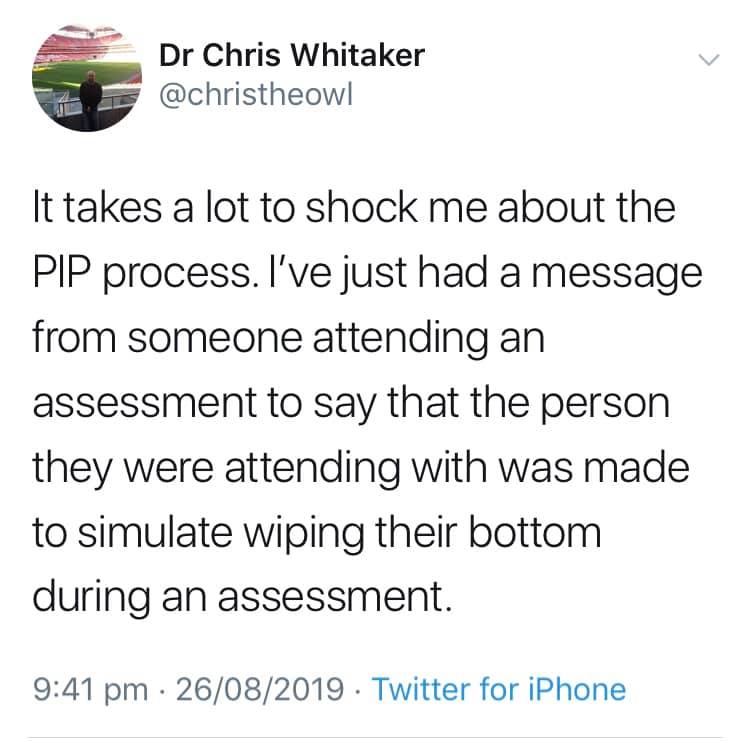
Claimant Sexually Assaulted During PIP Assessment

September 17, 2019

Spotted here.


Anon

I was sexually assaulted last spring by a female nurse at my PIP assessment. She didn’t believe I was bladder and bowel incontinent, and said she needed to examine me. Not knowing this was wrong, or what she was about to do to me, I lay on the couch as asked.
She thrust her hand between my legs and placed it on my genital area, asking me to squeeze. I did as she asked, then she removed her hand, saying “there’s nothing wrong with you”
I felt defiled and abused. I went home in tears, and was later alerted to the fact by my disability advisor, that I could have urinated on the nurses hand, and had to go home soaked in urine. There were no handwashing facilities in the room, so the nurse would have had to leave me unattended whilst she went to the bathroom elsewhere in the building.

Her assessment was so poor and missed out all of my mental health issues since childhood, and went as far as to say I did not present as tearful, when she actually tossed a box of tissues across the desk towards me, as I was crying so hard.
I lost my award because of her assessment of me.
I complained to I.A.S.and an investigation took months, including a face to face interview. I gave a police video statement, and the police said as I had no witness and she denied touching me, there was no case to answer.
I have complained to the NMC and will very likeky have to attend court against the nurse. She left I.A.S not long after my complaint, but I do not know if she resigned or was sacked.
She now works somewhere for the NHS and is likely abusing other vulnerable disabled people.

I’m wondeting if anyone else encountered an assault at assessment? I have PTSD about the event and relive that vile morning from start to finish.

Thank you.
ATOS Miracles

Aphasia

September 16, 2019

Sitting at his writing table by the window overlooking New York’s East River, Irfan Malik watches the water rush past. He too is in a rush. There are so many poems to complete before the words escape him forever.

The 61-year-old Punjabi poet, who was once fluent in four languages, has aphasia — a variant form of Alzheimer’s disease. He is losing his words one language at a time.

On good days he rolls with the water and is able to write — although it can take hours to finish a line. On the off days — and they are advancing rapidly — he can’t access the words. On these days he just watches the river rush by.

Malik was diagnosed with logopenic aphasia in 2015. “‘Aphasia’ means impairment of language, ‘logo’ means shortage. So he is losing his language,” explains Amna Buttar, a geriatric doctor at New York University Langone hospitals, who is also Malik’s romantic partner.

Initially he only had language issues but this summer it was confirmed that he has Alzheimer’s disease with memory impairment as well as executive function impairment, Buttar says. “His dementia is still considered mild, but will progress.”

When it began, Malik compared what happened to his brain to a stroke. The damage was done and he would have to learn to adjust, he thought. He stammered and would get slightly annoyed when people finished his sentences before he could. But he had accepted this was the hand he was dealt.

He moved to New York City from Boston in 2016 to be with Buttar, a fellow Punjabi expatriate, who fell in love with his poetry before she fell for him.

They met in 2014. Since then, Buttar has happily translated Malik’s Punjabi verses for English speakers. She is a passionate fan of his work and is eager to share it with a larger audience.

These days she also translates his conversations. While Malik can still understand English, he has trouble finding the words to express himself. He will slowly lose his comprehension too.

“It is so sad that a person whose life is about words is losing his words,” says Buttar.

“It makes me happy to know he is continuing to write poetry,” she says.

Malik became a poet out of necessity.

While a student in Lahore, Pakistan, in the 1970s, he was set on becoming a fiction writer and was writing in Urdu, the official language of Pakistan. Once his first story was published, he started showing up at the Pak Tea House, a hangout for famous and up-and-coming writers and progressives.

“I was very young so nobody paid attention to me,” he says. So he and another young Punjabi writer, Zubair Ahmad, founded a youth group called Nae Uffaq (New Horizons). They held meetings and readings at another tea house and soon attracted a young following.

“We became their voice,” he says.

It was not a political organization, says Malik. “Not yet.”

But by 1977, after General Muhammad Zia-ul-Haq came to power in a military coup d’état deposing Pakistan president Zulfikar Ali Bhutto, that all changed.

“I decided now was not the time to write stories or fiction but now was the time to get involved in politics and I joined an underground Communist Party,” he says in Punjabi with Buttar translating.

He stopped writing prose and became a scribe for an underground political circular called Red Flag. Life was tough for young activists. Malik said they were routinely rounded up, imprisoned and tortured. Malik knew of three young leaders who had died while being tortured. With that in mind and when he was no longer impressed by the party leadership, he quit the party and fled Lahore for Sweden with his Swedish wife, who was 8 months pregnant with their daughter.

He wrote his first poem in a new language — Swedish — in a new city — Stockholm.

He was studying Swedish and working on improving his English, when a journalist asked him to write a piece about Bhutto for a Swedish magazine. This paved the way to a job teaching immigrant Pakistani children in Stockholm both Punjabi and Urdu.

He published an Urdu translation of nine Swedish short stories titled Ghongay (Seashell) in 1993.

“I left home at 5 a.m. and was home at midnight,” says Malik. “I didn’t have much time so I decided to do poetry rather than prose. It doesn’t take as much time or research as prose fiction does.”

He did most of his writing commuting between schools on the city bus.

He met the late Swedish poet Gosta Friberg. In 2002, Malik published Ghaira (An Ever Expanding Circle) a Punjabi translation of Friberg’s poems.

“That started my journey into poetry.” Malik says. He soon decided to write only in his mother tongue, Punjabi. When South Asia was divided into India and Pakistan after the British pulled out in 1947, Urdu and English became the national languages of Pakistan. Written Punjabi was given an Urdu script and as a result the language lost a lot of its power.

Malik wanted to give it back.

His first book of poetry Vich Jagratey Sutti Taang (Desire Is Sleeping Within Sleeplessness, 1992) is about love and sex and politics.

His next book Akath (Untold, 1998), is a collection of poems about a language that is dying. It is a philosophical metaphor. One poem gets shorter until there are no words left and the book ends with several blank pages.

Malik relies on pauses to punctuate the words that paint his poems. Those silent spaces have always held as much importance as his carefully chosen words. Now as he writes about facing his illness, pauses take up even more space.

His third book Nun Guna (The letter N, 2000) plays with the structure of language.

Malik can no longer read that first poem he wrote in Swedish or speak to his first child in her mother tongue. That language disappeared first.

His English words are evaporating, too — gone before they reach the tip of his tongue. These days, it’s a struggle, but he can have conversations in Urdu and while he can still find words in Punjabi, he has trouble expressing himself in deep intellectual ways, says Buttar.

Malik can trace the onset of the disease back years before the official diagnosis. He was living in Boston with his second wife, an American he met in Stockholm, and their two children. He was working in the IT department at Harvard University when he first noticed a stammer as he searched for words. It was about 10 years ago.

By the time he was diagnosed in 2015, his marriage had unravelled and he had met Buttar. He was on disability from his job at Harvard and the prognosis depressed him.Get some good advice in your inboxGet expert advice on life and relationships with the Star’s Advice newsletter.Sign Up Now

After months of wallowing in despair, Buttar said to him. “You have a choice — stay depressed or do something about it.”

He chose to continue sharing his poetry. He contacted friends in Pakistan, across the United States, in Canada and Europe telling them he would be travelling and asking if they would arrange readings.

“Poetry is such an intimate thing,” Malik says of his preference for small gatherings.

Malik had five readings booked in Pakistan before he arrived which lead to further readings over the two weeks he was there. The same thing happened in San Francisco and Vancouver where there are large Punjabi communities.

Each year since including this year, he has continued these poetry tours. In 2018, he gave readings in Toronto, Stockholm and London.

“Some of the people who came to my readings knew my poetry. Some others didn’t but when they heard, they became my fans,” he says.

Malik writes about romance, spirituality and politics from the point of view of a man in exile. Different themes are seeping into his latest work which reflects his changing outlook on life. He wrote Call of Mystics at the table by the East River.

Tongues have gotten stuck to palate/ When you close your eye/ You see white light/ Flowing in water/ Rushing water/ Black water/ My heart desires/ This water to show me pictures / Drakes, catfish, frogs/ And Shah dolay de chohey (Microcephalic children considered mystic) / Then all of us join in Bhangra dance (Punjabi folk dance)/ Dam a dum mast qalandar/ Dam a dum mast qalandar (Sufi mystic chant)

Longtime friend and established Lahore-based literary writer Zubair Ahmad says Malik has a formidable presence among the post modern Punjabi poets who make up the Western Punjabi literary movement that started after the partition in 1947.

“Every poet has his inner river wherein he fulfils the water of his creation,” says Ahmad. “To me (the basis of Irfan’s poetry) is life abroad,” says Ahmad. “His source is not old classical Punjabi poetry or folk literature. He is a different kind of poet. His diction is not traditional and his poetry stands apart,” Ahmad says. “Anti-traditional, avant-garde and new poetic diction — he has made his place.”

Malik moved away from poetry during his years at Harvard, preoccupied with everyday life — work, family and taking advantage of the free Harvard education available to employees. He took courses in writing, theatre and acting and started the South Asian American Theatre there.

Eight years went by. When the memory lapses started, directing and acting became too challenging. One day he came across his poems and “I dropped my books in the sea. I needed to get back to it.”

Since then he has compiled and published two books of poetry Dooji Aura (The Other Woman, 2015) and his latest collection of selected works and some new poems he wrote about his disease titled Chhanday Agay Kayser, (Poetry for Saffron Flowers, 2018).

“Experimental, postmodern, non-linear, pithy, and self-reflexive are all apt descriptors for his poetic compositions,” wrote Saeed Ur Rahman, in a review of Malik’s last collection in Pakistani news magazine TNS. “Punjabi is a lucky language if Malik keeps on producing such refreshing work.”

At his readings, Malik often is accompanied by an English translator. Several of his poems have been translated into English, Swedish and Urdu and appeared in literary journals such as Salamander, a Boston-based magazine.

He has the title for his next collection Awan Waley Din Chutti Mangdey Nein (Coming Days Are Asking For Time Off.)

“In it there is only one romantic poem,” says Buttar. “It is about me. The rest are about Alzheimer’s and his disease and his feelings about his disease.”

As Malik continues to write, he is also focusing on getting more of his poems translated into English so his children will have access to his life’s work when he is gone.

“They don’t know my language and they don’t know my poetry,” he says.

It’s not easy. Nothing is easy for Malik anymore.

“It is tough for both of us,” says Buttar.

“Being a geriatric doctor, I know what is to come, so half the time I live in denial and half the time I know too much and it is very stressful trying to deal with it,” she says.

“But the hardest part is knowing he is going to forget about me. ”
Meningitis Awareness Week

September 16, 2019

Life is very different for Lesley Hart since she had meningitis nearly 10 years ago.

“I’m no longer Miss Independent. It’s impacting more and more as time goes on. But I live each day as I want to.”

Lesley is one of nearly 2,500 people who develop bacterial meningitis and meningococcal disease each year in the UK.

The Meningitis Research Foundation says the right support is key for people like her.

To mark Meningitis Awareness Week, it has released a survey showing that, while many know the condition can kill, very few are aware it can cause ongoing side-effects.

In the poll of 2,000 people, 87% underestimated – or did not know – that people who contract bacterial meningitis can be left with long-term problems.

And 90% didn’t know deafness is a common after-effect of meningitis.

Meningitis causes swelling in the lining of the brain. It is caused by a viral or a bacterial infection.

Viral meningitis usually gets better on its own. And while most of those with bacterial meningitis who are treated quickly will also make a full recovery, it can lead to serious long-term problems. One in 10 cases are fatal.

In Lesley’s case, she sought medical help when her usual migraine symptoms failed to improve.

She was admitted to hospital – and at one point her parents were told she had just six hours to live.

Lesley, who is from Hereford, says: “‘Meningitis is an infection I never thought I would get.

“My after-effects are wide and varied including a brain injury and short-term memory problems. I can struggle with holding information and I have tinnitus.

“I have nerve damage and I don’t feel hunger or thirst. I struggle to keep my feet warm. My skin grows funny on my feet and so I have deep-tissue dermatitis.

“When I was discharged I did not receive aftercare automatically, I have had to fight for every single appointment.

“Once I was referred to the brain injury team they were amazing though. He was finishing my sentences about what I was struggling with.

“It was great to be finally listened to and validated”

‘Cost can be immense’

Lesley now lives in a bungalow controlled by smart text, and has meals delivered, which she can heat up. “I have forgotten I am cooking things and leave them to burn”.

But the illness didn’t only change her health.

“My relationship has ended. I have two amazing friends, but I lost most as I couldn’t go out clubbing, and alcohol has a very negative impact on me. I was no longer deemed as ‘fun’.”

Lesley now works two days a week. “The brain injury team suggested giving up work completely, but I’m too stubborn. I also couldn’t cope with my own company every day.”

Vinny Smith of the Meningitis Research Foundation said: “While many are aware that meningitis costs lives, fewer people know about the damage the disease can do to people’s long-term health and their future.

“The cost to people can be immense and sadly some never fully recover, so the right support is essential.”

PIP Claimant Made To Simulate Wiping Bottom At Assessment

September 16, 2019

When Two Comedians With CP Fell In Love

September 13, 2019

When we put three disabled comedians together round a picnic table we hadn’t banked on hearing one of the best disability love stories we’ve ever heard.

We’re a hard-bitten cynical bunch at Ouch sometimes but this was a beautiful moment from Spring Day about her relationship with BBC Three’s one and only Jerk, Tim Renkow.

The story packs even more of a punch when you find out about her history and how much fun they’ve been having as a couple ever since.

Features the “catholic cure for stammering”, body positivity and more in the podcast that does disability differently – almost like it’s normal.

Melissa Blake

September 12, 2019

When Melissa Blake shared a blog post she’d written about Donald Trump on social media it went viral.

But most of the thousands of comments she received weren’t criticising what she’d written, but how she looked.

Melissa, 38, has the genetic bone and muscle disorder Freeman-Sheldon syndrome – a rare condition that affects the mouth, face, hands and feet.

“There were comments from people calling me ‘ugly’ and saying ‘she looks like a parade balloon,'” Melissa tells Newsbeat.

The final straw came when a particularly nasty commenter suggested she should be banned from posting pictures of herself online because of how she looks.

“I thought, well, I’m going to do the opposite and show them that they’re not going to get the better of me.”

In response to people calling her ugly, Melissa, who is a freelance journalist and disability blogger, then shared three selfies of herself on Twitter.

Melissa’s tweet was met with a positive response online and to date has had over 22,000 retweets and over 256,000 likes.

She says being judged on her appearance during her 14-year-career as a journalist is something she’s “come to expect”.

“I find this is something a lot of women who put themselves out there face – they are subject to visual attacks.” Image copyright Melissa Blake Image caption Melissa is touched by the support her selfie post has received

Melissa has had over 26 operations to straighten out her joints, hands, knees and treat her scoliosis – a condition where the spine twists and curves to the side.

She says it’s been hard at times to ignore the cruel comments she’s received.

“I’d be lying if I said they didn’t bother me and it’s hard not to get down on yourself.

“These people are just sat at home hiding behind their keyboards. I don’t think they would say half of what they say on the internet to someone’s face.”

But whenever she feels down, she looks at everything she has achieved so far.

“What I’ve overcome helps put things in perspective,” she adds.

Melissa also has a message for the trolls who may have insulted her and then seen her viral selfie post.

“I hope my selfies help them see there is a human on the other side of the computer they’re insulting.

“I think it just goes back to treating people how you want to be treated. I know that sounds so simple and cliché, but I think it’s true.”

George Wildgust- Oldest Known UK Man With Downs Syndrome

September 11, 2019

A man, whose family believe he is the oldest person in the UK with Down’s syndrome, has said dancing keeps him young.

George Wildgust, who celebrated his 77th birthday last month, was not expected to live past the age of 10.

People with the condition are expected to live to their 50s these days but the life expectancy was much lower when Mr Wildgust was born in 1942.

His niece, Nikki Wright, said he loves to watch Strictly Come Dancing and dance around his care home in Nottingham, where he has lived since 1993.

Children With SEND Marginalised In Mainstream Schools

September 11, 2019

Children with special needs and disabilities are being marginalised by mainstream schools in England, according to a report by the National Audit Office (NAO) which says the system incentivises them to be less inclusive.

The NAO accuses the government of misjudging the financial impact of its changes to education, with rising numbers of pupils with special needs unable to be accommodated in mainstream schools following a combination of funding strains, off-rolling and exclusions.

This has resulted in local authorities having to break their budgets to fund additional places in special schools, including in more expensive independent schools, its report says.

The investigation found that mainstream schools had incentives to avoid enrolling pupils with special educational needs and disabilities (Send), because of the additional costs imposed on school budgets and from the impact on the school’s league tables.

“Stakeholders in the sector have raised concerns that the demand for special school places is growing because the system incentivises mainstream primary and secondary schools to be less inclusive,” the NAO said.

“Mainstream schools are expected to cover the first £6,000 of support for a child with Send from existing budgets and cost pressures can make them reluctant to admit or keep pupils with Send.

“Another barrier is that schools with high numbers of children with Send may also appear to perform less well against performance metrics.”

The NAO’s figures showed that while the number of pupils with high needs has risen over the past four years in special schools, alternative provision and independent special schools, the number enrolled in mainstreams schools was still lower in 2018 than in 2014 or 2015.

A spokesperson for the Department for Education (DfE) said the government has committed to providing an extra £700m next year to help educate children with Send, along with launching a review of support.

“We have improved special educational needs support to put families at the heart of the system and give them better choice in their children’s education, whether in mainstream or special school,” the DfE said.

Gareth Davies, the head of the NAO, said: “While lots of schools, both special and mainstream, are providing high-quality education for pupils with Send, it is clear that many children’s needs are not being met.

“I therefore welcome the DfE’s announcement of a review into support for children with Send, following our engagement with them on this issue over recent months. We hope the review will secure the improvements in quality and sustainability that are needed.”

The report noted that pupils with special needs were more likely to be permanently excluded than those without special needs. Pupils with Send accounted for nearly 45% of all permanent exclusions and 43% of fixed-term exclusions in 2017-18, despite accounting for only around 20% of the pupil population.

“Evidence also suggests that pupils with Send are more likely to experience off-rolling – where schools encourage parents to remove a child primarily for the school’s benefit – than other pupils,” the NAO wrote.

The 2014 education reforms replaced statements of special education needs with education and health care (EHC) plans, but the NAO said the DfE misjudged the financial consequences: “The department expected that the benefits and savings would significantly outweigh the costs of moving to the new system.”

Tim Nicholls, head of policy at the National Autistic Society, said ministers need to use the review announced last week to address the system’s serious problems.

“We hear awful stories every day of autistic children who are being held back from getting the education they deserve because schools don’t understand or can’t meet their needs. This can be devastating for them and their families, and mean they lose all faith in the system. This detailed NAO report shows the extent of this unacceptable situation,” Nicholls said.

Disability, Culture And The Fight For Independence

September 11, 2019

Gazala Iqbal, who is paralysed on her right side, was so mollycoddled by her family that she was 16 before she learned to make a cup of tea. “Mum had to go into hospital. I suddenly had two siblings looking up to me but I didn’t know how to do basic things. Everyone had always done everything for me. I felt useless.”

Iqbal, now 46, was overprotected at home and her sense of dependency was reinforced by patronising attitudes from health and social care professionals. One district nurse told Bradford born and bred Iqbal that she spoke really good English “for an Asian woman”.

Such experiences drove her to do self-esteem classes and courses such as cooking. Today she is a confident, married mother of three living in an adapted property. “I’ve fought for my independence, but lots of people don’t know how to, or families don’t understand. They want to protect you, but they’re hindering you, and on top of that you get the professionals,” she says.

Iqbal’s story is echoed in new research by user-led charity Asian People’s Disability Alliance (APDA) into the barriers to independence for disabled Asian women. The report, Humare Avaaz (“our voice” in Urdu), follows 18 months of community research involving 90 women with a physical or learning disability, mental health issues, long-term condition or caring responsibility.

Ignorance of health and social care among families, APDA’s findings suggest, is compounded by professional assumptions. While the authorities are aware of the low or late uptake of services, the report states, they “appear content to presume that this is a choice made by ethnic minority communities”. Advertisement

The report, funded by Disability Research on Independent Living and Learning (Drill), is particularly critical of social care for undermining disabled Asian women’s independence through funding cuts and welfare reform. Social care, particularly where outsourced, is described as “a fragmented, pressurised system that did not appear to care”.

“This report highlights the unknown and often forgotten cultural and social barriers for disabled Asian women,” says Zeenat Jeewa, APDA’s chief executive.

For Iqbal, a large barrier was that family members assumed she would always “be looked after” by her parents. Shani Dhanda, 31, who has the brittle bone condition osteogenesis imperfecta, had a similar experience. Dhanda, an events manager and disability rights campaigner, lived at home until her late 20s. She says: “There was never an expectation that I’d get married or move out. When I was learning how to drive, people who’d known me my whole life were shocked – but why wouldn’t they think I’d want to do the same things they do?”

Sanya Shah (not her real name), 69, is a wheelchair user. Until she was 44, she lived with her parents but now has help from a care agency. Shah has good support now but she says a previous carer left her in bathroom halfway through a strip wash because the 15-minute visit had ended. There are at least 1 million disabled people from black and minority ethnic backgrounds in Britain, and research shows that 25% of people with learning disabilities entering adult social care will belong to minority ethnic communities, up to 2030. Sue Bott, director of policy and research at Disability Rights UK, which manages Drill in England, says Asian women need more information so they can “find out what’s on offer to support them to be more independent, and feel safe when approaching service providers for help.” Bott also argues for more funding for the voluntary sector .

There are solutions. Bradford council is embedding a human rights approach into its social work. Over the last two years, the learning disability team has made support more accessible, encouraging engagement with the Asian community.

“People are more likely to check out what’s available in the voluntary sector first, so we need to be working in partnership with the private and voluntary sector,” says Fazeela Hafejee, Bradford’s community learning disability team manager.

A Department of Health and Social Care spokeswoman says: “It’s unacceptable for disabled people from any background not to receive the support they need to access health or care services. We expect [health] trusts to make arrangements to accommodate their needs and local authorities must assess people’s needs and provide support if needed.”

Iqbal has a solution: “The government needs to ask disabled people what they want. If a disabled Asian girl asked me for help, I’d start by asking her ‘What do you want from your life?’”

Amputee Peer Support Group

September 10, 2019

When Lisa became an amputee, she noticed the lack of support for amputees. She decided to do something about it and made her own peer support group.

MPs Call For Pavement Parking Ban Across England

September 10, 2019

Student With Stoma Accused By Wetherspoons Staff Of Taking Drugs

September 9, 2019

 A student who was accused of taking drugs while using a disabled toilet at a Wetherspoons pub is calling for better awareness of invisible disabilities.

Amber Davies, 21, from Builth Wells, has a stoma after being diagnosed with ulcerative colitis aged 13.

While on a night out in Birmingham, she was “grabbed” by a bouncer after coming out of the disabled toilet.

Wetherspoons said staff apologised for the “confusing situation”.

Amber posted an open letter on her Instagram account detailing her experience, saying the door staff “very happily and very openly accused me of snorting, dealing and having sex in the disabled toilet for ‘there is no other reason I would need to visit it so often'”.

“I got grabbed by a female bouncer and my boyfriend by a male bouncer, we were accused of using them [the disabled toilet] for the wrong reasons,” Amber told the BBC.

“She [the bouncer] was quite reluctant to listen to my side of the story, I said it bluntly and I didn’t raise my voice once.” Media captionAmber has a stoma after having her bowel removed

Despite gaining access to the locked disabled toilet using a radar key, staff “kept shouting” and her boyfriend, who had gone in the toilet with her, was taken outside.

“I was upset at the time, we hadn’t done anything wrong, I spoke well considering. I was more annoyed that people were allowed to behave that way,” she added.

“[It’s] just completely unacceptable and they’re such a big chain, you’d think they’d have training or be knowledgeable before grabbing us.”

Amber, who is about to start her third year at Cardiff University, said she had come to expect “funny looks” but not the kind of treatment she received at the Dragon Inn in Birmingham. Image copyright Google Image caption Amber and her friends were enjoying a night out in Birmingham when the incident happened

In her post she said her stoma “needs constant care” and can be emptied up to 15 times a day, “it can make going out, especially on nights out, a pretty daunting prospect”.

The 21-year-old described her disability as a “chronic, debilitating, lifelong illness”.

She contacted the chain to complain about her treatment and has been offered a gift card in response. Image copyright Amber Davies Image caption Amber was diagnosed with ulcerative colitis aged 13

A JD Wetherspoon spokesman said: “A female member of door staff spoke with Ms Davies, who explained her disability.

“Staff expressed that if this had been known beforehand, or an explanation given sooner, the situation could have been avoided.

“Staff listened at length to Ms Davies’ points, never once questioning her disability and apologised for the confusing situation on both sides.”


How To Be Autistic

September 9, 2019

A woman has written a “brutally honest” account about being diagnosed with autism later in life in the hope others will “get the help they need”.

Charlotte Amelia Poe, 30, discovered she had the condition when she was 21 as she said “no-one ever went back to basics”.

She said her book, How to be Autistic, would have changed her life if she had read it as a child.

“If I can help one person, then it’s all been worth it.”

“I fear I have made myself incredibly vulnerable in writing it, but it felt necessary – important – to do so.” Image copyright Charlotte Amelia Poe Image caption In her video blog, Ms Poe reflected on years of anxiety attacks

In 2018, Ms Poe won the inaugural Spectrum Art Prize for her short video about being autistic, filmed by herself in her bedroom.

In it, she sits on her bed hugging a pillow, and cries as she describes clinging to the edge of tables “as another wave of panic crashes over you”.

Judges praised it for being both “bleak” and “beautiful”.

The self-taught artist, from Blundeston, Suffolk, said winning the award had opened up a “new chapter”.

“I was in a bedroom with a computer, and now I’m here.

“I’ve had messages from people saying ‘that’s me, right there, that’s me’, and that feels huge.” Image copyright Charlotte Amelia Poe Image caption Charlotte Amelia Poe says she wants to help people get diagnosed

She said she hoped her book would prevent others from missing out on opportunities she felt she had missed out on because of her later diagnosis, such as going to university.

“There’s a whole generation, at least, of people who don’t know they’re autistic, and I feel this book could be the spark that leads to diagnosis.”

Ms Poe said she still struggled with anxiety but that it was getting better. She said she wanted to inspire others to “make their voices heard”.

“There is a huge gap in history where autistic people should be.

“Now we have an opportunity, a moment, to create an autistic revolution.

“I hope to … create a discussion and a movement that allows for autistic people to be seen as equal and vital members of their communities, and as the unique and varied individuals they are.”

Therese Coffey, New DWP Minister’s Voting Record

September 9, 2019

With many thanks to Benefits And Work.


Therese Coffey, who today replaced Amber Rudd as secretary of state for work and pensions, voted to cut welfare benefits spending on 52 separate occasions between 2012 and 2016.

Amber Rudd resigned yesterday due to disagreements over Brexit with prime minister Boris Johnson.

Her predecessor, Esther McVey, also resigned due to disagreements with the then prime minister Theresa May over Brexit, in November 2019.

Coffey has been the MP for the Suffolk Coastal constituency since the 2010 election.

Her voting record is not one that will inspire confidence amongst claimants.

As well as voting to cut welfare benefits spending on 52 separate occasions between 2012 and 2016, Coffey:

  • Consistently voted against paying higher benefits over longer periods for those unable to work due to illness or disability
  • Consistently voted for the bedroom tax
  • Consistently voted against raising welfare benefits at least in line with prices
  • Consistently voted for mass surveillance of people’s communications and activities
  • Generally voted against laws to promote equality and human rights

Coffey was one of 72 MPs who are also landlords who voted against an amendment that would have obliged all landlords to ensure that their properties were “fit for human habitation.

The only consolation claimants can draw from the current situation is that Coffey is unlikely to be in post long enough to have much influence over anything.

It seems extremely likely that there will be an election in the next few months

If the Conservatives are not re-elected then Coffey will clearly be gone.

But even if they do win another term, a major reshuffle following the election is likely, which Coffey may not survive, at least in her current post.

The full list of DWP secretaries of state since Iain Duncan Smith resigned in March 2016 is:

Stephen Crabb: 9 March 2016 to14 July 2016

Damian Green 14 July 2016 to11 June 2017

David Gauke 11 June 2017 to 8 January 2018

Esther McVey 8 January 2018 to15 November 2018

Amber Rudd 16 November 2018 to7 September 2019

The average lifespan in the post since March 2016 currently stands at less than 9 months.

You can read more about Coffey’s voting record on the They work For You website.

44% Of Disabled People Have To Go Without Food Says Citizens Advice

September 6, 2019

With many thanks to Benefits And Work.


New data shows that 44% of disabled households have gone without essentials such as food and toiletries because of the benefits freeze, introduced in 2016, Citizens Advice claimed yesterday.

According to the charity, things are even worse for universal credit claimants, with 55% having gone without essentials such as food and 51% saying they have lost sleep because of financial worries.

The data also shows that 27% of people claiming benefits say financial worries have made them feel lonely or isolated. Some 29% say financial worries have affected their mental health.

Citizens Advice is calling on the government to:

End the freeze on benefit rates.

Uprate payments by the Consumer Prices Index plus 2% for four years.

Recalculate the Local Housing Allowance to at least the 30th percentile of local rents and re-establish the link with rental prices.

Reduce the five-week wait by bringing forward the first non-repayable payment to no later than two weeks into a Universal Credit claim.

There are more details on the Citizens Advice website

Alfie Bennett

September 5, 2019

A schoolboy’s piano performance at a railway station has won social media fans after a video of his playing was viewed more than 330,000 times.

Alfie Bennett entertained commuters at Birmingham New Street on a keyboard for public use.

His mother recorded the 12-year-old playing Queen’s Bohemian Rhapsody and uploaded it to Twitter where it won lots of praise.

She had intended to shoot the whole performance but gave up after she was repeatedly interrupted by the public asking her about her son and his performance.

Alfie, from Birmingham, has autism and his parents hope the social media spotlight will help raise awareness of the condition.

One-Off Injection Will Save Children From Inherited Blindness

September 5, 2019

NHS England is to pay for a cutting-edge genetic treatment that will save children with a rare inherited disorder from going blind.

A one-off injection will prevent babies born with poor sight because of an inherited retinal dystrophies disorder from losing their vision entirely, which usually happens during childhood.

The list price is high, at £613,410 per patient, but the NHS has done a deal with Novartis, the UK supplier of voretigene neparvovec, also known as Luxturna, and the numbers needing treatment are low. The company estimates that 86 people in England could benefit now, and about three to five babies with the genetic mutation are born every year.

“Loss of vision can have devastating effects, particularly for children and young people, but this truly life-changing treatment restores the sight of people with this rare and distressing condition,” said NHS chief executive, Simon Stevens, making the announcement at the Health Innovation Expo conference in Manchester.

“For previous generations, curing blindness would literally have been seen as a miracle. Now modern medicine is making that a reality for our patients. Once again the NHS is at the forefront of the genomic revolution with patients in England among the first to benefit from this revolutionary new form of treatment.

“This latest deal reinforces the benefits for companies willing to engage with us and be pragmatic with their pricing – which is good news for patients, taxpayers and industry.”

The National Institute for Healthcare Excellence (Nice) announced it had approved the treatment within 20 weeks instead of the average 38 weeks through its highly specialised technologies programme and with the cooperation of the company.

“This is a highly innovative treatment for a very distressing, inherited condition so we are pleased the company has worked with us and NHS England and NHS Improvement to allow us to offer these families hope for the future,” said Meindert Boysen, director of Nice’s Centre for Health Technology Evaluation.

The treatment is expected to become available in January at three specialist eye centres in the UK.

Stevens has pushed for NHS access to a number of innovative treatments, such as CAR-T therapy for blood cancers where other drugs have failed and the lung cancer drug pembrolizumab. The NHS can afford expensive new drugs for rarer conditions through tough deals and saving money on the more routine medicines, it says, and has cut the annual bill by £700m.

Sue Sharp, deputy chief executive at the Royal Society for Blind Children, said: “We see first hand the devastating effect of childhood sight loss, and so we welcome news of this breakthrough therapy and its impact on the lives of children with inherited retinal dystrophies disorder.”

Teenager Blind After Years Of ‘Fussy Eating’

September 4, 2019

Experts are warning about the risks of extreme fussy eating after a teenager developed permanent sight loss after living on a diet of chips and crisps.

Eye doctors in Bristol cared for the 17-year-old after his vision had deteriorated to the point of blindness.

Since leaving primary school, the teen had been eating only French fries, Pringles and white bread, as well as an occasional slice of ham or a sausage.

Tests revealed he had severe vitamin deficiencies and malnutrition damage.

Extreme picky eater

The adolescent, who cannot be named, had seen his GP at the age of 14 because he had been feeling tired and unwell. At that time he was diagnosed with vitamin B12 deficiency and put on supplements, but he did not stick with the treatment or improve his poor diet.

Three years later, he was taken to the Bristol Eye Hospital because of progressive sight loss, Annals of Internal Medicine journal reports.

Dr Denize Atan, who treated him at the hospital, said: “His diet was essentially a portion of chips from the local fish and chip shop every day. He also used to snack on crisps – Pringles – and sometimes slices of white bread and occasional slices of ham, and not really any fruit and vegetables.

“He explained this as an aversion to certain textures of food that he really could not tolerate, and so chips and crisps were really the only types of food that he wanted and felt that he could eat.”

Dr Atan and her colleagues rechecked the young man’s vitamin levels and found he was low in B12 as well as some other important vitamins and minerals – copper, selenium and vitamin D.

Shocking findings

He was not over or underweight, but was severely malnourished from his eating disorder – avoidant-restrictive food intake disorder.

“He had lost minerals from his bone, which was really quite shocking for a boy of his age.”

He was put on vitamin supplements and referred to a dietitian and a specialist mental health team.

In terms of his sight loss, he met the criteria for being registered blind.

“He had blind spots right in the middle of his vision,” said Dr Atan. “That means he can’t drive and would find it really difficult to read, watch TV or discern faces.

“He can walk around on his own though because he has got peripheral vision.” Image copyright Getty Images

Nutritional optic neuropathy – the condition the young man has – is treatable if diagnosed early. Left too long, however, the nerve fibres in the optic nerve die and the damage becomes permanent.

Dr Atan said cases like this are thankfully uncommon, but that parents should be aware of the potential harm that can be caused by picky eating, and seek expert help.

For those who are concerned, she advised: “It’s best not to be anxious about picky eating, and instead calmly introduce one or two new foods with every meal.”

She said multivitamin tablets can supplement a diet, but are not a substitute for eating healthily.

“It’s much better to take on vitamins through a varied and balanced diet,” she said, adding that too much of certain vitamins, including vitamin A, can be toxic, “so you don’t want to overdo it”.

Dr Atan said vegans are also at increased risk of B12 deficiency-related sight problems if they do not replace what they can lack when excluding meat from their diet.

“Nutritional yeast is a way of adding B12 to your diet,” she said.

Sources of vitamin B12 for vegans include:

  • breakfast cereals fortified with B12
  • unsweetened soya drinks fortified with vitamin B12
  • yeast extract, such as Marmite, which is fortified with vitamin B12

Rebecca McManamon, consultant dietitian and spokesperson for the British Dietetic Association, said restricted diets might happen for a range of reasons, including eating disorders, allergies and autism, and need specialist assessment.

“It’s also worth noting that since 2016 the UK government has recommended daily Vitamin D supplementation (10 microgrammes/400 International Units) for everyone between October and March as we are not likely to get enough from fortified foods.

“Multivitamin supplementation is recommended for all children up to their fifth birthday.”

Autistic Woman Told She Was The Wrong Sex To Have Condition

September 3, 2019

Jasmine Ghibli was diagnosed with autism at two years old in America. The diagnosis was taken away from her when she moved to Scotland after her GP decided she was the “wrong sex” to be autistic.

Now at 18, Jasmine has her diagnosis but not without enduring years of frustration at a system that she thinks appeared to forget the female face of autism.

Nicole Bonner, Jasmine’s mother, said their GP told them that, “autism isn’t for girls – she’s just a bad kid.”

After moving to Scotland from America, the children’s hospital informed Nicole that Jasmine wasn’t autistic, and that her original diagnosis was unrecognised.

Speaking to BBC Scotland’s The Nine, Jasmine, from Helensburgh, said the confusion around her diagnosis caused her mental health to deteriorate.

She says the lack of support and bullying at school led her to attempt to kill herself three times – the first time was when she was just seven. Image caption Nicole Bonner says Jasmine felt “hopeless”

Jasmine’s mum doesn’t blame Jasmine for trying to end her life. “She felt hopeless – I felt hopeless,” she says.

Jasmine’s story is not uncommon. The National Autistic Society’s most recent study examining the ratio of diagnosis in men was higher than that in women. The official estimate is now 3:1.

‘Being a brat’

There are multiple theories speculating as to why more men and boys get an autism diagnosis. Some reports say that girls are better at camouflaging or “masking” their autism by using mimicking techniques. Jasmine masks her behaviours by copying the people around her.

“It’s like putting on a horrendous amount of face paint, and at the end of every day, you have to wipe all of that face paint off,” she says. “I’m constantly exhausted.”

Jasmine believed she couldn’t appear as autistic because she wouldn’t get the same treatment as if she was male – “There would be no understanding if I had a meltdown. It would just be perceived as me being a brat.” Image caption Jasmine felt isolated due to the lack of support and understanding

She says she was forced to find her own sources of support. She now works closely with the Scottish Women’s Autism Network (Swan) as an advocate for autistic women.

“Swan saved her life,” Nicole says. “Jasmine would not be here without the support of those kind and understanding women.”

Jasmine has also spoken at an autism cross-party group at the Scottish Parliament to share her experiences, and hopes to be an advocate for more awareness in the area.

“I can’t express how important it is to empower autistic women and girls,” she says. “One of the main reasons I want to raise awareness is that it’s so easy to feel lonely and ostracised as an autistic person, but particularly as an autistic woman.

“We are completely underrepresented.” Image caption Both Jasmine and her mum are now hopeful for the future

Despite leaving school at 16 with little to no qualifications, Jasmine is going to the University of Glasgow in September to study English Literature, Language, and Linguistics.

“I always knew Jasmine was going to do great things,” Nicole says. “That’s just what she does – she changes people. She already has.”

“People just need to be tolerant, and show a wee bit of love. All she’s ever wanted was friendship and kindness.”

Clarks Store Thanked For Care Of Autistic Boy

September 3, 2019

A family has thanked Clarks shoes for the care staff showed their autistic son while out shopping.

Katie Nolan said son Jayden, nine, struggles with shopping, as sounds and people cause a sensory overload.

She said staff at the shop in Stafford noticed her sunflower lanyard, signalling his hidden disability, and took them to a private room where Jayden’s feet could be measured.

Clarks said it was pleased to hear about Katie and Jayden’s experience.

Mrs Nolan, 31, said the help Clarks staff showed made their experience “much easier”.

Along with husband Liam, 30, they had taken Jayden and their other two children Tommy, six, and Lucia, three, to buy back-to-school supplies.

It was her first time wearing the lanyard, which was launched in airports to let others know that the wearer may have a hidden disability.

“Jayden had already started getting over-sensitised, he was making a lot of noise,” Mrs Nolan said.

“They asked if we would like to go upstairs to the staff room where it was nice and quiet.” Image copyright Liam Nolan Image caption Lucia, Jayden and Tommy Nolan were all on the shopping trip

There, Mrs Nolan said, the staff gave Jayden a sensory story which explained what was going to happen, something he is familiar with from school.

She said the assistant was then able to measure his feet, put new shoes on and get him to walk around.

“He was still very anxious and very noisy…he doesn’t like strange places,” she said.

“But normally, when we go back-to-school shopping, Jayden is screaming and crying and we all end up leaving upset and teary, they made it so easy. “

“Clarks recognises and celebrates individuality and we are proud to see our company values being so well expressed by store colleagues,” a spokesman said.

Alison Lapper Says Late Son Parys Was Bullied Over Her Disability

September 2, 2019

The artist Alison Lapper has said her late son was taunted by other children at school because of her disability.

Parys Lapper, 19, was found in a hotel in Worthing, West Sussex, last month after he died from a suspected accidental drug overdose.

Lapper, who was eight months pregnant with her son when she posed for Marc Quinn’s celebrated Trafalgar Square statue, said he had suffered with depression and anxiety after being bullied at school.

“I could see how anxious he was,” said Lapper, who told the Sunday Times that Parys had asked her to stop attending parents’ evenings when he was 13.

She added that when they arrived at the school “we were the show. The next day Parys would go in and they would rip pieces out of him.”

Lapper was born with the condition phocomelia, meaning she has no arms and shortened legs. Eventually, Parys was moved to a smaller unit by his school because of his struggle to cope with the taunting, but dropped out.

During this period, said Lapper, he spent more time online, which furthered his declining mental health. “Parys didn’t like his body,” she said. “I thought I could teach him to, but it’s a social media nightmare, isn’t it? There’s always someone with a six-pack or bigger.”

She added that the irony of her son’s concerns about his image was not lost on her. “Look at me, for God’s sake,” she said, “and I really love my body. I’m not ashamed about it at all.”

Lapper said that despite her efforts to help him, Parys had become more introverted and had begun taking drugs.

After his behaviour deteriorated, she was forced to have him taken into care at 16 but kept in regular contact with him. “He was out of control and I couldn’t help,” she said, adding that his problems had been a “vicious circle”.

“His mental health would get worse so he’d take drugs and the drugs would then make his mental health worse.”

She added: “I don’t want my son to be remembered as a junkie, as just another drugs death. The drugs were a consequence of what he had been through.”

Parys was one of 25 subjects of the BBC television series Child of Our Time, which documented the lives of a diverse group of children born at the turn of the millennium.

His funeral was at Worthing crematorium on Thursday.

‘How A Blue Badge Will Help With My Hidden Disability’

September 2, 2019

“The amount of times I’ve gone to Asda and not been able to find a space straight away and had to leave – it’s too stressful.”

Connor Ward has autism and says having a blue badge will makes things like shopping easier.

“Instead of putting myself through having to squeeze into tight spaces, I just don’t do it.”

He’s one of the people who has a hidden disability who can now apply for a blue badge in England.

The permit helps people access shops and services, by allowing them to park close to their destination.

‘People say ‘why are you parked in the disabled place?’

The 21-year-old from Nottingham says he will definitely be applying for a blue badge but says he is worried he’ll face questions from some people because he doesn’t have a physical disability.

Connor says his mum has a blue badge for her disability and when they’ve been shopping, he’s faced questions. Image copyright Getty Images Image caption People with hidden disabilities, such as anxiety can apply for a blue badge parking permit in England

“People say ‘you shouldn’t be there’ or ‘why are you parked in the disabled place?’

“The judgment is from the wider disabled community as opposed to the general public,” Connor adds.

Connor feels in order for attitudes to change, things need to change.

“It would be nice to see a blue badge symbol that isn’t a person in a wheelchair.

“Lots of disabled loos are changing to show invisible disabilities as well, but ultimately if you’re going to allow more people to have blue badges you will need more parking spaces.”

‘My blue badge application was rejected’

Elizabeth Pennifold, 20, has Crohn’s Disease and recently applied for a blue badge to make things like going to the shops or having a day out easier.

“When I am tired, I feel like I am going to fall over so if I am parking close to where I am going, the likelihood of that is probably a bit less. Image copyright The Markus Reeves Brotherhood Image caption Elizabeth Pennifold says there needs to be more awareness around hidden disabilities

“With my Crohn’s, if I get an urge I need the toilet my fatigue will come on straight away. I get hot and sweaty and it hits you all at once,” she adds.

She applied for a permit about a month ago and says her application was rejected.

“When I applied for the blue badge I was already worried and conscious and felt a bit bad for doing it.”

Elizabeth says she will now reapply but feels when it comes to hidden disabilities, a lot of people don’t know what it is.

“I look like a young fit girl, you wouldn’t look at me and think there’s anything wrong with me at all.”

People with conditions such as autism or anxiety disorders can apply for the badge – although eligibility will be decided by local councils in England.

Scotland and Wales already have similar rules to include some mental health issues, but the criteria are yet to be altered in Northern Ireland.

The government said it would provide an extra £1.7m to help councils cope with the expected increase in applications.

The charity, Crohn’s & Colitis UK says it welcomes the changes but has some concerns.

In a statement it said: “Even under the new criteria, unless someone has very considerable pain whilst walking, experience severe or overwhelming anxiety whilst walking or that the act of walking from a car to a destination, could cause serious harm to themselves or others, it will still remain difficult for people living with Crohn’s or Colitis to successfully apply for a Blue Badge.”

Tackling CMV

September 2, 2019

Babies in the east of England are being screened for a virus which can cause development defects, including deafness.

Carriers of Cytomegalovirus (CMV) often have no symptoms but it can be passed from mother to baby during pregnancy and affects about 1,000 newborns in the UK each year.

A 100-strong team of NHS staff led by a Cambridge paediatrician have volunteered their time to test babies for the virus if they show signs of deafness.

Naomi Parker, 8, struggles to balance because of deafness, having contracted CMV from her mother Stevie Parker.

Ms Parker said: “I wish I knew about CMV. I would have been a little bit more vigilant.”

James Oliver

September 2, 2019

A man whose terminally ill brother was refused disability benefits has accused the Department for Work and Pensions of being “shambolic and incompetent”.

James Oliver, 49, could “barely walk” and was incontinent due to liver disease before he died on 9 April, his brother David Smith said.

But the DWP denied Mr Oliver Personal Independence Payments (PIP) after he scored zero points in an assessment.

The DWP said its procedures were followed correctly.

Several months after Mr Oliver’s death in Hastings, one of his children found a letter inviting him to an appeal hearing about the decision.

Mr Smith said he had told the department his brother was dead and described the letter as “insulting”.

The DWP said it was “very sorry for the distress caused” by the letter and it was “looking into this to prevent it happening again”. Image copyright David Smith

Mr Oliver had suffered chronic liver disease caused by alcohol dependency for several years, but his health took “a nosedive” in 2016 when his other organs became affected, his brother told the BBC.

“That left him barely able to walk,” Mr Smith said, adding that it would take Mr Oliver two to three hours to walk 500m to the nearest supermarket.

“He had to stop every few metres for breath because he was gasping,” he said.

“He had no control over his toilet habits and was so embarrassed. He’d go out and soil himself.”

Mr Oliver applied for PIP – the benefit that is replacing Disability Living Allowance – in March 2018.

How does PIP work?

PIP is made up of two parts: the daily living component and the mobility component, according to the charity network Citizens Advice.

Each part can be paid at one of two rates, either the standard rate or the enhanced rate.

During a PIP assessment, a health professional will give a claimant a score between zero and 12 on a range of activities.

The rate you receive depends on the number of points you score – a higher number puts you on an higher rate.

The assessments are done on DWP’s behalf by the private companies Capita and the Independent Assessment Services (formerly called Atos), which have come under criticism for scoring claimants too harshly.

Mr Oliver was assessed by a paramedic, who “gave him zero points on everything”, which meant he did not receive the disability benefit, his brother said.

He applied for a review of the decision – called a mandatory reconsideration – but it was upheld in June 2018.

Doctors gave Mr Oliver 12 months to live last summer, according to Mr Smith, although the DWP said it only had a record of the diagnosis from March this year.

Currently, a terminally ill person only qualifies for fast-tracked access to benefits when their death is expected within six months.

But the government is reviewing the rule after the All-Party Parliamentary Group for Terminal Illness said it was “outdated, arbitrary and not based on clinical reality”.

Without the benefits payment, Mr Oliver was not able to heat his home and he resorted to using a hot water bottle during the day to keep warm, Mr Smith said.

He said his brother “gave up” after his mandatory reconsideration was rejected and turned to alcohol.

“He just downed more or less anything he could lay his hands on at that point and it was the beginning of the end. We couldn’t bring him back from that,” Mr Smith said.

After collapsing on the way to the supermarket, Mr Oliver was taken to the hospital, where he was told he would soon die.

According to Mr Smith, his brother said: “I can’t believe it I’m going to die and I’m still not sick enough to qualify for PIP.”

March 2018 – Mr Oliver makes a PIP claim

May 2018 – His claim is denied

June 2018 – His mandatory reconsideration is disallowed

July 2018 – He appeals the decision

April 2019 – Mr Oliver dies

August 2019 – The DWP invites Mr Oliver to an appeal hearing in September

A Facebook post about Mr Oliver’s death had been shared 107,000 times by Friday afternoon.

Since writing the posts, Mr Smith says he has been “bombarded” by similar stories to his brother’s.

A DWP spokesperson said: “Our thoughts are with Mr Oliver’s family at this difficult time.”

People With Sight Loss ‘Avoiding Rail Journeys’

August 30, 2019

One in five people with sight loss have missed or avoided a rail journey due to access issues, according to a report.

A lack of support in stations made visually impaired people uncomfortable travelling, charity Guide Dogs said.

Music producer Justin Cunningham, 25, who uses a guide dog, said he had to “jump through hoops” just to get on a train.

Department for Transport (DfT) said it was “working closely with operators” to run an inclusive service.

Some train companies on National Rail services often require 24-hour notice to guarantee assistance for people with disabilities.

“More often than not we’re reliant on assistance, but staff need to be trained better,” Mr Cunningham said.

“Some times you have to ask members of the public, who are normally helpful but not always.”

A survey of 2,000 blind and partially-sighted people found 19% had missed important meetings and 13% had been late to see friends and family.

One in 10 also said they had been left stranded on a platform after missing a train, a figure that rose to more than one in three in London.

Clive Wood, engagement officer at Guide Dogs, said rail was “undoubtedly one of the most complex methods of travel for someone with sight loss”.

But improving training for staff at stations and increasing awareness “would make a huge difference”, he added.

A DfT spokesman said: “We are acutely aware of the difficulties faced by disabled passengers using our railways.

“Since we launched our Inclusive Transport Strategy last year, we have delivered against a number of the commitments including delivery of more than 200 accessible routes into stations.”

People With MH Can Now Access Blue Badges

August 30, 2019

A positive change to the Blue Badge scheme will come into play on Friday 30 August, when people with hidden disabilities such as anxiety and even Crohn’s Disease will be able to apply for the support.

It comes after the Department for Transport unveiled plans to extend its Blue Badge Scheme earlier this year to cover those with invisible illnesses, including mental health problems, such as depression and those in “severe psychological distress”.

Around 2.35 million people in the UK currently have blue badge permits because they have physical mobility difficulties or are registered, to an extent, blind.

These permits help them access goods and services, by allowing them to park closer to their destination.

Under the changes, more people with invisible disabilities will be able to benefit from this, making everyday tasks easier and reducing loneliness and isolation.

However critics say councils are ill-prepared for the new rules that will put potentially millions more drivers in priority need spaces.

Confused.com figures show there are 30 Blue Badge holders for every one council-owned parking space right now – a problem that will worsen with more badge holders on the road.

The comparison website is also calling for tougher punishments for those who break the law when using the parking permits.

Dedicated Blue Badge parking spaces are available for badge holders, as they’re often located closer to entrances or offer more room to get in and out of the car.

However, figures show that many drivers are abusing this luxury. Last year, more than 156,821 parking charge notice (PCN) were issued to drivers for wrongly parking in a Blue Badge parking space – a 15% increase compared to 2016 (136,940).

Amanda Stretton, motoring editor at Confused.com, said: “Clearly more parking for Blue Badge holders is needed – 30 drivers to one space is quite a challenge. It’s no wonder some of these drivers have had to park elsewhere. And the number of people competing for spaces is only going to grow as more people can apply for a Blue Badge now.

“Drivers who misuse these spaces are making the problem even worse. They should be more respectful and leave them free for those who need them.

Ceri Smith, at disability equality charity Scope, said unless the Government takes action on car parks, the extension of the scheme will be worthless.

“With spaces already scarce, it’s extremely worrying that so few councils have prepared for the expansion of the Blue Badge scheme, despite knowing it was coming for months.

“Many disabled people, including those with invisible impairments, need to be able to park close to shops and amenities.

“Without enough dedicated parking spaces, Blue Badges aren’t worth the paper they’re printed on.

“Councils need to up their game to ensure Blue Badge holders can actually use them.”

Artist David March Appeals For Return Of Paintings Meant For Friend With MS

August 29, 2019

Two original oil landscapes painted for a woman paralysed by multiple sclerosis are feared to have been stolen.

Having completed the two pieces of work, 79-year-old artist David March had just bought frames from the Ikea store in Cardiff.

However by the time he realised he had left the canvasses in a shopping trolley and returned, they had gone.

“You put your heart and soul into paintings, so to lose them like that was very upsetting,” he said.

The landscapes – of Carreg Cennen castle, Carmarthenshire, and Pen y Fan – were painted over a series of weeks and each measure 30in x 20in (76cm x 50cm).

“Losing them was a double-whammy,” said Mr March, of St Athan, Vale of Glamorgan.

“Not only was it the time and effort, but they were meant to be a surprise gift for a good friend who has been paralysed from MS and who loves those landscapes.

“I was actually very pleased with them and wanted to see which style frame worked best.

“But after loading the frames into my car, I distractedly left the rolled up canvasses in the trolley.

“I only realised my mistake once I got back home. I immediately returned to Ikea, but they had gone and no-one had handed them in.

“I haven’t a clue what’s happened to them. I only hope they are hanging up somewhere giving someone pleasure, though it would be lovely to get them back to give to our friend.”

Mr March’s family have taken to social media to plead for their return.

His daughter Sarah Rosser said: “They haven’t been handed in to Ikea or the police so we can only presume they’ve been stolen.”

Ikea said they had searched for the paintings but had been unable to find them and none had been found by the public.

Man Sets Legal Landmark As First Deaf Juror In English Court

August 29, 2019

A 54-year-old technology consultant from London is believed to have established a legal landmark this month by becoming the first profoundly deaf person to sit on a jury in a crown court in England and Wales.

Matthew Johnston served on three trials during a two-week period at Blackfriars crown court, concluding last Thursday. He read subtitles from courtroom stenographers and relied on his lip-reading skills to participate in jury deliberations. Johnston has a small amount of hearing as a result of his cochlear implant, and is able to speak.

“It’s all about inclusivity, isn’t it,” Johnston said. “It’s a big thing for me … We don’t want to turn our backs to society, we want to be part of society. We want to feel included. I feel great that I can be one of a jury.”

Deaf people have previously been denied the opportunity to serve on juries in the UK as many rely on sign language interpreters. English and Welsh law prohibits the presence in the jury deliberation room of anybody except the 12 sworn jurors, and an interpreter would be considered a disqualifying “13th stranger”.

After receiving a jury summons in January, and initially having a request for a stenographer refused for lack of finances, Johnston arranged a meeting with court officials to discuss how he could still fulfil his civic duty. Johnston assured them he did not require a sign language interpreter, and also noted that the round table in the jury deliberation room would allow him to lip-read his fellow jurors.

Johnston said deaf people are usually automatically precluded from selection, but insisted that was a mistake as effective methods of communication exist for many. He said: “They wanted to see me, how deaf I was, how well I could lip-read, and when they met me there was no problem.”

After being convinced of Johnston’s ability to serve without hindrance, and discussions with a judge, the officials secured financing for a two-person team of stenographers to transcribe everything spoken in court, which Johnston read on a tablet device from the jury benches.

He sat on separate trials for sexual assault, violent disorder and actual bodily harm. In two of the three cases, Johnston served as foreman of the jury – a measure that encouraged his fellow jurors to speak clearly and direct their words at him during deliberations. Johnston said he had requested that colleagues raise their hand before talking and refrain from speaking over one another, to ensure he could follow everything being said.

“I think it made the deliberations clearer, more structured,” Johnston said. “I was really pleased when somebody said: ‘Matthew, you’re going to be the foreman.’ I actually felt a little bit emotional when somebody said that. They had confidence in me.”

Deaf people have served on juries in Ireland, Australia and the US, but challenges to existing laws to permit the same in England and Wales have consistently failed. In 1999, the then chief executive of the British Deaf Association (BDA), Jeff McWhinney, lost a court battle to allow a sign language interpreter to accompany him. A judge ruled that a 13th person in jury deliberations would amount to an “incurable irregularity”.

There is no record of a profoundly deaf person having served on a British jury and the Ministry of Justice did not point to any previous examples when asked.

Johnston is not the first deaf person to seek to set a new precedent recently, however. In January, Pauline Latchem, from north London, was left “annoyed and irritated” when her request for a sign language interpreter to help her attend jury service at Wood Green crown court was rejected, with the jury summons board stating “jurors are not allowed to have interpreters” and that it “may well impact on my ability to carry out my jury service”. Advertisement

A deaf woman from Essex recently said she had appealed against her disqualification to a judge, who ruled that she should be allowed to appear on a jury and provided with an interpreter in court and a speech-to-text converter in the jury room. She has yet to receive a court date.

A Ministry of Justice spokesman did not comment specifically on Johnston’s circumstances but said: “Every effort is made to make sure people with hearing difficulties can serve on juries, and we are harnessing technology like hearing loops and computer-aided transcription services to improve accessibility even further.”

The MoJ says it is examining developments in potential new technology, including voice recognition software or simultaneous transcripts, that could provide technical assistance to those who are profoundly deaf.

Anthony Jarvis, who was on the same jury panel at Blackfriars as Johnston, said: “The processes in court seemed like they were in no way negatively impacted by having a deaf juror and that the court handled it very well. The trial carried on as if having a deaf juror was standard procedure. It didn’t feel like this was the first time.”

Johnston himself said that apart from a couple of small teething issues – his tablet ran out of battery charge at one point, and he also could not hear the announcements in the jury assembly area calling him to court – his time was entirely fulfilling.

“It worked. It can be done,” he said. “It means that more people with hearing impairments can go on a jury. You’ve got a bigger pool to select.”

His ultimate aim is that closed captioning is introduced to courts as a matter of course, and not only if someone on the jury self-reports as deaf. Eleven million people are hard of hearing in the UK, and Johnston said the option of reading subtitles could also help people for whom English is not their first language.

He said that Blackfriars crown court had already sought his feedback with a view to increasing its accessibility, but he also recognised that some new technology aimed at producing automated and near-instant transcriptions from spoken word was potentially still too unrefined. “If it changes the dynamic of a deliberation, I don’t know if it’s a good thing,” he said.

Blind University Of Glasgow Student ‘Faced Reading List Discrimination’

August 28, 2019

A severely visually-impaired student fears he will fail his final year at university because of “discrimination”.

Gary Copland says the University of Glasgow failed to provide him with accessible books, and then marked him down for citing too few materials.

He said he was made to feel like he was taking up too many resources and was offered little exam support.

The university acknowledged some shortcomings but said it was committed to “equality of opportunity”.

Mr Copland, 27, told the BBC’s Victoria Derbyshire programme his experience of studying law at the university had been “characterised by multiple barriers, failings, misunderstandings, stress, anxiety and a sense that there is no way forward to resolve the numerous issues”.

He said there had been “repeated failures” and “huge delays” in making course texts accessible to him in all four academic years.

In his first year, he said, he was provided with just one out of 600 texts in a digitised format – causing him to have to retake two exams.

And he said even in his current fourth academic year he had received accessible versions of only 3% of course materials.

‘Allowances made’

Mr Copland, who also has autism, told the BBC he had also been put at a disadvantage during exams.

He said tests were halted because of technical issues, exams lasting up to five hours had no screen breaks and in one instance an agreed support worker was barred from the exam room because the invigilator had not been informed.

And he said his request for such experiences to be taken into consideration and his grades moderated was refused by the university.

In letters seen by the BBC, the university accepted Mr Copland did not receive all the reading material he needed during the first three years of his course – and not all of that which was provided arrived in time.

But it said allowances had been made and extra time allowed during examinations to take into account his needs.

Mr Copland and his family made 19 formal complaints about his concerns between 2016 and 2019.

Both the university and the Scottish Public Services Ombudsman (SCPO) upheld a complaint in April 2019 relating to insufficient reading material being made available.

The SCPO is still investigating other complaints made during that time.

Mr Copland’s family said seven complaints to the university – including failings with IT systems, exam results being downgraded and an accusation of victimisation – were not upheld.

They said five were partially upheld, while the others were rejected – resulting in no action being taken – or were still outstanding, although the university says all but one complaint has been dealt with. Image copyright AGF Image caption The University of Glasgow said its Disability Service provides dedicated support for students with disabilities and impairments

The University of Glasgow said in a statement it always seeked to address the needs of individual students and to offer appropriate support, but in some complex cases “this can take some time to get right”.

It added: “In this instance, huge efforts have been made by both academic and professional support colleagues (aided by expert external advice) to ensure that the student can progress his studies effectively.

“We are pleased that he is progressing well at an academic level. Preparations for his next year of study have been under way for some time and we are confident that we will be able to continue to support him effectively through to the completion of his studies.”

But Mr Copland said that “little, if anything, has changed” since he first reported issues to the university.

He has now been diagnosed with depression, and said he had “numerous doubts about my ability to complete my studies”.

He added: “I do not know what I will do or what will happen if this does not get resolved.”

Daisy-May Demetre

August 28, 2019

A nine-year-old girl who had both legs amputated as a baby is set to walk the runway at New York Fashion Week.

Daisy-May Demetre, from Birmingham, was chosen to appear for Lulu et Gigi Couture, after its founder saw her modelling in London.

Eni Hegedűs-Buiron said she would be the first double amputee child to walk in an official NYFW show.

Daisy’s father, Alex Demetre, said she wanted to lead the way for other amputees.

Daisy was born with fibular hemimelia which led to her legs being amputated.

Mr Demetre said she had now worked for Nike, Boden and Matalan, and was named Child of Courage in the Pride of Birmingham awards.

Daisy, who will be walking on 8 September, previously represented Lulu et Gigi at London Kids’ Fashion Week.

Ms Buiron said: “I was asked if I was OK with having an amputee walk in my show. To be honest I was surprised by the question. For me, a child is a child and thus is beautiful and perfect.

“So of course I said yes.”

Daisy’s 11-year-old sister, Ella, will also be part of the show.

Mr Demetre said: “[Daisy is] going to be making a little bit of history. It is a good thing she is first to do it, but going forward we want child amputees all the time.

“It doesn’t stop you; it definitely doesn’t stop Daisy. She is fitter than most grown men I know.

“But the modelling doesn’t define Daisy, it is just a part of what does… she just does Daisy, it is the way she goes about life with a smile on her face.”

Love Island’s Theo Campbell Loses Sight In Eye

August 28, 2019

Love Island star Theo Campbell says he has lost sight in his right eye after he was hit by a champagne cork.

Campbell, who appeared on the 2017 series of the ITV2 show, was on holiday in Ibiza when the accident happened.

He was taken to hospital and subsequently underwent surgery.

In an Instagram post, he wrote: “Two eye surgeries later after a really unfortunate accident, I’ve lost all vision in my right eye as it got split in half.”

“Who would have thought a champagne cork would be the end of me? But I still have one eye left, looking at the bright side of things.” Image copyright Getty Images Image caption Campbell and Crossley attended the London premiere of The Lion King last month

He also posted a picture of himself in hospital with girlfriend Kaz Crossley – who appeared on a different series of Love Island.

An eyewitness told OK!: “Theo was on holiday in Ibiza enjoying himself when someone popped a bottle of champagne and the cork flew into his eye.

“People were screaming when they realised what happened and saw the state of his eye. One of the guys said it looked like his eye had exploded.”


Disabled Artist Alison Lapper’s Son Parys Lapper Dies Aged 19

August 27, 2019

The son of a disabled artist who posed for a famous Trafalgar Square sculpture while pregnant with him has died aged 19.

Parys Lapper died suddenly last week, his family said.

His mother Alison Lapper, who was born with shortened legs and no arms, posed nude for the artwork mounted on the square’s fourth plinth in 2005.

Her fiance has appealed to bikers to escort Parys on his final journey to Worthing Crematorium on Thursday.

On Facebook Si Clift said Parys was a “mischievous, generous, kind, loving, frustrating, cheeky, forgiving, beautiful boy”.

He was “his own man” and “a good son”, Mr Clift said. Image copyright Getty Images Image caption The marble sculpture of Alison Lapper by Marc Quinn stood in Trafalgar Square between 2005 and 2007

Mr Clift said he and Ms Lapper had been “blown away” by people’s kindness, humbled by their kind sentiments, and overwhelmed by messages of support.

He added: “Please take away from this a realisation that you are not alone, that you can talk and not to hold things within.

“Whatever it is, there is help.”

Ms Lapper “would absolutely love to see as many noisy motorbikes as possible to escort Parys on his final journey”, he said.

Open house

They will accompany him from her home in Shoreham-by-Sea, West Sussex.

The family is also holding an open house on Tuesday evening for his friends to decorate, paint, stick messages or sign their names on his empty coffin.

Ms Lapper co-hosted the 2016 BBC Four show No Body’s Perfect with fashion photographer Rankin, exploring how digital photography, social media and selfie culture had affected people’s sense of identity.

Parys also made appearances on screen as one of the stars on the BBC series Child Of Our Time, which tracks millennial babies from their infancy into their young adult lives.

Does The Fashion Industry Cater For Disabled People?

August 27, 2019

Last year Chloe Ball-Hopkins made a jumpsuit with the clothing shop ASOS.

It was designed with wheelchair users in mind, but anyone could wear it.

It’s an example of accessible fashion and 12 months on from the launch of her jumpsuit, Chloe has been to find out if other brands have followed suit.

You can listen to Chloe’s story on the BBC Sound podcast, The Next Episode.

Normal Pressure Hydrocephalus

August 27, 2019

When John Searle started to fall down and lose his memory, he thought it was the early signs of dementia. But it turns out he has a rare – and often undiagnosed – condition called normal pressure hydrocephalus. The good news is it’s treatable.

A few years ago, John Searle thought his life as he knew it was over.

His body had slowly stopped working. He had trouble walking, he was falling down, he had bad short-term memory and, at 69, he was incontinent.

It was a pattern of decline the retired Canadian engineer from Brantford, Ontario was all too familiar with. His own sister had died of Alzheimer’s in her 50s. His father had died of dementia in his early 80s. So he began to start planning for a future he would not be able to participate in.

“You kind of wonder where you’re going. You start thinking, is this it?” he says.

Doctors could not give him a definitive diagnosis, which only infuriated the retired engineer more. Parkinson’s treatment had no effect, he didn’t have Alzheimer’s but something was clearly not right. By 2018, he needed a wheelchair to go outside, and a walking frame inside his own home.

“There was no hope, I was sitting in the window watching life go by.”

“He was angry – he was beyond angry,” his wife Barbara chimes in. “There were nights when I was laying in bed thinking maybe I’ll have to sell the house… because I had to do everything.”

But that changed when he met Dr Alfonso Fasano, a neurologist at the Movement Disorders Clinic at Toronto Western Hospital, who diagnosed him with a condition called normal pressure hydrocephalus, or NPH.

The disorder is caused when excess cerebrospinal fluid accumulates in the brain’s ventricles, which are the communication centre of the mind.

This build-up of fluid can cause movement difficulties, memory and cognition problems and incontinence – symptoms that are also often associated with more common degenerative illnesses, like Alzheimer’s, Parkinson’s or dementia.

Hydrocephalus Canada estimates that at least 1 in 200 Canadians over the age of 55, or more than 57,000 people, have NPH. In the US, the Hydrocephalus Association estimates that 700,000 Americans are afflicted, but that only about 20% of people living with the condition been correctly diagnosed.

“NPH is a condition that is not well understood yet,” says Dr Fasano. Untreated, people may wind up in a nursing home, or die from complications. “That’s what we don’t want to see, people just dismissed,” he says.

Mr Searle first heard about NPH when he saw a specialist to treat migraine headaches in 2003. An MRI revealed some fluid in his brain’s ventricles, but because he had none of the telltale symptoms, he was not diagnosed.

In 2014, after several years of experiencing symptoms like memory loss and mobility difficulty, doctors did a lumbar puncture to drain some fluid from his brain to see if his symptoms improved, a common test for NPH.

Because Mr Searle’s symptoms did not improve, his doctors determined NPH must not be the culprit.

Eight years after 2010, when he first noticed the mobility issues and with his health rapidly deteriorating, he met Dr Fasano and agreed to try the test again.

This time, his wife Barbara noticed small improvements – so small that even her husband did not notice them.

“He wouldn’t believe it,” she said. “It was almost like ‘if I believe it and they’re wrong, it will be too big a disappointment.'” Image copyright University Health Network Image caption Dr Alfonso Fasano says while most patients diagnosed with dementia were diagnosed correctly, a small percentage may have NPH

Dr Fasano suggested they insert a shunt into his brain to drain the fluid, the front-line treatment for NPH, with a high success rate according to recent studies.

Shunt surgery can have serious complications and is not recommended for everyone with the condition.

More than a year later, and Mr Searle says he is beginning to get his life back. His gait has improved as well as his memory. He regularly works out with a personal trainer at the gym and goes on walks to help build his strength back up.

“The operation is only 50% of it, the rest is your mindset,” he says.

Although he still does not have his drivers licence, Mr Searle and his wife have started to travel again. They went to Florida last winter, and they’re planning trips to Las Vegas and Jamaica.

Barbara says the biggest change is her husband’s mood:

“The apathy that plagued him is gone. He’s his cheery self again.”

Dr Fasano says since Mr Searle’s story was shared with the media, the clinic has been overwhelmed with requests from patients who believe they have been misdiagnosed and have NPH.

Although misdiagnosis of NPH is a very real problem, Dr Fasano warns that most people who have been diagnosed with Parkinson’s or Alzheimer’s have the correct diagnosis – especially if they’ve been seen by a neurologist.

Up to 3% of the population over the age of 65 may have NPH, according to a recent study from Japan. The World Health Organisation estimates dementia, including Alzheimer’s, affects between 5-8% of the population over 60.

“This is a disease that is probably more common than we think it is, and this is a disease that can be treated very well, with a huge dramatic change of quality of life for these people,” says the doctor.

“At the same time, people are now believing that if they have Parkinson’s, they were misdiagnosed.

“They all hope the doctor was wrong.”

Whorlton Hall: Second Cygnet Home Chesterholme Put In Special Measures

August 23, 2019

A care home run by the same provider as a specialist hospital at the centre of abuse allegations has been put into special measures.

Chesterholme, in Northumberland, is run by Cygnet Healthcare, as was Whorlton Hall, where BBC footage appeared to show patients mocked and intimidated.

Chesterholme, in Hexham, has been rated inadequate by Care Quality Commission (CQC) inspectors who visited in May.

Cygnet said significant steps had been taken to address Chesterholme’s issues.

The inspection at Chesterholme, which cares for people with a learning disability or autism, followed concerns about the provider’s safety and culture raised in the BBC Panorama programme on Whorlton Hall earlier this year.

It found staff turnover was 45% and there were high numbers of unqualified and untrained staff employed to support people with complex needs.

Staff were “unable to communicate a shared vision for the service and were unsure which policies or governance structures were relevant”.

‘Recently acquired’

Risk assessments were not consistently updated, and medication for use in emergencies following rapid tranquilisation were not kept on site.

However, inspectors also reported that the environment was clean and well maintained and staff interactions with people were mostly positive. Image caption Cygnet Healthcare also ran Whorlton Hall hospital

The CQC said it would keep the service under close review and make a return inspection in due course.

Cygnet Healthcare said it had “recently acquired” the home and was “investing significant resources to further enhance the infrastructure and management capability across the group’s facilities”.

It added: “We remain committed to acting upon the report’s recommendations and working closely with the CQC to ensure we provide the highest standard and quality of care.”

Whorlton Hall hospital was closed following the alleged abuse revealed in the Panorama programme, with patients transferred elsewhere.

At the time Cygnet said it was “shocked and deeply saddened” and would co-operate with the police inquiry. In June three nurses filmed there were suspended from practice.

The CQC, which did not publish a report in 2015 that criticised aspects of care at Whorlton Hall, denied having been aware of abuse there. Drafts of the 2015 report were published following the Panorama programme.

Sophie Christiansen Stuck On SWR Train

August 23, 2019

Plastic Bottles Turned Into ‘Cheap’ Prosthetics

August 22, 2019

Plastic bottles have been turned into the sockets for prosthetic limbs by university experts.

The engineer behind the technique hopes it could reduce the cost of the sockets, which join artificial limbs to the body, from £5,000 to £10.

De Montfort University engineers ground plastic bottles down to makes polyester yarns, which were heated and moulded to create the sockets.

The sockets were tested at a rehabilitation charity in India.

The average cost of producing a socket is £5,000, but the university believes using recycled material could reduce the cost to as little as £10 and help tackle plastic pollution.

Dr Karthikeyan Kandan said two amputees who tried out the products in Jaipur were “really impressed”.

He said: “The aim of this project was to identify cheaper materials that we could use to help these people.”

The yarns made from the ground-down bottles are heated to form a solid, lightweight material which is moulded into prosthetic sockets. Image copyright De Montfort University Image caption The technique was used to produce prosthetic limb sockets for two amputees in India

The prosthetic sockets have to be tailor-made for each user.

Two were made in Leicester and taken to India to trial on two patients from Bhagwan Mahaveer Viklang Sahayata Samiti – an organisation which helps rehabilitate disabled people.

“Both patients were really impressed,” Dr Kandan said.

“Upcycling of recycled plastics and offering affordable prosthesis are two major global issues that we need to tackle.”

Time For A Social Care Emergency Says Anonymous Social Worker

August 21, 2019

It’s hard to go a day without the climate crisis hitting the headlines. In May, MPs endorsed a motion to declare a climate and environment emergency. It’s a positive step for the country to take an active role in finding a solution to these problems. But another issue has been missed off the agenda: social care.

We see protesters on TV holding placards with messages such as “stand up for animals” or “planet before profits”. But what about “people before profits” or “stand up for vulnerable humans”? These ideals do not need to conflict with one another but instead should stand side by side. Creating a sustainable future would also benefit individuals’ and communities’ health and resilience. With a new prime minister and hunger in the air for social justice, let’s take this opportunity to make a real difference.

Almost four years ago, I started my career as a qualified social worker. In that time, I have seen an ever-increasing uphill battle for social care services to meet the needs of vulnerable people.

Since I started my current role a year ago, three homes in the area have closed. Those care homes that are still open might have restrictions stopping people from being placed there by the local authority, or limited spaces.

Stories like this across the country paint a very bleak view. I want good quality placements for the adults I work with, as do their families and friends, but the demand for places outweighs the number of beds available.

It’s not just a question of bed availability, but also a placement’s ability to meet often complex care needs. This can result in homes “cherry-picking” the type of adult they want to care for, which can lead to people being without the support they require for a longer period as the local authority has to widen its search to find a suitable home and once found, the council may have to pay higher fees. Advertisement

My colleagues and I feel under pressure by the authorities we work for to practise in a cost-saving way, which can be at odds with key messages from the Care Act 2014, such as promoting wellbeing, giving choice and control over services people receive, and preventing, reducing and delaying the need for more support in the future. I have been asked as part of my performance measures to demonstrate saving money – rather than show how I have achieved positive outcomes for people – which is something I deeply object to.

The NHS makes headlines all the time, but there is less focus on social care, which is chronically underfunded. During the EU referendum campaign, Boris Johnson was one of the politicians promising £350m a week for the NHS on our exit from the European Union.

After becoming prime minister, Johnson announced: “We will fix the crisis in social care once and for all with a clear plan we have prepared to give every older person the dignity and security they deserve.” Let’s ensure he and the government know we are watching intently and will hold them to account.

The health service was founded on the principle of universal healthcare free at the point of use. It assesses a person’s clinical need, not their ability to pay, and people using social care should be treated in the same way.

The time has come to declare a social care emergency. If people are prepared to take radical steps to protect our planet, why not for the most vulnerable in society, who often do not have a voice? As citizens we need to ask ourselves what standard of care we are prepared to accept. Will people pay higher taxes to enable higher wages for care workers or better investment in services so they can meet needs?

Gandhi perfectly sums up why this is so important for the government to take on board: “A nation’s greatness is measured by how it treats its weakest members.” Social care cannot be left out of conversation and each one of us can do this by ensuring we give it a voice.

Tackling the social care crisis is not about short-term measures; it requires collective action across the UK government. Declaring a social care emergency would kick-start the debate and lead politicians to take tougher action.

Of course, making a declaration is the easy part and it must be accompanied by actions to meet set targets, such as increasing the number of care homes rated as good and better. It may seem dramatic to declare an emergency, but using this language should trigger a response. Progress so far has been too slow. Emergency action is the only option left.

Lee Duck-Hee Becomes First Deaf Player To Win ATP Tour Main Draw Match

August 21, 2019

South Korea’s Lee Duck-hee has become the first deaf player to win a match in the main draw of a tournament on the ATP Tour.

The 21-year-old, who is ranked 212th in the world, beat Switzerland’s Henri Laaksonen 7-6 6-1 at the Winston-Salem Open in North Carolina.

“People made fun of me for my disability. They told me I shouldn’t be playing,” said Lee.

“I wanted to show everyone that I could do this.”

He added: “My message for people who are hearing impaired is to not be discouraged. If you try hard, you can do anything.”

Lee does not communicate with sign language but instead uses lip-reading.

During his post-match interview his fiancee Soopin assisted him, clarifying answers for reporters in English.

Britain’s Andy Murray is among players to have come out in support of Lee, adding it must be “difficult” to play without being able to “pick up the speed of the ball” by hearing the sound.

“It’s obviously a huge disadvantage, so to be able to do what he’s doing is a huge effort,” said the 32-year-old, who lost in the first round in North Carolina as he continues his return to singles action after injury.

“We [tennis players] use our ears a lot to pick things up.”

Lee, who faces third seed Hubert Hurkacz in the next round, played his first ATP Challenger Tour event aged 14.

He played mainly in Asia before switching to hard courts in the US, reaching his first final in three years at Little Rock in June.

Tourette’s Action Wants Apology Over Award-Winning Joke By Olaf Falafel

August 20, 2019

A charity for people with Tourette’s syndrome has asked a comedian to apologise for his award-winning joke made at the Edinburgh Fringe festival.

Tourettes Action said it was “so disappointed” by Swedish comedian Olaf Falafel’s gag, which won Dave’s “Funniest Joke of The Fringe” prize.

It said the fact the public voted for the joke showed “how we as a nation deal with people who are different”.

A comedian said she was “tired” of her condition being used as a punchline.

Falafel won the award with the gag: “I keep randomly shouting out ‘Broccoli’ and ‘Cauliflower’ – I think I might have florets”.

TV channel Dave asked panellists – comprising the UK’s leading comedy critics – to submit their six favourite jokes made at the festival.

It then put the shortlist to 2,000 members of the public, 41% of whom voted for Falafel’s joke.

One of the panellists who shortlisted the joke, Kate Stone, told BBC Radio 1 Newsbeat: “It’s a good one, it’s a pun, everyone kind of recognises it as… it’s intended to be a joke and I think that’s one of the things that matters the most for this.”

But the chief executive of the UK’s Tourettes Action charity said the “rubbish” joke had brought “shame on Dave”.

Suzanne Dobson said her charity had been about to launch a campaign to stop using Tourette’s as a punchline – “which unfortunately has come about a week too late”.

“Humour is a great way of educating people – but not only is it not funny to poke fun at people with Tourette’s, it’s not even that funny a joke, is it?” she said.

Ms Dobson said the charity’s helpline had several calls on Monday from parents of children with the syndrome who were angered and upset by the joke. Image copyright Tourettes Action Image caption Suzanne Dobson said she found it difficult to understand what the general public found “so funny” about the joke

The charity is now calling on Dave and Falafel to apologise.

“I would ask them to walk in the shoes of somebody with Tourette’s for a day, and then come back and tell me if they find it quite so amusing,” Ms Dobson said.

Olaf Falafel and Dave have been contacted for comment.

Jess Thom, a comedian who has Tourette’s, said she was “not surprised” by the insensitive gag.

“It’s just exhausting. I woke up this morning and I looked at that, and it just made me feel sad and tired,” she said.

“I work hard to try and make good comedy, and to make it accessible to a broad range of people… and it feels frustrating when non-accessible, stereotyped work is rewarded,” she said.

What is Tourette’s syndrome?

Tourette’s syndrome is a neurological condition that causes people to make involuntary sounds and movements, known as tics.

Tics are not normally harmful to a person’s health.

However, physical tics – such as jerking of the head or limbs – can cause pain, discomfort, and mobility problems.

People often associate the condition with swearing or saying socially inappropriate things – but that only affects about 10% of those with the syndrome.

An estimated 300,000 adults and children in the UK live with the neurological condition.

Ms Thom also pointed about that neither of Falafel’s shows at the festival this year were “relaxed performances” aimed at encouraging people with Tourette’s or autism to feel comfortable in the audience.

Olaf Falafel, who claims to be “Sweden’s 8th funniest” comedian, said it was a “fantastic honour” to win Dave’s prize.

Liquid Food Users Fear For Lives

August 19, 2019


Patients who cannot eat have told BBC News they are petrified and fear for their lives after problems making their replacement nutrition.

They are completely dependent on bags filled with a liquid that contains everything their body needs and is infused directly into the bloodstream.

The NHS in England has described the issue as a national emergency.

“My life is in a lot of danger right now,” Lauren Mitchell, 21, from Stansted, Essex, told BBC News.

She was born with chronic intestinal pseudo-obstruction.

It means the muscles that should push food round her digestive system do not work and her meals would just sit on her stomach. Image copyright Keith Millen Image caption Keith Millen, from Bridgend, is completely dependent on bags of total parenteral nutrition – but supplies have been disrupted

Lauren has been kept alive by total parenteral nutrition (TPN) since she was seven years old.

It was manufactured by the company Calea and is tailored to the needs of her body so it contains precise quantities of vitamins, minerals, sugars, fats and proteins.

Five nights a week, she connects a 2.7-litre (4.7-pint) bag to a tube that slowly releases the contents into blood at her heart. It takes between 12 and 16 hours.

She used to have a weekly supply of TPN delivered on Thursday mornings – but six weeks ago her deliveries were late and then there was none at all.

Two weeks ago, she said, her account with Calea had been suspended.

The reason goes back to an inspection of Calea’s manufacturing site in Runcorn, Cheshire, in June.

The medicines safety body – the Medicines and Healthcare Regulatory Agency – found bacterial contamination in the production area and said the facility’s manufacturing processes did not meet guidelines the MHRA had set out in 2015.

No contaminated bags were discovered but the MHRA said there was a potential risk to patients.

The MHRA said: “When our inspectors identified this issue, we requested that Calea take immediate action to change their manufacturing process to ensure compliance with the MHRA’s published standards.

“This has led to a reduction in output while they consider longer term changes to their processes.”

Calea sources said it had stopped supplying 511 of its patients, chosen based on their medical need in consultation with the NHS.

Normal service would not resume until “towards the end of the year”, they added.

Lauren is no longer receiving the TPN bags tailored for her. Instead, she is being supplied with an “off the shelf” alternative.

“The consequence of that is it has made me very ill,” she told the BBC’s Victoria Derbyshire programme.

She now regularly feels tired, nauseous and dizzy.

“This is a national crisis,” she said.

She told the BBC News website: “If diabetics’ insulin was taken away, then there would be uproar – but because no-one knows what TPN is, no-one’s bothered and no-one knows how serious this is.

“This is our lives on the line here and we need answers and something to be done about it.” Media captionMichelle Collingwood has had intestinal failure since August 2014

Keith Millen, 48 from Bridgend, is also dependent on TPN, because of a fistula that means food “pours straight out” of his digestive system.

He has also been hit by the supply problems since the MHRA inspection.

“For 10 days I had nothing, all I had to go on were litre bags of saline [salt water],” he told BBC News.

“There was nothing, no explanation.”

It left him “knackered” and, Keith said, all he could do was sleep.

“You are that dependent on these bags – if they don’t come in, then it’s hospital, that’s it.

“It’s petrifying, it’s so scary… I’ll die, I know it sounds dramatic but they’re playing around with what I need to survive.”

Keith’s doctors eventually managed to get him on the limited list of patients Calea is still manufacturing the nutrition replacement bags for.

Letters, seen by the Health Service Journal, show NHS England has declared a national emergency over the issue.

“We realise that the disruption presents a clinical risk and have been careful to try and balance the risk of contamination and sepsis against the risk of supply disruption, which we know has already had a significant impact,” Dr Aidan Fowler, national patient safety director, wrote.

“This is a difficult balance but we are of the view that the manufacturing changes are necessary to ensure safe supply now and in the long term.”

A Calea representative said: “Supplying patients is Calea’s number one priority and we apologise to patients and their families for the distress caused.

“We are fully committed to… return to usual and reliable supply levels as quickly as possible during this challenging period.”

‘Hundreds’ Seek Private Clinics For Medical Cannabis

August 19, 2019

Hundreds of people in the UK are turning to private clinics for medical cannabis, BBC News has been told.

Since its legalisation in November 2018, there have been very few, if any, prescriptions for medical cannabis containing THC on the NHS.

And this has led some patients, with conditions such as epilepsy and MS, to pay up to £800 a month privately.

The government said it sympathised with families “dealing so courageously with challenging conditions”. Image caption Cheryl Keen says it is “disgusting” some patients have to seek private help

Cheryl Keen has been trying to get medical cannabis on the NHS for her daughter Charlotte – who has brain damage and epilepsy – but has been refused twice.

And she had been told it was too expensive and she had not yet tried all the other available options, she said.

“Nothing has happened, nothing has changed [since the legalisation],” Ms Keen told BBC Two’s Victoria Derbyshire programme.

“It’s absolutely disgusting that anyone is having to pay to go private,” she added – something she cannot afford to do. Image caption Charlotte has twice been refused medical cannabis on the NHS

Campaign groups say by not prescribing cannabis medicines with THC, the NHS is limiting treatment options for patients.

A review earlier this month by NHS England, however, highlighted a lack of evidence about the long-term safety and effectiveness of medical cannabis.

NICE said it was unable to make a recommendation about the use of cannabis-based medicines for severe treatment-resistant epilepsy “because there was a lack of clear evidence that these treatments provide any benefits”.

And this has led to the introduction of private clinics.

Grow Biotech, which handles about three-quarters of all medical cannabis imported into the UK, said as of July it had received more than 100 requests for private prescriptions – of which about 60 had been fulfilled.

The new London branch of The Medical Cannabis Clinics has not yet opened but said it had 162 patients on its waiting list – with conditions such as epilepsy, Parkinson’s, post-traumatic stress disorder (PTSD) and fibromyalgia.

“Everyone can get an appointment to come here but not everyone leaves with a prescription for cannabis,” its director, Prof Mike Barnes, said.

“There are some conditions for which there is good evidence for cannabis to be useful, so you’d have to have one of those conditions – like pain, anxiety, or nausea and sickness in chemotherapy or epilepsy.”

The clinic says consultations are carried out to ensure prospective patients have tried all reasonable licensed medication for their conditions and reached “the end of the road for treatment”.

Prof Barnes described the service as a “lifeline for patients in need”.

Prescriptions cost between £600 and £800 a month but Prof Mike Barnes rejected any suggestion the clinic was exploiting patients.

“This is the only way patients who are in significant need can get access to this medicine,” he said.

Government ‘failing patients’

A report last month by the Health and Social Care Committee said the hopes of patients and families had been unfairly raised when doctors were allowed to prescribe cannabis.

Labour MP Ben Bradshaw, who sits on the committee, told BBC News the government was “failing patients”.

“If anything [since its legalisation], it’s become more difficult for people to obtain it,” he said.

“[The government] now has to put this right, by delivering on the promises that it’s made to the patients.”

The Department of Health said in a statement: “To support doctors prescribing these products, we have asked the National Institute of Health and Care Excellence (NICE) to develop additional clinical guidelines and are working with Health Education England to provide additional training.

“The decision to prescribe unlicensed cannabis-based products for medicinal use is a clinical decision for specialist hospital doctors, made with patients and their families, taking into account clinical guidance.”

Zubee Kibria On Getting A Job With CP

August 19, 2019

It took me just under two years to find my current job as an events and administration assistant at a disability organisation. It wasn’t for a lack of trying. I was born with cerebral palsy and while I try not to let it get in the way of achieving my goals and aspirations, finding another role has not been easy.

I do feel that having a disability is a barrier to getting a job. I’ve applied for numerous positions over the years and it’s been rejection after rejection. It’s been very difficult to deal with, but I never gave up. Saying that, I haven’t sat idle – I’ve been volunteering for Disability Horizons, an online disability lifestyle magazine, for the past seven years.

In June I was so happy to have started a part-time job, working 17 hours a week spread over three days. My salary is £23,000. I’m enjoying it and slowly getting back into the routine of going into an office. My role involves assisting colleagues with organising and planning events, ensuring that all the logistics are in place. Advertisement

I have a real passion for events and have experience, voluntary and paid, planning and organising events such as fashion shows, coffee mornings, parties, meetings and conferences.

I’m in the process of setting up a company that works with businesses to make events more inclusive for disabled people. Attending them has made me realise that not all businesses know how to cater for everyone.

Last year I attended a fashion show which had really long queues to get in and when I did get in, there was no accessible seating for wheelchair users. Organisers need to ensure disabled people don’t have to queue for a long period; they should be given priority access.

This year I’m planning to launch Access My Events to give disabled people the opportunity to enjoy events. I’ve wanted to set up a business for a long time but faced hurdles to get to where I want to be.

I live with my parents and three sisters and one brother in Shepherd’s Bush in London. To be honest, my parents do everything for us all, but I do contribute about £80 a month to rent. I regularly go to an all-ability cycling club, which is free, and I attend a local gym that runs free activities for disabled people.

Due to my disability I have to take a taxi to work and back, which costs about £25 each way. Usually this would be funded through Access to Work (a government programme aimed at supporting disabled people to take up or remain in work) but at the moment I’m having issues getting the funding as I wish to use a particular cab firm that I use regularly. I am having to pay out of my own pocket until funding is approved. Sometimes I have to spend money on cabs separate to work. It can cost anything between £15–£20 depending on where I am travelling to.

I love holidays. Earlier this year I went on a pilgrimage in Saudi Arabia and then on to Pakistan to visit family with my parents. It set me back about £600, plus other expenses. I also love technology exhibitions as I’m really into tech.

Exhibitions tend to be expensive, but if there is anything I like I make a note of it and purchase it from a store for cheaper.

It feels great to be earning after a very long time and having that independence. Although I don’t look too far into the future, I would love my own place that’s adapted to my needs and where I can be as independent as possible. That would be really nice.

Career-wise, I’d like to focus on my company and grow a network of businesses to work with. I’m keen to make inclusivity a staple part of organising an event. I want to work to make a difference for other disabled people through my work, both paid and voluntary.

Sunflower Lanyards

August 16, 2019

Newsround has this useful article on sunflower lanyards, which signify hidden disabilities.

Does CBD Oil Help Anxiety?

August 15, 2019

Natalie, who has bought a bottle of Cannabidiol (CBD) oil online, has a few questions she wants answering before she decides whether to take it.

On this journey Natalie meets a hemp farmer, a scientist and tests the product at a laboratory.

CBD products, which are made from a cannabis extract, are very popular but currently there is no specific regulation about their production.

Purposeless Movements By Robert Softley Gale

August 14, 2019

Becoming a parent for the first time can be nerve-racking for anyone. Knowing it will be twins, the more so. But when your own mother has died in childbirth, the trepidation is intense. “The only birth I’d been at was my own and that all went pretty horrifically wrong,” says Robert Softley Gale. The day after his boys were born, “I was like, ‘Wow! I can do anything!’ That whole reclamation of birth, that it can be OK, felt so important.”

Fatherhood is the latest twist in a heady 18 months for the theatre-maker. At the start of last year, his company Birds of Paradise had its funding cut by Creative Scotland, a decision so bizarre it was hastily overturned. After that low, Softley Gale who has cerebral palsy – a consequence of his traumatic birth – scored one of the big hits of the 2018 Edinburgh festival with My Left/Right Foot – the Musical, a collaboration with National Theatre of Scotland that he wrote and directed.

Then, at the end of the year, Softley Gale split up with his husband (“We get on better now than we did before”) and in June, having met Pauline Cafferkey through a co-parenting website three years ago, he has become the beaming father of two boys. Both Softley Gale and Cafferkey wanted to be parents, neither wanted to go down the surrogacy route, so they opted to bring up the children together. “It’s me as a single guy and Pauline as a single woman getting together and having babies,” he says.

Oh, and this month, he’ll be making his debut at the Edinburgh International festival.

This is characteristic of a man for whom defying the odds is a personality trait. “What are the options?” he says. “You either go out and do the things you want to do or you don’t. My attitude has always been, ‘How do I make this happen?’”

Having overcome obstacles all his life, he is not about to stop now. “What I’ve heard from other parents is they’re all trying to work it out. No one knows what they’re doing, so it doesn’t feel that different to me. Obviously, there are practicalities: I got a new car four weeks before we found out it was twins and if I’d have known at that point, I might have got a bigger car for two car seats, a double pram and a wheelchair. But I’m so used to having to work stuff out that it’s not a big deal.”

He laughs when he remembers being approached by a stranger outside the Theatre Royal, Brighton, where My Left/Right Foot was playing earlier this year. “I must tell you,” they said, “the play in there is really good.”

“I said, ‘Great, thank you, I’ll give it a go.’” Despite it being a show that satirised the appropriation of disabled roles by non-disabled actors, few assumed someone with cerebral palsy might have staged it. That he did – and so well – feels like a step forward. Take the young woman who came up to Softley Gale during the initial run. She had just watched an uproarious comedy but was in tears. “I asked to study drama at school,” she said. “But they told me I couldn’t because I was disabled.”

“There is a real purpose here,” says Softley Gale. “‘Role model’ is a weird phrase, but letting people see that it can be done is very important.”

Now, the experience of fatherhood will feed into Purposeless Movements, a dance-theatre piece in which he turns the involuntary gestures of cerebral palsy into choreography. Revived after a short tour in 2016, it features four men reflecting on how the condition “affects their lives, their gender, their masculinity and their movement”. Because of the contribution of actor Laurence Clark, a self-styled “irresponsible father”, the show had already touched on parenthood, a theme that is likely to develop in this latest run.

“It’s even simple things like holding the babies,” says Softley Gale. “They were born four weeks early so they were pretty small. I thought, ‘With my great clunky hands, how am I going to hold them? Am I going to hurt them?’ But it’s a concern every parent has. For me, the choice was, either I’ll never hold them and they won’t get any bond with me – and what’s the point in that? – or I hold them and there might be a small risk. The way to avoid risk is to never have any contact with anybody. Every relationship is a risk, but we do it anyway.”

• Purposeless Movements is at the Studio, Edinburgh, 19–24 August.

Over Half Disabled Students Haven’t Heard Of DSA

August 14, 2019

Confusion over what is meant by disability, and poor awareness of a widely available fund, has led to 60% of eligible students missing out on financial support at university.

With A-level results due out on Thursday, thousands of young people will soon be deciding whether to take on the expense of a university education. For those students who are disabled and have additional access requirements, university could prove much more expensive than average, perhaps prohibitively so.

A report from the Department for Education in England, released earlier this year, revealed 60% of eligible students had never heard of Disabled Students’ Allowances (DSAs) – which could make attending university more achievable.

The long-established UK-wide fund can provide up to £30,000 for support including assistive computer software, transport, mentors or British Sign Language interpreters.

Many believe DSAs need better promotion in schools so that they are taken up by more students who do not realise their access needs can be met.

Only 13% of those who received DSAs had been informed about them by their school or college, according to the report.

The Department for Education says it is trying to let more people know about the fund.

“The Student Loans Company already include information about the allowance in information packs about student finance and we are considering how best to improve awareness, including among school staff,” it says.

And it seems that the advice given by some schools and colleges has been counter-productive.

Matthew has been diagnosed with anxiety. When he applied to study forensic science at De Montfort University, staff at his college advised him not disclose his mental health difficulties on his university application to avoid any prejudice. So he didn’t. Image copyright Matthew / Linsey Scott

“I was told by one of the staff, it would make my application lesser,” he says.

College for Matthew had been challenging – anxiety made it difficult for him to focus and he struggled to talk to people.

Ignoring the advice he had been given, Matthew mentioned his anxiety during a visit to the university and was encouraged to apply for a Disabled Students’ Allowance – which he hadn’t known about. He received support by the end of his first term.

When Rose Ann applied to study French and German at the University of York her school also failed to advise her of DSAs.

At the time she had been managing an eating disorder – which the school knew about.

“I didn’t really realise that DSAs included mental health so I didn’t actually apply,” she says. “I had a year out, because I was in hospital, and during that year I had a friend who had mental health problems and her school told her she could apply – so that’s how I knew about it.”

The system relies on students first knowing about DSAs and then completing a form with details of their needs – which can be hard to admit at an age when young people are striving for independence.

Rose Ann admits she was “sceptical” about disclosing her mental health difficulties.

“I wanted to be independent. I thought, ‘I’ve gone through school without getting support so I might as well do that at university too.'”

Later, after receiving a diagnosis of autism, she felt moved to apply and received funding for a laptop and a study skills tutor.

“Having a mentor got me on to the next stages of my recovery,” she says. “I’m not sure I’d have got through uni without it.”

Tina Sharpe, the Disability Services Manager at De Montfort, says thousands of students are let down every year by a lack of support and awareness. Image copyright Tina Sharpe

“Disclosure is the big stumbling block – 60% of the problem,” she says. “The ones that don’t disclose, because they think they’ll be discriminated against, slip through the gaps.”

The Department for Education has sympathy, but says disclosure is the only way of getting financial help.

“We know that students may find it difficult disclosing their disability however, without students declaring, we are not able to know if a student would be eligible for support,” it says.

After disclosure, Tina Sharpe believes the other main barrier to getting DSAs is completing the application itself.

“It’s a disjointed process. They have to send off medical evidence, then there’s an assessment of needs – and they’ve got to make that booking to be assessed, it’s all reliant on the motivation of the student.”

Sharpe says leaving the application to students could be seen as empowering, but she is concerned the procedure is too complicated. She believes students should be steered through the process with universities having more control.

“The liaison between schools, universities and colleges need to be better – they’re under a lot of pressure but it needs to be done, somehow.”

I have depression, what support might I get at uni?

  • A specialist mental health mentor to talk to on a regular basis
  • Text-to-speech software. Some people with depression find their memory and concentration may be affected, so this can help.
  • Mind map software. With thoughts all over the place and ideas pinging into your mind – this software keeps information and notes organised in chunks.


The government accepts the report’s criticism that the application process for DSAs is demanding. The report found that 31% of young people found the application difficult, while 32% found it hard to source medical evidence.

Making phone calls and attending meetings and assessments can exacerbate anxiety for some people, especially for those with learning or communication difficulties.

Rose Ann found it difficult. Her anxiety increased at the thought of not receiving funding. She describes it as a “stressful process”.

Nearly 60% of applicants also have to pay for a doctor to provide evidence. If you have more than one condition you may incur multiple charges, typically starting at about £18.

The report also revealed that those with mental health problems are most likely to have to fork out money.

When Phoebe, from Exeter, applied to do film studies at De Montfort using the online form, information about DSAs popped up. She tried to fill it in with details of her depression, but she says she found it such a “grey area” she gave up.

“It was like ‘Am I allowed it?’ and that put me off. With mental health you need evidence. I had to write to my doctor and he was quite slow with replying. It was an anxious process as I didn’t really understand the application – so I left it.” Image copyright Phoebe

Phoebe got on to the course and moved to the university in Leicester. Once there, she found social situations overwhelming.

Soon after term started she received a diagnosis of autism and was encouraged by the university to apply for a Disabled Students’ Allowance. She found having a firm diagnosis made all the difference when putting together her application.

“It’s set in stone,” she says. “Anything with mental health – you have to chase a lot.”

Phoebe’s DSA provided a printing allowance to reduce the anxiety of going to the library to do it, a study skills mentor to help her keep on top of work and a mentor who she sees once a week.

“We get along quite well and I don’t have to hide the traits or the person that I am, so I can be free – it doesn’t matter if I play with my hands or fidget.

“I don’t think I would have been as healthy in dealing with university without my DSA”.

A phone app called Brain in Hand is one of the newer support mechanisms which those who receive Disabled Students’ Allowance can access.

The app – which aims to reduce anxiety and improve independence – helps students with time management. It also prompts them to write down strategies for stressful situations which can be useful in moments of panic. Users are also directly linked to a team of human support staff.

Matthew, who experiences anxiety, says it helps him when he’s stressed about getting home.

“It will link me to the bus timetable and tell me what to look at,” he says. “Normally I’d write the information all down my hands and arms. It immediately gives you a breakdown to a solution.”

The app also prompts Matthew every two hours to rate his feelings on a traffic-light system. If he chooses red, a professional will contact him immediately. “You’re still able to be independent but they’ll help you out,” he says.

The government report concluded that knowing about the availability of DSAs before university helped two out of five disabled people decide to apply for higher education. It found the numbers positive, but admitted “not enough students know about DSA at the point of application”.

It adds that those who applied to university without knowing about the allowances would have had their minds put at rest.

Disabled Students’ Allowances:

  • The average amount granted is £500 per student
  • There is no deadline for DSA applications but it can take up to 14 weeks to get the support in place
  • Students are entitled to the allowance regardless of the institution they attend
  • The allowance is neither means-tested nor repayable
  • Students needing software are expected to pay the first £200 – the minimum cost any student is likely to incur when buying a computer


Student advisor for Disability Rights UK, Rundip Thind, agrees more needs to be done in schools and colleges to let people know what is available.

“Not knowing what you may get can result in some people not applying,” he says. “It’s sometimes felt that what you get isn’t worth the hassle and students would rather not go through an assessment process.”

He says awareness needs to happen at an earlier stage in order for DSAs to have a greater impact.

Matthew and Phoebe have completed their first years at De Montfort University, while Rose Ann has recently graduated from York.

Zoe Bannister

August 14, 2019

It is not just the exams that stand in way of Zoe Bannister’s dream of a place in medical school.

She must also overcome the challenges of phobias and having Asperger’s syndrome.

And she has – with a coveted spot at Cardiff University to study medicine in the autumn, as long as she gets her A-level grades on Thursday.

The Guardian On Danielle John

August 13, 2019

Last week, a woman’s sanction letter from the Department for Work and Pensions went viral on Twitter. Danielle John, from Cardiff, simply wrote: “Was told to put this up on Twitter… this was because I had a miscarriage and missed appointment.”

These stories are fairly common now. We are used to seeing reports about people being sanctioned because of attending a funeral/cancer treatment/their child being in hospital. But this one struck me in particular because the language was so coldly efficient. Brief to the point of cruelty. I didn’t know it was possible, even in a business letter, to say: “We’re about to ruin your whole life” without a shred of empathy.

The letter, written in February 2017, starts in large font: “You’ll lose some of your payment… This reduction will last 229 days.” Two hundred and 29 days for a single missed appointment. That’s almost 32 weeks of punishment. Or, if you prefer, February until August, with no money at all. When you consider that the harsher punishments for domestic violence introduced in 2018 suggest a sentence towards the upper limit of “a fine to up to 26 weeks’ custody” for common assault, you have to wonder what fantastical, sadistic metric the DWP has used to calculate sanctions.

The letter goes on to say that for her missed appointment – I just want to pause to remind you here that Danielle John was having a miscarriage at the time of missing this appointment – she would be sanctioned £10.40 for each of those days. So, a total of £2,381.60.

For two years, I have been writing solely about exclusion based on my experiences of homelessness and poverty and the consequences of austerity in the deprived towns I grew up in. I’ll admit to feeling a little jaded. Like many, I’m tired and, with the rest of the nation, I’m sitting with my popcorn watching the Brexit Shit Show in fascinated, terrified, distracted horror. As a consequence, part self-protection, part general fatigue, I’ve stopped feeling as much as I should about the many stories of human hardship, pain and deprivation that austerity has inflicted on so many of the most vulnerable.

But when Danielle posted her letter on Twitter, I took the time to read a little further. Yes, as usual, the letter was shocking, callous and entirely devoid of compassion. But then I discovered that Danielle had not been able to address the missed appointment – thus incurring 229 days of punishment – because, according to a doctor’s letter she also posted, she was suffering “recurrent miscarriages from August 2015 until October 2016” and that “she probably would not have been able to work at that time”.

Danielle says she had attempted suicide by slashing her wrists a few months before her sanction meeting and they still sanctioned her. After she was left with no money from February to August in 2017, she says the stress and debt sent her back to drug use after being clean for 15 years and she is still repaying the debt she incurred during those months.

Danielle John represents only one of these… I was going to say cases but of course she is a person. A human being who went through an undeniably human experience where she had no choice but to depend on a system hardwired to disregard humanity.

I was born into a single-parent family in receipt of benefits for my entire childhood. For much of that time, we lived in temporary homeless accommodation and hostels. I left school at 15 with no qualifications and with severe depression and anxiety as a result of growing up in poverty. I’m writing in this newspaper now because, no matter where we lived or how poor my education, I had access to libraries. I was able to get dependable benefits at 16 that allowed me to access housing benefit and offered me the stability to go to college, which was also free. Back then, I was just about able to afford university and once I was there I could access mental health treatment on the NHS and live in council housing.

Decades into the future, when we look back and wonder how things have ended up as they are, I hope we don’t have to say it’s because we were distracted or jaded. That we were listening to certain narratives about poor communities and forgetting to really think about the human repercussions of the frequent austerity horror stories.

In 2019, food bank usage, which has been directly linked by academics to sanctions, continues to rise and we still have the UN poverty envoy publicly labelling universal credit “universal discredit”.

Indeed, even Amber Rudd, secretary of state for the DWP, has backed down from three-year sanctions, which were deployed if claimants made three or more serious breaches, realising that forcing people to live below the poverty line for three years is unlikely to help raise them up or act as any form of incentive. Though, of course, if in the first place she’d asked anyone with any expertise in, or experience of, poverty, – if she’d even met me at a bus stop for five minutes – any of us could have told her that and saved a lot of time, expense and hardship.

That we currently have a benefits system that so arbitrarily brutalises and fails our most vulnerable should be a national scandal. But it is the dismantling of all the other essential, social mobility-enabling services that makes this such a scary story. Not just for today or next year but for consequences that will be seen in decades to come.

‘Lifetime of being left behind’ sees deaf pupils under-achieve at every stage of school

August 13, 2019

A press release:

  • New analysis shows that deaf pupils are falling behind at every stage of school, starting as early as Key Stages 1 and 2.
  • They also fall an entire grade behind at GCSE.
  • Less than half of deaf children now leave school with at least two A-levels.
  • The National Deaf Children’s Society says deafness isn’t a learning disability, so with the right support there’s no reason deaf children should fall behind.
  • As a result, the charity is calling on the new Education Secretary to “get a grip on the situation” and halt the funding crisis engulfing deaf education and the wider special educational needs system.
  • Case study: “People keep talking about secondary schools. I don’t know where she’s going to go. I don’t know how she’s going to cope.”

Deaf children across England are struggling at every stage of their education because of ‘a lifetime of being left behind’, according to the National Deaf Children’s Society.

The charity issued the warning after its new analysis of the Department for Education’s 2018 exam results for pupils up to the age of 19. It showed that just 44% of deaf pupils achieve two A-levels or equivalent, compared to 63% of hearing pupils.

On average, deaf children also fall an entire grade behind their hearing classmates at GCSE. In addition, less than three quarters of them (73%) will gain five GCSEs or equivalent by age 19, compared to 88% of hearing children.

The situation is even worse for English and Maths, which are often both required to progress in education. Half (52%) of deaf pupils gain five GCSE passes or equivalent when English and Maths are included. This rises to three quarters (76%) for hearing pupils.

The National Deaf Children’s Society says that the problem affects deaf children throughout their education, as they arrive at secondary school having already fallen behind. Less than half (43%) reach the expected standard for reading, writing and maths at Key Stage 2, compared to three quarters (74%) of other children.

There are similar concerns at Key Stage 1, with just over half (53%) of deaf children reaching the expected standard compared to 84% of their classmates.

The National Deaf Children’s Society says that deafness isn’t a learning disability and with the right support, deaf children can achieve the same as their hearing classmates.

However, it says the figures clearly show that deaf children are being failed at every turn by an education system that should be supporting them, with cuts to support services and key staff leaving the special educational needs system in crisis.

As a result, the charity is calling on the Government to get a grip on the situation and halt the crisis engulfing deaf education and the wider special educational needs system by properly funding the support every child needs to succeed.

The charity also wants the new Secretary of State for Education to introduce a bursary to train hundreds of new specialist teachers, who can provide crucial one-on-one support for deaf children, families and teachers from a child’s diagnosis right through to the end of their education.

Susan Daniels OBE, Chief Executive of the National Deaf Children’s Society, said:

“Deaf children arrive at school with amazing potential only to begin a lifetime of being left behind. While some of them are achieving incredible results and going on to their dream jobs, these results show that many more are being completely failed by the system on which they rely.

“For years the deepening crisis in deaf education has been brushed off with the Government pretending it didn’t exist. However, the Government’s own data now shows in black and white how dire the situation is for deaf children.

“The new Education Secretary Gavin Williamson has a golden opportunity to change deaf children’s lives. He must immediately invest in their support, reverse the devastating cuts to their specialist teachers and finally act where so many of his predecessors have failed to.

“Every child deserves the chance to shine at school, and deaf children are no exception.”

Case study

Kirsten Clark-Lyons’ daughter Indi, seven, was born with severe high frequency hearing loss. She wears hearing aids and uses a radio aid. They live in Chichester.

Indi has struggled at school and her mum Kirsten has faced a constant battle to get her the support she needs. She finds spelling and phonics particularly difficult because she can’t hear certain sounds, such as ‘S’. She sees her specialist Teacher of the Deaf just once or twice a year.

“You learn to be frustrated. Ever since she started school, we’ve had to fight. She’s making progress this year, but this is the first time in her academic life.

“I’d just like her to have listening breaks, because it’s very tiring for her, and to be able to sit at the front of the class. I’d also quite like her learning of spelling and phonics to be done in a separate classroom, but they don’t have enough staff.

“They said I should be thankful that she can speak better than other children with a hearing loss, but she can’t say her ‘S’ sound.

“I’m not asking a lot, but you just have to pick your battles.”

Kirsten says there is a lack of understanding of deafness, and it’s left her fearing for Indi’s future.

“It’s a lack of funding and understanding on the part of everyone she works with. The school try, I just don’t think they really know what they’re doing. They think that because she has hearing aids that everything is fine, but it’s not like a pair of glasses. She doesn’t instantly get perfect hearing.

“She’s bright and just passed her Key Stage 1 stats and I feel like she’ll leave with okay qualifications, but she could do much better. It’s not fair.

“People keep talking about secondary schools. I don’t know where she’s going to go. I don’t know how she’s going to cope.”

Capita Employee Reviews For Disability Assessor

August 12, 2019

I was briefly a DA – it is a job of extremes, with about 10% thriving on it and 90% being in the most miserable place mentally and emotionally they’ve ever been in their life.

Training is a little hard but fun, with a cohort starting at the same time. You make some friends, and it is paid – a good salary. 5 weeks easily passed.

There are essentially 3 variants of the job.
1) Paper-based, where someone’s dependence is obvious, from records and medical notes. Boring, but easy money if you’re IT literate.
2) Mainly clinic-based – you stay in clinic and people come to you. You listen to their tales and look for EVIDENCE of what they tell you. Their diagnosis is irrelevant in and of itself; independence, or specifically evidence of it, is what is assessed. This is not pleasant, basically because nearly everyone lies though their teeth to you and is clearly obvious, but you can bear it and write the report and be home before typical working hours would usually allow. HOWEVER very few areas allow you this – 90% are not this lucky.
3) Mainly (read, almost always) home visits. This is mental, physical, and emotional torture. The day is not 9-5pm. Read, 7:30am – 10pm to assess and submit reports. Some of reports will be returned to you by daily audit for 6 months (!), so next day you will have 7:30am-10pm PLUS amendments. Rinse and repeat. The actual assessment will be 5% people who ought never to have required an assessment, i.e. terminally ill or not compus mentis. >90% will be blatant, ill-informed liars who attempt to emotionally blackmail you – as a AHP, this is so, so obvious – not least when you meet these supposed ‘invalids’ playing tennis at a local club or out for a days’ shopping… again, none of these clowns are informed enough to realise that clear EVIDENCE of DEPENDENCE is what is being assessed – diagnosis is completely and utterly irrelevent. Further, the audits will (apparently arbitrarily, though very occasionally logically) require you to change your report, and by default that will possibly change that person’s award. You MUST do this, if audit demands it, to emphasise that a person was basically lying. IF someone gets a lower award than previously (which they will, it being PIP, not DLA, and therefore actually representative of how they are affected – i.e. not very) YOU are challenged, and complaints filed against, despite nearly always the decision reflecting the requirements of the audit, not your actual report. Despite attacks on these fronts, it remains that:
you have to tolerate an hour of a person’s lying and aggression (in their home, usually rough and/or intimidating) 3-4 times a day, arrive home when hours ought to be finished, only to start approx 4-5 hours solid of typing, to have this rejected and returned, and ultimately a complaint filed against you when you finally get it submitted. This, considering what you are actually outputting is FACTUALLY CORRECT – the vast majority who are on PIP are neither entitled to it nor in need of it, and they are bitter when this is evidenced.
Of all the take-aways from this, it is the revelation of the nature of the clients that made me most miserable – a corporate, cold, ‘you-are-expendable’ management I get, considering they pay well, and it is nothing new. However, the truth-tellers (DA assessors) are those who suffer unbearably whilst liars (almost the entirety of the supposed dependents) are trod carefully around and either re-assessed with minimal difference or ignored.

TL:DR – management don’t care a fig. Job is utter torture, unless you land on your feet with location. It is only those lucky few who hae a hope of progression. Clients are >90% verifiable, clinically and medically inconsistent, aggressive liars who will ensure you are complained against for telling the truth, so they get an extra £10 a week. This latter, and the >80 hour weeks means it’s 100-1 you won’t last 6 months.

What I learned: Most PIP dependents are liars. Most managers don’t care. 

Why Gaming Is Coming To This School’s Curriculum

August 12, 2019

Radio 1 Newsbeat has been to visit what’s thought to be the first school in the UK to be introducing a gaming class into its official curriculum.

The Richard Cloudesley School for special educational needs says it helps with pupils’ communication and problem-solving skills.

Jared O’Mara: Who Runs An Absent MP’s Office?

August 12, 2019

Jared O’Mara is taking time out from his official duties to deal with “mental health and personal issues” – but what does that mean for the MP’s constituents?

James Winstanley says he doesn’t have an MP. We meet for a pint after his shift at a pizza restaurant in the Sheffield Hallam constituency.

“I don’t know who’s in the MP’s office,” James tells me. “It could be anyone. My gran could be in there and she could just be getting paid.

“They could be campaigning for absolutely anything, against anyone’s agenda. They could be neo-Nazis. I have literally no idea what is going on in that office.”

Mr Winstanley isn’t the only person in Hallam wondering what is happening in the constituency office of Mr O’Mara, since he announced he was “taking time out” for personal reasons.

The MP, who ousted Nick Clegg from the seat in the 2017, left the Labour Party the following year after misogynistic and homophobic comments he had made 10 years previously were revealed by the Guido Fawkes blog. As an independent MP, Mr O’Mara no longer has to answer to a political party.

It has recently emerged Mr O’Mara had sent inappropriate messages to one of his female employees. He has promised to resign when Parliament returns from summer recess, but until then Mr O’Mara is still the sitting MP and is responsible for his constituents and what goes on in his office.

The problem is, something isn’t quite right in there, as I find out when I am invited in by Mr O’Mara’s chief of staff.

Gareth Arnold publicly quit his role in July by controversially posting his resignation statement on Mr O’Mara’s Twitter account. However, two weeks later, Mr Arnold is still in the job, telling me he has “extended his notice period”.

People in Sheffield Hallam have complained casework is not being dealt with.

Sinead Parkinson, a member of the Hallam Constituents Facebook group, told the BBC: “You would be hard pressed to find somebody who says they have been working in a positive way with the office of Jared O’Mara. They haven’t been. Cases aren’t being dealt with.”

Not only that, constituents have told the BBC they have been blocked on social media by the MP’s account and they have been responded to with memes.

Mr Arnold paints a different picture to me. “Is it a traditional set-up for a constituency office? No, not at all. Is it a constituency office that does manage to get casework moving, get some wins for constituents, represents them? Absolutely, yes.”

However, the MP for Penistone and Stocksbridge, Angela Smith, tells us Hallam constituents have started to call her office for help but she has had to turn them away.

“I just don’t know what people in Hallam are doing if they’ve got a really severe problem,” she said.

There are also questions about Mr Arnold’s conduct. He has admitted to the Victoria Derbyshire programme he had blocked constituents on Mr O’Mara’s Twitter account.

I wanted to see what was happening inside the office. I arrive at the nondescript, small office in the centre of Sheffield with Mr Arnold and an 18-year-old man who is introduced to me as the head of communications.

As soon as we walk in, they usher me over to a computer. They are keen to show me a video they have made which mocks their boss, Mr O’Mara, who says he has attempted to take his own life on three occasions. Mr Arnold asks me to stop recording as the video is ridiculing the Sheffield MP.

I asked him about this video later on; he said it was “for sentimental value” and was a “warts-and-all depiction of his [Jared’s] time as an MP”, which he would not share on social media without Mr O’Mara’s consent.

‘No security clearance’

I ask Mr Arnold about who’s in charge in the constituency, considering the MP is not around.

“People have joked to me that I was basically the MP for Sheffield Hallam because Jared was so, erm – not here basically… just the idea that someone would say that horrified me.”

Mr Arnold then, almost boastfully, tells me he has not been cleared by the parliamentary authorities to work in the office.

“I am running a constituency office on behalf of an MP without the required security clearance from the parliamentary authorities. It’s crazy isn’t it?”

The BBC has confirmed this. Mr Arnold also says he is accessing and using Mr O’Mara’s parliamentary email account.

Required security measures for MPs’ staff include an ID check and baseline personnel security standard checks undertaken by the Members’ Staff Verification Office.

A House of Commons spokesperson told us: “Any member of staff with access to the parliamentary network and/or estate has to be security cleared.

“Members of Parliament must not share passwords, or allow anyone else to use devices on which they are currently logged on to parliamentary accounts and services.”

This raises serious questions, as Mr Arnold has access to sensitive data about Mr O’Mara’s constituents. He is also technically able to perform political tasks, such as table written questions in the House of Commons and sign Early Day Motions.

We were keen to understand who is accountable in dysfunctional offices, when the MP is unwell or otherwise not able to fulfil his or her role.

We asked the Speaker’s Office for an interview and they replied: “The Speaker does not have any powers over MPs in relation to staff. The Speaker neither employs MPs nor their staff. There is a process for complaints to be made, via the Independent Complaints and Grievance Scheme.”

‘Blocked on Twitter’

So what are the people of Sheffield Hallam supposed to do now? Jodi Garth, who set up the Hallam Constituents Facebook group, is frustrated there appears to be no recourse.

“There isn’t anybody. There is no higher power than him because you can’t complain to his party because there’s not a party,” she said.

“Westminster doesn’t really have a system in place. The best thing I found was that he’s responsible to his constituents but he’s been blocking people on Twitter, he’s not been responding to emails so he’s not answering to us because he’s flat-out refusing to answer.

“And I feel like in so many ways the system needs changing so that if another constituency ends up in this situation, they can do something about it because all we’ve been able to do is call on him to resign.”

So-called recall legislation only allows a by-election to be triggered if 10% of constituents sign a petition after an MP is sentenced to a prison term or if they have been suspended by Parliament for at least 21 sitting days.

Mr O’Mara has been approached for a comment about this article.

‘Dysfunctional situation’

Luca Cornish-Jenkins, 19, who previously campaigned for him, told us: “I think it should be easier to change your MP if they’re not doing their job right.”

“Their [constituents’] link to the government has just been removed and in lieu of that there’s a team of people who are getting paid to do – it seems like – whatever they want, really. It doesn’t seem very democratic.”

We also contacted other parliamentary authorities, including the Commissioner on Standards, the House of Commons Commission and the Committee on Standards. They all said it would not be appropriate to offer comment on individual cases.

However, we understand there is currently no system in place to help constituents in this situation.

Angela Smith acknowledges this. “Parliament needs to look again at a situation where an office just becomes dysfunctional,” she said.

“We don’t have a blueprint for what an MP’s service should look like.

“The Jared O’Mara situation does beg the question about whether or not we do need to agree minimum standards and what the powers of Parliament should be.”

The situation in Sheffield Hallam may be unique at the moment, but at a time of political turmoil, with more MPs quitting their parties and with new parties emerging, it seems that this may be an issue that Parliament needs to look at.

‘I Was Denied Cervical Screening Because Of My Disability’

August 9, 2019

Women with physical disabilities often have to fight to access cervical screening, with some denied it altogether, a charity is warning.

Some said they hadn’t had smear tests for years because hoists were unavailable and testing at home was not an option, a report found.

Other women said they felt invisible and their needs were not understood.

Jo’s Cervical Cancer Trust said the inequalities faced by women with disabilities were “not acceptable”.

“Cervical screening saves lives and every eligible woman who would like to take part in the screening programme should be able to,” it said.

Kerry Thompson, 40, from Milton Keynes, who has muscular dystrophy, was told she could no longer have cancer screening at home when she moved house.

This was despite the test showing up abnormalities that needed regular appointments.

‘Nothing they could do’

“I had a new GP and I explained the situation – that the rooms were too small for my wheelchair to fit in and there was no hoist or wide bed for me to use,” she said.

“I also would need two nurses to help hold my legs, which can flop over.

“I can’t be the only female disabled person who comes to this surgery and needs a smear test,” she told them.

“But they said there was nothing they could do – and that went on for 10 years.”

Kerry recently managed to get a hospital appointment to be checked but, because of the delay, she was then told she would need numerous tests under general anaesthetic – and, because of her condition, she would have to spend 24 hours in a high-dependency ward.

“I had to put a brave face on it but I was angry and emotionally drained,” she said. Image copyright Getty Images

In the UK, there are 13.9 million people with a disability – about 56% are women and most have impaired mobility.

While the charity acknowledged many examples of good care, its report – based on an online survey of 335 women with a physical disability – says disability should not be a barrier to basic healthcare, such as screening.

The women featured in the report had disabilities including spinal muscular atrophy, Ehlers-Danlos syndrome, paraplegia, myalgic encephalomyelitis (ME) and cerebral palsy.

Wrong assumptions

Most cases of cervical cancer are caused by the human papilloma virus (HPV), which can be passed on through sexual contact.

But many physically disabled women said it was assumed they were not sexually active and so not at risk.

Others, including Jo Moss, who has chronic fatigue syndrome, also known as ME, and fibromyalgia complained about the lack of alternatives on offer.

“My condition means that I cannot sit or stand for more than five minutes without pain or dizziness and I am therefore unable to leave my bed,” she said.

Jo assumed it would be possible to organise a home visit for screening, as she does for dental care and injections – but she was told it was not possible.

Only after numerous letters to her GP did a nurse finally agree to a test at home – after eight years.

“It shouldn’t have taken me eight years to finally have the test nor should it be the case that you can’t access screening because of your condition or disability,” she said.

‘This must change’

Cervical screening prevents 75% of cervical cancers from developing, yet screening uptake in the UK is at a 21-year low.

All women aged 25-64 should be invited for an appointment by letter.

A small sample of cells is then taken from the cervix and tested for abnormal changes that can turn into cervical cancer.

Robert Music, chief executive of Jo’s Cervical Cancer Trust, said he was “shocked by the inequality that exists in accessing cervical screening across the UK”.

“It is not acceptable that women with a physical disability are often faced with additional hurdles or even being denied access to this potentially lifesaving test,” he said.

“It is worrying to see the level of stigma that exists regarding sex and disability and this must change.”

Prof Helen Stokes-Lampard, chair of the Royal College of GPs, said there was an “urgent need” to invest in practice buildings to make them accessible for people with disabilities.

“It is vital that the forthcoming comprehensive spending review includes significant commitments to improving general practice premises,” she added.

A Deaf Nurse On Discrimination In The NHS

August 9, 2019

Being deaf has never stopped me from doing anything; it’s other people who make it an issue.

Growing up, I knew I wanted to be independent and travel. Nursing kept presenting itself as a career option. I had a natural empathy for how people feel and knew what it was like to have to try and get clarity about things. I could see that it was an opportunity to make a difference.

Deafness throws up a lot of stuff about what you can hear and what you can do. As soon as you say the word “deaf”, you’re already locked into an unconscious bias, which is that we can’t hear so we must be stupid. One consultant didn’t want me on his ward because I had to make him stop when I needed to understand his instructions. He used to walk off ahead of me but if I can’t see you, I can’t see your lips to understand you. I was lucky because the sister on the ward reminded him that it wasn’t his ward, it was hers and that I was popular with patients. She made sure I wasn’t in those situations too often.

A couple of junior doctors used to play a bit of a joke on me: “Let’s see what she’ll go and get from the sluice room if we ask her something.” I’ve got a sense of humour but I’m not here for someone else’s fun. When anyone does anything that’s offensive, I’ll say something; it also provides an opportunity to educate on deafness.

As a deaf nurse, I bring insightful communication, and a true empathy that isn’t taught. I know what it’s like to be misunderstood and so I ensure communication is clear, succinct and understandable. As soon as you hit the wards, communication is important; people are frightened and you can’t ignore that.

I finished my district nursing career in 2016 and now give sessions about living with deafness to health and social care students at university. I’m also involved with my local hospital. If I’d had the technology available now when I started, it would have made such a difference. The advancements in hearing aids mean I would have been able to use phones more and say “pardon” less. When I was dealing with someone who had a sensitive situation I used to pass that phone call on to a colleague – if someone is in a difficult situation, they don’t want a nurse saying “sorry, can’t hear you?”, especially if they’re distressed.

I’ve always been open about my disability – I have severe-to-profound deafness, and wear hearing aids and lip-read to understand people – but I’m aware of nurses who won’t say they wear hearing aids because they feel they will be discriminated against. Because of that, they are missing out on communications support that could make such a difference to them.

When people are recruiting people who are deaf, we do get seen as an expense, but employers don’t realise that a lot of the communication support we need can be partially or fully funded by Access to work. At the moment we’ve got the NHS workforce disability equality standard to try and encourage a diverse workforce. It’s all very well, but we’ve lots of things like the Equal Opportunity Act in place already. How many times do we need to create another policy?

Deaf fatigue is so real. We have to focus every minute because we cannot afford to miss anything. There are some places where people will love working because they feel well supported. If you haven’t got that things are a lot harder. I think that’s where the NHS has been lacking: it’s less recognised that we need flexibility and rest time.

There’s no support for where we’re going in our profession, and I don’t think many of us with disabilities have got very far in terms of career progression. I’d like to know how many chief executives and board members have disabilities. I’d love to be a mentor for people with disabilities entering the NHS because it’s about being able to say to employers: “Think about how you could approach it differently – focus on the insight and benefits that each person can bring.”

I don’t want the NHS to disappear. It’s great, but the politics associated with it mean there are difficulties that weren’t there before. It’s not just about creating more policies and long-term plans, or new training. There are solutions to problems but it’s getting the right people to address them and embed the change that can make a difference to us all.

Activists Claim Police And DWP Are Sharing Data On Protesters

August 8, 2019

The UN’s investigator into global poverty has said innocent people are being caught up in the mass surveillance system used by the UK’s welfare state to combat benefit fraud.

His warning comes as disabled rights activists in the north-west claim that demonstrators with disabilities protesting against austerity cuts are having their personal information passed by police to the Department for Work and Pensions.

Both warnings came before a conference in Belfast on Wednesday on the use of surveillance powers and its impact on social security recipients and asylum seekers.

Philip Alston, the UN’s special rapporteur on extreme poverty, described it as a tragedy that people imagined that “the ever-more intrusive surveillance system by the UK welfare state” was used only against alleged welfare cheats.

“It’s not. It will soon affect everyone and leave the society much worse off. Everyone needs to pay attention and insist on decent limits,” he said.

Alston said the UK’s surveillance system stood the presumption of innocence on its head. He said this was because everyone applying for a benefit was “screened for potential wrongdoing in a system of total surveillance”.

Among those to complain that they have been caught up unfairly in the state’s use of CCTV cameras – including footage owned by supermarket chains, access to personal bank statements and conversations on social media – are disabled rights campaigners in Manchester. Advertisement

Rick Burgess, an activist with Manchester Disabled People Against Cuts, said fears that footage of his members and supporters demonstrating was being passed from police to the DWP had had a “chilling effect” on people’s willingness to protest.

“There are people who are not protesting today because they are terrified by what the DWP might know about them,” he said. “The idea that information the police gather at protests about some of those taking part could be passed to the DWP for welfare fraud investigations is Stasi-like.”

The climate of fear that Burgess and his colleagues describe has been heightened after investigations by the disability activist John Pring. On his Disability News Service website Pring alleged that Greater Manchester police (GMP) had an agreement with the DWP over shared information.

Pring claimed the force had admitted to a “written agreement” between the it and the DWP to share data about benefit claimants who take part in protests against cuts.


He said a formal agreement existed under the guise of the Data Protection Act. Pring also claimed he had evidence of this via a series of freedom of information requests he put in to the force.

“The worrying thing is we don’t know exactly what they are sharing with the department,” he said, pointing out that the GMP had released no details about the alleged agreement.

A spokesperson for the DWP insisted there was “no formal agreement with the police for this scenario”.

“The department does not request referrals from the police and there is no obligation on either the police or members of the public to provide referrals. In the event we receive information from the police, we consider it on its merits,” the spokesperson said.

“As is the case with any responsible government department, we stand ready to assist the police in the event they request information from us for the purpose of crime prevention or detection. This service is provided under the Data Protection Act for the purposes of preventing and detecting crime.”

GMP, however, confirmed that “information is shared between agencies under section 29 of the Data Protection Act”.

A spokesperson said: “This is not specific to protests at all. Information is shared with other agencies as part of wider information sharing for the prevention and investigation of crime, of which it is officers’ lawful duty to do so.”

The issue of surveillance powers by the welfare state was raised at a conference organised by the Right to Work, Right to Welfare campaign, which is being held in West Belfast as part of the Féile an Phobail festival in the city.

‘Dangerous’ Dockless Bikes Blocking Streets, Say Disability Activists

August 8, 2019

Registered as blind for 15 years, Deborah Persaud travels around London with guide dog Lewis by her side.

But on recent walks to work, the pair have faced a new challenge on pavements – dockless bikes for hire.

“Lewis has to navigate around them [and] we often end up having to walk onto the road,” she said.

“I have bumped into them a few times and that’s with Lewis. He is about to retire and I am absolutely terrified of using my white cane.”

There has been a rise of tech start-ups offering app-based hire bikes around major cities, enabling customers to book and unlock bikes via an app – which uses GPS to find the nearest one available.

But unlike dock-based models, such as London’s Santander Cycles, they can be then be left anywhere within designated parking areas.

Disability activists have said the schemes are causing “dangerous” obstructions for people with visual or mobility impairments in cities. Image copyright Lime Image caption The Lime E bikes are assisted by a motor, making them easier to cycle

New to the sector are electric bikes. Lime’s E bikes launched in London in December, while ride-hailing firm Uber placed its first fleet of red Jump bikes in Islington in May.

Both firms ask users to park bikes responsibly and out of the way of pedestrians.

‘Hazardous’

But Ms Persaud, 50, from Islington, said pavements in her local area are “littered” with the vehicles.

The civil servant said they often added time to her journey as they blocked routes.

“There were three Jump bikes placed on the pavement in Dalston on 27 July, so we couldn’t get on to it,” she said. Image copyright Clare Skinner Image caption Deborah Persaud and her guide dog Lewis

“On Tuesday morning there were two Lime bikes parked on the pavement in Highbury, so we had to get someone to move them.”

“It’s frustrating,” she added. “They are a hazard.”

Dr Amit Patel, who lost his sight suddenly in 2012, said he had incidents where his cane had become trapped in the spokes of the bikes. Image copyright Amit Patel Image caption Dr Amit Patel travels around London with his guide dog Kika

But the former University College Hospital doctor – who now relies on guide dog Kika to navigate London – said the worst situation he encountered was when bikes were parked against pedestrian crossings.

This blocks access to the tactile indicator on crossings, which tells visually impaired or blind people when they have right of way.

“It’s inconvenient and it’s dangerous,” he said.

“If you are going to use the schemes, just bear in mind to leave bikes in a safe space.”

Paralympian Baroness Tanni Grey-Thompson, who uses a wheelchair, said companies “have to be more responsible”.

“The quality of the pavement is really important for disabled people,” she said, adding that bikes parked on pavements had “huge potential to cause harm”.

She said: “The companies have to send out a really strong message, but actually people just need to think more about others.” Image copyright Dr Amit Patel Image caption Bikes have been left leaning against pedestrian crossings

Issues have plagued dockless schemes in cities around the UK, with bikes left strewn across pavements, defaced or stolen.

Operators ofo, oBike and Urbo are all reported to have withdrawn from Britain since 2018.

Major operator Mobike last year withdrew from Manchester, Newcastle and Gateshead following vandalism and theft, and the company also shrank its operational area in London.

Transport for London and the capital’s councils are now working to pass a new city-wide by-law to ensure schemes “are safely and responsibly managed”, Michael Hurwitz, director of transport innovation at TfL, said.

The by-law is designed to work across borough boundaries and address problems such as pavements being blocked, according to London Councils.

Under current legislation operators do not require consent from the borough or TfL to operate.

But the manager of Disability Action in Islington, Andy Greene, said the bikes do not “dovetail with creating an environment which is inclusive” and wants the companies to go further.

Mr Greene, who uses a wheelchair, urged more schemes to roll out bikes that can be accessed by people with a range of impairments, such as hand bikes or three wheeled bikes.

“We seem to be back to 50 years ago when one size fits all,” he said.

Nextbike, a dock-based cycle scheme, is due to roll out specially adapted bikes in Cardiff by this summer.

‘Every effort’

A spokeswoman for Lime said the firm was “disappointed” to hear its bikes had been found obstructing pavements.

“Lime’s network of e-bikes is maintained by a local operations team to ensure they are positioned considerately and, since our bikes require battery changes every few days, we are in very regular contact with our fleet,” she said.

“Our team also works to ensure that improperly parked bikes flagged through our customer service channels are dealt with in an appropriate and timely manner.”

A spokeswoman for Uber said customers should “take the time to park responsibly”.

“Anyone found to be riding or parking bicycles irresponsibly may lose access to Jump,” she added.

Being A Disabled Football Fan Can Be A Nightmare

August 7, 2019

After the summer break, many football fans will be looking forward to the start of the new Premier League season. But for some disabled supporters like me it’s a reminder that there is still a long way to go towards making the sport inclusive.

I love football and held a season ticket at West Ham United from 2016-18. But I didn’t renew it last season and I won’t this year because I don’t believe disabled football fans are treated as they deserve to be.

Under the Equality Act 2010, clubs are required by law to make reasonable adjustments for disabled people. To start with, however, this is ambiguous. What exactly constitutes a reasonable adjustment? It is subjective and can be interpreted differently. Nor does it go far enough. There’s more to inclusion than just ensuring there are enough wheelchair spaces, or publishing an access statement online. The whole match-day experience matters.

Take, for example, providing suitable toilet facilities. More than a quarter of a million people across the UK need fully accessible toilets known as “changing places”. Standard accessible toilets aren’t always suitable because they don’t include a hoist or adult-sized changing bench – and they are usually too small.

Changing places toilets give disabled people greater independence. Yet according to new research by Muscular Dystrophy UK, only 75% of Premier League clubs – West Ham included – have registered one, though some football grounds have provided temporary solutions. Thousands of people with severe disabilities can’t experience the simple pleasure of watching a football match because they are denied a basic human right: the use of a toilet.

Even if there is a suitable toilet, it will often be filthy or out of use. I’ve been to games where facilities haven’t been locked, which inevitably means non-disabled fans end up using them. Installing a universal Radar key, for use only by disabled people, prevents this from happening. Of course, people should take responsibility for their actions and use disabled toilets only if there is a genuine need. But clubs also have a responsibility to ensure their facilities are properly maintained and available.

On more than one occasion, however, I’ve been unable to use a toilet at a match because it had been locked completely without even the Radar key working. Enduring hours of having to hold it in is a horrible experience.

Football is supposed to inspire camaraderie and passion, but some disabled fans are forced to watch the game alone as not all clubs reserve spaces for friends and family to sit alongside them. Sometimes wheelchair users must also sit with supporters of the opposing team. That can be daunting. In that sense I’m lucky because at West Ham’s London stadium I was always able to sit with my partner. But we were so far away from other West Ham supporters that we didn’t experience the same atmosphere or sense of belonging as everyone else. The positioning of this seating was also open to the elements. I struggled with the cold and couldn’t even have a hot drink to warm up because there are no food stalls up in the stands. I would often go without eating or drinking the whole time I was there because it was too difficult to get down to the busy concourse.

The first time I bought a season ticket there was no information about the evacuation procedure for disabled people, nor could I see any signs in the stadium advising on what to do in an emergency. The lack of information panicked me. I couldn’t focus on the game.

All disabled people should have full and equal access to all areas of society. Sport is important to many of us, but reasonable adjustments still aren’t being made for disabled spectators. Far too often our experience of watching games is inferior to that of non-disabled people. I’d love to go to watch my team play this season, but my past experiences have put me off.

Premier League clubs have a lot to learn. They must engage with disabled fans. They must listen to our feedback and, more importantly, they must take it on board and take action.

Universal Credit: Job Centre Covered In Anti-Universal Credit Graffiti!

August 7, 2019

BBC Radio Host Michael Buerk Says ‘Let Fat People Die To Save The NHS Money’

August 6, 2019

Mochael Buerk, host of BBC Radio 4’s The Moral Maze, has made some outrageous comments about obesity.

He said the state should let fat people die to save the NHS money and that obesity should not be classed as a disease. He added ‘leave couch potatoes alone. They’re weak, not ill.’

Michael Buerk is wrong on all levels.

Firstly, obese people are still human and they fully deserve support to live for as long as is naturally possible. Some of them maybe do bring obesity on themselves, however there are many reasons for obesity which no one can help. Every obese person is not, as Michael Buerk suggests, fat because they eat too much.

Steroids, which are prescribed for many genuine conditions and physical disabilities, particularly arthritis, cause obesity. No one asks for arthritis, or Crohns, or colitis.

Also, wheelchair users and physically disabled people are often obese. They do not eat too much but it is physically impossible for them to move. Obese people are certainly not weak- many of them are genuinely ill.

Also, the idea of wanting humans to die to save anyone money is one that upsets me deeply.

I hope the BBC will distance themselves publicly from these remarks and strongly discipline Michael Buerk.


Capita Goes To Court Over Reputational Damage After Death Of Claimant

August 6, 2019

Benefit-assessment company Capita is going to court to try to reverse the “reputational damage” it says it suffered after a claimant died.

Victoria Smith died months after her personal independence payments were stopped following a Capita assessment.

The outsourcing company was ordered to pay £10,000 in damages over its handling of her disability claim.

It was found to have made incorrect statements but wants the county court verdict set aside and the case reheard.

The company conducts health assessments for personal independence payments (PIP), the main disability benefit, on behalf of the Department for Work and Pensions.

While the decision over whether someone receives the benefit is made by a DWP official, Capita’s assessment of how a person’s disability affects their life is a crucial part of the process.

‘She gave up’

A Capita healthcare assistant came to assess Ms Smith in March 2018.

The 33-year-old, from Market Drayton, in Shropshire, suffered from agoraphobia and fibromyalgia, which left her body in constant pain.

The Capita employee found Ms Smith did not score a single point in the test – and the DWP stopped her benefit.

In February 2019, her mother, Susan Kemlo, told BBC News the decision had “destroyed her”.

“When they took away her ability to look after herself, to have a way of life, she gave up,” she said.

Ms Smith died of a brain haemorrhage in July 2018 but doctors told the family her underlying conditions, particularly the fibromyalgia, had deteriorated as well.

The week after her death, a social security tribunal decided she had been eligible for PIP.

Furious with the conclusions the Capita employee had reached, Mrs Kemlo took legal action against the company for maladministration – in essence making inaccurate statements – and was awarded £10,000.

“I didn’t do it for the money,” said Mrs Kemlo.

“I did it for them to admit they were wrong, to get some justice for my daughter, because [it’s] only ever been about justice for Victoria.”

But Capita is now going to court later this month to try to set aside the judgement.

At a hearing scheduled for Telford County Court, the company will argue it never had a chance to defend the case because of problems in its own internal mail system.

In court papers, Capita “acknowledges that it has not been able to explain the default and therefore cannot provide a good reason for it” but says its failure to respond to the court was “entirely innocent and inadvertent”.

Capita also stands by its employee’s assessment of Ms Smith, describing it as “fit for purpose, accurate and medically justified” and says the family’s claim is therefore “without merit”.

If the court refuses to set aside the judgement, the company says, “the prejudice to Capita… is extremely significant”.

“Capita has been on the receiving end of significant negative press which suggests that it has been held liable following a successful claim by the claimant,” it says.

“This causes significant reputational damage to Capita’s business.”

‘Plainly wrong’

The court action by Capita has been condemned by Duncan Walker, a welfare rights adviser with Unite the Union, who has been supporting Mrs Kemlo since her daughter’s death.

“In the tragic case of Victoria, this was just one more example of shocking maladministration by Capita at public expense.

“Every Pip case undertaken by Unite members in Stoke-on-Trent with the specific health care professional in Victoria’s case has been overturned by the social security tribunals.

“It is an abuse of public funds and plainly wrong that such… reports are presented as fact and a shameful indictment of the government welfare reform ideology clearly persecuting disabled and vulnerable people.” said Mr Walker.

EU Citizens Unfairly Refused Access To Universal Credit

August 6, 2019

EU citizens are being made homeless and destitute after being turned down for universal credit despite having the legal right to reside in the UK, in what critics are calling the benefit system’s very own “hostile environment”.

Ministers are being urged to review “unfair practices” after law centres and welfare advisers reported a surge in cases in which EU nationals without UK citizenship have ended up in debt or sleeping rough because of incorrect decisions to refuse their application for universal credit that cut off their benefits overnight.

Claimants who challenge the decision typically have to wait up to 40 weeks for an appeal hearing. Welfare advisers say they win their the appeal in almost all cases, resulting in back payments of thousands of pounds.

However, during the wait for an appeal claimants struggle to pay rent as the claim for universal credit automatically ends previous awards, including housing benefit. With zero income, they experience stress, eviction and debt, and rely on family loans and food banks to survive.

Welfare advisers argue that extra complexity introduced into the benefits system to address public and media concerns about so-called “benefit tourism” mean universal credit is now wrongly penalising EU citizens who have earned permanent residence though years of work or family connections.

It is believed potentially thousands of EU citizens have been affected. One law centre said that while it saw just a handful of cases each month last autumn it was now seeing at least three a week. Several others contacted by the Guardian said they had seen a surge in cases as claimants moved onto universal credit from legacy benefits as a result of a change in circumstances, such as moving home.

“What is happening to our EU citizen clients is little short of scandalous,” said Michael Bates of the Central England Law Centre in Birmingham. “To see people who have lived and worked here for so long being told they don’t qualify for benefit when they so obviously do is a disgrace”.

Janet Coe, assistant director of Merseyside Law Centre, said it had seen a large increase in EU citizens incorrectly refused access to universal credit over the past six months. “I would absolutely say it is a hostile environment,” she said.

Malgosia Pakulska, senior welfare benefits advisor at the East European Resource Centre, said: “In my experience it looks like the default decision for EU nationals [regarding universal credit] is ‘no’. If you are able to argue your rights or you can find an organisation that is willing to help, then the decision is changed in the client’s favour. But this often takes months.”

Single people, often women, and those who are disabled or in low-paid work are disproportionately affected when the Department for Work and Pensions (DWP) refuses universal credit to EU citizens, say welfare advisers. Claimants who lack financial savings or the language skills to pursue the tortuous process of overturning the decision are most likely to end up destitute.

The problem has grown as more EU citizens move onto universal credit from existing benefits, at which point under DWP rules they must show again they are habitually resident in the UK. Some claimants struggle to show evidence that they are eligible because they have not kept employment and benefits paperwork.

Welfare advisers say the DWP makes little effort to access its own records. These often show that the DWP had previously agreed the claimant had a right to reside in order to receive legacy benefits, and in almost all cases the circumstances informing that decision will not have changed.

“We’ve been doing welfare work for over 30 years. We’ve often seen poor decisions, but not this poor,” said Coe. “The more complex the case the less likely the DWP will make a correct decision. It is partly about how they train the staff and what appears to be a lack of will to help and assist.”

Although the welfare system has never been straightforward for EU citizens to navigate, under the old system claimants refused a particular benefit were rarely left penniless. Under universal credit, which rolls six main benefits into one payment, claimants seeking social security support are put in an “all or nothing” situation.

EU officials are said to be aware of the complexity of the rollout of universal credit.

Luisa Porritt, deputy leader of Liberal Democrat MEPs, called for an urgent review: “ The government must urgently review these unfair practices. The inhumane, hostile environment created by the Tories is a disgraceful way to treat our friends, family and neighbours.”

The DWP said it was not aware of a rise in tribunal cases involving habitual residence test decisions. Universal credit decision makers were specially trained and mentored in this area. A DWP spokesperson said: “Staff must pass rigorous training before taking these decisions and we expect them to offer a high standard of support to help people with the evidence they need to provide.”

It added: “There’s been no change in the eligibility for universal credit since 2015 and there have been no changes to access to benefits ahead of EU Exit.”

‘How am I not a priority?’

Roxana Adamczyk, 32, from Poland, has spent 13 years in Birmingham working for local firms and studying for a degree. When she applied for universal credit in January she was turned down, on the incorrect basis that she did not have a legal right to reside.

Adamczyk’s son – whose British father is estranged – had reached school age and she had moved off income support expecting universal credit would provide some support while she set up her own business – which she had been planning with job centre help.

Despite her work record, and her receipt of income support being a clear sign she had the right to reside, the DWP knocked back her application. It said did not believe she was habitually resident in the UK, and her income stopped overnight.

Attempting to rectify the error was a nightmare, said Adamczyk. “They told me they could not speed up the appeal process because I was not a priority. I said: ‘Listen, I have a small son, all my money has stopped and I could lose my house. How am I not a priority?’”

Having previously volunteered with Citizen’s Advice, Adamczyk was not daunted by universal credit’s bureaucratic maze. She made a second application in February, which was again rejected. She took steps towards another appeal, and threatened the DWP with legal action. The DWP granted the second application on review.

She received no income between January and the end of May. She is still appealing the first application.

The process has been stressful, she says: “I was able to take out an overdraft. My landlord was understanding. And my mum flew over from Poland to help,” she said. “Without that we would have been homeless.”

Korean Beauty Vlogger Dawn Lee’s Cancer Journey Goes Viral

August 5, 2019

Korean beauty vlogger Dawn Lee was diagnosed with lymphoma, a type of blood cancer, in February.

The 29-year-old has been sharing her experience of chemotherapy on YouTube, with one video attracting almost four million views.

She told the BBC she was worried at first about sharing content that was not “pretty”, but hoped her videos would help others in a similar situation.

NDIS Defends Opposition To Sex Therapy Ruling

August 5, 2019

From Saturday’s Guardian:


In an interview, Rundle also defended the agency’s decision to refuse to fund sex worker services for people with disabilities, which the government has said would not meet “community expectations”.

The agency has been criticised by disability advocates for appealing to the federal court after the administrative appeals tribunal ruled a woman in her 40s was entitled to NDIS funding for sex therapy.

“We’ve been really clear that we don’t fund sexual worker and sexual support services in the way that I believe the community understands it at least,” Rundle said.

“We do provide support for our participants in a more general sense to support them with the way that they live and their lifestyle, but we don’t fund that.”

She suggested that the scheme would fund support workers to help people access sex worker services, but not the services themselves.

“If I could use an analogy, and maybe it’s a poor one… we’ll fund a person to help take a support worker to take them to the movies, but we won’t fund their movie tickets,” Rundle said

Asked if the government had influenced the agency’s decision, Rundle said: “No, that’s an agency position. That’s a position we should take and have taken, not the government.”

My Personal And Very Upsetting Experience With Uber Yesterday

August 5, 2019

Last night, for the first time, I had an Uber driver outright refuse to take me home because I revealed my disability. Apparently he is not allowed to take such a passenger because he doesn’t have facilities. I didn’t ask for any facilities apart from requesting him to drive closer to me because I have difficulty walking longer distances. He became rude, swore at us and said that he wanted to make sure of his job.

I am not in a wheelchair and would have been able to get into his car unassisted. I even held on to his car to attempt to get in. He reversed the car while I was holding it and I fell backwards and hurt myself. He claimed he didn’t see me.

I use Uber regularly and have had very few issues with their services in the past. This is certainly the most serious and the most upsetting issue I have ever had with an Uber driver.

I would like to make clear that the second driver I called was extremely helpful and polite.

I have written a strong complaint to Uber about the first driver. I am shaken by this experience. My father, who luckily was with me as I don’t know how I would have handled this experience by myself, was also very upset to see me go through this.

The driver’s attitude was insulting, totally insensitive and illegal.

I do my best to do what is physically possible, even with the limits my disability brings with it. I like to think that I do my best to be cheerful and friendly and polite to everyone.

Regular readers will know that I very rarely use this site to write about personal experiences. I prefer to use it to help a wide range of other disabled people, carers and families.

This is because I know that my disability is mild compared to most, and the limits it brings to my life are insignificant compared to the limits and challenges faced by so many who are more severely disabled than I am.

I am also extremely lucky to have extremely supportive parents and family members around me. I worry more for the many disabled people who do not have this support around them than I ever do for myself.

This experience has reminded me exactly what a long way we have to go before attitudes to disability change in our wider society. It has also reminded me exactly why I work so hard every day to change attitudes to disability.

Updated 10am: I had a follow-up call from Uber who were very understanding and helpful.


Disability And Sex: Paying For Sex Is Not The Only Option

August 2, 2019

A charity says paying for sex is a choice for disabled people, but shouldn’t be the only option.

Enhance the UK has told the BBC more needs to be done to normalise sex among those living with a disability.

Blogger Alex Squire has paid for sex in the past. The 29-year-old from Lincoln, who is disabled, says a long-term relationship is his preference, but that he “doesn’t have the same opportunities as able bodied people”.

Meanwhile, Marianne, a sex worker from Portsmouth, who specialises in disabled clients, says it’s about “normal and natural” physical contact.

Japan’s First Severely Disabled Lawmakers Join Parliament

August 2, 2019

Two politicians have taken their seats in Japan’s parliament as the first lawmakers with severe disabilities.

Yasuhiko Funago and Eiko Kimura are both largely paralysed and rely on carers for their physical needs.

Their election last month has been seen as major step for representation and the visibility of disabled people in Japan.

The upper house underwent special modifications to allow for their access.

After entering through the main gate of the National Diet via a special ramp, the two took their seats for the first time on Thursday to cheers from supporters.

Who are they?

Yasuhiko Funago has amyotrophic lateral sclerosis (ALS), also known as Lou Gehrig’s disease, and communicates using a computer system or through his carers.

The 61-year old was diagnosed with the progressive neurological disease in 2000 and since then has lost more and more mobility in his limbs.

“I am full of emotions that this moment has arrived,” Mr Funago said after his election in July. “I may appear weak, but I have more guts than others as it has been a matter of life and death for me.”

Eiko Kimura has cerebral palsy and is paralysed from her neck down except for her right hand.

She has had the disability since she was eight years old but has long promoted better integration of disabled people into society.

What party did they run for?

Both ran on the list of the small leftist opposition party Reiwa Shinsengumi, founded by actor-turned-politician Taro Yamamoto.

Advocating a society that does not cut anyone off, the party especially focuses on people it says are overlooked in Japan’s traditional society.

Aside from disabled people, candidates included single parents and part-time workers among others.

Reiwa Shinsengumi won two seats in the election. Mr Yamamoto won the direct votes, but under the senate’s partial proportional representation system the seats were allocated to Mr Funago and Ms Kimura.

What modifications were needed?

Following their election, the upper house carried out renovation work to provide barrier-free accessibility.

While the two lawmakers are not the first politicians to use a wheelchair in the senate they are the first who are severely disabled.

Seats were removed so that a reclining wheelchair would be able to fit in and rules had to be changed to allow carers to be present during sessions.

Japan’s cabinet office says there are 9.63 million disabled people in the country.

In 2020, Tokyo will host the Paralympics alongside the Olympics.

Piano Playing Helps Man’s Parkinsons

August 2, 2019

A man with Parkinson’s disease believes learning to play the piano has helped to slow its effects on his body.

Derick Davies was diagnosed with the progressive neurological disorder in 2008.

The 74-year-old has symptoms such as tremors, but said it has progressed more slowly than doctors predicted: “I put this down to the piano, and to trying to have a positive attitude.”

Parkinson’s UK said music could help people and called for more research.

Mr Davies, of Llanrwst, Conwy county, said the piano was a good choice for him, but may not suit others managing their condition.

“It requires quite a bit of concentration, particularly because Parkinson’s affects your co-ordination,” he said.

Parkinson’s is thought to be linked to a chemical called dopamine, which is lacking in the brains of people with the condition.

He described his diagnosis as “a tremendous shock to the system”, adding: “My immediate response was to say ‘why has this happened to me?’ Then I said ‘why not me’ because I can handle it.”

The main symptoms are shaking, tremors and stiffness, but depression, memory and sleep problems are also common.

Although there is no cure, treatments do exist to control symptoms.

Parkinson’s UK advocates exercise, but its website admits “there isn’t a one-size-fits-all approach”.

Research communications manager Dr Beckie Port said: “Interventions that involve music can offer important starting points in Parkinson’s rehabilitation, effectively acting on motor, as well as non-motor symptoms.”

She said more research could “allow the development of adequate, and increasingly specific and effective music therapy approaches”.

Mr Davies has written a song about his experiences in the hope it will inspire others coping with the disease.

He said: “It’s a message to all Parkinson’s sufferers that if I can do it, perhaps they can do it, perhaps not with music, but with something that can challenge the disease.”

His Parkinson’s “seems to be moving to a worse state at a slower rate than it would be otherwise” and he puts this down to the piano and “trying to have a positive attitude”.

How Can Universities Get Men To Talk About Mental Health?

August 1, 2019

Far fewer male students than female ones have accessed university counselling and wellbeing services this year, figures suggest.

Despite 44% of students in the UK being male, responses from 100 universities to a Freedom of Information request by BBC Two’s Victoria Derbyshire programme suggest only 31% of those using the services were male.

By the time Fraser Lister accessed services at his university he was on course to trying to take his own life.

Two weeks before his GCSE exams, Fraser, aged 16, lost his father who died of heart complications while out running.

Fraser found him in the middle of the road.

“It sent me into a downward spiral,” he explains. “But I was determined to get myself to university.”

As he began student life, however, new pressures unfolded – both the need to succeed academically and to build new friendships.

He joined the rugby club, but says, “I was dealing with the hyper-masculine sense that I needed to be going out all the time, I needed to be the life and soul of the party.”

He was aware university counselling services existed, but never fully engaged with them until finding himself at the point of crisis, when he tried to take his own life.

When Birkbeck, University of London, became the first institution in the UK to assess why this is happening, it says it found worrying results.

While many reported they were struggling with their mental health, they said they felt unable to take the first step in asking for help. Others believed their problems were not serious enough to warrant support.

So the university decided to act.

“They wanted images of masculinity to be challenged,” explains Jo Myddleton, one of the university’s counsellors.

“They wanted male role models – men who could talk about mental health and be visible in the university.”

The outreach team decided to introduce a range of measures to help give men the confidence to come forward – liaising with students at every stage.

A targeted poster campaign was launched, with images of men challenging traditional mindsets.

In one, a man looking strong and running cast a shadow in which he looked fearful. Another showed a man being forced to put on a brave face, with pegs attached to his mouth to ensure he smiled.

Work was also done to demystify the university’s counselling service, by creating a video that showed an example session at every stage, featuring one of its professionals.

“We created podcasts too,” Ms Myddleton explains, “[in which] four out of the six case studies are male.”

Different therapy options are also being looked into, to allow for group therapy sessions and the option of seeking help anonymously online – something some students said would make them more willing to attend counselling.

‘Active member of university’

Official figures show there were 95 recorded university student suicides in the 12 months to July 2017 in England and Wales, and that more than twice as many male as female students took their own life.

After Fraser attempted suicide, his mother intervened and told him to seek professional support.

His friends at university marched him down to the counselling service, to ensure he got the help he needed.

Fraser says it made a real difference.

“I gradually started to open up and engage properly,” he explains, having built up a level of trust with his counsellor.

“I became a much more active member of not only my [university] but also my academic community.

“I also realised how many people around me were dealing with the same things. In particular, how men were more likely to downplay their emotions in the same way I had.”

It is hoped access to such services will continue to improve in future.

The umbrella organisation for university wellbeing, Heads of University Counselling Services, recognises it is an issue.

Alan Percy, its former chairman and currently an executive committee member, told the BBC its strategies “just don’t seem to be working”.

He said: “Often these men wait until they’re in a crisis state before we even know they have a problem.

“[But] it’s not just the universities failing men with their mental health, society is failing them too.”

‘Blueprint for others’

At Birkbeck, there has been a steady rise in uptake among men of 6%, the outreach team says.

It is pleased with the improvement, but knows there is still work to be done.

Over time, though, it hopes to build a blueprint other universities and health services can follow.

“One of our aims was that services across the UK can apply [our model] to their own service, and hopefully allow more men to access help in a timely manner.”

Disney Star Cameron Boyce Died From Epilepsy

August 1, 2019

Disney star Cameron Boyce died a “sudden unexpected death” from epilepsy, a coroner has ruled.

The 20-year-old passed away in his sleep after suffering a seizure on 6 July 2019 at his home in North Hollywood.

His family had said at the time it was due to an “ongoing medical condition.”

A post-mortem was carried out on the Descendants star on 8 July, but further testing was needed to establish the cause of death.

The coroner has now found that Cameron died from natural causes.

Cameron Boyce was only nine years old when he appeared in Kiefer Sutherland horror movie Mirrors – which his dad recently revealed the actor never watched.

He then went on to play one of Adam Sandler’s children in the movie Grown Ups.

However it was on the Disney channel show Jessie that he became most well known as the character Luke Ross.

That led to him playing the part of Carlos de Vil in Descendants, the popular TV movie series which follows the lives of the children of Disney baddies.

“The world is now undoubtedly without one of its brightest lights, but his spirit will live on through the kindness and compassion of all who knew and loved him,” said a spokesperson for Cameron’s family at the time of his death.

“We are utterly heartbroken and ask for privacy during this immensely difficult time as we grieve the loss of our precious son and brother.”

Following his death, tributes were paid online to Cameron by his family and his former co-stars.

A Disney Channel spokesman described him as an “incredibly talented performer”.

They said: “From a young age, Cameron Boyce dreamed of sharing his extraordinary artistic talents with the world.

“As a young man, he was fuelled by a strong desire to make a difference in people’s lives through his humanitarian work.

“He was an incredibly talented performer, a remarkably caring and thoughtful person and, above all else, he was a loving and dedicated son, brother, grandson and friend.

A Day In The Life Of A Young Carer

July 31, 2019

Jaiden, 13, has helped to care for his mother, who has lupus and various health complaints, since he was a small boy.

“I really, really love my mum. I don’t want anything to happen to her… so I try my best to help her,” he says.


The Boffins Who Solve Disability Problems

July 31, 2019

If you are disabled and believe that a product to solve your problem doesn’t exist yet, listen up. A network of volunteer engineers are on-hand to help.

When Sarah Stones realised leaning heavily on her left arm was taking its toll but couldn’t find a device to help, she reached out to Remap, a charity that makes bespoke solutions for disabled people. Engineer Akshaya Ahuja made her an armband with a pressure-sensitive alarm that would make her straighten up.

About to go to market is an accessible toy kitchen which is suitable both for kids who use wheelchairs, and those who stand. Designer Bex French works for Demand, a similar charity to Remap which creates cool stuff for disabled people.

We put Bex and Akshaya on the spot with challenges from listeners, the presenters, and blind geek extraordinaire Robin Christopherson. Will Kate get a new skin to stop her joints from moving out of place? Why was Simon admiring Sarah’s seat? And what’s all the hype about buckwheat pillows?

MP Jared O’Mara ‘Deeply Ashamed’ Over Texts To Female Employee

July 30, 2019

An MP accused of sending inappropriate text messages to a female employee says he is “deeply ashamed” of his actions.

Jennifer Barnes, 20, who worked for Sheffield Hallam MP Jared O’Mara, claims she received a number of messages from him.

She said the texts, proclaiming his love for her, had left her “in tears”.

Mr O’Mara, who has announced plans to resign from his seat, apologised and said he had had “a complete mental breakdown”.

Ms Barnes started working for Mr O’Mara in June and said the “uncomfortable” messages began soon after.

She said she received a 17-paragraph message from the MP on WhatsApp two weeks ago, prompting her to quit.

“I am in tears and I am just like ‘this is it, I can’t go back now’,” she said.

“It almost makes me kind of shiver being spoken to by someone who is 17 years older than me, he is my boss, he’s an MP.”

In a statement Mr O’Mara said: “I am so sorry for the hurt and distress I have caused.

“I had a complete mental breakdown and I was not in my right mind when I sent those messages and I am deeply ashamed and scared that I did that.”

Mr O’Mara was elected as the Labour MP for the constituency in the 2017 general election, ousting former Deputy Prime Minister Nick Clegg.

He now sits as an independent MP, having quit Labour in 2018 after he was suspended over alleged misogynistic and homophobic comments posted online.

He said his mental health had worsened since he left the Labour party.

“I cannot apologise enough to Jennifer and everyone else I have hurt. I am so sorry,” he added.

DWP Lied About PIP Recordings

July 30, 2019

With many thanks to Benefits And Work.


An MP has accused the DWP of ‘not telling us the truth’ about PIP recordings, the Disability News Service as revealed.

Back in April 2018 we reported that the DWP had announced that it was to begin recording PIP assessments as a routine practice and was also intending to make PIP application forms easier to complete.

The news was greeted with great enthusiasm by a range of agencies.

Frank Field, chair of the Work and Pensions Committee said:

“Recording PIP assessments as standard is a tremendous step forward. The process relies on trust, and our inquiry found it sorely lacking. This move should go a long way to restoring trust and driving up the quality of assessments.

“A commitment to improving the gruelling application forms is also very welcome, and clearly the Government has listened to the thousands of claimants who contributed to our work.”

Here at Benefits and Work we were rather more sceptical.

We had argued in the past that the DWP would fight to the bitter end to prevent the routine recording of assessments.

And we noted that even the announcement last April by the DWP allowed plenty of wriggle room.

The DWP admitted at that time that the current requirement for claimants to provide their own dual recording equipment was unsatisfactory and added:

“We agree that this does not go far enough to help build trust in the system and therefore we intend to make recording the PIP assessment a standard part of the process. We are currently exploring potential options to test the recording of assessments, including video recording.”

We pointed out that the DWP were only ‘exploring potential options to test’ different methods of recording. After that would come the actual tests. Then there will be a report on the results of the tests.

We went on to say that:

“And only then will we know whether the DWP intend to pursue the idea or whether they decide that it is too costly, too technically difficult or, as they have with ESA, that it is something for which there is very little demand.

“Even if they do go ahead, they have given no timescale whatsoever for when there will be a full roll-out of recording of medicals.”

It turns out we had hit the nail on the head.

More than a year down the line, giving evidence to the same formerly enthusiastic work and pensions committee, the DWP are now claiming that the pilot programme has had to be extended because of “very low demand” for taping, but that the department will “report in the autumn on what we have found from claimants”.

Neil Coyle, MP, a member of the committee, said that the DWP was “not telling us the truth” it said last year it intended “to make recording the PIP assessment a standard part of the process”.

Coyle said: “The commitment was to record by default all PIP assessments. That is not happening.”

Amber Rudd admitted: “It’s not happening at the moment,” before adding: “The evidence I’ve got is we are going to look at it again in the autumn.”

So, we may finally get a report on the results of the pilot a year and a half after the DWP said that it wanted to restore trust in the system.

The fact that only video recording is being offered, when it appears likely that the majority of claimants would much prefer audio recording, has yet to be touched upon.

Still, even this is better than the result so far of the drive to make the PIP claim form easier.

Of that project there is still not a word.

You can read the full DNS report here.