Skip to content

What Does It Feel Like To Be Sanctioned? Nothing To Live For. No Hope.

February 23, 2015

An extract from Natalie Leal’s blog:

Jake’s story

Jake (not his real name) lives in the North of England and has been sanctioned twice for not attending appointments with his work programme provider, appointments he says he was not aware of.

The first time his money was stopped for six months, the second time was four weeks. He appealed the most recent sanction explaining he hadn’t been told about the appointment and that he was on a work trial at a local factory when it was due to take place. Despite providing evidence and contacting his local MP he lost the case. “I had to get on with the sanction and grin and bear it” he says.

Jake relied on friends and family for support and went to a food bank so he could eat. Food banks provide three days of emergency food to people who have been referred to them. Jake didn’t always have enough to feed himself properly.

“I was malnourished and lost loads of weight as I wouldn’t eat for days on end.”

Jake is angry. During the first sanction he says he was given wrong advice and was not made aware he had to continue attending the job centre to keep his claim live even though he was not receiving any money.

“It was a simple case of you are sanctioned and goodbye” he says. He doesn’t feel he was supported or listened to.

“I was given no help, advice, support whatsoever. No pointing in the direction of food banks, citizens advice, nothing at all.”

The situation he found himself in took a serious toll on his mental health.

“I was on anti-depressants and also considered suicide on a number of occasions. There was nothing to live for. No food, heating, electric, hope.

 “I pleaded with them, I said I will not be able to eat or live. I told them about my mental state and how I was on anti-depressants and that the sanction wasn’t helping me.”

The DWP emphasize that people can apply for hardship payments if they can prove they won’t have enough money to live on during a sanction. These payments are a reduced amount, usually 60% of Job seekers allowance. People have to wait two weeks before they can apply and many people are unaware of them.

Jake didn’t receive hardship payments. He applied but by the time he could sort it out the sanction period was over.

Over a year later Jake is still feeling the effects. He’d like to move but can’t due to rent arrears and says he will be paying back debts for the next decade.

“I am currently £3000 in debt as a result with rent arrears, council tax arrears and court costs from fighting the sanction.

“I’m going to be in debt for the whole of my thirties. Ten years in total to pay the debts off. All due to these draconian sanctions.”

Can Blind People Detect Breast Cancer?

February 23, 2015

Women being screened for breast cancer in Germany may find themselves in the hands of a blind examiner. The idea has been around for a few years, and unpublished research suggests that it really works – that blind people can in fact detect tumours earlier than their sighted counterparts.

Could blindness help detect breast cancer?

This surprising, yet simple idea came to a German doctor one morning while he was in the shower: would blind women actually do his job a lot better than he does?

“Three minutes is all the time I have to do clinical breast examinations in my practice,” says Duisburg-based gynaecologist, Dr Frank Hoffmann.

“That’s not enough time to find small lumps in the breast tissue, which is crucial to catching breast cancer early.”

People trained to read Braille have a highly developed sense of touch, so Hoffmann guessed that blind and visually-impaired women would be better qualified than anyone else to carry out breast examinations on his patients.

The evidence is now unequivocal, he says.

In an as yet unpublished study carried out with Essen University, blind women are said to have detected nearly a third more lumps than regular gynaecologists.

“Women doing self-examinations can feel tumours which are 2cm and larger,” Hoffmann says.

“Doctors usually find tumours between 1cm and 2cm, whereas blind examiners find lumps between 6mm and 8mm. That makes a real difference. That’s the time it takes a tumour to spread its cells into the body.”

In both Germany and the UK, regular mammograms and screening programmes are only offered to women aged 50 and over – but in both countries it is the biggest killer of women between 40 and 55, and in Germany the age of the women affected is falling.

Hoffmann says he founded his organisation, Discovering Hands, in order to save lives through early detection. He devised a course to train blind women to become Medical Tactile Examiners or MTEs, and there are now 17 working in practices across Germany.

One of them, Filiz Demir, sees about seven women a day, performing examinations which can last up to 45 minutes, which would be unheard of for a gynaecologist.

Just over a year ago Demir was working in a travel agency, but when she turned 35 her sight slowly deteriorated and it became harder and harder to do her job. She quit, retrained and learned Braille but found it impossible to even get invited for job interviews.

“Blindness was always my disability back then,” she says.

“I could never work as fast as the others. I was always behind. Now my disability has become my strength. I’m not reliant on anyone and I can help others. It’s a great feeling.”

Curious to know how Demir and her colleagues work, I decided to have an examination myself.

Using strips of tape marked with co-ordinates in Braille, the MTE makes a grid on the breast. She slowly feels her way along this grid so that wherever she finds a lump she can tell the doctor its exact location.

Demir does an exhaustive examination, but the 30 minutes fly past. It’s a calming, relaxed atmosphere, not at all uncomfortable and there’s ample opportunity to ask questions.

After seven months in this practice, Demir’s clearly relieved to have found mostly benign tumours. Just a few weeks back she found the first malignant one, which shook her a bit.

But it’s my turn to be taken aback when she removes the Braille strips and cautiously tells me she’s found something.

A lump on each side, in fact.

Had I been a regular patient in the practice, I would have gone into the next room for an ultrasound. Unfortunately, I have to take this information back to my gynaecologist in Berlin where I get a referral for an ultrasound and mammogram.

After a couple of weeks waiting for an appointment, the ultrasound finally shows up nothing. The radiologist tells me it doesn’t make sense to do a mammogram – and unhelpfully suggests that the examiner probably just felt a bit of my ribs.

Hoffmann’s advice in such a situation is to repeat the MTE check a few weeks later in the first half of the menstrual cycle. If a lump can still be detected by palpitation “a mammography makes sense”, he says.

It’s exactly this cycle of check-ups which can lead to false alarms, angst and harmful, unnecessary surgery, according to Prof Gerd Gigerenzer, director of the Max Planck Institute for Human Development.

“I know many women who have been frightened by false alarms. Some have a biopsy done, which showed nothing, but they live their lives from one mammogram to the next.”

There’s little consensus over the benefits of breast screening programmes and whether regular examinations actually save lives. Gigerenzer explicitly warns against them, and does not rejoice at the idea that it’s now possible to detect smaller lumps.

“The finer and more precise the diagnostic techniques are, the more clinically irrelevant cancers will be detected,” he says.

“This can lead to unnecessary surgery or radiation therapy. In this case, early detection only harms.”

The jury, he says, is out on the Discovering Hands method until the team can provide the necessary evidence, proving whether their technique actually reduces mortality.

A study on this is expected to be completed and published later this year.

Meanwhile, one of Hoffmann’s patients, Heike Gothe, tells me she owes her life to one of these examiners.

Still grappling with the shock of her husband’s untimely death from illness, Gothe took up the helm of the family business, a successful small company exporting internationally. But it wasn’t long before she received her own diagnosis.

“I had felt a lump on my right breast and went to see the doctor,” Gothe says.

“They confirmed what I’d found and then detected a very small lump on the left, just 2mm in size. It didn’t even show up on the ultrasound or mammogram, it was just the blind MTE who felt it.”

Finding this remarkably small tumour may well have saved her life. Both tumours were diagnosed as malignant, but with chemotherapy and radiotherapy, she beat the cancer.

Gothe is a fighter but she puts her energy and positivity down to these intensive examinations by an MTE every six months. According to Gothe, that’s why she can sleep at night and how she gets out to run her business.

“Fear rears its ugly head every now and then,” Gothe says. “And the only way I can deal with it is that I know I’m in good hands.”

A handful of German insurance companies are also convinced. Six of them now cover the costs for their patients to have these clinical breast examinations.

While new MTEs take up permanent positions in clinics across Germany and in Austria, the founder of Discovering Hands, Frank Hoffmann, is in talks with Israel and Colombia. He sees opportunities even further afield.

“I’m convinced,” he says, “that especially in countries that aren’t technically so advanced as Germany – this model could improve the quality of medical standards very dramatically.”

In 2006 and 2007 Gigerenzer gave a series of statistics workshops to gynaecologists, and kicked off every session with the same question:

A 50-year-old woman, no symptoms, participates in routine mammography screening. She tests positive, is alarmed, and wants to know from you whether she has breast cancer for certain or what the chances are. Apart from the screening results, you know nothing else about this woman. How many women who test positive actually have breast cancer? What is the best answer?

  • nine in 10
  • eight in 10
  • one in 10
  • one in 100

Gigerenzer then supplied the doctors with data about Western women of this age. (His figures were based on US studies from the 1990s, rounded up or down for simplicity – recent stats from Britain’s National Health Service are slightly different.)

  1. The probability that a woman has breast cancer is 1% (“prevalence”)
  2. If a woman has breast cancer, the probability that she tests positive is 90% (“sensitivity”)
  3. If a woman does not have breast cancer, the probability that she nevertheless tests positive is 9% (“false alarm rate”)

In one session, almost half the gynaecologists said the woman’s chance of having cancer was nine in 10. Only 21% said that the figure was one in 10 – which is the correct answer.

The DWP Must Be Stopped From Arresting Witnesses To JobCentre Appointments

February 23, 2015

An extract from Kate Belgrave’s blog:

On Wednesday this week, people plan to gather at jobcentres to protest about the arrest of an activist who accompanied a woman to an appointment at Arbroath Jobcentre. The thought of that arrest and upcoming court hearing gets on my nerves very badly, for a couple of reasons. One of the reasons is completely selfish. I accompany people to jobcentre appointments all the time and I don’t want to hear that someone has been hauled off by the police for doing similar. I hope the DWP isn’t getting ideas here. It already has jobcentres in near-lockdown. I’ve had run-ins myself with security guards who police jobcentres and know they can be extremely unpleasant if they feel like it. This sort of crap could inspire them to further triumphs.

And there’s more. Plenty more. I wonder if this arrest means that the DWP will begin to push the idea that JSA claimants should be denied the right to take someone along to their jobcentre meetings. God knows that accompanying people is tricky enough already. I’ve been stopped by security guards who have demanded to know my name (I’ve always refused to give it) or who have simply said You Can’t Come In. Different people at the same jobcentre sometimes tell you different things about access. One guard at a northwest London jobcentre stopped me from accompanying a man with learning difficulties to his appointment until we explained that the disability adviser in the very same jobcentre said that the man could bring someone to help with his forms. The man has literacy difficulties and can’t use a computer. He struggles to apply for jobs online, which means he is at risk of sanctions.

Other people feel exposed without a witness. They’re right to. They are. There’s an awful power discrepancy at jobcentres, you know. I’ve met advisers and guards who are decent and helpful, and I’ve met advisers and guards who are not. Certainly, there are jobcentres where JSA claimants report that some advisers run terror campaigns: “there’s a woman in there who signs people on. She is bullying people…She shouldn’t be working there.” People feel that they must keep their heads down to avoid sanctions: “They are a bit stroppy. You can’t say nothing to them, because if you argue back to them, the security is there and they will sanction you…you have to keep quiet.” People hope for the best, but they may not get it. The equation balances out if the person who is signing on can take a supportive witness to appointments.

Severely Disabled 8 Year Old Must Claim Benefits In Germany Say DWP

February 21, 2015

I wonder if this photo led to this newspaper article?

Either way, I’m glad to know the full story behind the photo. The case is crazy- the child is British and living in Britain. Why can’t Britain pay her DLA? Her father is working in Germany- he is not German and even if he was, considering the child is British and living here, the idea of claiming in Germany would still make no sense.

Ava Jolliffe needs round-the- clock care, is profoundly deaf, certified blind, has to use a wheelchair, can’t feed herself and her eyes shake permanently.

But because the Preston eight-year-old’s father works in Germany, and pays the equivalent of National Insurance there, the Government say she is not entitled to Disability Living Allowance (DLA).

Instead, bosses at the Department for Work and Pensions (DWP) have told the family they should be claiming help from the German authorities.

Ava’s distressed mum Laura, of Garstang Road, Barton, near Preston, today told of her disbelief at the ‘farce’ with the DWP.

They had initially told the upset family that Ava’s disabilities did not meet the conditions to receive the allowance.

They now say that was an error, but will still not pay out because of where her father works.

Laura, 43, said: “We are exhausted, mentally, physically and emotionally, we have nowhere to turn. I have cried so much over this. We are trying desperately to get some help.

“We just feel sick with it. Ava can’t read, she can’t write, she uses sign language, she has no opportunity to fight for herself.

“We are a positive family, we just want what is best.

“They are financially limiting us as a family which means with the things she enjoys, that physically help her, we have to say, ‘Can we afford it?’”

The Jolliffes were living in Germany because of dad Graham’s job with BAE Systems. It was there Ava was diagnosed with a life-shortening neuro-degenerative disorder called Brown-Vialetto-Van-Laere syndrome

In November 2013, Laura came back to Preston with daughters Ava and Libby as Ava was ‘educationally failing’ and Laura’s mum was poorly. Graham stayed on in Germany, as his contract there runs until July.

Ava, who attends Royal Cross Primary School, is so poorly she now needs her own personal assistant at school.

When Laura first applied for Disability Living Allowance in April 2014, the application was knocked back, but was then reconsidered and awarded.

Since then the highest amount of DLA – around £80 a week – was paid. Then Laura, who cares for Ava full-time, was advised by Lancashire County Council to apply for Carers’ Allowance.

Again the request was knocked back and went to a reconsideration panel. It was refused again so Laura pressed ahead with an appeal.

But in a shock turn this week, she received a letter to say the Disability Living Allowance had been withdrawn.

The letter from the DWP said in order to get DLA, Eva must have a disability which means she needs:

l Help with personal care for about an hour

l Needs frequent attention with bodily functions or continual supervision both day and night to avoid substantial danger to herself or others.

The letter – which the DWP has since said was an error – concludes that Eva’s needs ‘do not satisfy these conditions’, despite her needing 24-hour-a-day care.

It added: “For children under the age of 16, any attention, guidance, supervision or watching over they require must be substantially greater than that required by children of the same age and without disabilities.”

Laura explained: “The carers allowance team had been talking to the disability allowance team and at that point they decided to rescind Ava’s DLA.

“They said they were unhappy with their original decision. They have not given us a proper explanation as to why.

“They said Ava is not disabled enough. They just don’t seem to know what they are doing. The whole thing has become a farce. The final kicker for us was they said we have to reapply for Ava’s DLA.

“They are implying it is Germany’s responsibility. She was born in Preston. She is a British citizen

“We have just had such a time of it, we have been through hell and back with her we have come back to our own country and we have had the rug pulled from under us.”

Laura added: “The £80 makes a difference. We take Ava to disabled swimming, to therapy, all the things that keep her active, they all cost money.

“Having a disabled child isn’t cheap – so many of her medicines are not covered by the NHS. If she wants something, as best as we can we provide it.”

A DWP spokesman said: “Miss Jolliffe was originally awarded the care component of DLA in June 2014 in error. As her father works in Germany and pays the equivalent of National Insurance contributions there, Germany is the state responsible for providing that benefit.

The DWP said in line with the relevant European Regulation, it will be forwarding on the claim to the German authorities, but the family would not have to pay back any DLA already granted in error.

SpecialEffect-Charity Making Video Games Accessible

February 21, 2015

Lee is a lifelong gamer; he also has spinal muscular atrophy, a disease that causes progressive muscle weakness. When his condition meant that he was no longer physically able to play games, he became depressed – he felt like part of who he was had slipped away. Now, with a combination of a mouth-controlled joystick and a series of micro-switches he is playing again. He has just completed Grand Theft Auto V. “There are no more limitations,” he says.

The staff at SpecialEffect have dozens of stories like this. Set up in 2007 by Dr Mick Donegan, a specialist in assistive technology, the charity uses a range of specialist interfaces to help people with disabilities who want to play video games but can’t use standard controllers. They have palm and chin joysticks, they have button pads that can be pressed with feet, and voice control systems. Some setups implement technologies developed by other organisations, some are custom built by resident engineer Barrie Ellis and his small in-house team, who’ll often happily rip apart standard peripherals before reconfiguring them into more accessible gadgets.

“Sometimes part of the interface is PC-based in order to run software to change how the joysticks or buttons behave,” explains SpecialEffect communications officer, Mark Saville. “For instance, we’ll remap buttons or change the joystick sensitivity. For other controllers, we use software to incorporate inputs such as voice control. If something doesn’t exist or is prohibitively expensive, we make modifications to hardware ourselves.

“Our job is to join the dots by connecting a person’s abilities with the tech, often in combinations – voice commands, muscle twitch switches and eye control, for example.”

One recent collaboration is particularly interesting. Working with confectionary company Mondelez International, SpecialEffect combined the PC life simulation game Spore, with an eye-tracking system and a 3D printer. Players with severe physical disabilities are able to design monsters in the game using their eye movements to control the cursor, then have their creations printed out as models. Mondelez usually uses its 3D printing tech to prototype vending machines. Now it helps people build monsters.

From modest beginnings, the charity has garnered huge support within the industry, recently announcing Tim Schafer the co-creator of the legendary Monkey Island games as a vice-president, along with Labour MP Tom Watson and BBC technology reporter Kate Russell. With greater visibility comes greater demand. “It’s been a crazy year for us,” says Saville. “The number of people contacting us for help and support has shot up as word has spread. With gamers increasingly moving to the next-gen consoles over the last year this has also added to the demand for our work and created some interesting tech problems. Finding solutions has been challenging, but it has had a huge impact on those we work with.”

What’s being recognised at the heart of this is the fundamental importance of play – and the joy of video games. In a video interview SpecialEffect posted on YouTube, Lee talks about the loss of identity he suffered when he could no longer play games; it’s not just about losing out on fun, it’s about relationships. Lee can now play Fifa 15 with his brother, even though they won’t be able to have a real-life kickabout together. Games can help rebuild sections of relationships that some of us take for granted. In another video we see a girl named Ceyda, who has cerebral palsy, playing the action adventure game Disney Infinity. Her delight is palpable. “It’s something she can play with her friends and not be excluded,” explains her mum. “Her first words were: ‘I’m now a gamer’”.

Matching players with game systems is a complex undertaking. Donegan often talks about how every person the charity sees is effectively a separate project: everybody has different needs and abilities that the modified hardware has to fit in with. “We have a games room at our Oxfordshire HQ,” says Saville. “People can visit to try out controllers with friends and family in a relaxed setting with our staff, who are specialists in getting the most out of the technology. But most people we see are unable to travel, so we visit them at their homes, sometimes multiple times.”

With degenerative conditions, the controllers often need to be modified or rethought as the condition progresses. The charity also has occupational therapists who work with gamers, testing their abilities and ensuring comfort. “They’re also brilliant at coming up with great low-tech [controller] solutions,” says Saville. “I took a look in one of their kit bags the other day and saw an assortment of weird stuff including garden twine, table tennis balls, Blu-Tack and, rather disconcertingly, a tube of tile grout. I’m assured it’s all useful.”

Gamers are able to borrow expensive specialist hardware like an IntegraMouse or Eye Gaze eye-tracking camera, have it set up and ensure it works for them before they purchase their own hardware. “It’s a genuine privilege to be able to witness the moment that it all clicks into place,” says Saville. “The smiles, the laughs – it makes it all worthwhile.”
The Gameblast weekend

This weekend, the charity is running its biggest fundraising event yet: GameBlast, a sponsored 48-hour gaming marathon with people all over the country streaming footage of themselves playing games for the entire weekend. SpecialEffect is also hosting its own telethon on the online channel Twitch, where viewers will be able to see game developers playing and chatting about their latest projects. GameBlastLive is being shown via Twitch, from 10am on Saturday.

Often when games are written about in relation to life or culture, there will be a smattering of comments about how they’re a waste of time, how there are so many better things to do. But SpecialEffect’s work illustrates rather profoundly how games can facilitate social contact and creativity; they provide a ‘magic circle’ in which physical limitations can be cast away in the pursuit of fun.

After the hectic GameBlast weekend, work will return to normal for SpecialEffect, matching gamers with the equipment they need, exploring new control options. Technology continually evolves to allow fresh possibilities. “We’ve even been looking into brain control as a future option,” says Saville. “We’re following developments closely.”

GameBlast is taking place this weekend. The GameBlastLive broadcast begins on Saturday at 10am.

Down’s Boy Jay Beaty, 11, Wins Scottish Football ‘Goal Of The Month’ Award

February 20, 2015

An 11-year-old boy from County Armagh has won the Scottish Premiership goal of the month award for January.

Jay Beatty, from Lurgan, hit the back of the net at half-time during Celtic’s victory over Hamilton Academical.

Jay, who has Down’s Syndrome, won 97% of the thousands of votes cast to scoop the award.

The announcement was made on YouTube by Jay’s hero, former Celtic striker Georgios Samaras.

On the video message, sent from Saudi Arabia, Greek striker Samaras says: “Jay my friend, you and me we’re the same now, scoring goals. I’m very happy to announce you won the goal of the month.

“Well done pal, great job. I miss you and I love you.”

Jay, a big Celtic fan, knocked in his half-time penalty during his team’s win at Hamilton after being invited to the game as a special guest of the New Douglas Park side.

He was able to give a pre-match team talk to the Celtic players in the away dressing room.

His father Martin said: “Jay stood in front of 20 professional players and gave off about their previous performances and said they needed to buck up their ideas, it seemed to work a treat.”

Your children aren’t a priority the Jobcentre is. Yesterday’s demo.

February 20, 2015

Charlotte Hughes's avatarThe poor side of life

Yesterday was a wet and cold day and people entering the Jobcentre were more demoralised than ever. We used to have time to set up and get ready but people now wait for us and pop over to say hello, to lend some support and to ask for advice. We see this as a positive sign because people are becoming slightly more empowered and enlightened. They know the way they are being treated is wrong.
A lady who had just left the Jobcentre walked over to me, she is a young single mother with a young child. She said that she feels like she is being targeted by a certain Jobcentre employee. I asked for her advisors name and it was a name that I recognised, the advisor was the same advisor that had tried to target me in the past. The advisor had told her that her child doesn’t…

View original post 389 more words

What is the difference for benefit claimants between a sanction, a disallowance and a suspension of benefits?

February 20, 2015

www.refuted.org.uk's avatarwww.refuted.org.uk

At times it is easy to get confused about what a Benefit Sanction is compared to a Disallowance of Benefits or  Supsension of Benefits. Today the DWP responded to an FOI request thus:

What is the difference for benefit claimants between a sanction, a disallowance and a suspension of benefits?

How does each of these actions affect entitlement to Housing Benefit on grounds of low or nil income?

Sanction: This has the effect of either reducing benefit or terminating entitlement to benefit consequent on a claimant taking or failing to take action contrary to commitments entered into both when claiming a relevant benefit and as amended during the award: eg. not applying for work, or refusing to attend a training course when in receipt of Jobseeker’s Allowance (JSA) or Employment and Support Allowance (ESA).

Disallowance: This applies where a claim for benefit does not meet the conditions of entitlement for the benefit claimed –…

View original post 294 more words

What MS Means To Three Young Artists

February 20, 2015

Three young artists convey their experiences of multiple sclerosis in the hope of helping others with their diagnoses.

To find something good out of something bad was the brief given to three young people. They all have multiple sclerosis (MS) and have been creating artistic works that examine how it has affected them in positive ways.

The final pieces – a combination of portraits, photographs and jewellery – are part of a project being run by multiple sclerosis charity Shift MS.

They show, they say, that “no two people have the same experience of MS”.

Perceiving identity

Photographer Hannah Laycock is 32 and works in London. She was diagnosed with MS in 2013 after showing symptoms since February of the same year. Her initial fear was that she had motor neurone disease, which her father has had since 2009. Instead it was confirmed that she had MS.

“I see my experience of the diagnosis as serendipitist in some ways,” she says. “I’m fortunate enough not to have MND, and fortunate enough to have learnt a lot from my dad and his diagnosis, which has given me strength of mind, body and soul.”

Laycock initially experienced a creative lull after her diagnosis, but says this particular project has inspired her to do some self-reflection and return to artistic work.

Her pieces are a photographic journey exploring her feelings of uncertainty, fear, loss and liberation.

“Neurology’s favourite word is ‘deficit’,” she says. “Loss of speech, loss of language, loss of memory, loss of vision, loss of dexterity, loss of identity.”

In her collection she aims to question the notion of this neurological “loss”.

Filling in the Gaps

Bryony Birkbeck was diagnosed with MS when she was 20. She is a multidisciplinary designer and university lecturer in graphic design from Norfolk.

Since her diagnosis, the 31-year-old has been losing her sight due to the related condition optic neuritis.

“At the time I developed optic neuritis I was working on projects which relied heavily on my sight and was about to embark upon a two-year trip abroad,” she says. “I was terrified. The thought of entering the unknown without being able to rely on visual information was unimaginable.”

But as her sight deteriorated she began to use her imagination to fill in the gaps and often makes up lost information based on sounds, smells and the textures around her. “It’s a sort of alternative reality that still has the foundations of my past experience and knowledge but is peppered with images from inside my head,” she says.

“The physical photographs I have look dull in comparison to my own ‘memory photographs’.”

line

Lesion jewellery

Kirsty Stevens was diagnosed with Multiple Sclerosis in 2007, while studying for a jewellery and metal design degree in Dundee.

Once she had come to terms with the fact that she has MS, she quickly realised that fearing the worst wasn’t making anything easier, and decided to use her diagnosis in a positive way.

She is a visual artist who is inspired by her MS. Using her own MRI scans, taken during the lead-up to her diagnosis in 2007, the 29-year-old focuses on the damaging lesion shapes that are visible on the scans to create delicate jewellery patterns. She says this turns the “ugly and negative into something unrecognisably positive”.

By making jewellery for this project, Stevens has realised how empowering her diagnosis has been and how proud she is to be part of the “MS army”.

To the woman who tutted at me using the disabled toilets…

February 20, 2015

sam's avatarSo Bad Ass

Dear lady who loudly tutted at me using the disabled loos,

I know you saw me running in, with my able bodied legs and all. You saw me opening the door with my two working arms. You saw me without a wheelchair. Without any visible sign of disability.

You tutted loudly as I rattled the handle with my hands that work perfectly and my able voice call to my kids that I’d be out in just a minute.

My lack of wheelchair may have suggested to you that I was some lazy cow who didn’t care. Some inconsiderate bitch who was using something I wasn’t entitled too. (I actually carry a card to explain that I’m entitled to and have a disability key if you’d have cared to ask). You may have seen my face blushing as I caught your eye and assumed I was showing guilt at blagging the…

View original post 540 more words

DWP Madness- Share If You Think This Is Wrong

February 20, 2015

DWP madness, a mother’s request to share if you think this is wrong. I spotted it on Facebook.

Woman, 52, Found Fit For Work And Told To Play Down Sickness History To Employers

February 19, 2015

Extract from Kate Belgrave’s blog:

Outside one of the North London jobcentres this week, I spoke with woman in her early 50s who signs on for JSA and works for several hours a week as a cleaner (she’s one of the many people I meet at jobcentres who must claim JSA because they need to subsidise the crap wages they’re pulling at low-paid, part-time work). This woman said she once worked as a dinner lady, but had to leave that job, because she has a heart condition (an enlarged heart and an erratic heartbeat, etc). She said that getting up at six o’clock in the morning for the cleaning job was a struggle, because of her heart problems. But hey. That’s us today. Nobody cares about older women with heart conditions. They can still drag a vaccum-cleaner about between pains and palpitations. Needless to say, this woman had been chucked off ESA, because she’d been found fit for work.

She said that a family member found the cleaning job for her. She felt that getting work through family and friends was her only real option, because of her sickness history. She didn’t think that she was likely to land anything substantial through more formal job application routes. Her health and her sickness record worked against her. Anyone who has ever got a job knows that you usually have to give your new employer your sickness record and sign some sort of declaration – and that your last employer can even be contacted by your new one for your sickness history. Depends a bit on where you work and how robust HR is, I guess, but I think we can safely say that it can be hard to leave your sickness history behind. This woman said that she’d even been told by an adviser somewhere that her best shot was to play her sickness record down, or to not really mention it until she had to, or something along those lines. So – that was great.

Wasting police time – a new role for the Jobcentre ?

February 19, 2015

untynewear's avatarUNEMPLOYED IN TYNE & WEAR

> The following was forwarded by email and is reproduced with permission.

Hi,I  enjoy reading your blog, I felt i had to write to someone to express my astonishment at the actions of Killingworth (North Tyneside)  job centre.

My son has just been sanctioned by them. He asked for a hardship form to get some kind of help.

I know he shouldn’t have done but in filling it in he said he might have to resort to shoplifting to survive !

Very much to my surprise at about 6.30pm tonight was a loud knock on the the door my partner answered to be confronted by 2 policemen.They asked for my son by name, they asked if he had written those things on the from.

He said he had because he was very annoyed with being sanctioned, they asked if he was intending to go shoplifting, he said no, they both…

View original post 196 more words

Children See A Person, Not A Disability

February 19, 2015

Caroline White’s son Seb has Down’s syndrome. Here she explains why she wishes more adults would treat him the way children do.

If you were asked who or what it was that taught you the greatest lessons in your life your first answer would most likely be a particularly inspiring teacher, your time at university, a year spent travelling, a best friend, an influential adult, a beloved parent or grandparent.

All of these people and experiences have undoubtedly influenced my outlook on life and, without question, have all shaped who I am today.

My steepest learning curve of all has been in the last seven years. The birth of my first baby, with an added diagnosis of Down’s syndrome, proved to be truly life-changing.

Within that experience I have learned so much – about me, about others, about priorities, and equality. But it is Seb himself, and the children around him, that have taught me the most.

My memories of being told my son had Down’s syndrome, at just a day old, are very bleak. I was devastated. My mind raced with fear of what the future held for us and I imagined a lifetime of exclusion and disability, of being on the outskirts, being stared at and feeling “different”.

For a time I thought the hurt would never lift. At that moment my baby didn’t just have Down’s syndrome, he was Down’s syndrome. I pigeonholed him into a box of outdated stereotypes and failed to see that actually he was still a baby, and my baby. Seb.

Bit by bit the pain began to ease as I fell hopelessly in love with this little boy. With each day that passed he showed me something new about him. He grew from a beautiful baby to an adorable, but sometimes challenging, toddler and from there to an equally adorable (and equally challenging) little boy.

He now loves football and scooting, ice cream and chips but hates having his hair washed and going to bed. He is a little boy who has learned to read and write, who loves going to the cinema and playing with his mates. Our lives together could not be further from the bleak outlook I had imagined.

f faced with pre-conceived assumptions made by well-meaning adults on a regular basis. People will tell me that “children like Seb” are loving and giving or they will say that Seb seems to have “it” mildly. And if I am telling someone for the first time that I have a son with Down’s syndrome the most common response is “Oh!” and a palpable feeling of awkwardness, and on more than one occasion, followed with an “I’m sorry”.

But with children it is different. There is a beautiful innocence through the eyes of a child. They see a person, not a syndrome.

Seb attends a mainstream school. The children at the school don’t know that Seb has a “label”. They have no pre-conceived ideas of what he should or shouldn’t be, or what he can or cant do. He is just Seb. If asked to describe him, the other children would say how good he is on his scooter, that he loves football, that he is a fast runner or that he needs a little bit of extra help at school. If you asked the parents of those children the same question then I still think “Down’s syndrome” would be in the first sentence.

Seb now has two younger siblings and I have never told them that he has Down’s syndrome. I want them to grow up seeing Seb as Seb. I don’t want him labelled or excused.

So it took me aback when Seb’s four-year-old brother, out of nowhere, suddenly said to me: “Mummy, Seb talks funny doesn’t he?”

I was unprepared for the question and had to think fast.

“Well, you know, some of us are good at some things, and some of us are good at others,” I said, trying to buy myself some thinking time.

“You know how Seb is good at football, and you are good at talking? Well, we are all just different and good at different things”

“Oh yes!” he excitedly replied, “maybe he was talking in Spanish, Seb’s good at Spanish!”

And that was it. Nothing else, nothing more. He accepted the explanation and moved on.

I wish so much when I had been given Seb’s diagnosis that I could have seen the world through a child’s eyes. The news would have made little impact, if any. I feel so sad that I wasted those precious early days wrapped up in my own unnecessary fear. The panic I encountered was, without a doubt, based on ignorance.

I grew up in an era when children (and adults) with a learning disability were rarely seen. I don’t remember ever having the opportunity to talk to or get to know anyone disabled as a child. Children with learning difficulties, and disabilities in general, were not seen at school or at dancing or Brownies or on the football pitch or in the cinema.

In fact, “disabled” people were segregated into their own community and often the only time you saw anyone disabled was en masse at an outing to the seaside. This meant that I never got the chance to see beyond the label they were given and ultimately, when my son was given a diagnosis of Down’s syndrome, I was uncomfortable with it and felt devastated. I feel really ashamed of that now.

Caroline White blogs about having a child with Down’s syndrome here.

Disabled Children Waiting Longer For Diagnosis

February 19, 2015

Thousands of disabled children are waiting longer for vital services, with some being left for more than two years before they are diagnosed, a survey suggests.

The British Academy of Childhood Disability found that waiting times were being breached on a regular basis.

One child affected by a delay in diagnosis was Ruby. It took more than a year to be diagnosed with hypermobility, a joint condition which left her in constant pain.

Nikki Fox reports.

Why Are People With Mental Health Conditions Living In Squalor?

February 19, 2015

The chief executive of Healthwatch England, has written to the Department of Health, demanding action to close loopholes that mean that some of the most vulnerable people in society are living in appalling conditions and receiving poor care, which is not subject to any regulatory scrutiny.

The health and social care consumer watchdog was alerted to the problem after Pearl Baker got in contact to raise concerns about the state of her son Nicholas’ accommodation and that of his neighbour, Christine Jones.

Both have schizophrenia and were placed into supported living accommodation in Newbury, by West Berkshire council. Housing association London and Quadrant owns the property and has contracted out its management to a not for profit agency, Creative Support which also provides the care service, on behalf of the council, to help tenants with severe mental health conditions live independently. These include taking residents to do their weekly shop and to the GP, as well as twice weekly contact with support workers.

Nicholas, 49, was keen to try to be independent and did not want his mother to visit him in his flat, so although she phoned him every day and did his shopping, it was not until he moved back to his mother’s home temporarily in December, when his flat was due to be refurbished, that she realised what squalor he had been living in.

“I have never seen such filthy, disgusting, unhygienic conditions in my entire life,” Baker says. “The bathroom was indescribable: black mould everywhere. The only thing that happened was the walls in the bedroom and sitting room were painted, carpet was laid to the sitting room and bedroom and new flooring in the kitchen.”

But when Baker wrote to the Care Quality Commission (CQC), she was informed that the regulator could not investigate because supported living accommodation is an unregulated service. Exasperated, Baker started an online campaign to improve mental health services and gathered over 700 signatures to a petition at her local station, which she presented to Downing Street last month.

According to the most recent figures from the Health and Social Care Information Centre, there are 122,085 adults with serious mental health conditions living independently in England. The majority will either be in supported living accommodation, and receiving home help with shopping and cleaning as part of that support, or using daycare centres, all of which are unregulated by the CQC.

Over the last 20 years people with learning disabilities and mental health problems have increasingly been housed in supported accommodation where they live more independently. With the exposure of abuse at the Winterbourne View unit in 2011, the government pledged to move 3,250 people out of clinical environments, but this has yet to be achieved. Last week, the government pledged to close up to 49 private hospitals that provide long-term accommodation for people with learning disabilities or autism.

This makes it all the more urgent that action is taken to make supported living accountable, says Katherine Rake, chief executive of Healthwatch England: “We are calling on the secretary of state to shut regulatory loopholes which mean vulnerable people have no obvious mechanism of redress and that poor quality of care can go uninspected and unchallenged.”

The problem is not restricted to supported living. There is increasing concern about the quality of home support, daycare centres and other unregulated services. “It seems to be the most enormous gap that people can fall into and one that catches more and more people as the move to personal budgets and supported living continues growing,” says Rake.

Five local Healthwatches have already raised concerns about the quality of unregulated care services. While the CQC does regulate personal care elements of services delivered in supported living accommodation, it excludes other services such as shopping and cooking.

“The logic of the divide between which services fall under the CQC’s remit and which do not is very difficult to understand,” says Rake. “When you hear the terrible human consequences of this divide, it is very chilling. It’s an appalling coincidence that it is the most vulnerable adults and their carers who have to navigate such an extremely complicated system.”

As the Winterbourne View case shows, regulation by the CQC is not a panacea. But it would ensure regular inspections take place and would also enable people like Baker to make complaints more easily.

Mental health lawyers say that both the council and NHS have a responsibility to ensure that those discharged into supported living have good quality care. Susan Thompson at DAC Beachcroft says: “If someone is detained under section 3 of the mental health act, on discharge into the community they are automatically entitled to aftercare and a care plan. This remains in place for as long as the local authority and NHS think necessary to ensure they do not return to hospital. That provision should be reviewed at a minimum on an annual basis.

“Even though they may be living in unregulated accommodation, their community care needs should be being monitored by appropriate agencies.”

A joint statement for West Berkshire council and Creative Support says: “The job of the care providers is to find the right balance between giving support and respecting the wishes of the individuals. They are assessed as currently having the capacity to decide how much care and support to accept. All tenants have care and support plans and these are reviewed regularly. Creative Support does make offers of direct assistance with cleaning, professional deep cleaning and assistance to refurbish their living environment. These may or may not be accepted by an individual and cannot be imposed. Neither the local authority or the provider have the right to enter a tenant’s property or to enforce any cleaning regime on them without their consent.”

Andrea Sutcliffe, chief inspector of adult social care at the CQC says: “We are concerned that in some cases, aspects of supported living schemes that do not currently need to be regulated are not delivering the standards that people have a right to expect. We are working with people who use and provide supported living services to see whether there is more we can do to improve the inspection of these services within our existing powers or whether we need to do more work with the government to see how the regulation of these services could be strengthened.”

A Department of Health spokesman says: “We keep the types of activity the CQC regulates under review, including any evidence that suggests further regulation is needed.”

Christine Jones (not her real name), 61, has been living in supported living accommodation for the last four years. Diagnosed with paranoid schizophrenia, following her breakdown at the age of 32, Jones has been in and out of hospital and residential care, before moving in to supported living accommodation in Newbury, in 2011.

When we meet, Jones opens the door to her one-bedroom flat with no shoes on, revealing blackened feet with very long toenails. And there is an unmistakeable smell of stale sweat and urine everywhere. “I haven’t been able to wash for over a year,” Jones says. When asked why, she says her bad back and the strength of her antipsychotic medication – Jones has a depot injection and takes procyclodeine tablets – means she finds it hard to walk far and is unsteady on her feet, especially when she bends over. “My flat only has a bath and I can’t get into it,” she explains. “And there’s no hot water anyway.”

Jones cannot manage the cooker either. “I just live off sandwiches,” she says. She is clearly really hungry too, as when I take her round a shepherd’s pie, she polishes off what would fill two hungry people or three moderate eaters in just a few minutes and then makes inroads into a family-sized apple pie.

Jones is living in squalor. and her flat is a fire hazard. The kitchen is truly disgusting. Dirty dishes are stacked up with caked-on food in them and the floor is covered in something black that makes it hard to work out what the flooring is supposed to be, and there is no running cold water and no plug for the sink. . The only water is cold water that comes out of the hot tap.

The living room where she sleeps – the actual bedroom is piled full of stuff – is, if anything, even worse. The table is covered with black grime, on top of which are overflowing ashtrays, interspersed with several £20 notes and lots of coins and random papers. Under the bed are piles upon piles of cigarette butts and ash and the carpet is a mass of stains. The bed linen looks like it has never been changed.

Despite the fact that Creative Support staff take her to the supermarket and see her twice a week, Jones says nobody has talked to her about what extra help she needs with washing, and cooking, or the state of her flat. She says she has no care plan, so does not know who to turn to. “I am really unhappy,” Jones says. “I’m not coping. I just want to go back to residential care. These people aren’t looking after me properly.”

According to West Berkshire council and Creative Support all tenants have care and support plans that are reviewed usually within 12 months and they are visited in accordance with their support plans.

• Some names have been changed

Scarlett, 9, Gets Her ‘Wish To Walk’ After SDR Surgery

February 18, 2015

A nine-year-old girl who suffers from cerebral palsy has had her life-long wish to walk granted thanks to pioneering surgery. 

Scarlett Hewitt from New Addington in Croydon travelled to St.Louis Children’s Hospital in America for the operation after raising over £84,000. 

Her parents, Lisa and John Hewitt, say they are overwhelmed by the response to the online fundraising page. 

London Live’s Reya El-Salahi has been to visit the family at their home. You can find out more about Scarlett’s story by visiting www.justgiving.com/Scarlettswishtowalk.

Smear Test Film Launched For People With LD

February 18, 2015

Somerset Partnership NHS Foundation Trust, which runs services for people with learning disabilities, has joined up with Public Health England and the charity Jo’s Cervical Cancer Trust to create a public information film targeted directly at women with mild and moderate learning disabilities and those that support them.


The Smear Test Film is an educational film that aims to help people understand more about cervical screening and its role in preventing cervical cancer. Crucially, the film was made with women from the target audience who were able to talk from their own experience.


Dr Rachel Menday, who heads up Somerset Partnership’s Better Health Team which worked on the film, explains:


“Women with learning disabilities often don’t attend national screening programmes as much as the general population so we wanted to design a resource to support people to  make an informed choice about whether or not to attend their cervical screening appointment.


“The film was designed with and for women with learning disabilities. We worked together with JUMPcuts, a film company with lots of experience in making films with and for people with learning disabilities, to enable women to share their own stories of going for screening.


“Staff from the Better Health Team at Somerset Partnership ran workshops with women who had different experiences of going for cervical screening. The women talked together about their experiences, shared what worked well and what could have been done differently and laughed a lot! Some of the women then decided to share their experiences on film so that they could help and support other women with learning disabilities who were in a similar situation.


“We want as many women as possible to view this film so they can think about the importance of going for screening and book themsleves in for an appointment.”


When asked about why she thinks the film is important, Sarah Coome, one of the women who participated in the film, said:


“I want to show the film to my daughter because my Mum had cancer. I had cells too and had to have laser treatment. I used to have a smear test once a year, but my last test was okay so I now only need one every three years.”


Edward Colgan, Chief Somerset Partnership NHS Foundation Trust congratulated everyone involved with The Smear Test Film and said:


“This project is so important because it was made by women with learning disabilities for other women with learning disabilities about a very important issue. I wish The Smear Test Film every success in reaching as many people as possible and encouraging women to go for screening.”


The Smear Test Film is available to view for free on the Jo’s Trust website http://www.jostrust.org.uk/videos/smear-test-film or copies can be purchased from the website at a cost of £3.

ESA Sanctions Hit New Record High

February 18, 2015

Many thanks to Benefits And Work.

Sanctions against employment and support allowance (ESA) claimants in the work-related activity group have hit a new record high, according to DWP figures released today.

In September 2014, the most recent month for which statistics are available, 3,828 ESA claimants were hit with a sanction. The total for the preceding month was 3,096.

3,453 of the September sanctions were for alleged failure to participate in work-related activity, the remainder for failure to attend a mandatory interview.

The DWP continue to refuse to supply any explanation as to why ‘new regime’ sanctions have more than trebled from 1,091 in December 2012 to their current level.

You can download the latest sanctions statistics from this link.

Bishops Condemn Government ‘Demonising’ Of Benefit Claimants In Letter

February 18, 2015

Benefits And Work take the relevant parts of the 52 page letter sent to the Government by Church of England Bishops yesterday.

The House of Bishops of the Church of England have told Christians they have a duty to vote in the general election and condemned the demonising of benefits claimants and the targeting of the least well off for cuts.

In a 52 page letter to the people and parishes of the Church of England published today, the Bishops say

“Unless we exercise the democratic rights that our ancestors struggled for, we will share responsibility for the failures of the political classes. It is the duty of every Christian adult to vote, even though it may have to be a vote for something less than a vision that inspires us.”

In a clear attack on the language used by politicians and the media about benefits claimants, they add that:

“It is particularly counter-productive to denigrate those who are in need, because this undermines the wider social instinct to support one another in the community. For instance, when those who rely on social security payments are all described in terms that imply they are undeserving, dependent, and ought to be self-sufficient, it deters others from offering the informal, neighbourly support which could ease some of the burden of welfare on the state.”

The Bishops also point out that austerity has not been experienced equally by all:

“It has been widely observed that the greatest burdens of austerity have not been born by those with the broadest shoulders – that is, those who enjoy a wide buffer zone before they fall into real need. Those whose margin of material security was always narrow have not been adequately protected from the impact of recession.”

You can download the full letter, ‘Who is my neighbour’ from this link.

Readers, I am neither Christian nor religious, but I do know that if highly respected people within a religious community say something, it is well worth listening to. Bishops are in positions of power and authority and great respect within the Church of England- and on top of that, they have spoken out at the start of Lent.

If Government Ministers are Christian, I imagine that on receiving this letter, they will be torn between their personal religious beliefs and the professional game of politics.


George The Poet Has A Brother With Autism

February 18, 2015

A few weeks ago, I heard some of George The Poet’s work on London Live TV. I thought he was brilliant.

Last night, I found out he has a teenage brother with Autism. This just gives me another reason to like George The Poet.

George the Poet says people who joke about autism are “ignorant”.

The spoken word poet, who came fifth in the BBC’s Sound Of 2015, has a brother who was diagnosed with the condition at the age of seven.

“Sometimes people think they might be being clever,” says George who’s full name is George Mpanga. “Knowing what I know I can’t sit there and pretend it’s funny or it’s not ignorant.”

The 24-year-old believes “people need to change how they think about autism”.

He says: “It’s not something that should be cured or fixed. It’s a point of difference which should be appreciated and understood.

“One way to understand autism is to think about the things you take for granted.

“An awareness of body language, to know when someone is happy or angry. Or realising when someone is being sarcastic or telling a joke.”

He explains what life was like growing up for him and his brother Kenny in a BBC Radio 1 documentary being broadcast tonight.

“For many people with autism, it’s almost impossible to interpret or understand these kind of things,” says George.

“The rest of my brothers and I had to realise that the way we tease each other might not be fair for Kenny.”

Kenny, who’s now 15, says he struggled at school.

“I think when they heard the word autism they thought disabled instantly,” he says.

“I used to hear, ‘Oh yeah, you stupid autistic guy. You’re not an able student, you’re just a worthless autistic guy.’

“When I was younger I wasn’t very confident. Hearing all those comments just used to make me burst into tears and just not want to talk to anyone.”

The NHS describes autism as a condition that affects social interaction, communication, interests and behaviour.

It is called a spectrum disorder because the symptoms can vary greatly between people.

  • Around 700,000 people may have autism, or more than 1 in 100 in the population.
  • An estimated 2.8 million peoples’ lives are touched by autism.
  • Between 44% and 52% of people with autism may have a learning disability.
  • Five times as many males as females are diagnosed with autism.

Source: The National Autistic Society

Kenny says: “I always think about numbers. They fascinate me a lot. Whenever I learn a new square number it’s very rewarding.”

He has a skill where if given any date in history, he can work out what day of the week it was.

“No-one really knows why there is a link between autism and different types of skills or gifts,” says George.

“It already feels like I’ve given myself a head start in maths,” says Kenny. “The sky’s the limit.”

In the documentary Joely Colmer shares her story of living with autism as well.

“Everything I have to have a routine for,” says the 22-year-old from Bournemouth.

When she brushes her teeth she brushes “50 times up, 50 times down. It sounds really silly but I need those routines or nothing in the world makes sense”.

She says when her parents told her she had Asperger syndrome, “they gently said there’s this little thing you’ve got. It makes you really clever, it makes you really special and it makes you unique. It makes you a little bit different.

“I just researched it, and I loved it. I read through all the lists of the symptoms and it just screamed at me. And I was like my life finally makes sense.”

When Joely went to Glastonbury, her older sister Corinna says it was like she was “going home. Because everyone was weird and wonderful [Joely] didn’t feel like the odd one out.”

Joely says: “Everyone was wearing really cool, multi-coloured clothes, and everyone was just so happy and relaxed. I remember saying to my mum, ‘I love it. Everyone is so wacky and different. I feel normal.’

“I’m really positive about my disability. I love my disability.

“Like I look at something as if its like having a pair of binoculars. I can zoom in on the detail and remember everything I see. I think that’s quite a rare gift.”


World Of Warcraft Introduces Colourblindness Support Interface

February 18, 2015

Blizzard, the games company behind World of Warcraft, has added an interface to assist users who have colour blindness.

It is adding three sets of colour-blind filters, and users will be able to fine tune the mode to take account of their particular visual issues.

The condition affects one in 12 men and one in 200 women, with red-green colour blindness the most common.

But not everyone was convinced that the changes would be helpful.

The new modes will be available in the World of Warcraft patch 6.1 and will include text enhancements to help identify particular weapons.

The patch is currently being tested before general release.

Accessibility expert Ian Hamilton, who has created an app to make the London Underground easier to navigate for those with the condition, said the enhancements were not perfect.

“I don’t want to knock them. They have gone to the effort of doing something about it, but they are choosing the wrong colours to replace the traditional ones,” he told the BBC.

This, he said, could be easily tweaked.

Lots of gaming firms were now beginning to design games with colour-blind players in mind, although there was more that could be done, said Mr Hamilton.

“Candy Crush is a perfect example of how you can design shape as well as colour. Although this is the case for most of the game, it isn’t for the later levels when they introduce bombs and eggs. At that stage, they are losing people,” said Mr Hamilton.

Colour Blind Awareness founder Kathryn Albany-Ward said: “Games generally do cause a lot of problems, and there are a lot of people in the gaming community putting pressure on the gaming firms to bring in colour-blind friendly modes.”

IDS Refuses To Say Who The Victims Of Future Cuts Will Be

February 17, 2015

Thanks to Benefits And Work.

Iain Duncan Smith continues to refuse to say where the axe will fall when massive cuts are made in welfare benefits if the Conservatives win the next election. Speaking on the Andrew Marr show on Sunday, IDS said that that ‘categorically yes’ savings of £9 billion will be made.

However, a select committee found only last week that since 2010, welfare reforms that were supposed to save £19 billion have saved only £2.5 billion. Given that pensions are largely protected, this raises doubts about the chances of savings being made without very deep cuts to working age benefits.

Marr: “Of the undiscussed, unmentioned savings to come in the next government, if it’s a Conservative government: £9 billio. That is equivalent to the entire budget for disabled people, most of the budget for housing benefit. It’s a huge amount of money, I’m just asking you where that is going to come from. Where are your targets?”

IDS: “Well, I’m not going to start discussing exact specifics. We have already one thing which is we will continue that freeze on benefit growth as we have done already, we’ll extend that. And that will save a significant sum of money.

“But what I will say that as we come forward we will talk more about what we are going to do to save this money. People should not doubt our intention to get the deficit down. If we don’t get the deficit down we don’t get borrowing down people pay more in taxes.

“You don’t do it necessarily by cheeseparing or cutting. What you do is you do it by changing the way that people go about their lives, more people in work, more people getting a sustained income, more people off housing benefit as a result, more people in full time work. That’s the way that you really reduce the budget overall. And that’s the way that we’ll be approaching the savings.

“But if you ask me are we going to be able to make those savings, my answer is categorically yes. And I’ve already discussed this with the chancellor.”

However, only last week the Treasury Select Committee found that welfare reforms made since 2010 by the coalition that were expected to save £19 billion have, in reality, only saved £2.5 billion.

Savings from getting people into work are especially hard to achieve. Even with the much higher than expected rise in employment, JSA spending is only expected to fall by £0.6 billion a year. In the meantime, spending on tax credits is expected to be £0.2 billion a year higher, because many people moving into work are on low wages which entitled them to tax credits.

The committee also found that some of the growth in self-employment was due to the JSA sanctions regime pushing claimants into “non-genuine” self-employment.

Overall, the committee found that because of problems and delays with disability benefits and universal credit, plus the rise in housing costs and continued low wages:

“Welfare reforms that were originally expected by both the Government and the OBR to yield savings of £19 billion have in fact resulted in only £2.5 billion of savings.”

It is against this background that IDS’ claim that he can cut the benefits bill by getting more people into full-time work should be viewed. The reality is likely to be very different indeed.

You can download the Treasury Committee’s autumn statement report from this link

Four In Ten Claimants Doubt Simplicity Of UC Finds Study

February 17, 2015

Four in ten universal credit claimants do not think the policy makes it easier to understand how to claim benefits, a government-commissioned study has said.

The survey published by the Department for Work and Pensions (DWP) over the weekend could damage ministers’ assertions that universal credit makes it simpler to claim welfare payments than under the old system.

The study polled 478 universal credit claimants on whether the policy makes it ‘easier to understand what you are required to do’ when claiming benefits compared to jobseeker’s allowance (JSA).

A total of 39% of respondents, who all formerly claimed JSA, said they either disagreed (22%), were neutral (14%) or did not know (3%). Sixty one per cent agreed.

A central tenet for universal credit, which rolls a number of benefits into one, is that it drastically simplifies a complicated system of welfare payments by combining multiple benefits into one payment.

The DWP describes the policy, which was first introduced in April 2013, as a ’simpler, streamlined system’.

The study also found that slightly fewer universal credit claimants were confident of finding a job compared to if they were JSA claimants.

Out of 677 unemployed universal credit claimants, 76% said they were ‘confident they will find work in three months’, compared to 78% of 724 JSA claimants.

However, the study said this result could be affected by the fact that fewer universal credit claimants report being out of work.

A further report over the weekend said analysing nearly 6,000 claimants over the first four months of their universal credit claim showed a percentage point difference of between 3% and 4% in the proportion of universal credit claimants in work compared to those claiming jobseeker’s allowance (JSA).

Cameron: Jobless Teenagers Must Carry Out Community Work For Their Benefits

February 17, 2015

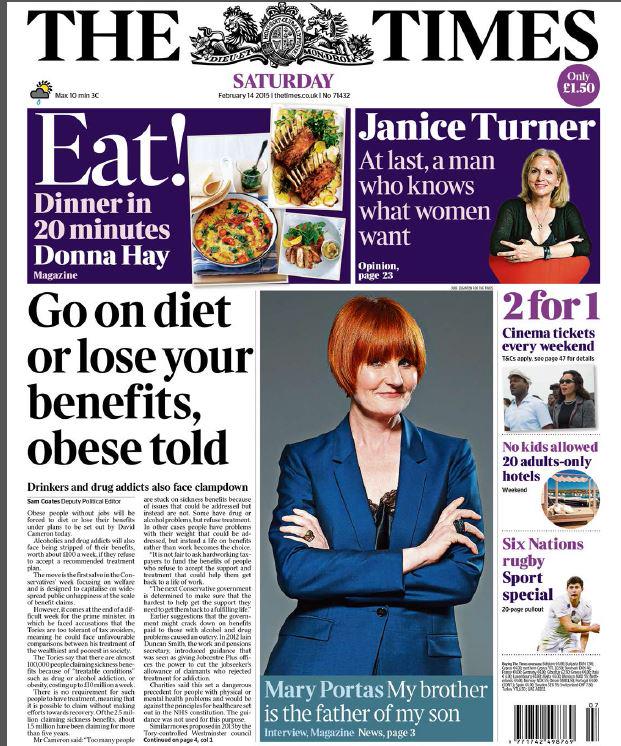
Dear readers, first they came for the obese, then they came for the addicts, and then they came for the teenagers.

David Cameron’s latest announcement, reports tomorrow’s Telegraph, will be that

those aged between 18 and 21 who have not had a job for six months will be barred from claiming benefit unless they agree to start an apprenticeship or complete community work.

They will be required to do 30 hours a week of work in the community which can include making meals for older people, working in local parks or cleaning up war memorials.

Cameron will go on to say

“What these young people need is work experience and the order and discipline of turning up for work each day. So a Conservative government would require them to do daily community work from the very start of their claim, as well as searching for work.”


Readers, I can see two significant problems with this proposal instantly.


The first is that I wonder how realistic this proposal is. If young people will have to carry out community work from the day they start claiming benefits, how much time and energy will that leave any young person with which to search for a job?

Are benefit claimants supposed to spend every waking moment either working for free or looking for paid work?

The second problem worries me even more. Readers,  nothing has been revealed about whether Employment Support Allowance claimants aged 18-21 would be affected by this policy, should it become law.

ESA claimants are disabled and physically can’t cook, clean or do heavy lifting. Also, readers, many disabled people who are not found eligible for ESA claim JobSeeker’s Allowance.

David Cameron must clarify whether young ESA claimants and young disabled JSA claimants would be exempt from any such policy, publicly and at the earliest opportunity.


Your sick notes aren’t good enough claim Ashton under Lyne Jobcentre

February 17, 2015

Charlotte Hughes's avatarThe poor side of life

Yesterday our demo was a very busy one. From the minute we arrived to the minute we left we were inundated with terrible stories and people desperate for help. Nothing really shocks us anymore but it’s becoming very clear to see that universal credit is destroying life’s for both working and non working people.
A man who wanted to remain nameless has been claiming universal credit but he got sick so he did the responsible thing, he went to his doctor and got a sick note. The doctor stated on his sick note his medical condition so he took it into the Jobcentre. He was told that this sick note wasn’t good enough and that he needed to get another one because it needed the words written on it.. “He’s got worse”. He went back to the doctor got another sick note but the doctor quite rightly said I can’t…

View original post 541 more words

Ryan Ruckledge Is Addicted To Tanning Injections And He Wants Them Funded By The NHS

February 16, 2015

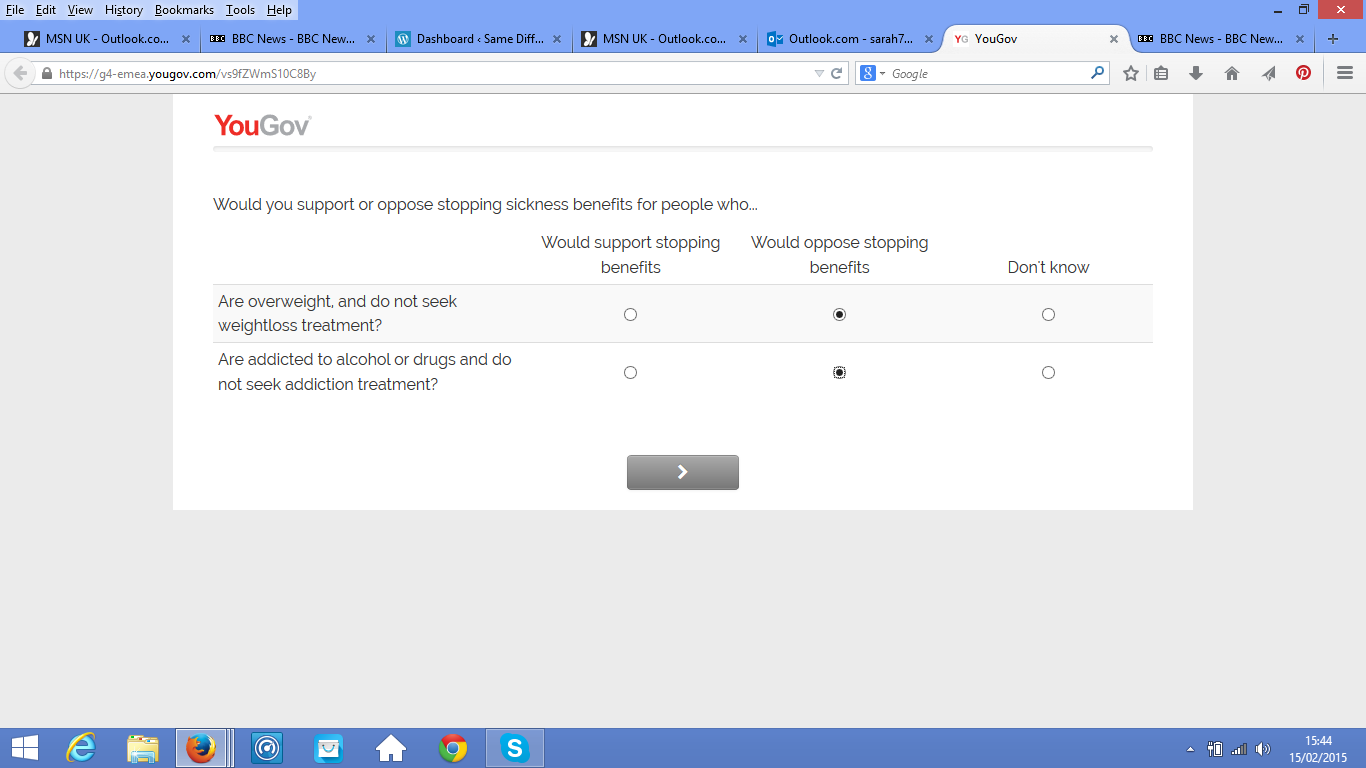
Readers, at the weekend, when I wrote that I could see Cameron’s idea to cut addicts’ benefits if they refused treatment from both sides, I saw many comments suggesting disagreement with that view.

However, Ryan Ruckledge has a very unusual addiction- to tanning injections- and he wants them funded by the NHS.

He says they would be helping an insecure person and asks what do they want me to do, be depressed?’

He told This Morning his doctor suggested counselling, but he refused to go.

Readers, Ryan Ruckledge clearly has mental health issues, however in my personal opinion counselling would be a great help to him. Ryan Ruckledge is one person who is refusing treatment for an addiction that he has brought on himself, and he says he ‘can’t be bothered’ to seek counselling. He said the injections he takes could benefit people with albinism- a recognised physical disability, and wants the NHS to fund research into them.

Readers, if Ryan Ruckledge is, or was to be,  on sickness benefits, I would fully support his sickness benefits being cut unless he attempted counselling.

Ryan Ruckledge gives many, many people with incurable physical and mental health conditions a very bad reputation.

My fear, readers, is that viewers of This Morning will start to believe that no addict is ‘bothered’ to seek counselling.

The question must be asked, readers: Why did This Morning give airtime to Ryan Ruckledge two days after the revelation of the ‘idea’ to cut sickness benefits from addicts?

This Morning are a national institution. The thought that they might be showing support for such an idea is a worrying one.


More Than One In Six JSA Claimants Sanctioned Show Stats

February 16, 2015

Many thanks to the brilliant Benefits And Work.

Statistics released by the DWP following a freedom of information request show that over half a million jobseeker’s allowance (JSA) claimants – well over one in six – received a sanction in the 12 months between April 2013 and March 2014.

The shock figures demonstrate the untruthfulness of Esther McVey’s claims before the work and pensions committee earlier this month.

McVey told the committee that very few people are sanctioned. More than one in six claimants hardly sounds like very few.

McVey also stated that once claimants were sanctioned it acted as a red flag and alerted the authorities that a person was vulnerable and in need of help.

Yet the statistics show that in the year between 1 July 2013 and 30 June 2014 almost 100,000 people received two sanctions and over 35,000 received three. Astonishingly almost 2,000 claimants were sanctioned ten times or more in a one year period.

It is hard to see how this can be reconciled with the claim that claimants who receive a sanction are regarded as vulnerable.

Download the full statistics from this link

Total number of individuals who a) received Jobseeker’s s Allowance and b) received at least one JSA adverse sanction decision, at any time during April 2009 and 31 March 2014 and at any time in each year in Great Britain : April 2007 to March 2014

2007/2008  256,021  12%
2008/2009  286,694  10%
2009/2010  386,979  11%
2010/2011  523,042   15%
2011/2012  460,780   13%
2012/2013  557,858  16%
2013/2014  568,430  18%

Total number of individuals who received one or more Jobseeker’s Allowance (JSA) adverse sanction decisions,in Great Britain: 1 July 2013 to 30 June 2014

One adverse sanction decision 372,461
Two adverse sanction decisions 99,621
Three adverse sanction decisions 35,170
Four adverse sanction decisions 14,873
Five adverse sanction decisions 7,103
Six adverse sanction decisions 3,755
Seven adverse sanction decisions 2,126
Eight adverse sanction decisions 1,381
Nine adverse sanction decisions 852
Ten adverse sanction decisions 1,881
Total 539,225

UKIP: The First 100 Days

February 16, 2015

This airs tonight at 9pm on Channel 4:

A ground-breaking and provocative fictional documentary, from the makers of Cyberbully, set in a fabricated future where UKIP have won the 2015 general election and Nigel Farage is Prime Minister

Cyberbully was an important, enjoyable programme.

However, Same Difference hopes that its makers’ latest project remains a work of fiction for a long time to come.

Should it come true, disabled people would have much to worry about.

The programme is expected to generate a lot of discussion, so please see this as an open thread for your thoughts on it.


UC Claimants More Likely To Be In Work Than JSA Claimants, Show Studies

February 16, 2015

Universal credit claimants are more likely to be in work than those on Jobseeker’s Allowance, according to two government reports published over the weekend.

Analysis of nearly 6,000 claimants over the first four months of their universal credit claim shows a percentage point difference of between 3% and 4% in the proportion of universal credit claimants in work compared to those claiming jobseeker’s allowance (JSA).

The Department for Work and Pensions report was published as the government launched the next phase of universal credit, which it calls a ‘national roll out’. Universal credit combines a number of benefits into one payment made direct to households.

The analysis found that universal credit claimants spent on average four days more in work and earned on average £50 more during the first four months, looking at ‘matched’ claimants with similar age and employment histories. 

However the report states that ‘additional discussion and supplementary analysis’ is necessary to clarify whether it is universal credit as a system that is responsible for the improvements.


The report also notes some important factors may have influenced the results, such as certain groups which may have a lower rate of employment being excluded from universal credit, including pregnant women and people without a bank account.

Another potential bias is that JSA claims are processed faster, meaning ‘for two identical claims (one JSA and one UC), it will appear that the JSA claimant took a longer time to find work than the UC claimant’ as, after 5 days, 64% of JSA claims are processed as compared to 57% of UC claims.

The report describes the analysis as a ‘best attempt’ given the available data at this early stage.

Work and pensions secretary Iain Duncan Smith said: ‘The evidence today shows that under universal credit, people move into work more quickly and earn more money, giving them increased financial security.

‘This is a cultural change which will alter the landscape of work for a generation.’

There will be a phased rollout of universal credit from today, starting with more areas in the north west of England and spreading gradually to include all job centres. The DWP expects the majority of claimants to be claiming universal credit by 2017.

Universal credit rollout began in October 2013, starting with Hammersmith Jobcentre, followed by Rugby, Inverness, Harrogate, Bath and Shotton by Spring 2014. The benefit was introduced to pathfinder areas in the north west, initially for single people and then extended to couples in July 2014 and to families with children in November 2014.

Dr Sarah Woollaston Calls Obesity Sickness Benefit Loss Idea ‘Illegal’

February 16, 2015

Senior Tory MP Sarah Wollaston has demanded that a Conservative proposal to cut benefits for obese people, drug addicts and alcoholics is dropped immediately.

The chair of the Health Committee has written to David Cameron to warn that he is effectively asking doctors and nurses to break the law.

She said the law on consent was clear: that all patients have the right to refuse treatment. By threatening to take away people’s basic income, the government would be forcing people to get help.

“A doctor would not only find themselves in breach of the law, they’d find themselves at risk of being struck off,” Wollaston told BuzzFeed News. “So in fact, his proposal is utterly unworkable in terms of the existing law.”

The prime minister has declared that people who cannot work because they are too fat – or addicted to drugs or alcohol – could have their benefits cut if they refuse to get treatment. At the moment there is no requirement on addicts to seek help before they claim sickness benefits. Cameron has launched a review to see if he can change the rules.

The government says there are 100,000 people claiming benefits for “treatable conditions”. But official stats show that only 1,780 of these were claiming on the basis of obesity last year.

Wollaston said the policy was the wrong message to be sending out so close to the general election.

The MP for Totnes, a former GP, said: “I want us to win the election. I’m infuriated by this because it’s the kind of thing that just doesn’t help.

“It’s really unnecessary and it’s all part of, in my view, trying to appeal to a sort of particular group of people who see that everybody on benefits is somehow there because it’s their own fault. We shouldn’t go down this route.

“We need to have a compassionate Conservative message, in my view, and this isn’t a compassionate Conservative message – this is frankly illegal and unworkable.”

She admitted she had thought hard about having a “fight” with Number 10 on the issue, with less than three months to the election.

But she said: “I’m cross with them. We want a positive message, not this kind of negativity, and particularly something that’s not only negative but actually unworkable and illegal. I did think about this, I did think: ‘Do I actually want a fight about this because I want us to win the election?’

“But I’m afraid there are some things that are indefensible and it’s better for them to withdraw it now. I think people should make a fuss.”

Wollaston also hit out at “policy wonks” who didn’t understand the law.

She said it was “inevitable” that the proposal would be thrown out in the end.

“I sometimes wonder who these policy wonks are that don’t actually bother to acquaint themselves with the law,” she said. “Really what we need, rather than wait for months with this dragging on, it’s much better for the government to issue a clarification that there will be no enforced referrals. And I’m afraid it is an enforced referral if it means you’ll lose your benefit if you don’t go.

“If you say to somebody: ‘We will remove everything you have to live on unless you go to this thing’, all you’ll have is people pitching up just to tick the box, they won’t engage with treatment so it won’t work, and it would count under the law as an enforced referral and it would be illegal. So I can’t stress this enough, they need to withdraw it and they should do it immediately.”

Cameron did not immediately respond to Wollaston’s letter. Announcing the proposal on Saturday, he said:

Some have drug or alcohol problems, but refuse treatment. In other cases people have problems with their weight that could be addressed, but instead a life on benefits rather than work becomes the choice. It is not fair to ask hard-working taxpayers to fund the benefits of people who refuse to accept the support and treatment that could help them get back to a life of work.

A Truly Chilling Move: Now Maximus Are Trying To Buy Remploy

February 16, 2015

johnny void's avatarthe void

maximusfbUS based multinational Maximus could be set to expand their monopoly over the lives of sick and disabled people by buying up what’s left of soon to be privatised Remploy.  This brazen move is sure to inflame anger against the company who are already facing protests after winning the contract to take over running the despised Work Capability Assessment from Atos.

Shortly after the government embarked on the cruel and vindictive closure of the Remploy factories, parts of the organisation were hived off and turned into a sort of state run welfare-to-work company.  Then last year it was announced this would be sold off to the private sector under an initiative bizarrely called Project Jupiter.

Just two companies have submitted bids to buy Remploy, Maximus and Prospects.  Both of these companies are already involved in the welfare-to-work  sector and the Remploy deal comes with a big juicy DWP contract to…

View original post 448 more words

Call The Midwife: Series 4 Episode 5- Brittle Bone Disease

February 16, 2015

I’ve watched Call The Midwife with great interest and enjoyment for the last four years. I’m pleased to say the programme has often covered disability in that time, from all perspectives- mothers, children, becoming disabled and disabled adults.

Last night’s episode was no exception- a mother who refused medicine for her baby on religious grounds turned out to have a child born with Brittle Bone Disease, which was, as it sadly still sometimes is, mistaken for child abuse.

You can watch the episode on Iplayer here for a month, if you wish.

Asperger’s Man In ESA Support Group Gets Work-Focused Interview Letter From DWP

February 16, 2015

An extract from this post by the brilliant Kate Belgrave.

Here is a letter received very recently from a DWP “work coach” by Sean* (name changed), a Northamptonshire man who I’ve known and written about for several years. He has Asperger’s and severe depression.

2LetterDWP-216x300

Sean finds day-to-day life very difficult to handle (he struggles to leave his house a lot of the time). He actually finds day-to-day life so challenging that even Atos agreed that he shouldn’t have to work. After a face-to-face assessment for his WCA about two years ago (I attended that assessment with him), Atos placed him in the support group for Employment and Support Allowance. As many of you will know, people in the ESA support group are neither required to work, nor to look for work. That’s the whole point of the support group. It’s an acknowledgement (a grudging one, I suspect) by the system as we have it that some people simply aren’t in a position take a job. From Benefits and Work: “the ESA support group is for claimants who the DWP consider to have such severe health problems that there is no current prospect of their being able to undertake work or work-related activities.” Once you’re in the support group, that should be the end of that, at least until your next assessment.

But here is this letter all the same. Disturbing reports of other people in the ESA support group getting letters like this, or calls to attend work-focused interviews, now abound. Sean received this letter out of nowhere and it scared the hell out of him. I imagine that scaring the hell out of him was at least in part the point of the exercise. The DWP doesn’t like people with mental health conditions to feel too secure.

Now YouGov Are Asking Questions About Tory Plans To Cut Sickness Benefits From Obese And Addicts

February 15, 2015

Same Difference was unpleasantly surprised to find this question in the latest YouGov survey.

Screenshot (2)

This was the response:

Screenshot (10)

Same Difference strongly opposes this idea for reasons listed here.

YouGov is an opinion poll site that covers a wide range of topics.This topic could simply have been included because it is a current ‘hot topic’ in the media.

However, the question must be asked: Does the inclusion of a question on this topic in a survey released the very day after the idea was revealed show YouGov’s support for the idea?

UC Rollout £600M Under Budget, Insists IDS

February 15, 2015

The roll-out of universal credit has cost less than expected and is being carefully delivered “stage-by-stage”, the work and pensions secretary says.

Iain Duncan Smith told the Andrew Marr Show the new benefit was £600m under budget and was being tested gradually.

Universal credit, which replaces six payments, is being introduced across the country on Monday. It should be offered by all job centres by 2016.

Labour called it a “failing programme” that would take years to implement.

‘Waste and delays’

Universal credit replaces housing benefit, JSA and tax credits, and is currently available in nearly 100 job centres.

About 50,000 people in selected areas have claimed it since it was introduced in April 2013 – far fewer than the government originally said would be getting it by now.

Technological problems have caused delays and forced ministers to write off tens of millions of pounds.

But from Monday the benefit will be made available in 150 job centres over the next two months, with all job centres due to be covered by next year.

Mr Duncan Smith said he had acted on the advice of experts to introduce the new benefit in stages.

He said: “We remember what happened with tax credits and others under other governments, Labour and Conservative, where you launch them all at once, they don’t go right.

“Under tax credits 400,000 didn’t get their payments and billions have been lost.

“So we brought in some other people, they looked again at, they advised me and I took that advice, which was do it stage by stage, test it, then roll it out, then test the next bit, then roll it out and that’s what we’re actually doing.”

line break

What is universal credit?

  • An overhaul of the benefits system driven by Work and Pensions Secretary Iain Duncan Smith
  • It will eventually replace six benefits: Income-based job seekers allowance, income-related employment and support allowance, income support, working tax credit, child tax credit and housing benefit
  • Universal credit is tapered so that benefit payments are reduced gradually as claimants earn more
  • There are no limits to the number of hours claimants can work a week
  • Ninety per cent of universal credit claims are made online
line break

The government’s analysis suggests claimants in pilot areas were 13% more likely to have found work within four months than similar groups claiming JSA.

The research tracked claimants between July 2013 and April 2014 in Warrington, Wigan, Oldham and Ashton-Under-Lyne.

Its results suggested those receiving universal credit were more likely than JSA claimants to believe the benefit system was encouraging them to find work, take any job they were able to do and spend more time looking for work.

But Labour said the government – which had originally promised that universal credit would save £1.7bn by cutting errors and fraud – had now cut that target by two thirds.

Shadow work and pensions secretary Rachel Reeves said: “The only person who believes Iain Duncan Smith’s promises on universal credit is Iain Duncan Smith.

“Iain Duncan Smith promised one million people would be claiming universal credit by April 2014. But the latest figures show only 26,940 people on the new benefit. At this rate it will take 1,571 years to roll out universal credit.

“Labour wants universal credit to work and we’ll call in the National Audit Office to do an immediate review of this failing programme to get a grip of the spiralling waste and delays.”

Ministers estimate that, once fully implemented, universal credit will boost the economy by £7bn every year because of an increase in people being in work and reduced benefit expenditure.

Housing Benefit ‘Disallowance-‘ A Freedom Of Information Request

February 15, 2015

Readers, you may remember this story from earlier this week.

I’ve just seen this Freedom of Information request on this issue. I will not reveal the name of the person who sent this FOI in case revealing affects the queston being answered.

I hope a response is provided- I’m sure many would love to know the answer.

Dear Department for Work and Pensions,
I would like you to clarify this matter for me. As far as I’m aware
when a person gets sanctioned the money that they receive gets
stopped and also their housing benefit gets stopped. However they
are still allowed to make a claim for housing benefit under a zero
income status. I have recently had reports of a Jobcentre advisor
telling claimants that if they don’t comply then they themselves
will sanction their housing benefit for two weeks.

When you have your signing on appointments, things are slightly
different… if we don’t think that you have applied for as many jobs
as you could have, if you don’t provide sufficient detail on the
jobs you have applied for, or if you do nothing at all, not only do
you run the risk of losing four weeks’ jobseekers’ allowance, there
is also a two-week disallowance of other benefits you are
receiving. The only exception being child benefit. Now, most people
who claim jobseekers’ allowance are also claiming housing benefit
and council tax benefit as well. The disallowance means that you
would be liable to cover your rent and your council tax costs for
two weeks.
Please can you clarify if this above matter is indeed the case and
legislation has indeed been passed to allow this.
Also of this is the case then when was this legislation passed and
by whom passed it.

Tories Launch ‘Hate Sick And Disabled Claimants Week’

February 14, 2015


The Conservatives have launched a week long campaign aimed at stirring up hatred against welfare benefits claimants in general, and sick and disabled claimants in particular. The project appears to be an attempt to move the spotlight off tax avoidance at a time when polls suggest that the HSBC scandal is costing the Tories votes.

The campaign began today with a threat to stop the benefits of obese claimants as well as those who are dependent on alcohol and drugs, unless they take part in treatment programmes.

Cameron has announced that Dame Carol Black, responsible for the ‘Fit Note’ amongst other things, has been asked to carry out a rapid review of whether it would be possible to stop the benefits of people who refuse treatment.

Announcing the review, David Cameron claimed:

“Some have drug or alcohol problems, but refuse treatment.

“In other cases people have problems with their weight that could be addressed – but instead a life on benefits rather than work becomes the choice.

“It is not fair to ask hardworking taxpayers to fund the benefits of people who refuse to accept the support and treatment that could help them get back to a life of work.”

“Pathetic”
The move has already been widely condemned.

Former Labour spin doctor and recovering alcoholic Alistair Campbell, who is an Alcohol Concern ambassador, told LBC radio:

“I actually do think when you have got real leaders like Merkel doing the things that they are doing, it is embarrassing that we have a PM who does this sort of stuff. The fact that he is making a speech about it is pathetic.”

“People that are walking around London and the rest of the rest of the country today, as they walk over people in sleeping bags on the streets, just ask themselves if those people really, really chose to be there. They did not choose to be there – they are alcoholics or drug addicts because it is a disease, it is an illness, that is how it should be treated.

“To say we are not going to give you benefit because you are fat, we are not going to give you benefit because you drink too much, just think about what we have become as a country that that is our Prime Minister and that is how they treat a serious illness.”

Tough week ahead
Today’s announcement is just the first of a week of attacks on welfare benefits claimants by the conservatives as they try to prevent the press concentrating on tax dodging. And it’s probably just a small foretaste of what is to come in the weeks leading up to the election.

So, if you’d like to feel that you are fighting back rather than simply being a target, here’s three suggestions for ways to make life harder for the conservatives.

Support Full Fact
Support the brilliant Full Fact charity, who have until 27 February to raise £25,000 to fund a six week, 18 hours per day election fact-checking project.

The presence of a Full Fact team will make it harder for politicians and the DWP press office to put out blatant untruths without them being challenged and exposed.

The project is being backed by Cathie Wood, sister of a claimant who died after wrongly being found fit for work. She commented:

“You are doing vital work – good luck with it.

“This donation is in memory of my brother Mark Wood who died due to current govt. policies and lies.”

If you can afford to, please make a donation to Full Fact via Crowdfunder.

www.crowdfunder.co.uk/lets-factcheck-the-election

Even if you can’t, please publicise the fund raising appeal on twitter, Facebook, blogs and forums.

Register to vote
Register to vote and encourage everyone you know to do so.

According to the independent Institute for Financial Studies (IFS), working age benefits will have to be cut by a horrifying 25% in order for the Tories to meet their spending plans.

There’s no doubt that cuts of that level will cause immense suffering and even deaths amongst claimants.

So voting in the coming election really is a matter of life and death if you are a working age claimant.

Spread the word: claimants can choose the next government
Fight feelings of hopelessness. Publicise the fact that there are thousands of voting age claimants in every constituency in the UK. This means that in many constituencies a relatively small percentage of claimants could decide who gets the seat.

We’ve got bar charts that show how small the swing amongst claimants would need to be, based on 2010 results. In fact, with the election too close to call, there are even more constituencies where claimants could hold the balance of power.

Spread the word: claimants have the power to choose the next government.  Feel free to copy and use our bar charts.

Nine Hundred Terminally Ill People Reassessed For PIP

February 14, 2015

An image I’ve just spotted on Twitter.


https://pbs.twimg.com/media/B9v-mxaIQAAY9r7.jpg


The world’s gone mad, readers. I’ve been saying for years that reassessment is bad enough for people with very severe long term disabilities. But terminal illness?

The DWP needs a dictionary.


Obese Told To Diet Or Lose Benefits

February 14, 2015

Embedded image permalink


This is a story I can see from both sides. As someone physically disabled since birth, I feel that if people bring obesity or drug or alcohol addiction on themselves for no good reason then their benefits should possibly be cut and given to others.

However, readers, that rarely happens. Drug or alcohol addiction could be caused by mental health issues or physical disabilities, particularly if people become disabled later in life. Addiction can also cause mental health issues. In such cases people are genuinely disabled and have conditions which cannot be helped or cured.

Also, readers, many studies have shown that wheelchair users are more likely to be obese, because many of them do not walk and are unable to carry out most forms of exercise. So before bringing in any such policies, the Government would need to clarify that overweight wheelchair users would be exempt from any benefit cuts.

Also, it is important to consider that people with physical disabilities, particularly my condition, Cerebral Palsy, who can walk often walk as if they are drunk. So if someone was to see a person with CP  walking, they may wrongly assume that person is an alcoholic and falsely report them for benefit fraud if this policy was to become law, when in fact they are completely genuinely disabled.

Jack Eyres To Become First Disabled Man To Model At New York Fashion Week

February 13, 2015

A British personal trainer will become the first male amputee model to strut his stuff on the catwalk when he takes part in Antonio Urzi’s New York show this week.

Jack Eyers, from Bournemouth, Dorset, was the personal choice of Urzi, who counts Beyonce and Lady Gaga among his A-list fans.

The 25-year-old, who had his right leg amputated at the age of 16, will fly out to the Big Apple this weekend and says he thinks the experience will be ‘amazing’.

”It all feels so surreal,’ said Mr Eyers. ‘I can’t believe this is actually happening. To be the first male amputee model on a New York Fashion Week runway feels amazing – it feels like such a big deal. the abs, the arms…

‘I have no idea what to expect, so it’s pretty overwhelming,’ he continued. ‘I just want to show that having a disability doesn’t need to hold you back.’

Mr Eyers will wear designs created by Urzi, a man whose work will be familiar to anyone who saw Lady Gaga during this year’s Born This Way tour.

The designer-to-the-stars has also seen his pieces embraced by the likes of Beyoncé and Britney Spears.

‘It’s amazing to think I’ll be wearing clothes designed by such a prestigious man,’ added an excited Mr Eyers. ‘I’m in good company.

‘I always said if I was going to do something like this, I want to do it big. I want people to see me, and to realise that there needs to be more disabled models walking the runway.’

Mr Eyers became an amputee at the age of 16, after having his right leg, which had been left withered by a condition called Proximal Femoral Focal Deficiency, amputated

Fed up with constant trips to hospital, Mr Eyers opted for the amputation in the hope of finally being able to lead a normal life. 

‘Growing up with the deformed leg was really hard – I had no muscle structure or knee joint and I walked with a really pronounced limp.

‘At primary school I was really into sports but it was hard to join in, and I would get bullied.

‘I remember at the age of around seven saying I wanted to have it amputated but I needed to wait until it stopped growing – it felt like this devil attached to me. When I finally got it removed it felt like I’d been reborn.’

Finally rid of the leg that had caused him so much pain, Mr Eyers became a fitness fanatic, and started to look into a career in modelling.

He eventually came across Models of Diversity, a company that campaigns for more diversity within the modelling industry.

Signed on the spot, his career has gone from strength to strength, and was even crowned Men’s Health Magazine’s Man of the Year.

 ‘Once I’d had my leg amputated I started to gain confidence and went to the gym,’ he explains of his impressive career.

‘I initially wanted to join the fire service, but I soon realised that it just wouldn’t be possible as an amputee – so I looked at what else I could do and discovered personal training.’

‘I’d really got into the gym and fitness, and then I remember seeing an article about Models of Diversity in a magazine.

‘I went along to a photo shoot with them and everything has just snowballed from there.’

Mr Eyers has also appeared in campaigns for online fashion retailer Boohoo, as well as in advertisements for Tango and Barclays. He recently became the face of the charity, Scope.

His focus now, however, is on his ground-breaking appearance in New York. ‘The organisers of the New York show, FTL Moda, got in touch with Models of Diversity about me and the work I was doing, and after meeting with them, they offered me a chance to be in the show.

‘I could hardly believe it. It still doesn’t feel real, but I can’t wait to get out there and get stuck in. It’s such a massive step for me and the modelling industry.’

Speaking about his choice of model, designer Urzi, added: ‘For me it’s just an honour to be able to work on this amazing project.

‘We are so proud to have the opportunity to enhance the amazing skills of these professional Models of Diversity’s models.

‘My publicist and my team are constantly at work to create fashion in a unique and sophisticated way to be embraced from the people of the world.’


Leukamia Boy Tommi Miller, 7, Has DLA Reinstated

February 13, 2015

A pleasant update on a story covered last month.

A U-turn by the Department for Work and Pensions (DWP) was met with cheers from a small, but vocal, group of protestors gathered outside Chesterton Road’s Job Centre on Friday 6th February, in support of seven-year-old Cambridge resident and cancer sufferer, Tommi Miller.

The organisers took action after learning that Tommi’s family had been forced to rely on food bank assistance for months, following the DWP’s refusal last year to award Disability Living Allowance.

The family had previously received the benefit but, when Tommi briefly went into remission last April, the support was withdrawn, despite his ongoing medical treatment.

When the cancer returned in September – affecting Tommi’s spinal cord, brain stem and bone marrow – the family continued to be denied benefits.

His mother, Ruth, explained that Tommi had recently undergone “eighteen sessions of radiotherapy to the brain,” with a further two years of chemotherapy in prospect, but that “DWP staff showed little regard for our situation.”

Shortly after the protest started, news broke that the Millers’ claim had been favourably settled by the DWP. Cambridge MP Julian Huppert, who intervened on behalf of the family, said they would receive additional support for the months they’d been waiting, compensation, and will not be subject to review for four years.

Huppert was “delighted” at the result, but admitted, “I really wish the DWP had sorted this out correctly the first time.”

When asked about her feelings regarding the decision, Ruth stressed that other families continue to endure similar situations: “I really just hope no-one else has to suffer like we did.”

Ruth, along with a friend, now hopes to found a charity aimed at helping others in comparable circumstances. She was also keen to thank those who had supported her family, as “without the help of our friends and community we would have truly been stuck.”

Friday’s protest began with an altercation between security personnel and protestor James Nichols, who was physically restrained after attempting to place a banner over the Job Centre’s window. Speaking to police later, Nichols said the use of force had been “entirely unnecessary. They could have asked us to remove the banner, but they didn’t.”

Daniel Brett, the demonstration organiser, admitted he had no personal connection to the Miller’s, explaining: “I don’t know the family but, as a father of a child the same age as Tommi, I understood.” He went on, “I’m fed up of seeing people pushed into destitution for ‘austerity’.”

Among the protestors was ten-year-old Sara, who held a sign she created with her younger brother. Her father, Arsalan, said Sara had pushed him to attend.

He commented, “anybody can be vulnerable to situations like this,” and hoped to “show solidarity, not just with the Miller family, but with everyone in this country who’s suffering under austerity.”

On learning of the protest, Tommi’s mum said it had come as a “complete shock,” but added “we were pleasantly surprised that people took time out to do such a bold, brave thing for us and we thank all involved so very much.”

NI Man Wins £2000 Compensation From ATOS Over Lack Of Access At WCA Assessment Centre

February 13, 2015

A useful case to know about. Maybe people in the rest of the UK can try for compensation in a similar situation.

People who had to travel to alternative assessment centres in the last six months due to disabled access problems at Royston House can apply for compensation under the Disability Discrimination Act. A strict six-month time limit applies.

Atos has agreed to pay £2,000 in damages for Mr McCann, a Law Centre client with mobility problems who had to travel to an alternative WCA assessment centre due to lack of disabled access at Royston House, Belfast.  This test case was taken to challenge an issue affecting many people with disabilities.

Mr McCann had not been able to gain access to Royston House in Belfast where the Work Capability Assessment (WCA) is carried out, because of disabled access problems. The Law Centre represented him in his claim for damages at the County Court. Mr McCann was not alone in his predicament. According to figures released last year, over 1,600 claimants had to travel to alternative assessment centres based in Ballymena and Portadown in 2012-2013.

Law Centre (NI) Director Glenn Jordan said: “We are delighted to have brought this case to a successful settlement. This is good news for Mr McCann and for all those who will not have to travel long distances for their WCA assessment.  It’s an example of how the Law Centre is able to pursue strategic cases that make a positive difference for the most vulnerable in our society.”

From 14 November, people with mobility issue are offered assessment in ground floor premises in Belfast. Patricia Carty, the Law Centre social security adviser who took on this case, said: “Other people affected in the last six months may now apply to the County Court for compensation under the Disability Discrimination Act. However, they need to be aware that there is a strict six month limit for appeal applications.”

Details of the case

WCA assessments are usually carried out on the fourth floor of Royston House. When Atos Healthcare took over the medical assessment of those claiming Employment and Support Allowance, it stopped training staff on evacuation procedures as part of its new health and safety measures. Since then, people who would require help in the event of the lift breaking down in an emergency have been sent to the alternative centres where assessments are carried out in ground floor offices. A large proportion of ESA claimants have mobility issues and many are wheelchair users. This raises issues of disability discrimination due to the extra stress caused by travel which non-wheelchair users do not have to undertake.

The assessments are carried out by Atos under contract from the Department for Social Development, and the Department had to pay £35,000 in taxi fares to the alternative centres.  In addition, travel expenses would have been paid out to those who drove themselves.

When the Department and Atos Healthcare could not agree on which agency was responsible, the Law Centre sought an order from the County Court, and Atos then agreed to settle the case.

Down’s Syndrome model makes fashion history by walking at New York Fashion Week

February 13, 2015

Record Number Of Sanctions Imposed On Jobseekers

February 13, 2015

The number of people claiming jobseeker’s allowance (JSA) being subjected to benefit sanctions is creeping up, with nearly one in five being penalised last year.

Figures released under the Freedom of Information Act show that 3,097,630 JSA claims were made in 2013-14 and 568,430 individuals were subject to a sanction, a total of 18%. In 2012-13, 16% of claims were subjected to sanctions and 15% in 2010-11. They are imposed on people who fail to keep appointments, reject jobs or walk out of jobs without good reason.

In 2008-09, only 286,694 sanctions were applied on the 2,935,930 JSA claims, representing 10%.

Rachel Reeves, the shadow work and pensions secretary, said: “The huge rise in sanctions since 2010 shows the government’s system is in chaos. The number has doubled since 2009 to a level where one in five of all JSA claimants receive a sanction. This will lead to further concerns that unofficial targets imposed on jobcentres by the Department for Work and Pensions are forcing up the number of people who have their benefits withdrawn.

“Under a Labour government, there will be no targets for sanctions and the system will focused on helping people into work, not simply finding reasons to kick jobseekers off benefits.”

The figures also show that 372,461 claimants were subject to one adverse decision, 99,621 to two and 35,170 to three between 1 July 2013 to 30 June 2014.

The DWP stressed the figures were derived from unpublished information which have not been quality assured to Official Statistics publication standards and should therefore be treated with caution.

David Webster, the honorary senior research fellow at Glasgow University, said: “The DWP is still regularly claiming that it is only a ‘tiny minority’ of claimants who are sanctioned – most recently by Esther McVey last week – but this suggests it is not a tiny minority.”

Employment minister Esther McVey said: “All the international evidence suggests that sanctions do have a positive impact on people getting into work, and there are two parts of that: as a deterrent, it has a positive impact on moving people into work and there is further research that, should somebody have been sanctioned, it helps them into work afterwards.”

The DWP pointed to OECD research on northern member states which suggested that having a credible benefit reduction leads to increased work search and a subsequent increase of flow into employment of up to 50%.

ASDA TOPS DISABILITY-FRIENDLY TABLE, BUT BLUE BADGE BAY MISUSE STILL INFURIATES DISABLED CAR DRIVERS.

February 13, 2015

A press release:


Asda is the most disability-friendly supermarket chain in Britain, but nearly 95% of disabled drivers say they are impacted or obstructed by able-bodied driver blue badge bay misuse across all the major retailers’ car parks – presenting a massive customer relations dilemma for the stores.


Those are some of the key findings of Blue Badge Mobility Insurance (BBMI) – a mobility equipment rescue, recovery, insurer and adviser – which surveyed mobility equipment users and their experiences of trying to live a normal life.


The survey indicates that while some big retailers could improve disability access, a key point is that stores are caught between a rock and a hard place in policing matters such as disabled parking bay usage while not upsetting able-bodied customers.


“The stores try very hard to accommodate disabled shoppers – from parking spaces to checkout aisles. The issue seems to be that too many able-bodied people don’t fully understand the nature of the challenges faced by people on sticks, crutches, in wheelchairs or using powered wheelchairs and mobility scooters,” said Mark Effenberg of BBMI, whose son is a wheelchair user.


“When we examined the issue and spoke to disabled drivers, it became apparent that the vast, vast majority of supermarket car parking problems were down to fellow able-bodied shoppers misusing disabled parking bays.


“But while many able-bodied drivers did move on when asked, some unfortunately accompanied their exit with a tirade of abuse aimed at disabled shoppers waiting for a space, while others simply refused to move for reasons as varied as ‘I’m waiting for a friend’ and ‘You don’t look disabled’.


“However, quite often the issue is not the proximity of a disabled space to the entrance of the store, it’s the need to open doors fully in the wider blue badge bays.


“We were surprised how many disabled drivers drove to a supermarket but eventually gave up and went home – sometimes after up to an hour of waiting for a space. Able bodied people have options, but disabled people don’t. Waiting becomes an accepted part of their lives.


“The supermarkets are fighting for market share, and should be mindful of the value of the ‘disabled pound’ as part of that mix – but also that supermarkets are in many areas the only place disabled shoppers can access, so they have a responsibility to provide that access.”


Mobility equipment users placed Asda top of the disability-friendly table on 27.8%, followed by Tesco on 15.7% and Morrisons on 8.7%. The survey was conducted online in January 2015, with between 115 and 169 respondents per question.


Hampshire-based Blue Badge Mobility Insurance provides mobility equipment rescue and recovery, insurance covering use, protection and liability relating to scooter, wheelchair and home equipment, care-related insurance products, as well as advice on sourcing and use of mobility equipment.


http://www.BlueBadgeMobilityInsurance.co.uk/

Disabled Man Wins Right To Keep Motability Car After PM Told

February 13, 2015

A disabled driver who faced losing his car under benefit changes said he was “elated” to have won his case after it was raised with the prime minister.

Mark Francis, 44, of Resolven near Neath, had been told he would lose his vehicle later this month as he had been reassessed as no longer eligible.

David Cameron promised to look into it after Neath MP Peter Hain raised the issue at prime minister’s questions.

The Department for Work and Pensions said it had received “new evidence”.

Mr Francis told BBC Wales his hereditary spastic paraplegia had worsened, but he had been reassessed to a lower level of benefits in which he was no longer eligible for a car under the Motability scheme.

He said he had phone calls from Motability and the Department for Work and Pensions (DWP) on Thursday to tell him his case had been reassessed again – in his favour – after it was raised in the House of Commons on Wednesday.

“It’s great that I can keep the car – too bad I only got it by getting Peter Hain to ask questions in Parliament,” he said.

“How many other disabled people haven’t done that?”

Mr Hain is trying to find out the reason for the change as he believes other people on disability benefits may be affected by changes to the regulations.

A DWP spokesman said: “If claimants disagree with a decision then they can seek to have it reviewed and submit new evidence.

“Mr Francis followed this process and when the new evidence was taken into account was awarded a higher rate of benefit.

“This enables him to retain his Motability car.”

The Finnish Punk Band With LD Who Want To Win Eurovision

February 13, 2015

Just a quick Friday Fun link for you, readers.

Kiss Awkward Goodbye This Valentine’s Day

February 13, 2015

Ouch! have more on Scope’s Valentine’s campaign and two awkward disability dating stories.

They are asking for people to share their awkward disability dating stories, so readers, I’ll share a quick one with you.

Aged 10, I sent my first Valentine’s card to a boy who was, at the time, a close friend. But- and this is probably where I went wrong- I didn’t sign it. He took one look at it and went running off down the corridor to the other Year 6 classroom, thinking it was someone from there! I think I eventually told him it was me but otherwise, I wonder if he would ever have guessed!

That may sound childish, readers, but it hurt at 10!

Scope’s Valentine’s e-cards were shared here on Tuesday but they weren’t as popular as I thought they would be then, so I thought I’d link to them here again in case you have someone to send them to who will know who sent them…

Universal Credit To Go Nationwide From Next Week

February 13, 2015

Universal credit, the government’s welfare programme, will be accelerated next week as the Tories ramp up their attack on Labour’s record.

Iain Duncan Smith, the work and pensions secretary, is to announce plans to extend the scheme nationwide at the rate of 15 new job centres a week from next Monday.

The scheme has been tested at 96 job centres in London and the northwest, but from Monday all new single benefits claimants will start joining the programme, which merges six benefits into one. Couples and families will be added at a later stage.

Officials said that the scheme for single people would be phased in over the year, with more than 250 job centres offering the system by the end of April and a further 120 by July.

Mr Duncan Smith will this weekend confirm the extension, more than doubling the current scale of six new centres a week. “The accelerated rollout means that it will be in a third of the country’s job centres by spring. Universal credit will provide the country with an economic benefit of £7 billion each year,” a source close to the minister said.

He will also initiate an onslaught on Labour’s record, arguing that Ed Miliband has been “sitting on the fence” on welfare. The Tories believe that the government’s drive to cut down the social security bill has played well with its voters and with those tempted to defect to Ukip.

“Ukip voters don’t like the policy on overseas aid or Europe or immigration, but they do back the welfare changes,” one Tory source said.

Rachel Reeves, the shadow work and pensions secretary, has said that if Labour won the election she would suspend universal credit for three months to investigate it.

The scheme, which has run into delays and had to be “reset” at huge cost because of IT problems, has already been the subject of “access” talks between Labour and Whitehall officials.

Although the party supports the principle of merging benefits, it has said that it would scrap the scheme if it became too expensive and unwieldy.

Mr Duncan Smith hopes that his decision will put Labour on the spot and make the system more difficult to unravel. He will claim that the trials have been so successful the programme can be introduced more quickly than expected.

However, a National Audit Office (NAO) report has said the programme would still not be completed until 2019 or 2020.

About 54,000 claims have been made so far but nearly eight million people will be eligible when the scheme is opened to new and existing claimants. There have been small trial runs for couples and families with children but only 26 centres will process these by March, according to Citizens Advice.The charity yesterday backed the widening of the scheme but was concerned that it would not be matched by support for claimants.

“The accelerated rollout of universal credit must be matched by the expansion of support for new claimants,” said Gillian Guy, chief executive of Citizens Advice.

“Nine out of ten of our clients need assistance to deal with things like monthly payments and budgeting. As more people move on to universal credit it is vital that they are able to access the help and support they need to understand the new system,” she said.

Ms Reeves criticised the uptake so far. “Only 26,940 people are claiming universal credit according to the latest government figures — that’s less than 3 per cent of the 1 million people Iain Duncan Smith promised would be by April 2014,” she said.

“Labour wants universal credit to work and we’ll call in the NAO to do an immediate review of this delayed project, which is years behind schedule. And unlike the government, we won’t pour millions of taxpayers’ money down the drain.”

Help Brandon Get Visa To Stay With His Disabled Wife

February 13, 2015

Brandon faces deportation and separation from his disabled wife. We need funding to cover legal expenses and visa fees.

To know Brandon and his wife, Is to meet a couple truly in love. Anyone who sees them together can see their connection, Love and dependency on each other. Unfortunately unless Brandon finds full time employment this relationship could have a catastrophic end.

They met in 2012 when Brandon moved to Swansea from the USA so they could marry and set up home together.

Brandons wife, who due to her severe mental health condition and vulnerability can not to be named, is dependent on benefits. This condition makes it impossible for her to work. She relies on Brandon for care and support. Their marriage however is undergoing extreme stress as he is only allowed to stay in Wales on a temporary spousal visa.

Because they are married, Brandon’s wife lost her severe disability payment of £60 per week so they are they both struggling to survive on her reduced disability benefit. Even worse, this benefit cut means she can no longer sponsor Brandon for his spouse visa and he is likely to be deported back to the USA. The couple have sought legal advice from a solicitor, however as this case does not fit the requirements for legal aid, the half hour free advice that most law firms offer is insufficient to unravel the complexities of immigration law.

As a foreign national, Brandon is not entitled to claim benefits. The key for them being able to stay together is for him to find a job. They also need to be able to afford the legal fees and pay for the visa which amounts to at least £1200

Although he has no paid employment Brandon contributes to the community by doing voluntary work at an environmental recycling centre. He would accept any job and has worked for Amazon in Swansea via a recruitment agency. Despite being described by his manager as a fast and reliable worker, and being told that Amazon would keep him on if they could, Brandon was laid off by the agency. He spends hours every day applying for jobs although to date he has been unsuccessful.

Brandon has attended interviews where employers have been impressed with his enthusiasm and skills and has been offered irregular part time or zero hour contract work, But this is not an option as his wife’s ESA and housing benefit are stopped when he works, And she needs professional help to fill in forms and to get letters of support from social services to evidence her condition each time he stops or starts work. To date she has done this 8 times, and finds this a dehumanising and distressing process which affects her mental health and their marriage, To the point where she has spent time in psychiatric hospitals.

Their marriage is under constant stress. Brandon supports his wife the best he can but they both struggle to survive on her benefits, and the fear of her husband’s deportation makes her very unwell. In an ideal world Brandon would be like to support his wife so they could live independently.

Brandons wife’s condition has been deteriorating and she has attempted suicide. If Brandon were to be deported the results could be catastrophic. She would not be entitled to live in America with him, because her mental health condition would immediately disqualify her from the strict US visa requirements.

Could you help to save this marriage? An offer of a job for a conscientious worker is essential for Brandon to continue living here and to keep him and his wife together. Or could you help with the legal costs? Any contribution towards this would be gratefully received.

Please help in anyway you can. For further information and ways to support this lovely couple then contact Pete on 07967 917045 or email helpforcw@gmail.com

Autism Campaigner Kevin Healey Leaves Twitter

February 13, 2015

I read this with sadness. I’ve been connected to Kevin Healey on Twitter for some time.

An autism campaigner says he has quit Twitter because he does not feel safe from impersonators.

Kevin Healey, 40, a trustee of the National Autism Society, said people had faked his account and abused him.

He said he was angry that Twitter would not verify his account, which he feels would give him some protection as people can see which account is real.

A Twitter spokesman said it was unable to comment on individual users for privacy and security reasons.

‘Sick of impersonations’Mr Healey, from Newcastle-under-Lyme in Staffordshire, who had 130,000 followers, said he had been told he does not meet Twitter’s eligibility criteria.

Twitter says it verifies accounts of “highly sought users in music, acting, fashion, government, politics, religion, journalism, media, sports, business, and other key interest areas”.

About 1,600 people have signed a petition backing his request.

He said he had been receiving abuse for about two years and has reported it to Twitter and police. Some people have been warned and others had accounts suspended, he said.

Staffordshire Police has investigated 13 incidents of people impersonating him but has been unable to locate those responsible, Mr Healey said.

The force said it had been in regular contact with the victim following his complaint about online harassment last January and is pursuing lines of enquiry.

“I help people get the help they need but the things people have been saying to me have been horrific.

“I’m suffering from stress… I don’t feel safe.”

He said his Facebook profile has been verified – given a blue tick proving the account is genuine – and he will not return to Twitter until the same thing happens.

Earlier this month, Twitter’s chief executive promised tough action to deal with abusers after admitting the company “sucks” when it comes to dealing with abuse and trolling.


Breaking News: Predicted Disabled Persons Voting: ODI Enabled Disability Intelligence Survey effect by Parliamentary Seat Majority

February 12, 2015

thinkablesite's avatarthinkablesite's Blog

#ukdisability2015 #GE2015 Disability Voting Intellgence survey 1 December 2014

Predicted Disabled Persons Voting by Parliamentary Seat in ascending majority

The ODI say there are 10.3 million disabled adults living in the UK who can vote. 2.3m disabled people are not registered to vote. A significant percentage do not vote at all.  They have disengaged politics.

The Predicted Disabled Persons Voting Indication helps disabled people target seats whereupon their vote may decide the outcome of the seat and give disabled people an opportunity to hold politicians to account for policies which have affected their lives.  The PDV disability voting analysist can be found here:

Please use the document to cascade to disabled persons and disability organisations based in each of the identified UK parliamentary election constituency seats.
Please help make disabled persons’ votes count.

View original post

Safer Banking Tips For Disabled People

February 12, 2015

Using chip-and-pin in shops or at a cash machine can be a problem for some disabled people and many have to ask for the help of strangers. But a new guide explains how to keep banking secure.

You’ve gone to the post office to send a parcel and realise that there’s no money in your wallet. Your hands don’t work, so punching in the Pin code for your bank card isn’t an option, unless you ask someone else for help.

Almost three-quarters of people for whom using a bank card is difficult say they have given their Pin code to someone else in the past two years. That’s according to research by the Payments Council which oversees payment services in the UK. They warn that sharing this information breaks with the terms and conditions of many accounts. This means that if you’ve been a victim of fraud and the bank finds out you gave your Pin code to someone else, you may not get your money back.

Owen Lowery is paralysed from the shoulders down due to a judo accident 30 years ago. When he goes out he mostly does so with paid personal assistants, who he’d rather not give his personal bank details to. “It takes quite a while to establish trust,” he says. “When I’m with my wife it isn’t an issue, but even then not being able to use my own card does create a feeling of impotency.”

Handing over the Pin code for a current account is not the only way you can draw money out or pay in a shop but the Payments Council found that 50 per cent of disabled people said they were not aware safer alternatives exist.

In response, the Payments Council has produced a consumer guide called Pay Your Way. It contains tips on banking safely when someone else does much of it on your behalf.

The new guide gives advice such as how to best use internet and phone banking, how to set up a joint account with a trusted person, and how to create a “one time only” Pin code to withdraw a specified sum without handing over a bank card.

Helen Doyle, head of policy and research at the organisation, told Radio 4’s In Touch programme about yet another option which many may not be aware of. Prepaid cards can be bought at the post office and some supermarkets, and you don’t need a bank account to do so. Money can be put on to them via SMS, online and at the Post Office and because they are from a major credit card company they can be used anywhere. “Many of these work in the same way as credit and debit cards,” says Doyle.

She also recommends third party mandates. These give a trusted person access to an individual’s main bank account meaning they can then withdraw money or pay bills for somebody else. “You can normally specify quite specific terms about who has access and what they’re able to do,” she says.

The guide gives particular thought to those with reduced mobility. It’s recommended that the setting up of many of the above safe money methods are best done in conjunction with internet banking, but online services vary in accessibility and require further research to find the one best for you.

Lowery uses a head-mounted mouse pointer to bank online, but says he had to switch banks when the one he was with added a chip-and-pin system to boost security. It caused him difficulties because: “It involved having to punch numbers into a keypad whenever I wanted to access my accounts”.

The added security created an access barrier for Lowery as he wasn’t able to use his pointer to press buttons on the card reader. “I told the bank about this,” he says “but the only compromise they were willing to make was to send me a bigger keypad.”

Doyle says that the Pay Your Way campaign has also worked with banks and building societies on new best practice guidelines to boost staff awareness and to make sure accessibility needs are built into products of the future.

Sobbing Decision Makers Beg Claimants Not To Appeal

February 11, 2015

With many thanks to Benefits And Work.

Sobbing decision makers are desperately trying to persuade claimants not to lodge appeals following an unsuccessful mandatory reconsideration, a senior welfare rights worker has revealed. It is the first evidence that DWP staff are coming under pressure to meet targets for cutting appeal numbers for benefits including employment and support allowance (ESA), personal independence payment (PIP) and disability living allowance (DLA).

The DWP introduced a new, much more complex system for challenging benefits decisions in 2013. The mandatory reconsideration system obliges claimants to first ask the DWP to look at a decision again and then, if they are unhappy with the result, to lodge an appeal with the Tribunals Service themselves.

The new system applied to universal credit and PIP decisions from April 2013 and to ESA and other benefits from 28 October 2013.

Back in December 2014 we revealed that there had been a fall of more than 50% in the number of challenges to ESA decisions following the introduction of the mandatory reconsideration before appeal system.

The fall in the number of actual appeals has been unprecedented, with 92% fewer ESA appeals being lodged.

At the time we suggested that the fall in challenges was likely to have been caused at least in part by an array of dirty tricks being employed by the DWP.

Further evidence has now merged that, in the same way that Jobcentre Plus staff have targets for sanctions, decision makers have targets for preventing appeals.

Writing on the welfare rights workers website Rightsnet, one senior welfare rights worker reveals that two clients have told him independently that the decision maker was ‘in tears’ or ‘sobbing’ because the claimant insisted that they wished to continue with their appeal when their mandatory reconsideration was unsuccessful.

The senior welfare rights worker goes on to explain that two decision makers have told claimants:

“But don’t you understand, the whole point of mandatory reconsiderations is to avoid appeals because they’re expensive, time-consuming and usually pro-claimant and wrong. Even government ministers know that.”

In the past, decision makers were indifferent as to whether their decisions were appealed or not. It simply made no difference to them. For decision makers to be reduced to tears when a claimant informs them that they intend to appeal suggests that massive pressure is now being placed on them to stop this happening.

This is a time of continued staff cuts at the DWP. The threat of being put on a ‘performance improvement plan’, which could lead to cuts in income and dismissal, because too many of your decisions are being appealed, is a powerful one. It seems certain that, as with sanctions targets, the DWP will deny that any such threats are being made.

But, if they aren’t, what possible explanation could there be for the weeping decision makers?

Women With LD Are Hidden Victims Of Domestic Violence

February 11, 2015

While focus on abuse in residential care increased after the BBC’s Panorama exposure of Winterbourne View in 2011, there is scant attention given to the mistreatment of people with learning disabilities within intimate relationships. There is only one specialist refuge in the UK for women with learning disabilities who have suffered domestic violence and, until now, little research into this hidden problem.

Barbara Davis’s abusive boyfriend burned her fingers on the stove when he discovered her packed suitcase under the bed and realised she was trying to leave. He had controlled Davis, 36, who has a mild learning disability, for years. He isolated her from family and friends, verbally abusing her parents until they stopped visiting. He locked her in the privately rented London flat they shared, goading her to kill herself. She recalls: “He told me to strangle myself with a wire … he wanted me to die.”

Unaware of the existence of domestic violence support agencies or refuges, Davis (not her real name) eventually escaped with the help of family and is in supported living.

Davis’s story is typical of those uncovered by an unprecedented two-year research project by the University of Kent’s Tizard Centre that explores the experiences of former victims as well as the attitudes and practices of professionals who support such women.

Women with mild to moderate learning disabilities were interviewed for the research. They described physical, sexual, emotional, psychological and financial abuse. Researchers say some of the women’s experiences differed from those of their mainstream counterparts including “play-fighting” in which the perpetrator prepares their victim for later violence. Only four of the 15 interview subjects knew refuges existed.

The women said their partners did not have learning disabilities but did have physical or mental health issues, or a drug or alcohol dependency. Several had criminal records or were known to police.

Michelle McCarthy, who led the work and is a reader in learning disabilities at the Tizard Centre, says: “This is about coercive control and women not being free to live their own lives. These women have the least resources in terms of money and social or emotional support, so they’re going to be more vulnerable to domestic violence.”

She adds: “There’s play fighting and testing boundaries. The women have to go along with it or, as one said, they’re told ‘You’re a miserable cow’. The perpetrators have health problems and need care themselves, so the women find it difficult to leave.”

Campaigners’ efforts mean domestic violence has gradually risen up the political and public agenda – although a funding crisis means refuges are closing. The government, for example, is due to introduce a new offence of “coercive control” to address the fact that abuse is not just physical. However, there are concerns that the new law will not extend to carers, potentially allowing abusive male partners of disabled women to argue they are acting in the interests of their victim, therefore escape punishment.

Yet the Tizard research shows that most police officers do not believe that a learning disability makes women more vulnerable to domestic violence. Its attitudinal survey of police, health and social care workers from 17 police forces, 52 councils and 45 NHS trusts in England, Wales and Scotland found less than half of police officers felt women with learning disabilities were more at risk. This compares with 78% of health and social care staff. McCarthy says this is worrying given that the police are often the first point of contact in abuse cases.

Asked about learning disability training, one in five police officers said they had received “a lot” or “enough”. The research suggests professionals must be wary of diagnostic overshadowing, where problems such as a sudden loss of money or refusing support are attributed to someone’s learning disability, rather than considered as potential signs of abuse.

McCarthy believes domestic violence services must become more aware of learning disability while learning disability services must appreciate the risk for abuse within relationships. In addition, mainstream refuges should be more accessible to women with learning disabilities.

Beverley Lewis House, run by housing association East Thames Group, is the only specialist refuge for women with a learning disability. It has supported 180 women from across the UK for nearly 20 years. Councils pay an average weekly £975 per place, with referrals from across the UK. The service can accommodate 12 women and they stay an average of two years – about 18 months longer than at a mainstream refuge. The intensive support plan includes one-to-one counselling and cognitive behavioural therapy. Most women move on to supported living, some with a few hours of social care support a week after gaining new life skills and confidence.

Manager Asha Jama suggests the lack of focus on learning disability and domestic violence could be because women live with partners in “ordinary housing” and have mild support needs. This gives a false impression of their safety and resilience. “People [wrongly] think they’re safer [than in residential care],” she says. “The people we support have very quiet voices … It’s about looking at the person as a set of behaviours and acknowledging they have an emotional life with the same aspirations as everyone else.”

Following the research findings, the Tizard Centre has produced a video, Don’t put up with it, information leaflets for women suffering abuse, and guidance for police, health and social care professionals.

McCarthy says: “Women with learning disabilities are women first. Anything that other women are experiencing, they experience too; there’s nothing about having a learning disability that protects women from domestic violence.”

The death of JC+ The birth of JS+

February 11, 2015

leonc1963's avatarDiary of an SAH Stroke Survivor

I expect most people claiming either JSA or ESA have been subject to a sanction or a threat of one and this has a snowballing effect on other help and support and ultimately leading to eviction.

With little over 80 days until #GE2015 and our chance to have our say via a vote we must continue to fightback against this inhumane practise of belittling the poor and less well off and everyone involved with it whether that be central or local government should hold there heads in utter shame that too applies to anyone who supports it.

I have already been unfairly kick off ESA so the threat of a sanction will not affect me, but I still not help thinking about all those who have, indeed the future scares the hell out of me.

Anyway getting back to Job Centre Plus it was once a place I felt proud…

View original post 298 more words

RIP Andrew Sherrat- Another Victim Of #fitforwork #dwp

February 10, 2015

150210andrewsherrat

Housing Benefit ‘Disallowance’ With A JSA Sanction

February 10, 2015

Kate Belgrave recorded this recently at a jobcentre:

Here’s a transcript. Kate Belgrave’s confused.

“Now, as I was saying, if you are on one of our courses and you either don’t bother to attend that course, or if you are removed from it by your own actions, those things and the other things that I mentioned, if you can remember, could cost you four weeks’ jobseekers’ allowance. When you have your signing on appointments, things are slightly different… if we don’t think that you have applied for as many jobs as you could have, if you don’t provide sufficient detail on the jobs you have applied for, or if you do nothing at all, not only do you run the risk of losing four weeks’ jobseekers’ allowance, there is also a two-week disallowance of other benefits you are receiving. The only exception being child benefit. Now, most people who claim jobseekers’ allowance are also claiming housing benefit and council tax benefit as well. The disallowance means that you would be liable to cover your rent and your council tax costs for two weeks, as well as losing four weeks’ jobseekers’ allowance. Now, these sanctions have been in place for over two years. If it’s never affected you, you may never have known any of this. I’m just giving you the worst case scenarios.”

Okay. The are several possibilities here. One is that the adviser was wrong. Another is that the adviser was right (and let’s face it – he sounded pretty well-versed. People who run these induction courses know what they’re saying and the messages they’re sending, more to the point). Is it possible to misconstrue what the adviser said, or the message being sent here? – if it is, I’m sure someone will put us right. I certainly don’t mind saying that I’m confused.

If anyone can shed any light on things, please do. As I say, people left that meeting very much under the impression that there would be a two-week and non-challengeable loss of housing benefit and council tax benefit if they were sanctioned. If that is not the case, they certainly should be told and some sort of clarifying statement made for everyone, including jobcentre advisors who run induction sessions (I have asked the DWP for such a statement. They generally never get back to me these days, but who knows. Perhaps this post will motivate them). There was certainly no mention of the ways to restart housing benefit if it stopped when you got a JSA sanction, or any indication that asking for backdated housing benefit payments to the start date of a sanction was a possibility – ie, the things people can do when their housing benefit is stopped because of a JSA sanction. It was just the usual “you can kiss all your money goodbye.”

Which is par for the course at jobcentres, I must say. You hear an awful lot about the ways you can lose your benefits. You hear a lot less about the ways that you can get them back. You also hear a lot of confusing, worrying things about the hits you’ll take if you’re sanctioned and the benefits that will be affected. This stuff is done far too casually. It needs a serious sorting out.

George Berger on Gordon Waddell and the Origins of the Work Capability Test

February 10, 2015

beastrabban's avatarBeastrabban\'s Weblog

A few weeks ago I blogged about a piece on Mike’s site, Vox Political, by Mo Stewart describing Unum’s role in formulating the fitness for work test. This is the prize piece of pseudoscience used by the DWP and Atos to deny people welfare benefits on the grounds that, no matter how ill or disabled they are, they are still somehow ‘fit for work’. In the most extreme cases, this has resulted in terminally ill people having their disability benefit removed and blandly informed that they will have to be reassessed. Just in case, you understand, that they get better.

One of the commenters on the piece was George Berger, who kindly informed me of his piece on the DPAC website tracing the origins of the fitness for work test in the bizarre theories of Gordon Waddell. Mr Berger commented:

It seems that the historical source is Waddell’s work…

View original post 461 more words

Calderstones ‘Likely Target’ For Closure

February 10, 2015

The NHS is to shut many of the 58 hospital units in England where people with learning disabilities are still being sent to live despite ministers’ demands that the practice should end in the wake of the Winterbourne View abuse scandal.

Health chiefs intend also to force closure or reform of up to 49 private hospitals that provide long-term accommodation for people with learning disabilities or autism whose behaviour is considered challenging. One company has already been refused a licence to operate.

The moves were announced by Simon Stevens, the chief executive of NHS England, as he was questioned by MPs about the failure of previous attempts to stop people being placed in hospitals rather than supported to live in the community.

Stevens said: “I am afraid the time has come to say that some of these remaining facilities are going to have to close and care is going to have to be re-provided in a radical way.”

There would be “substantial transition” over the next 12 to 24 months, he said.

The announcement caught MPs and campaigners by surprise as there had been no reference to closure plans in a report published a fortnight ago by NHS England on its efforts to breathe new life into the stalled care reform agenda following the Winterbourne View scandal.

One likely target for early closure will be the 200 beds operated by the Calderstones Partnership NHS foundation trust, based in Clitheroe, Lancashire, which was subject of a damning inspection report at the end of last year. Inspectors found serious deficiencies in care provided by the trust, where more than four in 10 patients had been living longer than five years.

It is almost four years since exposure of abuse of patients at the former Winterbourne View private hospital near Bristol, leading to the jailing of six staff and conviction of five others.
Advertisement

Ministers set a deadline of last June for moving up to 3,000 people out of similar units, but numbers have remained static. Although almost 600 people have been transferred, they have been replaced by others and many units have waiting lists.

In a report last week, the National Audit Office said the government had underestimated the “formidable” complexity of the task and had failed to offer incentives to local care commissioners to come up with alternatives to containment in hospital.

Of a sample of 281 patients at four hospitals, two NHS and two private, the NAO found the average length of continuous stay in hospital, including transfers, was six years and nine months. Overall, the patients had spent an average 17 years and four months of their lives in hospital.

Stevens told the Commons public accounts committee: “In this instance, my belief is that none of us should be sitting here defending the indefensible. I think people have been badly let down.”

Plans for a closure programme would be drawn up over the next six months and would focus on the north and parts of the Midlands, where NHS hospital numbers were highest. But steps would also be taken to curb referrals to the private sector.

“We can’t have a situation where we reduce the NHS provision and instead it flows over into third-party providers that expand on the back of it,” Stevens said.

Jane Cummings, the chief nursing officer for England, told the committee that the Care Quality Commission had recently rejected an application from a private company for a licence to open a new learning disability hospital. The CQC had consulted NHS England, which had said it did not support the proposed model of care.

Margaret Hodge, the chair of the committee, said she was delighted to hear at last a firm commitment to close outdated hospital services and provide a better life for thousands of people with profound learning disabilities.

IT Limiting Landlords’ Ability To Prepare For UC

February 10, 2015

More than half of social landlords have reported that their IT systems are limiting their ability to prepare for universal credit.

The poll of social landlords, carried out by Sheffield Hallam University for software firm Housing Partners, found 56% of landlords think their IT systems are hampering their ability to cope with direct payment of benefit to tenants under universal credit.

The poll asked landlords ‘is anything limiting your ability to prepare for direct payments?’, and allowed them to choose more than one answer from a list of options. More than half cited ‘suitability of IT systems’ as a limiting factor with a third of landlords saying it is difficult for them to pull together data from different systems.

The report said ‘limited functionality of IT systems and the fact that some information remains paper-based’ is likely to explain why some landlords are finding it difficult to access information on tenants.

The study also found 39% of landlords keep information on more than one electronic system, while 42% keep information on electronic and paper-based systems.  

Three quarters of landlords cited ‘availability of data about tenants’ as a factor limiting their ability to prepare for direct payments. The government last month changed the law to allow the Department for Work and Pensions to share personal data with social landlords, councils and charities.

Under universal credit a number of different benefits, including housing benefit, are merged into one monthly payment paid direct to households.

Anthem for ATUs.

February 10, 2015

Ruder than anything I usually post… but I hope you’ll forgive me as it’s a reblog and for a good reason, readers!

Kara Chrome's avatarWho By Fire

***

***

With acknowledgments to the wonderful Mitch Benn (from 8:55 onwards)

View original post

Learning disabled and the #workprogramme. My experience with Mark

February 10, 2015

Ben Claimant's avatarBen Claimant

Last week I attended the work programme for the first time this year.  My part-time Xmas work ended in January so I signed back on – but I was feeling anxious.  For over a year now whenever I attend any place associated with DWP I have found myself struggling. Inside my head I’m like a pressure cooker steamed up and tense. I often find myself physically shaking. It’s ridiculous and frustrating but sometimes I cannot write my own signature as I struggle to hold a pen. This has been going on since my benefit sanction in December 2013.

A few things have changed since I last attended the work programme; there is a new manager, fewer staff and they have moved into a new building. The place is small with six computers available. Staff desks are mingled between the spaces available to ‘clients’.  The old manager filled the walls with quotes…

View original post 1,612 more words

Scope’s Disability-Friendly Valentine’s Cards

February 10, 2015

As part of their End The Awkward campaign, Scope have designed these Valentine’s e-cards.

I’ve chosen to share them here because they made me smile.

This one’s my favourite:

headoverwheels

But these raised a smile too:

freeparking

canesignsweet

Disabled And Elderly People Auctioned Online By Councils In ‘Cattle Market’ For Care Services

February 10, 2015

Elderly and disabled Britons are being auctioned online by UK councils, with private care firms bidding to offer beds to them. Critics warn this ‘uncivilized’ process turns vulnerable people into commodities, and is compromising their quality of care.

According to a special report conducted by Radio 5 Live, a minimum of 12 councils currently use these auction-style websites. Among those in question, are Devon County Council, Southend Borough Council, Birmingham City Council and Kent County Council.

As part of this reverse tendering process, local authorities post vulnerable peoples’ personal details online, and invite bids from local care homes.

In a climate of ongoing austerity where councils could see further cuts to their already beleaguered budgets, it is thought that many more will follow suit.

The system has provoked outrage across the UK, with critics warning the process is akin to an online “cattle market.” Others warn that vital decisions about the final years of elderly peoples’ lives are being made by software, which prioritizes low costs over quality of care.

Reverse tendering

The bidding process can span anything from a few hours to several days. In the vast majority of cases, the cheapest offer wins. The new system also means the families of those in need are often unable to inspect care homes before their loved ones arrive there.

At the beginning of the process, up to 100 care providers can tender bids online. Specially designed software then compiles a list of the most agreeable bids. Bidders are subsequently shortlisted and informed of where they ranked.

Those who fall into second position may adjust their bid, by offering extra care services or lowering their suggested price. If the adjustment is deemed favorable, such a move can push a bidder to the top position.

Councils claim quality of care is the most important consideration in the overall process. But figures sought under a Freedom of Information (FoI) request indicate 92 percent of care contracts on the system over a six-month period were awarded to the bidder who had offered the lowest price.

The FoI request was commissioned by Les Latchman, chairman of the Birmingham Care Consortium, which represents care homes throughout Birmingham.

Latchman warns the system of “reverse tendering” compromises the quality of care extended to patients and undermines ethical practice.

“If you are going to keep lowering the price, something has got to give,” he told the Daily Mail.

Ross Altmann, a government adviser and independent expert on care for older people, warns the rise of these auction-style sites highlights Britain’s funding crisis for elderly care.

“It is awful. The idea of bidding for a person is just uncivilized. These are not parcels, they are people,” she told the Daily Mail.

‘Commodification of elderly people’

Care firms bidding to offer an elderly person a place are required to state which services they can offer – and at what price – before contracts are awarded.

Local authorities claim the quality of patients’ care is the most important consideration. They stress patients are not forced to accept the care homes offered to them following the bidding process, and that the lowest bid does not always win.

Birmingham City Council has reportedly been using this auction-style system since 2012, and claims it has slashed its spending on care services by almost 20 percent as a result.

The software is called SProc.Net, produced by Milten Keynes-based firm Matrix SCM.

A spokesman for Birmingham council told the Daily Mail the well-being of elderly people it provides care packages for is “paramount.”

“We only award care packages to providers who are able to demonstrate that they can meet the needs of individuals,” he said.

However, Radio 5 Live’s investigation revealed that in certain cases elderly people in Birmingham were being housed in care homes that won the auction-style contracts despite being rated “zero” on scales of care quality that spanned 0-100.

Scores that fall under the “60” mark are generally deemed “poor.”

Mike Gimson, chairman of Moundsley Healthcare Group, said the shift in Birmingham City Council’s policy for attributing health care to the elderly is a “disgrace.”

“It is more like Hereford cattle market than it is a caring service for the elderly,” he told the Daily Mail.

Janet Morrison, chief executive of UK charity for the elderly Independent Age, told the paper the system of reverse tendering risks commodifying vulnerable older people.

“We are concerned that older people’s needs will lose out to price as the main reason for selecting a home,” she added.

In 2014, Matrix SCM claimed it was in negotiations with 30 local authorities on the prospect of using its software.

Some Taxis Overcharging Wheelchair Users, Finds Investigation

February 10, 2015

Some taxi drivers in Stoke-on-Trent have been charging wheelchair users more than able-bodied passengers, a BBC investigation has discovered.

The city council has said no extra charge is permitted for wheelchair accessibility.

But undercover filming revealed a woman was told by one cab driver she had to pay more than “normal” people because her wheelchair “was heavy”.

On average, the cost was about two-thirds more for wheelchair users.

A team from Inside Out West Midlands took black-cab journeys across Stoke-on-Trent city centre with Baljeevan Deol, a 22-year-old student, who has generalised dystonia.

The condition means she cannot control her muscles, and she agreed to take part in secretly filming drivers after suspecting she was regularly charged more than her able-bodied friends.

Ms Deol and Inside Out programme production staff made 12 identical trips.

Programme producer Qasa Alom said: “Obviously we are not saying every taxi in Stoke will overcharge, but our investigation found of the 12 journeys we took, Bal was charged more every single time.”

Ms Deol said: “I feel sad and angry. I’m so annoyed this happens and how much money over the last few years I’ve spent extra that I shouldn’t have.

“They can’t get away with this. I feel like I’m being discriminated against and it’s just not fair.”

Abdul Rauf, from the Hackney Carriage Association in Stoke, said drivers breaking the rules should be “brought to book”.

“There is no such thing as an extra charge for wheelchairs, so whoever is doing so is breaking the terms and conditions of their licence.

“We need to identify these guys and bring them before the committee to explain their actions. We in the trade do not condone this; it damages our trade.”

Stoke City Council cabinet member for neighbourhoods, Joy Garner, said drivers’ training included disability awareness, and “they are well aware they shouldn’t be overcharging”.

She also said the council would consider working with disability groups so wheelchair users knew their rights.

“If people use our transport services they should know what to expect and know they don’t have to be ripped off like that.

“It’s saddening; it is a handful bringing rest of the profession into disrepute. It’s really sad,” said Ms Garner.

Inside Out West Midlands is on BBC One at 19:30 on Monday, and afterwards on the iPlayer.


Man Charged With Alan Barnes Attack

February 9, 2015

A man has been charged with assaulting disabled pensioner Alan Barnes in Gateshead, for whom £300,000 was subsequently raised in donations

Mr Barnes, 67, suffered a broken collarbone when he was knocked to the ground outside his home in Gateshead, on 25 January.

An online fundraising campaign set up on his behalf raised £330,135.

Richard Gatiss, 25, of Gateshead, will appear before magistrates in the town on Tuesday.

He has been charged with assault with intent to rob, police said.

Beautician Katie Cutler launched an online fundraising campaign, after being moved by Mr Barnes’s plight.

The campaign quickly snowballed and attracted donations from almost 25,000 people from all over the world.

Mr Barnes lived with disabilities from birth, after his mother contracted German measles when she was pregnant.

He will be presented with a cheque at Newcastle’s Assembly Rooms on 13 February.

Let Bastion Go To His Happy School #SchoolForBastion

February 9, 2015

Something I’ve just signed at Change.org:

My 11 year old son Bastian, or Basti, is a real gem of a boy.  1 of 6 in the world, with a complex Neuro Genetic Disability! (SEDTD5)  He is a very happy and contented child, who uses pranks to overcome his limitations; because at the end of the day, all Bastian really wants, is to be happy and accepted. He refuses to allow his disability to get the better of him. He calls himself differently enabled. He askes: ‘Dear Mr Cameron, why can’t I, as a disabled child have a choice of schools, just like my main stream school friends?’

Do the Disabled really have a Choice?

Here is a video of Bastian   http://youtu.be/_2hkxIR_sno

A Message for Mr Cameron by Bastian: http://youtu.be/n2yLbK5YySo

Follow Bastian and his musings on a daily basis: https://www.facebook.com/BastianWillicott

Medical Info:  http://www.ncbi.nlm.nih.gov/pmc/articles/PMC3980521/

Bastian’s quick guide: http://sfari.org/news-and-opinion/in-brief/2014/genetics-new-variants-linked-to-intellectual-disability

Sometimes, because of the way Bastian’s brain processes information he often can and cant do tasks both equally at the same time, making it hard for him to ‘function’ in a ‘normal’ capacity.  This is very frustrating for Bastian, because he is totally aware of his limitations yet, extremely intelligent all at the same time.   Professionals call him a true Enigma.

As we face a continued and never ending battle, I/we are pleading with the London Borough of Barnet to allow Bastian to attend and to be transported to The Collett School, who are still waiting for him to start his secondary school pathway.

Bastian Needs:  1) The Collett School in Hemel Hempstead

                        2) Transport to and From The Collett School


The Rest of his Needs are met and Paid for by Me, his mother, which includes specialist therapies, treatments and or programmes.

The problem or block we continually face is with our local borough ‘The London Borough of Barnet’ have blocked our every move to Bastian’s new school.  The Collett School as well as Hertfordshire Country Council have accepted Bastian and are waiting for him to attend, however Barnet continually see fit to block my sons wellbeing. The fight has now been 40 months in the making since the start of researching his secondary school placement and continues still to this day.  

Bastian does not fit a main stream school nor does he fit a special school. He does not fit a box of any sort; therefore very difficult when it comes to schooling and or educating Bastian, because there are no benchmarks or tick boxes or tests for a child like my son.   I as his mother know him beyond all measures, I know him in and out and am able to differentiate his needs and his frustrations on a daily basis and know above all what school suits him the best.

After 18 months of researching 35 schools, I, his main stream primary school Senco Team and Clinical Team,  eventually concluded with the help of his new head teacher that The Collett School would meet Bastian’s emotional wellbeing needs as well as his specialist school curricular.  The Collet School in Hemel Hempstead is the ideal school for Bastian, upon visiting as well as having open stay days, Bastian slotted in perfectly. A match made for his enigma status. 

They say that the local school is good enough for Bastian, as all disabled children go to that school.  Whilst I am not disputing the excellent work done by the local special school; I am disputing that it’s not conducive to Bastian’s emotional well-being, because of his indifferent intellectual ability. Bastian’s clinical team all back me up.

I have had no option but to home school Bastian since September 2014, because as a caring mother, I cannot allow Bastian to go through any more emotional distress of being in the wrong school.  The London Borough of Barnet refuses point blank to send him to his happy school. Not all disabled children are the same.

Whilst Bastian isn’t able to fully grasp academia, he is able to fully engage and hold a proper and high levelled conversation with his main stream peers, but is unable to cope in a secondary main stream environment, backed up by my own intuition as well as having approached and visited all local secondary main stream schools. 

This whole experience is utterly emotionally, physically, psychologically and financially devastating and heart-breaking for both of us. 

I have been fighting the hardest battle of my life to get Bastian the school he needs and deserves.  Barnet will not provide for him, saying all disabled children are the same and the local school is good enough.  The Collett School is 9 miles further in distance and out of our borough, however we sit directly on the border, but pay council tax to Barnet. 

Even though Bastian is thriving in his home schooling environment and has made immense leaps and bounds, he just wants to go to his happy school. Bastian cannot understand why the London Borough of Barnet does not want to understand him, his needs, and his emotional intelligence as well his indifferent academic intelligence.

He continually says, “I just want to be happy, Mommy, is that really bad? Is it bad to be happy?”

We are exhausted at fighting our own government, why won’t Barnet listen? Is Happiness based on money? Bastian is not the only child in this devastating situation, they don’t fit a main stream or special school, and often the inclusion policies are not always based on helping children who need a school in the middle of both steams. Parents are tired, parents are exhausted, disabled children (or differently enabled children) are not all the same, and they all have voices.  

What is needed for Bastian is a school that will make him happy and aid his enigma status.   As we face a continued and never ending battle, I/we are pleading with the London Borough of Barnet to allow Bastian to attend and to be transported to The Collett School, who are still waiting for him to start his secondary school pathway. 

All we want is for Bastian to go to a school that will make him emotionally stable and happy.

Let’s all allow Bastian his happy school #SchoolforBastian #HappyBasti

Thank you all from me Janet Willicott a very proud Mommy

Twitter: @janetwillicott  & Facebook: Janet Willicott


Sanctioned for making a spelling mistake.

February 9, 2015

Charlotte Hughes's avatarThe poor side of life

You couldn’t make it up… Well actually it’s become the norm to be sanctioned for making a spelling mistake. A gentleman who spoke to us on our Thursday demo told us that he was put on a three month sanction at Ashton Under Lyne Jobcentre for making a spelling mistake. He wasn’t given a chance to correct it, or a chance to explain it. He was told very bluntly “we are sanctioning you for spelling this word incorrectly on a form. This will prevent you from getting work so therefore is a sanctionable offence”. This man received a three month sanction for this so called offence. No one bothered to ask him if he was dyslexic or had any other issues which may have prevented him from spelling the word correct. Neither is it a crime to spell a word incorrectly. Indeed we are all human and are prone to…

View original post 661 more words

Mr. Cameron You Have Their Blood On Your Hands

February 9, 2015

iRate's avatariRate

A track about the tragic victims of Condem cruelty.

***
Music & Lyrics by iRate
ACTIVIST. MUSICIAN. WRITER.
iRate Board – iRate Images – iRate Music – iRate Networking – iRate Space – iRate Tumblr  – iRate TV – iRate Twitter

View original post

Changing the face of fashion: Model with vitiligo stars in two major fashion campaigns

February 9, 2015

Are There Enough Disabled Actors?

February 9, 2015

TV channels are publishing guidelines declaring the number of disabled characters they will put on screen, but are there enough disabled actors out there to play the parts?

In the UK those who want a career in acting are likely to attend drama school or another form of formal training. But many disabled people feel they can’t go down this route due to lack of access, or because of prejudice.

“If you weren’t disabled, we’d definitely let you in,” was one response that actor and director Simon Startin received from a drama school at the start of his career 20 years ago. “These were the good old days when they could be blatant about it,” he jokes. Another school told him they’d let him in if he “got cured”.

He told Ouch’s talk show that he did eventually go to drama school – impressively only 16 out of thousands of applicants were successful that year – but believes he got in because his disability is “visibly mild” and he did not require accessible adaptations, like ramps or lifts to be installed.

“I have a clenched body so I can get away with being ‘odd’ in able-bodied parlance,” he says. “If you have more severe disabilities, then drama schools are in no way set up to cope with that.”

Louise Dyson runs Visable People, a casting agency for disabled actors. “I get hundreds of emails from disabled people all over the world each week who want acting work,” she says, but, though schools have been receptive to the idea of taking on disabled students, few on her books are drama school trained.

The numbers who have formal drama training haven’t increased since Dyson started the agency in 1994. “I’m really sad to say that, because I think that training is really important,” she says.

One college who appear to be telling a more positive story is the Royal Central School of Speech and Drama in London. In 2013-14 almost a quarter of students attending full-time courses there had a declared disability, a higher percentage than the number of disabled people living in the whole UK. “We are very proud of the work we do to support applicants and registered students who have one or more disabilities,” says Dr Catherine McNamara who chairs the college’s equality and diversity committee. Their disabled student numbers have been around this level for the 12 years she’s worked there.

She’s keen to say that these figures represent their mainstream classes and do not include the students with learning disabilities on their part-time specialist Diploma in Performance Making.

Startin doesn’t think a career in acting has to come via a full-time drama school placement but thinks some kind of training is crucial. “If actors have no training, the ability to apply yourself and the tools for the job aren’t there,” he says. “Those without training are unlikely to get past any audition stage if they apply for a role because of the standards and prejudices of mainstream theatres.”

A number of schemes which trained those actors unable to access drama school have been and gone. The Missing Piece, for example, was a programme run by disability theatre company Graeae with London Metropolitan University in the 90s and early 2000s. It was an intensive four month course.

Startin says that “a whole tranche” of disabled actors came from that scheme and found jobs in TV, radio and on stage. He says that disabled actors “occasionally drip through” now but are thin on the ground. Recently he needed to find a young blind male actor for a role in A Midsummer Night’s Dream but struggled and chose to recast the character as female because he was able to find a blind actress who was more suitable.

Diversity has perhaps been discussed more since actor, producer and comedian Lenny Henry started to lend his weight to the matter regarding BAME representation. Other minority groups, including disabled people, have benefited from the focus.

In July 2014, BBC Director General Tony Hall pledged to quadruple the number of disabled people on screen by 2017, and in January this year Channel 4 published a diversity charter stating that executives bonuses won’t be paid if at least one main character in every drama and comedy they commission, is not from a minority group – this includes disability.

In November 2014, ITV announced a section of their commissioning process called the Social Partnership Programme. While it doesn’t explicitly lay down targets for disability representation, it obliges producers to prove that their output visually reflects the diverse make up of Britain and that they have recruited production staff to help improve diversity in the industry as a whole.

Dyson works with channels on their diversity schemes and says that Channel 4’s promise to audition two disabled actors for every drama is a “big step forward”.

Eddie Redmayne has been widely praised for his depiction of Stephen Hawking in The Theory of Everything, including by people who have motor neurone disease, the same impairment as the professor.

But even though non-disabled actors have often received awards for their portrayal of disability, disabled commentator Mik Scarlet told the Ouch disability talk show that it must end because they “overdo” it. “The person playing it has no knowledge of disability, has no understanding of it,” he says.

Dyson adds that there is a problem when casting directors expect an exact disability and illness match from disabled actors. Often the match just isn’t there and that’s when they start looking at non-disabled actors again. She says disabled actors should have the first stab at those jobs because they don’t tend to get the chance to audition for roles where there’s no disability mentioned.

Simon Startin says he has chosen to play characters with more pronounced impairments than his own. “I’ve ‘cripped’ up in the past,” he says, referring to a time he portrayed Caliban from Shakespeare’s The Tempest as having cerebral palsy. “I wanted to play him as a disabled character because he’s ostracised and spat at by everybody – and hated. He’s described as a monster.”

Startin happily admits that, for this role, his own disability “just wouldn’t cut it”.

IDS Claimed To Be ‘Pleased’ With Universal Credit On A Recent JobCentre Visit

February 9, 2015

WORK and Pensions Secretary Iain Duncan Smith declared that he was ‘pleased’ with the roll-out of Universal Credit during a visit to Nelson yesterday.

The former Conservative leader was given a tour of the town’s Jobcentre, in Netherfield Road, to ask staff how his welfare reforms were taking shape.

He praised the centre’s staff and Pendle’s Tory MP, Andrew Stephenson, for their work in tackling unemployment in the borough.

Despite turning up around 70 minutes late having visited Morecambe earlier in the afternoon, Mr Duncan Smith said he was impressed with what he had seen.

Staff feedback on Universal Credit was mixed, with one employee highlighting ‘regular glitches’ in the system and ‘poor communication’, while others said it had benefitted unemployed residents.

Mr Duncan Smith said: “We are continuing to make new adjustments and that’s the whole point of Universal Credit.

“We said we would use the North West as a guide for how we would roll it out elsewhere. These people, these advisers, are the ones driving it and I’m pleased with what I’ve seen today.”

He added: “This is a small Jobcentre but a perfectly formed one. They are all doing a great job. The jobs revolution starts here.”

Universal Credit, a single monthly payment which merges together benefits and tax credits, was rolled out in East Lancashire in October last year. The reform, one of the Coalition’s flagship policies, has been criticised for being implemented too slowly.

The Theory Of Everything And Still Alice Have BAFTA Success

February 9, 2015

Same Difference was very pleased to see that The Theory of Everything won the following three BAFTAs:

  • Outstanding British Film
  • Best Adapted Screenplay
  • Best Leading Actor (Eddie Redmayne)

Sincere congratulations also go out to Julianne Moore, who won the Best Leading Actress BAFTA for her role in Still Alice.

What has been achieved by 4.8 million Work Capability Assessments?

February 8, 2015

Woman, 50+, Cured Of Rare Condition WHIM Syndrome

February 8, 2015

A woman with a rare disease has been spontaneously cured in an event so improbable doctors say it is the medical equivalent of a lottery win.

The woman in her 50s, who is not being named, was plagued by warts and infections as part of “WHIM syndrome” – caused by a defective immune system.

But US doctors say a fluke DNA mutation, reported in the journal Cell, effectively cured her in her 30s.

One doctor said the odds of it happening were “astronomically low”.

‘Pupils dilated’

Patients with WHIM syndrome have a defect in a single section of their DNA.

They are still able to make the cells that form the immune system, but these get stuck in the bone marrow where they are produced.

The patients are left incredibly vulnerable to infection, particularly the human papillomavirus that leads to warts and an increased risk of cancer.

The woman, who has asked doctors not to reveal her name, was the first identified case of WHIM syndrome more than 50 years ago.

But at the age of 58, she sought out a team of researchers at the US National Institute of Allergy and Infectious Diseases to get her daughters tested.

She had passed the condition down to two of her daughters, but Dr Philip Murphy who was doing the testing was in for a shock.

“My pupils dilated when she said her warts had disappeared 20 years ago,” he told the BBC News website.

The team then tried to figure out how this “miracle case” occurred.

‘Remarkable’

The cure was traced back to a mutation in a single cell in her bone marrow.

An event called “chromosomal shattering” in which a part of the DNA is rearranged led to 164 genes being lopped out of her DNA.

Crucially this included the mutated one that was causing the problem.

If this had happened in a muscle cell it would have made no difference to her. But it took place in a stem cell that manufactures immune cells.

That cell was able to gradually take over the bone marrow and was the starting point for a new immune system that could get into the bloodstream.

Dr Murphy told the BBC News website: “It is really kind of remarkable, she started out as this very unlucky girl and ended up winning the lottery by having this incredibly rare event, the only one reported in the world to date that basically.

“She no longer has warts, is no longer [more] susceptible to infections and no longer has blood abnormalities.

“The odds are astronomically low.”

He hopes a deeper understanding of the disease could lead to a treatment or even better ways of carrying out bone marrow transplants.

Prof Andrew Jackson, from the MRC Human Genetics Unit in Edinburgh, told the BBC: “This is an interesting tale.

“I see patients with genetic disorders all the time and it’s often ‘what you’re born with is what you’re left with’ so spontaneous resolution is something we wouldn’t expect or hope for.”

He said there had been “similar tales” in other conditions but this was coupled with excellent science “giving biological insight” into the syndrome.

He also said it was important to find out what role the other 163 genes that were affected by the mutation had.

PIP Reviews And Tribunals: The DWP Keeps Piling On The Pressure

February 7, 2015

An update from Vox Political on Mike’s wife and more…

Further to yesterday’s article on the hoax letters being sent out by (in this case) Atos, summoning benefit claimants to non-existent “assessment” meetings, a couple more developments have come to light.

Firstly, Mrs Mike has received a new letter stating that her assessment has been cancelled and she doesn’t have to attend. This writer shall be going in any case – just to make sure.

Secondly, it seems matters get worse if you are unlucky enough to be denied benefit after an assessment. What follows refers to Personal Independence Payment. First, let’s hear from a commenter who had to go through the ‘mandatory reconsideration’ procedure:

“With the help of my local CAB (Citizens Advice Bureau), I made an application for PIP. As is normal, they refused it. The CAB explained they would, and requested a ‘Mandatory Review’.

“Under the old system, they would write a letter stating their reasons why the decision is wrong. Now, though, Atos will not accept this.

“Instead they are going to phone me at some random time of their choosing. I will then be expected to make the representation myself, without the representation or support I need.

“As a large part of my disability is related to my mental health, this is inappropriate, and causing me some severe anxiety.

Another example of how this caring government is making people more ill – this time by not letting them use the services of the CAB.”

Vox Political has more.

Stats: DWP recruited 2907 Benefit Sanctions Decision Makers from 1059

February 7, 2015

www.refuted.org.uk's avatarwww.refuted.org.uk

Whilst the DWP continually says it has no Benefit Sanctions Targets, despite irrefutable evidence, this view now seems even more implausible since today it published statistics that it show they nearly trebled the number of sanction decision makers?

sanctiondecisionmakers

Source: https://www.whatdotheyknow.com/request/decision_makers_4#incoming-614876

.

View original post

Parents Of Children With Downs Support Samuel Forrest

February 6, 2015

Messages of support have been flooding in from our readers today for the father whose wife divorced him when he refused to abandon their baby, Leo, who was born with Down’s syndrome.

Samuel Forrest, from Auckland in New Zealand, told ABC News that his wife filed for divorce when Leo was just one week old – because she feared his disability would bring “shame” on her family.

We wanted to speak to the very people who have been in Samuel’s position, get their take on the story and hear about their own experiences of raising children with Down’s syndrome.

Their responses were truly touching.

1. “We accepted him unconditionally”

Catherine Standlick from Cornwall gave her reaction to the story and told us about her 23-year-old son, Tomas, who has Down’s syndrome.

She said: “What a fantastic daddy Samuel will be. Our fourth child was born with Down Syndrome, which we didn’t know until his birth.

“We accepted him unconditionally. It’s not his fault and he is the most loving, cheeky, sometimes challenging, but mostly rewarding son we could have asked for. He is loved by everyone in his family, he is a blessing to us all.

“It is refreshing to see such innocence, as he knows no different, he just loves being loved and happy in his family.

“Yes, there are behavioural problems sometimes, but to us it’s all part of Tomas. As I said, challenging but rewarding, always.

“At least this little boy, Leo, will know love and happiness in his life – that’s all he needs.”

2. “Hand on heart, I would not change a thing”

Vicky and Paul Malkin-Jones from Chapel St Leonards are mum and dad to beautiful baby boy, Eden, who is nearly seven months old.

At first, Eden’s results from tests for Down’s syndrome in pregnancy came back as ‘low risk’, but when he was born mum Vicky knew instinctively that he had it.

Vicky told Mirror Online: “When Eden was put in my arms, call it a mother’s instinct, but I just knew he had Down’s syndrome, so I requested to see someone.

“When it was confirmed two weeks later, my husband and I sobbed. I guess it was just because it was the unknown, but hand on heart if I knew then what I know now, those tears were wasted. He brings us so much happiness.

“Eden is such a happy little boy – he melts everyone’s hearts. We often get stopped and people say, ‘what a gorgeous, happy boy you have’.

“When I read the story I felt so sad that someone could walk away like that. I would say to the father, ‘what an amazing man’, and tell him to stay strong. That little boy will bring him so much love and happiness always.

“To other parents of children with Down’s syndrome, I would say that special children are sent to special parents. They are blessed.

“Our children will do everything they can, but in their own time, which is even more exciting as you know they have had to work so much harder.

“Here’s a little quote that a close friend gave to us… Why fit in, when you were born to stand out?”

Vicky and Paul have also started the Facebook group, ‘An extra chromosome makes you extra awesome.’

3. “She has taught us so much”

Julie Morrison, from Northern Ireland, said: “We have the most amazing daughter called Rachel. She has taught us so much and opened so many doors.

“Rachel fought to be with us and life would be very boring without her beautiful face and personality.

“Good luck on the most amazing journey of your life with your very special son.”

4. “Our daughter is a blessing and always will be”

Jake Coleman, from Gosport, said: “This truly is disgusting. I cannot believe that there are people like this in the world.

“I have a beautiful four-month-old daughter with Down Syndrome and she is the most loving girl in the world.

“It breaks my heart to hear of such foul happenings in this world. I wish that people could have a little more heart.

“Our daughter is a blessing and always will be.”

5. “She has brought us so much joy”

Sandra Allen said: “Good for you ‘Dad’. I have a Down’s Syndrome daughter and she has brought us so much joy. We could never part with her.

“Your wife will miss out on the best thing that ever happened to her. He will show you more love than she ever could.

“Congratulations on the birth of your beautiful, special son.”

DWP Appointment Hoaxes

February 6, 2015

Mike Sivier’s wife has been called for a hoax appointment by the DWP:

Don’t you just hate it when you get a hoax call from the Department for Work and Pensions?

Mrs Mike had one this week, it seems – from Atos.

“Your appointment for an assessment with a healthcare professional” was the heading, beneath which were the words: “We have been asked by the Department for Work and Pensions (DWP) to carry out an assessment in relation to your benefit claim. We have arranged an appointment for you at [date and place]. It is important that you attend this assessment. If you don’t attend, your benefit may be affected.” And so on. It was dated January 30 and we received in on Tuesday (February 3).

Long-term readers will know that this writer is her carer and attended her first work capability assessment in that capacity. I wanted to do so again but on the day we had the letter I was full of a cold that has been going around, and did not feel well enough to deal with grinding bureaucrats until today (Friday).

Phoning up the number on the letter, I gave Mrs Mike’s details, only to be told that there was no appointment booked for her. The person on the other end of the phone – who was very polite and helpful – suggested that her appointment might not be for ESA but PIP, and provided a phone number so I could inquire.

Let’s cut a long story short. She didn’t have an appointment for PIP, or DLA either.

So the letter is a hoax.

Vox Political has more.

Tory MP Mark Spencer Accused Of Wanting The Poor To ‘Starve In The Dark’

February 6, 2015

A Tory MP stunned fellow parliamentarians after defending the benefits system that left a jobseeker with learning difficulties without food or electricity after he was four minutes late for a Jobcentre appointment.

Conservative backbencher Mark Spencer, who represents the Nottinghamshire constituency of Sherwood, made the controversial remarks during a debate on the state of poverty in Britain on Wednesday afternoon in Westminster Hall.

Labour MP Lisa Nandy, shadow civil society minister, told fellow parliamentarians about how a vulnerable person in her constituency of Wigan suffered after having his benefits taken away under the controversial sanctions regime.

“Several times this year I have had to refer a gentleman with learning difficulties to Denise (the local Reverend) for food due to him having sanctions on him for turning up late,” a local councillor had told her. “The gentleman can’t tell the time and is a recluse. He has been found sitting in his flat in the dark with no electric or gas. He won’t ask for help.”

“Only for the old neighbours watch out for him and contact myself heaven knows what would of happened to him. I was informed he has to get a letter off the doctor for an electric card…The lad turned up at my door the other night. He hadn’t eaten for 5 days. He looked like he was dying.”

Iain Duncan Smith‘s sanctions system, under which a jobseeker can automatically lose their benefits for low-level offences like missing an interview with their Jobcentre adviser, has been a subject of mounting controversy as critics warned that the “immoral” reforms would drive people to rely on food banks to survive.

The Department for Work and Pensions (DWP) has so far defended the regime, with senior official Neil Couling causing controversy after he argued that sanctions can provide a “welcome jolt” to those affected.

In response to Nandy’s speech, Spencer said that people like him needed to learn “the discipline of timekeeping”, and suggested the education system needed to improve to cure the constituent’s learning difficulties.

He added: “I hope that the Hon. Lady [Nandy] appreciates that people who work very hard, and who might be earning very small amounts from working 50 hours a week, have to turn up to work on time. If they are late for their employment, they might be sanctioned by their employer.”

Spencer’s remarks, which have caused a stir online, outraged Labour MPs as he spoke in Westminster Hall. Nandy remarked that his “patronising tone” showed “exactly why people throughout the country are so angry with the Government”. Fellow Labour MP Debbie Abrahams warned Spencer to be “be careful in what he says”.

Independent policy expert Declan Gaffney, who has written on child poverty, society security and produced reports for the London Child Poverty Commission, condemned his remarks for their “shocking lack of awareness, or just… humility”.

Political scientist Rob Ford, from Manchester University, accused Spencer of telling job-seekers who miss their appointments to, in effect, “starve in the dark”.

Others mocked Spencer for suggesting people with learning difficulties just need to “learn timekeeping” and get cured of their “congenital problem”.

During the debate, the Tory MP refused to back down, saying: “I think that that emphasises the importance of the education system in solving the challenges that we face as we move forward. We must try to ensure that the employees of the future are in the best place to be able to take on a career and move forward with a job.”

Spencer was later rebuked by Nandy after he dismissed her concerns about poor people being unable to afford “good quality food” by pointing out that “products such as potatoes and fresh carrots are actually the cheapest sources of food available”.

Nandy said: “I am sure that if the Hon. Gentleman [Spencer] went down to a local food bank in his constituency and explained to his constituents that they should be buying carrots and potatoes, they would thank him for that in May. That is the sort of attitude to people whose poverty has been caused by the Government that does his party so much harm, and deservedly so.”

She later urged the government to ensure “that in future no one will be sanctioned for having learning difficulties that prevent them from being able to tell the time.”

Boy With Rare Condition Searches For Ethnic Minority Bone Marrow Donor

February 6, 2015

A young boy who once gave bone marrow to his sister is now in urgent need of a transplant himself, but faces an uphill battle because the number of registered donors from ethnic minorities is low.

Dushyant Mehta’s actions gave his sister an extra five years of life before she died but he now needs help from someone who shares his Indian heritage.

John Maguire reports.

Madison Tevlin

February 6, 2015

A Canadian teenager who was born with Down’s syndrome has become a hit on YouTube after recording a cover version of a John Legend song.

Madison Tevlin’s rendition of “All of Me” has been watched almost 5 million times and has been described as “inspirational” and “amazing.”

But it has also attracted criticism.

Work Programme Staff Were ‘Told To Increase Sanctions’ Says Former Employee

February 5, 2015

With many thanks to Benefits And Work.

A former employee of three separate Work Programme providers describes how staff members were compelled to increase sanctions in order to hit financial targets.

From 2011, at the dawn of the Work Programme, to 2014, I worked on three separate Work Programme provider contracts. At some point during each of these I, with my then colleagues, was approached by various levels of management and told in no uncertain terms to increase the number of sanctions raised on our clients.

Different justifications were given for this demand, but the implication was always the same – get the dead wood off our books so we can concentrate on the job-ready customers and hit our targets. Fortunately, I was clued-up enough to resist these attempts at coercion through a proper knowledge of the legal foundations underpinning the Work Programme, but many didn’t, and, at threat of receiving a disciplinary and/or losing their jobs, complied.

If the general public could hand out medals, I’d have a chestful by now. As soon as I mention that I used to be an employment adviser on the government’s Work Programme, they seem to feel I deserve one for dealing with the Stella-swigging, Sun-reading, swearing and spitting media-fuelled image they have of the typical participant. Of course, I’m always quick to point out that there’s no such thing as a typical participant (I had two barristers on my case load for example) and often make a point of telling them I actually really enjoyed working with my clients – it was the system itself that I had issues with.

Read the full story in the New Statesman

Inside An Assessment And Treatment Unit

February 5, 2015

What is it like in an assessment and treatment centre? How do they work and how do they provide support for those with severe learning disabilities?

The BBC’s disability news correspondent, Nikki Fox was given exclusive access to one in Southampton.

She was shown around by challenging behaviour pathway lead, Simon Tarrant at the Willow Assessment and Treatment Unit in Hampshire and met one of the patients.

The C-Brace

February 5, 2015

A Londoner has become the first man in Britain to walk with the help of a bionic leg brace.

The C-Brace aims to help people with partial paralysis, spinal injuries, post-stroke and post-polio syndrome.

The carbon fibre brace uses a built-in microprocessor and sensors to allow the knee to control walking.

In this report, David Buchanan from Ottobock, the company that makes the braces; patient John Simpson and orthotist Chris Drake all talk to BBC London’s Emma North.

A Tribute Post For Thomas Rawnsley

February 5, 2015

Readers, several of you have been following the case of Thomas Rawnsley over the last few days.

Thomas had Downs Syndrome and Autism and sadly, had spent the last few days on life support after a heart attack.

Readers, I am very sad to have to write that Thomas’ life support was switched off yesterday. Thomas was 20.

The second link will take you to the Facebook page of Thomas’ mother, Paula Rawnsley, if you wish to send your tributes and condolences directly to her.

If not, you are welcome to leave them below and I’ll see that they are passed on.

RIP Thomas Rawnsley.

Grieving Sister Of David Clapson Confronts Esther McVey

February 5, 2015

After yesterday’s inquiry into benefit sanctions. The New Statesman reports.

Esther McVey, the Employment Minister, was handed an image of David Clapson – the man found dead in his flat from diabetic ketoacidosis, two weeks after his benefits were suspended – following a select committee inquiry into benefits sanctions this afternoon.

In the emotional confrontation, Clapson’s younger sister, Gill Thomspon, presented the image to McVey and said: “A diabetic cannot wait two weeks.” A reference to the amount of time a Jobseeker’s Allowance claimant, when sanctioned, has to wait to receive a hardship payment.

When Thompson discovered her brother’s body in July 2013, she found his electricity had been cut off, meaning the fridge where he stored his insulin was no longer working. Speaking to the Guardian in 2014, Thompson said: “I don’t think anyone should die like that in this country, alone, hungry and penniless . . . They must know that sanctioning people with diabetes is very dangerous. I am upset with the system; they are treating everyone as statistics and numbers.”

During the committee hearing today, McVey and Chris Hayes, Labour Market and International Affairs director, were subjected to an intense grilling from the Labour MPs on the cross-party committee surrounding the adverse effects of sanctioning, targets by Job Centres and deaths related to cuts in benefits. The committee chair, Dame Anne Begg, said that in some circumstances sanctioning was leaving people “destitute”.

When asked by Labour MP, Debbie Abrahams, how many peer reviews the DWP has carried out following the death of a claimant, McVey conceded that the figure was 49. Although it’s worth pointing out that a Freedom of Information request by the Disability News Service found that the DWP had carried out “60 peer reviews following the death of a customer” since February 2012. McVey refused to comment on individual cases but said that none of the reviews had found a link between benefits sanctioning and the death of a claimant.

“I think you’re inflaming this,” McVey added. “We followed and looked at what we did, how best we worked in supporting the individuals . . . but we ensured that we followed all of our processes correctly.”

Tensions escalated during the hearing, and at one point the committee member Paul Maynard, a Tory MP, appeared distressed by the opposition’s questioning of McVey and threatened to leave the committee hearing.

Although sanctions have long had cross-party support, new regulations introduced in October 2012 mean that a claimant could be sanctioned for a longer period of time. Some have called this rigorous, while others have opted for the word punitive. The Labour MP, Glenda Jackson, was firmly of the view that it is punitive: she hounded the Employment Minister over the alleged use of targets in Job Centres across the country and citied evidence from the Public and Commercial Services Union.

But despite the mounting evidence – substantial amounts were officially submitted to the inquiry – McVey echoed previous statements issued by the DWP and said: “Categorically, there are no targets for benefits sanctions.”

Speaking to the New Statesman after the hearing, Abrahams said:

Once again Esther McVey has shown a stunning disregard for the mountain of evidence provided during this inquiry from individuals, academics and organisations who have seen first-hand, or worse experienced, the effect of this government’s inhumane approach to sanctioning, especially against vulnerable people.

I can’t imagine how it must have felt for people like Gill Thompson, who has battled so hard to get answers about her brother’s death, to have to listen to Esther McVey say support is there for vulnerable people who are sanctioned.

And, once again she point-blank refused my demand for a second, full, independent inquiry into sanctions. Anyone who’s been following this inquiry and heard the evidence will fully understand why the government will never allow a full inquiry. They have too much to hide and too much to lose.

Mother Of 6 With LD Can Be Sterilised Rules CoP

February 4, 2015

A mother-of-six with an IQ of 70 should be sterilised for her own safety, the Court of Protection has ruled.

The Court heard that a further pregnancy would be a “significantly life-threatening event” for both the mother and child.

Mr Justice Cobb said the woman had the “same human rights” as everyone else and this was not a case of “eugenics”.

He has authorised health and council services to intervene and perform the sterilisation.

The name of the woman has not been released, to protect the identify of her children.

The Court of Protection, which rules in cases when people are unable to make decisions for themselves, heard the woman has no contact with any of her six children. All are being raised by carers.

The 36-year-old’s history was described as “extraordinary, tragic, and complex”.

Two of the children were born at home in conditions described as “unhygienic and overrun by pets”.

There is evidence that BBQ tongs were used as forceps, although this was denied.

In another birth, the woman – known only as DD – contested there was no father and the pregnancy resulted from a “tablet from a health food shop”.

Safety

Mr Cobb’s Judgement said: “The ethical, legal and medical issues arising here are self-evidently of the utmost gravity, engaging, and profoundly impacting upon DD’s personal autonomy, privacy, bodily integrity, and reproductive rights.”

It said there were considerable concerns about the woman’s safety.

Doctors said the wall of her uterus was “tissue-paper thin” and likely to rupture in childbirth, leading to almost certain death of the infant.

Mr Cobb insisted: “Those who lack capacity have the same human rights as everyone else.

“This case is not about eugenics, this outcome has been driven by the bleak yet undisputed evidence that a further pregnancy would be a significantly life-threatening event.”

He has authorised a sterilisation operation, but there will be no notice given to the woman or her long-term partner, who also has learning disabilities.

Rebecca Schiller, the co-chairwoman of the human rights in childbirth charity Birthrights, said: “Taking away a person’s ability to have a child is truly draconian.

“It may be justified in extreme circumstances, but immense care must be taken to safeguard the rights of people with mental health conditions.”

The Guardian’s Tribute To Lucy Glennon

February 4, 2015

Deserves a post all of it’s own.

Because a mainstream media organisation paid tribute to a disabled charity working journalist. Readers, that doesn’t happen every day. Readers, that just shows me exactly how special Lucy Glennon really was.

RIP Lucy. You managed to break down barriers, even in death.

Calderstones Closure Reports Denied

February 4, 2015

Reports that Calderstones Hospital is set to close have been strongly denied by health officials.

Independent expert, Sir Stephen Bubb, who was asked by NHS England to review services for patients with learning disabilities or autism, advised health chiefs to close “large institutions” like the Whalley-based hospital and move patients into small units or community-based care intead.

Sir Stephen, who heads up the Association of Chief Executives of Voluntary Organisations, said: “The Bubb report was clear – large instituitions caring for adults with learning disabilities and/or autism should close, and local community care should be found as an alternative. This includes instituitions such as Calderstones Hospital.”

On his blog, he added: “When we closed the old mental asylums this was done as part of a clear closure programme. Politically it was agreed that institutions were not right for people with mental health problems, and that closure was going to happen. “Clearly, then, there had to be a strong programme to support the move of thousands into the community. But no one doubts that it was the right approach. And no one would want to go back to the old ways. So, why do we tolerate the existing system for people with learning disabilities?

“Now NHS England need to be brave and clear on closures. I’m pleased they want to start with Calderstones. But being coy and using vague language and circumlocutions to avoid the problem is not going to work. It’s not about ‘reconfiguration’ or ‘bed reductions’. It’s a principled stand which says clearly: large institutions are not an appropriate form of care in the 21st century.”

However, bosses at Calderstones say they have no knowledge of any plans to close the hospital. In a statement released to the Clitheroe Advertiser and Times, a spokesman for Calderstones Hospital said: “We would like to reassure those we support that the Trust has no knowledge of any closure programme affecting secure forensic learning disability services.

“We can confirm that we have had no conversations, which give credence to this debate. Our first concern is the anxiety of a significant number of very vulnerable people, as well as their carers, families and our staff. We have been working very closely with local commissioners to ensure best provision for those service users who have reached a point where they can live with support in the community.”

A spokesman for NHS East Lancashire Clinical Commission Group added: “We are the lead commissioners for the Enhanced Support Service (ESS) at Calderstones, which is a service that aims to support service users to live in the community.

“As such we work in partnership with the Trust, and with Specialised Commissioners and NHS England. We are keen to ensure that learning disability services are appropriate, high quality and effective for patients who require them.

“We are actively working with the Trust to ensure that patients who can live independently in the community with support, are able to do so.

“However, it is important to recognise that the majority of patients at Calderstones are supported and cared for in a safe, protective and therapeutic secure environment to help them achieve the best outcomes.

We are not aware of any plans to close the Trust at all, however, we are monitoring the situation very closely, noting that the Trust is nationally recognised as a specialist forensic learning disability service.”

How Can Cookery Classes Help People With LD?

February 4, 2015

A leading charity says more support is needed to help adults with learning disabilities make healthier choices in their diet. So how would this support look?

“I love cooking,” says Mark Wakeman, who has learning disabilities. He attends a regular cookery class at Stepping Stones, a charity that provides services for people with learning disabilities in South London. “I like cooking fruit,” he says, “I like deserts but I’m trying to cut down. I’m cooking a curry.”

The teacher on the class, Claire Reardon, aims to reinforce basic messages about nutrition. “The whole idea is to encourage healthy eating, she says. “We try to use seasonal ingredients that are fresh and healthy.”

The British Institute of Learning Disabilities (BILD) told 5 Live Breakfast that people with learning disabilities find it hard to understand the consequences of their lifestyle, so are much more likely to have diabetes, obesity, poorer health and to die younger than the general population.

“There needs to be support and encouragement so adults with learning disabilities understand healthy eating and healthy lifestyle options,” says the organisation, who also teach about the consequences of poor diet.

The problem is said to be widespread and BILD believe the problem lays with the people who are choosing the food – often not the person with learning difficulties.

They found the three groups at greatest risk are: those living in homes of hospitals where they are cooked for, those living at home where a parent chooses their food, and those living in the community who are often driven to choose unhealthy options because they are cheaper.

Stepping Stones say only one in ten adults with learning disabilities has access to a healthy diet. They want to ensure that their students on their classes are able to make active choices and aren’t just “passive receivers” of food. BILD has identified this as the best solution.

Reardon takes classes of between 6 and 20 adults with learning disabilities. One of her students, Bulent Abosoglu, lives on his own. “I need to learn cooking skills,” he says. “I don’t know how to cook. I need to learn more.”

BILD says short-term savings giving poor support to people with learning difficulties will result in far more expensive consequences in the longer term for the NHS. They want more support in place to ensure that advice about healthy eating is also available to social care providers.

The organisation says classes such as those provided by Stepping Stones, cannot be a “one off” with a day here or an event there. They say encouraging people with learning difficulties to take more responsibility for their eating choices will take time and requires good support.

Family members and carers can help in this goal says The Caroline Walker Trust, which provides nutritional support to vulnerable adults. They suggest you could write a shopping list of food and drink – with pictures if necessary, drawing up a cooking schedule containing healthy meals and swap unhealthy snacks for fruit.

UKIP Bristol Vice Chair John Langley On Stephen Hawking

February 4, 2015

Readers, let’s see if we can get Nigel Farage to discipline him for disablism, as he has been disciplining people recently for racism and homophobia.

“As A JobCentre Adviser, I Got Brownie Points For Cruelty”

February 4, 2015

Angela Neville, 48, is describing events she witnessed as a special adviser in a jobcentre that prompted her to write a play about her experiences.

“We were given lists of customers to call immediately and get them on to the Work Programme,” she recalls. “I said, ‘I’m sorry this can’t happen, this man is in hospital.’ I was told [by my boss]: ‘No, you’ve got to phone him and you’ve got to put this to him and he may be sanctioned.’ I said I’m not doing it.”

Neville worked as an adviser in Braintree jobcentre, Essex, for four years and has written a play with two collaborators, her friends Angela Howard and Jackie Howard, both of whom have helped advocate for unemployed people who were threatened with benefit sanctions by jobcentre staff.

The title of the play, Can This be England? is an allusion to the disbelief that she and the others feel at how people on benefits are being treated, she says. And she unashamedly describes the play, in which she also acts, as a “dramatic consciousness-raising exercise”.

Can This be England? deals with the quagmire that awaits people caught in the welfare system. Scenes are set in jobcentres and in characters’ homes addressing some of what Neville calls the “everyday absurdity” of what occurs, such as when people with disabilities and fluctuating health conditions are wrongly declared “fit for work” inflicting additional suffering in the process. It also examines the dilemmas faced by staff in jobcentres, many of whom Neville believes feel stripped of any power to do good and are crumbling under the strain as managers enforce new rules.

“You’re not doing the job, you’re firefighting,” she says. “From my own experience, staff are subjected to constant and aggressive pressure to meet and exceed targets. Colleagues would leave team meetings crying. Things were changing all the time. The pressure was incredible. Advisers were actively encouraged to impose sanctions (along the lines of “sanction of the month”) to contribute to the points system that ranks jobcentre offices. It was often for stupid reasons,” she adds.
Advertisement

“And it was happening all the time. A customer maybe would be a little bit late or would phone in and the message wasn’t passed on. It was very distressing to have customers literally without food, without heat, without resources and these are unwell [and] disabled customers. If it hadn’t been for the fact that most of my colleagues were dedicated and compassionate people I wouldn’t have lasted more than a few months.”

A demonstrable shift took place once the coalition settled in, says Neville. Along with “relentless” targets, huge caseloads, and less time to spend with individual claimants, she lists the increasing complexity of the system including the many and very complicated forms that needed to be filled in and problems with the fitness to work test administered by Atos. “It used to feel like we were doing something for clients, now it was [doing something] to them,” she says.

Things were made all the more difficult, she adds, when staff were given far fewer opportunities to assist claimants with things like accessing grants previously available for interview preparation, such as getting a haircut. “These small things can mean a lot. Over time, though, this fund was chipped away until requests were routinely turned down,” she says. “Initially I felt that I had the resources to genuinely support customers. Sadly, this changed once the coalition came in – to the extent that the work almost became the persecution of some of the most vulnerable people in society.”

A central motivation behind the play was how “morally compromising” the job had become, says Neville. In one scene an adviser tells her mum that it’s like “getting brownie points” for cruelty. When Neville herself became redundant in 2013, she was warned about being sanctioned for supposedly being five minutes late to a jobcentre interview.

There was also a strong feeling among the playwrights that the tendencies in wider society and the media to stigmatise and vilify benefits claimants needed to be refuted. The play opens with a scene where nosey neighbours spot someone on sickness benefit in the street and assume they must be skiving instead of working. “This play is about getting people to bloody think about stuff. Use their brains. Sometimes I think, crikey, we are turning into a really mean, spying on our neighbour, type of society,” says Neville.

She is one of many former jobcentre workers speaking out with revelations about a “culture” of targets and accelerating pressure on staff to shift people off benefits, (repeatedly denied by the Department for Work and Pensions) often by the overuse of arbitrary and harsh sanctions that mean people’s benefits can be stopped for weeks and sometimes months. Like others, Neville says the new regime rolled out by the government as part of its “back-to-work” drives and budget cuts has caused enormous stress for claimants but also for the staff expected to implement them. Some advisers’ stories have been officially documented, such as that of John Longden, a former jobcentre official who gave written evidence to the ongoing parliamentary committee investigation into sanctions of “hit squads” setting claimants up to fail. Today, work and pensions minister, Esther McVey, will be grilled by the committee on the increased use of benefit sanctions.

Neville acknowledges that she has worked in just one jobcentre but argues that as the evidence from other frontline workers comes out it is clear that poor practices are commonplace.

She insists she isn’t normally a political person. “I don’t have a particular axe to grind … but it does always seem to happen under the Conservatives,” she adds.

Can this be England? has only had a couple of performances in Quaker meeting houses, but more are planned in the coming months. As for what lies ahead, Neville is adapting the stage play for radio and says the script is freely available to other performers who want to put the play on. One reason for doing so is to gain a wider audience but it is primarily because she and her co-writers worry about serious problems down the road with social security reform. “I’m really scared that these next [welfare spending] cuts are going to come along and that people are going to get used to it and say: ‘that’s just the way it is’. It’s the acceptance of it I can’t bear to think about.”

Coventry Uni Student Says Landlords Refusing To Rent To Her Because Of Her Guide Dog

February 4, 2015

A blind student at Coventry University claims she’s struggling to find a home after landlords refused to let her rent accommodation – because of her guide dog.

Charlotte Nickson, 19, is registered visually impaired and relies on her guide dog Layla to help her with every day tasks.

The teenager originally from Oxfordshire is currently in her first year of university and as such has been guaranteed a place to stay in one of the university’s halls of residence.

However, once her letting agreement runs out at the end of the academic year, she will have to find a new place to stay.

Charlotte has been looking for accommodation since November last year but has been unsuccessful and feels she is being discriminated against by local landlords.

The forensic science student said: “Most landlords and letting agencies won’t even reply to my requests to view properties.

“When I tell them the law about guide dogs and they normally stop talking to me or try to change their rules to exclude animals altogether to get around the law.”

The landlords that have responded to Charlotte have indicated that Layla must either live outside or she must pay extra. Charlotte said: “One letting agency said that the only way they could let me live in their properties would be if Layla live in the garden.

“If I agreed to that I would be violating her welfare rights.

Charlotte added: “Guide Dogs have tried to help. However the landlords refuse to speak to them. One landlord even put up the rent by about £90 behind our backs after Guide Dogs called. That’s a lot of money when you’re a student.”

The Coventry University student, who is looking to move to the city permanently after growing up in care, said: “It’s very stressful because I don’t know where I’m going to live next year.

“It would be great to finally know I have somewhere to stay.”

A spokesperson for the charity Guide Dogs said: “It is unlawful for landlords to discriminate against guide dog owners when renting a property to them. Landlords have a duty to make reasonable adjustments in amending their ‘no dogs’ policy as guide or assistance dogs are not pets but mobility aids.”

Did You Know That Robert Halfon MP Has CP?

February 4, 2015

I found out this very interesting fact last night while watching Inside The Commons: Lifting The Lid.

A quick search revealed its truth.

I always thought Paul Maynard was the first MP with CP. But Robert Halfon was elected at the same time- in 2010.

I wonder why Halfon’s disability was not as widely revealed as Maynard’s?

I have never followed Halfon closely, but I know he is a friend’s MP and I have heard good things about him.

How do you feel about him, readers? What’s his record?

Malcolm White- Lung Cancer And Long PIP Wait

February 4, 2015

Malcolm White, a 55-year-old cleaner, spent last winter dragging himself home on the bus from daily chemotherapy sessions.

“I could hardly lift my head or my legs when each session finished,” Malcolm says. “I was shattered, but I had no other way to get home.”

While fighting an aggressive form of lung cancer, Malcolm, from South London, couldn’t afford the short journey by taxi. “I couldn’t afford to eat,” he says.

“I don’t know what would have happened to me without friends who came over and cooked for me.

“The radiotherapy burned my oesophagus and I couldn’t swallow. I ended up in A&E with dehydration. I kept fainting.

“On top of all that, I was getting into rent and council tax arrears.”

Throughout his physical ordeal, Malcolm should have been supported by Iain Duncan Smith’s flagship new Personal Independence Payment – a benefit designed to help people like him.

But PIP – administered by ATOS and Capita – has missed deadline after ­deadline. Its failure has left many ­thousands of people – 180,000 at the last count – with no support.

When Labour’s Margaret Hodge MP condemned PIP as a “fiasco”, this was an understatement.

Macmillan Cancer Support says a shocking 30% of its ­benefits advisers say they know of someone who has died while waiting for benefits to be processed.

Benefits advisers who know of someone who’s died while waiting for benefits to be processed

30%

Macmillan Cancer Support

Several charities have called for roll-out of PIP to be suspended.

Last week, Minister for Disabled People Mark Harper faced Labour claims that one in 10 people is still waiting more than 16 weeks for an assessment.

Instead of saving the taxpayer £1.2billion, PIP has so far led to the DWP spending £1.6bn more than planned.

While officials clash over figures, Malcolm’s wait for help has been cruel and precise. He was diagnosed with small cell lung cancer a year ago and applied for help last March.

“When I applied for PIP, ATOS told me it could be 26 weeks before I was assessed,” he says.

“They next wrote to me on November 9. It took 32 weeks just to get that letter, which didn’t even offer me an assessment.”

The target is 16 weeks to be assessed.

ATOS wrote to Malcolm again on January 11 – now at 40 weeks – finally with an appointment date for later this month. Although there is an assessment centre close by, it was for 9am in Stanford-le-Hope, Essex. Three trains and 30 miles away.

“There was no way I could get there,” Malcolm says. “It would mean three trains in rush hour and a bus at the other end.”

Neil Coyle, Labour’s prospective parliamentary candidate for Malcolm’s local area, Bermondsey and Old Southwark, has since intervened to get him a new appointment.

Malcolm says he doesn’t understand what he has done wrong. He spent much of his working life as a window cleaner until a degenerative spine disorder meant that was no longer possible. He now works as a cleaner in a theatre.

After struggling on statutory sick pay, he recently went back to work against the advice of his doctor.

So far his treatment is working, but it is still early days. “I only do a few hours and my employers are so kind they’ve often done the work for me already,” he smiles. “They say, you need the rest, Malcolm.”

Before he got sick, welfare “reform” was already affecting Malcolm. His mum had died, so he was forced to pay Bedroom Tax on the council flat he had lived in for 49 years.

“But there was nowhere to move to,” he says. He finally moved into a one-bedroom place around the time he was diagnosed with cancer.

“I’d thought I was losing weight from all the stress,” he says. He was left paying debts and the costs of travelling to hospital from his sick pay. There was no money to look after himself.

Both the Department for Work and Pensions and ATOS say they are very sorry for Malcolm’s long wait.

“We have made attempts to contact his treating health professionals to gather more information in order to try to avoid a face-to-face consultation which unfortunately has not been possible on this occasion,” an ATOS spokeswoman said.

Trigger Warning- Suicide- Of Retired Gardner After ‘Backlog’ Left Him Owing £800

February 4, 2015

A retired gardener took his own life after a change in the benefits system left him owing more than £800 to his local council, an inquest heard.

Malcolm Burge, 66, who lived in a lodge at the City of London cemetery, wrote to the council telling them he was “depressed, stressed and suicidal”, saying: “I have no savings or assets. I am not trying to live, I am trying to survive.”

Speaking after his inquest in Bridgwater, Somerset, his sister Carol Higdon said: “He was a very quiet and proud man. We knew nothing about all this until after his death.”

Burge began claiming benefits when he became a carer to his father. He was forced to leave his job as a gardener at the cemetery and was entitled to housing benefit, council tax benefit and a state and work pension.

Government changes to welfare in January 2013 meant Burge’s weekly housing benefit, paid by Newham, should have been slashed from £89.39 to £44.75.

But this was not implemented due to a “backlog” at the authority and Burge continued to receive the higher amount.

The pensioner, who did not realise he should have been receiving less, was horrified when the authority issued a demand for an £809.79 overpayment.

He wrote letters to Newham council begging for help but officers insisted the amount had to be paid and arranged for a deduction to his weekly benefits.

The West Somerset coroner, Michael Rose, said Burge had not tried to avoid paying the debt. “This is a tragic case,” Rose said. “Mr Burge had obviously been caught up in the change of the government benefits system. In fairness to the council they have admitted failure due to a backlog.

“They didn’t fully address Mr Burge’s queries and their tone was not appropriate. It seems clear that he was a man who needed help and was in distress. Unfortunately, Newham council were unable to give it to him.
Advertisement

“There was no deliberate attempt to avoid payment, he was overwhelmed by the sum. The council were overwhelmed by the number of cases that they had.”

Rose said he would be writing to Newham to try to establish a system for the most vulnerable to contact the authority. “People of this age don’t always have laptops or iPads and can’t use the internet,” the coroner said.

“It is almost an excuse now to ignore one’s responsibilities and say: ‘Look up the website’.”

Newham council sent 10 letters from June 2013 to May 2014 asking for the £809.79 to be repaid. In a letter to the inquest a council official said: “I could not find anything in the context of Mr Burge’s correspondence that would have alerted the author to his state of mind at that time.”

But Rose read a copy of the final letter Burge had written before his death in June last year, spelling out that he felt “suicidal”. Other letters described his difficulty at navigating through the council’s telephone system and his inability to access the internet services they had suggested.

The coroner concluded that Burge had taken his own life.

A Newham council spokesperson said: “Our thoughts are with the family and friends of Mr Burge following his tragic death. In our submission to the coroner, we acknowledged delays and deficiencies in our extensive correspondence through letters and phone calls with Mr Burge. We are sorry if this contributed to his death in any way.

“We will await the letter from the coroner, review our ways of working and change how we deliver this service as a result. As the coroner has acknowledged, Newham council was under particular pressure. This was at a time of huge government benefit changes while the council was also dealing with some of the harshest cuts to local government anywhere in the country.

That backlog has now been cleared to manageable levels.”

• In the UK, the Samaritans can be contacted on 08457 90 90 90 or via email: jo@samaritans.org

JobCentre Staff Face Losing Pay Rises For Not Meeting Sanctions Targets, Say PCS

February 3, 2015

Fresh evidence that job centre managers routinely put pressure on staff to impose financial penalties on benefit claimants has been submitted to the Commons work and pensions select committee inquiry into sanctions.

Documents produced by the PCS union at the committee’s request present a series of emails from Job Centre Plus managers which the union says show that staff who fail to instigate or approve enough sanctions are subject to performance reviews.

It says the emails reveal how staff are pressurised to meet sanctions targets, seemingly regardless of whether the penalty is appropriate. Staff who do not meet “expectations” are given a “must improve” rating by managers and in some cases are denied performance-based pay rises, it says.

A sanction involves the stopping of claimants’ benefit payments for at least four weeks – equivalent to almost £300 – as a penalty for breaching benefit rules and conditions, typically failure to look for work or attend jobcentre appointments.

The PCS disputes the Department of Work and Pensions’ (DWP) claim that sanctions targets do not exist and that sanctions are only imposed as a “last resort”.

The Union states:

This is a Kafka-esque situation in which the department denies any targets as it penalises its own staff for not meeting these targets

The PCS says that in one region individual job centres were given colour ratings of red (bad) or green (good) depending on whether they had met targets to sanction job seekers, incapacity benefit claimants, and recipients of income support.

Staff attending a regional briefing last month at which the ratings were unveiled were told that “off-flows” (the removal of claimants from the unemployment register) would help deliver savings to the welfare budget.

According to the union, staff were told the internal publication of the ratings helped offices “see how their performance translates into monetary savings for the country”.

Other emails purport to show how staff are encouraged to use the “hassle factor” to “frustrate claimants off benefits” by imposing increasingly onerous claimant commitments on customers – typically, stringent targets for job searches or the imposition of daily signing-on requirements.

In one email a Job centre manager queries why only two claimants failed to meet their commitments from the 916 interviewed that month, and suggests tighter conditions must be imposed if official sanctions level expectations are to be met.

The employment minister Esther McVey is likely to be asked about the allegations when she appears before the select committee on Wednesday morning.

The PCS evidence follows separate written submissions to the committee by two former jobcentre employees who alleged that officials set up “hit squads” to target benefit claimants for sanctions and put pressure on them to sign off the dole.

Latest official figures show that 918,000 claimants were sanctioned between April 2013 and March 2014 for apparently breaching benefits rules. Sanctions rates have risen sharply since 2010, and soared since tighter conditions were introduced in Autumn 2012.

Job centre staff who fail to make sufficient sanctions referrals are placed on Performance Improvement Plans, which can result in them losing out on annual pay awards, the union claims.

It says it has been inundated by staff complaining about the pressure to sanction claimants and meet sanctions targets, which it says are

Skewing the role of our members in jobcentres and polluting the relationship between jobcentre advisors and claimants

A spokesman for the DWP said there was “nothing new” in the claims. He added:

In return for their benefits, claimants are asked to do everything they can to look for work, and more than 70 per cent say they are more likely to follow the rules if they know they risk having their benefits stopped.

With the record number of vacancies, it’s right that claimants are asked whether they are doing enough to find a job. There are no targets for sanctions.