Skip to content

See Hear Presenter Menmos Costi To Appear In Holby City Next Week

November 5, 2013

Along with his daughter, reports Limping Chicken.

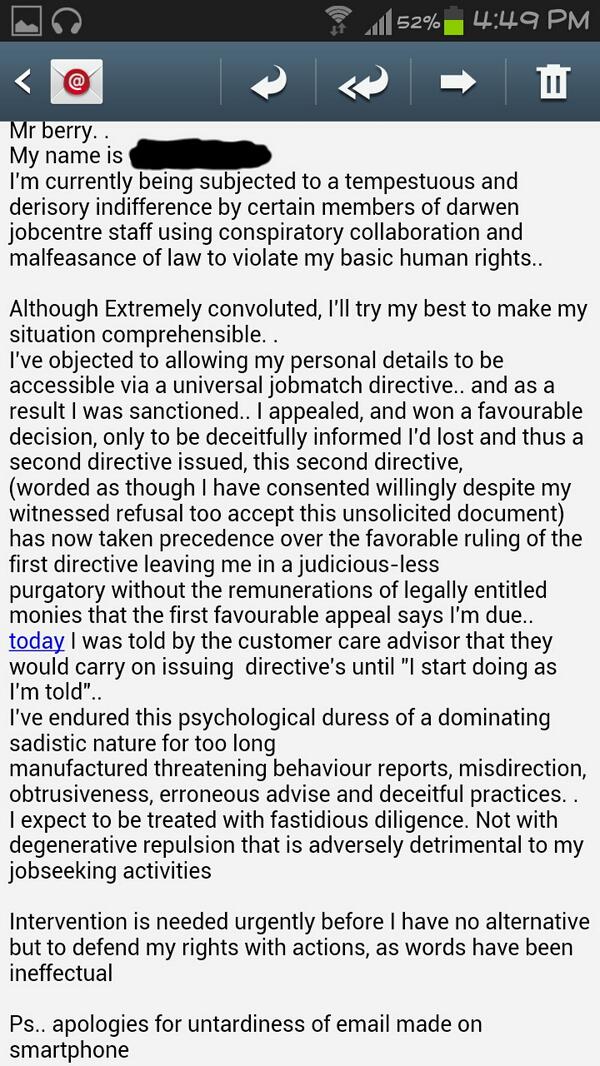
A JSA Claimant’s Email To Their MP About Their Jobcentre Plus

November 5, 2013

Readers, I am sharing this because I think it should go viral. It could happen to anyone of us, whichever benefit/s we claim. This is a question of the behaviour of JobCentre Plus staff towards someone they are supposed to be employed to support.

I don’t think it is acceptable, and we should all remember it in case we ever experience something similar.

jc+

#JusticeForJames Campaign: A Very Positive Update

November 4, 2013

Remember Justice For James? This very positive update just dropped into my inbox.

Following your signature on our #JusticeForJames petition we are very pleased to let you know that we had a productive meeting with senior representatives from Oxfordshire County Council.

At this meeting the Council confirmed that they have been able to negotiate for James’ tenancy to be extended for six months while they work to find a permanent solution. We are sure this in no small part due to the support you have shown us in our campaign, so thank you. 

Ensuring James’ long term independence is not yet over and so during the next six months we will be working closely with the council to look at a number of more permanent options for James. We have made huge progress and I am now hopeful that we will find a good solution. We will let you know more once some of the details are confirmed.

David Cameron has asked to remain closely informed with the progress in James’ case. During my families’ meeting with him he stated his support of independent living for those with disabilities, which we felt was his genuine view. 

We want to help him turn those words into action and will be working on a much wider campaign around this to help other people in a similar situation to James. Please keep checking your inbox for messages from me as I will be in touch very soon to ask for your support once again in ensuring an independent future for those more vulnerable members of our society.

With many thanks for your support so far, it really has helped us influence James’ future.

Warm regards,
Alana

Martine McCutcheon Reveals ME, Depression

November 4, 2013

Actress Martine McCutcheon has told how she has got her figure back after ballooning as a result of depression and fatigue illness ME.

The former EastEnders star piled on an extra two-stone but has now shed the weight with a combination of exercise, diet changes and improving her mental well-being with anti-depressants.

The star is now so comfortable with her body she has posed in a vintage negligee for Hello! magazine as the 37-year-old told about her fight back to health.

She said: “The illness made me lose all my muscle tone and my skin became loose and dry. I had the body of an old woman. I would think, ‘That’s not me’.

“Because ME is an illness that affects the brain and nervous system, your hormones are all over the place, which makes you prone to bloating and sporadic and sudden weight gain and loss.

McCutcheon, who has been unwell for seven years, said it left her full of self-loathing.

Getting the chronic fatigue under control has helped the Love Actually actress to start exercising again.

She said: “I go to the gym, I walk, I do Pilates and whilst I won’t deny that I would love to be slimmer, I have realised that short of living on fresh air, I’m never going to be a skinny Minnie.

“If I work out hard one day, I have to make sure I rest up the next. But my jeans fit nicely now, so that makes me happy. I feel like I’m getting there again, which is wonderful.”

She said she and husband Jack McManus are hoping to be parents, or at least expecting their first child, within a year, now her health has improved.

“It’s what I want more than anything, but I’d been so scared that I wouldn’t be able to. I thought, ‘How can I bring a baby into the world when I’m not well enough to look after myself?’ Now I feel I could,” McCutcheon added.

:: The full interview is in the new edition of Hello! which is on sale now.

Disabled MPs Who Claimed For Energy On Expenses

November 4, 2013

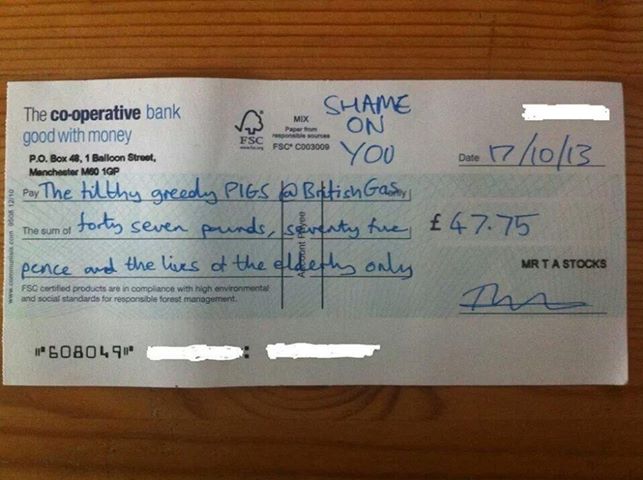
Following the Sunday Mirror investigation which uncovered the shocking fact that 340 MPs claimed for their energy bills on expenses, the publication yesterday named and shamed them in the form of a written list.

With great, deep sadness, I learnt last night that there are no fewer than four disabled MPs on their list, and two of the three MPs who have been Ministers for Disabled People since the Coalition Government took power.

In order of amount, they are:

  • Paul Maynard MP £1204.61 for gas and electricity.
  • David Blunkett MP £1095.91 for gas and electricity.
  • Andrew George MP £593.05 for gas and electricity.
  • Dame Anne Begg MP £120.74 for electricity.

I used to look up to all four of these people. I used to be proud of their achievements. I used to be inspired by them. I used to want to be like them.

Tonight, with great sadness, I realised they were no better than any other able bodied politician.

I feel betrayed. And I no longer want to be anything like them.

Politics is my great interest, Parliament is my ultimate dream. However, my roots have always been, and will always be, in disability. If I should ever be lucky enough to enter Parliament, I will never forget those roots. I will never forget the struggles and challenges that ordinary disabled people face every day to pay bills. I will never forget that at heart, I too am an ordinary disabled person.

In times like these, while ordinary disabled people face impossible choices about how to pay energy  bills, which are being raised by energy companies at the speed of light, I will never, ever, understand how disabled MPs could have lived with themselves after forgetting their roots and betraying their own community by claiming for energy.

As for the two Ministers, I wouldn’t have expected any less from them. We always hated them both anyway. In order of amount:

  • Maria Miller MP £2011 for electricity.
  • Esther McVey MP £467.42 for electricity.

All I have to say about them is that neither of them are disabled. They didn’t have to agree to represent disabled people. If they could live with themselves, watching energy prices rise, knowing how much the rises would directly affect the very people they represented, and knowing that they got their energy for free, why did they choose to represent us?

At least Mike Penning, our current Minister, doesn’t appear to be on the list.

If there are any disabled MPs on the Sunday Mirror list that I haven’t listed here, please do let me know in the comments below. I have only left them off because I don’t know they are disabled, but I will add them gladly.

Official Launch Of UKDHM 2013

November 4, 2013

I’ll be at this. If you live in London and are able to come, it should be a great night!

nut-logo

logo

Celebrating Our Struggle for Independent Living: No Return to the Institution or Isolation.     

Tuesday 19th November 2013

 5.30 (6pm start) – 8pm 

Abbey Community Centre, 34 Great Smith Street, London SW1 P3BU

                                                                       Speakers

Christine Blower, General Secretary NUT

                                                          Liz Carr, Comedian

Jackie Downer, CEO The Quality Company

Kirsten Hearn, Chair Inclusion London

Prof.Mike Oliver, Writer

Prof. Jan Walmsley, History of Learning Difficulty

Chair-Richard Rieser, Coordinator UKDHM

9732117489_41d2fc60f7 (1).jpg

Light refreshments will be provided.

Launch Co-sponsored National Union of Teachers 

Please RSVP to info@ukdisabilityhistorymonth.com or call 07907346273

Sunday Mirror Front Page: 3 November

November 3, 2013

sunday mirror 3 nov

That says it all, doesn’t it, readers? When rising energy prices have such serious potential circumstances for so many.

Krrish 3 Review

November 3, 2013

I’ve just seen the Bollywood movie Krrish 3. This is the latest in what has so far been a trilogy. It began with Koi Mil Gaya, the story of learning-disabled Rohit Mehra and his friendship with an alien.

Krrish 2 was a beautiful movie, telling the story of Rohit’s son, Krishna.

Now, in Krrish 3:

After defeating the villainous Dr. Siddhant Arya, and bringing his father Rohit back from the dead, Krrish continued fighting against evil and saving innocent lives. Now Krishna is living a happily married life with Priya, while Rohit is using his scientific brilliance to benefit society. And Krrish is everyone’s favorite superhero saviour. Unknown to them, a dark force is growing in another part of the world. Kaal, an evil genius, is selfishly misusing his powers to spread fear, death and destruction. And he is being assisted by an army of very dangerous beings, which he has created himself. Not long after Kaal’s plans are put into action, both Rohit and Krrish find themselves faced with a crisis of epic proportions, which only they can resolve, together. But when they finally cross paths with Kaal and his army, neither of them is prepared for what lies ahead. Kaal not only brings the world to the brink of disaster, he also puts the strength and love of Krishna and his family to the test.

The reason I’m writing about this movie here is Kaal, the evil villain. He has the mind of a superhero, but he is paralysed from the neck down, apart from the use of two fingers, and uses a wheelchair.

I would usually have been thrilled about the character of a wheelchair user with superpowers in any movie. However, this one is truly evil. He grows up unable to understand his disability or his superpowers, and sets out to use them to find a cure.

In his attempt to find a cure, he creates a race of beings from a mixture of human and animal DNA. This element strongly resembles Avatar, and the Na’vi race, except, of course that in Avatar the nonhuman race befriended and cured Jake Sully. In Krrish 3 the animals are out to destroy human lives and cities.

As a whole, the movie had more than enough science fiction to please a male audience of all ages and just enough Hindu mythology to make a perfect Divali special.

It also had just enough nostalgia for this fan of the trilogy.

However, I came out confused. A part of me- the teenage girl who loved the characters and the first two parts of the trilogy, obviously wanted a happy ending for the family.

But the disabled person in me, the one who constantly looks for positive media representation of disabled people, found herself wishing that Kaal had used his superpowers in a much more positive way.

I sincerely hope that any young children who watch this movie, disabled and non-disabled alike, realise that while it is absolutely fine for a wheelchair user to have the mind of Stephen Hawking, and through that mind the powers of Superman, any wheelchair user with that much luck should use their brilliance in positive ways. Of course, in reality, most of them do.

However, I sincerely hope that non-disabled children don’t come away from this movie with a fear of wheelchair users! Because one evil superhero in a wheelchair doesn’t make all wheelchair users evil. I promise.

An Open Letter To IDS

November 3, 2013

Seen here yesterday. Please share widely.

Lynne Maguire

I wrote this open letter earlier today after reading more of what is happening with this government. I hope you would publish it.

Dear Mr Duncan Smith,

Since the government have declared that it is illegal to assist in a suicide so that sufferers of certain illnesses must prolong their life to the bitter end, even though they don’t wish to, can you please explain to me why you are allowed to let people die whether they want to or not?

Dignitas and other organisations can give people a choice to die with dignity, without starving or freezing to death if they wish this to happen. And whilst your government have put in place an end of life care package, it nowhere near meets the same quality of end of life as that of those organisations. In fact, it is based on starving people to death which can take days. There is no dignity in that.
It is quite possible that those people who would wish to end their lives are claiming some kind of benefit.

By taking away the money people need, you are placing them in a very dangerous situation. They will eat or they will heat their homes, but they will not be able to do both. It is a very stark choice to have to make. If they eat, will they freeze to death and if they heat their home then they will almost definitely starve to death. Some people will probably make this choice anyway as you have made it so impossible to continue with their life as it is.

A concerned victim of your policies.


South Ayrshire Council Join Knowsley Housing Trust In #BedroomTax Children’s Services Threats

November 2, 2013

Yet again, for the second time today, I’m shocked. Going on Scotland’s recent record on the Bedroom Tax, I would never have expected this from a Scottish council. I thought they planned to abolish bedroom tax after independence, if it happens.

CALLOUS council chiefs stand accused of acting like childsnatchers as they seek to evict desperate families over bedroom tax arrears.

South Ayrshire Council sent out a shocking letter threatening to force struggling parents from their homes – then report them to Children’s Services.

The council agreed in March that no families would be evicted over debts caused by the hated tax, which hits the poorest in society hardest.

But the letter, sent on behalf of director of care Harry Garland, says: “The attached notice warns you that South Ayrshire Council can take legal action to repossess your house at any time during a six-month-period.” The eviction letter targets people over arrears as little as £250 and warns that repossession action will cost the tenant £400.

And it puts the boot in by saying: “If you have children in your household, we may also inform Children Services.”

Bedroom tax protester Alan Wylie said: “We have seen letters like this but nothing with such a terrible threat.

“The council are effectively saying we will put you on the street then report you to the people who take children from their parents.

“The inference is that because they will be homeless, they won’t be able to look after their kids.

“It’s sickening and I have spoken to people who are terrified because of this bullying. Whoever came up with this strategy is behaving like a childsnatcher.”

Ayr MP Sandra Osborne said: “This is harking back to the bad old days when families were terrified by the threat of social services seizing their children.

“This letter makes a very strong implied threat and there is not a word dedicated to helping families in need. It is nasty and cruel and I believe it is a disgrace.

“Social services departments are meant to be there to help families in time of need. They are not to be used to batter parents into submission over a tax that is iniquitous and unfair in itself.”

Garland, who took up his post in the Tory-led council after being director of children’s services on Orkney, insisted the letter was meant to ensure that families received all necessary help.

He said: “We have responsibility for children’s welfare and clearly we don’t want anyone to be in any difficulty. If there are children within any household that are having difficulty, we contact them to see what additionally we can do for them.”

Garland denied that families were being threatened. He said: “That’s clearly nonsense. That’s not the spirit or the intention of the services. It’s quite the opposite.

“That letter goes out to people who won’t communicate with us. What we are trying to do is say that if there are children within the family and they have difficulties, come and talk to us and we will do something to support them.”

Garland refused to apologise for any distress caused to families. He said: “I’ll have to look in detail at the form of contact that has gone out and how regularly that has happened and consider if that should be altered.

“If people are misconstruing what the letter is saying then clearly we will look at it again and make sure it is absolutely crystal clear what the intention is.

“The council made a decision that if people work with us there will be no evictions within 12 months but people have to work with us to enable that.

“The letter was trying to get people to communicate with us and deal with any problems.

“It is not the council’s or my intention to upset anyone and I would urge anyone with any difficulties to contact the
relevant officers and we will try to sort out the issues.”

The bedroom tax, brought in by the Con-Dems in April, removes the spare room subsidy attached to housing benefit and has led to thousands of cases of arrears.

Dear Richard Littlejohn, here’s some polish for that turd.

November 2, 2013

Richard Littlejohn, enemy of Same Difference and anyone else with a brain, scribbles nonsense. That’s not new.
Jack Monroe responds with strength and humour. That’s what’s new.

Jack Monroe's avatarCOOKING ON A BOOTSTRAP

Dear Richard Littlejohn,

I’ve read your trash non-journalism ‘comment’ piece about me in the Daily Mail this morning – not because it is a newspaper I read, but because a friend forwarded it to me.

Firstly, I have to commend you for managing to get so many facts completely wrong in a comparatively short article. But that’s your style isn’t it – never let the truth get in the way of a good smear campaign, or something like that.

So just in case you wanted to attempt to polish that turd of an article with something that resembles the truth, here’s some of them addressed:

1. I’m not single, I’m getting married in the Spring.

2. When I returned to work after maternity leave, I found it impossible to cover the irregular night shifts thirty miles from home with any form of childcare. Childminders just don’t work all night. My…

View original post 1,099 more words

Knowsley Housing Trust – pay your rent or social services will take your children away

November 2, 2013

Just when you thought Iain Duncan Smith could not stoop any lower………. UPDATE

November 2, 2013

leonc1963's avatarDiary of an SAH Stroke Survivor

Many of you have read the tragic circumstances here

http://diaryofansahstrokesurvivor.wordpress.com/2013/10/31/just-when-you-thought-iain-duncan-smith-could-not-stoop-any-lower/

I now bring you an update to these tragic set of circumstances which is just a snippet of how corrupt this Government is indeed I believe they think they are above the law and any other person would be in Contempt of Court.

Below is a further letter from L J Duut’s Mother who is a constituent of Iain Duncan Smith:

My mother has just sent a response to her letter as follows: 01/11/2013

Ref: POS(1)4004/238

Dear Ms N*** and Mr Duncan Smith,

I have received a letter from Mr Iain Duncan Smith, dated 28th October 2013, stating that it is in reply to my email of 22nd September 2013, that was sent to Ms Jo Nash.

The letter is totally out of context and does not relate to my letter in any way.

I am now attaching an emailed…

View original post 369 more words

Week of Action to Stop Workfare and Sanctions: 2nd – 8th December

November 2, 2013

johnny void's avatarthe void

sanction-sabsFrom Boycott Workfare

In January this year, 110,000 people had their benefits stopped – ‘sanctioned’ – in a social security system that now leaves people with nothing for up to three years.

The government has not revealed how many thousands of people have been sanctioned since then, but it looks clear that more than a million people will have faced sanctions – and the hunger, pressure on families and stress they cause – by the end of the year.

Workfare, which forces people to work without pay and pushes those in work out of their jobs, is still the government’s ‘flagship’ solution for the unemployed. Osborne’s latest workfare proposal is more than twice the length of a maximum community service sentence.

But people’s action is pushing back their plans:

  • Wetherspoons, Argos, Shoezone, The Red Cross, and Superdrug have all dropped out since the start of the year. Homebase has scaled back significantly and Homes for Haringey has started paying people.
  • Despite a court ruling, the government is…

View original post 224 more words

Obituary: Augusto Odone, Father Whose Story Inspired The Movie Lorenzo’s Oil

November 2, 2013

From the Guardian.

The tale of the determined amateur who proves the professionals wrong is always a compelling one, but with Augusto Odone – who has died aged 80 – it went much deeper. In 1984, his youngest child, Lorenzo, just a month away from his sixth birthday, was diagnosed with adrenoleukodystrophy (ALD), a neurological disorder that causes the degeneration of the brain in young boys. “We were told to go home and watch Lorenzo die,” Odone recalled. Neither he nor his wife, Michaela, was prepared to do that.

And so Augusto, an economist based at the World Bank in Washington DC, who had no scientific training, spent the time that he was not caring for his boy in the library of the George Washington University near his home, trying to understand ALD. It was, he read, linked to the accumulation of Very Long Chain Fatty Acids (VLCFA). How would it be, Odone suggested to various medical experts on the basis of his own reading, if the properties of oleic and erucic acids in combating VLCFA were combined? Might that halt the development of ALD? He organised seminars and conferences to seek expert opinion, but the establishment was sceptical, especially over the use of erucic acid.

Here Odone’s essential character – determined, driven, sometimes even wilful, telephoning colleagues in the middle of the night when an idea occurred to him, so eager was he to translate it into action – took him further than many others in similarly desperate circumstances might have gone. He and his wife simply refused to be defeated by the medical consensus.

They found a retired British chemist, Don Suddaby, willing to make up a batch of the combined oil. And then they set up their own clinical trial, testing it on Michaela’s sister, also a carrier of the ALD gene. When they saw a dramatic drop in her VLCFA levels, with no side effects, they knew they were on to something.

They did not wait for their findings to be peer reviewed, but instead, from 1988, gave what became known as Lorenzo’s Oil to their son every day. It worked. “The ALD serpent that had brought so much grief to our family had been tamed for good,” Odone wrote.

Their story caught the eye of Hollywood and in 1992 Lorenzo’s Oil, starring Nick Nolte and Susan Sarandon, was released, bringing the Odones’ remarkable fight to global attention. They used the film’s success to fund and draw attention to the Myelin Project, a research organisation they had established in 1989 with Augusto as its passionate, unstoppable president, to tackle the next great challenge that faced them – restoring the myelin sheath, the coating on the nerves, that is destroyed in ALD and in multiple sclerosis.

Though Lorenzo’s deterioration had been halted by the oil, it could not reverse the damage already done to his body. Within six months of diagnosis, he had been bedridden, unable to move, speak or swallow, and had to be fed by tube. Both parents cared for him with great tenderness and determination, always conscious that locked inside his body was a fine mind. They made him the calm centre of their lives and their home. It was an extraordinary, exhausting and humbling act of parental love and devotion.

Michaela died from lung cancer in 2000, after which Augusto was joined as principal carer by Oumouri Hassane, who had first become part of the Odone family when Lorenzo was a baby and they were posted to the Comoros in the Indian Ocean by the World Bank.

Progress on myelin regeneration remained painfully slow, though Lorenzo’s medical condition was stable for a quarter of a century, beating off every bout of flu, cold and even the pneumonia that, it had been often predicted, would kill him. However, in 2008 an infection in his feeding tube precipitated his death, the day after his 30th birthday.

Three years earlier, after enduring endless sniping from the medical establishment – the Odones were accused of “preferring a Hollywood ending” – Augusto had been vindicated. An authoritative study by the Kennedy Krieger Institute in Baltimore showed that in young boys with the ALD gene given Lorenzo’s Oil before the onset of symptoms, 74% did not develop the full-blown disease.

Augusto was born in Rome and grew up in the Piedmontese town of Gamalero. His father, Angelo, was a leading figure in the Italian resistance movement, and his mother, Maria, wrote several books on home economics. He studied law at the University of Rome and then went on a Fulbright scholarship to the University of Kansas. In 1969 he moved with his first wife, Ulla Sjostrom, and two children to Washington DC, and joined the World Bank. The marriage ended in divorce, and in 1977 he married Michaela Murphy.

After Lorenzo’s death, he returned to Europe, to the Italian city of Acqui Terme, in the region where he had grown up. He wrote a memoir, Lorenzo and His Parents (2012), allowed himself to be cared for by his grown-up children, and carried on with typical determination during years of poor health. Lorenzo, though, was never far from his thoughts. “I dream of him often. Sometimes he is in his sick bed, but often he is that small boy, running and swimming in the Comoros.”

Augusto is survived by Cristina and Francesco, the children of his first marriage.

• Augusto Odone, economist and medical pioneer, born 6 March 1933; died 24 October 2013

An ATOS Nurse’s Story

November 1, 2013

Seen here. Shared in the interests of sending it viral. This shows that the ATOS nurses do know exactly what is going on and don’t like it.

I resigned from Atos in 2012.

As a nurse, I was taught to care and be compassionate about the people I was in contact with. This was not the case with Atos.

It was very much a target driven role and you were under constant pressure to meet these targets. We had to see a minimum of 6 clients per day, some nurses were managing 10 and I often wondered how. I was warned, on a number of occasions, about this. If another nurse asked for help, I was more than happy to help or discuss a difficult case. My manager had a firm, but polite, word with me in a quiet corner, and reminded me of my role, which was to meet targets, not have general chit chat with colleagues. We were not allowed to offer any advice to our clients and we were not supposed to engage in a conversation, unless it was about the assessment. This was extremely hard to avoid, especially with a client with learning difficulties, who would often love to chat!

The doctors would ‘cherry pick’ the easy clients, as they were paid per case and often saw, on average, 14 cases per day. Very good, considering they worked office hours.

We were monitored closely on how many clients we put into Support Group . If our totals were above the national average, we would have to ask an ‘experienced’ member of staff for permission to put a client into a support group, even if it was plainly obvious they could not return to work. Those members of staff who had a low number of support group additions, were praised.

I assessed a client with mental health issues who I entered into the support group. I was so concerned about her I stayed with her, in the waiting room, until a family member came to collect her to take her home. I was instructed to attend a meeting with my manager and was given a verbal warning for costing Atos money – when I asked how this was possible, I was informed that during the time I was with this client in the waiting room, I could have assessed somebody else.

I assessed a client with visual problems, due to her diabetes, who could not read 16 point print, nor could she see hazards in the street. Although not registered blind, she was under the care of a consultant, was receiving treatment and needed constant support from her family. Although there was not a suitable support group for her, I put her in a higher group and recommended she was recalled in 18 months, after she had received treatment from her consultant, to assess her condition. I was instructed, by my manager, to downgrade her. I was told to add her to a lower group and recall her in 6 months. I strongly disagreed, due to her current condition and underlying medical problems, but was told, in no uncertain terms, not to question my managers judgement. It was at this point I decided to resign.

I could not live with the knowledge of what I was doing and the effect this could have on somebody’s life. Although there are a number of people who are more than capable of work, the majority are genuine, sick people who need our help, not to be demoralised in this way. I saw so many people who would cry in front of me, because they want to work so much, but couldn’t.

Atos Healthcare do not care about their staff and more importantly, do not care about their clients. They are more interested in making money and I believe they should be stripped of this contact with DWP. This is not a job any nurse should do, if their NMC registration means anything to them.

J. Stoker. RGN


GOSH To Trial Downs Pregnancy Blood Test

November 1, 2013

A simple blood test during pregnancy which can detect Down’s syndrome in the developing foetus is to be trialled by the NHS.


It could significantly reduce the number of women needing invasive testing, which can cause miscarriage.


The study at Great Ormond Street Hospital will assess how and when the blood test could be introduced across the NHS.


In the UK, 750 babies are born with Down’s syndrome each year.


All pregnant women in the UK are offered screening for Down’s syndrome.

Miscarriage danger

Currently a woman’s risk is assessed, based on her age, an ultrasound scan and markers in the blood. Those deemed at high risk of a child with Down’s are offered an invasive test.


It involves using a needle to take a sample of either placental cells or of the fluid that bathes the baby – but this procedure carries a one-in-100 chance of miscarriage.


The aim is to reduce the number of women having the invasive testing by more accurately assessing the risk.


The new blood test, which is already available privately, looks for tiny fragments of DNA from the placenta and the foetus floating in the mother’s bloodstream.


Down’s syndrome is caused by an extra copy of a massive stretch of DNA – a part or even all of chromosome 21. The test can analyse the free floating DNA for extra copies.


It is thought to be 99% accurate. Those with a positive result will still be offered the invasive procedure to confirm the result.


Prof Lyn Chitty, from Great Ormond Street who is leading the trial, told the BBC: “It could very significantly reduce the number of invasive tests and increase detection, this is seriously exciting stuff and it would be great to get it into the NHS.


“What we are trying to do is give information on how and when to introduce it into the NHS.”


The NHS National Institute for Health Research funded trial will analyse the scale of the benefit and the best way to inform mothers and train staff, including midwives, about the test.


“One of the very important aspects of our study is looking at ways to ensure women understand the test and the implications of the results so that they can choose whether or not to have it,” she said.

‘Earlier and safer’

Dr Anne Mackie, from the UK National Screening Committee, said: “Early indications suggest that using Non-Invasive Prenatal Testing (NIPT) to screen women who are found to be at a higher risk of having a baby with Down’s syndrome would enable earlier and safer detection of the condition.


“[We have] been working in close collaboration with Great Ormond Street Hospital for Children, particularly in looking to ensure the new test does not affect the quality of the current service offered to pregnant women.”


Carol Boys, the chief executive of the Down’s Syndrome Association said: “We would be delighted if tests which lead to miscarriage were discontinued.


“We understand that the new test is approximately 99% accurate for those women who have already been established as having a high chance of carrying a baby with Down’s syndrome, and are interested to see if that accuracy is maintained in women where this has not already been established. The studies for this are still under way.”


She said the information and education provided to women and health professionals would be important.

Just when you thought Iain Duncan Smith could not stoop any lower……….

November 1, 2013

leonc1963's avatarDiary of an SAH Stroke Survivor

Permission given by those concerned in this article

They have request that this be blogged and that I help in making it go viral so I ask if you agree with what has been published here you too share, blog and retwit as this is a new low of Iain Duncan Smith and I for one am truly disgusted not only with his reply letter that did not even touch base with the issues raised he also chose to pass the buck this smacks of total incompetence.

The person this refers to is a BRITISH CITIZEN indeed she has lived here all her life, was born in Chingford LONDON and is a UK Passport Holder. She has worked here paid her taxes here, however this Govt want to send her to Holland.

The letter I will copy and paste below is a letter sent to Iain Duncan Smith by the…

View original post 1,521 more words

#ATOS Process Is ‘Terrorism By The State’ Says Claimant At Tribunal Statement

November 1, 2013

Spotted here.

ATOS Miracles

Paul Somethingtobe Barnard a statement I made at #WCA tribunal –
“I have to say that this process which started in April 2012 at my first visit to the ATOS office in Chatham, has been the most painful humiliating and brutal treatment of another human being I can imagine. this is terrorism by the state on people who already have massive hurdles in life to deal with. it is worse treatment than meted out to criminals. … it is cruel relentless and vicious bullying of people who have no choice by the state…. it has taken me personally to the darkest place I have ever been, especially in view that I had made some progress with both my physical and mental health problems. I believe that the only reason I have survived it is due to the 5 years of intense therapy which I sold my house to pay for. nearly all others have not had that help, and I personally know three people who have killed themselves directly as a result of this process. it has achieved exactly the opposite of the government stated policy. it has caused through fear and stress a terrible degeneration in my physical and emotional state and made it almost impossible for me to function in ways that I was able to prior to this. I would wish that no human being should be subjected to treatment of this nature ever again. it is obscene. it has been 18 months of torture.
There wasn’t much they could say to that”

https://www.facebook.com/ATOSM

Disability-Friendly Halloween Costumes

October 31, 2013

I looked for something like this all day and I just found it. Better late than never!

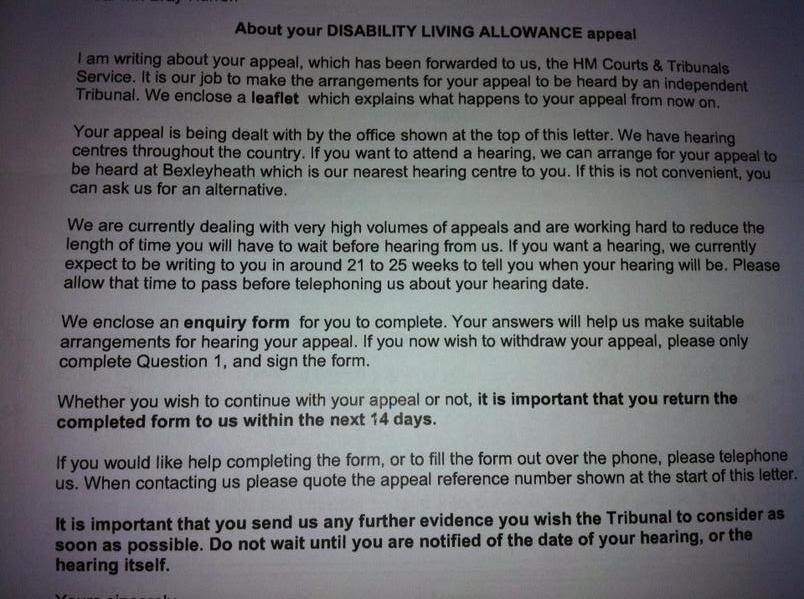
Up To Six Month Wait For DLA Appeal DATE

October 31, 2013

With many thanks to @Inkysloth for Tweeting the letter.

DLA appeal to use

In his words “F***!”

So not only does a person lose money which is needed for essential equipment and services, and sometimes for food and heating, but they have to wait up to six months just to find out when they’ll be told when they might get that essential money back. And then of course there is the possibility that after all that, they might lose the appeal anyway.

Shocking.

Many thanks must also go out to @SocietyGuardian for covering this in their daily bulletin. Other media organisations should join them, and soon.

Something needs to be done about this, and fast.

Two One Direction Fans Sing ‘I Would’ In ASL For 1D Day Challenge

October 31, 2013

When I think about viral teenage bands, One Direction spring to mind instantly. I don’t really follow them myself, but I know they have amazing careers.

I’ve just found out that 23 November will be 1D Day, on which One Direction will take part in a seven hour livestream. They want their fans to participate in any way possible.

So two One Direction fans who can’t hear filmed this video, in which they sang ‘I Would’ in American Sign Language.

Your Thursday Treat!

Teacher Struck Off For Two Years For Saying: ‘Hitler Wasn’t All Bad, He Killed The Disabled’

October 31, 2013

And gays, and Jews. Only two years! We should campaign to make the strikeoff permanent!

A teacher in Scotland who told students that “Hitler wasn’t all bad”, because he killed gay people, has been struck off.

David McNally told a Higher class: “Hitler wasn’t all bad – he killed the Jews, the gays and the disabled”.

He went on to say to a third-year Religious Education class that he would “rather have been a prison warden or a child abuser”, according to the General Teaching Council (GTC).

Pupils subsequently complained to their parents about the comments, which were made at Kilwinning Academy, Ayrshire, in November 2012.

McNally, a supply teacher, was found to be unfit to teach at the GTC hearing, at which he was not present. He accepted that he had made the remarks in his written submission.

In it, he wrote that he was having a “particularly bad day” and  that he had made the comments in a 
“general sense”. This was rejected by the GTC.

Among other comments, McNally also asked pupils: “Did you have sex at the weekend?”, as well as saying: “I love my mobile phone because I can sit and watch porn on it.”

He also reportedly said: “I have a part-time job at a children’s home – they have taught me how to whip a child with a wet towel without leaving a mark.”

McNally was struck off the teaching register, and cannot reapply to teach for two years.

In its decision, the panel said: “The panel had regard to the 
detailed submissions made by the respondent.

“The panel rejected the suggestion that the comments had been made in a general sense.

“It noted that the 
pupils had reacted to the comments by 
reporting the matter to their parents.

“The panel was of the view that the 
explanations by the 
respondent did not 
reduce their gravity and considered that, 
under any circumstances, they were entirely inappropriate.”

McNally may appeal once he receives written notification of the GTC’s ruling.

Text Of Kate Green’s First Speech To Unison Disabled Members Conference

October 31, 2013

The Shadow Disability Minister gave this speech yesterday:

It’s a great pleasure to join Unison here this morning. Earlier this year, I was fortunate to be invited to your equalities conference, and I think I recognise some of the same faces! But I have to tell you this is my very first speech in my new role as shadow minister for disabled people – so I hope you’ll be a little kinder to me – you know so much more than I do, and you will have much more to tell me than I can tell you.

Writing this speech has however been made much easier for me by a very helpful article which was published last week by my predecessor Anne McGuire.

I know Anne is well known to you, and I can imagine there was real dismay when she announced she was stepping down from the frontbench.

She’s been an expert, passionate and committed advocate for the rights of disabled people for many years, she was a highly effective minister when we were in gvt, and I know she’s a very hard act to follow.

I’m very glad to say that she’s also my good friend.

Anne in her article last week wrote that the last three years have been the most threatening for disabled people and their families, and I could not agree more.

After years of progress – under both Tory and Labour governments – the DDA, Making Rights A Reality for Disabled People, the signing of the UN Convention – under the Tory-led coalition it feels we have gone back to the dark ages.

Disabled people have been – I think it’s not an exaggeration to say this – they’ve been vilified, while the support that they rely on has been slashed, without a care for the long term or the human consequences.

According to campaigners, disabled people have been hit 9x as hard as non disabled people by austerity cuts.

And such support as has remained in place is increasingly being confined to the most severely disabled .

Yet such an approach is simply counterproductive.

It will lead to greater isolation, reduced social participation, worse health outcomes, less chance that disabled people will be able to participate economically.

It will pile up costs and anguish for disabled people, their families, communities, and ultimately the public purse.

Yet even as disabled people are taking the hit, every day it seems there’s a drip drip of stories in the media that repeatedly portray them as scroungers, skivers, or frauds.

So I want to say very clearly – what’s being said, insinuated and implied, is wrong, it’s cruel and it’s shameful.

It creates division, and it feeds into quite despicable levels of abuse and violence.

It underlies unacceptable levels of hate crime against disabled people, and we need to call time on it now.

Labour will continue to stand against this, and condemn misleading and inflammatory portrayals of disabled people – and I want to lay down the challenge to government ministers: you should be doing so too.

But while there’s so much for us to be angry about under the present gvt, today I want to think ahead about how Labour would approach disabled people’s rights.

I hope some of you will have contributed to the work that Anne and Liam Byrne set in train to consult widely on what a Labour government could do to make disabled people’s rights a reality.

We’ve asked Sir Bert Massie to chair a taskforce advising us on how we should take our thinking forward in the light of what we’ve been told, and I’m very much looking forward to discussing ideas with Bert and his team.

But, you know, I’m already clear about the guiding principles that we as a Labour government will follow.

Ed Miliband has talked powerfully of how we are a One Nation party.

That means a vision of a better Britain, in which everyone has a stake, everybody plays a part, prosperity’s fairly shared.
And nowhere could our notion of being One Nation be more tested than in the way in which we include disabled people and stand up for their rights.

So every policy Labour develops will be about including, not isolating disabled people.

It will be about respecting them, celebrating the contribution they make, not demeaning and insulting them.

And disabled people themselves will be co-producers in decision-making about them and their lives.

Of course, every individual will face different circumstances, no two disabled people have the same lives or needs.

But we should not be satisfied until every disabled person can achieve their full potential.

Now, we’ve said we will be tough on benefits spending. That doesn’t mean blaming or demonising people, but it does mean being tough on what it is that prevents every disabled person is from participating as they could.

For many, that includes being in work.

And I think we have much more to do to address the disadvantage that disabled people face in the labour market.

Why are disabled people less likely to be in work, to earn less if they are in work, or to progress less than non-disabled people?

What barriers are in their way? And more important, what do we do about it?

I truly believe the gvt has missed a huge trick in its annual reviews of the WCA. It could have taken the opportunity to think big.

But nowhere have ministers asked – what would need to change to enable more disabled people to work and to thrive at work?

Instead they’ve concentrated – crudely – on sorting people into those who can work and those who can’t, and putting more pressure on individuals they think could work.

I simply don’t buy that binary approach. People’s lives are more complicated. Conditions are more nuanced. Work – and contribution – comes in many forms.

So I want to look very hard at all aspects of disabled people’s employment chances, not just go round beating up on Atos (though they deserve some of that), not just a bit of tinkering with the WCA.

I want to see our labour market strategy linked much more closely to our industrial strategy.

And I want us to learn from what were able to try in govt – whether that’s Work Choice, A2W, P2W, NDDP – and take a hard look at what worked and what did not.

On social care, my colleague Liz Kendall and I want a sustainable model that ensures we don’t get into a situation where disabled people end up becoming increasingly dependent for want of often quite small amounts of care.

The government clearly thinks responsibly for caring can be thrown more and more on families.

But that’s not always feasible, it’s not fair, it’s not economically effective, and it’s not what many disabled people want.

We need a system that preserves people’s independence, that is a springboard to their wider participation in society, not a means of putting them out of sight and out of mind.

And on financial support for disabled people, well look, I’ve always known that a secure and decent income is a prerequisite for full social engagement – whether that’s about participating in education, employment, being able to volunteer or participate in community activity, care for your kids, enjoy and live your life.

You know we won’t be able to reverse every benefit cut when we come into government, though we’ve already said we’ll abolish the hated bedroom tax – and 2/3 of those affected by it are disabled people.

But I’ll tell you this: I am all too aware that the cost of living crisis is felt acutely by disabled people, as the extra costs associated with disability pile up.

So it will be my priority to make sure that every measure we announce to address the cost of living crisis that families face under this out of touch, arrogant, millionaires’ gvt – that every one of our policies goes the extra mile to work for disabled people, their families and carers too.

I’m conscious of how much of your time I’m taking. It’s because there is so much I want to say.

So let’s treat this as the start of a conversation, not the end of a speech.

When I heard Anne was standing down, I too was dismayed – but I have to tell you my very next thought was that I passionately wanted her job.

I know how bad things have become in just three short years, but I know we can do so much better for disabled people. I know it can be better than this.

With your support, I very much look forward to getting to grips with the challenge. Please let’s stay in touch.

Internal Memos Reveal Fresh Attacks On Claimants And Job Centre Workers

October 30, 2013

Spotted here. Cross posted because of it’s seriousness.

Job centre internal memo seen by Socialist Worker

Part of job centre internal memos seen by Socialist Worker

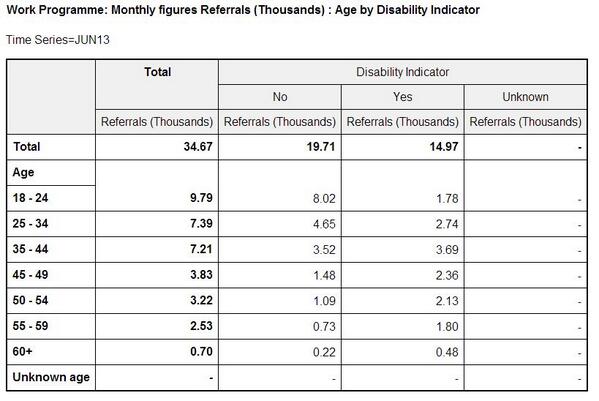
The government is changing the rules to make it harder for disabled people to appeal when it takes away their benefits.

And they are clamping down on job centre staff who try to help claimants, in an effort to break an “appeals culture”, according to internal memos seen by Socialist Worker.

People claiming Employment Support Allowance (ESA) can be stripped of it if they are deemed “fit for work” in controversial tests run by companies such as Atos Healthcare, known as Work Capability Assessments (WCA).

WCAs have come in for massive criticism from doctors as well as disability campaigners, and almost 40 percent of people who appeal against a WCA decision are successful.

The high appeal rate has been a huge embarrassment for the government—as it exposes how arbitrary and unfair their assessments are.

But instead of changing the system the government is making it harder to appeal against it.

From now on people who wish to appeal must do so by a tribunal instead of through the job centre.

Job centre staff have been strictly instructed not to download and print the forms for claimants, but tell them to find the forms themselves from the tribunal service.

This is a process that many claimants will find difficult, particularly if they lack internet access and printing facilities or suffer from mental health problems or learning difficulties.

Before they can even lodge a tribunal appeal, claimants have to ask the government to reconsider. There is no time limit for this process, and during this time claimants will not be allowed to claim ESA.

They can claim other benefits, such as jobseekers’ allowance, though this may later be counted against them when they argue that they need ESA.

Once they move to tribunal appeal they can claim ESA again—but job centre staff have been told not to make them aware of this right unless they explicitly ask.

And WCA decisions are to be sent directly to job centre advisors in the hope that this “contributes to a reduction in appeals” too.

One job centre worker told Socialist Worker, “The government sees job centre staff as part of the problem for helping claimants stand up for their rights, and they are trying to curtail that.”

Instead of moving the goalposts they should scrap the unfair WCA system altogether.

Remploy Factories To Close Tomorrow

October 30, 2013

The end of an era for disabled people. The end of choice, of the meeting of needs, as well as of employment. It will be a sad, sad day that will see many forced into something that just won’t be suitable for them for reasons they just can’t help- mainstream employment.

Even more sadly, as a result of benefit cuts, the choice will be that, or starve.

The last Remploy factories close on Thursday, ending 67 years of state-run sheltered factory employment for disabled people in the UK. For some, it represents a long overdue progression from paternalist attitudes towards disability and work; for others, an unforgivable betrayal.

Closure of Remploy’s remaining three furniture factories in Blackburn, Sheffield and Neath, south Wales, will draw a line under an issue that has riven the disability movement and caused huge difficulties for successive governments. Recriminations are likely to continue for many years, but there will be no return to the concept, part of the welfare state settlement, of a protected workspace for disabled people, operated and subsidised by the taxpayer.

Tim Matthews, Remploy’s chief executive, has overseen the final, painful switch from sheltered factories to supporting people with disabilities into mainstream employment – a side of the operation that will continue.

For him, the move has seemed inevitable since the day, four years ago, when he visited Remploy’s Birkenhead textile factory, which eventually closed last year.

“For a variety of reasons, they had lost their contracts, and there were 30 or 40 people sitting there doing absolutely nothing,” Matthews recalls. “They had no work to do and had not had any work for some time.

“Later, I went down the road to the Birkenhead branch of Remploy Employment Services (Res), which had not been open very long, and learned that they had placed more than 40 people in work in six months. That was quite a contrast: 40 people sitting around doing nothing in our factory against 40 people in productive jobs in the local economy. Which was the right model for supporting disabled people in the 21st century?”

Critics accuse Matthews and Remploy’s senior management of having done little to win new business for the factories, which numbered 83 as recently as 2007. Twenty-nine of those were closed the following year under the Labour government – something for which Peter Hain, who was work and pensions secretary and the MP for Neath, in south Wales, continues to be vilified in some quarters.

In 2008, Matthews, a former leading NHS executive, was recruited to try to make a go of the remaining 54 factories, while developing Res, under a modernisation plan that was given £555m of government funding over five years. But the economic recession hit that same year and the rapid move to outsourcing of public-sector services meant that councils, the health service and other government bodies were placing fewer contracts with Remploy – despite exhortations by ministers, notably then prime minister Gordon Brown who was a strong supporter of the organisation.

Matthews thinks it might have been possible to save a core group of factories if he had been allowed to make further closures and refocus product lines. But the issue had become too hot a potato for Labour, which was by then dogged by vociferous protests by Remploy workers .

The coalition government commissioned a report on the future of disability employment and training from a review team led by Liz Sayce, chief executive of disability charity Radar (now Disability Rights UK) and a known critic of sheltered factories. The report recommended winding down support for segregated employment, saying that each of the 2,800 Remploy factory workers was subsidised by an average £25,000 a year that could be better spent.

With that political cover, and following a subsequent consultation, ministers announced in March last year that all subsidies would end and the factories sold or closed.

Of the 54 factories, 36 were deemed unviable and shut in 2012. Of the remaining 18, three have been sold as going concerns. The sale of the successful automotive component division, which accounts for a further three, and of Remploy’s CCTV monitoring business is on the verge of completion. New small-scale enterprises owned and run by some of the workers made redundant have sprung up in seven other factories.

In all, about 390 jobs are expected to be saved or created out of 1,200 that remained in December. At their peak, in the late 1980s, Remploy factories employed more than 10,000 people at 94 sites – though they never made a profit.

It is unclear how many ex-Remploy workers have found other jobs. The Department for Work and Pensions says it has contact with 1,300 of the 1,800 people made redundant since March 2012, of whom 535 are back in work and 398 are in training. An £8m support package has been allocated, together with 200 personal case workers.

Matthews leaves Remploy at the end of the year when his contract finishes. A new chief executive will run Res, which has helped 50,000 disabled and disadvantaged people into work in the past four years. By March 2015, it is expected to be in private hands.

Matthews says: “By all measures … the business [Res] is going extremely well.”

To some, nothing can replace the support that the sheltered factories offered. Jerry Nelson, national officer for Remploy at the GMB trade union, says: “This is devastating for the people involved, some of the most disadvantaged in society. For many, the factory has been their whole life – and their lives are being destroyed.”

Government Loses Cait Reilly Workfare Appeal

October 30, 2013

But not the bit about slave labour. This looks like progress, of a sort, but I’m a bit confused, as it seems there could have been more progress.

The government has lost a Supreme Court appeal over a ruling its flagship “back to work” schemes were legally flawed.

Ministers failed in a bid to overturn an earlier ruling that regulations underpinning the schemes were invalid.

The case was brought by graduate Cait Reilly. She also claimed that requiring her to work for nothing at a Poundland store breached laws on forced labour.

But employment minister Esther McVey said the judges had specifically rejected claims of “slave labour”.

Critics have said the schemes are unfair because they involve work without pay and cuts in jobseeker’s allowance for those who failed to comply with the rules.

Five Supreme Court justices upheld a Court of Appeal decision which went against the government in February, because of shortcomings in the way the schemes were explained to those taking part.

But the Supreme Court rejected a counter-appeal against the scheme and upheld the Court of Appeal’s ruling in the government’s favour that the regulations did not constitute forced or compulsory labour.

Ministers had brought in new rules allowing the unpaid schemes to continue pending the outcome of the appeal.

Ms McVey rejected suggestions that the ruling was a blow for the government, describing it as a “victory for common sense”.

She told the BBC that the government had listened to the concerns about the schemes and would introduce further safeguards to clarify what was expected of those taking part.

But she insisted that judges had backed the fundamental basis of the scheme – to give people experience of holding down a job – and the possible use of sanctions.

“First and foremost, it is about getting people into work and supporting them the best we can and we are doing a very good job of that,” she said.

Labour’s Consultation Report: Making Rights A Reality For Disabled People

October 30, 2013

Sue Marsh appears to be quite excited about this.

But, as usual, Sue Marsh is absolutely right. She says that if Labour regain power and keep these promises, then this document will change the lives of disabled people.

Disabled people sincerely hope that, if Labour regain power at the next General Election, they will follow this document, as it sounds, and keep their promises. We sincerely request Labour to do so.

But, going by the current records of David Cameron and Nick Clegg, it is impossible to blame anyone for having their doubts.

Still, we watch this space in sincere hope.

Applied Behavioural Analysis

October 30, 2013

A year ago, Julie Barber came close to a nervous breakdown. Her son, Jack, who is four, has autism, and she felt overwhelmed by his demanding behaviour. “He was having two-hour meltdowns nearly every day,” says Barber, who lives with Jack in Thurrock, Essex. “I’ve got a bad back just from trying to manage him.” Her greatest worry was that, since the age of three, he had regularly refused to eat anything except baby food and custard, and it had to be a particular brown colour. “It was horrendous – if I tried anything else he would be sick,” she says. “Even if a drink was too cold, it would make him gag. I was scared that he’d deteriorate because he wouldn’t get the right nutrients.”

Today, watching Jack happily tuck into sausages and baked beans, she still finds it difficult to believe how far he’s come. “He eats pretty much everything now. I can take him out to a restaurant, or a party. You have no idea what that means.”

In September last year, Jack started at Treetops, one of a handful of state special schools in the UK offering a programme of applied behavioural analysis, or ABA.

First developed in California in the 1960s, ABA uses a system of rewards to change children’s behaviour and teach them new skills. It has always been controversial – psychologist Ole Ivar Lovaas, who pioneered the use of ABA on children with autism, used “aversives”, such as striking children or giving them a mild electric shock, when they did not comply. These punishments have long been abandoned, but critics still warn the method is overly demanding – some programmes involve 40 hours a week of contact time – and have likened the approach to “dog training”.

However, ABA has seen a huge rise in popularity and is now widely used in the US as an approach for autism. Online, there is an abundance of ABA success stories, with consultants describing it as a highly effective way to “normalise” children with autism and help them communicate and function in the world.

Demand for ABA is just as high in the UK, but the majority of programmes are in the private sector, meaning schools like Treetops have become very oversubscribed.

“We are at absolute capacity,” says the headteacher, Paul Smith, as he strides through the serene, spotless corridors at Treetops, decorated with haiku poems and summer holiday reports written by the children. “Families are moving from all over the country to get their child in. They are desperate. We know that the earlier a child starts on the programme, the better their outcome will be, but, unfortunately, we’re getting log jams, which means families are left waiting.”

ABA can be used for anything from improving behaviour to teaching curriculum subjects. The key tactic is to engage the child using individual rewards or “reinforcers”.

At Treetops, which uses a type of ABA known as verbal behaviour or VB, each child is “paired” with an assistant who carries a bag of “rewards” – toys or props the child enjoys using. Whenever they perform a task correctly, or behave as they are being taught to, they get a few minutes with their reward. In one of the older year groups, a teenage boy is treated to five minutes on the Nintendo DS, while another runs a wooden toy up and down his arm. In the nursery, a teaching assistant simply blows bubbles around the room as a reward for her pupil correctly saying his numbers.

“It works because it’s so individualised,” says Jennifer Hubbard, an ABA teacher and manager of the school’s VB programme. “Each child’s programme looks very different and we make it specific to what’s going on in their life.

“We tend to start by teaching them how to request things because a lot of problematic behaviour stems from frustration at not being able to communicate, and once they have a way to tell people what they want, or don’t want, problem behaviour dec reases.”

Many of the pupils at Treetops’ ABA centre arrive unable to speak – one boy started aged 13, unable to communicate a single word, say staff. Although some develop full speech, the classrooms are filled with children using sign language or even typing words out on tablets to communicate with their assistant.

Unusually for a school specialising in autism, the classrooms are brightly coloured, with the children’s pictures and projects dangling from the ceilings and walls.”Some people think our classrooms are too colourful, but we want our children to be able to function in a busy environment because that is what life is like,” says Hubbard. “The real world isn’t a blank canvas.”

Although no one uses the word “punishment”, there are “consequences” for bad behaviour. These could be the denial of access to a reward or an activity a child does not enjoy. In Jack’s case, to tackle his issues with eating, his teaching assistant would give him a tiny spoonful of regular food, and if he ate it he’d immediately get a spoonful of the baby food he liked, as a reward. Slowly, he stopped gagging so much, but his mother admits she came close to stopping the programme.

“I found it upsetting to see him crying and being sick,” she says. “And if he was sick, he wasn’t allowed to have his custard afterwards. I found it very harsh and questioned whether it was going to work.” But she persisted. “Something told me to keep going with it, and after about six months he was starting to eat.”

Jeremiah Cherian, five, also started at Treetops last year. His teachers have used ABA to toilet train him. His behaviour and ability to make eye contact have improved, and he has started communicating with signs. “I can’t even think about what would have happened if Jeremiah wasn’t here,” says his father. “It was such a battle to get into this school – we were on the waiting list for a year and a half. There was no way we could have afforded an independent school.”

Smith first learned of ABA when a pupil who was undergoing a private ABA programme at home started at Treetops. After researching the merits of the technique, he asked Thurrock council if they would fund the school to start offering it.

“The local authority were already on board because they were funding home ABA programmes and it would be cheaper to offer it through schools,” he says. Treetops now has 85 children on one-to-one ABA programmes.

Smith is convinced that ABA is an effective approach for autism, a condition thought to affect one in 100 children.

“Before we started getting log jams, roughly a third of our children were developing sufficient language and behavioural skills to go back to mainstream school, and another third were able to move to our moderate learning difficulties wing.

“We have taken children from other special schools that have been unable to cope with them, and they have progressed here.”

However, he is always realistic with parents, some of whom are hoping for a “cure”. “There’s no doubt that all the children improve – and some are transformed – but, of course, some don’t improve as much.”

Smith is now keen for other local authorities to start offering ABA in schools.

But the approach is not without its critics. Perhaps of biggest concern is the principle of changing or removing autistic behaviour. “This is a really contested issue in the autism community,” says Dr Liz Pellicano, head of the Centre for Research in Autism and Education at the Institute of Education, University of London.

“Some people hate their autism because it prevents them from doing the things other people do. But others celebrate it, and feel it offers not only challenges but also opportunities.

“Although therapists wouldn’t say that they’re trying to normalise children with autism, that is the underlying ideology of ABA – to make them indistinguishable from their peers.”

This is not only ethically questionable, she says, it could be harmful, too. “Being told there’s something wrong with you is going to potentially make you more anxious and more depressed, which is already highly prevalent in people with autism.”

Dr Luke Beardon, senior lecturer in autism as Sheffield Hallam University, argues that ABA’s focus on behaviour and rewards means that children may not learn how to make decisions for themselves. “Let’s say we used ABA to teach a child about inappropriate touching or taking off clothes. That’s fine, until they are a young adult and have a girlfriend and suddenly they find they want to do this inappropriate touching. The concept of ‘why’ is so important.”

At Treetops, Hubbard insists that the children learn to transfer their skills. “This isn’t just robotic learning. They first learn to say ‘apple’ to get a reward, but then we find they start to use it socially – they say it when they see it at the supermarket simply because they want to tell you – they want to have a conversation.”

She adds that her staff would be “horrified” at the thought that ABA aims to take away a child’s autism. “We know they will have autism as a lifelong diagnosis. The only behaviour we are stopping is that which is causing them harm or stopping their learning.”

So why isn’t ABA being taken up by more state schools? Much of the evidence suggests that autistic children do best with a combination of approaches.

“For a certain percentage of children, ABA is helpful,” says Beardon. “But it’s best if other approaches are bolted on. There’s no one-size-fits-all because every child is different. Somewhat ironically, for people with autism, flexibility is the key.”

A documentary about ABA, Autism: Challenging Behaviour, will be shown on BBC4 at 9pm on Tuesday 5 November

No Benefit Sanctions: The Graphic

October 30, 2013

benefit sanctions

I take it this very good graphic refers to this petition, which has gone viral since it was started yesterday. I’ve signed, have you?

Daily Mirror Front Page: Wednesday 30 October

October 30, 2013

dailymirror

It seems the press is finally on the side of the vulnerable. Covering today’s Parliament Committee in the way the people want to hear and read.

Thank you, Daily Mirror. Will it last? I hope so. Will it spread to other newspapers, websites, and TV channels? I hope so.

5th November: Facebook Protest: UK Mask Day

October 29, 2013

Here’s the event page.

ON 5TH NOVEMBER WE ALL CHANGE ARE PROFILE PICS TO A MASK..CAN BE WHITE WITH PATTERNS BUT A FULL FACE MASK WILL DO THOUGH….
THIS IS IN RESPECT OF T.M.S.O GROUP WHO ARE DOING EITHER RALLIES,OR STAND OF, DEMONSTRATIONS, ALL AROUND THE UK IN DIFFERENT DESTINATIONS INCLUDING LONDON…EVERYONE WHO IS THERE TAKING PART WILL BE WEARING A FULL FACE MASK,SHOWING THE GOVERNMENT WE ALL ARE AGAINST ALL THE CUTS THEY HAVE MADE AN GOING TO MAKE..
PEOPLE WHO CANT GO FOR REASON THEYLL HAVE THERE CHANCE TO DO THEIR BIT BY JOINING THIS EVENT AN GET A MASK PIC AN CHANGE URE PROFILE PIC AN PUT ON URE STATUS…(Bonfire of Austerity)….
THIS HAS TO BE DUN IN THE MORNING TILL MIDNIGHT THAT NIGHT…
COME ON LETS MAKE THIS GO WILD ON FACEBOOK..

If I Was A Fantasy Philanthropist For The Day… #fantasyphilanthropy #cityphilanthropy

October 29, 2013


I was recently asked how I would distribute £1 Million if I was a fantasy philanthropist for a day. Which good causes would I choose to give it to?


For me, the answer to this question is simple. It came to me almost immediately. I have often wondered which good causes would benefit if I ever won the National Lottery!


So, what is the simple answer? Disabled children.


I have been disabled since birth. Cerebral Palsy has  been my constant companion.


As I have grown older, I’ve become involved with a small charity providing grants to the families of children who share my condition, for equipment and therapy costs.


I have often wished I could spare £1 Million to donate to this organisation, and others which have helped me personally through the years.


The realistic way of spending a fantasy £1 Million would be to donate it to a small charity for disabled children, such as the one I work with. I would love to be able to use my own money to improve the lives of disabled children and their parent carers.


I would love even more to be able to build a fully accessible treatment centre for children with Cerebral Palsy, with trained physiotherapists providing free treatment to those families who could not afford to pay another centre. That would be my real fantasy philanthropy. However, sadly, I realise that that would cost a lot more than £1 Million.

DWP: No Child Should Manage Their Own Condition

October 29, 2013

From Change.org. I just signed with pleasure. Could those of you in the UK share far and wide please.

My son Zach has been Diabetic since he was 5 years old.  Now, at the age of 12, the DWP have deemed him capable of controlling his own condition and have therefore withdrawn his Disability Allowance.  

NO CHILD with a serious medical condition should be expected to manage their own illness.  If their health is not looked after now, their futures will look very bleak indeed.

I, like many parents with a child who has a serious condition, has had to give up work at some point (for me it was 3 years)  to look after their child and this extra money is desperately needed to provide the additional things that are essential to maintain good health.

This petition is for ALL parents with children in a similar position.  It’s a totally unfair system.  Why do some people get DLA and not others when they have exactly the same condition?

No child should be burdened with this. 

DWP Publishes New PIP Myth Buster

October 29, 2013

With thanks to Disability Rights UK.

Following the announcement that PIP will only start to be rolled out for existing DLA claimants in limited areas, the myth buster is intended to correct any ‘misconceptions’ about the Personal Independence Payment.

You can download the myth buster from Gov.UK though you may also wish to download our own free guide to claiming PIP.

Stop the war on the poor.

October 29, 2013

Haunt ATOS This Halloween With Glasgow Against ATOS

October 29, 2013

Less Than 5 Weeks Left To Protect Your Medical History

October 29, 2013

Share! Petition! Share! Protest! Share!


Peter Cranie, lead candidate for the North West Green Party in next years European Elections says :-

“The Liberal Democrats and Conservatives do not want to respect your medical privacy any more. In a move that is largely under the radar in the mainstream media, the Health and Social Care Act will shortly make it possible for NHS England’s care.data programme to share confidential information from GP records with commissioners, research organisations and private companies in de-identified and identifiable forms. You can re-read that again – identifiable form.

So let’s take some of the mystery away from this. You can read an excellent summary on the 2020health blog. We need people to be informed that their confidential medical records are going to be “extracted” with GPs unable to continue an age old practice of protecting patient confidentiality. However, there is a legal barrier to this, and under the Data Protection Act, you can object. Thankfully some really good people have already prepared opt out letters.

I’ve been appointed as our Home Affairs Spokesperson for the Green Party and in my first action in that role, I’m asking Green Party members and supporters to back the 2020health campaign to make this an “opt-in” campaign. We’ve seen that increasingly our personal information has become a commodity to be traded and sold to the highest sector bidder. That is no way to run a National Health Service or our country. Government protection of our privacy and confidentiality is vital and this highly illiberal legislation, ironically brought in by Liberal Democrats in coalition, must be resisted.

To personally opt out, please use Medconfidential’s template letter, but more importantly, share this information as widely as you can online and in leaflets to help others to do the same. The Green Party will always stand up for your rights of medical privacy and confidentiality.”


Disabled Man Refused Entry To Train

October 29, 2013

A DISABLED student has hit out at rail bosses who refused to let him board a train because they mistakenly believed his wheelchair was too wide.

Stuart McCabe, who has cerebral palsy, was told by ScotRail he couldn’t travel as his powered chair breached their “maximum width ­specification” of 70cm – even though it is just 58cm wide.

As a result, the 27-year-old – who had hoped to use the Glasgow Queen Street to Edinburgh Waverley route last week – ended up on a cross-country service, which added time and inconvenience to his journey.

Stuart, from Renfrew, said: “I’m angry, upset and annoyed by what happened.”

Stuart, who is studying an IT course at the University of the West of Scotland, tried to book his train ticket over the phone but, when he gave the dimensions of his chair, he was told it was too wide and he could not travel.

He said: “They said I couldn’t travel for health and safety reasons. They said my wheelchair was two ­centimetres too wide but I knew that wasn’t right.

“I ended up having to travel on a cross-country train to Edinburgh, which takes much longer. They had no problem with my ­wheelchair on that train. I feel this is something that should be highlighted. People should know about what happened to me.”

Stuart has now received an apology from ScotRail – the second time in a week they have had to say sorry to a wheelchair user.

Last Monday, we revealed disabled Chris Smyth was wrongly banned from trains for having too big a chair.

Chris, 24, spent weeks having to make other travel arrangements after being told his electric chair was 2cm too wide.

But it turned out staff had been quoting rules for ­disabled scooters, not chairs.

Chris, who suffers from severe prolapsed discs in his back, said: “It was totally ­ludicrous.”

Now ScotRail have accepted Stuart’s wheelchair is well within the size limit.

A spokesman said: “We have apologised to Mr McCabe for any confusion caused and have provided a £50 gesture of goodwill.”

An Email To An MP From A Constituent On EDM 620

October 29, 2013

Spotted here. Reposted with thanks and in the hope it might help some of you when writing to your MPs on this EDM.


Firstly I would offer for you to read an article I recently wrote regarding my thoughts on the new rule change and implementation of “Mandatory reconsideration”. Following that I highlight some major points of concern I have regarding this that as yet I have seen neither addressed or commented on elsewhere.

———————————————
The ATOS/DWP situation is not getting better at all. the tribunals are overturning ATOS decisions at the rate of just over 40%, that means that the tribunal panels are obviously finding a huge amount of people who were assessed as fit and well for work that are patently not. Secondly, when a person appeals against an ATOS decision they are reduced in benefit to a weekly amount of £71 per week, which is exactly the same as they would get for being on jobseekers allowance, so they are not continuing to get the higher disability premium whilst going through the appeals process. So why when there is still such a large percentage of wrong ATOS decisions and also given the fact that benefit is cut to the same rate as jobseekers whilst appeals are being made is Duncan Smith proposing to remove all benefit from someone who makes an appeal??????

Duncan Smith and cohorts are planning to introduce mandatory reconsideration at the back end of October, a situation where the DWP reconsiders before an appeal can actually be registered as an appeal, there will be no ESA paid during that period of time. So, for that period of time what benefit will be paid and for how long will that period last??????

Now the only alternative I can see would be for the person who lodged the appeal to sign jobseekers, but is not jobseekers a legal contract in which you declare yourself able to work, available for work and actively seeking work, which would run absolutely contrary to the position of a person appealing against the decision in the first place and the 40% who are being found to justifiably not be able to work would be completely unable to comply at all with the terms of jobseekers. So during this indeterminate period of time which the DWP will be reconsidering, which is likely to be weeks or months, how do they live on zero benefit?

This is absolutely about shutting the appeals process down for all but those who are fortunate enough to have money to carry them through those weeks and possibly months of no money. ATOS is now engaged in re-assessing all those who won their tribunals, whilst many had recommendations from the tribunal that they not be re-assessed for in many cases 24 months, ATOS is completely ignoring those recommendations and hitting those tribunal winners in many cases before even 6/7 months have passed…. so….. this new rule of mandatory reconsideration I honestly see as being Duncan Smith and cohorts way of shutting those people out from receiving any justice at all, they will be re-assessed, declared fit and well and then placed into the limbo of mandatory reconsideration where they will not be able to obtain benefits and that limbo is likely to last months.

But…… At the point of mandatory reconsideration the claimant has already made the decision to appeal and has effectively done so in writing. Now as far as I am aware the DWP`s role during mandatory reconsideration is not to actually decide if the claimant can make an appeal, it is to reconsider its position and to decide whether it stands by its initial position or not, which means mandatory reconsideration is nothing more than an integral part of the appeal process and the point where the DWP is doing nothing more than looking back over its role, ATOS`s role and whether it still feels it is justified in the decision it has arrived at.

So even whilst the DWP is engaged in mandatory reconsideration, this in reality is not a different part of the appeals process, the DWP is not deciding as to whether the appeal itself is valid, the appeal is absolutely valid from the point it is made and the DWP has no right to deny that validity and the claimant has an absolute right to proceed to tribunal for a ruling……. so…….

On what basis is Duncan Smith and cohorts actually removing this integral part of the appeals process and defining it as being outside of the appeal process in the first place? It is not outside of the appeal process, a claimant once filing the appeal has filed an appeal from the point in time they file it and that appeal then runs until either the tribunal rules on that appeal or the claimant of their own volition withdraws the appeal, the DWPs role in mandatory reconsideration is merely double checking its own position, it cannot deny the appeal or stop it, its role during mandatory reconsideration is not that at all…. So I would submit that from a legal standpoint and absolutely from a moral standpoint that the appeal period is absolutely from the very day it is filed and runs until the very day that the tribunal makes a decision on it, in which case the assessment rate should apply throughout.

Anyone who cannot see what is going on here is either completely dumb, in denial or being wilfully evasive, this mandatory reconsideration is degenerate, designed to suppress individuals ability to appeal, punish them if they do and I am pretty sure is designed to address those who have already attended tribunals and won in a second round of ATOS/DWP/Duncan Smith and cohorts culling.
———————————————–

The further thoughts I have on this are as follows.

I am certain that ATOS is re-assessing many individuals that were already assessed, had been to tribunal and obtained decisions in their favour. As those people have already been through the process before, plus that many of them are being dragged back into the process very quickly following their tribunal hearings, it stands to reason to assume that many of them are truly ill and there will absolutely be amongst those many that contest and appeal against decisions that they are fit and able to work. I do not believe that ATOS is getting its assessments right at all, the alarmingly high proportion of tribunal decisions ruling against those assessments, nearly 40% of them, is absolutely a clear indication of this. Let`s be frank, I do not believe that those tribunal panels are made up of bleeding heart types who are overturning those assessments emotionally, tribunals do not work that way at all, they are overturning them because they are wrong, simple as that. These people, who are considerable in number, are going to be discarded and destroyed under the new mandatory reconsideration rule change.

The many tens of thousands that are put in this position and who would go on to successfully challenge those assessments in tribunal are going to be genuinely and severely ill, they will be cut off from ESA and absolutely unable to comply with the stringent parameters of jobseekers, we are talking considerable numbers of ill and vulnerable people who at very low points in their life could absolutely do without the extra stress that the removal of every single penny of benefit will bring.

Now correct me if my understanding of this is wrong, but to also have state assistance to certain other benefits requires initially for the individual to be on either ESA or Jobseekers. So, council tax benefit will be removed for those who find themselves in this position will it not and whilst they have absolutely no money coming in at all, they will be accruing council tax debt at the full rate will they not? The vast majority if not all of these will also be on medication and in many many cases multiple types of medication, to obtain free prescriptions again an individual must I believe be on ESA, Jobseekers or have some form of exemption, again these considerable amount of people are going to be placed in a situation where they have no money at all, yet for their health and maintained well being they somehow have to find £7.85 per prescription item, then we also have rent and mortgage relief which I believe will be the same and finally off the top of my head, this would also affect ophthalmic tests and prescriptions too would it not?

From the perspective of the 40% who are being found unfit for work by the tribunals this is a very ill thought out rule change. The trouble is I suspect that the driving notion behind this rule change is to push people off of ESA, onto jobseekers and into work, which is a ludicrous proposition and more importantly, callous in the extreme for that 40% that even the tribunals are declaring unable to comply with that. Mandatory reconsideration is going to trap that 40% in an impossible and un-survivable position, mandatory reconsideration is highly likely to be a process that lasts months in duration and this rule change is going to destroy tens of thousands of people, highly likely kill quite a few and no doubt at all we will see suicides, total mental collapse of many and even homelessness too arising from it…. It should urgently be stopped and returned to the previous position where those that appeal against their decisions travel through uninterrupted due process of appeal to tribunal on the assessment rate of £71 a week at is has been until now.

Are Disabled People Still Invisible?

October 28, 2013

The Editors features the BBC’s on-air specialists asking questions which reveal deeper truths about their areas of expertise.

In London in the summer of 2012, disabled people were suddenly in the spotlight during the Paralympics. But a year on, have they gone back to being invisible?

The BBC’s social affairs correspondent Alison Holt spoke to comedian Francesca Martinez, who has cerebral palsy, about how disabled people are viewed.

Watch The Editors on BBC One at 23:25 BST on Monday 28 October (except in Wales and Northern Ireland) or catch it later on iPlayer.

FUCKING FANTASTIC NEWS – JANICE DICK WILL FIGHT DUNCAN SMITH IN CHINGFORD

October 28, 2013

ianbone's avatarIan Bone

janice

Janice is an activist in the anti-Atos Campaigns in Scotland and a feisty revolutionary so Duncan FUCKING Smith –
BE AFRAID………a good slapping is coming your way.

View original post

Government In Chaos Day

October 28, 2013

I’m going, are you?

Following the withdrawal of a planned roll out of PIP across the UK causing a massive increase in anxiety and uncertainty amongst disabled people and support services, the Labour Party has declared the “Government is in chaos”.

The BBC now says “Government denies chaos after Welfare Delays”

This is akin to when Dr Who brought down an arrogant Prime Minister with the simple phrase “Doesn’t she look tired to you?”

Spread the truth.

Government in Chaos!! Spread it loud and proud – tweet, blog, post and share 🙂

Monday is the day – Government in Chaos day

Tracy Kenny And The British Media

October 28, 2013

Fightback are asking for this to be shared around so people know the truth of Tracy Kenny’s situation. With thanks to Newsjiffy.

Tracy Kenny,who has been on Employment and Support Allowance (ESA) for over two decades due to having contact dermatitis, which means she is allergic to substances including allergic to rubber, glue and metal has had her benefits stopped.

This has produced quite a lot of glee from the newspapers. The Star describe her as a “benefit scrounger” and the Manchester Evening News and Daily Express use the emotive word “pocketed” to imply she is ripping the taxpayer off.

The Manchester Evening News and the Times also describe ESA as a handout, even those people have to qualify for it. The word handout implies it is given out like leaflets. Many of those who claim it have paid in to the system. The Times article does not mention who wrote it, which is unusual.

I know there are a tiny, tiny minority of people who do cheat the system – there always will be under any system, and I believe that anyone who is healthy enough to work and can find work that does not conflict with their beliefs within a reasonable distance should work.

However, I don’t see what alternative Tracy Kenny has.

Many employers insist on a uniform and those who don’t usually expect smart shoes to be worn in the office. How easy will it be for her to find shoes that she is not allergic to and that employers are happy for her to wear?

She’s tried clogs and socks on their own don’t work either.

Many people commenting on the stories have told her to just wear socks – only some of the papers mention that this has not worked.

Even if this had worked, how many employers would be happy for her to turn up to work in just socks? And walking on pavements in socks would probably make her feet bleed.

One person commenting on the Manchester Evening News story suggested she get an home-based “ironing job” or “lick envelopes.” The fact that people think there are jobs where you can sit at home licking envelopes shows how ignorant some are about the state of the job market. Also, ironing jobs are unlikely to pay much as most people can’t afford to pay others to have their ironing done.

Another person even suggested that she should walk barefoot – because of course loads of employers would be happy with that.

Tracy Kenny also has to use a mobility scooter when she leaves the house – difficult to commute for long distances on as the battery needs recharging – and has to wear special gloves on a daily basis.

How easy is it for someone to find a job who cannot wear shoes, has to wear special gloves and has to use a mobility scooter to travel?

Tracy Kenny takes more than 20 tablets every day and has to apply a variety of creams and ointments. How can she do that while working? I assume different tablets have to be taken at different times.

It seems clear to me that with her health issues Tracy Kenny will struggle to find a job with an employer that is happy for her to work barefoot while wearing special gloves and where there is easy access for a charging point for her mobility scooter.

This employer would also have to be happy for her to take breaks to take tablets and apply creams.

It says a lot when the Daily Mail story is the most reasonable. Unlike the other newspapers above, the Mail actually mentions that she has tried to find other jobs but her allergies – including a dust allergy – stopped her working in these jobs.

Margaret Cox of the National Eczema Society told the papers:“People just don’t understand just how awfully painful a severe eczema can be. If your skin is cracked, bleeding and sticking to clothing, can you imagine walking?…”

The glee of certain newspapers that Tracy Kenny has lost her benefits is a disgrace. The reporters at the Times, Manchester Evening News, Star and Express who wrote such unfair stories should consider how easy they would find working if they had to wear special gloves on a daily basis, could not wear shoes or could only travel on a mobility scooter.

A Weather Warning With A Difference

October 27, 2013

In all seriousness, take very good care in the storm, everyone, and be safe.

However, please also think of this, spotted here.

1383387_493849487389110_583501295_n

Switch It Off On November 5th

October 27, 2013

Four Days Without Food…

October 26, 2013

Spotted here. This seems like it was originally written in America, but sadly, it now applies to many in the UK. So please share far and wide as it expresses something simple in powerful language.

Day four without food, does anyone care? How would you know unless I told you, it feels eerie this feeling of hunger and starvation, knowing that your body is attacking itself for sustenance.

What have we done to deserve this? Murderers get three squares and a cot to sleep on, free cable TV, and a college education, to be reformed, hardworking people like me go hungry, I pay for the worst that society has rejected to be comfortable, what’s wrong with that picture.

Four days without, food, hell maybe FIVE, and I am starring into the distance, I see things I have never seen before, I see a woman throw away a perfectly good sandwich, all because she didn’t want it. Oh I work, I have a job, just no money, where I set is a café, a diner if you will, the smell carries through the buildings, like a fresh summer breeze, I see people walking back and forth with their lunches, and breakfast.. and I go hungry.

Four days without food shit, maybe SIX NOW. My face looks sunk in, I stare at the pits called eyes, and wonder where the next meal will come, I wonder what it’s like to be a cook that works with food all day long but can’t afford to eat either, or the grocery store worker that stocks food all day knowing he can’t afford to buy his family food. Or the Pizza delivery driver that smells the hot pizza just inches away, but knows it’s not for him, what goes through those people’s minds? Do they die inside a little bit? Do they cry at night when they get home? Does there kids, or pets look at them with daddy please I’m hungry look on their faces? Does anyone care?

Four days without food, fuck maybe 8, I am such a failure, I sit here looking at the life I led, and wonder, why was I even born? What right does anyone have to love me? Why am I still here? Where are we going? I think I am sleepy now… time for the sleep that will end this hunger, I hope hell has a banquet.

UNKNOWN..

Brooke Greenberg Died Yesterday Aged 20

October 25, 2013

Readers, I’ve just read some very sad news. Brooke Greenberg died yesterday aged 20.

I was fascinated by her condition when I first heard about her 4 years ago. I always had nothing but good wishes for her.

My thoughts are with her family now.


Dear Kate Green – Where do Disabled People fit in Labour’s ‘Tough on Welfare’?

October 25, 2013

jaynel62's avatarjaynelinney

Dear Kate Green MP

You wrote in LabourList.org on Oct 18 you’d spent a week ” at home with a bad back, unable to make it into Parliament“, you then talk at length about the ineffectivenesses of ATOS and how the Labour Party needs ” to think about whether we can we develop an assessment process that looks at people’s real lives, at what they would really need to be able to do to hold down a job, and what support they’d need to do it.”

I’d like to ask you to now consider those people who live with your ‘bad back’ every day of their lives; those of us who struggle through with a disability that causes sickening  pain, so bad we can’t sleep, move, or even think, What are Labours plans for us? We’ll never be able to hold down a job when it takes an hour to write a…

View original post 177 more words

Bedlam: Channel 4, 9pm, Starting 31st October

October 25, 2013

The world’s oldest psychiatric institution opens its doors in a documentary series challenging the myths, taboos and stigma around mental illness in Britain today.

Readers, what do you think about this series? Will you be watching it?

Thoughts On Final Episode Of Educating Yorkshire

October 25, 2013

I followed the series through to the end, and have just seen the final episode.

It followed Musharraf, a Year 11 student with a severe stammer.

He was often allowed to type his thoughts as his speech is painstakingly slow. This took me back to my own high school days, when I was allowed to type my work because my handwriting is not easily readable.

We watched his favourite teacher prepare him for the hardest test in a young stammerer’s life- the GCSE English Speaking exam.

With a little help from a pair of headphones and some music, results day brought a miracle for Musharraf.

So, if you are currently teaching or treating someone with a stammer, please, watch this.

Ouch Interview Colin Hambrook

October 25, 2013

On mental health, religious beliefs and artistic expressions.

Single Man With Mental Health Difficulties Granted Tenancy Of Three Bedroom House #BedroomTax

October 25, 2013

In a recent case, a local housing association brought trespass proceedings against a single man occupying a three bed roomed property.

Prior to the proceedings, the man lived at the property with a relative, the tenant. The tenant left the property, leaving the man alone in the house as an unauthorised occupier and as such, he had no right to live at the property.

The man wished to remain at the property as he had lived there for some considerable period and was settled, he got on well with his neighbours and there were no rent arrears. He also suffered from mental health problems, namely depression and social phobia.

Initially, evidence was gathered to establish he had health problems and also a petition was obtained from his neighbours to request that he be allowed to remain at the property. The information was sent to the housing association and a request was made to allow him to remain and to give him the tenancy. Despite this, the local housing association were adamant that he could not remain and issued possession proceedings.

The mans mental health deteriorated significantly due to the stress of court proceedings. A defence was filed on the basis of proportionality, public law grounds and under the Equality Act 2010. Medical evidence was obtained that confirmed the man suffered from ill health and was protected under the Equality Act 2010, therefore, the housing association must not treat him unfavourably due to his disability under the Act.

Ultimately, in a shock about turn by the housing association, when presented with the medical report and defence, the housing association agreed to allow the man to remain at the property. The reason: ‘a shortage of one and two bed roomed properties in the area’. Since the commencement of the ‘Bedroom Tax’ rules in April 2013, it now appears that the immediate area has run out of one and two bedroom properties and in this case, this factor appears to have been an important one in deciding to grant the tenancy.

Instead of giving him the tenancy, they could have offered suitable alternative accommodation, however, perhaps an unforeseen effect (by the government, at least) to the reforms is that there are no alternative smaller properties. It is also understood that in the street where the man lives, happily now, a number of three bedroom properties remain vacant. I also wonder how the local authority will now deal with the increasing number of homeless people, who, through no fault of their own, cannot afford to keep their properties and are seeking assistance. Even if the local authority accepts a duty to re-house, where exactly will they place the applicants? I anticipate that this situation will only get worse, but to what scale?

By Victoria Finley, housing law solicitor

Full Steam Ahead On The Welfare Reform Gravy Train – Here Comes Mass Workfare

October 25, 2013

johnny void's avatarthe void

workfare-gravy-train-largeWelfare-to-work companies will be salivating at the news that the DWP are set to shovel yet more cash into their greedy pockets.

As revealed by @refuted, a commercial competition has been launched for companies wishing to carry out George Osborne’s mass workfare scheme.  Companies from the fraud ridden welfare-to-work industry will be handed yet more tax payer’s money to arrange six month workfare placements in community organisations.  These will be inflicted on the hundreds of thousands of long term unemployed people leaving the Work Programme and start from April next year.

This new scheme represents 780 hours unpaid work, over two and a half times higher than the maximum community service penalty that can be handed out by the courts.  And this is just for the crime of being unable to find a job.

It is likely to be the most marginalised who will suffer as a result of…

View original post 710 more words

Campaigners Write To Cameron On Cold Homes

October 25, 2013

Fuel poverty campaigners have written to Prime Minister David Cameron demanding cross-party action on the “national crisis” of cold homes.


Campaigners said the UK was second only to Estonia for people struggling to pay their energy bills across Europe.


It came as Public Health England urged people to keep their homes well heated this winter to avoid potentially fatal health problems.


It said living rooms should be 21C (65F) and other home areas 18C (70F).

‘Biggest opportunity’

Campaign group Energy Bill Revolution – an alliance of charities including Age UK and Barnardos – said the biggest problem in the UK was “leaky homes” and called for investment in a domestic insulation programme.


Energy Bill Revolution said “woeful” levels of insulation had left Britain falling way behind comparable European countries such as Sweden, Germany and the Netherlands.


Campaign director Ed Matthew said: “Our political leaders are falling over themselves to come up with headline-grabbing ways to cut energy bills yet they fall woefully short of a true solution to the energy bill crisis.


“By far the biggest opportunity to cut energy bills is to fully insulate the UK’s leaky homes. No other investment can do so much for so many. If the government is serious about solving this crisis they must make insulating homes the UK’s number one infrastructure priority.”

Increasingly anxious

Public Health England’s advice came in its Cold Weather Plan for 2013, after four of the big six energy companies announced price rises.


Age UK said older people in particular were increasingly anxious about the cost of heating their homes.


Winter health risks range from flu to falls – but the cold can also make heart and respiratory problems much worse.


On average there are about 24,000 excess winter deaths in England each year, many of which experts say are preventable.


The plan has been produced in collaboration with the Department of Health, NHS England and the Local Government Association.


It contains advice for the NHS and local government, as well as individuals.


This includes having your flu vaccination if you are in an at-risk group, ensuring homes are properly insulated and making sure heating systems are routinely checked.


From November, the Met Office will issue cold weather alerts if the temperature dips to 2C (35F) or less, or if there is severe winter weather such as heavy snow or widespread ice.

‘Stay warm’

Dr Paul Cosford, director for health protection and medical director at Public Health England, said: “In colder weather, keeping yourself warm is essential to staying healthy, especially for the very young, older people or those with a chronic condition such as heart disease and asthma.”


Public health minister Jane Ellison said: “The elderly and those with long-term illnesses are particularly at risk during winter months so it’s crucial that people stay warm.”


Age UK’s charity director Caroline Abrahams said: “Being cold is a huge health risk for older people so it is absolutely essential that older people stay warm during the winter months.


“But with fuel poverty blighting the lives of millions of households in the UK many older people are feeling increasingly anxious about the rising cost of energy.


“The government must show it has a clear long-term plan to make low income homes more energy efficient.”

EDM 620: Support For People During Reconsideration Of ESA Refusals

October 24, 2013

Please contact your MP and get them to consider signing this:

That this House notes that at present people who apply for employment and support allowance (ESA) and are declared fit for work can ask for this decision to be reconsidered prior to lodging a formal appeal; further notes that at present people can continue to receive ESA at the assessment rate during this period; welcomes the introduction of reconsideration in all cases as of 28 October 2013; expresses concern that people will no longer be able to claim ESA during this period; further expresses concern that their only alternative will be to apply for jobseeker’s allowance (JSA), for which being fit for work is a condition of receipt; further notes that since October 2008 four in 10 appeals have been successful; fears that in future people who are awarded ESA on appeal will be ineligible for both ESA or JSA during reconsideration; believes that the Government has a duty to support those who cannot support themselves through no fault of their own; and calls on Ministers to bring forward legislative proposals to ensure that ESA claimants can continue to receive the benefit at the assessment rate during this period.

What Good Am I?

October 24, 2013

Video collage, dedicated to sick and disabled protestors.

Man, 59, Declared Fit For Work- While He Has Brain Surgery

October 24, 2013


A FORMER chef had his sickness benefits stopped — while he was in hospital recovering from emergency brain surgery.


Rana Ahmed collapsed with a brain haemorrhage and stroke and had to undergo an urgent operation.


And it was while the 59-year-old from Bolton was recovering at Salford Royal Hospital that a social entitlement tribunal upheld a Department for Work and Pensions’ (DWP) ruling that he was fit to work.


Mr Ahmed, who collapsed on June 26, had to live off scraps, and at one stage went three weeks without eating, before he turned to the Unemployed Advice Centre (UAC) in Deansgate for help following the tribunal on July 9.


Despite having had brain surgery, the DWP told Mr Ahmed, from Bold Street, to reapply for Employment and Support Allowance (ESA) as the nature of his illness has “changed”.


A letter sent to him in hospital following the tribunal said: “The tribunal has confirmed the (DWP) decision maker’s opinion that you do not have a limited capability for work.”


This took nearly two weeks to complete — another period when Mr Ahmed received no income.


Denise Lonsdale, aged 59, the manager of the UAC, said: “It’s outrageous, especially as Mr Ahmed’s English is not very good.


“When I spoke to the DWP and outlined our concerns, all they did was say we can’t help you, you’ll have to reapply.


“In the meantime he had no money, and the food parcels the government provide are not suitable for him.”


“We had to ward off pursuits for his rent, which he obviously couldn’t pay because he had no income.”


An exhausted Mr Ahmed was too unwell to speak to The Bolton News and slept on a bed delivered to the UAC as an emergency measure.


He originally claimed Employment Support Allowance in April, 2012 after being forced to give up his part-time work at two Bolton restaurants because of high blood pressure.


Despite experiencing headaches and blackouts, the DWP ruled Mr Ahmed was fit to return to work after he completed a capability questionnaire last year — a decision he appealed.


The manager of A’la Pizza and Rooster restaurant in Deane Road, who did not want to be named, confirmed they let Mr Ahmed go because he had become too ill to work.


“He was a very good chef for us, but it is a physically demanding and stressful job and his hands were shaking at times and he could not lift pans up,” he said.


“It was clear he was not well as he could barely cope with the heat from the cooker.


“He was a loyal man who my boss brought from London about seven years ago especially to cook in the restaurant.”


Ms Lonsdale, from Tonge Fold, said “ludicrous” DWP capabiltiy questionnaires are too narrow in their focus to be effective.


“They are making a decision when they are not medically qualified,” she added.


“It’s got to the point where if you can lift your own hand you are fit for work — but it’s never as simple as that.


“There is not enough work out there for able-bodied people, let alone people who are clearly ill.”


The DWP declined to comment directly on the case, but said capability assessments are important because “conditions affect different people in different ways”.


A spokesman said: “A decision on whether someone is well enough to work is taken following a thorough face-to-face assessment and after consideration of all the supporting medical evidence provided by the claimant.”


According to NHS choices, “poorly controlled high blood pressure” is one of several things that are known to increase the risk of developing an aneurysm or haemorrhage.


On September 10, six weeks after Mr Ahmed’s welfare payments were initially stopped, his housing and sickness benefits were reinstated after a doctor submitted evidence to the DWP to verify Mr Ahmed’s surgery.

More dodgy numbers on jobs for the disabled from the fake statistics machine

October 24, 2013

Mike Sivier's avatarMike Sivier's blog

Someone in the Coalition government needs to watch what they’re saying – otherwise people all over the UK might come to unintended conclusions.

Take a look at this: “Over 2,000 more disabled people got the support they needed to get or keep their job, compared with this time last year, official figures released today (22 October 2013) show” – according to a Department for Work and Pensions press release.

It goes on to say that the number of people receiving support under the Access to Work programme between April and June this year increased by 10 per cent on the same period last year, to 22,760. Access to Work “provides financial help towards the extra costs faced by disabled people at work, such as support workers, specialist aids and equipment and travel to work support”.

Apparently the new stats show the highest level of new claims since 2007 –…

View original post 771 more words

Couple Jailed For Trafficking Deaf Pakistani Girl

October 24, 2013

A couple who trafficked a 10-year-old girl to the UK, who was repeatedly raped and kept as a servant for nearly a decade, have been jailed.

Ilyas and Tallat Ashar brought the girl, who is deaf, from Pakistan and kept her at their home in Eccles, Salford, where she slept in the cellar.

Ilyas Ashar, 84, who was found guilty of 13 counts of rape, was jailed for 13 years at Manchester Crown Court.

Tallat Ashar, 68, convicted of benefit fraud and trafficking, got five years.

Judith Moritz reports.


PIP Problems Mean Progress For Campaigners

October 23, 2013

Haha, DWP, take that! ATOS, take that!

As a result of these delays the implementation of PIP for existing working age DLA recipients will be introduced more gradually, starting with certain post code areas.

This means that, from 28 October 2013, if you are getting DLA you will only be invited to be reassessed for PIP if you are in one of the following groups and living in Wales, East Midlands, West Midlands or East Anglia.

  • You are a child turning 16 on or after 7 October 2013 (children who are terminally ill will be reassessed at a later date).
  • You are reporting a change of circumstances which may affect your rate of payment. Some changes will not trigger an invitation to claim PIP at this stage, for example if you go into a care home, hospital or prison or if you have a change of address.
  • You have a fixed-term DLA award which expires after 17 March 2014.
  • You choose to claim PIP and you live in one of these areas.

We have amended our Claiming PIP guide to show this change.

The reassessment areas are all those where Capita is responsible for consultations/assessments. Atos areas will only handle new PIP claims.

The DWP have produced a map of the affected areas.

This timetable change mirrors that for Universal Credit (UC), which has been forced to push back its national roll out date. Compared to UC, PIP is relatively straightforward to implement. If the DWP is already facing problems with PIP, this raises the question of how and when UC will finally be fully introduced.

Claimants To Lose DLA If Falsely Accused Of Fraud

October 23, 2013

Spotted here. Shared because of the seriousness and general madness of the policy.

From 28 October, where a claimant is investigated by the DWP as a result of a false accusation of fraud, they will automatically lose their DLA and be forced to make a claim for PIP, even if found to be entirely innocent. The new DWP policy is legally questionable and is likely to cause enormous distress to claimants, whilst rewarding hate-callers.

The change in DWP policy has come about because of the roll-out of PIP to existing claimants which begins at the end of this month.

According to PIP regulations, after 28 October if ‘a DLA entitled person . . . notifies the Secretary of State of a change of circumstances’ they will be ‘invited’ to claim PIP instead.

In other words, if you are getting DLA and you inform the DWP that your condition is getting better or worse, then you will be assessed for PIP rather than for DLA.

In March of this year the DWP published a PIP toolkit which included a number of factsheets about the PIP claims process. Included in factsheet 6 was confirmation of how changes of circumstances would be treated:

From October 2013, DWP will start to write to the following existing DLA claimants, inviting them to claim PIP. The invitation will explain how to make a claim, and the time limits for making a claim:

• claimants who choose to claim PIP (selfselectors) can do so from this date

• those DLA claimants who report a change in their care or mobility needs will be invited to claim PIP

However, in September the wording of the second bullet point was changed, so that it now states that amongst those who will be invited to claim PIP will be:

• those claimants where we receive information that there has been a change in their care or mobility needs

So, it appears it will not just be where the claimant themselves inform the DWP of a change of circumstances that they will be assessed for PIP, as the law requires.

Instead, where someone else, including a malicious neighbour or relative using the anonymous National Benefit Fraud Hotline, reports that the claimant is no longer in need of help with care or mobility, the claimant will still lose their DLA and be assessed for PIP instead.

This approach appears to be confirmed by a poster on Rightsnet who explained:

“At our local JC+/customer/representative forum meeting last week a DWP partner support manager brought the following change of wording to the attention of the meeting (second bullet point on page one of link)

“In his words anyone who was ‘bubbled’ (shopped) would be taken as if they were a ‘self selector’ in the DLA/PIP reassessments.”

The decision about whether the claimant has been committing fraud must still be based on the DLA criteria.

But even if it is decided that there has been absolutely no change in their condition and they are the victim of a misguided or deliberately malicious informant, the claimant will still lose their DLA and have to claim PIP instead.

It will undoubtedly be cheaper and more convenient for the DWP to assess claimants for PIP at the same time as they are investigating them for DLA fraud. It saves coming back and looking at their claim again at the proper time.

However, we know that large numbers of people are likely to lose out under the transfer from DLA to PIP, including some people with mobility problems and some people who need supervision because of serious mental health conditions. Being assessed early for PIP, in some cases possibly by three or more years, will therefore be a serious blow.

That, simply for administrative convenience, the DWP are prepared to inflict this blow and in the process collude with hate-filled anonymous callers, says a great deal about the way that claimants are now viewed by the state.

Benefits and Work have made a Freedom of Information request to try to uncover what guidance has been issued on how to treat DLA claimants accused of fraud after 28th October.

You can download the PIP toolkit from this link.

A Heartfelt Request From Sue Marsh: A #Sparatacus In Crisis

October 23, 2013


Friends, one of our Spartacus warriors is in crisis. Their DLA has been stopped through an admin error, their mental health is in crisis, their home is on the line and they need us.

This blog post tells you more http://diaryofabenefitscrounger.blogspot.co.uk/2013/10/a-spartacus-in-crisis-please-help.html

Please, donate as little or as much as you feel you can manage. Many of us have so little, but I know how much many of you desperately want to help in a practical way.

This small act of love could save a life, so please, help me to help them.

#BedroomTax Forcing Disabled People To Give Up Assistance Pets

October 23, 2013

For Jane Heather and her family, leaving their one-year-old Labrador Cross puppy at an animal shelter was one of the hardest decisions they have ever made.

“But we knew it was the right one,” Jane says. “When we had to move because of the Bedroom Tax, we didn’t have the room for a dog.

“It wasn’t fair. We knew how badly it would affect my son, Bart, who has Aspergers, but we had no choice.

“We had to give his dog Brandy to an animal shelter. It broke all our hearts.”

Hundreds of animals have been left at shelters since April 1 this year, when the Bedroom Tax – or what the Government calls the Under-Occupancy Charge – started.

The cruel tax means that ­vulnerable families are not just losing their homes and often their family support networks but also their pets.

Animal charities say their shelters are at breaking point after receiving almost double the number of animals.

Blue Cross alone has received triple the number of cats and one and a half times the number of dogs since the controversial tax began.

In Jane’s family, their dog was more than just a pet. Brandy was the centre of her son’s universe – and a companion for Jane who has an incurable bowel disease and is often in and out of hospital.

Bart, 16, can only manage one word, when I ask him how he feels about losing his dog. “Devastated,” he says.

The family from Beccles, in Suffolk, receive a number of different benefits that support their lives. Jane, who has ulcerative colitis and has had large sections of her intestine removed, also suffers with chronic back pain.

Bart goes to college, where he is ­studying to be a mechanic, but finds it extremely hard to talk to people. Jane’s husband is a carer for her and Bart.

The family had lived in their ­four-bedroom housing association home with a garden for 11 years until the Bedroom Tax forced them to move. Their daughter recently left home, leaving them “under-occupying” by two bedrooms under the new legislation.

It left them having to find £29 a week – £116 a month – not an option on the money they barely survive on.

There are many households faced by cuts suddenly unable to afford to keep pets – and for families with disabilities, losing an animal companion can be a particularly cruel blow. Dogs get people out of the house, help with depression, and have ­therapeutic ­benefits.

Jane says that her family waited years to get a dog, until she felt her son would be able to take care of a pet.

“Taking him to the Blue Cross was the most ­heartbreaking thing I’ve ever done,” she says. “He had been part of our lives for almost a year.

“He was my best friend, my son’s best friend and my daughter’s best friend.

“When we first took him, the shelter was full and we had to bring him home again and wait for a place.

“My son doesn’t find it very easy to speak to people. But he could talk to Brandy. He has been quite withdrawn since.

“My own condition is aggravated by stress and upset, but I was told that having a pet could bring down my blood pressure. When they make these decisions, they just don’t think about how they are affecting people’s lives.”

In the five months before the Bedroom Tax, the Blue Cross re-homed 29 cats, 16 dogs, three guinea pigs and three rabbits where the reason was given as “not allowed to keep pet in house”.

In the five months since, they have already taken in 85 cats and 23 dogs for this reason alone – and the cuts are only just starting to bite.

“Brandy was clearly a much loved member of the family,” Kim Hamilton, Blue Cross chief executive, says.

“Blue Cross wants local authorities and housing associations to fully consider the needs of people when assessing accommodation need, and that should include if they own pets.

“We believe pets are an important part of the family and that it is really ­important for people and pets to stay together whenever they can.”

In the whirlwind of callous cuts currently faced by disabled people in the UK, the loss of pets may seem less ­important. But it is yet another cruelty heaped upon the cruelties faced by vulnerable people.

The new “Bedroom Tax Minister”, Esther McVey, knows all about that, as she has just been promoted from Minister for Disabilities to take on the Employment brief.

At the weekend, she even suggested three bedroom houses should be broken up into one-bedroom flats at yet more cost to the taxpayer – all to save Iain Duncan Smith’s failing flagship policy.

Meanwhile, for families like Jane Heather’s, the pain continues. In recent months, several disabled people besieged by cuts have told me that facing the loss of their pets is the final heartbreaking straw for them.

That their animals are part of what makes their life worth living, and that without them, it’s just another reason not to go on.

  • If you need support with rehoming a pet go to www.bluecross.org.uk or phone the helpline on 0300 790 9903

Government Told To Compensate Downs Woman

October 23, 2013

The government has been ordered by the European court of human rights to pay compensation to a severely disabled patient with Down’s syndrome for detaining her illegally.

The woman, named only as MH, lived in Shropshire, where she was taken into hospital on mental health grounds in January 2003, initially for assessment.

Her mother tried to have her discharged but the hospital blocked the request on the grounds that the woman would have been a danger to herself and others.

Social workers then applied to the local county court to “displace” the mother as her nearest relative. That application had the effect of extending MH’s detention indefinitely.

She was eventually released in July 2003 but judicial review proceedings were begun against the health secretary.

MH complained that her right to challenge the lawfulness of her detention had been violated because there was no provision under UK law for the automatic review of the detention of persons without legal capacity.

Her lawyers also argued that there had been no provision for a patient, whether incapacitated or not, to take proceedings before a court or tribunal when the detention had been extended indefinitely.

In a unanimous judgment, the court in Strasbourg held that the UK had violated the woman’s right to liberty during the first 27 days of her detention.

It ordered the UK government to pay the woman, who is now in her 40s, compensation of €4,400 (£3,730). She also received a similar sum for her legal costs.

The judges said: “It is clear that special safeguards are called for in the case of detained mental patients who lack legal capacity to institute proceedings before judicial bodies. However, it is not for this court to dictate what form those special safeguards should take.”

Eight Year Old Girl To Stephen Timms MP: ‘We Don’t Have Enough Money’

October 22, 2013

This is a very well written letter for an eight-year-old!

stephen-timm-letter-375x500

Image thanks to LabourList.

Typical political response from Stephen Timms MP here.

What Do You Do With Yours?

October 22, 2013

Last week, Scope asked disabled people what they do with their social care. Now, they have collected some of the responses into a Storify, which they would like to see shared widely.

Thorpe Park Defends ‘Mental Patient’ Attraction

October 22, 2013

I signed the petition linked below with pleasure. I hope you will add your signature.

Calls to shut down a theme park Halloween attraction have been made in a petition whose organisers say it stigmatises mental illness.


The Asylum maze has been part of Thorpe Park’s annual Fright Nights for more than eight years.


Campaigners claim having actors chasing people around an asylum stigmatises mental ill health.


Thorpe Park said the attraction was not offensive or a realistic portrayal of a mental health institution.


A petition organised by Katie Sutton, a mental health nursing student at the University of Salford, has attracted more than 200 signatures.

‘Absolutely horrified’

Miss Sutton said she first became aware of the maze through Twitter.


“Thorpe Park kept repeating to people that there weren’t sufficient complaints. I thought if we can get actual forms of people bothered about it, then it might help.”


She said the matter had been discussed in one of her university classes and “everyone in the room was absolutely horrified”.


The charity Rethink Mental Illness has carried out a poll on Twitter to gauge people’s views.


Paul Jenkins, its chief executive officer, said: “While some people clearly feel very strongly about this, opinion has been mixed.


“While of course there’s nothing wrong with a bit of Halloween fun, explicit references to ‘patients’ crosses a line and reinforces damaging stereotypes about mental illness.”

‘Not universally representative’

In September, supermarket chains Tesco and Asda withdrew two Halloween outfits after they were criticised for stigmatising people with mental health issues.


Asda dropped its “mental patient fancy dress costume”, and Tesco later withdrew its “psycho ward” outfit.


In a statement, a Thorpe Park spokeswoman said the negative comments were not “universally representative”.


“This is primarily a matter of context. The maze is not something you happen upon when out shopping,” she said.


“This maze is also in its eighth year of operation and is an obviously extreme and simulated experience which draws on classic horror film content.


“It is not intended, nor is it deemed to be by those who have actually experienced it, to be in any way offensive or to be a realistic portrayal of a mental health or indeed any other institution.”

Veronica Kenning Died On Saturday

October 22, 2013

Goodbye, Veronica Kenning. I didn’t know you personally. I only heard of you when you did this.

Yet this is how I know that the world of disability rights lost one of its great campaigners when you passed on.

Ours is a world where a name is never forgotten- I’ll never forget yours, and neither will many others. RIP.

What Is Your FDA?

October 22, 2013

Favourite Disability Acronym? I quite like CP, for obvious reasons…

Video From Day 1 Of #Atos #WCA Vigil

October 22, 2013


ATOS Nurse Was Drunk At Work

October 21, 2013

Many thanks to ATOS Miracles, general strikers of ATOS gold!

Seems like some of our ATOS nurses are turning to the demon drink whilst on duty, torturing and lying about people. If you have been seen by this ATOS HCP ( Heather Mc Bean) could be a good reason to overturn your wrong decision !
See this …
http://www.nmc-uk.org/Documents/FTPOutcomes/2013/Jul/Reasons%20%20Macbean%20ICIO%20041481%2020130731.pdf

The Best Response So Far To Energy Price Rises

October 21, 2013

Add to this the lives of sick and disabled people…

1383919_545409288868869_954175443_n

Schools Must Support Health Conditions

October 21, 2013

Schools in England will have a legal obligation to support children with long-term health conditions, such as diabetes, epilepsy and asthma.


A written statement from Education Secretary Michael Gove announced plans to introduce a “clear requirement on all types of state schools”.


Schools will have to take “reasonable action” to provide extra support.


Campaign group Diabetes UK welcomed the announcement as a “major step” that could affect a million children.


The announcement, in a written ministerial statement, responds to concerns that some children are being excluded from a good education because of their underlying health problems.


It aims to clarify the rights of families concerned about how their children’s health problems might affect their education.


Asthma UK says that on average there are two children in every class with asthma.

Re-assuring parents

“Whilst a vast majority of schools take these issues seriously, it is clear some families have had poor experiences,” says the statement from Mr Gove.


“This new duty, underpinned by statutory guidance, will help schools to ensure that they are taking reasonable action to support children with medical conditions, where necessary.”


The change will be introduced as an amendment to the Children and Families Bill.


The proposals say that although most schools already make provisions, this will set out a clear framework of expectations.


This could include making an individual plan for a pupil.


There will also be advice on storing medicines and emergency procedures.


A statement from Diabetes UK says that while many schools provide excellent additional support, there are examples where children are “effectively excluded from fully participating in their education and hindered in meeting their full academic potential”.


Caroline Moore, the charity’s director for planning and support services, said the announcement “has the potential to make a huge difference to the lives of around a million children”.


Kay Boycott, chief executive of Asthma UK, said: “We can’t overstate the importance of the government putting a duty on schools to support children with medical conditions.


“On average, two children in every classroom in the UK are living with asthma and just a quarter of teachers say they would feel completely confident knowing what to do if a pupil had an asthma attack.


“This is putting children’s lives at risk on a daily basis and needs to be urgently addressed by introducing individual care plans and training for teachers on implementing them as part of a medical conditions policy for every school.”

Andrea Begley: Album Out Today

October 21, 2013

To mark the occasion, the BBC have interviewed her. I’m off to buy the album!


Daniel Kawczynski MP Tells Disabled Beggar: ‘Get A Job’

October 21, 2013

A Conservative MP berated a one-legged wheelchair bound beggar outside Parliament telling him to “get a job”.

Daniel Kawczynski scolded disabled drug addict Mark McGuigan for begging and told him to find work using a Government scheme.

The 6ft 8in ministerial aide towered over Mr McGuigan as he told him: “Get a job, find some work.

“Yes, I know it is hard, I have struggled too.”

The jobless father-of-one accused the MP for Shrewsbury and Atcham of being “aggressive” and said he was left feeling humiliated and intimidated.


Speaking to the Daily Mail, he said: “He made me feel really small. He was so sanctimonious.

“I can’t get a job. I can barely read and write. Look at me, I am missing a leg.

“I said that to him but he just started getting more and more aggressive. It was horrible.

“I felt very intimidated by the way he was leaning over me saying, ‘Get a job, get a job’, he was towering over me.”

Mr Kawczynski, who is a strong supporter of welfare reform, insisted he was simply offering the beggar useful advice.

He said: “There are better and more productive ways of helping people to spend their time.”

The 41-year-old politician claimed beggars should be challenged on why they were not looking for employment.

He said: “He asked me for money so I asked him what he was doing to find a job.

“He said, ‘I can’t get a job’.

“He had difficulties in literacy and numeracy. I told him there were Government initiatives to help him with this.

But Mr McGuigan, who grew up in care after being removed from his alcoholic parents, hit back saying: “I wasn’t born with a silver spoon in my mouth like most MPs.”

He described growing up in care after a troubled childhood as one of six siblings with alcoholic parents and brothers who turned to burgling to make ends meet.

He said: “I was placed into care at the age of ten but it was almost the best thing that happened to me because suddenly there was food everywhere.”

Mr McGuigan’s education suffered as he was moved in and out of different care homes.

He fell into drinking and drug taking as a teenager and lost his leg a decade ago after it became infected from a heroin needle.

He said he wanted to “name and shame” the MP.

Template Letter Of Complaint For ATOS Nurses

October 21, 2013

I found this here. I thought some of you, or someone you know, might find it useful.

Complaint to the Nursing & Midwifery Council (NMC)


Date:


Complaint relates to: (name of nurse etc.)


NMC Reference Number: (if you have it)


Complaint is in relation to: dishonesty, misrepresentation and malpractice whilst in the employ of Atos Healthcare


Complainant: (your name)


Email/address: (your email or address)


Illness and/or disability:


Complaint details:


Following the usual procedure for an ESA benefit claim, made because of a long-term, medically documented disability and illness, I supplied:


TAKE OUT ANY OF THE FOLLOWING THAT DO NOT APPLY TO YOU, OR ADD ANY RELEVANT DETAILS THAT AREN’T THERE (REMOVE THIS)


1)    An ESA50 form detailing my illness and disability, and completed and signed by myself and my GP

2)    Supplied additional medical evidence regarding medication and side effects

3)    Supplied additional information from my Specialist/Social Worker/Carer

4)    Supplied additional information regarding how my illness or disability affects peoples lives, via Fact Sheets or Information Booklets supplied by the organisation or charity that represents my disability or illness


Further to my supplying the DWP with this information, the Atos HCP – in this case, Mr, Miss, Ms, Mrs (delete whichever is not applicable and put the HCP name here) – produced a report that contradicted all other evidence supplied by me without having seen me face to face, or contacting me in any other way.


OR


The assessment was conducted by an Atos HCP – in this case, Mr, Miss, Ms, Mrs (delete whichever is not applicable and put the HCP name here) without regard to the regulations, as sections of the WCA report form were left blank, answers given were cut short, misrepresented and/or left from the form completely. Additional information regarding my illness or disability was offered but not accepted or ignored.


The documentation I have obtained, regarding said report, indicates that (again put HCP’S name) did not contact my GP for further clarification or information (as required to do under the regulation pertaining to these assessments), unless the Atos HCP is a specialist in this particular disability or illness, which he/she is not.


This medical report was used by the DWP to deny me the benefit to which I am entitled. And has caused a deterioration in my health, anxiety and stress, as well as financial hardship.


Furthermore, the report has: (again, take out or add to the relevant points)


a)    Left blank descriptors that apply to me

b)    Ignored medical evidence

c)    Contradicted evidence supplied by a more qualified medical practitioner and/or specialist

d)    Has incorrect information regarding my personal details

e)    Been completed by someone with no specialist knowledge of my illness or disability

f)     Completed by someone who is not a qualified GP, doctor or specialist


Aside from (HCP’s name here) willingness to offer his/her medical opinion on a subject that is beyond their qualification, this person has either:


i)   Willingly omitted or added information that has enabled the DWP to deny me the benefit to which I am entitled, or

ii)   Has produced a report of a poor standard, and in breach of legislation, due to maladministration and/or a failure to understand the scope of their qualifications with regard to the matter they were tasked with.


It is very worrying that an NMC-registered health care provider is behaving in this manner for financial gain, without thought or cares for the devastation their dishonesty and/or maladministration leaves in their wake. I would hope that you deal with this matter with urgency and rigour, as I won’t be the only person who has had my life ruined by this person.


(Keep this in only if it applies) It is also of some concern that this ‘medical report’ was then overruled at reconsideration/appeal, indicating that it was not fit for purpose to begin with.


I can provide copies of all documentation involved in this process, should you require it.


Regards


(Your name here)


Pay careful attention to the words in red, remove them from the final letter or change to black the relevant parts and remove the rest.


Send the complaint to: fitness.to.practise@nmc-uk.org


Template Letter Of Complaint To GMC About ATOS Doctors

October 21, 2013

I found this here. I thought some of you, or someone you know, might find it useful.

Complaint to the GMC


Date:


Complaint relates to: (name of doctor etc.)


GMC Reference Number: (if you have it)


Complaint is in relation to: dishonesty, misrepresentation and malpractice whilst in the employ of Atos Healthcare


Complainant: (your name)


Email/address: (your email or address)


Illness and/or disability:


Complaint details:


Following the usual procedure for an ESA benefit claim, made because of a long-term, medically documented disability and illness, I supplied:


TAKE OUT ANY OF THE FOLLOWING THAT DO NOT APPLY TO YOU, OR ADD ANY RELEVANT DETAILS THAT AREN’T THERE (REMOVE THIS)


1)    An ESA50 form detailing my illness and disability, and completed and signed by myself and my GP

2)    Supplied additional medical evidence regarding medication and side effects

3)    Supplied additional information from my Specialist/Social Worker/Carer

4)    Supplied additional information regarding how my illness or disability affects peoples lives, via Fact Sheets or Information Booklets supplied by the organisation or charity that represents my disability or illness


Further to my supplying the DWP with this information, the Atos HCP – in this case, Mr, Miss, Ms, Mrs (delete whichever is not applicable and put the HCP name here) – produced a medical report that contradicted all other evidence supplied by me without having seen me face to face, or contacting me in any other way.


OR


The assessment was conducted by an Atos HCP – in this case, Mr, Miss, Ms, Mrs (delete whichever is not applicable and put the HCP name here) without regard to the regulations, as sections of the WCA medical report form were left blank, answers given were cut short, misrepresented and/or left from the form completely. Additional information regarding my illness or disability was offered but not accepted or ignored.


The documentation I have obtained, regarding said report, indicates that (again put HCP’S name) did not contact my GP for further clarification or information (as required to do under the regulation pertaining to these assessments), unless the Atos HCP is a specialist in this particular disability or illness, which he/she is not.


This medical report was used by the DWP to deny me the benefit to which I am entitled. And has caused a deterioration in my health, anxiety and stress, as well as financial hardship.


Furthermore, the report has: (again, take out or add to the relevant points)


a)    Left blank descriptors that apply to me

b)    Ignored medical evidence

c)    Contradicted evidence supplied by a more qualified medical practitioner and/or specialist

d)    Has incorrect information regarding my personal details

e)    Been completed by someone with no specialist knowledge of my illness or disability

f)      Completed by someone who is not a qualified GP, doctor or specialist


Aside from (HCP’s name here) willingness to offer his/her medical opinion on a subject that is beyond their qualification, this person has either:


i)               Willingly omitted or added information that has enabled the DWP to deny me the benefit to which I am entitled, or

ii)             Has produced a medical report of a poor standard, and in breach of legislation, due to maladministration and/or a failure to understand the scope of their qualifications with regard to the matter they were tasked with.


It is very worrying that a GMC-registered health care provider is behaving in this manner for financial gain, without thought or cares for the devastation their dishonesty and/or maladministration leaves in their wake. I would hope that you deal with this matter with urgency and rigour, as I won’t be the only person who has had my life ruined by this person.


(Keep this in only if it applies) It is also of some concern that this ‘medical report’ was then overruled at reconsideration/appeal, indicating that it was not fit for purpose to begin with.


(Keep this in only if it applies) After checking on your website, I am rather alarmed to discover that this doctor is not licensed to practise medicine in the UK, yet clearly considers him/herself more qualified to produce a medical report and prognosis after a brief assessment than my own GP. Isn’t this breaking the law?


I can provide copies of all documentation involved in this process, should you require it.


Regards


(Your name here)

‘Butterfly’ Brothers To Be Remembered On Children In Need

October 21, 2013

THE memory of two inspirational Poole brothers who died within days of each other is being kept alive by their devoted parents.


The story of Harry and Cody Churchill, who both suffered from a debilitating and painful skin condition, is to be told on the BBC Children in Need programme on November 15.


Harry, who was three, and his 21-month-old brother Cody died in March and their parents Steph and Chris almost immediately decided to go ahead with the broadcast.


Writing on the boys Facebook page they said: “When the boys passed we vowed to keep their memory alive. Their personalities were larger than life so it’s only right that we keep them remembered forever.”


Two months before the boys died the family was contacted by the BBC keen to tell their story and how children’s hospice Julia’s House had helped them.


“As we all know Harry loved the cameras. About 20 minutes after they passed we decided it would be right to still continue with Children in Need to show how important Julia’s House children’s hospice is to families in their time of need,” they said.


They added: “Some people will think we are wrong for doing this but this was an opportunity to get our boys remembered all over the country.


“It wasn’t easy going over our story in front of the cameras but it was worth it.”


Both boys suffered from Epidermolysis Bullosa and were known as butterfly children, because their fragile skin would blister at the slightest touch.


Harry died at Julia’s House on March 13 and just two days later Cody succumbed to a serious infection.

Call For Whistleblowers Treatment Inquiry

October 21, 2013

Ministers must launch an inquiry into how whistle-blowers are treated in the wake of the Orchid View care home scandal, MP Charlotte Leslie has said.


The Tory MP spoke after Lisa Martin revealed she had not worked since exposing abuse at Orchid View in Copthorne, West Sussex, in 2011.


That was “an indictment of our system”, Ms Leslie told BBC Radio 5 live.


The government said it would be publishing plans on protecting whistle-blowers later this year.


On Friday, at an inquest into 19 deaths at Orchid View, West Sussex coroner Penelope Schofield said the home was riddled with “institutionalised abuse”.


She ruled that neglect contributed to five of the deaths and said the home, then run by Southern Cross, was “mismanaged and understaffed”.


Orchid View has since reopened under a new name and new management.


Ms Martin, who first told police about problems at the home, told 5 live on Saturday: “I do want to work back in care but I can’t get a job in the care industry again.


“Where I live is a very small village, next to Copthorne – everyone knows what went on.


“It’s just been an absolute nightmare for me.


“Obviously I know, morally, that I did the right things.


“Whether I would ever do that again – I probably wouldn’t because it’s had a huge impact on my life.”

‘Losing livelihoods’

Conservative MP Ms Leslie, who is also a member of the health select committee, told 5 live’s Sunday Breakfast that Ms Martin’s experience was “absolutely appalling but sadly it’s becoming a recurring theme”.


“Whistle-blowers across the NHS and the care system do the right thing, stand up and save lives, in many cases.


“And then other future employers look at them and, instead of saying, ‘thank goodness – here’s someone who can prevent bad things happening’, they look at them and say ‘here’s a troublemaker’.


“Start Quote

Staff should be able to speak out and we are determined to ensure that if individuals raise concerns about patient safety they are listened to”

Department of Health


“People who are saving lives are losing their jobs, losing their livelihoods and everything.”


She added: “That’s why I think a whistle-blowing inquiry or review is needed into how we can ensure that whistle-blowing isn’t needed – because management systems iron out these things before it gets to whistle-blowing – and how you can protect whistle-blowers.”


A spokesperson for the Department of Health (DoH) said staff in the health and social care sectors “should never be stopped from raising concerns about patient safety and the secretary of state for health has told trusts that doing this is unacceptable”.


“Staff should be able to speak out and we are determined to ensure that if individuals raise concerns about patient safety they are listened to,” they added.


The department said that, later this year, it would publish its response to a public inquiry report released in February into failings at Stafford Hospital which came after years of neglect led to the unnecessary deaths of hundreds of patients.


Its response to the inquiry would “lay out how we plan on making sure whistle-blowers are not just protected but also praised for their courage and thanked by management”.


That would form “a key part of the effort to build the safe, effective and compassionate culture that patients, the public and the overwhelming majority of staff across health and social care expect”, the spokesperson added.

Man With Spinal Injury Found Fit For Work

October 19, 2013

A former foundry worker who has not worked for 21 years after injuring his back in an industrial accident has been told he is now fit enough to look for a job.

Charles Foreman, who is in continual pain and has to use a walking stick, frame or wheelchair to get around, has been told he does not qualify for Employment and Support Allowance (ESA), following an assessment by a doctor working for Atos Healthcare on behalf of the Department for Work and Pensions (DWP).

The doctor judged he fell far short of the minimum eligibility standard and, as a result, his £97-a-week incapacity benefit will be withdrawn on October 28.

Mr Foreman and his wife. Karen, both 52, are challenging the decision because they say the doctor’s assessment report does not give a true picture of his disability.

He said: “I would love to go back to work. I hate my life and have considered suicide because of the pain.”

Mr Foreman has a degenerative spinal condition and takes a cocktail of 21 tablets a day to fight pain and depression. He also takes liquid morphine which causes drowsiness and prevents him from driving or using heavy machinery.

To qualify for ESA, Mr Foreman had to score at least 15 points in his work capability assessment. But the Atos doctor who visited his Market Harborough home in August gave him no points at all in 16 of the 17 categories, and six points in the remaining category.

Mr Foreman said: “I don’t think the doctor who assessed me gave a true picture of what I have to go through and the pain I suffer in my back, neck, arms and legs.”

The former club athlete injured his back while shovelling blocks of sand at a foundry in Shropshire when he was 21. He returned to work after three weeks, but his condition deteriorated and after a decade he was made redundant for taking too many sick days.

Mr Foreman was then signed off as sick for three years before his entitlement for disability benefits was granted in the mid-1990s.

An MRI scan earlier this year confirmed he has damage to his neck and lower spine and, on October 14, his GP confirmed he was unable to work because of “chronic back pain”.

Mr Foreman qualified for assessment at home after he was turned away from the Atos Healthcare centre in Leicester earlier this year – because he was in a wheelchair.

As the Mercury reported at the time, he was told the office, in Halford Street, was not equipped for wheelchairs and would pose a health and safety risk if there was a fire. Atos Healthcare later apologised for turning Mr Foreman away.

Karen, a shop manager, said: “There is no way Charles can work. They didn’t even allow him to be assessed at the Atos centre because he has to use a wheelchair and cannot climb stairs. I cannot understand why he does not qualify for the allowance. The assessment report does not show the difficulty he had or the pain he went through doing the movements he was required to do.

“He cannot sit for any length of time without having to move. He cannot stand for long, either. He also cannot lift anything with any weight in it.

“He has problems sensing the heat of objects with his hands. He also has major problems walking. He also finds it difficult to concentrate.

“What kind of work could he do? We feel we are banging our heads against a wall but we are determined to get justice.”

Since the new assessments for ESA were introduced, there have been more than 600,000 appeals, about 40 per cent of which have been successful.

A spokesperson for the DWP, which was also commenting on behalf of Atos Healthcare, said: “There is strong evidence that working can be beneficial for many people who have a health condition. But we also want to ensure those who need it get the right support, which is why a decision on whether someone is well enough to work is taken after consideration of all the supporting medical evidence provided by the claimant.

“Anyone can appeal against a decision.”

British Gas Price Rises: Effects On Health And Disability

October 18, 2013

Last night, I sent around a message asking people to contact me about how the British Gas price rises would affect their or their child’s disability or health condition.

I was, and still am, hoping to publish an extended guest post on this topic.

However, it soon became obvious that there will be serious disability-related consequences, particularly because of something I had not thought of. So I decided to write a post on this topic myself, and open it to your comments.

So, what had I not thought of? What had I not remembered?

British Gas provides electricity as well as gas.

Why is this relevant?

Because electricity is required to operate all kinds of disability and health related equipment, from hoists and lifts in the home to oxygen tanks and nebulisers, and portable dialysis machines.

With the exception of hoists and lifts, all the machines listed above are used for life threatening conditions. If sick and disabled people require access to them at home, but will now need to spend more to run them at home, they will be stuck in a very tight spot.

They may even be forced to choose between using the electricity, to keep the disabled person alive, or eating and drinking, to keep the disabled person and their carers alive.

What a choice.

One person on Facebook put it simply: more people will end up in hospital. This is very true- if they decide that they cannot afford to run portable oxygen tanks, portable nebulisers and portable dialysis machines in their own homes, they may decide to take up the use of these machines in hospitals.

This would add to the pressure on the NHS’ already limited resources. It would take spots away from people who might be more in need of the hospital machines than someone who could have coped with the portable machines for the old cost of the electricity bill.

It will reduce quality of life for those who could have coped with the portable machines, as it will mean regular hospital appointments in the case of dialysis in particular. In the case of oxygen tanks, it might even mean that a person would have to stay in hospital or a care home permanently.

That might sound extreme, but it just highlights the difficulty of the choice between a portable oxygen tank and food.

Will desperate parent carers, unable to afford the electricity to run an oxygen tank at home, be forced to put their children into care? Not because of a lack of love for the child, but because of a simple lack of money?

I do hope not- but what a choice.

In the case of hoists, the consequences may seem less extreme. The lack of electricity to run a portable hoist in a home would mean that if a permanent wheelchair user wanted to move from bed to wheelchair or sofa, they would have to be lifted by carers, putting carers’ physical health in unnecessary danger.

If there is no one around to lift such a person, they would have to be left lying still in a safe place for long periods of time, until they could be lifted. This would have consequences for their quality of life.

The need to switch a lift off in the home would mean that without the ability to be manually lifted by a carer, a permanent wheelchair user would spend very long periods of time in one part of their home.

British Gas, and other providers who are considering price hikes, need to seriously consider these points and seriously consider making people who can provide proof of requiring these machines in their home exempt from the price hike.

What I would like to know, readers, is: Is there a campaign, petition or similar to make such people exempt? If not yet, I would be very interested in starting one. Would anyone like to help?

Finally, if I’ve left anything out, this thread is open for your comments about how the British Gas price rises will affect you or your family.

Pensioner, 84, Convicted Of Trafficking And Abusing Deaf Girl, Then 10

October 18, 2013

A pensioner who trafficked a 10-year-old deaf and mute girl into Britain, keeping her in his cellar to claim benefits, was convicted yesterday of repeatedly raping her.

Ilyas Ashar, 84, was found guilty of 13 counts of rape against the girl, who is now in her 20s, after she was kept at the home he shared with his wife Tallat in Eccles, Salford, and made to sleep in the “sparse, cold and damp” cellar.

The jury Minshull Street Crown Court in Manchester heard that the girl, who is from Pakistan, and is profoundly deaf and cannot speak, was beaten and slapped as well as being forced to work for Ashar and his family and friends in virtual slavery as a domestic servant. Details of the victim’s ordeal only emerged after she was taught sign language following her accidental discovery in 2009 by trading standards officers who had come to the couple’s house to investigate possible illegal activities.

Ashar used his victim to satisfy his sexual desires as well as enlisting his wife to use the girl’s details to steal more than £30,000 in benefits as well as set up several bank accounts in her name. Two female jurors wept as the guilty verdicts were delivered against Ilyas Ashar, who was warned by Judge Peter Lakin to expect a “substantial prison sentence”. The judge said he was excusing the jurors of further jury service for a decade after hearing traumatic evidence.

Ashar had been convicted at an earlier trial of two counts of trafficking a person into the UK for exploitation and three counts relating to the fraudulent obtaining of benefits. Tallat Ashar, 68, and the couple’s daughter, Faaiza Ashar, 46, were also found guilty at the previous trial of benefit fraud charges.

After that jury had been unable to reach a verdict against Ilyas Ashar on the rape charges, a re-trial was ordered which was the subject of reporting restrictions until yesterday’s convictions. Police described Ilyas Ashar as “pure evil”, having obtained and exploited a victim who had no means to communicate and no contacts beyond his family.

Salford divisional commander Chief Superintendent Mary Doyle said: “This was a dreadful case where the girl endured years of domestic exploitation at the hands of the Ashar family. They have exploited her disability and made it appear to the authorities that she was responsible for their own fraudulent behaviour. She was essentially kept in domestic servitude.

“What is remarkable – and the most important aspect of this unusual case – is that the victim has emerged a confident, well-adjusted and determined young woman.”

Campaigners expressed concern that the victim was brought to Britain through London’s Heathrow airport in June 2000 around the age of 10 using a passport which gave her age as 20.

Hannah Flint, of Stop The Traffik, said: “It is vital that proper training is provided for police, border agencies, teachers, lawyers and other employers to help them spot the signs of human trafficking.”

Family Challenge DLA 84 Day Rule

October 17, 2013

The rule is madness. I wish them all the best with the legal case.

A family whose disabled son’s benefit was taken away while he was in hospital, have challenged the government rule.

Cameron Mathieson spent more than two years in Alder Hey Hospital with cystic fibrosis and muscular dystrophy.

His family argue they acted as full-time carers until the five-year-old’s death, in October 2012.

Government guidelines state Disability Living Allowance (DLA) is not payable after the first 84 days in hospital.

Cameron’s father Craig, said they were challenging “this grossly unfair rule in Cameron’s name” and plan to take the government to the Court of Appeal.

‘Emotional pressure’

He said: “Cameron had a unique combination of conditions and was the only such patient in the world with both cystic fibrosis and Duchenne’s muscular dystrophy in the genetic combination he had.

“While he was in hospital, my wife and I remained his primary caregivers and one of us stayed by his bedside at every waking moment, caring for him, nursing him, keeping him happy, bringing his brothers and sister to see him and play with him, giving medicines – far more than the hourly checks that he would have received on such a busy ward.

“Abdicating Cameron’s care to hospital staff during this time was simply not an option because they had made it clear to us how much they depended upon our input, yet after 84 days his DLA was suspended, along with Carer’s Allowance and our National Insurance contributions, putting unbearable financial and emotional pressure on us as a family.”

Children’s charities Contact a Family and Children’s Trust are backing the Mathieson’s challenge and have written to Esther McVey, Minister for Disabled People, about the issue.

They have estimated there are up to 500 cases of children affected by this rule each year in the UK, with parents often staying with their child around the clock.

‘Hospital meets need’

Dalton Leong, chief executive of The Children’s Trust, said: “Current DLA regulations mean that some of the UK’s most severely disabled and sick children are being denied financial assistance at a time when they need it most.

“Removing DLA from a child, leads to the parents losing their Carer’s Allowance and in some cases other benefits. This can prove financially devastating for families with severely disabled children who are often in and out of hospital.

“We urge the Government to stand by its commitment to protect the most disabled, by abolishing this rule.”

A Department for Work and Pensions spokesman said: “DLA is paid to help people who are unable to walk or virtually unable to walk or do things like wash and dress themselves.

“After a child is looked after free of charge in hospital for nearly three months we put payment of their DLA on hold because their needs are already being met by the NHS.

“Children receive DLA payments for longer [than over 16s] after being admitted to hospital, because we recognise they need longer to adjust.”

Vigil For Mental Health WCA Court Case

October 17, 2013

I’m sure we’ll all be there in spirit, readers, even if we can’t physically attend.

1385619_663729713661641_619229379_n


Do You Need To Ring DWP Claim Lines From Your Mobile?

October 17, 2013

My thanks to all the mobile networks listed below for finally listening. This will be a great help to many disabled people.

freecalls

Man Regains Sight, Passes Driving Test

October 17, 2013
Joseph Lewis, 26, had suffered with extremely poor vision his whole life, and his outlook on like was bleak after he developed cataracts six months ago, forcing him to lose the little sight he had.

But after a complicated operation prevented him from a lifetime of blindness and enabled him to see, the ambitious 26-year-old has passed his test. 

Joseph said: “I had always wanted to be able to drive but it seemed impossible, especially once the cataracts developed.

“I just didn’t know how my vision would be after the surgery – before I couldn’t read a car number plate at 10 metres, let alone 20 metres, but now I can see far into the distance, it is incredible.”

Joseph, from Newport, South Wales would not have qualified for surgical intervention on the NHS until he was blind, so he sought advice from a private eye treatment specialist and underwent a risky operation to give him sight.

Joseph said: “Some surgeons felt that I was too high risk to operate on but I knew that I would soon be completely blind if I did nothing.

“I have suffered depression due to how my vision affects my life and I thought I would never be able to drive, so I have always been very dependent on other people.” 

During the complicated life-changing operation, Joseph’s surgeon removed the cataracts and replaced his natural lenses with artificial ones, which have been surgically implanted into his eyes and work in the same way as the most advanced lenses in a pair of glasses.

Joseph said: “Good vision is a gift and I hope that I never take it for granted. 

“I couldn’t believe how many stars there are in the night sky, and most importantly, I have just passed my driving test – only seven weeks after the surgery. 

“That was something I never thought I would be able to do in my life.”

Drive With Ease With PB Conversions

October 17, 2013

Enjoy the Freedom of Driving With Ease


Driving is something that many people take for granted when they wake up in the morning and simply get in their car to go off to work or to visit friends and family. But when you have a disability, driving can be painful, tiring and sometimes just completely impossible. However, this no longer has to be the case and with some small adjustments to suit you and your needs, driving could become a part of everyday life.


What Can be Done?


There are a huge number of adaptations that can be made to a car that can aid with driving and make life not only a lot easier, but also a lot more comfortable. Hand controls are one of the most common forms of adaptations due to their many benefits. If you rely on your arms for your movement then this would be ideal for you. The controls are easy to use and are fitted neatly so they simply feel as though they were part of the original car. With extra protection for your legs, you will enjoy ultimate comfort and feel secure as you are driving. The pedals can still be used as standard if anyone else has access to the car.


If your disability makes it difficult for you to use the accelerator due to its positioning, having a left foot accelerator may help. By installing another accelerator pedal, this gives you a little more flexibility and allows you to drive with ease. This is applicable within automatic cars and the original right pedal will be left and will still be usable.


Wheelchair hoists are another popular choice for car adaptations. There are a number of options to choice from with this alteration but essentially they will all lift a wheelchair or a scooter into the back of your vehicle. These are ideal if you often take trips away or simply like to get out and about a lot and find this much easier with the aid of a scooter or wheelchair.


There are a variety of other adaptations available including steering aids, Space Drive and radio remotes. Depending on how your disability affects you, there is an option which may be able to suit your specific requirements and give you the freedom to enjoy driving.


How Will it Make a Difference?


Being able to drive with ease could make a huge difference to not only your life, but your friends and family’s lives. It is a great feeling to get out there on your own and have more independence without having to rely on others for help. This could improve your quality of life and your general happiness so there really are no downfalls. You will be able to visit friends and family when and as you wish and there will be no more waiting around for lifts or taxis.


Who Carries out these Adaptations?


PB Conversions are car adaptation experts available to customers within the Bedfordshire, Hertfordshire, Buckinghamshire and Northamptonshire areas. They manufacture and fit a wide range of alterations as well as being a platinum dealer for Auto Adapt products. With a wealth of experience, they are able to offer sound and professional advice as to which adaptation may suit you best.


This post was written by Amy Bennett who has recently invested in car adaptations from PB Conversions for her boyfriend. He is now able to enjoy the freedom of driving and they are planning a trip away over the Christmas period.

Mexican Asperger’s Man Wins Court Case

October 17, 2013

A 25-year-old Mexican with the autistic condition Asperger’s has won the right to make key decisions about his life without parental consent.


The Supreme Court ruled in favour of Ricardo Aldair by four votes to one.


Mr Aldair said that Mexican legislation violated the United Nations Convention on the Rights of Persons with Disabilities.


It banned him from doing simple tasks by himself, such as applying for a passport, because of his condition.


A judge will be appointed to agree which decisions Mr Aldair will be allowed to make without the consent of a parent or guardian.


The groundbreaking ruling is expected to have wider implications for the rights of people with autism in Latin America, says the BBC’s Will Grant.

‘Great step forward’

“I want to be allowed to decide what to do, where to go, where and with whom I want to live or travel, where to work or study,” Mr Aldair told the Mexican Supreme Court.


Mexican legislation makes straightforward tasks, such as buying a mobile phone, enrolling in university or applying for a driving licence, very difficult for people with Asperger’s syndrome or other forms of autism.


Mr Aldair said all papers had to be signed by his parents or legal guardians.


He began his battle two years ago and has been supported in his fight by a non-profit organisation.


“All we wanted was for Ricardo’s own free will to come first, and now the court has recognised that,” his lawyer, Andres Gomez Montt, told the BBC.


Mr Aldair said he wanted to read the full court ruling before making further comments, but expressed his satisfaction at the decision.


“They have asserted our rights and I believe this is a great step forward,” he said.


Mexican legislation on people with disabilities was drafted with the intention of protecting them, by taking away legal responsibility for their actions, but Mr Aldair’s mother says the law is out of date.


“Many children have different levels of disability. Some need more support, some need less. This should be about giving to each one what they need,” Leticia Robles told BBC Mundo earlier this year.


The UN’s World Health Organization describes autism spectrum disorders as “a group of complex brain development disorders”.


It affects one in each 160 children around the world on average, the WHO says.


“These disorders [which include Asperger’s syndrome] are characterized by difficulties in social interaction and communication and a restricted and repetitive repertoire of interests and activities.”

The Future’s Rosie

October 17, 2013

The Future’s Rosie recently won “best new blog” at the MAD (Mum and Dad) Blog awards. In it, Thomas Bachofner documents the progress of his two-year-old daughter, Rosie, who has Down’s Syndrome. But why does he blog about it?


I’m a graphic designer from Cheshire, not known for writing or reading any books. So it came as a surprise to me that I could even string a sentence together, let alone write a blog that is well received – I’m guessing it’s because it comes from the heart.


My site is about Rosie’s achievements, such as last week when she stood up for the first time, but it also gives me an opportunity to do my little bit towards raising positive awareness of Down’s.


The first post was published on 14 February 2012 but the idea to share our story with the world came much earlier.


Thomas’ list of ‘what ifs?’

  • What if I don’t ever get used to the inevitable stares from the ignorant corners of society?
  • What if Rosie can’t ever walk?
  • What if Rosie attends school and she’s the only person in her class not to get a party invite?
  • What if she’s bullied and picked on by her peers and she thinks they are her friends?
  • What if name calling leaves a lasting mental scar on her and/or her brothers?
  • What if she becomes too dependent when she’s older?
  • What if I become so protective it affects her ability to become independent?
  • What if I can’t do enough to help her reach her full potential?
  • What if I can’t afford the extra classes or development tools she could really use to her benefit?
  • What if she does need that further heart surgery in her twenties?
  • What if… and the list goes on


When my wife Karen and I learnt that our unborn daughter had Down’s syndrome, it was a shock, and it didn’t feel like anybody understood our predicament.


As a parent, you assume that everything will be fine. Our two boys, Harry and Joe, were born without complications. But we were told about Rosie’s condition in such a negative way that we thought it would change our lives drastically for the worse.


I found that all I wanted to do was read real-life parent stories from people in our situation, not the science and figures you become bombarded with when searching online. But there weren’t many Down’s syndrome parenting blogs around at the time and even fewer were written from a dad’s perspective.


I started to jot things down and was surprised to find that it helped get my emotions out. My scribbles eventually turned into The Future’s Rosie which is having more of an impact on me and others than I could ever have predicted.


Initially it was a handy way of telling my friends and family how I was feeling and it meant I didn’t have to repeat myself over and over at what was a delicate time for me. But many of them began to share it with their friends and, before I knew it, my blog was being read by hundreds of people.


I’ve shared lots of private thoughts about her development and how we as a family are all pitching in to help her.


Last year I wrote about what I called “a barbaric-looking developmental aid” given to Rosie by her physio. It’s a standing brace and we couldn’t get her to use it. She hadn’t wanted to walk or crawl, so we got Rosie’s brothers to stand on the sofa and blow bubbles which made her reach up and support her body with her legs in order to strengthen them.


I’ve covered learning the Makaton sign language, feeling full of pride when my young sons Harry and Joe stood on stage at school to give a talk about Down’s to 250 kids, and I wrote about the weekend we all survived without Mummy being there.


One of the hardest things I have done is write about Rosie’s surgery. Children with Down’s syndrome often have related heart difficulties and Rosie was born with a hole in the heart which needed fixing. My blog entry on that day included post-op pictures of my daughter – it felt like these might be useful for parents to see, if they too have to face the same operation with their Down’s syndrome child.


As Rosie got older, I quickly learned that my own pre-conceived ideas of Down’s were both ignorant and outdated. I wanted to teach others about the reality in a non-patronising manner, so decided to use myself as an example in my own social media campaign. I did it from Rosie’s perspective and called it Things I’ve Taught My Daddy.


Other Down’s parents blogs

There is an increasing number of blogs written by parents of children with Down’s syndrome.

Down’s with the Kids

A Different View

Orange Juice Flavour Sky

Downs Side Up


As with the blog, before I knew it the captioned images I shared on Facebook and Twitter had been seen by thousands worldwide.


One of the messages I tried to communicate was that people with Down’s are people first and foremost. They are more like their families than they are each other, though many people still find it difficult to see past the physical characteristics associated with the syndrome.


Life with Rosie really is very normal, in fact she has been a far easier baby than both her older brothers were. The whole family love her to pieces and I genuinely wouldn’t change a single thing about her – well, maybe the volume of her cries when she is hungry.


After all “Down’s syndrome” isn’t who she is, it is just a part of her.


Thomas Bachofner blogs at The Future’s Rosie

DPAC And MyLegalForum Survey On Job Centre, Sanctions And Work Programme

October 17, 2013


Thousands Of Disabled People Referred To Workfare

October 16, 2013

With many thanks to the Welfare News Service who first Tweeted this:

workfare


David Cameron: #ATOS Decision Making Must Improve

October 16, 2013

David Cameron has said the company that carries out “fitness-for-work” tests on disabled benefits claimants has to improve its decision-making.

But he rejected an angry call by Labour MP Dennis Skinner, at Prime Minister’s Questions, to “get rid of” Atos.

The Bolsover MP dubbed Atos a “cruel, heartless monster”, referring to a constituent with cancer who had to wait 11 months for an appeal.

The man, a “butcher and farmer in Bolsover”, had now died, he told MPs.

The veteran Labour MP, his face red with anger, told Mr Cameron: “Isn’t it time we put an end to this system, where people that are really suffering should not be allowed an appeal, having to live on £70 a week? Him and his widow.

“Two things the prime minister should do: One, with immediate effect, make an ex-gratia payment to his widow to cover the suffering and pain and lost income

“And secondly abolish this cruel, heartless monster called Atos – get rid of it.”

‘Unacceptable’

Mr Cameron promised to look into the “desperately sad case” raised by Mr Skinner, adding: “Everyone who has constituency surgeries and talks to constituents knows that we have to improve the quality of decision-making about this issue.”

But he added: “I think it is important that we carry out proper assessments of whether people are qualified for benefits or are not qualified for benefits.”

He said Labour had “started to look at work capabilities” when they were in power.

Labour has said it would keep fitness for work tests if it wins the next general election, but has suggested it would sack Atos, saying it gets too many tests wrong and delivers poor value for money.

The French IT firm is paid by the government to carry out “work capability assessments” for people applying for the sickness benefit employment and support allowance, as well as people who were previously on incapacity benefit.

It was told to improve its services by MPs in July after an “unacceptable reduction” in the quality of its written reports.

A government audit, which analysed 400 reports, followed concerns being raised over the firm’s services.

The company responded by saying it provides a “professional and compassionate” service.

Food Bank Use Triples In Year

October 16, 2013

The number of people relying on food banks to survive has tripled over the last year, according to new figures.

The Trussell Trust, which runs 400 food banks across the UK, said it handed out supplies to more than 350,000 people between April and September this year.

A third of those being helped were children, and a third needed food following a delay in the payment of benefits.

The government said the rise was down to the greater number of food banks.

The Trussell Trust said the problem was so severe that some people using food banks have started to hand back items that need cooking, as they cannot afford to use the energy.

The Trust is calling for a public enquiry into why so many people are having difficulty feeding themselves.

“The level of food poverty in the UK is not acceptable,” said Chris Mould, the Trust’s executive chairman.

“It’s scandalous, and it is causing deep distress to thousands of people, ” he added.

Food banks work through a system of referrals.

Professionals including doctors and social workers hand out vouchers, which in the first instance can be exchanged for three days’ worth of emergency food.


Sanctions

The Trust said that the problem of hunger in the UK is getting worse.

Rising living costs and stagnant wages are forcing more people to live on a “financial knife edge”, it said.

It also forecast that rising energy prices this winter are likely to see more people “choosing between heating and eating.”

It admits that one reason for the rise in the numbers is that there are twice as many food banks in existence as last year.

But the Trust says the number of people using them has still tripled, and that even the well-established food banks are reporting significant rises in their use.

It claims that problems with benefit payments is a major factor.

“We’re talking about mums not eating for days because they’ve been sanctioned for seemingly illogical reasons,” said Mr Mould.

“Or people leaving hospital after a major operation to find that their benefits have been stopped or delayed,” he added.

Food poverty

However the government has taken issue with the report.

Who can use a food bank?

  • Users have to be referred by any one of a number of care professionals, including social workers, doctors, health visitors, the police, schools or church ministers.
  • In the first instance they will be given vouchers for three days of emergency food. However they can be given up to 3 vouchers in a row.
  • After that the Trussell Trust will try to give people long-term support to stop them going hungry

“The Trussell Trust itself says it is opening three new food banks every week, so it’s not surprising more people are using them,” said a government spokesperson.

On the matter of benefit payments, the Department for Work and Pensions (DWP) said that there was “no robust evidence that welfare reforms are linked to increased use of food banks”.

It also said that benefit processing times have steadily improved over the past five years, with 90% now being paid within 16 days.

There was further evidence of increased demand for food hand-outs from FareShare, an organisation which distributes supplies to more than 1000 charities across the UK.

It said requests for its services had risen by 15% over the last year.

The supermarket giant Tesco has now agreed to donate all its fresh surplus food to FareShare, so providing 7 million meals a year to those who need them.

The Labour MP Frank Field, who wrote a report on food poverty for the government, has already called for a public enquiry.

At the end of September he wrote to the Prime Minister, saying he was worried that food banks were becoming an “institutional part of the welfare state”.

A Tale Of Two Carers

October 16, 2013

The care industry is being held back by budget constraints, low pay and a resistance to improving quality, according to Association of Directors of Adult Social Services.

It is calling for standards to improve, but some care workers say their hands are tied by a system that simply does not allow them to do their jobs properly.

Breakfast’s Jenny Hill met one woman who said she was expected to be “in two places at once” because of a practice known as call cramming. Her voice has been disguised in this video to protect her identity.

It is a very different story for those given the time to support their patients, such as Michelle Menns. She told the BBC that she was not under too much pressure at work, but that she did have fears for the future of the care industry.

Ruth Owen, CEO Of Whizzkids, On Being A Disabled Woman In A Non-Disabled Man’s World

October 16, 2013

She explains all to the Guardian here.

Van Driver Tells Dame Sarah Storey To ‘Get A Job’

October 16, 2013

But she has a job… Paralympic cycling!

Paralympic golden girl Dame Sarah Storey says she’s “livid” after a van driver told her to “get a job”.

Storey, who has won 11 gold medals, is currently on maternity leave and was walking in her home town of Disley, Stockport, when the lad insulted her.

The 35-year-old cyclist was made a dame in the New Year’s Honours and gave birth to daughter Louisa in June.

She used her Twitter account to reveal the incident with the van driver at Tuesday lunchtime.

She posted:


https://twitter.com/DameSarahStorey/status/390089988811284480


The athlete later added: “Oh yes the rage! I was livid & stunned!”

Storey, who trains with Team GB at Manchester Velodrome, was one of the outstanding heroes of London 2012.

She won Britain’s first gold medal of the summer, in the women’s individual C5 pursuit, and went on to win three more.

Her Twitter message left her supporters equally irate.

Ned Boulting posted: “You should have coshed him with a medal or two. Or eleven.”

She replied: “Need to start taking them out with me again!!!!”

Storey later added:


https://twitter.com/DameSarahStorey/status/390109618820874240


The athlete lives with her Paralympic gold medallist husband Barney, and their daughter Louisa.

Mental Health Services In Crisis

October 16, 2013

The mental health service in England is in crisis and unsafe, says one of the country’s leading psychiatrists.


Dr Martin Baggaley, medical director of the South London and Maudsley NHS Trust, spoke out as an investigation by BBC News and Community Care magazine reveals more than 1,500 mental health beds have closed in recent years.


Many trusts have all their beds filled.


Care Minister Norman Lamb said the current situation was “unacceptable” and provision must improve.


While there was a drive to treat more people in the community, he said beds must be available when patients needed them.

System ‘inefficient, unsafe’

Freedom of Information requests were sent to 53 of England’s 58 mental health trusts, by BBC News and Community Care, and 46 trusts replied.


The figures show that 1,711 mental health beds have been closed since April 2011, including 277 between April and August 2013.


This represents a 9% reduction in the total number of mental health beds available in 2011/12.


Three quarters of the bed closures were in acute adult wards, older people’s wards and psychiatric intensive care units.


Northumberland, Tyne and Wear NHS Trust has cut its inpatient beds by 157, while St George’s and South West London has removed 155 beds.


Behind the statistics lie the consequences for staff and patients.


On the morning Dr Baggaley spoke to the BBC, he said a severely distressed patient had been transferred from Croydon to Hertfordshire as there were no beds in London.


He has 50 patients in beds outside his trust, some as far away as Somerset.


He said: “We are in a real crisis at the moment. I think currently the system is inefficient, unsafe.


“We’re certainly feeling it on the front line, it’s very pressured, and we spend a lot of our time struggling to find beds, sending people across the country which is really not what I want to do.”

Increased demand

Lucy Bowden ended up in the back of a police van due to a lack of beds after voluntarily seeking help.


The 33-year-old, who self-harms, was left wandering around the grounds of her local accident and emergency unit after being told there were no psychiatric beds available after she’d been treated following an episode.


Eventually the police were called, who had to section her to force her local psychiatric hospital to provide her with care.


She recalls: “They couldn’t find anywhere so they were saying I’d have to go in to police custody, in a police station which would mean I’d have to go into a cell. Eventually they found a bed and I had to go into the back of a police van, in the cage in the back. It was horrible.”


The bed closures are only part of the problem.


There is also increasing demand for mental health services, according to Dr Baggaley.


“There seems to be a genuine increase in demand,” he said. “That’s partly explained by a reduction in beds, by resources coming out of the health system, the squeeze on social services budgets, and by the general economic situation.”


Average occupancy levels in acute adult and psychiatric beds are running at 100% according to the FOI figures from 28 trusts.


Half of these trusts had levels of more than 100%; all of them had occupancy rates above the 85% recommended by the Royal College of Psychiatrists.


The problems of running at capacity are highlighted by the tragic case of Mandy Peck. The 39-year-old told psychiatric staff she was feeling suicidal but her local mental health service centre said they had no beds available. A day later she jumped to her death from a multi-storey car park. A subsequent investigation found that a bed had actually been available.


Care Minister Norman Lamb said: “Current levels of access to mental health treatment are unacceptable. There is an institutional bias in the NHS against mental health and I am determined to end this.


“More people are being treated in the right settings for them, including fewer people needing to go into hospitals. It is essential that people get the treatment they need early and in the community but beds must be available if patients need them.”

All In This Together: Are Benefits Ever A Lifestyle Choice?

October 16, 2013

Or ‘On Benefits, Not Proud And Desperate.’ Watch this, Channel 5.

Alex Brooker Speaks To Ouch

October 16, 2013

Alex Brooker, one of the three presenters of Channel 4’s The Last Leg, speaks to Ouch.

Before becoming a presenter on the disability comedy chat show, Brooker was a sports journalist. While covering a Paralympic try-out event, he had a go at rifle shooting and, before he knew it, found himself on the GB squad – but quickly left.

“The reason I quit,” he says, “is because I’ve always grown up never having any other disabled mates. There weren’t any other disabled people at my secondary school, so it was quite weird to find myself pigeonholing myself as disabled… and I had a real issue with it.”

Click the play button to hear more.

A full length interview can be heard on September’s disability talk show from Ouch – click for details and a transcript.

The Ouch talk show is available monthly to download or stream. Rob Crossan and Kate Monaghan present.