Skip to content

Disabled Woman Told To Cut Her Hair To Save Carers Time

March 23, 2012


https://twitter.com/#!/BendyGirl/status/182862672910487553


Shocking. Probably about as shocking as the idea that a disabled person has a personality is to the idiot who made the suggestion.

FINDSAFECARE.COM ANNOUNCES THE ARRIVAL OF THE UK DISABILITY FORUM AND EXHIBITION IN MANCHESTER

March 23, 2012

A press release from Find Safe Care:

The UK Disability Forum gives people the chance to discuss and debate how the NHS reforms will affect the residents in the North West.


Findsafecare.com is excited to announce that The UK Disability Forum and Exhibition will be kicking off at the Manchester Etihad Stadium on Thursday 12th April. One of the UK’s first disabled MPs, Paul Maynard, will be the key speaker at the event. He will be holding a Q&A session with the local residents. Disability Campaigner, Stephen Brookes, will also be attending the forum, putting his spin on the debate. This is a great chance for residents to have their voice heard by the Conservative Party.


Alongside the live forum aspect of the event there will be a range of workshops and seminars taking place throughout the day. The event also aims to create a communications bridge, giving residents the opportunity to find out what services and products are available to them at our public and trade exhibition of relevant oganisations and businesses.


The UK Disability Forum and Exhibition will be coming to the Manchester Etihad Stadium in Manchester on Thursday 12th April. The event will take place between 10am and 4pm, entry is free for anyone who pre-registers their tickets. To be in with a chance of winning an iPod, we ask people to email kelly@findsafecare.com to reserve their tickets.


We Won’t Drop The Baby

March 23, 2012

I’ll be watching this on Sunday night at 10.25 on BBC One:

Comedian Laurence Clark and his wife Adele both have cerebral palsy. Six years ago when they had a baby boy, Tom, they were criticised by doctors for being irresponsible. Laurence is wheelchair-bound, and Adele is heavily dependent on her crutches. But now Adele is pregnant again. And this time Adele is determined to have a natural birth. It is a brave decision, considering Laurence’s cerebral palsy was caused by his own difficult birth, and Adele’s CP affects her from the waist down.

For six months we join Laurence, Tom and Adele in an observational film that lays bare the joys and hurdles of disabled parenting.

As if they didn’t have enough to deal with – just four weeks after Adele’s due date, Laurence is set to appear at the Edinburgh Festival Fringe performing his comedy routine throughout the summer. It will be an exciting and challenging time for the Clarks as they make the journey up north, complete with their newborn baby. Will Laurence be able to balance family life with his passion for comedy?

This post is part of the DisAbility And Parenting debate at Same Difference.

A Petition For Change To ME Services In Toronto- In Memory Of Emily Collingridge

March 23, 2012

Liisa Priyanka Lugus has just posted this message on the Same Difference Facebook page:

in memory of emily collingridge, i’m petitioning the canadian minister of health to create a dedicated care unit for me/cfs patients in toronto. i’d appreciate if you could sign and share. thank you. i’d love to see such units everywhere!
I have signed the petition-please do the same.

James Hobley From Britain’s Got Talent Will Carry Olympic Torch

March 23, 2012

He posted this on Facebook yesterday:

I have got confirmation I am carrying the Olympic torch at stockon on June 17th. Who’s coming to support me..cant wait

What an honour James, well done!

Scotland’s GP’s call for an end to controversial ‘fit for work’ tick-box tests carried out by French IT company ‘with immediate effect’ #Braveheart #wrb #GPs

March 23, 2012

A press release that all disability campaigners have been asked to publicise from Black Triangle:

Scotland’s GP’s have today called for an end to the Government’s controversial computer-based ‘Work Capability Assessments’ carried out by French IT multinational Atos Origin for the DWP with ‘’immediate effect’:

http://www.bma.org.uk/images/slmc2011agenda_tcm41-212139.pdf
60 Lothian: That this conference, in respect of Work Capability Assessments (WCA) as performed by ATOS Healthcare, believes that:
i. the inadequate computer-based assessments that are used have little regard to the nature or complexity of the needs of long term sick and disabled persons
ii. the WCA should end with immediate effect and be replaced with a rigorous and safe system that does not cause avoidable harm to some of the weakest and most vulnerable in society

The Scottish-based disability rights and advocacy group Black Triangle was instrumental in getting the motion tabled at the Scottish Local Medical Committee’s (SLMC) conference at Clydebank.

Dr. Stephen Carty who works as a GP in the Leith area of Edinburgh and who is an active member of the campaign said:

“I welcome the support of the Scottish LMC conference on this matter.

This sends a ray of hope to some of the weakest and most vulnerable in society.

It also sends a clear message to other representative bodies including the General Medical Council (GMC) of the significant concerns shared by many GPs across the country.”

He said that “In my opinion the current contractual arrangements between the DWP and General Practice are unsustainable. The WCA as performed by ATOS is not an effective or safe method of determining “fitness to work” and this must be addressed.”

He continued: “All doctors are duty bound by the GMC to report any system or process that may be harmful to patients. The WCA is a harmful process. Scottish GPs have spoken: the GMC cannot remain silent on this matter any longer”

John McArdle, a founding member of Black Triangle said:

“The scandal of these assessments has gone on far too long. As a grassroots disabled people’s organisation we are over the moon that Scotland’s GP’s have spoken out so clearly and unequivocally in their condemnation. Our GP’s recognise the severe and avoidable damage that is being done to sick and disabled people through this brutal, draconian and profoundly unjust testing regime as they see it every single day. It must be halted now – ‘with immediate effect’.- before any further harm results and whilst the GMC launches a thorough investigation. They can no longer remain silent. They must act. ”

Team GB’s Kit Revealed

March 22, 2012

I know I’m late in posting this but the BBC didn’t put that little key word- Paralympic- in the article this morning, so I thought the kits might be different.

Anyway, the link above will take you to a whole ‘collection’ of features about our designer kits for London 2012.

Wheelchair User Banned From Dance Class

March 22, 2012

A wheelchair user has been barred from a dance class in Berkshire.

Susi Rogers-Hartley was stopped from attending the class at the Reading Rowing Club, until “further notice”.

International para-show jumper Ms Rogers-Hartley, from Oxfordshire, broke her back falling from a wall on an assault course, in 1998.

Organisers All Jazzed Up said they sympathised, but must first consult their insurers to work out how to integrate her into the Lindy Hop class.

Ms Rogers-Hartley, from Upton near Didcot, said she wept all day after being told not to attend what would have been her second class, on Tuesday.

“When I was able-bodied I ran marathons and was very active,” she said.

“But now I’m in a wheelchair sport is far more important to me.”

The former Royal Navy communications worker told how she decided to join a friend at the dance class after watching dancing shows on television.

“I was bouncing off the walls with excitement about going this Tuesday but then I was told I couldn’t attend,” she said.

“They said I’d made the teachers nervous and they were worried about me wheeling over someone’s toes and they mentioned insurance.

“The class has people aged in their 80s, they could easily fall over and break a hip. If I can’t take any risks I may as well wrap myself in cotton wool and live in a box.”

But All Jazzed Up, a small, non-profit making dance club run by volunteers, said she is not the first disabled dancer they have worked with.

Teacher Jean Harper said: “We have taught visually impaired students, students who are hard of hearing and someone with Parkinson’s disease but none of us are trained to teach wheelchair dancing or have any training or experience in how to adapt Lindy Hop to wheelchair dancing.”

Sue Cummings, of the UK Wheelchair Dance Sport Association (UK), said she had been contacted about the case.

“I don’t think Jean should be victimised over this,” she said.

“While it’s wonderful to be all-inclusive, and I’m a wheelchair user, there are some dance classes a wheelchair user is not going to be able to do because a wheelchair does not react the same as legs do. If you don’t know what their injuries are, you can injure them and the person who did it would be liable.”

Mrs Harper said All Jazzed Up has told Ms Rogers-Hartley she is welcome to attend the evening and share her ideas on how they might integrate her into the class.

She said they had also asked her to provide details of her back injury, so the Wheelchair Sports Association could assess her.

“We are currently investigating the situation with the Wheelchair Sports Association, who run specific residential courses in wheelchair dance teaching and associated examinations to try and discover whether and how we can teach Lindy Hop safely for all concerned,” Mrs Harper said.

Yesterday’s ‘Granny Tax’ Announcement Means Pensioners Have Joined The Party Of Outcasts

March 22, 2012

Readers, disability really is everywhere. Sometimes it’s just well hidden, as it was in yesterday’s Budget announcement.

As @PinkWaferBelle Tweeted yesterday:

We now welcome Pensioners 2 the Party of Outcasts which include the Disabled, Sick, Working Poor,Children, + Public Sector Workers+The North


Disabled Children’s Service Review Result

March 22, 2012

A watchdog found that families felt they wait too long to access services for their disabled children

Disabled children and their families sometimes wait for up to a year for aids such as wheelchairs, a social care watchdog review has found.

The Care Quality Commission (CQC) found there were considerable variations in services provided in England with the national average wait for powered wheelchairs at three months. There were also delays in other services such as speech and language therapy (SALT) and physiotherapy, the commission said.

The national report and 151 local area reports also looked at the quality of support for children and young people including individual health action plans, whether PCTs involve families and children in the delivery of their care and whether families had access to short breaks.

Families felt access to and involvement in services was a challenge and that they waited too long for access to services and for initial diagnosis, the review discovered.

Other survey data showed the national average wait for a referral for community physiotherapy was seven weeks, with some children waiting up to six months and the average wait for a referral to a community occupational therapist was 15 weeks with the wait ranging up to two years.

CQC head of operational improvement, Sue McMillan, said: “This review gives disabled children and their families the tools they need to hold their local commissioners to account.

“We were disappointed a proportion of PCTs were unable to provide the data we asked for and we’re calling on them to improve the information they hold. This vulnerable group often have complex and long-term specialist health needs and commissioners should be managing these needs better.”

Whizz-Kidz chief executive Ruth Owen added: “We know there are an estimated 70,000 children in the UK who could benefit from the right mobility equipment. Providing a child the right wheelchair at the right time enhances their lives, giving them not just mobility but independence.”

She said that from April, the Government’s Any Qualified Provider policy would give young wheelchair-users the choice to be referred to providers like Whizz-Kidz if they were waiting to receive the mobility equipment.

The review looked at the views and experiences of disabled children and their families plus survey data from commissioners and acute hospitals from September 2009 to September 2010.

Hayley Okines, 14, On BBC Breakfast

March 22, 2012

Hayley Okines is 14-years-old, but a rare genetic condition called progeria means she ages eight times faster than the average person.

In medical terms her body is that of a 100-year-old woman.

But BBC Breakfast heard that Hayley faces her condition with immense courage, and that she, along with her mum, has documented her unusual life in a book.

Yorkshire Parents Hope To Set Up Free Special School

March 22, 2012

A group of parents has applied to set up a special school on the East Yorkshire coast.

The proposed school will be set up as a free school, funded directly by central government, but run by parents instead of the local council.

Parents claim the school is needed to reduce the travel times to existing special schools across the region.

A teaching union said that the local authority was best placed to run special needs provision.

One of the parents behind the scheme is Hazel Cockill, whose five-year-old son has severe learning disabilities.

Local support

Ms Cockill said she hoped the new school would reduce the three hours a day her son spent travelling to and from the family’s home in Holderness, to his school near Goole.

The group is attempting to raise £100,000 to fund the set-up process. Ms Cockill said the group had received a lot of local support.

She said: “We’ve already put the word out and we have got some teachers who have come onboard to be on the committee, so I don’t think we will have a problem.”

Free schools were introduced by the government in 2010.

They are established as academies, independent of local authorities and with increased control over their curriculum, teachers’ pay and conditions, and the length of school terms and days.

Brian Swinton, secretary of the East Riding branch of the National Union of Teachers, said there was a “need to look at the geographical distribution of special needs provision in East Yorkshire”, but questioned whether setting up a local free school was the best way of solving the issue.

“I have a lot of sympathy for these parents,” he said.

“But, I think they would be much better served by putting together a pressure group to get the authority to shift some provision from the west to the east.”

Is Online Dating The Solution For Disabled People?

March 22, 2012

As this article explains, Stefano Goodman found that when a DisAbled man is honest with potential online dates about his DisAbility, he might, just, hopefully, possibly, one day soon, become a bit less Undateable.

So take that and give it to your title-writers, Channel 4!

Budget 2012: Families With Disabled Children Exempt From Working Tax Credit Changes

March 22, 2012

Once again, no mention of issues that specifically affect disabled people in yesterday’s Budget announcement. After searching Twitter and the World Wide Web, the only article I could find that specifically mentioned disabled people and Budget 2012 was this one from Nursery World.

I’m pleased to say it tells of progress of a sort. Families with disabled children who are entitled to Working Tax Credit will be exempt from changes to the rules regarding this benefit, as long as one partner is entitled to Carer’s Allowance.

Sean Neilson Speaks About His Little Brother Ryan, Who Had CP

March 21, 2012

Sean Neilson spent three weeks in Thailand working with children with a range of conditions – including cerebral palsy, which affected his younger brother Ryan.

The 26-year-old, whose story will be told in a BBC Two documentary, told the BBC Scotland news website what the journey from Glasgow to Chiang Mai meant to him.

I have decided to tell my story in memory of one of the most important people to ever come into my life – my little brother Ryan Neilson.

Ryan was born with cerebral palsy in 1987 and could not walk, talk or even sit up on his own for the rest of his life.

Every day was a cherished moment and every day he taught me about how simple it is to smile.

Even in the hardest of times, when times get me low or I feel upset I think about Ryan. He was my inspiration, my motivation, my passion – but, most importantly, my brother.

Intensive care

I was bullied at school, and Ryan was the only friend who made me feel like the most important person in the world. He was my best friend, and we had a special bond and connection which can never be forgotten.

For 12 years of my life I got the amazing opportunity to care for my younger brother every day.

I helped my mum with Ryan’s every need. Every day was a new challenge, but something I enjoyed doing – it made me feel like I was making a difference in his life by being there for him and caring for him.

Unfortunately, Ryan became ill quite a lot throughout his life. In 2000 he became very ill after surgery and had to be taken to hospital, were his condition deteriorated.

He spent more than four months in intensive care, where he went through several operations.

Ryan took a long time to get better and my mum and me would often gain solace in praying in the hospital’s chapel. I prayed that he would be out of pain, and to a certain extent God listened to me.

Ryan came home and was home for a number of months before peacefully passing in his sleep, leaving a void that will never be filled.

That day that Ryan passed, I lost my best friend, my brother, my inspiration and the fire inside me. I felt like my whole world was coming undone and that life would never be the same without him.

Unconditional love

I remember speaking to my brother after he passed and saying to him: “Please give me the strength to be as strong as you and please give me the strength to make a difference in the world, the way that you made a difference in mine.”

From that day I made every day count. I have worked hard to make a difference in the world, and everything that I have done, I have done with passion, emotion and with the unconditional love of my little brother.

At the age of 14, I produced the first ever bereavement magazine for children who were in the same position as me – who had lost someone who made their lives much brighter, much bigger and much more colourful.

In May 2011, I applied for the Magnus Magnusson scholarship at Glasgow Caledonian University.

I received the award and travelled more than 8,000 miles to Chinag Mai in Thailand to work with children who were in the same position as my brother.

I worked with many children who suffered from cerebral palsy, ADHD, autism, Asperger’s, Down Syndrome and Foetal Alcohol Syndrome.

I also worked with young girls who had been sexually trafficked, and women who had been as young as 12 when they had been raped, had given birth to babies and then been thrown out of their tribes.

The trip changed my life in so many ways and allowed me to believe in myself and believe that I could cherish Ryan’s memory by doing something good in the world.

Ryan was my life. He filled every inch of my life with laughter, love and inspiration.

He taught me that life is something to be cherished and something that I should never take for granted.

Explore Stories will be screened on BBC Two Scotland at 19:00 on Wednesday.

Amit Sodha- Mainstream Marathon Man

March 21, 2012

My good friend Amit Sodha is running this year’s London Marathon. Any money he raises will be put towards buying a new wheelchair for a young boy who he met at PACE– a charity that is close to both our hearts. Amit explains all here.

Amit, this tiny little post is just my way of saying thanks for all you do for PACE. I know they love you and I am truly glad to have you as a friend. The world needs many more like you.

Celebrities join forces with Young Epilepsy to launch My Purple Pledge

March 21, 2012

A press release from Young Epilepsy:

Young Epilepsy is urging people all over the country to back flagship campaign ‘My Purple Pledge’ this March, and make a difference to the lives of the 112,000 young people in the UK living with epilepsy.

Backed by a series of famous faces including Commonwealth, European and World Champion 400 metre hurdler Dai Greene, Young Epilepsy is asking the public and celebrities alike to do something purple and help put a spotlight on this misunderstood condition.

Pledges could range from wearing purple to work or school, baking and selling purple cakes, taking part in a Purple Zumba, or even being sponsored to lie in a bath of blackcurrant juice! Anything goes and the quirkier the better!   Any pledge – big or small – will help raise vital funds for the charity which is the UK’s only national charity dedicated to children and young people with epilepsy and other associated neurological conditions.

‘My Purple Pledge’ coincides with Purple Day (26 March 2012), the international day to mark epilepsy awareness and National Epilepsy Awareness Week (May 2012).

Young Epilepsy Ambassador, Dai Greene, said: “My Purple Pledge aims to put epilepsy on the map and make people aware of what it really means. I’m fully behind the campaign and will be pledging purple to help improve the lives of a lot of young people with epilepsy. I’m hoping that as many people as possible will be ‘in the purple’ for the 26 March and help raise desperately needed funds for such a deserving cause.

“Epilepsy effects over 112,000 children and young people under the age of 25 – including myself – and is the most common neurological condition in the UK.  Despite this, it’s still relatively unknown and has little awareness.”

Lisa Farmer, Director of Fundraising at Young Epilepsy, commented: “My Purple Pledge is a fun way of generating awareness about a very serious condition.  All monies raised through the campaign will be used to provide life-changing support through our special school, college, medical centre and residential homes.  Ultimately, it will help young people with epilepsy across the country to fulfill their potential.”

Epilepsy is a serious debilitating disorder of the body’s nervous system causing symptoms such as paralysis, muscle weakness and seizures.  It affects around one child in every primary school and five in every secondary school.   Around 6,000 young people will experience communication, learning or behaviour problems. In some cases they will also have a significantly higher mortality rate.

The Children’s ISA is the main My Purple Pledge sponsor for 2012, with the first commercial partner being EasyLink UK, which provides epilepsy seizure monitors.

Please visit http://www.mypurplepledge.com for more information or follow My Purple Pledge on Twitter @purplepledge.

Emily Collingridge Dies

March 21, 2012

Matthew Smith posted a very sad message on the Same Difference Facebook page a few hours ago:

Just learned that Emily Collingridge, who wrote the book Severe ME/CFS: A Guide to Living, died last Sunday at age 30. She had been suffering very severely from ME for many years, and had a major relapse in late 2009 after publishing her book. She had volunteered for AYME (the Association for Young People with ME) and the family support charity Home Start before an earlier major relapse in 2005. No other details about her death, including the immediate cause of her death or which hospital she was in, have been released. Her book can be ordered through the website.

Severe ME – Severe ME-CFS: A Guide to Living

www.severeme.info

A book providing help to patients with severe ME as well as the loved ones and professionals caring for them.

Matthew also published a full post in tribute to Emily at his own blog.


Tips For Making A Home Dementia Friendly

March 21, 2012

Simple design changes can help people with dementia stay in their homes for longer, according to research by the University of Stirling.

Professor June Andrews from the university’s dementia unit, shows Lorna Gordon how homes can be designed to help people with the illness.

She also explains how a virtual care home has been created online, to allow people to access the information more easily.

MP Urges Powered Wheelchair Law Change

March 20, 2012

The government is being urged to alter the law so that children under 14 can use heavier motorised wheelchairs.

Currently any chair weighing more than 150kg is classified as a car.

But Conservative MP Aidan Burley argues that advances in technology mean chairs for the most severely disabled have become heavier, as they contain more devices to enable better mobility.

During a Commons debate he will call for the limit to rise to 200kg and for the minimum age rule to be removed.

Mr Burley, who represents Cannock Chase in Staffordshire, told the BBC that the 1988 Road Traffic Act under which the current regulations are set out, was “out of date”.

Hi is focusing on “Class 3” wheelchairs, the type used by people with the most severe disabilities and holding the most equipment.

‘Very arbitrary’

Mr Burley said: “The modern chairs have moved on massively in the past few years. They have more grip, robust tyres and facilities like oxygen chambers and better movement.

“As a consequence they’ve become heavier, pushing many of them above 150kg, and meaning that kids can’t use them.

“That’s why I want the limit to be raised to 200kg and for the age limit to go on Class 3 wheelchairs.”

He added: “The age limit is very arbitrary. It’s not fair that a 13-and-a-half-year-old with a degenerative disease can’t have the level of freedom that the chair would provide.

“These are the most disabled children, the ones with great breathing difficulties. A lot of these children are going to die soon and this is about trying to make their last years, or even months, as comfortable as possible.”

The government recently raised the maximum weight for Class 2 wheelchairs – for those who do not have the most severe disabilities but still need some motorisation of the chair – from 110 kg to 150 kg.

Mr Burley, in his 10-minute rule bill, will attempt to introduce a similar increase for Class 3 chairs.

The disabled children’s charity Newlife, based in his constituency, is also calling for a change in the law.

Ten-minute rule bills do not normally result in a change in government policy, but Mr Burley said he had spoken to transport ministers and was hopeful of an alteration.

He added: “Some organisations, such as health providers, are using the current law in an attempt to save money by not providing children with the best chairs.

“But charities such as Newlife, who want to help and aren’t using public money, are being denied the chance to do so. This has to change.”

The bill will be debated at about 1530 GMT.

Accessibility victory for Parliament buildings

March 20, 2012

A press release I have just received from Mencap:

The Changing Places campaign for full accessible toilets is celebrating after the success of getting Changing Places toilets installed in all four Parliament buildings in the UK.


Changing Places toilets cater for people who have profound and multiple learning disabilities (PMLD) and other people with severe disabilities who need the support of at least one carer. The Changing Places campaign is run by the Changing Places Consortium and sponsored by Total Hygiene.


The Changing Places toilets in the parliament buildings were installed after campaigning from local disability groups and charities, including PAMIS in Scotland and Mencap in England, Northern Ireland and Wales. These Changing Places toilets mean more disabled people and their families can now access parliament, allowing them to participate more in the democratic process.


Minister for Disabled People, Maria Miller comments: ‘Having previously hosted an event for the Changing Places campaign, I know how useful these facilities are to provide additional space and equipment to help those with complex needs and their carers.  We have to ensure Parliament is as accessible as possible to encourage more disabled people to enter elected office.’


Standard accessible toilets do not meet the needs of people with PMLD, Changing Places toilets are different to standard disabled toilets and have extra features including space for at least one carer, a height adjustable changing bench, a hoist and a peninsular toilet. Without these facilities, families and carers of people with PMLD have to change their loved one on a cramped and dirty toilet floor.


Beverley Dawkins, Co-Chair of the Changing Places Consortium, comments: “The impact of a Changing Places toilet on the quality of life for people with PMLD and other people with severe disabilities is significant. We’re delighted that all four parliament buildings in the UK now include one, what a fantastic achievement for the Changing Places campaign and democracy.”

Rita Simons: My Daughter, Deafness And Me

March 20, 2012

I’ll be watching this tonight at 10.40 on BBC One:

Documentary. EastEnders actress Rita Simons has five-year old twin daughters, Maiya and Jaimee. Maiya was diagnosed with hearing loss at six-months old. Rita and husband Theo have just had the shocking news that, one day, she will probably lose her hearing completely.

Rita and her family need to make life-changing decisions for Maiya’s future – should they embrace the deaf world, learn to sign and send her to a specialist school or try and give her hearing with technology, implants and artificial sound or a mixture of the two?

Every parent agonises over the choices they make for their children but it is even more difficult when you have to decide on the fate of one of your child’s senses, when they are too young to make a decision for themselves.

Family Of Disabled Girl Raise Legal Aid Fears

March 20, 2012

The family of a girl who suffered brain injuries after complications before her birth fear changes to the legal aid system will deny others justice.

The parents of Olivia Collis from Cardiff received state support in fighting a medical negligence case.

The UK government wants to save £350m a year on legal aid by 2015 and has proposed limiting access for medical negligence cases.

But it says cases such as eight-year-old Olivia’s will not be affected.

The Legal Aid, Sentencing and Punishment of Offenders Bill returns to the House of Lords on Tuesday after a series of defeats.

Olivia’s mother, Leanne, feels that other families who face years of court proceedings and litigation in medical negligence cases should also be able to call on the state for support.

The Welsh Ambulance Service has admitted partial liability in Olivia’s case.

“Without legal aid families are going to be left to fend for themselves,” said Mrs Collis.

”When you’ve got a child which is brain injured – the mother and father have got to take time off work.

“Their financial situation is worse, without legal aid families are going to struggle.”

The family is waiting for experts to assess how much care and equipment will be needed to help Olivia in the future, before a final compensation figure is agreed.

Amendments have already been made to the bill which would allow support in obstetric cases of medical negligence.

No win, no fee

But according to solicitor Andrew Davies there is still concern that some child brain injury cases such as Olivia’s may not be included.

“I think there is a strong case for arguing that those most vulnerable in society should have the means of bringing their cases through the courts,” he said.

“Those cases tend to be the most difficult, tend to be the most costly – and frankly there are few better ways of bringing a case to the court other than with legal aid support.”

The bill is aimed at replacing legal aid for clinical negligence cases with a reformed system of no win, no fee arrangements, under which, the government believes more cases will be funded privately, rather than by the taxpayer.

A spokesperson for the Ministry of Justice said: “At more than £2.1bn per year, we have one of the most expensive legal aid systems in the world which in the current financial climate we just cannot continue to afford.

Safety net

“Legal aid is an essential part of the justice system, but it is also in urgent need of reform if we are to deliver the modern, efficient justice system we all expect.

“We are clear that clinical negligence claims in obstetrics cases which result in severe disability must receive legal aid.

“We have therefore brought forward an amendment to our bill which will make this clear in law.

“A safety net will continue to exist for other more serious and complex clinical negligence cases where there is a human rights issue.”

The spokesperson said 82% of cases were already not funded by legal aid.

“Claimants will also have access to solicitors through ‘no win-no fee’ deals, which the government is reforming,” they added.

“We are making special arrangements so that people will be able to insure themselves against the cost of reports if they lose.

“Importantly, we are also bringing in a rule that will mean, in most cases, victims will not have to meet the other side’s costs if they lose.”

A Welsh Ambulance Service spokesperson said: “We very much regret the circumstances surrounding this case and reached an agreement with the family in January prior to a court hearing.

“The trust is fully co-operating with the family’s legal team to complete clinical and legal discussions to determine the final settlement.”

Are You Disabled Enough For Benefits?

March 20, 2012

How sick or disabled do you need to be to qualify for state support? Is it enough to be blind or do you also need to be deaf? Is it enough to have been so seriously injured in a car accident that you can no longer walk without extreme pain, or do you have to be bed-bound?

These are the sort of questions that a new, computer-led system for determining eligibility for sickness benefit has been trying to resolve for the past year. Judging by the mounting pressure on appeal tribunals, where hundreds of thousands of people have flooded to contest the decisions, the system is not working smoothly.

There was a 56% rise during 2010/11 in the number of people appealing rulings that they are fit for work and the tribunals system has become overloaded. Since the system was trialled at the end of 2009, at least 390,000 people have gone to appeal; tribunal courts have been forced to open on Saturdays and to increase staff by 30% since January 2010, to deal with the backlog; the cost of these appeals is expected to reach £50m a year by the end of this month. The scale of the problem is startling; the tribunals service has radically increased its capacity in order to cope with a possible half a million new cases over the next 12 months.

During the past year these tribunals have become the frontline in a nationwide battle against this new system designed to assess the nature of disability and illness, variously described by MPs and campaigners as “chaotic” and “not fit for purpose”.

Peter, a computer analyst (who prefers not to give his real name because he is still appealing against his ruling), was forced to give up his job in October 2008 when he could no longer see the screen well enough to work. He was formally registered blind in 2009, after 20 years of gradually deteriorating eye-sight. Because he was no longer able to do his job, he applied for the new incapacity benefit, employment and support allowance.

Despite his blindness, he was refused the benefit, and told he was fit to work. In order to qualify for the benefit, you need to be awarded 15 points in the new test, the work capability assessment. He scored nine points, which means he was denied both the benefit and also the chance of getting targeted extra support to help him find appropriate work. Had he been deaf, as well as blind, he would have secured the extra points, he was told.

He appealed against the decision, and a panel overturned it in March 2011, concluding that he should not be expected to find work. Then in October 2011, he was invited for another test, and a few weeks later was again told he didn’t qualify for the benefit. He has launched a second appeal process, and is enraged at the time and money wasted on repeatedly sending him through the system.

His experience of winning an appeal, only to find that he has been invited to have his capacity to work retested, is a common one. Because so many people have lodged appeals, his case will not be heard until September.

“They have changed the system to catch out more people. I think they try their damnedest to avoid paying,” Peter, 59, says. “They knew my condition was permanent and degenerative, so if it’s true in 2009 that it’s permanent and degenerative, then it has to be true in 2011. The consultant ophthalmologist has written to tell them that.”

Unsettled by being unemployed, and missing his work in IT, he went to the volunteering centre in Windsor, to offer his services for free, but he was told that he wouldn’t be suitable for any of the positions on offer because of his vision problems. So he remains stuck – officially classified fit to work, but in practice unable to find even an unpaid role. He feels that he has been classified as “one of George Osborne’s scroungers”.

“These absurd and inaccurate decisions, leading to time-consuming and expensive eventual correction, leave the applicant feeling both demeaned by the process and depressed by the heartlessness, if not nastiness, of the government,” he argues. “It’s an extremely complicated process to go through. I am not a shy person and I do stand up for myself. If I was a bit more shy and retiring I might have been intimidated into not complaining.”

Many people caught up in the chaos agree that it is sensible to check whether claimants are really eligible for the incapacity benefit (which is about £99 a week, about £30 a week more than jobseeker’s allowance) but feel angry at the flawed process, which can lead to decisions being made and overturned repeatedly. A select committee report into the system’s failings stated that it inspired “fear and anxiety among vulnerable people”.

In Cambuslang, on the outskirts of Glasgow, Marie, 31, (who also asks that her real name should not be printed because of the ongoing appeal), is still struggling to recover from a car accident four years ago that damaged a disc at the base of her spine. She had to give up her job as a dispensing chemist because the injury made her unable to stand for prolonged periods, and prone to falling. She relies on her husband to help her get up and to wash, and she says she has “bad days and really crappy days”. The pain, and the effect the injury has had on her life, has triggered depression.

At her medical assessment in 2010, she was given zero points, and was told to go to the jobcentre and start applying for jobs. “The guy in the jobcentre could see how difficult it was for me to walk. He said I shouldn’t be there, and told me there was no way he was going to send me out for interviews,” she says.

On appeal, in March 2011, the initial decision was overturned and she was granted 15 points, enough to qualify for the benefit, in recognition of the profound difficulty she was having walking. But last December, she was asked to return for another assessment of her capacity to work and was refused the benefit a second time. “The test was the same, very tick-boxy,” she says.

As part of the test, the staff employed by Atos Healthcare, the French-owned company paid £100m a year to carry out the tests on behalf of the government, ask claimants sideways questions about their life, entering the data into a computer, which uses their answers to build up a picture of their capacity to hold down a job. Questions about which television programmes a claimant regularly watches might, for example, be taken as evidence of their ability to sit and concentrate for half-hour periods, and by extension their employability, while the answer to the question “do you clean your teeth regularly?” might be used to understand both someone’s manual dexterity and their mental state. Marie thinks that her admission that she reads stories to her three-year-old son (born shortly after the car accident) was taken wrongly as evidence that she was able to sit for extended periods of time.

“I’m not reading him Moby Dick, just five-page-long picture stories,” she says, frustrated by the apparent absurdity of the system. She cried for two days, she says, after getting the second refusal. She has launched a second appeal, backed by her doctors and her local MP.

Both the current and preceding governments were determined to cut the cost of the incapacity benefit bill, and the new test has different and tighter criteria, making it more difficult to be judged eligible for employment support allowance (ESA). Figures published last week showed that 37% of claimants of the old incapacity benefit who are reassessed are declared fit for work and have their sickness benefit removed. The government hailed these preliminary figures (which do not take appeals into account) as evidence that their policy is working; disability rights groups said the statistic simply showed that the test had become unacceptably harsh. The implication that those found capable of working must have previously have been wrongly or even fraudulently claiming benefits is repeatedly cited by claimants as one of the most distressing aspects of the policy.

“It’s terrible how it makes you feel. I feel sorry for anyone who has to go through this system, I really do,” Marie says. “I’d love to return to work. I could be earning a really good wage, but right now I’m not fit enough, and I could damage myself more.”

The pressure on tribunals shows that these cases are far from exceptional. Of the 390,000-plus appeals that have been lodged against decisions not to grant the benefit, just under 40% have been successful. The most recent figures (April to October 2011), which emerged on monday via a Freedom of Information request lodged by the mental health charity Mind, indicate that the success rate has jumped to 46% of decisions being overturned in the claimant’s favour.

At Fox Court in central London, the social security tribunal reception area feels like a doctor’s waiting room. Some people breathe heavily and uneasily; others make their way uncomfortably to a seat, leaning on crutches, or helped by friends. Many look very unwell. They are here so that judges and doctors can assess definitively how unwell they are, and rule on whether they should be resting at home, or sent back out into the workplace. Essentially, this is where new definitions of what it is to be unwell and disabled are being forged.

District tribunal judge Mark Hindley sits with a doctor and spends the day painstakingly trying to work out who is too sick to be forced to find work. First he listens as a mother of three explains in Arabic, through a translator, that she is unable to work because of depression and a back problem. She brings out a plastic bag and shakes out a pile of sleeping pills, unidentified pink tablets and co-codamol, explaining, wheezing painfully as she talks, that the tablets make her so drowsy that she has to spend much of the afternoon lying on the sofa.

Hindley explains that the ruling will be made according to their judgment of how severely her medical problems prevent her from carrying on with a normal existence. “It is not what your medical problems are but what those medical problems stop you from doing,” he tells her. He and the doctor are unable to come to an immediate decision and promise to let her know in writing.

Next they see an Albanian man in his 50s who has spent most of his career working as a hairdresser, but hasn’t worked since he moved to this country because of a knee problem, which makes it painful to stand for long periods. “Every minute that I stand, I am in pain,” he tells the tribunal, through a translator.

The doctor is curious about the clean state of the rubber fitting at the bottom of his crutch, and wonders how frequently he uses it; she also questions whether he is using it on the correct side to support his knee. They reject his appeal because, although they accept that his knee is problematic, this scores him only six of the necessary 15 points required for sickness benefit.

“We accept that it is hard to stand for any period. We don’t think you have any problems with walking,” he is told. Red-faced, and visibly angry, he gathers his papers and limps from the room.

Later they hear from a 47-year-old mother-of-three from north London who was forced to give up her job as a school support officer because of arthritis in her lower back and the depression that followed her increasing inability to move without pain. It becomes clear that when she went for her initial work capability assessment, she was stoical about her condition, rather than labouring the extent of her problems, and as a result, failed to score sufficient points to be granted ESA.

“In my head I feel that I can do more than I can actually do. A lot of it was pride. I think I held a lot back from my children, but the pain was always there in my lower back and groin,” she says. She explains that in her family, they’ve always had a culture of coping. “We don’t tell outsiders what is going on in our personal lives, at home. You deal with it yourself.” But it becomes obvious through painstaking questioning that her arthritis impedes much of everyday life.

“If something dropped to the floor?” the doctor asks her. She shakes her head. “It would stay there.” Putting clothes in the washing machine? “My daughter would do that for me. I was calling for my 12-year-old daughter to do a lot more to help me, helping me in and out of the bath, helping me in and out of bed in the morning,” she says.

While the court adjourns to discuss her case, she explains how upset she was to have been found fit for work after her initial work capability assessment.

“They were telling me I was fit for work when I was screaming in pain. I was taking ibuprofen like sweets,” she says. She stopped working only when the pain made it hard for her to get to work. “I loved that job. I always loved working with children.”

“I know that there are people who are taking the piss, you see it on the news. But would I be sitting here going through the humiliation of being told to bend down, kneel down, if I could work? It wasn’t very nice … the whole thing you have to go through.”

The panel decides to overturn the original decision and award her the benefit.

The new system was devised under Labour, but campaigners blame this government for rolling it out nationwide last year, beginning the mammoth task of retesting all 1.6 million incapacity benefit claimants, at a rate of 11,000 a week, before the system was ready.

Atos has also been blamed for the high level of inaccuracies in the decisions, accused by one MP of “disastrous delivery” of the tests. Protesters have repeatedly mounted demonstrations outside their London offices, waving banners that declare “Atos doesn’t give a toss” and “Atos kills!” – a reference to the small but growing number of claimants who have killed themselves after finding that their benefits have been removed. In a select committee report last year, MPs questioned whether as “a private company, you are driven by a profit motive”, incentivised “to get the assessments done, but not necessarily to get the assessments right”.

Staff at Atos say they believe it is “unfair” to blame their organisation for broader problems that have dogged the system. In a briefing last week, the company’s communication team said they did not feel responsible for the chaos unfolding in the tribunals, pointing out that they were only responsible for the medical test, and that the decisions were made (based on the information they supply) by jobcentre staff.

“We strive to make sure our assessments are absolutely accurate,” the official from Atos, who asked not to be named, says. (It took 18 months to organise an interview with Atos. The meeting was finally arranged on the agreement that the official would not be named.)

Was the number of people going to tribunal the result of a failing of the test? “To be honest, I don’t think we know,” he adds, unexpectedly open about the absence of communication between the different sections of the state carrying out this policy. “We would love to get more feedback [from the tribunals] so we could understand if there are systemic issues, but we just don’t get that feedback.”

Responding to all the criticism, the government has appointed Professor Malcolm Harrington to conduct a review of the system’s failings, and has already implemented some improvements, but the welfare rights organisations say the complaints from claimants have not ended. Harrington is still working on new improvements, but has previously told the Guardian that he was “staggered and shocked” at the growing cost of tribunal appeals against decisions.

MPs from all over the country say constituents are still alerting them to problems. Jessica Morden, Labour MP for Newport East, told colleagues in a recent debate that her constituents were getting “caught in a cycle, in that they get zero points when they go for the work capability assessment, they wait seven months for an appeal, the decision is overturned and they immediately receive another letter asking them to take part in another round of assessments”. The “stress and anxiety being placed on people with very serious conditions is unacceptable,” she said.

There is some unease with a sense that indirect questions are put, in order deliberately to catch people out, and the way that “evidence is unofficially gathered”. Labour’s Pamela Nash said: “One of my constituents is deaf, but he was told that he could not possibly be deaf because he heard his name being called in the waiting room. Clearly, while he was waiting he was looking at the door in order to lip-read.”

Tom Greatrex, who has campaigned consistently on this issue, voiced frustration that constituents with incurable progressive conditions were being called back for repeated assessments. “Common sense must be applied. If an individual is never going to get better, why should we reassess them? It is a waste of taxpayers’ funds.”

The delays in the tribunal hearings are causing unexpected knock-on problems. At the Agnes Smith Advice Centre, on the Blackbird Leys estate in Oxford, advice workers have become increasingly concerned about the number of people who come to them penniless because they have failed to attend their medical and have consequently been denied any state support. People have usually failed to turn up for legitimate reasons and have sometimes tried to warn the medical examiners that they would be unable to attend. While they are waiting for an appeal against the decision, they are not entitled to any benefit because of their apparent “non-compliance”.

“One lady had suffered a stillbirth around the time the questionnaire was due back. One lady phoned Atos to say she could not attend the medical examination on its due date, and was told that a new appointment would be arranged, but received a letter the next day stating that her benefit had been stopped. Other people are simply too sick, mentally or physically, to deal with the questionnaire or attend the appointment,” advice worker Cathy Wells explains.

“It is the most sick and vulnerable claimants who are likely to end up in this position. One of my clients is suffering from malnutrition, and is under the care of the mental health crisis team, who sometimes arrange for him to spend time as an inpatient on a psychiatric ward so that he can get some food and warmth.”

The government remains attached to the policy, frequently pointing out that incapacity benefit has cost £135bn over the past decade; even with the cost of appeals and repeat assessments, the government will save large sums by removing benefits from a third of claimants. A spokeswoman adds: “We are committed to helping thousands of people move from benefits and back into work. Those found too sick or disabled to work won’t be expected to and will continue to receive the help and support they need.”

But Neil Coyle, of Disability Rights UK, said the government’s attempt to redefine the very nature of disability was alarming. “The government’s rhetoric seems to imply that many thousands of disabled people who will lose their benefits simply aren’t disabled enough.”

Noise- A Radio Play About Sound

March 19, 2012

The BBC Ouch blog reports:

Traumatic memory loss is innovatively brought into sharp ‘audio’ focus on Radio 4’s Afternoon Drama this Tuesday.

‘Noise’, by blind writer Alex Bulmer, tells the story of Kit who is returning home after a long stay in hospital and whose mind is gradually feeding her important clues as to why she lost her memory … and who might be to blame.

Alex co-wrote the 2008 version of Hunchback of Notre Dame for Radio 4 and is one of the BAFTA nominated writing team behind Channel 4’s disability drama series Cast Offs. ‘Noise’ is her first original radio drama for the BBC.

After a recent workshop, she came up with the idea to write a play driven by sound, rather than mainly dialogue. Alex wanted to write a piece about someone decoding and understanding the world through sounds, similar to the way she herself does.

She spent time making recordings with a sound engineer and, Alex says, the story gradually emerged:

“Everyone who has worked on this project has realised how challenging it is to create a character who has no memory, and in audio only. To make her the driving force of the story but also keep her vulnerable was hard. the fact it’s radio means you can’t rely on visual images to tell the audience she is confused and we were all determined not to use any voiceover from the character.”

Kit is in hospital and making good progress after being found unconscious in a local park one freezing February night. A hypothermia-induced memory loss has left her unsure of herself or her surroundings. With the help of hospital therapist, Helena, and her fiancé Dan, Kit returns home, but something isn’t quite right….what is that strange piano melody that keeps penetrating her consciousness? And why is Dan so insistent that she stay indoors? What is the wooden object in the living room that Dan doesn’t want her to touch? And who is Matt, the man who keeps calling?

The story is woven together using half-remembered noises and repetition of speech. Playwright Alex was drawn to using a character with traumatic memory loss after discovering that, like her, they can be very sensitive to sound.

Now in her mid 40s, Canadian born Alex is blind after experiencing gradual sight loss from the age of 25. But will she be using these newly discovered audio techniques in future drama productions?

“On some level I have been writing like this for the past five years because, in my progression as a blind person, I’ve become more and more positive and confident with how I receive my world in an original way, and I’ve become more confident about using that to inform my work. It’s about what my blindness gives to me as an original perspective.”

Her play ‘My Garden’ has been selected as part of the 2012 Cultural Olympiad at South Bank, to be performed by Graeae theatre company, and Alex has other projects in the pipeline.

We often hear that disabled actors find it hard to get work, does she believe that the same goes for disabled writers?

“I think there’s still a political tendency in the disability movement to lean towards casting as the big issue. I’d really like to see that same urgency also given to writing; an urgency to get writers in, and directors also, to inform storylines. I think it’s equally, if not even more important, that people writing a script have knowledge. That’s not to say you have to be disabled to write a disability storyline but you can do it in a particular way.

“‘Noise’ is aesthetically informed by my experience of blindness, as well as the subject itself. So I’d really love to see more disabled writers.”

Alex Bulmer’s ‘Noise’ can be heard on Radio 4 at 2.15pm on Tuesday 20 March.

Boost for disabled tourists as Heathrow pilots wheelchair workshop

March 19, 2012

A press release I have just recieved from Trailblazers:

A group of young campaigners are heralding a move by BAA Airports to pilot the UK’s first airport wheelchair repair service at Heathrow, in a move that they say will be a major boost to disabled travellers.

The Muscular Dystrophy Campaign Trailblazers’ 2010 study of disability and the UK tourist industry, All Inclusive?, found that the fear of damage to powered-wheelchairs during loading and unloading from aircraft is a major anxiety for disabled tourists, who may be left stranded if the equipment fails to start. The 400-strong young campaigners’ group, which tackles social issues facing young disabled people, learned of the pilot scheme during a meeting in Parliament last week, and says that it should give domestic and international disabled travellers confidence to fly in and out of the UK.

The new trial will run between July and September in time for the Olympic and Paralympic Games and will see a specialist technician on-hand to fix faults on the spot. Modern powered wheelchairs are often designed specifically for their owners, meaning that a substitute cannot be found easily and disabled tourists risk having their holiday ruined should the wheelchair breakdown abroad.

The Trailblazers have battled to improve the UK tourist industry for disabled travellers, including campaigning to end inconsistent policy between major airlines on carrying disabled travellers and working with travel agents to ensure vital information is offered to disabled customers.

Trailblazer Jagdeep Sehmbi (28) from Birmingham said:

“This is great news for disabled flyers. A couple of years ago, I arrived back into Heathrow after a holiday to find my wheelchair broken and bent out of shape. I’m dependent on my wheelchair for independence day to day, so I’m stranded when it is out of action. I really feel for disabled people from other countries who experience the same thing, when they have paid hundreds or even thousands of pounds to come here and enjoy their holidays.

“Knowing there will be an expert at the airport should the worst happen means that people can relax and enjoy their breaks.”

Bobby Ancil, Project Manager of the Muscular Dystrophy Campaign Trailblazers said:

“We are delighted to hear about this pilot, which is going to be a real boost for disabled tourists planning a trip to the UK over the summer. Handing over a powered-wheelchair – which can cost up to £16,000 – to an airline can be a pretty daunting prospect for its owner. To then be stranded at a busy foreign airport because a wheelchair is no longer functioning is the stuff of nightmares.

“We really hope that this pilot will be a success and that Olympic and Paralympic Games might bring us the legacy of a permanent wheelchair repair service at our busiest airport.”


Jill Edge

March 19, 2012

Jill Edge modestly played down the role she has played in helping her community in Pembrokeshire.

The 63-year-old from Fishguard has had Ankylosing Spondylitis – a progressive arthritic condition that affects parts of the spine – since her teens.

But despite being in a lot of pain and undergoing numerous operations, she has continued to campaign for disabled rights.

Jill has also helped set up Cars for Carers, a charity which provides free transport to those caring for elderly or disabled people.

And until recently she ran the Evergreen Club for older local people in Fishguard, who meet once a month with a couple of trips out each year.

Her daughter Jo put in the successful nomination to be an Olympic flame torchbearer in the town in when it travels through Wales from 25-30 May.

“I was amazed,” said Jill. “I was flattered by things she said about me. You know your children but I never thought about her thinking about me like that.

“I never thought I would get chosen. I was quite surprised. The phone hasn’t stopped ringing.

“You live the life you’ve got. I do what I think I ought to do.

“I don’t know when I started to feel about my community. I suppose I get on with it really.”

Jill has also been involved in helping to establish and save two local theatres.

She was part of the committee who in the early 1980s established arts centre Theatr Mwldan in Cardigan and she chairs the committee who have saved Theatr Gwaun in Fishguard.

In nominating Jill, Jo praised her mother for fighting against adversity.

“Mum has also been a fantastic parent, always supportive and encouraging myself and my brother to be whatever we want to be,” she said.

“She always taught us to respect other people without discrimination, and showed us that no matter what obstacles you face, you can lead a full and rewarding life.”

Doug Stanhope, Alison Pearson And Nicky Clark

March 19, 2012

American standup comedian Doug Stanhope has faced criticism after a tweet wishing “a fetid ovarian cyst” on Daily Telegraph journalist Allison Pearson.

Disability rights campaigner Nicola Clark, who previously led the condemnation of Ricky Gervais’s use of the word “mong”, branded Stanhope “a bully with a microphone” after his forthright damnation of Pearson’s views on assisted suicide.

In a recent column for the Daily Telegraph, Pearson argued that Tony Nicklinson, a 53 year-old former engineer left paralysed from the neck down by a stroke, was wrong to fight for the right to die and should instead hope for an opportunity to refuse life-saving medical treatment.

Responding to the article, the comic labelled her a “cunt” on his Facebook page, before sending Pearson a public tweet saying, “I just went Christian just to pray you get a fetid ovarian cyst. Let me know if it works.” Pearson herself used Twitter to hit back, describing his comments as a “vile incitement to hatred against women”.

Stanhope is a vocal advocate of the right to die. In an interview last year, he described his mother’s choice to take her own life rather than live with emphysema as “the single bravest thing I’ve ever seen anyone do”.

However, speaking to the comedy website Chortle, Clark dismissed the manner of his expression: “Stanhope reserves his defence of disabled people for those who agree with him and his savage attacks for those disabled people whose parents have a different political viewpoint.”

Clark has previously criticised Stanhope for referring to Sarah Palin’s son, who was born with Down’s syndrome, as a “retard” and a “spastic”.

Pearson also claimed to be taking matters further, tweeting: “I am investigating employers of @DougStanhope and will be asking why they choose to hire vile misogynist [sic]. Does Channel 4 actually employ him? Do they know he is an online misogynist and creep?”

Stanhope subsequently requested that his 81,000 followers refrain from targeting Pearson with similar abuse. Both suggested that they would continue to talk about the incident, Pearson in a future column and Stanhope onstage.

Zakia Begum- Carrying The Olympic Torch From Her Wheelchair

March 19, 2012

When Zakia Begum found out she had been chosen to carry the torch she said she was so happy she cried.

The 21-year-old has a form of muscular dystrophy and is a wheelchair user.

She has recently starred in a short film about disability awareness and helped develop a disability awareness campaign.

She said: “I was thinking ‘I hope I’m not dreaming’. I’m really, really looking forward to it.”

Are you DisAbled? Have you been chosen to carry the Olympic torch? If so, please do let us know!

More Elective Amputation

March 19, 2012

Nicola Wilding, 35, lost the use of her right arm in a car crash 12 years ago.

Nerve transplants have returned some movement to her upper arm, but she’s been told she’ll never be able to use her hand again.

Now, having seen a Newsnight film on the work of Austrian surgeon Oskar Aszmann, she is actively considering having her hand cut off and replaced with a bionic prosthesis.

“Twelve years ago on the motorway coming back from Brighton I had a crash,” she says, in the kitchen of the Surrey home she shares with her parents and son.

“In the impact I brought my arm up to protect my head and it’s pulled the nerves and the shoulder back. I broke the bones straight across – compound fractures I think here and here,” she continues, slicing her good hand across the sites of the breaks.

The bones could be fixed, but the injuries to her brachial plexus, the complex set of nerves which run from the neck via the shoulder to the arm, were always going to prove more problematic.

Her entire right arm was left paralysed by the crash, so surgeons performed nerve transplants, taking tissue from her leg and the side of her torso, to try to restore some movement.

Slowly and with the help of physiotherapy, movement returned to her upper arm. But the hand remained paralysed and withered.

“My doctors are like ‘That’s all we can do for you’,” she recalls.

Nicola remained frustrated, and still is.

“It’s the everyday things. If you go to butter toast you can’t hold it. I’ve used my teeth to open bottles and chipped some teeth. Taking my clothes off, having a shower. I have to have meals prepared for me – I can’t peel a potato as much as I’ve tried. I’d probably end up injuring myself.

“There are things I just can’t do.”

Then, last May, she saw a Newsnight film in which Austrian resident Milo underwent elective amputation to have his withered hand replaced with a prosthesis. He had suffered a brachial plexus injury in a motorbike accident, and had also lost the use of his hand.

The film also featured Patrick, the first patient to undergo the procedure, who was already showing off his bionic hand, opening bottles and tying his shoelaces.

The surgeon was Oskar Aszmann.

“I saw the clip of Oskar, and I was just filled with hope, because it could be life changing.”

London meeting

Nicola contacted Mr Aszmann immediately, but it’s only this month that she has had the chance to meet him.

The surgeon was giving a lecture on his work to doctors at St Thomas’ Hospital, London. Nicola attended the lecture and then met the surgeon for an initial consultation.

In a small room off a hospital ward, Mr Aszmann asked her how she was injured and what treatment she had had. He examined the arm, asking her what she can and cannot feel, and saw what movement she has.

But he was also keen to quiz her on her motivations and her expectations for elective amputation.

“These are risky decisions – they are irreversible. Once the extremity is gone it’s gone, you cannot put it back on again,” he says after the meeting, but he believes Nicola is a good candidate.

“She’s already ready to go. She says she wants to have a functional hand and arm, so I think for her there’s no question in her mind.

“What we have to figure out is what she still needs to qualify for an elective amputation and I think for that she will need to come to Vienna for us to conduct thorough tests.”

That will involve testing the electrical output of nerves in her lower arm, to see whether they will provide sufficient signals to steer a bionic hand.

More surgery might be necessary to improve movement in the arm, he says. There may also be surgery he can perform to reduce the persistent pain Nicola suffers in her arm.

Nicola herself seems inspired by the lecture and by her meeting with Mr Aszmann.

“If the possibility is there and I feel that I haven’t gone through with that, then I’ll feel that I’ve let myself down.

“I’ve come this far and this is another door to be opened, so yes, I’m all for it, whatever the outcome, whatever happens, it’s all good.”

She now has to plan her trip to Vienna, and then, should she be selected for elective amputation, she’ll have to think about where she can raise the money, not just for the surgery, but for a lifetime’s worth of prosthetic hands and maintenance.

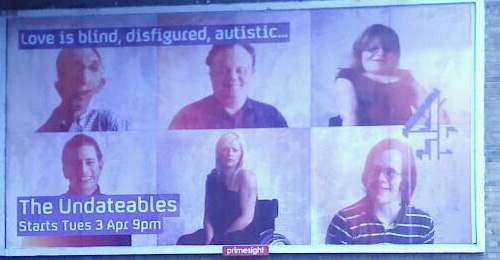
The Undateables

March 18, 2012

What a terrible title for a dating show for disabled people, readers. As I have said and seen many times before, DisAbled people are certainly not undateable. It is these sorts of outdated views that give DisAbled children and teenagers the very wrong idea that they will never fall in love because no one will want them. It is these sorts of outdated views that give the parents of disabled children similar very wrong ideas that their child will never fall in love because no one will want them.

As I have grown from a DisAbled child into a DisAbled adult, I have discovered that my romantic feelings are just as strong as anyone else’s, thank you very much, if not stronger, because when I fall in love, it will be with a person- not his looks or his physical abilities. I have stopped seeing myself as ‘undateable’ and realised that the person who can see past my DisAbilities is out there somewhere- I just have to find him!

Anyway, back to the real reason for this post. It’s a show starting on April 3rd at 9PM, on Channel 4. The Channel 4 Press website says:

The Undateables is a programme about people looking for love – but with a difference.

The series follows a range of people whose ability to form relationships is affected by an impairment or challenging condition – such as being deaf, having Tourette’s or Asperger’s. The programme charts their quest to find love in an image-obsessed world where people are too quick to make snap judgements or assumptions based on first impressions – and even consider such people to be ‘undateable’.

With the help of one of the biggest personal introductions agencies in the UK, and using pro-active searching methods to find perfect matches, the series looks to help find love for those who have until now found it difficult to date. Looking for matches within both the non-disabled and disabled communities, the series sets out to revolutionise the dating scene and turn society’s prejudice on its head.

The Undateables is an uplifting and moving series exploring how society’s attitude towards anyone who digresses from what is considered to be the norm can have a profound impact on those people’s lives.

I understand that they are trying to turn the ‘undateable’ stereotype on it’s head, but in that case why not use a title like ‘Dateless and Disabled?’ This might have given the impression that disabled people are looking for dates- rather than the impression that no one wants to date us!

And as for this billboard advert- well, I see where it’s coming from but am I the only one who finds it offensive?

(Image thanks to Liberal Conspiracy)

Footballers Support Charlotte Nott With Shirt

March 18, 2012

Oxford United players have worn special shirts in their game against Rotherham in support of a four-year-old girl who lost all her limbs to meningitis.

The team’s shirts bore the slogan “United 4 Charlotte” in honour of Charlotte Nott who was almost killed by the disease in December 2010.

Her father, Alex Nott, said the club would go to the “ends of the world” to help people in the community.

He added: “There’s not many clubs that would do something like this.”

Charlotte was treated at Oxford’s John Radcliffe Hospital for the illness but her condition worsened and she developed septicaemia. Both her arms and legs needed to be amputated.

A club spokesman said: “This is a very special shirt for a very special cause.”

Oxford United has also been working with SpecialEffect, a charity which helps adapt computer games for disabled children.

The shirts also bear the SpecialEffect logos and will be worn for just one game and then auctioned off to fans.

Half of the money raised will go to the games charity and half will be given to the Charlotte Fund.

Winterbourne View: Four More Admit Charges

March 18, 2012

Four more people have pleaded guilty to ill treating residents at a private hospital near Bristol.

The case follows secret filming by BBC’s Panorama at the Castlebeck-owned Winterbourne View Hospital.

Graham Doyle, of Patchway, admitted seven charges, Danny Brake and Jason Gardiner, both of Bristol, admitted two and Sookalingum Appoo of Bristol admitted three charges.

The programme showed them physically and verbally abusing patients.

Charges were brought against the four under the Mental Capacity Act.

Doyle had two pleas of not guilty to ill treatment of a patient accepted by the Crown alongside his seven guilty pleas.

Appoo’s charges related to wilfully neglecting a patient.

All of the offences took place between February and March 2011.

Judge Neil Ford QC, at Bristol Crown Court, adjourned proceedings against the four pending the preparation of reports.

There will also be another hearing after Easter for the remaining four defendants.

Three others – Wayne Rogers, 31, and Allison Dove, 24, both of Kingswood, and Holly Draper, 23, of Mangotsfield – pleaded guilty to charges in February.

Twenty-four patients were transferred from Winterbourne View near Hambrook following the BBC investigation and the home was closed last June.

My Endorsement Of Caitlin’s Wish- Book For Young Carers

March 17, 2012

Regular readers may remember Caitlyn’s Wish, the book for young carers that Same Difference publicised in 2010. Well, now the second edition is coming out and I am proud to say that I have been asked to endorse it. This means my thoughts about the book will be in print along with the thoughts of recognised carers’ charities and other equally important organisations.

It is an honour and a big moment. See if you can spot my endorsement!

PC Rathband Funeral Took Place Today

March 17, 2012

The funeral service for PC David Rathband has begun in Stafford.

PC Rathband, who was shot and blinded by Raoul Moat, was found dead at his home in Northumberland on 29 February.

The policeman grew up in Stafford and his family said that it was his wish to be buried in the town.

The public memorial service began at about 12:00 GMT at Stafford Crematorium on Tixall Road following a funeral procession that started at his sister’s house.

‘A lot of tears’

Following the service the officer’s family will hold a private burial, where PC Rathband will be laid to rest next to his 18-year-old niece Naomi Essery, who died in 2002.

BBC reporter Chris King said: “The coffin was taken into the crematorium to the sound of Monty Python’s Always Look On The Bright Side Of Life.

“On the side of the hearse Tango 190 – his police call sign – was written out in orange flowers.”

PC Rathband’s cap and uniform stripes were on top of the coffin and a wreath showed the emblem of Northumbria Police.

More than 100 members of the public had come to pay their respects by about 11:00 GMT.

Police were joined by members of the fire service who marched from their headquarters on Weston Road to the crematorium, where police formed a guard of honour outside the front entrance.

“I think the day will hold a lot of tears for a lot of people,” said PC Rathband’s twin brother, Darren.

“It’s a chance for everybody to come and pay their respects and send David off. I just hope that people do turn out and show that it wasn’t for nothing.

“It’s got to be for something other than a coward that shot him.”

#Whilstdisabled

March 17, 2012

When I saw #whilstdisabled earlier today, I thought it was just Friday fun. But now it seems to have grown, as these things usually do. I suggest you take a look!

Homeshare: The Unlikely Housemates

March 17, 2012

I think this is a great idea.

‘Ashley Treatment’ On The Rise: Six Links From A Special Guardian Report

March 16, 2012

I am shocked to read that ‘Ashley treatment,’ named after the 2007 case  of Ashley X, is on the rise. I am even more shocked to read that it has been given to a boy with Cerebral Palsy.

Below are six links you may like to read on this topic. As always, I welcome your thoughts.

World’s First MS Pill Approved By NICE

March 16, 2012

The world’s first pill for multiple sclerosis has been approved for use on the NHS by the National Institute for Health and Clinical Excellence.

Multiple sclerosis, or MS, affects about a 100,000 people in the UK but until now, patients have had to be treated with injections.

Consultant neurologist Dr Eli Silber and MS patient Elizabeth Kinder say the pill brings several benefits.

Exciting New Therapy For Cystic Fibrosis

March 16, 2012
 The professor leading a trial in cystic fibrosis treatment said that there is “huge excitement” about a new type of gene therapy.


Professor Eric Alton, UK Cystic Fibrosis Gene Therapy Consortium Coordinator from Imperial College, told the Today programme’s Justin Webb that his team is “excited and enthused” but insisted that it was important not to hype the potential breakthrough.

The trial is being funded by the National Institute for Health Research and the Medical Research Council and it is hoped that it will ultimately lead to a cure for the inherited disorder which affects around 9,500 people in the UK and 90,000 around the world.

Professor Alton told the Today programme’s Justin Webb that the “biggest snag is the evolution of the lungs” which, as well as preventing germs and infections from getting in, also stop gene therapy from being effective, so his team has spent the last decade trying to find “tricks to slip the gene in.”

“This is difficult science that needs to be built up gradually,” he said. But if it is successful the scientists involved could “book their tickets to Stockholm to pick up their Nobel Prize”.

Violeta Aylward Struck Off For Switching Off Jamie Merrett Ventilator

March 16, 2012

Good. This won’t help Jamie Merrett but at least she can’t do any such thing again.

A nurse who was filmed accidentally switching off the ventilator of a paralysed man has been struck off.

Agency nurse Violeta Aylward was then filmed unsuccessfully trying to turn the machine back on. Jamie Merrett, 39, was left severely brain damaged.

A Nursing and Midwifery Council hearing found Ms Aylward guilty of serious professional misconduct following the incident in January 2009.

Mr Merrett, from Wiltshire, had CCTV installed amid concerns about his care.

Ambition 24hours, the agency which supplied Ms Aylward, said it was unable to comment.

The conduct and competence panel was told Mr Merrett, named only as Patient A in the hearing, was “completely dependent” on a mechanical ventilator to breathe and needed 24-hour care following a road traffic accident in 2002.

Speaking on behalf of Mr Merrett’s family, Seamus Edney from SJ Edney Solicitors in Swindon said: “The family are very pleased with the outcome of the disciplinary proceedings against the nurse but they do feel that she’s not the only person to blame for what happened.

“They feel that some of the blame must rest with Ambition 24hours who actually placed her in the first place with Jamie – why didn’t they check her competence beforehand to ensure that she had ITU experience?

Night shift

“Why didn’t they ensure that she was insured to cover her action when she was caring for Jamie? These are questions that still need to be answered.”

During the hearing, Neil Moloney, for the Nursing and Midwifery Council, said that in early December 2008, Ambition 24hours Nursing Agency had been asked to provide a nurse to cover some shifts caring for Mr Merrett and had been aware of the requirement that the nurse must have either intensive care unit (ITU) training or experience.

When Ms Aylward went to care for Mr Merrett she was on the books of the agency as a registered learning disabilities nurse and had no ITU training or experience.

Mr Moloney said footage from the CCTV showed Ms Aylward switching off Mr Merrett’s ventilator and then pushing buttons in an attempt to turn it back on at the start of a night shift on 8 January 2009.

The hearing was told a 999 call was made by a care assistant and Mr Merrett was transferred to hospital intensive care.

A police investigation was undertaken after the incident but when the Crown Prosecution Service (CPS) considered the case it was decided there was insufficient evidence to prosecute Ms Aylward for the criminal offence of causing grievous bodily harm, Mr Moloney said.

‘Misleading information’

Mr Merrett’s family said they were considering taking legal action against Great Western Ambulance Trust because of concerns about a further delay in giving him oxygen.

In November 2011, paramedic Neil Crawford, who worked for GWAS, was suspended for a year by the Health Professions Council for failing to ventilate Mr Merrett after his life support was turned off by Ms Aylward.

Following the ruling, spokesman for GWAS, John Oliver, said: “The welfare and appropriate care of our patients is always our main priority.

“Following this incident in January 2009, the trust became aware that the paramedic who was first on scene failed to provide the level of care demanded of a professionally registered clinician and subsequently provided inaccurate and misleading information to the resulting investigation.”

Mr Crawford was initially suspended by the trust and, following an internal investigation and disciplinary process, he was subsequently dismissed.

Nine Out Of Ten People Feel Disabled People Are Treated Badly

March 16, 2012

A press release I have just received:

New research revealed yesterday by charity Papworth Trust has found that almost 9 out of 10 feel disabled people are treated badly.

1 in 7 believed that disabled people are labelled “benefit scroungers” and 12% said they felt like second or lower class citizens.

The survey was based on a sample of over 750 people, most of whom were disabled. It also found that those questioned often felt marginalised by the actions of politicians and the media. 82% of people surveyed said politicians did not treat disabled people fairly, while 68% levied the same criticism at newspapers.

Many disabled people said that after years of seeing improvements in attitudes to disability, they had recently noticed a backlash. “For most of my life things have been improving for us disabled. However in the past couple of years it feels like the clock is being turned backwards, and quickly,” said one participant.

Papworth Trust Director of Marketing David Martin says, “While progress has been made in legislation, disabled people have told us that they need further changes in day-to-day attitudes. We spoke to people with the same hopes and dreams for the future as anyone else; young people planning careers, people hoping for relationships and people wanting the best for their children in the future. We urge the Government to consider the recommendations that have come out of this research.”

The survey was carried out by Papworth Trust as part of its response to a Government consultation to inform their disability strategy. The charity concluded that there are 2 easy changes which could be made to improve attitudes towards disabled people:

1.    A Government-led national review of Government and media language to highlight the damage done by pejorative language and negative stereotyping. This should lead to stricter and better enforced codes of conduct associated with the misleading use of language and statistics, with harsher penalties for inaccurate coverage (some people even suggested laws banning suggested links between disabilities and “scrounging”).

2.    More education and awareness raising campaigns directed at schools, professionals and the public about disability. This would include a review of the effectiveness of current awareness-raising programmes about disability where they exist and assess where gaps could be filled.

Gary Parkinson’s Son Feels ‘Let Down’ By Tony Nicklinson Case

March 14, 2012

The son of a former footballer with “locked-in syndrome” has said coverage of a fellow sufferer’s right-to-die case has left him feeling let down.

Tony Nicklinson, who has been paralysed for seven years, won the right to proceed with his legal case on Monday.

Luke Parkinson’s father, former Burnley and Middlesbrough player and Blackpool coach Gary, has had the condition since suffering a stroke in 2010.

He said when “bad days” happened, it was up to carers “to be more positive”.

Mr Nicklinson, who communicates through the use of an electronic board or special computer, said before the ruling that his life was “dull, miserable, demeaning, undignified and intolerable”.

‘Sickens me’

Mr Parkinson said in a blog post that he accepted that Mr Nicklinson had “very understandable reasons for thinking as he does”.

However, he said he believed “a life is a life and that’s the way it should stay”, as “there is always something to live for and I 100% agree with that”.

He said that while he was glad the condition was being discussed, the media had “gone about raising awareness of locked-in syndrome in the wrong way”.

“The news of Tony Nicklinson makes me feel slightly disappointed and let down, as I feel it shows a bad example to the world of locked-in syndrome and its sufferers,” he said.

“The possibility of sufferers being able to end their lives sickens me.

“With no offence intended, I hope the laws stay as they are currently regarding euthanasia and assisted suicide.”

Mr Parkinson said the media should concentrate on “inspirational people such as Kate Allatt”, who recovered from the syndrome and now works to raise awareness of it.

He said, while he could not speak for his father, when “bad days” happened, it was up to carers “to be even more positive”.

“Since taking ill, my dad has made some remarkable improvements but is still a long way from making a full recovery and regain the quality of life he once had,” he said.

However, he said that even without a full recovery, he said he believed his father could have “an equally as good one in the future”.

Despite having the condition, Gary Parkinson has worked as scout for Middlesbrough, a role which Luke said “keeps him positive and shows him there is a life even with a disability”.

Jim Mansell CBE Dies

March 14, 2012

I am very sad to say I have just read that Jim Mansell, the learning disability campaigner who recieved a CBE this New Year, has died.

My thoughts are with all who are affected by this sad loss to the world of disability rights.

Met Police Assaulted Autistic Boy

March 14, 2012

At least Jody McIntyre was over 18. But to assault a 16 year old? No words.

Metropolitan Police (Met) officers assaulted a 16-year-old boy with severe autism by forcing him into handcuffs and leg restraints during a school trip, the High Court has ruled.

The judge said the boy, now 19, also had his human rights breached.

The boy, who also has epilepsy, was subjected to disability discrimination and false imprisonment, it was ruled.

He was awarded £28,250 in damages following the incident at a swimming pool in Acton, west London, in 2008.

‘Refusing to apologise’

The force was refused permission to appeal, although counsel for the Met Commissioner said the application would be pursued directly with the Court of Appeal.

Outside court, the teenager’s solicitor Tony Murphy said: “The commissioner, Bernard Hogan-Howe, is still refusing to apologise and has instead sought permission to appeal this judgement.

“He has used public money to defend the indefensible.”

The boy, known only as ZH, was physically removed from the swimming pool and forcibly restrained after he jumped into the pool fully clothed.

The judge, Sir Robert Nelson, said although the officers attending the incident were acting as they genuinely thought best, their responses were “over-hasty and ill-informed”.

Matters escalated to the point where a “wholly inappropriate” restraint of ZH, who cannot communicate by speech, took place.

By failing to consult his carers, the police failed to understand the potentially serious consequences of applying force and restraint to ZH, who was said to have suffered moderate post-traumatic stress disorder.

The judge said that ZH was at the pool for a familiarisation with four other pupils when he became fixated with the water and broke away from the group.

When the police arrived, they perceived it as a “life-and-death situation” as ZH, who could not swim but had no fear of the water nor indeed any knowledge of its danger, could have drowned.

When ZH moved closer to the pool, two officers took hold of his jacket as he began to gather momentum, but he was much too big and strong and ended up in the water, which was chest-deep.

Police van cage

ZH was moved to the shallow end and lifted out by lifeguards, with two police officers taking hold of his arms before handcuffs and leg restraints were applied.

Soaking wet, agitated and distressed, he was placed alone in a cage in the rear of a police van until calmed by carers and allowed to leave with them.

The judge said lawyers for ZH had established his claim for trespass to the person, assault and battery and false imprisonment under the Disability Discrimination Act and the Human Rights Act,

He said: “The case highlights the need for there to be an awareness of the disability of autism within the public services.

“It is to be hoped that this sad case will help bring that about.”

The court heard it was the first time police in London had been found to have subjected a member of the public to inhuman or degrading treatment, and to disability discrimination.

A spokesman for the Met said they were giving the findings of the hearing “full and careful consideration”.

He added: “We will be seeking legal advice and take forward any learning as appropriate.

“We are making an application for leave to appeal today.”

I am so shocked by this case that I have created a petition calling for an apology to the family and for the police not to appeal this correct High Court ruling. If you agree you can sign it here.

Wireless Limbs And Prosthetic Skin

March 14, 2012

A new generation of bionics which can connect wirelessly with the nervous system and feel are under development.

Animal tests have already been conducted in which devices are implanted directly into the nerve to process and transmit signals wirelessly to an external device.

Other researchers are developing prosthetic skin which might wrap around a bionic limb and feed back sensory information to the nervous system, in theory enabling users to detect and feel objects.

The current generation of bionic hands can pinch or grasp using two or more electrodes fitted inside the portion of the prosthetic which fits over the stump.

These electrodes are positioned to pick up signals from the user’s peripheral nerve system that are naturally amplified by muscles in the stump.

Progress is almost continuous. German company Otto Bock has developed a hand incorporating multiple electrodes which can drive wrist flexing and rotation.

While Scottish company Touch Bionics builds hands which use software to control individual finger movement, so that the hand can clasp around objects.

The surgical rewiring of nerves in an amputee can also offer a great deal, enabling those with no arm at all, for example, to drive bionic arms with elbow and hand movement.

But there are problems. Sweat on the skin or any movement in the prosthetic can disrupt the signal to the bionic limb. The prosthetics can also rub against the skin and cause discomfort and sores.

The next generation of bionics will try to overcome these problems and offer some sensory feedback to the user.

Wireless bionics

Researchers in Britain have already developed the Intraosseous Transcutaneous Amputation Prosthesis (ITAP), a rod screwed into the bone of an amputee onto which prosthetics can be fitted directly and securely, be they hands, legs or fingers.

The rod means higher loads can be carried than with traditional prosthetics which fit over the stump of an amputee like a glove. It also avoids friction between the prosthetic and the skin.

Scientists such as Prof James Fawcett, of the Centre for Brain Repair at Cambridge University, are meanwhile developing neural interfaces whereby prosthetics will communicate wirelessly with implants fitted directly into the nerve fibres in the stump.

“People have produced very sophisticated prosthetics which will do very sophisticated things, but in almost every case the thing that people are struggling with is to link it up successfully to the nervous system,” he says.

“A lot of soldiers who have lost limbs apparently have given up using these devices and gone back to a simple hook, which at least is reliable.

“The device we’re producing is for recording sensory impulses in a nerve and gets inserted into the limb nerve itself.”

Once the device is inserted into the nerve, nerve fibres grow through it. Nerve signals associated with particular movements are then selected, and these signals transmitted wirelessly to a receiver in the prosthetic.

So far the device has been tested in mice and rats for up to 12 months. While the researchers do have some concerns that scarring within the device could strangle nerve fibres and disrupt signals, no such problems have been detected to date, says Prof Fawcett.

“We have a programme which will develop a prototype interface in about three years’ time and that will then be taken forward through the legislature for human safety and toxicity trials,” he predicts.

Researchers in Italy are also working on wiring bionics to the peripheral nerve system, and have already conducted trials in which electrodes temporarily connected to the nerves were used to drive an unattached prosthetic hand.

Prosthetic skin

Elsewhere, researchers are looking to make more responsive prosthetics with many looking to flexible electronics or “prosthetic skin” to do the job.

“We’re looking into putting electronics onto surfaces that can be deformed, flexed but also stretched like a rubber band,” says Stephanie Lacour of Switzerland’s Ecole Polytechnique Federale de Lausanne.

“The idea with the prosthetic skin would be to have some kind of a glove like a latex glove which we could fit around the current prosthetic limb but that would be full of electronic sensor function that would mimic the sense of touch we have in human skin.”

Eventually, such sensors might feed information back to the brain via neural interface devices, but in the meantime there are other options.

Otto Bock are working on simpler devices whereby electronic sensors on a prosthetic detect information about objects and temperature which is fed back to the user via vibrations or pressure applied to the adjacent skin.

The surgical rerouting of sensory nerves in the stump (or chest muscles where an entire arm is replaced by a prosthetic) could enhance the effect, by creating areas of skin which feel what fingers would once have felt.

A new generation of bionics could also enhance the lives of individuals who are paralysed from the neck downwards or who have conditions like Locked-In Syndrome.

Last year, a paralysed US man made headlines after temporary electrodes placed on his brain were used to control a remote prosthetic hand which he used to stroke his girlfriend’s hand.

Back in Switzerland, researchers are testing a thought-controlled wheelchair which uses electrodes placed on the skin in a skullcap to drive the chair.

Prof Fawcett says such machines will be “a very exciting technology for the future” but says there are big problems to overcome.

“The issue with electrodes which record from the brain is bandwidth. You can transmit very little information and it’s slow.

“The electrodes also have to be very localised so you can only record from one bit of the brain and at the moment the electrodes are very unreliable and tend to produce inflammation and this stops the electrodes working.

“The other issue is that the electronics which you have to add are very complicated and you have to attach large structures to these skulls.”

Kate Allatt Revisited

March 14, 2012

I first covered the story of Kate Allatt, who recovered from locked-in syndrome, last year. Today, she discussed her own case, as well as the case of Tony Nicklinson, with BBC Breakfast.

Dan Eley

March 14, 2012

A man left paralysed in an accident in Colombia has reached the half-way point on a virtual 550-mile cycle ride.

Daniel Eley, 33, from Witley in Surrey, broke his neck while diving into a shallow river on New Year’s Day 2010. He now uses a wheelchair.

He is using a bike which electronically stimulates the major muscle groups in his legs to create a cycling motion.

He is covering the equivalent distance from Guildford to Glasgow, averaging 35 miles a week in aid of Spinal Research.

He is hoping to raise £10,000, and since beginning his virtual ride on 9 January has covered 275 miles on his Functional Electrical Stimulation bike, which would place him just past the city of York on the map.

The distance of 550 miles is equivalent to cycling from the Spinal Research headquarters near Guildford, from where Mr Eley is undertaking his challenge, to The Queen Elizabeth Spinal Injury Centre in Glasgow.

He said: “I’m not voluntarily moving my muscles… I’ve got electro-pads on my quadriceps, gluteus muscles and hamstrings, and the computer on top of the bike stimulates the muscles in a sequence which creates a cycling motion.”

As he has some movement in his arms, he is also using a hand cycle to complete his ride.

Mr Eley said after eight weeks he had noticed a significant increase in the muscle tone in his legs.

“At the beginning I was barely able to cycle for 20 minutes without my legs becoming tired, against resistance level two.

“Now eight weeks later, with the same level of stimulation, I am able to cycle for 45 minutes against resistance level three, at a higher speed, and then after a five-minute break continue for another 45 minutes.”

Care home

Mr Eley, who was working as a teacher in Colombia, dived into a “deceptively shallow river” in the Amazon jungle.

After three days at a clinic in the jungle, he was transferred to a hospital in Bogota.

After two months, and as a result of a fundraising campaign, he was flown back to the UK and taken to the specialist Stoke Mandeville Hospital in Buckinghamshire.

He stayed there until November 2010 and now lives in a care home for disabled people near the town where he grew up in Surrey.

Disability Horizons In The Guardian!

March 13, 2012

The Guardian have interviewed the founders of Disability Horizons, the online magazine that I regularly contribute to.

Just Not Funny

March 13, 2012

Just Not Funny Campaign

Foundations:
This campaign launched in March 2012 . Its ultimate mandate is to challenge comedy that mocks disability and it aims to do so by galvanising the support of individuals and charities.

Who are we:
This campaign is supported by like-minded individuals and charitable organisations, who are increasingly concerned by the lack of protection for this most vulnerable section of society. The Just Not Funny Campaign will nominate key spokes-people who are able from their own personal experience to voice a response. The campaign is determined to avoid becoming the lone and subjective voice of a single individual, but rather to harness the collective passion of its grassroots supporters worldwide.

We do not hold ourselves out as experts in any particular disability, but recognise the damage that results from reckless humour and profiteering at the expense of the disabled. We care about individuals who do not have a platform from which to respond. Simply speaking we believe that comedy which targets disability and mocks the disabled has no place in contemporary society. It is Just Not Funny.

Where are We:
The campaign is not limited by geography. It has been established through the medium of social network sites: twitter and facebook. Wherever you are around the world, if you support our campaign you can ‘friend’ us or ‘like’ our campaign page on facebook or follow or retweet our message on twitter.

About Us:
We seek to challenge comedy that is being arrogantly offensive towards people who have a disability. When comedians through their comedy further demonish a section of society which already has enough to contend with. Disability hate crimes have reportedly risen by 20%-source: same difference blog, 2011. Comedy that vindicates or encourages such hatred is Just Not Funny and should rightfully be challenged.

We will engage political support and where appropriate write and inform media broadcasters the views of our supporters, and challenge them to consider what they are encouraging society to laugh at.

We appreciate that we are living in a democracy and therefore freedom of speech should not be unduly curtailed. Whilst the the Equality Act 2010 specifically excludes broadcasting, we feel strongly that there are lines which must be drawn when vulnerable minority groups are targeted for the sake of controversial humour. Although such comedy may not intend offence, this does not justify recklessness and broadcasters have a moral and social responsibility to consider their content. The Just Not Funny campaign will set out to hold broadcasters to account for their programming wherever it is felt to negatively affect the public perception of any disabled group or individual.

Comedy that uses aggressive language to target, bully, or marginalise a person with a disability is unacceptable . Often offensive comedy seeks to justify itself as satire and /or irony with the purported aim of itself raising awareness of prejudice in society. The Just Not Funny campaign will not be fobbed off by pseudo intellectual argument and will judge comedy on the basis of its impact on the disabled. We will not be afraid to call a spade a spade where we see exploitative humour at the expense of the vulnerable. We are not against comedy that is inclusive of disability, we can all laugh at ourselves. However we seek to distinguish when the audience is interpreting such humour ‘with’ the disabled or ‘at’ the disabled. The arbitrator of such offence must surely be the minority group affected.

The national press is also a representation of civil society in a democracy; therefore we will also monitor the response of the public through national media as another determining factor of when comedy has crossed a line.

Get involved:
We literally cannot do this without your support. This is a movement and not a charity. We are not asking for your money, but your eyes, your ears and above all else your voice. Please inform us when you feel that comedy has targeted disability and together we can challenge more effectively . Please bring to our attention any relevant media coverage, video clips, or stories of your own personal experience where you feel this is relevant to the campaign. Thank you for your support.

If you are very passionate about this campaign through your own personal experiences, please get in touch with your local MP and help to galvanise political support for JustNotFunny campaign. Email your MP or visit them at surgery and explain how comedy that targets disability personally affects you. Please contact us and let us know how you got on.

Keep it Clean:
Obviously we understand the passions that underly these issues, but we do not believe it is right to fight bullying with bullying. The administrator of this campaign on facebook will actively monitor debates and discussions which take place. If a debate arises where an individual uses obscene language toward another or behaves in a bullying, aggressive or unduly personal tone then your posting will be moderated. Please keep the debate clean and respectful to others at all times in keeping with the spirit of what we are trying to achieve.

Contact Us:
The Administrator of the Just Not Funny campaign can be contacted through facebook and on twitter @just_notfunny. Or alternatively by email: justnotfunnycampaign@googlemail.com

Remploy Wales Factories Figures Expected Today

March 13, 2012

UK ministers are to publish the financial details of Remploy factories set to close in Wales, threatening the jobs of 272 disabled people.

Minister for Disabled People Maria Miller said she was willing to work with the Welsh government to see if any of the seven sites could stay open.

But she has ruled out any further UK government subsidy.

Remploy sites were established in 1946 as part of the welfare state. Workers fear they will not find new jobs.

Staff at Remploy take on work including furniture making and recycling electrical appliances.

But most of the state-funded factories make a loss, and last week the UK government said seven sites in Wales would close, putting a total of 281 jobs at risk.

After a meeting with First Minister Carwyn Jones, Ms Miller said a study by accountants KPMG into the financial viability of the sites would be published later on Tuesday.

She said she was willing to listen to any ideas to keep the sites open.

Those under threat are at Aberdare, Abertillery, Bridgend, Croespenmaen, Merthyr Tydfil, Swansea and Wrexham.

Factories at Porth and Neath will continue to operate.

I Dreamed A Dream- Susan Boyle’s Life On Stage

March 13, 2012

Susan Boyle leapt from obscurity to worldwide acclaim in just a few days, after her appearance on a TV talent show went viral on the internet.

Now, Elaine C Smith will portray the singer in a stage musical based on her life story.

Boyle, who will appear as herself during the finale of I Dreamed A Dream, told the BBC’s Lizo Mzimba that the story has a “magical appeal”.

The show will premiere at Newcastle’s Theatre Royal.

Tony Nicklinson Case Discussed On This Morning

March 13, 2012


https://twitter.com/#!/itvthismorning/status/179505038580912128

Letting Go

March 13, 2012

I will be watching this tonight at 10.35 on BBC 1:

Having a child leave home is difficult enough for any parent, but when your teenage daughter has Down’s syndrome it is even harder. Domenica Lawson, nearly sixteen, is unsettled at the prospect of growing up and of having to leave a warm and supportive home. But it is her mother, Rosa Monckton, who is faced with the challenge of planning for the future, knowing that her daughter must eventually leave home and start an independent life without her.

Letting Go follows Rosa and her daughter as she leaves school and takes her first steps into a more adult world. And as Domenica prepares for the challenges of independent life, Rosa meets three other young people with learning disabilities, and discovers how they are managing their transition to greater independence.

Jess Hiles has a rare genetic disorder. With the encouragement of her parents, she has moved in to her own flat. But as she and her parents have discovered, living alone does not mean living independently.

Richard Sherratt’s learning disabilities meant that despite having significant support from carers he was unable to cope with neighbourhood hostility and has had to return home to be looked after once again by his mother, Dawn.

Jack Hale, from Devon, is a year older than Rosa’s daughter and also has Down’s syndrome. There is a happy and well-run care home very nearby, but his mother Ronni has never really considered it. Her sparky son has ambitions to be a DJ and to be famous, and she is reluctant to limit his horizons.

Stephen Hawking Films Big Bang Theory Cameo

March 12, 2012

Professor Stephen Hawking has filmed a cameo for US sitcom The Big Bang Theory, due to be aired next month.

The famous physicist will appear in a scene with socially awkward scientist Sheldon Cooper, played by Jim Parsons.

Producers had asked Professor Hawking, best known for his best-selling book A Brief History of Time, to appear on the show before, but he had been too ill to take part.

He previously recorded voice-overs for animations The Simpsons and Futurama.

Last year, he fronted his own TV series Brave New World for Channel 4, which looked at new developments in science and how they might benefit mankind.

It also showcased the Professor’s new voice synthesizer, which replaced the robotic voice he has come to be associated with.

Professor Hawking relies on text-to-speech software to communicate because of motor neurone disease, which leaves him unable to speak.

He turned 70 earlier this year but missed some of his birthday celebrations due to illness.

Sci-fi cameos

The Big Bang Theory is the second highest-rated comedy on US television, just behind Two And A Half Men. Both were created by Chuck Lorre.

The self-styled “geek sitcom” revolves around four insular and awkward scientists and their neighbour Penny, an aspiring actress who works in a Cheesecake Factory restaurant.

It has attracted many cameos from sci-fi actors such as Wil Wheaton, Summer Glau and Leonard Nimoy.

Several high-profile scientists have also appeared, including astrophysicist Dr George Smoot and theoretical physicist Dr Brian Greene.

Professor Hawking has been referenced in the series once before.

During the fourth series, comic book fan Howard Wolowitz (Simon Helberg) left Sheldon a fake voicemail, pretending to be the British physicist.

“I wish to discuss your theory on black holes,” said the message. “Meet me at Randy’s Donuts.”

Professor Hawking’s cameo will be screened in the US on 5 April, and on Channel 4 in the UK at a later date.

Xeni- Quality Clothes And Jewellery For Women On Wheels

March 12, 2012

I’ve just read about Xeni– a new range of clothes and jewellery for women in wheelchairs and those who have trouble with buttons, clasps and zips. The company’s founder, Ann Oliver, has Multiple Sclerosis. I think this is a fantastic idea that, perhaps, only a DisAbled woman could have had.

Jamie Merrett Case Hearing

March 12, 2012

An agency nurse was filmed switching off the ventilator of a tetraplegic man then trying to switch it back on again, a disciplinary hearing was told.

Violeta Aylward faces an allegation of misconduct in relation to a shift caring for Jamie Merrett, 39, in Devizes, Wiltshire, in December 2008.

Mr Merrett installed CCTV in his room after becoming concerned about the quality of his care, the Nursing and Midwifery Council (NMC) was told.

The hearing continues.

Police investigation

The conduct and competence panel was told Mr Merrett, named only as Patient A in the hearing, was “completely dependent” on a mechanical ventilator to breathe and needed 24-hour care following a road traffic accident in 2002.

Neil Moloney, for the NMC, said in early December 2008 Ambition 24hours Nursing Agency had been asked to provide a nurse to cover some shifts caring for Mr Merrett and had been aware of the requirement that the nurse must have either intensive care unit (ITU) training or experience.

“On two previous occasions Patient A had experienced significant failings in his nursing care in relation to his ventilator,” he added.

“He was very anxious about a recurrence of any such incident and he had therefore had installed CCTV in his room.

“The registrant (Ms Aylward) was not involved in the previous occasions.”

When Ms Aylward went to care for Mr Merrett she was on the books of the agency as a registered learning disabilities nurse and had no ITU training or experience.

Mr Moloney said footage from the CCTV showed Ms Aylward switching off Mr Merrett’s ventilator and then pushing buttons in an attempt to turn it back on at the start of a night shift on 8 January 2009.

The hearing was told a 999 call was made by a care assistant and Mr Merrett was transferred to hospital intensive care.

A police investigation was undertaken after the incident but when the Crown Prosecution Service (CPS) considered the case it was decided there was “insufficient evidence” to prosecute Ms Aylward for the criminal offence of causing grievous bodily harm, Mr Moloney said.

Ms Aylward is not present at the hearing which is scheduled to last until Friday.

North Of England Will Be First To Get PIP

March 12, 2012

Disabled benefit claimants in the north of England will be the first to receive the Government’s new personal independence payment (PIP).

Ministers are scrapping the disability living allowance handout for two million people of working age and replacing it with the PIP which will involve an individual assessment in a bid to cut down on overpayments.

However amid wrangling as the Welfare Reform Bill went through Parliament earlier this year, the Department of Work and Pensions agreed to stagger its introduction.

Disabled People Minister Maria Miller said: “To ensure a smooth introduction, the launch will be undertaken through a phased approach, commencing initially with a subset of new claimants,

“This will ensure processes and procedures are working fully before moving to process all new claims and then reassessing existing disability living allowance.”

In a written Commons statement, she said the Bootle Benefit Centre would administer the first new claims from next spring for recipients in Merseyside, north-west England, Cumbria, Cheshire and the North East.

She said it would provide a “robust test of the PIP processes and new computer systems” set-up to handle the claims before it is rolled out across the country.

A DWP spokesman said: “Disability Living Allowance (DLA) is an outdated benefit with the vast majority of people getting it for life without systematic checks to see if their condition has changed. This has led to hundreds of millions of pounds in overpayments.

“We are replacing DLA with the personal independence payment and introducing a new face-to-face assessment and regular reviews, to make sure support is going to those who need it most. We are moving forward with the next stage of our reforms and a lot of work has been carried out to ensure a sensible phased introduction.

“Under PIP support will be focused on those who need it most, with a greater proportion getting the higher rates compared to DLA.”

Dear readers, I live in London, far away from the North of England. But it’s true what this says. If I don’t speak out now, no one will speak out  when they come for me.

Rise Up UK- A New DPULO

March 12, 2012

This is just a quick post to promote Rise Up UK. Rise Up UK is a new Disabled People’s User Led Organisation. It aims to develop a one-stop digital shop for disabled people with interests relating to entrepreneurship.

This is the very good idea of Disability Rights Campaigner Lisa J. Ellwood. Lisa has been heavily involved with The Broken Of Britain for quite some time.

You can also follow Rise Up UK on Twitter and Facebook.

Tony Nicklinson Wins Right For Case To Be Heard In Court

March 12, 2012

Tony Nicklinson, who is paralysed and wants a doctor to be able to lawfully end his life, should be allowed to proceed with his “right-to-die” case, a High Court judge has ruled.

The 58-year-old from Melksham, Wiltshire, has “locked-in syndrome” following a stroke in 2005 and is unable to carry out his own suicide.

His is seeking legal protection for any doctor who helps him end his life.

The Ministry of Justice argues making such a ruling would change murder laws.

“Locked-in syndrome” leaves people with paralysed bodies but fully-functioning minds.

The judge’s ruling now means that Mr Nicklinson’s case will go to a full hearing, where medical evidence can be heard.

Following the judge’s ruling that his case can proceed, Mr Nicklinson’s wife Jane read out a statement from her husband on BBC 5live.

It said: “I’m delighted that the issues surrounding assisted dying are to be aired in court. Politicians and others can hardly complain with the courts providing the forum for debate if the politicians continue to ignore one of the most important topics facing our society today.

“It’s no longer acceptable for 21st Century medicine to be governed by 20th Century attitudes to death.”

‘Stressful’ wait

Mr Nicklinson, who communicates through the use of an electronic board or special computer, said before the ruling that his life was “dull, miserable, demeaning, undignified and intolerable”.

During the radio interview, Mrs Nicklinson passed on questions to her husband, using his letters board to spell out his response.

When asked what he hoped would happen next, he replied: “I will be able to access a doctor when the time is right.”

He went on to spell out: “I can just about cope with life at the moment, but not forever.”

Mrs Nicklinson said she was “really pleased” with the judge’s decision. “It’s been quite stressful waiting for this decision.

“It’s really good to know that the judge thinks that we have a case that needs to be argued.”

Earlier, Mrs Nicklinson said that her husband “just wants to know that, when the time comes, he has a way out”.

“If you knew the kind of person that he was before, life like this is unbearable for him,” she added.

She said she did not know when her husband might actually want to die. “I suppose just when he can’t take it any more,” she said.

Mr Nicklinson, who has two grown-up daughters, launched a legal action seeking court declarations that a doctor could intervene to end his “indignity” and have a “common law defence of necessity” against any murder charge.

But David Perry QC, representing the Ministry of Justice, told the High Court that Mr Nicklinson “is saying the court should positively authorise and permit as lawful the deliberate taking of his life”.

He added: “That is not, and cannot be, the law of England and Wales unless Parliament were to say otherwise.”

BBC legal correspondent Clive Coleman says the case goes beyond assisted suicide as Mr Nicklinson’s paralysis is so severe it would prevent him from receiving assistance to kill himself and he would have to be killed – and that would amount to murder.

He says Mr Nicklinson is seeking a court declaration based on his right to respect for private life under Article 8 of the Human Rights Convention – in effect saying that in his circumstances, his right to life includes the right to end his life in a humane manner of his choosing.

Scottish Scientists Working On Turning Sign Language Into Text

March 12, 2012

Technology aimed at translating sign language into text is being developed by Aberdeen scientists.

The portable sign language translator (PSLT) would use the camera on devices such as laptops and phones.

An app would then translate the movements into text which can be read by people, who may not understand sign language.

Computing scientists at Technabling, a spin-out company of the University of Aberdeen, are behind the technology.

It is hoped this could transform how sign language users – from the profoundly deaf to those who have lost hearing in later life – communicate.

One of the main focuses is to help young deaf people improve employment opportunities.

Dr Ernesto Compatangelo, a lecturer in computing science at the University of Aberdeen, and founder of Technabling, said: “The aim of the technology is to empower sign language users by enabling them to overcome the communication challenges they can experience, through portable technology.

“Their signs are immediately translated into text which can be read by the person they are conversing with.

“The intent is to develop an application – an app in smart phone terms – that is easily accessible and could be used on different devices.”

He added: “One of the most innovative and exciting aspects of the technology is that it allows sign language users to actually develop their own signs for concepts and terms they need to have in their vocabulary.”

Sign language users have helped the development and testing of the product since its conception.

Local sign language users interested in becoming involved with the ongoing development can get in touch via pslt@technabling.co.uk

It is hoped the technology could be available as a product by 2013.

Tony Nicklinson Awaits Ruling On Death

March 12, 2012

A man whose body is so paralysed that he wants a doctor to be able to kill him will find out later at the High Court if his case has been thrown out.

Tony Nicklinson, 58, from Melksham, Wiltshire, is seeking a ruling on whether a doctor who ended his life would have a defence against murder.

Mr Nicklinson suffered a stroke in 2005 and has “locked-in syndrome”.

The Ministry of Justice wants the case struck out, arguing only Parliament can change the law on murder.

Locked-in syndrome involves people, like Mr Nicklinson, whose bodies are paralysed but their minds are intact.

Mr Nicklinson, who communicates through the use of an electronic board or special computer, says his life is “dull, miserable, demeaning, undignified and intolerable”.

He wants his “suffering to end” through a doctor being able to “lawfully” conduct an assisted suicide.

The case was heard in the High Court last month and judgement was reserved by Mr Justice Charles.

Mr Nicklinson, who is married with two grown-up daughters, launched a legal action seeking court declarations that a doctor could intervene to end his “indignity” and have a “common law defence of necessity” against any murder charge.

But David Perry QC, representing the Ministry of Justice, told the High Court that Mr Nicklinson “is saying the court should positively authorise and permit as lawful the deliberate taking of his life”.

He added: “That is not, and cannot be, the law of England and Wales unless Parliament were to say otherwise.”

Medical advances

Mr Nicklinson’s wife, Jane, said the law had not kept pace with medical advances.

“Twenty years ago Tony would have died, but people are being kept alive with such terrible conditions,” she said.

“He says now that if he’d known what life would be like for him now he would have just laid down and died, quite honestly. He wouldn’t have called for help.

“Times haven’t moved on. Medical practises have become so much better. The law hasn’t progressed with that.”

BBC legal correspondent Clive Coleman says the case goes beyond assisted suicide as Mr Nicklinson’s paralysis is so severe it would prevent him from receiving assistance to kill himself and he would have to be killed.

He also says Mr Nicklinson will probably appeal should his court bid fail.

“This is a case which is likely to end up at the Supreme Court,” our correspondent added. “It’s a very clear example of a point of law which has enormous general public importance.”

The case is thought to be the first of its kind and represents the most ambitious effort yet mounted to free up laws on the right to die, our correspondent adds.

Will There Ever Be A Real Six Million Dollar Man?

March 12, 2012

Can we give ourselves super vision, super strength and super speed?

Science fiction is littered with the theme of upgrading the human body with machinery.

In the 1970s classic TV series The Six Million Dollar Man, the main character – astronaut Steve Austin – is horrendously injured in a test flight accident. He was a man “barely alive” but, as the title sequence explained, science could come to his rescue.

“Gentlemen, we can rebuild him. We have the technology. We have the capability to make the world’s first bionic man. Steve Austin will be that man. Better than he was before. Better, stronger, faster.”

His array of upgrades included an eye with zoom and infrared vision. Bionic legs which could give a car a good race and an arm with the strength of a bulldozer.

Meanwhile, as we have been discovering in the Bionic Bodies series, bionics are having a transformative role in the real world. Artificial hearts implanted into the chest can keep patients alive until a transplant becomes available. Cochlear implants have restored hearing to people who were once deaf. Bionic eyes are giving sight to the blind and a range of hands, arms and legs are restoring lost movement.

But the focus is on keeping people alive or restoring lost function. What about the potential to expand capabilities, what is known as human augmentation? Could a six-million-dollar man ever be built?

Enhancement

“Well, first of all, it’s going to cost a lot more than six million dollars,” says Richard Yonck, foresight analyst with Intelligent Future in Seattle, “but there’s an awful lot of technologies underway that will come very close to achieving that.”

He said: “I see strength, certainly, and I would say the equivalent to the bionic arm he had – that kind of strength – is certainly feasible with time.

“He had bionic vision; the contact lens is one approach and there are developments in retinal implants which are currently working to restore sight. That type of technology will lead to further capabilities, I’m sure, with time.”

However, what about running at speeds of 60mph (100km/h)?

“In physical terms, it’s definitely feasible; in practical terms, I’d really question that, given the difficulties.

“Bipedalism was not really designed for that kind of running. There’s considerably more efficient ways of moving at 60mph. I don’t know if there’s enough benefit to overcome the difficulties of 60mph running speed.

“I totally believe that very seriously enhanced and augmented abilities are going to be available to human beings both in the general public and certainly at the military level.

“In terms of strength, in terms of endurance, in terms of sensory capabilities – all of these are most definitely going to be, in the coming decades, seeing some significant progress.”

One of the challenges with human augmentation is that the human body is still going to be quite weak. It is remarkably easy to damage the body in everyday life, from preparing dinner to playing football.

It might be possible to attach a bionic arm with enough strength to lift a car. However, actually doing so could cripple the rest of the body. Falling over while running at 60mph could be equally damaging.

Timescales

Current bionic body part replacements can imitate human function, but considerable technological developments will be necessary before entering an era of enhancement.

Dr Anders Sandberg, from the Future of Humanity Institute at the University of Oxford, told the BBC: “I do think it is possible to reconstruct a body quite easily and get into a six-million-dollar man situation.”

For the next 10 years, he thinks the field will be at the level of “pretty nice prosthetics”, but would then start to be “significantly better” than the real thing.

He said: “I think mid-century, I would be rather surprised if there wasn’t a lot of implants and enhancements around.”

Options could include “sensory augmentation; ways of extending our senses such as infra-red sight or ultra-violet; or extending hearing.”

He says one day blind people who are fitted with artificial retinas will not only be given sight, but, rather like a smartphone, a range of apps will emerge that would allow recording, zooming and augmented reality.

“Eventually you reach the point where you can start doing things that normal people can’t do,” he said.

Anybody interested?

“It is quite possible that while we’re kind of anxious about the end product that seems to come from science fiction, we’ll be quietly accepting versions of it,” argues Emily Sargent who is preparing the Wellcome Collection’s exhibit, Superhuman.

She cites the example of the introduction of in vitro fertilisation (IVF) which made people “incredibly nervous” and then “very quickly we became accustomed to it”.

Prof Noel Sharkey, from the University of Sheffield, is not convinced that augmentation will ever catch on: “You’ve got perfectly good legs and arms; I’m not sure people will want other things attached.

“I think it is quite likely that humanity will fight back. I don’t want to be enhanced at all. I’m a human, I love being a human.”

However, he can see enhancements coming from “exoskeletons” – basically robotic suits.

It already conjures up the idea of the people flying round like the Marvel Comics superhero Iron Man, but some suits are already being made.

The Japanese company Cyberdyne has already developed a suit called Hal. It can help people who are no longer able to walk to regain their mobility by picking up electrical signals from the nerves which used to tell limbs to move and converting them into instructions for the suit.

The other option for Prof Sharkey is devices which can be controlled by thought, but which are not part of the human body.

He said: “If I want a really really strong arm, rather than having it attached to my body, it would be much better if it was just alongside me and just moved when I moved and did whatever I wanted. I think you might see that.

“So I can imagine a building site for the future, for instance, where there are builders wearing these exoskeleton suits and being accompanied by tools that do whatever they want without having to press buttons and things.”

So does he think there will be a six-million-dollar man?

“No Steve Austins, I think, but put it this way – I couldn’t rule it out.”

New Drug For Bone Disease Babies

March 11, 2012

A new drug could help save the lives of babies dying from a rare genetic bone disease, experts have revealed.

Children with severe hypophosphatasia, which affects just one in a million people, began being treated with the drug three years ago after it was developed by bone research scientists in the USA and Canada.

The results of the trial, showing that the asfotase alfa drug had been successful, were published in the medical journal The New England Journal of Medicine this week.

Experts from The Children’s Hospital, Sheffield, and the University of Sheffield, the largest site in the worldwide trial, said it was “crucial” the drug was licensed as soon as possible.

Eleven babies were treated during the trial, with three of those, from Germany, Greece and Northern Ireland, being given the drug in Sheffield.

The children were injected with the drug three times a week and clear results emerged after around three to six months, experts said.

Nine of the babies completed the trial.

Sufferers of severe hypophosphatasia, which is thought to affect just 35 babies worldwide, normally die after the age of six months and children struggle to walk or use their limbs properly, are very weak and in pain. Less severe forms are seen in older children and sometimes in adults.

Professor Nicholas Bishop, an expert in metabolic bone disease at Sheffield Children’s NHS Foundation Trust and The University of Sheffield, said: “The long-term effects of this drug are not yet known but the results we’ve had so far on this trial are undeniable. It’s saved and changed the lives of nine children who would otherwise have died after just a few months.”

Prof Bishop, who has been developing Sheffield’s bone service to become the leading European centre in the field for the last 13 years, added: “The trial has been a fantastic success and it’s crucial we now get the drug licensed as soon as possible and begin helping children born with this disease.”

PC David Rathband’s Twin Will Clock Him Off Final Shift Today

March 10, 2012

The twin of PC David Rathband will “clock” him off his final shift before a memorial service in Newcastle.

PC Rathband, 44, who was shot and blinded by Raoul Moat in 2010, was found hanged at his home in Blyth, Northumberland, on 29 February.

Hundreds are expected to attend the first of two services in honour of the traffic officer at St Nicholas Cathedral at 12:00 GMT.

Darren Rathband said the service was to “celebrate” the life of his brother.

Before the service a hearse will stop at Etal Lane police station, in Newcastle, where PC Rathband was based, and his brother will formally book him off his last shift.

PC Rathband’s widow Kath will not be attending Saturday’s service, but will be at the funeral in his native Stafford next Saturday and at a memorial service organised by Northumbria Police at the same cathedral on 19 March.

Darren Rathband, who is also a police officer and lives in Australia, organised Saturday’s service.

Humanist speaker

The cathedral said it was expecting about 800 people, with mourners also lining the streets outside.

A sound system will enable those outside the cathedral to hear the full service.

Sue Sim The Chief Constable of Northumbria Police Sue Sim said she would attend the service

The service will be conducted by the Dean of Newcastle, the Very Reverend Chris Dalliston.

He said: “The memorial service will include a tribute to David led by humanist Carly Fee, although as one would expect in an Anglican cathedral the service will include prayers that bear witness to the Christian hope.

“We hope the service will enable people of every faith and none to come together to honour David’s memory.

“This is a celebration of David’s life, his bravery and his service to the community.

“However, the cost he and others have had to pay remind us forcibly of the destructive powers at work in our society, the need for constant vigilance and the debt we owe, not only to David but to all his colleagues in the Northumbria force.

“We hope that this service will begin the process of bringing healing and reconciliation to those who have been caught up in this tragic situation.”

The Chief Constable of Northumbria, Sue Sim, who promised PC Rathband there remained a job for him with the force, said she would attend the service.

PC Rathband was shot twice by Moat while sitting unarmed in his patrol car in July 2010.

After being shot, PC Rathband set up the Blue Lamp Foundation charity which helps emergency service personnel who have been injured at work.

Hotel Exploited Autistic Chef

March 10, 2012

This is why organisations like Remploy still need to provide some level of segregated employment. This man would not be blamed if he was not ready for mainstream employment for a very long time, if ever again.

A hotelier who paid an autistic chef £95 a week because he “thought he could get away with it”, must pay him more than £40,000 compensation.

An employment tribunal condemned Joseph Louei for exploiting a “vulnerable and disabled young man”.

The owner of the Astor Hotel in Plymouth claimed 23-year-old Adam O’Dee had to be “carried and pampered”.

The tribunal heard Mr Louei threatened the chef with the sack “for taking too much off the end of a cucumber”.

Mr O’Dee, from Plymouth, won his claims for unfair dismissal, disability discrimination and minimum pay.

‘Beggers belief’

Mr Louei was also accused of throwing frozen bread rolls around the kitchen after wrongly blaming the chef for not taking them out of the freezer.

Mr O’Dee, who suffers from Asperger’s Syndrome and dyslexia, resigned claiming he was harassed and victimised by Mr Louei.

He was paid less than half the national minimum hourly rate of £6.08 for people aged 21 or over – described by the tribunal judge John Hollow as a “very substantial underpayment”.

“It beggars belief that a businessman of 25 years’ standing should accept that a very vulnerable individual could properly be employed at £90 or £95 per week for a full week’s work,” he said.

“This was nothing more than exploitation of a very vulnerable young man.

“This was done because Mr O’Dee was disabled and Mr Louei thought he could get away with it.”

The tribunal panel also said the chef was victimised after complaining of disability discrimination.

Evidence from Mr Louei and two of his witnesses was described as unsatisfactory and unreliable, with “many discrepancies and contradictions”.

‘Never lie’

Mr O’Dee began working as a trainee chef at the hotel on Plymouth Hoe in February 2010, having been introduced by Remploy, which helps disabled people find work.

He was not paid for working extra hours at weekends and busy times like Christmas, because Mr Louei said this would give him extra experience.

Working additional hours for no remuneration was “extraordinary and incomprehensible”, the tribunal said.

Mr Louei said he had been made out to be a “monster” and treated like a criminal.

He denied abusing his employees and said he had not lied to the tribunal.

“I never, ever lie… Adam did not produce any work – he had to be carried and pampered,” he said.

The compensation package awarded by the tribunal includes loss of earnings, injury to feelings and unfair dismissal.

EHRC To Intervene In DNR Case

March 9, 2012

The UK’s human rights watchdog is intervening in a landmark case over the use of “do not resuscitate” orders for NHS patients.

The Equality and Human Rights Commission (EHRC) is an independent party to the case being brought by the husband of a woman who died in Addenbrooke’s hospital, Cambridge, last year.

David Tracey alleges medical staff at the hospital unlawfully issued two such orders without the consent of his 63-year-old wife, Janet, or discussion with her and that by doing so deprived her of her right to life and subjected her to degrading treatment. He also says that he was thereby denied respect for his personal and family life.

The Cambridge University Hospitals NHS trust, to which Addenbrooke’s belongs, and the Department of Health deny acting unlawfully under the 1998 Human Rights Act and dispute the Tracey family’s account of what happened at the hospital.

David Tracey also wants to force the government to draw up a national policy on the use of instructions not to attempt cardiopulmonary resuscitation (DNRs), which are issued on thousands of patients each year. The government insists the matter is better left to existing national professional guidance backed up by local trust policies. The Care Quality Commission, the NHS watchdog, has recently warned a number of hospitals to improve their recording of DNRs.

The EHRC generally intervenes only in cases where it can use its expertise to clarify or challenge an important element of the law. These usually involve serious matters of public policy or general public concern.

Merry Varney, a solicitor at Leigh Day & Co, who is representing the Tracey family, said after a preliminary hearing on Friday: “This case underlines the importance of a transparent, accessible and consistent policy regarding a patient’s right to know when a decision not to resuscitate them is made and to know how their views are taken into account and, where necessary, how to challenge a decision they disagree with.

“In this case we claim that neither family member or patient were consulted on whether a DNR order was placed on Mrs Tracey’s medical records.

“However the hospital claim they had the permission of a family member. The wider issue for society is that unless specifically authorised by the patient, it cannot be right that a family member can agree to a DNR and seems perverse considering the laws regarding euthanasia and the concerns often tabled in such debates of the risk of abuse from inheritance hungry relatives.

“We are not suggesting in this case that every patient has the right to demand cardiopulmonary resuscitation, but I do believe that in this day and age of patient choice and transparency, a competent patient must surely know when a decision to withhold potentially life sustaining treatment has been made.”

David Tracey said: “Following the first anniversary of Janet’s death I am pleased that progress is being made to clarify how DNRs can be used for patients and their families.”

A full hearing of the judicial review will take place at the high court in London later this year.

Remploy Closures Will Wreck Lives

March 9, 2012

Les Woodward says that Remploy closures will take employment choice away from disabled workers. As I Tweeted on Wednesday when the news broke, I have to agree with him.


Remploy Man Creates New Jobs For Disabled People In Wales

March 9, 2012

A man who started his own business when the Remploy factory in Trefforest closed four years ago is aiming to create new jobs for disabled people.

Steven Watts, who set up GreenCap to refurbish and re-upholster furnishings, has received a share of a £358,000 publicly funded grant.

The Remploy factory in Trefforest closed in 2008 and it has been announced seven more may shut in Wales.

Four other south Wales valley’s social enterprises will also share the money.

The money is aimed at creating 14 jobs along with work placements and training.

The other enterprises are Rhymney cycle repair and training company Rainbow Community Enterprise, Ann’s Kitchen, a cafe and sandwich delivery service based in Graig y Rhacca, Samye Foundation Wales and Playworks, a childcare provision provider based in Caerphilly.

Hundreds Expected At PC David Rathband Memorial Tomorrow

March 9, 2012

More than 800 people are expected to attend the memorial service to celebrate the life of PC David Rathband in Newcastle.

PC Rathband, 44, who was shot and blinded by Raoul Moat in 2010, was found hanged at his home in Blyth, Northumberland, on 29 February.

The public service is at St Nicholas Cathedral at 12:00 GMT on Saturday.

The cathedral said it was expecting about 800 people inside, with mourners also lining the streets outside.

Members of the public, politicians and senior dignitaries are invited to attend.

A sound system will enable those outside the cathedral to hear the full service.

‘Tremendous strength’

PC Rathband’s widow Kath said she will not be at the service on Saturday, but will be attending his funeral in Stafford on 17 March.

She is also taking part in the public police memorial service on 19 March, also at St Nicholas Cathedral.

She said: “I would like to take this opportunity to thank Northumbria Police for the care and support they have given and continue to give to myself, Ash and Mia during this incredibly difficult time.

“I’d also like to thank all the wellwishers for their kind words, from which I have gained tremendous strength.

“Family, friends and colleagues can gather to celebrate the many happy memories we all have of the 12 years spent as a family in the North East of England.

“In these extremely difficult times for myself and our children, we want to be able to grieve in private and out of the media spotlight and we request that everyone respects this.”

PC Rathband was shot twice by Moat while sitting unarmed in his patrol car in July 2010.

Another World Record For Ellie Simmonds

March 9, 2012

Double Paralympic champion Ellie Simmonds became the first swimmer to break a world record at London’s Aquatics Centre with victory in the 200m individual medley.

The 17-year-old finished in a time of 3:08.14, beating her own previous best time by over half a second.

A tearful Simmonds said: “I can’t believe I’ve broken a world record.

“I haven’t had a great week but I’ve been working hard on the event. I was confident but it’s a big surprise.”

She was edged into second by Beijing gold medallist Heather Frederiksen in the 100m freestyle earlier in the week.

Simmonds told BBC Sport: “I have great people around me. My coach and family [in Swansea] are amazing.

“I wanted to enjoy it and getting gold is great, but a world record is something else.”

Fellow SM6 swimmer Natalie Jones was second, with Rhiannon Henry , from the SM13 category, third in the multi-classification event.

Simmonds’ success follows a European record from six-time world champion Susie Rodgers , who won gold in the 50m butterfly on Wednesday.

Elsewhere on day six, 11-time Paralympic medallist Sasha Kindred secured victory and a London 2012 qualifying time in the men’s 200m individual medley.

As with all of those attaining the desired times this week, they will still need to compete at the British International Disability Swimming Championships in Sheffield next month to be assured of a place at the Games.

Kindred told BBC Sport: “I went a bit slower in the final, but two swims under the qualifying time is great and means I should come back in the summer for my fifth Paralympics.”

James Crisp (SM9) was the runner-up with Robert Welbourn (S10) collecting bronze.

Just one swimmer was in the final of the men’s 150m individual medley, but 15-year-old Lyndon Longhorne set a new British record with a time of 3:02:36 and will hope to attain a qualification time at the trials on 6-8 April.

Fiona Pilkington’s Family Settle Police Compensation Claim

March 9, 2012

Relatives of a woman who killed herself and her disabled daughter after repeated harassment have settled a claim against Leicestershire Police.

An action brought by Fiona Pilkington’s mother and Francecca Hardwick’s brother, himself a vulnerable adult, has been settled by a five-figure sum.

The mother and daughter died in 2007 when Ms Pilkington set fire to her car.

They had complained to police 33 times after being harassed by youths in their home near Hinckley.

The family’s solicitor, Jocelyn Cockburn, said: “It was important for the family to achieve justice after going through a horrendous few years following the deaths of Fiona Pilkington and Francecca and it has given them a modicum of financial security going forward.

“The case also had enormous public interest because of public concern about the treatment of vulnerable and disabled people in society and the case dealt with what duties the police have to protect people like Fiona and her family from anti-social behaviour and hate crime.”

‘Organisational’ failings

A report by the Independent Police Complaints Commission found that the force had failed to identify Ms Pilkington and her daughter as vulnerable.

Over the course of 10 years, Ms Pilkington’s home in Barwell was repeatedly targeted by groups of up to 16 youngsters, with stones, eggs and flour thrown at the house.

On one occasion, Francecca was told to lift up her night-dress, while her brother Anthony was locked in a shed at knifepoint.

Ms Pilkington reported the incidents, as well as keeping a detailed log, but in total received only eight visits from officers.

Four Leicestershire police officers were cleared of misconduct after internal hearings were held by the force.

Speaking after its hearings, Dave Evans, Deputy Chief Constable of Leicestershire Police, said the failings were of “an organisational nature due to the systems and processes in place at the time”.

Chief Constable Simon Cole confirmed that the civil claim had now been settled out of court, but said this had been done “without admission of liability”.

“This is a tragic case and I felt that it was the right thing to do to, for everyone concerned, to draw a line under the litigation,” he said.

“Since the sad events in October 2007 the force has made significant changes to the way anti-social behaviour is dealt with and the way in which vulnerability is identified to ensure that the right support is given.”

Teenager Patrick Kane’s Bionic Body

March 9, 2012

Technology has always striven to match the incredible sophistication of the human body. Now electronics and hi-tech materials are replacing whole limbs and organs in a merger of machine and man.

BBC News is exploring the field of bionics in a series of features. It has looked at the latest scientific developments and will analyse the potential to take the technology even further, enhancing the body to superhuman levels.

Teenager Patrick Kane lost his left arm and right leg after contracting a vicious strain of meningitis and developing blood poisoning at nine months old.

The 14-year-old now uses a prosthetic leg – a selection are lined up in his bedroom, from the waterproof welly to a blade for running – as well as a pioneering bionic arm.

Patrick was fitted with the i-Limb Pulse about 18 months ago. He says it has changed his life – he is now able to do to more intricate things than he could before, and it has given him an extra level of independence.

More than 2,000 people worldwide, mainly in America, have been fitted with this arm from Touch Bionics.

It has two movements, opening and closing a fist, which respond to muscle contractions in Patrick’s upper arm.

The latest version of the arm can increase pressure on an object, but no arm has yet to give the sense of touch. Patrick however uses this to his advantage – he is able to manipulate hot experiments in chemistry lessons, unlike his friends.

Other arms are being developed to allow increased dexterity. The Modular Prosthetic Limb gives 22 movements, including individual finger and wrist mobility. This uses a number of sensors in different locations to pick up muscle contraction in the residual limb, and complex algorithms to distinguish between similar signals to produce different movements.

Produced by Anna-Marie Lever

FullFact: Is Cameron Wrong On DLA Reforms

March 8, 2012

https://twitter.com/#!/FullFact/status/177801705017184256

Elmfield School For The Deaf Will Stay Open

March 8, 2012

A Bristol school for children with hearing problems, which faced a threat of closure, is to continue operating.

Bristol City Council has announced that Elmfield School for the Deaf will continue to provide education for deaf or hearing impaired children

In 2010 the authority proposed to close the school after recommendations were made by an independent review.

A petition was then started against the plans and within two months had gained more than 4,000 signatures.

The school’s chair of governors the Reverend Canon Gill Behenna said: “We have constantly maintained that Elmfield School provides excellent educational opportunities for deaf and hearing impaired children.

“We now look forward to working with Bristol City Council and colleagues in the field of deaf education, on developing the school as a regional provision.”

‘Financially viable’

The council said the key to its future operation was a revision to planned pupil places and a commitment to serve children with additional needs.

From September, the school will be funded to have an admission number of 30 places.

It currently has 24 children on roll aged between three and 15, many of whom live outside Bristol

Councillor Clare Campion-Smith, from the Liberal Democrat-led authority, said: “In order for Elmfield School to continue, it is important that it is financially viable and can serve children who may have additional learning or behaviour needs.

“We will continue to keep all services under review and respond to how parents make choices for their children’s education.”

Alzheimer’s Patients Should Use Drugs For Longer, Finds Study

March 8, 2012

Thousands of patients with advanced Alzheimer’s disease could benefit from drugs, research suggests.

A study in the the New England Journal of Medicine found that patients who stayed on the dementia drug Aricept had a slower decline in their memory.

The drug tends not to be prescribed once sufferers progress beyond moderate symptoms.

Medicines regulator NICE said its guidelines supported continuing treatment where there were benefits.

The patent for the medicine Aricept, which is used to treat Alzheimer’s disease, expired recently. Much cheaper versions under the generic name donepezil are already available for about £12 a month.

The researchers say their new evidence could lead to twice as many Alzheimer’s sufferers worldwide being given medication.

The trial involved 295 Alzheimer’s patients in England and Scotland who had been taking Aricept.

One set were given placebo tablets while another set stayed on Aricept. A third set were given another drug, Ebixa, or memantine, which is usually prescribed only in the later stages of Alzheimer’s.

The fourth batch of patients received a combination of both drugs.

The researchers assessed each group for a year, looking at their cognitive scores on factors like memory, and also at how well they coped with everyday tasks such as dressing and eating.

‘Robust and compelling’ evidence

The drugs were unable to halt the decline of patients, but they slowed it down.

The study’s lead author, Professor Robert Howard from King’s College London Institute of Psychiatry, said: “For the first time, we have robust and compelling evidence that treatment with these drugs can continue to help patients at the more severe stages.

“Patients who continued taking donepezil were about four months ahead in how they were able to remember, communicate and perform daily tasks than those who stopped taking the drugs.

“It means a lot to doctors and carers to see differences like that. These improvements were sustained throughout the year.

“It’s fair to say that both drugs have independent, positive effects at this stage of dementia. I’m advising hospital colleagues to continue patients on donepezil, when it’s tolerated, and to add in memantine.”

Controversial restrictions

About 500,000 people in the UK are thought to have Alzheimer’s disease – with only about 10% who are in the earlier stages currently on drug treatment.

NHS funding of dementia drugs has been controversial in the past. The National Institute for Health and Clinical Excellence (NICE) set restrictions in 2006, which campaigners tried to overturn in court.

A year ago, revised NICE guidelines accepted that medicines including Aricept were cost-effective and could be prescribed earlier in the course of the disease.

Professor Clive Ballard from the Alzheimer’s Society, which part-funded the trial, said: “Usual practice has been to discontinue the treatment once patients have declined to a certain stage.

“This trial suggests the default position should be the other way round, because most people are benefiting.

“It’s not so much the NICE guidance that needs to change – but how clinicians interpret it.”

NICE said its guidelines did not include any specific recommendations on when to discontinue medicines.

Dr Simon Ridley from Alzheimer’s Research UK said: “Trials such as this are extremely important for informing decisions about the way medication is prescribed.

“It would be helpful to see longer-term trials to determine exactly how long the benefits seen in this study might last.

“Sadly we still lack a treatment that can stop Alzheimer’s disease in its tracks.”

PC David Rathband Was Planning New Life In Australia

March 8, 2012

The policeman shot and blinded by gunman Raoul Moat was considering a new life in Australia prior to his death, his twin brother has said.

PC David Rathband was found hanged at his home in Blyth, Northumberland, on 29 February.

Darren Rathband said that during a recent visit to his home in Adelaide they had discussed the future.

He was thinking about leaving Northumbria Police and living in a specially-built property next to him.

Darren Rathband, a police officer in Australia, said: “We planned a future together.

“We looked at buying a house with some land.

“David could have his own independent living accommodation, with a pool.

‘Attitude did change’

“We discussed how we would have his own letter box, his own door, and he could have been independent.

“He was so positive in regards to that.”

Following his death, Northumbria’s chief constable said that there had been discussion over PC Rathband’s return to work in a road safety capacity in April.

However, Mr Rathband said his brother did mention not going back to the force.

“I certainly think there were times when that attitude did change and there were times when he still wanted to get back to work,” he said.

“It was difficult for him.

“He [sometimes] did not see he had a role he wanted to do in the police service.”

A memorial service to celebrate PC Rathband’s life is being held at St Nicholas Cathedral in Newcastle, or Saturday.

Members of the public, politicians and senior dignitaries are expected to attend.

The funeral will take place at his home town of Stafford on 17 March, and Northumbria Police is holding a separate memorial service in Newcastle two days later.

DLA Man Caught Playing Golf

March 8, 2012

A man who was caught on camera playing golf despite claiming he could not walk more than 50m has been jailed for a £12,500 benefit fraud.

Nottingham Crown Court heard Robert Cave, 50, was filmed playing golf despite telling the Department of Work and Pensions (DWP) he was disabled.

The man, of Mansfield, started claiming disability living allowance in 1996 for a genuine degenerative condition.

Cave, jailed for four months, did not reveal that his condition had improved.

‘Most unfair’

Sentencing, Judge Andrew Hamilton said: “You don’t get a 15 golf handicap overnight. He must have been playing for a long time.

“You are a thorough and utter liar and cheat.

“This is one of the worst cases of someone who is flagrantly flouting the rules and creating public indignation.”

Judge Hamilton added the case was “most unfair” because other people had genuine claims.

Sian Fellowes, senior fraud manager for DWP, said after the hearing: “We received some anonymous information from a member of the public, which is usually the way we find out about cases of this nature.

“He was seen to be engaged in various activities that were very much at odds with what he said his capabilities were in order to claim the benefit.

“He was seen loading things into his car but most compellingly he was seen playing golf.”

She said Cave had been seen playing regularly once a week on an 18-hole golf course at Norwood Park, near Southwell.

Jamie Merrett Fears He Will Never Get Compensation

March 7, 2012

A man left severely brain damaged after a nurse mistakenly switched off his ventilator fears he may never receive compensation, his solicitor has said.

Tetraplegic Jamie Merrett’s nurse Violeta Aylward was caught on camera switching off the machine in 2009.

She worked for recruitment agency Ambition 24hours, but it did not have medical negligence insurance as it was not required to.

It explained that Ms Aylward should instead be covered by her professional body, the Royal College of Nursing (RCN).

But the RCN said it was no longer prepared to indemnify Ms Aylward.

In a statement, the organisation said: “The RCN indemnity scheme applies to members working in both the public and independent sectors.

“Our indemnity scheme, like insurance policies, is subject to certain conditions and exclusions.

“The RCN declined to indemnify the nurse in this case because of her complete failure to co-operate with us.

“Despite making every effort to engage with the nurse, we were left without information or legal instructions.

“At this stage, it would be inappropriate to comment further on legal proceedings that are ongoing.

“However, it is important to note that there are other defendant parties to these proceedings.”

It added: “For the avoidance of doubt, the payment of any compensation and costs under the RCN indemnity scheme is entirely in the discretion of the RCN Council, subject also to you satisfying the conditions set out here.

“The RCN scheme is not a policy of insurance.”

‘Beggars belief’

Solicitor Seamus Edney, of SJ Edney in Swindon, who is acting for Mr Merrett, said Ms Aylward’s indemnity had been “withdrawn at a very late stage in the case”.

“She’s now liable in person for any damages which are awarded to Jamie,” he said.

“It just beggars belief that a nurse could find herself in this situation, where the RCN can withdraw indemnity.

“There must be many other nurses out there who are working for a supply or recruitment agency and they find that they may not have cover from their professional body.”

Mr Merrett, from Devizes, had been cared for at home since 2002 and set up the camera at his bedside in 2009 after becoming concerned about the quality of his care.

Extra care

He had been left paralysed from the neck downwards in a road accident, but was able to use a wheelchair and talked using voice-activated technology.

His ventilator was switched off for 21 minutes and eventually restarted by paramedics but Mr Merrett had already suffered serious brain damage and now needs extra care.

Mr Merrett’s solicitor has now lodged a claim against Invent Health, a private agency which sub-contracted the work to Ambition 24hours.

Invent Health said it could not comment on the case because of the claim.

Mr Edney said: “There is a risk of course that we may not succeed and because there is no insurance Jamie may not get his damages.”

Ms Aylward, who has not responded to a request from the BBC for a comment, is due to appear before the Nursing and Midwifery Council next week to face a range of charges that include not being familiar with how to operate a ventilator.

Government Announces Closure Of Remploy Factories

March 7, 2012

Full details:

https://twitter.com/#!/dwppressoffice/status/177387389990342657

Reactions:

https://twitter.com/#!/Redpeter99/status/177386476194107393

https://twitter.com/#!/la_crip/status/177387716974096385

https://twitter.com/#!/SallyBercow/status/177412518673784833

https://twitter.com/#!/SallyBercow/status/177412518673784833

https://twitter.com/#!/ITVLauraK/status/177424041668390913

https://twitter.com/#!/BBCNormanS/status/177423571839238144

https://twitter.com/#!/Fight_Workfare/status/177448709087436801

https://twitter.com/#!/CommunityUnion/status/177492011069341696

https://twitter.com/#!/carl_chambers/status/177831350391422977

My personal view:

https://twitter.com/#!/samedifference1/status/177456386626691072

https://twitter.com/#!/samedifference1/status/177456954053099520

Feet First For Diabetics

March 7, 2012

Today’s BBC Scrubbing Up feature by Barbara Young:

As a new study highlights major variations in diabetes-related foot amputation rates, Barbara Young, chief executive of Diabetes UK, explains why action is needed to cut rates of preventable amputations.

If I were to tell you about a place where thousands of feet were amputated every year as a result of poor healthcare, you would assume I was talking about somewhere in the developing world.

Well you’d be wrong. The fact is that here in the UK, thousands of people with diabetes have amputations every year.

Not only does an amputation dramatically reduce quality of life, but the likelihood of dying within five years is greater than for breast, bowel or prostate cancer.

And yet an estimated 80% of the 5,000 diabetes-related amputations a year in England could be prevented through better healthcare and improved management of the condition.

The fact that so many people are needlessly having their feet amputated is a national disgrace. And yet despite the large numbers, awareness of the problem is worryingly low even among people with the condition.

But it does not have to be like this.

The scandal of preventable amputations is one we hope to bring to an end with our Putting Feet First campaign. Over the next five years, we want the number of amputations in people with diabetes to reduce by 50%.

Raising awareness of the issue will be a big part of this.

‘Insufficiently thorough’

The 2.8m people in the UK who have been diagnosed with diabetes should know how important it is to manage blood glucose levels, cholesterol and blood pressure well, as well as checking feet regularly and making sure shoes fit properly.

But they also need to know what healthcare you should expect – because all too often it falls short of what people are entitled to.

Firstly, everyone with diabetes should get an annual foot check.

These are important for identifying problems at an early stage, but many thousands of people are not getting them. And when they are being done, they are sometimes insufficiently thorough.

I have even heard of foot checks where the patient is not even asked to take their shoes and socks off!

Also, at the end of the check patients should be told what their risk status is, so if this does not happen then you should ask.

Secondly, if you have a foot ulcer then you need to be seen by a diabetes specialist foot care team as soon as possible.

It should certainly be within 24 hours, as an ulcer can deteriorate in a matter of hours.

Some areas are already doing well in terms of getting diabetes-related ulcers referred to these specialist teams within 24 hours.

But there are also poorly-performing areas where this does not happen.

Tragically, that omission can be the difference between someone keeping their foot and losing it.

If people with diabetes are not offered this level of care, they should insist on it and complain if they don’t get it.

But the point is that decent healthcare is something everyone should get as a matter of course.

For this to happen, we need to address the reason that large swathes of the country are doing so badly.

We know from speaking to health professionals that many of them are desperate to give people with diabetes the best possible foot care but feel unable to do so under the existing system.

This is why the government needs to show leadership on this issue by insisting that all areas of the country offer the same standard of care that is already available in the best areas at the moment and monitoring and managing standards to ensure that they are being delivered.

This greater political will is the only way to bring an end to the tragic postcode lottery of amputations and in doing so create an NHS that really does put feet first for people with diabetes.

Prosthetics Through Time

March 7, 2012

A feature in pictures from the BBC.

David Cameron, Meet Lisa Egan

March 7, 2012

She’s disabled. She’s hilarious. And she’s written you an open letter, Sir.


Thank You Sonia Poulton

March 7, 2012

You’ve written something very sensible about disability. The Daily Mail needs many more journalists willing to write pieces like this.

Discussion: Being Disabled And Transgender

March 7, 2012

Readers, I’ve heard of many people who are disabled and homosexual. However, yesterday, I read an article in the latest issue of Disability Now that really made me think about something I have never thought about before.

It is an article about disabled children in foster care and those who have been adopted, but that isn’t the reason it got me thinking. It got me thinking because one of the disabled people it features is also transgender.

Now, call this ignorance if you like but I have never thought about the possibility of disabled people being transgender before I read this article. I think this is definitely a topic that needs much more coverage and discussion and maybe even study.

So, what I’d like to know is: Are you disabled and transgender? Do you know anyone who is disabled and transgender?

I’d like to get a sense of how common it is for disabled people to be transgender/transgender people to be disabled. So please leave thoughts, comments or experiences below.

PC David Rathband To Be First Person On Olympic Wall Of Fame

March 7, 2012

PC David Rathband who was shot and blinded by Raoul Moat, will be the first person to feature on a roll of honour on an Olympic Torch route.

PC Rathband, originally from Stafford, was found dead at his home in Blyth, Northumberland last week.

A wall of fame displaying photos of community figures is being set up by Stafford Borough Council in May.

Adam Hill, the council’s head of leisure and culture, said PC Rathband’s courage had been inspirational.

PC Rathband was shot twice by Moat in Newcastle in July 2010.

He was found dead on Wednesday night and an inquest later heard he had been found hanged.

Public request

He had set up the Blue Lamp Foundation to raise funds to help injured members of the emergency services.

A borough council spokesman said: “The public have asked for David Rathband to be the first person to be named on the wall of honour.

“Obviously setting up such a good initiative makes him the sort of worthy person we want to see on it.”

The authority has been asking people to nominate community champions and volunteers who they think should be included on the wall of photos.

The Olympic Torch will travel through Gnosall, Haughton and Stafford on 30 May.

A spokesman for the council said the feature would be placed at a secret location in Stafford on the day and would then be moved to a different location in the town.

Aspergers Boy, 7, Wins Right To Fly Flag In Garden

March 7, 2012

A seven-year-old boy who was told to take down his pirate flag by a Lincolnshire council has received a letter of apology.

Anthony Steele, who has Asperger’s syndrome, was told his Jolly Roger breached planning regulations.

East Lindsey District Council said it had acted after a complaint was made about the flag.

However, it has now sent the family an official apology saying no further action would be taken.

In a letter, the authority said it wanted to “take the opportunity to apologise to you formally for the severity of the letter you received in relation to the pirate flag you were flying in the garden for your son, Anthony.

“When we receive a planning related complaint, the council has a duty to write to make those concerned aware, but accept on this occasion our letter was over the top.”

The council had previously appealed for the government to review its planning regulations in regard to children’s play equipment after the issue first came to light.

Anthony’s mother Sara, said she was happy to receive the apology from the council.

Her partner Ronnie Ford-Kennedy said he hoped that in future the council would “sit back and drink a large cup of common sense” before sending letters.

A4E Employee Invented Signatures To Boost Results Of Scheme

March 6, 2012

The welfare-to-work company A4e was forced to withdraw from part of a £900,000 project to place vulnerable people into work after an employee forged signatures on official forms.

A4e was helping to place 630 youngsters with disabilities and mental health difficulties into jobs in Teesside in a project funded with European Union money.

Former colleagues said the employee invented signatures to increase the number of people who appeared to have been placed in jobs or on courses.

The disclosure will add to questions concerning governance within A4e. The company, which has £180m worth of public contracts, is at the centre of a fraud investigation in Slough, where four people have been arrested. A subcontractor of A4e is also subject to an official inquiry. An inquiry into its Hull office resulted in one former employee being fined for falsifying job outcomes.

On Monday, Margaret Hodge, chair of the public accounts committee, told MPs she has received new allegations of fraud against the company. A spokesman for A4e said the company did not know about these allegations.

In February company founder Emma Harrison, who was paid an £8.6m dividend last year, resigned as an unpaid Downing Street adviser and as chairman of A4e. She denies any wrongdoing.

David Cameron told the parliamentary liason committee on Tuesday that if allegations of fraud against A4e are proven and show that problems in the company are systemic, then government contracts with the company could be halted.

The inquiry into forged signatures dates back to 2009 when A4e was among subcontractors working to Redcar and Cleveland borough council in the Elite Project, funded with European Social Fund cash, to help hundreds of young people who might otherwise slip through the net.

They included teenage parents, those with learning difficulties and disabled people. But a council inquiry found that learners’ signatures had been forged. A source close to the inquiry said: “The fraud was obvious and was an attempt to make it look as if the individual had got more vulnerable people involved than was the case.”

A spokeswoman for A4e said the employee resigned before disciplinary action was taken. “We would have treated this as a disciplinary matter,” she said.

There had been no financial gain and no evidence of criminal activity. “This was a case of poor administration, nothing more,” she said. “The individual involved admitted that she was the only person involved in this activity and had undertaken this activity of her own volition.”

A spokesman for the council said: “In 2010, Redcar and Cleveland council had a contract with A4e to deliver part of a programme to support young people who were not in education, employment or training. After scrutiny regarding some of this work, part of this contract was discontinued.”

Another part of A4e’s contract – to evaluate the Elite project by interviewing young people – continued, sources close to the project said.

In a further development, Labour accused the prime minister of misleading parliament by failing to disclose A4e was subject to a fraud inquiry when Harrison was recruited as his adviser on troubled families in December 2010.

Last month, Cameron told MPs: “At the time she [Harrison] was appointed there were no formal investigations into A4e, there was just the company’s own probe into irregularities.”

The Department of Work and Pensions said in a statement that an inquiry into fraud in A4e’s Hull office – first reported in the Observer in November 2009 – resulted in a successful prosecution in July 2011. A DWP official said this was a “live case” in 2010.Liam Byrne, the shadow cabinet office minister, called for Cameron to apologise to MPs.

“Incredibly, David Cameron is simply flat wrong. There was actually an investigation under way when he appointed Emma Harrison that was so serious that someone has been convicted.

“The government must publish all correspondence between officials and A4e so that we can start to get to the bottom of what’s going on in this huge government contract.”Downing Street has been accused of ignoring warnings that appointing Harrison as an adviser could lead to a conflict of interest.

Figures released to this newspaper show that the DWP has launched nine fraud investigations since 2005 into A4e’s involvement in the Labour government’s Flexible New Deal scheme and has asked the company to pay back money on five occasions since 2005. There was no case to answer in three of the inquiries, and there was no evidence of systemic problems in any of them, officials said.

DWP officials have told the Financial Times they warned No 10 of their concerns. Cameron told the Commons that information about alleged fraud at A4e had not been passed to ministers quickly enough and he had asked the cabinet secretary, Sir Jeremy Heywood, to investigate.

It has also emerged that A4e has been advising No 10 on value for money in privatisation, including writing a guide on contracting out.

Kelly Taylor, Campaigner For Assisted Suicide, Dies

March 6, 2012

A terminally-ill Bristol woman who launched a legal battle to force doctors to end her life has died.

Kelly Taylor, who had Eisenmenger’s syndrome and the spinal condition Klippel-Feil syndrome, died at Frenchay Hospital on 27 February.

The 35-year-old had been campaigning for more than six years to change the law on assisted dying.

It is understood she died of heart complications as a result of a congenital condition.

Pain relief

Eisenmenger Syndrome, a heart and lung condition, can develop in people born with a hole in the heart if it is not treated in infancy.

Mrs Taylor also suffered with the rare musculoskeletal developmental disorder, Klippel-Feil syndrome.

From the age of seven, her health grew steadily worse.

In 2003, after waiting nearly 10 years for a heart and lung transplant, she was told a match could not be found and was taken off the transplant list.

Her doctors were unable to find a combination of drugs to relieve her pain as she was allergic to many of those normally used to treat Eisenmenger’s.

In August 2005, to end the “pain and misery” of her condition, she attempted to starve herself to death as an act of voluntary euthanasia.

But after 19 days she was in so much pain she decided it was less dignified than her medical condition and began eating again.

In 2007, she was given a year to live and launched a legal battle to force doctors to end her life.

She was fighting for the right to allow doctors to increase her medication to induce a coma-like state and then have food and hydration withdrawn.

‘Deeply saddened’

But despite abandoning her case, after having a request for an adjournment rejected by doctors, she remained committed to patient choice at the end of life.

Davina Hehir, a Dignity in Dying director, said they were “deeply saddened by the news of Kelly’s death”.

“Kelly’s determination to speak out about why she wanted the choice of an assisted death made a huge impact,” she said.

“People could see that this was someone who had given a huge amount of thought to the issues and who was prepared to stand up for what she believed in.

“We will miss her enormously.”

The family have said they are too upset to talk about her death.

Ben Hughes

March 6, 2012

A transplant patient from Shropshire whose body has rejected his new lungs wants to raise awareness of the need for more organ donors before he dies.

Ben Hughes, from Shrewsbury, was born with congenital heart disease and had a heart and lung transplant in 2007.

Last year he began to suffer chronic rejection and has recently been told he may have just days left to live.

Mr Hughes, 28, admitted his life “would have been over a long time ago” if he had not received the organs.

Last year the NHS Blood and Transplant Service said a record 18 million people had registered as organ donors in the UK, but the number still needed to increase with some 10,000 people on a waiting list for transplants at any one time.

‘Amazing memories’

Mr Hughes has been writing a blog for a local newspaper as well as telling his story on the internet to highlight the need for donors.

Despite relying on a wheelchair to get around, the 28-year-old has been steadily working through a bucket list which has included visiting a number of football grounds and spending time with friends and family.

He said: “It’s been a blast. I’ve done more in the last two months than I’ve done in 28 years on this earth.

“I’ve made some amazing memories for my loved ones to keep.”

He has also asked his wife, Ayla, to set up a charity to help others in a similar situation.

Mrs Hughes said: “There’s no help out there for people in Ben’s situation. People over 21.

“There are charities out there that help children to have special days and there are also charities that help people with cancer.”

Evie Read

March 6, 2012

Evie Read has been diagnosed with a rare disorder that will leave her body paralysed but her mind will be intact.

The five-year-old little girl suffers from ataxia-telangiectasia, or A-T for short, a life-limiting disease with which most affected children are wheelchair-bound by the age of 10.

But although the neurodegenerative condition, which affects around 20 children each year, will attack the part of her brain controlling movement and stop her from walking, speaking and even eating, her mind will be untouched.

Her parents Toby and Emily Read are campaigning for greater awareness about the disease.

Mr Read, 37, told Mail Online: “We had read enough to know that it was incurable and that it would do terrible, terrible things to our daughter.

“At the moment she goes to a normal school, which she loves. She is bright, loves writing, is learning to read and has many friends.

“One of the tragedies of this disease is that the physical abilities she is just learning now will be taken away from her.

“She will find it progressively harder and harder to control her muscles and will slowly lose the ability to write, speak, walk, read and even to swallow food unaided.

“She will lose none of her intelligence but will instead have the frustration of not being able to do the things she once could.”

The couple, who have three children, have decided not to tell Evie about her illness, which currently only manifests itself as a problem with balance.

Mrs Read said the diagnosis left her “absolutely shattered”.

Mr Read, an insurance underwriter, added: “This summer we’re hoping to take her to the Paralympics to get her acclimatised to the idea of being in a wheelchair. We want to show her being physically disabled is not the end of the world.”

Although the condition is inherited, Mr and Mrs Read’s two sons, Wilf, three, and Albie, nine months, do not have the disease but are carriers.

A team of doctors from Great Ormond Street Hospital and the Royal Surrey Guildford are working to keep Evie healthy for as long as possible.

Mr Read said: “We are not without hope that a cure can be found in time for Evie and the medical experts have indicated that these are promising times for children like her. However, because the disease is so rare, funding is largely dependent on grass roots donations.

“So this year our target is to raise £300,000 to further the projects. I’m running a triathlon in September with 20 other people and I’m planning to cycle 220km in the Alps with another group of fund-raisers. We will push our bodies to the extreme as this is something Evie won’t be able to do when she gets older.”

More information about A-T is available online as well as ways to support the cause.

Police Memorial Service To Be Held For PC David Rathband

March 5, 2012

A police memorial service is to be held to honour the officer shot and blinded by Raoul Moat.

PC David Rathband was discovered dead at his home in Blyth, Northumberland, on Wednesday night. An inquest later heard that he had been found hanged.

Northumbria Police said that the force would be holding a service during the week starting 18 March.

The ceremony is in addition to the funeral, for which no date has as yet been announced.

PC Rathband, originally from Stafford, set up the Blue Lamp Foundation after he was shot twice by Moat in Newcastle in July 2010.

The charity helps emergency service personnel injured in the line of duty.

His twin brother Darren has vowed to continue its work.

He flew back from Australia and took part in Saturday’s Newcastle Parkrun. Before the event, a one-minute silence was held to remember his brother.

Northumbria Police said in a statement: “A Northumbria Police Memorial Service will be held during the week commencing 18 March in memory of PC David Rathband.

“On behalf of his widow Kath and their children, all his colleagues will be invited to attend.

“Further details will be announced in due course.”

Racing With The Hamiltons: Nic In The Driving Seat

March 5, 2012

I will be watching this tomorrow at 10.35pm on BBC 1:

In 2011, 19-year old Nic Hamilton dreamed of following his brother Lewis in to motor racing. But as well as the pressure of being a Hamilton and never having raced a car in his life, Nic also has a disability that had him using a wheelchair until he was 16. This powerful and intimate film follows the family as they try to help Nic achieve his dream. With unprecedented access we see Nic embark on a season that will determine whether he has what it takes to make a career of his own in the glamorous and dangerous world of motorsport.

Underwater Wheelchair Ballet

March 5, 2012

A disabled north Devon woman is preparing for a London 2012 Cultural Olympiad performance, using her specially-adapted wheelchair to perform underwater ballet.

Sue Austin, a student at the University of Plymouth, is believed to be the world’s first underwater acrobat in a wheelchair.

She will be performing live in Weymouth and Portland during the Olympic celebrations later this year.

The chair is powered by two motors and Ms Austin steers the wheelchair by operating two plastic “wings” either side of the chair.

Ms Austin has been in a wheelchair since she developed ME in 1996.

She said: “This work is about showing that in spite of working with mental and physical limitations, it is still possible if you have a passion about something to transcend those issues.”

Bionic Bodies

March 5, 2012

The first part of a BBC News series on bionics.

Hearing Dogs For Deaf Children

March 5, 2012

Dogs are commonly known as man’s best friend, but it turns out they may also be a child’s – particularly if those children are one of the 45,000 deaf children in the UK.

“Hearing dogs”, as they are known, could transform many young lives by offering companionship, confidence and independence.

Not only that, but these specially trained dogs could improve behaviour at school and lead to better academic performance, a recent study has found.

James Cheung is 11 years old and the owner of Kurt, a golden labrador retriever.

Kurt is specially trained to respond to household sounds that a deaf child cannot hear, like a door bell ringing, a telephone sounding and any alarms going off in the home.

But Kurt has proved to be much more than just a dog who hears.

“He is a wonderful accompaniment to our household,” say James’s mother Louise, from Derbyshire.

“I can’t remember life without him.”

Sleep companion

Although they have had Kurt for less than a year, he has become a close companion for James, who is an only child, and a reassuring presence around the home.

“James had sleep anxieties, which he was being treated for, but now that Kurt sleeps with him in his bedroom he feels much less isolated when he takes out his hearing aid at night.”

Kurt has also helped James’ social interaction, which he had always found difficult because of a speech disability.

“James is now mad keen on dogs, even his teachers have noticed. He researches them and talks about them. It’s an interest which helps him initiate conversation with people.

“Before he would have avoided dogs. Now he adores them.”

The study, carried out by Hearing Dogs for Deaf People, looked at the impact of hearing dogs on the lives of 12 deaf children and their hearing families in the UK since 2008.

It found that hearing dogs had a positive effect in a number of areas, such as helping parents get the child’s attention, making bedtime and sleeping easier, and giving the child confidence – particularly in social settings.

Parental concerns about the child’s safety also fell dramatically, the study found.

Reassurance

Michele Jennings, chief executive of the charity, says this is because they can feel more relaxed about everything.

“Parents are concerned about dangers around the home but we train dogs to respond to smoke alarms, to alert a child to alarming noises, even things like ambulance sirens when they are out and about.

The responses of the families involved in the study said the dogs helped the children stay safe near roads and prevented them wandering off in public places.

But there were other noticeable benefits to placing hearing dogs with deaf children.

Their teachers noticed better behaviour at school and parents experienced happier family times at home.

The child was also more likely to wear a hearing aid, which often led to better academic progress and improved speech.

Most importantly, the dogs became their friends – often “best friends”.

Hearing dogs are trained to alert children by nudging the child with their nose or, in the case of an alarm clock, wake the child up by putting two paws on the bed and pulling the duvet off.

Loving bond

Hearing dogs can also be used by the parent to fetch the child when needed and to carry written messages in a small purse, which the child can then respond to in the same way.

“The dog is a great conduit between parent and child – it gives the child independence,” Michele Jennings says.

The majority of the dogs trained by the charity are cocker spaniels, miniature poodles, labradors and golden retrievers – dogs that can cope in most situations and be obedient, loving family dogs.

Volunteers offer to socialise the dogs when they are puppies, and when they are 10 or 11 months old, they start their sound skills training.

They are then introduced to a recipient deaf child and the bonding starts to take place.

There are currently 750 working hearing dogs in the UK for adults and, following the success of the trial, the charity wants to train many more dogs to work with deaf children.

It’s a costly process though, with each dog costing £45,000 to be trained during its lifetime.

All hearing dogs are retired at 11 years of age but they are usually kept on by the families.

“The bond between family and dog and child and hearing dog is so strong. It’s a joy to see. They just become part of the family,” says Ms Jennings.

Accessible Leeds

March 5, 2012

A severely disabled 14-year-old boy has made it his mission to make Leeds a more accessible city for wheelchair users.

Nathan Popple, who has cerebral palsy, uses a wheelchair and speaks and types through a computer operated by a foot pedal on his chair.

Despite the challenges he faces, Nathan’s disability does not stop him from leading a full life. What does occasionally stand in his way is more mundane – steps, staircases and narrow shop aisles.

Frustrated after one particular incident, he decided to do something about it and set up a website Accessible Leeds which rates the city’s shops, restaurants, leisure facilities and public transport for their accessibility.

“I wanted to go bowling with my friends, but the place had stairs and I couldn’t get in,” Nathan explains. “It made me angry, so I decided to make a website to help others.

“I believe strongly in fairness and do not think that the world should be able to disable people by not providing access to places.”

Along with one of his support workers, he goes around the city centre checking disabled toilets, automatic doors and steps. Nothing escapes his eagle eye, from the width of shop aisles to the height of counters.

So far, he has managed to review 24 different places and services in the city.

The results have been mixed. Boots and the West Yorkshire Playhouse get 10/10, while a local taxi firm scored zero for regularly refusing to stop for him on the street, or drivers complaining during the journey about “having to take wheelchairs”.

After attempting to visit the Topman fashion store it was rated 1/10 as there was “no access if you use a wheelchair as it is upstairs and there are no lifts”

A Topman spokesman said: “Firstly, we would like to apologise for any inconvenience caused to the customer on his visit to Topman and would like to re-assure him this is something we are currently working on.

“At present, Topman are trading in a one level store on Land Lane whilst the old site Briggate Street site is being modernised.

“We have taken disability access in the new Topman Leeds store into account in its re-design and the new store opening on the Briggate Street this autumn will include two customer lifts and a hoist to get between each level of the new store.”

A Boots spokesman said: “We take great care in planning our store layouts to ensure they are easily accessible for our customers.

“We want to make it as easy as possible for customers to enter the shop, find the right product and pay for it quickly and smoothly.

“We consider aspects of the store such as the height of chip and pin machines and the width of our aisles, and make sure there are plenty of store colleagues on hand to offer extra help if needed.”

Sarah Carmody, Nathan’s stepmother, said writing up the results was a hugely time-consuming process for him.

“The information on his website is generally fairly small, about two or three sentences, but just to do that tiny amount himself can take up to two hours as Nathan operates his computer with a foot switch,” she said.

“If Nathan gets tired, he refuses to stop, he just keeps on and on until it’s done.”

Nathan said: “It can take ages but it is worth it.

“I want to make Leeds accessible for everyone.”

Roundabouts With Wheelchair Access

March 5, 2012

How wonderful. One of the popular ‘tragic’ images of physically disabled children in stories and songs has them watching longingly as other children play in the park. Now, some at least will be able to join in the fun.

Parks in Derbyshire are to be made more accessible to disabled children, thanks to a £60,000 grant.

Roundabouts with wheelchair access, musical activity panels and adapted picnic benches will be installed in Ashbourne, Bakewell and Matlock.

Accessible play equipment will also be added to a number of other Derbyshire Dales District Council run parks.

The authority said play and sport in its parks should be open to as many people as possible.

Work is expected be be completed at Ashbourne Recreation Ground, Bakewell Recreation Ground and Matlock Hall Leys Park by the end of the month.

Chairman of the district council’s Community and Environment Committee, Steve Bull said: “We know from listening to local people that healthy lifestyles continue to be a priority in the Derbyshire Dales.

“We are delighted the district council has won this substantial funding so disabled children can play alongside able-bodied friends and family members.”

The funding comes from the county council’s Aiming High project.

Talking Cash Machines

March 4, 2012

Talking cash machines sound like a really good idea to me, now that I think about it. I wonder why I never thought about there being any such thing before? Probably because there are so few of them. Anyway, I for one think the RNIB definitely have a point on this one.

A leading charity for blind people is calling on banks to make cash machines easier to use for people with sight loss.

In America, there are 100,000 talking cash machines, but the UK has just a few dozen.

The Royal National Institute of Blind People says visually impaired customers deserve to have the same access to cash as anyone else.

Paul Lewis reports.

PC David Rathband’s Twin Brother To Carry On Work Of Blue Lamp Foundation

March 3, 2012

The twin brother of the police officer shot and blinded by Raoul Moat said he would carry on the work of his charity.

PC David Rathband was found dead by police at his home in Blyth, Northumberland, on Wednesday night.

His brother Darren flew back from Australia and on Saturday, he was at the weekly Newcastle Parkrun, which his brother took part in.

He said he would continue the work of the Blue Lamp Foundation, which his brother set up.

Runners in the 5km run at Newcastle’s Exhibition Park held a minute’s silence to remember PC Rathband

PC Rathband set up his charity after he was shot twice by Moat in Newcastle in July 2010.

It aims to help emergency service staff injured in the line of duty.

In a post on Twitter, Mr Rathband said: “Makes me weep reading all your messages, broken but determined to keep David’s foundation growing for others. Please help me.”

On Friday, the inquest into PC Rathband’s death heard he was found hanged.