JustGiving Page Of The Week: Carly Skellern
Carly skellern will be running the London Marathon in April to fundraise for The PSP Association. Hers is this week’s JustGiving Page Of The Week. Best wishes Carly!
David Cameron On Riven Vincent
Typical. Just typical.
The prime minister has said he has “every sympathy” with the family of a disabled six-year-old after her mother accused him of not doing enough to help families in need of respite care.
Riven Vincent, of Staple Hill, near Bristol, says she cannot cope and may put her daughter Celyn into care.
She had criticised David Cameron and said the family was “crumbling”.
The PM denied austerity measures were preventing the family getting more help.
He added he would be looking into the case “very closely”.
Massive Support For Riven Vincent From Carers And Charities
The case of Riven Vincent, the mother who announced online that she was considering putting her daughter into care because she no longer felt able to cope, has attracted massive online support from other parents of disabled children.
Dozens of parents posted online messages today detailing the difficulties they have getting social services’ support, and charities stressed that Vincent’s case was not unique, warning that the problems facing families could get worse as local authority budget cuts begin to be felt.
David Cameron visited Vincent before the last election to assure her that if he became prime minister he would not do anything that would harm disabled children. She said today that she had hoped “he would have done more to protect families like ours”.
Vincent put out a statement this morning reiterating that her family was unable to cope. “We are crumbling,” she wrote. She stressed that she was anxious for her own daughter’s future, but was very conscious that her position was one shared by many families across the country.
“I have no wish to put my daughter into a home. We want to look after her, all I am asking for is a little more support. Without this we simply cannot cope and nor can families up and down the country just like ours,” she wrote.
Vincent cares full-time for her six-year-old daughter, Celyn, who has severe quadriplegic cerebral palsy and epilepsy. As her daughter grew older, caring responsibilities became more arduous, so Vincent turned to social services hoping for extra support. When she contacted social services originally to request that her weekly allocation of six hours’ respite care be increased, she was told that there “was no budget for it”.
On the Mumsnet website, where Vincent posted her desperate decision to hand her daughter’s care over to a care home, other parents described their own worries over changes to the support arrangements for families with disabled children.
One mother with three disabled children said she was concerned that each of her children would lose out once the Labour-initiated Aiming High for Disabled Children programme comes to an end at the beginning of April.
“My boys were given a ‘buddy’ each under the Aiming High scheme. This gives our family much-needed respite for a few hours each week. It started this week but will be gone by March because the Aiming High money wasn’t ringfenced and they lost it,” she writes. “We are terrified of what they are going to take away next.”
Richard Hawkes, the chief executive of the disability charity Scope, said: “Families with disabled children are already heavily reliant on public services for access to social care support and with local authorities facing budget cuts of 28% it’s likely we’ll see more of these budgets being squeezed. Whilst the government has committed £800m for respite, this money hasn’t been ringfenced so essentially local authorities can spend this money where they choose.
“We think the government doesn’t fully understand the pressures and the realities of disabled people’s lives or they wouldn’t be making decisions that have such a detrimental impact on these families.”
Clare Gent, strategic manager with the charity Action for Children, which is contracted by local authorities to provide short breaks and extra care for families, said there was great uncertainty about whether councils would extend their contracts after March, when the Aiming High money comes to an end. “Some local authorities have extended our contracts by three months, while they work out how much money they have, but it’s a very patchy picture.”
The £800m promised by the government is for short breaks for carers of disabled children over the next four years. “The only thing that makes that fragile is that it is not ringfenced. There is nothing that requires councils to spend that money on short breaks. We think there will be competing demands on that money.”
A lot of progress had been made in the provision of support for carers of disabled children under the Aiming High programme, she said, adding: “My big fear would be that, without ringfencing, the progress made is undone, and we revert to a patchwork of service provision.”
Statement From Riven Vincent
Yesterday, as has been reported, I called my social worker to tell her I wanted to start looking for a full-time residential care home for my six-year-old daughter, Celyn, who has severe quadriplegic cerebral palsy and epilepsy. I’d just received a letter from social services saying they was no chance of any more than the six hours respite care we receive currently.
I never imagined I would get to this point and it’s the last thing we want for her but we just can’t see any other option. Caring for my daughter is relentless. She needs someone 24 hours a day. She must be tube-fed, is doubly incontinent, cannot walk, talk, sit up, or use her arms. She has to be lifted using a hoist from chair to wheelchair, between bed and bath. She doesn’t grow up. I sleep in a bed next to Celyn every night, beside a monitor that checks her breathing. I’ve barely had an unbroken night since she was born and I am exhausted. My sleeplessness leads to problems with everything else. I’m too tired to cook and give my three other children the attention I need to. Caring takes over your whole life.
And it’s not just my family. Carers across the country are struggling the same way. It’s not a new thing. It’s been going on for years and no one government is to blame. But I had hoped that after David Cameron came to visit me earlier this year following our exchange on Mumsnet, he would have done more to protect families like ours. The money the government has allocated for short breaks and respite care – eight hundred million over four years – is not enough and worse still it’s not going to be ring-fenced. So there’s nothing to stop cash-strapped local authorities from using the money elsewhere.
I have no wish to put my daughter into a home. We want to look after her, all I am asking for is a little more support. Without this we simply cannot cope and nor can families up and down the country just like ours. We are crumbling.
David Cameron Says He Will Write To Riven Vincent
The prime minister has said he will write to a woman who says she may have to put her severely disabled daughter into care, as she can no longer cope.
Riven Vincent, from Bristol, posted a message on the Mumsnet website saying her local council had told her it could not provide more help.
Her six-year-old daughter Celyn is blind, quadriplegic and has cerebral palsy and epilepsy.
David Cameron had visited her during the general election campaign.
Mr Cameron had surprised her with a private visit after she spoke to him in April 2010 during a Mumsnet discussion.
‘Refused respite’
Ms Vincent said in her latest message on the website that she had contacted social services for respite help with her daughter but was told that none was available.
She said: “Have asked ss (social services) to take dd (dear daughter) into care.
“We get 6 hours respite a week. They have refused a link family. They have refused extra respite. I cant cope.
“I don’t know how to email Dave now he’s PM or I bloody would.
“I have called local MP Jack Lopresti too. I dont know what else to do.”
Since her original post yesterday, 1,373 Mumsnet users have replied with messages of sympathy.
A Downing Street spokesman said: “The prime minister is very concerned at what he’s heard.
“He’s writing to Riven Vincent and in conjunction he’s also asked her local MP for all the details of the case urgently.
“He’s also asking the MP to speak to the local council to make sure that she’s receiving all that she’s entitled to.”
Respite For Riven Vincent
Riven Vincent became an internet sensation yesterday for a very unfortunate reason. I’ve just read her full story in the Guardian and am pasting the article below:
Just before midday today, a Bristol mother called Riven Vincent announced to the internet: “Have asked social services to take dear daughter into care … They have refused extra respite. I can’t cope.”
The public revelation of her desperate situation became an instant internet cause celebre, and swiftly attracted a flood of over a thousand messages of sympathy and dismay. The online outrage quickly mounted when it emerged that David Cameron had visited Vincent at her home during pre-election campaigning and assured her that if he became prime minister he would not do anything that would harm disabled children.
Vincent cares full-time for her six-year-old daughter, Celyn, who has severe quadriplegic cerebral palsy and epilepsy. As her daughter grew older her caring responsibilities became more arduous, so she turned to social services hoping for extra support. When she received a letter today telling her no more help was available, she decided that her child would be better cared for in a residential home.
Sounding tired, and unhappy to find herself at the centre of a storm over government policy, Vincent said tonight that she was disappointed by Cameron’s failure to deliver on a personal commitment. “This is a side-effect of the cuts,” she said. “He could have protected families with disabled children from a lot of this. I would be angry, if I wasn’t so tired.”
Vincent sleeps in a bed next to her daughter every night, beside a monitor that checks her daughter’s breathing. After almost seven years of interrupted sleep, her own reserves of energy have become very depleted.
“It will be devastating for me as a mother. I want her here, with her family,” she said. “I never imagined I would get to this point. I don’t want her in a residential care home – it would destroy me. But without extra help, I find it hard to see how we can meet her needs at home.” She called her South Gloucestershire Council social worker today to tell her she wanted to start looking for a full-time residential care home options for Celyn. Then she posted her decision to friends on the Mumsnet website. Her message was instantly circulated around Facebook and Twitter.
Charities who campaign on behalf of carers looking after disabled children joined the online debate to warn that council budget cuts and the imminent removal of a ring-fence around the funding of respite care, could mean more parents struggling to get the respite support they need.
The decision is a complex one, and has not yet been made conclusively, but Vincent said today that she could no longer see how to avoid handing over her daughter’s care.
Caring for her daughter is “relentless”, she said. “She needs someone 24 hours a day. She doesn’t grow up.” Celyn must be tube-fed, is doubly-incontinent, cannot walk, talk, sit up, or use her arms. She has to be lifted using a hoist from chair to wheelchair, between bed and bath.
“My sleeplessness leads to problems with everything else. I’m too tired to cook, so the food in the fridge goes rotten,” she said. Her three other children are deprived of her attention. “Caring responsibilities take over your whole life.”
Vincent is already aware of the power of the internet as a tool for lobbying politicians. When Cameron visited the Mumsnet headquarters, also as part of pre-election campaigning, to talk online to parents, he was forced to admit (in response to questioning from Vincent), that he did not know how many free nappies the NHS had provided for his own son, Ivan, also born with cerebral palsy and epilepsy. She invited him to tea to discuss the issues, and was surprised in late March to be told that he was coming.
At that private meeting, he also promised to write on her behalf to the local primary care trust, to demand that the expensive incontinence nappies should be provided according to need, and not rationed to four a day. “I think he did write to them, but nothing has changed,” Vincent said.
It would cost the local authority between £2,000 and £3,000 a week to look after Celyn in a home, Vincent estimated, compared to £15 a hour for a carer to help at her own home.
By this evening, the prime minister’s office had been made aware of the latest developments in Vincent’s situation. Cameron’s spokeswoman said he would be writing to her and would be putting as much pressure as he could to make sure that the local council is doing all it can for her, but this, she stressed, was “a local council issue”.
“We are committed to continuing to improve respite care for carers of disabled children. We have said that we will provide £800m in funding for short breaks for carers of disabled children over the next spending review. This represents an increase in year on year funding from 2010,” she said.
Charities welcome this funding, but are concerned that the removal of a ringfence will mean that the money risks being diverted elsewhere.
David Congdon, head of campaigns and policy at Mencap, a charity for people with learning disabilities and their families, said: “Given that this money is available, there is no justification for cutting these services. As local authorities tighten belts we expect to hear more and more concerns from parents about respite care. Families and carers love the people they care for. They care for them willingly, but they need help to do so.”
I am shocked and very sad that a loving mother has been put in this situation because of a lack of respite care. If you’d like to email David Cameron about this case, there’s a template email and contact details at the Respite For Riven blog.
Baroness Warns Over Assisted Suicide Law
The law on assisted suicide could lead to the worst possible “botched” death and must be changed, an inquiry has heard.
Current guidelines, issued by the Director of Public Prosecutions (DPP) last year, are “particularly bad”, creating confusion and uncertainty, Baroness Warnock said.
While amateurs are allowed to help someone to die, she argued the complex procedure of mercy killing should only be carried out by qualified medical professionals.
Her remarks came as Lord Falconer’s inquiry into assisted dying heard evidence on the controversial debate.
At the moment, anyone acting with compassion to help end the life of someone who has decided they cannot go on is unlikely to face criminal charges.
Some travel to the Dignitas clinic in Switzerland to end their life.
After she gave evidence, Lady Warnock, 86, said: “I think that only doctors and nurses can secure a safe death.”
Earlier, Dignity in Dying chief executive Sarah Wootton said the 1961 Suicide Act was “no longer fit for purpose” and guidelines brought in after the case of right-to-die campaigner Debbie Purdy needed be replaced.
The Commission on Assisted Dying, an independent inquiry being held at the central London headquarters of think-tank Demos, is considering what system, if any, should exist to allow people to be helped to die and whether changes should be introduced to the law.
Assisted suicide remains a criminal offence in England and Wales, punishable by up to 14 years in prison, but individual decisions on prosecution will be made on the circumstances of each case.
Call for More Play For Disabled Children In Wales
Disabled youngsters say there is “nothing for them” when it comes to leisure opportunities in Wales, says a report.
Research by the Bevan Foundation shows that many felt unwelcome or unable to access services.
Charity director Victoria Winckler said it was a “damning indictment” and called for less policy and more action.
The assembly government said play provision for disabled youngsters was a “priority”.
The report is based on a survey of 82 disabled children, stakeholder organisations and surveys of play and leisure organisations who work with disabled youngsters.
It concludes that, despite a raft of legislation and policies brought in to improve their experience, “disabled children and young people face barriers from lack of provision, lack of support, poor access to buildings and negative attitudes”.
These factors all combine to prevent them from participating in leisure activities, the charity said.
The research also showed many youngsters fear being bullied in public places should they try to access services, and some were even afraid to use the toilet in leisure centres or swimming pools.
Bevan Foundation director Victoria Winckler said: “This is a damning indictment of the Welsh Assembly Government and the society we have created – its findings are bad for the assembly government in every way.
“It is time for them to put their money where their mouth is.
“There has been a lack of action here because nobody took ownership of the issue – it seems to be everybody’s responsibility and yet nobody’s responsibility.”
Changing practice
One of the report’s recommendations is to place a disability development worker in every local authority.
Ms Winckler said this need not cost a huge amount of money.
“It’s about changing practice – there are some very good organisations, like Dynamic in Wrexham and Circus Eruption in Swansea, which are providing excellent services on a shoestring and demonstrate that it is possible to involve disabled children and young people – either in specialist activities or in mainstream ones.
“What it needs is money to support the development of activities and more people on the ground to make those changes.”
‘Focused’
She said that a minority of disabled children and young people do lead very active lives, enjoying activities like swimming, horse-riding, trampolining and youth clubs.
The report concludes that the UK and assembly governments have created endless strategies and policy documents which have achieved nothing.
It calls for a more “consistent and focused” approach, which concentrates on the needs of young people irrespective of their disability and involves disabled children in decision-making.
An assembly government spokeswoman said: “We have provided £250,000 per annum for three years to help local authorities to expand the opportunities for disabled children.
“This funding will be matched by a similar amount from local authorities.”
It said that following the UK government’s decision to stop Child Trust Funds, the assembly government will be diverting money from the CTF Cymru top-up to other areas of need, “with a particular priority being children and young people with disabilities and their families”.
‘Huge strides’
She added: “The funding to improve support for disabled children, young people and their families will be made available, on a ring-fenced basis, through the assembly government’s new Families First initiative.
“We are working closely with the Disabled Children Matter Wales Campaign to ensure that their views can be taken into account as we develop the proposals and their roll-out.”
Michelle Daltry National Development Manager of Disability Sport Wales said: “Certainly within sport, huge strides have been made. Our community programme has been running for more than 10 years.
“In 2000, there were around 1,400 opportunities across Wales for disabled people. Today, there are in excess of 700,000. We have 400 sports clubs in Wales that are able to cater for disabled people.
“Having created a solid framework, we are now focusing on educating and upskilling the mainstream sports sector to provide community opportunities for disabled participants in an appropriate and meaningful way.”
Devon Disability Dance Charity Gets Grant
A disabled dance charity in Devon says it could work with an additional 240 people each year, thanks to a grant from the Big Lottery Fund.
Plymouth-based Attik Dance Limited was given the money to develop more classes for people with learning and physical disabilities.
The charity received more than £300,000.
Emma Hoare, general manager, said it was “incredibly important for disabled people, their families and carers”.
‘Daily challenges’
Miss Hoare said the money would fund creative dance classes and would allow the organisation to start performance groups around the city.
She added: “Many of the group encounter daily challenges such as a lack of awareness of their disability and prejudicial attitudes which can lead them to feeling isolated with low self-esteem.”
The charity said they worked with around 35 disabled people last year, but with the extra money this could increase to around 280.
The charity applied for the grant last summer and will spend the money over the next three years.
Bupa Care Home Fined Over Wheelchair Belt Death
A Birmingham care home has been fined £150,000 after one of its residents was accidentally strangled by the seatbelt of her wheelchair.
Bupa Care Homes Ltd pleaded guilty at Birmingham Crown Court on Tuesday to failing to ensure its residents were not exposed to health and safety risks.
It had previously pleaded guilty to other health and safety breaches at Amberley Court Nursing Home, Edgbaston.
Resident Brigid O’Callaghan, 74, died in the accident in October 2005.
The owner of the home has also been ordered to pay £150,000 in court costs.
The hearing was told how Mrs O’Callaghan had refused help getting into bed and slipped from her wheelchair, causing the lap belt to wrap around her neck.
There were notices warning about the risks of lap belts posted around the home but staff had not been given training into the potential dangers, the court heard on Tuesday.
The prosecution said no-one had checked on her in the night.
‘Progress noted’
Speaking after sentencing on Wednesday, Tim Seal, regional director of Bupa Care Services, said the circumstances of Mrs O’Callaghan’s death were “wholly exceptional” and added the incident “should never have happened”.
He said it arose because a nurse and carer had not followed Bupas’ own care guidelines but it also accepted there were other failings in the way the home was being run in 2005.
Mr Seal said: “Those issues have been addressed and this progress in key areas has been noted during a number of detailed monitoring visits and inspections that have taken place since.
“The HSE and the court also confirmed that whenever we identify any safety issues we do provide the necessary resources to put the problem right.”
Disability Services Must Change, Say North Yorkshire Parents
A North Yorkshire couple, whose daughter has cerebral palsy, say services for disabled children are “at breaking point”.
Andrew and Kathryn Newton, from Thirsk, say there needs to be a massive shake-up of disabled services because the current system does not work.
They say that currently the system relies entirely on parents having to find out what help is available.
The couple want to see one point of contact for parents to access help and advice.
Children’s Services at North Yorkshire County Council said they did not comment on individual cases.
The family have now raised their concerns with their local MP and hope that their points can be raised with ministers.
Sole carer
Andrew and Kathryn’s daughter, Aniela, is four and was born with severe cerebral palsy and requires full-time care. Kathryn acts as Aniela’s sole carer whilst Andrew often works abroad. Andrew told BBC Radio York that it can be a tough life:
“Aniela has what is called four limb cerebral palsy, she can’t do anything for herself. She can communicate through noise but that is all.
“She will need constant care for the rest of her life. Most four-year-olds are able to do some things for themselves but she can’t, she’s a four-year-old who is effectively still a baby.”
 |
From the moment Aniela wakes up they have to provide a constant stream of care, changing her, bathing her and preparing her drugs.
Everything can take much longer than caring for a healthy child as Andrew explained:
“For example it can take 20 minutes just to prepare Aniela’s wheelchair, my wife has just bought her first pair of jeans in four years because she just doesn’t get any time for herself.”
He says they have little quality time together as a couple apart from the three hours a week when a carer comes in to offer them some respite. Andrew admits that he doesn’t know how Kathryn copes.
Change needed
Aniela is severely disabled and needs a variety of special equipment to get through daily life but things like special beds, clothing and light can all prove expensive as can the physiotherapy that the little girl needs.
The Newton’s say it isn’t about the money but about how they can access the vast array of services that offer advice, help and support.
“There is no single point of contact for people like us,” says Andrew, “You ask social services for advice and they will refer you to the health service or vice a versa.
“It is down to parents to go cap in hand asking for help. What is needed is that one contact that you can go to so you aren’t sat at home filling in huge forms and questionnaire’s.”
He says change is desperately needed: “You should be engaged from the moment your child is diagnosed. You need that one person who tells you the basics, about what life will be like; what you are going to face and what you will need.”
Andrew believes that the right policies are in place but that there is a real problem in the delivery of them.
“I am not criticising the people who are working in the various agencies. It is more about how the system is managed and the fact that it is all so disjointed and unconnected.”
He says the system is at breaking point: “There’s no real link between the health providers and social services, parents are left having to fight for everything.”
Frankie Boyle’s Tramadol Nights Faces Axe
This is definitely moving in the right direction. I hope the programme does get axed, and that Boyle does get sacked. I have to thank Jay Hunt for showing sensitivity to all minority groups by making this suggestion.
Channel 4 is expected to axe Frankie Boyle’s controversial comedy show after he mocked the disabled and used racist language.
Tramadol Nights was one of the most complained about programmes of last year and new station boss Jay Hunt does not want it back on air.
Boyle, however, could be given a role in another comedy show being launched by the broadcaster.
Boyle is being investigated by media regulator Ofcom after making grotesque sexual jokes about Katie Price’s disabled son Harvey.
He also caused fury by using offensive words to describe black and Asian people.
By the end of his six-show run Boyle’s audience had dwindled to just 400,000 – and big name firms, including Nestle and L’Oreal, had pulled their advertising from around the programme.
Charities and viewers have called for Channel 4 to sack Boyle and sources close to Miss Hunt, who started her new £400,000 role as chief creative officer on Monday, said she did not want Tramadol Nights to return.
In a further blow, Boyle has been told he will not be on stage at the British Comedy Awards – which are being televised by the channel – to present an award.
The issue has prompted him to refuse to attend the ceremony at the O2 arena in London in any form.
A source said: ‘It is a reality check for Frankie and a sign he is no longer a top priority for Channel 4.
‘He threw his toys out of the pram and told bosses he had no intention of going to the awards – which didn’t go down well either.’
Sources say that axing Boyle’s show will help Miss Hunt make her mark in her new role. Her previous post as controller of BBC1 was dogged by controversy with critics accusing the corporation of ageist and sexist policies.
Her reputation suffered a blow after an employment tribunal upheld presenter Miriam O’Reilly’s claim that she was dropped from Countryfile because she was too old.
Boyle has repeatedly come under fire. Last month the Equality and Human Rights Commission accused him of ‘denigrating’ those with disabilities and warned his act could encourage hate crimes.
At the time of the Katie Price row, Channel Four insisted it was standing by Boyle and claimed his series had been assessed by executives and approved for transmission.
A spokesman for Channel 4 said: ‘No decision has been made on the future of Frankie Boyle’s series.’
Fuel Price Rise Could Threaten Leicestershire Dial A Ride
Volunteer transport schemes such as Dial A Ride are under pressure as drivers are hit by rising fuel prices, a Leicestershire organiser said.
Drivers have already called to say they may not be able to continue to volunteer, Lindsay Short of Bosworth and Hinckley Community Transport said.
“This could be a real problem because if we do lose drivers we won’t be able to run the service,” she said.
Volunteers use their own cars to transport people who need assistance.
Safety net
Mrs Short said they run a mini-bus service with paid drivers which would continue to operate.
One volunteer said the current diesel price of £1.34 a litre was simply too expensive for him.
Mrs Short said: “It affects our [volunteer] drivers as we can only pay them 40 pence a mile … that is not going to cover their costs when running their vehicles.”
Ian Drummond, the county council’s assistant director of transportation, said: “The council thinks this is a really useful service and is something we want to keep going.
“We are very keen to make sure the safety net is there for people who really need it.”
Trends In The Employment Of Disabled People In Britain
Received wisdom has it that the huge increase in the 1980s and early 1990s in numbers of people claiming what became incapacity benefit (IB) was the result of systematic massaging of the unemployment figures. Politicians looked the other way while GPs took advantage of lax rules and signed off hundreds of thousands of jobless patients as long-term sick and disabled to help them pick up a few more quid than they would get on the dole.
The interpretation persists in widespread scepticism about the true nature of many of the 2.6 million current IB claimants’ disability. Media reports dwell frequently on claimants with bad backs, stress and even, in one recent instance, indigestion and blisters. And such prejudice surely lies not far behind the government’s move to “migrate” 1.5 million claimants on to the new employment support allowance via a test of their capacity for work.
Mesmerised
However, research published today raises considerable doubt about this version of events. Richard Berthoud, a leading authority on benefits and welfare, has analysed three decades of different streams of data and finds that the story does not stack up. We have, he suggests, been “mesmerised” by the IB statistics alone.
“What looks like a very simple trend, turning at the point of introduction of incapacity benefit in 1995, is in fact very difficult to explain once you look below the surface,” says Berthoud, professor of social research at the University of Essex.
“Benefit rules have not been responsible for the trend, and the general assumption that these are people with trivial conditions is not supported by the evidence. It is people with more severely disadvantaging conditions that have been more affected by the trend.”
The number of claimants of the benefits that became IB soared from fewer than 600,000 in 1975 to just under 2.5 million in 1995. That the figure then broadly peaked, at the very time IB was introduced, has been seen as proof of the laxity of the system that preceded it.
Berthoud says things are not so simple: a fuller examination of data shows “little sign” that changes in benefit rules influenced the ratio of IB payments to disability disadvantage. There is also, surprisingly, relatively little correlation between the employment chances of disabled people and the business cycle, despite the widespread assumption that the fastest IB growth was stimulated by the industrial crisis of the early 1980s. There is, on the other hand, a strong correlation with regional economic variation, with disabled people in Scotland and the north-east consistently having least chance of work.
The principal data analysed by Berthoud is the annual General Household Survey, in which people are asked to declare any “limiting long-standing illness”. He finds not only a clear rising trend until the mid-1990s, but also that most of the rise was accounted for by people with more severe impediments – suggesting that the growth in IB claims reflected a genuine increase in numbers of people with disabilities in the population as a whole.
So if the research undermines a number of common hypotheses in this way, what does explain the quadrupling over 20 years of claims for what became IB? Berthoud has no easy answer, but does have one hypothesis of his own.
Skilled women
The trend corresponded, he notes, with a rapid increase in numbers of well-qualified women entering the labour market. For all the growing emphasis on disability rights, it is possible that employers became less motivated to hire or retain people with poor health and low skill levels. “It is even possible,” Berthoud concludes, “that there is now a glut of skilled women on the labour market, acting to the disadvantage of disabled people.”
Nick Bason, acting policy director at the Employers’ Forum on Disability, accepts that disabled people might have been disadvantaged in this way in the 1980s and early 1990s, but thinks that things changed in 1995 when, in addition to IB’s introduction, there was another significant reform.
“The introduction of the Disability Discrimination Act 1995 marked a turning point in attitudes and behaviour,” says Bason. “The law helped employers to see that disabled people had talents and skills to offer their organisations.”
• The report, Trends in the Employment of Disabled People in Britain, is available here
Disabled Workers At Remploy To Be Laid Off
Madness. Just madness. Do they want us to work or not?
Ministers want to halt the big losses experienced at Remploy’s 50 factories across the country.
Instead that they want those able to work to be employed through schemes run by private sector companies with a record of already at successfully providing work.
But the move is likely to be fiercely attacked by disability groups, unions and some MPs.
The staff at Remploy factories are highly unionised and ministers can expect a battle as they push ahead with their plans
Despite receiving £555 million of government funding, latest figures show that Remploy have failed to successfully compete as a commercial business.
Ministers say that it costs the taxpayer £25,000 to keep one Remploy factory worker in their job each year, and yet the factory bosses are paying 50 per cent of their employees to do nothing, because of the lack of orders.
The Department of Work and Pensions say that the offer of voluntary redundancies is a decision that has been made by the management at Remploy to ensure they do not overspend their budgets.
More than 50 Remploy factories employ 3,000 people, but they operate at a huge loss. They had expected to continue receiving a grant of £111 million each year, for the next five years, from the Department of Work and Pensions.
Today’s announcement, means workers will be encouraged to take the redundancy and offered help to get another job through Remploy’s own employment services system.
A Government source said: “Despite £555m in Government funding Remploy’s factories have not been able to compete as commercial businesses. For the vast majority of disabled people, mainstream employment is a preferable option, and workers who take voluntary redundancy will be helped into a job through Remploy’s successful Employment Services.
“They have supported 24,000 people into mainstream jobs with companies like Asda and Royal Mail and have added 38,000 vacancies to their books this financial year alone.”
Some factories will now be under pressure to close completely.
When Peter Hain, one of Iain Duncan Smith’s predecessors as Work and Pensions Secretary, attempted a programme of Remploy factory closures three years ago, he faced personal abuse and threats. He eventually closed 29 factories but there were no compulsory redundancies.
While some disabled charities have indicated that they do favour more disabled people trying to get work through private sector companies there is certain to be a backlash. Ministers will fear a highly emotive campaign from the unions that will paint the Tory-led Coalition as heartless.
Mr Duncan Smith’s department will tell MPs that the Remploy modernisation plan put in place by the Labour government needed a 130 per cent increase in public procurement sales at a time when the economy had gone into recession. The factories have been unable to get anywhere near that increase.
Remploy was founded in 1945 as part of the post-war development of the welfare state. It remains the largest nationalised corporation in Britain’s manufacturing sector.
One Month Before Heartbreak In The Guardian
I’m linking to this brilliant article by Sue Marsh, DisAbled blogger and contributor to One Month Before Heartbreak. Please do take some time to read it. Many thanks must go to Comment Is Free for their coverage of this very important event.
Teenager Gets Hospital Compensation Of £5.3M
A teenager left severely brain damaged after complications when she was born has been awarded a £5.3m payout.
The 15-year-old, from Fareham, Hampshire, was born at St Mary’s Hospital, Portsmouth in 1995 but suffered oxygen starvation.
The family’s legal team claimed that if she had been born six minutes earlier she would have not have suffered from brain damage.
Portsmouth Hospitals NHS Trust apologised to the family.
It was agreed that it would pay 66.5% of damages, which originally totalled £7.9m, and this was rubber-stamped at the High Court earlier.
The teenager, who uses a wheelchair, needs round-the-clock care which will be funded by the payout.
‘Terribly difficult’
Her mother said: “My daughter has all the needs and wants of any young teenage girl but she is severely disabled and needs permanent assistance from carers.
“She is sociable and knows her own mind. The years looking after her with the rest of the family have been terribly difficult at times.”
The money will be used to carry out adaptations on a house which will provide long-term accommodation.
A hospital spokesman said: “The trust would like to reiterate the apology already made to the child and her family and hopes the financial award for damages will secure their future and assist in maximising their potential.
“The trust has taken every possible action to further improve its maternity services to prevent a re-occurrence of an incident of this kind.”
‘Respite Menu’ For Highlands Carers
Parents in the Highlands requiring respite care for their disabled children could be given clearer information on the help available.
Social work staff want to develop a “menu” of short breaks and respite care as well as setting out the minimum level of service families can expect.
Highland Council’s spending on the services increased from £1.7m in 2009-10 to £1.8m in 2010-11.
The proposals have been outlined in a report to a council committee.
There are about 1,020 youngsters with a disability attended schools in the region, including 141 in special schools.
In the report, development officer Marlyn Campbell said parents often asked for clear information on the services and options that may be available to them.
Autistic Adults Needs Not Being Met In Wales, Says Charity Report
More than half of adults with autism in Wales say their needs are not being met, according to a charity.
The National Autistic Society Cymru said despite improvements, many people with the condition still had difficulty finding and securing services.
One in 10 adults said they had waited 10 years to be diagnosed, while 12% said they had been homeless.
The findings are published in a report called The Life We Choose: Shaping Autism Services in Wales.
The report highlights that while progress has been made across Wales in diagnosis and support, many people still feel that there is a lack of available services and professional understanding.
One mother said that earlier diagnosis of her daughter’s condition might have saved her marriage.
The NAS Cymru report found that 54% of the 354 people in Wales interviewed thought that their needs were not being met, while 58% the diagnostic process took too long.
Almost a third of adults with autism said they did not know where to find the support they needed, while 26% of parents and carers said they had been given a carer’s assessment, but only 52% of these receiving support as a result.
Some 59% of parents and carers said that a lack of timely support had resulted in higher support needs in the longer term.
Increased awareness of autism in schools can help children and young people reach their potential and also help prevent issues like bullying, according to NAS Cymru.
Jo Salmon, whose daughter, Holly, 12, has high-function autism, said the diagnosis was a “long process”.
‘New strategies’
“When she was a baby there was something not quite right but it took five years,” said Ms Salmon, of Caerphilly. “It was a fight to get a diagnosis.
“There have been a lot of changes – it turns the role of parent on its head. I had to learn new strategies on how to deal with Holly.
“I was upset and angry that it took five years to get a diagnosis.
“If we’d had a quicker diagnosis Holly would have had coping strategies sooner and I’d have dealt with her in a completely different way.
“Our lives would have been much easier and maybe – maybe – my husband and I would still be together.
“Things are difficult. Things fall on me, while my son is classed as a young carer because he helps Holly a lot with different things. It has been difficult, and it continues to be difficult.”
‘No consistency’
Jill Grange, who lives in Bridgend with her 12-year-old son Matthew, said her family had a mixed experience of education and support.
“For years, I was unable to get appropriate support for my son in school,” she said.
“It would be a different person helping him all the time so there was no consistency, and they seemed to have little or no training in autism.
“It got to a point where I had to home educate. He is now in a mainstream school, which understands his condition, but it’s followed years of struggling.”
Rebecca Evans, of NAS Cymru, said: “Our report is based on the largest-ever study of the experiences of those affected by autism across Wales and, crucially, reveals just how many are still not getting the basic help they need.
“While we are pleased to highlight several examples of promising work, such as the development of an all-Wales approach to adult diagnosis, and the production of awareness-raising resources for newly qualified teachers, what we need now is to ensure that people really feel the benefit and receive the support they are telling us they need.”
The King’s Speech Means Stammerers Are Understood Says Alison Whyte
“Brilliant”, said my son at the end of The King’s Speech. “People might feel what it’s like having gremlins in your mouth that stop words coming out.” Max is 19 and has stammered since he was five.
Thanks to Colin Firth‘s searingly accurate portrayal of stammering, people are beginning to understand that this isn’t just an annoying inconvenience. It can stifle a child’s personality and crush his confidence.
“It’s unseen and unheard”, says Norbert Lieckfeldt, chief executive of the British Stammering Association. “Stammering masks your ability and your intellect. It’s a layer between you and the world through which everything gets filtered. It’s a serious disability.”
In the film, speech therapist Lionel Logue sees King George VI as deeply damaged by his unhappy childhood. Nowadays, stammering is believed to be multi-factorial – partly genetic, partly physiological and compounded by negative experiences.
It’s a bitter irony that just when The King’s Speech has raised awareness about stammering, frontline services that help children with stammers or other speech difficulties are being slashed.
The Communication Trust says more than one million children and young people – two to three in every classroom – have some form of long-term, persistent speech, language and communication difficulty. In an ideal world, children with speech disorders would be picked up early and get support from trained teaching staff, and those with persistent problems would be referred to speech therapists.
The real picture is quite different. Many parents and teachers don’t recognise when a child’s speech is delayed or impaired. When they do, they have to fight for access to speech and language services, where they exist. We were lucky. Max was referred to the Michael Palin Centre for stammering children by our GP and benefited hugely from the therapy and support there.
Jean Gross was appointed government communications champion following an independent review of speech and language services for children and young people published in 2008. Since then, she has visited 70 local authorities and says: “Provision is uneven and inconsistent. There’s a postcode lottery. Some services are provided by the NHS, some by local authorities and some by schools. Children are falling through the cracks. We need community-wide strategies and we need health and education to work together.”
She cites examples of good practice: a multi-agency initiative in Sheffield that has early intervention and intensive support for children with speech impairments; a joined-up approach to tackle the high incidence of speech and language difficulties identified in Stoke-on-Trent.
But the general trend is that services are being cut. In a UK survey carried out by the Royal College of Speech and Language Therapists in November 2010, of the 159 respondents, 84% had been asked to reduce their services, with cuts of up to 30%. In Nottinghamshire, all speech and language therapy for children over six with autism has stopped. Gross’s warning to local authorities is: “Don’t cut these services. If you do, the bill will come later when these children are unemployed or if they develop mental-health problems.'”
When they finish primary school, only 25% of children with speech, language and communication needs reach the expected level in English, compared with 80% of children generally.
The college has launched a campaign, Giving Voice, to persuade decision-makers to safeguard early screening and guarantee access to therapy for all children who need it. The chief executive, Kamini Gadhok, says: “There is inaccurate messaging from the government that it is protecting the NHS budget. Shifting the budgets to schools will make things more fragmented and services could disappear. Communication is not a luxury that we can do without’.
Specific stammering services are also being axed. Of the 15 primary care trusts contacted by the British Stammering Association in December, four had no adult services, two had a very limited service. Newham PCT has cut its service altogether for children over six who stammer.
So why are these services considered dispensible? Lieckfeldt says: “If they cut A&E or cancer services, people are up in arms. Speech and language therapists can change lives, but they don’t have a powerful lobby. Many people aren’t aware they exist.”
To increase understanding in schools of stammering, the British Stammering Association has produced a new online resource for all teachers and school support staff in England and Scotland. It includes guidance on how to identify children who stammer and short, clear strategies on how to support them in both primary and secondary schools.
The Michael Palin Centre has also produced a resource for teaching staff, the Stammering Information Programme. The centre, currently the only one of its kind, receives referrals from throughout the UK. Gross says: “Outside London there is a gap in expertise. We need more Michael Palin centres, more experts in stammering in every area.” Michael Palin, whose own experience of his father’s stammer inspired him to support the centre’s work, says: “Every child in the country should be able to get specialist help, to ensure that, unlike my father, they are spared the agony of a lifelong stammer.”
There are plans to open a specialist centre in Leeds that will provide therapy to children throughout Yorkshire. The Michael Palin Centre also hopes to double its capacity to train speech therapists working with children in the south-east. Its director, Frances Cook, says: “We want specialist therapy to be very accessible because these children need therapy as early and as quickly as possible.”
While speech and language services are being cut, the government has announced 2011 as the National Year of Communication. At the end of this month, Gross will launch a government-backed campaign, Hello, which aims to make children’s communication development a national priority. It will be run by the Communication Trust, a coalition of 40 speech and language organisations. It will also provide materials for school staff, including information on speech development, advice about warning signs and where to go for help.
The future for children with stammers and other speech difficulties looks mixed. Lieckfeldt hopes The King’s Speech will create a debate. “This film gives us a once-in-a-generation chance to create a step change in the public’s perception of people who stammer. We’re just the same as everyone else, sometimes we just can’t get our mouths to do what we want them to do.”
The Importance Of Celebrity Support
Many thanks to my friends at mainstream political blog Liberal Conspiracy for publishing this guest post by David Mentiply. The post talks about the importance of celebrity support, specifically for The Broken Of Britain campaign.
I have said for ages that it is great that celebrities like Keith Duffy, whose daughter has autism, JK Rowling, whose mother had MS and others with money, fame and personal connections to disability do so much to help our charities and causes. After all, everyone knows that the non disabled public in Britain today really listens to these people because of their fame and status. And yes, I admit it- I quite like ’em too, for their talents!
Mainstream media and political blog support is equally important. Liberal Conspiracy, Left Foot Forward and the Guardian may not exactly be Katie Price, Peter Andre and Jeff Brazier, but they are growing in popularity every day. I think that disabled people are always going to listen to and agree with each other, but, celebrities or not, it will only be when the mainstream agrees with us that we’ll have true inclusion. So I sincerely thank Liberal Conspiracy, Left Foot Forward and the Guardian’s Society section, in particular, for giving disabled people and our issues as much coverage as they do. Each time they cover our issues, I, for one, feel more included and more wanted in mainstream society.
Black Eyed Peas Rapper Apl.de.ap Is Legally Blind
Black Eyed Peas singer Apl.de.ap has revealed that he is legally blind.
The rapper, real name Allan Pineda Lindo, has confirmed he suffers from a rare genetic eye disorder nystagmus.
His blurry vision and bad nearsightedness causes him to squint and strain to see objects.
It also causes his eyeballs to vibrate involuntarily.
According to British newspaper The Sun, the 36-year-old said: “I’m good at shapes.
“If I am not close, even if it’s big, I can’t read it.”
Apl.de.ap admitted that suffering from the condition when he was younger encouraged him to be more interested in music.
He added: “Until I discovered hip hop, I felt I was not going to accomplish anything.
“When I dance, I picture myself and the floor in my head.
“I doubted myself for a long time, I’m comfortable not using my vision. I weave around my problems.”
Independent Living Scheme In Bath
A project to help older and disabled people to live more independently has been launched in Bath and North East Somerset.
The Independent Living Service will be run by Somer Community Housing Trust with council funding.
The scheme is open to people over 50 and disabled adults. Services include a falls pick-up service and 24-hour help.
The council hopes it will reduce the amount of people who go into residential care before they need to.
‘Peace of mind’
Councillor Vic Pritchard, of Bath and North East Somerset Council, said: “The Independent Living Service will help us reduce the number of people needing costly residential care whilst at the same time freeing up more money to support the most vulnerable.”
Angela Gascoigne, from the Somer Community Housing Trust, said: “It will provide the level of support that people want, for the period of time they want it, giving real peace of mind for older people, their carers and relatives.”
The service is available to home-owners, tenants who rent privately and housing association residents.
People who want to use the scheme will be assessed to see what level of support they require.
Those on housing benefit will receive a free service and those who are not will be means tested to determine what they can afford.
Highlights Of Heartbreak
This is a round-up of some of my favourite One Month Before Heartbreak posts. There are many, many more that are very, very good, but here are my top ten, in no particular order, because they are all amazing!
Brian’s One Month Before Heartbreak Rap
First They Came For The Vulnerable
Thoughts On One Month Before Heartbreak
You Will Never Take Away My Shoes
Are You Sure It Won’t Be You Next?
What Happens To Disabled People In The Rain?
My Contribution To One Month Before Heartbreak
Dear Readers
This is my contribution to One Month Before Heartbreak, the Broken of Britain Blogswarm that starts today and ends on Sunday. It’s an original poem that I wrote recently. I hope you enjoy it.
It’s One Month Before Heartbreak
It’s one month before heartbreak
Our DLA they’re going to take
It’s only £100 a week, for goodness’ sake!
Where would we be without DLA?
For cars and care, unable to pay
Some trapped inside four walls all day.
They say they’ll replace it with PIP
(Personal Independence Payment)
But, we ask, what if we slip?
Or, even worse, what if we trip?
They say DLA will change its name
Not for love, marriage or any such game
But because we get the blame
But we didn’t make the mess, we say
Please don’t break our hearts this Valentine’s Day
Please let us keep our precious DLA!
Shropshire Cares Campaign Group Protest Over Day Centre Closure
Campaigners trying to prevent a Shropshire day care centre from closing have staged a protest.
A petition over the Grange centre in Harlescott, Shrewsbury, has more than 1,000 signatures, the Shropshire Cares Campaign group said.
Shropshire Council said demand for such centres would fall due to personalised budgets, with people making their own choices about services.
The protest was held outside Shirehall in Shrewsbury.
The centre is due to shut in March.
‘Most excluded’
Nicky Clark, from the campaign group, said: “I think if the council realises just how strongly the public feel about the closure of the Grange day care centre, they might actually rethink their decision.”
Tony Johnson, from the Mencap community development team in Shropshire, said people with a learning disability were “already the most excluded”.
He said: “They have greater health needs and Mencap firmly believe that cuts in services to people with learning disabilities, their families and carers is a false economy.
“[That is] because the statutory services will have to pick up the tab in the long term, if not the medium term.”
Conservative-controlled Shropshire Council said there would continue to be services and support for all those currently at the Grange.
Stephen Chandler, assistant director for adult social care, said: “This is a really challenging time for all managers of adult social care across the [country] and Shropshire’s no different.
“The challenge for us today is to ensure that any changes that are necessary as a consequence of the funding are managed as sensitively as possible.”
DLA Cuts Are Relevant To Everyone, Says BendyGirl
I’m linking to this brilliant article by BendyGirl, from today’s Guardian Joe Public Blog, in which, among other things, she explains what Disability Living Allowance is. It’s very well written and well worth a read.
Disabled Passengers’ Experiences On Trains
Some disabled passengers are left stranded on trains or waiting on platforms despite requesting assistance from rail firms, according to a survey.
Passenger Focus monitored nearly 200 “mystery shopper” journeys by people with visual or mobility impairments.
While 70% were satisfied with the service received, there were too many cases of the system failing, it said.
Train companies said poor service was “unacceptable” but the survey did not reflect improvements in service.
The Association of Train Operating Companies said further improvements were planned.
The mystery shoppers – who included wheelchair users – had booked through the assisted passenger reservation system.
Among them were some who found the service “outstanding and excellent”.
However, Passenger Focus chief executive Anthony Smith said while some excellent examples of customer service had been found by its survey, as well as improvements in the assisted passenger reservation system, there were still too many cases where the system was failing.
One traveller reported finding the service by staff “poor and bordering on the comical”, while another said they had encountered rude staff.
Mr Smith said: “There were too many instances of staff not being adequately trained, people being left stranded without help and, in some cases, not being treated in a decent or dignified way.”
One passenger, Martyn Sibley, who works for disability charity Scope, said he had had a couple of “horrific” experiences on the railways.
He told BBC Breakfast: “The two main pitfalls really are around the fact that you have to call at least 24 hours before you travel, so spontaneity goes out of the window.”
Mr Sibley said that twice his train had pulled away with him still on board while his travelling companion was on the platform trying to find the ramps to help him get down in his wheelchair.
“It is kind of a civil rights thing,” he said. “Martin Luther King had a dream half a century ago – well I’ve got a dream where I can literally wake up one morning, get on a train and not feel like I’m being a nuisance, no glitches and no stress, like anyone else.”
Atoc said train companies had been working closely with disability groups, Passenger Focus and the rest of the industry to improve the service.
“Where there have been cases of disabled passengers failing to receive the level of service they expect and deserve, clearly that is unacceptable,” it said.
“However, the Passenger Focus survey does not properly reflect the real improvements in the service offered to disabled passengers in recent years.
“Millions of pounds have already been invested in improving access for disabled passengers and significant progress has already been made. More disabled people than ever are choosing to travel by train.”
It added that train companies had acknowledged they could be doing more, and would this summer be launching an improved passenger booking system that had been designed and tested with help from disability groups.
‘More consistent’
Office of Rail Regulation chairwoman Anna Walker welcomed the level of passenger satisfaction shown in the report.
But she added: “The industry is taking positive steps by developing an improved booking service – but vulnerable passengers are calling for a system that they can rely on, and today’s evidence shows it is not there yet.”
She added that the recommendations would be discussed with the Department for Transport, and rail firms would be asked to set out clearly how it intended to deliver an improved, more consistent service.
Transport minister Norman Baker said the government was investing £370m in making the railways more accessible, as well as additional funding of £150,000 to Atoc to improve the assisted passenger reservation system during 2011.
“The government is determined to progressively reduce the number of people who find it difficult to access public transport,” he said.
JustGiving Page Of The Week: Amit Sodha
I recently found out that my friend, Amit Sodha, will be running the London Marathon this April to raise money for Little Haven’s Children’s Hospice, an organisation which provides respite care and end of life support to children living with life limiting conditions and their families. His is this week’s JustGiving Page Of The Week. Good luck Amit!
Next week, this feature returns to its usual slot on Friday. Meanwhile, please visit Same Difference at midnight tomorrow to see my contribution to One Month Before Heartbreak, a disability blogging event which runs until Sunday.
Prince Harry To Trek North Pole With Wounded Soldiers
Prince Harry is to join four wounded British Army veterans when they attempt to trek 200 miles (320km) to the North Pole in April. The men were all injured on the front line in Afghanistan.
Two hundred miles, four weeks, four wounded soldiers and one North Pole.
It is a catchy set of statistics adopted by the charity Walking With The Wounded, which aims to get the badly injured servicemen across the polar ice cap, unsupported.
Last year, I watched the team training in the Arctic archipelago of Svalbard, following them on a snowmobile as they got their first taste of the snow and ice.
The final expedition names have now been announced, together with news that Prince Harry – third in line to the throne and patron of the charity – intends to go with them for part of the way, subject to his military and royal commitments.
In practice, that means a severely squeezed timetable for the prince who still has weeks of helicopter training to complete with the Army and then a rather important wedding to attend, his brother Prince William’s, on 29 April.
“I am so proud to be patron of Walking with The Wounded,” the prince said.
“This extraordinary expedition will raise awareness of the debt this country owes to those it sends off to fight – only for them to return wounded and scarred, physically and emotionally.
“The debt extends beyond immediate medical care and short-term rehabilitation. These men and women have given so much. We must recognise their sacrifice, be thankful, and, so far as we can ever, repay them for it.”
Sub-zero blizzards
On Wednesday morning in a grey, rain-soaked Trafalgar Square, the expedition revealed their final four team members, whittled down from more than 100 original applicants, alongside some of the equipment they will be using.
Two of the team are amputees. Cavalry officer Guy Disney, from Oxford, had his lower leg blown off by a rocket-propelled grenade in Afghanistan in 2009.
And paratrooper Jaco Van Gass, originally from South Africa, had his left arm amputated at the elbow after a similar attack on operations.
Martin Hewitt, also with the Paras, has a paralysed right arm after being shot by Afghan insurgents, and Steve Young from the Welsh Guards fractured his back when his vehicle went over a buried mine in Afghanistan.
The wounded servicemen will have no resupply of provisions throughout their month-long trek, so will have to drag everything they need behind them in heavy arctic sledges called polks.
As well as battling against high winds, blizzards and plunging sub-zero temperatures, they will also have to cope with compacted ridges of ice, some near vertical.
They will also have to navigate a dreaded phenomenon called “leads”, stretches of icy sea water that can open up gaps between the ice and which can only be traversed by floating across.
As the ice is constantly shifting, they face the possible nightmare scenario of skiing several miles northwards to the pole, only to drift backwards and end up even further away.
In the early days of the trek, the team may also have to contend with carnivorous polar bears near the coast, although attacks are rare and precautions will be taken.
Accompanying the team will be the charity’s two founders, Ed Parker and Simon Daglish, and one of the world’s most experienced polar guides, Inge Solheim from Norway.
When I last saw him in the Arctic, last May, he was bluntly pessimistic.
There was no way, he told me, that the team at the time was ready to take on the North Pole.
They simply did not have the strength, stamina, nor skills – such as knowing how to put up a tent in a howling blizzard when your whole body is crying out for food and rest – he added.
But now, eight months on, Inge had a smile on his face.
“They have been training individually and together for many months and they’re getting there,” he told me.
“I think these guys are as ready as any other expedition has ever been ready for the North Pole”.
Unlike those four team members, Prince Harry is not, of course, disabled. But if all goes to plan and his commitments do indeed allow him to join the expedition for part of the way, he too is likely to find it an extreme challenge he will never forget.
DLA Mobility Component In Care Homes- Three Links
The Radio 4 You And Yours discussion on this issue is available on iPlayer here for a week. Any thoughts on it, readers?
I wrote an article for mainstream political blog Left Foot Forward on the issue today which you might find interesting.
This article from today’s Guardian is long but well worth a read.
Cutting The DLA Mobility Allowance Is Surely The Meanest Cut Of All, Says David Brindle
I’m linking to this article, from today’s Guardian, because I think it makes some very good points.
Is Penny Jarvis Right To Freeze Eggs For Her Two Year Old Daughter?
Like most loving mothers, Penny Jarvis says she wants the best for her daughter, MacKenzie, 2. However, when you read their story, you would be forgiven for thinking her methods of achieving what she believes to be best for her daughter are more than a little unusual.
MacKenzie was born with Turner Syndrome, a rare chromosome abnormality affecting females, that causes restricted growth, heart and kidney problems, bone disorders, hearing loss, ear problems and infertility. MacKenzie will be unable to conceive her own child naturally- but she could carry a child created from a donated egg.
So Penny, 25, wants to freeze her own eggs now, so that MacKenzie will be able to use them for an IVF pregnancy in later life. According to the Human Fertilisation and Embryology Authority, the procedure is allowed in this country, though a spokesman for the organisation also told the BBC that it would be very important for both mother and daughter to be given appropriate counselling if they chose to carry out a pregnancy.
As a disabled woman myself, let me say that I have nothing at all against disabled women having children. That is not the problem here. Some quick research on Turner Syndrome revealed to me that most girls with the condition have normal intelligence. So there is nothing to suggest that MacKenzie will ever be too severely disabled to make decisions, or to understand what it means to look after and love a child.
However, MacKenzie is only 2 years old. She will not be ready to have her own child for at least 14 years, if not much longer. Ms Jarvis says she would not mind if MacKenzie chooses not to use the eggs, that she is only giving her daughter ‘options’- but who knows what new medical options will be available to women in MacKenzie’s situation by the time she is old enough to start thinking about having children? And there is one other, simpler, less extreme option that Ms Jarvis doesn’t appear to have considered- adoption.
Being so young herself now, there is a good chance that Ms Jarvis will still be able to go through the procedure of freezing eggs for MacKenzie in 14 to 16 years’ time- when MacKenzie is old enough to decide for herself that she may want to use them.
Ms Jarvis says that MacKenzie’s diagnosis was, and still is, very upsetting for her. These feelings are only natural- many parents of disabled children have experienced similar situations.
The deep feelings that Ms Jarvis has for her daughter are immediately made clear by the fact that she is even considering carrying out such an extreme procedure. However, from what I have read about the case, personally, I believe that she is thinking too far ahead too early.
I would be very interested to read your thoughts on this case. I’m particularly interested to hear from mothers of girls about what they think they might do in the same situation.
Cross posted here.
An accurate new DNA blood test for Down’s syndrome could save nearly all pregnant women from invasive tests like amniocentesis, say experts.
Invasive testing takes place in 3% to 5% of pregnant women in the UK – some 30,000 women – and increases the risk of miscarriage.
The new DNA blood test could bring this down to 0.1%, according to a study in the British Medical Journal.
Around one woman in every 100 who has an invasive test will miscarry.
Some faced with the dilemma choose not to go for a diagnostic test – which involves having a needle inserted into their bump to draw off a sample of placenta cells or some of the fluid that bathes the baby – particularly if their estimated risk of having a Down’s baby is smaller than the chance of miscarriage.
The non-invasive DNA blood test could offer another option.
How it works
Babies with Down’s syndrome have an extra copy of chromosome 21, causing physical and intellectual impairments.
As DNA can cross the placenta from the baby to the mother, the blood test can look for this extra chromosome.
Scientists believe it should be rolled out as a screening test in the future based on their findings.
The latest study – the largest to date, based on 753 pregnant women in Hong Kong, the UK and the Netherlands – shows that it could bring the number of invasive tests down significantly, by about 98%.
This is because current NHS screening has a “false positive” rate of about 5%, meaning 5% will be told they are carrying a Down’s baby when they are not.
If these women were given the DNA blood test instead, almost all invasive procedures could be avoided, according to the researchers.
For example, each year in the UK some 30,000 pregnancy women undergo invasive testing and around 10% of these end up with a diagnosis of Down’s.
Doing a DNA blood test beforehand would mean fewer than 4,000 women would still need an invasive test.
Professor Kypros Nicolaides of King’s College London, who led the research along with colleagues from The Chinese University of Hong Kong, said the test would be welcomed by many women.
“Some women, understandably, are fearful of invasive tests.
“This extra screen is non-invasive and would save many from needing further investigation.
“Our study shows it is feasible to use in clinical practice.”
He said the test was still too expensive and needed further study before it could be rolled out to be used routinely – something that could take 10 years.
The ultimate goal is to make it 100% accurate so that invasive tests could be dispensed with completely.
Currently, three women in every hundred that test positive would not actually have a baby with Down’s.
Professor Lyn Chitty of University College London has also been trialling Down’s DNA blood tests.
She said: “I suspect there are many women who would welcome such a test and it may lead to a lot more women accepting the offer for screening.”
But she said it would be important to counsel women about the shortcomings of test.
“As yet, the results are not accurate enough to inform important decisions, like whether to continue the pregnancy.”
Guide Dog Not Allowed At Devon Hotel
A man from Devon who is registered blind said he was “astonished” when he was asked to leave a hotel restaurant because he had a guide dog with him.
Stephen Hartley, 39, from Tavistock, said staff at Browns Hotel in the town said his dog was not allowed in because they were serving food.
The hotel denied his claim and said Mr Hartley had been asked to leave because he had not made a booking.
It said it regretted any inconvenience caused to him.
Mr Hartley, a mature student at the University of Plymouth, had gone to Browns Hotel on 8 January to have a drink with friends who were having dinner there.
He was accompanied by his five-year-old Labrador guide dog, Hector, and said he had gone to the restaurant before without any problem.
He said: “Initially I was welcomed in.
‘Second-class citizen’
“But then a bar manager came over and said my dog was not allowed because they were serving food.”
Mr Hartley said that when he explained his dog was a guide dog he was told he would still have to leave.
“I was made to feel like a second-class citizen, it was astonishing,” he said.
In a statement, Browns Hotel, Tavistock, said: “We take all matters of customer care very seriously.
“The facts alleged have come as a shock to the management of the hotel as Mr Hartley is a well-known and regular customer.
“We regret any inconvenience that may have been caused to Mr Hartley and can assure him this was never the hotel’s intention.”
The hotel said Mr Hartley had been asked to leave the restaurant because it was hotel policy not to allow a customer to join a pre-booked table without prior arrangement.
It said he had been offered an alternative seat in the bar area but Mr Hartley had refused and left “rapidly” before the situation could be explained to him.
Mr Hartley said “never at any point” had the issue of customers joining a pre-booked table been mentioned to him.
The reason given was that dogs were not allowed where food was being served, he said.
The Guide Dogs for the Blind Association said the Equalities Act 2010 stated that guide dogs must be accepted into all establishments, including restaurants and hotels.
Barry Button, the organisation’s South West representative, said incidents like the one alleged by Mr Hartley “unfortunately happen quite often.”
He said: “It causes great distress to people who are guide dog owners.
“If you can’t take your dog with you then you are unable to have the independence that anyone else is able to have.
“It really is very discriminatory.”
Former Golf Captain Sentenced For DLA Fraud
A former golf club captain who claimed £40,842 in disability allowance while playing up to four times a week has been given a suspended jail sentence.
Valerie Lewis, 55, of Runcorn in Cheshire, claimed she could barely walk but was filmed playing at Sutton Hall Golf Club.
Lewis, of Picton Avenue, pleaded guilty at Warrington Crown Court to failing to report a change in her circumstances.
She was sentenced to 24 weeks in prison, suspended for two years.
The court heard that she had received Disability Living Allowance (DLA) since March 2001, before she was caught by surveillance in November 2008.
In statements supporting her claim, Lewis told the Department for Work and Pensions (DWP) that walking outdoors was virtually impossible and she needed support getting in and out of bed and the bath.
Five-mile walks
But in 2008, the DWP received a tip-off that she was fitter than she told them and was actually the Lady Captain at Sutton Hall Golf Club.
Lewis was due to go on trial but in December pleaded guilty to knowingly failing to report a relevant change of circumstances, thereby dishonestly claiming benefit totalling £40,842.
Charlotte Atherton, prosecuting, said Lewis had cited back pain that made it difficult to walk, dress and wash herself or prepare food without “severe discomfort”.
During an assessment with a doctor, Lewis claimed she could not walk more than 140 yards (128m) without needing to go to bed.
The court accepted she had suffered a back problem but was soon walking up to five miles across the fairways every time she played golf.
She was also seen riding horses in 2001 and golf club records – as well as own diaries – backed up evidence of her activities.
In 2003, Lewis reapplied for DLA after insisting that walking outdoors was “virtually impossible”, Miss Atherton said.
“In fact, Sutton Hall Golf Club records show that less than two weeks later she was playing in a monthly medal competition,” she added.
‘Misunderstood forms’
“She regularly travelled away to play golf and took part in competitions and in 2008 became the lady captain, a role which meant not only playing golf more regularly but also organising social events.
“Evidence from other members showed she had no difficulty with these tasks.”
After being caught on the fairways by the DWP covert surveillance, Lewis was arrested in 2009 – but denied fraud.
David Ackerley, defending, said his client had “misunderstood” the benefit application forms and was listing the “worst case scenario” they asked for.
“But that scenario was not the case every day,” he added.
He asked for leniency in sentencing, telling the court that his client’s husband had suffered three strokes, her mother is blind and her father has terminal cancer.
Judge Stephen Clarke, sentencing, suspended the prison term “as a measure of sympathy”.
“This case brings shame and disgrace on you,” he added.
Brother Jailed For Neglect Death Of Disabled Sister
A man whose disabled sister was found dying in squalor in the North Tyneside home they shared has been jailed for her manslaughter.
Cynthia Barrass had been left on the floor of the house in Central Avenue, North Shields for two weeks following a fall in February 2010.
The 58-year-old, who had learning difficulties, died in hospital.
John Barrass, 55, had earlier admitted manslaughter and was sentenced to two years and eight months.
Newcastle Crown Court heard that by the time he called an ambulance his sister was suffering from hypothermia and covered in sores.
She was placed in intensive care at North Tyneside General Hospital but died within a few hours.
Det Ch Insp Steve Binks, from Northumbria Police, said: “Cynthia Barrass was a vulnerable woman who should have been being cared for by her brother John.
“Tragically at the end of her life he didn’t give her the help she needed and she died as a result.
“The sentence handed out today shows the depth of the failing by the person she was closest to and should have been able to rely on.”
The North Tyneside Safeguarding Adults Board described it as a “dreadfully sad case” and said it was carrying out a serious case review.
Paul Hanson, strategic director of community services on behalf of the board, said: “The review aims to find out what we could have done to safeguard Ms Barrass or do differently in future.
“Now that the case has concluded we will finalise that report within the next few weeks and make those findings public.
“All agencies will take its recommendations seriously and use them to help make any improvements necessary.”
He added: “It is also about making sure that no carer of a vulnerable adult ever feels isolated and unaware of where they can go to get the help they or their loved one needs.
“Asking for help is not a sign of failure. We will listen and act to meet those needs.”
Radio 4 You And Yours Tomorrow On DLA Cuts
Please Show Your Support For An Inspirational DisAbled Woman
How To Overcome A Stammer
King George VI’s battle to overcome his stammer is the focus of a major film. How do modern-day stammerers tackle the condition?
It has won the praise of critics and earned its cast and crew a string of award nominations – yet for those affected by it, the disability at the heart of The King’s Speech is all too painfully real.
Stammering may have been played for laughs in the likes of the sitcom Open All Hours but the new Colin Firth drama portrays how heartbreaking and debilitating it can be.
Nonetheless, early intervention can effectively cure stammering in many children up to the age of six or seven and it can also speed up natural recovery, says Dr Rosemarie Hayhow of the Royal College of Speech and Language Therapists.
Among older children and adults, techniques to improve fluency and minimise the stammer can make a difference.
The King’s Speech depicts King George VI’s stammer and his attempts to tackle the condition with the help of Australian speech therapist Lionel Logue, played by Geoffrey Rush.
Written by David Seidler, who suffered from a profound stammer as a child, it offers a depiction of the disability that is far more sympathetic than is typical of film and television.
However, while it examines the King’s childhood and his relationship with his father, stammering is a physiological, not a psychological condition, which stems from subtle differences in the way that the language parts of the brain transmit information to the speech muscles, Dr Hayhow says.
Young children aged around three or four stand a very good chance of making a natural recovery, she adds. Early referral allows the stammer to be monitored so the right time to start treatment can be chosen. Most children of four to seven years will need therapy to help them overcome their stammering.
In one treatment approach the speech and language therapist teaches parents ways of responding to stammer-free and stammered speech – the child is praised and encouraged for speaking fluently and learns how to smooth the stammered words. Other treatments focus on how members of the family communicate with each other and find ways to make it easier for the child who is stammering.
When treatment is less successful it can still reduce the negative impact that stammering can have on a developing child, says Dr Hayhow.
However, by the time the child gets to school age, he or she will be spending so much of their time at school that the impact of parents will be reduced, as will the chances of the youngster growing out of it.
Social pressures begin to exert an influence, too. “The child becomes more aware of their difficulties and they begin to anticipate problems,” Dr Hayhow adds. “They also don’t realise they may have got into negative thinking patterns.”
With older children and adults, therapists will employ strategies to increase the speaker’s fluency and reduce the impact of the stammer on quality of life.
Fluency therapy may involve training stutterers to slow their speech to control their breathing and the way they form words.
Modification techniques do not get rid of the stammer but reduce its impact – so that, for instance, the sound of the stutter is softened. This feeling of greater control over their own speaking, in turn, lessens anxiety, which can help reduce stammering.
Devices which use an earpiece to block out the sound of the stutter’s own voice or play it back to themselves, so it sounds as though someone is talking along with them, can also be effective.
Leys Geddes of the British Stammering Association says it is important that sufferers do not just try one therapy and then give up – they may in fact benefit from one method more than another, or from a combination of techniques.
“My own view is that you want to try everything,” he says.
“Everybody is different. Don’t go around thinking maybe it’ll get better (without help).”
Sir Terence English Joins Right To Die Group
The heart transplant pioneer Sir Terence English has joined the right-to-die campaign. As one of Britain’s most eminent surgeons, and a former president of the Royal College of Surgeons, Sir Terence’s involvement will give added impetus to demands for doctors to be allowed to assist terminally ill patients to take their own lives.
Sir Terence, who performed Britain’s first successful heart transplant at Papworth Hospital, Cambridgeshire, in 1979, said he would be personally prepared to assist a patient to take their own life provided that he knew the patient was terminally ill, of sound mind and had not been “got at” by friends or relatives.
The former master of St Catherine’s College, Cambridge, has joined the Healthcare Professionals for Assisted Dying group. “I would want there to be safeguards,” he said yesterday. “I understand there are many doctors who, as with abortion, would not wish to have anything to do with assisted dying. [But] I think there are enough doctors who feel as I do.”
At present, most medical organisations, including the British Medical Association, are opposed to doctors assisting suicide. Only the Royal College of Nursing is neutral on the issue.
Sir Terence’s comments come after the Director of Public Prosecutions, Keir Starmer, clarified the legal position on assisted dying last year – a move interpreted by many as an indication that friends and family are unlikely to face prosecution if motivated by compassion to help a relative or close friend with a “clear, settled and informed” wish to die.
Is it progress that an intelligent, disabled person has won this award? Either way, it’s definitely progress, in my opinion, that Frankie Boyle and Jeremy Clarkson have not won it!
It appears the readers of the lads’ magazine Nuts are not just interested in three things. They’re interested in four – girls, booze, cars and astrophysics. The magazine’s readers have voted as their ‘British Bloke of the Year’ not Jeremy Clarkson, not Chris Moyles, not Frankie Boyle – but Stephen Hawking, Lucasian Professor of Mathematics at the University of Cambridge.
The astrophysicist came top of a poll of 12,000 British lads aged 16 to 30 and, according editor Dominic Smith, he was delighted to be chosen. “Thanks, Nuts. I’m pleased to hear that I’m Britain’s favourite ‘Nut’!” he is quoted as saying, possibly with a gun held to his head.
Says Smith: “We asked our readers to vote for the men they thought really set the standard in terms of exemplifying the very best of British. Stephen Hawking is an incredibly worthy winner, and I’m confident it was his work regarding gravitational singularities in the frame work of general relativity that tipped the balance in his favour.”
Others who might be equally surprised to have made the Nuts Top 20 include London mayor Boris Johnson and the BBC’s veteran wildlife presenter Sir David Attenborough. But there’s no surprise that all three presenters of Top Gear – Clarkson, May and Hammond – make the list.
THE NUTS TOP 20 GREATEST BRITISH BLOKES:
1. Stephen Hawking 2. Daniel Craig 3. David Mitchell 4. David Beckham 5. Christian Bale 6. Jeremy Clarkson 7. Frankie Boyle 8. Boris Johnson 9. Sacha Baron Cohen 10. Harry Hill 11. Russell Howard 12. Simon Pegg 13. Sir David Attenborough 14. James May 15. Richard Hammond 16. Chris Kamara 17. Ian Holloway 18. Chris Moyles 19. Clive Owen 20. Lee Evans
A charity has called for a change to the way London’s streets are designed to make them easier for blind people to negotiate.
The Royal London Society for the Blind says road layouts are too confusing for many of the 250,000 visually impaired people living in the city.
It says people are often too scared to leave their homes and suffer isolation, depression and desperation as a result.
Councils use tactile paving but designs vary from borough to borough.
The charity says if London’s 33 councils agreed common design standards it would help reduce the problems.
It wants the government to force planners to introduce simple, uniform design guidelines to give disabled people greater accessibility.
Dr Tom Pey, the charity’s chief executive, who is a guide dog owner, said: “Visually impaired people might just as well be moving to another country, not just across another borough.
“If we can remove barriers and the fear of getting around, then blind people are more likely to get out of their homes and be less depressed. This will benefit society as a whole.”
Patient Sues Croydoc After Leg Amputation
A man who had his leg amputated is suing a former out-of-hours doctor who failed to diagnose a blood clot.
Days after being seen by the Croydoc doctor in 2007 Brian Dowsett, 74, was diagnosed with an arterial obstruction and later underwent surgery.
Mr Dowsett, who lived in Croydon, south London, claims he was failed by the doctor who has since been struck off.
Patient Care 24, which took over the south-London service from Croydoc this month, refused to comment.
The out-of-hours service covers a population of 950,000 patients in Croydon, Kingston and Sutton & Merton.
Emergency case
Mr Dowsett called the service in January 2007 when he developed a pain in his right leg which had gone white.
He was seen by doctor Hans Raj Yadav, who had previously been suspended by a different out-of-hour’s provider over concerns about his clinical competence.
The doctor failed to diagnose an arterial obstruction above Mr Dowsett’s right knee and advised him to see his GP.
Three days later he was admitted to hospital as an emergency case and subsequently had his leg amputated.
 Mr Dowlett’s leg was amputated as a result of an arterial obstruction
Mr Dowsett is also taking legal action against a second Croydoc doctor involved in his case.
He said: “I just wish now that he had said go to A&E, because I believe it would have been quite a comparatively easy thing, it was just an arterial clot, to sort the problem out.”
An investigation by Croydon Primary Care Trust revealed Croydoc had failed to check references and was unaware Dr Hans Raj Yadav had previously been suspended.
Primary care trusts are responsible for commissioning groups of independent doctors or private companies to provide out-of-hours care.
In response to Mr Dowsett’s case, Croydon Primary Care Trust said: “We would like to extend our sincere apologies to Mr Dowsett… All the recommendations raised by our investigation have since been implemented.”
Patient Care 24 said it could not comment as the case was ongoing.
RNID Survey Finds Shop Hearing Loops In Scotland Not Usable
A quarter of shops and businesses in Scotland are falsely claiming to have hearing loops, according to the Royal National Institute for the Deaf.
A survey by the RNID suggested some shops were displaying hearing loop signs but did not have a usable system.
The charity sent mystery shoppers to 500 shops in Dundee, Glasgow, Paisley and Falkirk.
Some 132 shops displayed a loop sign but in 32 cases they were not working or staff did not know how to use them.
Hearing loops are invisible to most shoppers but are a vital tool for the 168,000 hearing aid users in Scotland.
They transmit sound directly to the hearing aid user and filter out background noise.
Delia Henry, director of RNID Scotland, said: “Eighty per cent of shops were not accessible for hearing aid users at all, and in 25% of stores who promoted the fact they had a hearing loop, they either weren’t working or weren’t accessible for hearing aid users.”
A portable hearing loop system can be bought for £200 but the RNID came across some stores where good intentions had not been followed through.
Ms Henry added: “In one store the staff proudly showed us that they had a loop but it was still in a box. The company had spent money to make the store accessible but they hadn’t trained the staff how to use it. It was really a waste of investment.”
The RNID was surprised to find communication specialists performed particularly badly.
All branches of Carphone Warehouse visited by mystery shoppers were found to be inaccessible to hearing aid users.
Mystery shopper Ken Nicholson went to the company’s Union Street branch in Glasgow. The hearing loop sign was clearly visible but when Mr Nicholson switched his hearing aid to the ‘T’ position he knew immediately it was not working.
Mr Nicholson said: “Shopping can be a difficult experience if you don’t hear well, particularly in a noisy shop.
“Passing the time of day with people is OK but if you want to know something precisely and you’re buying something important or expensive, if you’re not hearing 100% it’s a big disadvantage and an inconvenience.”
A spokesperson for the Carphone Warehouse said: “All of our stores should have working induction loops installed and we will investigate the issue with this particular store immediately. We apologise in the meantime.”
Staff training
Mr Nicholson said he had a similar experience at a branch of T-Mobile in Argyll Street. Despite displaying a hearing loop sign, staff told him they might have had one at some time but “probably hadn’t got one anymore”.
In a statement, T-Mobile said: “All T-Mobile’s retail stores have hearing loops in place for customers with impaired hearing and we’ve set this as an internal requirement for all new store builds.
“We’re sorry to hear about the incident in the Argyll [Street] store, where it’s been reported that the hearing loop was not in service.”
It added: “We’ve just recently completed a thorough staff education programme to ensure all employees are familiar with how the technology works and every customer has the best in-store experience.
“We will also be undertaking additional disability awareness training across our retail stores over the next few months.”
The RNID is warning businesses they may be breaking the law by not having working hearing loops.
The Equality Act of 2010 places a duty on retailers to allow equal access to disabled and able-bodied shoppers.
Playing The Stammering King Affected Actor Colin Firth, He Says
It’s amazing just how many people will tell you: “I have it, had it, my brother does, my cousin” . . . David Seidler, our screenwriter, has a stammer. And the odd thing is that if I talk about it, I find myself getting blocked and hesitant. I’m well aware that not many films have addressed this issue – except to make a mockery of it or to use it for comedy. There are so many things that are forbidden to pastiche in the world of people’s struggles or disabilities, and this one seems to be legitimate somehow.
It’s the third time I have played someone with a stammer. It had an effect on my body – headaches. I had to learn to stammer and then play someone trying desperately not to. It put my left arm to sleep – it was very peculiar. I must have been locking something, pinching a nerve. It was a semi-paralysis that would last for three or four days. Derek Jacobi said to me: “You could find it affecting your speech patterns for some time afterwards. When the job’s over, don’t worry, it will go away.”
I think what Bertie – King George VI – experienced as a child was that his stammer was somehow being connected with his slowness of learning, or the fluency problem was also a lack of wit. And he was anything but witless. A lot of the film comes from his letters – the self-mockery, the wryness. The line where Logue says: “You still stammered on the ‘w'” and Bertie says: “I had to throw in a few extra ones so they knew it was me” – I found that in Logue’s diary.
I had vocal problems in my 20s. I had an injury on my vocal cord which had to be dealt with surgically. It wasn’t a stammer but it meant I couldn’t be heard properly. I remember a voice therapist said: “Don’t underestimate how debilitating it is.” People appreciate the problem of blindness and deafness and so on. The psychological damage of not being able to speak properly to people – in the way they expect – is underestimated. I couldn’t express myself. My identity was completely stifled.
Studying historical footage of Bertie interested me. There’s one particular hellish pause during one of his speeches – and this is post-therapy – where you see the initial dismay, then the hope that it wasn’t as bad, and then the realisation that it was. He just has to stop and close his eyes and collect himself. And another attempt doesn’t work. You see it’s eternal. Of course he does come out of it, as you always do eventually, and that’s when I thought “hero”.
This is an edited transcript of an interview with BSA chief executive Norbert Lieckfeldt
Pc David Rathband To Run London Marathon
The police officer blinded when he was shot by Raoul Moat has started training to run the London Marathon.
Pc David Rathband, 42, said he would be taking part in the 26-mile event on 17 April to raise cash for the charity he has set up.
The Blue Lamp Foundation is aiming to raise £1m in three years to help members of the emergency services who are injured on duty.
Pc Rathband hopes he will raise at least £10,000 in sponsorship.
He will running with another officer, Pc Gareth Rees, from Stevenage, Hertfordshire, who was seriously injured when he was hit by a car in 2008, and two other supporters.
Robin Palmer, who will also be running with Pc Rathband, said his training was already under way.
“He’s stubborn and he will do it,” Mr Palmer said.
Pc Rathband was blinded when fugitive Moat shot him in the face as he sat at a roundabout in his police car in the East Denton area of Newcastle on 4 July.
DLA Replacement Plans Could Breach Human Rights Laws
Finally someone talking sense on this. Thank you very much, Mike Charles!
Plans to cut disability benefits could breach human rights laws, the government has been warned.
Ministers want to replace Disability Living Allowance (DLA) with a new Personal Independence Payment.
The government says the changes are designed to streamline the system as well as make cuts of 20%.
Disability lawyer Mike Charles told the BBC the moves could be unlawful if they denied individuals the right to quality of life.
The change would mean new assessment tests for claimants who would also need to have had a condition for six months.
‘Equal playing field’
Mr Charles said: “The human rights act says individuals have a right to family life, have a right to a quality of life, the whole purpose of the DLA is to put them on an equal playing field with everyone else.
“Any proposal that fails to appreciate those fundamental rights could find it is an infringement of the law.
“My view is even if its not against the letter of the law, it is against the spirit of the law.”
His opinion is backed up by other specialist disability lawyers.
Charities including Disability Alliance claim the proposals are not about simplifying the system but are about removing 380,000 claimants from it.
Disability charity Scope said it was unhappy that the mobility component of the DLA for care home residents, which supports people who need help getting around, would be scrapped.
Scope chief executive Richard Hawkes said: “We would say that that is quite a callous decision. It will result in people being prisoners in their own homes, they won’t be able to do those daily things that everybody else would take for granted.”
Janet Solomons, from north London, whose son Benji, receives DLA, said: “He lives in a residential care home where he has been for some 17 years now and he has benefits which includes the mobility allowance, which allows him to get out and about.
“It’s a very specific allowance and it makes an enormous difference to the quality of life that he has in that home.”
She said the impact of removing the DLA would be terrible: “He really enjoys going to a club on a Monday evening.
“It is only a couple of miles away but he needs a taxi to get there. If he did not have the allowance he just would not be able to go there.”
Consultation process
The government, which claims the changes could reduce spending by 20%, says it is committed to helping disabled people live independent lives and that the changes are needed.
The proposals are part of a consultation process that ends on 14 February.
The Minister for Disabled People, Maria Miller, urged people to give their views before the consultation ends on the 14th of February:
She told the BBC: “It’s really important that when people do give their input into the consultation that there is a realism about it.
“We are dealing here with a benefit which as I said is one of the largest benefits that’s paid in the UK and that we need to make sure it’s getting to the people who need it most.”
The Daily Star manages to add yet more insult to the injury comedian Frankie Boyle has caused with his controversial joke about Katie Price‘s disabled son, Harvey. The Star reports that Boyle’s co-writer, Tom Stade, sarcastically dismissed Price: “She’s a really good role model to tell people what she thinks.” It’s a shame the paper didn’t stop there – instead, it’s just an excuse to reprint the original offending joke.
Swansea Adult Learning Disability Centre To Close
A day centre in Swansea attended by 34 people with learning and physical disabilities will close in the summer.
The charity that runs Longfields in West Cross says it is no longer financially sustainable.
It will now work with the city council to make alternative arrangements for those who use it.
Actress Catherine Zeta Jones and her husband Michael Douglas made a five figure donation in 2003 for a hydrotherapy pool at the unit.
The Swansea-born actress was a patron of the Longfields Association before it merged with the UK learning disability charity Walsingham last year.
The centre has been in the city for 59 years.
Walsingham chief executive Paul Snell said: “It is with much sadness that we have taken this decision.
“We merged with the full intention of continuing and enhancing the day service at Longfields.
“However, despite our substantial investment in the centre, we are no longer able to continue providing this service as the financial losses are too great.
“We understand that the people who attend Longfields and their families will be concerned about this decision.”
The centre in West Cross employs 19 staff.
Mr Snell added: “In addition, we will support all of our employees working at Longfields by holding individual consultation meetings to discuss their options.”
The charity said when the centre closed in the summer it may be sold.
“I would like to make it clear that Walsingham will not profit from the future sale of the Longfields site in any way whatsoever,” said Mr Snell.
“As agreed with the Longfields Association at the time of the merger, the profits will be reinvested by Walsingham for the benefit of people with learning disabilities in the Swansea area.”
Swansea council’s cabinet member for social services Nick Tregoning said: “The number one priority for us and Walsingham now is to make the transition as smooth as possible for those who use the services.
“I am very pleased to hear from Walsingham that if Longfields is sold after the centre has closed all the proceeds will be ploughed back into services supporting people with learning disabilities in Swansea.”
Wheelchair Shortage At John Radcliffe Hospital
A volunteer ambulance driver has said a wheelchair shortage at the John Radcliffe Hospital in Oxford could lead to an accident.
Paul Barlow said if a patient fell over and broke their leg the hospital could have a “big claim on their hands”.
Estates director Ian Humphries said the John Radcliffe had recently ordered an additional 20 wheelchairs.
But Mr Barlow responded by saying: “How could it be enough? The John Radcliffe is like a big city.”
‘Got worse’
During one trip to the hospital Mr Barlow claimed it took him more than an hour to drop off three patients because of a lack of wheelchairs.
“It’s just got worse in the last month or so,” he added.
Mr Humphries said he was sorry to hear about Mr Barlow’s problems and that it was a challenge to ensure that the hospital had enough wheelchairs in the right places.
“Obviously, by definition, a wheelchair is a moveable item and it is intended to be used by patients throughout our hospitals.
“Sometimes they take a while to track back down again,” he said.
JustGiving Page Of The Week: Katie Gibson
This week’s JustGiving Page Of The Week slot goes to Katie Gibson, who ran last year’s New York Marathon for Get Kids Going. Best wishes Katie!
Mixed Blessings? The Paralympian Who Was Cured
Thanks to @goldencaesar, who Tweeted me this link today. It is the story of a former Paralympian who is no longer eligible for the Games because she has regained feeling in her legs and can walk again. While she appreciates every footstep, she misses competing in the Paralympics.
I have to say that if I was ever lucky enough to be cured, I would probably share her feelings. There are hidden pleasures that come with DisAbility, although you have to look very hard to find them. Any thoughts, readers?
Giving An Arm And… An Arm
Director Danny Boyle’s latest film, 127 Hours, tells the true story of Aron Ralston, a US mountaineer who was forced to cut off his own arm after being trapped under a boulder in a canyon for five days.
The critically-acclaimed film uses computer-generated images to show Mr Ralston, played by James Franco, breaking his own arm and using a blunt penknife to cut through his flesh.
As the film goes on general release in the UK, Mr Ralston goes into graphic detail about the moment he realised how to escape and what it felt like to amputate his own arm.
GUIDANCE: This interview contains material which some listeners might find disturbing
Listen to the full interview on Outlook on the BBC World Service.
The King’s Speech (Therapist)
The King’s Speech, which tells the true story of King George VI’s attempt to overcome his stammer with the help of maverick Australian speech therapist, Lionel Logue, is due for release on Friday.
The film is already tipped for Oscar glory, but such success might not have been possible without the discovery of Lionel Logue’s diaries only nine weeks before filming began.
Will Gompertz spoke to Lionel Logue’s grandson Mark about the unearthed archive and what it reveals about the remarkable friendship between the King and his therapist.
Please click here to see the video discussion.
Happy 13th Birthday Hayley Okines!
A girl who has a rare premature ageing disease is making the most of teenage sleepovers and friendships after celebrating her 13th birthday, a landmark she was not expected to see.
Hayley Okines, of Bexhill, East Sussex, was diagnosed with Hutchinson-Gilford progeria syndrome when she was one.
Doctors warned her family she was unlikely to reach her teens, but they have high hopes since she began a pioneering drug treatment in the US.
I first covered Hayley’s story on Same Difference last year, and am very happy to read this update on her.
Please click the link above to watch a video news report on Hayley and her family.
Ted Shiress: CP And Comedy
I’m linking to this article from Chortle, the UK comedy guide, in which Ted Shiress, a comedian with CP, describes his experiences. I have to agree with him that there are quite a few comedians with CP around these days- we seem to be the DisAbility group with the good sense of humour!
PC David Rathband Criticises Lack Of Help
The policeman blinded by Raoul Moat says he feels let down by the organisation which should have supported him after the event.
Pc David Rathband was shot in the face by the gunman in July.
He claimed the Police Federation had left him to “fend for himself” on his road to recovery.
The recently-appointed chairman of the Northumbria branch said he was aware there had been some issues and would be arranging a meeting.
Pc Rathband, who has been fitted with a prosthetic eye, said: “People seem to think the emergency services are paid extremely well, and yes they might be paid well, but the risks are high.
“I’ve lost both eyes and officers day in and day out have that same chance and risk.
“The Police Federation will sing their own praise and say they will do various things, but I’ve had very little help from the people I expected it to come from, and I don’t want anybody to be in the position where I am now.
“I’m mortified by it.
‘No malice’
“Twelve weeks on I’m still waiting to speak to the national chairman and keep constantly pestering to speak to somebody.”
A spokeswoman for the Police Federation said: “Whilst this is one for the local federation in Northumbria, [national chairman] Paul McKeever has been keen to speak with Pc Rathband for months and has made many attempts to contact him.”
Charles Munro, who has recently taken over as chairman of the Northumbria Police Federation, said: “Whilst I am aware Dave has had some issues, it would not be fair for me to comment until I have had the chance to sit down and explore them with him.”
After the shooting, Pc Rathband said that he “bore no malice” towards Moat, who shot himself in Rothbury, Northumberland, following a week-long manhunt.
He has since set up the Blue Lamp Foundation, a charity aimed at providing financial help to emergency personnel injured in the line of duty.
Police Forces Launch Pilot Schemes To Help Vulnerable Victims Of Antisocial Behaviour
Eight police forces in England and Wales have launched a project to help vulnerable victims of antisocial behaviour.
The seven-month Home Office pilot is designed to help quickly identify and protect victims most at risk.
It will change the way police respond to calls and introduce a new system to more effectively log complaints.
It follows the death of Fiona Pilkington who killed herself and her disabled daughter after years of abuse.
They had suffered 10 years of torment at the hands of a gang of youths who taunted them and pelted their home in Leicestershire with stones, eggs and flour.
The projects, in Avon and Somerset, Cambridgeshire, Leicestershire, Lincolnshire, London, South Wales, Sussex and West Mercia, will run until July.
They will focus on creating an effective call-handling system, which will better identify the most vulnerable victims, and improve information-sharing between the police and other agencies like social services.
They will also engage with communities to “clearly set out the issues which are causing the most harm to individuals and neighbourhoods” and how they will be tackled, the Home Office said.
Kim Langley, from Fareham in Hampshire, told the BBC she was disappointed by the police response when she reported verbal abuse and damage to her home.
“They’d send somebody out – we normally got a PCSO [police community support officer] come round – and we’d give them all the details, they’d write it all down, off they’d go again.
“A couple of weeks later… we’d get a letter saying there was nothing they could do, after extensive inquiries, because there was no evidence for them to follow.”
Crime Prevention Minister James Brokenshire said it was “not acceptable that those most in need either slip through the net or are plain ignored”.
“The technology exists to allow agencies to introduce a smart way of handling such complaints and a simple way of sharing information – they need to use it,” he said.
“It is essential those who raise the alarm and ask for help are listened to and their complaints acted upon promptly.”
Repeat callers
Leicestershire Police was strongly criticised following the deaths of Ms Pilkington and her daughter, but Ch Insp Nick Glynn told the BBC that many improvements had been made since.
“One of the significant changes we have made is that we now record anti-social behaviour in exactly the same way as we do crime,” he said.
“So we make sure we pick up people who are repeat callers and make sure they don’t slip through the net.”
Ch Insp Glynn said Leicestershire’s involvement in the project would help its good practice spread to other forces.
But he said that in cases of “lower level antisocial behaviour”, ordinary people could “take responsibility themselves” and reproach those causing trouble.
Home Secretary Theresa May has also called for communities to take action to help make antisocial behaviour “unusual, abnormal and something to stand up to”.
Compass Survey Shows Up To 500,000 People Wrongly Denied IB
Up to 500,000 people have been wrongly judged fit for work and disallowed incapacity benefit over the past 15 years, according to a study for Compass, the leftwing campaign group.
In the first attempt to quantify the numbers refused incapacity benefit only to have it restored, Steve Griffiths, a former government consultant, says the figures are “at least half a million” during that period.
Griffiths used official statistics gleaned from the Department for Work and Pensions (DWP), the tribunal service and social security statistics to get to “at least” 500,000 wrongly barred from incapacity benefit since 1996.
He discovered that at least 300,000 claimants won their tribunals when they appealed. He says this figure should be added to a different category of at least 200,000 people who have been refused incapacity benefit over the past 15 years but have ended up back on incapacity benefit. He arrives at this second figure by using DWP research that finds 35% of those removed from incapacity benefit – who cumulatively number more than one million people – have been in such a position.
The government will shortly receive the results of two pilot studies of its tests for incapacity benefit, intended to be adopted in April when it will begin processing the 2.2 million people on incapacity benefit at a possible rate of 10,000 a week.
Campaigners are concerned the historic errors in the system, revealed today , will continue to wrongly disallow substantial numbers.
The Labour backbencher Jon Cruddas called for a pause in this particular aspect of the government’s crackdown.
He said: “There is a crisis in our country, but it’s not simply a crisis of welfare dependency. It’s a crisis of mass chronic ill health caused by worklessness and poverty, not a lifestyle choice.
“Economic crisis encourages a search for scapegoats among the poor and dispossessed. A punitive welfare system is a consequence. Labour has to change the terms of debate on welfare in this country or we will inexorably head down a dangerous path toward hate politics and social conflict.”
The government plans to find economies of at least £16bn from the £195bn welfare budget. In opposition Tories indicated more than 1.5 million people could be helped back into work. However, there have been reports recently that the government now believes a lower number – one in 4 – will be returned to work.
A review by the academic Malcolm Harrington, published in November, advised the government that its method of assessing work capability was “inadequate”. The medical tests were “impersonal and mechanistic” and failed those with mental illnesses and long-term disabilities.
The government has endorsed the Harrington Review, but the Disability Alliance has expressed disappointment that only a quarter of its recommendations will be implemented by the time April’s rollout starts. They called it an “ineffective test” operating at “substantial and material cost”.
Zsa Zsa Gabor Admitted To Hospital For Leg Amputation
Zsa Zsa Gabor has been admitted to hospital in Los Angeles to undergo surgery to have part of her right leg amputated, her husband has said.
Frederic Prinz von Anhalt said she had gangrene in her leg and that doctors told her she would die without surgery.
The 93-year-old has been admitted to hospital a number of times since breaking her hip in July.
In August she asked for a priest to read her the last rites following surgery to remove two blood clots.
A month later she was rushed to hospital after slipping into unconsciousness.
Gabor’s publicist John Blanchette said the amputation was likely to be below the knee.
If successful, the treatment, at UCLA Medical Center, could add a few years to her life, Mr Blanchette added.
Gabor, who starred in films including Moulin Rouge and Touch of Evil, is partially paralysed following a car accident in 2002 and a stroke in 2005.
Amputee Veterans Care To Be Reviewed
A review of how the NHS cares for former British service personnel who lost limbs on active duty has been launched by the government.
Armed forces charities say the civilian health service is not adequately equipped to support amputee veterans to the same standard as the military.
Dr Andrew Murrison, Tory MP for South West Wiltshire and ex-Royal Navy medical officer, will lead the review.
Health Minister Simon Burns said those injured must get “first class care”.
Dr Murrison will look at future funding for technologically advanced prosthetic limbs, in order to minimise the “postcode lottery” in services.
He will also examine the role of service charities like the British Limbless Ex-Service Men’s Association (Blesma).
He said: “The provision of prosthetics service for the armed forces at Headley Court is recognised as exemplary and it is important to identify and understand possible issues that may arise for NHS providers or veterans when striving to maintain the same level of service in the future.”
Mr Burns also said he was grateful to the service charities for bringing the issue to his attention.
“We remain firmly committed to ensuring that military personnel will continue to receive the standard of prosthetics issued by the Ministry of Defence at Headley Court when they are discharged,” he added.
“Service personnel risk everything in the service of this country and the NHS must provide the first class care that these brave men and women rightly deserve and help to improve their health outcomes.”
Dr Murrison is expected to report back by the end of June.
Cash For Surrey Disability Sports Club
A sports club in Surrey for young people with disabilities has been given a £3,000 boost after residents voted it their favourite cause.
Spelthorne Disability Sports Club is run by volunteers for disabled people from five to 25 and their siblings.
Activities offered on Saturdays and in school holidays at Spelthorne Leisure Centre include football, basketball, athletics, rugby and trampolining.
A public vote took place to allocate the cash from a NatWest community fund.
Two runners up each received £1,000.
“I was delighted to hear that a club which makes such a difference to the Spelthorne community has been awarded the funding,” said councillor Denise Grant.
Shop Assistant Partly Blinded In Attack
A shop assistant was blinded in one eye after being attacked by teenagers in Greater Manchester, police have said.
The boys, described as 16 to 17, burst into a shop in Wood Street, Middleton, and demanded cash from the till.
When they could not open it, they set upon the 48-year-old victim. He fell, rupturing an eye socket and fracturing a cheekbone.
The incident happened at 1800 GMT on 30 November. Police have released the details to try to trace the teenagers.
Det Con Russ Clarke, of Greater Manchester Police, said: “The victim in this case has sustained injuries which will affect him for the rest of his life.
“I’m appealing to anyone who knows who has done this to think about that man and do the right thing by calling police.
“I would ask anybody who saw anything suspicious in the area around 1800 GMT that night or if you saw the offenders going into or leaving the shop to please come forward and assist the police.”
Nintendo Warns Of Eyesight Problems For Children Using The 3DS
The eyesight of children under six could be harmed by 3D games played on Nintendo’s forthcoming handheld console, the company has warned.
The games giant posted the health warning on the website devoted to the 3DS handheld.
It said specialists had warned of possible damage that could be caused by 3D games which present different images to the right and left eye.
Younger children should only play 2D versions of 3DS games, said Nintendo.
Parental control
The 3DS, the successor to the hugely popular DS handheld, goes on sale in late February in Japan and in Europe and the US in March.
The new handheld has two screens like older versions of the console with the top screen being able to show 3D images without the need for special glasses.
Parents should turn off this function if the handheld is going to be used by a child under six years of age, said Nintendo. It said the advice it had received from experts also applied to other 3D content that younger children might be exposed to.
In issuing the warning, Nintendo joins Sony and Toshiba in alerting people to the ill effects that can attend watching 3D movies or playing 3D games.
Sony has already said that parents should get medical advice before letting children watch 3D content on the PlayStation. Toshiba has said parents should keep an eye on children watching its TVs that can display 3D images without needing glasses.
The companies have also warned that watching too much 3D content can cause adults discomfort.
Congratulations Dame Anne Begg!
Scottish MP Anne Begg has been made a dame in the New Year Honours List for services to disabled people.
The Labour member for Aberdeen South is awarded a DBE, also in recognition of her support for equal opportunities.
The MP, who was the first full-time wheelchair user to be voted into Westminster, was born with Gauchers Disease, a genetic condition that causes bones to break easily.
The 55-year-old from Angus said she was “honoured and humbled”.
“Although I got the letter in November, it is only now it is sinking in,” she said.
“I am still a bit stunned and still coming to terms with what this means.
“This is not something I have ever sought in life, but to receive it is a great honour and I am humbled.”
First knighthood
Dame Anne has used a wheelchair for the past 26 years. She was a teacher before being elected 13 years ago.
She is patron of the National Federation of Shopmobility, the Scottish Motor Neurone Disease Society and Angus Special Playscheme, as well as president of the Blue Badge Network.
The politician, who has said she always regarded her wheelchair as her “liberator”, has campaigned for people with disabilities not to be excluded from society.
In parliament, Dame Anne lists her political interests as social justice, welfare reform, pensions, equality, genetics and broadcasting.
In 2010, the Aberdeen University graduate was elected as chairwoman of the work and pensions select committee.
JustGiving Page Of The Week: Peter Donnelly
I was recently sent a link to Peter Donnelly’s JustGiving page. Peter is fundraising for the Valerie Taylor Trust, a charity for disabled people in Bangladesh. He’ll be ‘rolling back home’ from a 3 month volunteering trip there in January, and blogging his experiences here. His is the last JustGiving Page of the Week for 2010. Best wishes Peter!
Disability News: The Year In Review
In January Geoff Holt’s Impossible Dream came true
He sailed alone across the Atlantic so blue
In February a wheelchair user became a Baroness
She’s Tanni Grey-Thompson, Paralympic star, no less!
In March, as we looked forward to a General Election,
Of disability policies, I published a selection
In April blind footballers kicked a cat into a tree
Everyone went mad- it was an advert on TV!
In May we lost our disabled Prime Minister
He was replaced with someone whose views are very sinister
In June we celebrated carers for a week
Without them, where would we be?
In July a policeman lost his eyesight
Because a gunman went mad, that’s just not right
In August I heard of an acid attack
Two sisters lost eyesight, and may never get it back
In September I heard the story of Beatrice Howden
She wants an electric wheelchair, but doesn’t know when
In October Nadine Dorries said we should get off Twitter
And get jobs- many were very bitter
In November the Talking Book turned 75
A wonderful invention that’s improved so many lives
In December an activist was pulled from his wheelchair
By a policeman, of all people. It’s been quite a year!
Would The Partner Of Your Dreams Have To Be DisAbled?
I’ve just received an email version of this article from the New York Times, and it made me think. I thought, for a bit of holiday season fun, I’d start a discussion topic here.
So, the topic of discussion is… my old favourite. Life, love and DisAbility. For those who have a husband/wife/partner: Are they DisAbled? Do they share your DisAbility? Have you ever had a relationship with a non disabled person?
For those who have not yet fallen in love, or don’t currently have a long term partner: Would you rather have a DisAbled partner? Have you ever had a relationship with a non disabled person? Would/has your partner have to share/shared your disability?
Personally, I would much rather meet a person who had a disability or shared my disability than someone who had no disability. I know how strong the connection between people who have such a big part of their lives in common is. I can’t see myself being happy with someone who does not understand the biggest part of my life, and I feel that really understanding something so big only comes from sharing it.
Blind Man Hit By Car Dies
I am sorry to have to post this:
A blind man who was struck by a car when he crossed a road with his guide dog in Cheshire has died.
A blue Renault Megane hit the 74-year-old as stepped into Marsh Lane, Frodsham, at about 1640 GMT on Monday. He died overnight.
The 51-year-old driver, from Runcorn, was not injured, Cheshire Police said.
A police spokeswoman has appealed for witnesses or anyone who saw the man or the car before the incident to contact them. The guide dog was unharmed.
Blind Man Critical After Being Hit By Car
A blind man is in a critical condition in hospital after being hit by a car while crossing a road in Cheshire.
The 74-year-old was walking with his guide dog along Marsh Lane, Frodsham, when he stepped out into the road in front of a Renault Laguna.
Police said he suffered serious head injuries in the collision and was taken to Countess of Chester Hospital.
The motorist, a 51-year-old man from Runcorn, was unhurt. Police have appealed for witnesses.
Evan Hansen
A three-year-old boy from Cardiff has undergone a five-hour operation in the United States which his family hope will help him walk unaided.
Evan Hansen, who has cerebral palsy, had the operation at a hospital in St Louis, Missouri.
Selective Dorsal Rhizotomy involves cutting the nerves in the spinal cord which causes spasticity in the muscles.
His parents Paula and Steve raised more than £40,000 to pay for the treatment because it is not available in the UK.
They are one of several families who have travelled to America for the procedure and are campaigning for it to be made available in the UK.
Evan and his parents braved the snow and flew from London’s Heathrow airport to Atlanta last week with only an hour’s delay.
His mother said they had to be up early for the operation at St Louis Children’s Hospital on Wednesday but everything went smoothly.
“Evan had to change into a little fish gown and got to watch Disney while he waited.
“We explained as best we could that he would need to sleep for Dr Park to give him his new legs and when the medicine came he took it without question – he even said it tasted nice!
“By the time he went into the operating room he was very relaxed and didn’t cry at all – he is a very brave boy.
“We received regular update calls in our private room to let us know everything was going well and finally Dr Park arrived to tell us it was all over and he was happy with the surgery.
“We were taken to recovery to see Evan and, although he cried a bit, he has been mostly asleep since.”
“The staff have been fantastic, calming Evan and informing us at every step.
“They have really put us at ease and made the whole experience so much less traumatic than it could have been.”
Beatrice Howden Has Ordered Her Wheels!
Good news for you all this Christmas, readers. Beatrice Howden’s family have ordered her electric wheelchair! There’s much excitement in the Howden family home, and hopes are high that Beatrice will be mobile by Easter. This news has made my day, and the Howdens have my best wishes.
Crippen’s Christmas Cartoon
Thanks to Crippen, who has a collection of Christmas cartoons at his site. This is my favourite. Season’s Greetings from Same Difference!
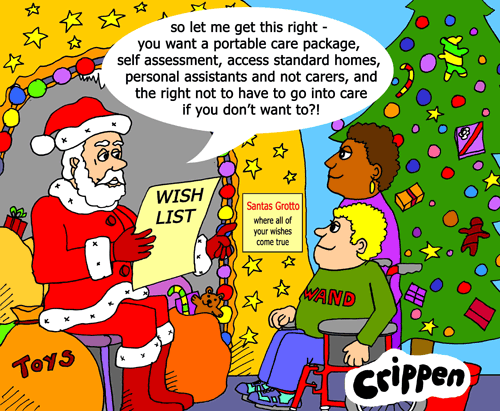
Christopher Killick
I can’t believe my eyes. I really don’t have words to describe my feelings about this case.
A disabled man has been found guilty of carrying out sex attacks on two severely physically disabled men.
Christopher Killick, 47, of south-west London, targeted his victims because he thought “they would never be able to complain”, the Old Bailey heard.
Killick, of Roehampton, was convicted of sexually assaulting the men between 1991 and 2005.
The men, who suffer from cerebral palsy, gave evidence in court using an intermediary and technology.
Killick, who also suffers from cerebral palsy, did not give evidence.
‘Dangerous and manipulative’
He was cleared of raping a third man, who was also severely disabled and used a specialised voice machine to communicate.
Killick was more physically able when he carried out the attacks and befriended the victims before assaulting them, Johannah Cutts QC, prosecuting, said.
She said: “Christopher Killick has socialised and worked within the disabled community for many years.
“He abused his friendship with these complainants and took advantage of their difficulties.
“He forced himself sexually on men who could do nothing to prevent it and whom he believed would never be able to complain or tell others what had happened to them.”
Alison Saunders, Chief Crown Prosecutor for London, praised the “patience and determination” of the victims for testifying.
She said: “Without them, Christopher Killick would never have faced the consequences of his actions.
“He is a very dangerous and manipulative man.”
Killick will be sentenced in January.
JustGiving Page Of The Week: Helen Copeland’s Zipwire
Not satisfied with skydiving in May, next July Helen Copeland will be Zipwiring for a charity called Dreamflight, that takes disabled children on… three guesses… a dream flight to Orlando’s theme parks. I don’t even know what Zipwiring is, but I do know that Helen is an inspiration. That’s why hers is this week’s JustGiving Page Of The Week. I hope you reach both your targets Helen!
Frankie Boyle Again- Three Times Over
This morning, I read this article which says that Tory MP John Whittingdale has said that Frankie Boyle ‘should not be allowed to continue with his brand of humour’ because he used two racist terms in the latest edition of Tramadol Nights. Thinking that I couldn’t agree more with a Tory MP for the first time in my life, I went off to Twitter- only to see this in my timeline:
http://twitter.com/#!/christinamartin/status/17911418980405248
This lovely quote also comes from the most recent edition of the programme.
I’ve been saying for ages that Frankie Boyle should not be allowed to express his outdated opinions in public attention. However, yet again, a mainstreamer noticed two examples of racism and didn’t notice, or didn’t care about, an example of disablist language that was broadcast in the same programme. Disablism, as I keep saying, is just as bad as racism. I’m not surprised that yet again, a mainstreamer doesn’t seem to have realised this, but part of me does wish he had.
Channel 4 are being just as bad over Tramadol Nights, though. I hope OfCom can knock some sense into them.
Case Of Asian Network DJ Sentenced For Carer’s Allowance Fraud Raises Bigger Questions
The case of Lubna Qazi has got me thinking. Mrs Qazi, 53, admitted falsely claiming Carer’s Allowance of up to £18,000 while working as a DJ for BBC Asian Network in Birmingham.
She began claiming the benefit in 2002 after her husband had a stroke. She started work at BBC Asian Network in early 2003- but for 7 years, she did not declare her job as a DJ to the DWP. She was earning more than the £95 a week allowed for people claiming Carer’s Allowance.
I am usually the last person to agree with benefit fraud. If Mrs Qazi had never been a carer and had claimed Carer’s Allowance, or if she had continued to claim the benefit after her husband had been cured of his health problems, I would have been the first person to strongly dislike her for this.
However, Mrs Qazi was genuinely her husband’s sole carer during the 7 years- a fact recognised by Birmingham Crown Court and the reason why she received a conditional discharge rather than a three month jail term. She has also been ordered to pay £100 legal costs and to return over £17,000 to the DWP.
This is a large sum of money, and there is no doubt that Mrs Qazi should have notified the DWP of her change of circumstances long ago. But she has not worked for the BBC since informing them of the case against her early this year.
As a disabled person whose parent carer claims Carer’s Allowance, I know others in the same situation. Our parents all had talents and careers before becoming our carers. They did not choose their caring roles- any more than we chose our disabilities.
Carers are all people, too. Many of them have intelligence and skills that can and should allow them to earn far more than £95 a week. By caring for us in our own homes, they are saving our hospitals and residential care homes a lot of money, time and trouble-as well as giving us a good quality of life- a life spent with family and friends in a familiar environment. They rarely complain, yet they are allowed to earn just under £150 a week for all their hard work- and that includes the benefit. Most of them rarely get a break.
Here’s a thought for those who think I am starting to rant- if a person working the 9 to 5 earned under £150 a week, would they be coming close to earning the minimum wage? I don’t think so. Well, many carers work very hard 24/7. For their caring jobs alone, they deserve to earn far more than the minimum wage.
I realise that this is wishful thinking, but personally, I would like nothing more than to see either Carer’s Allowance, the £95 weekly earnings limit, or both of these raised to at least minimum wage level by the Government.
For once, I am pleased to see someone not being sent to prison for benefit fraud.
Cross posted here.
Christmas And Friendship
A music therapy project for young adults with learning difficulties in Galloway has led to the release of a Christmas DVD.
Earlier this year, a former store room was converted into a small studio at the Activity and Resource Centre in Newton Stewart.
Since then clients – many with conditions such as autism and Asperger’s syndrome – have been making music under the guidance of former professional guitarist Paul Brown.
He spent 30 years as a touring musician, playing in West End shows and even a residency at the Monte Carlo Casino.
Now he has left the high life behind and settled in Galloway, Paul is helping disadvantaged people who never had a fair throw-of-the-dice. He recognises how music can help them.
He said: “Music is fantastic, because if you feel angry it’s better to take it out on a drum kit; if you feel angry you can write a beautiful song; or if you’re feeling very sad you can take the sadness out of yourself by putting it into a piece of music.
“In that way, you’re getting unwanted emotions out of yourself.”
The festive song Christmas and Friendship was written by Alexander Murray, 19, and is sung by 27-year-old Amanda Knight.
Alexander says he has wanted to write songs for years “but it never worked out”. He says he “cherishes” the day he met Paul because now, with his help, the music is flowing.
As well as composing Christmas and Friendship, Alexander has written seven or eight other tracks and hopes to bring out an album in 2011.
It has been a therapeutic process.
He said: “I have had some difficult times recently.
“Paul came up with the idea of me writing a song about me being sad and how it’s going to get better.
“That number was really, really uplifting.”
The project has also been a great boost for Amanda who sings lead vocals on the Christmas DVD. She has proved to be a natural performer with a lovely voice.
“I have always wanted to be a singer and now I have fulfilled my dream,” she said.
Amanda is a great admirer of Susan Boyle who has achieved international stardom despite also suffering from some learning difficulties.
“She has got a powerful voice and I think to myself (that) one of these days l could be the same as her,” she said.
Amanda says friends are encouraging her to enter the next X-Factor auditions and she says she just might.
It is a measure of the confidence the ARC music project has given those involved.
Manager Beth Bleasdale says they have improved their self-esteem, their communications skills and their ability to work together.
Support message
She says the DVD – which also features primary five girls from Penninghame Primary School in various Christmas scenes – is a “a great big achievement for everybody who has been involved”.
The DVD is also endorsed by the Eastenders actor Shane Ritchie who plays the character Alfie Moon. Shane has recorded a personal message of support from himself and the cast of the show.
In it he says: “I’m so sorry I can’t be with you all up there in south west Scotland as I’m currently pulling pints in the Queen Vic here in Walford.
“But I’m so happy to hear about the work you’re all doing in Dumfries and Galloway’s Cree Studio.”
The studio – made possible with the help of funding from the Postcode Lottery and Turning Point Scotland – is also getting external commissions, including some work on behalf of Dumfries and Galloway Council.
Christmas and Friendship is on sale as a CD (£3) and as a CD/DVD box set (£6) and is also available as a download.
One Of David Askew’s Harrassers Detained Again
A teenager from Greater Manchester who admitted harassing a man with learning difficulties who later died has been detained for robbing a man.
Kial Cottingham, 19, of Hattersley, threatened the victim, 57, with a knife and metal bar before ordering him to hand over cash, police said.
He was found guilty of robbery at Manchester Minshull Street Crown Court and detained for five years on Monday.
He was detained for 16 weeks after admitting harassing David Askew, 64.
He harassed Mr Askew, also of Melandra Crescent, who he called “Dopey Dave”, over a three-month period from 25 January 2010 until the day of his death on 10 March.
He was sentenced for that offence at Tameside Magistrates’ Court in September.
Police said Cottingham and another man confronted a man who was visiting a client in Sylvester Close, Hattersley in February.
‘Simply doing job’
They threatened him with the weapons before dragging him down the back of a row of houses.
They fled with a mobile phone, cash, car keys and cash from his car before fleeing on foot along Stockport Road.
Charges have not been brought against the accomplice, a police spokesman said.
Det Sgt Claire Platt, of Greater Manchester Police, said: “Only someone who has been through the ordeal of being robbed will understand just what this man has been through.
“He was simply going about his job when he was violently confronted and threatened by Cottingham.
“The fact he and his accomplice were carrying weapons shows a propensity for violence and intimidation and he did not care one bit about frightening this man just to get his hands on some cash.”
Wales Hate Crime Victims Hesitant To Report
More needs to be done to encourage the victims of hate crime to come forward, say equality campaigners.
Figures revealed to BBC Wales show that the number of recorded hate crimes and conviction rates in Wales is at a five-year high.
Criminology expert Matthew Williams is leading a study into the true scale of hate crime in Wales.
He said most victims are reluctant to report crimes even if they suffer discrimination daily.
Earlier this year the Crown Prosecution Service issued new guidelines to prosecutors which it says will help increase the number of cases brought to court.
It is particularly keen to clamp down on disability hate crime following high profile cases like those of Fiona Pilkington and David Askew.
Fiona Pilkington killed herself and her disabled daughter, Francecca Hardwick, 18, after years of abuse from a gang in Barwell, Leicestershire.
An inquest into her death heard she had contacted police more than 30 times about abuse claims, making her last report of intimidation by a gang of youths on the day she died.
Dr Williams, senior lecturer in criminology at the Cardiff Centre for Crime, Law and Justice, is the academic partner on a joint three-year study with the Cardiff and Vale Equality and Human Rights network.
He said figures revealed to the BBC showing recorded hate crimes had doubled in five years were just the tip of the iceberg.
“None of these figures surprise me and while they are encouraging, I think this is a societal change which could take decades to improve.
“There’s no reliable data on instances of hate crime in Wales – the British Crime survey touches on it but those minorities being targeted are not represented.
‘Low-level discrimination’
“Previous data on reported crimes reveals that about 80% of all hate crime goes unreported.
“What needs to be tackled is this day to day low level sustained discrimination – otherwise we will see more catastrophic outcomes like the Fiona Pilkington case.”
His view is shared by Simon Green, a wheelchair user from Bridgend, who earlier this year presented a BBC Wales Week in Week Out documentary on disability hate crime.
He wants to see legislation changed so that there are specific charges for disability and homophobic hate crimes, as there are for racially motivated crimes.
He said: “People are having their lives destroyed on a daily basis and dying because of it.
“When I was first in a wheelchair I expected I might be treated a bit differently but I didn’t expect that I would get tipped out of my chair and abused on a regular basis.”
He admitted many victims do not realise that a hate crime has been committed and that they have a legitimate right to report it.
He said: “If I reported every single incident, I would be phoning the police every time I go out.
“I would like to see more education being done in schools to teach young people about equality and awareness.”
The Equality and Human Rights Commission recently unveiled its Not just another statistic research which attempts to uncover what it is like for minorities to be on the receiving end of prejudice daily.
Wales director Kate Bennett said they were currently concentrating on disability hate crime in particular.
“Our Disability Formal Harassment Inquiry is investigating where this sort of harassment takes place and what the hotspots are.
“Attitudes are changing – the cases of Fiona Pilkington and Simon Green’s documentary have been crucial.
“But hate and crime are both strong words and so people often don’t think they apply to them as they don’t think a crime has been committed.
“We have seen figures from the police which suggest that in the last couple of months the reporting of hate crime has shot up.
“What we want to see is more incidents identified before they start building up.
“Sadly incidents are incredibly common – the Valleys Racial Equality Council has said that every ethnic minority person in the valleys is subjected to harassment every week.”
‘Heavily under-reported’
The police forces in Wales have been working with groups representing those most likely to fall victim to hate crime to improve training among officers.
In the Gwent force, 14 officers and support staff have been trained as part of its first lesbian, gay, bisexual and transgender (LGB&T) liaison service.
Det Sgt Wendy Keepin was instrumental in setting the service up.
She told BBC Wales: “I think there is a perception among some people that their experience would not be taken seriously if they reported it and that’s inaccurate.
“It’s no secret that homophobic crimes and incidents are heavily under-reported – some people don’t want to come out publicly and feel coming forward to report a crime will identify them.
“We can understand that but we want them to know we will deal with their complaints in total confidentiality.
“Our trained team is sympathetic and understand their needs so all cases are referred to get support and advice- we hope the way we are dealing with these victims will encourage more to come forward.”
Stonewall Cymru, the lesbian, gay and bisexual charity, has been working closely with the police forces and CPS in Wales.
Jenny Porter, community liaison officer for the charity, said: “Really these are tip of the iceberg figures, many more people experience homophobic hate crime than report.
“Our survey found that one in five lesbian, gay and bisexual people had fallen victim to a homophobic hate crime or incident in the last three years but seven in 10 of those had not reported that experience to anyone.
“From a victim perspective whether they report it or not, the incident still has a major impact on their lives.”
There had been a 25% increase of LGBT people using victim support services since Stonewall Cymru began a concerted campaign in January, she added.
Rudolph The DisAbled Reindeer
I’ve been thinking… Rudolph’s DisAbled! When Disability Bitch said so on Twitter the other day, I was inspired to write this:
Rudolph The DisAbled Reindeer
Rudolph the disabled reindeer
Had a very fast wheelchair
And if you ever saw him
You would say it wasn’t fair
‘Cause all of the other reindeer
Used to laugh and call him names
They never let poor Rudolph
Join in any reindeer games
Then one snowy Christmas Eve
Santa came to say,
Rudolph with your chair so fast
You can pull my sleigh at last!
So kids still got their presents
They shouted out with glee
Rudolph the disabled reindeer
You’ll go down in history!
I also wrote some DisAbility friendly Christmas songs last year. You can find them here, here, here and here.
Steven Neary Is Home!
I heard some great news on Twitter today. Steven Neary, the 20 year old man with Autism who was put into a care home by Hillingdon Council last year, then kept there against his father’s wishes, is now home. Full details here.
Independent Living Fund: EDM 1231
Originally posted here. Thanks to CarerWatch.
Please urge your MP to sign early day motion 1231 calling on the Government to reconsider the closure of the ILF to new applicants and to reverse the intention to close the fund in its entirety by the end of this Parliament. The proposed closure and rapid reduction in care will cause immense suffering and increased poverty for many older and disabled people.
Primary Sponsor – Katy Clark
The motion reads :
That this House notes with concern the Government’s announcement that the Independent Living Fund will be permanently closed to new applicants and completely phased out by the end of this Parliament; further notes that this will affect around 21,000 current recipients as well as those who would have applied to the fund in the future; acknowledges the fantastic assistance that the Independent Living Fund has provided severely disabled people to live independently; and calls on the Government to reconsider its decision, which will affect thousands of severely disabled people and will in the long term lead to greater financial costs as more people are placed in long term care.
How Accessible Is The Edinburgh Fringe Festival?
The BBC Ouch Blog have posted a link to a survey being carried out by the organisers of the Edinburgh Fringe Festival, to find out how accessible the Festival is. If you’re not too cold to think about next August, do let them have your thoughts.
Snow On Wheels
Ouch’s Liz Carr has just written her latest article. It’s about how she made the snow accessible to herself and her wheelchair. It’s hilarious as always, and worth reading, especially in this weather!
Be safe and warm in the snow, dear readers. If all else fails, read this blog with a hot cup of tea!
Petition To Keep DLA Mobility Component In Care Homes By The Muscular Dystrophy Campaign
If you live in the UK, please sign this petition here. I just did.
ME Not Caused By XMRV Virus
A new study has cast further doubt on the idea that a virus called XMRV causes chronic fatigue syndrome.
US scientists linked the condition, also known as ME, to a mouse-like virus in 2009 after finding it in blood samples.
Now, UK experts say the discovery was a “false positive”, caused by cross contamination in the lab.
The illness may still be caused by a virus, they say, but not the one at the centre of recent controversy.
“Our conclusion is quite simple: XMRV is not the cause of chronic fatigue syndrome,” said Professor Greg Towers, a Wellcome Trust senior research fellow at University College, London, who led the research.
“It is vital to understand that we are not saying chronic fatigue syndrome does not have a virus cause – we cannot answer that yet – but we know it is not this virus causing it.”
Mouse DNA
XMRV (xenotropic murine leukemia virus-related virus) is a virus found in mouse DNA.
It was discovered in 2006, and was later found in samples from some patients with prostate cancer and chronic fatigue syndrome.
This lead to suggestions that the virus might be the cause of these conditions.
A paper providing some evidence in support of a link between chronic fatigue syndrome and the virus was published in the leading journal Science last year.
In the latest work, the team, from London and the University of Oxford, used DNA sequencing methods to study XMRV.
They say their evidence, published in the journal Retrovirology, shows the virus found in patient samples arose from laboratory contam
What is more, they think it is unlikely that the virus could actually infect people.
Professor Tim Peto, consultant in infectious diseases at the University of Oxford, said the original paper in Science came as a great surprise to experts.
“It came as a great surprise when XMRV was first suggested as being linked to chronic fatigue syndrome and it was imperative that further tests be done to see if the findings could be repeated,” he said.
“There have now been a number of attempts which have failed to find the retrovirus in other samples, and this research suggests that in fact XMRV is probably a contamination from mouse DNA.
“These latest findings add to the evidence and it now seems really very, very unlikely that XMRV is linked to chronic fatigue syndrome.”
Is Frankie Boyle Funny?
I’m linking to this article from Sunday’s Observer. It’s a debate about whether Frankie Boyle is funny. It’s no secret on this site that I don’t find Frankie Boyle at all funny- what do you think, readers?
Disability Awareness Test For Carlisle Taxi Drivers
Potential taxi drivers in Carlisle now have to pass a disability awareness test before they are granted a licence.
Under new rules by the council, as the licensing authority, drivers have to prove they know their responsibilities to disabled passengers.
This will take the form of a test on what kind of support should be offered.
It is in addition to the existing test on their knowledge of the location of streets, public buildings, pubs and restaurants, villages and routes.
The new examination is based on a document setting out details such as assistance with seat belts, entering or leaving the taxi, help for visually impaired passengers, as well as those who are hard of hearing, or have learning difficulties.
The 12 Days Of Cripmas
The 12 Days Of Cripmas is a topical take of a classic carol listing the benefits and services currently being removed from disabled people in Britain. The lyrics were written by a user of the Ouch messageboards, sent to Where’s The Benefit and the track produced and directed by BendyGirl of The Broken Of Britain. We’re all incredibly proud of Imana our 11 yr old singing star who is a child carer for her mum who has Multiple Sclerosis.
Please share this track everywhere and let’s see if we can get it some national media attention!
Thanks, Kaliya AKA Bendygirl.
A Man And His Guide Dog
When former Paralympic skier Mike Brace was blinded in a fireworks accident at the age of 10, no one told him to stop doing things.
He was expected to become as mobile as possible and lead as normal a life as he could.
“Those with good mobility used a white stick and those who didn’t, used a guide dog,” he explains.
“The white stick was a badge of honour.”
Fifty years later, after representing Britain in cross-country skiing at six Paralympic Games and three World Championships, Mike found that using a cane was becoming more difficult.
He realised that a guide dog would be the solution to a world full of increasingly awkward obstacles for a blind person.
The answer came in the form of a black Labrador retriever cross, named Izzy.
“I wanted to expand my mobility ambitions rather than shrink them,” he explains.
“The stick was great for knowing the environment I was in but the dog is good for going round the obstacles I kept encountering.”
Cars encroaching on pavements, vans parked in odd places, an increase in street furniture all became frustrations for Mike in his daily life.
Three months on from their first meeting, Mike and Izzy are a team – thanks to some intensive training provided by an instructor from Guide Dogs.
Mike’s busy lifestyle meant that Izzy had to be able to cope with regular journeys to central London from his home in Hornchurch, Essex, using all forms of public transport and even a trip on the London Eye.
‘Maiden voyage’
It was no easy feat getting man and dog to bond and Mike recorded his thoughts on the training sessions in a regular phlog, the audio equivalent of a blog.
Listeners as far away as Australia listened to his experiences and his missives were downloaded 60,000 times.
In his phlog, Mike describes how he had an eventful maiden voyage with Izzy to the gym.
“Today is the first time I have been out of my home alone without my white cane for nearly 50 years.
“The route to the gym is difficult but she managed it with only one or two small problems.
“We missed the pavement leading to the sports centre but I soon realised Izzy was following two football players and got her back on the right path.
“We then nearly missed the path to the sports centre as Izzy was intent on getting into someone’s car right by the entrance.
Once at the gym, Mike confesses to his emotions taking over.
“I had a tearful minute in the changing rooms on my own before pulling myself together,” he says.
Mike says Izzy is now very clingy, very affectionate and likes nothing better than sitting on his feet when they are at home.
He feels like a grandparent with a new charge; a dad with a new baby.
And she has given him a new lease of life.
“Izzy has allowed me to do more and not shrink away from things. We went out in the snow, for example, and she was totally unfazed by it.”
But of course sometimes things do go wrong.
“Ninety-five per cent of the time she gets it right. When I think she’s got it wrong I have to take control, retrace our steps and find the correct route,” he explains.
Mike worried that he wouldn’t need to use the skills of navigation he’d learnt using his cane anymore. But he concedes that the reverse has been true.
“Izzy is a massive extension of my life. She gives me freedom of movement and independence. I can go anywhere with her and know that I will be able to find my way.”
Announcing ‘One Month Before Heartbreak’
Thanks to Emma Crees. This post was originally posted here by Emma.
I’ve been thinking about things that we can do to raise awareness of The Broken of Britain and our cause. This post is to announce our newest venture.
One Month Before Heartbreak
A Broken of Britain
Blogswarm
14th – 16th January 2011
What is it?
It’s something a bit similar to Blogging Against Disablism Day (BADD). Although I will run this yearly if I need to, I’m really hoping not to need to. Basically it’s people getting together to all blog on a subject or a theme at a specified time. The hope is that by all writing at the same time it raises awareness and makes more of an impact.
Why One Month Before Heartbreak?
The consultation that’s currently ongoing about DLA reform ends on 14th February 2011. Which is Valentine’s Day, traditionally a day for love but which could severely affect disabled people if DLA reforms aren’t handled correctly. We need to ensure that our voices are heard. We’re holding this event a month before the consultation ends in order to raise awareness of the consultation and give people to chance to respond to it if they wish. Bendy Girl came up with the name of this event.
What do I do?
Basically, write about whatever you want. Obviously, it should have something to do with disability and it would be great if you could mention this event and Broken of Britain. You don’t need to write specifically about the DLA consultation and your personal experience. Those are welcome but this isn’t topic specific.
Nor do you need to write. You can do a video, a recording, write a poem, draw a picture, anything you want!
I plan to make space available on my own blog to anyone that doesn’t have somewhere to share and wants it.
Who can take part?
Anyone. You don’t need to be disabled or a carer or know a disabled person to take part. Nor do you need to live in the UK or be British. For our campaign and especially for this event to be successful we need to get this out to the wider community, including the international disabled community and the non disabled community.
What can I do to help?
Post on your blog, twitter, Facebook, any website you go on about this event. We need to people to know it’s happening. And keep doing so until the date comes. Use the #BofB hashtag on twitter.
I have a more concise version of this announcement people can repost if they wish. Comment here if you want it or let me know where you think it should be reposted.
Take part if you feel able. This event runs over three days in the hopes that more people will be able to contribute than if it was tied to a single day. It’s not necessary to participate each day although you can if you wish.
If you spot something to do with One Month Before Heartbreak that you like, tell the person who wrote or otherwise made it. Who doesn’t love feedback?
Equally if you spot something you like share the link so others see it.
More will be posted about this along with some other ideas on how to take part as we get closer to the time. Please let me know of any suggestions or ideas you have.
Language
Language is important. However people have very different ideas about what is and isn’t acceptable. And they have their reasons for it. For example in some areas “disabled people” is acceptable but in others “people with disabilities” is considered more appropriate. Please respect that everyone has a choice. The Goldfish, creator of BADD, has given me permission to link to her Language of Disability Post which explains more about this.
And Finally…
Please don’t feel any pressure to take part or do more than you’re able to. I want people to stay safe and enjoy this!
Don’t forget the date!
One Month Before Heartbreak
A Broken of Britain
Blogswarm
14th – 16th January 2011
Heather Mills Chosen For GB Paralympic Ski Squad
Charity campaigner and former model Heather Mills has been offered a place in the development squad of the British disabled ski team for a trial period.
The ex-wife of Beatles legend Sir Paul McCartney lost part of her left leg in an accident in 1993.
She is hoping to reach the 2014 Winter Paralympics in Sochi, Russia.
“Heather is only at the first stage of a journey that we hope will lead to her becoming a full squad member,” said team manager Dave Chugg.
“She has made clear her ambition to represent Great Britain in adaptive ski racing and approached the British disabled ski team to try out for our development squad.
“At a recent assessment in an indoor ski slope, she demonstrated that she responds well to coaching and is capable of adapting her skiing in response to coaching direction.
“During the trial period with the development squad she will have the opportunity to develop her skills and follow a set programme both inside and outside of our squad setting.
“This will allow us to judge her progression from her current standard of being a very good recreational skier towards becoming a racer.
“At the end of that trial period we will make a further assessment based on how far she has improved and on her comparative performance with established racers and other development skiers.
“She has been invited onto the development team for the trial period because she is outside the usual age and ski profile for the team. However, she has shown good levels of fitness and determination.”
It is the latest challenge for the 42-year-old who has competed on ITV’s Dancing On Ice show and also on the US version of Strictly Come Dancing, Dancing With The Stars.
But despite her fame, Chugg has insisted that Mills will not receive any special treatment.
“When working with our squads, Heather will be treated the same as any other team member in terms of our expectations on and off the slope,” he said.
“But she will also be able to work hard with personal coaching when away from the squads.”
Kerry Robertson In Pick Me Up
I’ve just read a wonderful article about Kerry Robertson, the learning disabled teenager whose baby was taken into care last year, in Pick Me Up magazine, and I can’t stop smiling. Kerry has married baby Ben’s father, Mark McDougall, and they’ve got Ben back. I managed to find a scan of the article- here it is.

JustGiving Page Of The Week: Wendy Morrell
Wendy Morrell’s assistance dog, Caesar, died last January. In his memory, Wendy has been trying to fundraise for Dogs For The Disabled, the charity that brought them together in 2000. Hers is this week’s JustGiving Page Of The Week. I hope you reach your target Wendy!
Jeff Brazier: Me And My Brother
I’ve just watched Jeff Brazier: Me And My Brother on BBC Three. I’m glad I did- at times I laughed out loud, other parts were really frustrating. Anyway, here’s the link to it on iPlayer if you’re interested. Comments welcome.
Marfan Syndrome
I’ve just received this information from US charity National Marfan Foundation.
So what is Marfan syndrome you ask? Marfan syndrome is a disorder of the connective tissue. Connective tissue holds all parts of the body together and helps control how the body grows. As a result, Marfan syndrome features can occur in many different parts of the body, including the eyes, bones and joints, and heart and blood vessels.
People with Marfan syndrome frequently have telltale signs that are easy to see.
- They are often taller than unaffected family members, with disproportionately long arms and legs.
- They may have an indented or protruding chest bone and a curved spine, flat feet and loose joints.
- They may be nearsighted and have dislocated lenses in their eyes.
What can’t be seen is the effect of the condition on the aorta. It is prone to enlarge and could tear or rupture – leading to a sudden, early death – if it’s not treated.
It is a genetic condition, so people are born with Marfan syndrome, but outward signs may not be evident until the teens or 20’s. However, even if the outward signs are not evident, the aorta may be enlarged and needs to be treated and monitored from a young age. Three-quarters of people with the condition inherit it from a parent, but one-fourth are a spontaneous mutation, which means they are the first in their family to be affected.
If you or someone you know has any of these features, an evaluation is necessary. New diagnostic criteria have been defined for those with a family history of the condition and for those who may be a sporadic case.
For even more information, tips and resources, you may visit: www.marfan.org/marfan and check out this special video PSA: http://www.westglen.com/online/marfan.html
By simply spreading awareness to your readers, you can help reduce deaths from Marfan syndrome. I would really enjoy collaborating with you on this effort. If you’re interested, I would be happy to send over more information. Thank you for your time and I look forward to your thoughts.
Met Police To Investigate Jody McIntyre Incident
The Metropolitan (Met) Police is to investigate a man’s claim that he was twice removed from his wheelchair during a rally against tuition fees.
Jody McIntyre said he was hit with a baton and carried from his wheelchair, and was later dragged across a road in central London on 9 December.
“Disturbing” video footage accompanied his complaint, the Independent Police Complaints Commission (IPCC) said.
It will supervise an inquiry by the Directorate of Professional Standards.
Mr McIntyre, 20, alleged he had been discriminated against on the basis of his disability, added the IPCC, which is the watchdog for police forces across England and Wales.
On Tuesday he told the BBC he was “100% not a threat to anyone” during the demonstration.
“There is no doubt that this footage is disturbing,” said the IPCC’s commissioner for London, Deborah Glass.
“It is right that is should be thoroughly investigated, both for Mr McIntyre and in the wider public interest.”
Inquiry ‘progressing well’
The IPCC has now received 66 complaints from people who said they had suffered significant injuries at the hands of the police last Thursday.
A further 45 complaints had been lodged about events at the three previous protests about the increase in tuition fees in England, which were held in central London on 10, 24 and 30 November.
Most of these involved the Met but 11 involved officers from Avon and Somerset, Greater Manchester, Northumbria, Sussex and West Yorkshire, who were involved in policing the demonstrations.
The IPCC said it was “progressing well” with an investigation into whether Middlesex University student Alfie Meadows, 20, suffered a serious head injury after being hit with a truncheon last Thursday.
The watchdog’s investigators were checking CCTV footage and trying to contract witnesses, it said.
In addition, the mother of a 15-year-old girl had alleged her daughter suffered a broken foot during the rally on 24 November, while a woman said she was struck over the head with a truncheon on 30 November, it added.
Jeremy Vine Discussion On Jody McIntyre
Jeremy Vine was discussing Jody McIntyre’s case on his show today on Radio 2. It’s up on iPlayer here for a week. The discussion starts at around 1 hour 10 minutes and continues for most of the rest of the show.
I have a few points to make about what I heard.
There were some people on the show making comments like ‘what were the police supposed to do?’ There was even one man, one of the main studio guests, saying that wheelchairs can be used as weapons. I’ve never heard such rubbish! Wheelchairs are not weapons- they are necessary mobility aids. Wheelchair users do not choose to use or to need wheelchairs. They cannot help their disabilities. As I’ve said from the start, the police were very wrong to do what they did to McIntyre. I have CP and so do many of my friends. If McIntyre had been more severely affected by his disability, he might have hit his head on the ground, and then the police could have killed him. As it is, they are all very lucky that he was not left with a more severe level of disability after the incident. Has anyone considered that, even for a second, so far?
I was also shocked and very disappointed to hear the view of a mother of a disabled young man who wrote in to say she thought Jody McIntyre had put himself in danger by going to the protest. Of all the people I would expect to suggest that Jody McIntyre should not have been there, expressing his opinion like everyone else, the parent of a disabled person was last on the list! I’d like to know what other parents of disabled people think about this.
Comments, as always, are very welcome below.


