Deaf Man Sues Police In Colorado Over Alleged Excessive Use Of Force
A deaf man in Colorado has filed a civil rights suit alleging he was slammed to the ground by police after running a stop sign two years ago.
In his lawsuit, Brady Mistic claims two Idaho Springs police officers misinterpreted his attempts to communicate and “rashly attacked” him.
He says he was was wrongfully jailed for four months after the incident.
The police department has said it believes the officers acted appropriately.
His deafness was a “fact was not known to the officers during the initial encounter” when he failed to comply with verbal commands, the department wrote in an online statement defending the response.
Mr Mistic, now 26, is deaf in both ears, communicates via sign language and cannot read lips.
He alleges he was “confused, blinded by police lights, and unable to hear or know what was going on” when officers Nicholas Hanning and Ellie Summers apprehended him on 17 September, 2019 for running a stop sign.
According to the court filing, he used hand gestures and “clumsy verbal speech” to say the words “no ears”. The filing claims the two officers grabbed him “without providing any warning, commands, or reasonable opportunity for communication”.
He accuses the duo of slamming him to the ground and repeatedly shocking him with a taser device.
Mr Mistic was eventually charged with assaulting an officer after Mr Hanning broke his own leg during the arrest.
The charges were later dismissed though the police department has said those initial charges were “due to the resistive actions of Mr Mistic”.
Mr Mistic denies resisting arrest and his suit claims the charges were “an illusory attempt to cover up [the officers’] misconduct”.
Both police officers and the Idaho Springs police department are named in the lawsuit.
The department has said it reviewed the incident and deemed that the officers acted appropriately when Mr Mistic “immediately got out of his vehicle and quickly approached a clearly marked patrol car with the emergency lights activated”.
Mr Hanning is no longer with the police force, according to US media. He was fired in July and is currently facing separate assault charges over another arrest earlier this year.
Also named in the lawsuit is the county board of commissioners, which maintains the jail where he was held.
“In jail, Mr Mistic was repeatedly denied an interpreter or other reasonable means of communication for four months,” reads the lawsuit.
It claims that he was also unable to communicate with jail staff or use the inmate telephone system.
Mr Mistic is seeking compensation for physical and emotional harm under the Americans with Disabilities Act, and punitive sanctions against the both officers.
New disabled-led arts project challenges cultural stigma surrounding mobility shops
A press release:
Artist Bella Milroy’s new project aims to expose and interrogate the cultural status of mobility shops and aids, offering an alternative to the grey – beige – Purgatory that they currently exist within.
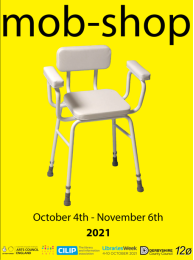
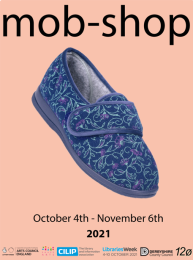
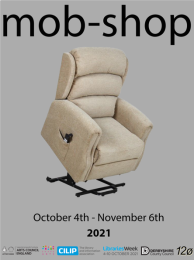
Posters advertising Mob-Shop, which takes place across Derbyshire libraries between October 4th and November 6th 2021
Mob-Shop is a continuing, disabled-led project exploring mobility shops, mobility aids and the devices and practices used by and designed for disabled and critically ill people. The project aims to expose the concept of mobility shops in where they sit in the cultural consciousness of disabled experiences and sent to them in ways that could potentially offer new and better alternatives to the redirect, medicalised, grey-beige-Purgatory of how they exist today.
Devoid of fashion, youth and culture and any form of autonomy and self-expression, mobility shops are a fascinating example of the excruciatingly rigid and ableist narrative that cuts right to the heart of how society sees disabled people.
Bella Milroy, director and curator, said: “Mobility shops do not reflect the reality of disabled experiences, and the aids and devices that are supposedly designed exclusively for us, so often failures in offering variety of choice, identity, or imagination. As physical spaces they are both geographically and socially located on the peripheries. Mob-shop seeks to centre disability culture and the wealth of shared knowledge and wisdom of our disabled community, facing some of these peripheral experiences at the core of the programme.”
This new programme commissions disabled artists to respond speculatively to the concept
of the mobility shop. In a series of newly created artworks, writing, workshops, and podcasts, we invite you to creatively accompany us in critically reflecting upon what the design and aspiration of accessible products, spaces and practices might embody.
You can find artworks exhibited at Chesterfield, Dronfield and Long Eaton libraries between
the 4th of October and the 6th November 2021. Printed artworks will be exhibited and distributed across all Derbyshire Libraries in the form of a double-sided poster. A downloadable version of this publication will also be made available as a PDF across all libraries in England. They will also be available to take away upon request.
The podcast will be made available on Soundcloud and promoted online through Derbyshire Libraries social media.
Mob-Shop is a project supported by 12o Collective, Derbyshire Libraries, CILIP, Shape Arts
and Arts Council England.
Further information regarding accessibility of venues, podcasts, workshops and
where to find audio descriptions, plain text versions and exhibition walk throughs of
all commissioned artwork can be found on the website www.mob-shop.co.uk.
If you have any specific access requirements or questions regarding how you might
wish to engage with the project and need to get in touch, you can email
Contributing artists: Aminder Virdee, Laura Daisy Cowley, Raisa Kabir, Mary Slattery (@invalid_art), Abi Palmer, Kiara Mohamed, Dahab Abdullah
Podcast contributors: Natasha Lipman, Kyla Harris, Nina Tame, Leah Clements, Maria Oshodi
Guest writer: Pippa Stacey
Critical Project and Production Support: Eva Duerden
Director and Curator: Bella Milroy
Dan Daw’s BDSM Dance Show
‘I grew up being told my body was wrong,” says Dan Daw. “And being told by medical professionals that my body had to be fixed. I was told I wouldn’t be able to be a dancer.” But that wasn’t true at all.
Born disabled – he identifies as “crip”, reclaiming the word, and prefers not to detail his condition – Daw, 38, grew up in an outback town in South Australia and showed a talent for performing from a young age (his grandmother was a dance teacher). During a drama degree in Adelaide, Daw discovered that working with his body was what made him buzz, which led him to dance, to the UK, to Candoco dance company and then to making his own honest and autobiographical performances, the latest of which is The Dan Daw Show.
Despite his certainty that his body was his best creative tool, Daw has been on a real journey with it. “I’ve had to pull apart and rebuild the relationship I had with my body,” he says, “and I’m only in the past couple of years starting to really find the joy in my body, because I still felt an immense amount of shame.” The Dan Daw Show is about him finding a way to own what he calls his “messy” body, “and finding my crip joy inside that”.
The medium Daw uses to illustrate this joy is kink. You might know it as BDSM, a term for sexual practices that go beyond vanilla and are often misunderstood. What kink absolutely isn’t is Fifty Shades of Grey, says director Mark Maughan, who created the show with Daw (whom he calls a “rare talent” of great integrity, humour and generosity of spirit). “I think people associate it with violence, pain, trauma,” he says, whereas in reality kink practices are about “care, interdependence and communication”. “Kink is about asking for what you need and not being ashamed of that, celebrating the things that we know we desire. That level of connection and communication with another human being is pretty special,” says Maughan. “When you feel that, it’s something incredible.”
In the case of The Dan Daw Show, this is illustrated in a duet with the non-disabled dancer Christopher Owen, where Daw allows himself to be dominated completely on his own terms. It’s about Daw being able to drop his armour, since in the outside world he never lets himself be seen as vulnerable. “My guard is up all the time,” he says. “Is someone going to point and laugh at me, or try and trip me up? Am I going to be infantilised today? Is someone going to speak really loudly at me? Is somebody going to invite me to come to their church because god can heal me? I even get people asking me if I’m homeless. The pity look. What have you got for me today, world?!”
Only really on stage, and during sex, can Daw be unapologetic about inhabiting his body, he says. It’s easier for him to ask for, and get, what he needs in the bedroom than in the outside world. “There’s a line in the show where I say, ‘I wish I could feel this free all of the time’,” says Daw. “The level of care involved in kink practices is beautiful. If we could have that same level of care and respect and consent with each other when we’re on the rush-hour tube in the morning we could build ourselves an incredible world.”
Performing is also a space where Daw can rewrite the power dynamic between himself and a mostly non-disabled audience. “You can look at me, stare at me, but at the end you’re going to clap, you’re going to love me,” he says, smiling at the idea of “people enjoying my body and paying money to see my body”. “Here in my space I’m consenting to Chris dominating me in a way that gives me pleasure and sets my body free, and there’s a real power in that,” he says. “I’m using a non-disabled body to give me what I need, so it speaks to allyship in a brilliant way, and that there’s more that non-disabled people can be doing for disabled people in the world.”
When Daw is in control of the narrative in the theatre, some of that long-held shame can be overcome and turned into power and pride. “After years of hating my body and rejecting my body, with this show I’m celebrating my body for the first time,” he says, “and it’s liberating in the most spectacular way.”
Energy Prices: Family Struggles To Meet Bills For Life-Support Sisters
The parents of two severely ill girls say soaring energy prices have left them struggling to meet bills for life-saving equipment.
Pam and Mark Gleave, from Amlwch, on Anglesey, have three adopted children who all depend on 24-hour life support.
Their energy bills have increased recently due to the children’s medical needs becoming greater.
Meanwhile gas and electricity prices have risen in the UK this year due to a number of factors.
The couple, who have two grown-up biological children, adopted their children after some time fostering.
Katie, 19, and Kelly, 14, have PEHO syndrome – a rare and degenerative neurological condition which means they cannot walk or talk, and need constant care.
Mason, 12, has complex medical needs due to brain damage and is currently at Alder Hey Children’s Hospital in Liverpool.
In the daughters’ room alone there are more than 60 plugs for medical equipment.
Ms Gleave said: “Our electricity bill alone is £776 a month – that doesn’t include heating or anything else.
“It’s not normal for a family to have 38 pieces of medical equipment running 24 hours a day.
“We see things are going up and up. Where are we going to find that money?”
Mr Gleave, 61, was made redundant two years ago and was planning to use the money he received to pay off the mortgage, but since then the children’s health has deteriorated and all three are on life-support machines at their home.
The machines must be charged constantly and back-up batteries are needed in case of a power cut.
“It’s extremely difficult,” said Ms Gleave.
“When Mark worked it wasn’t an issue, he used to work seven days a week, we never asked for anything from anybody.”
The family said if the children were being cared for in hospital, it would cost the health service about £2,000.
‘Sell home first’
But Ms Gleave said while they has discussed the option of hospital care as the bills mount: “That’s never going to happen – we would never let that happen.”
She told BBC Radio Wales Breakfast: “We have got things that we would sell before that would even be a thought in my mind.
“We’d sell the house first.”
All the carers and equipment are funded by Betsi Cadwaladr Health Board, but the equipment running costs are the parents’ responsibility, and the couple fear they will not be able to cope without financial help.
They have asked for guidance from health staff but feel lost and do not know who to turn to for help.
Ms Gleave said: “All we are asking for – is there some way we can get some support, because it’s not normal to have that amount of bills just to keep the children at home.
“For us it’s all about keeping the children at home. It’s about giving them to good quality of life.
“We’ve got a wonderful social worker, and I do know they are trying to look into it. But they, I think, are in the same boat as us. It’s not happened before – so where do we go?”
Another concern is that the children’s room in the conservatory is in poor condition and needs the roof replacing, but they do not want the move their children into separate rooms or into areas not adapted for them.
She said: “We seem to be fighting, and not getting the answers that we need.
“It’s not about complaining or moaning, people have been wonderful, our social worker, our ventilator nurse. It’s just we don’t know where to turn, that’s the honest truth, we don’t know what to do.
“We don’t know what the next few months is going to bring for the children, and that’s a real worry.
“I would not in any way swap our lives with these beautiful children that are so amazing and keep you grounded.”
She added: “In a world that we live in today, honestly, they are amazing, wonderful children.”
Paralympian Janice Moores Gets Podium Moment 37 Years Later
In 1984, Janice Moores won Javelin Gold at the Paralympics, held in New York.
Such was the amateur nature of the competition at the time, athletes had to provide their own audio cassette with their national anthem.
But, when it came to Janice’s proud moment at the medal ceremony, they played the victory march by mistake rather than God Save the Queen.
Now, 37 years later and living in a Dorset care home, Janice still feels the moment is tinged with sadness and disappointment.
The BBC South Today team joined forces with Janice’s friends and family to recreate her medal ceremony with the national anthem playing proudly.
Vic Reeves: Brain Tumour Leaves Comic Deaf In One Ear
Comedian Vic Reeves has revealed he has a benign brain tumour which has left him “100% deaf” in one ear.
The TV star, 62, whose real name is Jim Moir, said the growth is inoperable and has curtailed his hobbies such as listening to music and bird watching.
He told The Adam Buxton Podcast he had a benign inoperable tumour known as a vestibular schwannoma.
“I’ve gone 100% deaf in the left ear, and it will never come back,” he added.
Reeves, who found fame in the 1990s with his comedy collaborator Bob Mortimer, said: “It’s like the size of a grape so they just have to keep an eye on it.
“It’s benign. They can’t remove it – they can shrink it or they can just leave it and keep an eye on it, and that’s what they’re doing.”
Asked if this has distressed him, the Shooting Stars co-host said: “No, not really, I would rather hear than not but this happened so you just get on with it, don’t you?
“I’ve got used to it, I like going out bird watching and I never know where the birds are. I can hear them but I don’t know what direction they are in.
“I had to throw away all my stereo LPs.”
Vestibular schwannomas, also called acoustic neuromas, start in the nerve that connects the brain to the ear, according to Cancer Research UK.
‘A life without stereo’
The charity said the tumours are rare, do not spread to other parts of the body and because they grow slowly over years, symptoms do not appear for some time.
Among the symptoms are hearing loss, ringing and buzzing sounds, difficulty working out where sounds are coming from and numbness of the face, which usually only happens in advanced tumours.
Asked if he can hear anything at all in that ear, Reeves, who grew up in Darlington, said: “It’s dead, absolutely, completely gone.
“I’m living with deafness. Can you imagine a life without stereo records? All I’ve got left is Frank Ifield on mono!”
Search Finally Begins For Claimants Owed Up To £16,000 In PIP Back-Payments
With many thanks to Benefits And Work.
A year after we first wrote about it, the DWP have finally begun a search for PIP claimants owed up to £16,000 in PIP back payments.
This latest review follows a supreme court decision in July 2019 which found that the DWP had not been awarding the correct points to some claimants with mental health conditions who need prompting or social support to engage face-to-face with other people.
Back on 17 September 2020 the DWP announced that they were now following the decision of the supreme court and that they would be reviewing awards made between 6 April 2016 and 17 September 2020 to identify claimants owed money.
But it has taken another full year before Therese Coffey finally announced last week that the review had begun
Amongst PIP claimants who may have missed out are:
people who have regular meetings with a mental health professional, without which they would not be able to manage face to face encounters;
people who need the input of particular friends or relatives with experience of supporting them in social situations – rather than just any well-meaning friend or relative – to help them manage face to face encounters.
Some claimants will have missed out on awards of the standard daily living component since April 2016 and will be entitled to around £16,000 in back payments of PIP.
Plus back payments of means-tested benefits premiums in some cases.
Other claimant, who should have got the enhanced rate but only received the standard rate, may be entitled to smaller but still substantial sums.
We have updated a 6 page guidance document on this issue that we wrote a year ago, which explains who may be affected and what your choices are, and published it on the PIP page in the members area, under the heading ‘Engaging with other people face to face’ review. In the same section, there is also a 7 minute video explainer on the issue which we also created a year ago, as well as a copy of the memo issued by the DWP at the time.
It seems very likely that the DWP will deal with this review in the same way that they have handled the LEAP review relating to PIP mobility and mental health.
Which means that the majority of people who may be eligible for a back-payment will not be sent clear information about their possible entitlement, will not be asked for additional evidence and will miss out on many thousands of pounds in back-payments and current awards.
We strongly suggest that you consider proactively contacting the DWP if you think you may be affected by this issue.
We have published some short sample letters in the same section of the members area to help you if you decide to do so.
Judge Issues Protest Warning As Paralympian Jailed For Plane Stunt
A British Paralympic gold medallist has been jailed for a year for glueing himself to the roof of a passenger jet in an Extinction Rebellion protest – the first custodial sentence for any action linked to the group.
XR said it was “shocked and devastated” by the sentence handed to James Brown, 56, at Southwark crown court in London on Friday afternoon, by a judge who warned that protesters who disrupt people’s lives “will face serious consequences”.
Judge Gregory Perrins said Brown, from Exeter, who has been registered blind since birth, “cynically used” his disability and put his own life at risk when he staged his protest at London City airport on 10 October 2019, at at the height of XR’s second extended campaign of protests in London.
James Brown denied one count of causing a public nuisance, claiming he had ‘to do something spectacular’ to draw attention to the climate crisis. Photograph: Helena Smith/Extinction Rebellion/PA
That day, as hundreds of other XR protesters demonstrated at the airport in protest at expansion plans, Brown had climbed on top of a plane heading to Amsterdam, glued his right hand to its fuselage and wedged his phone in a door frame. He spent an hour livestreaming his protest before he was removed.
Brown’s trial at Southwark crown court heard his direct action led to 337 passengers missing their flights, and that it cost British Airways about £40,000.
Conducting his own defence, Brown said he aimed to draw media attention to the climate crisis. He wept as he told jurors: “I was prepared to challenge myself, to be scared, to face the fear, because the fear of climate ecological breakdown is so much greater.”
He was found guilty of causing a public nuisance by a jury after less than an hour’s deliberation.
As Perrins passed sentence on Friday, he told Brown: “It is important that those who are tempted to seriously disrupt the lives of ordinary members of the public, in the way that you did, and then seek to justify it in the name of protest, understand that they will face serious consequences.”
The judge said he accepted Brown was acting according to his conscience. He also said he recognised there must be “some sense of proportion” when sentencing people who commit offences during a protest. But, he told Brown: “You are not entitled to more lenient treatment simply because you were protesting about environmental matters as opposed to some other cause.”Advertisementhttps://10b084ba6d230c0f37855550c9f48967.safeframe.googlesyndication.com/safeframe/1-0-38/html/container.html
There were cries of “shame” from the public gallery as Brown was taken down to the cells. Brown’s solicitor, Raj Chada, of Hodge Jones Allen, said there would be an appeal against the sentence. “This is a dangerous judgment for our right to free speech, our right to protest and for those who campaign on environmental issues,” he said.
“We are shocked and devastated by this news,” said Alannah Byrne, a spokesperson for XR, who called Brown “a hero”.
She said: “To put a partially blind man in jail while the prime minister quotes Kermit the Frog to the UN and recruits the Wombles as the Cop [climate talks] mascots, shows what a mockery our leaders are making of this moment.”
Judge Perrins’ warning came after the climate protesters Insulate Britain, an offshoot of Extinction Rebellion, blocked the port of Dover, in Kent, on Friday, following five blockades of the M25 in the past fortnight.
Strictly’s Rose Ayling-Ellis Rehearsing Without Hearing Music
The new series of Strictly Come Dancing is starting and for the first time, one of the stars in the show is profoundly deaf.
Eastenders actor Rose Ayling-Ellis is paired with professional dancer Giovanni Pernice.
The duo took time out from rehearsing their first dance to talk about how they’ll be learning their moves.
How Much Do You Know About Sign Language?
Sign language is used as a means of communicating by millions of people worldwide, particularly those in the deaf community.
More than 360 million people have disabling hearing loss, and according to the World Health Organization (WHO) this is expected to rise to 700 million people by 2050.
People have been using different variations of sign language around the world for centuries but it is only in the last 50 years signing has been considered an official language in many countries.
To mark International Day of Sign Languages here’s a handful of things you might not know about sign language.
Some of England’s only holiday homes for disabled people in care are facing closure due to the policy that means all staff must be fully vaccinated against coronavirus.
The charity, Revitalise, said England’s vaccines mandate for care homes was having “devastating consequences” for a sector already in crisis.
The 60-year-old company, whose patron is the businesswoman and former prime minister’s wife Samantha Cameron, runs three specialist holiday centres in England which cater for 4,600 disabled people and their carers each year.
Janine Tregelles, the chief executive, said the future of the charity was under threat because of the policy that all care staff in England must be fully vaccinated against coronavirus by 11 November.
“For Revitalise and for the care sector, the mandatory vaccination policy will, if implemented, have devastating consequences,” she said.
The government said it was vital for care home staff to be fully vaccinated to protect some of the most vulnerable members of society. More than 90% of eligible staff had received their first dose of a Covid vaccine by last week, it said.
The mandatory vaccination policy applies only to care homes in England. It does not apply in Wales, Scotland or Northern Ireland, where it has not been adopted by the devolved governments.
Ministers have previously said they estimate that about 7% of the 570,000 CQC-registered care home staff in England – about 40,000 people – will refuse the vaccine and therefore no longer be able to care for residents after 11 November.
Tregelles said the future of at least one of its three specialist respite centres was at stake. She said five key, longstanding colleagues had chosen not to be vaccinated “because they believe in their right to bodily integrity, which is enshrined in the Human Rights Act”.
Another seven employees, who have been vaccinated, are threatening to resign if their colleagues are made redundant, she said. This means that one holiday centre may have to close, putting “the rest of the charity under threat”.
She questioned the logic of a policy that applied only to care home staff but not to residents, visitors, or frontline NHS workers who frequently came into close contact with vulnerable patients. The health and social care secretary, Sajid Javid, has said the policy was “highly likely” to be extended to frontline NHS staff after a consultation.
Tregelles said: “The welfare of our guests is our foremost priority and concern so there is a great irony that this new law, ostensibly designed to protect them, will only end up doing them harm.”
She urged ministers to ditch the policy before it deepened the staffing crisis “they have exacerbated beyond measure”.
“We need our leaders to work with us to ease, not worsen, the staffing crisis, to seek more balanced ways to encourage vaccination take up and to consider a range of different measures to ensure that care workers and the cared for, are looked after safely,” she said. “Mandatory vaccination is not the answer.”
The Department of Health and Social Care said: “Over 90% of care home staff have received their first dose of a Covid-19 vaccine ahead of the 11 November deadline and we encourage even more staff to get vaccinated to protect their colleagues and those they care for.
“Temporarily, those who meet the criteria for a medical exemption will be able to self-certify until we introduce a new system. This will ensure those with medical exemptions can continue working in care homes.”
Sex Education: Isaac Actor George Robinson Gets Intimate About Disability
Sex Education star George Robinson knows his character Isaac has a spiky reputation, and that’s just how he likes it.
The British actor, who is a wheelchair user, says he relished subverting “saintly” audience expectations as the teen comedy drama’s first disabled character – playing a villainous role in last season’s cliff hanger ending.
Spoiler alert: There are some references to events in series two and three below.
After forming a seemingly close friendship with Maeve (Emma Mackey) and witnessing the tumultuous romantic tension between her and classmate Otis (Asa Butterfield), Isaac shocked viewers by surreptitiously intercepting and deleting a voicemail from Otis in which he professed his love to her.
It sets up a tantalising love triangle dynamic for the third season of the hit Netflix show, which boldly tackles the diverse sex, love and personal lives of the students and locals surrounding Moordale secondary school.
“I really love playing Isaac,” Robinson tells the BBC, saying the reason is because the character is a bit of a divisive figure, adding that he believes people in the disabled community just want the opportunity to be seen with all their flaws.
He explains that the representative power of his character comes from Isaac’s wit and headstrong self-confidence – traits that are rarely, if ever, seen in disabled characters on screen.
“The feedback I’ve got from within the disability community is that it’s really refreshing to see someone who is so comfortable within themselves and not questioning their existence,” he says.
Playing such a self-assured character has also had a positive impact on Robinson himself, who became quadriplegic aged 17 after an injury during a school rugby match left him with a broken neck and injured spinal cord.
The role of Isaac was originally written for an amputee, but producers committed to re-write the character based around the disability of the successful applicant.
Now 24, Robinson says he’s “learned a lot” from Isaac “in terms of being comfortable within my own skin and not having to apologise” for himself.
His storyline contrasts with how often lazy disability narratives – generally presented as inspirational or tragic – have dominated popular culture.
The 2016 film adaptation of Jojo Moyes’ bestselling novel Me Before You, for instance, saw non-disabled actor Sam Claflin play the lead role of Will, who, having been paralysed in a motorcycle crash, feels life is no longer worth living and plots to end his life.
Despite falling in love with his new caregiver, Louisa, played by Emilia Clarke, he nevertheless pushes ahead with his plan, telling her: “I can’t be the kind of man who just accepts this.”
The film, which closes with him undergoing an assisted suicide procedure, drew heavy criticism for implying that death is preferable to living with a disability and for choosing to exclude disabled actors from disabled roles.
‘Authentic’ disability representation
Robinson emphasises that disability representation doesn’t just come down to seeing disabled characters on-screen – it also has to genuinely reflect the disabled experience, akin to RJ Mitte’s turn as Walter Jr. in Breaking Bad.
He says the writers of Sex Education helped ensure this by including him in the creative process and using his own experiences to help inform Isaac’s storyline.
One such moment last season saw Isaac arrive at a house party with Maeve, only to find a flight of stairs potentially blocking his way – a situation Robinson says he, and many other disabled people like him, have “encountered many times”.
“Often, people would see that scene and expect the character to say ‘Oh, don’t worry, I’ll have to go home,'” reflects Robinson.
But rather than turn back, Isaac enlists the help of others to carry him down the stairs in his chair.
“It’s the fact that Isaac goes, ‘No, I’m going to this party, you’re going to carry me down, I don’t care’… it’s such a lovely thing to see on screen – someone who’s unapologetically themselves,” he continues.
He adds that for people like Isaac “whether people accept that or not is irrelevant to them because they’re going to live their life and they’re totally valid in doing so”.
This kind of on-screen representation is especially powerful because it “breaks down the taboos” surrounding disability.
“Often people don’t necessarily know what to say just because they haven’t got that experience. But if they see it on screen that changes. More and more these days we learn about society from TV and media,” he says.
“I hope that through Isaac, people see how to treat someone with disability as if they were treating anyone else, regardless of it.”
And because Isaac is far from innocent and angelic, Robinson feels “it allows other conversations to be opened up” to the audience about disability that would otherwise go unchallenged or unspoken.
Challenging audiences
Nowhere has this need been made more apparent than by the nature of the online reaction to Isaac’s role as season two’s antagonist.
Many on social media unsurprisingly expressed frustration when debating his voicemail deletion, but a minority have persistently referenced Isaac’s disability within this – posting memes and gifs of wheelchairs being pushed down stairs or set on fire in retaliation.
Robinson says he has watched the messages with interest – including threats from people detailing what they would do to Isaac if they saw him in public.
Discussing the trolling, he says “the problem is lot of discussions online about Isaac are often only communicated through memes. This is inherently problematic because it’s a very superficial, visual medium that requires us to add the context”.
“I like to assume that the reason most people hate Isaac is not because of his wheelchair, but because he’s not necessarily likeable. However, the only way memes can communicate this is presented physically, through the wheelchair.”
But Robinson makes clear that while this is an explanation, it’s certainly not a justification.
“It doesn’t make it right at all. It shows there’s still a long way to go in terms of how these issues are presented and how people talk about disability. It’s not on.”
Getting intimate
Season three sees Isaac become more fully rounded, giving audiences a more intimate look at his character and relationship to his disability.
This is especially true in how his storyline progresses with Maeve, with the pair forming a strong emotional bond that eventually moves to the next level (we won’t reveal the impact of the voicemail).
As neighbours at the local caravan park, both are looking for success against the odds. Isaac, an aspiring artist, relies on his brother for care, while Maeve juggles battling the family fallout of her estranged mother’s drug addiction with reaching her gifted academic potential.
The season also sees Isaac break with their usual dark-humoured jousting to tell Maeve: “That’s why you give me a hard time, more than anyone else, because you know that’s what is going to make me feel seen.”
Robinson says the line is “really beautiful” as it turns the tables on the viewer and explores the complexity of disability from Isaac’s perspective.
It also dares to call out the toxic way Isaac can sometimes “play the disability card”, Robinson explains.
“Even though we don’t want to have it played to us, we can sort of play into it and make people feel bad for saying stuff,” he explains.
“I think what Isaac is saying there is ‘you don’t let me get away with that. You not only recognise my problematic behaviour but don’t let me dip into it… and that’s what makes me feel valid'”.
The same unflinching approach is taken to an intimate scene between the pair that Robinson feels acts as an “important cultural moment”, particularly for teen dramas, in normalising disability and sex.
One survey, from 2014, suggests that 44% of Britons sampled wouldn’t consider having sex with someone who had a physical disability.
The scene addresses the stigma, but in low-key fashion. Robinson says it works because it “doesn’t pander” to its own significance and instead flows naturally in terms of the story and Isaac’s relationship with Maeve.
It sees the pair tenderly discuss each other’s needs and bust open society’s unspoken curiosity. Both Robinson and Mackey, who plays Maeve, spent a long time working with intimacy coordinators and disability charities ahead of filming – aware of the positive impact it could have on perceptions.
“I’m really happy where we got with it,” says Robinson. “What makes that scene so beautifully crafted is the way it speaks to how sex isn’t always about the physical stuff but the intimate act of opening yourself up to one another. That’s really what sex is.”
It also points to the wider message Robinson wants to send with his portrayal.
“I just show that disabled people are everything: We’re fathers, we’re sons, we go through economic problems, we have problems with relationships, we have all of these things. And yes, we are intimate sexual beings just like everyone else.”
Staff To Gain Right To Request Flexible Working From First Day
The government is proposing to give all employees the right to request flexible working when they start new jobs, the BBC understands.
A consultation is to be launched on the proposals this week.
The plan would allow all UK employees to request a flexible working arrangement from their first day at a new employer.
At the moment, workers have to wait until they have been in their role for six months.
The proposals would also see bosses have to respond to requests for flexible working more quickly than the current maximum of three months. It would also force firms to explain why any requests were refused.
It is understood that the consultation document will be published on Thursday by the Department for Business.
It started examining a range of flexible working options in 2019, including working different or condensed hours, job sharing and remote working.
Jane Hatton, chief executive of the job search website Evenbreak, a social enterprise run by disabled people, said she welcomed the news.
“For employers, offering flexible working means they can access so much more talent and that really benefits the business as well.
“Before the pandemic there was a huge resistance for people working from home but the reality is they are just as productive if not more so – it’s just a pity it took a global pandemic for employers to trust their employees.”
Executive coach and disability equality trainer Mary Doyle said the right to request flexibility would help more employees.
Previously she worked for 28 years in technology and working from home was not an option.
Before the pandemic, she said that when it became more acceptable to work from home at a corporate level it still wasn’t the preferred option.
“For it to be right rather than a privilege would have made a huge difference to me earlier in my career,” she said.
‘Listening to employees is key’
Stephen Warnham, head of content at UK jobs site Totaljobs.com, said the move pointed to “a growth in a hybrid way of working”, where people are “trusted to work in the way that best gets the job done”.
“If you consider the jobs market as it stands with all its vacancies, businesses listening to the needs and wants of employees is key.”
As part of a survey of 200,000 staff worldwide, published in March this year, Totaljobs found that nine in 10 employees wanted partial flexibility to choose where they work.
“From a legislative perspective this is long overdue as a third of employers we speak to are already doing this anyway, so it is a really critical change,” said Mr Warnham.
Not a ‘game changer’
TUC general secretary Frances O’Grady said that flexible working “should be a right” to everyone from their first day in the job.
“But these proposals won’t be the game changer ministers claim, as employers can still turn down any or all requests for flexible working,” she continued.
“The government should change the law so that workers have the legal right to flexible work from day one in the job – not just the right to ask for it.”
And Angela Rayner MP, Labour’s Deputy Leader and Shadow Secretary of State for the Future of Work, said: “Labour will give workers the right to flexible working – not just the right to request it – and give all workers full rights from day one on the job.”
Gill McAteer, head of employment law at Citation, said that if an employee contract said the place of work was the office, employees have no legal right to work remotely.
“Until this becomes a reality, employees will have to accept their employer’s back to work plan or face challenging it through the existing flexible working process,” she said.
However, Ms McAteer said that while it was “relatively easy” for employers to refuse a work from home request before the pandemic, now it is “more challenging” as employees can demonstrate they have “effectively” carried out their role from home during the crisis.
The potential repercussions of employers getting this wrong can be costly, Ms McAteer explained, referring to a recent tribunal decision to award £185,000 in damages to an estate agent who was denied a flexible working request to leave work earlier to collect her daughter from nursery.
Covid-19: Art Project A Lightning Bolt Of Inspiration For Lockdown Shielders
A new exhibition showcasing art submitted by people shielding from Covid-19 during the pandemic is set to tour the UK.
Art by Post: Of Home and Hope features 600 pieces made by clinically vulnerable or isolated members of the public during the pandemic.
Opening at London’s Southbank Centre, it will later head to other areas such as Manchester and Sunderland.
Portraits of the artists with their work will also appear on billboards.
The project is intended to show the power of community art on health and wellbeing.
Delivered in partnership with the National Academy for Social Prescribing, the project began as a way of helping those who were clinically vulnerable to the effects of Covid-19 or who were socially isolated, including people living in care homes.
More than 4,500 people engaged with creative tasks sent out in booklets, with the help of their families, friends, neighbours and carers.
‘Lightning bolt of inspiration’
The cultural activities were intended to “ease isolation, loneliness and digital exclusion” for many people across the country, according to Alexandra Brierley, director of creative learning at the Southbank Centre.
The exhibition includes drawings, paintings and poetry – divided into themes around nature, sound and movement and hope.
One participant, 48-year-old Luke from Devon, told the BBC: “Art by Post has been a lightning bolt of inspiration and positive creativity to my senses, making me realise the sun sometimes shines brilliantly if you work for it.”
The exhibition, which opens on Monday, will also appear online for those who cannot make it to the venues.
After leaving London in October, it will head to The Mill Arts Centre and Banbury Museum & Gallery in Oxfordshire, the Arts Centre Washington in Sunderland, and The Beaney House of Art & Knowledge in Canterbury, as well as Home in Manchester and De Montfort University in Leicester, before concluding in March 2022.
The BBC’s preschool TV channel CBeebies has appointed George Webster as its first presenter with Down’s Syndrome. The 20-year-old will join the channel as a guest presenter from the CBeebies House, hosting segments and links between programmes from Salford’s MediaCityUK.
An actor, dancer and ambassador for the disability charity Mencap, Webster was announced as a presenter on Monday. In a video posted on social media, he said: “I feel so proud and I’m feeling so excited to start”, adding that he was looking forward to cooking and dancing in his new role.
Webster, who is from Leeds, previously appeared in an educational video for the BBC’s Bitesize strand on misconceptions around the genetic condition.
Many expressed their delight online at his announcement, especially parents of disabled children. Actor Sally Phillips, who has a son with Down’s Syndrome, wrote: “Oh CBeebies I could not love you more. This means so much to us and isn’t George amazing!!”
Elsewhere, Mencap described Webster as “a brilliant role model”.
CBeebies, aimed at children under seven, has been praised for its diverse content in recent years. In June 2020, following the death of George Floyd, mixed race presenter Ben Cajee informed young viewers about his own experiences with racism. A series of two-minute films titled My Black History Heroes, highlighting figures including Barack Obama and Mary Seacole, is currently airing on the channel.
Reactions to Webster’s appointment contrasts with the reception some 12 years ago to then-Cbeebies presenter Cerrie Burnell, born with her lower right arm missing, and whose appearance on the channel in 2009 led to a barrage of complaints.
Burnell Tweeted the news about Webster’s appointment, with the words “absolute joy”, as well as retweeting another message which posited that perhaps “the world has turned” in the intervening years.
Health and social care workers urged to consider personalised playlists for people living with dementia
A press release:
On World Alzheimer’s Day (today, 21 September), UK-wide charity Playlist for Life is calling for health and social care workers to learn how to swap medicine for music to support people living with dementia.
Based on decades of research on the benefits of using music, the charity is working with health and social care professionals to encourage the use of personalised playlists with residents and patients living with dementia, creating a tailored list of soundtracks with the familiar songs sparking memories from childhood through to wedding days and beyond.
Working with care homes, NHS wards and Higher Education Institutions across the UK, Playlist for Life trains health and social care teams to use music as the first line of treatment before medication.
In one care home near Glasgow, the staff reported a 60% reduction in the use of medication to calm anxiety for people living with dementia.
One couple who have benefitted from the use of Playlist for Life is Malcolm (59) and Carol (55) Topper from Carnwath. When Carol was diagnosed with young onset dementia, the pair, who have been married for 17 years, turned to their local church which runs dementia support groups and were assisted in building a personalised playlist. Malcolm cares for Carol at home and has found the playlist to be incredible in supporting Carol, which helps to stabilise her mood alongside assisting her memory.
Carol said: “After I received my diagnosis four years ago, I thought my life was over. I was in an incredibly dark place. I didn’t want to talk to anyone, I couldn’t stop crying, I didn’t want to go anywhere or do anything, I shut down emotionally.
“I was persuaded to visit the St Andrews Church group and was made to feel incredibly welcome. Straight away they introduced me to Playlist for Life and helped me pull my playlist together.
“Since then, I haven’t looked back. The difference in my overall mood is unbelievable. I’m a firm believer that the mental stimulus from recalling, not just the memories associated with a certain soundtrack, but the artist’s name and all the lyrics has really helped slow down the rate of my condition; as I can remember every song word in my playlist when it comes on, yet I struggle to remember what I had for breakfast that morning.
“As soon as my playlist is on, nothing else matters, the happiness it brings me is truly wonderful.”
Malcolm added: “Carol went into a world of her own after her diagnosis and I was trying everything to support her anyway I could. Since discovering Playlist for Life she has completely transformed.
“The whole experience has been a brilliant bonding exercise as we go through songs which bring back good times and feelings. Being a carer for someone, no matter their condition, is incredibly hard. I would urge anyone in the same position to consider looking into building their own playlist as it’s been an excellent tool, not just with helping improve Carol’s mood, but my own mood and outlook on life too. Together we’re going to keep adding tracks to our playlists, making even more memories in the process.”
Helen Skinner, Alzheimer Scotland Dementia Nurse Consultant at NHS Fife, has successfully been implementing Playlist for Life across community and mental health hospitals in the region. Helen said: “Frequently, patients who come to hospital with dementia are distressed and agitated. We try to support them as best as we can without using medication where possible, as naturally sedating with medicine poses other risks and side effects which must be considered.
“From improved moods and increased communication, through to implementing ‘therapeutic scheduling’, whereby providing the patient with music prior to a stressful activity such as taking blood, we find the music helps to relax and calm patients with no need for medication to be involved at all.
“Relatives supporting their loved ones can reconnect by identifying a playlist, helping them to feel more involved with their care whilst providing them with an engaging task to enjoy together while they’re visiting. It also allows staff to get to know patients on a deeper level, really getting to know the person rather than the diagnosis of dementia, and, as most people love listening to music, it’s an enjoyable and incredibly beneficial activity all round.”
To mark World Alzheimer’s Day, Playlists for Life is offering discounted packages on all introductory training courses for care professionals, giving them the tools to become ‘music detectives’, working with people living with dementia to map out their lives through music.
Michelle Armstrong-Surgenor, executive director of Playlist for Life, said: “Everyone has their own story to tell through the music that brings back memories from their life. This is also true for many people living with dementia, and certain songs have the ability to calm anxieties and provide comfort.
“Working with health and social care professionals in particular, we have found that personalised playlists can benefit both the person living with dementia and the care professional. Finding the musical soundtrack of someone’s life helps strengthen relationships and allows the caregiver to see the person beyond the dementia diagnosis through the music that is important to them.
“Personal playlists are a proven non-pharmacological intervention with many benefits, including the reduction of medication in some instances. We’ve had doctors actually prescribing music which is fantastic. It is our hope that we can inspire more organisations and individuals to use music in this way, allowing the 850,000 people living with dementia across the UK to benefit from the soundtrack of their life.”
For more information on the training courses or to hear more about Playlist for Life, please visit: www.playlistforlife.org.uk. Additional details can also be found on our dedicated training site: training.playlistforlife.org.uk
LETTER TO EDITOR: For ‘World Alzheimer’s Day’ this Tuesday, Revitalise offers a lifeline for people with Alzheimer’s and their loved ones
Dear Editor,
This Tuesday, 21st September, is ‘World Alzheimer’s Day’, dedicated to creating awareness of a disease that is the most prevalent form of dementia in the UK. For the 850,000 people living with Alzheimer’s in this country, it can effect memory and impair daily function and is often regarded as a family disease due to the impact it has on those closest to the person.
I wanted to take the opportunity to share with your readers a little more about the charity I work for, Revitalise, who provide specialist respite care breaks for people with conditions such as Alzheimer’s and dementia, as well as their families and carers.
One of our guests is Alison, wife to Nigel, who has Cortico Basal Syndrome, a rare form of dementia. Adjusting to life as Nigel’s carer as well as his wife was very difficult for Alison, as she is totally accountable for Nigel, along with the house, finances and all other responsibilities. She had not had a break from her caring duties for five years, until she discovered Revitalise.
Alison said: “The best thing about a Revitalise break is being with others on the same emotional and physical journey that we are on. Making new friends; learning from them; realising that I am not on my own and renewing friendships with staff and guests. There are so many hugs the first day and even more on the last day – magic.”
Revitalise breaks are a lifeline from the unrelenting pressures faced by carers, with purpose-built centres and expert care support. But they are also a great source of fun, with weekly live entertainment, daily activities, high quality hospitality and local excursions.
Revitalise have just opened holiday bookings for 2022 which include exclusive Early Bird discounts, giving guests huge savings if they book early. There will be two ‘Treasured Moments’ weeks next year for people with Alzheimer’s at their accessible centres: Jubilee Lodge in Essex and Sandpipers in Southport. The aim of these breaks is to create a supportive but stimulating environment where carers and their loved ones can enjoy a quality break together alongside care support from the Revitalise team, allowing them to shed the labels of ‘carer’ and ‘cared for.’
To enquire about the specialised breaks available at Revitalise, call 0303 303 0145, email bookings@revitalise.org.uk or visit revitalise.org.uk/early-bird
Devon Prosser, Revitalise
www.revitalise.org.uk
Legacy Benefits Case Delayed Due To Lack Of A Judge
With many thanks to Benefits And Work.
A case which could make a dramatic difference to millions of legacy benefits claimants by awarding them a £20 a week backdated uplift will not be going ahead in September because, almost unbelievably, there are no judges available to hear it.
A hearing had been listed in the High Court for 28 and 29 September to decide whether the government had broken the law by awarding an additional £20 a week to universal credit claimants during the pandemic but nota awarding it to claimants of legacy benefits, such as ESA.
The DWP’s excuse for this discriminatory behaviour was that the software for legacy benefits would not be able to calculate the increase for individual claimants.
However, on Friday the court announced that the case would now be adjourned until an unspecified date because no judge was available to hear it. Given the importance of the case and the huge number of people affected, this seems an extraordinary admission.
But it will come as a considerable relief to the government, which is planning to end the uplift for universal credit claimants at the end of this month, in the face of growing opposition from charities and its own MPs.
It is not known whether the case will now go ahead this year.
Justin Tomlinson Sacked As Minister For Disabled People
With many thanks to Benefits And Work.
Justin Tomlinson, Minister for Disabled People, Health and Work was sacked as part of last week’s cabinet reshuffle. He has been replaced by Chloe Smith.
Tomlinson, who few people other than diehard readers of these pages will probably ever have heard of, failed to make much of an impression at the DWP.
His replacement, Chloe Smith, seems unlikely to bring much in the way of support for, or personal knowledge of, the benefits system to her new role.
Wikipedia says that following a comprehensive school education, Smith graduated from York University and joined Deloitte Touche Tohmatsu as a management consultant. Smith took the seat of Norwich North in 2009 from Labour MP Ian Gibson, who resigned as a result of the parliamentary expenses scandal.
‘On 14 October 2011, she was appointed Economic Secretary to the Treasury in a ministerial reshuffle, becoming the youngest minister serving in government at that point. According to The Guardian newspaper Smith was appointed to the role because David Cameron wrongly believed she was a trained accountant’.
Smith’s voting record on benefits is much as you might expect from a Conservative loyalist. According to TheyWorkForYou, Smith:
Consistently voted against paying higher benefits over longer periods for those unable to work due to illness or disability.
Consistently voted against raising welfare benefits at least in line with prices
Consistently voted for a reduction in spending on welfare benefits
It seems unlikely that Smith will bring anything to her new role other than a determination to spend as little as possible on the disabled claimants for whom she is now a government minister.
Casualty Star Gabriella Leon Reacts To Jade Lovall’s Exit
Casualty waved goodbye to a fan favourite tonight (September 18), as Jade Lovall decided to leave the ED behind.
A poignant episode for Jade saw her realise that she needed a fresh start from the hospital, following two life-changing incidents that had occurred that day.
Jade was thrown to come face-to-face with her estranged mum Susie for the first time in over a year, but her day took a further unexpected turn when she was suspended for having drugs in her locker.
Viewers know that Stevie had actually planted the drugs after learning of Jade’s involvement in her sister’s historical car accident, but the shock discovery left the good-natured nurse’s job on the line.
Needing a fresh start anyway, Jade was left feeling revitalised following an emotional conversation with Susie, who begged them to start again. Emboldened, Jade walked away from the hospital with Susie, excited for their new ventures.
Speaking about how she feels about leaving the role after three years, Gabriella Leon – who played Jade – said exclusively to Digital Spy: “It feels exciting and surreal to reflect on my work for the last three years as Jade on the show. I feel extremely proud of the representation of a deaf character on mainstream television. Especially since Jade is the first regular with a disability in Casualty‘s history.
“Jade will always be very special to me, and what she meant to a lot of the fans. I am very grateful I got to breathe life into her, it’s the end and beginning of a great chapter in my life and career.
“I think it’s a strong end note for Jade. What I love about it is her willingness to put herself first, for maybe the first time in her life – and to realise that she deserves better, when she’s given little choice and is pushed into a corner, metaphorically. She is brave enough to dare to get it, absolutely. Working with Sophie Stone is always such a joy. I was really pleased we got Susie back.”
Explaining her reasons for deciding to park Jade’s journey here, Gabriella added: “It felt very natural. I am a big believer with going with my gut instinct, and I felt ready and at peace to move on after three years on the show.
“We filmed a lot of the heavier emotional scenes towards my last few days on set – so I was already feeling emotional and relishing and cherishing each moment. I was surrounded by lots of love and support and it made a really lovely final day. I spent the day just mentally saying goodbye to Jade and the studio.
“My final scene I got to work with some of my favourite cast so that was extra special. Saying goodbye to the cast and crew was really hard – but we’re good friends and keep in touch. I’m very grateful of my time on the show.”
Finally, Gabriella reflected on what she will treasure the most from her time playing Jade.
“Hands down it has to be working with the incredible cast and crew,” she said. “It’s a really big chaotic family and everyone really cares about the work. Struggling to contain laughter in scenes is always a highlight too.
“Getting an episode about a day in the life of Jade’s deafness on the day she meets her birth mother made by a team of deaf creatives, with deaf actors has to be the cherry on top!”
When asked if we could see Jade again one day, Gabriella was staying tight lipped, but there’s no doubt she’s got a very bright future ahead.

Electric Cars A Danger To The Blind, Say Charities
Blind and visually impaired people say quiet hybrid and electric vehicles are putting their lives in danger.
RNIB Cymru and Guide Dogs Cymru said the quiet vehicles must be made louder.
They said despite a noise-emitting device being mandatory for all UK-registered electric vehicles since July, some drivers switched it off.
The Department for Transport said from September 2023 manufacturers would be prevented from installing an acoustic vehicle alert systems pause switch.
The Avas system makes a noise similar to a conventional engine when reversing or travelling below 12mph (19km/h).
Older vehicles do not have a sound system built in.
More electric vehicles were registered than diesel cars for the second month in a row in July, according to the Society of Motor Manufacturers and Traders (SMMT).
Nick Lancaster, who is visually impaired and lives in Brecon, Powys, said he had noticed a huge increase in electric and hybrid vehicles.
“I have near-misses with electric cars quite often, up to a couple of times a week because I can’t hear them,” he said.
He fears he would have been hurt of it were not for his guide dog Lloyd.
“Lloyd has stepped in front of me to prevent me from crossing because he’s seen a car moving that I haven’t heard,” he said.
“It shakes me because I feel I was very close to having an accident and could’ve been seriously hurt.”
Andrea Gordon, who is blind and works as an engagement officer for Guide Dogs Cymru, said more awareness was needed.
“Please, we need that sound. Imagine how it would be for you if you were trying to cross the road wearing a blindfold and then perhaps you’ll think again,” she said.
The UK government’s Department for Transport (DfT) said regulations were changing to “prevent manufacturers from installing a pause switch that allows drivers to temporarily turn the system off”.
“All new electric and hybrid electric vehicles being registered from 1 September 2023 must comply with this requirement,” it said.
But RNIB Cymru and Guide Dogs Cymru want changes to come in sooner and want older vehicles to be fitted with a sound system.
The DfT said manufacturers needed time to implement the changes in their designs.
Director of RNIB Cymru Ansley Workman said: “We’re really concerned it’s going to take another two years to put that commitment in place because during that time people with sight loss are in danger… we know of many incidents of people who have walked out into the road and been hit by oncoming cars because they can’t see them.”
Little Mix Promoter Discriminated Against Deaf Mums
A concert promoter for Little Mix discriminated against three deaf mothers when it failed to provide a British Sign Language (BSL) interpreter for support acts, a judge has ruled.
Sally Reynolds, Sarah Cassandro and Victoria Nelson attended a concert in West Sussex with their children, who can hear, in September 2017.
The women had requested an interpreter so they could also enjoy the music.
LHG Live offered carer tickets and said they could bring their own interpreter.
But Ms Reynolds instructed lawyers to apply for a court injunction to force the promoter to provide a BSL interpreter.
Under the Equality Act 2010, any organisation supplying a service to the public is under a duty to make reasonable adjustments to ensure that a disabled person’s experience is as close as possible to that of someone without a disability.
While interpreters were provided for Little Mix’s performance, an interpreter was not provided for the band’s support acts.
Ms Reynolds issued legal proceedings for the failure to make reasonable adjustments, in the form of supplying an interpreter for the whole concert.
“We only got access to the last act,” Ms Reynolds told the BBC in 2018. “If you went to a film can you imagine only getting access to the last 20 minutes?”
LHG Live previously told the BBC: “We consulted with her [Ms Reynolds] recommended agency and agreed to provide the professional interpreter of her choice for the Little Mix show.
“This included specific staging and lighting, and a set list in advance.”
The company, owned by Liz Hobbs, also provided upgraded tickets, access to private accessible toilets and all public announcements on giant screens either side of the main stage.
But the women’s lawyer, Chris Fry, said: “LHG Live refused to accept that interpreters were reasonably required, and when challenged with legal action threatened the families with costs liabilities of over £100,000.”
District Judge Ian Avent rejected the promoter’s claim that there was insufficient time to deal with the issues which arose.
He said it was “slightly surprising” LHG Live, which has changed its name to Live in the UK, had not previously been asked to provide a BSL interpreter at a concert.
The judge added: “A considerably greater concern was the fact that Live appeared to have given no thought whatsoever to the possibility of deaf people attending one of their concerts and, therefore, to have given any consideration to what reasonable adjustments might need to be made.”
The promoter viewed Ms Reynolds’ request “more as a nuisance than something which they should have been proactively pursuing”, Judge Avent said.
He found that it sought to impose solutions in a “rather high-handed manner” and in a “vacuum of ignorance and understanding” as to any of the women’s disabilities and needs. https://emp.bbc.co.uk/emp/SMPj/2.43.9/iframe.htmlmedia captionHow one mother’s frustration turned into an unprecedented legal action
Speaking after the judgment, Ms Reynolds said: “The three of us wanted the same access to the event that everyone else had.
“The cost of the interpreter was minuscule to Liz Hobbs’s team, but her response to our request was so hostile that we had no option but to ask the court for a ruling.”
Mr Avent awarded the women damages of £5,000 each for injury to feelings.
The BBC has contacted the promoters for comment. According to the judgement, the company went into creditors voluntary liquidation, a type of insolvency, on 12 August 2020.
In a previous statement in 2018, a spokesman for Little Mix said the band “strongly believed their concerts should be completely inclusive for all”.
He added: “The band welcome all fans to their shows, including those with hearing impairment, and encourage the promoters they work with to make provisions to ensure their fans can enjoy the concert experience.”
Poor Housing Affecting Disabled Children’s Health
For mum Princess Bell, the one time each week her children spend together is very special.
But the siblings don’t live separately. They’re in the same house – but they can’t spend more time together because a combination of their disabilities and unsuitable accommodation means they have to stay on different floors.
They are one of the 4,100 families who responded to a survey by the charity Contact surveyed in June and July of this year.
Parents of disabled children reported worries that inappropriate housing was having a negative impact on their health.
More than 40% who took part in the poll said their home didn’t meet their child’s needs.
Speaking to BBC Newsnight, some parents even said they struggled to even get their children in and out of their property.
Princess lives in temporary accommodation in south London with her 13-year-old son, 11-year-old daughter and a baby.
The older children both have a rare genetic condition that means they are unable to walk or speak and have breathing problems.
The family are living in a three-bedroom house – every inch of each room packed with specialist equipment – while they wait for the council to find them a new home.
Due to a lack of space, the two older children with disabilities sleep on different floors. Once a week, Princess takes one child up to see the other. She says she doesn’t feel safe doing this more often.
“They’ve always been very, very close. And they’re in the same house and they don’t see each other… so when it’s then time for her to go back to her room, she cries and they lay together on the mat entwined because they’re best friends and they don’t see each other and they’re in the same house. And it is heartbreaking to see that because we’re already housebound.”
Lambeth Council said it had been working hard to meet the very complex housing medical needs of the family and apologised for delays in resolving the issue.
“However, we face a real shortage of available homes,” said a spokesman.
Window of opportunity
Data from Contact’s survey, shared with Newsnight, suggested 27% of respondents said they felt their home made their child’s condition worse or put them at risk.
“We were really taken aback by the proportion of families who weren’t only saying that the housing was unsuitable, but that their home environment was actually having a negative effect on their child’s disability,” said Amanda Batten, Contact’s chief executive.
“There’s no doubt that poor and inappropriate housing is having a hugely detrimental impact on the health and the lives of many disabled children and their families,” she said.
While the majority of the respondents lived in private or privately rented accommodation, 31% lived in social housing.
The government has been consulting on improving access to accessible housing. The report is due in December.
Campaigners say this is a vital opportunity to drive up standards of housing and potentially transform the lives of some of our most vulnerable children.
Amanda Batten says there’s a window of opportunity for change.
“Fundamentally, the problem is that there is not enough social and affordable housing full stop and, in particular, not enough social and affordable housing that is accessible to disabled children and their families,” she says.
And the lack of housing is costly to other sectors.
The government’s own data shows that delayed hospital discharges cost the NHS about £285m per year and the evidence suggests that up to 14% of these delayed discharges could be reduced by accessible housing.
Bertille Chuipa’s son Anderson, now 16, had a head injury while go-karting. He uses a wheelchair and needs a lot of space for his medical equipment.
Bertille gave up her job as a teacher and translator in Manchester to look after Anderson. “He needs somebody all the time at his side to keep an eye on him,” she says.
Anderson’s former home wasn’t suitable for a wheelchair and he spent more than a year in hospital while the council looked for an appropriate property.
Tara Parker, a paediatric nurse who works for the charity WellChild, says its research shows Anderson’s experience isn’t that unusual.
“Some young people will be delayed in an intensive care unit for approximately 12 months. And the cost of that is eye-watering. You could have bought and built them three houses by the time you’ve done that,” she says.
Local authority money is available to make improvements to properties, but the charity says it has more than 700 families on its waiting list for property improvements, 90% of whom live in social housing.
Manchester City Council said that occupational therapists searched for some months to find an appropriate home for Anderson due to the size of the wheelchair in question.
The family’s current bungalow has been extensively adapted.
At its starkest, inadequate housing can play a part in the circumstances surrounding a child’s death.
Newsnight has been investigating the reasons behind the deaths of young people, using evidence generated by the country’s first national database of child deaths, the National Child Mortality Database, which was published in May.
Poor housing was identified as a contributing modifiable factor in child deaths in this country.
In 2016, Mollie Wells’s son Harlie was born with a brain injury and cerebral palsy. Mollie, who lives in Ipswich, was only 17 at the time and was responsible for the majority of his care.
“He needed round-the-clock care. He couldn’t walk, talk, couldn’t sit up,” she says.
In 2017, Harlie and Mollie had to move after her private landlord gave her notice. The council found them a flat but the wheelchair wouldn’t fit through the door and had to be left outside in a communal area.
“I had to lift him everywhere. I had to do ground lifts. I had to do everything because he had no equipment,” Mollie says.
The lack of space and equipment in the flat meant Mollie couldn’t follow his care plan or medical advice properly.
“He couldn’t do physio, which possibly could have strengthened his legs, his back, his posture,” she says.
Harlie’s doctors and occupational therapists wrote to the council to say he needed to be rehoused urgently.
“They [the council] said that they’d look into it and it went on for two-and-a-half years,” Mollie says.
In October 2019, Harlie died unexpectedly. Mollie found him in his bed. She tried, in vain, to resuscitate him. Harlie was five years old.
The conditions surrounding his death fed into an analysis by experts on the national child mortality database.
Jacquelyn Wood is an NHS child death review nurse who looked at the circumstances around Harlie’s death to see what lessons could be learned.
Ms Wood says they looked at the impact that the pressure of being carried throughout the property might have had on his body. “And I think it’s really about asking that question. Does that then affect kind of life expectancy and mortality?”
She says Mollie fought to give Harlie the best care that she could afford and could access.
“When it came down to housing, there wasn’t anything else that she could do,” she says.
“It really isn’t an isolated incident.
“Ultimately the problem we have across the whole of the UK is there isn’t enough suitable disabled housing to meet the needs of these cohorts of children,” she says.
Mollie also believes his housing affected Harlie. “He wasn’t given a chance,” she says.
Ipswich Borough Council said it had provided the best accommodation it could for Harlie Beau-Wells.
But “it was acknowledged by all… that the property did not meet all of Harlie’s needs”.
It said it was building a specifically adapted bungalow for the family when Harlie died.
“Like all councils with housing, we have a large shortfall of suitable adapted property to meet demand from people with needs due to their disability,” a spokesman said.
The Ministry of Housing, Communities and Local Government told Newsnight: “We recognise the importance of improving accessibility, and the number of accessible homes has nearly doubled in a decade.
“Since 2010, we have invested over £4bn into the Disabled Facilities Grant, providing adaptations to almost 450,000 homes, including stairlifts, wet rooms and ramps. Councils are best placed to decide how much accessible housing is needed in their area, and set these requirements in their local plans.”
Watch the full report on BBC Newsnight on BBC Two or catch-up later on iPlayer.
Strictly Come Dancing: How Rose Ayling-Ellis Will Hear The Music
Strictly Come Dancing is welcoming its first ever deaf contestant this year – EastEnders star Rose Ayling-Ellis.
The 26-year-old has played Frankie Lewis, the daughter of Mick Carter (Danny Dyer), in the BBC One soap since May 2020.
Her casting on Strictly has understandably led some viewers to wonder how a hearing-impaired contestant will be able to take part in a show that depends on being able to listen to the live band and dance in time to a beat.
But Ayling-Ellis hopes this will be the perfect opportunity to educate others on how deaf people experience music, and challenge assumptions.
“A lot of people think that deaf people can’t hear the music, enjoy the music, and enjoy dancing, so I thought it would be a good platform for me to break that stereotype,” she explains.
‘Common misconception’
Ayling-Ellis will be coupled up with her professional partner on the Strictly 2021 launch show, which airs on BBC One this Saturday (18 September).
The show will also give viewers their first glimpse at how this year’s celebrities, including Dan Walker, Robert Webb and Nina Wadia, might fare on the dancefloor this series.image captionRose Ayling-Ellis plays the daughter of Danny Dyer’s character Mick Carter in EastEnders
The show’s casting of Ayling-Ellis was applauded for being inclusive, but some viewers were curious about how it would work in practice.
The actress tells BBC News: “It is a common misconception that deaf people can’t enjoy music.
“I have a hearing aid, so I pick up some of the music and I can hear the beat. I can hear someone singing, but I can’t identify exact words. I also feel the vibrations.”
In the case of Strictly, vibrations from the live band led by Dave Arch can be felt through the large dancefloor at the show’s Elstree studios.
The EastEnders star adds she will be able to use her professional partner for guidance to stay in time with the rhythm.
“I will be focusing on reading my partner’s body language plus counting in my head, which will help me with timing,” she says. “So for me it’s a combination of everything.”
“However,” she points out, “not all deaf people are the same, every deaf person will have their own unique experience with music. I do love music and I can’t wait to be taught how to dance at a professional level for Strictly!”image captionRose Ayling-Ellis will have an interpreter for her chats with presenters Claudia Winkleman (left) and Tess Daly
Sarah James, the executive producer of Strictly, says the production staff have been liaising with the actress about what her practical and logistical needs will be on the show.
“Already, the team and I have learned a lot from Rose,” says James. “She’s an amazing person, she is also very honest about what she needs and what we need to adapt, so it’s been an ongoing conversation.
“All the team are doing deaf awareness training, which has been brilliant, and we’re learning some sign language, and that’s been brilliant as well.”
Ayling-Ellis’s debut on Strictly comes just weeks after screenwriter Jack Thorne told the Edinburgh TV Festival that the industry must do more to support and encourage disabled people.
James notes: “Obviously Rose will need an interpreter with her at all times, so she’ll always have an interpreter with her in training. And then in the show you may see an interpreter with her on camera. She’ll obviously need someone to interpret the judges’ comments and her chat with Claudia [Winkleman].
“But other than that I know that Rose is really looking forward to the show, and I can’t wait to see what she does.”
While some viewers might feel embarrassed or awkward about asking questions around issues like this, there are many deaf people who have made efforts in recent years to increase understanding and break down any stigma.
In an article for British Deaf News, published last year, a writer with the nickname Deafie Blogger explained: “With music, I can hear it whilst wearing my hearing aids, but I need a little increase in volume and lyrics to understand what’s being said/to know what song is playing.
“It’s the same concept with lip-reading; without lyrics, I know there is sound, but I can’t pick out what is being sung.”
She added that most deaf people can feel the vibrations of music through their body – particularly if standing near a speaker or, if the music is loud enough, through the floor.
Deaf people, she explained, are better able to hear louder music particularly when using hearing aids or listening through headphones, but how well certain artists and songs can be heard partially depends on factors within the music.
She noted: “I struggle to hear high-pitched songs, for example Sam Smith, Dua Lipa, Taylor Swift – mostly female singers I find it hard to listen to. I love low-pitched tunes like Adele, Olly Murs, Ed Sheeran, quite often male/boy band singers.”
Asked during a webinar what the response from the deaf community has been to her involvement in Strictly, Ayling-Ellis says: “They are very excited. But it will also be interesting to see the reaction from a hearing audience.
“And I just hope a lot of good will come out of it, that will improve deaf people’s experience. They [the deaf community] will hope that a lot of people’s attitudes will change, and that deaf people get better experience, get more jobs, get more involved in the industry, and it becomes more inclusive.”
She concludes: “I feel like I have a purpose, because I’m deaf, and to be the first deaf person on Strictly, I feel like it’s a good chance to break the stereotype of what deaf people can and can’t do.”
Boris Johnson’s Mother Charlotte Johnson Wahl Dies Aged 79
Boris Johnson’s mother has died at the age of 79.
Charlotte Johnson Wahl, a professional painter, passed away “suddenly and peacefully” at a London hospital on Monday.
Johnson Wahl had been suffering from Parkinson’s disease.
During an interview in 2008, she had said: “I try to paint every day if I possibly can, though I have to go to the hospital a lot.
“I still manage to paint, though my arm will suddenly do a movement which is completely unintentional and that almost brings me to tears.”
Reacting to the death, Labour leader Sir Keir Starmer said: “I’m very sorry to learn of the prime minister’s loss. My condolences to him and his family.”
Mr Johnson once described his mother as the “supreme authority” in the family and credited her with instilling in him the equal value of every human life.
Tory MP Conor Burns said: “So sad to hear of the death of Boris Johnson’s mum. Thoughts and prayers are with him and the whole of the Johnson clan.”
Fellow Conservative Angela Richardson added: “Sad news for the PM tonight as well as the rest of the Johnson family. Thoughts with them all.”
Major Change Planned For PIP And WCA Assessment System
With many thanks to Benefits And Work.
The DWP are to introduce a major change to the assessment system for PIP and the work capability assessment for ESA and UC with just one company carrying out both assessments for any given claimant from August 2023.
Contracts for all assessment providers have been extended for two years to August 2023, after which the change to a single assessment provider in each of an undisclosed number of geographic regions will be introduced.
This means that the same company will have to have expertise in both PIP assessments and the WCA and will be able to use some of the evidence from one type of assessment when carrying out the other for the same claimant.
At present, all WCA’s a re carried out by Maximus.
PIP assessments are carried out by IAS (formerly Atos) and Capita.
Many readers will remember that Atos abandoned its WCA contract in 2014 after suffering years of increasingly negative publicity. The contract went to Maximus instead.
Atos may well be unhappy at the thought of returning to carrying out WCAs, but it seems to have little choice if it is to have any hope of holding on to its lucrative PIP contracts.
Meanwhile Maximus will have to develop expertise in PIP assessments and Capita will have to learn how to carry out WCA’s if they wish to stay in the market.
Other companies may also try to get a foothold.
It’s too early to say what the effect of all this will be on claimants.
On the positive side, the use of the same company is intended to lead to assessments being less onerous because, for example, a specialist report submitted for a PIP assessment can also then be used for a WCA.
But the main concern is likely to be that insufficient and misleading evidence gathered for, say, a PIP assessment will then be used as part of the evidence for a WCA, even if the PIP decision is subsequently overturned on appeal.
In addition, whilst the DWP say that there are no plans for a single assessment for both PIP and the WCA, a real fear is that evidence about say mobility from one assessment will be taken into account for the other, even though the criteria are quite different. The attraction of doing this for assessment providers is that assessments would be shorter and greater profits could be made.
The changes will not apply to Scotland, where PIP assessments will be carried out in-house by Social Security Scotland and discussions are ongoing about changes to the system in Northern Ireland.
Emma Raducanu Was Not The Only Brit To Win The US Open
Here at Same Difference, we were as thrilled as anyone else in Britain by Emma Raducanu’s sensational US Open victory. However, as a disability issues site, we were equally thrilled when two British men won the same title on Saturday night, and they did a Grand Slam!
Gordon Reid and Alfie Hewett became the first all-British pairing to complete the Grand Slam, with victory in the men’s wheelchair doubles final at the US Open.
The duo put in a dominant display to beat Argentina’s Gustavo Fernandez and Japan’s Shingo Kunieda 6-2 6-1.
It is their eighth successive Slam title together and 13th overall.
“To come here and finish the year strongly together, it’s a good feeling,” said Scotland’s Reid, 29.
“I think we’ve grown stronger and stronger every year. But over the last two or three years we’ve put in a lot more time and effort and invested more energy into the doubles side of things as well.
“I think the results that we’ve had is showing that that’s paid off.”
The pair are also the first wheelchair tennis partnership to complete the Grand Slam in men’s doubles.
They reached the Paralympic final in Tokyo just over a week ago but were beaten in a three-set thriller by France’s Stephane Houdet and Nicolas Peifer.
Hewett will bid to claim a third singles title in New York when he faces Kunieda again on Sunday in a repeat of last year’s final, which was won by the Japanese player.
However, it could be the last Grand Slam final for the Briton who has been told that he does not meet new classification rules as his disability is not deemed severe enough.
Jordanne Whiley missed out on a third US Open women’s doubles title when she and Japan’s Yui Kamiji were beaten 6-1 6-2 by Dutch top seeds Diede de Groot and Aniek van Koot.
Job Opportunity: Long Term Female Carer Wanted
The below is being posted by request of a friend of Same Difference.
Long term female carer wanted. No experience necessary.
Long term female carer wanted to support disabled woman in Wembley area. 5:30pm to 10:30pm on Mondays and 8:30am to 11am Tuesdays (extra hours are negotiable depending on your availability) in Wembley. Involves helping me get out of bed, showered, and dressed as well as other domestic tasks. Experience not necessary since training is given. NI no. / references required. The rate of pay, £9/hour. For an informal chat about the job, please contact Sapna on 07988863672.
Part time personal assistant wanted.
Part-Time personal assistant for disabled post graduate. Fun job in a family home. I undertake interesting projects and require physical assistance to live an independent, fun, and rewarding life. Regular shifts on Tuesday, Thursday and/or Friday 11:00 to 22:30. Experience not necessary since training is given. NI no. / references required. The rate of pay, £9/hour. For an informal chat about the job, please contact Sapna on 07988863672.
Letters Misleading Claimants Re Video Recordings
With many thanks to Benefits And Work.
A member has warned us about a misleading letter they received from an assessment provider which led to them missing out on having an official recording of their PIP assessment.
According to our member the letter stated that “at the start of the call if I wish to have it recorded to ask”.
Our member did so, but was told that if they wished to have the assessment recorded they had to inform the provider in advance. Asking on the day was not an option.
Rather than try to rearrange the appointment, our member went ahead with the assessment and covertly recorded it on their phone.
So, this is just a reminder to readers that regardless of what letters are sent out, the current position is that if you want to have your PIP assessment recoded you need to arrange this in advance by contacting the assessment provider as soon as you get a letter from them.
And, as we stress in our guide, it’s always worth considering making a covert recording of the call yourself, in case anything goes wrong with the official recording.
University Of Sheffield Apologises To Blind Student Over Lack Of Support
A blind student who withdrew from his university course after promised learning support failed to materialise said his future had “evaporated”.
Daniel Swain left the University of Sheffield a month after starting because of failings which he said meant his learning was inaccessible
The 19-year-old said he had “really struggled” since ending his philosophy degree course in October 2020.
The university has apologised and reimbursed his tuition fees.
Mr Swain, who began losing his sight aged 15 due to a genetic condition which affects the optic nerve, needed to know his timetable in advance so he could learn routes to buildings.
The university also said it would make teaching materials accessible to him.
Mr Swain, originally from Bridlington in East Yorkshire, said a learning support plan put together by the institution was not circulated to his lecturers.
‘All avoidable’
Mr Swain, who achieved two A* and one A grade in his A-levels, withdrew from the course because he was falling behind due to being unable to access materials effectively.
“I’ve been left in a really low place by the university… because I essentially had to see my future evaporate in front of me,” he said.
“It’s frustrating for me to see the university’s explanation for what happened.
“Everything could have been avoided if they’d just done what they were supposed to do.”
“Essentially, the university had inefficient systems for sharing support plans for disabled students,” he added.
“I want to make sure this doesn’t happen to other disabled students.”
The University of Sheffield issued a full apology and reimbursed Mr Swain’s tuition fees.
He was also offered some compensation, but his maintenance loan has not yet been repaid and he said he has been put off returning to education.
A university spokesperson said they were “very sorry” the support plan was not “fully implemented by a student’s department”.
“We are working proactively with our Students’ Union to improve our disability support and producing extensive guidance on implementing Learning Support Plans and the recommendations they make.
“We continue our commitment to addressing barriers to participation to ensure we provide inclusive curricula, learning and teaching environments.”
The Students’ Union said the issues raised were not unique to Mr Swain’s case and it was “completely unacceptable”.
‘Future stolen’
Mr Swain said: “I went to Sheffield and came back with nothing. I don’t know [now] what I want to do.”
“My future has been stolen from me,” he added.
“Going to university with a disability is hard enough.”
Performers and audiences who are clinically extremely vulnerable (CEV) are being shut out of the arts due to a lack of ongoing safety provisions, according to a number of people within the sector who cite a “two-tier” cultural reopening.
While the rest of the population has been able to return to watching and taking part in live music and performance as of the end of July, those who are clinically vulnerable, who number around 3.7m or 6.7% of the British population, are still waiting for their freedom day.
Musician Catherine Anne Davies, who performs as the Anchoress, hasn’t played a live show since June 2019 and recently had to postpone her 2021 tour dates until March, and cancel her support shows for Manic Street Preachers, following advice from her doctor. While she’s double-vaccinated, she’s also immunocompromised, and it isn’t safe for her to return to performing while Covid-19 infection rates continue to rise, there’s evidence of vaccine efficacy dropping over time, and all restrictions have been lifted.
“It’s financially devastating,” she says, having been unable to capitalise on the success of her critically acclaimed second album, The Art of Losing, which was released in March. “It should be the start of something new, a chance to grow my audience, but will that interest still be there next spring? Are people willing to wait when the attention span of the industry is quite short? This could have a really detrimental impact on what happens next in my career.”
Davies isn’t alone – 70% of musicians, songwriters and composers who are still shielding in order to protect their health or that of someone they live with are facing financial hardship, according to a new survey by the Musicians’ Union and the Ivors Academy. Rich Legate, artist development manager at Attitude is Everything – a charity that supports the music industry to make live events more accessible – said he’s witnessing many clinically vulnerable musicians questioning whether they can continue a career in music. “This is almost the final straw for many artists in this group.”
In theatre, it’s the “patchiness” of provisions for those who are clinically vulnerable that’s making it hard for performers who fall into that category to return to work, according to Michèle Taylor, who is director for change at Ramps on the Moon, which aims to create more opportunities for deaf and disabled artists, audiences and participants.
She said: “If I am going to go to, or work in, a theatre, I need to know exactly what to expect in order to be able to make an informed decision about my personal risk. If I don’t know how stringent a venue is going to be about checking Covid status, then that is, quite literally, useless to me.” While government guidance for events workers includes reference to the seven inclusive principles for cultural organisations from disability arts alliance We Shall Not Be Removed – including the provision of clear, accurate and comprehensive information about Covid-19 measures – there’s no mandate to follow them.
There is some evidence of thought being given to clinically vulnerable audiences – the Royal Shakespeare theatre in Stratford-upon-Avon, for example, will be hosting seven socially distanced shows throughout November and December for The Magician’s Elephant Musical. Battersea Arts Centre, meanwhile, has committed to doing socially distanced performances for its autumn season.
However, Andrew Miller, co-founder of We Shall Not Be Removed, said these are isolated examples. “There is no question that we’re going through a two-tier reopening of society generally, and in particular the cultural world that’s welcoming back the fit and able first, and sometimes later the disabled and vulnerable people.”
Julia Toppin, a live music fan from London, is on the CEV list due to the chemotherapy she’s currently undergoing as cancer treatment. At the moment, going to live shows isn’t worth the risk but there are some measures that would make her feel safer, and that she’d be willing to pay more for. “If I was in a box or a secluded area without many people there and didn’t have to queue, then I’d think about going to a gig.”
Comedian Jess Thom, who performs under the moniker Touretteshero and is also CEV, wants to see more reliable socially distanced performances and, like Toppin mentioned, separate spaces for CEV people. She’d also like to see clear information ahead of time about how to get in and out of spaces as well as how full they are likely to be. “If we could be in bubbles that were separate and had sufficient space, that would be safer.” The other interviewees spoken to for this piece suggested mandated mask-wearing, social distancing, more online offerings for those who can’t attend shows, enhanced cleaning regimes and a continued exploration of remote working for performance companies.
The Musicians’ Union is calling on the government to extend the self-employment income support and the furlough schemes for workers who are currently shielding. In addition, the organisation also wants to see clear guidance for employers on good ventilation and supporting CEV workers to return to the workplace. “The government must provide clearer, accessible guidance and ensure that this group of workers can access financial support to stay safe and not be forced to choose between going to work and their health,” said general secretary Horace Trubridge.
Ultimately, Thom wants to see acknowledgement that those who are CEV are just as important as those who aren’t. “When you hear people say we have to learn to live with the virus, that only makes sense if we’re all learning to live with it and we’re doing it with tools that are going to keep those for whom the stakes are really high safe.”
Man Reaches Mountaintop On Stretcher After MS Diagnosis
A man reliant on a wheelchair has been stretchered to the top of a Dartmoor Tor by his local mountain rescue team so he could enjoy the view.
Gilby Taylor, 62, moved to Belstone, Devon, with his wife, Jane, three years ago.
Diagnosed with multiple sclerosis, Mr Taylor could only admire the view of Belstone Tor from his garden.
That was until North Dartmoor Search and Rescue team were asked if they could help Gilby reach the top.
Three-Year-Old AJ Recovering Well After Being Lost For Days As NSW Police Continue Investigation
A three-year-old boy who spent three days lost in rugged bushland has been released from hospital as police try to work out how he ended up half a kilometre from his rural New South Wales home.
Anthony “AJ” Elfalak was reunited with his overjoyed family on Monday after being spotted by a rescue helicopter following a three-day search.
Hunter Region commander Simon Merrick said an State Emergency Service volunteer walked up to AJ and put his hand on his shoulder.
“[AJ] turned to him with a massive smile on his face that he will not forget,” Merrick said. “It was an emotional moment.”
AJ, who has autism and is nonverbal, went missing from his family’s property at Putty about 11.45am on Friday.
He was found sitting in a puddle drinking water from a creek after surviving three nights alone in the bush in temperatures which dipped as low as 3C.
Special operations team paramedic Gerry Pyke said AJ’s condition was “remarkable”.
“He is a little survivor,” Pyke said. “He had some lacerations on his lower legs … he did have a bit of nappy rash but he hadn’t had a nappy change for a few days so we can’t hold that against him.”
Pyke said once AJ woke up he was starving and ate three slices of pizza and a banana.
He was released from hospital overnight.
His father Anthony Elfalak said AJ had been bitten by ants and had fallen over but he was just grateful his son was alive.
“He’s just clinging to Mum,” Elfalak told TV crews. “As soon as he heard his mum, he opened his eyes and looked at her and fell asleep.”
The Elfalak family issued a statement late on Monday afternoon asking for space and expressing gratitude for everyone who assisted in the search for AJ.
“AJ is fine,” the statement read. “Hold your kids close. Please give our family the privacy to appreciate what we have.”
Over the weekend more than 130 people were involved in the search of the property and volunteers helped police on foot and on dirt bikes.
NSW Police Superintendent Tracy Chapman said investigations were ongoing into how AJ made his way so far from home.
“From a policing perspective we will still be continuing our inquiry to understand what has occurred over the past three days,” she said. “I know everyone has lots of questions.”
Disabled Afghans In Special Jeopardy, Warns Exiled Campaigner
World leaders must act to protect disabled Afghans who are in immediate danger under Taliban rule, a prominent blind human rights activist has urged after being evacuated to the UK.
Benafsha Yaqoobi, a commissioner at the Afghanistan Independent Human Rights Commission (AIHRC), said she fears the Taliban will neglect and discriminate against people with disabilities due to the belief, held by many in the country, that disability is a punishment from God for the sins of parents.
Speaking to the Guardian, Yaqoobi said: “I want from the UK and EU to please, please, create a special visa for women whose lives are in danger, people with disabilities whose lives are in danger.
“There are millions of people with disabilities there without any support, without food, without clothes, without education, without any basic human rights. We must raise their voices.”Advertisement
After a distressing journey to Kabul airport, Yaqoobi was evacuated by the Danish and travelled to the UK where she has spent the past 10 days in quarantine in a London hotel, and said she plans to contact activist Malala Yousafzai to discuss ways they could work together to help those suffering under the Taliban.
“I am scared the plight of the Afghan people will fade from the news. People with disabilities and women need help, people will die,” she said.
Yaqoobi and her husband, Mahdi Salami, who are both blind, were guided to Kabul airport by an assistant who is now in hiding in the country. She said they were beaten and pepper-sprayed during their three attempts to flee, and when she heard gunfire she feared her husband and assistant had been killed.
“It was really traumatic as a person with visual impairment. When they were shooting, they were shooting into the air, but I didn’t understand,” she said. “I was crying too much. It was really difficult for me and I couldn’t control myself, I screamed.”
She said there were children falling over and being trampled and injured outside the airport gates, where she and he husband were repeatedly pushed back. On their third attempt to escape, they were rescued under darkness after waiting for five hours in a remote location.
Yaqoobi believed she would be killed by the Taliban if she didn’t flee the country as a woman in a prominent position. She was often recognised in the street, and gave an hour-long TV interview just four days before Kabul fell.
“I was very scared because I was so well known. I covered my face with sunglasses and a mask, and went out the house to see if I would be recognised. When I got a taxi the driver said he knew me and had seen me on TV last week,” she said. “I felt I could be introduced to the Taliban very easily.”
Yaqoobi has served on the AIHRC since 2019, and along with her husband founded the Rahyab Organisation to provide education and rehabilitation training for blind Afghans.
Since taking power in Afghanistan last month, the Taliban has sought to assure the population it will respect the rights of women and minorities, and will not return to the brutal regime it implemented during the 90s when the group was last in control.
However, these assertions have been met with doubt by many and there have been reports of human rights abuses in the country.
“We will see in the future whether it happens. But the important issue for me now is people are dying, they’re starving and trying to leave,” said Yaqoobi, adding she hopes one day it may be safe for her to return to her home country.
“I don’t have anything now. But I have a big hope. Although I was forced from my nation, they will not take it from my heart for ever.”
Wheelchair Moto Cross: Teen’s Push For Paralympic Recognition
Lily Rice is already a world champion – now she wants her sport to feature in the Paralympics and to take her own shot at gold.
The 17-year-old from Manorbier in Pembrokeshire is pushing for Wheelchair Moto Cross to be in the games by 2028.
She became the women’s world champ back in 2019 – and the first woman in Europe to successfully pull of a backflip in a wheelchair.
As well as pushing for Paralympic recognition, she is also working to improve facilities across Wales for others to take up the sport.
But – as Lily knows full well – it’s a sport that comes with its risks.
Father, 86, Dies Trying To Rescue Disabled Daughter From Canal
An 86-year-old man has died while attempting to rescue his disabled daughter from a canal.
Lawrence Casey went into Bude canal in north Cornwall to rescue his daughter Jessica after she suddenly lost control of her mobility scooter and plunged into the water.
The young woman, thought to be in her 20s, was pulled out of the water by members of the public, but Casey was confirmed to have died at the scene.
His family praised members of the public who went to help during the incident on Wednesday afternoon.
“We are deeply shocked of course but I am so incredibly heartened by those who helped,” they said. “[We] would like to express our deep gratitude for all those involved.”Advertisement
They told the BBC that Casey had dedicated his life to Jessica. “He was devoted to the care of his disabled daughter and his final act of love as a father was to sacrifice his life to save hers.”
A Devon and Cornwall police spokeswoman said the emergency services were called at 5.20pm to Bude canal after public concern over the welfare of two people in the water.
“A woman in her 20s was pulled from the water by members of the public and was taken to hospital by land ambulance. A man in his 80s was confirmed deceased at the scene. His next of kin have been informed.”
Police said the death was not being treated as suspicious and a file would be prepared for a coroner.
The International Paralympics Committee (IPC) has defended a decision to strip a Malaysian athlete of his gold medal.
Shot putter Muhammad Ziyad Zolkefli won gold in the F20 class, but was later disqualified for arriving three minutes late for the event.
Mr Zolkefli was allowed to compete because at the time he had a “logical” reason for being late, the IPC said.
However, a referee later found there was no “justifiable reason” for him to be late.
The decision to strip Mr Zolkefli of his medal has been met with much anger on social media, especially from Malaysians.
“Absolutely disgraceful! You should not have allowed the athletes to compete if they were late. Don’t steal this hard-earned, world record-breaking medal from Ziyad,” said Malaysian MP Fahmi Fadzil.
Malaysia’s Youth and Sports Minister Ahmad Faizul Azumu said the country’s National Sports Council had been ordered to investigate. He added that he was “disappointed” by the decision to strip Mr Zolkefli’s medal.
“The athletes have waited for five years but their hopes and spirits were destroyed by a delay of not even five minutes… this is something which is very sad,” he said in a report by local news outlet The Star.
The hashtag #Ziyad has been trending on social media, with a lot of anger directed at Ukrainian athlete Maksym Koval – who initially won silver, but was later bumped up to gold after Mr Zolkefli’s disqualification.
According to a report by Malaysian media outlets, Ukraine had lodged a protest that Mr Zolkefli was late to the call room before the event started.
IPC spokesman Craig Spence said there had been “very abusive” comments online after the disqualification, much of it targeting the Ukrainians.
“I’m sorry. Rules are rules. The decision was taken. It wasn’t the Ukrainians’ fault that the Malaysian was late,” he said, according to a report by the Associated Press.
Mr Spence said Mr Zolkelfi – along with two others who were late – said they had not heard “the announcement or it was in a language” they did not understand.
An appeal against the decision has been rejected.
Mr Zolkefli had taken part in the F20 shot put event, which is for athletes with intellectual disabilities.
Sarah Storey won her 17th Paralympic gold to become Great Britain’s most successful Paralympian of all time.
The 43-year-old defended the women’s C4-5 road race title she has held since London 2012 to put her one gold ahead of previous record holder Mike Kenny.
Britain’s Crystal Lane-Wright finished seven seconds behind to take silver.
It was a GB one-two in the men’s C1-3 race too, Ben Watson winning his second gold with Fin Graham claiming silver in atrocious conditions in Tokyo.
“I’m a bit overwhelmed, I feel like it’s happening to someone else,” Storey told Channel 4.
“I can’t really explain or compute anything about the race, but crossing the line first felt so good.”
Storey’s gold was her third of this Paralympics, which is her eighth Games since making her debut in Barcelona in 1992 as a 14-year-old swimmer.
She won the individual pursuit on the track before claiming time-trial gold to equal Kenny’s record.
Storey now has 28 Paralympic medals in total and has not won anything except gold since making her cycling Paralympic debut at Beijing 2008.
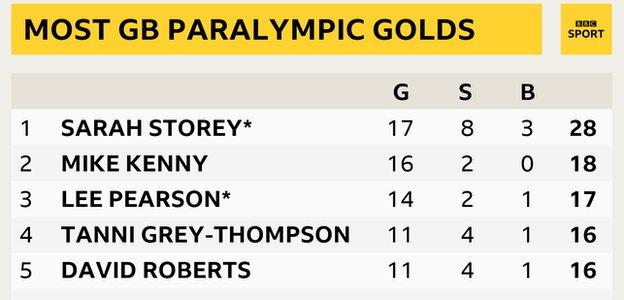
Familiar conditions as Storey powers to title
In weather more akin to her home near Manchester, with rain and thick fog making visibility difficult at the start, Storey was in the front pack from the off, alongside Lane-Wright.
The British pair allowed German Kerstin Brachtendorf to make a breakaway towards the end of the second of the six laps and the 49-year-old clocked a 25-second lead at the checkpoint.
She extended that advantage to more than a minute at the halfway stage, with Storey leading the chasing group and Lane-Wright constantly on her wheel.
As the rain got even heavier they were unable to reel Brachtendorf in, the gap opening up by another 10 seconds after four laps.
But Lane-Wright hit the front of the chasers with a significant injection of pace and her burst made all the difference as the pack quickly caught up with Brachtendorf to leave five riders in contention for the medals at the end of the penultimate lap.
It was at this point that the British duo found another gear, Lane-Wright and Storey breaking away to open up a comfortable lead coming into the finish on the Fuji International Speedway circuit.
Storey punched the air in celebration as she crossed the line in two hours, 21 minutes and 51 seconds.
France’s Marie Patouillet took bronze, almost two minutes after Storey finished, with early pace-setter Brachtendorf fifth.
“I don’t know if it’s sunk in. It’s something everyone has been talking about since Rio when it became a mathematical possibility with me doing three more events in Tokyo,” Storey told BBC Radio 5 Live’s Paralympic Breakfast.
“But you can’t take anything for granted and although I knew I had the capability to shut down the gap to Kerstin, when your legs don’t feel as good as they have done in the time trial and then the individual pursuit, then you think today is not my day.
“It’s one of those situations where I don’t know whether it will sink in when I get home, or whether it will be in a few months or even never at all.
“I just feel immensely proud and also immensely grateful to have so much support and to have such a great team around me and also a great team back at home. They’re the ones who are able to make this possible, by putting me on the start line in a position to go for it, so I’m a little bit lost for words in many ways.”https://emp.bbc.co.uk/emp/SMPj/2.43.7/iframe.htmlTokyo Paralympics: Sarah Storey and her family react to her record-breaking 17th gold
‘There are times when I think, ‘what would Sarah do?”
Lane-Wright’s silver was her third in Tokyo, having finished second to Storey in all three races.
The 35-year-old, who has five Paralympic medals in total, hinted this would be her last Games and was very aware of the historic nature of the race.
“I said ‘this is your gold medal’. You don’t have to worry, I’m not even going to attempt to take it away from you,” Lane-Wright said.
“This is part of history now. And I didn’t have the legs, she went so hard. It’s easy for me to now say I gave it to her, but she won that fair and square.
“Gold medals aren’t the only thing that define it, you also have to look at her as a professional. And even if she’d won silver today, she is still one of the greatest athletes we will ever have.
“I’ve piggy-backed on that because I’m in the same category and now on the same podium. There are times when I think, ‘what would Sarah do?’. She inspires me that much.”
‘You could see the drive at 14’
Baroness Grey-Thompson, who won 11 Paralympic gold medals for Great Britain, speaking to BBC Breakfast
Sarah is incredible. She’s very humble, very laid-back about her performances. Cycling, and sport, is her life and it’s her family’s life.
She’s one of those athletes who is dedicated, trains incredibly hard, and has that ability to push to herself.
Some of these races she could win in a different way – a slightly easier way – sometimes, but every time she’s on the start line she just gives 100%. It is amazing to watch her give so much of herself.
I first met her when she was 14 in Barcelona, and even at that age, you could see the drive she had.
I tease her slightly that swimming was just her preparation for cycling – it was an amazing base programme for her. If she hadn’t had an ear infection, and she hadn’t started cross-training on a bike, who knows where her sporting career might have gone?
She is one of those people who could probably go into any sport, but it’s been incredible to watch that journey.
Hitchhiking Home From A Boarding School- Without Sight
The best day of my school year was always the same: 29 May. It was known as Founder’s Day which, in most schools with such pretensions, meant being forced to dress in your best clothes, sing a hymn in Latin and then listen to some old bloke telling you how to live a good and righteous life. Doesn’t sound promising, does it? Except that at our school, it was different. We may have had the Latin hymn but, after that, we were told we must leave the school and go wherever we wanted (within legal limits, I suppose, though I don’t ever remember that being spelled out). This may not sound that spectacular, until you realise that this was a school for blind and almost-blind children.
You were also presented with five shillings, which I suppose was intended as a survival kit, but which we realised could buy 60 penny chews, or a dirty book from the top shelf of the newsagents, which the one boy with a bit of sight could read to you with the aid of a powerful magnifying glass.Advertisementhttps://b2f51103c7ec91ddc23ae852bf6d6d16.safeframe.googlesyndication.com/safeframe/1-0-38/html/container.html
If you think that, 60 years on, we live in a more liberal age when it comes to what blind children are encouraged to do, forget it! This would never happen now. But, I’m delighted to say that my friends and I made the absolute best of it.
For my first Founder’s Day, aged 11, three of us first years somehow found our way to Dudley zoo – I guess we must have caught the train. Methods of navigation are a bit of a blur but, somehow, once there, we must have found the dingo cage. Animal-mad, the first thing I remember is leaning over the bars to get as close to them as possible (being at boarding-school, I was missing my dog). No, I didn’t fall in, but inevitably my school cap fell off. Initially, the two dingoes approached it gingerly. Then, all at once, there was a snapping of teeth. The fight that ensued was deeply satisfying, interspersed as it was with the sounds of my detested school cap being torn to shreds. It was a suitably fitting climax to a gloriously anarchic day.
We made a return trip to Dudley zoo on Founder’s Day two years later. Now aged 13, we had become rather blasé about the animals and were more entranced by the small funfair. Three of us commandeered a dodgem each and, although the general idea is that your cars crash into each other, the unpredictability of three dodgems being driven by blind drivers proved too much for the staff. We were politely, but firmly, ushered out of the zoo.
My final use of the Founder’s Day freedoms was my boldest. With a totally blind friend, I decided to hitchhike home from Worcester to Winchester – well over 100 miles. I felt confident we could do the return trip in a day, while having time to sample a slap-up meal cooked by my delighted mother. One slight flaw in this plan was that I omitted to warn my mother we were coming. When we arrived, oil-stained but unbowed, she was up a stepladder, stocking the larder. She claims almost to have fallen off but, once over the shock, she did indeed provide us with a plate of sausage, egg and chips. But that’s as far as the prodigal son treatment went. I was told firmly that we had better head back immediately, before my dad got home, or there would be trouble.
The return journey went all right until we got a little beyond Oxford, when the light began to fade and people became less willing to pick up two scruffy urchins carrying white canes. But our luck still held. We found our way to a police station, where the officers were terrific. They drove us to the main road and then stopped cars until they found one that would take us back to Worcester.
We arrived back after midnight, expecting the sky to fall in. I rang home, where my father’s grumpiness turned to relief; even more astonishing, when we got back to school, the headmaster, after a bit of harrumphing, congratulated us on using our initiative.
My schooldays were by no means perfect, but if the job of a school is to prepare its disabled children for the rigours of life, Founder’s Day was a brilliant invention, now sadly missed.
Hen Night
Jessica is tough and successful. She’s a young disabled woman who loves her work as a teacher and has just had a “rush job” of a hen night, one last hurrah before the country enters lockdown. But as Covid shuts down the world, we see how precarious Jessica’s fulfilled life is. Due to funding cuts, she loses her specially adapted Motability car, and thus her ability to get to work. Then the council withdraws her social care, leaving her to struggle on alone.
This is Hen Night, a short film written and directed by Vici Wreford-Sinnott, a leader of the disability arts movement. If the story sounds familiar to many disabled people, that’s because it was inspired by some of the accounts in Crippled, Guardian writer Frances Ryan’s book about the demonisation of disabled people and the dismantling of the social safety net. Astonishingly, when Hen Night reaches our TV screens this week, it will be the first ever disabled, women-led piece of UK broadcasting.
Wreford-Sinnott did not just want to show what it is really like to have your social care removed, as so many did during the pandemic. “The other story we’re telling,” she says, “is about disabled women and the expectations and pressures on us to behave in a certain way, to make other people feel OK about our condition, to be the eternal smilers – to make everybody feel that we’re OK, we’re not a threat, we’re not as scary as we look.”
Both Wreford-Sinnott and Ryan stress the importance of showing well-rounded disabled characters, especially those who are younger and living lives to the full. While Hen Night does not shy away from the difficulties that come with being disabled, Ryan says she’d “love viewers to take away from it the fact that none of this is inevitable”.
She adds: “One reason why I loved Vici’s script is that it really skewers the idea of disabled people as tragic figures whose lives are crap. Jessica loves her life but has to fight to protect it. As I say in the book, disabled people aren’t inevitably vulnerable – we’re vulnerable when the state decides to pull back the support we need to live full lives like anyone else.”
The show is one of the first, alongside Netflix’s Special, not to portray disabled people as objects of pity. So often, as Ryan writes in her book, their lives are contorted to fit a Tiny Tim-shaped hole in society, whose purpose is to allow non-disabled Scrooges to feel better about themselves. Not so in Hen Night, where Jessica is shown tipsy and dancing. “Disabled people,” says Wreford-Sinnott, “are three dimensional.”Advertisement
Yet, despite the obvious benefits of hearing stories from a diverse cross-section of society, disabled people are routinely shut out of the creative industries. Ryan lists a few things that could make a difference, such as paying interns and allowing flexible working, but also highlights the inequality in wider society: “How can I get to a TV studio in London if the tube isn’t wheelchair accessible?”
While such obstacles keep disabled people out of the media, Wreford-Sinnott says there are some signs of progress. Each of the major broadcasters now has a disability leader or team, while the pandemic-induced shift to online working has helped disabled people become more visible. But she urges against complacency: “I have seen initiatives come and go in the last 30 years, which haven’t amounted to lots of tangible change. At the moment, we need lots of change. We need big change.”
She wants to see disabled people involved at every stage of the creative process. “Writers, directors, producers – but we also need to see disabled people taken seriously at commissioning level. We need to see disabled people in significant roles.” There’s also the question of money. Hen Night was made “on a shoestring” says Wreford-Sinnott. “I can only imagine what I – or any of my colleagues – could do with a bigger budget. So fingers crossed for that.”Special review – TV so sweet it makes Kimmy Schmidt look like a cynicRead more
Ryan agrees, adding: “Cultural prejudice still has a big impact. Disability is too often perceived as niche or not fun, and disabled workers are still judged as less capable. There’s huge disabled talent out there waiting to be tapped.”
Hen Night, then, is a first step: necessary and important but nowhere near enough. As Crippled shows, there are disabled people up and down the country with stories to tell. The more we hear them, the better we come to know the society we live in – and the easier it is to change it.
- Hen Night is on BBC iPlayer from 2 September as part of the BBC’s Culture in Quarantine
Tokyo 2020: Toyota Restarts Driverless Vehicles After Accident
Toyota is resuming operations of its autonomous vehicles at the Paralympic Games village in Tokyo following an accident.
Services of the e-Palette pods were halted after a vehicle hit a visually impaired athlete last week.
The athlete was not seriously injured, but he had to pull out of an event because of cuts and bruises.
The vehicles will now have more operator control and extra staff to ensure they do not hit any more people.
Aramitsu Kitazono, a member of Japan’s judo team, was hit as he was walking across a pedestrian crossing on Thursday.
Mr Kitazono was unable to compete in his 81kg category because of the accident.
In a statement late on Monday, Toyota said: “The vehicle’s sensor detected the pedestrian crossing and activated the automatic brake, and the operator also activated the emergency brake. The vehicle and pedestrians, however, came into contact before it came to a complete halt.”
The company said that operators would now be given control over how fast the vehicles travel, with two members of safety staff on board, rather than one, to help look out for pedestrians.
New safety features will also include louder warning sounds, while pedestrian guides at busy crossings in the Paralympic village will be increased to 20 from six.
Toyota also said that it would continue to make safety improvements “on a daily basis” until the village closes.
The company also said it was co-operating with a local police investigation to determine the cause of the accident.
Chief executive’s apology
On Friday, Toyota chief executive Akio Toyoda made a public apology after the incident.
“A vehicle is stronger than a person, so I was obviously worried about how they were,” he said in a YouTube video.
Mr Toyoda said the accident illustrated just how difficult it was to operate self-driving vehicles in the special circumstances of the village during the Paralympics, with people there who are visually impaired or have other disabilities.
“It shows that autonomous vehicles are not yet realistic for normal roads,” he added.
Autonomous ambitions
The company’s e-Palette pod, a fully autonomous electric vehicle, was adapted specifically for use during the Tokyo Olympic and Paralympic Games, with large doors and electric ramps to allow groups of athletes to board quickly.
The world’s biggest carmaker, like many of its motor industry rivals, is trying to develop autonomous vehicles to operate safely on public roads.
The e-Palette was unveiled at the CES technology show in Las Vegas in 2018, with the company touting it as “a symbol of mobility that goes beyond cars to provide customers services and new values.”
At that time, Mr Toyoda declared that Toyota was going to transform itself from a car company to a “mobility company”.
Actor Liz Carr On Silent Witness And Hollywood
Liz Carr’s role in Silent Witness was a groundbreaking step in the depiction of disability in primetime TV drama. The actor, comedian and broadcaster, who has used a wheelchair since childhood, looks back at her early years, her law degree, and how that led her to life of activism for disability rights.
Liz spent six years playing Clarissa Mullery in the BBC drama series, and she discusses the work she has been offered since she left, with latest projects being a major new Jack Thorne TV drama about disability rights, a new stage version of Larry Kramer’s classic 1980s AIDS play The Human Heart at the National Theatre, and her first Hollywood film, Infinite, starring Mark Wahlberg and Chiwetel Ejiofor.
The Last Leg Of Tokyo 2020
“Our catchphrase was, ‘What are they going to do, sack us?’” says Adam Hills. “We were only meant to be on air for 10 days, so we were happy to push boundaries. Little did we suspect we’d still be here nine years later.”
The Last Leg started life as a Paralympics spin-off to highlight Channel 4’s coverage of the 2012 London games. Host Hills called it “Three guys with four legs discussing the day” – he was born without a right foot, while sidekick Alex Brooker had his twisted right leg amputated when he was a baby.
The experiment was meant to end when the Paralympic flame was extinguished. But 23 series and 270 episodes later, it’s still going strong. Not even David “Weirwolf” Weir has this much stamina.Advertisementhttps://beb1060749539320bb4aca6931a37ebb.safeframe.googlesyndication.com/safeframe/1-0-38/html/container.html
Now, The Last Leg is back airing nightly for the duration of the Tokyo Paralympics. Each live episode will feature the now-familiar mix of sporting action, freewheeling chat and flat-out tomfoolery.
The presenting trio of Australian comic Hills, Croydon-born sports journalist Brooker and Devonian standup Josh Widdicombe (“the token able-bodied white male”) might be older and beardier, but they’re little wiser, retaining the anarchic spirit which first made The Last Leg a word-of-mouth hit.
“We’re a dysfunctional family,” says Brooker. “Adam’s the dad, providing for me and Josh while we piss about like annoying toddlers.”
“I was only in it for free sports tickets,” says Widdicombe. “I never imagined anyone would actually watch it. I suspected we were on to something when athletes started coming on the show. It’s easy to book comedians – they’ll do anything for the right fee – but the athletes felt like a vote of confidence.”
“Two shows in, we got an email from the US wheelchair rugby team,” says Hills. “We realised the show was being broadcast throughout the Paralympic Village and they were all tuning in every night.”
As the show’s remit broadened to include all things topical, ratings grew from 1.2 million to nudging 2 million – impressive for the 10pm slot. The Last Leg has won four RTS awards and been nominated for six Baftas. By stealth, it has become not just one of Britain’s most beloved late-night shows but is home to some of the spikiest satire.
In 2018, Hills hit the headlines after a rant about the “cult of Corbyn”. The previous year, they riffed on Ed Miliband’s notorious pic by staging a photoshoot where the former Labour leader donned leathers, shades and sat smoulderingly on a motorbike while holding a bacon sandwich.https://www.youtube-nocookie.com/embed/t_BYlYu-3Hw?wmode=opaque&feature=oembedAdvertisement
“God bless Ed Miliband,” says Hills. “He was still in our green room at 3am with Alex asleep on his shoulder. We get a different kind of political interview, partly thanks to the audience. Our studio is like a cauldron, so you’re surrounded by laughter. It’s intoxicating. Politicians let their guard down – and sometimes drop themselves in the shit. I remember Al Gore saying he didn’t want to be on set when the dancing Trumps and naked Putins came out.”
In 2015, Brooker was acclaimed for his “no bullshit guaranteed” grilling of the then deputy prime minister Nick Clegg. His opening question was “Boris Johnson: statesman or twat?” “Bit more the latter,” replied Clegg. Whenever Brooker detected obfuscation, he pressed a red buzzer.
“That can be credited to Alastair Campbell,” admits Hills. “He’d been on the week before and said, ‘If he starts talking rubbish, just hit the Bullshit Button.’”https://www.youtube-nocookie.com/embed/OxEph6hCqsI?wmode=opaque&feature=oembed
The show made waves again last year when nearly 500 viewers complained after guest Miriam Margolyes said she wanted Boris Johnson to die of coronavirus. On the whole, though, its political material is refreshingly hopeful. Righteous rage usually ends on a note of optimism. The “Re-United Kingdom” special on the anniversary of MP Jo Cox’s murder was genuinely uplifting.
There’s serendipity wherever you look on The Last Leg. This week it returns to the studio in London’s Olympic Village where the show began. Pre-2012, Brooker was a PA Media sports journalist who applied to a Channel 4 advert seeking new disabled talent.
“I was hired as a trainee reporter and covered the opening ceremony trackside,” he says. “Suddenly somebody went: ‘Let’s take this guy who’s never done comedy before and stick him on a talkshow.’ When I was called into a meeting about changing my duties, I genuinely said ‘What have I done wrong?’”https://www.youtube-nocookie.com/embed/DAXBOcv6AS4?wmode=opaque&feature=oembedAdvertisement
Comedian Rosie Jones, who was on the production team five years ago, now joins the lineup as a roving reporter in Tokyo. “If you’d told me I’d be a presenter by the next Games, I’d have said you were off your rocker,” says Jones. “It’s a shame there won’t be any spectators, but I plan on making enough noise to fill an entire stadium.” Coverage worldwide will have this crazy comedian with cerebral palsy shouting in the background,” grins Hills.
The Last Leg has had a major impact on disability representation in its near-decade on-air. Channel 4’s Tokyo coverage boasts the largest number of disabled presenters ever seen on British TV, comprising 70% of on-camera personnel. “We’re the majority now,” smiles Brooker. “They’ve chucked in a few able-bodied people to tick boxes.”
From its title downwards, The Last Leg busts taboos with its irreverent humour. “When people with disabilities get together, the humour gets very dark, very fast,” says Jones. “Nothing is off limits.” Hills agrees: “It’s getting hard to come up with disability jokes which are edgy enough. Paralympians are way more inappropriate than we could ever be.”
As Widdicombe says: “The show talked about disability in a way that was shocking, exciting and totally needed. Adam and Alex deserve so much credit for that. On the flipside, I’m constantly bullied and belittled, all because I was born with two feet. I’m consistently given hotel rooms with accessible baths. The third predicted word when you Google my name is ‘disabled.’”
Since its debut, The Last Leg has also tackled viewers’ questions about disability using Twitter hashtag #isitok. “The idea was to be like an MP’s surgery, where you could ask anything,” says Hills. It remains a popular section of each show and became part of Scope UK’s campaign to “end the awkward”.
“Those conversations hadn’t been had on TV before,” says Brooker. “We’d discuss the etiquette of handshakes or hard-hitting stuff like Pip assessments. Me and Adam compared prosthetics as if we were discussing cars. I’d never joked about my disability like that before. It’s been like nine years of therapy. It’s made me much more comfortable with myself. I just wish The Last Leg had been around when I was a kid. I never saw people like me on TV, let alone talking so honestly.”https://www.youtube-nocookie.com/embed/FsyY2WR4W0w?wmode=opaque&feature=oembedAdvertisement
The team’s excitement at the Games’ belated arrival is palpable. “There’s no cynicism,” says Hills, “just sheer joy and inspiring stories.” “I’m looking forward to seeing what new legs have come out since 2016,” adds Brooker. “I treat it like London fashion week. It’s Pinterest for prosthetics.”
Their work won’t be done when the Paralympians fly home. The Last Leg’s regular Friday night show returns in September, looking at the week’s news with a twinkle in its eye and a risque gag rarely far away.
What is The Last Leg’s greatest legacy? Widdicombe gives it deep thought, before deadpanning: “Well, Alex has bought a big house in Huddersfield.” “It’s not that big,” says Brooker. “Although it has got a pool table. I can’t even play.”
“I’m most proud of what it’s done for the Paralympic movement,” says Hills. “It’s the Games which really change perceptions. This isn’t disability sport to be patronised, it’s elite competition between athletes who’ve spent years busting their arse to get here. The Last Leg is us shining a spotlight on them. They’re the stars here.”
“It’s made disability cool,” concludes Jones. “Before The Last Leg, lots of people thought disabled people were victims and should be pitied. It’s proved that a person is so much more than their disability or how many limbs they have.”
The Last Leg of Tokyo 2020 starts on 24August, 10pm on Channel 4.
Autism: University Of Cambridge Launch UK’s Largest Ever Study
Researchers are looking for 10,000 people to take part in what a university is calling the UK’s largest ever study into autism.
The Autism Research Centre (ARC) at the University of Cambridge wants autistic people and their families to take part.
It want to investigate how genetic and environmental factors affect autistic people in different ways.
Prof Sir Simon Baron-Cohen, from ARC, said there was “an urgent need to better understand” autism.
The Spectrum 10K project will examine the different needs of people with autism, many of whom have additional conditions including epilepsy, anxiety and depression.
‘Postcode lottery’
Prof Baron-Cohen said the research “hopes to answer questions such as why some autistic people have epilepsy or poor mental health outcomes and others do not”.
People of all ages, genders, ethnicities and intellectual capacities will take part in the study by completing an online questionnaire and providing a DNA saliva sample by post.
Autistic participants can also invite biological relatives, autistic or otherwise, to participate.
Autism is a lifelong disability that affects how people communicate and interact with the world.
It is estimated that about one in every 100 people in the UK is autistic.
The project has been backed by comedian Paddy McGuinness, who has three autistic children.
The 48-year-old Top Gear presenter said getting support was “a postcode lottery”.
“One of the biggest things for any parent, who’s struggling as well, who does eventually get the diagnosis, is then it’s kind of a little bit like ‘right, you’ve got your diagnosis, now what?’
“There’s not things in place quickly for parents, I feel, to support them… it just depends on where you live in the country and that definitely needs to change.”
The project is being carried out in conjunction with the Wellcome Sanger Institute and the University of California Los Angeles.
Tokyo 2020: The Games With A Record Number Of LGBTQ Athletes
Just over 60 years ago, the first Paralympics took place, with a mission to be an inclusive sporting event for those with disabilities.
And with the Games underway in Tokyo, they are on track to become even more inclusive, with at least 28 openly LGBTQ athletes competing – a record number.
That’s more than double the number of athletes who competed at the 2016 Paralympic Games in Rio, according to sports news site Outsports.
“What’s happening at the Tokyo Olympic and Paralympic Games is a far cry from the first Athens 2004 Games I participated in as a young queer person trying to figure out my sexuality,” Theresa Goh, a 34-year-old Singaporean Paralympic swimmer, told the BBC.
Theresa, who was born with spina bifida, came out as queer after winning a bronze medal at the 2016 Rio Paralympic Games.
She says her parents’ support was central to her coming out publicly – her mother turned to her at the age of 14 and told her all they wanted was for her to find someone she loves, regardless of gender.
“I didn’t know how to react at first. They don’t just write manuals for situations like this,” said Ms Goh.
“I can’t imagine it was easy for my parents to learn their first child was born with a disability, and then later learning she’s also queer.”
However, public reaction was more difficult to anticipate.
She recalls being afraid to go back to training after coming out, worried that she might receive dirty looks from parents at the pool. But she says she received nothing but support.
“We’ve come a long way, but we still have a ways to go,” Ms Goh said.
High hurdles
This year’s Olympics which wrapped up earlier this month have been pivotal for the movement – with more than 100 athletes, including medal winners, speaking openly about their sexuality.
“Coming out is very difficult because the culture within sports is still so immensely ‘macho’ even though a lot of athletes have shown support,” US Olympian Danell Levya, who came out on Twitter last year.
The 29-year-old gymnast says he received a lot of support from Olympic champions like Laurie Hernandez and Simone Biles.
“To create more change, more support can be shown by those at the top,” he told the BBC.
But there is still some way to go. Just one active player has come out as queer in America’s National Football League’s 100-year history.
NFL player Carl Nassib came out in June this year, during pride month in the US.
In an Instagram post, he said that he’d been meaning to come out for the past 15 years – thanking family, friends, teammates and coaches for helping him feel comfortable enough to now speak out.
“Athletes need to know that their teammates and coaches will have their back if and when they choose to come out,” Joanna Hoffman, from advocacy group Athlete Ally, told the BBC.
“Men’s sports have traditionally lagged behind women’s in terms of numbers of ‘out’ athletes and allies.”
But that is changing with every athlete who speaks up, Ms Hoffman added.
Training for the future
Ms Goh says that coming out meant more for her as an athlete – representing a sort of liberation – allowing herself to compete as her true self, without fear.
“I think because we are in the spotlight, it’s a little more impactful to see us come out,” said Ms Goh.
For Mr Leyva, wanting to help others encouraged his decision.
“I wanted to help make it as normal as asking someone whether they are right or left handed,” said Mr Leyva.
Of course, the Olympics and Paralympics are a convergence of athletes from all over the world, and not all countries have witnessed equal strides in gay rights.
There are 69 countries and territories globally where homosexuality is still outlawed, and all but two of those countries have sent athletes to Tokyo.
That said, for the world’s most famous sporting event, things are changing, albeit gradually.
The number of Paralympic athletes coming out join a list of 180 openly LGBTQ Olympians who competed in Tokyo this summer – three times more than the number of athletes that were “out and proud” in Rio.
They include athletes who have each made waves in their respective sport, like British diver Tom Daley, US track and field champion Raven Saunders, and New Zealand’s weightlifter Laurel Hubbard.
And Ms Goh is optimistic that the list will only keep growing.
“There’s always time for more queer representation.”
Tokyo 2020 Paralympics: The Medal Table
Time difference with Japan means that we might miss some medals as they happen, so we are linking to the Medal Table here so that anyone who wants to follow results can do so easily.


Afghan Para-Athlete Welcomed By New Team In Spain
Nilofar Bayat is the captain of Afghanistan’s wheelchair basketball women’s team. But with the Taliban takeover, she and her husband have fled to Spain.
Her family home was hit by a rocket when she was two years old, injuring her spinal cord and killing her brother.
Since arriving in Bilbao, Nilofar has been offered to play for the city’s wheelchair basketball team.
Disabled and vulnerable adults in England are being hit by a steep rise in the amount they have to pay towards their care, BBC News research reveals.
Some adults with learning disabilities are paying thousands of pounds extra a year, with six councils doubling the amount of money collected in charges.
In half of 83 areas that responded to a BBC request, bills across all users have risen at least 10% over two years.
Directors of council care services blame years of government funding cuts.
Really upset
Saskia Granville was shocked when, earlier this year, her care charges increased more than 400% – from £92 to £515 a month.
She has a learning disability and lives in supported accommodation in Worthing, West Sussex, but fears the charges will curtail her independence.
“When Mum told me, she just burst out into tears,” Saskia says.
“It makes me really upset.”
A sum of almost £1,500 was also taken out of Saskia’s bank account as a backdated payment, in March, leaving her in debt.
Her mother, Bobbie, says: “Without my intervention, she wouldn’t have had any food that week.
“She wouldn’t have been able to pay her gas, electricity or water bills.”
Bobbie is challenging the charge increase but says there has been no notable progress.
The rise has also left Saskia worrying whether she can continue playing football each week – and coaching a girls’ team – because of the train fare and team subscription.
“It’s very important because it’s my favourite sport,” she says.
“I love going.”
West Sussex County Council said its charging arrangements, based on “a person’s ability to contribute towards the financial costs of [their] care”, “follow national guidance”.
How much more people are paying
- 13% average increase in how much disabled and frail people asked to contribute, in two years
- 83councils responded to BBC request for information (151 were asked)
- Equivalent £500rise per person with learning disabilities, in 22 of those councils
Source: BBC Freedom of Information requests, comparing 2018/19 with 2020/21
BBC News sent 151 councils a Freedom of Information request asking how much those living in the community had to pay towards their care.
In the 83 that responded, the amount disabled and frail people are expected to contribute has risen from £369m in 2018-19 to £420m in 2020-21.
And the rise is particularly apparent for those with learning disabilities, who often need greater levels of support.
In 22 councils, the charges have risen by the equivalent of £500 per person supported, since 2018-19.
But in other areas, the charges have fallen since the start of the pandemic, during which time many people have had their levels of support cut.
And in one council, Hammersmith and Fulham, residents are charged nothing for their care.
Matthew Willis has a severe learning disability and Smith-Magenis syndrome, which has autism-like features.
His mother, Lulu, says this can lead to behavioural challenges, as he becomes frustrated at struggling to communicate, such as “meltdowns” that can last for days and include him self-harming and breaking down doors.
Respite services, where support workers take care of Matthew, have provided an important change of scenery and helped her own mental wellbeing.
But this is no longer something the family can afford – as Matthew’s care charges have now risen from about £20 to more than £300 a month.
“It is totally immoral,” Lulu says.
“I want my son to have a meaningful life – and the money from his benefits goes towards paying for that.”
Jackie O’Sullivan, from the charity Mencap that represents people with learning disabilities, said the charge rises meant “the least well off in society [having] to make up for the shortfall [in funding]… that should come from the government”.
Many were still receiving less support than before the pandemic but “having to make tough choices between food and heating, and paying for care”.
And only 6% of those with learning disabilities were in work, making finding the extra money “impossible” for many.

Anyone who receives care from their council will have a very high need for support and a low income. So it is a sign of the acute financial pressures faced by local authorities in England that there has been such a significant increase in the money raised from people needing services.
Most who receive council support rely on benefits, so finding extra money to contribute to care, which is vital to their quality of life, can cause real hardship.
The pandemic has increased the demand for support and the financial pressures on a care system already in crisis. For many, it is perhaps one of the most shameful signs of that crisis that it is people in the toughest of circumstances having to dig deeper to plug the financial gaps.
The prime minister has promised he will reveal his long-awaited plans for reform by the end of the year. But Saskia, Mathew and many others need investment in a care system that will help them lead the best lives they can, right now.
Cath Roff, of the Association of Directors of Adult Social Services, said councils were “really stretched” after “10 years of austerity”.
Calling on the government to “bring forward [social care] reform now”, she said raising care charges was “not what any local authority would want to do – but… we need to stay solvent”.
“We now have Covid, which has added extra pressures,” she said.
“We’ve got people coming forward with increased needs – [and] we have a workforce crisis.”
The Department of Health and Social Care said it would bring forward proposals to reform the adult social-care system “later this year”.
And since the start of the pandemic, it had “committed over £6bn to councils, through un-ringfenced grants to tackle the impact of Covid-19 on their services, including adult social care”.
The Tokyo Paralympics get under way on Tuesday, with Covid-19 cases rising in Japan and all parties acknowledging that there is still a challenge ahead.
Delayed by a year because of the pandemic and with supporters unable to attend apart from a small number of schoolchildren, these will be a different Games to any previous edition.
But not only do organisers want top-level competition, they also want the Games to play a big part in making Japanese society more inclusive.
Tokyo is the first city to stage two Paralympic Games, having hosted the 1964 edition when 375 athletes from 21 nations took part in nine sports.
This time, around 4,400 athletes from 162 national Paralympic committees will compete in 539 medal events across 22 sports.
All will be eager to put the turbulent events of the past 18 months behind them and show the rest of the world what they can do as Paralympians on the biggest stage of all.
It will officially start with the opening ceremony at 12:00 BST on Tuesday and competition begins on Wednesday.
How did we get here?
After the Rio Paralympics, which needed major late budget cuts in order to go ahead, hopes were high that the Tokyo Games would bring the Paralympic movement back to a position of strength after the highs of London 2012.
Tokyo looked like the perfect partner, with a strong bond between the Olympic and Paralympic staging and unprecedented demand for tickets.
The original ‘one year to go’ festivities in 2019 featured successful mass participation events and showed a hunger among the Japanese public to get behind the Games.
But the coronavirus pandemic ripped up all of the plans, with a year’s delay and then a host of protocols affecting all concerned, as with the Olympics.
Athletes across the world faced challenges to their training and competition programmes, with some required to shield for medical reasons.
A state of emergency remains in place in Tokyo, with Covid-19 case numbers continuing to rise in the city and surrounds.
Within the Paralympic bubble, as with the Olympics, strict protocols are in place including daily testing for athletes, mandatory mask-wearing and social distancing.
In addition, equipment such as wheelchairs must be regularly sanitised.
“I’m confident it will be a safe Games – but a safe Games doesn’t mean zero cases,” International Paralympic Committee president Andrew Parsons told BBC Sport.
“We will have cases. But how we then control and react to the positive cases, and not let them spread the virus, will define whether we are successful or not.
“I understand the frustration and the anger among the Japanese about the pandemic, but there is no correlation between it and the presence of the Olympics here and I’m sure it is going to be the same with the Paralympics.
“There are other reasons for the rise in the number of cases.”
Coronavirus travel restrictions have had an impact on the Games, with athletes from Pacific Island nations Samoa, Kiribati, Tonga and Vanuatu unable to travel.
The news of their absence came days after Afghanistan’s two Paralympic athletes were forced to withdraw from the Games because of the situation in the country since the collapse of the government and the return of the Taliban. However, as a mark of solidarity, the country’s flag will be carried at the opening ceremony by a Games volunteer.
In addition, a six-strong Refugee team will take part in the Games, including Afghan swimmer Abbas Karimi and the team’s first female member, club thrower Alia Issa.
What’s new?
For the Tokyo programme, gone are Para-sailing and football seven-a-side and in come Para-badminton and Para-taekwondo, which will have 14 and six medal events respectively.
Four sports – Para-canoe, Para-shooting, Para-table tennis and wheelchair fencing – have more medal events than Rio.
However, the two biggest sports in terms of athlete numbers and medals – Para-athletics and Para-swimming – have fewer events than five years ago.
Both sports have introduced new mixed relay events – the universal relay in athletics features a visually impaired runner on the first leg, an amputee runner on the second, an athlete with cerebral palsy or co-ordination impairment on the third leg and a wheelchair racer on the last leg.
Swimming has added a 4x100m relay for S14 (learning disability) competitors.
What about the Great Britain team?
The GB team for Tokyo features 227 competitors – a figure that includes pilots and guides for visually impaired competitors plus competition partners – and they will take part in 19 of the 22 sports.
ParalympicsGB promised that the team would be the best prepared for a Games and they have worked hard to make sure that no stone has been left unturned, amid the many difficulties.
With 100 female athletes selected, the GB team will be the closest to gender parity it has ever been at a Summer Paralympics – 44% of the team are women, compared with 40% at the Rio Games.
The team is packed with experience with 144 returning Paralympians and 43 Paralympic champions.
In Rio, GB athletes won 147 medals, including 64 golds, across 15 sports – their best haul since 1988 – and were second to China in the overall medal table.
As with their Olympic counterparts, the Paralympic team have been given a medal range rather than a target by UK Sport, with theirs 100-140.
Who are the GB athletes to watch?
Sarah Storey has a chance to become Britain’s most successful Paralympian at her eighth Paralympics. She comes to Tokyo with 14 golds across her career in swimming and cycling, and three more golds will see her overtake Mike Kenny’s record of 16, which has stood since 1988.
Storey, 43, could also become Great Britain’s first gold medallist in Tokyo when she defends her C5 individual pursuit crown on Wednesday before she goes in two road races later in the programme.
She is part of a strong GB cycling squad with a host of medal chances both on the track and the road, through seven-time Paralympian Jody Cundy, Jaco van Gass, who was injured serving with the Parachute Regiment in Afghanistan and has competed at the Invictus Games, and tandem pairs Lora Fachie and Corrine Hall and Neil Fachie and Matt Rotherham.
Having created history in Rio by becoming the first GB athlete to win gold medals in two sports at the same Games since 1988, Kadeena Cox will bid to retain her titles in cycling and athletics.
She is joined in the dual sports club by triathlete George Peasgood, who will also compete in the road cycling events.
Lee Pearson will aim to add to his 11 golds in the equestrian arena, along with fellow multi-medallists Natasha Baker and Sophie Wells.
On the athletics track, Hannah Cockroft, Aled Davies, Libby Clegg, Richard Whitehead and Hollie Arnold will all be aiming to retain their Paralympic titles.
Debutants including 400m runner Columba Blango and javelin thrower Dan Pembroke will hope to make their mark, while London 2012 four-gold hero David Weir is back after a disappointing Rio Games.
In the pool, Ellie Simmonds is back for her fourth Games but faces a big challenge from team-mate Maisie Summers-Newton, and Bethany Firth will be keen to overcome a shoulder injury and retain the three titles she won in Rio.
What about the global stars?
From German ‘Blade jumper’ Markus Rehm to American wheelchair racer Tatyana McFadden, Brazilian swimmer Daniel Dias to wheelchair tennis home favourites Shingo Kunieda and Yui Kamiji, there will be some strong competitors on show.
Polish table tennis player Natalia Partyka will be aiming for her fifth title in a row, weeks after competing at the Olympic Games for the fourth time.
Italian wheelchair fencer Bebe Vio, who contracted meningitis aged 11 and had both of her forearms amputated as well as both her legs at the knee, will hope to shine in her sport, while it will be a memorable debut for 14-year-old Ugandan swimmer Husnah Kukundakwe.
And at the other end of the age spectrum, a trio of equestrian riders, Germany’s Heidemarie Dresing (66) Ireland’s Rosemary Gaffney (63) and Norway’s Jens Lasse Dokken (60), will be hoping to show that age is no barrier to Paralympic success.
A press release:
· Ignorance of legal obligations by senior professionals working in television seriously damages disabled workers’ careers and drives many out of the industry, new research by the Sir Lenny Henry Centre for Media Diversity finds
· Study produced by research centre at Birmingham City University reveals over 80% of disabled people working in the industry believe their disability has adversely affected their careers with 77% saying their career options are limited by their disability
A deeply damaging and inflexible workplace culture is preventing disabled workers working in the British television industry from progressing in their careers, according to new research.
The Career Routes and Barriers for Disabled People in the UK TV Industry report, available for download here, is released today by the Sir Lenny Henry Centre for Media Diversity (LHC) at Birmingham City University.
In the research, colleague’s attitudes toward disabled workers and lack of employer understanding about their legal obligations are revealed as the most common barriers to disabled industry professionals staying and advancing in UK screen industry roles.
The study also identifies lack of employer understanding about adjustments required by some disabled workers, and describes ‘consistent difficulties’ experienced by disabled people in the industry.
The report’s key recommendations include the creation of an industry-wide system to help implement adjustments when disabled people need them, as well as up-to-date training on equality law for all managers, and giving disabled people access to mentors, including other disabled people working in the industry, in addition to widening recruitment practices.
Such changes and improvements will lead to higher retention of disabled workers and more disabled people working at a senior level in the industry, the report says.
86 disabled UK television industry professionals, including Senior, Executive and Series Producers; Heads of Development, Directors, Production Managers and Producers were surveyed as part of the research.
Over half (52%) of respondents have been working in the industry for over 10 years in a variety of genres, including news, current affairs, factual and factual entertainment programmes, and with a wide and varied experience of disability including people with physical impairments, people who are neurodiverse and people who have significant long term mental health conditions.
Key findings include:
· Three quarters – 77% – of respondents felt being disabled had impacted on their career choices in the industry.
· A majority of respondents – 80% – felt being disabled had impacted on their career progression, or was likely to in future
· 84% of respondents to Ansell’s research said they had access needs or required reasonable adjustments some or all of the time
· 51% of those surveyed reported practical issues such as being unable to drive or physically use equipment, working hours, additional requirements such BSL and support workers, as barriers to employment or career progression.
The report, commissioned by the LHC, was produced by Kate Ansell, a disabled journalist, writer and executive producer with over 20 years’ experience of producing current affairs and factual films for major broadcasters including BBC and Channel 4.
The RTS award-winning filmmaker said, “In this research, disabled people themselves describe the experiences they’ve had working in the TV industry, including the barriers they’ve encountered and potential solutions to the problems. What’s striking is the consistency of the experiences described and the simplicity of some of the solutions. It’s crucial that the industry acts upon what it is being told.”
Survey respondents raised the issue of employer responsibility, with one saying “There is… little understanding of the Equality Act.” All except one of the interviewees agreed, saying they felt employers didn’t understand their legal responsibilities toward disabled people.
Participants describedtaking an unconventional or nonlinear career path – partly as a result of certain recruitment practices, travel requirements, or stereotyping. One professional surveyed, described recruitment practices in television as being ‘like the Wild West’. Participants who had had non-linear career paths believed this impacted on their career progression, with employers preferring applicants with more standard CVs. Some identified this as a reason they had not been successful in obtaining more senior roles.
Some disabled industry professionals were ‘pushed’ towards programmes about disability issues – with some respondents choosing to take advantage of their insight, and others pursuing and struggling to find work outside disability programming.
Aspects of some entry level roles, such as runner jobs, can be a barrier to entry for some disabled workers. Ansell’s research found that in some circumstances, participants made the decision to continue in a potentially harmful role with negative physical or mental health consequences, without asking their employers for support or adjustments to avoid damaging or disadvantaging their career prospects.
The research also suggests that relocation – a notable recent trend for some major broadcasters – creates complex issues for disabled industry professionals, including sourcing accessible accommodation and rebuilding support networks, which could mean losing opportunities to accept contract extensions or pursue promotions.
Marcus Ryder MBE, Head of External Consultancies at Birmingham City University’s Sir Lenny Henry Centre for Media Diversity, said, “Kate Ansell’s work is a necessary and timely contribution to the debate of how we increase diversity and inclusion in the television industry with respect to disabled people. It demonstrates a shocking basic lack of understanding of people’s legal rights, which is holding people’s careers back.
“The report also illustrates the ethos of the Centre, that empowering people from underrepresented groups to undertake the research and devise policies to overcome structural policies is the best way to progress. I sincerely hope the industry takes note of the issues raise in the research and more, implement the simple and practical policy recommendations contained within it.”
The Sir Lenny Henry Centre for Media Diversity (LHC) is a newly established research centre, bringing together the expertise of established media professionals and academics.
Since launching in February 2020, LHC has released a number of notable and impactful research publications, including the Black to Front report for Channel 4 News and academic and industry journal Representology, which explores diversity in media.
The Career Routes and Barriers for Disabled People in the UK TV Industry report is available for download here,
Arriving in Tokyo, I wasn’t entirely sure what to expect. It was a combination of relief that all the testing procedures for me were negative, and also relief that the Paralympic Games were going ahead.
There was always a tiny part at the back of my mind that somewhere along the line a second Games might be considered too much of a risk for Tokyo. Although I knew that a lot of the athletes had been flying out to Japan, it only felt real to me when I had picked up my accreditation.
The Paralympic journey from the highs of London 2012 to here has not been straightforward.
Before Rio 2016 and with Brazil in a tough economic situation, there was a real chance that those Games would not happen. But they turned it around and at the closing ceremony, it was described by the then International Paralympic Committee president Sir Philip Craven as “the people’s Games”.
Before the global pandemic, the expectation around the Tokyo Games was huge. Three years ago, I said that it would help the Paralympics take another big step forward with increased media coverage around the world.
Despite all that has happened, I still think these Games will take the movement to another level.
While the decision to postpone seemed a long time coming (there were complicated layers to the decision-making process), the athletes ended up stepping in to more unknowns.
Athletes train to compete and no-one had experience of a lack of events and a block of training that would extend to more than a year. The dates of competition are usually known months, even years ahead and while athletes are often told to ‘control the controllable’, there is so much that it outside their sphere of influence.
During lockdown, athletes across the world have had to learn to be creative, away from some of the high-tech training centres, and had to find new ways of doing things.
Certainly the centralised facilities have changed since I was competing but we always had a gym set up at home. Some of the younger athletes didn’t have that available to them so online coaching sessions became the order of the day.
I even joined in a couple of the online sessions organised by the rowing squad (not on a rowing machine, just with a stretchy band) and it was good to see the camaraderie of the different sports coming together.
But lab testing and time-trials are not the same as being against other people and with such little information available, especially for younger first-time Paralympians, we may well see some surprises.
The pressure going in to these Games will be greater. It was recently announced that US Paralympians will earn $36,000 (approximately £26,400) for a gold medal, the same as their Olympic counterparts. In a world where there is still not a lot of sponsorship for many, that will make a big difference.
The build-up to the Games has been different to any other and obviously the Games themselves will also have a different look.
Tokyo isn’t highly decorated with Paralympic flags (it wasn’t for the Olympics either), but once the events start everything will change. However, athletes will have to deal with the lack of fans watching them.
There was a brief glimmer of hope last week that some schoolchildren would be allowed in to watch, but that has been closed down. Bearing in mind that for many months the expectation was no crowds, it is unlikely to change athletes’ thinking.
I have competed in front of a packed crowds (Sydney 2000) and very few people (Atlanta 1996) and I know which I would prefer.
Learning from the Olympic experience of what to expect, athletes are competing for the gold medal regardless of who watches, but it is hard to celebrate a victory when there is no-one to respond to you.
What we saw in the Olympics was fellow athletes supporting their team-mates and it will be interesting to see – in the window of finishing their own event and having to leave – whether this is going to be possible at the Paralympics.
Athletes spectating is normally quite limited but it now really stands out because we can see who is there.
The ceremonies at the beginning and the end of the Games will also have a different feel.
Many athletes will choose not to attend the opening ceremony, and while I do not miss being on a plane with another 200 athletes and identical kit bags, there is something special about everyone coming through the airport and being welcomed home together.
No athlete trains for years for any of these things, or to mix in the village, but for those who have done previous Games the feeling will be very different.
Despite all the restrictions, we are going to see some great sport. Para-taekwondo and Para-badminton as new sports will have a lot to live up to, and as the biggest sports in terms of competitors and medals, Para-athletics and Para-swimming will be expected to deliver.
There will be more coverage around the world than ever before and there will be some amazing moments and ultimately that is what you want from a major sporting event.
Playing Carrom- By Foot
Harshad Gothankar shot to social media fame recently when cricket superstar Sachin Tendulkar tweeted a video of the young man playing carrom with his feet, calling it inspirational.
Carrom is a hugely popular board game played in South Asia.
The 23-year-old was born without arms, but he says his father never let him feel he was different from other children.
Instead, he encouraged him to do everything – how to write, how to use a computer, how to work out in a gym – so Harshad could live an independent life.
So now Harshad can do just about anything – with his feet.
‘Inaccessibility Is A Collective Problem’: The Promise And Limits Of Adaptive Fashion
When Angel Dixon acquired her disability, clothes shopping suddenly became complicated. She wanted things that worked for her: soft fabrics with no tags (because of nerve pain), and garments without buttons, zips or hooks would have been handy. She also – importantly – wanted to look good.
On a day trip from the hospital with her mother, Dixon realised she couldn’t even access most of the stores with her wheelchair. The change rooms were also inaccessible.
“I ended up finding mid-length jersey material dresses I could just pull over my head and crying when I got back to the hospital from exhaustion and confusion,” she says.
Diversity and inclusivity have recently become fashion watchwords, and brands have responded by, among other initiatives, designing lines of adaptive clothing. Merging fashion with function to cater to differently abled people, adaptive clothing is designed to make getting dressed easier, more convenient and even pain-free for people from all walks of life.
This year, The Iconic became the first major Australian and New Zealander retailer to release a dedicated “adaptive edit” in early August, citing the launch as part of their “commitment to a more inclusive Australian fashion landscape”.
Grace Stratton, director of New Zealand-based communications agency All is for All, says growing up she was made to feel as though her body should be minimised and not celebrated. Photograph: Synthia Bahati
Featuring three brands – the Tommy Hilfiger Adaptive Collection, Jam the Label and Christina Stephens – the range includes products like trackpants with a hidden pouch (for indwelling catheters), shirts with discreet back slips that make dressing easier, and trench coats that make magnetic closures look like normal buttons.
But it’s not the only one of its kind. EveryHuman, which has been online since late 2019, is a platform that features dozens of brands. They aim to create “greater choice for people with disability”.
Matthew Skerritt, founder of EveryHuman, said the products were selected for a range of different abilities. “Whether people struggle with dexterity, mobility or sensory issues, these products make life more accessible.”Advertisement
The Iconic partnered with All is for All – an accessible communications agency directed by New Zealand-based Grace Stratton – to ensure they were bringing the initiative to life through a pan-disability lens.
This project means a lot to Stratton – she feels it’s a “reprieve from that traditional sense of having to fit in”.
Stratton says growing up, she was made to feel as though her body should be minimised and not celebrated because it was “different to the norm”.
“It almost makes me hopeful for future generations – maybe they won’t have to go through the same challenges.”
But Dixon is cautious of touting adaptive clothing as groundbreaking – she flagged that it could be a slippery slope to perpetuating “dangerous ideas” if adaptive clothing and models with disability are segregated and marketed as “special”.
“One garment can’t solve all access problems, but there are ways to embed universal and inclusive design into all fashion designs.
“Inclusive design is something else. It’s clothing that is designed with a diverse consumer in mind and focuses on both form and function,” she says.
She gives the example of zippers at the back of garments (the enemy of anyone who lives alone), saying “inaccessibility is a collective problem”.
As more adaptive fashion lines roll out, some consumers with disability are beginning to realise not all that glitters is gold. Adaptive lines may bridge gaps for many, but a lot of work still needs to be done to make these initiatives truly inclusive.
Cost is one of the major elephants in the room so far for adaptive clothing. Only four garments in The Iconic’s edit – two tees and two long-sleeve tees – cost under $50.
People living with disability are disproportionately affected by poverty – around four out of every 10 Australians living in poverty have a disability.
That point is crucial for Dixon, who says, “There’s a lot of us [living with disability], but that doesn’t mean we all have disposable cash to throw around.”
She still thinks adaptive fashion lines can work. But says “we need to elevate the ranges that exist and we need competition to bring the prices down”.
Stratton acknowledges the barriers people face are vast, and that online-first adaptive edits such as The Iconic’s won’t work for everyone. “[But] we have a responsibility to start somewhere, and I think in the digital age, a lot of people with disability are finding communities online.”
While it’s true we’re in the digital age, the conversation on adaptive clothing has not reached everyone.
Gavin Jackson is a 52-year-old man from Innisfail, a town of about 1o,000 that sits an hour south of Cairns. He has multiple sclerosis (MS) and had never heard of adaptive clothing until we spoke.
“The idea of it [adaptive clothing] is enlightening to me. I want to be aware of what’s out there, because MS is a degenerative disease and I don’t know what I’m going to need in six months’ time,” he says.
Jackson was surprised he had never been told about adaptive clothing, considering he is an NDIS participant and garments can be claimed on most care plans.
Living rurally, he’s also limited if he needs something new to wear.
“Most of the time it’s function over fashion – so I’m just trying to get things that work for me. And sometimes I will wear the same thing because it works.”
Although Jackson uses the internet (we iMessaged back and forth while he Googled “adaptive fashion”), he said he wouldn’t buy from an online-based adaptive fashion line.
“Buying clothes online is daunting. Something may not fit right and returning it seems like such a big deal to me.”
For Jackson, who uses a cane and is primarily unstable on his feet, lugging ill-fitting garments back to Australia Post is just an extra thing he doesn’t need to worry about.
For adaptive clothing to be accessible to those like Jackson, fashion brands need to make changes in their physical shopping experiences, too.
“Sometimes the racks are close together and it makes it difficult to get around. But I still prefer to have that as an option instead of online shopping,” Jackson says.
Stratton is hopeful adaptive edits will trigger a wider conversation on disability rights – but she concedes these clothing lines have their limits.
“Fashion is important, but it’s not a fundamental issue in terms of the things that disabled people face,” she says. “We’re still struggling with access to healthcare and education.”
WeThe15: ‘Game-Changer’ Plan For 1.2bn Disabled People
A global campaign described as a “game-changer” has been launched to improve the lives of more than one billion disabled people by 2030.
WeThe15 wants to improve inclusion, raise awareness and end discrimination of disabled people around the world.
It brings together a coalition of organisations from the International Paralympic Committee (IPC) to Unesco.
The launch comes ahead of the delayed Tokyo 2020 Paralympic Games which begin on 24 August.
Using the event as a springboard, the IPC and International Disability Alliance has joined forces with arts, business and human rights organisations including UN Human Rights and The Valuable 500 to “raise awareness, change attitudes and create more opportunities” for disabled people.
The campaign has been set-up to represent the 15% of the world’s population that is disabled – about 1.2bn people, according to the World Health Organization.
As part of it, the IPC, Special Olympics, Invictus Games and International Committee of Sports for the Deaf will collaborate for the first time to ensure there will be a major sport event – and platform for the campaign – every year until 2030.
For the launch, 125 landmarks will turn purple – the internationally recognised colour of disability – from New York’s Empire State Building to Moscow’s Ostankino Tower and the London Eye.
President of the IPC, Andrew Parsons, said: “[The project] aims to put disability right at the heart of the inclusion agenda, alongside ethnicity, gender and sexual orientation.
“I strongly believe WeThe15 could be a real game-changer.”
He said collaborating with big organisations would ensure a significant presence at local, grassroots, levels to help improve people’s lives.
‘Awareness needs to grow’
Sam Milne, from Leicester, has cerebral palsy and plays with a local basketball team.
She said society’s general perception of disabled people could be problematic and she had faced discrimination.
She said people often presume she can’t speak because she uses a wheelchair and that going back to basics, such as ensuring as many places as possible are accessible, would improve her life and enable her to get out into the community more easily.
One of her wishes is that more doors could be power-assisted rather than relying on strength to open them.
“I can walk a bit, but if I can’t open the door how far am I going to get? This awareness needs to go down to the everyday – to the shopkeepers and the hair salons.”
But she warned that awareness “needs to grow” and not disappear once the Paralympics is over.
The WeThe15 campaign plans go beyond sport and over the next 10 years it says it will focus on different “pillars” which need greater equality.
This year it will concentrate on access to vaccinations against Covid-19, while in the run-up to the LA Paralympics in 2028 – the home of Hollywood – it is expected to focus on disability representation in the entertainment industry, such as ensuring disabled actors play disabled characters.
According to the IPC, 85% of disabled people around the world live in poverty, about 50% are unemployed and 75% of countries have no laws protecting them.
Mr Parsons said: “We want to tackle employment, we want to tackle mobility.
“Of course it will be different country-to-country. This is why we will need the local presence there to understand the challenges and that’s why it’s a 10-year campaign. We’re trying to cover all basis and all nations.”
While WeThe15 focuses on the statistic that 15% of the global population is disabled, the US government puts it much higher at 26% for its citizens while the UK government says it’s 22%, but the definitions of disability often vary.
In the UK a person is considered to have a disability if they report a long-standing illness or impairment which causes substantial difficulty with day-to-day activities.
For long jumper and Paralympic medallist, Stef McLeod Reid, Tokyo 2020 will be her fourth Games.
The track athlete, who had a foot amputated as a teenager following a boating accident, hopes WeThe15 will stop people viewing disabled people as “other”.
“When you realise that one billion people in the world live with a disability you realise this should be at the front of every single inclusion agenda.
“There is so much potential and talent sitting there left untapped because the world is designed around this very specific idea of ‘normal’.”
She said “disability is expensive” – from purchasing the right equipment to making buildings accessible – and that needs to be addressed.
“What we are lacking, unfortunately, in different parts of the world, is money and investment and a commitment that everybody should be able to fulfil their potential.”
She believes success will rely on “shifting mindsets” to make the “world more accessible to everyone”.
A press release from Amnesty International:
|
AMNESTY INTERNATIONALPRESS RELEASEMalawi: People with albinism in urgent need of protection after horrific killing Background Ian Muhamba disappeared on 23 July during a visit to Blantyre, Malawi’s second largest city, from Mulanje. He was reported missing to Limbe Police Station in Blantyre. On 14 August the community reported a dead person who was buried with missing body parts by the police in Kachere. The body was later exhumed by the police, and positively identified by relatives as that of Ian on 15 August before being reburied on 16 August. On 12 August, a group of regional albinism associations convened to develop and adopt a resolution calling on leaders of the Southern Africa Development Community to guarantee the safety and security of people with albinism. |
Actress Selma Blair has said she is “in remission” from multiple sclerosis.
The 49-year-old American, known for films like Cruel Intentions, Hellboy and Legally Blonde, was diagnosed with the autoimmune disease in 2018.
Blair, who had been left with intense physical pain, told reporters her condition had improved as a result of a stem cell transplant and chemotherapy.
“My prognosis is great,” she said. “I’m in remission. Stem cell put me in remission.”
She added: “It took about a year after stem cell for the inflammation and lesions to really go down.”
Stem cell treatment it is not a cure for MS but can help to stabilise the disease and improve disability, according to researchers.
The star was speaking while promoting a documentary, Introducing Selma Blair, which follows her as she “reconciles a journey of monumental transition” to living with the incurable condition, which affects the brain and spinal cord, causing vision, balance and muscle problems.
MS had left Blair unable to speak properly or fully use her left leg, and she was pictured using a cane to walk up a red carpet after the Oscars two years ago.
Speaking to a virtual Television Critics Association panel on Monday, she said she had been doing well for the last few months after having felt “unwell and misunderstood for so long”, according to People and the Associated Press.
“I was reluctant to talk about it because I felt this need to be more healed and more fixed,” she said.
“I’ve accrued a lifetime of some baggage in the brain that still needs a little sorting out or accepting. That took me a minute to get to that acceptance. It doesn’t look like this for everyone.”
Last week another US actress, Christina Applegate, revealed she had been diagnosed with the condition.
The Guardian Interviews Thomas Quasthoff
Thomas Quasthoff has been retired from classical music for nearly a decade now. The German bass-baritone was in his early 50s when he made the shock announcement – an age when singers of his type are still in their prime. His elder brother Michael had been diagnosed with lung cancer in 2010, and that diagnosis and his brother’s subsequent death had left Quasthoff temporarily physically incapable of singing.
“Three days after being told that my brother would not live longer than nine months I lost my voice,” he recalls. “Doctors looked at my throat and said: ‘Everything is fine.’ But my heart was broken, and if the heart is broken …” he pauses. “The voice is the mirror of the soul.”
Ill health was cited as the reason for his retirement in 2012, but he had been voicing disquiet with the sterility and formality of the classical world for some time, and though his brother’s death was the trigger it may be that such a move was already brewing.
“I always wanted to belong to the group of singers who retired early enough,” he tells me over video call from his home in Berlin. “I never wanted to hear people say of me: ‘Oh, you should have heard him three years ago.’” But his decision was a blow to audiences – Quasthoff was one of the world’s finest lieder singers, acclaimed for the range and colours of his voice, for his attention to detail and exceptional directness as a performer. In 2009, the Royal Philharmonic Society awarded him the gold medal, its highest honour. Previous recipients have included Brahms, Elgar, Stravinsky, Bernstein, Barenboim, Jessye Norman and Sir Simon Rattle.
That Quasthoff had any career as a classical singer, let alone one this successful, was little short of amazing. While she was pregnant with him in 1959, his mother had taken the anti-morning sickness drug thalidomide and he developed phocomelia, which left him with stunted limbs. He is just over 4ft tall and life has been a constant physical struggle, yet he is not just completely without self-pity but is a force of nature – exuberant, loud, uncompromising.
During his classical career, he wanted no allowances made for his disability. “It’s a fact, not a problem,” he says. “I reached everything in my life that I wished. I was successful as a singer; I got a [music] professorship; I have been married for 15 years and have a wonderful, incredible, smart stepdaughter; we live in a beautiful house in Berlin. What shall I say? I know a lot of colleagues who are much less satisfied than I am.”
Quasthoff was determined never to allow his disability to define him. “I was educated like this,” he explains. “My parents and my brother never treated me like a disabled person. My brother’s friends were my friends. I was always part of a normal family life.” He likes to quote a line from his wife, Claudia Stelzig: “Tommy, for me you are not disabled, you are only smaller. That’s all.”
He accepts that some of his audience may have come because they were intrigued by his personal story, but believes they were a small minority. “Most came to hear me,” he says, “because they were entertained in a high-quality way. I wanted to be accepted as an artist who was disabled, not seen as a disabled person who was an artist.” He realised audiences would never be blind to his disability – “If I come on stage, one metre 35 [tall], with short legs, short arms and seven fingers, who shall ignore it?” he says with his deep, resonant laugh – but hoped that once he opened his mouth in a lieder recital they would forget about it.
Quasthoff exudes self-confidence and resilience, but says this wasn’t always the case. “In the first 18 years there were more dark than positive sides,” he says, “especially during puberty when boys get girlfriends; I was standing [on the sidelines]. I wanted to study music, but the university said I was not allowed because I could not play an instrument.” He studied singing privately instead. The key, he says, is “not that these negative things are happening but how do you deal with them and what are you taking out of the situation?” He treated every obstacle, every setback, every dull job he had to do to pay for his singing tuition as a challenge and something from which to learn.
There was one overriding motivation driving him as he studied for more than a decade and a half and built a career. “I never wanted my mother feeling guilty,” he says, “and she did – from the moment I was born she felt guilty [for having taken thalidomide]. Even if I said 100 times that she should not, she still did, so I tried to show her that I had made the best out of my life and talent.”
Since leaving the classical world and the return of his voice, Quasthoff has switched to jazz, which he had always enjoyed, and had dipped into even in his classical days: he had made a well-received jazz album in 2007. “I had done it very rarely in my classical time because it’s a different kind of singing, but I have now learned a new instrument – the microphone – and I love it.” He finds singing jazz and being part of a quartet a wonderfully relaxed form of music-making – intimate, pressure-free, music produced by a group of friends.
This month’s Edinburgh festival will showcase Quasthoff in three guises: singing jazz with his quartet, as a teacher, and performing in a semi-staging of Richard Strauss’s opera Ariadne auf Naxos. The latter does not, though, constitute a fully fledged return to the classical stage – he will play the spoken role of the pompous major-domo.
Although he was to be found mainly in the concert hall as a recitalist, Quasthoff did sing some opera during his classical career, but his roles were restricted by his disability. In part, the restrictions were self-imposed – he rejected Daniel Barenboim’s liberating notion that he should sing Leporello in Don Giovanni, worrying about the moment in the opera when he would have to swap clothes with the Don, who was being played by the hulking Bryn Terfel. He turned down offers to sing the hunchback Rigoletto and the evil dwarf Alberich in Wagner’s Ring – casting that he thought a little too obvious. But he did play Don Fernando, the minister who secures Fidelio’s release from prison, and had a considerable success as Amfortas in Parsifal at the Vienna State Opera. “I preferred to play kings and ministers,” he says with another deep-hued laugh.
Quasthoff denies that he found opera unduly physically taxing. “I was in good condition,” he says. “At the first meeting, the director [of Parsifal] asked what can I do. I told her everything that you want except making myself naked. This is not going to happen, for two reasons. I do not want it, and I do not want that the audience is leaving in seconds!”
But his first love was always singing lieder. In opera, he says, he worried that his disability would become the focal point of the audience’s attention; in recitals, he was able to get audiences to suspend their disbelief. “As a lied singer, you have to be a very good actor,” he says. “I think that is missing at the moment”: he worries that singers today put beauty of tone above characterisation. “You have these mini-scenes that you have to fill with expression and colours. In opera, you can hide behind your clothes and the scenery.”
What about the classical world he has left behind? Does he have any qualms about resisting his agents’ blandishments to return? “I loved what I did, but the business is very superficial. You have a number of stars that I can count on my right hand – and my right hand is not very big! I had my time and was in a wonderful situation where I was able to have a world career. As a concert singer, to win six Echos and three Grammys is very rare.”
But he insists he doesn’t miss it. “I have nothing to prove any more.”
The Thomas Quasthoff Quartet is at the Edinburgh international festival on 24 August. Quasthoff gives masterclasses on 29 August, and performs in Ariadne auf Naxos, 25 to 29 August, available online 29 August to 27 February.
Coda Review
When Ruby Rossi (Emilia Jones) sings, she gets a good feeling. Sorting through the daily catch aboard her family’s fishing boat in Massachusetts, the 17-year-old high school student croons Etta James’s classic Something’s Gotta Hold on Me with unselfconscious abandon. She squeezes her eyes shut, a groove gripping her shoulders. Her voice is striking and lovely, not that her dad, Frank (a wonderful, drily funny Troy Kotsur), or older brother, Leo (Daniel Durant), seem to pay it any attention. The film soon reveals it’s not that they haven’t noticed – it’s that they haven’t heard.
This US remake of the 2014 French comedy-drama La Famille Bélier, about the hearing daughter of deaf parents who secretly dreams of becoming a singer, was a smash hit at this year’s Sundance film festival, winning a record-breaking $25m distribution deal with Apple TV+ as well as four of the festival’s top awards. It’s not hard to see why: it’s warm, fuzzy and feelgood, taking a timeless coming-of-age tale and braiding it with a timely politicalagenda. Writer-director (Tallulah) takes great care to increase and improve the long-overdue representation of the deaf community on screen, casting deaf actors in deaf roles (a responsibility the original film neglected).Advertisementhttps://ae49e3eb491b759cd2aedb48d6d6b7d5.safeframe.googlesyndication.com/safeframe/1-0-38/html/container.html
Ruby is a Coda – a hearing child of deaf adults – and as her brother is also deaf, she serves as the whole family’s unofficial interpreter, translating their American Sign Language (ASL) to both the local fishing community and the meddling authorities. It’s a full-time commitment that competes with her schoolwork, her social life and, now, choir practice, which she signs up for on a whim. Her music teacher, Bernardo “Mr V” Villalobos (Eugenio Derbez, straining for inspirational cuddliness), takes note of her forthright talent as well as her faltering confidence, insisting she work towards auditioning for Boston’s Berklee College of Music. Equipped with an endless supply of motivational quotes and quirky cardigans, he prescribes her breathing exercises and a duet with – eek! – her crush, Miles (Sing Street star Ferdia Walsh-Peelo).
The two are to perform Marvin Gaye and Tammi Terrell’s Motown hit You’re All I Need to Get By at the school concert, an excuse for them to practise a cappella in Ruby’s cramped bedroom. If this sounds worryingly like an episode of the shrill teen TV show Glee, mercifully it couldn’t be less like it. Heder chooses not to structure the film as a series of showy musical numbers. Instead, scenes in which we hear Ruby sing, including one where she reluctantly, then ferociously, belts out Joni Mitchell’s Both Sides Now, are grounded in emotion, not spectacle.
“If I was blind, would it make you want to paint?” needles Ruby’s mother, Jackie (Marlee Matlin), a former pageant queen struggling, for various reasons, to connect with her daughter. She asks the question with a whisker of resentment. The deaf actor gives a complex performance in a juicy role, her most high-profile since her landmark Oscar win for Children of a Lesser God in 1987. Frustrated by Ruby’s obsession with music, Jackie bans headphones at the dinner table. Swiping through son Leo’s Tinder prospects is permitted, however, as “something we can all do as a family”. Unlike the shy, responsible Ruby, her brother and her parents are in frequent pursuit of their own pleasure, something the film has a tendency to temper by playing for laughs. When she and Miles accidentally overhear her parents in the bedroom, Frank sits them down for a cringe-inducing conversation about safe sex. Miles learns the hard way what the ASL for “put a helmet on that, soldier” is. The Gallic humour of the original film feels playfully raunchy when translated to an American context.
Moments such as this define the deaf members of the Rossi family – their humour, their politics, their parenting, their desires. A wasted opportunity, then, that the film, as with the original, filters their experiences through an able-bodied protagonist. Heder mostly gets around this by dazzling the audience with Ruby’s tender, go-for-broke sincerity. To her credit, British actor Jones is pretty much note-perfect. Her singing voice has a wistful, lilting quality infused with longing and a little loneliness. It’s the film’s secret weapon, expertly deployed in one final number that sees her serenade her father beneath the stars. The film is a meticulously, perhaps even cynically crafted crowd-pleaser. Even those alive to its tactics might find themselves wiping away a tear or two.
- In cinemas and on Apple TV+
‘Deafness And Music Are Compatible’: Why Rose Ayling-Ellis On Strictly Matters So Much
Deafness has long been interpreted, incorrectly, as total silence. As such, Deafness and music are also wrongly seen as things which are incompatible with one another. Everyday language such as “tone deaf” doesn’t help, nor does a lack of representation when it comes to deaf people in music and dance. However, Rose Ayling-Ellis may be about to challenge misconceptions on a major scale, as the first deaf contestant on Strictly Come Dancing.
Ayling-Ellis, who plays Frankie Lewis in EastEnders, has said that appearing on the show is: “exciting and a little bit scary … I hope I will do the deaf community proud and break down more barriers.”
One of those barriers is the idea that music – and indeed, dance – is just about sound. Deaf percussionist Evelyn Glennie, who plays the drums by sensing the vibrations, famously dispels that myth. As do I, by using timing and rhythm to guide me when I play instruments. In the world of dance, Chris Fonseca wowed the judges on BBC’s The Greatest Dancer, before going on to choreograph a group of deaf and hard of hearing dancers for a music video. Deaf people can do anything. And yet there is still more to do when it comes to challenging the attitudes that prevent us from entering certain industries, making Ayling-Ellis’s appearance on Strictly so significant.
Many disabled people argue that it is these societal barriers which disable us, as opposed to conditions themselves. As the disability equality charity Scope puts it: “Barriers can be physical, like buildings not having accessible toilets. Or they can be caused by people’s attitudes to difference, like assuming disabled people can’t do certain things.”
We’ve already seen how Strictly can change attitudes, too. When YouTuber Joe Sugg – brother of Zoella – appeared on the show in 2018, a whole new audience was introduced to the world of online influencers. He won over the hearts of viewers, as he was voted all the way to the final. Since then, he’s had a starring role in the West End musical, Waitress. What’s not to say the same can happen with perceptions of deafness and disability?
However, we have to be clear that Ayling-Ellis being on Strictly is not incredible news “despite” her deafness. “Despite” frames deafness as the barrier, which is wrong for the reasons already stated. Our disabilities aren’t what we need to overcome in order to succeed, it’s non-disabled people being willing to make reasonable adjustments in order to level the playing field (and, in the context of Strictly, having good scores from the judges and winning over the public).Advertisement
It is important, too, to bear in mind the term “inspiration porn”, coined by the late, great disability activist Stella Young. “I use the term porn deliberately, because they objectify one group of people for the benefit of another group of people,” she said. “So in this case, we’re objectifying disabled people for the benefit of nondisabled people. The purpose … is to inspire you [and] to motivate you.”
Let Ayling-Ellis inspire the next generation of deaf young people – and I have no doubt that she will – but don’t let her efforts inspire you as hearing people.
Instead, let them motivate you to take down the barriers stopping other deaf people from following her in her footsteps – perhaps rather literally.
It’s Time For A Disabled Lives Matter Campaign
People with disabilities need a global campaign similar to the Black Lives Matter movement, the president of the International Paralympic Committee has said.
Speaking before the Paralympic Games, which begin in Tokyo later this month, Andrew Parsons, 44, said that too many disabled people were invisible and held back from participating fully in society.
“We’re not advancing as much as we could,” Parsons said. “If you see some other movements, like Black Lives Matter, the LGBTQ+ movement and the gender equality movement, they are advancing more than the movement for people with disability.”
An international campaign to tackle discrimination against those with disabilities will be announced on Thursday by a coalition including the IPC, the UN and the World Health Organisation.
Parsons said the pandemic had highlighted inequality across the world, pointing out that even in Britain almost 60 per cent of those dying from Covid had a disability. “We really consider they were left behind in the moment of crisis. When they needed services, they needed to be treated equally to other citizens. I think the majority of societies have failed.
“In many societies they are invisible, so one of the aims of the campaign is to make the issue visible. You cannot ignore 1.2 billion people, one in every seven human beings.”
Discrimination towards those with a disability was more hidden than other prejudices, he said. “It’s different with disability, because for example with race the motive comes from hate … No one hates a person because he or she is in a wheelchair, but many ignore what this person could do.”
Giving the example of the host nation, Japan, he said many countries stifled the potential of people with disabilities by coming from an “angle of super-protection”. He added: “While Tokyo is a very accessible city compared with other major cities in the world, you don’t see disabled people in the streets, because they are kept at home. And disabled people don’t only need protection … they need to be given opportunity.”
Parsons’s predecessor, Sir Philip Craven, 71, played wheelchair basketball for Britain and retired after the Rio Games. Unlike Craven, Parsons has never been a Paralympian and has no disability. Yet he sees his appointment as a sign of progress. “A person without a disability can be the president of the IPC, just as one day I would like to have someone with a disability as president of the International Olympic Committee. Why not?”
The television producer Ash Atalla, who worked on The Office and The IT Crowd, said that the representation of those with disabilities was still a problem. “It cannot be right that you can barely point to a disabled character that is not defined by their disability on TV,” he said.
Attalla, who contracted polio as a baby, admitted he had felt “a bit uncomfortable” when Ricky Gervais referred to him as “my little wheelchair friend”.
Why Coda Stars A Family Of Deaf Actors
The director of a multi award-winning film about a Coda – the acronym for child of deaf adult – says she was determined to cast deaf actors in her film, saying, “Deafness is not a costume you can put on.”
Coda is directed by Siân Heder, who made 2016’s Tallulah, starring Elliot Page, and was also a writer-director on the Netflix series Orange is the New Black. It’s the story of 17-year-old Ruby, the only hearing person in the Rossi family.
Used to her responsibilities of acting as an interpreter, Ruby finds it hard to choose between her loving family’s fishing business and fulfilling her own dream of going to music school.
“I think that it would have been such a missed opportunity to not use deaf actors regardless of it being the right thing to do,” Heder explains.
“It was so important to me creatively because they’d lived that experience. Deafness is not a costume you can put on. And there are so many aspects to that culture and experience you can’t play, unless you’ve lived it.”
Ruby is played by Emilia Jones, the British star of Netflix’s Locke & Key, but unlike the original French film Coda is based on, La Famille Bélier, the cast who play the other Rossi family members are all deaf.
They include Marlee Matlin, who won a best actress Oscar in 1987 for the film Children of a Lesser God – the only deaf performer in history to do so – and Troy Kotsur, who starred in 2019’s The Mandalorian, where he choreographed an adapted form of sign language for the Disney+ series.
Although deafness and hearing loss has been portrayed in recent movies such as Sound of Metal, A Star is Born, A Quiet Place and Wonderstruck, Heder says on-screen representation has been lacking. In the UK, the RNID reports that one in five adults are deaf or have hearing loss.
“I do think my actors have missed out,” she says. “Troy Kotsur has been working on stage for many years, he’s an absolutely brilliant unexplored actor, he’s been a total chameleon in everything I’ve seen him in.
“The opportunities are so rare as there has been so little representation. The more we get writers together in writers’ rooms to start to think, ‘What if this character was deaf?’ Or, ‘What if this character had a disability or was in a wheelchair’?’ That’s when representation starts to become more mainstream – as it needs to be.”
Nearly half of Coda’s script is American Sign Language and both Heder and Jones started learning it as soon as they became involved with the film. Heder explains she needed to be proficient, because she felt using an interpreter on set was too much of a communication barrier between her and her cast.
“When we got shooting, I found that directing is so specific, it’s so much about the connection between director and actor and forging trust, I found it difficult working with an interpreter,” she says.
“So, we were all in agreement – I would sign with them directly and the interpreter would stand by in case. It brought me into a whole new way of working that was so connected, to be honest it’s going to be hard to go back to doing anything else. Signing is so physical, it taps into your visceral sense of how to communicate an idea.”
“This movie changed my life,” Jones says. “I spent nine months preparing before flying to Massachusetts, where the movie’s set, and it allowed me to learn a skill for life. It’s such a beautiful language – although I’ve learned American Sign Language, I was going to say now I need to learn British Sign Language too.
“It was interesting to portray my feelings through a different medium, I guess when I act normally you internalise through your eyes – but with this, less is not more. It’s so physical, you have to inhabit what you’re saying, it’s a very emotional language. I felt quite vulnerable and it was challenging.”
Jones researched the role by speaking to real life Codas – who also interpreted for her on set.
“It’s very different to being a young carer, and I’ve played one of those in the past and researched that role too,” she explains.
“But they are both groups of young people shouldering responsibility. In the case of a Coda, you are part of two worlds and sometimes you can feel that you don’t belong to either, so that made Ruby a very layered character.”
“Everyone has different experiences of being a Coda as well,” Heder adds. “There’s often the sense of responsibility but also sometimes of power.
“That’s something I also discussed with Emilia, that Ruby’s self-worth is wrapped up in being an important person in her family, she’s needed in so many situations. She’s conflicted about leaving for music school because she’s afraid to leave, not because they’re telling her to stay. That was an important distinction.”
Coda made film history by winning four prizes, including the Audience Award, when it competed in the US Dramatic Competition at this year’s Sundance Film Festival – and was also showcased this month at the Sundance London event.
Apple TV+ bought the film for $25m (£18m) and the movie is now being tipped for Oscar nominations.
Heder says she’s excited that movie audiences will have a chance to see a coming of age story which happens to be set in a deaf family.
“We mostly all know what it is to have an embarrassing sex talk with our parents, or an embarrassing dad, and all of these scenes will be way more embarrassing in American Sign Language as they’re so visual,” she says.
“So, there’ll be universal scenes you relate to, but there’s also a cultural specificity in that the details of this experience might be new to you. Many cinema audiences have never seen an American Sign Language conversation on screen and this could be a powerful moment – you can look at the Rossi family and say, ‘This could be my family, they just happen to be deaf.'”
Coda is released in UK cinemas and on Apple TV+ on 13 August.
EastEnders actress Rose Ayling-Ellis is set to become the first deaf dancer on Strictly Come Dancing.
Ayling-Ellis, who plays Frankie Lewis, is the 12th star to be announced out of the 15 who will take to the dance floor when the BBC show returns this autumn.
“To be the first deaf contestant on Strictly Come Dancing is so exciting and a little bit scary,” she said in a statement on Thursday.
“I hope I will do the deaf community proud and break down more barriers.”
She continued: “But I am also very excited to learn an incredible new skill and even better I get to learn whilst wearing beautiful dresses made especially for me!”
Joining the soap in 2020, Ayling-Ellis, who communicates using British Sign Language, made history by becoming the first deaf actor to play a deaf character in the fictional town of Walford.
The 19th series of Strictly is expected to be the normal length after being slightly shorter in 2020 because of the Covid pandemic.
Bruno Tonioli will be absent from the judges’ desk this year, replaced by long-serving professional dancer Anton Du Beke. Four new professionals have also been revealed.
Blind Couple Refused Entry By Leicester Square Restaurants
Blind husband and wife Siobhan Meade and Sean Dilley were hoping to enjoy a meal in central London’s Leicester Square.
But they were left feeling “crushed” when they were turned away by two eateries, who claimed they could not bring their guide dogs in – despite it being illegal under the Equality Act.
Siobhan, who works for the Guide Dogs for the Blind Association, said the experience left her feeling like a “second-class citizen”.
The two restaurants, Jollibee and Little Italy, have both since apologised to Siobhan and Sean, who is a BBC journalist.
Sweet Anita: Tourette’s Queen Of Twitch
Anita, 30, is a full-time carer for her mum. For the hundreds of thousands of gamers who visit her on Twitch, she’s also known as the sassy and challenging Sweet Anita, a video gamer and streamer. But for a while she was waiting to be thrown off the platform for breaking all the rules.
With practised self-awareness, Anita broadcasts a daily mix of gaming, chatting with other streamers and fun challenges like building card towers.
She has Tourette’s syndrome – a neurological condition which amongst other things causes people to make involuntary sounds or movements.
Though it’s a condition which is better known in recent years, people are still full of questions because of its nature.
When she first started broadcasting on the well-known platform Twitch, Anita feared she would be thrown off because her verbal tics are of the kind known as coprolalia, where you might swear or say inappropriate things.
Anita has cussed everyone from the Queen through to Jesus and beyond as well as making many explicit references to sex acts, body parts and what your parents would think of as the worst swear words.
“It feels like you’re being physically forced to say these things,” she says. “I get this very strong urge. And if I don’t do it, then I become incredibly stressed and distracted.”
When she feels the tic coming, she says it’s “agonising” and would be inclined to stifle it if there wasn’t such a great feeling of release after it.
What is Tourette’s syndrome?
- As well as verbal it can also manifest as involuntary movements of the body, like in the eyes or shoulders, as well as being associated with OCD, ADHD, and learning disabilities.
- It usually starts during childhood, but the tics and other symptoms can sometimes improve after several years or even go away completely.
- The cause of Tourette’s syndrome is unknown. It’s thought to be linked to a part of the brain that helps regulate body movements.
Source: NHS
As a child, Anita was a keen user of the PlayStation 1 and Super Nintendo, and would never have considered gaming as a career until, when playing a game online, other players suggested she should try it.
She had long enjoyed playing online games like Overwatch, a team game set 60 years in the future where you play as characters called heroes and fight to complete missions together.
While playing, she came across a fellow gamer who had a channel on which he broadcast himself gaming and profited from it.
He immediately assumed she was a fellow streamer because she was very talkative on the game’s voice chat – a common feature in online games which allows you to discuss tactics and chat to other players by using a headset with a microphone.
It planted an idea in Anita’s mind. She thought: “If I’m doing exactly everything that you need to be a streamer, I might as well give it a go.” So she headed towards Twitch.
Like many beginners, Anita began small by broadcasting to her friends, and waited for what she thought would be an inevitable ban due to the language she uses.
As someone with Tourette’s, she is used to this kind of reaction.
“There are terms and conditions on Twitch which say that you can’t be abusive, you can’t use racial slurs and phobic slurs, and my tics force me to,” she says.
When nothing happened, she carried on broadcasting and was particularly pleased to see staff from the platform amongst other viewers of her stream.
She appreciated the encouragement they gave her.
Donations from fans and paid subscriptions have gradually turned this into a full-time job for Anita who now streams six days a week to thousands of people.
“When strangers started to find me, it was a surprise. And when they stayed, it was even more surprising. And when I started to be able to buy food because I played games with my friends – it wasn’t just surprising, it was awesome.”
While playing, she talks to her viewers and answers questions from them. A regular query she gets is what her weirdest tic is.
Anita is open to these personal questions and admits there is a particular tic that “weirds out” her friends.
Withholding the full detail, she says: “It involves heavy eye contact and an obscene gesture.”
For the most part, Anita’s viewers know what to expect from her and appear to enjoy being part of what you might call her inner circle.
This means she rarely has to explain herself or apologise unless she directs a previously unseen or offensive tic directly at an individual.
One supportive commenter at the bottom of a YouTube page featuring her “Tourette’s highlights” says: “I feel like Tourette’s is like just letting autocomplete finish your sentence but it’s only the things society tells you not to say.”
That’s how one fan sees it but what about the platform itself? Why haven’t they banned her like Anita expected?
Twitch says it wants to “create a welcoming environment which sets a level of decency and respect for our community.”
To that end it understands the situation and says: “[We are] delighted to support streamers like Anita as they grow their careers and community.”
Though the platform supports Anita’s endeavours, not all of the attention she receives has been positive.
Users on social media such as Reddit have accused Anita of fakery and even mocked her tics.
She says: “I had a massive wave of that when I initially hit the platform.”
Though it was difficult at the time, she is pleased it has allowed her to start discussions about an important matter for her and many others.
Several years on, she now says: “There are more people who believe me than don’t. And there are quite a lot of people who know about Tourette’s syndrome and educate other people.”
As a disabled person she says she knows what it’s like to be “quietly rejected” when applying for jobs and has even been evicted from homes in the past due to low awareness.
“Every time people understand my condition more, the world gets a bit safer for people like me,” she says.
Anita has found a particular niche that works for her right now but had her Twitch channel not taken off, would she be unemployed?
“If I wasn’t streaming I would still be running my own business selling things online, and I would be helping run three animal charities,” she says.
“I could do all of those things from home, where my tics wouldn’t interfere with anything.
“But I’m glad I chanced it and got out there.”
Disability Campaigner Stranded After Hotel Shower Fall
A disability campaigner was left naked and feeling vulnerable when she fell in a hotel bathroom where an emergency alarm cord was tied up out of reach.
Jennie Berry, a wheelchair user from Hartlepool, lay on the floor for 20 minutes after the accessible shower seat broke in her room on Saturday.
The 28-year-old managed to “wriggle” to a second alarm but when staff turned up they were unaware of how to lift her.
The Mama Shelter London apologised and said it would increase training.
Ms Berry, a community engagement manager for accessibility app Sociability, has called for more disability awareness in the hotel industry.
“The shower chair completely came off the wall, leaving me on the floor – I hit my head as I went down,” she told BBC Radio Tees.
“I’m a wheelchair user and I am paralysed from the waist down meaning I am unable to get myself back on the chair unassisted.
“I looked up and the red cord was tied to the ceiling so there was no way of reaching that one.
“Thankfully, there was a secondary one tied around a grab rail, which I was able to reach and kind of wiggle and keep yanking on until I was able to unhook it.”
She said hotel staff then rang her room but she was unable to answer as she was stuck in the bathroom.
“When they finally came they didn’t really know what to do, they had no manual handling training, there was no equipment to help get me up,” she added.
“It took three staff members 20 minutes to finally get me up, but obviously I was naked, I was soaking wet, and everything was just a bit of a mess.
“Thankfully I am not really hurt, I just have quite a lot of bruising on my arms of where they were dragging me and pulling me.”
Ms Berry posted on Instagram about the ordeal to highlight “the harsh reality” many disabled people often face.
“It’s not just about the actual equipment itself, it’s more so about the aftermath of how vulnerable you feel in that scenario,” she added.
“Not only am I on the floor and unable to be as independent as I usually am, it’s more so being on your own, being naked in front of strangers and them having to manhandle me.
“I just felt like a dead-weighted puppet – just being lifted about with absolutely no way of helping myself – just helpless.”
‘Apologise unreservedly’
Ms Berry has campaigned previously asking businesses to stop tying up the cords designed to help people.
Ms Berry said: “Often it just gets brushed under the carpet as if people are making a mountain out of a molehill, when in actual fact, the situation that so many disabled people find themselves in is really severe and it has a lasting effect on many people.
“I think change is coming – just when, I do not know.”
A spokesperson for Mama Shelter London, in Shoreditch, said: “We want to apologise unreservedly that this unfortunate incident occurred at our hotel that caused Jennie Berry understandable distress.
“We will be checking all facilities more rigorously in future from a maintenance point of view and increase the frequency of staff training for disability etiquette.
“We pride ourselves in being a wholly-inclusive brand and will redouble our efforts to fulfil this.”
ScotSpirit Holiday Voucher Scheme to boost pandemic recovery
A press release:
VisitScotland is encouraging businesses to sign up to a new voucher scheme to help low income families, unpaid carers and disadvantaged young people who have been adversely affected by the pandemic enjoy a subsidised two-night break in Scotland.
Administered on behalf of The Scottish Government, The National Tourism Organisation’s ScotSpirit Holiday Voucher Scheme will deliver £1.4 million worth by December 2022, and support tourism businesses to recover from the pandemic by stimulating the demand for off-peak domestic breaks and day visits.
Accommodation providers, and attractions that are interested in being part of the scheme should visit: www.visitscotland.org/about-us/what-we-do/working-in-partnership/scotspirit-voucher-scheme
The project is part of the £25 million tourism recovery programme announced by the First Minister in March 2021. The recovery proposals were developed by VisitScotland and approved by the Scottish Tourism Emergency Response Group (STERG) in collaboration with members of the Tourism Task Force.
The scheme is fully funded by The Scottish Government, and participating businesses will be paid for any booking made directly through the scheme by a method of their choosing. The scheme is open to bed and breakfast, guest houses, hotels, hostels, camping parks and visitor attractions across Scotland.
The project aims to stimulate off-season domestic breaks and day visits, to support the tourism and hospitality sector to recover, following the lifting of final restrictions across Scotland.
Working in partnership with several leading charities, Family Holiday Association and Shared Care Scotland, will ensure the vouchers are distributed to people in the greatest need of benefits to their mental health and well-being. The allocation of vouchers will be done through an application process which will start once there are a sufficient number of businesses signed-up to participate. Details of the application process will be announced at a later date.
Malcolm Roughead, Chief Executive of VisitScotland, said: “We’re encouraging as many tourism businesses as possible to be part of the ScotSpirit Holiday Voucher Scheme. Not only will you generate income for your business but you will also provide long lasting memories for people who don’t often get to experience a holiday. Tourism is a force for good – creating economic and social value in every corner of Scotland and enhancing the well-being of everyone who experiences it. Tourism makes Scotland richer, economically and socially, and without it Scotland would be a much poorer place.”
Tourism Minister Ivan McKee said: “After more than a year of the pandemic, a holiday from the stresses of daily life is something we all look forward to. We pledged to deliver a holiday voucher scheme in the first 100 days of this government and we are delivering. The £1.4 million ScotSpirit Holiday Voucher Scheme will support many families and unpaid carers who might not have been able to take a break, to take some time out and explore Scotland.
“I would encourage all tourism businesses to get involved with the scheme – not only will you be providing a welcome break for those who need it, but you’ll also generate income for your business and stimulate demand during the quieter winter months.
“Whether you’ve got a hotel in the city, a hostel in the countryside or perhaps a B&B on the coast, do get involved and support the ScotSpirit Holiday Voucher Scheme, if you can.”
For details about how to join the scheme and business terms and conditions please go to: www.visitscotland.org/about-us/what-we-do/working-in-partnership/scotspirit-voucher-scheme
A disabled woman has won permission for a judicial review of the new charging regime for swimming at Hampstead ponds in north London, which she claims is discriminatory.
Christina Efthimiou, 59, who receives disability-related benefits, has swum regularly at the ladies’ pond for the last four years but was priced out of access to the water, which is an essential part of managing her disability and hugely benefits her physical and mental health.
She argues that the City of London Corporation, which manages the Heath, has breached its duty to make reasonable adjustments in its charging regime and that the charges indirectly discriminate against disabled people.
A high court judge has said her case is arguable under the Equality Act 2010 and is likely to be heard before the end of the year.
“I’ve got challenges from the moment I wake up, but when I’m there, mentally, emotionally and physically I feel on top of the world,” Efthimiou, who has a number of health conditions including rheumatoid arthritis and chronic obstructive pulmonary disease (COPD), told the Guardian. “My breathing can happen organically and it fills me with elation. It’s an indescribable feeling.”
Represented by law firm Leigh Day and supported by the Kenwood Ladies’ Pond Association (KLPA), of which she is a member, Efthimiou applied for permission for judicial review earlier this year after the CoLC raised ticket prices for a second time, with a disproportionate increase for concessions – for which disabled people on benefits are eligible.
The CoLC first enforced mandatory fees in March last year, replacing the self-policed system that had been in place since 2005. Prior to that, swimming was free. Charges for adults were doubled and concessions charges were raised by 140%.
Efthimiou argues that the regime introduced on 1 April 2021, which increased the 2020 charges, adversely affects people with disabilities disproportionately, contrary to section 19 of the Equality Act.
While non-concessionary rates rose in line with inflation at 1.3%, the cost of a concessionary six-month pass was increased by 21.5% to £40.11 and a 12-month pass by 15.1% to £75.97.
Efthimiou said this was unaffordable as a one-off payment for disabled people who rely on benefits and the CoLC had refused to allow people to spread the cost by paying monthly or consider reducing the cost.
She also argues that single ticket prices are prohibitive for people on low incomes – it proved too expensive for her and it was only with help from her family that she was able to continue swimming.
And although she will qualify for free swims before 9.30am when she turns 60 next year, Efthimiou, who mostly relies on a friend to accompany her as her carer, says the early morning slot will not make the ponds more accessible for her. “When you’ve got disabilities you can’t plan like that. Being able to go when my body allows me doesn’t fit into a booking system,” she said.
She added: “If I couldn’t go it would be devastating, it’s the one thing that’s been a real benefit to me.”
Mary Powell, the KLPA vice-chair, said: “Until now [the CoLC] has been dismissive of the concerns we raised about exclusion from the bathing ponds … It is still possible to find a way to make the ponds accessible again and we urge the City to co-operate in this.”
A CoLC spokesperson said: “The Hampstead Heath charity offers a 40% swimming discount to disabled people, and a season ticket brings the cost down to as little as £1.46 per week.
“We subsidised swimming at the bathing ponds by nearly £600,000 last year and we offer a comprehensive support scheme, including free morning swims for under-16s and over-60s. Concessions apply to disabled people and those in receipt of state benefits.”
Christina Applegate: US Actress Reveals MS Diagnosis
US actress Christina Applegate has revealed she has been diagnosed with multiple sclerosis (MS).
Applegate first found fame as a child actress on US sitcom Married… With Children and won an Emmy for playing Rachel’s sister Amy in Friends.
“It’s been a strange journey. But I have been so supported by people that I know who also have this condition,” Applegate tweeted on Tuesday.
She asked for “privacy” as “I go through this thing”.
The Dead To Me actress added: “It’s been a tough road. But as we all know, the road keeps on going. Unless [someone] tries to block it.
Applegate, 49, has won plaudits for her TV acting roles in sitcom Jesse (1998 – 2000) and comedy Samantha Who? (2007 – 2009).
Her performance in Dead To Me has seen her nominated for Golden Globe, Emmy, Screen Actors Guild and Critics’ Choice awards.
She won a Primetime Emmy for her guest appearance as Rachel’s sister in Friends in two episodes in 2002 and 2003.
Applegate was also a member of the original Pussycat Dolls, when they were a burlesque troupe.
Her film roles include Anchorman: The Legend of Ron Burgandy. She later reprised her role as Veronica Corningstone in Anchorman 2: The Legend Continues.
Applegate’s other big screen outings include Bad Moms and The Sweetest Thing, opposite Cameron Diaz. She has also appeared on Broadway in shows such as Sweet Charity.
In 2008, Applegate underwent a double mastectomy after being diagnosed with breast cancer.
She opted to have surgery after testing positive for the BRCA1 breast cancer gene.
Applegate is married to Martyn LeNoble, who was a founding member of the 1990s alternative rock band, Porno for Pyros.
MS Charities Decry UK Postcode Lottery For ‘Life-Changing’ Drug
People with multiple sclerosis are paying up to £600 a month for a “life-changing” drug that is available on the NHS in Wales and Scotland but not in England.
Charities estimate that tens of thousands of people with MS are missing out on fampridine, which can improve a person’s ability to walk and reduce the risk of falling over.
They say the “postcode lottery” within Britain around access to the drug is “grossly unfair” to patients in England, who are being forced to live with MS’s very debilitating symptoms – which can include problems with vision, arm and leg movement, sensation and balance.
The senior Labour MP Dame Margaret Hodge has written to the health secretary, Sajid Javid, urging him to ensure that the medication is available to anyone who needs it.
Her intervention came after her constituent Steven Brooks’s ability to walk improved markedly after receiving fampridine as part of a clinical trial but whose health then declined when the trial ended and his hospital could not provide it.Advertisementhttps://c7188ce1e0169c9d3fa49816726a90d6.safeframe.googlesyndication.com/safeframe/1-0-38/html/container.html
“It is grossly unfair that people with MS are being denied access to fampridine – a potentially life-changing treatment – based purely on where they live in the UK,” said Phillip Anderson, the head of policy at the MS Society.
“MS is relentless, painful and disabling, but we know this treatment can make a significant difference to many people’s symptoms, including helping them to walk and manage MS fatigue.”
The disparity in access has arisen because the National Institute for Health and Care Excellence (Nice), which advises the government and NHS in England, believes fampridine does not represent value for money whereas its equivalent bodies in Wales and Scotland have recommended it.
The MS Society estimates that about 40,000 MS patients in England who would benefit from taking the drug cannot get it because of Nice’s ruling. About 200 people there have obtained it on the NHS and only after submitting an “individual funding request” – an appeal against being denied an expensive form of treatment – and showing they have exceptional need for it.
But the society says they represent only 0.5% of those who may enjoy a boost to their walking ability and quality of life if they could get fampridine on the NHS.
Biogen, which makes the medication, says an even larger number of people in England – about 65,000 – could improve their health if they could obtain the drug, and another 3,000 in Northern Ireland.
The MS Trust said patients were paying between £200 and £600 a month for the drug privately.
David Martin, the trust’s chief executive, said: “In England people with MS are being forced to make difficult choices on whether to pay for a medication that they could get for free in other parts of the UK. We at the MS Trust don’t think this is fair.
“We know that fampridine can make a difference to some people with MS who experience walking difficulties and the MS Trust would like to see fair access to this treatment across the UK.”
In her letter, Hodge asked Javid why NHS England had not been able to secure a discount on the cost of the drug from Biogen after the Scottish NHS agreed a deal to ensure its availability.
“It is not acceptable to find NHS England lagging behind and failing to offer access to fampridine for free. This failure has created a postcode lottery for MS sufferers that has severely impacted on the life of my constituent.”
Nice is updating its guidance on treating MS, which charities and patients hope will lead to the drug becoming free on the NHS in England. That is expected in 2022.
The Department of Health and Social Care said it sympathised with patients denied the drug but backed Nice’s judgment.
“We want all patients to have access to first-rate, innovative medicines and sympathise with those dealing with challenging conditions like multiple sclerosis,” a spokesperson said.
“Nice is world-renowned for its expertise in identifying effective treatments at a price that is fair to the NHS and taxpayers. They found there is currently not enough evidence on the effectiveness of this medicine compared to other effective treatments to recommend it for patients.
“We want to reassure people that Nice keeps its guidance under review. It’s currently reviewing its recommendations on fampridine and expects to publish updated guidelines next year.”
‘It’s Difficult To Live A Normal Life’: MS Patient Denied Drug In NHS Postcode Lottery
Steven Brooks’s ability to walk improved significantly when he took the multiple sclerosis drug fampridine for nine months as part of a clinical trial. However, the 67-year-old former butcher’s health has declined since the trial ended and he could not get the drug on the NHS from his local hospital in Essex, because it has not been approved for use in England.
“I was diagnosed with multiple sclerosis in my mid-30s when I had numbness in my right hand. My doctor put it down to repetitive strain injury from me using a chopper in butchering but it turned out to be MS.
“I remember the nurse sat down on my bed and asked what I was going to do now. I said: ‘I’m going to carry on exactly the same.’ At the time I didn’t realise what would happen, that although MS can be very slow to progress, over time it does make it difficult to live a normal life.
“Over the years my MS gradually got worse and worse and worse. I worked for more than 20 years after my diagnosis. But by the time I retired I had numbness in my feet and couldn’t walk, was very tired a lot of the time and very limited in what I could do.
“I used to go to the pub but that became out of the question. And I’d always loved gardening – that was my main hobby – but I found it harder and harder to do that and it’s now not possible.
“I’ve always had very good care at Queen’s hospital in Romford, and my consultant neurologist there got me on to a trial in which I was given a month’s supply of fampridine at a time. It made a big difference to my ability to walk and to sit up and down. There’s nothing worse than not being able to do something simple like walk to the toilet. But it made walking so much easier.
“On the drug I was able to get up and walk, not miles but a bit further than usual, compared with before, when I could only walk a little way and was at risk of falling over. It improved my quality of life.
“I was upset when I couldn’t get the drug any more. But that’s because it’s not available on the NHS in England, because it costs so much, even though people with MS in Scotland and Wales can get it. So why can’t they prescribe it to anyone here who needs it too? I miss not having it, especially now it’s getting to the stage where I can’t walk and can’t stand up.”
Deaf Is Not A Costume’: Marlee Matlin
When early financial backers of Marlee Matlin’s new film, Coda, expressed their preference for hiring big-name actors to play the roles of two major deaf characters – her onscreen husband and son – she threatened to quit. She told them that deaf actors should play characters written as deaf. “I said: time out. This is not right. It’s not authentic and it’s not going to work. If you go down that route, I’m out, because I don’t want to be part of that effort of faking deaf. I’m glad they listened.”
I can’t imagine anyone not listening to Matlin. Speaking from her home in Los Angeles, she is funny and warm, but there is something intense about her, almost intimidating. She sits straight-backed, her focus sharp. She is not a woman to mince her words – which are translated from American Sign Language (ASL) by her longtime interpreter and producing partner, Jack Jason, who is also on the call from his front room. The pair have been working together since 1985, just before she won the best actress Oscar at 21 for her first film role, playing a young deaf woman in the 1986 drama Children of a Lesser God – beating Sigourney Weaver (who was up for Aliens), Jane Fonda, Kathleen Turner and Sissy Spacek.Advertisementhttps://940cf5c2800ea7535e794cb0de64b93f.safeframe.googlesyndication.com/safeframe/1-0-38/html/container.html
Matlin, 55, is still the youngest best actress winner and the only deaf actor to win an Academy Award. On TV, she has picked up four Emmy nominations – one for her role in the all-time classic Seinfeld episode The Lip Reader, playing Jerry’s girlfriend. In The West Wing, she played the pollster Joey Lucas. She is now working on a project about how Prince Philip’s mother, who was deaf, rescued a Jewish family during the second world war. As an activist, Matlin helped push through legislation in the US requiring closed captioning on TV and streaming sites. She can’t stand inequality, in her own life or anyone else’s.
She says she is still boiling at a spiteful comment in 1986 by the film critic Rex Reed: “[He said] I won out of pity – that I was a deaf person playing a deaf role, how is that acting?” Her eyes widen. “There are hearing people playing hearing roles; how’s that any different? That’s what we call ableism, or audism.” In her 2009 memoir, I’ll Scream Later, she illustrated the incident with a photo of herself asleep as a child, bare bottom in the air, captioned: “Kiss my ass Rex.”
How did those comments make her feel at the time, when she was meant to be enjoying a delicious moment of success? “They were trying to make me feel less-than as a person, ‘handicapped’, that I wasn’t even able to do the work that I passionately loved to do,” she says. “They were telling me no, that I should not be able to be in Hollywood. Who are they to tell anyone that? How dare they?”
Self-belief, and an instinct to prove people wrong, has been there since Matlin grew up in middle-class suburban Chicago. She was born hearing and became deaf at 18 months; in her early 40s, a doctor told her the cause was probably a genetic condition. A happy kid, she had lots of friends and a determined streak: “If I had my mind on a candy bar, I would get a candy bar. My drive was huge.”
Matlin says she also had a temper and would get frustrated seeing her two older brothers playing music or picking up the phone to their grandmother. In retrospect, she believes she was angry at the ways being deaf isolated her. But, at about 11, something changed. “It was just a realisation of what my identity is,” she says. “I knew that there was a big world. I knew somehow in my gut that I had bigger fish to fry.”
Matlin went to a mixed deaf and hearing school and started acting at seven. When she was 12, Henry Winkler and his wife came backstage to meet her. Winkler became her mentor: “My Yoda”. When she moved to LA in the late 80s, she crashed in the Winklers’ pool house and ended up staying there for two years. She got married in their garden to Kevin, then a cop, whom she met in uniform, working on the set of a film. They have four children.
Listening to her gut doesn’t always make Matlin popular. In 1987, fewer than 48 hours after winning the best actress Golden Globe for Children of a Lesser God, she checked herself into rehab. She had started smoking weed just before her first year of high school and could puff through 20 joints a day. Now she was taking cocaine.
Her parents, her agents, everyone, said it was the wrong time to get clean. “No one wanted me to go into rehab, because I had just made a movie and the potential of getting an Oscar was going in my direction,” she says. “And I said: ‘Yeah, but to keep going I need to take care of myself first.’ I had to get sober so I could think clearly.” Matlin was in the Betty Ford clinic when she found out she had been nominated for the Oscar.
On the night Matlin won, she was clean and sober, but her dream-come-true moment ended miserably – with an emotionally abusive outburst by her then-boyfriend, William Hurt, who co-starred in Children of a Lesser God. He was also up for an Oscar, but missed out. He had been dreading her winning. In I’ll Scream Later, she described getting into a limo after a party, shiny gold statue by her side. Then Hurt got in the car and started laying into her verbally: “What makes you think you deserve it? There are hundreds of actors who have worked for years for the recognition you just got handed to you,” she remembers. “Think about that.” He then told her to sign up for acting classes.Advertisement
In the book, Matlin detailed the physical and emotional abuse she endured during their two-year relationship. The pair met on the set of Children of a Lesser God; she was 19 and Hurt was 35. By the time of the Oscars, they were media darlings – the onscreen couple who fell in love for real. But Matlin wrote about arguments that turned violent, that left her with bruises and cuts and, on at least one occasion, fearing for her life. She also wrote of one incident of sexual violence, after Hurt staggered into their apartment drunk at 4.30am.
Responding to Matlin’s memoir, Hurt said in 2009: “My own recollection is that we both apologised and both did a great deal to heal our lives. Of course, I did and do apologise for any pain I caused. And I know we both have grown. I wish Marlee and her family nothing but good.”
I ask Matlin if she found it painful to write these sections of the book. She shakes her head and fixes me a steady look with her shocking blue eyes. “I could not wait to tell my story, to talk about what I went through,” she says. Did she worry her revelations could damage her career? “I didn’t even give it a second thought, because it was the truth. It was my truth – and up to me to tell it my way.”
Matlin’s account of her relationship with Hurt was not widely reported when the book came out, but she got letters from women who had been through similar experiences. How did she feel a decade later when #MeToo exploded? “I felt a vindication. I could understand the anger. I could understand the cry for help. I applauded each person who came out and talked about their experiences and understood that it isn’t easy. People got blacklisted – it happened to some of those actresses. If it happened to you, have a right to talk about it.” She also writes in the book about two sexual assaults in her childhood: the first by a female babysitter and the second by a teacher – whom she later learned was a repeat offender.
Behind Matlin, I can see honours and awards. Is her Oscar there? No, it is in the dining room. “Get it for me, please,” she says, looking away from the camera. Kevin, it turns out, has been in the room all along. While he is gone, Matlin tells me he recently broke his collarbone. “He’s just had surgery. So I’m making him lift an eight-and-a-half pound [3.9kg] Academy Award.”
I see Matlin’s funny side when her husband returns and she mimics a shocked and delighted I’ve-just-won-an-Oscar face and starts lifting her statue like a dumbbell. She certainly gives a terrific comic performance in Coda, a heartwarming and funny family drama set in a Massachusetts fishing community. It prompted standing ovations – and a bidding war – when it premiered at Sundance.
The title is an acronym for children of deaf adults – used to describe hearing kids who grow up with deaf parents. Emilia Jones plays teenaged Ruby, the only hearing member of her tight-knit family. Matlin plays her mum, Jackie, who is baffled when Ruby joins the school choir and discovers a talent for singing (“If I was blind, would you like to paint?” she jokes. Matlin says it was the hardest line for her in the film.)
The film is a portrait of the lives of deaf people. One of the loveliest moments comes when Ruby’s singing teacher asks her to describe how music makes her feel. The question stumps her; she can’t find the words. Then she thinks for a second and signs her reply. For her, ASL is the language of feelings and expression.
What Coda doesn’t do is treat deaf culture as something that needs to be “fixed” – a criticism many deaf people levelled against Children of a Lesser God when it came out. That film featured Hurt as James Leeds, a trendy hearing teacher who gets a job at a deaf boarding school and shakes things up. Matlin’s character, Sarah, is a brilliant but damaged ex-pupil, now working as a cleaner in the school. Hurt has more screen time than Matlin and is a saviour figure to the deaf characters. Rather than captioning Matlin’s lines, the script had Hurt speak them back to her.
Children of a Lesser God is Matlin’s proudest achievement, but she says it would be done differently today, “with all the awareness of how it’s OK to subtitle, and I think that probably the perspective would be Sarah’s instead of James’s. A lot of deaf people would totally identify with the story of Sarah more than perhaps in the original film. But it was beautiful in the fact that it was cast authentically. And I think that we need more stories like that, on television and in film.”
And deaf characters must be played by deaf actors. “Enough is enough. Deaf is not a costume. It’s not authentic and insults the community that you’re portraying. Because we exist, we deaf actors. We do a much better job of portraying characters, telling stories that involve deaf characters, because we lived it. We know it.”
Coda is in cinemas and on Apple TV+ from 13 August
Disabled or elderly passengers who need assistance to board trains will be able to turn up and travel rather than book six hours ahead, under a scheme launched by South Western Railway.
The launch of “assisted boarding points” at stations on SWR, one of Britain’s biggest networks, allows passengers to contact a customer service team who then alert the guard on the next available train to ensure assistance is provided.
SWR said the service would require only 10 minutes’ notice. Standard industry practice is usually to request bookings the day before travel if possible to guarantee assistance.Advertisementhttps://4f3d7905e3c876abef28c6f0d5434dab.safeframe.googlesyndication.com/safeframe/1-0-38/html/container.html
The points, to be rolled out on all platforms across SWR’s 189 stations in the coming months, will include clear signage with a QR code that customers scan to send details of their journey and the type of assistance they require, such as a wheelchair ramp or visual impairment support.
The rail network described the scheme as an industry first that would make travel more accessible and the provision of assistance more efficient.
A spokesman said: “We know that not every journey is planned in advance, and indeed they shouldn’t have to be. We’re proud to be launching this industry-first service, which will make it markedly easier for our customers who require assistance to travel with minimum fuss or difficulty.”
Campaigners welcomed the scheme, but pointed out it would only help those with smartphones, and there was still much to do to ensure accessible travel.
Alan Benson, who sits on SWR’s accessibility panel and chairs Transport for All, has tested the assisted boarding point at his local station, Teddington in south-west London. He said: “Getting help on and off the train is vital for disabled people travelling, and this is the most common source of problems. Anything that makes this easier has to be welcomed.
“Other schemes set disabled people apart from other people’s travel experience. All across the country you have rail companies coming up with ideas to tackle a problem that we think should not be there. Given that caveat, SWR’s is probably the best of those.”
Katie Pennick, the campaigns lead at Transport for All, said current national schemes and apps, such as Passenger Assistance, often failed to guarantee help, adding that staff shortages during the pandemic had worsened the situation. “There are no shortage of horror stories. In an ideal world – certainly in an accessible world – disabled people would be able to travel with the same ease and spontaneity as anyone else, and independently.”
Both Benson and Pennick said major investment and commitment in the UK were needed to create level boarding between platforms and trains, in order to allow many passengers, particularly wheelchair users, to travel independently.
Teenagers With Cancer Feel Abandonerd By Friends
“I was so upset when it took a long time for one of my good friends to visit me in hospital,” Hiral Deugi tells Radio 1 Newsbeat.
She’s 24 now and was diagnosed with a form of leukaemia at 21.
“As soon as you’re ill people tread on egg shells and worry about saying they are having fun, but you still want to hear about the good times and the nights out.
“I could see my friend on social media going out and partying – which is totally fine – but I thought ‘why isn’t she visiting me?’ It was the worst time of my life and I really needed her.”
Eventually Hiral’s friend did visit her in hospital and said she hadn’t done sooner because she didn’t know what to say.
“When she told me that, I was so angry, but thinking about it now I can see that she probably just couldn’t deal with it.”
‘Cancer can change friendships’
Hiral’s experience is not unusual.
New research from the charity Teenage Cancer Trust has found that 40% of 121 young cancer sufferers surveyed said some of their friends stopped contacting them completely after diagnosis, and three quarters said that their friendships had changed.
Kathryn Rodwell, 23 and from North Wales, found out she had Hodgkin’s lymphoma during her second year at university. She’s still receiving treatment and is waiting for a stem cell transplant.
Kathryn had a group of three close friends at uni, but says that all changed when she was diagnosed.
“I tried to keep in contact with them all, but only one made the effort. Eventually I gave up trying with two of them and don’t speak to either of them now.”
She says the other friend has been brilliant at cheering her up, though, and not treating her any differently.
“When you’ve got cancer it feels like that’s all you have to talk about so it’s so nice when friends do reach out and just talk about normal things.”
Feeling ‘awkward’
Around half of the 121 young people with cancer surveyed say awkwardness about what to say or do is the reason friends fall out of touch.
That’s exactly what Rian Harvey found when he was diagnosed with leukaemia at the age of 14.
“I had a few friends that distanced themselves, and stopped contacting me.
“At the time it really hurt, but now I kind of understand why they did it,” he says.
“Cancer carries a massive stigma, and I think a lot of them thought I was going to die and just didn’t know how to deal with it.”
He’s 22 now and says that over the last few years he’s realised who his true mates are, with some “sticking by” throughout his treatment.
“A few of them would message me when I was in hospital saying they were at McDonalds and asking if I wanted anything picking up before they visited… and that was great as I still felt included – plus I was really hungry during treatment!”
So what should you say to a friend who has cancer?
Helen Veitch is from the Teenage Cancer Trust, which is currently running a campaign about how best to support a friend with cancer.
“It is totally understandable to feel scared, not know what to say or do, or be afraid of saying the wrong thing,” she says.
“But your friend is already going through the worst thing possible, so anything you ask or say won’t be that bad!”
Her top tips are to keep them included, have normal conversations and to stay in touch.
“Just send that message, or make that call… the longer you leave it the harder it’ll be.
“And really the best thing you can do is just to ask how you can support them, because friendship can be a really key part of cancer recovery”.
Sickness And Lies
With 15m people in England alone living with a long-term condition, and numbers rising, it’s no surprise the chronically ill community has exploded online in the last few years. Celebrities like Lady Gaga, Selena Gomez and Lena Dunham are opening up about their conditions, and chronic illness influencers are attracting huge social media followings.
But as visibility has grown, so have accusations of fakery. A new BBC documentary, Sickness & Lies, explores whether the accusers are right. Are some influencers faking illnesses for fame, money and attention?
Journalist Octavia Woodward, who is disabled herself, meets both accusers and their targets, and discovers a new condition, Munchausens by Internet, describing people who fake illnesses online – with sometimes fatal results.
Sickness & Lies is on iPlayer now
The number of placements given to students with special educational needs (SEN) in London was significantly lower for those aged 16 and over compared to younger pupils, the BBC has found.
Data shows that more than 13,000 SEN placements were offered to under-16s between 2019-2021. However, only 2,508 placements were given to 16-25 year olds in the same time period.
Claude, 23, from Richmond-upon-Thames, has been out of education since 2017 after he was not granted an appropriate placement by his local education authority.
Following years of tribunals and emails to the Department for Education, he has created a petition to try to stop other young people across the UK going through what he has.
Rett Syndrome: My Sister And I Have Never Spoken
Siblings often enjoy an unbreakable bond having grown up together and shared the same experiences. That’s the case for author Victoria Scott and her sister Clare. Clare can’t speak, write or sign due to Rett syndrome so they have been communicating for more than four decades without words. Victoria explains.
It’s 1989 or thereabouts and I’m being bullied at school. I don’t want to talk to my parents about it because I’m ashamed, but I know Clare won’t judge me.
After lights-out, I clamber into bed with her. We lie nose-to-nose, and she listens as I unload my worries and, when I’m finished, her shallow, rhythmic breathing lulls me to sleep.
We had many nights like this during childhood. They were entirely one-sided, because Clare can’t talk.
She has Rett syndrome, a complex neurological disorder that has left her profoundly disabled. There was no sign of her condition at birth, but a faulty gene stole the skills she had developed as a toddler and she now needs round-the-clock care.
What is Rett syndrome?
- It is a rare genetic disorder that affects brain development and results in severe mental and physical disability.
- It mainly affects girls and impacts about 1 in 12,000 births each year
- It is present from conception but usually remains undetected until the child – often from the age of one – starts to regress
Source: NHS
Diagnosed in the 1980s, Clare was one of the first children in the UK to be given that label by doctors who didn’t have much experience to go on. This meant my parents were given two vague and frightening pieces of information.
Firstly, they were told to take Clare home and “keep her happy,” inferring that she would surely die soon. That prophecy has not come to pass, thank heavens. Clare is now 41 and lives in a friendly residential care bungalow run by a charity. Our mum, Yvonne, gave up her career to care for her, but as Clare got older and her needs became more complex, even that wasn’t enough. Caring for Clare takes a village.
The other thing my parents were told was that, most likely, Clare would forever have the understanding of a baby.
I have always doubted that assumption.
Clare’s eyes are wise, warm and expressive. They light up when she listens to her favourite music – Kylie – and she is moved when she listens to The Snowman. Her eyes dance when she sees her niece and nephew and sparkle when she sees a man she fancies (including my husband, who I don’t mind sharing). They also sharpen when she’s in pain, narrow when she’s frightened and dull when she’s tired.
Then there are her hands, which Rett syndrome has characteristically made her wring daily since babyhood. They are bellwethers for her mood – frantic when she’s excited, languid when she’s relaxed, rigid when she’s uncomfortable.
Despite her inability to communicate by the spoken or written word, these involuntary movements tell us a great deal.
In recent years, the development of eye-gaze technology – where a person can build words and sentences by focusing on a computer screen – has transformed the lives of many people with Rett, giving access to an internal world once thought to be lost forever.
Families have found that their children understand more than those doctors had originally surmised, bringing about profound change for everyone concerned. One father, whose daughter has Rett syndrome, told me her first words via eye-gaze were: “I love you”.
Sadly, Clare hasn’t mastered the technology, primarily because her healthcare needs have been all-consuming in recent years. She was hospitalised with pneumonia and sepsis in 2019 and Covid-19 has meant she was forcibly withdrawn from the outside world to shield.
We’re not giving up hope, though, because hope is the engine that keeps driving us forwards.
There’s something else spurring us on. Nearly four decades after Clare’s diagnosis, we now know which gene causes Rett – MECP2 – and American scientists are expected to launch the first human trial of gene therapy to treat the condition next year.
This involves injecting a modified virus into the recipient which carries a correct version of the faulty gene.
Trials of the therapy on mice have demonstrated that a complete reversal of Rett may be possible. It’s an extraordinary prospect – absolutely dumbfounding that Clare’s condition could, potentially, be reversed in adulthood.
It feels like science fiction, even though it could soon become science fact.
I do have some significant concerns, however. I worry how Clare might feel about it, and whether she would be frightened. Furthermore, gene therapy is new and risky. What if it goes wrong?
We’ve also discussed the possibility of gene therapy as a family, but we are yet to reach any conclusions. Making a decision as enormous as this on my sister’s behalf, without being able to consult her, is a huge responsibility.
Although research points to potentially incredible gains, gene therapy also carries some significant risks, including the possibility of developing cancer, or an immune system problem, and even the risk of death. What right do we have to make this choice for her? But also, do we have the right to deny her this chance?
It was these questions that inspired me to write my first novel, Patience, which explores how a family deal with the decision to enter their daughter into an experimental gene therapy trial. I wanted to examine the ethics and emotions that surround such a decision.
The novel is told from the perspective of Patience’s mother, father, sister and, crucially, from Patience herself. She is unable to communicate, and her family are unaware that she understands.
Clare herself has had a lifetime of people making decisions about her life and her health without anyone consulting her, and I wanted to put that experience front and centre.
Back once more to those childhood nights. In those moments, when it was just the two of us, I swear I’ve experienced telepathy. Our faces cheek-to-cheek, I have felt words cascade into me, warm and wise.
You might suggest that it was wish fulfilment, that I was projecting my own words onto her, and that’s the most likely explanation. But I also believe in the power of human love to cross barriers, to influence things beyond the realms of scientific understanding.
Maybe Clare is “speaking” to me, maybe she’s not, but some evidence is irrefutable. I know from her smiles and her laughter that she knows who I am, that she remembers our bond and that she enjoys my company.
Recently, I saw Clare in person for the first time in 18 months – the longest we’ve ever been apart.
Once I’d wiped away a few tears, I held her hand and gave her a hug and we both reassured each other that we were still living and breathing.
Then I showed her a proof copy of the novel, which she knew I’d been writing – but probably, like pretty much everyone (including me) – never believed she’d see in print. We exchanged a meaningful look and a smile, and it meant the world to me.
Patience by Victoria Scott is published on 5 August
Anthony Hewson Obituary
Anthony Hewson, who has died aged 73 of heart-related problems, was a campaigner for disabled people, and especially for children, who brought much-needed change and modernisation to a wide range of charities and public bodies.
His involvement in services for disabled children began after his son, Toby, was born in 1981 with cerebral palsy.
Anthony, an engineer, began to devote his time to the school where Toby was a student, Ingfield Manor, in West Sussex, becoming chair of its governing body. He later joined the board and, in 1993, became chair of what was then called the Spastics Society, which owned Ingfield Manor.
The charity, where I worked at the time, had experienced a period of turmoil in the early 1990s, losing its chief executive and finance director. Its coffers had been hit hard by recession, jobs and services had been cut, and there was a need for real leadership and direction. At the same time, many believed it needed to become more inclusive. There was at that time limited involvement and input from disabled people in the development and running of services, or in influencing the direction of the charity.
Anthony helped develop a financial plan to avoid further cuts and closures. He brought a fresh perspective, recognising the need to involve disabled people in decision-making and in service design and development.
Education was always Anthony’s passion, rooted in his experience as a parent. He was driven and persuasive. Colleagues at the charity found his approach heartening: he did not want the status quo – he wanted things to be better. And he made a real point of listening carefully to others’ opinions and concerns. He was determined that disabled people should have better lives and that the charity – the biggest and most influential disability charity in the UK at the time – should lead the way.
He also took a central role in championing a change in the charity’s name, which most disabled people found outdated and offensive. Through a vote of the membership, in 1994 the Spastics Society became Scope.
Under his guidance, Scope developed a closer relationship with the Peto Institute in Hungary, which had pioneered conductive education, an educational technique that helps people with motor disorders, such as cerebral palsy, to improve their motor function and become more independent. The charity was the first to arrange for a group of candidates to undertake the gruelling training to become teachers, or “conductors”, in Hungary, and return to the UK to practise the technique. Before this, children wanting to benefit from conductive education had to travel to Budapest. Today the technique is much more widely available in the UK, and the teaching of it can be studied at degree level.
Born in Findern, Derby, Anthony was the son of Eric Hewson, an engineer, and his wife, Celia (nee Pritchard). After Chard school, Somerset, he began an apprenticeship with Beagle Aircraft in Shoreham, West Sussex. He met Liz Pope in the 1960s and they married in 1971. In 1970 he became an engineer for British Leyland and then, in 1976, for the Citroën/Peugeot group. In 1982 he returned to Sussex to work in the family firm.
After selling the family business in 1996 and stepping down as chair of Scope in 1997, he began to use his skills to support other organisations across the private, voluntary and public sectors. He took up public appointments, including as deputy chair of the Commission for Health Improvement, one of the forerunners of the Care Quality Commission.
In 2000 he became the first chair of the new Children and Family Court Advisory and Support Service, an amalgamation of a number of organisations responsible for the welfare of children and families involved in family court proceedings. The establishment of the new organisation was fraught with difficulties, and Anthony felt the merger should have been better planned and resourced. He left in 2003, frustrated that he had not been able to achieve what he had hoped. He then became a lecturer at the National School of Government, training senior civil servants.
He continued to work as an adviser and consultant across different sectors, from charities to care home groups. His work included three years supporting management changes at what is now St George’s University hospital NHS foundation trust, one of the largest NHS trusts in the UK.
Anthony returned for a second stint as chair of the board of governors at Ingfield Manor school and chaired the board of Connect, a charity that supports disabled people with communication difficulties. He was chair of the Hornsey Centre for children with cerebral palsy and a trustee at the National Council of Voluntary Organisations (NCVO). In 1998 he was appointed OBE for services to disabled people. The Peto Institute made him an honorary conductor in 2001.
In 2009 Anthony came full circle to the things that mattered to him most, working with Toby to set up a charity called Just Different. The charity goes into schools and runs workshops by disabled people, including Toby, to raise awareness and understanding among children and young people of disability and difference. To date Just Different has worked with more than 200,000 children and young people, and has expanded its work to provide visits to businesses.
In the weeks before his death he was discussing with friends the potential for launching a campaign to improve educational provision for disabled children. He was deeply concerned that services and conditions for children and their families were becoming worse now than they had been when Toby was young.
Anthony is survived by Liz, Toby, his sister, Elizabeth, and his mother.
An 11-year-old boy from north London, who lost his sight due to a rare degenerative condition, is able to play the sport he loves thanks to a football that makes a sound.
Mikey Poulli was devastated when he could no longer play after losing his sight to rod-cone dystrophy.
BBC London first spoke to Mikey in April 2019 when, at just eight years old, he had been scouted by the FA.
Now Mikey has met and trained with a host of football stars and hopes to one day play for the England blind team.
Disability: Paralysed Woman To Swim English Channel
A former police officer who was paralysed in a bike crash 20 years ago is aiming to swim the English Channel.
Paula Craig, from Pembrokeshire, is hoping to become the first person with a complete spinal cord injury to swim the Channel without a wetsuit.
Ms Craig, 58, will swim the Channel as part of a relay team of six, who will take turns to swim for an hour each.
“If you’re going to do a challenge then you may as well make it tough,” she said.
At the time of her accident in 2001, when she was hit by a car while on her bike, Ms Craig was working for the Metropolitan Police in London, as well as being a sub-three hour marathon runner and triathlete.
She said: “I woke up on the roadside and I’ve always said that that was a huge thing really, because I think I began to deal with it from that moment.”
She continued to work for the police, rising to the rank of detective inspector, as well as competing as a wheelchair athlete internationally.
To train for her latest challenge which is set to take place on 16 August, Ms Craig, who now lives in London, has been swimming off the coast of Fishguard, Pembrokeshire.
Her regime has involved swimming for 90 minutes, before a break and another hour’s swimming, all in water under 16C.
She said: “I’m hoping that the preparation is tougher than the actual swim, because the preparation has been tough.”
Each of the team of six will swim for an hour each at a time.
She added: “Obviously you’re there on the boat for five hours, potentially being sick, potentially feeling really bad, with the possibility of being woken up in the middle of the night to be told you’re in next.
“So it is going to be really, really tough, but if you’re going to do a challenge then you may as well make it tough, I guess.
“Open water swimming is just fantastic. It’s fantastic for everybody, but I think as a wheelchair user… to be completely out in the water with nothing around you is just this amazing feeling as well.”
Her sister Sue Evans said Ms Craig was “very resilient and determined”.
She said: “She never gives up on anything at all. Anything she does, she’s got to do really well at. I wouldn’t get in the sea at this time of year anyway, but for her to swim the Channel is pretty amazing.”
Blind Ambition (BBC Two) takes the tried and trusted format of putting two grumpy men together and sending them off on an exploratory adventure. The twist here is that Jamie O’Leary, a TV director, is partially sighted, and Jamie MacDonald, a standup comedian, is blind. O’Leary, who directed the series I’m Spazticus, explains that his passion projects cast disabilities in a different light. The idea here is to meet blind or partially sighted creatives, to see how their vision changes, well, their vision.
Blind Ambition is part travelogue, part documentary, part art project, and it is a bit of a shambles, at times, but a charming one. O’Leary has myopia, and at the beginning the producers send him off to an appointment at the eye doctor: “I always get a ‘wow’.” On cue, his optician greets him with one, before asking MacDonald what he would say to O’Leary, if he were to lose his sight completely. Should he prepare himself for it, or act as if it will never happen? O’Leary says, frankly, that he is in denial and can’t even let himself go there.Advertisementhttps://754b4e97e32ac375fac9184868eeb2be.safeframe.googlesyndication.com/safeframe/1-0-38/html/container.html
The candour of this documentary feels important. In Southend, after the first of many slightly tetchy car journeys together, the two Jamies meet Ian, a professional photographer who is 95% blind and has tunnel vision. In the car, MacDonald tries to work out how much he can, essentially, take the piss out of Ian; O’Leary tells him to go easy. But after Ian talks about his earlier depression and thoughts of suicide, he is the one who impresses the need for jokes. “You’ve got to have a sense of humour to get through blindness,” he says, before photographing the presenters in front of shops called Blind Corner and I Heart Blinds.
There is a series of stunts contained within this hour-long programme, each more absurd than the last. The Jamies try to take their own photographs in Southend, to varying degrees of success. They dress up as mice for more pictures (it took me a second to realise that the concept was “two blind mice”). Both appear entirely unimpressed at what the producer is asking them to do, even more so when they realise that doing the shoot at a train station on a Saturday night might attract a bit more attention than planned. “Is this a weird porno?” heckles one passerby.
Next, they go to Reading to meet a rapper, Stoner, who lost his sight five years after contracting meningitis at the age of 11. It is the most enjoyable section by far, in part because O’Leary attempting to impress Stoner with his hip-hop knowledge and questions about weed is very funny indeed. Denial rears its head again, as Stoner talks about his refusal to have a white stick or a guide dog, although he does say that, if he could train up an American bulldog, he might consider it. The Jamies then put themselves through the excruciating ordeal of a rap battle. To the enormous credit of Stoner, he gamely nods along.
In Derby, the pair meet Chris, a blind woodturner. Inspired by Chris’s confidence, the Jamies give it a go on the lathe, until Chris has to interject: “Right, careful!” In London, they meet Lizzie, a soprano who has no peripheral vision, but after they dress up as cartoonish opera singers and try to sing on stage, O’Leary has had enough of the stunts. Instead, he decides to put together and direct a rap-opera-western, with Lizzie and Stoner, and a cameo from MacDonald. It starts to go off on a tangent here. There is an art show, which features Chris’s woodwork, Ian’s photography and paintings and collages by various artists with limited or no vision. Then Apple from the Black Eyed Peas does a cameo on a new track by Stoner. I wondered if this was conceived of as a series, rather than the one-off it has ended up being. It certainly packs a lot in.
As a travelogue, though, it is very funny, and I thoroughly enjoyed O’Leary and MacDonald’s bickering. For all of its ramshackle, self-deprecating humour, it offers an illuminating take on blindness and creativity, as well as a candid look at the psychological effects of being visually impaired. O’Leary cites a New York Times piece from 2017, which reported that most Americans regard a loss of sight as the worst thing that could possibly happen to them. Again and again, they meet creative people who are dealing with that “worst thing” and making music and art regardless.
Neha Thethi, employment law expert at leading law firm Lime Solicitors explains what work-place discrimination is and what to do if you’ve experienced it.
It might sound strange, coming from a lawyer, but my key advice would always be to try and resolve any problems with your employer informally in the first instance. Wherever possible, employment tribunals should be a last resort; they can be highly stressful and often avoided through informal and/or formal grievance procedures.
What is discrimination at work?
The Equality Act 2010 protects you from discrimination. It is unlawful for employers to discriminate against employees because of one of the nine protected characteristics, which include : age, gender reassignment, marriage or civil partnership, pregnancy and maternity, race, religion or belief, sex, sexual orientation, and disability. All workers (irrespective of their employment status) and job applicants are protected against discrimination during the course of their employment.
There are different types of discrimination such as direct (including by association and by perception); indirect; harassment and victimisation. If you are a disabled person, your employer must not treat you unfavourably because of something connected to your disability where they cannot demonstrate what they are doing is objectively justified. This is called discrimination arising from disability. However, this will only apply if your employer knows or could reasonably have been expected to know that you are a disabled person.
Even though you are not obliged to tell your employer that you are disabled, it is highly advisable that you do, otherwise an employer may have a defence against a claim of discrimination if they were genuinely unaware of your disability. For example, your employer cannot make reasonable adjustments if they do not have constructive knowledge of your disability. If you want your employer to make reasonable adjustments at work then you must inform them of your disability in order to ensure that they know they have a legal duty to put the adjustments in place. Where possible, ask your employer for a referral to occupational health in order to support you at work.
What are reasonable adjustments?
The Equality Act says there’s a duty to make reasonable adjustments if you’re placed at a substantial disadvantage because of your disability compared with non-disabled people or people who don’t share your disability. There are lots of reasonable adjustments that employers can make, but adjustments only have to be made if it’s reasonable to do so. What’s a reasonable thing depends on your disability; how practicable the changes are; the size of the organisation, how much money and resources are available and the cost of making the changes. Examples of reasonable adjustments include providing flexible working hours; modifying work performance targets; providing special equipment or extra assistance to help you in work; providing ramps for wheelchair access; providing designated car parking spaces etc.
In addition to this, employers can help prevent discrimination in the workplace in other ways, including: having an up-to-date equality policy; providing regular anti-discrimination training to staff; making it clear how staff can complain if discrimination happens; regular one to one catch ups between employees and their line managers to help build positive working relationships.
What do I do if I’m being discriminated at work?
No one should ever be discriminated against at work. It is your employer’s responsibility to manage the behaviour of their staff. If a manager, peer or colleague is treating your unfairly, you should try to sort the problem informally first, with the person directly, or if you are not comfortable with this then through your manager, HR department or trade union representative.
What do I do if my employer won’t make adjustments or I’m still being discriminated?
When you are still working with an employer it is good practice to try and resolve any problems with your employer informally in the first instance. You could arrange a meeting with your employer, inform them of the problems you are experiencing and ask them to take appropriate action to resolve these problems, for example, by making a reasonable adjustment as recommended by occupational health. It is often the case that an informal discussion is all that is needed to get matters resolved.
If, however, this does not help your situation then you should raise a formal complaint through your company’s grievance procedure. Raising a grievance usually involves writing a letter with details of the discrimination. Your employer’s policy should explain what you need to do. It will also tell you how long each stage of the procedure should take. If you are unfairly treated for raising a grievance, this is also discrimination.
If raising a grievance does not help, then you may want to negotiate an exit package, or settlement compensation for the discrimination you have received.
If matters still remain unresolved, then you may wish to speak to a solicitor about taking legal action and making a claim for disability discrimination.
Communication
Communication is key. Your employer can not help you if you do not explain your situation.
Being discriminated against, for any reason, can be highly stressful and unsettling. However, it is important to keep notes of any conversations and copies of any emails so you can show that you tried to follow your employers procedures and find a solution. – if you find that you cannot settle the issue through informal/formal procedures or mediation, then it’s crucial you have a trusted legal advisor fighting your corner, to get the adjustments, apology, recognition and compensation you deserve..
A deaf woman has won a claim against the government after a judge found a lack of sign language at two Covid briefings “served to disempower, to frustrate and to marginalise”.
Katie Rowley, 36, from Leeds, started court action after the sessions went ahead without interpreters on screen.
The government denied breaching its legal obligation to make broadcasts accessible to deaf people.
In his ruling, a judge said the lack of provision constituted discrimination.
Katie Rowley, 36, from Leeds, launched the court action against Cabinet Office Minister Michael Gove in relation to the “data briefings” on 21 September and 12 October 2020.
She had argued that being unable to access the official information had caused her stress and affected her wellbeing.
Finding in her favour, Mr Justice Fordham said: “The lack of provision – the provision of subtitles only – was a failure of inclusion, suggestive of not being thought about, which served to disempower, to frustrate and to marginalise.”
Though he agreed with Ms Rowley’s claim in respect of both, the judge said subsequent briefings were not in breach of equality legislation.
The level of damages awarded to the claimant would be assessed by a county court judge, he added.
After the ruling, Ms Rowley thanked the judge and her legal team and said she was “very happy with the outcome”.
She said she was “emotional that we have achieved what we needed to be equal but sad at the same time that we had to fight for our rights”.
Similar briefings in Wales, Scotland and Northern Ireland included British Sign Language interpreters on screen.
A Cabinet Office spokesman said after the ruling: “We are pleased that the court ruled our policy of using on-screen British Sign Language interpreters was lawful during the pandemic.
“Our priority has always been to reach the largest possible audience with important public information, and we will continue to ensure that British sign language interpretation is made available during Covid-19 briefings.”
Officials said there had been more than 170 Covid briefings and “only two” had been found to be unlawful because British sign language was not provided on screen.
Ms Rowley, who was 25 weeks’ pregnant when she launched the judicial review claim, previously said the stress caused by being unable to access information at the briefing impacted upon her wellbeing.
Many who use BSL as their first language say they cannot rely on subtitles because the average reading age for deaf people is nine years.
“I have dyslexia myself – I am a slow reader – so that means when I was reading the subtitles, I would miss so much information and [it] would just mess up my head. It would be so difficult – it became impossible,” Ms Rowley previously told the BBC through an interpreter.
I struggle with a mild form of face blindness, or prosopagnosia. The condition, usually associated with autism, makes it difficult to remember people’s faces. This means that, in high-stress situations, I am often unable to match someone’s face to their name or even remember if I’ve met them before. When I worked at an office, I inadvertently offended colleagues who did not understand why I struggled to place who they were.
This is just one way that the daily office environment made my career difficult to navigate. Working from home, as I have for the past three years, has made a positive difference in my ability to be a successful, confident journalist, and a happier person overall.
For years, people with invisible disabilities – including neurodevelopmental disorders like autism and attention deficit hyperactivity disorder (ADHD) – have campaigned for accommodations that would allow us to do our jobs well. Chief among these is the flexibility to work from home. For many of us, the remote work era facilitated by Covid-19 has changed our lives for the better, despite the grief and anxiety of the pandemic.
Now, as the world begins to reopen and offices throw open their doors, many are afraid the era of working from home – where they feel more comfortable, productive and safe – is coming to an end.
A culture of workplace inflexibility
“In our research, what we found was that working from home was amongst the most required accommodations or support that people with all types of disabilities reported needing,” says Arif Jetha, part of a team of researchers who study workplace accessibility issues at the University of Toronto’s Institute for Work and Health. This essential accommodation request “was also one of the most unmet needs” by employers, Jetha says.
“Employers would often say that this is not in our policy. We just don’t do that.”
Paula*, a social worker in Liverpool, England (who requested that the Guardian change her name to protect her privacy), is autistic. In an office, she struggles with processing information and concentrating. Though she is easily able to complete her job’s administrative tasks without going into an office, before the pandemic, her direct manager required her to put in a new request every time she wanted to work from home. Eventually, she says, she gave up.
When the whole company transitioned to remote work during the pandemic, it threw into sharp relief the absurdity of having to make frequent requests to work from home – requests that were often denied.
“It is frustrating to hear [co-workers] complain about their needs not being met because they’re now working from home,” Paula says. “I really have to bite my tongue to stop from asking them, ‘Yeah, how’s that feel?’”
Becca*, a journalist in London who requested that only her first name be used because she hasn’t gone public with her autism and ADHD diagnoses, says she has “absolutely” faced hurdles climbing the career ladder because of her disabilities.
“I personally really struggle with processing different sounds at the same time. I always found it really difficult to work in an office with music playing and then listening to someone talk,” Becca says. “Brainstorming in a team of extroverts was also awful. I don’t like shouting over people and process written language so much better [than spoken conversation].”Advertisement
As a result, Becca says that employers and co-workers would assume she didn’t have any of her own ideas. This, and her discomfort with social situations and networking activities, made it difficult for her to get recognition for her work and the value she brought to her teams.
Becca has worked from home for years now, which she prefers to working in the office. “So much flexibility, lots of movement, many, many showers per day! A fan on me at all times,” she says. “Office spaces feel geared towards mentally well people and neurotypical people.” At home, she can orient her work situation, more or less, how she wants it.
Opportunity for reassessment
A 2020 analysis of job market data shows that, although people with physical or mental impairments can benefit greatly from workplaces with flexible remote work policies, we’re more likely to be denied such jobs, and instead find employment in precarious, inflexible service work and other blue-collar jobs. But even in white-collar office positions, the disability disclosures that many employers require for even the most basic accommodations can present roadblocks.
“Providing documentation [of diagnoses] can be extremely difficult, traumatic and personal for people,” says Jalyn Radziminski, the communication manager for the Bazelon Center for Mental Health Law. “Everyone does not have the same access to healthcare, funds and insurance to afford to be able to see someone consistently to provide paperwork.”
That’s not all. “People who disclose mental illness or other invisible disabilities such as autism often experience stigma after disclosure,” says Simon Bury, a postdoctoral research fellow at the Olga Tennison Autism Research Center at LaTrobe University in Melbourne, Australia. “This has led to reports of being overlooked for promotions, being discriminated against in task allocation that could lead to promotion, or simply being fired.”
With the requirement of disclosure, many of us are stuck between a rock and a hard place: disclose, and face significant stigma for our diagnosis. Refrain from disclosure, and struggle to explain why we have trouble with situations that other workers navigate with ease.
But there’s a way forward. Jetha, the Institute of Work and Health researcher, says that by implementing universal accessibility principles, like remote work options for all employees, employers help eliminate the need for individuals to disclose private diagnoses.
Remote work options benefit everyone. Parents can easily stay home with sick kids. Someone who’s feeling down for personal reasons can take the space they need without missing work. A commuter who lives far from the office can stay home when traffic is bad, or simply when they don’t have the energy for a long commute.Advertisement
Even as pandemic restrictions recede, there’s reason to hope that employers will allow their workers the flexibility they want or require.
“Many workers who might have previously been denied remote work alternatives, part- or full-time in the past, may now have a renewed opportunity to negotiate flex-place and flex-time working alternatives that make them far more productive, and lower stress and anxiety,” says Susanne Marie Bruyere, the director of the Yang-Tan Institute on Employment and Disability at Cornell University.
“This is hopefully one positive outcome from the pandemic – that organizations realize that there are many ways to work, and among them is working from home [or] remotely.”
Most critically, a flexible workplace allows people to take care of their needs as they arise, without judgment.
The pandemic made clear that for people who work in an office setting, most of our jobs can be done just fine from home. Companies that want to support all employees, not just those who fit a narrow mold, may realize that remote work policies have the capacity to make a happier, more productive workforce.
Just A Third Of Deaf Students Achieve Two A-Levels Compared To More Than Half Of Hearing Students
A press release:
- Just 34% of deaf students achieve two A-levels or equivalent.
- Gap in results between deaf and hearing students increases.
- The National Deaf Children’s Society calls on the Government to act swiftly and “end the injustice ingrained in the education system.”
Just a third of deaf students received two A-levels or equivalent last year compared to more than half of hearing students, the National Deaf Children’s Society has revealed.
New analysis of 2020’s exam results reveals that just 34% of deaf students across England gained two A-levels or equivalent vocational qualifications, compared to 55% of hearing students.
The National Deaf Children’s Society says that deafness is not a learning disability and the gulf between deaf and hearing students is “an injustice now ingrained in the educational system.”
As a result, the charity is calling on the Government to urgently address the issue in the upcoming SEND review by investing in more support for deaf students throughout their education, pointing to the difference in results as clear evidence that what’s currently being provided falls woefully short.
The exam data, which includes all students aged 18 across England, also shows that the number of deaf students reaching two A-levels or equivalent fell for the first time in four years, dropping by 2%. Meanwhile, hearing students saw their first increase in seven years with a 1% rise, widening the gap between the two groups.
The National Deaf Children’s Society says this is a huge concern and pointed to inaccessible remote learning as a possible cause, with its own research showing that two thirds of deaf students (63%) found lessons difficult to understand during lockdown.
Consequently, the charity says that from September schools and colleges need to make sure deaf students aren’t disadvantaged by face coverings, which restrict lip-reading, and prioritise them for any catch-up support being offered.
Martin McLean, Post-16 Lead at the National Deaf Children’s Society, said:
“Despite year after year of evidence, major advances in technology and constant Government promises of a superb education, the fact remains that two thirds of deaf students still fall short of what they set out to achieve. There’s a gulf in results between deaf and hearing students and it’s an injustice now ingrained in the education system.
“The Government has the opportunity to create real change in the upcoming SEND review and close this gap, but only if it gives every deaf student the tailored support they need and the education they’ve been promised.
“Deafness isn’t a learning disability and there’s no reason why deaf students can’t achieve the same results as their hearing classmates. No one involved in their education should rest until they do.”
Most parents never have to worry about being attacked by a violent child, but if it happens, they face a dilemma. They can’t just walk out – and they may fear that seeking help will have repercussions for their child. Research suggests the problem is often hidden, and far more common than we imagine.
Last summer, 10-year-old Aidan decided he was going to kill the family dog. He lured her behind the sofa with a sausage before putting his hands over her muzzle and around her neck.
“The crazy thing is that he actually loves the dog and me the most out of anyone,” says Aidan’s mother, Hazel. “But we are the two that he will target and sometimes he will hurt her to get a reaction out of me.”
Aidan kicks and hits, and he used to bite. He tells Hazel that he hates her and wants her to die, that he’s going to get a gun and shoot her. He’s tried to push her down the stairs, and now that he’s worked out where her blind spots are – she has a visual impairment – he throws things at her that she can’t see coming. Recently it was a kettle, which fortunately hadn’t just been boiled – but Aidan didn’t know it was cold when he picked it up and launched it.
“It looks like abusive, bullying behaviour,” Hazel says. “I feel like I’m in a domestic violence relationship. You say the first time your husband hits you you’ll walk out the door, but you’re not going to do that with your child are you? Because you’re the child’s protector, as well as his victim.”
All of the knives in the house have been locked out of reach since Aidan armed himself from the cutlery drawer and went for another member of the family. But he’ll use anything sharp – scissors, even nail clippers.
“Everything leads to violence,” Hazel says. “He is drawn to violence and will see the violence in any situation. We can’t even watch simple children’s programmes because if there’s the slightest bit of violence he will re-enact it, re-enact it, re-enact it.”

Aidan was four when Hazel and her husband adopted him and it was immediately clear he had much more complex needs than they’d been led to believe.
“We knew from day one there were serious problems,” Hazel says. “But we thought, ‘Well, he’s in a very strange environment, his foster placement wasn’t healthy… Let’s see how it goes.'”
But things didn’t go well. Right from the off, Aidan punched, pulled hair and spat.
Hazel and her husband hoped that the violence might abate over time, but it only got worse. Twice by the age of five Aidan had hospitalised the teaching assistant at the specialist unit where he went to school – the first time by kicking her full in the face as she bent down to pick up something he’d thrown on the floor in a rage. I know how violent he was – I saw the bruises all over the teaching assistantsHazel
Aidan’s mum
School staff were given specialist training to learn how to hold Aidan safely when he was being violent. She remembers the first occasion she saw Aidan after an “extended hold” – up to 50 minutes long.
“He was sitting on a little sofa in his classroom stripped down to his vest because he was sweating, with a teaching assistant beside him, and he was just shaking and quivering – it was awful,” she says. “I sat down and he just curled up on my knee, foetal style. It was really distressing.”
Looking back, Hazel wonders whether she should have allowed the school staff to restrain Aidan like this, although how else they could have contained him she’s not really sure.
“It must have traumatised him, but I know how violent he was,” she says. “I saw the bruises all over the teaching assistants and I don’t know what else they could do to keep themselves safe.”
The school then built a padded room, a soft, safe space for Aidan to go when he was a danger to himself and others.
“But he was in there every day,” Hazel says, “and he’d be so angry that he smashed the reinforced glass on the door three times.”
It was at that point the school told Hazel that they couldn’t manage her son any longer.
In 2010, researchers at the University of Oxford carried out the first ever analysis of police data on child-to-parent violence, finding 1,900 offences recorded in London over a 12 month period.
Criminology professor Rachel Condry, who led the project, estimates that nationwide there are tens of thousands of cases each year, most of which go unrecorded.
“It’s such a hidden problem – there are just so many parents that don’t feel like they can report it to the police or don’t get any help or don’t find services,” she says.
Parents have often told her they experience years of violence before reporting their children, and only make the call when they are really in fear.
“They’re quite rightly really worried about criminalising the child and what the consequences might be,” she says.
Before Condry’s study there had been very little research on child-to-parent violence, and in fact little awareness that it existed.
“It wasn’t on any official website, in any government policy – there was no mention of it anywhere,” she says. “And yet when I spoke to people who worked with children and families, in all sorts of different areas, they talked about coming across these cases all the time, so it was this really interesting silence.”
Families may not even tell their friends what is going on.
“There’s terrible shame in this,” says Helen Bonnick, a former social worker who has written a book about child-to-parent violence.
“If you’re a parent, your role is to bring up your child to be a responsible member of society and a loving, caring, human being, and if that’s all gone wrong, people feel that they’ve failed. They really don’t want to talk about it. And because no-one talks about it you think perhaps you’re the only person that’s experiencing it.”
Like domestic abuse and intimate partner violence, child-to-parent violence affects people from all walks of life, rich and poor, and it would be wrong to assume that it only occurs when children have been in care. In fact, Michelle John, from child-to-parent violence charity Parental Education Growth Support says her organisation helps more birth families than adoptive ones.
As is the case in Hazel’s family, mothers are most likely to be the targets.
“Women are much more likely to be victims of domestic violence of all kinds, and that is the case here too,” Rachel Condry says. “Although it does happen to fathers, son-to-mother violence is the most common form.”
Now no local school will have Aidan – all of the specialist units have turned him down or thrown him out. The nearest one that will is half an hour’s drive away, and it’s also unable to meet his complex needs.
“They’re containing him, but nothing’s getting resolved,” Hazel says. “The kid is still struggling.”
Academically he’s already about three or four years behind other children of his age, although his handwriting is beautiful.
Hazel has paid for training sessions to learn techniques that she can use to de-escalate Aidan’s violent behaviour, to avoid getting harmed.
One tactic is to hold up a large sofa cushion to prevent Aidan being able to hurt her.
“The first time he grabbed it off me and hit me with it,” Hazel says, “So I thought, ‘OK, got to hold it tighter.’ The second time it worked quite well – I managed to get it between us and he was punching and kicking and trying to get around it, but not managing.”
Hazel stresses that her son isn’t evil, he is the way he is because of trauma that happened in his past – and that’s not his fault.
“Even though it feels like he’s an abuser, he’s not really – he can’t help it,” she says. “He’s actually such a sweet-natured boy – he’s adorable and funny, and we do love each other.”
But the strain of all this has forced her to give up her job. Her health has gone through the floor – she’s had shingles repeatedly and pneumonia more than once in the past year, and now takes antidepressants. Her relationship with her husband has also suffered.
“When we first realised there were issues and things were so difficult, we basically both felt we’d made a mistake and couldn’t cope,” she says. “But saying that out loud means you have to do something, so neither of us said it out loud. We basically didn’t speak to each other for about six months.”
When is there a problem?
The Who’s in Charge? programme says that when a child’s behaviour becomes controlling, threatening, intimidating or unsafe it stops being normal. It provides signs to look out for:
- You change your behaviour to avoid confrontation with your child
- You are fearful for your safety or the safety of other family members
- The child is stealing or damaging other family members’ possessions
- The child threatens you or others
- The child threatens to harm themselves or engage in risky behaviour – always take threats of self-harm seriously
- The child is cruel to pets
Click here for a longer list
A couple of years ago, after much soul searching, Hazel was on the brink of taking drastic action.
“I found the effect it was having on the family as a whole very distressing, and so I made the decision that I was going to take Aidan and go,” she says.
Hazel’s husband persuaded her not to, and although she now acknowledges that was probably the right decision it doesn’t assuage the guilt she feels about the other children in their family.
“It’s their childhoods that we’ve put at risk,” she says.
Hazel’s family had given up visiting other people’s houses long before the pandemic. They don’t hold or go to any big family occasions; Hazel only sees her own parents while Aidan is at school because they can’t cope being around him. And Hazel doesn’t meet her own friends with Aidan in tow if any other children will also be there. She and her husband never get a night out or a weekend away – there’s no-one they can leave Aidan with who’d be able to manage him.
“It is incredibly isolating,” Hazel says.
But she has found great comfort in an online community of parents like her, in forums where people share stories and coping mechanisms, and offer moral support. Discovering so many people in a similar situation was a real eye-opener.
“There are many, many, many families like this,” she says.
Where to get help
If you or someone you know is in immediate danger always call 999 and ask for the police. Other sources of support include:
- National Domestic Abuse Helpline 0808 2000 247
- Who’s in Charge? 07814 378 325 07966 592 632
- Family Lives 0808 800 2222
- Adoption UK 0300 666 0006
- Parental Education Growth Support (PEGS)
- Holes in The Wall
Hazel keeps spreadsheets and is constantly chasing the different agencies involved with Aidan to find out what decisions have been made – or not made. She is always trying to keep the momentum going to find him the help he needs.
“Child-to-parent violence is nobody’s business but everybody’s business, in the sense that it’s no single service or organisation’s primary responsibility – I think that’s a real problem,” says Rachel Condry.
The family’s big hope is to get Aidan into a residential school that aims to completely rehabilitate children like him within three years, allowing them to move back home, live with their families and attend normal day schools.
“I really want him in a therapeutic school, one that is actually going to help him,” Hazel says.
But the entrance criteria are strict and complicated so it’s a long shot.
If Aidan isn’t accepted Hazel worries about how things might turn out for him. “He’s going to be an abusive partner and he’s going to be in trouble with the police,” she says. “He will lose it and get in a fight – I see prison.”
For now, she continues trying to keep a lid on things. While Aidan is at school she walks the dog and does a bit of mindfulness to prepare herself for his return. He might decide to tear the place apart, throw the contents of the fruit bowl at her and jump off the bannisters. Or, if it’s a peaceful night, Aidan will listen to his audio books – the same stories, over and over, following the words on the page. And when it is time for bed the doors downstairs will be locked so that if he gets up in the night he can’t bother the dog.
This story uses false names to protect Aidan’s privacy
Hollyoaks star Tylan Grant has opened up about Brooke Hathaway‘s latest storyline, which has seen the teenager come to terms with their gender identity.
In yesterday’s (July 22) first-look episode of the Channel 4 soap, viewers saw Brooke struggle with the announcement that they had been voted prom queen of Hollyoaks High, before explaining why to their friends.
“I don’t think I identify as a boy or a girl,” Brooke told Juliet Nightingale and Imran Maalik, who were only too happy to support them no matter what.
The sensitive but ultimately uplifting plot has meant a lot to Tylan, who also identifies as non-binary. Speaking about their connection to the ‘Oaks storyline, Tylan told followers on Instagram that they hope it encourages any viewers in a similar situation.
“This storyline in particular means a lot to me, being non binary myself, seeing the progression of Brooke’s self growth and self discovery has been emotional and empowering for me,” they wrote alongside a series of behind-the-scenes pics.
“I hope anyone out there who is coming to terms (or confused) with their identity can feel heard, encouraged or that I can be the representation that I so needed when I was younger,” Tylan added, before thanking fans “for the love”.
Hollyoaks airs weeknights at 6.30pm on Channel 4, with first-look screenings at 7pm on E4.
The daughter of a deaf woman has been paid more than £4,000 by a Belfast GP surgery over a failure to offer a sign language interpreter in appointments.
Ida Curlett, who died in 2019, relied on her daughter Carole to interpret for her during appointments at the Parkside Surgery.
Ms Curlett and her mother were unaware they were entitled to an interpreter until told by a taxi driver in 2018.
The surgery made the £4,250 payment without admission of liability.
The disability discrimination case was brought by Carole Curlett on behalf of her mother with support from the Equality Commission.
‘It was a strain on both of us’
Ida Curlett, who was a British Sign Language user, was never offered a sign language interpreter at any of her many GP appointments despite being a patient for more than 30 years, the commission said.
Carole Curlett said her mother found the lack of privacy “difficult”.
“It was a strain on both of us,” she added.
“I’m glad it is settled now, but I can’t help feeling aggrieved that we went through all those years not even knowing she was entitled to an interpreter.”
Anne McKernan, director of legal services for the Equality Commission, said it was “disappointing” the commission was still dealing with the failure to provide access to everyday services.
“Not having a professional interpreter in place in a medical setting could give rise to problems not just for the patient, but also the practice – problems such as misdiagnosis, misunderstanding of how to follow a treatment plan or inadequate informed consent,” she said.
Ms McKernan said it had put an “unfair burden on the unofficial interpreter”.
The Parkside Surgery has agreed to use the services of sign language interpreters in future when dealing with deaf patients and to advertise this facility clearly within the surgery.
Green Paper Proposes Severe Disability Group – No Assessments Or Detailed Application Forms
With many thanks to Benefits And Work.
The long awaited health and disability green paper Shaping Future Support was finally released yesterday. The 99 page document contains surprisingly few concrete proposals and comes close to admitting PIP was rushed and badly designed. It does, however, suggest creating a Severe Disability Group who would “never need to complete a detailed application form or go through an assessment”.
Amongst the issues Shaping Future Support does look at, those most relevant to Benefits and Work readers include:
- Ruling out a single assessment system
- Increasing the number of paper-based decisions
- Continuing the use of telephone and video assessments
- Testing a Severe Disability Group
- Increasing holistic decision making
- Changing the Special Rules for Terminal Illness
Ruling out a single assessment system
A single assessment for PIP and the WCA has now been ruled out. The DWP say that both initial claims and reviews for benefits take place at different times:
“only 4% of initial WCA and PIP assessments took place within 3 months of a claim for the other benefit”
“only 1% of PIP Award Reviews and ESA WCA reassessments occurred within 3 months of each other”
The DWP also say that the PIP assessment and WCA are looking at different things, so combining them would lead to a longer and more complex assessment.
However, the department is still working towards introducing an integrated health assessment service which will bring the assessments for PIP and UC/ESA onto a single, digital system. This will mean that, for example, medical evidence collected for one assessment can be used for the other.
Increasing the number of paper-based decisions
The DWP want to make more paper-based decisions. They say:
“To make more decisions quickly and simply, and reduce the need for face-to-face assessments, we want to maximise the use of paper-based assessments and make greater use of triaging. We would like to explore whether we can make decisions in straightforward cases without the need for an assessment. . .”
Where only a small amount of additional information is needed, assessors may be able to simply make a telephone call to a claimant instead of carrying out a full assessment.
Continuing the use of telephone and video assessments
The DWP claim that “In a recent survey, the majority of people who had a telephone assessment for PIP or for their WCA were ‘satisfied’ or ‘very satisfied’”
They now wish to fully evaluate telephone assessments to decide what role they will have in the future.
The department also claims that in the same survey, 56% of people said they would feel ‘comfortable’ or ‘very comfortable’ having their WCA or PIP assessment by video call.
Over 750 people have gone through a video assessment as part of a test which ran until the end of March 2021. The DWP now plans to increase the number of video assessments as part of a pilot.
Testing a Severe Disability Group
The DWP have decided not to introduce a minimum award duration for PIP. Instead, the number of repeat assessments may be cut by the introduction of a ‘Severe Disability Group’ (SDG).
The DWP say: “People who do not come within the special rules for terminal illness may still have severe and lifelong conditions that will not improve. These people are unlikely ever to work again and will always need extra financial support to live independently.”
The intention is to place people in this position into the SDG so that they “can benefit from a simplified process without ever needing to complete a detailed application form or go through an assessment.”
The DWP say they are “working with a group of health and social care professionals to help us develop the criteria for the SDG and identify the evidence that would be required to meet them. We will consult with charities and disabled people’s organisations on the criteria.”
Increasing holistic decision making
The DWP say they introduced ‘holistic’ decision making at the PIP mandatory reconsideration stage in 2019. Since doing so the percentage of decision changed at MR stage has nearly doubled and there has been a decrease in the percentage of appeals lodged.
Holistic decision making has since been introduced at MR for ESA and UC and the DWP are now also using it to make the first decision about entitlement following a health assessment on ESA, PIP and UC.
Essentially holistic decision making simply seems to mean staff spending more time making decisions, collecting more evidence and speaking directly to the claimant.
Changing the Special Rules for Terminal Illness
The period in which a person can claim under the Special Rules for Terminal Illness is to be extended from within six months of their expected death to 12 months.
However, legislation will be needed to introduce this change and so far no date has been given for the new laws to be put in place.
PIP was rushed and badly designed
The DWP have come as close as they are ever likely to come to admitting that PIP was rushed and badly designed. Looking at the frequent successful legal challenges to PIP, the Green paper says:
“While it is normal for the courts to test new legislation, the extent of challenge and the success rate suggest that some aspects of the PIP assessment criteria would have benefitted from further testing before PIP was introduced.”
When PIP was brought in, the stated intention was that it would cut the benefits bill by 20% compared to DLA. In fact, it is costing between £1-2bn more than DLA would have cost.
The DWP say that “Implementing the required changes following successful legal cases is one of many reasons why the cost of PIP has increased.”
Have your say
You can download a copy of Shaping Future Support from this link You can also download a response form from the same page if you wish to take part in the consultation.
Alternatively, you can complete an online consultation form.
The closing date is 11 October, with a White Paper due to be published in mid 2022.
“It was because of the stripes; black and white against red and white. I struggled to tell the difference.”
Former Newcastle United defender James Perch is describing what it was like to play against Sunderland in the Tyne-Wear derby as a colour blind person.
“When you have a split second to look up and pass the ball, it can be quite a challenge,” he tells BBC Sport. “That game was definitely the toughest.”
Colour blindness, or colour vision deficiency (CVD), affects men disproportionately more than women. One in every 12 males have it, compared to just one in every 200 females. For football players, coaches and fans, it can compromise and even ruin an experience they dearly love.
Rather than an inability to see colour completely, it is difficulty distinguishing colours and is also known as ‘red-green’ deficiency. Those two colours in particular prove the most problematic in many cases, but not exclusively.
Serie A clubs will be banned from wearing green kits next season, with the exception of teams who already wear home shirts in that colour, on the request of TV companies. They claim the contrast with the pitch makes games tough to watch for the viewer.
‘There are occasions the games can be unwatchable’
“Generally, kits are different enough so I have no problem,” says Tom Harrison, a Preston North End fan from Ealing, London. “But there are occasions where the games can be unwatchable; red vs green is the worst. I do wonder when it happens: ‘Why wasn’t that dubbed a kit clash?'”
Kieran Maguire is a football finance expert, and he has been vocal about his struggles watching games as a CVD fan. He doesn’t agree that Serie A’s decision will tackle the problem, because kit clashes remain the most prevalent issue.
“As a colour blind person it has never been a major issue with green kits on a grass background. Players are moving objects on a static background that aren’t green, like skin tones, hair and shorts. Green-red is the most common form of the condition, it can cause problems with other kit clashes, too. In Euro 2020, it was difficult to tell the difference between Italy’s blue shirt and the referees’ pink one.
“I managed to be one of the Arsenal fans in the stadium for the first post-Covid game against Rapid Vienna in November,” Chris Towers recalls. “Arsenal weren’t in great form, so it wasn’t overly surprising to see Rapid make a decent start. ‘This lot are doing well’, I thought; then they lashed one into the top corner from 30 yards.
“I stayed seated and appreciated what I’d seen but the Arsenal fans around me leapt to their feet and cheered. It was only then that I realised we were wearing our away kit for the match and Rapid were in green shirts with white sleeves. I spent 10 minutes thinking they were Arsenal!”
‘You don’t feel like colour blindness is a disability’
For Perch, training was where he faced problems most, because of the similarities in two colours of bibs. Naturally, in a boisterous dressing room setting, his team-mates were always going to make light of the situation.
“I’d have to ask to change bibs, because it was often yellow and green. I’d ask for a blue one,” he says. “People took the mickey a bit but it was all in good fun; you’d get the usual ‘oh, what colour is the sky? What colour is the grass?’ When you look into it deeply, it can affect you. It can affect you quite badly, to be honest.”
Voicing concerns can be a real problem for CVD people, as Harrison attests.
“You don’t feel like colour blindness is a disability that needs to be taken seriously. It is something people take quite lightly. You think if you asked for a kit change because you’re colour blind, it would get laughed off.”
‘Just talking about this is important’
There isn’t a general consensus for what should happen next. But the conversation is gaining prominence, especially since fans complained about a clash when Liverpool, in their traditional red, met a Manchester United side wearing a green away kit back in January. But will Serie A’s move make a difference?
“It is progressive,” says Arsenal fan and CVD person Steve Jefferys. “It is good that broadcasters are starting to get ahead of the issue. Colour blindness often gets dismissed as people see the impact as minimal, but just talking about this is important.”
BBC Sport reported on the issue in September 2020, and the steps being taken.
The FA is aiming to raise awareness of the issue and how it affects the sport – it released this video
on Colour Blind Awareness Day (6 September) three years ago, to help educate people about the condition.
Towers, though, doesn’t believe the Premier League should introduce a similar ban.
“All the Premier League clubs and kit manufacturers need to do is ensure they have second and third-choice kits that will contrast with the teams they are visiting to make it more accessible. Not just for colour blind fans, but players too.”
A severely disabled teenager is to mount a legal challenge after his benefits were cut off while he was in hospital receiving treatment for a life-threatening infection, leaving him thousands of pounds out of pocket.
Cameron Mitchell, 19, and his mother and carer, Nicola Clulow, are seeking to overturn a Department for Work and Pensions (DWP) regulation that suspends disability benefits for adults after they have spent 28 days in hospital, on the grounds the NHS is meeting the costs of care.
They argue the DWP rule is irrational because it breaches Cameron’s human rights and cuts against the purpose of the personal independence payment (PIP), which is a non-means-tested benefit to provide support for disability-related costs, including care and assistance.
Disability campaigners have long argued PIP payments should continue while a person is in hospital as their disability does not go away, and the costs incurred by family carers can be higher at this time. The DWP argues the rule prevents so-called “double provision” – the taxpayer paying twice for the same thing.
Cameron has had a neurological condition since birth that has left him unable to speak or walk and requiring 24-hour care. He also has epilepsy, muscle disorders, and suffers from frequent chest infections.
He was taken to hospital in Newcastle, 60 miles from his Carlisle home, in late December, suffering from septic shock. He spent the next six months receiving treatment in a high dependency unit, initially in the paediatric section of the hospital and subsequently on the adult ward.
His mother and father were in daily attendance and, as his full-time carers, were on call at the request of NHS staff. When his condition stabilised they took him on daily trips outdoors, and provided essential care such as suctioning his chest, looking after his stoma bag, and checking for hard-to-detect signs of distress and pain.
“Cameron has been hospitalised many times during his life and we have always stayed by his bedside day and night because he needs us to communicate for him and to help the medical staff identify and treat his complicated seizures. He can deteriorate very quickly unless you know what to look for,” said Clulow.Advertisementhttps://07f9668f4a6c4debce9ab428c8b7442e.safeframe.googlesyndication.com/safeframe/1-0-38/html/container.html
However, Cameron’s £151-a-week PIP payment – and his mother’s £67-a-week carer’s allowance – were stopped in May, several weeks after Clulow wrote to the DWP in March explaining the change in Cameron’s circumstances. They were also told they must repay hundreds of pounds in benefits dating back to the end of January.
“To suddenly be hit with the realisation that I was going to have to meet considerable extra costs and then find that I would have to do this on even less money caused me massive worry and stress when my only focus should have been on Cameron and his younger brother at home,” she said.
Carolin Ott, a solicitor with Leigh Day, which is acting on behalf of Cameron, said:“Cameron’s care needs are not and cannot be met by the NHS alone without the input of known carers, and those care needs do not suddenly cease to exist after Cameron has spent 28 days in hospital.
“Our client is arguing that the rule requiring suspension of PIP discriminates between disabled adults who require hospitalisation for more than 28 days, whose care needs cannot be met other than with the input of a known carer, as compared to those who are hospitalised for less than 28 days.”
A complicating factor has been Cameron’s age – even though he was 19 he was regarded as still a child by the education system because he attended a special school and therefore his mother received child benefit. Children are not subject to the 28-day hospital rule, yet DWP regulations treat him as an adult.
Until 2015, children were subject to a regulation that suspended their disability benefits after they had stayed more than 84 days in hospital. This was overturned after the supreme court ruled it was “grossly unfair” and in breach of human rights.
The case was brought by the family of severely disabled five-year-old Cameron Mathieson, whose benefits were withdrawn after 12 weeks of what turned out to be a two-year stay in hospital. Cameron, from Warrington, died in 2012.
A DWP spokesperson said:“We are looking at Mr Mitchell’s claim and will respond as soon as possible.”
A composer has quit the team creating the Tokyo Olympics opening ceremony after it emerged he had bullied classmates with disabilities at school.
Old magazine articles resurfaced in which Keigo Oyamada, 52, boasted of the bullying and said he had no regrets.
After the scandal broke, the performer apologised. But the outrage in Japan has now led to his resignation.
It is the latest setback for the games, which are opening on Friday under the shadow of the coronavirus outbreak.
“I have become painfully aware that accepting the offer of my musical participation in the Tokyo 2020 Olympics and Paralympics lacked consideration to a lot of people,” said Mr Oyamada, who is widely known as Cornelius.
In a statement, the Tokyo 2020 organising committee said Mr Oyamada’s actions were “absolutely unacceptable”.
“In light of his sincere apology, we expressed a willingness to allow Mr Oyamada to continue his work on preparations in the short time remaining before the opening ceremony,” it said.
However, the committee later decided to accept his resignation and apologised for the “offence and confusion caused”.
The organisers of the Tokyo games have had to deal with several high-profile resignations.
In March, creative chief Hiroshi Sasaki quit after suggesting that a female comedian could appear as an “Olympig”.
Mr Sasaki said plus-size entertainer Naomi Watanabe could wear pig ears at the opening ceremony. He later apologised.
In February, Yoshiro Mori was forced to step down as the head of the organising committee after he made remarks about women that were criticised as “inappropriate”.
Mr Mori was quoted as saying women talked too much and that meetings with many female board directors would “take a lot of time”.
People with learning disabilities in England are eight times more likely to die from Covid than the general population, according to research that highlights a “hidden calamity” of the coronavirus crisis.
The study from the London School of Hygiene & Tropical Medicine, Oxford University and Public Health England found risks were particularly high for those with profound learning disabilities linked to Down’s syndrome and cerebral palsy. Among Covid patients with Down’s syndrome, for example, the risk of dying from the infection was 36 times higher than in the general population.
“This is really stark. I was shocked at the increased death rates for people with learning disabilities and particularly for people with Down’s syndrome,” said Prof Hannah Kuper, director of the International Centre for Evidence in Disability at the LSHTM.Advertisement
Previous studies have highlighted the increased threat that Covid poses to people with learning disabilities but the latest study published in the British Medical Journal is the first to analyse hospitalisation and death rates among people on the GP learning disability register through both major waves of infection in England. It shows that people with learning disabilities are five times more likely to end up in hospital after infection.
The findings are based on more than 17m NHS electronic health records analysed through Oxford University’s OpenSafely platform. Of 90,307 adults on the learning disability register, 538 (0.6%) were admitted to hospital with Covid, and 222 (0.25%) were recorded as Covid-related deaths.
Why people with learning disabilities are at such greater risk is not fully understood but major factors appear to be poorer treatment and access to healthcare throughout their lives. On average, people with learning disabilities die more than 20 years younger than the general population.
Kuper said discrimination, exclusion and living in residential care homes probably added to the risk for those with learning disabilities, while people who have Down’s syndrome may have additional biological risks such as underlying heart conditions and immune system dysfunction.
The results highlight the importance of ensuring that people on the learning disability register are prioritised for vaccines, but Kuper said more measures are needed, including better disease prevention in care homes, more training for carers and supporters, and clearer information on Covid for people with learning disabilities.
Few studies have looked at the increased risk that Covid poses to people with other disabilities, in part because comprehensive registers like the one for learning disabilities do not exist. “It’s shocking what we find for learning disabilities and it shows that people with learning disabilities should be prioritised for Covid vaccination, but it highlights that we don’t know much about people with disabilities more broadly who may be just as vulnerable,” said Kuper.
“With the arrival of Covid-19, families and specialist services knew people with learning disabilities were particularly vulnerable but were uncertain how to protect them,” wrote Ken Courtenay at the Royal College of Psychiatrists and Vivien Cooper at the Challenging Behaviour Foundation in an accompanying editorial. “While the focus was on older adults, whose mortality rates shocked the nation, a hidden calamity was also taking place among people with learning disabilities.”Advertisement
They added that it is essential to understand the risks faced by people with learning disabilities and how best to protect them, writing: “People with learning disabilities have the same rights as everyone else, including the right to good health and to be safe from harm.”
A spokesperson for the Down’s Syndrome Association said the organisation has worked closely with researchers in the UK and globally to swiftly share information that will keep people safe, including “easy read” resources.
“We are currently pressing the Joint Committee on Vaccination and Immunisation to recommend that young people aged 12 to 15 who have Down’s syndrome will also be vaccinated and await any announcement with anticipation,” they added.
Jarred McGinnis: ‘You Don’t Have To Be Disabled To Write About Disability, But You’d Better Get It Right’
As an author with a visible and physical disability, it was inevitable that I would be asked to write about disability in literature – I’m a paraplegic and full-time manual wheelchair user, for those keeping score. When I had my spinal cord injury more than 20 years ago, I didn’t wake up to a PhD in disability studies, but I was introduced to a menagerie of annoyances and prejudices from people and architecture, which has definitely been an education. It should also be noted that disability is a catholic church, of which we will all be a member at some point in our lives.
One of the hardest and most surprising lessons I learned is that as a disabled person you don’t get the final say in your identity. That is up to those around you. It’s galling to deal with on a daily basis and far more difficult than the lack of accessible toilets. This is one of the themes of my novel The Coward, in which a young man’s life is changed by a car accident. How do you resolve the dissonance between how you are perceived and how you perceive yourself? It’s something that 2016’s Seeing Red by the Chilean writer Lina Meruane, about a woman losing her sight, does incredibly well.
The poet Raymond Antrobus explores similar themes to my work – masculinity, disability, family – in his 2018 collection, The Perseverance, but achieves his impact without all the extra faff and narrative a prose writer is compelled to include.
I don’t choose to read a book because it has a disabled character: at best, that tells me nothing about the story and at worst, I know exactly what kind of story I’m going to read. However, I appreciate that representation is important, and one of the impetuses for The Coward came from not seeing anything resembling my understanding of the disabled experience in fiction. Writing it, I sought to undercut the trite “triumph over adversity” trope with humour and honesty.The Coward by Jarred McGinnis review – the road to redemptionRead more
I grew up in Florida and Texas, and the southern literary tradition is replete with stories of the marginalised. In a 1960 essay, “Some Aspects of the Grotesque in Southern Fiction”, Flannery O’Connor explained that this was because the literary orthodoxy leaned heavily on stories of “men in grey flannel suits”, while the southern writer knows that those men are the true grotesques. In O’Connor’s 1955 story “Good Country People”, Hulga lost her leg in a hunting accident when she was 10. I don’t see a problem with Hulga’s vulnerability at the hands of a prosthetic-snatching preacher; the tussle of power and family dynamics in the story never made me question O’Connor’s depiction of disability. Hulga is a fully realised character drawn by the hand of a 20th-century master.Advertisement
I also adore Carson McCullers’s 1940 novel The Heart Is a Lonely Hunter. Her protagonist John Singer is the deaf mute on to whom the other characters project what they need – if there’s a perfect metaphor for disability among the able, it’s that. This novel captures the sadness and isolation of marginalisation like nothing else I’ve read.
Though not by a southern writer, and not exactly about disability, Katherine Dunn’s Geek Love (1983), features main characters whose rejection of normality as desirable, resonated both before and after my life in a wheelchair. There are definitely no “men in grey flannel suits” at the heart of this book. It is the story of Oly, a hunchback albino dwarf, who tries to thwart the devious Arturo, a boy with flippers for hands and feet, who starts a cult where devotees amputate their own limbs. At one point, Arturo is quoted as saying: “I get glimpses of the horror of normalcy. Each of these innocents on the street is engulfed by a terror of their own ordinariness. They would do anything to be unique.”Advertisementhttps://8f883bc5112975d42050b357a6a2da1d.safeframe.googlesyndication.com/safeframe/1-0-38/html/container.html
Life threw me quite literally under the bus,but I got up and thrived. Those without disabilities seem like children to me, innocent but inexperienced. They worry. They fear life with a disability, and are unsure if they have the strength for it. I no longer doubt it, and it has given me courage to do things I might not have if I hadn’t faced life from a wheelchair. I’ve always been surprised at the vehemence of the response whenever I say this, and I think it gets at the heart of people’s insecurities. They’ve taken for granted that they are better than the disabled, and it gets up their noses when you suggest otherwise.
For example, our family recently left the UK for Marseille. Why not move with your wife and two small children to a country where you don’t speak the language during a pandemic? Well, Brexit, the rise of home working, property prices, sun and sea, to name a few reasons, but mostly, because it didn’t frighten me. Compared to a traumatic spinal cord injury, it was going to be easy. After we moved, I came across a cultural tour of the city that included works by Claude McKay, the Harlem Renaissance writer. His novel Romance in Marseille was written in the early 1930s and left unfinished. It has only recently been published. It’s about an African man, Lafala, who is awarded a settlement due to a shipping company’s negligence that results in the amputation of his lower legs. That his disability is less of an impediment than his blackness points to a more nuanced and intersectional understanding of disability, race, class, gender and sexuality than many recent books overtly bound by their identity politics.
My family is limited by my disability. There are still a shocking number of places that I cannot go. Two contemporary books that give an honest portrayal of a family with a disabled member are Owl Song at Dawn (2015) by Emma Claire Sweeney, which looks at how the perception and care of individuals has changed over time while telling a beautiful story about sisters, and The Old King in His Exile (2017) by Arno Geiger, which is a memoir about the author’s father developing Alzheimer’s. As I said, at some point we will all have to deal with disability. The truth born out in these novels is – and it seems ridiculous to have to write this – that most families will do anything to ensure their loved ones are well and included.Advertisement
Pilcrow (2008), the first book in a trilogy by Adam Mars-Jones, follows in exquisitely rich detail a young boy, John Cromer, who has Still’s disease, a severe type of juvenile arthritis. For the first third of the book, he is in bed and dependent on his parents. Yet he is full of agency. Mars-Jones has done a masterful job of creating a classic coming-of-age story through the force of voice alone. There is a point in the book where he describes a banana so perfectly that I realised I hadn’t really noticed a banana before. It’s also full of wicked humour – in particular one scene, where the young boy, who is gay, hears the facts of life from his mother and is horrified at what he is told.
You don’t have to be disabled to write about disability, but you’d better get it right. As far as I know, Mars-Jones is able-bodied, but through his art he has created a lived character full of insights about himself and possessing a disabled body in a world that is overtly hostile to such bodies. The same goes for nonfiction works such as 2005’s The Lives of Dwarfs by Betty M Adelson, a tender and comprehensive social history of the subject, or the more recent Tell Me the Planets by Ben Platts-Mills, in which an able-bodied author sensitively portrays the challenges facing individuals with brain injuries during the UK’s austerity programme, which feels designed to harm the most vulnerable in society.
When I was in hospital, David Foster Wallace’s 1,000-page plus tome, Infinite Jest, which had just come out in paperback, appeared on my nightstand one morning. Someone had very thoughtfully understood I was going to be in bed a lot. The book’s adjacency of melancholy with humour still resonates for me, as does its understanding of the complexity of depression and addiction. I suspect Foster Wallace had a less nuanced understanding of physical disability, but I enjoyed his Quebecois radicals, les Assassins des Fauteuils Rollents or the Wheelchair Assassins, who terrorised the main characters. In the hospital, completely dependent on others, it was hopeful to consider an all-powerful shadowy cabal of wheelchaired men.
Disabled characters can be angry, pitiable, depressed, a problem for someone else or desiring of a cure. The problem comes when that is all they are. It’s vital to have access to stories where characters with disability reflect the experiences we have rather than the experiences we are assumed to be limited to.
A London police chief has revealed that Sunday’s Euro 2020 final could have been abandoned after ticketless fans “overwhelmed” perimeter security at Wembley stadium.
Jane Connors, deputy assistant commissioner of the Metropolitan police, said the force was committed to identifying those responsible and rejected claims that the policing operation had failed.
Connors said the Met commanders realised before the match on Sunday that a “high number of fans were arriving without tickets”, despite warnings to ticketless fans to stay away.
She said: “Soon after gates opened, the stewarding and outer security perimeter became overwhelmed and fans began pushing through security checks.”
She claimed that only the quick response of police commanders and “brave officers” at the scene prevented the stadium becoming overrun. “Without their immediate intervention, it is possible that this game could have been abandoned,” she said.
So far, 51 people have been arrested across London, including 26 who were detained at Wembley.
Connors added: “I do not accept that the policing operation failed and I stand by the difficult decisions made by police officers and the Met’s public order commanders.”
But she confirmed the policing operation would be reviewed by the Met and the Football Association. She said: “Where lessons can be learned, we will work with partners to ensure that future matches are not disrupted by a group of hooligans who are fuelled on alcohol.”England fan who stormed Euro 2020 final at Wembley defends his actionsRead more
Meanwhile, disabled fans have spoken of the terror of being caught up in the events on Sunday, as campaigners called for the review to include disability access at the stadium.
Ticketless fans have admitted targeting disabled entrances. Now disabled fans and their carers have described their fear as they became embroiled in battles between fans and stewards.
Scott Furlong, 39, said the scenes were shocking as he tried to get into the stadium with his 15-year-old son Kian, who has cerebral palsy. First they had to struggle to negotiate Wembley Way because it was so “mobbed with drunk people”.
Furlong said: “The smell of urine was stinging my eyes and pushing Kian’s wheelchair was like a snowplough – there were that many cans, bags and bottles.”
More serious problems began when it came to scanning their tickets at a separate disabled entrance in block N. Furlong said the door was twice kicked in by stewards trying to eject ticketless fans. “The door smacked against my son’s legs. He was shocked and I was furious.”
Furlong, who runs a sports equipment business in Coventry, said: “The stewards were probably in a tizz and didn’t know what to do, but kicking down a disabled entrance was just shocking – it could have hit someone on the head.”
Furlong is also angry with ticketless fans who were hanging around the disabled door to try to gain entry.
“Targeting disabled entrances just shows no compassion whatsoever. I don’t know what the stewards are paid, but I’m sure it wasn’t enough to deal with this lot.”
Kian said: “I was a bit scared when they came through the door. Daddy was shouting at them because the door hit my legs. I think they are idiots.”
Furlong said he managed to get a ticket for his son only after being repeatedly told by Uefa that the disabled allocation was full.
He said the organisation only relented when he emailed photographs of empty disabled seating areas at previous matches. “We’re hearing lots in the news about racism, but the discrimination in general was awful,” he said.
Tim Hiley, 29, an actor from Southampton, went to the game with fellow wheelchair-user Joe McIndoe and also witnessed ticketless fans being ejected by stewards via disabled entrances. “I was horrified by what I saw,” he said.
One ticketless fan posing as a steward in a hi-vis vest tried in vain to grab Joe’s wheelchair to blag his way through the disabled entrance.
Later, Hiley said, “all hell broke loose” when there was delay scanning their tickets. He said up to six stewards tried to hold back dozens of ticketless fans at a disabled entrance at Gate K where it has been claimed hundreds breached security.
Hiley said: “Eventually they were overcome with the sheer size of the crowd and people started running in. It was almost like a scene from Game of Thrones.
“A poor young lad with his leg strapped up and on crutches was floored by the crowd, and then a steward got flattened while trying to prevent people both getting into the ground but getting near me and my friend.”
He added: “The security was abysmal. It was the first time I’ve ever felt unsafe at an event and Wembley has some serious questions to answers.”
Level Playing Field, a charity for disabled supporters, has written to Wembley Stadium and the Met calling for an investigation on the impact on disabled fans.
The charity’s chair, Tony Taylor, said: “We must get some urgent answers about what happened, because the reports I’ve heard have been absolutely horrific. A lot of disabled fans are now really frightened about the level of security provided for them.
“People only got minor injuries, but it could have been much worse. We can’t just single out stewards, many of whom may not have been trained, it needs to be looked in the whole.”
Kamran Mallick, chief executive of Disability Rights UK, said: “It is deeply disturbing that disabled fans were subjected to injurious physical assault at a national sporting venue.
“We will be seeking urgent clarification from Wembley about how this was allowed to happen.”
A spokesperson for the FA confirmed that a full investigation will be carried out.
He added: “We also apologise to anyone at the match whose experience was affected by this unprecedented level of public disorder.”
DisAbled Scientist Claire Malone’s TED Talk
Is this the female Stephen Hawking? Watch this talk and then watch this space!
Five Ways For Firms To Reach Customers With Disabilities
Increasingly for businesses, factoring in the needs of disabled customers from the start is becoming a crucial part of product development. Yet this huge market – the so-called “Purple pound” – remains largely untapped as many firms are failing to successfully adapt for customers with disabilities.
The purple pound refers to the spending power of disabled households and is now worth some £274bn a year to UK businesses, according to the advocacy group Purple.
As one in five of us is likely to experience some sort of disability in our lifetime – how can firms successfully access the purple pound market and improve their bottom line?
Emma Vogelmann, from disability equality charity Scope, hopes that the easing of Covid restrictions will be a turning point – ushering in a “new normal”, reducing some of the barriers faced by disabled people when accessing businesses and services.
1. Smart products will appeal across the board
Sam Latif, Proctor and Gamble’s (P&G) accessibility leader, realised many of its products were “not as inclusive or accessible as they could be” when she took up her role.
One example was its Herbal Essences shampoo and conditioner bottles, which felt “identical”, making it difficult for people with impaired sight to tell them apart, she says.
P&G has since added “tactical markings” to the bottles, so people can tell them apart. “We have four stripes for shampoo and we have circles for conditioner that are embossed on the bottle,” says Ms Latif, who describes herself as 97% blind.
Ms Latif says her own experiences have given her “insights that the company would need to understand things that we need to improve in our products”.
This shampoo and conditioner bottle redesign not only benefits the visually impaired, but also helps people with soap in their eyes or who are not wearing glasses or contact lenses to ensure they use the right product.
“The business case is clear. If we intentionally serve 20% of the population that previously maybe we hadn’t thought about, it just makes business sense,” says Ms Latif.
P&G has also remodelled its Olay skin care jar to make it easier to open for people with dexterity problems, she adds.
Emma Vogelmann at Scope says that with our lives moving more online as a result of Covid, firms need to be aware that some customers with disabilities may face barriers using certain websites and apps.
“One of the biggest things businesses could do is to make sure they are testing their websites and apps with a wide range of disabled people.
“It’s only through user-testing that you are able to pick up barriers faced by a specific group of people – you wouldn’t be aware of those areas unless [you yourself are] faced with them,” she says.
2. Ditch the boring
Robin Sheppard, co-founder of Bespoke Hotels, says that staying in some hotel rooms designed for customers with disabilities amounts to a form of “punishment”.
Mr Sheppard, who has Gillian-Barré syndrome – a rare and serious condition that affects the nerves – says rooms often have very limited views and “humdrum décor and no sense of style”.
His company has been trying “to put some style and some swagger into the look and feel of the bedrooms, and a much more joyous sense of colour and verve”.
The idea is that there is no perceptible difference between rooms designed for visitors with disabilities and the rest.
“Ultimately the aim has to be to have all hotels with a new level that it’s become a non-issue – it’s just normal, it’s just the way it is,” he says.
His work is paying off, with disabled-friendly rooms at one of his hotels each generating over £7,000 more revenue than other bedrooms.
3. Improve customer service and train your staff
Equal access to shop floors and places such hotels, restaurants and bars is vital.
“If you have the most accessible building in the world and then the security guard says, ‘No mate, you can’t bring a dog in here’, then you are not getting inside that building,” says Gavin Neate, the founder of Neatebox which has developed a training app to improve customer service.
“The truth is that unless staff understand how to interact with disabled people and the needs of disabled people, then all of these services and products are going to be absolutely useless.”
His top tips to improve access is to employ more people with disabilities in the first place, and then train all of the staff better.
“Ask your staff members about disability and what they know. Then constantly ask them…because you can’t just train somebody, tick a box saying you’ve trained and then expect that they are going to remember it forever.”
Some firms make a “great effort” to consider the needs of their customers with disabilities, but some could “certainly be doing more”, says Emma Vogelmann.
Businesses with a large number of disabled workers “do particularly well because their disabled employees are able to influences policies and decision which are made in that organisation and come from a place of lived experiences,” she says.
“Other businesses that chose to engage with their disabled customers also really benefit from that. They understand the value of the purple pound and are not going to ignore the huge spending potential of disabled people.
“When they take those steps to be inclusive, they really encourage loyalty from disabled customers to continue to use their brand because they feel valued,” she says.
Ms Vogelmann says she hopes businesses will retain some Covid restrictions, such as reducing the number of customers in a shop at the same time, to make it a “less overwhelming process” for some those with disabilities.
4. Build in change from the start
Redesigning existing products or services to make them appeal to a disabled clientele is much more expensive than thinking about disability from the start, says Sam Latif.
“If you try to bolt it on at the end, of course there is going to be a cost,” she says.
Proctor and Gamble has incorporated audio description into its TV and video advertising, at a cost of 0.001% of the marketing budget for the brand. “It’s nothing, yet you can reach 2.2 million people in the UK alone with that investment,” Ms Latif adds.https://emp.bbc.co.uk/emp/SMPj/2.43.6/iframe.htmlmedia captionThe power of the “purple pound” explained
5. Win the internal battle
One of Ms Latif’s tasks in her role has been in opening “the hearts and minds” of senior managers at P&G.
She made the executives experience things first-hand – by getting them to wear glasses simulating sight loss, using a wheelchair or wearing gloves that restrict hand movement.
“Then we’d get them to open a pack of Pampers or tell us the difference between shampoo and conditioner. At that point, really the penny drops,” she says.
But does there have to be a “light bulb” moment for businesses to access the untapped purple pound market? Do firms not have a moral duty rather than just being encouraged by potential profits?
“That’s a really interesting question,” responds Scope’s Emma Vogelmann. She says the purple pound “is just another argument to be made for why disabled people need to be included and why it is so important to have an inclusive offer”.
Actress Ruth Madeley has told of how a taxi driver took her wheelchair away following an argument outside London’s Euston station last month.
The Bafta nominee said the driver told her it was “too difficult” to drop her at an accessible entrance and it wasn’t his problem if she couldn’t use stairs.
After a dispute over payment, she said he then took her wheelchair, put it in his boot and refused to give it back.
Transport for London has apologised for the “utterly appalling” incident.
Graham Robinson, TfL’s general manager for taxi and private hire, said: “We have contacted Ruth for more details so we can carry out a full and urgent investigation.”
The actress, from Bolton, was nominated for a Bafta for her breakthrough role in the BBC’s Don’t Take My Baby before starring in 2019’s Years and Years.
She wrote on Instagram that the driver of the private hire taxi told her it was “too difficult” to drop her at the station’s accessible entrance because of heavy traffic, and that he “had seen me stand & so ‘knew I could walk'”.
‘My problem not his’
“When I told [the driver] that I can’t manage stairs, he proceeded to tell me that it was MY problem not his,” she explained.
“As if this wasn’t traumatic enough, he demanded his fare even though the journey had been prepaid.
“When I tried explaining this on the street, he became very agitated &, in sheer frustration, HE TOOK MY WHEELCHAIR from behind me without warning & carried it away to put in the boot of his taxi, leaving me on the side of the road.”
The actress’s mother managed to grab the wheelchair, although the driver “tried his best to stop her”, Madeley said.
Taxis and designated wheelchair-accessible private hire vehicles have a legal duty to carry wheelchair users in accordance with the Equality Act 2010. This includes a duty to provide mobility assistance without additional charge.
Madeley said that when she tried to report the incident to the Metropolitan Police, she was told it was not a hate crime and that no criminal act had taken place.
She added: “I was shut down and made to feel as though I was making a fuss over nothing.
“After more fighting & asking for support, the police told me that nothing can be done. No warning to the taxi driver or the firm, no accountability, no consequences…”
A Met spokesperson confirmed to the BBC that, while appreciating the upset caused, the force would not investigate because the incident is “not a criminal matter”.
The incident took place at the end of June on the day that it was announced Madeley is to star in BBC Two’s forthcoming factual drama Independence Day? How Disabled Rights Were Won.
Marking the passing of the Disability Discrimination Act, the film is based on the true story of the people behind a campaign of direct action that lead to significant steps forward in the battle for disabled civil rights in Britain.
Madeley said her experience reflected the discrimination experienced by disabled people “every single day” and was “clear proof that the fight for disability rights is far from over”.
The Department for Work and Pensions has agreed to change its controversial policy of cold-calling vulnerable and disabled people and trying to persuade them to accept lower benefit claims than they are legally entitled to.
The Guardian revealed last year that scores of disabled people who had appealed against a DWP decision on their benefit claim were called by officials and offered “decide right now” offers to abandon the appeal before it reached tribunal.
Having resisted calls to change their practice for more than a year, the DWP backed down the day before a judicial review challenge at the high court this week brought by a disabled claimant who said she was unfairly pressured into accepting a lower benefit offer.
The claimant, known as “K”, had argued that the DWP’s practice was unlawful and discriminatory. People had felt under pressure to accept the offer, sometimes worth thousands of pounds a year less than they were entitled to, were not told about their appeal rights, or given the opportunity to discuss the offer with representatives.
K had made a claim for the personal independence payment benefit in 2017 but was refused. She applied again in 2019 and was awarded only a small amount. She appealed against the decision after her GP advised her that her serious mobility problems meant she was entitled to the highest levels of benefit.
After the appeal process started, she was called by the DWP, without warning, from a “withheld” number and told she had an hour to accept a deal that was higher than her award but less than she was entitled to. She was told “tribunals are not very nice to go to” and asked if she wanted to risk losing all her benefit.
K, who has fibromyalgia and epilepsy, and needs help with daily washing, accepted the offer but said afterwards she felt pressured into making the decision. She said she was “haunted” by her choice and decided to challenge the DWP after seeing press reports exposing the practice.
She said: “I wasn’t given the time I needed to speak to my mum or seek any advice. They didn’t give me the information that I needed to work out if it was what I was entitled to, and they didn’t tell me I could accept the offer and still appeal the decision if I wanted.”
She added: “It feels as though the DWP has been picking on extremely vulnerable people and using the fear of going to a tribunal or losing an award to pressure people into accepting less than they should be getting.”
K was offered a deal that amounted to £1,500 a year less than she would have been entitled to if she had successfully pursued the tribunal.
Disability benefit decisions are notoriously unreliable, and the process of appealing against them is long and stressful. The vast majority of benefit appeals cases that reach tribunal find in favour of the claimants.
Sara Lomri, K’s solicitor at the Public Law Project, said: “Unfortunately, a practice has developed over the last few years at the DWP whereby benefits decision-makers have been putting pressure on eligible disabled benefits claimants to accept less than their statutory entitlement. Most people would be outraged if they knew that a friend or vulnerable relative was treated this way.
“Judicial review is always a last resort, and this case shows why there must be an accessible legal route for people to hold public authorities to account. The law is there for us all to follow, and when the state makes a mistake, acts unlawfully, and will not change itself, there must be a way to correct it.”
The Law for Life charity, which collected many of the cases, was also involved in the case.
The DWP, which was ordered to pay 90% of the costs of the case, has agreed to issue guidance to officials making it clear they should not make so-called “partial lapse” awards similar to that made to K. Staff involved in these cases will be given mandatory retraining.
The DWP has been approached for comment.
MPs have approved compulsory vaccinations for care home staff in England, but a number of Conservatives rebels voiced anger at the plans.
From October, anyone working in a Care Quality Commission-registered care home in England must have two vaccine doses unless they have a medical exemption.
The House of Commons approved the regulations by 319 votes to 246.
But Tory MPs criticised the government for not publishing an impact assessment of the policy before the vote.
Health minister Helen Whately told MPs the “impact assessment is being worked on”.
Almost 30,000 more care home residents in England and Wales died during the coronavirus outbreak than during the same period in 2019, ONS figures released this month showed.
Ministers have previously expressed concern about the low take-up of the vaccine among some care home staff.
Conservative former minister Mark Harper, who chairs the lockdown sceptic Covid Recovery Group, said: “If there’s uncertainty, share the uncertainty with the House.
“It isn’t good enough to expect us to vote on something that is difficult and controversial and complicated, and not share the information with the House that the minister has at her disposal. It is an abuse. It’s not good enough.”
Conservative MP William Wragg said he was “in despair”, adding: “The government is treating this House with utter contempt. Ninety minutes on a statutory instrument to fundamentally change the balance of human rights in this country is nothing short of a disgrace.”
Mr Wragg went on to raise the case of a care worker who fears losing her job as a result of the policy, asking: “Is that what we’re prepared to do to our fellow citizens as a Conservative government?
Labour’s Rachael Maskell added: “We’re having to make a decision in the House this evening on the balance of risk and therefore we haven’t been given the data because the impact assessment hasn’t come forward.”
Deputy Speaker Nigel Evans said it was a “totally unsatisfactory” situation and he would raise the issue with the Speaker, Sir Lindsay Hoyle.
‘Totally unsatisfactory’
Care minister Ms Whately said guidance would be forthcoming, but suggested managers could discuss the vaccine with staff or look at an alternative role for those who did not want to be vaccinated.
But she acknowledged there were not “that many roles” that did not involve being in the care home.
She said in that situation, if a staff member did not want to be vaccinated, then a notice period could follow with a “fair process”.
Care organisations have previously warned that compulsory vaccinations could cause significant difficulties in a sector that already struggles to recruit enough people.
The British Medical Association, which represents doctors, warned compulsion was “a blunt instrument that carries its own risks”.
Governments in Scotland, Wales and Northern Ireland have said they have no plans to make Covid jabs mandatory for care home staff.
The move to mandatory vaccinations for care home staff in England follows a consultation by the Department of Health and Social Care, launched in April, two months after the government said it had met its target of offering all front-line care workers a first dose of a vaccine by mid-February.
At the time, it said 47% of English care homes for older people had more than a fifth of staff yet to take up the vaccine, despite staff at all eligible care homes having been offered vaccines, with the vast majority of homes having had repeat visits by vaccine teams.


