Sex And Cancer: ‘I Was Ashamed To Ask For Help’
When Cait Wilde was diagnosed with cancer at the age of 17, her sex life was way down the list of things to worry about. But after treatment, when she was ready to get intimate again, she was met with pain, discomfort, shame – and didn’t know how to get help.
Warning: This article contains adult themes.
Cait, from Manchester, had a type of blood cancer called acute myeloid leukaemia.
She describes her sex life before cancer as “pretty wild”, but during chemotherapy doctors told her sex could actually be dangerous.
Some 46% of younger people with cancer say it negatively affects their sex life, compared with an average across all age groups of 37%, according to research by Macmillan Cancer Support.
Almost 2,400 people aged 15-24 are diagnosed with cancer every year in the UK, according to the latest available data from Cancer Research UK.
‘A hypothetical chastity belt’
Treatment had left Cait with a low platelet count. Not enough platelets means if you get even a small cut or skin tear, as can happen quite often during sex, your blood won’t clot and you’ll just keep bleeding.
“It was kind of like having a hypothetical chastity belt put on me,” Cait tells Newsbeat.
As she “jealously” watched her friends from college head out on dates, Cait battled various side effects of her illness and treatment – including hair loss, weight fluctuations and excruciating bone pain.
She lost interest in sex during chemo but after a successful bone marrow transplant, “certain feelings started coming back” and Cait wanted to have sex again.
But when she tried to masturbate one night, she experienced “discomfort and pain”.
‘I felt broken’
Cait didn’t know at the time, but her chemotherapy and radiotherapy treatment had caused her body to go into chemical menopause.
One of the many possible symptoms of menopause is vaginal atrophy, where the vagina gets thinner and drier – making sex uncomfortable.
But no-one had warned Cait this might happen so she felt “left in the dark”.
“I thought: ‘This isn’t as fun as I remember it to be,'” Cait says.
She had just begun to feel ready to try dating again but the bad experience meant she lost confidence, as she started to imagine having to explain to anyone she wanted a relationship with that she couldn’t have sex.
“I felt, in a way, kind of broken. It brought on quite a bit of shame,” she says.
Cait was so ashamed she didn’t speak to anyone about what had happened for months.
But eventually she found out “by chance” that a nurse at her transplant clinic had set up a clinic for women’s health – where Cait finally managed to get support and advice.
“By the end of that appointment I walked out a lot more confident,” she says.
“I had to rediscover everything, but I was able to do that educated and much more safely.”
‘I felt so ugly’
Jack Fielding found it too “embarrassing and awkward” to ask his healthcare team for advice about sex after he was diagnosed with a type of sarcoma known as MPNST.
When Jack, from Bolton, lost weight and his hair during treatment in 2019, he felt “a part of who I was” had disappeared too.
“My self-esteem was knocked so much,” the 26-year-old tells Newsbeat.
“It made me feel almost alien-like. I’d just look in the mirror and I wouldn’t see myself anymore.
“Getting naked in front of somebody at the time was such a scary thought to me because I felt so ugly.”
Macmillan Cancer Support says cancer can affect someone’s sex life in loads of ways, including:
- Emotional impact of diagnosis, leading to a loss of interest in sex
- Short-term impact of treatment such as fatigue
- Body image issues from hair loss, weight loss/gain, and scarring
- Long-term impacts such as reduced mobility or physical changes in how your body works sexually
Psychosexual therapy is “under-resourced” in the NHS so most people have to pay for private care if they want help, according to Caroline Lovett, who’s one of a “small group” of such therapists employed by the health service with specialist cancer training.
“Going through puberty and thinking about your sexual wellbeing is difficult enough, but if you’re a teenager living with cancer it can feel even more lonely,” she says.
Dr Richard Simcock agrees the availability of specialist therapy is “very patchy” across the UK.
The consultant cancer specialist and clinical advisor for Macmillan Cancer Support says the NHS would benefit from more specialists because problems faced by people like Cait and Jack aren’t always being addressed.
“We need to make sure that healthcare professionals are trained to deal with those questions sensitively, but also trained to make sure that they answer those questions,” he says.
Cait’s now campaigning to improve sex advice and information for people with cancer and has worked with other young cancer survivors to write a magazine about their sex stories.
“Even if it’s bit TMI, it’s our experiences, and we want to encourage people to be more honest,” she says.
“I don’t want people to feel left in the dark like I did.”
Disabled Woman Highlights Disability Microaggressions With Photos
A woman who has a very rare and progressive muscle-wasting condition is hoping to initiate conversations around prejudice towards disabled people.
Louise Halling, from Poole, has taken a series of photographs highlighting some of the comments she has received that she describes as “microaggressions” towards her.
Louise has worked with the charity Muscular Dystrophy UK to release the photographs on her social media accounts.
Let’s abandon the misconception that only deaf and disabled people benefit from subtitled television. If you were one of the 5.7 million viewers in the UK who watched the Korean drama Squid Game last month and opted for subtitles, you’ll know what I mean.
Everyone who watches content with subtitles does so to engage with a show and process information in a way they otherwise couldn’t. In every situation, subtitles are an accessibility feature.
Channel 4’s subtitles outage in September affected huge numbers of viewers. Damage to hard drives caused by the triggering of the fire suppression system at the London base of Red Bee Media – which provides access services to large broadcasters – left Channel 4 viewers without subtitles for weeks, with casualties including the latest series of The Great British Bake Off.Advertisementhttps://af35494d408150a14e6d27aadacaf571.safeframe.googlesyndication.com/safeframe/1-0-38/html/container.html
Accidents happen, and sometimes there’s no one to blame. But Channel 4’s response to the incident was lacklustre. It was not the only broadcaster affected – Channel 5 and the BBC also experienced loss of subtitles. Yet months later, it is the only channel yet to resume normal service across both its live programming and catch-up service. It has only sorted the former. The broadcaster took nearly a month to fix the subtitles on their broadcast output, although this was quicker than the mid-November date they’d initially predicted, due to having “to build a completely new system”.
As well as that, Red Bee and Channel 4 failed to provide detailed and consistent updates on the situation. Over a fortnight after the initial outage, the Royal National Institute for Deaf People published a statement on their website in which they singled out Channel 4 for criticism. It stated: “We do not believe that they have communicated effectively with the deaf community.” They had to resort to writing to the broadcaster to ask them to provide the deaf community with updates on – among other things – how long the situation would continue. Granted, Channel 4 did issue a series of press releases with updates on the situation, but they came far too late – making deaf and disabled viewers like me feel completely disrespected.
Also, returning subtitles to live programming does not mean the issue is over and done with – and we cannot give Channel 4 an easy ride on the matter. There is still a huge problem with catchup services. I approached Channel 4 for a comment as part of my reporting on the issue, and a spokesperson told me the subtitling backlog for this won’t be resolved until the second week of December. That’s two and a half months after the initial incident – which is shameful.
Deaf and disabled people should not be waiting for access, and yet they are. In some instances, we miss out on programmes completely, with them disappearing from our screens and streaming services before they have a chance to be subtitled. This is especially the case for US programmes licensed by Channel 4, which have a limited shelf life on All 4 due to rights reasons.It has already caused issues for those looking to watch series five, episode one of the US legal drama The Good Fight, which was taken off All 4 at the end of November before it could be captioned. Deaf and disabled users have now been cut out of a conversation they were entitled to enjoy at the same time as everyone else.
It’s outrageous, though unsurprising. Deaf people often find themselves left behind the zeitgeist. The state of UK cinemas is so dire in terms of accessibility that I have to wait weeks for a subtitled screening. Provided the captions file doesn’t encounter any technical difficulties – as happened when I finally got to see No Time to Die last month and a big cinema chain ended up running a version without subtitles instead – I can join the conversation around the latest blockbuster release several weeks late. In that time, friends and family members may well have moved on to the next big thing.
Another prominent example of failure to serve deaf viewers is the UK government’s coronavirus briefings. Having rejected a petition signed by over 26,000 people, the government’s refusal to provide a British Sign Language (BSL) interpreter is forcing deaf people to receive public health information from unofficial channels or via word of mouth.
As for All 4, what does it say when a service that could help us deaf and disabled viewers “catch up” on content we missed the first time (because it wasn’t subtitled) isn’t accessible, either? It’s a damning stain on the reputation of a broadcaster that has long put diversity and inclusion at the forefront of its branding.
Eventually, captions will come back to All 4, but the trust Channel 4 has built up with deaf and disabled subtitles users will take much longer to rebuild. The National Deaf Children’s Society has estimated that the broadcaster will fail to meet the annual 90% target for subtitled content it is legally obligated to provide by the Communications Act 2003. This is unacceptable. Ofcom has suggested that they intend to take enforcement action if this happens, and they must not take this infringement lightly, if so. Ofcom needs to make sure that any action taken is to the greatest extent possible. Channel 4 must take its responsibilities to deaf and disabled viewers far more seriously – and the regulator needs to send a strong message to the broadcaster to ensure this happens.
Even if this were to be the case, it would not necessarily solve the situation with All 4, which could still justifiably fail to provide access under current regulation. Unlike TV channels, streaming services have no legal obligation to provide access services. The Digital Economy Act 2017 allows the culture secretary to impose requirements on providers, but we’ve yet to see this done.
This has to change. A failure to start regulating catch-up services on their access provision would mean broadcasters can fail to give sufficient priority to subtitling on these platforms, without consequences. When TV channels fall foul of accessibility requirements, they risk Ofcom breathing down their neck, ready to take regulatory action. It’s time the government recognises the contribution catch-up services make to the world of entertainment, and legislates to ensure that every viewer’s experience is accessible.
It’s a move that is long overdue. Only when this happens, together with strong action against Channel 4 from Ofcom, will the public be able to have any confidence that we can prevent such a dire case of inaccessibility from happening again.
‘It Was Magical’ – Meet The First Disabled Crew To Fly In Zero-Gravity
Becoming an astronaut is out of reach for most people. But could the tough selection process be doing more harm than good? New space firm, Mission Astro Access, wants to challenge the perception that space travel is only for those who meet specific physical criteria, and has sent its first disabled crew on a zero-gravity flight.
“It was magical,” says Sina Bahram of his first experience of weightlessness. “I’ve wanted to do this since I was four years old, but the underlying assumption was ‘that’s totally impossible’.”
The blind computer scientist, from North Carolina, was one of 12 disabled ambassadors selected by Mission Astro Access in America to experience a zero-gravity flight while conducting experiments looking at inclusive space travel.
In the future, this could mean incorporating tactile pathways in and around shuttles or utilising sound or vibrations to convey information.
“It can benefit the entire aerospace community,” Sina says, explaining that when adjustments are made for disabled people it makes everyone’s lives easier. The curb-cut to lower pavements, for instance, was created for wheelchair-users, but is welcomed by parents with prams.
Nasa astronaut Chris Hadfield might be keen to hear that. He made headlines in 2001 when cleaning fluid leaked inside his visor and irritated his eyes so he was unable to see mid-spacewalk.
Had tactile and audio information been available to him, not only would it have benefitted a blind crew but Hadfield might have felt safer too.
In October, the Mission Astro Access crew travelled to Long Beach, California and boarded a Boeing 727 for a parabolic flight. Sometimes referred to as the Vomit Comet, the plane flies in large arcs. As the plane tips over the arc it goes into free-fall creating weightlessness for about 20 seconds.
“The moment it actually sunk in was when they closed the cargo door,” says ambassador Mary Cooper who has always dreamed of space travel but thought it impossible.
The aerospace engineering and computer science student at Stanford University was born with fibular hemimelia, where part or all of the leg bone is missing. Mary had her left leg amputated below the knee as a baby and uses a prosthetic. “It’s one of my favourite things about me now,” she says.
As the plane went over the top of the arc and gravity disappeared the crew felt weightless for the first time – an extraordinary sensation.
“It’s not that you’re floating up, it’s that you’re no longer getting pulled down,” Sina says excitedly. “You’re sitting on the ground, you push off so much as with one finger and you’re floating.”
Sina had wondered what floating blind would be like when his constant point of reference – gravity – disappeared.
“I was expecting disorientation,” he says, “[but] once I started getting used to zero-g I immediately found it comfortable and easy for me to push off with less force and to use a little more finesse.”
Each crew member worked with MIT on specific experiments in-line with their disability to see how the industry could move forward, inclusively.
Sina tried using audio beacons to navigate by sound.
“Guess what? We couldn’t hear them,” he says, saying it is far louder than a commercial flight. “That’s a learning.”
But something unexpected happened.
When the command “feet down” was yelled – signalling the end of the parabola – “many of us in the blind and low vision crew were able to find our mats,” he says.
“That was just really a testament, both to our internal working memory and all the solutions we’ve had to come up with on earth.”
The failure of the audio beacons has opened up other conversations.
Could bone-conducting headphones be used? Or maybe vibrotactile feedback – the sensation of vibration – by having a device placed on someone’s skin where the noise could be felt?
Mary’s experiment gave her permission to cartwheel.
She wanted to prove she could station keep – manoeuvre around the cabin safely – with and without her prosthetic leg.
“I was able to let my leg go, just let it fly. I had this moment of flipping around, doing cartwheels. And that was such an amazing experience,” she says, proving prosthetic limbs don’t hold anyone back.
While Mary and Sina are part of the first disabled crew to go on a parabolic flight, they are not the first individuals.
In 2007 Stephen Hawking described the experience as “true freedom” and this September Hayley Arceneaux was one of four civilian astronauts to fly aboard SpaceX’s Inspiration4. She has a titanium thigh bone having survived childhood bone cancer.
Another astronaut, Rich Clifford, was diagnosed with Parkinson’s shortly before his third space flight – but it was not widely disclosed.
Mary says: “Nasa, and from a government standpoint, have never picked anyone with a disability. They always have had these very strict standards.”
“And these standards aren’t safe,” Sina adds. “Nasa is doing a disservice to humanity and also to astronauts themselves by not considering inclusion upfront. When you get a group of people with diverse abilities together the sum is greater than the parts.”
It is something Nasa utilised in the 1950s, when it recruited 11 men from Washington’s Gallaudet University – for the deaf and hard of hearing.
Most had acquired their deafness through meningitis, which damaged the vestibular system of their inner ear making them “immune” to motion sickness.
They took part in a variety of experiments to report their physiological and psychological experiences of movement including weightlessness.
One experiment took them to the choppy Nova Scotian seas. While the scientists became violently ill, the Gallaudet Eleven played cards.
Sina believes “ableism” is what is holding the industry back.
“There’s this built-in belief that persons with disabilities are somehow less than and therefore all of the other considerations aren’t brought to the table,” he says, saying that needs to stop.
Mary says there are simple ways to increase inclusion. Astronauts speak several languages, so why not make American Sign Language (ASL) one of those?
Some of the crew signed during the mission, but interpreting the words was difficult when people were floating upside down.
Solutions are already being bandied about – perhaps a drone could detect signs and display them the right way up for the receiver?
It’s food for thought.
Next time, Sina personally wants to explore “the sonification of a gyroscope,” where sound and vibration could give him a sense of movement in a particular direction.
He says flight suits could have these features built-in, benefiting everyone, not just blind astronauts.
“Mary will be looking at something and doesn’t need to glance up to know that she’s actually experiencing a little bit of spin, because her left hip is vibrating.
“We need to get away from thinking of this as that which is done in excess. These are necessary considerations that we simply haven’t been making yet.”
Mission Astro Access isn’t alone in this space race. The European Space Agency called for six para-astronauts earlier this year and disability advocate Eddie Ndopu has signed several NDA’s about space travel.
Having returned to earth, Mission Astro Access’ 12 ambassadors will now also “rethink life on earth” and encourage greater inclusivity within the science, technology, engineering, and mathematics (STEM) sectors.
“The thing that resonates with me the most is that we really don’t need many accommodations,” Mary says, whose mind often drifts back to October.
“Every single night I lay in bed and I just try and remember that feeling of complete weightlessness. It’s a feeling I know I’ll be chasing for a long time.”
London Bus Driver Refused To Take My Disabled Daughter
A woman says she was left feeling “ridiculed and belittled” by a bus driver who refused to let her young disabled daughter board.
Mother-of-five Tameika Pieternella often travels by bus in Abbey Wood, south-east London, with two-year-old D’Naiyah, who has brain damage.
She says the driver would not get out a ramp for her daughter’s buggy-style wheelchair, while another simply drove off, leaving them at the bus stop.
Transport for London has apologised.
Louise Cheeseman, TfL’s director of bus operations, said: “We are very sorry that Ms Pieternella and her daughter have experienced this.
“We would like to reassure her that making travel easier for Londoners with reduced mobility is one of our top priorities. We have one of the most accessible bus networks in the world and all bus routes are served by low-floor vehicles with an access ramp and dedicated space for wheelchair users.
“Bus drivers have received accessibility training and these incidents should not have happened.”
‘Better training needed’
Ms Pieternella says she had to explain her daughter’s condition to one driver before he agreed to get out a ramp for them to board.
D’Naiyah is not able to walk or talk, is registered blind and needs her buggy to get around, said Ms Pieternella, who is offering to help TfL retrain bus drivers to better understand the difficulties of caring for disabled children.
“I’m willing to be a part of a retraining process where I could take my daughter in her chair so drivers can become familiar with different types of wheelchairs,” she said.
“The drivers I’ve dealt with clearly only consider wheelchairs to be the ones with the big wheels at the side. [The experience] made me feel ridiculed and belittled.”
On one occasion, she said, a driver refused to get out a ramp for the buggy as he believed “it was not needed”.
“Instead of letting the ramp out, he shut the bus door and just left us there. I was so hurt because I don’t understand why these drivers are so mean,” Ms Pieternella said.
“I said to one driver: ‘If I was a white mother with a white child would you still be treating us like this?’ And that’s when he finally let the ramp down.”
Ms Pieternella said these experiences had upset her other daughter, who is nine.
“My daughter asks me: ‘Why do they treat us this way, why don’t they want to let my sister on the bus?'”
Due to the difficulties she has experienced, Ms Pieternella says she now has serious anxiety attacks whenever she has to use the bus.
“I don’t know what kind of driver I’m going to come in contact with,” she said. “Don’t get me wrong, some drivers are really nice but they should all be because they’re dealing with the public.
“My daughter’s disabilities do not give anyone the right to discriminate against her. It needs to stop.”
TfL said it was raising the matter with bus operator, Arriva.
“We will invite Ms Pieternella to a meeting with Arriva where we will be ensuring everything is being done to prevent this from happening again,” TfL said.
“We will also help Ms Pieternella access our Mobility Aid Recognition Scheme card, which helps to signal to bus drivers that the customer is using a mobility aid and the ramp should be lowered.”
Autism: ‘Free Nursery Care Not Available To My Son’
A woman whose son has autism has said children with additional needs are being discriminated against as they cannot all access free nursery care.
Rebecca put three-year-old Jack in a private creche as mainstream nurseries could not cater to his needs.
Bridgend council offered her 12.5 hours of funded private childcare, but she has to top up more than £200 a month.
It said full-time education or special packages were offered for children with extra needs in mainstream schools.
Rebecca said she waited 15 months for Jack’s diagnosis after noticing something was different.
He struggles with loud noises, can be triggered by flashing lights and has “meltdowns” which sometimes have no trigger, said Rebecca.
In Bridgend, children are eligible for free nursery education from the age of three.
If working parents wish to put them in private nurseries, they can apply for the Welsh government’s Childcare Offer, which provides 30 hours of free early education and childcare a week.
Rebecca, who is currently training as a teacher, does not qualify for the full amount and said the current system was unfair on families with children with additional needs as public-run nurseries cannot cater for all disabilities.
‘Disability discrimination’
Rebecca said it “doesn’t seem fair” that Jack will not be entitled to full childcare support in a creche that meets his needs just because the free nurseries available to him cannot support him.
She said: “If he wasn’t autistic and didn’t have the needs that he has then he would have a full-time place in the school and we wouldn’t have to pay any additional fees to top up, but Jack needs to go there to progress.
“It feels like disability discrimination as it’s not Jack’s fault.”
Rebecca added that was part of a wider problem with education and support around autism.
“Jack is such a happy boy and his differences make him such an interesting character so I’m excited for his future, but I am worried more about society and what society needs to learn to make life better for Jack too,” she said.
“It can be extremely challenging when Jack has a meltdown and it limits what we can do as a family and the places we can go because a lot of places aren’t equipped for children with autism.
“It has left us feeling frustrated and still lost.”
‘Fighting for support’
Rebecca said they had longed for a diagnosis to finally have something to help get the support Jack needs.
But she added the most frustrating part was that even with the diagnosis, they were still no further forward in getting the help they were “desperate for”.
She said while she has been offered online support, it was “extremely difficult” for Jack.
“It is very hard to get him to engage as he needs to be in a room with someone, so although he has had some support it hasn’t made an ounce of difference,” she said, adding that she is “fighting for face to face support”.
Rebecca said she and her husband had been forced to do their own research and reach out to other families to make sure Jack gets the support he needs as early as possible.
“It makes you feel less alone but I have learnt more from them than I have [from] the professionals because you just don’t get that from them,” she said.
‘Even harder during pandemic’
Chris Haines from the National Autistic Society said: “Unfortunately, stories like Rebecca and Jack’s remain all too common in Wales.
“Parents across the country often tell us they have struggled for many years to get the right support in place to meet their child’s needs.
“This has become even harder during the pandemic which has had a disproportionate impact on autistic people and left many families feeling completely stranded.
“It is vital that autistic children receive timely early-years support, so councils must ensure their needs are prioritised and properly addressed in recovery plans.”
A Bridgend County Borough Council spokesman said: “The local authority offers full-time education for some nursery pupils with additional learning needs in mainstream classes or in specialist provisions attached to mainstream schools.
“However, full-time nursery education is not suitable for all nursery pupils with complex, additional learning needs and therefore, specialist packages, tailored to meet individual needs are offered.
“All specialist packages are monitored on a regular basis to ensure they meet each child’s needs.”
A Welsh government spokesperson said: “In addition to the Childcare Offer, funding of around £1.5m is made available to local authorities each year through the Childcare Offer for Wales Additional Support Grant to help fund additional childcare costs and ensure eligible children with additional needs are able to access the childcare element in the same way as other eligible children.”
Strictly Come Dancing: Deafness ‘Not A Barrier’ To The Arts
The success of actor Rose Ayling-Ellis in this season’s Strictly Come Dancing is shining a spotlight on an “invisible disability”. Two teenagers are hoping to follow in her footsteps.
Strictly star Rose Ayling-Ellis is inspiring more deaf young people to pursue careers in the arts.
The EastEnders actor, 26, is the first deaf contestant in the show’s history.
Her popularity has also sparked a surge of interest in sign language courses.
And as she dances her way into the quarter finals, Ms Ayling-Ellis is showing young deaf people that “deafness is not a barrier”.
Student Ella, 16, from Burnham-on-Crouch, Essex, said Ms Ayling-Ellis had “changed perspectives about deaf people”.
“Deafness is an invisible disability,” she said.
“People are seeing her every Saturday night, a deaf person being amazing. It’s so positive – it’s not scripted.
Ella, who has ambitions to work in theatre, directing and writing, lost her hearing when it began to deteriorate at the age of 11. She also wants to become the first deaf fight scene co-ordinator.
“I grew up with that hearing experience – now I’m profoundly deaf I feel I have two perspectives on this.
“It’s the first time I’ve seen a deaf person in that kind of reality show. She’s not playing a character, she is showing herself as a deaf person and it’s beautiful.”
Scarlet, 15, from Borehamwood, Hertfordshire, who wants to become a teacher, turned to dance during lockdown as a “way to escape and take the stress away”.
She said the Strictly moment where Ms Ayling-Ellis and her partner Giovanni Pernice danced in silence “had real impact”.
“I always say that when I take my hearing aids off there’s silence and nothing else – and that dance made people realise what it can go from,” she said.
Scarlet was born without outer ears – a condition called bilateral microtia.
“Rose has inspired me in many ways, you can be who you are – even because you have a hearing loss – you can be yourself,” she said.
‘It doesn’t have to be a barrier’
Martin McLean, of the National Deaf Children’s Society, said being deaf “doesn’t have to be a barrier”.
“For deaf young people it’s really important to see someone who’s deaf like them doing well,” he added.
“Being deaf hasn’t held Rose back, she’s out-performing her hearing peers.
“Often deaf children are the only person in their family, or school or college, who’s deaf. There’s a lack of role models. It’s inspiring to for them to see Rose talk so positively about being deaf.
“It doesn’t have to be a barrier – they can achieve whatever they want to.”
Mental Health: Deaf People Frustrated Over Access To Help
Deaf people are twice as likely to suffer mental health problems than those with hearing, a report has found.
The All Wales Deaf Mental Health and Wellbeing Group said help in Wales was behind the rest of the UK and it wants to see significant improvements.
It also described the inequalities faced by deaf people trying to access mental health support as “really frustrating”.
The Welsh government said it would consider the findings of the report.
Ffion Griffiths, 23, from Neath, has been deaf since birth, and accessing child and adolescent mental health services in Wales has been a problem over the years. She had to travel to England to get the support she needed.
“It’s really frustrating because deaf people in England have more opportunities,” she said.
“It means they can be treated and get better quicker but for us, how can we do that?
“How can we expect to recover if we don’t have access to the services or any pathways for us to follow to get the treatment that we need in Wales?”
The All Wales Deaf Mental Health and Wellbeing Group has compiled a report of deaf people’s experiences of trying to access mental health support.
Julia Terry, a former mental health nurse and associate professor at Swansea University, has helped put together the report, which calls on the Welsh government to take action.
‘Loneliness and isolation’
“We know people who are deaf often have fewer educational qualifications, lower employment rates, and increased levels of loneliness and isolation, and that’s why they’re more likely to develop mental health problems than hearing people,” she said.
“What we’ve had in the past has been a few satellite service where staff from Manchester, London and Birmingham have come into Wales for a short period, but a lot of those services have dissolved.
“So people who needed hospital care have had to travel many miles away from their families and friends and have effectively been somewhere with limited support.
“We need to be doing far more in terms of supporting people who are deaf, in terms of promoting positive mental health but also a service that is accessible, run by staff who have increased deaf awareness in order to provide a supportive and safe service for deaf people in Wales.”
According to the British Society for Mental Health and Deafness, Wales is the only UK country which does not provide a clear service to meet the needs of deaf people experiencing poor mental health.
Members of Wales’ deaf community say they want to see primary care staff have an increased knowledge of available mental health services for deaf patients, basic training around deaf issues for all health and care workers, and an accessible helpline and signposting service.
As well as being deaf herself, Cathie Roberts-Talbot provides mental health training to the deaf community.
“Deaf people living in Wales should have the support in Wales – not having to go over the border to England,” she said.
“You should have equality and access to information but at the moment, as a member of the deaf community, I don’t feel that.”Media caption, Social isolation, anxiety and stress are some of the most prevalent issues facing the deaf community, according to the survey
She added: “Our biggest concern going forward is that people need more mental health services and if there isn’t that provision in Wales longer term, it’s going to be more difficult and problematic for the deaf community because that early intervention isn’t going to happen.”
A Welsh government spokeswoman said: “We will consider the findings of this report as we implement our Together for Mental Health strategy and framework of care and support for people who are deaf or living with hearing loss.”
Disabled Dumfriesshire Driver Makes Electric Charging Point Plea
A man with a rare muscle-wasting condition says poor electric vehicle infrastructure risks seeing disabled people being “left behind”.
David Gale, 38, from Templand near Lockerbie, has Becker muscular dystrophy.
He said he would like to make his next car an electric one but said too many charging points were unsuitable.
Transport Scotland said ensuring accessibility for all was a “core part” of the Scottish government’s approach.
Mr Gale said some charger bays were too small to allow him to open a door to get into a wheelchair.
He also cited the lack of dropped kerbs and the chargers, charging sockets and cables being too high or too heavy as other issues.
Mr Gale’s condition causes muscles to weaken and waste over time, leading to increasing and often severe disability.
He requires assistance with mobility and currently drives an adapted Vauxhall Astra.
He is due a new vehicle next year under the Motability scheme and would like it to be an electric one but has concerns about infrastructure.
“I don’t want to be desperately needing to charge my car only to reach a charging point that I can’t use because it hasn’t been designed with disabled people in mind,” he said.
“It feels like I’m being discriminated against.
“All charging points should be accessible in the first place, otherwise decades down the line more money will have to be spent to correct them.
“As the 2030 ban on the sale of new petrol and diesel cars approaches, it is imperative that disabled people aren’t left behind.”
Robert Burley, of Muscular Dystrophy UK, said Mr Gale’s situation highlighted how often disabled people were treated as an “afterthought”.
‘More accessible’
Transport Scotland said all chargers supported by the Scottish government had to meet the requirements of its good practice guide.
It said that meant that installations should take account of duties set out in the Equalities Act including issues such as markings and dropped kerbs.
Transport Scotland added that it was working in partnership with Scottish Enterprise to improve the design of electric vehicle charge points to make them “even more accessible”.
It is also working with the Department for Transport, Motability and the British Standards Institution on the development of accessible vehicle charge point standards.
A set of advisory standards is due to be developed by summer next year providing specifications for installers and operators in Scotland and across the UK.
With many thanks to Benefits And Work.
Greater Manchester Coalition of Disabled People (GMCDP) says disabled claimants are being unfairly targeted for fraud investigations by a secret algorithm and forced to fill in forms over 80 pages long.
The group, supported by tech action organisation Foxglove has issued a letter before action to the DWP asking how the algorithm works and what is done to eliminate bias so that disabled claimants are not unfairly investigated.
GMCDP say that a huge percentage of their group has been hit by the investigations make long and frustrating calls to call centres, dealing with confusing phone menus and unhelpful operators with no training to assist disabled and vulnerable people.
Others must fill in forms of over 80 pages that ask the same questions again and again.
The group says that disabled claimants are forced to repeatedly explain why they need payments in an aggressive and humiliating process that can last up to a year.
The Manchester coalition have so far crowdfunded just over £4,000 of a £5,000 target using the Crowdjustice platform to help them meet the legal costs of challenging the DWP. There is a deadline of 31 December to raise the rest of the funds.
Rachel Gadsden: ‘What I Lost In Sight I Gained In Imagination’
An artist whose career has thrived despite dealing with major sight loss has encouraged others with serious eye conditions to pursue their passion.
Rachel Gadsden, from Loughborough, was diagnosed with retinoschisis – a disorder that splits the layers of the retina – 15 years ago.
Now she hopes to use her profile to provide encouragement to other people dealing with a visual impairment.
She said what she had lost in sight, she had gained in imagination.
“I remember the first moment I was told I had quite a serious eye problem and that it was going to have to be seriously investigated,” she said.
“It was like I’d been punched in the chest, it was quite terrifying.
“I came home and made a sculpture in my studio with my eyes closed because I was thinking ‘how’s all this creativity going to come out in another way?’
“Then one day I realised you get on with this or you give up – and I was not going to give up.”
Since then she has exhibited internationally across the mainstream and disability art sectors, winning multiple awards along the way.
“People ask how do I see,” she said.
“I think it’s like swimming under water – sometimes you can see a little bit and sometimes you can’t see anything at all.
“But what’s interesting is although I might see less and it’s all blurred, my imagination has completely gone through the roof.
“So I feel like I see the world in a far more beautiful way and that’s what I hold on to.”
Now she is working with healthcare firm Roche on a campaign, which aims to raise public awareness about sight loss and help to encourage those who have experienced it.
Ballet Dancer Joe Powell-Main Seen As ‘Wrong Type’
“Coming back to [dance] with a disability, a lot of people… see me probably as the wrong type of dancer doing ballet.”
Despite being Wales’ first professional ballet dancer with a disability, Joe Powell-Main has faced some judgements.
The 23-year-old has returned to dance from injury and uses his wheelchair and crutches to perform.
He said it should be easier for others like him to enter the profession in future.
Joe, who is from Newtown in Powys, has danced since he was a child.
But while he was training at the Royal Ballet as a teenager he suffered a series of injuries, leaving him with long-term damage to his left leg.
The injuries left him depressed as dancing had been his world since he was a child.
After three years he wanted to start dancing again, but found it difficult to be accepted in the ballet world.
‘I’ve had people making snap judgements’
“I’ve had people making snap judgements and be like: ‘You’re in a wheelchair, you use crutches, so how are you going to be able to do dance?’,” he said.
“It can be quite difficult to navigate.”
He said his movements don’t necessarily conform to the strict rules of what people should expect, but that does not mean it is not ballet.
‘What I’m still doing is ballet’
“Sometimes it doesn’t look like conventional ballet – people in point shoes, legs up by their ears… but there needs to be a willingness to look beyond that and see that its different,” he said.
“What I’m still doing is ballet, I’m just sitting down or I’m using my chair or I’m using my crutches to assist me to be able to do things, just in a different way.
“I think if people can look beyond that and see that there’s something there that you know, that can be taken forward and hopefully there will be more dancers like me.”
‘I need to crack this for others’
The 23-year-old refers to himself as “differently abled” rather than disabled because he said it “adds a stigma that people think: ‘Oh, well you can only do this'”.
Joe believes he is the first such dancer to have a professional contract with a ballet company.
But he said it has been a difficult journey and he wants opportunities widened for others.
“For me to be able to get the balletic movement again, even though it was in my wheelchair, spurred me on – I was like right there’s no one else like me so I need to crack this for other people as well.
“Even now it can be quite difficult to navigate, but I think unfortunately that comes with the territory and if change is to happen, that is something I need to go through, for me and everyone coming after me as well.”
He’s twice been UK para-dance champion performing with his sister, and also performed with the Royal Ballet at the homecoming event for the Paralympics in September.
‘Beautiful and diverse’
Joe has also just completed a UK tour of Giselle with Ballet Cymru, a Newport based company which wants to change perceptions of ballet.
Its artistic director, Darius James, said the ballet world needs to change and see it as a “beautiful diverse ballet” as the dance was 80 years ago.
“I would ask [people] to come and see Joe on stage and our entire company on stage and look at the diversity and see that it actually is ballet that if you take it back to the roots of ballet,” he said.
Ballet Cymru also has a programme to encourage young people from more diverse backgrounds into ballet.
Amy Doughty, who organises the project, said it is so those with different levels of physical ability, less affluent backgrounds and different body shapes all feel ballet is for them.
“It’s about talent and we know that talent is everywhere and we only see such a small proportion of that talent because historically its only been accessed by a small group of people,” she said.
Gavin Clifton: Author With CP
An author with cerebral palsy who fulfilled his dream of writing a children’s book said he hoped it could help young people “be themselves”.
Gavin Clifton, 39, from Caerphilly County, wrote Max and the Magic Wish about a boy with cerebral palsy who wishes to be like other children before starting school.
Mr Clifton wanted the message that it is OK for children to be different.
He said he hoped it could go against the negativity on social media.
Mr Clifton, who lives in Pentwynmawr near Newbridge, was was expected to never walk, talk or go to mainstream school due to his condition.
The severity of symptoms can vary significantly with cerebral palsy, from minor issues to severe disability.
Mr Clifton now walks and drives and can speak through a specialist machine.
He said he wanted to show others what people with disabilities can do: “As I have gotten older I thought to myself ‘what would my life be like if I wasn’t disabled’ but I can in all honesty say at this moment in time I wouldn’t change a thing.
“The person you become is the most important thing and not your disabilities because you learn to adapt your life in your own way and I want to show children and others with disabilities that being yourself is always the best way to be and never stop following your dreams.
“It has always been a dream of mine to write children’s books and if I can educate more people and inspire them whilst making a difference to their lives I would be so happy. It would be my biggest achievement yet.”
Mr Clifton said he wants it to go against “keyboard warriors” trolling people with disabilities on Twitter and Facebook.
He said: “The good side of these platforms is that they allow us to showcase the different types of disabilities and how disabled people can prosper and make a difference in our society but there is also an ugly side in the online abuse disabled people get.
“I have suffered abuse from keyboard warriors myself but the best advice I can give is to never bite back and let go of all the horrible comments and let them go over your head.
“This is the reason that I wrote Max And The Magic Wish – never let people try to tell you any different.”
The author’s father Martin Clifton said: “The doctor said he would never walk, probably never talk because of his cerebral palsy that affects one side of his body.
“As parents you have got to adapt as there was not the facilities that are about today. I am just so proud of him.”
Illustrator and publisher of Mr Clifton’s books, Clare Thomas, said working with him was “an absolute honour”.
She said: “He doesn’t let anything stand in his way.”
Mr Clifton released his second book, Paddy the Polar Bear, on Friday and said he had no plans to stop any time soon.
THE BENEFITS OF OUTDOOR MUSIC FOR PEOPLE WITH DISABILITIES
A press release:
To celebrate International Day of People with Disabilities on December 3rd, Percussion Play is highlighting the benefits of music, particularly outdoor music, for people with both physical and mental disabilities.
Outdoor musical instruments are helping people with physical disabilities to create music without limits and by locating these instruments in an accessible, open, outdoor setting, this helps to reduce the many obstacles people with physical disabilities face in their daily lives.
As well as improving access, playing outdoor musical instruments has been proven to induce multiple responses – physiological, movement, mood, emotional, cognitive and behavioural and there are very few other stimuli that have such a profound positive impact on such a wide range of human functions and emotions.
Playing outdoor musical instruments enables children to improve their gross motor skills because they are encouraged to use full-body movements.
When playing larger instruments there is a positive impact on core stability. The right side of our brain controls the muscles on the left side of our bodies and the left side of the brain controls the muscles on the right side of our bodies. When we cross our midline with our arms or legs, we boost communication between the two hemispheres of our brains. For children to become confident with movements that cross the midline, we need to encourage the brain’s two hemispheres to work together.
Playing outdoor musical instruments also encourages the use of fine motor skills and improves hand-eye coordination as the child has to hold a beater or mallet and hit the instrument in a specific place to make a sound.

Children who have a disability that impact their education, often find it difficult to engage in a classroom setting but being able to create music outside can help children with learning difficulties engage and enjoy lessons.
Having large, brightly coloured outdoor instruments which vary in shape and are visually varied can encourage children with learning difficulties to engage and explore whilst promoting imagination.
Percussion Play is the world-leading manufacturer of outdoor musical instruments and is seeing an ever-increasing interest in their inclusive outdoor instruments, with record sales this year.
Percussion Play has created a range of beautiful outdoor musical instruments which are played across the world’s schools, libraries, parks, hospitals and senior living communities. From the popular Calypso Chimes to the Harmony Flowers., Percussion Play’s instruments are designed to bring people together to create uplifting music.
Jody Ashfield, Founder and CEO of Percussion Play said: “We are proud to recognize and support this year’s International Day of People with Disabilities. Percussion Play support the 2021 campaign of ‘Fighting for rights in the post-COVID era’ and hope to encourage everyone to be able to create music without limits. We hope our accessible outdoor instruments can help remove barriers for people who live with disabilities and help encourage more people to create and enjoy music in the great outdoors”.
You can read more research on the benefits of music for those with disabilities here.
Youth Parliament: How Seth Burke Is An Unwitting Political Pioneer
He has already learned to ride a trike after his parents were told he wouldn’t – and now Seth Burke is preparing to be an unintentional political pioneer.
The 13-year-old will become the first person to use a wheelchair to be sworn into the Senedd as one of 60 elected into the Welsh Youth Parliament.
Seth suffers from rare muscle wasting condition Duchenne Muscular Dystrophy and will meet fellow members next year.
He wants to use his position to help shape future Welsh policies.
“I think I’m the first in the Senedd with and I want to set an example to other children in Wales to follow their dreams,” said Seth from the Vale of Glamorgan.
“I think that sometimes because it’s been difficult for me, I want to make it easier for everyone.”
Seth has never allowed his lifelong progressive condition hold him back and now the scout from Dinas Powys wants to inspire other people with disabilities to help shape their county.
A few years ago he performed a duet with his singing idol Dolly Parton on her famous song Jolene on a Caribbean cruise with his family, now he’s using his voice to a different effect.
“I want to do stuff like work with mental health and I also want to help the environment, because the climate struggle is getting bad,” said Seth, a student at St Cyres in Penarth, the former school of paralympic legend and House of Lords peer Baroness Tanni Grey-Thompson.
Seth is already trying to make a difference to people’s lives and has taken part in medical trials, in the hope of helping others with his condition.
And as a member of the council for his school year, he helped come up with ‘Wellness Wednesdays’ and had ideas about how to make online learning less intense for pupils at the height of the pandemic.
“He’s not shy in coming forward with an idea,” said head teacher of St Cyres Simon Morris.
“They are very mature ideas and they are wonderful and he will sit and listen to the views of others, and is respectful, but he’s not shy in saying if he thinks things can be done better.”
Seth will be the first wheelchair user to have a voice at the Senedd and discussions are being held there about possible rules to ensure political parties select a certain number of diverse candidates at future elections.
That’s so people with disabilities and people of different races, backgrounds, genders and age groups are represented.
“We need to work harder as a Senedd to make sure we are fully representative of the people of Wales and the youth parliament is showing us the way to do that,” said Senedd presiding officer Elin Jones.
The latest cohort of Welsh youth parliamentarians will formally take their seats in the new year when they meet each other in person for the first time at the Senedd and begin their time representing 11-17 year olds.
Nearly 300 candidates stood for 60 Welsh Youth Parliament seats and thousands of votes were cast by young people during a three-week campaigning period.
Some 40 constituency seats were decided by the online ballot with 20 members selected by organisations as the Welsh Parliament wanted representation from diverse groups of young people – and Seth’s name was put forward by Ty Hafan children’s hospice, where he receives care.
“No one goes out of their way to be obstructive or not support these families,” said chief executive Maria Timon Samra.
“But often that lack of understanding is there and we advocate very heavily on their behalf, but I think it will be very powerful for Seth to be able to do that from a lived experience.”
During their term until 2023, the members will focus on their main priority issues raised by candidates and young people around Wales.
The idea is that by meeting regularly, consulting with young people and conducting inquiries, members of the youth parliament will discuss the issues that matter most to young people and lobby elected politicians in the full Welsh Parliament.
Treasure Island Review – BSL Production A Sign Of Progress
While this is a sometimes flawed production, with an occasionally uneven pace and a script that could do with more depth, its importance should not be underestimated.
Derby theatre artistic director Sarah Brigham is at the helm of this ship, stuck in the harbour last Christmas, finally setting sail this festive season.
What makes the production quietly revolutionary is its integration of British Sign Language and captioning. Brigham is a hands-on in-the-community kind of leader and staging this production in a city that, she says in her programme notes, has one of the largest deaf populations in the country outside London, is an excellent flag planted. That there were a number of people communicating via sign language in the auditorium seats is a testament to the vision.
The story itself is largely well served. Jim Hawkins becomes a young woman, Gem Hawkins, as in Bryony Lavery’s National Theatre adaptation, one of a number of roles played by two actors on stage together. It is an intriguing decision to have some characters double like this; the soul of Oraine Johnson’s Captain Flint is manifest on stage by Becky Barry, but the script never gets under the skin of why.
The question doesn’t get in the way of a joyous production and having two Gems for the price of one when they are as engaging as the two actors here – deaf dancer and actor Raffie Julien and April Nerissa Hudson – is a bargain. Both have the ineffable quality of connection with the audience that is vital for all shows, but especially at Christmas. Capturing a wide-eyed innocence and joy of adventure as they set off aboard the Hispaniola (the BSL for which is beautiful) as the avatars of the young audience members, they are both perfectly cast.
The show is almost stolen by Nadeem Islam who, as Trelawney, gives an irresistible comic turn and Alex Nowak as Ben Gunn is amusingly surreal.
This production will tighten over the run, ironing out one of the flaws, but half the applause here belongs to a greater cause.
What It’s Really Like To Work In TV As A Disabled Person
While there has been improvement in disability representation in recent years, it’s still common to switch on the TV and only see non-disabled people. In the UK, 22% of people have a disability, yet disabled talent makes up just 7.8% of the people we see on screen and 5.2% behind the camera.
The Guardian has spoken to a number of disabled professionals to hear what it’s really like to be disabled in British TV. Some are famous faces; others work behind the scenes. Here, five disabled people tell all.
The presenter
When you’re being used for entertainment as a disabled person, you feel no better than a freak in a circus show. When I started out in television, as a person with a visible disability, I was asked so many invasive questions. One director asked me if I had sex with my mobility aid.
I have gone without food and water on location for fear of an accident when there are no disabled facilities. I have guzzled painkillers to keep up with the long hours and run myself into the ground with call times that never take into account that my body isn’t the same as everyone else’s.
I was once passed up for a job, and when I was told about it, the executive said: “Not to worry, we will always need ‘wheelchairs’ on TV.” In the past, I’ve been asked to work for free, and yet the crew around me – all non-disabled men – weren’t. There’s no one to turn to when you feel discrimination; it is considered part of the job.
It’s no secret that people like me are used to tick boxes. If someone has a meeting with us, even if that meeting doesn’t go anywhere, it counts towards a diversity and inclusion quota. Tokenism is rife. It’s very hard for your mental health. I see other minority groups being given air time and creating cutting-edge content, but disability is still poorly represented.
I have only recently started to notice disabled people working around me, but rarely in roles of authority. TV has a responsibility to educate the wider public. But how can it when the people at the top have little to no lived experience of being disabled themselves?
The producer
I’ve had moments of despair in my job – the hundreds of times I’ve not been able to go to the toilet because I can’t find an accessible loo. It’s basic but it is never thought about.
Often, when I meet someone for the first time they make snap judgments, from assuming I’m on work experience to never directly addressing questions at me. It’s not their fault, but it takes its toll and is exhausting. I have to work harder and faster than my non-disabled peers just to be considered an equal. I’m pretty sure I’m the only person with a visible disability working in my role in my industry.
People rarely ask what support I may need, perhaps because they’re embarrassed or feel awkward. I have lost out on jobs because they are not accessible. The offices are upstairs with no lift, and they are not able or willing to move them downstairs.
But I’ve also been offered opportunities that as a child I could never have dreamed of, and that is mainly down to getting to work with some brilliant people. People who will do whatever is needed to make my environment as accessible as it can be.
The actor
I’ve been acting in television for 25 years. I remember early in my career I was on an ITV series’ read-through that included a wheelchair-using actor, but it was on the third floor of an inaccessible building. No one mentioned it. When I tried to ask an assistant producer how he was going to attend, the wheelchair-user told me to be quiet. He didn’t want to be known as a troublemaker. It was a reflection of a cruel time.
There have been great moments, too. In 2011, I got six weeks on a big Irish soap. I was equal, had respect, no one questioned anything about my impairment. I did the first ever kiss between a non-disabled and disabled character on Irish telly, and the whole thing was an oasis. Around the same time, some people I know had a meeting to pitch a Christmas drama about a wheelchair-user and their family. The TV exec turned it down. “No wheelchairs at Christmas,” they said.
But we’re not treated like special aliens any more, or as if people are doing us a favour by putting us in their work. The advent of disability storylines actually written by disabled writers has inevitably meant great improvements. These days it genuinely feels that we belong there as much as anyone else.
The performer
Midway through my career, I got a coveted place on one of the main broadcaster’s diversity schemes. I was there as a disabled person and a gay person – a double whammy for the tick boxes. The “prize” was a paid entry-level job at a prestigious production company. My first placement was in the development team, comprising five young guys and one older bloke closer to my age. On my first day, after a reluctant “hello”, communication was kept to a minimum. That continued for the entire time. We were in an open-plan office, all sitting face to face along a two-metre desk. There was no ignoring me, the only wheelchair-using woman at the table. But they did ignore me. They rendered me invisible. I was never invited out for lunch or to the pub. I’d eat alone or with my PA, and my anxiety shot through the roof. The manager who’d placed me there suggested it was my responsibility to fit in better. After my year with that company, I urgently needed mental health treatment. It was the worst year of my life.
Later, I found out why I was treated so badly. I had been allocated a place at the communal desk because it had easier access for my wheelchair. That space had belonged to the older bloke in the team, who wasn’t happy he’d had to give up “his” desk for a disabled newbie. He encouraged the others to shun me.I decided never to work in an office again.
The director
One of the reasons I started in television was because I never saw people like me. Little did I know I was setting myself up for a lifetime of frustration. I’ve worked in telly for more than 20 years and have seen my non-disabled peers surpass me at every turn.
I spent my early years crisscrossing between disabled and mainstream television, often in tokenistic roles. In mainstream TV, I have to fight for every reasonable adjustment I need – and frequently lose. Once, I was given a desk space removed from the rest of the team, which meant I was often out of the loop. I asked why I wasn’t invited to senior external meetings and was told it was because there wasn’t room to house me. One well-meaning colleague asked if she could send my medical history round the team so they’d have a better understanding of how to work with me.
We’ve had a senior-level person say the only reason we got a commission was because our programme was a public service and therefore it was their “duty”. Whenever disabled talent is mentioned they’re always too niche, too boring or don’t look “disabled enough”/look “too disabled”. There’s sexist and racial bias, too. Time and time again I’ve been passed up for jobs in favour of a white disabled male – often someone “less” disabled than me. It’s worse for disabled women of colour.
For every television bully I meet, there are 20 others who will one day champion me and other disabled people up to senior levels. But I won’t lie: the waiting is hard and it erodes your self-worth.
Over the past couple of years I’ve seen change coming, but it’s incessantly slow. Disabled people are starting to push back and say this isn’t good enough, and it feels like broadcasters are starting to listen. We need disabled people visible at every level: directing, commissioning, running, balancing the budgets and dazzling onscreen. When that happens, it will be magical.
Oscar Pistorius: Reeva Steenkamp’s Parents To Meet Her Killer
Reeva Steenkamp’s parents are preparing to meet her murderer, the former Paralympics star Oscar Pistorius.
It is part of a process that could lead to his eventual release on parole.
The South African athlete has been moved to a prison closer to Barry and June Steenkamp to enable the meeting to go ahead.
Pistorius has served half his 13 years and five months sentence, handed to him for the 2013 Valentine’s Day killing.
The Steenkamp family lawyer has previously said the announcement he was being considered for release came as a shock, but that they were willing to participate in what the South African authorities describe as “restorative justice”.
As part of this, offenders are expected to speak to their victims or their relatives. They must also acknowledge the harm they have caused, the department of correctional services said.
He has been moved from a prison in the capital, Pretoria to one in the port city of Gqeberha, previously known as Port Elizabeth, in the Eastern Cape.
Pistorius shot his girlfriend Ms Steenkamp dead in 2013, saying he mistook her for a burglar at his Pretoria home.
He fired four times through a locked toilet door.
In 2014, at the conclusion of a trial that was followed around the world, he was given a five-year term for manslaughter. But Pistorius was found guilty of murder on appeal in 2015 and the sentence was later increased to 13 years and five months.
When the possibility of Pistorius’ release first came up earlier this month, the Steenkamps’ lawyer, Tania Koen, told national broadcaster SABC that they “would like to participate in the victim-offender dialogue”.
“June [Steenkamp, Reeva’s mother] has always said that she has forgiven Oscar, however that doesn’t mean that he mustn’t pay for what he has done… Barry [Steenkamp, Reeva’s father] battles with that a bit, but that is something he will have to voice at the appropriate time,” Ms Koen added.
“The wound, even though so much time has passed, is still very raw.”
The lawyer also told the UK’s Daily Mirror newspaper that the Steenkamps had received a letter from Pistorius which she described as being “emotionally distressing” for them.
According to AFP, social workers are expected to speak to the family before the meeting goes ahead.
The authorities have not said when the meeting will take place, simply saying “the timeframe… will be guided by the level of preparedness by all participants”.
The department of correctional services asked people not to put pressure on those taking part to reveal what was said.
Prior to the murder, Pistorius was well known as a Paralympic gold medallist. In 2012, he made history by becoming the first amputee sprinter to compete at the Olympics running on prosthetic “blades”.
His legs were amputated below the knee when he was 11 months old because he was born without fibula bones.
Online PIP2 Form Offered To All New Claimants From 6 December 2021
With many thanks to Benefits And Work.
Benefits and Work understands that the online version of the PIP2 How your disability affects you’ claim form is scheduled to be made available to all new claimants from 6 December, if everything goes to plan.
The digital PIP2 claim form is currently being offered to around 500 claimants a day.
However, all DWP staff dealing with new PIP claims are currently being trained on how to explain the online claims process to claimants. The training is expected to be completed by the end of this week, with the form being offered to all new claimants from 6 December.
Benefits and Work understands that take-up will be optional. You can still choose to be sent a paper form instead. The DWP have estimated that around 1,000 people a day will opt to use the online form.
Members can download a guide to the online PIP2 form from the PIP resources page. However, we don’t know what changes might have been made to the form since we last saw it. So if anyone does take up the offer and can email us screenshots of each page before you complete it, that would be extremely helpful. All help will be on a strictly confidential basis and you can contact us for suggestions if you are not sure how to take screenshots or how to forward them by email.
£2 Billion Bonanza For PIP And ESA Assessors And DWP Will Decide Percentage Of Phone And Face-To-Face Assessments
With many thanks to Benefits And Work.
The first details of the new assessment contracts for PIP, ESA and UC have been announced. The contracts split the UK into five regions, hand over £2 billion to the private sector over five years and allow the DWP to decide what proportion of assessments will be telephone or face-to-face, regardless of actual claimant needs.
Under the new claimant Functional Assessment Services (FAS) system, the UK will be divided into five regions from 1 August 2023:
Lot 1 – Northern England and Scotland 647,600,000
Lot 2 – Midlands and Wales 473,400,000
Lot 3 – South West England 338,000,000
Lot 4 – London, South East & East Anglia 396,800,000
Lot 5- Northern Ireland 105,100,000
In each region, a single company will carry out all the PIP, ESA and UC assessments.
The total value of the contracts is £2 billion, rising to £2.8 billion if the DWP chooses to extend the contract for an additional two years.
The Scottish government will be taking over PIP assessments itself in advance of August 2023, but there will be a few claims that are already underway which will still be dealt with by private sector assessors.
The bid winners will be paid for a 10 month ‘implementation phase’ during which they will have to get all their staff recruited and trained, acquire premises and set up IT systems before going live.
The DWP will provide one IT system for supporting PIP and a separate system for all other benefits.
However, bidders are warned that various changes may take place throughout the life of the contract.
These changes include alterations in the ‘channel mix’ as the DWP term it.
What this makes clear is that it is the DWP, not assessment providers who will decide what proportion of claimants receive a telephone or face-to-face assessment.The document gives the example: “change in proportional requirements relating to virtual assessments and face to face assessments. For example, the requirement may change from 60% face-to-face to 20%’.
This means that assessment providers will be working to meet targets for types of assessment, regardless of whether that means that some claimants are obliged to have an inappropriate method of assessment.
You can read more details of the contract on the Find A Tender website.
Sir Frank Williams Obituary
Before the road accident that changed his life at the age of 43, Frank Williams typified the breed of fast-living, almost pathologically competitive alpha males who had graduated from the mostly amateur world of postwar British motor racing to dominate the sport at its highest level.
When Williams, who has died aged 79, lost the use of all four limbs after crashing a rental car while speeding from a circuit in southern France to a nearby airport one evening in the spring of 1986, his career as the driving force of a championship-winning Formula One team appeared to be over.
For several days he hovered on the brink of death. But tetraplegia was to prove no match for the will of a man devoted to winning, often against the odds. Thirteen years later, having added seven more constructors’ world championships and five more drivers’ titles to the pair of each secured by his team before the accident, he was knighted for his services to motor sport. The men who won the world title at the wheel of his cars were Alan Jones, Keke Rosberg, Nelson Piquet, Nigel Mansell, Alain Prost, Damon Hill and Jacques Villeneuve.
By that time his wheelchair, pushed by a carer, had become a familiar sight at the world’s racing circuits. Williams sat in the pits during the races and qualifying sessions, watching the computer screens that monitored his cars’ progress, his once expressive features now a largely inscrutable mask. The view of his rival team bosses was summed up in a remark attributed to one of them, Ron Dennis of McLaren, when it was announced that Williams would be returning to action despite the loss of physical functions: “Now he’s even more dangerous. All he can do with his time is think.”
Like Enzo Ferrari, Williams designed not a single nut or bolt of the cars that bore his name. Instead he functioned as a motivator, a strategist and a hustler who enjoyed making a good deal for his team almost as much as he loved seeing them triumph on the track. Eventually, in 2012, after the last of their 114 grand prix victories, he stepped back, handing over the frontline duties to his daughter, Claire, who had studied her father’s style and methods at close quarters for many years.
Williams was born in South Shields, now in Tyne and Wear, to Clare (nee McGrath), a teacher of children with special needs, and Owen Williams, who flew Wellington bombers in the RAF and left the family before his son was a year old. While his mother struggled to earn a living, much of the young Frank’s upbringing was consigned to his grandparents.
He was enrolled at St Joseph’s college, a Roman Catholic boarding school in Dumfries, where he was good at languages but spent most of his time studying motoring magazines. His mother had taken a job as a headteacher at a school outside Nottingham, and during his holidays Frank would often stay with a schoolfriend in Newcastle whose father was a car dealer. He learned to drive in the grounds of his mother’s school, taking the wheel of her Morris Minor before he was old enough for a provisional licence.
Earning a mere £3 10s a week in his first job, as a trainee with a vehicle distribution centre in Nottingham, he persuaded his mother to give him £80 to buy a hotted-up Austin A35 saloon with which, as a teenager, he entered his first races. It was while sitting on a trackside bank after rolling the car at Mallory Park that he struck up a conversation with Jonathan Williams, another young driver who had crashed at the same spot. Back in the paddock Jonathan introduced his new acquaintance to his friend Piers Courage, the Old Etonian son of the chairman of the Courage brewery.
After hitting a lamp-post and writing off the car on the way to the next event, at Oulton Park, Frank fitted some of the undamaged components into another Austin, an A40, and carried on racing. Dismissed from his day job after failing to attend a course, he worked briefly as a filling station attendant and as a trainee sales rep for Campbell’s Soup, which required him to wear a bowler hat when visiting clients.
His friendship with Courage and Williams drew him into a circle of ambitious young racers. Before long he was living at 283 Pinner Road in Harrow, north-west London, a house that had become a centre for their activities, where his penniless state meant that he frequently slept on a couch.
The group, who included Courage, Charles Lucas, Anthony “Bubbles” Horsley and Charles Crichton-Stuart, the grandson of the 5th Marquess of Bute, spent their summers hauling their racing cars from one continental circuit to another behind a variety of dilapidated vehicles and surviving on the starting money picked up from race organisers.
It was a picaresque apprenticeship in international motor sport, but Williams’s enthusiastic participation in the hedonistic life of the mid-1960s was balanced by an asceticism that encompassed his growing obsession with long-distance running and a lifelong avoidance of alcohol and tobacco.
A gift for deal-making enabled him to earn a living from buying and selling components for racing cars, and eventually complete cars. The proceeds subsidised not only his racing activities but also the Curzon Street haircuts, cashmere sweaters and Dougie Hayward jackets that belied his general impecuniousness. In 1966 he drove a Brabham in European Formula Three races, without great success, while Courage, competing in the same category, finished the season with 12 wins.
By the end of 1967 Williams’s business activities were turning a profit. Courage’s promising career, however, had stalled, and he was happy to accept his friend’s offer of a race at Brands Hatch in a prototype F3 Brabham. A win in their heat gave Williams his first victory as an entrant and established a partnership with Courage. The combination achieved respectable results the following year, although it was Jonathan Williams, taking over at Monza in Courage’s absence, who gave the team owner his first international win.
In 1969 the team moved up to Formula One, running a Brabham with financial support from Dunlop and Castrol. Early in the season a second place behind Graham Hill’s Lotus in the Monaco Grand Prix earned them both prestige and $20,000 in prize money. That would be the season’s best performance, but by the end of the year Williams had made a deal to run Courage in a car built by the Argentinian wheeler-dealer Alejandro de Tomaso.
After the car had performed poorly in the early races, Courage was in seventh place in the Dutch Grand Prix at Zandvoort when he ran wide in a fast bend and hit a bank. The car overturned and caught fire, trapping the driver, who died in the blaze. Badly affected by the death of a friend in a car that he had entered, Williams considered giving up the sport, but instead finished the season with other drivers. The next four years were a story of struggle and failure with a variety of cars, drivers and backers, the only bright note sounded when Jacques Laffite finished second in the 1975 German Grand Prix.
To keep the team going, at a time when his telephone line was regularly cut off, Williams borrowed money from many sources, from Bernie Ecclestone – then the owner of the rival Brabham team – to his girlfriend, the former Virginia Berry, who had left her husband, another racing driver, to be with him. When Frank and Ginny were married at a register office in 1974, both were skint and a friend stumped up £8 for the licence. The loans from Ecclestone cemented a relationship that would prove useful to both men in later years.
At the end of 1975 Williams entered into two partnerships. The shorter of them was with Walter Wolf, a Canadian with a fortune from the oil industry. The other, which would last several decades, was with Patrick Head, a young engineer. The new Wolf-Williams car, a modified Hesketh, was a disappointment, and Williams was humiliatingly eased aside.
He decided to leave completely, taking Head with him to start afresh under the name Williams Grand Prix Engineering. So allergic to bankers that he hid when a man from Barclays came with what turned out to be the offer of a £30,000 loan and an overdraft, he raised similar funding from a representative of Saudi Arabia’s national airline; the slogan “Fly Saudia” on the rear wing of their March car represented the first significant incursion of Arab oil money into sport.
Poor results did not deter the Saudis, and in 1978 the first Head-designed Williams, the FW06, made its debut in the hands of the team’s new driver, a pugnacious Australian named Alan Jones. The following year, renamed Albilad-Saudia, the team won five grands prix: the first at Silverstone, where the victorious FW07 was driven by Clay Regazzoni, followed by four for Jones.
Starting the 1980 season with a win from pole position in Buenos Aires, Jones took four more victories in the FW08 on the way to becoming world champion, the team taking its first constructors’ title barely a couple of years after Williams had been dodging bank managers. A further constructors’ title came the following year, and in 1982 Rosberg became Williams’s second world champion driver.
Once Williams had returned from his accident, Head and his assistants produced a stream of world-beating cars bristling with technical innovations. The active suspension, traction control and automated manual transmission of the Renault-engined FW14B – designed by Adrian Newey, a new addition to the technical team – allowed Mansell to become the first driver to win nine races in a single season on his way to the 1992 title.
Williams was now the team every driver wanted to join. In 1994, having watched his great rival Prost cruise to the previous year’s title in the FW15, the triple champion Ayrton Senna switched over from McLaren. The Brazilian was leading his third race in the FW16, at Imola, when he left the track, hit a wall, and was killed. It would be several years, and a journey through the Italian legal system, before Williams and Head were cleared of blame for an accident that forced F1 to reconsider its attitude to safety.
Williams and Head shared a view of drivers best summarised in the former’s words to the author Gerald Donaldson: “The best of them are driven, motivated, pushy, won’t-accept-second-best, immensely competitive people. This is what makes them good – because they’re bastards.” The no-nonsense Jones was their beau idéal, but their judgment was far from flawless. They gave Damon Hill, who had steadied the team after Senna’s death, his notice midway through 1996, the season in which he became champion, in order to replace him with the lacklustre Heinz-Harald Frentzen.
Jacques Villeneuve’s 1997 title, won the year after the team moved to new headquarters in the Oxfordshire village of Grove, would prove to be their last. The rejection of Newey’s request for the technical director’s role and a stake in the company led to the departure of a brilliant man who went on to design title-winning cars for McLaren and Red Bull. That decision prefaced the team’s gradual competitive decline, although engineering collaborations with Renault, BMW and others bolstered the company’s finances. In August 2020 he bowed to the inevitable and sold the team to a US investment firm, Dorilton Capital, for $152m, effectively severing the family’s connection with the sport.
Ginny died of cancer in 2013. While recovering from his accident, her husband had told her: “As I see it, Ginny, I’ve had 40 fantastic years of life. Now I shall have another 40 years of a different kind of life.”
Williams is survived by their three children, Jonathan, Claire and Jamie, and two grandchildren, Ralph and Nathaniel.
Man With Down’s Syndrome Marks 30 Years In Job
A man with Down’s Syndrome is marking 30 years of working at the same family-run tyre fitters.
Andrew Williams initially started working at Heath Tyres in Cardiff on a work placement and is still there at the age of 49.
The Welsh government is being urged by Learning Disability Wales (LDW) to create a national job coaching service to support people into paid jobs.
Andrew Evans, the manager of Heath Tyres, said they “found the right man for the right job” in Andrew.
About 54,000 people in Wales have a learning disability, but only 6%, UK-wide, are in employment.
One Disabled Rape Survivor’s Story
I have been a wheelchair user for a number of years, due to a progressive condition. I have been a rape survivor for four. These things are more connected than you might think.
I first met Alex (not his real name) four years ago. We were at a house party. He was drunk and I was sober; this would become a running theme.
I remember thinking how gorgeous he was. Months passed and we fell out of touch, apart from the odd message, until one night, quite unexpectedly, he came to my apartment. I had messaged him earlier in the day, hoping to catch up in the coming weeks over a coffee. Hours later, he messaged me saying he was out and wanted to talk. I had already taken my makeup off and was in my pyjamas, so I said he could come over for a bit instead. He was very drunk; I was sober. Even so, I was in my own home, in my pyjamas; I don’t remember feeling unsafe. We were friends.
Alex was intriguing and intelligent, but I can honestly say that I wanted and expected no more than a chat that night. He had other things on his mind. After we had chatted for a while, he picked me up from my wheelchair, carried me to my room and put me on my bed. I joked about getting an early night. He took his clothes off and straddled me, his arms either side of me. I froze. “Come on, it’s just a bit of fun,” he said, adding: “We’re both adults; it doesn’t have to mean anything,” as he urged me to let him go down on me. I can’t remember how many objections I put up, but when they didn’t work, I gave up, fearing violence if I persisted, and resigned myself to what was to happen: my “friend” was going to have sex with me without my consent – to rape me.
Afterwards he had me weighed down under an arm and a leg, so when he passed out, I couldn’t move. I lay there until he rolled over and fell back asleep. I wriggled to the side of the bed, slid to the floor and crawled to the kitchen to get my wheelchair. I didn’t sleep, instead focusing on how dry and chapped my lips were. Since then, I haven’t been able to sleep without applying lip balm.
The next day, I was confused. I texted my friends. Half of them encouraged me to be happy; I used to have a crush on him, after all. The other half pointed out the red flags I had been so willing to ignore when he showed up to my apartment stinking of wine.
I messaged him and we met to talk about it in person a few days later. He cried, worried about how this was going to affect his career prospects. I felt bad for him, so I decided to protect him by not reporting it. I thought that, if I tried to forget about it, in a week or so it would be over. I tried to find a way to soothe the feelings I had that somehow I was guilty for what had happened. In my mind, sexual assaults were things that happened between strangers in dark alleyways, not between two friends at home. I didn’t fit the black-and-white image of a sexual assault survivor – I use a wheelchair, after all – and this only added to my confusion.Advertisement
A week later, I was still sad and confused and experiencing pain and tenderness between my legs, so I went to the emergency room. There, the nurse referred me to the sexual assault treatment unit, where I finally realised that I had been sexually assaulted. The doctors used a mirror to show me what I couldn’t see. My vulva and my inner thighs were bruised black and blue. I wince just thinking about it now. It finally dawned on me that he had always meant to force himself on me.
Outside of this small, white hospital room, the whole world was talking about sexual assault. The #MeToo movement was at its peak. Women were being praised and encouraged to come forward with their stories. But those who did were Hollywood actors who had suffered assault at the hands of their directors or co-stars, or employees who had endured countless advances by their bosses. There was never any mention of people with disabilities.
Yet disabled women are almost twice as likely to have experienced sexual assault as non-disabled women. They are also more than five times as likely to have experienced sexual assault as disabled men. I know that my story is not the only one of its kind out there, even if it feels as if it is.
But I didn’t think my ego could stand another blow by admitting I was more of a victim than I wanted to be. My disability automatically made me a victim; how could I be a sexual assault victim, too?
The fear of not being believed deters reporting in many cases of sexual assault. But I was preoccupied with the idea that my case would be questioned because of my disability. More than one person I considered to be a friend asked about my sexual ability when I confided in them about the assault, as though this was the most important question. If my friends reacted this way, how could I expect others to be compassionate?
Some days I feel determined to share my story, and report it, for all the disabled women who can’t. Some days I just want to forget the whole thing and continue with my life. But forgetting seems impossible. I wonder if he is as haunted by it as I am.
The Everyday Assault Of Disabled Women: ‘It’s Inappropriate Sexual Touching At Least Once A Month’
Amy Kavanagh is as happy as anyone else that the world is opening up – but there is one thing she is not thrilled to be experiencing again. “As much as I’m excited to be getting out and socialising again, it comes at a cost,” she says. Kavanagh is blind and sexual harassment is as frequent in her everyday life as it is disturbing. “I get harassed in public, on the street, in shops, on public transport, in cabs and even in professional environments. Pre-pandemic, I experienced inappropriate sexual touching at least once a month,” she says.
While there has been a renewed focus on women’s safety since the deaths of Sarah Everard and Sabina Nessa, little attention has been paid to the harassment and violence faced by disabled women. Yet women with a disability are almost twice as likely to have experienced sexual assault (5%) as women without a disability (2.8%), according to ONS data for the two years to March 2020. This is not an anomaly; in the previous three years, the figure was 5.7%. In 2021, a survey of more than 1,000 disabled women carried out by the Trades Union Congress found that 68% had experienced sexual harassment at work. The figures constitute a hidden blight on disabled women’s lives.
Kavanagh says men often target her under the guise of assistance. “A typical experience is that someone offers to help me cross a road and, whether or not I accept, they grab me by the arm and refuse to let go. Often they will use this opportunity to touch my breasts, make inappropriate comments about my sexuality or physical appearance, or ask me personal questions about my body,” she says. She is certain that men target her because she is blind. “I can’t easily identify them, I can’t see them coming or know if they are following me or watching me.”
In response, Kavanagh started a Twitter campaign under the hashtag #JustAskDontGrab. There were hundreds of responses – including deaf people sharing how people “get their attention” with inappropriate touching and wheelchair users being moved without their consent. Ruth Murran, a wheelchair user, shared an experience of a man pushing her, without warning, during a trip to a shopping centre. When another woman intervened, he claimed he was just trying to help.
While the campaign’s message seems clear, Kavanagh says “disabled people often face hostility if they don’t accept help”. This could be verbal abuse, physical violence or even sexual assault. “This is why it’s so important to listen to disabled people when you offer help, as we don’t know whether your intentions are good or if you are the next person who might hurt or assault us.”
Katie, a wheelchair user, has also faced harassment and assault in public. She has a six-month-old daughter, so hasn’t been clubbing for a while, but when she did it lurked on every dancefloor: “Pretty much every time I went out, you’d have someone grab your breasts. That was quite common.” She says the groping was “people walking past, taking an opportunity … Because I’m sat down, I think it is more anonymous.”
If she went for a date in a bar, being seated in a booth came with risks, too. “People put their hands under my clothes, things that I have not consented to. And, obviously, I am marginally more vulnerable than other women. I can’t just quickly get up.” If, in a busy venue, she transferred out of her wheelchair into another chair, it created an extra level of vulnerability, as she couldn’t get away. “When you protest, it feels dangerous; you never know how they’re going to react. So you feel like you can’t say no.”
Both women say the problem is reinforced by the ableist narrative that disabled women are not attractive – and therefore won’t be on the receiving end of sexual harassment or violence. Kavanagh says this means that, when she talks about harassment, “the first reaction I always get is disbelief. People simply can’t believe that a blind woman gets groped. Disabled women are desexualised and infantilised, so people don’t think we experience anything sexual, including unwanted negative sexual experiences.”
Katie says she would now report any harassment, but “back then I would say: ‘Well, this is just what happens.’ Part of the reason for that was that people would say: ‘Well, why are they doing that to you? Because who’s going to see you as a sexual being? Anyway, you’ve probably misinterpreted their behaviour,’ or: ‘You should be grateful.’ I’ve had both those things said to me before – by friends.”
Also, perceived vulnerability runs through the stories of all the disabled women I speak to. Sarah (not her real name) is autistic and works as a journalist. Asked to describe her experience of sexual harassment, she says: “Where do I even begin? Creepy propositions, overly sexualised comments, being invited into hotel rooms … It is very disheartening,” she says.
Sarah says the problems can start when people disclose that she is autistic to others without her consent. “People take this as: ‘Oh look – they are vulnerable,’” she says. Predators can see autistic and other disabled people as not quite people, which makes it easier to justify harassment (if only to themselves). There is often an implicit assumption that these women don’t have the intellectual capacity to recognise harassment – or to stop it. Sometimes women find their disabilities are actively used against them, such as hypersensitivity to noise being used to justify a meeting in a hotel room, rather than the lobby.https://589ec0d862bdf50686b1128d3ba1315b.safeframe.googlesyndication.com/safeframe/1-0-38/html/container.html
“I also find reading intentions from faces very difficult,” Sarah says. Many people, she says, are aware that this is a common feature of autism and manipulate their facial expressions in a deliberate attempt to confuse disabled women about their intentions. When an autistic woman finds she has been misled, she can be made to feel this is her fault. “I take safety extremely seriously for this reason,” Sarah says. It has made her suspicious and sometimes fearful.
For the Paralympian Anne Wafula Strike, it is hard to tell if harassers who make lewd comments about her body target her because she is a wheelchair user, a woman of colour or both. Her experience, she says, differs “depending on how I’m wearing my hair – if I want to look very African in the way I do my hair; stuff like that. And I think that, being a woman of colour, people push boundaries more, definitely.” Disabled women of colour are seen as “easy targets”, she says. While Wafula Strike is confident that she can tell the difference between “a man who is genuinely interested in me, with good intentions, and others that take advantage”, she worries that less outgoing or younger women may not.
Despite the statistics and testimonies from women such as Wafula Strike, Kavanagh and Sarah, none of the major women’s organisations I speak to say they can comment on the particular problems faced by disabled women. Instead, I speak to Dr Hannah Morgan, a senior lecturer at Lancaster University’s Centre for Disability Research. Disabled women face “neglect” by mainstream women’s services and anti-harassment efforts, she says.
“The impact and legacy of overprotective services” prevent disabled women from exploring their sexuality on their own terms, and separate them from the peer networks that build the confidence and knowledge to challenge inappropriate behaviour. There is also “strong evidence that disabled women have been less likely to be believed or seen as credible witnesses in a prosecution, and the false assumption that disabled women are ‘safe’ from forms of sexual harassment … because they may deviate from socially constructed norms about beauty and sexual attractiveness”.
Often, she explains, disabled women have to choose between freedom from harassment and freedom in general. What do you do if you are groped by the taxi driver who represents your only access to the high street, or the barman who puts out a pub’s portable ramp for you to meet your friends? Morgan agrees with all the other women to whom I speak: disabled women are subject to “assumptions about their ‘inherent vulnerability’ and a greater assumption that the perpetrator will get away with it”.
It can become unbearable – and has real social effects, too. “The psycho-emotional impact, or emotional toll, can lead some disabled women to reduce their potential exposure by limiting their social activities or participation in work or education,” Morgan says. In a world where inaccessibility and ableist attitudes keep disabled people out of society, sexual harassment is one more horrible reason to just stay at home.
With attitudes to disability so entrenched in society, the hope for change can seem minimal. But as we have seen this year, sharing stories can start new conversations and spark change. If we are truly to take on harassment culture, it is time to place disabled women’s experiences front and centre.
Hackney Man First To Receive 3D-Printed Prosthetic Eye
A hospital patient will become the first person in the world to have a 3D-printed prosthetic eye.
Steve Verze, from Hackney, east London, will receive the eye on Thursday at Moorfields Eye Hospital in London.
It is hoped the eye will be more realistic than a traditional acrylic prosthetic eye.
It will also cut the time it takes for patients to be fitted with their prosthetics in half, from six weeks to three.
“I’ve needed a prosthetic since I was 20, and I’ve always felt self-conscious about it,” said Mr Verze, who is in his 40s.
‘Looks fantastic’
“When I leave my home I often take a second glance in the mirror, and I’ve not liked what I’ve seen.
“This new eye looks fantastic and, being based on 3D digital printing technology, it’s only going to be better and better.”
For a traditional prosthetic a patient has to undergo a two-hour session to mould their eye socket, before the prosthesis is fitted and then painted.
The 3D printed prosthetic should reduce the manufacturing process to two to three weeks, with the initial appointment taking just half an hour, according to the hospital.
Professor Mandeep Sagoo, consultant ophthalmologist at Moorfields Eye Hospital, said the staff were “excited” at the potential of a fully digital prosthetic eye.
“We hope the forthcoming clinical trial will provide us with robust evidence about the value of this new technology, showing what a difference it makes for patients.
“It clearly has the potential to reduce waiting lists.”
100 People Held More Than 20 Years In ‘Institutions’
One hundred people with learning disabilities and autism in England have been held in specialist hospitals for at least 20 years, the BBC has learned.
The finding was made during an investigation into the case of an autistic man detained since 2001.
Tony Hickmott’s parents are fighting to get him housed in the community near them.
BBC News overturned a court order which had prevented reporting of the case.
Mr Hickmott’s case is being heard at the Court of Protection – which makes decisions on financial or welfare matters for people who “lack mental capacity”.
Senior Judge Carolyn Hilder has described “egregious” delays and “glacial” progress in finding him the right care package which would enable him to live in the community. He lives in a secure Assessment and Treatment Unit (ATU) – designed to be a short-term safe space used in a crisis. It is a two-hours’ drive from his family.
This week, Judge Hilder lifted the anonymity order on Mr Hickmott’s case – ruling it was in the public interest to let details be reported. She said he had been “detained for so long” partly down to a “lack of resources”.
Like many young autistic people with a learning disability, Mr Hickmott struggled as he grew into an adult. In 2001, he was sectioned under the Mental Health Act. He is now 44.
“Nine months we were told he’d be away, until they found him a suitable place in the Brighton area,” says his father, 78-year-old Roy.
Mr Hickmott was finally declared “fit for discharge” by psychiatrists in 2013, but he is still waiting for the authorities to find him a suitable home with the right level of care for his needs.
“If he’d murdered someone he’d be out now. He’s lost his family, he’s lost his home,” says his mother Pam, who is 81. “He’s just a shadow of the human he used to be. There are so many families like us – crying and screaming. We are our children’s voices.”
His Assessment and Treatment Unit care is paid for by the NHS – but the cost of housing and caring for him in the community with trained staff would fall to Pam and Roy’s local authority, Brighton and Hove, and local NHS commissioners. That process has been bogged down in delays and wrangles. Pam believes the delays are over funding.
“We’ve got judges telling them to get on with it but they’re still not doing it, they’re still fighting over the money.”
Finding suitable housing with skilled support staff can be a complicated process. But Mr Hickmott’s family argue it should have been put in place a long time ago.
Pam and Roy’s home is full of photographs showing their son in happier times. Birthday parties, smiling with his two sisters, holidaying with his mum and dad. The couple used to visit him twice a week – although, now they are that bit older, they just travel up on a Thursday.
“I’ve gone through three cars traveling to and fro,” says Roy. “Sometimes Pam and I travel back and pull in at the side of the road and we just cry.”
Six evenings a week – at 17:00 – they speak to their son on the phone.
“He describes all the rooms in our house. His memory of his home is all he’s got,” says Pam.
During past visits to the ATU, Pam says they drew pictures of a house with a garden by the sea. She would tell her son he would be home soon.
“He doesn’t believe us any more. He doesn’t believe he’s coming home.”
In addition to the 100 patients, including Mr Hickmott, who have been held for more than 20 years – there are currently nearly 2,000 other people with learning difficulties and/or autism detained in specialist hospitals across England.
In 2015, the Government promised “homes not hospitals” when it launched its Transforming Care programme in the wake of the abuse and neglect scandal uncovered by the BBC at Winterbourne View specialist hospital near Bristol. But data shows the programme has had minimal impact.
Ministers pledged to reduce the number of patients in such hospital settings by 35% by March 2020, with the aim of people being back in their communities with tailored support packages. But, by March last year, there were only 300 fewer patients detained – a reduction of just 13%.
The 35% target has now slipped to 2023/24.
It was further BBC News analysis of this official data which revealed that of 350 people detained for more than a decade, 100 of them have been in hospital settings for more than two decades.

Numbers of people with learning disabilities and/or autism in inpatient units in England:
- March 2015 – 2,395
- March 2020 – 2,095
- October 2021 – 2,070
Source: NHS Digital
Last month, crossbench peer Baroness Hollins – who has been reviewing long-term segregated care – told the House of Lords it was time to “end the scandals” and give people back their lives. But she also spoke of another man – Mr W – held largely in solitary confinement for 20 years but who, for the past three years, had lived around the corner from his parents.
“Despite still recovering from the trauma, he is now happy,” she said.
This is what Roy and Pam Hickmott want.
The author of the Serious Case Review into what happened at Winterbourne View, Dr Margaret Flynn told us the “institutions” detaining people like Tony should not exist.
“It’s appalling. These people are not criminals. They are stuck, just as people used to be stuck in long-stay institutions.”
She says there is so much testimony from people with a learning disability and/or autism – and their families – about “harmful experiences” when they are removed from “all that is familiar to them”.
Judge Hilder – who has allowed Tony Hickmott’s case to be reported following an application by the BBC and Sky News – has ordered the authorities involved in his care to work together to move him back to Brighton by May.
In a statement, Brighton and Hove Council said: “Tony has extremely complex needs. We’ve tried on a number of occasions to find a sustainable solution nearer to Brighton… these were not successful.” The council says it is working with the NHS and Mr Hickmott’s family to find other options.
NHS England in the South East says it is continuing to work with partner organisations – and Roy and Pam Hickmott – to ensure “appropriate care and support is in place”.
Grace Dent Comfort Eating With Rosie Jones
Grace’s Comfort Eating guest is comedian Rosie Jones. She and Grace sit down to talk family, friends and the comfort foods that have seen them through. Rosie tells Grace about orgies, sausage rolls, and what it’s like to be disabled – and constantly hungover – at university.
Kevin Sinfield: Leeds Rhinos Legend Raises £800,000 After Completing 24-hour 101-Mile MND Run
Rugby league legend Kevin Sinfield has completed a run of 101 miles in 24 hours in aid of motor neurone disease research and raised more than £800,000.
He set off on Monday from Welford Road, where he is a Leicester Tigers coach.
The route ended at Headingley, home of rugby league club Leeds Rhinos, where he played for 18 years.
Sinfield raised £2.7m last year by running seven marathons in seven days and was a team-mate of Rob Burrow, who was diagnosed with MND in 2019.
“It’s been a real team effort from all the crew and I wouldn’t have got it done without them,” Sinfield told BBC Breakfast after finishing at Headingley.
“The support along the route has been incredible right from the start. It was certainly a battle – we wanted a battle and we certainly got one.
“I’m broken – I don’t know when I’ll be able to run again.
“Rob knows how much we love and care about him. For those really dark moments you have to think of Rob.”
The 41-year-old initially set a fundraising target of £100,000 for the Extra Mile Challenge, but he had already exceeded that total before he started the run at 08:40 GMT on Monday.
At the conclusion of the challenge, the total raised had soared to well over £500,000 and has continued to rise, with the fundraising site collecting donations crashing as Sinfield completed the feat.
His gruelling route from the East Midlands to West Yorkshire was split into 7km sections, with each one having to be completed within 60 minutes.
Sinfield, who was awarded an OBE in the Queen’s Birthday Honours in June for fundraising and services to rugby league, was cheered on throughout the challenge and was greeted by hundreds of fans, as well as Burrow and his family, inside Headingley.
“Thanks so much to all involved with this amazing event. The money raised will help people to get great facilities for a new care centre and to help find a cure for MND,” Burrow told BBC Breakfast.
“Today is a an amazing day for the whole community and will benefit every sufferer.
“Lastly, to my amazing friend Kev, you don’t realise the impact you have had on me and the whole MND community.”
MND affects the brain and nerves and eventually stops muscles functioning.
The government has pledged to put at least £50m into MND research over the next five years.
Lizzie Emeh Obituary
My friend Lizzie Emeh, who has died aged 44 after a short illness, was a pioneering artist and songwriter who championed the rights of people with learning disabilities in the UK. In 2009 she made history with her debut album, Loud and Proud, becoming the first person with a learning disability to release an album of original songs in the UK.
Born and brought up in west London, Lizzie was of Irish and Nigerian heritage. Her parents, Kathleen (nee O’Neill) and Jonathan Emeh, were told she would never walk or talk due to severe medical complications. However, at four years old she proved the doctors wrong, and throughout her life she continued to defy the odds.
Music was a key part of Lizzie’s childhood, and she started singing aged 10. From the age of 11, Lizzie boarded at Parkwood Hall cooperative academy, a school for children with learning disabilities, in Swanley, Kent.Advertisementhttps://87897dc7b5beff75976e37bfdc461ed6.safeframe.googlesyndication.com/safeframe/1-0-38/html/container.html
Her career really started to develop in 1999 when she was discovered by Heart n Soul, a creative arts community based in south-east London. From 1999 to 2007 Lizzie toured with the Heart n Soul Experience across Europe, performed for three consecutive years at Glastonbury festival, and took Heart n Soul Unplugged to Asia.
In 2009, she released her debut album, Loud and Proud. It charted her key life experiences and she described it as “eclectic, wide-ranging and with lots of soul”. The album was a rallying call for people with learning disabilities. Lizzie won two national awards for her contribution to music, and she actively encouraged a number of learning-disabled artists to develop careers in the music industry.
Lizzie was a charismatic, engaging force of nature on a mission to effect change. She used her success to share her inspiring life story with thousands of people across the UK. She was also part of a groundbreaking research project at the Wellcome Collection in London, called Heart n Soul at the Hub, exploring learning disability, love and human value.
A major highlight was performing with Beverley Knight at the opening ceremony of the London 2012 Paralympic Games in front of 80,000 people. Lizzie was a fearless performer, and audiences loved her authenticity, her direct lyrics and the soulful power of her voice. Over the past few years, she had collaborated with the London Symphony Orchestra and released a further three EPs.
Lizzie met Eddie Goodman 18 years ago via a mutual friend at the LeeGrove Club, also known as the Tuesday Club, for people with learning disabilities, based in Grove Park, south-east London. They were friends for a long time, got together around 2010, and were married in 2016.
Lizzie is survived by Eddie, her sister, Monica, and her brothers, Chris and Eddie.
DWP Urged To Reveal Algorithm That ‘Targets’ Disabled For Benefit Fraud
Disabled people are being subjected to stressful checks and months of frustrating bureaucracy after being identified as potential benefit fraudsters by an algorithm the government is refusing to disclose, according to a new legal challenge.
A group in Manchester has launched the action after mounting testimony from disabled people in the area that they were being disproportionately targeted for benefit fraud investigations. Some said they were living in “fear of the brown envelope” showing their case was being investigated. Others said they had received a phone call, without explanation as to why they had been flagged.
The Department for Work and Pensions (DWP) has previously conceded that it uses “cutting-edge artificial intelligence” to track possible fraud but has so far rebuffed attempts to explain how the algorithm behind the system was compiled. Campaigners say that once flagged, those being examined can face an invasive and humiliating investigation lasting up to a year.Advertisementhttps://572bf69b7786a55f7aff47c7806f8708.safeframe.googlesyndication.com/safeframe/1-0-38/html/container.html
A legal letter has been sent to the DWP demanding details of the automated process that triggers the investigations. Greater Manchester Coalition of Disabled People (GMCDP), which sent the letter with the help of campaign group Foxglove, said a “huge percentage” of the group has been affected by the system. The group believes the government has a legal duty to be transparent about how the algorithm works.
Concerns were raised by the charity Privacy International, which first found references in a DWP report to its use of “cutting-edge artificial intelligence to crack down on organised criminal gangs committing large-scale benefit fraud”. A 2019 UN report into the “digital welfare state” said algorithms were “highly likely” to repeat biases reflected in existing data and make them even worse. It added: “Inbuilt forms of discrimination can fatally undermine the right to social protection for key groups and individuals.”
The government has until Friday to respond to the legal letter.
“We’re tired of the fear of the brown envelope and tired of being repeatedly forced by DWP officials just to justify who we are,” said Rick Burgess of the GMCDP. “It’s time for the DWP to come clean about how this algorithm works and explain why so many disabled people are flagged for investigation. Disabled people need support – not being ground down by a brutal system that assumes we are fraudulent until proven innocent.”
Foxglove said: “The DWP algorithm seems to send poor and disabled people to the call centre from hell. The DWP needs to explain exactly how its algorithm works and what is done to eliminate bias – or be taken to court.”
Officials stressed that specialist staff were involved in any cases of suspected fraud and error and support was offered to those who needed it. A DWP spokesperson said: “The DWP will be responding to the letter written by the representatives of the GMCDP in due course.”
Strictly Come Dancing Inspires Deaf Signing Course For Teens
A charity that supports deaf people is to run a sign language course for teenagers after this year’s Strictly Come Dancing series sparked lots of interest.
EastEnders actor Rose Ayling-Ellis is the first deaf contestant in the BBC programme’s history.
Deafconnect in Northampton said interest in how the actor communicates had led to lots of inquiries.
It said it had given them the impetus to put on a course for young people.
Chief executive officer, Jenny Dawkins, said the casting of deaf actor Lauren Ridloff as superhero Makkari in Marvel Studios’ Eternals film had also raised awareness.
“We have wanted to do [this course] for a long time but this has kind of pushed us,” she said.
“Now is the time because it’s what everyone is talking about.”
Ayling-Ellis and her professional dance partner Giovanni Pernice have been praised throughout the series but last week, they paid particular tribute to the deaf community, while dancing to music by Clean Bandit and Zara Larsson.
Halfway through, the music cut out as the pair danced on, in order to show people what a deaf person’s world was like.
The charity said Ayling-Ellis had given people an “amazing insight into life as a deaf person”.
Ms Dawkins said it was “fantastic proof that a deaf person can do anything they want to do”.
“Not all deaf people can now dance, but our aim is to give all deaf people a chance to be fully included if they want to do something,” she said.
She said they had wanted to run a course for teenagers for a while, as affiliated British Sign Language (BSL) courses are not really aimed at young people.
Plus, deaf children were now encouraged to go to mainstream schools and the pupils want to communicate with each other.
The charity’s six-week after school course for 11 to 18-year-olds covers a lot of the basics and, while it was not a qualification, it acted as a taster for the affiliated sessions.
Ms Dawkins said there was a lot of interest in the class, which starts in January, and there they would have to start a waiting list or put on another class.
‘Diagnosis Is Rebirth’: Women Who Found Out They Were Autistic As Adults
Less than 20 hours after asking women who had received a late diagnosis of autism, we received 139 replies from around the world.
There were women whose lives had been scarred by victimisation, from bullying to rape, because without a diagnosis they did not know they were highly vulnerable to manipulation and abuse.
There were women who were diagnosed in their 70s, who had known there was something different about them for 60 years. There were those who described the decades-long struggle to fit in as a trauma that pushed them to mental collapse, sometimes to the point of attempted suicide.
Others had wasted decades being misdiagnosed, prescribed unnecessary drugs and forced to remain in mental health wards while experts failed to diagnose their condition – or refused to listen to the women’s accurate self-diagnosis because, the experts insisted, the woman did not “look” or “act” autistic.
Women of colour and non-binary women seemed to find it particularly hard to get diagnosed.
“I was around 20 when I started to question whether I could be autistic but quickly dismissed this possibility because as a young Black woman, I did not fit the stereotypical autistic presentation of a young, white boy,” said one 35-year-old woman who asked to remain anonymous.
Almost every woman said they had known almost all their lives there was something different about them. As one put it: “I searched for 45 years for who I was. I had no identity – it was like looking in a looking glass with no reflection.”
Finally getting the diagnosis was life-changing for many. “I am so utterly relieved to finally have an answer,” said Sarah Martin, 52, who was diagnosed last month. “I had no idea life could feel this good. Diagnosis is rebirth.”
Sophie Meredith, 31, from Shropshire agreed. “Being told that there isn’t something inherently wrong with you and your brain is just wired differently is life-affirming,” she said.
Erica Evans said her diagnosis at 50 unleashed “a wild mix of both positive and negative emotions”. “It was validation, confirmation, empowerment,” she said. “I no longer feel like a ‘broken’ neurotypical.”
Many women felt conflicted by their diagnosis: they spoke of mourning the years they had spent misunderstanding themselves and being misunderstood by others.
Kirsty Stonell Walker, 48, from Southampton, said she felt “utter relief that the way I am is not my fault – but a sense of depression that I will never be better at being a person than I am now”.
Others spoke of the often crippling impact on their mental health of decades spent “masking” – pretending to be neurotypical. For others, a late diagnosis was devastating.
A 61-year-old woman from Yorkshire, who asked to remain anonymous, said: “Learning I was autistic later in life made me feel I wasn’t a whole person. I felt disbelief, despair, sadness, loss and pain.”
“Why tell me now? I can do nothing about it. What help is there for me? Nothing. Society doesn’t understand us. Government doesn’t help us,” she said. “And there is nothing I could do to improve that diagnosis.”Advertisementhttps://a08c1b6ff974e33dbb983c45a49dca92.safeframe.googlesyndication.com/safeframe/1-0-38/html/container.html
Even for those women who go through the process of diagnosis, the NHS wait can be devastating: between four and nine years.
But even once a diagnosis is secured, many women still struggle. Amber Affleck, 28, was relieved to finally get her diagnosis five years ago but also “confused as there was no help available to help me to deal with it”.
She said: “I have been left to pick up the pieces and figure it out myself, with no help at all.”
For some women, other people’s reaction to the diagnosis they craved has been a fresh trauma: relatives have ignored the diagnosis or viewed it as attention-seeking, friends have become wary, others have dropped contact.
Most women, however, spoke ecstatically about the result of their diagnosis. “My life has been completely transformed,” said one. “It’s like realising that not everyone lives in a cage, like you; some people really just do find life easier, and that doesn’t make you a failure.
“I’m finally living as an authentic version of myself, and it’s indescribably empowering. I am free.”
Felix Klieser: Playing The Horn Using My Left Foot
The Bournemouth Symphony Orchestra has begun its autumn season with musician Felix Klieser as its artist in residence.
The 30-year-old German professional hornist will tour with the orchestra for the next two years. Felix was born without arms and plays the keys with his left foot.
Disabled People And Partners Not Welcome At Travelodge Hotels
After arriving at a Travelodge hotel with my partner who is a wheelchair user, we were faced with an issue. According to the staff at Travelodge, all accessible Travelodge rooms across the country are only fitted with single beds. After explaining that we were partners who booked a double room, they replied that Travelodge don’t offer this as to quote ‘disabled people mainly travel with their carers so need single beds’.
Myself and my partner were horrified that Travelodge don’t think or believe that disabled people could possibly have a partner they would want to sleep in a bed with. We were also stumped how staff could possibly know who a disabled person was traveling with. It’s fairly obvious that the staff are making assumptions that if you’re disabled and traveling, it must be with a carer. That disabled people couldn’t possibly be in relationships and want to share a bed with them.
When talking to staff members at Travelodge, we were also upset and disgusted in the manner my partner was treated. The staff would only speak to myself (an able bodied person) and would not ask questions about my partner, to my partner. Making another assumption that my partner was incapable of speaking for themself.
I want Travelodge to hold accountability as a huge UK chain hotel company that offers accessible rooms to offer rooms with double AND single beds to cater for disabled people traveling with partners. This is the bare minimum expected at a hotel that offer a variety of double and single rooms for people not requiring an accessible room. I would also like Travelodge to commit to taking accessibility and disability awareness more seriously within their staff members and take the relevant, regular training for staff working at Travelodge hotels.
Michael Shamash Obituary
Although small in stature, my friend Michael Shamash, who has died aged 63, had a very big presence in the lives of many who knew him. Michael had an aptitude for building lasting friendships, whether through chairing the Restricted Growth Association (2003-07), lecturing on critical disability studies at the University of Middlesex, his directorship of the disability advocacy organisation Shaping Our Lives (2018-21), or through his work in social care and his wide range of interests.
I met Mike in London in the early 1980s, when we both worked for Camden social services department. Later, we joined forces as shop stewards for the local branch of the public sector union Nalgo (now incorporated into Unison). Mike was passionate about social justice and worked hard to represent the interests of staff in need of help. In the 1990s he served as a trustee to the British Association of Social Workers.Advertisementhttps://ee1522f49983ebbbd072df830668c7d6.safeframe.googlesyndication.com/safeframe/1-0-38/html/container.html
On visiting Mike’s flat for the first time, I was struck by the huge, framed wall prints of Russian communist iconography, depicting strong, proud images of Russian industrial workers. These works reflected Mike’s overlapping interests in art, fashion, politics and travel; he regularly travelled, often alone, to non-tourist destinations, such as (then) eastern bloc countries, to enquire for himself about life under different regimes.
Also in Mike’s flat were his display of model buses, a form of transport he regularly used and one about whose regional history he had an almost encyclopedic knowledge. Mike could also wax lyrical on the merits of the Trabant car and, eventually, he journeyed to Germany in one with his childhood friend Will Self, the subject of a BBC Radio 4 series, Self Drives: The Trabant, broadcast in 2016.
One of four children of Charles Shamash, a dentist, and Arabella (also Shamash by birth), Mike grew up and lived all his life in north-west London. He went to University College school in Hampstead, and studied sociology and politics at the University of Warwick before joining Camden council as a social work assistant. Later he completed an MA in criminology at the University of Middlesex.
He loved the city of his birth, despite the demise of some landmarks that were personally significant to him. He and other contributors memorialised these on a website he and an old college friend initiated, called London RIP. As someone with restricted growth, Mike was noticeable when out in public and too often experienced being stared at or even ridiculed. Although never lost for the right expletive, Mike was rarely downhearted and his positive outlook was one of his many strengths, along with warmth, interest in others, and sense of fun.
Ten years ago Mike met Helen Tonge and together they had a daughter, Lydia. Mike rejoiced in fatherhood and adored Lydia, who is now two years old and is proving to be as sociable as her dad.
Mike is survived by Helen and Lydia, his mother, his sister, Adele, and brothers, Jack and Philip.
Catterick Veteran Named World’s Strongest Disabled Man
A veteran who was injured in an explosion in Afghanistan has won the title of World’s Strongest Disabled Man.
Mark Tonner, who lost the use of his right arm in 2010, took part in the contest in Iceland and broke the world record by lifting 280kg (44 stone) with one arm.
The 38-year-old, from Catterick, trains in Darlington and said weightlifting is “like therapy”, as it has helped him recover from PTSD after the explosion.
Wheelchair User ‘Pushed From Brighton’s Legends Club Dancefloor’
A wheelchair user has expressed anger after claiming his chair was pushed off a dancefloor by nightclub staff.
Tyler Paul, 29, was on a basement dancefloor at Legends in Brighton when he said he was asked to leave.
A video on social media appears to show a bouncer grabbing his wheelchair to escort him off the dancefloor.
Legends apologised, but said the video only showed a “snapshot”. It also said its basement was not wheelchair-accessible due to fire regulations.
Mr Paul, from Worthing, has cerebral palsy. He uses a wheelchair, but can walk with support.
‘Unacceptable’
He visited the nightclub on Saturday, and walked downstairs to the basement dancefloor with the help of friends during the evening.
He said he was initially asked to sign a document saying he was happy to be downstairs.
But ten minutes later, Mr Paul said another bouncer asked him to leave.
He said when he questioned why, the bouncer started pushing his chair to make him leave the dancefloor.
He explained: “That’s the same as someone coming up to an able-bodied person and touching their body and pushing them along.
“I just found that unacceptable.”
Fazilet Hadi, head of policy at Disability Rights UK, said inaccessible venues are an “everyday occurrence” for disabled people.
She said: “The burden of challenging venues always falls on us as disabled people. That’s really, really hard.”
Mik Scarlet, an accessibility consultant who has advised venues like the Ministry of Sound, says staff at venues need better training.
“You don’t put your hands on people and just grab them. You don’t talk down to them,” he told the BBC.
“I’m afraid most nightclub security staff do not have that level of training.”
The Security Industry Authority, which regulates bouncers in the UK, said staff with its licenses were “trained in aspects of the differing needs of customers with disabilities”.
Legends said in a statement its bouncers had acted “with full professionalism”.
The nightclub also said the video only showed a “snapshot” of what happened.
It said fire regulations prevented wheelchair-users from accessing the basement, and when Mr Paul was asked to go back upstairs he refused.
However, it said that it was “sorry” that Mr Paul wasn’t able to enjoy his night.
Mr Paul said he hopes sharing his experience would encourage venues to be more accessible.
Frida Kahlo Art Fetches Record $34.9m At Auction
A painting by Mexican artist Frida Kahlo has sold at Sotheby’s auction house in New York for a record $34.9m (£25m).
It is the highest price paid at auction for a Latin American artwork.
The record had previously been set by a work by Diego Rivera, with whom Kahlo had a decades-long tumultuous relationship. His piece sold for $9.76m in 2018.
Kahlo’s painting “Diego y Yo” was one of her final self-portraits.
The work depicts a tearful Kahlo with her husband Rivera painted above her eyes.
It was described by Sotheby’s at the auction on Tuesday as “one of the most important works by Kahlo ever to come to auction”.
The buyer has been identified as Eduardo F. Cosantini, who founded a museum in Argentina, according to the New York Times.
The painting was last auctioned in 1990 for $1.4 million.
Kahlo, widely regarded as one of the greatest painters of the 20th Century, was famed for her intimate self-portraits reflecting pain and isolation.
She lived from 1907 to 1954 and proudly promoted indigenous Mexican culture through her art.
Her work also chronicled her painful relationship with her body, disabled through childhood polio and severe injuries following a bus accident.
Is TikTok Giving Young Women Tourettes?
Michelle Wacek was a TikTok fan years ago, back when the video-sharing app was called Musical.ly. “I went on it for a laugh,” she says. “And then I got sucked into the vortex.” She took part in lip-syncing challenges, and followed the influencer Evie Meg, who raises awareness about Tourette syndrome among her 14 million followers.
In April 2020, Wacek was messing around in the kitchen when her husband accidentally clipped her in the face. The then 25-year-old chef had a panic attack. “It triggered a PTSD response from a previous abusive relationship I was in,” she says.
Over the next few weeks, Wacek noticed that she was having tics. “They were just little noises,” she says. “Nothing to write home about.” She would scrunch up her nose, or huff. The tics escalated from sounds into words and phrases. Then the motor tics kicked in. “I started punching walls and throwing myself at things,” she says. By July, Wacek was having seizures. She had to stop work. “Being a chef with seizures is not safe at all,” she says.Advertisementhttps://8f8b01111fe4957d32b8adbfcc016c36.safeframe.googlesyndication.com/safeframe/1-0-38/html/container.html
Her GP referred her to a neurologist, who diagnosed her with functional neurological syndrome (FND). People with FND have a neurological condition that cannot be medically explained, but can be extremely debilitating. “In a general neurological clinic, around 30% of the conditions we see are not fully explainable,” says Dr Jeremy Stern, a neurologist with the charity Tourettes Action. In Wacek’s case, FND manifested in verbal and motor tics, not dissimilar from how Tourette syndrome appears to lay people, although the two conditions are distinct.
Wacek has up to 20 seizures a day and currently has to use a wheelchair. Like Meg, she is now a TikTok influencer, using her platform to raise awareness of FND. “Knowing that I am going through the same crap as other people out there makes me feel better,” Wacek says. “Without all these platforms, I would be quite isolated.”
This month, Wacek’s Facebook groups and online communities lit up. The source: a Wall Street Journal report about the rise in young women developing sudden-onset tics that doctors thought could be linked to TikTok. The article prompted a swift backlash from many in the Tourette’s and FND community. “I read the article and thought it was a load of crap,” says Wacek. “TikTok is not giving people Tourette’s.” The fact that she followed Meg before developing tics herself, says Wacek, is a “coincidence”.https://8f8b01111fe4957d32b8adbfcc016c36.safeframe.googlesyndication.com/safeframe/1-0-38/html/container.html
But there isa rise in young women presenting with unexplained tics that come on suddenly, far later in life than the usual presentation for Tourette syndrome. Some of these young people are social media users, some are not. What on earth is going on?
The neurological journal Brain isn’t typically the locus of international controversy. But times are changing. “Journals are more open-access than ever before,” says Dr Seonaid Anderson, a research psychologist and neurodiversity consultant who specialises in Tourette syndrome. “People with neurodiverse conditions can access what is being written about them far more freely. Webinars often feature patients in the audience.”
In August, Brain published a paper with the incendiary headline:“Stop that! It’s not Tourette’s but a new type of mass sociogenic illness”. In it, clinicians from Hannover Medical School in Germany speculated that a mass sociogenic illness (MSI) that resembled Tourette’s but was not Tourette’s, was spreading among German teenagers. A sociogenic illness, explains researcher Dr Kirsten Müller-Vahl, “is when people who are in close contact develop similar symptoms, but without any underlying cause”.
A mass MSI outbreak was seen in the UK at a Lancashire school in 2015, where 40 pupils received medical treatment for dizziness thought to be brought on by anxiety after a handful of children fainted during an Armistice Day service in a warm assembly hall. MSI is currently in the news as a possible cause for the mysterious Havana syndrome, which is affecting diplomats at US bases across the world. But experts did not believe MSI could be spread via social media – until the Hannover team’s research.
MSI ripples outwards from a “patient zero”, infecting the people around that person in waves of anxiety-induced illness. “People now use social media so intensively that it more or less replaces our normal context,” says Müller-Vahl. “You can be in close contact with someone via social media, it can be very emotional, and you can identify with that influencer. We believe that spread can happen solely via social media.” In this case, Müller-Vahl identifies this patient zero as a German YouTuber, Jan Zimmerman, who has Tourette syndrome and runs a channel with 2.2 million subscribers.
In 2019, Müller-Vahl says, teenagers began to present at her clinic with functional Tourette’s-like symptoms, a subset of FND. Typically, Tourette’s starts during childhood, with six the average age of onset. But the mean onset age of Müller-Vahl’s patients was 19. Their symptoms also escalated more quickly than typical Tourette’s. In all, since 2019 Müller-Vahl has seen nearly 50 young people; all of them confirmed that they watched Zimmerman’s channel. She believes FND was spread via social media contagion, in much the same way that a fainting fit ripples through a packed school hall.Advertisement
Müller-Vahl is not accusing young people of faking illness. “I know no expert who feels this is malingering,” she says. But the title of her paper – Stop That! – was interpreted that way. “People criticised our title because it was a bit provocative,” says Müller-Vahl, sounding exasperated. “But we are not saying to the patients: ‘Stop that.’ It’s addressed to medical doctors. Stop diagnosing this as Tourette’s, when it’s FND.”
Be that as it may, says Anderson, “It’s easy for the public to think people are saying that you should stop your tics. We want people to get away from that view, which is linked to the dark days of previous years.”
The phenomenon Müller-Vahl’s team observed – young people with sudden-onset tics, thought to be FND and possibly linked to social media exposure – has been observed by clinicians globally. With the exception of Müller-Vahl’s own study, most of those with the symptoms are female. “We’ve seen groups of teenage girls from the same school who develop almost identical tics,” says Dr Tammy Hedderly, a paediatric neurologist at Guy’s and St Thomas’ NHS trust. Stern has likewise heard of outbreaks in UK schools.
“They shout ‘Baked beans!’ or hit their parents on the head,” says Hedderly. “When a 15-year-old girl walks into my clinic shouting ‘Baked beans!’, my first question is: ‘Have you been watching this influencer? Because I know all the names of the influencers. So it’s important to recognise that social media does play a role and the scale of the problem is wide, across the UK.”
In the US, Dr Caroline Olvera, a neurologist, has also seen an increasing number of young people, mostly girls, presenting with sudden-onset tics. She wrote a research paper based on her study of more than 3,000 videos of TikTok Tourette’s influencers, observing: “Despite our study cohort spanning different countries, 67.9% of the cohort mentioned their TikTok tics were from other content creators, and the majority had the same vocal tic.”Advertisement
Olvera’s research has not gone down well in some quarters. “I’m frustrated,” she says. “I’ve tried to stop reading a lot of what is written out there.” She’s received “lots” of angry emails. “My colleagues have had a positive response to my research,” she says, “but I don’t know if it’s been perceived appropriately by the public. The last thing I would want is for my patients to walk away from this thinking that their disorder is fake or not worthwhile.”
Much of the controversy arises from the misapprehension that doctors are accusing young people of faking Tourette’s for attention, or arguing that TikTok is givingpeople Tourette’s. Neither claim is true. “What the media has boiled it down to,” says Olvera, “is that if it’s not Tourette syndrome, it’s fake. But just because it’s not Tourette syndrome doesn’t mean it’s fake. This is a real condition. Even though it’s not typical Tourette’s, it’s very disruptive and stressful.”
Meg Jones, 17, began experiencing tics in February this year. “I was really stressed out,” she says. Her puppy was sick, and Meg was behind at school. “I had teachers phoning me non-stop, asking me where my work was,” she says. “At one point I broke down.” The tics started with neck jerks and escalated within weeks. Meg would hit her friends and head-butt things. By May, she was having seizures.
Meg was recently diagnosed provisionally with Tourette’s – over the phone. “The call was less than five minutes long,” she says. “The neurologist didn’t say much. He just said, ‘I believe you have Tourette’s.’” (A diagnosis of Tourette syndrome requires a person to have had verbal and motor tics for at least one year.) She is on the children and adolescent mental health services (Camhs) waiting list. “If I was to look at my life and think of all the things I can’t do at this point, and how uncertain the future is,” says Meg, “I would become extremely depressed.”
After she developed tics, Meg started to follow TikTok influencers with Tourette’s. She is a fan of @UncleTics, a New Zealand influencer with 3.2 million followers. “Finding people who are going through the same thing helps a lot,” she says. “But I also noticed that watching other people tic made me tic.” She picked up specific vocal tics from these TikTok accounts, such as blurting out the word “lesbian”.
It is widely accepted by experts that tics are “suggestible”, meaning that people with tics often trigger new tics in each other. “We know that when people with Tourette’s get together in support groups,” says Anderson, “they may pick up each other’s tics, although it’s usually for only a few hours.” It is not that TikTok is givingpeople tics; rather, it may be triggering tics in people who are searching social media for information about their condition. “Social media can’t create tics,” Anderson argues. “What it might do is trigger someone who is already susceptible.”Advertisement
“The safety and wellbeing of our community is our priority,” a TikTok spokesperson says. “We’re consulting with industry experts to better understand this specific experience. We’re proud that people living with Tourette syndrome have found a home on TikTok where they can fight stigma, find community and express themselves authentically.”
Meg, meanwhile, isn’t consciously imitating the influencers she sees on TikTok. “I’ve had people at my school tell me that I’m an attention seeker,” she says. “But if they were put in my shoes, they’d know that’s not true … Imagine straining your neck for hours a day and not being able to move. As much as I find myself hilarious and laugh about it with my friends, I would 1,000% choose not to have this over having the attention, any day.”
Suggestibility can trigger tics even in the classroom. Chloe (not her real name), 14, received a diagnosis of Tourette syndrome in July. “The tics started 18 months ago,” says her mother, Jill (also not her real name). “But she’d been suppressing them, until everything came out in September last year. The stress of the pandemic made it too difficult to hold them in.” Chloe had to take time off school this year. “During the time she was off,” says Jill, “another girl in her class developed tics.” Now both girls are in the same classroom, which poses a problem. “They set each other off,” Jill explains.
It should not be surprising that the stress of the pandemic is causing young people to present with tics, which are often exacerbated by stress and anxiety. It should also not be surprising that social media use may worsen tics in people with an underlying predisposition, in the same way that social media is known to correlate with other negative mental health outcomes. Stern advises patients to limit social media exposure for this reason.
What is surprising, and dispiriting, is the extent to which stigma persists around little-known conditions such as FND, and the lack of support available to people with tics. “Regardless of why these tics are happening,” says Jess Thom of the blog Tourette’s Hero, “whether they are functional (FND) or Tourette’s, the symptoms are real and not the fault of these young people who are in need of support that doesn’t really exist.”
NHS mental health services are at breaking point due to a post-pandemic backlog. “I’ve heard of families waiting between two and four years to be seen by Camhs,” says Anderson. Chloe is on a two-year waiting list to see a neurologist. Wacek is waiting to see a neurotherapist; in desperation, she called 111 recently, only to speak to a brusque and unsympathetic doctor. “He said I was doing it to myself,” she recalls. “Which made me feel worse, which made me have more seizures.”
In Wales, there is currently no paediatric neurologist who specialises in Tourette syndrome. “It’s shocking,” says Helen Reeves, 42, from Pembrokeshire. Her 13-year-old daughter developed sudden-onset tics in August. “You go to the paediatrician with symptoms and they ask me what I think it might be.” Reeves is campaigning for better provision: a petition she started has more than 7,000 signatures. It is a similar story in much of the UK. “There are hardly any pathways through to consultants,” says Paul Stevenson, 58, of Berwick-upon-Tweed. His son developed sudden-onset tics last year. “All these people are going through this traumatic period, and doctors are not fully understanding what is going on.”
In the absence of specialist support, young people can only hope their tics become more manageable with time. A couple of weekends ago, Meg went away with friends to Cardiff. It was the first ordinary thing she has managed since her tics came on. “That was a major thing,” she says. “To be a normal independent teenager.” Next year, her friends will apply to university. She wants to apply too, but is worried. “What if I had a seizure and no one knew what was going on?” says Meg. “The unknown is scary. But I don’t want to be afraid of my life.”
Many Tens Of Thousands Missing Out On PIP For Long Covid
With many thanks to Benefits And Work.
Many tens of thousands of people are missing out on PIP awards for Long Covid if official statistics are to be believed, Benefits and Work can reveal.
DWP figures show that it dealt with an average of just one claim for PIP a day where the main disabling condition was Long Covid, between March and July 2021.
Yet, according to the Office for National Statistics (ONS), 1.2 million people have Long Covid in the UK, 426,000 have had it for at least a year and 233,000 report that their ability to undertake daily activities has been “limited a lot” as a result.
Benefits and Work looks at the mystery of the missing claimants.
Records began
Whenever a claim for PIP is assessed the DWP decide which condition, where there is more than one, is the claimant’s main disabling condition. It is that condition which is recorded in the stats as the grounds of the claim. Secondary conditions are not recorded.
The DWP began recording claims where Long Covid was the main disabling condition from March 2021. Before that cases were just recorded according to the main symptom, such as fatigue or respiratory illness.
Between March and July, the DWP say there have been just 143 claims for PIP based on Long Covid, an average of fewer than one a day.
(Please note, the DWP say: Statistical disclosure control has been applied to this table to avoid the release of confidential data. Totals may not sum due to the disclosure control applied).
- March 6 claims
- April 27 claims
- May 37 claims
- June 31 claims
- July 40 claims
108 of those claimants got an award. This is a success rate of 76%, much higher than the average success rate for PIP, which is only around 42% for new PIP claims.
- 35 got enhanced daily living
- 63 got standard daily living
- 8 got no daily living
- 64 got enhanced mobility
- 32 got standard mobility
- 8 got no mobility
29 claimants got the enhanced rate of both components.
It is clear then, that where the DWP assesses an award as being based on a main disabling condition of Long Covid, there is a strong possibility of a PIP award and a good chance of getting the enhanced rate of at least one component.
So why have there been so few claims for PIP based on Long Covid?
Number of Long Covid cases.
The remarkably small number of claims is definitely not due to there being very few Long Covid cases that have lasted three months and are likely to last for at least another nine months.
According to figures released by the Office for National Statistics on 4 November, an estimated 1.2 million people in the UK have Long Covid, where symptoms have lasted for more than four weeks, as of 2 October. This is up from 1.1 million as of 5 September.
Of people with self-reported Long Covid:
- 240,000 (20%) first had COVID-19 less than 12 weeks previously,
- 849,000 (71%) first had COVID-19 at least 12 weeks previously,
- 426,000 (35%) first had COVID-19 at least one year previously.
Long Covid has adversely affected the ability to carry out daily activities of 780,00 people, 65% of all those who have the condition.
233,000 (19%) report that their ability to undertake daily activities has been “limited a lot”
Fatigue is the most common symptom – experienced by 55% of those with self-reported long Covid – followed by shortness of breath (39%), loss of smell (33%) and difficulty concentrating (30%).
Aside from loss of smell, these are all symptoms that would be extremely relevant to both the daily living and mobility components of PIP.
Long Covid is most common in people aged 35-69 years old, but it is increasing amongst 12 to 16 years and 17 to 24 years, with the latter now comparable to people aged 35 to 69 years
So the majority of people with Long Covid would fit within the age range for a claim for PIP.
It’s worth noting that according to DWP statistics there were just six people getting attendance allowance for Long Covid and we couldn’t find any awards of disability living allowance for Long Covid at all.
According to a report by Imperial College London, the proportion of people with COVID-19 symptoms rapidly declines after the first four weeks, followed by a small drop by 12 weeks. However, there was little change after 12 weeks, even at a 150 day (5 months) follow-up.
Professor Paul Elliott, director of the REACT programme from Imperial’s School of Public Health, said: “Our findings do paint a concerning picture of the longer-term health consequences of COVID-19, which need to be accounted for in policy and planning”.
What this suggests is that anyone with Long Covid that has lasted more than 12 weeks with no signs of improvement, and which affects their mobility or ability to carry out the PIP daily living activities, should meet the PIP test that requires it to be likely that the effects of their condition will last for at least another nine months.
Based on these figures there should have been many tens of thousands of claims for PIP by now and the majority should have been successful.
More than one condition
One partial explanation for the very low numbers is that many people with Long Covid may also have other serious health conditions
According to ONS, Long Covid is more common in certain groups of people. These include
- females,
- people living in more deprived areas,
- those working in health or social care,
- those with another activity-limiting health condition or disability
So some people with Long Covid may already have a health condition that means they are in receipt of the highest rates of PIP and not eligible for a higher award because of Long Covid.
Or they may have received a higher award because of Long Covid but the DWP still classify their original health condition as their main disabling one.
But there is no suggestion by ONS that all, or even most, people with Long Covid have another serious health condition.
On its own, this cannot explain the DWP statistics.
Fiddling the figures
Having many tens of thousands of people awarded PIP for Long Covid would not be in the interests of the government. It would call into question whether the only measures of success in dealing with the pandemic are how many people die and whether the health service is overwhelmed.
Instead, it would suggest that how many people are infected is vitally important in measuring the long-term effects on individuals and on society.
In which case it would be in the interests of the government to ensure that the DWP classify awards that are in reality due to Long Covid as being based on any other health condition the claimant has, regardless of how severe that other condition really is.
So where, Long Covid was mentioned in a claim or a change of circumstances, careful checks would need to be made to ensure that wherever possible it wasn’t listed as the main disabling condition.
DWP staff are told in guidance obtained by Benefits and Work that in every case where a claimant reports that they have Long Covid, they must be referred to an assessment provider even if it could make no difference to their award..
“Even if a customer is already on enhanced and enhanced and has now reported Post/Long COVID syndrome as a condition you should still refer these cases to an AP – In-house decisions must not be made on any case where Post/Long COVID syndrome is stated as a disability.”
Is the reason for this that the DWP want to ensure that cases are not listed as being based on Long Covid wherever it is possible to avoid it?
Lack of awareness
There may be many people with Long covid who either don’t know about PIP or don’t think that they can claim PIP for Long Covid, so reducing the number of claims.
So, for example, people may wrongly think that they have to have had a positive test for COVID-19 before they can claim PIP for Long Covid.
They may think that they have to have been diagnosed with Long Covid to claim PIP on those grounds. This isn’t the case.
They may mistakenly think that you have to prove that you had a severe case of COVID-19 to make a claim. Again, this is incorrect.
They may think they have to have had it for at least a year, before they can make a claim. This isn’t right either.
Or they may just think that there is no chance of getting an award for Long Covid, so it isn’t worth trying. In fact, as we have seen, your chances of an award are a great deal higher than for most other conditions.
What we can do
It is entirely possible that the reason for the astonishingly low level of PIP awards for Long Covid is a combination of all these factors.
It will probably be impossible to prove whether the DWP is cooking the books. To do so, we would need to know, at the very least, how many claimants mentioned COVID-19 in their claim. And you can be certain that the DWP will say that they don’t record this data and it would be too expensive to attempt to create it.
But we can do something about the possible lack of awareness of the right to claim PIP for Long Covid, by simply spreading the word to anyone you know with the condition and by publicising the fact on social media and elsewhere.
People need to know that you can claim PIP for Long Covid and your chances of getting an award are high.
Because, if the ONS and DWP’s figures are correct, there are tens of thousands of people in the UK struggling to manage daily living activities who are missing out on financial help that would make it easier for them to do so.
Benefits and Work members can download a 7-page, Long Covid PIP supplement, to be used in conjunction with our Guide to PIP Claims and Reviews.
Strictly: Rose Ayling-Ellis Praised For Deaf Tribute Dance
Strictly star Rose Ayling-Ellis and her dance partner have been praised for paying tribute to the deaf community during their performance on Saturday.
The EastEnders actress, the first deaf contestant in the show’s history, danced alongside Giovanni Pernice to music by Clean Bandit and Zara Larsson.
But halfway through, the music turned to muffled noise and silence, as the pair danced on.
Anton Du Beke said it was “the greatest thing I’ve ever seen on the show.”
Former Strictly contestant JJ Chalmers said Ayling-Ellis was greatly helping “get us to where we want to be” with regards to attitudes around disability.
Du Beke and his fellow judges awarded a near-perfect 39 out of 40 combined score.
Head judge Shirley Ballas rose to her feet to salute the performance, saying: “This is a number that will be etched in my heart for a long time. It was absolutely beautiful.
“I’m sure the deaf community will be absolutely so proud of you,” she said.
Motsi Mabuse thanked Ayling-Ellis for including them and the viewers “in your world”. “Sometimes it’s more than scores and marks and dancing, sometimes it’s just a moment, and we just had that, and thank you so much.”
Craig Revel Horwood described the dance as “fabulous”.
‘Such a joy to be deaf’
The actress, 26, paid tribute to her dance partner Pernice live on the show after the performance for having helped her to deliver her powerful personal message.
“I feel very thankful for your determination to make this dance the most positive, happy dance, it can be, because you know that being deaf, there’s nothing wrong, it’s such a joy to be deaf, and I think that says a lot about you as a person,” she said.https://emp.bbc.co.uk/emp/SMPj/2.44.3/iframe.htmlMedia caption, Watch: Actor Rose Ayling-Ellis and her dance partner Giovanni Pernice prepare for their first live performance
The pair were also sent a video message from Hamilton Lodge School and College, a school for deaf children, whose pupils thanked them for using sign language. “You are great role models for us because you show that deaf and hearing people can work together to achieve anything,” they signed.
“And like you, we want more people to learn how to sign.”
Changing attitudes around deafness
Speaking on Radio 4’s Today programme on Monday, percussionist Dame Evelyn Glennie, who has been deaf since the age of 12, described Ayling-Ellis as being “a wonderful role model – in that she has so well integrated her situation with the general public and her fellow colleagues.”
She added: “I think probably the biggest impact has been the surge in the awareness of sign language,” she said, noting how it can also be used by non-deaf people who have trouble communicating vocally.
However, she did say she was “slightly concerned” about the silence in the performance, as many deaf people “do not live in a world of silence”.
“I think it’s the simplifying of things that becomes a problem and becomes quite confusing for the general public,” she added.
Former Strictly contestant and Invictus Games medallist JJ Chalmers told Today that Ayling-Ellis had been an “absolute triumph” on Strictly.
“We are making massive improvements and in-roads to where we need to be in society and where we need to be within broadcast, and that is absolutely wonderful,” said Chalmers, who was injured in a bomb blast in Afghanistan while serving as a Royal Marine.
“But again we’re speaking [about] it as a moment, as almost a shock. Whereas actually I would hope it would be slightly further down the road at this point.
“But it’s people like Rose that will get us to where we want to be.”
He added that it’s been “nice to see people talking about her disability, yes, but also being able to look beyond it.”
Chalmers, who felt his disability was hardly mentioned when he appeared on Strictly last year, complimented the producers for having “made adaptations to her [Ayling-Ellis]” rather than “her having to make adaptations to the programme”.
“That’s what society needs to do,” he said. “Society needs to realise that actually we need to be the ones that change that way we are set up and that we function in order that everyone is included.”
Members of the public also reacted positively to Ayling-Ellis’s performance, with one describing it as “beyond beautiful”.
With many thanks to Benefits And Work.
The UK branch of an Australian company heavily involved in the welfare to work industry is carrying out a combined PIP and WCA pilot with almost 1,500 PIP claimants in the DWP’s ‘Health Transformation Area’, the government has revealed.
As we highlighted in September, the DWP are to introduce a major change to the assessment system for PIP and the work capability assessment for ESA and UC, with just one company carrying out both assessments for any given claimant from August 2023.
The DWP say that are not planning to have a single assessment for both PIP and the WCA. But the same company will carry out both assessments using the same software platform and sharing information between the two assessments where possible.
In a written answer to a parliamentary question, minister for disabled people Chloe Smith revealed that Advanced Personnel Management Group (UK) Limited employs the health professionals currently working in the DWP’s Health Transformation area. This is a pilot area in which the new assessment system is being trialled.
According to Companies House, Advanced Personnel Management Group (UK) started out with the bizarre name of ‘Macbeth 22’ in 2003, before becoming Pertemps People Development Group (PPDG), which was a contractor on the Work Programme.
PPDG was bought out by the Australian company Advanced Personnel Management (APM) in 2015 and its name was changed to make it part of the APM group. APM appointed the late Alan Cave, a former DWP employee who ran the Work Programme, as the chief executive of its UK arm.
In Australia APM are one of the main providers of Jobactive, which aims to move welfare benefits claimants back into work.
In 2019 APM bought out another leading a leading UK government Work and Health Programme provider, Ingeus. At the time, APM Chief Executive Michael Anghie said:
“Around the world, governments are facing many challenges such as ageing populations, increasing mental health issues, pressured health budgets, migration and integration, and technology that is changing job opportunities. Some important solutions to these challenges relate to work, health and behaviour change, which is what Ingeus and APM both do really well.”
The DWP say that they intend to recruit their own healthcare professionals for the Health Transformation Area, but have given no timetable for when this might happen.
You can read Smith’s full written answer on the Health transformation Programme here
America Sues Uber For Overcharging Disabled People
The US Justice Department (DoJ) is suing ride-hailing app Uber over allegations it has been overcharging disabled people.
The DoJ claims Uber’s “wait time” fees are discriminating against disabled passengers who need more than two minutes to get into a car.
It says Uber needs to comply with the Americans with Disabilities Act (ADA).
But Uber said wait time fees were not intended to apply to disabled riders and that it had been refunding fees.
Kristen Clarke, assistance attorney general for the DoJ’s civil rights division said the lawsuit aimed to send a “powerful message that Uber cannot penalise passengers with disabilities simply because they need more time to get into a car”.
Uber and other companies that provide transportation services “must ensure equal access for all people, including those with disabilities,” she added.
However, Uber said it disagreed that its policies were in violation of the the ADA.
A spokesman said the company had been in talks with the DoJ before the “surprising and disappointing” lawsuit.
Wait time fees were “never intended for riders who are ready at their designated pickup location but need more time to get into the car”, he said.
Uber had a policy of refunding wait time fees for disabled riders whenever they alerted the firm that they had been charged, the spokesman said.
“After a recent change last week, now any rider who certifies they are disabled will have fees automatically waived,” he added.
Uber’s disability issues
Uber began charging passengers for driver waiting times in 2016.
The firm says riders are charged on average less than 60 cents, and that wheelchair-accessible trips or Uber Assist trips do not have any wait time fees by default.
It is not the first time that Uber has found itself in hot water over disability issues.
In April, it was ordered to pay a blind woman in San Francisco $1.1m after she was refused rides on 14 occasions. In the UK, Paralympic medallist Jack Hunter-Spivey said in September that Uber and other taxi drivers regularly drove off when they saw that he was a wheelchair user.
A 2020 study by the University of Tennessee found that it takes 28% more income for a disabled person in the US to achieve the same standard of living as a non-disabled person.
Maria Town, president and chief executive of the American Association of People with Disabilities (AAPD), who has cerebral palsy, told the BBC that disabled people often face a “disproportionate economic burden, often as a result of realities they cannot change nor control”.
In addition to higher costs for health care, medical supplies and accessibility tools, the practice of applying extra fees for services, such as grocery delivery or rideshare wait times, adds an additional “tax” for disabled consumers, she said.
Ending the practice of charging wait-time fees for disabled riders would be a “step in the right direction toward economic equality and dignity”, Ms Town added.
The AAPD said it had seen many cases where Uber drivers had driven away when they saw that the passenger was using a wheelchair, crutches, a walker or a service dog.
“The presence of disability alone sometimes is enough, it’s a huge issue,” Ms Town said, recalling an incident from 2017 concerning a man in Texas who had a genetic disorder that affected his appearance.
She also said that it was unfair of Uber to expect disabled people to use only its wheelchair-accessible services or Uber Assist.
“It’s not fair on a number of fronts – there’s a limited supply of these cars on the road, but also people with disabilities may not want assistance,” she stressed.
Forcing someone to take an assist ride could cause “some tense driver-rider interactions that are completely unnecessary,” Ms Town said.
Claimant Commitment Sanctions Reintroduced For New Style ESA And JSA
With many thanks to Benefits And Work.
Claimant commitment sanctions have been reintroduced for new style ESA and JSA, the latest edition of the DWP newsletter Touchbase has revealed.
Sanctions relating to the claimant commitment had been suspended due to the pandemic. However, it is clear that it is now back to business as usual for the DWP, including sanctioning sick and disabled claimants.
According to Touchbase:
“This week a change was made to bring the obligations in new style JSA and ESA benefits in line with those in Universal Credit
“This will mean that, as is the case for Universal Credit claimants, if someone in receipt of new style JSA and ESA fails to do what they have agreed to in their Claimant Commitment without good reason – such as having or caring for a child, or a change to a health condition – their payments may be reduced for a set period. This is known as a sanction.
“All Claimant Commitments are tailored to a person’s personal circumstances and local jobs market, and claimants affected by this change are being informed of the introduction of the new process. Sanctions are only applied as a last resort when a claimant is not engaging with the commitment they have made. If someone disagrees with a decision they can ask for it to be looked at again.”
Rose Ayling Ellis On Strictly Inspires People To Learn BSL
Sir Ed Davey Explains His Reason For Having A Second Job
Hundred People Die Fighting For Terminal Illness Benefits
Around 100 people denied fast-tracked disability benefits for terminal illness died challenging the decision.
Currently, patients can access benefits more quickly if their clinician says they have six months or less to live.
In July the government promised to extend that to 12 months. Critics said it did not go far enough.
“Our priority is dealing with people’s claims quickly and compassionately,” the Department for Work and Pensions (DWP) said.
End-of-life charity Marie Curie said it had “serious concerns about the DWP’s ability to recognise when a claimant was approaching the end of life and was in desperate need of support”.
Dr Sam Royston, its director of policy and research, said if people died before their appeals were decided it was “highly likely they were living with a long-term or terminal illness”.
“Many of these people should have received fast-track access to support [originally],” he added.
Patients can currently access fast-tracked benefits at a higher rate by applying under the Special Rules for Terminal Illness (SRTI).
They need to submit a form signed by their clinician, saying it is probable they will die within six months.
The DWP said of those who applied “the majority received the highest possible award and were paid within three days of making a claim”.
But charities said the system was flawed.
The Motor Neurone Disease (MND) Association said the unpredictability of the speed with which a person with MND might deteriorate, meant it was difficult for neurologists to give accurate prognoses.
Susie Rabin, head of policy and campaigns at the MND Association, said that made it difficult for people to access benefits through the special rules.
Dr Catherine Millington-Sanders, the clinical lead for palliative and end of life care for the Royal College of GPs, added doctors “still faced uncertainty when determining exactly how long someone has got to live”.
“It makes little sense to have a rigidly set time cap to be a determining factor,” she said.
Affected families and charities said the current process was “overly complex and stressful” and it remained unclear when reforms would happen.
They have also called for the government to go further and scrap the requirement for people on terminal illness benefits to be reassessed every three years.

‘We’ve been forgotten’
Helena Reynolds, from Essex, who is terminally ill with intestinal failure, said the current six-month rule was “pointless” because “terminal meant terminal”.
“It’s like we’ve been forgotten. All we’re asking for is a little dignity; we shouldn’t have to beg for our benefits when we get ill,” she said.
Mrs Reynolds was aged 14 when she was diagnosed with Crohn’s disease and had 23 operations on her abdomen before she was awarded Disability Living Allowance (DLA) for life in 1991.
When Personal Independence Payment (PIP) replaced DLA in 2019, her benefits were initially cut, but later reinstated on appeal.
This year, although her doctor said her condition would “almost certainly…prove fatal at some point”, they could not say she had less than six months to live.
Instead, she had to re-apply for PIP under the standard route and was given a 10-year PIP award. The longest possible award under special rules would have been for three years.
Paul Alexander, policy manager at disability equality charity Scope, said: “This is a clear example of the system being overly complex, stressful and inconsistent.”
“It doesn’t make sense that someone would go from getting a ‘lifetime’ award, to being refused support from its successor benefit, despite being terminally ill,” he added.
Dr Royston from Marie Curie said few people awarded benefits under special rules lived beyond three years but for the small number who did it was “inappropriate and insensitive” they had to make a new application or risk losing support.

‘It was degrading’
Christine McCluskey, from Dundee, Scotland, had a history of illnesses including Crohn’s Disease, osteoporosis, and suffering a stroke in 2005.
She was told her PIP would be stopped and that DWP would try to recoup an overpayment of Employment Support Allowance after a physical assessment, which described her as having a “slim build” and being a “pleasant lady to assess”.
She weighed around 5st 6lbs (34.4kg) at the time and was being fed by a drip, her daughter Michelle said.
Then she received a terminal lung cancer diagnosis in July 2018.
She submitted a form from her doctor to the DWP about her separate terminal diagnosis but a letter came back in September 2018, a month later, to say that information – the form – required her to start a fresh claim. She died the same day aged 61.
Michelle believes the application process needs to change so fast-tracked support can be paid automatically to people with a terminal diagnosis.
It was “degrading” for a person to need to submit a form putting a time frame on their own death, she said.
Michelle, who previously shared pictures of her mother with national newspapers to highlight her experience, said: “You just have to look at her to see she wasn’t well and that was before she had cancer.”
In February 2019, a tribunal ruled Christine’s PIP should not have been cut. The DWP paid the arrears owed.
A new benefit called Adult Disability Payment was due to replace PIP in Scotland from spring 2022, which would use a clinician’s prognosis of their patient rather than any time limit.
Income-based benefits still administered by the DWP, such as Universal Credit, would however still use the DWP’s end-of-life definition, which has led to concerns of a developing two-tier system for people applying for benefits in Scotland.
What happens next?
Madeleine Moon, former Labour MP for Bridgend, previously sponsored a Private Members’ Bill in 2018 which proposed to remove the six-month time limit and replace it with a clinical judgment made by an appropriate health professional.
Parliamentary time ran out to discuss the bill beyond its first reading in the House of Commons and then Mrs Moon lost her seat. Jessica Morden, Labour MP for Newport East, has now taken up the bill again.
Mrs Moon, whose husband Steve died from motor neurone disease in 2015, said: “The cruelty, if not the inhumanity, of the current system is shocking.https://emp.bbc.co.uk/emp/SMPj/2.44.3/iframe.htmlMedia caption, Madeleine Moon gave an emotional speech in the House of Commons
“I’m glad the government has accepted the current rules are wrong.
“Most people in the initial shock [of receiving a terminal diagnosis] aren’t thinking about benefits, they are thinking what have I got to do to live whatever time I have left.
“You need to plan for the new future and you need to stabilise the family’s finances. What you can’t do is spend the time going through the long time to access PIP.”
Northern Ireland’s communities minister Deirdre Hargey has committed to bring forward legislation to widen the eligibility to people with less than a year to live, before the next assembly election is due in May 2022.
In July, then-minister for disabled people Justin Tomlinson said Westminster would make the same change for Universal Credit and Employment and Support Allowance (ESA) next year and Attendance Allowance, Disability Living Allowance and PIP “when Parliamentary time allowed”.
The DWP reiterated it would make those changes “so more people could get the vital support they needed”.
University of York Professor of Law Charlotte O’Brien, a specialist in welfare law, said it was a different process to change the rules for universal credit and ESA because those rules were in secondary legislation regulations, whereas DLA, PIP and Attendance Allowance were set out in the Welfare Reform Act 2012, so a new Act of Parliament could be required.
“The chances of the government proposing a bill specifically for this are quite slight, as are the chances of them having the time and the Parliamentary bandwidth,” Prof O’Brien said.
Philippa Day’s Sister Writes For The Guardian
In the grounds of a mental health hospital my sister, Philippa Day, looked at me with tear-filled eyes and told me that the Department for Work and Pensions (DWP)’s actions would kill her, and that when they did she wanted me to advocate for her so that it would never happen again. I looked at her gravely and made a solemn promise that if anyone took her from me I would do exactly that.
Philippa had emotionally unstable personality disorder, agoraphobia, anxiety, depression and type 1 diabetes. In November 2018 Philippa was advised by her community psychiatric nurse (CPN) that she may have been entitled to more benefits than she was receiving and was asked to consider applying for personal independence payments (Pip).Advertisement
I accompanied Philippa to an organisation called Framework in Nottingham to receive advice around applying for Pip and to start the application. Philippa completed the application with the assistance of her mental health and diabetic teams and posted the form herself, feeling a great sense of achievement that she had walked to the postbox unaccompanied.
In March 2019, Philippa discovered that her disability benefits had been stopped in January that year and she was only receiving the standard allowance – at this time about £60 a week. What transpired after was a downward spiral hastened by poverty and the difficulty of having her benefits reinstated. Despite numerous phone calls from both professionals and Philippa, there continued to be mistakes in the handling of her claim. Philippa called the DWP herself, sobbing while discussing her issues – recordings of these calls were included as evidence in our claim. She informed them that she was “starving and cold” and that she “literally needed a reason to live”. When she ended the call, my sister still said thank you.
Notably, in July-August 2019 my sister received a letter instructing her to attend an assessment in the next city in the early morning. Her CPN appealed against this decision, highlighting that Philippa would not be able to engage in a face-to-face assessment outside her home due to her agoraphobia and complex mental health issues and that to do so would place her at significant risk of harm. Her community mental health team and her family worked tirelessly to mitigate the effects of this trip, however we were unsuccessful and in the early hours of 8 August 2019 my sister took an overdose that she would not survive.
In the following pre-inquest reviews and the inquest itself, we continued to suffer from the cold and unyielding walls of the DWP and Capita, the private firm that carries out some benefits assessments. In a pre-inquest review it had been heavily implied by a Capita lawyer that I had written my sister’s suicide note, which directly implicates the DWP, for political gain. This was easily disproven with time stamps, however the outrage I felt remained. In the inquest itself, my mother, who had not been called to give evidence, felt the need to submit an oral statement detailing that she loved her daughter. My sister’s CPN, who was highly commended by the coroner for her work, gave evidence for two days on the medical interventions offered to Philippa and the impact that having her disability benefits removed had on her mental state. In a rare move, on the last day of the inquest the coroner, Gordon Clow, chose to read his conclusions in full. Hour after hour we listened to how 28 individual mistakes made by both the DWP and Capita led to Philippa’s death.
In Clow’s conclusion, he states “the failure to administer the claim in such a way to avoid exacerbating Philippa Day’s pre-existing mental health problems was the predominant factor” in my sister taking an overdose. We are the first family to have received compensation regarding a benefit-related death, but we are not the only family that has suffered. Organisations and individuals are trying to hold politicians to account over these failures. I recently took part in Rethink’s campaign Stop Benefit Deaths, where individuals are invited to email the secretary of state urging them to meet with bereaved families, and calling for a public inquiry.
In my campaigning against benefit deaths, I have had the privilege to meet others who lost their loved ones in similar circumstances. This included meeting at the Museum of Austerity, a VR piece that recently premiered at the London film festival featuring holograms of 10 people who lost their lives, with their stories told by family members. There was the power of shared experience in that room as we were led family by family to experience the piece alone.
While going through the processes of applying for disability benefits, which could be described as arduous, disabled people feel alone and scared that the lifeline of their payments will be removed. My sister’s case and others like it have highlighted longstanding and systemic issues with the benefits system in the UK and have further damaged the public’s confidence in the DWP. This can only be rectified by a public inquiry, meaningful change and transparency about how benefits applications affect disabled people.
Capita Pay Substantial Compensation To Family Of Philippa Day
With many thanks to Benefits And Work.
Capita have paid ‘substantial’ compensation to the family of Philippa Day, a single parent who took her own life after she was told that she had to attend a face-to-face PIP assessment in spite of her anxiety, depression and agoraphobia and in defiance of pleas by her CPN. It is believed to be the first such payment made by a DWP health assessment provider.
Ever since her death in 2019, Philippa’s family have been fighting to make the DWP and Capita admit their role in her death and to change the way vulnerable claimants are dealt with.
In a call the DWP tried to prevent the coroner making public, a clearly very distressed, sometimes crying, Philippa told a DWP call handler she was “literally starving and cold”, “genuinely can’t survive like this for much longer”, was “in so much debt”, “literally cannot leave the house”, and needed “a reason to live”.
However, the call handler simply asked her if there was anyone in her family or a local charity who could help her and told her that she needed to talk to Capita about when she would have her assessment.
No note was made on Philippa’s file of the level of distress she was in and the DWP’s six-point plan to be used when claimants express suicidal intent was not used.
The call handler told the inquest that she had heard many claimants crying and saying similar things.
Philippa’s family sued both the DWP and Capita for negligence.
Capita have now settled out of court, paying a sum that will provide for Philippa’s son’s upbringing.
Following the settlement, Imogen Day, Philippa’s sister said:
“Our family have always maintained that my sister’s treatment by the Capita, on behalf of the DWP directly impacted her mental state and in the end is the reason for her death.
“Capita’s wall of bureaucracy, with no consideration for Philippa’s mental state, exacerbated her despair at her debt and poverty. She was met with cold, uncaring call operators who would not listen to her cries for help. However we welcome the opportunity to meet with Capita to discuss improvements to their service.”
“This settlement will in some measure provide for Philippa’s family and a materially stable upbringing for Philippa’s son, but he has lost his mother, and there is nothing Capita can do to put right the wrong that contributed to Philippa’s death.”
Leigh Day partner Merry Varney, who represented the family, said:
“Through this settlement, and the public investigation into how the DWP and its agents treated Philippa, a young mother with physical and mental health conditions which led to damning findings by the Coroner, the law has delivered some accountability for and recognition of the wrongs Philippa suffered and the devastating impact on her family.
“Capita has shown acceptance of their failures and a willingness to ensure their mistakes are not repeated, however there remain too many examples of the DWP, which controls the financial circumstances of the majority of people too sick to work, acting inhumanely to those receiving benefits and a continued resistance by the DWP to transparent investigations into benefit related deaths.
“Until the DWP changes its attitude, people like Philippa and her family remain at risk of gross human rights violations and ‘benefit related deaths’ are just another example of preventable deaths of people with disabilities occurring without any proper investigation or scrutiny.”
The DWP have refused to comment on the court case, which is now believed to be closed, but a Capita spokesperson told the Guardian:
“We are very sorry for the mistakes we made in processing Philippa’s personal independence payment (PIP) claim and the additional stress this caused her. In partnership with the DWP, we have considered and reviewed the coroner’s report and we are implementing all the recommendations that are relevant to us.
“Following this incident, we have strengthened our processes and we are working to continuously improve and deliver a professional, efficient and kind service for every PIP applicant we assess.”
The compensation payment is the first of its kind by a health assessment company to a claimant’s family and will no doubt cause major concern both to the DWP and to the assessment providers in case it is the first of many.
You can read the full story on the Leigh Day website and in the Guardian
Tailoring Up
With many thanks to Benefits And Work.
The DWP are experimenting with a “Tailoring Up” approach to sanctions for disabled claimants which will allow job coaches to make activities either voluntary or mandatory on a personal whim. The DWP are doing no monitoring of the programme whatsoever to ensure that particular groups of claimants are not discriminated against.
The Tailoring Up programme claims to focus on “what a claimant can do, rather than what
they can’t”. It allows job coaches to make employment support activities such as training or work experience voluntary, so that the claimant is not at risk of being sanctioned.
However, job coaches are free to make the activities mandatory and therefore subject to sanctions for any claimant “where appropriate”.
Attending meetings with job coaches will continue to be a mandatory activity.
According to a response by minister for disabled people Chloe Smith to questions by the Commons work and pensions committee:
“Tailoring Up is a new way to deliver our existing conditionality policy for people with health conditions. The approach focuses on what a claimant can do, rather than what they can’t, and commitments are built up and tailored to the individual’s situation. Tailoring Up encourages a voluntary first approach to allow a claimant to test out employment support activities without risk of a sanction while they are still building their knowledge and understanding of the impacts of their health condition.
“The Tailoring Up approach does not remove the option to apply mandatory conditionality. The approach is tailored to each individual dependent on their personal circumstances. Many people will have a blend of commitments, some voluntary and some mandatory, and we retain the mandatory requirement for claimants to attend any interviews set.
“All commitments are agreed in advance with the claimant and Tailoring Up reduces the likelihood of any sanction referrals by applying a voluntary first approach where applicable. However, claimants may still be set mandatory commitments if the work coach feels it is appropriate; and should the claimants fail to comply without a good cause, they could be subject to a sanction.”
There are many objections to this approach.
The most obvious is that if you want to make claimants feel safe to try out work-related activities then the only sensible thing to do is remove the threat of sanctions altogether. The rates of benefits like ESA, JSA and UC are now so low that the idea that a significant number of claimants would prefer to remain in poverty on benefits rather than work if they could is far-fetched.
The Tailoring Up approach applies not just to claimants “found to have Limited Capability to Work following their WCA, on both New Style ESA and Universal Credit”. It also applies to “everyone on the health journey providing medical evidence before their WCA”. In other words, claimants who will eventually be placed in the support group can still face an arbitrary risk of sanctions at the whim of a job coach, whilst they are waiting to have their WCA.
It’s also clear that this new approach makes discrimination, both at the institutional level and at the individual job coach level, even more likely and virtually impossible to expose.
Under Tailoring Up, job coaches have the power to choose how many sanctions threats they choose to load on any individual claimant. Where a job coach is sceptical about, for example, ME/CFS, Long Covid or mental health issues they will have the power to make more activities mandatory for claimants with those conditions.
Smith was unable to answer a whole range of questions about the scheme from the work and pensions committee because:
“We do not collect data which identifies how many claimants are in receipt of voluntary as opposed to mandatory commitments.”
This means the department will have no way of checking whether the sanctions regime is being applied in a discriminatory way, with claimants with particular conditions or from particular ethnic backgrounds, for example, being more likely to be subject to sanctions.
So far, no guidance has been published on how job coaches should decide who will be subject to mandatory activities. This means that claimants will have no way of measuring whether they are being treated fairly and according to DWP policies.
Benefits and Work has requested copies of any such guidance, but the DWP often ignores the rules when it comes to Freedom of Information requests.
The Tailoring Up approach is initially being trialled in 11 Health Model Offices, with a view to rolling it out nationally. The 11 offices are:
Aberdare, Croydon, Fraserburgh, Gosport, Grantham, Leeds Eastgate, Paisley, Slough, Stourbridge,
Sunderland, Wigan.
Benefits and Work members concerned about facing sanctions can download a copy of our 35 page guide to Ways to prevent and overturn ESA and UC sanctions from the ESA and UC resources page.
Israeli minister Karine Elharrar made headlines around the world when it emerged she couldn’t attend the COP26 summit on Monday because it wasn’t wheelchair-accessible.
For many disabled people, it was a reflection of the way they often feel ignored or left out of conversations about climate change.
Yet disabled people are among those most “adversely affected in an emergency”, according to the United Nations Human Rights Council. And those emergencies – from wildfires to flooding – are likely to become more frequent because of the climate crisis.
So why are disabled people so affected by climate change and what can we do about it?
Heatstroke and dehydration
In July 2018, a heatwave hit Montreal, Canada. Temperatures soared to 35.5C (95.9F) for days. Hospitals became busy with those experiencing the effects of heat and 61 people died. A quarter of those had schizophrenia.
“That’s 500 times their share of the population,” says Prof Sébastien Jodoin, a climate change specialist from McGill University, who has multiple sclerosis and studies the relationship between human rights, disability and the climate crisis.
Many people with schizophrenia take anti-psychotic medication to treat their symptoms. It can make patients less tolerant to heat, increasing the risk of heatstroke and severe dehydration, which can prove fatal.
Professor Jodoin says it’s the lack of communication between authorities and at-risk communities that exacerbates these situations.
“People who live with schizophrenia tend to have less of a social network, they tend to be more poor,” he says. “These are the underlying effects of how disability will increase vulnerability or engender vulnerability, to climate change.”
Climate change increases the risk of the hot, dry weather, which is likely to lead to more heatwaves and fuel wildfires. A warming atmosphere also makes extreme rainfall and flooding more likely.
Professor Jodoin says what happened in Montreal is a snapshot of what is to come.
In 2019, California was hit with a series of outages as companies shut down power to prevent wildfires spreading. Gerald Niimi, from Santa Rosa in North California, had managed a chronic lung disease for years and relied on an oxygen ventilator to help him breathe.
But when the power-outage hit, his ventilator stopped. He and his wife fled their home and desperately searched for a working vent, but failed. Gerald died two days later.
Energy supplier Pacific Gas & Electric later admitted it had failed to notify thousands of customers, including hundreds with medical conditions, before shutting off their power.
During the wildfires, some disabled Californians had difficulty fleeing their homes. Those who were able to escape found many of the emergency centres providing water, bathrooms and a safe space, were not accessible.
Floods and rubber dinghies
This summer, 12 disabled care home residents in the town of Sinzig, in Germany, died when sudden flooding hit – they had been unable to evacuate. The floods have been linked to climate change by scientists and politicians.
Dr Charles Williams, a climate scientist and research fellow at the University of Bristol, has spinal muscular atrophy (SMA). “As a wheelchair-user, I would not be able to get into a rubber dinghy to be evacuated,” he says.
Similar stories emerged after Hurricane Katrina hit New Orleans in 2005, causing serious flooding. A report, by the US-based National Council on Disabilities, found disabled people struggled to access support.
Most evacuation busses did not have wheelchair lifts, many of the emergency shelters were inaccessible and people with visual and hearing impairments were unable to obtain local safety information.
Weather-related disasters, such as Hurricane Katrina, have increased five-fold over the past 50 years. So what needs to happen to better support disabled people?
Andy Greene, from Disabled People Against Cuts (DPAC), believes disabled people need to be more involved in climate change discussions – particularly when new laws are brought in.
He says governments often overlook the impact of legislation on those who are disabled, pointing to the crackdown on plastic straws as one example.
After a Sir David Attenborough documentary highlighted how take-away containers were littering the seas, a public outcry led to legislation banning single-use plastic straws.
The new law included an exemption for those who need to use plastic straws for medical reasons, but Mr Greene says many disabled people were still adversely affected as they rely on the availability of plastic straws to drink independently.
Replacements like metal or pasta straws are hard and can cause damage if, for instance, the person using them were to slip or spasm while drinking. And paper straws tend to collapse. That’s why bendable plastic is important for those who can’t pick up a cup.
“Disabled people [who use straws] are a very small group, but this ban has a real impact on them – while having a minimal actual real impact on the structural effects of climate change and global warming,” he says.
He believes it’s another example of disabled people being forgotten and left behind.
The term “eco-ableism” is now being used to describe this sort of discrimination. It refers to the failure of decision-makers and activists to consider that some environmental actions make life more difficult for disabled people – such as removing disabled parking bays to make way for cycle lanes.
What next?
At COP26, some side events will specifically explore disability and climate change. One event will look at inclusive designs for climate resilient cities, while another will highlight the impact of climate change on the health of disabled people.
Prof Jodoin says governments often do not think of the “specific requirements of people with disabilities”. But he sees COP26 as “an opportunity to push disability rights”.
Dr Williams says “there are reasons to be hopeful” about tackling climate change. He says the problem so far has been the “apparent lack of motivation and willpower” to make changes on an individual and political level.
“Only time will tell if these attitudes will change. There has been a dramatic shift in the last 10 years, but this needs to continue.”
Cancer Patients With Learning Disabilities Sought
Charities are seeking volunteers for a research project looking into the experiences of people living with learning disabilities and cancer.
Macmillan Cancer Support and Midland Mencap have launched the joint project in Birmingham and North Warwickshire.
The project, due to conclude next spring, hopes to better understand patients’ experiences and find out how services can be improved.
Researchers are looking to speak to patients as well as families and carers who would be happy to share their experiences for the project.Quote Message: This project will give us an invaluable insight into the experiences of people with learning disabilities and cancer, and ultimately help us achieve better experiences for them, and help us improve the personalised care and support we offer.” from Hannah Sanderson Macmillan Cancer Support
This project will give us an invaluable insight into the experiences of people with learning disabilities and cancer, and ultimately help us achieve better experiences for them, and help us improve the personalised care and support we offer.”Hannah SandersonMacmillan Cancer Support.
Ecopunk: Dungeons And Dragons Versus The Environment
When Liam Hevey started to experience climate anxiety he wanted a way to make other people care for the environment as much as he did. So the autistic designer created a role-play game to save the planet in the hope players might continue the battle in the real world.
With players gathered round the table, a session of Ecopunk is under way, a role-playing game set in 2044. It’s like Dungeons and Dragons but with more politics and environmental collapse.
To play, all you need is the game book and some character sheets to keep track of your energy, skills and inventory. You also need a lot of dice.
Its designer is Liam Hevey from Nunhead in south-east London. He is autistic and grew up to think with a large degree of what he calls “political dissidence”. He didn’t like or understand the way the world runs, with its “irrational” norms and ideas that everyone else seems to accept.
This is a familiar feeling to many autistic people – if something in the world doesn’t make sense then it needs to be corrected and smoothed out.
It has led Liam to have a passion for environmentalism, and frustration at the lack of coordinated action to save the planet.
He refers to the present climate emergency as “the defining moment” of his life and in a dark mood he adds it could well be the thing that will “end it”.
Your imagination, and the rules, are the only limits in Ecopunk but the story is dark, dystopian and perhaps a little too familiar.
After failing to act in the early 21st century, the climate is in fast decline, and the human race is in a death spiral. You could find yourself playing the part of a disillusioned hacker with a love for tofu, a bitter soldier with a cybernetic arm, or a botanist with a knack for brewing. They are Punks, they’re out-of-step with society and they are fighting to keep humanity alive.
Liam explains that the story starts with the crisis going into full swing.
“Politics has broken down and reformed and restructured around a new reality. We no longer live in this period of capitalism … and America has kind of fallen apart.”
Liam has imagined three new superpowers have risen to the top: The Central African Socialist Union, the Chinese Empire and the European Commune.
Each offers their own ideological response to the world’s problems: imperialism, neo-Marxist collectivism, or eco-fascism respectively.
You want complex world building? You’ve got complex world building.
The players, or Punks, exist at the edges of these nations, and, as their name suggests, they do not participate in the politics but still have to engage with them to survive.
Like fellow autistic campaigner Greta Thunberg, Liam has suffered from climate anxiety which is now being talked about more, especially amongst younger people. And, like Greta, he too experienced panic attacks when he was younger.
Creating the game has helped give him some control back over the situation.
Months of writing and play-testing have culminated in hundreds of pages of rules, missions, mechanics and lore.
Liam realises that a numbers-obsessed man who enjoys socialising with people over dice and scoresheets is a bit of an autistic stereotype. It’s this aspect of role-play games which he thinks gives it that nerdy image.
But Liam says much of his interest is in the role-playing part of the game where you don another personality. It’s not mathematical, it’s more about slipping into the shoes of a character, to think how they think and interact in this fantasy world.
He found that role-playing as characters who were, for example, charismatic or confident, helped him apply this to himself.
I put it to him that this sounds like masking, where autistic people adopt neurotypical behaviours to fit in, which can be very tiring and often means suppressing your natural autistic traits.
Liam says it’s not the same for him, but recognises the similarities and says role-playing provides a “safe space” for other people to practice masking
During October, Liam ran a successful Kickstarter campaign to fundraise just under £15,000 for Ecopunk. Kickstarter is a website which, as the name suggests, helps people gather funding to start projects the community believes in. He was helped by Arts Council England, Shape Arts and a team of artists.
A basic version of the game is already available for free as a PDF download – the fundraising will go towards a “professionally produced” release with extensive artwork, and a physical version which he is keen to say will be carbon neutral.
Liam wants the game to make people think more about environmental issues and hopes players will leave the game and “fight for the future” like they did when they played.
COP26: Boris Johnson Apologises To Minister Over Wheelchair Access
Boris Johnson has apologised to an Israeli minister who was unable to access COP26 in her wheelchair.
Karine Elharrar was forced to return to her hotel 50 miles away on Monday after waiting outside for two hours.
The UK prime minister told her he was sorry for the “confusion” when the energy minister joined a meeting with him and Israel’s PM, Naftali Bennett.
Mr Bennett thanked his British counterpart for his “quick intervention on this unfortunate incident”.
And he called it a “learning opportunity for all of us in the importance of accessibility for all”, a statement backed by Mr Johnson.
Ms Elharrar – who has muscular dystrophy – told BBC News she had gone into the climate summit on Tuesday “very easily” and it was “quite a different experience”.
But she said Monday’s incident had been “a good experience to make sure the next UN conference will be accessible”.
The minister added: “We can talk about accessibility and the rights of people with disabilities, but in life we need to implement all the conventions and all the regulations and that was an experience that showed that we need to pay attention to all the details everywhere.
“I am sure it will be different in the future.”
Earlier, the UK’s Environment Secretary, George Eustice, said the incident involving Ms Elharrar was “deeply regrettable” and that the UK government had apologised.
But disability charity Scope said it was “inexcusable” and the organisers “should have seen this coming”.https://emp.bbc.co.uk/emp/SMPj/2.44.0/iframe.htmlMedia caption, Israeli minister Karine Elharrar hopes for better wheelchair access at conferences
Mr Eustice appeared to blame the Israeli delegation for the fact Ms Elharrar could not get into the venue, telling BBC Radio 4’s Today programme: “What would normally happen in this situation is that Israel would have communicated that they had that particular need for their minister.
“There was obviously something that went wrong in this instance and they weren’t aware of that so they hadn’t made the right provisions at that particular entrance she was coming too.”
He added: “I know that at most of the other entrances there [is] wheelchair access there. It was because she obviously came to an entrance that didn’t have that provision.”
But a spokesman from the Israeli Embassy in London said the country’s delegation to the summit had “communicated over the past several weeks all the details about the minister’s requirements”.
Mr Eustice faced some criticism for the remarks, with Lib Dem peer Lady Ludford tweeting: “Not the most gracious of responses for the COP26 host to blame the guest.”https://emp.bbc.co.uk/emp/SMPj/2.44.0/iframe.htmlMedia caption, Environment Secretary George Eustice: COP26 wheelchair access problems “deeply regrettable”
On Monday, Ms Elharrar told Israel’s Channel 12 that she could not get onto the grounds of the conference because the only options were to either walk or take a shuttle that was not suitable for a wheelchair.
Her office told the Times of Israel she waited outside the venue in Glasgow for two hours, and she was eventually forced to return to her hotel in the Scottish capital Edinburgh 80km (50 miles) away.
On Monday, she tweeted that it was “sad” the UN “does not provide accessibility to its events”.
And an official in Israeli Prime Minister Naftali Bennett’s delegation said they had formally complained to organisers.
‘Genuine mistake’
Reacting to the incident, Alison Kerry of Scope said: “It is inexcusable that the organisers of COP26 haven’t made all of their venue accessible for disabled people.
“No one should be excluded from participating in an event that is addressing one of the biggest issues of our time.”
She added: “The organisers should have seen this coming. With one in five of us being disabled, it should come as no surprise that a venue hosting tens of thousands of delegates will need to make a significant number of reasonable adjustments.
“It’s high time accessibility is built in from the start and not an afterthought.”
The organisers of COP26 told the BBC that the permanent structures for the conference were fully wheelchair accessible.
A COP26 spokeswoman said: “This was a genuine mistake and we have apologised to Minister Elharrar -we look forward to her attendance at COP26 today [Tuesday].
“We remain committed to an inclusive event accessible to all and the venue was designed to facilitate that.”
An Israeli minister has said she could not attend the COP26 summit on Monday because it was not wheelchair accessible.
Karine Elharrar tweeted that it was “sad” the UN “does not provide accessibility to its events”.
An official in Israeli Prime Minister Naftali Bennett’s delegation said they had formally complained to organisers.
And Mr Bennett said he would not attend on Tuesday if Ms Elharrar could not access the summit, the official added.
The UK’s Environment Secretary, George Eustice, said the incident was “deeply regrettable” and the government had apologised to Ms Elharrar – who has muscular dystrophy.
But he also appeared to blame the Israeli delegation, telling BBC Radio 4’s Today programme: “What would normally happen in this situation is that Israel would have communicated that they had that particular need for their minister.
“There was obviously something that went wrong in this instance and they weren’t aware of that so they hadn’t made the right provisions at that particular entrance she was coming too.”
Mr Eustice added: “I know that at most of the other entrances there [is] wheelchair access there. It was because she obviously came to an entrance that didn’t have that provision.”
He faced some criticism for the remarks, with Lib Dem peer Lady Ludford tweeting: “Not the most gracious of responses for the COP26 host to blame the guest.”
Ms Elharrar reportedly told Israel’s Channel 12 that she could not get onto the grounds of the conference because the only options were to either walk or take a shuttle that was not suitable for a wheelchair.
Her office told the Times of Israel she waited outside the venue in Glasgow for two hours, and she was eventually forced to return to her hotel in the Scottish capital Edinburgh 80km (50 miles) away.
An official in the Israeli PM’s delegation said Mr Bennett had told UK Prime Minister Boris Johnson about the incident, and Mr Johnson had invited Ms Elharrar to join a meeting between the two prime ministers on Tuesday.
On Monday, UK Foreign Office Minister James Cleverly said he was “deeply disappointed and frustrated” Ms Elharrar could not access the summit.
“The COP venue is designed to be accessible for all. I have spoken to the minister about this and I look forward to meeting her [on Tuesday],” he tweeted.
As the Tokyo Paralympic Games drew to a close, Australian prime minister Scott Morrison announced the federal government would facilitate equal prize money for Olympic and Paralympic medallists. My performances, and those of my teammates, were to be valued equally, through a gesture that acknowledged our years of toil in pursuit of sporting excellence. After 61 years of Australian participation at the Paralympic Games, were our lawmakers finally recognising the contributions people with disability make in this country?
Perhaps, but I’m not so sure. Heartbreakingly, our nation’s laws still fail to protect the most fundamental human rights of my community, with some laws existing solely to perpetuate such violations. This failure to protect my community has persisted since federation, and until the government takes action to resolve it, any declaration of equality serves merely as a glimpse of how things should be for all people with disabilities – not just Paralympians.
Since 1901, Australia has insisted on calculating the ‘burden’ of disability without considering the contributions people with disabilities can make to society. One of our nation’s first laws not only implemented the infamous White Australia Policy, but also an ‘able-bodied Australia policy’ prohibiting people with disabilities or mental health conditions from entering the country. This policy persisted during the refugee intake in the aftermath of the Second World War. Under the pretence of humanitarianism, Australia categorically excluded people with disabilities, including children, from qualifying for our protection. Cruelly, this intent to discriminate against disability tore families apart, with some parents pressured into leaving such children behind.Advertisement
Our history is shocking, but these principles of discrimination remain entrenched in the actions of our government. The migration policy makes it clear: our government does not want people with disabilities. Lawmakers were so intent on holding onto this discrimination that when legislating the Disability Discrimination Act, they made sure to exempt the Migration Act. This exemption allows our government to exclude people solely on the basis of their disability. It is astounding that laws seeking to prevent discrimination can also grant permission for that discrimination to continue against the very people it’s supposed to protect. No one should ever have the power to choose when discrimination is OK.
The consequences of this facade have already played out in the most tragic circumstances. Pakistani refugee, Shiraz Kiane, applied three time in four years to have his family join him in Australia. The only problem was, his daughter had cerebral palsy. In breach of human rights principles, applications for his family were rejected due to the estimated financial burden his daughter posed for Australia. He could never return home for fear of religious persecution and the Australian government could not muster the compassion to unite him with his family. In 2001, while suffering from depression, Mr Kiane set himself on fire outside Parliament House in Canberra. Several weeks later, he died from the burns he sustained.
This should never have happened, and yet nothing changed. Recently, the issuing of deportation notices to families on the basis that their child’s disability was a national burden is, in my opinion, one of the most shameful policies pursued in this country. Some of these children were born in Australia, for others it’s all they know, but still, we won’t help them.
We did not want to help Kayaan Katyal, a six-year-old born with cerebral palsy years after his parents moved to Australia. We did not want to help Kayban Jamshaad, a child who acquired both a brain injury and haemophilia shortly after being born in a Bunbury hospital. We did not want to help the families of children with autism, even though their parents promised to cover all associated costs. And we did not want to help the family who had called Australia home for a decade because their daughter was diagnosed with cystic fibrosis.
When they issue these deportation notices, the government not only refuses to ignore the great contributions children with disabilities can make in this country, but they also dismiss the contributions of their families, who include doctors, teachers, and SES volunteers. For non-citizens, this means an accident or the decision to have children could end in deportation. Fortunately, public outrage has secured ministerial interventions for some but not all according to disability advocates – a hollow victory for those permitted to stay in a country that openly admitted it did not want them.
I don’t have to make the case that my community contributes to this country. The government acknowledged this by granting my Paralympic teammates Vanessa Low and Michal Burian with Australian citizenship, despite their disabilities. As Paralympic medallists, I only wonder if the government included their prize money as they include lung transplants or speech therapy in calculating the financial burden their disabilities might pose?
As another teammate of mine, Madison de Rozario, says: “People with disabilities shouldn’t have to be exceptional in order to be accepted”.
The 17-Year-Old Making Films Fun For Deaf Children
“Seeing my son be able to sit and understand the movie and see things he’s not seen before in eight years, it’s amazing.”
For eight-year-old Toby, who is deaf, watching films or TV on streaming platforms can sometimes be a bit pointless – because so many of them don’t have sign language versions.
“We have captions but they don’t really do anything for him because it goes quite fast. He would just watch and not get much from it,” his dad Jarod Mills tells Radio 1 Newsbeat.
But now, Toby has some help thanks to an app developed by a 17-year-old A-level student.
Mariella Satow, who has dual UK-US citizenship, lives in the UK but has been stuck in New York since summer 2020 because of Covid travel restrictions.
In that do-something-new phase of lockdown, Mariella created a signing app called SignUp.
She got the idea when she was teaching herself American Sign Language (ASL) – one of hundreds of sign languages used across the world.
Mariella wanted to watch TV shows to help her learn, so was disappointed to discover how few had signed versions.
According to research from The Big Hack by disability charity Scope, many streaming platforms offer closed captions and audio description, but not sign language.
It’s taken a year for Mariella to develop the technology, with lots of help from ASL teachers and the deaf community.
The app is available in the US as a Google Chrome extension – with an interpreter appearing in a box once the film starts playing.
It only works on Disney Plus films at the moment, because that’s where Mariella thought she could help the most children.
“Me and my sister were avid movie watchers when we were younger, and I couldn’t imagine that not being a part of our childhood,” she tells Newsbeat from New York.
‘Level playing field’
Jarod, who works in Kentucky at a school for deaf children, says it was “exciting” watching Toby use Mariella’s invention.
“The app creates a level playing field,” he says.
“Kids are getting that understanding and information like any hearing child does – they learn a language even before they go to school.”
Deaf people in the UK face many of the same barriers when it comes to cinema and TV.
“A hearing person can spontaneously go to the cinema. Whereas people who rely on subtitles have to make sure there’s a suitable viewing at a time we’re free,” says 27-year-old Stacey Worboys from Cardiff.
“I’d like to be able to go anytime without having to change my plans or book time off work.”
Stacey says she hasn’t previously come across any signing services “which will allow for an interpreter to be added to interpret the whole film”.
She has learned British Sign Language (BSL), and is comfortable using subtitles when watching TV shows and films.
But she feels having an interpreter would make things “more inclusive”, especially for someone who might struggle with subtitles.
Stacey and Toby aren’t the only people to be welcoming Mariella’s app. It’s now got thousands of users, and she’s working long days to juggle it with her A-level studies.
The time difference from New York to her school in Rugby, Warwickshire, means she sets her alarm for 5am.
She admits it’s “a bit tough” – but the silver lining is it gives her time to work on SignUp once lessons are over.
The positive reaction from teachers and parents has kept Mariella motivated to face the early starts.
“The most meaningful comments are when it’s the first time a child has had full access to a movie. The numbers don’t really matter, it’s the messages,” she says.
Stacey says a UK version of an app like SignUp would make film and TV “more accessible” for the deaf community, especially as sign language is often deaf people’s first language.
Mariella is up for the challenge – and hopes to make a British Sign Language version of her app for other streaming platforms such as Netflix and Amazon Prime.
“There are more than 300 sign languages used worldwide, so it’ll take a long time to get all of those versions out,” she says.
Disney hits such as Frozen, Moana and The Incredibles – Mariella’s favourite film – have all now been signed for SignUp, and Mariella’s had requests to do hundreds more films.
“I can’t believe how big it’s become,” she says.
“I had no idea what I was launching into the universe.”
Coventry Woman With Down’s To Fight High Court Abortion Ruling
A woman with Down’s syndrome says she will continue to fight to change the law that allows abortion up to birth for a foetus with the condition.
Heidi Crowter brought a case against the government in July saying the legislation did not respect her life, but she lost in the High Court last month.
Ms Crowter, 26, from Coventry, told BBC News she initially “lost the strength in herself” after the result.
But she said she planned to appeal.
Ms Crowter’s legal team had argued rules on abortion were unlawfully discriminatory.
Under legislation for England, Wales and Scotland, there is a 24-week time limit for abortion, unless “there is a substantial risk that if the child were born it would suffer from such physical or mental abnormalities as to be seriously handicapped”, which includes Down’s syndrome.
The government maintained there was no evidence the law discriminated against Down’s and the case was dismissed, with judges finding the section of the Abortion Act pertaining to the condition to not be unlawful. They said it aimed to strike a balance between the rights of the unborn child and of women.
Ms Crowter said the outcome had made her feel “like people didn’t want me in the world”.
Ms Crowter, who explained previously she had not been campaigning against women’s right to choose, said: “I do feel discriminated against and the law doesn’t change how I feel.
“We’re going to ask the Court of Appeal to see if we can appeal and we’ll go from there – let’s do this.”
Liz Crowter, Heidi’s mother, said she was not surprised by the High Court decision but welcomed her daughter’s plans to challenge it.
“To hear that somebody thinks there’s no discrimination when the rule of the land is 24 weeks for one baby and full terms for a disabled baby – it’s clearly discrimination,” she said.
She added parenting was hard “whatever your children are like” and people’s feelings and the “great support that there is out there” needed to be taken into account when making law.
Ms Crowter’s husband, James Carter, said he would support his wife in her latest legal battle.
“I want Heidi’s voice to be heard and I’ll try my best [to] support [her] in this court case, to be the best husband.. who would love her and support her.”
Speaking in July when the case was brought, British Pregnancy Advisory Service told the BBC there was “a relatively small number of abortions every year” taking place after 24 weeks.
Guardian Letters On Step Free Access
From the most recent Guardian letters page.
Timothy Garton Ash writes that it “should be a pleasure to take the train” (Why we need a new golden age of European rail, 27 October). Given that more than two years have passed since parliament declared an environment and climate emergency, one might imagine that the Department for Transport would prioritise initiatives which would let everyone access a platform.
Hundreds of our stations still lack any step-free access, and the DfT’s current policy of allocating funds over five-year periods means that progress towards full accessibility of the railways remains pitifully slow.
The announcement that city regions will receive billions for sustainable transport cash is very welcome, but it would make even more sense if, at the same time, “Access for All” funding was reappraised in order to enhance these developments.Advertisementhttps://03d865e69b45f6e072ecd5678777c7fe.safeframe.googlesyndication.com/safeframe/1-0-38/html/container.html
After all, families struggling with pushchairs, and people with mobility issues would just love to be able to get on to a station platform.
Paul Tattam
Chinley, Derbyshire
Timothy Garton Ash is quite right. My husband and I, now in our 80s, have not flown since 2006 and have had many wonderful rail holidays, travelling round Germany and Italy, staying in interesting cities for a few days at a time. The journey to Sicily using the overnight train from Rome, and the journey to Albania using the ferry from Bari to Durrësstand out as special. We have missed our regular fixes of train travel these last two years and can’t wait to resume our journeys.
Andrea Ives
Pateley Bridge, North Yorkshire
Reading Timothy Garton Ash’s article makes me think the government has got air passenger duty the wrong way round. If you need to go to Australia, it’s by air, but all domestic and many European destinations are easily reached by rail. It’s short-haul that should be penalised.
David Simpson
Datchet, Berkshire
Bobbie Goulding In Group Of Ex-Rugby League Internationals To Sue Over Brain Damage
Ten former rugby league players, including ex-Great Britain scrum-half Bobbie Goulding, are claiming the sport has left them with brain damage.
Lawyers say the players are all suffering from “neurological complications”.
And they are now planning a legal claim against the Rugby Football League for negligence.
It follows similar action by rugby union players including England’s World Cup winner Steve Thompson.
Goulding, who has recently been diagnosed with early-onset dementia, said there was not enough protection for players who had suffered head injuries.
The 49-year-old, who won the Super League and Challenge Cup double in 1996 as St Helens captain, said he had played again within days of being knocked unconscious at least three times in his career.
Former Wales international Michael Edwards, 48, and Scotland internationals Jason Roach, 50, and Ryan MacDonald, 43, are also part of a test group of 10 players, all under the age of 60, bringing the legal action. All three have also been diagnosed with early-onset dementia.
Their lawyer, Richard Boardman, said he was representing a total of 50 former professional rugby league players in their 20s to 50s, all of whom are showing symptoms associated with neurological complications.
He is also representing 175 former rugby union players, including Thompson, in a separate lawsuit.
Boardman said the legal claim was not just about financial compensation, but making the game safer and getting tested and diagnosed to undertake urgent clinical support.
He said there were potentially hundreds of former rugby league players who, as they reached their 40s and 50s, were developing various neurological issues, such as early-onset dementia, CTE (chronic traumatic encephalopathy), epilepsy, Parkinson’s disease and motor neurone disease.
“The vast majority of the former players we represent love the game and don’t want to see it harmed in any way,” Boardman said.
“They just want to make it safer so current and future generations don’t end up like them. We’re asking the RFL to make a number of immediate, relatively low-cost changes to save the sport, such as limiting contact in training and extending the return to play following a concussion.”
Given the significant risk of serious or permanent brain damage caused by concussions, the former players allege the RFL owed them – as individual professional players – a duty to take reasonable care for their safety.
Boardman added the group also felt the RFL should have established and implemented rules on the assessment, diagnosis and treatment of actual or suspected concussive injuries.
In a statement the RFL said: “The Rugby Football League has recently been contacted by solicitors representing a number of former players.
“The RFL takes player safety and welfare extremely seriously and has been saddened to hear about some of the former players’ difficulties.
“Rugby league is a contact sport and, while there is an element of risk to playing any sport, player welfare is always of paramount importance.
“As a result of scientific knowledge, the sport of rugby league continues to improve and develop its approach to concussion, head injury assessment, education, management and prevention across the whole game. We will continue to use medical evidence and research to reinforce and enhance our approach.”
‘I didn’t have one doctor check on me after knockout’
Goulding played for sides including Wigan, Leeds, Widnes and St Helens as well as earning 17 caps for Great Britain. He played for England five times, including the World Cup final in 1995, and the following year was named in the Super League team of the season.
Since retiring, first in 2005 and then nine years later after a brief comeback with Barrow Raiders, he has spoken about his battles with alcohol and drug addiction.
Talking about his dementia diagnosis, Goulding said: “For something like this to come out of the blue, and hit me like a bus, is hard to take.
“I didn’t think about dementia at all, I just thought it was the way life was.
“I played within days of serious knockouts on at least three occasions. I remember playing on a Sunday for Leigh at Huddersfield towards the end of my career [in 2002].
“I was in Huddersfield Royal Infirmary on the Sunday night after being seriously knocked out and played the following Saturday against Batley. I didn’t have one doctor check on me during that week.”
What is CTE & how can it be diagnosed?
Many of the former rugby league players who form part of the legal case have been diagnosed with early-onset dementia and probable CTE.
CTE is the disease discovered by Dr Bennet Omalu in American football player Mike Webster, and the subject of the film Concussion starring Will Smith. In 2011, a group of former American footballers started a class action against the NFL and won a settlement worth about $1bn (£700m).
CTE can develop when the brain is subjected to numerous small blows or rapid movements – sometimes known as sub-concussions – and is associated with symptoms such as memory loss, depression and progressive dementia.
The disease can only be diagnosed in a brain after death.
It has been found in the brains of dozens of former NFL players, as well as a handful of deceased footballers, including former West Bromwich Albion and England striker Jeff Astle. A re-examination of his brain in 2014 found he had died from CTE.
The issue of concussion in sport has been debated extensively over the past few years and the links between heading a football and degenerative brain disease have even forced rule changes at youth level.
In England, Scotland and Northern Ireland, children aged 11 and under are no longer allowed to head a ball in training, while there are also limits to heading frequency at higher age group levels.
At senior level, former professionals have called for more research and better player welfare after the death of England World Cup winner Nobby Stiles a year ago, and news that his 1966 team-mate and Manchester United legend Sir Bobby Charlton is also suffering from the disease.
More information about dementia and details of organisations that can help can be found here.
Why Women May Wait Decades For An ADHD Diagnosis
Gender bias is leaving many women with attention deficit hyperactivity disorder undiagnosed, leading psychologists are warning.
The prevailing stereotype ADHD affects only “naughty boys” means at least tens of thousands in the UK, it is estimated, are unaware they have the condition and not receiving the help they need.
“I used to tell doctors and therapists all the time, ‘You’ve got to make this constant noise in my head stop. I can’t think. I can’t sleep. I can’t get any peace,’ but this was always dismissed as anxiety or women’s problems,” Hester says.
Diagnosed with depression at 16, she spent much of her 20s unsuccessfully battling to be referred to a psychiatrist.
And she constantly felt she was not reaching her true potential.
Make mistakes
“I studied history at university and could write an essay on an academic subject – but when I worked as a sales assistant, I couldn’t fill out an order form,” Hester says.
“My mind would wander off and I would make mistakes.
“I would get a lot of criticism for that.
“I was always thinking, ‘Why am I not able to manage things that other people can do so easily – like keep their house tidy or remember deadlines?'”
Nervous breakdown
The anti-depressants and anti-anxiety pills Hester was encouraged to take were not helping but she learned to hide her struggle.
“You suppress who you are, so you can look like a normal person – but it’s exhausting,” she says.
“Then, I had a baby – suddenly, that extra pressure, the sleep deprivation, all the wheels fell off.
“When he was three-years-old, I had a nervous breakdown.”
Doctor’s radar
Hester was finally diagnosed with ADHD in 2015, aged 34, and only, she says, because her husband had discovered he had the condition, a year earlier.
His diagnosis took 12 months.
“At no point did anyone say to Chris, ‘This sounds like anxiety,’ or ‘Have some tablets,'” Hester says.
“He was taken seriously.
“Whereas with me, I was on the doctor’s radar from the age of 16.
“Bluntly, it took so long for me to be diagnosed because I’m a woman.”
Disruptive behaviours
A late diagnosis can have a negative impact on relationships and careers, as well as increase the risk of mental-health problems such as anxiety, depression and eating disorders.
Clinical and forensic psychologist Dr Susan Young says childhood is where the bias starts – with boys three to four times more likely to be diagnosed.
Research suggests boys tend to display more disruptive behaviours, such as rule-breaking or fighting, while girls’ symptoms are likely to be more subtle.
“It’s the boisterous boys who are causing problems in the classroom who are going to be referred for help, not the quieter girls who are criticised for daydreaming or not paying attention – but those girls are also struggling,” Dr Young says.
“Women haven’t just woken up with ADHD – there have been signposts all the way along their life.”https://emp.bbc.co.uk/emp/SMPj/2.44.0/iframe.htmlMedia caption, Twiggy: “My ADHD is part of who I am”
Twiggy, 27, says the signs she had ADHD were clear at school.
“I loved English and drama,” she says.
“If we were learning about Shakespeare, oh my gosh, I was on fire.
“But if it was anything else, like maths, I just wasn’t interested.
“If I was a boy, I think my behaviour would have been looked into – but I was just labelled a disruption.”
Cried tears
Twiggy’s struggles with focus often left her feeling “stupid”.
But, with the support of her family and friends, she went on to study law at university and become a beauty journalist for a prominent magazine.
Twiggy first heard about ADHD in women on social media but then had to persuade her GP to refer her to a psychiatrist.
When her diagnosis was confirmed, last August, she cried tears of happiness.
“It was a huge relief knowing I’m not hyperactive because I’m annoying, I don’t daydream because I don’t care about what the person is saying, it is just the way my brain works,” she says.
Blame myself
ADHD is a neurodevelopmental condition that comes in three types: inattentive, hyperactive/impulsive, or a combination of both, which is what Twiggy has.
All the women say their ADHD diagnosis has improved their lives.
For some, medication and therapy has helped.
For others, including Twiggy, all they needed were answers.
“My ADHD is part of who I am – but now, I’m able to manage it, I don’t blame myself anymore,” she says.
Underlying difficulties
Experts say females often learn to “camouflage” their symptoms.
They may be viewed as having anxiety or depression.
They may have another condition alongside their ADHD, such as autism.
And this can lead to an incomplete or incorrect diagnosis that masks their underlying difficulties.
Car crashes
Leading experts say the diagnosis gap between males and females shrinks in adulthood.
But while NHS Digital data suggests diagnoses have been on the rise for both genders in recent years in England, in 2019-20, 33,000 women were diagnosed compared with more than 100,000 men.
As a teenager, Sheelagh battled suicidal thoughts.
As an adult, she exhibited risky behaviour – including being involved in six car crashes.
And her life was “chaos”, the 66-year-old says, until her ADHD was confirmed, three years ago.
“I do think about what it would have been like if I had been told earlier,” she says.
“My kids have turned out amazingly well – but I’m sad they’ve done it in spite of me not because of me.
“I could have had a career – I trained as a dispensing optician but I never managed to hold down a job long enough to progress.
“I would just walk out because I would get frustrated with people not understanding me.
“I’m quite fond of who I am now.
“Before, I was like a volcano, ready to go off.
“Now I’m like a mountain – gentler, quieter, smoother.”
Mental-health services
A Department of Health and Social Care official for England says guidance has been updated.to make it easier for doctors to diagnose ADHD in women and girls.
There are currently no dedicated services for adults with ADHD in Northern Ireland, according to a departmental official. Patients’ needs are met via “generic mental-health services”.
The Scottish government says it is carrying out a pilot project to improve the diagnoses of adults with neurodevelopmental disorders.
A review by the Welsh government of all-age neurodevelopmental services is due to be completed by March.
For more information, psychologists advise completing online ADHD questionnaires and speaking to a GP.
Spend a day in Shakespeare’s Theatre as stars of stage and study come together to launch online learning platform
A press release:
A Bit Lit
#ABitLit #ShakespeareDayOut | @a_bit_lit| https://abitlit.co/ | Images and Video | Link to Trailer
A brand-new digital learning platform is set to launch with the aim of making the latest academic research available to anyone, anywhere, in a fun and interactive format. A Bit Lit’s debut event will take place on Saturday 15 January and will be the first in a series of events and courses drawing on historical and cultural research and performance expertise.
Theatre lovers and history buffs are invited to experience A Day Out in Shakespeare’s Theatre, an opportunity to imagine a trip to the theatre in the 1600s, diving into the decisions and dilemmas they might have faced while taking in the sights, sounds and even smells of the day in a two-hour experience that will test the limits of Zoom. There will be fireworks, there will be bears – who knows, the theatre may even burn down – they often did.
A Day Out in Shakespeare’s Theatre draws together talents from the worlds of theatre and academia including Sir Simon Russell Beale and This is Shakespeare author Professor Emma Smith, who will introduce the event. Audience members will have a chance to create their own Shakespearean-era production with performers fromimprov troupe The Pantaloons, taking learning about Shakespeare’s theatre to a new, more immersive level.
To help build the atmosphere and provide clues as the audience creates the show, early modern theatre specialists Dolphin’s Back will perform a scene from the era, theatre and performance artist Emma Frankland and Scottish-Thai actor, theatre-maker, writer and drag queen Bea Webster will deliver traffic and weather reports for the day. The audience will then be joined by some of the most cutting-edge academics who will reveal surprising and unknown research about the period, including the Museum of London Archaeology’s Heather Knight on forgotten performance venues and Before Shakespeare’s Callan Davies on the women who ran Shakespearean theatre and Holly Dugan on the smells of early modern London.
Aimed at those aged 14 and up, audiences will be able to enjoy the experience alone, or as a party, perhaps dressing up to meet friends online. Those who’d like to learn more after taking part are invited to join a follow-on course, called How to Make an Elizabethan Theatre to take place online in the weeks following the event, exploring the same ideas in greater depth. As part of A Bit Lit’s commitment to bringing performance and research to communities often underserved by theatre and universities, all events will be translated into British Sign Language, live captioned and audio described. A programme of further interactive events and follow-on courses will soon be announced soon, including topics such as Black Romance Fiction, The History of Dragons and Queer Urban Histories.
A Bit Lit was born on the first day of the UK lockdown, the brainchild of theatre historian Andy Kesson. During the past year and a half, A Bit Lit has posted almost 150 open-access, free videos celebrating research and creative work from Ghostbusters to coconuts, professional wrestling to reading in outer space. Andy is now joined by the Royal Shakespeare Company associate artist and performer Jimmy Tucker to make A Bit Lit a digital platform bringing research and creativity to new audiences.
Speaking about A Day Out in Shakespeare’s Theatre, Professor Emma Smith, Professor of Shakespeare Studies, University of Oxford, said ‘I’m excited to be part of the launch for A Bit Lit. I look forward to seeing how it’ll shake up what we expect from the online learning space and mash up the insights of research and scholarship with the energies of live theatre and improv.”
Emma Frankland said “Andy brings so much fresh energy and insight to theatre history, which in turn, informs theatre present!”
Bea Wilson said ” I’m really excited to be joining A Bit Lit’s new platform, bringing a sense of play, fun and experiment to the world of learning and performance. I’m especially excited by the way they’ve foregrounded d/Deaf and disabled academics and performers in their patrons, performers and audience.”
Sir Simon Russell Beale said “I’ve known the team behind A Bit Lit for a few years now having worked with Jimmy at the RSC. I know they’re as passionate as I am about opening up the plays of Shakespeare’s era to people everywhere so I’m delighted to be able to be a part of their first event.”
A Bit Lit Founders Andy Kesson and Jimmy Tucker said “We are really excited to launch this new venture, creating a new space for learning together and connecting wide audience to the latest ideas and creative work. ‘A Day Out at Shakespeare’s Theatre’ will launch our new platform perfectly with its blend of archaeological, archival and performance-based discoveries and a real sense of anarchic fun. The theatres of Shakespeare’s time were brand-new experiments in public entertainment and the communication of innovative ideas, and we hope to create something similar online.”
Andy Kesson is a theatre historian and award-winning teacher, with over twenty years’ experience working across the theatre and university sectors. He is the author of John Lyly and Early Modern Authorship, has edited essay collections on print popularity and the early English theatre, and is a regular advisor and collaborator in the theatre, from mainstream companies such as the Royal Shakespeare Company and Shakespeare’s Globe to newer, fringe and experimental companies such as Dolphin’s Back and The Pantaloons. His research and performance work have generated over one and a quarter million pounds of funding and includes the Before Shakespeare and Box Office Bears research projects and the first large-scale professional production of John Lyly’s queer and trans-positive play, Galatea, directed by Emma Frankland.
Jimmy Tucker has over 30 years’ experience working in the theatre, including collaborations with Michael Grandage, Edward Hall and Roxana Silbert. He is an Associate Artist at the Royal Shakespeare Company, performing in Stratford-upon-Avon, London and New York, including Michael Boyd’s Histories which won three Olivier awards. He is a founder member of the Propeller Theatre Company, and has taught Shakespeare in performance at London’s Globe Theatre.
Listings information
A Day Out in Shakespeare’s Theatre
Saturday 15 January
4-6pm GMT
Tickets £15: https://www.eventbrite.com/e/a-day-out-at-shakespeares-theatre-tickets-194451829657
How to Make an Elizabethan Theatre Course
Monday 14 February -18 March (Four video lectures posted at the start of each week, available to watch in your own time)
Tickets £35
In this course, we consider the theatre of Shakespeare’s time from four unique perspectives: the people making the theatre, the people writing plays for it, the people acting and watching it and the characters brought to life onstage.
The course will be delivered by a series of 4 video lectures, and participants will be offered an additional Q&A online session each week. A reading list will also be made available.
For more information visit https://abitlit.co/events/how-to-make-an-elizabethan-theatre/
Dandy- The Cycle
Dandy, a 28-year-old alternative pop musician from Shropshire, has every reason to be angry. An abusive relationship in her early 20s left her powerless, she says, while the deaths of thousands of fellow disabled people under the benefits system have filled her with pain and rage.
In Their Shoes, the lead single from her self-recorded, self-produced debut album, The Cycle, excoriates this “broken system that’s rigged to lose” with portraits of characters such as Mary: “When she’s at the assessment / She holds her pride / As they ask why she hasn’t / Pursued suicide.”
Despite her incisive lyrics, writing this unsparingly didn’t come naturally, Dandy says over a Zoom call. “Anger is an emotion that I had to learn how to feel, and I had to learn how to channel artistically or productively. I think that’s a huge problem for a lot of people, and I think particularly disabled people.”
Discovering her voice has earned her a staunch following. She has 15,000 followers on Instagram, where she shares her own candid and comedic illustrations on comments that she’s tired of seeing and hearing as a queer, disabled young person. Her attitude is the same in person, as she laughs at her own frankness.https://www.youtube-nocookie.com/embed/He-rgGhnpqQ?wmode=opaque&feature=oembedDandy: In Their Shoes – video
“We feel we don’t have a right to be as angry as we should be, that we need to sit back and be the good disabled people who are really thankful for the handouts,” she adds. “I feel so much frustration about that, because all of the disabled people I know are fantastic, incredible people. We need them: they add so much vibrancy to the world, and we’re so often reduced to being a so-called ‘burden’.”
Dandy’s haunting piano melodies, inspired by her “lifelong hero” Kate Bush, recently caught the attention of BBC Introducing. She’s hoping her music travels further – energised by the striking fact that there are no popular musicians signed to a major label who use a wheelchair.
Even among working disabled musicians, a survey by arts access charity Attitude Is Everything (AIE) found that two-thirds had compromised their health or wellbeing to perform live; 70% said they had withheld information about their health condition due to stigma and concerns over working relationships. Those who have disclosed access requirements said they were often ignored or not taken seriously.
“Artists and musicians with chronic illnesses are frequently met with attitudinal barriers, which stem from a lack of understanding about what it is actually like to manage a health condition day in, day out,” says AIE artist development manager Rich Legate. “They do not see the planning, the rest, the wellbeing tactics.”
Diagnosed in 2018 with myalgic encephalomyelitis (ME), life suddenly slowed down for Dandy. It led to the once-reserved artist developing a renewed sense of determination. “I would honestly say that I probably would have gone through the rest of my life really struggling with my confidence if I hadn’t become disabled,” she admits. “I had to become confident in a wheelchair, with people staring at me and interrogating me when I’m trying to buy bog roll.”
After spending 18 months in bed, she says, she stopped caring about what other people thought. “When everything is stripped away, you go, ‘OK, what is fundamentally important to me?’ And that was art and music.”https://open.spotify.com/embed/album/72uiYKWsqVpfiPG4SZM9XK
Diving into songwriting after her diagnosis, Dandy took inspiration from Bush, Tori Amos and Pink Floyd’s The Wall. “It’s so politicised,” she says of the latter. “There’s so much reflection on society and the ills in our society, and it’s done in such a clever way that people can sort of interpret it in all sorts of different ways.”
Creating The Cycle presented its own set of challenges. “Rather than focusing on one song at a time, I did a lot of flitting between,” says Dandy. “Another thing my ME has caused is I’ve lost my rhythm, and I didn’t believe that that was a thing that you could lose. I thought that was an innate thing that either you had or you didn’t, but mine is just terrible.” She meticulously tapped out drum patterns on GarageBand, as part of a creative process that she shared on her Instagram.
Dandy says she tried gaining attention for her music by emailing industry professionals, only to be met with what she describes as a “wall of nothingness”. It ended up being beneficial, she says, leading her to create work that is wholly authentic to her voice. I ask her what’s stopped past musicians from finding mainstream success. “Firstly, it’s accessibility,” she says.
A 2019 AIE survey found that concert venues were frequently failing to provide adequate access and facilities. After the lifting of Covid-19 restrictions allowed live music and theatre to return, disabled and chronically ill musicians have said they remain shut out of gigs and festivals. “We can’t get into studios, we can’t get into venues, we can’t get into all of these places that we need to to produce our music,” she adds.
Secondly, she continues, “I think labels perceive it as a risk – and again, there’s no other examples of it.” Yet with her “angry album”, Dandy isn’t standing down. “I realised how incredibly useful [anger] is, and how many people need to hear that. I hope people listen to [the album], and realise that those are emotions they’re allowed to have when terrible things happen to them.”
Dandy’s debut album The Cycle is out now.
With many thanks to Benefits And Work.
A disabled claimant died underweight, ‘unkempt and dirty’ after the DWP wrongly stopped both his ESA and PIP. The DWP left the destitute claimant to be supported by their elderly, disabled parent who themselves needed daily carers and meals delivered. £14,000 in backdated PIP was eventually paid to the claimant’s next-of-kin, the Independent Case Examiner (ICE) has reported.
According to ICE, the claimant had severe depression and physical health problems and was classed as vulnerable by the DWP.
For a long time, their elderly parent was their appointee for benefits purposes. But the parent became too ill to continue and informed the DWP.
At this point the DWP should have found another appointee for the claimant themselves, as their guidance requires, but they did not do so.
Over the following months the claimant’s ESA and PIP were repeatedly stopped due to failure to attend assessments and then restarted following interventions. However, the DWP seem to have lost the evidence showing why the claims had been restarted
Sometimes letters were sent to the claimant’s address and sometimes to his former appointee’s, making it even harder for the claimant to meet their obligations.
The DWP repeatedly failed to follow their own safeguarding procedures throughout this period, even though they knew the claimant was vulnerable.
At one point the claimant’s sibling even contacted the DWP to say that the claimant’s GP had sent them for psychiatric assessment due to a deterioration in their mental health.
The sibling explained that they had been to the claimant’s house and found unopened post and said they weren’t fit for a PIP assessment.
Nonetheless, another PIP assessment was arranged by letter, the claimant didn’t answer the door and their PIP was stopped.
The same thing had also happened in relation to their ESA claim.
At the time of their death the claimant had been without ESA for 3 months and PIP for three weeks.
The claimant’s sibling told ICE that when they had last seen the claimant they had lost weight and were unkempt and dirty. Their elderly parent had been giving the claimant money for food, providing support even though they themselves had a care package, meals prepared and carers attending daily.
Following a complaint by the claimant’s sibling, the DWP made a payment of ESA arrears and £3,000 of backdated PIP.
The sibling then took the case to ICE, resulting in a further payment of £10,700 in PIP to the claimant’s estate and a consolatory payment of £2,500 to the family.
The ICE report doesn’t give the claimant’s cause of death.
But there can be no doubt that the continual stopping and starting of their benefits will have exacerbated the claimant’s mental health issues as well as causing considerable distress to their family.
It’s worth noting that even when ICE drew the DWP’s attention to their own guidance, which said they were responsible for ensuring the claimant had an appointee, the DWP continued to dispute this.
Had the DWP provided an appointee and not ignored their own safeguarding procedures on multiple occasions, it is entirely possible that this story would have had a very different ending.
As it is, we can only hope that the Court of Appeal in the Jodey Whiting case will take note that ICE is once again identifying failures by the DWP to follow its own safeguarding procedures. How many more times does this need to happen before it is accepted that it is an entire system that is failing and not just isolated incidents?
You can read the full account in the ICE annual report (See: case study 3)
Long Covid: What Are You Entitled To If You Can’t Work In The UK?
Since falling ill with Covid-19 in March 2020, Sara Hawthorn, 38, has been experiencing extreme fatigue and other problems, such as trouble concentrating and brain fog.
“I can’t work or focus,” says Hawthorn, who lives in Leeds and runs her own PR agency. “I’m constantly forgetting. I can’t trust my brain.”
Hawthorn at first tried to conserve her energy by reducing her working hours, then in August this year she closed her business. “I didn’t trust myself to do the best work that I could. My occupational therapist said: ‘We always tell people to stop everything but you have not literally stopped; you have worked throughout the pandemic.’ There’s been no recuperation time. I need to listen my body.”Advertisementhttps://d5d191e7435a91d1e495bc543fcac90a.safeframe.googlesyndication.com/safeframe/1-0-38/html/container.html
Hawthorn, who was referred to a long Covid clinic in August after nine months on the waiting list, adds: “I was active, ran a business, danced a lot, walked, baked; all that is gone. Life is dull, small and boring. It’s hard to compare yourself with who you were before. The work guilt was horrific but continuing was at the cost of my health.”
In May the Office for National Statistics estimated that 1 million people in the UK were experiencing self-reported long Covid – a term used to describe symptoms that persist four weeks after having the virus. The NHS recognises symptoms as including extreme tiredness, problems with memory and concentration (“brain fog”), difficulty sleeping and shortness of breath.
Experiencing fatigue after contracting Covid-19 in December 2020, David Reynolds*, 33, could only work 50% of the time when he returned the following month. Reynolds, the head of resource recovery at a product design company, worked several hours a day over five days but he struggled. “It exhausted me,” he says. “And I didn’t recover. Work were really sympathetic and accommodating and said the ball was in my court. I kept going as we were busy but I kept experiencing cycles of feeling wiped out.”
He continued for five months until he told his employer that he was finding it difficult to recover. In May he volunteered to reduce his hours to three days a week, resulting in the loss of two-fifths of his pay. He says he has been able to cope because of the savings he had amassed during the pandemic. “I managed to save up quite a bit of money during lockdown, which I would never usually be able to do. But now I’m eating into them. Thankfully, I’m on a reasonable salary, so I can get by without changing my lifestyle, but it’s not sustainable long term. I plan to go back to four days as soon as I can.”
His company arranged an occupational health assessment, where it was agreed that reducing his hours by a specific time and taking rest periods would hopefully aid his recovery. When he told his employer that he was finding it difficult to live on three days’ salary, it offered to pay statutory sick pay pro rata, which he says comes to about £40-£50 a week.
If an employee needs to reduce hours or workload, sometimes adjustments will be suggested by a GP when they issue a statement of fitness for work – a note needed if you are off work for more than seven days.
“If a GP suggests certain workplace adjustments within a fit note then an employer is obliged to consider whether it is possible and reasonable to implement them,” says Charlotte Geesin, the head of employment law at Howarths. “While an employer is obliged to consider any suggested adjustments, they are not obliged to implement them if they cannot reasonably be accommodated, for example, on the basis of cost.”
If an employer is unable to accommodate the suggested adjustments then the employee is entitled to remain off sick from work until they feel well enough to go back, she says.
An employee who is absent under a fit note and who meets the eligibility criteria will be entitled to statutory sick pay, which is £96.35 a week, for up to 28 weeks. “When SSP ends or, if an employee is not able to obtain a fit note to validate the absence, then any unpaid absence would be something that the employee would have to discuss with their employer,” Geesin says.
She adds that if an employer has a company sick pay scheme in place, an employee might also be entitled to additional pay during any absence. “If an employee does not have a contractual right to company sick pay or if the entitlement to extra company pay is described as discretionary, then the employee would have no automatic right to pay. Any payment would need to be agreed between an employer and an employee.”
Geesin says that it is possible for a person with long Covid to be classed as disabled and to qualify for any workplace help related to that. It is worth checking the conciliation service Acas’s website for guidance on the growing impact of long Covid in the workplace.
A Department for Work and Pensions spokesperson says: “For anyone with a disability or long-term health condition, including long Covid, there is a strong financial safety net, including statutory sick pay and universal credit. Personal independence payment (Pip) is also available for those who have a daily living and/or mobility needs for three months, and are expected to have these for at least another nine months.”
Wendy Alcock, the communications manager at Entitledto, an online benefit calculator, says that those over pension age might be allowed to claim pension credit, while all age groups and work types may be eligible for help in paying council tax.
“Contributory benefits (new style employment and support allowance and new style jobseeker’s allowance) are available to help people who have paid enough national insurance contributions over a certain period of time,” she says.
They are not means-tested so there are no income and savings rules that need to be met.
If an employee needs to reduce hours or workload, sometimes adjustments will be suggested by a GP when they issue a statement of fitness for work. Photograph: Fiona Jackson-Downes/Getty Images/Cultura RF
“Some of these benefits, including universal credit, require you to agree to a claimant commitment to continue to receive your payments,” she says. “If you don’t meet the rules you will be sanctioned and your payment will stop. Your work coach should take into consideration your long Covid when agreeing your commitments and they have the discretion to change things, so ask if you’re struggling to meet them.” The benefits calculator at entitledto.co.uk will help you work out what you may be able to claim based on your own circumstances.
Those with long-term health conditions as a result of long Covid can also apply for Pip if they have had daily living or mobility needs for three months and are expected to have needs for at least a further nine months.
Another option could be claiming on your insurance if you have it. “If you can’t work you can claim through your income protection cover,” says Kevin Carr, an insurance consultant. “Insurers will want evidence and will write to your GP. With hundreds of thousands of people having long Covid, the industry is bracing itself for a large number of claims.”
Hawthorn has not looked into whether she could claim benefits, but she fears for the future financially says she is likely to struggle. “I haven’t been able to plan for this,” she says.
“It’s been blow after blow … I had reserves in the bank but I had to use them because of the economic situation.”
* Name has been changed
Peers Urged To Reject Bill To Legalise Assisted Dying
Medical professionals and religious leaders have warned peers against backing a fresh attempt to relax the law on assisted dying.
A new bill to enable terminally ill adults to legally seek assistance to end their lives will be debated by the House of Lords on Friday.
Campaigners say a change in the law would give them greater control over how and when they die.
But opponents argue a change in the law would threaten vulnerable people.
The bill, proposed by independent peer Baroness Meacher, would amend legislation in England and Wales from 1961 that bans assisted dying.
Currently, those who judged to have assisted the suicide or attempted suicide of another person can be jailed for up to 14 years.
The proposed new law would enable adults who are of sound mind and have six months or less to live to be provided with life-ending medication.
The person wanting to end their life would have to sign a declaration approved by two doctors, which is signed off by the High Court.
Baroness Meacher has said her bill would help a “small but significant number of dying people avoid unwanted suffering at the end of life”.
However, a group of 1,689 current and retired doctors, pharmacists and medical students has urged peers to reject it.
In an open letter to Health Secretary Sajid Javid, they said a change in the law would “threaten society’s ability to safeguard vulnerable patients from abuse,” and “undermine the trust the public places in physicians”.
“It would send a clear message to our frail, elderly and disabled patients about the value that society places on them as people,” they added.
The proposed law change has also attracted criticism from Archbishop of Canterbury Justin Welby, Roman Catholic Cardinal Vincent Nichols, and Chief Rabbi Ephraim Mirvis.
In a letter of their own addressed to peers, the religious figures registered their “profound disquiet” at the bill, arguing its proposed safeguards contained “practical inadequacies”.
They wrote: “We acknowledge that Baroness Meacher is seeking the alleviation of suffering.
“This motivation we share wholeheartedly, but we disagree on the means advanced to address this very real concern.
“The aim of a compassionate society should be assisted living rather than an acceptance of assisted suicide,” they added.
Previous failed bills
Baroness Meacher’s proposed law is the latest in a series of bills suggested by parliamentarians to try and change the law on assisted dying in recent years.
The peer revealed that the death of a family member had left “an indelible mark”, as she reflected on how a relative with liver cancer took their life more than 40 years ago.
She said: “I just thought, how lonely is that? How awful. And she can’t have been certain that it would work. In fact, it did work. That left an indelible mark on me.”
The proposal follows similar bills by Labour peer Lord Falconer and former Labour MP Rob Marris, both of which failed to become law.
As a private member’s bill starting in the Lords, Baroness Meacher’s bill is also unlikely to succeed because it has no priority to be debated in the Commons.
The Ministry of Justice says a change in the law “in an area of such sensitivity” should be a matter for MPs, not the government, to take a view on.
A similar bill aiming to legalise assisted dying in Scotland has also been tabled by the Liberal Democrat MSP Liam McArthur.
Disabled Man Hopes To Challenge Benefit ‘Hospital Rule’
A disabled man who had his welfare benefits paused when he spent more than 28 days in hospital, is hoping to challenge the rule in court.
Cameron Mitchell, 20, from Carlisle, cannot walk or speak, and has seizures. He spent 128 days at the Royal Victoria Infirmary.
Current rules mean he lost his payments while still needing carers, and he has applied for a judicial review.
The Department for Work and Pensions has been contacted for a comment.
‘Needs don’t change’
Mr Mitchell receives Personal Independence Payment (PIP) and his mother and carer – Nicola Clulow – receives a Carer’s Allowance.
Under current regulations, known as the “hospitalisation rule”, a person’s entitlement to their benefits is suspended if they have received care in hospital for more than 28 days.
Legal firm, Leigh Day, has applied for a judicial review – where a judge considers the lawfulness of a decision or action by a public body – to challenge the current regulations.
Ms Clulow – who is communicating on her son’s behalf in this case – said the payments were stopped even though the hospital relied on her for her son’s care.
She said staff asked her to spot when Mr Mitchell was about to have a seizure, to interpret his pain and to be available at all hours to assist with his care when asked.
The family said they lost more than £5,000 in benefit payments while spending about £100 a week on food and transport.
Mr Mitchell argues the DWP’s failure to provide an exception to the rule for disabled people, whose needs do not change, discriminates against them and breaches their human rights.
Ms Clulow said: “Cameron requires the constant care and knowledge of his needs from a known carer whenever he is in hospital.
“This doesn’t change on day 29, but the financial means to enable us to provide this support does.”
Channel 4 subtitles, signing and audio description are not likely to return on TV until mid-November, almost two months after a catastrophic fault.
The outage, which has already lasted more than three weeks, has angered deaf, hard of hearing and visually impaired viewers.
More than 500 people have complained to broadcasting regulator Ofcom.
The fault happened on 25 September when a fire suppressant system destroyed hard discs at a broadcast centre.
An emergency back-up subtitling system also failed. The channel is building a new system from scratch, and said it will fix the problem more quickly than its current prediction of mid-November if it can.
The incident at the broadcast centre owned by Red Bee Media also affected other broadcasters like the BBC and Channel 5, although their services have now been restored.
‘Complex process’
“Channel 4 would like to apologise to viewers for not currently being able to provide access services,” a statement said. “We realise how frustrating this is for our viewers.”
The broadcaster will begin to offer subtitles for its biggest shows like The Great British Bake Off and Gogglebox on its online catch-up service All4 from this week.
However, the channel cannot provide audio description or sign language services at all. “These services were irretrievably lost during the incident and we won’t be able to restore them until we move to the new system we are building,” it said in an update published on Tuesday.
It added: “We cannot rush this and run the risk of something going wrong. Something like this needs to be installed slowly to ensure our channels don’t come off air and to prevent something like this happening again.
“That means that full access services might not be available until the middle of November. Clearly, if we can do anything to speed up this process, we will.”
Mark Atkinson, chief executive at hearing loss charity RNID, said: “For more than three weeks, the 12 million people in the UK who are deaf or have hearing loss have felt excluded and increasingly angry, because the system to provide subtitles and signed content is broken.
“It’s impossible to imagine a failure that affected the hearing community being allowed to go on for so long.
‘Unacceptable’
“The BBC and Channel 5 are now offering a near-normal service, but it is unacceptable that the system could have failed so spectacularly, and that Channel 4 have still not fixed the problem. Further, there was a failure across the board to communicate to deaf people regularly and – most importantly – accessibly.
“We’re pleased that Channel 4 have started providing updates in British Sign Language to the deaf community. They must ensure deaf people and people with hearing loss are kept informed about what steps they are taking until the problem is fixed.”
An Ofcom spokesperson said: “We remain extremely concerned by the impact on people who rely on these services. Channel 4 did not have strong backup measures in place, and it should not have taken several weeks to provide a clear, public plan and timeline for fixing the problems.
“We now expect Channel 4 to meet the timings it has set for restoring these vital services.”
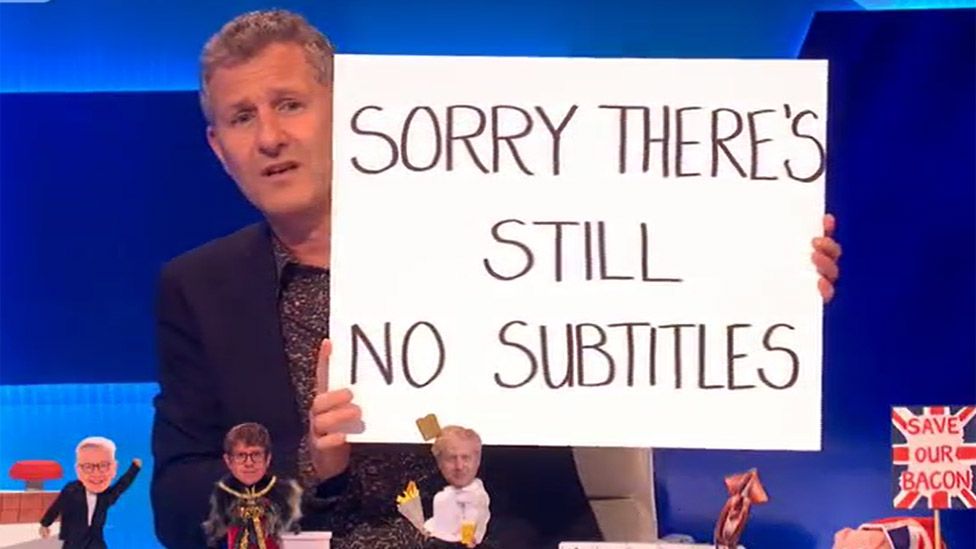
A spokesman for Red Bee Media said: “Things are improving every day and we are able to deliver more and more accessible programmes, but we are unfortunately still experiencing issues with receiving the media for which our access teams create pre-recorded subtitles, audio descriptions and signing.
“As soon as there are any more updates, we will share these.”
The original fault temporarily took Channel 4, Channel 5 and S4C off air completely, and led to transmission problems in the subsequent days, such as E4 being forced to delay the Married At First Sight series finale.
On 8 October, presenter Adam Hills addressed the problems on Channel 4’s The Last Leg, holding up a hand-written sign reading “Sorry there’s still no subtitles”, followed by another saying “Sort it out”.
The Times reported that the fire suppression system at Red Bee’s headquarters sucked all the oxygen out of a room, causing a “sonic wave” that shut down the transmission servers.
A spokesperson for the London Fire Brigade said: “Firefighters were called to reports a gas suppression system had activated at a building on Wood Lane in White City on Saturday 25th September.
“The suppression system had activated in a server room and on site engineers worked to ventilate the room. Firefighters carried out a search of the building and a sweep of the room but found no fire apparent.”
DWP Accused Of Copying ‘Kidnappers’ To Verify UC Claims
With many thanks to Benefits And Work.
The DWP stand accused of having taken a lesson from ‘kidnappers’ in order to verify universal credit claimants’ addresses, by requiring them to take multiple photos of themselves, including one with them holding a copy of the current day’s local paper.
The Public Interest Law Centre have tweeted an extract from a claimant’s UC online account and suggested that ‘Point 5 is what kidnappers do, which seems appropriate’ .
The extract itself is a list of 5 demands the claimant must meet in order to have their UC claim considered:
Further to today’s phone call. I now require you to provide the following information. If you don’t provide all of the information that we’ve requested your claim will be closed.
1. A photo of your ID card or passport open on the photo page.
2. . A photo of your ID card or passport open on the photo page held next to your face.
3. A photo of you stood outside the front door (open behind you) of the property you live at. Ask someone to take this from the street so that the whole property can be seen.
4. A photo of you stood next to your street sign with you [sic] right hand holding it. Ask someone to take this photo from a few metres away so that the background can be clearly seen.
5. A photo of you holding your local newspaper for the area you live (not a national tabloid newspaper). This should be dated the same day you upload the photo.
As other posters point out there are numerous problems with this approach including: many areas don’t have a local paper anymore, you can’t put your hand on a street sign if it’s halfway up a building, you can’t take a photo of yourself in the front door of your property from the street if you live halfway up a block of flats, you may not know anyone who could take a photo of you and may be unwilling to hand your phone over to strangers.
The bizarre series of instruction appears to be a way of trying to verify a claimant’s identity and address without having them attend an interview.
But many would argue that copies of items such as utility bills and tenancy agreements are as reliable as a series of images that could quite possibly be photoshopped.
Theatre Became More Accessible During Covid. Will It Last?
Going to the theatre in a pre-pandemic world, my first question was always whether I could use the toilets. With so many of the UK’s theatres dating back decades, or centuries, even the disabled toilets are often tucked into tiny, pokey spaces that could be fine for a small manual wheelchair, but not my assistant and bulky powerchair. Even disabled loos can be inaccessible for disabled people.
Like going anywhere with a wheelchair, a trip to the theatre requires ridiculous planning. Just booking a seat is often a challenge. Most theatres still don’t allow you to buy wheelchair tickets online, and good luck trying to find out if an assistant goes free. But what has stopped me – and many other disabled or chronically ill people – from regularly going to the theatre is simply a lack of energy. By the end of a working day, I was often too exhausted and sore to spend more hours in my chair.
“Journeys out are too tiring, require planning, and often have to be cancelled,” John Maidment, an avid theatre fan who is disabled, told me. “Most theatre seating is too uncomfortable, and I can’t move about, shift position or exercise a limb as it annoys and distracts others.”
All of which made the pandemic-induced shift to online performances a welcome change: suddenly, theatre was newly accessible, and not just for those with mobility impairments. For deaf, hard-of-hearing and visually impaired audiences, online performances suddenly came with captions, British Sign Language and audio-description as standard. And the option to watch from home helped some autistic and learning-disabled people to enjoy the theatre free from strict expectations around silence and stillness.
Some of the UK’s biggest theatres are committed to maintaining an online theatre programme after Covid. The Barbican in London is keeping some shows as purely online experiences, while the Young Vic has committed tois streaming all of its main-stage shows. Sadler’s Wells launched its Digital Stage last year, and will keep it into 2022. But others are reducing their streamed performances, perhaps in the hope of getting people inside theatres again. The Birmingham Hippodrome and the Royal Exchange in Manchester do not list any online performances at all. And in the rush back to full houses, captioned, BSL-interpreted and relaxed performances are once again becoming rare, with most theatres providing only one or two accessible showings of each play.
Andrew Miller, who was the UK government’s disability champion for arts and culture before setting up of the Disability Arts Alliance, says the lack of social distancing is keeping him out of his own sector. He used to attend roughly 100 shows a year, but now describes himself as “part of the socially excluded”. When he declines invitations with concerns about Covid, the response from theatres, he says, is “we hope to see you when you feel comfortable” – as if there’s nothing that could be done. In reality, theatres know – because they’ve been told – how they could do to help: simple measures like mandating masks, checking vaccine status, requiring proof of a negative test, and keeping a small section for social distancing would all go a long way. Such measures have been proven to work on Broadway. But the UK theatres are turning a blind eye.
“We are determined that deaf, disabled and neurodivergent audiences are not left behind, as was so often the case pre-pandemic,” says Nickie Miles-Wildin, the associate director of Graeae, a theatre company for deaf and disabled creatives. She hopes that more theatres will enforce social distancing at their performances to allow clinically vulnerable people to return, as well as offering online shows. (Graeae’s current production, 10 Nights, is available as a download.)
And then there’s still the stairs, the narrow seating and, of course, the toilets. That theatres have remained pokey is especially galling when many venues had put off making such improvements before the pandemic as they would have to close for renovations. Historically, some theatres have hired “access consultants”, who advise on how to improve accessibility but may not necessarily be disabled themselves. Hiring disabled professionals would take the burden off disabled fans who often end up advising theatres for free; people such as Shona Louise, a theatre photographer and wheelchair user who campaigns for better access. It is “frustrating” that theatres have not used their time in lockdown to improve accessibility, she says. “We had such an opportunity to increase accessibility across the board – and we just decided not to take that up.” Advertisementhttps://1de64f88bf2aa1994dfca5af61f29784.safeframe.googlesyndication.com/safeframe/1-0-38/html/container.html
London’s Old Vic has used the pandemic to install more accessible loos and create a lowered section of its bar that will enable wheelchair users to more easily order drinks (always a bonus, in my book). But there has been some regression, too. Shona and other activists recently complained when it emerged that the extremely popular Henry VIII musical, Six, would be moving from the Lyric to the Vaudeville theatre, which does not have an accessible loo. The Vaudeville’s stairlift (the only way wheelchair users can access the stalls) is unable to handle powerchairs. Conversations with the Vaudeville had been “constructive”, she says – but ultimately they should never have been necessary in the first place.
The answer to all these issues is to have more disabled people working in theatre. “There is no one fighting for us on the inside,” Shona says. As theatres reopen their doors, the back-to-normal narrative is, as John says, “nothing less than a betrayal. We know they can do it when it suits them.”
Liverpool Teacher Shortlisted For $1m Global Teacher Prize
A UK PE teacher who has pioneered new ways of teaching sports to visually impaired children at a special needs school in Liverpool has been shortlisted for this year’s prestigious global teacher prize.
David Swanston, a teacher at St Vincent’s school, is in the final 10 out of 8,000 nominations and applications for this year’s $1m (£730,000) award, which is intended to showcase the work teachers do preparing young people for their future. It is funded by the Varkey Foundation and endorsed by Unesco.
He is joined by Elliott Lancaster, a 24-year-old postgraduate student at Keele University, who is shortlisted for the first Chegg.org global student prize, a sister award that rewards exceptional achievements in learning and extracurricular activity, with a $100,000 prize.
Swanston has taught children with visual impairments for more than a decade at St Vincent’s, which is a specialist school for children with sensory impairments. In 2020 he was appointed deputy principal.
Swanston specialises in PE but teaches a range of subjects including geography and art. He pioneered techniques to enable students with visual impairments to participate in sports, since they on average accumulate less than half the recommended 60 minutes of moderate daily activity. Several of his students have gone on to become Paralympians.
His work has included modelling techniques and examples to enable blind students to understand how sports pitches are laid out. He is developing a version of rugby specifically for blind children, which uses textures and electronics to model game play and create ball prototypes.
If he wins the global teacher prize, Swanston plans to use the funds to support physical activity, horticulture and wellbeing programmes at the neighbouring Alder Hey children’s hospital, as well as to develop inclusive and blind ice hockey across the UK. He will also use the funds to support his charity, Sightbox, which aims to improve access to adapted sport for visually impaired students in developing countries.
Lancaster is a postgraduate student at Keele University and a sustainability campaigner. In 2016 he established a social enterprise app in Newcastle-under-Lyme called Utter Rubbish, which updates local residents on recycling policies in their local area. There are now plans to roll out the service in other local councils. He has also set up a network of sustainability volunteers, who lobby for organisations to become carbon neutral.
In his academic work, Elliott has published two award-winning studies looking at interdisciplinary learning and the impact of coronavirus on blended learning.
Sunny Varkey, the founder of the Varkey Foundation, said Swanston and Lancaster’s nominations “highlight the importance of education in tackling the great challenges ahead – from climate change to growing inequality to global pandemics”.
The education secretary, Nadhim Zahawi, congratulated Swanston and Lancaster on their nominations. He said that after a recent meeting with Lancaster he had been “so impressed by his passion and commitment to issues like sustainability”, and he praised Swanston for his “innovation” and “inspirational work”.
The winners of both prizes will be announced on 10 November in a virtual ceremony hosted at Unesco’s headquarters in Paris.
Four Hour Telephone Assessment Slots Misery
With many thanks to Benefits And Work.
Homelessness charity Groundswell have contacted us to warn that the DWP appear to be introducing a four hour slot system for telephone assessments, instead of giving a fixed-time appointment for a call.
Staff from the charity came across the practice in connection with a work capability assessment (WCA) for a universal credit applicant.
The 4 hour window raises huge problems for organisations who wish to provide a support worker to assist with giving evidence at the assessment, because few charities can afford to have a staff member sitting at a claimant’s home for up to four hours waiting for a call.
In addition, the protracted wait is likely to cause enormous distress to some claimants, especially those who experience anxiety.
The DWP’s explanation for the four hour window is that sometimes assessments overrun, so it is difficult to give a precise time when an assessor will be available.
The only concession that appears to be being made is that claimants can ask for a 9am or 1pm appointment in order to be first on the list for the morning or the afternoon. But clearly these slots will be in short supply.
We don’t yet know if this practice is now widespread and whether it also applies to WCAs for ESA and for PIP assessments.
If you have had a similar experience we’d be grateful to hear from you either with a comment below the line or by using our feedback form.
The Football Association has pledged to increase the number of people playing disability football in England by 50% in three years, as it announced its first plan to support the game.
Currently 4.5% of people with disabilities play football, fewer than the 5.9% who play golf. The FA’s Football Your Way plan intends to create 2,800 new opportunities to engage in the game – from greater provision at schools to a new “recreational football offer” for adults. It also has broader ambitions to change the culture around football and disability.
The FA’s director of women’s football, Baroness Sue Campbell, has developed the plan, alongside the director of equality, diversity and inclusion, Edleen John. Campbell says it represents an organisation “looking to drive change”.
“There’s a lot of good work gone on in the past but very much on the back of pioneers,” she added. “This is the first time as a Football Association that we have had a coordinated plan which covers all of our divisions. It’s about focusing our energy on getting more disabled people to play our game to enjoy our game and to stay in our game.”
Campbell said he plan was born out of recognition that there had not been enough work on disability inclusion, but also that the quality of the work could be improved. “It reminded me very much of where the women’s game was five or six years ago,” she said.
The FA intends to expand the pathway for players looking to reach the top and will create women’s national teams for blind players and those with cerebral palsy. A target of 1,000 new disability football coaches has also been set, with current players set to be fast-tracked into the roles. The percentage of people with disabilities on the FA’s payroll is targeted to grow from 3.3% to 10%.
Disabled people are twice as likely to be inactive as non-disabled people, figures further affected by the pandemic. Campbell says that information and instilling confidence are the most important factors in making the plan work but that football has an ability to drive change more broadly in society.Quick Guide
“Information is key, but my experience is that at starter level it’s about confidence,” Campbell said. “That’s why we want to say it isn’t all about heavy competition. If you just want to come and play for fun we’re going to create opportunities for you where you [don’t] feel you’re going to be measured or that you might be hurt. That might sound overprotective but I think the reality is we’ve got to get people back in playing and enjoying being active again.
“I passionately believe that football is a powerful way to get messages into society. If we can demonstrate our commitment and really make a difference to people’s lives, maybe we can be a beacon for other people in society to recognise that we should and could do more.”
Birmingham Teenager Receives Award For Sign Language Lessons
A teenager who has helped more than 80,000 people learn British Sign Language (BSL) has received an award.
Tyrese Dibba, 16, who has Charge Syndrome and is deaf and partially sighted, created a series of videos teaching BSL during lockdown.
The videos were released with charity Sense in a bid to tackle isolation among people with disabilities.
He received a Points of Light award from the prime minister and said he was “a bit surprised” to be recognised.
The charity said Tyrese was star of of its Sense Sign School which taught tens of thousands of people BSL via free online classes.
The Points of Light awards recognise an individual each day who has made an outstanding contribution to volunteering in their community.
Tyrese, from Birmingham, said: “I’m happy so many people wanted to learn some basic sign language. I’m a bit surprised to be recognised for my work by the prime minister.”
Richard Kramer, chief executive of Sense, added: “He’s an inspirational young man who has overcome challenges to get tens of thousands of people learning sign language.
“We can’t think of anyone more deserving of winning this award.”
Pupil Abuse In Special School Secure Rooms Filmed On CCTV
An investigation has been launched into “organised abuse” at a special school in London after CCTV was discovered of pupils being physically assaulted and neglected, BBC News has learned.
The videos, found by staff, show pupils being mistreated in padded seclusion rooms between 2014 and 2017.
One parent said he didn’t know the rooms existed until he collected his “distressed” autistic son from one.
The school said it was working with the police and supporting families.
Whitefield School in Walthamstow, north-east London, has over 300 pupils aged between three and 19, many of whom have severe or complex needs and are unable to communicate verbally.
BBC News has learned that in May a staff member found a significant number of videos showing children in the school’s seclusion rooms. In some of the footage, pupils are physically assaulted and neglected.
Secure or seclusion rooms are used in schools when it is thought a pupil needs to be isolated from a classroom during the school day.
In July, the school wrote to parents about the discovery of evidence of “alleged child neglect”.
The Metropolitan Police has now reviewed a significant amount of CCTV footage and the local authority has launched an investigation into “organised and complex abuse” at the school, BBC News has learned.
This is defined as “abuse involving one or more abusers and a number of related or non-related abused children”.
In January 2017 the school was rated inadequate after an Ofsted inspection found a small number of pupils had been placed in secure rooms “for repeated and prolonged periods of time”.
The report said while the school referred to them as “calming rooms” this was “not an accurate description of the three secure, padded and bare spaces that are used”.
All three rooms at Whitefield School were poorly ventilated with doors that could not be opened from the inside, while two had no natural light and children were unable to see outside or hear clearly, according to Ofsted.
“In a significant number of cases, pupils are placed in the rooms more frequently or for longer periods of time, as their behaviour worsens,” the report said. It added there was no evidence parents had been told when their child had been placed in the room.
Following the inspection, the school wrote to parents telling them it was ending use of the rooms. Later that year the school was inspected again and given an outstanding rating.
‘It was diabolical’
One parent told the BBC he didn’t know the rooms existed until he was taken to collect his autistic son from one of the them, following problems with his behaviour.
He said his son appeared agitated and his shirt was ripped.
“He was very upset, very distressed”, he added. “I thought it was diabolical.”
The boy’s mother said her son would not have been able to communicate any experiences in the rooms because of the nature of his disability. She said she was frequently called by the school about ways to manage his behaviour but use of the rooms was never mentioned.
“You send your child to school because you expect that they’re going to be treated with dignity and respect,” she said.
“I think of a ‘calming room’ as a safe space: beanbags, soft lighting, bubble machines – not padded cells.”
Parents of some pupils at the school who may have spent time in the rooms have been contacted by the London Borough of Waltham Forest, but not been told whether their children have been identified in videos.
BBC News has seen a letter written by the school’s head teacher in May 2017 outlining the steps it was taking to address the Ofsted inspection.
It said it was closing the “calming rooms” but no mention was made of footage documenting their use.
That month a teacher at the school was sacked after a member of the public saw him kick a 17-year-old pupil with autism on a school trip.
Seclusion rules ‘not strong enough’
A BBC News investigation in 2018 discovered the use of isolation and seclusion rooms varied widely in schools.
It found some children spent consecutive weeks in isolation booths and more than 5,000 children with special educational needs had attended them.
Seclusion rooms are used in many schools across the country to tackle challenging behaviour and disruption.
But government guidance says “a separate room” should only be used when it is in the best interests of the child and other pupils, and locked rooms should only be considered in “exceptional circumstances”.
Rules around use of seclusion rooms are not strong enough, according to Paul Dix, who has campaigned to ban isolation rooms.
“I don’t think they could be more lax”, he said. “It seems to just rest with the culture and leadership of the individual organisation and nobody really seems too concerned about legislating.
“It’s just ludicrously Victorian to think that putting a child in a locked room is going to do anything but exacerbate the problem.”
In response to the BBC, the academy trust which runs the school said it had new leadership since the rooms were used who “promptly” reported the videos to the police and local authority after they found them.
It said it had appointed a new head teacher following the discovery and met with parents of those children who may have been affected.
It declined to say if the CCTV had been disclosed to Ofsted during its inspection.
Ofsted also declined to say if it had observed CCTV cameras during its inspection or asked to review footage.
In a statement it said it had shared some of its inspection evidence with the police at their request and could not comment further.
The London Borough of Waltham Forest said it visited the school after Ofsted’s January 2017 inspection “to ensure the safeguarding concerns raised were acted upon immediately” but only learned pupils had been filmed in the seclusion rooms when the footage was discovered in May 2021.
The Metropolitan Police said it was investigating “several allegations of child cruelty” at the school between 2014 and 2017 but there have been no arrests.
The government said it was aware of the allegations but could not comment further while a police investigation was under way.
Mike Tindall Meets Families Living With Parkinson’s Disease
Former England rugby captain Mike Tindall hears from families living with Parkinson’s disease.
The former player, who’s married to Princess Anne’s daughter Zara, speaks to those dealing with the same condition as his father.
PIP To Be Scrapped For Some Claimants Next Year And Replaced By New Disability Payment
The Adult Disability Payment (ADP) is a new benefit scheduled to be delivered by Social Security Scotland next year that will replace Personal Independence Payment (PIP) for Scottish claimants.
The new benefit will provide additional financial support to people of working age across Scotland with a disability, long-term illness or mental health condition. It will initially be piloted from spring, 2022 before becoming available to all Scottish claimants in the summer of the same year.
Scottish claimants who currently receive UK Government disability benefits, delivered by the Department for Work and Pensions (DWP), will be transferred to the new devolved system in stages after the new benefits are introduced. Full transfer of benefits from the DWP is expected to be completed by 2025.
Read More
Social Security Scotland will deliver three new forms of Disability Assistance
- Child Disability Payment will replace Disability Living Allowance (DLA) and is due for a full roll-out starting in November, 2021 after an initial pilot scheme launched in July
- Adult Disability Payment will replace PIP and is due for full roll-out by summer 2022
- Pension Age Disability Payment will replace Attendance Allowance and a roll-out date has still to be confirmed
The Scottish Government assumed responsibility for these benefits alongside Severe Disablement Allowance and Industrial Injuries Disablement Benefit in April 2020.
However, due to the impact on the Scottish Government, Social Security Scotland and public services in managing Scotland through the Covid-19 pandemic, a decision was made to delay the launch of Disability Assistance.
For now, disability benefits will continue to be delivered by the DWP.
The change to PIP will only affect Scottish claimants.
Below is our quick guide to Adult Disability Payment and includes everything you need to know about eligibility, payment rates, assessments and making a claim.
Who will be eligible to make a claim for the Adult Disability Payment?
Eligibility criteria is similar to PIP.
This benefit is for people who meet the following criteria:
- You are aged between 16 to State Pension age (now 66 for both men and women)
- You have difficulties with daily living or getting around outside your home (or both)
- You have had the physical or mental difficulty for at least 3 months and expect it to continue for at least 9 months
If a person is terminally ill these qualifying periods do not apply.
How are claims assessed?
Social Security Scotland will make decisions about entitlement for ADP using the applicant’s account of their circumstances and existing supporting information, where possible.
The number of face-to-face assessments will be significantly reduced and will only be necessary when it is the only practicable way to make a decision.
Most consultations will be carried out over the phone, but can be face-to-face in a GP surgery or even at home – whatever works best for the person applying.
And claimants will no longer be asked to carry out tasks to demonstrate how their disability, long-term illness or mental health condition affects them as part of the application process.
Research into how people felt about the current DWP assessment consultation was carried out before the new system was devised by Social Security Scotland.
People who have undergone assessments for DLA and PIP told Social Security Scotland Experience Panels it was the “most stressful part of the overall process.”
However, a DWP spokesperson recently commented: “Our latest survey shows that 82 per cent of PIP claimants are satisfied with the overall service they receive from us and we continue to work closely with stakeholder groups and assessment providers to continuously improve the overall experience.”
Examples of supporting information
This will be used to help make a decision about your claim and will include:
- a social care needs assessment
- a report from a community psychiatric nurse
- information from a carer
Payment rates for Adult Disability Payment
Social Security Scotland will provide the same rate of all forms of Disability Assistance as the current rate of the equivalent UK disability benefit (PIP) and will increase in line with inflation each year.
Based on 2021/2022 rates the weekly amounts of Adult Disability Payment are:
Daily living
- Standard rate: £60.00
- Enhanced rate : £89.60
Mobility
- Standard rate : £23.70
- Enhanced rate : £62.55
How often will my award be reviewed?
Unlike DWP payment awards which are reviewed regularly over a fixed-period of time, the ADP will be rolling, with no set end date.
Reviews will be ‘light touch’ and as non-intrusive as possible.
Will I still be able to swap all or part of my mobility payment for the Motability Scheme?
People who get the highest rate of the mobility component of ADP will be able to transfer either the whole or part of the money they get for the mobility component to access the Accessible Vehicles and Equipment Scheme .
This new Scottish scheme will provide a service similar to the current Motability scheme, with a range of cars, wheelchair accessible vehicles, scooters and powered wheelchairs on affordable leasing terms, with a range of adaptations at little or no cost.
Clients who have an existing Motability lease will be able to retain their vehicle until the end of that lease.
Did you know there are a number of ways you can stay up to date with the latest money saving and benefits news from the Daily Record?
You can join the conversation on our Money Saving Scotland Facebook group for money-saving tips, benefits news, consumer help and advice plus the latest shopping deals.
Sign up to our weekly Record Money newsletter to get our best stories sent straight to your inbox. You can sign up either by entering your email address in the sign up box further up this page or click here.
You can also follow our Twitter account @Recordmoney_ for regular updates here.
When can I apply for Adult Disability Premium?
New claims will be accepted initially in the pilot scheme from spring, 2022.
Anyone who needs to claim for additional financial support due to a disability, long-term illness or mental health condition should apply for PIP from the DWP.
We have a dedicated section for all things PIP-related to help claimants understand the benefit with guides on how to apply and complete the claim form – browse the topics here.
Find out more about all the new Disability Assistance being delivered by Social Security Scotland website here.
A press release:
Based on the book by award-winning, neurodivergent children’s author, Elle McNicoll
BBC Children’s has partnered with 9 Story Media Group to bring award winning book, A Kind of Spark, to audiences in the UK. The powerful live action series will tell the inspirational story of 11-year old Addie, a neurodivergent girl. When she learns about the witch trials that happened centuries ago in her hometown, Addie knows that there’s more to the story of these ‘witches’, just as there is more to her own. Can Addie challenge how the people in her town see her and her autism and make her voice heard? A heart-warming and funny story about friendship, courage and self-belief.
Winner of the Blue Peter Book Award and the Overall Waterstones Children’s Book Prize, A Kind of Spark interweaves the past and present in eight action packed episodes full of magic, mystery and friendship with a strong message of inclusion.
Sarah Muller, BBC Head of Commissioning & Acquisitions 7-12, “We’re delighted to bring this moving and powerful story to audiences in the UK. In Addie we have a character who is relatable, uplifting and inspiring and we can’t wait to bring her story to life. Our aim is to reflect all of our audience on screen and this story of difference and acceptance is one that we can’t wait to tell.”
“We are thrilled to partner with BBC Children’s to bring this incredibly special story to the screen,” said Gráinne McNamara, Vice President, Live Action for 9 Story. “Just like the countless kids who have fallen in love with the book, we were instantly captivated and inspired by Addie’s way of looking at the world. Representation is crucial in kids television and we are excited to bring A Kind of Spark to new audiences in the UK.”
A Kind of Spark is created for television by Anna McCleery (Free Rein, The Secret Life of Boys), written by Anna McCleery and Elle McNicoll (A Kind of Spark, Show Us Who You Are) and produced by 9 Story Media Group.
Ends.
For BBC Children’s press enquiries, please contact: faith.whitehouse@bbc.co.uk and vicky.owen@bbc.co.uk
Faith Whitehouse
Assistant Publicist
BBC Children’s, BBC Education
07384 452 744
LETTER TO EDITOR: For ‘WorldArthritisDay’ this Tuesday, Revitalise offer support for the UK’s 10 million living with the often-crippling condition
Dear Editor,
Arthritis is the most common cause of pain and physical disability in the UK, with around 10 million people affected, often finding their lives changing enormously by the pain of inflamed joints. This Tuesday is World Arthritis Day, a global awareness day held to raise awareness of the condition. I would like to share with your readers a little about arthritis, and how the charity I work for, Revitalise, are able to support people living with arthritis.
Osteoarthritis is the most common type of arthritis, causing joint pain and stiffness usually developing over time and frequently seen in the hands, knees, hips, feet and spine. Rheumatoid arthritis is an inflammatory disease, mainly affecting joints and tendons, with inflamed joints appearing swollen and red. The disease usually starts in the wrists, hands or feet, and can spread to other joints and parts of the body.
Revitalise specialise in respite care breaks for people living with conditions related to arthritis and over 150 different disabilities. Our centres are purpose-built and fully-accessible and every aspect of our guests’ holiday is tailored to their needs.
One of our guests, Tracy, was 27 years old when she noticed she was beginning to lose sensation and movement in both the left and right side of her body. Tracy was diagnosed with hemiplegic migraines and arthritis. Doctors recommended that Tracy exercise, and swimming at the Revitalise Sandpipers hydrotherapy pool really helps her muscles and arthritis.
Tracy said: “When my illness got a lot worse, I was in and out of hospital a lot and couldn’t go on holiday. I’ve now been using a wheelchair for the last two years. I wish I knew about Revitalise sooner. The main thing that I come away with is confidence. I don’t feel afraid or scared that I am disabled – instead I’m made to feel that I can achieve things. People accept me for who I am.”
Treatments for arthritis vary person to person, depending on the condition and focus on reducing symptoms and improving quality of life. Many of your readers may find an accessible break with Revitalise to be a fantastic additional support and enjoy the varied activities and excursions we offer.
Revitalise have opened holiday bookings for 2022 which include exclusive Early Bird discounts, giving guests huge savings if they book early for Jubilee Lodge in Essex or Sandpipers in Southport. These breaks create a supportive but stimulating environment where carers and their loved ones can enjoy a quality break together alongside care support from the Revitalise team.
To enquire about the specialised breaks available at Revitalise, call 0303 303 0145, email bookings@revitalise.org.uk or visit revitalise.org.uk/early-bird
Rebecca Young, Revitalise Director of External Affairs
www.revitalise.org.uk
Too Many People Getting PIP And Being Placed In ESA Support Group, Says DWP Secretary Of State
With many thanks to Benefits And Work.
Therese Coffey, the secretary of state for work and pensions has said that PIP has “grown in a way that was not anticipated” and that it needs to be targeted “even more so to people who need that help”. She also refused to rule out merging PIP with universal credit and said that the benefits system needs to stop “encouraging people to show how they really cannot do any work at all”.
The comments made at a meeting at the Conservative Party Conference, will dismay all those who have already endured the move from incapacity benefit to ESA, based on the idea that ESA would focus on what claimants could do rather than what they could not do.
Many of those same claimants have also faced the move from DLA to PIP, based on the claim that PIP would be better targeted on those who needed support.
Coffey’s comments are particularly ironic given that PIP was promoted by the DWP as being more effective at providing help to claimant with mental health conditions.
Yet the example Coffey chose to give of where PIP is failing was the increased help for young people with mental health issues.
“PIP has certainly grown in a way that was not anticipated when it was introduced.
“To give you an example, three out of four young people who claim PIP have their primary reason being mental ill health.
“That in itself is 189,000 young people who currently receive benefit focused on that. There may be other benefits they receive as well.
“So that’s one of the things where I’m very conscious one of things I’m trying to do as Secretary of State is very much the issues we face are downstream, and what are the things we need to do to get more upstream.
“And I hope that might give us the headroom then to… how is it that people can think the benefit system is fair.
“And I think by being able to target that even more so to people who really need that support, may improve that prospect of public perception.”
In relation to ESA, Coffey said that the original expectation was that only 25% of claimants would be in the support group rather than 80% and that she wanted to change the focus to “what people can do, rather than the benefit system being driven currently by what you cannot do”.
When asked if there were any plans to merge UC and PIP, Coffey refused to rule it out, saying that “everything is on the table”.
Could You Be Eligible For Household Support Fund Help?
With many thanks to Benefits And Work.
A new £500 million Household Support Fund (HSF) for vulnerable UK households was launched by the DWP on 6 October. It will last until 31 March 2022 and may be a very important lifeline for some Benefits and Work readers over the winter.
However, the fund is being administered by local authorities who have very wide discretion in how they distribute money, so local research will be needed to discover if you might be able to get help.
The Household Support Fund (HSF) was launched with virtually no detail at very short notice to head off a potential backbench conservative revolt against the ending of the £20 UC uplift last week.
It has been condemned by charities as merely a sticking plaster and a hastily cobbled together attempt to save face by ministers. But for struggling households even this short-term support cannot be ignored.
In England the money is being given to county councils and unitary authorities. The devolved administrations in Scotland, Wales and Northern Ireland will decide how to distribute their share of the funds.
Each local authority can draw up its own procedures and targets for awarding payments, as long as they stay within the DWP’s overall guidelines.
The money should be primarily be used to help pay for food, energy and water bills for vulnerable households, but other costs can also be covered.
Amongst the possible items listed in DWP draft guidance are:
- sanitary products,
- warm clothing,
- soap,
- blankets,
- boiler service/repair, purchase of equipment including fridges, freezers, ovens,
- broadband and phone bills,
- clothing,
- essential transport-related costs such as repairing a car, buying a bicycle or paying for fuel,
- housing costs
At least 50% of the money has to go to households with children. But the remainder can go to households without children, including people living alone. The funds are not restricted to people in receipt of benefits. Not is there any requirement that you must be employed or that you must be unemployed.
Councils can identify households they regard as vulnerable using data they already hold, request applications for support from other agencies or from individuals or use a mixture of all these methods.
So, it is likely that some authorities will accept grant applications from individuals and others will not.
Awards can be made to the same household for different types of expense and multiple awards can be made to the same household.
Whatever approach they use, councils must have “a clear rationale or documented policy/framework outlining their approach including how they are defining eligibility and how households access the scheme.”
Councils have until 29 October to provide the DWP with a plan setting out how they will distribute their share of the funds. At some point most will hopefully publish information online as well.
At the moment it is likely that most local authorities are scrabbling to come up with a plan to award the funds. We would be grateful for any information from readers about what is happening in their local area.
There is a press release on the Household Support Fund on the .gov website
Comedian Rosie Jones has said getting online abuse after appearing on BBC One’s Question Time has made her “more determined” to speak up for minorities.
Jones, who has cerebral palsy, appeared on the programme’s panel on Thursday.
She tweeted: “The sad thing is that I’m not surprised at the ableist abuse I’ve received. It’s indicative of the country we live in right now.
“I will keep on speaking up, in my wonderful voice, for what I believe in.”
The comedian and actress, who is known for TV shows like 8 Out of 10 Cats and The Last Leg, said the negative reaction had only served to strengthen her resolve.
‘More determined’
“A lot of my job is going on stage and telling silly jokes about my boobies,” she said on ITV’s Loose Women on Friday.
“So actually to be given a platform where I can speak more seriously about what it’s like to be disabled and gay and a woman in this country right now, it feels like such a powerful opportunity.
“Unfortunately after my appearance last night I got a lot of abuse online about how I look and about how I sound and about my disability, and actually that makes me more determined to speak out for minorities because this country needs to be a better and more accepting place to live in.”

Analysis by Entertainment reporter Alex Taylor
The response to Rosie Jones’s Question Time appearance underlines an uncomfortable truth – society is used to disability being discussed, but not so much disabled people making their own voices heard.
Cultural representation of disability, led by the media, has traditionally been confined to one-note issues of need, such as social care, or Paralympic-esque inspiration narratives. Jones’s vocal opinions on a variety of social and political issues challenged this.
The abuse she received reflects the need for change as disability continues to be the most underrepresented area of diversity across the media. Like her, I have cerebral palsy.
But Jones’s steadfast defiance also proves the power of representation. It’s why the BBC has rightly committed to improving representation of disabled talent on and off-screen, in line with disability storylines in Sex Education and Breaking Bad.
Social media hate doesn’t take away words or experiences. Jones’s words on Question Time proved that. It does however empower the need for change.
Jones was on the political debate programme with Education Secretary Nadhim Zahawi, shadow Foreign Secretary Lisa Nandy, National Farmers’ Union president Minette Batters, and LBC broadcaster Nick Ferrari.
She received support from the likes of TV presenter and author Richard Osman, fellow comedians Shaparak Khorsandi and Kerry Godliman, and the disability charity Scope.
Khorsandi added her voice, saying: “We are all your army against this hate… I never had a Rosie Jones in the comedy world that I loved as a kid. Very delighted my children do.
Former Northern Ireland Secretary and Home Office minister James Brokenshire, who was diagnosed with lung cancer in 2018, has died aged 53.
The Old Bexley and Sidcup MP took leave from his ministerial duties earlier this year after reporting a recurrence of a tumour on his right lung.
His family called him “a loving father to his three children, a devoted husband” and a “faithful friend”.
Mr Brokenshire had been in hospital since his condition worsened on Sunday.
He was first elected to Parliament in 2005 as MP for the former constituency of Hornchurch.
Chair of the Old Bexley and Sidcup Conservative Association, Evelyn Morrison, who worked with Mr Brokenshire, for 12 years, said: “I’m very devastated. A wonderful, wonderful MP. Lots of integrity. He worked so closely with us.”
After his diagnosis, Mr Brokenshire, a former lawyer, worked to promote greater awareness of lung cancer.
Mr Brokenshire was a Home Office minister from February last year until this July.
Previously, he was housing secretary from April 2018 to July 2019 and Northern Ireland Secretary from July 2016 to January 2018.
Southampton have ended their status as the only Premier League club not signed up to the Football Association’s football leadership diversity code (FLDC), with a call for authorities to do more on inclusion.
The south-coast side became the 52nd of 92 league clubs to sign up to the voluntary charter, a year after it was launched and hours before the FA was set to publish statistics on the number of clubs involved. It came as the FA launched a diversity strategy, with targets for recruitment at all levels of the organisation including, for the first time, the recruitment of people with disabilities.
In announcing their decision Southampton said they were “committed” to the FLDC but that “the club maintains it could go further”.
“The club’s existing recruitment targets encompass all roles, as opposed to leadership roles only, and also extend beyond race and gender,” the club said. “We look forward to engaging with the FA on this topic to broaden the targets for all clubs.”
The FLDC commits clubs to achieving certain standards, ensuring that15% of hires in senior leadership roles will be black, Asian or of mixed heritage, and 30% of hires will be female. The code was broadly welcomed across the game but was criticised by Disabled Rights UK for the limited scope of its targets. Under the FA’s new Be the Change strategy, the organisation is committed to people with disabilities forming 10% of its workforce by 2024.
There are also targets for people with black, Asian, mixed and other ethnic minority backgrounds taking 13% of leadership roles and comprising 17% of all employees, while 42% and 40% of the roles respectively should be filled by women. The FA is also to launch an “organisational disability plan” alongside a new policy on transgender inclusion in football.
The FA’s equality, diversity and inclusion director, Edleen John, said there had “always been an understanding” that not every club would sign up to the FLDC immediately but that an upcoming report on the impact of the first year of the code may “galvanise” others to join.
“I’m hopeful that once people see the one year report and the information that is shared within it, they might feel as though they want to be part of driving forward that collective change,” John said. “I recognise and acknowledge for a lot of clubs, actually, there’s nervousness around moving to a place where there’s increased transparency and accountability.”
On disability inclusion, John said: “What will be coming further down the line is a plan which will look at a number of different elements from increasing participation and engagement through to what we are doing in our own organisation.”
Disability Hate Crime Victim Wants To Help Others
A woman with learning difficulties who was verbally abused in the street has said she wants to help other victims of hate crimes.
Amy Williamson, 25, was travelling independently for the first time when the incident happened in Leeds.
She said it left her scared to go out in the area after dark.
A new study has found more reports of hate crimes against disabled people in West Yorkshire than any other area for the fourth year in a row.
The two charities behind the research, Leonard Cheshire and United Response, described the county as a “disability hate hotspot”.
Ms Williamson said she reported the incident in 2019 to the police.
“They walked up to me when I was about to go home to my mum. They stopped me from going forwards and they called me nasty names,” she added.
‘Frightened to come out’
Ms Williamson said she wanted to raise awareness and offer support to other people with disabilities who had also been victimised.
She added: “I would like to help people if they get bullied… I love helping people.”
Support worker Mandy Haigh said there needed to be more awareness of the effect hate crimes could have.
“I know many people with learning disabilities that’s happened to who don’t come out of the house anymore because it’s completely knocked their confidence,” she said.
“They’re frightened to come out because that happens.”
According to the charities’ report, which collected responses from 39 of England and Wales’ 43 police forces, 935 incidents were reported to West Yorkshire Police in the year to March 31.
That represented an increase of 7.5% on the previous year, it said.
The report added that only seven of those reports ended up being referred to the Crown Prosecution Service or someone being charged.
West Yorkshire Police said it was working to “improve the investigation of hate crime”.
Assistant Chief Constable Damien Miller said the force did have specialist hate crime co-ordinators and that it recorded every incident “whether it passes the threshold to be classified as a crime or not”.
“This means that while we do record some high levels of hate offending, we also have a better picture of what is happening and would rather victims felt empowered to make their voices heard,” Mr Miller added.
Cyrano: Peter Dinklage Film Explores ‘Human Need For Connection’
A new film adaptation of Cyrano de Bergerac highlights the “human need for connection”, director Joe Wright says.
The first trailer for the Oscar-tipped Cyrano, which features Game of Thrones star Peter Dinklage in the titular role, was released on Wednesday.
The film tells the story of a poet who struggles to reveal his true feelings to the woman he loves due to his perceived unattractive appearance.
Wright says he identified with the original French play from a young age.
“I was one of those kids who felt like they were odd and other and unworthy of love, so I always connected to the story,” he tells BBC News. “It’s about the human need for connection, and how we often fail to connect with other people.”
Wright, who previously directed Atonement and Darkest Hour adds: “Perhaps this film can help to express what I believe to be true, which is that we are more similar than we are different, despite outward appearances.”
What is Cyrano de Bergerac?
Written in 1897 by Edmond Rostand, Cyrano de Bergerac is about a man born with a very large and ugly nose, which makes him feel as if he is unlovable.
Cyrano is a talented poet and an excellent swordsman who is secretly in love with a woman named Roxane, herself a lover of poetry.
But Cyrano, conscious of his appearance, fears rejection and struggles to reveal his true feelings to her.
When a handsome army cadet called Christian arrives on the scene, Roxane begins to fall for him. But Christian is no good at writing poems.
So Cyrano steps in and effectively ghost-writes Christian’s love letters and poems to Roxane, prompting her to fall in love with the young cadet instead.
The film explores several themes – love triangles, deceit, the power of language, a person’s true inner value juxtaposed with outward appearance, and, as Wright puts it, “how we often fail to connect with other people through fear of being seen, somehow”.
“The story reminds me of the importance of human connectivity, especially at a time when we were so starved of that during lockdowns,” he says.
‘A giant soul’
In the latest iteration of Cyrano, the lead character is reimagined so his insecurity is not over his facial appearance, but his height.
“Normally, Cyrano is played by a very handsome actor with a big rubber nose on his face,” notes Wright.
“And although we may suspend our disbelief, we know that actor can, at the end of the day, take off his nose and go to the pub and be a handsome actor. Whereas with Pete, you know he is as he is. And he brings with his smaller stature a giant soul.”
Dinklage, who has a form of dwarfism known as achondroplasia, has been widely praised for his performance by critics who saw an early screening of the film at the Telluride festival in September.
“Although Cyrano has been played by way too many actors to count over the years, Dinklage makes it so fresh, so alive, and so potent it feels like we are seeing Cyrano depicted for the very first time, wrote Deadline’s Pete Hammond.
“Dinklage’s diminutive stature serves the same purpose the character’s oversize schnoz originally did, lending Cyrano an outsider quality that he must overcompensate for in personality,” said Variety’s Peter Debruge. “His Cyrano allows him to confront the insecurities that come with any physical difference more candidly than ever before,” added IndieWire’s David Ehrlich.
However, Next Best Picture’s Matt Neglia said: “Cyrano is so unabashedly romantic that it certainly won’t work for everyone… Dinklage is so intelligent, funny & deeply empathetic. He broke my heart. Costumes are a standout, though I took serious issue with the brightly lit, almost soap opera quality of the cinematography.”
The film is adapted from a musical version of the famous story written and directed by Erica Schmidt, which played off-Broadway in 2018.
Schmidt, who has also written the film’s screenplay, reimagined Cyrano as a dwarf and enlisted her husband, Dinklage, to play the leading role.
“The original Rostand play is quite an intellectual proposition,” Wright points out. “It’s very wordy, there are these long monologues about words, and plays on words. And what the songs do is they kind of stand in for those extended monologues and become a hopefully more accessible and emotional experience of those same ideas and themes.”
He continues: “When I saw Peter play the role [on stage], I was really blown away by that expression of his otherness, just in him being Peter. And I thought that was a very exciting prospect. I think film’s creative success is often designed by the right actor in the right role at the right moment.”
Cyrano has gone through countless versions since it was first staged in Paris in 1897, with the titular role played to great acclaim by Benoît-Constant Coquelin.
Many other performers have taken on the titular role since, among them Sir Antony Sher, Robert Lindsay, Gerard Depardieu, and Kevin Kline, while José Ferrer won an Oscar for playing Cyrano in a 1950 film.
In 2019, James McAvoy donned a prosthetic nose to play Cyrano in a production staged at London’s Playhouse Theatre.https://www.youtube.com/embed/fOInHcgmKus?feature=oembedFigure caption, Warning: Third party content may contain adverts
Dinklage has been touted as a possible best actor nominee in the coming film awards season for his portrayal, but Wright says he tries to avoid such industry buzz.
“I try to drown it all out,” he says. “I don’t find it very healthy for my emotional stability, nor for my creative progress. I live in a farm in Somerset and I try not to read the trades or reviews or any of that stuff. The most important thing to me is that I get to keep making work.”
Ahead of the trailer’s launch, Wright says: “I’m really excited for people to see the film… and I hope it conveys a sense of human connection of love and beauty and a sense that I hope people find or have found their soulmate, and I hope they remember to tell them that they love them.”
Cyrano is released in UK cinemas on 14 January 2022.
Disabled Access – have your say!
A press release:
Euan’s Guide and Motability Operations launch National Access Survey
A new Access Survey will give disabled people and their families the chance to share their experiences, insights and feedback on how accessible Britain is.
Now in its 7th year, the Euan’s Guide Access Survey is the largest and longest running survey of its kind and is being supported by Motability Operations for the first time this year. Motability Operations is the company behind the Motability Scheme which supports disabled people in achieving greater independence and everyday freedom through access to affordable, worry-free mobility by leasing a car, scooter or powered wheelchair.
With all the changes in the post-lockdown world, capturing the views of disabled people on how accessibility has changed, has never been more important. With the addition of questions about pandemic-restrictions, this year’s survey will provide insight about public sentiment and the impact of Covid-19 on accessibility and safety.
The organisations are working together to ask everyone who has ever had to consider disabled access to share their opinion on accessibility in 2021. The data gathered will be used to provide a picture of disabled access in the UK and will be compared with previous results to find out if access is getting better or worse.
Delia Ray, Motability Operations’ head of marketing, commented on the partnership:
To share your thoughts and experiences via the Euan’s Guide 2021 Access Survey please click here.
For more information on leasing a car, scooter or powered wheelchair through the Motability Scheme, visit motability.co.uk or call 0800 953 7000.
At West London College, young people with learning disabilities are being taught how to make coffee, prepare food and give good customer service in the hope they will soon find paid work.
About 80% of staff at Fair Shot Café have learning disabilities, but founder Bianca Tavella says that, with comprehensive training, more businesses should be considering the potential of people with a learning disability.
The café opens its first retail outlet in Mayfair, central London, in November, but it’s hoped the training will eventually be extended to colleges around the country.
Makeup student with cerebral palsy defies odds
A press release:
GlamCandy student Hannah Pierce is breaking boundaries after successfully completing the ‘Introduction to Makeup Artistry’ course.
At just 18 years old and living with cerebral palsy, Hannah attended the professional creative college based in Scotland to pursue her passion for makeup. She now looks set to become one of a tiny number of professionals in the beauty industry.
Having spent all of her life in a wheelchair, Hannah is on a mission to rid the stereotypes within the industry and prove that regardless of a disability, you can follow your dreams.
Hannah comments: “I’ve been interested in makeup for about eight years. I started teaching myself through online YouTube tutorials. During my time at GlamCandy, I met some incredible people, including my tutors Vicky Cameron and Holly Martin. I also loved how the college gave you so much knowledge of makeup, but it didn’t feel intimidating; it was always such a relaxing, friendly environment.”
The course helps students master the skillset required of a professional artist by studying specialist styles including colour theory, bridal basics, and product knowledge.
She continues: “Glamcandy is one of the best and most unique experiences. Be ready to learn so much about makeup without even realising it. The staff and fellow students are always on hand to support and guide you on your journey to kick-starting a fantastic career.”
GlamCandy students are able to learn from some of the finest technical makeup artists in the UK, as well as benefit from partnerships with leading brands, including Illamasqua, Mac, Kryolan, Doll Beauty and B Perfect.
Hayley Harvey-Smith, director at GlamCandy, said: “It’s been fantastic to welcome Hannah onto our course and showcase her incredible talent from skills that she originally taught herself. GlamCandy is an inclusive college, and we are open to students from all backgrounds, so it’s a pleasure to have worked with Hannah.
“Many students use our pro courses to develop their skills and enhance their makeup knowledge, which then allows them to fast-track into the industry.”
The creative college is busy enrolling for the next cohort of HNC students and various short courses. Those interested in kick-starting their beauty or photography career can do so by visiting the GlamCandy website: https://glamcandy.co.uk/
With many thanks to Benefits And Work.
The government is breaking its own rules on publishing research in order to hide evidence given by 120 disabled claimants about how they are treated by the DWP. The cover-up comes as the DWP fights to prevent a further inquest into Jodie Whiting’s death, which would look at whether there are life-threatening flaws in the way disabled claimants are supported.
Stephen Timms MP, chair of the commons work and pensions committee, wrote to Theres Coffey, DWP secretary of state in August, asking for a copy of a report entitled The Uses of Health and Disability Benefits, which interviewed 120 claimants about their experiences of receiving PIP, ESA and Universal Credit.
The report was completed in 2020, but has still not been published and no reference has been made to it in any subsequent green paper relating to disability or benefits.
In an entirely dismissive two sentence response Coffey relied to Timms that it was not necessary for the government to publish the report and it did not intend to do so.
However, Timms has written back to Coffey asking again for a copy of the report.
He has pointed out that when the research was commissioned, the bid pack stated that the successful bidder would have to create:
“A final report of the research findings for publication” and “a one-page summary of the research for the DWP website”
Timms has also pointed out that the government has a protocol for the publication of social research whose principles include the following:
Principle 1. The products of government social research and analysis will be made publicly available.
Principle 2. There will be prompt release of all government social research and analysis.
Principle 3. Government social research and analysis must be released in a way that promotes public trust.
The government is clearly breaching all of these principles and Timms has now asked for an explanation from Coffey by 11 October.
As Timms himself says:
“Some 120 disabled people gave up their time—at DWP’s request—to talk about their experiences of the benefits system, in the expectation that they were taking part in research that would be published and used to inform policy. DWP should be listening to the voices of disabled people. Instead, the Secretary of State seems to have simply brushed this important report under the carpet.
It is difficult to avoid the conclusion that the Government is refusing to publish this research because its findings are too embarrassing. It must now publish the report without further delay.”
It may be that there is nothing in the report that relates to the avoidable deaths of claimants. But if a picture is painted of an organisation that is institutionally cynical, disablist and incompetent then it may be very relevant indeed.
On the basis that when it comes to pressure, every little helps, Benefits and Work has made a freedom of information request for a copy of the report. Given that the bid required a report to be written for publication there can be no possibility of the department pleading cost or confidentiality issues.
The DWP will drag it out, but eventually they will almost certainly have to hand over a copy.
Meanwhile, you can read the full correspondence on the work and pensions committee website
New Date Set For Legacy Benefits Court Case
With many thanks to Benefits And Work.
The hearing to decide whether legacy benefits claimants should receive the same £20 uplift that universal credit claimants were awarded will now take place on 17 and 18 November.
A hearing had been listed in the High Court for 28 and 29 September to decide whether the government had broken the law by awarding the additional £20 a week to universal credit claimants during the pandemic, but not awarding it to claimants of legacy benefits, such as ESA.
However, the original hearing was adjourned because no judge was available to hear it.
We’ll keep readers posted on the progress of the case.
The Stand-Up Comic Who Confronted Jacob Rees-Mogg In Manchester Over ‘Shameful’ Fit-For-Work Tests
A stand-up comedian who confronted Jacob Rees-Mogg over ‘shameful’ fitness to work tests says his protest was provoked by his own ‘degrading’ experience of proving he was eligible for benefits.
Dominic Hutchins, who has cerebral palsy, tackled the Leader of the Commons outside the Conservative Party conference in Manchester on Monday afternoon.
During the three minute exchange in St Peter’s Square Mr Hutchins, 43, challenged the Government’s track record on disability rights, berated Mr Rees-Mogg over policies that he blames for causing the loss of his job as a youth worker and criticised the ‘shameful’ fitness to work tests.
He told Mr Rees-Mogg: “You’re just another Eton millionaire Tory who looks down on disabled people.
“You basically said you’re disabled, but are you really disabled?
“It’s shameful.”
Mr Rees-Mogg told him: “I strongly advise you to speak to your MP.”
Speaking to the Manchester Evening News later Mr Hutchins, of Disley, near Stockport, said: “I’ve had cerebral palsy since birth, but a year ago I had to go through this process of proving I’m still disabled so I can still get disability benefit.
“I’ve always been very independent. I went to university, I’m a parish councillor, I was a youth worker, I drive, but instead of talking about all the positive things I can do, at the age of 42 I had to tell them all the things I can’t do.
“Do you know how degrading that is?”
Mr Hutchins, a stand-up comic who has performed a number of gigs at Manchester’s Frog and Bucket comedy club, is a member of the campaign group Manchester Disabled People Against Cuts.
He says he often uses his act to raises issues he campaigns about and went to the Conservative Party conference because he ‘felt a duty to get disabled people’s voices heard’.
He added: “Some disabled people can’t get out and get their voices heard, so I feel a duty to do that, not so much for me, but for the disabled community as a whole.
“Four years ago I got made redundant. The Tories are always saying to people that employment is the way forward, but they’re the ones putting people out of work.
“I wasn’t expecting to grab anybody, I just went there to show solidarity with disabled people.
“I saw Jacob Rees-Mogg and thought it was a good opportunity to get my point across.
“To be fair he listened to me and he gave me his time, but I think his response was just lip service to be honest.”
Music Studio Opens For Young Disabled Adults In Gloucester
A £1.8m state of the art music studio that can support young adults with disabilities has opened.
The Hub in Gloucester was set up by the Music Works charity and includes a sensory room and recording studio.
The charity said its targeted programmes will “break down barriers” for those with learning and physical disabilities.
Disabled musician Ben Pollard said the quality of the studio was “insane” and its creation “meant a lot” to him.
The music centre also provides completely mainstream programmes for people who do not have any special needs.
The hub includes recording studios, performance space, broadcast and sensory rooms and a digital suite.
Gloucestershire musician Xenon Bourne had previously used the sensory room to make music in.
“It’s just a nice way to let loose and express yourself in lots of ways,” he said.
“A good party vibe, I feel.”
Gloucestershire musician Ben Pollard, said he has been enjoying using the facilities.
“As a disabled musician I think it means a lot basically,” he said.
“Forget all the other music-based places I’ve been to – this one is just insane.”
The Music Works creative music director Malaki Patterson said: “We have targeted programmes to make sure that those people who may find barriers or challenges to get them into a space, are broken down so they can feel welcome.”
‘Opened up opportunities’
Foundation House, a long-term residential care home for those who have physical and learning disabilities and acquired brain injuries, uses the centre.
Foundation House senior facilitator Jess Hobson said: “There’s so many places that we just can’t access and it could be as simple as there’s just some steps getting into the building or the staff don’t know how to interact with our residents.”
She said the music studio has “opened up so many opportunities” for her residents.
“We have some residents who are non verbal and they’re able to express themselves in other ways by being here, so it’s just an incredible place,” she added.
Billie Eilish To Headline Glastonbury Festival In 2022
Billie Eilish has been announced as the first headliner for the 2022 Glastonbury Festival.
The pop star first hinted at the news on Instagram, where she posed in a Glastonbury hoodie, with the caption “2022”.
Glastonbury organiser Emily Eavis later confirmed the booking, and said the 20-year-old would be “the youngest solo headliner in our history.”
“This feels like the perfect way for us to return and I cannot wait!”
Eilish will also be the first female headliner since 2016 – although Taylor Swift was booked to play in 2020, before the Covid pandemic put an end to the summer festival season.
Glastonbury was also cancelled this year, although organisers staged a virtual event with artists including Coldplay, Wolf Alice and Jorja Smith.
Eilish’s first appearance at Glastonbury in 2019 was hailed as a triumph by critics.
The NME called it a “once-in-a-generation” show, while Variety called it a “mesmerising” and “life-affirming” performance.
Dressed in a Stella McCartney outfit, the singer bounded around the stage as fans sang back every word of songs like Bad Guy, All The Good Girls Go To Hell and You Should See Me In A Crown.
During Ocean Eyes, she sat cross-legged on the stage and asked fans to give the show their full attention.
“If you want to film me, that’s OK – but put the phone next to your face and look me in the eye.
“Because we’re right here now together and this is the only moment we ever get together, ever.”
She needn’t have worried. Approximately 40,000 rapt fans watched her every move. Not bad, when you consider her set had been upgraded from the 10,000-capacity John Peel tent just weeks before the festival.
Since then, Eilish has gone on to win multiple Brit and Grammy Awards for her debut album, When We All Fall Asleep Where Do We Go, and recently topped the charts with the follow-up, Happier Than Ever.
Last week, the star was in London for the premiere of the James Bond film, Not Time To Die, for which she wrote the theme song.
Eavis, who made a point of watching Eilish at the side of the stage in 2019, said she “couldn’t be happier” to welcome the star back to Worthy Farm.
The festival also posted its first line-up poster for 2022… featuring just one name.
Elephant Man Dissection: ‘Joseph Merrick Would Be Heartbroken’
Actor and broadcaster Adam Pearson is among thousands of people to oppose a show where a replica of Joseph Merrick’s body will be dissected.
Known as the Elephant Man, Mr Merrick grew up in Leicester and toured the East Midlands as a travelling exhibit before moving to London.
Disability campaigners have likened the “dinner and dissection” event to a freak show, and more than 8,000 people have signed a petition against it.
The show is being held by Sam Piri, who secured funding for his business on the BBC programme Dragons’ Den and insists the show is educational.
The company at the centre of a string of faults with TV broadcasts over the past week has said sorry to deaf and blind viewers as issues continue to affect subtitles and audio description.
Red Bee Media said it understands “the challenges” viewers are facing.
“We share your frustration and are working tirelessly towards a solution,” it said in a statement on Twitter.
The company handles playout services and broadcasting technology for a number of channels.
The problems began on Saturday, caused by an “activation of the fire suppression systems” at the company’s headquarters in London, it said.
Channel 4 has had particular issues, with the BBC and Channel 5 also are among those affected.
On Thursday, the technical problems meant E4 was forced to repeat the previous night’s episode of Married At First Sight instead of playing the series finale.
“We are very aware that there continue to be problems with providing subtitles on some of our customers’ programmes, and we understand the challenges this creates for deaf and hard of hearing viewers, as well as for other people who are reliant on the service,” Red Bee Media said.
“Our audio description services are also being affected on some programmes and this is causing challenges to blind and visually impaired viewers.”
They that they were doing “everything in our power to resolve” the issues.
‘A massive hassle’
In response, one viewer posted: “As a deaf person, I had to stop watching Channel 4 because there’s no point as I can’t read any subtitles to enjoy anything.
“It’s a massive hassle that we all have to wait for normal services to resume. Hope your subtitles will be available on catch up for the TV shows we missed.”
The Times suggested the problems arose when smoke was detected at Red Bee’s headquarters and the fire suppression system sucked all the oxygen out of one room. That caused a “sonic wave” that shut down the transmission servers, the newspaper reported.
Several channels were taken off air as a result on Saturday. A Channel 4 spokesperson said: “We’re working hard to resume our normal services and appreciate your continued understanding.”
The last episode of Married at First Sight will be broadcast on E4 on Friday, a day later than planned.
Whorlton Hall: Nine Charged After Abuse Allegations
Nine people have been charged with the abuse of patients with learning difficulties at a specialist hospital in County Durham.
In 2019 undercover filming by BBC Panorama at Whorlton Hall appeared to show vulnerable adults being mocked, intimidated and restrained.
The six men and three women are charged with ill treatment or wilful neglect of an individual by a care worker.
They will appear before Newton Aycliffe Magistrates’ Court on 9 November.
The accused, who are all former workers, are:
- John Sanderson, 24, from Willington
- Darren Lawton, 46, from Darlington
- Niall Mellor, 24, from Bishop Auckland
- Sara Banner, 31, from Newton Aycliffe
- Matthew Banner, 41, from Newton Aycliffe
- Ryan Fuller, 26, from Startforth
- Sabah Mahmood, 26, from Kelloe
- Peter Bennett, 52, from Darlington
- Karen McGee, 53, from Darlington
The facility, near Barnard Castle, which has since closed, was privately-run but funded by the NHS.
Covid: Lockdown And The Cost Of Cancelled Physio Sessions
Editor’s comment: I don’t have SMA however physio is vital for me and I do have personal experience of the issues raised in this article.
Physiotherapy is often used to treat sports injuries or ease niggles, but for some disabled people it can be essential to maintain the quality and length of their life. Meg Fozzard explores the serious nature of what happened during lockdown when appointments regularly had to be cancelled.
“It will speed up the decline and shorten my life.” These are very blunt words from Jack, not his real name, who believes his health has been impacted by having had far fewer physio sessions during lockdown due to the reduced service.
The 31-year-old has Spinal Muscular Atrophy (SMA), a genetic condition characterised by severe weakness and wasting of muscles.
Living with this progressive condition means Jack has had a lifetime of regular physiotherapy and occupational therapy to keep his body working and maintain muscular strength.
He says: “It meant I could do simple things for myself, such as lifting a cup, holding my phone to my ear, those little things that are essential to independent living.”
But when the pandemic struck, the appointments stopped. He had only one session in 18 months and says that has taken its toll on his body.
Though the disease inherently causes muscle wastage, he believes he has lost strength more quickly than when he had therapies regularly.
What is Spinal Muscular Atrophy?
- Spinal muscular atrophy (SMA) is a genetic condition that makes the muscles weaker and causes problems with movement and gets worse over time.
- There are several types of SMA with signs and symptoms often appearing before the age of two. Two of the four types can impact life expectancy.
- It’s not currently possible to cure SMA, but treatment to manage the symptoms often includes exercises or surgery to treat problems with the spine or joints. Several drugs are also now available for some young children.
Source: NHS
There are four varieties of SMA, each of different severity. For Jack, he says his version “will bring my life to a premature end, but I fear the abilities I’ve lost may bring this forward more so”.
Jack earns a living as an e-commerce marketing consultant but says he’s now less able to work and has lost independence.
“It has made work harder and doing things with friends difficult.” He tells me that his basic balance has been affected and it is difficult to eat out. He finds it all hard to accept.
“I can foresee there being issues getting regular appointments in the short-term. It will just compound the progress of my disease.”
Jane Green, from West Sussex, found herself in a difficult situation when she dislocated her shoulder and couldn’t get an appointment with her usual NHS physio.
The 59-year-old has hypermobile Ehlers-Danlos syndrome which typically causes this kind of regular joint dislocation, effects connective tissue in the body, and can also bring about dental problems, chronic pain and migraines.
Like Jack, before lockdown she had regular outpatient appointments with specialists, but when Covid-19 forced everyone to live differently, she struggled with the lack of support.
Jane didn’t go to A&E with her dislocated shoulder for fear of getting Covid-19, instead she contacted an osteopath she had worked with previously.
“It was expensive,” she told me, and her shoulder didn’t get better.
When she started getting bad nerve pain due to daily partial dislocations (subluxations), she had no option but to pay for a private physiotherapist.
Jane, who works with autistic and hypermobile people to make sure their needs are met by the social care and education systems, believes the lack of available physio appointments has been detrimental to her health in the short-term.
Those painful subluxations continue to wear her body down, and, in the longer term, Jane worries she “might have frozen shoulder and other arthritic issues.”
Rob Yeldham, director of strategy, policy and engagement at the Chartered Society of Physiotherapy, says during the first and second waves of the pandemic many physios were redeployed to treat Covid-19 patients which created a “knock-on effect” to regular services.
He says, however, that a return to normal, “isn’t enough” and that problems from before Covid-19 must be addressed: “We want to go beyond just reinstating services to see real improvements in access, equity and quality of care.”
He says prior to Covid-19 waiting times for patients to see specialists were already “unacceptable” and not all services were accessible.
Rob says one way they are trying to improve this is through the creation of the Community Rehabilitation Alliance which consists of more than 50 health and social care organisations who campaign for better access to higher quality services.
While no official figures have been kept on the number of patients impacted by the loss of physio appointments, Dai Davies, Professional Practice Lead from the Royal College of Occupational Therapists, says there has been an increase in people trying to access support.
He tells me cases have become “increasingly more complex” as a result of delays which the pandemic caused.
Referrals and assessments now take longer because patients are “physically weaker and more fragile in their wellbeing”.
One way the profession is trying to combat this is through a greater use of technology for remote appointments though Dai says it’s understood that this isn’t accessible for everyone and face-to-face meetings will still be maintained.
Meg Fozzard: My personal experience
This problem of cancelled sessions, virtual appointments and declining conditions is one that I understand first-hand.
The day after I flew back from a family trip to California in 2019, I had a cardiac arrest aged 26.
I was diagnosed with a genetic heart condition which causes a defect in the cells of my heart and also experienced a brain injury due to a lack of oxygen.
My resulting disability impacts all areas of my life including memory, speech and dexterity. It means I can’t do everyday tasks like washing my hair and I use a wheelchair to get around.
To reset my body after such a significant event, physiotherapy became crucial.
Before the pandemic, I saw a physiotherapist every three weeks and an occupational therapist every four to help improve my walking and my ability to do tasks like doing-up buttons.
When lockdown began, I was initially given video and telephone appointments. These were tricky – it wasn’t the same as seeing a physio in-person who has the correct equipment and it’s difficult for them to understand the way your body moves through a laptop.
After that, months went by without contact. It is only recently that my sessions have resumed, but these are at a reduced rate.
Although I didn’t lose skills during lockdown, nor did I improve in the way I expected to and it remains a difficult situation I, and many others, are trying to come to terms with.
Jon-Allan Butterworth Joins GB Para-Snowboarding Team
Paralympic cycling champion Jon-Allan Butterworth has joined GB’s Para-snowboarding team.
The former RAF weapons technician, 35, from Sutton Coldfield, retired from professional cycling last year after winning gold at Rio 2016 and three silver medals at London 2012.
Butterworth lost his left arm in a rocket attack in Iraq in 2007. After that, he started snowboarding as part of his rehab, and said rejoining the sport 14 years later felt like a “full circle” moment.
He has his sights set on competing in the 2026 Winter Paralympics in Italy.
A group of neurodiverse artists have been shortlisted for the Turner Prize 2021. Same Difference congratulates them and hopes for their success!
Project Art Works is a collective of neurodiverse artists and makers based in Hastings.
Neurodiversity is defined as autistic or other neurologically atypical patterns of thought or behaviour.
They say they explore art through collaborative practice with, for and by “neurominorities” – and their work appears in exhibitions, events, films and online.
At the Herbert, the artists they support are given centre stage. The collective has filled its space with paintings and drawings by the artists, which form part of a physical and digital archive of more than 4,000 works.
They include, among many, Neville Jermyn’s drawing of a blue whale and Darryl Spencer’s depiction of jungle foliage in lush charcoal, titled Collaboration.
There is also a studio for making work at the far end of the gallery, where artists can also meet and share stories.


