With many thanks to Benefits And Work.
The DWP has confirmed in its latest personal independence payment (PIP) statistical release that many planned award reviews are on hold, but that claimants will continue to receive their current level of benefit until a review takes place.
In the DWP’s latest PIP Official Statistics to January 2022, published yesterday, the DWP admitted that planned reviews of PIP awards that were given for a fixed period are not all taking place because staff are working on “other parts of the process” instead.
“Planned award reviews are currently on hold in some cases which frees up resource to process registrations in other parts of the process but delays clearances for the award reviews themselves.”
In fact, the number of new claims is up 20% compared to November to January of last year. So, a deluge of new claims is the “other part of the process” that staff are working on instead. The bottleneck appears to be primarily in getting claimants assessed by Capita and Atos (IAS).
However, in the same document, the DWP do confirm that claimants who are waiting for their award to be reviewed will continue to receive PIP at the same rate.
“Any PIP claim where an award review is waiting to be processed continues to receive their pre-review level of benefit. Customers whose needs have changed and who are awaiting a review may instead register a change of circumstance.”
The confirmation that awards will continue in payment will come as a great relief to many thousands of claimants who have been left in a state of anxiety and uncertainty by a lack of news from the DWP about their award review.
PIP award reviews backlog set to last
There are now over a third of a million (340,000) new claims ‘in progress’, meaning that they have yet to be completed and are probably mostly waiting for an assessment.
Waiting times for decisions on new claims have gone up from 19 weeks a year ago, to 22 weeks now. Of this, most of the wait is for an assessment, up from 15 weeks a year ago to 17 weeks now.
Given the size of this backlog and the effect of the pandemic on people’s physical and mental health, which means new claim numbers are likely to remain very high, there seems little chance of Capita and Atos getting on top of things any time soon.
So, claimants awaiting a planned PIP review may be waiting a long time yet.
With many thanks to Benefits And Work.
The Disability News Service (DNS) has been told by a DWP whistleblower that claimants with significant mental distress are being forced to attend weekly meetings with work coaches whilst waiting for a work capability assessment. Separately, Benefits and Work has heard from an alleged former DWP employee who says work coaches are being named and shamed for not pushing enough claimants out of the support group of ESA and onto UC.
DNS was told by the whistleblower that ‘DWP managers are telling work coaches that they should not have any “white spaces” in their diaries, and so should tell claimants waiting for their WCA to come into the jobcentre even if they know they will eventually be placed in the LCWRA group.’
The whistleblower is now “very concerned” that DWP’s new, even stricter, approach “might lead to more people taking their own lives”.
Separately, Benefits and Work has heard from a whistleblower who says they are a former DWP employee. They told us that work coaches are being named and shamed for not pushing claimants of ESA and onto UC and also being bullied into sanctioning claimants.
We have not been able to independently verify these claims.
The whistleblower told us:
“At the moment, work coaches are being bullied into sanctioning and getting customers from ESA support to UC.
“My friend, who is a work coach, was ashamed by an email sent to all her work coach team naming and shaming staff who hadn’t got customers off UC and ESA(s) to UC. The staff had valid reasons for not removing their customers from ESA support, but they were not listened to.
“Staff dread coming into the office and many are applying and leaving for the Scottish Government.”
Benefits and Work would be very happy to hear from DWP employees on condition of strict anonymity, using our contact form
With many thanks to Benefits And Work.
The special rules relating to terminal illness are to change for the better from 4 April for employment and support allowance (ESA) and universal credit (UC), with other benefits to follow later.
At the moment, the definition of terminal illness is that you are suffering from a progressive disease and your death in consequence of that disease can reasonably be expected within 6 months.
From 4 April, 6 months will be changed to 12 months. If you come within these special rules you should automatically be found to have limited capability for work-related activity, you will not be required to have a face-to-face assessment and you will not be subject to a waiting period.
The DWP say that the change to 12 months will be extended to PIP, DLA and AA as soon as parliamentary time allows.
Matthew Reed, Chief Executive of the end of life charity, Marie Curie, said:
“After the announcement in the summer and following years of campaigning for this change to be put in place for dying people, we are pleased to see this next step come into place for Universal Credit and ESA claimants. This will ensure more dying people can concentrate on making the most of the limited time they have left, rather than worrying about their finances. Marie Curie believes that everyone has the right to the best end of life care and support.”
Sally Light, CEO of the Motor Neurone Disease Association said:
“I welcome the announcement that changes to the Special Rules criteria will come into force next month for Employment and Support Allowance and Universal Credit. This change will enable more people living with complex and unpredictable terminal illnesses like motor neurone disease to access the support they need swiftly and sensitively, without the need for a face-to-face assessment. This is an important first step and we hope that this positive change can be enacted for other applicable benefits as soon as possible.”
More details on the changes to special terminal illness rules on the .gov.uk website.
Driving Tests: Deaf Man Accuses DVSA Of Discrimination
A deaf man has accused the UK government of discrimination over the problems he faced while trying to sit his Large Goods Vehicle theory test.
David Pool from Nefyn, Gwynedd, said the Driver and Vehicle Standards Agency (DVSA) failed to accommodate or book an interpreter on three occasions.
He added: “I feel discriminated against. I think they need to have some deaf awareness.”
The DVSA said the matter would be investigated as a matter of urgency.
Mr Pool said he wanted to be a lorry driver as it is a well-paid job.
But when he attended his first LGV theory test in February 2021, the DVSA failed to book a room big enough to accommodate himself and an interpreter and he was sent home.
The second time he failed his test and on his third booking, Mr Pool said the DVSA contacted him at the last minute to cancel.
On his fourth attempt, he attended the test centre in Bangor and although the DVSA said an interpreter had been booked, they did not show up, so he was sent home.
British Sign Language (BSL) interpreters usually sit with people sitting the exam and translate from English into BSL to ensure they can understand all the information and are not disadvantaged.
They can also provide clarification when needed as written English is not necessarily the first language of someone who communicates through BSL.
This service is booked through the DVSA and applicants are not charged.
Mr Pool said he was refused a refund for his booking and travel costs and was still waiting to receive a new date to sit his theory test.
He added: “They need to know more about deaf people and the education and how they communicate. We face a lot of challenges and barriers.
“When you’re deaf and there is a language barrier there, getting information in your first language is very very difficult.”
https://emp.bbc.co.uk/emp/SMPj/2.44.14/iframe.htmlMedia caption,
This is a signed version of the radio programme, CODA: I’m the thumb in the family
Mr Pool has been receiving support from the charity Centre for Sign Sight Sound (COS).
“I feel the accessibility is there,” Ffion Mon Roberts from COS said.
“But I just feel it’s the attitudes of the organisation – it’s their time in booking that and the lack of awareness.”
Ms Roberts said Mr Pool’s case was one of many that highlighted the barriers deaf people faced when accessing public services.
Mr Pool has contacted his MP, Liz Saville Roberts, who said public bodies such as the DVSA had an obligation to serve everyone fairly.
“The DVSA should be ahead of their game in this and as it’s turned out, it just seems like they are looking for excuses not to provide a service,” she said.
The DVSA apologised for “any distress caused” and said it was committed to providing a “high quality service to everyone”.
But Mr Pool said job opportunities for deaf people were limited and he is now unemployed as he continues his struggle to get his LGV licence after being made redundant at the beginning of the pandemic.
“I want to be a lorry driver, I want to be working, at the moment I am sat at home doing nothing.
“I’ve got children I want to provide for but there’s this barrier.”
Deaf Teen Returns As An Animation For Sense Sign School
A press release:
- Tyrese Dibba, from Birmingham, made headlines in 2020 when his free online classes in BSL became a huge success with tens of thousands participating in lockdown
- Tyrese, along with disabled friends, has now been turned into the animated star of a new product aimed at helping families learn BSL – and raise money for charity!
- ‘Sense Sign School’, created by the disability charity Sense, is launched to coincide with Sign Language Week (W/c 14 March)
15 March 2022: A Deaf teen who inspired over 80 thousand people to start learning British Sign Language during the UK’s first lockdown, has become the animated star of a new product aimed at raising money for charity and getting more people using BSL.
Tyrese Dibba, from Birmingham, made the headlines in 2020, then aged 15, when he teamed up with the disability charity Sense, to launch free online BSL classes to the public during the UK’s first lockdown. Deaf and partially sighted, Tyrese plays the role of ‘Mr Tyrese’ when he is giving his lessons, dressed in braces and orange tie. He would go on to be awarded the ‘Stephen Sutton Inspiration Award’ at the Pride of Birmingham Awards 2021, as well as the Prime Minister’s Points of Light Award, in recognition of his efforts.
Tyrese, who is supported by Sense, now features as ‘Mr Tyrese’ in animated form, the star of ‘Sense Sign School’, a new monthly subscription product, by Sense, that aims to teach people of all ages basic British Sign Language in a fun way. Subscribers receive a monthly lesson pack in the post, which includes illustrated flash cards, a conversation guide leaflet as well as access to digital lesson pages and sign animations to aid learning.
Tyrese Dibba said:
“I love the idea of continuing my work in animated form, supporting more people to learn to BSL. Deaf people shouldn’t be excluded. You should be able to chat to everyone, regardless of disability.”
Mr Tyrese is the Head Teacher of Sense Sign School, and is joined by other teachers, all based on real people that Sense supports – giving each pack its own unique personality and identity – and helping subscribers to learn more about the experiences of people living with complex disabilities.
One of the new teachers is 18-year-old George Cook, from Birmingham. George has CHARGE syndrome, is autistic and deaf. He has been supported by Sense for over five years and uses BSL to communicate. George’s mother, Emma, says proud of her son.
Emma Cook said:
“I’m very proud that George is involved in this, as the more people who can sign the better. Deaf people shouldn’t be isolated in this day and age.”
George said:
“More people using BSL gives me more independence, because the more people who can help me, the better.”
Sense Chief Executive, Richard Kramer, said:
“We’re thrilled to have Tyrese and George – and other friends of Sense – support us on this exciting venture which will get more people using BSL, and help raise money for our work supporting people living with complex disabilities.
Hundreds of thousands of people who are Deaf use BSL as their first language, and if more people are able to use it, we can ensure that less people are excluded.”
You can sign up to Sense Sign School at: www.sense.org.uk/sensesignschool
Mother-To-Be Gifted Pram Adapted For Wheelchairs
A mother-to-be who said she was daunted by the prospect of caring for a baby as a wheelchair user said a firm had come to her rescue by making a bespoke pram.
Cirencester Fabrication Services responded to Laura Kirkby’s desperate plea for help in creating a pram to fit onto her wheelchair.
Ms Kirkby said she had attended countless baby shows and scoured the internet but found no suitable product.
“It’s going to make a huge difference to the life of my baby,” she said.
“My baby can see me, and that’s a big part of being a parent.
“When we knew I was having my child, I did wonder if it would be possible to manage with my disabilities.
“I thought internationally we would find something and there was nothing manufactured, it was disheartening.”
Ms Kirkby, who is from Cirencester, also contacted disability charities for advice.
She said they had advised her to keep her baby in a sling, but she said in her case that was not appropriate because of her disabilities.
By chance she saw an advert posted by the Cirencester company and approached them for help.
Marc Begg from Cirencester Fabrication Services said the request “definitely wasn’t something we do on an every day basis”.
“It was an engineering challenge for us, but I was surprised nobody else had done this before,” he added.
“To be able to change someone’s life is a proud thing for us,” he said.
Ms Kirkby’s baby is due in April and she said she was looking forward to using her pram.
“Such simple products like this will make a huge difference.
“I’m not the only person who is disabled and has a child.
“It just means that we need to do things a little bit differently,” she said.
Down’s Syndrome Campaigner To Appeal Abortion Ruling
A woman with Down’s syndrome fighting against abortion laws says she is ecstatic she has won the right to appeal against a High Court ruling.
Heidi Crowter challenged legislation allowing foetuses with the condition to be aborted up until birth, saying it was unlawfully discriminatory.
The government maintained it did not discriminate against Down’s and the case was dismissed last year.
But the 26-year-old from Coventry has celebrated the chance to appeal.
“I am so happy I could burst”, she told BBC News.
“If we don’t win, then it’s not meant to be, but I think we will win.
“And it’s even better it happened on International Women’s Day.”
After Tuesday’s hearing, she thanked people via social media for their support throughout her legal challenge.
Under legislation in England, Wales and Scotland, there is a 24-week time limit for abortion, unless “there is a substantial risk that if the child were born it would suffer from such physical or mental abnormalities as to be seriously handicapped”, which includes Down’s syndrome.
In September, High Court judges found the section of the Abortion Act pertaining to the condition to not be unlawful, adding that it aimed to strike a balance between the rights of the unborn child and of women.
However, the Court of Appeal will now reconsider the case after judges gave permission.
‘Not adequate’
Giving their ruling on Tuesday, Lord Justice Peter Jackson and Lady Justice Nicola Davies said the appeal was granted on the grounds that Ms Crowter and the two other applicants had the right to hear the decision of a full court, and that even if the appeal failed, clarity in the law was important.
The judges said the applicants could appeal on limited grounds – essentially whether or not the rights of disabled foetuses are discriminated against, by clauses in the abortion act.
“It is at least arguable that the treatment of the question of interference… was not adequate,” Lord Justice Peter Jackson said.
“Even if the appeal is likely to fail for other reasons, this is an area where clarity is important and the applicants and others in their position are entitled to know where the law stands on the question of their rights and whether they have been interfered with.”
Ms Crowter addressed the court during the hearing, telling the judges the law “makes me feel that I am not wanted and loved” and that it was “downright discrimination”.
“People like me should not be discriminated against,” she said.
“Please hear our appeal so all babies can be treated equally, all the time, however many chromosomes they have.
“So, please, let us appeal and change the law to make us all equal. I want people to see us as people and equals and not just a burden.”
Ms Crowter said the appeal should be heard before the end of the year.
Support for students with disabilities should be improved, the government has been urged, after analysis showed that fewer than a third receive the disabled students’ allowance (DSA) meant to help them access and thrive in higher education.
According to a report, just 29% of students in England and Wales with a known disability received the allowance in 2019/20 while those who have been through the application process complained of bureaucracy, long delays, inconsistent quality of support and a lack of communication.
“A nightmare,” said one student, “a full-time job” said another describing the challenge of coordinating support which is rarely in place at the start of a course and can take months to secure, delaying students’ progress and putting them at an unfair disadvantage.
Advertisement
The report by ex-paralympic swimmer Lord Chris Holmes described the DSA as “a gem of a policy”, but too many potential recipients are unaware of its existence. He also saidthe 30-page application and lengthy assessment process are daunting and the “administrative burden can act as a barrier to study rather than the support intended by the scheme”.
The DSA is intended to cover study-related costs a student may incur because of a mental health problem, long-term illness or any other disability. It is dependent on individual need rather than household income and does not have to be repaid.
As of the next academic year, undergraduate and postgraduate students can receive up to £25,575 a year to pay for specialist equipment or non-medical helpers, for example a British Sign Language (BSL) interpreter, a note taker or additional travel costs incurred as a result of a disability.
Based on data from the Student Loans Company, the report found that 75,900 students from England and Wales received DSA in 2019/20. Yet, figures from the Higher Education Statistics Agency show the total number of students with a known disability – who were domiciled in England and Wales and studying in a university in any one of the four home nations – was 261,620.
The SLC said there were a number of reasons why students may not apply for or be eligible for DSA. Students need to be eligible for student finance and they need to have a disability defined under the Equality Act. It also pointed out they may not require DSA support as their university may already have provision in place.
An SLC spokesperson said reforms were already under way to improve and speed up the DSA application process. “It will remove key pain points in the customer journey, provide the student with a single point of contact and support throughout the process, and contractual control to ensure consistent quality of service.”
Advertisement
The Holmes report makes 20 recommendations including an awareness campaign for schools, a digital “passport” to be carried through from school to higher education and beyond to work, greater flexibility in provision and improved communication and quality assurance processes.
Lord Holmes, who won nine golds, five silvers and one bronze medal across four paralympic games, said: “DSA has such inherent possibilities, to enable, to empower all our disabled young people. When it works well, it really works.
“As this report illustrates, with a series of carefully considered changes, DSA could go even further, enabling hundreds of thousands of disabled students to fulfil their potential.”
A Department for Education spokesperson said: “There are valid reasons why some students with a disability would not need to apply for DSA, for example because their needs have already been fully met by their university. Work is under way with the Student Loans Company to improve students’ experience, by making the application process easier, and working to shorten the journey between applications and support being received.”
Lancaster Mum Wins Legal Fight For Son’s Kidney Transplant
A mother has won a legal battle to ensure her teenage son has the right to a potentially life-saving transplant.
Ami McLennan, from Lancaster, had argued a transplant was 17-year-old William’s only chance and without it he would have just 12 months to live.
Royal Manchester Children’s Hospital had claimed his autism would make the operation and aftercare too risky.
But a judge has ruled the teenager should be given the chance of having the operation.
Presiding over the case in the Court of Protection, sitting in Liverpool, Mrs Justice Emma Arbuthnot said she had put herself in “William’s shoes”.
“I have no doubt he wants to live a life with the support of his family and that he wants to continue playing ‘kerbie’ long into the future,” she said.
She added that even though there were many risks involved in a transplant it was the only way of potentially securing William’s long-term survival.
Her decision came after a four-day hearing which heard evidence from clinicians involved in William’s care as well as experts representing both the hospital and his family.
The court heard how William, who has autism, ADHD and learning disabilities, was not deemed to have the capacity to make such a complex decision about his future.
But his mother said they should never have had “to fight this” but added “now we have got a chance”.
“William’s situation is critical. It could mean the difference between life and death,” she said.
“All we have ever wanted is for him to be added to the transplant list and treatment continued until a donor is found.”
‘Enjoys life’
She believes, with the right care, her son could cope with the complexity of such a procedure, as well as having various lines for dialysis and other treatment post operation if needed.
The hospital argued the only way of ensuring a successful transplant would be to put William under sedation and ventilation for an extended period of time, which could cause huge psychological trauma.
Despite these risks, William, a keen golfer, gave evidence to the judge in a private hearing in which he said he wanted the operation and that it would “make him better”.
He told Justice Arbuthnot that while he was scared about the operation he wanted the chance to live longer.
He told her how he loved his jobs at his local respite centre, making tea, mopping, making picture frames and laminating documents.
The judge told the court: “It is very clear he enjoys the life he leads, playing games and doing odd jobs, going to school and being at home with his family.”
The health trust had argued that, post operation, William would be unable to cope with the number of tubes in his body – there could be five in total after the operation – and there was a risk he could pull them out and cause damage to his new kidney.
Acting for Ms McLennan, Victoria Butler Cole disputed that saying that with the right care and reasonable adjustments – such as having relatives or a carer present to stroke his hand and calm him – he had proven that he could manage such complex treatment.
Since BBC News supported his mother to lift reporting restrictions, several altruistic donors have come forward, willing to donate one of their kidneys if they are found to be a match.
Kim McGowan is among them. Her son, also called William, is autistic with ADHD and she believes strongly that William should have the same chance as any other child.
She said: “I think when you’re a parent of a child with any additional need you will be very familiar with the feeling of having to fight. [Their] fight is unimaginable and I will do anything, anything I can do to help.”
Ms Toli Onon, joint medical director for Manchester University NHS Foundation Trust, said: “We welcome the clarity which this decision brings for William, his family and our clinicians.
“The trust asked the Court of Protection to make today’s judgment because of how unusual, complex and risky the situation is.
“William, his family and our staff have all worked really hard together to support his dialysis; and we will now be liaising with William and his family regarding how best to progress his treatment.”
This twisty-turny thriller from South Korea is an impressive, auspicious debut for writer-director Kwon Oh-Seung; taut as a piano-wire garotte, it’s compelling as a genre exercise. But it also offers a (possibly accidental) critique of a culture that often treats women and disabled people as inferior to able-bodied men. That latter point is extremely well illustrated late in Midnight when heroine Kyung Mi (Jin Ki-joo), a young deaf woman, keeps trying to get help from the cops or onlookers in a crowded street only to find people usually inclined to believe her pursuer, serial killer Do Shik (Wi Ha-Joon, best known as the handsome cop from Squid Game, magnificent here as a baddie) because he’s such a good actor, skilled at implying she’s “hysterical” or “damaged”.
Unlucky Kyung Mi just happened to be in the wrong place at the wrong time when she interrupted Do Shik while he was in the process of attacking another young woman, So Jung (Kim Hye-Yoon), whose incredibly controlling brother Tak So (Park Hoon) warned her not to stay out too late. Annoyingly, it turns out he was sort of right.
At least it’s the women who show mettle, resourcefulness and compassion, and that also goes for Kyung Mi’s deaf mother (Kil Hae-yeon); the men are largely thugs, dopes or in Do Shik’s case, straight up killers. While Kyung Mi and her mum’s deafness and skill with sign language puts a spin on things, the script doesn’t patronise them by making them more noble or more vulnerable, nor does deafness define their characters. Unsurprisingly, the film uses sound and silence inventively – both to simulate how the world sounds to its deaf characters but also to crank up the tension. That said, Kwon can’t resist over-egging the pudding in the final act with a protracted, borderline-silly finale; but even that excess makes it interesting.
Midnight is released on 14 March on digital platforms.
A disabled student left in tears when a bus driver refused let her bring a mobility aid on board has won an apology.
Sam Cleasby, 40, from Sheffield, was attempting to get to university when she was told she could not bring her walking bike on the bus.
Ms Cleasby, who has ulcerative colitis, said she was “devastated”.
First Bus Midlands managing director Nigel Eggleton apologised and said what happened “was quite wrong”.
Ms Cleasby said she was told her walking bike was too big for the bus, and claimed the driver said space at the front was reserved for “real disabled people”.
“It was a bit of a shock. I was in tears, I was angry, I was telling him that it was illegal discrimination of a disabled person,” she said.
“Not every person is going to know about every single mobility aid, but what you don’t do is tell somebody they’re lying.
“It was awful and humiliating and totally unnecessary.”
Ms Cleasby pointed out that folding bikes are permitted on buses under First’s policies, and her walking aid could be collapsed if required.
Mr Eggleton from First Bus apologised to Ms Cleasby “for the obvious distress that was caused”.
“Today we will be talking to our driver to try and understand why he behaved in the way that he did,” he told BBC Radio Sheffield.
He said while staff were trained, “something hasn’t worked here” and they would work to find out what happened.
“We’ll crack it. We cannot discriminate in the way that we did yesterday, that is quite wrong and we need to deal with it.”
Charity Says Housing System Fails People With MND
People with motor neurone disease (MND) have been failed by the housing system, a charity has said.
Those living with the terminal condition have reduced mobility and require homes with easy access.
MND Scotland said some waiting times for suitable housing or alterations were longer than the average life expectancy of someone with the disease.
The Scottish government said it was looking at how to streamline the process to help make changes easier.
People living with MND can quickly lose their ability to walk, talk, eat and breathe unaided. The disease gets worse over time.
The call for improvements to the housing system has been backed by people affected by the illness, including 27-year-old Moray mum Lucy Lintott.
She said she had been told her new accessible home would not be available until next year.
MND Scotland said the current processes were not working well, with too few accessible homes and long waits for allocations or home adaptations.
Head of policy and campaigns, Susan Webster, said: “Speed with MND is key.
“One local authority reported a waiting time of four years for an accessible home, and another reported it could take 15 months, from being added to the waiting list, to having a ramp fitted.
“The average life expectancy of someone with MND is just 18 months from diagnosis.”

Precious months ‘spent frustrated and stressed out’
Former police officer and ambulance service worker Ian Cartwright died in October 2019, less than a year after his diagnosis with MND.
His wife Marie said she spent the last months of his life fighting North Lanarkshire Council to get a wet room and other essential adaptations installed.
She said she had to wash him on their garden decking with buckets of water because her husband’s difficulties accessing their bathroom.
Mr Cartwright died before adaptations were put in place.
His wife said: “My husband Ian only lived for nine and a half months from diagnosis. That was precious time that we were supposed to spend making memories together.
“Instead, we spent most of it frustrated and stressed out, battling to get adaptations made to our home.”
She praised the help received from an occupational therapist, but said the process was delayed by committee meetings and there were also difficulties in finding builders to do the work.
North Lanarkshire Council said it spent £3m annually carrying out works to specially adapt council properties for people and families who require additional support around their homes including ramps, widened doorways, grip rails, walk in showers, wet rooms, stairlifts and changes to room layouts.
A spokesman said: “We liaise with families to discuss and review their needs and aim to support them as quickly as possible.
“We also work with our tenants and the health and social care partnership to put in place the most appropriate home adaptations for those who need additional assistance.”
The council also aims to provide 5,000 new-build homes for rent by 2035, with a number of properties on each site designed to suit tenants’ varying needs, he added.

Ms Lintott, who was diagnosed with MND in 2014, lives in a two-bedroom sheltered accommodation flat in the Elgin area with her partner Tommy and their two young children.
She has been on a list for a three-bedroom accessible home for more than a year.
Ms Lintott said: “I got offered a two-bed bungalow but had to turn it down as it was smaller than my flat and I need a third bedroom for overnight care.
“I have two young kids, who are only going to get bigger and take up more space around the flat. It’s just not realistic to stay where I am for much longer.”
Her local authority, Moray Council, said it had policies in place to support people with terminal illnesses and increase the availability of suitable housing.
It said private developments of 10 or more homes must include affordable housing and provide 10% of the units to wheelchair accessible standards.
Over the last 10 years, in line with Scottish government guidance, the council said it had worked with housing association partners to deliver 140 wheelchair accessible homes.
A spokeswoman said: “We make strenuous efforts to identify the needs of wheelchair users who apply for assistance and aim to deliver housing with sufficient internal circulation space to meet their needs, and which can also be tailored to the individual.”
The Scottish government said it wanted people with degenerative illnesses such as MND to have “choice, dignity and freedom” to access suitable homes.
It said wherever possible all new affordable homes were designed to be flexible to meet people’s needs as they change over time.
A spokesman said: “However, we know there are issues with the way adaptations are being accessed and delivered locally.
“We are looking at how the process can be streamlined and made easier for people who need adaptations.”
He added: “We are also working to increase the supply of accessible and adapted homes, bringing in a new Scottish Accessible Homes standard that all new homes must meet and delivering a programme to retrofit homes in the social rented sector to make them accessible.”
From an outrageous poet to grassroots activists living in an “atmosphere of fear”, get the lowdown on disabled life in China as the Winter Paralympics get under way in Beijing.
In 2014, a poem full of sex and lust appeared online. It was posted by a Chinese woman who had published work before but none had gained traction quite like this.
Crossing Half of China to Sleep With You was its title, the author Yu Xiuhua, a farmworker with cerebral palsy. It lit-up the internet – the nation couldn’t believe a disabled woman was talking about wanting sex so explicitly.
“People started to pay attention to her,” says Hangping Xu, an expert on contemporary disability culture at Stanford University in California, USA.
“She has desire, she’s playful, she’s using dirty language. She doesn’t fit into the state-sponsored narrative about people with disabilities always being very nice, obedient, inspiring people.”
Yu felt it was time to remind everyone that disabled people are complex human beings, not one-dimensional.
Jia gets that. She is 26 and grew up in Guangzhou, south China, before she moved to Beijing. She has Spinal muscular atrophy (SMA), a muscle wasting condition, and uses a wheelchair.
“People tend to think that we will be positive everyday and have a smile on our face, but actually people with disability also have times that they are sad and angry.”
As a child people made comments about Jia. They were “not discriminatory”, she says, but curious.
At the time it wasn’t common to see disabled people in the street but Jia believes people are more familiar with their presence now – “In Beijing, every time I take the underground, I see people using wheelchairs”.
For China, 2008 was a big year for disability. It hosted the Summer Paralympics and ratified the UN Convention on the Rights of Persons with Disabilities which commits the country to “fundamental freedoms” such as a right to education, employment and accessible transport.
Stephen Hallett, who has a visual impairment, has lived and worked in China for 30 years. He is a specialist in disability affairs in China, chair of the UK charity China Vision and visiting professor at the University of Leeds.
He says the changes in 2008 signalled “a slow trajectory towards a more progressive, more humane society”.
It was a change from the early 2000s when “disabled people were hidden either at home or in the countryside.”
More access provisions made it easier to go out, which raised their visibility as regular citizens.
‘Atmosphere of fear’
Then progress unexpectedly stopped.
After President Xi Jinping came to power in 2013, civil society, which allowed people to call for change, was “largely closed down”, Stephen says. It was exchanged for what he calls an “atmosphere of fear, where people can’t speak out and criticize the government.
One of the most notable organisations to close was Yirenping, which defended the rights of disadvantaged groups through legal means.
It had built a network of disability rights activists to support employment, education and accessibility cases. But from 2013 its offices were raided, its activists jailed and all operations ceased.
“The trouble is you don’t bring about real change unless you have voices and a degree of activism from the grassroots,” Stephen says. “China is in a state of stagnation.”
Without that activism, progress has become piecemeal.
Jia attended mainstream school but it didn’t meet her needs. There was no accessible toilet on the campus which meant she had to use a temporary toilet in view of other students.
Friends of Jia complained about the “embarrassing” situation and the school, never having thought about it before, built an accessible one.
The same thing happened at Renmin University in Beijing where she studied world history. She had to build upon the changes others had made before her.
The room she lived in already had a ramp thanks to the previous disabled occupant and Jia’s teachers agreed to move classes out of inaccessible buildings so she could attend.
Although it shows a willingness on an individual level, there is no legal framework to require it.
Hangping believes it’s because disability is still seen as charity.
“There is nothing about the notion of thriving and how the institution should provide these accessible facilities and the state should invest in this,” he says.
In 2006 the China National Sample Survey on Disability found the disabled population stood at 83 million, or 6.34% of the total 1.3 billion. While the figures have slightly increased to 1.4bn and 85 million respectively, they are likely to be on the low side as the World Health Organisation says the disabled population of the world is 15%.
The survey revealed another statistic – half were aged 60 or over, a group that is only set to get bigger and develop more needs.
That plays on Jia’s mind and she hopes to become a professor of public policy.
“I was treated well, but I would like to do more research about the environment for disabled people because there are many big problems, like finding jobs,” she says.
Globally, disability employment tends to be low and China, despite its communist background, is no exception. Like several countries, including Japan, it uses a quota system. Companies must employ 1.5% registered disabled people or pay a fine. Many choose to absorb the fine.
Proceeds from the fines are then used to support disabled people into the workplace
But some businesses abuse the system. They employ disabled people without expecting them to actually work so they don’t have to meet their access needs. It means an income for the individual and government statistics look good, but it doesn’t bring about meaningful change or fulfilment.
Jia says the quota system often discriminates against those who need carers or reasonable adjustments but, she says, the internet has become a platform full of opportunities which the pandemic helped consolidate after many could not attend the office.
One of her disabled friends, who needs to rest every few hours, set-up an English tutoring business which “helped him achieve his dream” from home. Others have gone into online writing jobs.
But finding work relies on education and qualifications which is another challenge.
Children are entitled to an education from “kindergarten to senior high school” according to China’s State Council, but this doesn’t always happen.
Those with physical disabilities are more likely to access mainstream education while those with learning or sensory disabilities often find themselves in specialist schools with their own curriculums.
“This kind of segregation can be problematic,” Stephen says. It limits future prospects and perpetuates low expectations.
Students at blind schools are often funnelled into the “default career option” of massage – a big part of Chinese culture and it’s accesible work if you can’t see.
“The people who have been given good jobs in hospitals can earn serious money,” he says, but there’s an “underbelly” which can make women especially vulnerable.
“There’s a whole sex industry there. It’s hard to get to the bottom of because it’s one area that everybody knows about, but they don’t want to talk about.”
While there are problems, he says education has improved and more disabled people are going to university but for those unable to go, or who can’t find employment, family is key to their care.
The China Disabled Persons’ Federation is one state-owned organisation that aims to represent the rights and interests of disabled people.
Its current chairperson, Zhang Haidi, became paraplegic aged five and uses a wheelchair. Unable to access school she taught herself to university level and learned four languages. She is somewhat of a legend in China and also head of China’s Paralympic committee.
But despite the Federation, only the most seriously disabled receive financial support from the government. Instead, the focus is on reducing poverty by providing a minimum welfare subsidy known as “Dibao”. By default this often provides financial support to disabled people who are too often living in poverty.
For families who don’t qualify for Dibao, tough decisions have to be made.
Jia has 24-hour care. She receives a monthly sum of 900 Yuan (£106.57) from the government while her family pay the majority remaining cost of 4,100 (£485.70). She considers herself lucky.
“If they don’t hire a helper for me that means my mom will not go to work but stay at home and take care of me.”
She knows of families where the cost of care has resulted in parents losing their careers.
One father, a successful businessman, left his job to care for his daughter with SMA, while his wife looked after their autistic son.
Jia says it’s one area of support she wants to see improved.
“There is some funding for disabled families, but it’s not enough. If that family had enough money to hire a helper maybe the father can go back to his business and contribute more to society.”
That idea of contribution remains prominent.
The Communist Party of China has ruled since 1949, and the concept of the “ideal citizen” prevails: “A non-disabled man who’s able to contribute to the motherland,” Stephen says.
It’s an ableist ideal, but notions are shifting.
Earlier this year the government started funding a drug for SMA patients which was previously too expensive for Jia to contemplate. Within a month of taking it she could once again stand-up unaided.
She says while the expense is a financial “burden” for the government, she was touched and excited for the future when a spokesperson said it was because “every minority group is priceless”.
There are hints of progress but equality is a long way off – something the government itself is recognising.
Recently, the State Council described progress as “unbalanced and inadequate” with a “big gap between the lives these people lead and lives to which they aspire”.
“We have a long way to go,” it admitted.
Blindness On Stage
What is it like to navigate not only a stage but the entire theatre industry as a blind person? From the practicalities of performing to harmful preconceptions about the roles visually impaired actors can play – and how blindness itself is portrayed – there is a lot to deal with.
Actors Chloë Clarke and Douglas Walker recognise scenarios such as audition scripts printed in a font size that is too small – but they also tell me about the good practice they have experienced. Speaking over Zoom from her home in Cardiff, her guide dog resting by her feet, Clarke explains how technology helps. The 38-year-old performer, who is also an audio description consultant, uses bone-conduction headphones in rehearsals to be line-fed by a colleague, rather than struggling to sight read. She also tells me enthusiastically how her iPad is useful, “in terms of enlarging text and using the camera to zoom in on action happening in the room that I can’t otherwise see”.
Walker, a 36-year-old, Bristol-based actor, comedian and writer, says that seeing a model of the set up close during rehearsals familiarises him with the stage layout. When he is performing, bits of glow-in-the-dark tape (which the audience can’t see) are placed on the back of pieces of the set so that he can orientate himself.
There aren’t just practical implications for blind actors but questions about the roles they go for as well. How do they approach playing a fully sighted character? Maybe we should stop assuming that a character is non-disabled just because the script doesn’t specify whether they have a disability, suggests Walker. “I usually do imagine that I’m playing a fully sighted character,” he says, “but I have also had points where I have realised that it doesn’t matter, I can leave that ambiguous.”
Both have auditioned for roles as visually impaired characters. “I often audition for blind roles where they expect you to turn up looking completely blind, and the issue there is that people’s preconceptions about what a blind person looks like, of course, don’t marry with reality,” says Clarke. In these situations, she has a conversation with the creative team about how they portray blindness on stage.
Clarke explains how, early in her career, she didn’t want to be described as a visually impaired actor. But her perspective has shifted. “I’m proud to call myself a disabled person, and I’m a proud disability rights activist,” she says resolutely. She cites learning about the social model of disability in her 20s as vital to this. The social model emphasises that it is barriers in society, from unmarked steps to discriminatory attitudes, that disable people, rather than their impairment.
For Clarke, the social model doesn’t just influence her disabled identity, but also her thoughts on the controversial topic of non-disabled actors “cripping up” to play disabled characters. These actors, Clarke argues, can’t understand the societal barriers disabled people face every day. “Until you have that lived experience of being ostracised, and othered, and feared and pitied all at once, you can’t possibly represent that authentically and fairly,” she says.
Walker takes a different approach. “Acting is always about representing someone that you are not,” he says. It’s important, Walker tells me, that it’s done sensitively, with a non-disabled actor seeking out the lived experience of people they are portraying. But both Walker and Clarke highlight that in such cases, roles are being taken away from disabled actors.
Getting involved with visually impaired theatre organisation Extant was integral to Walker’s career. In 2018, he joined their artist development initiative, Pathways, which included workshops on different types of dramatic work, including Shakespeare, physical theatre and film. Other sessions focused on how to pitch yourself to casting directors and preparing for auditions. Through Pathways, he met the head casting director for the National Theatre, who invited him to – successfully – audition for a part in The Visit in 2020. “It’s undeniable that it made a difference,” says Walker of Pathways. “It wasn’t just how do you go about being an actor, but how do you go about being a visually impaired actor.” Walker learned how to advocate for himself in the industry.
In her work on Equity’s Deaf and Disabled Members’ Committee, Clarke helps support actors who have faced discrimination. Her company, Elbow Room, aims to make space in the industry for disabled performers. With Elbow Room, Clarke produced the comedy The Importance of Being Described … Earnestly?, which playfully interrogates the idea of audio description in theatre and raises questions about the challenge of getting the industry to take accessibility seriously.
It’s important, Clarke says, for theatre to move away from tropes about disabled lives – that they are always tragic or about “overcoming” – and instead recognise the diversity of experiences. “Until disabled writers, directors and casting directors become more prevalent, and disabled people can tell their own stories, we are always going to be stereotypes,” says Clarke. “The industry has got such a huge responsibility in how society perceives disabled people. I really want to see the industry starting to live up to that responsibility.”
Athletes from Russia and Belarus will not be allowed to compete at the 2022 Winter Paralympics in Beijing after the International Paralympic Committee reversed its original decision.
The IPC was heavily criticised when, following Russia’s invasion of Ukraine, it initially said it would allow the athletes to compete as neutrals.
A statement said the “situation in the athlete villages” was “untenable”.
The Games’ opening ceremony takes place on Friday.
IPC president Andrew Parsons said an “overwhelming number of members” had spoken to the IPC and said they would not compete in the Winter Paralympics should athletes from Russia and Belarus be allowed to take part.
Parsons described the Russian and Belarusian athletes affected as “victims of your governments’ actions”.
“We are very firm believers that sport and politics should not mix,” Parsons added.
https://emp.bbc.co.uk/emp/SMPj/2.44.13/iframe.htmlIPC made right decision in the end – Baroness Grey-Thompson
“However, by no fault of its own the war has now come to these Games and behind the scenes many governments are having an influence on our cherished event.
“Ensuring the safety and security of athletes is of paramount importance to us and the situation in the athlete villages is escalating and has now become untenable.”
Valeriy Sushkevych, the Ukrainian Paralympic chief, said Ukraine’s presence at the Games is a “symbol that Ukraine is alive”.
There were set to be 71 competitors from Russia and 12 from Belarus – plus guides for both nations – competing in Beijing.
Parsons said the decision to prevent the athletes competing would “preserve the integrity” of the Games and “the safety of all participants”.
On Wednesday, a number of governing bodies and political figures criticised the IPC for not immediately banning Russian and Belarusian athletes.
A joint statement from the athletes of Ukraine and the Global Athlete group, an international athlete-led body that aims to inspire change in world sport, said the IPC had issued “another blow” to every Ukrainian athlete and citizen with its decision.
Ukrainian Olympic skeleton racer Vladyslav Heraskevych, speaking before the IPC reversed its decision, described the situation as “disgusting”.
“They put Russia above the interest of other countries,” Heraskevych, who displayed an anti-war sign during the Beijing Games in February, said.
“Anything less than a full ban is unacceptable. It’s sad and heartbreaking.”
Nadine Dorries, UK Secretary of State for Digital, Culture, Media and Sport, said she was “very pleased” the IPC had changed its ruling after calling for it to “urgently reconsider” its decision.
Dorries added:
“The welfare of all the other competing athletes is of upmost importance and we’re pleased the IPC also recognise that.”
Professor Nick Webborn, chair of British Paralympic Association, said the IPC’s decision on Thursday was the right one.
Asked if the ParalympicsGB team would have boycotted the Games, Webborn told Radio 4: “That was one potential scenario but something that we would not wish to exercise because our athletes deserve the right to be here.
“We would not want to remove that opportunity for them if we could possibly help it.”
Baroness Tanni Grey-Thompson, who won 11 Paralympic gold medals for Great Britain in the summer Games, said she felt sympathy for the athletes on an individual level.
“Life in Russia for a disabled person is incredibly hard and most of the athletes are only funded on the medals that they win,” she told BBC Breakfast.
“If they are not able to get any funding, it affects not only their ability to do sport, but also their lives. It is hard, but we cannot keep pretending sport and politics aren’t linked.”
Parsons said it was unlikely a viable Games could take place should Russian and Belarusian athletes be allowed to compete.
“To the Para-athletes from the impacted countries, we are very sorry that you are affected by the decisions your governments took last week in breaching the Olympic Truce,” he added.
“I hope and pray that we can get back to a situation when the talk and focus is fully on the power of sport to transform the lives of persons with disabilities, and the best of humanity.”
A number of governing bodies from across sport have introduced measures to exclude Russian and Belarusian athletes, including banning the use of their flags and cancelling events.
‘Our presence here is not merely a presence’
Ukraine has reported that more than 2,000 civilians have died since Russia began its invasion on 24 February.
Their Paralympic team, consisting of 20 athletes and nine guides, are in Beijing and able to compete.
Sushkevych said it was a “miracle” that the team had made it to the Games amid the turmoil caused by the Russian invasion.
“We came here from Ukraine and we travelled through Ukraine. It took us many days, we had to overcome a lot of barriers that had to do with the war,” Sushkevych said.
“Many members of our team barely managed to escape from the bombardments and shells exploding but still we made it here.
“I can say that this is a miracle.”
Sushkevych thanked reporters who attended a news conference on Thursday, saying their attention was important “for Ukraine and all countries and people in the world”.
He said that while staying in Ukraine would have been the easiest thing, their absence from the Games would have signified that “this country would cease to exist”.
“To be more specific, a superpower wants to destroy our country. Our presence here is not merely a presence,” Sushkevych added.
“This is a sign that Ukraine was, is and will remain a country. For us, it is a matter of principle to be here with the Paralympic family – to be here as a symbol of Ukraine that is alive.”
Ashford Mother Says 3D Printed Robotic Arm Is ‘Amazing’
A mother has said her new 3D printed bionic arm is “amazing” as it enables her to hold both of her boys’ hands as they cross the road.
Amy Brown, from Ashford, was born with half of one arm missing and was fitted with a basic prosthetic at six months.
She said she “used to hide myself” before raising £10k for a Hero Arm produced by Bristol-based Open Bionics.
Now she can grip things and even do a thumbs up, which she said took her “about four weeks” to learn.
The Hero Arm, which can be used by both adults and children aged over eight, uses a motor controlled by the user’s muscles.
‘Game-changer’
Learning to use it takes time.
Ms Brown said: “I have to use muscles which I have never used before, which are very small, to operate the arm.
“Opening and closing I think I picked up quite quickly, but to do a thumbs up, it took me about four weeks.”
Ian Jones, of Limb Solutions, said: “It’s about trying to teach her to find the right wiggle of her residual limb to operate the electrodes.
“She cottoned on really quickly.”
Ms Brown said having the arm had been a “game changer” for her.
“Being able to hold both my boys’ hands as we cross the road, to take them to the park without having to rely on anybody else, is just amazing,” she said.
DWP Inhumanity Traps Claimant In Intensive Care Unit
With many thanks to Benefits And Work.
A PIP claimant must return his Motability car on Thursday and faces being permanently trapped in an intensive care unit even though he is not ill, because the DWP clawed back his payments. The clawback from Motability was made, in spite of a plea from his legal team to put it on hold, because of the PIP 28 day hospital rule which he is now challenging in the High Court.
Cameron Mitchell, aged 20, has profound and multiple learning disabilities (PMLD).
He currently spends four days a week in hospital in an intensive care unit and three days a week at home.
This is not because Cameron is ill, but because of problems and delays in providing a care package to allow him to live permanently at home.
Without the Motability car to transport Cameron and all his equipment, he will be trapped in the hospital seven days a week. His parents also need the car to provide personal care for Cameron whilst he is in hospital.
However, in December 2021 Cameron’s mother Nicola Clulow was told by the DWP that she must repay overpayments of PIP and Carer’s Allowance made after Cameron was in hospital for 28 days in 2020.
Cameron’s solicitors, Leigh Day, asked the DWP to pause any recovery until a court challenge to the 28 day rule could be heard.
However, the DWP clawed back payments from Motability and the car must now be returned, even though his parents need it to continue caring for him, because Cameron needs known carers to provide support for him even when he is in hospital.
Cameron’s mother said:
“Cameron has been stuck living in intensive care first in Newcastle, then in Carlisle for almost 15 months now. Not because he’s ill but due to problems and delays in providing a home care package that can meet his complex special needs.
“He’s 20 years old and has had to spend days and nights for months watching very sick people who often don’t survive and despite his lack of communication it’s clear to everyone that he was switching off from the world, was depressed and just had no interest in life.
“Contact with the outside world and the ability to go home to be with family are crucial for him. To go out, and especially to go home Cameron requires a great deal of equipment to go with him and this would be impossible without his Motability car.
“Having been called on 21st February 2022 by Motability to say his vehicle must be returned on Thursday 3rd March was one of the most difficult and upsetting situations we have faced because it means that Cameron will once again have to simply stay looking at the four walls of the Intensive Care unit and not get home.”
This week Cameron was given permission for a judicial review in the High Court of the hospitalisation rule. The case will be heard later this year.
Cameron is arguing that the hospitalisation rule breaches his rights because it directly discriminates against him, a person with PMLD requiring hospitalisation for a period of more than 28 days, as compared to those with PMLD who are hospitalised for less than 28 days.
He is also arguing that the hospitalisation rule indirectly discriminates against those who have PMLD or treats those with PMLD the same as others when it should be treating them differently in recognition of their disability-related needs which mean that they require care from ‘known carers’, people who know them and their needs whilst they are in hospital.
He is also arguing that the rule is irrational because it cuts across the purpose of PIP.
Cameron is being represented by Leigh Day, solicitors.
Indie coming-of-age drama Coda boosted its Oscar hopes with two wins at the Screen Actors Guild Awards on Sunday.
Troy Kotsur, who plays the deaf parent of a hearing teen in the film, won best supporting actor, making him the first deaf winner of an individual SAG Award.
Coda also won the main prize for best ensemble cast in a film. It is up for three awards at next month’s Oscars.
Will Smith won best film actor for King Richard, and Jessica Chastain took best actress for The Eyes of Tammy Faye.
And West Side Story’s Ariana DeBose won best supporting actress, making her the first openly queer woman to win an individual film prize in the ceremony’s 28-year history, according to the Los Angeles Times.
In his acceptance speech, which he also signed, Kotsur thanked Apple TV for their “authentic” casting of the film.
He joked that he had been a member of SAG since 2001 and “now I feel like I’m finally part of the family”.
His co-star Marlee Matlin, who is the only deaf performer to have won an Academy Award, said she was “stunned” by Coda’s ensemble success and thanked director and writer Siân Heder.
“Thank you for including deaf culture, we love you. We deaf actors have come a long way,” she said.
“This validates the fact that we deaf actors can work just like anyone else. We look forward to more opportunities for deaf actors.”
Coda centres on teenager Ruby – played by Emilia Jones, star of Netflix’s Locke & Key and daughter of British TV presenter Aled – who is the only hearing person in her family.
In the TV categories at Sunday’s ceremony, South Korean Netflix hit Squid Game made history by becoming the first non-English language series to win any SAG awards.
Lee Jung-Jae and Jung Ho-Yeon took home the male and female awards for outstanding performance in a drama series.
The show also won outstanding action performance by a stunt ensemble in a comedy or drama series.
The ceremony also saw some stars send messages of support for Ukraine, while noting leader Volodymyr Zelensky’s roots in entertainment.
“The president of Ukraine was a comic,” said Succession actor Brian Cox while accepting the award for best TV drama ensemble. “He was a wonderful comic performer, and we should respect that for him, and to come to the presidency was amazing.
“But the thing that’s really distressed me is what’s happening in Russia to my fellow actors and actresses and performers and writers and critics. They are told under pain of high treason that they cannot say a word about Ukraine. And I think that is pretty awful.”
Chastain said during her speech that “my heart is with [those] fighting for their safety and their freedom”, while TV host Greta Lee walked the red carpet in a blue and yellow dress – the colours of the Ukrainian flag.
Has Your DWP Call Been Answered By A ‘Human-Like’ Voice?
With many thanks to Benefits And Work.
The DWP has told claimants not to be concerned if a “human-like” voice speaks to them when they call.
An article in the DWP’s Touchbase online newsletter this month explains:
“Conversational Platform (CP) is one of a suite of new strategic solutions being introduced by DWP to provide an improved modern telephony service in line with changing customer needs.”
It is not clear what ‘the changing customer needs’ are, but enormously long waits are being reported by claimants calling the DWP and a software solution is clearly cheaper than one involving actual human beings.
The article goes on to say that:
“CP will transform the customer journey by providing an automated conversational experience, replacing existing Interactive Voice Response (i.e. press 1 for X, 2 for Y) with a voice led solution (‘What are you calling about today?’).
“As customer experience is critical in supporting the development of CP, from the end of March 2022 data will be collected regarding the reason for the call. Customers should not be concerned if they hear a “human like” voice when they contact us.”
Conversational platforms can be anything from an FAQ chatbot to something like Siri or Alexa which uses machine learning to improve its responses over time.
The main advantages to the DWP are that phone calls can be answered much more quickly at considerably lower cost than employing people to staff phone lines.
Where the query is a simple one, an automated response may be sufficient.
But for anything even remotely complex the fear must be that automated systems allow the DWP to claim that all calls are being answered quickly whilst, in reality, claimants are left without any meaningful response.
Benefits and Work would be pleased to hear your experience of calling the DWP. How long did it take to get an answer and did you speak to a real person or did an artificial intelligence bot deal with your query?
Man With CP Makes Incredibly Generous Offer To Ukrainian Refugees
Motability’s One Big Day Events Are Back
A press release from Motability:
Exciting news: face-to-face Motability Scheme events will be back for the 2022 One Big Day programme. These events offer the perfect chance for disabled motorists and their families to find out everything they need to know about the Scheme, see the latest range of products available and have their questions answered by Scheme experts. New for 2022 at The Big Event, is an Electric Vehicle Hub where visitors can discover more about what to consider before deciding if an electric vehicle is right for them.
The events programme will kick off on Friday 20 and Saturday 21 May 2022 with The Big Event at the NEC in Birmingham. The flagship show houses the Scheme’s largest display of cars, Wheelchair Accessible Vehicles (WAVs), powered wheelchairs and scooters available on the Motability Scheme. In addition to the event in Birmingham, there will be three regional One Big Day events taking place across the UK. Every event offers free entry with plenty of free parking.
The 2022 event dates are:
- Friday 20 and Saturday 21 May, The Big Event at the NEC, Birmingham
- Saturday 23 July, One Big Day at Westpoint, Exeter
- Saturday 13 August, One Big Day at Yorkshire Event Centre, Harrogate
- Saturday 17 September, One Big Day at Royal Highland Centre, Edinburgh
The Big Event will also be available online, meaning the live expert Speaker Sessions and event footage from across the two-day event, will be available to view from the comfort of home.
The Big Event at the NEC is the largest show of the year, but all the events have a wide range of cars available to explore, including Electric Vehicles, Wheelchair Accessible Vehicles (WAVs), adaptations, scooters and powered wheelchairs. There are also helpful advisors on-hand to answer questions about the Scheme, as well as representatives from the Scheme partners, RAC, RSAM and Kwik Fit.
The family-friendly events are free to attend, and children can meet the Scheme mascot, Billy the Bear, who is always happy to take selfies. There will also be a children’s play area as well as cafés, plenty of seating, and accessible toilet facilities. Ear defenders are available at all the events, and a sensory room, providing a quite space for those who need it, can be found at each venue.
For the latest announcements visit the Motability Scheme Facebook page (facebook.com/motability) or the new @OneBigDay Twitter profile dedicated to the events (twitter.com/OneBigDay).
Man With Down’s Syndrome Proves His Capability Chasing Scaffolder Dream
The mother of a man with Down’s syndrome who is studying to become a scaffolder said he had surpassed all expectations.
Vicky Scanlon said when her son was born she was told of “everything he wouldn’t be able to do”.
Now, Todd Scanlon, 32, from Swindon, is challenging perceptions and attending Weston Construction College where he is proving how capable he is.
“I’m really pleased for him and he’s proud of himself,” Ms Scanlon said.
The 56-year-old added: “I was only 24 when Todd was born, I was still young myself, and I found out after he was born that he had Down’s syndrome.
“My dad said to me ‘he’s got arms, he’s got legs, he’s got a voice, what more do you want?'”
She said that she has always been proud of her son, but did not expect him to have the career that he has.
“He has been on courses with work experience before but at the end of each course, there’s nothing really that comes out of it for people with disabilities,” she said.
With the help of his manager, Martyn Coles, of Coles scaffolding, and after 18 months of trying, Mr Scanlon was accepted onto the course.
“There have been so many hurdles because it’s so unique, no-one seemed to want to accept it was do-able [for someone with Down’s syndrome],” Mr Coles said.
“We got to a stage before lockdown where it felt like it was never going to happen and door after door being shut, but I said to him, ‘if you want to go somewhere, I’ll support you’.”
Following talks and an SEN assessment at Weston Construction College on 14 January, Mr Coles said “staff acknowledged Todd had the aptitude to do the scaffolding qualification and he was capable of moving forward”.
Mr Coles said: “Todd’s buzzing to be able to go to college and do this course and he just wants to become a scaffolder and wants what everyone does, the job and the pay packet.”
He has been advising the college as he explained with Todd, and anyone with additional needs, training methods need to be adapted to fit the person.
“It has been … a unique process as Todd is the only person we know of with Down’s syndrome working in construction [possibly] in the world, but definitely in the UK,” he said.
Massive difference
Mr Scanlon will complete the course at his own pace, with no deadline, and will receive one-to-one support to achieve his certified Construction Industry Scaffolding Record Scheme (CISRS) card and work towards his scaffolding NVQ.
Eventually he will become a fully-qualified scaffolder, something that would mean a lot to both him and Mr Coles.
Ms Scanlon praised the work Mr Coles has done to help her son.
“He’s made a massive difference in our lives and if one person reads this, and it makes them stop and think, and create an opportunity [for someone with additional needs], even if it’s a couple of hours a week, it’s a good thing in my eyes,” she said.
Mr Coles and Mr Scanlon will discuss work opportunities with the Swindon Downs Association on a webcast on 3 March.
Claiming PIP For Adults With ADD/ADHD
With many thanks to Benefits And Work.
One of the most visited threads on the Benefits and Work forum is a six year old one about claiming PIP for adults with Attention Deficit Hyperactivity Disorder (ADHD).
We suspect that many of these visitors are parents looking for information as their child makes the transition from DLA to PIP.
But others may be adults who have had a diagnosis later in life and are trying to discover if there is financial help available in relation to a condition that may have had a profound effect on every aspect of their life.
So, we’ve put together some statistics and other information which we hope will at least demonstrate that there really is a good chance of getting an award of PIP for ADD/ADHD.
And, in fact, if you do get an award, there’s a very good chance it will be at an enhanced rate for at least one component.
PIP claimants with ADD/ADHD
In total, there are 37,784 PIP claimants with ADD/ADHD listed as their main disabling condition according to the DWP’s own statistics.
For comparison, there are 127,399 awards for Autistic Spectrum Disorders and 7,968 for Obsessive Compulsive Disorder.
In reality, there are probably a great many more claimants for whom ADD/ADHD is a very important factor. But often a co-existing condition such as depression or anxiety will be selected as their main disabling condition by health professionals who have little experience of ADD/ADHD.
Success rate
The average success rate for all assessed claims for PIP is 53%.
For ADD/ADHD the success rate is 49%.
So, a little bit lower than average, but still almost half of all claimants with ADD/ADHD get an award.
Award rates
Almost everyone who gets PIP for ADD/ADHD gets an award of the daily living component and two thirds get an award of the mobility component.
34% get the enhanced rates of both components.
- Enhanced daily living 26,699 (71%)
- Standard daily living 10,200 (27%)
- Enhanced mobility 14,030 (37%)
- Standard mobility 11,502 (31%)
Age
Awards are very heavily skewed towards younger claimants, with almost 70% being under 25 years old.
Fewer than 2% are aged 50 or over.
Again, this probably reflects the fact that diagnosis is much more likely in children and that the condition is more likely to be identified now than it was even a few decades ago.
Reasons for awards
There are no statistics which show which activities and descriptors PIP claimants with ADD/ADHD scored points for.
But, because PIP is awarded not because of your condition, but because of the way it affects your daily living and mobility then every claim will be different in any case.
The best way to establish whether you might be eligible for PIP on the basis of ADD/ADHD is to look through this list of PIP activities and think about the ways that your condition affects your ability to carry them out.
- Preparing food
- Taking nutrition
- Managing therapy or monitoring a health condition
- Washing and bathing
- Managing toilet needs or incontinence
- Dressing and undressing
- Communicating verbally
- Reading and understanding signs, symbols and words
- Engaging with other people face-to-face
- Making budgeting decisions
- Planning and following journeys
- Moving around
Remember that you need to be able to complete the activities
- to a reasonable standard,
- safely,
- repeatedly
- no more than twice as long as it would take a person without a health condition.
Below are some examples of the issues that you might have.
Being easily distracted, a tendency to procrastinate and difficulties with organizing tasks may cause problems in relation to preparing food, washing and bathing and dressing and undressing. Tasks may not get started, you may start but not complete them or they may take you more than twice as long as people without a health condition.
A tendency to hyperfocus may affect activities like taking nutrition, if you become so engrossed in things that you forget to eat.
Forgetfulness and disorganization may cause problems with managing medication or therapy.
Being impulsive may make budgeting a real problem.
Engaging with other people may be a challenge because of difficulties with turn taking, maintaining concentration and keeping to a topic during conversations.
Planning and following journeys may be challenging because of impulsivity, poor concentration and anxiety.
Legal decisions
There has been very little case law so far in relation to ADD/ADHD and PIP.
But in DP v Secretary of State for Work and Pensions (PIP): [2017] UKUT 156 (AAC) an upper tribunal judge held that a claimant with ADHD who selected previously worn clothes rather than clean ones and failed to change their underwear from one day to the next might score points for dressing and undressing.
The judge also held that even if the claimant was able to plan their finances effectively they could score points for making budgeting decisions if they then, due to impulsiveness caused by ADHD, spent their money on something else entirely.
Next steps
If you do think you may qualify for PIP because of ADD/ADHD it would be worth trying our free PIP test to see how you score yourself.
If you don’t score yourself enough points, still consider trying to get advice from a welfare rights worker about whether you might qualify.
If you do assess yourself as scoring enough points, the Benefits and Work guides will take you step-by-step through the entire process of making a claim and, if necessary pursuing an appeal.
New research shows that many NHS trusts are not meeting their legal duty to help people with additional communication needs.
People who are blind, deaf or have a learning disability are increasingly being failed by health services that aren’t meeting their communication needs, new research shows.
The failure puts services in breach of their duty under the Accessible Information Standard, a legal requirement created by NHS England in 2016.
The standard requires that all publicly funded health and social care providers identify, record, flag, share and meet the information and communication needs of those who use their services, to ensure equal access to healthcare.
However, our evidence shows that the statutory duty is being significantly compromised and that its implementation has been patchy.
What did NHS trusts tell us?
Of the 139 NHS trusts that responded to our Freedom of Information (FOI) request, only a third (35%) said they fully complied with the standard.
This means that a vast majority of health services are failing to put the standard into practice by asking for people’s communications needs, recording them and sharing with other services:
- Just over a half (53%) of trusts reported they ask patients about their communication needs and what support they need at first contact.
- A quarter (26%) of NHS services didn’t record people’s communication needs on their patient file or only do this some of the time.
- Only 57% of the trusts said staff routinely share patients’ communication needs with other health and care services.
Some trusts admitted that low staff awareness of accessible communication, constrained resources and a lack of IT systems that would allow them to record patients’ communication needs prevented them from putting the right arrangements in place.
We issued the FOI requests to 220 NHS providers, including acute and ambulance trusts, to find how they are delivering the Accessible Information Standard after we recorded a significant surge, 141%, in public concerns related to healthcare information during the first year of the pandemic, compared with the same time period pre-pandemic.
What has the public told us?
A separate review published today of 6,200 people’s experiences shared with us between April 2019 and September 2021 showed:
- Changes to services that took place during the pandemic were especially acute for people who are blind, deaf or have a learning disability, with many reporting that they stopped getting information from the NHS in the formats they had been.
- Deaf people were unable to lipread what staff at hospital were saying because of the widespread use of facemasks.
- One blind person was given paper forms to order a white cane and deaf people were asked to book GP appointments over the phone.
- Some services didn’t have basic support in place or were unwilling to provide the help people are entitled to. Examples included dental practices not getting hearing induction loops installed or GPs refusing people access to a sign language interpreter.
- Incidents of low staff awareness meant people felt intimidated at GP appointments, with some deaf people reporting that staff were trying to communicate with them by shouting.
- When people were not given communication support, they had to rely on family and friends. This made them feel less independent and forced to share sensitive health information with family members. Some people reported losing income because they had to take time off work to support their family members at medical appointments.
I feel forgotten, ignored and not taken seriously
Connor is currently studying for a masters in social and public policy in Leeds. He is blind and requires healthcare information in an electronic format as well as in Braille.
Sharing his experience Connor said:
“Trying to get information about my own healthcare, in a format I can understand, has often been difficult. I can’t read letters that come through the post, or prescription medications.” After moving to Leeds, he wanted to register with his local GP practice, but wasn’t provided with a form that he could fully access.
“I feel forgotten, ignored, and not taken seriously. All I’m asking for is consistency, training on accessible information for staff – a few minor changes would make the world of difference to people like myself. I want to be able to take responsibility for myself, and good accessibility gives me the choice and freedom to do that. When it’s accessible, there’s nothing I can’t do.”
Need for greater accountability
We have warned that no one is currently fulfilling their responsibility for holding health and care services to account for breaching their legal duty to support patients who have additional communication needs.
With NHS England currently reviewing the Accessible Information Standard, we have joined forces with leading disability organisations, including RNIB, RNID, Mencap and SignHealth, in calling for stronger accountability in its implementation.
Commenting on the issue, our Chair Sir Robert Francis QC, said:
“Our findings show clear evidence of a failure to protect the rights of our most vulnerable patients to accessible information and communication support through poor accountability across our health services.
“Health and care services are legally required to follow the Accessible Information Standard, yet currently there is no effective mechanism for holding them to account on how they put it into practice.
“People want clear, understandable information to enable them to make informed decisions about their health and care and get the most out of services. For instance, without proper communication support during GP or hospital appointments patients and their families can suffer psychologically with long-term consequences for their health and welfare.
“This research shows that health and care services within the newly created 42 integrated care systems must act to ensure no one is excluded from access to healthcare because of their communication needs. NHS England needs to hold health and care services to account in the implementation of the Accessible Information Standard to protect these rights.”
How can we fix the issues?
We are asking the Government and health and care services to take five steps.
To make sure that more people with a disability, impairment or sensory loss are given information in the way they can understand, we are calling for:
- Health and care services to be made more accountable for delivering the standard.
- Every health and care service to have an accessibility champion.
- Better IT systems so you can tell services your support needs.
- People with communication needs to be involved in designing better services.
- Compulsory accessibility training for NHS staff.
What our partners say
James Watson-O’Neill, Chief Executive, SignHealth said:
“Alongside these findings, SignHealth partnered with a coalition of charities to review the NHS Accessible Information Standard, sharing the lived experience of patients alongside insights from NHS professionals. The report indicated that 1 in 10 disabled patients do not have equitable access to healthcare. This is unacceptable, particularly when the right to do so is protected in law. The report urges the NHS to implement the AIS now, by delivering training, updating patient record systems, providing alternative contact methods and strengthening accountability.”
Dan Scorer, Head of Policy and Public Affairs at the learning disability charity Mencap, said:
“People with a learning disability are more likely to die avoidably and die far younger than the general population – often because of serious barriers to accessing healthcare. One of the key issues is making the reasonable adjustments people need to access healthcare, and research into the premature deaths of people with a learning disability has shown that people can miss out on the care they need when healthcare services don’t provide accessible information.
“The Accessible Information Standard was meant to ensure that disabled people received information in a way they could understand from healthcare services yet – despite 6 years having passed since the standard’s introduction – research shows that this still isn’t happening in many healthcare services.
“To tackle health inequalities it is absolutely vital that people are able to communicate with healthcare services and understand information about their healthcare, which is why Healthwatch England’s campaign to fully implement the Accessible Information Standard is critical to the health and wellbeing of the 1.2 million people with a learning disability in England.”
CBD Gummies Online Scam Costs Disabled People Millions
Online subscription scams, many using bogus celebrity endorsements, are costing victims tens of millions of pounds a year, a BBC Radio 4 File on 4 programme investigation has found.
Some 300,000 people a year are thought to have been tricked into the schemes, many seemingly backed by celebrities such as comedian Russell Brand.
But in reality, the celebrities have never even heard of the products.
Many of the scams lure victims in with fake adverts on Facebook.
File on 4 found more than 800 on the social-networking site.
Facebook says it has now taken down most of the pages – adding that using public figures to scam people out of money is against its policy.
Desperate to ease the fibromyalgia caused by a childhood accident – and feeling let down by doctors who dismissed her widespread pain as a symptom of depression rather than the other way round – Louisa Dyson, 40, from Doncaster, went online to find an alternative remedy.
On Facebook, she saw what she thought was a MailOnline article featuring Brand talking about the benefit of CBD gummies – a jellied sweet containing cannabidiol, found in cannabis, which some users say helps aches and pains.
“It was a really well written article,” Louisa told File On 4.
“I could hear him talking while I was reading it and then got to the end and there were these people talking about these gummies.
“They were noticing results within a week.”
‘Overwhelming panic’
But what she thought was a £38.99 “buy one get one free” offer on two bags of “Green CBD gummies” turned out to be a £148 payment.
“I felt that sort of overwhelming panic,” Louisa said.
“I felt hot and a bit fizzy and thought, ‘Oh God, what if it’s not just this £148?
“‘How do I know that overnight more is not just going to go, ‘Ka-ching, ka-ching, ka-ching, ka-ching,’ out of my account?'”
‘Huge amounts’
Louisa could not get her money back but her bank stopped any more being taken from her account.
However, many are not so fortunate.
File on 4 has spoken to 20 victims of this scam alone.
One had money taken from her bank account for several months without knowing.
Another was unable to leave their house for weeks because of the stress.

“In the UK, there are in the region of 300,000 victims per year and they are losing on average around £250 – that puts it into the [region of a] £75m-a-year loss to UK victims,” fraud investigator Gillian Schonrock, who has spent the past five years looking into online subscription scams, said.
“We’re not talking here about the odd fraudster who has managed to set up one small scheme here, we’re talking about thousands of scammers and huge amounts of money.
“On a global scale, we’re talking $1bn [£0.7bn] a year or more.”
‘Being conned’
The CBD gummies Louisa bought online were also advertised on Facebook using a host of other fake endorsements by celebrities, including journalist and television presenter Dame Esther Rantzen.
“I loathe them incorporating my name and therefore, if you like, my reputation to sell their products, which I know nothing about,” Dame Esther said.
“It really is so anger making, now I feel helpless and I’m being conned myself.
“Facebook has an obligation whether they like it or not.
“Someone’s got to make Facebook responsible and make them police the material they carry.”
Louisa is now more cautious about what she buys online but knows such scams will continue to prey on vulnerable victims.
“There are people that are in a really dire situation and for somebody to do this to other people at the level they’re clearly doing it, they’re not nice people,” she said.
“They’re cashing in on people who are struggling.
“It’s absolutely disgusting.”
PIP Renewal Chaos
With many thanks to Benefits And Work.
Renewals for PIP are in a state of chaos, with claimants left terrified that their PIP is suddenly going to stop because a new decision has not been made by the time their award is due to end.
Last month, after hearing from members whose PIP renewals had been delayed due to a lack of available assessments, we asked readers to tell us if they’d had similar experiences.
The responses we’ve received make it clear that the PIP renewal system is currently badly broken.
The main cause of the chaos appears to be an increase in the number of fresh claims for PIP and a decision by the DWP to prioritise these over existing claims, but without any effort to explain what is happening and give claimants a written extension to their award.
We can report, however, that so far we have not heard from anyone whose PIP award has actually been stopped due to a failure to make a new decision. Instead, awards seem to be being allowed to run on, but frequently without the claimant being told in writing that this will happen.
Anxiety of not knowing
It is this entirely avoidable uncertainty about whether their award will suddenly end that is causing enormous anxiety for some readers.
“Had to extension due to covid & renewal form in May 21, completed returned with all consultant letters etc returned by 17th May 21 ( 13 July 21 cut if date for forms). Since then I’ve rung 4 times, to be told its waiting case manager review, last week my Mental Health support worker called and was told it’s in next batch for assessment call, can’t say when it will be. PIP ends 12th March 22. How am I going to cope I’m losing my sight can’t go out as stuck on 1st floor flat no lift,my anxiety is off the scale . . .”
“I sent my forms back in June 2021. They have received them but I’m still waiting for a decision. I’m still receiving my low rate care so that’s a blessing. But it is very stressful waiting to see when I check my bank whether they have paid me or just stopped my money. It’s been the case before that its stopped THEN I get the letter. Something is seriously wrong with the benefits system and it needs a complete overhaul in my opinion.”
Some readers have even been told that it is their responsibility to keep chasing up their renewal:
“Yes, I too was given an extension to 28/2/22 followed shortly after by a review form. I returned that in April 2021 and have phoned three times. The first time they confirmed it had been received, the second time it was with ‘the DM’ (Decision Maker) and the third time they agreed I had been waiting a long time so it would be sent to a ‘Case Manager’ at Capita. I was told to ring again to chase it up at the end of January. Apart from being desperate for a decision due to the anxiety this is causing, why should it be up to us to chase our claims? I’ve written to my MP about this but he has not even had the courtesy to acknowledge my email, let alone reply. Covid will always be an excuse and I do realise that everyone is busy but this treatment of people with disabilities and health problems is causing severe anxiety, harm and can only be described as disgraceful.”
Another reader has received a range of different explanations for the delays to their renewal and is even worried that they may end up with a large overpayment bill:
“I received a letter in 2020 saying my pip was extended due to covid. I then received a renewal form in June 2021 saying unless I returned by 31st July my award would stop. In passing during a phone call they said it was extended to September, they did not inform me of this in writing.
“I’ve been told when chasing various delays – it’s still in a backlog pile or it’s with an assessor for an assessment. When the organisation that has supported me writing my application chases it they said “Oh no, it’s not going for assessment at all it’s just in the backlog pile”. I’ve chased again last week and been told it is with assessor but no date been given – they have told me if I have not heard by March (when my claim ends apparently although I’m now so confused when my claim ends) I’m to ring and chase again.
“So in summary I don’t know when my claim ends – I don’t know whether I need an assessment (this causes me huge anxiety as I’m agoraphobic as well as other medical issues) – and more recently I asked if they change my claim will I have to pay anything back – they stated I would only have to pay back if it was deemed I had failed to tell them a change – well there has been changes but only worse as I’ve now been diagnosed with a neurological condition .
“so I’m left confused and very anxious – my renewal has been with them since July 2021.”
Reassurance given
Some readers have been reassured by the DWP that their claim will not end if a new decision is not made in time. But even then, this has been done verbally but not in writing.
“I received my review forms April ‘21 and returned them in July. I was lucky enough to have 3 months to complete & return form. My original award was extended until March 2022.
“I emailed them a couple of weeks ago and actually got a response: there has been an administrative error with my claim form and they have passed it on to the assessment team.
“Reassuringly, after I had queried if my award would stop in March I was told ‘ Please rest assured that your PIP will remain in payment until a decision is completed and if there is an increase to your award the difference will be paid back to [review date].”
“I sent off the PIP renewal form on 31/8/21 by registered post. as I had not heard from the DWP by 31/12/21, I called them in early January to enquire why I had not heard anything. I was told that there was a massive delay owing to Covid and that I should not worry as the DWP will get back to me. I continue to receive my PIP payments every month – it has not stopped.”
Change in condition
Some claimants, however, are desperate for their award to be looked at again because their condition has worsened and they now need more financial support. In these cases, every week without a decision simply makes their position harder to cope with.
“Nightmare! Notified DWP in June 2021 of a deterioration in my condition – heard nothing. Received a PIP review form in September which I returned on 6th Sept advising I was waiting for Neurologist appointment. Inevitable letter saying they hadn’t received it etc etc. Phoned in Nov to be told claim was ‘on the system’ but not yet being assessed. Phoned again in Dec to be told it will be well into 2022 before I hear from them. Sent copy of letter in Dec from Neurologist confirming I have a muscle wasting disease and it is likely to be Motor Neurone Disease, MS or some other unpleasant conditions. 26th January now and still no communication whatsoever. So angry, frustrated and worried!!”
“I have been waiting 12 months for my pip renewal and been told it could be a other 8 months to wait. Is this ok? I have had changes to my health but have not been able to tell them about them. Is this right to wait this long?”
“I sent my renewal form back to the DWP September 2021 they received them on 6th September 2021 I chased them up on October 21st 2021 agent said because my condition has worsened I need an assessment he said I would receive a letter about it still waiting for this and it’s now nearly the end of January 2022, in November 2020 I received a letter saying my PIP award had been extended for 9 months ending on 22nd July 2022 I’m getting quite concerned now.”
Further information
We have now made a Freedom of information request to ask what guidance is issued to decision makers for dealing with cases where an assessment has not been carried out close to, or at the time, that an award is due to end. We have also asked for any statistics which show whether the number of claimants who have not received a timely renewal decision is increasing.
We’ll let you know when we get any responses.
Legacy Benefits £20 Uplift Case Fails
With many thanks to Benefits And Work.
The High Court has ruled against four claimants who brought a claim against the DWP for failing to give them the same £20 uplift that was given to universal credit (UC) claimants during the pandemic.
Between March 2020 and October 2021, the standard allowance element of UC was increased by £20 a week to support claimants during the pandemic.
However, claimants of legacy benefits, such as ESA and JSA were not given a similar increase.
The four legacy benefits claimants argued that the failure to give them the same uplift was discriminatory.
The High Court accepted that there were a greater proportion of disabled people on legacy benefits and that disabled claimants on legacy benefits were in the same position as disabled claimants on UC.
However, the judge held that the difference in treatment was justified because the DWP said it was done with the intention of providing additional support to people who had lost their jobs as a result of the pandemic and were forced to claim UC for the first time.
The judge accepted this in spite of the fact that all UC claimant, not just those who had recently lost their jobs, were given the uplift.
The judge also refused to be swayed by evidence that claimants who have recently lost their jobs tend to have higher rates of savings and were better able to meet the additional costs of the pandemic.
The judge also accepted that claimants of legacy benefits have a very low level of income and must have experienced additional hardships due to the pandemic, but did not consider that this was relevant to the decision.
The claimants legal team is considering whether there are grounds for an appeal.
Full story on the Osborne Law website.
Do Accessible Sex Toys Exist?
In 2020 the global sex toy market was valued at more than £24bn by industry experts* – but does it cater enough to disabled people?
Curious? Explore the world of accessible (and inaccessible) sex toys in this podcast…
Kelly Gordon, head creative at sex toy brand Hot Octupuss, shares her own saucy anecdotes alongside Joy Addo, who talks about her life as a “fat, black, blind, SEXY, single mother-of-one” on her own show, Joy’s World The Podcast.
The duo also discuss practical advice, a secret “pleasure room” and how disabled people can buy and use sex aids, helping to navigate a topic that is too often taboo.
Tamera: ‘Having Synaesthesia Means I See Colours When I Hear Music’
Imagine listening to music and seeing colours. Yes you read that right.
That’s exactly what happens to singer and songwriter Tamera due to a neurological trait she’s got.
She has something called synaesthesia – a condition which fuses your senses, so instead of experiencing them separately and involuntarily, they are automatically joined together.
For Tamera, it means she has a “colour palette in my head”.
“When I listen to RnB I usually see deep blues and purples, emerald greens,” she tells Radio 1 Newsbeat.
“When I’m listening to say Afrobeats I see oranges, like burnt oranges, yellows and really bright lime greens.”
It’s said to affect about 4% of the population and can manifest in many forms as it can affect tastes, smells, shapes or touches.
The Radio 1 Introducing artist of the week says having synaesthesia has helped her with her songwriting.
“For me personally I am very visual when it comes to music or sounds,” Tamera says.
“So I guess it really helps me when I’m in the studio because I can hear a beat immediately. I’ll have like a colour palette in my head.
“I just feel colours and sometimes I’ll see like a whole movie scene, I’d describe it like a whole scene, a set-up, and what I feel would be happening to this music.”
‘Getting me and my feels’
The 25-year-old says she only recently found out synaesthesia “was a thing” but she’s not the only musician with the condition.
Pharrell Williams, Billie Eilish and Lady Gaga also have synaesthesia.
For Billie Eilish, it inspires her creative process.
“All of my artwork, everything I do live, all the colours for each song, it’s because those are the colours for those songs,” she’s said.
Pharrell has previously said “it’s the only way” he can “identify what something sounds like”.
“I know when something is in key because it either matches the same colour or it doesn’t. Or it feels different and it doesn’t feel right.”
The UK Synaesthesia Association say synaesthesia isn’t a disease or illness and is not at all harmful.
Some research has shown synaesthetes self-reported greater visual imagery ability than the general population, and some specific memory advantages have also been measured.
“It’s always been normal. It’s always been that way,” Tamera, from Gravesend, Kent, explains.
“It’s been a tool that I’ve used to help me write songs for a really long time.”
Tamera, who you may remember from reaching the X-Factor finals as a 16-year-old in 2013, describes how at times when she’s in studio sessions she’ll write about what she sees rather than what she feels.
“I feel like writing can be a very visual thing,” she continues.
“Whatever brings the most crazy scene into my head or a nice colour palette that is getting me and my feels, then I’ll just write to that.”
The condition has influenced her latest project, Afrodite, and its music video.
“If a song is going to be released it has 100% been obsessed over by me when it comes to the visual side.
“The colours around all the singles have been red, orange and browns and that was 100% deliberate because that is what I was seeing the whole time I was writing the project.”
Angel Lynn: Mum Of Paralysed Woman ‘Scared’ She Won’t Get Daughter Back
The mum of woman left paralysed after being snatched by her ex-boyfriend has said she fears she may never get her daughter back as she was.
Angel Lynn, then aged 19, was thrown into a van before she was found seriously injured on the A6 near Loughborough in September 2020.
She remains in hospital paralysed and unable to communicate.
Mum Nikki said of the pair involved: “They have got no idea what they have done to my family.”
Chay Bowskill, 20, was given a seven-and-a-half year sentence while his friend Rocco Sansome, 20, who had driven the van, was sentenced to 21 months.
The sentence given to Chay Bowskill was confirmed to be under review by the Attorney General under the Unduly Lenient Sentence Scheme shortly after he was convicted.
The family have now been told that Rocco Sansome’s sentence is also under review.
Angel, now 21, is receiving 24-hour specialist care in a rehabilitation centre.
‘Changed in an instant’
“You’re supposed to be able to protect your children, you’re supposed to look after them and make sure these things don’t happen,” Nikki said in a new interview with Sky News.
“I hope she can eat, drink, talk, just communicate.
“It’s just her not being able to say if she’s in pain, just having conversations really with the rest of the family, being able to eat with us and stuff, that’s what I want back – I want my Angel back.”
Her aunt Jackie previously described how Angel “blossomed into this beautiful girl” and said the fact she was alive was hope for the family.
“She was beautiful inside, she was just always nice. She was always happy, always smiley,” Jackie told Radio 1 Newsbeat earlier this year.
“I never want this to happen to anyone else.
“Angel’s life changed in an instant and nobody saw it coming.”
The trial at Leicester Crown Court in January heard Miss Lynn, who was aged 19 at the time, was forcibly picked up by Bowskill and taken into a van, which was driven off at pace by Sansome.
Miss Lynn fell from the van as it was travelling at about 60mph (97km/h) along the dual carriageway and suffered severe brain injuries, the court heard.
‘Scared’
“I miss everything about her, doing things together, running in and out of the house how she does, everything, cheekiness, she’s just so funny, so kind,” Nikki added.
“I’m just scared I won’t get my Angel back.”
Bionic Eyes: Obsolete Tech Leaves Patients In The Dark
Hundreds of people who had retinal implants to improve their sight face an uncertain future as the technology they rely on is now obsolete.
Second Sight stopped making its Argus II bionic eyes several years ago to focus on a brain implant instead.
According to IEEE Spectrum, which broke the story, it is now hoping to merge with a biopharmaceutical firm which does not make implants.
Second Sight was contacted by the BBC but has not yet responded.
Enhancing lives
Adam Mendelsohn, chief executive of Nano Precision Medical, with which Second Sight is planning to merge, told the BBC it would consider the issues raised by IEEE once the merger, scheduled for mid-2022 – was completed.
“I do intend to make this one of our priorities if and when I assume my leadership position in the combined company,” Mr Mendelsohn said.
According to Second Sight’s website, its Argus II offers life-changing benefits for those with sight impairment, including “enjoying mobility and independence”.
“Our mission is to develop neuro-stimulation technology to enhance the lives of blind individuals, while supporting our current users,” it says.
But IEEE Spectrum reports that Second Sight actually discontinued its retinal implants – which effectively take the place of photoreceptors in the eye to create a form of artificial vision – in 2019.
It says the firm nearly went out of business in 2020 and is now concentrating on a brain device – the Orion – which also provides artificial vision, while providing only limited support to the 350 or so who have the implants.
Costly technology
Surgery to implant the device typically takes a few hours and is followed by post-op training to help users interpret the signals from their devices.
The website also promises updates. “As technology improves, so will your Argus II implant – without the need for additional surgery. Enjoy programming flexibility and the capacity for future hardware and software upgrades.”
The system consists of the implant, special glasses with a built-in camera and a video processing unit (VPU) that is attached around the wearer’s waist.
The camera on the glasses sends video to the VPU, which converts the images to patterns of black and white pixels and sends them back to a responder in the glasses, which in turn beams them wirelessly to an antenna on the outside of the eye.
An implanted electrode array behind the retina receives the stimulation patterns from the user’s glasses and stimulates the eye by creating flashes of light that correspond to the video feed and which are sent by the implant to the optic nerve to create a kind of artificial vision.
It’s clever and innovative tech, which has taken decades to create and was not cheap – estimated at around $150,000 (£110,000) excluding surgery and post-surgery training.
But patients contacted by IEEE Spectrum voiced concern.
One, Ross Doerr, said Second Sight failed to contact any of its patients after its financial difficulties in 2020.
“Those of us with this implant are figuratively and literally in the dark,” he said.
Another user, Jeroen Perk, had problems when his VPU system broke in November 2020. “I had no vision, no Argus, and no support from Second Sight,” he told the publication.
He considered having the device surgically removed but decided to ask other patients and doctors familiar with the system for help, and luckily found spare parts.
Second Sight told the magazine that during its financial difficulties it had had to reduce its workforce and “was unable to continue the previous level of support and communication for Argus II users”.
It has since contacted users and doctors, saying it will do its best to “provide virtual support”. But no repairs or replacements are possible for the implants.
Tech vulnerability
Elizabeth M Renieris, professor of technology ethics at the University of Notre Dame, in the US, described the development as a cautionary tale.
She told the BBC: “This is a prime example of our increasing vulnerability in the face of high-tech, smart and connected devices which are proliferating in the healthcare and biomedical sectors.
“These are not like off-the-shelf products or services that we can actually own or control. Instead we are dependent on software upgrades, proprietary methods and parts, and the commercial drivers and success or failure of for-profit ventures.”
Ethical considerations around such technology should in future include “autonomy, dignity, and accountability”, she added.
‘I Told My Son I’d Fight To Keep Him Safe’ – How Joan Martin Saved Her Learning-Disabled Child From Deportation
In 2013, Joan Martin’s heart stopped. She was having major surgery due to a life-threatening aneurysm. After hours in the operating theatre, and seven and a half units of blood, doctors managed to save her life. She believes that she was meant to survive because she had important work to do: to protect and advocate for her son, Osime Brown, 23, who is autistic and has the learning age of a child of six or seven.
After she recovered, Martin, 55, continued to pour all her energy into looking after him in the family home in Dudley, West Midlands, as she had always done. “I’m a Christian, I have faith and I’m a fighter,” says Martin. But she had no idea of the scale of the battles that lay ahead.
Her world collapsed on 3 August 2018, when Brown was convicted at Wolverhampton crown court of robbery, attempted robbery and perverting the course of justice in relation to the theft of a mobile phone. Brown and a witness, who were friends of the victim of the theft, insisted he was innocent.
To his mother’s further horror, he was also told he would face deportation to Jamaica – a country he left at the age of four – at the conclusion of his prison sentence. Martin says she did her best to support Brown while he was behind bars, but his vulnerabilities meant the harshness of prison life was particularly challenging.
“I said to Osime: ‘I will fight with every breath in my body to keep you safe.’ But, in prison, he experienced racist abuse, restraint and violence. He suffered from anxiety and depression and began to self-harm,” says Martin. “Yet Osime was graceful throughout, even though he could not fight back because he did not know how.” A Ministry of Justice spokesperson said the department was unable to comment on individual cases.
Martin was certain that being exiled alone to a place Brown had no memory of, with no family there to support him, would kill him. He was unable to grasp the implications of the move across continents that was about to be imposed on him, asking her: “What number bus will I need to catch, Mum, to come and visit you in Dudley after they’ve sent me to Jamaica?” It wasn’t until he was assessed prior to his threatened deportation that the extent of his learning disabilities was fully realised. Along with autism he was diagnosed with anxiety disorder, depressive illness, post-traumatic stress disorder and unstable personality disorder. “My overall impression of Osime is that he is a deeply sad and depressed young man who feels that he has been treated unjustly,” the psychologist wrote.
Although Martin was desperate to halt Brown’s deportation, at first she did not campaign publicly, apart from posting updates on Facebook about her son’s case for family and friends. But then Emma Dalmayne, herself autistic and CEO of the charity Autistic Inclusive Meets, heard about the case. She shared Martin’s concerns about what was likely to happen to Brown if he was forcibly removed from the country and launched a petition in the summer of 2020 calling for the deportation to be halted. Within a year it had attracted 429,000 signatures. Fifty-five MPs supported the campaign to allow Brown to remain in the UK with his family. In the autumn of 2020, Free Osime Brown rallies were held.
Martin rose to the challenge of spearheading the fight against Osime’s deportation and was thrilled to see so much public support for her son. She took every opportunity to speak out about the case in the media. As the campaign continued to snowball, more than 100 public figures, including the former archbishop of Canterbury Rowan Williams, the Labour peer Alf Dubs and the poet Benjamin Zephaniah wrote to the home secretary calling on her to stop the deportation of the vulnerable young man.
How did Martin make the leap from a quiet behind-the-scenes advocate for her son to a vocal public campaigner?
“I hate injustice,” she says simply. “I have some deep scars myself. I fled domestic violence and I know what it’s like to feel you have nobody on your side. I know how it feels to be pushed from pillar to post and to be bullied.”
Martin came to the UK from Jamaica in 2001 and trained as a nurse. In her early life on the Caribbean island, she tended pumpkins and bananas and helped to rear goats. Her grandparents had arrived in the UK in the 1960s as part of the Windrush generation. Her grandfather worked in a coalmine and for a bus company.
“I feel that the racism and hostile environment experienced by the Windrush generation is being repeated for Osime, a Windrush descendant,” she says.
Brown, the youngest of Martin’s five children, spent the first years of his life with his father in Jamaica. But he moved to join his mother and siblings in Dudley before he started nursery and then primary school.
The expert reports written prior to his planned deportation found that both his schools and the local education authority had failed to carry out statutory assessments that could have identified his difficulties and put appropriate support in place. Martin says that, despite the challenges he faced, her son has many talents and is very empathic.
“He is very artistic and won medals for basketball at school. He doesn’t like to see anyone cry. I remember he saw me crying once and picked up some paper to wipe my tears away.”
At the age of 16, to Martin’s horror, social services agreed to take Brown into care after he said he thought that his mother was too strict with him. He wasn’t happy with the way she put her foot down when he wanted to hang out on the streets with friends until 11pm.
“Osime was failed by the system, which did not give him the right support,” says Martin. “Being in care removed him from the structure I had given him, destabilised him and led to him ending up in destructive company. My son is vulnerable. I think he was maliciously manipulated.”
His time in care was a bleak period for Brown and his family. “When Osime went into care, the light in him went out. He became emaciated. He’s very tall but sometimes he would come and sleep in my lap all day like a baby,” says Martin.
Of social services’ decision to place him in care, the psychologist who wrote an expert report to provide evidence about why he should not be deported said: “Social services were not aware of the severity of Osime’s difficulties and appear to have worked on the assumption that he was capable of making his own decisions in a rational way. There is a strong prima facie case that Osime has been failed by the statutory services in the UK.”
Brown was moved from one care placement to another – Martin believes there were at least a dozen arrangements made for her son by social services. “Everything was against Osime from the start,” she says. “Kids can be very mean and he was forced to take the blame for things he hadn’t done.”
When asked for a comment on the case, councillor Nicolas Barlow, cabinet member for health and adult social care at Dudley council, said: “Osime Brown has an allocated social worker and work is ongoing to determine an appropriate package of support. The council cannot comment further on individual cases.”
The whole family were overjoyed when the case was reviewed and the Home Office decided to drop the deportation order. But the struggle continues. Martin, her husband and Brown’s older siblings are now campaigning to get his conviction overturned, to right the perceived wrongs meted out to him by education officials and social services over the years, and to get appropriate support in place for him so that he can try to move forward with his life.
“My focus is to clear Osime’s name,” says Martin. “We are committed to making a difference for autistic people, particularly those who are neglected, misunderstood and punished by the system. Someone has to be there to speak on their behalf and be an advocate where their rights are concerned. We are setting up Fobwell Spectrum, an organisation to help autistic people, their families and guardians to fight back and overcome difficulties that the system presents.”
Despite the many battles Martin has endured in her life, she is a woman who exudes love and positivity. “Osime is surrounded by love,” she beams. One of the first remarks she made after receiving the news that Home Office officials were abandoning the deportation was an expression of love for those working in the department, something officials are unlikely to be used to: “Our fight shows you should never give up. The Home Office has made the right decision to allow Osime to stay with his loving, caring family. I will respond with love because we know no other way. Thank you for allowing my son to stay in his home and in the only country he has ever truly known. We are grateful. This goes to show that you can respond in a dynamic and just way. God bless you.”
Martin was equally emotional when addressing her son’s many supporters. “Because of you, Osime will remain in his home,” she said. “I have a restored trust in humanity. You have demonstrated what love looks like.”
Sadly, Brown’s story is not unique. There have been many cases, especially those involving young black men, where learning disabilities or mental health problems have been misinterpreted as bad behaviour. Failure to provide appropriate support early on can lead to the disastrous spiral he experienced.
Despite the victory, daily life continues to be challenging for Martin and her son. “Osime hardly ever leaves his bedroom and he doesn’t speak. He’s still struggling to cope. He’s afraid of the world,” says Martin.
But the continuing public support for her campaign to overturn her son’s conviction keeps her going. “I’m fighting for Osime but I’m also fighting for others. I don’t want to see anyone else go through what we have been through. My child was punished by the same system that failed him. They did him wrong. Now is the time to let him live in peace.”
Puerto Rican Sofía Jirau is making history as the first Victoria’s Secret model with Down syndrome.
In an Instagram post shared on 14 February, Jiaru, 25, announced her new gig with the fashion company.
“One day I dreamed it, I worked for it and today it’s a dream come true,” she wrote in the caption Spanish, which was translated to English via Google Translate. “I can finally tell you my big secret… I am the first Victoria’s Secret model with Down Syndrome!”
“Thank you all for always supporting me in my projects,” she continued. “This is just the beginning, now it’s formed! Inside and out there are no limits.”
According to her official website, Jirau made her debut as a model in March 2019, on her 23rd birthday. In February 2020, she modelled at New York Fashion Week for the first time.
Her career has also expanded outside of modelling, as she launched her online store, “Alavett,” based on the phrase “I love it,” in 2019. Some of the products on this site include phone cases, mugs, hats, and shirts.
Speaking to People after and about her NYFW debut, Jirau noted that while she “lived her dream” this was only the start of her overall career.
“When I was little, I looked myself in the mirror and said, ‘I’m going to be a model and a businesswoman,’” she said at the time.
On Instagram in February 2020, Jirau also shared a video of herself walking at NYFW, and the caption reads: “I was born for this and I want to show the world that I have everything a model needs to shine.”
And when addressing how much support she’s had from her modelling team and Puerto Rican family, Jiaru emphasised how she wouldn’t let anything get in the way of her goals.
“Inside and out, there are no limits. There aren’t,” she told People. “Everyone can accomplish their dreams.”
Along with her business and modelling career, Jirau has started her own campaign, “Sin Límites” (No Limits), which is dedicated to raising awareness about Down syndrome and its community.
What Soaps Can Teach Other TV Shows About Disability Representation
Soaps aren’t always known for their realism, but they have accepted a fundamental truth in recent years – that they should represent disabled people’s lives more honestly and accurately. Unfortunately, it’s a truth that other forms of entertainment have yet to learn fully.
History is littered with shallow and damaging stereotypes about disabled people, especially in TV and film, and they have consequences for their real-life counterparts.
Two-thirds of British people feel awkward around disabled people. Much of the disability imagery society consumes is inaccurate or offensive (and that can include soaps). The media often represents disabled people as burdens, or tragic victims – until, miraculously, they can be fixed and are okay.
The soaps themselves have to take responsibility for the damage that has been done to disabled people across the generations. But Soapland has evolved – and seems to have made a conscious effort – to include disabled characters with multi-layered storylines and to employ disabled actors to play them.
In recent years, storylines haven’t concentrated exclusively on a character’s disability or used it to further a plot. It’s exciting to see characters with disabilities living with them and not having their entire identities consumed by that single aspect.
The first disabled person I saw on TV was Emmerdale‘s Chris Tate (Peter Amory) in the ’90s. The character, played by a non-disabled actor, negatively shaped my relationship with my own disability. The portrayal only seemed to reinforce the already powerful negative stereotypes.
The audience didn’t see Chris struggle to get into a building or through a doorway, which might have raised awareness and positively influenced the attitudes of wider society, but they did manage to show his other struggles. He always seemed to be bitter about his disability, and I feared I would be too – it consumed his life, and that legacy remains with me. It wasn’t representation – it was harmful tokenism.
As Dr Kirsty Liddiard from the University of Sheffield notes: “Disabled people aren’t the sum of their disability or impairment. They are partners, lovers, mothers, fathers, employees, friends and family members, and everyday people with everyday lives – with joys and worries just like anyone else.”
EastEnders’ Frankie Lewis (Rose Ayling-Ellis) has managed to pack a lot of joy and worry into her time on the soap. Ayling-Ellis has also increased representation for the d/Deaf community through her time on Strictly Come Dancing.
Frankie has shown that her disability is an essential part of her identity without being a barrier to being an everyday person or an EastEnder. What’s more human, or more quintessentially Walford, than scrapping and squabbling like the Mitchell brothers with a sibling until one of you locks the other in the boot of a car?
Soaps are unique as they offer audiences long-term engagement with characters and storylines. As a result, we can learn more about them over time, years or even decades of their lives, including the impacts of their disabilities. We see their relationships unfold, flaws and faults and motivations emerge – their histories are untangled and examined. We see life happen to them, and events shape them.
We have seen Emmerdale’s Ryan Stocks (James Moore) navigate many life events since finding out about his Dingle heritage. However, his disability, cerebral palsy, hasn’t been minimised or erased.
The recent loss of his adoptive mother has been significant. Disabled people are often put into boxes with firm labels and told how to act and react, so to see such raw, debilitating, human despair on screen was meaningful and significant.
The same is true for Coronation Street’s Izzy Armstrong (Cherylee Houston). The character has Ehlers-Danlos Syndrome and has presented the harsh reality of the pandemic and its negative impact on disabled people. She has been brutally cut off from everyday life and must rely on snippets of human connection via video calls.
Unfortunately, this cruel isolation remains the reality for many disabled people, even as we see others return to the world more fully. Coronation Street must continue to explore and examine the lasting impact.
It’s essential to show the realities of disability. Disability shouldn’t be removed from representation, but nor should it be the single defining element of a person’s story or personality.
It’s about making sure that disabled people are seen as more than stereotypes – disability co-exists with every human emotion and every human experience – sibling rivalry, grief, isolation, a thirst for vengeance.
After all, Hollyoaks’ Summer Ranger (Rhiannon Clements) is not defined by her shortened left forearm but by her not-entirely-successful revenge and murder plots. She might be the Sideshow Bob of British soap, but she achieved a great deal: assault, kidnapping and jilting someone at the altar.
It’s what soaps do so well – better than any other type of television, in fact: they treat disabled people as human beings who are impacted by their disabilities but not defined by them.
Disabled people are multi-layered and multi-dimensional. So, it has been essential to see the focus shift from disabled characters being empty vessels into which non-disabled audiences can pour all their expectations and biases. But, unfortunately, it’s a lesson that other types of film and television have yet to learn.
Disabled children and young people should get 20 minutes of exercise each day and strength and balance activity three times a week in the first ever physical activity guidelines released for them by the four chief medical officers in the UK.
The recommendations, underpinned by research from Durham University, the University of Bristol and Disability Rights UK, note that the health and wellbeing benefits include stronger muscles and improved confidence.
While chief medical officers have previously issued physical activity guidelines for UK children and young people, it is the first time such recommendations have been made for those with disabilities.
The chief medical officers, Sir Chris Whitty, Sir Michael McBride, Sir Gregor Smith and Sir Frank Atherton, said: “We are delighted to present this report and infographic which are an important step forward in addressing the gap in physical activity guidelines for disabled children and disabled young people.
“We encourage schools, parents, carers and healthcare professionals to communicate and promote these guidelines across their wider professional networks to enable appropriate physical activity opportunities for disabled children and disabled young people in their communities.”
Brett Smith, professor of disability and physical activity at Durham University, who led the work, said while many disabled children and young people wanted to be active, they and their parents often had questions, including whether it was safe for them to exercise and how much they should do. “They don’t have any guidance to say physical activity done at certain levels is really good for you. They need that reassurance that it’s good,” he said.
Indeed, the evidence showed that physical activity could be just as beneficial for disabled children and young people as those who did not have a disability. But Smith said it was also crucial that disabled children and young people had access to spaces such as playgrounds and leisure facilities.
“From a public health perspective, we can say x amount of physical activity is good for you or not, but until we have inclusive environments, until we have equality in those contexts, then children will always struggle, and their parents will always struggle to be able to do that,” he said.
The new guidelines recommend that disabled children and young people aim for 120 to 180 minutes of moderate-to-vigorous intensity aerobic activity a week, or 20 minutes a day, and engage in strength and balance-focused activities around three times a week.
“We don’t have any evidence to make a minutes recommendation for strength and balance,” said Charlie Foster, professor of physical activity and public health at the University of Bristol, who was also involved in developing the guidelines. He said strength and balance-focused activities included dance, yoga and gymnastics.
Foster added that, as for other groups of individuals, all movement mattered and all “bite-size chunks of activity” counted – a phrasing he said was preferred by the disabled children and young people involved in communicating the guidelines.
Smith said that the participants stressed that while the amount of physical activity was a useful message, it was important to them to emphasise equality, inclusivity, fun and exploring what made them feel good.
“The lesson they taught us [is] that public health resources and messages will have more impact if they are co-produced in genuine partnership with people with lived experience,” Foster said. He also suggested the approach could prove useful for other areas of public health, including the uptake of Covid vaccines.
The guidelines did not break down recommendations by different impairment groups, not least because evidence specific to some groups was lacking. Instead the team said it was important for people to find what worked for them, and to tailor exercise to what they could do on that day – a point raised by the disabled children and young people themselves.
The guidelines, said Smith, were important not only from a public health perspective, but also because they covered a group of individuals that were often forgotten.
“If people have forgotten about the health disparities, the health inequalities are just perpetuated implicitly if not explicitly on that,” he said, adding that disabled people had often been overlooked during the Covid pandemic.
“It’s just putting disabled people and disabled young people at the forefront of policy, at the forefront of our agenda, at the forefront of our thinking, because there are so many young disabled people in society,” he said.
Tadeusz Lysiak’s film “The Dress”, the second production by Warsaw Film School, nominated for an Oscar®
A press release:
The short film The Dress which was directed by Tadeusz Lysiak, a student of the Warsaw Film School has been nominated for the 94th Academy Awards® in the Best Live Action Short Film category. The Dress is a poignant story about the desire for love and intimacy, whose short statured protagonist Anna struggles with social rejection because of her appearance. This is the second Oscar® nomination for its producer, the Warsaw Film School, an educational institution located in the heart of Europe.
Tadeusz Lysiak states “This is so surreal, I can’t believe this! I am so grateful to the entire film crew, my producers – Warsaw Film School and all the coproducers and good people that supported us. This is just out of this world. This film is a huge team effort, and it was made with student passion and mission to change the world for the better. Thank you all for supporting us!”
Anna Dzieduszycka (lead actress) states “I want to say that I am very proud of us. I never imagined something like this, but now I know that nothing is impossible and it’s a wonderful feeling! Believe in yourself, respect and love each other.”
Working at a roadside motel Julia doesn’t want to suppress her desire, sexuality, and longing for physical intimacy any longer. When a handsome truck driver comes into her life, her unrealized fantasies begin to come true. But “The Dress” is not just the story of a woman meeting a man. Julia, physically different from the society around her, experiences rejection and bullying. “The Dress” is a universal story about longing that affects everyone, regardless of the barriers and differences that divide us.
The movie was written and directed by Tadeusz Łysiak, a student at the Warsaw Film School. The production has screened at nearly 40 film festivals around the world and has won 18 awards. Awarded at the prestigious Atlanta Film Festival allowed “The Dress” to compete for an Academy Award® nomination.
The main actress Anna Dzieduszycka hopes that her role will be one step towards changing the perception of individuals like her on screen: ‘I wish people stop using the word “otherness”, become more open-minded and embraced diversity of viewpoints. […] That looks don’t matter. We all have magic inside us.’ says Anna Dzieduszycka. Her acting has been recognized at many festivals in Poland and abroad. Anna’s awards include the Grand Prize for Best Actress at Flicker’s Rhode Island International Film Festival in the US. Jury statement: The story told in “The Dress” also forces us to reflect on the condition of society, which has become almost a slave to artificially created beauty standards.
The Oscar-nominated title was created by a team composed mainly of students and graduates of the Warsaw Film School. The director, Tadeusz Łysiak, participated in the prestigious program FUTURE FRAMES – Generation NEXT of European Cinema within Eastern Promises at the Karlovy Vary International Film Festival. He is also a winner of the “Discovery Eye” award for young talented filmmaker at the Polish Film Festival in Chicago. Tadeusz Łysiak’s previous award-winning film “Techno” has had over a million views on YouTube.
The cinematographer, Konrad Bloch, is a graduate of Warsaw Film School. He was recognized for his work as a cameraman on the set of “The Dress,” among others, at the 45th Gdynia Film Festival – the award for Best Cinematography – the Bronze Tadpole at the Energa CAMERIMAGE Festival and the Best Cinematography award at the 38th Sulmona Film Festival.
The film is produced by the co-founder and Chancellor of the Warsaw Film School, director and screenwriter Maciej Ślesicki. He is the producer of many student films, including “Our Curse,” which was nominated for an Academy Award® for Best Documentary (Short Subject) in 2015. “The Dress” was also co-produced by DOBRO, MIŁO and GŁOŚNO. The project was co-financed by the Polish Film Institute. Salaud Morisset is responsible for international distribution and sales. “The Dress” is the only production this year from Poland that is up in the running for an Academy Award®. Soon the young polish filmmakers will walk the red carpet together with the biggest stars of world cinema. The results of the Oscar race will be announced soon.
The 94th Academy Awards® ceremony will take place on March 27th at the Dolby Theatre.
Bionic Eye Tech Aims To Help Blind People See
Once upon a time there were some unusual Australian sheep, with exceptionally sharp eyesight.
The small flock spent three months last year with bionic, artificial eyes, surgically implanted behind their retinas.
These sheep were part of a medical trial that aims to ultimately help people with some types of blindness to be able to see.
The specific aim of the sheep test was to see if the device in question, the Phoenix 99, caused any adverse physical reactions – the bionic eye was said to have been well tolerated by the animals. As a result, an application has now been made to start testing in human patients.
The project is being carried out by a team of researchers from the University of Sydney and the University of New South Wales.
The Phoenix 99 is wirelessly linked to a small camera attached to a pair of glasses, it works by stimulating a user’s retina. The retina is the layer of light-sensitive cells at the back of the eye that convert light into electrical messages, sent to the brain via the optic nerve, and processed into what we see.
The Phoenix 99 device is able to bypass faulty retina cells, and ‘trigger’ those that are still able to work.
“There were no unexpected reactions from the tissue around the device, and we expect it could remain in place for many years,” says Samuel Eggenberger, a biomedical engineer at the the University of Sydney’s School of Biomedical Engineering.
At least 2.2 billion people around the world suffer from some form of impaired vision, ranging from a mild level to total blindness, according to the World Health Organisation. The WHO says the financial impact of this, in terms of loss of productivity, is more than $25bn (£19bn) per year for the global economy.
The use of bionic eye systems to help treat blindness is an industry still very much in its infancy, but with technological developments advancing quickly, one report expects the sector to be worth $426m by 2028.
“Advancements in technology have been redefining ophthalmology,” says Dr Diane Hilal-Campo, a New Jersey-based ophthalmologist. “Innovations have not only made diagnosis easier and more precise, but have transformed patient care for the better.”
As an example, she points to a bionic eye that has already been fitted to more than 350 people around the world – Argus II from US firm, Second Sight.
This works in the same way as the Phoenix 99, and the initial version was first fitted to a patient as far back as 2011.
Second Sight is now continuing work on a new product called Orion. This is a brain implant, and the company says that it has the goal that Orion will be able to treat nearly all forms of profound blindness. The project is still in early clinical phases.
Other bionic eyes systems include the Prima device, which has been developed by French firm Pixium Vision; and Bionic Eye System by another Australian team, Bionic Vision Technologies.
Dr Hilal-Campo says that one current problem is the high cost of the technology, which makes them “accessible to very few people”. The Argus II, for example, costs about $150,000.
She adds that as the tech is still in its infancy the results are not yet anywhere near perfect. “I have no doubt that the technology has transformed the lives of patients who have been lucky enough to receive these implants,” says Dr Hilal-Campo. “Currently, however, the technology is limited, only allowing for the perception of light and shadows, and, to some extent, shapes.
“[Yet] I am optimistic, that in the coming years, biotech firms will continue to find new ways to help restore sight in those with vision loss.”
Bhavin Shah, a London-based optometrist, agrees that bionic eyes still have a long way to go. He compares them with digital cameras, which were first invented in 1975, and then took decades before they were widely available.
“I believe that once the quality of the technology reaches a suitable standard, and approaches something approximating the vision achieved by a healthy eye, this technology will be much more commonplace,” he says.
“However, there is still a strong drive to treat or prevent blindness from occurring in the first place.”
Technologies that detect and diagnose vision impairments, he explains, are likely to have a much wider impact in the short-term. “There are [now] more advanced, easier to use, more reliable and inter-connected diagnostic tools,” Mr Shah says.
“For example, we are able to quickly take multiple scans of different structures within the eye, examine them in greater resolution, and share them quickly with colleagues. Artificial intelligence is also able to take decisions [on this], in some cases faster, and with greater reliability, than experienced clinicians.”
Dr Karen Squier, an associate professor and chief of low-vision services at the Southern College of Optometry in Memphis, Tennessee, believes that some of the most important improvements in eyecare technology are often the smallest.
She points to thing like the Apple iPhone’s accessibility features. These include a voiceover function whereby the user can get audio descriptions of what is on the screen – from the battery percentage, to who is calling, and what app your finger is on.
Dr Squier also highlights Microsoft’s Seeing AI app, which uses a smartphone’s camera to identify people and objects, and describe them audibly. It can also check barcodes and then tell you what the item is, or read handwriting out loud, such as a letter from a grandchild.
“That’s probably the technology that people get most excited about, because it does a lot of different things, and just uses the camera and operating software that is built into the phone already,” adds Dr Squier “And it’s usually pretty easy for people to learn how to use.”
Longer-term, she believes some of the main benefits of eyecare technologies will come from integrating them into disability-friendly public policies and systems. One example could involve using technology that can alert vision-impaired passengers of bus timetables and alerting them when a bus is on its way, eliminating potential problems at the bus stop.
That isn’t to say that Dr Squier doesn’t see more sophisticated technologies – bionic eyes included – having a significant impact in the future as technology advances.
“I think even bionic eyes are going in the right direction,” she says. “But we’ll have to see how it goes.”
Disabled Jobseeker: ‘All I Want Is For Someone To Have Faith In Me’
The government wants to see one million more disabled people in work in the next five years.
But the disability employment gap remains stubbornly high – only about 50% of disabled people are in work, compared to 80% of non-disabled people.
Amrit Dhaliwal is blind and has been applying for jobs for the past five years.
But she’s come up against many barriers – including being told by one organisation she can’t even volunteer there because their office “isn’t safe” for a blind person.
DWP Secret Survey Set To Blame Claimants For Going Cold And Hungry
With many thanks to Benefits And Work.
A secret survey being carried out by the DWP looks set to blame claimants themselves for going cold and hungry, Benefits and Work can exclusively reveal. Poor budgeting skills, rather than poverty levels of benefits payments, are likely to be suggested as the cause of claimant hardship.
This latest survey comes hard on the heels of the publication of a disability benefits report which the DWP tried to suppress and which showed that some claimants could not afford necessities including food and heating.
Individual claimants are being contacted and invited to take part in the new survey.
At this stage we don’t know how many claimants are involved or how they are being selected. But the survey is being carried out by one of the UK’s leading polling companies on behalf of the DWP, so the numbers are likely to be considerable.
The introduction to the new survey says it is intended to help the DWP “better understand people’s financial situation and what support they may need”.
The online survey asks a number of questions about what kind of debts claimants have, what effect the debts have had on them and what support they need.
They are asked if they have ever “fallen behind on, or missed, any payments for domestic bills or credit commitments”. A list of possible payments they might be behind on includes : a loan from a bank, building society, money lender, friend or relative; a payday loan; a pawnbroker; court fines.
Claimants are also asked the reasons they have borrowed money, with suggestions including: house or car repairs; paying interest on debts; buying gifts; essential items such as food and bills; holidays.
It is the question about the support that struggling claimants need which is most concerning, however. The full question and list of options is as follows:
What types of help or support, if any, would be most useful in helping you manage your finances?
- Help with working out what money I have left to spend each/day/week/month.
- Advice on how to spread my spending so I don’t run out of money
- Advice on how to reduce my spending
- Advice on how to reduce my debt
- Advice on how to increase my income
- Help with setting up a direct debit/standing order
- Help with opening a bank account
- Other (specify)
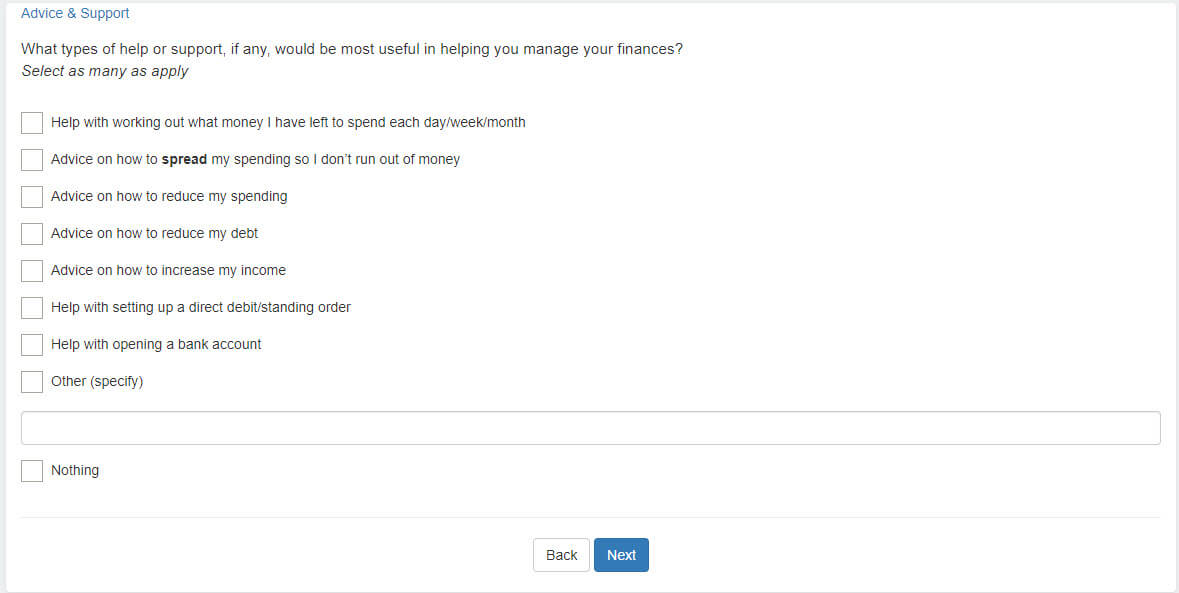
In this context, advice to increase my income is most likely to relate to those in employment. In general claimants cannot increase their income unless there is a benefit they could be claiming that they are not aware of.
What is entirely missing from these options are the ones that would actually make a difference to claimants, such as:
- Pay benefits at a rate that is enough to live on
- Remove the 5 week waiting time for UC
- End the long delays for PIP assessments and WCAs
Because there are no such options, this survey will produce results that say that, of claimants who are in debt:
X% say they need advice on working out what money they have left to spend
X% say they need advice on how to reduce their spending
X% say they need advice on how to reduce their debt
Whilst some people may indeed say in the ‘Other’ box that the help they need is a higher rate of benefits, this will not be listed as a percentage in outcomes as everyone’s answers will be worded differently.
In other words, all the support needs will be around claimants not understanding how to manage their money, rather than it being impossible to manage on the money they receive.
Benefits and Work has made Freedom of Information requests to ask how the claimants taking part in this survey are selected, how many are taking part and whether the results of the report are going to be published.
But the DWP are still smarting from the recent publication of the secret benefits report which showed how disabled claimants are struggling to pay even for necessities.
So if this report allows the DWP to claim that the reason some claimants are unable to eat or heat is that they are failing to budget wisely, then we suspect it will be published as quickly and widely as the DWP can possibly manage.
Muckamore Abbey Hospital: My Brother’s 34-Year Wait To Leave
A BBC News investigation revealed last year there were 100 people with learning disabilities and autism who have been detained in specialist hospitals for more than 20 years. Since then, families across the UK have contacted the BBC to tell their own stories.
One of those is a woman from Northern Ireland whose brother was hospitalised 34 years ago, but has been fit for discharge for 25 years. He is in Muckamore Abbey Hospital, which is at the heart of the biggest abuse investigation in NHS history.
Watch as Brigene tells the BBC’s Jayne McCubbin about her fight to bring her brother home.
Disabled people helped with the rising cost of living through The Motability Scheme’s introduction of a ‘New Vehicle Payment’
A press release:
With soaring energy and fuel prices and everyday living costs increasing, the Motability Scheme has introduced a ‘New Vehicle Payment’ to help its customers. The payment of up to £250 will be given to both existing, as well as new-to-Scheme customers. This ‘New Vehicle Payment’ will total £250 for a new car or Wheelchair Accessible Vehicle (WAV), and customers who order a scooter or powered wheelchair will receive a £100 ‘New product payment’.
The Motability Scheme who provide worry-free, affordable motoring to disabled people and their families in the UK, will send this one-off payment to all customers who take delivery of a new vehicle or product in 2022. This eligibility includes customers who have joined the Scheme in 2022 alongside existing customers who have ordered a new car. For existing customers who won’t be replacing their vehicle this year, they will still be eligible to receive the ‘New Vehicle Payment’ when they next renew their lease and receive a new vehicle, WAV or Scooter, beyond 2022.
One payment will be made per customer, and this will be issued straight away after delivery. The Motability Scheme is encouraging its customers to set up an online account, the quickest way to receive this payment is by bank transfer.
To claim the ‘New Vehicle Payment’, Motability Scheme customers should ensure that they have updated their payment preferences via their online account. Once the account has been either created or logged into, payment preferences can be updated via ‘personal details’ to enter bank details and choose payments by bank transfer. The alternative option is by cheque, but this could take longer to process.
The Motability Scheme’s online account provides great benefits for its customers including showing key lease dates and important lease documents. It also provides peace of mind with quick find displays of customers’ managing dealers contact details so customers can easily get in touch regarding any servicing, maintenance or repairs.
Customers should visit https://www.motability.co.uk/my-account/ to set up their payment preferences for the new vehicle payment.
More information: Motability Operations will only ever use a customers’ bank details to make payments or refunds to a customer. The account details are encrypted and held securely once saved.
Mum’s Search For Kidney Donor That Could Save Son’s Life Amid Legal Row
The mother of an autistic teenager at the centre of a legal battle has launched an urgent appeal for a kidney donor in a bid to save his life.
Ami McLennan, from Lancaster, said a transplant represented her son William’s only chance and, without it, he would have just 12 months to live.
Royal Manchester Children’s Hospital argued a transplant was not in the 17-year-old’s best interests.
The BBC successfully challenged an anonymity order to name him.
“He deserves that chance,” Ms McLennan said. “I’m just fighting for what he and everybody else with a learning disability should be entitled to.
“Nothing will ever stop me fighting for my son.”
William’s future is in the hands of a Court of Protection judge who must decide on the best course of treatment.
‘Reasonable adjustments’
William, who has only 5% kidney function, can articulate his wishes and has said very clearly he does “not want to die”, Ms McLennan said.
The keen golfer has a rare kidney disease Focal segmental glomerulosclerosis (FSGS) which means he needs to receive dialysis for four hours, four times a week.
At one stage he was hooked up to various machines for 10 hours a day.
Even with dialysis, his condition means he only has a life expectancy of 19 years.
A successful transplant could extend his life by another 20 years.
His autism and ADHD make the treatment more difficult because he struggles to cope with the wires, tubes and various medical procedures.
Even if a suitable donor is found, medics said there was very little guarantee a transplant operation would be successful, his condition could reoccur in a new kidney, and he may not be able to tolerate the procedure because of his autism.
They fear he would have to spend six weeks sedated and ventilated in intensive care to ensure he complies with the interventions after the operation.
William’s mother said her son had already proven on repeated occasions that with time, patience and the necessary reasonable adjustments, he could cope with such complex procedures.
She said: “He is an active 17-year-old boy. He shouldn’t be denied an operation anyone else would have the right to just because of his autism.
“We feel we have had to fight for William at every stage of his life.
“Without lifting the reporting restrictions, we had nothing.”
At a remote hearing on Tuesday, the BBC overturned the court order which had prevented Ms McLennan being able to raise the profile of his case, and make this plea for a living donor.
Lifting the reporting restrictions, Mrs Justice Arbuthnot recognised time was running out for William and that the family needed to be able to speak out.
She told the court: “It will take time and no doubt the best option is a live donor rather than a dead donor if a transplant is found to be in William’s best interests.”
William’s family are not suitable donors because of their own health conditions, so they are desperately searching for a live donor.
That would allow them the time to plan the operation and psychologically prepare William for any procedure that followed.
Ms McLennan said: “Now we can try and find a donor and we’ll get ready to fight the next battle.”
A Court of Protection hearing to decide whether William should be added to the transplant list will be heard in the next three weeks.
Manchester University NHS Foundation Trust, which manages the Royal Manchester Children’s Hospital, said it recognised it was a “very difficult time” for William and his family.
In a statement, it said: “Our clinicians have worked very hard to enable William’s treatment to take place so far, and he continues to have his haemodialysis, as agreed with his family, subject to any change in his clinical condition.
“The decision on whether a transplant would be in his best interest is a very complex one, requiring consideration of a range of very difficult issues including significant risks and the possibility that his transplant would fail, which is why the Court of Protection is being asked to make a decision on the best care for William going forward.”
Liz Davis, from Irwin Mitchell, who is representing Ms McLennan, said: “While we are encouraged the trust has been working with the family to try to reach agreement on William’s care we’re determined to ensure their voice is heard on the incredibly important matter, including putting forward strong legal arguments as to why a kidney transplant is in William’s best interests.”
Frances Ryan On Loving Her Body
This body is a genetic mistake, a pitiable stare, the scan on a mundane Tuesday lunchtime with a doctor speaking in hushed tones by the bed.
It is glorious too, thanks. It is deep-in-the-bones laughter at 2am with people who love you; only strangers care that it is sitting in a wheelchair while doing so (“Have you got a licence for that thing, sweetheart?”). It is straight-As, promotions and beating expectations as much as the odds. It is being buckled over from the pain, clutching a public toilet bowl, pills and dignity rattling at the bottom of a handbag.It is sex, fevered goosebumps and kisses to the skin like magic. It is warm summers with friends, sunshine on bare legs and 90s dance music ricocheting through the air.It is fucking knackered.
This body is more than twice as likely to be domestically abused, is paid on average £3.68 less an hour, is a third less likely to be able to access lifesaving breast cancer screenings, and is still told to be “grateful” for it. “Be grateful, love. You’re lucky they hired you. He’s a saint to be with you.”
This body is a scrounger if it needs the state, a faker if it holds down a job. It is the reject of capitalist productivity, all the while working harder than any FTSE 100 CEO. This body is one in five, full of potential, untapped and waiting. It is ready to burst, to make its mark, if only the trains were accessible, personal assistants funded and housing usable. It is just not trying hard enough.
This body is told to love something that hurts every day – #bodypositivity – or to loathe it, depending on the latest cultural winds. It is too ugly to be on the front cover of magazines, too pretty “to have to be in that chair, love”. It is a token, out front and centre when it suits, hidden in the back room when it all gets too much. It is more beautiful and powerful and astounding than words can muster.
This body is not “differently abled” or “handicapped”, and it is not your “inspiration” either. It is the herculean sum of all those who came before and those who will after; the young girl wearing her BiPap machine with pride on TikTok and the menopausal woman with a stoma choosing knickers in M&S. It is the changing of the seasons over centuries, from being hidden in institutions to regaling on the fourth plinth in Trafalgar Square,frombegging in the workhouseto legislating in parliament. I believe they call that progress.
It is said that the greatest act of resistance is to live well, and I think there is truth in that. It is radical to love a body that the world says is wrong. This body, in all its joy and tears and moving edges, is loved completely – not despite its disability, but because of it.
Frances Ryan is a Guardian columnist and author of Crippled: Austerity and the Demonisation of Disabled People
RSC Casts Disabled Actor As Richard III
He is one of Shakespeare’s most reviled characters, distinguished by his “deformed, unfinish’d” figure. Now, for the first time, the Royal Shakespeare Company has cast a disabled actor in the title role of Richard III in a new production opening later this year.
For Arthur Hughes, it is a “dream come true” although his first reaction to being cast as the 15th-century king of England was disbelief. “It’s a part I’ve always wanted to play, it’s a very complex role, and it’s the biggest thing I’ve done,” said Hughes, 30.
Amid debate about whether actors need lived experience to give depth and authenticity to certain roles, Hughes said: “When Richard is played by actors who are able bodied, there’s an issue of how to portray the disability, how to wear this costume.
“With me, when I walk out on stage, it’s completely apparent that I have a disability. I can’t hide that. There’s a truth to it immediately, before I’ve even opened my mouth.”
Having able bodied actors play disabled characters was “problematic in many ways”. He added: “It’s not to say [able bodied] people can never play these parts. But I think it’s time that we had that lived experience shown properly.”
Hughes was born with a rare condition known as radial dysplasia, which affects one in 30,000 people. He has no thumb or radius bone in his right arm, and his right wrist is disfigured. He identifies as “limb different”.
Richard III, depicted by Shakespeare more than 100 years after his death as an ugly hunchback, in fact suffered from scoliosis or curvature of the spine. When the last Plantagenet king’s skeleton was discovered beneath a Leicester car park 10 years ago, his twisted vertebrae were unmistakable.
He came to the throne in 1483 after his nephews, the sons of King Edward IV, were consigned to the Tower of London. The children were later murdered, apparently on Richard’s orders. Richard reigned for just 26 months before being killed in the Battle of Bosworth Field during the Wars of the Roses.
Directed by Gregory Doran, Shakespeare’s eponymous play will open at the company’s theatre in Stratford-upon-Avon in June. Before then, Hughes appears in a BBC drama, Then Barbara Met Alan, to be aired in the spring. It tells the story of two disabled cabaret performers who became the driving force behind the Direct Action Network, campaigning for disabled rights.
“They were very brave, real freedom fighters,” said Hughes, who plays Alan Holdsworth alongside Ruth Madeley as Barbara Lisicki. “They used to throw themselves in front of buses, chain themselves to Downing Street and organise these huge actions shutting down bridges to get themselves into the spotlight. It’s a love story set against a wider backdrop of a civil rights movement.”
The TV drama and the RSC production showed attitudes were changing, said Hughes, who has encountered certain “perceptions and underestimations” during his acting career.
“Lead parts for disabled actors is a real next step forward. Disabled actors that you see on TV and on stage are often in smaller, fringe parts. For true representation, we need to have leading disabled actors telling stories about disability and also not about disability.”
But the real breakthrough would come when disabled actors were cast in non-disabled parts, or in dramas where disability was not a central part of the story but was “just there” as part of a character’s life, he said.
The RSC has cast disabled actors before, including Charlotte Arrowsmith, who identifies as deaf and uses sign language, Karina Jones, who is visually impaired, and Amy Trigg, who was born with spina bifida and uses a wheelchair.
This year, the RSC is teaming up with TikTok to offer £10 tickets to all its productions to young people aged 14 to 25 with the aim of developing “a lasting commitment and love of theatre and live performance” and “diverse audiences of the future”.
Erica Whyman, acting artistic director of the RSC, said the company was committed “to partnership, to inclusion and justice”.
CODA Nominated For Best Picture At Oscars
Some breaking news that we at Same Difference are thrilled to read. Coda, the film with an almost all-Deaf cast, has been nominated for the Best Picture Oscar.
We hope it wins!
Disabled People Five Times More At Risk Of Food Poverty
A million UK adults went an entire day without eating over the past month because they could not afford to put a meal on the table, according to research highlighting how the cost of living crisis has driven up food insecurity.
Soaring energy and grocery prices – along with the removal in October of the £20 Covid top-up to universal credit – were having a devastating impact on the food consumption of millions of people, the Food Foundation thinktank said.
More than one in five households said they have already faced a ”heat or eat” dilemma, cutting back on the quality or quantity of food to pay energy or other essential bills, while 59% of households fear the cost of living squeeze will leave them with less to spend on food in the future.
Advertisement
Altogether, nearly one in 10 UK households reported experiencing some degree of food insecurity over the past month – defined as skipping meals, going hungry or not eating for a whole day – because they were unable to afford food.
“There is little doubt that the cost of living crisis is putting very real pressure on the ability of many to afford a healthy diet and is set to widen health inequalities,” the foundation said.
Millions of households are under increasing financial pressures as a result of soaring energy bills and rising inflation. Gas and electricity bills will rise by an average of £700 a year from April, pitching 5m households into fuel poverty, despite measures introduced by the government to ease the strain.
Grocery bills have also risen sharply, up 3.8% in January and potentially adding an extra £180 a year to the average household’s grocery bill this year. The strain on low-income family budgets is reflected in soaring demand at food banks and cut-price food clubs.
The anti-poverty campaigner Jack Monroe recently revealed how food price rises had pushed up the price of the cheapest 500g bag of pasta in her local supermarket from 29p to 70p (an increase of 141%), rice from 45p a kilo to £1 for 500g (344%), and baked beans from 22p to 32p (45%).
The Food Foundation survey was undertaken online between 18 and 20 January, polling 4,200 adults. It found 8.8% of all households, containing 4.7 million adults, reported that they had experienced food insecurity, up from 7.3% in July, when the last survey was undertaken.
About 2 million children were living in households that do not have access to a healthy and affordable diet, putting them at risk of diet-related diseases such as obesity, and poor physical growth, the foundation said.
Some groups were more likely to have experienced food insecurity over the last six months than others. People with serious disability were five times more at risk than those without a disability. People on universal credit were five times more likely to be food insecure than those not claiming.
“The rapid escalation in disabled people experiencing food poverty is truly shocking. It is disabled people facing the biggest barriers to independence and inclusion that are in the worst situation; how can this possibly be acceptable?” asked Kamran Mallick, the chief executive of Disability Rights UK.
The Department for Work and Pensions was approached for comment.
Deaf People Diagnosed With Cancer Face ‘Big Barriers’
Coleen McSorley, who has been deaf from birth, was left upset and struggling to understand the details of her cancer diagnosis. Now one care centre is hoping to offer more support to others facing a similar challenge.
Coleen was diagnosed with breast cancer in September 2020.
At the time, Covid restrictions meant she was unable to bring an interpreter or her hearing parents to hospital appointments.
The 56-year-old said she was given wads of literature about her cancer – but like many people who have been deaf from birth, she struggles to read.
“English is my second language after British Sign Language,” said the cleaner, from Stirling.
“At the hospital a big barrier was they were wearing too many masks. They were all talking at me but I didn’t understand what they were saying, it was horrendous.
“I felt frustrated because I wanted them to pull down their masks so I could try to lip read a little bit, but they wouldn’t and it was very confusing.”
Coleen, who had an interpreter to help her with this interview, said the process was difficult because she was given a lot of thick booklets that she could not read.
“I would receive emails from nurses but I couldn’t read them and I wasn’t allowed an interpreter into my house at that time, it was very hard,” she said.
Coleen discovered she had cancer following a trip to the physio after she felt she had pulled a muscle in her neck.
She said: “There was a pain in my shoulder and it hurt so much. When the physio asked me to lie face down on the table I had pain in my chest.
“There were lumps in my breast which could move but I just thought it was the change of life and put it down to hormones.”
‘Everything came out’
Her physio was concerned and gave her a letter to take to her doctor.
At the GP’s surgery she was still not allowed an interpreter and Coleen said she did not understand anything that was going on.
She had biopsies and a mammogram, and by the time she had her appointment with a consultant she was allowed to take an interpreter.
Coleen said she could tell that the consultant “was serious and told me straight” – although the interpreter used softer sign language to try to ease the blow.
“I never cried, I held everything in because my husband wasn’t allowed to be there and I was on my own,” she explained.
However, she said that “everything came tumbling out” when she was moved into a grief room with a nurse.
“I kept saying: ‘Why me?’ I was crying and not coping, the tears kept flowing, I was very emotional and I wanted to go home.”
Coleen, who had stage three cancer, was treated with chemotherapy and had a mastectomy. She has now recovered.
She found out about the Maggie’s centres when she was being fitted with a wig.
Coleen said she felt more comfortable after she met Yvonne McIntosh, an oncology nurse and centre head at the Maggie’s Forth Valley cancer care drop-in centre.
“I felt my mental health wasn’t good until I came to Maggie’s, but they explain everything to me.
“Maggie’s has really calmed me down,” she said.
Yvonne said that even with an interpreter, a lot of information could be lost in translation.
“A lot of sense and meaning is lost and things can land differently so they don’t come across with the same context,” she said.
“When Coleen came to us she didn’t know what the pills were that she was taking.
“She didn’t understand about her treatment and didn’t know how her medication worked for her.”
Yvonne says she wants to run a workshop for deaf people with cancer.
“Deaf people think there is no support for them so I’ve only had two deaf people here at Maggie’s in my career.
“They lack the exposure to cancer information which hearing people take for granted.
“When Coleen came to us she thought her cancer was going to come back and she was struggling with things, but now she has all the information and support.”
MPs have forced the publication of a government-commissioned research report that found low-income people reliant on disability benefits are struggling to meet essential living costs such as food, rent and energy bills.
The report has been kept under wraps for over a year, with the work and pensions secretary, Theresa Coffey, repeatedly refusing to release it on the grounds it was necessary to “protect the private space” in which ministers develop policy.
The report was finally published on Thursday morning after the cross-party work and pensions select committee invoked rarely-used parliamentary powers to force its release, and accused ministers of “trying to bury uncomfortable truths”.
Stephen Timms, the chair of the work and pensions committee, said the report gave “valuable insights” into the experiences of people on disability benefits: “While the system is working for some, we now know that others reported that they are still unable to meet essential living costs such as food and utility bills.”
Theresa Coffey, the work and pensions secretary, had not wanted the report released. Photograph: James McCauley/Rex/Shutterstock
He added: “By persisting in its decision to hide away evidence of the struggles people are facing, the DWP will only have further harmed its reputation with disabled people at a time when – as its own officials have acknowledged – lack of trust is a major issue. In order to rebuild its relationship with disabled people, the DWP must stop trying to bury uncomfortable truths.”
Anastasia Berry of the MS Society charity said the report highlighted the inadequacy of benefits for many disabled people: “Despite the DWP’s relentless attempts to bury this research, we can finally see what they’ve been so desperate to hide … It shows some are struggling to pay for essential day-to-day expenses, such as food, heating and medications, let alone these extra costs.”
The Department for Work and Pensions (DWP) has already faced allegations from a whistleblower close to the research team that it intervened to reduce the number of references to unmet needs and the adequacy of benefits in the report.
Separately, last week it emerged that Coffey had blocked the publication of an internal DWP research report into the effectiveness of benefit sanctions, arguing its release was not in the public interest. This is despite promises made to MPs three years ago that it would publish its findings.
Under government social research protocols, the completed disability benefits report should have been released no later than 12 weeks after it was handed to the DWP in September 2020. Participants in the research – 120 people with a health condition or disability were interviewed in depth – were reportedly promised the report would be published, according to the Disability News Service.
At the time, the adequacy of benefit levels was a major political issue amid a fiery debate over whether ministers should scrap or maintain the £20 universal credit Covid top-up, or extend the top-up to people on “legacy” disability benefits who were not in receipt of universal credit.
The government announced last June that it would withdraw the £20 top-up in October, brushing off criticism that this would put the living standards of low-income households at risk. This amounted to the biggest overnight cut to the basic rate of social security since the second world war, according to the Joseph Rowntree Foundation.
The disability benefits research, carried out by the National Centre for Social Research, found that for claimants with “restricted financial circumstances”, benefits offered the prospect of a regular income vital to enable them to meet basic day-to-day living costs.
Despite this, some of the cohort of disabled claimants interviewed by researchers reported that the low value of benefits meant they “were still unable to meet essential living costs such as food and utility bills”.
The DWP said: “We’re providing extensive support to millions of disabled people and those with a health condition to help them live independent lives. As the research shows, health and disability benefits, alongside other income streams, helped to meet almost all identified areas of additional need.
“We are currently considering a range of policy options, drawing on wide evidence, research and analysis as part of the upcoming health and disability white paper.
“Protecting a private space for policy development is important and we had committed to publish this report as soon as this policy work concluded.”
Improved PIP Guidance On Absence Of Mental Health Medication
With many thanks to Benefits And Work.
The latest edition of the PIP Assessment Guide contains improved guidance for assessors on the significance of whether or not a claimant with a mental health condition is receiving medication.
Assessors very often use the fact that a claimant with, for example depression, is not receiving any medication as evidence that their condition must have very little effect on their daily living or mobility.
However, the guidance issued by the DWP now points out that the severity of a mental health condition “does not necessarily correspond with the type or dosage of medication that the claimant is receiving”.
The guide points out that factors such as side effects, problems complying with a medication regime or the medication not being effective for that individual may all result in someone with a severe condition not receiving medication.
The guidance also goes on to say that assessors should take into account the use of treatments such as psychological therapies instead of medication.
The document does not, unfortunately go on to point out the difficulty that many people have in getting access to therapies, due to a lack of provision in their area.
As a result, some people for whom medication is not appropriate will have no support whatsoever in spite of the severity of their condition.
The full text of the updated guidance on mental health medication is as follows:
When considering mental health medication HPs should remember that not all claimants with a mental health condition will be on medication or receiving therapy. Severity of a mental health condition does not necessarily correspond with the type or dosage of medication that the claimant is receiving. There are a number of reasons why a claimant may be unable or choose not to take mental health medication, for example, but not limited to:
poor compliance due to the nature of mental health condition
side effects or difficulty tolerating medication
lack of efficacy
preference for psychological therapy instead of medication
complicating factors, for example excessive alcohol consumption
Therefore absence of medication does not automatically mean that the health condition is not severe. However, HPs should consider the type and context of certain medications, for example use of depot antipsychotic injections in psychotic disorders.
HPs should also take into account that some medications are used to treat different conditions, for example some antidepressants are also licenced to treat anxiety. HPs must also consider the use of other treatments such as psychological therapies.
We’ll be updating our PIP guide to take account of these changes.
You can download a copy of the PIP Assessment Guide from this page.
Paralympian Will Perry Takes Dwarfism Campaign Into Classroom
A swimmer who represented Great Britain at the last Paralympic Games has taken his campaign against dwarfism abuse into the classroom.
Will Perry, from Northamptonshire, has been inundated with support and has met the prime minister since he told the BBC he was “sick to death” of being laughed at every day.
After speaking to students in Towcester, he said: “I really want to educate the younger generation about my campaign and what I’m fighting so strongly for.”
He said he hoped to continue arranging school visits to spread his message further.
DWP To Ramp Up UC Sanctions As Time To Find Preferred Work Slashed
With many thanks to Benefits And Work.
Universal credit claimants are to have the time they can look for a job in their own field drastically cut from three months to one month as the government aims to force 500,000 people into work of any kind by June. Claimants who do not comply with the new Way To Work regime will face having their benefits sanctioned.
At present, claimants are allowed to seek work just in their preferred area of skill for the first three months of a claim. Even this is a relatively short time to secure work if you have experience and qualifications where vacancies arise less frequently.
One month is a highly unrealistic time in which to find a vacancy, go through the recruitment process and be appointed.
Once claimants are forced to take any vacancy offered, or have a sanction imposed on them and their family, they will find it much harder to obtain work in the area they are qualified in.
They will have less time for job seeking, less opportunity to attend interviews and are likely to be looked on less favourably by some employers if they have been working in a lower skilled field for some time.
Having to take often insecure work is also more likely to lead to repeated periods of unemployment, potentially having to serve another five week qualifying period for universal credit, with all the damage that does to household finances.
The DWP say that:
“Targeted predominantly at those in the intensive work search group on Universal Credit, Way to Work will support people back into work faster than ever before and filling vacancies more quickly.
“To support people into work faster those who are capable of work will be expected to search more widely for available jobs from the fourth week of their claim, rather than from three months as is currently the case.
“This clearer focus will ensure that, if people are not able to find work in their previous occupation or sector, they are expected to look for work in another sector and this will be part of their requirements for receiving their benefit payment.
“For the vast majority of people who are already engaging fully with Jobcentre Plus, this could be the extra support they need to secure a job. However, for the small minority who do not engage, the sanctions regime will operate as usual.”
“They will be supported in this with more time spent face to face with a Work Coach to receive better, tailored support. We know work is the best way for people to get on, to improve their lives and support their families because people are at least £6,000 better off in full time work than on benefits.”
At the same time as the DWP is ramping up the threat of sanctions, it is also refusing to publish a report which they themselves created in 2019 into the effectiveness of sanctions. At the time, the DWP said they would make the findings public.
However, they have now refused a Freedom of Information Request from a Glasgow based economist and social security expert for a copy of the report.
The DWP say they have changed their mind about publishing the report because it contains details of a sensitive nature.
The reality is that there is ample evidence that the threat of sanctions simply makes claimants more stressed, ill and unable to obtain employment.
But a crackdown on claimants is one of the populist measures that governments of every persuasion resort to when they are in trouble. It now looks like just such a crackdown has begun.
Benefits and Work members can download a copy of our 30 page guide to Ways to prevent and overturn ESA and UC sanctions from the ESA and UC page
Read the DWP press release on Way To Work
Read more about the Way To Work regime and about the secret sanctions report in the Guardian.
Covid Vaccines Offered To Vulnerable Five-To-11-Year-Olds In England
Young children between the ages of five and 11 considered most at risk of coronavirus will be offered Covid jabs from Monday in England.
The move comes after the UK drugs regulator approved a low-dose version of a Covid vaccine for children last month, deeming it safe and effective.
Eligible children include those with learning disabilities and long-term conditions, such as diabetes.
Cases in young children are rising, but for most, infections are not severe.
Some of those most at risk are more vulnerable to serious illness, and those living with vulnerable adults could pass the infection on.
In December 2021 the government’s vaccine advisers, the Joint Committee on Vaccination and Immunisation, recommended around 500,000 young children at highest risk be given the jabs.
‘Do not delay’
This includes children with serious underlying heart and lung conditions and those living with people with weakened immune systems.
A decision on vaccinating all other five-to-11-year-olds has not yet been made.
Deputy lead for the NHS vaccination programme, GP Dr Nikki Kanani, urged parents not to delay coming forward.
She said: “We know vaccines give significant protection against severe illness from Covid – including the Omicron variant – so it is important that our youngest and most at risk get protected.”
Most jabs will be given by GP-led teams and in hospital hubs. Officials say parents and guardians should wait to be invited by the NHS.
Young children at risk will be offered two Pfizer vaccines eight weeks apart – at a third of the adult dose.
It is widely used in other countries – more than five million children have been given it in the US alone.
Covid vaccines are already being offered to young children at risk in Wales and Scotland. Public-health experts in Northern Ireland say GPs will be sending parents information about jabs by early February.
The NHS has already delivered more than three million vaccinations to people aged 12 to 17.
Separately, NHS England plans send out flu vaccine reminders to the parents and guardians of eligible children.
In England this includes all two-and-three-year-olds and all pupils from reception age to school leavers, to drive up protection from the virus.
Comedian and actress Rosie Jones, who plays Paula Kettering in BBC’s Casualty, has opened up about the need for disability representation.
Rosie joined the soap in February 2021, and her character Paula is disabled, which leads to some heartbreaking storylines involving social services that are very important to the actress.
Speaking to Metro.co.uk, Rosie said: “Paula’s not perfect. She has flaws, she’s stubborn, the story is showing that disabled people can be three… well they are always three- dimensional and I feel like playing Paula meant showing there are millions of disabled people who, like her disability, they are underestimated and treated awfully by the services and the system and the government.”
“This needs to change. I think it’s important to know this is definitely something that disabled mums have to go through,” Rosie continued, referring to the storyline where Paula’s pregnant and fighting to keep her child.
“We need to raise awareness about how there is still stigma with disabled mothers.”
In Rosie’s first episode as Paula, her character explained that her benefits had been cut and, after social services discovered her pregnancy, they are threatening to take her baby away.
Though Paula has tried to get social services to see that she can take care of her child, regardless of her disability, they don’t seem receptive to the prospect.
“It’s showing that just because a woman has a disability and unfortunately a problematic past, she can get better, it’s just sad that the services don’t believe it,” Rosie added.
Rosie is a comedian, writer, and actress who regularly discusses ableism and disability inequality, particularly on The Last Leg or on Question Time. It is her hope that playing Paula will encourage change in how people treat disabled people in the UK.
Casualty airs on Saturdays on BBC One.
E-scooter Firms To Develop Universal Warning Sound After Collisions
E-scooters could all be given the same distinctive artificial sound to warn people when they are approaching, after engineers and rival operators announced a joint research project to identify the best noise for them to make.
Acoustic researchers will work with firms licensed to run UK e-scooter rental schemes with the aim of developing a universal sound for the otherwise near-silent vehicles. The sound would help alert other road users, particularly people with sight loss.
Concerns have been raised by charities for blind people about the safety of e-scooters after a number of collisions, although these have largely involved unlicensed e-scooters, which are illegal to drive on public roads, let alone pavements.
The sound will be developed at University College London’s laboratories with input from the three licensed operators in London: Dott, Lime and Tier. The multinational operators want to give all their e-scooters the same sound, and hope to set an industry standard for the UK and around the world.
Researchers are aiming for the new sound to be sufficiently distinctive and audible to alert those with sight loss, while not creating further difficulty for those with hearing loss and neurodiverse conditions. A spokesperson said a range of noises would be “ethically tested” at UCL’s Person-Environment-Activity Research Laboratory.
Prof Nick Tyler, the director of the facility, said: “Through studying how the human hearing system has evolved, we can create sounds for e-scooters that are detectable without adding more noise to the environment. It is a huge scientific challenge, but one that will enable everyone to feel comfortable with this new form of micromobility that is quickly growing in popularity.”https://www.theguardian.com/email/form/plaintone/business-todaySign up to the daily Business Today email or follow Guardian Business on Twitter at @BusinessDesk
Fred Jones, a regional general manager with the e-scooter operator Tier, said developing “an inclusive sound for e-scooters will be crucial to protecting pedestrians and road users potentially made vulnerable through the introduction of this new transport mode”.
The project will build on work done by operators with disability charities and other acoustic researchers.
The chair of Transport for London’s independent disability advisory group, Joanna Wootten, said they were excited that the venture would be “breaking new ground where there are currently no standards or regulations in place”.
Dr Antonio Torija Martinez, an acoustic researcher at the University of Salford, said they had developed a standalone system with variable noises reflecting speed, but were continuing to look into “developing warning sounds for an optimal balance between noticeability and annoyance”.
Trials of legal rental e-scooter schemes continue across the UK, with the government still giving no indication of its long-term decision over the vehicle’s future. Sales of unregulated e-scooters have led to increasing numbers of crashes and deaths, according to a report from the Parliamentary Advisory Council for Transport Safety.
Ofcom To Investigate Channel 4 Over Subtitle Outage
Broadcasting watchdog Ofcom is to investigate Channel 4 after an extended outage over its subtitle services.
The broadcaster experienced several major outages late last year, caused by issues at the centre which handles its playout services.
Its subtitling, signing and audio descriptions were all affected, prompting the National Deaf Children’s Society to call for action.
Channel 4 told the BBC it was sorry for “significant impact” of the outage.
‘Fell short’
A statement from Ofcom said: “We have found that Channel 4 managed to meet the statutory requirement to subtitle 90% of its programme hours over 2021 on most programmes.
“It also met its requirements for audio description and signing.”
But the media watchdog added: “However, Channel 4 fell short of its subtitling quota on Freesat, a satellite TV platform used by around two million UK homes.”
The issues originally arose in September after a fire suppression system was triggered at the broadcast centre of Red Bee Media, causing severe damage.
The “extended outage” of Channel 4’s broadcast channels was not fully resolved until November.
In a statement to BBC News on Friday, a Channel 4 spokeswoman said: “We apologise for the significant impact the Red Bee Media incident had on our access services.
“Channel 4 would like to reassure our audiences that we have thoroughly reviewed the resilience of our systems to ensure that such a catastrophic event cannot harm our ability to deliver these essential services in the future.
“Whilst we have not met our own high standards in 2021, we still delivered all of our overall statutory obligations and we are once again offering market-leading access services,” she added.
Ofcom “remains very concerned” about the incident, which it said resulted in a “lengthy outage to Channel 4’s access services provision and also wider disruption to its general broadcasts on all platforms”.
The authority is now reviewing Channel 4’s transmission arrangements and back-up facilities that were in the place at the time, and what they have done about it since.
It noted how the broadcaster’s “access services” are relied on “by millions, including deaf, hard-of-hearing, blind and partially-sighted people, to watch and listen to television”.
British Sign Language To Become Recognised Language In The UK
British Sign Language (BSL) is on course to become a recognised language, after the government backed a proposal by a Labour MP.
The private member’s bill, introduced by Rosie Cooper, aims to improve accessibility for deaf people and would see the promotion of BSL when making public service announcements.
It would also see the launch of an advisory board of BSL users to offer guidance to the Department for Work and Pensions (DWP) on how and when to use it and look at increasing the number of BSL interpreters.
It will encourage government departments and public bodies to follow the guidance, giving deaf people “equal access to education, employment, public services such as the NHS”, according to the British Deaf Association (BDA).
DWP minister Chloe Smith said: “Effective communication is vital to creating a more inclusive and accessible society, and legally recognising British Sign Language in Great Britain is a significant step towards ensuring that deaf people are not excluded from reaching their potential.
“Passing the bill will see [the] government commit to improving the lives of deaf people, and will encourage organisations across the nation to take up the BSL mantle, benefiting both themselves and the deaf community.”
If the bill passes its reading on Friday, 28 January, it will have two more stages to pass before becoming law. The final reading is expected to take place in March.
Rosie Cooper, the MP who proposed the bill and whose parents were both born deaf, said: “The deaf community have constantly had to fight to be heard. This bill sends a clear message that they deserve equal access and will be treated as equal.”
Although BSL was recognised as an ‘official’ language by the UK government in 2003, it does not have the same legal protections as Welsh or Gaelic, for example.
EastEnders actor Rose Ayling-Ellis made history as the first deaf contestant on BBC One’s Strictly Come Dancing and has urged people to back the bill.
She told BBC News: “Why doesn’t this country legally recognise BSL? It’s our language. It feels wrong, it isn’t right, it should be accepted.”
She added: “If I go to the doctor and there is no interpreter, it means I have to bring a family member with me – but I don’t want that, I want privacy.”
In the wake of her celebrated Strictly win, research revealed more than three-quarters of deaf children thought the show has given the public a better understanding of deafness. There are an estimated 87,000 BSL users in the UK.
David Buxton, chairman of the BDA, said: “Deaf people still do not have access to the same essential information and services that are available to the hearing population.
“The Equality Act does not cover linguistic rights. We are forced to rely on inadequate disability discrimination legislation to access information in our own language.
“British Sign Language is an indigenous language of the UK and should be accorded the same legal protection as Welsh and Scottish Gaelic.”
‘I Had To Pay For Tourette’s Diagnosis’
A teenager who developed Tourette’s syndrome in lockdown was forced to pay for a diagnosis after months of trying to get help through the NHS.
Edie Pilkington, 16, from Bradford, began to get physical twitches such as neck jerks before vocal tics appeared.
Mum Amy said attempts to get help felt like “banging your head against a wall” and they ended up seeing a consultant privately.
The government said it had increased funding for mental health services.
Edie said her symptoms had escalated to the point where she could have “an overload”.
“It’s just so tiring,” she said.
“My body feels exhausted, my neck aches like hell. My throat sometimes hurts when I do have verbal ones, like grunts… physical, they do end up leaving marks.
“That might be what I have to deal with for the rest of my life.”
Seeing her daughter “exhausted”, her mother Amy called her GP, who “referred me to paediatrics initially, as they were confused as to what area to send me to”.
“The paediatrician said to Edie: ‘Don’t worry you’ll grow out of it’, but she was already 15,” she said.
Mrs Pilkington said Edie had lost friends because of the tics, as she stopped wanting to join in activities with them.
Last November, she contacted MP Judith Cummins, who wrote to Bradford District and Craven Clinical Commissioning Group, which is responsible for local NHS services.
It acknowledged there were “gaps in our service and provision” for and promised to escalate the issue.
However, the family was still unable to get help and Mrs Pilkington said said she felt like she was “hitting a wall”.
In December, Edie and her mum travelled to a clinic in Elstree, Hertfordshire, to see Dr Inyang Takon, one of only a few consultants in England who specialise in tic disorders and Tourette’s.
Dr Takon prescribed medication for Edie to reduce the tics because of the injury risk they posed.
“We have seen a lot more children coming in [with tics] during this pandemic period, so we really need to understand what’s going on,” she said.
“This can only be done when you have a service and when you can do research on the children who are presenting.
“There are very limited services around the country to address this need. The government needs to do something about this urgently.
“It’s not just one person, there are many, many more who can’t afford to pay for this service who need it.”
This is backed up by Tourette’s Action, which said specialist clinics have seen an increase in cases, particularly in young women.
The charity’s medical director, consultant neurologist Dr Jeremy Stern, said the lack of services was a “national problem” and the system in place was “not fair or fit for purpose”.
“People can’t necessarily get a diagnosis and very often can’t get the treatment which we know can help them,” he said.
“It’s a problem Tourette’s Action is very concerned about and we would like to campaign further to try and help this problem.
“I cannot say this is a satisfactory situation at this moment.”

Tourette’s Syndrome
- A condition characterised by involuntary sounds and movements, or tics
- Usually appears during childhood; six years old is the average age
- The cause is unknown but it can sometimes be diagnosed alongside ADHD, obsessive compulsive disorder, or learning difficulties
- It is rarely harmful to someone’s overall health but physical tics can be painful
- There is no cure for Tourette’s but it can be managed with medicine and behavioural therapies
Source: NHS
Since her diagnosis, Edie said she feels “relieved and less stressed and less awkward”.
“Now I can give a straightforward answer and be more comfortable and calm,” she said.
Mrs Pilkington added: “Hopefully she can now settle down into the new version of her.”
A Department for Health and Social Care spokesperson said: “We are absolutely committed to supporting the wellbeing of children and young people with Tourette’s syndrome and other tic disorders.
“The majority of services for people with Tourette’s syndrome are commissioned locally by Clinical Commissioning Groups, through either paediatric services or Child and Adolescent Mental Health Services (CAMHS).
“Early support and treatment is vital, and we are providing the largest mental health funding in NHS history through an extra £2.3bn a year to mental health services such as CAMHS by 2024.”

Rose Ayling-Ellis Calls For British Sign Language Recognition
More than 150,000 people use British Sign Language across the UK, with around 87,000 relying on it.
But it’s not recognised as an official language in England, Wales or Northern Ireland. That means it’s not protected in law in the same way that Welsh and Gaelic are, so public bodies aren’t required to promote and facilitate the use of BSL.
Labour MP Rosie Cooper is bringing a private member’s bill in an effort to get that changed – with actress and Strictly Come Dancing winner Rose Ayling-Ellis among those backing the move.
Disney Responds To Peter Dinklage’s Criticism Of Snow White Remake
Disney has responded to criticism made by Game of Thrones actor Peter Dinklage about its forthcoming live action adaptation of Snow White and the Seven Dwarfs.
Dinklage said the remake of the 1937 animated film, based on story from the Brothers Grimm, was “backward”.
Disney said it was going to “avoid reinforcing stereotypes from the original animated film”.
Dinklage had said Disney should have reassessed the project.
“I was a little taken aback by [the fact] they were very proud to cast a Latina actress as Snow White,” he told podcaster Marc Maron.
“But you’re still telling the story of Snow White and the Seven Dwarfs.”
Dinklage – who stars in the forthcoming Oscar-tipped film Cyrano – has a form of dwarfism called achondroplasia.
The actor has previously spoken about the representation of dwarfism, saying it was “bad writing” to make it a “dominant character trait”.
The original Snow White and the Seven Dwarfs film, released in 1938, was the first full-length animated feature from Disney, and is considered one of the studio’s classics.
West Side Story star Rachel Zegler and Red Notice actress Gal Gadot are set to star in the adaptation, as Snow White and the Evil Queen respectively.
Speaking about the new film, Dinklage acknowledged Disney’s casting of a Latina actress in the leading role, but said further progressive casting was needed when it came to the other characters.
“You’re progressive in one way but you’re still making that backward story of seven dwarves living in the cave,” he said.
“They were so proud of that, and all love and respect to the actress and the people who thought they were doing the right thing but I’m just like, ‘What are you doing?'”
British Paralympian swimmer Will Perry, who has publicly condemned people who abuse him, said people with dwarfism were often portrayed as “mythical or comical characters” on film and TV.
He told Nicky Campbell on BBC Radio 5 Live: “I know loads of people who love [Snow White and the Seven Dwarfs] for the right reason… but we are now in the 21st Century.
“People like Disney, who have influence over young people, need to be influencing them in the right direction.”
In a statement, Disney said the live action remake will be an updated version of the original 1937 film.
“We are taking a different approach with these seven characters and have been consulting with members of the dwarfism community,” it said in a statement.
“We look forward to sharing more as the film heads into production after a lengthy development period.”
Oscar-nominated producer Marc Platt, who also worked on Disney’s live-action rendition of The Little Mermaid, is set to produce the film.
With many thanks to Benefits And Work.
A newly updated version of the PIP Assessment Guide suggests that the DWP have abandoned the struggle to prevent claimants openly or secretly audio recording PIP assessments on their mobile phones, as well as now giving an undertaking that everyone can have their assessment recorded by their assessor.
The PIP Assessment Guide is issued to health professionals and their employers by the DWP and also published online.
The latest version makes it clear that everyone can ask to have their PIP assessment recorded, whether it is a telephone or face-to-face assessment. It states that:
“Upon prior request, providers have the facility to audio record telephone and face to face consultations. There is an expectation that this will remove or reduce the need for claimants to record consultations.”
The guide goes on to say that face-to-face claimants must sign a consent form in which they agree to not use the audio recording for unlawful purposes. Telephone clients have to give a verbal agreement.
If you use a recording for your own information, share it with an advisor or use it as part of an appeal, this is all entirely lawful.
The guidance also says that:
“In some circumstances, claimants may wish to use their own equipment to audio record their consultation. The consent process above should be followed.”
There no longer appears to be a requirement that claimants must use very expensive dual tape recorders if they wish to record their assessment.
In relation to covert recording, the guidance now says:
“A claimant may make a covert recording of the consultation without the HP being aware. If the HP notices that a claimant is covertly recording their consultation, the restrictions above should be explained to the claimant.”
Previously, if a claimant was found to be covertly recording an assessment the guidance said that they should be asked to stop and, if they did not do so, the assessment would be terminated for failure to participate.
All of this guidance relates to audio recording only, video recording by claimants is not permitted.
We would encourage everyone to ask for their assessment to be audio recorded.
We would also suggest that you consider making a recording of your own as a backup, just in case the official recording somehow fails or goes astray.
However, if a badly informed health professional insists you cannot use your own device we would strongly advise you to stop recording and make a complaint afterwards, rather than risk your claim being stopped.
We’ll be updating our PIP guide to take account of these changes.
You can download a copy of the PIP Assessment Guide from this page.
ESA Claimant Gets £7,500 Compensation, But 118,000 More Unjustly Missing Out, Says Ombudsman
With many thanks to Benefits And Work.
The Parliamentary Ombudsman has told the DWP to give a claimant £7,500 compensation and called on the department to compensate 118,000 other claimants it says have been treated unjustly, in a report released this month.
The claimant, Miss U was transferred from incapacity benefit to ESA, but the DWP failed to assess her for income-related ESA. As a result Miss U not only missed out on ESA but also on passported benefits, such as the Warm Home discount and free prescriptions.
Between 2012 and 2017 Miss U was about £80 a week worse-off than she should have been, roughly halving her ESA income for five years.
Miss U had severe physical and mental health issues. The lack of money meant that she was unable to have an adequate diet or to heat her home, causing both her mental health and her arthritis to deteriorate.
As a result, amongst other things, Miss U’s depression worsened, her hair fell out, she lost a lot of weight, was unable to afford urgent medical treatment and was due to have a toe amputated
Miss U was given arrears of £19, 833 by the DWP.
However, the Ombudsman has instructed the DWP to also make a payment of £7,500 to compensate her for the years that she lived in hardship and also add interest to the benefits arrears payments as well sending a written apology.
The DWP have agreed to the apology and the interest payments but are arguing that the compensation award is too generous.
Miss U, along with thousands of other claimants had missed out on income-related ESA when they were transferred from incapacity benefit, because the DWP did not assess them properly.
After a long battle to evade responsibility, the DWP launched a LEAP exercise to identify claimants who had lost out and pay them arrears.
However, Miss U had received help from a welfare rights worker and so had obtained her arrears payment without having been part of the LEAP review.
The Ombudsman is now recommending that the DWP should offer a remedy to all of those who went through the LEAP process and suffered an injustice as a result of their maladministration.
The DWP, however, argue that they should not pay blanket compensation to other claimants, essentially because it would cost too much and because it is in their view sufficient that they have now improved the way they work in regard to identifying claimants entitled to income-related ESA.
It says the unfortunate handling of Ms U’s case was a “simple misunderstanding” and there is no evidence that other non-LEAP exercise claimants were affected.
However, the Ombudsman says “If Ms U’s decisions were typical, DWP will have declined to make others special payments on wrongly applied grounds, will have told them they could not complain to its Independent Case Examiner and will not have told them about the Ombudsman. That means that likely routes for such evidence were closed off.”
The Ombudsman has given the DWP three months to:
- says what action it will take and when to remedy financial and non-financial losses caused to those people adversely affected by the migration not included in the LEAP exercise
- reconsiders its decision to rule out compensating people included in the LEAP exercise for financial and nonfinancial losses
- report to the Work and Pensions Select Committee on its progress and what decisions it makes about how to remedy its failings.
The Ombudsman went on to say:
“We think it is extremely disappointing that having accepted the maladministration we identified, DWP has not accepted our recommendations to do something proactive about others it knows must be in the same position as Ms U.”
Srikanth Bolla: The Blind CEO
Srikanth Bolla is about to have a Bollywood film made about his life. The young CEO has built a company worth £48m – but it nearly didn’t happen. As a teenager, Srikanth was told it was illegal for him to study maths and science at senior school because he is blind, so he sued an Indian state to make it possible, as Arundhati Nath explores.
Every day, for two years, six-year-old Srikanth Bolla walked several kilometres to school in rural India, guided by his brother and following his classmates.
The route was a muddy track, lined with shrubs, which flooded during monsoons. It wasn’t a happy time.
“No one talked to me as I was a blind kid,” he says.
Born to poor, illiterate parents, he was rejected by the community.
“My parents were told that I couldn’t even be a watchman for my own house because I couldn’t see if a street dog had walked in.
“Many people would come to my parents and ask them to murder me with a pillow,” the now 31-year-old recounts.
Ignoring this, his parents were very supportive and, when he turned eight, Srikanth’s father said he had some exciting news. Srikanth had been given a place at a boarding school for blind children and would be moving to the nearest city of Hyderabad – 249 miles (400km) away. At the time, the city was in the state of Andhra Pradesh.
Although a long way from his parents, Srikanth was excited and quickly settled in. He learned to swim, play chess and play cricket with a ball that made rattling sounds so he could locate it. “It is about the hand and the ear,” he reveals.
Srikanth enjoyed his hobbies but also started to wonder about his future. He had always dreamed of becoming an engineer and knew he needed to study science and maths for that.
When the time came, he selected those crucial subjects but his school said “no”, and informed him it was illegal.
Indian schools are run by several bodies, each with their own rules. Some come under the state governments or central boards, others are managed privately.
Srikanth’s school was run by the State Board of Education of Andhra Pradesh and, as such, was not permitted to teach science and maths to blind senior students because it was considered too much of a challenge with its visual elements like diagrams and graphs. Instead, they could study the arts, languages, literature and social sciences.
It was 2007 and Srikanth was frustrated by this arbitrary law that wasn’t the same for all schools. One of his teachers, Swarnalatha Takkilapati, was frustrated too and encouraged his young student to take action.
The duo went to the Board of Secondary Education in Andhra Pradesh to plead their case, but they were told nothing could be done.
Undeterred, they found a lawyer and, with the support of the school management team, filed a case with the High Court of Andhra Pradesh appealing for a change to education law to allow blind students to study maths and science.
“The lawyer fought it on our behalf,” Srikanth says, the student didn’t need to appear in court himself.
While the case rumbled on, Srikanth heard a rumour. A mainstream school in Hyderabad – Chinmaya Vidyalaya – which operated under a different education body, offered science and maths to blind students. It had a place for him if he was interested.
Srikanth happily enrolled.
He was the only blind student in his class, but says “they welcomed me with open arms”.
He says: “My class teacher was very friendly. She did everything that was possible to help me. She learnt how to draw tactile diagrams.”
Tactile diagrams can, for instance, be created using thin film on a rubber mat. When a drawing is made on it with a biro or pencil it creates a raised line which you can feel.
After six months there was news from court – Srikanth had won his case.
The court had ruled blind students could study science and maths in their senior years at all state board schools in Andhra Pradesh.
“I felt extremely happy,” Srikanth says. “I got the first opportunity to prove to the world that I could do it and the younger generation needn’t worry about filing cases and fighting through the court,” he says.
‘Pouring rain on a small sapling’
Srikanth soon returned to a state board school and studied his beloved maths and science, averaging 98% in his exams.
His plan was to apply to India’s prestigious engineering colleges known as the IITs (Indian Institutes of Technology).
Competition is fierce and students often attend intense coaching ahead of entrance exams – but none of the coaching schools would accept Srikanth.
“I was told by top coaching institutes that the course load would be like pouring rain on a small sapling,” he says, explaining they presumed he wouldn’t meet the academic standard.
“But I have no regrets. If IIT didn’t want me, I didn’t want IIT either,” Srikanth says.
He applied to universities in America instead and received five offers, settling on MIT in Cambridge, Massachusetts where he became the first international blind student. He arrived in 2009 and described his early days there as a “mixed experience”.
“The extreme cold was the first shock as I wasn’t used to such cold weather. The food smelt and tasted different. All that I ate for the first month were French fries and fried chicken fingers.”
But Srikanth soon began to adjust.
“The time at MIT was the loveliest period of my life.
“In terms of academic rigour, it was tough and gruesome. Their disability services did great work in supporting, accommodating and bringing me up to speed.”
While he studied he also started a non-profit organisation, Samanvai Center for Children with Multiple Disabilities, to train and educate young disabled people in Hyderabad. He also opened a Braille library there with money he raised.
Life was going well. After studying management science at MIT he was offered several jobs, but he chose not to stay in the States.
Srikanth’s school experience had left a mark, and he felt like he had unfinished business in his native country.
“I had to struggle so much for everything in life whereas not everybody can fight like me or have mentors like me,” he says, adding that once he looked at the bigger picture he realised there was no point fighting for a fair education if there were no job opportunities for disabled people to take afterwards.
He thought: “Why don’t I start my own company and employ persons with disabilities?”
Srikanth returned to Hyderabad in 2012 and founded Bollant Industries. The packaging company manufactures eco-friendly products, such as corrugated packaging, from fallen areca palm leaves and is valued at £48m.
It employs as many disabled people and those with mental health conditions as possible. Before the pandemic this accounted for 36% of its 500-strong staff.
Last year, aged 30, Srikanth made it onto the World Economic Forum’s Young Global Leaders 2021 list and he hopes that within three years his company Bollant Industries will become a Global IPO – where its shares are simultaneously listed on multiple international stock exchanges.
Bollywood has also come calling. A biopic starring well known actor Rajkummar Rao has been announced and will begin filming in July. Srikanth hopes it will stop people underestimating him when they first meet him.
“Initially people would think, ‘oh, he’s blind…how sad’ but the moment I start explaining who I am and what I do, everything changes.”
Unlocked: The Best Beauty Products For People With Reduced Mobility
My right arm was out of action for weeks last year and it caused me to ponder again how ill-served those with long-term and more serious motor difficulties are by consumer industries, including beauty. It’s extremely hard to remove shiny screw-top lids, operate pipettes and prise open stiff palettes when you have only one or no working hands.
Despite its feted 2019 inception, Grace Beauty – a brand specialising in stylish ergonomic grips for everyday makeup – has all but vanished, so for the time being, it’s a matter of seeking out existing products with accidental benefits. I found the matte finish of the lids and (refillable) plastic bottles from Skingredients easy to lift off and replace one-handed, and the pumps sufficiently sturdy for good purchase. Skin Good Fats, from £44, a creamy, barrier moisturiser for all skins, is my most used.
Almost all Drunk Elephant products (C-Firma, £52.80, is an outstanding vitamin C serum) feature twist-up pump dispensers that can be operated one-handed and dispensed directly on to the face. Milk Makeup has similarly accessible packaging: its chubby, non-slippery sticks of colour (Mini Lip+Cheek, £16.50, is an essential) can be twisted up easily, then daubed and blended without the need to grip a brush (though Kohl Kreatives has an extensive line of makeup brushes designed for those with motor disabilities, from £8.99).https://www.theguardian.com/email/form/plaintone/inside-saturdaySign up to our Inside Saturday newsletter for an exclusive behind the scenes look at the making of the magazine’s biggest features, as well as a curated list of our weekly highlights.
Makeup palettes can be tricky to handle, but Viseart’s Pro and Petits Fours shadows come in gatefold cardboard-lidded palettes that flip open without a clasp, then sit flat, so you won’t have to chase it around the tabletop with a brush. The eyeshadows are impeccable.
To finish the look, Lottie London’s wing edition stamp liner, £5.95, requires less dexterity than a traditional eyeliner. You simply press the rubber stamp nib on to each eyelid for identical feline flicks.
All this comes at a cost, inevitably, and there is gross unfairness in being penalised for the privilege of using everyday items.
Hope came in Olay’s December piloting of its easy-open lid, a limited run of chunky tops with winged handles that will fit all Olay moisturisers, as part of manufacturer P&G’s pledge to make its packaging more accessible for people with disabilities. The new lids are so far available only in North America, but hopes are high for a UK release. Big change comes from huge brands, and this one is overdue.
‘Don’t Write Me Off Because I’m In A Wheelchair’: Manchester Arena Survivor Takes On Kilimanjaro
It was a month after the Manchester Arena attack when Martin Hibbert learned the catastrophic toll of his injuries. He and his 14-year-old daughter, Eve, on a “daddy daughter day” to an Ariana Grande concert, were 5 metres from the explosion that killed 22 people and injured hundreds more in May 2017.
Hibbert, 45, from Chorley in Lancashire, was told he would never walk again. Eve would probably never see, hear, speak or move – if she made it out of hospital. They were the closest to the bomb to survive.
Nearly five years on, Hibbert describes every day as “like climbing a mountain” as they continue to recover from their injuries. He is, however, preparing to tackle his biggest peak yet: in June, he will attempt to scale Mount Kilimanjaro to raise £1m for charity to support people with debilitating spinal injuries.Advertisement
“The climb is to say: don’t write me off because I’m in a wheelchair. Look at what someone in a wheelchair can do with the right help and support,” he said.
Hibbert, a football agent, will tackle the 45-mile ascent on a custom-made handbike, using push-and-pull levers to navigate the often harsh terrain on Africa’s highest mountain.
It will take about a week of gruelling 12- to 14-hour climbs to reach the summit of Kilimanjaro, where temperatures can fall as low as -20C. If he succeeds, it is believed he will be one of the first people to reach the top with a complete spinal cord injury.
The risks are considerable. About one in three people who attempt Kilimanjaro never make it to the summit, according to mountaineering websites, and he estimates there is a 10% success rate for those in wheelchairs.
One of the greatest risks is infection, given the length of time he will be in a specially adapted chair, so a skin nurse will be among the medics guiding him to the top. “The odds are against me but the paramedic that saved my life didn’t think I was going to survive the journey to hospital,” he said. “Failure is just not an option.”
Since the blast, Hibbert has become an ambassador for the Spinal Injuries Association and a motivational speaker. Far from blocking out the arena atrocity, he uses it to help counter his depression and post-traumatic stress disorder.
“There are times when it does get tough and I don’t want to get out of bed and you’ve got to find the strength,” he said.
“I just use Salman Abedi or [the thought that] if I don’t get out of bed today, the terrorists have won. They don’t want me sat here with you today during this interview. They don’t want me living life to the full. They want me sat in the corner crying about it.”
He added: “If you could see what I’ve seen, it would finish you off. To see all those people around us dead and blown up – but we’ve survived. That’s what gets me out of bed, because if I don’t live life to the full I’m letting those 22 people down and their families.”
Hibbert has already raised almost £400,000 of his £1m target for the Spinal Injuries Association. His greater goal, he said, was for a “revolution” in how Britain thought about disabled people.
He said he had been shocked by the lack of assistance for those in wheelchairs, for instance in hotels, restaurants or cinemas – and was appalled to learn that only one-third of the roughly 2,500 people a year who sustained a spinal cord injury sought specialist support to help them regain their independence.
“When you’re disabled I think members of the public either think you’re a Paralympic athlete or a benefits scrounger. There’s nothing in between,” he said. “It’s not the spinal cord injury or the wheelchair that makes me feel disabled, it’s people’s attitudes, it’s the landscape, it’s the environment.”
Hibbert, a lifelong Manchester United fan, said he had been inspired by the footballer Marcus Rashford’s successful campaign for free school meals and that he would lobby the government on behalf of people with life-changing injuries: “This is about changing the landscape for disabled people. If all we do is raise a million quid, I’ll be disappointed. I’ll see it as a failure.”
When he reaches the summit Hibbert will scatter the ashes of his mother, who died in October and was “incredibly proud” if not overly enthusiastic about his Kilimanjaro attempt. He will also carry a picture of “my princess” Eve, now 19, whose recovery has astounded the medics who treated her for 10 months at Manchester children’s hospital.
Despite the early prognosis, she can see, hear, talk and has begun to walk unaided: “I keep saying to her: when she is ready, she will inspire the world.”
Claimants Facing PIP Delays Due To Lack Of Assessments
With many thanks to Benefits And Work.
We are hearing from members whose PIP renewal has faced repeated delays due to a lack of available assessments, to the point that they are now concerned that their PIP may be stopped entirely through no fault of their own.
Even where extensions to awards are being made, claimants are not necessarily being told how long they are for.
One member told us:
“It started in April 2020. I got a three month extension for returning the form, I think this was general rather than specific to me due to Covid.
“The form was returned in June and after chasing for over two weeks confirmed as returned.
“I chased in November and was told that it was still with the DWP but they would now refer it on for assessment, I got the impression that it would still have been with the DWP if I had not chased.
“They also said that the claim would end in February, as scheduled unless a Decision was made before then!
“I’ve chased again, still pending an assessment but was now told that the award would be extended, no mention of for how long, automatically four weeks before it ends, I’m now four weeks from the end, so will be looking for a letter next week.”
Fats Timbo: ‘I Thought I Was Cursed’
Fats Timbo is a lot of things.
The 25-year-old is a comedian, a model and she has more than two million fans on TikTok.
She also happens to be 4ft (1.21m) tall, and has had to overcome bullying and insecurity to achieve her success.
“For a long time, I thought I was cursed,” she tells BBC Radio 1Xtra’s If You Don’t Know podcast.
“When I was younger, every time I would go out and someone’s looking at me, it would make me feel so bad.”
Even when going shopping, she’d experience “people looking at you, people laughing at you, people just ridiculing you”.
But Fats found confidence through social media, where she shares comedy sketches and lifestyle posts.
“When I was online, and people noticed how much courage I had and [they] enjoyed my content, that’s what made me different,” she says.
“I realised when I was going through all the hardships and people bullying me, I felt like I went through it for a reason. Those that have a difference, that’s what makes you stand out.”
‘I like to be called a person’
Fats was born with dwarfism, but she prefers the term “little people”.
“Dwarfism is the medical term for it,” she explains, “but I don’t like to be called a dwarf because I like to be called a human – I like to be called a person.
“Dwarfism is almost making me sound like a mythical creature,” she adds.
“The ‘m word’ – or midget – for me, has always been used as a negative connotation, so that is why I don’t like to hear it or people using it towards me.”
When she was younger, Fats was “flattered” by people approaching her and fetishising her body.
“You get people, literally because you’re small, and you’re some kind of fantasy to them – they instantly just want to do the ‘ting'”.
“I didn’t understand it. I didn’t have a boyfriend – or experience of a relationship – so I thought I should be flattered, but now looking back as an adult, and seeing people do it to me as an adult, it just feels wrong. It makes me feel like an object.”
‘I’m invincible’
But Fats believe she has “changed people’s perceptions about ‘little people’, by educating people.”
The social media star – who grew her fanbase after appearing on Channel 4’s The Undateables in 2018 – now has more than 240,000 followers on Instagram.
“I’m grateful I have my platform,” she says: “It taught me I can do anything. I’m invincible, not even in a mad, arrogant way.”
Fats works with beauty and lifestyle companies to create her content – something that didn’t seem possible for her growing up.
“Because of how things are moving forward, and brands and companies are trying to change the way they represent people, I am happy brands are using me,” she says.
“I am giving hope to younger people like me who are dark-skinned and may have a disability.”
“There was no representation [for me] – I felt so alone when I was younger,” Fats adds.
“But now, I’m representing, baby!”
Bionic Eye Implant Enables Blind UK Woman To Detect Visual Signals
An 88-year-old woman has told of her joy at becoming the first patient in the UK to benefit from a groundbreaking bionic eye implant that enabled her to detect signals for the first time since going blind.
The woman from Dagenham suffers from geographic atrophy. The condition is the most common form of dry age-related macular degeneration (AMD), which affects millions of people worldwide and can cause loss of sight.
The breakthrough, which experts say offers hope of restoration of sight to people suffering vision loss because of dry AMD, involves a revolutionary chip that was implanted behind her blind left eye. Hi-tech camera glasses she was given to wear this week captured the scene in front of her before relaying the data to the implant that sent an electrical signal to her brain – just like natural vision.
“Losing the sight in my left eye through dry AMD has stopped me from doing the things I love, like gardening, playing indoor bowls and painting with watercolours,” the unidentified woman said in a statement released by Moorfields eye hospital NHS foundation trust.
“I am thrilled to be the first to have this implant, excited at the prospect of enjoying my hobbies again and I truly hope that many others will benefit from this too.”
She received the Prima System device – developed by Pixium Vision in France – at Moorfields in London as part of a Europe-wide clinical trial backed by the National Institute of Health Research (NIHR) Biomedical Research Centre at Moorfields and the UCL Institute of Ophthalmology.
The implant works by surgically inserting a 2mm-wide microchip under the centre of a patient’s retina. The patient then wears special glasses, containing a video camera that is linked to a small computer attached to their waistband.
The chip captures the video provided by the glasses, and in turn transmits this to the computer, which uses artificial intelligence algorithms to process the data and guide the focus of the glasses.
The glasses then project this image as an infrared beam back through the eye to the chip, which transforms it into an electrical signal that travels back through the retina cells and into the brain. The brain then interprets this signal as if it were natural vision.
Mahi Muqit, consultant vitreoretinal surgeon at Moorfields eye hospital, said: “The success of this operation, and the evidence gathered through this clinical study, will provide the evidence to determine the true potential of this treatment.”
Muqit, who is an honorary clinical lecturer at the UCL Institute of Ophthalmology and a NIHR research investigator, added: “This groundbreaking device offers the hope of restoration of sight to people suffering vision loss due to dry AMD.”
Solihull Instagrammer’s Cerebral Palsy Videos Are Viral Hits
A man has built a following of more than 219,000 people on Instagram by posting videos that carry a positive message about disability.
Joseph Bird, from Solihull in the West Midlands, has cerebral palsy.
Every week he posts videos of his work in the gym, including boxing lessons.
The 28-year-old received nearly 24,000 likes for a video on the photo-sharing platform encouraging more disabled people to drive.
Memories Of Office Life: At 20 And Blind, My Workmates Pranked Me Mercilessly – And I Loved It
My first experience of office life was daunting. You might expect one’s first experience of working in an office environment to be pretty gentle: making the tea, a bit of filing, running errands for the boss. Not a bit of it, in my case. Aged 20, with no experience of office life, I was the boss. And, just to add a little spice to the task, I was totally blind.
My job as a community service volunteer at Youth Action York was to persuade a sceptical group of teenagers to give a helping hand to local elderly or disabled people who were struggling – assisting them with their shopping, perhaps, or tidying up their garden. It felt like a challenge, and my teenage volunteers made sure it was.
The phone would often ring, only for me to find the handset wasn’t where I expected it to be. Eventually, I would realise it had been hidden – usually in a filing cabinet or drawer, which may have also been locked.
The teenage volunteers found this very funny – and, actually, so did I. At a time when braille was added to magazines by spraying on small plastic dots, they sometimes took to melting the bottom lines of pages too, much to everyone’s amusement.
I can feel the disability lobby revving up as they read this. That is bullying, they will say, and what’s more, by laughing along with them, I was contributing to my own discrimination. But I didn’t feel like that back then, and I don’t think that now. They were spiky teenagers, and they were doing to me what they routinely did to each other: looking for the weakest point and giving it a jab.
Until I began working in that office, I’d been at a special blind school, where the teasing was merciless, and where I’d learned what real bullying could be like. But many of the Youth Action teens became my first close full-sighted friends and remained so long after I left York. It was the nearest I’d got to acceptance by a group of streetwise kids.
In any case, I found revenge a far more satisfying and effective tactic than querulous complaint. I had a couple of packs of braille playing cards and started to play poker with some of the volunteers on quiet afternoons. I enjoyed a rather good run of luck, and a bit of money changed hands before I let on that, with a very keen sense of touch, you could read which cards you were dealing as you dealt them. My workmates were indignant, but impressed. It’s not true, of course, but as long as they thought it was, and that they had been cheated, I felt honour was satisfied. I’d evened up the score.
Multiple Warnings That Claimants May Have To Choose Between Heating And Eating From April
With many thanks to Benefits And Work.
A growing number of organisations are warning that claimants and low paid workers may be faced with a choice between heating and eating when energy prices rocket in April. Energy bills could consume 50% of some claimants’ incomes, one charity has warned.
Gas and electricity bills are forecast to rise by around 50% from April, when the current price cap is lifted.
As a result many on limited incomes will face very harsh choices.
Martin Lewis of the Money Saving Expert website told Radio 4 this week:
“We absolutely know we need a substantial increase in the billions of pounds funding to vulnerable people, and people on low incomes, or it is not an exaggeration to say some will have to choose between heating or eating and that is not appropriate in one of the world’s richest economies and a civilised nation.”
The Institute for Fiscal Studies (IFS) reported this month that claimants need a 6% increase in their benefits, rather than the 3.1% annual uplift that they are scheduled to get in April. Claimants will be £290 a year worse off on average if the current plans are followed, they warned.
The measure would cost an additional £3 billion but there is no sign that the government is likely to implement it.
At the same time, the treasury has announced that it is writing off an eye-watering £4.3 billion of the estimated £5.8 billion lost to fraud in relation to pandemic relief schemes for business, such as furlough payments and loans.
The lost funds would easily have covered a year’s 3% benefits uprating and it is impossible to believe the government would give up on pursuing fraudulent benefit claims so easily.
Meanwhile, the Joseph Rowntree Trust (JRT) has said this week that households on low incomes will be spending on average 18% of their income after housing costs on energy bills after April.
For single adult households on low incomes this rises to a shocking 54%, an increase of 21 percentage points since 2019/20.
Lone parents and couples without children will spend around a quarter of their incomes on energy bills, an increase of almost 10 percentage points in the same period.
JRF is calling for an immediate emergency payment for people on the lowest incomes to help prevent hardship in the months ahead.
Katie Schmuecker at JRF said:
“The case for targeted support to help people on the lowest incomes could not be clearer. But this must go hand in hand with urgent action to strengthen our social security system, which was woefully inadequate even before living costs began to rise.
“Our basic rate of benefits is at its lowest real rate for 30 years and this is causing avoidable hardship. The Government must do the right thing and strengthen this vital public service.
“Rising energy prices will affect everyone, but our analysis shows they have the potential to devastate the budgets of families on the lowest incomes. The Government cannot stand by and allow the rising cost of living to knock people off their feet.”
You can read the JRF report here.
You can read the IFS report here.
Pantene Advert Stars Disability Activist Lucy Edwards
Pantene and Lucy Edwards launch Pantene Miracles Silky and Glowing Shampoo and Conditioner. Lucy Edwards is a blind broadcaster and disability activist, with vibrant red hair. In this Pantene ad she is wearing a cream dress, standing in front of a microphone. Pantene Silky and Glowing
People With LD Need Accommodation Near Their Families
Hundreds of Scots with learning disabilities are being forced to live far away from their families or are stuck in hospital for months or even years, according to a report by a charity.
The Enable Group says it wants to end the practice of sending people away from their communities. BBC Scotland spoke to one of the families affected.
Nova Cox is 44, has autism and learning disabilities and has been in and out of different kinds of care her whole life.
She was living in England but when the pandemic hit she wanted to be back in Scotland and her family wanted her to come back.
The problem was, they couldn’t get her anywhere suitable to live close by.
What was being offered by her local council was not right for Nova; she wanted to live independently with carers to support her.
Her sister Sarah Cox told me about the fight they had with the local authority.
“When Nova moved up from Liverpool we had no placement for her here. It took a year for us to get something sorted,” she said.
“Nova was sofa surfing between me, my mum and my sister which was stressful for her because she’s autistic and she has challenging behaviour, but she managed very well.”
“Every other option was gone through first – from respite, to shared living, to even foster placement. Nova already has a loving, caring family, she doesn’t need to be fostered into somebody else’s family.”
Last year, Jeanne Freeman announced the Community Change Living Fund: £20m to help reduce the problem of sending people away from their families and communities.
The BBC asked every local authority and health and social care partnership (HSCP) in the country what they had done or planned to do with the money.
Of the 15 replies we received, three areas planned to build and open more multi-bed units. One has put the money towards producing a video.
Jan Savage, director of the learning disabilities charity Enable, told BBC Scotland: “The intention of this funding is specifically to get people who have been stuck in hospital or who are out of area the support they need to come home.
“And I think it requires bigger picture thinking because ultimately the cost of supporting someone to live in hospital long term ultimately is far more expensive than the cost of supporting someone to live in the community.”
Commenting on our findings, she expressed concern over the number of multi-bed units saying it was inappropriate to replace one form of institution for another.
She also said there was a lack of clarity around how the HSCPs should use the funding, or whether it is even sufficient.
“There is some good evidence of the start of joined-up thinking and of the HSPCs starting to plan ahead, but this money was announced a year ago, and the partnerships aren’t telling us how many people they’ve managed to help return home and even how many people this impact on in their areas,” Ms Savage said.
‘National scandal’
Nova isn’t the only person who has struggled to get appropriate care in the area they live.
In 2018 the Scottish government found more than 700 people to be living in out-of-area care, and figures the following year put the number at more than 1,000.
Enable, who has published a report on out-of-area care called “My Own Front Door”, said it was it a “national scandal hidden in plain sight”.
“It’s happening in your hospital, in mine and in our local areas. We need this to be addressed now,” Ms Savage said.
The charity is calling for the end to the practice of sending people away from their communities and returning everyone who wants to by next year.
The point, Ms Savage says, is to ensure that everyone who wants to come back home can – and that people have an appropriate choice of where and how to live.
“It’s an abuse of people’s human rights, it’s a human rights emergency because this population have been known about for some years and certainly since 2018 when the Scottish government first published the Coming Home report,” she said.
“While there has been some more investment into the system, we still don’t know today in 2022 what has happened to those people who were written about in 2018.”
Learning disabilities
The National Autistic Society says many of those on an out-of-area placement are on the Autistic spectrum.
Supporting Enable’s campaign, the society’s Rob Holland is calling for the government to publish the numbers to understand the scale of the problem.
“The Scottish government and NHS Scotland need to routinely record and publish data on the numbers of autistic people and people with a learning disability being sent away from their communities so we understand the scale of the problem,” he said.
“This is something other parts of the UK routinely report on so they have a much better idea of the situation and what they can do to address it.”
Commenting on Enable’s report, Mental Health and Social Care Minister Kevin Stewart said the Scottish government was committed to ensuring that people with learning disabilities received the “best possible support and services”.
“We acknowledge that there are continuing challenges around people with learning disabilities and more complex care requirements who have spent an unacceptable amount of time in assessment and treatment units. Hospital is not a home,” the minister said.
It is a happy ending for Nova, though.
She’s got her own flat with the support around her that she needs. Crucially, she’s able to be near her family which ultimately enriches her life.
Rose Ayling Ellis Is In The Big Issue!
Women’s Safety: Disabled Woman Begged The Bus Driver To Let Her Travel Home Safely’
A disabled woman is calling for greater understanding of female safety after she “begged” a bus driver to let her travel home when her pass did not work.
Rachel Davies’s pass was declined when she tried to take the first of two buses home, in Northampton. The Stagecoach driver let her travel to her first stop but could not help further.
She said a “transition plan” was needed to ensure journeys were completed.
Stagecoach said the driver had been “following the rules”.
Travelling alone
Ms Davies, 27, has Ehlers-Danlos syndrome, a connective tissue disorder that causes dislocations in her hands and knees.
She also has nerve damage in her left leg and uses a stick to make walking easier.
And at 4ft 6in, she feels “anxious” travelling alone.
“I’m very aware that I can easily be attacked and I can’t do anything about it,” Ms Davies says.
Tried scanning
On the evening she was travelling, Ms Davies had only her phone and bus pass with her.
After the driver tried scanning the pass three times, it came up as “hot-listed”, meaning no longer valid for travel, and he had to confiscate it.
At the time, Ms Davies did not understand why it was not working.
She tried to explain without it she could not travel on her second bus, operated by Britannia Bus, as it did not have contactless technology and she had no other way to pay.
Walk home
The driver looked “really conflicted”, Ms Davies says, but said he could not return her pass – because it would be caught on CCTV.
“That overrode my safety,” she says.
The Stagecoach driver let her travel free to her first stop – the city centre – and advised her to call the council about the situation, even though it was after office hours.
“I kept begging and pleading, ‘I don’t want to walk home alone,'” Ms Davies says.
“I would have been happy with him taking it [the pass] if he made sure I got home.”
Being left
Fortunately, Ms Davies, who volunteers with young people at The Yard: Community Courtyard, was able to contact her boss, who arranged and paid for a taxi to take her home, but she was left feeling vulnerable.
“Women are scared of walking home at night,” she says.
“No-one should be less important than procedure policies.”
Ms Davies says she felt “frustrated” by the “lack of duty of care”, especially following the murder of Sarah Everard, when the police urged women to “wave a bus down if they feel vulnerable and distressed“.
“The best approach would have been for him to say, ‘We are not going to leave you in this situation, we will take you to the next bus service and explain and then they will get you home,'” she says.
“There needs to be a transition plan, instead of being left to fend for yourself.”
Make mistakes
Ms Davies later discovered her pass had been rejected because she had used an old card.
“I am human, people make mistakes,” she says.
“But it doesn’t mean that in a time when someone is close to tears and begging to get home, they should be sent away.”
Stagecoach said: “Our driver was following these rules.
“He carried the passenger free of charge to the town centre arriving at 17:00.”
Britannia Bus has also been contacted.
YouTuber Adalia Rose Dies Aged 15 From Progeria
YouTuber Adalia Rose has died at the age of 15 from a rare genetic condition.
The US teenager was diagnosed with Hutchinson-Gilford progeria, also known as Benjamin Button disease, when she was three months old.
It’s a rare fatal condition which causes problems with growth and features which resemble early ageing.
In an Instagram post Adalia’s family said she “touched millions of people and left the biggest imprint”.
Adalia, from Texas, had almost three million YouTube subscribers and shared different tutorials, as well what it was like to live with the condition.
“She came into it quietly and left quietly, but her life was far from it,” said her family in the post.
“She is no longer in pain and is now dancing away to all the music she loves. I really wish this wasn’t our reality but unfortunately it is.
“We want to say thank you to everyone that loved and supported her. Thank you to all her doctors and nurses that worked for YEARS to keep her healthy.”
About 500 children around the world are affected by Hutchinson-Gilford progeria. People with the condition have an average life expectancy of 13 years.
In a 2018 interview her mum Natalia Pallante said: “When Adalia was born, I think it was she was like a month old and [the doctors] weren’t happy with her growth,”.
“My favourite thing about being her mom is just watching her grow and seeing just how different she is from everyone.
“Adalia has changed my life completely,” she added. “It’s not like I was hateful but I wasn’t nice to myself. I wasn’t thankful. I didn’t realise what life was until she was born.”
A Paralympic swimmer said he had had a “fantastic” reaction since speaking out about public abuse he receives because of his dwarfism.
Will Perry, who swam for ParalympicsGB in the S6 100m freestyle at Tokyo 2020, said he was “sick to death” of being laughed at because of his disability.
Speaking on BBC Breakfast, he said the reaction to his comments had shown “how many people are standing by me”.
“It is a really good reminder this is a minority of the public,” he said.
Perry, from Northamptonshire, has a common form of dwarfism called achondroplasia.
He had called for people to challenge those who filmed him or laughed at him in the street.
On Friday he said: “The really fantastic thing is the reaction I got, knowing how people are standing by me.”
The 21-year-old said, outside of the Paralympic Games, disabled people were “pretty irrelevant,” so it had been “great to see so many people backing my cause, messaging me in support, saying they will call others out”.
He said he had been contacted by parents of children with the same condition, concerned they would receive similar abuse.
“All I can say at the moment is there is nothing we can do,” he said. “I’m trying my hardest to fight it, but we’ve got to stand together.
“I’ve been brought up to take it on the chin; that you can’t change it, you’ve got to be strong.
“I want to be strong, but I shouldn’t have to be.
“When the whole public gets behind this people will realise it is just not acceptable.”
MPs To Go Ahead With Publishing Secret Report
With many thanks to Benefits And Work.
The commons work and pensions committee has confirmed it is going ahead with its plan to obtain a copy of a secret disability benefits report and publish it.
Regular readers will know that the DWP is fighting to keep secret a report entitled ‘The uses of health and disability benefits’ which deals in part with the unmet needs of benefits claimants.
The work and pensions committee had given the DWP a deadline of 11 January to publish the report themselves.
However, on 10 January the committee received yet another blunt refusal from Therese Coffey, secretary of state for work and pensions:
“As I have written to the Committee before and re-stated at the Committee hearing last month, my Department is currently considering a range of policy options, drawing on wide evidence, research and analysis, and protecting a private space for policy development is important. I have no intention to publish this research at present.”
The committee have now written to the authors of the report, NatCen, ordering it to provide a copy of the report to the committee by Thursday 27 January, for publication.
Rt Hon Stephen Timms MP, Chair of the Work and Pensions Committee, said:
“After repeated obstruction from the Secretary of State to keep from public view a piece of work that falls within the Government’s own protocol for publication, we have reached the end of the road. We would have much rather the DWP had done the right thing and published the report itself, so it is with regret that we must now take the highly unusual step of using our parliamentary powers to obtain a copy from NatCen and publish it ourselves. We have been forced to do this to ensure that the reality of disabled people’s experiences of the benefits system can see the light of day.”
However, the DWP has admitted that the report was altered before publication and a whistle blower has said that this was in order to reduce the number of references to claimants’ unmet needs. The final report is, therefore, unlikely to fully reflect the reality of disabled people’s experiences of the benefits system.
Benefits and Work is continuing with our Freedom of Information request for a copy of the unaltered report.
You can read the full account from the work and pensions committee on the parliament website.
Letter To My MP About No 10 Drinks Party
Following on from Rory Kinnear’s heartbreaking article published in the post above, I thought I would share the letter I recently wrote to my MP about ‘that’ drinks party.
I am a physically disabled woman. When Corona hit in 2020, I locked down completely. I lost five months of physiotherapy between April 2020 and January 2021 across two lockdowns as the committed, caring health professionals who have provided me with lifesaving physiotherapy since birth also locked down completely, putting the health of their patients above everything else. I believe I lost physical abilities as a direct result of this, which are only now slowly returning, thankfully, after a year of continuous appointments.
On a personal level, I stopped visiting my father who is a pensioner and also locked down completely, requesting me not to even enter his home, in which he lives alone, for the first three months of lockdown for our mutual protection. I will never get that time back in either area of my life.
I kept the rules made by Mr Johnson for the protection of myself and those around me. For the same reasons, I would do so again but the least I expect is that the person who creates the rules and repeatedly asks me to keep them will lead by example.
Sadly Mr Johnson forgot the sacrifices made by the ordinary people in the country he leads. His moment of madness on the evening of May 20th, 2020 leaves me heartbroken at the thought of the sacrifices I made over lockdown.
I thought Mr Johnson did his best in a difficult situation for the safety of the country and so over lockdown, I positively changed my opinion of him. Now, however, it is time for him to make a public apology in an 8pm news conference, similar to the one in which he announced the very rules he went on to break, closely followed by an announcement of his resignation.
Readers, you can write to yours using contact details listed here.
Without wishing to sound like an episode of Poirot, I remember well what I was doing on the evening of 20 May 2020, when more than 100 people were invited to a BYOB party in the prime minister’s garden, “to make the most of the lovely weather”. While they recovered from an “exceptionally busy period” with, it might be presumed, laughter, companionship and their own bottles of wine, I was at my house. Like them, I, too, had a glass of wine, although I had drunk it by myself. I had then gone for a walk around my block where I had bumped into a friend out on his “daily permitted exercise”. We spoke a little, at a distance of more than two metres. He offered his condolences. I thanked him and returned home, alone. 20 May 2020 was the day I buried my sister.
Like those assembled with their bottles in Downing Street, I, too, had broken the government’s existing guidelines, implemented to mitigate the spread of Covid-19, in a familiar garden. After my sister Karina’s funeral, I had gone to my mother’s house. It was a baking hot day and, while the circumstances didn’t really allow me to “make the most of the lovely weather”, the sunshine did permit me and my other sister, Kirsty, to sit in our mum’s garden, at the state-appointed distance from each other, and recall the many joys, as well as strains, that Karina’s life had brought. There were three of us in the garden, from three separate households, one more than was permitted. It might not have been exactly to the letter of the law, but we reckoned it was the least our grief would permit.https://d15d91a70a495baf0e37df64cd6cc748.safeframe.googlesyndication.com/safeframe/1-0-38/html/container.html
Luckily we could remain physically, if not emotionally, distanced from each other. Karina had died of Covid and we felt we should take the best precautions possible to prevent the disease’s spread. We sat at three different points in the garden, on familiar garden furniture in the most unfamiliar of circumstances. We didn’t hug, didn’t allow ourselves any of the consolation of physical touch: we thought it would be safer that way. Physical contact was, after all, what they had instructed us to avoid. For 48 years my mother had fought to keep her disabled daughter happy and alive. For 48 years, whenever Karina had been ill, my mother had slept in hospital chairs for weeks on end, gone days without sleep, sacrificed her own health for Karina’s wellbeing, driven by a love that only a parent can know. And now Karina was dead. And we couldn’t hug each other. It was bleak, yes, but then it was a time of incomparable global uncertainty. An unparalleled, unifying swathe of sadness had devoured us all. Pain like ours was tearing through families the world over. So, in some ways, it felt like we were all in it together.My sister died of coronavirus. She needed care, but her life was not disposableRory Kinnear
A couple of hours earlier, we had driven in separate cars to the cemetery in which my father is buried. Two gravediggers stood by a fence as we watched six strangers, wearing masks and latex gloves, lower Karina’s coffin into a freshly dug plot adjacent to his. A priest, somewhat concealed behind another gravestone, invited me to speak. I attempted to hold back tears as I gave thanks for the extraordinary role Karina had played in our family. A tinny speaker played Abba’s Thank You for the Music, the lyrics a little drowned out by the rustle of the willow tree above. We threw some earth on her coffin, got back in our separate cars and went back to my mum’s for a slice of chocolate cake on disposable plates. I had brought my own. Our story was just one of thousands similar happening up and down the country. We were, we consoled ourselves again, all in it together.Advertisement
That evening, as I walked alone, the streets were piercingly quiet. How sad it all is, I thought, how devastatingly sad. And yet, what consolation there is in seeing and hearing these manifest absences; silences that speak of self-denial and mutual respect. The sepulchral pallor that my corner of London had been bathed in was the result of a shared commitment to rules, designed by them,to keep us, our loved ones and our wider society safe. I walked past my neighbours’ houses; friends numbed by screentime and family dynamics, unsure how long this would all last, no access to society beyond their phones, windows open to mitigate against that lovely, lovely weather. I couldn’t help but feel grateful that my community was taking the deaths of people such as my sister as seriously and profoundly as I was. Their confinement spoke of a silent but wholehearted sympathy for families such as mine. They knew, they felt too, that we were all in it together.
Well, not all of us, it turns out. Not them.
Just under two miles separates my corner of London from the garden of Downing Street. I am, today, haunted by the tinkling of those glasses there on that sun-drenched night, the echoing of their thin laughter, the stifled chuckles as they practised their imagined denials and, most perniciously, the leadership that encouraged it to happen. Their actions feel like direct assaults in the face of my family’s, and all of our shared national, tragedy. To me, and I’m sure many others, the revelations of the manifest and repeated failures of those in power to understand, empathise or show solidarity with what the people of this country experienced during that time have released from the body politic a stench so toxic that I can’t see how they will be able to put it back in the bottle, no matter how desperately they try. They can’t point the finger anywhere else this time, can they? After all, they brought the bottle themselves.
The Walking Dead star Lennie James has said there needs to be much more of a “conversation” about the casting of roles.
Amid a growing clamour for actors to have lived experience of the characters they are playing, he called for debate especially “in areas where the authenticity has been underserved”.
The Line of Duty actor is currently in rehearsals for A Number, a psychological thriller at the Old Vic theatre in London, opposite I May Destroy You’s Paapa Essiedu.
James told the BBC: “Where gay actors have not been given the opportunity to play gay parts, or disabled actors have not even been considered for the opportunity to play disabled parts, in that situation then I would 100% be part of the conversation of saying, why not? That absolutely should change.”
But he insisted he would “challenge” the idea that certain roles must be reserved for particular actors to ensure their performance is authentic.
The Save Me actor and writer said the casting of any role had to be “on a case by case basis. I don’t believe in blanket statements… because then the role of the actor slightly changes and is slightly different to the one I hope and pray that it is”.
His comments come after Dame Maureen Lipman questioned the casting of the non-Jewish actor Dame Helen Mirren as the former Israeli Prime Minister Golda Meir in an forthcoming film.
“The Jewishness of the character is so integral,” Dame Maureen told The Jewish Chronicle.
Last year the Bafta-winning writer Russell T Davies, talking about his Channel 4 Aids drama It’s a Sin, which only featured gay actors in gay roles, told the Radio Times: “You wouldn’t cast someone able-bodied and put them in a wheelchair, you wouldn’t black someone up. Authenticity is leading us to joyous places.”
Marlee Matlin, the only deaf actor to win an Oscar for the 1986 drama Children of a Lesser God, has also spoken out on behalf of deaf actors.
“Enough is enough,” she told The Guardian last year. “Deaf is not a costume. It’s not authentic and insults the community that you’re portraying. Because we exist, we deaf actors.”
But other actors have called for a more nuanced approach, believing it is part of the actor’s job to inhabit a totally different character.
The multi-award winning actress Cate Blanchett has said: “I will fight to the death for the right to suspend disbelief and play roles beyond my experience.”
And speaking to Radio 4’s World at One following her comments about Dame Helen’s casting, Dame Maureen herself also acknowledged it was a “complex” argument.
“You simply would rule out the whole skill and craft of acting if you cast narrowly,” she said, before adding: “I am not someone who believes Shrek should be green.”
James, 56, admitted he was “scared witless” by his latest role in A Number, a play about the ethics of human cloning.
He is returning to the stage after a 16-year absence.
Appearing alongside him will be Essiedu, 31, who was the first black actor to play Hamlet for the Royal Shakespeare Company in 2016.
The pair have known each other since Essiedu was chosen as one of Bafta’s Breakthrough Brits in 2018. Recipients are given mentors in the industry.
“They ask you, ‘Who do you want to meet?’ You can meet Steven Spielberg. I was like, ‘I’ll meet Lennie James,'” laughs Essiedu, who cites James as an early career inspiration.
With James based in Austin, Texas, filming Fear the Walking Dead, and Essiedu in London, the pair kept in touch online, via email and Zoom.
“The first time we actually met in person was on the first day of rehearsals (for A Number),” says Essiedu.
Unfortunately, the experience was “profoundly underwhelming” thanks to Covid, he explains.
“I think we bumped fists or even elbows.”
In A Number, James plays a father, with Essiedu playing his three sons, two of whom are clones of the first.
Caryl Churchill wrote the play in 2002. The first production, at the Royal Court Theatre in London, starred Michael Gambon and Daniel Craig, well before he went on to play James Bond.
The Guardian’s Lyn Gardner described it as an “engrossing spectacle”, adding: “The success of a disturbing evening lies in Churchill’s ability to raise big moral issues through the interstices of close human encounters.”
But, she noted, “Although the play is in part an attack on patriarchy, it doesn’t supply enough hard information to resolve the issue of whether character is determined by genetic or social factors.”
In 1996, scientists had made history by creating Dolly the Sheep, the world’s first mammal cloned from an adult cell.
Researchers hoped the scientific experiment would help to treat debilitating diseases, but critics were worried it opened the door to human cloning, designer babies and a dystopian future.
“The version we are doing is set in the here and now, where cloning is a possibility, a bit like it is now,” explains James.
After Dolly’s birth, countries across the globe began to adopt their own laws regarding human cloning. Although the UK allows the use of cloned human embryos for therapeutic purposes, it has banned reproductive cloning which would aim to create a new-born baby that is genetically identical to another human being.
Secret revealed?
“If they hadn’t put the restrictions on the process that they put on when Dolly the Sheep was done, who knows what situation we would be in 20 years later?” asks James.
“And this play supposes a future on from that and that’s where we’ve set it. So we’re not going to be dressed in white space suits and be talking to the walls.”
Essiedu adds: “It’s not a sci-fi play about Paapa Essiedu trying to copy himself and Lennie James watching that. It’s about personal relationships.”
James says while cloning is the “springboard” for the play, A Number is primarily about “the relationship between fathers and sons.”
His return to the UK stage also means an opportunity to catch up with old colleagues.
James, who played Gates, the embattled DCI Tony Gates from the first series of Line of Duty, says when he comes home, he and his former co-stars Adrian Dunbar, Martin Compson and Vicky McClure will “all go and grab a curry together.”
He is also still in touch with the show’s creator Jed Mercurio, too. The sixth series was billed as the final one, but could the show return?
“I think there’s another season to come,” says James. “But if I’ve just let out a secret, I’ll own it.”
A Number is at the Old Vic from 24 January until 19 March.
Strictly: Sign Language Interpreter To Be Projected On To Big Screens At Live Shows
She was the first deaf contestant and winner of Strictly Come Dancing, and now Rose Ayling-Ellis is set to make history again by taking part in the UK’s first arena touring show that will have a British Sign Language interpreter at every performance.
For each of the 33 shows of the forthcoming Strictly Live UK tour, producers are providing a registered interpreter who will appear on two large screens either side of the stage, meaning deaf people can sit almost anywhere in the venues to enjoy the event.
After winning the Strictly glitterball trophy, EastEnders actor Ayling-Ellis said she hoped her achievement would help with “breaking the barriers” for deaf people.Advertisementhttps://d69107e3e3ccf5534442a6f15e9b744d.safeframe.googlesyndication.com/safeframe/1-0-38/html/container.html
Her appearance on the BBC One dancing competition helped increase awareness of the deaf community and sign language. After her partially silent dance with Giovanni Pernice last autumn, searches for information about sign language rose by almost 500% and the BSL Courses website reported an increase of almost 3,000% in sign-ups for its free training programmes.
Ayling-Ellis, who stars in Strictly Live UK along with fellow former contestants including Sara Davies and Tilly Ramsay, said: ”I’m delighted that every performance of the Strictly Live Tour will be signed by a BSL interpreter and put on to the screens so the whole audience will be able to see it.
“With 33 shows across the country, I really hope this news encourages more deaf people of all ages to come and enjoy the show.”
Camilla Arnold, series producer for the BBC’s long-running deaf community show See Hear, told the Guardian: “To have BSL access at every performance on the Strictly tour is a huge milestone for the deaf community, as we have, up to now, been restricted to very few dates with BSL access for performances and shows.
“This is such an exciting period for the deaf community, with See Hear celebrating its 40th birthday last year, the possibility of the BSL bill (England) being passed at some [time] in the near future and, of course, Rose … shining the torch for the deaf community.”
Although many theatres and arenas, such as the O2, can provide sign language interpretation to make shows more accessible, the producers behind the Strictly Live UK tour said their show is the first national British tour to feature a BSL signing at every performance.
Strictly Live UK begins in Birmingham on 20 January before going to other major cities including Manchester, Glasgow, Newcastle and London.
Paralympic Swimmer Will Perry ‘Sick To Death’ Of Dwarfism Abuse
A swimmer who represented Great Britain at the last Paralympic Games says he is “sick to death” of being laughed at because of his dwarfism.
Will Perry, from Northamptonshire, said there was a “big party” after Tokyo 2020, but once the celebrations ended the abuse started again.
He has a common form of dwarfism called achondroplasia and said people like him were often filmed or laughed at in the street. The 21-year-old has called on people to challenge those doing it.
He said: “With dwarfism, I face a lot of public abuse. I believe it happens because in so many films and on social media, we’re depicted in a comical way, we’re described as funny characters.”
With many thanks to Benefits And Work.
A coroner has issued a Prevention of Future Deaths (PFD) report after the DWP forced a severely ill claimant to leave hospital to make a claim, rather than allowing him to do so electronically. The claimant, who was very vulnerable to infection, subsequently died.
Terence Talbot, who had Bipolar Affective Disorder, was being detained under the Mental Health Act when he had a rare reaction to the medication he was being prescribed.
This left him very vulnerable to infection.
However, the DWP refused to let Mr Talbot make a claim for benefits electronically, instead insisting he had to make the claim in person.
In her report, the Coroner says that health professionals had never experienced such an ill patient being forced to make a claim in person before:
“I heard from all the doctors and a senior nurse in this case who have a considerable experience across a range of specialties and across several different NHS Trusts that they have never experienced nor heard of a case where a severely ill inpatient was required by the Department of Work & Pensions to leave hospital to attend its offices in person to make a claim for welfare benefits.
“Terence Talbot was suffering with a mental disorder and an exceptionally rare and complex disease with a risk of death and suffering severe exfoliative dermatitis that rendered him very vulnerable to infection.”
The secretary of state for Work and Pensions has until 28 January to say how the DWP will make sure that nothing like this happens again.
You can read the full story on the Disability News Service website and download a copy of the Prevention of Future Deaths report from the Judiciary website.
Room 5 With Helena Merriman
Helena Merriman was on Woman’s Hour yesterday discussing her new radio programme Room 5:
Three years ago, BBC radio broadcaster Helena Merriman received a shock diagnosis related to hearing loss after giving birth to her son. This prompted her to explore how people handle life-changing news about their health in a new radio series called Room 5 that airs on Radio 4 this week. Helena joins Emma to discuss the power of resilience.
The first episode of Room 5 airs today at 8am on Radio 4:
‘He was interested in why I was so attached to this penguin’
Bex is at university when she starts feeling anxious and overwhelmed. As Bex deteriorates, doctors are in a race against time to diagnose her. And that’s where the penguin comes in.
In Room 5, Helena Merriman interviews people who – like her – were changed by a diagnosis.
Dementia Cases Expected To Almost Triple Across The World By 2050
By 2050, more than 153 million people could have dementia, up from 57 million in 2019, experts are warning.
The predicted rise is largely down to ageing and growing populations.
But unhealthy lifestyles contribute too, the researchers say in The Lancet Public Health journal.
Risk factors that urgently need addressing and account for more than six million of the projected increase include high rates of smoking, obesity and diabetes, they say.
The study, which looks at 195 countries, aims to give governments an idea of what resources and support may be needed and what action might help.
Dementia is already the seventh leading cause of death worldwide and one of the major causes of disability and dependency among older people.
But it is not an inevitability. The researchers point to the importance of improvements in access to education in countries around the world and say that their projected figure for 2050 has already been adjusted downwards by 6.2 million based on what is expected to happen in this area.
They are less optimistic about the effects of obesity, high blood sugar and smoking and have already factored in an extra seven million cases in 2050 linked to those causes.
Quitting smoking
Lead author Emma Nichols, from the Institute for Health Metrics and Evaluation, at the University of Washington, in the US, said: “We need to focus more on prevention and control of risk factors before they result in dementia.
“Even modest advances in preventing dementia or delaying its progression would pay remarkable dividends.
“To have the greatest impact, we need to reduce exposure to the leading risk factors in each country.
“For most, this means scaling up locally appropriate, low-cost programmes that support healthier diets, more exercise, quitting smoking and better access to education.”
The study predicts cases will rise:
- in eastern sub-Saharan Africa, from nearly 660,000 to more than three million – mainly driven by population growth
- in North Africa and the Middle East, from almost three million to nearly 14 million
- in the higher-income Asia Pacific region, from 4·8 million to 7·4 million
- in Western Europe, from almost eight million to nearly 14 million
- in the UK, from just over 907,000 to almost 1.6 million
Devon Training Café Helps 30 People Further Their Careers
A training café in south Devon that opened in 2020 has helped 30 people with additional needs get into jobs or further education, managers have said.
The No Limits Café in Newton Abbot is helping people make the transition into paid work through training and support.
Government research said fewer than 10% of adults with learning disabilities were in paid employment.
Staff at the project said their example could show other potential employers the “benefits of a diverse workforce”.
Sarah Thorp, director of the café, which is a community interest company (CIC), said one of the motivations was because she “found it really difficult to understand” why there was a lack of employment for those with learning difficulties.
She said: “Supported in the right way, they are capable of accessing employment in all sorts of roles.”
Tom, 24, is one of the success stories of the project, which saw the café open in March 2020.
Ms Thorp said he had changed from being someone who “didn’t want to approach customers” to becoming “an amazing barista”.
Tom said he was inspired by the project and “got really good at making the patterns on the coffees”.
He then got a job through the government’s Kickstart scheme, which provides businesses with funding to take on unemployed 16 to 24 year olds.
He said the help from No Limits to get his new post at a dessert kitchen in Torquay was “really good”.
Ms Thorp said: “What we’re hoping to do is enable other organisations to realise what reasonable accommodations are [to allow people to work], and how easy they are to implement, so that they can reap the benefits of a diverse workforce.
“It’s hugely rewarding just to provide them [people the cafe supports] with that outlet and make the world more accessible.”
Dr Lin Berwick On Woman’s Hour
Dr Lin Berwick, author with CP, is on Woman’s Hour today on BBC Radio 4 at 10am:
Dr Lin Berwick MBE has cerebral palsy quadriplegia and became totally blind at the age of 15. She also has partial hearing loss and is a permanent wheelchair user. She wasn’t expected to live past her teens and has needed care 24/7 all her life. Now in her seventies, she has been a fierce advocate and ambassador for people with disabilities and their carers, and has written a new book On A Count of Three all about what it’s like having a carer – and what she thinks carers should know.
Guardian Letter On Masks In Classrooms
In light of the reintroduction of face coverings to secondary school classrooms this week, it is of course true to say teenagers are resilient, demonstrating endless adaptability. But spare a thought for deaf schoolchildren who can’t lip-read or understand facial expressions when face masks are being worn.
They have faced challenge upon challenge since the start of the pandemic, isolating during everyday life, facing cancelled exams and enduring online lessons without subtitles. Thousands of deaf secondary-aged pupils will be filled with a sense of dread about the reintroduction of face coverings in class as they return to school.
Public health should always be prioritised, but deaf children’s inclusion in society matters too. We cannot continue to see deaf children falling behind their classmates and their mental health suffering where a few simple adjustments and more sensitivity from the public would make all the difference.
Jo Campion
Deputy director of advocacy, National Deaf Children’s Society
An England deaf team footballer says when she plays she “just feels normal” and is treated equally on the pitch to those who can hear.
Claire Stancliffe, 32, has won medals at the Deaflympics, World and European Championships during her career and currently plays for Corby Town in Northamptonshire.
She said football had given her life skills such as self-confidence and thinks there has never been so many routes into the game for disabled players.
“The most important thing I love about the game is that I just feel normal when I play,” she said.
“My hearing doesn’t affect me when I’m with a hearing team. On that pitch I’m treated the same as everyone else.”
Family Of Autistic Man Plan Legal Challenge Over Care Conditions
The family of an autistic man confined to an apartment and fed through a hatch are planning a legal challenge against his conditions, in a case that will increase pressure on the government to end the practice of keeping people with severe learning disabilities in “modern-day asylums”.
Nicola, whose 24-year-old son has been detained under the Mental Health Act since September 2017 at Cheadle Royal hospital in Cheshire, said his care is “worse than being in prison” and “people wouldn’t treat an animal” as badly.
She has appointed lawyers at Irwin Mitchell to explore a legal challenge to his circumstances which include constant monitoring by CCTV and outdoor access into a fenced-off garden at the facility which is run by the private Priory Group.Advertisementhttps://a7a9e580e1c4a94f2459f28c4a0516c9.safeframe.googlesyndication.com/safeframe/1-0-38/html/container.html
“We fully appreciate that my son has complex needs but he’s being treated terribly,” she said. “He’s locked away from the world and has no physical contact with anyone.”
He also has a learning disability and Tourette syndrome and has been treated for aggression and anxiety. “I can’t even hold his hand or hug him because of the conditions he’s kept in,” his mother said. “Every time I see him it breaks my heart. He has no quality of life, he just exists.”
Campaigners are calling for greater efforts to provide care in the community for people like Nicola’s son and say about 2,000 people are held in such “assessment and treatment units (ATUs)” in hospitals, with about half of them having been there for at least two years. The placements are expensive partly because they require so many staff.
Mencap, a learning disability charity, said many of the people in inpatient units ended up there because of the lack of funding for social care and not because they have a genuine need for inpatient mental health care.
“The government must treat this scandal with the urgency that’s needed,” said Dan Scorer, head of policy at the charity. He said ministers had “broken promise after promise to close beds and support people in the community”.
The standard of some care homes for people with learning disabilities is also under growing scrutiny. In October, the Guardian revealed how conditions at Berkeley House, a care home in Kent run by a private chain, Achieve Together, declined so badly families were given less than a day’s notice of its closure.
Inspectors from the Care Quality Commission found residents “living in inhumane conditions”, according to a recently completed inspection report. There was no toilet roll and “faeces was found on two people’s bedding, pillows and another person’s chair”.
One resident had no bedding at all and staff had damaged residents’ furniture. Inspectors “observed a staff member pushing and forcing a person to sit in their wheelchair against their will” and others using derogatory language. There were not enough qualified staff, one bedroom stank of urine and safeguarding incidents went unreported.
“Staff spoke with people in a harsh tone and were focused on tasks rather than engaging with people to meet their emotional needs,” the inspectors reported, before labelling the facility “inadequate” and triggering its closure.
A spokesperson for Achieve Together, which is ultimately owned by an international investment fund, said: “We unreservedly apologise for the unacceptable shortcomings … We are clear that the provision fell way below the high standards that the people we support rightly expect and deserve, and that we know we can provide.”
The cases come a decade after the Winterbourne View scandal, in which BBC Panorama exposed the abuse of people with learning disabilities in a private hospital in Gloucestershire.
Kirsty Stuart, a public law and human rights lawyer at Irwin Mitchell representing Nicola and her son, known as patient A, said she was now representing 25 other families whose loved ones are in ATUs.
“They feel they have no option but to seek legal advice in order for their loved ones to receive the care they deserve,” she said. “We call on the Priory, the CCG and local authority to work with ourselves and Patient A’s family to reach an agreement over his care, which the family believe should be in the community as this would give him the best quality of life.”
Liverpool city council said it could not comment on individual cases.
A spokesperson for the Priory Group said it was committed to “ensuring well-planned transfers to the most appropriate community settings whenever they become available” but said: “Some individuals with highly complex behaviours, and detained under the Mental Health Act, can be difficult to place despite all parties working very hard over a long period of time to find the right setting.” It said care was continually reviewed to ensure the “least restrictive setting possible”.
A spokesperson for the Department for Health and Social Care said: “We are determined to continue reducing the number of autistic people and people with a learning disability in mental health hospitals as well as the reliance on inpatient care. That’s why we are investing in community services and supporting discharges with £90m of additional funding this financial year.”
NHS Liverpool clinical commissioning group has been contacted for comment.
George Alagiah: Cancer Will Probably Get Me In The End
BBC newsreader George Alagiah has said he thinks the cancer he has had since 2014 will “probably get me in the end”, but that he still feels “very lucky”.
“I don’t think I’m going to be able to get rid of this thing. I’ve got the cancer still. It’s growing very slowly,” he said on the podcast Desperately Seeking Wisdom.
Alagiah was first diagnosed with stage four bowel cancer in April 2014.
But he said he was able to look back at the “great good fortune” in his life.
Speaking on the podcast with ex-Downing Street director of communications Craig Oliver, Alagiah said that when his cancer was first diagnosed, it took a while for him to understand what he “needed to do”.
“I had to stop and say, ‘Hang on a minute. If the full stop came now, would my life have been a failure?’
“And actually, when I look back and I looked at my journey… the family I had, the opportunities my family had, the great good fortune to bump into (Frances Robathan), who’s now been my wife and lover for all these years, the kids that we brought up… it didn’t feel like a failure.”
He also spoke about his treatment, saying: “My doctor’s very good at every now and again hitting me with a big red bus full of drugs, because the whole point about cancer is it finds a way through and it gets you in the end.
“Probably… it will get me in the end. I’m hoping it’s a long time from now, but I’m very lucky.”
Alagiah has also worked as a BBC News foreign correspondent and specialist on Africa and the developing world, covering events including the Rwandan genocide and interviewing Nelson Mandela and Archbishop Desmond Tutu.
‘Recognise the humanity’
In October, the journalist said he was taking a break from TV to have treatment after “a further spread of cancer” was discovered. He said in June 2020 that the cancer had spread to his lungs, liver and lymph nodes.
When asked what piece of wisdom he would give, he spoke about the need for people to think more collectively.
“I think it would be to constantly ask the question, ‘What is it we can do together?'” he said.
“I spent a lot of my time in Africa, and in South Africa they have a word: Ubuntu. It’s the idea that I’m only human if I recognise the humanity in you.
“There’s this collective notion of life which I think we have lost.”
Daughter Had To Tell Deaf Father He Was Dying
When Francesca Bussey’s deaf father was admitted to hospital in 2019, she dropped everything to be available to sign for him. But is it always appropriate for relatives to interpret for their loved ones? And are we taking advantage of goodwill to cover for a shortfall in professional interpreting services?

Francesca Bussey was at her elderly father’s bedside when a doctor arrived with terrible news.
Her profoundly deaf dad had been in hospital for a month, and although Francesca had repeatedly asked nurses to book an interpreter for him, he had received just two hours of British Sign Language (BSL) interpreting support.
“When he was well my dad could lip read,” Francesca says, “but by this point he could barely see. They put up a sign behind his bed – a picture of an ear with a cross through it – and they’d come round and shout at him, and he’d be frightened and confused and not know what was going on.”
So 42-year-old Francesca – like tens of thousands of others across the UK who routinely lend their ears and signing skills to their deaf parents to help them navigate a world built for the hearing – stepped in. And without missing a beat, Francesca interpreted the news for her father that day.
“There was no time lag,” she says, “I was told it. I interpreted it.
“I had to tell him he was dying.”
Francesca grew up as a hearing child with two deaf parents in the 1980s – a time before mobiles and texting – and started signing at just seven months old.
“My first language is British Sign Language (BSL),” she says. “It’s a huge part of me – I love my language.”
Francesca took on a lot of responsibility from a very young age – her parents had little choice but to rely on her to get things done that the rest of us take for granted. By the age of four she was making phone calls on their behalf, and by eight was dealing with the bank.
“They were always very aware of not wanting to burden me,” she says, “but it was just easier for me to do it. I felt very grown-up, I was different and important.”
Looking back though, Francesca says it was hard having to constantly help her parents. “I was on call all the time,” she says. “I never had a time when I didn’t feel responsible for communication.
“As a child you aren’t able to say, ‘I can’t do it anymore,’ [because] you don’t know where your boundaries are.”
Being the child of deaf parents is no ordinary upbringing. Thirty-one-year-old Glaswegian comedian Ray Bradshaw has carved out a stand-up career mining a rich seam of stories from his childhood.
“If I swore as a kid while signing, my parents would take me into the kitchen and wash my hands with soap,” he jokes.
- Listen to Dr Humera Iqbal and David Reid’s documentary about the children of deaf adults, CODA: I’m the thumb in the family
Ray’s material is witty, light-touch activism, often hinging on the scarce availability of BSL interpreters in schools, hospitals, and businesses. When the interpreter is a no-show, family members often jump in to fill the gap – like the time Ray mischievously stepped up to “mistranslate” his school parents’ evening to his own advantage.
But Ray says something is wrong when people have had to translate terminal illness diagnoses to their own parents.
Prof Jemina Napier, a specialist in sign language and communication at Heriot-Watt University, says hearing children of the deaf are talented linguists. But they are also equipped with a whole slew of cognitive and emotional skills that come from being keyed into the adult world from an early age, deciphering the subtle registers of adult speech, and solving complex problems.
Like Francesca and Ray, Prof Napier is hearing but grew up in a deaf household. She rails against the notion of deafness as a deficit, seeing it instead as a cultural identity to celebrate, and is similarly positive about interpreting. She calls it “brokering”, to encompass a sense of the emotional negotiation involved.
But there’s a vast difference between dealing with a pizza delivery at the front door and interpreting in challenging situations as Francesca had to in hospital with her father, she says.
“Kids feel out of their depth. The emotional impact of those very high stakes settings is not appropriate.”
- There are around 11 million people in the UK who are deaf or hard of hearing
- There are 151,000 British Sign Language users in the UK
Thirty-year-old Pearl Clinton also had to break life-changing medical news. When she was 12 her father died, and it fell to Pearl to tell her mum. Then at the age of 28 Pearl had to explain to her grandmother that she was dying.
Now she is campaigning to put an end to family members interpreting at medical appointments, not only because of the difficulties they face relaying complex medical information, but also because of the potential impact that having to break bad news might have on mental health.
“Since launching the petition, I’ve heard so many stories,” Pearl says. “It is still happening.”
Under the 2010 Equality Act, deaf people should have access to sign language interpreting in hospital, but in reality interpreters are thin on the ground. Hospital staff are under pressure and don’t always recognise that it’s an issue to rely on relatives.
“It’s absolutely not their fault,” Francesca says. “They’re ridiculously busy, they’re overwhelmed, and sometimes they don’t know how to do it.”
The world has moved on since Francesca’s profoundly deaf mum was a child. She was sent to boarding school in 1952 when she was four years old. Francesca says the aim was to produce deaf people who could, “function in mainstream society” – but she simmers with anger as she describes the dreadful treatment her mother experienced there.
“My mum was put in a straitjacket basically – they tied her arms to the bed and put her hands in gloves. Another time she was locked in an air-raid shelter,” Francesca says.
“Imagine being a small child, punished for trying to talk to your friends and use sign language, when you can’t hear anything and your family isn’t there.”
Francesca says her mother is a smart woman, but she left school at 16 with no qualifications and a reading age of about nine. She says the treatment her mother endured at boarding school affected her mental health well into adulthood.
“There is a whole generation of deaf people for whom similar things happened,” Francesca says.
There are still many frustrations for deaf people today. When activist and deaf parent Rubbena Aurangzeb-Tariq was employed as an accessibility consultant for a train company, she advised them that their ticket office window glass was too reflective for lip-readers. It was easily remedied with a change of lighting or non-reflective glass, but nothing was done.
For Rubbena, this isn’t just annoying, but also belittling as her 12-year-old daughter has to come along to buy her train tickets.
But there have been many positive changes. Growing deaf awareness is making a difference. Deaf parents have access to better education, and information technology means that they are much less reliant on their hearing children.
There are organisations for the children of deaf adults (CODAs), where people can share their experiences and celebrate their heritage, and a historic lack of representation in the mainstream media is also being challenged.
When 27-year-old Rose Ayling-Ellis, who plays Frankie Lewis, a deaf EastEnders’ character who left Walford in November, became the first deaf contestant on Strictly Come Dancing this year, there were reports of record numbers of people searching for signing courses online.
Ella Depledge, aged 21, is one of the younger generation of hearing children who feel less pressure about interpreting for their deaf parents than others perhaps have in the past.
“It’s stressful,” Ella says, “I used to feel very heavily responsible and it wasn’t good for me. I made a decision a while ago to just say ‘no’.”
Ella’s parents support her decision, but she appreciates the linguistic insights her early interpreting has given her and has just finished a degree in English at King’s College, London.
“If you can sign, it gives you a really cool understanding of language,” she says.
Francesca’s lifelong responsibility for interpreting on behalf of her parents has shaped her, too. She has a successful career subtitling for a TV network and laughs as she describes herself as very good at “adulting” and never being late for anything.
But being a daughter and an interpreter all at once – and finding out that her father was dying one moment and having to relay that information the next – was difficult.
“I’ve done a lot of hard things in my life,” she says, “but that was the hardest.”
Carol In Sign Language Spreads Festive Cheer
A school for children who are deaf or who are visually impaired have recorded a special Christmas carol video.
It features pupils from Jordanstown school using sign language alongside the classic Christmas song “O Holy Night”.
A well-known singer has also lent her vocals to the piece.
Former winner of BBC’s The Voice, Andrea Begley who is also visually impaired, sings the lyrics featured in the video.
She said: “There’s just such a huge wealth of talent at the school.
“Music really does embody that hope and accessibility for everybody.”
This seems a very appropriate ‘note’ on which to end our posting for 2021. With one of our favourite singers singing us a Christmas carol.
Season’s Greetings, readers. There will be no further posts until January 3rd.
Tony Hickmott: Autistic Man Was ‘Loneliest Man In The Hospital’
A whistle-blower in the case of an autistic man who has been detained in hospital since 2001 says he feels complicit in his “neglect and abuse”.
A BBC investigation found 100 people with learning disabilities have been held in specialist hospitals for 20 years or more, including Tony Hickmott.
His parents are fighting to get him rehoused in the community.
A support worker at a hospital where Mr Hickmott has been detained said he was the “loneliest man in the hospital”.
The company that ran the hospital until 2020 no longer exists and former directors, who the BBC contacted, declined to comment.
Mr Hickmott was sectioned under the Mental Health Act in 2001. His parents, Pam and Roy Hickmott, were told he would be treated for nine months, and then he would be able to return home.
He is now 44 – and although he was declared “fit for discharge” by psychiatrists in 2013, he is still waiting for authorities to find him a suitable home with the right level of care for his needs.
Last month, the BBC overturned a court order allowing the reporting of his story – one that is now in the hands of the Court of Protection.
‘Locked up with criminals’
Following the report, Phil Devine came forward to talk about conditions at the hospital, which we are not naming for Mr Hickmott’s care and wellbeing.
Mr Devine said he worked in the private, low-secure hospital as a cleaner and a support worker between 2015 and 2017.
It was run by a company that at the time was called the Huntercombe Group, until it was sold last year.
Some of the patients there had committed crimes, while others, like Mr Hickmott, were detained under the Mental Health Act.
Mr Devine said only Mr Hickmott’s basic needs were met. “Almost like an animal, he was fed, watered and cleaned. If anything happened beyond that, wonderful, but if it didn’t, then it was still okay.”
“The management at the hospital said to us: ‘Here’s a care plan. At so and so time get breakfast, at so and so time get him dressed’. That’s just a schedule – that’s not a care plan,” he said. “It was strict, it was rigid. But that was all Tony had.”
Mr Devine said unlike many other patients in the hospital, Mr Hickmott had very little freedom. He spent all of his time in segregation.
Mr Devine believes this was primarily down to the risk of other patients in the hospital. He said: “He had never committed a crime, but here he was, living in solitary confinement.”
He has now met Mr Hickmott’s parents to give them an account of how he felt the system had failed their son.
In 2020, the hospital was put into special measures because it did not always “meet the needs of complex patients”. A report highlighted high levels of restraint and overuse of medication, a lack of qualified and competent staff and an increase of violence on many wards.
The hospital has now been taken out of special measures but still “requires improvement”, according to the Care Quality Commission.
‘Homes not hospitals’
Mr Hickmott is not alone in his detention. There are currently 2,070 patients held in hospitals and other secure settings across England. Some 100 of those have been detained for more than 20 years.
In 2015, the government promised “homes not hospitals” when it launched its Transforming Care programme in the wake of the abuse and neglect scandal uncovered by the BBC at Winterbourne View specialist hospital, near Bristol.
It has repeatedly missed its targets to close beds and move people close to home, back in their community with the right care and independence.
The Huntercombe Group, which ran the hospital, was sold in late 2020 by its parent company, Four Seasons, which is currently in administration.
While the name still exists, the previous company is no longer in existence.
In a statement, the group said: “The Huntercombe Group that ran this hospital up to the end of 2020 are a different legal entity to the current Huntercombe Group, who were not established at the time and therefore not involved in providing services.
“All patient records from the hospital are held by the previous owners of the former group, and as such the current Huntercombe Group hold no records of patients.”
A spokesperson for the NHS said it was working closely with Tony, his family and local commissioners to meet his complex care needs.
It said the number of people with a learning disability or autism who were in a mental health inpatient setting had reduced by 28% since March 2015.
A man who killed his girlfriend’s three-year-old disabled daughter after she refused to eat her lunch has been jailed for 11 years.
Paul Marsh, 27, of Folkestone, Kent, inflicted catastrophic injuries on Jessica Dalgleish after he became angry and frustrated, a court heard.
He then tried to cover up the attack, claiming she’d fallen down the stairs.
Marsh was convicted of child cruelty and manslaughter at a previous hearing at Maidstone Crown Court.
Jessica died in hospital on Christmas Eve in 2019.
The court heard Marsh, a care worker, had thrown her very roughly and with considerable force, so her head hit a hard surface, which may have been the wooden bars of her cot, the floor, or the banister.
‘Pain and suffering’
Jessica’s mother called Marsh an “animal” and a “monster” in her victim impact statement.
“I beg that the monster who took her suffers every day of his miserable life,” she said.
“I will never recover from losing my baby, Jessica was a light in the world.”
Sentencing Marsh, the honourable Mr Justice Cavanagh said: “The whole family mourns the life that Jessica will not now have, and suffers from the trauma of knowing how she died.
“It is clear that the death of this lovely small child has caused great pain and suffering to a large number of people.”
Marsh was sentenced to nine years in jail for manslaughter and a further two years for child cruelty, to run consecutively.
After Marsh was jailed, Det Ch Insp Neil Kimber, from Kent Police, said: “This is a tragic case in which a young girl has been robbed of her life before it had really begun.
“Marsh was reluctant to get medical attention for Jessica on the day he inflicted these injuries and he has since sought to evade justice by changing his account and lying about what actually happened on that day.”
The court heard Marsh had worked as a support assistant in a home for adults with profound learning difficulties.
But jurors were told that instead of calling 999, Marsh immediately tried to cover up what he had done.
Marsh, who was first-aid trained, had also moved her when he knew he shouldn’t, to help his false story that Jessica had fallen down the stairs, the judge said.
Following the hearing, a Kent County Council spokesman said the circumstances surrounding Jessica’s death were the subject of a multi-disciplinary review in January 2020 by the Kent Safeguarding Children Multiagency Partnership.
He said the learning from the review had already been fed into professional training, and a further report was expected early next year.
Teen Says Strictly Come Dancing Shows Deaf People ‘Not On Side-Lines’
A teenage actor has said the first deaf winner of Strictly Come Dancing has shown that those who cannot hear are “not just on the side-lines”.
EastEnders actor Rose Ayling-Ellis, the first deaf contestant in the BBC programme’s history, won the 2021 competition on Saturday.
Paris Thompson, 17, from Norfolk, who was born deaf, wants to follow in her footsteps.
“I’m here, I’m ready for anything,” she said.
“Just be aware that there are deaf people that need roles and that there are deaf people in the arts community that want to be involved and they shouldn’t have to be separated from it,” she said.
Paris, is part of the theatre company at The Garage in Norwich, which provides performing arts programming, participation and education for all ages, but particularly focuses on young people in challenging circumstances.
She started acting in nursery school in the role of Mary in the Nativity and has made a short film called Coda.
“I just love acting, it’s hard to pinpoint why, I just really enjoy being a character,” she said.
Ayling-Ellis and her professional dance partner Giovanni Pernice were praised throughout the BBC series but the production paid particular tribute to the deaf community, while dancing to music by Clean Bandit and Zara Larsson.
Halfway through, the music cut out as the pair danced on, in order to show people what a deaf person’s world was like.
“I actually loved watching Strictly, it was so exciting,” Paris said.
“I think Rose has really just opened [things] up more for the hearing world, for everyone to see that deaf people are not just there on the side-lines.
“We are here and we do need opportunities and we can do the same things that any hearing person can do.”
Strictly: Rose Ayling-Ellis On Her Historic Strictly Win
EastEnders star Rose Ayling-Ellis has become the first deaf contestant to win BBC One’s Strictly Come Dancing.
She told BBC Breakfast she wants to “inspire the hearing people to change their perception of the deaf community”.
We Want Your Reactions To Rose Ayling Ellis’ Strictly Win
This news made our day on Saturday evening and from what we saw online, many others shared our excitement. So please consider this an open thread of celebration, to share what the Strictly result means to you.
Rose Ayling-Ellis: Strictly Star Inspires Sign Language Lessons Surge
The first deaf contestant on Strictly Come Dancing has inspired a surge in people learning British Sign Language.
The director of one firm offering BSL courses told Radio 1 Newsbeat enrolments have gone up by more than 2,000% since Rose Ayling-Ellis has been on the show.
Google Trends, which analyses online search data, also suggests more and more people are interested in learning.
Rose, 26, is best known for playing Frankie Lewis in EastEnders.
But she’s made headlines throughout this year’s Strictly competition as she repeatedly brings attitudes towards disability into the spotlight.
Russell Fowler, director of the website BSL Courses, says there are always “spikes” in people signing up to learn sign language following new episodes of Strictly.
“On one Saturday we had over 1,000 and another time we received 778,” he says.
“In August we were averaging around 20 to 30 enrolments a day, but by November, we were receiving an average of 400.”
These stats are backed up by digital PR researchers Molly Jordan, 21, and Maddie Peacey, 23.
The pair, who are both from Oxford and describe themselves as Strictly super fans, have been monitoring Google Trends since the series began.
“When I was first watching it, I thought I’d love to learn sign language myself and I wondered if other people were thinking the same thing,” Molly says.
She found that search for the terms “learn sign language” and “sign language course” had increased by 300% and 222% since November 2020, respectively.
Molly and Maddie both decided to sign up for lessons.
‘I feel so proud’
“With people wearing masks it’s an even better time to start learning,” says Maddie.
“We’ve learnt the basics and how to say ‘good luck, Rose’.”
Molly adds: “It’s exciting and you feel so proud when you’ve achieved something and you’re able to communicate it.
“We’re also trying to teach it to friends and colleagues, so it spreads.”
Sixth form student Daisy Bennett, 16, says her sign language lessons will help her goal to become a child psychologist.
“I’ve always been intrigued by BSL and how deaf people communicate and after watching Rose on Strictly, I felt like it was time to take it up,” says Daisy, who lives in Essex.
“So far I’ve learnt the whole alphabet and some basic communication, so like ‘hello, goodbye, my name is’, as well as basic objects around the house.”
The college student says sign language is different to other languages she’s had lessons on in the past because “a lot of the signs are similar and you don’t include every word like you do when you speak”.
Eventually, Daisy wants to be able to “have a full conversation with someone who uses sign language”.
‘It’s crazy’
Jason Tennant, 29, is a BSL teacher, in Margate, Kent.
He is profoundly deaf and has used BSL to communicate all of his life.
During lockdown, Jason noticed he was getting more sign-ups, with people wanting to “be better allies to the deaf community”.https://emp.bbc.co.uk/emp/SMPj/2.44.10/iframe.htmlMedia caption, Strictly finalists: ‘We all represent something’
But he says Rose’s Strictly appearance has accelerated things further.
“We’re getting enquiries for courses beginning in September 2022. That’s crazy because we usually start new classes in September or January, but that might change with all the new demand.”
Learning sign language isn’t as difficult as people might think, Jason says, adding that most of his students “achieve the basics” within about 20 weeks.
“You’d be amazed with how much you already employ BSL by yourself. There are universal signs out there that we use already in our everyday life.”
Jason has known Rose for a few years and says “she’s a lovely presence to be around”.
He says he’s loved watching her throughout the series, and was particularly moved by hers and Giovanni’s Couple’s Choice dance which featured a “silent moment” in tribute to the deaf community.
“When the music cut, it felt like our world was on show for a brief moment,” Jason says.
“I was sat on the floor, tears streaming down my face. I tried to talk to my partner but my emotions got the better of me, so he just came and hugged me and we just watched Rose be herself.”
“I’m still bowled over that someone like me could be on [Strictly], such a massive institution.”
Billie Eilish Says Porn Exposure While Young Caused Nightmares
Singer Billie Eilish has described how she suffered nightmares after being exposed to “abusive” pornography from the age of 11.
Speaking on SiriusXM, the 19-year-old said she is now “devastated” to reflect on her exposure to the content.
Eilish said the experience led her to “not say no to things that were not good” when she began having sex.
“It was because I thought that’s what I was supposed to be attracted to,” the Grammy Award-winner said.
Eilish, who is about to turn 20, has spent much of her teenage life in the public eye. She forged a reputation for wearing a baggy style of dress and has regularly spoken about body image and being sexualised while growing up.
The topic of pornography came up in the interview as it is referenced in a song, Male Fantasy, on her album Happier Than Ever.
She told interviewer Howard Stern that she now thinks porn “is a disgrace” after watching content she described as “violent” and “abusive” while growing up.
Eilish particularly criticised the way pornography can depict women’s bodies and sexual experiences.
“I didn’t understand why that was a bad thing – I thought it was how you learned how to have sex,” Eilish said about watching, adding her mother was “horrified” when she told her.
“I was an advocate and I thought I was one of the guys and would talk about it and think I was really cool for not having a problem with it and not seeing why it was bad.”
The singer-songwriter said she believed viewing the content while so young had “destroyed” her brain and caused her to suffer nightmares.
Eilish said it is a “real problem” that porn could skewer wider understandings of what is normal during sex, including around consent.
The view is echoed by experts focusing on child welfare, including Unicef, who say exposure to pornography at a young age can be harmful. They say pornography that portrays abusive and misogynistic acts can lead to normalisation, as well as poor mental health and other negative outcomes in children.
Eilish also discussed a range of other issues in her interview, including dating in the public eye and contracting Covid-19 earlier this year despite being vaccinated.
“I didn’t die, and I wasn’t gonna die, but that does not take away from how miserable it was. It was terrible,” she said, adding she was unwell for almost two months.


