Skip to content

DWP Gets Tough On ESA Claimants

November 28, 2014

With many thanks to Welfare Weekly.

The Department for Work and Pensions has today announced a number of changes to Employment and Support Allowance (ESA) and Work Capability Assessments (WCA).

Some of those changes are outlined below:

“Today we are announcing a package of ESA measures to improve further the support we offer disabled people and people with health conditions.

“In early 2015 we are introducing a number of pilots to help us better understand what support ESA claimants need to help them move back into work. The more intensive support pilot will increase the frequency and intensity of Work Coach support for the first six months following completion of the Work Programme.

“The more intensive support pilot will increase the frequency and intensity of Work Coach support for the first six months following completion of the Work Programme.

“In specific ESA ‘hotspots’ (areas that need the most help) we will be piloting a more active regime for ESA claimants. Those awaiting a WCA will be offered voluntary employment-related Work Coach interventions and we will also be testing occupational health advice for Work Coaches and back pain management support for claimants with this common musculoskeletal condition.

“From early 2015, we are implementing a trial of the Claimant Commitment for ESA claimants at various stages of the claimant journey. Universal Credit claimants are required to accept a Claimant Commitment as a condition of entitlement, so the trial will inform our preparation for the cultural transformation that the introduction of Universal Credit requires for claimants and staff.

“The trial will take place in a single Jobcentre Plus District, with the groups being ESA claimants:

  • awaiting a WCA (participation will be voluntary for this group);
  • following a WCA (when allocated to the Work Related Activity Group); or
  • who have completed their participation on the Work Programme.

“The Claimant Commitment helps to focus claimants on their work related requirements including, where appropriate, proactive work search that treats looking for work as a full time activity. For the first time claimants’ obligations are recorded in one place, clarifying both what they are expected to do in return for benefits and support, and exactly what happens if they fail to comply.

“We intend to introduce a measure to allow for a new extended period of sickness on Jobseeker’s Allowance (JSA) in April 2015.

“This will mean that claimants who expect to be sick for less than 13 weeks can opt to remain on JSA rather than switch to ESA. This will allow them to continue to benefit from the support of the Jobcentre to help them return to work – as soon as they have recovered from their health condition.

“We intend to introduce a measure to prevent claimants being paid the ESA assessment rate where a claimant has been found fit for work, but makes a repeat claim for benefit and has not developed a new condition or had a significant worsening of their condition.

“We would still need to consider the repeat claim but while we are considering it, and pending any appeal against our refusal of that claim, no ESA would be paid although JSA could be claimed. This is due to be introduced next spring and should help ensure that claimants found fit for work claim JSA and remain closer to the labour market, rather than looping around the ESA system.

“We will evaluate the results of these pilots and consider any changes needed as part of the next spending review.”

Responding to the announcement, Chief Executive of Citizens Advice Gillian Guy said:

“Employment Support Allowance is not fit for work. The Government’s failure to get right support for sick and disabled people is unacceptable. We have long campaigned to make ESA fit for work, and the changes proposed by Government today do not appear to address the deep-seated problems with this system. More than 180,000 people have come to us for help with ESA in the past year.

“Urgent changes to fit for work tests must be made to reduce waiting times and improve the accuracy and consistency of the assessments. Many Citizens Advice clients have been left for up to six weeks whilst waiting for a second opinion on their claim, whilst other people have been charged more than £100 by GPs for medical evidence to support their appeal. Ministers must ensure no one claiming ESA is left without financial support whilst challenging an assessment decision. Anyone who is sick or disabled and in need of support has every right to expect a system which is fair, gets decisions right first time and where they do not have to pay for medical evidence to support their claim.”

Click here to find out more (pdf)

IB To ESA Transfer Stats

November 27, 2014

Many thanks to Benefits And Work.

Statistics released today by the DWP show that only 7% of incapacity benefit to employment and support allowance (ESA) claimants were found capable of work in 2013, with almost 60% being placed in the support group. The figures raise a huge question mark over what the transfer process has achieved, other than causing enormous hardship, distress and, in some cases, the death of claimants.

The figures also show that decision makers are now ten times more likely to disagree with Atos health professionals who find a claimant fit for work than they were in 2009. Decision makers overruled Atos one in every five times that a claimant was considered fit for work by Atos in 2013. When reconsideration decisions and appeal decisions are also taken into account, the level of error by Atos begins to look colossal.

The figures also show a big increase in the proportion of ESA claimants getting into the support group on mental health grounds. There has also been a major rise in the proportion of claimants who do not have to have a face to face assessment before being place in the support group.

The DWP released the statistics to coincide with the fifth independent review of the work capability assessment.

Apart from the first section on IB to ESA transfers, all the figures below relate to initial claims for ESA. They don’t include repeat assessments or incapacity benefit to ESA transfers.

Comparison of initial claims, IB to ESA claims and reassessments
When the effect of appeals is taken into account, there is a big difference between initial claims, incapacity benefit to ESA claims and ESA reassessments.

In 2013, for initial claims:

  • 39% were placed in the support group
  • 26% were placed in the work-related activity group (WRAG)
  • 34% were found fit for work

For ESA reassessments, the percentages were:

  • 53% were placed in the support group
  • 35% were placed in the WRAG
  • 12% were found fit for work

For IB to ESA transfers, the percentages were:

  • 59% were placed in the support group
  • 34% were placed in the WRAG
  • 7% were found fit for work

The figures for IB to ESA reassessment raise a big question mark over whether the whole expensive and deeply distressing process has been worthwhile, when only 7% of transferred claimants in 2013 were found to be fit for work.

Atos versus decision makers

There has been a big increase in the percentage of occasions on which the ESA decision maker (DM) has overruled an Atos finding on initial claims, almost always to the advantage of the claimant.

In 2009, where Atos said the claimant was fit for work the DM agreed in 98% of cases and placed the other 2% in the WRAG.

By 2013 where Atos said the claimant was fit for work the DM agreed in only 80% of cases and placed 17% in the WRAG and 4% in the support group. (Percentages don’t agree due to rounding)

In 2009, where Atos said the claimant should be in the WRAG, the DM agreed in 98% of cases and placed the other 2% in the support group.

By 2013 where Atos said the claimant should be in the WRAG, the DM agreed in 96% of cases and placed 4% in the support group.

In 2009 where Atos said the claimant should be in the support group, the DM agreed in 99% of cases and put 1% in the support group.

By 2013 the decision maker agreed in 100% of cases.

Support group awards

The total number of claimants placed in the support group on initial claim has risen from 31,000 in 2009 to 141,000 in 2013

Mental health awards

There has been a big increase in the proportion of claimants assigned to the support group on initial claim because of mental health. The percentage is up from 25% of those in the support group to 48% of those in the support group.

The proportion of claimants with a mental health condition getting into either group on initial claim has risen from 37% in 2009 to 45% in 2013.

By far the most common reason for an award of ESA on mental health grounds is a depressive episode, accounting for 50% of all awards.

Other anxiety disorders accounts for 18% of the total.

Age

Age can make a big difference to outcomes, with young people aged 16-24 being more likely to be placed in the support group.

In 2009 of claims by 16-24 year olds:

  • 16% went into the support group
  • 32% went into the WRAG and
  • 52% were found fit for work.

There were a total of 39,000 claimants in this group.

By 2013

  • 49% went into the support group,
  • 23% went into the WRAG and
  • 27% were found fit for work.

There were a total of 45,000 claimants in this group, down from 58,000 in 2012.

For claimants aged 25 and over in 2009:

  • 11% went into the support group,
  • 35% went into the WRAG and
  • 54% were found it for work.

There were a total of 260,000 claimants in this age group.

By 2013:

  • 38% went into the support group,
  • 27% went into the WRAG and
  • 35% were found fit for work.

There were a total of 320,000 claimants in this age group, down from a high of 290,000 in 2012.

Paper based assessments

There has been a huge increase in reliance on paper-based assessments for initial claims. These are up from 6% in 2009 to 28% in 2013. These are claimants who are assigned to the support group based on a review of the documents, without needing to have a face to face assessment from Atos.

Regulation 35, physical or mental health risk

Those being placed in the support group because of the exceptional circumstances rules – that there would be a risk to their health or the health of someone else if they were not found to be incapable of work-related activities – has more than doubled from 17% to 38% between 2009 and 2013.

In 2009 47% of these regulation 35 decisions were because of a face to face assessment and 53% were paper based. By 2013 the face to face assessments had fallen to 34% and paper based increased to 66%. These figures have remained similar since 2010.

You can download all of the statistics from the .gov.uk website

NHS Islington: #BringStephenHome

November 27, 2014

I’ve just signed this with pleasure on Change.org:

My son Stephen is 19 years old. I love him to bits but right now I am desperately worried for him.

He has autism and finds it hard to communicate. For over a year now he has been living in a unit at St Andrew’s Hospital, Northampton, which is 80 miles from our home in London.

He has learning difficulties but he is being kept under the mental health act at a psychiatric unit, with patients much older and with a range of different conditions.

He has the sweetest smile but since he has been there I haven’t seen it once. It’s not the right place for him – even his consultant agrees he should not be on the mental health register and should be moved somewhere more suitable.

We have to travel miles each weekend to see him and sometimes we only see him for a few minutes, sometimes we travel all the way to see him, only to be told that we are not allowed a visit. And other times he has been put on so many drugs he just falls asleep. It’s is heartbreaking to have to leave Stephen there. He is covered in bruises and has gashes all over his head from where he has hit himself from being anxious.

Right now the local authority is reviewing where to place Stephen. They want to move him to another hospital in Colchester but that won’t solve anything.

We want Stephen to have a better quality of life; to be able to spend time outdoors, to be around his family more often. Ideally we want Stephen to live with us as a family with the support of carers. He should also be taken off the the mental health register, so he has more freedom for how he lives his life.

Other families who have loved ones with autism have successfully fought to have them live in homes with specialist carers near loved ones. And the Government made promises that people with autism and other learning difficulties should be cared for in their communities with the help of their families but this promise is being broken for Stephen.

Stephen is being let down by the institutions that are meant to be caring for him – locked up in a hospital and lost to a system that wants to tick boxes instead of care for my son.

Stephen deserves to be allowed to live a life in safe place with carers who understand his needs and surrounded by people that love him.

Please sign my petition and help my family but most of all help my son.

My petition was set up and established by leading Autism campaigner & Ambassador Kevin Healey.

Severely Disabled Ellie McDonald, 19, Mental Age 5, Must Have Fit For Work Test Says DWP

November 26, 2014

The family of a severely disabled teenager who has the mental age of a five-year-old have been left furious after benefits officers demanded the girl be put through a fitness-to-work assessment.

Ellie McDonald, 19, suffers from the extremely rare genetic disorder called Chromosome 7 Deletion, which means she is unable to eat, sleep or walk without the help of mother Louise.

In preparation for Ellie leaving her special needs school, her mother and her full-time carer applied for employment support allowance (ESA) to replace their child benefit payments.

But the family were shocked to be told Ellie would need to be tested to rule out her being fit for work – a process Miss McDonald branded ‘bureaucracy gone mad’.

Louise McDonald is angry that her daughter Ellie who has a mental age of five and cannot walk or eat without help – has been told she will have to undergo a fitness-to-work assessment.

The family, from Bradford, West Yorkshire, have hit out the government’s refusal to realise that Ellie, who cannot read or write and needs around the clock care, is entirely unfit to work.

They will now have to wait up to a year to receive medical tests, in which time they fear they’ll miss out on around £200 a month they are entitled to.

Miss McDonald, 42, said: ‘Ellie is completely reliant on us – she is unable to do anything for herself and has been in care from birth.

‘Two weeks before she left her special needs school we applied for employment support allowance as we would no longer be receiving child benefit.

‘They told us she would have to have another screening process to rule out she is unfit for work – even though the doctor has sent a note to show how disabled she is.

‘We filled this form out asking what Ellie could and couldn’t do. It was a joke – just crosses in every box. Ellie can’t read, write, talk or even sleep without help.’

The teenager, who turns 20 next month, was born with part of a chromosome missing and has to be sedated each night due to the part of her brain which induces sleep being disabled.

She also lives with one kidney – meaning she is prone to frequent infections – as well as bowel and bladder paralysis and 70 per cent curvature of her spine.

Miss McDonald, who lives with partner Ben, 38, and Ellie’s younger sister Megan, seven, and ten-year-old brother Joshua, added: ‘The system is too bureaucratic and it sees us as figures instead of people.

‘Surely anyone can see Ellie will never be able to be independent, let alone work. I know they only want to check to avoid fraud, but if you look fraud only accounts for one per cent of disability allowances.’

She added: ‘It’s a standard case of “computer says no” and it’s made things really difficult.

‘It’s a waste of public money and a drain on the NHS – they know of Ellie’s condition but will now have to conduct a series of degrading tests on her for the sake of proving what we all already know.’

The family receives £310 every four weeks for disability living allowance and £141 every fortnight for employment support allowance.

The family say she’ll continue to go to her day care centre after she finishes at her special school. 

A DWP spokesman said: ‘No-one should doubt our commitment to ensuring that people who need an assessment get the best possible service and are seen in the quickest possible time.’ 

Performing Poetry- On A Ventilator

November 26, 2014

Performing poetry has its challenges, but more so if your breathing is controlled by a machine.

Owen Lowery is 46 and lives in Lancashire. He has a ventilator which helps him to breathe.

He began writing poems seven years ago on a university course and started to perform them for audiences in 2012 after an Arts Council grant made live shows possible. He brought in a musician, a producer and a film-maker to create a poetry performance which is accompanied by music and animation.

His ventilator is programmed to take breaths for him at set intervals which, he says, can make it tricky to read his work aloud. “I was a bit nervy at first,” Lowery says, “because I thought that the gaps between breaths would be too obvious and too long.”

He says that being on a ventilator is like breathing passively. “It’s done for you, without you having to think about it. You have to wait for it,” he says, “and that has a big impact on your reading and your performance of poems.

“When I perform, I try and be aware of it and almost use it as an advantage to make people think about what I am saying. But in general, when you’ve been on it quite a long time, you almost forget it’s there.”

Lowery spends time practising before a performance to work out where his breathing will kick in, so he doesn’t get caught out in the middle of a line. “You want the pauses to occur at fairly natural places,” he says. “It’s about pacing yourself out. Like doing a musical score and figuring out where to put the breaks.”

He hasn’t always been disabled, and writing wasn’t always his passion. At 18 years old he was holder of the British Judo men’s closed title when a promising sporting career ended abruptly for him. An accident in the ring during a charity tournament left him paralysed from the shoulders down. He’s now a tetraplegic and unable to breathe for long periods without help.

After two years Lowery left hospital with his new wheelchair and a portable ventilator. He describes the important device as: “a vanity case-sized thing with batteries, about the size of a Filofax”. A tube leads from the ventilator to a tracheostomy – an opening in the neck in front of the windpipe. “The tube goes under my jumper and I always wear a neck scarf, so you can’t even see the tracheostomy bit,” he says.

Following the accident, Lowery’s parents moved from Reading to Lancashire to help him. He went on to gain a first-class honours degree in humanities from the Open University followed by two master’s degrees, one in military studies and another in creative writing. He is currently working towards gaining a PhD on World War Two poet Keith Douglas.

He met his wife, Jayne, when she began working as his carer. They got married last year but Lowery is still living with his parents until Jayne’s house can be adapted.

Jayne reads some of the poems in the live shows, and often takes notes for Lowery if something inspires him when they are out together.

In his first book Otherwise Unchanged, nestled among works about historical events and his beloved Liverpool football club, there are many poems about his recovery.

One of them, Bruise from my Baclofen Pump Re-fill, deals with the complicated relationship between patient and doctor while having anti-spasmodic drugs administered to a pump underneath his skin. And another poem in the collection, New Admission, Southport ICU, recounts the arrival of a short-stay patient to the high dependency ward.

A new book, which doesn’t touch on disability, is based on the work of Portuguese visual artist Dame Paula Rego, and will be published early next year.

“Writing about disability in many ways is no different to writing about anything else,” says Lowery. “It is simply something that is there, in the way that an odd-shaped tree might be, or a football match, or a story from the war. The secret, if there is one, is to understate, rather than overstate, perhaps, allowing the reader to make their own mind up.”

Owen Lowery will perform poems from Otherwise Unchanged on 4 December at Liverpool’s The Bluecoat, as part of DaDaFest.

Operation Disabled Vote

November 26, 2014

The Mirror has given very well deserved coverage to Operation Disabled Vote, a campaign which launches tomorrow.

Care For People With LD ‘Failing’ Finds New Report

November 26, 2014

People with learning disabilities in England are being kept in hospitals far from home for too long, a review says.

The report, written by Sir Stephen Bubb, recommends introducing a charter of rights and more community facilities for people with learning disabilities.

It also says some “inappropriate” in-patient facilities should be closed.

The report comes after abuse was exposed at Winterbourne View care home in Bristol in 2011.

Sir Stephen, chief executive of the Association of Chief Executives of Voluntary Organisations (ACEVO), was asked by NHS England how to address “serious shortcomings” in support for those with learning disabilities.

The report – “Winterbourne View – Time for Change” – offers 10 recommendations for the NHS, local government, regulators and the government.

They include a framework to support people with learning disabilities and autism move out of hospitals and into the community.

Its other recommendations include:

  • the introduction of a charter of rights for people with learning disabilities and/or autism and their families
  • giving people with learning disabilities and their families a “right to challenge” decisions and the right to request a personal budget
  • a requirement for local decision-makers to follow a mandatory framework setting out who is responsible for which services and how they will be held to account
  • a planned closure programme of “inappropriate” in-patient facilities
  • improved training and education for NHS, local government and service provider staff
  • the founding of a social investment fund to build community-based services

‘Immediate action’

Sir Stephen said the Winterbourne View “scandal” had “shocked the nation” and that had led to pressure to prevent such a case from happening again.

Neglect and abuse of patients by staff at the Winterbourne View private hospital, near Bristol, was uncovered by BBC Panorama. Six people were jailed in 2012 and five given suspended sentences.

Sir Stephen said: “People are still angry and frustrated that more people with learning disabilities are being placed in institutional care than moved into the community.

“We urge immediate action, to close all Winterbourne-style institutions and ramp up community provision.

“We need a new charter of rights to empower people with learning disabilities and their families, and give them the right to challenge the system. We need that system to have the courage to act on these recommendations, and not to promise another false dawn.

“The time for talk is over. It’s time for people with learning disabilities or autism and their families to be put first.”

‘Radical changes’

Leo Andrade, whose 19-year-old-son Steven has severe autism and lives in a hospital in Northampton, welcomed the report.

Mrs Andrade lives in London and spends up to four hours travelling to see her son. She said she has “no trust whatsoever in the system”.

“I do not want my son again in any other institution,” she said. “I also find the idea that having my son away from us is robbing us of having a family.”

Mrs Andrade also warned implementing the recommendations would not be easy, suggesting decision makers often shy away from risky decisions.

NHS England chief executive Simon Stevens has called for “radical changes” in care for those with learning disabilities, saying it would mean “challenging legacy models of institutional care”.

“NHS England’s recent work with people with learning disabilities, and this new report, all now prove that radical changes are needed in NHS and social care, so that people with learning disabilities and their families increasingly take control of how the services they want and need are provided,” he said.

‘Active role’

Jane Cummings, chief nursing officer for England, said: “This report asks every part of the system to respond. We are committed to playing a full and active role in the implementation of the recommendations and call on others to do the same.”

NHS England said all local NHS leaders must now have a register of inpatients with learning disabilities and autism to create informed local care plans.

It is also carrying out care and treatment reviews, which looks at whether a patient is receiving the right care in the right place and takes into account the patient’s requests.

NHS England expect about 1,000 reviews, which are supported by clinicians as well as NHS and local authority commissioners, to have taken place by the end of the year.

Disability Campaigner Tisme’s Cares Has Been Removed By Facebook

November 26, 2014

Campaigner and reader Gail Ward posted something on Facebook last night that I’m not at all happy to hear. That is that our fellow disability rights campaigner, Tisme’s Cares, has had her account removed by Facebook.

I caan only assume that this is beause she does not follow their ‘real name’ policy.

Tisme’s Cares does a lot of good work for disabled people and carers through Facebook. She shares useful information and requests advice for her followers and friends.

Gail Ward wannts to try to get Tisme’s Cares’ Facebook account reinstated. In this, Gail Ward has the full support of Same Difference.

Updated 10.45: Gail Ward has now set up a petition. Please sign and share widely.


Invisible citizens: UK charity calls for action to help people with learning disabilities integrate into the community

November 26, 2014

A press release:

New research shows more than half the population don’t know anyone with learning disabilities, despite 20 years of ‘care in the community’

Learning disability charity Brandon Trust is this week calling on the government and social care sector to do more to help people with learning disabilities build connections in their communities.

The charity’s 20th anniversary report, Finding Freedom, launched at Learning Disability Today London on Thursday 27 November, warns that the vast majority of people with learning disabilities remain invisible in our society despite more than 20 years of ‘care in the community.’

New research[1] commissioned by the charity reveals that 54% of people don’t know anyone with learning disabilities. Of those who do know someone with a learning disability (46%), just a quarter said they would describe that person as a friend.

Action has to be taken to change this, according to Brandon Trust, not only to improve the lives of people with learning disabilities but also to reduce the reliance on paid for care, an increasingly pressing issue when faced with a social care budget crisis.

This is backed up by the fact that 64% of people surveyed felt people with learning disabilities are not visible in their community and 91% believed people with learning disabilities should be given greater opportunities to build relationships in their community.

Brandon Trust’s new report Finding Freedom demonstrates how community connections can transform the lives of people with learning disabilities through the stories of three individuals the charity supports. (see CASE STUDIES section below). It also outlines practical recommendations for the sector and policy makers to deliver greater integration.

Launching the report at the Learning Disability Today conference in London, Brandon Trust chief executive Lucy Hurst-Brown said:

“Our research confirms what we are often afraid to admit – that people with learning disabilities are invisible in our society. But when people with learning disabilities not only live in a community but are truly connected to it, through their interests, friendships and by building their independence, the results are extraordinary.

“Take Jade, who two years ago spent most of her time alone in her room in a supported housing scheme and described herself as ‘down all the time.’ She now enjoys a packed social diary that includes everything from singing in a community choir to eating out with friends in town. She takes the bus on her own, which she thought she could never do, and has even developed a love of tree climbing thanks to a new volunteering role.

“But her experience is the exception, not the rule. Scratch under the surface of “care in the community” and the reality for most people with a learning disability – despite the fact they live in a town, village or city – is “care without the community”. Instead of encouraging independence and social or economic integration, support often simply perpetuates an individual’s dependence on health or social care organisations.

“Paid for care cannot replace friendships or real community connections. People with learning disabilities need relationships, hobbies, jobs and education. Care providers have to be braver in order to facilitate this. Commissioners too need to be less risk averse and to recognise the merits of supporting people to do the things they can do, increasing their independence and ultimately reducing their need for paid for support.

“In a world where we face a crisis of rising social care costs, integration is the key not only to a better life for people with learning disabilities but to reducing the burden on the taxpayer to provide care.”

The new national survey commissioned by Brandon Trust and published in their 20th anniversary report Finding Freedom shows:

·         Over half the population (54%) don’t know anyone with a learning disability. That’s despite an estimated 1.5 million people with learning disabilities living with their families, in private rented housing, social housing or small supported housing schemes across the UK.

·         64% felt people with learning disabilities were not visible in their community and 91% believed they should be given greater opportunity to build relationships with people in the wider community.

·         Of those who do know one or more people with learning disabilities (46%) the most common reason was as a neighbour, rather than as a friend.

·         25% of those who know someone with a learning disability see them less than once a year.

Recommendations outlined in the report include support providers and the social care sector becoming less risk averse, relinquishing control of their traditional role as care givers and acting instead as community connectors.

This is a cultural issue with the care sector. It demands leaders set the tone, alter their organisation’s ethos and reassure their workforce about the benefits of change. Risk is not a reason to deny people choice and freedom.

At a commissioning level, the report argues, support should be allocated according to what people can do, rather than what they can’t. Health and social care organisations that commission providers for support are also risk-averse, as numerous guidelines and research point out[2]. Many commissioners, historically used to bulk buying support services, find it difficult to purchase flexible, responsive services based on individual need.

The focus should be on what people with learning disabilities can offer, rather than what they need. This “asset-based approach”, as opposed to a “deficiency model” is more cost-effective since supporting people to become more connected in their community ultimately reduces the need for paid support. Success therefore should be judged on how much less help – and funding – people with learning disabilities need.

Lastly, Government needs to do more to champion the social care workforce, promoting recruitment, retention and leadership in social care as it has done with the education sector.

Lucy Hurst-Brown adds:

“Our vision over the next two decades is to encourage individuals to be more independent and resilient in local areas, so they receive less paid-for support.

“While there are those who will always need some (at times even significant) support, the measure of success at Brandon Trust is how far staff become invisible, while those they support become more visible.

“Freedom from institutional living was the force for change in the early days of Brandon Trust, Today freedom remains our prevailing driver.”

CASE STUDIES – see full report (below) for full versions

Jade Ward, 21, from Trowbridge, Wiltshire has gone from being quiet, shy and unhappy – regularly withdrawing to her bedroom, to becoming a confident, outgoing young woman with a packed social life. Her weekly activities include a community choir, meals out with friends, karaoke nights in a local pub and she has even developed a penchant from climbing trees, thanks to a recent volunteering role.

Next, Jade hopes to get a job. Now that she feels part of her community, she says, she wants to contribute more to it.

***

Phil Burt, 54, from Newquay, Cornwall, has autism and a mild learning disability. After years in residential care he now has his own flat, his own car and enjoys the enviable status as a preferred regular in his local pub. He gets out and about in his local community, driven by his support worker but in his own car – his most treasured possession.

His support worker Gareth says the car “represents a lot more than just a set of wheels – it is Phil’s independence.”  Phil cleans the car – by hand, on his own, as he emphasises: “I do it myself”.

Phil’s life has been transformed in the three years since he moved into his own housing association flat, with one-to-one support from Brandon Trust, after years in residential care. For Phil’s proud father, Doug, the contrast is clear, “he’s living the life he wants to live now, there’s no question about that.”

***

There is no such thing as simply popping out to the shops for Barbara Martin, 60, from Launceston, Cornwall. A quick errand-run will turn into a series of chats and catch-ups with the many people she knows in her community, either neighbours in her block of flats or friends from the Oxfam store where she volunteers.

Barbara, who has a mild learning disability and a hearing impairment, lived in different NHS long stay hospitals and care homes for 25 years. The pensioner says: “They treated me like a baby and I did not like that.”

Brandon Trust began supporting her in 2007, by which time Barbara had moved from group living into her own council flat. Staff have worked with Barbara to build her longed-for independence and to help her do more for herself. The initial support, which included staff staying overnight, reduced over time and now totals around 10 hours a day. Now, says her support worker Penny, “by the time we get here, Barbara is up and dressed, has had her medication, and is ready for the day.”


To download the full report Finding Freedom, the survey results and high res images please click here or go to www.brandontrust.org

Starving, Disabled Children- Cuts Have No Conscience Says Frances Ryan

November 25, 2014

Lorna Jamison is selling things from her home in Haverhill, Suffolk to buy her two sons winter coats. Family photo frames, ornaments and toys; whatever she can get her hands on and will get some money quickly. She’s full-time carer to Ellis, who is six and has Asperger syndrome, and the benefits the family gets aren’t enough to pay for basics like food and gas.

The bedroom tax took £20 a week (Lorna appealed to the council owing to Ellis’s disability and won but still hasn’t been given back what was overpaid). Lorna has taken out three payday loans and two further high-interest loans in the past year. She’s stopped using electricity when the boys aren’t home.

If this story is starting to sound familiar, it’s because it is. A sort of everyday poverty that has taken hold in this country over the course of this government. This is life after austerity, when a winter coat for your disabled child is luxury and debt and sold toys is old news.

A third of families with disabled children can’t afford heating now, research from the charity, Contact A Family found this week. The number going without food has nearly doubled in the past two years from 16% to 31%. Is this a national crisis yet? I am not sure what more it takes.

Hungry and cold disabled kids get weaker. It does not take an expert to grasp that. Can’t afford the heating? Pneumonia. Can’t afford petrol? Hospital appointments are cancelled. This is the reality of two years of council tax cuts, tax credit changes, and the bedroom tax when life costs more. Of parents going without and in debt, almost a quarter say their disabled child’s health has deteriorated because of a lack of money. What did anyone expect?

Chantal Chaervey from Woodbridge in Suffolk has watched her 12-year-old son Harry, who has severe brain damage and poor immunity, catch 13 lung infections over the past year. Harry is incontinent and gets cold at night when he gets wet from his urine and Chantal can’t afford the extra heating.

That is not a palatable image but then, poverty is not pretty. Neither is disability, at least when the state takes someone’s help – physical and financial – from under them. Talk to carers and charities and the words are “exhausted” and “at breaking point”.

In a separate survey this year by the charity Scope, nearly half of parents of disabled children said they had seen their GP owing to stress and anxiety, as getting regular hot meals became yet another daily battle, next to fighting for shrinking services. Short breaks and overnight care for parents to grab a few hours sleep are becoming a distant memory.

Still, mental health is expendable. Usually women’s. Three-quarters of mothers with disabled children have to give up a career and an income. Isolation and poverty like to come together. There is no money coming in and no one is listening.

Karen Jones, in Flint, Wales, is now stretching £30 for two week’s family shop. She has chronic depression and is full time carer to her 10-year-old son, Aaron, who has severe attention deficit hyperactivity disorder (ADHD). His medication means he has extreme weight loss and Karen skips meals to make sure she can afford to feed Aaron. Some days she exists on a piece of toast.

“These are families who are suffering due to no fault of their own,” Terry Wogan notably clarified during this month’s Children In Need appeal, when disabled children were wheeled out for the camera. Tax and government now seems to work on this principle of the deserving and undeserving poor with councils checking claimant’s booze and fag receipts before giving emergency help, as if we now need to establish a person is deserving before their suffering means something. Disabled children are at least perfect for this new narrative. Innocent and in need. The poster child for austerity.

In the rankings of human misery, few things sit worse than a hungry, cold disabled child. Perhaps they are the tear-jerking victims of the cuts anyone hoping to prod an impenetrable Tory heart has been waiting for. This is welfare as a contest. Disabled children the deserving claimants at the front of the queue, Jobseekers the scum pushed to the back. Exactly the ranking and division rampant individualism dreams of, where some people’s struggle matters more than others and the new underclass are set against each other.

Yet disabled children are not “good poor” because there is no such thing as “bad poor”. There are people in poverty, with names and lives, who are being dehumanised because they dare to need something. Starving, disabled children are the ultimate symbol of a cuts agenda that has no limits or conscience. If a sick child does not mark the end of the austerity experiment, there is no hope for any of us.

Some names have been changed

The Real Tom Thumb: History’s Smallest Superstar

November 25, 2014

Charles Stratton, better known by his stage name Tom Thumb, was a dwarf who became a global celebrity in the 19th Century.

When people think of Tom Thumb they may recall the English folklore character, or the children’s nursery rhyme, but few, it seems, think of the real life Tom Thumb, a performer who shot to fame in the 1840s, watched by 50 million people worldwide, and a firm favourite with both Queen Victoria and Abraham Lincoln.

In the winter of 1842, legendary showman PT Barnum was stranded in Stratton’s hometown of Bridgeport, Connecticut. His New York based “freak shows” were becoming very popular and it seems he was keen to meet a four-year-old “extraordinary local boy” he had heard the townsfolk talk about, said to be just 25 inches tall.

“The public at the time craved freaks of nature,” says Lord Grade who presents a new documentary on the life of Tom Thumb. From people covered in hair and dubbed cannibals, to giants and dwarves, Barnum offered people the chance to see them in his Hall of Living Curiosities.

No questions were asked about the appropriateness of this type of show at the time. “You have to remember that ‘freaks’ were big business then, and there were quick bucks to be made,” Grade says. Speaking from his experience of TV production he says that decisions have to be made now about whether a person is fully consenting.

At the time though, it was an attractive gig for many, who with their “weirdly shaped” bodies were often ostracised and impoverished due to a lack of work. Stratton’s parents saw this as an opportunity and consented as soon as Barnum offered a hefty $3 per week (about £70 a week) to their son. The four-year-old was put on a month’s trial at Barnum’s notorious American Museum in New York and had pride of place in the line-up.

Barnum had big plans for Stratton. He kitted him out in custom made suits and boots, came up with witty skits, said he was from England and told audiences the boy was a much older 11 to avoid accusations he was merely exhibiting a slightly smaller than average child. Most importantly though, Barnum changed the boy’s name to General Tom Thumb, after the English folklore character. It was brilliant branding and the press took the bait, says Professor Eric D. Lehman, author of Becoming Tom Thumb. “The title General is a classic celebrity status enhancement such as Prince, Madonna, Count Basey.”

The media, like Barnum, were not concerned with issues of exploitation. “General Tom Thumb Jr., the dwarf, is the most wonderful specimen of a man who ever astonished the world,” one newspaper wrote. “The idea of a young gentleman, 11-years-old weighing less than an infant of six months is truly wonderful.”

Next on Barnum’s list was to ensure Stratton became an international star, and London was the place to go. It was a brave move as the two countries had been at war just 30 years earlier, and many in England’s capital prided themselves on being more respectful and dignified than the Americans. There was a worry that Londoners would find a performing dwarf simply crass.

The initial reception was poor, but ever the publicist Barnum managed to turn their fortunes around and quickly learnt the importance of class status in England and the marketing of Stratton to the upper echelons. Aristocratic endorsement quickly advanced his popularity. Knight led to lord and lord led to duke until they got a personal invitation from Queen Victoria to Buckingham Palace.

“Good evening ladies and gentlemen,” was a six-year-old Stratton’s introduction to the royal court. It wasn’t exactly the protocol Queen Victoria was used to. With his entertainer’s hat on Tom Thumb launched into a routine singing cheeky songs and rattling off impressions. The court were officially in mourning for Prince Albert’s father so it was a risky tactic.

But nobody kicked them out. And, when it came to leaving, Barnum was well briefed in the etiquette of not turning your back on the monarchy and knew to walk backwards. Stratton tried to keep in step but his little legs wouldn’t let him so he would turn and run and stop and turn around to bow again and again. It set off a royal spaniel, the same height as the boy, who barked incessantly. Stratton, ever the performer got out his tiny ceremonial sword and pretended to fight the dog. The court erupted, Queen Victoria was amused and they were invited back to the Palace.

Stratton’s fame was secured and for the next three years he toured Europe with Barnum. Wherever he went he was mobbed by hysterical crowds. Women queued around the street to get a kiss from him and there are reports of husbands “driven wild with jealousy”, Grade says.

The next logical step for Barnum was a celebrity wedding. In February 1863, he arranged for Charles to marry one of his other turns, Lavinia Warren, also a person of restricted growth. Their wedding was eagerly anticipated and it featured on the front page of the New York Times on the days leading up to the event – even though it was at the height of the civil war. Harpers magazine snapped up the wedding photographs for its cover which were taken in advance, and President Abraham Lincoln hosted their honeymoon party.

But, as with celebrity weddings of today, some believed it was a cynical publicity stunt. Stratton was quick to react to this. He said: “It is true we are little but we are as God made us, perfect in our littleness,” he wrote. “We are simply man and woman of like passions and infirmities with you and other mortals. The arrangements for our marriage are controlled by no showman’.”

The wedding boom indeed made the enterprise more successful. The next plan to increase their fame further would be the addition of a child, and Barnum was, as ever, happy to fix this. He rented babies from foundling hospitals for photo shoots and personal appearances, and the crowds went crazy. When that idea had run its course, Barnum simply said the child had died.

Here, Grade says that Barnum had overstepped the mark and moved from entertainer to exploiter.

Lavinia confessed to the baby hoax in her autobiography and her version of events has gone unquestioned for years. However, in an unusual twist, historian John Gannon has discovered that this may not have been the case and revealed paper evidence in the documentary that seems to prove the child was in fact Charles and Lavinia’s after all.

Stratton could easily have retired as a young child, he had earned a large amount of money that made him very rich and paid for his sister’s to go through private education, but he went on touring for many years. He clearly enjoyed the stage, and though others questioned whether Barnum was exploiting him, Stratton proved himself to be entirely in control of his own show later in his career.

Mat Fraser, a modern day actor who is thalidomide-impaired, and who performs a freak show skit, thinks there are clear reasons why Stratton was continually drawn to the stage.

“Here’s the thing that non-disabled people tend to forget: you do your show and a thousand people think you’re fantastic, you walk out the stage door and some fella’s staring at you on the street again,” he says. “BANG! You’re back there, you’re always back there. Of course you want to be back on the stage, it’s a delicious power that I wouldn’t know what to do without.”

Eventually the Strattons settled down in Warren’s home town of Massachusetts where they built a mansion complete with custom made small furniture. He died suddenly at the age of 45 and more than 10,000 people travelled to see his body lying in state. Eight years later Barnum was buried just a few feet away.

Daily Mail: Sainsburys ‘Will Not Renew’ Jack Monroe’s Contract After Cameron Tweet

November 25, 2014

Personally, readers, I am very upset to read this.

‘That’ Tweet from Jack Monroe only said what many disabled people and carers think, and have thought for a long time.

Also, Jack Monroe may be employed by Sainsbury’s, but the Tweet was sent from her personal account, in a personal capacity. Had she sent it from Sainsbury’s account, their actions may have made sense. However she didn’t- nor is she in a position of power or authority. She simply has a high profile- and that too mainly amongst bloggers and journalists.

Jack Monroe was simply participating in an online campaign when she sent that Tweet. She was expressing a personal opinion, but speaking for many who share that opinion who are literally unable to speak for themselves.

Yet she has experienced a great deal of abuse on Twitter since the Tweet was sent and made public.

Personally, I don’t think she deserves that abuse. She certainly doesn’t deserve to lose her job.

Readers, I realise that you may not agree. Please share your thoughts below.

Mike Sivier says his own Tweet on Cameron, which agreed with Monroe’s sentiments, was ignored by the Tories.

Updated 11am: Monroe says Sainsbury’s have not yet told her that her contract will not be renewed. Personally, I hope this means the Mail got it wrong, or exaggerated.

If Sainsbury’s are considering sacking her, I hope they reconsider. If they simply haven’t told her yet, I hope they reconsider and reveal that they were considering what the Mail reported, but reconsidered.

This post stays, because my opinions on Monroe and her Tweet are still true and my full support of her remains.


Kelly Gallagher Nominated For Sports Personality Of The Year

November 25, 2014

I’m very pleased to see her on the list. She’s the only Paralympian this year. Her inclusion is very well deserved.

The Reason Behind The Takeover Of Keith Ordinary Guy’s Facebook Page

November 25, 2014

I think it is very important to share this information that I’ve just seen on Facebook. The word needs to get out there so that no one falls for this scam. Please share widely.

The reason behind the troll taking over Keith Ordinary Guy’s A Letter A Day to No 10 has now become clear – do share this?

Jayne AishKeith Ordinary Guy

I’ve just left the old group.
I’ve spent a few hours this morning trawling the offenders personal page and the old group. He seems to be banking upon people staying. I have seen mention of a scam on his personal page where groups are set up and then donations asked for (I’ve seen him already ask for donations in a comment) thereby giving access to card details.
Be careful! There are bound to be some vulnerable people in the group and I am concerned that they may be duped. Should there be some kind of public status made that warns people and suggests they should leave the old group? He has quite a few friends in there from his timeline, and they seem to work as a group. The one thing he appears to be banking on is that people will stay “I bet you any money that 4000 people won’t leave” were his words. I think we should try and make it that 4000 people do leave!

Thanks Jayne

How DEAEP helped Former soldier with ESA Claim

November 24, 2014

jaynel62's avatarjaynelinney

One of the long term cases we are dealing with at  DEAEP  is Burt, he initially came to us for help in January 2014, a deterioration of his health had left him unable to work and in October 2013 he’d claimed ESA. He received an award in January and he’d been placed into WRAG, his range of physical and mental health difficulties were such it was clear he was in the wrong group, therefore  he we supported him submit a mandatory reconsideration (MR) claim to be moved into the Support Group.

In October 2014, Burt received the letter informing him his 365 limit for NI contribution based ESA was ending, so we reapplied for Income based ESA including up to date health information from his specialists demonstrating his further health deterioration.  He was immediately re-awarded and the decision maker had again placed him in WRAG, ergo we resubmitted a MR for inclusion into the…

View original post 486 more words

Over Half A Million Trapped In ESA Assessment Stage

November 24, 2014

With many thanks to Benefits And Work.

Over half a million people are trapped in the assessment phase of employment and support allowance (ESA) whilst waiting for a work capability assessment (WCA) and hundreds of thousands more are dealing with the uncertainty of not knowing when their next assessment will be, a government minister has confirmed.

In answer to a written question, Mark Harper, minister for disabled people, stated that:

“As at 30 September 2014 there were around 580,000 cases awaiting Work Capability Assessments at Atos Healthcare (down by 25% since February). These figures do not include cases where the claimant has yet to return the claimant questionnaire.

“From 1 March, MAXIMUS Health and Human Services Ltd. will take over delivery, initially using elements of the Atos infrastructure in order to ensure a smooth and gradual transition between providers. The priority for MAXIMUS will be to deliver the best service possible for claimants, increase the volume of assessments carried out and reduce waiting times.

“We are committed to reducing waiting times which is why this Government has awarded the new contract to Maximus.”

In answer to a separate question on reassessment of existing ESA claimants, Harper responded that:

“The Department has temporarily deferred routine repeat assessments for those already in the Work-Related Activity Group or the Support Group of Employment and Support Allowance (ESA), in order to focus on new claims.

“Assessments are continuing for new ESA claimants and all those already referred to Atos. Repeat assessments will also continue for people who report a change in their circumstances.

“The Department has agreed a contract with a new provider, Maximus, to deliver the new assessment service from March 2015. We are working with Maximus to increase the number of assessments and resume repeat assessments once they have the capacity to do so.”

MOBILITY SCOOTER USERS: FIGHT BACK AGAINST COUNCIL “NOT US, GOV” POTHOLE DAMAGE DUCKING LETTERS

November 24, 2014

A press release:

A mobility equipment insurer specialising in cover for powered wheelchairs and scooters has warned users not to accept standard “not our responsibility, guv” letters from councils rejecting pothole damage claims.


“Councils have a standard statutory defence that they cannot be held liable for a road defect they don’t know about, either because they’ve not been alerted to it, or because their own road monitoring team hasn’t spotted it – and if your mobility scooter is damaged by one, then you’ll probably get a letter to that effect without them even reading your letter of complaint or repair cost claim,” said Mark Effenberg who established Blue Badge Mobility Insurance when he couldn’t find a suitable insurer for his own son’s powered wheelchair.


“Their view is that the insurers should pick up the bill – but they’re taking the same attitude they would with a claim from a car owner – the difference is that insurance is not compulsory for mobility scooter users, so if a damage claim is rejected by a council, then the user may have to pay for damage his- or her-self.


“There’s no doubt that anybody trying to get compensation for damage to a mobility scooter caused by a pothole will end up in a bit of a scrap with the local authority, so tenacity is key.


“There are two types of damage caused by potholes: mobility scooters are pretty tough, but steering can be vulnerable to pothole damage. But there is the issue of secondary damage: the scooter may survive the impact of hitting the pothole unscathed, but it may well cause a loss of control and consequent impact with kerb, street furniture or another vehicle.”


Hampshire-based Blue Badge Mobility Insurance will provide policies covering use, protection and liability relating to scooter, wheelchair and home equipment, and will price-match like-for-like policies currently on the market. Other care-related insurance products will be launched throughout 2014 – all aimed at people who want to remain independent and receive care at home, and for those that care for them.


Typical guideline premium prices will be £24 a year for wheelchair cover, and from £59 for electric wheelchairs and mobility scooters.

The Real Meaning Of Mongol

November 24, 2014

Uuganaa Ramsay was raised in Mongolia but now lives in Scotland. She has recently been exploring why her ethnicity is linked to Down’s syndrome, a condition diagnosed in her son.

“I don’t like that word,” says a woman sitting opposite me on the train, pointing at the title of the book I am holding. “Horrible word.”

It’s my memoir, but she doesn’t know that. It was me who gave it the one-word title, Mongol.

I chose it because it has a deep meaning for me. It’s the word I grew up using to describe who I am, reading it in poems, singing it in songs, writing stories with it and drawing pictures about it – it represents my identity and culture.

“Where are you originally from?’ the lady asks. “Mongolia,” I say. “Oh, of course. Of course you are,” she says. I could see in her face that she had realised something that was now obvious but hadn’t previously occurred to her.

The word Mongol is rarely used politely these days and is often unpleasantly shortened to “mong” but how on Earth did my ethnic identity end up becoming a slang word for stupid? Even worse, used by comedians to “push boundaries”.

While working at the Royal Earlswood Asylum in the 1860s, John Langdon Down started to categorise the patients known then as “idiots”, noting that one group all had a similar appearance. Mentioning a roundness of cheeks, the shape of eyes and other physical traits, he wrote: “A very large number of congenital idiots are typical Mongols.”

Julie Coleman, Professor of English at Leicester University, thinks Down is saying “these people have regressed to an earlier state of humanity, which is the state of being Mongolian,” noting also that this observation came some seven years after Darwin started to talk about evolution.

The name Mongol stuck even though some of Down’s contemporaries doubted the racial theories he documented in the paper Observations on an Ethnic Classification of Idiots.

It wasn’t until 1965 that the People’s Republic of Mongolia complained to the World Health Organisation that the term was derogatory towards them, and it was replaced with Down’s syndrome. The word was still commonly used in the UK in the 1980s.

But though my ethnicity is Mongol, the reason I get emotional is because we lost our three-month-old son, Billy, who was born in 2009 with the condition. Billy had a hole in the heart and died at three months old of a chest infection before being able to have surgery. The two meanings of Mongol collided for me then, causing pain, grief and anger.

When Billy was born it was suggested he may have Down’s syndrome but before the tell tale extra chromosome was confirmed by a blood test, one doctor said that the original diagnosis may have been confused because of his ethnicity. So the link remains in people’s minds.

For a BBC Radio 4 documentary, I returned to Mongolia after a gap of eight years. I love the country.

Mongolians have a nomadic tradition. I was raised in a yurt on the plains, have herded goat and sheep and journeyed by horse. We are good at adapting to different situations, have good survival skills and traditionally you can turn up at anyone’s house and expect to be fed and get a bed.

John Langdon Down first stigmatised Mongols by linking them to the disability and 100 years later, after being widely acknowledged that the word Mongol shouldn’t be used in the context of Down’s syndrome, people frown on it or campaign against it because they know it’s bad.

I started writing a list of countries where the term has been used in a derogatory way or to mean Down’s Syndrome. I now have over 20 countries on my list.

I needed to speak up about it and I did by originally writing a book. Some people told me to be more resilient and follow what they did in their culture and just accept it. Some comforted me by saying languages change over time. But the question bugging me was who changes languages, because confusion over the term is still strong.

One half Mexican and half Mongolian person contacted me to say that in the Latino community, the words “Mongolito” and “Mongolita” still have very ugly meanings. “Introducing myself as a half Mongolian to my Hispanic acquaintances proved to be almost embarrassing throughout my teenage years,” they said.

And another person from Morocco told me they have a son with Down’s syndrome and that neighbours call her Mongolian and throw stones at them in the street. Again someone from South Africa wrote to tell me they were “shocked to find that Mongolians refer to themselves as Mongols when I arrived in Mongolia”.

In the US, some Mongolian friends of mine were stopped on the street by a lady insisting they should take their child to a doctor because she suspected he had Down’s syndrome. And while on a course in London, my Chinese and French classmates told me: “We didn’t know someone from Mongolia could be normal and clever like you.”

I want people to know you can use Mongol in the same way as you would refer to a Scot, Turk or Pole. It’s fine. We can unlearn negative connotations because we learnt them. You can call me Mongol because I am one.

The Meaning of Mongol airs on BBC Radio 4 on 24 November at 20:00GMT.

Families With Disabled Children Facing ‘Heat Or Eat’ Choice Because Of Benefit Cuts Finds Study

November 24, 2014

Soaring numbers of families with disabled children are being forced to go without food or heating because they can no longer afford the basics, a major study shows.

Changes to benefits and the rising cost of living are forcing many of the country’s most vulnerable families to cut back on essentials, according to research from Contact A Family. The situation is having a direct impact on their health in what campaigners dubbed “a national scandal”.

Overall, 83 per cent of parents with disabled children say the family is now having to go without. Of these, almost a quarter say their child’s health has worsened as a result, and more than two thirds suffered ill health themselves.

Welfare reform has come at a time when rising food and energy bills have pushed the finances of many families to the limit. For those with disabled children it is even more difficult because they often have extensive extra living costs, such as the need for warmer houses or heavier reliance on cars.

One third of families with disabled children are worse off as a result of benefit changes – nearly half by more than £1,500 a year, the report warns. Changes to tax credits, a reduction in help with council tax and the “bedroom tax” were the commonest problems reported.

Most report turning off heating to save money, with a third of those with disabled children going without heating to make ends meet, up from one in five in 2012. The number going without food has nearly doubled over the same period to 31 per cent.

Dame Anne Begg, who will launch the research in Parliament on Tuesday, said: “It’s a sad testament to our society that we’re not looking after the most vulnerable. It’s never been easy for families with a disabled child or adult but it has got harder. The economic downturn, the fact that benefits have not kept pace with inflation, and welfare reform have all worked together. A lot of these families have been hit by other changes in the benefit system such as the bedroom tax.”

The research, called Counting the Costs, is a UK-wide survey of more than 3,500 families with disabled children. Researchers found that debt was a growing problem for families with a disabled child, with 36 per cent having taken out a loan to cover costs, up from 29 per cent in 2012.

Karen Horridge, the chair of the British Academy of Childhood Disability and a consultant paediatrician at Sunderland Royal Hospital, said her association was “extremely concerned” by the findings. “I know of families whose homes have become damp and their disabled children ill, needing hospital treatment as a consequence, because of insufficient funds to heat their homes effectively,” she said. “I know of a number of families with one or more disabled children who have got into debt because of the high costs of keeping warm, fed and clothed. This is especially problematic with some private landlords who are less flexible about payments.

“We’re very worried about the direct impact of austerity measures on disabled people and their families but also on the indirect cuts on the services they need. Some families are being referred to food banks because they don’t have the means to put food on the table.”

Contact A Family says the Government must ensure that the welfare system reflects the extra costs and barriers to work that those with disabled children face. It also proposes that energy companies should offer discounts to households with a disabled child.

Amanda Batten, the chief executive of Contact a Family, said: “Increased living costs and cuts to financial support have left some families with disabled children reeling. Despite the economy showing signs of recovery, families with disabled children are not optimistic about the coming years. Instead, they feel they are facing an increasingly precarious financial future.”

More than a quarter of families surveyed had extra costs of £300 or more every month relating to their child’s disability. The largest costs were heating and utility bills.

The shadow work and pensions minister, Rachel Reeves, said: “David Cameron’s failure to tackle the cost-of-living crisis has forced families with disabled children from all corners of the country to choose between heating and eating. A Labour government will tackle the cost-of-living crisis by freezing energy prices, raising the minimum wage, giving incentives to businesses to pay a Living Wage, extending free childcare provision and scrapping the bedroom tax.”

A DWP spokesman said: “This Government is committed to supporting the disabled and their families, and continues to spend around £50bn a year to this end. Our welfare reforms will improve the lives of some of the poorest families, with Universal Credit making three million households better off by £177 a week on average.”

Case study: ‘Yasmin has muscle spasms and they’re worse if she’s cold’

Claire Melia, 36, from Sheffield has twin eight-year-old daughters Yasmin and Chiara. Yasmin has a severe form of cerebral palsy

“I’m Yasmin’s full-time carer so working is not an option. Heating and electricity costs have gone up massively. My benefits have actually reduced because my housing benefit no longer covers my mortgage and I have to find another £150 a month. The house needs to be at around 20C or it’s painful for Yasmin. She has muscle spasms, and if it’s cold they’re much worse. The heating is off when they aren’t here. I’m not in debt at the moment but have had a debt of £600 previously. I’ve cut back on food as well. Some days I skip one meal and some days two.

“I don’t drive but we have to use accessible taxis which cost more. Her Disability Living Allowance is meant to cover the cost but it doesn’t.”

Living In A Box For Autism Awareness

November 24, 2014

Shop worker Hayley Bicker wanted to raise awareness about autism after feeling shocked at people’s reaction to an autistic child in a supermarket.

She decided to lock herself in a glass box for 100 hours to raise awareness of a condition that leaves some people feeling isolated from the world.

Karen Betts whose five-year-old son Robbie is autistic, said she thought the idea was amazing as autistic children sometimes look like they are having a tantrum but it can be related to sensory issues.

Gran, 90+, Sent Jobcentre Interview Letter

November 24, 2014

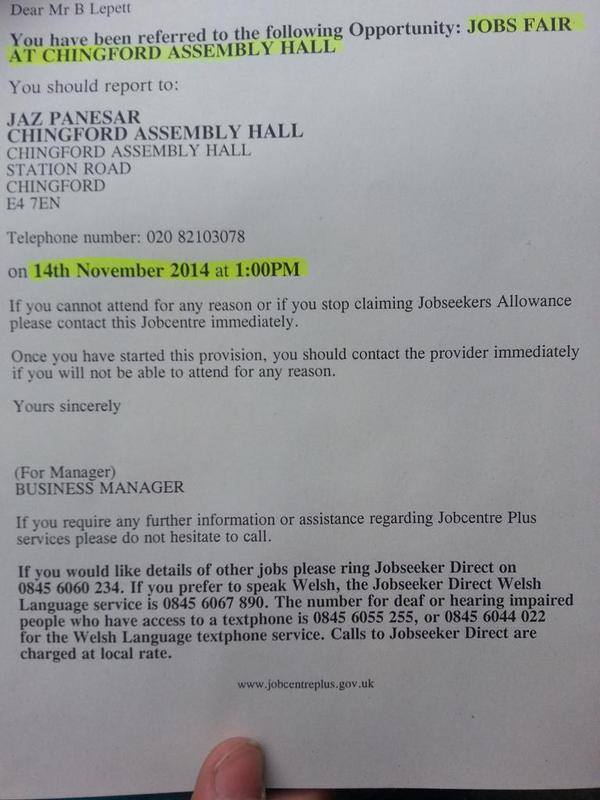
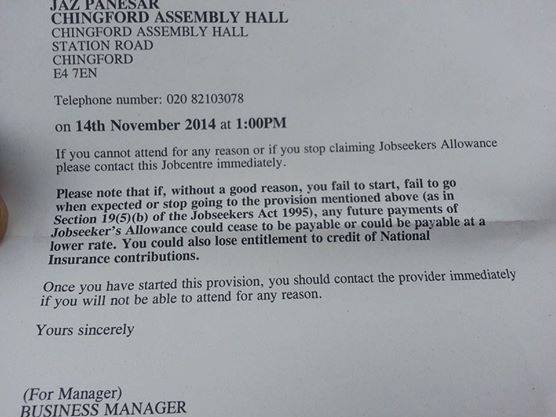
A worried grandson asks on Facebook why his grandmother aged 90+ was sent this letter:

I think this should be all over the papers. Disabled people of working age getting these letters is quite bad enough, but OAPs of 90+?

A Conversation with a Jobcentre Advisor

November 21, 2014

Three Children Who Were Bullied Because They Are Disabled

November 21, 2014

Research shows disabled children are much more likely to be bullied. Three young people who were once victimised tell their stories and share tips on tackling the problem.

This year’s Anti Bullying Week has been asking schools to give particular attention to children with disabilities or special educational needs. The organisation behind the campaign, the Anti-Bullying Alliance (ABA), has published new research on attitudes to disablist language this week and cites other recent research which shows eight out of 10 children with learning disabilities have been bullied, and that disabled children at primary school are 50% more likely to be victimised.

Rebecca, Maxine and Ammaar were at the receiving end of bullying. They explain how they got through it in the hope that their stories will help those having trouble now.

‘Speak up’

More than 90% of parents of children with Asperger Syndrome told the ABA that their child had been bullied in the past 12 months. Rebecca Parkin is 17 and has the condition. She was bullied regularly from the age of six until recently, when becoming a campaigning voice for others in her situation boosted her confidence. Rebecca says she was an “easy victim” for bullies. “I rarely spoke to anyone. I was really shy and kept to myself, even saying hello to someone was really difficult for me,” she says.

The problems began in primary school, where she was called names and excluded from friendship groups, but she describes high school as “a living hell”. “I was called fat, crazy, weird, stupid, ugly. When I was about 12 a gang of 16-year-olds came up to me in a park and tried setting my hair on fire. In school I got hit and tripped up, I had food and water thrown on me. One day a boy cornered me and said he was going to find me after school and kill me. I also got abuse online and someone set up a fake account on YouTube in my name so people could leave nasty comments on my videos.”

Rebecca was so badly affected that she began self-harming and needed help from mental health services. Things only changed for the teenager when she managed to speak up about what was happening to her. She says that she bugged teachers “until they did something about it” and that helping others in the same situation taught her that “you need to speak up so things will change”.

“I know it’s hard but if you can’t vocalise what’s wrong, write it down or draw it,” says Rebecca. “Do whatever you can to show how you are feeling and what is going on.”

Rebecca is now an anti-bullying campaigner with Ambitious about Autism, NSPCC and Ditch The Label.

‘Take precautions’

Maxine Young is 22 and acquired a learning disability as the result of a brain tumour at the age of three.

“He called me brain tumour kid,” says Maxine Young, referring to one boy who bullied her. She was consistently called names and teased about her size and appearance throughout primary and secondary schools, and then at college. Telling teachers led to bullies getting temporary exclusions from school, but the bullying only stopped completely when Maxine was physically assaulted at a bus station, and went to the police. The attacker got a two-year suspended sentence and was ordered to pay compensation. This, coupled with how seriously the police took her situation, has helped her grow in confidence. Maxine has now developed strategies to avoid being targeted in the future.

“If I do get bullied now, I say to them, why are you doing this? What’s the point in bullying people when you won’t get anything from it? I carry a personal alarm with me in case I do get assaulted again,” says Maxine, who has also received self-defence coaching from the police.

Maxine now helps Mencap to give anti-bullying training to parents and carers of people with learning disabilities .

Mencap are keen to stress that Maxine’s story is an exception to the rule. The charity says that in the last two years there were 124,000 disability hate crimes, but only 3% of these were recorded by the police, and only 1% resulted in prosecutions.

‘Don’t believe them’

Ammaar Hussein is 16 and has been a victim of bullying in the past because of his deafness. He recently made a video for the National Deaf Children’s Society (NDCS) giving tips for ways to tackle bullies. One tip he offers is, “Don’t believe the bullies”.

They would “speak very slowly, stretching their mouth and making fun of me” says Ammaar. It reached the stage where the bullies’ words affected how he went about his daily life. “I kept thinking that I couldn’t communicate properly and that people wouldn’t understand me if I tried. I felt embarrassed.

“One boy called me a robot because I was wearing my hearing aids,” he continues. “I felt really annoyed and ignored him but I kept thinking ‘Do I really look so different?'”

He says his biggest mistake was to listen to what bullies told him. “I did not realise that they were trying to ruin my confidence,” he says. “Remember, bullying is never your fault.”

Ammaar is now an anti-bullying ambassador at his school and he helps other deaf young people who are being targeted because they can’t hear.

Learning Difficulties and Signing On? The System Can’t Be Bothered

November 20, 2014

Back to Kilburn jobcentre this morning for a Thursday signon session with Eddie, the 51-year-old man with learning and literacy difficulties who I’ve been working with as he’s tried to get his fortnightly jobsearch done and avoid sanctions.

The jobcentre was pretty chaotic this morning – understaffed, I think, and tense. Most of the seats in the waiting area were occupied by people who were waiting to sign on. A number of people were pacing around.

Eddie was one of them: “I want to get out of here,” he kept saying to me. “Let’s get it [the signon] done and go.” Eddie hates the jobcentre and he seemed fraught this morning. He said there’d been some sort of fight between a claimant and adviser and/or Security just before I arrived. I knew something was up, because I’d seen four or five coppers climbing out of their car and heading into the jobcentre just as I turned up at about 9.30am. By the time I got upstairs, the police were all hanging around on the first floor in the waiting area and I could see a couple of coppers talking to people in a side room.

Full story at Kate Belgrave.

Support Group Chances Increased By Upper Tribunal Decision

November 20, 2014

With many thanks to Benefits And Work.

A recent upper tribunal decision may have significantly increased the chances of employment and support allowance (ESA) claimants being placed in the support group rather than being forced to carry out work-related activities that cause a substantial risk to their health. The decision has come about because, just two months after taking power in 2010, IDS did away with one of the stages of the work capability assessment in order to push through the transfer of incapacity benefit claimants to ESA as hastily as possible.

The work-focused health related assessment (WFHRA) was a ‘second medical’ at which an Atos health professional looked at what capability for work you still had and ways in which it could be improved by the taking of steps in relation to your physical or mental condition.

The subsequent report was passed on to your personal adviser who used it to decide what kind of work-related activities you might be capable of. It was a vital part of the WCA because it was the only way the DWP passed on information about the way your condition affects you to the person supposed to be preparing you for work – they have never been allowed access to the medical assessment itself.

WFHRAs were suspended for two years in July 2010 due to their having achieved only ‘mixed results’ and because of the increasing backlog of ESA medicals. They were subsequently abolished altogether.

A recent three judge upper tribunal hearing, however, has almost reinvented the WFHRA.

The tribunal were hearing a case in relation to regulation 35(2). In essence, this says that if because of your health condition or disability, there would be a substantial risk to the mental or physical health of any person if you were required to carry out work-related activities, then you should be placed in the support group.

The tribunal judges held that where a tribunal is considering whether a claimant should be covered by regulation 35(2) the onus is on the DWP to provide a significant amount of additional evidence if they think the claimant should not be placed in the support group.

This includes evidence about what activities work providers in your specific location send people on, which ones it would be reasonable to require you to do and what mechanism the DWP can point to that will give the tribunal confidence that the information will be effectively communicated to the work programme provider and acted upon.

If the DWP can’t do all this to the tribunal’s satisfaction then it must find that you are eligible for the support group.

Not surprisingly the DWP are very unhappy about this and are appealing the decision to the Court of Appeal. In the meantime, the DWP appear to be trying to get all appeals to first tier tribunals that raise the issue of regulation 35 stayed until the Court of Appeal has heard the case and reached a decision – which could be many months away.

We’ve updated both of our guides to claiming ESA to take account of this decision.

Meanwhile, if you are an ESA claimant, we’d be very interested to see your comments below on what work-related activities you have been forced to do and whether they were appropriate.

Welfare Delays Behind Increase In Foodbank Use Finds Study

November 20, 2014

Delays and gaps in the welfare state are behind the soaring numbers turning to food banks, according to new research into those relying on charity in Britain.

Minor adjustments to the benefits system could prevent many from needing emergency food, research commissioned by Oxfam, Child Poverty Action Group, Church of England and The Trussell Trust has found.

The research was conducted using a combination of surveying more than 900 clients at three Trussell Trust food banks, as well as 40 in-depth interviews at seven food banks across the UK. The majority of food bank users surveyed were there as a last-resort. They also typically needed help after something happened to completely stop or dramatically reduce their benefits.

For more than half of those interviewed, the immediate trigger which sent them to a food bank was linked to problems with welfare, including waiting for benefits to be paid, sanctions, problems with Employment Support Allowance or missing tax credits.

Alison Garnham, chief executive of Child Poverty Action Group (CPAG) said: “Food banks have boomed not because they‘re an easy option but because people haven’t got money to eat – often because of problems with claiming and the payment of benefits. A delay in a benefits decision or a period pending a review can force hunger and humiliation on families, leaving them no option but the food bank. Rather than protecting these families from poverty at the time when they most need help, the system leaves them with almost nothing to live on.”

Improving access to short-term advances in benefits and simplifying the claims process would curtail the numbers falling through the cracks, researchers said. They also recommended a reform to the sanctions system, which stops benefits punitively for long stretches of time, often after minor mistakes, such as not attending a meeting.

Around one in five of those attending food banks had household benefits stopped or reduced because of a sanction and more than a quarter were waiting for a benefit claim which had not been decided.

The Bishop of Southwark, the Rt Rev Christopher Chessun, said: “This report offers a picture of people facing acute crises in their lives with fortitude and dignity. That this happens is no surprise to thousands of Church of England parishes around the country who help to provide care and relief for their neighbours by running and supporting food banks.

“It is vital that the measured and practical recommendations set out in this report are actively considered and acted upon by politicians of all parties to ensure that more and more people are not forced into relying on emergency food aid.”

Reliance on emergency food handouts has soared in the last two years. More than 900,000 people were given emergency food by the Trussell Trust in the last financial year, up from fewer than 130,000 in 2011-12.

David McAuley, Trussell Trust CEO said: “This new evidence brings into sharp focus the uncomfortable reality of what happens when a ‘life shock’ or benefit problem hits those on low incomes: parents go hungry, stress and anxiety increase, and the issue can all too quickly escalate into crippling debt, housing problems and illness. The Trussell Trust has consistently said that too many people are falling through gaps in the social security system. The voices of food bank users heard in this report have informed the united call from four respected anti-poverty bodies to implement simple fixes to the welfare system.”

A Government spokesman said: “This country has been through the deepest recession since modern records began, and sticking to this Government’s long term economic plan is the only way to improve living standards.

“The report itself concludes it can’t ‘prove anything’ – it uses self-selecting data and recognises there are complex underlying issues. We have a strong safety net in place, spending £94bn a year on working age benefits, and we provide a wide range of advice and assistance for anyone in need of additional support.”

Raising awareness of disability-related bullying

November 19, 2014

Disabled students able to design 3D objects with their eyes

November 19, 2014

A press release.


 A disability college has pioneered new technology which allows students to design and print 3D objects using only their eyes. This is part of a recent global push to adapt new technologies to assist disabled people as seen with mobile phones, exoskeletons and now with art and design. 


See the film here: https://www.wetransfer.com/downloads/3557a0e934b680df9d86416f3466d3dd20140623214720/e919caef677a30adf15c40f7e66d693d20140623214720/00a69e%3e


SHIVA (Sculpture for Health-care: Interaction and Virtual Art in 3D) is a 3D design and printing project which allows disabled people to design an object or sculpture in 3D, which is then printed as a 3D model.

Initiated in 2010, SHIVA was designed by a group including Mark Moseley (Assistive Technologist at Victoria Education Centre), Dr Leigh McLoughlin and Professor Alexander Pasko and his team at the National Centre for Computer Animation at Bournemouth University in the UK. They were also helped by researchers from the University of Lille.

The technology was tested at and is now used by Victoria Education Centre (VEC), a school for children with physical disabilities, which is part of the national disability charity Livability http://www.livability.org.uk/

How does it work?

Some disabilities can make interacting with a touchscreen interface a challenge due to varying levels of dexterity and control.  The team needed to create an interface that was highly customisable for a variety of disabilities.

–          First, the interface is set to suit the particular user’s needs. They may not be able to use a touch screen, for example, so they may require an eye-gaze system instead. Eye-gaze technology then tracks where a user is looking and translates it into screen coordinates so that on screen cells or buttons can be selected.

–          The user is then able to build an object of their choosing using the program. They do this by selecting a number of objects and placing them onto a single stick, like a totem pole. These objects can be modified and rotated to suit their design preferences.  Students can select shapes using their interface of choice and combine it with other shapes, manipulate the scale, and even remove portions of the shapes. The stick is also completely removable if the users or educators have no use for it.

–          You can find out more about SHIVA at the Applied Shapes website http://www.appliedshapes.com/?q=research/shiva

o   This is the company that will support and distribute SHIVA when it is made fully open to the public.


What are the benefits to disabled people?


SHIVA allows a variety of disabled people to engage in creative design projects in ways which they may not previously have been able to. It breaks down the barriers between art and ideas and provides a new passage for creation and design.


–          Coordination and muscular control: The SHIVA program can be customised depending on the specific needs of the individual. The eye-tracker function benefits some disabled people who have issues with coordination and muscular control, alleviating the problem of using ones hands on a design or artistic project.

–          Visual impairment: The display is also customizable, so cells can be rearranged to suit different disabilities. The screen colours and cell size can be adjusted in order to assist people who are visually impaired, for instance it could have a black background with yellow controls, making it easier for someone with a visual impairment to see.

–          Any settings that have been tailored to a specific individual can be saved and easily retrieved at the start of each session within the program.

–          Professor Pasko thinks that it helps to ‘give children the tools for creativity’ because they ‘have great imaginations but almost no tools to express themselves.’ He says, ‘a piece of software which can help someone create something independently, or make them proud of what they have created is going to build self-esteem, that’s going to make them feel better and have fun.’


Results at VEC


The project has enabled young disabled students at VEC to design digitally and print in 3D. The models have been 3D printed to give the children tangible models of their creativity – “it brought the whole thing alive”, says Professor Pasko.


–          The software will continue to be used, and it is hoped that funding will be acquired so that the software can be further developed.

–          To date, around fifteen pupils with varying levels of disability have used the software and many models have already been produced. Professor Alexander Pasko said, ‘Suddenly the entire school realised “Wow it’s a different world now.”’

–          The software has been used for a project inspired by artist Andy Goldsworthy http://en.wikipedia.org/wiki/Andy_Goldsworthy


Who created it and who funded it?


–          SHIVA was designed by a team of people including Mark Mosely (Assistive Technologist at Victoria Education Centre) Dr Leigh McLoughlin, and Professor Alexander Pasko (National Centre for Computer Animation of the Media School at Bournemouth University in UK).

–          They were assisted by researchers from the University of Lille and the National Centre for Computer Animation at Bournemouth University.

–          It was funded by INTERREG IVA 2 Seas Programme (http://www.interreg4a-2mers.eu/en/) an international organisation that supports cross border cooperation between schools, charities and businesses from England, France, Belgium-Flanders and the Netherlands. They help fund projects that involve economic development, environmental issues and quality of life issues.

–          Many from VEC were involved, especially the Speech and Language Therapy Department. Mark Moseley was VEC’s technical lead for the project and was the primary consultant for accessibility. He created the user interface designs which were later implemented by BU. Mark worked closely with Sarah Gilling (Head of Speech and Language Therapy at VEC) who helped define how the software would be used and what aspects of therapy it could be linked to.

What’s Troubling Disabled People About The Tania Clarence Case?

November 19, 2014

A woman who killed her three disabled children by smothering has been sentenced to a hospital order. The judge’s ruling sparked an online debate that has been overwhelmingly sympathetic to Tania Clarence’s situation, but some aren’t happy with the reaction.

Clarence’s solicitor Richard Egan explained outside court that the mother was “overwhelmed” by her situation, that the “daily struggle” of caring for her children eventually overcame her “ability to cope with the enormity of the task she faced.”

The most popular reaction from the public was one of empathy for Clarence, a depressed woman looking after three young, disabled children. One person wrote on the Daily Mail comments section: “How anyone could cope in this situation is beyond me. Healthy children are hard enough work, but 3 profoundly ill children…it would be non-stop and watching them die.”

But for others the case has ignited anger, in particular people with spinal muscular atrophy have expressed concern at how the disability has been portrayed by the media as an “infant killer”, despite most with type 2 living long and fulfilling lives.

Disabled journalist Mik Scarlet outlines some of the viewpoints surrounding the case.

Katherine Araniello, who has type 2 spinal muscular atrophy (SMA), the same condition as the Clarence children that died, stated on her Facebook page: “This mother acknowledged and understood what she had done and appears to have planned to kill her children. It doesn’t sound to me as if it was carried out because of a psychotic episode, so my overall feelings on this story are the terrifying moments those poor children had. I can relate to zero physical movement, not being able to wave my arms in protest, let out a scream, defend myself.”

Mark Womersley, who also has SMA type 2, posted a video on Youtube in which he expresses how deeply the case has affected him. He raises his worries about the media portraying the condition as an “infant killer”, even though he has reached the age of 47. He believes the charge of manslaughter did not fit the facts of the case as they came out during the trial. He also raises his fears over the use of the term “mercy killing” during the trial and what it might say for disabled people in the future.

The phrase “mercy killing” was used early on in the trial, although the judge, Mr Justice Sweeney said before sentencing this was not a “mercy killing in the sense in which that phrase is normally used. The children did not ask to be killed, and you did not, and do not, seek to justify your actions as being justified in mercy.”

While the case itself is causing a great deal of debate, the arguments in mitigation made by the defence surely raise important questions that should be used to learn for the future. A key issue is how could any mother with three disabled children reach a point where the only solution that seemed viable was to end the children’s lives? There are all manner of services available to parents of disabled children, yet much of it is only provided after being sought out. If this kind of tragedy is never to happen again, what should be done to ensure that no parent can ever claim that they lost hope due to lack of support? How has the care and support systems for the parents of disabled children reached a point where families can feel such despair?

Parents of disabled children regularly claim that they find it almost impossible to source the correct support and are not even sure of what is available to them. Why are there not systems in place to ensure that as soon as an impairment is highlighted all the support that might be required is not made available as part of the treatment process?

Another troubling question is why the signs of Clarence’s failing mental health were not spotted sooner. We hear time after time from people who have experienced mental health crisis points that they felt a total lack of support and understanding, both from the medical profession and the wider society. It too often falls on the person experiencing problems to seek out help at a time when they are least equipped to do so.

Most importantly for disabled people, why is it that the courts, the media and the general public repeatedly see death as being preferable to being disabled?

During the discussion on Facebook, Katherine Araniello explains how she feels about the impact of the coverage of disability in the Clarence case. “From the SMA perspective, as always, this is a completely one-sided misrepresentation,” she writes. “I don’t know any SMA people who want to die. All of us are highly motivated individuals and are petrified by the real threat of legalising assisted suicide in the UK. Such biased representation of people with SMA… drip feed the public into viewing us as medical failures/problems, and is what makes this story so unequal to that if it had been non-disabled children.”

If the portrayal of disability is mostly negative in tone how can parents of disabled children foresee a positive future for their offspring? The disabled community decry how so many damaging stereotypes around disability are reinforced by the press and media, yet when a case such as this arises the media and press are quick to blame everyone except themselves.

Whatever your feelings about the issues raised by the sad deaths of Max, Ben and Olivia Clarence, there can be no question that we must all do our utmost to ensure nothing like it ever happens again. No parent of a disabled child should ever claim that they have been left so bereft of support that they could not cope or that their expectations for the future of their child were so poor that the child’s death seemed preferable.

How Dementia Can Change A Relationship

November 19, 2014

The Care Quality Commission, which inspects care homes in England, has told 5 live Breakfast that staff need better training to deal with questions around dementia and intimacy.

Nicky Campbell spoke to Rita and Rosie on Your Call, both of their husbands have formed new relationships in their care homes.

Rosie’s husband Den would “turn his back” and pull his hand away from his wife, which she found “very hurtful”.

Rita says she’s “not upset” that her husband Frank has formed a relationship with another woman in his care home because “he’s got company, I sit on one side to hold Frank’s hand and she sits on the other side and holds the other hand”.

This clip is originally from Breakfast Tuesday 18th November 2014.

Victory As Police Caution Withdrawn From Downs Teen Arrested For Going To School On Bank Holiday

November 19, 2014

Readers, you may remember that earlier this year, Same Difference covered the case of Abdulkarriem Al-Faisal who was arrested and cautioned by police or going into school on a Bank Holiday to pick up a hat.

Yesterday, readers, I read some very good news on Change.org. His caution has been withdrawn!

We are pleased to report that the IPCC have now withdrawn the Caution and have also removed my son Abdulkarriem name and DNA details from their database.

We are very happy with this result!

We are grateful to all those who took time out to sign our petition and support us and Abdulkarriem, in other ways. It made a massive difference, we know that for a fact.

Please share this news on Facebook: http://on.fb.me/1u7gVMh

We also commend and thank, David Lammy MP for Tottenham whose intervention really helped to concentrate the IPCC’s investigation and they took action, we think much faster due to his involvement.

We are also grateful to the IPCC, for taking a very sensible approach to our complaint. They have not only removed the caution but have offered an appointment to meet with Abdulkarriem to allay his terror of all Police, which developed since the arrest and detention in Wood Green Police Station.
We thank the Met Police for removing the caution and we are more than happy to say that because our son has Downs Syndrome and has been very sheltered, nothing even close to this had ever happened to him, therefore his actual memory of what happened could have been tainted as they have contended though he remains adamant.

Our whole aim from the beginning and now, is to highlight to the Met Police that Downs Syndrome youths and adults are vulnerable adults and therefore, processes need to be put in place and monitored to see that they are given treatment in custody that befits their level of understanding. What seems appropriate for most suspects might be totally inappropriate for a vulnerable adult with the understanding of a child.

We are however, unreservedly happy that this matter has concluded satisfactorily and that the handling of the complaint was done with sensitivity and care for Abdulkarriem, to the point of the IPCC wanting to ensure that his perception of the police is restored for the better in the future. We think this is a great offer and will be taking them up on it for our son’s sake.
We thank all those who helped and advised us, including our official and unofficial solicitors. We thank the Down Syndrome Association for their support and advice.

Finally but not least of all, we thank Change.org for the care with which they have handled the petition and in dealing with our family during the course of the whole incident and campaign.

We were also very pleased with the Media coverage and their support in highlighting our son’s plight and indeed understanding that this was about the wider issue for us.

We consider this matter settled for the good of all and are happy for the petition to be marked as settled and removed.

Thank you again, please share the news here: http://on.fb.me/1u7gVMh

May Allah bestow His blessings upon you all.

With thanks

Roshina Al-Faisal The Al-Faisal Family

UK Disability History Month 2014- War And Impairment

November 19, 2014

Five years ago, London-based Disability Rights campaigner Richard Rieser had a brilliant idea. He created UK Disability History Month- a month of events to celebrate disabled people’s lives and achievements while recognising the struggles we faced in the past. The Month runs from 22 November-22 December.

Last night in Central London, Disability Rights campaigners, disabled people, carers and allies gathered to celebrate the fifth anniversary of UKDHM at this year’s Launch event. As usually happens at these events, we ate good food, had great fun and met up with friends old and new.

However, this year, something was slightly different. This year’s theme was easily the most serious one in the history of this History Month. Because this year, UKDHM has decided to join the mainstream media in marking the centenary of the start of World War 1.

The ceramic poppies at the Tower of London- one for each soldier who lost their life in World War 1- were briefly mentioned tonight. However, one of UKDHM’s central themes ever since its creation has been ‘celebrating our lives’ and so rather than tributes to the dead, the Month will focus on the living- those countless soldiers who have survived war, but returned with impairments.

This year, the Month has been supported by Unite, the Union. It was Chaired by Sean McGovern, who represents disabled workers within the Union. Union member Diana Holland also spoke about how the Union supports disabled workers and their equal opportunities.

One theme that came up throughout the evening was how disabled soldiers were supported back into work after World War 1. It was as a result of their experiences that many of the financial benefits and work support schemes that disabled people enjoy today were first created. One other point that will stay with me was the story of how deaf people, newly returned from World War 1, were shot in the streets because they could not respond when asked to go to work! Today that seems shocking and would be illegal, which just proves how far understanding of disability has come in the last century.

Mo Stewart, a disabled war veteran who served in the RAF, spoke about the difficulties she faces today, now that working age disabled war veterans are no longer entitled to Disability Living Allowance for life. Although this was something they were previously promised in recognition of their services to the nation, she spoke of her disappointment at discovering that she will now have to apply for its replacement benefit, Personal Independence Payment, which has a 12 month waiting list, along with other working age disabled people. The promise of DLA for life now applies only to disabled war veterans who are no longer of working age.

Paula Peters of Disabled People Against Cuts spoke very well about her experiences working at the Ministry of Defence. She started this job the day Iraq invaded Kuwait in the First Gulf War. She explained how the role left her with mental health difficulties, describing particularly the guilt of knowing that her choices as a worker had led to lives being lost. She went on to describe the assessment process faced by disabled benefit claimants today and the difficulties she and her friends have faced as a direct result of this process.

John McDonnell MP, who is known for being a great supporter of disability issues, spoke about everything that he and others have been doing within and outside of Parliament to support disabled war veterans, disabled people in general and our causes and issues.

Arthur Torrington of the Windrush Foundation spoke about the experiences of Carribean soldiers during World Wars 1 and 2. As a British Asian, I have always had an interest in the experiences of ethnic minority soldiers, something which I feel is not covered often enough in the mainstream media. So I was particularly pleased to see this topic being included and covered.

Richard Rieser, Founder and Co-ordinator of the Month, gave an informative presentation about War and Impairment.

These events usually end with entertainment, however this year, we were instead shown a short, silent film by the disabled artist Katherine Araniello on disability and war. She then explained how making this film was a new experience for her, as when she started making it, she was just an artist who knew nothing about war. The film was interesting, and perhaps the lack of organised entertainment this time around was appropriate.

After all, there is nothing entertaining about war- or the impairments it causes to people, both on and off the battlefield.

Inclusive United

November 18, 2014
A new project gets more disabled people playing the beautiful game.

Inclusive United is a flagship partnership project which aims to get more disabled people playing football. 

Funded by The FA and Wembley National Stadium Trust, Inclusive United has been going since 2012 and is a Co-operative of fourteen Professional Football clubs in London.  

The team is part of wider scheme “London United”, which aims to get clubs working together to battle social issues that are affecting London, such as health, disability, crime, education and community cohesion.  

During its first three years, Inclusive United plans to involve over 3000 disabled footballers, and looks to include anyone with any disability, be it physical or visual impairment, or learning disabilities.

BREAKING NEWS: Tania Clarence Sentenced

November 18, 2014

Tania Clarence has today been detained under a hospital order. She will not be released until she has recuperated from the ‘depressive episode’ she is reportedly experiencing.

[Video] IDS’ Jobs Fair, Chingford, 14th November 2014

November 18, 2014

‘John’, schizophrenia and his debts: The DWP can’t abdicate responsibility

November 18, 2014

Ann McGauran's avatarAnn McGauran

It’s emerging that the Department for Work and Pensions (DWP) has carried out what the Disability News Service (DNS) says were ’60 secret reviews into benefit-related deaths in less than three years’. The excellent DNS obtained the figures from the DWP in response to a series of Freedom of Information Act (FoI) requests. The DWP has always rejected any connection between the coalition’s welfare reforms and cuts and the deaths of claimants.

Additionally, the DWP has now released guidance to staff saying that peer reviews might also be considered in cases involving ‘customers with additional needs/vulnerable customers’.

The vulnerability of many benefits claimants is illustrated by the case of ‘John’, who came into the London food bank with a voucher on Friday. He’s 33 and explained to me that he’s in debt. He still owes well over £2,000 to ‘payday’ or short term loan companies. These include Cash Generators,

View original post 484 more words

George Osborne spending £25bn more on benefits than planned, says Labour

November 17, 2014

With many thanks to Benefits And Work.

Chancellor George Osborne is having to spend £25bn more on welfare than he planned this parliament because of rising demand for housing and disability benefits, Labour claimed on Sunday.

Figures commissioned from the House of Commons library by Ed Balls, the shadow chancellor, and Rachel Reeves, the shadow work and pensions secretary, suggest the bill for welfare is still predicted to go up significantly despite Conservative party claims to be saving money on benefits. Labour said a key cause of the higher than expected spending is that more people in work are having to rely on benefits because of low wages, as well as mismanaged reforms at the Department for Work and Pensions.

Their analysis of official figures suggests the government has overspent by £1.4bn on housing benefit for people in work, with the number of claimants increasing by more than 50% since 2010 and set to double by 2019.

The party also said the government has spent £8bn more than planned on incapacity benefits due to “chaotic delivery of reforms and failure to help disabled people into work”.

Balls and Reeves told the Politics Home website that:

The government has spent over £8 billion more than they planned on incapacity benefits due to their chaotic delivery of reforms and failure to help disabled people into work.

Delays to the delivery of the Personal Independence Payment have meant not only uncertainty for thousands of disabled people, but a mounting cost to the public purse, with £1.7 billion more spent than planned over the parliament.

And £130 million has been wasted on failed IT for Universal Credit, which is still only reaching less than one per cent of its intended caseload.

Read the full story in the Guardianand the Politics Home website

Blue Badge Company lands new national contract

November 17, 2014

A press release:


Selected Post Office stores across the UK now stocking stylish blue badge wallets


A business that makes stylish wallets for disabled parking permits has landed a new national contract with the Post Office.


Blue Badge Company has confirmed that over the weekend (15-16 November), the Post Office began stocking its products in selected stores across the UK, just weeks after its trademark blue badge holders were rolled out across more than 2,000 Boots stores in the UK.


The deal was signed soon after the company launched its new range of products, which include a series of toasty wheat warmers, travel cardholders and a leather collection of the popular parking permit wallets. The new, luxury products expand Blue Badge Company’s existing range, which will continue to grow over the coming months.


The Post Office will stock 12 designs from the company’s blue badge wallet collection. The first products will land in over 200 of the main Crown Post Offices and will then be rolled out to around 300 stores over the next few months.


The company was the first in the world to offer uniquely styled blue badge holders and remains the only company in the UK.


Ellen Green, director of Blue Badge Company, said: “We never imagined we’d get one national retailer to stock our products, let alone two, so we were absolutely delighted when the Post Office agreed to a deal!


“We have been overwhelmed by the response to the display wallets to date so are really looking forward to having these and our new product range available so widely.”


The beautiful handmade wallets, cardholders and wheat warmers are made by a team of highly skilled individuals in Bristol– some of whom are registered disabled themselves – providing jobs and training for those with limited work options.


Aimed at both women and men, the products can be bought from most Boots UK stores, boots.com, selected Post Office stores, directly from the Blue Badge company website, independent retailers and in a number of high street shops.


With other new products already in production, Blue Badge Company hopes to be the biggest supplier and manufacturer of modern living aids in the next three to five years, with big plans to expand and diversify its product range in new territories.


From 1 January 2015 it will be compulsory for all blue badge holders to display the new hologram-style disabled parking permits.


The Government’s major reform of the Blue Badge scheme that came into action on 1 January 2012 replaced handwritten badges with standard electronic permits, printed with anti-fraud holograms, that were issued as and when disabled people applied for, or renewed, their permits.


Blue Badge users have to apply to renew their permit every three years meaning that at the turn of the year the new hologram permits will be the only valid badges in circulation and the former will be obsolete.


Each wallet comes with a free timer clock that can be dialled without being removed from its case. The exclusive ‘hologram safe’ feature, which ensures the hologram on the badge isn’t covered, complies with Department of Transport guidelines and the wallet guarantees that permits can be displayed legally, protected from damage and easily removed.


For media enquiries or sample products, please contact Lucy Doyle at Spirit PR on 0117 9441415 or bluebadge@spiritpublicrelations.co.uk


Vikki George’s 30 Wishes Project

November 17, 2014

A woman with ME who runs a charity from bed where she spends all her time, is urging others to complete a list of wishes to mark her 30th birthday.

Aspirational lists of things to achieve are seen and shared regularly on social media. Though 29-year-old Vikki George reads them, she can’t do the action packed things like skydives and round the world trips that they often contain, due to ME (myalgic encephalomyelitis) which gives her chronic fatigue.

The condition means George also experiences a lot of pain and in 2012 it caused three months of complete paralysis. Now she has to spend most of her time in bed, in darkness. She leaves the room for only an hour a week when her parents help her downstairs to lie on the sofa.

This means that for her birthday George is unable to plan the activities her peers might, and she would have a lot of catching up to do first. “I haven’t ticked off any of the teenage things,” she says. “I haven’t even bought my first legal drink or had my first driving lesson.”

Instead, to mark her birthday she has come up with 30 wishes designed to make others’ lives brighter. She is now asking the general public to carry them out.

The wishes include joining the bone marrow register and helping to raise £6,000 to buy a beach wheelchair for her favourite Norfolk holiday spot. They are all things that she would like to achieve if she could. “If I was well enough, I would like to be outdoors, actively fundraising,” she says.

Though she is asking others to carry out good deeds there are positive things she is able to do from her bed which she dedicates a lot of time to.

She co-founded Postpals 11 years ago, a charity that delivers cards and gifts to seriously or terminally ill children and their siblings.

George had the idea after a particularly severe bout of illness. At the time she was receiving cards regularly from AYM, the Association for Young People with ME, and says it was the highlight of her day. “Mum and dad would bring up the post and read it to me,” she says. “Pinning them up on my bedroom wall made me happy.”

She now puts all her spare energy into doing the same for others, and the latest project is sending letters to children from each of Santa’s reindeer.

“One girl in hospital thought that the reindeer had peeked through the ward window,” says George. “Another boy was so relieved because the letter from the reindeer had come to the hospital so Santa definitely knew he was there.”

So far, 15,000 people have watched a YouTube film about Postpals, whose patron is BBC Radio One DJ Fearne Cotton. Wish number two on the list is to get the video viewing figure to 300,000.

The fifth wish was for 12 flowers to be given out to strangers, which George’s local radio station BBC Surrey granted recently. The morning show is featuring one of her wishes each week in the run up to Christmas.

George has been keeping tabs on the progress of her wishes from her blacked out bedroom. She says her room is “a mess, and talks about the brightly coloured “stuff” pinned up everywhere which she can see in dim light. “I often have butterfly things scattered around because they have become my symbol of hope,” she says.

The 30 wishes have been posted on her blog from a tablet computer which she describes as a “lifeline to the world.” When she’s in hospital, she insists on a room with Wi-Fi because the internet is how she maintains contact with her friends, most of whom also have ME.

She is keen to raise awareness of the condition and the 30 Wishes project has allowed her to do so. “You only see people with ME who are doing really well and out and about,” she says, “you don’t see the ones who are behind closed curtains. I’m sure we’ve got neighbours who don’t know I exist.”

Threatened For Complaining The ‘Work Skills’ Course Was Useless

November 17, 2014

More stories from the Jobcentre from the brilliant Kate Belgrave, who has the full article here.

One I’ve been thinking about for a while:

Another phenomenon worth touching on when we’re talking about pointless jobsearch activity is the so-called “work skills” courses that JSA claimants are sent on by jobcentres. These are the courses that are provided, if that’s the word, by the likes of Reed, A4e and other of the usual suspects. People must attend these courses if the jobcentre says so. It’ll be news to nobody that people are told they’ll be sanctioned if they say No, and are indeed sanctioned if they say No. You can see that in the transcripts below. (I’m wondering if these courses ARE actually mandatory – or if people can say No and are just told they can’t, as they are told with everything else).

These courses have intrigued me for a while, because from the start, people have told me that so many of the courses are utterly meaningless. One man at the Kilburn jobcentre told me earlier this year that while he was sorting out a support worker job and waiting for CRB checks to come through, he was sent on a course where he was taught to tear up paper for teamwork purposes. “They sent me on this stupid course at Wembley. It was just a two week thing – a waste of time. They teach you how to stick a piece of paper back together as a teamwork thing. They said I’d get certificates for it. I said “there’s no way I’m putting that on my CV. You’re having a laugh.”

I started thinking about this again recently, because I’ve noticed that the JSA claimants I’m speaking with each week at jobcentres are getting angrier and angrier at the absurdity of these courses. It occurs to me that the anger is escalating. People are already furious at being forced to work 30 hours a week for free on community work placements and about the torturous daily sign on process. One guy at the North Kensington jobcentre (you can read more about this below) reported that his course provider took real exception when people on the course got together and said that the whole exercise was pointless. He said that the course provider pretty much got to the “Let’s Take This Outside,” point when people complained. “We got threats from the providers…I had no choice. I had to go on the course, or get no money.”

Group Claiming To Be From UKIP Attack Disabled OAP Labour Campaigner

November 17, 2014

A disabled pensioner was kicked while on her mobility scooter when thugs claiming to be from UKIP attacked Labour activists campaigning for the NHS.

Linda Hall’s terrified seven-year-old grandson Thomas was with her when the yobs struck in Corringham, Essex, on Saturday.

The three men had passed the Labour group’s “Save our NHS” street stall earlier and one said to one activist that they were “UKIP – we will be back later”.

They returned with a woman who filmed them kicking over the stall and lashing out on an iPad-style computer tablet.

Linda, 67, who suffers from chronic rheumatoid arthritis was left with a bruise on her leg. 

She said: “There was a lot of pushing and shoving, they trashed the street stall – kicked the boxes of leaflets all over the ground….

“The level of violence was really quite scary.”

Linda, who has been campaigning for Labour for more than 12 years, added: “I have never come across anything like this, absolutely extraordinary and it really was very scary.”

The activist, who is standing for the local council, said she got off lightly with a “glancing blow” from a thug who was kicking at a sign propped against her scooter.

“The kicking that was going on, if anybody had got their leg behind it – I’m not given to exaggeration – I think there would have been serious injury done.”

Mike-le-Surf, would-be Labour MP for South Basildon and East Thurrock, was also caught up in the mayhem.

Mr Le-Surf: “If these thugs think they can come and intimidate us, then they have another think coming.

“We are committed to campaigning for a better way of life. If that doesn’t suit the fascists, the thug and the bully, then tough”.

Although the thugs did refer to UKIP there is no proof they belong to Nigel Farage’s party, he added.

A UKIP spokesman said: “We do not believe that these people are anything to do with us. It looks like a set-up job.

“However, we do look forward to seeing the video evidence and if they are anything to do with us we will hand over any information to the police so that anybody involved in assaulting anybody – disabled or not – can be properly charged.”

Essex police are investigating.

Young, gifted and black? Join the Equality and Human Rights Commission and be conned over your pay

November 16, 2014

davidhencke's avatarWestminster Confidential

Baroness Onora O'Neill: the chair of the ECHR Pic credit: Flickr Baroness Onora O’Neill: the chair of the ECHR
Pic credit: Flickr

The Equality and Human Rights Commission is supposed to be the champion of the rights of ethnic minorities, the disabled and women against discrimination. It should be in favour of equal pay.

As a previous blog revealed its reputation is rather shaky when it comes to defending equality between men and women in the Middle East. Baroness Onora O’Neill, its part time chair, talks the big talk in the UK when  it comes defending women’s equal rights to men only to believe in her other position as a trustee of the  American University of Sharjah that women are second class citizens compared to men who are not allowed to meet privately with them as equals. I wonder whether she is allowed to be alone with a man when she is in Sharjah.

Now it turns out that her officials are quite…

View original post 339 more words

Mark Cotton

November 16, 2014

A DOUBLE amputee died in an apparent suicide fewer than 48 hours after being told an allowance to pay his carer was being slashed by two thirds, his sister claims.

Mark Cotton, 54, had lost both his legs due to a medical condition and relied on paid help which had been agreed with the authorities.

But he was visited for a re-assessment and four days later received a telephone call to say the allowance for paid care was being cut from nine hours a week to only three.

Fewer than 48 hours later he was found dead at his home in Sevenoaks Mead, Allerton, Bradford, after apparently taking an overdose of the painkillers he needed because of his illness.

His sister Jjeneen Sherington said he had left a note and hit out: “They are the cause of his death in my eyes.

“He would still have been here if this hadn’t happened”.

Mr Cotton lost one leg in 2010 and returned to work in a teaching role after that but his deteriorating health meant his remaining leg was amputated in 2012.

Even before the second amputation he had needed care and Jjeneen was paid for nine hours a week, though said in reality she spent more time assisting him and could not work as a result.

“When he was told he was being re-assessed he thought because his circumstances were worse, they might give him more money.

“Then they phoned to say they were reducing his money,” she said.

That worked out as a reduction in paid for care from nine to three hours a week, she said, and during his re-assessment interview, Mark had been asked if he could do his own ironing while sitting down, one of the tasks normally done by his sister.

“We were going to fight the decision, through Citizens’ Advice and his MP,” she said.

“He had loved his work and wanted to get back to a job. He had put himself through university and had started a course to learn a foreign language in the hope of being able to teach that, but his health meant he had to give it up.

“He had always worked and put into the country, but this was what he got back.

“The paramedics said he must have been in a lot of pain, because of the medication he had been given,” she said.

A spokesman for Bradford Council said: “We are aware of the tragic death of Mr Cotton, who was known to Bradford Adult Services, and our thoughts are with his family.

“Investigations will be carried out into the circumstances of this case and it would be inappropriate to comment until those investigations have been completed,” he said.

West Yorkshire Police confirmed that a 54-year-old man was found dead after a call was made for an ambulance at 8.17am on Thursday, with no suspicious circumstances.

JSA Claimants Were Forced To Attend IDS’ Jobs Fair Yesterday Under Threat Of Sanctioning

November 15, 2014

As this letter clearly says:

jobsfair1 idsthreat

Letter spotted at Class War 2015, who also have full details.

URGENT: People awaiting WCA Assessments, particularly in Birmingham Please Read and share

November 15, 2014

From DPAC.

DWP management target disabled  benefit claimants.

Over the next 24 hours DWP management will ‘invite’ close on 2,000 benefit claimants from Birmingham to attend interviews, with a goal of getting at least 10% off the benefit register.

The group of benefit claimants being targeted are in the majority waiting for assessments to decide if they are able to be deemed ‘fit for work’. (The assessment formerly and controversially run by ATOS). Those waiting assessments are often disabled or vulnerable adults.

The ‘invitation’ letter issued makes no suggestion that the attendance to these interviews is purely voluntary, indeed DWP staff in Birmingham (and Central England) have been advised verbally and by email from management to keep it to themselves that attendance to these interviews is not mandatory. One manager in a city based office was overheard saying that the way to deal with these claimants is to ‘hassle, hassle them off benefit’.

Andrew Lloyd, PCS Midlands regional secretary that represents DWP staff said, “It is outrageous that the DWP are duping the most vulnerable by issuing this letter, and then worse still setting a target to get those off benefits, it could be argued that this approach is unlawful. Our members are totally opposed to this approach but are faced with inferred disciplinary action unless they act upon these targets.”

[Press Release from PCS Union]


If you receive one of these letters, or if you receive a letter about Work Focussed Interviews while you are in the support group YOU DO NOT HAVE TO ATTEND and they cannot stop your benefits if you don/t attend.

Here is a template letter that you can use to reply to the letter from the DWP:

Dear Sir/ madam (DWP)
 
I understand that this interview is not mandatory and my non attendance will not effect my benefit payments. I am therefore exercising my right not to attend this interview.
 
I want to make it clear that I will cooperate with all mandatory requirements to ensure continued payment of benefits.
 
Yours

XXXXX

please contact us via email if you are worried or would like more information

Infographic- The Difference Between Rheumatoid Arthritis and Osteoarthritis.

November 14, 2014

I’ve been asked to share this infographic with you.

Bathing_Solutions_Arthritis_Infographic_V2 (1)

Access To Work Case Studies Wanted

November 14, 2014

From Disability Rights UK on Facebook:

The Ombudsman is investigating Access to Work for maladministration. As Geoff Adams-Spink is an associate of Business Disability Forum, he has agreed to collect case studies and forward them via the forum to the Ombudsman’s office for consideration. Please email him via geoff@adams-spink.com with a detailed case study if you believe that you’ve been treated unfairly by Access to Work. Please make sure that your case study sticks to the facts.

Man Detained After Female Staff Member Seriously Injured At Kirkcaldy Job Centre

November 13, 2014

A female member of staff sustained a serious head injury on Wednesday afternoon following an alleged assault at Kirkcaldy Job Centre.

Police attended the building following reports a woman had been attacked with a weapon.

The alleged incident happened in full view of other staff members and member of the public.

The woman was taken to the Victoria Hospital in Kirkcaldy by ambulance.

Police were quickly on the scene and a man was detained.

There was intense police activity in the area of Hunter Street with uniformed and CID officers present.

Officers were seen carrying evidence bags from the premises.

An Ambulance Service spokesman said: “We attended at the request of the police.”

One eyewitness told The Courier: “It’s an open office. The police were there within minutes.”

The Job Centre re-opened in the afternoon.

A police spokeswoman said: “Police in Kirkcaldy attended an incident at the Kirkcaldy Job Centre.

“A man was restrained by security staff and was subsequently detained. 

“The woman was taken to the Victoria Hospital by the Scottish Ambulance Service for treatment to a head injury. 

“A report will be sent to the Procurator Fiscal.”

A Department of Work and Pensions (DWP) spokeswoman said: “Violent behaviour towards our staff is completely unacceptable and thankfully is incredibly rare. We will be working closely with the police on this incident.”

Labour Propose Three Crucial Changes To WCA

November 13, 2014

With many thanks to Benefits And Work.

A Benefits and Work member has received an email this week from the central office of the Labour Party setting out ‘three crucial changes’ the party proposes to make to the way the work capability assessment (WCA) works. But how crucial are they really?

Our member emailed the Labour party on the subject of the WCA and forwarded us the email they eventually received in response.

Three problems
The email sets out what Labour see as the current problems with the WCA, whilst underlining that they believe that ‘a test will always be necessary’. The three main problems identified are:

That the WCA is ‘not integrated with employment support’ and so is not helping claimants back into work;

That the WCA ‘lacks credibility with disabled people, causing anxiety and stress’;

That the system is ‘riven with poor decision making’, leading to a ‘staggering 45 per cent of appeals against the test’ being upheld last year.

Critics may point out that not only did Labour devise and introduce the WCA, but also that the level of appeal success under Labour was very similar to what it is now.

Three changes
However, Labour have come up with ‘three crucial changes to the way that the test works’ that they will introduce if they get into power.

1 Labour will ‘start by transforming the way the WCA is designed to make it more effective at helping disabled people into work’. There are no details of what this transformation will involve, except that ‘disabled people would receive a copy of the assessor’s report of how their health condition may affect their ability to work, and information about the support that is available in their local area to help them’.

2 Labour will also ‘continue to produce an independent review of the WCA’. In addition, they will ‘ask the Office for Disability Issues to support an independent scrutiny group of disabled people to work together with the independent reviewer to assess whether the test is being conducted in a fair and transparent way’. Labour says it will only ‘commit to responding to the recommendations of this report’, there is no undertaking to actually act on them.

3 Labour will introduce ‘penalties for poor performance by assessors, measured both on the number of times decisions are overturned by DWP decision makers, and the number of times they are overturned on appeal.’

Critics may argue that: offering unspecified changes to the WCA amounts to very little; that a group of disabled people put forward by, for example Disability Rights UK, may not command universal support, especially if there is only a commitment to ‘respond’ to recommendations, and that penalties that are hidden behind a cloak of ‘commercial confidentiality’ – as they undoubtedly will be – will offer no reassurance whatsoever.

But would Labour’s proposals be an improvement on what we have already? Tell us what you think in the comments section below and we’ll ask the Labour party for their response.

The full text
The full text of the email is reproduced below:

With Labour, disabled people would receive a copy of the assessor’s report of how their health condition may affect their ability to work, and information about the support that is available in their local area to help them – a first vital step towards a more integrated system of support.

Labour believes that the Government must work to support people with disabilities fulfil their own ambitions to enter paid work. That’s also the best way to control the costs of social security within an overall cap on spending, and to make sure there is a system that supports those who need it, including those who may never be able to take up jobs.

When the last Labour Government introduced the Work Capability Assessment we wanted it to be part of a system that helped support more disabled people into work. We have always said that a test will always be necessary, but it is abundantly clear that at the moment the WCA is not working.

First, the test is not integrated with employment support, which may help explain why the Work Programme is performing so miserably for disabled people, with just five per cent helped into sustained jobs. Second, the test lacks credibility with disabled people, causing anxiety and stress. That is in part because of the third failure – a system that has been riven with poor decision making, causing hardship for disabled people, and huge costs to the public purse. Last year, a staggering 45 per cent of appeals against the test were upheld.

So a Labour government would make three crucial changes to the way that the test works. We will start by transforming the way the WCA is designed to make it more effective at helping disabled people into work. With Labour, disabled people would receive a copy of the assessor’s report of how their health condition may affect their ability to work, and information about the support that is available in their local area to help them – a first vital step towards a more integrated system of support.

Secondly, we would continue to produce an independent review of the WCA, and ask the Office for Disability Issues to support an independent scrutiny group of disabled people to work together with the independent reviewer to assess whether the test is being conducted in a fair and transparent way. We will commit to responding to the recommendations of this report.

Finally, a Labour government will go further in ensuring that the assessments get it right first time. We would make sure that in the new system there would be clear penalties for poor performance by assessors, measured both on the number of times decisions are overturned by DWP decision makers, and the number of times they are overturned on appeal.

Disabled people have suffered for too long in a system that has too often been unfair, ineffective, and non-transparent. Labour will build a Britain that works for everyday people, save the NHS, and turning decisively away from a Tory government run for the privileged few. 

’67 jobs’ blog – My story

November 13, 2014

pstymail's avatar67 job applications in a fortnight and sanctioned

‘67 jobs’ blog – my story

by Peter Styles

MeFirstly, thanks again for all the kind messages of support, received both on the site and to me personally. It has been a tonic at a stressful time. Some heartfelt and very interesting stories have been left on the site, and I wish a happy and successful resolution to one and all.

So how did it come to be that I was sanctioned after applying for 67 jobs in a fortnight? Here’s the story as succinctly as I can put it.

Over the last year since losing my job I’ve been applying for up to 15 jobs a day, securing at least an interview a month and doing whatever I could to free myself from an increasingly precarious financial position – especially as the lion’s share of the Jobseekers’ Allowance is spent on subsidising a significant underpayment in Housing Benefit each…

View original post 658 more words

ESA Sanction Figures, April-June 2014

November 12, 2014

With many thanks to Benefits And Work.

Figures published today by the DWP reveal that it is having to overturn a huge proportion of its own sanctions against employment and support allowance (ESA) claimants even before they reach an appeal. Nonetheless, decision makers continue to sanction thousands of ESA claimants every month.

The latest figures, for April to June, 2014, reveal that sanction levels are continuing an upward trend:

April 4,118

May 4,770

June 5,132

What is most shocking, however, is the change in the number given for sanctions handed out in March 2014.

In August of this year, we revealed that 7,507 ESA claimants had been sanctioned in March

However, in the latest statistical release this number has been reduced to 4,266, suggesting that the DWP have overturned almost 45% of their own sanction decisions before claimants have had time to get anywhere near a tribunal.

To have to admit that you have wrongly imposed sanctions on such a high proportion of sick and disabled claimants should be a matter for shame, remorse and an immediate change of procedures by the DWP.

Sadly, we know that it will make no difference whatsoever.  However, it does undeline the need to always challenge unfair sanction decisions:  you have a very good chance of winning.

You can download the latest sanctions figures from the DWP website.

Robin Williams May Have Taken His Life Due To Parkinsons Drug Reaction

November 12, 2014

Robin Williams may have taken his life after falling victim to hallucinations associated with dementia and Parkinson’s disease, his family are said to believe.

The TMZ website reported that it had obtained documents showing that the comedian, who commit suicide in August, was suffering from a form of dementia called Lewy Body Dementia (or LBD) when he died.

Discovered only in the 1990s, Lewy Body Dementia causes abnormal deposits of protein across the brain, leading to a diminishing of the chemical needed to process normal thinking and behaviour.

It often accompanies Parkinson’s Disease, the neurological condition which Williams had been suffering from for about three years before his death, and was said to be distressed about.

People with Lewy Body Dementia can respond adversely to medications commonly taken for Parkinson’s, and may experience hallucinations in which they see phantom objects, people and animals. It is common for sufferers to attempt to speak to the phantoms.

The Lewy Body Dementia website warns: “Some people with LBD are extremely sensitive or may react negatively to certain medications used to treat Alzheimer’s or Parkinson’s in addition to certain over-the-counter medications.”

According to the Coroner’s report, Williams had two antidepressants and two caffeine compounds in his system when he died.

A source said by TMZ to be connected with the Williams family told the website that he had complained to his wife, Susan Schneider, about the way his medication made his feel.

The family is said to believe that Lewy Body Dementia was the “key factor” behind Williams’ decision to take his own life at the age of 63.

TMZ said Williams’ doctors agreed that the disease, which affects around 1.3 million people in the United States, was the trigger for his suicide.

It is unclear whether the Good Morning Vietnam star or his doctors were aware of his condition before his death.

According to the Coroner’s report, the much-loved comedian and Oscar-winning actor, who left three children, was suffering from anxiety, depression and paranoia in the run-up to his death on August 11.

He had attempted to slash his wrists with a pocket knife before hanging himself with a belt in the bedroom of his home in Marin County, California.

His wife told the coroner that the couple had been sleeping in separate bedrooms as he had difficulty sleeping and was often restless at night.

Sleeping issues are a common symptom of Lewy Body Dementia, according to the Association’s website, as are hallucinations, fainting and falls.

As many as half of sufferers will react adversely to medications used to treat Parkinson’s.

Full story in the Telegraph.

Not laughing on the way to the #foodbank: ‘Marie’ the carer and her sons

November 12, 2014

Ann McGauran's avatarAnn McGauran

Marie (not her real name) is 53 and is separated from her husband,  although they are still legally married.  Despite her many health issues, she has been his full-time carer for four years.  He has dementia, while she lives with chronic arthritis, anxiety and panic attacks, depression and anger management issues. They have four sons in their 20s – three of whom still live with Marie. All four of her sons have mild to moderate learning difficulties.

Left with no benefits, she came into the London food bank last week with three of her sons for some help. Her employment and support allowance (ESA) – a benefit paid to the sick and disabled if they are unable to work – had been withdrawn.  It was stopped following a Work Capability Assessment (WCA) carried out by Atos (whose controversial contract with the government to undertake the tests is ending early)…

View original post 786 more words

New Book Throws Universal Credit System Into Doubt

November 12, 2014

Iain Duncan Smith’s floundering Universal Credit system will have to deal with 1.6million changes to people’s claims every month, a Government adviser has revealed.

The shocking figure throws fresh doubt over whether the Work Secretary’s flagship scheme will ever be fully up and running after being dogged by delays and glitches.

Professor John Hills reveals the scale of the challenge in a new book that explodes the “strives versus skivers” myth peddled by politicians.

Professor Hills, of the London School of Economics, warns: “This will make the system hard to run.”

It will also pile pressure on the poor, he warns in Good Times, Bad Times: the welfare myth of them and us.

“The complexity of people’s lives makes attempts to simplify the benefits system sound attractive, but that very complexity makes ‘simplification’ fraught with difficulty, threatening to make things even harder to cope with for people with little margin for errors – their own or those of official systems.”

Full story in the Mirror.

Mother Speaks Of Anger After Stagecoach Bus Refused To Move Pushchair For Her Daughter’s Wheelchair

November 11, 2014

Bryan Adams’ Exhibition Of Soldiers Portraits Starts Tomorrow- Wounded: The Legacy Of War

November 11, 2014

An exhibition of photographs by Bryan Adams of young British servicemen and women who have suffered life-changing injuries on military duty in Iraq and Afghanistan.  Featuring over 30 portraits on public display for the first time in the UK, the startling series honours the war heroes of today and highlights the plight of wounded personnel.

At the time of military withdrawal from Afghanistan and centenary commemorations of the First World War, the exhibition will serve as a timely and thought-provoking tribute to those who continue to put their lives in danger in the line of duty.  A band of brothers and sisters who returned home for rehabilitation and resettlement, their disfigurements and disabilities act as a reminder of the battles beyond combat – mentally, emotionally and physically.

The intimate portraits are striking and unsettling, since they do not shy away from the atrocities and aftermath of war.  In them, the inspiring individuals show the same spirit of resolve, courageousness and camaraderie in civilian life as in service.  Their searingly honest and heartfelt stories will share the wall space with their pictures to provide insights into the personal paths of conflict to recovery.

The exhibition is accompanied by a stunning coffee table book, Wounded: The Legacy of War published by Steidl, priced at £50 with proceeds from the book going to veteran support charities BLESMA, Blind Veterans UK, Combat Stress and SSAFA, and War Child.  It features images of 40 veteran soldiers taken by Adams, accompanied by each soldier’s personal story.

Why Oscar Pistorius’ Disability Could Keep Him In Jail For His Whole Sentence

November 11, 2014

According to the Mirror, the prison has a tagging scheme. Pistorius was hoping he would be released after 10 months and tagged- but the tags can only be attached to ankles. Pistorius has no ankles, so he has been told he’s not eligible.

They can’t attach the tags to wrists, because they could be removed too easily. There is a fear that Pistorius could take off a prosthetic limb with a tag on it and escape.

So, readers, all that talk about his disability keeping him out of prion and now, it looks like the opposite may actually come true!

“DWP Docking Benefits Left Me Starving And Cold”

November 11, 2014

A VULNERABLE disabled woman said she has not eaten properly for almost three weeks, after her benefits were docked when she failed to attend Job Centre appointments.

June Howland, from Darlington, said a combination of illness, her lack of mobility and the fact she lives alone made it impossible for her to attend appointments aimed at assessing her suitability to work.

The 42-year-old, of Auckland Avenue, said: “It has affected my health, I have not been able to eat properly and my house has been freezing.

“I have been laid on my couch under my duvet, without gas or electric, not able to get warm.”

Ms Howland, a wheelchair user as a result of operations many years ago, is unable to walk long distances and uses crutches to get around her home.

Her combined benefits amounted to £200 every fortnight, but the sanctions imposed by the Department for Work and Pensions (DWP) meant she received just a quarter of that – the majority of which was swallowed by by her rent commitments.

A DWP spokeswoman said Ms Howland’s complaint has now been resolved and her payments in the process of being reinstated.

She said: “We’ve written to her to tell her about the decision.

“In general terms, if anyone who is referred to the work programme and thinks their health will prevent them attending their appointment, or if their health condition has worsened, they should speak to their provider.”

Ms Howland, a former security officer, who maintains that she is not fit for work, said she had yet to receive written confirmation from the DWP that her payments would resume.

She added: “I was poorly, I called them to say that I could not make my appointment and they sanctioned me for it.

“They expect me to work and I can’t – my doctor has declared me unfit for work.

“Every day has been a struggle since they sanctioned me, I have had no money for my gas and electric, no money to feed myself, nothing at all.”

Ms Howland, who worked as a security officer before her ailing health forced her to give up her job, added: “There are people out there who claims benefits when there’s nothing wrong with them.

“I have got genuine health problems and doctors to back that up.”

Quentin Blake Says We Need More Disabled Characters In Children’s Books

November 11, 2014

And I strongly agree with him!

As he launches his latest book, Sir Quentin Blake says there should be more illustrations of children with disabilities in children’s literature.

“They’re just not there,” he says.

After being asked to submit illustrations of children using mobility aids for an exhibition three years ago, the well-known illustrator started to realise the level of under-representation and wanted to do something about it.

In his only video interview since launching the book, Blake says that there has been lots of talk about how disabled children are “coming in on the edges” and so decided to create a story where they don’t remain on the sidelines. “I just thought well, we’ll just do it about them,” he says.

The Five of Us features children with what Blake calls “special abilities”, who end up having to rescue their bus driver when he falls ill during a trip into the remote countryside.

On disabled children in books more generally, the illustrator famous for having drawn classic characters like the BFG and Willy Wonka in Roald Dahl stories, says: “We can’t have a quota and we can’t have a token. But one day I hope it just comes naturally, it’s not something I would have to think about.”

For a subtitled version click here

Claire Dyer Is Free!!!

November 11, 2014

Late last night, I found out this fantastic piece of news. Matthew Smith has full details here.

Two Blind People Verbally Abused At Huddersfield Sainsburys

November 10, 2014

Police have released a CCTV picture of a man who they would like to speak to after two blind people were verbally abused in Sainsbury’s supermarket in Huddersfield.

PC Emma Poole, of Huddersfield Neighbourhood Policing Team, said: “This incident, which is being treated as a hate crime, happened at around 4.30pm on Sunday, November 2.

“The victims, a 17-year-old girl and a 21-year-old man, have been at the checkouts of the Market Street store when a man has approached them and tried to distract their guide dogs.

“When they have told the man not to do that he has become verbally abusive towards them both.

“We are keen to speak to anyone who recognises the man pictured or who has any other information which could assist us in our ongoing enquiries. Information should be passed to Huddersfield NPT on 101.”

The World’s First 48 Hour Silence For Multiple Sclerosis

November 10, 2014
A press release:


DON'T SAY A WORD FOR 48 HOURS & FUNDRAISE FOR 
MULTIPLE SCLEROSIS CHARITY, SHIFT.MS
From 1900hrs Thursday 20 November until 1900hrs Saturday 22 November.
 
 
Shift.ms invite the world to embrace this ambitious challenge and make the loudest silence!
 
 
MS is a serious chronic and progressive illness affecting the body’s nerves that can render a person disabled. It affects the brain and spinal cord resulting in loss of muscle control, vision, balance, numbness or thinking ability. There are around 100,000 people in the UK with MS, and 2.5 million worldwide. 
 
WHY THE "SILENCE?"
 
Shift.ms aims to provide support to those recently diagnosed with MS, reducing the isolation that many feel following their diagnosis. Most are diagnosed in their twenties and thirties and on receiving the life changing news, they experience a great sense of loneliness and fear. Shift.ms has created a social network where MSers can unite, break the silence and gain support from one another. George Pepper, who has MS himself, set the charity up in 2009. He was diagnosed at 22 and wants to prevent others from suffering in silence, the way he did. George found it difficult to find other MSers of a similar age in a similar situation, even online. This frustration led him to set up a website - www.shift.ms - where MSers could meet and share experiences.
Shift.ms now has thousands of members who support one another through its social network and forums:
 
“When diagnosed with MS I felt as though no one understood what I was feeling. I wanted to be cured. I didn't want to be ill. 
My parents tried to help, but their constant concerned looks and hushed voices, rather than being supportive, only amplified my concerns, added to the worry and created a guilt. Nurses had all of the medical answers, told me what I needed to know at the time but were the first to admit, they don't have MS so don't really understand. For me that is what Shift.ms offers, a place to ask what you need to, get the support from those that understand and to be part of a community that is all going through the same thing. Fears were set aside, friendships made, and questions answered.” Gemma Grant, 30, Sheffield 


Shift.ms are recruiting a silent army across the UK. The 48 hour sponsored silence is something that anyone can get involved in. Shift.ms will encourage fundraisers not to isolate in their silence but to continue as usual – go to work, to the pub, have a haircut….– and interact with as many people as possible. 
 
Shift.ms has set up a platform - www.silence.ms - where images and thoughts can be shared on social media throughout the silent journey.
 
What were your last words before the silence and what were your first words after the 48 hours?
 
 
Co-founder of Shift.ms, George Pepper, said: “Shift.ms’ focus is on reducing isolation and providing social support for recently diagnosed MSers. The sponsored silence challenge will not be easy as talking is our natural instinct (the average person says up to 20,000 words per day) but this challenge can be fun. Shift.ms wants to create an inclusive fundraiser that can involve the very audience it’s raising money for. I look forward to taking part in the silence, although my baby daughter will be nine weeks old by then and soothing her in silence may be tricky!”
 
To take part in the 48hr silence from 1900 on the 20th November visit www.silence.ms. Sign up and Shift.ms will send you a silence pack to help you with the fundraising challenge.
 
You can find out more about the campaign here: www.silence.ms
See promo vids
http://youtu.be/kipXB-Jd_50
http://www.youtube.com/watch?v=zm5FgRStFbs
 
About Shift.ms
Shift.ms is a user-led social network
for people with Multiple Sclerosis (known as MSers), particularly the recently diagnosed.
Shift.ms is a digital-first charity, set up in 2009 by George Pepper and Freddie Yauner. George has a background in marketing, whilst Freddie is a designer and artist. George was diagnosed with MS aged 22.
Diagnosis of MS is most common in young adults; a time of decisions about relationships, family and career. We believe it’s crucial to have the right support at this time.

Crowdfunding For Equality

November 10, 2014

A press release from Art With Heart:

Crowdfunding for Equality

Art with Heart need your support to reach hundreds of people with their inclusive coming of age tale.

Equality driven Theatre Company, Art with Heart are raising money through Crowdfunding website Kickstarter to nationally tour their Award Winning Play Secret Diaries.

Secret Diaries is an inclusive, honest story which questions acceptance and allows you to challenge your own opinions on friendship, love, society, power, family values and discrimination” – Writer Sarah Evans

Secret Diaries advocate, Kate Green MP Shadow Minister for Disabilities said:

“This is a brilliant, really creative and important project to give young people the chance to think and feel confident about their sexual identity and how to open up the difficult conversations about equality and respect for all. I want young people everywhere to have the chance to see, talk about and reflect on it – and the adults who care about them to do so too.”

Art with Heart have already received some funding for the tour, but are keen to raise the rest of the funds needed through pledges from the general public.

“For us, Crowdfunding is so much more than just funding; it is a way of creating a community of like-minded, passionate people, with similar values, who can work towards a shared goal. We’re all part of it from start to finish and that’s important.” – Director Rachel Moorhouse

“Crowdfunding is different to traditional fundraising, every pledge has a reward, from a public thank you, to 80s/90s treats from our props treasure chest and tickets to a performance. It is important for us to be able to give something in return for helping making it happen” – Evans


Secret Diaries is a Play for anyone age 14-114. It charts the big stuff in life from dance routines to coming out; exploring homophobia and finding your own voice. Secret Diaries follows the story of Hayley, a young lesbian growing up in the 80s, with her Dad and best friend Debbie, to present day.

“To start a conversation about equality, you need everyone around the table. Secret Diaries was born out of a need for honest conversations around homophobia; helping people to feel comfortable in their own skin.” – Evans

With the support of pledgers through Kickstarter, Art with Heart will tour the country with up to 22 performances, give free workshops and education packs to schools and youth groups, provide free teacher training events and provide a British Sign Language interpreter on tour.

Evans, Creative Director and writer is passionate about British Sign Language access:

“Having a BSL interpreter with us at every step of our development, rehearsals and on tour is key in making sure everyone has an equal experience. There often isn’t enough choice of dates or productions which are either BSL interpreted or integrated and we want to show that it’s important to give equal access. I’m hearing, studying for my Level 3 and always seek out work which is interpreted. It’s frustrating when there is a clear exclusion from performances, or feel like you are behind, or not getting the same experience as everyone else. We’ve also created a fully translated version of the script to ensure nothing is lost in interpretation.”

“It’s brilliant to work with a company who are really passionate about giving the same experience to BSL users as hearing audiences. I’ll be working in rehearsals not just turning up on tour, which will make sure that everyone gets a high quality experience of the work we’re making” – BSL interpreter Rachel Moffatt-Feldman.

They will be bringing people together during National Anti-Bullying Week for an 80s themed party.

“Everyone knows what it’s like to feel like you don’t fit it, we want to bring people together and stand stronger. National Anti-Bullying Week is a time to stop, reflect and support.” – Evans

“With 12 days to go we’ve reached 69% funded, but it’s not signed, sealed, delivered, there’s still a long way to go. If we don’t reach our target then everyone gets their money back, it’s all or nothing and we think that’s important. Every Kickstarter has a video, our whistlestop tour of 80s hits and ridiculous dancing has made people smile, and we hope it will for you too.”- Moorhouse

If you would like to support Art with Heart in reaching their goal in time go to www.kickstarter.com/projects/artwithheart/secret-diaries. Pledges start from just £1.


Firms’ Disability Access Unlawful Finds BBC London Investigation

November 10, 2014

The government is writing to a string of high street chains urging them to improve after a BBC London investigation revealed a “depressing” failure to accommodate disabled people.

Two researchers, one blind, one a wheelchair-user, documented their daily travails with pinhole cameras.

Some of the UK’s top chains failed to provide ramps – while five cabs refused to take a guide dog.

Several firms apologised while others promised to improve.

The Equality Act obliges organisations to make reasonable adjustments for disabled people.

But researchers found unusable tables or ramps missing or broken at branches belonging to Itsu, Costa Coffee, Eat, Caffé Nero, Caffé Concerto, Chipotle and the Post Office.

Researcher Christiane Link said: “I went from coffee shop to coffee shop – and either they had steps in front of their door or they only had high tables.”

After experiencing problems in east London, BBC London test-booked 20 cabs to pick up a blind researcher. Five refused to take his clearly-marked guide dog.

One said: “Small dog, we can take it, but big dog we can’t take it, we don’t have the facilities.”

The man was driving a people carrier.

Another said: “That will be extra money.”

A third had a conversation with base on his radio – before claiming he could not take the dog because of “hay fever”.

‘Bunny hop off the train’

Drivers with allergies must carry a card proving it, but he was unable to produce this.

Robin Allen QC, head of chambers at Cloisters and a leading expert in equality law, viewed the BBC’s footage.

He said: “What I have seen in terms of the drivers who refused to take the guide dog appeared to be a clear case of a criminal offence.”

Of the other companies, he said: “If they fail to make reasonable adjustments and an individual is denied access to facilities on an equal basis,

BBC Inside Out has discovered continuing accessibility issues two years after the London 2012 Paralympics which heralded changing attitudes to disability

The Post Office carried out Ms Link’s transaction in the street.

But Mr Allen said: “It is not reasonable, particularly with financial products or personal products, to expect wheelchair users to expect service in the street.”

On four occasions, the wheelchair user got stuck on a train when staff booked to help did not arrive on time. She was unable to board a bus due to a faulty ramp.

Team GB wheelchair rugby player Ross Morrison said: “Getting on and off can be a really tricky issue. Quite often ramps aren’t there.

“I’ve got good chair skills so I can bunny hop off the train – not safe, but I get away with it. For your average disabled person that’s not an option.”

A BBC London Freedom of Information request found disabled access complaints to TfL have almost trebled in three years – from 570 in 2011 to 1,431 in 2013.

The FoI revealed three legal actions between 2011 and present. All ended in out-of-court settlements – with £8,000 paid in damages and £41,673 for claimants’ legal costs.

A TfL spokesman said: “It’s disappointing to hear anyone using the network has been prevented from making the journey they want.

“Our network’s not perfect, but we’re trying to make it more accessible, by putting in new lifts, boarding ramps and making another £75m available for step-free stations.”

TfL said it had received only six complaints over guide dog refusals by minicabs in eight months, out of 45 million journeys.

Minister for Disabled People Mark Harper said: “I’m perplexed by the taxi story because I can’t think of any plausible reason why they weren’t able to take your researcher.”

Of the wider findings, he said: “It’s depressing. But we need to remember lots of firms do deliver good service.”

Mr Harper has said he will write to the firms and consider redrafting guidance on minicabs.

line

High street responses

Costa said: “We have instructed our maintenance team to visit. We apologise for any inconvenience.”

Caffé Concerto said: “We recognise our obligations under the Act and are constantly working to improve access.”

Itsu said: “We are very sorry your researcher had difficulties eating at Itsu. This is not acceptable and we are rectifying this.”

Eat said: “We are disappointed to have failed and would like to apologise.”

Caffé Nero said: “We consider we make all reasonable provision with regards to access.”

Chipotle said: “When this was brought to our attention, we made adjustments to ensure tables are accessible in all our restaurants.”

The Post Office said: “We make endeavours to comply with regulations. We apologise for any inconvenience.”

Maximus Says WCA Backlog Could Take 18 Months To Clear

November 10, 2014

With many thanks to Benefits And Work.

The backlog of fitness-to-work assessments for benefits recipients could take as long as 18 months to clear, according to the company being brought in to deal with the problem.

Maximus Health Services UK was awarded a £500m three-year contract that starts in March, after Atos Healthcare ended its contract early following criticism about the number and speed of assessments it had carried out.

More than 600,000 appeals have been lodged against Atos judgments since the work capability assessments began, costing taxpayers £60m a year. In four out of 10 cases the original decisions are overturned.

Leslie Wolfe, president of Maximus, said it would aim to carry out assessments in a “timely manner”, but warned that improvements would not happen overnight. “It’ll take some time to hire the healthcare professionals. The expectation is that in 12 to 18 months, we should be able to catch up on the waiting times,” she told BBC Radio 4’s Today programme. “We’re hopeful that if we [conduct] the assessments in a timely manner, some of that anger and resentment will go away.”

Debbie Abrahams: “Half A Million Sanctioned JSA Claimants Have Disappeared”

November 10, 2014

MP Debbie Abrahams has revealed that Oxford academics will report next month on what has happened to half a million jobseekers allowance (JSA) claimants who were sanctioned and subsequently disappeared from official employment statistics.

The Oxford University study led by Professor David Stuckler and Dr. Rachel Loopstra, is in the process of analysing what has happened to the 4.5 million people who have been sanctioned under the Coalition government’s sanctioning regime.

Their research will be published in full later this month for full peer review. According to Abrahams:

“Since the government’s regulations came into effect in October 2012 about half of all sanction decisions have led to people on JSA having their social security payments cut for a least 4 weeks, affecting over 2 million people.

“Of those sanctioned, one in four leave JSA, and their preliminary statistical analysis is revealing that most of those who leave do so for reasons other than employment.”

The research suggests more than 500,000 Job Seekers Allowance claimants have ‘disappeared’ since the sanctions regime was toughened in October 2012.

This could mean the claimant count – one of the ways of measuring unemployment – is actually 20,000 to 30,000 higher each month than government figures.

This suggests that, in August 2014, the claimant count could have hit one million instead of being at 970,000.

Abrahams said: “Sanctions are being applied unfairly to job-seekers as well as the sick and disabled. And we shouldn’t forget that most people on social security are actually in work but are struggling to make ends meet.

“I’ve always maintained that the real reason the government is doing this is to get them off the JSA claimant figures, so it looks like there are fewer people who are unemployed.

It directly contradicts the government’s current claims about these people coming off JSA because they’ve gone into work.

“Iain Duncan Smith will try and say these statistics are unreliable but the fact is these are the DWP’s own statistics so they can’t wriggle out of it using that excuse!”

Stuckler and Loopstra, who have analysed data from 375 local authority areas have said they are ‘shocked’ by what they have found so far.

Talking about his research findings Professor Stuckler said: “The data clearly show that many people are not leaving JSA for work but appear to be being pushed off in unprecedented numbers in association with sanctions.”

Debbie Abrahams To IDS: “People Are Dying Because Of These Sanctions!”

November 10, 2014

With many thanks to Benefits And Work.


Oldham East and Saddleworth MP, Debbie Abrahams, has publicly lambasted the secretary of state for work and pensions, Iain Duncan Smith, at a Department of Work and Pensions (DWP) Select Committee (5/11/14) for denying that the inappropriate use of sanctions against social security claimants is harming, and even contributing to the deaths, of vulnerable people.

The verbal exchange began when Abrahams asked the minister about the huge number of people who leave Job Seeker’s Allowance after being sanctioned and simply disappear from official records, saying: “It is worrying though, isn’t it, with the levels of sanctions that we are seeing, hundreds of thousands of people have had their benefits stopped for a minimum of four weeks and then approximately a quarter of these people, from the research that I’ve seen, are disappearing.

“They are leaving and we don’t know where they are going. That’s an absolute indictment of this policy and it’s a little bit worrying if we’re trying to tout this internationally as a real success story.”

Mr Duncan Smith responded: “Well I don’t agree with any of that. I actually believe the sanctions regime as applied is fair, we always get the odd case of …”

Abrahams interrupted saying: “People are dying because of these sanctions!”

Mr Duncan Smith continued: “No I don’t agree with that. I think the reality is that the sanctions regime, as a part of this system, we give a huge amount of support to all those who are at the job centre. Job centre staff do not set out to sanction somebody just off the top of their head. They have to have pretty strong evidence and a belief that that individual is not co-operating for various reasons.”

After the session Abrahams said: “It’s incredible that the minister can simply brush aside the mounting evidence that inappropriate use of social security sanctions is having on vulnerable people.

“Many organisations, from foodbanks to church groups and charities, have been imploring the Coalition Government to acknowledge that the new regime, introduced in October 2012, has created a sharp increase in the use of sanctions and has been incredibly damaging.

“We’ve already heard from a whistleblower who left his job as a JCP advisor because he refused to apply sanctions when people had done nothing wrong. And recently, over 200,000 people have signed a petition to look into the death of an ex-soldier and diabetic, from Stevenage, who died after having been sanctioned.

“He was found dead surrounded by job applications, penniless and with an empty stomach according to his post mortem. He couldn’t even afford to run his fridge so couldn’t keep his medicines cold.

“This man was called David Clapson.

“He was not a scrounger. He was a vulnerable man who had served his country and was unfairly sanctioned under a social security regime sanctioned by this Tory government and propped up by the Liberal Democrats.”

Gig Buddies

November 10, 2014

Audience walkouts are hard for any band, particularly when the people leaving don’t want to go. “We were frustrated that people with learning disabilities had to leave our gigs at 9pm, because their carers were working inflexible shift hours,” explains Paul Richards, a former singer with the punk band Heavy Load, three of whom had learning disabilities themselves. It’s estimated that 2% of the population have a learning disability. “We realised this was a massive issue,” continues Paul. And if these people aren’t allowed to lead full social lives, it’s likely other choices are being denied them too.”

Having identified a problem, they saw it as their responsibility to provide an answer. In January 2013 Paul launched the befriending scheme Gig Buddies, which partners people who have a learning disability or difficulty with volunteers who share their interests, to accompany each other to events. The scheme runs all over Sussex, and tonight we’re in Worthing to join some buddies on a Friday night out.

“Free beer, on the house. Waheeey!” Andrew Walker joins me at a table. He’s well over six foot, with a loud, infectious laugh – and he’s not joking about the beer. A new Czech beer is being promoted in this lively pierside bar, with free pints being given away. Andrew is 30 and has autusm. Alex McLaren, his quieter buddy, is with us. He was matched with Andrew, he explains, because they are both adventurous music devotees, who enjoy expanding their tastes. Next month they have tickets to see the acclaimed soul collective Jungle, but have also been to a Blondie tribute band. Their very first gig together was a heavy metal concert. “We both had stiff necks the next day from headbanging,” Alex says.

At 9pm, we stroll to Worthing Pavilion, and skip the queue. The VIP treatment comes courtesy of One Inch Badge, concert promoters who put a pair of gig buddies on the guest list for each of their shows. Fifteen minutes later, the Horrors – a goth-psychedelic outfit dressed as if for Halloween – step out on stage, and play very loudly. Smoke and lasers fill the theatre, and Andrew is instantly transported. He dances, paying close attention to the rhythmic interplay between the musicians. “Listen to that,” he shouts to me during a tempo change, “That’s really good.”

He should know. Andrew is a singer himself, in a band called the Revs. Recent gig highlights include singing Nirvana anthems to a crowd of 5,000 at a Belgian music festival. Tomorrow he’s at a football match, after that the cinema. He also works as a quality checker in a specialist housing organisation, improving the quality of life for vulnerable people. He’s a great example of what a person can achieve once obstacles are removed.

Gig Buddies attracts a wider range of applicants than many good causes, perhaps due to the flexible nature of the commitment required – an event once a month – and the obvious fact it’s centred around having fun. “We have students, disaffected support workers, people with families who want to get their gig lives back. Seventy per cent of them have never volunteered before,” Paul explains, with pride.

With us in the crowd are Karen Amsden, a punk rock fan, and her buddy, Mandi Kite. This is their first evening out together. In front of the Horrors’ sonic squall, chatting is a challenge, so Mandi and I amuse ourselves wordlessly, deciding who looks the most ridiculous on the flyer for the theatre’s upcoming pantomime, Aladdin.

The problems experienced by people with learning disabilities vary. They can include difficulty learning new things, communicating or travelling independently. Mandi has Down’s syndrome, but despite her support needs, Karen says she never felt she was taking too much on. The charity trained her on interacting with people with learning disabilities, and provides ongoing assistance. “We’re getting to know each other. More than gigs, Mandi wants someone to meet people with, and become less shy. I think we were matched because we both adore cappuccino and cake.”

Despite its roots in the live music scene, the scheme emphasises freedom of choice. The “gig” can be whatever participants enjoy. “Some prefer walking, or sports or photography,” says Paul. “The idea is to get to know someone through shared interests rather than a medical diagnosis. It’s about changing the power balance, giving people with learning disabilities a community presence. It’s letting people live the lives they want.”

For more information about the Gig Buddies scheme, visit stayuplate.org/gig-buddies-project

Assisted Dying

November 7, 2014

ragingcrip's avatarHello from Raging Crip

Today the assisted dying bill of Lord Falconer is returning to the House of Posh Fuck. But don’t be swayed by the pomp and the circumstance. Don’t be swayed by the pains of people who are depressed, in pain, or who simply cannot do what they did last year. They call this an assisted dying bill, but its class war, in the poisonous atmosphere of welfare reform, this bill is about legalising murder. Now the doughty ship Britannia is actually slamming into the iceberg, this bill is so bloody dangerous in these troubled times, that it infact heralds a human rights atrocity. The seething mamser Grayling cannot wait to get us out of the European Court of Human Rights. The present toolbox have total disrespect for human rights, rightly they are now under investigation by the United Nations for ‘grave violations’: http://4bitnews.com/uk/united-nations-launches-investigation-grave-violations-disabled-britain/ The assisted dying bill has not simply appeared…

View original post 766 more words

Charlea Armstead- Dementia At 12

November 6, 2014

She dreams of nothing but being a ballerina, and who would deny brave schoolgirl Charlea Armstead that pleasure?

Because despite her youthful enthusiasm for singing and dancing, the 12-year-old suffers from dementia.

Although she keeps on smiling, Charlea is gradually losing her memory and motor function due to the extremely rare and incurable brain condition Niemann-Pick Type C.

She was diagnosed with the genetic degenerative disorder when she was just two months old.           

It leads to a build up of toxins in the spleen and liver.


People with Niemann-Pick Type C rarely live into their teens.

Her mum Danielle Craig, from Oldham, is now trying to raise awareness of the disease which affects only 82 people in the UK and around 500 worldwide.

She told the Daily Mail: “We don’t know when this cruel disease will take Charlea.

“We were told it could be two years or ten. Charlea is 12 and she’s still fighting.

“She has big dreams for a wonderful life. I just hope a cure is found soon so all her wishes come true.”

Battling Charlea has been obsessed with dancing from a young age, but her favourite style is ballet.

Aged six, she joined professional dancers at Manchester Opera House in a rehearsal for Swan Lake in a magical day out organised by the Make A Wish foundation.

Danielle said at the time: “She loves anything to do with singing and dancing. It really was a dream come true for her. I took a lot of pictures and she can’t keep her eyes off them.”

Charlea was given a special pair of ballet wings and a wand during the rehearsal.

Work Programme Failing 90% Of ESA Claimants Finds MPs’ Report

November 6, 2014

The companies running the Government’s flagship scheme to cut joblessness have backtracked on promises to focus on hard-to-help claimants, a MPs’ report published today says.

The Public Accounts Committee denounced the failure to target more help on the most difficult cases as a “scandal”.

Firms operating the Work Programme are spending less than half the amount they had originally pledged on claimants with disabilities such as mental health problems. Such groups are being “parked” as the firms focus on finding jobs for people considered easier to help into employment, the PAC said.

In a damning verdict on the programme, which was launched three years ago, the MPs accused Iain Duncan Smith’s Department for Work and Pensions (DWP) of failing to give incentives to providers to support harder-to-help claimants to find a job.

Almost 90 per cent of claimants of Employment and Support Allowance, which is paid to the sick and disabled, who are on the Work Programme have not been found jobs.

Margaret Hodge, the PAC’s chairman, said: “Evidence shows differential payments have not stopped contractors from focusing on easier-to-help individuals and parking harder-to-help claimants, often those with a range of disabilities including mental health challenges.

“Data from Work Programme providers shows that they are, on average, spending less than half what they originally promised on these harder to help groups.

“It is a scandal that some of those in greatest need of support are not getting the help they need to get them back to work and are instead being parked by providers because their case is deemed just too hard.

“The Department must do more to encourage providers to work with harder-to-help groups.”

Mrs Hodge also warned that the DWP’s sanctions regime could cause “significant financial hardship” to individuals.

“Feedback from some constituents suggests the number of sanctions has been increasing, and some providers have been recommending sanctions more than others,” she said.

A DWP spokesman said: “As this report says, the Work Programme is helping more people than any previous employment programme, with over 330,000 people moving into lasting work and finally gaining the economic security that comes with a regular pay packet.

“The Work Programme has contributed to the largest drop in long-term unemployment in a generation and providers are paid by results, with more money for the hardest to reach, but only if they get those people back into lasting work.”

Autistic Boy, 13, Grabbed In North Shields Street

November 6, 2014

Does anyone know anything? This needs to be shared as widely as possible.

A boy with learning difficulties was grabbed by a masked man in a terrifying attack.

The boy, 13, was walking with a friend in North Shields when the long-haired attacker came from nowhere and grabbed him by the wrists.

The man was wearing a balaclava when he pulled the vulnerable schoolboy towards him near Balkwell Green and Heaton Terrace.

Attempting to break free, the frightened teenager stamped on his attacker’s foot.

But the man, who is described as being in his mid 40s, sunk his nails into the little boy’s wrist.

The boy’s auntie, Chyvonne Binks, said: “He’s finding it hard to come to terms with what happens because he suffers from autism as well as ADHD.

“He was absolutely terrified when he got back to his friend’s, and he’s still in deep deep shock.”

The vulnerable teenager, eventually broke free and ran to the nearest point of safety at a friend’s house in Balkwell Green.

His friend’s mother immediately called the little boy’s family and police.

The family were shocked when he began his description of the grabbing which happened at about 4:45pm on Monday night.

Chyvonne, 55, who also lives in North Shields, said: “We were shocked when my nephew said he couldn’t tell what he looked like because he was wearing a mask which covered most of his face.

“He said you could only see his eyes and his mouth, but also he had long hair and lots of wrinkles around his eyes. The family are relieved they taught the little boy about stranger danger.

Chyvonne added: “We are always banging on about stranger danger to him, but it’s even more worrying now.

“A few things like this have happened in this area and it’s getting out of hand.”

Police took statements from the little boy, and returned later that night for DNA samples from his cut wrist.

A spokesperson for Northumbria Police said: “The man is described as having dark hair with grey bits.

“Extra officers are now on patrol in the area to carry out enquiries and provide reassurance to the public.”

Anyone with information about the attack should call 101, extension 69191, or Crimestoppers on 0800 555 111.

Former Youth Worker Filmed Himself Raping Severely Disabled Teen

November 5, 2014

A former youth worker who filmed himself raping a severely disabled 13-year-old girl was today jailed for 15 years.

Andrew Faulds was caught by cops after a video of a child being raped was seized during an arrest in Canada.

Detectives established that the video had been recorded on a mobile phone on an estate in Southall, west London.

Metropolitan Police officers then identified the victim in the video as a girl with severe learning difficulties.

Further inquiries then led to the identification of Faulds, 40, who was arrested on suspicion of rape at his home in Greenford, west London.

Police matched the living room in the video – which was recorded on Saturday, March 26, 2011 – to Faulds’ previous address.

He later pleaded guilty to two counts of oral rape at Harrow Crown Court but further investigations revealed Faulds owned hundreds of indecent images of children, including one that showed him performing a sex act in the same room as a young girl, recorded on his laptop and mobile phone.

Faulds was charged with further offences of possessing and distributing indecent images and sexual activity in the presence of a child under 13.

He admitted these offences today and was sentenced to a total of 15 years in jail.

Detectives believe Faulds, who previously worked as a learning mentor for the Ealing tuition service in Southall, as a youth worker at Brentford FC Community Sports Trust and for Ealing council’s play service, may have committed even more offences and are urging anyone with information to come forward.

Detective Constable Emma Macdonald said: “Faulds has proven himself to be a predatory paedophile who took advantage in the most despicable way of a young girl with learning difficulties.

“He has an unnatural interest in children that he fuelled by accessing hundreds of indecent images and interacting with other paedophiles online.

“This case demonstrates the world-wide commitment to tackling child abuse and paedophilia and I am pleased this process has led to Faulds’ conviction. He has been sentenced to a substantial jail term, thankfully putting him out of reach of other children.

“We believe these offences were not his first and would appeal for any other victims to approach us in confidence.”

‘Almost every day one of my clients mentioned feeling suicidal’

November 5, 2014

A scandalous picture of suffering, trauma and destitution is painted by a former Work Programme adviser who was tasked with getting claimants off the employment and support allowance (ESA) sickness benefit.

Speaking to the press for the first time since she quit the job last year, Anna Shaw (not her real name) says: “Some of my clients were homeless, and very many of them had had their money stopped and were literally starving and extremely stressed. Many had extreme mental health conditions, including paranoid schizophrenia, psychosis, bipolar disorder and autism. One guy [diagnosed paranoid schizophrenic and homeless] came to see me for the first appointment and mentioned that he had not eaten for five days. I offered him my lunch, thinking he would refuse it out of pride, and he fell upon it like a wild animal. I’ve not seen a human being eat like that before.”

Shaw can only speak out anonymously, because when she resigned, after just a few months in the job, her employer made her sign a confidentiality clause. She believed that the majority of her ESA caseload of about 100 clients were not well enough to have been on the government’s welfare-to-work Work Programme, but should instead have been signposted to charities that could support them with their multiple problems. “Almost every day one of my clients mentioned feelings of suicide to me,” she says. Shaw says she received no training in working with people with mental health issues or physical disabilities.

Under the government’s welfare reforms, Shaw’s clients would have completed a controversial test, called the work capability assessment (WCA), currently conducted by contractor Atos, and been placed in the work-related activity group (WRAG) of ESA because they were judged capable of working, albeit with appropriate support. Shaw’s employer was subcontracted by one of the 18 “prime providers” the government pays to implement its Work Programme to get jobless people into employment. However, Shaw says she was never given a copy of her clients’ WCA, which details their health conditions, so it was difficult to provide the support they needed.

Shaw thinks many of her ESA claimants wanted to work, but the “fundamental issues” – their physical and mental disabilities, often coupled with situations such as homelessness or domestic abuse – were not dealt with. “Every person who came in needed specialist help on a whole range of things, and to be supported, not under imminent threat of losing their benefit the whole time.”

She believes many of her clients had been wrongly assessed as fit to work. “I had a woman with multiple sclerosis who had been domestically abused and was suffering from very severe depression and anxiety, and she had a degenerative condition and she was deemed fit for work,” she says. “I gave people advice under the radar about how to appeal … but it was absolutely not in our remit to encourage people to appeal.”

The most recent government figures (to June 2014) show that only 2% of longer-term ESA claimants find sustained employment. Independent research by the Centre for Economic and Social Inclusion has found that disabled people are about half as likely to find employment as non-disabled people. Last week, a report suggested that officials were considering cutting ESA, which is paid to around 2 million people, by as much as £30 a week as the chancellor, George Osborne, seeks a £12bn cut in the welfare bill.

Shaw says she was expected to enrol claimants on back-to-work courses. “It was very much ticking boxes. My managers were just obsessed with compliance with the Department for Work and Pensions (DWP). We would be penalised as an organisation if we didn’t sanction people who failed to show up… but with ESA they realised there was very little chance of getting these people into work. They were kind of parked.”

In the past year, sanctions for ESA claimants who fail to turn up for interviews with their job adviser have increased more than sevenfold. In each case, claimants lost at least one week of their benefit money, even if they said they were too ill to get to an appointment. “One minute we had to sanction and the next minute we were told absolutely not to sanction,” says Shaw. “I think this was in response to [hostile coverage to sanctions in] the press… so the advice was given that we weren’t sanctioning them but we weren’t to let them know we weren’t sanctioning them… so they would come for appointments.”

According to one of Shaw’s former colleagues who is still working for the organisation, sanctioning has intensified. “She said: ‘It’s got a lot worse since you left and now we’re having to sanction all the ESA claimants if they don’t turn up for appointments,’” says Shaw.

Two months ago, the work and pensions secretary, Iain Duncan Smith, stated that the WP “revolutionises the way we provide support to those who are the hardest to help, supporting a move from dependency to independence and getting people into work so that they have financial security for the future”. But Shaw’s revelations contradict the ministerial architect of welfare reform.

She says: “I felt that my job was really a non-job and as long as I ticked the boxes, they didn’t really care what I did with them… but they missed the point that these were actually human beings that I was coming into contact with, and going home every night wondering if these people were still alive.”

Shaw’s claims are backed up by a recent report, Fulfilling Potential, compiled by a WP client, Catherine Hale (pictured, right), with support from Mind and the Centre for Welfare Reform. Of the 500 people on ESA who responded to an online survey, 82% said their WP provider made no effort to adapt jobs on offer or make it easier for them to work. Only 7% said their adviser had a copy of their WCA.

A spokesman for the DWP says Work Programme providers “have the freedom to design any work-related activity so it is appropriate to the person’s condition”, and the DWP “offers more money to providers for helping the hardest-to-help groups into work, such as people on ESA”.

But there is no breakdown of how much of the £1.37bn WP expenditure from June 2011 to 31 March 2014 was spent on helping ESA claimants. He insists that sanctions are “used only as a last resort” and “about 99% of ESA claimants don’t get a sanction”. He adds that the DWP is looking at how to share information about clients’ medical conditions with WP advisers.

Framed as a worthless, feckless good-for-nothing

In December 2012, Catherine Hale, 44, who has suffered for many years from severe ME was placed in the work-related activity group of ESA and referred to a jobcentre. “I brought a copy of the report from my work capability assessment (WCA)… it explains what my problems are and she [the jobcentre adviser] said ‘Oh, I can’t look at that dear, I’m not even qualified to put on a sticky plaster’. She just didn’t want to know.”

Six months later the referral letters started to arrive inviting Hale to attend an interview at a Work Programme (WP) provider to discuss what employment may be suitable for her.

“Each letter came with a threat attached that if you do not turn up your benefit will be affected”, says Hale. “The first time I was supposed to go I was really poorly and could barely get out of bed. I was aware I had to phone them up. They were all really rude and didn’t pass on your messages. There was no compassionate human being in the system at all. I had a kind of breakdown from the anxiety. There was something about being framed as a worthless, feckless, good-for-nothing that left me feeling persecuted and empty of self-belief.”

Hale says she got a letter from Seetec, the WP provider, saying that the centre she had to attend for her interviews had moved to Woolwich [south London]. “I looked it up and it involved taking two trains and walking almost a mile. I advised them my WCA said I can’t walk more than 200 metres and requested adjustments. I never got any reply to that letter or any other letter I’ve ever written to Seetec,” she says. “Then I started getting letters mandating me to four-hour workshops three days a week for four weeks in a row. My WCA report says I can’t sit for more than an hour without pain or discomfort so I wrote and pointed this out.”

According to Hale, Seetec reported her to the DWP for failure to attend on five occasions. “Each time they report you the DWP writes to you and gives you seven days to give a good reason for not attending which effectively is three days by the time the letter gets to you and you post it back. I’d point out that my disability is not in dispute because they’ve got my WCA report. I’d written requesting adjustments and hadn’t had any reply.”

In March, Hale says she was sanctioned but didn’t receive a letter to tell her. Her benefit was cut by £71.70 per week. Hale had telephone interviews with Seetec so she “recomplied’’ with the programme. The adviser should have alerted the DWP that she had re-engaged. Hale’s solicitor advised her she had a very strong case of discrimination under the Equality Act 2010 and would have a high chance of success in a county court, but this would probably come with a confidentiality clause. She chose instead to talk. In August, Hale was reassessed and put in the support group of ESA where she is not expected to work.

Seetec said: “We are aware of the issues raised and are working with the DWP to gain a clear understanding of Ms Mollona’s [Hale’s married name] experience.”

This Is What The ‘Annual Tax Statement’ Should Have Looked Like

November 5, 2014

We all owe a debt of thanks to Richard Murphy, over at Tax Research UK. He has broken down the information in George Osborne’s misleading ‘annual tax statement’ into its component parts and then put a new version together, under categories that more accurately describe the spending concerned.

Then he turned the information into a handy pie chart – similar to Osborne’s but with one major change:

This version is accurate.

Here it is:

141105richardmurphy1Full story at Mike Sivier.

Kitty S Jones reports that the TUC want the Conservatives to repay the cost of the ‘stunt.’

Disabled Woman Wins Legal Battle With Thomas Cook After Airport Hell

November 5, 2014

An arthritis sufferer from Sheffield who stood in an airport queue for four hours because her tour operator failed to find her a seat or wheelchair has won a legal battle for damages.

Janice Campbell, aged 67, from Sheffield, sued Thomas Cook on the grounds their failure to help was discrimination.

The travel firm appealed but three senior judges threw out the appeal.

Afterwards, Mrs Campbell, who suffers from arthritis in her neck, back and right hip and gets migraines said: “All I wanted was a seat.

“Hopefully this very good judgment will make a difference.”

She was among hundreds of tourists flown back to the UK after civil unrest erupted in Tunisia in January 2011.

On January 14 2011 she was made to stand for four hours at Monastir Airport, waiting for a flight.

When she informed staff she was unable to stand for long periods she was told ‘there is nothing we can do’ despite seeing other people being transported in wheelchairs.

She was told if she did not move to join another queue she would be left behind.

She was not flown back to the UK until January 16 and suffered bouts of vomiting while waiting for a second day at the airport.

A spokeswoman for Thomas Cook apologised to Mrs Campbell but said the ‘urgent nature’ of the repatriation meant it was not possible to arrange the necessary assistance.

Awarding damages against Thomas Cook Tour Operations Ltd last May, Judge Geoffrey Robinson, said ‘nothing effective’ had been done to alleviate her suffering.

He said: “This is such a clear case that it is, frankly, a simple case of the defendant failing to act with common humanity towards a person in obvious difficulty and distress.”

The appeal was fast-tracked to clarify the law for disabled travellers visiting countries outside the EU.

The firm argued she was not entitled to be compensated for failures outside the EU.

But appeal judges said the decision was ‘impressive, well-reasoned and right’.


Teenagers Break In And Steal £7000 From Terminally Ill Disabled Woman Who Was Saving For Her Own Funeral

November 4, 2014

Shocking and sickening. Does anyone know anything? Please share widely.

Teenage thugs burst into a terminally ill mum’s home and stole £7,000 cash she had been saving for her own funeral.

Michelle Goodhall, 35, was left terrified after the callous youths barged into her house and found the cash she had been keeping in a safe in her bedroom.

And less than 48 hours later, terrified Mrs Goodall was targeted AGAIN when intruders once again broke in – this time grabbing her by the head before fleeing empty-handed.

Police are now investigating the double attack on Mrs Goodall – who was told she has less than 12 months to live because of respiratory problems earlier this year. 

She told the Huddersfield Examiner: “The first time it happened was on Thursday night. I was in the downstairs toilet and I heard someone come in through the door and go straight upstairs.

“My husband John had just popped out to pick up a takeaway and I thought it was my daughter and a friend. Suddenly I heard this tremendous crashing and banging.

“I was scared it was a burglar and I heard them come back down and head to the kitchen, then I heard plates being smashed on the floor.

“I was terrified as I was home alone.

“Later we found out that £7,000 we’ve saved for my funeral was taken – I haven’t got longer than 12 months.”

Mrs Goodall’s prognosis came six months ago when doctors performed a double lung transplant.

Husband John said the operation went wrong and now his wife’s airways are slowly shutting down, leaving her almost entirely wheelchair bound and on oxygen. 

John, 61, who is a full-time carer, said: “On Thursday night I went out to pick some food up from a local takeaway.

“Michelle had been in the toilet under the stairs when she heard people come in. She heard banging before they came downstairs and threw plates and a bowl of fruit in the kitchen before leaving.

“They were in and out within a few minutes but it was a terrifying ordeal. She rang me and my daughter and we alerted the police straight away.

“I later noticed that a case I kept on top of my wardrobe in our room had been opened and the cash we kept inside was gone.”

A camcorder was also taken in the raid on the Goodhall’s family home in Dewsbury.

Thinking the ordeal was over, the family were targeted again when two thugs returned to the house on Saturday morning, grabbing Michelle’s head and slamming her against the wall before leaving empty-handed.

John added: “We couldn’t say if it was the same people, but if it was I presume they were returning to take more of our possessions.

“It all happened so quickly but she was left shocked and terrified.”

The thieves have been described as male and wearing black hooded-tops.

The first is aged 16-17 years, chubby build and he wore black tracksuit bottoms and white trainers.

The second is around 14, slim and he wore grey tracksuit bottoms and white trainers.

Det Sgt Paul Keitch from West Yorkshire Police said: “It is clearly concerning that this vulnerable woman’s home has been targeted twice in a short period of time, with the intruders in this latest incident also using violence against her.

“Thankfully she was not seriously hurt but nonetheless this was a frightening experience for her and it is vitally important that we identify those involved.

“We are supporting the victim and her family, which includes advising on how the property can be made more secure.”

The Untold Stories Of Deaf People During World War 1

November 4, 2014

I’ll be watching tomorrow’s See Hear with interest.

This year has seen many commemorations of the centenary of World War One. It was one of history’s deadliest conflicts, claiming millions of lives. Stories featuring deaf people of that period have remained largely hidden but have been pulled together by See Hear ahead of Remembrance Sunday.

When the war broke out, sentries were deployed across the country and security was tightened. But many deaf people were unaware of the new rules … and paid for it with their lives.

“Deaf people walking along the road were told to stop by sentries. But when they continued to walk, they were shot,” says historian Norma McGilp, who is herself deaf and has been researching a book about the experiences of deaf people in World War One.

“There are a number of stories about deaf people being randomly shot while walking home from work, cycling or generally getting on with life,” McGilp tells See Hear.

Reports like these peppered the pages of local and national newspapers at the start of the war but by September 1914, the British Deaf Times had published a set of guidelines warning its readers not to go out walking alone or near railway lines, stations and public buildings, and advised they be accompanied by a hearing person where possible.

Though some deaf people became unforeseen casualties of home front security, evidence has also emerged about how many were involved in the country’s war effort.

In London, a deaf volunteer battalion was reported to have been trained in drill and tunnel digging and a number of deaf people were employed in factories as munitions workers – making and testing shells, fuses, and manufacturing everything from tools through to wheels.

Despite strict rules barring people with hearing impairment from serving as soldiers, a number of deaf people made it to the battlefield.

Harry Ward joined the Royal Munster Fusiliers and did his basic training in Ireland, at the Curragh Camp.

Private Gomer Jones was profoundly deaf since early infancy and had no sight in his right eye. According to press reports of the time, Jones was the best marksman in his company and a skilled soldier, indistinguishable from his fellow fighters.

Frederick Morffew, a deaf road worker from Petersham, was determined to make it to the battlefield. Surprisingly he managed to pass a medical and joined the army in May 1915. Records show that he served for around six weeks before being discharged on account of his deafness. Undeterred, he joined the labour corps and was posted to France.

Until recently, the family had no idea of the lengths he had gone to in order to support the troops, his granddaughter Eileen Allen told See Hear.

“You were a hero, and I salute you, because I think you must have been some special sort of person. I’m glad that you were in my family,” she said of her granddad Fred.

Whilst over 700,000 British soldiers lost their lives in WW1, it’s estimated nearly two million were left disabled. According to Peter Brown, a deaf historian at City Lit, an adult education college in London, approximately 30,000 of these soldiers were deafened. Around the country, 31 centres were set up to teach them lip-reading and re-integrate them into society.

Our knowledge of deaf people in the Great War is limited to newspapers, deaf periodicals, military records and photographs. Film cameras were not widely used, so there is no recorded history, signed or spoken, from deaf people themselves.

Deaf filmmaker Julian Peedle-Calloo re-imagines the unique situations deaf people faced in the era with his new 30-minute drama Battle Lines, made for the deaf online TV channel BSLZone. A period drama set in a small village during wartime, it follows a deaf man who desperately wants to fight but is instead treated as an outcast by his neighbours.

“Many people are under the impression that deaf men were fortunate to not serve in World War One due to their deafness and so had a lucky escape,” Peedle-Calloo says. “I wanted to show that they were far from lucky.

“Deaf men wanted to be able to serve their King and country and do their duty as part of the war effort and they were denied this opportunity. They were rejected by the army and rejected from their communities for their perceived cowardice – a double punishment,” he says.

Disabled Workers In UK Still Face Workplace Discrimination Finds Study

November 4, 2014

UK businesses are still discriminating against disabled workers as one in five feel they are unsupported and treated differently, according to law firm Leigh Day.

The organisation’s Purple Workforce report also found that almost half of disabled worker respondents admitted they would not feel comfortable disclosing a disability when applying for a new job.

In addition, the study found that three-quarters of those questioned gave their reason for being reluctant to reveal details of their disability as fear of discrimination rather than personal factors such as embarrassment.

“Disabled people are pushing hard to find jobs and get on at work, but they continue to face huge barriers,” said Anna Bird, group head of policy, research and public affairs at disability charity Scope.

“We know that the attitudes of employers are absolutely crucial in ensuring that disabled employees succeed and progress in the workplace.

“Yet all too often, disabled people tell us that they face negative attitudes at interview, or when in their role.

“Many disabled people are also falling out of work, when simple adjustments could be made by workplaces to enable them to stay in work and progress in their careers.”

The research also revealed that, of those with a disability and in employment, one in six said they do not feel supported by colleagues, while one in four felt senior management or their employer did not support them.

In addition, the study found that that less than half had asked for adjustments to accommodate their disability as they did not want to draw attention to themselves and of those who did make a request nearly a third said they received little or no help following their request.

Leigh Day said the findings of the report describe a disabled workforce where prejudice is resulting in a high cost to society due to wasted talent, lower tax revenues and higher welfare costs.

The report comes after welfare reform minister Lord Freud apologised for suggesting that disabled people are not “worth” the National Minimum Wage of £6.50 per hour.

“There is a group, and I know exactly who you mean, where actually as you say they’re not worth the full wage and actually I’m going to go and think about that particular issue,” he reportedly said.

But the Conservative Party peer issued an apology, saying that he had been “foolish”.

“I was foolish to accept the premise of the question,” Freud said.

“To be clear, all disabled people should be paid at least the minimum wage, without exception, and I accept that it is offensive to suggest anything else.” 

Harvester Apologise To Megan Brennan

November 4, 2014

Yet again, it seems that an apology makes everything okay. Smell the sarcasm.

A restaurant chain has apologised after a severely disabled teenager was asked to leave one of its branches in Hampshire for making too much noise.

Megan Brennan, 19, had been enjoying a meal at a Harvester in Eastleigh but her mother Helen was told she was annoying other customers.

Mrs Brennan said she was “devastated and upset” by the treatment of her daughter.

Harvester said it had got an “extremely sensitive situation” wrong.

Megan, who has severe learning difficulties, was being taken out by her family to mark her moving from home into full-time care.

‘Poor experience’

Mrs Brennan said: “She was very excited and she was babbling quite a bit and when we were asked to leave by the manager, I was just devastated.”

The family refused to leave and apologised to fellow diners.

The company said it had since discussed the matter with staff.

“Going forward we are highlighting this poor experience to our teams across the country to ensure no other guests are put in this situation again,” it said in a statement.

“We spoke with the Brennan family, apologised to them directly and, we understand, resolved their complaint.”

Philip Connolly, of Disability Rights UK, said “We really shouldn’t be getting these kind of incidents at all.

“The bigger the brand, the less we should expect these problems because we’d expect good policies, good training, good standards and enforcement of those standards.”

John McArthur- Sanctioned For Refusing Workfare At Company That Let Him Go

November 4, 2014

A man who was let go at the end of a temporary job has been ordered by the Department for Work and Pensions (DWP) to work for the same firm for six months without pay.

Electronics specialist John McArthur, now unemployed, says he is living off 16p tins of spaghetti and without heating after being sanctioned by a jobcentre for refusing to work unpaid for LAMH Recycle in Motherwell, a Scottish social enterprise.

He says he was happy to work for LAMH under the now-defunct future jobs fund for the minimum wage in 2010-2011, but refuses on principle to do the same job unpaid.

McArthur, 59, says he is surviving on a monthly pension of £149 after the DWP stopped his unemployment benefit until January as punishment for his refusal to go on the 26-week community work placement (CWP).

For almost three months, McArthur has spent two hours each weekday morning parading outside the plant wearing a placard reading: “Say no to slave labour”.

“It was simply a case of: ‘Go here, work for nothing and if you don’t we’ll stop your subsistence level benefit,’” he said.

McArthur, who says he has been applying for 50 jobs a week without joy, said the CWP programme was “entirely exploitative” and came at the “expense of poor people who’ve got absolutely no choice”. He added: “They [the government] deny it’s forced labour, that you can say no, but forced doesn’t always mean physical, it can be psychological or economic.

“The person who is trying to survive already on subsistence level welfare has absolutely no choice in the matter … especially if they’ve got young children to look after.”

LAMH confirmed it has 16 people working for six months without pay under CWP but added that since the end of June, six had progressed into paid employment.

The social enterprise, which repairs computers and recycles tin and cardboard, says it helps dozens of people each year who are long-term unemployed, many of whom have health issues.

Joe Fulton, the operations and development manager, said he believed the scheme “worked for people who want to make it work for them”. He added that out of the organisation’s paid workforce of 39, 25 had previously been unemployed.

McArthur said there were no jobs for someone his age in the Lanarkshire area. He said support for his placard demonstration had been overwhelming and just one person had objected.

Following conversations with local councillors, North Lanarkshire council passed a motion in October strongly objecting to forced employment schemes saying it would not get involved itself. “This council will not provide jobs or placements without pay as a condition of receiving benefits unless it is truly voluntary,” the motion read.

“We do not support any mandation of unemployed people to work without pay that puts their benefits at risk.”

The motion added such measures were ineffective and could “further stigmatise and demotivate” the unemployed in their search for work.

Last Wednesday, the DWP continued to battle the information commissioner and hostile court judgments ordering it to reveal where possibly hundreds of thousands of people are being sent to work without pay, sometimes for months at a time.

At the tribunal, the DWP argued that if the public knew exactly where people were being sent on placements political protests would increase, which was likely to lead to the collapse of several employment schemes and undermine the government’s economic interests.

The DWP confirmed some of the UK’s biggest charities, including the British Heart Foundation, Scope, Banardo’s, Sue Ryder, and Marie Curie had withdrawn from the CWP scheme, causing a significant loss of placements.

Giving evidence, senior civil servant Jennifer Bradley confirmed that numerous charities and businesses were receiving cash payments as an incentive to take on the unemployed.

She said several DWP schemes used mandatory unpaid work as a tool to help people but stressed that it was written into the terms that charities and businesses could not use people out of work to replace their paid workforce.

The DWP said it could not comment on individual cases but added that community work placements “help long-term unemployed people to gain work experience which increases their confidence, helps them to gain vital skills and crucially, improves their chances of getting a job.

“We are not naming the charities and community groups involved in the scheme in order to protect them from those who seem intent on stopping us helping people into work.”

Latest Foodbank Figures Top 900,000

November 3, 2014

With many thanks to Benefits And Work.

  • 913,138 people received three days’ emergency food from Trussell Trust foodbanks in 2013-14 compared to 346,992 in 2012-13
  • Figures are ‘tip of the iceberg’ of UK food poverty says Trussell Trust Chairman
  • 83% of foodbanks report ‘sanctioning’ is causing rising numbers to turn to them
  • Foodbank figures trigger biggest ever faith leader intervention on UK food poverty in modern times.

Over 900,000 adults and children have received three days’ emergency food and support from Trussell Trust foodbanks in the last 12 months, a shocking 163 percent rise on numbers helped in the previous financial year. Despite signs of economic recovery, the poorest have seen incomes squeezed even more than last year reports The Trussell Trust, the UK’s largest foodbank network. More people are being referred to Trussell Trust foodbanks than ever before.

“That 900,000 people have received three days’ food from a foodbank, close to triple the numbers helped last year, is shocking in 21st century Britain. But perhaps most worrying of all this figure is just the tip of the iceberg of UK food poverty, it doesn’t include those helped by other emergency food providers, those living in towns where there is no foodbank, people who are too ashamed to seek help or the large number of people who are only just coping by eating less and buying cheap food.

“In the last year we’ve seen things get worse, rather than better, for many people on low-incomes. It’s been extremely tough for a lot of people, with parents not eating properly in order to feed their children and more people than ever experiencing seemingly unfair and harsh benefits sanctions.

“Unless there is determined policy action to ensure that the benefits of national economic recovery reach people on low-incomes we won’t see life get better for the poorest anytime soon.”

Read the full story on the Trussell trust website

Disabled Pensioner ‘Bombarded’ With Gas Bills Despite Only Using Electricity

November 3, 2014

A disabled pensioner has told of his “absolute nightmare” after being bombarded with gas bills for 14 years – even though he only uses electricity in his flat.

Alan Eacock, 73, said he had contacted British Gas “thousands” of times over the years and had eight visits from inspectors who confirmed he did not use gas.

However, the bills have never stopped arriving in the post.

The energy company has apologised and admitted it should have taken action earlier to close the account, reports the Birmingham Mail .

But Mr Eatock now wants compensation from British Gas over the demands.

The grandfather, of Kings Norton, Birmingham, said: “I hate them. It’s been an absolute nightmare.

“I have never used gas in the property. I have electric heaters and an electric oven.

“I even got the gas meter disconnected three years ago, but still British Gas keep sending me letters.

“It is driving me mad. I am a strong-willed person, but it could easily send somebody else over the edge.”

Mr Eacock, a former maintenance worker, moved into his flat in Redditch Road, Birmingham, in 2000.

The dad-of-two pays Npower for his electricity, but within weeks of moving in he started receiving bills from British Gas.

But despite numerous inspections from engineers, and even getting the meter removed, the bills just keep coming.

The company even referred the demands to a debt collection agency, Improved Financial Solutions Ltd. The most recent letter delivered in August demands £30.73.

Mr Eatock said: “Every time I see a new letter in the post I get really stressed, and often rip them up. I just want it to stop.”

Now Mr Eacock, who suffered a stroke 17 years ago, wants to sue the energy giant for the stress caused.

“I have had 14 years of hassle, phone calls and sitting in waiting for their visits.

“I just can’t take it any more.”

Leigh Franks, of British Gas, said: “I am very sorry that we didn’t close Mr Eacock’s account when the meter was removed in April.

“We should have acted quicker, given his circumstances, to resolve the issue.

“This has now been done and Mr Eacock will not receive any more letters from us.

“We will be contacting him to apologise and to offer a gesture of goodwill.”

Annual Tax Statements Will Show ‘Welfare’ As One Category

November 3, 2014

They were originally planning to show pensions and disability/sickness benefits as separate categories:

However, the breakdown does not make clear that most of the welfare budget goes to pensioners, and sick and disabled people. The Treasury originally planned to show just 3% went towards unemployment benefits while much larger amounts went to children and families, elderly people and those unable to work. A Treasury spokesman said this 2012 version had just been a prototype and after research it was decided to simplify the summaries. A more detailed breakdown was available on the government’s website.

To make this even worse, the Guardian article says that for someone earning £30,000 a year:

£1,663 of their money goes towards welfare, £1,280 to health, £892 on education, and £822 to state pensions. Just £78 of their salary goes towards overseas aid and £51 to the EU budget.

According to that list, the largest amount of money goes to welfare.

If I was a non-disabled taxpayer who’d never claimed a penny in my life, looking at that list would make me hate benefit claimants. I shiver just thinking about the rise in hate crimes against benefit claimants this is going to lead to.

Readers, the ‘welfare’ category puts a whole new meaning on our Government’s favourite phrase “we’re all in this together.”

Except we’re not all in this for the same reasons.

Some of us have worked hard for 50 years to get ‘in this.’

Some of us have met with tragic accidents to get ‘in this.’ Some of us have developed illnesses we’d never heard of before to get ‘in this.’

Some of us are ‘in this’ simply because we love our severely disabled children deeply and have given up our own jobs and lives to give them the best lives possible.

Some of us are ‘in this’ because we were born simply too severely disabled to lift a finger.

Working is our impossible dream, but one we wish every day could come true.

But the Government doesn’t seem to care.

Update 4/11 3pm: Mike Sivier has started a petition against these ‘tax summaries’ calling for an apology to the public and their withdrawal. Please join me in signing it.


Bullying At JobCentres

November 3, 2014

A few thoughts on bullying at jobcentres:

I get the feeling that there is an adviser at the North Kensington jobcentre who over-enjoys, if I can put it that way, the power that jobcentre advisers have over JSA claimants. We’ve spent a few weeks now talking with JSA claimants outside that jobcentre and a lot of them mention this person. They certainly did last week. Here are three quotes I took. Two of them are from or about people who tried to say No to an instruction from an adviser:

“There’s a woman in there who signs people on. She is bullying people. She is the worst one. She ain’t there today, but she’s really horrible to people and she ain’t doing her job properly. She shouldn’t be working there.”

“There’s a woman in there. She’s a fucking cunt. All the other advisers – I have no problem with them. But she’s saying that she’s going to put me on an IT course, even though I’m signing off soon. Every day there’s an argument with her.”

Full story at Kate Belgrave.

Councils ‘Deluged’ By Applications For DoLS

November 3, 2014

Applications to restrict freedom of people with illnesses like dementia and autism for their own safety have risen ten-fold since a landmark court ruling.

Deprivation of Liberty Safeguards (DoLS) provide protection for people with reduced mental capacity.

The Supreme Court ruling means every individual is entitled to their own assessment rather than a general one.

But social services directors say it has put major pressure on services as social workers carry out assessments.

The application for a DoLS is normally made by a hospital, care home or advocate for the person who has reduced mental capacity.

A report published on Monday by the Care and Social Services Inspectorate Wales (CSSIW) and Health Inspectorate Wales (HIW) also found hospitals and care homes were not always aware of their responsibilities under DoLS guidelines.

Increase

Figures obtained by BBC Wales show that since the Supreme Court ruling, there has been at least a ten-fold increase in applications for DoLS in most areas of Wales with some receiving significantly more.

Hywel Dda University Health Board, which covers Carmarthenshire, Ceredigion and Pembrokeshire, has seen applications rise to 251 between April and August compared with just 57 in 2013/14.

Betsi Cadwaladr University Health Board which covers north Wales has seen applications increase to 127 from 27 in the same period while Powys Teaching Health Board’s figures have gone up from 30 to 140.

In council areas, Gwynedd had seven applications last year but 122 so far this year and Blaenau Gwent’s figures have risen to 146 in the six months from April from just two in the previous year.

Councils and health boards are obliged to carry out a full DoLS assessment within 21 days, seven days if the request is urgent, and failure to adhere to these timescales could leave them vulnerable to legal challenges.

Liz Majer from the Association of Directors of Social Services Cymru said they had done a survey of local authorities which showed there had been a 30 fold increase in applications in a six month period, as compared to the previous year.

“Without additional resources you can understand that’s had a major impact and pressure on service delivery”, she said.

‘Vulnerable people’

The report published by CSSIW and HIW said there needed to be a greater awareness and understanding in care homes and hospitals of how safeguards can be used to support people who lack mental capacity.

It also found training was fragmented and needed to be better co-ordinated.

CSSIW chief inspector Imelda Richardson said: “It’s not unusual to have to go outside to relieve the pressure on the system by having additional staff on a temporary basis.

“If there is pressure on the system then there’s going to be some time-lags.

“But it’s important to try to keep within reasonable bandwidths on timescale because we’re talking about very vulnerable people and the anxieties of their families.”

Health Minister Mark Drakeford said: “Authorities need to be made more aware of their responsibilities and need to have reliable access to training and ongoing professional support which is focused on their particular role and responsibilities.

“An action plan has been agreed outlining the process for streamlining the DoLS process, to make it both proportionate and protective within the legal parameters and by embedding the Mental Capacity Act in relevant codes of practice.”  

Apparently It’s Not Illegal For Landlords To Refuse HB Claimants

November 3, 2014

But that doesn’t make it right…

Three People With LD Die Each Day Due To Lack Of Hospital Care

November 3, 2014

A shortage of specialist nurses trained to care for people with learning disabilities is putting the lives of thousands of vulnerable people at risk, the leading charity Mencap has warned.

No NHS hospital in England has 24-hour learning disability (LD) nurse cover and more than 40 per cent of NHS trusts do not even employ a single LD nurse, according to Freedom of Information requests from the charity. NHS workforce figures show that there has been a 30 per cent cut in the number of LD nurses employed in the health service over the past five years.

The charity said that the absence of specialist nursing support was putting lives at risk. People with learning disabilities often find it difficult to communicate their condition, and Mencap said there had been numerous cases in which doctors had dismissed dangerous symptoms as merely an aspect of a patient’s disability. The number of LD nurses employed in the English NHS has fallen from 5,700 in September 2009, to fewer than 4,000 in July this year – the latest month for which data exist.
Research commissioned by Mencap last year estimated that 1,200 people with learning disabilities are dying “needlessly” in the NHS each year, largely due to delays or problems in investigating illnesses.

In their role as go-between for patients, families and doctors, LD nurses can help speed up diagnoses, which in some cases can be the difference between life and death.

However, severe budget pressures on NHS hospitals have led managers to look for savings wherever possible, and Mencap has expressed concern that LD nurses are being viewed as expendable.

Muhammed Yilmaz: ‘An LD nurse could have saved my brother’s life’ Muhammed Yilmaz: ‘An LD nurse could have saved my brother’s life’ (Teri Pengilley)

“Through the work they can do, the awareness they can generate, learning disability nurses can, indirectly, save lives,” said Dan Scorer, Mencap’s head of policy. “We know about the hole in the NHS finances and a lot of trusts are in serious financial trouble. Our argument would be that the consequence of not investing in learning disability nurses are extremely serious.”

One person who knows too well the true value of such nurses is Muhammed Yilmaz, 24, a cyber security analyst from north London, who lost his brother Gerald, 37, in July 2012. In the week before he died, Gerald, a gardener, whose disability meant he had the IQ of a seven-year-old, was sent home from London’s Whittington Hospital twice, diagnosed with a migraine.

His parents told doctors that his behaviour had changed, and that he was not recognising people he knew, but their concerns were not acted upon until a third visit to hospital when doctors order a CT scan which revealed a brain abscess. After three operations in a week, Gerald died.The coroner said that earlier treatment could have saved his life.

“In those three days at Whittington we had no contact with an LD nurse,” Mr Yilmaz said. “If an LD nurse was there, she would have been able to tell this was not Gerald’s baseline [normal behaviour]. If an LD nurse is there they can act as a go-between and advise the doctor.” The hospital has since acknowledged it failed Mr Yilmaz and has changed its procedures, offering new training to staff.

Jan Tregelles, chief executive of Mencap, has called for better training for NHS employees. In an open letter co-signed by representatives of the British Medical Association and the Royal College of Nursing, the charity also calls for 24-hour LD nurse cover across the NHS.

“Every year, 1,200 people with a learning disability are dying prematurely because the health system is not meeting their needs,” they wrote. “This is three people a day. How many more lives have to be lost until every hospital has dedicated learning disability liaison nurses?”

Labour’s shadow minister for public health, Luciana Berger, said that the fall in the number of LD nurses was “unacceptable”. “These shortages are putting vulnerable people at unnecessary risk,” she said. “Under David Cameron, the number of learning disability nurses has fallen. Labour will train and employ more of these specialists to ensure people with a learning disability get the specialist support they need.”

The coalition Health minister Norman Lamb “strongly shared Mencap’s view that the NHS has to change”. He said: “We’ve commissioned more student places for learning disability nurses, and we are working to encourage more people to consider this as a career path.”

Mencap’s letter in full

Dear Sir.

We, the families who have lost our loved ones due to failings in the health system, concerned health professionals, and Mencap are calling for the Government to recognise the health inequalities faced by people with a learning disability. The Government must act now to stop this needless waste of life.

For ten years successive governments have been told by doctors, nurses, researchers, families and Mencap that steps could be taken to prevent these deaths. The presence of Learning Disability Liaison Nurses – health professionals trained to care for people with a learning disability – has been a key recommendation, yet we now know that almost half of acute NHS Trusts don’t employ any, with none offering 24 hour availability.

1,200 people with a learning disability are dying prematurely every year because the health system is not meeting their needs. This is 3 people a day. How many more lives have to be lost until every hospital has dedicated learning disability liaison nurses, available 24 hours a day, to care for people with a learning disability?

Death by indifference families:

Muhammed Yilmaz
Chas and Peggy Pearce
Mary Sharpe
Sue Rawlinson

Health professionals and organisations

Jan Tregelles, Chief Executive, Royal Mencap Society
Dr Peter Carter OBE MCIPD CCMI, Chief Executive and Secretary General, Royal College of Nursing
Professor Sheila the Baroness Hollins, Chair of the Board of Science, British Medical Association
Helen Laverty, Professional Lead, Learning Disability Nursing University of Nottingham
Vicky Raphael, Chair, National Valuing Families Forum
The Lord Rix Kt CBE DL, President of the Royal Mencap Society, and Co-Chair of the All Party Parliamentary Group on Learning Disability
The Rt Hon. the Lord Wigley, Vice President, Royal Mencap Society
Professor Ruth Northway FRCN, Professor of Learning Disability Nursing, University of South Wales
Dr Ashok Roy, Chair of the Intellectual Disability Faculty, Royal College of Psychiatrists


X Factor Winner Sam Bailey Has Bell’s Palsy

November 2, 2014

But she’s not letting it stop her living life to the full.

Severely Disabled Teen Asked To Leave Harvester For Making Too Much Noise

November 2, 2014

When you insult one of us, you insult us all, Harvester. I won’t be back in a Harvester any time soon.

A disabled teenager was ordered out of a Harvester pub… for making too much noise.

Megan Brennan, 19, and family were enjoying her last meal before she started full-time care when staff asked them to go.

The manager complained that Megan, who is severely ­disabled and has a mental age of one, was annoying customers, they say.

The “family friendly” chain later apologised and offered her mum Helen, 54, a £100 gift token.

But the mum of three believes staff should be better trained to deal with the disabled.

She told the Sunday People: “Their customer service from management was ­appalling. I will never walk into a Harvester again.”

Megan suffers from Angleman syndrome, which causes severe physical and mental disability. She communicates by making sounds and raising her voice.

Her brother Jack said: “Megan is moving into full-time care but her goodbye meal for her carers was completely ruined by ­being asked to leave.

“It was horrible. I have never seen my mother so upset.” Helen, of Chandlers Ford, Hants, had booked a table at the Ham Farm Harvester in East­leigh last Saturday.

Student Jack said Megan was “really excited” about the outing. “But after five ­minutes the manager came over and complained she was making too much noise.

He said, ‘If you can’t keep her quiet I am going to have to ask you to leave.’

“He claimed other people had complained. We were stunned. They were not ­accommodating at all.

“We asked people if they wanted us to leave. No one said they had complained so we refused to go.

“We’ve been to far posher restaurants and never been asked to leave.

“They really let themselves down. I asked the manager if he had read the Disability Discrimination Act and he had no idea what to do.

“At the end he knew how upset we were but he didn’t even apologise.”

A spokesman for Harvester, part of the Mitchells & Butlers pub chain, said later: “We apologise to Megan and her family and are investigating their complaint thoroughly.

Disabled Woman Stole Food From Asda After Benefits Stopped

November 1, 2014

Readers, how many more similar stories am I going to have to cover?

A woman whose benefits had been stopped stole food from a supermarket.

Wendy Rogers, 51, of Garstang Road East, Poulton, pleaded guilty to two offences of theft.

Chrissie Hunt, prosecuting, said Rogers took a shoulder of pork from Asda on September 28, and the following day returned to the store and took a packet of cream cheese.

Trevor Colebourne, defending, said his client, who had no previous convictions, was severely disabled and had had numerous operations.

At the time of the theft she had problems over her benefits and was penniless.

Rogers was given a 12-month conditional discharge and ordered to pay £15 victims’ surcharge by Blackpool magistrates.

App Gives Own Voices To People With MND

November 1, 2014

Motor Neurone Disease sufferers who struggle with speech will be able to communicate via a recording of their own voice with the help of a pioneering new app.

In the past users of the Predictable app would only be able to chose from a limited selection of voices.

Now the makers of the app have joined forces with US company ModelTalker, which specialises in a process called voice banking.

The app will ask sufferers in the earlier stages of the disease to record 1,600 words and phrases, which ModelTalker will break down and digitise.

The new synthesised voice can then be uploaded on the Predictable app when speech becomes difficult. 

Predictable also allows friends or relatives to record a voice track on behalf of the sufferer. 

MND attacks the nervous system, causing the muscles to weaken and waste, ultimately limiting speech and movement.

The Inner Vision Orchestra

November 1, 2014

Baluji Shrivastav is one of the music world’s most in-demand sitar players. Blind since the age of four, he’s now leading an ensemble of blind musicians.

Baluji Shrivastav has played on Top of the Pops five times, accompanied Stevie Wonder in Hyde Park and, in 2012, performed with Coldplay at the Paralympics closing ceremony. You can hear his sitar clearly in Massive Attack’s famous song Teardrop, and he has recorded with many other acts, including Annie Lennox, Oasis and Kaiser Chiefs.

In 2010 Baluji (known by his first name alone) set up the Inner Vision Orchestra, – specifically to give paid work to fellow blind musicians, and partly because he wanted to address some of the confidence problems suffered by others in his position. They perform regularly together and now, he says, members are getting further professional jobs as solo musicians.

One of Baluji’s aims was to show the world that the ensemble can play music better than many sighted people – he says you have to be very good to get where his orchestra has got to.

“Inner Vision members can play in sync successfully without relying on eye contact or even a conductor,” he says. It’s a skill which impresses sighted musicians, for whom a visual connection is crucial to get their cues. “As we have been practising more and more together, our understanding [of one another] is developing further and further.” They remember the order of play and if in doubt Baluji leads. Rather than rely on a conductor, one musician starts each piece and the rest follow his or her tempo. “I don’t say anything about what instruments there are or what a musician is going to play. They have to tell their own story.”

Baluji’s story is itself extraordinary. Born with sight in the northern Indian state of Uttar Pradesh, he was diagnosed with glaucoma at eight months old. At the time, a neighbour told his mother she had been able to cure her own eight children of the same eye condition with her homemade opium-based remedy, and wanted to try it on Baluji.

“She put the medicine inside my eyelid and bandaged my eyes for three days,” he says. “But when the bandage was taken off, there was a lump in it. My mother asked what the lump in the bandage was, and the neighbour told her ‘it’s dirt, throw it away’.” But the lump was in fact Baluji’s eye and with the other one also damaged, he went blind soon afterwards.

Baluji says his mother realised he was a “born musician” when he started singing at 18 months old. She taught him to play the harmonium, an organ-like wind-powered keyboard used in Indian music.

Baluji was educated at the Ajmer Blind School for boys 300 miles away in Rajasthan. His musical ability quickly shone through – but most of the instruments at the school were made from pumpkin and were incredibly delicate, so children were only allowed to play them in moderation. Baluji was desperate to play more and one day he happened upon a sitar. Despite protestations from his teacher that the instrument was too big for such a small boy of eight, he started to play and immediately picked out a number of tunes. He fell in love, and never looked back.

By the age of 10, Baluji was conducting his first non-sighted orchestra at his school, featuring more than 80 musicians. He had to find a way of doing it in a non-visual way and hit on the idea of using a xylophone where each note he played conveyed a pre-arranged instruction.

The emerging virtuoso went on to gain two music-related degrees but when his family lost their lettings business he put his work on hold to help them. So they could continue to earn a living, he taught them to weave cane chairs, a skill he had learned at the blind school. In his 20s, Baluji did a masters degree in sitar before moving to France and then later to the UK.

While he says the attitude to blindness in Asia is not good, it was the negativity from his family and community that spurred him on to, in his words, “show them that being blind is not a curse but a boon”. He believes he wouldn’t have fulfilled his musical potential, pushed himself forward or gained such positive attention if he hadn’t lost his sight.

In contrast to the positive spirit he forged in northern India, Baluji is concerned by the attitude of some blind people in the UK. “I see lots of blind people here who don’t have any confidence,” he says. Though many might disagree with his assessment, he thinks they may have become a bit “lazy” because they receive “too many benefits and comforts”.

A recent tour has taken the Inner Vision orchestra to small venues all over England by minibus and public transport. This can present logistical challenges, says Baluji says. The musicians have had problems with taxi drivers refusing to take their guide dogs, and one dog’s tail got caught in a taxi door when it closed.

But assistance is necessary for Inner Vision members to be able to work optimally and each person has different needs. “Some of our musicians were born blind but some went blind at a later age and need more help,” says Baluji. “We need volunteers to take care of them and to look after guide dogs while their owners are on stage performing.”

The Inner Vision Orchestra has just finished a UK tour and recently reached their £10,000 target on a crowd-funding website to make a film about their work. Watch the trailer on YouTube.

‘Cured’ Of Cerebral Palsy After 50 Years

October 31, 2014

In yesterday’s Sun, (£) I read a story that really made me think about something I haven’t thought about for quite a while- the ‘cure’ debate.

When David Hayes, 58, was 5, he was diagnosed with Cerebral Palsy. He spent his life “struggling to walk and using wheelchairs.”

The article says that Mr Hayes  spent 15 years on the board of directors for Scope and four as national vice chairman. He retired in 2007 due to chronic pain.

Readers, Scope used to be the main UK charity for Cerebral Palsy. It is only very recently that they have expanded to supporting all disabilities. So the fact that Mr Hayes was working for this particular organisation tells me almost instantly that Cerebral Palsy was an important part of his life, a part of his life that he had clearly accepted.

Mr Hayes says in the article  “I never let the condition I thought I had hold me back.”

However, five years ago, Mr Hayes’ son, Philip, began feeling pain in his hip during cold weather. It was only then that doctors realised that David Hayes had been misdiagnosed, and that the condition he had was in fact a congenital deformity.

Readers, given Mr Hayes’ age today and the medical knowledge that was available in his childhood, doctors cannot be blamed for the misdiagnosis. That is far from the point of this post.

The point of this post is that the story made me think very hard about my own relationship with Cerebral Palsy- the condition I’ve had since birth.

Mr Hayes does not reveal, in the article, any emotional difficulty coming to terms with the misdiagnosis. He has had hip and knee replacements which, he says, have given him a new lease of life. He is now able to walk pain-free and says that finding out his condition could be cured was, for him, “a dream come true.”

Readers, I’m much younger than Mr Hayes, but his story and reaction brought a question I thought I’d forgotten back into my head. If I was put in Mr Hayes’ position tomorrow, told that I had been misdiagnosed and that, in fact, I had a condition that could be cured, what would I do?

After being in the constant company of Cerebral Palsy all my life, I know the condition inside out. I know its types, its levels. I even know most of its medical terms. Sometimes, I think I have more knowledge of Cerebral Palsy than most of the healthcare professionals I’ve met.

Besides, readers, all my closest friends are people with Cerebral Palsy, the parents and siblings of people with Cerebral Palsy, and healthcare professionals who treat Cerebral Palsy. If I lost Cerebral Palsy, I would lose the strongest connection I have with all of them.

Once before, a couple of years ago, I wrote here about whether I would want to be cured.

In that post, I wrote that if I was cured I would “buy a pair of high heels, take a driving test, pass it and drive a fast car. Then I would cure those of my friends who are still alive today and have long, clear, verbal conversations with them on long walks around a lovely park.”

But what if I was misdiagnosed? What if I had a whole new condition, maybe one that could be cured, or one that would allow me to drive or wear high heels?

The answer, readers, is that any new condition that doctors may correct my diagnosis to tomorrow would be a condition that I would know nothing about. And that, readers, by the way, includes a total cure, entry into what I call the ‘mainstream world.’

Any cure I’ve ever imagined before has been a cure that would also be available to my friends with CP. But would I want a misdiagnosis, which may be a cure from CP, but which would only be available to me? Would I want an exit, an ‘escape route’ from what I’ve known all my life?

The answer is that such a situation would take me into a whole new world. To some, entry into a whole new world may feel like a magic carpet ride. But after a lifelong relationship with Cerebral Palsy, I, for one, now know that I wouldn’t want to enter a whole new world- at the very least, not unless I could share it with my friends.

Cerebral Palsy is my world. It has been my world for so long now that if I lost it, I would lose a part of myself. A big, important part of myself.

Would my friends still want to know me if I left the world of Cerebral Palsy? I don’t know. They might not like the person I’d become given a driving license and a pair of high heels. I don’t know if I would like the person I’d become given a driving license and a pair of high heels.

Do I want to find out? That question opens a massive can of worms, readers. I know that I would find it very, very difficult now, almost impossible, to identify with another disability in the same way as I do with Cerebral Palsy. I think that I would personally face great emotional difficulties if I found out I was misdiagnosed.

The world of Cerebral Palsy is a strange one, readers. Maybe the specific worlds of every disability have this in common- I don’t know.

But in the world of Cerebral Palsy, at least, I have seen that if your family member dies and you choose to stay connected, you are welcomed with open arms. Yet I can clearly see there being a difference if a person with CP was misdiagnosed.

Misdiagnosis would instantly take a person out of the world of Cerebral Palsy. Maybe not out of the wider world of disability, but definitely out of the world of Cerebral Palsy.

If one of my friends was misdiagnosed, I would personally feel that we had lost the most important thing we had in common. As much as I would still love them as a person, I would feel that I could no longer share the most important part of myself with them.

Readers, for me personally, a part of me will always have Cerebral Palsy, no matter what cure or misdiagnosis may come along in my future. But would my friends from my world believe me if I told them “I may have been misdiagnosed, but I’ll always understand you?”

I don’t know the answer to that question, and I would hate it if the answer was no. So, after many struggles and rants, I have come to the conclusion that Mr Hayes can keep his dream come true. And while I very sincerely and honestly wish him very good luck, for me, personally, the situation that he now finds himself in would be a nightmare.


ESA Cuts ‘Considered’: Two Vox Political Readers, And A Same Difference Reader, React

October 31, 2014

This graphic is shared with many thanks to Mike Sivier.


A reader of Same Difference wrote to me on Facebook yesterday saying:

“IF THIS GOVERNMENT CUT THE SUPPORT ELEMENT TO MY EMPLOYMENT AND SUPPORT ALLOWANCE. I AM PUBLICALLY MAKING THIS COUNTRY AND ITS PEOPLE AWARE THAT ANY SUICIDAL ACTIONS THAT I WILL TAKE IN PROTEST ARE WHOLLY AS A RESULT OF THIS GOVERNMENTS OR SUBSEQUENT GOVERNMENTS ACTIONS IN MAKING MY LIFE SO INTOLERABLE AND ISOLATING AND UNBEARABLY MISERABLE THAT IT IS NOT WORTH LIVING.”

ESA Cuts ‘Considered-‘ The Graphs The Tories Don’t Want You To See

October 30, 2014

The Mirror have published two graphics on ESA spending and what the changes would mean.

Here’s what gets spent on ESA now:

They’ve also published a graph showing what would happen if the ‘considered’ cuts became government policy.

They rightly ask: do disabled people who need supplementary income to live REALLY need their benefits cut, ahead of pensioners who make up at least 58% of welfare expenditure? No.


Progeria Girl Ashanti Smith, 11, Ordered By Teacher To Remove Pink Wig

October 30, 2014

A terminally ill  schoolgirl who suffers from alopecia has been left devastated after teachers forced her to remove a wig she wore to school.

Ashanti Elliott-Smith, 11, wanted hair like other girls but says she was told to take it off because it was pink and could encourage others to dye their hair.

She suffers from Hutchinson Gilford Progeria, a rare ageing disease that makes her look 80. She is not expected to live past her 15th birthday.

The youngster “fell in love” with the wig after her mother’s friend gave it to her last Wednesday.

Her mother, Phoebe Smith, dropped her off at Oakmeeds Community College in Burgess Hill West Sussex, the next day. She says teachers said her daughter looked “glamorous” and “beautiful”.

But just minutes later a teacher told Ashanti to remove the wig.

Miss Smith, 29, from Burgess Hill, said: “She was devastated when they told her to take it off. Her little heart was broken – it is disgusting.

“The wig is bright but she should have the right to wear whatever colour hair she wants.

“She loved the wig because it is big and pink, pink is her favourite colour, and she was obsessed with the wig.

“When I took her into school three teachers by the office said she looked glamorous and beautiful and said how lovely her wig was.

“But as soon as I turned my back they told her to remove it. It was so embarrassing for her.

“It was the first time she wore the wig into school and she has not been back in since last Thursday.”

Ashanti is still contemplating whether to go back to school after half term on Monday.

Her mum added: “If she goes back next Monday, she definitely will be going back wearing the wig.

“They are not going to get my child to take her wig off. If it makes her feel beautiful then they should let her wear it.

“She knows she looks different. She does not have the choice of wearing make up or wearing bows in her hair, so wearing a wig should be allowed.”

Ashanti started at Oakmeeds in September.

Miss Smith continued: “She looks a lot different to other children. We get a lot of bad comments about Ashanti and this knocked her right back.”

Colin Taylor, Headteacher Oakmeeds Community College, said: “Ashanti attended school in a large purple wig which was the first time she had appeared in school wearing a wig or any form of head wear.

“Her Learning Mentor, who meets her every morning and supports her throughout the day along with a Learning Support Assistant, spoke to the Head of Year about it.

“It was agreed by the Director of Inclusion and Head of Year that Ashanti would wear the wig home but not in lessons because it was not cold in the school and she had never wanted to wear one before.

“We tried to discuss this with Ashanti’s mother on Thursday but we were not able to make contact with her.

“We have worked closely with Ashanti’s mother to ensure her wishes that her daughter is treated like all other pupils are met.

“Ashanti is a pleasure to have in the school and we believe we have done everything we can to meet both her needs and her mother’s requirements during the first half term.

“Ashanti has settled well at Oakmeeds.

“At no time to our knowledge did she request special consideration about head wear but we would fully understand it if Ashanti was to need a hat or indeed a wig when the weather gets cold – even indoors.

“In the past other children have worn wigs following serious illness, but ones that were of a natural look – not large brightly coloured ones.”

Maximus Are The New Atos: Destroy Maximus

October 30, 2014

johnny void's avatarthe void

atos-black-triangleThe BBC are reporting that US company Maximus has won a £500 million contract to take over from Atos administering the despised Work Capability Assessment (WCA).

Maximus, who already have a contract running Iain Duncan Smith’s failing Work Programme, will now carry out the computer based assessments used to strip benefits from sick and disabled people by declaring them ‘fit for work’.

Atos claimed they pulled out of the WCA after staff were threatened.  But this was a fucking lie.  What happened to Atos was much more toxic.  Regular and repeated protests were held outside Atos offices all around the UK, including their glitzy London headquarters.  They were hounded off social media, whilst their corporate identity was repeatedly hijacked despite a string of petty legal threats.  Other parts of their business were affected.  The Co-operative bank were successfully lobbied to end their occupational health contract with Atos.

Everywhere Atos…

View original post 239 more words

Ministers Considering Cuts To ESA, Leaked Papers Reveal

October 30, 2014

This would be a real disaster for so many…


Ministers are considering drastically cutting the main Employment and Support Allowance sickness benefit, internal documents seen by the BBC suggest.

New claimants, judged to be capable of work with appropriate support, could be given just 50p more per week than people on job seekers allowance.

Current recipients get almost £30 per week more.

The Department for Work and Pensions said the ESA proposals were not government policy.

I have taken only a snippet of the article, because it goes on to cover many related issues that, while very important, are not new.

Campaign Calls For Disney Princess With Downs Syndrome

October 29, 2014