Skip to content

Inclusion London Responds To Government Announcement Of ATW Cap

March 21, 2018

A press release:

Ellen Clifford, Campaigns and Policy Manager for Inclusion London said: “While we welcome the news that the Access to Work cap is to be increased, we remain opposed to the imposition of any form of cap. Capping the amount of support that an individual can receive through Access to Work discriminates against those with the highest support needs, effectively penalising those with certain impairments for being Deaf or disabled. Though the cap is now higher, it is still set at an arbitrary, fixed limit whereas costs for highly specialised equipment and good quality professional interpreters tailored to an individual’s needs can exceed this amount or vary from year to year. There is also no financial reason for a cap, given that investment in Access to Work makes a return on investment to the Treasury through taxes, without even taking into account the added cost benefits of savings to the NHS or social care budgets.

“The cap is also just one issue within a whole range of problems that Deaf and Disabled people are experiencing with Access to Work. These include administrative and financial errors on a scale that is making employment unviable for many, alongside cuts and restrictions to individual support packages that are placing intolerable strain on Deaf and Disabled people doing their best to stay in work. An urgent review of the scheme in consultation with Deaf and Disabled people is well over due.”

Assessor Asked Suicidal Claimant For Details Of How They Would Act On Their Feelings

March 20, 2018

TRIGGER WARNING. But please share widely. This can’t be allowed.

AMD Treatment Could Be Available Within Five Years After Small Trial

March 19, 2018

A treatment for the commonest cause of blindness could be available within five years, scientists believe, after revealing the first two patients given a revolutionary stem cell therapy have regained enough vision to be able to read.

The two patients have advanced AMD – age-related macular degeneration – which destroys the central vision. Both were losing their sight. They were, said their surgeon, unable to see a book, let alone the printed letters.

But an implanted “patch” of stem cells over the damage at the back of the eye has restored the central vision enough not only for reading but to see faces that used to be a grey blur.

In the future, the scientists behind the breakthrough anticipate the procedure could be as common as cataract surgery, helping large numbers of the 600,000 to 700,000 people in the UK who are losing their sight because of AMD.

The breakthrough comes from the London Project to Cure Blindness, a collaboration between Prof Pete Coffey of University College London and Prof Lyndon da Cruz, a retinal surgeon at Moorfields Eye Hospital.

They aimed to treat 10 people who had the “wet” form of AMD, caused by sudden leakage from blood vessels in the eye that can destroy the macula, a key part of the retina. The retinal pigment epithelial (RPE) cells in the macula are crucial to the functioning of the light sensitive photoreceptor cells, which die without RPE support.

The two patients, a woman in her 60s and man in his 80s, are the first in the UK to have the treatment, and were chosen because of their advanced disease – they would have gone blind within six weeks of the blood vessel leakage. Each had one eye implanted with the patch, which consisted of a membrane covered with human embryonic stem cells engineered to differentiate into RPE cells. The results are published in the journal Nature Biotechnology.

Coffey said the improvement in vision – often measured in lines on a reading chart – was much greater than they had hoped for: “We said we’d get three [out of the proposed 10] patients with vision recovery of three lines. They probably wouldn’t get reading vision back.

“The first patient has got six lines improvement, which is astounding, and the second has five lines and he seems to be getting better as the months go by. They are both really reading. At best [the woman] could read about one word a minute with magnification. She is now reading 80 words a minute and [the man] is reading 50.”

The male patient was Douglas Waters, 86, from Croydon. His case was severe and the doctors were not especially hopeful when they gave him the treatment in autumn 2015. But the results have been remarkable.

“In the months before the operation my sight was really poor and I couldn’t see anything out of my right eye,” he said. “I was struggling to see things clearly, even when up close.

“After the surgery my eyesight improved to the point where I can now read the newspaper and help my wife out with the gardening. It’s brilliant what the team have done and I feel so lucky to have been given my sight back.”

Coffey and da Cruz intend to operate on one more patient to ensure the safety of the procedure. One of the successes of the trial has been showing that there was no need for drugs to suppress the patient’s entire immune system to avoid rejection of the stem cells. The eye is self-contained, so they were able just to inject pellets that release immunosuppressant drugs into the eye over the course of two to three years.

Coffey thinks they can have an off-the-shelf treatment available for NHS surgeons to use within five years, at the moment just for the 10% of AMD patients with the wet form of AMD. Dry AMD develops more slowly and there is no treatment for it. Coffey says, however, that there is no reason why the patch would not work for them too.

In due course, the team hopes the treatment could become as common and eventually as cheap as cataract surgery.

Dr Carmel Toomes, associate professor at the Leeds Institutes of Molecular Medicine, said: “These results give the many patients out there who suffer from AMD and other retinal degenerations real hope that stem cells replacement therapy may be a reality in the near future. While this is only a very early clinical trial, the results are positive and show that the technology is moving along. In the right direction.”

World Downs Syndrome Day Video- 50 Mums 50 Kids

March 19, 2018

We’re a little late to the party- it’s already gone viral, but we love it anyway. World Downs Syndrome Day is on Wednesday. We hope you’ll use it to celebrate Downs Syndrome!

Stem Cell Treatment ‘Game Changer’ For MS Finds International Study

March 19, 2018

Doctors say a stem cell transplant could be a “game changer” for many patients with multiple sclerosis.

Results from an international trial show that it was able to stop the disease and improve symptoms.

It involves wiping out a patient’s immune system using cancer drugs and then rebooting it with a stem cell transplant.

Louise Willetts, 36, from Rotherham, is now symptom-free and told me: “It feels like a miracle.”

A total of 100,000 people in the UK have MS, which attacks nerves in the brain and spinal cord.

Just over 100 patients took part in the trial, in hospitals in Chicago, Sheffield, Uppsala in Sweden and Sao Paolo in Brazil.

They all had relapsing remitting MS – where attacks or relapses are followed by periods of remission.

The interim results were released at the annual meeting of the European Society for Bone and Marrow Transplantation in Lisbon.

The patients received either haematopoietic stem cell transplantation (HSCT) or drug treatment.

After one year, only one relapse occurred among the stem cell group compared with 39 in the drug group.

After an average follow-up of three years, the transplants had failed in three out of 52 patients (6%), compared with 30 of 50 (60%) in the control group.

Those in the transplant group experienced a reduction in disability, whereas symptoms worsened in the drug group.

Prof Richard Burt, lead investigator, Northwestern University Chicago, told me: “The data is stunningly in favour of transplant against the best available drugs – the neurological community has been sceptical about this treatment, but these results will change that.”

The treatment uses chemotherapy to destroy the faulty immune system.

Stem cells taken from the patient’s blood and bone marrow are then re-infused.

These are unaffected by MS and they rebuild the immune system.

Prof John Snowden, director of blood and bone marrow transplantation at Sheffield’s Royal Hallamshire Hospital, told me: “We are thrilled with the results – they are a game changer for patients with drug resistant and disabling multiple sclerosis”.

Prof Basil Sharrack, neurologist at Royal Hallamshire Hospital, told me: “This is interim analysis, but with that caveat, this is the best result I have seen in any trial for multiple sclerosis.”

‘Lived in fear’

Louise was diagnosed with MS in 2010 when she was only 28.

She told me: “MS ruled my life and I lived in fear of the next relapse.

“The worst time was not being able to get out of bed because I had no stability in my body – I struggled to walk and even spent time in a wheelchair.

“It also affected my cognition – it was like a brain fog and I misread words and struggled to keep up with conversations.”

The BBC’s Panorama filmed her undergoing her transplant in October 2015 and she is now back to full health.

She got married to her partner Steve, on the first anniversary of her transplant, and their baby daughter Joy is now a month old.

“I feel like my diagnosis was just a bad dream. I live every day as I want to, rather than planning my life around my MS.”

The transplant costs around £30,000, about the same as the annual price of some MS drugs.

Doctors stress it is not suitable for all MS patients and the process can be gruelling, involving chemotherapy and a few weeks in isolation in hospital.

Dr Susan Kohlhaas, director of research at the MS Society, said the stem cell transplant HSCT “will soon be recognised as an established treatment in England – and when that happens our priority will be making sure those who could benefit can actually get it”.

She added: “We’ve seen life-changing results for some people and having that opportunity can’t depend on your postcode.”

First Disabled Ensemble Led By Disabled Conductor

March 19, 2018

Bournemouth Symphony Orchestra is thought to be the first professional orchestra in the world to form an ensemble of disabled musicians.

The group is led by a disabled conductor, James Rose, who has cerebral palsy.

He does not have control of his arms so uses a baton attached to his head to lead the musicians.

Google Maps In London Offers Wheelchair Friendly Routes

March 19, 2018

Wheelchair users travelling in London and other worldwide cities on public transport can now get accessibility information from Google Maps.

Users will be able to filter for “wheelchair accessible” advice when planning journeys in the capital.

However disability groups warned the information needs to be up-to-date and accurate in order to be helpful.

The service is initially available on desktop and will be rolling out across iPhone and Android devices.

It has also been launched in New York, Tokyo, Mexico City, Boston, and Sydney with plans to roll it out across other locations.

The London information covers the underground, bus, DLR and tram networks and will be added for the overground at a later date.

‘Not entirely accurate’

Alan Benson, chair of disability access group Transport for All said: “Getting around the London network on a restricted basis takes a lot of knowledge and confidence, something that I have built up over many years.

“For someone that does not have that knowledge it can be quite daunting. However having accessibility information in an app the same as everyone else is great.

“The problem is however that the information is not entirely accurate.”

Mr Benson warned for example, that the lifts at Brixton underground station are going to be out of action until September and this information is not included in the Google Maps feature.

He said: “The wrong information is worse than no information. If you don’t have any information you won’t take the journey. The wrong information will destroy people’s confidence.”

The new feature was announced by Google Maps product manager, Rio Akasaka in a blog post.

He said: “Information about which stations and routes are wheelchair friendly isn’t always readily available or easy to find.

“To make public transit work for everyone, today we’re introducing ‘wheelchair accessible’ routes in transit navigation to make getting around easier for those with mobility needs.”

Google said that before launching the feature it had tested it with various wheelchair users and accessibility groups.

The route information is also supplemented by the knowledge of an area of local people, who can add accessibility information to Google Maps directly.

‘Most accessible walking route’

Ellis Palmer, a BBC reporter and wheelchair user, welcomed the news from Google and highlighted the challenges that he and others with accessibility needs face.

He said: “Anything that makes it easier to get around London as a wheelchair user is always welcome.

“The big problem in getting around London is that only 73 stations are accessible for wheelchair users in any way shape or form.

“Only 50 can be accessed independently and autonomously by wheelchair users without any need for assistance by station staff.

“Buses, however, are 100% accessible, but only have one space for a wheelchair/scooter user – making it difficult if one wants to travel with others with limited mobility.”

Mr Palmer added: “Aside from looking at just public transport options, it would be great if the Google Maps application told the user the most accessible walking route: trying to get around town can be extremely difficult when you find your journey interrupted by pavements that are not level.

“Google’s creation can be a push forward for access in the capital, but only if we recognise there’s still a long way to go before disabled people are able to get around the city the same as their able-bodied counterparts.”

Bollywood Actor Irrfan Khan Has Rare Tumour

March 19, 2018

Bollywood actor Irrfan Khan has revealed on Twitter that he has been diagnosed with a neuroendocrine tumour.

The rare illness affects the cells that release hormones into the bloodstream. Mr Khan did not give any further details of his condition.

He had tweeted on 6 March that he was suffering from a “rare disease” but did not say what it was.

Khan, 51, has acted in more than 100 films including Bollywood hits Piku, Maqbool, Haasil and Paan Singh Tomar.

His English language films include Life Of Pi, Jurassic World, Slumdog Millionaire and The Amazing Spider-Man.

He took to Twitter on Friday to talk about his illness.

His wife, Sutapa Sikdar, had said in a Facebook post on 10 March: “My best friend and my partner is a ‘warrior’ he is fighting every obstacle with tremendous grace and beauty.”

Health experts say neuroendocrine tumours can develop in many different organs in the body and can be cancerous or non-cancerous.

Some tumours can cause abnormally large amounts of hormones to enter the bloodstream and cause symptoms such as heart problems, changes in blood pressure or cramps.

Some neuroendocrine tumours can be treated through surgery or chemotherapy.

Khan is India’s best-known international actor and has also featured in a wide range of well-received roles in Bollywood and independent Hindi films.

In 2013, he won India’s National Film Award for his leading role in Paan Singh Tomar, a biopic about a top athlete who becomes a bandit.

He has also won the Viewers’ Choice Award at the Cannes Film Festival for his portrayal of a lonely accountant who mistakenly receives a lunchbox intended for a colleague in the 2013 film The Lunchbox.

It was also the only Indian film to be selected for competition at the London Film Festival that year.

BBC One To Screen Oscar-Winner Silent Child

March 16, 2018

Oscar-winning British short film The Silent Child is to be shown on BBC One on Good Friday, giving UK viewers the first chance to see it.

Written and directed by ex-Hollyoaks stars Rachel Shenton and Chris Overton, the 20-minute film tells of a young deaf girl who struggles to communicate.

Maisie Sly, a six-year-old girl from Swindon, plays the title role.

She travelled to Los Angeles earlier this month to attend the Oscars and see her film named the winner.

Shenton, who is from Stoke-On-Trent, was inspired to write the film because of her own family’s experience.

When she was 12 her father went deaf after receiving treatment for chemotherapy.

She learned sign language and became a qualified British Sign Language Interpreter and ambassador for the National Deaf Children’s Society.

She and Overton, who is now her fiance, cast Maisie after conducting a nationwide search and auditioning 100 children.

Millions were touched earlier this month when Shenton, 30, used sign language during her Oscar acceptance speech.

She and Overton subsequently revealed they hope to be able to turn their short into a feature-length film.

The Silent Child will be shown on BBC One on 30 March at 19:40 BST.

Stephen Hawking On Communication

March 15, 2018

Two great things we found yesterday that Stephen Hawking said about communication:

Communication, as Stephen Hawking proved by example, isn’t always verbal. However, it is always valuable, whatever its form. Disabled people deserve the freedom to speak, whatever form of communication they are able to use.

PIP Should Be Decided By The NHS, Not The DWP

March 15, 2018

We’ve been asked to publicise this petition to the Government.


Currently the DWP handles the deliberation of PIP and ESA. Disability is a state of being dealing with health, not work and pensions. The decisions for any disability related payments or dictates should be handled by the government’s experts (i.e. health professionals) in the NHS, not DWP.


In August this year the UN criticised the UK government for its treatment of people with disability and stripping people of their livelihoods, dignity and being. This has led to an increase of post-decision making unexplained deaths of people with disabilities. The DWP is not concerned with helping people or listening to experts on health related issues with relying on ‘for profit’ companies making decisions on people with disabilities. The NHS needs to be the decision making body for PIP.


Lambeth Council, How Is This Wheelchair Access?

March 15, 2018

Asks reader Charley Hasted.

Stephen Hawking Dies Aged 76

March 14, 2018

Readers, it’s a sad, sad day for the disability community. Stephen Hawking, who is in my opinion the most intelligent disabled person ever to have lived, has died aged 76.

He has always been a true inspiration to me, a woman born with her disability, Cerebral Palsy.

Like his disability, Motor Neurone Disease, Cerebral Palsy affects speech at several different levels. So while I am lucky enough to have clear speech, I have had several nonverbal friends all my life. They have always shown me that you don’t need verbal communication to be intelligent.

Stephen Hawking inspired me because he and his instantly recognisable, computerised voice showed the world what I have always known- that disabled people can do anything they like, and have opinions on anything they like. The world listened to him when he showed them this- possibly because he became disabled as a young adult. Now that his life has ended, at least fifty years after doctors first told him it would, I hope the world remembers this forever.

Also, because he became disabled later in life, after meeting his first wife Jane Hawking, he showed the world that becoming disabled doesn’t need to change the life a person had before. He stayed married as his disability progressed, and had three children. This too has always been inspiring to me. My parents were told, in 1990s school playgrounds, that I would never fall in love or get married. Children were not thought of for people who were born disabled. When I was old enough to understand, I soon realised those people were wrong. Stephen Hawking was one of the reasons why I realised this.

Most of all, Stephen Hawking inspired me because, even though his disability eventually cost him everything else, he never lost his brilliant mind. As a child, I struggled to get mainstream schools to accept me and the limits my disability brought. Once the schools accepted me, I struggled to  show teachers that I was as intelligent as anyone else in my class. Stephen Hawking showed me, my teachers and the whole world that disabled people can, and do, have brilliant minds, too, and that brilliant things may just happen if the rest of the world allows those brilliant minds to be used to their full potential.

There may, or may not, ever again be any disabled person quite as intelligent as Stephen Hawking on this planet. Personally, though, I hope the world never forgets him. I hope the children of today and the children of tomorrow learn all about him in Science and History lessons of the future. Most of all, I hope that when children come out of lessons about Stephen Hawking, they leave them knowing everything he taught me by example.

The news of Stephen Hawking’s death was a shock to wake up to this morning. It is something that, perhaps, should have happened long, long ago. Perhaps even long before my lifetime. However, now that it has happened, there is no doubt in my mind that it is a sad, sad day for the whole world.

Sian Preddy: Wales’ First Deaf Midwife

March 14, 2018

Sian Preddy, from Bridgend is Wales’ first profoundly deaf midwife. Here she explains how she decided to pursue a career she loves and how she has overcome barriers.

I was four years old when I was first diagnosed as deaf.

My mother cried and cried when told the news. She had known there was something wrong with me but was constantly brushed off by doctors as an overly anxious mother; she was so relieved to finally have a diagnosis.

After that, I was given a hearing aid but just ripped it off. Nothing helped. I kept getting ear infections and by the age of 14 was classed as profoundly deaf.

Because I had spent so much time in hospital as a child, I was interested in the medical world and wanted to be a nurse.

But at school, I was told it wasn’t an option. There were no deaf nurses.

As the years went on, I had two children.

And I remember the midwife at my first birth saying I would be a fantastic midwife because of my personality; it just stuck.

Because I wanted to hear my children, I then had a cochlear implant.

It’s an electronic device that helps deaf people hear by sending signals to the nerves used for hearing. It comes in two parts – a small device placed under the skin above the ear, and a headpiece that sits on the outside of your head.

I then applied for midwifery training and haven’t looked back.

So far, I’ve completed two years at the University of South Wales.

The implant helps me hear things, such as monitors and emergency buzzers that are essential in midwifery.

I also have a specially-adapted stethoscope so I can hear babies’ heartbeats.

But I still face challenges.

When studying at the university, I’m in a class of 22 and I struggle to hear. And when out on placement, I have to explain to people that I’m profoundly deaf but can hear via an implant.

Sometimes, I’m meant to use a telephone, which is really difficult, but I try to avoid it if I can. The birthing room too can be challenging.

When a woman is in labour, it is important to be able to hear the monitors and heartbeat of the baby. But if you build up a good relationship with the woman, it helps things go fine.

When I gave birth, for instance, I didn’t have an interpreter. But the midwives were amazing and their facial signs and body language were enough to reassure me.

So I try to build that sort of trust and rapport with other women in labour.

Being deaf doesn’t affect the work I do.

In fact, I often don’t tell birthing women I am deaf.

I want them to be able to get to know me first, so usually, I tell them after their baby has been born and we are doing some baby checks.

They then realise there is something different with my hearing, so that’s when it comes up.

Delivering my first baby was amazing; what a privilege to be part of something so private and so special.

It brought tears to my eyes then, and it still does.

It’s amazing to be nominated for this award and it’s lovely to be recognised for what I am doing.

I don’t think of myself as an inspiration; I’m just me.

But if I can inspire a deaf person to do something they want to do or at least find out if it’s possible, then that’s great.

  • Sian has been nominated for Disability Wales’ #IAmEmbolden awards to honour women for breaking down barriers and empowering others.

Councils Refuse To Hand Over Ashes To Families After ‘Pauper Funerals’

March 13, 2018

Councils are refusing to give poverty-stricken families their loved ones’ ashes in an apparent ploy to reduce demand for paupers’ funerals, it can be revealed.

An undercover investigation by The Sunday Times found that Glasgow city council has told some of its poorest residents they could not keep relatives’ ashes unless they paid for a private ceremony.

In a recorded conversation, an official told a woman posing as a representative of a dead man’s sister: “It’s us having to pay for it, so, as I say, she will not get his ashes back

Asked if the sister could scatter her brother’s ashes at a special location, our reporter was told: “I’m afraid not. No.”

The official stated the policy three times, explaining that families had no right to the ashes because the state was paying and they would be disposed of in the council-owned crematorium garden.

Some councils in London and elsewhere in Scotland are understood to impose similar restrictions. Glasgow city council later denied this was its policy, saying if staff had said ashes were withheld to discourage people from applying for a public funeral, this was an error “and we will discuss this with the team”.

Frank Field, the Labour MP who chairs the Commons work and pensions committee, said the findings were “shocking” and “would make most people sick to the pit of their stomach”.

“The idea that because you are poor you should have no tangible means through which to remember and pay your respects to a loved one is appalling.” He is to table urgent parliamentary questions to Esther McVey, the work and pensions secretary.

Councils in the UK spend £4m a year on nearly 4,000 burials or cremations for those with no next of kin or whose family are unable or unwilling to pay.

Known as public health funerals south of the border and as national assistance funerals in Scotland, they are compared to the paupers’ funerals of the Victorian era, with early-morning cremations and bodies deposited in communal graves.

Their use has risen in recent years in response to the growing cost of funerals and the declining value of government aid to the bereaved. The Department for Work and Pensions has capped “social fund” extra expenses for funerals at £700 since 2003. The scheme pays towards coffins, flowers and funeral directors’ fees, but eligibility rules are strict and those in work are often excluded. Since 2003 the average cost of a funeral has risen from £1,920 to £4,078.

Research by the Citizens Advice Bureau in Stirling shows that 82% of paupers’ funerals in Scotland involve families who are unable, or sometimes unwilling, to pay, up from 44% a decade ago.

The Green MP Caroline Lucas has branded ministers “cruel” for refusing to increase the grant and for making it difficult for families to claim money until after the funeral. This means they are forced to take out payday loans or go into credit card debt. Last year, credit card debt for funerals reached £200m.

Research by the insurer Royal London shows that although some councils spend generously on paupers’ funerals — Birmingham tops the list, paying out an average of £1,847 on 376 occasions in 2015-16 — others keep the annual cost to three figures. Tamworth borough council managed to spend just £200 on one funeral. Broxbourne, Warrington, Chorley, East Staffordshire, Eastleigh and South Lakeland also spent under £1,000.

If a council refuses a pauper’s funeral, the body is held in a mortuary until the family raises the money. If after weeks or months the council concludes the family is unable to pay, it then has a duty to arrange a burial or cremation.

Speaking to the woman assisting The Sunday Times, the officer from Glasgow city council bereavement services said the dead man’s sister could attend a funeral at the municipal crematorium “first thing in the morning” and stand for a minute’s silence.

The officer admitted that the service was not a “funeral per se”, adding: “Unfortunately there’s no minister, there’s no clergy and it’s very, very basic. The lady will not get his ashes back.

“Glasgow city council’s the applicant, so we’ll disperse the ashes in the garden of remembrance. The family will only get his ashes back if they can make the arrangements.”

Heather Kennedy, campaign manager for Quaker Social Action’s Fair Funerals, based in east London, said: “Councils often play on the shame and grief of their poorest residents to deny them the help they need, but [keeping ashes] is one of the worst tactics we’ve heard of. Funeral poverty is becoming a national scandal.”

Glasgow city council said it was legally responsible for “the remains of the deceased” and sometimes a number of people tried to claim the ashes “with no reliable or legal way of determining who should take precedence”.

“However, where this is clear, we can and do pass remains into the care of family members.” It added: “The council is currently creating a fund to support families struggling with funeral costs.”

It said the deceased were treated with “the utmost dignity and respect” and explained that provisions were made for appropriate religious and cultural traditions to be observed where the beliefs of the deceased were known.

Disabled People Could Lose Homes In SMI Changes

March 13, 2018

Life began at 40 for severely learning-disabled Colleen say her sisters, when she moved into her own home.

She is living happily in her Coventry house, 11 years after leaving unsuitable residential care, thanks to a carefully-crafted network of 24-hour care and a range of state benefits.

But due to the impending removal of the housing part of her support, known as Support for Mortgage Interest (SMI), that security has been mired in uncertainty and anxiety.

Colleen is one of 124,000 households in England who receive this particular benefit.

It helps them repay the interest on their mortgages and nearly half the recipients are pensioners.

However, within weeks the benefit will be axed and a loan offered instead.

Those who have not signed up to the new government scheme face losing their mortgage support.

Though small, the current funding arrangement makes enough difference to enable Colleen to live on her own, and not in a care home.

With no capacity to make her own decisions, her sisters, Felicity Banbury and Fiona Garrigan, look after her interests.

They fought hard for 13 years to find her somewhere comfortable, safe and suitable to live.

Felicity says the impending changes put that security at risk.

“The biggest worry was that we have been given six weeks to make what are really serious financial decisions affecting Colleen’s future,” she said.

“If we don’t make the right decision, she [Colleen] could get into arrears and even lose her house.”

A lack of timely communication about the new rules, by the Department for Work and Pensions (DWP), has stoked up fears of arrears, and ultimately evictions, for some vulnerable and elderly people who receive SMI.

Beatrice Barleon, the policy manager at the learning disability charity Mencap, said: “Many rely on this benefit to pay for their accommodation, and poor communication around these changes has led to people fearing that they will lose their homes as a result.”

By late January fewer than 7,000 of the 124,000 affected households had signed up for the new loan scheme.

And the latest statistics from the government reveal that 5,500 people have still not been contacted about the options ahead.

With just four weeks to go until the current benefit is withdrawn, neither Colleen nor her sisters have received the full information they need from the DWP (via private firm Serco) to be able to make a judgement on the options ahead.

In fact they were contacted for the first time about the forthcoming changes only three weeks ago.

Shadow housing minister Melanie Onn said: “It is shocking that with just weeks to go people are still yet to be contacted about the end of support for mortgage interest.”

Since the BBC contacted the DWP with these concerns, new rules have been attached to the new regulations

This should give the most vulnerable SMI recipients – those with someone appointed to act for them – extra time to make their decision.

A DWP spokesperson said: “Over time, someone’s house is likely to increase in value, so it’s reasonable that anyone who has received financial help towards their mortgage should be asked to pay that back if there is available equity when the property is sold.

“We have been contacting people to explain the change and signpost them to independent advice giving them plenty of time to make a decision.

“But we understand that there are vulnerable people including those with severe learning disabilities or dementia, many of whom have someone acting on their behalf, who need extra support and time,” said the DWP spokesperson.

The DWP also said anyone who had not yet been contacted about the changes would now remain on SMI until they had been reached and guided through the options.

Mrs Barleon from Mencap said this was not the end of her concerns.

“The worry is now that innovative schemes such as homeownership for disabled people, will no longer be available in the future,” she said.

Before moving into her own home, Colleen spent 26 years in residential care, which her sisters say did not meet her needs.

“When she was part of statutory services, she lived with others and we saw a deterioration in her condition,” said Felicity.

Felicity welcomed the late decision to give the most vulnerable SMI recipients more time to consider their options.

But she said she was still very concerned about those without the sort of support she offers to Colleen, and possibly without a voice to argue their case.

Mystery Of Glowing PIP And ESA Assessment Reviews Deepens

March 12, 2018

With many thanks to Benefits And Work.

The mystery of how PIP and ESA assessment companies achieve over 90% customer satisfaction ratings has deepened after Benefits and Work tried to find readers who had been asked to provide feedback.

Last month we asked readers ‘Were you intimidated into giving good feedback to a PIP or ESA assessor?

We asked the question because we had heard from one member who had been asked to give signed feedback to a PIP assessor who stood over her as she wrote it. Not surprisingly she gave the health professional top marks.

We wanted to find out whether gathering feedback in this very unsatisfactory way was the norm, and the explanation for the 90% plus satisfaction rating achieved by private sector assessment companies, or whether it was a one-off error by an inexperienced assessor.

However, far from providing an answer, all we have done is deepen the mystery.

Because out of the many tens of thousands of claimants, advice workers and support workers who read our newsletters, only two people contacted us to say that they had been asked to give feedback.

One gave feedback in person and one in writing.

Such a low level of response is very unusual for Benefits and Work and does raise at least a suspicion that the number of people that the feedback responses are based on is quite small.

We have now made a freedom of information request to the DWP asking how and when feedback is collected, who it is collected by and how many responses the latest statistics are based upon.

We won’t be holding our breath for a response.

But we won’t give up either.

Winter Paralympics Handbook: Disabled Women Are Human Too

March 12, 2018

I’m sorry, but as a disabled woman, I strongly feel that any country that needs to write that sentence anywhere should not be hosting a Paralympics at any time of year!

South Korea was celebrated for the way it hosted the Winter Olympics, but in the first edition of its volunteer handbook, published in January, it felt it necessary to remind volunteers, known as the Passion Crew, that “a female disabled is also a female human being”. So is it ready to host the Paralympics?

South Korea is famed for its technology and fast-pace, its difficult relationship with North Korea and of course K-Pop which burst on to the Western music scene with Gangnam Style. But it hasn’t always been as forward-thinking when it comes to women, especially if they’re disabled.

“Women could never be heroes,” travel writer, Seoul-dweller and disability campaigner Seyoon Jane Hong, 30, says.

“Until the 20th Century, everything was male-centred.

“Even now if you are young, you may experience unfairness. When you’re a woman, oppression is added. And if there is a disability, it is triple discrimination.”

It’s something she and her friends face, but the country is in flux – divided by age, gender and ability – perhaps not too dissimilar to the UK.

“Baby Boomers and the older generation give more value to economic development than human rights, peace and equality,” she says. “To them, disabled people are patients who need help.

“Younger generations, on the other hand, are much more flexible. They acknowledge that various people live together in society and regard people as important rather than economic.”

Hong has been in a wheelchair for 20 years after she contracted a spinal cord virus – aged 10.

She spent years confined to Seoul, South Korea’s capital, until she decided to travel alone when the first accessible express train, KTX was completed.

She felt liberation and wanderlust – emotions that had never been experienced by disabled people older than her.

Hong recalls elderly women telling her how their lives were stunted by the perception of their disability. They were dehumanised – forced to marry older men, or unsuitable disabled men, because remaining single was unacceptable.

“They have not been recognised for their femininity because they may have difficulty in bearing and nurturing children,” she says. “They experienced repression and frustration from the people around them. There was no opportunity.”

She says expectations have changed and, in 2018, there is less emphasis on marriage and beauty, and those with disabilities are “free to love and get married or spontaneously stay single”.

As a United Nations member, South Korea follows the UN Convention on the Rights of Persons with Disabilities. The convention includes the equal rights of women and children who are disabled.

Since the 1990s, disabled children have attended mainstream school. Hong is young enough to have benefitted from this inclusive step forward, although she says her own experience was challenging.

“If the teacher had a strong understanding of the disability, it was easy to participate in the class. But if not, it was difficult.”

Preconceptions have started to change, with talks and outreach programmes in place. There are many disabled students at university although youth unemployment is high and, for those with disabilities, it’s even worse.

The OECD, the club of industrialised nations, says 5% of South Korea’s 50 million population are registered disabled and, of those, 64.5% are unemployed according to Human Rights Korea.

The government has tried to combat these high figures by taxing companies £637 annually if they don’t employ 1.5 disabled people for every 50 people they hire. But according to the Ministry of Employment and Labor, more than half of all companies opt to pay the fine instead.

Britain doesn’t have a quota system but other European countries like Germany and Austria do – and are said to have a similar pushback from employers.

Those in South Korea who are unable to find work can apply for benefits through a controversial grading system based entirely on medical assessments rather than factors such as whether someone lives rurally or in the city.

Hong says the money is never enough and leaves many people “having to rely on their families”.

There are some spotlight areas of progress, most noticeably in the creative sector with disabled contributors featuring more in newspapers and on TV.

KBS, the state-run broadcaster, made headlines around the world in 2011 when it employed Lee Chang-hoon as a TV news anchor.

Chang-hoon lost his sight as a baby but, at the age of 27, he impressed the producers with his ability to read and write scripts quickly in Braille and became the first of a number of disabled presenters.

In the online world, animator Laila – who is deaf – has made her mark with popular web comic I Am Deaf, which is about living in South Korea without hearing.

An enthusiastic 9.4 million people read “webtoons” each day and Hong describes Laila’s story as “popular with everyone”.

In one of its 200 episodes, the main character is mystified when a sweet potato is thrown at them. It turns out to be hurled by a visitor when the character doesn’t hear the doorbell.

Despite the bizarre storyline, people seem to relate to these skits, with one person commenting: “I can only hear from one side of the ear, but I could already identify a lot with you, I’m learning how to understand others through you.”

Hong herself is the author of Europe, There’s No Reason Not to Go, a guide which documents her wheelchair travels. She is passionate that all disabled people have the chance to explore internationally and says it’s a route into social participation.

But overseas travel has highlighted the accessibility challenges she still has in her own country.

About 70% of buses in Seoul do not have low floors – making them inaccessible for wheelchairs. Bus companies don’t want to invest in a minority, and, with its many cars and illegal street parking, Seoul is unfriendly for blind people, Hong says.

This jars a little with the country’s adoption of the UN Convention which “requires” each signatory to “identify and eliminate obstacles and barriers and ensure that disabled people can access their environment and transportation”.

The world has been focused on Pyeongchang as a Winter Olympic and Paralympic host. We think of the host venues as cities, but this is a region – with a ski resort – and it has given the country chance to showcase how far it has come.

A high-speed train, suitable for wheelchairs, will shuttle spectators to the Games – and the Paralympic committee has ensured there are parking areas, ramps and accessible accommodation.

Hong sees Pyeongchang 2018 as an opportunity for people to communicate about the global future of disability and says South Korea is ready for the Winter Paralympics.

“You do not have to speak a foreign language in this age. You can talk as you and I do with a translator. What is important is meeting people in the world who share the same values.

“I want to meet more disabled people in the world. That way, you can apply better values back to Korea, and we can distribute the great value of Korea to others.”

Despite requests for a statement on the wording in the volunteer handbook, the organisers of Pyeongchang 2018, did not respond to the BBC.

The International Paralympic Committee (IPC) said it had requested the clumsy wording be updated and said the phrase may have been lost in translation.

As per the IPC’s request, the webpage containing a link to the booklet was “temporarily [taken] down for system update” – but this has remained the case for over a month and now the games are under way.

Maija Mattila- Mixed Race Model With Downs

March 12, 2018

When a mixed-race girl with Down’s syndrome sat down to watch Finland’s Next Top Model, it might have seemed a distant world. But for Maija Mattila, it started the dream that changed her life.

Maija watched in awe as the tall, dark, aspiring model walked in front of judges of the reality TV show and posed for the camera. This was Polina Hiekkala, and she was doing everything Maija wanted to do.

Maija’s hazel brown eyes light up when she talks about modelling.

The young Finnish-Nigerian woman explains how she has watched countless hours of catwalk videos on YouTube since being inspired by Hiekkala in 2012.

“I started practising my walk at home, in front of the mirror,” she says.

Maija, who was born with Down’s syndrome and is now 20, leans gently against her mother and laughs shyly when recalling her early steps towards a modelling career.

Her mother, Anna-Erika Mattila, admits it was difficult to support her daughter’s dream in the beginning.

“I wanted her to have more realistic ambitions,” she says.

At school, Maija was bullied because of the colour of her skin. Maija’s father is from Nigeria. Her mum is Finnish.

“And then there’s Down’s syndrome on top of that,” says her mother.

Despite significant hurdles, Maija has pursued her dream. All the way, she has had support from friends and family.

For her 18th birthday, a family friend gave Maija a gift voucher for a professional photo shoot. It became another life-changing moment.

The shoot was held at the Finnish Broadcasting Company, where the team behind a youth-focused news programme caught wind of it.

They liked her story, so they filmed her photo shoot and put together a package for their online show. It went viral.

Shortly afterwards, Maija was doing radio and magazine interviews – and more photo shoots.

“My biggest campaign so far has been for Kalevala Koru,” says Maija, name-checking a well-known Helsinki jeweller.

“I loved doing the catwalk at African Fashion Festival Helsinki,” she adds.

It has not all been straightforward, though. Fashion industry rules apply to her, like anyone else.

“The hardest thing about modelling has been losing weight,” she says.

Her mother adds that Maija has lost 15kg (2st 5lb) over a couple of years. Naturally enough, the sacrifices have been tough. Last summer Maija gave up ice cream, chocolate and all sweets.

Life without pudding is hard, she says, but the desire to become a model trumps her sweet tooth.

Though there are very few models in the world with Down’s syndrome, Maija’s mum believes their time is coming, suggesting there is room for more diversity in the modelling industry.

She speaks about Madeline Stuart, an Australian model with Down’s syndrome, who recently landed a contract.

“It would be great if Maija and Madeline could do a shoot together one day, it would be like chocolate and vanilla,” she says.

When walking around town, says Anna-Erika Mattila, “people often ask me where I have adopted Maija”.

She is not offended by this, more amused. People are naturally curious, she says, referring to Maija’s darker complexion and her Down’s syndrome.

Skin colour also interests Maija. When she was younger she had difficulty understanding why her mother’s colour was different to hers.

And although Maija’s father has not been in her life, she has taken a keen interest in Africa.

“I want to go [to Nigeria], to just holiday and bathe in the sun,” she says, adding how much she loves Nigerian singer Yemi Alade.

She also hopes her journey will inspire others.

“I want to be an example to others and encourage everybody to pursue their dreams and be proud of their skin colour.”

DWP Produces Mandatory Reconsideration Form They Don’t Want You To Use

March 12, 2018

With many thanks to Benefits And Work.

The DWP have published a 7 page mandatory reconsideration form which can be used with any benefit, but they make it clear they would rather you didn’t use it.

The 7 page long form can be downloaded to your computer and completed offline before being printed off, signed and posted.

According to the notes on the form it can only be saved and opened in Adobe Reader XI or newer versions. The DWP say it will not save in other pdf readers such as Preview on a Mac or Foxit on a PC.

The form, however, tries to discourage people from actually making use of it. Instead, the DWP make it clear that they would much rather you made a verbal request for an MR:

“It is easier to call

You can ask for a Mandatory Reconsideration over the phone. Your claim will be looked at in exactly the same way. It’s much quicker and you can explain why you think the decision is wrong over the phone, without needing to fill anything.”

Benefits and Work would always advise claimants to make their MR request in writing, so that you can give precisely the information you wish and do not have to justify what you are saying to a potentially discouraging DWP staff member.

If you do ask for an MR by phone, perhaps because you are very close to the deadline, it is still worth confirming in writing the fact that you made a telephone request.

You do not have to use this form to make a written MR request. If you prefer, you can still do so in a letter.

We would be interested to hear from anyone who does make use of the form. Please let us know if you encounter any technical – or other – problems.

You can download the form from this page.

69% Of Claimants Win PIP And ESA Appeals

March 12, 2018

With many thanks to Benefits And Work.

The proportion of PIP and ESA claimants who win their appeal at first tier tribunal has now climbed to an extraordinary 69%, according to figures released this week by the Tribunals Service.

The figures show that the percentage of claimants winning their appeal has risen from 65% in the first quarter of 2017/18 to 68% in the second quarter and 69% in the third quarter.

The success rate for ESA is also currently at 69%, although this represents a slight fall from a high of 70% recorded in the last quarter of 2016/17.

The success rate for DLA currently stands at 61%.

The figures also show that there has been a decrease of 1% in the number of social security appeals lodged compared to the same quarter last year.

However, it is clear that the Tribunals Service is struggling to cope with the level of demand, with an increase of 47% in the number of cases awaiting a hearing.

You can download the full tribunal statistics from this page.

Row Over Frida Kahlo Barbie Doll

March 12, 2018

Same Difference sees the point of this article, but we still thank Mattel for including a disabled female icon in their International Women’s Day range.

A row has broken out between relatives of the late Mexican artist Frida Kahlo and the corporation which claims it holds the rights to her image.

It comes after the toy company Mattel launched a range of new Barbie dolls based on “Inspiring Women” – Kahlo among them.

In a statement, the family insisted Mattel was not authorised to base a doll on Kahlo.

But both the Frida Kahlo Corporation and Mattel have rejected the claims.

The artist with the famous unibrow was famous for her self-portraits and became a feminist icon. Since she died in 1954, her image has generated an array of consumer products, from tequila to lip gloss.

This is not the first time that the commercial activities of the Frida Kahlo Corporation are said to have angered some of Kahlo’s descendants.

“Mrs Mara Romeo, great-niece of Frida Kahlo, is the sole owner of the rights of the image of the illustrious Mexican painter Frida Kahlo,” the family said in a statement.

Mrs Romeo told AFP news agency that the problem was not confined to image rights.

“I would have liked the doll to have traits more like Frida’s, not this doll with light-coloured eyes,” she said.

But Mattel said the company had the correct permission to produce the likeness.

“Mattel has worked in close partnership with the Frida Kahlo Corporation, the owner of all rights related to the name and identity of Frida Kahlo, on the creation of this doll,” a spokesperson said.

“In addition to the Frida Kahlo Corporation being an important part of the doll development process, we have their permission and a legally binding agreement to make a doll in the likeness of the great Frida Kahlo.”

Mattel also provided a statement from the Frida Kahlo Corporation in which it said it derived its rights to reproduce Kahlo’s image from Kahlo’s niece, Isolda Pinedo Kahlo.

Charlotte Ormrod, 11, Loses Disability Benefits For Attending Mainstream School

March 10, 2018

This makes me sad beyond words.


I was once in the position Charlotte Ormrod is in today. I was a disabled child in two mainstream schools, a college and a University.

My personal experiences made me so passionate about Inclusion that Inclusion has its own page here on Same Difference.

Today, 25 years after my parents and my friends’ parents fought for us to have our intelligence recognised in mainstream classrooms- today, when we thought the worst of our battles were over- the DWP dares to tell a mother that her disabled child isn’t entitled to benefits- because she chooses to use the right we battled so hard to get for ourselves and others after us. The right to a mainstream education for any disabled child who wished to have one.

I am sad beyond words tonight, readers. More than that, though, I am scared beyond words. I am scared that today’s parent carers will be scared to put their disabled children in mainstream schools after reading about Charlotte Ormrod,  in case they, too, lose their benefits as a result.

Parent carers- I urge you, no, I beg you, not to make that mistake. I know the Tories have never been fans of inclusive education, but please, don’t be scared to make the choice that is right for your child, no matter what.

Disabled Women Want To Be Included By Feminists Says Anne Wafula Strike

March 9, 2018

In this brilliant article from yesterday’s Guardian.

Disabled women are still struggling to find our place in the women’s movement – and high-profile campaigns such as #MeToo are a reminder of what a long way there is to go before we can say that our voices are being heard.

Most things about disabled women’s lives remain shrouded in taboo – our sexuality above all. In many African cultures, in particular, women with disabilities are still not respected, even by their families, and there are huge issues when it comes to disabled women taking over or inheriting family wealth.

I don’t want to bash feminism, or the women’s movement, or campaigners in Hollywood or anywhere else. But I do want activists to pay more attention to the challenges disabled women face.

As a black, disabled woman, I was looked down on and marginalised back in my hometown in Kenya. Because I couldn’t perform the chores expected of many women, such as collecting water and firewood, I was disqualified and felt that I didn’t have a voice. Some people thought my disability was a curse from God, others thought it was witchcraft. Many people told my parents that I would amount to nothing. I count myself very lucky that they wanted the best for me and believed in me, despite what friends and family said.

Women with disabilities all over the world are trying to push forward, as I did, but it’s hard when campaigning is still so focused on rights and opportunities for able-bodied women. The lack of disabled role models is a serious problem. For example, in the recent commemorations of the centenary of women’s suffrage, Rosa May Billinghurst, known as the “cripple suffragette”, barely featured. Similarly, when we talk about gender and inequality, for example the pay gap, we are still predominantly talking about able-bodied women.

Meanwhile, abuse of disabled women remains widespread in many parts of the world, including women with learning difficulties who may find it difficult to articulate their experiences, or be disbelieved when they try.

In the UK we need more, and better, representation of people with different abilities, from all backgrounds. At the moment when we talk about diversity, we are mainly referring to race and sexuality, while disability is left out. We should use the women’s movement in the UK to redefine what inclusion means. If we look at the fashion industry, for example, how many women with disabilities ever have the opportunity to appear in magazines or on catwalks? A short film about a deaf girl, The Silent Child, won an Oscar on Sunday, but how many dramas or biographies about women with disabilities do we see? In a truly inclusive society, it would be the norm to see women with disabilities represented and integrated in all areas – in the media, politics, engineering, medicine. Ultimately we are just as capable and willing as able-bodied women.

As disabled women, we are constantly having to validate our existence, which is frustrating and exhausting. It often feels as though every box is ticked while we, disabled women, are left blank. But while there are still people who look for reasons why inclusion isn’t achievable, others are going out of their way to make it a reality. Attitudes are slowly beginning to change. It might not be easy to redefine inclusion so that disabled women, too, can find their place in the world, but if we are serious in our aspiration to leave no one behind, then it must be done.

As A Disabled Woman I Had To Battle To Get Married

March 8, 2018

Sometimes he’d even forget that I only had one arm. He was an able-bodied person, a complete man – he could get any girl.

But he was with me. It had been a year since we started living together under one roof without getting married.

The decision to stay together while unmarried was not an easy one.

It started after I created my profile on a matrimonial site to alleviate my mother’s concern about my marriage.

I had turned 26 and my mother thought it was time.

My left arm had got cut off in an accident when I was a child, so I understood her anxiety about my marriage.

One day, I got a request on the matrimonial site. The man was an engineer by profession. He was Bengali too, just like me, though from a different city.

But I was unable to decide anything. So I wrote back that I was not ready for marriage.

“Even so, we can talk,” came the reply.

#HerChoice is a series of true life-stories of 12 Indian women. These accounts challenge and broaden the idea of the “modern Indian woman” – her life choices, aspirations, priorities and desires.

I used to live in a flat with two friends. They worried he might be a fraud, who might leave after using me. I’d had two bad relationships and knew what I didn’t want in the next one.

I wasn’t ready for a new relationship, but I also didn’t want to live my life alone. That’s why I continued to talk to him and saved his name as “Timepass” in my mobile.

One day, we decided to meet.

I had already told him that I had only one arm, yet I was scared of his reaction.

We talked while strolling by the roadside and discovered many common interests. Slowly, we became friends.

He was a quiet person and he had his own ways of taking care of me. He would always make sure that I got home safely.

I didn’t know if I would be a good wife but he definitely had all the qualities of a good husband.

Once when I fell sick he bought medicines and even spoon-fed me. That was the first time he took me in his arms. That was an amazing day.

A few months later, my flatmates got married. It was difficult for me to pay the rent for the flat alone.

Around the same time, a room adjacent to my boyfriend’s flat became vacant. I moved in there. It allowed us to pretend that we were not living together, though we were.

When my mother came to visit me, she probably realised that we were together.

We got to know each other more intimately. All the fears related to my disability dissipated as I showed him I could do housework work effortlessly.

We knew that a live-in relationship wasn’t only about fulfilling sexual desire; it meant sharing one’s whole life.

It is a promise of togetherness and acceptance of each other. Perhaps this is the reason our courts have also recognised it.

He didn’t know how to cook and neither did I. But, gradually I learned everything.

All those doubts that I had about myself fell away. I realised that even though I wasn’t a romantic, I was capable of becoming a good wife.

He understood this as well but in his family’s eyes I was less able than an ordinary woman.

He was an only child. When he told them about me, his mother said, “It’s OK to be friends with such a girl but forget about marriage.”

Ever since I lost my arm, I have been under pressure to prove that I can do any physical task just like any other able-bodied girl.

Eventually his family saw that I was able to do all the household chores expected from a wife. Whether it was cutting vegetables, cooking, changing bed sheets, washing dishes or cleaning the house, I could do everything with one hand.

His parents realised my disability wouldn’t limit me.

Today, after a year of being married, our love has only sweetened. My disability has not become a stumbling block of our relationship.

Now I wonder if I’ll be able to take care of a child. And the answer to this also lies within.

When I am able to trust myself, then those living around me will also believe in my ability to be a mother.

DWP Employee Knowingly Lied To MP Says Claimant

March 7, 2018

Spotted here.

I now have enough evidence to show that a DWP employee knowingly lied to my MP with the intent to deceive. The DWP is ignoring my formal complaint request. My MP really wants to believe the DWP so is ignoring my correspondence. Does anyone know what the law is for a public sector working knowingly deceiving an elected official?

People in the comments thread of that Facebook post are asking for the MP to be named and shamed. However, that is not what concerns Same Difference. The questions we feel we must ask are: How many more DWP employees are doing this? Will anyone ever do anything to stop it happening, if there are more?

These questions may be stupid ones, and we fear we can guess the answers to both.

However, that’s the whole problem, isn’t it, readers?

A Funny Response To The Fake Facebook Friends DWP Story

March 7, 2018

Readers, you may remember the #fakedwpstories incident from 2015. We do, so we found this Tweet funny and thought we’d share the joke.

Plain English Explanation Of Disability Premiums Under Universal Credit

March 7, 2018

Bollywood Star Irrfan Khan Has Rare Disease

March 7, 2018

Bollywood actor Irrfan Khan has revealed that he is suffering from a “rare disease”.

He has asked his fans not to speculate on his condition, adding that he will share more when “further investigations come with a conclusive diagnosis”.

Khan, 51, has acted in more than 100 films, including Bollywood hits Piku, Maqbool, Haasil and Paan Singh Tomar.

His English language films include Life Of Pi, Slumdog Millionaire and The Amazing Spider-Man.

He took to Twitter on Monday to talk about his illness.

Khan is India’s best-known international actor and has also featured in a wide range of well-received roles in Bollywood and independent Hindi films.

In 2013, he won India’s National Film Award for his leading role in Paan Singh Tomar, a biopic about a top athlete who becomes a bandit.

He has also won the Viewers’ Choice Award at the Cannes Film Festival for his portrayal of a lonely accountant who mistakenly receives a lunchbox intended for a colleague in the 2013 film The Lunchbox.

It was also the only Indian film to be selected for competition at the London Film Festival that year.

DWP Does Not Deny Asking Leisure Facilities For CCTV Footage Or Fake Friending Disabled People

March 6, 2018

Maisie Sly Is ‘The Face Of Change’ Says Father After The Silent Child Oscar Win

March 6, 2018

Gilson Sly is a very proud father. His daughter Maisie stars in the Oscar winning film The Silent Child.

Speaking to the BBC after watching the ceremony on TV he said:

“I’m so proud of everything, my daughter is the face of change”.

Toyota Mobility Foundation Want Your Hopes For The Future Of Mobility

March 6, 2018

https://twitter.com/ToyotaMobFdn/status/970653002804682752


Our editor was asked to participate in this project- here is her contribution:

What Is An ‘Inclusion Rider?’

March 5, 2018

Frances McDormand also has the backing of Same Difference in this, though we doubt she’ll care!

If this year’s Oscars are remembered for anything, it may be for making the term “inclusion rider” common parlance.

Mentioned by Frances McDormand at the end of her best actress acceptance speech, it refers to a clause actors can insist be added to their contracts.

“[It] means that you can ask for and/or demand at least 50% diversity, not only in casting but also [in] the crew,” she explained backstage afterwards.

Its mention prompted a dramatic surge of interest in the term on Google.

Many people also searched for inclusion “writer”, having misheard the final sentence of McDormand’s rousing address.

McDormand said she had only become aware of the term recently. But it’s actually been around since 2016.

It was coined by media researcher Stacy Smith in a TED talk she gave that year, in which she posited ways to show more women, ethnic minorities and people with disabilities on screen.

Dr Smith came up with the concept with Kalpana Kotagal, a civil rights and employment practice attorney in Washington DC, and the producer and actor Fanshen Cox DiGiovanni.

The University of Southern California professor argues that an “equity clause” in an A-list actor’s contract could allow the film’s minor on-screen roles “to match or reflect the demography of where the story is taking place”.

Speaking to an audience in San Francisco, Dr Smith said: “The typical feature film has about 40 to 45 speaking characters in it. I would argue that only 8 to 10 of those characters are actually relevant to the story.

“The remaining 30 or so roles, there’s no reason why those minor roles can’t match or reflect the demography of where the story is taking place.

“An equity rider by an A-lister in their contract can stipulate that those roles reflect the world in which we actually live.”

Speaking after the awards, Dr Smith said the mention had come as a “complete surprise” and that she was “utterly elated” that McDormand – who won for her role in Three Billboards Outside Ebbing, Missouri – had so publicly championed her proposal.

“The goal is that talent can take the inclusion rider and adopt it in ways that make sense for their values and their beliefs,” she told The Guardian.

The good news is that some A-listers are already taking the initiative when it comes to using their position to negotiate a more representative work space.

“I’m committed to the Inclusion Rider,” tweeted Brie Larson, Oscar-winning star of Room and the forthcoming Captain Marvel. “Who’s with me?”

McDormand also got the backing of former tennis player Billie Jean King, British screenwriter Jack Thorne and Pitch Perfect star Elizabeth Banks.

Disability Wins At Oscars 2018 As The Silent Child And The Shape Of Water Find Success

March 5, 2018

Same Difference sends many congratulations to The Silent Child team for their very well deserved win of the Best Live Action Short Film Oscar. Particularly, very well done to Rachel Shenton for signing her acceptance speech:

A film starring a six-year-old deaf British girl and made by two former Hollyoaks stars has won an Oscar.

The Silent Child, which tells the story of a girl who struggles to communicate, was named best live action short film.

It stars Maisie Sly, aged six, from Swindon, and Rachel Shenton, who played Mitzeee Minniver in the Channel 4 soap.

Shenton also wrote it and used sign language in her acceptance speech. It was directed by Chris Overton – AKA Hollyoaks cage fighter Liam McAllister.

“I made a promise to our six-year-old lead actress that I would sign this speech,” Shenton said while accepting the statuette at Sunday’s ceremony in Hollywood.

“My hands are shaking a little bit so I apologise,” she added.

Maisie didn’t go up on stage to collect the award, but Overton told BBC 5 live: “When we won I could see her up there jumping up and down and that was surreal.

“But I think she’s taken it all in her stride. She always said we’d win.”

Shenton added: “She held the Oscar, she said it was very heavy, she had her photograph taken with it and then said she wanted to go back and see her brothers and sisters, so she’s keeping it real.”

The Silent Child tells the story of a profoundly deaf four-year-old called Libby, played by Maisie. She lives a silent life until a social worker, played by Shenton, teaches her how to communicate through sign language.

Giving her acceptance speech complete with sign language, Shenton said: “Our movie is about a deaf child being born into a world of silence. It’s not exaggerated or sensationalised for the movie.

“This is happening. Millions of children all over the world live in silence and face communication barriers, and particularly access to education.

“Deafness is a silent disability. You can’t see it and it’s not life threatening so I want to say the biggest of thank yous to the Academy for allowing us to put this in front of a mainstream audience.”

Shenton, from Stoke-on-Trent, was inspired to write the film by her father, who went deaf after receiving treatment for chemotherapy when she was 12.

She became a qualified British Sign Language Interpreter and ambassador for the National Deaf Children’s Society.

In his acceptance speech, Overton thanked Shenton – his fiancee. He said: “It’s really your hard work for the last 12 years that has really made this project authentic.”

Overton also thanked their parents for making cup cakes to raise funds for the film, and those who backed its crowdfunding campaign.

He told BBC Breakfast they raised “over £1,000 in cupcakes”.

“My mum and dad made the cupcakes and Rachel’s mum and her mum’s partner Nigel sold them at their work,” he said. “We crowdfunded this all by ourselves and we had the support of so many people, but it was made on a shoestring.”

The pair cast Maisie, who had never acted before, after a nationwide search involved advertising on the websites of deaf organisations. They auditioned 100 children before they found their star.

Maisie’s family had recently relocated 160 miles from Plymouth to Swindon so Maisie could attend a mainstream school where deaf children are supported.

We also sincerely congratulate the team behind The Shape Of Water, which has won Best Picture. However we note that its lead actress, Sally Hawkins, does not share her character’s disability. The question must be asked- why couldn’t that role, too, have gone to a disabled actress? We wait in hope for the day when a nonverbal actress might play a nonverbal character- and still win Best Picture.

DWP Asking Leisure Facilities For CCTV Footage Of Disabled People

March 5, 2018

It seems we can’t go out in public…

Jess Thom Performs Samuel Beckett’s Not I

March 3, 2018

Not I is a monologue by Mouth. It is difficult to learn much about Mouth in the 13 minutes the monologue lasts, but the audience learns enough. The monologue is abstract, not written in complete sentences, but that is not the only thing that makes it unusual. Usually, monologues are written and spoken in the first person, by the central character. Not I is written and spoken in the third person, about Mouth.

The audience learns that Mouth is a woman who has lived to be 70 and has never known her family. We learn that she never speaks, unless she gets the ‘sudden urge to tell’ which happens ‘once or twice a year’ and ‘always in winter.’

The incomplete, abstract structure of the monologue makes it a difficult piece to follow. It has few stage directions, except that Mouth is suspended 8ft in the air in the dark, with only her mouth lit up. The fact that the audience can’t see her face, and that she is at such a height, makes it even more difficult to follow the piece.

I had never seen or read any Beckett before, and Not I did not leave me desperate to read his complete works!

After the performance, Jess Thom screened a short documentary explaining why she chose to perform the play. As a woman with Tourettes Syndrome, Thom strongly identifies with Mouth and cares about her as a character. She sees Mouth as a disabled character and speaks with a passion that is difficult to ignore about the similarities between their lives, and about the importance of disabled actors playing disabled characters.

This version is certainly an original interpretation of a classic text, but who cares that Thom’s Mouth sits in a wheelchair, or that one of her Tourettes tics is the word ‘biscuit?’ Not I!

Not I runs at the Battersea Arts Centre until 17 March 2018. All performances are relaxed and fully BSL interpreted.

Research On Inclusive Cycling Training

March 2, 2018

Same Difference has been asked to publicise the following piece of research:


CALLING ALL DISABLED PEOPLE AND THEIR PARENTS/CARERS/PARTNERS/FRIENDS 

Please complete the following quick anonymous questionnaire. Your participation is crucial in order to improve a delivery of inclusive cycling sessions for disabled people. It will take 5-10 minutes of your time and you will be in with a chance of winning 3 x £35 Amazon vouchers.

The survey and further information can be found below.
IF YOU ARE A DISABLED PERSON: https://opinio.ucl.ac.uk/s?s=50995
IF YOU ARE A PARENT/CARER/COMPANION OF A DISABLED PERSON: https://opinio.ucl.ac.uk/s?s=51154

Thank you in advance for your help. Any questions please contact Pola Berent <p.berent@ucl.ac.uk> at University College London.

No One’s Benefit Payment Will Be Affected By Severe Weather

March 1, 2018

https://twitter.com/DWP/status/969267866196500480

Same Difference suggests that if anyone tells you differently next week, you show them a copy of their own Tweet as proof!

Disability Income Guarantee abolished under Universal Credit rules – a sly and cruel cut

March 1, 2018

Kitty S Jones's avatarPolitics and Insights

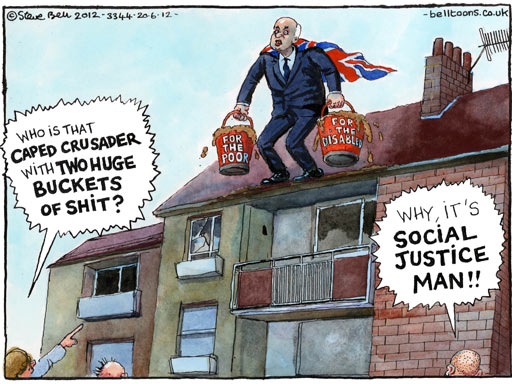
social justice manMany of us have said previously that the government’s ‘flagship’ policy, Universal Credit (UC), is about implementing further cuts to welfare support by stealth. However, the loss of income to disabled people through hidden cuts has been under-reported. 

Despite the systematic cuts to support that was originally calculated to provide sufficient support meet the costs of citizens’ basic living needs, UC is on course to deliver only marginal taxpayer savings despite driving through the huge cuts in benefit payments to many claimants, according to the Office for Budget Responsibility (OBR), last month.

Related imageDisabled people who qualified for the support component of income-related Employment and Support Allowance and (ESA) are also eligible for a disability premium. This is also called the Disability Income Guarantee. However, as a result of the abolition of both the severe disability premium (SDP) and enhanced disability premium (EDP) under UC rules, according to the disability charity, Scope, 

View original post 1,750 more words

Cold Weather Payment- Are You Eligible?

March 1, 2018

A Quarter Of British Paralympians Don’t Feel Cared About Finds Survey

March 1, 2018

A quarter of Britain’s leading Para-athletes do not feel cared about as a person, a recent survey has found.

The findings – obtained by the BBC – were part of a British Athletics ‘Culture Health Check’ feedback session at a World Class Programme weekend.

More than 80% of all athletes on the programme responded and received the results earlier this month.

Among several conclusions was that “athletes feel like a medal commodity and disposable”.

UK Sport has asked all sports to take part in a review of the culture across the high performance system after a series of athlete welfare scandals.

The findings also revealed:

  • 28% of athletes surveyed disagreed that feedback is valued
  • Not all (93%) are proud to be part of the programme
  • There was “disengagement between staff and athletes”
  • Stakeholder input was “low and negative”
  • Under a section titled ‘Mental Health’, the ‘interpretation of results’ included: “shocked at the amount of athletes that feel this way [not cared about as a person]”
  • A lack of information when it comes to classification and the need to “remove the fear of voicing your opinion”
  • Among suggested improvements was “external support – not British Athletics or the English Institute of Sport – but someone that is not invested in elite performance”

In November, MPs heard evidence of cheating in the classification system, with Paralympian Baroness Tanni-Grey Thompson testifying that athletes were threatened with non-selection if they spoke out.

A new code outlining the processes of classification of British Paralympians, allowing them to report alleged abuse of the system independently of their governing body, is set to introduced.

The survey also produced some positive findings. Athletes were told that 95% of them had agreed that the World Class Programme (WCP) “adds value” and that they were most proud of “how much [staff] care”, “positive feedback”, and a “willingness to improve the WCP”.

There are 49 para-athletes on the World Class Programme.

What do the governing bodies say?

In a statement, British Athletics said it “welcomed the implementation of the Culture Health Check” and that they were proactive in encouraging athletes to respond “as openly and honestly as possible”.

Athletes were “invited to a structured feedback session to explore some of the areas of negative feedback”, which was attended by three members of their newly-elected independent athletes commission.

A statement read: “While there was a wide range of positive feedback, we focussed this session on those areas identified as needing improvement.

“This reflects our continuing determination to remain a leader in developing productive engagement with athletes on our World Class Programme.”

UK Sport said they would “not be commenting on any aspects” of the results and criticised the fact that the findings were leaked.

“We have made the commitment to our athletes, sports, staff and stakeholders who are contributing to this work that the information they provide will remain absolutely confidential,” read a statement.

“It is disappointing that some have chosen to break this confidentiality and undermine the whole process of improvement we are undertaking through our work with sports.”

The emails that UK Athletics sent to athletes earlier this month informing them of the results contained no reference to confidentiality.

However, six-time Paralympic club throw and discus medallist Stephen Miller also said he was “disappointed” in the leak.

“Through the athletes’ commission and advisory group there are now official and robust channels through which athletes and coaches can voice their feedback, opinions, concerns and issues,” he tweeted.

“I’ve always felt incredibly lucky, proud and honoured to be part of the World Class Programme.”

F51 Paralympic and world club throwing champion Jo Butterfield said the meeting was “immensely positive”, while Hannah Cockroft, 15-time Paralympic and World gold medallist in T34 wheelchair racing, also spoke of her disappointment at the information being leaked.

“We as a team were most surprised about people not feeling cared about,” she said.

Man who ‘can’t leave house alone’, Jake Adey, found “fit” for work by DWP

February 28, 2018

Terminally Ill Man Fights Universal Credit In Court

February 28, 2018

Next month, a terminally ill man is set to take on the government – and with it, the disastrous universal credit (UC) policy. Known only as TP, a 52-year-old ex-City worker – who has non-Hodgkin lymphoma and the lymph node condition Castleman disease – is launching a landmark challenge at the high court after becoming financially worse off under the new benefit system.

This couldn’t come sooner. In October, I warned of the hidden cut within UC for disabled people: thanks to the abolition of both the severe disability premium (SDP) and enhanced disability premium (EDP). As a result, according to the disability charity Scope, the move to UC will see claimants lose as much as £395 a month. The outcome of the legal challenge could have widespread ramifications for 230,000 disabled people who it is estimated will be hit by the removal of disability premiums under UC.

The government says that disabled people will be protected by “top-up payments” as they transfer to UC but no such payments are planned until July 2019. The Department for Work and Pensions claims UC means support is focused on those “who need it most”, but a government removing SDP and EDP – benefits designed to help severely disabled people living without a carer – is pulling a safety net from citizens with the greatest needs. This includes disabled single parents who, without their benefits to pay for help to cook or wash, are likely to be forced to rely on their children as young carers. TP’s case shows this inhumanity in a nutshell. He discovered he was dying in 2016 and moved to London to receive treatment, but as it was an area where UC had already been rolled out in the capital, his benefits were cut by £178 a month.

It’s the political equivalent of kicking someone when they’re down. Disabled people are already hardest hit by austerity, especially when cash-strapped councils are increasingly charging them for their social care (a charge that can hit those receiving SDP even harder as they don’t have a family carer). Research from disability charity Scope this month finds disabled people have to pay on average an extra £570 a month for the costs of disability for anything from taxis to specialist food, with one in five paying more than £1,000 extra per month.

Since its rollout, UC has become synonymous with hardship, often heaped on the most disadvantaged families: from an increase in food bank use and rent arrears, to now one million children set to miss out on free school meals because of UC’s new earnings threshold. But the threat to disabled and chronically ill people has up until now gone largely under the radar. Yet severely disabled people will collectively lose £2bn in disability premium payments (a fraction of what the government is spending on UC’s delayed rollout). Or to put it another way, a mother with multiple sclerosis won’t be able to afford to put the heating on or pay for a carer to help her wash.

Launching a multibillion pound benefit system only to remove vital income from some of the poorest people in the country is a particularly warped use of public money – and a move that exemplifies just how low the Conservatives are willing to sink in their rush to gut Britain’s safety net. The campaign group, Disabled People against Cuts, is launching a national protest in responseon 1 March. As UC is hailed as the biggest reform to the welfare state since Beveridge, there’s a very real risk that its greatest achievement will be making more disabled people hungry and housebound. Led by one terminally ill man, the time has come to fight it.

A Poem About The Daily Fail

February 27, 2018

Longtime readers will know how much I hate the pile of scribble that I call the Daily Fail.

The poem below puts my thoughts on that so-called newspaper into brilliant rhymes- complete with a rather funny disability link!

Pregnant? – then you can wait for Universal Credit

February 27, 2018

suwn's avatarscottish unemployed workers' network

baby&#039;s bottle_000001

When Jan was 32 weeks pregnant she was told to move from ESA to Universal Credit. As a result, due to the delayed first payment, for her final weeks of pregnancy and early weeks of motherhood she will be on short rations. When Jan told us this we thought we should find out what was going on, and how many other new mothers might be affected. This is what we have learnt.

If you live in a Universal Credit Full Service area, as here in Dundee, then every new claim for a means-tested working-age benefit will be in the Universal Credit system.

If you are pregnant and on JSA, then you will have no choice but to change benefit. When you start getting maternity pay you are no longer looking for work, so no longer entitled to JSA. In the past you could apply for Income support; now, if you…

View original post 221 more words

DWP Presenting Officers Have Targets To Reduce Enhanced PIP And Support Group ESA Awards

February 26, 2018

With many thanks to Benefits And Work.

Disability News Service (DNS) has uncovered evidence that DWP presenting officers are required by their bosses to try to nobble as many enhanced PIP awards and ESA support group awards as possible.

In theory, presenting officers should act as a ‘friend of the court’, helping judges to reach a fair decision.

However, we warned back in March 2016 when the DWP was given £22 million to recruit new presenting officers:

“In reality, they will be sent by the DWP to try to discredit claimants and argue as forcibly as possible for the DWP’s interpretation of the law to be accepted.”

This latest evidence suggests that we were correct.

A freedom of information request by DNS resulted in them being sent forms that have to be completed by presenting officers after each tribunal they attend.

Included in the documents are the following questions for presenting officers attending ESA and PIP tribunals, respectively:

“PO impact – Was SG [support group] award averted”

“PO impact – was enhanced PIP award averted?”

DNS quotes a DWP insider as telling them that presenting officers are being given the ‘target’ of stopping enhanced PIP payments and that this was placing ‘immoral pressure’ on presenting officers.

As Benefits and Work revealed back in November 2017, presenting officers currently attend 23% of all first tier PIP tribunals, but the aim is to increase this to 50%.

It would seem likely that presenting officers are being used primarily to target claimants who are likely to be seeking enhanced rates of PIP or the support group of ESA. In which case their presence has nothing to do with improving decision making by feeding back to colleagues and everything to do with saving money.

The use of the public purse to provide presenting officers to tribunals under false pretences is a new low even for the DWP. It demonstrates once again that this is a rogue agency at war with the people it was created to support.

We hope that this revelation by DNS will help to undermine the credibility of presenting officers with tribunal judges, though we suspect their standing is already pretty low.

You can read the full story on the DNS website.

Did You Feel Pressured To Give Good Feedback On A PIP Or ESA Assessor?

February 26, 2018

With many thanks to Benefits And Work.

In recent reports on PIP and ESA assessments, the Commons Work and Pensions committee have been highly critical of private sector providers, but have also noted that ‘The PIP and ESA assessment processes function satisfactorily for the majority of claimants’.

This conclusion is based on figures provided by the DWP:

“In 2015/16, 76% of PIP claimants and 83% of ESA claimants surveyed were satisfied with the service they received from the DWP. All three contracted providers “consistently exceed” their customer satisfaction targets of 90% for PIP and 91% for ESA.”

However, one Benefits and Work member contacted us to say:

“After I left the examining room the assessor handed me a piece of paper and a pen. I had to mark if the process had been easier than expected, or less than satisfactory and so on. She leaned over the front of my buggy so that she could see what I was writing and my signature. She hadn’t yet processed my report so I was a very good girl and gave the nice lady the top score!”

We stress that this is the first time anyone has alleged to us that the collection of feedback by private sector assessors is anything other than entirely above board and we do not have any other supporting evidence.

But clearly, very few claimants would risk giving negative feedback if they knew that the assessor could read it before even completing their report on the claimant.

Such feedback would be of no value whatsoever and the action of an assessor in reading feedback even as it was being written could fairly be described as intimidatory.

Benefits and Work would be very interested to hear from readers about whether you were asked to give feedback and, if so, were you able to be certain that the document was confidential and wouldn’t be seen by your assessor?

Because, if the Work and Pensions Committee have been relying on statistics that are demonstrably untrustworthy, then they should know that.

You can comment below this article or email us at tech@benefitsandwork.co.uk We may quote from your email in a future article but we will not under any circumstances disclose your identity.

DWP Blames Brexit For Its Broken Promise On Sanctions

February 26, 2018

With many thanks to Benefits And Work.

The DWP has broken, or kicked into the long grass, a series of promises it made to the Commons Public Accounts Committee (PAC). One of these was a promise to trial issuing a warning before a first sanction which has apparently become a victim of Brexit.

Warnings
Last year the DWP made five promises to the PAC about improvements to sanctions. So far it has kept none of them.

The DWP agreed that it would “undertake a trial of warnings (rather than sanctions) for first sanctionable offences, as recommended by the independent Oakley Review and the Work and Pensions Select Committee.”

However, the DWP has now said it will not be doing this because:

“Competing priorities in the Parliamentary timetable mean that the legislative change that would be necessary to introduce a trial of this type cannot be secured within reasonable timescales.”

In other words the DWP are claiming that because of Brexit there is no space for legislation to allow for issuing warnings instead of sanctions.

In reality, there would be absolutely nothing to stop the DWP issuing a warning rather than a sanction in the first instance if they chose. New legislation would not be needed, just less harsh implementation of the sanctions regime.

More broken promises
The DWP has failed to meet other undertakings it gave to the committee.

The DWP agreed to work with other government departments to estimate the impacts of sanctions on claimants and their wider costs to government. The DWP have now said they will not do this because they have discovered they “do not have the capacity to undertake this activity.”

The DWP said they would look into why sanctions were imposed inconsistently by different jobcentres and providers and report back by the end of 2017. The DWP now says it will not finish its research until March 2018 and has not given a date when it will be ready to publish it. Past experience suggests that the research may not be published until so long has passed that the DWP can argue that its conclusions are now out of date and cannot be relied upon.

The DWP said it would look into how it could ensure that housing benefit is not stopped in error due to sanctions. The DWP now claims that it found no evidence that HB is ever stopped in error because of sanctions. Instead, they laid the blame on claimants who they say fail to return forms when their HB is suspended as a result of a sanction. As a result it will be taking no further action.

Further details of the DWP’s broken promises can be found in the Treasury Minutes Progress Report

Give A Fair Hearing To People Without Speech

February 23, 2018

The title of a letter published in yesterday’s Guardian, signed by 51 disabled people, parents and allies who all support the use of Augmentative and Alternative Communication. Our editor added her signature with pleasure and pride. This has always been a cause very close to her heart.

England CP Football Captain Jack Rutter Devastated As Rule Change Ends Career

February 22, 2018

England Cerebral Palsy captain Jack Rutter says he is “devastated” after a change to classification rules led to an immediate end to his career.

The 27-year-old, who also skippered ParalympicsGB’s cerebral palsy side, has accepted a coaching role with the Football Association.

Revised rules regarding the level of a player’s impairment have led to Rutter being classified as ineligible to play.

“It’ll affect teams around the world,” he told BBC Radio Gloucestershire.

“I’m absolutely devastated and I feel like I’ve lost a lot. I’m fairly fit still so I had at least another five years of playing in me.

“But I’ve got lots of opportunities available to me now and I just want to try and help the next generation now.”

Following research, the International Federation for CP football have amended the level of impairment required for a player to be eligible.

“Now any player who hasn’t got spasticity in at least two limbs is no longer allowed to play in the sport,” Rutter, who is from the Forest of Dean, explained.

“Normally that comes from cerebral palsy from birth, or from a stroke, so players who have maybe had a traumatic brain injury later in life, or if they’ve recovered well, may not be able to play any more.

“It’ll be interesting to see the impact around the world because some teams could be left with no team to field.”

Rutter, who had captained England since 2014, has an FA level three coaching badge and will now work with the England CP Under-21 team.

Formerly on the books of Birmingham City, his dreams of being a Premier League player were ended in 2009 when he fell victim to an unprovoked attack while on a night out.

“I was just about to become a professional footballer,” he recalled. “I actually fractured my skull in two places because I was hit, knocked unconscious, and then I fell and hit my head on a kerb.

“That caused a double skull fracture, moderate brain damage and also severed my cochlear nerve, which means I’m permanently deaf in my right ear.

“My balance and coordination was terrible and I was dizzy all the time. But because I’ve trained and worked at it, I’ve managed to turn my life around and I feel very fortunate and proud of what I’ve achieved.

“But unfortunately, it means I can’t play in the sport any more because I’m not as impaired as some of the other players. However, that’s testament to me and how well I’ve recovered, I think.”

In a statement on the FA website, chairman Greg Clarke said: “Jack has not only been an iconic player, but a role model and a credit to the Three Lions badge.

“His very presence in the England Cerebral Palsy team has helped raise the profile of disability football, and the players that participate, across the country and at all levels.”

Assessor: I’ll Google Your Condition

February 21, 2018

A Husband’s Complaint To ATOS After His Wife’s Face To Face PIP Assessment

February 20, 2018

Same Difference recently received the following on email. The claimant involved remains anonymous, but the letter is otherwise published word for word. If you have experience with this ATOS nurse, please do let us have your comments.

 Good Day,

I would like to  bring the handling of my Wife’s Atos assessment by Nurse Mathew Flis, to change over from DLA to PIP and Mobility to your attention, and make a complaint for the following reasons, along with credible evidence of malpractice, by this Atos Nurse.
,On March 7th 2017 my Wife had a face to face assessment with Atos Nurse, Mathew Flis, his report was fraudulent and misleading for the following reasons. In his report, which I have a copy of, he claims to have carried out a Musculoskeletal examination, his report contains a comprehensive  list of movement and grip capability tests, to have carried out the claimed examination would have required my Wife to climb onto and then lay on a examination table,this examination did not take place, due to the fact that my Wife never left her seat, and also due to her physical condition, she would have been unable to be subjected to the alleged tests.  l have sent a complaint to DWP along with Doctors letters and MRI Scan and X Ray Results that confirms her actual physical condition.   My Wife’s answers to his assessment questions were ignored  manipulated, an example of this is … he accepted that my Wife requires to have cooked food cut up for her, on her plate, he did not accept that to prepare a simple meal she would have to have hard raw vegetables cut up for her … ??? due to grip issues,she could not use an aid, and I always assisted her,Mathew Flis ignored this,   Most importantly, he was told that since my Wife sent in the PIP application, she had an accident dropping a dish of hot food in the Kitchen, as a result of this SHE NO LONGER COOKS AT ALL,   Mathew Flis also ignored this change of circumstance and it was not mentioned in his report, I sugest that the Mathew Flis report is fraud by representation, and influenced the decision makers. My Wife needed 12 points to qualify for high rate care she was awarded 11 ….. Her Mobility allowance was lost due to Mathew Flis  ignoring my Wife when she reported that due to her stumbling because her leg does not always respond, she needs my support for her safety, since her mini stroke she now  has balance issues, which makes her walking even more difficult, Mathew Flis lied about the distance my Wife is able to walk, 12 weeks after the assessment her Doctor confirmed in a letter that she does stumble, all letters, MRI Scan and Xray reports can be obtained from DWP, these letters and reports are credible proof of Mathew Flis did not carry out his assessment in a legally acceptable manner.
Twelve weeks after the Atos assessment  my Wife saw  her Doctor ( Dr Robbins Marazion ), , after an examination Dr Robbins was  concerned by her painful condition, and movement restrictions,he confirmed that she had significant problems,( My Wife’s Doctors qualified assessment proves that Mathew Flis had beyond the balance of probability falsified his report )   he then arranged for X Rays,  Due to the X Ray report  he arranged for a MRI Scan, and referred her to a Neuro Surgeon, both Dr Robbins ( Marazion Surgery ) and Consultant Neuro Surgeon Mr Sam Muquit (Derriford Hospital Plymouth ) were appalled by the claimed Atos Nurses Musculoskeletal report and agreed the claimed Atos examination could not have taken place. Was this Nurse medically Qualified ?,  Does he have a code of practice to Follow ?  Atos is under contract to DWP, is this practice acceptable ?
In 2006 My Wife had a review, which involved a home visit and assessment by Atos Dr Malic  as a result of his report, My Wife was upgraded from low care to high rate, both components were awarded for an indefinite period, as her conditions are degenerating, some 12 years later Atos Nurse Mathew Flis’s assessment does not reflect on how my Wife’s condition would beyond the balance of probability have seriously degenerated. Both Doctor Robbins and Consultant Neuro surgeon Mr Sam Muquit  will confirm that my Wife’s Disabilities have indeed seriously worsened. Was Nurse Mathew Flis basing his assessment on his opinion or medical fact ?, MRI Scans and XRays taken shortly after the Atos assessment show a serious conflict in Mathew Flis’s claimed Musculoskeletal test, and my Wife’s Actual physical condition.
Due to the misrepresented Atos report, In March 2017 my Wife was reduced from High rate Care to Standard rate, she lost her Mobility allowance and her Blue Badge.
My Wife was devastated by these decisions and loss of her much needed Blue Badge, losing the Badge would seriously effect her quality of life, Due to the stress and anxiety of the decisions, and the prospect of having to attend an appeal tribunal, in May 2017 my wife suffered a Mini Stoke, her stroke consultant Dr L Wesson ( Royal Cornwall Hospital ), said that this stress and anxiety was most certainly the cause, The Mini Stroke has been life changing,  she now suffers with balance, mood and speech issues, the brain damage shows on her MRI Scan.
As a result of the support and medical evidence supplied by her Doctor, in June she received a phone call from PIP in Blackpool, a lady named Karen informed us that my Wife would now receive Standard rate Mobility, Karen also stated, that should my Wife appeal for high rate, she may well loose both components, we regarded this as a threat. Due to the risk of more stress my Wife agreed under duress.
In October my wife had a consultation with Consultant Neuro Surgeon Mr Sam Muquit, he carried out an examination and the MRI Scan was shown to us, he concluded that an urgent operation is required on her spine, however due to concerns of risks involved and the fact that she could well have a major stroke during the operation, due to her having to stop taking her blood thinning stroke prevention medication for days before the operation,  he thinks it would be unwise to proceed, the outcome of not having the operation, will eventually result in my wife needing a wheelchair.
Due to the Malpractice by the Atos Nurse Mathew Flis  my wife has suffered physical and financial loss, and is left in need of a operation on her spine that she now cannot have.  This is a serious matter, taking into consideration the medical evidence along with X Ray and MRI Scan results from my Wife’s Doctor and the Consultant Neuro Surgeon, this evidence proves beyond the balance of probability, that Atos Nurse Mathew Flis carried out the face to face assessment Fraudulently,  I will be seeking Redress for the Brain Damage and Financial loss my Wife has suffered, I intend to take legal action against Mathew Flis the Atos Nurse, for breach of the Fraud act 2006 / Misconduct in Public Office, he may well say he was Under Instruction, so I am approaching Atos first.
Both Doctor Robbins and Consultant Mr Sam Muquit have offered their full support regarding this complaint and my seeking Redress, My local MP Derek Thomas ( St Ives ), is also in receipt of this complaint letter.   The lateness of this complaint is due to health issues last year and Stress Limitation, and also awaiting X Ray and MRI Scan results, plus the consultation with the Consultant Neuro Surgeon in October. We are now going to give Mathew Flis and Atos a chance to resolve this, before taking this matter to Court. It is also our intention to Take legal action against DWP Decision makers Linda George and Anna Rushton.
 I will look forward to a quick and satisfactory response, and hope that my Wife will receive full recognition of this injustice, and she will now be treated in fairness and will receive Redress for the Stress and Consequence of that Stress and Anxiety Caused by Atos Nurse Mathew Flis.
   PS  A copy of this will be posted to  Atos customer relations, to create a paper trail to back this    email.
   A  complaint has also been sent to DWP.

World’s First Para-Football National Association Launched In Scotland

February 20, 2018

The world’s first national association dedicated to Para-football is to be created by the Scottish Football Association.

It will also invest more than £100,000 to help grow and run the game.

The governing body’s Para-football and equalities lead hailed the move.

“We’ve decided to give the individual organisations funding to allow them to have ownership of their leagues, their competitions and development of their own game,” David McArdle said.

“There’s no better way to make sure that inclusivity and equality is being embedded in your game than to have them sitting at the same table as everybody else.”

The new affiliated national association will unite a broad range of groups – amputee, cerebral palsy, deaf, frame, learning disability, mental health, powerchair, dwarfism, blind and visual impairment football.

Its launch announcement is being made at the inaugural Scottish Para-football conference, held in Largs on Sunday.

It hopes to level the playing field by sitting the disability organisations alongside other Scottish ANAs to give them a stronger voice and promote meaningful development.

“In Scotland, you have the youth game, the women’s game, juniors, amateurs, welfare and SPFL, but there is a gap for Para-football and disability sport in general,” McArdle told BBC Scotland.

“The SFA in the past have created the leagues and have set them up and helped the clubs develop, but really what we’ve found is that we don’t have the expertise of how they want their game to run.

“Players should always be at the forefront of everything that the SFA does, so the players will be closer to how the leagues are run, closer to their committees and able to say they want more or less league days and where they should be run.

“In the past, the SFA made those decisions for them, which for the benefit of the game is not correct, so that’s what we’re trying to do with this funding.”

The move is part of the SFA’s One National Plan, the grassroots football strategy launched in 2017 aimed at empowering players and volunteers, encouraging social change, inclusivity, equality and health.

It is thought to be the first time a nation has brought together the various organisations and McArdle says it is for the good of the Scottish football.

“In the past, all they had was training, training ever week with nothing to look forward to at the end of it,” he explained.

“Now, with over 24 competitions in place, the players have something to look forward to, to look over the other side of the pitch and see another strip that they’re playing against and have that competition element – and have what everyone else in the game just takes for granted.

“The football is always going to be serious. It doesn’t matter whether you’re playing five-a-side with your friends or playing in a professional or amateur league.

“The game is always competitive, so we want to allow opportunity for that to take place.”

Nyle DiMarco’s Tweets Spur Deaf People To Share Cinema Frustrations

February 20, 2018

Deaf actor and model Nyle DiMarco has taken to social media to share his dissatisfaction with the captioning of a screening of Black Panther on Sunday.

In a series of tweets Mr DiMarco explained how he walked out of the showing after feeling “so disabled” when the “awful” captioning device on offer “kept skipping lines” and “missing scenes”.

Hundreds of deaf people responded to his posts with their own stories of cinema annoyances.

Mr DiMarco, who won America’s Next Top Model and Dancing With the Stars, criticised the closed captioning system which displays subtitles to individual theatre-goers.

In the UK open captioning, which displays subtitles on the main screen, is much more prevalent.

Mr DiMarco added he felt “disappointed” by his experience and suggested cinemas were “basically for able-bodied people”.

Deaf actress Shoshannah Stern was among the hundreds who responded to share their irritation at the issues faced by deaf cinema-goers.

Ms Stern explained captions for the hearing-impaired are sometimes surreally at odds with the action on screen.

Nyle DiMarco regularly uses his social media following to draw attention to deaf issues, including teaching American Sign Language to his 1.5m Instagram followers and 63,000 YouTube subscribers.

Many Twitter users responded to Mr DiMarco’s tweet to explain issues of accessibility and captioning have stopped them attending the cinema all together.

One person said their faulty closed-captioning devices made them leave the cinema, while another replied they had given up on cinemas and would wait for a film’s DVD release,

Others called for more cinemas in the US to use open captioning.

While some pointed out that in the UK open captioning is used more often, the availability of showings was questioned by some.

The cinema chain involved responded to Mr DiMarco’s tweet stating they take issues such as this very seriously and asked the model to contact them.

More Than 1M Benefits Sanctions Imposed On Disabled People Since 2010

February 19, 2018

Disabled people receiving state benefits have been hit with a million sanctions in less than a decade, according to alarming new evidence that they are being discriminated against by the welfare system.

A comprehensive analysis of the treatment of unemployed disabled claimants has revealed that they are up to 53% more likely to be docked money than claimant who are not disabled. This raises serious concerns about how they and their conditions are treated.

The findings, from a four-year study by academic Ben Baumberg Geiger in collaboration with the Demos thinktank, will cause worry that a government drive to help a million more disabled people into work over the next 10 years could lead to more unfair treatment.

Sanctions – the cutting or withholding of benefits – are applied as a punishment when claimants infringe the conditions of their payments by, say, as missing appointments or failing to apply for enough jobs.

While the sanctions regime has been championed by the government as a means of encouraging people to take a job or boosting their chances of finding one, most experts consulted as part of the Demos project concluded that conditionality has little or no effect on improving employment for disabled people. There was also widespread anecdotal evidence that the threat of sanctions can lead to anxiety and broader ill health.

The study found that disabled claimants receiving jobseekers’ allowance – given to people who are out of work – were 26-53% more likely to be sanctioned than claimants who were not. Those hit by sanctions reported that the disparity arose because jobcentre staff failed to take sufficient account of their disabilities.

However, a spokesman for the Department for Work and Pensions said it did not recognise these figures: “If someone has a health condition, we work with them to reduce what they need to do, and people are always supported to meet the requirements of a tailored claimant commitment, which they agree with their work coach. This sets out what is expected of them in return for the support they will receive. Sanctions are only used when someone has failed to meet these requirements without good reason – this is in a minority of cases and people are given every opportunity to explain why they have failed to do so before a decision is made.”

The new study found that more than 900,000 JSA claimants who report a disability have been sanctioned since May 2010. People who claim a different benefit, employment and support allowance, and have been placed in a work-related activity group – which requires them to attend jobcentre interviews and complete work-related activities –can also be sanctioned. The research found that more than 110,000 ESA sanctions have been applied since May 2010.

The findings have caused alarm among charities, many of which have dealt with cases in which disabled people complained of poor treatment and a lack of understanding.

Mark Atkinson, chief executive at disability charity Scope, said: “Punitive sanctions can be extremely harmful to disabled people, who already face the financial penalty of higher living costs. There is no clear evidence that cutting disabled people’s benefits supports them to get into and stay in work.

“Sanctions are likely to cause unnecessary stress, pushing the very people that the government aims to support into work further away from the jobs market.”

Polling for the Demos project found that while the public often supported the imposition of sanctions for disabled people, they did not back the way in which they were applied in practice.

A majority thought that disabled people’s benefits should be cut if they do not take a job they can do, but they were less supportive of sanctioning for minor noncompliance, such as sometimes turning up late for meetings. Even those who supported sanctions preferred much weaker punishments than those the government uses.

The research recommends a reduction in the use of so-called “benefit conditionality” for disabled people and a strengthening of the safeguards to ensure disabled people are not unfairly punished.

Polly Mackenzie, director of Demos, said it was now clear that the benefits system isn’t working for disabled people: “Conditionality is important in any benefits system, but when disabled people are so much more likely to be sanctioned, something is going wrong. Jobcentre advisers and capability assessors too often have a culture of disbelief about disability, especially mental illness, that leads them to sanction claimants who genuinely could not do the job they are being bullied into applying for.

“We need to think again about how we assess work capability. Employers also need to be better at adapting to disabled people’s needs so that more jobs can be done by people with fluctuating conditions.”

This follows a damning report by the National Audit Office in 2016, which found that there was no evidence that sanctions were working. It also found a failure to measure whether money was being saved, and that the application of sanctions varied from one jobcentre to another.

Nina Grant has Ehlers-Danlos syndrome, a genetic collagen defect that causes chronic pain, fatigue and frequent joint injuries. She was sanctioned in 2016 after she informed the Department for Work and Pensions that she was carrying out what the department specifically describes as “permitted work” while on disability benefits. “I only found out about the sanction when I checked my bank balance and realised the payment hadn’t gone in as usual.”

After she complained, her benefits were reinstated. “They didn’t apologise. They didn’t offer any explanation. If I hadn’t called them, it could have gone on for months. It made me feel like I was being punished for trying to contribute while disabled, and scared that they were going to use that as an excuse not to pay me.”

The Londoner is reliant on a wheelchair outside her home, and finds it extremely painful even to use a pen most days. “I understand that people exploit the system, but this government treats disabled people with utter contempt.”

Ten years ago Josie Evans was working as a nurse when she suddenly went into anaphylactic shock. After 41 further life-threatening attacks, she has been diagnosed with idiopathic anaphylaxis, which means she is extremely allergic to more than 100 antigens and triggers.

She relies on disability benefit to pay her rent and buy food but was sanctioned in 2016 after failing to send in a form on time: “The document was 20 pages long and I was in too much pain to write, because my hands were swollen from a recent allergic reaction I’d had.”

She explained this and was told she could take her time. Ten days later, a letter arrived from her landlord saying her housing benefit had not been paid. She discovered all her disability benefits had been stopped because the form had been late. “I was scared. I knew I’d need to buy food in the next 48 hours, and I can’t use a food bank because of all my allergies.”

It took weeks for her benefit to be reinstated, and she had to borrow money from her family. “It was so stressful it brought on an allergic attack. The people who work at the DWP simply do not understand the reality of what it’s like to be disabled. There is no room for compassion.”

Riding Everest-A World First

February 19, 2018

In April 2018, join Max and an expedition team of friends, family and supporters as we attempt to reach Everest Base Camp to raise funds for the Riding for the Disabled Association.

Max, who has cerebral palsy, will be leaving the electric wheelchair he relies on daily in Kathmandu and swapping to a Nepalese horse for the ascent up to Base Camp with a team of supporters walking alongside. 

This trek will be a world first. 

Fining Disabled Parents For Lateness To School Solves Nothing

February 16, 2018

Am I a bad mother because my son misses the morning register sometimes? The odds that I find myself up against certainly make it seem so, as I am being taken to court by my local authority. While I was taught to be respectful of other people’s time and would like to teach my son the same, sometimes it’s not that easy.

I have a condition called pseudoachondroplasia. This means I have restricted growth. Standing at 3ft 6in, I have misalignments of my knee and hip joints and a curvature of the spine. All of this significantly affects my mobility.

Sadly, the lateness doesn’t reflect my efforts. Some mornings I limp from my bed to the car, push through the pain and apologetically arrive flustered and anxious at my son’s school gate at 9:15am. The resulting late marks from missing the morning register have added up and my attempts at an appeal have been turned down.

A £410 fine later, I will find myself in front of a magistrate next week for an expensive slap on the wrist. Despite his being about 10-15 minutes late some days, my son’s attendance is very good and he is achieving well. I am a single mother with no support network and the little family we do have all work full-time.

The fine feels extremely unfair. Is it going to alleviate me of my physical limitations? It is far more likely to drag us further away from a solution by infringing considerably on my mobility costs. 

I am not arguing that there should be one rule for me and another for everybody else, nor am I wanting sympathy. This is simply the reality for many single parents who live with a disability. For many, this topic is dangerous territory for fear of being accused of “playing the card” and for fear of the assumption we’re not “coping”. After all, much of our battle for equality has been based around the insistence that wider society acknowledges our abilities.

But sometimes it just takes one person to drop their pride and admit they are struggling, before others come forward too. Maybe it will take something like this to open that difficult dialogue, to reaffirm it’s OK to admit you’re finding something difficult, to in turn effect change instead of judgment.

Is equality achieved by treating disabled people like everybody else? In many circumstances, yes. But equality is not achieved by ignoring someone’s limitations. I’d like policymakers to consider disabled parents. Like many solutions, this one costs money. Schools can only do so much. At present, there is funding which provides respite for parents of disabled children. It doesn’t factor in that one day these children will grow up and have families of their own, like me.

Disabled parents deserve to have equal rights to access services. Not be fined and told to get on with it. 

Publicising my story attracted a backlash. Many asked why I didn’t “just get up earlier”. Presumably they’ve not experienced what it is like to live with chronic pain. It is sporadic and unpredictable, not something you can plan around.

Each of us can make a difference. There’s a mother and dear friend who goes out of her way to drop my son home when I’m physically depleted. There’s my neighbour who has started scraping the ice off my windscreen in these winter months because you noticed I cannot reach and that it sets me back a further 10 minutes, thank you. Thank you for being part of the solution and not the problem.

We have a long way to go before disability is really understood. It’s time we started empowering disabled parents, so that we can continue doing one of the hardest jobs in the world: raising our children without judgment. Schools, educational welfare officers and voluntary services should all work together towards a common goal: ensuring our disability doesn’t impact negatively on our young before it is too late. After all it takes a village to raise a child.

Blue Badge Thefts In England Quadruple In Four Years

February 15, 2018

Thefts of parking permits for disabled motorists have more than quadrupled in four years, according to new figures.

Official statistics show there were 2,921 blue badges reported stolen in England during 2016-17, a rise of 14% on the year before.

It compares with 656 stolen in 2012-13.

The Local Government Association (LGA) said fraudsters were “robbing” disabled people of their independence but added councils had successfully prosecuted more than 1,100 people in 2016-17.

Department for Transport data showed that councils in London had the highest rate of thefts of blue badges.

In Islington 196 badges were stolen in 2016-17, equivalent to 26 in every 1,000.

Blue badges allow disabled people to park for free in pay and display bays and for up to three hours on yellow lines.

In London, badge holders are exempt from the congestion charge saving them around £2,500 a year.

The LGA said more than two million disabled people use blue badges.

It said fraudsters had been prosecuted by councils for using stolen or lost badges and using relatives’ badges “in order to scam free parking to go shopping or travel to work”.

There were 1,131 successful prosecutions for blue badge fraud in 2016-17, up from 535 in 2013-14.

LGA transport spokesman Councillor Martin Tett said: “Theft of blue badges is clearly a crime on the rise and it is alarming that incidents have risen by more than 40% in just two years.

“Blue badges are a vital lifeline that helps disabled people get out and about to visit shops or family and friends. Callous thieves and unscrupulous fraudsters using them illegally are robbing them of this independence.”

PIP Assessors Get £50 Bonuses For Meeting Targets Says Whistleblower

February 14, 2018

And a blind man was told his white stick isn’t an aid:

DWP’s Valentine’s Tweet

February 14, 2018

Committee: PIP, ESA Trust Deficit Fails Claimants And The Public Purse

February 14, 2018

A press release:

In a report published today, Wednesday 14 February 2018, the Commons Work and Pensions Committee says public contract failures have led to a loss of trust that risks undermining the operation of major disability benefits.

Rt Hon Frank Field MP, Chair of the Committee, said:

“For the majority of claimants the assessments work adequately, but a pervasive lack of trust is undermining its entire operation. In turn, this is translating into untenable human costs to claimants and financial costs to the public purse. Government cannot, must not, fail to recognise the unprecedented response the Committee had to this inquiry, remarkable for the consistency and clarity of themes that emerged through thousands of individual accounts. No one should have any doubt the process needs urgent change.

“Recording the face-to-face assessment would go so far toward increasing transparency and restoring trust it beggars belief that this is not already a routine element of the process. The resistance from the Department to instituting this is equally bewildering. The cost of providing a record of the assessment is surely nothing compared to the benefits of restoring trust. Those benefits should include far fewer decisions going to appeal – and being overturned there – at considerable legal expense to taxpayers.

“The current contracts have not made the system fairer, have not made it more transparent and have not made it more efficient. They are up for review, and market interest appears limp. The existing contractors have consistently failed to meet basic performance standards but other companies are hardly scrambling over each other to take over. The Government should be prepared to take assessments in house.”

Efficient, consistent and objective?

The decision to contract out PIP and ESA assessments in the first instance was taken to introduce efficient, consistent and objective tests for benefit eligibility. The Committee says it is hard to see how any of these aims have been met. None of the providers has ever hit the quality performance targets set for them, and many claimants experience a great deal of anxiety and other deleterious health impacts over a process that is regarded as “opaque and unfriendly” throughout. Successive evidence-based reviews done for DWP show a pervasive culture of mistrust around PIP and ESA processes, with concern about the face-to-face assessment by a health professional at its core.


The Committee recommends DWP:

– Immediately institute recording of face to face assessment and provide a record and a copy of the assessors report to claimants

–  Take measures to improve understanding amongst health and social care professionals, and claimants, of what constitutes good evidence for PIP and ESA claims, and to ensure this evidence is used effectively by contractors;

– Set out how it will measure, monitor and report on the supply of evidence into PIP and ESA assessments

-Improve accessibility of the process at every stage: from the format and style of the application form, to information about home visits, to information about accessing  reconsideration and appeal

 -Improve its use of contract “levers” to improve contractor performance   – and quality control via feedback through the claim process, including feedback from the appeal stage


No dog, can’t walk, or – How did you catch Down syndrome?

On Friday last week the Committee released a report compiling some of the thousands of individual claimants’ experiences of the PIP and ESA claims process – from application form to final appeal. The response to the inquiry was unprecedented – in sheer volume, by an order of magnitude – and composed of accounts that were shocking and moving, credible and consistent. A recurrent, core theme   – that claimants do not believe assessors can be trusted to record what took place during the assessment accurately – has implications far beyond the minority of claimants who directly experience poor decision making.


For the record 


The case for improving trust through implementing default audio recording of assessments has been strongly made: the Committee says DWP should implement this measure for both benefits now. In the longer term, the Department should look to provide video recording for all assessments.


DWP attests that the most common reason for decisions being overturned at Appeal is that new evidence has come to light. Organisations that support claimants say this is sometimes true, but the “overwhelming reason” for revised decisions is the full consideration of pre-existing evidence.  DWP’s own data shows that this “new evidence” is most often oral evidence provided by the claimant. In many cases this evidence could have been gathered at the initial assessment. The Department’s “lack of determination” in addressing this shows real weaknesses in its feedback to, and quality control over, contractors, which must be urgently addressed.


Overall costs to taxpayer

On Monday the Press Association published a Freedom of Information response giving a breakdown of some of the wider, systemic costs of wrong decisions. The Committee has previously published a table of the cost of benefits tribunal appeals to the Ministry of Justice – MoJ itself attributes the starkly increased costs to PIP appeals and their complexity – but was surprised to learn of the existence of the figures provided to PA, which it had previously requested. The Chair has written to  Secretary of State Esther McVey asking for an explanation of the discrepancy.

The definition of an “acceptable” report leaves ample room for reports riddled with errors and omissions. Despite this low bar all three contractors have failed to meet their key targets in any single period.  The PIP contracts set targets for contractors to deliver fewer than 3% “Unacceptable” reports. Neither PIP contractor has met the 3% target to date in any rolling three month period. In Capita’s case, as many as 56% of reports were found to be unacceptable in the rolling period February to April 2015.

The Department’s use of financial penalties to try to bring reports up to standard has not had a consistent effect. Large sums of money have been paid to contractors despite quality targets having been universally missed. The taxpayer has spent hundreds of millions of pounds more checking and defending DWP decisions based on the contractors’ reports – not least in externalised costs in the Tribunal appeal system.

The Committee says DWP must consider whether the market is capable of delivering assessments at the required level, and of rebuilding claimant trust. If it cannot—as floundering market interest may suggest—the Department may conclude assessments are better delivered in house

Not All Assessors Are Cruel-A Positive Tale

February 13, 2018

BlueAnnoyed's avatarblueannoyed

We have all heard the horrible accounts of claimants suffering at the hands of the DWP, the endless distress it causes many cannot be minimised or the deaths that have occurred primarily amongst those with Mental Health Conditions. When I had the offer of a claimant to give me access to a assessment that was recorded I jumped at it. I made a promise not to disclose their ID or personal information under DPA. Many will know the dread filled moments of the’ brown envelope syndrome of the dreaded ‘WCA’ assessment coming through the letterbox.

However the questions I felt would be worth documenting  for the many who face this barbaric process and I’m glad I did as for once, this would give an insight into the type of things a claimant was asked, rather than hearsay on social media.The claimant was assessed by a Nurse who gave her name…

View original post 421 more words

DWP Spent £100m On Disability Benefit Appeals, Figures Reveal

February 12, 2018

The Department for Work and Pensions (DWP) has spent more than £100m in just over two years on administering reviews and appeals against disability benefits, figures show.

Tens of millions of pounds a year are also spent by the Ministry of Justice on the appeals, about two-thirds of which were won by claimants in the past 12 months.

The costs were described as “staggering” and a former Conservative minister said “something is seriously wrong with the system”.

The DWP said a small proportion of decisions were overturned and most employment and support allowance and personal independence payment claimants were happy with their assessments.

But the department is facing questions from the work and pensions select committee over the figures, following claims that it was not given similar information for MPs’ inquiry into PIP and ESA.

Figures obtained through a freedom of information request show the DWP has spent £108.1m on direct staffing costs for ESA and PIP appeals since October 2015.

The amount covers mandatory reconsiderations, an internal DWP review and appeals to tribunals run by HM Courts and the Tribunals Service.

Neil Heslop, the chief executive of the disability charity Leonard Cheshire, said: “To spend this amount on admin fighting to uphold flawed decisions that shouldn’t have been made in the first place is staggering.

“Thousands of disabled individuals have had to fight to receive support to which they are legally entitled.”

Since October 2015, 87,500 PIP claimants had their decision changed at mandatory reconsideration, while 91,587 others won their appeals at tribunal.

In the first half of 2017-18, 66% of 42,741 PIP appeals went in the claimant’s favour.

The figures for ESA since October 2015 show 47,000 people had decisions revised at mandatory reconsideration and 82,219 appeals went in the claimant’s favour.

So far in 2017-18, 68% of 35,452 ESA appeals have gone in favour of the claimant.

Ros Altmann, a Conservative peer and former DWP minister, said the money could be spent on benefits for those who need them, rather than the costs of fighting claims.

“Disability benefits need an overhaul and, of course, we must not let people make bogus claims, but the extent of the appeals we are seeing clearly indicates that something is seriously wrong with the system,” she said.

Figures released to the select committee inquiry show further costs to taxpayers.

The Ministry of Justice spent £103.1m on social security and child support tribunals in 2016-17, up from £92.6m the year before.

In a letter to the committee, the then justice minister Dominic Raab said the average cost of an appeal had more than doubled to £579 in 2014-15 because PIP cases “now comprise a much larger proportion of the caseload” and require more members on the tribunal.

The MPs are due to publish the results of their inquiry on Wednesday.

Frank Field, the committee chairman, has written to Esther McVey, the work and pensions secretary, to ask why MPs were not given the information.

The DWP gave the committee the average cost of a mandatory reconsideration and appeal for PIP and ESA, but Field said it was unable to work out the full cost because information on whether PIP appeals were from new claimants or those being reassessed, which have different costs, was not available.

“That this data was provided in response to an FoI request, but not for our report, is doubly regrettable, since the key theme of our report is the need to introduce much greater trust and transparency into the PIP and ESA systems,” Field wrote.

A DWP spokeswoman said it was working to improve the process, including recruiting about 190 officers who will attend PIP and ESA appeals to provide feedback on decisions.

“We’ve already commissioned five independent reviews of the work capability assessment, implementing more than 100 of their recommendations, and two independent reviews of PIP assessments,” she said.

“Meanwhile, we continue to spend more than £50bn a year on supporting people with disabilities and health conditions.”

Huge Fall In PIP Medical Evidence Requested By Capita

February 12, 2018

With many thanks to Benefits And Work.

Disability News Service is reporting that there has been a huge fall in the number of requests that Capita makes for further medical evidence when assessing claimants for personal independence payment (PIP).

Capita and Atos are expected by the DWP to ask for further medical evidence from GPs, consultants, mental health nurses and other health professionals, where this is needed in order to properly assess a claim.

Additional medical evidence can make a huge difference to whether a claim succeeds or not and is frequently a deciding factor at appeal tribunals.

The expectation by the DWP prior to PIP being launched was that further evidence would be collected in about half of all cases.

However, DNS has obtained DWP documents showing that further evidence was collected by Capita in fewer than 2% of cases in June and July 2016.

The documents show that there was a dramatic drop in the number of requests for evidence by Capita from 69% in January 2016 to just 1.8% in June 2016.

Capita have offered no explanation for this extraordinary fall.

The claims by DNS of a huge fall are backed up by figures given in a parliamentary response by Sarah Newton, minister for disabled people. These show that Capita made the following requests for further evidence:

2015 94,390

2016 48,240

2017 20,902

The figures suggest that Capita’s performance may have worsened even further since 2016.

Meanwhile Atos (now known as IAS) asked for further evidence in only 5-6% of cases in January to July of 2016, but this had risen to as high as 13% by December 2016, according to DNS.

The figures given by Sarah Newton for requests for further evidence by Atos also show a rise over time:

2015 51,166

2016 58,979

2017 98,084

Collecting further medical evidence slows down the process of assessing PIP claims and costs money. It also adds considerably to the likelihood of correct decision being made, probably at the initial claim stage and undoubtedly at appeal stage.

The fact that further evidence is collected on so few occasions and, where Capita is concerned, in a rapidly declining proportion of cases, raises further doubts about the fitness for purpose of the entire PIP process.

You can read the full story on the DNS website.

PIP And ESA Assessments: Imaginary Dogs And Claimants Catching Downs

February 12, 2018

With many thanks to Benefits And Work.

The Commons Work and Pensions committee has produced a damning report about PIP and ESA assessments based on evidence they have received from almost 4,000 claimants. The document includes tales of imaginary dogs, claimants catching Down’s syndrome and assessor’s equipped with x-ray vision. The DWP, however, have already dismissed the findings as founded on anonymous evidence.

The committee said that the individual responses were ‘the most ever received by a select committee inquiry, by an order of magnitude.’

The MPs were clearly convinced of the honesty and accuracy of the responses, stating:

“The unprecedented response was also remarkable in the consistency of the themes that emerged through the honest and often distressing accounts from thousands of people navigating the claims process, alongside, of course, managing their disability and mental health issues.”

The report covered a very wide range of issues.

There were examples of reports that contained basic errors of fact, including inventing dogs where none existed:

“Apparently I walk my dog daily, which was baffling because I can barely walk and I do not have a dog!” Nikki

“She wrote I arose from the chair without any difficulty. I was in bed the whole time (she let herself in) and I only have the one chair in the room and she was sitting in it. She said that I had no difficulty reading with my glasses yet I do not wear glasses to read.” Mary

“The report we received was a work of fiction and bore no resemblance to what actually took place [ … ]. For example the assessor said my husband took off his jacket with my assistance. My husband did not wear a jacket that day. The assistance I gave with his clothing was to help him put on his socks and shoes although no mention was made of this. Timings were wrong, names were wrong, information was wrong, relevant things that happened were not mentioned while things that did not happen were invented.” John

Physical examinations were often misrepresented by the health professional, who were sometimes apparently equipped with x-ray vision:

“One assessor said I had full movement in my toes although the podiatrist said at the time it was only 20%. I still can’t work out how she could tell considering I was wearing leather winter boots which she did not ask me to remove.” Watson

“Born with severe Talipes. Assessor said he “knew all about Talipes, [so] don’t need to examine foot” [ … ] Report stated 50 degrees plantar flexion, which would be normal. Actual degree is less than five. A difference of 90%. Could have been solved by his examining my foot.” Siobhan

“She stated that a physical examination had been done, but I did not move from my chair, so she could not examine my spine which she stated was normal, nor get an accurate range of limb and joint movements. The latter were given in degrees on the report. No measurements were taken. Even a physiotherapist would struggle to give this degree of accuracy without using a measuring device.” Name withheld17

“The assessor’s report [ … ] listed a full A4 page of exercises, angles attained and their conclusions. [These were] allegedly done at the assessment, none of which were done. [This included that I had] laid down when I had never been out of my wheelchair nor my thick winter coat the whole time [ … ] raising my arms, attempting and failing to get my arms behind my head and back, and rotating my ankles, again something haven’t been able to do successfully for years.” Gee

Assessors Lack of knowledge of their condition was also a concern for some claimants:

“Some of the assessors, both ESA and PIP, need more insight and training with regard to people with learning difficulties. Below are questions that parents have been asked at the assessments; How long have they had Down’s syndrome for? When did they catch Down’s syndrome? When were you diagnosed with Down’s syndrome? Down’s syndrome is a widely recognised learning disability. If an assessor is being asked to assess someone with a condition that they do not know about, common sense and courtesy should tell them to research the condition before starting the assessment. We therefore believe that more training is required in some cases.” Down’s Syndrome Association

“The assessment itself was brief, and the assessor had no knowledge of my condition. She said not to worry, she’d Google it later. The report was incorrect. The assessor asserted that my gait is normal, but I’ve had a limp since 2005, and use crutches from the physio to try to straighten my walk [ … ] She also said I have normal spinal movement—I haven’t, partially because of pain, partially due to the metal cage round my lumbar vertebra. The list goes on.” Ceri

The use of ‘informal observations’ in which the assessor reaches conclusions based on a claimant’s appearance and behaviour also came in for heavy criticism:

“I was judged on superficial characteristics like my demeanour on the day which aren’t indicative of my internal mental state whatsoever. In early stages of mania, I appear happy and confident and my behaviour gradually becomes more extreme over the course of weeks. Severe mood episodes are episodic, but even between them, my mood is problematic and hard to cope with. No concession to the variable nature of my illness was taken into account.” Nick

“The assessor said in the report something to the effect that my mental health wasn’t an issue as I had smiled during my assessment. At the time of my assessment I was highly suicidal.” Amanda

“The assessor stated that I was “well kempt [sic]”. However, I had not managed to wash my hair for over a week due to my impairments, and she failed to note that I was only wearing two items of clothing, and was spaced out on my prescription controlled drug.” Name withheld29

“The assessor stated in her report “no signs of sore hands” “no signs of repeated washing” “was well groomed” “was well dressed”. Anyone with a brain cell knows mental health isn’t always visible, and OCD isn’t all about excessive washing of the hands! OCD is known as a secretive disorder at the best of times and people in that profession should know better when it comes to mental health.” Chad

“The assessment was done by a general nurse with no mental health training. He concluded that, since I did not appear to be stressed, anxious or show any mental health issues during the assessment, it was “unreasonable to believe” I had mental health issues [ … ] The stress of the interview actually got me admitted to hospital the next day.” Sarah

The Work and Pensions committee made a wide range of recommendations for further investigation by the DWP of the problems claimants experience.

They also paid tribute to the bravery of claimants in submitting evidence:

“The PIP and ESA assessment processes function satisfactorily for the majority of claimants, but they are failing a substantial minority. The response to our inquiry from claimants was striking and unprecedented. This report—featuring just a fraction of the evidence we received—is a tribute to their efforts and bravery in submitting evidence and a reflection of the importance of recognising the human consequences of policy shortcomings.”

The DWP, however, have already dismissed the evidence from claimants in a statement in which they said it was “disappointing that this report uses a number of anonymous claims that we are unable to investigate”.

They added: “We’ve already commissioned five independent reviews of the work capability assessment – accepting over 100 of their recommendations – and two independent reviews of Pip assessments. Anyone needing extra support can request it, and if someone is unhappy with a decision, they can appeal.”

“As the [select committee] highlights, assessments work for a majority of people, with 76% of Pip claimants and 83% of ESA claimants telling us that they’re happy with their overall experience.”

You can download the full report from the work and pensions committee web pages.

The PIP Carbuncle Proven #ThePIPFiles

February 9, 2018

jaynel62's avatarjaynelinney

Yesterday John Pring at DNS  gave us three separate reports under the header “The PIP Files“. These contained analyses of information gained from a year long Freedom of Information battle by John Slater with the DWP,  and included findings  “multiple complaints made against scores of Atos assessors” and “Nearly one in three Capita assessments were flawed“. The information also demonstrated that Atos & Capita have “been failing to request vital evidence that would help disabled people secure the benefits they are entitled to” .

I know its highly unlikely this knowledge will be of a surprise, given the amount of posts I’ve previously put out around PIP and DWP but the reality that these are the FACTS as given BY DWP might help anyone engaged in their own war for benefits. Further this evidence will add yet more credence to MPs…

View original post 162 more words

National Audit Office Asked To Look Into Motability

February 9, 2018

Work and Pensions Secretary Esther McVey has asked the National Audit Office to look into the finances and pay policy of the Motability charity.

It follows reports it has £2.4bn in reserves and pays its boss £1.7m.

The charity denies having built up “spare” money and says it has provided 4.5m vehicles to disabled people and their families since its 1977 launch.

Labour’s John Mann, who raised the matter in the Commons, called the cash reserves and pay figures “grotesque”.

He said there needed to be an “urgent review” into “this registered charity, which is funded by a direct grant by the taxpayer through the government”.

Motability response

Ms McVey, answering Mr Mann’s urgent question in the House of Commons, told MPs: “Motability was originally set up 40 years ago with cross-party support. It has done much good in that time.

“But come today, anybody looking at the size of the reserves and pay packages would question the direction Motability has taken in allowing this to happen.

“And with the current focus on corporate governance issues and the use of public money, I have today asked the National Audit Office to give consideration to undertake an investigation into this matter.”

After the initial report in the Daily Mail earlier this week, Motability issued a statement denying having a “spare” £2.4bn, saying that the money is not held as cash but is used to buy cars.

“This reduces the amount of borrowing required… underpins the scheme’s financial stability, protecting it from the business risks it faces, particularly in relation to used car values,” it said in the statement.

On chief executive Mike Betts’ pay, the charity said it was “reviewed against the market to ensure that it is both competitive over the long term and to ensure that any rewards are related to performance especially in relation to the quality of service provided”.

The statement said Motability had an annual turnover of £4.2bn, manages a fleet of vehicles worth £6.5bn and buys and sells 200,000 cars each year.

Disabled People Still Struggle To Vote

February 9, 2018

Frustrating. That’s how some women describe accessing the vote, 100 years after the law changed.

Despite having a legal right to vote, some are still unable to cast a ballot at election time – or at least not in secret.

The government has put systems in place to help, but many people say these are often cumbersome and leave people reliant on family or friends.

‘Dark ages’

“There is no autonomy,” Ruksana Khanum, a law graduate who is partially-sighted, says.

Blind and partially-sighted people are provided with a tactile overlay for their ballot paper, but this only indicates numbers down the left-hand side and where the boxes are to cross. No names or parties are rendered in braille.

Ruksana says this leaves her reliant on a family member or friend to read out the ballot paper for her and then, as the overlay has a tendency to slip, to check that she has actually crossed the intended box.

As the youth forum advisor for the Royal Society for Blind Children, she is campaigning for a more accessible ballot paper.

“Frustration is pervasive,” she adds. With technology “we can do things – but with this fundamental right, we are stuck in the dark ages”.

Despite the Electoral Commission’s directions to local authorities, advising them to ensure polling stations do not disadvantage disabled people, a 2010 survey by the disability charity Scope found two-thirds of them had access issues.

From simple problems such as steps and tables being too high – creating barriers for wheelchair users – to difficulties arranging proxy votes for people who cannot use a pen, disabled women and men are finding themselves struggling to access the democratic process.

Scope’s head of policy, James Taylor, said he had heard of disabled people being turned away from polling stations.

“This should not be happening and councils must work to make all necessary changes. If we want everyday equality, then an equal share in our democracy is one of the fundamental places we need to start,” he added.

Britain’s First Guide Horse

February 8, 2018

Whatever next?

Mohammed Salim Patel knew he was causing a stir in Blackburn market on Monday because he could hear it. “There were people around us saying, ‘Oh, look at that’, and I could hear the shutter sounds going on all their phones,” the 23-year-old says. The cause of the disturbance: Digby, Britain’s first guide horse for blind people.

Patel, who lives in the Lancashire town, was enjoying his second meeting with the American miniature horse and the animal’s trainer, Katy Smith. Once Digby, who is eight months old, is fully trained (in about two years), he will move into a miniature stable in Patel’s garden.

“At the minute, I’m heavily reliant on people,” says Patel, who has a dog phobia. He works as a journalist at BBC North West Tonight in Salford. “I have a support worker who picks me up and takes me home and supports me full time in the office. Digby would relieve a lot of that.”

Smith has eight small horses at her stables in Northallerton, North Yorkshire, where she runs KL Pony Therapy. She takes the animals into care and nursing homes, but heard about their use as service animals in America for people with dog phobias or allergies.

“They’re almost like dogs,” she says. “It’s the way they watch you and want to be with you. They want to please you.” They live up to the age of 45, Smith says, adding: “Get some panniers and they can also carry your shopping.”

The animals need suitable outdoor accommodation, and ideally a nearby stables for the odd gallop. Smith, who works with police horse trainers and Guide Dogs for the Blind, also fits her horses with nappies known as “thunder pants”. She has had an enquiry from one other blind person, and plans to train a second foal.

Patel, who has an inherited retinal condition, first met Digby last year. “Obviously, I’ve not stopped thinking about him since then but he also remembered,” he says. “He rubbed his neck against my leg and stood next to me, which apparently is a sign. I’m amazed at how good his temperament is, despite the fact he’s only eight months old.”

Face To Face Appointments For Forgetting Login Details

February 7, 2018

DWP Faces Another Potentially Explosive Court Case

February 7, 2018

With many thanks to Benefits And Work.

A terminally ill claimant, known as TP, has won the right to a judicial review of the decision to force him to claim universal credit (UC), resulting in a large drop in his income. The case comes after the DWP recently lost a judicial review which will lead to an increase in personal independence payment for hundreds of thousands of claimants.

TP became terminally ill with non-Hodgkin’s lymphoma and Castleman’s disease in 2016 and was in receipt of Severe Disability Premium (SDP) and Enhanced Disability Premium (EDP).

However, on medical advice he moved back to London to receive treatment.

Because he had moved into a full service area he was obliged to claim UC, which does not include SDP or EDP. As a result he is now £178 a month worse off.

The government have argued that there is transitional protection to ensure that claimants do not lose out as a result of moving on to UC if their circumstances remain the same.

However, what they do not make clear is that this protection will only be available to existing claimants who are part of the mass ‘managed migration’ onto UC beginning in July 2019.

Anyone who is forced to claim UC because they live in, or move to, a UC full service area and have a change of circumstances will not receive any transitional protection.

There is no logical reason whatsoever why something as simple as a change of address should lead to a cut in benefits intended to support a claimant who is disabled and living alone.

As TP’s solicitor, Tessa Gregory at Leigh Day explained:

“We believe that by taking away these essential benefits from some of the most vulnerable people in society, the government has acted unlawfully.

“For my client who suffers from a terminal illness and is undergoing gruelling chemotherapy the additional benefits are quite literally a lifeline. At a time like this he should be focussing on his health not worrying about his benefits being axed by the DWP. We believe the safety net, which any one of us might need to rely on, is being unlawfully eroded by the way Universal Credit is being introduced”

The DWP has already had to take on hundreds of extra staff to deal with reviewing all 1.6 million PIP claims after their earlier court defeat. A ruling against them in this case could throw UC into a similar state of chaos and bring much needed relief to thousands of UC claimants.

Ghana’s Autistic Models

February 6, 2018

These autistic teenage girls have become successful models in Ghana, where they have won awards and been made brand ambassadors for a water company in Ghana.

The BBC went to see Yacoba Tete-Marmon, Nana Ohenewaa Kuffour and Maame Bema Baffour Awuah strut their stuff.

Incontinent, Tube Fed Mum Denied PIP

February 5, 2018

No Face To Face Or Benefit Loss After 1.6M PIP Reassessments Says Sarah Newton

February 5, 2018

With many thanks to Benefits And Work.

Minister for disabled people, Sarah Newton, has told MPS in an emergency debate this week that there will be no face-to-face reassessments and nobody will have their benefits cut as a result of 1.6 million PIP claims being checked.

News that all 1.6 million claims are to be reviewed has caused widespread concern amongst claimants.

Many fear that a review could lead to their award being reduced rather than increased.

However, in a debate on 30 January Newton told MPs:

“Nobody is going to be called in for a face-to-face assessment, and nobody is going to have money taken away from them.”

The degree to which claimants are reassured will depend on the degree to which they believe government ministers are telling the truth.

You can read the whole debate here

Thirty Day Limit For Benefit Appeals Extended As It’s Ruled Illegal

February 2, 2018

Three Billboards’ Portrayal Of Dwarfism

February 2, 2018

And suicide, reviewed in the Guardian by a writer with dwarfism.

Terminally Ill Man With Weeks To Live Was Told He Wouldn’t Qualify For PIP Before December 2017

February 1, 2018

Will Capita Ditch PIP Assessments And Throw PIP Into More Chaos?

January 31, 2018

With many thanks to Benefits And Work.


Shares in Capita have plummeted 40% today after it warned that I’s profits were going to be much lower than expected and warned that no dividends would be paid. It is also trying to raise £700 million and is going to sell non-core parts of the business.

The news comes in the wake of the collapse of government outsourcing firm Carillion just two weeks ago.

Chief executive Jonathan Lewis stated:

“We are now too widely spread across multiple markets and services, making it more challenging to maintain a competitive advantage in every business and to deliver world-class services to our clients every time.

“Today, Capita is too complex. It is driven by a short-term focus and lacks operational discipline and financial flexibility.”

For claimants, the question now will be whether Capita counts PIP assessments as a profitable and core part of its business.

If the company were to try to walk away from its PIP assessment contract just as the DWP announces that it is looking again at 1.6 million PIP awards it could throw the entire PIP regime into even more chaos.

Why Penny Pepper Cried At Silent Witness This Week

January 31, 2018

This Is Real Life For Many Disabled People

January 31, 2018

Sanctioned For Going To A Funeral

January 30, 2018

Every Single PIP Claim To Be Reviewed Says DWP

January 30, 2018

Every person receiving Personal Independence Payments (PIP) will have their claim reviewed, the Department for Work and Pensions has said.

A total of 1.6 million of the main disability benefit claims will be reviewed, with around 220,000 people expected to receive more money.

It comes after the DWP decided not to challenge a court ruling that said changes to PIP were unfair to people with mental health conditions.

The review could cost £3.7bn by 2023.

The minister for disabled people, Sarah Newton, said the DWP was embarking on a “complex exercise and of considerable scale.”

She added: “Whilst we will be working at pace to complete this exercise it is important that we get it right.”

Ministers made changes to PIP in 2017 which limited the amount of support people with mental health conditions could receive.

As a result, people who were unable to travel independently on the grounds of psychological distress – as opposed to other conditions – were not entitled to the enhanced mobility rate of the benefit.

‘Vital support’

The government pressed ahead with the proposals, despite criticism from an independent tribunal in 2016.

But in December, a High Court judge ruled the alterations “blatantly discriminate” against people with psychiatric problems and were a breach of their human rights.

Last week, new Work and Pensions Secretary Esther McVey announced the government would not appeal against the judgement, despite not agreeing with certain aspects of it.

Mark Atkinson, chief executive at disability charity Scope, said more was needed to address the issues with PIP.

“While it’s crucial that the government urgently identifies and pays the vast numbers of disabled people who lost out on this vital support, this will not address the root of the problem,” he said.

“The fundamentally flawed PIP assessment needs a radical overhaul so it accurately identifies the extra costs disabled people face.”

Disabled Trans Youtuber Stef Sanjati Interviewed For Ouch

January 29, 2018

Fans of YouTube vlogs may already be familiar with 22-year-old Stef Sanjati, known for her make-up tutorials – a popular theme on the video site.

She has over half a million subscribers known as her Breadsquad, a name born from a running joke involving baguettes and how great bread is.

As a child, Stef was diagnosed with a genetic condition which has caused her to be deaf in her left ear, have bone mutations on her face, very blue eyes which appear further apart than on an average person, and pigmentation of hair and skin – a collection of symptoms known as Waardenburg syndrome.

Though she looked different from her peers, it was never something she worried about until she started getting bullied at school.

“Fish face, frog face or any aquatic animal that has wide spread eyes,” became the go-to insults for the then male teenager.

“I remember when I was learning to draw faces in art class they would tell me ‘put one finger-space between the eyes’ and I was always, like – that’s not my face, that’s not true… for me it’s two and a half.”

As well as being called unkind names because of her face, Stef was also bullied for not being very masculine.

“I had this moment when I was a kid when this bully was picking on me for being a little bit feminine. He was insinuating that I was a scary homosexual.”

Being a feminine boy with a non-standard face led her to struggle with identity and appearance throughout her school years – she knew she was different but couldn’t work out exactly why.

Growing up in a small town in Southern Ontario, Canada, she says there were no resources to help her explore her “true self”. At that point the web, where she now thrives, wasn’t the seemingly endless and diverse source of information it now is.

Knowing little about gender identity, she figured she must be gay and so “came out” in ninth grade at the age of 13 – and lost all her male friends as a result.

“The first day of the second semester of ninth grade, I went to sit next to my best friend in my science class and he told me – he looked me dead in the eye with a stone face – he said ‘If you sit next to me I will kill you’.”

Stef describes herself as a “ball of self-loathing” at this time, and “hated” everything about herself.

“I couldn’t look in the mirror without hyperventilating. I kind of just withdrew from the community and from my peers.”

She felt abandoned, isolated and confused and so turned to her computer as a “digital escape”.

“I pretty much took my life and moved it from the small town I grew up in and onto the internet.”

While online, she played a lot of games that were very different to real life. She says: “I plunged myself into fantasy worlds, where there were people with faces like mine and people that were a little gender divergent – and it was cool.”

Stef got into social media because it was a place where she could express herself away from the bullies. But, despite trying hard, reality kept seeping in.

Still identifying as a young man, though not feeling it, she felt isolated and, when she reached college, she adopted what she calls a “hyper masculine image” by growing a beard and wearing blazers. But it didn’t make her feel better.

“That is when I ended up falling back into the femininity. That’s when I realised this has to mean something and I had to do some research,” she says.

Part of Stef’s self-exploration was facing the discomfort, or dysphoria, she had with her body.

But it was only when her mind wandered onto matters of parenthood that she started to realise the problem.

Stef found herself asking “Why am I so uncomfortable with the word father or dad though I want to be a parent so badly?” She says that it was in realising she wanted to be a mother, not a father, that made her appreciate that all her discomfort was about gender.

“Then I realised I was transgender. Then I understood what I needed for myself to be truly happy.”

It was at this point she started to document her transition to becoming female on her YouTube channel.

After making videos about it for a while, Stef began to get a different type of question – not about gender, but “what happened to your face?”

She responded with a video called My face: Waardenburg syndrome. It went viral and presently has over eight million views. Stef believes the syndrome hadn’t been represented in media before she created the video, and it also got her noticed.

“I’m very grateful for that video,” she says. “It gave me my audience.”

Stef continues to be a role model for people struggling with appearance and gender.

One fan comments: “I’ve been watching since you came out, and it’s so buck-wild to see you through your transition and become happier and excited about your progress. I can’t wait until I go on HRT so I can start feeling more like myself too.”

Stef uploads every week on her YouTube channel where she tells her Breadsquad to “embrace” who they are, and gives updates on her next surgery.

Viewers hear a lot about her self-exploration. In hindsight, she says, the difficulties she had with her appearance were never about those syndrome traits she was born with – she still has eyes which are slightly further apart than other people and she has a white stripe of hair at the front of her head.

She says it was about her gender and the way puberty affected her face – and that was what her facial-feminisation surgery addressed, not her impairment, as she has come to love the other-worldly look she has.

“I was very specific with my surgeon to not alter any of my Waardenburg syndrome features.”

Listen to Lucy Edwards interview with Stef on the BBC’s Ouch podcast

Blue Badge Changes Were Forced On DWP

January 29, 2018

With many thanks to Benefits And Work.


Consultation on changes to the Blue Badge eligibility criteria are being forced on the government, rather than being an attempt at inclusivity as minister’s have attempted to claim.

In a hard hitting article, Charities help cover up real reason government announced blue badge changes, the Disability News Service has pointed out that the consultation is the result of legal action taken by a claimant over a year ago.

Announcing the move, transport minister Jesse Norman said:

“Blue badges give people with disabilities the freedom to get jobs, see friends or go to the shops with as much ease as possible.

“We want to try to extend this to people with invisible disabilities, so they can enjoy the freedom to get out and about, where and when they want.”

What Norman didn’t add, however, but the Disability News Service have been quick to point out, is that the DWP are only planning to extend eligibility because of a court case brought by a claimant with autism forced them to do so.

David, an autistic man with learning difficulties, lost his blue badge after 30 years simply because he was forced to move from DLA to PIP. The criteria for blue badges for PIP claimants makes it much harder to qualify if you have a mental, rather than physical, health condition.

David’s legal action has forced the DWP, slowly and reluctantly, to launch a public consultation and change the rules, which discriminate so heavily against claimants with mental health conditions.

Sadly, David himself did not live to celebrate his victory, as his solicitor Louise Whitfield, explained:

“Sadly, my client who brought the judicial review has now passed away, but I will be encouraging all my other clients to respond to the consultation making clear how devastating it has been for them to lose their existing badge and then have to battle for months, if not years, to get it reinstated just so that they can leave their home.”

You can read Charities help cover up real reason government announced blue badge changes on the DNS website.

ATOS- Reviewed By A Former Employee

January 26, 2018

Spotted on Facebook… please share widely.


DWP Take On Hundreds Of Staff As McVey Admits 220,000 Claaimants Affected By PIP MH U-Turn

January 25, 2018

With many thanks to Benefits And Work.

Esther McVey, secretary of state for work and pensions, admitted yesterday that up to 220,000 claimants could have been affected by the DWP’s attempt to discriminate against people with mental health conditions claiming personal independence payment (PIP). The DWP are taking on hundreds of extra staff to try to identify and contact affected claimants.

New staff
Last week we highlighted the DWP’s shock decision not to challenge the court decisions in RF and MH.

These were cases in which the DWP tried to defend its attempts to make it much more difficult for claimants with mental health conditions to claim the mobility component of PIP.

At the time it was believed that around 160,000 claimants could have been affected by the DWP’s attempts to change the law.

However, in answering an urgent question in the Commons yesterday, McVey revealed that the DWP now believe that the number of claimants affected could be as high as 220,000.

McVey told MPs:

“Up to 220,000 people could be affected. That is why we are taking the process very seriously. We as a Department will reach out to those people, once we know exactly what we are doing.”

According to McVey each affected claimant should get a letter from the DWP and receive backdated PIP:

“The Department for Work and Pensions will undertake an exercise to go through all affected cases in receipt of PIP and all decisions made following the judgment in the MH case to identify anyone who might be entitled to more as a result of the judgment. We will then write to the individuals affected and all payments will be backdated to the effective date in each individual’s claim.”

The task is a huge one and the DWP are “actively recruiting hundreds of staff for this at the moment”.

Public cash v crowdfunding
McVey also revealed that the DWP had spent £181,000 of public money on fighting claimants in these cases. She added that:

“ . . . a Department as big as the DWP expects the costs of court cases to be that high, and they are comparable with those of other Departments engaged in similar judicial review cases.”

Claimants, on the other hand, had just £8,000 in crowdfunding – much of that donated by Benefits and Work readers – to fight their corner.

We’ll continue to publish updates on this issue as it becomes clearer exactly how the DWP now intend to interpret the law and what guidance they issue to decision makers, health professionals and to staff tasked with identifying claimants who have lost out.

We have now updated our PIP claims guide in the members’ area to take account of the DWP’s decision not to appeal.

You can read the emergency question and answers here.

CP Is Motivation For Youtuber Abdi Omar

January 24, 2018

Abdi Omar, who has cerebral palsy, moved to the UK from Somalia when he was just four years old.

Technology has made it possible for him to become a motivational speaker and YouTuber.

Deaf Mum Sues Little Mix Concert Promoter Over Interpreters

January 24, 2018

Eight-year-old Cate Merry and her friend Megan are big fans of Little Mix.

They’ve got the T-shirts, the photo albums, the CDs, can sing the songs and rock the dance routines.

So how did their love of the band lead to unprecedented legal action?

Last year, Cate’s mum Sally Reynolds bought six tickets to see the band in concert on 1 September at the South of England Event Centre in Sussex.

Sally is deaf and booked for herself and two deaf friends to go with their daughters who are all able to hear.

In order that she and her two friends could fully access the performance, Sally asked the organisers, LHG Live, to provide a British Sign Language interpreter.

She was initially offered carer tickets and told that she could bring her own interpreter, but she didn’t consider that met her needs or amounted to full access.

Speaking exclusively to the BBC, Sally explained: “We asked two or three times, please can you provide the interpreter for us, and the explanation we got back was just a ‘no’.

“It didn’t have any reason behind it and eventually we became so frustrated.

“I wanted to share the same experience my daughter had – essentially I just wanted access to the songs.”

Legal action

Under the Equality Act 2010, any organisation supplying a service to the public is under a duty to make reasonable adjustments to ensure that a disabled person’s experience is as close as possible to that of someone without a disability.

With just days to go before the concert, and no interpreter in place, Sally took an unprecedented legal step.

She decided to instruct lawyers to apply for a court injunction to force LHG Live to provide a British Sign Language interpreter.

It worked. Hours before the hearing was due to take place, LHG Live agreed.

The girls and their mums got to go to the concert and when Little Mix took to the stage their lyrics were interpreted for Sally and her friends by a specialist interpreter from the company Performance Interpreting.

However, the concert had started with two supporting acts and the interpreter had not been booked to cover them.

“I felt that we were really part of the Little Mix experience,” said Sally, “but because it was so good I realised that we had missed out on the first two acts.

“So it was very much a disparity of experience compared with everyone else.

“We only got access to the last act. If you went to a film can you imagine only getting access to the last 20 minutes?

“We had paid for our tickets like everyone else.”

In a statement, LHG Live told the BBC: “We received a request from Sally Reynolds to supply an interpreter.

“We consulted with her recommended agency and agreed to provide the professional interpreter of her choice for the Little Mix show.

“This included specific staging and lighting, and a set list in advance.”

LHG Live also provided upgraded tickets, access to private accessible toilets and all public announcements on giant screens either side of the main stage.

Sally Reynolds is now issuing legal proceedings for the failure to make reasonable adjustments, in the form of supplying an interpreter, for the whole concert.

Her solicitor Chris Fry, managing partner of Fry Law, believes the action shines a light on a wider point.

“People with sensory impairment actually want to attend musical and sporting events just as anybody else does,” he says.

“The fact that you have a hearing impairment or sight loss doesn’t mean that you don’t want to be at the event.

“So it is important that venues and promoters recognise that the legal duties to make reasonable adjustments extend to them.

“It is an important way of making society more inclusive.”

For Cate though, it’s all much simpler.

“Sometimes my mum doesn’t get to have the experience to go to places because sometimes there aren’t interpreters,” she says.

“I really love my mum, and I want her to come to the concerts with me.”

A spokesman for the band said: “Little Mix strongly believe their concerts should be completely inclusive for all.

“The band welcome all fans to their shows, including those with hearing impairment, and encourage the promoters they work with to make provisions to ensure their fans can enjoy the concert experience.”

Not Disabled Enough For PIP…

January 24, 2018

David Blunkett Had To Prove Himself As ‘Someone Who Couldn’t See’

January 23, 2018

David Blunkett has said that he tried “too hard” to prove that “someone who couldn’t see” could be an effective cabinet minister.

Now Lord Blunkett, he was a high-profile, charismatic – sometimes controversial – cabinet minister in the Tony Blair era.

In a interview with Sean Curran for BBC Parliament’s Conversations, he reflected on how he spent nights and weekends “doing the homework”. Looking back, he thought he “should have had a better life balance”.

He did it, though, because he “had to prove to himself and to the world that it could be done”.

Blind from birth, he attended a boarding school for blind children from the age of four. By the standards of modern parenting, the regime was not a gentle one but he thought boarding school brought two benefits.

“It allowed you to learn the tough parts of life. You had to just get up and do it. You had to clean your own shoes. You had to make your bed, you had to muck in and put up with bullies and deal with the rough and tumble of life.”

But there were costs to boarding school life too: “Sometimes that did feel alienating and probably you got less love and emotion than you would want.”

He evolved into a studious teenager, calling himself “an old fogey”.

“I was heads down, studying, being a bit boring, not getting into it. Looking back on it, I do regret that I was too serious, that I didn’t really go out and enjoy myself. “

He hastily added: “I don’t mean experiment. As I once said to someone at university who offered me drugs: I’ve got enough problems not being able to see without actually taking something else but it would have been nice to have had a bit more fun.”

David Blunkett became leader of Sheffield City Council in 1980 at the age of 33 and an MP in 1987. When Labour came to power in 1997, Tony Blair appointed him education secretary and promoted him to home secretary in 2001.

In his interview he reflects on Labour’s battle with Militant in the 1980s, his relationship with the former Labour leader Neil Kinnock and on coping with Parliament as a blind MP.

Aside from the parliamentary authorities asking if his guide dog was going to be “disruptive”, his main problem was getting extra resources to enable him to work “on equal terms”.

“This wasn’t about me. This was about a demonstration as to whether someone with a disability – someone who couldn’t see – could do the job on equal terms. That would have profound implications for people with disabilities. There was more at stake than David Blunkett.”

Looking back at his time in politics, he admitted: “I always wanted my own way, always wanted to go to the wire. That’s a good thing on occasions when you’re fighting for resources, but it can get up people’s noses a bit.”

It was his mother who taught him to fight for resources. She had a “tough life”, he said, but was “incredibly loving”.

When David Blunkett was 12 his father was killed after a horrific accident at work. His mother had to fight a long battle to get compensation from the Gas Board.

“She taught me never to take no for an answer,” he said.

You can watch Sean Curran’s interview with David Blunkett on BBC iPlayer.

Neil Diamond Retires From Touring After Parkinsons Diagnosis

January 23, 2018

Singer Neil Diamond has announced he will retire from touring, after a recent diagnosis of Parkinson’s disease.

Diamond, who turns 77 on Wednesday, cancelled his March tour dates for Australia and New Zealand on medical advice.

The Solitary Man singer was midway through his 50th anniversary tour.

In a statement he said he took the decision “with great reluctance and disappointment”.

“I have been so honoured to bring my shows to the public for the past 50 years,” he said.

“My sincerest apologies to everyone who purchased tickets and were planning to come to the upcoming shows.”

Parkinson’s is a progressive condition in which the brain becomes damaged. It can lead to tremors, difficulty moving, speech changes and eventually memory problems.

Diamond hopes to continue writing and recording for some time to come, a post on his website reads.

“My thanks goes out to my loyal and devoted audiences around the world,” he said. “You will always have my appreciation for your support and encouragement.”

With a nod to his hit Sweet Caroline, he added: “This ride has been ‘so good, so good, so good’ thanks to you.”

Diamond, who has sold over 130 million albums worldwide, is set to receive a lifetime achievement award at Sunday’s Grammy Awards.

The singer last performed in the UK and Ireland in October as part of the 50th anniversary world tour, but the the onset of Parkinson’s disease “has made it difficult to travel and perform on a large scale basis,” his official website said.

Friends and fans sent their best wishes to the singer on social media as news of his retirement spread.

“Keep fighting, old buddy. You’ve got a long way to go yet,” tweeted singer Nancy Sinatra.

“Endless admiration and love to you,” wrote musician Josh Groban.

Rolling Stone contributing editor David Wild said Diamond was behind “the kindest thing any star ever did for me”.

DWP Ordered To Publish Secret ATOS And Capita PIP Reports

January 23, 2018

Record Numbers Given Zero Points For PIP

January 22, 2018

Epilim Disabilities A ‘Scandal’ Says Norman Lamb MP

January 22, 2018

An MP has said the harm caused to children after their mothers were given the epilepsy drug sodium valproate is an “extraordinary scandal”.

It is thought about 20,000 children in the UK have been left with disabilities caused by valproate since the 1970s.

Norman Lamb MP said it was also “extraordinarily distressing” new research suggested medical problems could be passed through generations.

Affected families have called for a public inquiry and compensation.

Sodium valproate, also known as Epilim, can be prescribed by doctors as a treatment for epilepsy and bipolar disorder.

It carries a risk of causing physical abnormalities, autism, low IQ and learning disabilities if babies are exposed to the drug while in the womb.

The Medicines and Healthcare Products Regulatory Agency (MHRA) said the drug is “kept under constant review”, while the Department of Health said it expects the MHRA to take further action if a review finds more can be done to highlight the risks associated with it.

Many parents have claimed they were not made aware of the risks from taking the treatment while pregnant, even after new safety warnings were introduced in 2016.

Sue Jenkinson, from Liverpool, took the drug while she was pregnant and both of her two daughters developed foetal valproate syndrome.

They have since had their own children and they believe they are showing signs of the condition, despite neither taking valproate during their own pregnancies.

“It’s because I took that medication, that’s why my kids haven’t got a normal life and they struggle every single day of their lives,” Ms Jenkinson said.

Her grandson Ryan has medical problems including dyspraxia, learning difficulties and a bowel condition, and is being monitored by Professor of Clinical Neuropsychology Gus Baker.

Prof Baker said he is currently identifying Ryan’s “strengths and weaknesses” and “trying to map them on to what we understand about sodium valproate and how it affects children”.

“I’ll probably be in a good position to provide a formulation of what I think has happened to him and what we might be able to do to ameliorate those difficulties that he is clearly having,” he said.

Mr Lamb, a former minister for care and support, is part of a campaign calling for the government to back compensation claims.

“We are in a good dialogue. The minister, Lord O’Shaughnessy, appears to be completely conscious of the need to stop this scandal continuing,” he said.

In France, a charity-led campaign is being supported by the government and Mr Lamb has called for something similar “to happen here without delay”.

The drug’s maker Sanofi said valproate had been “made available to physicians to treat epileptic patients in the 1970s”.

“It was and still is one of the most effective treatments for epilepsy, a serious and complex disease that can be potentially fatal to patients,” it added.

The firm said it was “aware of the challenging situations faced by families with children with conditions that may be related to their mother’s treatment with antiepileptic drugs”.

However, they said the drug “has at all times been supplied in the UK with a warning of the risk of malformations in babies”.

Research from Konkuk University in South Korea involving mice has also suggested disabilities caused by valproate could afflict successive generations within families.

Professor of Pharmacology Chan Young Shin said he found evidence “the compound could cause autism spectrum disorder trans-generationally”.

The MHRA has said the study had “many limitations”, but some families believe this has happened to them.

Mr Lamb said the research into whether the syndrome can pass between generations showed the consequences of taking valproate during pregnancy must be “extraordinarily distressing for the families affected”.

Any potential help for affected families will probably be too late for Bridget Buck.

The 19-year-old, from Stanmore in north-west London, was born with severe medical problems including brain damage and spina bifida after her mother was prescribed sodium valproate.

“I do all Bridget’s overall care. I think for Bridget, I talk for Bridget, I walk for Bridget. I live for Bridget,” her mother Karen said.

Yet she has been told the speed her daughter is deteriorating means she will probably only have months to live.

“Mothers shouldn’t have to bury their daughter, no mother should do that,” she said.

A Department of Health and Social Care spokesperson said: “Patient safety is always our priority. We want to make sure doctors give women the right information when prescribing these drugs — that’s why the medicines regulator is already reviewing how effective measures to highlight these risks have been.

“We expect them to take further action if they find that more can be done.”

Watch the full film on Inside Out London, Monday at 19:30 GMT on BBC One.

New Blue Badge Rules May Benefit People With Hidden Disabilities

January 22, 2018

People with hidden disabilities could soon be entitled to blue badge car parking permits under Department for Transport proposals.

The DfT said the change would make it easier for people with conditions such as dementia and autism to travel to work, socialise and access shops and services in England.

It is hoped the move – which would be the biggest change to the blue badge scheme since it was introduced in 1970 – would help create parity in the treatment of physical and mental health.

The DfT said councils had different interpretations of existing rules, and only some recognised hidden disabilities. The new policy is designed to provide “clear and consistent” guidelines.

About 2.4 million disabled people in England have a blue badge. This enables them to park free of charge in pay-and-display bays and for up to three hours on yellow lines, while in London they exempt holders from having to pay the congestion charge.

Approximately three out of four blue badge holders say they would go out less often if they did not have one, according to the DfT.

The changes being put to an eight-week public consultation also include blue badge assessments being carried out by a greater variety of healthcare professionals who can spot whether mental illness is causing mobility problems.

Sarah Lambert, the head of policy at the National Autistic Society, welcomed the proposal and said amending parking permit access could be “a lifeline” for many autistic people, who often do not qualify under current regulations.

Autistic people can suffer anxiety from not being able to park in a predictable place close to their destination, and some can “experience too much information” from the environment around them on public transport, Lambert said.

“We hope the government will make this important change and we look forward to working with them to make sure that autistic people and their families benefit.”

The Silent Child

January 22, 2018

Profoundly deaf Maisie Sly reckons she will be heading to the Oscars in March.

The six-year-old stars in short film The Silent Child, which has been written by former Hollyoaks actress Rachel Shenton.

They will find out whether the film has made it to the final five in the best short film category at this year’s academy awards, when the nominations are announced next week.

Victory As Esther McVey Makes PIP U-Turn

January 22, 2018

Up to 164,000 people are in line for increased disability benefits after ministers gave in to a high court ruling that said government policy had been “blatantly discriminatory” against people with mental health conditions.

In a major U-turn, the new work and pensions secretary, Esther McVey, said she would not challenge the December ruling that found changes to personal independence payments (PIPs) could not be justified.

Campaigners called the announcement a major victory for thousands of disabled people who had faced “crude and unfair distinctions” between those with physical impairments and mental health conditions.

McVey’s decision overturns moves by ministers last spring to stop people qualifying for enhanced payments within the mobility component of PIP for reasons of “psychological distress”. The decision led to an outcry from campaigners and many disabled people who lost money.

Individuals with conditions such as severe anxiety and bipolar disorder warned that they were scared to leave the house and needed support to walk 200 metres, but were stripped of payments because they did not need a stick or a physical aid.

A challenge to the high court resulted in a judgment before Christmas last year, in which Mr Justice Mostyn said: “In my judgment, the 2017 regulations introduced criteria … which were blatantly discriminatory against those with mental health impairments and which cannot be objectively justified.”

Charities widely expected McVey to challenge the decision but she said the government had decided not to do that, although she said ministers did not agree with some of the detail of the ruling.

“Our intention has always been to deliver the policy intent of the original regulations, as approved by parliament, and to provide the best support to claimants with mental health conditions,” she said.

However, she has now asked the Department for Work and Pensions to begin an exercise going through all affected cases in receipt of PIP.

“We will then write to those individuals affected, and all payments will be backdated to the effective date in each individual claim. I hope that by making this statement it is clear that the government is committed to improving the lives of people with mental health conditions,” she said in a written ministerial statement.

Officials would not put a number on how many people might be affected but a government impact assessment did suggest 164,000 claimants could be affected by the change to the mobility component of PIP. However, not all will have gone for a reassessment during the period since the changes, so will not all receive backdated payments.

Mark Atkinson, chief executive of disability charity Scope, said: “It’s absolutely right that the government has accepted the high court’s ruling over the ‘discriminatory’ changes made to PIP last year. This announcement is a victory for the many disabled people who have been unable to access support they are entitled to.

“The regulations introduced last March made crude and unfair distinctions between those with physical impairments and mental health conditions.”

He argued that thousands relied on PIP to live independently and meet “often substantial extra costs” as a result of their condition or impairment.

“While those affected by these misguided changes will now receive the payments they are entitled to, the fundamentally flawed PIP assessment process still needs radically overhauling so it accurately identifies the extra costs disabled people face,” he added.

Labour’s shadow work and pensions secretary, Debbie Abrahams, said the government was wrong to bring in the new regulations and ignore the view of the courts “time and time again”.
But she added: “Serious questions remain including: how many people have been adversely affected by the government’s reckless decision to oppose the tribunal’s original judgment? How much public money has been spent on lawyers, trying to defend the indefensible? And how quickly will people with severe mental health conditions receive the support to which they are rightly entitled?

“This is yet more evidence of the duplicity and disarray of the Tories’ social security policies.”

Frank Field, the Labour MP who chairs parliament’s work and pensions select committee, called it a very welcome first move for McVey, adding “hopefully the new broom sweeps clean”.

“I hope she will now put into place the high court’s ruling for past claimants who may have lost out, or are waiting for their appeals,” he said.

Movement Reality

January 19, 2018

A project that our editor is involved in is fundraising!

Movement Reality is an arts and health collaboration between an artist, people with perceptual differences due to conditions such as stroke or head injury, therapists and an academic. We have formed to explore the different movement realities we all experience through the medium of art.

Our perception helps us make sense of the world and the way we move in everyday environments. Perceptual differences are often hidden, but might be revealed for example when someone has difficulty getting dressed, or making a cup of tea, or bumps into people or objects when walking down the street. People living with perceptual difference may relearn how to do things that they originally mastered as a child, or use different ways to achieve everyday activities.


We all experience the world in our own way but little is understood about the personal experiences of people with perceptual difference.

We aim to increase the public’s understanding of individual movement realities, and in turn raise awareness of people’s experiences of disability, particularly where disability is hidden.

Our project will involve workshops to explore individual movement reality states of people with perceptual differences, providing reference material for the art piece. This will culminate in spoken word performance by the participants themselves, accompanied by a written publication. We aim to perform and discuss our work at art galleries and relevant health and disability conferences across the country.

We need funding for each stage of the project including production, equipment, transport, venue hire, printing, travel and subsistence.


As some of us have mobility issues, without funding we can’t even get everyone together in one room to get the project started.

The team is currently made up of:

NaoKo TakaHashi MFA, BA (Hons) (naokotakahashi.com): an artist who has exhibited widely including at Tate Modern

Jon Cooper: studied fine art for a year’s foundation many years ago and has been theatrical since a child. He has been retired since his haemorrhagic strokes in 2011 and 2012

Shivinder Grewal: a professional actor, trained in artchitecture and design and draws avidly. He sufferred brain hypoxia as a result of a cardiac arrest and now has epilepsy

Sarah Ismail: a writer and journalist with a degree in creative writing. She has lived with bilateral cerebral palsy for over 30 years (since birth)

Athena Logothetis MRCOT, PgDip, PGCHE: a specialist neurological occupational therapist, with a special interest in arts and health

Gemma Cook MSc, BSc (Hons): a specialist neurological physiotherapist, with a special interest in arts and health

Dr Elizabeth Cassidy PhD, MSc: a researcher in qualitative analysis and neurorehabilitation


Many thanks for donations of any size, we can’t wait to get started on this project.

Terminally Ill Noel Conway Wins Right To Appeal Right-To-Die Ruling

January 18, 2018

A terminally ill man who wants to be helped to die has been granted permission to take his case to appeal.

Two judges from the Court of Appeal said there should be a full hearing of 68-year-old Noel Conway’s case.

Mr Conway, a retired lecturer from Shropshire who has motor neurone disease, was too ill to attend court.

Last October, the High Court rejected his challenge to the Suicide Act 1961 which he argues breaches his right to a “peaceful and dignified death”.

Mr Conway wants a doctor to be allowed to prescribe him a lethal dose of drugs.

The Appeal Court granted permission for him to challenge the ruling and will give its reasons later.

But the full appeal will not be heard until a later date.

Mr Conway’s barrister told the court that he had been given “more than six months to live, but not much more” and as a result would welcome the appeal being heard quickly.

Currently any doctor helping him to die would face up to 14 years in prison.

Back in October, Lord Justice Sales, Mrs Justice Whipple and Mr Justice Garnham rejected his case.

His lawyers had argued he faced a stark choice, which was unfair and the law needed to change.

They said he could either bring about his own death while still physically able to do so, or await death with no control over how and when it came.


ATOS Would Fully Support The Recording Of PIP Assessments

January 17, 2018

With many thanks to Benefits And Work.

In written evidence to the work and pensions committee, Atos have said that they ‘would fully support’ the recording of personal independence payment (PIP) assessments. They also revealed that an average of one third of their health professionals leaves every year and that 40% of requests for medical evidence from GPs and consultants are ignored.

Capita failed to return any evidence to the committee within the deadline.

Recording assessments
In a written reply to the work and pensions committee last month, Atos – now known as Independent Assessment Services – explained to the committee the current regime for recording medicals. This includes:

  • Giving three working days’ notice that you intend to record the assessment;
  • Signing a ‘recording agreement’ which seeks to limit how you can use the recording;
  • Providing your own simultaneous recording equipment which can produce two copies and which must not include laptops, tablets, smartphones or MP3 players.

However Atos went on to say that they “would fully support introducing a simple, straightforward process for the recording of assessments if the DWP select to introduce this facility”.

The chances of the DWP agreeing to this seem exceedingly small, however.

Staff turnover
Atos lose a lot of health professionals every year

In January to December 2015, out of 803 staff a total of 298 (37%) left.

In both 2016 and 2017 a total of 33% left.

This means that, on average, the entire health professional team has to be recruited and trained all over again every three years. It’s not surprising that the quality of assessments is as low as it is.

Further medical evidence
Atos do sometimes request further medical evidence from GPs and consultants in the form of ‘factual report forms’ as well as sending out DS1500 (terminal illness) forms.

However, in 2015 just 59% of these were actually returned.

In 2016 62% were returned.

In 2017 the figure had dropped to just 57%.

Given that DS1500 forms are always likely to be returned, the failure rate for other requests is probably much higher than 40%

Home visits and paper based reviews
The percentage of PIP assessments done just on the paper evidence is falling year on year, but home visits are rising.

In 2015 19% of assessments were done on the papers alone. This fell to 17% in 2016 and 14% in 2017.

In 2015 13.5% of claimants had a home assessment. In 2016 this had risen to 14.5% and in 2017 it was 16%.

You can read the full written submissions on the work and pensions committee web page.