Skip to content

How Do Blind People See Emojis?

October 26, 2015

On this edition of Inside Ouch: Apple has released 150 brand new emojis. The internet is becoming increasingly visual but how do blind people experience these graphics, and is digital communication becoming more inaccessible?

With Kathleen Hawkins, Kate Monaghan and Damon Rose.

Listen to the podcast here.

Tell us what you think of our podcasts and the subjects we talk about. Tweet @bbcouch, or find us on Facebook.

Please rate and review the podcast on whichever service you use. It helps other people to find content they might also like. Plus it would make us smile … with pointy ears and squinting eyes.

Army recruiting at the Jobcentre

October 26, 2015

Charlotte Hughes's avatarThe poor side of life

A while ago I voiced my concerns on here about the army recruiting at Ashton Under Lyne Jobcentre. I’m sure that this is common practice at quite a few Jobcentres but no one seems to want to speak about it.

When I first saw this I was very concerned. Not only because they were openly recruiting but the way in which they were doing so.

I and my comrades were approached by claimants walking in and out. The words of one claimant I have never forgotten. He said ” I was approached by a member of the army recruiting team. They said to me that there was nothing here for me, nothing at all going for me. I may as well give up.”

He then went on to say ” you’ve got no choice you’ve got to join the army. It’s the only thing for you to do. You won’t…

View original post 507 more words

Blind Woman Told To Leave Liverpool Asda Because Of Guide Dog

October 25, 2015

A blind woman says she “died inside” when she and her guide dog were told to leave an Asda store in Liverpool – as shocked shoppers looked on.

Louise Cannon, accompanied by her harnessed German Shepherd, Harmony, was planning on doing her regular shop with her 12-year-old niece at her local Stonycroft Asda on Green Lane on Friday afternoon.

She says that when she entered the store, a security guard repeatedly told her “go outside” because “no dogs” were allowed.

The embarrassed 34-year-old charity worker says she told the man her dog was a guide dog but the employee still told her to leave the store.

Last night, the American-owned supermarket retailer said it was “genuinely sorry” about the “unacceptable” incident.

Louise, who says she is registered blind, said: “My niece Abbie said, ‘Aunty Lou, that man’s talking to you’.

“I asked him what he’d said and he told me, ‘no dogs allowed, go outside’.

“I told him, ‘she’s a guide dog’ but he said it again, ‘no dogs allowed, go outside’.

“I told him that it was against the law to stop me coming in with Harmony but he continued to tell me to leave.”

By this point, Louise says she was “dying inside with embarrassment” as more and more attention was being drawn to her as people looked on.

Angry customers swore and shouted at the security guard. A female shopper told him, “she’s got every right to shop in here”, said Louise.

A defiant Louise asked the guard to go and get his manager.

Green-haired Louise, who says she doesn’t “look blind”, says Harmony was wearing her “working” harness.

Eventually, the man complied and the store manager apologised to Louise – who, after the “mortifying” ordeal, got on with her usual shop.

She said: “It was so embarrassing, I was mortified. When I went to the tills everyone was talking about it – I felt like dying inside.

Holding back tears, Louise told the ECHO: “Usually I’m so confident and I deal with lots of situations but this has really thrown me.

“I won’t go in there again because I won’t be able to see if it’s the same security guard who made me feel so vulnerable. That’s a massive part of my independence gone – and I’ve worked so hard for that.

“Security guards are supposed to protect you – not intimidate you.”

To get home, an upset and shaken Louise had to cross a busy Prescot Road while responsible for Harmony who she has had since July, and her young relative.

A spokesperson for Asda said: “We are genuinely sorry for how the security guard on duty in our store treated this customer, it was not acceptable.

“The colleague isn’t originally from the UK and wasn’t familiar with guide dogs being allowed inside shops.

“He has now been retrained.”

Bradbury Fields – a Liverpool charity for blind and partially sighted people – says more needs to be done to better inform retail and restaurant workers about the legal rights of guide dogs and their owners under the UK Equality Act.

In September a visually impaired teenager was ordered to leave Liverpool One’s Yee Rah Thai restaurant after the manager told her “no pets allowed”.

The Hands-Free Wheelchair

October 25, 2015

Fundraiser With ‘Back To Front Heart’ Kirsty Howard Dies Aged 20

October 24, 2015

A girl born with a rare heart defect and given just weeks to live at the age of four has died, aged 20.

Kirsty Howard attracted world attention when she joined David Beckham in launching the Manchester Commonwealth Games in 2002.

Throughout her life, Kirsty, from Wythenshawe, Manchester, raised more than £7.5m for Manchester’s Francis House Children’s Hospice.

She died in hospital early on Saturday with her family beside her.

Kirsty was the only British child – and one of only two worldwide – born with a back-to-front heart.

Her parents along with sisters Zoe and Kim were at Kirsty’s bedside at Manchester Royal Infirmary, said a spokesman from the Kirsty Club, a charity founded by the youngster.

Her fundraising efforts won the support of prime ministers, pop stars and Hollywood actors as she continued to defy medical odds.

She also overcame her illness to study childcare at college, intending to pursue a career as a teacher for children with special needs, before she died just a month after her 20th birthday.

In an interview recorded with the BBC two years ago she said she enjoyed going to the cinema and “being on the phone pretty much all the time”.

David Ireland, chief executive of Francis House, said Kirsty’s fundraising “gave us a measure of security that allowed us to expand and develop our service”.

He added: “Hundreds of children, young people and their families owe a tremendous debt to the young lady whose face made Francis House a household name.”

Paying tribute, opera singer Russell Watson tweeted: “My inspirational friend Kirsty Howard is with the Angels. My heart is aching so much. RIP Angel forever xxxx”

She was born in Manchester on 20 September 1995 with an exceptionally rare and inoperable condition that meant her heart was back to front, causing the misplacement of her internal organs. The condition required a constant oxygen supply.

Kirsty first met David Beckham in 2001 when she was a mascot for England’s 2002 World Cup qualifier against Greece. She walked out with the team with a 20kg oxygen tank in tow.

Alongside Beckham, she handed the baton to the Queen at the opening ceremony of the 2002 Commonwealth Games in Manchester.

In 2003 Kirsty started the first Great Manchester Run and took part in the race, wearing the number one vest in her wheelchair. She took part in the race every year following.

She was awarded the Helen Rollason Award by the BBC in 2004 for her courage and determination and has also received the Child of Courage award and the Pride of Britain award.

Kirsty was the face of the charity appeal for Francis House Hospice, originally opened by Diana, Princess of Wales in 1991.

The Kirsty Club was launched to expand and improve the service, with celebrity supporters of the appeal including Gloria Hunniford, Mohamed Al-Fayed, Davina McCall and opera singer Russell Watson.

Can You Help Ellie Farnfield #FindTrainTom?

October 23, 2015

Ellie Farnfield is trying to find the man who left her this note after she had an epileptic seizure on a train.

Can you help her #findtraintom?

Wheelz Does A Double Backflip In A Wheelchair

October 23, 2015

Aaron “Wheelz” Fotheringham is 22 and from Las Vegas, Nevada. Aaron, who was born with spina bifida, was adopted into a family of six children and used a wheelchair from an early age.

Wheelz went to his first skate park aged eight with his older brother and after watching from behind the fence, his brother challenged him to drop into the bowl himself. He gave it a go, landed on his face but was hooked from that moment.

Now Wheelz is the only person to land a double back flip in a wheelchair and is continually pushing himself to see what tricks he can do next.

“Fear is definitely a huge part of it” says Wheelz. ” It’s more than just regular fear, it’s ‘I’m going to die’.”

Talk about the video on social media using #wheelz

DWP Was Blamed By A Second Coroner For A Benefit Claimant’s Death

October 23, 2015

Mike Sivier of Vox Political reports today that the sad death of Michael O’Sullivan was not the only one blamed, by a coroner’s report, on the actions of the DWP.

The sad death of Julia Kelly, who took her own life last November, was reportedly blamed on upset caused by the “potential withdrawal” of her benefits, at her inquest in March, by Northampton Coroner Anne Pember.

Mke Sivier explains the case:

Ms Kelly had been forced to give up work in 2010 due to pain caused by a car crash (which was not her fault) five years previously. In 2013, she was involved in a second crash and had to undergo a six-hour operation on her spine as a result.

Together with her father, David Kelly, she formed a charity – Away With Pain – to help fellow sufferers of chronic back pain.

But then the Department for Work and Pensions told her she had to repay £4,000 in Employment and Support Allowance payments, saying she had failed to declare capital funds.

It seems the government department was referring to money held by the charity, rather than funds owned by Ms Kelly herself.

Ms Kelly, who had fought for every penny of her benefit at three tribunal hearings, was bombarded with a series of repayment demands. According to her father, it was this relentless stream of brown-envelope letters that pushed her to suicide.

Now Vox Political- and Same Difference– have been left wondering how many more coroners’ verdicts have blamed the DWP for the deaths of benefit claimants, but have not yet been revealed to the wider public?

New Sesame Street Character Julia Has Autism

October 23, 2015

The newest Sesame Street character, Julia, is a little girl who also has autism.

The Sesame Workshop says she is being introduced as part of a campaign to take the stigma away from the disorder.

They also hope Julia will help those who are dealing with autism.

The workshop says she’ll be portrayed as a girl who “does things a little differently” when playing with her Muppet friends, including Elmo and Abby.

“If you’re five years old, and see another kid not making eye contact with you, you may think that child doesn’t want to play with you. But that’s not the case,” Sherrie Westin told People Magazine.

“We want to create greater awareness and empathy.”

Julia won’t feature in the Sesame Street television show but she will be included in digital and printed storybooks.

“Families with autistic children tend to gravitate toward digital content, which is why we created Julia digitally,” said Ms Westin.

“We want parents and children to understand that autism isn’t an uncomfortable topic.”

Sesame Street is also producing online tools as part of its See Amazing in All Children initiative, to help people affected by autism manage everyday activities.

Their guides, aimed at families with children aged between two and five, include ones on brushing your teeth, visiting a restaurant and crossing the road.

Although aimed at people in the US, the resources are also available to audiences in the UK.

There are around 700,000 people in the UK diagnosed with autism, according to The National Autistic Society.

Mark Lever, the charity’s chief executive, said in a statement to Newsbeat that his organisation hopes it will “inspire” other creators to include characters with autism in their work.

“What we like most about their approach is how it celebrates difference and shows how a little understanding can change everything,” he said.

“For instance, one scene in the Sesame Street storybook shows Julia flapping

“Rather than giving her an unhelpful and judgemental look – as can often happen in reality – Elmo simply explains that this means that Julia is excited.”

IDS Announces Two Week Warning Period For Sanctions

October 22, 2015

The benefit sanctions system will be made less aggressive in response to criticism of it from a parliamentary committee, Iain Duncan Smith has announced.

The Work and Pensions Secretary said people subjected to sanctions would from now on initially be given a “yellow card” or warning when the sanction –a benefit deduction – was triggered.

Claimants would then be given a 14 day period to provide evidence of why a sanction was not deserved before the monetary penalty was applied.

Under current rules, such a sanction would be applied immediately. The Work and Pensions Secretary said the new approach would be introduced on a trial basis.

“During this time, claimants will have another opportunity to provide further evidence to explain their non-compliance,” Mr Duncan Smith said in a letter to the Work and Pensions Select Committee.

“We will then review this information before deciding whether a sanction remains appropriate. We expect that this will strike the right balance between enforcing the claimant commitment and fairness.”

The change may soften some of the hardship caused by the sanctions because in practice a very high proportion of benefit sanctions taken to independent appeal are overturned.

In 2014 the DWP released figures which showed that 58 per cent of people seeking to overturn sanctions were successful – up from 20 per cent before 2010.

Sanctions are supposed to be applied to benefit claimants when a person does not comply with the conditions put on them by the DWP.

Claimants can have their social security payments stopped for reasons including missing jobcentre appointments or failing to look for work.

Widely-criticised decisions include people being sanctioned for missing jobcentre appointments because they had to attend a job interview, or people sanctioned for not looking for work because they had already secured a job due to start in a week’s time.

In one case a man with heart problems was sanctioned because he had a heart attack during a disability benefits assessment and thus failed to complete the assessment.

The Work and Pensions Committee in March called for an independent inquiry into the way the sanctions operated, for the second time in a year.

The MPs’ report warned that the sanctions regime appeared to be “purely punitive”.

In August the DWP was caught making up quotes from supposed “benefit claimants” saying that sanctions had actually helped them.

The Department later admitted the quotes were fabricated and withdrew the leaflet, claiming they were for “illustrative purposes only”.

Sanctions have been associated with highly problematic rises in poverty and deprivation.

LORDS COMMITTEE ON THE EQUALITY ACT 2010 TAKES EVIDENCE FROM DEAF COMMUNITY

October 22, 2015

A press release:


-First ever Lords Committee to take evidence in British Sign Language-


Next week, Tuesday 27 October, the House of Lords Committee on the Equality Act 2010 and Disability will take evidence from the British Deaf Association, among others.

And in a first for a House of Lords Committee, the witnesses will give evidence in British Sign Language. BSL interpreters will enable witnesses from the British Deaf Association to give evidence on issues such as legal recognition for BSL, reasonable adjustments for BSL users and also what other barriers deaf people have experienced in accessing employment and services.

The first session will take evidence from Terry Riley, Chair, British Deaf Association, and David Buxton, Director of Campaigns and Communications, British Deaf Association.

In a second session the committee will hear from businesses and campaign groups on the issue of accessing employment and services. It will cover areas such as ‘hidden disabilities’ and whether business and service providers are catering for them, the value of the ‘questionnaire procedure’ in employment applications, and guidance for businesses on welcoming disabled customers.

Witnesses in this session are George Selvanera, Business Disability Forum, Mark McLane, Global Head of Inclusion and Diversity from BDF Partner Barclays Bank, James Lowman, Association of Convenience Stores, and Dr. Peter Purton, Policy Officer, Disability and LGBT Rights, Trade Unions Congress.

The evidence session will take place at 3.20pm, on Tuesday 27 October, in Committee Room 4a of the House of Lords.

Meet Joy Milne- The Woman Who Can Smell Parkinson’s

October 22, 2015

Meet the woman from Perth whose super sense of smell could change the way Parkinson’s disease is diagnosed.

Joy Milne’s husband, Les, died in June, aged 65.

He worked as a consultant anaesthetist before being diagnosed with Parkinson’s at the age of 45.

One in 500 people in the UK has Parkinson’s – that is 127,000 across Britain.

It can leave people struggling to walk, speak and sleep. There is no cure and no definitive diagnostic test.

Joy noticed something had changed with her husband long before he was diagnosed – six years before.

She says: “His smell changed and it seemed difficult to describe. It wasn’t all of a sudden. It was very subtle – a musky smell.

“I got an occasional smell.”

Joy only linked this odour to Parkinson’s after joining the charity Parkinson’s UK and meeting people with the same distinct odour.

By complete chance she mentioned this to scientists at a talk. They were intrigued.

Edinburgh University decided to test her – and she was very accurate.

Dr Tilo Kunath, a Parkinson’s UK fellow at the school of biological sciences at Edinburgh University, was one of the first scientists Joy spoke to.

He says: “The first time we tested Joy we recruited six people with Parkinson’s and six without.

“We had them wear a t-shirt for a day then retrieved the t-shirts, bagged them and coded them.

“Her job was to tell us who had Parkinson’s and who didn’t.

“Her accuracy was 11 out of 12. We were quite impressed.”

Dr Kunath adds: “She got the six Parkinson’s but then she was adamant one of the ‘control’ subjects had Parkinson’s.

“But he was in our control group so he didn’t have Parkinson’s.

“According to him and according to us as well he didn’t have Parkinson’s.

“But eight months later he informed me that he had been diagnosed with Parkinson’s.

“So Joy wasn’t correct for 11 out of 12, she was actually 12 out of 12 correct at that time.

“That really impressed us and we had to dig further into this phenomenon.”

And that is exactly what they are doing.

Scientists believe that changes in the skin of people with early Parkinson’s produces a particular odour linked to the condition.

They hope to find the molecular signature responsible for the odour and then develop a simple test such as wiping a person’s forehead with a swab.

The charity Parkinson’s UK is now funding researchers at Manchester, Edinburgh and London to study about 200 people with and without Parkinson’s.

A simple test for Parkinson’s could be life-changing, according to Katherine Crawford, the Scotland director of Parkinson’s UK.

“This study is potentially transformational for the lives of people living with Parkinson’s,” she says.

“Parkinson’s is an incredibly difficult disease to diagnose.

“We still effectively diagnose it today the way that Dr James Parkinson diagnosed it in 1817, which is by observing people and their symptoms.

“A diagnostic test like this could cut through so much of that, enable people to go in and see a consultant, have a simple swab test and come out with a clear diagnosis of Parkinson’s.

“It would be absolutely incredible and life-changing for them immediately.”

Ms Crawford adds: “They and their professional colleagues would be able to discuss and arrange a treatment programme, be able to monitor the progression of the disease and treat it appropriately as it went on and it would potentially offer more opportunities for people living with Parkinson’s to get involved in research.”

It might have been an accidental discovery but Joy hopes it will make a real difference to people starting out on their own journey with Parkinson’s.

Prime minister dismisses UN inquiry into government’s discriminatory treatment of disabled people

October 22, 2015

Kitty S Jones's avatarPolitics and Insights

disability_2218977b

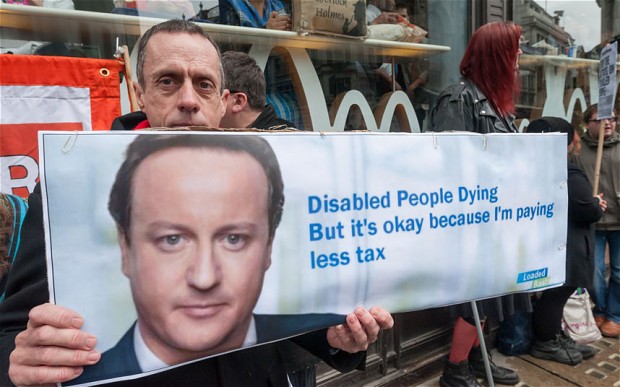
Labour leader Jeremy Corbyn has asked David Cameron at Prime Minister’s Questions today to publish the details of the Government’s response to the United Nations inquiry into the allegations that Conservative policies are breaching the rights of  disabled people in the UK. He also asked if the government intended to co-operate with the inquiry.

Such UN investigations are conducted confidentially by the UN and officials will not confirm or deny whether the UK is currently being put under scrutiny.

However, the ongoing inquiry been widely reported by disability rights groups and campaigners. The Department for Work and Pensions has previously declined to comment on the possibility of an investigation.

Mr Corbyn used his final question to ask about the United Nations inquiry into alleged ““grave or systemic violations” of the rights of disabled people in the UK. The PM gave a dismissive response, saying the inquiry may…

View original post 936 more words

BREAKING NEWS: Labour MP Michael Meacher Dies Aged 75

October 21, 2015

It is with great sadness that Same Difference has learnt of the death of Labour MP and former minister Michael Meacher.

Mr Meacher was a great supporter of issues affecting disabled people, carers and benefit claimants. We were and will remain very grateful for the support he showed for our issues.

RIP Sir.


How The DWP Is Drafting In Doctors To Promote Iain Duncan Smith’s Warped Ideology

October 21, 2015

johnny void's avatarthe void

fit-note-guidanceAre you working hard enough?  Are you sure?  What if you get sick, or have an accident?  Are you prepared to go to work anyway, even if you don’t think it would be good for your health?  What if your doctor and boss agree you could do something other than your usual job instead of malingering at home?  Like making cups of tea all day, or cleaning the bogs, or any form of work your empoyer can dream up to force you not to take time off.  Because that is now the chilling reality as the DWP attempts to inject Iain Duncan Smith’s warped ideology into the NHS.

Last week the DWP issued patronising new guidance to GPs on when they should issue a Fit Note.  Doctors are warned of the dangers of ‘worklessness’ and told they must consider “the vital role that work can play in your patient’s health”.

View original post 1,061 more words

Victoria Derbyshire Programme’s Special Coverage Of Mental Health Services

October 21, 2015

Capita Training Pack Focuses On Claimants’ Tobacco, Alcohol And Drug Use And Gambling Habits

October 21, 2015

Benefits and Work has obtained a training pack issued to personal independence payment (PIP) health professionals, part of which presents a depressingly tabloid view of sick and disabled claimants.

One section of the pack explains what evidence should be gathered about a claimant’s ‘Social and occupational history’

There are just 283 words in this section. Yet 160 of those words focus on exploring the claimant’s use of alcohol, tobacco and recreational drugs and their possible gambling habits.

The pack explains that:

‘Good evidence can be obtained during this part of the assessment for justifying descriptors 7, 8 and 10, so explore claimant responses as far as possible, i.e. if claimant likes to bet on the horses or football, he is likely to have skills in working out odds, read and interpret results, follow race/match on radio/TV/Internet (this all relates to activities 8 and 10). if he places bets by phone this could relate to activity 7.’

Activities 7, 8 and 10 are:

7. Communicating verbally.

8. Reading and understanding signs, symbols and words.

10. Making budgeting decisions.

We don’t know if the training material was created by Capita or provided for them by the DWP.

But what we are certain of, is that if this had been a pack about assessing the health of say teachers or doctors, the first example of a social activity that would have sprung to the writers mind would almost certainly not have been betting on the horses.

What To Expect At Your WCA

October 21, 2015

Maximus have released a video titled What To Expect At Your Health Assessment.

It is a re-enactment of a typical WCA. Maximus intend it to be helpful.

Claimant Refused PIP By Tribunal- For Spending Too Much Time On Facebook

October 20, 2015

With many thanks to Benefits And Work.

A shocked welfare rights worker, posting on Rightsnet, has revealed how his client had their personal independence payment (PIP) appeal refused because of the amount of time the claimant allegedly spent on Facebook.

Accused of lying
The claimant had appealed to a first-tier tribunal about the decision on their PIP claim and attended an oral hearing with a representative.

Whilst considering their mental health, the claimant was asked by the panel whether they ever used Facebook. The claimant replied that they did so ‘now and again’.

After all the evidence had been taken, the claimant and their representative returned to the waiting room while the tribunal made their deliberations.

However, when they were called back before the panel to hear the decision, the claimant was accused of lying to the tribunal. The medical panel member had the claimant’s Facebook page open on their smartphone and was reading from it, clearly taking the view that the number of posts was too frequent to be regarded as ‘now and again’.

Because the evidence gathering phase of the appeal had ended, the claimant was not allowed to respond, they could only listen to the decision of the tribunal in shocked silence.

Thus they were given no opportunity to challenge the accusation that they were lying or to explain that their partner also used their Facebook page.

Instead, they must now go through the lengthy process of asking for a statement of reasons from the tribunal judge – which can take many weeks or months to be provided – before asking for the decision to be set aside or appealing to the upper tribunal.

Breach of natural justice
There is a very strong probability that the decision will be overturned because it is such a flagrant breach of natural justice: the decision was based on evidence acquired by the panel itself from elsewhere and the claimant was given no opportunity to comment on it.

But, as well as leaving a big question mark over the quality of training for tribunal members, this episode also raises the possibility that claimants’ use of social media may in the future be used as evidence when making decisions on benefits entitlement.

If all the facts are collected and the claimant is given the opportunity to comment on them, this may just be another indignity that claimants are expected to learn to live with. Either that or claimants will need to make sure that their online life is kept as private as possible.

But if decisions are made based on partial evidence and wrong assumptions, as in this case, it will simply lead to more unfairness and injustice for sick and disabled people.

View the topic on Rightsnet

Dear readers, you just couldn’t make it up!

I’m off to share this post on Facebook!

Cerys Edwards Dies Aged 9

October 20, 2015

I am very sad to learn that Cerys Edwards has died. Hers was a case I heard of in the early days of Same Difference. It has always stayed with me and I often wondered what happened to her. RIP.

A girl left brain-damaged in a crash caused by a speeding driver has died, after being on a ventilator for almost nine years.

Cerys Edwards was 11 months old when Antonio Singh Boparan crashed into her parents’ car, leaving her needing round-the-clock care.

She died on Saturday – a month before her 10th birthday – from complications caused by an infection.

Her father told the BBC she would be sadly missed by all who knew her.

The Crown Prosecution Service said it would need a further file of evidence from the police for it to consider charging Boparan with causing death by dangerous driving.

Gareth Edwards said: “Cerys was a very happy little girl, whose cheeky smile would melt the heart of anyone present.

“She idolised her father and me her. We had a huge bond and understood each other. She loved listening to music and watching DVDs, going shopping, visiting the cinema and family holidays in Wales.

“She loved people singing and reading to her and made lots of friends who will all miss her.

“Given her injuries, she never complained and was a joy to be with.

“She was very much a people’s person and enjoyed company, was very nosey and always listened to people’s conversations even when it didn’t concern her.

“She would always watch what you were doing and would follow you round the room with her eyes. She didn’t miss a trick.

“She is and will be sadly missed by all who knew her especially her dad.”

A spokesman for Boparan said: “Antonio remains deeply remorseful of his actions as a teenager nine years ago and their tragic consequences.

“No words can appropriately convey the extent of his sorrow and regret at hearing this terrible news today.

“He sends his heartfelt condolences to Cerys’ family at this extremely difficult time.”

Boparan was 19 when he hit the Edwards’ car head-on in November 2006.

He was doing more than 70mph in a 30mph area when he crashed his Range Rover Sport in Streetly Lane, Sutton Coldfield.

Boparan, of Little Aston, Sutton Coldfield, was convicted of dangerous driving in April 2008.

He was told by Judge Frank Chapman he had shown an “arrogant disregard” for safety and jailed for 21 months. He was released under curfew conditions after serving six months.

A campaign by Mr and Mrs Edwards for tougher sentences for dangerous drivers, led to the then Justice Secretary Jack Straw proposing an increase in the maximum two-year jail term for dangerous driving to five years.

The family were awarded nearly £5m in compensation from Boparan’s insurers and £450,000 a year for the rest of her life.

Approving the payouts, Judge Martin McKenna at Birmingham’s High Court said it was “one of the saddest cases” he had ever come across.

Boparan was later jailed for a further year after admitting his part in a bar brawl which left a man blind in one eye.

He pleaded guilty to violent disorder and assault after a 22-year-old man was injured at the Nuovo Bar, Birmingham, in April 2014.

Boparan’s father, Ranjit Singh Boparan, is known as “The Chicken King” after founding the 2 Sisters Food Group.

George Osborne Wants Further Welfare Cuts To Pay For Security Spending

October 20, 2015

These will include cuts to disability benefits and jobcentre staff, reports FT.com:

Ministers are not seeking to reduce the levels paid in disability benefits but the Treasury is keen to explore whether the assessments for the benefits can be applied more quickly and rigorously.


In 2013, new claimants began receiving the personal independence payment (PIP), rather than disability living allowance (DLA), the older benefit that is being phased out.

From this year, those already on DLA have begun to undergo assessments to be switched over to PIP. The Department for Work and Pensions wants all claimants to be receiving the new benefit by May 2018.

But the Treasury is keen to find more savings, urging the Department for Work and Pensions to consider whether the switchover could be accelerated and whether the tests could further reduce the caseload.

“Disability benefits is a big area of spending so it’s to be expected that [the Treasury] would look at that,” said a Department for Work and Pensions official, adding that negotiations were still at “an early stage”.

In March, David Cameron said that the switchover was “going to lead to some savings over time and we haven’t created that benefit in order to undermine it. We want to enhance it and safeguard it.”

The two disability benefits are currently received by about 3.2m people and are forecast to cost £15.6bn in 2015/16. The government estimates that the cost of benefits will decline to £13.8bn by 2020, since it believes about 600,000 fewer people will receive the new benefit.

The Treasury is also seeking cuts in the numbers of Jobcentre Plus staff, according to two officials. About 80,000 people — one in every five civil servants — worked for the Department for Work and Pensions as of last year, and the Treasury wants to reduce that number further.

Yeovil Youths Burst Used Condom Over Disabled Woman’s Head In Horror Attack

October 20, 2015

A disabled woman has been left too scared to leave her home after youths burst a substance filled condom over her head in a horror attack in Yeovil.

Donna Stanley, who is 48 and has severe mobility problems, was on her way back from the pharmacy at Abbey Manor Forum in Yeovil when she was targeted by a group of boys and girls.

“It was incredibly loud. When I turned around I saw that it was a condom. I don’t know what was inside it but they were laughing and shouting. I said – what have you done that for? I was in shock and started to get quite emotional.”

Luckily, two men came to Mrs Stanley’s aid and chased off the perpetrators.

Mrs Stanley said: “A van stopped and two workmen got out and shouted at them to leave me alone. They ran off and the two men asked me if I was ok. I said yes and that I just wanted to be on my way home. I was crying my eyes out. I don’t know what people thought of me.”

Mrs Stanley said the attack had seriously affected her self confidence and she now felt scared leaving the house.

She said: “With my illness, it’s taken me a while to come to terms with it and how I’ve had to change. It’s taken me a long time to build up my confidence to go out.

“I’ve had verbal abuse before but this is the first time anyone has actually come up close to me.

“I don’t know what was inside it the condom but it went all over my clothes and in my hair. The incident has really knocked my confidence about going out again. I just don’t want it to happen to someone even more vulnerable than me.”

Mrs Stanley’s daughter Naomi said she was disappointed in the police’s reaction to the incident and that, despite calling 101 at 5.30pm on Monday, officers had failed to visit Mrs Stanley and collect a statement by Tuesday lunchtime.

Miss Stanley said: “She is absolutely distraught about it. When she came home I had to convince her to call the police as she’s not the kind of person to make a fuss. They said they would get someone out as soon as possible but no-one came.

“They rang back at 9pm and apologised that someone hadn’t been out as soon as they should have. To me that’s just not good enough. I feel very angry about this. I also feel guilty because I feel like I should have been with her but you don’t know these things are going to happen do you?”

Avon and Somerset Constabulary confirmed it was looking into the incident and that an officer would visit Mrs Stanley soon to take a statement.

A spokesman for the force said: “We were called on October 12 at 5.30pm to a report that a woman had had a condom pushed against her head by two youths on St Patrick’s Road, Yeovil.

“The two youths are described as being aged between 10 – 12 years old, they were both white males. One was described as having blond hair and wearing a grey tracksuit and the other was wearing dark clothing and riding a scooter.

“We’ve made contact with the victim to arrange going over to interview her about what happened. Anyone who was in the area between 4.30pm – 5.30pm who saw what happened should come forward quoting log number 633 on 12/10.”

WRAG cuts will “lead to more tragedies”, says Debbie Abrahams

October 20, 2015

Kitty S Jones's avatarPolitics and Insights

Sick and disabled people in the Work Related Activity Group (WRAG), claiming Employment and Support Allowance (ESA) will see payments cut by £30 a week, to bring the benefit in line with the current Jobseeker’s Allowance (JSA) rate.

The cut will affect up to 500,000 sick and disabled people, including many with incurable and progressive conditions like Parkinson’s and Motor Neuron Disease, who are unfit for work but whom the Department of Work and Pensions believes may be capable of working at some point in the future.

Debbie Abrahams, the shadow minster for disabled people, and a former public health consultant, is calling on the Government to scrap the measure.

Debbie has highlighted the government’s own figures, which showed that the death rate of people on out-of-work disability benefits had increased – in comparison with the general population – from 2003 to the period between 2011 and 2014.

She…

View original post 585 more words

LORDS COMMITTEE ON THE EQUALITY ACT 2010 HEARS FROM DISABILITY CHARITIES

October 19, 2015

A press release:


Tomorrow, 20 October, senior executives from charities Scope and Mind will give evidence to the House of Lords Committee on the Equality Act 2010.

Also giving evidence is the director of policy and campaigns at the disability campaign group People First (Self Advocacy).

In this week’s evidence sessions, the Committee will focus on issues facing disabled people in employment and service provision, such as reasonable adjustments, use of the courts in achieving redress under the Act, and also how the Act impacts on those with learning difficulties.

Those giving evidence tomorrow, at 3.30pm, are Elliot Dunster, Group Head of Policy, Research and Public Affairs, Scope; Paul Farmer, Chief Executive, Mind, and Andrew Lee, Director of Policy and Campaigns, People First (Self Advocacy).

Questions that the Committee is likely to put to the witnesses include:

  • What are the problems in accessing employment for people with learning disabilities?
  • To what extent do reasonable adjustments solve these problems?
  • How can we remedy the perceived lack of clarity from both employers and disabled people on what reasonable adjustments are possible for those with mental health issues?
  • How can changes to the Equality Act or Government policy address these problems?
  • Is reliance on individuals bringing cases to courts and tribunals an effective way of achieving compliance with the Equality Act? Could this be made easier, and if so how?
  • What is your relationship with the Equality and Human Rights Commission (EHRC)?
  • Are disabled people feeling a loss of confidence in the Commission?

The evidence session will take place at 3.30pm, on Tuesday 20 October, in Committee Room 4a of the House of Lords.

PIP 20 Metre Legal Challenge Fails

October 19, 2015

The Court of Appeal have rejected the appeal in Sumpter vs Secretary of State for Work and Pensions. This was an appeal against last year’s High Court ruling rejecting a judicial review challenge to the fairness of the Government’s consultation process on the introduction of the Personal Independence Payment (PIP) 20 metre eligibility criteria.

Under PIP you can get an enhanced mobility component if you are only able to move up to 20 metres aided or unaided. Previously, under Disability Living Allowance (DLA), the equivalent higher mobility award was given to those who could only manage to walk up to 50 metres.

The Court of Appeal found that the PIP consultation had been conducted fairly, if not exactly flawlessly and upheld the earlier High Court decision.

“The reality was that consultees such as Mr Sumpter had every opportunity to present to the Respondent the difficulties that the move from a 50 metre benchmark to a 20 metre one would cause to them. It is clear that such opportunity was taken.”

This ruling means that thousands are likely to lose out on the PIP enhanced mobility component. Disability Rights UK has already highlighted that 150 to 200 lose their Motability car each week and that the DWP consistently fails to provide information on how many disabled people have been awarded the PIP enhanced mobility rate. However the Government’s own figures predict that, by 2018, just over 600,000 will qualify for the enhanced mobility component compared to over a million people who would have qualified under the old scheme.

The effect on the independence of disabled people will be profound. Prior to the judgement Mr Sumpter said:

“Without access to support, I would be unable to do a huge number of activities that many people take for granted. I would lose my Motability vehicle and would struggle to access local amenities including supermarkets.

The government policy on eligibility would leave me completely in the lurch and massively affect my quality of life.“

Liz Sayce, Chief Executive of Disability Rights UK says:

“PIP could see thousands of disabled people become institutionalised in their own homes.  The DWP expects that 600,000 disabled people who currently get the higher rate mobility component will lose it altogether or receive the lower amount.  This means that many will lose their car under the Motability car scheme so they will no longer be able to get to work or get out and about.

We believe the test of policy changes relating to disability should be whether they help or hinder independence and participation in society. This change does not meet this test.

Despite receiving over 1,100 responses to the 2013 consultation opposing the new PIP mobility test the Government pressed ahead.”


Surfboard For Disabled Children Hits The Waves

October 19, 2015

A university has enlisted the help of children to test new surfing products for young people with disabilities at a Swansea beach.

Thirteen-year-old, Kai, from Port Talbot, who has cerebral palsy, was among those hitting the waves at Llangennith beach in Gower.

University of Wales Trinity Saint David academics tried out a tandem surfboard, which can be ridden be children with neurological conditions and controlled by an instructor, and a surf access vehicle.

They have been produced by the Cerebra Innovation Centre, a collaboration between the university and charity Cerebra.

Act For The (Human Rights) Act

October 19, 2015

Posters like this:

Jan SuttonJan
was left in bed all day by her carers. The Human Rights
Act helped her get her dignity back.

Have started appearing on Billboards across the London Underground network. They are part of a campaign to save the Human Rights Act.

Here is the full story behind this poster.

PSNI Launches New Disability Hate Crime Campaign

October 19, 2015

An online campaign to stop disability hate crime has been launched after the Police Service of Northern Ireland recorded 44 attacks within six months.

The actual number of attacks is believed to be higher as many victims are hesitant to speak to police.

The crime is defined as “any incident perceived to be on the grounds of the person’s physical or mental disability by the victim or any other person”.

The PSNI has launched a Facebook campaign to help stamp out the attacks.

Victims of hate attacks have said they are hopeful it will have an impact.

‘Voice’

Two years ago, the PSNI commissioned Leonard Cheshire Disability, a disability rights charity, to establish an advocacy service to help disabled people gain equal access to justice.

The service was the first of its kind in Northern Ireland and Eilis Mulholland from the charity said it has made significant difference.

“Often victims can be nervous about approaching police because of a fear of being misunderstood or not believed,” she said.

“With us, they can speak freely and we can then act on their behalf.”

Charity advocates make the initial contact with police to find out if the complaint has been recorded a hate-motivated crime.

They can then act as a go-between in police interviews, or to correlate police correspondence.

“The service provides a voice for disabled people if they need that kind of support,” Ms Mulholland said.

‘Upset’

Wheelchair user Michael Bailey has been the victim of disability hate crimes on several occasions.

“The first time I was crossing at the lights and I got a smack on the back of my head – I couldn’t understand what it was for,” he said.

“The second time I was passing trees, and bits of wood and stones were thrown at me from behind them.”

Like many other victims, he did not report the initial incidents.

However, he eventually contacted police after an attack near his home in which youths tried to steal his wheelchair.

“Teenagers came up to the back of my wheelchair, calling me names, taking everything off me. I realised they wanted my wheelchair,” he said.

He called the police later that night but was upset when, against his wishes, officers arrived in a marked car.

“I didn’t want that. After they left, I was tortured again.”

‘Scared’

John Gillespie, who has a learning disability, was shopping in east Belfast when he was targeted by a teenage girl.

“I was minding my own business when she walked up to me and took my gold necklaces off my neck,” Mr Gillespie said.

“I was scared because I didn’t know what she would do.”

He was particularly upset as one of the necklaces had been left to him by his late brother, Martin.

“She took advantage of me knowing I had a learning disability.”

He reported the incident to police but felt his complaint was not taken seriously.

‘Loyalty’

Ch Insp Emma Bond said the PSNI is keen to make the reporting of crimes as easy as possible, and that is why they commissioned the advocacy service.

“It’s essential that victims feel able to report so that future attacks can be prevented,” she said.

“I’m very conscious that disabilities aren’t always visible so officers may be unaware of the specific needs.”

Although most attacks are carried out by strangers, Ms Mulholland said the crimes can happen within a person’s own home, perpetrated by members of their own family.

“Disabled people can be taken advantage of by people they know – people they trust,” she said.

“It can be physical abuse, verbal abuse, sexual or theft.

“But this can be particularly difficult to deal with as they might be reliant on that person or feel a loyalty to them that makes them reluctant to speak out.”

‘Difference’

Ms Mulholland added that the PSNI, the Housing Executive and the Department of Justice have been working hard to end this kind of crime.

“Nobody should have to suffer in silence, least of all a vulnerable, disabled person,” he said.

Disability hate crimes recorded by the PSNI have steadily increased since the advocate post was established.

Mr Gillespie said the service had made a big difference in his case.

“I felt somebody was there for me who wanted to listen. Without them, I don’t think anything would have been done.”

Schools Find Helping Children With Facial Disfigurements Helps Everyone With Body Image Concerns

October 19, 2015

Marcus Powell was a cheerful, happy-go-lucky child with a circle of good friends in the reception class at Trinity primary school in Hereford. His classmates seemed not to notice the side of Marcus’s face, described by his mother, Sam, as “looking as though a trench goes right down it”.

Marcus was born with a cleft lip and palette so has a gap in his lip and the roof of his mouth. The 15 operations he has needed have not helped the way he looks, but that had not concerned him.

Everything changed, though, when Marcus moved up a year and the children became more conscious of his disfigurement. “It was as though suddenly they saw me differently,” says Marcus, who is now 11. “They called me scarface or Moshi Monster and said I was ugly and they didn’t want to play with me. Before, I had lots of friends.”

Sam watched as her son became withdrawn and upset when it was time to go to school. “I realised he no longer mentioned friends. At first, he wouldn’t tell me what was happening and when he did and I suggested talking to the

It was a similar story for Yasmin at secondary school. She had severe scarring after an illness and was teased and bullied a great deal because of it. Yasmin veered between retreating into impenetrable silence and erupting into rages. She got no help from her school and, eventually, dropped out completely.

It is a wretchedly familiar scenario according to Changing Faces, the national charity working to support the visibly different and to counter prejudice. Jane Francis, policy adviser for the charity, talks of the huge effect of appearance bullying and the damage it does to children’s education. About 86,000 young people in the UK have significant facial disfigurement, she says. This is most often caused by congenital deformities, illness, accidents or skin conditions.

“The way these young people look makes them particularly vulnerable to staring, comments, questions, ostracism and bullying.”

It is not only those with a disfigurement who are affected by concerns about their appearance and who fear bullying. In a recent survey of 1500 young women for the Girl Guides, by the Rathbone charity, half said they were bullied at school because of the way they looked, and some missed months of education to avoid their tormentors.

The problems around body image in schools and colleges have also been recognised by the Centre for Appearance Research at the University of the West of England, which is collaborating in a European Commission-funded initiative to look at how this can be tackled. The Mirror Mirror project was set up to develop a teacher training pack of strategies to lower the dropout rates linked to how people feel about their appearance.

It was Sam Powell who learned that Changing Faces, as part of its Face Equality campaign, produces teaching resources for schools and runs training sessions with staff and pupils. The aim is to help them understand how a bullied child feels – but also to help the other pupils, who may be acting out of fear or a prejudice they cannot analyse.

Ann Pritchard, headteacher at Marcus’s primary school, Trinity, had not realised what was going on because he had kept his feelings hidden. However, when his mother explained how unhappy he was, she was keen to invite Changing Faces into school. There was a talk with the class teacher about Marcus’s situation, and discussions were held with all the children.

Pritchard is determined her school prioritises equality, and says: “I came in on these sessions explaining in more detail about Marcus having had a lot of operations, that he went through much pain and I wanted to help the children see that Marcus’s face has nothing to do with who he is as a person, so it is just cruel to attack him because of it. That led to us talking about diversity and how people are different in many ways.”
Advertisement

Pritchard says the work, initially intended to help children with disfigurement, has benefited all the pupils. “We now start with years 4 and 5 talking about body changes and body image because already then girls particularly are very aware.

“Now the children know that name calling and appearance-bullying will be challenged and I think that has made them feel more secure and happier.”

Face Equality’s teaching resources can be linked to the curriculum. For instance, drama offers an ideal opportunity for asking what facial expressions and body language say about our attitudes. In English, one exercise looks at how language about disfigurement affects attitudes.

Francis, a former teacher, has also worked with the Equality and Human Rights Commission to gather information to help Ofsted inspectors to ask the right questions when looking at schools’ equality policies. “With today’s emphasis on appearance, it is more important than ever that schools have a way of confronting staring, comments, questions, ostracism and bullying,” she says. “Without appropriate intervention, it so easily affects vulnerable children’s wellbeing and achievement.”

That is what happened with Adam, a year 8 student who has neurofibromatosis, which means his head and face are distended. His school performance was extremely poor and his behaviour bad. He got into verbal battles constantly and said his only pleasure in school was swearing and shouting. When Changing Faces came to his school, it became aware how little the staff understood Adam’s situation when a teacher asked “how long will he live?”.

Adam was assessed as above-average intelligence. All the staff were given this information and the school used personal, social, health and economic lessons to raise the whole school’s awareness about visible difference. They organised a visit from a high-achieving adult with the same condition who talked to the pupils about his school experiences and how he had become successful. One-to-one support was arranged for Adam to begin studying again, he slowly made friends, and in due course went to university.

Meanwhile, at Trinity, Pritchard was startled at the positive effect the Changing Faces sessions had on the children. “Some were mortified and upset, there were even tears. They hadn’t thought about how Marcus might feel and how they were causing him unhappiness.”

Sam Powell says, with touching delight, that after the intervention Marcus had “his best year of all at Trinity”. Now he has moved to secondary school – along with a group of primary school classmates who became close friends.

The Failings Of The DWP And ATOS In The Case Of Peggy

October 18, 2015

From the Fightback forums.


In November 2010 Peggy, my cousin had her Parkinson’s support worker fill out a claim for DLA she was 63 at that time. They did not hear anything until April of 2011, when an ATOS doctor visited her at her home. His report said she had no problem getting up and albeit slow, no problem with walking. Despite Peggy’s son making numerous calls to the DWP he kept getting told DLA had been refused in January 2011, even though they had no knowledge of this, the DWP also denied any knowledge of sending out a doctor in the April.
In August I took over the case as I had worked for the benefit system many years before. On contacting them they again said benefit had been refused in Jan and had no knowledge of an ATOS doctor going to see her in April of that year. I sent a letter with a copy of the appointment from ATOS threatening an MP complaint and requesting copy of the doctor’s report, giving them two weeks. I received a letter finally three weeks later again saying benefit had been refused and no copy of medical.
At that point I contacted Bob Ainsworth, a Coventry Labour MP, to intercede. He did so and I got a letter of apology and after some weeks of waiting as they had to go to their repository, a copy of the report. I submitted an appeal as it was their fault for delay they accepted, based on my cousin’s health. She would not walk outside on her own as she was prone to falling, she had got stuck in the bath so was now unable to wash herself, she was suffering from hallucinations because of the potency of the Parkinson’s medication, all of which was told to the ATOS doctor but he did not put down.
The ATOS doctor did bring up a very upsetting event from her past some forty years earlier which had no bearing on her current condition, which as you can imagine upset her greatly. I complained to ATOS and received an apology, when I pushed it further the doctor claimed he had not mentioned the event, so it came down to he said she said.
By this time my cousin who gets very muddled did not want any contact with DWP as she could not handle them, and it upset her greatly. She needed the money for the extra help of heating, taxis etc, she had no extra ability to pay for these extras she now needed through no fault of her own.
Towards the end of November 2011 I requested compensation hoping this would make them look at case again which they did, but still no joy. My cousin then started to fall over in the street and as she was on a first floor council block we were getting worried for her safety as her hallucinations were also getting worse. I submitted a fresh claim for DLA in Dec 2011 keeping the old claim in appeal. She was then moved to sheltered accommodation in March 2012. The fresh claim Peggy received the higher rate mobility and care, but they still wanted to pursue earlier claim to tribunal.
I spoke to DWP and stated this was a waste of money, now she is due high rate but last year not even the lower rate it made no sense, but sense never comes into it. I informed the women that my cousin was now so bad one look at her struggle to walk, which she could not do unaided anymore, we would have won and what a waste of money and stress. My cousin who wanted to be left alone by that point, and unprintable what she called DWP, but who could blame her, she agreed to attend hearing in April. As predicted she won the case and the money was backdated.
The case took from November 2010 to April 2012 to settle. I estimate it most have cost DWP 20-30 thousand pound to fight. My cousin was and is very sick women, with numerous ailments but still had the humiliation of going to court. Is this a ‘scrounger’ or ‘feckless’ women or someone who deserves humanity, I will let you be the judge of that.

Disabled Drivers And Blue Badge Holders Being Charged For NHS Hospital Parking

October 18, 2015

More than one in 10 hospitals is charging disabled drivers for parking, just as the NHS tries to plug what is expected to be close to a £2bn deficit this year. 

Labour has analysed government figures and found that 132 hospital sites in England charge disabled people and visitors to park their cars. This is out of 1,251 sites that provided details to the annual Estates Return Information Collection, which was published last week. 

 Jeremy Hunt, the Health Secretary, said last year that “patients and families shouldn’t have to deal with the added stress of unfair parking charges”. He pointed out his department’s guidance on such charges, which included concessions for the disabled and visitors to relatives who are gravely ill. 

Robert Halfon, the minister without portfolio, who suffers from osteoarthritis and a form of cerebral palsy, is a Blue Badge holder who has previously condemned the charges as “a stealth tax on the vulnerable”. 

But parking charges are worth around £200m a year, vital money at a time when the NHS is so financially stretched. Last month it was claimed that more than 50 NHS institutions were handed £1.2bn in 2014-15 to cover wages, debts and the replacement of vital, but antiquated, medical equipment. 

Justin Madders, a shadow Health minister, said: “Jeremy Hunt promised to tackle these unfair charges, but as ever with the Tories you can’t trust a word they say on the NHS.

“Disabled people often have no choice but to drive to hospital, and it’s wrong to target them with parking fees. Hospitals are being forced to introduce or increase parking charges because they are desperately short of cash … disabled people are paying the price.”

The news follows a report last week that showed 112 NHS trusts had increased car parking charges. A hospital in Kent had increased its rate by 60 per cent, from £5 to £8, while the Wye Valley Trust had hiked the average price of a parking ticket from 33p to £3.17.  

The Health minister Ben Gummer said: “NHS bosses shouldn’t hit disabled patients with unfair car parking charges. We urge hospitals to offer cheaper rates to the elderly, disabled people and patients who have to make lots of trips to hospital … Local patient groups should keep an eagle eye out for any excessive price hikes.”

Thousands protested in London yesterday (see above) against changes to junior doctors’ contracts in England, which they claim will reduce their pay by up to 40 per cent. 

Heidi Alexander, the Shadow Health Secretary, said: “Jeremy Hunt punishes staff for his own mismanagement of the NHS… Junior doctors are the backbone of the NHS … It’s wrong that this Government is OK with the idea of paying some junior doctors less to do the work they do now … And they’re wrong to punish staff for their own financial mismanagement of the NHS.

“Nobody wants to see industrial action but nobody wants junior doctors too exhausted to provide safe patient care either.” 

Dr Johann Malawana, chairman of the BMA junior doctors’ committee, said the protests were “a wake-up call for ministers”.

UN Inquiry Into ‘Grave Violations’ Of Disabled People’s Human Rights Begins In Scotland

October 18, 2015

UNITED Nations officials have arrived in Scotland to investigate allegations that Westminster welfare reforms have led to “grave or systematic violations” of disabled people’s human rights.

The Sunday Herald revealed in August that the Special Rapporteur and members of UN’s Committee on the Rights of Persons with Disabilities (UNCRPD) were due to visit the UK to probe the complaints and take evidence from individuals and campaign groups, including in Scotland.

Officials arrived this weekend and will spend around two weeks visiting all four of the UK’s nations. All investigations are being conducted in private with participants being asked to sign confidentiality agreements.

The UN investigators will specifically examine whether the British government has committed “systematic and grave violations” of the Convention on the Rights of Persons with Disabilities. The UK is the first country in the world to be investigated in this manner.

Meanwhile the Scottish disability campaign group Black Triangle has also revealed it plans to take another complaint to the UN Special Rapporteur under protocols which allow individuals to lodge cases where there is believed to be a “life-threatening situation” or urgent action is required.

Black Triangle said their complaint will focus on the case of Michael O’Sullivan, a disabled father-of-two with severe mental health issues, who killed himself after he lost access to his disability benefits.

Last month, in what is believed to be the first case of its kind, a coroner directly attributed his suicide to being found “fit for work” following an assessment under the controversial work capability process.

John McArdle, co-founder of Black Triangle, said he could not make any comment on the current UN investigation. However, he said the group were planning to submit a separate complaint to the Special Rapporteur which would focus on O’Sullivan’s case.

Black Triangle has also compiled a dossier of more than 80 deaths linked to welfare reform, including a 44-year-old man with mental health conditions whose benefits were cut after he was deemed fit for work.

He was left with £40 a week to live on and was badly malnourished when he died, weighing just 5st 8lbs.

The group, which was set up to campaign against benefits cuts, is named after the black triangle which the Nazis forced people with disabilities to wear in concentration camps to show they were ‘workshy’.

Last month the Sunday Herald revealed how the UN investigation was triggered by a complaint submitted by Black Triangle’s sister campaign group Disabled People Against Cuts (DPAC), which contained more than 40 issues cited as evidence that “attacks are being carried out in every area” of disabled people’s lives by the UK Government.

The issues outlined include the impact of the bedroom tax, problems which have been caused by changes to disability benefits and an overall one per cent cap on annual benefit rises. It also raised concerns about the impact of benefit sanctions and workfare programmes, as well as inaccessible public transport and cuts to mobility allowances.

A DPAC spokeswoman said: “Many disabled people are facing a multitude of attacks on their human rights and living standards.

“It is rarely just one or two issues per person. This is the crucial point in the current retrogression of the human rights of disabled people.”

Last night a spokesman for the Department of Work and Pensions said: “We are committed to supporting the most vulnerable people in society and spend more than £50 billion every year on disabled people and their services. We are happy to inform the inquiry of this.”

DPAC Asking For URGENT Online Action To Get Question Raised At Next PMQs

October 18, 2015

An urgent appeal for online action from DPAC.

We need Jeremy Corbyn to ask the following question at this week’s PMQs and to try to make sure that happens we’re asking all of you to contact him and ask him to raise the issue of the UN inquiry into the grave and systematic violations of disabled people’s human rights.

You can email him at corbynj@parliament.uk

Or tweet to him @jeremycorbyn

Also submit it to this address as well

http://www.labour.org.uk/page/s/question-for-david-cameron

Our question is below.

“The United Kingdom is currently being investigated by the United Nations Committee on the Rights of Persons with Disabilities because of allegations of “grave and systematic” violations of disabled people’s human rights. Shamefully we are the First Country ever to face such an inquiry. The Inquiry itself is has been widely reported in the press and DWP have confirmed the inquiry was initiated by the campaign group Disabled People Against Cuts.

Will the Prime Minister now commit to the government publishing in full the findings of the committee when the report is sent to the government next year?

Terminally Ill Company Director Announces Date Of Death On Linkedin

October 17, 2015

A terminally ill company director has used his LinkedIn profile to announce the dates of his death and funeral before he ends his own life at a Swiss euthanasia clinic.

Simon Binner, 57, an operations director at Caremark – a health and social care organisation in Sutton, was diagnosed with aggressive motor neurone disease (MND) in January.

He updated his profile page on the professional networking site to say he will die this coming Monday and his funeral will be held on 13 November.

In a section entitled Patient, Cambridge-graduate Binner wrote: “I was diagnosed with aggressive [MND] on 7 January 2015. As I was driven home I had already decided what I would gladly have to do when my time was upon me.

“I died in Switzerland with Eternal Spirit on Monday 19 October 2015 and my funeral was on Friday 13 November 2015.

“My MND accelerated very rapidly. The sawbones initially thought I would last until 2017/2018, but they were mistaken – no worries, it’s an inexact science!

“I don’t recommend MND! Better to have one massive fatal stroke or be killed instantly by a drunk driver! There is nothing that I can say that’s positive about MND.”

Under a second section entitled Non Executive Director, dated June 2013–October 2015, Binner’s profile reads: “I handed over my Operations Director role to Hannah Drury and became a Non-Executive Director. I died on Mon 19 Oct 2015.”

Binner, from Purley in Surrey, will travel to the Eternal Spirit clinic in Basel where he will be assisted to die, according to his profile.

Andrew Copson, chief executive of the British Humanist Association, said Binner’s story highlighted the need to change the law on assisted dying.

“The tragedy at the heart of Simon’s story is that if the law allowed people with incurable and terminal conditions to seek a doctor-assisted death in this country, he and others like him would have more time to spend with their loved ones before their conditions became intolerable for them,” he said.

“The current law heaps unnecessary suffering and trauma on to families like the Binners. Our thoughts of course continue to be with them at this difficult time.

“We continue to support a change in the law for those who are terminally and incurably suffering to end their lives, provided they have made a rational, committed, and un-coerced decision to do so, just as Simon has made for himself.”

Motor neurone disease is a rare condition that progressively damages parts of the nervous system, leading to muscle weakness and often visible wasting. Sufferers find it difficult to walk, speak, swallow and breathe and eventually the person may become unable to move.

There are about 5,000 people living with the condition in the UK, according to the NHS. There is no known cure for the condition.

In 2013, Binner’s 18-year-old step-daughter Chloe Drury died from the rare bone cancer Ewing’s Sarcoma after being refused access to potentially life-saving drugs because of her age. A campaign was subsequently launched in Chloe’s name calling for changes to medical law.

New York Theatre Scene Welcomes Deaf Actors

October 16, 2015

Spring Awakening has been revived on Broadway, but this time with a predominantly deaf cast. New York has seen a wave of productions bringing deaf actors to the fore, transforming both the theatre scene and the job opportunities for deaf actors.

July 7 Survivor Daniel Biddle’s Experience Of Disability Hate Crime

October 16, 2015

Being called “lazy and disrespectful” during a visit to the local tip isn’t the worst thing that’s happened to Daniel Biddle.

Ten years ago he lost both legs, an eye and his spleen during the horrific 7/7 London suicide bomb attacks that shocked the world.

 He has also been left deaf in one ear.

But when he didn’t get out of the car to help his wife off-load their rubbish at the tip recently, he became the victim of very different kind of attack, from an abusive woman branding him “lazy”.

Abuse ‘all too common’

According to Daniel, from Abergavenny , such casual abuse is all too common, and just one example of disability hate crime.

“I was at the local tip disposing of some rubbish with my wife,” he said.

“Because of the layout of the tip it was difficult for me to get out of the car and do anything to help.

“So, my wife got out of the car and started emptying the rubbish on her own. 

“As she was doing this, we started receiving abuse from a woman who was calling me ‘lazy’ and ‘disrespectful to women’.

“It reached the point where my wife got my wheelchair out of the car to show her that I was disabled.

Woman’s tirade of abuse

“However, we continued to receive a tirade of abuse from this woman.

“I honestly think people look at disability in a negative light pretty much 90% of the time.”

Official statistics released by the Home Office earlier this week show disability hate crime rose by over a third in Wales last year.

The number of hate crimes motivated by disability recorded by the four Welsh police forces jumped from 150 in 2013-14 to 202 in 2014-15.

Officials say the jump indicates improved recording practices and that victims have more confidence to report crimes to the police and partner agencies.

7/7 bomb saw Daniel go under the train

Daniel was 26 when he stood next to Mohammad Sidique Khan, who blew up the London tube train on which he was travelling on.

The first of four bombs, which killed 56 people that day, flung Daniel through the doors and under the train.

He suffered three cardiac arrests as doctors battled to save him and was treated for a collapsed lung, multiple internal injuries and MRSA.

He also suffers with Post Traumatic Stress Disorder (PTSD).

On Friday he will share his personal experiences at a Disability Hate Crime Awareness Event in Cwmbran.

Under-reported crime

“Disability hate crime is under-reported and that’s why I’m pleased to support this event,” he said.

Around 60 people ranging from professionals from the Crown Prosecution Service; police officers and police staff; disabled people and representatives from leading disability organisations are expected to attend the summit, being hosted by Gwent Police at the Parkway Hotel. 

“For me, this event is all about harnessing the relationship between the police and the disabled community and instilling confidence in people from the disabled community to report these crimes in the first place,” added Daniel.

“It’s also about educating the police on how they should be handling these crimes.”

Disability hate crime remains a priority

Police and Crime Commissioner for Gwent, Ian Johnston, said: “This event is all about raising awareness and ensuring disability hate crime remains a priority.

“There has been an increase in recorded disability hate crimes in Gwent and I believe this is a direct result of victims having the confidence to report these crimes to the police and partner agencies.

“However, we recognise there is still more work to be done as disability hate crime still only accounts for 5% of the total reported hate crimes across England and Wales.

“We know anecdotally that disabled people’s experiences would suggest hate incidents and crimes are part of many individuals’ daily experience.

“This event is all about raising awareness and highlighting our unified commitment to improve our response to disability hate crime.”

British Sign Language GCSE Is Being Piloted!

October 15, 2015

Same Difference is very pleased to have learnt that a BSL GCSE is being piloted. The course is being offered at six pilot schools from this term (September 2015).

We are particularly pleased to note that the schools appear to be mainstream organisations. We hope to see many more schools following this progressive, but sensible, lead in the coming years.

PIP Appeals Need To Be Done In Writing Says Fightback’s Michelle

October 15, 2015

From Fightback. Please share widely.

We cannot stress enough that you need to appeal in WRITING against a PIP decision, not over the phone. We know it is tempting to get on the phone as soon as you get the dreaded brown envelope, however this will ensure that they will reconsider the decision using the same evidence that day or a few days later, and will most likely come to exactly the same negative decision as it will not give you adequate time to send anything new in.

Here are our tips on appealing a PIP decision:

When you first get your dreaded brown envelope saying you have failed to get enough points to qualify for pip it can be really disheartening and we are dealing with many calls from fightbacker’s daily, who are angry, upset, and basically cannot believe some of the information contained in the medical report. Firstly my advice is try and take a step back, your first instinct maybe to get on the phone and give them a piece of your mind. Well doing this will mean you will be speaking to a call centre member of staff, with little info apart from what is on the screen. When you say you want to appeal they will explain the procedure to you, and say that you can just do it over the phone. We advise that you stress that you will have been advised by Fightback to appeal in writing to give you the best chance of overturning the decision. Do not get drawn into a conversation about what you disagree with, as they will treat this as a reconsideration via phone and you will not be given chance to send in anything else as fresh evidence.

We recommend you do however ring and request a copy of the assessment report from DWP, (you can do this the day of assessment,) then to appeal in WRITING, listing clearly on a copy of the assessment/decision notice, if you have it through in time, where you disagree with it, for instance, if the assessor stated you walked across the car park, and you were dropped off at the door, then explain this and gather supporting statements to substantiate it if you had someone with you, explain they are willing to give evidence in court if that is the case also. Send in any proof to contradict the assessor’s findings, for instance if they say you can manage therapies/medication and you have a dosette box or use chemist home delivery services, then send proof of this for instance a photograph of the blister pack with the sticker on, or a photo of aids you have, with a bill clearly in the background of the photo to show it’s your photo as ID.

Remember you can request the assessors report the day you have the assessment itself, from DWP and ATOS/Capita, to be well prepared.

Get copies of any specialist to GP reports you are missing from the GP or actual specialist secretary if able. Many people are not even aware these are generated, and they are entitled to a copy at the time. Provide any new appointment letters even though they state not to, or OT assessment letters /careplans, or any evidence of problems you are having with work/debt, such as your attendance record, HR letters, or letters from substantial debt ie court letters, DRO/bankruptcy letters etc..

Complete a day in the life negative diary, (see forum) which will state clearly what you are unable to do each day and the pain levels you are in day to day ie: gauge it 1 to 10. Also list what you are unable to do, i.e.: I was unable to stand upon waking up for 15 minutes due to numbness, or was unable to get downstairs until mid afternoon because of the fatigue, in short you need a warts and all kind a diary of what you are unable to do, even if you avoid doing these things now because of the pain or fatigue levels. Explain clearly what happens before, and after each descriptor on the diary also so for instance if you have to rest the day after you go to the GP surgery, then list this. Try and keep it simple and do say 3-4 days over a page of A4 or 2 at most.

Send this all off recorded delivery to the address on your PIP notice, and make sure it is within the 28 days of the letter, keep a copy of everything and ring them after 10 days to ensure they have it all logged. If you get anything else then send that off quickly recorded deliver, (do not send originals you will not get them back,) FAO of the decision maker marked urgent.

If you are still turned down then feel free give us a ring and we can advise over the phone, or if you are able to come to the office in Bury Manchester then we can help in person. Remember our advice is FREE and we can also advocate for you wherever you are in the UK although we may need you to cover our expenses depending on where you are for this. If the MR fails to overturn the decision then you need to lodge it with the Tribunal Service with an SSCS1 form, and we can help with that stage.or you can try our adviceline if you are still unsure.

There are lots of notes on our forum and website that help with this next stage.

If you are already at this stage, then if you want to let me know we can advise on the SSCS1 stage, and have a indepth note on this on the forum and website or can do this for you,along with a link to the form itself, with the advocacy service we have, either way feel free to add us as advocates and then ring us on the advocacy number below if you need help.

Michelle Cardno (Llb Hons)
Legal Advocate
Fightback4Justice

Life As The Twin Who Wasn’t Born Disabled

October 14, 2015

It is 20 years since Ed Green’s disabled twin sister died but he still considers accessibility with everything he does.

My twin sister and I were born prematurely. I was the weaker out of the two of us – Jenny was both healthier and happier. It’s ironic then that I was the one who came out of it unscathed and Jenny went on to live with cerebral palsy.

The risk of complications in a multiple pregnancy is greater than carrying just one child, and it’s not uncommon for one twin to be disabled and the other not. Paralympic swimmer Sascha Kindred has a non-disabled twin, and actor Ashton Kutcher’s twin brother is disabled. So we’re in good company.

Twins are often thought to have a closeness that isn’t there with other sibling relationships. The fact we were on different sides of the disability divide, for want of a better phrase, didn’t alter this.

Jenny and I were born 10 weeks early and 10 minutes apart, weighing in at 3lb 5oz and 2lb 12oz respectively. We spent our first three months in hospital, or rather, for much of that time, separate hospitals. When we eventually went home it was no doubt a great relief to mum and dad, who were still just keeping their heads above water. After all, mum only found out she was expecting not one, but two babies, eight hours before we were born.

This happened 46 years ago but then, as now, twins looked to each other as they reach those childhood milestones, with grown-ups and peers comparing and contrasting their development too.

I don’t remember when I first really understood what Jenny’s differences meant. But I do remember as a toddler, urging Mum repeatedly: “Why can’t Jenny walk?” The answer always came back the same: “We don’t know.”

An early obstacle was education. Jenny had blended in seamlessly at the local village playgroup and it hadn’t crossed mum and dad’s minds that disability would affect the transition to infant school. They had heard that the school’s policy was to separate siblings into different classes but, happily, twins were always kept together. And the fact that the school was a modern, single-story building with no steps, made it all sound positive.

When Mum and Dad went to see the head teacher however, any ideas of Jenny joining me in mainstream education were curtly dismissed: “I’m afraid I cannot ask my staff to cope with Jennifer,” they were told. I started school in September 1973 and left a frustrated sister at home.

It seems extraordinary our parents weren’t given any guidance at this stage, they had to find things out for themselves.

A place was found for Jenny at a local special school. I still remember the sign “Danger: Physically Handicapped Children” at the gates. I had never realised my twin was dangerous.

Listen to Ed tell his story in the latest Ouch disability podcast

Putting aside our identical knitted jumpers, people saw us as different – strangers would stop and give Jenny sweets, for instance. Then there were those special school parties with celebrity performers – the likes of Roy Kinnear and Tony Blackburn with his radio dog (a “woof woof” from Arnold).

The jump to secondary school landed me with a new, unwelcome daily routine in the form of homework. Jenny, eager to follow her brother, begged her teachers to give her homework also. This led to an angry phone call from her headmaster, accusing mum of “pushing Jenny too far”.

As we reached 16, thoughts turned to “What next?” for Jenny and my worry about her future went into overdrive.

I’d heard many stories about disabled people living with their aging parents until middle age and then getting despatched to an institution, their only respite throughout adult life being visits to day centres. When I left home for university, Jenny was halfway through taking various assessments and trying out a training flat.

She really came into her own through an independent living organisation, which she was later to chair. In retrospect, I think it gave Jenny a rich experience, but at the time I was preoccupied with what I felt was a laissez-faire approach from them which left their disabled members open to exploitation – in fact Jenny had all her savings cleared out by a fraudulent volunteer at one stage.

Jenny’s poor grip on her finances gave me sleepless nights and I ended up insisting on seeing her bank statements. All those ordinary brother/sister quibbles pale in comparison to the fights in our early 20s about how much she needed help or should be left to get on with things.

Jenny died a couple of weeks before what would have been our 28th birthday. In a terrible accident, her clothing caught fire as she was cooking her evening meal. All these years on, I have bitter-sweet memories of making her collapse into giggles, her overactive reflexes making her spill her drink all over the place as she both laughed and feigned annoyance at the same time.

Jenny and her different needs still touch my daily life in subtle little ways. When my foreign partner marvels at our Edwardian tube stations, I find myself automatically working out where on the line there is platform-to-street access. Swiping my smartphone’s screen, I think first of Jenny and then automatically trace the complicated thumb movement that would be impossible for many people with cerebral palsy. And when colleagues at work take the lift down four floors, I take the stairs – just because I can, and because it feels frivolous not to.

There are things only twins can share, such as our quirky sense of humour and memories of childhood. But it’s strange that for us her cerebral palsy, and my lack of it, was something we shared too.

Carly Canavan- Mental Age 4, Forced To Prove She Can’t Work

October 14, 2015

A severely disabled young woman with a mental age of a four-year-old has been ordered to prove she cannot work.

Carly Canavan, 21, has been warned she will lose vital benefits if she and her family don’t fill in detailed forms and submit to their “work capability assessment” to the Department for Work and Pensions.

Carly distressed mum Victoria Lamont says Iain Duncan Smith’s department should already know her daughter will never be able to work, the Daily Record reported .

And she slammed the pen-pushers yesterday for hounding her family instead of making sure they get the help they need.

Victoria, 43, said: “Carly was born with part of her brain underdeveloped. It won’t grow back.

“She will never be independent. She won’t get any better.

“I have to help her with everything, from getting up to dressing and washing. She needs assistance when she goes to the toilet and she still wears nappies at night.

“She can’t walk far and is scared of uneven ground, even going out her own front step. She needs care in every aspect of her life.

“I called up the DWP twice after receiving the forms and the people I spoke to said the same thing – fill them out or her benefits will stop.

“There was no compassion. Nothing. The system is heartless.”

Mum-of-five Victoria, of Uddingston, Lanarkshire, also looks after three of her other children on her own as well as holding down a part-time job working 16 hours a week at a petrol station. Dealing with pressure from the DWP is the last thing she needs.

She says she has been told in the past that her daughter would get disability living allowance for the rest of her life.

DLA was replaced recently by the new “personal independence payment”, and Carly has also been receiving around £500 a month in employment and support allowance.

But last month, work assessment forms for Carly dropped through Victoria’s letter box. She says she has been ordered to fill them in by the middle of this month or Carly’s ESA
will be stopped.

Victoria said she was “upset and emotional, really angry” when the forms arrived.

She says she has spent years filling in forms about Carly’s condition. And she doesn’t understand why the DWP can’t simply check her daughter’s files rather than making threats and insisting on reassessing her from scratch.

Victoria said: “This can be done so much better. If they examined her file, they would understand the problem.

“Why can’t they communicate better with other departments?

“I’ve filled in loads and loads of forms, including invasive questions about whether Carly is ever likely to be pregnant.

“They kept phoning me up to ask me different things. It’s upsetting to keep getting asked the same questions.

“A doctor who examined Carly years ago once told me, ‘If you lost a leg, the DWP would expect it to grow back.’ That’s how I feel about it.

“I would love for Carly to get better and have a normal life like her brothers. That’s what upsets me even more.

“She may be asked into a face-to-face meeting with the DWP. I’d be so angry if that happened.

“They say they understand your position. But until you have a disabled child, you’ll never understand.

“She is my lassie and I want to protect her for as long as possible.”

A DWP spokeswoman last night claimed the assessments were designed to help disabled people. She added that officials offered help to fill in the forms.

She said: “It is important that we occasionally review someone’s employment and support allowance claim to ensure they are getting the right level of support, rather than just automatically writing them off to a life on benefits.

“Decisions are taken after consideration of all the evidence provided by the claimant, including any supporting medical evidence from their GP or medical specialist.”

Carly is the latest in a long line of severely disabled people to fall foul of Duncan Smith’s hardline approach to the most vulnerable families.

The Work and Pensions Secretary recently revealed he wants to change the rules to force severely disabled people to work even if they can only do two hours per week.

Duncan Smith was widely criticised for punching the air and yelling “Fantastic!” at the end of Chancellor George Osborne’s Budget in July.

He said he was celebrating the announcement of Osborne’s so-called National Living Wage. The Budget also took £12billion from the poor, including an average of £1000 a year from three million households on working tax credits.

Would You Let Maximus Help You With Your ESA50?

October 14, 2015

With many thanks to Benefits And Work.


Maximus have launched a new telephone support service to help claimants complete their ESA50 capability for work questionnaire. But would you want to use it?

Maximus, or Centre for Health and Disability Assessments (CHDA), as their ESA assessment branch is known,  announced the new service last week.

The company says that it has a team of ‘specially trained advisors’ and that they will ‘guide you through the form filling process, answer questions and recommend what kind of evidence to send in and bring to your assessment’.

According to Rob Winter, service improvement director at CHDA:

“Completing the ESA50 is a really important part of the assessment process, as it ensures that our staff have access to the most up to date and relevant information for every case. We are confident the new service will improve both the customer experience and the accuracy of information submitted on the ESA50 form”

We entirely agree that the ESA50 is an important prt of the work capability assessment process, which is why we would urge readers to consider very carefully whether Maximus are the best people to help with the task.

Nevertheless, if anyone does decide to get help from the support line, we’d be fascinated to hear about your experience – especially if you happen to have recorded it.

More details on the support service are available here.

70% of deaf people with hearing dogs have been refused access on the UK high street

October 13, 2015

A press release:

A recent survey, conducted by national charity Hearing Dogs for Deaf People, has revealed that 70% of deaf people with hearing dogs have been refused access to services*.

The charity has launched a new campaign to raise awareness among businesses of their obligation, under the Equality Act 2010, to allow disabled people with hearing dogs into their premises.


Feedback showed that business owners have wrongly refused access to deaf people with hearing dogs due to ‘hygiene reasons’ or a concern that the dog may cause a disruption. However, the Chartered Institute of Environmental Health states that risk of an assistance dog posing a hygiene risk or behaving badly in any public space is very minimal.


Michele Jennings, Chief Executive of Hearing Dogs for Deaf People said:

“Hundreds of deaf people in the UK rely on their hearing dog to help them every day, and it’s upsetting and degrading when they are turned away from a business.


“Not only do hearing dogs carry out a wide range of practical tasks, but they also provide a deaf person with the support and confidence needed to live an independent life.


“The Equality Act 2010 states that service providers must not treat people with disabilities less favourably if they have an assistance dog, so we want to ensure that all businesses are aware of this.”

Hearing dogs complete a rigorous 18 month training programme, in which they are trained to toilet on command, lie quietly on the floor in a restaurant or café, and taught not to wander freely around the premises.


Catherine Broughton, aged 74 with hearing dog Beni, is one of the charity’s recipients who has been denied access to a business on a number of occasions. She said:

“Being denied access with Beni brings a mixture of emotions – from shock, disbelief and panic, through to humiliation and helplessness. It is imperative that the quality of life of disabled people with assistance dogs is protected through inclusion and accessibility.

“Occasionally, when I have been turned away from a business, I have been forced to appeal to a higher level of management. This usually brings forth a belated apology, but sadly, there are still some places that I cannot bring myself to revisit.”

Disability Hate Crimes Rise By 25% Since Last Year, Show Stats

October 13, 2015

Home Office statistics on hate crime, released today, show that recorded disability hate crimes have risen 25% since last year.

Also, 5% of total recorded hate crimes last year were disability hate crimes.

The detailed statistics and explanation of them can be found at the link above. For the stats mentioned here, please see Table 2.

Readers, we cannot stress enough that these stats are based on recorded hate crimes. If you experience disability hate crime and don’t report it to the police, it won’t be included in statistics. So we may never know what the real statistics are.

Please, should you ever experience disability hate crime, report it to the police, or to someone who can go to the police with you.

“Just because I can’t speak doesn’t mean I have nothing to say”

October 13, 2015

Crimewatch Film On Hate Crime

October 13, 2015

A hate crime is a crime against an individual or group of people based on their identity. Victims can be targeted for a disability, their race, religion, gender identity or sexual orientation.

Hate Crimes are devastating crimes, targeting people simply because of who they are. It leaves people physically and psychologically scarred, and the statistics show these types of crime are on the rise in the UK.


We have spoken to people from the 5 monitored categories of hate crime about their experiences.

Does Society Treat Blind Women Differently To Blind Men?

October 12, 2015

Today’s Woman’s Hour covered this topic in it’s last segment. I think it might be worth discussing.

Sick note refused under government new scheme. 

October 12, 2015

Charlotte Hughes's avatarThe poor side of life

This is a true shocking account of a young persons visit to their G.P recently. Sadly it’s true and I’m hoping that most G.Ps are refusing to implement this.

I’m going to call this person X. It’s quite appropriate because that as I see it is how this government sees most vulnerable people in this country. This government has a great disdain for the poor, sick and vulnerable indeed I have been quoted in the past as saying that this is a war against the poor and those in need. This is another tactic that they want to employ.

Many times now this Tory government has been quoted as saying that they they want to get rid of ‘the sick note culture’. They don’t want anyone off work. People are expected to quite literally work themselves to death. Getting a sick note is seen by the Tory party as ‘a…

View original post 343 more words

There definitely is life after breast cancer.

October 12, 2015

Poppy Hasted's avatarPoppy's Place

Hats off to BBC journalist Victoria Derbyshire. What a fantastic woman. How wonderful that she has produced a video diary about cancer diagnosis and her one sided mastectomy. How brilliant that she is being so open about it. Amazing. As someone who has been through the same thing I would like to congratulate her and support what she is doing. Can I say, here and now, that there definitely is life after breast cancer.

I had my one-sided mastectomy in October 2012, almost exactly 3 years ago now. The thing I remember the most was how fast everything happened. From diagnosis to surgery was only about three weeks in total. Three weeks of hospital visit after hospital visit, examination after examination, test after test. No real chance to sit and consider what having cancer might really mean in the long term. No chance to do anything much really.

I suppose…

View original post 659 more words

When ESA Is Stopped And You Are Forced To Claim JSA

October 12, 2015

From Benefit Resolutions.

WHEN ESA STOPPED…FORCED TO CLAIM JSA

DIRECTLY FROM OUR ONGOING COMMUNICATIONS WITH DWP ON BEHALF OF ESA CLAIMANTS WE SUPPORT…

REGARDING JSA PROTOCOLS FOR THOSE AWAITING APPEAL

Ex-ESA customers claiming JSA will still have to meet JSA conditionality requirements; they must be available for and actively seeking work.

However, customers can restrict their availability in any way provided the restrictions are reasonable in the light of their physical or mental condition.

The Labour Market Conditions Guide states that ‘ where the customer imposes acceptable restrictions because of their physical or mental condition they do not have to show they have reasonable prospects of getting a job…

However, they must show all the restrictions are reasonable and are connected with their health’.

Advisers dealing with such customers should have regard to these factors and take them into account when drawing up a Claimant Commitment.

Jobcentre staff do not have access to customers medical records and rely on the customer to inform them of their health condition

REMEMBER. As soon as your tribunal appeal is granted.

YOU ARE ALLOWED TO HAVE YOUR ESA CLAIM REINSTATED

Here to serve, Benefit Resolutions Team.

WRAG ESA Will Be Cut By £30 A Week For New Claimants From 2017

October 12, 2015

Disability Rights UK’s latest  e-newsletter, released this morning and seen by Same Difference, reveals:

Our thoughts following the Conservative Party Conference:  Despite government statements that disability benefits will be protected from cuts, ESA for people in the WRAG group will be cut – by £30 a week for new claimants from 2017. This is a disability benefit, so the promise to protect such benefits is broken. Cutting ESA is shocking. It will drive more disabled people into poverty and will act as a disincentive to trying work. People who remain on the existing rate will know that, unless they are specifically protected, if they try work and they need to give it up for disability-related reasons, they will then be viewed as a new claimant, and go on to a benefit that is £30 less per week than they received before working. Where’s the positive incentive in that?

Same Difference understands that Parliament will debate the reduction in WRAG payments in the coming months.

Victoria Derbyshire’s Breast Cancer Diary

October 12, 2015

The BBC journalist and presenter Victoria Derbyshire was diagnosed with breast cancer in July, and had a mastectomy last month. She decided to record a diary with her thoughts after surgery to try to help demystify the treatment.

“The word cancer has such a chilling effect on people, me included, but I’ve learned over the past few weeks that this illness doesn’t have to be elevated to some uber-powerful status. It’s simply an illness that the NHS treat with expertise and care,” she says in the video.

Derbyshire, 47, was diagnosed with lobular breast cancer, which means it develops in the lobes of the breast and spreads to surrounding tissue – some 10% of breast cancers are this type.

She had a mastectomy on 24 September at Ashford Hospital in Surrey, part of the Ashford and St Peter’s Hospitals NHS Foundation Trust.

“Today I had a mastectomy. I feel all right, I can’t believe it,” she says in her hospital bed, just hours after the operation.

“When I woke up from the anaesthetic I did cry. It was just relief, such a relief. The malignant tumour in my right breast is gone, two or three lymph nodes are gone,” she explains.

“Three lymph nodes were taken away as they had tiny, tiny, bits of cancerous cells, so they took them out and will analyse that tissue, and that will guide the medical professionals in terms of whether I end up having radiotherapy and/or chemotherapy.”

‘So inspiring’

Derbyshire praises the treatment she has received from NHS staff, describing it as “awesome”. “They are so inspiring and caring and I feel so grateful to them,” she adds.

She says she’s in some pain, but not much, as it’s being controlled by painkillers. “It feels like someone has punched me in the right-hand side, but it’s not the end of the world, it’s really not.

“It reminds me of, if you’ve got boys and you’re playing football with them and they tackle you a bit too hard and run into you, bash you because they don’t realise your chest is so sensitive. It’s just achy and dull and not searing by any stretch of the imagination.”

Watch Victoria’s diary in full here.

Breast cancer is the most common cancer in the UK – one in eight women will be diagnosed with it. It’s the second most common cause of death from cancer in women in the UK.

But more than 85% of people survive breast cancer beyond five years.

Derbyshire says her personal approach to it has been very upbeat as well as pragmatic.

“Everyone who’s diagnosed with cancer, I’ve learned, has a different story, a different experience and a different way of approaching it. I, for what it’s worth, don’t feel like I’m battling cancer, I don’t feel that I’m fighting cancer, I am simply being treated for cancer,” she explains.

“The reason why I wanted to talk about what happened to me is because I’m a pretty open person, but also because more than one in three people will be diagnosed with cancer at some point in their lifetime and here’s the thing – having cancer is manageable, it can be manageable. Having a mastectomy is totally doable. I didn’t know those things until I got cancer. And that’s what I want to tell people.

“I know everyone’s different when they’re diagnosed – every cancer is different, everyone has a different experience, but that’s mine and I hope you don’t mind me sharing it with you.”

‘Really positive’

Derbyshire left hospital the day after the operation, and, in an update recorded five days later in the park with her puppy Gracie, she says she’s not in very much pain unless she accidentally pulls herself sharply.

“I’m restricted in my movement – I’m up and about, I can walk, but I can’t really use my right-hand side. I couldn’t lift a book, or a laptop, I can’t hold a shower head to wash my hair or use my right hand to brush my teeth, so that’s slightly frustrating but it’s not the end of the world,” she explains.

After receiving results from the tissue removed from her during the operation, Derbyshire has been told she needs radiotherapy and chemotherapy. She will have it in the coming months and will present her programme as much as she can during her treatment. She’s next back on air on 20 October.

“I’m not worried about that as the cancer is out of me, it’s gone. That’s just the next part of the treatment, the next part of the process. And in this whole process I haven’t actually felt ill once, and it’s bizarre,” she says.

“I feel really positive, I’ve got no reason not to feel positive. My over-riding emotion is that I have to make sure that this cancer doesn’t come back.”

Macmillan and Breast Cancer Care were consulted during the making of the diary.

Dyspraxia Awareness Week 2015 – 10 facts about dyspraxia

October 12, 2015

nataliemlw's avatarNatalie Williams - The Blog With (More Than) One Post

It’s dyspraxia awareness this week (11th-17th October)! As those of you who read my blogs will know, raising awareness of dyspraxia isn’t just limited to one week for me – it’s dyspraxia awareness week every week for me! Although I do hope that lots of much needed awareness is raised during this week in particular.

So here’s 10 facts about dyspraxia…

  1. It is thought that 5-10% of the population have dyspraxia.

When I was younger, I thought that dyspraxia was rare as I didn’t know anyone else who had it and no one seemed to have heard of it before. I was very surprised to hear in recent years that 5-10% of the population are thought to have dyspraxia. It is, of course, difficult to say exactly what percentage of the population have dyspraxia. There may be many more people who have dyspraxia who go undiagnosed and it also affects…

View original post 1,136 more words

Garrett Holeve- Martial Arts Fighter With Downs Syndrome

October 12, 2015

Garrett Holeve (aka G Money) has always dreamt of being a Mixed Martial Arts (MMA) fighter, and with the full support of his parents, prepares to fight another disabled opponent. But Florida authorities deemed the contest a health risk. Can G Money win the right to fight and challenge perceptions of what adaptive athletes can do?

Reading University Students’ Petition To Save Their Deaf Theatre Studies Course

October 12, 2015

University students who fear a course in theatre arts, education and deaf studies is under threat have started a petition to save it.

The three-year course at the University of Reading, which is open to both deaf and hearing students, uses signing to study drama and theatre.

The university said the review into the course was ongoing and no final decision had yet been made.

More than 1,300 people have signed the petition to date.

According to the university the “unique” course, which is under internal review, is the only one of its kind in the UK.

In June the university announced its Systems Engineering building could close owing to low enrolment and an almost £2m deficit.

Eastenders’ Donna Actress Lisa Hammond ‘Abused By Public’ For Not Always Using Her Wheelchair On Screen

October 12, 2015

EASTENDERS actress Lisa Hammond has revealed she is often the target of verbal abuse for not always using her wheelchair in the BBC One soap.

The 37-year-old star, who plays market trader Donna Yates, suffers from pseudoachondroplasia and joint hypermobility which means she can walk if she feels able.

“The main image of wheelchair users is that of paralysis. So when I get out of my chair to do a scene on my feet – and that all depends on how I’m feeling – people don’t like it,” Lisa told the Daily Star Sunday.

“But if I can’t or pain levels are bad then I’ll use my chair. I’ve been shouted at. I’ve had people say, ‘Oi, why are you in a chair when you were walking on EastEnders last night?'”

The former Grange Hill actress tries to laugh the comments off, but sometimes finds it difficult to deal with and is left in “shock and disbelief”.

Lisa, who joined the EastEnders cast last year, was not originally going to be written into EastEnders as a disabled character, but she impressed bosses at her audition so much that she was awarded the part.

At the time, she said: “I’m really excited to join EastEnders. Donna is a bit of a handful but they are always the most fun characters – it feels good to be bad.”

Donna is the second disabled regular in the soap, after Adam Best (David Proud), who left the show back in 2010.


People With LD Make History On Stage

October 12, 2015

Abbey Davies is 23 and has always wanted to follow her family’s tradition of performing in the West End. However when she was 22-months-old she contracted meningitis that left her brain-damaged and with learning disabilities.

Thanks to the efforts of David Stanley, who founded the Essex-based Music Man Project, Abbey joined 200 adults, children and special-school pupils on the stage of the London Palladium in what is believed to be the first performance of its kind in a West End theatre.

Running music education specifically for people with learning disabilities, Stanley has been planning this performance for years, giving people like Abbey the chance to sing somewhere she could previously only dream about.

“She loves her music – it’s the one thing she’s always focussed on” says Abbey’s mum Coral Davies. “Her father performed at the Palladium and our son Kane also performed at the Palladium” and now Abbey is getting that chance too.

“When I grow I want to be a star” says Abbey.

As Eastenders Casts Riley Carter Millington, First Transgender Actor In UK Soap History, An Upcoming Piece Of Disability Progress Goes Almost Unnoticed

October 9, 2015

Late last night, Digital Spy carried the news that Eastenders have cast Riley Carter Millington, 21. He will play a transgender character called Kyle. Even more importantly, Carter Millington will be the first transgender actor to play a transgender character in UK soap history.

A very important piece of progress for the transgender community. A very important piece of progress that I, a physically disabled person who celebrates any diversity in the media, also very warmly welcome.

This morning, the news of Carter Millington’s casting and character is everywhere. Reportedly Kyle will appear briefly this month before being part of a major storyline nearer the end of this year.

On Monday, Digital Spy carried another Eastenders- related article. This was an interview with disabled actress Lisa Hammond, who plays disabled character Donna Yeats.

Disabled characters in Eastenders are, I’m very pleased to say, nothing new. Donna Yeats is part of a long line of them- and many are very popular. From Janet Mitchell to Jean and Stacey Slater, disabled people on the Square have had major storylines and firm roots as the relatives of Walford royalty.

It was the upcoming storyline news revealed by Lisa Hammond in the interview that will mark a major piece of progress for disability representation in UK soaps.

She revealed that Donna is going to “get passionate” with Fatboy Chubb in upcoming episodes. However, this upcoming storyline seems to have gone unnoticed in the mainstream media so far.

Fans will have to wait and see whether the storyline develops into a long-term relationship, but even if it doesn’t, I welcome it very warmly.

Why? Because fans know that Fatboy is a ‘normal’ young man. He loves a laugh and often hangs out in the Queen Vic. If Donna, the wheelchair user, wanted an age-appropriate, non-disabled person to have a romantic storyline with, she couldn’t have got more ‘normal’ than Fatboy.

If that is the message Eastenders want to send out with the storyline, it’s one I warmly welcome. Because yes, some non disabled people do take a romantic interest in their disabled friends- and it is perfectly fine for them to do so.

Donna and Fatboy have been friends for some time, so even if their relationship doesn’t turn serious, the reason behind this, I sincerely hope, will not be Donna’s need to use a wheelchair.

I sincerely hope that even if they do only have a one-night stand, the reason behind this will simply be to show the audience that disabled people do have one night stands, too- and it is perfectly fine for them to do so.

Again, I warmly welcome both the casting of Riley Carter Millington in the role of Kyle and the upcoming storyline between Donna and Fatboy. I look forward to watching both onscreen.

Eastenders is a national institution, with great power to use both of these very progressive storylines to change audiences’ attitudes positively. I, for one, sincerely hope they remember this and make every effort to do so.

Stereotyping In Toys- ‘Slave’ Toys And Elderly Men In Wheelchairs

October 9, 2015

Yesterday, an American five-year old’s toy made the news.

Mother Ida Lockett, from Sacramento, California, said her son was recently given a PlayMobil Pirate Ship. The toy includes a figurine that strongly resembles an African-American slave.

The Washington Post described the doll as “a dark-skinned doll wearing no shoes, ripped pants and a tattered yellow shirt.” The toy reportedly includes a “silver piece” which the instruction manual asks children to place around the dark doll’s neck- a neck shackle. The ship apparently includes a dungeon.

Ms Lockett claims the toy is “definitely racist.”

Playmobil said in a statement: ““The figure was meant to represent a pirate who was a former slave in a historical context. It was not our intention to offend anyone in anyway.”

Readers, I’m all for representation of difference in toys. I am a British Asian woman with a physical disability. As a child, I wondered  two things: Why all my dolls had straight legs and why all my dolls had white skin. Years later I was given a black porcelain doll- she still decorates my room.

Today I would love the children in my life to play with black dolls. I warmly welcome the fact that there are now many more available.

However, I wish the big toy companies knew that representation of difference is not just about giving a doll black skin, or including a wheelchair in a hospital set for an elderly toy patient to sit in, as Lego did earlier this year.

At the time, Rebecca Atkinson, founder of the very popular Toy Like Me campaign, which calls for positive representation of disability in the toyshop, told the Huffington Post:” it’s so disappointing that the only wheelchair using figure across all Lego products is an elderly person being pushed along by a younger figure. What does this say to children about disability?”

It says that disability only happens to older people. Something that definitely isn’t true. Definitely not what I want the children in my life to learn or think.

Even if children who play with the PlayMobil Pirate Ship are too young at the time to know the full history of slavery, this toy will still teach them from a young age that people with black skin don’t have the money to buy shoes or nice clothes. A very negative stereotype that, thankfully, is no longer true in America, or the UK. Definitely not what I want the children in my life to learn or think.

Where are the black Hollywood Barbies? Where is Bollywood Barbie? Where are the brightly coloured Lego or Duplo or PlayMobil wheelchairs carrying children in school uniforms? Where are the wheelchair accessible dolls’ houses?

Why can’t a toy company create a wheelchair accessible school bus so that a child toy in a wheelchair can travel to school on the same bus as their friends who can walk?

Why must the black figurine teach children about a negative period in black history? Surely slavery as a result of skin colour is something the adults of today want their children to forget? Or at the very least, to learn about when they are old enough to understand what a very negative idea it ever was, and that it should never happen again?

Why was the toy that taught young girls that disability can happen to pretty girls who brush their hair discontinued? It was called Share A Smile Becky and was warmly welcomed by my teenage self!

So PlayMobil, Mattel, Lego: Please create as many black toys, brown toys and toy wheelchairs as you like. But please don’t teach our children that difference is negative.

Because difference is not negative. Different is not wrong- different is different.

First Drug That Slows Decline In Progressive MS Found In Trial

October 9, 2015

The first drug to slow the decline in patients with primary progressive multiple sclerosis has been reported at a conference.

The disease affects nerves and leads to fatigue, muscle problems and loss of vision.

Preliminary data from trials of 732 people showed that ocrelizumab slowed the onset of disability by 24% over the course of 12 weeks.

The MS Society said the findings were a “big moment” in treating the disease.

There are two main forms of MS – relapsing remitting, which comes in a cycle of flare-ups and relapses, and primary progressive, which is a gradual deterioration.

In both forms the immune system attacks the layer of myelin that surround nerves. It acts like the insulation around a cable to allow electrical signals to be passed down the nerve fibre.

Ocrelizumab depletes a part of the immune system in order to protect the myelin.

Data presented by the pharmaceutical company Roche at the European Committee for Treatment Research in Multiple Sclerosis suggested the pace of the disease could be slowed.

Prof Gavin Giovannoni, one of the researchers involved in the trial at Barts and The London School of Medicine and Dentistry, told the BBC News website: “These are very significant results, the drug is effective and the safety profile is very good.

“It’s not going to fix the damage, it’s going to slow the accumulation of more damage. We don’t want to raise false expectation that it will reverse disability.”

He said there was now an onus on Roche to “keep the price down” so patients could benefit.

Nick Rijke, from the MS Society, said: “These phase 3 trial results will provide a great deal of hope for people with primary progressive MS.

“Finding effective treatments for multiple sclerosis is our number one priority and this is a big moment.

“So far only the top line results from this trial have been announced, so we look forward to seeing the full details with great anticipation.”

Why should a young person at the start of their life feel like they want to end it? 

October 9, 2015

Charlotte Hughes's avatarThe poor side of life

Today was our usual Thursday afternoon outside the Jobcentre. The rain kept off and everyone was still in a fairly good mood. It had been a good weekend at the Manchester demonstrations and our visit from Natalie Bennett had given everyone a good morale boost. And quite rightly so, they deserved it. The team are amazing.

Not long after most of our regular attendees had arrived I received a telephone call. It was from a claimant at Ashton Jobcentre. They were panicking and I could hear them crying. I asked what was wrong and they said that they had received a letter stating that they had to attend a work programme course in a different town too far away to walk and they didn’t have enough bus fare to get there. They didn’t know how to get there.

I asked them if they could meet me outside the Jobcentre which…

View original post 477 more words

An Open Letter To IDS- Meet Michael

October 9, 2015

Spotted here yesterday.


HELLO IAIN,

You don’t know me, but I’ve taken a keen interest in your work over the years. I didn’t manage to catch your speech on Tuesday but the reaction on social media suggested that you made some characteristically callous comments about disabled people (presumably to rapturous applause).

I read your speech when I got home and, to be honest, the premise seemed fairly straightforward: you believe that it is not the role of the state to lift, or keep, people out of poverty; the only appropriate tool to ensure a good life is individual hard work.

With that in mind I’d like you to meet Michael, a 27-year-old man with severe autism.

Michael lives in a residential care centre in Ayrshire, 40 miles away from his family. He has a bedroom with an ensuite, and shares a kitchen and lounge with other service users who also live in the unit (it would be an insult to call it a home).

Though he used to enjoy a range of educational activities which improved his quality of life these have been discontinued due to funding problems rooted in your government’s austerity agenda.

Michael cannot read, write or speak and, although he is capable of communicating with those who know him (at least on a basic level), he spends a great deal of his time frustrated at his inability to express himself.

Sometimes, depending on a range of largely uncontrollable factors, this frustration manifests itself in violent outbursts during which Michael may injure himself or his staff.

In addition to his autism, Michael also suffers from a number of health problems including epilepsy – as a consequence he has little, if any, privacy.

To be clear, no amount of ‘support’ will ever change these simple facts.

Having read your speech on Tuesday I spent much of the evening trying to imagine the sort of job that Michael could do in order to deserve a life free from poverty and its associated consequences (such as an earlier death).

Eventually, just when I was about to give up, it hit me – there is something that Michael could do, a role perfectly suited to both his abilities and his situation.

Michael, it turns out, would make an excellent scapegoat.

In this role Michael could help you to convince the people of Britain that their problems are caused by people who are disabled, low-paid, young or foreign, thus allowing your government to go about its business of protecting those who are actually to blame.

It’s perfect really, and wouldn’t even involve any expensive training or set-up costs – just a bit of casual demonisation from a failing minister looking to build a legacy on a pile of shattered lives.

The thing is, Iain, I get it: in a world – your world – where humans are separated into black and white, scroungers and strivers, Michael is the former. He is a burden on society, an unproductive unit, a red mark on the balance sheet.

Reduced to a statistic, Michael is simply a problem; to you, it would be better if he didn’t exist at all.

But he is not just a statistic, and he does exist.

Michael is my brother.

So while you have spent the last 23 years ‘serving’ as an MP, enjoying an outrageous salary and taxpayer-funded breakfasts (at £39 a go), I’ve seen my brother’s physical and mental health decline.

While you have been living like a Lord in your father-in-law’s countryside mansion my brother has been trapped in a care setting which – despite the best efforts of his fantastic staff – fails to meet his needs.

While your government has ensured that the richest in society continue to get richer, Michael’s quality of life has steadily declined.

If there is a silver lining it is this: at least Michael does not understand that those running the country simply don’t care about him.

Of course, you will say that your reforms are not intended for people like Michael, that only those who can work but choose not to will be caught up in the maelstrom of shame, bureaucracy, contempt and incompetence which has defined the last five years for vulnerable people up and down this country.

In reality – as you must surely know – the decisions you have made in recent years have brought misery to people who benefitted the least from the pre-recession boom years and who bear no responsibility for the economic crash of 2008.

Disabled people have, for example, been worst affected by the bedroom tax, while the introduction of Universal Credit could end up costing families with disabled children £1,400 a year.

On top of this, research by Inclusion Scotland has shown that disabled people and their families are suffering “stress, fear and isolation” as a result of your welfare reforms.

But, of course, none of this matters to you because disabled people like my brother are the easiest of targets and, in the splendid isolation of your privileged life, you are never likely to come face-to-face with the human cost of your political choices.

So, again, I’d like you to meet Michael. I’d like you to spend a whole day with him, to at least try to understand what life is like for someone in his situation and to see just how hollow the ‘all in it together’ rhetoric really is.

Finally, I’d like you to look me in the eye and tell me that it is not the role of the state to ensure that my brother has a life worth living.

A normal, compassionate human being would never be able to do it; I suspect that you just might.

Claimant Speaks Out After Redruth JobCentre Computer Row

October 8, 2015

A MAN whose behaviour resulted in ambulance and police officers being called to Redruth Job Centre has claimed that the government’s failure to pay him job seekers allowance has left him starving.

Last Wednesday police were alerted to an incident at the job centre where a man became aggressive at staff in the building.

The man, 59-year-old former lorry driver Phillip Heath, says his frustrations were born out of the fact that he was told by staff that he had to use a computer to claim job seekers allowance.

“I’ve spoken to the Redruth job centre several times and each time I was told that to claim job seekers allowance I have to have the internet and an email address.

“As far as I’m concerned you might as well go and throw a computer in Stithians Dam as I have no interest whatsoever in learning to use one.

“They aren’t listening to me, all I hear is computer, computer, computer and I haven’t been paid since September 4. I can fix a car and am a very hands-on guy, but don’t even know how to turn on a computer.

“I’ve barely had anything to eat for 12 days. If a person has a pet they get prosecuted if they don’t look after it but the government are starving me and doing nothing about it.

“Redruth Job Centre has nothing in writing saying that I have to use a computer.”

Mr Heath was originally signed off sick following a heart attack 12 months ago, but despite a note from his doctor saying that he shouldn’t be allowed back to work, a Department of Work and Pensions medical assessment declared him fit to work and as a result made him to turn to applying for job seekers allowance to get by.

During the fracas at the job centre Mr Heath was spoken to by police and then tended to by the ambulance service when he complained of chest pains before being taken home.

A Police spokesman said: “A man became aggressive in Redruth Job Centre, at around 12.30 on Wednesday September 30.

“Both police and ambulance attended due to concerns over his health.

“Paramedics gave him the once over, but there was no need for him to go hospital so police took the man back home and gave him some words of advice.”

A spokesperson for the Department of Work and Pensions has said that there are advisors at the job centre to help with the online side of job seekers applications and that the matter is now one for the police to deal with.

Poetry For #NationalPoetryDay: Some Links To My Original Writing

October 8, 2015

Readers, as promised in the last post on this blog, in this post I am going to link to some of my favourite poems that I have written myself.

Sadly I haven’t had, and nor will I get, the time to write anything original today. However I do hope you enjoy these, and do feel free to share the links anywhere you like with the hashtag #NationalPoetryDay.

Happy #NationalPoetryDay!

A Poem For #NationalPoetryDay- “Needing Disabled People” By Sue Napolitano

October 8, 2015

Readers, today is National Poetry Day in the UK.

I’m a bit of a poet myself, so I am going to link you to some of my original poetry in the next post.

Sadly, I haven’t been able to write anything original in time for today. However, campaigner and actress Liz Carr shared this wonderful poem online yesterday.

It took thoughts out of my mind, words out of my mouth and feelings out of my heart when it comes to all my friends with disabilities, and their families.

Readers, there seems to be no better day to share it with you, so without further prose, and with many thanks, I hand you over to Sue Napolitano:

Needing Disabled People

I need you like I need
The comfort of a warm bath
For my aching bones,
The homeliness of tea and scones
On a rainy day,
The sting of a dip in the sea
On a hot one.

Because ……..
You know how life knocks me about,
You know what it takes to keep bobbing up
You know how tired its possible to get.
You know because
You live there too.

I need you because,
In a world of denial,
You give me back to myself,
With you I can speak the unspeakable,
Laugh at the unfunny,
Be deadly serious.

Together we are not scared of truths
That terrify,
Together we can plan the impossible,
Spin fantasies today
And make them happen tomorrow.

I leave you with my bones polished and new,
I take a blessing for my body,
I go breathing clean air,
Thinking clear thoughts,
Owning my strength.

I need you.
— Sue Napolitano

Becky And Hattie’s Moving Neon Story For Guide Dogs Week 2015

October 7, 2015

A press release:

The Guide Dogs charity has today released an emotional ‘moving neon artwork’ telling the story of Becky who lost her sight as a teenager. As her eye sight deteriorated, Becky, from Liverpool, became more and more isolated, but everything changed when she met her guide dog Hattie.

This inspiring short film is released to coincide with this year’s Guide Dogs Week (3-11 October), celebrating the amazing difference that guide dogs like Hattie make to the lives of thousands of people in the UK. The Guide Dogs Week theme is ‘Let’s Glow’ – a tribute to the famous neon guide dog harness.

The video concept is based on Becky’s experience of losing her sight and how Hattie has helped to turn her life around. As Becky tells her story in her own words, dancers move in the dark to form shapes representing her story with flashes of neon colour appearing.

Speaking about how her guide dog changed her life Becky says:

“Before I got Hattie I didn’t have much confidence and I could barely face going out alone.

“She’s changed all of that and I now have the freedom to go wherever I want, whenever I want. That might not sound like a big deal to some people but for me it’s been life-changing.

“I don’t share my story very often, but this was a really nice way to share it in a positive way. I hope people also join in and glow for Guide Dogs this week so that the charity can continue their invaluable work and help other people like me regain their freedom.”

This Guide Dogs Week please watch and share this inspirational story: youtu.be/CA-QQOtMzZY

BREAKING: Boy, 10, Needing Urgent Jaw Cancer Surgery Has ‘Vanished’ Says Judge

October 7, 2015

A 10-year-old boy who has jaw cancer and needs urgent surgery has vanished, a High Court judge has said.

Mr Justice Mostyn said the boy, who has not been identified, is Polish and could be in Poland with his parents, whom he urged to comply with doctors.

Details of the case emerged in a ruling following hearings in the Family Division of the High Court in London.

A doctor has told the judge the boy will die a “brutal and agonising death” if a tumour is not removed “very soon”.

Surgery request

Mr Justice Mostyn said the boy, who had lived in England with his parents for two years, was at risk of “serious harm” and the risk was growing each day.

An NHS trust with responsibility for the boy’s care had asked the judge to rule that specialists could perform surgery.

The boy’s parents preferred to treat him with “Chinese medicine”, doctors said.

The judge said there was evidence the boy had left his home with his mother two weeks ago, and that the boy’s father had boarded a ferry bound for France in the past few days.

‘Given chance’

Mr Justice Mostyn stated: “I give full weight to the wishes of (the boy) as well as those of his parents.

“It is a strong thing for me, a stranger, to disagree with and override the wishes of (the boy) and his parents.

“But I have absolutely no doubt that (the boy) must be given the chance, a very good chance, of a long and fulfilling life rather than suffering, quite soon, a ghastly, agonising, death.”

Mr Justice Mostyn said he had made an order saying efforts should be made to find the boy.

The Polish embassy in London was being alerted, he added.

The judge referred to the boy and his parents by initials only and did not name the NHS trust.

Open Water Swim To Fundraise For A Wheelyboat For Young Epilepsy Students

October 7, 2015

A press release:

On Friday 9 October a special open water paddle and swimathon will be taking place at Weir Wood Reservoir in East Grinstead, Sussex to raise funds for a specially designed disabled-access Wheelyboat for the students of St Piers School and College in Lingfield, Surrey. Over 100 children and adults will be taking to the water in kayaks and wetsuits to complete the 4km route to raise funds towards the £34,000 needed to purchase the Wheelyboat. The specialised powerboat will enable the students, supported by the charity Young Epilepsy, to take part in open water boating activities that form an important part of their curriculum.

The Wheelyboat Trust is a national charity that provides disabled people with the opportunity and freedom to enjoy water-based activities all over the UK, for sport, wildlife watching, recreation, education or rehabilitation purposes. The specially designed Wheelyboats are simple to board via their roll-on, roll-off bow ramps and their level deck provides access to every corner of the boat including the helm, overcoming practical difficulties and providing disabled users with independence to make the entire water accessible.

Young Epilepsy is a national charity working exclusively on behalf of the 112,000 young people under the age of 25 in the UK with epilepsy. The charity runs St Piers School and St Piers College in Lingfield, Surrey where it provides highly specialised education and healthcare for children and young people with epilepsy, autism and other neurological conditions. The school is raising funds to acquire the Wheelyboat Trust’s latest model, the Coulam Wheelyboat V20. This Wheelyboat is capable of reaching speeds of up to 30mph, allowing it to be used for more adventurous and thrill-seeking powerboating. The Coulam Wheelyboat V20 seats up to 10 adults including 6 wheelchair users and has a specially designed drive-from-wheelchair helm making Powerboat 2 and Inland Waterways Helmsman qualifications a reality for those with disabilities.

The V20 Wheelyboat will benefit all 180 students at the school and college, many of whom have profound and complex learning difficulties. The students will be able to experience the sensory stimulation and pleasure of being on the water, while many will enjoy learning how to drive a powerboat. The addition of this Wheelyboat will enable the school’s boating programme to be extended to more varied and adventurous waters around the UK, support St Piers’ delivery of The Duke of Edinburgh Award scheme, and benefit other local special schools that participate in the boating programme.

Andy Beadsley, Director of The Wheelyboat Trust says, “The Wheelyboat Trust is helping to raise 50% of the funds needed to purchase the Coulam Wheelyboat V20, but this still leaves £17,000 left for the school to raise. We hope the swimathon will be a great success to kick start their funding as the boat will form a very important part of the students’ activities and curriculum, and will help those with profound disabilities get out on to the water having fun.”

DPAC And Black Triangle Block Carpark At Tory Conference In Manchester

October 7, 2015

Some photos from earlier today when protestors from Disabled People Against Cuts and Black Triangle blocked the carpark at the Tory Confrence in Manchester.


World Cerebral Palsy Day

October 7, 2015

Readers, I’ve just found out that today is World Cerebral Palsy Day 2015.


I’m going to celebrate myself and everyone and everything this DisAbility has given me today in this tiny little post.

Someone very strong recently wrote that cancer was a gift to her. Today I write that Cerebral Palsy has been a gift to me.

What would I have without Cerebral Palsy?

A driving licence. A car. A wardrobe full of high heeled shoes of all colours. Probably a kitchen full of recipe books and maybe the ability to make my own lunch and dinner. I might have been a snooker player, or an artist, the kind with paint I mean.

What do I have with Cerebral Palsy?

A deep, real understanding of differences that cannot be helped. Sensitivity. The most amazing friends anyone could ask for, who are some of the strongest people anyone could wish to meet. An understanding that communication doesn’t always have to be spoken. A bookshelf full of interesting, enjoyable books written by talented people and the ability to eat my mother’s brilliant cooking every day for the rest of her life. I watch snooker, annd cricket, and Paralympic sport. And I am an artist- the kind with words, but who cares? Paint’s for kids anyway!

Is my life perfect?

No. Is yours? Whose is?

Would I change my life?

Some things, of course. Wouldn’t you change some things about yours too?

Would I be without Cerebral Palsy?

No. Never. Cerebral Palsy is my constant companion. Cerebral Palsy is my best friend. Cerebral Palsy makes me who I am. Being without Cerebral Palsy would be like being in another country where I knew nothing and no one. That may be exciting to some, but to me it’s a nightmare.

Please celebrate yourselves today, fellow CPers. And celebrate your carers, too- they deserve recognition and appreciation for giving us the lives we have had.

And please remember:

11061285_10155448732950651_1437413016937043405_n

Nicola Moss, Ataxia And MS But No Motability Car- Because She Can Walk With Support

October 7, 2015

A DISABLED Tamworth woman who is unable to walk says she is being penalised for being ill – after disability officials said she CAN walk and must give up her Motability car.


Nicola Moss, who is 39 and lives in Dosthill, says she was told by officials they believe that she can walk – with help – up to 50 metres without the need for a wheelchair.

And this week she was forced to hand over the keys to the car which has a special hoist for her mobility scooter.

“It’s disgusting,” Nicola told the Herald this week. “I’m in a wheelchair. I need my car but they are saying I cannot have it.”

 Nicola has been diagnosed with multiple sclerosis, which has been getting progressively worse, and she also suffers from ataxia.

She originally qualified for the Motability car under the government’s Disability Living Allowance, but earlier this year that changed to the Personal Independent Payment.

Under the new guidelines she now only qualifies under the standard rate, which does not include a car.

“I have appealed and have sent doctor’s letters, but they are still saying no,” she said.

“I cannot even get to my bin which is outside my house. I sit in my house all day.”

Nicola added: “I cannot do anything. I am a genuine case, I have never lied, but they refuse to send someone out so they can see for themselves.

“I am so frustrated. They are not listening at all.

“It makes you out to be a liar. I’m a good person and am being penalised for having a chronic illness.”

Nicola, who is married and has lived in Tamworth for nearly 20 years, believes there are thousands of others in the same situation as her. She is now taking legal action in an attempt to get a specialised car back.

She feels she has lost her independence.

“When I handed my car over this week it was dreadful. It’s very, very stressful, but the more stress you have the worse your MS gets.”

She added: “I am confined to my house now because I cannot afford another car. I have not got that sort of money.”

“I want everyone to know what I’m going through and what a load of rubbish it is.”

Maximus: Job Vacancies And High Salaries Raise Repeat WCA Fears

October 7, 2015

With many thanks to Benefits And Work.

Maximus is offering salaries of up to £84,000 for doctors, and £44,500 for nurses, to carry out medicals for employment and support allowance (ESA). The high salaries and a vigorous new recruitment drive are raising fears that more existing claimants are set to be reassessed.

‘Great opportunity for overtime’
Adverts for doctors, nurses, physiotherapists and occupational therapists to carry out work capability assessments (WCAs) have been posted on Maximus’ Bring Your Expertise recruitment website.

There is also a very rosy recruitment video in which staff tell viewers that Maximus “are there for the claimant” .

And, in case potential recruits are worried they won’t be able to manage on £84,000 a year, one Maximus employee explains happily:

“There’s a great opportunity for overtime.”

So keen are Maximus to recruit more staff that they even list events around the country that they will be turning up at.

But, with the drive to move incapacity benefit claimants onto ESA almost completed, there is a big question mark over why Maximus are recruiting now.

Enormous backlog
The answer may lie in a story that Benefits and Work broke last year: that because of an enormous backlog, the DWP had stopped sending existing ESA claimants back for repeat medicals. According to a memo seen by Benefits and Work, the last list of names sent to Atos, since replaced by Maximus, for reassessment was on 20 January 2014.

From that date, as claimants came up for reassessment, their medical was deferred for two years without informing them that this had happened.

Where there was a change of circumstances, such as a change in the claimants condition – notified by the claimant or alleged by someone else – then a repeat WCA would still take place.

Since then there has been no information about whether repeat assessments – or a proportion of them – are still being deferred for two years.

Posts on our forum suggest that some claimants are being told, when they ring the DWP to enquire, that their WCA has been put off for another two years. But others are being called for a reassessment around the expected date.

Benefits and Work has now made a freedom of information request to try to discover what the current situation is.

But the major recruitment drive by Maximus, at a point where they might be expected to be scaling back their operations, suggests that change may be coming.

NI Police Officer Clodagh Dunlop’s Recovery From Locked-In Syndrome

October 7, 2015

As a police officer, 35-year-old Clodagh Dunlop has had more than her fair share of daunting experiences.

But after she suffered a massive stroke in April, she found herself with locked-in syndrome.

It was the most “terrifying experience of my life”, she said.

For almost three months, Clodagh, from Magherafelt, County Londonderry, was unable to move and speak. She could only communicate by blinking, but her mind remained completely alert.

Locked-in syndrome can affect a small percentage of people when they have a stroke.

There is no treatment or cure and recovery is very rare.

In her first broadcast interview since regaining her speech, Clodagh told the BBC that while her body was left completely paralysed, she was fully aware of everything that was happening around her.

“I remember everything from the first moment I woke in the intensive care unit,” she said.

“It was a very surreal experience. I wanted to shout out to everyone ‘I’m here!’.

“I could see my family and partner, Adrian, were so upset and I wanted to reassure them, but I couldn’t do anything. You are a prisoner in your own body.”

It was on her birthday in May that Clodagh started to show signs of breaking free from being locked-in.

“My friend visited me and I was trying to communicate to her that I wanted tablets,” she said.

“I had a spell-board and blinked out everything, but she was assuming what I had said.

“I was so angry. I screamed at her and that was the first time I could make noise and my arms moved slightly.

“I went from angry to overjoyed. It was a remarkable moment.”

‘Letting Go’

Locked-in syndrome affects particular parts of the brain and Clodagh has had to relearn basic bodily functions like breathing and swallowing

She is now learning to walk again at the brain injury unit at Musgrave Park Hospital in Belfast. Her long-term goal is to run four miles as she used to do every day.

“I’ve had to somewhat mourn my own death,” she said.

“The person who I was is still inside me, but I have had to accept that I’ll never be that person again. I have to let go of her.

“I have learned a lot about humility and compassion.

“You are a silent observer of the world when you are locked in. I want to share my experience so I can help others and make a difference.”

For eight years, Clodagh was based in Londonderry as a PSNI officer and in 2012 won a community policing award.

It is a role she hopes to return to one day.

“I’m just taking every day as it comes,” she said

“I would love to return to work.

“I loved Derry and I loved the people. I would feel really proud if one day, I could go back.”

IDS Tells Disabled People To Work Their Way Out Of Poverty

October 6, 2015

Disabled people should have to work their way out poverty and not simply be taken out of it by state financial assistance, Iain Duncan Smith has said.

The Work and Pensions Secretary said it was not the role of government to pay the disabled enough to stop them being poor and that the correct way to escape poverty was by working.

 “We don’t think of people not in work as victims to be sustained on government handouts. No, we want to help them live lives independent of the state,” he told the annual Conservative party conference in Manchester.

“We won’t lift you out of poverty by simply transferring taxpayers’ money to you. With our help, you’ll work your way out of poverty.”

Mr Duncan Smith said many sick and disabled people wanted to work and that the Government should give them support to find jobs and make sure the welfare system encouraged them to get jobs.

The Work and Pensions Secretary also dismissed protests against his policies, which his party’s conference had been subject to.

In his wide-ranging speech, Mr Duncan Smith also criticised the old Employment Support Allowance benefit for signing people off work when they were judged by doctors as too sick to work.

“The ESA has Labour’s essential mistake at its heart – that people are passive victims. Of course if you treat people as passive that’s what they’ll become,” he said.

“It’s no wonder, when the system makes doctors ask a simplistic question: are you too sick to work at all? If the answer is yes, they’re signed off work – perhaps for ever.”

The PCS trade union, which represents civil servants, said Mr Duncan Smith had “fundamentally failed in his job”, however.

“How Iain Duncan Smith, who was fundamentally failed in his job, has remained in his post is a political mystery that will confound pundits for generations to come,” the union’s general sectetary Mark Serwotka said.

“Universal credit has been a textbook case of how not to overhaul public services and his cruel cuts to social security support for unemployed, sick and disabled people bring shame on the UK as a civilised nation.”

The Work and Pensions Secretary’s policies on disability have faced sustained criticism in recent years.

He has also been lambasted for closing Remploy factories, the scrapping of the Independent Living Fund, cuts to payments for a disability Access To Work scheme and cuts to Employment and Support Allowance.

Fitness to work tests have also been the subject of much disquiet, with critics labeling them unfair, arbitrary, and bureaucratic. 

The Government’s so-called “bedroom tax” also primarily hits disabled people, with around two thirds of those affected by the under-occupancy penalty being disabled.

Katie Davidson, 21- The Latest Victim Of DWP Madness

October 6, 2015
A YOUNG disabled woman has been forced to turn to food banks and crisis loans to survive after the Department for Work and Pensions slashed her benefits and stopped her partner’s Carer’s Allowance.

Katie Davidson, 21, suffers from a range of mental and physical disabilities including autism spectrum disorder, attention deficit disorder, joint hypermobility syndrome, which causes her a lot of pain and restricted movement, panic attacks, depression and anxiety.

For the past two years she has been receiving £82.20 a week on the Personal Independence Payment (PIP) enhanced care rate as well as the standard mobility payment of £21.80 a week.

Her partner and full-time carer Martin Laird, 23, was also in receipt of £62.10 a week in Carer’s Allowance because she needs round-the-clock care.

However, after a DWP assessment, Katie got a letter saying that her PIP enhanced care payment has stopped and her partner would no longer get Carer’s Allowance to look after her, which means the couple are struggling to make ends meet on £87 a month.

The DWP said the reason for Katie’s benefit cuts was that she told the assessor she was able to carry out eight out of the 10 criteria and only had problems preparing food and engaging with people face-to-face. However, both Katie and Martin say this is not true and they did not say this to the assessor.

Katie’s mother Morag fears the distress of the DWP decision could push her daughter to the edge of despair.

Morag, from Livingston, West Lothian, said: “Financially it is an absolute nightmare for Katie and her partner, having to rely on crisis loans and food banks.

“The DWP have just taken her enhanced care away, they don’t care how she lives. They are not interested in her welfare or how she feeds or cares for herself.

“It is horrendous the way the DWP are treating people.

I am very concerned for Katie and I worry this will push her too far, but I’m trying very hard not to think about what that might mean.”

The family plans to pursue a “mandatory reconsideration” in a bid to get the decision reversed, and if that fails will have to go down the long road of appeals.

Mother-of-six Morag said: “Katie struggles with certain types of communication. She is OK with written stuff but has problems with auditory processing, meaning she struggles to process information that is given to her verbally. She has problems with sensory processing so she doesn’t like certain types of noises, busy places or people she doesn’t know, or any change and has periods where she doesn’t really ‘do’ people because she finds it overwhelming.

“It is a disability and that is why she was getting PIP, it is what is called a hidden disability because you cannot look at Katie and see that she is in a wheelchair or a stick because she is blind or anything like that.

“Katie needs someone there all the time. Because of her condition she struggles with motivation, she isn’t motivated to cook so unless prompted she just won’t eat, she needs someone to remind her to get up, get dressed and go to the toilet. She struggles to get in and out of the bath because of her restricted mobility. She is really bad at sleeping and if she’s not told to go to bed she would just stay up all night. She goes days and days without sleeping.”

Katie said she feels “helpless and stressed” over the DWP decision. “Losing the enhanced care component of my PIP and Martin’s Carer’s Allowance means we have no money left,” she said.

“We’ve already borrowed all we can from friends and family, and after realising we couldn’t afford to eat last week we had to go to a food bank. The appeal could take months and the uncertainty is only making me feel worse.

“It looks like I might have to apply for Employment Support Allowance (ESA), even although we were advised not to go down this route because of the further negative impact on my mental health.”

Social Justice Secretary Alex Neil promised when Scotland has control over disability and carers’ benefits, people will be treated with respect and dignity. “The process of applying and being assessed for benefits can be stressful for anyone, but for people with disabilities it can be a traumatic experience which can worsen their condition,” he said.

The SNP’s disability spokesperson Natalie McGarry MP described Katie’s story as “utterly heartbreaking”.

She added: “The Tories’ ideologically driven cuts to disability benefits will reduce PIP spending by 20 per cent, but behind these stark statistics are disabled people left to live in poverty.

“If the Scottish Parliament is to have the maximum flexibility to take a better approach, Iain Duncan Smith must halt the discredited reassessment process and devolve funding in full to the Scottish Parliament.”

Black Triangle, a Scottish disability campaign group, said the sooner Scotland gets full powers, the better to stop people suffering like Katie. Campaign manager John McArdle said: “We demand that power over welfare be devolved to Scotland, because it is killing our people.”

The DWP said that after a face-to-face assessment and consideration of all the medical evidence provided, Katie was found to be eligible for the standard rate for the mobility element only.

She was also found to be ineligible for the daily living element, which meant that her partner was no longer eligible for Carer’s Allowance.

A DWP spokesman said: “PIP helps with some of the extra costs caused by long-term ill health or a disability. It is not intended as an income replacement benefit such as Employment Support Allowance or Jobseeker’s Allowance.”

The King And I Broadway Actor Kelvin Moon Loh’s Facebook Post On Autistic Audience Member Has Gone Viral

October 6, 2015

Frankie Boyle, please take note!

DJ Eye Tech: The DJ With Locked-In Syndrome

October 6, 2015

“Using an eye-controlled computer has been life-changing and producing my radio show has given me a sense of purpose.”

Bram Harrison, who goes by the name DJ Eye Tech, has locked-in syndrome – which means he is trapped in his own body unable to talk or move.

He is a DJ on a community radio station in Exeter and uses an infra-red tracker on one eye and selects letters and words on a screen.

He can also go online using his eye.

That’s how he picks the tunes for his show.

“I injured my brain in a bike accident 18 years ago. Luckily for me I can move my eyes and use my eyes to communicate.”

He jokes it is hard to express himself because he thinks he sounds “like some kind of nerd”.

“I want a bit more feeling, depth and passion.”

Before he got an eye-controlled computer he would spell words out on a board by pointing them out, but now Bram has a voice.

“There has been a massive computer music revolution and right at the same time I control computers to open up the world.

“Much of what I have done is untried and untested. It makes things very stressful and difficult. It also keeps things very exciting.”

Bram spends hours putting together each show.

“Sometimes there is a message in the music I select for the show but not always though. If I like something I will play it and it could be from many genres of music.”

He has also produced music which has featured on his radio show.

Bram is one of the people featuring in the Make It Digital season. Radio 1 has a four-part series celebrating digital creativity and innovation.

In the first part on 6 October Huw Stephens investigates how digital life has altered how young people with disabilities can experience making and watching music.

It starts on Tuesday at 21:00 BST on BBC Radio 1.

Clarke Carlisle Says Some Sports Are Behind On Mental Health

October 6, 2015

Some sports are “failing to address” the issue of mental health, according to retired footballer Clarke Carlisle.

Sports such as boxing and American football have not given mental and physical health the same importance, he told the Victoria Derbyshire programme.

But he praised cricket and rugby league for “investing heavily” in support for players and staff.

Former Burnley and QPR player Carlisle, 35, tried to take his own life in December 2014 while severely depressed.

He said sport in general had progressed from “ignoring mental health to at least acknowledging it exists” but added more needed to be done.

The Mental Health Charter for Sport and Recreation,  of which Carlisle is an ambassador, has more than 250 signatories – including the Football Association (FA), Rugby Football Union and Lawn Tennis Association.

But Carlisle, a former Professional Footballers’ Association chairman, called on the FA and individual football clubs to help establish a support network for players and raise awareness.

“A huge percentage of the athletes suffering with mental health problems don’t know they’re suffering,” he said. “They just think they have a drink problem or an anger issue.”

He added many sportsmen and sportswomen worry about “losing pride” if they discuss their mental health, or that it will have a “negative effect” on their prospects.

Carlisle’s comments come on the day world footballers’ union Fifpro is set to release a study of mental health disorders in football, for which 800 current and former players from 11 countries were interviewed.

The research builds on an earlier Fifpro pilot study that found 39% of retired professional footballers have a mental illness, while 26% of active professional footballers reported signs of anxiety and depression.

Fifpro chief medical examiner Dr Vincent Gouttebarge said on Monday: “We know that much more needs to be done to protect and support players. The stigma around mental illness must be removed so players feel more comfortable coming forward. They must know they are not alone.”

‘Getting stronger every day’

Carlisle suffered internal bleeding, a broken rib and shattered left knee when he was struck by a lorry on the A64 near York on 22 December. He had tried to take his own life.

Two days earlier he had been stopped by police after his car almost hit a lorry in north London. He was later banned for drink driving.

Afterwards he said he had been left severely depressed by the end of his football career, financial problems and the loss of a TV punditry role.

Carlisle – who spent six weeks in hospital – said he was now “getting stronger and healthier every day”.

Carlisle, pictured with Wade Elliott, helped Burnley win promotion to the Premier League by defeating Sheffield United in the 2009 Championship play-off

He added: “I have more of an awareness of my own mental health than ever before. You have to learn about yourself to spot the signs that things aren’t good.”

Carlisle said his family can notice changes in his mood simply through his voice on the telephone or the number of tweets he is posting.

He added his three children had been “wonderful” following his split from his wife of 14 years, Gemma, earlier this year.

“My personal life has been in the public eye but we’re making it work as much as you can with two people getting divorced,” he said.

Professional years

Carlisle said the natural ups and downs of sport provided him with the opportunity to hide his mental health problems as a professional.

“Football was a fantastic sticking plaster… you lose a game and can get drunk with the lads and no-one thinks less of you.

“But secretly I was in a darker place and using the football as a cover.”

The former Premier League defender said he did not realise the full extent of his depression until he tried to take his own life, having previously “boxed off his emotions”.

He is now accustomed to openly discussing the subject, but says this has brought its own challenges.

“I’m constantly judged by my mental health. That can be frustrating, but it’s part of me speaking out.”

Natalie’s Brother Luke

October 6, 2015

Protestor Natalie told the Artist Taxi Driver about her late brother Luke, who had schizophrenia, at the Tory Party Conference yesterday.

Light An Online Candle For The DWP Dead

October 6, 2015

Disabled Toddler Sleeping In Cage Because Council Refuse To Pay For Special Bed

October 6, 2015

A disabled toddler has been forced to sleep in a makeshift CAGE because council chiefs refuse to buy a special bed to keep him safe.

Saul Shoebridge suffers from a rare condition which causes a permanent fusion of the joins in his skull, preventing brain growth, the Daily Record reports .

The condition – craniosynostosis – means he often wakes during the night then flaps his hands, screams, shouts, bites, bangs his head or runs into walls.

Three-year-old Saul and his mum Sarah rarely get a full night’s sleep but her request to her local authority for a special bed for him was turned down.

Saul had to undergo surgery at just nine months old to help his condition.

At the same time, he had genetic tests that revealed he has Burnside-Butler Syndrome, which causes learning difficulties, developmental delay and can lead to epilepsy and other physical problems when he is older.

Saul, from Aberdeenshire, is also autistic and has sensory processing disorder which causes him to do extreme things to get enough sensory information to his brain.

He has a very high pain threshold, which means his mum doesn’t always know if he is hurt when he wakes during the night and thrashes around his room.

Sarah, 43, who also has another autistic son Jordan, 19, has been unable to let Saul sleep in his own room in case he wakes in the night and hurts himself.

She said: “Saul has had to sleep in my room because he only sleeps for two hours at a time and wakes up and charges around the room.

“He has no concept of time, no concept of pain and no danger awareness.

“If he woke and injured himself in the night, I wouldn’t know about it. He lives in his own little world.”

Saul has meltdowns which his mum says can be “physically challenging” for her. She added: “He is a very strong little guy.”

Sarah says she hasn’t had a night’s sleep in years but laughed: “It’s amazing how your body adapts to a lack of sleep.”

After Saul outgrew his cot, he had a toddler bed. But he would get up after two hours’ sleep and start charging around the room.

Sarah said: “I put a playpen around the bed but that didn’t work because he used the bed to climb out of the playpen.

“I had to take the bed away and put him on the mattress inside the playpen because that was the safest thing for him.

“Then, he worked out how to throw himself over the playpen so I had to put a tarpaulin on top of the playpen until he was asleep then remove it because of the safety fears.”

However, this means Sarah is in and out of bed constantly to ensure her little boy does not come to any harm.

Special beds, costing about £4500, are available and will keep Saul completely safe.

The bed would also give his mum the chance of a more restful night as well as allowing her to have her own bedroom.

However, Aberdeenshire Council have refused her funding request.

Sarah said: “They said we were a low priority so they weren’t in a position to fund us.

“I spoke to my local councillor who indicated we would get the bed then everything just stopped.”

Last week, disabled children’s charity Newlife Foundation gave Saul a temporary six-month loan of the specialist bed he so desperately needs – and already it has changed his life.

Sarah said: “The bed is fully enclosed but is brightly coloured and has portholes he can see out of. He can throw himself about as much as he wants, but can’t get hurt and can’t get out.

“He throws himself off the walls but it has an air mattress so it’s like a bouncy castle to him and is completely safe.

“He loves it. He took to it straight away and when he’s in it, he’s sleeping within half an hour.

“Before, he would roam about for hours throwing things but he finds it peaceful in there.

“It has allowed him to go to bed in his own room for the first time in years.

“I leave the door of his room and mine open so I can hear him when he wakes but I don’t need to get up immediately to check on him because I know there is no chance of him getting hurt.

“In just a week the quality of my life and his has grown immensely. Now, when he has a meltdown, I can put him in his bed and pull up the zip – not as a punishment but to use it as a calm-down area to keep him safe and keep me safe and prevent my bruises.

“The Newlife Foundation have helped us immensely. They say they are going to try to help raise funds to buy Saul a bed of his own.

“But if we don’t get the money by March, Saul will be back to sleeping on my bedroom floor covered in a tarpaulin.”

Newlife Foundation’s head of operations Stephen Morgan said: “We are really pleased to be able to help Saul and his family through our emergency loan service but we urgently need local heroes to help us keep Saul safe.

“It is essential for every child to be able to sleep safely through the night. With help, we can make this happen for Saul.”

An Aberdeenshire Council spokesperson said: “We don’t comment on individual cases but we always work closely with families and partner organisations to get the best outcome for them and the child.”

● If you would like to help Saul, go to http://www.newlifecharity.co.uk/aberdeenshire or call the Newlife County Liaison Team on 01543 431 444 or email local@newlifecharity.co.uk

Newlife guarantee that all money donated to help Saul will be used to fund his special bed.

Any surplus funding will help provide equipment for other disabled children in Aberdeenshire as Saul is one of four children in the area in need of equipment.

Video: Protestor Assaulted Outside Tory Conference Yesterday

October 6, 2015

Many thanks to Welfare Weekly for the information.

Watch: Boris Johnson Pelted With Balls By Disabled People At Tory Conference

October 5, 2015


BREAKING NEWS: DPAC Members Being Kettled At Tory Conference

October 5, 2015

I couldn’t agree more with Tricia McLaughlin:

Young Disabled Peope DO Have Sex- And We Should Talk About It

October 5, 2015

Something I’ve been saying for years!

“We’re all human, we all have sex,” 19-year-old Jack West says.

“Just because you’re disabled doesn’t mean you’re not going to, or you’re not able to do it.”

New research from the charity Scope suggests that just one in 10 non-disabled young people has been on a date with a person with a disability.

Their new campaign, End the Awkward, is looking to make people feel more comfortable when talking to – or dating – a disabled person.

“They ask me a lot about my sex life, that’s pretty weird, because it’s none of their business,” says 24-year-old Holly Dunkley.

Like many people her age, she’s looking for a partner on dating apps and websites. She also uses a wheelchair.

If you go to nightclubs it can be a nightmare because people try to set you up with their other disabled friends
Holly Dunkley
 

“They just assume that I’m a virgin,” she says of the men she meets online.

Holly has cerebral palsy and sclerosis and says some people she meets treat her disability like a “taboo”, while only a “handful” speak to her like a normal person.

“They’ll say things like, ‘You’re too pretty to be in a wheelchair,'” she explains. “You can have a normal sex life and have a disability.”

Holly says one of the misconceptions is that a partner might “hurt” or “damage” her.

Jack has a condition known as hemiplegia, which affects the movement in the right side of his body. He is also a mixed marital arts fighter.

He’s just started a new relationship and says he’s confident talking to people in clubs and bars. He met his current girlfriend on a night out.

Although the majority of his experiences are positive, occasionally when he’s tried online dating, he has received unpleasant comments.

We’re all human, we all have sex. Just because you’re disabled doesn’t mean you’re not going to
Jack West
 

“I do remember speaking to one person, I mentioned my disability and they said ‘that’s disgusting’ and they didn’t talk to me.

“But I laughed about it. That’s the sort of person I am. I’ve grown a thick skin.”

Scope is campaigning for non-disabled people to be more open to meeting people with a disability.

Their research, which surveyed 2,000 people from a self-selecting panel, suggests that more than half of people aged between 18 and 35 had never started a conversation with a disabled person.

Both Jack and Holly have lots of friends and both say they are the only people with a physical disability in their social group.

Scope’s research suggests three quarters of young people had never invited a person with a disability out on a social occasion.

Jack says he enjoys going out on nights out but Holly says sometimes going for a drink can be difficult for her.

“If you go to nightclubs it can be a nightmare because people try to set you up with their other disabled friends,” she explains.

“If you go to bars, sometimes you meet nice people, but a lot of the time they’re drunk and they’re like, ‘I’ll go with you, because I can tick you off my list.'”

She adds: “If I’m honest, it does get frustrating, but you just have to carry on, don’t you? There’s someone out there for everyone.”

Dyslexic Artist Doug Spallacey Uses Exhibition To Raise Awareness Of The Condition

October 5, 2015

“My careers advisor at school said ‘you can’t be an artist, go to work in a factory’ – and for a while I did.”

Doug Spellacey, now 52, said not much was known about dyslexia when he was at school and, even after he was diagnosed, he did not feel supported.

He said he felt “persecuted” for his disability and his reaction was to be “quite off the wall and psychotic, so I spent my childhood being kicked out of class”.

Taking the careers advisor’s advice to get a job in a factory, he said he met a woman there who convinced him to go to night school where he mainly took art classes.

He got into university to study design and craft on his second attempt, his first application rejected because of his lack of English and maths qualifications.

“My lecturer at night school wrote me a cover letter the next time I applied, asking them to give me a chance because I’d tried really hard,” he said.

Mr Spellacey grew up in London and Basingstoke. He said he moved to Cardiff in his mid 20s, although he cannot remember exactly when – another symptom, he says, of his dyslexia.

He fulfilled his ambition of becoming an artist, working behind the alias Myriad Designs, and now uses his exhibitions to raise awareness of dyslexia and inspire others with disabilities to achieve their goals.

His latest exhibition, a photography collection entitled The Beautiful Side of Dark, will be at Cardiff’s Arteas cafe from 5 October to 7 November.

“Whenever I start an exhibition, I have an opening day to talk to people and discuss the situation that led me to where I am now,” said Mr Spellacey, who is also a support worker for people with learning difficulties.

Dyslexia is commonly known as a reading disorder but he said he also experiences many other problems.

“It affects my short-term memory and it’s difficult to get things into my long-term memory. I have no concept of time, I can’t remember names and dates, they won’t stay in my mind.

“If I’m having a conversation, I won’t be able to think of a word. It can happen to anyone if they’re tired, but it happens to me every day.

“I tend to swear an awful lot because if I swear that gives me time to think of the word, but to the outside world I’m someone who can’t remember names and dates and swears a lot.

“People get the wrong perception of you, so you end up getting frustrated.

“I can’t deal with clutter either. My mind loses things if there’s mess on a table. It could be that I’m looking for a pair of scissors, but I won’t be able to see them. Everything has to be in order.

“Because you can’t see my disability, a lot of people forget about it and I have to keep saying, ‘it’s because of my dyslexia’.”

Mr Spellacey said he wanted to help other people with disabilities like dyslexia to believe in themselves.

“My battle with dyslexia has not been easy,” he said. “I was practically written off by the academic system and I want to tell people, ‘just go for it’.

“I want to encourage people who have dyslexia, and offer hope and guidance where I can. Dyslexia can be life-limiting but with the right support and belief in yourself you can achieve great things.

“There are people out there who will help you. You generally find one organisation will know about other organisations. As soon as you get the ball rolling, you start making other contacts.”

He added: “Dyslexia is like autism in that there’s a wide spectrum. It affects some people mildly and some quite severely, like me.

“If you’re at that end of the spectrum and it’s a struggle to do it by yourself, citizens advice can advise you and go through the information and do the research for you.”

Maggie Hampton, from Disability Arts Cymru, said of Mr Spellacey: “He is a talented artist whose work is exciting and challenging as well as being of a highly professional standard.

“Doug exhibited with us in 2014 and 2015 and we are looking forward to planning more work with him in the near future.”

ESA And PIP Could Be Merged Suggests IDS

October 5, 2015

With many thanks to Benefits And Work.

The Guardian has reported that Iain Duncan Smith is considering merging personal independence payment (PIP) and employment and support allowance (ESA) into a single benefit or, alternatively, merging the two tests.

In an interview on 2 October, IDS told the Guardian:

“It is early days in the reform process, but Duncan Smith says that he has already started to ease the system through the “fit for work” programme, which makes an assessment of the needs of a claimant who falls ill, rather than “parking them on statutory sick pay”. He is also looking at the idea of merging ESA (paid to those out of work) with disability living allowance (DLA – paid to fund the costs of disabled people who are both in work and out of work) under universal credit. Alternatively, he might just merge the two tests for the benefits.

“Duncan Smith has a more favourable view of the DLA test. “My sense was if you just looked at disability living allowance, that doesn’t reach the same absolute. The test is not about ‘can you work or can’t you work’, it is looking at your condition.”

Many claimants may find it worrying that IDS has apparently not spotted that DLA has been replaced by PIP for working age claimants.

That aside, it is clear that the tests for PIP and ESA, both of which rely on a points system and an army of hastily trained ‘health professionals’ to administer them, could conceivably be merged into a single assessment.

The attraction for the DWP in terms of reduced costs would be considerable.

The downside from their point of view, however, would be that an application for ESA would be likely to end up being an application for PIP as well, meaning a potential increased take-up of that benefit.

You can read the full interview in the Guardian

ESA Claimants Hit By Unlawful Housing Benefit Stoppages

October 5, 2015

With many thanks to Benefits And Work.

The DWP have had to issue an urgent bulletin to all housing benefit staff to try to prevent them unlawfully stopping housing benefit payments to sick and disabled claimants who have had their employment and support allowance (ESA) sanctioned.

The ‘Urgent Bulletin’ has been issued in response to groups representing claimants pointing out that some jobseeker’s allowance (JSA) and ESA claimants are wrongly losing their passported housing benefit when hit with a JSA or ESA sanction.

It appears that some local authority staff cannot tell the difference between a sanction, where a claimant remains entitled to the sanctioned benefit even if they do not receive payments or get reduced payments, and a disallowance, where the claim itself ends.

Reminders have been issued to staff about this issue since 2010, but apparently the message has still not sunk in, leading to desperate hardship and the threat of eviction for affected claimants.

You can download Urgent Bulletin HB U1/2015 from this link.

PIP Transfers To Begin Nationally For Lifetime DLA Claimants From October

October 5, 2015

With many thanks to Benefits And Work.

The DWP has confirmed that claimants getting an indefinite or lifetime award of disability living allowance (DLA) throughout the UK will now start being transferred to personal independence payment (PIP).

The move from DLA to PIP for lifetime claimants began in pilot areas in July of this year, with further postcodes being added in September.

However, the DWP announced the national roll out of the transfer in the latest edition HB Direct, a bulletin that goes out to all local authorities:

“From October 2015, PIP will be rolled out across GB to claimants that have a long-term or indefinite award of DLA.

“The rollout will be carefully managed to make sure that the volume of invitations issued to claimants in each postcode matches the capacity of the assessment providers in that area.”

The award rate for DLA to PIP reassessments has fallen from a high of 79% last November, down to a low of 72%. This means that currently more than a quarter of DLA claimants do not get an award of PIP.

You can download the latest edition of HB Direct from this link

As a lifetime DLA claimant who has not yet received an ‘invitation’ to claim PIP, I’m scared. readers, I’m very scared.

PLEASE NOTE AND SHARE: Tribunal Without Appellant’s Attendance

October 5, 2015

From Benefit Resolutions. Worth noting and sharing widely.

Deaf Actress Sophie Stone Was In Doctor Who: Under The Lake Last Weekend

October 5, 2015

I have never seen Doctor Who in my life. However, I know how popular he and his programme are worldwide.

A couple of days ago I noticed a lot of discussion on Facebook about the fact that the Doctor doesn’t know Sign Language. This is apparently important because the Doctor understands all languages.

It was mentioned that the episode featured a Deaf character. So I looked this up and discovered that the Deaf character, Cass, was played by Deaf actress Sophie Stone.

Here is her short biography from the Radio Times:

Sophie Stone’s journey to Doctor Who was a rather public one because the actress gained widespread acclaim for becoming the first deaf person to study at the Royal Academy of Dramatic Arts. And her stint at RADA served her well because she’s popped up in all sorts of things since.

As well as maintaining a stellar career on stage with the likes of the National Theatre, Sophie has also appeared in Casualty, Holby City and Mapp & Lucia. And to keep the Doctor Who connection alive, she’s also worked opposite Alex Kingston in ITV’s supernatural miniseries Marchlands.

Having  covered a play, Woman Of Flowers, in which  Sophie Stone played the lead last year, I am very pleased to see her getting a part in the mainstream institution that is Doctor Who.

I also thank Doctor Who for giving the role of a disabled character to a disabled person. This is something that, I strongly feel, should happen more often.

Science fiction is still not my usual cup of tea, so this won’t make me a fan of Doctor Who.

However I would be very interested to know if Cass is going to become a regular character. If so I hope the Doctor will learn Sign Language!


Small Is Beautiful: The Dwarf Fashion Show Hit Paris Fashion Week Last Friday

October 5, 2015

Bucking the fashion show stereotype of tall, willowy models, Paris Fashion Week was treated Friday to a parade of women of restricted growth sashaying along the runway to great public applause.

The only criteria for becoming one of the atypical models showing off the New York Creative Business House’s tailor-made collection, was that you had to be under 1.30 metres (four feet four inches) tall.

The innovative show was co-created by the French “Donnons-leur une chance” (Give them a chance) non-profit association and by Creative Business House.

“The Dwarf Fashion Show”, as it’s been dubbed, was in its third edition after debuting at last year’s Paris Fashion week and a show last winter in New York.

Asian fashionistas will be able to enjoy the show next year when it is due to hit the Tokyo catwalks.

“It’s to change people’s ideas of us, and because I like fashion I wanted to be on the catwalk,” French model Emma told AFP.

“And it could give designers ideas of how to make clothes for us,” she added.re

And here is a video of the little people’s big success!

Fightback’s Michelle Calls For Evidence To Present To The UN Inquiry Into The Cuts

October 5, 2015

BBC Ouch Discuss Jewel Shuping

October 4, 2015

On their latest podcast, BBC Ouch discuss Jewel Shuping, the American woman whose Body Identity Integrity Disorder made her blind herself.

Paid Job Opportunity: Young Disabled Woman Seeks Female Personal Assistant

October 3, 2015

IMPORTANT Info On Housing Benefit

October 2, 2015

With many thanks to Gail Ward. Please share widely.

I have dyspraxia, but people tell me I must be drunk – #EndTheAwkward

October 2, 2015

Jewel Shuping Blinded Herself Because She Has Body Identity Integrity Disorder

October 2, 2015


I have written in detail about BIID and my feelings on it here. Nothing has changed, readers.

My Last Summer’s Andy Priest Dies Aged 47

October 1, 2015

I watched My Last Summer with interest last year and often thought of Andy Priest and Lou Street, the two participants who were still alive at the end of the series.

I have followed Andy Priest’s charity, the Andy Priest Trust, on Facebook for some time now.

With great sadness, I have just seen the news of his passing away which was posted on their page a few minutes ago at time of writing.

RIP Andy Priest. Thank you for sharing your last summer with the world.

Make A Noise For Selective Mutism Awareness Month

October 1, 2015

A press release from SMIRA:

Why is a disorder that affects 1 in every 150 children relatively unheard of?

Let’s change that.


This month, SMIRA, the Selective Mutism Information and Research Association, is launching the ‘Make a Noise’ campaign to help children find their voices. Selective mutism (‘SM’) is an anxiety-based mental health disorder, usually commencing in early childhood, preventing an individual’s ability to speak out in a certain situations. SM is not a choice.

The month of October is dedicated to raising awareness of Selective Mutism with a number of events throughout the country.

Selective Mutism affects at least 1 in every 150 children, and is three times as common in bilingual children, however is relatively unheard of. Those affected are able to speak freely in familiar circumstances such as with family in the home, but will remain consistently silent in others, perhaps exhibiting a blank expression or appearing ‘frozen’ when expected to speak. SM usually begins in children under five years of age, though it may only become noticeable when the child begins to interact outside the family circle, such as within the school setting. This condition prevents children from interacting and learning normally at school – which can be debilitating and detrimental to their lives and to their family. With early intervention, recovery is effective, but in some instances it may persist and last as long as adulthood.

The UK registered charity SMIRA, founded in 1992, is dedicated to give those with SM, their parents and professionals an opportunity to feel less isolated and to discuss their experiences and obtain guidance and help.  SMIRA’s aim is to raise awareness of SM generally but also to raise funds to provide much needed training opportunities, particularly for health and education professionals. Plus of course anyone who may be involved in the care and welfare of selectively mute children.

Do get in touch if you would be interested helping SMIRA raise awareness of Selective Mutism.


1 in 3 unpaid carers never get a break: stark shortage of respite revealed

October 1, 2015

A press release:


·         Research uncovers 73% of unpaid carers only have one week or less holiday a year

·         1 in 3 never have an evening or a weekend off from their caring role

·         1 in 3 have not taken a break because they felt too guilty

·         44% feel stressed or anxious about their own health

New research has lifted the lid on the reality of life as an unpaid carer in the UK. The study, carried out by Research Now on behalf of National Accident Helpline reveals a substantial gap between the respite that unpaid carers need and are entitled to, versus the breaks they actually get. The health of the UK’s 5.8 million unpaid carers is at risk due to a lack of adequate rest. There are many barriers in their way, including feelings of guilt.

The national poll questioned 1,000 unpaid carers in the UK, including those caring for a loved one involved in an accident. The independent study aims to understand the impact of looking after someone – specifically how supported carers feel by friends and family and how much time they have to relax, undertake hobbies or take a break.

With a summer break still in recent memory for many Britons, the research shows that most unpaid carers will not have had time off from their role. The vast majority (73%) of those polled have on average no more than one week’s holiday a year, with 1 in 3 (35%) never having an evening off from their caring duties, and 1 in 3 (34%) never getting a weekend break. Only 6% of carers are able to take more than 3 weeks’ holiday – a stark contrast to the average 25 days’ holiday Britons are given.

Why so few carers take the breaks they need:

·         Feelings of guilt have held many back, with 35% stating that they have not taken a break when they wanted one because they felt too guilty

·         Over 1 in 4 (28%) stated that they could not afford to take a break

·         A quarter (25%) highlighted that they would only like to go away with the person they care for

·         1 in 5 (23%) pointed to the difficulty of arranging cover as a major barrier

Why a break for those in a caring role is so important:

·         1 in 3 (34%) said they didn’t want to make a fuss about themselves

·         44% confess they are anxious about their own health

·         More than half (55%) admit to feeling frustrated in relation to their caring role

·         36% say a break would enable them to catch up on their sleep

·         Only 24% feel supported by their family with their caring responsibilities and only 13% feel supported by their friends

Russell Atkinson, CEO of National Accident Helpline, said:


“Our research helps to draw people’s attention to the full impact an unexpected injury can have on an individual and those they love, as severe accidents can mean people suddenly find themselves needing to provide full-time care.

“Stepping up to the plate as a carer can be as tough as it is rewarding, and for that reason we want to emphasise the need for the right support for carers to get their essential respite. For their own health – and for the person they care for.

“In response to its findings, National Accident Helpline is launching the British Caregiver Award to raise awareness of unpaid carers, their invaluable support for the people they care for and, crucially, the effect that this caring has on their lives.”