Skip to content

Children With LD More Vulnerable To Sexual Abuse

September 11, 2015

Children with learning disabilities are more vulnerable to sexual exploitation than other youngsters, according to research published today.

A coalition of children’s charities says poor sex education and a lack of awareness mean the problem is not properly recognised or understood.

Michael Buchanan reports.

Terminally Ill Man Says “Every Day’s A Bonus”

September 11, 2015

On Friday, MPs will debate whether or not to legalise assisted dying.

It would enable any adult in England and Wales who is terminally ill to ask doctors for a lethal dose to end their life.

Those in favour argue it would enable patients to die with dignity and without pain but those against say it would set a dangerous precedent and is unnecessary.

Fergus Walsh spoke to Adrian Small, a terminally-ill patient being cared for at a hospice, about living with his disease.

Man douses himself in petrol inside Ashton Under Lyne Jobcentre. 

September 10, 2015

Charlotte Hughes's avatarThe poor side of life

Yesterday I received three telephone calls and today I also received a text message informing me that a man had doused himself in petrol inside the Jobcentre. When we arrived at our regular Thursday demo today we were stopped by two claimants who also confirmed it. Each person that conveyed their stories gave the same account and after checking that there was an incident at the Jobcentre yesterday I can say that this is true.

The man walked into the Jobcentre with a petrol container.. He looked desperate by all accounts. We cannot say for definite what his exact reasoning behind this was but what we can say is that this man was in mental anguish. Along with thousands of claimants everyday he was most likely pushed to the edge. He couldn’t take anymore. Death it seems was the only option to him, and he wanted to show the DWP…

View original post 687 more words

ESA: Outcomes Of WCAs, Great Britain

September 10, 2015

The DWP today released the latest statistics on the outcomes of Work Capability Assessments for ESA. The statistics cover the 9 months up to June 2015.


Successful ‘Fit For Work’ Appeals At Highest Ever Level, Show DWP Stats

September 10, 2015

The share of Fit for Work decisions being overturned on appeal is at its highest ever level, figures released by the Department of Work and Pensions (DWP) reveal.

Successful appeals against decisions made during April to June last year hit 53 per cent – up two per cent on the previous three months.

The DWP point out that while the share of successful appeals is on the rise, the number of people appealing a decision has dropped significantly.

Mencap’s Head of Campaigns Rossanna Trudgian argued today’s figures show the Work Capability Assessment (WCA) is failing the people it is designed to support.

She said: “The fact that 53 per cent of Fit for Work decisions are being overturned following an appeal is deeply concerning and further evidence of how the WCA is in need of a ‘fundamental redesign’, as acknowledged by a previous Select Committee Report.

“We hear from many people with a learning disability who during the WCA are asked questions they don’t understand and aren’t offered the support they need to answer questions correctly. Wrong decisions are disturbingly commonplace and the percentage is showing no sign of improving – causing fear and anxiety amongst people with a learning disability.”

The WCA is designed to determine whether someone who is out of work is entitled to claim Employment Support Allowance.

It separates people into those who are unable to work because of health related issues, those who could return to some form of work with support or those who could return to work as soon as possible.

Introduced by Labour in 2008, the WCA program was pushed forward by Tory Work and Pensions Secretary Iain Duncan Smith when he came to office in 2010.

In the final quarter on 2008, 40 per cent of those who appealed against a Fit for Work decision had it overturned.

Today’s figures show that since the period of July to September 2013, more appeals have been successful than failed.

In the report, the DWP claims “caution should be applied before drawing conclusions from the more recent periods.”

The report says: “The number of appeals has been decreasing and the percentages for the quarter April to June 2014 are for 1,300 Fit for Work decisions with a completed appeal. This compares to 5,000 Fit for Work decisions a year earlier in the quarter April to June 2013.

“In addition, the proportions for more recent months are likely to change when the outcomes of appeals still to be heard are included.”

Last month it was revealed 2,650 people died within six weeks of being found Fit for Work, including 1,360 who had lost an appeal against the decision.

“Would You Want Me Making Decisions About How Much Morphine To Give Your Mother?”

September 10, 2015

Spotted on the ATOS Miracles Facebook page.

dresa

Madeline Stuart, Model With Downs Syndrome, Signed To Glossigirl In World First

September 10, 2015

Paralympian Charlotte Wilkinson-Burnett Banned After Her Disability Ruled Pschological

September 10, 2015

One of Britain’s best hopes of a medal at the Brazil Paralympics has been told she can no longer compete after being told her disability is “psychological” rather than physical.

Charlotte Wilkinson-Burnett, 23, who has been in a wheelchair for four years since she slipped in a shower in 2011, won gold at the Canoe Sprint World Cup in the summer.

But tests by doctors have shown she has “conversion disorder”, which causes people to suffer from symptoms such as paralysis without any identifiable physical cause.

Ms Wilkinson-Burnett says she has been left “heartbroken” after being told by British Canoeing she no longer qualified under International Canoe Federation rules.

She found out shortly before she was due to compete in the Paracanoeing World Championships and said on her blog: “I should have been competing at the world championships, but following my declassification, this is clearly no longer happening.

“I thought that I’d be able to accept what has happened and watch my friends compete, but this has been one of the most heart-breaking times of my entire sporting career.”

Ms Wilkinson-Burnett, from Leicestershire, was an England under-21s hockey player before her accident at a summer school in the US in 2011. She says she has no feeling from the chest down. She began canoeing in September 2013 and was a medal prospect in Rio but was diagnosed with conversion disorder after extensive investigations at hospitals in Nottingham, Leicester and the US. Medics said the tests “strongly suggest” there is no underlying neurological abnormality to explain the weakness and numbness in her legs.

A spokeswoman for British Canoeing said: “Based on all the information we now have, we can confirm that unfortunately Charlotte’s disability would not be classifiable under the current paracanoe eligibility criteria set by the International Canoe Federation.”

She added: “We are extremely surprised and disappointed with this turn of events, which is a huge blow to Charlotte, who is a very talented and committed athlete, but it is vital that the integrity of the classification process is upheld to ensure it provides a level playing field for all athletes to participate.”

Dr Timothy Nicholson, from the Institute of Psychiatry, Psychology and Neuroscience at King’s College London said: “Anyone who understands the disorder will have mixed feelings about somebody being banned from competing.”

UK Public Wants To Name And Shame Fake Disabled Bay Parkers Finds Poll

September 9, 2015

A press release:

Public wants crackdown on drivers who misuse disabled and baby parking bays


A huge majority of drivers want to see people who misuse disabled and baby parking bays in car parks and shopping streets to be named and shamed in public.


Others say that banning anti-social parkers from shops would be another way of preventing them for blocking spaces for drivers with special needs, a Yorkshire-based car leasing company has found.


However, there may be some reluctance on the part of both store operators and local authorities due to the potential of bad publicity if somebody is wrongly accused, the Flexed.co.uk car lease company says.


“Even the most mild-mannered shopper’s blood boils at the sight of somebody parking in a disabled bay who marches off like there’s nothing wrong with them,” says Flexed.co.uk spokesperson Mark Hall, “and it’s important that genuine offenders are somehow stopped from doing it again.”


Flexed.co.uk asked over 800 drivers about what would be a fitting way to deal with restricted bay offenders:


  • 92% said they should be named-and-shamed in public
  • 83% said they should be fined
  • 65% said they should be banned from the shop or shops involved
  • 54% said the “punishment” should be the same irrespective of whether it was on public or private land

Typical of drivers questioned was Linda, 52: “I’ve got a blue badge because of mobility problems, and it drives me up the wall to see somebody parked in the disabled bays in town just so they can nip over to the cash machine. Where’s a traffic warden when you need one?”


Another disabled driver, Brian, 29, told Flexed: “I’ve taken pictures of cars parked illegally in disabled spaces, but I’m told they’re not admissible as evidence. Let’s name names and stop these idiots.”


New mum Bryony, 26 said: “There’s a reason why supermarkets have mum-and-baby bays by the doors – it’s so I don’t have to cross any roads with a baby and two toddlers in tow. They’re not there so you can run in for cigarettes and a box of doughnuts.”


One unrepentant driver who Flexed.co.uk saw parked in a mother-and-child space at a big-name supermarket said: “The car park’s rammed all except for these baby parking spaces – why should these lazy people get special treatment?”


Getting it right


While there’s clearly public appetite to shaming drivers who flout parking rules, there are practical difficulties in making it a reality, Flexed.co.uk’s Mark Hall says, most notably in making sure you’ve got the right person.


“Both councils and supermarkets will be reluctant to paste faces or number plates up in public because they don’t want bad publicity if somebody is accused by mistake. Some people don’t have obvious disabilities, and that is bound to lead to problems,” he says.


That’s an issue faced by Jenny, 60: “I’ve got respiratory problems which mean I can’t walk more than 50 yards without getting out of breath. So I can make it from my car to the mobility scooters, but that’s just far enough more me to get an ear-bashing from some self-appointed parking warden who thinks I’m faking it.


“I’m registered disabled, but I just don’t look it. It’s very distressing, but I won’t shop online, otherwise I’d be housebound. Do you want me to chop a leg off or something so I look the part? ” she told Flexed.co.uk.


“That’s the sort of thing that shops would be keen to avoid,” says Flexed.co.uk ‘s Mark Hall, “They would have to be very careful and possibly appoint people specially to watch over parking bay use. I’d imagine that most retailers will decide it’s not worth the bother.”


However, in town centres, it’s a different story, where traffic wardens and PCSOs should be on the alert for special parking bay offenders.


“With the backing of the law and local traffic enforcement, there ought to be zero tolerance for abled people using disabled bays, even if it’s just for a few seconds to go to a cash machine or drop somebody off,” says Hall.


“Once the fine is paid, why not put snapshots of the offending number plates in the local press? I’m sure it would be a popular feature.”


Essentially, drivers should be made aware that their cheating the disabled and families out of their rightful parking spaces is as anti-social as smoking or drinking in public, Flexed says.


“Those spaces are there for a reason, says Hall, “Show a bit of respect.”

DLA Lifetime Award PIP Transition Started From 1 September In 29 New Areas

September 9, 2015


 With many thanks to Benefits And Work. Still no sign of my postcode, thankfully, readers.

Claimants getting a lifetime or indefinite award of disability living allowance (DLA)in a further 29 postcode areas are now being forced to try to claim personal independence payment (PIP) instead. Originally no transfers from DLA to PIP were planned to take place before October 2015.

The move from DLA to PIP in the 29 new areas began on 1 September. The transfer process is expected to take over two years, with the DWP saying claimants can be contacted at any time up to 30 September 2017.

In June, the DWP announced that 3,000 claimants in 10 postcode areas would begin to be assessed for PIP from 13 July, earlier than the original planned date of October 2015. The DWP claimed this was so they could test the reassessment process, including letters and phone call scripts.

However, the latest announcement suggests that the DWP is in a rush to get up to the full rate of an average of 1,800 assessments a day for lifetime DLA claimants.

The award rate for DLA to PIP reassessments has fallen from a high of 79% last November, down to a low of 72%. This means that currently 28% of DLA claimants do not get an award of PIP.

The new affected postcode areas are:

  • Bath (BA)
  • Blackpool (FY)
  • Bromley (BR)
  • Bournemouth (BH)
  • Bristol (BS)
  • Cambridge (CB)
  • Canterbury (CT)
  • Cardiff (CF)
  • Chelmsford (CM)
  • Crewe (CW)
  • Dartford (DA)
  • Dorchester (DT)
  • Durham (DH)
  • Gloucester (GL)
  • Halifax (HX)
  • Huddersfield (HD)
  • Lancaster (LA)
  • Luton (LU)
  • Plymouth (PL)
  • Portsmouth (PO)
  • Reading (RG)
  • Romford (RM)
  • Salisbury (SP)
  • Southend on Sea (SS)
  • Southampton (SO)
  • Stockport (SK)
  • Taunton (TA)
  • Torquay (TQ)
  • Truro (TR)

Already affected from 13 July are 10 postcode areas:

  • Blackburn (BB)
  • Bolton and Bury (BL)
  • Derby (DE)
  • Leicester (LE)
  • Manchester (M)
  • Oldham (OL)
  • Preston (PR)
  • Stoke-on-Tent (ST)
  • Warrington (WA)
  • Wigan (WN)

Shock Poll Of 10,000 Saga Members Reveals Support For UK Branches Of Dignitas

September 9, 2015

Two-thirds of older Britons think the controversial Swiss suicide clinic Dignitas should be allowed to operate in the UK, according to a shock poll.

They believe the law should be radically changed so people can choose to end their lives here by taking a lethal dose of drugs – even if they are not terminally ill.

The survey of nearly 10,000 Saga members found 61 per cent to be in favour of such a far-reaching change in legislation, with only 17 per cent against. The remainder were undecided or expressed no preference.

It comes days before MPs are due to debate a new Assisted Dying Bill. If the Bill is passed, it will allow doctors to prescribe a lethal dose of drugs to patients thought to have less than six months to live who have demonstrated a ‘clear and settled intention’ to end their lives.

It will not extend assisted dying to those who are simply tired of life – and so would not permit Dignitas to operate here exactly as it does in Switzerland.

Supporters of the Bill believe the Saga poll shows there is widespread support for changing the law, which they describe as ‘a mess’.

But opponents say it illustrates only that the public is failing to grasp the true dangers of allowing assisted suicide here – and has swallowed Dignitas ‘propaganda’ whole.

Lord Falconer, a former Lord Chancellor who has been the driving force behind the campaign to bring in a law allowing assisted dying, said last night: ‘There is little doubt the law is a mess – the courts, the police, the Director of Public Prosecutions who put the current guidelines in place, the public, and above all people who are dying and those who love them, all agree.

‘It’s time for the legislators and the Government to set up a trusted process which can produce a solution for the long term.’

Rob Marris, the Labour MP who tabled the Assisted Dying Bill, said the poll results were not surprising, adding: ‘They are broadly consistent with other opinion polling, showing that a majority of the UK population broadly supports a change in the law to allow assisted dying.’

Sarah Wootton, chief executive of Dignity In Dying, said: ‘This poll shows that people understand the current law is broken and want it fixed. The Bill before MPs would allow terminally ill, mentally competent adults to request medication from their doctor, should they meet numerous strict criteria, so they can end their own lives in their own homes rather than in clinics or in the shadows.’

BRITONS WITH ONE-WAY TICKETS TO SWITZERLAND

Britons are ending their lives at Dignitas at a rate of one every two weeks.

Almost 300 people from Britain have travelled to the clinic in Switzerland to kill themselves since 2002, according to figures from the campaign group Dignity In Dying.

Some have terminal illnesses, but by no means all.

Last year, The Mail on Sunday highlighted the harrowing case of Erica Blaza, who was just 51 when she journeyed to Switzerland, accompanied by her husband Pete Finch.

Ms Blaza was suffering from intense pain caused by a ‘short circuit’ in her brain triggered by a stroke. The pain made her life ‘a living hell’, she said, but she was not terminally ill.

Last month, it emerged former nurse Gill Pharaoh, 75, ended her life there despite admitting she had only a few ‘comparatively trivial’ aches and pains.

In an interview, she said: ‘I have looked after people who are old, on and off, all my life. I have always said, “I am not getting old. I do not think old age is fun.”’

And in May, advertising executive Jeffrey Spector, 54, paid £8,400 to die at Dignitas after being diagnosed with a tumour on his spine.

He feared an operation to remove it might paralyse him, but he was not thought to have been terminally ill.

But opponents argue it is dangerous to use snap polls as evidence that the public supports assisted dying. Baroness Finlay, chairman of the National Council for Palliative Care, said: ‘A lot of people have taken a very superficial view of Dignitas and have not looked at the dangers of assisted suicide.

‘They have read all the propaganda in the press about people who have gone to Dignitas, which makes it all sound wonderful and lovely.

‘But when people read about what Dignitas does, they will find it horrific. It is an assisted-suicide conveyor belt.’

She cited former Dignitas nurse Soraya Wernli, who has described the operation as ‘a production line of death concerned only with profits’.

Baroness Finlay, a doctor specialising in end-of-life care, added: ‘We have a duty to help people who are struggling to find a way of living again, because we value life. We should not be setting up a death service. We should be improving our hospice at home and palliative care services, which are too patchy.’

The Bishop of Carlisle, James Newcome, said: ‘A poll last year found that support for assisted suicide ebbed away once people were presented with the views of medical professionals, disability groups and the possibility that terminally ill people would put pressure on themselves to seek assistance with ending their lives out of fear of being a burden.

‘Recent votes against legalising assisted suicide by the Scottish Parliament and the Welsh Assembly are further evidence that when given time to consider the issues in detail, there is overwhelming rejection of a change in the law.

‘The Church of England believes that terminally ill people are by definition vulnerable and ought to be surrounded by love and support and with the best possible care.

‘They should not be placed under a burden to consider ending their lives prematurely.’

Populus asked Saga members: ‘To what extent do you support or oppose a change in legislation so that Dignitas, the Swiss assisted suicide clinic, would be allowed to set up a branch in the UK?’

Of the 9,794 respondents, 33 per cent said they would ‘strongly support’ such a legal change and an additional 28 per cent said they would ‘somewhat support’ it. Only 11 per cent ‘strongly opposed’ it

The question was one of several posed to Saga members in August, as part of a monthly questionnaire.

Other subjects included ageism in the NHS, saving for themselves and grandchildren, and their attitudes towards means-testing the Winter Fuel Payment. Populus found that four per cent believed their advancing years had negatively affected their ability to access surgery on the NHS – although 14 per cent thought their age had helped them get on the operating table.

The survey revealed that large numbers of grandparents are helping grandchildren out with the cost of their education, with 39 per cent of those giving to the younger generation saying the money was being put towards tuition fees.

But when asked if they agreed that the £200 Winter Fuel Payment should be means-tested, with the millions saved used to cut tuition fees, more Saga members (45 per cent) were opposed than in favour (37 per cent).


Woman With Amnesia That Makes Her Forget The Date Found Fit For Work

September 9, 2015

A woman says she has been deemed fit to work despite a condition which makes her think every day is 15 October 2014.

Nikki Pegram, 28, from Wellingborough, Northamptonshire, has had memory loss since a fall a year ago.

She used to work as a pub manager and was also able to claim benefits because of other health issues. She now has no job and no disability benefits.

The Department for Work and Pensions said Ms Pegram’s circumstances had changed and she was entitled to appeal.

Ms Pegram fell and banged her head as she was leaving Kettering General following an appointment for a knee problem last October.

‘Relies on diary’

She developed anterograde amnesia, which means she cannot create new memories and believes each day is the day of her hospital appointment.

She takes notes and reads the diary each morning to help her get through the day.

Her partner Chris Johnston said: “She lives her life on a day-to-day basis – she doesn’t know what she did yesterday, last week, last month.

“She has to rely on the diary she’s got and she has to rely on me.”

Before the accident, she claimed personal independence payment (PIP) for her physical health problems, which included chronic pain, osteoporosis and polymyalgia.

Groundskeeper Mr Johnston hoped they would be entitled to more help.

Ms Pegram was reassessed and has since been stripped of more than £200 a fortnight.

She is entitled to claim about £70 a week, dependant on a GP note, in employment support allowance, Mr Johnston said.

‘Training every day’

“She was declared fit for work because she can walk 200m and she can talk without prompting,” said Mr Johnston.

“I don’t see how they could have come to that conclusion. She’s not got better, she’s got worse.

“She can’t work – she won’t know where’s she working, what she’s doing, you’d have to train her every day.”

Mr Johnston said they would appeal, but he did not expect the case to be settled for many months.

The DWP said: “Personal independence payment is awarded on the basis of how someone’s condition affects them rather than simply on the condition itself.

“Decisions are made after consideration of all the evidence, including an assessment and any information provided by the claimant and their GP.”

Charity makes waves for disabled powerboating

September 9, 2015

A press release:

Trial the unique disability-friendly Wheelyboat model

at this year’s Southampton Boat Show


The Wheelyboat Trust will be at this year’s Southampton Boat Show from Friday 11 September to Sunday 20 September with its most versatile craft developed to date, the Coulam Wheelyboat V20. The small charity has been funding the design and build of unique disabled access boats for more than 30 years, and its latest model is gaining popularity for the opportunities it gives disabled users to take up the thrill of fast-paced powerboating both at sea and on inland waterways.

The Wheelyboat Trustis a national charity that provides disabled people with the opportunity and freedom to enjoy water-based activities all over the UK, for sport, wildlife watching, recreation or rehabilitation purposes with its seven different boat models. The specially designed Wheelyboats are simple to board via their roll-on, roll-off bow ramps and their level deck provides access to every corner of the boat including the helm, overcoming practical difficulties and providing disabled users with independence to make the entire water accessible.

The Coulam Wheelyboat V20 is a bow-loading Wheelyboat manufactured in GRP glass fibre designed for use on inland and inshore waters. Powered by a 60hp motor outboard, it can reach speeds of up to 30mph, allowing it to be used for more adventurous and thrill-seeking powerboating. The Coulam Wheelyboat V20 seats up to 10 adults including 6 wheelchair users and has a specially designed drive-from-wheelchair helm making Powerboat 2 and Inland Waterways Helmsman qualifications a reality for those with impaired mobility. The V20 model on display at the boat show will soon be used by Mylor Sailability which helps hundreds of people from all over Cornwall with a wide range of disabilities take part in sailing.

Andy Beadsley, Director of The Wheelyboat Trust says, “No-one in a wheelchair should feel excluded from outdoor activities and since launching the Coulam Wheelyboat V20 model last year, we have seen a surge in orders across the country from a variety of different venues, users and community groups such as keen fishermen, sea cadets and special educational needs schools, all raising funds to get their own boat. We don’t believe there is any other provider of these kinds of boats in the whole of Europe, so by coming to the Southampton Boat Show we want to raise awareness to more people about the possibilities that Wheelyboats can bring to a community or boating venue to allow more disabled people to get out on the water.”

Right to die? No thanks, I still have things to do.

September 8, 2015

Poppy Hasted's avatarPoppy's Place

On Friday 11th September Parliament will, once again, debate assisted dying. And, yet again, opinions are polarised. Everyone has their own views on the matter, should the legislation allowing assisted suicide be in place or is it the thin end of the wedge and should it remain illegal. Just like many people, I have strong feelings on the issue.

As I am a severely disabled woman, restricted largely to a hospital bed in my living room, many people might expect me to be in favour of taking my own life when things get too much for me. Well, possibly surprisingly, I am not. I am one of the ‘thin end of the wedge’ people. I am only 54 years of age and I have so much more to give, so much more to say, so much more to do. I have two adult daughters, two adult nieces, and I want…

View original post 649 more words

IDS Criticised For Calling Non Disabled People ‘Normal’

September 8, 2015

Same Difference was watching this debate live yesterday and saw this moment. We wondered whether IDS might have said ‘non disabled’ to take back the ‘normal’ but going by his record, the Telegraph’s interpretation is most likely correct!

Iain Duncan Smith, the Work and Pensions Secretary, has been criticised for referring to people without a disability as “normal”.

His comments during a parliamentary debate about employment rates appeared to suggest that those with disabilities were abnormal.

SNP MP Eilidh Whiteford said that the comment was as a “shocking insight” into Mr Duncan Smith’s mentality.

According to Hansard, the official record of what is said in parliament, Mr Duncan Smith said: “We have made huge strides in getting more people with disabilities back into work … but the most important point is that we are looking to get that up to the level of normal, non-disabled people who are back in work.”

Fit For Work Interview For Downs Syndrome Man, 53, With Mental Capacity Of 2 Year Old

September 8, 2015

Via reader Alan Mason on Facebook:

A good friend of mine posted this yesterday! The insidious Welfare Reforms not only have a devastating impact on their victims but also touch the lives of people who have friends or relatives in that vulnerable position and who are repeatedly bullied by the DWP, and now they are becoming more and more enraged!

Via Louise Jones:

“A raging update on my 53 yr old Down’s syndrome cousin, Mark (yes, 53). My relatives submitted the forms to confirm why he can’t work, but the IDS brigade still came out to see him – how can you interview someone who can’t string two words together and has the mental capacity of a 2 yr old? He still doesn’t call me by the right name, so they have no chance of him working anywhere in any role. The interview was an embarrassment & a waste of my families’ time. It’s a clear example of the governments heartless methods in cracking down on anyone not in work. Consider this – if the likes of Mark are being grilled, God knows what the government are doing to those who have a few months left to live etc. to get them into work. Ask Mark what it was all about & he couldn’t tell you, thankfully he is ignorant to this unjustly behaviour and whoever sat with him was just another face in the house; but for other people this kind of interrogation would be enough to push someone over the edge!”

Manchester ATOS PIP Assessment Centre Penalising Claimants For Using Stairs While Lift Out Of Order

September 8, 2015

Spotted on Fightback’s Facebook page:

Feel free to share

I see Pall Mall Manchester Atos PIP centre have their lift out of order yet again, and are then allegedly penalising claimants for attempting the 7 or 8 steps into the assessment centre and so called 100 metres to the furthest room from the front door, and stating on their reports that a claimant appears to have no problems with mobility as they managed the stairs, didn’t use the lift, and walked into the building over 100 metres.
Even if someone is shaking/crying and sweating profusely from the effort of trying, as my client showed in May, they may be penalised. My client was told by staff that her claim would be sent back to DWP if she couldn’t get up the stairs, she half crawled them and they witnessed her doing so. This is against The Equality Act 2010 and should be reported as it is direct disability discrimination to hold an assessment for a disability benefit in a centre with no active disabled access.

Sadly the HCP report came this week and voila her 6 year higher rate DLA mobility and car are no more and she is cured, after 2 failing hip replacements 16 yr old ago that desperately need redoing, a partial ankle replacement and severed nerves in her foot from this, and despite being on the list for an urgent right knee replacement, not to mention her spine curvature and scoliosis which also all appear to have apparently been cured. Best of all her left leg has grown miraculously 4 inches in order to match her right, all of which were causing severe walking difficulties for her. This is on top of her serious heart condition which causes her to faint when it races and bursitis of the hip and shoulder. She is a walking miracle!

All of this was because the lift was broken, yet again at the centre, or was it?

Come on ATOS after seemingly improving your practices you are seriously deteriorating fast with these cheap tricks and ridiculous reports. 10 minute reports are also being reported in some areas, how on earth can all the claimants disabilities and needs be discussed in this time adequately?

Anyone else experiencing a sharp influx in “broken lifts” anywhere else in the UK at the moment? We are very interested to hear your stories of disabled access problems and failing equipment so we can help compile a report.

There are some excellent centres out there, one in the centre of Manchester, the purpose of this post is to try and establish if these are isolated incidents, or common practice in this centre or elsewhere. If we establish if it is the latter then we can begin gathering evidence for a more serious complaint than the few relating to this we have.

Michelle Cardno, LLB hons
Disability buddy advocate
Fightback4justice

Medical Travel Compared- Taking The Hassle Out Of Travel Insurance For Sick And Disabled People

September 8, 2015

This is a guest post from the team at MedicalTravelCompared.co.uk.


It can be very frustrating and time consuming trying to find travel insurance if you have a disability, a pre-existing medical condition, or are over 50, but help is on hand with the specialist comparison website MedicalTravelCompared.co.uk.

MedicalTravelCompared.co.uk was developed specifically to provide an easy and convenient way of finding suitable cover at a competitive price and is operated by a team of medical travel insurance experts, who have many years’ experience in the industry.

The online platform is host to a wide selection of medical travel insurance products and is designed to act as a guide with a series of helpful articles so visitors are able to make informed decisions about the cover they intend to buy.

Only specialist travel insurers are eligible to sit on the panel, so no matter what your age, destination you’re travelling to, or the type of medical condition you have, MedicalTravelCompared.co.uk can assist in finding cover that meets individual needs. The panel currently consists of over 25 leading insurers so it can deliver the best prices within minutes.

The applications process is also easy to access and, to make things even quicker, a sophisticated online medical screening system allows people to declare their medical conditions just once and still receive multiple quotes.

Sometimes a little extra support may be needed during the application process, so there is also a telephone medical screening support line where you can speak to a trained Customer Service Assistant.

MedicalTravelCompared.co.uk’s website is also helpful if you’re just after information and tips on how to get the best-value travel insurance cover – a series of online Travel Guides and videos are available on all sorts of subjects from what specific conditions and the medical screening process to the types of policy you can buy and how destination can affect the premium.

So, if you’re thinking about a holiday and don’t want to pay more than you have to for travel insurance, you could do worse than visiting MedicalTravelCompared.co.uk before you book.

Probe After Police Ignore Help Calls From Family Of Paralysed Man Who Was Being Eaten Alive By Maggots

September 8, 2015
Peter Mitchell, of Accrington, Lancashire, was found slumped on his sofa last month after having a stroke.

The 64-year-old’s sister, Carole, and her daughter, Jordyn, found the former soldier five days before he died at the Royal Blackburn Hospital.

Ms Mitchell, who has a spine condition, was not able to drive the two hours from her home in North Yorkshire to visit her brother – but when she couldn’t contact him on the phone, she called the police for help.

She criticised Lancashire Police for failing to do a welfare check on her brother despite two separate requests on August 11 and August 12.

When they failed to respond she travelled to find out what happened to him.

Now the Independent Police Complaints Commission (IPCC) is set to investigate the force’s handling of her request.

She said: “When we went through the door it was like a scene from a horror movie. The first thing that hit you was the smell and then all you could see were bluebottles flying around.

“He was mentally aware of everything that was going on, but couldn’t talk. That’s the worst part of it. He was so annoyed.

“Me and my daughter will be traumatised for life.” 

IPCC Commissioner Carl Gumsley said: “My sympathies go to the family and friends of Peter Mitchell. Our investigation will look into the circumstances around this very sad incident and seek to clarify Lancashire Constabulary’s response.” 

A spokesman for Lancashire police said: “Our thoughts are first and foremost with Mr Mitchell’s family at what is clearly a difficult time.

“This matter was referred to the Independent Police Complaints Commission as a mandatory referral and we will of course offer them every co-operation during the course of their investigation and act on any recommendations which follow.”

An inquest is due to be held in order to determine the cause of death.

Disabled People Protest Sir Mansel Aylward And Socialist Health Association

September 8, 2015

A press release:

For immediate release: 7th September 2015
The Disabled Activists’ Network Cymru (DAN Cymru) is organising a vigil and protest tomorrow evening to protest the decision of the Socialist Health Association, a body affiliated to the Labour Party, to give a platform to Sir Mansel Aylward, Chair of Public Health Wales and the man behind the Department of Work and Pension’s Work Capability Assessment (WCA).

Data released by the DWP last month show that thousands of people have died after being found “fit to work” by the deeply flawed WCA [1]. The WCA was introduced by Sir Mansel while he was Chief Medical Officer of the DWP. As disabled people we are dismayed at the lack of solidarity shown to us by Socialist Health Association through their decision to give legitimacy to Sir Mansel and the discredited “biopsychosocial model” of disability on which the WCA is based.

It is particularly puzzling to us that a socialist association within the Labour Party feels it is appropriate to give a platform to the UK’s leading proponent of the biopsychosocial model, given that Labour leadership frontrunner Jeremy Corbyn Jeremy Corbyn voted against the introduction of the WCA eight years ago and called for it to be scrapped, saying it had caused “immense distress and suffering for thousands of disabled claimants”.

The biopsychosocial model on which the WCA is based is a brainchild of the US medical insurance industry, particularly Unum, which funds Sir Mansel. Unum Provident Insurance were fined $31.7 million in 2003 in a class action law suit in California for running ‘disability denial factories’ in which they use the pseudoscientific and discredited biopsychosocial model to deny medical insurance payouts to thousands of ill and disabled Americans [2].

Dr Liza van Zyl, a disabled member of DAN Cymru, said, “A lot of disabled people who become involved in DAN Cymru initially found us when they were searching the internet for ways to commit suicide because the DWP stopped their income after the WCA found them fit to work. The WCA has been the cause of so much suffering and destitution of disabled people in Wales. It is staggering beyond belief that the Welsh Government has appointed the man responsible for the WCA to chair Public Health Wales.”

Rob Marsh, convenor of DAN Cymru said, “The biopsychosocial model is a cargo-cult science with no credibility in the medical and scientific establishment. The British Medical Association has condemned the WCA and called for it to be scrapped. The BMA has found that eight out of ten GPs report that their patients find the WCA and the DWP-administered benefits system so stressful that it causes mental ill-health in those patients who did not previously have mental-health conditions. And over half of WCA assessments are overturned on appeal, at huge cost to the taxpayer. It is staggering that Aylward is considered an appropriate person to advise the Welsh Government on public health and disability matters”.

LORDS COMMITTEE TO ASK HOW WELL THE EQUALITY ACT 2010 IS BEING ENFORCED

September 7, 2015

A press release:

-Committee on the Equality Act 2010 to ask lawyers’ organisations whether disabled people are being let down by the law-


Is the Equality Act 2010 being enforced properly? Have changes to employment tribunal fees and legal aid resulted in discrimination? Are disabled people being let down by the way reasonable adjustment is interpreted?


The House of Lords committee investigating the Equality Act 2010 will tomorrow, Tuesday 8 September, put these and other questions to a variety of witnesses from lawyers’ organisations as part of its investigation into the legislation.


The Committee will hear from Rachel Crasnow QC from the Bar Council, Lucy Scott-Moncrieff CBE from the Law Society, Barbara Cohen from the Discrimination Law Association and Douglas Johnson from the Law Centres Network.

Questions that the committee is likely to put to the witnesses include:

  • Is there evidence to show that potential employment discrimination claimants are being deterred by new tribunal fees?
  • Have changes to legal aid helped in this regard?
  • Could alternative enforcement models work better?
  • How should the public sector equality duties be better executed or enshrined?
  • What is your view on the Equality and Human Rights Commission and their role in enforcing the Act?

The evidence session will take place at 3.45pm, on Tuesday 8 September, in Committee Room 4a of the House of Lords.

With One Year To Go, Rio Prepares For Paralympics

September 7, 2015

It is exactly one year to go until the Paralympics begin in Brazil.

Thousands of spectators and athletes will descend on the city of Rio de Janeiro for the biggest celebration of disability sport in the world.

But behind the excitement of next year’s Games, how is the city preparing and what is it like for disabled people living there?

Nikki Fox reports.

Disability Campaigners Reveal The’ 41 Issues’ That Prompted Upcoming UN Human Rights Probe

September 7, 2015

CAMPAIGNERS have revealed details of the dossier of complaints which led to the UN launching an investigation into allegations of “grave and systematic violations” of disabled people’s human rights in the UK.

Disabled People Against Cuts (DPAC), a grassroots campaign group, has published a list of more than 40 issues which it submitted as evidence to the UN that “attacks are being carried out in every area” of disabled people’s lives by the UK government.

The list ranges from the introduction of the bedroom tax and controversial “fitness for work” tests, to the impact of benefit sanctions and cuts to mobility allowances.

The campaigners say the UN inquiry – the first of its kind – has “great historic importance” and will examine the “vicious and punitive attacks” on disabled people’s independent living, as well as cuts which have led to unnecessary deaths.

Last week the Sunday Herald revealed how UN officials will visit the UK in the next few months, following the launch of the formal investigation by the UN’s Committee on the Rights of Persons with Disabilities (CRPD).

Scottish disability charity Inclusion Scotland said it has been advised a visit by the Special Rapporteur and members of the committee on the rights of persons with disabilities is expected in the “near future”.

A spokeswoman for DPAC, which was formed by a group of disabled people in protest against austerity cuts, said she could not give any more details of what stage the UN investigation is at due to confidentiality, but that it would be “getting more active in the next few months”.

She said: “Quite simply we’d like disabled people’s rights to be respected rather than torn away at every opportunity.

“The inquiry has already shown that disabled people can and must fight back, not just in the UK but in other countries where violations are happening due to austerity and a wilful neglect of disabled people by governments.”

She added: “As the submission was put together by a team of three people it has proved…that we do not need to wait for big organisations to act, nor have a large staff or millions in funding to create change and resistance.”

DPAC said it first made a complaint over a ‘regression’ of disabled people’s rights to the UN’s CRPD in May 2013, based on statistics and personal testimonies, which was followed by a further submission of evidence.

The 41 issues which it has outlined include the impact of the bedroom tax, problems which have been caused by changes to disability benefits and an overall 1% cap on annual benefit rises.

The submission has also raised concerns about the impact of benefit sanctions and workfare programmes, as well as inaccessible public transport and cuts to mobility allowances.

The DPAC spokeswoman said: “Many disabled people are facing a multitude of attacks on their human rights and living standards.

“It is rarely just one or two issues per person. This is the crucial point in the current retrogression of the human rights of disabled people – attacks are being carried out in every area of our lives.”

She added some situations had become even worse since the group first submitted their complaint to the UN in 2013.

“There has been a massive rise in the numbers of disabled people being sanctioned and left reliant on food banks, and the increasing levels of malnutrition people are suffering due to increased poverty,” she added.

A spokesman for the Department of Work and Pensions (DWP) said: “All United Nations inquiry processes are confidential and we are unable to comment on the speculation surrounding this.”

“Benefit Sanctions Harmed My Mental Health”

September 7, 2015

The inflexibility of the benefit sanctions system is leading to people having their support taken away unfairly, the Labour MP Rebecca Long Bailey has said.

She told the Victoria Derbyshire programme the current system can penalise the most vulnerable in society.

Lee Curry received a four-week benefits sanction for failing to turn up to an appointment he was not told about.

He has since had his benefits reinstated on appeal, but says the sanction accentuated his depression.

Archbishop Welby Urges MPs To Reject Assisted Dying Bill

September 7, 2015

The UK will cross a “legal and ethical Rubicon” if the law on assisted suicide in England and Wales is changed, the Archbishop of Canterbury has said.

MPs are due to debate the Assisted Dying Bill, which would allow doctors to help terminally ill patients to die in some circumstances, on Friday.

But Justin Welby said the bill would mean suicide was “actively supported” instead of being viewed as a tragedy.

He and other faith leaders have issued a joint letter urging MPs to reject it.

‘Compassionate approach’

Writing in the Observer, the archbishop said he and the heads of other Christian, Jewish, Muslim and Sikh groups believed the bill went beyond “merely legitimising suicide to actively supporting it”.

He said asking doctors to aid suicide would be “a change of monumental proportions both in the law and in the role of doctors”.

“This respect for the lives of others goes to the heart of both our criminal and human rights laws and ought not to be abandoned,” the archbishop said.

“I agree that the law should take a considered and compassionate approach to caring relatives who are asked by those closest to them to help bring their lives to an end.

“To change the law, however, to give individuals access to medically prescribed lethal drugs risks replacing the type of personal compassion that is forged in a life-time relationship for a ‘process’ marked by clinical and judicial detachment.”

The archbishop said a change in the law would place thousands of vulnerable people at risk.

Informed decision

The private members’ bill set to be debated on Friday was put forward by Rob Marris, the Labour MP for Wolverhampton South West.

It is almost identical to a bill presented by former Lord Chancellor Lord Falconer, which passed its initial legislative stages in the House of Lords last year before running out of parliamentary time.

The archbishop argued against the previous bill, calling it “mistaken and dangerous” and he pressed for an inquiry into assisted suicide.

The official position is that the Church of England is opposed to assisted dying but Lord Carey, the former archbishop of Canterbury, has argued in favour of a change in the law.

According to the campaign group Dignity in Dying, at least 35 people from the UK went to the Dignitas organisation in Switzerland to end their lives last year.

Rabbi Dr Jonathan Romain, chair of inter-faith leaders for Dignity in Dying, said: “We hold that life is precious and to be valued, but when it becomes unbearable, there is no reason for someone already dying who wishes to relinquish it to be forced to carry on against their will.

“Assisted dying for the terminally ill who are mentally competent and request it of their own free is not a mortal sin but a religious option.”

The Assisted Dying Bill, if passed, would allow doctors to prescribe a lethal drug dose to terminally ill patients in England and Wales who are deemed to have less than six months to live.

Two independent doctors would be required to agree that the patient had made an informed decision to die.

The bill does not allow for assisted suicide when the patient is not terminally ill, nor for voluntary euthanasia, where a doctor administers the lethal medication.

In Scotland MSPs rejected the Assisted Suicide Scotland Bill by 82 votes to 36 following a debate in May.

Claimant’s Mobile Phone Taken And Kept By JobCentre Security Staff

September 6, 2015
Joanne Lee
4 September at 16:08

I took my brother to the job centre yesterday in which while he was there he received a phone call from the doctors informing him of his test results.
Security heard his phone go off and came over to him and said to him that he is not allowed to use his phone in the building.
He told them it was the doctors and was important.
He was told to switch off the phone or lose it.
My brother refused to do so but put his phone back in his pocket.
A few mins later my brother received an text message and with that security came over and snatched his phone out of his hand and told my brother he could have it back.
At the end my brother went to security and asked for his phone back.
The security man said (You have breached the rules of Job Centre Plus and therefore we have reserved the right to keep the phone).
At this point I stepped in and said (You just cant take a persons phone off them and refuse to give it back). I was told that unless we both leave the police will be called and we will both be arrested.
I then spoke to the manager whom went to security and asked for the phone to be returned.
Security then said (We have taken the phone as he was filming security staff at work and because of this the phone will not be returned).
As far as I am concerned theft is theft and as far as I am concerned there is nothing in the rule book that says mobile phones can b seized by security and kept.

Man With Leukaemia Told To Find Work By The DWP

September 4, 2015

A man with leukaemia who doctors say is too sick to work has been told by the Job Centre that he is not doing enough to find a job.

Michael Ward, 59, of Southowram, says he has been told by Job Centre officials that he is not sick enough to claim Employment and Support Allowance (ESA) and is not entitled to Jobseeker’s Allowance (JSA) because he is not actively seeking work.

Mr Ward has lived with chronic leukaemia for 18 months and was diagnosed with severe arthritis in his left knee in 2012.

“I’m getting fed up of the Job Centre rejecting me all the time because of what I’ve got,” he said. “I can’t cope with getting a job and they say I’m fit for work – which I’m not.”

“I keep trying to explain to them, but it keeps going over their heads – they’re trying to push me into warehouse work, but that’s something I can’t do,” he said.

“I feel really shocked and down – it’s getting to the ridiculous now. It’s taking a lot out of me mentally – there are a lot of things that I used to do that I can’t do anymore.”

Mr Ward said was well he worked in warehouses, but his condition now makes physical work impossible.

“I’m afraid that with the pressures they’re putting on me the leukaemia will flair up, and when it does that’s not something an employer’s going to like,” he said.

Halifax MP Holly Lynch has taken up Mr Ward’s case and has vowed to highlight the issue in Parliament.

Ms Lynch said: “The Job Centre are telling me that Mr Ward is falling between two different benefits, but is eligible for neither.

“The Government needs to take a more compassionate approach – the DWP are making a real mess of this.”

Figures released by the Department for Work and Pensions (DWP) reveal that 90 people a month died between 2011 and 2014 shortly after being declared “fit for work”.

The official DWP statistics revealed that during the period December 2011 and February 2014 2,380 people died after their claim for Employment and support Allowance (ESA) ended because a work capability assessment found they were found fit for work.

Halifax MP Holly Lynch said: “Job Centre staff are following the procedures in place, but these procedures need to change, especially with difficult and complex cases.

“These figures have shown that thousands of people have died shortly after being declared fit for work – the Government has got this completely wrong.”

The DWP said it could not comment on Mr Ward’s case without his National Insurance number.

Circus Act With Disabled Performers Reclaims The ‘Freak Show’

September 4, 2015

“Freak shows” used to be a popular pastime in Victorian times where people with “unusual” or “different” bodies would be shown off and exploited for the benefit of an audience.

But a circus act featuring disabled artists is hoping to reclaim the term.

Cirque Bijou, a circus company based in Bristol, includes disabled and non-disabled artists, and their current project Extraordinary Bodies invites the audience to think about different kinds of bodies and how they look.

Featuring live music and a large aerial set, it is a perfect setting for people with disabilities, says performer Jamie Beddall.

“Circus can be done by anybody and interesting bodies make more interesting circus,” he says.

Problem Solved: Abusive Twin Brother Has MS

September 4, 2015

The Guardian’s problem page advises a man who is a victim of domestic violence by his disabled twin brother.

Deaf Man Sanctioned For Being 10 Minutes Late For Training Course

September 4, 2015

A deaf claimant who received a four week sanction – stopping all his Jobseeker’s Allowance – after being ten minutes late for a training course has had is appeal upheld by an Upper Tribunal

While the sanction was imposed in November 2013 it took until 14 August 2015 for his appeal to be successfully heard.

The claimant was a 53 year old man who had difficulty hearing and so wore a hearing aid in his right ear.

He was told that he was required to attend and complete a CV writing course from 11.15 am to 12.15 pm. He was given a “Jobseeker’s Direction” letter to confirm the time and date of the course.

However, he arrived at the course ten minutes late and was told that he had missed his appointment. A decision was made that he did not have good reason for failing to carry out his Jobseeker’s Direction and a four weeks sanction was imposed.

In his notice of appeal the claimant stated that he had misheard the date of the appointment as 11.50 am as this was the time he usually signed on.

He was not wearing his hearing aid as it was faulty and did not think to check the time of his appointment by looking at the letter he had been given as he thought it was the same time as the previous two appointments he had been given. He had reported to the Jobcentre straight away and rebooked and completed the CV course the very next day.

In upholding the claimant’s appeal, Upper Tribunal Judge Knowles decides that there was no refusal or failure by him to carry out the Jobseeker’s Direction:

“Having regard to all the circumstances, did the Appellant’s late arrival at his CV writing course amount to a failure or a refusal to carry out his Jobseeker’s Direction? 

First, the Appellant did not refuse to carry out his Jobseeker’s Direction: he was merely 10 minutes late in attending the course. As the Respondent submits, it was inherently improbable that this Appellant would have deliberately attended late given his past record of compliance.

Second, the Appellant’s late arrival was accepted by both the Respondent and the tribunal to have been a genuine error. Third, the Appellant reported his late arrival to the Job Centre that same day and rebooked the CV writing course which he subsequently completed.

Set against these matters is the Appellant’s late arrival contrary to the terms of his Jobseeker’s Direction. However I find that it would be disproportionate to conclude that this factor in isolation was sufficient to amount to a failure by the Appellant to carry out his Jobseeker’s Direction.”

Photo Of Elderly Grandmother Being Pushed From Afghanistan To Hungary By Wheelchair By Grandson, 18 #Refugees

September 4, 2015

https://twitter.com/chafahi/status/639235145292218368

Have You Seen Richard Green?

September 4, 2015

First Woman With Rare Skin Condition To Ever Give Birth Has Second Baby

September 4, 2015

A WOMAN with a rare condition that makes her skin ten times thicker than usual has defied the odds to have a SECOND baby.

Stephanie Turner is believed to be the first person with Harlequin Ichthyosis to ever give birth.

Her condition leaves her skin in an armour-like state and susceptible to cracking. Pregnancy is particularly difficult because the expansion of the womb and stomach can cause cracking and infection.


But Stephanie, 23, and husband Curtis celebrated when Willy, now two, was born, making her the first woman with the condition to give birth.

Their new child Olivia was born four months ago.

Stephanie, from Arkansas in the US, said “I always wanted to be a mum, but I didn’t know if I could have kids.”

When Stephanie was born, her mother Donna was told babies who were born with her skin condition had little hope.

Her extremely painful disorder left her unable to go outside at times.

She said: “If it got too hot, I had to stay in. I’d get sick, pus would come up, my skin would hurt and it would be awful.”

“The doctors couldn’t tell us anything because I was the first one to consider having a baby.”

Her husband Curtis is smitten with her.

He said: “Stephanie’s a super-mum, she can be doing 50 different things at once and still have time to smile and take care of both the kids.”

Gabriel Pepper Has Lost Half His Care Hours After ILF Axed

September 3, 2015

A disabled man has sparked protests after revealing he’s lost half his care thanks to the Tories’ cruellest cut.

Gabriel Pepper, 44, was paid the Independent Living Fund for 16 years before the government scrapped it despite widespread protests.

Just like 18,000 other disabled people Gabriel, who has severe complications from a brain tumour, was promised he’d still be cared for by his local council.

But the government has given councils less money than they had before and made no commitment to giving it directly to ILF clients.

Now the details of Gabriel’s package are clear – and he says the time he has with a carer has dropped from 72 hours a week to 38.

That means he has just an hour a week to go shopping, Gabriel says.

He is planning to take legal action over his plight, which prompted a noisy protest yesterday outside the offices of London’s Waltham Forest Council.

A dozen campaigners including from Disabled People Against the Cuts brandished signs saying: “A 48% cut is not a transition!”

Gabriel told Mirror Online: “The new cut would reduce my life to a skeleton.

“Disabled people will not be shoved to the margins of society. Disabled people did not create the global financial crisis.”

Gabriel suffers from poor eyesight and problems with co-ordination and stamina after a tumour in his brain had to be frozen instead of removed.

He says he is unable to leave the house without support and has been told other tumours could develop.

“We are British people, and we are very angry, and we have Jeremy Corbyn now,” he added.

“Austerity in UK is a lie. The UK is the fourth richest country in the world.”

The £320m ILF helped 18,000 disabled people live in the community instead of care homes until it shut its doors on June 30.

Thousands of people including Corrie stars signed a petition against the move, but they lost a High Court battle claiming the closure breached equality laws.

That prompted a last-ditch protest during Prime Minister’s Questions, sending Westminster into police lockdown when activists tried to storm the Commons chamber.

Just £260m of the budget was transferred to the budgets of local councils, and there was no law saying they had to set it aside for ILF recipients.

That meant more than 30 councils folded the cash into their general care budgets as they struggled to meet Tory cuts.

Gabriel’s local authority, Waltham Forest, was one of those councils.

A spokesman said: “A robust review was undertaken into Mr Pepper’s care and support needs by an experienced social worker.

“His new care package, which equates to 38 hours per week and meets all of his assessed care and support needs, covers daily living activities, shopping and social activities.

“It is designed to ensure that all opportunities for independent living are maximised and will be introduced in phases to ease the transition from previous care arrangements.

“Mr Pepper continues to receive statutory benefit entitlements, including access to a higher rate Disability Living Allowance.

“We have offered Mr Pepper further support, including occupational therapy, however he has declined this.

“Despite continuing to be hit by Government cuts, Waltham Forest is committed to ensuring every vulnerable resident has access to the support services they need.”

Doctor Ordered Campaigner Paula Peters Not To Hear The Words ‘Iain Duncan Smith’

September 3, 2015

Fit For Work Tests Pushing Disabled People To End Own Lives, Says Jeremy Corbyn

September 2, 2015

With many thanks to Welfare Weekly.

Iain Duncan Smith’s ‘fit for work’ tests are responsible for pushing disabled people into committing suicide, says Jeremy Corbyn.

Speaking to Channel 4, the Labour leadership front-runner said he had met many disabled people who had been subjected to fitness for work tests, otherwise known as the ‘Work Capability Assessment’ or WCA.

He added that some of those people were suffering from mental health conditions, and have taken their own life as a result of the humiliating and degrading medical assessments.

“I’ve met so many people with disabilities who’ve been through fitness for work tests where they’ve been approved as fit for work and clearly are not”, he said.

“Some are suffering mental health conditions. Some even commit suicide as a result of it.”

He added: “Most of them, I think in fact 60%, win appeals on this. So if 60% of decisions are being overturned on appeal, there’s something badly wrong with the decision-making in the first place.”

Jeremy Corbyn was responding to figures published last week by the Department for Work and Pensions, which revealed that more than 2,500 people had died after being told they were ‘fit for work’.

Mr Corbyn has called for Iain Duncan Smith to resign over the damning deaths figures.

A DWP spokesperson said: “It’s irresponsible to suggest a causal link between the death of an individual and their benefit claim”.


If you’ve been affected by the issues raised in this article and need help and support, you can speak to the Samaritans in confidence on 08457 90 90 90 (UK).

More disability benefit data refused for release by DWP.

September 2, 2015

jaynel62's avatarjaynelinney

Back in January I wrote about how my transition from DLA to PIP lost me £140 per month, and in March I posted about the saga I had with my Mandatory Reconsideration; both of these pieces demonstrated precisely what this loss meant to me in real terms. Since then I have found myself so behind with bill payments, I now am past ‘robbing Peter to pay Paul’ and am at the bailiffs knocking on the door stage.

The reason for raising this is, today a FOI request asking  ‘The percentage of current DLA claimants, who, on conversion to PiP, were reduced in their claims’…was answered by the DWP. Unsurprisingly their response was “I can confirm that the Department holds the information you are seeking. However, Section 22 of the Freedom of Information Act exempts this information from disclosure. This is because the information is intended for publication at a future date.

Once again…

View original post 148 more words

People With LD Being ‘Silenced’ With Drugs

September 2, 2015

People with learning difficulties in the UK are being inappropriately over-medicated, patient records suggest.

A study in the BMJ looked at GP data spanning over a decade and found that more than a quarter of 33,000 adults with learning difficulties had been prescribed antipsychotics, often with no obvious clinical justification.

The drugs are designed to treat severe mental illness, not tricky behaviour.

NHS England has already warned prescribers about the problem.

In July, it sent a letter to patients and professionals saying these powerful medicines should not be used as a “chemical restraint”.

A report by Public Health England estimates that up to 35,000 adults with a learning disability are being prescribed an antipsychotic, an antidepressant or both without appropriate clinical justification.

NHS England advises: “If you are worried, either for yourself or someone you know, about the medicines being taken, speak to the person responsible for prescribing them. This will usually be a GP, psychiatrist, specialist doctors, pharmacist or nurse prescriber.”

It says medicines used to treat mental illness can be very effective in treating some people with learning disabilities when used appropriately.

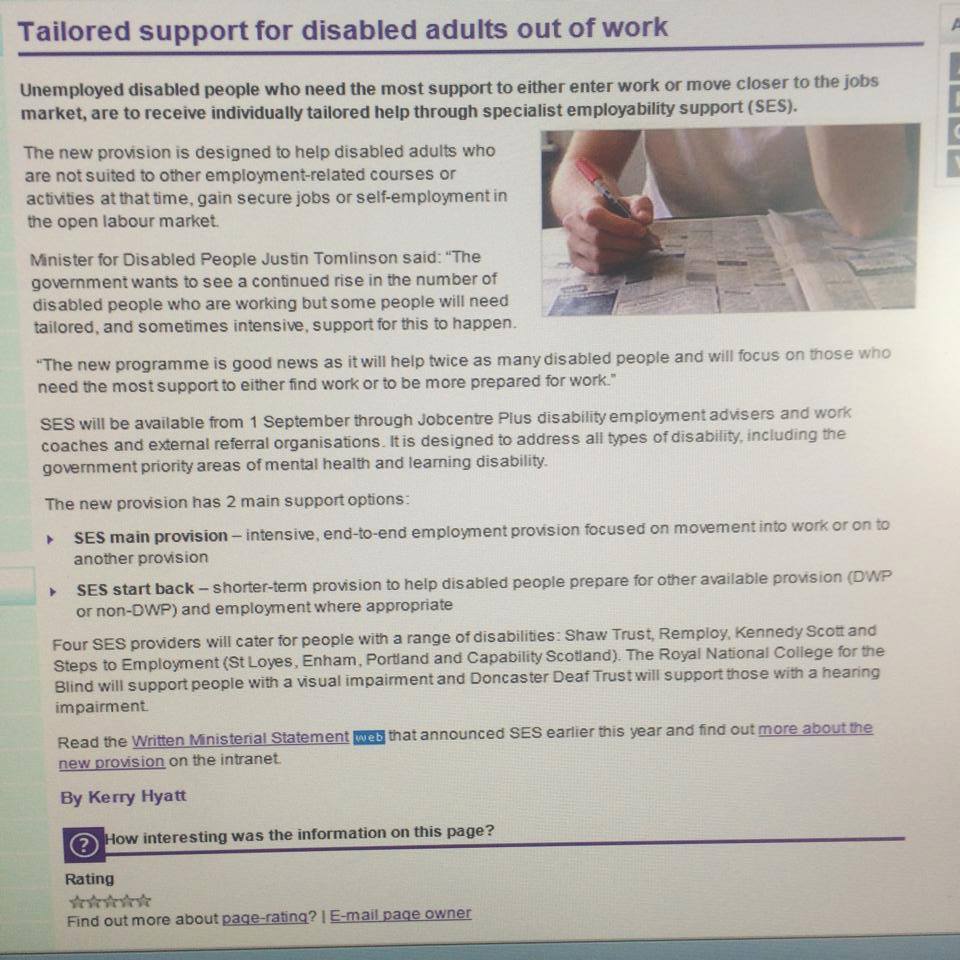
Kennedy Scott And YMCA Launch Their DWP SES Programme

September 1, 2015

A press release:

Kennedy Scott and Central YMCA are launching their new DWP Specialist Employability Services (SES) contract today, September 1st.

This is an important milestone for Kennedy Scott as this represents both a new Prime Contract, and an extension of the organisation’s service across the UK for the first time. This two-year contract will support 735 people with disabilities, more than a third of whom are expected to go into sustainable work.

This contract also marks the start of Kennedy Scott and YMCA’s pioneering new SME-third sector partnership. This fuses Kennedy Scott’s long history of supporting the most disadvantaged into work with YMCA’s 171 years of history of changing lives through education, training and campaigning.

This partnership, and its seven third sector subcontractors, will operate using the innovative ‘Circle of Support’ model which brings together all relevant parties in an individual’s life to provide a unified approach, share responsibility and form a constant bedrock of support. This draws on an evidence base and best practice from sectors including dementia care and occupational health. This multidisciplinary approach will draw on the expertise of both internal and external experts, with KS Case Managers seeking to build the self-esteem and confidence of each participant on their journey into sustainable work.
Commenting on the start of the contract, Teresa Scott, CEO of Kennedy Scott said:
“We are delighted to have been awarded this Prime SES Contract, which is a significant milestone for us. We have built on our previous success to develop an innovative circle of support model, and together with YMCA, this will help us to support more people than ever before back into sustainable jobs”.

This contract forms a major part of the government’s drive to halve the gap in the employment rate between disabled and non-disabled people. It will be heavily evaluated to measure the impact that it makes, with both organisations in the partnership absolutely committed to its success.

This was evident at the launch of the contract in central London on 21st August, which was attended by staff from both organisations, as well as stakeholders including from the DWP.

The Special Needs Hotel

September 1, 2015

This will air on Thursday at 10pm on Channel 5.

For 22 teenagers from across the country, it is their first day at the Foxes Hotel in Somerset, the grand Victorian hotel which specialises in running this unique training academy. For Amanda, Thomas and Katie it is also their first time away from home – how will they meet the challenges in the year ahead?

Stuart Chester Cannot Talk, Read, Or Write- But He Must Fill In 20 Page DWP Form To Prove He’s Fiit For Work

September 1, 2015
A SEVERELY disabled young man who is unable to talk, read or write and needs round-the-clock care from his mother is the latest target in Iain Duncan Smith’s campaign against Scotland’s most vulnerable.

Stuart Chester, who has Down’s syndrome, epilepsy and autism and is unable to feed or wash himself, is being told by officers in the Tory minister’s Department for Work and Pensions to prove he is unfit for work.

The 25-year-old has been sent a controversial 20-page work capability assessment form to fill in that will investigate his fitness for work and whether he deserves his Disability Living Allowance (DLA) and Employment and Support Allowance (ESA) benefits.

Last night Social Justice Secretary Alex Neil described Stuart’s case as “absolutely outrageous” and “shameful”.

Stuart has been given a deadline of September 18 to complete the complicated and detailed document and return it to the DWP.

His mother Deborah McKenzie, 51, said receiving the form had caused her “undue stress” and said Duncan Smith’s plan to deliberately target the sick and disabled was tantamount to “genocide”, after shocking DWP figures were released last week showing more than 80 people were dying each month following work capability assessments.

She said: “Stuart gets the high-rate DLA and he was supposed to get that for life because his condition will never change. He also received ESA benefits.

“I cannot understand why he was sent this capability for work questionnaire because he cannot talk, read or write or do anything for himself. There is no way he could work and this is just causing a lot of undue stress and anxiety.

“I was really upset when the form came through the door. I called up the DWP and asked them why they would send it out to someone like my son when he is supposed to to get DLA for life and they told me it was tough luck, that it’s just the way it is and I would just need to fill out the form for him just like everyone else.

“I know other disabled people in wheelchairs with conditions like cerebral palsy, also people like Stuart who cannot do anything for them, are being harassed by the DWP to fill in fit for work forms when there is absolutely no way they could work.

“I used to have to fill in a form for my son every three years but eventually we were told he had the DLA for life because his circumstances were not going to change and he I no longer had to fill in an application for benefits for him.

“I am his full-time carer and there is no way my son could work, no chance. He needs 24/7 care and cannot feed or wash himself and he has a lot of accidents toilet-wise. I have to do everything for him.”

Neil called for the “cruel” assessments on the sick and disabled to be scrapped, and demanded that David Cameron hand over the rights to decide on benefits to the Scottish Government.

He said: “This is absolutely outrageous and these are the kind of cases which highlight that the Tories are out of control and they must hand over running of our benefits system to the Scottish Government.

“It bad enough the DWP sends out these forms to people like Stuart but they don’t seem to understand the stress and worry this causes families in Scotland.

“If someone is clearly unable to work and has a lifelong condition they should not be hounded like this and they should be left alone, not put through the hell of being assessed for work and worrying about whether or not they will get their benefits when they are quite clearly entitled to them.

“It is nothing but bullying, harassment, intimidation and a breach of human rights of the most vulnerable in our society and it has got to stop.

“They have crossed the line and if we had control over these benefits, the first thing we would put an end to this kind of harassment and treat these people with respect and dignity they deserve.”

Last week, disability campaigners spoke to The National and warned more people would die because of work capability assessments unless they were scrapped.

The claim followed the release of figures that revealed 2,380 claimants died between December 2011 and February 2014 shortly after being told to get back to work and that their benefits were being stopped.

In the same period, 50,580 people who received ESA died within two weeks of their benefit claim ending.

Stephen Cruickshank, director of the Scottish Disability Equality Forum, who has spinal neuropathy, said the work capability assessments were unfit for purpose.

Mother-of-two Deborah, of Glasgow, said Duncan Smith had “a lot to answer for” and described him as “the lowest of the low” for targeting disabled people.

She said: “I don’t know how Iain Duncan Smith can sleep at night or live with himself targeting the disabled and most vulnerable in our society like this.

“It is beyond belief and absolutely disgusting considering many of the people being sent these forms were awarded with DLA for life which we had to fight for.”

Deborah said coping with everyday life caring for Stuart was “hard and challenging” and even though she knows that he cannot work, it is the uncertainty of having to fill in the complicated form that is putting her under even more stress.

A DWP spokesman said: “We regularly review people’s conditions to ensure that they are not simply written off and condemned to a life on benefits. That’s why we have improved the work capability assessment since it was introduced in 2008, ensuring that it is fairer and more accurate.

“Decisions are taken following a thorough independent assessment, and consideration of supporting medical evidence provided to us by a claimant’s GP or medical specialist.”

“It’s important that regular assessments are made, as for some people, conditions may improve or worsen.”

Bedroom Tax Victims Fighting To Stop Disabled Grandson Going Into Care

September 1, 2015

A disabled boy’s grandparents have beaten Iain Duncan Smith’s heartless bid to block a court appeal on the Bedroom Tax that will decide whether he carries on living with them or goes into care.

Doting Paul and Susan Rutherford were targeted by the ­cruel levy, which will force them to quit their three-bed home, two years ago and fought it with a judical review.

Grandson Warren, 15, needs round-the-clock attention from two people and because of their own disabilities the couple rely on help from paid carers – who need to sleep over regularly.

Without their third bedroom they will lose their support lifeline and Warren, who has Potocki-Shaffer syndrome, will go into care with the taxpayer footing the bill.

DWP chief Mr Duncan Smith urged judges to throw out the couple’s challenge.

But last month Lord Justice Underhill and Lord Justice Stanley Burnton ruled their case must be heard by the end of 2015.

Have your say in our new comments section below

D Legakis Photography/Athena Paul and Sue are pictured in their ‘spare’ room, with Warren looking on from the corridor
Unjust: Paul and Sue are pictured in their ‘spare’ room, with Warren looking on from the corridor

Michael Spencer, a solicitor for the Child Poverty Action Group, said: “Paul and Sue work round the clock to care for Warren.

“Without carers who can stay they wouldn’t be able to cope and Warren would have to go into care – at substantial cost to the taxpayer.”

Paul and Susan live in a three-bed bungalow in Clunderwen, Pembrokeshire, specially adapted to meet Warren’s needs.

They share a room while Warren sleeps in another. In addition to putting up carers, the third stores Warren’s equipment.

Paul and Susan – who were in BBC documentary Saints and Scroungers – claim the hated levy ­unlawfully discriminates against ­seriously disabled children requiring overnight care.

The Difficulties Of Getting Fit With A Disability

August 28, 2015

By Kate Ansell for Ouch!

My favourite thing about being disabled has always been that no-one expects me to do any exercise.

I have cerebral palsy (CP) and the assumption that I couldn’t take part in sport while growing up was one I was happy to embrace because I hate physical exercise.

So imagine my frustration when Paralympics 2012 came to London and disabled people the world over seemed to be getting sporty. Every other taxi driver would ask me if I was going to take up sprinting.

Though the Paralympics loomed large, it turns out I am not the only disabled person who dislikes taking part in sport. According to new research by Scope, although most disabled people think the London Paralympics showed they can achieve great things, only 5% of them were actually inspired to do more exercise or sport after the games.

The thing about having CP is that I never had to think about keeping fit very much. The way I walk is exhausting, and has always been a workout in itself. As a result, I have spent most of my life being very thin without even trying. For people with CP, this isn’t uncommon: there was even a Facebook group called Why Diet When You Can Have Cerebral Palsy? where we’d share our outrageously decadent calorific dinner plans and then laugh about how we planned to burn it all off tomorrow, simply by walking a bit.

But I had to leave that Facebook group because, unexpectedly, I got fat.

In what I now know is a pattern common to people who share my disability, as I hit my thirties, I became less mobile. This meant I did less of my characteristic strenuous walking and put on significant weight for the first time. “Oh yes,” said every medical professional I encountered, “this is what happens with CP as you approach middle-age.” Great.

So, now I have to watch what I eat and also do exercise.

But this change in my attitude isn’t just vanity, I need to shed the extra weight so I can improve my mobility.

I knew that I had to do something physically challenging … but what?

A physiotherapist once recommended I join a gym and I laughed at her because, well, gyms aren’t for me. People tend to stare when you have a disability, and I need to feel comfortable if I’m going to work out.

“I hate the gym,” agrees John Dickinson-Lilley, one of Britain’s top blind male ski racers. “I have a utilitarian approach to fitness. I have to go to the gym so that I can ski.” He’s comfortable in the gym he’s been attending for the last five years, but he stopped taking his guide dog or cane because of the attention it attracted.

Although it’s a necessary evil, I felt nervous about approaching the gym for the first time in my life, especially when I couldn’t move as well as I am used to.

Kris Saunders-Stowe, a wheelchair user and qualified fitness instructor tells me that I am not alone in feeling intimidated by a typical gym environment. “Centres don’t always help,” he says. “There is a lot of ignorance. They need to understand the disabled community more.”

Kris met prejudice when taking his instructor qualifications. One tutor told him he should be in “the special class” but it didn’t put him off. He believes attitudes are beginning to change, and, in an attempt to fill the gap, he now runs fitness classes for disabled people in Herefordshire. “Legs aren’t necessary to keep fit,” he says. He took mainstream fitness qualifications, and went on to specialise in working with disabled people. He’s about to release an exercise DVD for people with disabilities. The routine is energetic, but assumes the participant is sitting down.

Crucially, Kris says, the kind of fitness he promotes isn’t about winning medals. “People assume you want to be a paralympian, but it isn’t about becoming a big sports person.” For disabled people, the goals can be more modest, but life-changing, he says. “Forget fitness, some people just want to be able to lift their mug.”

Kris is supporting Steptember, a campaign by Scope to raise money and encourage people to move more, whether they are disabled or not. So next month is a good chance for me to get involved.

Ability Bow, a gym in east London, takes away the anxiety that you are being watched due to your difference, because they are dedicated to working with disabled people They have nearly 500 people on their books, and a waiting list. Many people are referred by their GP but some have self-referred after hearing about the results that its members have achieved. “It’s tailored to your needs,” says Victoria Kent, who founded the gym. “Disability is completely normal here.”

While researching how I could improve my fitness levels, I found other disabled people online who are attempting to get fit. One of them advised me to get a heart rate monitor to help me understand how much energy I was using on a day-to-day basis. This was suggested because step-counters are designed with regular walkers in mind, and so tend to underestimate the calories I burn when walking.

I did get a heart monitor, and now switch between this and a Fitbit, which counts steps. I have discovered that walking from my house to the local corner shop, and back again, renders a Magnum ice cream bought in that corner shop almost completely calorie-neutral for someone who walks like me. Not the point of using a heart rate monitor in the first place, I realise, but I do appreciate the information.

It seems unlikely I will ever become a true gym bunny, but it’s good to know there are disability-friendly places to go if I change my mind. And if I stop eating so many ice creams and set small goals for myself, it’s possible I’ll even start to get fit.

Daughter Says Mother’s Death Two Weeks Ago Was ‘Hastened’ By Benefit Delay Stress

August 28, 2015

Moira Drury died less than fortnight ago aged 61. She suffered from combination of illnesses, including depression and cancer, but her daughter believes that a seven-month delay in processing her benefit claim hastened her death.

During her life, she overcame domestic violence and severe disability to work as a nurse and bring up three daughters as a single parent. But at the end she was effectively abandoned without support and income by a glacial and bureaucratic benefits system.

“She was incredibly determined, resilient, strong and warm-hearted,” said her daughter, Nichole Drury. “She was such an amazing lady.”

According to Nichole, her mother’s demise was hastened by the decision of jobcentre officials earlier this year to stop her benefits. “She told me the day before she died that the stress of having her benefits removed contributed to her decline,” said Nichole, who is a veterinary surgeon based in Sussex.

“Stress and anxiety lowers your immune system and ability to fight disease. I am absolutely certain that the stress she endured caused her to give up her fight against her illnesses. Without the stress this caused she would have had a little more precious time.”

Her benefits saga started when she was told by her local jobcentre in Essex to undergo a fit-work-test, known as a work capability assessment (WCA), on 15 January to assess whether she should continue to be eligible for Employment and Support Allowance (ESA), a benefit awarded to people judged unable to work.

Bed-bound and suffering from flu and a chest infection, she telephoned to say she was not well enough to attend. Illness also prevented her attending a rescheduled WCA just over two weeks later on 3 February.

On 16 February she received a letter from Basildon benefit centre saying it had examined her reasons for not attending the WCA. Presumably it did not accept that she was genuinely ill. The letter only says tersely that it considered she was capable of work and that she was no longer entitled to ESA.

Moira wrote to the Department for Work and Pensions to ask for the decision to be reconsidered. A week later the DWP replied saying it would not reverse its decision. “You requested a mandatory reconsideration of this decision on the grounds that … you were not well and had diarrhoea and that you have diabetes and epilepsy.

“Having considered all the available evidence, I am unable to accept that a good cause has been shown for not attending the medical assessment … and you cannot be treated as having limited capability for work. As a result, you are not entitled to employment and support allowance.”

That decision plunged Moira into an bureaucratic nightmare and personal depression. She was, her daughter says, “going round in circles”. She did not understand why she had lost her benefits. She was not told she could appeal, and was advised to reapply for ESA.

The DWP aims to process benefit claims within 16 days, but the reality can be very different. Moira’s claim was stuck in the system, and had still not been completed when she died. As a result, for the last seven months of her life, as her health deteriorated, she received no income.

When Nichole telephoned the DWP to check on the process of the application, she was told they were awaiting medical records from Moira’s GP. When Nichole checked with the GP practice, they told her they had not received any such request.

The lowest point came just over a month before Moira died, when she received a court summons for non-payment of council tax. As her ESA had been suspended, her local council had automatically stopped her council tax benefit, meaning she was liable for full council tax. Moira was not told. The shock arrival in July of a council tax bill for nearly £2,000 came the day after she received the results of a hospital biopsy that detected cancer on her lung.

“That was the point that pushed her over the edge,” says Nichole.

Ministers are fighting a permanent battle against critics from across the political spectrum concerned at how welfare cuts and reforms and benefit processing delays have hit the poor and vulnerable, causing illness and stress, and driving those affected to food banks and loan sharks.

On Thursday the government finally released statistics relating to ESA claimants who have died after claiming benefits. It is under pressure to release internal reviews into 49 benefits-related deaths since February 2012, 40 of which followed a suicide or apparent suicide.

Moira certainly did not fit with the crude media characterisations of benefit claimants. She was working as a nurse and bringing up three young children in the West Midlands in the 1980s, when her abusive husband attacked her with a hammer, an assault that put him in prison and her in hospital with a serious head injury.

When she recovered, she refused to sign on for sickness benefit, says Nichole, and returned to work doing night shifts at the local hospital. She later took time out to look after her daughters and subsequently worked as a receptionist until 2007, when a combination of limited mobility, mini-strokes, epilepsy and depression forced her to give up.

The DWP told the Guardian that its sympathy was with the Drury family but indicated that its files said it had proved difficult to assess her claim. “It’s important that people supply sufficient evidence – including medical evidence – when making a claim, as it could affect their benefit entitlement. That is why we contacted Ms Drury several times to try and gather further evidence. People also have the right to ask for a reconsideration of their case or appeal if they don’t agree with a decision.”

However, Nichole, who described her mother as proud and often unwilling to admit that she needed assistance, tried in vain to help her to navigate a benefits system she calls an “administrative assault course”. For her, a successful professional, who had had no personal dealings with the benefits system, her encounter was eye-opening.

“Nobody wants to see people exploiting the welfare system. But we don’t want a system which leaves people by the wayside. The way it works is crude and it’s cruel, and seems deliberately designed to get the weak and vulnerable off benefits to save money. It’s people who can’t fight back who are the victims.”

Ending Own Life Would Be Easiest Option, Says Terminally Ill Man

August 28, 2015

Caller Jeff tells LBC that Britain is letting down its most vulnerable after he was turned down for benefits, despite being diagnosed with terminal cancer.

//embeds.audioboom.com/boos/3509567-terminally-ill-man-rails-against-benefits-cuts/embed/v4?eid=AQAAAAGN31U_jTUA

Jeff opened his heart to Tom Swarbrick during a discussion about how thousands of people have died shortly after being declared “fit for work” by the Department of Work and Pensions.

“I’ve got a couple of months to live…and after working for 46 years, they refused me Jobseeker’s. I’ve been contemplating suicide – I think it’s just terrible that the Government can’t help.”

A very emotional Jeff also slammed the Government for not doing enough to help British citizens, saying: “I thought charity began at home…suicide would be the easiest option.

“I worked for 46 years off, never took a day off sick. And when I went down with cancer…I’m just too weak to work.”

Listen to the powerful call above.

Mencap Calls For Investigation Into ESA Death Stats

August 28, 2015

A disability charity has called for an investigation to be held into the deaths of more than 2,000 people within weeks of being judged “fit for work”.

Mencap, a learning disability charity, says the “tragic” deaths raise questions about the fairness of the work capability assessment.

It comes after the Department for Work and Pensions (DWP) released figures sought under a Freedom of Information Act request.

The figures show that between December 2011 and February 2014, some 2,380 people died within around two weeks of their Employment and Support Allowance (ESA) being stopped following a decision they were “fit to work”.

The DWP insists there is “no causal link” between benefits status and the likelihood of dying, as the individual causes of deaths were not recorded in the figures.

The department stressed that the death rates for unemployed claimants remained in line with trends in the wider population for a decade.

But Mencap argues the number of deaths is unusually high for people of working age who had been declared fit to work.

The charity’s Rob Holland, who co-chairs the Disability Benefits Consortium, said: “These tragic figures are concerning and warrant further investigation.

“We know the fit for work test is failing disabled people, with devastating consequences.

“Wrong decisions can mean people are left with little or no support at all, in some cases struggling to pay for their homes and basic essentials like food and heating.

“The Government must act now to reform the work capability assessment so it is fair for disabled people and those with health and medical conditions. Indeed there is real concern that the process itself is stressful and can in fact worsen people’s conditions.”

A DWP spokesman said: “We don’t hold information on reason of death, so no causal effect between a fit for work decision and death should be assumed.

“The mortality rate of those who are claiming Jobseeker’s Allowance – which includes some of those found fit for work – is still lower than for the general population.

“Furthermore, the overall trend shows the mortality rate for people who have died while claiming an out-of-work benefit, has fallen over a 10-year period.”

IDS Should Resign Over Disability Benefit Death Stats, Says Jeremy Corbyn

August 27, 2015

Iain Duncan Smith should resign after the release of statistics showing thousands of people died soon after being found fit to work in disability benefit tests, the frontrunner for the Labour leadership has said.

Jeremy Corbyn called for the Work and Pensions Secretary to step down, and said the Work Capability Assessments had left some disabled people in “despair”.

“He should never have been appointed. Yes, he should resign because these figures are so frightening and so disgusting,” he told a hustings event hosted by the Daily Mirror newspaper.

“I’ve had people with mental health difficulties as well as physical difficulties who are absolutely in despair because they’ve been declared fit for work and are absolutely not.”

The Department for Work and Pensions battled for months not to release the numbers, with Mr Duncan Smith at one point telling Parliament they did not exist.

But the statistics, released on the order of the Government’s transparency watchdog, show that between December 2011 and February 2014, 2,380 people died after their Work Capability Assessment told them they should start looking for work.

The figures related to claims for the Employment and Support Allowance (ESA) benefit as well as IB/SDA.

The DWP’s mortality report says that a causal effect cannot be assumed from the new numbers.

  Jeremy Corbyn said the DWP secretary had to step down “These isolated figures provide limited scope for analysis and nothing can be gained from this publication that would allow the reader to form any judgement as to the effects or impacts of the Work Capability Assessment,” it says.

When asked about the stats in Parliament during the fight to get them released, Mr Duncan Smith told Labour MP Debbie Abrahams:

“She knows very well that the department does not collate numbers on people in that circumstance.”

In 2012 a government advisor appointed to review the Government’s Work Capability Assessment said the tests were causing suffering by sending sick people back to work inappropriately.

“There are certainly areas where it’s still not working and I am sorry there are people going through a system which I think still needs improvement,” Professor Malcolm Harrington concluded.

The tests are said to have improved since then, but as recently as this summer they are still coming in for criticism. 

In June the British Psychological Society said there was “now significant body of evidence that the WCA is failing to assess people’s fitness for work accurately and appropriately”. It called for a full overhaul of the way the tests are carried out.

The WCA appeals system has also been fraught with controversy with a very high rate of overturns and delays lasting months and blamed for hardship

Some payments for the ESA benefit were cut in the Chancellor’s recent budget, with Mr Duncan Smith arguing that the previous cash level created a “perverse incentive”.

Homelessness charity Crisis last year warned that an increase in sanctions for the ESA benefit was in danger of contributing to a rise in homelessness for disabled people.

A DWP spokesman said: “The mortality rate for people who have died while claiming an out-of-work benefit has fallen over a 10-year period. This is in line with the mortality rate for the general working-age population.

“The Government continues to support millions of people on benefits with an £80 billion working-age welfare safety net in place.”

Mental Health In The Asian Community

August 27, 2015

Mental health services for people from the South Asian community need to be improved, a leading psychiatrist has told the Victoria Derbyshire programme.

Dr Dinesh Bhugra, Professor of Mental Health and Diversity at the Institute of Psychiatry at King’s College London, says the NHS should ensure services are culturally sensitive and appropriate, with staff receiving extra training to encourage people to come forward and to reduce stigma.

He spoke to Naga Munchetty along with Tamana Miah and Aneela Ahmed about their health issues.

Death Stats: ESA, IB, Or SDA

August 27, 2015

Here’s the document.

It says on the front page that it’s not suitable for assistive technology, but that you can request it in other formats.

A Leaflet From The DWP- It’s About To Get Worse For Disabled People

August 27, 2015

I spotted this late last night on the ATOS Miracles Facebook page.

This was sent to us from  an inside source on dwp intranet
From the DWP intranet page- watch them spin it as working for your welfare you’ve not got the skills etc to get work after years out of the Job market so these employers are wiling to work with dwp to
Enable those without skills to get skills. If you don’t comply we will sanction you, so tesco etc will get free labour again under the guise of being altruistic
When IDS said relentless he meant it. I can just hear him saying the above.

dwp intranet

Updated 2pm: Many thanks to reader Liane Gomersall who sent in a page of information about how Remploy will run SES programmes.

Jeremy Corbyn Would Consider Introducing Women-Only Train Carriages At Night

August 26, 2015

Earlier today, I saw this on Facebook:

Many disabled women I have linked up with today welcome the choice of being able to use a women’s only train carriage at night.
It’s not all about able bodied women’s choices who have been largely dismissing the idea today.

It got me thinking about my own views on women-only train carriages.

As a woman, I like the idea of women-only train carriages being available for women to use late at night. I think that this might reduce sexual assaults, groping, or insults aimed at women by men on trains late at night.

However, as a physically disabled woman, women-only train carriages wouldn’t help me personally at all. My disability means that I can’t use public transport independently. So I rarely use trains as it is. However, women-only train carriages would restrict me even further as they would mean that I wouldn’t be able to use a train late at night with my father, brother or future boyfriend without another woman present as well. I need the help of whoever is with me to get on and off a train and would find it extremely difficult to stand waiting for a man if he was in a separate carriage.

I have heard that women-only carriages would not replace mixed carriages, but would be available for women who chose to use them. So if I was on a train with a man and I had to sit in a mixed carriage with him because I needed his help, I would have to sit with other men who may be drunk late at night and who may make me feel uncomfortable anyway.

If I was not disabled and didn’t need the help of my companions on a train I may, at times, choose to use a women-only train carriage, even if I was travelling with men I know, because as a woman I don’t like the idea of drunk men who I don’t know staring at me, insulting me or worse on a train.

As things are, for me personally as a disabled woman, the choice to use women-only train carriages would not change anything, as it would not even be open to me unless the people I knew who were travelling with me on the train late at night were also women.

So for me personally, women-only train carriages would be more of a restriction to who I was able to travel with on a train late at night than anything else.

Do you have any thoughts on this idea, readers?


George Galloway Takes On #IDS And #fakedwpstories

August 26, 2015

Including a call from a wheelchair user with CP who was sanctioned after she couldn’t attend a job interview- because she was unconscious.

DWP Letter Proves You Can’t Be Sanctioned Just For Refusing To Sign Forms

August 26, 2015

Readers, have you ever been told you can be sanctioned just for refusing to sign anything given to you by your Work Programme Provider?

Well, this letter, sent to inform a claimant that his appeal against a sanction had been successful, proves that you can’t.

With many thanks to campaigner Gail Ward.

workprogrammeappealsuccess

ESA WRAG Sanctions Up 30% In A Year

August 26, 2015

Sanctions to people on disability benefits rose by over 30 per cent last year.

According to figures from the department for work and pensions, 33,357 sanctions were dished out across the 492,180 people in the Employment and Support Allowance (ESA) Work Related Activity Group (WRAG) in Britain in 2014-15.

The WRAG group is the part of ESA intended for people who are too sick to work now, but who could potentially work in the future.

This works out as 6.8 sanctions for every 100 claimants and is 31 per cent higher compared to the rate of 5.2 sanctions per 100 claimants in 2013-14. This is a result of the number of people claiming that type of ESA decreasing at the same time as the number of sanctions being awarded increased.

More details here.


Valerie Vaz, Walsall MP, Writes To Capita Chief Executive Over Inaccessible PIP Assessment Centre

August 25, 2015

Walsall South MP Valerie Vaz has written to the chief executive of Capita, Andy Parker, over concerns about the Personal Independent Payment offices for Capita in Walsall town centre.

She said some rooms at the base in Lower Hall Lane were not wide enough for disabled people and was ‘alarmed’ applicants were being asked to climb upstairs to get to consulting rooms.

Ms Vaz raised concerns that it could be taken as evidence against them when making a claim.

Among her concerns was an access ramp at the front of the premises which she said was very steep.

But Capita has claimed it had worked with organisations for disabled people to make sure all of its centres had ground floor consulting rooms and step free access.

Ms Vaz said: “A building where PIP assessments are undertaken should be a model of accessibility, not a challenge for those who use the building most. I hope that Capita will urgently address the concerns raised.”

She said she had sent the letter after constituents had told her that the disabled access toilet and the entrances to the consulting rooms are too small for wheelchair users to access.

She added: “I also understand that the access ramp at the front of the building is very steep.

“I was alarmed to be told that PIP applicants are being asked to climb stairs to consulting rooms.

“This could wrongly be taken as evidence that they do not qualify for PIP, which is a vital lifeline intended to help meet the extra costs of having a disability.

“Some people applying for PIP have long term conditions which fluctuate.

“On one day they may be able to climb the stairs, but unable to the next.”

In her letter to Mr Parker, she has asked for confirmation that the building complies with the Disability Discrimination Act, the Equality Act and Building Regulations and for confirmation that applicants should not be asked to climb stairs.

She added: “All assessments should take place on the ground floor.”

But Delyth Bowen, spokeswoman for Capita, said: “We have worked with disabled peoples’ organisations to ensure all of our centres have ground floor rooms and step free access.

“We try to see claimants with mobility impairments in their own homes.”

NHS Discriminating Against Civillian Amputees

August 25, 2015

Charities representing some of the 64,000 amputees across the UK say civilians are being discriminated against.

Their claim comes after NHS England refused to fund three specialist prosthetics, despite them being available for service veterans injured in conflict.

Nikki Fox reports.

Room use, disability and bedroom tax – A favourable UT precedent

August 25, 2015

Dear Iain McNicol -Labour Leadership Vote – What a Farce

August 25, 2015

Another well known disability campaigner, Jayne Linney, has had her vote denied.

jaynel62's avatarjaynelinney

This is the letter I sent to Iain McNicol this morning as I too have received my email denying me my vote!

Dear Iain McNicol

As a previous Labour Member who didn’t renew my membership due to concerns with actions by my local Labour Party and what I perceived as a lack of opposition from the Parliamentary group, I maintained my belief in Labour’s aims and values.

Given this I willingly paid my £3.00, which I can ill afford as a disabled benefit recipient, to become an Affiliated Supporter and vote for my preferred candidate in the Leadership campaign.Upon receiving my electronic ballot paper I immediately duly voted but today I received an email informing me my vote will not be counted?

The email states “We have reason to believe that you do not support the aims and values of the Labour Party or you are a supporter of an organisation…

View original post 92 more words

A Letter A Day To No 10 Number 1189: Iain Duncan Smith- Work Cures Mental Illness

August 25, 2015

As always, Keith Ordinary Guy says shares of this letter are encouraged and welcomed.

I got it from here.

IDS’s Full Speech From Yesterday On Work, Health And Disability

August 25, 2015

From here. There is also a video version here, for those who need it.

Labour’s legacy of worklessness

My thanks to Reform and Barclays for hosting this event.

Today, I want to set out where our reforms of the last five years have taken us….

….and what I see as my priorities for the next five.

Let me start with the last Parliament.

It was clear from the situation we inherited in 2010, that something had gone very wrong in this country.

We had a welfare system where a life on benefits paid more than having a job.

That wasn’t fair to the hardworking taxpayers who paid for it….

….and it wasn’t fair to the people who were trapped in a system with no hope for a brighter future.

We lived in a country where….

  • nearly one in five households had no one working;
  • the number of households where no one had ever worked had nearly doubled;
  • 1.4 million people had been on benefits for most of the previous decade.
  • And where close to half of all households in the social rented sector had no one in work.

This bleak picture was the reality just five years ago.

Under Labour, welfare spending went up 60% and the benefits system cost every household an extra £3,000 a year.

Spending on tax credits increased by 335%.

That’s £23 billion.

It is clear that the last Labour government’s approach of handing out more money to lift people over an arbitrary poverty line wasn’t working.

Of course money has a role to play, but greater and greater handouts were not actually extending opportunity….

….they weren’t transforming lives….and they failed to improve people’s life chances.

Government spending was poorly targeted and there was a focus on inputs rather than outcomes.

The result was a country where worklessness had become engrained.

A life without work, for many, had become ‘the norm’.

It was taking root in families and starting to pass through the generations.

This was a national scandal….

…. and above all, a personal tragedy for each and every person and their family not in work.

The sickness benefit culture in this country, I believe, is in dire need of reform….

….so that will be my focus in the coming months.

And I want to be clear about the principles that will drive action as we move forward.

Principles driving reform

I have said many times that I believe work is the best route out of poverty.

It provides purpose, responsibility, and role models for children.

As a one nation government, we believe everyone in the country should have the chance to benefit from the security and sense of purpose that comes with being in work.

That is why our guiding principle has been to place work at the heart of everything we do in our reforms.

Getting people into work is more than just earning a salary and certainly more than balancing the public purse.

These matter, of course, but they are not the primary reasons.

For culturally and socially, work is the spine that runs through a stable society.

We could not have continued with the situation we were left in 2010.

Significant numbers of people saw work as something completely alien to them and their families.

For many, work was something they simply didn’t do, and never had.

It was something other people did.

Many had fallen into a life of dependency.

This is damaging for society.

A dependent society is one that’s….

….more likely to suffer crime

….more likely to be ill

….more likely to call on the health service

….and more likely to increase the cost to criminal justice system.

But critically, families where no-one works, lose their sense of self-worth.

Children grow up without the aspiration to achieve and they become almost certain to repeat the difficult lives of their parents….

….following a path from dependency to despondency.

I want those who remain trapped and isolated on welfare to move from dependence to independence.

That is real social justice –

giving people the power to decide their own lives….

….not live a life dictated by others.

That’s why we are helping people back to work and to stay in work.

Let’s take the Work Programme.

The Work Programme is, I believe, the most successful back to work programme we’ve ever seen.

By March this year:

  • over 1 million people – or 70% of all referrals – had spent some time off benefit;
  • and over 430,000 people had moved into lasting employment.

Job Centres are also now working in a more flexible way, providing that longer term support.

And we are rolling out Universal Credit and our Fit for Work service – something I will return to later.

But we can see the change that has been made since 2010:

  • Nearly two million more people are in work.
  • The number of workless households has reached a record low – down over 670,000.
  • And the workless households rate in the social rented sector is also at its lowest on record.

But we know that we must not stop there.

We need to be relentless in our efforts to get more people into work and off welfare.

But work is more than just salaries, tax, numbers and statistics….

….it is what shapes us and helps us develop.

In short, it is about self-esteem, self-confidence and self-worth.

Work is good for health

Yet there is one more area which we haven’t focused on enough – how work is also good for your health.

Growing evidence over the last decade has shown work can keep people healthy as well as help promote recovery if someone falls ill.

By contrast, there is a strong link between those not in work and poor health.

So, it is right that we look at how the system supports people who are sick and helps them into work.

Let me be clear….

….a decent society should always recognise that some people are unable to work because of physical or mental ill health – or both.

It is right that we protect these most vulnerable people in our society.

And that support is there.

For despite the scaremongering, it is worth reflecting on the fact that we in this country spend more on sick and disabled people than the OECD average.

To put that in perspective – and according to the OECD, the UK spends more on incapacity than France, Germany, or Japan.

However, we are also ensuring that the resources are in place to support people into work.

I’m proud that we are providing significant new funding for additional support to help claimants into work….

….£60 million in 2017 rising to an additional £100million a year by 2020.

We are seeing a continued rise in the number of disabled people getting into work.

The latest figures show a rise of more than 200,000 disabled people who are now in work compared to the same time last year.

That’s now over 3 million disabled people who are in employment.

Yet, this is only the beginning.

For we know there remains a gap between the employment rate of disabled and non-disabled people.

We want to ensure everyone has the opportunity to transform their lives for the better by getting into work.

That’s why, as part of our one nation approach, we have committed to halving this gap.

On current figures, that means getting 1 million more disabled people into work.

I want to be clear – this employment gap isn’t because of a lack of aspiration on the part of those receiving benefits….

….in fact, the majority want to work or stay in work, but I believe this gap exists because of two factors:

First, some employers are reluctant to employ people with disabilities.

That is why I have set up the ‘Disability Confident’ campaign.

This shows employers that the reality is quite different from the perception….

….in fact, that once employed, people with disabilities are in the vast majority of cases more productive than others.

Second, the poor quality of support they receive leads too many sick and disabled people languishing in a life without work, when work is actually possible for them.

Challenge to employers

It is this support that I want to turn to now.

I want to look at the support people receive right from the start when they first get sick – which can very often be from their employer.

Too many businesses do not pay any attention to the health condition of an employee who has fallen ill….

….or make any attempt to understand what the problem is.

The employee goes to their doctor, and after a short assessment, their doctor signs them off work.

Too often, even early on, no one at work maintains regular contact with them.

And after successive sick notes, their original condition then gets worse.

An opportunity to keep the prospect of a return to work within sight is lost.

Instead, they move onto sick pay, and then at some point are left to cascade onto sickness benefit.

This has become a damaging cycle which affects everyone.

Instead, employers need to recognise the importance of staying in touch with their staff when they get sick…

….and of providing early support to someone to stay in work or get back to work.

This makes sense for three important reasons.

First, it makes sense for businesses who invest a lot of money in their staff, not to lose that investment through illness and absence that could be avoided.

Second, it makes sense for society by stopping people falling onto expensive sickness benefits and then into long term worklessness….

….we know each month a person is on sickness benefits, they become progressively less likely ever to work again.

And third, perhaps most importantly of all, it makes sense to ensure that a fellow human being isn’t written off with all the negative consequences that follow for them and their families.

Some companies understand this.

They realise the benefits of investing in staff health and wellbeing….

….they have come to see that it improves productivity and reduces the costs of sickness absence.

In these organisations, employees who fall sick:

  • Will experience regular and direct communication;
  • They will receive a work-focussed health assessment to overcome any obstacles to a return to work….

….and review what work they can do and what support they need to do it.

  • Together with the employer, they also will agree a plan of action with timescales to support a return to work, taking into account their health condition and any workplace adjustments.

At every step, there is tailored support and a realistic expectation on both sides of a return to work.

Importantly, and where possible, that vital link with work is not lost.

Sadly, this is however, by no means common practise.

Other countries do this better than us….

….and it’s something that both the private and public sector in Britain need to get much better at.

Fit for Work service

We know the personal and professional empowerment that is possible if the right support is provided at the right time.

But employers can’t do it alone.

GPs are also vital in this process.

They need to see the health benefits for their patients of early support and a return to work.

The good news is that now businesses and GPs will be able to use the new Fit for Work service that is being rolled out by us.

So, instead of asking, ‘how sick are you?’….

….the new service asks, ‘what help can we give you now that will help and keep you close to your job?’

Sophisticated early support can have a positive effect on both health and employability.

We are also working with the Department of Health so that GPs routinely send people to Fit for Work to get their Return to Work Plan.

In fact, all GP practices in England have been sent a letter asking them to do just that.

Focus on mental health

I do want to take a moment to look at what is one of the biggest causes of work absence in the UK.

One in six people have a common mental health condition….

…..and you’re much more likely to fall out of work if you do.

In fact, almost one in four people on Jobseekers Allowance has a mental health condition.

The vast majority are related to anxiety and depression, which we know are treatable conditions….

….and the sooner someone gets treatment, the better.

And we know the longer you are out of work, the more chance you have of worsening mental health, even if the original reason for your ill health was a physical one.

So, every day matters.

That is why our Fit for Work service includes professional experts skilled in helping people with mental health conditions.

That is why this Government is investing in psychological treatment services which are helping thousands of people return to work from a period of sickness absence.

And that is why we are also investing and testing new ways of joining up health and employment services to improve access to treatment and support.

Universal Credit

So, I see the Fit for Work service as the first line of defence when someone falls sick….

….helping employers and GPs to step in early.

But even when someone is out of work, it is critical that we have a modern and flexible benefit system that supports them….

….and keeps them close to the labour market wherever possible.

That’s what is so important about Universal Credit.

The roll out is well under way….

….half of all JobCentres are now using Universal Credit.

However, there is a tendency for people to focus on Universal Credit’s technical innovation.

Today, I want to explain just how transformative Universal Credit is in a human sense.

Under tax credits, once someone claims, they lose any human interface with the JobCentre.

Under Universal Credit, people can expect early and continued support about what work they can do and what support they need to do it, until they leave the benefits system.

As a result, work coaches will spend time working with claimants focussing them on what they need to do and how the system can help them progress.

It is that human interface with the advisor – who through Universal Credit – will work on their plan and help motivate them and support their return to independence.

Moreover, with ESA becoming part of Universal Credit….

….it is that access and human interface which opens the way for us to re-think the relationship between sickness benefits and work

Case for further reform – ESA and WCA

I spoke earlier about what good employers do when one of their staff goes off sick:

  • They keep in touch on a regular basis.
  • Through a clear action plan, they look at the obstacles that may be preventing a return to work and do everything they can to remove them.

However, what happens to a claimant on Employment and Support Allowance is very different.

Under the existing system, there is a limited opportunity to work with the Jobcentre.

Instead, they receive an assessment of their condition that focuses on what they can’t do rather than on what they can do.

That assessment will force them into a binary category saying they can be expected to work or they can’t.

So it’s not surprising that over the last two decades, the number of people on sickness benefits has stayed at around 2.5 million.

While the number of people on unemployment-related benefit has nearly halved since 2010, a fall of around 700,000….

….the number of sickness benefit claimants has fallen by 88,000.

ESA was designed and introduced under the last Labour government in 2008 and expanded under Yvette Cooper when she was Secretary of State for Work and Pensions….

Labour said it would lead to one million fewer people being on incapacity benefit [John Hutton in 2006].

However, the design of ESA as a short term benefit, where the vast majority of people are helped to return to work, simply hasn’t materialised in reality.

ESA may have been designed with the right intentions, but at its heart lay a fundamental flaw.

It is a system that decides that you are either capable of work or you are not.

Two absolutes equating to one perverse incentive –

a person has to be incapable of all work or available for all work.

Surely, this needs to change.

In the world beyond ESA, things are rarely that simplistic.

Someone may be able to do some work for some hours, days or weeks, but not what they were doing previously.

As ESA becomes part of Universal Credit, the two approaches seem at odds.

We need to look at the system and in particular the assessment we use for ESA.

The more personalised approach under Universal Credit sits alongside a Work Capability Assessment, which sets the wrong incentives.

That’s why I want to look at changing the system so that it comes into line with the positive functioning of Universal Credit.

A system that is better geared towards helping people prepare for work they may be capable of, rather than parking them forever beyond work.

We need a system focussed on what a claimant can do and the support they’ll need – and not just on what they can’t do.

Conclusion

So, whether it’s through Fit for Work, Universal Credit or an improved assessment….

….the more that people feel there’s someone with them, helping them get over the hurdles back to work and to stay in work….

…the more likely their lives will change for the better.

I want to place people at the heart of the system, and make the system work around them, rather than the other way round.

It was this back-to-front approach that we inherited….

….a system that people crashed into, and struggled to figure out.

Over the course of the last Parliament, the Labour Party stood in opposition to all our reforms to sort out the flawed system they created.

Given comments from each of the leadership candidates about the Welfare and Reform Bill, I suspect they will continue on this path of blind blanket opposition.

The challenge to Labour is to see that the reforms I am proposing are about transforming lives.

We are giving everyone in this country the chance of a better life….

….the chance to fulfil their potential.

That is surely something we can all support.

As part of our one nation approach, we are committed to continuing to reform the system….

….so that it travels with people through every step of their journey from dependence to independence.

When we achieve that, we will finally have a welfare system fit for the 21st century….

….a welfare system that focuses on those most in need, and helps ensure that, people who can, become independent from the state and live better, more fulfilled lives.

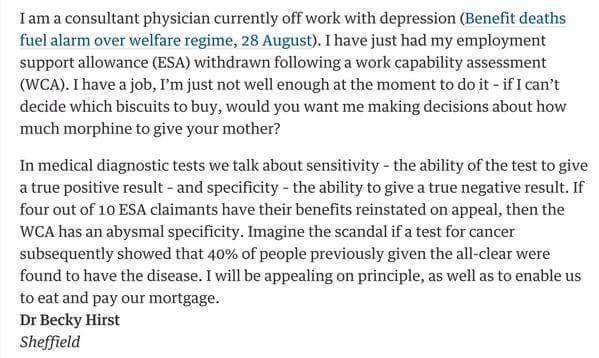
Steve Bell’s Latest Guardian Cartoon #IDS #fakedwpstories

August 25, 2015

Steve Bell’s latest cartoon for the Guardian was published last night. It’s on yesterday’s story about the latest planned ‘reforms’ to ESA. It’s done in the style of the original #fakedwpstories leaflet.

It’s so brilliant that I just had to share it with you all here, readers.

Steve Bell

Why Ellen Green Turned Down Touker Suleman On Dragons’ Den

August 24, 2015

Ellen Green, Director of the Blue Badge Company, turned down Dragon Touker Suleman’s offer of £70000 in yesterday’s show.

Here, she tells the Guardian why, as part of an interview.

Seema Jaya Sharma’s Final Facebook Post Goes Viral After Her Death From Terminal Cancer

August 24, 2015

A woman has posted the most positive and inspiring final Facebook status after losing a six year fight against cancer.

Seema Jaya Sharma, 37, had been given the all clear three times during her longterm battle with the disease, and according to the Evening Standard, she’d fronted a campaign for Cancer Research UK.

However on 21 August she passed away at 2.10pm after the cancer had returned.

Rather than leaving a heartbreaking Facebook status to family and friends, the mother from Ilford made her final words count in the best way.

The Facebook post reads: “This is me.. SEEMA Jaya Sharma. Please keep me alive through you good times and every time you laugh or smile and have fun, i’m right there having fun with u!!! YAY!!!

“Don’t cry for me Argentina,” she wrote, “the truth is that i didn’t even know where u are on the map!! Geography was never my strong point!! :S.

“Anyway this is me saying ‘peace out people’ if a bird poos on ur head, that’s just me saying ‘yo man’ and if i really like u then i might just come haunt you to create ur own kinda bird poo innit!!! hehe!! LOVE YOU!!! MWAH 🙂 xxx”

Sharma also left instructions for her funeral and requested that guests arrive in “bright colours” to celebrate her life.

She wrote: “Oh theres gonna be a wake after too (location will be confirmed) and I would prefer it if nobody goes to my house between now and the funeral. TANKOOOOOOOO 🙂 xxx colourful clothes please!!! We’re celebrating!!! WOOOHOOOO 🙂 xxx”


The Facebook status was uploaded by a family member who wrote: “She wanted her last words to be ‘I got 21 seconds to go!!! hehe :P)’.”

Since the post was uploaded, it has been attracted more than 7,000 likes and many people have commented on what a brave and wonderful woman Sharma was.

“What an amazing woman, the legacy she has left behind will be far reaching,” said one user. While another wrote: “RIP Seema. A bright colourful beautiful twinkling star to watch over your loved ones. Condolences to family & friends.”

IDS Says #fakedwpstories Officials Could Face Disciplinary Action

August 24, 2015

Iain Duncan Smith has said his officials who used fictional claimants to show the impact of benefit sanctions could face disciplinary action.

The work and pensions secretary said the made-up stories on the DWP website were meant to help people understand the system and were based on “real life cases”.

But Mr Duncan Smith stressed that he had not seen them before publication.

And he told BBC News that the officials “should never have done that”.

The DWP faced widespread criticism last week when it emerged that two sickness benefit claimants, supposedly called Zac and Sarah and who featured on the department’s website, were not real people.

‘Binary system’

Stephen Timms, Labour’s acting shadow work and pensions secretary, said: “You couldn’t make it up – but it seems Iain Duncan Smith can. The only way he can find backers for his sanctions regime is by inventing them.”

In one case study, a welfare claimant, “Sarah”, said she was “really pleased” a cut to her benefits had encouraged her to improve her CV.

In the other, “Zac” said he let his work coach know when he was going to miss a meeting and because he did so, “my benefit payment hasn’t changed”.

The apparent deception was uncovered by a Freedom of Information request by website Welfare Weekly.

Mr Duncan Smith said “someone in the operations department” had posted the stories, which were “drawn as a summary from real life cases but it wasn’t a real life case”.

He added: “It was quite wrong, those individuals [responsible] ultimately will face some form of disciplinary procedure.”

He told BBC News that “thousands of these things go out, week in week out, to help advise claimants and advisers, on how best to make the system work and how it can work for them”.

And the erroneous case studies had now been taken down from the department’s website, he added.

Mr Duncan Smith’s response came as he announced a planned shake-up of the rules on sickness benefit to encourage more people into work.

In a speech in London, he said the current system was too “binary” – with claimants deemed either fit or unfit for work.

Instead, claimants should be made to take up any work they could, even if it was just for a few hours, he added.

Homeless Pensioner Forced To Live In His Car While Battling Cancer Because His Housing Is Not A Priority

August 24, 2015

A pensioner is being forced to live in his car with his three dogs while he battles cancer, because he isn’t high up enough on the housing list. 

Ian Russell, 67, has been sleeping in his Ford Mondeo since March with his trio of Airedale terriers, waiting for somewhere to live.

Doctors, who also treat him for his diabetes, arthritis and angina, even have to make their ‘home visits’ to his car. 

A nurse visits him in the Ford every day to treat the painful sores that have developed on his skin.

‘The car smells and I have to have my sores bandaged up every day,’ said Mr Russell.

‘Nobody intends to end up homeless and desperate, but that’s what’s happened.’

The former draper, currently in remission after cancerous tumours were removed from his neck, still finds himself down the pecking order for social housing in St Neots, Cambridgeshire, despite his desperate plight.

The former business owner moved to St Neots from Ayreshire, Scotland, to be nearer his sister Patricia Chown, 57. 

But Patricia, who is housebound because of arthritis, cannot offer him somewhere to sleep because it would break the terms of her own social housing tenancy.

Mr Russel said: ‘I was married for 14 years and the divorce I lost everything. 

‘I was evicted from my previous home in Scotland by environmental health and came back to St Neots to be near my sister.

‘I got put on the housing list but they placed me on the lowest band D because I couldn’t prove I was homeless.

‘They’ve been saying for months that they would send a council official to visit me but no-one has been.

‘The conditions I’m living in are horrendous.’

Mr Russell sleeps in the car’s front passenger seat, and lives off his just £150 a week pension and disability benefit.

He added: ‘The doctor came and said there is a risk of me having a blood clot, so I spent two days in hospital.

‘It’s very frustrating. I’m still recovering from having cancerous growths taken out of my head and neck and these conditions aren’t helping.’ 

Although feeding his three dogs, Trouble, Stretch and Gabby, is costing him a quarter of his income, he insists that he could never leave them behind.

‘I can’t just leave them. I’ve had them for more than a decade and I know they’ll be thrown on the scrapheap if I let them go,’ he said. 

‘They’re all old dogs. If they go to a home, no-one will have them as pets..’  

Mr Russell was recently bumped up to band A on Huntingdonshire District Council’s housing waiting list after a resident complained about the conditions he was living in. 

His niece, Natasha Shevki, 35, said: ‘It’s so horrible to watch a member of your family in this state.

‘It’s awful because we all want to help but we simply don’t have the room.

‘Mum will breach her contract if he stays there and I’ve got four children at mine so we’re already sleeping on the sofa.’

So Mr Russell and his dogs will have to continue living in the car, which he can’t drive because of his arthritis, until he finds an alternative. 

A spokesman for Huntingdonshire District Council said: ‘We are aware of this individual and are working with him to help find accommodation.’

Pulse II: The Sex Toy Developed With Disabled Men In Mind

August 24, 2015

Disability Horizons explains all.

I have linked to the article so that no one has to see it unless they are interested and/or old enough.

I work hard to provide a good mix of information at Same Difference so that there is something for everyone.

Personally, I see this as progress. Disabled people do have sex. Disabled people do know what sex toys are and disabled people do use sex toys.

So why not make some that are accessible?


IDS To Call For Urgent ESA Overhaul As Part Of Drive To Reduce Welfare Costs

August 24, 2015

Disabled people and those too sick to work will be the next group feeling the impact of the Government’s drive to reduce the cost of welfare and the numbers out of work.

In a major speech on Monday, the Work and Pensions Secretary Iain Duncan Smith will warn that Employment and Support Allowance (ESA) – the benefit paid to the sick and disabled – needs to be urgently overhauled, because too few ESA claimants are being helped to get work.

He also wants the system for deciding who is eligible for ESA tightened up.

 Since he took on responsibility for overhauling the welfare state in 2010, Mr Duncan Smith has seen the number of people on Jobseekers’ Allowance fall by almost 700,000, nearly halving the 2010 figure, but the numbers on ESA have stayed stubbornly high at more than 2.5 million, a fall of about 90,000.

He blames a fault in the way ESA was devised. He is expected to say: “When ESA was introduced in 2008 it was intended to be a short-term benefit, with the vast majority of people being helped to return to work.

“ESA may have been designed with the right intentions, but at its heart lay a fundamental flaw.  It is a system that decides you are either capable of work or you are not. This needs to change – things are rarely that simplistic.

“We need to look at the assessment we use for ESA – and I want to look at changing it so that it is better geared towards helping to get people prepared for and into what work they may be capable of, rather than parking them beyond work.”

Mr Duncan Smith is adamant that people who are genuinely too ill to work will still be protected by the welfare state, and he will stress that for many people – particularly those with mental issues – being in work acts as an effective therapy.

But others may fear that he is reacting to pressure to cut the welfare bill by any means that he can.

The Chancellor George Osborne wants the social security budget reduced by £13bn a year by 2020-21.

In his budget speech in July, Mr Osborne announced a £640bn cut in welfare payments for people in the work related activity group (WRAG), who are categorised as not fit enough for work, but able to carry out “work related activity”– a move condemned by disability rights campaigners.

According to the Disability News Service, the percentage of people living in households where at least one member was disabled and who were in “absolute poverty” rose from 27 per cent in 2012-13 to 30 per cent in 2013-14, an increase of about a tenth in just one year. It is feared that the drive to reduce the cost of ESA will mean more disabled people living in poverty.

Liz Sayce, chief executive of Disability Rights UK, said that many disabled people would welcome what Mr Duncan Smith is proposing, if it turns out that the reforms genuinely help people to find work – but not if it proved to be simply a way of cutting the welfare budget.

She said: “One of the problems has been that the work programme has totally failed people on ESA. The figures for getting people on ESA into work are very poor. Some people do want to work, with the right kind of support.

“We would like to see radical changes to the work programme in which it was really tailored to individual needs. If there was investment in that, you might see greater numbers of sick and disabled going into work, and that would be great.

“You also need a recognition that some people are not well enough to work, and reducing the money they get will simply drive more disabled people into poverty.”

DWP Seeks 2800 Short Term Staff, Weeks After Over 3000 Full Time Staff ‘Leave’

August 24, 2015

The Department for Work and Pensions has been criticised for advertising nearly 3,000 jobs on short-term contracts less than two months after shedding thousands of permanent staff.

A total of 3,824 permanent staff members across England, Scotland and Wales left under a voluntary exit scheme in late June. On Thursday, the DWP said it was looking to recruit 2,800 people to work on its “reform programmes”.

Mark Serwotka, the general secretary of the Public and Commercial Services union, which represents public sector workers, said: “It is incredible that less than two months after cutting thousands of low-paid jobs, the DWP is advertising for close to the same amount.

“Instead of constantly trying to trip up claimants, the DWP should ensure the proper resources are in place to return the department to one where sick, disabled and unemployed people are given the support they need and deserve.”

A PCS spokesman told the Guardian: “We see this as further casualisation of the workforce, which we are obviously opposed to. We want to see people employed on permanent contracts.”

According to the union, many of the staff who left in June worked in areas similar to those in which the department is now seeking to hire. It said the work could have been done by the existing staff, “with minimal retraining and setup costs”.

Its analysis suggested that the first wave of hires would mean a shift in the department’s geographic focus.

London and central England in particular are recruiting significantly fewer than they lost in June, while many more will be hired in north-west England and in Wales than those who left in those areas.

A DWP spokesman said: “We are undertaking some big welfare reforms and we’re recruiting fixed term 18-month appointments to cover this period. There have only been a handful of compulsory redundancies over the last four years – with the vast majority of people leaving voluntarily.”

The news comes as the DWP deals with a row over its use of fake benefits claimants to send out a positive message about its reformed benefits system.

It used stock images alongside what it admitted in a response to a freedom of information request was invented testimony. The department said they were representative of conversations its staff had had with real people.

Neighbours Star Ryan Moloney Reveals Toadie’s Paralysis ‘Could Be Permanent’

August 23, 2015

Neighbours star Ryan Moloney has teased a long journey ahead for his character Toadie Rebecchi following his accident this week.

UK viewers will see Toadie left paralysed after a tragic accident on a bouncy castle, leaving him with a very uncertain future.

Although Toadie initially goes into denial over the situation, he is soon forced to face up to the harsh reality that he may never be able to walk again.

Speaking to Digital Spy, Moloney said: “This is going to go on for a long time, absolutely. I am still filming in a wheelchair.

“He initially thinks it is just swelling and that is what is causing the problem. He thinks once that goes down, they will be able to fix him up and everything will be okay.

“That is just his hope talking though and once that wears off, the reality is that this could be a permanent way of life and it looks like it is going to be. He is very upset by it.”

Discussing the challenges of filming in a wheelchair, Moloney said: “I initially thought that it was going to be difficult to try and show colour and movement. I thought the directors would whinge about everything not being in shot and all this kind of stuff, but it has been really good and I am really enjoying it.

“It has been challenging in terms of not moving your legs. All the natural instincts of not being able to move and also trying to learn how you would move around, hold yourself and do particular things if you can’t move your legs. It has definitely been a challenge.”

Toadie’s future is looking increasingly bleak but Moloney has revealed that it will make his relationship with his wife Sonya even stronger.
He said: “This affects his ability to actually do the normal roles that he would do in his family – being the main breadwinner and whether or not his business will survive. He also worries about being able to relate to Nell and the things he can do with her, and the things he now can’t.

“On top of that, he has Sonya and her now being his lover but also his carer. From that aspect, there is a lot in there. Obviously there are the normal challenges but this actually really brings them together.

“They will come out stronger from this. They have got to rely on being honest and open with each other because what else have they got after that?”

Neighbours will air Toadie’s accident on Monday (August 24) at 1.45pm and 5.30pm on Channel 5.

‘Suicide Guidance’ Given To Untrained Glasgow Call Centre Staff By The DWP As They Prepare For ‘Desperate’ Calls From Unsuccessful UC Claimants

August 23, 2015

GUIDELINES on how to deal with suicidal benefits claimants have been handed out by the Department for Work and Pensions to Scots workers tasked with rolling out the UK Government’s controversial welfare reforms.

As part of a six-point plan for dealing with suicidal claimants who have been denied welfare payments, call-centre staff in Glasgow have been told to wave the guidance, printed on a laminated pink card, above their head.

The guidance is meant to help staff dealing with unsuccessful applicants for Universal Credit who are threatening to self-harm or take their own life.

A manager is then meant to rush over to listen in to the call and workers – who insist they have had no formal training in the procedure – must “make some assessment on the degree of risk” by asking a series of questions.

One section of the six-point plan, titled “gather information”, demands that staff allow claimants to talk about their intention to commit suicide.

The call-centre workers, who earn between £15,000 and £17,000 a year, must “find out specifically what is planned, when it is planned for, and whether the customer has the means-to-hand”, according to the guidance seen by the Sunday Herald.

Staff are also warned in the plan that they may have “thoughts and feelings” about the situation afterwards and offered reassurance that “this is all part of the process of coping with the experience and is normal”.

Glasgow-based call-centre workers have accused the DWP of asking them to carry out the job of a psychologist or social worker.

The SNP have accused the UK Government of “playing a dangerous game with people’s lives”.

Universal Credit combines six working-age benefits – including housing benefit, Jobseeker’s Allowance (JSA) and tax credits – into a single payment. Although not yet fully rolled out across the UK, Universal Credit is already available to benefit claimants in more than 40 so-called “Jobcentre areas” in Scotland, including Glasgow, Edinburgh, Stirling, Inverness and Dumfries as well as parts of Lanarkshire, Aberdeenshire and Ayrshire.

Processors and telephonists have to contact claimants to tell them they have been denied the new benefit or are facing sanctions which can mean payments are withheld for up to three years.

One Scottish call handler, who asked not to be named, said: “Some of us have been given a baby-pink laminated sheet which we’ve been told to hold up in the air if someone threatens to self-harm or commit suicide. So, when we are on the phone speaking to claimants – who are often very vulnerable people who are being sanctioned all the time and have no money – if they express that they intend to harm themselves or kill themselves there is a sheet instructing us how to react, which involves asking a number of questions, including how they intend to do it.
“This would suggest the DWP is expecting it to happen and I assume that this procedure is in place so that they can say they did their part. But we are not trained to deal with vulnerable people in this way. It’s a very distressing thing for us to handle.

“They’re basically telling us to assess claimants by asking how they intend to self-harm or commit suicide, which is a job that only a trained psychologist, social worker, or at the very least, a counsellor should be doing.”

Another worker said: “There was a man on the phone to me who said if he didn’t get money he’d kill himself. This was before we were issued with the guidelines and I wasn’t sure what to do so I could only try to calm him down.

“He hung up the phone and when I tried to call him back I couldn’t get through. It was very upsetting. I spent the rest of the day worried that he may have taken his own life.

“It wasn’t until the next day that a colleague told me they spoke to him later and he didn’t go through with it.

“But I know of colleagues who have been told by claimants that they are going to commit suicide and they have done so. It’s devastating for them.”

Scottish Minister for Social Justice, SNP MSP Alex Neil, denounced the six-point plan and urged  Work and Pensions Secretary Iain Duncan Smith to rethink his policies.

He said: “I would call on him to immediately withdraw his six-point plan and bin it because it’s playing a dangerous game with people’s lives.

“It is totally outrageous and unacceptable to put his staff in the position of playing God. They are not medically qualified to properly assess anyone with mental health problems. This is a recipe for tragedy.  

“What this is doing is putting people in real danger because if people are assessed wrongly and they are already feeling suicidal it could drive somebody over the edge. This is utterly the wrong thing to do and Iain Duncan Smith should immediately withdraw these guidelines, apologise and have an immediate rethink of the policy.

“It shows total disregard for the wellbeing of the benefit claimant and the DWP staff who are being put in this invidious position. Quite frankly, it’s morally wrong.

“The UK Government is leaving itself open to the charge that this six-point plan is an admission that its welfare reforms are putting people at risk. You could draw that conclusion. That is the implication of what they are doing.”

Lynn Henderson, Scottish secretary of the Public and Commercial Services Union, which represents many of the DWP staff, also criticised the procedures, saying: “For most of us the thought of suicide is unimaginable but for PCS members in DWP the unimaginable is becoming harsh reality.

“As benefits are cut, people in desperate need are finding they cannot contemplate a future worth living for – and DWP’s solution is to ask overburdened staff, who are under enormous pressure themselves, to take responsibility for spotting whether members of the public are likely to take their own lives or not.  

“It’s disgraceful that this Government, rather than recognising that its own policies are driving people to despair, is applying sticking-plaster solutions by asking our low-paid, undervalued members to take on what are literally life-or-death responsibilities.”

A DWP spokesman said: “Our frontline Jobcentre staff work hard every day supporting people to find jobs and it is only right we provide a range of training and guidance to assist them in their work.”

Shocking Image Of CP Man Bathing In Paddling Pool Because Of #BedroomTax

August 23, 2015

Rob being washed in a paddling pool, in the living room

This shocking picture exposes the brutal reality of David Cameron’s Bedroom Tax – a severely disabled man forced to bathe in a paddling pool in his living room.

The Sunday People is today publishing the photograph at the request of the family of Rob Tomlinson after he was driven out of his specially adapted home by the hated Tory tax.

For years Rob, 48, happily used a purpose-built walk-in shower at a four-bedroom house specially converted for him and his caring ­relatives by the local council.

But after Work and Pensions Secretary Iain Duncan Smith imposed the Bedroom Tax, Rob’s family fell into debt as they struggled to pay the cost of being penalised for two spare rooms.

They were forced to move and ended up in a privately rented ­bungalow with no ­bathroom facilities for the severely disabled.

There, Rob had to regularly endure the humiliation of being washed in a paddling pool in scenes reminiscent of the Third World rather than one of the richest nations on the planet.

His devoted brother Gary, 47, who with his partner Joan are Rob’s full-time carers, said: “We had to fill the pool with a hosepipe. Then I would have to lift Rob in. I would use buckets to wash him.

“It was easier when I was younger. As I got older it was hard work.

“This is a disabled man. There was no dignity in it for him or us.

“The Bedroom Tax is unfair. There are thousands of disabled people who have suffered because of it.

“But all Iain Duncan Smith does is sit in Parliament, smug and laughing and claiming his expenses.”

And in a final insult, their old home is now occupied by an elderly couple who are exempt from the tax while Rob and his family have been forced to move THREE times.

Rob suffers from cerebral palsy, epilepsy, double incontinence and has a mental age of four.

He lived in his family’s four-bedroom home for 24 years and the local council spent £70,000 adapting it.

Since the death of his mum Betty aged just 49 from cancer in 1995, Rob has been cared for by Gary and Joan. Each had a daughter from previous relationships who also lived in the house in Bootle, Merseyside.

In 2000 the council built an ­extension, providing a fourth bedroom, a shower room, an extended kitchen, overhead hoists and ceiling straps, plus patio door access to the garden.

Gary said: “It was ­fantastic. They built the house around Rob – everything he could have needed.”

When the couple’s girls grew older they moved out.

Then in early 2013 Gary and Joan ­received a letter from their housing ­association, One Vision.

It revealed that the tax – a cut in housing benefit for council and housing association tenants if they are deemed to have spare bedrooms – was being introduced and their property was “under-occupied” by two bedrooms.

Gary said: “At first I thought it wouldn’t affect us because the house had been specially built for Rob’s needs. Plus where else could they put us that was suitable?”

They filled in forms asking for “discretionary measures for people with special requirements” but were shocked when they were turned down.

Gary said: “We were told we would have to pay £24.60 a week. We didn’t need four bedrooms but we did need something suitable for Rob. But we were told, that doesn’t matter, you still have to pay.”

They were told One Vision didn’t have a suitable adapted property.

The couple then received a “notice to seek intention to evict” as they were in arrears of over £300 because of the tax.

Tomlinson/Sunday Mirror Gary’s brother Rob, in 1987, with their mum, Betty Tomlinson
Family: Rob in 1987 with his mum Betty Tomlinson

Joan said: “It scared the life out of us. We started looking at the private sector but the problem there is that in private properties we couldn’t make the changes needed for Rob.”

They moved to a private bungalow in Southport, Merseyside, in December 2013 but Rob was hit with pneumonia.

Two days after he was well enough to leave hospital, the bungalow owner died and her children decided to sell.

In March last year Rob’s family moved to yet another place but this didn’t have a suitable bathroom and they had to use the paddling pool.

Last September NHS staff came to assess Rob after Gary applied for CHC (continuing health care) funding. He said: “This is meant to transfer Rob’s care from social services to the NHS and he ticked every box.

“But they told us we had to stop ­lifting him because if there was an ­accident we would be liable.

“After that we had to give him bed baths. It was pretty awful. He started getting bed sores.”

In desperation the family turned to their local MP John Pugh.

Mr Pugh told One Vision: “It is clear that Robert has not only lost his quality of life but also the basic human right of a decent home.”

In March this year they got a new bungalow with a suitable bathroom. But Rob’s bedroom is tiny and he has hardly any view.

As a result of the NHS assessment, Rob will get home nursing care several times a week.

But Gary said: “It has taken two years of misery to get to this point.

“To make it worse, a few months ­after we left our adapted house we were told we shouldn’t have had to go. Rob did meet the criteria to stay where he was.

“We’ve since found out an old couple have moved into the house and they’re only using one bedroom.

“If you’re over 65 you are exempt from the tax. It’s not their fault, but it shows how wrong it is.”

One Vision said: “In a bid to reduce the impact of welfare reform we have increased our benefits advice.”

A spokesman for Sefton Council, which oversees Bootle, said: “We cannot comment on any individual case.”

A DWP spokesman said: “We have provided nearly £500million to local councils to support vulnerable people through the changes.

“They can make discretionary payments for people to stay in their accommodation.”


Blind Man Mistakenly Tasered Accepts Settlement From Lancashire Police

August 22, 2015

A blind man hit with a stun gun when his white stick was mistaken for a sword has agreed an out-of-court settlement with Lancashire Police.

Lancashire Police apologised to the man after the October 2012 incident.

The man’s solicitor said the settlement was undisclosed. The victim’s identity is protected by a court order.

The man brought a claim for false imprisonment, assault and battery and breach of the Human Rights Act 1998 against Lancashire Constabulary.

He has described being Tasered as feeling like “grabbing an electricity pylon”.

The man said he had post-traumatic stress disorder (PTSD) and had been left “very nervous”.

An investigation by the Independent Police Complaints Commission said the police officer who shot him had “used a level of force that was unnecessary and disproportionate”.

Following a disciplinary hearing in 2014, the officer was told to apologise to the man in person and was given a “performance-improvement notice”.

Blue Badge Thefts Soar- Disabled Drivers And Passengers Targeted

August 22, 2015

As a disabled passenger who has always had a Blue Badge, this worries me deeply.

The number of disabled parking badges being stolen has more than doubled with thieves breaking into cars and retirement homes for the vouchers worth up to £6,000 a year, councils have warned.

Nearly 3m people, who can be drivers or passengers, have been issued with Blue Badges because they find it difficult to walk.

The scheme, which applies across the UK, enables them to park for free in pay-and-display bays and on double yellow lines. In London, where theft levels were particularly high, holders are exempt from the Congestion Charge, saving them up to £2,500 annually.

The Local Government Association (LGA) said numbers of thefts of Blue Badges had soared from 656 in 2013 to 1,756 last year, with criminals selling them on the black market or using them for free parking.

Someone who parks in a city centre throughout the week could save more than £6,000 over 12 months.

The LGA said councils had prosecuted 565 people last year for fraudulent use of stolen or lost badges. They included a Watford man who admitted using his grandmother’s Blue Badge for four months after she died.

Five drivers received a combined bill of nearly £2,000 in fines and costs following prosecution by Sutton Council in south London for fraudulent use of the badges.

Coun Peter Box, the LGA’s transport spokesman, said: “Illegally using a Blue Badge is not a victimless crime. For disabled people, Blue Badges are absolutely essential in order to get out and about to visit shops or family and friends.

“Callous Blue Badge thieves and unscrupulous fraudsters using them illegally are robbing disabled people of this independence. It is staggering how low some people are stooping simply to con a few hours of free parking and alarming to see thefts rising so significantly.

“Despite limited resources, councils will continue trying to crackdown on this crime and will not hesitate to prosecute drivers trying to abuse the system.”

Some local authorities have set up enforcement teams to target Blue Badge fraud.

Under the Road Traffic Act, misuse of a Blue Badge is a criminal offence carrying a maximum fine of £1,000.

Coun Box added: “It is important to catch these criminals in the act. To win the fight against Blue Badge fraud, residents must keep tipping councils off about people they suspect are illegally using a badge.”

Disabled Boy Gets 20,000 Birthday Cards

August 22, 2015

A six-year-old boy with a muscle-wasting disease has received more than 20,000 birthday cards.

William Magee, from Wirral in Merseyside, has Duchenne muscular distrophy.

The cards follows an online appeal for cards by his mother.

Andy Gill from BBC North West Tonight reports.

DWP calls grieving mum and demand to know where her son is – day after he is buried

August 21, 2015

Debbie Abrahams MP Calling For IDS To Resign Over #fakedwpstories

August 21, 2015

From the website of Debbie Abrahams MP:

As a member of the work and pensions select committee, I have called for Iain Duncan Smith to resign following
revelations that his department created a leaflet about sanctions containing made-up quotes attributed to non-existent benefit claimants.

I instigated an inquiry into the use of sanctions by the work and pensions committee, which reported in March this year and I believe after being caught out so publicly it must be impossible for Iain Duncan Smith to continue as work and pensions secretary and he should do the honourable thing and resign.

This is yet another example of not only his incompetence, but what can only be described as very shady and unscrupulous behaviour not befitting a Member of Parliament let alone a Secretary of State leading a Government Department.

Once again Duncan Smith is caught trying to paint a particular picture of social security claimants. He is a disgrace and should do the honourable thing and resign. When his own department have to resort to this sort of tactic, in a desperate attempt to make it appear as though the system is working, no-one can be left believing that his draconian social security sanctions regime is fit for purpose.

Only Mr Duncan Smith seems to believe that unfair and inappropriate use of sanctions on vulnerable social security claimants is acceptable. And now he’s shown that he thinks it’s acceptable for his department to produce literature that is fabricated in a desperate attempt to make people believe his sanctions regime is working fairly.

It beggars belief that David Cameron can, in the light of this embarrassing debacle, continue to back Mr Duncan Smith as a credible work and pensions secretary when he has presided over such a catalogue of errors.
In last few weeks alone the independent Social Security Advisory Committee have produced a report which says that the Government’s sanctions regime should be given ‘an urgent and robust review’.

And following the Government’s appeal against the Information Commissioner’s ruling compelling the Government to publish figures on the number of people on Incapacity Benefit and Employment and Support Allowance who have died between November 2011 and May 2014, including those found fit for work, a Tribunal has now set for November 10 th to hear why Iain Duncan Smith has refused to publish these data.

I will never forget the fact that not only did Iain Duncan Smith defy the Information Commissioner’s ruling to provide these data on deaths of people on social security, but that he stated to me, personally, in Parliament, it did not exist. But then, just two days later, the Prime Minister said to me, again in Parliament, the data would be published, only for the DWP’s appeal documents to defy him as well, stating publication was not in the public interest!

The select committee inquiry which I instigated reported in March and the mountain of evidence that was put before the select committee by religious organisations, academics and charities, not to mention those actually affected by inappropriate sanctions themselves, pointed overwhelmingly to a system that is inhumane and deliberately created to skew unemployment figures.

The sad truth is that Iain Duncan Smith is doing everything he can to cover up the mess he has created. And this is a mess that is ruining innocent people’s lives and, as the evidence suggests, even killing some.

The only credible reason he’s going to such lengths to hang on to his job is because he knows he has so much to hide.

Was The Defying The Label Season A Success?

August 21, 2015

BBC Three’s Defying the Label season came to an end last week. But did it hit the mark? Disabled journalist Frances Ryan thinks it did.

If you caught even part of BBC Three’s Defying the Label season – the channel’s biggest ever season of disability related programming – it was easy to sense the relish of the commissioning editors. Over the past month, there have been 15 specialist documentaries, current affairs features, a factual drama and a comedy panel game show that covered topics ranging from sex and relationships to hate crime. At times, it was as if BBC Three felt they were single-handedly filling in the wasteland of mainstream coverage of disability. Perhaps they were.

In my weaker moments, I would prefer a television-wide ban of every disabled person in the country than to watch another makeover programme renovate a disabled person’s house or garden to a chorus of inspirational music.

In 2014, the on-screen representation of disabled people across the BBC was at – a pretty dire – 1.2%. This is an issue across all channels. And one that does not just concern how rarely disabled people are featured on television but how they are depicted when they are.

BBC Three took us to another place entirely with the Defying the Label season, showing viewers and commissioners alike how disability on television could be and it did this in two ways. On the one hand, it gave a focus to disability-related stories that are rarely given screen time. On the other, it gave control to disabled people – from presenters to documentary subjects – it seems fair to say we would otherwise not see.

Shows like The Unbreakables: Life And Love On Disability Campus – a three-part documentary following a group of young people with complex disabilities living away from home for the first time – and Wanted: A Very Personal Assistant – following young disabled people’s search for suitable carers – were proof of this most obvious but often ignored rule of representation on television. As The Radio Times put it in its review: “The brilliance came by not trying to do anything except give the subjects the chance to speak for themselves.”

The season was not always easy viewing. The Ugly Face of Disability Hate Crime took us through surely some of the worst demonstrations of daily prejudice. Brilliantly presented by Adam Pearson, it explored not only the cruelty of the crimes in the UK but the scandal of how little justice there is for the victims. The World’s Worst Place to be Disabled? – a one-off documentary presented by journalist and wheelchair user, Sophie Morgan – showed the horrific impact of cultural and religious stigma around disability in Ghana. I’ve not often seen images like this on television – the sprawling prayer camps where disabled children and adults are kept in chains to a river where disabled babies are said to be ritually killed with schnapps laced with poison.

I would like to believe that such stories would have made it to the screen without the commissioning structure of a designated disability season but the evidence suggests otherwise. How often do we see a documentary on BBC Two exploring an issue specific to the disabled community? Or a drama on BBC One featuring a lead by a disabled actor? Don’t Take My Baby – the season’s lone disability drama – was repeated on BBC1 on Tuesday but this is a rare example, (and not in primetime).

The BBC have publicly announced a commitment to quadruple the on-screen representation of disabled people by 2017. It will be interesting to see how exactly this is achieved.

Designated seasons such as Defying the Label are an effective short-term strategy but they are not a long-term solution. Television at its best is a window into another life. What we see on screen will only become less male, white, middle-class, heterosexual – and non-disabled – when diverse programming is not a seasonal special but a regular scheduling fixture. As Scope’s Mark Atkinson Mark recently noted, when it comes to disability on our screens, the focus needs be on getting disabled actors, characters and stories in all types of programming – from soaps, children’s programming to reality TV.

The positive reception to the Defying The Label season – both critically in reviews and from the public on social media – can give commissioners confidence. It’s shown that if you give viewers well crafted, engaging storytelling about disability, they will not only watch but stay for more. The next ambition should be telling such stories on BBC One and BBC Two, integrated into everyday programming. After all, whether it is a drama based on the fight of disabled parents to keep their children or documentaries about disability hate crime, these are not “disability programmes” but programmes that happen to feature disability. The true testament to the success of specialised disability seasons is when there will no longer be a need for them.


Sexual Abuse Of People With LD Is ‘Too Often Overlooked’

August 21, 2015

The UK’s only Home Office funded sexual violence adviser for people with learning disabilities, Annie Rose, explains all in this article for today’s Guardian.

ESA Death Statistics To Be Released Just Before August Bank Holiday

August 20, 2015

With many thanks to Benefits And Work.

The DWP have cynically arranged for the long-awaited employment and support allowance (ESA) death statistics to be released immediately before a bank holiday in the middle of the parliamentary summer recess, Benefits and Work can reveal. This is a traditional method of burying bad news in the hope it gets the minimum possible publicity.

The ESA death statistics will be released on Thursday 27 August, immediately before the bank holiday in England and Wales on Monday 31 August.

So, not only will the news receive much less attention because it is in the immediate run up to the holiday, but parliament is in recess, so ministers cannot be challenged on the statistics.

Given the enormous delay in publishing these figures, it is very clear that the timing was absolutely designed to ensure the figures receive a s little attention as possible.

It is also still not clear whether the statistics will be in the same format as a previous release, allowing a direct comparison. All that the DWP ae saying at this stage is that:

“This publication will provide information on those who have died after claiming Employment and Support Allowance, Incapacity Benefit or Severe Disablement Allowance in Great Britain in response to a number of Freedom of Information requests.”

On the same day, the DWP are publishing a more comprehensive – and probably deliberately opaque – set of statistics entitled ‘Mortality statistics: out-of-work benefit claimants Mar 2003 to Feb 2014’.

According to the DWP:

“This publication will provide mortality statistics for people on out-of-work benefits in Great Britain by age group and sex, from March 2003 to February 2014. Out of work benefits are Jobseeker’s Allowance, Incapacity Benefit /Severe Disablement Allowance, Employment and Support Allowance and Income Support.”

Benefits and Work will alert readers as soon as the statistics are available.

Disability Campaigner Francesca Martinez Banned From Voting In Labour Leadership Election

August 20, 2015

Apparently, for voting for Jeremy Corbyn.

Same Difference has no preference for any political party or any Labour leadership candidate- but this doesn’t seem fair or democratic to us. And reports suggest she’s not the only one.

LD Woman Julie Beards, 45 And Husband, 44, Arrested On Suspicion Of Murder Of LD Woman Susan Whiting, 20

August 20, 2015

A couple have been arrested on suspicion of murder after police hunting for a missing woman with learning disabilities found a body.

Susan Whiting, 20, had been reported missing by her mother at lunchtime on Monday after she failed to return to her home in Bloxwich, Walsall, West Midlands.

Today, police searching a property half-a-mile away from her house confirmed a body had been found. 

The couple who live in the property, named locally as Steve Beards, 44, and his wife and Julie, 45 – who has learning difficulties – are now being questioned on suspicion of murder.

The bungalow remains cordoned off while forensic specialists examine the property. A blue forensic tent has also been erected in the back garden of the £100,000 bungalow.

A spokesperson for West Midlands Police said: ‘The body is yet to be formally identified and a post mortem will take place in due course to establish the cause of death, which at present is being treated as suspicious.’

A police spokesman also said the case had also been referred the case to the Independent Police Complaints Commission (IPCC), the police watchdog.

It is understood Miss Whiting’s family had raised concerns about her contact with the arrested couple prior to her death. Residents said the bungalows in the close where the body was found is for vulnerable adults. 

Nearby resident Mark Hopkins, 45, said today that the whole incident had been ‘shocking’. 

‘I was out yesterday and came back to see the close sealed off. My heart goes out to her family,’ he said. 

The bungalow where the body was found remains cordoned off with uniformed police officers and forensic specialists examining the property

‘We moved here thinking it was a nice area. I’ve never seen so many police in my life. They haven’t told us what’s going on, they’ve just told us that we will hear about it on the news.’

He added: ‘Julie has learning difficulties. She used to push teddy bears around in wheelchairs while we were all in our back gardens.’  

A neighbour who lived near Ms Whiting said she had been adopted by her mother Maureen after being in care as a young child.

He added: ‘She was a lovely young woman who did have learning difficulties. She was always bubbly, up for a chat. What has happened to her is just heartbreaking.’ 

A neighbour living near to the Beards, who did not wish to be named, said: ‘We were told they found the body under the bed but they look like they hebeen searching in gardens too so who knows what they have found. 

‘Susan knew the couple and had been round before, which I’m told her family were not too happy about.

‘Cops were there on Monday so how on earth its took them this long to find the girl in the house is beyond me. I just feel so sorry for the families of everyone involved.’  


Today, the principal of Walsall Adult and Community College, where Ms Whiting was a student, paid tribute the ‘cheerful and lively’ young woman. She had attended the college for around three years and had recently completed a diploma.

Principal Jev Bhalla said Ms Whiting was preparing to embark on a career in hospitality and catering. 

He added: ‘Susan came to us as a young girl and became more confident every year. Last year she completed her diploma in hospitality and catering and worked at our bistro at the college.

‘Susan has always been a cheerful and lively girl and our thoughts are with her family at this unimaginably difficult time.’ 

After launching a search for Ms Whiting, police had said they were ‘very concerned for her wellbeing’.  

A member of her family added at the time: ‘All her family and friends are extremely worried about her. She has learning difficulties.’  

Cancer Doesn’t Care

August 20, 2015

This poem has been in my mind for quite some time. I finally decided to write and publish it when UK journalist Victoria Derbyshire revealed her breast cancer diagnosis yesterday.

I dedicate it to anyone who is currently battling cancer and the families of anyone who has battled or is battling cancer.

Cancer Doesn’t Care

Cancer doesn’t care if you’re rich and famous
Cancer doesn’t care if you’re world number one
Cancer doesn’t care if you’re someone’s daughter
Cancer doesn’t care if you’re someone’s son.

Cancer doesn’t care if you make music
Cancer doesn’t care if you sing the blues
Cancer doesn’t care if you play a sport
Cancer doesn’t care if you read the news.

Cancer doesn’t care if you’re someone’s mother
Cancer doesn’t care if you’re someone’s wife
Cancer doesn’t care if you’re someone’s sister or brother
Cancer doesn’t care if you’re the love of someone’s life.

Cancer doesn’t care if you’re happy or sad
Cancer doesn’t care if you’re someone’s dad
Cancer doesn’t care that to see it you’re not glad
Cancer just doesn’t care and that’s what makes it so very bad!

I give permission for this to be reprinted anywhere- but I ask that, with the exception of WordPress reblogs which automatically do both, you credit me as the author and email me on samedifferenceone@hotmail.co.uk to let me know you wish to reprint it.

Mother Of Severely Disabled Toddler Was Forced To Change Son In Front Of Customers At Packed London McDonald’s

August 20, 2015

A mother was ‘forced’ to change her severely ill toddler’s nappy in front of a packed McDonald’s restaurant after being refused access to the disabled toilets.

Katie Barker said her three-year-old boy, Mitchell, needed changing after their meal at the fast-food eatery on Eden Street, Kingston-upon-Thames, in London.

A sign on the disabled toilet door said the lock was broken, but Miss Barker didn’t mind using it, as going to the upstairs female toilets would have provided logistical problems. 

Mitchell was born with an extra chromosome and is thought to be the only child in the UK with his specific condition, which is said to be so rare that it doesn’t even have a name. 

He uses a special push chair to get around.

The three-year-old is incontinent, he can’t speak and he has multiple organ problems.

The family were told they couldn’t use the disabled toilets by a ‘rude’ member of staff. 

After realising there was no room to change Mitchell in the upstairs female loos, Miss Barker stripped her son in front of the crowded restaurant. 

McDonald’s said there was a ‘miscommunication’ which led to the family’s ordeal.

Miss Barker, who was also with her mum Pauline Barker, 56, said the family were ‘gobsmacked’ at the way they were treated.

The mother-of-two, from West Molesey, Surrey, said: ‘After we had finished our food I noticed Mitchell was wet and needed changing.

‘I had his radar key and took him to the disabled toilet. There was a sign on the door saying the lock was broken, which didn’t bother me too much as we could have just held the door closed.

‘I asked a member of staff if we were still allowed to use it and she said no. She was so rude.

‘I was told to take him upstairs, which was a problem in itself as Mitchell has serious balance and stability problems. He uses a special push chair to get around.

‘We struggled to walk up the 30 or 40 steps, and proceeded to go to the female toilets.

‘When I walked in, there were three cubicles and just enough room in front of the sink for one adult to stand.

‘Where exactly am I meant to change a big three-year-old? So we made our way down stairs and I changed him standing up where we were seated in front of every other customer in there.

‘I found it highly unacceptable and actually quite degrading for my son.’ 

Mitchell, who has a hole in his neck as a result of a tracheotomy as a baby, struggled to cope with the attention during the 15-minute ordeal at the restaurant.

Miss Barker, who also has a one-year-old son called Callum, said: ‘We had plenty of filthy looks from other customers and I don’t blame them.

‘A child being changed while they’re eating but there was no way I was going to leave him wet.

‘I suggest McDonald’s seriously reviews its staff in that store and the changing facilities for the disabled.

‘Disabled isn’t one specific type of person. There’s lots of varieties and each and every one of them deserve to feel human and keep their dignity no matter what age they are.’

A McDonald’s spokesman today said: ‘We apologise for Ms Barker’s experience when visiting our restaurant this weekend. 

‘Due to a miscommunication, Ms Barker was directed to the female toilets upstairs. 

‘Had the team been aware of the circumstances, they would have happily ensured she and her son had access to the disabled toilets downstairs. 

‘Our customer services team is in touch with Ms Barker to clarify the situation.’

Leaflet Launched To Help Disabled Jobseekers Receive Fair Treatment

August 19, 2015

In what is believed to be the first initiative of its kind in the country, on May 15 a partnership of Suffolk organisations launched a guide aimed at ensuring fair treatment for citizens with disabilities or with long-term sicknesses who are also claiming Jobseekers Allowance (JSA).

The guide is the result of the Ipswich & Suffolk Council for Racial Equality (ISCRE) and the Ipswich & District Citizens Advice Bureau (IDCAB) coming together to form the ‘3Ds’ Project.

The ‘3Ds’ in question are: Disability + Disadvantage = Duty.

This partnership was formed after ISCRE had identified problems being experienced by disabled or long term sick JSA claimants in looking for work because of their disability.

Because of this, many were being ‘sanctioned’ (losing benefits) for not complying with their job seekers agreements. Nationwide, the number of claimants sanctioned has increased by 64% with one in four of these identified as being disabled or long term sick. A total of 11% of JSA claimants in the East of England have been sanctioned.

Under the Equality Act 2010, the Department for Work & Pensions (DWP) has a duty to make reasonable adjustments for disabled or long term sick claimants to overcome difficulties that are not faced by people who are not disabled.

The leaflet is aimed at both DWP staff and the jobseekers and their friends and family. It defines the meaning of disabled under the Equality Act, explains the legal duty of the DWP and includes a tear-off form for claimants to take to the job centre explaining their disability and any reasonable adjustments that should be made to their job seekers agreement.

Allen Larke of Ipswich has experienced the unfairness of how the current system works. “One of the things that would need looking into is the amount of time a person is allowed to be ill during one year whom has a serious disability. On my experience as having unstable type 1 diabetes, it is hard to gauge when it plays up”.

“This year I had to miss a signing on and personal adviser, and was told that next time I would be sanctioned if I missed due to my illness. Also people are penalised for being a few minutes late to sign on and threatened with sanctions”.

“There is no real help with having advisers as they do not listen to problems for disabled people finding work. In my case employers don’t want to employ people with diabetes as they think time will be needed from work”.

“This has caused me problems as being unemployed for 5 years, do not get JSA and informed by JCP that I have not paid enough NI contributions, but when you sign on they inform you that contributions being paid”.

According to ISCRE’s Legal Director, Audrey Ludwig “the Equality Act helps people with disabilities get changes to policies and practices to overcome their disabilities and therefore fully participate in society. The leaflet informs and reminds Job Centre Plus of their duty to make reasonable adjustments to job seeking agreements. Many changes carry no costs like changing the timing of appointments but can prevent the claimants having their benefits stopped unjustly and suffering real financial hardship”.

Deputy Manager of IDCAB, Nelleke van Helfteren, has championed this project from the start “we are very grateful to the Suffolk Foundation and the Vineyard Church who both awarded us funding for this very worthwhile project. We are so pleased to be working with other agencies in Ipswich on behalf of these vulnerable clients who suffer real financial hardship when their benefits are sanctioned through no fault of their own”

3Ds Project leaflet

DWP’s Fake Claimants, ‘Zac’ And ‘Sarah’ Were Also Used To Promote Other Government Schemes #fakedwpstories

August 19, 2015

Well, well, well. You couldn’t make it up! Oh, wait a minute…

The two fake characters who were used by the Department for Work and Pensions in leaflets promoting its benefits sanctions regime were also deployed in other Government literature, it has emerged.

One of the supposed “benefit claimaints” – named as ‘Sarah’ – was quoted praising the DWP for threatening to withdraw benefits if she refused to complete her CV. The DWP admitted that her comments were among a series of quotes on leaflets that were fabricated for “illustrative purposes”.

The woman posing as ‘Sarah’ was also pictured in another government blog, called The Daily Job Seeker, which offers practical advice on interview tips and techniques and information about Universal Credit.

Advice under her picture includes ‘her’ top 10 tips “to help get your dream job”:

'Sarah' appeared on the Government's Daily Job Seeker blog, offering 'her' top 10 tips 'to help get your dream job' ‘Sarah’ appeared on the Government’s Daily Job Seeker blog, offering ‘her’ top 10 tips ‘to help get your dream job’

As with the leaflet about benefit sanctions, the post from ‘Sarah’ on the Job Seeker advice website has been removed, with a link to the post simply containing the message “not found” and her picture and quote vanished:

'Sarah' no longer appears on the post ‘Sarah’ no longer appears on the post

The DWP said it was not commenting further on the story and refused to confirm whether it had pulled the posts in response to the widespread outrage expressed against the DWP yesterday.

Another character, named as ‘Zac’, also praised the new benefit rules, explaining how his benefits had continued because he had offered proof of a hospital appointment:

Another example shows the system working well

His face was also used in another DWP leaflet, but this time he was explaining how his Job Seeker’s Allowance had been stopped, though his name was not attached to this post:

“I didn’t take part in the MWA scheme,” he is quoted as saying. “Then my work coach found me a job that suited my skills but I didn’t apply for it, so my JSA has been stopped for six months. If I don’t apply for the jobs my work coach asks me to apply for I could end up losing my benefits for three years.”

The link to the post has also been edited, with an error message appearing and visitors forwarded to a different post on the site.

The DWP was widely condemned for the fake quotes, with charities accusing the Government of misleading the public over the “unacceptable” fabrication of quotes, while the shadow work and pensions secretary Stephen Timms said the admission should lead to the sanctions regime to be scrapped.

Jeremy Corbyn, the front-runner in the Labour leadership contest, offered the strongest criticism, describing the fabrication of comments as “truly shameful”.

“The punitive benefit sanctions regime is impoverishing some of the very poorest unemployed and disabled people, driving more people into deeper poverty,” he said.

“It is a damning indictment that civil servants are now being forced to make up quotes to cover for the failed political agendas of ministers, after the numerous debacles of Universal Credit, the work capability assessment, and the delays facing disabled people trying to get personal independence payments.”

We hope readers understand why we have chosen to leave the photos in this post.

Starbucks Apologise To Woman After Staff Member Refused Her Use Of Disabled Toilet Because She Didn’t Look Disabled

August 19, 2015

Readers, please watch the video available in this link for the full story. It gets worse!

Disabled Alexandra Austen was reluctantly allowed to use the disabled toilet, despite suffering from arthritis in every joint in her body.

Full-time carer Lucy Challis, 21, was with her mum Alexandra when they popped in for a coffee at a branch of the multi-national chain, famed for paying very little tax in the UK.

But when the 41-year-old single mum asked to use the disabled loo before having a drink and a member of staff allegedly opened the unisex toilet and said “you don’t look very disabled”.

Alexandra was left “humiliated” by the incident in the Richmond, south west London, branch on Friday afternoon – just three weeks after she was forced to give up her job because of the pain.

Lucy said: “Both toilets were locks so I asked the lady if she wouldn’t mind opening them for me.

“She came over five minutes later and opened the unisex toilet for the girl in front.
“She then went to walk off and I said, ‘So sorry but could you open the toilet for my mum’.

“She looked my mum up and down and said, ‘She doesn’t look very disabled’.

DWP Sanctions Leaflet ‘Blatantly’ Disregards Standards Of Ethical Conduct #fakedwpstories

August 19, 2015

A press release from the Chartered Institute Of Public Relations.

The President of the Chartered Institute of Public Relations (CIPR), Sarah Pinch FCIPR MIOD, has responded to reports from Welfare Weekly, that the Department for Work & Pensions (DWP) fabricated quotes and images in information packs on benefits sanctions, issuing the following statement:

“Falsely creating the impression of independent, popular support is a naïve and opaque technique which blatantly disregards the CIPR’s standards of ethical conduct.

“It is deeply disappointing that the public relations professionals involved in this campaign allowed it to be published.

“All CIPR Members are publicly accountable for the standard of their professional conduct, and the conduct of those under their management.

“This accountability is a valuable asset to the public, to Members and to those who employ them.

“Honest regard for the public interest; delivering reliable and accurate information; and never misleading clients, employers or others are vital components of proper professional practice.

“Any CIPR Member found to be breaking any of our ethical principles, will be held accountable for their actions.”

The institute is hosting its second annual ‘Ethics Month‘ in September 2015. As part of Ethics Month, a series of roundtables will be hosted starting with ‘Would you lie for your employer or client?’ taking place on 9 September.

Founded in 1948, the CIPR is the professional body for public relations practitioners in the UK. With over 10,000 members involved in all aspects of public relations, it is the largest body of its type in Europe.

DWP Admits That Benefit Sanctions Harm Claimants’ Health

August 19, 2015

In other news, readers, the Pope is Catholic.

THE Department of Work and Pensions (DWP) has published guidelines to jobcentres acknowledging that social security sanctions actively damage the health of claimants.

The guidelines state that imposing benefit sanctions for two weeks or more will “usually” damage the health of a claimant. As has been widely reported, many social security sanctions last significantly longer than this, and are sometimes indefinite.

In a section on dealing with vulnerable members of society, official decision makers (DMs) were advised to consider whether the health and wellbeing of a vulnerable person would be damaged more than the average person.

The guideline states: “It would be usual for a normal healthy adult to suffer some deterioration in their health if they were without: 1. Essential items such as food, clothing, heating and accommodation, or 2. Sufficient money to buy essential items for a period of two weeks.”

It goes on to state:”The DM must decided if the health of the person with the medical condition would decline more than a normal healthy adult.”

John McArdle of the Black Triangle Campaign, a lobbying group that advocates the rights of disabled people, was quoting in the Herald stating: “What decent civilised person would look at that and be anything other than utterly appalled by it?

“We are trying to persuade the Scottish Government to legislate to protect people. We also feel they could do more to educate family doctors about the issues of disabled people falling through the net and being sanctioned.”

A spokesperson from the DWP proclaimed that the guidelines did not simply mean that the department believed that sanctions harm health. Yet when asked for an alternative interpretation, they were unable to provide one.

In memory of John Hull

August 19, 2015

Claimants Being Offered Unpaid Work Experience- At The Job Centre

August 19, 2015

Unemployed benefit claimants are being offered unpaid full-time work at the job centres where they sign on.

Jobless people who have been offered the 9am to 5pm ‘work experience’ positions are said to be livid at the idea they may be being exploited.

Some people who sign on at the Kentish Town Job Centre in north London say they are worried they might lose their housing and unemployment benefits if they refuse.

But a Department for Work and Pensions (DWP) spokesman said such suggestions were ludicrous.

The spokesman said the placements offered ‘invaluable’ office experience for claimants who he stressed would never have access to sensitive data.

He said: These positions, they are not mandatory in any way. They are completely voluntary.

Claiming we could sanction people for not taking on the positions is absolutely ludicrous.

Its all about helping people get skills and experience.

The spokesman said the practice of offering unpaid work at job centres to claimants was not universal, but certainly happened at a few here and there.

He said the number of working hours was flexible and volunteers days never ended later than 5pm.

The spokesman denied suggestions jobcentres were using the practice to exploit claimants for free work, saying: This isnt something thats for the jobcentre; its something thats for the claimant.

He added: Its absolutely ridiculous the idea we are forcing people to do work experience and thats filling in gaps of staff that have left.

The Best Thing I’ve Seen From #fakeDWPstories

August 18, 2015

This one’s for the Breaking Bad fans among you, readers!

Did You See These Arrests?

August 18, 2015

A message from Green And Black Cross on Facebook. Please share.

Were you at the anti austerity march on june 20th, in London this year?

A woman was arrested at about 2.30 in Exeter street, near the savoy hotel on the Strand. She has m.s. and the way the police were treating her caused her to have a siezure and to be taken to hospital. At about the same time her partner, who was trying to help her, was also arrested.

If you saw either of these arrests please could you get in touch with gbc on the hotline 07946541511 or gbclegal@riseup.net. thanks

Iain’s Story #FakeDWPStories

August 18, 2015

Sorry, dear readers, but I couldn’t resist sharing this image that I just spotted on Facebook.

Man sentenced for stealing over £350,000 from elderly and vulnerable victims

August 18, 2015

A press release from the CPS.

A former financial advisor has been sentenced today to six years for dishonest conduct in managing the finances of four elderly and vulnerable people, Preston Crown Court heard.

Peter Bottomley, from Morecambe, was an authorised Independent Financial Advisor until 2003. Despite his authorisation to be an Independent Financial Advisor ceasing, he continued to manage the finances of some elderly people who later went on to reside in local care homes, often with no next of kin. He took advantage of his victims to steal enormous amounts of money for his own personal gain – a total of £356,883.16.

The investigation into Peter Bottomley’s criminality started with one victim with cerebral palsy, from whom he stole £103,646.48. The investigation then revealed Peter Bottomley had tricked a number of other people in the same way and created wills which would have been to his benefit.


Elizabeth Jenkins, Deputy Head of the Specialist Fraud Division at the CPS, said:


“To steal money from anyone is unacceptable, but to steal the life savings of the vulnerable and the elderly is particularly cruel and calculating.

“The strength of our evidence was such that Peter Bottomley had no choice but to plead guilty which spared the victims from a potentially lengthy trial.

“It was clear that Peter Bottomley selected his victims because he thought their age, and in one case their cerebral palsy, made them easy targets. We asked the court to reflect the pernicious way in which he targeted these vulnerable victims in its sentencing.

“Crimes like this should not pay and we have already succeeded in restraining £1.3m worth of Peter Bottomley’s assets. We’ll now continue to work hard to ensure this money is recovered and his victims are compensated.”

#fakeDWPstories

August 18, 2015

We at Same Difference have just spotted the Twitter Hashtag #fakedwpstories.

We think it follows on from this story that we covered earlier today.

Go on, have some fun. Add your own!

DWP Admits Making Up Quotes By Benefit Claimants Showing That Sanctions Were Helpful

August 18, 2015

The Department for Work and Pensions has admitted making up comments from supposed “benefit claimants” that appeared in a leaflet about sanctions.

The leaflet, which has now been withdrawn, included positive example stories from people who claimed to have interacted with the sanctions system.

In one example, titled “Sarah’s story”, a jobseeker is quoted as being “really pleased” that a cut to her benefits supposedly encouraged her to re-draft her CV.

“It’s going to help me when I’m ready to go back to work,” the fabricated quote reads.

Another, by a benefit claimant supposedly called “Zac”, details the sanctions system working well.

But in response to a freedom of information request by the Welfare Weekly website the DWP said the quotes were not actually real cases and that the photos were not of real claimants.

  The leaflet shows a claimant pleased with the outcome of their sanction “The photos used are stock photos and along with the names do not belong to real claimants. The stories are for illustrative purposes only,” the department said.

The leaflet, a copy of which is available in full at Welfare Weekly, contains no suggestion that the stories are not real.

The revelation is controversial because the sanctions system has been criticised for causing extreme hardship and being operated in an unfair and arbitrary way.

The MPs said there was evidence that the benefit cuts for unemployed people caused more problems than they solved and might be “purely punitive”.

Previous widely-criticised decisions include people being sanctioned for missing jobcentre appointments because they had to attend a job interview, or people sanctioned for not looking for work because they had already secured a job due to start in a week’s time.

In one case a man with heart problems was sanctioned because he had a heart attack during a disability benefits assessment and thus failed to complete the assessment.

Charities including Crisis and the Joseph Rowntree Foundation say the sanctions are responsible for a significant increase in homelessness and rough sleeping in Britain under David Cameron’s government.

Mark Serwotka, the general secretary of the PCS union, told the Independent that the department’s actions were “sinister”.

  Another example shows the system working well “It’s disgraceful and sinister that DWP has been trying to trick people into believing claimants are happy to have their benefits stopped or threatened. Sanctions are unnecessarily punitive and counterproductive, and should be scrapped,” he said.

The DWP added in the FOI response to the website: “We want to help people understand when sanctions can be applied and how they can avoid them by taking certain actions. Using practical examples can help us achieve this.

“We have temporarily changed the pictures to silhouettes and added a note to make it more clear that these are illustrative examples only.

“We will test both versions of the factsheet with claimants and external stakeholders to further improve it in the future. This will include working with external organisations.”

The Independent contacted the Department for Work and Pensions for additional comment on this story.

Disabled Teenagers ‘Easily Lost’ In Today’s Welfare State

August 18, 2015

Frances Ryan writes for today’s Guardian about the case of Sanjeev, 17, who is deaf and looking for work.

PIP Has Overtaken ESA As Users’ Number One Problem Says CAB

August 18, 2015

With many thanks to Benefits And Work.

Personal Independence Payment (PIP) has overtaken Employment Support Allowance (ESA) as the most common problem people come to Citizens Advice for help with, the charity revealed today.

Astonishingly, the equivalent of almost a quarter of all PIP claimants in April 2015 came to the CAB for help.

The figures show 11,500 people sought guidance from Citizens Advice about PIP, compared with 52,000 new claimants and reassessments the Department for Work and Pensions (DWP) recorded in the same month.

Just like with ESA, people are confused about whether they qualify for PIP and others are experiencing distress and financial troubles as decisions about their applications are delayed. Challenges over judgements and appeals are also increasing as many complain about inaccuracies in their medical assessment.

The top three PIP problems reported to Citizens Advice in the last year are:

Over 100,000 queries about eligibility for PIP.

Over 50,000 making and managing a claim issues, including problems with delays.

PIP challenges and appeals issues have increased, now standing at over 20,000.

In one case, a woman who visited her local Citizens Advice for help with her PIP application is still waiting to hear if her claim has been processed more than 12 months later. She has also had numerous home visits and assessment appointments cancelled. The woman, who has serious mental health issues, told Citizens Advice the delay has resulted in financial difficulties and put her under a great deal of stress.

Since PIP was introduced as a replacement for Disability Living Allowance (DLA) in April 2013, Citizens Advice has helped people with over 300,000 issues relating to the new benefit. As the national roll out of PIP continues, Citizens Advice is calling on the government to learn from the mistakes made when ESA was introduced.

Gillian Guy, Chief Executive of Citizens Advice, said:

“People’s ability to live independently is at risk due to PIP failures. People are experiencing problems with every part of the PIP application process, causing a huge amount of stress and anxiety for those going through a very difficult time.

“ESA has proved a huge challenge with people complaining of problems with the application process, medical assessments and delays to awards. With PIP now the number one problem people come to Citizens Advice with, the Government must avoid repeating the mistakes made with ESA and focus on its safe and steady implementation.

“PIP is designed to help people who are disabled or living with serious health conditions with the extra costs they face, such as getting help with day to day tasks, but for too many people the system is not working. In order to fulfil its intention the Government needs to ensure the PIP process is implemented properly and responds to people’s changing needs.”

Jeremy Corbyn Backs The New WOW Petition

August 18, 2015

With many thanks to Benefits And Work.


Labour leadership front-runner has given his backing to a new WOW petition calling for the government to assess the full impact of all the cuts to support and social care for disabled people.

The original WOW campaign petition calling for a cumulative impact assessment of the cuts to disabled people’s benefits got over 100,000 signatures, 18 months ago. It led to the issue being debated in the House of Commons, but no further action was taken.

The new petition, launched on the government’s e-petition website today has attracted widespread political support.

Jeremy Corbyn , current favourite to win the Labour leadership election, said:

“I backed the last WOW petition and I back this one because we can’t stand by and let this Government inflict this scale of hardship and suffering on people with disabilities. It’s inhumane.”

Natalie Bennett, leader of the Green Party of England and Wales, said:

“This government must not be allowed to get away without accounting for the impact of the continuing attacks on the benefits and services that disabled people are entitled to in a humane, decent society.

“The WOW petition had a big impact last time around, and this 2015 version is entering a new political climate, in which campaigners are getting together to fight against the failed policy of austerity that is making the poor, the disadvantaged and the young pay for the greed and fraud of the bankers, and in which the political winds are clearly, finally, shifting after decades of failed Thatcherite policies from successive governments.”

Natalie McGarry MP, the SNP’s spokeswomen for Disabilities, said:

“The SNP backs WOW’s campaign calling on the UK Government to conduct a full impact assessment of all cuts to support and social care for disabled people.”

You can sign the new WOW petition here.

Emmerdale Star Kitty McGeever, First Blind Actress To Join Regular Cast Of A Soap, Has Died

August 17, 2015

I am very sad to read this. Same Difference covered Kitty McGeever’s casting at Emmerdale. We celebrated it for the progress it was. Kitty McGeever is listed as one of our inspirations for the achievement.

We’ll remember her, with thanks for breaking down a barrier in disability representation on television.

May she be the first of many blind people to earn regular roles in soaps and dramas. RIP Kitty McGeever.

Emmerdale star Kitty McGeever has died.

The popular actress, who played mischievous Lizzie Lakely on the ITV soap, was surrounded by her family as she passed away last night (August 16).
McGeever joined Emmerdale in March 2009 and was the first blind actress to be cast as a regular in a UK soap.

She appeared on the show until March 2013, when ill health forced her to leave.

Confirming the sad news, an Emmerdale spokesperson told Digital Spy: “It is with much sadness that Emmerdale confirms actress Kitty McGeever, who played the character of Lizzie Lakely, passed away last night, surrounded by her loving family.

“Kitty was a great talent and a true inspiration to all who worked with her. The cast and crew are devastated at her passing and she will be missed tremendously and remembered fondly by all of us.”

Lizzie was a popular addition to the long-running drama, initially introduced as a loveable rogue when she arrived wearing a tag following a conviction for a petty crime.

Her bad behaviour continued as she saw some of the locals as new targets for mischief, including when she conned her friend Marlon Dingle into accepting her romantic advice via an expensive psychic telephone line.

Lizzie did settle down over time as she made more friends in the village, and she helped to keep Jai Sharma’s workforce laughing when she took up a job at his sweet factory.

She also supported her best friend Lisa Dingle after Lisa confided in her about being raped by evil Derek Benrose.

Prior to Emmerdale, McGeever worked as a stand-up and her other screen credits included roles in Beautiful People and London’s Burning.

More recently, she had filmed a role in horror movie The Unfolding, which is due to be screened at the Frightfest film festival on August 28.