Skip to content

Francis From BBC Documentary ‘The World’s Worst Place To Be Disabled’ Has Died Aged 30 #ForFrancis

August 17, 2015

I share this message from Sophie Morgan in tribute to him, as she has requested people may like to do.

It is with enormous sadness that I write to tell you all that Francis – the young man in our BBC Documentary – has died.

http://youtu.be/ww2CP0a8qOg

Francis has been confined to his room for 15 years after becoming disabled, and now after years of neglect his suffering is over.

I met him in Ghana as part of a documentary which explored where in the world it might be worse to be disabled, and his face and story will haunt me forever.

He is buried today aged only 30.
R. I. P Francis 1985-2015

If you would like to support my campaign to raise money for those who help rescue people like Francis please donate here:
https://crowdfunding.justgiving.com/worlds-worst-place-to-…/

And share this post in remembrance ‪#‎forfrancis‬

Diagnosed With ADHD At 50

August 17, 2015

Attention deficit hyperactivity disorder (ADHD) in adults is a “hidden” problem that needs better diagnosis, the charity for people with the condition, Addiss, has said.

The symptoms include hyperactivity, a short attention span and impulsive behaviour.

It is the most common behavioural disorder in the UK affecting an estimated 2 to 5% of children and young people but there are no official figures for adults diagnosed.

Not everyone agrees that the symptoms used to diagnose children also apply to those over 18 but a leading ADHD charity is calling for the NHS to speed up that system – by assessing and referring adults quicker.

Nicola Beckford went to meet Helen Rice, from Caversham in Berkshire, who was diagnosed with ADHD two years ago at the age of 50.

She has what she describes as the “classic traits” associated with the condition – disorganisation, procrastination and an impulsive nature.

“My head is like a bucket,” she explains to the Victoria Derbyshire programme.

My Personal Reaction To Liz Kendall’s Comments

August 17, 2015

I may be late writing this as I saw the news late. Many bloggers and campaigners have already published personal reactions and responses. However I would like to join many of my friends and fellow disability campaigners who are expressing deep dislike of Liz Kendall’s comments yesterday on disabled people. Disabled people ARE ordinary people. We ARE human. To suggest otherwise in such strong language almost describes us as ‘freaks,’ or even as subhumans. It takes everything we’ve fought for five hundred years backwards.

We don’t want to go back to the days of ‘freak shows.’

I’ve spent thirty years trying hard to prove to the world that I AM an ordinary person, that I AM human, that I AM NOT a ‘freak.’

I fought to study in ‘ordinary’ schools, I fought to work in an ‘ordinary’ workplace. Many others fought for much ‘smaller’ rights to do ‘ordinary’ things safely.

My community has fought at every turn. Every generation of children born disabled has improved life in some way for generations to come. Generations of parent carers fought to give their children ‘ordinary’ lives. The current generation of disabled adults fights every day  to improve life for the disabled children of today and tomorrow.

We did all this, we continue to do all this, because we know that we, and/or our children, ARE ordinary people. We know that we, and/or our children, ARE human. We know that we, and/or our children, ARE NOT the ‘freaks’ that we used to be considered by society.

Readers, many of you may be thinking that I am overreacting. Many of you may be thinking that Liz Kendall simply had a ‘slip of the tongue’ and that she should be forgiven.

Readers, if Liz Kendall was not an MP, I might have forgiven her for a ‘slip of the tongue.’ If Liz Kendall was not in a position of power and authority, I might have forgiven her for a ‘slip of the tongue.’ If Liz Kendall was not currently attempting to become leader of the Labour Party, and potentially a future Prime Minister of the United Kingdom, I might have forgiven her for a ‘slip of the tongue.’

As things are, readers, I cannot forgive her comments.

There are few things I hate more than people who are in the public eye revealing outdated, offensive opinions in public places. Last time I checked, the BBC News Channel was a very public place.

I join the calls for Liz Kendall to apologise for these comments as soon as possible, preferably live on the BBC News Channel, exactly where she made them in the first place.

Liz Kendall

Dear Liz Kendal. An open letter about what “normal people” look like…

August 17, 2015

maxfman's avatarmax j freeman

Liz Kendall The original tweet came from Jon swindon, @swindon81

Dear Liz Kendall,

It seems today, you made the following statement.

“Yes, we must support the disabled, but we must support ordinary people as well”.

Would you be so kind as to clarify who “we” are?

I am technically disabled, although I claim no benefits.  I have manic depression.  To be honest Liz, its really difficult to live with.  But I muddle through.  I pay taxes, and it gives me great pleasure to know, that those taxes support other people, who may, at some point, find themselves in a psychiatric institution, as I found myself, a couple of years ago.  

I count myself as part of the great “we”.  I also count myself as normal, as one in four of us will face a mental health challenge at some point in our lives.

Could you clarify, am I one of “them”…

View original post 335 more words

Petition Calling For Apology From Liz Kendall For Recent Comment About Disabled People

August 17, 2015

I signed this last night:

Liz Kendall on BBC News today

“Yes we must support the disabled, but we must support ordinary people as well.”


We demand Kendall withdraws this statement and apologises.

Disabled People are disabled by barriers which block their equal participation in society

Those barrier include attitudes such this one by Kendall

Language which implies we are outside the ordinary, abnormal or lesser people allows cuts in our benefits, the abolition of the ILF and even Hate Crime and murder to be tolerated.

Removing the barriers including the attitudes is the first step towards equality

One In Four Disability Benefit Claimants Face ‘Serious Difficulties’

August 16, 2015

Almost a quarter of all people applying for disability benefits to help them live independently are encountering serious difficulties, including delays, unfair dismissal of claims and confusion over eligibility, The Independent on Sunday has learnt. The scale of the problem with personal independence payments (PIP) means that needing help with the benefit is now the most common reason for approaching the national charity Citizens Advice charity, new figures show.

In June last year, the Public Accounts Committee described the implementation of PIP as “nothing short of a fiasco”. Figures for April this year show 11,500 people in one month went to Citizens Advice for help with the benefit in one month. This is a significant number given that the Department for Work and Pensions (DWP) recorded only 52,000 new claimants and reassessments in the same month.

PIP began replacing the old disability living allowance (DLA) in 2013 as part of Iain Duncan Smith’s welfare shake-up. In an attempt to slash the benefits bill, the criteria for receiving help became more stringent and most claimants will now be subject to constant reassessment. Since last month, almost everyone on DLA – apart from the most extreme long-term cases – has had to reapply for PIP.

The idea of the benefit is to provide financial support for disabled people who face the greatest challenges to be independent, regardless of whether they are in work. The payments range from £21.55 to £138.05 a week, depending on the severity of the condition, to help with some of the extra costs caused by long-term ill-health or disability.

In the past year, Citizens Advice received more than 100,000 queries about eligibility for PIP and more than 50,000 approaches about issues with a claim, including problems with delays. A significant number – more than 20,000 – also needed help with challenges and appeals after being turned down for the payment.

Gillian Guy, chief executive of the charity, said: “People’s ability to live independently is at risk due to PIP failures. People are experiencing problems with every part of the PIP application process, causing a huge amount of stress and anxiety for those going through a very difficult time. For too many people the system is not working. In order to fulfil its intention, the Government needs to ensure the PIP process is implemented properly and responds to people’s changing needs.”

Figures from the DWP published in June 2015 showed that delays for PIP had fallen to an average of 11 weeks for new claimants. However, Citizens Advice has evidence that some people are still waiting more than a year, and that delays to decisions have resulted in many people falling into debt and some relying on support from family members.

Shadow disability minister Kate Green said: “These figures make worrying reading. PIP can be a lifeline, helping disabled people and those living with serious illness such as cancer or Parkinson’s disease to meet the extra costs disabled people face. Yet the Government is recklessly pressing ahead to roll out the new benefit to all existing disability living allowance recipients rather than sorting out the problems that this research shows. It’s a recipe for chaos which will leave many disabled people facing hardship and distress.”

The majority of assessments in the UK – about 70 per cent – are handled by the controversial outsourcing giant Atos. Capita handles the remaining cases in Central England, Northern Ireland and Wales.

Last year, Atos famously bought itself out of a contract assessing fitness to work tests for the DWP last year following years of protests and bad headlines – including that it found terminal cancer patients fit for work. Its role in PIP contracts has also been controversial.

An investigation by the Disability News Service last month found that the proportion of disabled people stuck in the queue to be assessed for PIP was more than five times higher in parts of the country managed by Atos than those managed by Capita. Nearly a third of new PIP claimants in Atos areas – Scotland, the North of England, London and southern England – waited longer than 20 weeks for a decision, official figures from 31 March showed.

An Atos Healthcare spokesperson said: “We are sorry that anyone has had to wait for their PIP claim and we have been clear that this has been unacceptable. We have done all we can to reduce delays quickly, while also making sure that we give each individual the time they need during an assessment.”

The disability charity Scope says that, like Citizens Advice, its helpline has been inundated with calls from people struggling with PIP. Negative decisions and poor decision-making are something the service says it hears about every day.

Mark Atkinson, chief executive of Scope, said: “We’ve heard from a large number of disabled people who used to receive DLA, but did not qualify when reassessed for PIP. Many of the callers said that their assessment report didn’t resemble what happened in their assessment.

“Life costs more if you are disabled. From higher energy bills to specialist equipment – our research shows that this adds up to on average £550 per month. Extra costs payments – DLA and PIP – are a financial lifeline for disabled people.”

Clair, 32, a mother of three from Berkshire was in a serious car accident last year that left parts of her brain pushing down onto her spinal chord. She has mobility, vision and hearing problems and suffers from constant pain and nausea. She only receives £202 a fortnight in statutory sick pay and applied for PIP in July 2014. She was not given an assessment date until February this year and it was a two hour drive away. She suffers from severe motion sickness and vomited so much on the journey that it had to be abandoned and she was hospitalised for five days.

Clair was then forced to re-apply all over again and was only interviewed for it last week, when she discovered the waiting was not over: “They said the wait would be four to eight weeks, or a bit longer, which is a long time given I’ve been waiting since last year,” she said. She is due to have major brain surgery in the autumn and says the money “would make an absolutely massive difference; it would be a lifeline.”

Paralympian Baroness Tanni Grey-Thompson, who lobbies in the Lords for improvements to disability benefits, said: “Not only has the system changed, but there are new criteria, and the appeals process is more challenging. The cost of a decision being overturned because the wrong decision was made in the first place is such a waste.

“I am also concerned about the delays, and the percentage of people who are actually being transferred over [from DLA]. I think we are potentially seeing the tip of the iceberg and we are not going to know the full scale of the problems for another 12 months.”

A DWP spokesman said: “As a major new benefit still in the process of being introduced, it is only natural that PIP will generate questions from the public. We give Citizens Advice financial support to recognise the work they do helping people understand the benefits system.”

The spokesman added that “the average new PIP claimant waits only five weeks for an assessment”, though once all those in the system are taken into account, the mean wait is more than double this. He said: “We are continuing to take a gradual and controlled approach to the rollout.”

Case study: “‘I can’t use my arms or legs, but I have to face a tribunal’” 

Ronny Huelin, 52, lives in Rugby with her husband, Mike, 47, and daughter, Louise, 17

“I applied for PIP back in May on the advice of a neurological specialist treating me for an extreme version of restless leg syndrome. It’s like Parkinson’s and means I’ve lost function in my arms and legs. I can’t make the bed, wash my hair or Hoover; I can’t even pick up a kettle – it’s like I’ve got no muscles. In the night my legs and arms jerk so I wake up exhausted.

“I used to work as a teaching assistant but now I can only do playground duty for six and a quarter hours a week. I have no other income. My husband was made redundant as a warehouse operative recently. My husband and daughter help, but once she’s back at college and he’s back at work I don’t know what I’ll do. PIP would mean I could afford things like lighter pans that I can lift on my own and someone to help with cleaning.

“At the first PIP assessment I was given six points and needed eight. I appealed, and the second time they came back and gave me seven. They never spoke to the specialist who told me I should be eligible. Now I’ve had to take my case to a tribunal.”

Ten Years Of Being A Disabled Comedian At The Edinburgh Fringe Festival

August 15, 2015

Simon Minty reflects for BBC Ouch:

A lot has changed in the past decade when it comes to disabled comedians and the types of shows that audiences expect. Are we becoming more mainstream?

The cleaners visited our rented apartment here in Edinburgh yesterday to change the bed linen and bring fresh towels. That means I have now been at the Edinburgh Fringe Festival for a week. It’s hard to keep track as the days are an identical routine of practising for our comedy show: Abnormally Funny People.

It’s been 10 years since we first came to the Edinburgh Fringe Festival to perform. We’re a group of odd balls really, all disabled and all thinking we’re funny enough to go on stage and try to make people laugh.

In 2005 we had some experienced comics and some novices but fast-forward 10 years and we now have a team of 12 comedians, including most of the original line-up, some newer acts and even a couple of acts we’ve met while we’ve been up here in Scotland and roped in to join us.

There were disabled comedians performing before 2005. Laurence Clark and Francesca Martinez immediately spring to mind, but I like to think we were the first to have an ensemble show and really bring it to the mainstream. Plus we always included a token non-disabled act, which may have helped.

Being new then was confirmed by the amount of media interest we received: a string of interviews, a magazine front cover here, a double-page spread there and even a Sky documentary made about us. Today there’s not so much of the special treatment, but it’s not gone completely.

A few days ago there was a Meet the Media event at the Edinburgh Fringe Central Office. The large school hall-like room thronged with creative young (and old) things, waiting for their quick pitch with the press. Like the old Disney World queuing system, if you had a disability you were fast-tracked. The Scotsman, however, long seen as the place to be reviewed during the Fringe, had no fast-tracking, just a two-hour line. Equality bites.

It’s not the only change. We are no longer revolutionary – there must be more than a dozen shows in which a performer with a disability is telling amusing, personal, engaging stories. Not to mention dance, theatre and other shows. Disability is its own sub-genre now with specialist commentators such as The Sick of Fringe covering it. Abnormally Funny People are not the only game in town.

So how do you rise up out of the melee? My opening gag in 2005 was walking up to the microphone high up on its stand, looking up at it (I’m just under 4ft tall) and saying: “That’s my career over”. It got a laugh then, might still do now but it’s not enough anymore.

We’re lucky, most of the comedians in Abnormally Funny People are hugely experienced and stand-up comedy is how they make their living, so they know how to work an audience.

Most acts still have to acknowledge their impairment, as if to say to the audience: “Yes I am aware of my disability”, but from then on it has to be strong material with a composed delivery. Those performing for the first time at the Edinburgh Fringe will go back a whole lot wiser and smarter after being on stage every day for a month.

Abnormally Funny People were never about education. From the outset it was just about making people laugh. But looking back to 2005 I was concerned about us not making ourselves look silly. Now I realise we should be free to look silly. Back then we were on a high wire – one side appealing to the mainstream and the other, trying not to undermine disability rights.

Whether real or not, that risk feels less now. The tightrope is now a sturdy rope bridge, which allows a lot more room for creativity and experimentation. For example we’ve made a video where all the acts in the show sing Human by the Killers. It’s funny, it’s silly, even at times warming. We’re going beyond disability to a lovely, free space where we don’t care. Of course there is still biting wit in the material.

And we continue to shake that rope bridge by introducing improvisation. Tough stuff for anyone, but when your improvisers can’t hear, speak with a voice-synthesised keyboard or have Asperger’s syndrome, this takes it to a whole new level. It feels strong and powerful.

The overriding feeling from my first week at the Fringe once more is just having a disability isn’t enough to be successful anymore. We’re an accepted part of the creative population. To stay funny, relevant, interesting and get the audiences in, we have to keep moving on foot or by wheels.

Latest Figures Show Massive Rise In ESA Sanctions

August 14, 2015

With many thanks to Benefits And Work.

Figures released by the DWP this week show a massive 38% rise in employment and support allowance (ESA) sanctions in the space of just one month. The huge increase raises fears that the DWP deliberately reduced sanctions in the run up to the election, but are now launching a big new drive against ESA claimants.

The statistics show that ESA sanctions rose from 2,454 in February 2015 to 3,382 in March 2015. The March total is the highest since May 2014 and the fourth highest monthly total since a new sanctions regime was introduced in December 2012.

No explanation is given for the rise of over a third in the number of sanctions in the course of just one month.

However, it seems incredibly unlikely that claimant behaviour altered that much in such a short time, so a toughening in the way the DWP are administering the sanctions regime seems the most probable reason.

The DWP would have been aware that the March 2015 statistics would not be released until the election was safely out of the way. It is, therefore, entirely possible that after many months of generally reducing sanction numbers in the run up to the election, the DWP knew that from early last year they would be free to start hitting ESA claimants again, as the figures would not be seen until a new administration was in place.

Many people will doubt, however, that the DWP could be so coldly calculating in the way it deals with sick and disabled claimants.

Few, perhaps, of those doubters would be ESA claimants.

You can download the latest ESA sanctions statistics from this link.

A Message From Fightback: DWP May Alter And Forge PIP Forms

August 14, 2015

From Fightback’s Facebook page. Please share widely.

Ok we have a bit of a tricky post now but one that is true and illustrates the latest all time low DWP will go to to justify their adverse decisions to the Court.

Our client who attended court and won today is convinced somebody at DWP altered and forged some of her PIP form. Many of the pages on the main descriptors were replaced with the no tick boxes ticked, indicating she had no problem with washing, dressing, toileting, and communicating and with all her written info was virtually blank. On closer scrutiny of the bundle which contained the application form, her handwriting was noticeably different on the form on these pages and her 7s uncrossed on others.

She was denied points as she had indicated “no problems,” but after writing a statement to confirm, and a submission pointing out the inconsistencies and alleged fraud, the judge agreed with her and the decision was overturned.

We urge you to therefore keep copies of your PIP form and compare it to the one in the bundle, if on appeal.

I suspect this was not a one off!

Research: People with autism ‘have greater quality of creative ideas’‏

August 14, 2015

A press release:

Recently published research in the Journal of Autism and Developmental Disorders has found that people with autism have ‘fewer ideas but are more creative and think outside the box’:
People with autism ‘have greater quality of creative ideas’

Autistic traits may be socially disabling but are also linked to original thought and creativity, research has shown.

https://home.bt.com/news/uk-news/people-with-autism-have-greater-quality-of-creative-ideas-11363997790544


Jolanta Lasota, Chief Executive at national charity Ambitious about Autism, explains that lack of creativity is one of many autism myths and this research helps to highlight the fact that seeing the world in a different way can be a positive trait, too:

“There are many misconceptions and myths about autism, the biggest one including being anti-social and a lack of empathy. However, what people with autism struggle with is fitting their feelings of sympathy and caring into everyday interactions.

“In this case, whilst it is true that some people with autism can have very specific interests and may struggle with abstract concepts, this research helps to highlight the fact that seeing the world in a different way can be a positive trait, too. We find time and again that many of our pupils in our TreeHouse School and Ambitious College are very creative, whether that be through art, music, film or photography. It is great to see research continued in this area to help dispel more autism myths.”


Homeless Former Soldier With PTSD Forced To Beg Outside Cambridge Asda

August 14, 2015

Spotted on Facebook:

Further to my post yesterday in regards to the ex service man who was outside Asda Cambridge with a sign asking for help, he was again there today and was kind enough to let me photograph his sign. He told me he was staying on Coldhams Lane in a shelter and has been for a while. We chatted again and he showed me his horrific wound scars and I mentioned that I put his plight on facebook and he said others had as well. I also told him of the help available and he said he is onto it. I have said that if he is there tomorrow I’ll give him the details some of you have kindly given me. Please share both of the statuses to help raise awareness of this disgusting situation.

Walsall Capita Disability Benefit Assessment Centre Is Inaccessible

August 14, 2015

A disability benefit assessment centre run by Capita and aimed at helping people cope with immobility is accused of being inaccessible – to disabled people.

Valerie Vaz, MP for Walsall South, has called on the chief executive of Capita to address serious concerns over the Personal Independent Payment offices in Lower Hall Lane, Walsall.

Her constituents have claimed that doors in the office rooms and toilets were not wide enough for wheelchairs.

They also allege that the ramp is too steep to comply with building regulations.

And some constituents said they were forced to climb the stairs to the interview rooms.

The PIP beneift is intended to help people aged 16 to 64 with extra costs caused by long-term ill-health or a disability and started to replace Disability Living Allowance from 8 April 2013.

Ms Vaz said: “I was alarmed to be told that PIP applicants are being asked to climb stairs to consulting rooms.

“This could wrongly be taken as evidence that they do not qualify for PIP, which is a vital lifeline intended to help meet the extra costs of having a disability.

“Some people applying for PIP have long term conditions which fluctuate –- on one day they may be able to climb the stairs, but unable to the next.”

The MP voiced her concerns in a letter to Capita Chief Executive Andrew Parker, and asked him to confirm that the building complies with the Disability Discrimination Act, the Equality Act and Building Regulations.

The letter, dated July 31, also asks for confirmation that applicants should not be asked to climb stairs, and requests that all assessments take place on the ground floor.

Ms Vaz added: “A building where PIP assessments are undertaken should be a model of accessibility, not a challenge for those who use the building most.

“I hope that Capita will urgently address the concerns raised.”

A spokeswoman for Capita said: ““We have worked with disabled peoples’ organisations to ensure all of our centres have ground floor rooms and step free access.

“We try to see claimants with mobility impairments in their own homes.”

Charity Wants Recognition Of ‘Essential Tremor’ As A Disability

August 13, 2015

A charity for people who have uncontrollable shaking is calling for the condition to be given greater recognition as a disability.

The Scotttish Tremor Society [a deliberate misspelling] says shaking is often mistaken for Parkinson’s.

It is estimated that up to 6% of the population have “essential tremor” – a rhythmic trembling of the hands, head, legs, trunk and/or voice.

It can appear at any age, and is four times as common as Parkinson’s.

Essential tremor is a disorder of the nervous system, but is not always due to trauma. It can be hereditary or caused by a stroke – or it can simply begin for no apparent reason.

Six-year-old Greg McLelland was born with the condition but his mum, Stacey, says it wasn’t properly diagnosed until he was aged five.

“At first we thought it was epilepsy but then a year-and-a-half ago we got the proper diagnosis. It was actually a speech and language therapist who noticed the tremors.”

Greg’s shakes are worse at night.

“We had a single bed for him but we had to get bed guards to stop him falling out with the night tremors. We’ve now got him a new double bed and, fingers crossed, he won’t fall out of this one.

“We don’t know what the future holds for him. Now, his writing is very small and he doesn’t write much. The school try to get him to do things without writing, or by using a tablet.”

Mary Ramsay was also born with essential tremor but was 48 before she got a definite diagnosis.

“I was getting to the stage where I wouldn’t go out, I wouldn’t eat or drink in public, I wouldn’t write. I withdrew. But, in 1992. I went onto the internet and found the National Tremor Foundation.”

Mary now runs the Scotttish Tremor Society which campaigns for greater recognition of the condition.

“There are three ‘t’s. Two for Scottish and one for tremor,” she said

“We have one lady whose mother was diagnosed with Parkinsons – I’m not sure how long ago – but she was put on medication for Parkinsons and it turns out it is essential tremor. So they have to wean her off the medication before they can start treating essential tremor.”

“Mary’s given us more information than the paediatrician has,” says Mrs McLelland. “That’s shocking.”

The Scotttish Tremor Society has launched a petition calling on medical professionals and the government to recognise that it is a disabling medical condition.

The petition will be presented to the government in October.

Severe cases

“We are getting emails, phone calls, requests from America, Australia, New Zealand and a whole host of other countries. I basically can’t keep up,” said Mrs Ramsay.

Jamie Hepburn, the Scottish government’s minister for sport, health improvement and mental health, said it anyone who experienced tremor symptoms should see their GP as soon as possible.

He also welcomed efforts to raise awareness of the condition.

“I understand that essential tremor can cause disruption to people’s lives, particularly in more severe cases,” he said.

“There are no specific treatments but it is possible to diminish the effects through appropriate medicines or other treatments in the most severe cases.

“Clinical advice, support, or appropriate referral to specialist services will be determined by GPs and based on an assessment of individual need. It is therefore essential that people who experience such symptoms seek advice from their GP as soon as possible.”

HMRC and Department for Work and Pensions partake in autism training‏

August 13, 2015

A press release:

HM Revenue and Customs (HMRC) and The Department for Work and Pensions (DWP) have offered young people with autism work experience as part of an ‘Insight Programme’ developed in partnership with Ambitious about Autism.

The scheme, which ran from Monday 29 June – Friday 10 July, looked at addressing the fact that 85% of adults with autism are not in full time paid employment. :

The two-week programme enabled participants to develop skills and familiarity with an office based workplace, gain support and coaching from managers, and obtain information about different Civil Service employment programmes including Fast Track Apprenticeships and the Summer Diversity Internship Programme.

The scheme had three core elements – work experience, coaching and awareness sessions. Coaching was provided for the young people participating in the scheme, who all received a tailored development plan. Along with broader confidence building and career planning guidance, sessions also focused on strategies for completing on-line tests, application forms, and attending job assessment centres.

Employees at DWP and HMRC were offered workshop-based sessions, providing an overview of autism and how those on the autism spectrum can be supported in the workplace. These sessions, co-delivered by a young person with autism, provided basic autism awareness training to managers.

Jolanta Lasota, Chief Executive of Ambitious about Autism commented:

“With the right support, planning and opportunities from employers, many young people with autism have the ability and desire to work. However, recent figures show that only 15% of people with autism are in full time, paid employment.

“Schemes like this are vital in getting young people with autism into the workplace and we are delighted that HMRC and DWP are ready and willing to take part.”

Janet Hill, Civil Service Diversity and Inclusion Team Programme Director added:

“Small changes to the working environment are often all that is needed to support young people with autism and we are keen to make this happen. Ambitious about Autism has been helpful putting this programme together and I look forward to putting all our learnings into practice. We look forward to the benefit this training has provided our staff and to hosting more schemes like this.”

David Nicholson, youth ambassador at Ambitious about Autism and one of the young people taking part in the scheme added:

“Having us involved in this training is great because we can give an insight that no one else can. I am really keen to get started and to help organisations as important as the HMRC and DWP create employment opportunities for other young people with autism.”


The Unbreakables: Life And Love On Disability Campus- Episode 3

August 13, 2015

BBC Three, 9pm.


Documentary series about life at National Star College in Gloucestershire, a further education college for people with physical disabilities, acquired brain injuries and associated learning difficulties.

Every September, 170 students from around the UK begin a new year of study at National Star. Many live on campus for three years and revel in the specialist teaching, state-of-the-art facilities, end-of-term balls and, more than anything, the freedom of a new life.

Working with a wide range of disabilities, staff and students are devoted to a single mission: unlocking the potential in everyone and gaining the skills to get the best out of their adult lives. Through this powerful series of films we witness the resilience, energy and humour of a stand-out cast of wonderful young characters.

National Star prepares all its students for a more independent life after college. The final episode follows three of the most independent students into the outside world, on the hunt for the one thing they most want in life – Lewis wants a new voice, Morgan wants a job and Sasha wants a home.

We meet the charismatic Lewis amongst a room of students watching the world cup, and much like the others he is yelling at the TV screen, but does so with an electronic voice through his communicator. Lewis, who hails from Newcastle, is fed up with his voice and embarks on a personal mission to find a Geordie accent for his communication device, with the help of his friend Rob.

Morgan has been overcoming his speech impediment and won’t let it hold him back in his search for gainful employment. For Sasha, the one thing she doesn’t want to do after college is return home to live with mum and dad, as we follow her struggle to move into suitable housing.

‘Truancy’ Fines And Trials For Termtime Holidays: Experiences Wanted

August 12, 2015

Today’s news story on parents being fined, and even facing court trials, for taking their children on termtime holidays, was covered in some depth on Victoria Derbyshire.

One of the guests interviewed was the stepfather of a boy with autism. He was explaining his family’s need to go on holiday in January to avoid the stress of holiday season crowds for his stepson. He said that his stepson’s special school allow the time off, because they understand the disability-related needs of the child. However, the mainstream schools his other children attend are no longer so understanding.

Unfortunately, that section of the programme is not available as a separate clip to link to, but the whole programme is available on iPlayer.

This got me thinking. So, I would like the experiences of parents of disabled children in this area. Are special schools more understanding than mainstream schools, in your experience? Please leave your comments below.


Couple With LD Celebrate 10 Years Of Marriage

August 12, 2015

I hope that soon, stories like this won’t be news, because this will be something ‘normal.’

A New Milton couple with learning disabilities are celebrating 10 happy years of marriage and overcoming the hurdles faced along the way.

Mike and Jane Snell have both used supported living accommodation in the town for nearly 30 years and now live happily together in a Sanctuary Supported Living (SSL) apartment, which provides them with onsite support when they need it.

The pair, who are now both in their 50s, first moved to separate semi-independent flats in 1993 and by the end of 2003 they had become an item and moved in together, before tying the knot in 2005.

During their marriage, the couple has faced a range of challenges, not least in the form of recent health and mobility issues.

Despite this Mike and Jane have now celebrated the 10-year milestone with a party and barbecue at their home in the market town with friends, relatives and staff.

Mike said: “The past 10 years have been fantastic and we really enjoyed celebrating it with our friends and family at New Milton.”

Jane added: “It was lovely to have everyone in one place and share stories over the barbecue.

“I hope our relationship proves that if you find the right person, you can have the marriage you dream of – learning disability or not.”

Mike, who has balance difficulties as well as Parkinson’s Disease, has needed to use a wheelchair while Jane, who has Down’s Syndrome, has also developed recent mobility problems.

The couple have lots of happy memories of holidays enjoyed together at Butlins, and their honeymoon in Bournemouth.

For their wedding, Mike and Jane chose a local pub as the venue for the reception. The special occasion was very much a friends, family and team managed affair with staff taking photos, driving the bridal car and one of the team leaders making the bridesmaid dresses.

SSL’s local service manager Alison Notman said: “The past 10 years have been such a success story for Mike and Jane.

“I can still remember seeing Jane’s father smiling at her as he led her down the aisle; and it was lovely to see Jane’s mother, at the age of 95, at their anniversary celebrations.”

The two’s achievements haven’t been limited to marriage either. Over the years, Mike has held down stable work in the kitchen at the local New Forest day centre, while Jane worked in a local school.

Jane now looks to inspire others with learning disabilities, not least her niece Alice, who also has Down’s Syndrome.

Alison added: “Mike and Jane are a shining example of what people with learning disabilities can achieve and have served as trailblazers to a new generation of people with special support needs.

“When they made their vows, a wedding among a couple with learning disabilities was very rare indeed and now, just as independent living has become more common, so too has marriage.”

School Uniforms And Disability

August 12, 2015

This video is the story of my secondary school life, dear readers.

My mother had my buttons replaced with poppers and my skirt fastened with velcro. However, I still had the shoelace problem and the changing of clothes was just one of the reasons why PE was my lesson from Hell!

Next Worker Mistakes Colostomy Bag For Shoplifted Clothes

August 11, 2015

A Next shop assistant accused a Crohn’s disease customer of stuffing stolen trousers up his jumper – but it was just his colostomy bag.

Lee Winters-Jones was pursued out the high street store by a suspicious assistant who followed him into Marks & Spencer before confronting him.

The 31-year-old, who walks with a stick, described feeling humiliated when he was forced to show the Next employee his medical bag, which collects his waste.

The retailer has apologised for the blunder in Prestatyn, north Wales, and offered Mr Winters-Jones £200 compensation, later upped to £500.

The dad-of-two, from Colwyn Bay, said: “We were only in Next for a couple of minutes, but I did notice a guy had followed us down the stairs but I didn’t really think anything of it.

“After Next we walked to Marks & Spencer which is quite a long way away.

“I can only walk slowly and I’ve got a walking stick, but my free hand does tend to hold my colostomy bag, it’s a self conscious thing.”

“After ten minutes, he just came up to me and said that he had a reason to believe that I had stolen some suit trousers,” he continued.

“I felt forced to show him that underneath my jumper was my colostomy bag, and I told him that he had discriminated against me, he denied this.

“He said a quick sorry, then he just walked off.

“It was a horrible experience, I felt very shaken up there was a lot of people in the store, it was a public shaming and I hadn’t even done something.”

A spokesman for Next said: “We would like to pass on our sincere apologies for any distress caused to Mr Winters Jones.

“We are currently investigating this incident as a matter of urgency and liaising with the management team both at the store and head office to ensure that something like this does not happen again.”

Coronation Street Casts Actor With Downs Syndrome After Disability Talent Workshop

August 11, 2015

This is proof that sometimes, ‘disability talent search’ events actually work.

I don’t watch Coronation Street, but I look forward to following the progress of this actor and his character on Same Difference.

Coronation Street has cast an actor with Down’s syndrome to play the nephew of Cathy Matthews (Melanie Hill).

Producers found Liam Bairstow at a recent workshop they held for actors with disabilities, and the youngster has already started filming on the ITV soap.

Producer Stuart Blackburn said: “We ran a workshop called Breaking Through a while ago, which was for actors with disabilities. It was recognising that they get so few auditions, and actually we found a young guy there called Liam Bairstow, an actor with Down’s syndrome.

“He’s going to be coming in as Cathy’s nephew. It’s not some politically correct thing. We actually found there a really great actor with a wonderful sense of timing. The cast have been really enjoying working with him.”

Blackburn has also confirmed that Cathy’s relationship with Roy will be one of the major storylines in the soap’s upcoming live episode.

It has also been confirmed that Sally Ann Matthews is returning to the role of Jenny Bradley, following her brief comeback earlier in the year.

Students Helping Disabled People In Wolverhampton Appeal Benefits Sanctions

August 11, 2015

Please share this with anyone it might help.

Disabled and vulnerable Brits have managed to get more than £600,000 of benefits back on appeal – thanks to the help of students.

The number of sanctions against Brits receiving disability benefits has nearly doubled in one year. The majority of Brits appealing the decision have no one to represent them.

But now University of Wolverhampton law students have teamed up with the council to back claimants who make appeals.

And in the first 12 months, the students have helped 37 claimants get back an average of £17,260 each.

One of the students, Jocelyn Thomas, said: “This has given me confidence, and I am even more motivated to continue doing my very best to try to achieve positive results for the appellants.

“My greatest delight being a representative is experiencing the joy and relief expressed by the clients when they have won their appeals.”

A little help from my (legal) friends

You can appeal a benefits sanction – and having an expert to help you makes a difference.

Just 15% of Brits appealing sanctions have a representative, according to Wolverhampton City Council. But when claimants do find a representative, two-thirds are successful in their appeal.

The students are focused on Wolverhampton claimants. If you are a Wolverhampton claimant, and you need advice, you can call for more information on how to access the legal advice service on 01902 555351 between 9am and 4pm, weekdays. Other councils will have welfare rights departments – you can find your local authority here.

This is how one woman won

The students took up the appeal of a single woman in her fifties. She had a back injury and struggled to move, but she was turned down for Employment and Support Allowance after a medical assessment.

When one the students spoke to her, it turned out the woman was actually incontinent but was too embarrassed to tell the officials handling her case.

The student persuaded her to include the details and helped her write an appeal. It was successful. Now the woman gets £102.15 a week and also received £1,045.80 in arrears from the Job Centre.

How to appeal a benefits sanction

If you’ve stopped receiving Employment and Support Allowance and want to appeal, you can ask for a mandatory reconsideration. You need to do this within one month – otherwise you’ll have to ask for a late revision.

Get the letter you received telling you about the decision to cut the benefit. Write to the office address on the letter explaining why you think the decision was wrong. Include as much medical evidence as possible.

If you don’t get the decision changed by asking for a mandatory reconsideration, you’ll have to take your challenge to the appeal tribunal.

You can find template letters by going to the Citizens Advice page on appeals and clicking on the link to the Employment and Support Allowance appeals guide.

If you want someone to help you and you live in England or Wales, try calling the Disability Information and Advice Line (DIAL) on 0808 800 3333 FREE, weekdays 9am to 5pm, free from landlines. You can find your local DIAL services here. Capability Scotland also has a helpline.

You can find more information on getting face-to-face advice and finding free legal help here.

A Women’s Magazine Wants People On DLA To Do Something Shocking

August 11, 2015

We spotted this Tweet and were shocked by it:

https://twitter.com/iamkateevans/status/631011874029629440

Here at Same Difference, we are and always will be strongly against obese people losing their benefits if they refuse treatment. Our reasons are explained here.

We will do our best to find out the name of the women’s magazine which sent the request, as we believe it deserves to be named and shamed.

Updated 5.30pm: Many thanks go out to reader Daniel Factor who informs us that the request was sent by Women’s Own magazine.

The Totally Senseless Game Show

August 11, 2015

This will air tonight at 10.30, BBC Three. Presenter Martin Dougan explains more here:

Martin Dougan is a presenter who first appeared on our screens as part of the London 2012 Paralympic Games coverage and can currently be seen reporting for CBBC’s iconic news show, Newsround. Here, he chats about how he came to front the Totally Senseless Game Show, part of BBC Three’s Defying the Label season.

As a wee Martin, I would sit and watch all the crazy shows the 90’s had to offer like The Big Breakfast, Blind Date, Gladiator, Alive and Kicking; I could go on for ages.

They don’t make shows like that anymore and I miss them. The shiny floors, the cheesy music, and all the family together, chucking away at other peoples misfortunes. Especially when Blind Date was on: what happens when you put willing contestants in front of a live audience? I’ll tell you what you get: TV gold!

The Totally Senseless Gameshow was formed with all of those memories in mind, but it comes with a twist; get a couple of celebs and make them do things in front of people – seemingly nothing original about that idea because it happens all the time.

I have a condition called Cerebral Palsy, which means I use a wheelchair to get about. What better way to bring people into my world, than to let them experience it for themselves? I like to tease people so that’s all the information about the show I’m giving…

To say this project was challenging for me would be a huge understatement. I usually present a children’s news programme, so having my own 30 minute comedy show meant I was a completely out of my depth. I mean, I might be a funny guy, but do I know how to make things funny on TV? There is a difference, you know. To add to that how does a newsreader become a comedy host? Has that ever been done before?

On the very first day of this project, I quickly realised I must the luckiest man in the world because not only was I going to be the person doing this, but in my opinion, I was going to be working with some of the best comedy brains around. I really want to take all of the credit for this show, but I can’t – a good friend of mine, the TV producer Gina Lyons, deserves most of the applause.

I came up with a couple of crazy ideas and that lovely human made it all happen because she believed in the idea. She even managed to convince people that I should be the person in the driving seat, which was amazing because at the time I wasn’t so sure she was right. Gina ended up producing the pilot with Roughcut Productions. As soon as I walked into their office, I felt as though I’d known everyone for ages. They understood my humour and what this show was, arguably before I did.

Sometimes all you need is for someone to take a chance in you. There are TV presenters out there who’ve never had the chance to do something like this. I just hope people enjoy the show and I hope it gets people talking about disability in a positive way.

Welfare Weekly Want Case Studies Of Your Experiences At The JobCentre

August 11, 2015

Spotted on Welfare Weekly’s Facebook page:

Case Studies Wanted: According to the DWP, the majority of ‘customers’ (their words) are satisfied with the “service” they receive from JobCentre Plus.

We would like to hear from jobseekers about their experiences of JobCentre Plus and whether they helped you in securing employment.

Please send your personal experiences to letters@welfareweekly.com, providing as much detail as possible.

We can and will provide anonymity on request, but would very much like to include your name and comments. Your personal identifiable details will not be shared with any third-parties.

Please make the subject of your email: JCP

What The Stars Of Epilepsy And Me Did Next

August 11, 2015

Young Epilepsy made this video showing us what the students featured in Epilepsy And Me are doing now.

Find A Home For My Brother

August 11, 2015

BBC Three, 9pm:

Amal Fashanu goes on an emotional, personal journey to explore what kind of care provision is on offer for young people with learning disabilities in both the UK and Ghana. She visits people’s homes, local communities and alternatives set-ups to find out where might be a suitable place for her brother to call home.

Wheelchair User Beaten Up For Parking In Disabled Bay Outside Kent KFC

August 10, 2015

Simeon Drewett, 47, had stopped briefly outside the KFC fast food diner at Strood Retail Park, so his son, Jake, could grab them a quick bite to eat.

Mr Drewett, who is registered disabled after suffering from back problems for years, was pulled out of the vehicle after the man gave him a tirade of verbal abuse for stopping there.

He described how he was yanked out of the driver’s seat by the man, who he said was older than him, and was then punched to the upper body and wrestled to the ground.

In addition to fracturing a vertebra, he dislocated his hip and suffered severe bruising.

Shocked shoppers and a KFC employee came to his aid and pulled his attacker from him before calling the police.

He has come forward to tell of his ordeal, which happened on June 27, because he is frustrated at the lack of progress with the investigation.

Almost seven weeks after the incident, Mr Drewett said he had heard hardly anything from the police and thinks the man, who left his details with other people at the scene, should have been arrested by now.

Mr Drewett, from Borstal, said: “He was angry about disabled people being able to park
wherever they like.

“He was swearing and shouting and then just grabbed me as I opened the car door.

“I couldn’t believe his strength. He was a much older man than me and it was frightening, very frightening.

“It was the shock of it all and I broke down after it happened.

“After he was pulled off me by the people who came to my aid, he calmed down a bit and as they were taking down his registration number, he handed over his name and address.

“There were several witnesses who said they were happy to talk to the police about the attack, but still I am waiting to find out if these people have been spoken to and if he has been arrested.

The only update I’ve really had from the police is they are waiting for information from the hospital about my injuries.

“All I want to know is if he has been arrested. I don’t want him to get away with it.”

A police spokesman said: “Officers have carried out a number of inquiries including reviewing CCTV footage and speaking to possible witnesses.

“Inquiries are continuing to establish the circumstances surrounding the incident.

“In addition to ongoing inquiries, police are awaiting confirmation of the extent of the victim’s injuries.”

The spokesman confirmed a 65-year-old man had been interviewed under caution.

“Officers investigating this incident have made contact with the victim on a number of occasions and will continue to provide updates to the victim as and when there are appropriate developments.”

Vet With MND Wants To ‘Put Herself Down’ At Dignitas

August 10, 2015

Cradling her beloved Eric on the sitting room floor of her 18th Century cottage, Lisa Milella stroked him for the last time. The highly regarded vet then gently gave a lethal injection to her four-year-old pedigree Abyssinian cat and held him as he died in her arms.

It is not an easy decision for any animal lover to put a beloved pet down, but her actions are made all the more poignant by the horrific situation she now finds herself in at the age of just 41. 

Two years ago, 12 years after Eric’s death, the veterinary dentist was diagnosed with motor neurone disease – the condition Professor Stephen Hawking suffers from – and was given two to five years to live.

Now, she has set about meticulously planning her own death through a lethal cocktail of drugs at the controversial Swiss-based organisation Dignitas. Meanwhile, she is calling on MPs to support a Private Members Bill on assisted dying, due for a second reading next month.

‘In Britain, we give more dignity in death to our pets than we do human beings,’ she says. ‘I don’t want to suffer a prolonged, lingering death. I want to be able to choose when I die – and I’d like to do that in my home, surrounded by my loved ones with dignity – but British law doesn’t allow me to do that and that makes me angry.’

To put your own pet to sleep in this way may seem shocking, but for Ms Milella it was the ultimate act of kindness and love – and a model for how she would like to end her days.

Her voice cracking with emotion, she says: ‘Eric was born with a congenital heart defect and he went into heart failure. His breathing had suddenly become laboured and he was too weak to stand. He was suffering.

‘Professionally, I knew death was the kindest release for him. He was given to me as he couldn’t be sold due to his condition and had lived for four very happy years – way beyond anyone’s expectations.

‘As I am a vet, I loved him and was able to do everything possible for him, even though I knew his life would be short. Every night, he used to crawl under the duvet to say goodnight and sleep lying on my feet.’

Ms Milella feels her profession has given her clarity about how she wants to live and ultimately die. ‘I know there’s no coming back from this disease for me,’ she says. ‘When my respiratory muscles become paralysed, gasping for every breath in a chair is not a life I want to live.’

That’s why, she says, she supports the Assisted Dying Bill, which, if passed into law, would give anyone the right to an assisted death if they come to a clear and rational decision in writing and it is ratified by two doctors and a High Court judge.

The Bill, which was first proposed during the last Parliament but ran out of time in the House of Lords, has several celebrity supporters, including former Monty Python star Eric Idle and actor Sir Patrick Stewart, but is opposed by the British Medical Association. David Cameron has voiced his opposition but will allow a free vote in the Commons.

Ms Milella completed her seven-year specialist training as a veterinary dentist in 2010 and quickly became recognised as one of the world’s foremost specialists. But the self-confessed workaholic said the diagnosis of motor neurone disease in August 2013 shattered her life ‘like a nuclear bomb’.

She said: ‘Four months earlier, I found I could not work one of my dental drills, then I struggled with the button on my car key. Then, at a dinner at the European Dental Congress in Prague, my legs turned to jelly for no reason. I realised then something was very wrong.’

The doctor was blunt to the point of brutality, telling her simply: ‘You have motor neurone disease. You’ve got two to five years to live.’

‘Then it was basically, ‘Off you go, have a nice weekend.’ There was no offer of counselling, or ‘Is there anyone to drive you home?’ ‘

She sat in shock before ringing her parents, who live in Australia, who immediately flew to be at her side.

Two days later, she emailed Dignitas. ‘I spent a few hours researching everything on their website before contacting them. I needed to demonstrate I am suffering a deterioration before they gave me the number of a UK organisation, Friends At The End, who could help me with UK law. I was desperate to establish when I needed to act. You need to go to Dignitas a lot sooner than you’d need to if you could be helped to die here, because you need to be fit enough to be able both to travel to Switzerland and to administer the drugs yourself before you are too weak.

‘If the law was different, I could have a few more months at home.’

Meanwhile her biggest frustration has been dealing with the NHS.

‘I had two NHS physiotherapy appointments before being signed off, so now I pay for physio – and that’s what has kept me moving.’

She faced similar frustration at an appointment in January with a health professional to determine whether she was entitled to Disability Allowance.

‘The interviewer said, ‘You have a diagnosis of motor neurone disease. Could you remind me what that is?’ I burst into tears thinking a healthcare professional couldn’t even be bothered to Google it.

‘When I explained it was a degenerative disease and eventually you can’t walk, use your hands, can’t swallow and can’t breathe, so you die, she said, ‘Oh, I did the Ice Bucket Challenge. Do you want to see my photos?’ I was distressed.’

Instead of wallowing in self-pity, Ms Milella worked on a list of projects to help bears, orang-utans, leopards and tigers with the charity International Animal Rescue for as long as she was able to do so.

She also trained others to continue her work.

One of the highlights of Ms Milella’s work was performing a life- saving operation on an orang-utan called Pinky last year after a mouth infection threatened to kill her.

‘The infection was so severe there was a risk her organs could shut down. It was only afterwards I registered just how privileged I was to do my bit to help such a majestic creature in the middle of the jungle in Borneo.

‘I also trained a number of vets to perform surgery and root-canal treatment on former dancing bears whose teeth were smashed out by their former handlers, leaving them in agonising pain for years on end.’

Her next trip will be a return to India in December, which will fulfil one of the four things left on her bucket list: to present a groundbreaking dental report aimed at improving the treatment of captive wild animals.

She also wants to raise £50,000 for International Animal Rescue’s rescue centres.

Her final wish is to die on her own terms. In the past six months she has been forced to adapt her £650,000 Surrey home for life in a wheelchair. ‘One of my saddest days was when I shut my veterinary website down. That was everything I’d ever worked for and one of the few days I had a good cry.

‘A few nights ago, I went to an open-air cinema in an electric wheelchair and someone smiled in a pitying way, clearly thinking, ‘Oh poor you.’

‘The real irony is that I thought, ‘Poor you!’ I really know you’ve got to make the most of every day, while most people sleepwalk through their lives. I also realise today is the best I’m going to be, as tomorrow I’m only going to be worse.

‘I’ve had an incredible life, but I believe happiness comes from having a purpose in life or getting pleasure from life – but there will come a point where I am so disabled I will have neither.

‘By speaking out on assisted dying I hope to make a difference. I just hope when the Bill is read again, they find the courage to act with kindness and compassion.’

To donate to Lisa Milella’s appeal for IAR, visit www.justgiving.com/Lisa-Milella-100

Epilepsy: Living With An Invisible Condition

August 10, 2015

Epilepsy is an invisible condition that can strike at any time, without warning. BBC3’s programme Epilepsy & Me shows what life is like for people whose daily seizures mean they have to be watched 24 hours a day.
We heard from 24-year-old Amy who described how she has gained more independence since her mother Christina once had to keep an eye on her all the time.

The Max Wall Effect

August 10, 2015

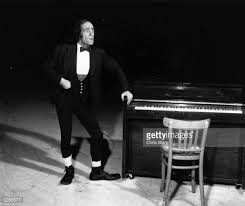
markneary's avatarLove, Belief and Balls

max wall

I’ve been in a very sad Facebook conversation since yesterday. Eden Evans has been in an ATU for the past six years. Every fortnight, his mum Debs sets out on the 320 mile round trip to visit Eden. She is accompanied by Eden’s beloved but elderly dog. Every now and then, Debs will post a heartbreaking photo of herself and the dog sitting on the train station before setting off on a four and a half hour journey. Yesterday, Debs posted that she was in tears on her journey back home. She was upset to find that Eden “was not clean”. It seems that nobody is attending to his personal care. Despite the huge sums the Unit gets paid for providing Eden’s care, this basic and respectful aspect of his care is not happening.

Debs’ post prompted Lynne to join in the conversation. Lynne is the mother of Chris (“The…

View original post 444 more words

Epilepsy & Me

August 10, 2015

BBC Three, 9pm:

What happens when people can’t see your disability? It’s hidden and can strike at any time, without warning – when you’re walking down the street, in a classroom, at a party or on a date.

Epilepsy & Me is a film about people who have extreme epilepsy, where seizures can be a daily occurrence and they have to be watched 24 hours a day. It follows four people at a crucial point in their lives when their futures are being decided.

It’s rare that 21-year-old Jack gets through a day without having a convulsive seizure. He needs constant supervision, but is determined to take his new girlfriend Olivia out on a date – made even more complicated when he has to bring his support worker along.

Amy is leaving her residential college and needs to find somewhere to live, but where will be safe, happy and allow her more independence?

Olivia is 21 and hasn’t had a seizure for four years. She wants to prove to others that she’s ready to learn to drive – something most people around her believe isn’t possible.

And 14-year-old Thomas has recently developed epilepsy because of a newly discovered brain tumour. What will happen if he has major surgery?

How can you grow up and lead an independent life when you can never be left alone?

Sanctioned Jobseekers With Mental Health Problems Are Not ‘Vulnerable’ Says DWP

August 9, 2015

This article was written by Natalie Leal for Welfare Weekly. It is published here by request of Welfare Weekly.

Sanctioned Jobseekers with mental health problems are not classed as ‘vulnerable’ unless they have an accompanying physical health problem, according to the Department for Work and Pensions (DWP).

Use of the controversial sanctions regime, which sees claimants money cut or stopped for up to three years, has rocketed since stricter rules were introduced by the government.

In 2013-14 record numbers of sanctions were imposed, with nearly one in six jobseekers affected, and many fear those with mental health problems are often the hardest hit.

When a claimant has their Jobseekers Allowance (JSA) reduced or stopped they can apply for a hardship payment – up to 60% of their JSA. This can go some way to cover the cost of food and bills while they have no other means of support. Those classed as ‘vulnerable’ can normally claim this vital support immediately, but others may have to wait at least two weeks.

However, those JSA claimants with even the most serious mental health illnesses are not considered vulnerable by DWP; they have to instead wait and go through what could become a lengthy application process.

DWP guidance on hardship payments states: “Requests for hardship payments may be made by people who say they have a mental condition. A person will only be a member of a vulnerable group if the condition causes limitation in functional capacity because of a physical impairment.”

It continues: “It is extremely rare for a mental condition to produce a physical impairment that limits or restricts functional capacity but it can happen.”

For decision makers in any doubt, the guidance goes on to clarify all mental illnesses “without physical impairment”:

  • Affective disorder
  • Agoraphobia
  • Anorexia nervosa
  • Anxiety
  • Bipolar Affective disorder
  • Bulimia nervosa
  • Depression
  • Dissociative disorders
  • Nervous Debility
  • Neurasthenia
  • Neurosis
  • Obsessive-compulsive disorder
  • Panic attacks
  • Paranoia
  • Phobias
  • Phobic anxiety
  • Psychoneurosis
  • Psychosis
  • Schizophrenia

While those suffering from the most severe mental illnesses are likely to receive Employment and Support Allowance (ESA), it is estimated that 23% of JSA claimants have a mental health condition.

Tom Pollard, Policy and Campaigns Manager at Mind said:

“We are extremely concerned that this guidance does not consider people with mental health problems to be vulnerable compared to those who are living with physical health problems.

“Making such a distinction could result in further financial difficulties for those affected by mental health problems, in addition to the distress caused by being sanctioned in the first place.”

A DWP spokesman said they have a well-established system of hardship provision for claimants who are sanctioned.

“We absolutely recognise mental health conditions through the benefit system, with mental health champions and other support for individuals to find work through Jobcentre Plus.

“As taxpayers would expect, the vast majority of those on benefits do the right thing by looking for work, however the small minority who refuse to do so, or take up a job, risk a reduction to their benefits.”

Clubs “Neglecting Responsibility” To Disabled Fans

August 9, 2015

Disabled supporters continue to be forgotten by a number of professional clubs according to new research, with 55 of the 92 teams in the top four divisions forcing away fans to watch matches in home sections of support.

A study has shown that only three Premier League clubs provide the minimum wheelchair space in their grounds as recommended by the Accessible Stadia Guide – a number dependent on the size of the stadium – with Swansea, Leicester and newly promoted Bournemouth those who meet the requirements.

In April 2014 the government described the situation for disabled supporters as “woefully inadequate” but, before the new Premier League season starts, research from the office of Chris Bryant, the shadow secretary of state for culture, media and sport, has laid bare the serious issues that fans still face.

With the top flight’s lucrative TV deal coming into effect this season, Labour is calling on the government to make sufficient wheelchair space a mandatory requirement, asking for a consultation process into the issue involving the Football Association and Premier League.

The analysis compares the cost of upgrading stadiums to the minimum standard for disabled seats with each club’s transfer spending this summer. Arsenal, who are the top disability seat providers after Swansea, Bournemouth and Leicester, would need to spend £140,000 to meet the recommended minimum number of wheelchair spaces, while it would cost Chelsea, Liverpool and Manchester United between £1.4m and £2.2m, sums that would amount to a fraction of the amounts spent on players during the current transfer window.
The cost of upgrading Premier League grounds.

Gary Siddons, a Chelsea fan for 20 years, said very little has changed in terms of disabled seating and that away supporters feel the brunt. “I’ve had to pick and choose away matches,” he said. “If you have to sit with the home fans it can be quite fractious. You have to temper your support. The powers that be wouldn’t dream of allowing a line of able-bodied fans within another section – it would never happen. But it just seems acceptable that disabled people can do that.

“I had a terrible experience at an FA Cup semi-final against Liverpool at Old Trafford in 2005-06 because we had to sit with opposition supporters and had to leave at half-time. People’s attitudes to disabled people seem to be changing and there is more awareness now but in terms of the seating hardly anything has changed.”

Bryant, whose research has also found issues regarding the admission of guide dogs at certain stadiums, said: “With the money pouring into Premier League football it just isn’t right that disabled football fans are being forgotten by the clubs they love. Everyone should be able to go and watch a game if they want to but, even as the new season starts, Premier League clubs still aren’t doing enough to be inclusive and accessible for all.

“We need an end on the unfair and complex schemes for disabled fans to get tickets for matches, the lack of audio provision in stadia and the restrictions on guide dogs. It isn’t right that clubs are failing their disabled fans and we need to see real action and improvements this season.”

Garden Design Explores Synaesthesia

August 8, 2015

Some people experience the world in a unique way – a dog’s bark might taste like chocolate or a piece of music appear colourful.

This is because they have a trait known as synaesthesia. When one of their senses is stimulated, another sense is activated at the same time.

A new garden design is helping people without the trait to imagine what this would be like.

Claudia Hammond, who has a mild version of synaesthesia, went to find out more.

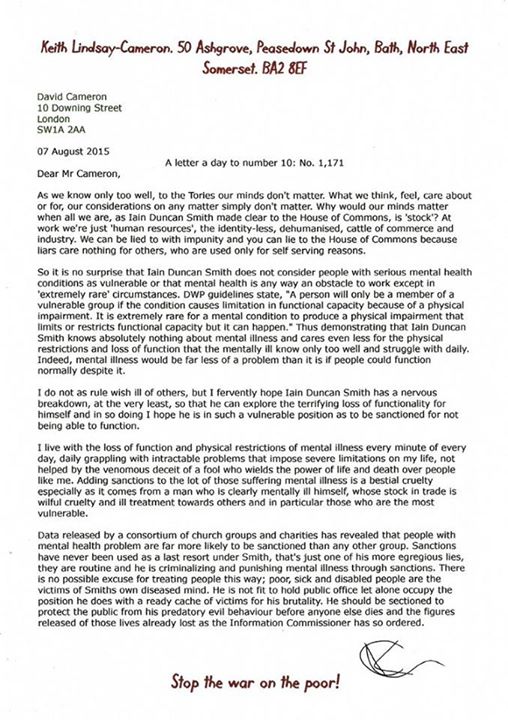
A Letter A Day To No 10 Number 1171: Mental Illness Alone Doesn’t Make You Vulnerable Says IDS

August 7, 2015

Keith Ordinary Guy says shares are encouraged and welcomed…

letteraday7aug

Belfast Divided Over Frankie Boyle Festival Appearance

August 7, 2015

Comedians often court controversy with their acts and Frankie Boyle well known for raising a few eyebrows.

He is appearing at a festival in Belfast on Friday evening, but because of jokes he has made in the past about disability, some have vowed to take a stand against his show.

Chris Buckler reports.

Help Needed To Resist Evictions Of Disabled Men

August 7, 2015

Readers, DPAC need our support.

On Monday 10th August we need activists to be at the Sweets Way Estate, Barnet, London, N20 0NT from 8 am to resist the eviction of a family with a disabled person as a member.

When you arrive at Sweets Way, you will see the gates of Sweatstopic when you arrive, that is the meeting point.

Cat from Sweets Way Resists writes:

On Monday Morning at 10, High Court bailiffs are coming for the last sweets way residents, Mostafa and his family. Mostafa is disabled and has fought and a long and hard battle with Barnet council in the court itself to be rehoused. Mostafa and his family have said they will resist eviction, with the help of Sweets Way Resists + Sweetstopi. Yet, we may be short on numbers s we have our own occupations to protect. Would you be interested in helping resist eviction?

If you can’t get there in person – you can still help out online.

Please contact Barnet Council and tell them you want them to halt this eviction, using their Web Contact Form or twitter: @BarnetCouncil

And

there is another eviction happening to a disabled person, Paul, Tomorrow Morning, 7th August at 22 Yew Tree Road, Beckenham, Kent. BR3 4HT. Be there to resist the eviction from 8.30am

OR an Eviction court hearing is 9.30am at Croydon County Court 2-8 Altyre Road, Croydon Surrey CRO 5LA. Be there to support. ***

Autistic Teen To Livestream 12-Hour Minecraft Marathon For Ambitious About Autism

August 6, 2015

A press release:

Tom Kirkman-Wood is 14 years old and has autism. On Friday 7th August, he will be doing a 12 hour Minecraft-Charity livestream to raise money for Ambitious about Autism, the leading national charity for children and young adults with autism. Tom’s Minecraft marathon will run from 8am to 8pm.

Tom said “I am very keen to spread the word about autism and love busting autism myths. I also happen to be a big Minecraft fan. The 12 hours is just 12 hours of playing in one go – I have done that kind of length before so I know that I can handle it however it is always hard. I will occasionally ask people in chat to set me goals and challenges”

Minecraft has already been shown to be very popular for those with autism, because it is a game that never ends. One father has now created Autcraft, a closed online Minecraft community just for kids with autism.

According to Learning Works for Kids, “Minecraft provides a vibrant world in which creativity, exploration, and productivity occurs on the player’s terms. Particularly in the creative mode, Minecraft allows the player to have a great deal of control over their environment. Minecraft also rewards discovery in a way that does not prompt anxiety and fear. While many children with Autism crave routine and familiarity, Minecraft becomes a safe place to develop flexibility. They are able to explore an unknown world and face fears without giving up safety.”

You can find a link to Tom’s live stream here: http://www.twitch.tv/tkdubsta
Tom’s twitter handle is @autismacceptan and his fundraising page can be found below:
http://uk.virginmoneygiving.com/fundraiser-web/fundraiser/showFundraiserPage.action?userUrl=ThomasKirkmanWood&faId=611512&isTeam=false

Jolanta Lasota, CEO Ambitious about Autism said “We are always delighted when the young people we represent and support want to raise money for us. This fundraiser is a great example of the different ways that you can raise money. Whilst it is true that Minecraft is a particularly popular game for young people with autism, 12 hours is quite the commitment and we wish Tom all the best of luck with the marathon!”


Life As A Parent With MS

August 6, 2015

What is it like to be a disabled parent with a young child?

Nicola Smith, who has multiple sclerosis (MS), has told the Victoria Derbyshire programme she is worried her condition will lead her six-year-old son, Finlay, to miss out.

She told the programme that because of the tiredness the condition can cause, everyday parenting tasks like taking her son to school can also make her feel “like you’ve run a marathon”.

URGENT Search For Two Teenage Girls After Teen With Autism Attacked At Butlins Bognor Regis

August 6, 2015
thomas 18
Alison Askew Attwater


TO ALL MY FB FRIENDS PLEASE SHARE THIS AND ASK FRIENDS DO TO!
PRESS RELEASE

Can you help solve case of attack on autistic Thomas to find two teenage witnesses?

A mother of two from Epsom in Surrey has launched a social media campaign on Twitter and Facebook to find a couple of teenage girls from the Reading area, who witnessed her 18 year old, autistic son Thomas being viciously attacked last Thursday, whilst staying at the Bognor Regis Butlins Holiday Camp, holidaying with his mum and 19 year old brother Charlie.

The assault took place outside the Beachcomber pub and restaurant inside the Butlins Bognor Resort on Thursday 30 July, at around 9pm. Alison Attwater, 46, the mother of the assaulted young man has made this appeal: ‘Seeing your own child savaged like this is utterly heart breaking. It is vital we find these young women, who saw the attack. All we know is their names are Amelia and Athena, they are about 16 and from the Reading area, one is red head and one blonde haired.

‘They made friends with Thomas on the Wednesday night,’ explains Alison. ‘Please come forward if you know these young women. I’d love to speak to Amelia or Athena, as would the Police. I must underline though, they are not in any trouble at all, but they might be valuable witnesses, especially if they are able to help identify who did this to my son.’

‘This unprovoked attack has caused considerable damage to Thomas’s face as well as inside his mouth, leaving multiple cuts and bruises, which required three separate hospital visits. Given that Thomas is autistic, one of the most alarming aspects of this incident was that my son had no idea how to cope and spent two hours wandering the Butlins camp site, alone. Thomas was then taken to Chichester Hospital, West Sussex, by ambulance.

‘At the time, Butlins security staff said they were too busy dealing with another incident to deal with what happened to Thomas. The company has written today by email, saying it could take up to three weeks to reply to my letter of complaint. The Butlins holiday was meant to be respite for the family, using vouchers provided by the charity Family Fund.’


The Unbreakables: Life And Love On Disability Campus- Episode 2

August 6, 2015

Documentary series about life at National Star College in Gloucestershire, a further education college for people with physical disabilities, acquired brain injuries and associated learning difficulties.

Every September, 170 students from around the UK begin a new year of study at National Star. Many live on campus for three years and revel in the specialist teaching, state-of-the-art facilities, end-of-term balls and, more than anything, the freedom of a new life.

For these students their time at college is a time for firsts, whether that is their first time crossing the road or their first time playing spin-the-bottle. In the second part of the series, we meet the excitable new freshers embarking on their first taste of freedom, including 20-year old Dan who has cerebral palsy and dreams of being a DJ.

We’re also introduced to the Overton Gang, a noisy, fun-loving bunch of friends who are the most independent students at college. This group includes the college ‘hottie’ Nicky, who wasn’t born with a disability – at 17 she incurred a brain injury after she drove into a tree on her way to her college prom. Nicky now enjoys her new life at Overton House where the group get up to the usual student high jinks of vodka shots and truth-or-dare. They grow up fast, which can make trips home emotive – as we witness one of the gang, Josh, opening up to his mum when remembering his teenage life.

Reader’s Experience At Decathlon Southampton

August 5, 2015

An email from reader and friend of Same Difference Jemma Brown about her recent unpleasant shopping experience.

Decathlon in Southampton don’t have an accessible changing room!

I went to buy a sports bra, couldn’t find them, then wandered around trying to find a member of staff. Found a member of staff who gave it the ‘it’s over there’ and I assume pointed. Explained that I needed them to show me as I’m VI.
I sat on the floor to find my size (big sizes are always at the bottom) picked a few to try.

Then I couldn’t find fitting rooms.

Queued for ages to speak to a member of staff who told me they don’t have an accessible changing room. I was flabbergasted so asked to speak to the manager.

Manager came and said ‘they’re all accessible it’s totally flat’ I said ‘ok let’s see if I can get me and my guide dog in it.’

Off we went…

The changing rooms are basically a circular curtain at the end of the isle with a bench and a mirror in it. There are no grab rails no light, no colour contrast (I couldn’t see hooks or rails) and very little space. The only way to fit my
guide dog, Ollie, in was to remove the changing bench (what happens if I want to try on trousers) even then it was very tight and very very dark. No way you would fit in if you needed a PA with you. My pupils can’t adjust to changes in light but this was really really dark.

So because I had to remove the changing bench, I then had to stand holding my rucksack between my knees, no grab rails, no chance of sitting down. When the curtain is pulled it blocks out all the light and you’re essentially in the dark.

Manager then said they had a disabled loo I could use but it’s upstairs… I full on belly laughed! I can’t really do stairs at the moment so explained that I have a physical disability too and that I could not get down the stairs.

I had to give up and leave and I’m so angry to be treated this way it’s not what I was expecting.

It’s basically like ‘come to this sports shop if you are physically “normal,” if you play a disability sport go somewhere else.’

The manager missed my point when saying there were no steps. When I asked how wheelchair users get on ‘ if we remove the bench a wheelchair fits in.’ When I mentioned about telling a blind person it’s over there and asked if they trained staff to recognise a guide dog manager said ‘no
offence but we don’t get them in that often.’

Also I couldn’t believe that the disabled loo which was the only alternative option was upstairs!

The manager did try to be helpful by moving things around – at the end of the day it’s not their fault if head office
don’t train staff or design their stirs to accommodate disabled customers.

I’m so angry and upset. Shopping should not be that hard.

In the last 7 months my physical disability has deteriorated to the point where I have had to stop playing blind cricket and football and move to wheelchair basketball – I love it but it’s a blow and I know I will get to the point where my vision deteriorates so this is no longer an option. I want to enjoy sport as much as I can while I can still take part and it’s like Decathlon in Southampton are basically saying ‘only able bodied people play sport.’ This is totally wrong.

People talk about the Legacy of the 2012 Paralympic Games but if big brand shops like Decathlon are treating disabled people like this then nothing has changed.

URGENT: Wheelchair Stolen From Stoke Newington, London, Morning Of 5/8/15

August 5, 2015

Please share widely:

Updated 6/8: Dom’s sister, Holly, started a GoFundMe for him to possibly replace the stolen chair. With his case trending on Facebook and picked up by the Mirror, at the time of this update they have already raised £19000!

Campaign Asks Facebook To Improve Accessibility For Those With Usher Syndrome

August 5, 2015

What Not To Do

August 4, 2015

A series of comedy shorts by Channel 4 and Scope, featuring Alex Brooker. Part of Scope’s End The Awkward campaign.

Have You Seen Mark Crozier?

August 4, 2015

I’ve just spotted this on Facebook- please share widely.

Hi. I need everyone’s help here. This is my sister in laws partner Mark Crozier. He didn’t turn up for his job in Newcastle on Sunday. He left his house keys and mobile behind and boarded a train for London. He has been suffering from depression and left giving no warning . His partner and son are desperate to find him. I know this is needle in a haystack time but he’s somewhere in London and if this gets to enough Facebook’s up there someone might just spot him. If they do can they inform the local police. They are aware and it would be of relief to the family to know he’s ok. Please forward.

mc

Travelling 200 Miles To See Daughter In Mental Health Care

August 4, 2015

Part of a report from today’s Victoria Derbyshire:

The government has announced an extra £143m for children’s mental health services in England, including an attempt to end children being treated far from home. Maria Higginson and her daughter Amber are from Torquay, Devon, but the authorities said the nearest care was 200 miles away in Maidenhead, Berkshire. Now Maria faces a journey of hundreds of miles to see Amber, as our Social Affairs Correspondent Michael Buchanan reports.

Charlie, 11, On Life As A Young Carer

August 4, 2015

The Carers Trust, a charity working with families, says it comes across children as young as five who are looking after family members.

5 Live’s Lesley Ashmall spent time with 11-year-old Charlie, who cares for her sister and her disabled mum.

“I help with some of the cooking, the washing up, the cleaning,” said Charlie. “I help bath my sister, read her a story, get her in to her pj’s and up in to bed ready for her next day at reception. I make sure my mum takes her tablets at the correct time”.

Her mum Jackie added: “she is my life support, just being there for everything, she fills in every little gap or crack that is appearing.”

Neighbours’ Toadie To Be Left Paralysed In Upcoming Episodes

August 4, 2015

I’ve just read this on Digital Spy:

Neighbours favourite Toadie Rebecchi will be left paralysed later this month as his past comes back to haunt him.

The popular character will be knocked unconscious when he slips off a jumping castle while spending time with his daughter Nell at an event organised by Naomi Canning.

When Toadie wakes up in hospital and seems to be okay, the relief from his loved ones is sadly short-lived as he is forced to confess that he can no longer feel his legs.

Concerning test results then reveal that Toadie’s accident has aggravated his old bullet wound, which he sustained when he was shot by Guy Sykes in 2006.

Although Toadie goes in for urgent surgery, the bad news for his wife Sonya and their friends is that there’ll be no immediate answers over his future.
The doctors can only reveal that either the bullet still lodged inside Toadie has caused more damage, or the swelling he has suffered is pinching some nerves.

One outcome is permanent while the other would resolve itself in time, leaving Toadie with an anxious wait to find out whether he’ll ever walk again.

Longtime readers may know that I’ve been a massive fan of Neighbours forever. I have grown up with Toadie Rebecchi bringing fun and laughter to my TV screen!

He is one of Neighbours’ most popular characters of all time. I am very pleased to see a storyline involving disability given to such a regular, popular and well-known character.

I have never liked miraculous cures in TV disability storylines. I much prefer to see TV programmes showing that becoming disabled doesn’t have to completely change a person’s life. I hope that Toadie will remain paralysed, but that the other parts of his life will continue unchanged. Neighbours has managed this successfully in the past with Paul Robinson and Susan Kennedy.

I look forward to seeing what is coming up for Toadie, and sincerely thank Neighbours for the storyline.


Life Begins Now

August 4, 2015

BBC Three, 9pm:

Partying, snogging, drinking – for most of us college life is the best of times. But for people with learning difficulties, moving on from this special period in their lives raises unique challenges.

This sensitive film spends the last few weeks of term at Derwen College in Shropshire with six students as they prepare to graduate and enter the real world.

Jon, Aled and Aled have been an inseparable gang for the past three years – united by their Downs Syndrome, but also their love of mischief and girls. Gang leader Jon has cultivated a reputation as a hard man on campus. He doesn’t want to get a proper job once he leaves college; instead he’s going to pursue the life of a gangster – ‘fighting, hot-tubs, strippers’. His two trusty companions Aled and Aled are also signed up to this hedonistic lifestyle. But as the time approaches for Jon to say goodbye to college and his best buddies, reality bites and his hard man mask begins to slip.

Daniel and Lissie also met three years ago and fell in love within just a few days of term beginning. They’re the college sweethearts, Derwen’s Posh and Becks, and are rarely seen out of each other’s company. During the final term Dan bought Lissie an engagement ring and proposed to her in front of his college friends. But they’re keeping their marriage plans a secret from their parents. Will their relationship endure living two hundred miles apart when they return to their family homes?

And then there is Steven. He’s struggled to create a close friendship at Derwen College because of his autism and challenging behaviour. Now, as he is preparing to leave, there are concerns at the college that he will struggle to integrate back into mainstream society.

Leaving college is a daunting time for anyone, but the staff at Derwen have added concerns for our students. Because of their learning difficulties they are less likely to be able to anticipate the changes that await them. The future really is a journey into the unknown.

Some 2016 And 2017 PIP Awards Being Assessed Early

August 3, 2015

I’ve just spotted this on Fightback. It may be useful to some of you.

I have heard a number of 2017 PIP awards are now being assessed “early” as the assessors have taken on new staff in order to cope with DLA to PIP changeovers coming this year and have time on their hands therefore they are reassessing most 2016 and now some 2017 claimants in certain areas. Not everyone will be and if nothing has changed you can just use info from the old form. Nevertheless it’s stressful and tantamount to disability harassment yet again.

City Of London Employers Failing Disabled People, Says Lord Mayor

August 3, 2015

The City’s big employers must make greater efforts to employ disabled people, the Lord Mayor of London has told The Independent in an exclusive interview. 

Alan Yarrow said: “They are not doing enough. I think they can do more and I think they need to realise how little they do at the moment.”

Mr Yarrow, whose son has disabilities, was speaking in the wake of a debate over outdated attitudes sparked by the seven-metre high Damian Hirst sculpture, entitled Charity, put up outside the Gherkin in the City. It is based on a 1960s charity box depicting a disabled young girl clutching a teddy bear and a collection tin. The charity Scope withdrew the boxes in the 1980s in favour of more positive images of disabled people.

Under Mr Yarrow, the City  of London Corporation  guarantees interviews to suitably qualified candidates with disabilities. The so-called “two ticks” scheme – which includes a number of other commitments – has been adopted by financial companies including Clydesdale bank, Royal Bank of Scotland and Scottish Widows. However, it is not universal. 

Mr Yarrow said: “I read that only 48 per cent of people with disabilities have jobs in London. If that it is the case, it is far too low a percentage. Diversity is a subject we think is incredibly important. There is no point just employing a bunch of people that are all alike.

“We are also facing the fact that the availability of employable people is falling in the capital. Those with disabilities who want to work should therefore be given a chance. Employers will probably find they are very loyal.

“We have to get through the process of accepting that not everyone is going to be what people might consider to be physically or mentally perfect. Nor do they need to be to make a contribution. ”

Elliot Dunster at Scope said: “Many tell us they feel they have missed out on a job opportunity because of employer attitudes. This is a waste of the talents of disabled people, who are a vital and often untapped resource for the UK labour market.”

Sarah Long’s Open Letter To David Cameron

August 3, 2015

Readers, this is Sarah Long’s open letter to David Cameron:

Dear David Cameron

A life worth living with Morquio: A Funding request for Vimizim

Having Vimzim (elosulfase alfa) has not just extended my life, but made it worth living, and now the governance of this country led by yourself will make a decision if this Enzyme Replacement Treatment will be available in the United Kingdom. This decision will ultimately decide whether I will continue living.  I was in the final stages of Morquio (MPSIV) and did not have much longer however I am living proof this drug prolongs life as well as providing a quality of life.  If as it seems increasingly likely the UK will not provide this treatment, it will be my end. I hope you can prove this assumption wrong.

Can you imagine what it is like being locked inside a body, a fog distancing myself from others? Disconnected to an extent between what is going on around me and being an active player in it?  Everyday, struggling to breath, choking on thick mucus, ever amazed at the volume I used to cough up each day.  The pain echoing from the lungs as they struggled to function; my cervical spine and throughout my body feeling like someone has walked up and pulled two strings at the back of the neck tightly. Wondering if my arms, hands or other limbs will be working each day. Reflecting now on my past self I am aware that my body felt like a lead weight compared to now. It was hard work to do things, like wadding through treacle, a strong resistance to achieve anything. Never having refreshed sleep, the oxygen headaches, the fear carers had of me not waking up even though the reality of me sleeping was rare.  Have you ever been asked to leave a theatre because your breathing is too noisy? I have.

Maybe at 44 years old living with Morquio I ask too much to live longer. I can’t imagine what my parents felt when they were told when I was 6 I would live until I was 15 years old. I can’t ask either as my mother died from cancer when I was 18.  This is when I had to become independent. It was her battle with cancer and her attitude to forging teaching roles for women in a very male dominated school (Ampleforth) that inspired me to push myself.  Education was important to my mother and she pushed for me to have one. Initially I was not entitled to state education, the local primary school refused to enrol me, as this was when I stopped growing.  My parents chose a private convent school at 6 I remember well the fear that gripped me when I went there each day. Other kids were not allowed to play with me in case I got hurt. This endorsed rejection meant not only bullying, jeering from children, but also from teachers.  I moved when my parents realised the horror of it, to a prep school although a struggle as they had to pay for it. It also meant painfully for my mother and myself having to leave home at 6 years old for boarding school. My school years were isolating. I remained in residential educational establishments all my life, private then a special college when disabled children were at last provided with some form of education. When I was growing up I remember the frustrations of finding it difficult to walk, watching on the side-lines as I could not keep up with others and it was hard to engage practically with lessons. It was not just my legs that began to fail but also my wrists. I remember being bullied because I could not sharpen a pencil! My pediatrician spotted that I had intelligence and insisted I learnt to type as my writing was going to be one of the first thing to go.  It did. I loved art and drama but as my arms and then voice began to fail I could not continue. Life for children with Morquio is very different now with touch screens, laptops and tablets.

I call myself a special school survivor because it was a difficult place to reside, particularly since many pupils died and people used to wonder if I was going to live through each year.  I rebelled at school by studying, as this was counter-cultural! I got an undergraduate place at the University of Bath, and I had access to the independent living fund so was able to cope living and making my own choices in the world. I worked for 15 years before my health began to make me withdraw more and more from working. This was a major frustration. My most significant deterioration was my breathing, as my lungs got restricted, my immune system began to fail and slowly my world got smaller, I saw friends less and less, my ambitions and drive got squashed. I did however pass my Masters of Research with distinction, hoping I could somehow undertake freelance research work; I then got offered a funded Phd.  My world however seemed to drift away from me shortly after as it became a struggle to function, I did not sleep and was diagnosed with hyperventilation during the day and hypoventilation at night. It was like someone just pulled out the power plug during the day without warning! I did not sleep more that 2 hours at any given time. I was in what they term the final stages.

It was not a difficult decision to join the BioMarin trial for Vimizim and it felt a real privilege to be asked to give back to others with my impairment; I started treatment on the 29th February 2012. I am utterly amazed how Vimizim (elosulfase alfa) has benefited me I would not have been able to draft this if I had not the treatment!  I only had one infection at the beginning of my participation, with Vimizim attributed to my extremely quick recovery.  It only took four weeks to recover from pneumonia, previously pre-Vimizim it took nine months. Over the past two and a half years I have been free of respiratory infections, and although my support workers have aliments and I spent time at the university I have not picked things up!  I sleep for over four hours a night, that is so refreshing compared to before. Although still reliant on a nebuliser four hourly, I don’t need the oxygen.  My clinical evidence validates the Vimizim research data as my oxygen and carbon dioxide levels have stabilised particularly during my sleep.  I have my voice back, and my body feels so much lighter than it has for twenty years.  I was so unaware of how I had slipped into this world of “heaviness” although I feel lighter, I have not had my full physical strength return, after all my joints were too damaged and many of them have collapsed. The pain however, has become less and so much easier to manage.  I am able to cope with my independent living scheme taking on the employer role saving the local authority money and dealing with the now imposed changes. Previously I would get very anxious about these things particularly given I have no family support. My PhD supervisors noticed my written work had improved significantly probably because my oxygen levels were better and it looks like I could of finished my thesis by the beginning of next year. I heard on the Monday before NICE published its finding I have an academic article accepted for publication ‘the intrinsic quality of life’. I am also able to drive my van further, and spent last weekend in Devon with friends. I was beginning to get active and be back in the community.

It is terrifying that my last treatment is tomorrow having benefited from BioMarin generous compassionate provision, and there still is no solution or decision in the UK. It has to be a testimony that the treatment is a success given that having a drip every week (it has to be every week) for 4-5hours is a tough regime, but you go through it as you know you (or your child) benefit from it. It is surprising that over 30 other countries are providing the treatment and the UK is not, ironic since I will without it be trapped in this country unable to fly to seek it elsewhere. As an academic and former civil servant at local and national government levels it’s troubling that there is seemingly a lack of accountability. Along with the worrying fact that rare impairments’ groups are having their treatments evaluated by instruments designed for mass (larger population) treatments. As you know families with rare diseases have very different experiences of health care services compared to other larger impairment groups. Humanity is pluralistic by nature and we rare folk are part of it! So what now, for me? It feels like a death sentence will I live or die, this is what you are deciding.

The faces behind the label ‘Morquio’ are not just children there are also adults, as medical advances take place the kids of today may grow up to and experience my dependent state that I ended up in. My experiences demonstrate that this treatment enables regression of the disease, and has stripped away many of the restrictions Morquio imposes. To support these claims I can provide witness statements from friends, assistants and clinical evaluations.  There can be no doubt that this drug does prolong life. Contradicting NICE conclusions. I am concerned as I read NICE related documents that they have come with a predetermined agenda masking their potential lack of knowledge of living with Morquio. The applied matrix evaluation tools overwhelm our small population that have Morquio, so as a consequence our lived realities are not captured within their conclusions. Many of the questions they want answers for would need longitudinal studies; of course being a rare impairment means there is a lack of knowledge e.g. peer articles and any study and/or evaluation is always a learning curve. They have failed to authenticate the realities of the aging process aligned with the degenerative experiences for people with Morquio who survive into adulthood both physiologically and psychologically.

Access to Vimizim is a matter of life and death – I personally beg you as someone you are likely let die over this, not to let the young people experience what I have. Although you are aware of your own fragility you also worry about how your family and friends will cope. Without Vimizim I can make that academic assumption that I will slip back into isolation, suffer the poor consequences of having a bad immune system. It is unknown what will happen as we were told to have it every week, and my body craves it, I am dependent on the drug. I had dreams again, ambitions, but this is now most likely to be taken from me if NHS England vote no to interim provision this week, and NICE rejects it in October. Now more care will be needed as I slip back to that dark place I was trapped in before, solitude you probably cannot imagine. It was wonderful being able to laugh again, reflect on academic challenges, be ambitious, and begin to live.  I only wish I lived in a society that thought my future was an investment, now I find myself dehumanised by the processes in place, a non-person.  I am left desperate, imploring you to intervene and provide this innovative and effective treatment. Vimizim creates a future full of opportunities, a stability that means less dependency on the health care services and promotes overall wellbeing.

Please support the funding of this treatment, not only is Vimizim innovative, the first cases tried here in the UK, this is a legacy that you can lead to change a lifetime.

Yours sincerely

Sarah A. Long BSc(hons) DipSW MRes

Disabled In An Instant

August 3, 2015

BBC Three, 9pm:

Documentary in which actor and sportsman Peter Mitchell, who was himself paralysed in a car crash, follows the stories of three young people who have battled to survive life-changing illnesses or injuries, as they leave hospital and discover what life is like with a disability. Peter tries to help them, questioning why the support networks supposed to assist disabled people don’t work better.

Woman’s Leg Amputated Against Her Wishes After CoP Ruling

August 1, 2015

A mentally-ill woman has had part of her leg amputated against her wishes in order to save her life, it has emerged.

Doctors said the woman, in her 60s, would die “very soon” from an infection unless her leg was removed above the knee.

Last Friday, the Court of Protection ruled Surrey & Sussex Healthcare NHS Trust could carry out the operation.

But it banned reports of its decision until surgery had taken place, in case the woman found out and was distressed.

Mr Justice Keehan said he was “concerned to say the least” about authorising amputation against a patient’s wishes.

‘Best interests’

But, he concluded, the woman had no “concept” of the risk to her life and said she “deserved the chance to live”.

The court heard the woman, who had “psychotic symptoms”, had an infection which was not responding to treatment.

Doctors said she did not have the mental capacity to make decisions about her treatment and did not understand the risk to her life.

Mungo Wenban-Smith, for the trust, argued amputation could prolong the woman’s life by 10 or more years.

Conrad Hallin, who was appointed on the woman’s behalf, agreed the amputation was in her best interests.

Mr Justice Keehan ruled: “I am completely satisfied that [the woman] lacks the capacity to make decisions because she suffers from a delusional disorder.

“It would appear she has no concept or understanding whatsoever that the alternative to surgery is that she will die within the next five to 10 days.”

Carers now being targeted by the DWP. 

July 31, 2015

Charlotte Hughes's avatarThe poor side of life

Sometimes it’s hard to keep up with all the changes that are occurring in the DWP. It seems like a never ending turnstile of changes. I usually get alerted to the big changes fairly early on before they happen, but I missed this one.

A lady approached me outside the Jobcentre yesterday during our weekly demonstration. To say she was a bit annoyed was an understatement. She is a full time carer for her disabled son. His condition is unpredictable at times and as a result they are in receipt of a high level DLA payment. It’s not easy to get a high level award and this lady has fought very hard to get this.

She had received a letter from the Jobcentre. She had been asked to go into the Jobcentre for a mandatory back to work meeting. To make matters worse they didn’t send her to her nearest…

View original post 734 more words

Applications now open for £50,000 Stelios Award for Disabled Entrepreneurs in the UK 2015

July 31, 2015

A press release:

• The £50,000 award recognises talents of established business owners with a disability or long-term health condition.
• The cash prize is the largest of its kind for disabled entrepreneurs.
• The award is run in conjunction with Leonard Cheshire Disability, the UK’s leading disability charity.
• Award is personally chosen and presented by easyjet founder Sir Stelios Haji-Ioannou at a special ceremony in London on November 4th.
Sir Stelios Haji-Ioannou and Leonard Cheshire Disability are pleased to invite applications for the Stelios Award for Disabled Entrepreneurs 2015 worth £50,000.

The award, jointly run by the Stelios Philanthropic Foundation (www.stelios.com) and the charity Leonard Cheshire Disability, (www.LeonardCheshire.org) recognises the achievements of disabled entrepreneurs who have overcome challenges to set up their own company and excel in their chosen business field. Now in its ninth year, past winners have been drawn from the travel agency, homebuild and IT sectors as well as companies specialising in disability/mobility aids.

Applications are now being accepted online at http://www.leonardcheshire.org The deadline for all applications is Friday 18 September 2015.

Sir Stelios said: “Creating opportunities for disabled people facing discrimination in business is essential. The Stelios Award for Disabled Entrepreneurs highlights their achievements and contribution to society.

We want to hear from talented disabled entrepreneurs who are able to show they have got what it takes to run a successful business and meet a real need in the market.”

Clare Pelham, Chief Executive of Leonard Cheshire Disability said: “We are delighted to work with Sir Stelios on an award that celebrates the remarkable achievements of disabled entrepreneurs.

“I know there are many talented and successful disabled entrepreneurs out there. I urge them to take advantage of this unique opportunity for valuable recognition of their business and skills – in cash and publicity – and apply.”

Last year’s winner, Ben Wolfenden said: “Winning the 2014 award has meant so much to me both financially and personally. I’ve been able to solidify the team and our offering, grow some fantastic new clients and build a better working environment for my health.”

Ben said that despite undergoing a gruelling regime of medication and five hours of physiotherapy every day, he and his team have grown Visibilis by over 1000% in the year from 2012 to 2013, with 2014 exceeding expectations.

He added, “I would urge anyone with a disability, whether you see yourself as an entrepreneur or not, to apply and let Stelios and his team decide!”


For full details on eligibility and an application form please visit http://www.leonardcheshire.org/stelios or call 020 7112 1489 (choose option 1). Alternative application formats are available on request.

www.stelios.com

Justin Ashton becomes the first person in the world to be fitted with leading medical technology for drop foot sufferers

July 31, 2015

 A press release:

Justin Ashton, a 40 year old stroke survivor from Kettering has become the first person in the world to be fitted with a new innovative nerve stimulator cuff to help him walk normally again. The Ottobock MyGait Cuff Soft is the world’s most advanced Functional Electrical Stimulation (FES) cuff of its kind, enabling people with drop foot to walk more naturally again.

The MyGait Cuff Soft is the slimmest FES cuff available in the market. Designed specifically to be easy to put on and take off using only one hand, the unique design is comfortable and breathable. Discreet and effective, the MyGait Cuff Soft could help thousands of people in the UK living with MS, stroke survivors and the effects of brain injury. The device is so discreet that when worn to aid walking, it is barely noticeable.

Justin suffered a stroke whilst working as an electrician. He was on his way to work when his driving became impaired, his speech slurred and he lost vision. He was told he had suffered a stroke and rushed to Kettering General Hospital, however it was days before he realised the full extent of his stroke and the effect it would have on his life. After six months of rehabilitation, Justin still struggled with walking, tripping and falling often due to drop foot, which is the inability to raise the foot due to a weakness in or paralysis of the dorsiflexor muscles in the leg and the foot.

“Following my stroke, I thought my life was over. I was unable to even sit up by myself and had to re-learn all the simple tasks you take for granted all over again,” states Justin. “It would be fair to say I was a fit and active 33 year old when I suffered the stroke; I loved my job as an electrician, I was a keen golfer and would also coach my son’s football team at the weekend. When I was unable to get out of bed it was devastating to not be able to do my daily activities and only be able to see my children when they visited me in rehab.”

He has since become the first patient in the world to be fitted with a new product called MyGait Cuff Soft to treat drop foot. The most advanced cuff-based stimulator on the market, it offers two-channel stimulation – meaning more than one muscle group can be stimulated at one time. In addition, the new technology allows for adaption during sub-phases of gait to improve the way patients walk.

“I’ve tried all sorts of treatments for my drop foot – from orthoses right through to other FES devices on the market and can honestly say the new MyGait Cuff Soft is worlds apart. It’s more comfortable than anything I’ve tried and is slim enough to wear under any of my jeans & trousers, even the narrow ones – which is a first for me! It fits really nicely, is easy to put on and off and has allowed me to go out and do so much more. I have my confidence back and have lost the fear that comes when you’re unstable and immobile.”

The MyGait Cuff Soft works by providing an electrical impulse that is delivered to the nerve which stimulates the muscle into movement. A heel switch sensor communicates wirelessly with the cuff and electrodes to stimulate the appropriate nerve at the right time and frequency during the walking cycle.  A unique advantage of MyGait system is that in addition to the dorsiflexor muscles, other muscle groups can also be stimulated using a second channel. This makes it possible to provide additional support when walking. Knee and hip control can be improved by stimulating different muscles with the second channel.

“Drop foot can leave sufferers with complex mobility challenges that effects quality of life and confidence,” states Lynn Vale, MyGait specialist at Ottobock. “We are delighted to introduce this exciting new product to the UK that is helping people like Justin get their life back on track and improving their walking ability. The new Cuff Soft is comfortable to wear and is so slim it is hardly noticeable under trousers.”

The MyGait Cuff Soft is available from leading Ottobock distributors around the UK. Visit the Ottobock website to find your nearest MyGait Cuff Soft distributor.

Wanted: A Very Personal Assistant, Episode 2

July 31, 2015

BBC Three, 9pm:

There are currently around 300,000 young disabled people in the UK who rely on carers for their daily needs. For many of these ambitious young people, finding the right carer is the difference between achieving their ambitions or a life unfulfilled. But as a young disabled person in Britain your options are limited, as the majority of people working in care are over 40 years old.

But with three quarters of a million young people under 24 currently looking for work, could the solution being staring us in the face?

This groundbreaking series explores what happens when four young ambitious disabled people put all their care needs in the hands of unemployed people their own age. But there’s a catch – to ensure applicants come with an open mind, the exact nature of the job and the employer’s disabilities aren’t revealed until the final job interview.

Will seeing the world from a different point of view help break down preconceptions of disability and unemployment? Could challenging shared experiences lead to lasting friendships and even a rewarding new career?

In the final programme, the new carers are pushed further out of their comfort zones as they help their employers face real-world challenges away from the home. With the possibility of a real job offer at the end there’s a lot at stake for everyone.

Michael’s carer Denny Lee struggles with his bowel management come to a head, forcing her to question whether this is really the job for her. Josh’s carer Francesca is shocked to be asked to take him to the red light district in Amsterdam so he can have sex. Rupy’s carer Chantelle comes to terms with the stark realities of finding accessible homes. Jasmine’s carer Emily must prove herself on the domestic front to have any chance of being offered a job.

An Open Letter to a researcher on “The Undatables”

July 30, 2015

slatteroo's avatarSomewhat Ridiculous

I did a new act competition today (it was fun and Tom Taylor won the heat as he was very good). I had my set all planned out, but then something happened that made me forget all my jokes and write something entirely new in an hour. At 15.45 today, I received this facebook message out of nowhere:

Hi Mabel,

I hope you are ok.

I really hope you don’t mind me messaging you – my name is {Name Redacted] and I am a Researcher on The Undateables. 

View original post 751 more words

The Unbreakables: Life And Love On Disability Campus- Episode 1

July 30, 2015

BBC Three, 9pm:

Documentary series about life at National Star College in Gloucestershire, a further education college for people with physical disabilities, acquired brain injuries and associated learning difficulties.

The college years are ideal for making friends and finding romance. Roommates Xenon and Bradley Nash banter effortlessly about which of them is more handsome, but as they are leaving college soon their friendship will come to an end.

The high-octane college life includes all-campus events such sports day, summer balls and electing a new president. Bradley Butler is running for the top job – he sends an email to 200 students because he is desperate for his campaign to be taken seriously. But can he usurp the slick incumbent Nathan Mattick who is running for a second term?

Life at National Star is very different to life outside, as we find when we meet Beth in the Welsh Valleys who is preparing to leave home for the first time and start at National Star. She is desperate to meet new friends and quickly falls for Ed, a handsome young man who does not use a wheelchair. But she must come to terms with his learning disability, which is causing him to believe that he is a retired premiership footballer.

Alan Barnes Looking To Move To Shetland Islands After A ‘Calling From God’

July 29, 2015

Disabled pensioner Alan Barnes is planning to leave Tyneside for the Shetland Islands.

The 67-year-old has put his Gateshead home on the market just three months after buying the terraced house, with cash donated by well-wishers.

And Alan is hoping to make a fresh start off the Scottish coast doing work for the church.

The committed Christian said he made the decision to sell his Low Fell home after getting a “calling” from God.

He said: “I have had a calling from God to go to the Shetland Islands. I’m hoping to do some youth work there. It came to me whilst I was praying.

“I’m very open to the Holy Spirit. I have never been to Shetland before but when you get a calling from God you can’t ignore it. I have just got a strong feeling that’s where I need to be.”

Alan became a household name earlier this year after he was targeted by would-be mugger Richard Gatiss.

The 4ft pensioner, who has suffered from height and growth problems since birth, suffered a broken collar bone when the legal-high user pushed him to the ground as he moved his wheelie bin in January.

And after we told how Alan was too afraid to return to his bungalow, in Low Fell, local beautician Katie Cutler set up an online fundraising drive to help support the victim as he looked for a new home.

Alan’s plight touched hearts across the UK and generous well-wishers donated a staggering £330,000 in a matter of weeks.

Alan used half the money to buy a two-bedroom terraced house, which he paid £150,000 for in April.

After he told admitted in May that he was struggling to settle in his new home, we teamed-up with the Sunday Mirror to give the pad a luxury makeover.

But Alan is now keen to make a fresh start, with the house now on the market for £155,000.

“Whenever anyone stops and talks to me all they ask is how am I settling in,” he said. “But I’d much rather talk about my Christian faith. If the house sells quick I’ll just rent somewhere.

“It’s really exciting. I could just stay here but I’m not going to ignore the call from God.”

Since helping Alan, Katie, of Greenside, Gateshead, has set up her own charity called the Katie Cutler Foundation, for which Alan is an ambassador.

Gatiss, of Split Crow Road in Gateshead, was jailed for four years at Newcastle Crown Court after admitting assault with intent to rob.

NHS Announce New Care Guidelines For Learning Disabilities

July 29, 2015

A press release:


The NHS have announced new draft guidelines to help transform the care of people with learning disabilities and/or autism. The new draft service model is the latest piece of work to emerge from the Transforming Care for People with Learning Disabilities programme, which is a joint piece of work between the NHS England, the LGA, ADASS, the Care Quality Commission (CQC), Health Education England (HEE) and the Department of Health (DH).


The Service Model sets out nine overarching principles which define what ‘good’ services for people with learning disabilities and/or autism whose behaviour challenges should look like. Highlights include:


  • Providing more proactive, preventative care, with better identification of people at risk and early intervention;
  • Empowering people with a learning disability and/or autism, for instance through the expansion of personal budgets and personal health budgets and independent advocacy;
  • Ensuring access to activities and services that enable people with a learning disability and/or autism to lead a fulfilling, purposeful life (such as education, leisure)


Jolanta Lasota, CEO Ambitious about Autism explains why these principles are so important for those with autism and how they affect their education:


“One in a hundred people in the UK have autism, so it is crucial that government, health care and local authorities understand that with the right support, planning and opportunities across their support network, many people with autism have the ability to lead a fulfilling and purposeful life.


“It is particularly encouraging to see access to leisure activities included in the principles. We have found that for the students at our TreeHouse School and Ambitious College, access to vocational and leisure programmes including horticulture, equine and photography are really important for both their enjoyment and education. These activities can also help to find a career path, so it is crucial to their development.


“Whilst education is crucial to personal development, it can only be effective within a wider framework of good health and social care arrangements. We are delighted to see all-round quality of care for those with autism being addressed by the NHS and hope it goes a long way to supporting those with autism and other less visible disabilities.”


“Planning And Following Journeys” Opposite Decisions By Judges Could Mean Disaster For PIP Claimants

July 29, 2015

With many thanks to Benefits And Work.

Two upper tribunal judges have come to exactly opposite conclusions about the law relating to the PIP mobility component activity ‘Planning and following journeys’, leaving the DWP and claimants to argue at first-tier tribunals over which decision the judge should follow. One of the two decisions could see tens of thousands of lower rate DLA mobility claimants, especially those with mental health conditions, lose their award when transferring to PIP.

Conflicting decisions
In a decision dated 17 June 2015, upper tribunal judge Edward Jacobs decided that help from another person in connection with planning and following journeys deals only with navigation and “excludes dealing with other difficulties that may be encountered along the way.” This is in line with DWP guidance, which many tribunals have chosen to disregard until recently.

In a decision dated 23 June 2015, however, upper tribunal judge Sir Crispin Agnew of Lochnaw Bt QC, held that help from another person in this connection can be for “any reason including a mental health reason such as overcoming anxiety or other psychological distress.”

Mobilising activity 1 looks at your ability to plan, follow and undertake a journey, with points scored as follows:

a. Can plan and follow the route of a journey unaided. 0 points.
b. Needs prompting to be able to undertake any journey to avoid overwhelming psychological distress to the claimant. 4 points.
c. Cannot plan the route of a journey. 8 points.
d. Cannot follow the route of an unfamiliar journey without another person, assistance dog or orientation aid. 10 points.
e. Cannot undertake any journey because it would cause overwhelming psychological distress to the claimant. 10 points.
f. Cannot follow the route of a familiar journey without another person, an assistance dog or an orientation aid. 12 points.

Jacobs’ case
In the Jacobs case, the claimant’s evidence was that:

“I get lost a lot, but not always – only if it is a new place – I panic, I cannot concentrate, I cannot plan a route, I panic. It really helps to have someone with me and reassure me and encourage me to go out – doing this on my own is extremely stressful and exhausting.”

She also claimed that:

“PTSD – depression. I stay indoors as much as possible. The PTSD makes me feel I am in danger when I am not – causes extreme stress . . . I don’t like strangers trying to talk to me or saying hello. I get extremely stressed, I over react, I find it very distressing and it makes me very tired and I suffer fatigue.”

Zero mobility points
However, the health professional who carried out her PIP assessment found that she had normal mental health and she scored no points for mobility and just two points for problems with dressing.

A tribunal also awarded her zero points for mobility, but six points for daily living: 4 for problems engaging with other people and two for budgeting.

With the help of the Citizens Advice Bureau, the claimant won permission to appeal to the upper tribunal, arguing that descriptor 1d should have been considered by the tribunal because:

“She cannot go to unfamiliar places on her own, due to her mental condition and her difficulty to speak or mix with other people. She may find herself lost in a new place and will be unable to approach someone to help.”

The upper tribunal also considered whether 1f could apply, because even on a familiar route there might be an accident or road works that would mean a change of route.

The DWP argued that descriptor 1d only applies to problems with navigating a route and not to problems in the external environment that claimants may encounter while doing so.

The CAB, unfortunately, made only a ‘no comment’ response to this argument by the DWP.

Jacobs’ decision
Judge Jacobs held that the DWP were correct and that:

“descriptor 1d deals with navigation and excludes dealing with other difficulties that may be encountered along the way.”

He went on to say that:

“Difficulties that may arise during the journey, such as getting lost and asking directions or encountering crowds, are not difficulties with following the route. They may prevent the claimant getting back onto the route if lost or finding an alternative route to avoid some obstacle, but those are different matters.”

Jacobs argued that descriptors 1b and 1e deal with undertaking the journey, but 1a, 1d and 1f with following the route of a journey.

Agnew’s case
Judge Sir Crispin Agnew, however, came to the opposite conclusion to judge Jacobs, less than a week later.

In this case the evidence was that the claimant “never goes out alone not even to the local shops due to anxiety.”

The tribunal awarded the claimant 4 points for 11b, but the claimant appealed on the grounds that she should have been awarded 12 points for 11f.

The DWP argued that references to “assistance dog” and an “orientation aid” in 1f:

“show that orientation and sensory impairment problems are meant to be included under this descriptor” and that accordingly it is navigation that is being tested in these descriptors. A person who required to be present but did not help with navigation would not be included.”

The claimant’s representative responded that:

“A person who cannot undertake a journey, cannot follow a route . . . the test for mobility are not designed so that someone who can plan and follow a route, intellectually, or in their imagination, but due to a disability cannot execute it, unless accompanied, is to be excluded from the benefit.”

Agnew’s decision
In his decision, Agnew agreed with the claimant’s representative, holding that:

“Even if a claimant can in theory navigate a route, if the claimant cannot in fact go out and follow it without the assistance of another person, dog or other aid, whatever that reason, I consider it brings the claimant within the Activity.”

He went on to say that:

“I do not accept the Secretary of State’s argument [Submissions paragraph 4] that “another person” has to be construed in line with “assistance dog” and “orientation aid” so that “another person” is restricted to someone helping with “orientation and sensory impairment” alone. There are definitions of “assistance dog” and “orientation aid” which limited the scope of dog and aid, but there is no definition limiting the purpose for which the person can be used. Activities 11d and 11f do not qualify “another person” such as “aided by” or “assisted by” which are words defined in paragraph 1 of the schedule. I therefore conclude that the reason the person is required so that the claimant can follow the route can be any reason including a mental health reason such as overcoming anxiety or other psychological distress.”

The danger now
If followed, Jacobs decision is a disaster for claimants, especially those with mental health conditions who have problems with something other than straightforward navigation.

It means that they must show that they experience such “overwhelming psychological distress” that they cannot go out at all in order to get an award of the mobility component.

Because if they can go out, but need someone with them, for example to cope with fear of strangers or the possibility of an epileptic seizure, then they can only score four points for 1d. This is not enough to get an award of the mobility component unless they also have physical problems covered by the ‘’Moving around’ activity.

Jacobs decision, if followed, also means that claimants with a mental health condition who have problems with something other than straightforward navigation can never be awarded the enhanced rate of the mobility component. Because even if they can’t go out at all they can only score 10 points, not enough for the enhanced rate..

It also means that claimants who cannot go out alone because of, for example, the risk of having a seizure are unlikely to qualify for the standard rate of the mobility component on those grounds.

What you can do
Until recently, many tribunal judges have been happy to disagree with the DWP’s claim that 1d and 1f do not apply to claimants with mental health conditions, but only to those with visual, cognitive or intellectual impairments who need active help to navigate.

But the DWP have tightened up their guidance on this issue, which seems to have persuaded some tribunals to accept their opinion. Now the Jacobs’ decision gives them even more reason to refuse PIP to huge numbers of claimants who currently qualify for at least the lower rate of the DLA mobility component.

However, the Agnew decision has equal force in law, so it’s up to each tribunal to decide which to follow until a tribunal of three upper tribunal judges or a higher court makes a firm choice between the two.

In the PIP appeals section of the members’ area we have published a downloadable submission pointing out what we consider are material errors of law in the Jacobs’ decision and asking the tribunal to follow Agnew instead.

If you have to appeal on this point and find that the DWP are pushing for the decision that they prefer to be followed by the tribunal, you can send in this submission in response. The tribunal are still free to choose whichever decision they wish and they do not have to accept the arguments we have put forward.

But our submission gives them good grounds to follow Judge Agnew if they wish and may give you good grounds to appeal to the upper tribunal if they choose not to and your appeal is unsuccessful as a result.
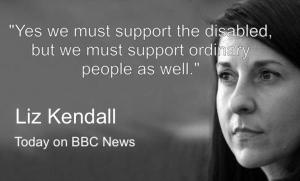
BBC3 presenter and journalist crowdfunding to transform the lives of people with disabilities in Ghana

July 28, 2015

A press release:

Sophie Morgan, the journalist and disability campaigner, has launched a JustGiving Crowdfunding page to buy a school bus and other life-changing equipment to help the people featured in her BBC3 documentary, The World’s Worst Place to be Disabled?

Sophie, who was paralysed in a car accident aged 18, travelled to Ghana to report on the plight of the 25 million people living with a disability in a country where there is almost no access to equipment, education, transport, healthcare or work.

During the course of the documentary, which airs on Tuesday evening at 9pm, Sophie discovers the harsh realities of the many disabled people who end up living on the streets of the country’s capital; and visits one of Ghana’s popular prayer camps where disabled people are taken to be ‘cured’. At the camp she witness patients  chained up as part of their treatment, and learns how they are beaten, starved and worse so that they can’t escape.

In the most shocking moment of the programme, a local disabled activist takes Sophie to where he says children are poisoned and killed, and she goes to meet a so-called Fetish Priest who admits that he will dispose of a disabled child for payment.

Sophie Morgan, said: “Our own society is by no means perfect, we have difficulties here that act as a catalyst for much of the advocacy and campaigning work I do and the UK, like many other parts of the world, have a long way to go before we can say that being disabled isn’t, by definition, disabling.

“When I became disabled the support of my friends, family, society and even Government enabled me to go on to create a new life, one in which I feel deeply fulfilled and happy. Sadly, this is not the case for disabled people in Ghana who are subjected to the most appalling conditions and human rights abuses. By launching a crowdfunding page on JustGiving I hope to be able to directly help some of the people I met and to expose the horrifying reality of the many disabled people who in Ghana.”

The crowdfunding page aims to raise a total of £9,000, which will be split between the Orthopedic Training Centre, the purchase of a school bus for Mr. Barima’s School for The Physically Challenged and the purchase and shipping of additional equipment which will be distributed by the DESO and the Ghanaian Society for the Physically Challenged.

To donate: https://crowdfunding.justgiving.com/worlds-worst-place-to-be-disabled

To view the trailer for The World’s Worst Place to be Disabled? https://www.youtube.com/watch?v=_PhQjsiYzBQ

Carer Sacked For Revealing Caring Responsibilities For Daughter With Cystic Fibrosis

July 28, 2015

Readers, this case, Truman V Bibby Distributon Ltd is an important one for carers to note.

As Mike Sivier reports:

A healthy man was sacked from his job because he had caring responsibilities for a daughter with cystic fibrosis, a tribunal heard.

The employee – a Mr Truman – had indicated to Bibby Distribution Ltd that he would have to spend more time caring for his daughter because his wife, the primary carer, was starting her own business.

He was dismissed from his job on the day he reached one year’s service with the company, on the grounds that “his heart was not in the business” and his primary customer was dissatisfied with his work. Significantly, Mr Truman would have become entitled to unpaid ordinary parental leave after notching up one year’s service. His dismissal on the first anniversary of his employment meant that he was denied this right.

The full details, and an explanation of ‘associative discrimination,’ are here.

Please share this with as many carers as possible. Carers need to be aware that they are being treated in this extremely unfair way- and that the law will protect them if they report such treatment.

A survivor of the system but no thanks to the DWP.

July 28, 2015

Charlotte Hughes's avatarThe poor side of life

Last week I met a lovely man once again. I didn’t recognise him, and I had to look twice. The last time that I saw him he was very thin, he was hungry and very depressed. Why? The Jobcentre kept sanctioning him even though he had fully complied with his job search requirements. It had got that bad that he was very close to loosing his home and he was thinking of taking his own life. The DWP had taken every bit of hope away from him. He had nothing left inside him. Both myself and his girlfriend had given him some advice and he survived.

He sat opposite me, and I told him that I didn’t recognise him, his whole persona had changed. There was a spark in his eyes and he had put a lot of weight on. I asked him what had happened, and he told me…

View original post 682 more words

A Programmer’s Thoughts On PIPAT Software

July 28, 2015

I’ve just seen this on Facebook. Please share it widely.

Hello. I’m not sure if this subject has come up before, but I feel it is worthy of attention. I have recently been investigating the software, called PIPAT that ATOS PIP assessors use to create their assessment reports.

I used to be a programmer and software tester, and I wanted to know how this software worked. Someone had managed to get a copy of the user guide from the DWP, released under FOI.

I have been going through the PIP assessment process myself, which is now heading for Tribunal, and I couldn’t reconcile in my mind how my disabilities were ignored when it came to awarding me points (I got zero). I know I am not alone here by any means. This software makes it all too easy for the assessor.

I discovered that the software is written so that whatever the assessor writes in the first part of the report, such as history, and anything the claimant tells the assessor, there is nothing whatsoever in the second part, the choosing of descriptors, that is connected to the first part. This means nothing is built into the programming to make sure the assessor uses ALL the evidence that was (hopefully) collected, or was provided elsewhere, and then can subsequently make the right descriptor choice.

The assessor can basically say anything they like. Nothing in the software forces them carry out the assessment fairly.

At best, this is very poor program design, sloppily written. A piece of programming that is not integrated in any way, has NO checks and balances to make sure the business process it is supposed to support works as it should, that is, the PIP assessment itself, is in my view unforgivable. I’m inclined to think it is deliberate.

It was apparently developed by IBM, at a cost of £50,000,000 to £75,000,000 PER YEAR, for what is basically little more than a glorified Word document!

Think how many peoples’ disallowed PIP payments THAT would pay for. I think it’s a scandal and I intend to write to the DWP and ask for an explanation.

The World’s Worst Place To Be Disabled?

July 28, 2015

BBC Three, 9pm:

Disabled journalist Sophie Morgan travels from London to Ghana to uncover the horrifying reality of many disabled people who live there. Sophie meets children who have been exiled from their villages for being ‘cursed’, chained up in local prayer camps, and investigates the ritualistic killing of ‘spirit children’ believed to have been possessed by evil spirits.

Beginning in the country’s thriving capital city Accra, Sophie sees first-hand how many disabled people end up living on the streets, and hears how much of the disabled community has been left out of this west African country’s economic success. Shocked by what she finds in the city, Sophie heads to the countryside to find out the reality of life for disabled people there.

Travelling with her brother Tom, Sophie finds herself in one of Ghana’s popular prayer camps where many disabled people are taken to be ‘cured’. She meets patients who have been brought to the camp against their will by their families, and chained up so that they can’t escape.  As Sophie leaves, she learns of an even worse reality for many disabled children, who are ‘returned to the spirits’ by some of Ghana’s spiritual and traditional healers – and ritualistically murdered. A local disabled activist takes Sophie to where he says children are poisoned and killed, and she goes to meet a so-called Fetish Priest who admits that he will dispose of a disabled child for payment.

After so many shocking discoveries, Sophie makes her way back to Ghana’s capital city to put her findings to a government spokesperson, and to ask if Ghana really is the world’s worst place to be disabled.

Disability Groups Call For Cancellation Of Frankie Boyle Belfast Festival Gig

July 27, 2015

Longtime readers will know that Same Difference covered the 2010 incident mentioned in this article. We have strongly dislliked Frankie Boyle ever since and fully support the calls for this gig to be cancelled.

A group calling for a Belfast show by comedian Frankie Boyle to be cancelled has said his jokes “poke fun at and mock children with disabilities”.

The controversial Scot is due to perform at the part-publicly funded Féile an Phobail next month.

Festival organisers have said it is the fastest-selling comedy gig they have ever put on.

But opponents are demanding that it is cancelled because of jokes Boyle has told about people with Down’s syndrome.

The mother of a girl with the condition said that during a live show in 2010 he had “made fun of the way people with Down’s syndrome speak” and “made a number of references to people with Down’s syndrome dying early”.

A group of parents of children with disabilities and a number of disability charities say they have the support of thousands of people in calling for the comedian’s appearance at the festival to be scrapped.

And the Belfast Telegraph has reported that one of the founding members of Féile an Phobail, the former Sinn Féin Lord Mayor of Belfast Tom Hartley, has become the first high-profile figure to publicly oppose the show.

His brother Stephen has Down’s syndrome.

Vulnerable

Johnny Lundy, of Féile for Everyone, the group objecting to the show on 7 August, accused the festival of hypocrisy over booking Mr Boyle.

“I don’t think its acceptable at a community festival whose claim or remit is that it’s a community for all and its disability awareness is second-to-none,” he said.

“It’s hypocritical to make that claim and then have somebody like Frankie Boyle appear at it.

“This is a community festival, it’s part funded by public money, and it is seeking to mock one of the most vulnerable groups in our society.

“I object to my money being used to make my daughter and others like her the butt of his jokes.”

A protest against the gig was held outside Féile an Phobail’s offices in west Belfast on Friday, and the objectors are due to meet festival representatives on Monday.

A spokesman for the festival said organisers had already met with “concerned individuals and groups”, including learning disability charity Mencap, to “discuss their concerns around the performance”.

“We’re looking forward to meeting this group and hearing what they have to say,” the spokesman said.

The spokesman added that he did not wish to comment further until after the meeting.

Distinction

Around 2,000 tickets have already been sold and the festival is expecting a capacity crowd of 2,500 at the show.

Spiked Magazine’s Tom Slater said Boyle “is not some sort of anti-disabilist hate-preacher”, and said the opposition to his show was hysterical.

“He is not going around inciting violence,” Mr Slater said.

“He is going around making very crass, very unpleasant jokes that a lot of people, quite rightly, are upset by.

“We need to make a distinction.

“I think we need to get some kind of perspective on this kind of alarmist rhetoric of whereby we see any kind of offensive statement as potentially damaging.”

The BBC has contacted Frankie Boyle’s representatives but has yet to receive a response.

Katie Hopkins Blasted For Latest Sick ‘Joke’ About Dementia

July 27, 2015

Katie Hopkins Tweeted this yesterday:

https://twitter.com/KTHopkins/status/625228801820229632


She was, quite rightly, blasted on Twitter for her extreme insensitivity to people with dementia.

The Boy Who Wants His Leg Cut Off

July 27, 2015

BBC Three, 9pm:

Documentary about Dillon, an eleven-year-old boy who suffers from an aggressive form of neurofibromatosis, a disease that causes tumours to form in his nervous system. His leg has grown out of proportion to his tiny frame and he’s found it hard to get around, never mind joining in with other kids. In his mind there’s only one way to cure the problem – amputation. But can a young boy persuade the medical establishment to cut his leg off, and is it even in his best interests?

Sarah Long, Oldest Survivor Of Morquio Syndrome, Fighting For Lifesaving Drug

July 26, 2015

Every day Sarah Long becomes weaker. She cannot sleep for more than an hour at a time, loses concentration and struggles to speak.

“I don’t have much longer,” she says with a remarkable lack of self-pity. At 44, she is by far the oldest person to have Morquio syndrome, an extremely rare degenerative impairment, caused by missing enzymes, that has stopped her from growing since the age of six.

Most people with the syndrome die in their teens from a heart attack or because their lungs fail. Only 88 people in England – and 160 worldwide – are known to have the syndrome and barely a handful have made it into their 30s. Long has earned her surname.

But, then, since she lost her mother when she was a teenager, she has been nothing if not strong-willed. She puts her longevity down to “bloodymindedness, a strong heart, determination – that was something my mum taught me”.

Not only did she go on to defy every medical prediction and reach her 40s, she took a degree in sociology, then a master’s, and is now in the middle of studying for a PhD.

It was the same determination that in 2012 made her choose to test a free trial of a drug called Vimizim. She had spent eight months laid low with pneumonia, a period in which she says she “didn’t function”, and felt going on the trial was worth the gamble.

She writes movingly on disability blog My Way Access: “Can you imagine what it is like being locked inside a body, a fog distancing myself from others? Disconnected to an extent between what is going on around me and being an active player in it? Everyday, struggling to breathe, choking on mucus. The pain echoing from the lungs as they struggled to function; my cervical spine and throughout my body feeling like someone has walked up and pulled two strings at the back of the neck tightly.”

Long says she will never forget the day she started taking the drug: “It was 29 February and I totally changed. Before, it was like I was walking through treacle. Everything was a struggle but afterwards I had a lot more energy.”

After taking Vimizim she hardly experienced any infections. If she did, the recovery time was measured in weeks not months. She was able to sleep for as many as four hours a night, an astonishing achievement by her standards. Her academic work blossomed.

And then her world fell apart. Vimizim’s developer, BioMarin, stopped supplying her with the drug. Testimonies provided by her friends to the National Institute for Health and Care Excellence (Nice), which provides guidance to NHS England on funding drug treatments, describe a decline in her health. Having gone from being alert and energetic she is sinking fast, in considerable pain, and soon expects to be put on a ventilator.

Tyla Thackwray, one of Long’s helpers, observed: “I have been astounded by the speed and severity of her withdrawal. I am extremely concerned for her, and I can only imagine the pain, desperation and frustration that she feels.”

BioMarin’s decision to stop supplying Long came as an independent committee advising Nice suggested that the clinical benefits of Vimizin, which can cost up to £395,000 a year, may have been overstated.

But Long questions how this decision was reached. She believes NHS England has dragged its feet on the issue of funding, prompting BioMarin to end the trial. Hopes that NHS England would provide interim funding have been dashed.

Long’s story highlights the terrible situation confronting people with rare diseases. There may be drugs that can help them. But the extent to which they work is often unknown because credible, peer-reviewed research into rare diseases lacks funding. The troubling conclusion to be drawn from the ending of the Vimizin trial is that drug manufacturers will increasingly think twice before funding further research into treatments for rare conditions.
Advertisement

A spokeswoman for Nice explained that it was still evaluating Vimizin’s efficacy. “We hope to publish final guidance in October,” she said.

However, the advisory committee has indicated that it will not recommend funding. It has “noted that elosulfase alfa [Vimizim] would not affect spinal cord or skeletal damage, and would not entirely stop disease progression, both of which significantly affect quality and length of life in people”.

But, while Vimizin may not work for everyone, notably younger patients, Long vehemently disagrees with the committee’s findings in her specific case. Now, with time running out, Long has taken to writing an open letter to the prime minister as she attempts to defy the odds once again. “I am living proof that this drug prolongs life as well as providing a quality of life,” she writes. “If, as it seems increasingly likely, the UK will not provide this treatment, it will be my end.”

Compliance interview

July 25, 2015

The UK’s First Find-A-Physio App Launches

July 24, 2015

A press release:

The world of Physiotherapy is often confusing and inaccessible, for many it can be extremely difficult to know when physiotherapy is the answer and more importantly how to access physiotherapy. The use of the internet and mobile technology, such as apps, are changing the way we live day to day. The mobile and ‘real world’ is becoming synonymous; we shop, bank and for a growing few live our life through the internet. With the launch of the UK’s first and only Find-A-Physio app, patients can now quickly and conveniently find, search and book a Chartered Health and Care Professions registered Physiotherapist from the palm of their hand.

Whilst working as a physiotherapist in the military, national sport and private practice, Thomas Sowter, founder of Find-a-Physio began to notice a significant problem; just how difficult it was for potential patients not only to find and book a physiotherapist but to learn about their injury. There were possibly hundreds of thousands of people with injuries for whom physiotherapy wasn’t a consideration. Adding to this, they didn’t have access to the physiotherapy profession; a world which was usually filled with jargon and difficult to digest information. It became apparent that it was almost impossible for individuals to learn about their injuries and most importantly acquire the treatment, support and rehabilitation needed. Find-a-Physio was born.

The initial website was designed for the general public, not only for them to learn about their injury but to also find and book a local physiotherapy appointment. The website soon grew and the needs of physiotherapists were also identified. The website and app now provide a platform for up and coming courses, potential job opportunities and most importantly blogs, podcasts and critical reviews, enabling physiotherapists to keep up to date with their Continued Professional Development

With development comes innovation and after dedicated research to the needs of the public, Find-a-Physio decided to take the website beyond the computer screen and into everyone’s hands – via the UK’s first IPhone App.  The app marks an important stage for not only Find-a-Physio but the health profession as a whole, by going beyond the laptop or computer screen into the mobile world, engaging and helping the general public receive the treatment they need in an easy, efficient and convenient way.

The Find-a-Physio app is the first in the UK and not only enables people to find and book a physiotherapist in their area but allows people to learn about common injuries and the treatments physiotherapists offer. The app also acts as a platform for the physiotherapy community; helping to unite physiotherapists across the country and to help reinforce the values of the profession and enhance professional development.

Find out more at www.Find-a-Physio.co.uk.

Record Numbers Using Access To Work Scheme

July 24, 2015

A press release from Ambitious About Autism:

It has been announced that a record number of people with learning disabilities and mental health conditions are using the Department for Work and Pensions’ Access to Work employment support schem. The government have also announced that they are expanding the existing team of Access to Work advisers into a Hidden Impairments Specialist Team to target support at people with mental health conditions and learning disabilities as well as dyslexia, autism and other less visible disabilities.

Jolanta Lasota, CEO Ambitious about Autism, highlights recent relevant research on employment and autism and explains why not-employing those with autism is a missed opportunity for all involved:

“With the right support, planning and opportunities from parents and employers, many people with autism have the ability to work. Despite this, recent figures show that only 15% of people with autism are in full time, paid employment. 79% of those polled who are not in employment would like to be.

“Although not without its own issues, employment and the job satisfaction that it hopefully brings can help many people with autism overcome other problems they face including a sometimes overwhelming lack of self-confidence and low self-esteem. This record number of people using the Access to Work scheme is testament to those with disabilities who are keen to work and shows the type of committed employee that they could be.

“Ambitious about Autism is working with The Department of Work and Pensions and HMRC to provide their staff with autism training and to provide work experience for young people with autism.

“It has been shown that those with autism can make for loyal, diligent and hard-working employees. It is great to see that employers are waking up to the talent that is out there and we hope they will realise there is still more to be gained by employing those with autism and other ‘less visible’ disabilities, too.”


How Do We Define A Disability Hate Crime?

July 24, 2015

Presenter Adam Pearson has told the Victoria Derbyshire programme that there needs to be more awareness of disability hate crime.
In a documentary on the subject, he found that many people didn’t know how the crime was defined and when name-calling or pointing became abuse.
He also spoke to Joanna Gosling about how his own condition, neurofibromatosis type 1, had attracted hostile behaviour.

Wanted: A Very Personal Assistant, Episode 1

July 24, 2015

9pm, BBC Three:

There are currently around 300,000 young disabled people in the UK who rely on carers for their daily needs. For many of these ambitious young people, finding the right carer is the difference between achieving their ambitions or a life unfulfilled. But as a young disabled person in Britain your options are limited, as the majority of people working in care are over 40 years old.

But with three quarters of a million young people under 24 currently looking for work, could the solution being staring us in the face?

This groundbreaking series explores what happens when four young ambitious disabled people put all their care needs in the hands of unemployed people their own age. But there’s a catch – to ensure applicants come with an open mind, the exact nature of the job and the employer’s disabilities aren’t revealed until the final job interview.

Will seeing the world from a different point of view help break down preconceptions of disability and unemployment? Could challenging shared experiences lead to lasting friendships and even a rewarding new career?

The first programme sees our young disabled people interviewing potential candidates, and the successful applicants getting to grips with the many challenges of personal care.

At university, 23-year-old Michael Cattermole’s hobbies were sport, partying and girls, but an accident on a night out two years ago has left him paralysed from the neck down. Having been through almost 50 carers in a year, Michael is hoping to find someone who he feels comfortable with.

24-year-old Rupy Kaur is a psychology student with cerebral palsy. She’s living with her extended family of 12 people in Manchester, but is looking for a switched-on carer who can help her find a house of her own, and help her become more independent.

21-year-old Josh Robertson is currently making waves on the London comedy scene. He suffered brain damage in a quad bike accident when he was 11, and is looking for a carer who can go out and party with him, and help him meet girls.

Jasmine Rankin is a 21-year-old receptionist from Taunton, Somerset with spinal muscular atrophy. She is looking for a carer who can tackle both boozy nights out and her intimate personal care.

Both the employers and their carers are pushed far out of their comfort zones, physically and emotionally. And after an intensive trial period, will it prove to be a match made in heaven, some people’s idea of hell, or the start of a beautiful new career?

In part one, Michael’s carer Denny Lee struggles with Michael’s care needs, especially bowel management, Josh’s carer Francesca battles with Josh’s crude humour and his love of boozing, and Jasmine’s carer Emily tackles the intimate personal care with aplomb – but fails dramatically on the domestic chores front.

Alex Barker’s 300 Mile Pub Crawl To Prove He’s Disabled, Not Drunk #ServeAlex

July 24, 2015

A press release and update on Alex Barker.

A man who was turned away from a Cornish pub after a medical condition was mistaken for drunkenness is to return there – stopping at pubs along his 300-mile route from his home in Coventry.

Alex Barker, 43, who has Moebius Syndrome and facial palsy [photo attached], stumbled as he walked into the pub in Falmouth on Saturday 11 July, and was then refused service as staff believed him to be ‘under the influence’. His experience led to national media coverage and a social media campaign led by the charity Changing Faces in which pubs were asked to commit to ‘#ServeAlex’.

After leaving Coventry later today [Friday 24 July], Alex’s route will take him to pubs in Coventry, Worcester, Bristol, Taunton, Exeter, Bodmin, Truro before reaching Falmouth on Saturday evening, where he’ll visit a number of pubs and bars.

He’s hoping to raise £10,000 for Changing Faces and Facial Palsy UK, two charities that have supported him, to help them raise awareness of the problem.

“I’m going to have a drink in ten pubs on the way to Falmouth, but none of them will be alcoholic. I’m going to show that however I look, sound and walk, pubs should serve people like me. They shouldn’t rush to judgement to say that I’m drunk,” said Alex, who studied in Falmouth and now works in IT.

Dr James Partridge OBE, chief executive of Changing Faces, commended Alex’s determination to use his own experience to raise awareness but said that pubs must meet the challenge themselves. “The Equality Act protects people with disabilities and disfigurements from discrimination, and pubs, bars and clubs who don’t recognise this and step up to the plate could find themselves in hot water. We’ve published guidelines to help licensees and door staff deal with these issues.”

Karen Johnson, deputy chief executive of Facial Palsy UK, said that licensed venues had a legal duty to ensure they are not discriminating against people because of a medical condition. “People living with facial palsy live with prejudice and discrimination every day of their lives, and day in day out we hear stories similar to Alex’s. If his trip back to Cornwall prevents one person having the same experience as he did then that’s a great result, but the hope is that many more will benefit.”

The #ServeAlex campaign has been supported by Give as you Live. “Give as you Live are delighted to be able to offer support to the #ServeAlex campaign,” said Greg Hallett, chief operating officer. “Raising funds and creating awareness are critical elements of the challenges facing charities today and at Give as you Live we are dedicated to providing a range of services and products that can help in some way. Changing Faces and Facial Palsy UK should benefit greatly from Alex’s campaign – its vital work that needs more public attention, so what happened to Alex doesn’t happen to anyone else.”

More information on Alex’s trip can be found at www.servealex.co.uk.

Terminally Ill Father With Two Weeks To Live Seeks Home For Disabled Son So He Can Die In Peace

July 23, 2015

Pkease share widely.

A desperate father who has just two weeks to live has said he cannot die in peace until his disabled son is found a safe home.

Dave Williams, 53, single-handedly brought up his son Aron and currently shares a three bedroom house with the 29 year old, who has Aspergers and mild autism.

Ten weeks ago, the former-dustbin man was diagnosed with lung, liver and spine cancer and told he had just 12 weeks to live.

Now Mr Williams, of Newton Abbot in Devon, fears that if social services don’t find a place for Aron soon he will be kicked out of their social housing property and left with nowhere to go.

He said: “I thought I could leave this mortal earth in peace, but I can’t because I don’t know what’s going to happen to Aron.

“He is everything to me and I don’t want to spend my last two weeks worrying like this.

“I’ve accepted I’m going to die and I want to die in peace, but I can’t with this over my head.”

When Mr Williams learned he had just 12 weeks to live, he immediately contacted Aron’s social worker for help with his son’s future.

However, he claims social services have not resolved the problem and fears that time is running out.

“I’m not asking for much,” he said.

“I just want Aron to have a home to go to after I’ve died.

“Social services have come up with just one place in the last 10 weeks, but that fell through.”

He said when he died the housing association Teign Housing would be quite right to evict his son because he “doesn’t need to be in a three-bedroom house”.

He added: “Aron is semi-independent.

“He works five days a week on a farm at Sharpham run by the Robert Owen Communities and I want him to have his own place.

“He does need some care, but not much, just someone to pop in every day to make sure he has paid any bills, help him read his letters, make sure he’s got a hot meal and takes his medication.

“I can’t wave a magic wand and find him accommodation.

“I have enough to do organising my funeral, my will and sorting out my finances.

“Social services must have contingency plans for situations like this. It’s ridiculous.

“Friends and family have said they would give Aron a bed, but that would come off the back of my death, and it shouldn’t happen like that.”

He said his son was having difficulty coming to terms with his death and he wanted Aron to be rehomed somewhere familiar so he was not too traumatised at having to leave his house.

He said: “Because of his learning difficulties he can’t accept his dad is dying.

“I want social services to find him somewhere else to live now so he can go there at weekends and get used to it before I die.

“I’d like to see my son in a bedsit or a flat in this area because Newton Abbot is his home and he is known here.

“I want to die in my bed at home in the sitting room with my daughter and son around me, in peace, knowing he’s got somewhere to go.

“He has done so well in his life and to think he could regress because he is put into a hostel or other temporary accommodation is unbearable.”

A Devon County Council spokesman said: “We are working the housing team at Teignbridge Council and Teign Housing to help find Aron suitable alternative accommodation which meets his specific care needs.

“We will continue to do everything we can to fully support Aron in the accommodation identified for him.”

The Ugly Face Of Disability Hate Crime

July 23, 2015

Tonight, 9pm, BBC Three:

Adam Pearson is on a mission to explore disability hate crime – to find out why it goes under-reported, under-recorded and under people’s radar. In this documentary, Adam challenges people into questioning their attitudes towards disability and disfigurement, to uncover the roots of the issue.

Adam has neurofibromatosis type 1, a condition that causes benign tumours to grow on nerve endings – in his case, on his face. He is disfigured and disabled and has experienced disability hate crime first-hand, like a number of his friends, some of whom he meets with in the film. Their stories may differ, but their disability as the motivating factor is constant.

Just days into his investigation, Adam becomes the target of some grossly offensive online hate speech. While this isn’t unusual for him, for the first time Adam decides to take action, reporting it to the police – with some unexpected outcomes.

Undeterred, he looks to understand the laws specific to disability hate crime, and finds that a mixture of ignorance and inequalities mean that these crimes often don’t make it to our courts, or are sentenced less severely than other hate crimes when they do.

Adam looks to uncover what attitudes and influences may be causing people to commit disability hate crime in the first place, questioning whether the portrayal of disfigurement and disability in the media, for example, could be leading us to associate them with being ‘the bad guys’.

With help from Miles Hewstone, professor of social psychology at the University of Oxford, Adam conducts an experiment measuring peoples’ innate prejudice towards disfigurement that gives some shocking results, and leads him to question if he alone can hope to affect a change – and if so, how?

Woman, 21, Takes Photo Of Downs Toddler Inside Washing Machine And Posts It On Facebook

July 22, 2015

A MOTHER took this photo of a toddler with Down’s syndrome in a washing machine – and then put it on Facebook.

Since posting the picture of the little boy, Courtney Stewart has been branded a scumbag, questioned by police and allegedly assaulted on her doorstep

  But the 21-year-old, herself a mother, was in no mood to apologise yesterday when the Daily Record spoke to her.

She said of the boy, who was in her care at the time: “He loves the washing machine. We took a picture and it was a laugh.”

Stewart’s neighbours in Erskine, Renfrewshire, were horrified when they saw the image of the two-and-a-half-year-old inside the machine – with an adult’s hand holding the door.

A member of the public who contacted us about the picture said: “It was terrible to look at.

“For anyone, let alone someone who is also a parent, to take a picture like that and stick it on Facebook for a laugh is unbelievable.

“It’s no wonder people are angry about it.

“People in the town have been talking about it, because anyone who has seen it has been left shocked.”

Stewart told us that the boy, who is small for his age, climbed into the machine of his own accord.

And she condemned those who reported her to police.

She said: “He is clearly laughing in the pictures.

“So I don’t understand why somebody took that picture as – well, I don’t know what they took it as.

“What did they think I was doing to him? Taking him for a spin?

“He’s got a bit of a washing obsession. Anyone who knows him would know he’s got a washing obsession.

“I don’t know who reported it. I don’t really know why they would do that. I think it’s absolutely ridiculous.

“They shouldn’t be able to call the police anonymously.

“The police know who it was and I don’t think it’s at all fair that they can’t tell me.”

The photo appeared on Facebook on Thursday last week and quickly caused an angry reaction.

One woman said of Stewart: “She is a scumbag. She is a nutter.”

Stewart replied to her critics by asking: “Who phoned the police and said —– was being abused in this pic?

“For anybody who knows —– they’ll know he loves washing machines. So take a good look at your life first hen.”

Stewart took down the photo after she was reported to police.

She told us she was horrified on Sunday morning when two officers came to her door – but conceded that they were right to investigate the picture.

She said: “It’s horrible having the police at the door thinking you’re a bad person.

“I was shocked, but in a sense I’m glad they didn’t just take it as a joke and not come and see me. So I was thankful in that way.

“A male and a female officer were here asking me questions for more than an hour.”

A police spokeswoman confirmed Stewart had been spoken to. She said: “Advice was given. Relevant child care checks were made.”

Stewart insisted there was no way the boy could have come to harm in the machine.

She said the door “was not closed right over” – the photo shows a hand holding it shut.

And she added: “The machine was unplugged because I’m getting a new one.”

Stewart also claimed she had been physically attacked by a complete stranger over the picture.

She said: “I got assaulted by a woman. She came to my door and said I was a f****** nutter and she wouldn’t let me anywhere near her kids.

“It happened on my doorstep at 11 o’clock in the morning. I got assaulted in my own home.”

A 42-year-old woman was arrested over the alleged assault. She appeared at Paisley Sheriff Court on Monday andthe case was continued without plea for a week.

The Record spoke to Renfrewshire Council about the photo, and a spokesman told us: “We can’t comment on
individuals but we are vigilant on any issue which could potentially affect the welfare of a child.”

Melanie Reid: The Times Journalist Who Doesn’t Accept Her Disability

July 22, 2015

Journalist Melanie Reid was paralysed in a horse riding accident five years ago and has struggled to come to terms with her disability since.

Tucked away in rural Scotland, down a winding, rutted track, nestles the home of Melanie Reid, the author of the weekly Spinal Column in The Times. It is remote, often muddy and sometimes inaccessible.

Though her accident left her with minimal movement in her arms and legs, the house itself remains noticeably free of adaptions usually considered helpful for a severely physically disabled person. But there are no lowered worktops in the kitchen and no adapted power points – Reid thinks the adoption of too many would signal an acceptance of her disability, which she does not feel.

Five years ago Reid was at a point in her life where, she says, she was exactly where she wanted to be, doing precisely what she wanted to be doing. She was a successful journalist, with a loving husband and a son who was thriving. They had set up home in the country, complete with beautiful views and stables for her much-loved horses. Reid was the one who tended to stride ahead and lead the activities – she says she was the family’s practical problem-solver.

It was while out riding that the accident happened which left her a tetraplegic. Cantering towards a jump, her horse baulked and suddenly stopped. She tried to hang on to the horse’s neck but she was thrown off and flew over the jump with her arms out behind her. Her face hit the ground and her body flipped.

People watching have since told her it looked almost innocuous, and like it was happening in slow motion. She did not lose consciousness and says she experienced some incredible sensations in that moment.

“I felt warmth and beauty in my body, and saw bright red in front of my eyes. It was the computer shutting down, the lorry crashing into the telephone exchange.”

She spent almost a full year in hospital, determinedly working towards gaining as much movement in her limbs as possible. The idea for her weekend newspaper column was conceived during an MRI scan.

“I have to tell people about this, I have to describe it,” she remembers thinking.

Regularly writing about her disability and the frustrations and struggles to do everyday things then became a form of therapy. She says it was also a way of regaining some of her power, not least because it’s helped to pay the bills – Reid had always been the main bread winner.

She knows that publicly declaring that she can’t accept her physical limitations irritates and angers some of her disabled readers, and says that she is resented by them for saying she regrets “being stuck in disability”. She has written stories about having constant physiotherapy which has enabled her to shuffle a few steps, and is aware that it has led to some disabled people feeling betrayed and that they’re not trying hard enough. “There is that feeling that I’m letting the side down by being ‘a walker’,” she says.

She understands that people who have been wheelchair users for the majority of their lives have to be comfortable with who they are and accept their situation. However, she says she has to believe that, given the choice, they too would rather be up and walking around because to her, being in a chair is very frustrating. “I would leave the chair in an instant,” she says.

Reid’s spinal injury is not complete, meaning she has some movement in her body, and lives with what she calls “the torture of possibility” every day. She asks herself why she can’t move just that little bit more, or improve a little further and imagines those with complete spinal cord breaks do not have to live with that torture.

Shortly after the accident, Reid recognised her life was now fundamentally changed and that she could no longer be the practical problem-solver in the family. She says her husband Dave, who was used to being the entertainer, has had to take on her old role. It was a vast change for him.

Reid offered Dave a chance to leave their marriage. She told him he should go and find another woman, someone who could make love to him, someone to walk with and be happy with, someone who was “not just a lump of meat”. He told her: “Don’t be bloody stupid. I’m not going anywhere.”

He has shared a big chunk of Reid’s sense of loss and grief, admitting to her that it sometimes does make him sad seeing a couple walking down the street together.

Similarly, she has asked her son not to hang around, not wishing to tie him down. He is now in New Zealand and Reid tries not to write or talk to him when she is having a down day. She wants him to think of her as “the mum who could do stuff”.

Reid thought there would be nothing more to write about once she had come home from hospital, but due to popular demand, the column continues. She says she would love to stop writing so forensically about her life at some point, perhaps once she has written the memoir that people keep asking her to write.

Whilst being stoic, Reid finds it hard to identify any positives that have come out of her accident. Remaining the stubborn mistress of her largely unadapted home is currently very important to her, but she does not rule out some possible alterations in the future, perhaps when she has made peace with her disability on her own terms.

Melanie Reid is Peter White’s guest on No Triumph No Tragedy, BBC Radio 4, Wednesday 22 July. Listen again on the iPlayer.

Support For Mortgage Interest Changes Will Affect Current Claimants

July 22, 2015

With many thanks to Benefits And Work.


The plan to change support for mortgage interest (SMI) payments from a benefit to a loan will hit current SMI claimants, the DWP have confirmed in an impact assessment published yesterday.

SMI pays all or part of the interest on a claimant’s mortgage if they are getting benefits such as Income Support, income-based Jobseeker’s Allowance, income-related Employment and Support Allowance, Pension Credit or Universal Credit.

At present SMI is a non-repayable benefit. But one of the measures in the Welfare Reform and Work Bill currently going through parliament is to change the payments into a loan from 2018, which will be repaid when a claimant returns to work or sells their property. Alternatively it will be recovered from their estate after they die.

Not only will the loan have to be repaid, but interest will be charged on it and there will be an administration charge on top. The changes will affect both current claimants and new claimants from 2018.

The DWP claim that the change will increase claimants’ life chances and reduce repossessions.

You can download the full impact assessment from this link.

ESA Changes From 2017 Will Improve Life Chances Says DWP

July 22, 2015

With many thanks to Benefits And Work.

Half a million people are expected to lose out financially at any given time as a result of the abolition of the work-related activity component (WRAC) of employment and support allowance (ESA) for new claimants from 1st April 2017. The government claims this will improve their life chances.

The figures come from the impact assessment for the abolition of the WRAC which the government published yesterday. New claimants will lose £28 a week, estimated to be a 10% reduction in overall income for the families affected.

The DWP claims that affected claimants will be better off because the changes are “supportive of the Life Chances legislation in that this policy will gradually build the incentive for people to make the choice to move into work.”

They even argue that the policy of making ESA claimants poorer could reduce child poverty because “the number of children living in workless households could fall over time.”

The DWP argues that anyone affected by the changes could recoup their losses by working for 4-5 hours a week at the national living wage. In this way

It doesn’t explain how people who are too sick to work can actually work or who will offer them jobs for such a small number of hours a week.

The full impact assessment can be downloaded here.

Bionic Eye Implant Is World First

July 22, 2015

Surgeons in Manchester have performed the first bionic eye implant in a patient with the most common cause of sight loss in the developed world.

Ray Flynn, 80, has dry age-related macular degeneration which has led to the total loss of his central vision.

He is using a retinal implant which converts video images from a miniature video camera worn on his glasses.

He can now make out the direction of white lines on a computer screen using the retinal implant.

Mr Flynn said he was “delighted” with the implant and hoped in time it would improve his vision sufficiently to help him with day-to-day tasks like gardening and shopping.

Weed or flower?

The Argus II implant, manufactured by the US firm Second Sight, has previously been used to restore some vision to patients who are blind as a result of a rare condition known as retinitis pigmentosa.

The operation, at Manchester Royal Eye Hospital, is the first time it has been implanted in a patient with age-related macular degeneration (AMD) which affects at least half a million people in the UK to some extent.

I met Ray Flynn last month, on the morning of his surgery and he explained that although his retained his peripheral vision, his central sight had disappeared.

He said: “I’m unable to put the numbers in for my card when paying in a shop or at the bank, and although I was a keen gardener, I can’t tell the weeds from the flowers anymore.”

Mr Flynn said he had to sit very close to the television to see anything.

He had given up going to see Manchester United play football as he cannot make out what is happening.

The operation took four hours and was led by Paulo Stanga, consultant ophthalmologist and vitreo-retinal surgeon at Manchester Royal Eye Hospital and professor of ophthalmology and retinal regeneration at the University of Manchester.

He said: “Mr Flynn’s progress is truly remarkable, he is seeing the outline of people and objects very effectively.

“I think this could be the beginning of a new era for patients with sight loss.”

How it works

The bionic eye implant receives its visual information from a miniature camera mounted on glasses worn by the patient.

The images are converted into electrical pulses and transmitted wirelessly to an array of electrodes attached to the retina.

The electrodes stimulate the remaining retina’s remaining cells which send the information to the brain.

In a test, two weeks after surgery, Mr Flynn was able to detect the pattern of horizontal, vertical and diagonal lines on a computer screen using the implant.

He kept his eyes closed during the test so that the medical team could be sure that the visual information was coming via the camera on his glasses and the implant.

Mr Flynn said: “It was wonderful to be able to see the bars on the screen with my eyes closed.”

The implant cannot provide any highly detailed vision – but previous studies have shown it can help patients to detect distinct patterns such as door frames and shapes.

Prof Stanga said that in time, Mr Flynn should learn how to interpret the images from the implant more effectively.

Dry AMD

  • There are two forms of age-related macular degeneration – dry and wet.
  • The dry form affects 85% of AMD patients and causes gradual loss of central vision, but does not affect peripheral vision.
  • The Macular Society estimates that 44,000 people a year in the UK develop dry AMD.

Four more patients with dry AMD will receive the implant at Manchester Royal Eye Hospital, as part of a clinical trial.

Prof Stanga said: “We hope these patients will develop some central visual function which they can work in alongside and complement their peripheral vision.”

We are very excited by this trial and hope that this technology might help people, including children with other forms of sight loss.”

The Argus II costs about £150,000, including treatment costs, although all the patients on the trial will be treated free of charge.

Gregoire Cosendai of Second Sight Medical Products, described the AMD study as “totally groundbreaking research”.

The trial is being held in the Manchester Clinical Research Facility – funded by the National Institute for Health Research and Wellcome Trust, which aims to bring new drugs and medical devices to patients.

Cathy Yelf, of the Macular Society, said: “This is an exciting result and we are following the progress of these trials with great interest.

“Macular degeneration can be a devastating condition and very many people are now affected as we live longer.

“These are early trials but in time this research may lead to a really useful device for people who lose their central vision.”

Ottobock Wheelchairs Now Available From NHS Scotland

July 21, 2015

A press release:

Ottobock has welcomed a decision from NHS Scotland to add a range of their wheelchairs to the wheelchair services framework agreement. Nine of Ottobock’s power, manual and children’s wheelchairs are now available to patients across Scotland. Ottobock’s wide range of wheelchair are known for their quality, robust designs and clever engineering. Lightweight and durable, this range of wheelchair will offer more choice to wheelchair users in Scotland – enabling them to find the right solution to suit their individual lifestyle.

Families with children living with disability will see the greatest changes, as a range of Ottobock wheelchairs specifically designed for kids are added to the NHS framework agreement. The range now available includes a power wheelchair specifically designed for children, the Ottobock B400 Kids. A compact and robust power wheelchair, the B400 Kids has a small footprint for easy manoeuvring. It is hoped that the long battery life and tight turning circle will help disabled children across Scotland become more mobile, independent and adventurous.

Currently, standard children’s chairs use adult frames with smaller seats and cushions, making them look bulky and out of proportion. Ottobock’s children’s wheelchairs are specifically designed for children’s needs and shape and are completely configurable. The Ottobock Bravo Racer, a manual wheelchair, is designed to grow with the child, meaning that it not only lasts longer, but can adapt to suit the needs of the user.

“It’s easy to under-estimate the importance of having the right wheelchair if you’re growing up with a disability”, explains Simon Tempest, Ottobock Mobility Solutions Manager. “Just like able-bodied children, the desire to move around, explore and play is just as strong and with the right wheelchair, the only boundaries should be those set by parents! We’re delighted that children across Scotland will be able to benefit from our range of buggies, push-chairs, manual and power wheelchairs all designed specifically for children.”

The design and build quality of Ottobock’s children’s wheelchairs runs throughout the adult range and a number of power and number of the Ottobock adults range are now also available on the Scottish framework agreement.

For information about finding the right wheelchair for your child speak to your local wheelchair centre.

A Non Disabled Son Reviews Don’t Take My Baby

July 21, 2015

Sixty-six years ago, Andrew Bradford was born the son of two people with polio. Now, he has reviewed Don’t Take My Baby with his family’s personal experiences in mind.

Don’t Take My Baby: A Review

July 21, 2015

I’m writing this soon after watching Don’t Take My Baby on BBC Three. This is the start of their four week long Defying The Label season of programmes about disability issues.

And what a start it was too! Anna (Ruth Madeley) and Tom (Adam Long) are a young couple. Their relationship is strikingly normal. Adam has any young man’s charm and a mischievous sense of humour. On their first date, he throws Anna into a swimming pool to skinny dip, hardly seeming to care that there are other people around!

However, this classic tale of modern young love has one striking difference to most others- Anna and Tom are both disabled. Anna is a wheelchair user with an uncertain life expectancy. Tom is partially sighted, with his limited vision fading fast.

Yet once they both understand that they can both understand and fully participate in a physical relationship, it becomes clear that theirs is a love that will last.

Anna has just given birth to their baby girl, Danielle, and is recording the story of her parents’ lives for her to watch in the future.

The characters of the couple’s parents all fit one classic ‘disability stereotype’ or another. Anna’s father left soon after her disability was diagnosed. Her very loving mother is full of fear about the pregnancy, almost overprotective. Tom inherited his eye condition from his father, the only parent who really seems to understand the couple’s situation, having been through it himself. Tom’s mother worries about the baby inheriting Anna’s more serious condition and about her son, in his future, having to care for the child without eyesight.

Then there is the social worker, Belinda. Assigned to assess their ability to look after the baby, she has her doubts at first, as any disabled person will tell you most professionals do. Her entrance into their lives brings real fear for the couple- the fear of losing the child they so clearly love. Belinda warns the couple that she will come to their home unannounced, and then makes a habit of doing so at just the wrong moment, leaving viewers gasping and unsure whether to laugh or cry!

In this case, however, it is Belinda who eventually comes around and makes the case for the couple to keep their baby. So, for this couple, it really is, as Anna says, “how much you love your child that counts.”

Viewers are left hoping that the other 11,000 decisions that social workers have to make each year about children staying with their disabled parents will all have such happy endings.

Ruth Madeley, like Anna, is a wheelchair user. Jack Thorne, the drama’s writer, is disabled.

There is very little, if anything, wrong with the drama as a whole- except perhaps that baby Danielle does test positive for one of her parents’ conditions.

Personally, I grew up at a time when parents of disabled children were told their children would not be able to find love for themselves. Babies weren’t thought of. However, now, as a disabled adult, I realise how wrong that was. I am pleased that this drama raised these very important issues so well. I wish every parent who was ever told their disabled child wouldn’t find love and couldn’t have children could watch it.

Me And My New Brain

July 21, 2015

BBC Three, 9pm:

Charlie Elmore suffered a brain injury in a snowboarding accident four years ago. Now she’s going to retrace the steps of her dramatic recovery and meet other young people adjusting to life after serious brain injuries, including 19-year-old car-crash survivor Callum, avid skier Tai and fashion buyer Hannah, who has to re-learn how to walk and talk after she collapsed whilst out shopping and hit her head on the pavement. With their help, Charlie embarks on a courageous journey to improve understanding of this ‘invisible’ disability, which is the biggest cause of acquired disability in young adults in Britain, and discovers the hidden ways it affects her own life too.

Wheelchair Services Across England Failing, Says Dame Tanni Grey-Thompson

July 20, 2015

One of Great Britain’s most successful Paralympians has said wheelchair services across England are failing on every level.

Baroness Tanni Grey-Thompson has launched a new national charter to improve services across the country.

Some people wait years for the right wheelchair and an ill-fitting chair can cause hip dislocations, pressure sores and make disabilities worse.

NHS England said the whole system needed to change.

There are about 1.2 million wheelchair users across the UK, but NHS England said the figures were old and work needed to be done collecting data locally to get a detailed picture of what was happening across the country.

Baroness Grey-Thompson, who launched the Right Chair Right Time Right Now campaign, said the standard of wheelchair services differed greatly depending on where a person lived.

She gave examples of some people waiting three months for a suitable chair and some waiting seven years under a different NHS trust.

‘Huge problem’

Most worryingly, she explained, is hearing stories of people with life-limiting conditions, such as Motor Neurone Disease, dying before they get their wheelchair, spending the last few months of their lives trapped inside their homes.

But it is not just a moral responsibility, Baroness Grey-Thompson said.

“I think the problem is huge, not just the wait times, but the ultimate cost to the NHS. If people aren’t sitting on the right cushion, they’re not in the right chair, it’s causing harm to people.”

If you have a long-term or permanent disability and need a wheelchair, in most cases this is how it works:

  • You’ll start by getting a referral from your GP to the NHS wheelchair services
  • You’ll then be assessed to determine your physical and social needs, where you live and work will also be taken into account
  • Next, a decision will be made on whether there’s a need for a chair

Those who work in the service say a lack of national guidelines and funding means it is in need of reform.

Krystyn Jarvis, of the National Wheelchair Managers’ Forum, said wheelchair services were not seen as an important part of the NHS.

“We have been asking for change for more than 20 years. We know the situation isn’t acceptable,” she said.

“But because every locality commissions differently, you were always going to get this postcode lottery.”

‘Shared ambition’

Baroness Grey-Thompson has launched the charter in the hope that services, clinical commissioning groups and NHS trusts across England will sign up to it.

She posed in a wheelbarrow alongside otherwise wheelchair users in front of the Houses of Parliament to highlight the importance of the right chair.

Although the charter isn’t mandatory, the Wheelchair Leadership Alliance is hoping that its 10-point pledge will be the first step to a fair and effective service for those who need it.

NHS England said it “absolutely shared the ambition of the Leadership Alliance that wheelchair users and their families should be supported to lead full, independent and active lives”.

“For the first time ever we have set up a rigorous data collection mechanism, and our work to both pilot a tariff for wheelchairs and support commissioners will also help implementation of the charter locally,” it added.

Don’t claim DLA claim JSA states Jobcentre worker to unwell lady. Striking Jobcentre workers and army recruitment tactics inside the Jobcentre.

July 20, 2015

Charlotte Hughes's avatarThe poor side of life

I’ve been quiet for a while so many apologies for being away. Sometimes it just gets too much and last week was one of those weeks. I had to have a bit of time out and as a result I feel much better. When you are heavily involved with this type of work it can and does get to you. The injustice of it all gets too much. It seems like your fighting a lone battle, when in reality you aren’t. But you are stuck in a corner for a while screaming to be heard.

I’m writing this on the day the some Jobcentre workers in Bolton are striking over their conditions whilst implementing universal credit. Whilst I fully sympathise and support them I can’t help to wonder why on earth aren’t they making a bigger noise about the way they are being forced to treat innocent people? They are…

View original post 927 more words

Why Fraser Stewart Left His Job In A UK JobCentre

July 20, 2015

Now a budding journalist, Fraser Stewart explains here why he left his job in a UK JobCentre- right at the start of the Coalition  Government’s time in power.

Spartacus Response To Proposed ESA Cuts

July 20, 2015

Whatever has been said in various places about the Spartacus Network in the past, I believe there is a lot of sense in this. I am sharing it with good intentions, in the hope it might be useful to you, readers.

Thanks to Rick B TenPerCent.


#‎WRAG2ruin‬
Spartacus response to the proposed cuts to Employment and Support Allowance https://www.dropbox.com/…/Spartacus%20responsetoESAcuts.pdf…

Spartacus ESA Mythbuster
https://www.dropbox.com/s/0oryx…/ESA%20Mythbuster.final.pdf…

Don’t Take My Baby

July 20, 2015

This is on BBC Three tonight at 9pm:

Factual drama which tells the story of a disabled couple’s agonising struggle to keep their newborn baby. Based on real-life testimony, this emotional tale will call viewers’ prejudices and beliefs about the disabled community and society as a whole into question, as we learn about a situation many disabled couples find themselves in as new parents.

Can 21-year-old wheelchair user Anna and partially-sighted Tom provide the care and attention their daughter needs, or will social worker Belinda have to consider alternative care?

Katie Hopkins Reveals She Has An Autistic Daughter- Just Two Months After Insulting Honey, 9

July 19, 2015

Katie Hopkins has revealed she has an autistic daughter – two months after she branded a nine-year-old autistic girl a “t***”.

The motormouth – who has three kids, Maximillian, Poppy and India – insists she considers the mental condition to be a “gift” and is an “awesome thing” to have.

When asked by The Guardian if she herself lies on the autism spectrum, she replied: “One of my daughters is diagnosed as being on the spectrum

“It’s an awesome thing, to live with a child who can memorise a times table in two minutes. They don’t get things emotionally.”

Katie was blasted by the National Autistic Society and Twitter users after she described nine-year-old Honey, who was diagnosed with mild autism, as a “t***” while she was tweeting during Channel 4’s show, Born Naughty?, in May.

She wrote at the time: “Honey can’t complete the autism assessment as she is too busy being a complete t***. But the s*** mum assessment is complete #bornnaughty”

She even slammed Honey’s parents, writing: “Honey’s mum is thrilled her daughter has pathological demand avoidance. Now a whole world of funding has opened up to her #bornnaughty”

In response to her comments, the charity even invited her to meet some of their members to “understand autism”.

They said: “If Katie wants to really understand autism, we would like to invite her to come to meet some members of the National Autistic Society and hear about the challenges they face every day.”

But Katie has now insisted she didn’t want to tell them that she had an autistic daughter because they would assume she “gets it”.

The former Apprentice star added: “I often think I don’t see the world on the same plane as everyone else, either. I feel like I’m 90 per cent off, and that’s OK.”

Mirror Celeb has contacted Katie Hopkins for comment.

David O’Mar, 58, Found Fit For Work Two Weeks Before His Death

July 19, 2015

A disabled dad died two weeks ­after being judged fit for work as he lay in hospital with pneumonia

Diabetic David O’Mar was stripped of his disability benefits in April after a work ­capability assessment for Iain Duncan Smith’s hated Department for Work and Pensions.

His daughter Alexandra believes he is one of the growing number of victims of brutal government policies.

She is calling on officials at the DWP – as well as Prime Minister David Cameron – to make good on their pledge to reveal how many deaths are linked to cuts.

PA Works and Pensions Secretary Iain Duncan Smith punches the air as he listens to Chancellor of the Exchequer George Osborne deliver his Budget statement to the House of Commons, London
Responsible: Work and Pensions Secretary Iain Duncan Smith

David, 58, was bed-bound in hospital on the date of a tribunal to decide whether he should carry on getting ­disability benefits or was well enough to look for a job.

Despite family pleas to reschedule, the court ruled the former radio DJ fit for work.

He died of pneumonia on April 29.

Alexandra told the Sunday People.: “It ­definitely affected him. I think it’s ­disgusting they stopped somebody’s ­benefits who genuinely ­needed them.”

She is demanding the release of government ­statistics showing how many people have died within six weeks of being ruled fit for work and losing their benefits.

Mr Duncan Smith once claimed the figures did not even exist.

But in a climbdown this week, Mr Cameron told MPs that the data is “being prepared for publication as we speak”.

A string of deaths are feared to have been caused by cuts. Stephanie Bottrill, 53, of Solihull, West Midlands, killed herself in May 2013 and left a note ­blaming the bedroom tax.

She was worried about paying an extra £20 a week to stay in her home.

Diabetic David Clapson, 59, died of a lack of insulin after his Jobseeker’s Allowance was axed over a missed appointment.

The ex-soldier had just £3.44 in his bank and could not afford electricity to power the fridge where he kept vital doses.

As the Government prepares a further £12billion a year in ­welfare cuts, campaigners fear there are many more ­victims – including David O’Mar.

Before he fell ill the dad-of-three, of Cardiff, had a £400 bill from the council for unpaid rent after his housing benefit was cut.

He attended a job centre in March for a work ­capability test, which found he had “limited” ability to work and he had his £100-a-week Employment Support Allowance stopped from April 1.

David appealed but caught pneumonia shortly ­afterwards and was ­admitted to Llandough hospital, Cardiff.

He only found out the date of his appeal when his ­daughter went to pick up things from his flat and found a summons.

Shop worker Alexandra, 26, called the court and was told to write ­requesting a postponement, which she did.

She said: “I explained the situation and he’d had notes from the doctors about his ­condition.

“But then I received a ­letter saying it wasn’t a good enough reason.

“My dad said: ‘Fine, wheel me into court on my bed then’. He had a great sense of humour. But it was hard to see him suffer with this on top.”

Later that week he had the letter saying his disability benefit had been cut.

David was well enough to ­return home for a few days and his mum Margaret Moore, 78, travelled from Somerset, where she lives with her ­partner, to care for him. Mrs Moore was optimistic he would recover in time for his 59th birthday on July 19.

But she said: “He couldn’t walk. He couldn’t see. He was in a ­terrible state.

“By the end of the week he was back in ­hospital then he just deteriorated. How was he supposed to work? Something has got to change for people like David.”

Divorced David was nicknamed Dai Poland because he once ran a radio station in the east European country.

When he returned to Wales in 2003 he worked as a football talent scout for Derby County and Burton Albion.

He also threw himself into charity work, collecting hundreds of football shirts to send to orphanages in Moldova and Ukraine for Christmas in 2012.

Alexandra added: “He had a great life, travelling around and helping kids.

“But I would still like some answers from the courts and the judge. Why did they think he could do ­anything? He could barely walk. I don’t want that to happen to anybody else.”

A DWP spokesman said: “Our thoughts are with Mr O’Mar’s family. It’s wrong to suggest a causal link between the death of an individual and their benefit claim.

“Dignity is for everyone, everywhere, always”

July 18, 2015

DWP Hires Miracle Lifestyle Guru Who Claims 95% Success Rate In Curing Mental Health Conditions!

July 18, 2015

johnny void's avatarthe void

definition-isanityFears that the psychological treatments to be introduced in Jobcentres will amount to little more than unscientific quackery look well founded with the appointment of a so-called stress and anxiety management company to provide service for claimants with a mental health condition.

Earlier in the month ITV reported that a company called Start Smiling Again would soon be working across several Jobcentres in South Wales.  According to Minister for Murdering Disabled People, Justin Tomlinson, this is part of a package of support that shows that supporting people with a mental health condition is a priority for the current Government.

Start Smiling Again are run by David Rahman, who calls himself a Coach & Blueprint Therapist.  It is unclear whether anyone else is currently involved in the company as their website contains no company information, landline phone number or address.  Instead potential customers are invited to call Dave on his mobile. …

View original post 497 more words

Billy Connolly Says Parkinson’s Has Forced Him To Give Up The Banjo And Guitar

July 18, 2015

Billy Connolly has been forced to give up playing the banjo and guitar because of Parkinson’s Disease.

The Scottish comedian and actor started out as a folk singer before developing his stand-up act.

The 72-year-old often travelled with his banjo but now says he can no longer play as he prepares to travel across the US by rail for a new TV series.

Connolly said Parkinson’s had particularly affected the use of his left hand.

When he was on Desert Island Discs, Connolly chose a banjo as his luxury item and he also has a banjo tattoo on his left hand.

In an interview in Canada to promote his stand-up tour, he said: “I’m starting a documentary series in a month’s time following the railways around America. I’m going to festivals and state fairs and all that.

“I’ve been longing to do it for a long time. The only trouble is that we’re going to bluegrass festivals and I’ve got Parkinson’s Disease and it’s really affected my left hand and I can’t play the banjo or guitar any more, but I’ll join in on the singing at least.

“It’s been a rough go between that and the cancer. I kept telling my wife that haemorrhoids couldn’t be far behind.”

Connolly disclosed in 2013 that he had been diagnosed with Parkinson’s and prostate cancer on the same day.

He has since been given the all-clear from cancer and will travel through 28 states and 8,000 miles by train later this year in new ITV documentary series Billy Connolly’s Tracks Across America.