Skip to content

EyeControl- Giving Voice To UK MND/ALS Patients

August 17, 2018
Your support of this campaign will allow us to gift EyeControl devices to people with ALS in the UK. Whatever amount is raised, we will match so that a person with ALS in your close community can enjoy state-of-the-art communication technology with their families and caregivers. You can choose to give EyeControl to a named individual (we will match your 1,000GBP) or choose to support a neighbour within your community. Any support is valuable – help us give a voice to the voiceless.

ALS is a vicious disease that eventually strips people of the ability to speak or move, though it does not affect a person’s cognitive abilities. 

People with ALS suffer from locked-in syndrome, a rare neurological disorder in which there is complete paralysis of all voluntary muscles except for the ones that control the movements of the eyes, making communication possible only through eye movements or blinking.

We decided to create a simple-to-use and more affordable device that gives locked-in patients a voice. The device does not require the use of a screen and has a short learning curve.

In August 2014 the Ice Bucket Challenge phenomenon raised millions towards ALS research and we would like August 2018 to be all about the gift of communication to people with ALS.

Your support of this campaign will allow us to gift an EyeControl device to a person with ALS. We will match all funds raised so that a person with ALS in your close community can enjoy state-of-the-art communication technology with their families and caregivers.

Powered by AI technology, EyeControl is a wearable healthtech device on a mission to give a voice to the voiceless.

As the world’s first wearable continuous communication device, EyeControl gives locked-in patients a renewed sense of independence by enabling them to constantly and easily communicate with their family, friends and caregivers. The screenless device utilizes an innovative eye-tracking technology to offer immediate, around-the-clock communication, and is simple to use. It provides a communication solution in crucial moments where no other options are available.

The EyeControl is the world’s first AI-powered, wearable eye tracking device, enabling 24/7 immediate communication and the ability to communicate in various situations that alternative solutions have not been able to accommodate. It enables patients to communicate immediately upon waking, while in the bathroom, indoors, outdoors and even while traveling. The EyeControl is screen free, which lowers the cost and is simple to use, requiring very little training time.

“It’s not easy being an ALS patient, but the most critical struggle is the struggle to communicate. Communication is a life saver.”    

– Shay Rishoni (1966-2018), former President of Prize4Life & EyeControl co-founder

We are excited to be working in conjunction with the local professional organizations in the UK who will nominate members in their region to receive a device.  You will have an option to choose your geographic region so that that a device goes to someone in your local community or you can choose to gift a device to a person with ALS in the UK.


If you know someone with ALS that you believe could benefit from the device – you can choose to gift a device specifically to them. Make sure to let us know so that we can make the proper arrangements.

We expect to begin distribution of the device by the end of this year.

Please help us give the gift of communication to people with ALS from your community.

Autism Covered Up In Ethnic Minority Communities

August 16, 2018

The “taboo” subject of autism must be tackled in ethnic minority communities rather than ignored like a “disease”, one campaigner has said.

Hazel Lim believes it is almost seen as “contagious” while Race Council Cymru said families cover it up fearing it will affect marriage chances.

The National Autistic Society estimates there are 34,000 autistic people in Wales from all backgrounds.

However, it is thought there could be many more in minority communities.

Autism is a lifelong development disability which cannot be cured and affects how people see, hear and interact with the world.

“Many families with autistic children would prefer not to make it public because it affects your chances of making a good marriage,” said Race Council Cymru’s chief executive Uzo Iwobi.

“People judge you and the children are often picked on so it’s very, very difficult to find Black, Asian and Minority Ethnic families who want to talk about it openly.”

Ms Iwobi said parents and grass roots ethnic minority organisations need to be encouraged to talk about it more.

She said otherwise it will “always be a situation that is hidden in plain sight”, adding: “We should focus on this issue pertaining to ethnic minority communities because there is a specific need to have those families supported and encouraged to come out and talk about it and seek the help that they so desperately need.”

In Swansea, the Chinese Autism Support Group is aiming to improve knowledge and understanding.

It was set up by Hazel Lim, who has an autistic child and a masters degree in the condition.

“In the Chinese culture, autism is like a taboo – nobody even wants to mention it. It’s like a disease,” she said.

“Even by saying it, it can spread. They feel like it’s contagious. I think that’s down to the cultural perception.”

She said in China it is viewed “very negatively”, adding: “People who come to the UK, the Chinese who come here, when their children are diagnosed with autism they feel like that’s the end of the world.”

Ms Lim said language was the main barrier to overcoming issues, with most of the information available in English.

“They will not go out and ask people for help and to translate things for them because they feel like they are in a very vulnerable situation,” she added.

‘Cultural differences’

The group is supported by Race Council Cymru – which also wants to run autism awareness courses in Wrexham’s Portuguese community and the Somali community in Cardiff.

Meleri Thomas, from The National Autistic Society Cymru, said “language and cultural differences” made it hard.

She added: “Some of the families we’ve spoken to also feel that these difficulties were exacerbated by low levels of autism awareness in their own communities.”

The organisation has been campaigning for an Autism Bill for Wales, which would include mandatory training for professionals in autism, clearer access to diagnostic services and increasing public understanding.

A Welsh Government spokesman said it funds the National ASD Development Team, which has “developed a wide range of resources” to help tackle the issue.

He added all NHS service patients can access translation services.

Meet The 8-Year-Old Cystic Fibrosis Campaigner

August 16, 2018

An eight-year-old boy with cystic fibrosis has urged a pharmaceutical firm to lower the price of a drug so it can be made available on the NHS.

Luis Walker, from Horam, East Sussex, told Vertex Pharmaceuticals Orkambi would make him “feel much better”.

The National Institute for Health and Care Excellence (Nice) said the price offered by Vertex was unsustainable.

The Department of Health has called for a “speedy solution” to be found between NHS England and the firm.

In a handwritten letter to Rebecca Hunt, Vertex vice-president for corporate affairs, Luis wrote: “You have the medicine that can make me feel much better and not have to spend so much time in hospital please sell it to my country.

“If your son had cystic fibrosis I know you understand and lower the price of Orkambi.”

His mother, Christina, said: “It’s a really simple message, please lower the price so the NHS can afford it.

“Our children deserve the chance that everyone else has and they actually have it now with this drug.”

Orkambi was approved by the European Medicines Agency in November 2015 but an agreement on cost has not yet been reached with the NHS.

Ms Hunt said Vertex “shared the frustration” of Luis and the thousands of people in England waiting for access to the drug.

“We have spent every one of the thousand days since Orkambi was approved trying to get it to patients who need it; and again urge Simon Stevens (NHS England Chief Executive) to come to the table so patients in England don’t have to wait any longer,” she said.

But last month, Health Secretary Matt Hancock urged Vertex to break the “impasse”, telling the House of Commons NHS England had made a “very generous final offer” to the company.

NHS England said it had proposed a five-year deal which provided the potential for Vertex to secure revenues from the NHS in the region of £500m over the next five years and in excess of £1bn over the next 10 years.

In a letter to the Cystic Fibrosis Trust on 16 July, NHS England National Director John Stewart said he hoped “Vertex chooses to act responsibly and accept this deal and take advantage of the significant flexibilities the NHS is offering”.

In May, Luis was among hundreds of children suffering from cystic fibrosis who wrote to Prime Minister Theresa May pleading for the life-changing drug.

Ms Walker said that since then he had lost 13% lung function, but doctors believe Orkambi would help slow further decline.

Orkambi has been shown in clinical trials to improve lung function and respiratory symptoms in people with the life-shortening condition, and is thought to be appropriate for about 50% of sufferers.

PIP Stopped On Review? Two New Legal Protections

August 15, 2018

Universal Credit: The Truth About Advances

August 14, 2018

UK Supermarkets Discriminate Against The Poor With The Online Minimum Spend

August 14, 2018

BBC’s Leading Lady Shorts Didn’t Represent Disability Says Sam Renke

August 14, 2018

Katie Piper Will Participate In Strictly 2018

August 13, 2018

Same Difference is thrilled to see that, after Jonnie Peacock’s 10-week run last year, Strictly have included another disabled contestant this year. We are particularly pleased to see that Katie Piper is the first contestant of this year’s group to be revealed. We wish her every success in the competition.

The first contestant to be announced for this year’s series of Strictly Come Dancing is Katie Piper.

The television presenter appeared on BBC Breakfast, where it was confirmed she would be taking part in the show.

The 34-year old former model claimed she lacked “natural rhythm” and said it was “a bit daunting” to be taking part in the programme.

She also admitted that when she told her husband about it, “he just thought I was joking”.

Claudia Winkleman and Tess Daly will return to hosting duties, with Shirley Ballas heading up the panel of judges.

Bruno Tonioli, Darcey Bussell and Craig Revel Horwood complete the line-up of experts.

On Sunday, Tess and Claudia revealed each of this year’s contestants had been given names of a type of cheese as a codename – to protect their identities in the run-up to the show.

In a video posted to Strictly’s official Twitter account, the presenters went through a number of different cheeses, giving clues to the celebrities’ identities.

Piper told BBC Breakfast that her codename had been “Brie”, which in the video Winkleman described as being “a right laugh”.

The 16th series will be the first without dancer Brendan Cole, who confirmed he’d been axed from the show earlier this year.

The new series will kick off with a launch show on BBC One in September, with the full series returning later on in the autumn.

Piper has presented programmes including Channel 4’s Bodyshockers, and has set up a charity to help people with facial disfigurements, burns or scars.

She was the victim of an acid attack in 2008 that left her blind in one eye, after an ex-boyfriend arranged for sulphuric acid to be thrown over her face.

Writing on Twitter, Piper said she was “super excited but very nervous” as she prepared to embark on “a new chapter”.

“It’s going to be a challenge but everyone who knows me knows I love a challenge so here goes,” she said.

Two more contestants who’ll compete for this year’s glitterball trophy will be named on The One Show later.

The Indonesian Man Who Turned His Home Into A Special School

August 13, 2018

This Indonesian man has made it his life’s mission to educate children with disabilities.

Tatang was seven years old when a surgery to improve his failing vision went wrong and robbed him of his sight altogether.

“When I came home from the hospital, my heart was broken; I was a wreck,” he says.

Eventually, with the support of friends and advice from other blind people, he picked himself back up. He learned Braille, a universally accepted system of writing used by and for visually impaired people, and went on to study anthropology at university.

When Tatang returned home in Indonesia’s Bandung after graduation, he realised there were no education facilities for children with disabilities in his community. With financial support from his brother, he set up a school in his own home, teaching children to read Braille.

Today, many years later, the school teaches dozens of children with different needs. Along with minors with vision impairment, children with hearing impairment are taught sign language with the help of volunteers, while youngsters with Down’s syndrome get the attention they need.

At times, Tatang struggles to keep the school operating.

“Following my brother’s death, things have been very difficult for me, because not only the school, but my personal life was subsidised by him,” he says.

Most of his students come from families below the poverty line, making it impossible for them to pay any kind of tuition fee towards the upkeep of the school.

Educational opportunities for children with disabilities in Indonesia remain limited. The Indonesian government says it is working towards improvement and passed a new disability rights law in 2016.

More recently, Tatang has been receiving some limited financial assistance from the local government, but he still relies heavily on donations from fellow Indonesians to stay afloat.

“I’ve never thought of giving up. No matter what, the students here are my responsibility, and I have to educate them, so they can have a bright future.”

Talia Grant, Autistic Hollyoaks Actress, Says Autism Is A Blessing And A Curse

August 13, 2018

Actress Talia Grant describes her autism as a blessing and a curse.

The 16-year-old is the first autistic actress to play an autistic character in long-running Channel 4 soap Hollyoaks.

Speaking on the Liverpool set, Talia says cast and crew have done lots of “simple” things to help her deal with the hectic filming schedule.

Paloma Faith- Warrior- Featuring Disability Activists

August 10, 2018

Same Difference sincerely thanks Paloma Faith for this wonderful music video. It features many amazing people, but we were particularly pleased and proud to spot two friends of our site, highly respected disability activists Lucy Mason and Samantha Renke.

Kurt Yaeger On Being An Actor And An Amputee

August 10, 2018

I was a very overweight child with older brothers and I had to keep up with them. We all used to ride bikes and motorcycles together but, because they were older, I had to push myself – that’s always been part of me. In 2006, I was involved in a motorcycle accident in LA. My leg was torn off when I was hit by a car travelling at 100 miles an hour. It left me a below-the-knee amputee and, in the aftermath, that drive was essential to pull myself through, both mentally and physically.

I learned to view my disability as a positive. I’ve become more successful as a result, because I understand the human condition more accurately. Before losing my leg I didn’t comprehend when a doctor asks you about your pain on a scale of one to 10. I now understand what 10 means – it means suicide is a viable option. That gives you humanity and it has made me a better actor – being able to tap into it is incredibly useful.

The Hollywood system employs a laughably small number of disabled actors, so I’ve had to be tenacious. Less than 2% of characters on TV have a disability and 95% of those are played by able-bodied people. The mathematics tell the story: the numeric value of disabled actors on screen has remained the same and yet the amount of TV production with Netflix etc has, say, tripled in the past 10 years. That means discrimination has actually increased. I’m watching disabled friends’ lives disappear because they are not able to practise their craft.

Unequivocally, union rules state that you must audition disabled people for disabled roles. But take, for example, Joaquín Phoenix in Don’t Worry, He Won’t Get Far on Foot – they didn’t see a disabled actor for that role. I think we need to get to a stage where a major star playing a disabled character can’t be accepted until disabled performers are accepted.

With regards to my casting in The Festival, the decision to use a real disabled actor came from the top. Channel 4 was looking for disabled actors and I did a read for the film. Iain Morris was very aware of disability and humour and how far he could push it. He created a brilliant character: an optimistic and plucky American who stomps on people’s emotions but with no idea he is doing it. Disability doesn’t play into the character’s motivation – the leg in itself isn’t a character trait. I’ve played a lot of characters who had nothing to do with disability, but it was refreshing that the comedy didn’t pull any punches. Humour is a great bridge to truth.

I find there is a difference between the attitudes of disability-phobic execs versus crews. When you’re in the trenches, you deal with people on a daily basis; when you’re removed, you lose this connection to how people really are. The crew on The Festival never had an issue with my disability. There was no genteelly asking hard-to-answer questions – because they understood.

I believe more representation and interesting roles for disabled actors will happen. Disabled people have $175bn (£136bn) in discretionary spending – there is a market and Hollywood is waking up to that. The series Speechless has been a huge success; John Krasinski demanded they hire an actor who is deaf in A Quiet Place. Once that becomes the norm, disability will be acceptable.

The biggest problem is that the execs are scared. They feel like they need to be PC but don’t know how, so instead the issue is swerved. I didn’t think about disability before I lost my leg, so I know how they feel, but they need to not be afraid of language. I don’t care if I’m referred to as an amputee or a one-legged bastard. Come and talk to us – and don’t be afraid to make mistakes.

Sex- The Last Taboo For Mental Health And LD Professionals And Patients

August 10, 2018

As a junior doctor working in psychiatry, I’m always struck by the honest answers and insight my patients share with me, offering a glimpse into how their mental health affects every aspect of their lives – from their finances and their diets to their sleeping patterns, careers and even dog-walking routines.

Healthcare professionals can be pretty candid, too – and good at talking about taboo subjects like death, poo, mental health and criminal behaviour. Yet sex is still a conversational hurdle we don’t manage well. Perhaps we’re too prudish to discuss it or perhaps we naively presume that if our patients don’t mention their sex life it’s because it isn’t relevant or important.

But it is. Loss of libido and anorgasmia are among the most oft-cited side effects of medication that lead people to stop taking their tablets. Families of patients with intellectual disabilities or those managing mental health symptoms like psychosis, frequently voice their concerns about appropriately managing their sexual needs as an addendum at the end of an appointment. Sex, older age, serious mental illness and intellectual disabilities remain the last bastions of stigma in our society.

Everyone has a right to explore their own personal and sexual identity. Human instinct has programmed all of us to be drawn to comfort, love, security and acceptance, but for some people balancing this instinct alongside innate biological urges is difficult. One young person under our psychiatric care had been experimenting on their own with a sex toy and ended up at our local A&E requiring surgical intervention. Another patient met up with a prostitute they’d contacted through the internet and was mugged, losing their bank cards and wallet.

Sex education for people with intellectual disabilities and significant mental illness is still subpar. Research has shown that they are at a significantly increased risk of contracting STIs – and a 2008 study in Wolverhampton, following teenagers from a school for those with moderate learning difficulties, showed that within 18 months of leaving school, 40% of the girls were pregnant.

At the other end of the age spectrum, as dementia rates in the UK increase, some studies suggest that up to 25% of people with dementia can behave in a sexually inappropriate way. When sexual disinhibition escalates as part of someone’s cognitive decline it can be difficult for families. Patients have asked us for assistance in hiring prostitutes and on our elderly mental health wards we have patients sexually propositioning each other under the belief that someone is their spouse; issues surrounding safeguarding, capacity and consent are constantly ongoing.

Across the world, there are varying approaches to addressing this issue in an accessible and inclusive way across the age and LGBTQ+ spectrum. One NHS psychiatrist told me about his experiences working in India, where he could refer patients to a sex clinic as part of their recovery or care plan. At this clinic a trained sex worker and psychologist teach male and female patients about anatomy, relationships and social skills within the realms of sexuality.

It’s the norm in Holland for health and social workers to advocate for a patient’s unmet sexual needs – and care packages can involve access to a vetted prostitute to cater to these requirements. In New South Wales, Australia, prostitution was decriminalised in 1979 – and this has contributed to the inception of charitable foundations focused specifically on providing safe, practical sex education for people with mental and physical disabilities.

In the UK, we often rely on support from organisations like Mencap and Enhance the UK to provide community education and support, and from a mental health perspective, things are managed on a case-by-case basis. There’s a lack of formal guidance in this area, so doctors and patients will often sit down together with key workers or community psychiatric nurses to work out the best way to safely support people’s needs, especially vulnerable young people, whether it be though arranging some quiet time or enabling access to materials and resources such as simple sex toys or access to pornography in private.

It’s more complicated for progressive cognitive decline in later life; medication is an ethical minefield and there’s a distinct lack of relevant evidence-based research. Some anecdotal evidence suggests the benefit of distraction techniques such as arts and crafts, cuddly toys or puppetry to keep wandering hands busy, but it’s not much of a long-term fix.

People with mental ill health shouldn’t be denied a sex life. Severe mental ill health or intellectual disability don’t mean someone automatically lacks the capacity to make related decisions – there are huge numbers of people with intellectual disabilities or mental illness in consenting, loving and fulfilling relationships – but for some people, extra support or adapted sex education enables them to explore their own identity safely.

We have a duty of care as healthcare professionals to educate and support our patients in an open-minded way across all aspects of their life – and sometimes that means we need to ask difficult questions.

Freya Ridings Is Grateful For Dyslexia

August 10, 2018

Freya Ridings has been all over Radio 1 this week after her track Lost Without You was selected by Scott Mills as his tune of the week.

Prior to that she was all over Love Island too, with all three of the 23-year-old singer-songwriter’s opening singles having helped to soundtrack “totes emosh” scenes in the popular ITV2 reality show.

Now Freya’s moving across America, playing major festivals and headline shows for the first time ahead of her biggest UK tour to date in October.

Not bad for somebody who was written off as a musical no-hoper as a kid, due to her severe dyslexia.

“At school I was really heavily dyslexic, so I really struggled academically with reading and writing,” she explains.

“I loved playing piano and guitar, but I couldn’t read music or other people’s songs. Basically all my music teachers gave up on me, one by one.

“Then, at the age of nine, I started writing my own songs as no one would teach me anyone else’s.

“At the age of 11 I did my first open mic show, and it was one of those lightning-bolt moments where I suddenly found what I wanted to do.”

Freya, who later attended the famous Brit School, like Adele and Amy Winehouse before her, adds: “At the time I used to be really embarrassed about it – not being able to play like classically trained people.

“Now I look back and I’m so grateful for that. It was one of the most defining moments of my life, as it meant I had to write my own songs.

“It just became the greatest love of my life and really anchored me through some of the hardest years.

“Now it’s just this incredible time where the songs I wrote in isolation are actually the thing that are connecting me with people.”

Her advice for other would-be songwriters who aren’t necessarily great academically is this: “If you can hear it and work it out, you can ‘write’ it.”

This is unofficially known as the Sir Paul McCartney method – and he did all right for himself.

“I never sit down with a pen – I just let it come into my subconscious” she says.

Freya’s first three tracks – Lost Without You, Blackout and Yeah Yeah Yeahs cover Maps – all made it out of her brain, onto record and then on to TV.

Lost Without You was the most “Shazamed” song ever to feature on the series, suggesting viewers were loving what they were hearing.

(That was the song playing when Laura Anderson was dumped by Jack Fowler, in case you were wondering.)

“They used all three of my first singles on the show, which I was shocked and blown away by. I need to send someone some flowers!” Freya jokes.

“All my songs are based on personal experience, and Lost Without You came out fully born.

“That moment had really affected me, and I almost didn’t realise until I was writing that song and felt that much emotion.

“I definitely never thought I’d never ever share it with anyone, so the way it’s been received is really heartbreaking and heart-warming at the same time.”

Ridings is currently sharing her songs with thousands of new fans across the States. She was at Lollapalooza last weekend and has Austin City Limits to come.

As well as moving into other countries, the London balladeer has also crossed genres after another of her tracks, Ultraviolet, was remixed as a dancefloor filler by Welsh electro DJ High Contrast.

“I love the fact that someone wants to experiment with a song you’ve written,” she admits. “You just write them on your own on a piano at home and then it’s like, wow!”

Backed by BBC Music Introducing, Freya cites “incredible female performers” like Taylor Swift and Beyonce as inspirations, both musically and sartorially-speaking.

She lived out a childhood dream last year by performing at the Royal Albert Hall, as support for Tears for Fears.

She’d actually appeared at the iconic venue before under very different circumstances, shortly before her lightning-bolt moment.

“I was in a choir at school and we were part of the BBC Proms back in around 2002,” she reveals.

“There were 200 of us in our little yellow T-shirts, looking down at the stage thinking ‘oh my god, imagine playing there!’

“So walking out onto that stage was so surreal. It was so dark and I couldn’t see or hear anything.

“I was almost more nervous walking off than walking on.”

Freya Ridings tours the UK in October.

Online Hearings For Benefits Appeals To Start This Autumn

August 9, 2018

Any thoughts on this, readers?


Remote online hearings of social security appeals at the First Tier tribunal will begin this autumn in the next phase of courts modernisation, the senior president of tribunals has revealed. In a speech to the Administrative Law Bar Association published by the judiciary today, The Rt Hon Sir Ernest Ryder said that the tribunal would pilot ‘asynchronous conversations so that we can conduct some live hearings without the need for a disabled user to face a difficult journey to a hearing room’.

Evidence will also be shared digitally with the Department for Work and Pensions, he said.

Jobcentre Staff Told By DWP Not To Record Number Of People They Send To Foodbanks

August 8, 2018

Jobcentre staff are told not to keep a record of the number of people they direct to foodbanks, despite appearing to send thousands of people to charities providing food parcels to hard-pressed families.

A directive, issued by the Department of Work and Pensions (DWP), tells staff they must not use the term “referral” or “voucher”, and should not keep any record of the number of people they “signpost” to foodbanks. 

Critics have urged the Government to halt the practice as ministers have used the lack of records to dodge questions about the impact of welfare reforms.

The revelation also indicates how charities are being relied upon to support the benefits system, but not to what extent. One major food bank charity says it hands out nearly 60,000 food parcels every year as a result of “signposting”.

The Whitehall department’s so-called ‘Operational Instructions’ were obtained following a Freedom of Information request in February which asked for details on what staff are told to do if people ask for food aid.

The instructions state that instead of offering referrals or vouchers to claimants, Jobcentre staff must only offer “signposting slips”.

In bold letters, the instructions say: “The signposting slip must not be referred to as a Foodbank Voucher.”

The only time Jobcentre staff are allowed to keep track is if the foodbank makes a request, the instructions reveal.

“This record should only be used to authenticate the issue of signposting slips at the request of the foodbank,” the directive reads.

“It is not to be used for any other purpose, including to count/monitor the number of signposting slips issued.”

Many foodbanks only serve clients who have been issued a voucher from an associated partner – usually a charity, or a branch of Citizens’ Advice.

Two foodbank chief executives told the HuffPost UK that they’ve started to treat signpost slips as if they were vouchers, and they know other foodbanks do the same.

Michael Beckett, CEO of Colchester Foodbank, said a signposting slip is essentially a foodbank voucher issued by a Jobcentre rather than another agent.

“If it quacks like a duck and looks like a duck, I’m pretty sure you could say it’s a duck,” Beckett said.

He said 16% of its clients were directed to them by Jobcentres, which he described as “our top partner referral agent”.

Daphine Aikens, the CEO of Hammersmith and Fulham Foodbank, said: “To me, it doesn’t make sense why they wouldn’t keep track of the data. I can’t think of any practical reason why.”

Hammersmith and Fulham said 8.5% of its referrals were from Jobcentres.

The Trussell Trust, the largest foodbank provider in the country, keeps data on all the people it helps.

The charity told HuffPost UK that nearly 60,000 food parcels – around 5% of its output – were given out in 2016 as a direct result of Jobcentre signposting.

A spokesman said: “There is still a very mixed picture reported by foodbanks about their relationships with Jobcentres.”

By not officially keeping track of the data, the Government has been able to avoid answering awkward questions from MPs.

When Justin Tomlinson, a junior minister at the DWP, was asked about how many people who use Jobcentres need the help of foodbanks last month, he said: “We do not record the number of people using foodbanks or other types of food aid.”

Last month, Baroness Buscombe, the DWP’s spokesperson in the House of Lords, was asked how many families affected by a Government crackdown on benefits for households with two children or more were using foodbanks.

“We do not record the number of people using foodbanks or other types of food aid,” she said, adding charities do keep records.

The DWP Secretary, Esther McVey, previously refused to reveal the ‘Operational Instructions’ when she was a junior minister in 2013.

Labour MP Frank Field, chair of the Work and Pensions Select Committee of MPs, who campaigns against hunger in the UK, told the HuffPost UK: “Does the DWP not want to know how many times Jobcentre staff are having to refer people to foodbanks?

“Any instruction that forbids staff from monitoring such trends should immediately be reversed.”

A spokesperson for the DWP said: “We are constantly reviewing research carried out by organisations to add to our understanding of foodbanks and will consider further research to add to our evidence base, to ensure we’re providing the best possible support for vulnerable groups.”

The revelations come as a leak to The Guardian showed the DWP is about to conduct a study on the impact of its policies on the increased use of foodbanks, which are about to enter one of their busiest periods of the year. 

Access to adequate food becomes a problem for many of the poorest people in Britain, particularly during the summer holidays, as children are unable to benefit from free school meals.

Some foodbanks, such as Hammersmith and Fulham, are running summer clubs in order to feed children that are missing out from free school meals.

A government spokesperson said a £2m fund has been set up to help feed hungry youngsters.

We are committed to supporting families to improve their lives, and employment remains the best route to achieve that,” he added.

DWP Downgrades How MSPs Can Contact Them Over The Holidays

August 8, 2018

Two Crazy Stories From Airports

August 8, 2018

BBC journalist Frank Gardner was left stranded at Heathrow again.

While Belfast airport turned away Steve Smithers, 48, because of his wheelchair repair kit.

Pensioners, PIP And Mobility

August 7, 2018

Universal Credit Killed My Dad, Says Grieving Daughter

August 7, 2018

Disabled Women Forced Into Surgery- Because Of Lack Of Toilets

August 7, 2018

Fi Anderson has, over the years, developed what she calls “pee math”. Through trial and error, she has learned that the only way she can be out of the house from 9am to 5pm without needing the toilet is to limit her fluid intake to one and a half child-size cups per day. It has taken her years to train herself to survive on such a small amount of liquid and she has tricks to get past the thirst, including chewing gum to produce more saliva.

The 29-year-old has muscular dystrophy and has busy, active days: she is a mum to two young daughters and runs a charity, the Minicore Project, which she founded for those with her disability. But, for decades, what she can do and where she can go has been dictated by toilet provision. As she is unable to get out of her wheelchair herself, standard disabled toilets in Britain – which have only grab rails and no hoist to help lift someone – are inaccessible to her. “I feel like I’m chained to a toilet,” Anderson says from her home in Bolton. “It dominates my life.”

It means leaving the house for more than a couple of hours – say, to go to the cinema, to go shopping or to eat at a restaurant – is often impossible. “I quickly realised that, if I drank normally, I’d need to leave wherever I was abruptly and get home as fast as possible to go to the toilet.”

Forcing her bladder to work like this has taken a toll on her health and she is now faced with a desperate surgical solution. Ten years ago, she began to get back-to-back urinary tract infections and has since had so many that she is in a constant state of infection: feverish on and off throughout the week, fatigued and weak, and resistant to antibiotics.

She had to start wearing adult nappies to be able to go out. “I felt humiliated having to ask my carers to put them on me,” she says. Once, when she was delayed coming home from a hospital appointment in Manchester, she had to sit in her used nappy for five hours.

With no other option, she is about to have surgery to insert a suprapubic catheter. This involves an incision in the lower stomach to the bladder and the insertion of a catheter tube and balloon. It will mean that she will be able to use standard accessible toilets, as she will be able to urinate without getting out of her wheelchair. But the surgery is potentially dangerous: because of her weakened respiratory system, Anderson can’t have a general anaesthetic and there is a risk that, even with local anaesthesia, she could end up in intensive care with breathing difficulties brought on by pain or complications. She will need to be awake throughout the surgery and attached to a ventilator to breathe.

Anderson’s doctors term her situation “social incontinence”. She has full control of her bladder – no physical incontinence – but simply lacks the ability to urinate because there aren’t toilets suitable for her in public. And she is far from alone. There are 250,000 disabled people in the UK who cannot use standard accessible toilets. The solution for Anderson and other disabled people should be simple: what is known as a “changing places” toilet, a facility fully accessible for all disabled people that features an adult-sized changing bench and a hoist. But there is a chronic shortage of these in public spaces. With just over 1,000 across the country, it is common for the nearest accessible loo to be two or more hours away.

Campaigners want fully accessible toilets to be installed in public places such as large railway stations, airports and motorway services. Last month, the government announced £2m for changing places facilities at motorway services. But there is still a long way to go. Recently, Marks & Spencer came under fire for launching a range of clothes for disabled children but not having adequate disabled toilets in any of its stores.

It is easy to dismiss such facilities as too costly or relatively unimportant, but Lorna Fillingham, a campaigner who handed in a petition to Downing Street in February, calling on the government to do more to address the problem, says this is a critical issue. “Disabled people and their carers are being put at risk of both physical and emotional harm all day, every day, throughout the UK, as many towns and cities don’t have a single registered changing places toilet facility,” she says.

Fillingham’s seven-year-old daughter uses a wheelchair and she says many disabled children like hers are being changed on dirty public toilet floors because of a lack of facilities. Children who are often immuno-suppressed due to underlying conditions such as cancer or who have equipment, such as feeding tubes, need to use clean facilities. “Disabled teenagers and adults who can’t be lifted are forced to sit in their own urine or faeces,” she adds. “[None] of that should be happening in a civilised country in the 21st century.”

The alternatives to decent toilet provision are all degrading. While disabled men who can’t use standard disabled toilets have told me of having to go into a cubicle and urinate in a plastic bottle, women are, of course, unable to use this option. As I began to investigate this, it emerged a number of women such as Anderson are taking the drastic step of having medically unnecessary surgery to avoid being confined to their homes.

Marni Smyth, 23, had catheter surgery three years ago. She has type 2 spinal muscular atrophy, which means she is unable to lift herself out of her wheelchair; she is doing a PhD in art and design at the University of Huddersfield. Like many students, Smyth has always enjoyed going to bars and clubs with friends, but, with no changing places facility in the town centre, if she needed the toilet on a night out she had to go home. (Since she had her operation, Trinity Leeds shopping centre has opened, with a changing places toilet, but it is not available at night once the centre has closed.)

Like Anderson, Smyth tried to restrict her fluids to go out, but became constantly dehydrated, to the extent that her hair thinned. She tells me she still has dark circles under her eyes from the damage. “That will probably never go now, which affects my confidence without makeup.”

Surgery seemed the only way out. “Toileting was literally affecting every aspect of my life,” Smyth says. “It was the only choice, other than carrying on living with such restrictions.”

Carrie Aimes knows surgery is far from an easy way out. The 29-year-old from Worcestershire has scoliosis and joint contractures, which mean she is unable to lift herself from her wheelchair. Throughout school and university, she would spend “all day, every day” strictly limiting her fluid intake or being able to go out of the house only for a few hours. At other times, her mother, who has arthritis, had to struggle to lift Aimes on to standard toilets. “It was degrading and dangerous,” Aimes says. “I’ve been dropped on the floors of public toilets due to the lack of facilities.”

In 2011, through “sheer desperation”, she elected to have surgery for a catheter, despite it being medically unnecessary. This was dangerous: she had the operation under general anaesthetic at severe risk to her poor lung function. Having got through the surgery, she is now able to use standard disabled toilets, but has to take medication to avoid becoming incontinent because of a reaction to the catheter. “Your bladder recognises it as a foreign object and therefore constantly tries to expel it,” she explains.

Every four to five weeks, Aimes has to have her catheter changed under local anaesthetic. Her catheter has become “stuck” several times – meaning it couldn’t be changed – and she had to have multiple surgeries to fix it, each time under general anaesthetic. “Before each routine appointment, I would feel sick with anxiety, not knowing if my catheter would get stuck, thereby necessitating yet another surgical procedure,” she says.

Aimes has since changed urology teams and has so far avoided further surgery, but she stresses a catheter is “by no means a fix-it solution”. “But it’s something I must endure, since the only alternative is to return to how I was before,” she adds.

Over the past three decades, Britain has made great progress in adapting leisure and sports venues, transport and the high street to be increasingly accessible for disabled people. Fully accessible toilets are surely the next, long-overdue step. After all, this is not simply about toilets; it is a question of whether disabled people are seen as fully-fledged members of society, who have the right to enter public spaces like anyone else.

In Bolton, Anderson is on the waiting list for surgery. She tells me she is frightened about being awake for it – others with her condition who have had the procedure have told her it is “the most horrifically painful thing”. But right now, she has no other choice.

UC Claimant Not Entitled To A Break From Jobcentre For Baby Son’s Brain Surgery Says DWP

August 6, 2018

Katie Hopkins Insults Autistic People Again

August 6, 2018

https://twitter.com/KTHopkins/status/1023925456314228736

Woman With IQ Of 49 Forced Into Marriage

August 3, 2018

A woman with the mental age of a seven-year-old child was married in a UK register office despite repeated warnings to police, social services and immigration officials.

The forced marriage took place in 2012 after her stepfather was allegedly paid £20,000 by the family of a Pakistani man who was having trouble getting a visa.

A registrar reported serious concerns about the woman’s welfare after the wedding day, including that her mother had slapped her in the face to get her to smile for a photograph. It later emerged that the authorities were already aware of the case and police had allowed the marriage to go ahead as officers believed that “no crime had been committed”.

Council officials also permitted it as they were “concerned about being seen not to have taken into account the cultural background”, according to court documents.

The woman has an IQ of 49, compared with an average of 100 for healthy adults. This score is extremely low and suggests significant developmental delays in childhood.

She was raped by her Pakistani husband and they had a child, who was taken into care after the birth. When the case was heard at the High Court in 2013, Mrs Justice Parker declared: “She does not have the capacity to consent to marriage. To inflict pregnancy and childbearing on a person who cannot consent is about as gross a physical interference as can be imagined.”

The woman, referred to in court as PM, was brought up in England as a Sikh but her mother married a Muslim and she was converted to Islam. She was married in an Islamic ceremony to her stepfather’s nephew but this was ended after he could not get a visa. She was then married to a cousin on her mother’s side who came to England but they were divorced in India because he said he had not been told about her learning disability.

In November 2011, when PM was 35, she was married for a third time in a Muslim ceremony in the UK to a Pakistani aged 33 who was in the country on a student visa that had expired two months earlier. She was raped and impregnated and her family started the process of having her married in a register office. The abuse occurred despite social services having been involved for ten years.

Before the wedding, concerns were raised by a registrar who reported that when she interviewed PM she was “obviously learning disabled, spoke in a ‘simplistic way’ and was confused about her husband’s name”.

An anonymous call also came in to the council saying that her stepfather was being paid £20,000 for the marriage. The registrar reported the case to UK Visas and Immigration because of an “overwhelming concern that the man was marrying PM for a visa”. A doctor assessed her and found she could not consent to marriage. However, a superintendent registrar later intervened, saying that she “was concerned about being seen not to have taken into account the cultural background and PM’s right to marry”. The authorities then appear to have been duped after the family had got a note “from a local paediatrician who may have had some connection with the family”, claiming the woman understood the concept of marriage.

Describing the case history in court, Mrs Justice Parker added: “The police thought that no crime had been committed because the sexual activity seemed to be consensual.” The marriage in a register office went ahead in February 2012.

After PM gave birth she told social workers that she had been physically and emotionally abused by her mother and stepfather. The baby is now in care.

Mrs Justice Parker found PM did not have capacity to consent to marriage or sex and should not live with the man she was forced to marry. She said the woman was still “being used” by the Pakistani man to stay in the UK, as he argues that being made to live abroad would breach his right to family life with his wife and child.

Swedish Police Fatally Shoot Man, 20, With Downs And Autism

August 3, 2018

A young man fatally shot by Swedish police while carrying a toy gun in Stockholm had Down’s syndrome and a form of autism, local media report.

Officers opened fire on Eric Torell, 20, in response to what they described as a “threatening situation” in the early hours of Thursday morning.

He was reported missing after leaving home hours earlier, his family said.

Eric’s mother, Katarina Söderberg, said the toy was a gift and she described her son as “the world’s kindest man”.

Ms Söderberg told Swedish news outlet Expressen that Eric was severely disabled and struggled with his speech, only ever really using the word “mum”.

She described the plastic toy he was carrying at the time of the shooting as “like a submachine gun”.

“It’s impossible to understand. He wouldn’t hurt a fly,” Ms Söderberg said.

The incident occurred at about 04:00 local time in the Vasastan district of the Swedish capital, Stockholm, after police responded to reports of a man in possession of a gun.

Three officers reportedly arrived at the scene and approached Eric before ordering him to discard what they believed to be a dangerous weapon. He was then shot after failing to comply and acting “threateningly”, police said.

Eric was taken to hospital but was later confirmed dead from his injuries.

Ms Söderberg said her son had left home a number of times previously but had always been found or returned.

An investigation into possible police misconduct is now under way, Expressen reported.

Rugby Player’s Son Asked By Airline To Prove Disability

August 3, 2018

A 10-year-old disabled boy was made to prove he had a disability when an airline’s administrative error put his flight in jeopardy, says his mother.

Alex Johnson said she was “appalled” with the “humiliating” treatment her son received at Split Airport, Croatia, getting a Jet2 flight home on Tuesday.

She said Jack, of Wigan, Greater Manchester, who has Duchenne muscular dystrophy, was “mortified”.

A spokesman for Jet2 said the firm was “extremely sorry”.

Jack is the son of former Wigan Warriors, London Broncos, Castleford Tigers and Salford City Reds rugby league player Andy Johnson.

‘So embarrassed’

Mrs Johnson said Jack and the rest of the family made “great memories” in Croatia but the holiday was “ruined” when they tried to check in on their return flight home to Leeds-Bradford Airport.

She said although there was no issue on the outbound flight, staff at Split Airport appeared to have no record of Jack’s disability and two days’ notice had been required to put a motorised scooter on the aircraft.

Mrs Johnson said she was then asked in front of Jack: “Do you have proof your son is disabled?”

She said she showed his blue badge in “disbelief”.

Almost two hours later the family were allowed on the return flight.

“Jack doesn’t like any fuss or made to feel different,” she added.

“He was so embarrassed.”

The following day Mrs Johnson said her son had a “complete meltdown”, which she blames on the trauma at the airport.

She said: “I want lessons to be learned and all staff to get training to ensure this never happens again to another disabled person.

“They should be treated with dignity.”

Jet2 has apologised for the “distressing experience”.

“Although this is an isolated incident, we have learnt a number of lessons and are we are urgently reviewing all our procedures to ensure that this does not happen again.”

Ministers’ Plan To Research Effect Of Policies On Food Bank Use

August 3, 2018

Ministers have secretly drawn up plans to investigate whether the government’s own policies are to blame for the sharp rise in the use of food banks, the Guardian has learned.

Two of the most senior officials at the Department for Work and Pensions (DWP) have been tasked with overseeing the study, according to a draft proposal, which is marked: “Official – Sensitive”.

The four-page document, dated June 2018, says a key objective of the proposed research is “to identify any areas of DWP policy or operational practice that may have contributed to a rise in demand for food bank services”.

Some of those who will be asked to contribute to the research will be asked to sign non-disclosure agreements.

The use of food banks has become a toxic issue over the last five years, with Tory ministers consistently refusing to accept that austerity-driven welfare reforms, including the introduction of universal credit, may be directly responsible for the huge increase in people needing emergency help.

The Labour MP Frank Field, chair of the work and pensions select committee, said he hoped the proposed research was “a welcome sign that the government is going to look again at universal credit”.

“This is a problem of the government’s own making. If this research gives the government a chance to get off this self-imposed hook, then it’s a good thing. But God help people in the meantime.”

The blueprint for the study is set out in the leaked document, which is titled: “Update on commissioning food banks research.” It explains that the report will cost £217,000 – and that funding “has now been approved”.

It says the year-long project aims to find out how many people are being forced to seek emergency food aid and why.

The study, due to be published in October next year, will rely on a survey of 600 food bank managers and 500 food bank users, as well as in-depth interviews with a much smaller number of people who regularly use the service.

Under the heading “Factors driving the use of food banks”, the document describes seven objectives. As well as assessing the role of DWP policies, it says the research should look at “how far economic factors have influenced the use of food banks”.

The blueprint also acknowledges the risks in undertaking the research, including “negative results”.

Food banks provide help for families and individuals who are in financial hardship and are provided by organisations such as the Trussell Trust.

Since the financial crisis the number of food banks in the UK has grown rapidly. The Trussell Trust said its 400-strong network gave out a record 1.3m food parcels to an estimated 666,000 people in 2017-18, up 13% on the previous year.

Many of those on the front line have said that government policies are behind the rise, particularly the move to universal credit, which replaces a range of benefits with one payment.

The Trussell Trust said that in areas where universal credit had been in place for 12 months or more, food banks were four times as busy as elsewhere, as long waits for payments and administrative problems forced people to seek help.

Last year a study by Oxford University academics warned that benefit freezes and welfare changes such as universal credit and cuts to disability payments were likely to drive up food bank use in future years.

However, the government has been reluctant to accept this, insisting there is no proven link.

The DWP study could completely undermine this position because the questions researchers intend to ask include some focusing on the impact of the transition to universal credit, and whether this has been “a driver of food bank usage”.

Another question states: “To what extent does the administration of benefits … contribute to food bank usage?”

Field, a former Labour minister in charge of welfare reform, said: “The government knows perfectly well there have been real cuts in benefits that have particularly hit families with children and this has led to hardship and destitution. I hope this is a sign that the secretary of state is having a change of heart.”

Stella Creasy, the MP for Walthamstow, an area she says has been hit particularly hard by the rollout of universal credit, was highly critical of the DWP’s position.

“Four or five years after so many of us have raised concerns, they are finally doing some research that they don’t want anyone to know about.

“Frankly, it’s just not good enough. They should be researching their own culpability in pushing people into destitution, setting rules that are impossible to follow.

“For years the government has been holding to a ‘don’t ask, don’t tell’ strategy. If they are now recognising they are a cause of the problem, the question is, what are they going to do about it? They should stop universal credit for a start.”

A DWP spokesperson said: “As we have said previously, we are currently reviewing research carried out by organisations to add to our understanding of food bank use and will consider further research to add to our evidence base, to ensure we’re providing the best possible support for vulnerable groups.”

Two Deaf Men Attacked For Speaking Sign Language

August 2, 2018

A deaf man was stabbed and another punched for using sign language in an “unprovoked attack”, police have said.

Greater Manchester Police (GMP) said the victims, aged 46 and 43, were assaulted at about midnight on Thursday as they walked home from a Swinton pub.

The younger man was hit in the face while the 46-year-old, stabbed in the stomach with a 30cm knife with a pink handle, remains in a stable condition.

The two suspects are believed to be boys aged between 14 and 17.

‘Simply walking home’

Police said the assault took place near the junction of Mossfield Road and Dewberry Close.

PC James Wakeley said: “This was a shocking, unprovoked attack on two friends who were simply walking home after enjoying a night out at the pub.

“They tried to calm the situation by explaining as best they could that they were deaf, but were met with violence.”

After one of the boys punched the younger man, the second youth knifed the 46-year-old.

He was taken to hospital where he remains in a stable condition, police said.

One of the offenders was described as 5ft 6in tall, white, of thin build was wearing a grey Adidas tracksuit, trainers and a hooded top.

The second male was described as about 5ft, white, of thin build, with short black hair. He was also wearing a grey tracksuit.

Both were right handed, police added.

PC Wakeley said: “We are thankful that the victim who was stabbed is recovering well in hospital, but this could have been a different story.

“We would urge anyone who has any information on this crime to contact police immediately.”

Young Carers Can’t Spend Summers Like Peers

August 2, 2018

Fourteen-year-old Jess wants to go on holiday this summer like any other teenager, but she has to be on hand to help to care for her brother.

Jacob, 13, has quadriplegic cerebral palsy and is registered blind so needs care 24 hours a day seven days a week in his home in Carlyon Bay, Cornwall.

“My mum and I take it in turns being with him around the clock,” says Jess.

She is just one of 700,000 children and young people caring for someone with a disability or an illness in the UK.

The summer holidays are very different for people such as Jess Siagian, and her mother, Natalie, as they are the sole carers for Jacob.

They cannot leave him alone at all because he is blind, as well as severely disabled, and he gets very distressed.

Natalie says: “He’s very reliant on his loved ones to interpret the world around him.”

The only let up they get is five hours every Saturday when a professional carer takes over – but at the moment the carer is on holiday.

‘Very boring’

Jess and Natalie have to do everything for Jacob, starting with getting him out of bed in the morning, giving him a bath and dressing him.

“I dread the extra hours I have to do in the summer holidays as it can get very boring at times,” says Jess.

It’s hard for them to go out as a family – let alone on holiday together.

“So, we end up staying at home a lot. It can get a bit frustrating.

“Even if I just need a lift to go and see my friends, we have to get Jacob into the car.

“We have to do the whole ramp thing and my mum has to drop me off.

“Then my mum has to get him out of the car when she gets back, so I don’t want to ask too much of her.”

“I spend most nights face-timing with friends to stay in contact rather than meeting up.”

‘We’re not grumbling’

A snapshot survey of 270 young carers by charities the Carers Trust and Action for Children found nearly half (47%) would spend more than four hours a day during the summer holidays caring for a relative.

And most (57%) worried about talking to their friends when they returned to school after the summer break.

Natalie says: “Normally, I try and keep Jess protected from the caring responsibilities as far as possible but she knows no time of not caring for Jacob.

“Because it weighs heavily for me, I miss spending the time on Jess – and I know it’s missing. We’ve never been on a summer holiday together.”

But Natalie is planning to take Jess away camping for a couple of days, if she can work it out, when the carer comes back.

“We’re not grumbling,” she says. “It is what it is. There’s no point getting worried about it because you can’t change it.”

Carol Iddon, Action for Children’s managing director of children’s services, said: “The summer holidays can be heartbreaking for young carers who are often isolated and trapped at home, while their friends are having fun in the sunshine, playing sports or enjoying adventures abroad.

“We see first-hand the awful impact of loneliness and stress on young carers, who dedicate their lives to helping their loved ones.

“These children are often desperate for a break from their duties and to have a bit of fun in their holidays – that’s why young carer respite services are such a lifeline for them.”

Work and Health Programme: You do not have to sign WHP documents or give reasons for not signing. #DoNotSign

August 2, 2018

mrfrankzola's avatarFrank Zola

“There is no specific legislation that requires a Work and Health Programme (WHP)
voluntary participant to give a reason for declining to sign an action plan. We have asked
providers to note any reasons offered for the refusal to sign but the participant is not forced to supply a reason. A WHP mandatory participant is expected to comply with any
mandated activities set out in the action plan but again no legislation compels them to sign or provide reasons for refusing to sign, however, a failure to adhere to the mandated actions set out in the plan may lead to a compliance doubt referral being raised. ”
FOI reply – 31 July 2018: ‘Work and Health Programme: Participants “must” sign action planning evidence or give reason(s) for not doing so?

.

.

.

.’

View original post

The DWP Think Scientists Should Clean Toilets

August 1, 2018

Terminally Ill Family Faces Deportation To Pakistan

August 1, 2018

Love Island Could Achieve So Much If It Was Diverse

August 1, 2018

UC Payments At Risk Of Being Used By Abusive Partners, Warn MPs

August 1, 2018

MPs have called for an overhaul of the way universal credit is paid, to minimise the risk of it being used by domestic abusers as a way of exerting financial control over their partners.

A work and pensions select committee inquiry report says the current default policy of a single monthly payment per household risks the entire family income – including money meant for children – going into the abusive partner’s bank account.

“That risks them [the abused partner] remaining dependent on their abusive partner and making it harder for them to leave, should the opportunity present itself,” the report concludes.

Experts told the committee during its inquiry that the switch to single household payments increased the risk of women being bullied by their partners.

The report cites a survivor of domestic abuse who told the committee of the potential risks of single household payments: “He [the abusive partner] will wake up one morning with £1,500 in his account and piss off with it, leaving us with nothing for weeks.”

Universal credit rolls six working-age benefits into a single monthly payment with the aim of simplifying the social security system. However, MPs heard that this “de-labelled” payments, such as child tax credits, that were previously earmarked for children, and paid to the main carer, normally the mother.

MPs said ministers should consider splitting the payments between the two adults on a routine basis, not just to prevent abuse, but to ensure universal credit properly reflected modern working life and gender equality principles.

Frank Field, the committee chair, said: “This is not the 1950s. Men and women work independently, pay taxes as individuals, and should each have an independent income. Not only does universal credit’s single household payment bear no relation to the world of work, it is out of step with modern life and turns back the clock on decades of hard-won equality for women.

“The government must acknowledge the increased risk of harm to claimants living with domestic abuse it creates by breaching that basic principle, and take the necessary steps to reduce it.”

The report accepts that switching to a default dual-payment system will be complicated, especially as it is unclear whether the much-criticised universal credit IT system would be able to cope. Nor could such a change guarantee to prevent domestic abuse.

But it says ministers have a moral duty to ensure the benefits system does not facilitate abuse and that the Department for Work and Pensions must seriously consider any changes which might offer some protection, albeit limited, to survivors of abuse.

The Scottish government has passed legislation that would require the DWP there to introduce split payments by default. The report says DWP ministers in England should support and learn from Scottish trials of dual payments.

The Tory MP Heidi Allen, a member of the select committee, said: “One of the key improvements of universal credit over legacy benefit systems is the way it seeks to proactively support individuals. So it can’t be right that payments are made by default as a single block to a household.

“In the 21st century, women deserve to be treated as independent citizens, with their own aspirations, responsibilities and challenges.”

The report called for domestic abuse specialists to be introduced into every jobcentre, along with the provision of private rooms to enable privacy for claimants to discuss sensitive issues.

A government spokesperson said: “We have specialist teams in every jobcentre who can support victims of domestic violence. Staff do everything they can to make sure people fleeing domestic abuse get the help they need as quickly as possible. That includes enabling urgent payments to be made for collection within two to three hours and transferring a person’s claim to a different jobcentre.

“The vast majority of jobcentres have private interview facilities. In the small number of offices where these aren’t available we can make arrangements for people to visit other jobcentres that do have private rooms, or arrange a home visit where appropriate. We are also continuing work to look at how we can improve universal support further, to provide assistance for managing finances.

“For those who require additional support, split payments are available. However, it is important to note that previous legacy benefits were also paid to one account and as the report recognises, split payments cannot be the solution to what is a criminal act.”

Parkinsons Revealed By Former MP And Actor

August 1, 2018

Two famous people recently revealed that they have been diagnosed with Parkinson’s disease. They both want to raise awareness of the condition. It would be good to see them both using their high profiles to do so.

For those who follow politics, the first is former MP Sir Peter Luff, now 63.

For those who follow US dramas, the second is actor Alan Alda, now 82, star of The West Wing.

We wish them both well.

UC Claimants Win Damages After Unlawful Discrimination

July 31, 2018

Sisters Turn Wheelchairs Into Artworks

July 31, 2018

Izzy Keane was born with spina bifida, and when she was a child, used to decorate her wheelchair for special occasions. Her sister Ailbhe, an art student, later designed a funky wheelchair cover for Izzy as part of a college project. After seeing how much Izzy loved the design, the sisters came up with more of them, and now run a company working with 40 designers to create colourful, fashionable, artistic wheels for people like 10-year-old Lucy. As the company’s motto proudly states: “If you can’t stand up, stand out.”

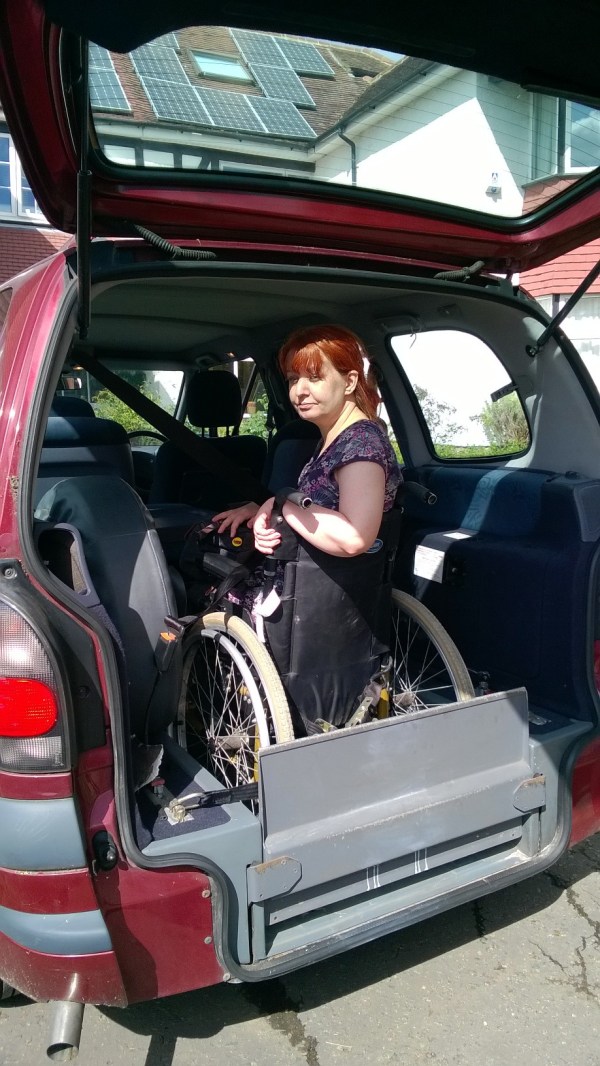
Nicki Myers Writes About Receiving A Free Wheelchair Accessible Car

July 31, 2018

Same Difference thanks reader Nicki Myers for writing this wonderful guest article about how she answered our recent advert. 

When I read on Same Difference about someone wanting to give away a wheelchair accessible car, I have to admit, my heart started to beat a bit faster than usual. I toyed with the idea of replying because I was sure someone would have snapped it up already but I was so desperate for a vehicle, I decided to send the owner, Rahila, an email.

I’ve had Motability cars for 25 years. The scheme worked really well for me and I was able to keep driving as my impairment became worse. My last car was a heavily converted Chrysler Grand Voyager which was adapted so I could drive from my powerchair with a joystick control. I received a huge grant from Motability for this conversion in March 2008. Although it was a bit unreliable, the car suited my needs, so after 5 years I kept extending the contract. A few years ago I learned that the Motability grants team had changed the rules for vehicles like mine. To qualify, you now need to be working or volunteering for 16 hours or more a week. Although I would love to do this, I am just not well enough. I spend 2-3 months a year in hospital and have spent time in intensive care every year since 2014. I have pulmonary fibrosis and Ehlers-Danlos Syndrome and haven’t been able to work for 14 years. There is no way I can qualify for a further Motability grant under their current rules and when my vehicle was 10 years old, it had to be handed back.
I’d pretty much resigned myself to relying on public transport (or taxis in emergencies) but there are some places I can’t get to via public transport; not all buses in Cambridge are accessible. You only have to look at the media to know about the difficulties faced by wheelchair users wanting to travel by train at the moment. I’ve been stranded on a train when the assistance didn’t turn up so I’m too scared to travel by train alone these days. When Rahila replied to my email to say the car was available, I couldn’t quite believe it. I called everyone who could possibly accompany me to London to look at it. Almost everyone was on holiday, given the time of year, but at the last minute, a good friend agreed to come and his son gave us a lift.
Rahila’s car has an important history. It had been bought for her son, Nihal, who had cerebral palsy and, very sadly, passed away. You can read about Nihal’s life in this book written by his mother.
It’s in my Kindle, waiting to be read. The family has a strong emotional attachment to the car and I understand this more than most. My youngest son was 12 when he died 6 years ago and I still have most of his possessions – his bike is still in my back garden. You have to be ready to pass on items like this and Rahila and her family had decided that the time was right for them.
It was great to meet Rahila and her lovely family. The car was perfect for my needs as a passenger. We went for a test drive around the block and I felt safe and comfortable. I’d had to take my manual chair to get to London and I was a bit concerned that my larger powerchair may not fit but it does, perfectly.
Having a vehicle means that I can now get to those places that were out of reach. I can visit my son’s grave in the woodland cemetery, have days out with my baby granddaughter, get to Papworth  hospital without needing to rely on ambulance transport. I will be able to travel more easily for political activism (disability rights and anti-austerity). It means the world to me and I will always be so grateful to Rahila and her family for this generous gift. I have donated to the charity set up in Nihal’s name which provides equipment for children who have cerebral palsy. There are many things which enable these children to thrive but that are not provided by the local authority. You can find out more about the charity or make a donation here
I’d also like to thank Sarah Ismail from Same Difference for sharing the information. Sarah is a Trustee of the board for Nihal’s charity.

Rahila and family say goodbye…

As new owner Nicki heads home to Cambridge with all her wheels in one place!

Legal Permission No Longer Required For Permanent Vegetative State Care To End Rules Supreme Court

July 30, 2018

Legal permission will no longer be required to end care for patients in a permanent vegetative state, the Supreme Court has ruled.

It will now be easier to withdraw food and liquid to allow such patients to die.

When families and doctors are in agreement, medical staff will be able to remove feeding tubes without applying to the Court of Protection.

Lady Black ruled there was no violation under the Human Rights Convention.

The Court of Protection has ruled on cases for 25 years but the process can take months or years, and it costs health authorities about £50,000 in legal fees to lodge an appeal.

The case was brought to the Supreme Court after a banker in his 50s suffered a heart attack, resulting in severe brain damage.

He has since died but the case continued so that a court ruling could be made

The man, known as Mr Y, was unresponsive after his heart attack last year and there was no chance of recovery.

His family and his doctors agreed it would be in his best interests to allow him to die by withdrawing his feeding tube.

The NHS trust asked the High Court to declare that it was not necessary to apply to the Court of Protection for a decision when the doctors and the family all believe it is in the patient’s best interests.

The judge agreed, but the official solicitor appealed on behalf of Mr Y – an appeal which has now been dismissed.

‘Ruling will divide opinion’

In Monday’s Supreme Court judgement, Lady Black said an agreement between families and doctors was sufficient safeguarding to ensure “public confidence”.

But she urged families to apply to court “where there are differences of view” between relatives or medical professionals.

The charity Compassion in Dying said it would “allow those closest to a person – their loved ones and medical team – to feel supported and empowered to make the right decision for the person, even when it is a difficult one”.

The BBC’s legal correspondent Clive Coleman said it was a “very significant ruling” which would “divide opinion”.

“People have strong religious feelings about this, there are strong ethical feelings around all this,” he said.

“There will be some who consider this a compassionate ruling… there will be others who say this is a dangerous ruling along a slippery slope towards euthanasia.”

Dr Peter Saunders, director of anti-assisted dying group Care Not Killing, said he was “very concerned and quite disappointed by the Supreme Court ruling” on ending care for vegetative patients, who are “effectively going to be starved and dehydrated to death”.

He said it removed an “additional layer” of protection for vulnerable, and “financial concerns” about looking after vegetative patients could mean “decisions may be made for the wrong reasons”.

Blue Badges Will Be Available For Hidden Disabilities From Next Year

July 30, 2018

Blue badge parking permits are to be made available for people in England with “hidden disabilities” such as autism or mental health problems.

The Department for Transport said people with non-physical disabilities would have an equal right to free parking from next year.

Currently the rules do not explicitly exclude hidden disabilities, but councils’ interpretations can vary.

Similar changes have come into effect in Scotland and Wales.

When the changes to the blue badge scheme in England are introduced, they will extend eligibility to:

  • people who cannot make a journey without “a risk of serious harm to their health and safety” or that of others, such as young children with autism
  • people for whom travel causes “very considerable psychological distress”
  • and those with considerable difficulty walking, meaning “both the physical act and experience of walking”

About 2.4m disabled people in England currently have a blue badge.

The scheme, first introduced in 1970 to make access easier for disabled people, costs £10.

It allow holders to park for free in pay-and-display spaces across the UK and for up to three hours on yellow lines.

The blue badge concessions do not apply to privately-run car parks. They also can not be used in central London, where residents need to apply for a special permit, although they do provide an exemption from the congestion charge.

Transport Minister Jesse Norman said: “Blue badges are a lifeline for disabled people, giving them the freedom and confidence to get to work and visit friends independently.”

The change follows a consultation launched in January which saw 6,000 responses.

Three in four disabled people say they would go out less often without the parking permit, the DfT said.

‘Overwhelming anxiety’

Jane Harris, director of external affairs at the National Autistic Society, said the change would “make a massive difference to the lives of many of the 600,000 autistic people in England, and their families”.

Many autistic people experience major challenges in travelling, making detailed preparations and suffering “overwhelming anxiety” about things going wrong, she said.

She said that some can be unaware of the dangers of the road while others can feel panic in busy or loud environments.

Siobhan Fairclough, from Edgware in north London, said she had been refused a blue badge for her daughter Jenny, 21, who is autistic with learning disabilities and rheumatoid arthritis. She welcomed the change.

“We wouldn’t have to worry,” she said. “When we’re walking and there are too many people around, she gets overwhelmed and it’s likely to cause a meltdown.”

People with other disabilities and their carers also said easier parking would have a significant impact on their lives.

Jenette Kingsbury in south Norfolk said her husband, who has 50% vision loss, auditory processing issues and cancer of the bone marrow, had been rejected for a blue badge because he is physically mobile.

But she said his disabilities put him at risk in traffic and she hoped he would benefit from the rule change. “Just small things make big differences when every day poses a challenge,” she said.

Scotland and Wales have already changed their eligibility criteria for the Blue badge scheme to include some mental impairments, where people cannot follow the route of a journey without assistance, but the rules are yet to be altered in Northern Ireland.

Automatic, Wheelchair Accessible Car Given Away To Same Difference Reader

July 30, 2018

We hope to publish an interview with the lucky reader as soon as possible.

Channel 4 Audio Description Campaign

July 30, 2018

Publicising by request of Channel 4:


Channel 4 have recently started broadcasting an on-screen campaign to raise awareness of our Audio Description service.

It’s part of a pan-broadcaster campaign to reach out to people with visual impairment and make them aware of what is on offer and is voiced by The Last Leg presenter Adam Hills.

It’s on air from 28 July to 9 September.

Stats for 2017 show that the percentage of programmes broadcast with AD across Channel 4’s portfolio were –

Channel 4 – 36%

E4 – 66%

More 4 – 30%

Film4 -31%

4Seven – 37%

There’s a link to the film below:

 https://youtu.be/QaoZoMnFwms

Boy With Epilepsy And Family Kicked Off Emirates Flight

July 27, 2018

Emirates staff have forced a disabled teenager and his family to disembark from a plane because he has epilepsy, despite the fact he held a medical certificate and clearance to fly.

Eli, the 17-year-old son of the Euronews journalist Isabelle Kumar, had boarded a flight on Wednesday from Dubai to France, the final leg of a long-haul journey from New Zealand via Australia.

But when Kumar – who had phoned the airline in advance to ensure they were aware of her son’s needs – asked for a seat with a vacant seat next to it in case he had a seizure, they wanted to see the medical certificate.

“I couldn’t initially find the certificate, But I called the doctor, got them to email the certificate which she did immediately,” she said. “Eli’s doctor wanted to speak to the attendants but they refused to speak to her, refused to look at the certificate, and refused to listen to us about Eli’s needs.”

Attendants said the certificate had to be shown to ground staff, despite the fact that the family had spoken to staff at check in and at the departure gate about their son’s disability.

Attendants then told the family – Kumar and her husband also have 10-year-old twins – they had to disembark and threatened to call the police if the family did not leave the plane, Kumar said.

“The children were crying, Eli was really distressed, he was biting his arm which is how he copes with stress, holding his head in his hands,” she said.

“We managed to get him off OK, and there was an emergency medical team waiting. They thought he’d had a medical emergency, but we said he was fine. They couldn’t understand why we had been kicked off. They immediately agreed he was fine to fly, but we were not allowed to re-board. The lack of humanity was really shocking.”

Kumar said the incident had left her children distraught.

“Travelling with a kid with disabilities is really challenging, we really have to plan it carefully in a lot of ways – so something like this is really disruptive, particularly for Eli. He is totally exhausted, he was very upset when we got taken out, he didn’t understand what was going on.”

Kumar said the family continued to be treated badly once in the airport and that there was “no contrition” by the airline. One customer services manager suggested they fly to Vienna, despite the fact that they live in Lyon. Finally a different Emirates employee suggested that the family fly to Geneva the next day.

“We were just dumped in an airport, we had to battle to get a hotel and it was only after there was a Twitter storm that they suddenly started treating us correctly,” said Kumar.

When the family arrived in Geneva Eli had a seizure, which Kumar puts down to exhaustion and lack of sleep. “Eli is now 17, we know what it takes – we’ve been everywhere and we’ve managed it, but it takes very careful planning which is why this was so disruptive.”

From there they took a £572 Emirates transfer car to Lyon, which they had to put on a credit card. The company said the cost would be refunded, but refused to state it in writing, Kumar said. When they arrived in Geneva, two of their bags were also missing.

The incident left them demoralised and exhausted, she said. Although the family had travelled several times with Emirates, they would think twice before doing so again, she said. “It has been very long and very trying, the whole thing has just been so difficult.”

Tanni Grey-Thompson, who won 11 Paralympic gold medals between 1992 and 2004, said she was extremely disappointed by the way Emirates had appeared to handle the situation.

Although medical certificates were necessary in “very limited circumstances, it made no sense to ignore one once produced”, she said. “This incident raises more questions. Under what assessment process did the member of staff make this decision? What reassurance do passengers have that if they book with any airline they will be able to fly? Instead of encouraging openness, it may encourage people to be less open.”

She also said that travel was becoming harder for disabled people in many circumstances. “I’m really concerned that issues like this could encourage airlines to demand increased medical certification, or that airlines may not let disabled people fly on their own.”

Simon Wigglesworth, the deputy chief executive at Epilepsy Action, said the story was very concerning. “Epilepsy can be a very distressing condition in itself and this experience will only have added to that for all concerned,” he said. “[It] is a varied condition which affects everyone in very different ways. We urge travel companies to ensure that their staff are trained in epilepsy first aid so they know what to do if someone has a seizure and how to make them safe.”

An Emirates spokesperson said the airline was “very sorry for any distress and inconvenience caused to Ms Kumar and her family”.

“Such situations are usually difficult for operational staff to assess, and they opted to act in the best interest of our passengers’ safety as well as on advice from our medical team,” they said.

“Our customer service team has been in touch with the family, and we have offered them a complimentary hotel stay while in transit and rebooked them on another flight departing on 26 July.”

Medicinal Cannabis Products Will Be Legalised

July 26, 2018

Specialist doctors in the UK will be able to legally prescribe cannabis-derived medicinal products by autumn, the home secretary has announced.

Those that meet safety and quality standards are to be made legal for patients with an “exceptional clinical need”, Sajid Javid said.

It follows high-profile cases involving children with severe epilepsy being denied access to cannabis oil.

Others forms of cannabis will remain illegal.

‘Exceptional circumstances’

Mr Javid’s decision was made after the chief medical officer for England, Prof Dame Sally Davies, and the Advisory Council on the Misuse of Drugs said patients with certain medical conditions should be given access to the treatments.

Their advice was part of a review into medicinal cannabis launched by the home secretary following an outcry over Billy Caldwell and Alfie Dingley being denied access to cannabis oil.

The parents of the boys, who have rare forms of epilepsy, say it controls their seizures.

The Home Office recently granted them licences to access the treatments.

Mr Javid said: “Recent cases involving sick children made it clear to me that our position on cannabis-related medicinal products was not satisfactory.

“That is why we launched a review and set up an expert panel to advise on licence applications in exceptional circumstances.

“This will help patients with an exceptional clinical need but is in no way a first step to the legalisation of cannabis for recreational use.”

‘Birthday present’

Billy Caldwell’s mother, Charlotte, said Mr Javid’s announcement had been made on her son’s 13th birthday.

“For the first time in months I’m almost lost for words, other than ‘thank you Sajid Javid’,” she said.

“Never has Billy received a better birthday present, and never from somebody so unexpected…

“But, crucially, my little boy Billy can now live a normal life with his mummy because of the simple ability to now administer a couple of drops a day of a long-maligned but entirely effective natural medication.”

Cannabis is classed as a Schedule 1 drug, meaning it is judged to have no therapeutic value but can be used for the purposes of research with a Home Office licence.

The decision by the Home Office will put certain cannabis-derived products into Schedule 2 – those that have a potential medical use – and will place them in the same category as cocaine and heroin, among other drugs.

The Department for Health and Social Care and the Medicines and Health products Regulatory Agency (MHRA) will now develop a clear definition of what constitutes a cannabis-derived medicinal product so they can be rescheduled and prescribed, the Home Office said.

In the meantime, clinicians will still be able to apply to an independent expert panel on behalf of patients wishing to access these products.

The home secretary said licence fees for applications made to the panel will be waived, and those already granted will not be charged.

‘Safer medicines’

The home secretary’s decision was welcomed by campaigners and health experts.

The Royal College of Nursing said the decision was “very welcome”.

Dr Tom Freeman, senior academic fellow at King’s College London, said Mr Javid’s decision would have a “substantial impact on research by facilitating the development of safer and more effective medicines”.

Former justice minister Sir Mike Penning, who was among those appealing for Alfie Dingley to be given a special licence for medicinal cannabis, welcomed the announcement but said there were still unanswered questions about which treatments would be rescheduled.

“Any move to restrict medical cannabis in the UK to a very narrow range of derived products, each requiring full pharmaceutical trials, thereby blocking out the many products available overseas, will lead to great disappointment and be a missed opportunity.”

Automatic Wheelchair Accessible Car Available For Free

July 26, 2018
Renault Espace Automatic, maroon colour, 1998 registration. Compact disabled access design, perfect for city parking, air-suspension on back axle allows car to sink to the ground and turn into a ramp without requiring huge clearance at the back.
 
MOT runs outs on 29th July. Serviced annually. In good working order but poor body work. 20 years old but only 67K mileage. Available free. Based in NW London
For more information please contact Rahila Gupta: rahilagupta@gmail.com


DWP And Medical Records

July 26, 2018

The Giving Machine- Donate To The Nihal Armstrong Trust Through Online Shopping

July 25, 2018

Publicising this with pleasure for The Nihal Armstrong Trust:


I run this charity, The Nihal Armstrong Trust, which provides disability-related equipment and services to children aged 18 and under with Cerebral Palsy.

There is a new and simple way of donating money to us without it costing you a penny. That’s not possible, I hear you think. If you sign up to the giving machine, link below, every time you go shopping on major sites on the internet, a little purple shaped heart pops up to tell you that on this site x amount from your purchase will go to the charity.

You are allowed to nominate 4 charities so if you nominate us, it won’t displace your other favourite causes. Every little bit adds up. It takes a few seconds to set up.  Instructions for signing up to the site are here: https://www.thegivingmachine.co.uk/causes/the-nihalarmstrongtrust/

Here’s a link to a heartwarming 30sec video of a little boy for whom we funded the iPad in the picture.  http://lights-test.s3.amazonaws.com/video/93c0420272cdc9290fc9a8b7f8f447d8/img-3521.mp4 

P.S. The only slightly annoying thing about this is that if you are shopping at Amazon you have to click first on the giving machine website and then click on Amazon (which comes up as a list of shops which donates to the giving machine) because Amazon does not automatically connect to their site. This is just one extra click to make.

Demi Lovato In LA Hospital After Suspected Overdose #PrayForDemi

July 25, 2018

Pop singer Demi Lovato is in a Los Angeles hospital after a suspected drug overdose, US media report.

The Los Angeles Police Department reportedly responded on Tuesday to a medical emergency in the Hollywood Hills, where Lovato lives.

TMZ reports the 25-year-old was found unconscious and treated at the scene with Naloxone, an anti-overdose medicine, after possibly taking heroin.

The Sorry Not Sorry singer was in a stable condition, US media report.

Lovato has struggled with substance abuse for years, and appeared to relapse in recent weeks.

Last month she cancelled her show at London’s O2 arena, announcing the news on Twitter hours before the concert was due to begin.

In a single released last month, Sober, she sings: “Mommy, I’m so sorry I’m not sober anymore. And daddy please forgive me for the drinks spilled on the floor.”

The song ends with the lines: “I’m sorry that I’m here again, I promise I’ll get help/It wasn’t my intention, I’m sorry to myself.”

The track release followed Lovato marking six years of sobriety in March this year.

She was due to complete the North American leg of her Tell Me You Love Me world tour with a concert in Atlantic City, New Jersey, on Thursday.

Her fans say the singer’s battles with bipolar disorder, bulimia and addiction – often documented in her music – have helped them with their own struggles.

The BBC contacted Lovato’s representatives on Tuesday, but did not receive an immediate reply.

As reports of her condition spread, there was an outpouring of support on social media from other celebrities and musicians.

Within hours of the report, tens of thousands of people had tweeted the hashtag #PrayforDemi.

According to US health officials, 115 Americans die from an opioid overdose every day with more than 250,000 Americans dying over the past decade.

Raised in Dallas, Texas, Lovato first entered the spotlight on the children’s TV series Barney & Friends.

She appeared alongside the Jonas Brothers in the 2008 Disney Channel movie Camp Rock.

Lovato released her first studio album, Don’t Forget, in 2008.

In a YouTube documentary, Simply Complicated, released last October, Lovato revealed her drug use began when she first tried cocaine at the age of 17.

“I felt out of control the first time I did it,” she said. “My dad was an addict and an alcoholic.

“Guess I always searched for what he found in drugs and alcohol because it fulfilled him and he chose that over a family.”

Lovato went to rehab for the first time in 2010.

“I wasn’t ready to get sober,” she said in the documentary.

“I was sneaking it on planes, sneaking it in bathrooms, sneaking it throughout the night”.


DWP Claiming Back Rent From Grieving UC Families

July 24, 2018

Universal Credit Whistleblower: It Was More About Getting Them Off The Phone

July 23, 2018

Joanne Huggins, 37, worked on the universal credit helpline in the Grimsby service centre for nearly two years before quitting in April. She had worked in social housing and understood the social security system but was still surprised by what she found.

“I did not expect it to be so fundamentally flawed,” she said.

She had hoped she would be able to help resolve the problems reported by claimants, some of whom would call in upset after payments were late, or were unexpectedly reduced, but soon found the system resistant to offering quick or easy assistance.

“It felt like these were not people that you serve, not customers, not important, but people who get in the way of what you are are trying to do, which was to hit call targets,” she said.

It was “heartbreaking” having to block or deflect vulnerable claimants, telling them that they would not be paid, or would have to submit a new claim, or have a claim closed for missing a jobcentre appointment, or be sanctioned – a penalty fine for breaching benefit conditions – or go to the food bank.

The system felt crude rather than intuitive, and her role often felt adversarial. “It was more about getting the person off the phone, not helping.”

It did not help that claimants regularly received different advice in different parts of the social security system. In some cases she would tell callers they had to make an appointment with the jobcentre work coach to solve a problem, only for the work coach to tell them to contact the call centre.

She was surprised by how people left waiting and penniless by the system often did not vigorously pursue the delay or error. “I was surprised by how little contact they had with us. It was as if they just sensed the system was unhelpful and they couldn’t rely on it.”

Bayard Tarpley, 27, also worked in the Grimsby centre. He said the system was not only avoidably complex but failed to anticipate that claimants may find it difficult. Claimant errors could be triggered by poor wording, could be hard to spot and difficult to swiftly correct.

“A common example of a seemingly trivial claimant error causing problems is where people have a tenancy agreement that shows a weekly rent figure, even though they pay their rent monthly. So they might enter, say, £75 a month in answer to the question of how much rent they pay,” he said.

“This can get verified because the case manager missed the issue, and as a result the claimant receives £75 for housing support at the end of the month. We get an angry phone call and spend a week or two resolving it.”

Tarpley gives countless examples of how his experience showed that the system is designed irrationally, or clumsily, or in a way that confuses staff as well as claimants and leads directly to people not receiving the money they need.

“Universal credit is like one of those old Disney cartoons with a leaky boat. The holes spring up, and Bugs Bunny or whoever sticks a finger in, but then a new hole appears, and they end up sprawled across the boat trying to block all the leaks. The holes aren’t the problem, though, it’s the boat,” he said.

Staff often get confused by the welter of system updates, guidance and memos. “This results in a massive variation in understanding between agents, teams and especially service centres, meaning that claimants can call three times in a row and get three different answers to a query.”

This piled excessive responsibilities on to call centre staff, he said. “When people call up with very specific questions about how their terminal illness affects their benefit, it’s me that answers that question. It’s me that has to judge whether it’s appropriate to ask a claimant if her third child is the result of sexual assault because it may affect her benefit entitlement.

“The decisions I make on a daily basis have an impact on how quickly someone is able to pay their landlord, turn the heating back on, get their children to school. I have made decisions that have resulted in people being evicted, and decisions I have made have led people to tell me that it is the reason they are self-harming.

“I would argue that I am scarcely qualified for any of those things, never mind all of them.”

Adam Hills’ Autobiography, Best Foot Forward, Is Out Tomorrow

July 23, 2018

Adam Hills says the real impact of 2012’s The Last Leg won’t be seen until 2020, adding it “accidentally” broke barriers about disability.

Hills, who fronts the Channel 4 show, says it put the “awesome” Paralympic athletes centre stage, while getting laughs from moments like “the blind guy who misses the long jump and lands on someone”.

“If all you’re doing is pointing out the funny in the Paralympics then you’re mocking disabled people,” he says.

“But if you’re celebrating them as well, then you’re covering both bases, you’re being balanced.”

The show, which also features Alex Brooker and Josh Widdecombe, started out as a comedic wrap-up of the day’s events at the Paralympics.

They “accidentally broke down a few barriers”, Hills explains, adding: “We didn’t set out to, that wasn’t our plan, but we knew that would be a side effect of doing what we did.”

Rio was next to host the games in 2016, but Hills explains this wasn’t enough time for 2012 to have an impact.

“You think it’ll happen four years later, but no, those guys in Rio started planning well before 2012 so it’s not until 2020 in Tokyo that we’ll see the impact.

“I know for a fact that the Japanese broadcasters have said ‘let’s use the Paralympics to change perceptions – we’re not going to just cover it, we’re going to affect social change because that’s what happened in 2012’.”

The Last Leg introduced the groundbreaking #isitok feature in 2012. Viewers were invited to tweet questions that could be considered inappropriate, like: “Is it OK to fancy the Para-athletes?”

These questions were then answered on-air, reflecting the show’s mix of laughs and serious content.

Hills sees the show as part of the “perfect storm” of “everyone in London” thinking the Olympics would “go badly”, and then saying: “‘That was great, now let’s do it again, what can we do?’

“And then the Paralympics came around with billboards that said ‘thanks for the warm-up’, so people were going into it with a positive attitude.

“We went into it with positivity and a little bit of edge. It was about disability, so we were rooting for the underdog – they did well, so we were rooting for the winners.”

The show’s popularity meant people took notice of the Paralympics, not least because of the success of the British Para-athletes, who came third overall with 34 golds and a whopping 120 medals.

Hills is ruminating about the success of the show as part of his self-penned book of memoirs, Best Foot Forward.

It paints a colourful picture of his happy childhood and early failures and successes as a stand-up, before romping through his TV career and encounters with stars including Billy Connolly and Whoopi Goldberg.

He writes about years of early slog and travel, with late-night gigs, local radio and plenty of knock-backs. But it never crossed his mind to give up on comedy.

It’s at this point that he makes a surprising confession – about an addiction.

He can’t get enough of the buzz from performing live comedy, saying it feels like a “cleansing vomit”.

“I don’t think I’ll ever not do stand-up,” he says quietly. “It boils down to the addictive nature of how good it feels when a gig goes well.

“If I haven’t done it for a while, I start getting really edgy and I can’t work out why I’m unhappy and unfulfilled. Then I go and do a gig, and it’s like ‘aah, that’s better, I needed to get that out of my system’.”

Hills, who was born without a right foot, also writes briefly about this as well.

His parents “received the invaluable advice to ‘treat him like any other normal kid'”, which they did, by enrolling him in a gymnastics class.

‘Introverted and shy’

He also heeded early advice from a veteran at Sydney Comedy Store, who said he should stop including his foot in his act until he was “good enough”.

Hills also says he’s “surprisingly introverted and shy”, despite being known for his his TV rants on topics from child poverty to Donald Trump.

But this hasn’t stopped him from inviting a variety of politicians on the show, which is now on its 14th series, and takes a satirical spin around the week’s news.

He managed to persuade Labour leader Jeremy Corbyn to step out of a glamorous car onto a red carpet, wearing a white fur coat and a lot of attitude.

“They all come out of the show looking good,” Hills says, adding that his favourite Tory was Baroness Sayeeda Warsi, who won lots of fans just by being “funny”.

“She was amazing, she had a lot of people saying more Tories should be like her afterwards. Tory MP Anna Soubry did quite well, but Sayeeda Warsi was the best of the Tories,” he says.

Hills laughs about politicians often appearing on the show as “a last resort”.

“When former deputy prime minister Nick Clegg appeared, he said to me: ‘You get slated in the press, you get your own party turning against you and then your press secretary says do you want to appear on The Last Leg, and you think how much worse can it get?!’.”

Hills is happy to get serious though, and when asked about Paralympic sports such as boccia – which don’t appear to merit live Paralympic TV coverage yet – he pauses for thought.

“I think sometimes the lack of coverage is to do with the host broadcaster, sometimes it’s to do with just bad planning.”

Citing other Paralympic sports that have also been overlooked by live TV, including the wheelchair marathon and equestrian events, he adds: “I would have thought that the lack of coverage for boccia might be that the sport isn’t considered exciting enough, the physics of the ball rolling – it’s like lawn bowls.

“Having said that, I bloody love lawn bowls on TV! I’d love to see more boccia coverage, especially when you’ve got the GB team winning medals – that’s what people want to see.”

As for the future, he’ll continue working on The Last Leg, plus a documentary about playing in the disability rugby league. Not surprisingly, he also has plans up his sleeve for more stand-up.

Hills is pleased that disability in comedy appears to be much more visible. Lee Ridley – better known as Lost Voice Guy – won Britain’s Got Talent, while Robert White, a comic with Asperger’s, came second.

“There are a few disabled comics coming through, which is bad news for the rest of us,” he laughs.

“I think what’s really interesting and what’s a good sign is when people watch The Last Leg now, they complain there’s not enough diversity on it.

“When you consider that two out of three of us are disabled, you’ve got hand deformities, leg deformities, and people are asking ‘why aren’t there more women and people of colour?’

“You go ‘oh wow’, we have ticked that one diversity box so hard in indelible ink, that people just ignore us. So that’s a good sign.

“It means we have to move on to the next thing.”

Best Foot Forward, published by Hodder and Stoughton, is out on 24 July.

The Ability People- Inclusive Recruitment Agency

July 23, 2018

A Paralympic gold medallist has set up a recruitment firm to help close the “outrageous” gap in employment rates for disabled people.

Liz Johnson, who triumphed in the 100m breaststroke in Beijing in 2008, will also help place non-disabled job hunters.

Her business, the Ability People, is staffed entirely by people with disabilities. It focuses on the technology, engineering, software and human resources sectors.

The agency, in Newport, south Wales, already has agreements in place with Diageo, John Lewis and British Airways.

Johnson wants to reduce the 30 percentage points gap in the employment rate for disabled and non-disabled people. “It’s an outrageous figure,” said the 32-year-old.

“Many people living with disabilities would love to secure full-time work, but employees consciously and unconsciously discriminate against them when it comes to hiring decisions.”

From Locked In Syndrome To Fatherhood

July 23, 2018

Martin Pistorius had locked-in syndrome and was unable to communicate for more than a decade.

He could see and hear everything, but no-one knew he was conscious.

Now he’s about to become a father. This is his story.

Tanylee Davis Left Trapped On Board Train After It Leaves- Five Days After Her Last Bad Train Experience

July 23, 2018

A comedian who felt “harassed and humiliated” for using a disabled space on a train for her mobility scooter, prompting an apology from the operating company, has had yet another bad experience on the railways.

Tanyalee Davis was en route to York for a show and, although she had already spoken to staff to ensure she would be helped off the London North Eastern Railway (LNER) train, no one came to assist – meaning she had to stay on board until Darlington, 50 miles away.

Canadian-born Davis, 47, who has a form of dwarfism, was ordered to vacate the disabled space on a GWR train earlier this week.

This latest incident, on Friday – five days after her initial ordeal – shines a light on the everyday trials of disabled people up and down the UK.

“The train guard came and talked to me and said: ‘I’ve already rung, York knows that you are arriving,’” she said in a video posted to her YouTube channel.

He told her not to panic and that if no one was there to help her, he would come to assist her.

“So we get to York, I’m waiting and nobody’s coming and some people get off and I just assume that the guard will be coming and all of a sudden the train doors close and now I’m off to Darlington.

“The guard on this train is lovely, I don’t know his name but he’s lovely. This is not a beef against the guard, he did everything he could possibly do.

“But this is the problem. The platform staff, he’s rang them, and they were like: ‘What, oh my God, we thought she got off the train.’

“Anyway, oh, another day, another try, you know, and I’ve gotta be on stage in an hour and now I’m going to be an hour out of my way. It’s been a rough day.”

She thanked everyone for the outpouring of public support throughout the week and apologised for not being able to reply to all of the thousands of messages.

The guard was “mortified” and apologised personally and, when she finally arrived at York station, staff were “over the top apologetic” and gave her two bottles of wine.

Luckily, Davis made it to her gig.

A spokesman for LNER told the BBC: “We are very sorry for the unacceptable experience Ms Davis had whilst travelling with us.

“We are fully investigating the incident to understand what went wrong and to ensure that lessons are learnt for the future.”

Downtism: Teheran’s Newest Cafe

July 23, 2018

This is significant progress for disabled Iranians. The project deserves publicity because it has been created in a country where the rest of the world might not expect to see such an organisation. It would be great to see more projects like this in Western countries.


With tables squeezed together, framed paintings on the walls and a one-page menu that offers a selection of coffees, Downtism cafe in northern Tehran looks like any other coffee shop. It’s unique, though: Downtism is the first and only cafe in Iran where all the employees have Down syndrome or autism.

“I really like my job. It feels good to be out of home with friends and make real money,” Arya, a 21-year-old with autism, told Al-Monitor.

His mother, who identified herself as Mrs. Azad, said she was equally pleased with her son’s job as a dishwasher. She told Al-Monitor, “We’re very happy and satisfied that they’re working. This way they can both work and socialize with others. They develop social skills and self-confidence.” She and other parents take turns lending a hand at the cafe and overseeing how their children are doing.

Downtism, which opened May 1, has quickly made a name for itself. When Al-Monitor visited the coffee shop after Ramadan, all the tables were filled.

A smiling young boy or girl greets customers and hands out a colorful menu that offers espresso, lattes or cold drinks made with traditional flavors like saffron. The colorful drawings on the walls are the works of the 35 employees, most of them in their 20s. There are often lines for the coffee, Mrs. Azad told Al-Monitor.

Behind the cafe’s success stands Aileen Gerami, a music instructor who came up with the idea three years ago. This year she finally managed to obtain the support of the State Welfare Organization, which gave her the venue.

“I have been holding music concerts with disabled people in different cities for the past 17 years,” Gerami was quoted by Sharaq Daily as saying. “But I always felt that was not enough for them. They were with other people for a short time, and after that they were alone again.”

Mohammad Reza Asadi, deputy director for rehabilitation at the State Welfare Organization, was quoted by local media on May 1 as saying that the cafe is the first in the Middle East to be entirely run by people with Down syndrome and autism. “There are 4,000 families affected by autism in Tehran,” he said. “This cafe will provide hope for them.”

The cafe provides an employment niche for Iran’s disabled population, which faces many obstacles in daily life.

“City structures are not suitable for the disabled to let them move freely. This also restricts the disabled presence in workplaces, even if a company is willing to hire them,” Vahid Rajabloo, a 30-year-old who has a rare genetic disorder called spinal muscular atrophy, told Al-Monitor.

Rajabloo never got a chance to go to school due to his physical disability, but he taught himself programming and eventually became economically self-sufficient. Believing that access to education and services is key for professional success, he has established a directory of services offered for the disabled called Tavanito.

“My startup has different sections. Part of it introduces markets to companies while encouraging them to employ the disabled. It also facilitates access to different services, from dental care to hairdressing and buying devices such as wheelchairs or walkers they need to use. The startup also has a section to train the public on how to treat the disabled and their families,” he told Al-Monitor.

But measures like the cafe and his startup are small steps compared to the enormity of problems Iran’s handicapped face. The ball rests in the court of the government, both for employment and for social aid.

At a conference held on the International Day of Disabled Persons last December, Minister of Cooperatives, Labor and Social Welfare Ali Rabiee briefed nongovernmental organizations about the measures the government has taken in that field, including offering professional training to the disabled and low-interest loans.

The government is hopeful that the new Comprehensive Law Supporting the Rights of the Disabled will soon resolve many of their problems. The much anticipated law was passed in March, and a month later, President Hassan Rouhani called for its immediate implementation. The law calls for upgrading city structures to facilitate the movement of the disabled and granting them insurance for medical and rehabilitation services as well as sports, educational and cultural services. It also aims to create jobs and housing for them.

In Iran, disabilities are classified into four categories, based on severity: low, average, severe and very severe. While official figures put the number of Iranians with severe disabilities at 1.5 million, there is no official statistics available about the other groups, making it nearly impossible to determine the employment rates among them. Experts agree that the absence of such data also hampers rehabilitation services to the disabled. Therefore, they say, the government must first gather statistics on the number of Iran’s disabled people.

Asked about the importance of places like Downtism cafe, Mrs. Azad said, “It’s very crucial for them since those who come here have the understanding to respect the kids and accept their work even if they’re not done perfectly like in regular cafes. These are the only places where we as their families have peace of mind, since nobody makes fun of our kids or abuses them.”

Expert Advice: Medical Cannabis Should Be Available On Prescription

July 20, 2018

Doctors in the UK should have the option to prescribe cannabis-derived medicinal products to patients with certain medical conditions, drugs experts have advised the government.

The Advisory Council on the Misuse of Drugs recommends rules should be changed for these medications, if safe.

It comes after high profile cases involving children with severe epilepsy being denied access to cannabis oil.

The government must now agree on a definition for these products.

The Council recommended that clinical trials be carried out urgently to improve understanding of medicinal cannabis products, as well as their safety and effectiveness.

Its advice is in line with a recent review by the chief medical officer for England.

Prof Dame Sally Davies said there was conclusive evidence of the therapeutic benefit of prescribing cannabis-based products for certain medical conditions.

Home Secretary Sajid Javid said he was “carefully considering” both recommendations and would make a decision shortly.

The Home Office recently granted Billy Caldwell and Alfie Dingley, boys who have rare forms of epilepsy, a short-term licence to allow them access to cannabis oil, which their parents say helps to control their seizures.

Cannabis for recreational use will remain illegal.

Avoid harm

The Council’s advice is that only products meeting definitions decided on by the Home Office and the Department of Health will be moved out of schedule 1 of the Misuse of Drugs Regulations 2001 into schedule 2, which allows them to be prescribed by clinicians.

Schedule 1 includes drugs not used for medical purposes, such as hallucinogenic drugs, raw opium and cannabis.

The Council said there were still potential risks if cannabis-derived medicinal products were prescribed inappropriately and these needed to be carefully considered to avoid harm to patients.

Dr Owen Bowden-Jones, chair of the ACMD, said: “At present, cannabis-derived products can vary greatly in their composition, effectiveness and level of impurity.

“It is important that clinicians, patients and their families are confident that any prescribed medication is both safe and effective.

“The ACMD recommends that an appropriate definition be agreed by DHSC and MHRA promptly.

“Only products meeting this standard and definition should be given medicinal status.”

It stressed that rules for synthetic cannabinoids, which are found in products such as ‘Spice’, would not be changed.

A Tip On Texts About MR

July 20, 2018

DWP Gives In On ESA Backpayments

July 19, 2018

With many thanks to Benefits And Work.

The DWP has finally surrendered and agreed to repay ESA claimants all the money that was unlawfully withheld from them, it was announced yesterday. The u-turn follows the publication of a highly critical report by the Public Accounts Committee (PAC).

In March of this year we reported that the DWP failed to award income-related ESA to around 70,000 claimants who were transferred from incapacity benefit to contribution-based ESA from 2011 onwards.

Affected claimants are owed between £2,500 and £20,000 each.

However, the DWP had insisted that they were only legally obliged to repay underpayments from 21 October 2014, when the upper tribunal first ruled that contribution-based and income-based ESA are a single benefit and that the DWP has a duty to assess claimants for eligibility to both types of ESA when a claim is made.

This meant that underpayments from before this date all the way back to 2011 were simply being ignored by the DWP.

The PAC report, published yesterday, accused the DWP of multiple failures:

“It failed to design a process that reflected its own legislation. It failed to subject that process to proper scrutiny. It failed to listen to its own staff, claimants, or external stakeholders and experts who told it things were going wrong and that it needed to slow down. And it failed to act even when it was painfully obvious that it was underpaying a significant number of people, taking over six years to take the necessary corrective action.”

Committee Chair, Meg Hillier MP, commented:

“Indifference has no place in the delivery of vital public services. It must be rooted out wherever it is found.

“The Department needs to explain what it is doing to improve both its management culture and its ability to gather and act promptly on critical intelligence.

“It must also set out how it will more quickly address the £1.7 billion of underpayments claimants miss out on each year.

“Half-hearted Whitehall targets offer no comfort to people struggling to make ends meet because of Government mistakes.”

Within hours of the report being published, Esther McVey, secretary of state for work and pensions, made a statement saying that the DWP would be backdating ESA payments all the way to 2011. Claimants who have already received their backdating will have their case reviewed again to see if they are entitled to any more money.

Child Poverty Action Group, which had launched a legal challenge to the DWP’s original decision to limit backdating, welcomed the u-turn.

However, the DWP is still refusing to pay compensation for consequential losses, such as loss of free prescriptions, free dental care and free school meals.

The Life Of A Perfectionist

July 19, 2018

Holly Greenhow Wins £15M Compensation For CP

July 18, 2018

A girl with severe cerebral palsy who became a child modelling star has won more than £15 million in compensation from the NHS.

Holly Greenhow, 12, was left disabled and suffering from significant communication problems after her brain was starved of oxygen during birth. 

Described as “incredibly sociable and strong-willed”, she has forged a career as a model, working for names such as Tesco and Boden. 

Holly’s family sued Hinchingbrooke Anglia Healthcare NHS Foundation Trust, which runs Hinchingbrooke Hospital in Cambridgeshire.

Yesterday at the High Court the hospital was ordered to pay a £6.4 million lump sum, with annual payments expected to take the total compensation to more than £15 million over the course of Holly’s lifetime. 

Alex Antelme, QC, for the hospital trust, said it was a “tragic case”’ and the impact on Holly was “self-evident”. He praised the “incredible commitment and care which her parents and wider family have provided”.

Holly’s mother Fiona Greenhow said: “It’s a fight that has taken just over 12 years. If you had told me at the beginning it would have taken this long I don’t think I would have believed you.

“It is a good feeling to know that Holly will be financially secure in the future and her brother, Oliver, will not have to feel responsible to look after her.” 

On Holly, she said: “She can light up any room with her smile and infectious laugh. However, at the same time she is incredibly strong-willed and will not give up until she is understood”. 

Mrs Greenhow said, however, that Holly finds it “almost impossible for her to entertain herself” because of her disabilities, but enjoys watching vloggers on YouTube.

Last year her family paid £10,000 so she could have pioneering stem-cell treatment in California. Mrs Greenhow told the BBC how it had improved Holly’s vision and the quality of her sleep, expanded her vocabulary and given her more control over her muscles. 

Holly has also joined a new modelling agency established to support children and adults with disabilities. 

“I have been really supportive of the modelling for Holly as I want her to be an advocate for models with disabilities and at the same time it gives her an opportunity to do something different,” Mrs Greenhow said. Holly’s mother hopes that, with professional care, her daughter will be able to live independently when she grows up and lead a “fulfilled life”.

“Albeit we are delighted with the award, it has taken a lot of time and emotional energy to get to this point,” Mrs Greenhow said. “No amount of money or apology will ever bring back what we should have had with Holly. It has changed all of our lives and there isn’t a day that goes by that I do not regret what happened the day she was born.” 

Judge David Pittaway QC approved the settlement as “appropriate”, adding that he has “great admiration” for Holly’s parents. “This will enable all of you, particularly Holly, to have a much better quality of life,” he said.  

“You will have the certainty that there will always be money available to look after Holly.”

The hospital trust admitted 75 per cent liability, and will pay annual instalments of £110,000 which will rise to £200,000 as Holly gets older. 

DWP Reviews All PIP Claims For Haemophilia

July 18, 2018

With many thanks to Benefits And Work.

The DWP have announced that they are reviewing all awards of PIP to claimants with haemarthropathy, a severe type of arthritis caused by bleeding into the joints due to haemophilia, because of a failure to give high enough awards.

According to the DWP, an audit was carried out of awards of PIP to people with haemophilia after concerns were expressed by the All Parliamentary Party Group on Haemophilia and Contaminated Blood

The DWP say that a systematic problem was identified with how the functional needs of claimants with haemarthropathy had been assessed for PIP.

As a result the DWP are reviewing all PIP cases where the main disabling condition is haemophilia to identify and review claimants with haemarthropathy. The DWP believe that there are approximately 410 such cases and they will review each one.

No claimant will have their award of PIP stopped or reduced as a result of the review and none will have to attend a face-to-face assessment.

The DWP started reviewing cases on 25 June 2018 and expect the process to take 4-6 weeks to complete.

Anyone with haemarthropathy who believes their case should be reviewed and has not received a letter by 23rd July 2018 should phone the dedicated phone line for this exercise (0800 121 4296) as soon as possible after that date.

This telephone line will only answer queries relating to this exercise within usual business hours (Monday to Friday 9am – 5pm).

Thanks to Neil Bateman for alerting us to this issue.

A Win For Common Sense

July 17, 2018

Our editor is excited to be back in print! She recently contributed this to Unite Magazine, a new disability rights publication.

Brexit Trade Bill Set To Crush Disabled People

July 17, 2018

An inevitable consequence of a Brexit run by the Conservative Party is that the interests of society’s most vulnerable people are being trampled upon in an unprecedented manner.

The latest example of that happening comes courtesy of the Trade Bill that will be debated on the floor of the House of Commons tomorrow.

It is designed to take some 40 trade agreements signed by the EU with third countries and place them into UK law. This act of housekeeping, however, comes with an extraordinarily nasty sting in the tail if, like me, you are among the estimated 20 per cent or so of Britons who have a disability.

According to a letter sent to the International Trade Secretary Liam Fox, the bill “lets ministers change a wide range of laws – including the Equality Act – without parliamentary scrutiny, in order to implement international trade agreements”.

It continues: “There are no safeguards to prevent ministers from using these new powers to remove rights granted by Parliament.”

Its 20 signatories include Liberty, the Business Disability Forum, Disability Rights UK, Leonard Cheshire Disability, Mencap, The National Aids Trust, the Royal National Institute for the Blind, Amnesty International UK, Ambitious About Autism and the Association of Chief Executives of Voluntary Organisations.

They and their co signatories warn that the powers granted by the bill could lead to some apallingly malign outcomes. One example they highlight is that it could be used to change those parts of the Equality Act that require public vehicles to be made accessible to disabled people.

This is important because people with disabilities rely far more on public transport than non disabled people do for access to leisures facilities, local services, shops and the like. Of no less importance is the critical role accessible public transport plays in their ability to work. The Government still claims that its desire is to get 1m or so more disabled people into work. That’s not going to happen if they aren’t able to get to places of employment.  

“Such broad powers have not been and cannot be justified to achieve the Bill’s stated aim of rolling over existing trade agreements the UK has through our membership of the EU,” the signatories say, while urging a commitment to change the text of the bill to protect human rights and equality laws.

Given the quality of the man in post as International Trade Secretary, whom it bears repeating is a doctor by training, it is hard to see that happening.

This is what Paul Drechsler, President of the the CBI, said on the subject of the trade deals Mr Fox’s Department was set up to negotiate: “There’s zero evidence that independent trade deals will provide any economic benefit to the UK that’s material. It’s a myth.”

For the record, the Department for International Trade insists that the continuity powers in the trade bill won’t be able to be used without Parliamentary scrutiny and says that it has held discussions with the with the Equalities & Human Rights Commission about the bill. However, if all is hunky dory, why would 20 respectable organisations feel sufficient concern to write? Perhaps it’s a reflection of the Government’s lamentable record on disability.

Depressingly, this has so far received little in the way of publicity. Perhaps that is partly because there is now just so much evidence of the desire on the part of the right wing of the Conservative Party to turn the Brexit wound septic.

DWP Telling Claimants Not To Use Fightback And Similar Advocacy Organisations

July 17, 2018

McVey Escapes Benefit Style Sanction From House Of Commons

July 16, 2018

With many thanks to Benefits And Work.

Esther McVey, secretary of state for work and pensions, escaped being given a benefits style sanction and having four weeks’ pay docked by MPs yesterday, when opposition parties failed to muster enough votes to support the move.

McVey hit the headlines following her response to the highly critical report into universal credit (UC) by the National Audit Office (NAO). Amongst other things, McVey untruthfully told MPs that the NAO has urged that the roll out of UC be speeded up, when they had actually recommended the precise opposite.

Claimants who give inaccurate information to the DWP can face sanctions and even criminal prosecution.

McVey made a very limited apology to the House of Commons after the head of the NAO published an open letter criticising McVey’s statement to MPs.

In an effort to keep the pressure on McVey, Labour introduced an opposition day motion that read:

“That this House censures the Secretary of State for Work and Pensions, the right hon. Member for Tatton, for her handling of the roll-out of universal credit and her response to the NAO report, Rolling Out Universal Credit; notes that the Department for Work and Pensions’ own survey of claimants published on 8 June 2018 showed that 40 per cent of claimants were experiencing financial hardship even nine months into a claim and that 20 per cent of claimants were unable to make a claim online; further censures the Secretary of State for Work and Pensions for not pausing the roll-out of universal credit in the light of this evidence; and calls on the Government to reduce the Secretary of State for Work and Pensions’ ministerial salary to zero for four weeks.”

The motion failed, with 268 MPs voting in favour and 305 voting against.

You can read the Hansard record of the debate here.

Mencap Wins Overnight Back Pay Appeal

July 13, 2018

Care workers who had to stay overnight as part of their job will not be entitled to back pay at the minimum wage after a Court of Appeal ruling.

The charity Mencap, who won the appeal, argued that a previous tribunal decision which compelled care providers to fund six years’ back pay for overnight carers was unaffordable.

And it said smaller employers could be forced out of business by the decision.

But a union said workers should be paid what they were legally entitled to.

Care workers who provide care for people with serious learning disabilities overnight used to be paid a flat fee of around £30, reflecting the fact that they might be sleeping during some of their shifts.

But after employment tribunal rulings, HM Revenue and Customs said they should be paid at least the minimum wage for every hour overnight, amounting to about £60.

Employers were told to fund £400 million of back pay but care providers, including Mencap, argued that this was unaffordable.

The Court of Appeal ruled today that care providers had no liability for back pay.

But the union Unison is considering an appeal to the Supreme Court.

Lord Justice Underhill, sitting with two other senior judges in the Court of Appeal, said: “For the reasons which I have given I believe that sleepers-in… are to be characterised for the purpose of the regulations as available for work… rather than actually working… and so fall within the terms of the sleep-in exception.

“The result is that the only time that counts for national minimum wage purposes is time when the worker is required to be awake for the purposes of working.”

However, most employers have now started paying the minimum wage to care workers who sleep overnight while working.

Disabled Passengers Being Treated Unacceptably At Four Major UK Airports

July 13, 2018

Disabled passengers are being treated unacceptably at four major UK airports, the aviation watchdog has said.

The Civil Aviation Authority (CAA) assessed all airports in Britain, with London Gatwick, London Stansted and Birmingham airports told they needed to improve accessibility for disabled passengers.

Manchester was the only airport to receive a “poor” rating. Some passengers on incoming flights were left waiting on planes for more than an hour before assistance arrived.

“This is not an acceptable situation,” the CAA said.

Officials at Gatwick, Stansted and Birmingham failed to provide the regulator with sufficient information about their standard of service.

London Heathrow, the UK’s busiest airport, was one of 26 classified as “good” or “very good” this year. It was among four rated “poor” last year.

Disability charities welcomed the improvements made in recent months but expressed concern that several of the largest airports were continuing to fail on accessibility.

Neil Heslop, the chief executive of Leonard Cheshire, said it was not acceptable that some major gateways to the UK offer disabled passengers poor treatment.

Last year the BBC’s security correspondent, Frank Gardner, was left on an easyJet flight after all other passengers had disembarked and special assistance staff failed to turn up at Gatwick airport.

Gardner, whose legs were paralysed when he was shot six times by al-Qaida sympathisers in Saudi Arabia in 2004, said at the time: “It happens so bloody often, that it’s just really tedious. Time and time again if the plane lands at a British airport and it’s not on an air bridge, disabled passengers like me have to wait for the … high lift to come and get you off.”

Phil Talbot, the head of communications at the disability charity Scope, urged the CAA to “continue to work with airports to bring those lagging behind up to scratch”.

The CAA consumers and markets director, Paul Smith, said: “There are still too many occasions where things go wrong. Where we see examples of bad practice, we will not hesitate to hold airports to account and take the necessary enforcement action.”

The aviation minister Lady Sugg called for passengers with reduced mobility or hidden disabilities to “get the service they deserve every time they fly”.

Manchester airport said it acknowledged the CAA’s findings and was “committed to making further improvements to ensure we meet the required standards”.

A spokesman added that the airport had already taken a “number of positive steps” in the last 12 months, such as introducing a lanyard for people with hidden disabilities and setting up a disability engagement forum.


Review For PIP Planning And Following Journeys Cases Finally Starts

July 13, 2018

Dawn Charitable Trust Is Crowdfunding

July 12, 2018

Same Difference has been asked to publicise the following:

We are pleased to announce that we have successfully launched our crowdfunding page.
We are raising money for a cause that we feel is in much need of support, this project will help us to support more people with mental health issues and explore certain other areas of need. Please find the link below to support us.
http://www.crowdfunder.co.uk/dawn-mental-and-social-health-and-wellbeing

We Thank you all for your support in advance.

Disabled People Do Care About The Environment… But They Also Need Plastic Straws

July 12, 2018

The debate about plastic and the environment has gone worldwide in recent years. Same Difference has never agreed with a total ban on plastic straws, in particular. We know that many severely disabled people genuinely can’t drink without a straw.

This week, as Seattle has become the first major US city to ban plastic straws,  we have found two articles which discuss this need, and explain that it doesn’t mean that disabled people don’t care about environmental issues.

One is from British disability activist and writer Penny Pepper, written for Monday’s Guardian.

The second, published yesterday, is from American website The Salt.

Both are well worth a read.

We’d like to know what you think about a ban on plastic straws. How would a total ban affect you as a disabled person or carer? Would you like to see businesses ban plastic straws completely?

Or would you prefer a solution that would recognise a customer’s genuine need for a plastic straw- such as giving out paper straws for free, but charging disabled customers a small amount to use plastic straws, with money raised from this being donated to environmental causes?

Please share your thoughts in the comments below.


If You Want To Appeal A Failed PIP Assessment

July 11, 2018

Here is a tip from Fightback.

If you have failed to gain an award for PIP and want to appeal or do not agree with the decision, then our advice to give you maximum time, is to ring the DWP to ask for the assessors report tell them that you do not know if you are appealing or not and will wait for the assessors report to make that decision. When the date is a few days away for return, (1 month from the date on the decision letter) then ring them and tell them that you have decided to appeal, are doing so in writing and they will then open up the date for another 30 days more, giving you the “extension” although they will not call it an extension as such it is and buys you more time.

Paypal Says Cancer Death Breached Its Rules

July 11, 2018

PayPal wrote to a woman who had died of cancer saying her death had breached its rules and that it might take legal action as a consequence.

The firm has since acknowledged that the letter was “insensitive”, apologised to her widower, and begun an inquiry into how it came to be sent.

The matter came to light after her bereaved husband contacted the BBC.

He said he wanted to make other organisations aware how distressing automated messages could be.

Lindsay Durdle died on 31 May aged 37.

She had been first diagnosed with breast cancer about a year-and-a-half earlier. The disease had later spread to her lungs and brain.

PayPal was informed of Mrs Durdle’s death three weeks ago by her husband Howard Durdle.

He provided the online payments service with copies of her death certificate, her will and his ID, as requested.

He has now received a letter addressed in her name, sent to his home in Bucklebury, West Berkshire.

It was headlined: “Important: You should read this notice carefully.”

It said that Mrs Durdle owed the company about £3,200 and went on to say: “You are in breach of condition 15.4(c) of your agreement with PayPal Credit as we have received notice that you are deceased… this breach is not capable of remedy.”

PayPal has told Mr Durdle that it is looking into this “as a priority”, and has written off the debt in the meantime.

“We apologise to Mr Durdle for the distress this letter has caused,” a spokesman added.

“We are urgently looking into this matter, and are in direct contact with Mr Durdle to support him.”

Mr Durdle said a member of PayPal’s staff had told him there were three possible explanations:

  • a bug
  • a bad letter template
  • human error

He added that he had been assured that whatever the cause, it would be addressed, although PayPal had told him it would not be able to share the information because it was an “internal matter”.

“I’m in a reasonable place at the moment – I’ve got quite a level head on my shoulders – and am quite capable of dealing with paperwork like this,” Mr Durdle said.

“But I’m a member of the charity Widowed and Young, and I’ve seen first-hand in there how a letter like this or something like it can completely derail somebody.

“If I’m going to make any fuss about this at all, it’s to make sure that PayPal – or any other organisation that might do this kind of insensitive thing – recognises the damage they can cause the recently bereaved.”


How Accessible Is Russia For Disabled Football Fans?

July 10, 2018

More than 22,000 special access tickets for people with disabilities have been sold for the World Cup in Russia.

BBC reporter Ashley John-Baptiste met one England fan with limited mobility to see what it’s like navigating public transport and visiting the stadiums.

Review: Jellyfish

July 10, 2018

Jellyfish has one of the most original sets audiences will ever see. The stage is transformed into a pier, covered in sand that is stepped in as you walk in and out. The audience feels as if they are on the beach, in Skegness, where the play is set, with the characters.

At its heart, Jellyfish is the story of two very different kinds of love. The romantic love between Kelly (Sarah Gordy), a woman with Downs Syndrome, and Neil, a non-disabled man, and the love between a mother and her child.

Agnes, Kelly’s mother, is deeply worried by Kelly’s relationship with Neil. She eventually accepts it, but not before setting Kelly up on a more ‘appropriate’ date with Dominic, a man with Aspergers who becomes Kelly’s close friend.

Kelly becomes pregnant, and against Agnes’ advice, decides to keep the baby. The characters worry about ‘the test’ which will determine whether the baby will have Downs. Genetics, adoption and what it means to be a ‘real’ parent are all key themes in the play.

The play has a small but very varied soundtrack, with Lilly Allen being followed by Tom Jones. There is something for everyone, of all ages, whether its the set, the soundtrack or the storyline.

As a woman born with her disability, who is also a hopeless romantic, I was really pleased to see the very important issues it covers handled so sensitively and covered in such a positive light.

There were moments of laugh-out-loud humour and others that made me want to cry. I recommend Jellyfish highly to anyone who wants to spend two hours watching something that will stay with them for some time to come.

Jellyfish runs at the Bush Theatre until 21st July.

As McVey Denies DWP Scan Social Media, One Blogger Can Prove Her Wrong

July 9, 2018

Archbishop Of Canterbury Doesn’t Pray For Daughter’s Disability

July 6, 2018

A press release from the BBC Ouch Podcast.

The Church needs to do more to embrace disability and mental health, the Archbishop of Canterbury Justin Welby tells the BBC, drawing on the experience of two of his daughters.

He reveals that Katharine’s mental health difficulties and Ellie’s learning disabilities had “really brought it to the front of [his] mind”.

This is the first time Ellie has spoken publicly about her dyspraxia, which impacts co-ordination, but can be confused with clumsiness.


Her disability, not being an obvious physical impairment, is often referred to as invisible. Because of this, she feels her needs are often misunderstood or overlooked.


She told BBC Ouch: “I have struggled a lot. People have looked at me and basically – I know the look now – it’s literally like, ‘You’re not disabled, why are you sitting there?’ Or, ‘Why can’t you do this?’.

“I’ve been discriminated against quite a few times because they don’t understand it.”


Katherine, his oldest daughter, also shares her experiences of depression, and says that the most hurtful thing she has experienced was somebody praying for her “addiction to negative thinking.”

She told Ouch: “I’m not addicted to negative thinking; I’m depressed and anxious medically. It’s a chemical thing going on with me, it’s not an addiction.”

The Archbishop told BBC ouch he does not pray for Ellie’s disability. “I haven’t prayed for Ellie,” he says. He sees Katharine’s mental illness as something she’s not always had, but Ellie has always had the disability and it is part of her.

“I haven’t talked to Ellie about this [but] we had this discussion once around the [family] table when Ellie wasn’t there, because someone had asked me the question.”

He asked the family what they thought about praying for Ellie.

Turning to Ellie, he says: “Your younger sister said, ‘If God changed Ellie she wouldn’t be Ellie, and we love Ellie’. So there’s that thing that Ellie’s Ellie, she’s precious.”

The Archbishop discussed his project to make churches nationwide more accessible. At present protecting the listed status of a church takes priority over making it accessible to those with disabilities, preventing the installation of ramps and other mobility aids.

Read the full story here: https://www.bbc.co.uk/news/disability-44688094

Parents Fundraising For Baby Karl

July 6, 2018

Same Difference has been asked to publicise this story, for friends of the site.

ASOS Praised For Designing Clothes For Wheelchair Users

July 5, 2018

ASOS has been applauded for selling clothing that’s been manufactured specifically with wheelchair users in mind.

Chloe Ball-Hopkins, a Paralympic athlete for Team GB and reporter for BBC Bristol Sport, revealed yesterday that she’d collaborated with the retailer to create a waterproof jumpsuit that’s wheelchair-friendly.

The tie-dye jumpsuit, which costs £50, is fully waterproof and has been designed with an adjustable hood, a longer hem at the back and soft jersey lining on the inside.

Many have commended ASOS for being more considerate of people with disabilities than other fashion brands.

“Shopping is something most of us take for granted in terms of representation,” one person wrote on Twitter. 

“Seeing disabled people in the media through campaigns, as actors, singers is so important as it challenges the stigma around disabilities.”

The shopping site has been praised for providing an example of “diversity without tokenism,” as Ball-Hopkins has been photographed in a typical modelling setting as opposed to a “special one off to gain attention.” 

While the jumpsuit is currently the only item of clothing on the site that’s been produced especially for people who use wheelchairs, Ball-Hopkins has hinted that more similarly-designed articles could soon be on the way.

“So over the last several months I have been working with @ASOS to create a fashionable, yet practical waterproof all in one. Not just for people like me in a chair but for anyone,” she wrote on Twitter.

“It’s about making fashion accessible! So what should be next?!”

This isn’t the first time ASOS has received recognition in recent times for its efforts to be more diverse and representative. 

The brand has been hailed on multiple occasions for featuring unedited photos of models on the site and for displaying the same clothes on people of different sizes.

Sophie Bradbury-Cox, a 30-year-old blogger who has spinal muscular atrophy type three, has made it her aim to inspire other people with disabilities to enjoy fashion to the full.

“I started my Instagram account because I wanted to show other disabled people that you can be sitting in a wheelchair and still have your own sense of style,” she told The Independent.

Penny Mourdant Becomes First To Use Sign Language In House Of Commons

July 5, 2018

The international development secretary became the first minister to use sign language at the dispatch box when she discussed a global disability conference taking place in London at the end of July. The conference is designed to help the world’s poorest people who are living with disabilities.

DWP Advises Some Refused PIP Claimants To Reapply As It Releases LEAP Project Details

July 4, 2018

With many thanks to Benefits And Work.

The DWP has today issued new information about the LEAP project which will check past PIP decisions in the light of changes to the law. Some claimants who were refused PIP are being advised to consider making a new claim.

The review process
We have written extensively elsewhere about changes to the Planning and following journeys activity following the DWP’s attempts to make it harder for claimants with mental health conditions to get an award of the mobility component.

We have also written in detail about changes to the law relating to safety and supervision for PIP.

We now have more information about the way the review will be carried out.

The DWP will not be contacting claimants before they review your award unless they consider that they need more information.

The DWP say they will write to you after the review to let you know the outcome. No timescale is being given for how long it will take to review all the claims involved. 

They say they are not planning to carry out any face-to-face assessments as part of the review.

The DWP also say that no-one will have their award reduced as a result of this process.

Planning and following journeys
Information issued today about Planning and following journeys explains that the DWP will be checking:

all current claims,
claims decided on or after 28 November 2016 where PIP was not awarded.

They will not be looking your claim if you have been getting the enhanced rate of both the daily living and mobility parts of PIP since 28 November 2016

If your award is increased it will usually be backdated to 28 November 2016, or if you claimed PIP after 28 November 2016, backdated to the date you started getting PIP.

If the decision to refuse you PIP was made before 28 November 2016, then it will not be looked at again. The DWP advise you to make a fresh claim if you think you might be eligible for an award under the new rules.

Safety and supervision
Information issued today about safety and supervision explains that the DWP will be checking:

all current claims
claims decided on or after 9 March 2017 where PIP was not awarded

They will not be looking your claim if you have been getting the enhanced rate of both the daily living and mobility parts of PIP since 9 March 2017.

If your award is increased it will usually be backdated to 9 March 2017, or if you claimed PIP after 9 March 2017, backdated to the date you started getting PIP.

If the decision to refuse you PIP was made before 9 March 2017 then it will not be looked at again. The DWP advise you to make a fresh claim if you think you might be eligible for an award under the new rules.

You can download the information about the review process from this page.

Claimant Dies 3 Weeks After Benefits Stop

July 4, 2018

Wednesday One Liner

July 4, 2018

A certain football team won a certain big match last night. As I watch my country celebrate, I’m in the mood for some fun.

And so, this one liner, spotted on Facebook, made me smile and I thought I would share it with you.

“I’m reading a romance in Braille. It’s a touching story!”


Decision On Medical Cannabis Law ‘Within Weeks’

July 4, 2018

The government says it will reach a decision within the next few weeks on whether laws around medical cannabis will be changed.

The Advisory Council on the Misuse of Drugs is now assessing the “balance of harms and public health needs” in terms of rescheduling treatments.

It comes after high profile cases involving children with severe epilepsy being denied access to cannabis oil.

Cannabis for recreational use will remain illegal.

The first part of the review – looking at the scientific evidence – has already been completed by England’s chief medical officer.

Prof Dame Sally Davies said there was conclusive evidence of therapeutic benefit of prescribing cannabis-based products for certain medical conditions.

That list includes treating:

  • chronic pain
  • nausea and vomiting caused as a side-effect of cancer therapies such as chemo
  • muscle spasticity symptoms in multiple sclerosis (MS) patients

Overall, the report found less evidence for the treatment of epilepsy.

The Home Office recently granted Billy Caldwell and Alfie Dingley, boys who have rare forms of epilepsy, a short-term licence to allow them access to cannabis oil, which their parents say helps to control their seizures.

An epilepsy drug called Epidiolex is currently going through the process of authorisation and is being assessed by the European Medicines Agency for the treatment of childhood epilepsy.

It contains a compound found in cannabis called CBD and is exempt from scheduling regulations. US regulators have already approved its use.

There are cannabis-based medicinal products currently available in the UK. Sativex, which contains both CBD and the principle psychoactive component of cannabis THC and is used to treat MS, is listed as a Schedule 4 drug.

Raw cannabis and THC are controlled as Schedule 1 drugs as there is currently no recognised medicinal or therapeutic benefit in the UK.

Dr Michael Bloomfield, Clinical Lecturer in General Psychiatry at University College London, welcomed the review saying: “It could help patients suffering from devastating illnesses and facilitate medical research into new potential treatments for a range of disorders.”

Gay Conversion Therapy To Be Banned

July 3, 2018

Controversial “gay conversion therapies” are to be banned as part of a government plan to improve the lives of gay and transgender people.

A national survey of 108,000 members of the LGBT community suggested 2% have undergone the practice with another 5% having been offered it.

It also found more than two-thirds of LGBT people avoid holding hands in public, for fear of negative reactions.

The prime minister said nobody “should ever to have to hide who they are”.

A 75-point plan to improve the lives of LGBT people, costing £4.5m, has been produced in response to the survey.

Its results also showed the respondents were more likely to be “less satisfied” with life than the rest of the population.

The charity Stonewall added there were still “pockets of society” where the LGBT community was “far from safe”.

As part of the plan, it said it would “consider all legislative and non-legislative options to prohibit promoting, offering or conducting conversion therapy”.

Equalities minister Penny Mordaunt told BBC Radio 4’s Today programme of the practice: “This is very extreme so-called therapy that is there to try and ‘cure’ someone from being gay – of course you can’t cure someone from being gay. In its most extreme form it can involve corrective rape.

“That’s very different from psychological services and counselling. It’s pretty unpleasant, some of the results we found, and it shows that there’s more action to do.”

She said the government is consulting on the best way to implement a ban, adding: “It’s absolutely right that that abhorrent practice has to go.”

There are also plans to introduce a national LGBT health advisor, tackle discrimination, improve the response to hate crime and to improve diversity in education institutions.

Analysis

By Michelle Roberts, BBC News online health editor

Sometimes called “reparative” or “gay cure” therapy, conversion therapy is a term used for any form of so-called treatment which attempts to change sexual orientation or reduce attraction to others of the same sex.

Experts say the word therapy is misleading because there is no scientific basis for it

All major therapy professional bodies as well as the NHS in the UK disagree with it on logical, ethical and moral grounds.

Stonewall says that “no one should be told their identity is something that can be cured”.

Those identifying as gay or lesbian made up 61% of respondents to the survey, carried out between July and October last year. Just over a quarter identified as bisexual and a small number identified as pansexual (4%) and asexual (2%). People identifying as transgender accounted for 13% of respondents.

A quarter of those who took part in the survey said they were not open at all about being LGBT with family members they lived with.

Of the trans men who took part in the survey, 56% said they had avoided expressing their gender identity for fear of a negative reaction from others.

That figure rose to 59% for trans women and 76% for non-binary respondents.

LGBT hate incidents had been experienced by 40% of people in the survey, with more than nine in 10 of the most serious offences going unreported.

Prime Minister Theresa May said: “We can be proud that the UK is a world leader in advancing LGBT rights, but the overwhelming response to our survey has shone a light on the many areas where we can improve the lives of LGBT people.

“I was struck by just how many respondents said they cannot be open about their sexual orientation or avoid holding hands with their partner in public for fear of a negative reaction.

“No one should ever have to hide who they are or who they love.”

‘Long way to go’

Ruth Hunt, chief executive of Stonewall, said she was pleased the government was listening to the LGBT community,.

But she added there was “still a long way to go until we reach full equality”.

Campaigner Peter Tatchell welcomed the government trying to ban conversion therapy. But he said the 75 point-plan did not go far enough.

“The biggest fail is the lack of any pledge to end the detention and deportation of LGBT+ refugees fleeing persecution in violently homophobic countries like Uganda, Iran, Russia, Egypt and Jamaica,” he said.

“Another big omission is the absence of any commitment to compensate gay and bisexual men who were convicted under past anti-gay laws.”

DWP Deny Scanning Disabled Claimants’ Facebook Pages

July 3, 2018

New Guidance For Decision Makers On PIP Mobility

July 2, 2018

With many thanks to Benefits And Work.


Decision makers have been provided with new guidance on the PIP mobility component this week. This follows the issuing of new guidance to PIP assessors and the announcement by the government that a review of PIP claims has begun following a victory by claimants in the case known as MH.

In March 2017 the DWP changed the law relating to the PIP mobility component in order to make it harder for claimants who have difficulty going out because of overwhelming psychological distress to get an award.

The changes, which relate to the Planning and following journeys activity were ruled unlawful by the courts and, in January 2018, the DWP admitted defeat and dropped their appeal against the decision.

In addition, further changes were made to the law in a case known as RJ which interpreted the law relating to safety and supervision in a way which is more favourable to claimants.

The new guidance sets out the major changes to the law on mobility which decision makers should take into account.

Decision makers have been told the following:

Follow the route” (in 1d and 1f) is not restricted to navigation only; it means making one’s way along a route or going along a route safely.

Previous to MH descriptors 1d and 1f were restricted to navigation only, so problems with psychological distress were not considered. Previous to RJ the problems with following the route had to manifest on the majority of days, but post-RJ one has to apply the RJ decision of how safely is to be assessed.


A claimant who suffers overwhelming psychological distress whilst on the journey and who needs to be accompanied to overcome the overwhelming psychological distress may satisfy descriptor 1d or 1f. PreMH this person could only satisfy 1b. Previous to RJ the problems with following the route had to manifest on the majority of days, but post-RJ one has to apply the RJ decision of how safely is to be assessed.


Descriptor 1b is relevant where a claimant needs prompting to overcome overwhelming psychological distress when setting off on the journey. As someone who needs another person when travelling along a route would satisfy 1d or 1f, descriptor 1b only applies in practice in the circumstance where someone needs prompting to set off on the journey (but would not need another person whilst on the journey itself). Pre-MH someone in this position would have satisfied descriptor 1b also.

Distress or anxiety short of overwhelming psychological distress is not enough to bring a claimant within descriptor 1d or 1f. The tribunal stated that “Although regulation 4(2A) applies so that the question is whether, if unaccompanied, the claimant can follow a route safely, to an acceptable standard, repeatedly and within a reasonable time period, the fact that a claimant suffers psychological distress that is less than overwhelming does not mean that the claimant is not following the route safely and to an acceptable standard. The threshold is a very high one. Thus, the facts that the claimant was “anxious” and “worried”…and was “emotional”…were not sufficient for those claimants to satisfy the terms of descriptors 1d or 1f because they could in fact complete journeys unaccompanied without being overwhelmed”. Although pre-MH overwhelming psychological distress is not a factor for 1d and 1f (as this is only taken into account for 1b and 1e), the high threshold definition is in line with the term ‘overwhelming’ so should be applied to the pre-MH period and onwards.

The detailed guidance for decision makers also contains examples of how to apply the law. You can read more about the dates that the different decisions have to be applied from in this article: Three different decisions may have to be made on the same PIP mobility claim

You can download the guidance on PIP mobility ADM memo 16/18: PIP mobility activity 1, effect of Upper Tribunal decision MH v SSWP (PIP) [2016] UKUT 531(AAC) from this page.

Government Finally Announces Start Of Review Of Over 1.6 Million PIP Cases

July 2, 2018

With many thanks to Benefits And Work.


The government this week announced that the DWP have begun reviewing over 1.6 million PIP claims as a result of changes in the law brought about by legal decisions in cases known as MH and RJ.

MH found that the way that the DWP had been deciding PIP mobility claims was wrong and that psychological distress should be taken into account more widely. It lead to the DWP trying to get round the decision by changing the regulations. These changes were found to be unlawful in a further case, RF. The DWP have now been forced to accept MH is now the correct interpretation of the law

A separate case known as RJ forced the DWP to consider more reasonably whether claimants can carry out an activity safely and whether they need supervision whilst doing so.

In her statement, Sarah Newton, minister for disabled people, revealed that the DWP will also be reviewing around 420 cases relating to haemarthropathy, “following feedback from external stakeholders that the functional needs of claimants with haemarthropathy were not being adequately assessed.”

The DWP originally said that they would have to look at 1.6 million PIP cases in the course of the review. But having taken 5 months to actually correct the guidance given to health professionals and decision makers and begin the review, that number is likely to have increased.

The minister gave no details of how long the reviews are expected to take, other than the review of haemarthropathy cases, which will take approximately 6 weeks.

You can read the ministers full statement on PIP reviews here.

Updated Guidance On PIP Safety

July 2, 2018

With many thanks to Benefits And Work.

The DWP have this week updated the guidance they issue to decision makers in relation to awarding points for safety for personal independence payment (PIP) claims. The changes primarily stress the possibility of risk to a person when they are outdoors during the recovery period after a seizure or similar episode.

Back in November 2017 we covered the new guidance issued to decision makers relating to safety and supervision for PIP. The document was published in response to an upper tribunal ruling that interpreted the law more favourably for claimants.

Until then, the DWP had argued that a claimant could only score points for being unsafe if harm was likely to occur on more than 50% of the occasions on which they attempted an activity.

However, in March 2017 a panel of upper tribunal judges held that the decision maker should look at whether there is a real possibility that harm might occur and also at how great the harm might be. The greater the potential harm, the less likely it needs to be that it would happen on any specific occasion.

We pointed out that it had taken the DWP a disgraceful seven months to update their guidance to decision makers. And, even then, every single one of the 5 examples given of how the law should be interpreted resulted in no change of award to the claimant.

The DWP have now updated that guidance. Of the five examples given in the original version, four remain unchanged.

In the fifth example, (now example 7) in which the claimant has epilepsy with tonic-clonic seizures, there are still only 4 points awarded for daily living. This is not sufficient for an award. Indeed, the DWP have strengthened the guidance against giving an award by claiming that there is no risk of the claimant choking during a seizure:

“During a seizure or event often the mouth will clench and people bite their tongue, any food in the mouth would remain there and the person having the seizure breathes through their nose. Alternatively, depending on the nature of the seizure, the swallowing reflex may be maintained so that the person swallows the food, even whilst semi-conscious. Also the length of time spent swallowing is short. The claimant has never choked in the past nor mentioned that risk.”

However, the claimant originally received no award for mobility either on the grounds that they could take precautions by using safe crossings. This example has now changed, with the result that the claimant gets an award of the enhanced rate of the mobility component on the grounds that 1 f) applies because they cannot follow the route of a familiar journey without another person:

“The claimant falls during their seizures. This is deemed to count under mobility activity 1 rather than mobility activity 2 as it is on account of their cognitive impairment (the losing of consciousness), not their physical ability to stand and move. The claimant has experienced injuries as a result of these falls. The decision maker considers the frequency of incidents and the severity of harm that could occur and finds that the risk is sufficient so that the person reasonably needs another person with them to make those journeys safely. The decision maker deems that descriptor 1f is the correct choice.”

Two additional examples have been added.

In example 5 the claimant has seizures for which they receive a brief warning. The decision maker gives no award of the daily living component on the grounds that the claimant can make themselves safe within their home and rest after an episode. However they receive an award of the enhanced rate of the mobility component on the grounds that 1 f) applies because they cannot follow the route of a familiar journey without another person. They need someone with them because

“ . . . when outside the home the claimant cannot make themselves safe and is deemed so vulnerable during the seizure and recovery period that they would be at risk of harm.”

In example 6 the claimant has episodes of status epilepticus which can be life-threatening. Episodes have happened twice in the last six months. The decision maker awards:

4 points for preparing food
2 points for taking nutrition
1 point for monitoring a health condition
2 points for washing and bathing
2 points for managing toilet needs

This means that the claimant qualifies for the daily living component of PIP, but only at the standard rate.

In addition they are awarded the enhanced rate of the mobility component on the grounds that 1 f) applies because they cannot follow the route of a familiar journey without another person.

Whilst the changes are mainly positive, they still encourage decision makers to believe that awards based on safety and supervision should be very much the exception rather than the rule.

You can download the updated guidance ADM memo 15/18: PIP, the meaning of ‘safely’, amended version from this page.

Love Island’s Niall Reveals Aspergers

June 29, 2018

Love Island star Niall Aslam has spoken out for the first time since leaving the show, sharing that he has Asperger syndrome.

The contestant quit the ITV2 reality series more than two weeks ago for “personal reasons”, with tabloid reports suggesting that those reasons were health-related, falling ill before his exit.

Niall wrote a heartfelt message to his fans on Instagram earlier this morning (June 28), revealing that he was diagnosed with Asperger’s as a young child and discussed how he struggled living with the developmental disorder growing up.

“For far too long, I have suffered in silence and not acknowledged a massive fact about my life which going into the villa has led me to finally realise and accept,” he wrote.

“When I was a young child, I was diagnosed with Asperger syndrome, a fact that until this post has never [been] shared outside of my close family.

“Growing up was extremely difficult for me, and I often felt out of place. I always felt that people didn’t understand me, yet I was afraid to reveal my true scales as I did not want the label or stigma that was attached to it.

“But now I think it is important that I come forward, not only so that I can finally be honest with myself and to those around me, but also so that other individuals in my position can embrace their true colours.”

Niall continued by thanking ITV and the people behind Love Island for their support.

“It’s not been an easy ride for me to come to terms with this fact, but I am glad that I can now accept who I am, and am looking forward to my next chapter,” he said.

“I would just like to thank the team at ITV for always backing me and giving me the opportunity to rid myself of my insecurities and embrace the fact that I am different, yet I am still a rainbow fish.

“I can’t explain how grateful I am for the support from the whole team over this period.

“I would also like to thank the British public for the love you have all shown me over the past few weeks. It has been overwhelming.

“Now it’s time for this rainbow fish to dive deep into the big blue ocean and show the world what I’m about – there’s more layers to come!”

A Tip On PIP From Fightback

June 29, 2018

UC Claimant Feels Simultaneously Fit And Unfit For Work

June 28, 2018

Deaf Reverend Leads Signed Church Services

June 27, 2018

Reverend Susan Myatt was born profoundly deaf and now holds sign language church services.

As the deaf chaplain for Lichfield Diocese, she has made it her mission to encourage others to worship in their own way.

The congregation at her monthly British Sign Language service at St Michael and All Angels Church in Penkridge, Staffordshire, has grown steadily since she started it last year.

Driverless Wheelchairs Being Tested In Singapore

June 27, 2018

Could there really come a day when driverless wheelchairs won’t be a disabled journalist’s April Fool?

There’s been a lot of talk about driverless cars, but are driverless wheelchairs a more realistic short-term prospect?

Researchers from the National University of Singapore and MIT say technology can help give wheelchair users more mobility and therefore greater independence.

My disability means I can’t self-propel a manual wheelchair. I have no sense of direction, as a result of my disability, so I will never be able to use an electric wheelchair.

That’s why I,  for one think such a day would be an amazing one.

DWP Finally Publishes New PIP Mobility Guidance For Assessors

June 27, 2018

With many thanks to Benefits And Work.

More than five months after admitting they had broken the law and would have to reassess 1.6 million PIP awards, the DWP have finally published new guidance for health professionals on how to assess mobility claims.

In March 2017 the DWP changed the law relating to the PIP mobility component. Their aim was to make it harder for claimants who have difficulty going out because of overwhelming psychological distress to get an award.

The changes, which relate to the Planning and following journeys activity were ruled unlawful by the courts and, in January 2018, the DWP admitted defeat and dropped their appeal against the decision.

However, instead of immediately beginning to apply the law correctly, the DWP continued to apply the discriminatory rules whilst they claimed they were consulting with stakeholders over changes to the guidance issued to assessors.

The new guidance has finally been published. However, it is very hard to see how such minimal changes could possibly have taken 5 months.

A number of paragraphs relating to the changes to the law which dealt with psychological distress have been removed from the guidance.

A new paragraph has been added to descriptors c), d) and f). These were the descriptors which had the words ‘For reasons other than psychological distress’ unlawfully added to them in March 2017 and which have had to be changed back to their original wording.

Descriptor 11 d) ‘Cannot follow the route of an unfamiliar journey without another person, assistance dog or orientation aid’, for example, has had the following paragraph added:

“This descriptor is most likely to apply to claimants with cognitive, sensory or developmental impairments, or a mental health condition that results in overwhelming psychological distress, who cannot, due to their impairment, work out where to go, follow directions, follow a journey safely or deal with minor unexpected changes in their journey when it is unfamiliar. A claimant who suffers overwhelming psychological distress whilst on the unfamiliar journey and who needs to be accompanied to overcome the overwhelming psychological distress may satisfy descriptor 1d.”

References to ‘psychotic illness associated with severe paranoia’ and ‘risk of self-harm due to overwhelming psychological distress’ have also been added to the guidance.

A new paragraph on falls arising from a sensory or cognitive impairment, such as seizures, has also been included.

However, the idea that the changes could reasonably have taken five months to consider is not a credible one.

It appears to have been an exercise in deliberate delay by the DWP before they begin an even more long drawn out process of attempting to identify claimants who were unlawfully deprived of their correct award of PIP.

There is undoubtedly a hope on the part of the department that the longer the procedure is dragged out, the less likely it is that affected claimant will be aware they have been overlooked or ignored in the review process.

We will be publishing an update to our PIP guide once we have had time to properly consider the changed guidance. We hope to do so within the next few days . . . certainly in less than 5 months.

In the meantime, we have created a document which shows the changes between the previous guidance and the current guidance. Text that has been removed has been highlighted in blue. New text is highlighted in yellow. We may not have spotted every change, so do please contact us if you spot any others.

You can download the full new assessment guide from this link.

Cancer Patients Face Absurd Travel Insurance Costs

June 26, 2018

Cancer patients are struggling to find affordable travel insurance, even long after treatment is finished, a report from the City watchdog has revealed.

The Financial Conduct Authority (FCA), says it will now work with the industry to direct people to specialist cover.

One trade body said it was “absurd” that such a large group of people were unable to travel.

It is hoped that the action by the FCA will help 15 million people with long-standing health conditions.

The regulator added that this group was expected to rise to 18 million in the next decade. In a report, focusing particularly on those who have had cancer treatment, it said that many of these people had become marginalised by the insurance sector.

Problems included:

  • A lack of information about alternative cover after people had been given expensive quotes or refused cover owing to their condition, or past condition
  • A lack of understanding among insurance companies and their customers about what risks are considered when setting prices
  • Unclear pricing of premiums

This led many people to feel that they were uninsurable, particularly after failing to find travel insurance via a price comparison website, and despite the fact there are a host of specialist firms ready to cover them.

Melissa Collett, professional standards director at the Chartered Insurance Institute, said: “One in three people living in the UK are likely to get cancer at some point in their lives and it is absurd that this large group are prevented from travelling because they cannot get insurance or worse, forced to risk travelling without it.

“Many people living with cancer and those in remission live healthy and full lives and we should be doing all we can to support them in this.”

Some of those who faced difficulties found frontline insurance staff had little understanding of health conditions.

One 58-year-old woman said she had undergone surgery to remove a 2mm cancerous “freckle” more than six years ago. Regular check-ups followed and she was declared cancer-free in December 2015, and yet even since then she had struggled to get insurance.

Another had faced premiums of hundreds of pounds after receiving treatment for “low-grade bladder cancer”.

“I do not understand why I am charged very high premiums every time I travel abroad as my cancer history does not necessitate any medication or treatment and has no impact on my daily life,” the respondent explained to the FCA.

Macmillan Cancer Support said it had received 900 calls since January about travel insurance and suggested that the plans from the FCA needed to go further.

“Improved signposting will only benefit people with cancer if, at the end of it, there is fair and affordable cover available. As it stands, this is rarely the case,” the charity’s executive director of policy, Fran Woodard, said.

“No two cancer experiences are the same and if travel insurers want to meet the need for people with cancer, they must update their oversimplified medical screening to reflect this.”

The Association of British Insurers (ABI) said it was vital that people were clear about pre-existing medical conditions as medical costs could reach tens of thousands of pounds for complicated treatments in countries outside Europe, so insurers needed to allow for that.

However, Raluca Boroianu-Omura, head of conduct regulation at the ABI, said that the industry was open to finding new ways of helping people find appropriate cover, in addition to work it had already done with cancer charities.

David Sparkes, head of compliance at the British Insurance Brokers’ Association, said specialist insurers could ask precise questions about a customer’s health condition to judge levels of risk, which meant that cover did not need to be more expensive.

He said it was important that signposting to these firms was available to people with various health conditions, not only cancer.

PIP Madness From The DWP

June 26, 2018

Alfie, Billy, And… Oliver?

June 25, 2018

Benefit Assessor Suspended For Describing Assessment That Never Happened

June 25, 2018

Review: Libby’s Eyes

June 22, 2018

Libby”s Eyes is a play that, in many ways, tells the story of my life as a disabled person. It is set in a world where disability rights campaigning meets science fiction.

Libby (Georgie Morrell) is a girl whose eyes don’t work the way they ‘should.’ But she is independent and passionate about her job and her “normal” life. So one of the highlights of the play comes when she discusses the meaning of ‘should’ and says that ‘should’ doesn’t make something right.

The government in Libby’s world has divided people into two groups- ‘functioning’ and ‘non functioning.’ Non functioning people are not considered legal people. They lose their rights to disability benefits, healthcare and education. Libby’s father, who shares her condition, registers as non functioning and loses his guide dog. At one point in the play, he is even referred to as ‘it.’

Libby’s Eyes is a machine given to her by the government to assist her, since she is functioning. It looks like a Discman- for those old enough to remember a Discman, says the play’s hilarious audio describer, Louise Kempton,- but definitely isn’t a Discman. It is a robot with artificial intelligence. At first, Libby refers to it as Libby’s Eyes, but later, this changes to L.E.

As Libby gets used to L.E and likes “her” “she” begins to give “her” opinions on Libby’s life. But the government consider this a ‘defect’ of L.E. When this ‘defect’ is discovered by the government, they try to take L.E away from Libby in a tribunal.

This is when the audience hears two very passionate speeches- one from Libby’s mother about Libby’s life, and another from L.E. Surprisingly, L.E tells Libby that it is Libby’s personality that gave “her” emotional intelligence.

The play ends on Libby’s own terms- something that will surprise no one who comes to know this character.

Anyone drawing parallels between Libby’s Government and the current UK Department for Work and Pensions wouldn’t be far wrong. Playwright Amy Bethan Evans writes in the play’s programme that she dedicates the play to anyone who has been through the PIP process, or has supported someone who has.

I highly recommend this play to anyone who understands disability issues. Such an audience will laugh out loud in some parts and be moved to tears by others.

It is certainly a production that will stay with me for a long time.

Libby’s Eyes is at the Bunker Theatre on Mondays and Thursdays until 7 July.

Disability Benefit Appeal Success Hits All Time High

June 21, 2018