Skip to content

Sanctioned Because She Offered To Work Closer To Home

December 22, 2015

Disabled People Could Lose Benefits On Christmas Eve

December 22, 2015

Jobless and disabled people could be stripped of their benefits this Christmas under a strict new sanctions regime for the festive period, it has been claimed.

In an apparent hardening of the Government’s attitude to welfare, those who miss a job centre appointment, interview or work capability assessment in the immediate run-up to the holidays could now be told the news on Christmas Eve itself.

The Independent had previously reported the Department for Work and Pensions (DWP) would be running a “business as usual” approach to Christmas this year, and was accused of taking a “Scrooge-like approach” to the season.

In new claims denied by the DWP, the SNP say this will be only the second year the approach has been taken, after a series of unwritten “special operations” were scrapped that previously protected claimants from having their Christmases ruined.

The party said concerns were raised by DWP staff themselves, who told the SNP they were made to call people up with bad news on Christmas Eve for the first time last year, and were unhappy they had to implement the alleged change in policy.
‘Scrooge-like approach’

Hannah Bardell, an SNP member who raised the issue in Parliament last week, has now written to the Work and Pensions Secretary Iain Duncan Smith urging him to “show compassion and reinstate the special arrangements previously in place”.

In a letter seen by the Independent, she expressed concern that DWP staff “will be forced to sanction claimants up to and over the festive period, including for example on Christmas Eve”.

Ms Bardell wrote that the previous grace period was in place because “it can be a very difficult time for some people, with sanctions having an adverse effect on both staff and claimants”.

“I have been advised that last year it caused considerable distress to both staff who were forced to implement sanctions at this time of year and indeed claimants, who received the news.”
The number of people facing sanctions in the coming days is difficult to predict, as the DWP does not provide a daily breakdown of its figures.

But numbers on the department’s own website show that last December, sanctions were issued to 34,958 people claiming Jobseeker’s Allowance and 3,274 seeking ESA – disability benefits.

Mencap, a key member of the 60-charity Disability Benefits Consortium, said it was contacted last year for the first time by someone with a learning disability who was told his benefits would be stopped on Christmas Day.

Dan Scorer, Head of Policy at the learning disability charity, told the Independent that if the SNP’s claims were true, “taking away the Christmas grace period for sanctions risks pushing people with a learning disability into financial and emotional crisis at a time when the normal networks of support are not easily accessible”.
He said: “The Government should be creating a benefits system that gives people financial support to lead independent lives and move towards and into work. As it stands they risk having the opposite effect.”

A spokeswoman for the DWP denied that the department had ever implemented special measures or a “grace period” where claimants were spared bad news over the Christmas.

Confirming there was a possibility people would be told they were being sanctioned on Christmas Eve this year, she said the department had no figures on the number of people who might be affected.

In a statement, the DWP said: “Any suggestion that jobcentre staff are forced to sanction claimants is completely false.

“Jobcentres are open at select times over the holidays to give people the opportunity to seek employment and careers advice; there are no ‘signing on’ appointments over this period.

“The number of sanctions are falling and they are only ever imposed as a last resort if someone fails to demonstrate reasonable action to find work.”
‘Flaws in the sanctioning process’

The SNP’s claims came as an influential Commons committee released a report exposing a number of flaws with state benefit delivery.

The Work and Pensions Committee found that, on average, 30 per cent of Jobseeker’s Allowance sanctions were successfully appealed, rising to more than 60 per cent for Employment and Support Allowance.

In today’s report, it ordered the Government to deal with “flaws in the sanctioning process”. “DWP must address the quality of original decisions in order to maintain a downward trend in the number that are overturned,” it said.

Previous findings from the committee have seen Mr Duncan Smith pledge a system where those being sanctioned are warned two weeks beforehand and given a change to appeal – but such reforms will be trialled in 2016, too late for those who face having this Christmas ruined.
Other charities have repeatedly expressed concerns over how benefit sanctions impact the poorest in society – and said this was never more evident than during the Christmas period.

Alan Markey, the chair of the National Association of Welfare Rights Advisers, told the Independent his organisation was “opposed in principle to the sanctions regime”.

“The experience from our advisers nationally is that sanctions disproportionally affect vulnerable groups, such as people with mental health issues and other health problems, and that they do not achieve their intended aims. All they do is increase hardship and poverty.”

Alison Garnham, the chief executive of the Child Poverty Action Group, said it was “high time the [sanctions] system was overhauled”.

She said: “Whether it’s over Christmas or at other times, families are being left destitute by an overly harsh regime that can leave them with a choice between eating from a food bank or not eating at all.”

And Kirsty McHugh, chief executive of the ERSA trade association representing welfare to work providers, said: “Employment support works best when there is a positive relationship between advisor and jobseeker. Sanctions should only ever be used as a last resort. It therefore seems highly unlikely that sanctions at Christmas will be in the best interests of anyone.”
‘Financially and emotionally ruining Christmas’
James Smith, 38, is one of many people across the country who will be required to attend a Work Capability Assessment (WCA) this Christmas Eve.

He suffers from a very severe form of ulcerative colitis, an illness which forced him to give up a career in youth work which, in 2010, saw him meet Prince Charles as an ambassador for the Princes Trust.

Mr Smith will be accompanied by his father during his WCA, after a series of bad experiences with the DWP’s chosen contractor “Maximus Health and Human Services”.

Speaking to The Independent, he said changes to government support for the disabled in 2014 had set the country back 40 years.

“How would it make you feel, to have a chronic, incurable condition with 21 years of medical notes and be treated as though you are lying by a company that would rather lie than educate themselves on disability.

“To not be allowed to enjoy Christmas because you have to attend an assessment which will most likely dominate the whole of Christmas Eve.”

Mr Smith said he was lucky to have a strong support network behind him, and requires the WCA sign-off in order to have his state pension approved rather than to receive immediate benefits.

But he said he imagined the threat of sanctions to others in a similar position would “financially and emotionally ruin Christmas for people who have no way to hold the DWP accountable”.

“They have to show more compassion,” he said. “Even in the First World War, a truce was called to stop the killing at Christmas. I am angry and saddened that those with disabilities and chronic illness mean so little now to the rest of society.”

Dates for Benefit Payments Over The Festive Season

December 22, 2015

With many thanks to Jemma Brown:


DWP Madness From Benefit Resolutions

December 22, 2015

https://www.facebook.com/groups/78210566600/permalink/10153103867046601/

The Choir That Signs Christmas Carols

December 22, 2015

Kaos Choir for Deaf and Hearing Children shot to fame when they performed at the opening ceremony of the Paralympic Games in 2012. The London-based choir bring together deaf children and hearing children, and all songs performed are both sung and signed by everyone to whatever ability they can.

Find out how it works as they prepare for one of their many Christmas performances.


Blind Photographer Ahmad Zaghal Is Instagram Hit

December 20, 2015

Blind photographer Ahmad Zaghal talks to the BBC about his work taking pictures at music concerts, which has gained him a following on photo-sharing service Instagram.

Together with Sean Gray, who was born with cerebral palsy and is the lead singer in the band Birth (Defects), Ahmad also hosts a weekly radio programme.

The BBC caught up with the the duo during their broadcast on the University of Maryland campus.

Coronation Street Planning Drugs Story For Izzy Armstrong

December 20, 2015

Coronation Street is planning a drugs storyline for Izzy Armstrong in the new year.

The character, who suffers from Ehlers-Danlos Syndrome, struggles when the pain becomes worse and Erica Holroyd (Claire King) suggests she tries cannabis to help.

Cherylee Houston, who plays Izzy, also suffers from the condition and like her character, uses a wheelchair for mobility.

 The storyline will be used to debate the issue of using cannabis as a pain relief and the effect it will have on the character’s family.

A Corrie source told The Mirror: “The show has researched this issue extensively and, whilst Izzy will take cannabis to try and alleviate her pain, the programme will look at all aspects of this debate and examine the legal implications and the far-reaching consequences of her actions for her family.”

The actress, who has played the role since 2010, recently suffered from a disability hate crime after she was wrongly accused of faking her need for a wheelchair.

Ashton under Lyne Jobcentres equivalent of the X Factor is here! 

December 18, 2015

Charlotte Hughes's avatarThe poor side of life

Ashton Jobcentre are now branching out into talent shows like the X factor. They now have recruitment agency called “radio reform” that whisk you off to Granada studios (at your expense of course) to record you speaking into a microphone telling folk what “talents” you have!Now is it just me but the very name “radio reform” is wrong. It’s insulting. Just because you are poor does not mean that you need “reforming”.

It is also compulsory to attend this. If you don’t you will get sanctioned!

Please don’t say it’s just myself that finds the whole thing ridiculous and offensive.

Less time making up these silly courses and stunts and more time is needed to let jobseekers actually look for real jobs if they are able to.

View original post

WHY IS THE DWP FAILING TO PROVIDE PROPER EXPLANATIONS ALONGSIDE ITS LEGISLATION? LORDS TO ASK MINISTER

December 18, 2015

A press release:

The House of Lords Secondary Legislation Scrutiny Committee will next week take oral evidence from the Lord Freud, Minister of State for Welfare Reform on the quality of information that the Department for Work and Pensions has provided in support of statutory instruments.

Since the general election the Committee has published three reports criticising DWP for failing to provide sufficient explanation alongside its Statutory Instruments to enable it to gain a clear understanding of the effect of the instrument under consideration. The Committee has therefore invited the Minister to attend and discuss how his department can do a better job in meeting the Committee’s information requirements.

The Evidence session will start at 12:00 on Tuesday 22 December in Committee Room 3A of the House of Lords

Lord Freud is the Minister for Welfare Reform at the Department for Work and Pensions (DWP) and as such may make statutory instruments that set out new or revised legislation on social security benefits.

The instruments that have caused the Committee particular concern were:

 Universal Credit (Waiting Days) (Amendment) Regulations 2015 (SI 2015/1362) (see 3rd, 4th and 5th Reports)

 Social Security (Housing Costs Amendments) Regulations (SI 2015/1647) (see 9th and 11th Reports)

 Housing Benefit (Abolition of the Family Premium and Date of Claim Amendment) Regulations 2015 (SI 2015/1857) (see 17th Report)

Sanctioned For Not Looking For Job- While Waiting To Start One, At The DWP

December 17, 2015

A MAN on benefits was sanctioned by Jobcentre staff for not looking for work while he was waiting to start a new job – at the Department for Work and Pensions.

A farcical loophole allows the DWP to sanction claimants for not jobhunting in the period between being offered work and starting in their new post.

Glasgow Central MP Alison Thewliss has a constituent who lost their benefits while waiting for their DWP job.

More on the story you could not make up is here, readers.

WARNING Scammers Targeting People With Letters From The DWP

December 17, 2015

Blind Rider Fights Paralympic Rule Change

December 16, 2015

A partially sighted dressage rider says a new rule that she must wear a blindfold to compete in the Paralympics is “treacherous”.

Verity Smith from Gloucestershire had hoped to win gold for Team GB at next year’s Paralympics but a new ruling means riders would have to compete blindfolded.

Her coach, Olympic dressage gold medallist, Laura Tomlinson, said she competes at an extremely high level and does “a phenomenal job”.

BBC Points West Alistair Durden reports.


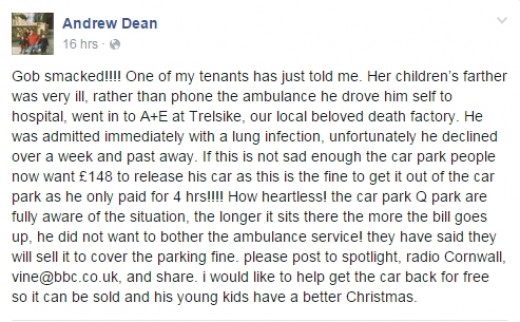
Dead Man’s Family Threatened With Sale Of His Car if They Don’t Pay Fine To Remove It From Hospital Car Park

December 16, 2015

Spotted here.

carparkfine


Anna White- Left Locked In After Appendix Surgery Went Wrong

December 15, 2015

Anna White was a determined, outgoing 15-year-old with ambitions to become a midwife when she was admitted to the Royal Albert Edward infirmary, Wigan, for appendix surgery in 2011. But despite the routine nature of the procedure, the teenager was left unable to walk or talk after her brain was starved of oxygen due to complications following the surgery.

Now 19, White requires round-the-clock care and communicates by looking at letters on a board to spell out words. Her intellectual capacity is unimpaired but doctors say she faces being “locked in” her body for the rest of her life.

Speaking exclusively for a film made by the Guardian from their home in Wigan, her mother Donna White described Anna as a typical teenager before the surgery. “She was sporty. Loved her life. Very outgoing, very glamorous, very determined.” She was once a keen gymnast and karate brown belt before her surgery in September 2011.

The operation appeared to go well, but in recovery Anna suffered a cardiac arrest and stopped breathing. The lack of oxygen moving to her brain caused serious damage, leaving her with profound disabilities.

The Wrightington, Wigan and Leigh NHS foundation trust, which manages the hospital, has since admitted that the tube delivering anaesthetic to Anna was not flushed out after use and a small dose of the drug was left inside it. When fluids were administered to Anna following the surgery through the same tube, the remaining anaesthetic was inadvertently delivered into her body, causing her to suffer a sudden respiratory arrest and cardiac arrest.
Advertisement

Donna noticed Anna was convulsing in recovery. “I asked the nurse what was wrong and why she was twitchy. She asked me to go for a cup of tea. When I was walking back to the ward the anaesthetist ran past me,” she said. “I didn’t know what was wrong. I think it was the third person afterwards who told me she had had a cardiac arrest.” The Whites say they were only told of the reason for Anna’s injuries after she had been in hospital for over five months.

Anna says she often thinks about what would have been had the mistake not occurred. “I would be living my life,” she spelled out, using eye movements. She is now unable to get out of bed or move from her wheelchair without specialist equipment, and cannot wash or feed herself unaided. Donna has had to give up her work as a cleaner to provide her daughter with the care she needs. “It’s like having a newborn baby. Everything a newborn baby needs, that’s what I do now,” she said.

The Care Quality Commission (CQC) visited the Royal Albert Edward infirmary in the months following Anna’s surgery hospital because they “… had concerns about some serious incidents that had happened within the operating theatres.” In a report released in November 2012, they wrote: “These incidents occurred because internationally recommended checklists were not being completely followed on some occasions. We found that systems had improved within the operating theatres where the serious incidents had taken place. However, some theatre staff told us that they did not always get the required level of support from some of the surgeons.”

Since then, the CQC has reported significant improvements at the infirmary although recent monitoring on the hospital, from May 2015, found that there was an elevated risk of “never events” – serious incidents that are wholly preventable should guidance or safety recommendations available at a national level be implemented.

“Anna’s case is heart-rending because it was a simple mistake but it brings such devastating consequences for her,” said Brendan Hope, a criminal negligence specialist at law firm Slater and Gordon, who is representing the Whites in their case against the trust. “Anna has some help from the local authority but it’s just a few hours a day. The consequences of these injuries tend to fall on families. Donna has stepped up to the plate in this case, but it brings an awful lot of stress. It’s very important to have financial compensation so that Anna can have the care regime she needs.”

The Whites know that no sum of money will give Anna her life back. Asked what she misses most about her daughter before the surgery, Donna immediately replied: “Her voice. Even if it’s just telling me off for something or disapproving of something. Just her voice.”

In a statement to the Guardian, the Wrightington, Wigan and Leigh NHS foundation trust admitted that “the care it provided to Anna White fell below an acceptable standard, and has apologised unreservedly to Ms White for this. The trust has implemented a number of changes to eliminate the possibility of this type of failing occurring in the future.

“Given that legal proceedings in relation to this care are ongoing, the trust is unable to offer further comment at this stage.”

Stephen Smith- Took Own Life After PIP Refusal

December 15, 2015

A 50-year-old man from Leiston with a history of anxiety took his own life after changes to his benefits left him unable to cope, an inquest heard yesterday.

 
 Stephen Smith, of Seaward Avenue, took his own life on January 17 this year, following a long period of mental health problems.
 Changes to the benefits system in June last year meant that Mr Smith was invited to submit a Personal Independent Payment (PIP) claim, as his disability allowance was about to expire.

But after the Department of Work and Pensions ruled that he was ineligible, Mr Smith and his partner Lucy Stewart, who was also on benefits relating to a learning disability, saw their weekly total cut by £137.55, and left the 50-year-old in depair over his financial situation.

However, a follow-up call from the DWP explaining its decision did not take place, prompting Mr Smith to send a formal letter to reconsider the assessment in November with the help of the Disability Advice Centre..

A second error at the DWP in December resulted in Mr Smith’s details being updated, before his appeal was mistakenly closed down before it had been labelled for reconsideration. The DWP in its statement said it admitted that errors had been made.

At the inquest in IP-City Centre Ipswich yesterday, Miss Stewart’s father David said the ensuing anxiety and reduced payments were the triggers for Mr Smith’s suicide.

The inquest also heard that Mr Smith had begun mental health treatment in 2000 after the death of his mother, but had been stable in recent years before anxiety over his benefits caused his symptoms to become worse.

Assistant coroner Nigel Parsley said: “I do find it a truly tragic case. Lucy was a real positive factor in his life and that kept him on an even keel for a considerable part of the time, but I cannot ignore the fact that he suffered from mental illness and had admitted suicidal thoughts.”

A conclusion was recorded that Mr Smith had taken his own life.

Mr Parsley added that while the DWP had admitted to errors, they were mistakes in procedure and were not a breach of its legal duty.

At the inquest, Mr Stewart said that Mr Smith’s anxiety and reaction to change meant he was unable to cope with the changes.

“For Stephen in his condition he could not understand there were savings he could make, things were very distressing,” he said.

The DWP confirmed that the follow-up calls no longer take place, and a retrospective review after Mr Smith’s death revealed no change in its decision.

Sanctioned Because Dying Grandad Was ‘Not Immediate Family’

December 14, 2015

sanction1

Macdonald Hotel Held Christmas Event For Beach Wheelchair Charity

December 14, 2015

A press release:

Macdonald Marine Hotel & Spa in North Berwick has hosted a festive fundraising event to help raise money for the East Lothian based Beach Wheelchair charity on Sunday 13 December.

More than 85 guests attended the glittering event held in the hotel’s luxury Bass Rock Suite which has spectacular views over the championship golf courses and across the sea to the Kingdom of Fife. During the champagne reception guests were able to take a closer look at one of the specially modified wheelchairs which can be taken on wet or dry sand allowing those with certain mobility issues to get better access to the beach. Diners were treated to a three course Christmas dinner with all the trimming prepared by the hotel’s chefs.

Macdonald Marine Hotel & Spa has been supporting the Beach Wheelchair charity since it was established in July 2014. The charity was set up by Alison Brown and Jackie Tagg both from East Lothian who wanted their family members with mobility issues to enjoy the stunning North Berwick beach. Since then, the charity has quickly grown with more than 60 hires of their wheelchairs.


Macdonald Marine Hotel & Spa Managing Director Grant McKenzie said: “The Beach Wheelchair event was a resounding success with many guests still enjoying the music until well after midnight. We are really pleased to support the work Beach Wheelchairs does for those with disabilities in East Lothian and we are aiming to continue this important partnership at events already in the diary for 2016.”

Co-founder Alison Brown said; “We have been overwhelmed by the support and encouragement of the local community in North Berwick, especially the team at Macdonald Marine Hotel & Spa.” Jackie Tagg, co-founder, added; “We are now supporting other communities in Scotland to develop their own beach wheelchair scheme.”

Macdonald Hotels & Resorts will be celebrating its 25th anniversary over 2015 and 2016, and operates over 40 hotels across the UK and ten resorts in both the UK and Spain.

ISIS Orders Killing Of Children With Downs Syndrome

December 14, 2015

This is absolutely sickening.

Vile ISIS terror thugs have issued a fatwa to kill babies and children with Down’s Syndrome, it has been reported.

Iraqi activist group Mosul Eye says the ISIS Shar’ia Board issued a savage “oral fatwa (an Islamic term for a religious decree)” to its members authorising them to “kill newborn babies with Down’s Syndrome and congenital deformities and disabled children”.

If true – and reports from the war-torn region are difficult to verify – it means ISIS has taken a leaf from the Nazis, who murdered disabled children it perceived to be a “burden on the state”.

Mosul Eye monitored the deaths of children with Down’s Syndrome and other congenital deformities and discovered the fatwa was issued by one of Islamic States’s Shar’ia judges, a Saudi judge named ” Abu Said Aljazrawi.

Their information indicates that most of the children born with Down’s Syndrome are those of foreign fighters who married Iraqi, Syrian and Asian women.

The activists recorded more than 38 confirmed cases of killing babies with congenital deformities and Down’s Syndrome, aged between one week to three months. They were killed by either lethal injection or suffocation.

Some of those killings took place in Syria and Mosul.

A statement from the activist group said: “As if it is not enough for ISIL (another name for ISIS) to kill men, women and the elderly, and now, they kill children.”

One Facebook user said: “I have just shed tears for these babies. I have two children with special needs, my heart is breaking.

“They are worse than the Nazis.”

The Department for Work and Pensions don’t know what their ethical and safeguarding guidelines are but still claim they have some

December 14, 2015

Kitty S Jones's avatarPolitics and Insights

dc308-media_http1bpblogspot_yzchdI have recently written quite extensively about problems with how the government conduct “research,” I’ve also highlighted the many official rebukes the Conservatives have faced because of their tendency to invent statistics to “verify” their ideologically-driven, value-laden “hypotheses.”

Who could ever forget the Department for Work and Pension’s fake testimonials from fake benefit claimants telling us all how fakely beneficial the fakesters had found having their fake lifeline benefits withdrawn for fake non-compliance, leading to fake improvements of behaviour, presumably after a bout of fake starvation and destitution.

The new Work and Health Programme, aimed at reducing the number of people claiming Employment and Support Allowance (ESA), is currently still at a (fakery) research and trialing stage. Part of the experimental nudge element of this research entails enlisting GPs to “prescribe” job coaches, and to construct  “a health and work passport to collate employment and health information.” …

View original post 876 more words

ESA Assessors Forced To Retrain If They Find Too Many People Unfit For Work

December 14, 2015

An important feature, spotted here.


  • Mental health sufferers assessed by physiotherapists
  • Assessors forced to retrain if they pass too many people
  • “Rude” assessors ignoring government guidelines
  • Over half of all initial ‘fit-for-work’ decisions appealed against are being overturned

My doctor knows my situation. My bones are crumbling, like arthritis. That only started when I began to lift the heavy things at M&S.”

Barbara Johnson, 52, lives alone on Colehill Road, Fulham. Her medical problems began after a botched operation on her right foot in 2006. She can now barely walk, due to numbness that has spread up her calf.

This has caused her to collapse in the street several times. “They’ve had to take me straight to hospital,” she says.

Incredibly, Barbara was declared “fit-for-work” by an independent assessor in 2011, despite sending doctors’ certificates to the Department for Work and Pensions. Her Employment and Support Allowance (ESA) was cut, leaving her with no income, without notice.

The DWP forced her to take a work placement at M&S: “I was carrying heavy trays that didn’t have handles — I had to bear the weight on my hands. My right side is so weak, yet they just wanted to put me in the workplace”, she says.

As well as aggravating her feet problems, the placement caused permanent damage to her wrists, for which she now requires steroids.

Her problems did not end there. When I met her in late October, her ESA had just been stopped once again.

How was Barbara declared fit-for-work, when her doctor and GP observed that she was not? How could she receive ESA one month, then be “fit-for-work” another?

Moreover, why are society’s most vulnerable still at the mercy of what has been criticised as an unpredictable and erratic assessment process?

These questions are as relevant as ever. In August the Department for Work revealed that, in 2012–14, 2,380 people had died shortly after being declared “fit-for-work”.

For the 8,000 Hammersmith and Fulham residents like Barbara— and the many more across the country — dependent on Employment and Support Allowance for survival, repeated assessments, rudeness from assessors, and the threat of benefits being withdrawn without notice, have been the norm for many years.

Applying for Employment and Support Allowance — which has been phased in to replace Incapacity Benefit, and Severe Disablement Allowance since 2008 — can take months.

After filling in the “ESA1” claim form, applicants are usually given the basic allowance of £73.10 per week until they complete the process.

The next step is the ESA50 medical questionnaire. Tom Kenny, who works for Action on Disability in Fulham, has helped thousands of prospective claimants with the form. “It’s not fit for purpose,” he says.

The ESA50 asks 18 questions split into Physical, Mental, and Eating and drinking capabilities. It also states a list of “Things we’d like to see, if you already have them”, including GPs’ and doctors’ reports and medical scans. “Don’t ask or pay for new information,” it stresses.

Critics argue that this deceives claimants into thinking that they stand a chance without including medical information. Tom Kenny finds this particularly misleading: “We would never send off an ESA50 without medical evidence, and we also do a covering letter. We have a high success rate with them but that’s only because of the time we put into them.”

After the ESA50, most claimants attend a face-to-face “Work Capability Assessment” (except in extreme circumstances, such as terminal illness — although in 2012, a man with terminal brain cancer was deemed “fit-for-work”). The assessor sorts claimants into “fit-for-work”; “fit for work-related activity”; or fit for neither (the “Support Group”).

The face-to-face assessment is the most controversial part of the process. French firm Atos held the contract for the assessments from 2008, but walked away in 2014 after “negotiations” with the DWP. They had become one of the most hated companies in Britain; employees received death threats.

American firm Maximus took over from Atos in March 2015. They refused to acknowledge my request for comment.

There have been plenty of shocking stories about the face-to-face examinations, and one case that Kenny dealt with springs to mind:

“We had a young man who was examined at home because they accepted that he was too ill to travel to the assessment centre. He had a commode, and was in a wheelchair. Yet they turned up at his house and failed him.”

The face-to-face assessment is supposed to test 17 areas of physical and mental capability. For each question, the claimant earns zero, six, nine, 12, or 15 points — the fewer the points, the “fitter-for-work” the claimant is.

Given that the face-to-face test is supposed to test actions performed in the workplace, its format is alarmingly basic.

One of the questions asks if the claimant “Cannot raise either arm as if to put something in the top pocket of a coat”, for 15 points. Kenny explains: “Even the most severely disabled person can do that. What they don’t take into account is, can they do it repeatedly, all day long.”

A doctor, nurse, or physiotherapist will conduct the test. However, Kenny informs me that it is not uncommon for someone with a mental health problem to be assessed by a physiotherapist:

The lack of understanding of mental health has recently come into focus. In November, Oxford academics found evidence to suggest that every 10,000 Work Capability Assessments leads to about six suicides. The tests were also declared responsible for 279,000 extra cases of mental ill-health.

Francois Greeff, 56, suffers from bipolar disorder, attention deficit disorder, and autism. After spending four years on the streets of Hammersmith and Fulham, he now runs a charity, “Good4You”, devoted to helping disabled homeless people.

He recalls his 2011 assessment: “The guy said: ‘Do this [raise your arms], stand up, read the wall chart. You’re fit-to-work.’ I explained that I am bipolar, which he should have known if he read my medical records.

Firstly, the rudeness that Francois experienced is not uncommon. Barbara Johnson recalls being told that if she didn’t answer correctly, “you’re going to regret it.”

Secondly, mental illness simply should have been considered in the questions that Francois was asked.

A 2011 Statutory Instrument defines the prescribed structure of the test. For instance, section 12 states that having a “Reduced awareness of everyday hazards” which “leads to a significant risk of injury to self or others”, should earn the claimant 15 points.

In his current home in Merton, Francois points at his smoke alarm, which he has permanently disabled. “It’s kinder on the neighbours. I would leave something cooking and it would start smoking, and the alarm would go off. I’d just get distracted from cooking. That’s ADD (Attention Deficit Disorder).” Yet Francois’s assessor refused to consider this very real hazard to his daily life.


Why aren’t assessors following the guidelines laid out to them? For Tom Kenny, the problem is twofold: “Firstly, even qualified doctors aren’t following the guidance from the DWP.

“Secondly, there’s a subconscious culture of bashing benefit claimers.”

How does this culture manifest itself? “There’s no way that the DWP can say that they’ve got quotas of how many people they can pass. What we do know happens is that if an assessor is passing too many people, they go through a retraining period.”

Has this culture changed at all since Maximus took over from Atos? Although the DWP is publishes figures on the assessments, there is a nine-month backlog of information due to “processing of data”; the latest numbers are for ESA claims between January-March 2015. This means that there is no new data that enables us to compare Maximus’s pass rates to Atos’s.

The existing figures do reveal a sharp rise in successful tribunal appeals. Since 2008, 37% of all fit-for-work decisions have been appealed against. In January-March 2015, 54% of fit-for-work decisions that were appealed were overturned, compared with 37% in April-June 2013 — equating to an enormous number of wrong decisions.

Even at the tribunal, though, assessors have no accountability for their incorrect decisions. To Tom Kenny, changing this would present something of a solution.

“If doctors, nurses and physiotherapists could be brought before a judge to explain and justify their decisions, it would change the system radically.

“As far as I know, though, there are no plans to do this.”

What’s more, the benefits department of Kenny’s charity — Action on Disability – is in danger of closing before January, having not received funding from Hammersmith and Fulham council in six years. Residents will likely lose one of the few sources of support to guide them through the ESA process.

When I went back to see Barbara in November, she explained that her ESA had been resumed again, but now they were refusing to reimburse her for her month without benefits.

Reflecting on her perpetual difficulties with medical assessors, she insists: “I don’t keep having these problems because I’m particularly spiteful. I’m just angry that they’ve taken no responsibility. No care. No concern. Nothing.

“I thought they were meant to be doctors”, she says.

American Horror Story: Freak Show Actress Rose Siggins Dies Aged 43

December 14, 2015

Rose Siggins, an actress who played a character with no legs in the US hit show American Horror Story, has died at the age of 43.

Siggins, who was born with a rare genetic condition which causes abnormal fetal development of the lower spine, had her legs amputated at a young age.

She played a character called Legless Suzi in the fourth series, Freak Show.

The FX network paid tribute to Siggins calling her “a kind person, a loving mother and a very talented actor”.

Her co-star Sarah Paulson tweeted: “The AHS family lost one of our own… Rose Siggins was an absolute light… I will never forget your laugh or your beautiful eyes.”

The actress died in Denver, Colorado on Saturday. Her agent, James Mullen, said more details would be released soon. She leaves two children.

‘Beloved’

Actor Denis Hare pointed followers in the direction of an online fund set up to help Siggins’ children.

The FX statement added: “She was beloved by everyone in the AHS family.

“Our thoughts and prayers are with her family and friends at this time.”

American Horror Story: Freak Show – set in one of the last remaining freak shows in the US and following its attractions’ struggle for survival – earned 20 Emmy nominations, including outstanding limited series.

The current series, Hotel, has been nominated for two Golden Globes, including an acting nomination for pop star Lady Gaga.

London Commuters Stare At The Bear In The Wheelchair

December 12, 2015

From BBC Ouch:

A short tale to follow on from last week’s Christmas show. When 12-year-old Summer travelled home after being in the Ouch studio, she was carrying a bear in a wheelchair given to her as a present.

The next day her mum called to tell us about the unusual reactions they got to the disabled cuddly toy. They were both quite surprised. Summer’s mum Cherie tells more.

Success Rate For PIP Appeals Rises To 60%

December 11, 2015

With many thanks to Benefits And Work.

The proportion of personal independence (PIP) appeals that are won by the claimant has risen to 60% according to the latest official figures. The number of PIP appeals is also increasing rapidly.

The appeal statistics for July to September 2015 show that PIP appeals now account for 38% of all social security appeals. The number of PIP appeals has been steadily increasing – from 2,145 in July to September 2014 to 13,568 in the most recent quarter.

Employment Support Allowance (ESA) accounted for 36% of the total social security appeals lodged in July to September 2015 and saw a 26% increase from 10,357 in the same period in 2014 to 13,020 in the current quarter.

The success rate for social security appeals varies widely depending on the benefit.

58% of ESA cases are won by the claimant, 55% of DLA cases, 40% of Job Seekers Allowance cases and 24% of Housing/Council Tax benefit cases.

PIP claimants won in 60% of cases from July to September 2015, up from 56% in the previous quarter.

The proportion of successful PIP appeals has increased with every quarter since the benefit was introduced.

You can download the latest PIP appeal statistics from this link.

Vouchers May Replace Some PIP Payments As DWP Tries To Cut PIP Claimants By 35%

December 11, 2015

With many thanks to Benefits And Work.


The DWP has today launched a consultation aimed at slashing the number of people eligible for the daily living component of personal independence payment (PIP) by up to 35%. The cuts will be aimed at claimants who qualify for PIP because of their use of aids and appliances and may include replacing awards with discretionary voucher payments.

The press release and consultation document published today claim that 35% of all daily living allowance awards are based solely on the claimant’s need to use aids and appliances.

In addition, the DWP points out that recent upper tribunal decisions have found that a bed, for example, can count as an aid or appliance if a claimant needs to sit on it in order to get dressed.

The DWP argues that the use of readily available or low cost items as aids or appliances isn’t a reliable guide as to whether a person has to meet additional costs because of their disability. As a result the department has launched a brief consultation, ending on 29 January 2016, to decide whether and how to change the system.

The five possible options
Five possible options for change are listed in the document:

1 A lump sum paid to claimants who score all their daily living points from aids and appliances. This could be discretionary and its use limited through the use of vouchers. The awards could be periodic, in order to cover the cost of replacing aids or appliances. It would not passport to other benefits or premiums and would not exempt claimants from the benefits cap. Claimants scoring at least some points from other descriptors would be paid at the relevant weekly rate, as now.

2 A lower monthly payment for claimants who score all their daily living points from aids and appliances. It would not passport to other benefits or premiums and would not exempt claimants from the benefits cap. Claimants scoring at least some points from other descriptors would be paid at the relevant weekly rate, as now.

3 A new condition of entitlement that claimants must score some points from a descriptor that

does not relate to aids and appliances. Claimants scoring at least some points from other descriptors would be paid at the relevant weekly rate, as now.

4 A change to the definition of aids and appliances to exclude any that the DWP does not consider are a good indicator of additional cost and need. Claimants who use aids and appliances that are a good indicator of extra costs would be paid at the relevant weekly rate, as now.

5 Halving the number of points that can be scored for the use of aids or appliances from 2 to 1 for some or all daily living activities.

Current claimants
The current PIP eligibility rules will continue to apply until any changes are made.

The consultation document also states that current claimants will not be affected immediately. However, when their award comes up for review or a change of circumstances is reported, then they will be covered by any new rules.

In addition, the DWP have made it clear that they intend to regularly review and cut eligibility to PIP to ensure that it is ‘financially sustainable’ in the future.

How to take part
If you wish to take part in the consultation, you can send your response to:

PIP.consultationfeedback@dwp.gsi.gov.uk

Or write to:

PIP Policy Team
Department for Work and Pensions
Ground floor, Caxton House
Tothill Street
London
SW1H 9NA

Your response needs to reach the DWP by 5pm on 29 January 2016.

You can read the PIP consultation press release here.

You can download the PIP consultation document here.

Government plans to change the point system for those applying for PIP. 

December 11, 2015

Charlotte Hughes's avatarThe poor side of life

The Government would like to make it even harder for those who want to claim PIP. PIP has replaced DLA and people claiming DLA are now being shifted over to PIP. If you have received your notification of change then you must apply for PIP within the 4 weeks stated. If you don’t your money will stop.

Now applying for PIP isn’t easy. The form is very long and repetitive and I can’t stress enough that you should always get help when filling this form in. It’s very easy not to fill it in correctly and sadly that’s what this government want you to do.

The governments plans to change their point system is unfair. They want to basically cut the points for “aids”. An aid can be a stair lift, a handle at the side of a toilet to help you stand up, a seat that you sit on…

View original post 363 more words

Disabled Model Chelsey Jay Left ‘Humiliated’ By Lack Of Wheelchair Access At Clothes Show Live

December 11, 2015

A disabled model has criticised one of the UK’s leading fashion events after its lack of disabled access left her “humiliated”.

Chelsey Jay, who has Postural Orthostatic Tachycardia Syndrome and uses a wheelchair, was denied the chance to speak at a Clothes Show Live seminar when the event’s organisers provided no facilities for her to access the stage.

The 24-year-old from Essex, who campaigns for diversity in the fashion industry, was promised a place at one of the event’s seminar panels to discuss the issue of disability inclusion in fashion.

According to Ms Jay her position on the panel came after over a year of communication with the Clothes Show Live over the fact they employed no models with a disability.

Ms Jay said organisers at the event initially ensured the stage she would be speaking from had “a bit of a step” and would organise a ramp if needed.

She was confronted, however, with a stage at least “15 inches high” and “no was ramp provided”.

Ms Jay added the seminar room was “chaos” and people from the panel had already begun speaking 10 minutes early without her.

Ms Jay said: “I was not happy that I hadn’t been notified that they were starting early and that now I would be interrupting a room full of strangers and they would all be sat in silence seeing me pushed up a ramp onto the stage.

“I thought I was going to have a panic attack. I felt sick. I couldn’t believe it. I am so humiliated and feel like a fool.”

“I thought the Clothes Show was genuine in their intentions for wanting to reach out to Models Of Diversity but they were not.”

“The fact that I was there to talk about disability inclusion in fashion, at a fashion event that excluded me, is laughable, but it’s not a joke, it’s real life, and a reality to so many disabled people every single day.”

Ms Jay has been campaigning with Models of Diversity – a groups advocating disability rights in the fashion industry – since she suddenly become disabled four years ago. 

She is currently helping to launch a petition calling for a ban to employment discrimination on the grounds of disability.

The Clothes Show have since apologised to Ms Jay for any distress she may have been caused.

A statement from the event said: “The Clothes Show invited Chelsey Jay to this year’s event as a guest, and due to genuine human error the access that she required to take part in our seminar was not made available on time.

“The Clothes Show has written both privately and publicly to apologise for any distress this has caused and have tried to speak to both Chelsey Jay and Models Of Diversity to apologise in person, however they will not take our calls.

“Although The Clothes Show 2015 closed its doors just 2 days ago, conversations started several months ago to review how the show can be even more inclusive, however it is too early to announce our plans for 2016.”  

The Disability Hairdresser

December 11, 2015

Liz Stewart used to have such problems getting her son Delroy to have a haircut that she ended up cutting his hair while he slept.

“I’d get too stressed with it,” says Delroy, who is now 22 and has Down’s syndrome.

Liz realised there weren’t any hairdressing salons in Wales suitable for Delroy, but also she was also concerned about the difficulties he was having finding a job.

So she came up with the idea of opening a salon for people with additional needs to get their hair cut in a low-stress environment.

It seems that customers are appreciating the environment that doesn’t have pictures on the walls, loud music and where the usual salon noise of hairdryers is kept to a minimum. 

ESA Repeat Assessments To Begin Again From 1 December

December 10, 2015

Many thanks to a number of members who pointed out this post on the Rightsnet forum:

“This has just come through from operational stakeholders –

“We wanted to update you on a recent decision by DWP to start to refer some people for repeat Work Capability Assessments from 1 December 2015. As you are probably aware, in January 2014 a decision was taken to suspend the referral of routine repeat assessments (apart from people who felt that there had been a change in their condition that might have led to an increase in their benefit).

“Centre for Health and Disability Assessment (CHDA) began delivering the Work Capability Assessments on behalf of the Department in March 2015 and there is now capacity to start to conduct some repeat assessments alongside new claim assessments. The Department is committed to continuously improving the Work Capability Assessment and will monitor the situation closely.

“There are no changes to the Work Capability Assessment process, however, some people will now start to be called in for reassessment to ensure they are receiving the appropriate rate of benefit and support to return to work where appropriate. DWP wanted to make you aware of this operational decision so that you are able to continue to provide the most appropriate support to the people you represent.”

We don’t have any further details as yet, but we’ll keep you posted.

Wythenshawe Jobcentre Closed After Break-In And Fire

December 10, 2015

Wythenshawe ’s Jobcentre has been closed after arsonists broke in and torched the building – with nearly 2,000 benefits claimants affected.

Firefighters were called to Simon House on Wavell Road on Saturday evening after reports of smoke and flames coming from the first floor.

Police closed off the street and part of nearby Brownley Road as crews tackled the blaze at around 10pm.

It is understood the building was broken into, before a fire was started on the first floor.

The entire first floor, where up to 50 staff work, was destroyed – meaning officials have had to urgently scramble to send staff to other centres.

Windows and walls were left charred after the flames ripped through the building.

A spokeswoman for Greater Manchester Fire and Rescue Service said three fire engines were sent to the site, with crews tackling the flames for three hours.

A joint investigation with police has been launched, with the blaze being treated as arson.

Almost 2,000 benefits claimants will have to go elsewhere for face-to-face help, with staff also having to redeployed to alternative sites across the region.

A Department for Work and Pensions spokeswoman said the first floor of the building was destroyed – and that the building had to be cleared on Monday.

The ground floor was left with considerable water damage after the sprinkler system was activated.

The Jobcentre, which serves 1,937 benefits claimants, will be closed ‘for the foreseeable future’, according to Department for Work and Pensions chiefs,

It is understood some outreach work will taken on by eight staff already based at nearby Wythenshawe Forum.

Only a ‘limited’ amount of work will be taken on by staff there, however.

Around 50 staff from the Jobcentre deployed to other nearby sites, wherever they can be accommodated.

People will still be able to access telephone and online services.

If Jobcentre staff need to see a claimants face-to-face, appointments will be made at other nearby facilities.

It is not yet known the extent of damage to claimant records and Jobcentre data.

The damage will be assessed as police and fire chiefs continue their investigation.

Wounded British soldier shuts up anti-Muslim racists with epic message

December 9, 2015

Tom Pride's avatarPride's Purge

GET A GRIP

Chris Herbert was serving in Iraq when his right leg was blown off by a roadside bomb.
Here’s what he has to say about anti-Muslim racism:

Getting frustrated by some people expecting racism from me, because I got blown up. Yes. A Muslim man blew me up, and I lost my leg.

A Muslim man also lost his arm that day wearing a British Uniform.
A Muslim medic was in the helicopter that took me from the field
A Muslim surgeon performed the surgery that saved my life
A Muslim Nurse was part of the team that helped me when I returned to the UK
A Muslim Healthcare Assistant was part of the team that sorted out my day to day needs in rehabilitation when I was learning to walk
A Muslim taxi driver gave me a free ride the first time I went for a beer with my Dad after…

View original post 216 more words

Children’s Charity Backs Lords Bid To Overturn Baby Benefit Bar

December 9, 2015

A press release:

Major UK children’s charity, Together for Short Lives, has lent its support to peers’ bid to change the law to give seriously ill babies and young children access to a vital benefit which would help them leave their home or hospital bed.

On Wednesday (9 December), the House of Lords will debate an amendment to the Welfare Reform and Work Bill to give families of babies and young children who depend on bulky medical equipment access to the mobility component of the disability living allowance (DLA). Many of these families are currently unable to afford the specially adapted vehicles they need to transport their children and their big and heavy buggies and equipment – meaning that these children are effectively spending their last days unnecessarily trapped in hospital or at home.

Under current government rules, only children over the age of three can access the most generous form of mobility support (the ‘higher rate’) worth £57.45 a week. This is because ministers do not believe that it is possible to tell whether children under the age of three are unable to walk as a result of a disability.

The amendment – tabled by Labour work and pensions spokespeople Baroness Sherlock and Lord McKenzie – would benefit the 1,500 babies and young children in England alone who need to be attached to ventilators and other vital equipment. Transport ministers have already recognised these families’ special mobility needs and have extended the eligibility criteria for blue parking badges to them.

Barbara Gelb OBE, chief executive of Together for Short Lives said:

“Peers have an opportunity to give an amazing Christmas gift to families of babies and young children who are likely to have short lives – the precious gift of being able to show their child what life is like outside of their own home or hospital bed.

“Many babies and young children who depend on ventilators do not live long enough to pass the age threshold for the DLA set down by ministers. In the meantime, their pressing mobility needs go unmet. This means that things that even some families of older children with life-limiting conditions can do – such as going shopping or visiting family – are often beyond reach. It also means that babies and young children are being trapped in hospital beds unnecessarily because they cannot be transported home – an awful, inhumane situation for their families and a clear waste of taxpayers’ money.

“I recognise the difficult financial circumstances in which the government has to operate. However, rectifying this anomaly would cost just £4½ million per year. I cannot believe it was the intention of ministers to wilfully bar babies with short lives from this benefit and I hope that this amendment allows the government to address this oversight.”


How The DWP Will Make Sure Claimants Won’t Have A Happy Christmas

December 9, 2015

Manchester Airport Wins Loo Of The Year Award For Its Changing Places Facilities

December 8, 2015
A press release:

Manchester Airport has won a Platinum Award, for its Changing Places facilities, at the Loo of the Year Awards in the 2015 search to find the best ‘away from home’ toilets in the UK.

Secret visits were carried out by toilet-checking judges, and the airport’s Changing Places facilities in Terminals 1, 2 and 3 picked up the national award, with a five-star rating.

At an investment of £235,000, the newly installed facilities have been designed to meet the needs of passengers who have profound and multiple learning disabilities (PMLD) and other passengers with severe disabilities who need the support of at least one carer, providing them with a safe and easy toilet facility to use when travelling through the airport.

Clos-o-Mat has provided the equipment for the Changing Places which includes features such as a height-adjustable changing bench, an overhead track hoist; a peninsular toilet, privacy screens and increased space, giving passengers and their carers the facilities they require.

The annual Loo of the Year Awards started in 1987 and are recognised as standard setters for all those who provide ‘away from home’ facilities for staff, customers and visitors.

Over 1,000 entries were received this year and every entry receives unannounced visits from an authorised Loo of the Year Awards Inspector and was assessed against 100 judging criteria – including signage and décor, fixtures and fittings and overall standards of cleanliness and management.

A Manchester Airport spokesperson, said: “We are delighted with this award as it is an important recognition of the high standards we demand and is testament to the hard work of all of the unsung heroes who help to keep the airport clean and keep our customers happy, which is our number one priority.”

Access to the Changing Places is provided via the telephone next to each facility and is controlled by the Customer Contact Centre. To pre-notify the airport of a requirement to use the facilities, passengers or carers can contact the team on 0330 333 0304.  For more information, visit: www.manchesterairport.co.uk.

Hospital Apologises To Family Of Down Syndrome Man Andrew Waters For DNR Order

December 8, 2015

A hospital trust has apologised for placing a “do not resuscitate” (DNR) order on a patient with Down’s Syndrome – and listing his learning difficulties among the reasons for doing so.

The family of Andrew Waters was not consulted or informed and found out only after he was discharged from hospital in Margate, Kent, in 2011.

East Kent Hospitals NHS Trust has admitted breaching his human rights.

Mr Waters died in May, aged 53, but the order did not have a bearing.

His family has never sought compensation over his death.

However, BBC News can report the case surrounding the DNR order after getting a court order protecting Mr Waters’ anonymity lifted, with the consent of his family.

Mr Waters loved dancing, swimming and drama groups.

His family were horrified when, during a hospital stay related to his dementia, staff decided he should not be resuscitated if he developed heart or breathing problems.

The order listed Down’s Syndrome and his learning difficulties among the reasons.

‘Disgraceful’

Andrew’s brother, Michael Waters, said: “For someone to make that decision, without consulting a member of the family or any one of his carers, was just totally unacceptable.

“No-one has the right to make such a decision in such a disgraceful way… to put those reasons down.

“We were there at hospital and involved in his care at every point.

“The form was a folded-up piece of paper found in his bag after discharge, by his carers.

“There was nothing wrong with Andrew’s health at the time which would have had an effect on resuscitation.”

The Waters family have welcomed the trust’s admission that it breached his human rights.

Michael Waters added: “It’s taken a long time for the hospital to admit this, which we’ve found hard.

“All we ever wanted from this case was a simple apology.

“People with Down’s Syndrome deserve the right to live like you and me.”

‘Unreserved apology’

In a statement, East Kent Hospitals University NHS Foundation Trust said: “The trust accepts that it breached its duty owed to the patient.

“We apologise unreservedly for this and the distress caused.

“Actions have been taken to ensure this does not happen again and the trust has now reached a resolution with the family.”

The lawyer who brought the case says trust breaks down between doctors and families if the reasons behind resuscitation orders are not communicated effectively.

Merry Varney, a solicitor with Leigh Day, also fought the case of Janet Tracey, which established last year that doctors had a legal duty to consult and inform patients about DNR orders.

She said: “Sometimes they can be really aimed at trying to give a patient a dignified death.

“This is not about giving up on someone or writing them off.

TV dramas

“But that’s generally what I hear people say they feel, if they find out about these after the decision has been made.

“I still receive around three calls a fortnight from families or patients who are concerned about what a DNR means and whether it means not to treat more generally.

“Unfortunately, the portrayal of cardio-pulmonary resuscitation in TV dramas sometimes suggests it’s a quick fix and works for everyone.

“That’s simply not the case – and there’s a real onus on healthcare professionals to communicate that.”

‘Scandal’

The learning disability charity Mencap described Andrew Waters’ case as “unacceptable”.

Its head, Jan Tregelles, said: “Many families who have lost their loved ones to poor care within the NHS have told us about the inappropriate use of DNR.

“There have been circumstances where these notices have been applied without the knowledge or agreement of families.

“And the orders have also been applied hastily, in inappropriate situations, solely on the basis of a person’s learning disability.

“This highlights the failures of care that are a daily reality for many people with a learning disability trying to get access to good quality healthcare.

“1,200 people with a learning disability are dying avoidably in the NHS every year.

“The Government must take action to ensure that people with a learning disability get the right healthcare within the NHS and put an end to this scandal of avoidable deaths.”

Guardian Children’s Books Are Having A Disability Diversity Day

December 8, 2015

I love that publication!

Here is a brilliant article by The Book Addicted Girl where she links to what is to come for the rest of the day.

Disability Related Children’s Books That Should Be Available In English

December 8, 2015

As someone who has always wanted to see more books featuring disabled main characters anywhere and everywhere, I sincerely thank the Guardian for putting this list out there.

Sensitive Santa Spoke Sign Language To Child On Saturday In Middlesborough Shopping Centre

December 8, 2015

We must thank him for his sensitivity. If only all Santas knew how to speak sign language, or communicate in other accessible ways with children without speech!

Buying A House When You’re Disabled

December 8, 2015

Disabled people’s income can be low or vary wildly depending on health. This can make buying a home, and the accessibility that brings, difficult.

For many disabled people, living in accessible accommodation is important and key to quality of life. It’s sometimes hard to achieve this if you rent, whereas if you own your own home, you can ensure the environment is as you need it. But house-buying is a huge financial step and can come with complications.

When buying property, mortgage lenders will tell you how much they are prepared to loan you based on your income and financial history. But those with a disabling condition which fluctuates from good to bad may unhelpfully have an income which fluctuates along with their health. Some banks allow you to declare welfare benefits as income, but if you go through a good patch or if rules about entitlement change, you might find your benefits disappear. All this makes it difficult to demonstrate a stable income, meaning the bank don’t have the confidence to loan you much money and you find it hard to buy a house.

Deborah Kelly and her husband Stephen bought a house in Suffolk last year. They’re both disabled and unable to work, but managed to make the purchase using a scheme called HOLD, which enables disabled people to buy through shared ownership – they own a portion of the house, and a housing association owns the rest. Each month, they pay a combination of interest-only mortgage, and rent.

Kelly feels incredibly lucky to have been able to do this but found the process very slow with lots of people involved. “There were an awful lot of forms. Lots of waiting on being given the go ahead.”

Before this, Kelly and her husband were dividing their time between their parents’ homes in Suffolk and Surrey. Neither find travel easy and it became a struggle.

As their income is solely from benefits, they have found recent welfare reform unsettling. “When the government’s shaking everything up, you can’t feel very secure,” she says. “I had been quite pessimistic, but now I’m more optimistic. We’re going to be all right.”

The couple have been living in their own home for a year and say they have “massive freedom” now.

A mortgage typically runs for over 20 years and some disabled people have to consider their impairment may deteriorate, meaning they won’t be able to work the same amount of hours as they once did. In usual circumstances, working fewer hours will lower the amount of money a person is able to earn. Income protection insurance sounds sensible in the circumstances, but it’s harder and more expensive to get if a customer has a pre-existing medical condition.

So what do you do? Most people would seek advice, but it’s not easy to find independent financial advisers who are familiar with all the foibles of having a lifelong impairment.

Aware of this gap in information, last month disability charity Scope launched a digital information hub to provide money management advice to disabled people, in conjunction with the Money Advice Service.

Though Deborah and Stephen found a way to get what they want, for disabled people who do work, it can be a struggle to find that kind of security.

Sarah Rigby, who lives in Liverpool, used to work as a physicist, but stopped four years ago when it became increasingly unsustainable. She experimented with working part time, but found herself exhausted. She was later diagnosed with Ehlers Danlos Syndrome, a genetic condition which affects her joints, leaving her tired and with limited mobility.

She now claims Disability Living Allowance for those extra costs of being disabled, but the household income comes entirely from her partner Carl, who is also a scientist. “I mind him paying for it all,” she says.

They have a joint mortgage, which remains affordable on a single income. “We were very cautious when we bought the house,” she explains. “We were both quite junior. We wanted a mortgage we could afford on a single salary.”

Rigby has recently been turning her mind towards the future and the fact her mobility is likely to decline. “Our house has no downstairs loo and there’s no room for a stairlift,” she says, adding that they will have to move in the next five years. “I know that need is coming and it makes me feel like a burden.”

Previous research from Scope shows that disabled people find it harder to obtain mainstream, affordable credit, and so are less likely to use any form of credit. But those that do are much more likely to get high interest loans like those from doorstep lenders.

Adding to an already complex picture, the charity also estimates that disabled people pay an average of £550 per month in extra costs such as transport and equipment in order to make their lives more accessible, and that benefits do not cover the whole of this cost.

Buying seems out of reach altogether for some disabled people, especially those with families.

Mary Hammonds from Warwickshire has ME, and has just had a baby. The new addition to their family meant Hammonds and her husband Steve needed to move to a bigger property, ideally a bungalow. She says it was tough to find one on the rental market – partly because of a shortage of bungalows and partly because those which are available are often restricted to older people.

“We can’t muster up the deposit for a starter home and then also the money to make it accessible,” she says.

For most of their relationship, her husband has been the sole earner. “Now he’s in his 40s and ineligible for any of the first time buyer assistance programmes, or a longer term mortgage,” says Hammonds. The costs that come with being disabled don’t help.

“We were getting close to a possible deposit, but £5,500 for the stairlift, £1,500 for the powerchair, £2,000 more than we might otherwise have spent on a second-hand car that’s big enough to carry two adults, one baby, one powerchair and ramps… see our savings vanish, and that’s even before we buy baby stuff.”

David Cameron, Are You Watching? #DisabilityLawChanger

December 7, 2015

Terrible please read. 

December 7, 2015

Charlotte Hughes's avatarThe poor side of life

I found this story on Facebook. It’s shocking but not unusual. Please read and share. I will keep the people concerned anonymous as always.

I am writing to let you all know that last night my brother ********was rushed to hospital after he collapsed in his home last night.

The hospital have said that ****** had been starving himself for over 3 weeks following losing his benefits to which he was found fit for work.

The doctor has stated that this has resulted in complications with his Diabetes that has triggered to his internal organs shutting down.

I have been told to expect the worse and that he may not pull through.

***** had kept quite that he had lost his benefits from me and his family which was rather stupid.

I have also been told that he had been taken advantage of by an neighbour who was stealing food…

View original post 28 more words

‘I WAS MADE TO FEEL A NUISANCE’ – LORDS TO HEAR WHAT IT’S LIKE TO FIGHT DISABILITY DISCRIMINATION

December 7, 2015

A press release:

 -Committee investigating Equality Act 2010 hears from disabled people and carers-
Next week, on Tuesday 8 December, the House of Lords Committee on the Equality Act 2010 and Disability will ask disabled people about their experience seeking justice against discrimination.

The Committee will quiz two couples who have had experience of trying to fight disability discrimination, from formal complaints procedures through to the Ombudsmen and the courts. The Committee will also hear from Carers UK, for their perspective on tackling discrimination.

One witness, Andrew Brenton, had to settle out of court following what he claims were repeated instances of disability discrimination by his university. In written evidence already submitted to the Committee, he said that after several attempts at seeking redress he was ‘made to feel like he was simply a nuisance’.

The witnesses, giving evidence at 3.45pm, are:

·    Emily Holzhausen OBE, Director of Policy and Public Affairs, Carers UK
·    Michèle Brenton and Andrew Brenton
·    Jeanine Blamires and David Blamires

Questions which the Committee will put to the panel will include:

·    Given your experiences, what changes would you like to see to the courts process when seeking justice?
·    Would you have preferred going to a disability ombudsman?
·    What is your experience of reasonable adjustments, and of forcing institutions to make changes?
·    How aware are you of the rights of carers under the Equality Act 2010?
·    Does the Act cater well enough for carers who are disabled?
·    Does the Equality Act 2010 need extra powers to safeguard carer-friendly public spaces and services?
The evidence sessions will start at 3.20pm, on Tuesday 8 December, in Committee Room 4a of the House of Lords.

University of Sheffield student with a rare condition shortlisted for national charity award

December 7, 2015

A press release:

A 20-year-old woman who is losing her sight and hearing, has been shortlisted for a national award by deafblind charity Sense in the category of ‘Young deafblind person of the year’ for being a champion for people with sight and hearing impairments.

Ellen Watson was born with hearing impairments, and then at 15 she began losing her sight and was diagnosed with Usher Syndrome, a rare condition that causes progressive sight and hearing loss. Despite the challenges her condition has presented Ellen has thrived, achieving excellent results in her GCSE’s and A Levels and is now studying at the University of Sheffield.

Ellen is a committed and inspirational campaigner and fundraiser for charities such as Sense and Guide Dogs, and she works hard to raise awareness of Usher Syndrome and deafblindness.  She also works as a Teaching Assistant with children with sight and hearing loss and has provided inspiration to many young people struggling to come to terms with their condition.

Commenting on her nomination Ellen said: “I feel really touched to have been nominated by my family and friends and then to have been shortlisted. It’s been a rocky four years since I was diagnosed, but thanks to amazing support from my family, my awesome mum, great friends and charities like Sense, it has not stopped me achieving what I set out to do.

“Being at uni in Sheffield, letting my hair down like any other 20 year old, having the freedom to do what I want on my terms, laughing and smiling are some of the things I will never take for granted, and will be forever grateful for. It is thanks to the tireless campaigning of charities like Sense that I have the opportunity to live a life as fulfilling as any other 20 year old, so thank you!”

Sense Chief Executive Gill Morbey said: “People with a range of sensory impairments often face major challenges in life and these awards reflect some of the fantastic achievements they have accomplished. I have been hugely impressed by the dedication, determination and good work of all the nominees. Ellen is an amazing young woman and I would like to congratulate her on her nomination.”

Ellen will find out if she’s won at a special ceremony in London on 7 December hosted by TV presenters Wendy Turner and Julie Peasgood.

DWP Persecution Of People In ESA Support Group

December 7, 2015

Mike Sivier at Vox Political recounts an experience his wife, Mrs Mike, had last week with the DWP:

Insane as it may seem, the Department for Work and Pensions is actively pursuing people with long-term illnesses, apparently in order to make them increasingly anxious and thereby worsen their health.

This will not be news to anybody who is familiar with the benefit system for the sick and disabled. All you others, take note.

On Monday, Mrs Mike received a letter from the DWP. It said:

“Notification of Customer Compliance Visit

“We will be calling at your home.

“A customer compliance officer … will be visiting you at your home on Thursday 3rd December 2015… It is essential that you are available for this visit and provide the documents requested in this letter. This interview has been arranged because your circumstances may have changed and we need to ensure your payments are correct.

“When you claimed benefit you agreed to tell us immediately if the circumstances relating to your benefit entitlement changed.

“What will happen if we do not hear from you?

“If you fail to be available for this visit and do not contact me, your entitlement to benefit may be in doubt and your payments will be stopped.

“If there has been an unreported change in your circumstances then any overpayment will have to be paid back. Further, you may be liable for financial penalties.”

In this case, Mr and Mrs Mike were lucky. They found helpful resources at DPAC, another site Same Difference deeply respects. You can find these resources through the link above, if you are in a similar situation to Mrs Mike.

DWP Ordered To Apologise To Sister Of Tim Salter

December 4, 2015

With many thanks to Benefits And Work.


The DWP has been ordered to apologise to the sister of a vulnerable claimant who committed suicide after his benefits were cut, according to the Guardian. The case bears a striking resemblance to others in which the DWP have failed to follow their own guidelines and also ignored coroner’s prevention of future death reports.

Physiotherapist assessment for mental health
When Linda Cooksey found the body of her brother Tim Salter in his home in September 2013, there was no food in the house, no money in his bank account and a letter from his housing association threatening him with eviction.

Salter had been left partially sighted following a previous suicide attempt and had mental health conditions including agoraphobia. In spite of this, and references to suicide in his claim for ESA, he was found fit for work and had his benefits drastically cut nine months before his death.

Linda Cooksey told the Guardian in January 2015:

“The chap who assessed my brother was a physiotherapist. He didn’t know anything about mental health. They should have taken notice of the first paragraph of his statement, that he had attempted suicide, that he had low moods. You’d think they would say, ‘We better tread carefully here.’ The system does not cater for mental health problems.”

Complaints
Salter’s case was one of the 60 secret DWP reviews into the deaths of claimants which are the subject of a current Benefits and Work freedom of information request.

However, the review found no fault with the way that the case had been handled.

Cooksey then complained to the Independent Case Examiner (ICE).

Bizarrely, ICE did not uphold the complaint because Salter had “told Atos Healthcare professionals that he sometimes felt suicidal”, but he had failed to make a “declaration of an intention to attempt suicide (for which the DWP has detailed guidance for staff)”.

Following this decision Cooksey took her case to her MP who passed the case to the Parliamentary and Health Service Ombudsman.

The Ombudsman found that the DWP had failed to follow proper procedure because they had not requested further medical evidence after Salter disclosed a previous suicide attempt.

The Ombudsman said that such a request might not have altered the final decision on Salter’s fitness for work, as he was not seeing any health professionals about his mental health, but would have reassured relatives that the DWP had done the best it could.

Coroners warnings
Tim Salter’s case is far from unique. In fact, the DWP have ignored two prevention of future death warnings over the issue of failure to collect further medical evidence in mental health cases.

Stephen Carre took his own life in January 2010 after being found capable of work following an Atos work capability assessment (WCA).

A coroner found that the DWP failed to seek further medical evidence even though Carre had a psychiatrist and a community mental health nurse.

The coroner issued a prevention of future death warning because of the failure to chase up further evidence. The DWP has a statutory duty to respond to such notices explaining what they are going to do to prevent similar situations occurring.

The DWP never did so.

Michael O’Sullivan, who suffered from anxiety and depression, committed suicide in September 2013 after being found capable of work.

In January 2014 a coroner issued a prevention of future death warning because Atos and the DWP had failed to request further medical evidence from his GP, his psychiatrist or his clinical psychologist.

The DWP responded on this occasion and gave an undertaking to “issue a reminder to staff about the guidance related to suicidal ideation”.

They never did so.

No apology
The Ombudsman in Tim Salter’s case gave both the DWP and ICE one month from 16 November to make their apology to Cooksey.

ICE has now done so.

The DWP remain silent.


You can read the full story in the Guardian

Akshansh Gupta- Indian Man With CP Gets PhD

December 3, 2015

Akshansh Gupta, 32, has just completed his doctorate from India’s prestigious Jawaharlal Nehru University (JNU) in brain and computer interface.

Mr Gupta has cerebral palsy, a neurological condition that severely limits his movements and speech capability. He cannot walk, operate his own wheelchair or even feed himself.

India has more than 25 million disabled people but the country severely lacks proper infrastructure to support them.

“I feel that if you are determined, you can achieve anything. But you have to take the first step, until you do that, you can’t expect the world to support you,” he told the BBC.

Woman Who ‘Lost Sparkle’ Died On Saturday

December 3, 2015

A woman who rejected life-saving kidney treatment, saying she felt she had lost her “sparkle” and did not want to get old, has died, it has emerged.

The 50-year-old, known only as C, had been at the centre of litigation at the Court of Protection and last month a judge ruled she could refuse dialysis.

A solicitor representing one of her daughters said C died on Saturday.

C had damaged her kidneys when taking a drug overdose in a suicide attempt but did not want to undergo dialysis.

The court, which considers cases relating to sick and vulnerable people, had to decide if she had the mental capacity to refuse treatment, in a case brought by the trust with responsibility for her care.

The hearing was told that C’s life “had always revolved around her looks, men and material possessions”.

In a statement, one of C’s daughters told the court said: “‘Recovery’ to her does not just relate to her kidney function, but to regaining her ‘sparkle’ [her expensive, material and looks-oriented social life], which she believes she is too old to regain.”

Last year, C had been diagnosed with breast cancer, but had refused treatment that would “make her fat”.

A long-term relationship had broken down, she had been plunged into debt, and she had tried to kill herself, the court heard.

Her suicide attempt damaged her kidneys but with dialysis, her prognosis would have been positive.

‘Sovereign’ of own mind

King’s College Hospitals NHS Foundation Trust, in London, had wanted dialysis forced on C, claiming a “dysfunction of the mind” meant she could not decide for herself.

Mr Justice MacDonald dismissed the hospital trust’s application, saying C was “sovereign” of her “own body and mind” and thus “entitled” to make such a decision.

But he said many people may be horrified by C’s thinking and that the decision to refuse treatment could be described as “unwise”, with some considering it “immoral”.

His ruling was made on 13 November and it has emerged that she died 15 days later.

He said she could not be identified. Another judge has since ruled that she had to remain anonymous, even after her death.

BREAKING NEWS: Oscar Pistorius Guilty Of Murder As Court Changes Manslaughter Verdict

December 3, 2015

Olympic athlete Oscar Pistorius has been found guilty of murder after a South African appeals court overturned an earlier manslaughter verdict.

He killed his girlfriend Reeva Steenkamp in February 2013 after shooting her four times through a locked toilet door.

He is currently under house arrest after spending one year of his original five-year sentence in jail.

Pistorius will now have to return to court to be re-sentenced, for murder.

Vigil For Victims Of Welfare Reforms In Edinburgh Marks International Day Of Disabled People

December 3, 2015

“Victims” of the Tory government’s welfare cuts‘ regime will be commemorated with a candlelight vigil in Edinburgh tomorrow (3 December).

Dozens of people who have either killed themselves or died as an alleged consequence of benefit cuts will be remembered during the event which is being hosted by disability campaign group Black Triangle.

It will take place outside Edinburgh’s St Giles Cathedral at 4pm followed by an event at the City Chambers at 7pm.

On its website, the organisation lists dozens of people from across the UK it alleges have been “killed as a result of welfare reforms.”

Alongside the names it has written in eulogy: “They shall be remembered forevermore.

“Avenge the dead. Resuscitate the living. We must fight on for freedom from Westminster’s murderous policies and support the struggle of all Britain’s sick and/or disabled people simultaneously.”

Statistics released by the Department for Work and Pensions revealed that during the period December 2011 and February 2014 2,380 people died after their claim for employment and support allowance ended because a work capability assessment found they were found fit for work.

UK ministers say that the data can not be used to link claimant deaths to its welfare reforms, but the figures have turned attention on the government’s fit-for-work assessment process, which has been dogged by controversy in recent years.

Steve Cargill, responding to the event’s posting on Facebook, said: “This government has blood on its hands.”

BREAKING NEWS: 20 Victims In Shooting Incident At California ‘Facility For Disabled People’

December 2, 2015

We at Same Difference will do our best to kep readers updated. If anyone in California knows anything more than what is being reported here in the UK, kindly comment below.

Police are attending a shooting at a social services facility for disabled people in California.

Fire officials in San Bernardino said it was responding to a “20 victim shooting incident” and it was working to clear the scene.

It is still a “very active scene” and police are trying to secure the building, said a police spokeswoman.

There may be up to three gunmen, she said, and they were heavily armed and possibly wearing body armour.

She did not confirm the number of victims.

A local reporter tweeted that people are being evacuated from the Inland Regional Center, a non-profit medical and health organisation.

People are being seen wheeled away on stretchers with medics and police officers in attendance.

Representatives from the FBI and the Federal Bureau of Alcohol, Tobacco and Firearms are on the scene.

No arrests have been made yet.

An ABC affiliate tweeted that there are 12 fatalities, but police have not confirmed that number.

Updated 1am 3/12: The Guardian has some more details.

Kylie Jenner’s Wheelchair Photoshoot

December 2, 2015

I’m not quite sure what to make of the photoshoot picture of Kylie Jenner in a wheelchair.

When Lady Gaga did her ‘mermaid in a wheelchair’ segment on stage a few years ago, I looked at her record of including fans with disabilities and thought that she might have been trying to make wheelchair users in her audience feel included, welcomed or cool.

I don’t know Kylie Jenner’s opinions on disability or difference. And she appears to have been asked to sit in a wheelchair as part of a photoshoot for Interview.

Interview senior editor Chris Wallace told Mashable that the images were intended to present Jenner as “the object of Internet fetishization and curiosity and wonder and celebrity,” in addition to portraying her as “in control of her image.”

Jenner appears to be wearing a very short dress while sitting in the wheelchair, which is gold.

(Photo copyright Steven Klein/Interview)

Has anyone considered the fact that Interview, through Kylie Jenner, may have been trying to show its readers that girls in wheelchairs wear short, sexy dresses, too, and that this is perfectly all right?

As an occasional wheelchair user who has many friends who are permanent wheelchair users, I welcome anything or anyone that shows the rest of the world what people in wheelchairs already know- that we are just like everyone else.

Some have criticized the photo on Twitter:

https://twitter.com/PunkinOnWheels/status/671722196025249792?ref_src=twsrctfw

Readers, there are very good points being made in that Twitter thread. Very good points that deserve consideration.

Personally, I would love to see a model who actually is a permanent wheelchair user on the front cover of a magazine sitting in a wheelchair wearing a short, sexy dress.

However, the question that must be asked about that is- would non-disabled girls and women, given a wide range of magazines to choose from, look twice at a model in a wheelchair on a front cover if she wasn’t Kylie Jenner? The sad truth, readers, is that I think the answer is no. Maybe a time will come when that answer will change. I dream of that time, but sadly, I don’t think it has come yet.

If the photo is trying to make a point about girls and women in wheelchairs being cool and wearing short, sexy dresses, too, then I think it needed to be a photo of Kylie Jenner, in order to make all girls and women look twice at it so that that point could get across to them.

If that was Interview‘s intention, I welcome the photo and thank them for it.

If that was Interview’s intention, I thank Kylie Jenner for agreeing to pose for the photo. Because if that was Interview’s intention, Kylie Jenner has used her fame and fortune to do something very positive that everyone can learn something very important from.


Court Of Protection Grants Woman Permission To Die After ‘Losing Her Sparkle’

December 2, 2015

A 50-year-old woman who fears that the passing of her youth and beauty means the end of everything that “sparkles” in life has been granted permission to die by the court of protection.

In a highly unusual judgment published this week, King’s College Hospital NHS Trust has been told that the unnamed woman has the capacity to make up her own mind and is entitled to refuse the life-saving kidney dialysis treatment she requires.

The decision includes a detailed account of the lifestyle of C, as the woman is known, describing her as “impulsive”, “self-centred”, heavy drinking and four times married.

But the judge, Mr Justice MacDonald, explained that the principle was the same for any patient. “The right to refuse treatment extends to declining treatment that would, if administered, save the life of the patient,” he said in his court of protection decision.

“This position reflects the value that society places on personal autonomy in matters of medical treatment and the very long established right of the patient to choose to accept or refuse medical treatment from his or her doctor.

“Where a patient refuses life-saving medical treatment the court is only entitled to intervene in circumstances where the court is satisfied that the patient does not have the mental capacity to decide whether or not to accept or refuse such treatment.” Intervention, he said, was not required in this case.

MacDonald continued: “C is a person to whom the epithet ‘conventional’ will never be applied … C has led a life characterised by impulsive and self-centred decision-making without guilt or regret. [She] has had four marriages and a number of affairs and has, it is said, spent the money of her husbands and lovers recklessly before moving on when things got difficult or the money ran out.

“She has, by their account, been an entirely reluctant and at times completely indifferent mother to her three caring daughters. Her consumption of alcohol has been excessive and, at times, out of control … In particular, it is clear that during her life C has placed a significant premium on youth and beauty and on living a life that, in C’s words, ‘sparkles’.”

Having been diagnosed with breast cancer, she had taken an overdose with alcohol. She did not die but caused herself such extensive kidney damage that she required dialysis – which she now refused to undergo.

The judge added: “My decision that C has capacity to decide whether or not to accept dialysis does not, and should not prevent her treating doctors from continuing to seek to engage with C in an effort to persuade her of the benefits of receiving life-saving treatment in accordance with their duty to C as their patient.

“My decision does no more than confirm that in law C is entitled to refuse the treatment offered to her for her benefit by her dedicated treating team. Nothing I have said prevents them from continuing to offer that treatment.”

MacDonald analysed evidence from psychiatrists and medics, and from one of the woman’s daughters. One daughter told him that her mother’s life had “to all appearances” been fairly glamorous. She said her mother did not want to be “poor”, “ugly” or “old”.

“She has said the most important thing for her is her sparkly lifestyle,” said the daughter. “She kept saying she doesn’t want to live without her sparkle and she thinks she has lost her sparkle.”

The daughter said family members would devastated if her mother died, but added: “We think it is a horrible decision. We don’t like the decision at all. But I cannot get away from the fact that she understands it.”

Life-transforming technology out of reach for young disabled people, due to high cost

December 2, 2015

A press release:

Young disabled people are missing out on technology that could transform their lives, with three out of four unable to afford adapted equipment, according to a report released today (Wednesday 2 December).

The 600-strong young disabled campaigners group, Muscular Dystrophy UK Trailblazers, tells how technology plays a vital role in helping disabled people to live independently, work, socialise and study. However, gadgets like adapted smartphone controls, equipment to manage their home environment and voice recognition and eye-reading technology, remain financially out of reach for too many young people. Many members of Trailblazers have muscle-wasting conditions, and may have little muscle strength, meaning they struggle to type, grip or to hold heavier objects.

The group’s report, Switched on, also found that young disabled people are struggling to find out about technology that could make a difference to their lives, with no single source of information on assistive apps, gadgets, hardware and software available.

Of the young disabled people who were interviewed for the report*:

  • Three-quarters do not have the assisted technology they need because they can’t afford it
  • A third felt isolated because of a lack of assistive technology
  • Three in four said technology helped them with daily activities at home
  • Fifty percent said assistive technology helped them with education

At a meeting in Parliament today*, Trailblazers is calling on the Government, the NHS and technology firms to look at ways of making life-enhancing technology more affordable; and to help young disabled people find out about what is available for them.

Jennifer Gallacher (32) from Middlesbrough has the neuromuscular condition, spinal muscular atrophy (SMA). She said:

“I’m unable to do many of the simple things people do without even thinking about it, opening the door, going to the toilet or even holding a phone to my ear. Technology gives me independence at home. I would be completely lost without it, and totally reliant on my parents. It wouldn’t be possible to leave me on my own, even for a few hours. I have a door entry system, which I can use from the living room or bedroom, a ceiling hoist to move between rooms and a device which helps me use the bathroom.

“I feel extremely lucky that the NHS recognised the impact this equipment would have on my life, and that I haven’t had to struggle to cover the costs myself, but I know this is the case for many others. For people who have limited movement, there are so many obstacles out there. When you are at home, being able to live your life freely, to use your bathroom, your phone or even let a guest through your own front door, really can mean the world.”

Tanvi Vyas, Project Manager for Muscular Dystrophy UK Trailblazers, said:

“Technology has a huge role to play in increasing independence for young disabled people. The right assistive gadgets can transform home, university, working and social life. Yet too many are missing out because of poor financial support and the often eye-watering costs of buying privately. We need the Government, NHS and tech firms to work together to bring down costs, and to make it easier for people to find out about what is out there to help them.”

* What: Meeting of the All Party Parliamentary Group for young disabled people

   When: Weds 2nd December, 3:00pm – 4:30pm

Where: Boothroyd Room, Portcullis House, Westminster

A Reader’s Open Letter To Iain Duncan Smith

December 2, 2015

Same Difference recieved this letter last night, from a reader who has asked to remain anonymous. It is an open letter to IDS. We thank the reader for sharing their thoughts with us, and for asking us to publish the letter.

Dear Iain Duncan Smith

I want to tell you about me and how you changed my life.

I worked since the age of 14. I started off as a part time waitress in a friend’s pub on weekends serving roast dinners. I always remember the thrill of being tipped £1 when I collected empty dishes. Back then that was a good tip. This taught me to save for things I wanted and instilled a working ethic into my soul. I moved on to serving in a corner shop as I got older and then serving in the pub when I was legally allowed to. All the while I remained in school. I studied hard for my GCSE’s and A Levels until one day I walked into the recruitment office in Newport to apply for the Army.

This started a 13 year journey for me. It was fascinating and I loved it. I took pride in my work because I knew it would save lives. I travelled and learned languages in my spare time due to working constantly with military from other countries. In what spare time I had I volunteered helping people with learning disabilities. My life was busy and hectic but I loved every minute. I got so much enjoyment and I felt fulfilled.

Then in a blink of an eye (literally) it all vanished. I sustained injuries, catastrophic injuries that changed my life. It is not important what happened or where as I do not want to distract from the point I am wanting to make here. But I went completely blind overnight. I had to deal with this on top of other injuries. While in Intensive care I suffered a major heart attack brought on by my injuries and my lungs were badly damaged where they will never fully recover. My whole life was wiped out but I stayed optimistic. I was still alive.

Over the next 3 years I worked harder than I ever had in my life. Learning to walk again. Learning to live without sight. From dressing myself to making a humble cup of tea. I had to learn to read and write again using Braille yet not once did it ever cross my mind this was it for me. As soon as I got the basics covered I started to think about returning to work. What jobs I could now do etc. The DWP offered no help and treated me as someone incapable of ever working again but I never stopped.

To cut a long story short I rebuilt my life and eventually became self employed working from home. To start earning my own money again felt fantastic. I felt whole again and nothing meant more to me than restoring my dignity. All went swimmingly until one day I am sat in my GPs office and my world fell apart. I had been feeling unwell for some time and now I was listening to my doctor talk to me about what lay ahead and listen to her arrange emergency appointments at the hospital. I had struck a triple whammy. One day I am going to the bowel cancer clinic, next I am going to the breast cancer clinic and then the skin cancer clinic. I sometimes wonder if all my injures were to blame but I faced it head on. After all I had been through worse. What followed was 18 months of hell.

Now I know you are assuming I am referring to how ill I was. The hospital and nurses etc were great even if the treatments and procedures were not. Even my housing officer offered to come with me sometimes so I would not have to face everything alone. But this was not the hell I am referring to.

The hell I am talking about is what you and your department did to me. The time I needed some help financially I was treated less than human. Once I had to get my local MP to intervene due to your staff laughing at me down the phone when I was requesting letters etc in Braille. I was made to feel humiliated on numerous occasions as I was literally begging for help to fill out forms as I could not see due to only printed formats available. I would have my benefits delayed, not weeks but months to be processed and in the mean time I had nothing to live on. I ran up debts for my utility bills and council tax etc and this confounded bedroom tax for a box room smaller than my toilet. When they were finally sorted I was sanctioned. Why? For spending too much time at the cancer units and not enough time looking for a job. Sanction after sanction after sanction. It felt as if I had become an easy target for your staff to make up their numbers. I had to start selling my furniture and belongings to keep a roof over my head. My friends were buying me food to help me eat. My GP was lecturing me for going for prolonged periods without food. I am not talking about the odd day but 7 days at a time. My recovery was seriously hampered by how ill I was becoming due to stress and starvation. By now I was sleeping on the floor as most of my belongings had been sold.. My gas had been disconnected so no heating or hot water. For several months I lived like this but it was spring then summer so it didn’t seem that bad.

Then winter followed Autumn and the temperatures plummeted. Whilst I had made a full recovery with everything else I was now in the cycle of becoming ill with chest infections due to the cold and low immune system from not eating. Then the cold came. I would wear 3 or 4 layers of clothes to try and keep warm. Sleeping on a freezing floor and the only hot meal I had was cuppa soups. My main meals were cuppa soups while you spend £40 of tax payers’ money on breakfasts.

After everything I had gone through and kept fighting, this was my lowest point. So low that just a few weeks ago I took an overdose. The one thing I swore I would never do, I did. I did not want to feel this painful cold anymore. Cold that hurt you to your bones. I did not want my stomach cramping anymore from not eating for days or feel the humiliation of having to use a food bank. I just felt humiliation and shame for what I had been reduced to.

I am glad to say I am now self employed again earning my own money. I am slowly rebuilding my home, replacing the furniture I had to sell to keep a roof over my head and having my boiler reconnected next week. None of this turnaround is down to you though. This is who I have always been. A worker. Someone who wants to be a part of society and wants to provide for themselves and I know I will be a success.

Life has thrown everything at me and not once did it break me or make me want to give up. But you did.

You made me feel life was not worth living anymore.
You and your policies.
You and your department.
YOU!

Innovative technology makes life more accessible for people with M.E.

December 1, 2015

A press release:

UK charity Action for M.E. is using innovative technology to make life more accessible for people disabled by the chronic, debilitating condition myalgic encephalomyelitis (M.E.)

Working with transformative platforms Xperedon and PowaTag, the charity is bringing a simpler way of shopping, donating and independent living to the 250,000 people in the UK with the illness.

Both platforms are integrated into the charity’s new Online M.E. Centre, launching Thursday 3 December, the UN’s International Day of Persons with Disabilities.

Sonya Chowdhury, Chief Executive, Action for M.E., says: “We are thrilled that Action for M.E. is the first charity to work with Xperedon, via online independent living shop Really Useful Stuff.

“By hosting our own shop through the Really Useful Stuff website and the Xperedon platform, we are able to bring independent living aids to people with M.E. at the best possible price.”

”We have also recognised the huge potential which the PowaTag offers us. It means that people will be able to donate to us more quickly and more easily than ever before.”

David Hallett, CEO, Xperedon, says: “We’re all about using our expertise to solve real world issues with technology and services, and this is a prime example of what can be achieved when the barriers are lowered and co-operation is enabled via tech. We’re excited to be playing our part in leading this revolution.”

Kay Allen OBE, Chief of Stuff at Really Useful Stuff, says: “I am really excited by the opportunities of this new venture. We want to combine the voice of the UK’s 11 million disabled people into a powerful consumer collective that can command the attention of the marketplace.”

Anyone who makes a purchase from the shop will be offered a 10% discount on the retail price, with the option to donate back to the charity upon checkout if they choose.

Action for M.E. has been consulting with people affected by M.E. to make sure the shop is stocked with the aids and equipment they find most useful.

Action for M.E. supporter Karen swears by her grabber. “The more tired I am the more frequently I drop things on the floor,” she says. “My grabber saves me having to bend or get down on my knees to retrieve things; something which really aggravates the pain in my joints.”

PowaTag is a free mobile app available from the iTunes and Google Play Stores that enables users to immediately complete transactions with their phone or tablet in moments using pre-entered information, interacting with anything from products to advertising in print, online and in broadcast.

Dan Wagner, CEO and Founder of Powa Technologies, says: “I’m delighted that Powa Tag can help people donate to Action for M.E. and support the fantastic work that they do.

“Many people want to give but simply do not have the time to fill out the long forms which are normally required to donate to charity. Or sometimes these forms can just be too confusing.

“PowaTag simplifies this process to make it quick and easy. It uses pre-entered information meaning that people are only required to scan the PowaTag code, enter the amount the wish to donate, and then hit confirm. It also means that they can donate their desired amount, rather than being stuck into a fixed number like people can be via text donations.”

Benefits And Work Asking How Far Claimants Were Asked To Travel For A PIP Assessment

December 1, 2015

With many thanks to Benefits And Work.

When there was an enormous backlog for personal independence payment (PIP) assessments, claimants were often given an appointment at a distant assessment centre, even though there was one much closer to them.

The explanation given was that it was necessary to book claimants in wherever there were available appointments, rather than keeping them waiting for the closest centre to have a vacancy.

But those enormous waiting lists have vanished now, with waiting times generally down to weeks rather than months.

Yet we’re still hearing from members who are being asked to travel almost 90 minutes for a face-to-face assessment, even when there is a centre in their own town.

Very often this means that the claimant cancels the first appointment. But then they must attend the next appointment they are given, no matter how problematic, or risk being refused PIP for failure to attend an assessment.

We would like to find out how common and how widespread this issue is. So, please let us know by commenting below or dropping us an email to office@benefitsandwork.co.uk and telling us how far you were asked to travel to a medical, when this happened and whether there was another centre closer to you.

Vest That ‘Feels Words’ Could Help Deaf People

December 1, 2015

A prototype vibrating vest which could change the way deaf people understand speech by creating a new route to the brain, has been developed by researchers at Baylor College of Medicine in Texas.

The device works on the concept of sensory substitution – finding alternative ways for one sense to be experienced by another – and is fitted with a series of mobile phone motors which vibrate in specific patterns depending on what is being heard.

BBC Click’s Jen Copestake reports.

Disabled Beauty Bloggers- ‘Too Pretty To Be In A Wheelchair’

December 1, 2015

Beauty blogger Sarah Wilson was told by a stranger that she was “too pretty to be in a wheelchair”. She wrote about it on her website, inspiring a number of people to get in touch. Here five disabled beauty writers explain what fashion and make-up mean to them.

Sarah Wilson

“I feel like people look at me when I’m out and think ‘why have you even bothered'”, says the 28-year-old. “I think that’s maybe my imagination but it’s often how I feel. For me make-up is like my armour. I put it on because I love it. I’m a woman first and foremost, my disability comes second to that.”

Sarah is a beauty and lifestyle blogger who set up her website Sarah In Wonderland in May. She has Ehlers-Danlos syndrome (EDS), which can lead to chronic pain and fatigue, and often uses a wheelchair or crutches.

She was shopping at a make-up counter when the stranger mentioned her looks. “She said it like it was a compliment and then walked away. Generally I have answers ready for most comments but I had nothing for this one. It was later on that I started to feel really angry,” she says.

“My make-up is not a mask, I’m not hiding from anything. It’s a strange circle because I want to look my best but equally I want people to know that there’s something wrong with me. The blog post really spiralled, It got more comments than anything else I’ve ever written which made me feel quite comforted, it’s reassuring to know that people feel the same.”

Sarah In Wonderland

Jordan Bone

Jordan has over 165,500 subscribers to her YouTube channel and 117,000 followers on Instagram. She reviews beauty products and creates video make-up tutorials. Paralysed from the chest down after a car crash in 2005, the 26-year-old posted a video earlier this year explaining how she had taught herself to apply her make-up following the accident. It went viral.

“I hadn’t discussed it on my blog before then. That was a really vulnerable video to make but it felt really important,” she says.

“Make-up is art to me, it can make you feel really confident, and you can be whoever you want to be. It’s not a mask, it’s there to enhance.”

Jordan is unable to open and close her hands, and uses her mouth to help manipulate her brushes. She had to completely re-train herself to apply make-up following the accident. “It took about a year. I would be sat at the nurses’ station in hospital trying to learn how to use my hands again but just lifting my arms up to my face to put mascara on was difficult. It was such a long process and I feel really proud that I got there.

“My blog is about make-up but it’s not just about make-up – it’s about positivity, and showing people that they can achieve whatever they want.”

Jordan’s Beautiful Life, YouTube

Lucy Edwards

After losing her sight two years ago because of a rare genetic condition Lucy Edwards also had to re-learn the art of make-up. “I can do pretty much everything myself now – except false eyelashes, which I’m working on,” she says. “I’ve always loved make-up and I didn’t want to give that up because of blindness.”

But since starting her YouTube channel, which now has nearly 23,000 subscribers, make-up has become about much more than looking good.

“Now I can’t see myself in the mirror, make-up is a way for me to control how I look. I know exactly how I look because I’ve created it. That’s very empowering.”

She adds that reaction to her videos has been surprising. “People tell me their personal stories and I really like that, I feel like I’m changing the world on this very small scale.”

Yesterdays Wishes

Magdalena Truchan

“Fashion has always been a means of self expression since it is both transformative and therapeutic,” says Magda, who calls herself the Pretty Cripple. “I consider the choosing of an outfit a creative endeavour and derive great joy from coordinating colours, patterns, accessories and other accoutrements.”

Magda, from New York, has paraplegia. She is an artist and graphic designer and describes fashion as one of her greatest loves. She generally finishes every outfit with a hat.

“My philosophy is that no matter the circumstance, one should always strive to look their best. I have even given strict instructions on what I will be wearing when I’m buried.”

Pretty Cripple

Tania Dutton

Tania Dutton was an oboe player before her disability forced her to give it up. Like Sarah, she has EDS, and she now is unable to even hold the instrument. “Make-up became my creative outlook, I was able to express myself in a way that I used to be able to with my music,” she says.

“It is also a really good way to hide how I’m feeling – if you put on make-up then people assume you must be feeling ok, even if you’re actually feeling terrible. There are certain members of my family who I will never see without my make-up on because I don’t want them to worry about me. Of course there’s a flipside, which is that people think you’re feeling ok when you’re not.”

Changes to her drug regime have caused Tania’s weight to fluctuate and affect her skin. “I put on three stone while taking one medication, which made me go off fashion for a bit and that’s when I got much more interested in make-up.”

When Tania Talks

Nelson Mandela’s Stepdaughter Was ‘Blinded By Abuser’

December 1, 2015

The daughter of Nelson Mandela’s widow Graca Machel has been speaking for the first time on television about her experience of being physically abused by her partner and how it left her blinded in one eye.

Josina Machel was beaten in October in Mozambique’s capital, Maputo, on her mother’s 70th birthday.

She has been telling her story to the BBC’s Milton Nkosi in Johannesburg, as part of the BBC’s 100 Women season.

Gordon Ross Launches Appeal Over ‘Right To Die’ Guidance For Scotland

December 1, 2015

A severely disabled man is launching a fresh bid to get legal guidance issued in Scotland regarding assisted suicide.

Gordon Ross, 66, who suffers from degenerative Parkinson’s disease, is concerned that anyone who helped him end his life would face prosecution.

He wants the Lord Advocate to issue guidelines in the way the Director of Public Prosecutions has for England.

A judge rejected his case in September. His appeal will be heard by three judges at the Court of Session.

Mr Ross, a former TV producer, who lives at a care home in Glasgow, will not attend the hearing in Edinburgh as he is too ill.

However, supporters of his action plan to hold a rally near the court in Parliament Square on Tuesday morning.

Mr Ross brought his case for a judicial review to the Court of Session in Edinburgh in May.

‘Dignified suicide’

He wanted Scotland’s most senior prosecutor, the Lord Advocate Frank Mulholland QC, to set out guidance on what circumstances he would take into account before deciding whether to prosecute somebody who had helped another person end their life.

His QC, Aidan O’Neill, had argued that under the European Convention on Human Right there was a substantive right to “a dignified suicide”.

He said: “In effect a complete and blanket prohibition against or threat of prosecution for all or any who might assist the suicide of another is convention incompatible.”

Gerry Moynihan QC, counsel for the Lord Advocate, said there was no proper foundation in law for the outcome that was being sought.

Mr Moynihan told the court: “The Lord Advocate is being asked to produce guidelines on prosecution for assisted suicide. We do not prosecute for assisted suicide. We prosecute for murder or culpable homicide.

“There is no blanket rule in Scots law. Consideration has to be given to the causal connection between the conduct and the death.

“People are entitled to know the Lord Advocate’s policy is he will prosecute and he will.

“To say anything else is to give people a false expectation of immunity from prosecution. That is an illusion.”

In a written judgement issued in September, Lord Doherty ruled that the current Crown policy was legal and did not breach the European Convention on Human Rights.

Lord Doherty wrote: “The policy is consonant with the rule of law. The public know what his policy is and there is no suggestion that that it is being applied inconsistently.”

In May, MSPs rejected the Assisted Suicide Scotland Bill by 82 votes to 36 following a debate and free vote on the issue at Holyrood.

Daniel Radcliffe’s New Role As Igor- Victor Frankenstein’s ‘Hunchbacked’ Assistant

December 1, 2015

A disabled actor will play a disabled role in a film! Same Difference welcomes this warmly.


He is the star of one of the biggest film franchises in history, but since graduating from Hogwarts, Daniel Radcliffe has proved he is much more than just the boy wizard Harry Potter.

In his latest role he plays Igor – the hunchbacked assistant to Victor Frankenstein – played by James McAvoy.

The re-imagined version of Mary Shelley’s novel is Daniel’s first big studio movie since Harry Potter.

BBC Breakfast’s Louise Minchin went to meet him to talk hunchbacks, action heroes and life after Harry.

Two Disabled Athletes Make BBC Young SPOTY List For 2015

December 1, 2015

Same Difference was slightly disappointed last night, when the shortlist for the BBC’s Sports Personality Of The Year was revealed. For the first time in a few years, there are no disabled athletes shortlisted for the main award.

We planned to write a post today, expressing our disappointment. However, we happened to come across the shortlist for the Young SPOTY- and we’re very glad we did, because it includes not one, but two disabled athletes!

Sophie Hahn – Para-athletics

Age: 18
From: Leicestershire
•2 x gold medals at the IPC World Championships in Doha.

Sophie, who has cerebral palsy, was inspired to take up athletics after watching London 2012. She won her first world title within a year. Aside from excelling as an athlete, Sophie has proved she possesses great sportsmanship, congratulating every athlete after her races, and taking all advice on board, whether it be about sporting improvements or how to deal with the media.

And

Tully Kearney – Para-swimming

Age: 18
From: Aldridge
4 x gold, 1 x silver and 1 x bronze at the IPC World Swimming Championships in Glasgow
• Competed in seven competitions in 2015
• This year she has improved her 200m Individual Medley time by 10 seconds and lowered three European records in the 400m Freestyle, the 200m IM and the 100m Butterfly during the World Championships

Five years ago, Tully was merely a spectator watching her mum, Amanda, swimming for fun. Tully has a progressive neurological condition that causes muscle weakness, and was reclassified earlier this year. Tully’s first appearance on the international stage was in 2013, where she won one gold, three silver and three bronze medals in her age group at the 25th German Open Meet in Berlin.

Same Difference would be very pleased to see one of them following in the footsteps of Ellie Simmonds, Josef Craig,and a certain Andy Murray (yes, he is disabled…).

Fighting The Disability Taboo In Pakistan

December 1, 2015

Disability is still considered a taboo in Pakistan and it is especially difficult for women.

As part of the BBC’s 100 Women season our Pakistan correspondent Shaimaa Khalil met one of the country’s up and coming artists and public speakers who has been in a wheelchair for more than seven years after a car accident destroyed her spine.

Muniba Mazari now speaks out about rights for disabled people in Pakistan.

She started painting when she was in the hospital and realised she was not going to walk again. She told Shaimaa what pushed her into starting to paint.

ESA Support Group Numbers Rising Says OBR

November 30, 2015

With many thanks to Benefits And Work.

The Office for Budget Responsibility (OBR) has revised up its estimate of the proportion of employment and support allowance (ESA) claimants who will be placed in the support group.

A brief note in the OBR’s ‘Economic and fiscal outlook’ document, written to accompany the chancellor’s Autumn statement, states:

“We have also revised up spending on incapacity benefits, assuming that 38 per cent of claims will be in the more expensive support group of employment and support allowance (ESA) in steady state (up from 30 per cent in our July forecast).”

There is no explanation for why the numbers have risen so suddenly and are expected to stay remain so high. However, it is known that Maximus are having considerable difficulty recruiting sufficient health professionals, meaning that there is still a huge backlog of work capability reassessments.

Thousands Of Cancer Patients Will Be Too Poor To Celebrate Christmas

November 30, 2015

Thousands of people with cancer will feel “cold and lonely” this Christmas because they do not have enough money to celebrate or heat their homes, a charity has said.

Almost 170,000 people in the UK with cancer are unable to join in special family events such as Christmas due to a lack of cash, according to Macmillan Cancer Support.

Its survey of almost 1,000 people living with cancer found 9% had to miss out on visiting family and friends because they could not afford it.

Other research of more than 1,600 people who have been in touch with Macmillan found 28% were unable to adequately heat their home in winter due to money worries.

The charity has previously found 83% people with cancer are on average £570 a month worse off as a result of their diagnosis.

Reasons include being too ill to work, needing new clothes for a changing body shape, needing to heat the home (cancer patients are more likely to feel the cold) and extra costs such as transport to hospital appointments.

Macmillan said the government must rethink its plan on welfare, which it said would take £30 a week away from people with cancer who are too ill to work.

Lynda Thomas, chief executive of the charity, said: “It’s heartbreaking that people who are going through cancer, which is likely to be one of the most difficult times of their life, are also having to wake up on Christmas Day in the cold, alone, without being able to have Christmas dinner or buy presents for their loved ones.

“Having cancer is an isolating time and being cut off financially because of a diagnosis makes life even harder. People with cancer can lose hundreds of pounds each month because of their diagnosis.

“It is incomprehensible that the government is pressing ahead with proposals to cut the benefits of people with cancer who have been medically assessed as unable to work by around £30 a week.
Advertisement

“This will make life even more difficult for this vulnerable group of people with cancer.”

Gemma Savory, 31, from the West Midlands, was diagnosed with bowel cancer last year.

She said: “I was made redundant soon after my diagnosis and despite receiving benefits it just wasn’t enough to cover all the extra costs that come with cancer. I can’t imagine anyone surviving if their benefits are cut further.

“In the end I had no other option but to find work during my treatment instead of recovering from this devastating illness at home.

“I didn’t choose to have cancer and it doesn’t even seem fair that I have to worry about this as well as having undergone gruelling radiotherapy, chemotherapy and major surgery.

She added: “Last Christmas was a real struggle but fortunately my wonderful colleagues helped me through it by selling Christmas cards, which helped raised enough funds for me to celebrate Christmas Day.

“The financial impact of cancer is hard at the best of times but at Christmas it’s so much worse.”

A Department for Work and Pensions spokesman said: “The vast majority of those with cancer will not be affected by the changes and won’t be expected to look for work, and no one already claiming employment and support allowance will be worse off under these reforms.

“People facing a cancer diagnosis will continue to get the support they need through the benefits system.”

Major Delays For Forced DLA-PIP Transfers

November 30, 2015

With many thanks to Benefits And Work.

The Office for Budget Responsibility (OBR) has said that it now expects the DWP to take 45% longer than planned to reassess all working age disability living allowance (DLA) claimants for personal independence payment (PIP). The OBR still expects only 74% of DLA claimants to get an award of PIP, however, leading 400,000 current DLA claimant losing out entirely.

Atos and Capita blamed
The DWP had planned to have moved all working age claimants off DLA by the end of September 2017. However, the OBR says it now expects the DWP and its contractors, Capita and Atos, to reassess 35,000 fewer claimants per month in 2016-17, a 45% reduction. The OBR now believes that the reassessment process will not be completed until 2018-19.

The OBR’s ‘Economic and fiscal outlook’ document, written to accompany the chancellor’s Autumn statement warns that the DLA to PIP transfer regime seems to be heading down the same disastrous road that saw Atos pull out of the work capability assessment:

“It is a concern to us that the revisions to our spending forecasts on DLA and PIP echo the pattern of revisions to our forecasts of spending on incapacity benefit and ESA during the reform of the incapacity benefits system.”

The OBR appears to lay the blame for the delay squarely on the shoulders of Atos and Capita:

“DWP’s external contractors have so far struggled to meet required volumes and outcomes. This means that the timetable for the reassessments has been extended from two to three years.”

400,000 to lose out
The report goes on to say that the OBR still expects 26% of current DLA claimants to end up with no award when assessed for PIP:

“. . . our forecast assumes that only 74 per cent of DLA claims reassessed would be successful in a PIP award. 8 So with around 1½ million claims assumed to be reassessed through managed migration, that implies that by 2018-19 just under 400,000 managed migration claims will not receive a PIP award, reducing spending by around £1.8 billion in that year.”

However, the prediction comes with an important caveat: the OBR has no data from forced reassessments to base its predictions on. Instead, because no results have yet come through from the forced reassessment of long-term claimants, all predictions are currently based on a group of 900 lifetime award claimants who volunteered to be assessed for PIP.

As the OBR points out, “these cases may differ from the larger number of managed reassessment cases due to take place over the next three years.”

The big question
The fact that reassessments are going to take three years instead of two may be good news for some claimants, who will be able to keep their DLA for an extra year. It is undoubtedly bad news for the government, which will find itself many hundreds of millions out of pocket as a result of taking longer to cut the disability benefits bill.

But the big question for claimants and the DWP alike is: what proportion of indefinite DLA award claimants will actually lose out as a result of the reassessment process. So far, we have predictions but no certainty.

Benefits and Work will keep readers posted as figures become available.

You can download the OBR’s ‘Economic and fiscal outlook’ document from this link.

Talking About Sex When You Have A Life Limiting Condition

November 30, 2015

Talking about sex and relationships is tricky for many people, but it can be especially tough if you have a life-limiting condition like Lucy.

She has a severe form of Ehlers-Danlos syndrome, which affects her collagen.

It has caused organs such as her gut to fail, so she is fed through a tube. She also uses a wheelchair.

“We are still young people with wants, needs, desires, emotions. We all want a relationship,” she tells Newsbeat at her home in Essex.

Sex and relationships with a disability or life-limiting condition is normal, because we’re still normal people
 

A new set of guidelines is being published on Tuesday for staff working with young people who have life-limiting or life-threatening conditions.

It aims to help professionals such as doctors and carers support people like Lucy when they are exploring sex and relationships.

One of the biggest myths according to Lucy is that people like her can’t have sex.

“Anyone can have sex. There are ways around doing things and, at the end of the day, relationships aren’t just about sex. It’s about the whole emotional, the physical, everything that comes with a relationship.

“People don’t realise that. They think that if you’re in a wheelchair you can’t do anything at all, whereas you can.”

The 22-year-old from Essex hasn’t had a relationship yet.

“I don’t meet a lot of people, I don’t go out much. People are a bit scared of the wheelchair. They think you either can’t have sex or they don’t really want to talk about it with you because they’re embarrassed.

“They think because you’re in a wheelchair you can only be with someone that’s in a wheelchair.”

Nobody knows what to say, it’s difficult for everyone concerned
 

That is one of the many small things that people take for granted when it comes to dating, which can be a big challenge for Lucy.

“I can’t just go anywhere. I’ve got to make sure it’s wheelchair friendly. I can’t just jump out of bed and go out – it’s like military precision to get everything sorted just to go out.

“There’s so much medical equipment, I’ve got tubes and everything everywhere.

“I can’t just jump in bed and cuddle or whatever. I can’t just do that.”

Her condition also means she isn’t able to eat regular food.

“So much of social interaction revolves around food and I can’t join in with that. I can’t go down the pub and have an alcoholic drink because I can’t drink much at all.”

Lucy thinks young people in her situation don’t know how to ask for help because they’re embarrassed.

“Sex and intimacy is a taboo anyway without it being with a disability or a life-limiting condition. Nobody knows what to say, it’s difficult for everyone concerned.”

That’s where the team behind the new guide hopes to make a difference. It’s come from The Open University and the charity Together for Short Lives.

Lucy thinks professionals do need better training in this area.

“What would really help people like me is to have the professionals trained to give us advice, to know the legalities of it, to know the personal side.

“But also for there to be publications that actually give advice to young people.”

Lucy wants everybody to understand that “sex, relationships and intimacy with a disability or life-limiting condition is normal, because we’re still normal people”.

She says she would like to have a relationship.

“I don’t know whether it’d be able to be physical, but to love and be loved basically, to have that emotional support, just that someone that’s just for me and that would be quite nice.

“It’s finding the right person to look past all the medical stuff and see you for you.”

Eye Movement Operated Wheelchair ‘Utterly Brilliant’ Says Tester With MND

November 30, 2015

Steve Evans has had motor neurone disease for eight years, and now only has movement in his eyes.

He told BBC Sussex he had been reliant on others for everything, including moving his wheelchair so he could get a different view.

Then he was invited to become a “test pilot” for the Eyedrivomatic system which was developed to control his electric chair with his eyes, using the same system as he uses to operate his computer for typing.

“It’s utterly brilliant. I can know go where I want, when I want,” he said.

The system is available as “open source”, and can be adapted to operate over equipment, its inventor Patrick Joyce said.

Tottenham Hotspur Supports UK Disability History Month

November 30, 2015

Same Difference welcomes Tottenham Hotspur Football Club’s support of UK Disability History Month.

Today the Club is pleased to announce its support for UK Disability History Month (UKDHM) (November 22 – December 22) as part of its ongoing commitment to backing football’s equality and inclusion campaign, Kick It Out.

Our continued support for Kick It Out highlights the importance of equality and diversity in football and focuses on tackling all forms of discrimination.

In the past 12 months, the Club has developed a number of initiatives to ensure that both fans and local residents with disabilities have access to the opportunities we deliver – from following the team to away games and ensuring their needs are fully met, to accessing sport, education and employment programmes available in the community.

In November, 2014, the Club, through the Foundation, launched a Disability Centre of Excellence in partnership with Barnet and Southgate College. The Centre is designed to provide specialist education facilities dedicated to the specific needs of students with complex learning and physical disabilities. With the aim of making a life-changing difference to 200 students each year, the facilities help develop vital communication, independent living and work skills to provide students the best chance of becoming economically active in their future life.

Working closely with the Tottenham Hotspur Disabled Supporters Association, we continue to be the only Premier League Club to have a disability steward travel to all away games with our disabled fans. In doing so, our specially trained disability stewards ensure that our fans have a fantastic experience in and around the different stadia in the Premier League and Europe.

During the summer months, we announced that our Disability Schools programme had been delivered to every special school within the London Boroughs of Haringey, Enfield, Waltham Forest and Barnet since 2006. The programme sees members of our Equalities and Inclusion team work closely with special schools to deliver bespoke sports and education activities for students each week, encouraging pupils to build positive relationships through sports participation.

To date, over 13,000 opportunities have been delivered to people with disabilities with this number continuing to rise on both a local and international level.

The Club has dedicated its fixture against Newcastle United on December 13 to supporting Kick It Out. In the lead up to this game and during UKDHM, please keep an eye on our website where we will be hearing from fans and members of the community who have benefitted from some of our disability programmes.

For more information about UK Disability History Month, please visit www.ukdhm.org. For information about Kick It Out, visit www.kickitout.org.

Government’s Second Response To Independent Review Of PIP Assessments

November 30, 2015

With many thanks to Disability Rights UK.

The Government has today published its second response to first independent review of Personal Independence Payment (PIP).

Due to the broad scope of some of the recommendations within the review, the Department for Work and Pensions (DWP) decided to respond to the review in two stages. The Department published its initial response to the independent review in February 2015. The response focused primarily on the short–term recommendations and set out how the Department would respond to them, complementing work that was already underway.

In this second response the DWP responds to the medium and long-term recommendations and provides an update of actions taken against the short term recommendations.

Background

On 10 April 2014, the Minister of State for Disabled People appointed Paul Gray to lead the first independent review of the Personal Independence Payment (PIP) assessment.

In his review, Paul Gray explored how PIP is operating and the effectiveness of the assessment. He set out a series of recommendations based on information gathered throughout the review. The recommendations focus on 3 main areas:

  • improving the claimant experience
  • clarifying and improving the collection of further evidence
  • the overall effectiveness of the assessment

Key findings of the first PIP review

Overall the report describes the PIP ‘claiming experience’ as problematic.

“The current Personal Independence Payment (PIP) process gives a disjointed experience for claimants. Some short term improvements are needed, for example to communications including decision letters. In the longer term, there should be a more integrated, digitally enabled claims process under common branding that would improve claimant experience and effectiveness.”

The report finds it is too early to draw definitive conclusions about the overall effectiveness of the PIP assessment based on available published data. It recommends that a rigorous evaluation strategy that will enable regular assessments of the fairness and consistency of award outcomes be put in place, with priority given to the effectiveness of the assessment for people with a mental health condition or learning disability.

The responses to the call for evidence showed the most concern over the delays and backlogs for claiming and receiving PIP as well as the complexity of the PIP2 claim form.

The report makes a number of recommendations to be carried out in the short medium and log term including:

In the short term

  • clearer communications to claimants about the assessment process
  • redesigning structure and content of decision letters
  • ensuring assessment provider rooms allow claimant and assessor to at a 90 degree angle
  • monitoring the application of Activity 11 – ‘Planning and Following Journeys
  • reviewing how aids and appliances are taken into account
  • ensuring consistent application of the rules on reliability and fluctuating conditions

In the medium term

  • suggested improvements the collection of further evidence, including consistency regarding the evidence required, sharing work capability assessment evidence, Departmental information and assessments from the wider public sector (such as social care reports).
  • put in place a ‘rigorous’ evaluation strategy that will enable regular assessments of the fairness and consistency of award outcomes be put in place, with priority given to the effectiveness of the assessment for people with a mental health condition or learning disability.

In the long term 

  • Review the PIP claims process, adopting a design that maximises the opportunities presented by greater use of digital and other technologies which would:
  1. allow claimants to track the status of their claim
  2. move away from a one size fits all model to one tailored to the needs of claimants

A full list of recommendations is in Annex 4 of the review.

A Summary Of The Spending Review Announcements That Will Affect Disabled People

November 30, 2015

With many thanks to Disability Rights UK.

The following is a summary of the key announcements in the 2015 spending review, which affect disabled people

View spending review documents

Education and Skills

Special educational needs

The government is investing in new school places for children with special educational needs and disabilities.

Student loans

To reduce government debt, the student loan repayment threshold for Plan 2 borrowers will be frozen until April 2021. The discount rate applied to student loans will be revised to 0.7% above RPI, to bring it into line with the government’s long-term cost of borrowing. Taken together, this will reduce the government’s estimate of the long-term student loans subsidy to around 30%. This may increase student repayments.

Further education

The government will expand tuition fee loans to 19 to 23 year olds at levels 3 and 4, and 19+ year olds at levels 5 and 6 to provide a clear route for learners to develop high-level technical and professional skills. This will benefit an estimated 40,000 students a year. The government will also consult on introducing maintenance loans for people who attend specialist, higher-level providers, including National Colleges.

Higher education

Financial support for higher education will be increased to enable people to study for a degree. The government will lift the age cap on new loans to postgraduates from 2016-17 so they are available to all those under 60.

The government will introduce new part-time maintenance loans from 2018-19 to support the cost of living while studying. The government expects 150,000 part-time students could benefit each year by the end of the Parliament.

For all STEM subjects, tuition loans will be extended to students wishing to do a second degree from 2017-18.

Apprenticeships

At Summer Budget it was announced that three million new apprenticeships will be created by 2020, funded by a levy on large employers.

The apprenticeship levy will come into effect in April 2017, at a rate of 0.5% of an employer’s pay bill. A £15,000 allowance for employers will mean that the levy will only be paid on employers’ pay bills over £3 million.

Less than 2% of UK employers will pay the levy.

Into work support

Introduction of a new Work and Health Programme after current Work Programme and Work Choice contracts end, to provide specialist support for claimants with health conditions or disabilities and those unemployed for over 2 years.

Independent living

Social Care

Local authorities will be able to levy a “social care precept” of up to 2% in council tax which must be spent exclusively on social care. There will also be an extra £1.5 billion in the Better Care Fund.

However, in future, local authority funds may reduce for some councils with the abolition of the revenue support grant, currently paid out from the pooling of LA business rate collections. The Department for Communities and Local Government (DCLG) will consult on changes to the local government finance system to pave the way for the implementation of 100% business rate retention by councils (the consultation will take into account all the main resources currently available to councils, including council tax and business rates) and the phasing out of the  revenue support grant.

Mental health spending

There will be £600m extra funding for mental health.

Housing

The review promises to deliver 400,000 affordable housing starts by 2020-21, focussed on low cost home ownership but also refers to an additional commitment to building an additional 8,000 specialist homes for older people and people with disabilities.

£500 million allocated by 2019-20 for the Disabled Facilities Grant, which will fund around 85,000 home adaptations that year. This is expected to prevent 8,500 people from needing to go into a care home in 2019-20.

Heating

The Warm Home Discount scheme will also be extended to 2020-2021. This currently gives certain low-income households a one-off reduction of £140 on their electricity bill. People can apply for the scheme online through their supplier.

Health

NHS England will receive £10 billion more a year in real terms by 2020 than in 2014-15.

Benefits and tax credits

Tax credits

The tax credits income threshold will remain at £6,420 from April 2016 and the tax credits taper will remain at 41% of gross income

From April 2016 the amount by which a tax credit claimant’s income can increase in-year compared to their previous year’s income before their award is adjusted (the income rise disregard) will be reduced to £2,500 as announced at Summer Budget, ensuring tax credit entitlement better reflects claimants’ actual income

With reference to tax credits and the extension of 30 hours free childcare for working families. Those on tax credits will be eligible in cases where a parent or their partner (if they have one) is in work and the other parent is disabled or a carer; or where a parent or their partner (if they have one) is taking time away from work on paid sickness or parental leave.

Housing benefit

Additional Discretionary Housing Payment funding will be made available to local authorities to protect the ‘most vulnerable’ including those in supported accommodation.

Cap on the amount of rent that Housing Benefit will cover in the social sector to the relevant Local Housing Allowance, which is the rate paid to private renters on Housing Benefit. This will include the Shared Accommodation Rate for single claimants under 35 who do not have dependent children. This will apply to tenancies signed after 1 April 2016, with Housing Benefit entitlement changing from 1 April 2018 onwards

Limit Housing Benefit and Pension Credit payments to 4 weeks for claimants who are outside Great Britain, from April 2016. At present, Housing Benefit recipients can go abroad for up to 13 weeks while continuing to receive Housing Benefit.

Universal Credit

A commitment to provide greater up-front support for claimants with disabilities and health conditions from the start of their claim and enable them to be referred to specialist support from day 1 where appropriate. To support this the Spending Review announces a real terms increase in funding to help people with disabilities and health conditions to get work and remain in work. This includes:

  • a real terms increase in spending on Access to Work, providing specialist IT equipment, or support workers, to help a further 25,000 disabled people each year remain in work
  • expanding the Fit for Work service supporting more people on long-term sickness absence with return to work plans
  • over £115 million of funding for the Joint Work and Health Unit, including at least £40 million for a health and work innovation fund, to pilot new ways to join up across the health and employment systems

In addition to these measures the government wants to improve links between health services and employment support, recognising timely access to health treatments can help individuals return to work quicker. The government will publish a White Paper in the New Year that will set out reforms to improve support for people with health conditions and disabilities, including exploring the roles of employers, to further reduce the disability employment gap and promote integration across health and employment.

The Government’s intention is to extend job search conditionality to a further 1.3 million claimants per year by 2020-21.

State pension

From next year the basic state pension will rise by £3.35 to £119.30.


Court rules that Tory benefit cap unlawfully discriminates against disabled people

November 30, 2015

Kitty S Jones's avatarPolitics and Insights

A high court judge has ruled that Iain Duncan Smith’s welfare policy unlawfully discriminates against disabled people by failing to exempt their carers from thebenefit cap. The ruling is the second this year to criticise the cap. In March, the supreme court found that the cap left people claiming benefits unable to house, feed or clothe their family and was thereforein breach of the UK’s obligationsregarding international human rights.

Mr Justice Collins said the government’s decision to apply the cap to full-time carers for adult relatives had created serious financial hardship for them, forcing many to give up caring for loved ones, and had also placed extra costs on the NHS and care services.

The ruling comes after two carers brought the case against the Department for Work and Pensions (DWP) following serious concerns that the benefit cap would unfairly harm those who care for…

View original post 842 more words

Donald Trump Denies Knowing NY Times Reporter At Centre Of Disability Row

November 27, 2015

Donald Trump has accused a New York Times reporter of “grandstanding about his disability” as he denied mocking the journalist’s condition during a campaign speech.

Trump escalated his attack on reporter Serge Kovaleski and demanded an apology from his paper after it accused the Republican frontrunner of ridiculing Kovaleski, who has arthrogryposis, a congenital condition that affects joint movement.

“I have no idea who this reporter, Serge Kovalski [sic], is, what he looks like or his level of intelligence,” Trump said in a statement issued by his campaign on Thursday afternoon.

“Despite having one of the all-time great memories, I certainly do not remember him.

“I don’t know if he is [Houston Texans defensive end] JJ Watt or Muhammad Ali in his prime – or somebody of less athletic ability.”

In a speech to supporters on Tuesday night, Trump derided Kovaleski, who has disputed Trump’s claim that he saw “thousands” of Muslims in New Jersey celebrate the 9/11 attacks – while flailing and twisting his arms.

Kovaleski worked for the Washington Post at the time of the 9/11 attacks and was one of the authors of an article that Trump has cited in support of his claim. The Washington Post has since added a disclaimer that fact-checks Trump’s claim.

In his Thursday statement, Trump said: “I know nothing about [Kovaleski] other than I have great respect for the way he wrote the story on 18 September 2001, and in particular the paragraph talking about Muslims and tailgate parties taking place in New Jersey.”

Trump later added to his statement, asking the paper to apologise to him for accusing him of mocking Kovaleski. He also reinforced his criticism of the Times in light of its business decisions and fortunes in terms of sales and readership.

“Serge Kovaleski must think a lot of himself if he thinks I remember him from decades ago – if I ever met him at all, which I doubt I did,” Trump said. “He should stop using his disability to grandstand and get back to reporting for a paper that is rapidly going down the tubes.”

Kovaleski covered Trump’s businesses as a reporter for the New York Daily News in the late 1980s and 1990s, and has met him several times.

“Donald and I were on a first-name basis for years,” Kovaleski told the Times on Thursday. “I’ve interviewed him in his office. I’ve talked to him at press conferences.

“All in all, I would say around a dozen times I’ve interacted with him as a reporter while I was at the Daily News.”

Earlier this week, Kovaleski said he did not recall Trump’s account of what happened in Jersey City on 9/11.

“We did a lot of shoe leather reporting in and around Jersey City and talked to a lot of residents and officials for the broader story,” Kovaleski said on CNN. “Much of that has, indeed, faded from memory.

“I do not recall anyone saying there were thousands, or even hundreds, of people celebrating. That was not the case, as best as I can remember.”

At the Tuesday rally in Myrtle Beach, South Carolina, Trump ridiculed Kovaleski, telling supporters: “Now the poor guy. You ought to see the guy: ‘Err, I don’t know what I said. I don’t remember.’”

As he spoke, Trump pulled his arms up to his chest and flailed about in what looked like an imitation of the journalist’s disability.

In his Thursday statement, Trump said he had not been aware of the journalist’s disability and “merely mimicked what I thought would be a flustered reporter trying to get out of a statement he made long ago”.

Kovaleski told the Washington Post: “The sad part about it is, it didn’t in the slightest bit jar or surprise me that Donald Trump would do something this low-rent, given his track record.”

A spokesperson for the New York Times told Politico: “We think it’s outrageous that he would ridicule the appearance of one of our reporters.”

The controversy is the latest in a Trump campaign that has included a reference to Mexicans being “rapists”; an insinuation that Fox News host Megyn Kelly was particularly tough in her line of questioning in the first Republican debate because she was menstruating; and the removal of Univision journalist Jorge Ramos from a press conference after he pressed Trump on his immigration platform.

Despite the seemingly unending stream of controversies, which pundits agree would have derailed most candidates by now, Trump has maintained his standing at the top of the Republican polls, confounding the political establishment.

“This isn’t about shutting off Mr Trump’s bullhorn,” the New York Times editorial board wrote earlier this week. “His right to spew nonsense is protected by the Constitution, but the public doesn’t need to swallow it.

“History teaches that failing to hold a demagogue to account is a dangerous act. It’s no easy task for journalists to interrupt Mr Trump with the facts, but it’s an important one.”

Universal Credit system down again…Unhelpful staff and yet again claimants not being allowed Hardship forms.

November 27, 2015

Charlotte Hughes's avatarThe poor side of life

Hi sorry its been a while but I have been busy. I suffered a bereavement and it hit me for six. Hopefully I will be back to normal soon. This has not however prevented me from attending our weekly demonstrations Im glad to say.

Today was a particularly miserable day, and for more than one reason. The weather was very dull and miserable and the rain didn’t help. And it was also a bad day for claimants.. well even worse than normal if that is possible.

Its never a good day at Ashton Under Lyne Jobcentre. The claimants have suffered more than others, and have been some of the first victims of the governments evil regime. You can feel the suffering in the air. People are either close to loosing it, or becoming ill as result, or they become aggressive. We saw quite a bit of that today. People storming…

View original post 836 more words

Police Appealing For Information As Disabled Woman Donna Stringer, 43, Fights For Life After Care Home Firework Attack

November 27, 2015

A disabled woman is fighting for life after her care home erupted in flames when “cowardly” thugs aimed fireworks at the building from a moving car.

Wheelchair user Donna Stringer became trapped and fell unconscious in the burning care home in Barking, east London, after the “drive-by” arson attack in the early hours of Friday, November 13.

The 43-year-old, who has learning difficulties, was rescued by firefighters in oxygen masks after at least eight others had escaped Lynwood Care Home.

She is now in intensive care after suffering terrible injuries in the blaze, which erupted at about 1am

Detectives today released CCTV footage of rockets being aimed from a car as they launched an appeal for information.

The Met said the culprits are believed to have targeted a number homes in the area with fireworks.

A heart-breaking photo showing critically injured Ms Stringer on life support was also released by officers in a rare move by Scotland Yard.

Det Sgt Karl Dines said her family are “devastated” and remain at her bedside.

She said: “As you will see in the footage that we have released today, this was a deliberate act where fireworks were thrown at a number of homes.

“This is a deeply upsetting incident involving an innocent and helpless victim who has severe learning difficulties. 

“Donna is fighting for her life in hospital; medical staff are working tirelessly around the clock to keep her condition stable in the hope that she will recover.

“The fire has caused significant damage to the care home and devastated Donna’s loving family. 

“It is vital that anyone who has any information about this incident comes forward and shares what they know as soon as possible.

“I would like to hear from anyone who has any information that may help us identify who is responsible.”

Detectives said they have made no arrests so far as they issued a plea for help from the public.

The other people who fled the home included six residents and two care workers, who all escaped unharmed.

They have been moved elsewhere due to the extent of the fire damage.

Barking and Dagenham council leader Darren Rodwell said: “This was an extremely cowardly act on some of the most vulnerable people in our community. It was not just an attack on them but an attack on our whole community.

“This kind of behaviour is not welcome in our borough and I am appealing to anyone with information to please contact the police.”

Anyone with information should contact Barking and Dagenham CID on 020 3276 1096 or via 101. Witnesses can also email information to LBBDAppeal@met.pnn.police.uk or contact Crimestoppers anonymously on 0800 555 111 FREE.

Therese Hunt: Student With CP Gains Masters Degree

November 26, 2015

This post is part of the Inclusion Rules! Debate at Same Difference.


A YOUNG woman who is unable to walk or feed herself has defied the odds to gain a master’s degree.

Therese Hunt, 26, who has cerebral palsy will graduate from Roehampton University with an MSc in bio-mechanics, the study of human movement.

Each of her exams took 18 hours and she had to dictate each word to a scribe because she is unable to hold a pen or use a computer.

She said: “Out of all my achievements doing the masters is the greatest. Studying a masters can be demanding for anybody.

“I will be graduating in March and I am very excited about that. But I am most looking forward to starting a career.”

Therese, from Billericay, has always wanted to work with amputees from the war and has been looking for work experience, following her graduation.

Proud mum Mary, 64, said: “Therese has achieved great things and people should never let a disability hold them back.

“She was born was cerebral palsy and medical staff at the time told me not to expect much from her because of her condition.

“I know there are parents who have children with cerebral palsy and they think that’s the end, but it’s not.

“She found the exams exhausting because she gets tired from talking, it is quite a strain.”

Therese lives independently, although she has 24 hour care at her own home. She has a boyfriend and graduated with a degree in sports science in 2011, also from Roehampton.

Mary added: “She took a year out and then began studying for her master’s degree back in 2012.

“I am so proud of her and everything she has done. I have to praise the education and care support systems. They get a lot of stick but they have given Therese so much support on the past years.”

Leonie Watson On Losing Sight

November 26, 2015

Leonie Watson lost her sight in her 20s after ignoring doctors’ advice about her diabetes for years. Here she charts her journey into blindness, and the frustration of feeling partly to blame.

I became blind over the course of 12 months from late 1999 to the end of 2000. It was mostly my fault. I was diagnosed with type 1 diabetes when I was a little girl – the type where your body stops producing insulin. At the time they explained I would have to eat a precise amount of food each day, and that I would need to inject a precise amount of insulin to handle it.

When I was a little older I asked my paediatrician why it had to be this way, why I couldn’t work out how much food I was about to eat, measure my blood glucose, and then calculate the insulin dose myself. To this day I don’t know whether he actually did pat me on the head, or whether my subconscious has added a memory based on his reply (“don’t be so ridiculous”), but it doesn’t really matter in the scheme of things. That was the moment the rebellion started.

At some point during my teens I discovered I could skip an injection without anything terrible happening. I stopped monitoring my blood glucose levels almost entirely and when I was old enough to make my own decisions, I stopped going to the doctor for annual check-ups.

Throughout my student days I had a riot. I smoked, danced, partied, and kept on ignoring the fact I was diabetic.

By the time the century was drawing to a close, I was working in the tech industry as a web developer. This was the era of the dotcom boom and everyone was having fun. There were pool tables in the office, Nerf guns on every desk and many insane parties. Paul Oakenfold was the soundtrack to our lives, and we’d fall out of clubs at 6am and drive to Glastonbury Tor to watch the sunrise just for the hell of it.

One morning in October 1999 I woke up with a hangover. As I looked in the mirror I realised I could see a ribbon of blood in my line of sight. As I looked left then right, the ribbon moved sluggishly as though floating in dense liquid. Assuming it was a temporary result of the previous night’s antics, I left it a couple of days before visiting an optician to get it checked. When I did the optician took one look at the backs of my eyes and referred me to the nearest eye hospital for further investigation.

When diabetes is uncontrolled for a time it causes a lot of unseen damage. When you eat something your blood sugar levels rise and your body produces insulin to convert that glucose into usable energy. If there isn’t enough available insulin then the cells in your body are starved of energy, they begin to die and the excess glucose remains trapped in your bloodstream.

As if that wasn’t enough, the glucose will then smother your red blood cells and prevent them from transporting oxygen efficiently around your body.

One of the ways this damage eventually manifests itself is diabetic retinopathy. In an attempt to get enough oxygen to the retina at the back of your eye, your body creates new blood vessels to try and compensate. The new blood vessels are created as an emergency measure and so they’re weak. This means they’re prone to bursting and haemorrhaging blood into the eye – creating visible ribbons of blood like the one I could see.

This all has the inevitable effect of damaging your sight.

The people at the eye hospital told me laser treatment might halt the breakdown of the blood vessels at the back of my eye and enable the remaining vessels to strengthen enough to get the oxygen to where it should go.

It wasn’t pleasant. It requires an anaesthetic injection into the eye before a laser is repeatedly fired at the back. I remember one round of treatment skewing the sight in one eye by about 90 degrees – trust me when I tell you it’s impossible to remain upright in that state.

Looking back, I realise that laser treatment was a futile gesture. No-one ever came straight out and told me the consequences of having advanced diabetic retinopathy, it was always spoken of in terms of a progressive deterioration.

I remember the day I admitted it to myself though. My sight had been steadily worsening and it was a day in the spring of 2000 that it happened. I was walking down the stairs at home when it hit me like the proverbial sledgehammer – I would be blind. With absolute certainty I knew I would lose my sight and that I only had myself to blame. I sat on the stairs and fell apart. I cried like a child. I cried for my lost sight, my broken dreams, my stupidity, for the books I would never read, for the faces I would forget, and for all the things I would never accomplish.

I reluctantly realised I needed help. My doctor prescribed anti-depressants that effectively put me to sleep 23 hours out of every 24. After six weeks I decided enough was enough and took myself off the meds for good.

A curious thing had happened in the intervening weeks though. While I was asleep my mind appeared to have wrapped itself around the enormity of what was happening. It wasn’t in the form of a revelation or anything like that, but it was a recognition of what I was up against, and that was enough for the time being.

Over the ensuing months I gave up work as my sight continued to deteriorate.

I had days when I raged out of control and screamed or threw things at the people I loved just because they were there. There was the day I stumbled in the kitchen and up-ended a draining rack full of crockery that smashed into a thousand pieces around me. I remember once demolishing a keyboard I could no longer use, and kicking the hell out of the Hoover because the cable was so caught up around the furniture I couldn’t untangle it. And there were those days, too numerous to count, when I bruised, cut, scratched or burned myself while doing everyday tasks, and the rage and the tears would overwhelm me all over again.

Towards the end of that year, not long before Christmas, the last of my sight vanished. When I think of it now, it seems that I went to bed one night aware of a slight red smudge at the farthest reaches of my vision (the standby light on the bedroom television), then woke the next morning to nothing at all.

Only 3% of blind people are completely blind. Most have some degree of light perception or a little usable vision, but I’m one of the few who can see nothing at all, and nothing is the best way to describe it. People assume it must be like closing your eyes or being in a dark room, but it’s not like that at all. It’s a complete absence of light, it isn’t black or any other colour I can describe.

Instead my mind gives me things to look at. It shows me a shadowy representation of what it thinks I should see – like my hands holding a cup of tea. Since my mind is constrained only by my imagination, it rather charmingly overlays everything with millions of tiny sparkles of light, that vary in brightness and intensity depending on my emotional state.

My retinas are long since gone, so no actual light makes its way to the back of my eyes. This is what gives my eyes their peculiar look – each pupil is permanently open to its fullest extent because they are trying to take in light. And oddly, it’s the appearance of my eyes which still makes me feel a little uncertain about being blind, but given that I no longer really remember what I look like, perhaps there will come a time when that will fade and leave no uncertainties. I’m pretty well-adjusted to being blind.

With the last of my sight gone, things actually started to get a lot easier to deal with. I stopped trying to look at what I was doing, and started to use my other senses.

Let me clear up a common misconception while I’m here, I do not have extraordinary hearing or sense of smell. I do pay more attention to those other senses though. For instance, I’ll often hear a phone ringing when other people don’t because I’m devoting more of my concentration to listening than they are.

The next few months were a time of discovery, sometimes painful, often frustrating, but also littered with good memories. I learned how to do chores, how to cook, where to find audiobooks, how to cross the road, and what it feels like to drink too much when you can’t see straight to begin with.

It’s been 15 years since all this happened. Somewhere along the way I went back to work, and I now have the uncommonly good fortune to be working and collaborating with lots of smart and interesting people, many of whom I’m delighted to call friends.

So life moved on, as life has a habit of doing. I celebrated my 40th birthday last year – perhaps that is what has given me cause to reflect and share my story.

Ben Baddeley Has Designed Christmas Cards To Fund His Treatment

November 26, 2015

Strong And Mighty Max

November 26, 2015

Kristina Gray said she wrote children’s book, Strong and Mighty Max, about her son’s dwarfism, in order to “educate and make people more aware” of dwarfism from a young age.

She has four children, and only her four-year-old son, Samuel, has achondroplasia, which is one of the most common forms of dwarfism.

Kristina said she is “calm and correctional” rather than angry towards people who laugh at her son’s disability, as she likes to let people know he is “just like other children”.

This clip is originally from 5 live Daily on Tuesday 24 November 2015.

‘Outrageous’ Donald Trump Mocks NY Times Reporter’s Disability

November 26, 2015

The New York Times has criticised Donald Trump as “outrageous” after the Republican presidential front-runner mocked one of its reporters and appeared to imitate his disability.

In a speech to supporters on Tuesday night, Trump derided Serge Kovaleski – a reporter for the newspaper who has disputed Trump’s claim that “thousands” of Muslims in New Jersey celebrated the 9/11 attacks – while flailing and twisting his arms.

Kovaleski has arthrogryposis, a congenital condition that affects joint movement.

In 2001, he was a journalist at the Washington Post and one of the authors of a report cited by Trump in defence of his 9/11 claim. (The Washington Post has since added a disclaimer to the report, distancing it from the claims.)

The 2001 report said that “law enforcement authorities [in Jersey City] detained and questioned a number of people who were allegedly seen celebrating the attacks and holding tailgate-style parties on rooftops”.

In the wake of Trump’s insistence that “thousands and thousands of people were cheering” as the World Trade Center was destroyed, Kovaleski this week said he did not recall “anyone saying there were thousands, or even hundreds, of people celebrating”.

“We did a lot of shoe leather reporting in and around Jersey City and talked to a lot of residents and officials for the broader story. Much of that has, indeed, faded from memory.

“I do not recall anyone saying there were thousands, or even hundreds, of people celebrating. That was not the case, as best as I can remember,” he told CNN.

On Tuesday evening, at a rally in South Carolina, Trump tore into this account, telling supporters: “Now the poor guy. You ought to see the guy: ‘Err, I don’t know what I said. I don’t remember.’

“He’s going: ‘I don’t remember. Maybe that’s what I said.’”

As he spoke, Trump waved his arms around and held his hand in front of his chest in a claw-like position.

“The sad part about it is, it didn’t in the slightest bit jar or surprise me that Donald Trump would do something this low-rent, given his track record,” Kovaleski told the Washington Post.

A spokesperson for the New York Times told Politico: “We think it’s outrageous that he would ridicule the appearance of one of our reporters.”

Trump has not commented directly on his latest controversy, but on Wednesday sent several tweets attacking the New York Times.

Ryan Wiggins On Asperger’s And Bullying

November 26, 2015

A 14-year-old boy has made a film about his experience of being bullied just for “being different”.

Ryan Wiggins, who was diagnosed with Asperger’s Syndrome at the age of ten, said the bullying started “as soon as he started school”.

He made the film Tomorrow, with the Anna Kennedy Online charity, to support other young people with Autism.

Ryan told BBC Radio 5 live’s Nicky Campbell if young people are being bullied they need to “talk to someone” because “it won’t get better if you just leave it”.

Workfare Abandoned! Mandatory Work Activity and Community Work Placements Both To Be Scrapped

November 25, 2015

johnny void's avatarthe void

workfare-partyIn a major victory for campaigners, two of the main workfare programmes are to be abandoned the DWP has quietly announced today.  Private sector contracts to run Community Work Placements and Mandatory Work Activity will not be renewed says the department in their response to George Osborne’s spending review.

Community Work Placements involve six month’s forced full time work for the long term unemployed, whilst Mandatory Work Activity is a four week short sharp shock of workfare used to punish claimants who were judged not to have the right attitude by Jobcentre busy-bodies.

Hundreds of charities have pulled out of both schemes or boycotted them completely after furious campaigning from Boycott Workfare, Keep Volunteering Voluntary and claimants across the UK.  Recent performance figures showed that only half of those referred to forced community work actually started a placement.  Eighteen months after Community Work Placements began the DWP is

View original post 206 more words

Sense warns disabled children could miss out on free childcare places due to lack of suitable providers

November 25, 2015

A press release:

National deafblind charity Sense today (25 November) responded to the publication of the Comprehensive Spending Review and the Government’s promise to increase the amount of free childcare available to parents.

Deputy Head of Public Policy, Kate Fitch said:

“We are pleased that the Government has announced an additional £300 million of funding for the Nursery sector, alongside the previously announced extension of free childcare. This will be a huge relief to many providers who have been struggling to supply the free childcare scheme and stay afloat.

“However, we are concerned that the parents of the disabled children we support may not be able to access the free childcare on offer due to a chronic shortage of suitable childcare and play provision in their local area. This is unacceptable.

“The Government must urgently consider how it will ensure that all eligible children, including families with disabled children, are able to access the 30 hours free childcare, before the plans are rolled out.”

Terminally Ill Pakistani Teen Anwar Ullah, 17, Meets Malala

November 25, 2015

A terminally ill teenage boy from Pakistan has been flown to Birmingham to fulfil his dying wish to meet the Nobel Peace Prize winner Malala Yousafzai.

Anwar Ullah, 17, suffers from a rare form of lung cancer. His meeting with Malala was arranged by the Make A Wish Foundation.

The pair spent an afternoon chatting and playing board games.

In 2012, Miss Yousafzai was shot in the head by a Taliban gunman for demanding that girls be allowed to receive an education.

After the visit, Anwar Ullah said, “My dream has come true.”

Bollywood Superstar Amitabh Bachchan Reveals 25% Liver Functioning

November 25, 2015

Bollywood megastar Amitabh Bachchan made a startling revelation about surviving only on 25 per cent of his liver today having lost the rest 75 percent to the deadly Hepatitis B virus.

Speaking at the launch of media campaign for on Hepatitis, Amitabh Bachchan recollected how he contracted the disease.

“Hepatitis B came to me accidentally. After my accident on the sets of Coolie, I was infused with the blood of about 200 donors and 60 bottles of blood were injected into my system. The Australian antigen Hepatitis B had only been detected three months ago and it was very new for being detected also among various tests needed to be carried out before giving blood to another patient. One of my blood donors was carrying Hepatitis B virus which went into my system. I continued to function normally till year 2000 and almost 18 years after the accident, during a very normal medical checkup, I was told that my liver was infected and I had lost 75 per cent of my liver. So, if I am standing here today, you are looking at a person who is surving with 25 per cent of liver. That is the bad part. The good part is you can survive even with 12%. But no one wants to get to that stage,” said Amitabh Bachchan.

Amitabh Bachchan also praised the doctors and medical facilities in India and certified them as second to none when it comes to treating patients infected with TB and Hepatitis B.

“I went through a medical course and during all my ailments, I relied on medical experts and doctors in my country despite having the means to do go abroad but I had faith in the medical professionals and doctors of India. When we took a second opinion abroad, I found out that whatever diagnosis was commanded to me by Indian was no different from the foreign ones,” he said.

The superstar also complimented the efforts of workers who go deep into rural areas to administers vaccine doses.

A Tip From Fightback About PIP/ESA Appeals

November 25, 2015


An important tip from Fightback.

Fightback appeal note

If you win an appeal for PIP or ESA do not expect the backpay and payments to increase quickly. It takes on average 4-8 weeks for DWP to sort it out and they will often delay as much as they can.

Remember they also have the right to challenge the decision,as do you, and your case it is often passed to the legal team for scrutiny, especially if the value is over a certain amount. This seems to be particularly applicable in the case of PIP where backpay often exceeds £5000.

If you win an ESA appeal then you will still need to send in fit notes for a while until they acknowledge the decision has been overturned.

Finally in a small number of cases DWP have been challenging the legality of the tribunals decision, thus costing the public purse potentially, thousands in legal fees, and causing even more financial hardship to thousands who have already endured, what is often 6 months of hardship or more.

If this happens to you then remember legal aid is available to upper tier appeals so you maybe entitled to financial help and the cost of a solicitor and even a barrister, in this case.

In our opinion DWP should just accept gracefully that they have made an error, however many of the call centre staff are now being told to inform customers that the dwp still retain the right to decide whether a claimant get the award so inform claimants the decision maker will have to decide. This sends many people into a flap, but in most cases is just a case of the decision maker checking that you have no outstanding debts with DWP or tax credits, and another chance to drag their feet paying up.

If you successfully overturn a decision you may also expect a benefit review which will just be to check everything is correct. If you have been honest on your forms, then it’s nothing to worry about and most people find its over and sorted in weeks.

It would be interesting to hear how much the DWP legal team is actually costing per annum. We know that the cost of prosecuting someone for susoected benefit fraud often outweighs the cost recouped in many cases and often cases fall down due to unreliable evidence in court.

Michelle
Legal advocate Fightback

Authors Of ‘Extra Suicides’ Study Call For DWP To Release Data

November 24, 2015

With many thanks to Benefits And Work.

The authors of a report which found that the work capability assessment (WCA) is linked to almost 600 additional suicide have called on the DWP to release any data it holds on claimant mortality.

The peer reviewed report, written by respected academics from Oxford and Liverpool universities, found that in areas where incapacity benefit claimants were being reassessed for employment and support allowance, suicide rates, mental health conditions and antidepressant prescribing all increased.

The DWP have dismissed the report out-of-hand, claiming that it is ‘wholly misleading’. The department also argued that:

“In addition, it is concerning that they provide no evidence that the people with mental health problems highlighted in the report even underwent a Work Capability Assessment.”

However, the report’s authors have now responded in a letter to the Guardian, saying:

“Suicides and other mental health problems continue to increase in the UK. It is crucial that we understand why this has occurred and take action to reverse this situation. In order to facilitate this the DWP should make any relevant data they hold available to researchers, to allow further analysis of the health impact of the WCA.”

However, it seems extremely unlikely at this stage that the DWP will release any data whatsoever which might prove that their policies are harming sick and disabled people.

You can read the full letter in the Guardian

What If We Were All Visually Impaired?

November 24, 2015

On the first day of 1995 in Baghdad’s central hospital, a group of nurses huddled together in tears: “When shall we tell Aphra that God has given her a blind son?” This was Saddam’s postwar Iraq: resources were scarce, I was suffering from hypoxia, and my father was forced to bribe the doctors for more oxygen to keep me alive.

After I was discharged, my overjoyed mother took me back some 200km to our rural village in the heart of the motherland. When my older brother was born – my dad’s first (sighted) son – scenes of jubilation broke out in the village. Thirty lambs were killed to celebrate his arrival. But no lambs were killed for my return from the capital; I didn’t even get a chicken. After all, I was disabled. For the three months before we fled to the UK, the old women of the village – the gossips – would fall into my mother’s arms and sob: “I’m so sorry for you, Aphra.” “Don’t be sorry for me,” my mother assured them. “Without him, we wouldn’t be allowed to leave.”

For those were the days when refugees didn’t have to drown in the Mediterranean in search of a better life, the days when immigration officers smiled at the borders. We were given permission go to the UK, so that I could undergo surgery; Iraq was no place for sigat (Arabic for “crippled”) like me, whose disability brought shame upon the community. Of course, like the fleeing refugees today, we still had to sell everything we owned.

My mother sold her wedding ring. “Diamonds are a girl’s best friend, but you are no longer a girl, Aphra. You are a woman,” my grandmother told her sobbing daughter, my mother, at the pawnbrokers.

After a successful operation, I had a fraction of my sight restored. Today, I am blind in my right eye and have 10% sight in my left. At night – and when I hit the dancefloor – this goes down to 5%. But I’ve got enough to be thankful. Enough to travel the world alone. Enough to catch the pitying stares from strangers. I get them all the time; at the gym (yes, I go to the gym), supermarket, on the tube and even from experienced doctors at the eye hospital. But what these patronising bastards don’t realise is that being blind has many perks: with all our other senses heightened, us blindys are a force to be reckoned with. From sex to travel, blindness is a blessing in disguise.

People who know me call me Big Owl, partly for the reasons you’d already expect, partly because of my powerful ears. They have given me a heightened appreciation for my true love: music. As Andrea Bocelli puts it, “A voice is a very intimate instrument.” I can hear all the colours in Eva Cassidy’s Over the Rainbow. My spine tingles at the choir in Aretha Franklin’s Mary, Don’t You Weep. I cry at the honest harmonica in Bob Dylan’s The Times, They Are a-Changin’. And even silence is music: the pauses in the vulnerable guitar solo in Janis Joplin’s Get It While You Can tell such a painful story. It only takes one riff or run from Erykah Badu’s Bag Lady to fill me with both momentary euphoria and abject sorrow. Detail matters. I like to think about what distinguishes a husky voice from a raspy one.

The subtleties that the sighted filter out as background noise make all the difference.

While I could do with a nose job, I do love my hypersensitive sniffer. Pleasant smells are very pleasant; waking up to cooking bacon, clothes fresh out the washing machine, and Febreze air freshener in Dad’s ancient Toyota are blind delights. I am obsessed with cologne – birthday presents from friends were always the same. On every back-to-school shopping trip, I would force Mum to stop by at the Perfume Shop on Oxford Street. I’d spend hours in there sniffing the latest perfumes from Prada, Gucci and Armani. Of course, we would always leave empty-handed – Mum couldn’t afford £40 on Davidoff Cool Water. But I treasured the free samples!

My love for cologne helped to refine my sense of smell. At school, I was summoned to the lost-property box at the end of each term. There, I would take one whiff of a garment and reunite it with its longing owner. For my efforts, I was rewarded with Haribo.

When people talk of heightened senses, they speak in terms of “compensation”: my ears making up for what my eyes can’t do. But I do not see heightened senses as compensatory in nature because I do not see blindness as damage. In a court of law, compensation will only be awarded once damage is proven. I am not damaged. I am not disabled; I have a disability. I prefer the noun to the adjective because it highlights that my blindness does not define who I am; it is one tile in a complicated mosaic.

But it is all too easy for one to be blinded by my disability. One tile in the mosaic steals the show, leaving the others unnoticed. I am a law student, an aspiring human-rights barrister, journalist, writer, singer, gin-lover, brother and friend.

I love to backpack around the world, climb mountains, discuss constitutional law and get my groove on every now and then. There is one thing I especially like, which shocks most: sex.

During my first year at university, a rumour went around halls that had I got lucky the night before. The usual questions – Who? Where? When? Are they going out? – were never asked. Surprise and shock were the typical reactions. People sometimes forget – or try not to remember – that blind Iraqi refugees have libidos.

My sighted friends certainly try not to remember that I have a more active sex life than they do. Appearance is a red herring for the blind. I judge people on what they say and do rather than what they look like. And since the human race is, on the whole, a good and kind one, I am easily seduced. In their inspiring song Hope, there is a reason Twista and Faith Evans want to see the “vision of the world through the eyes of Stevie Wonder”: everyone wants a better sex life. To any interested readers, lest you forget, it is kindness and Davidoff Cool Water that will win my heart – not a tuxedo. Mind you, I do like a bit of silk or velvet, so choose your garms wisely.

As I stub out my last Marlboro Light of the day, I can’t help but wonder what the world would be like if we were all visually impaired. Maybe the villagers would have killed a lamb for me. Maybe you would have a better sex life. Maybe David Cameron would open his heart to the refugees. Maybe – just maybe – the world wouldn’t be so ugly.

Pakistan Set To Execute Disabled Abdul Basit Tomorrow

November 24, 2015

Pakistan plans to execute a disabled man this week, as Amnesty International said the country was nearing 300 hangings in less than a year.

The execution of Abdul Basit, a paraplegic man who was convicted of murder in 2009, has been postponed several times after rights groups raised concerns about how a man in a wheelchair would mount the scaffold.

Amnesty said the hanging had been scheduled for Wednesday and accused the country of “shamefully sealing its place among the world’s worst executioners”.

Pakistan’s human rights commission said it had written to the prime minister, Nawaz Sharif, seeking to delay the execution, and that prison authorities were awaiting an answer from the government on how to proceed with the hanging.

The rights group Reprieve said the number of executions in Pakistan had exceeded 300, while other local activists said the figure was less than 260. No official figures are available.

David Griffiths, Reprieve’s south Asia research director, said: “Pakistan’s ongoing zeal for executions is an affront to human rights and the global trend against the death penalty. Even if the authorities stay the execution of Abdul Basit, a man with paraplegia, Pakistan is still executing people at a rate of almost one a day.”

There was no evidence that the “relentless” executions had done anything to counter extremism in the country, he added.

The rights group also alleged that many of the executions had come after court proceedings that “do not meet international fair trial standards”.

Pakistan ended a six-year moratorium on the death penalty last year as part of a crackdown after militants gunned down more than 150 people, most of them children, at an army-run school in the restive north-west.

Hangings were initially reinstated only for those convicted of terrorism, but they were extended in March to all capital offences.

Supporters argue that executions are the only effective way to deal with the scourge of militancy in the country. But critics say the legal system is unjust, with rampant police torture and poor representation for victims, while the majority of those who are hanged are not convicted of terror charges.

The human rights activist and lawyer Asma Jahangir said: “The state is hanging petty criminals while known terrorists are still in prisons.”

The Amnesty figures suggest Pakistan is on track to become one of the world’s top executioners this year. In 2014, 607 people were put to death in 22 countries, according to Amnesty, though that figure does not include China, where the number of executions is believed to be in the hundreds, but is considered by authorities to be a state secret.

WCA And Mental Health- A Case Study

November 24, 2015

From the Guardian:


David*, a father of two from Stroud, Gloucestershire, has watched his teenage son struggle with anxiety and increasing mental health problems after the WCA process found him fit for work. His son’s benefits were stopped six months ago, when he refused to attend a jobcentre. He does not blame the test for his son’s worsening mental health, but believes he was unfairly assessed, which did not help his situation.

The 19-year-old has severe irritable bowel syndrome and associated incontinence, for which he is receiving treatment, as well as mental health problems that were undiagnosed until recently. He was receiving employment support allowance (ESA), a lifeline that allowed him a degree of independence from his parents, who live in a semi-rural community.

“People are complex, people are different, that’s why the system is cruel,” David said. “Sometimes my son can take the dog for a walk, but other times he has to go to the toilet every 20 minutes. He often has to wear nappies.

“His GP had signed him off sick, but on ESA you can only get signed off for so long. You get to a point where no matter what a health professional says, it doesn’t make any difference. If Atos or Maximus, who are doing the tests now, say it doesn’t qualify, it makes no difference what the consultants are saying.”

David said since his son’s mental health has deteriorated since he was found fit for work and his benefits were stopped.

“For the last six months, he hasn’t had any money coming in. He’s isolated, he can’t see his friends, who have money. He couldn’t face the prospect of attending the jobcentre every two to three days with his difficulties and when he is hearing voices.”

“He’s now at the point where his mental health has deteriorated so much he has had a psychotic episode. We had a psychiatrist from the early intervention team come around last week. I can now prove, because of this letter from the psychiatrist, that he is mentally ill.”

* Name has been changed to protect his anonymity

Psychiatrist Links WCA To Mental Health Relapses

November 24, 2015

Tougher “fit for work” tests introduced to assess eligibility for disability benefit have caused relapses in patients with serious mental health conditions, according to a consultant with the Royal College of Psychiatrists.

Dr Jed Boardman, a consultant psychiatrist at the South London and Maudsley NHS trust, said the work capability assessment (WCA) discriminates against those with mental health issues and called for an overhaul of the process.

Boardman, who treats patients with serious and long-term mental health problems, told the Guardian: “People with severe long-term problems get very distressed about being assessed, probably because mistakes are made, because the process isn’t perfect, because they don’t feel they are being listened to in their interviews.

“You do see people relapsing as a consequence of getting distressed.”

His comments follow a study, published last week, that linked the WCA tests with an additional 590 suicides, increased mental health problems and hundreds of thousands of antidepressant prescriptions. The study, published by the Journal of Epidemiology and Community Health, showed a correlation between worsening mental health and assessments under the WCA, but did not say definitively that it was the cause. The Department for Work and Pensions described the study as “misleading” because researchers had no evidence that those with increased mental health issues had undergone a WCA.

In a letter to the Guardian, the study’s main author, Benjamin Barr, said it was crucial the DWP takes seriously concerns that WCAs are “severely damaging” mental health. He called on the department to release data it holds to researchers to allow further analysis of the health impact of the controversial test.

“Their primary criticism of our study is that we don’t have data specifically on people going through the WCA and consequent mental health problems,” said Barr, from the University of Liverpool. “They have data on who has died following the WCA and they could facilitate linkage of that data with health causes.”

Thousands of claimants have died after being found fit for work, according to statistics released in August by the DWP, following a freedom of information request. Ministers insisted that the figures they have released could not be used to link claimant deaths to welfare reforms, but the government has refused to release figures that would make it possible to assess whether the death rate for people found fit for work would be higher than normal.

One million recipients of disability benefit in England went through the test between 2010 and 2013, researchers found, while another million were expected to be assessed this year.

Boardman’s concerns are echoed by psychologists and benefit advisers working with claimants, who say they have anecdotal evidence that WCAs cause additional distress for those with mental health issues.

Toby Chelms, a cognitive behavioural therapist for the NHS in Leeds, said he has had to alter treatment plans for patients after “dips” in their conditions following WCA tests. Others have cancelled appointments with him after having their benefits stopped, because they can no longer afford the bus fare, he said.

“I have seen clients who can barely leave their homes due to anxiety, depression, PTSD [post-traumatic stress disorder] or obsessive compulsive disorder be deemed fit for work and therefore have their benefits cut or removed,” Chelms said.

“I’ve certainly seen people who have started treatment and have spikes in anxiety or depression following the outcome of the tests. People with mental health issues are very self-critical and ashamed of themselves and we’re trying to reevaluate that critical self thinking. But if someone in authority says: ‘You’re fine to work’, it can set them back.”

Boardman said the WCA failed to take account of “the fluctuating nature of the symptoms of the real-life person being assessed”.

“Quite often you can see in front of you someone who is trying hard to appear normal,” he said. “People very rarely play up their symptoms; they play them down.”

Numerous reviews of the WCA, including a select committee review in 2014, have expressed concern over the assessment’s applicability to mental health. According to the most recent independent review, almost 50% of those assessed under the WCA have a mental health problem as a primary condition.

Psychotherapists, advisers and a number of claimants who contacted the Guardian this week after a callout suggested those with mild or moderate mental health problems are also being impacted by their experience of the tests.

Markus Greenwood, the chief executive of Mind in Salford, said the charity’s benefit advisers have a high success rate – 65% – for those they help appeal WCA decisions via tribunals.

He said clients tend to play down their conditions when dealing with the WCA assessors and often benefit advisers have to step in to clarify what they are actually suffering from. “Because of the stigma that is still associated with mental health, people don’t want others to know that they are suffering,” Greenwood said. “If they are in front of an official, they might not disclose the extent to which they are incapacitated.”

A DWP statement said: “The health professionals who carry out work capability assessments are highly trained to assess people with mental health conditions.

“We have worked closely with medical experts and charities to make significant improvements to the WCA process and the percentage of people with mental health conditions who get the highest level of support has more than tripled since 2010.”

Benefit Claimant? You’re Too Poor To Live In Brighton

November 24, 2015

RESIDENTS claiming benefits should be advised by council staff to consider leaving Brighton and Hove and moving somewhere more affordable, according to a new council report.

Council staff should have “honest and open conversations” with families reliant on benefits, warning them that they might not be able to afford big enough homes in the city and to consider moving to more affordable areas of the country.

Green councillors said the advice amounted to “social cleansing” of low-income families out of a city they had called home for generations at a council meeting last night.

Council officers have warned that ongoing welfare reform could price low-paid workers out of commuting distance from the city and harm the local economy.

Ongoing welfare changes also lead to families falling behind with rent and becoming at risk of homelessness, harming council finances in reduced rent collection and homeless costs.

On average benefit claiming families are £44 a week worse off since the 2010 reforms launched by the then coalition government with the hardest hit being the disabled, large families and residents aged under 35.

Brighton and Hove is said to be one of the most places most strongly affected by ongoing welfare reform because of high concentrations of disadvantaged communities and a housing market with high prices, high private sector rents and “very strong demand” for limited council housing.

The situation is predicted to worsen as the impact of George Osborne’s welfare cuts in this summer’s budget take hold – Brighton and Hove is set to be one of the most heavily impacted by the reduction of the benefit cap from £26,000 to £20,000.

Additionally the controversial Universal Credit scheme will begin in Brighton and Hove in December with an initial rollout of between 500 and 1,000 claimants up to March next year but eventually expanded to at least 20,000 households.

Green councillor Leo Littman said: “Taking £60 million a year from the 25,000 poorest households in the city is evil and woe betide if you have the misfortune to be disabled.

“Fundamentally the report endorses officers of Brighton and Hove City Council being asked to talk to residents of Brighton and Hove city, many of whom have lived in the city for generations, and say ‘I’m sorry you are now too poor to live in Brighton and Hove’.

“I find that desperately upsetting.”

Conservative councillor Nick Taylor said the reforms should not be seen as “all doom and gloom” as it had encouraged thousands of households across the country back into work.

He said the council should look to encourage more residents out of the private rented sector and into home ownership through the Government’s expanded Right-To Buy scheme.

He added: “The next phase of welfare reform is going to be broadly positively for the country and for the city.”

Parent Carer Nicky Clark Reveals Her Own Autism Diagnosis

November 24, 2015

Nicky Clark was one of the first people I ‘met’ on Twitter.

As I told her tonight, ever since I’ve ‘known’ her, I have considered her to be an amazing mother, carer and person.

Nicky Clark has two daughters with Autism. Ever since I have had online contact with her, she has been a disability rights campaigner and a campaigner for carers.

Yesterday, in an article for Ambitious About Autism, Nicky Clark revealed that she has recently been diagnosed with Autism herself.

I would like to put on record that this in no way at all changes anything I have ever felt for or about Nicky Clark.

She and her family have always had my very best wishes and my full support, and that will never change.

I don’t even feel that I can welcome Nicky Clark into ‘my’ world-the world of disability-because I believe that as a carer and a very supportive parent of her two disabled children, she has always been a part of it anyway.

I link to her very well written article simply because I believe it should be read.

It is yet another piece of proof that anyone, at any age, can be diagnosed with any disability.

Tania Clarence Case Review Finds She Was Overwhelmed

November 23, 2015

A woman who killed her three children had become “overwhelmed” by their care up to four years before, a report said.

Tania Clarence, of New Malden, south-west London, admitted the manslaughter of her three-year-old twins Max and Ben and daughter Olivia, aged four.

Professionals recognised as early as 2010 that she was probably depressed, the serious case review noted.

Despite making 14 recommendations, the review stated the disabled children’s killings in 2014 were not preventable.

All three children had spinal muscular atrophy type 2, a life-shortening condition that causes severe muscle weakness, which can result in problems moving, eating, breathing and swallowing.

They were found dead at their home on 22 April, after Clarence had smothered them.

‘Intelligent and bright’

She pleaded guilty to manslaughter by way of diminished responsibility and was detained under a hospital order in November last year.

The report found that by the end of 2010 she was probably suffering with depression and had been “overwhelmed” by the high number of appointments she had had to keep since her twins Ben and Max were born that summer.

Up to 60 professionals are thought to have been involved with the family’s case.

Officials said the children enjoyed their lives and described them as “intelligent, bright,” and “lively”.

Clarence, 43, was observed to have had an affectionate relationship with Olivia, but the premature births of the twins caused a “huge emotional and practical adjustment” for the family in July 2010.

Child-protection dispute

She told health practitioners she never had a full night’s sleep because of the children’s disturbed sleep patterns and was often found to be tearful and tired when they visited her, but had refused help for her suspected depression.

The parents indicated they did not want invasive medical intervention that might cause their children pain and had signed a “do not resuscitate order” for ongoing treatment, because they prioritised quality of life over life-lengthening treatment, the report said.

Professionals had reported concerns Clarence did not always follow their advice and a discussion was raised about whether the child protection threshold had been reached in this case, “but this was never agreed”, the report found.

Two local authorities and two hospitals explored the possibility of legal intervention in the case but an apparent breakthrough was made in April 2014 when their father Gary agreed to allow Olivia to have a stomach operation. He was also seriously considering spinal surgery too, which though painful might have provided some benefits.

The report said it was not known whether the mother had consented to the operations because the pair had requested that all discussions about medical intervention be discussed with the father.

Clarence killed the children soon after she was left alone with them in April, when her husband went to visit his relatives in South Africa.

More Marfan Syndrome Surgery Planned For Of Mice And Men Singer Austin Carlile

November 23, 2015

Of Mice & Men frontman, Austin Carlile, has revealed he’ll be having further surgery to help him with his ongoing battle with Marfan Syndrome.

The condition is genetic and affects the tissue which holds all the body’s cells and organs together, causing limbs to be abnormally long.

The singer was answering a fan on Twitter asking for tips for undergoing major surgery.

That’s when he revealed that he had more surgery planned for himself.

The 28-year-old was admitted to hospital earlier this year after suffering a heart problem caused by the syndrome.

As a result the band had to cancel two of the last dates of their Full Circle Tour earlier this year.

People with Marfan syndrome are often very tall, thin, loose jointed and they may have problems with the heart and blood vessels causing them to have shortness of breath and fatigue.

There’s currently no cure for Marfan syndrome, so treatment focuses on managing the symptoms and reducing the risk of complications.

Although the disorder is rare, it still affects about one in 3,000 people in the UK and is one of the most common connective tissue disorders.

Deerhunter guitarist Bradford Cox also suffers with the condition.

It seems Austin hasn’t had much luck this year. The singer has already had to have multiple surgeries this year to help him continue to combat the disorder.

Then earlier this year while rehearsing in the studio, he was electrocuted by his microphone.

Jessica Thom Writes Open Letter To Mothers Of Children With Tourettes

November 23, 2015

The brilliant Jessica Thom has written this open letter to mothers who may be struggling to get used to their child’s Tourettes diagnosis.

I thought it was worth a link for any of you who may be interested.

Fears That Potentially Lethal Autism ‘Cure’ Has Spread To Britain

November 23, 2015

Police have been urged to investigate the first suspected UK case of a parent giving their child industrial strength bleach as a “cure” for autism.

Thames Valley officers have received a complaint that a young mother was using doses of MMS or “Miracle Mineral Solution” on her young son who has autism.

MMS involves giving children two chemicals – sodium chlorite and hydrochloric acid – which combine to form bleach. It is usually sold to be taken orally, but parents are also told to use it as an enema. The potentially lethal mixture is being touted as a cure for autism, cancer, HIV, malaria and Alzheimer’s by the US-based Genesis II Church.

The organisation, which describes itself as “non-religious church of health and healing”, claims MMS is no different from giving sacrament in church services. Medical experts have rubbished the healing claims made for the product.

The cure has already been linked to one death and there are several reported cases of those taking it suffering serious injuries. It was banned in Canada after it caused a life-threatening reaction in an elderly man. The US Food and Drug Administration warns that the product “used as directed, produces an industrial bleach that can cause serious harm to health”.

The dangers of ‘Miracle Mineral Solution’

MMS, or Miracle Mineral Solution, is quackery of the worst order. The name was invented by US entrepreneur Jim Humble who claims it helped him recover from a bad bout of malaria in South America.

MMS is not approved for the treatment of any disease anywhere in the world and, according to the US Environmental Protection Agency, chronic exposure to small doses of chlorine dioxide could cause damage to brain development.

In the UK, It falls to the Food Standards Authority (FSA) to police the product as it is classified as a food supplement. It first warned in 2010 of the threat from MMS, telling people to consult their doctors if they had consumed it and felt unwell. The product could cause severe nausea, vomiting and diarrhoea, potentially leading to dehydration and reduced blood pressure. If the solution was diluted less than instructed, it could damage the gut and red blood cells.

A similar product known as Chlorine Dioxide Solution (CDS) should also be avoided.

When mixed with fruit juice, as recommended, it acidifes to produce chlorine dioxide – a potentially lethal bleach used for stripping textiles. 

Last month a US vendor was jailed for four years over MMS in the first prosecution of its type. In the UK, the Food Standards Agency warned that MMS should not be taken as it can cause vomiting and diarrhoea as well as damage to the gut.

Despite this, the product is widely available on the internet, and social media groups which promote it have more than 1,000 members.

Autism activist Emma Dalmayne, who infiltrated one group, reported the case to police after discovering evidence that a mother living in the UK was using the product herself as well as giving it to her young son. It is the first suspected case in Britain.

“As a parent of a autistic children, I know the desperation to make things better for your child, but it’s unbelievable that these people are using an unscientific, unproven and unregulated product on their child,” Ms Dalmayne said.

“The fact their children get ill [as a result of MMS] and are in pain should be enough to get them to stop immediately. Sadly, they don’t.”

She said people joining the websites and seeking to buy MMS are warned by the organisers not to speak to health professionals or relatives about what they are doing. Thames Valley Police declined to comment on the case, but confirmed that a complaint had been received.

Ms Dalmayne criticised the slow response of regulators to the threat from MMS. “The Medicines and Healthcare products Regulatory Agency (MHRA) and Trading Standards are not acting swiftly enough to shut down the suppliers, which is why, I, as a member of the public do what I do.” Autism groups have also criticised regulators for failing to shut down websites selling the product.  

Fellow activist Fiona O’Leary said: “We want the MHRA to tackle this situation like their colleagues in Ireland who acted swiftly when hearing about establishments selling MMS.”

The spread of the MMS cure is troubling regulators. Five months ago Surrey Police and Trading Standards officers interrupted a Farnham meeting of the Genesis II Church after it was advertised that MMS would be supplied at the meeting.

A spokeswoman for the MHRA said: “While the contents of MMS are a chemical, it has no proven, or conceivable, health benefit and is not a medicinal product.”

The Food Standards Agency said: “Our advice is that MMS is not safe and should not be sold as a supplement. MMS is commonly used as bleach and can be harmful.”

Robert Halfon MP Admits And Apologises For Six Month Affair With Activist

November 23, 2015

Late last night, I read reports that disabled MP Robert Halfon admitted last week to a six month affair. Mr Halfon reportedly cheated on his long term partner with high profile Tory activist Alexandra Paterson, 30.

Reportedly, Mr Halfon claimed between 25-30,000 pounds in expenses to stay at London’s East India Club between 2010 and 2014. The claims were legitimate- Mr Halfon, unlike other MPs, is allowed to claim for overnight stays close to Westminster because of his disability, Cerebral Palsy.

However, he reportedly met Ms Paterson at the club, though the Independent reports that his spokeswoman told the Sunday Times that Ms Paterson did not stay at the club overnight.

The point of this article is not to criticise Mr Halfon for claiming legitimate expenses. Nor is the point of this article to criticise Mr Halfon for having an affair- his private life is his private business and no one has a right to comment on that.

The point of this article, readers, is to say something that you may consider controversial.

I have shared Mr Halfon’s disability since my birth 30 years ago. Growing up in the 1990s, the idea of disabled people having any sort of sexual relationship was unheard of. Mr Halfon is 46. I think it’s safe to say that the idea was even more unheard of when he was a teenager.

Luckily, it is not nearly as unheard of now. However, I think many non-disabled people still prefer not to think about the idea of disabled people having sex.

So, readers, the point of this article is to thank Mr Halfon for speaking out about his affair, for which he has fully apologised.

The point of this article is to thank the several mainstream newspapers which covered the story yesterday for covering the story without being afraid to include Mr Halfon’s disability in their coverage.

Disabled people know that disabled people have sex, too. Yes, even in affairs. Disabled people will not be surprised about that part of the story.

And everyone knows that MPs having affairs is nothing new or surprising. However, non disabled people may have thought that, because of his disability, Mr Halfon would be one of the last MPs to be caught up in a sex scandal. I hope that when they read about his affair, they will see that Mr Halfon is just like any other man.

By revealing his affair, Mr Halfon has, however unintentionally, used his high profile to do something positive for the disability community.

Call me controversial. Call me crazy. Call me what you like. But for that, I thank him.

Greg’s Wheelchair Accessible Van Fund

November 23, 2015

Same Difference received this email yesterday from reader Greg Wickenburg.

Hello fellow Blog readers. I was hoping the community out there might be able to help me out. When I was 17, in 1982, I was a passenger in an automobile accident that left me a C5 quadriplegic. I can’t use my hands or legs so I have to use an electric wheelchair. I drive it using a joystick.
My 20-year old van has started costing more in upkeep than it’s worth. I’m sure you all know, wheelchair accessible vans or anything having to do with disabilities or medical issues often cost outrageous sums of money. Like most people, I can not afford a new van. So I started a gofundme page to try and help raise funds.
I’m hoping to raise enough for a newer used van, but would love to raise enough for a new van.  Though my fantasy would be to raise enough to get a van I could actually drive myself with a joystick, just like the one on my wheelchair. But this equipment is so costly, it may forever be just a fantasy. Being dependant on others for almost everything, it would be life changing to be able to drive myself to doctor appointments, or even just being able to go to a friend’s house without family having to take me.
Not only do I need a new van for mechanical reasons, but for health reason also. A person with a spinal cord injury can not regulate their body temp very well. Though I am most often too cold (My ave body temp is 96.5), in the Phoenix summers I can and often do get overheated. This causes something called AD (Autonomic Dysreflexia). That leads to dangerously high blood pressure, among other things. It can be very bad news. My current van only as AC in the front, not in the back where I sit in my chair. And the AC it does have in front is not very good.
I would be so grateful if the blog community could help donate anything to my Gofundme account, and or share the link on your Social Media to help get the word out. It could make a huge difference in my life. Every little donation can help a lot.
You can see my gofundme page at: https://www.gofundme.com/qe6wk5jg
I thank you so much, any questions you can e-mail me at:
Greg Wickenburg vanfund@cox.net

Wheelie Santa Becomes Most Popular Design Submission on Lego Ideas Platform as Parents Flood Site to Vote

November 22, 2015

A press release:

A model of a wheelchair-using Santa and Christmas Fairy becomes the most popular design on Lego Ideas platform just days after being uploaded by journalist and co-founder of #ToyLikeMe, Rebecca Atkinson.

The design entitled Christmas Wands ‘n’ Wheels , which features wheelchair and white cane using mini figures quickly started gathering votes, overtaking Lego Jeep, Rocket and Vintage Tram designs to become
the most popular design of the week, after parents of disabled children flooded to the site to support the idea.

“There are 4 billion Lego mini figures on the planet,” says Atkinson, “ But not a single one has a disability. I’d l ove to see that change and for Lego to celebrate their disabled fans by including positive representation of disability in their products.”

The move to submit the ‘ Christmas Wands ‘n’ Wheels’ to Lego Ideas comes after Atkinson gathered nearly 19k signatures on a change.org petition calling for disability representation in Lego products. Despite thousands of signatures, Lego have yet to respond. The Lego Ideas platform allows fans to upload and vote for designs they would like to become reality.

Lego Ideas – https://ideas.lego.com/projects/121896

“ For a child with an impairment it would be hugely affirming to be reflected by a brand like Lego,” says journalist and #ToyLikeMe cofounder Rebecca Atkinson. “It says that the brand is behind them, believes in them, and that they are part of the mainstream. For children without a disability, seeing a brand like Lego celebrate human difference helps to creat e a more positive attitude when they meet someone with an impairment in real life.”

Despite being emailed tweeted, tagged, petitioned and numerous TV and radio appearances by #ToyLIkeMe, Lego have sadly remained silent.

“ Lego has huge cultural sway ,” says Atkinson, “And the power to really change perceptions . Children look up to global brands like Lego and learn through them. But if these brands don’t include positive disability representation, then what are they teaching children? That exclusion is OK in real life?”

# ToyLikeMe hope that Lego will join the ranks of Playmobil, Orchard Toys, Lottie and Makie dolls, who have already answered the campaign call for positive disability representation in the toy box to help create a more inclusive play landscape and change perceptions of disability for generations to come.

Government Says Assessments For Severely Disabled People Must Go On

November 21, 2015
SOCIAL Justice Secretary Alex Neil has hit out at the “callous” response from the UK government after he called for the severely disabled to be exempt from distressing work capability assessments.

He wrote to Minister for Disabled People Justin Tomlinson citing the case highlighted in The National over the past few months of severely disabled Stuart Chester and urged him to stop these assessments for people like him whose health condition will never improve.

However, in a letter of reply Neil was told that people like Stuart “cannot be exempted from attending periodic work capability assessments” and it was stated there was support in place to “ease the whole process”.

Neil said: “I think it is wrong and cruel to put people with life-long conditions like Stuart’s and his family through the stress and anxiety of these assessments when it is quite clear his condition will never improve and he will never be fit for work.

“These Tory ministers haven’t a clue about how normal people live. I think it is outrageous that they are not even willing to consider exempting severely disabled people from these totally unnecessary assessments.”

Neil met with 25-year-old Stuart, who has Down’s syndrome and autism, cannot speak, read, wash or clothe himself, and his mum Deborah and sister Amanda in September for the first time to discuss ways of working together to save other vulnerable people suffering under the new welfare system.

Stuart, from Glasgow, is just one of hundreds of severely disabled people ordered to prove he is unfit for work even though he needs round-the-clock care from his mum.

He was sent a 20-page work capability assessment form to fill in that will investigate his fitness for work and whether he deserves his Disability Living Allowance (DLA) and Employment and Support Allowance (ESA) benefits.

Deborah, 51, has filled in the form for him and heard word back from the Department of Work and Pensions (DWP) that his benefits won’t change but Stuart will still have to face regular assessments to see if he is fit for work, which she insists is “ludicrous”.

She said: “All we can do is continue to fight against the injustice and shout about it from the rooftops until someone eventually listens. But the Tories don’t care if people die as a result of their benefit cuts. They just want to save money.

“We have all got to stand together and say enough is enough, right now before more disabled people die because of it. I cannot understand how they are getting away with killing people. It is genocide.”

Her daughter Amanda, 29, set up a Facebook page in Stuart’s name and has received amazing support from thousands of people all over the world.

Independent research released this week showed “hard evidence” of the link between work assessments and mental ill-health.

The SNP’s Fair Work and Employment spokesman, Neil Gray, said the Tories “can no longer hide” from the link between work capability assessments and mental ill-health as more and more evidence comes to light.

It follows comments made this week by the family of Angela Smith, who took her own life in September, about their anger at the Tory government and their belief that Angela’s fears of being reassessed led to her death.

Angela’s father Donald Smith said she was “a victim of this government’s repressive measures against disabled people”.

The findings of the investigation are the latest in a series of revelations about the devastating impact these assessments.

Gray, who is the MP for Airdrie and Shotts, said: “Sadly, we have heard of many cases similar to that of Angela and of concerns being raised by doctors and those working for front-line organisations but these just seem to fall on the deaf ears of the Tories.

“This week a study from Oxford and Liverpool universities linked 590 suicides to Work Capability Assessments which proves just how devastating these interviews and the threat of vital benefits being sanctioned are for individuals.

“The Tories can no longer hide behind excuses and pretend that there is no evidence of a link between these cruel and degrading tests and mental ill-health, increased use of anti-depressants and suicide.”