Covid: Vaccine ‘Life-Changing’ For Doctor With Genetic Disorder
A former consultant who has been shielding with her family for 11 months says getting the Covid vaccine will “set all my family free”.
Dr Victoria Lidstone said receiving the vaccine at the weekend meant she was “finally able to think about putting my arms around those that I love”.
The 50-year-old from Cardiff has Andersen-Tawil syndrome and said she had taken Covid extremely seriously.
She lost her mother to the same disorder when she was a young adult.
The rare genetic disorder can mean episodes of muscle weakness and paralysis.
‘One long lockdown’
The former palliative care consultant said losing her mother meant she felt she had “missed out on so much since by not having her around”.
She said: “I didn’t want that for my children.
“I want to be there for them so as a family we have taken Covid extremely seriously, we have shielded as a family and been really careful for nearly a year.
“To say this hasn’t been easy for my three kids in their late-teens to do this is putting it mildly.
“Lockdowns haven’t really made a difference to us – it’s been one long lockdown and the vaccine will set all my family free.”
‘On their knees’
Dr Lidstone stopped work in her early-40s because of her medical condition but still has many friends in the NHS and her husband is an NHS consultant.
“As a doctor myself I do have an idea of what my colleagues are going through right now, and it’s not good,” she said.
“I have lots of friends in the NHS who have been working on this treadmill since last spring – the phrase, ‘working like there’s no tomorrow’ comes to mind…
“I can’t help, except with the odd phone call…
“My mates keep on keeping on for me, for you, for everyone – they are exhausted, mentally and physically.”
She has now launched a fundraising campaign to raise money for NHS Charities Together.
“The NHS staff are on their knees,” she said.
“There is no getting away from that fact. They have been exhausted for months. It’s the least I can do to raise some funds to improve their kit and staffing levels.
“Whilst I look forward to my life massively improving, and the prospect of surviving Covid if I catch it, the NHS staff will continue to work day-in-day-out for all of us.”
Tara Bostock’s Family Call For Research Into LD Covid Death Rates
The family of a woman with Down’s syndrome who died after contracting Covid-19 are calling for more research into how the virus affects people with disabilities.
Tara Bostock, 51, from Barlestone in Leicestershire, died despite having self-isolated, her family said.
Research has found people with learning disabilities are more likely to die from Covid.
Ms Bostock’s family described the death rate as “astonishing”.
‘Appalling loss’
Ms Bostock – described by her family as “a joy to be around” – lived with her sister and was waiting for a vaccine before she died on 21 January.
Her relatives said she was “the most beautiful, loving person”.
Niece Rebecca Barnes said people with learning disabilities needed to be vaccinated faster.
“I completely understand the elderly are very vulnerable,” she said.
“They need to be looked after, but there are other people that need looking after as well.
“The figures are astonishing [concerning] how many people are dying with learning disabilities.”
According to Mencap, 80% of deaths of people with learning disabilities in England in the week up to 22 January were Covid-related.
Dan Scorer, from the charity, said a lack of access to health services and a lack of social care have been factors in the “appalling loss of life”.
“People have struggled to understand the complex and ever-changing rules they’ve needed to stay safe,” he said.
Ms Barnes’ family are holding a number of fundraising events in her memory to support two social clubs that she attended.
Teacher With Tourettes Describes Distressing Vaccination Experience
COVID’s Disabled Victims | People And Power
Sia Says Sorry To Autism Community For Controversial Film Music
Australian pop star Sia has apologised for casting a neurotypical actor as a nonverbal autistic girl in her film Music, and for scenes depicting the use of restraints on autistic people.
Her directorial debut Music attracted controversy online on Wednesday after it was nominated for two Golden Globes.
It was criticised for the casting of dancer Maddie Ziegler in an autistic role, as well as for restraint scenes.
Sia has now said a restraint warning would be added to the film’s start.https://emp.bbc.co.uk/emp/SMPj/2.39.15/iframe.htmlmedia captionWhy has Sia been criticised for her new film?
Variety said the singer had also tweeted that all restraint scenes will be removed from public screenings of the film.
“I plan to remove the restraint scenes from all future printings. I listened to the wrong people and that is my responsibility, my research was clearly not thorough enough, not wide enough,” she tweeted, shortly before deleting her account which had about 6m followers.
“I promise, have been listening. The motion picture Music will, moving forward, have this warning at the head of the movie,” she said.
She added: “Music in no way condones or recommends the use of restraint on autistic people. There are autistic occupational therapists that specialise in sensory processing who can be consulted to explain safe ways to provide proprioceptive, deep-pressure feedback to help w[ith] meltdown safety.”
On Wednesday, actress Ruth Madeley, who has spina bifida, expressed solidarity with “every #ActuallyAutistic person who is rightly devastated to see #Sia”s Music nominated”.
“Disabled people are needed in the industry now more than ever to help change the narrative we’re all so sick of,” tweeted the actress, who was in 2019 BBC drama Years and Years and has featured in BBC One’s Celebrity Best Home Cook.
A tweet from GhillieGuide, an “austistic self-advocate”, said the use of restraint in the film brought back “traumatic memories”.
The film, written and directed by Sia, also stars Kate Hudson and Leslie Odom Jr, and will be released in certain cinemas around the world for one night only next week.
It received a Golden Globe nomination for best picture in the musical or comedy category, along with Kate Hudson, who got a nod for best actress.
In November a petition to cancel the film, which Sia described as “a love letter to caregivers and to the autism community,” went up online.
Speaking recently on the Grounded with Louis Theroux podcast, Sia agreed with him that the challenges and experiences for people with autism are varied, and said she wanted that to be reflected on screen.
“Sometimes it’s coupled with savant capabilities and other times it is not,” she said. “If you went and met everybody in the world who is on the autism spectrum you would never find two the same.”

Analysis
By Drew Miller Hyndman, disability reporter, BBC Ouch
Autistic people were speaking out against Music the day it was announced, with complaints focused on the stereotyping of autistic people and the decision to cast Maddie Ziegler, a non-autistic actress, as the autistic lead character.
The strong feelings behind these complaints were exacerbated when Sia engaged directly with autistic people on social media.
In one tweet, she even called one a “bad actor”, a moment that has come to sum up this film for autistic people.
For many in the autistic community, Sia’s apology is being seen as too little too late, and the damage has been done.
Covid: Blind Woman’s Shielding Case Granted Judicial Review
A blind woman taking legal action against the government over claims they did not give her accessible information on shielding has been granted a judicial review.
Sarah Leadbetter said the government sent her letters in a “tiny” font rather than in a format she can access like email or audio files.
The 45-year-old said the review showed how “important” the matter was.
The government said it remained focused on protecting the most vulnerable.
Ms Leadbetter – who is classed as clinically extremely vulnerable – has a genetic condition that affects her immune system, is in remission from cancer and lives with her elderly parents who also have health issues.
She said she only discovered she was on the Shielded Patients List because her mother, who is also shielding, received the same letter and told Ms Leadbetter.
Her solicitors said this breaches duties under the Equality Act 2010 and the Accessible Information Standard.
Ms Leadbetter, from Narborough, Leicestershire, previously said formats like an audio CD or emails with voiceover capability were preferable to Braille and large type.
She said it was “wonderful” a judicial review had been granted.
Ms Leadbetter added: “This shows how important it is that blind people, not just me, should get information in an alternative format.
“This change needs to happen.
“The issues I face are not unique to me, they are commonplace among blind and partially sighted people. We feel as if we are treated like second-class citizens.”
Solicitor Kate Egerton, who is acting for Ms Leadbetter, said the Department of Health and Social Care (DHSC) refused to provide sight impaired people with communications regarding shielding in their preferred format.
She said: “The DHSC argue that their failure to do so is not unlawful because there is no substantial disadvantage to sight impaired people in receiving hard copy letters, and that it would be too difficult logistically to provide sight impaired people on the shielding list with their preferred formats.
“Clearly, not being about to access information about shielding puts people’s own health – and that of their families – at significant risk.”
A department spokesperson said: “The government remains focused on protecting the most vulnerable in our society.
“We have issued guidance for the clinically extremely vulnerable with information on how they can keep themselves safe during the restrictions, and this, along with a wide range of public health guidance, has been made available in a variety of formats.
“Letters detailing shielding advice for the clinically extremely vulnerable are also available in a range of formats and languages, and are also sent by email where an individual has registered an email address with their GP practice.”
The judicial review is due to take place at the High Court in March.
Covid-19 has reversed progress made in levels of activity among disabled people, according to a new report, amid concerns the gains may not be recovered because of the scarifying effects of the pandemic.
The observations come in the second Annual Disability and Activity Survey, which measures participation and attitudes towards physical activity among disabled people. Conducted by the disability charity Activity Alliance, it is seen as a companion to Sport England’s Active Lives study.Leading Paralympian says lockdown needs of disabled people ignoredRead more
The survey found that before the onset of Covid the number of disabled people who said they were physically inactive had fallen to 34%, down from 41% the year before. This corresponded with an 18% rise (from 40% to 58%) in the share of those who said they had “the opportunity to be as physically active as they want to be”. Following Covid, however, that number has fallen back to 39%, with the need to self-isolate the most common reason given, alongside a fear of contracting the virus.Advertisement
According to the chief executive of the Activity Alliance, Barry Horne, this change reflects the disproportionate impact Covid has had on disabled people. “Two thirds of people who have died from Covid are classed as disabled people,” Horne said. “What this survey shows and the Active Lives survey shows is that they are disproportionately impacted in terms of activity levels, too.
“There are external factors such as the lockdown but there’s also logistical factors in terms of being able to connect with the people who might help someone to exercise. You’ve also got the crisis within sports activity providers where they’re able to do a lot less.
“Finally the big thing that comes out is where disabled people are coming from. They’re more fearful. The proportion of disabled people who fear catching Covid is significantly higher than the wider population.”
With the leisure industry in financial crisis, Horne insists whatever provision remains post-Covid must be focused first on those who need it most.https://www.theguardian.com/email/form/plaintone/the-recapSign up to The Recap, our weekly email of editors’ picks.
“When I talk about inclusive practice it’s not just about the provision it’s about how you engage people’s psychological concerns and make it feel relevant for them”, he said.
“The resource will be what it is, the access to it is what matters. There are mechanisms through which it can happen but the reality is that this agenda has not been prioritised. We were starting to, however, and that’s my bit of optimism.”
Young Shielders: Covid Vaccine Is A Ticket Back To Normal
I was out walking my dog last March when I received a text telling me I was clinically vulnerable and needed to start shielding immediately.
Being totally honest, I burst into tears when I saw it – knowing I wouldn’t be able to go out for a walk or a run, or even go to the supermarket.
I’ve had an auto-immune disease since the age of ten and take immunosuppressants, which have controlled it really well and let me lead a relatively normal life.
But one thing I’ve always struggled with is my weakened immune system. Before lockdown I’d get common colds that would knock me out for weeks and constantly need antibiotics for various infections I pick up.
I’d certainly let myself wonder about what would happen to me if I did catch coronavirus and working as a journalist every day certainly didn’t help that feeling of anxiety.
So when I got a text last week offering me the chance to book in my first vaccine, I was absolutely overjoyed.
I immediately texted my parents, my sister and my friends – it felt like the biggest thing that had happened to me in a long time.
As I walked to the vaccine centre on Saturday morning (in my new trainers and a full face of make-up, because why not?), I allowed myself to dream.
I thought about all the things I used to take for granted, but now miss so much.
Spontaneously planning a night out three hours in advance. The excitement you get before going to a gig. The countdown and frantic packing days before a holiday. Not that we can do any of that just yet – but still, it’s good to dream.
A paramedic gave me the jab and handed me a card with my batch number on, which now felt like the most precious thing I owned.
It was my ticket to a return to normal life.
I called some fellow twentysomethings who’ve also had to shield and have got the jab.
El Afzal is a 24-year-old from Manchester, whose severe asthma and skin condition have meant she’s also had to shield.
“Everyone’s struggled with lockdown but when you’re clinically vulnerable there’s a different stress level,” she says.
“I was getting all the texts and letters from the government telling me I was more likely to get severe Covid and that’s been really hard in terms of anxiety.”
‘I can sleep through the night’
El found it very tough seeing her friends going out – even in a limited, socially-distanced way.
“It feels like a big kick in the face when you’re sat at home and you can’t even go to the shop.”
She says her experience of trying to get the vaccine was tough at first because her health conditions meant she couldn’t receive the Pfizer jab.
“I’ve had the Oxford one now and I’m really grateful that I’ve been able to have it at this point and at least get my first jab.
“There’s a sense of relief and I can sleep through the night and actually know I’ve done everything that I possibly can to ensure I’m as safe as possible,” she says.
“I remember sitting down with my family eating lunch and my mum looked at her phone and she’d got the text – I had my phone charging in the other room and I went to grab it.
“It was incredible to see that message – I was absolutely buzzing.”
Georgie Hodges is a 20-year-old student from London who has been shielding since the start of the pandemic due to a genetic condition. She says lockdown’s had a really bad impact on her education and social life.
“My attention span has completely dropped in the last year and I can’t sit down and focus – I also have joint pain and mobility issues,” she says.
Georgie, along with her key worker parents, has received the first dose of the vaccine but doesn’t expect her life to suddenly change, even when restrictions are relaxed.
“I won’t be going out as normal until I get the second part but I’m actually quite overwhelmed with what to do,” she says.
“I find going out for a walk quite overwhelming at the moment, so as much as I’d love to say I’ll be going out with my friends, I don’t know what I’ll do.”
But Georgie says she “can’t put into words” how it feels to know that she’s on her way back to a normal life.
“It’s finally light at the end of the tunnel.”
Covid: Captain Sir Tom Moore ‘Inspired Me To Walk Through The Agony’
A paralysed 999 call handler has walked one lap of a football pitch in honour of Captain Sir Tom Moore.
Sean Ash, 39, from Bexley, south east London, was told he would never walk again after being diagnosed with a rare spinal condition in August.
However, after months of therapy, he was able to walk small steps with the help of a walking frame.
Mr Ash said he would “keep walking for him as long as I can” in memory of Capt Sir Tom.
He completed a lap of Millwall’s pitch on Tuesday to raise money for the NHS.
He said: “Every step that I take, all the pain and agony that I go through, it’s all for something bigger than myself.”
“I’m walking for everyone that has a spinal cord injury. I’m walking for all our NHS heroes.”
In January Mr Ash raised almost £60,000 for his London Ambulance Service and NHS colleagues after walking a mile around the roads surrounding his home.
He said he was inspired by 100-year-old Capt Sir Tom’s fundraising efforts.
“I want to inspire the nation to get up and walk for Tom.
“There was a time when he got up and walked for us when we needed him,” said Mr Ash.
Capt Sir Tom previously described Mr Ash as an “inspirational young man”.
Mr Ash is paralysed from the waist down due to cauda equina syndrome (CES) – a rare type of spinal stenosis where all of the nerves in the lower back suddenly become compressed.
Although he has completed the walk recovery will be painful he said.
“A lot of people see me walk around here and think that’s the challenge. But the challenge is now when I get home and I’ve got to recover somehow.
“But it was worth it.”
NI Special School Staff To Get #VaccinePriority
Some staff working in special schools in Northern Ireland will be prioritised for vaccination against Covid-19.
The move comes after an agreement between the Departments of Health and Education.
The proposal from Education Minister Peter Weir had previously been discussed by the executive.
BBC News NI understands that staff involved in giving direct care to children with the most complex needs in special schools will be prioritised.
However, it is not yet clear on what date they will begin being vaccinated.
It is also not clear if all staff in special schools will be prioritised, or just some staff.
In Northern Ireland, the agreement between the Departments of Health and Education is only with regard to those working in special schools.
Special schools have remained open for all pupils since the start of January, while most pupils in pre-schools, primary and post-primary schools are learning remotely.
Weekly Covid-19 testing for staff and pupils in special schools is also due to begin in February.
“Staff working in special schools are supporting children and young people who have the most complex healthcare needs and require support from across the health and education sectors,” Health Minister Robin Swann said.
“It is with this in mind that we have made the decision to offer the vaccine to those staff involved in the direct care of these children and young people.”
The departments of health and education will now work to identify staff in special schools who should be offered the vaccination first.
Staff who are in close contact with multiple children and young people for prolonged periods, and those who offer personal and intimate care are those likely to be prioritised for vaccination.
Education Minister Peter Weir said he hope the move would “help to ease the anxiety of parents and carers as well as staff working in special schools”.
Sinn Féin assembly member Colm Gildernew said the ministers and departments “now need to work along with the Education Authority, school staff and their representatives to take this forward so these important workers can be vaccinated as soon as possible”.
RNID launches new drive to silence tinnitus for good
A press release:
This Tinnitus Awareness week (1st – 7th Feb), RNID are launching a new drive to encourage more people to back vital research into tinnitus. The charity is already funding research into new treatments which could lead to millions of people with tinnitus being helped but we need your support now more than ever.
Dr Ralph Holme, Director of research at RNID said;
“We are learning more about the biology of tinnitus every day and exploring new ways to treat it. The progress being made gives us real hope of breakthroughs in the next few years that will bring us closer to effective treatments. In order to achieve this we need your continued support.“
RNID, the national charity making life fully inclusive for deaf people and those with hearing loss or tinnitus, is raising awareness of tinnitus and calling on supporters to help fund more research to help silence it forever.
Tinnitus is a ringing, hissing, roaring or any other sound in one or both ears or in the head, which has no external source. It is most frequently associated with exposure to loud sounds that damage the ear and ultimately cause changes to the brain.
Many of us will have experienced temporary tinnitus after a night out at a concert but for some people, tinnitus is permanent. 7.1 million people – that’s 1 in 8, have tinnitus in the UK. For many people it can cause serious anxiety and stress and in some cases lead to depression and sleep disorders.
Rich, 32, a teacher said his tinnitus started eight years ago.
“The first time I noticed it I was driving home from work. I could hear a whistling noise and I thought there must be something wrong with the car. It felt like the window was open slightly so made sure they were all closed and I could still hear that noise which I thought was really strange. The noise was just not going away and even when the engine was turned off it was still there. I ended up waiting in the car for around 20 minutes and it was completely silent – apart from this noise in my head.”
He adds:
“I was in panic, stressed, frustrated when it first started and would be ironing my shirt for work in the morning in floods of tears as it wouldn’t go away. But now I manage really well. It doesn’t impact on me as much as it did as I have learned ways to cope and manage it. Staying calm helps, as does exercise. I always tell people that it will get better, you just have to give it time.
I have listened to a few seminars during lockdown that gave me excellent tips to try. Once was about moving the tinnitus down the priority list in your head. It’s all about knowing that it’s there but trying not to make it something to worry about – because then it moves up your priority list.
RNID has invested over £1m in silencing tinnitus since 2012. The charity’s research in this area has increased understanding of the biological basis of tinnitus, knowledge that is now being used to develop treatments.
Donations have helped fund a PhD student to study how brain activity changes as tinnitus develops. In time, this research will move us forward to find effective treatments for tinnitus. For every £1 we receive, 92p goes to help deaf people and those living with hearing loss or tinnitus.
RNID is asking for a future where tinnitus is silenced and asking supporters to donate today https://rnid.org.uk/get-involved/donate/
· £25 Would pay for a researcher to use a specialised microscope for one hour to study the inner ear to improve delivery of drugs to treat hearing loss.
· £500 Would cover the cost of a brain scan for a person with dementia, helping us understand the link between hearing loss and dementia.
· £10,000 Would support a small pilot study to carry out preliminary testing of a potential new treatment for tinnitus.
The charity also runs a Tinnitus helpline which offers free, confidential information about tinnitus. Call 0808 808 6666 (freephone) or Text 07800 000360.
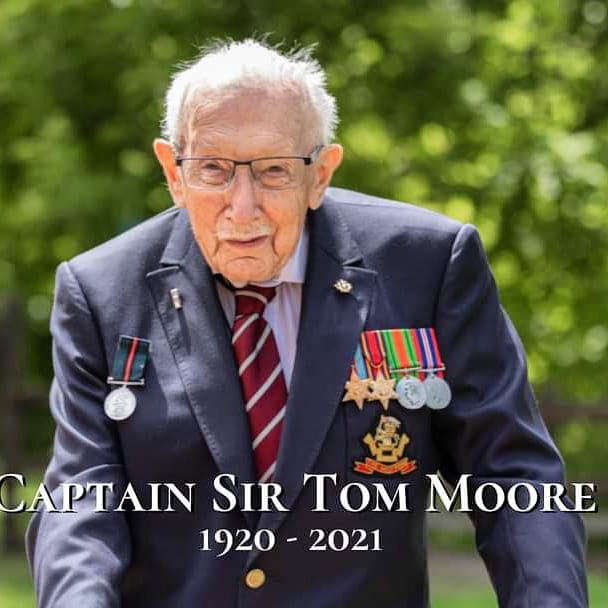
BREAKING: Captain Sir Tom Moore Dies With Coronavirus
The 100 year old war veteran had been seriously ill in hospital since Sunday.
Same Difference shares the sadness of the whole UK at the loss of the fundraising legend who became a national treasure during the first UK lockdown.
We will always remember his fundraising efforts by walking frame. We thank him for bringing hope and cheer and good news to our lives in the last year of his lifetime, during a time that was otherwise so dark.
RIP Captain Sir Tom.
Tommy Pilling: Conmen Pose As Couple To Steal Fundraising Cash
CROOKS posing as a grieving widow with Downs syndrome are targeting the family’s loyal supporters in a bid to con them out of cash.
Fraudsters claiming to be Maryanne Pilling are attempting to gather collections in memory of her late husband, Tommy.
The pair made history as the UK’s first couple with Down’s syndrome to marry, but Tommy sadly lost his Covid fight on January 1.
In the wake of his death, a host of fake social media profiles have been created on Instagram and Facebook claiming to be raising cash in memory of Tommy to help support his wife.
Maryanne’s sister, Lindi Newman, 33, has slammed the individuals for taking advantage of the family during their time of need.
She said: “Someone tried to hack their Instagram and Facebook accounts and then created fake accounts and messaged followers posing as Maryanne and asking for money.
“It’s so awful – they’ve now blocked us so we can’t see what they are doing and I think it’s an attempt to cover it up.
“Lots of people have reported the fake accounts but they are so similar and I am concerned people will not know the difference.
“With Instagram the real account uses a capital M and T in their names.
“We had about 50 messages from people who were contacted by these people and they were asking us if it was true.
“They would have never asked for money like this and anything that was donated went to homeless charities or organisations.”
Tommy, 62, from Shoebury and Maryanne had celebrated their 25th wedding anniversary in July and shielded for much of 2020.
The couple boasted 70,000 followers from across the world.
Mrs Newman added: “It’s disgusting and people have seen his passing as an opportunity.
“It’s only just a month since he died and we’ve got enough to deal with without all this too.
“I just hope their followers do not stop supporting them but I do not think anyone has given any money and most people knew it was a scam.
“Their real social media accounts were never about this but are about sharing their story.
“Maryanne is not doing too good at the moment and it’s not getting any easier for her.
“I am worried it will get worse when she goes home. We don’t know what she’s going through as everyone grieves differently.”
Last month huge numbers joined an online candle service in memory of Tommy.
The family held the service and encouraged followers around the world to join in by lighting a candle and posting images online.
Visit http://www.instagram.com/maryanneandtommy/ for any official fundraisers set up.
As well as this interview, Victoria spoke to the parents of a severely disabled 14 year old boy in a care home who haven’t seen their son since Christmas Day. They raised the very important issue of children’s care homes, which have had no coverage at all while elderly care homes have been everywhere.
The vaccine is, of course, currently only advised for adults.
Same Difference joins countless parents in asking a very important question: What about learning disabled children? We call for them to be given priority for the vaccine, along with all shielding children, at the very earliest opportunity.
Heart-Breaking Philippa Day Call The DWP Didn’t Want People To Hear
With many thanks to Benefits And Work.
DWP lawyers tried to prevent a coroner from releasing a recording of a distressing telephone by Philippa Day in which she told a call handler that she ‘needed a reason to live’, but received no help whatsoever.
Philippa took her own life after she was told that she had to attend a face-to-face PIP assessment in spite of her anxiety, depression and agoraphobia and in defiance of pleas by her CPN.
In the call, a clearly very distressed, sometimes crying, Philippa tells the DWP staff member she is “literally starving and cold”, “genuinely can’t survive like this for much longer”, is “in so much debt”, “literally cannot leave the house”, and needs “a reason to live”.
However, the DWP agent simply asks her if there is anyone in her family or a local charity who can help her and tells her that she needs to talk to Capita about when she will have her assessment.
No note was made on Philippa’s file of the level of distress she was in and the DWP’s six-point plan to be used when claimants express suicidal intent was not used.
The call handler told the inquest that she had heard many claimants crying and saying similar things.
In a statement, Philippa’s family said:
“As our family made clear in evidence given at the inquest into the death of my sister, we believe that Pip’s treatment by the DWP had a direct impact on her mental state and in the end is the reason for her death.
“Support from her community psychiatric nurse and from her family kept her going. But the constant cold and unsympathetic wall of resistance that she met at Capita and the DWP was more than she could endure.
The coroner is to issue a prevention of future deaths report telling the DWP to improve mental health training, record keeping and assessment processes.
Listening to the call, however, it is hard not to conclude that the first thing the DWP needs to introduce is the tiniest scrap of humanity into its treatment of claimants.
You can listen to a copy of Philippa’s call on the Guardian website
Read more about the conclusion of the inquest on the Leigh Day website
The Samaritans can be contacted on 116 123 or by emailing jo@samaritans.org or jo@samaritans.ie.
Kellie Larkin
Kellie Larkin says lockdown has improved her quality of life.
The 20-year-old from Country Tyrone has cerebral palsy, is quadriplegic and is a permanent wheelchair user.
She is also non-verbal and uses eye-gaze technology to communicate through a computer.
With the increase of online technology during lockdown, she says it has created more opportunities for her to communicate than ever before.
Kellie is part of Barnardo’s NI Disabled Children and Young People’s Participation Project and in 2020 won the charity’s Young Achiever Award.
Covid: Powerchair Footballer’s Family Reunion Hopes After Jab
An England powerchair footballer who has been isolating in his bedroom for nearly a year hopes to be reunited with his family after being vaccinated.
Ed Common, who has muscular dystrophy, is on a Covid vulnerable list and got a call “out of the blue” by his GP.
His only direct contact has been with his mother inside the family home in Hexham, Northumberland.
“I just want to get back to normal and be able to go out and do things with my mates,” the 26-year-old said.
Before lockdown, the Newcastle United fan used to train twice a week and meet up with friends.
However, in March 2020, the family decided he should isolate within their home to keep him “as safe as possible” because he has a weakened immune system.
It meant only mum Lorna could go into his bedroom and he was unable have contact with his father Graham, sister Gemma, 27 and brother Joe, 17, who live in the same house.
He received his first dose of the Oxford-AstraZeneca vaccine on Thursday and the family will wait for his second dose and immunity to build before they begin to see more of each other.
Ed, who has represented England at the sport’s world cup and European championships, hopes to make the world cup squad for the 2022 tournament in Australia.
“I get up, usually watch TV, Netflix and stuff and play with some of my mates on the PlayStation,” he said.
“I’m looking forward to getting back to football and hopefully get on to the next England team for Australia.”
His mum said the vaccine meant there was “light at the end of the tunnel”.
“I knew that he would struggle to fight Covid off if he was to catch it,” Mrs Common said.
“We got a call out of the blue saying there was a spare vaccine and they asked if Edward would like to come down to get his and we were on our way.
“I’m over the moon that he has now had it. We still have to be very careful.”
Vaccines are currently being given to the elderly and most vulnerable first, with a list of nine high-priority groups being followed.
EastEnders Star Rose Ayling-Ellis Reveals Show Will Further Explore Frankie’s Deaf Identity
EastEnders star Rose Ayling-Ellis has revealed the show will further explore Frankie’s deaf identity.
On the BBC One soap, the actress plays Frankie Lewis, who is the deaf daughter of Mick Carter (Danny Dyer) and Katy Lewis (Simone Lahbib); the woman who sexually abused Mick while he was in a care home as a boy.
While Frankie is currently caught up in the emotional storyline, Rose recently confirmed the character’s deaf identity will be explored further in a forthcoming plot.
“For too long, TV hasn’t portrayed the deaf experience of deaf culture,” Rose told Inside Soap.
“I think for people who don’t know anyone who is deaf, it’s important to show what life is like for a deaf person.
“Even things such as using my voice and having the audience hear my ‘deaf accent’ is a big step forward. I truly hope that hearing voices such as mine on TV will become the norm. Plus, it’s exciting to have two deaf characters on a major prime-time show.
“Ben’s [Mitchell] experience with deafness is very different from Frankie’s which shows that not all deaf people are the same. Sign language is a huge part of Frankie’s life too, so hopefully you will see more of that.”
She added: “You will get to see more about Frankie’s deaf identity, which may teach the audience a thing or two that they potentially didn’t know, or hadn’t thought about before.”
The comments follow Linda Carter discovering more of Katy’s abuse and Shirley demanding answers over Katy’s ongoing freedom.
Quad Gods: The World-Class Gamers Who Play With Their Mouths
Chris Scott was falling towards the ground above Long Island, New York, when he realised that something was wrong.
An experienced skydiving instructor with around 6,000 jumps behind him, this should have just been another day at work. Strapped to Scott’s chest was a tandem jumper named Gary Messina, for whom the jump was an annual birthday tradition.
But when the men reached an altitude of 175ft, the parachute that had been slowing their descent suddenly collapsed. It had most likely been caught by a dust devil, a small unpredictable tornado that is the bane of skydivers, as it forms in the same clear conditions that are perfect for their sport.
Messina, a prison officer who was due to turn 26 the next day, died on impact with the ground. Remarkably, Scott survived, although he soon blacked out. “I remember staring at the ground – and that was it,” he later told reporters. He was airlifted to Stony Brook University Hospital.
When he woke up 11 days later it was early August 2014 and doctors told him he had broken his neck. He was paralysed from the shoulders down and lucky to be alive. “I was a light beam away from death,” he said.
Scott went to a specialist rehabilitation centre in Atlanta, Georgia, before moving back to New York to live in the same apartment building as his family. He used a mouth-operated joystick to move his wheelchair and regularly went to Mount Sinai Hospital in East Harlem to work on his rehabilitation.
It was there that he met Dr David Putrino in March 2019. In his role as the director of rehabilitation innovation at Mount Sinai, Putrino explored different ways of improving patient health. He used training methods associated with high-performance athletes, as well as technological solutions like virtual reality.
The pair met at a time when Scott was struggling to cope. He missed being part of a team and felt a lack of purpose in his day-to-day life. Putrino had been recommended as someone who might be able to help.
“We sat there staring at each other in silence for a little while,” says Putrino. “And then I was like: ‘Well, what do you like to do?'”
Scott replied that he loved playing video games against others. Putrino was surprised. “That was me being naive at that point,” he says, “because I’d never seen competitive gaming from someone as severely paralysed as Chris.”
They loaded a basketball game called NBA 2K into a PlayStation 4 at the hospital. Scott’s backpack hung from his wheelchair and he asked Putrino to reach inside and fetch a device for him.
The device had a mouthpiece with a joystick and different sensors that could be sucked on or blown into. This was Scott’s QuadStick and it helped him to play video games using his mouth.
Putrino mounted the QuadStick on to the wheelchair so that it lined up with Scott’s mouth. Then they began to play.
Scott moved the joystick with his lips. He could control the basketball players, making them pirouette, leap and throw, by puffing and sipping on the holes. “It was just incredibly dextrous and skilled,” says Putrino. “And all of a sudden he was kicking my ass at NBA 2K.”
The experience gave them an idea. They were both familiar with the growing industry of esports where gamers competed against each other in tournaments. What if they could use Scott’s video game skill and Putrino’s expertise in high-performance training as the basis for an esports team with other quadriplegic players?
Scott sent out a message to other patients at Mount Sinai to gauge interest. “This was the big test, because we weren’t sure whether anyone would reply,” says Putrino. But they didn’t have to wait long to hear back. “People contacted us immediately and they were saying: ‘We want a piece of this.'”
Blake Hunt was one of those who got in touch. He had played video games since he was a child. “I remember playing Nintendo with my brothers,” he says. Whoever came in first place had bragging rights for the day.
A talented American football player, Hunt was 17 when he broke his neck during a match for his high-school team. “I couldn’t really figure out a way to be competitive once I got hurt,” he says. “That’s where I got a lot of my enjoyment in life from. So I struggled with my identity for a while.”
After the accident Hunt couldn’t move his legs, but he was able to move his arms and wrists. Without full use of his hands, however, he couldn’t find a way to play the video games he’d always enjoyed.
“One day I got really angry, and I decided to game by any means possible,” says Hunt. Although he couldn’t move each finger individually, he could make his hand close by pulling back his wrist. By flexing his wrist back and forth, he discovered he could press the buttons and move the joystick of a specially-designed controller.
The first game he played was Call of Duty: Black Ops – a shooting game with a zombie mode that Hunt particularly enjoyed. Then he began playing American football on Madden NFL. It was a revelation. “That’s when I realised that I can still be as competitive as anybody,” he says.
Shortly after their call-out, Scott and Putrino held a meeting where they set out their vision for an esports team that could compete at the highest level. Hunt was one of those in attendance. Soon a group of eight people with paraplegia and quadriplegia were meeting up regularly to practice. “And from there it kind of skyrocketed,” says Hunt.
One of the first video games they played together online was League of Legends, a gladiatorial game where two teams battle each other in a fantasy setting. It is a game that relies on teamwork and, as they played, the different playing styles and characteristics of each team member came to the fore.
Sergio Acevedo was a laid-back, calming personality, while Richard Jacobs was lively, animated and often spoke in the third person as he played: “Good job, Rich!” Hunt could sometimes be heard singing at points of particular tension. Some of the team played by pressing pads with the side of their heads, while others manipulated controllers with their arms. People wouldn’t think that the person on the other side of the avatar is beating them by playing with their mouth.
They found that playing together they were a formidable outfit. “Individually we had a hard time winning sometimes,” says Hunt. “But when we all came together, it was very hard to beat us.”
Nyree Stevens was another who responded to the initial call-out. Thirty years old and a keen artist, she uses her mouth to paint portraits of her friends. She was injured by a stray bullet on a night out with friends in Harlem when she was 18. “It was a gunshot wound to the neck,” she says. “I was in the wrong place at the wrong time.”
Video games have become an important part of her life. “It helps me get my independence back to be able to play,” she says. When she joined the team, she was the only woman. “You know what boys are like with their games,” she says. “They live for gaming. But I’m getting up there with them.”
Often the people that they played online – and beat – were non-disabled. Sometimes their opponents didn’t know who they were playing. “People don’t know,” says Hunt. “And it’s very liberating to beat them. That’s part of the fun.”
But with the growth in popularity of streaming platforms like Twitch, often gamers can see each other. Nyree Stevens enjoys it when her opponents can see her.
“A lot of people wouldn’t think that the person on the other side of the avatar is beating them by playing with their mouth,” she says. “So that’s totally cool.”
Practice paid off. By the summer of 2019, the team were ready to begin playing in competitions where prize money and greater prestige would be up for grabs. On the cusp of their first tournament in late July 2019, they held another team meeting.
Afterwards, Putrino remembers being with Scott as he left Mount Sinai for the day. “He stopped his chair and looked over his shoulder to ask me: ‘Do you really think we can do this? Can we really pull this off?'” Putrino told him that to get as far as they had they were already winning. Scott smiled and rode his chair out of the hospital.
A few days later, there was terrible news. Scott had died from a chest infection. “It was a shock to all of us,” says Hunt. “It’s still hard to deal with. We don’t really discuss it too much.”
“That was a big blow,” says Putrino. But he adds that for many disabled people, health is fragile. “You just never know what’s going to happen.”
The team got together and resolved to continue what Scott had started. Their team name would be the Quad Gods. “We call ourselves the Quad Gods because in our minds we’re all gods of our own lifestyle,” says Hunt.
They each came up with different alter egos. Hunt chose Shango. “He’s an African God of thunder, and when I bring the pain, I bring the thunder.” Richard Jacobs chose Zeus. Nyree Stevens chose SittinPrettii.
In the first competitive tournament they played in there were 99 teams, and the Quad Gods were hoping to finish in the top half. They came fourth. They began playing in – and winning – more tournaments online, finding particular success with the popular fighting game Fortnite.
As stories about their team spread among the gaming community, funding opportunities came their way. They received money to buy equipment and to launch as a legitimate esports team. The New Jersey Nets basketball team donated a gaming space. The Quad Gods began looking around for a full-time coach.
Their next goal is to place highly at a range of different esports World Championships next year. The Olympic Committee are strongly considering esports for the 2024 Olympics and, by securing a world ranking, the Quad Gods hope to qualify.
For the team, the benefits of competitive gaming have been considerable. “When we do things we enjoy, it releases stress,” says Hunt. “Stress is a killer in its own right. In that way gaming has been therapeutic. I’ve been in the chair since I was 17. I’m now 31. In many ways gaming has saved my life.”
“None of us would be together if it weren’t for Chris showing up to my lab one day and saying ‘Hey, I got to do something,'” says Putrino, known affectionately as “the Quadfather” by the team.
The Quad Gods logo was painted by the laid-back Sergio Acevedo, who, like Nyree Stevens, paints with his mouth. It is of a wheelchair being held aloft by wings.
“Chris will always be our captain,” says Hunt. “He’s our guardian angel and the wings embody that.”
Fire Captain Andrea Hall of South Fulton, Georgia, explained that her late father was deaf. She is bilingual – an English speaker and an American Sign Language user – and she said she wanted people watching her to be able to experience the US Pledge of Allegiance in their own language.
Can You Date Someone With Cerebral Palsy?
That’s a loud and clear and signed and communicated YES from us!!
Unplayable: Disability And The Gaming Revolution
There has long been a sizeable gap between the popularity of video games and their accessibility. Disabled gamers can find themselves thwarted by changes to controller settings, frozen out of storylines because particular motor skills are being tested, or stymied by sudden obstacles that require acute hearing or eyesight from someone who has hearing or sight loss. But after decades of advocacy work by disabled gamers, that gap is beginning to close.
In this documentary, blind gamer Steve Saylor hears some of the stories behind how gaming became more accessible. The documentary includes contributions from Steve Spohn from Able Gamers on how a bag of rice proved instrumental in getting an innovative controller made and from Mike ‘BrolyLegs’ Begum, who uses his face to press the buttons and has become a top Street Fighter player.
Steve Saylor always thought that he sucked at gaming – it turned out that gaming sucked for him.
Financial Stress Caused By DWP And Capita Failings Main Factor In Death Of Philippa Day, Coroner Rules
With many thanks to Benefits And Work.
A coroner ruled yesterday that a catalogue of 28 failings by DWP and Capita and the financial stress that resulted were the ‘predominant factor’ in the death of Philippa Day.
As reported elsewhere on Benefits and Work, Philippa took her own life after her DLA was wrongly stopped and she was required to attend a PIP face-to-face assessment, in spite of experiencing mental health issues including unstable personality disorder (EUPD), anxiety, depression and agoraphobia.
Nottingham Coroner’s Court heard that some of the errors were made repeatedly and were not just mistakes by individuals.
Mistakes included losing Philippa’s PIP claim form, failing to follow their own procedures when dealing with a vulnerable claimant, failing to record phone calls and wrongly attributing evidence given by a CPN as evidence from the claimant herself.
Philippa’s sister made a statement after the interview about the death of her sister, known to the family as Pip.
“As our family made clear in evidence given at the inquest into the death of my sister, we believe that Pip’s treatment by the DWP had a direct impact on her mental state and in the end is the reason for her death.
“She was in despair because of the depths to which she had sunk, she could see no way out of the debt and the poverty in which she was living. Pip’s poor mental health meant she was not able to handle the battle with the DWP for the reinstatement of her benefits. The stress of the conflict with the DWP made her even more ill.”
The coroner is to issue a prevention of future deaths report which will instruct the DWP to provide mental health training for staff, improve both record keeping and the assessment process as well as ensuring that letters from the DWP do not cause further stress.
Katie Price’s ‘Candid’ BBC Documentary Harvey And Me Praised
A BBC documentary following reality TV star Katie Price and her disabled son Harvey has been positively received after airing on Monday.
Katie Price: Harvey and Me charts the difficulties the pair face as he enters adulthood – including crucial decisions over long-term care.
Price previously told the BBC the decision to move Harvey to a specialist college was “terrifying”.
In its five-star review, The Times said the documentary showed “hidden depths”.
The paper’s TV critic Carol Midgley said it portrayed the “ferocity of maternal love” and presented Price in a “new, more meaningful light”.
In contrast to her public persona as a former glamour model, she was “just a mother fighting for a son whose special needs are so complex”, Midgley wrote.
Sense, a charity which supports families dealing with complex disabilities, said it had been contacted by “many” parents in a similar position since the broadcast.
The charity’s chief executive Richard Kramer said: “The programme was incredible because as well as highlighting the issues that parents of children with complex disabilities face, it also showed its joyous and rewarding moments.
“Harvey is a star, and the incredible bond between him and Katie is clear”.https://emp.bbc.co.uk/emp/SMPj/2.39.12/iframe.htmlmedia captionKatie Price and her son Harvey in a crucial year of his life
Harvey, born in 2002, was diagnosed with Septo-optic dysplasia, a rare genetic disorder affecting his eyesight, as well as autism and Prader-Willi syndrome, which can cause learning difficulties and behavioural problems. He is unable to control his weight and requires 24-hour care.
The realities of life both living with and managing someone with these conditions were well explored, said The Guardian’s Lucy Mangan.
“There is damaged plasterwork all over their home, and Harvey’s younger siblings know to run upstairs if he kicks off,'” she said.
However, her three-star review did find fault in its scope. She said the “candid” documentary, made by long-time friend of the family Hannah Lowes, had “the inescapable feel of a pre-emptive strike against media criticism Price is likely to face for ‘sending her child away'”.
And while Mangan praised the delicate depiction of the bond between mother and son, she suggested Price “might have used her platform to spell out in greater detail” the challenges faced by parents of disabled children – particularly those without her resources, despite her recent bankruptcy.
The Independent’s three-star review, by Ed Cumming, also noted the programme didn’t “expand much beyond its immediate subjects, or push the boat out compositionally”.
‘Price’s celebrity was irrelevant’
But the consensus was that despite these shortcomings, the documentary effectively explored the hidden realities of life as a parent of a disabled child.
Viewers witnessed Harvey’s “polite and affectionate” personality, said The Telegraph’s Anita Singh, and understood that Price “wanted to protect her son, but knew that sending him to a place where he could learn independence and crucial life skills would be the best thing she could do for him”.
Singh’s four-star review concluded: “Price’s celebrity was irrelevant to the programme. She was not here as a famous person, but as a parent whose dilemma will be familiar to many.”
The documentary was watched by around 2.4 million people on BBC One, according to overnight ratings. Price thanked viewers for their support and said she wanted to “continue the conversation” around “the difficulties that parents of children with complex needs face”.
Former EastEnders actress Danniella Westbrook commended Harvey as a “amazing young man”, adding: “What a great mother Katie is.”
Other users shared their admiration for Price as a parent and defended Harvey against previous online abuse he has received.
Katie Price: Harvey and Me is available to stream on BBC iPlayer (UK only).
Nine Month PIP Extension Letters Flood Out
With many thanks to Benefits And Work.
Benefits and Work is hearing from numerous members who have received a letter from the DWP telling them that their PIP award has been extended, usually by nine months.
The letter reads:
‘We suspended Personal Independence Payment (PIP) Award Reviews because of the coronavirus (COVID-19) outbreak.
We have now begun reviewing PIP awards again and we may look at some awards later than we originally planned. To make sure that you still receive your payments we have extended your award until . . .”
The letter then gives a new end date for the award, typically 9 months after it was originally due to end.
The letter goes on to say that the claimant does not need to contact the DWP and that the DWP will contact them before the new end date, to review their award.
We have heard from members whose award was due to end as far off as 2029 but who have now been told it has been extended into 2030.
The letters appear to be the ones that Justin Tomlinson referred to earlier this month, when he admitted that over half of the 1.6 million claimants who are having their PIP awards extended had still not been informed.
With many thanks to Benefits And Work.
Both the DWP and Capita failed to record, or destroyed, vital evidence relating to the death of Philippa Day, the Disability News Service (DNS) has revealed.
Last week we shared details of the incompetence and institutional callousness that lay at the heart of the death of Philippa after she was told that she had to attend a face-to-face PIP assessment in spite of her anxiety, depression and agoraphobia and in defiance of pleas by her CPN.
Now DNS has published further details from the ongoing inquest which may lead some readers to question whether it was solely incompetence which resulted in vital recordings of telephone conversations not being made available to the coroner.
A Capita representative, Edward Cronie, was asked why recordings of calls made to Capita by Philippa’s CPN on 7 August – the day before Philippa was found unconscious at her home – and 9 August were not available.
According to Cronie the telephone extension of the agent who took the call on 7 August was not “correctly configured to record calls”, while there had been a “congestion issue” two days later, which meant eight calls to another agent’s extension had not been recorded.
Cronie suggested – in response to a question from the coroner – that someone at supervisory level would have been able to access recordings and delete them from the system, although there was no evidence that they had.
Asked if the system showed if recordings had been deleted, he said: “I would not be able to answer that.”
Meanwhile, the DWP told the coroner that they were unable to provide a recording of a key conversation between the DWP and a CPN because they had deleted it.
The DWP claimed they had done this because data protection rules meant they had to delete recordings that were “no longer relevant” after 14 months.
They said that they had not been aware of the inquest until July 2020 – nine months after Philippa died – and by then the call had been deleted.
However, where a claimant has died in circumstances that may implicate the DWP, and where the DWP have carried out their own investigation into the matter, it is absolutely clear that all the data relating to the case should be kept.
It might be needed not just for an inquest, but also because the next-of-kin might wish to bring a claim against the DWP, given that a young child lost her mother in this instance.
Which perhaps explains the alacrity with which vital evidence was destroyed.
You can read more about Capita’s failure to provide recordings here and the DWP’s decision to destroy evidence here.
‘People Assume I Can’t Be Gay Because I’m Disabled’
On a video on Tik Tok, Stephen Thomas Smith looks into the camera and shouts: “I am a gaaaaaaaaaaaay!”
It’s his reaction to people who assume that he must be straight or doesn’t have any sexual feelings simply because he’s disabled.
Stephen, who has cerebral palsy, is a disability and gay rights campaigner and uses Tik Tok as a way to raise awareness on the issues.
But he admits sometimes he doesn’t feel like he’s part of the LGBT community because he often comes up against “ableism” – discrimination against people with disabilities.
“When I go to G-A-Y or Pride I get denied access to nightclubs because I’m ‘too drunk’ – when actually I’m sober – and I get told I’m on drugs,” says Stephen.
“That’s my community and it’s supposed to be accepting but yet I go to that ‘safe space’ and get denied access.
“So why would I associate myself with a community that’s so ableist. I’m not particularly proud to be part of that community as a disabled person.”
Stephen, 24, says the ableism he experiences means he often doesn’t feel like he “has an identity” within the LGBT space.
“You feel like you’re in the middle ground or this place of nowhere because I’m disabled, so I’m supposed to be with disabled people.
“But I’m also gay but they don’t accept me. It feels like I’m in the middle and I have no identity. It’s weird.”
When Stephen he told his family he was gay, he says it wasn’t really a big thing as he has two older sisters who are lesbians.
But it was more of a surprise to people at his secondary school because he was just seen as the “person in the wheelchair”.
“It was easy to come out but I think people didn’t expect it,” says Stephen. “But my mum expected it because I’m as camp as Christmas.
“I don’t think people usually think, ‘Oh this disabled person is gay or straight or they want to interact or they have desires’.
“In high school I was just seen as the disabled kid.”
Stephen, who is from Manchester but lives in London, says even now when he goes on dates he experiences ableism which can feel “dehumanising”.
“I went on a date once and I met him for a coffee and he just sat down with me and he said, ‘This is like the show the Undateables’,” he says.
“I was like, ‘Cool, the first think you see is my disability, not my outfit’. So what I did was just walk out because I’ve not no time for ableism.”
Stephen believes people often see those with a disability as being asexual because of the way disability is portrayed in the media.
“We’re portrayed to be helpless creatures who depend on people and we’re created to be animated,” he says.
“And we don’t fit into a certain gender – to be a man is to be strong, is to walk and talk in a certain way, and to be a woman is the same but as a woman.
“Because disabled people can’t abide to that etiquette of the body, we’re seen to be asexual, dependant creatures.
“We still have desires and we have our own minds. People need to stop looking at the physical and start really looking at people.”
Stephen has been using Tik Tok for less than a year but already has 48,000 followers and 1.2 million likes.
In his videos, he uses sarcasm and humour to raise awareness and address some of the misconceptions he experiences as a disabled gay person.
“Laughter is a gateway and instead of people laughing at me, they’re laughing with me and I think that’s important,” Stephen says.
“It allows people to understand more about your disability and instead of being turned off, it’s more of a gateway for people to access it.
“I still get a load of hate comments but I reply to those in a funny way. Someone called me spaghetti hands so I made a funny video about having spaghetti hands.
“It doesn’t really affect me because I’m living my best life over here.”https://emp.bbc.co.uk/emp/SMPj/2.39.11/iframe.htmlmedia caption”I reply to hate comments in a funny way”
Stephen says even though he gets some hateful comments, he also has lots of positive ones too.
“I get loads of messages every month saying either their son’s got cerebral palsy and I’ve helped them understand it or I made someone laugh.
“I think the videos break a stigma because it allows people to have an insight into disability and queer disability and the queer body.
“I think the people who are hateful just need more education or more visibility.”
Stephen’s cerebral palsy means he has a carer and uses a wheelchair if he’s travelling long distances – for example through an airport.
But he doesn’t feel like he is limited by his disability and has just been accepted to study a MA in photography at the Royal College of Art in London.
Stephen believes better representation of disabled people in the media would help combat ableism and discrimination in society.
He believes the show The Undateables – which follows disabled people on dates – is “patronising” and “toxic” for disability representation.
“I’d like to see more disabled people in mainstream media and more visibility, Stephen says. “I’d like to see some bad-ass disabled people doing some amazing things.”
Autistic Sunderland Teen Illustrates Charity Aviation Book
A teenage aviation enthusiast with autism has illustrated a book in aid of military charities after using art as an emotional outlet during the coronavirus pandemic.
Jack Berry, from Sunderland, who is also selectively mute, began drawing planes last summer.
Flying High in the Sunlit Silence depicts aircraft including Lancaster bombers, Spitfires and Tornados.
Red Arrows squadron leader Adam Collins described his work as “inspirational”.
Details explaining the history of each plane and helicopter, written by pilots and military experts, accompany Jack’s illustrations.
Formula 1 driver Lando Norris, Red Bull designer Adrian Newey and ex-Formula 1 driver David Coulthard, who is now a commentator for the sport, have also contributed to the book.
Jack’s mum, Sara Berry, said he had been inspired by the lockdown efforts of Captain Tom Moore, who last year raised millions of pounds for the NHS.
With an initial interest in planes stemming from his grandfather’s work on Concorde, Jack’s fascination was cemented by trips to airshows and the Battle of Britain Flight Memorial Visitor Centre in Lincoln.
“He wants to know everything about aircraft and he’s so engaged with it so he wants to show his appreciation to the pilots,” Ms Berry said.
“He’s always drawn and will do it either to calm himself down or as a way of saying ‘thank you’ to someone.
“The RAF and the services have opened their arms and accepted Jack for who he is. I think that’s really important.
“The pandemic has been draining for me as a parent and for Jack, but this has given us a chance to bond.”
Squadron leader Collins said Jack’s illustrations “capture the themes” of the Red Arrows’ recent 100th anniversary – commemorate, celebrate and inspire.
Three charities chosen by the youngster – SSAFA’s Forces Additional Needs and Disability Forum, International Bomber Command Centre and Lincolnshire’s Lancaster Association – will receive a percentage of sales.
An e-book will be available from Monday to tie in with Jack’s 14th birthday, with a print version set to be available shortly afterwards.
Penguin Bloom
Director Glendyn Ivin’s melodrama Penguin Bloom comprises two key plot strands – one involving a human and the other an animal – which have unsubtle intersecting metaphors.
While vacationing in Thailand, Sam Bloom (Naomi Watts) falls off a ledge and becomes a paraplegic. Months after the accident, while she is in the throes of deep depression, her husband Cameron (Andrew Lincoln) and their three young boys (Griffin Murray-Johnston, Felix Cameron and Abe Clifford-Barr) bring into the family home an injured magpie they name Penguin, pledging to nurse it back to health. And so: a bird learning to fly again coupled with the story of a wheelchair user whose spirits are broken.Penguin Bloom: how a scruffy magpie saved a familyRead more
Insulating Penguin Bloom a little from complaints that it trades in heavy-handed metaphors is the fact it was based on a true story (adapted from a book by Cameron Bloom and Bradley Trevor Greive). It reminded me of Craig Monahan’s gentle 2014 drama Healing, which was inspired by a real-life initiative that had prisoners working in a sanctuary for injured raptors – thus ripe with symbolism invoking broken wings and broken people.https://www.youtube-nocookie.com/embed/q7eZEZHRrVg?wmode=opaque&feature=oembed
The idea of an animal’s physical and behavioural transformation mirroring a person’s is an interesting and multifaceted concept. Are we for instance projecting ourselves on to animals when we see our stories in them, or are some narrative templates – such as triumphing over adversity – so strong they transcend species, bringing a degree of narrative order to a chaotic universe?
It becomes painfully clear early in Penguin Bloom, however, that Ivin – who recently directed two exceptional TV series, The Cry and Safe Harbour – is going to take the easy way out. Even talented directors find it difficult to resist the lure of the voiceover, despite that famous dictum being drilled into their heads since film school: the one about how they ought to “show, don’t tell”.
The person doing the telling in Penguin Bloom is Noah (Murray-Johnston), one of Sam and Cameron’s sons, who begins by reminiscing that “Mum loves the ocean, she always has” and eventually concludes that she “is not the person she once was … but for me, she’s more than that”. How was anybody not wincing when that line was recorded?
I quickly found myself longing for less yakety-yak and more visual storytelling – only for another dictum, “careful what you wish for,” to start ringing in my head. In one dramatic scene Sam stares at a jar of honey and pushes it off the kitchen bench, as if to say: my life has been smashed to pieces – a moment so symbolically loaded they put it on the trailer. During another Sam smashes framed family photos with a broomstick, and yes – they put that one on the trailer too.Penguin Bloom review – Naomi Watts saved by a magpie in charming dramaRead more
Meanwhile, Penguin stays busy charming the characters and the audience, softening Sam’s hardened heart and embedding herself into the family’s routines – pottering around the home, stealing a teabag from a mug and generally behaving like a loveable little scamp. The way the bird (several were used during production) is integrated into various scenes – as if it really were a member of the family – is exceptionally well done: props to magpie trainer Paul Mander, who was assisted with modestly used and seamlessly integrated CGI.
When Penguin finds herself in a traumatic situation, I discovered myself more emotionally involved than I thought, genuinely concerned for her safety – well aware that Australian cinema has a reputation for killing off animals (particularly dogs: Mad Max 2, Red Dog, Snowtown, I’m looking at you). I felt more invested in Sam’s journey in the second half too, when she takes up kayaking and Watts’ strong, solemn performance is afforded more space to breathe.Advertisementhttps://58a48e8019f0b8e3b1facee3a6b54667.safeframe.googlesyndication.com/safeframe/1-0-37/html/container.html
But every once in a while Ivin did something to make me question his motives. Take for example a shot late in the piece, in which Sam looks ahead and imagines herself – smiling, upright and walking happily – beaming back at her. This image comes dangerously close to endorsing outdated and offensive views of disability: particularly the idea that a person isn’t “complete” unless they look and move like the majority.
By this point shouldn’t the film be more interested in the person Sam has become, rather than who she once was? A postscript informs us that Bloom went on to achieve numerous sporting distinctions, as if this were nothing more than a small thing to bung on at the end. It is a final confirmation that Penguin Bloom, while heartening, is more about loss than rebirth. There is a great, moving story to tell about the real Sam Bloom – but this film only gets part of the way there.
• Penguin Bloom is in Australian cinemas now
Katie Price: Harvey And Me
When faced with having to move their disabled child to a different school or college, families face difficult decisions. Now, reality TV star and ex-model, Katie Price, is on that journey with her eldest son, Harvey, who is about to make that transition.
It was a quiet 18th birthday for Harvey. There were balloons in the garden and presents were opened, including a frog lunchbox and an iPad. For a treat, Katie took him to one of his favourite places – the local train station.
“This is the best train ever. I love it,” Harvey says, taking photographs.
His birthday marks another milestone. It is time to leave school and find a college, a process the family has filmed for BBC One documentary, Katie Price: Harvey and Me.
“It’s pretty predictable to know what will happen with the other kids,” Katie says, who has four other children. “But with Harvey it’s not predictable because he’s got complex needs.”
She says searching for a specialist college has been a “new journey” for her. “It’s not easy and it’s terrifying.”
Harvey was born in 2002. He was diagnosed with Septic Optic Dysplasia, a rare genetic disorder affecting his eyesight, as well as autism and Prader-Willi syndrome which can cause learning difficulties and behavioural problems.
He is unable to control his weight and requires 24-hour care.
“It’s not straightforward, where you can just choose a college,” Katie says. “They have to have the right nursing team and know how to deal with his challenging behaviour.”
In the UK, children with long-term health conditions are cared for by child health and social care services until they turn 18 and transfer to adult services. https://emp.bbc.co.uk/emp/SMPj/2.36.7/iframe.htmlmedia captionKatie Price and her son Harvey in a crucial year of his life
It can be a precarious moment and often involves a lot of upheaval including meeting new teams and specialists.
Like many families, the Prices have been warned the most suitable college may be a long way from their Essex home, because there are few of them and they are widely dispersed.
For Harvey, the most appropriate include those in Camden, Wales, Sunderland and Somerset.
The distance, and Harvey’s age, means he will become a full-time residential student, including weekends.
To make sure they find the perfect home, Katie and Harvey have visited as many as possible. A process made difficult by Covid-19 and Katie having broken the bones in both her heels in a water park accident.
‘Crisis point’
“He needs to have his independence and I think he’ll enjoy it – make friends,” Katie says. “I want him to be in a room with his mates while he plays the keyboard and sings his songs.”
At Harvey’s current school he is a weekly boarder. Making the decision for him to board was difficult and prompted by the distress he felt at the daily travel from home to school, and the impact on the family.
“I was at crisis point,” Katie says. “It was affecting the other kids, it was the danger-zone for him, smashing the house up.
“I hated him going to residential. I cried. But I saw he was happy there.”
As the documentary reveals, there are holes in the walls of the Price house where Harvey has punched them.
His autism can lead to meltdowns when he becomes overwhelmed or distressed by a situation. For Harvey, loud noises like slamming doors can trigger this and lead him to hit his head or punch a wall – common coping mechanisms.
It is a situation Katie had to consider when they looked at colleges – would Harvey be safe? Could the staff handle him?
During a visit to The Orpheus Centre, a college in Surrey which provides therapy to disabled young adults through the performing arts, a loud and unexpected noise distressed Harvey and he threw his head repeatedly against a door.
Katie told him to count to 10 to control the stress but another noise sounded and he kicked out. The staff encouraged him outside where it was quieter, but it signalled the end of the visit.
Katie will often touch Harvey or speak with him to maintain his calmness. The duo banter constantly and have scripted phrases they say to each other – when Harvey says “Hip, hip,” Katie replies, “Hooray”.
The scripting is sometimes considered similar to stimming (self-stimulatory behaviours) that many autistic people like to use to relieve anxiety or show happiness.
When they visited National Star college in Cheltenham, Harvey was distressed and worried he would have to stay overnight.
He didn’t want to get out of the car and whimpered. Again, Katie reassured him and encouraged him to wear his ear defenders. Because this isn’t a regular day for Harvey, the teacher, Alice, showed him a “social story” with pictures of what he could expect from the hours ahead.
She decided to begin at the end with “goodbye” – so Harvey knew he would go home.
It was a difficult start, but when he visited the flats the students live in – with their own bathrooms and kitchens – and got to watch frogs and trains on a big screen in a sensory room, he was won over.
He described the college as “wicked” and excitedly said “yes mum” when asked if he would be happy there.
Katie says: “The reason I want him to go full-time residential is because some weekends they might have disco nights or bowling and he might want to go and do that and not just come home to me. It gives him a choice.”
But it is far from a done deal. It relies on much administration and the local authority agreeing to finance it.
Lynette Barrett, chief operations officer at the college, tells Katie: “We would put in a funding application to your local authority and that application would detail everything that we are going to provide for Harvey.
“For someone that is a part-time day student that may be £15,000 to £20,000 a year. For a student that is full time, all-year round residential with really high health care needs, that could be up to £300,000 to £350,000 a year.”
It will be the Price’s local authority which makes the decision on whether to fund it or it may decide somewhere local is suitable.
The approval depends on Harvey’s needs. Katie must ensure his Education Health and Care Plan (ECHP) – a legally binding document in England detailing the support he must receive – is up to date.
“Everything about Harvey is in that plan,” she says. “It’s so time-consuming and you feel like you’re alone, but you’ve just got to get on with it.”
Katie must detail Harvey’s education attainments, health problems and the medication he requires, as well as the tasks he can complete – whether he can cook for himself, dress, make the bed and wash.
The thought of Harvey leaving home is daunting for Katie, but a move she wants to pursue.
“As much as you smother your kids and you want them with you all the time, sometimes you have to let them go, just give them that bit of space to go and explore.”
This year has been challenging for the family. Harvey is classed as extremely clinically vulnerable and has been shielding during the pandemic. He also spent some time in intensive care and his health is a constant concern.
“With Harvey the future is unpredictable, but I’ll make sure that he’s in a place where he thrives on happiness, excitement, joy and he looks forward to waking up.”
Katie and Harvey have applied to National Star. They will find out in March if they have been successful.
UK viewers can watch Katie Price: Harvey and Me on Monday 25 January at at 20.30 GMT on BBC One and BBC iPlayer.
People On Carer’s Allowance Have #VaccinePriority
Learning Disability Vaccine Plea: ‘Don’t Leave Us To Rot’
As high risk groups continue to be immunised there are growing concerns that people with learning disabilities have been missed out.
Despite a recent Public Health England report warning they are six times more likely to die from coronavirus, as a group, they have not been prioritised for a vaccine.
Legal action is being taken against the Department of Health and Social Care, which says it is working hard to vaccinate all those at risk.
Nikki Fox reports.
Northern Ireland Looks To Dump Capita
With many thanks to Benefits And Work.
Northern Ireland is looking at the possibility of bringing PIP assessments in-house instead of outsourcing them to Capita, as is currently the case. However, Capita still looks likely to get a two year extension on its current contract.
In the second independent review of the PIP assessment process, completed in December 2020, it was recommended that PIP assessment be brought in-house.
The current contract with Capita is due to end in July of this year.
However, Deirdre Hargey Minister for Communities, said that the changes could not be made in a matter of months.
“We cannot change it right away; we cannot change something like that in a matter of months. However, I am instructing officials to look at what we need to do in the time ahead. We are looking at that in-house model, as, importantly, it meets the needs of those who require it. Engagement with those individuals, and with the advice sector, in the design and in what that will look like will be critical in the time ahead. There is a commitment from me to look at all of it and to do that.”
Scotland has already announced that it is to do away with the use of private sector companies to carry out PIP assessments.
If Northern Ireland follows suit, the pressure on the Westminster government to do the same may become too great to resist.
The Cartoonists Making Mental Health Their Muse
Comics are not just about superheroes. Emily Oomen meets the artists shaping graphic medicine – a genre focused on the experience of living with illness.
Ellen Forney was in her twenties and working as a professional cartoonist when she stumbled into the world of graphic medicine.
The artist had been working for one of Seattle’s long-running newspapers The Stranger when, in 1998 and just before she turned 30, she was diagnosed with bipolar disorder.
She says the diagnosis “sank in like the sun had gone behind the clouds”.
Comics had always been a familiar language and format for Forney. She turned to them looking for comfort and was excited to discover a new genre she had never heard of – graphic medicine.
The genre focuses on and discusses topics within the medical field from cancer to Alzheimer’s and anorexia in an engaging and entertaining way.
Although developed for patients and medical professionals as a way to explore different conditions, it is now often found in general stores and libraries.
Forney who was comfortable telling stories through this medium, started to create comics for herself about her experience of living with mental illness.
“I wrote a lot in my journals,” she says. “I didn’t know that those were going to be pieces of a comic, a memoir later, but it’s kind of how it comes out of me, in words and pictures.”
She says it gave her great solace while she learned to manage the condition.
After several years of creating comics for herself she designed a graphic memoir of the experience – Marbles: Mania, Depression, Michelangelo, and Me.
“I felt like I needed to do it for myself and to get it out there to reach other people – because I can, because I’m a storyteller, and I thought it was an important story to tell.
“It’s not just ‘here’s my experience, that was a mess’, but how do we put those pieces together? How do we come to heal?”
One story in Marbles, illustrated in black and white, tells the moment where Forney noticed her mood had lifted after she had starting taking a new antidepressant.
Standing in the shower she realised the water droplets looked like lanterns at a night festival and said the joy she felt at seeing images-within-images made her feel that things were looking up.
Making the memoir, “was a very, very thorough excavation of my experience,” Forney says. “I felt like I came to understand [my bipolar disorder] and wrap my head around it better.
“An important part of what we have as a storyteller is…we can offer, if not solutions, at least the possibility of hope.”
The memoir, published in 2012 is now considered part of the graphic medicine canon.
Forney, who has taught the art of comics at the Cornish College of the Arts since 2002, has also created artwork for Seattle’s Capitol Hill light rail station and collaborated on the award-winning illustrated novel, The Absolutely True Diary of a Part-Time Indian.
But graphic medicine remains an important part of her life. She recently published her latest book, Rock Steady: Brilliant Advice From My Bipolar Life which is a self-help survival guide full of tips, tricks, and tools that can help those living with bipolar disorder thrive.
“One of the things that’s really, really important, is a sense of humour,” Forney says. “It’s one of the ways to give yourself some sort of perspective when you’re telling a story.”
British cartoonist Gemma Correll agrees. “It can be good to laugh at yourself sometimes, especially when you feel really bad.”
She says graphic medicine has helped her convey her experience of anxiety and depression and she incorporates humour in a way that is relatable to many people.
In her comic version of Sleeping Beauty, while she depicts two fairies giving baby Aurora nice presents, the third gives her the gift of a lifetime of clinical depression.
As the saying goes, laughter can be the best medicine.
Correll, who has been featured by the BBC, The New York Times and Mindful Magazine, says: “One of the hardest things I think about mental illness is actually being able to describe how you feel.
“If I needed to go to the doctor or a counsellor, I would have a really hard time vocalising any problems that I was having. So I would always write them down instead and just give them the paper and say ‘this is how I’m feeling’.”
Not only have Forney and Correll’s comics helped them personally, they have also helped readers find solidarity and recognise their own mental health challenges.
One of Gemma’s readers told her the comic “helped me articulate how I feel like I haven’t been able to put it into words until now”.
While many people with mental illness can feel alone in their experience, Forney has also been able to find company through graphic medicine.
She said that after releasing Marbles she was “blown away and delighted to find that there was this whole community of people who also found that comics [were] an important and really valuable way to tell these stories of health”.
Dr. Ian Williams, a cartoonist and physician based in Brighton, UK, was the first to coin the term “graphic medicine” and created the Graphic Medicine organisation which brings artists and enthusiasts together.
He did so while studying for a medical humanities degree “partially as an excuse to put off getting down to writing my dissertation,” he says.
Williams defines graphic medicine as “anything that happens or is happening at the interface between the medium of comics and the discourse of healthcare”.
While Covid-19 has put a stop to any physical events in the past year, it has not stopped the community coming together.
The organisation, Graphic Medicine, has held monthly virtual meet-ups called Drawing Together where the community comes together to draw, support one another and share.
They hope physical events may be able to take place soon.
While it was initially terrifying to be vulnerable and publish personal comics, Forney says: “I really, really wish that everyone with a mental disorder could have the experience of talking about it and getting the reaction of people saying ‘me too!’
“It’s astounding… It’s given me a lot of strength to the point where I can just talk about it with the guy on the airplane next to me.”
Children’s TV presenters are often at the forefront of social change. Perhaps this is because – as one of the people interviewed in Silenced: The Hidden Story of Disabled Britain (BBC Two) remarked – “children are much better at inclusion” than their angry-letter-writing, Ofcom-complaint-making parents.
Ben Cajee, of the current CBeebies cohort, won praise for his age-appropriate discussion of racism in October, but in 2009 it was his predecessor Cerrie Burnell who inadvertently became an activist. Burnell was born with a right arm that ends just below the elbow. She hadn’t set out to champion the rights of disabled people – all she wanted was to introduce another episode of Balamory – but when parents complained that her appearance was “scaring children”, she did just that.
Where do such prejudices against disabled people come from? This documentary saw Burnell explore that question, finding the beginnings of an answer in the archives of a workhouse in Southwell, Nottinghamshire. There, page after page of an 1861 parliamentary report reduced human beings to labels such as “feeble-minded”, an umbrella term covering all manner of physical and mental conditions. In Victorian Britain, disabled and impoverished people were routinely shut away from the rest of society in workhouses. When Burnell tentatively suggested that “a shadow of that has carried on, in a way”, the continuity was striking. It was in this 19th-century hell that the 21st century’s punitive attitudes towards benefits recipients took root.Advertisementhttps://ca7854385c621049340c3956dcb35e30.safeframe.googlesyndication.com/safeframe/1-0-37/html/container.html
Not everyone was content to leave disabled people to fend for themselves, however. Burnell’s history is littered with misguided do-gooders, such as the Manchester-area benefactor Mary Dendy, whose attempts to save Britain from “this evil” caused generations of misery. A committed eugenicist, she dedicated her life to founding Sandlebridge Colony, “a home for the permanent care of the feeble-minded”, and campaigning for the Mental Deficiency Act of 1913, which gave authorities sweeping powers to institutionalise people against their will.
At this point, Silenced shifted in tone from Who Do You Think You Are? social history to an unusually bleak episode of ITV’s reunion show Long Lost Family. Brothers David and Alan Gambell only discovered the existence of an older sister, Jean, in 2007 after opening a letter addressed to their long-dead mother. Jean had been shut away in a Macclesfield care home for more than 70 years, but, when the brothers were at last able to visit, she immediately recognised them and greeted them by name. “Within weeks, she died,” said David. “She was just hanging on to see her family at long last.”Cerrie Burnell: ‘Disabled people have been shut away during the pandemic’Read more
It was all getting almost unbearably sad by the time the first heroes of Burnell’s history emerged to point the way forward. There was Dr Ludwig Guttmann, a Jewish spinal injuries specialist who fled Nazi Germany, then used competitive sports to restore the confidence of his paraplegic patients in England, ultimately founding the Paralympic Games. Later, in 1972, the trailblazer Paul Hunt wrote a letter to the Guardian calling for the formation of the Union of the Physically Impaired Against Segregation (UPIAS), resulting in the development of the social model of disability. This was the revolutionary idea that people were not disabled by their impairment or difference, but by a society that, for example, had no wheelchair ramps at train stations.
Particularly badass, though, were the disability rights activists Jane Campbell and Alia Hassan, who recalled for Burnell the thrill of “bringing London to a standstill” with their direct action campaign in the 80s. The look of baffled insult on Chris Tarrant’s face when he emerged from the Telethon ’92 charity fundraiser at LWT studios to a crowd of protesters holding “Piss on Pity” placards was a picture. It does seem, though, that the producers missed a trick in not approaching Tarrant for an updated comment. What better case study on how popular attitudes to disabled people have – or haven’t – changed over the past 30 years?
The history of disabled Britain features plenty of heroes to inspire, but what Silenced so movingly illustrated is that this is not really the story of individuals who overcame the odds. In fact, it is the story of how entire communities can – and must – open up to include humans in all our variety. So, it felt appropriate to give the last word to Micheline Mason, a campaigner for integrated schools from a time before CBeebies: “When people saw the non-disabled kids saying we want our friends in school with us, we had a lot of fun together, y’know, that’s what changes people. You almost can’t argue about it any more.”
“As a disabled person you have to be so political every day,” says Cerrie Burnell, “just in how you go about your life; being joyful has to be a choice because you are told at the beginning that you’re not really welcome here or there is something wrong with you.”
Burnell, a former presenter on the children’s channel CBeebies was born without the lower part of her right arm. The subject of prejudice by some parents when she got the CBeebies job, Burnell – also an actor and writer – explores the origins of negative attitudes towards disability in a BBC Two documentary on Tuesday, Silenced: The Hidden Story of Disabled Britain.
Part of a BBC season marking the 25th anniversary of the Disability Discrimination Act (DDA), the programme asks why disabled people have been ostracised from society, charts the battle for rights and concludes that, despite the freedoms won, much progress still needs to be made.The Guardian view on disability rights: a deficit of attentionRead more
Burnell describes the show as “a wake-up call but not in a shouty way”, and says making it opened her eyes to the systemic ableism that has led to those with disabilities being treated as inferior.Advertisementhttps://ca79172aac41300fd236dc2688508619.safeframe.googlesyndication.com/safeframe/1-0-37/html/container.html
In Great Britain, just over half of disabled people (52.5%) are in employment, compared with 76.3% for the population as a whole,while statistics for England show that for those with a learning disability, the figure is only 5.6%.
Burnell cites the DDA as the most significant advance made for UK disability rights, although she is shocked at how relatively recently it was introduced.
“People had been campaigning since the 60s to have the right to choose where to live or how to dress or to have a relationship or to have children or to get to keep those children. All of those things had been taken away from us.”
The documentary follows Burnell as she questions why the prejudice towards disabled people dating back centuries persists today. Contemporary attitudes, she learns, were shaped by the segregation of disabled people, first in workhouses and then in 20th-century institutions that admitted children with physical and learning disabilities and where they remained shut away for decades.
She also meets some of the trailblazers and crusaders who campaigned for disability rights and inclusive education and pioneered independent living.
But she warns that rights fought for over decades can swiftly be lost. Disabled people had already been badly affected by austerity policies – which have led to cuts to welfare payments and social care funding, and made it harder for disabled people to live independently – and she feels that disabled people have “yet again been segregated and shut away” during the coronavirus crisis.
The first thing the public heard during the pandemic was that people didn’t have to worry about the virus as long as they didn’t have an underlying health condition, says Burnell. “Well, what if you do?” she asks. “It doesn’t mean that your life is any less valuable and again it is the disabled community who suffered the most throughout the pandemic and the death toll has been high.”
Figures from the Office for National Statistics show that in England and Wales, disabled people account for almost six in 10 (59%) of all deaths involving Covid-19.
The fallout from the pandemic will be “brutal”, says Burnell, and “isn’t just going to suddenly end when everyone has been vaccinated because we’ll have lost so many people and services will be readjusting to the aftermath of the crisis”. She feels the emotional impact of the past year will take many people time to recover from, whether they were feeling anxious about going back into the world after isolating or they are working in overstretched public services.
Post-pandemic recovery plans must focus on improving access to spaces – from workplaces to cafes and other venues and better awareness of disability issues, Burnell believes. She especially wants disability to no longer be viewed as a barrier to employment, learning and living a full life.
“I think there is going to be a huge amount of anxiety going back out into the world,” she says. “The world wasn’t particularly kind to disabled people before the pandemic, so a lot of those small victories are going to have to be refought for.”
Burnell hopes her work – whether on this documentary, presenting on CBeebies or as an author – will help to play a part in “normalising” disability. She looks back fondly on her time on the children’s channel.
“I got to do a job that I loved and it was fabulous that it started conversations about disability,” she says, “but it is still very telling that it was needed. Now when you see someone on screen with one hand, without a prosthetic, hopefully it is less jarring than it was pre my time on CBeebies.”
In a 2011 Guardian interview, she called for more positive disabled icons – so have things improved over the past decade? She says advances have been made in getting more disabled actors on screen, citing Silent Witness’s Liz Carr, rock musician, actor and writer Mat Fraser, Years and Years star Ruth Madeley and Melissa Johns, who has appeared in Coronation Street and BBC drama Life.
“Of course there is further to go, there always is,” she adds. “While there may be many working disabled actors, we are not yet at the point where we have got superstars, but that day is coming. I have much hope and I hope to be part of that change.”
She hopes eventually to see the media present more nuanced narratives of disabled people’s lives, beyond the current binary of misery or triumph over adversity: “We never explore things in a non-obvious way, we never explore the subtleties, the love or the joy.”
Curriculum vitae
Age: 41.
Family: Solo parent to a daughter.
Education: Cavendish secondary school, Eastbourne; Manchester Metropolitan University (acting).
Career: 2018-present: actor, author and TV presenter; 2018: actor, Doctors; 2018: presenter, Matron, Medicine and me; 2009-17, presenter on CBeebies, along with other shows such as The One Show and The Wright Stuff; 2002-08, actor, various roles, including The Bill, Holby City, EastEnders and Grange Hill; 2002-08: playwright.
Public life: Writer in residence, Booktrust.
Interests: Beach volleyball, ice skating, yoga and meditation.
- Silenced: The Hidden Story of Disabled Britain is on BBC Two at 9pm on 19 January and available on iPlayer after that
Government Survey On Disability
Same Difference has been sent the following by Gemma Cook, a friend of the site:
Hi Sarah
Hope you’re well and keeping safe. Just wondering whether you know about this government survey and opportunity to influence disability strategy
https://disabilityunit.citizenspace.com/cabinet-office/ukdisabilitysurvey/
Best Wishes
Gemma
Please click the link if you wish to find out more about the survey, or to participate.
The Artists Using Dyslexia As A Creative Force
Two artists have been brought together through their personal experiences of dyslexia for a new arts project.
Turnberry-based Mark Stoddart has been a designer for 30 years, while Angus Hepburn, from Angus, has been looking for ways to give his career a boost.
Stoddart, whose bronze sculptures are produced at an Edinburgh foundry, has offered to fund the production of one of Hepburn’s designs.
Dyslexia Scotland put the artists in touch with each other.
Stoddart, who struggled with his dyslexia as a child, is an ambassador for the charity.
His artwork includes a life-size Model T Ford which was installed in Fort William to recall the driving of one of the American cars to the summit of Ben Nevis in 1911.
To mark the 30th anniversary of his career, he wanted to give something back by helping an artist in the early stages of their career.
Hepburn, 35, had worked in London after graduating from Gray’s School of Art in Aberdeen with a BA in Visual Communication.
But after a series of unpaid placements and having to supplement his art by working in the hospitality industry, he decided to return home to Scotland.
He has been volunteering at Hospitalfield House Arts Centre in Arbroath while applying for jobs, a task made tougher due to the impact of the Covid pandemic on businesses.
A meeting with the career service at Dyslexia Scotland led to Hepburn being put in touch with Stoddart.
Both men have faced challenges due to their dyslexia.
Stoddart said that as a child he was “introverted, withdrawn” and had “zero confidence”.
His life was turned around by the care and teaching he received at a school in Sussex between the ages of 13 and 18.
Hepburn said he had enjoyed “amazing support” from his teachers
However, he added: “I’d found the world of work difficult, as the stigma associated with dyslexia can be very strong.
“Through my art, I had managed to overcome many of the obstacles I faced in my youth, but as a man, I felt I needed a bit of direction to translate my ideas and vision into an artistic reality and to make my mark, and my living, as an artist.”
He added: “It is just about catching a break. The opportunity to work with Mark came out of the blue.”
Stoddart said: “When I learned about Angus and his desire to use his dyslexia as a creative force, I was instantly reminded of my own sometimes difficult experiences in school and work.
“His motivation to do his own thing and forge his own artistic path directly matched my own ambitions as a young man, and I was delighted and humbled that Dyslexia Scotland thought of me as a mentor to Angus.”
The designer added: “After 30 years in the art business, I can help Angus polish his designs and avoid some of the pitfalls that lie between idea and execution.”
With many thanks to Benefits And Work.
DWP incompetence and institutional callousness caused the death of claimant Philippa Day, evidence given to a coroner’s inquest seems to suggest.
Philippa Day, who had type 1 diabetes and had been diagnosed as having emotionally unstable personality disorder (EUPD), anxiety, depression and agoraphobia, took her own life after she was given no choice but to attend a PIP assessment or lose her benefits.
Philippa, 27, had been receiving DLA since she was 16 but made a claim for PIP in November 2018. However, the DWP lost her PIP application form and then stopped her DLA in January 2019.
The inquest heard from a DWP call handler who spoke to Philippa in June 2019 when she was trying to find out why here benefits were still suspended.
A sobbing Philippa told the DWP worker that she was “literally starving and cold”, “genuinely can’t survive like this for much longer”, was “in so much debt”, “literally cannot leave the house”, and needed “a reason to live”.
However, the call handler failed to raise the issue with a case manager and said that she couldn’t recall why she had hadn’t done so in spite of the claimant’s obvious distress, adding that is was “quite usual” for claimants to cry during calls.
In fact, a case manager had examined Philippa’s case in March 2019 and confirmed the decision to stop her benefits, in spite of a note on her file which said Philippa was “quite unwell with mental health”.
The case manager also admitted that she had not been given information about Philippa’s mental distress which had been passed on by a community psychiatric nurse (CPN) the week before the decision to stop her benefits.
In a further error, the DWP had recorded the evidence as having come from Philippa herself rather than a CPN.
Philippa’s unconscious body was found by her sister and father on 8 August 2019, just days after she had been told she would need to attend an assessment centre for a face-to-face appointment to decide her new personal independence payment (PIP) claim.
This was in spite of the fact that Philippa’s CPN had told Capita of the enormous distress the thought of attending an assessment centre was causing her.
On the pillow next to her was the appointment letter from Capita.
The inquest continues.
You can read the full story on the Disability News Service website here and also here
Who’s Exempt From Wearing Masks?
“My heart races, I get really hot and start sweating, I start shaking, all the noise in the shop seems to get louder and the lights seem to get brighter.”
That’s how it feels when Georgina Spray puts on a face covering.
The 21-year-old has autism and is exempt from wearing one. But she’s so worried about being confronted, she chooses to put one on anyway.
The problem for Georgina is there’s still no official way of proving you’re exempt.
Face coverings are compulsory in almost all public indoor areas across the UK.
And with many of the big supermarkets saying they’ll deny entry to people who don’t wear masks unless there’s a genuine reason, Georgina worries the chance of abuse rises.
So, who counts as ‘exempt’?
The list is long and fairly vague. Around the UK advice is slightly different but in general, if you can’t put one on or wear one due to an illness, impairment or disability, you don’t have to.
You’re also exempt if they’re likely to cause you “severe distress”.
The problem is, it isn’t easy to tell if someone’s exempt just by looking at them – and that’s where confrontations can happen.
Last year, a number of mental health and disability charities wrote to the Government in England, asking ministers to provide a “recognised badge [or] identifier to signify the wearer as exempt”.
That hasn’t happened. Instead, there are templates you can print off, depending on where you live.
“I have a few sensory problems,” Georgina tells Radio 1 Newsbeat.
“It is stressful enough going into a shop when you have autism – with the background music, beeps of the till, customer announcements, people talking, bright lights, humming of the fridges and freezers. Adding a face covering is too much for many autistic people to bear.”
She’s glad shops are clamping down but worries about being mixed up with people who are “determined to break the rules” and lie about being exempt.
“I don’t carry my diagnosis letter and assessment scores around with me and people often say to me, ‘You don’t look disabled’.”
Georgina’s seen videos online of people without masks being abused by others – and says the possibility of that happening to her is worse than having to wear a mask.
“I know I wouldn’t be able to stand up for myself.”

Drew Miller Hyndman, disability reporter BBC Ouch
Not having to wear a mask might seem like a privilege to those of us made to wear them, but exempt people feel understandably anxious about being less protected when going out.
On top of the risk of catching the virus, some have faced abuse in public and the vague guidance on who is and isn’t exempt hasn’t helped.
Victims of this abuse have called upon the government to recognise the sunflower lanyard as a clear way to signal that a person is exempt.
The lanyards were originally created for people with invisible disabilities to signal their impairment but the charity that makes them recently created a mask exempt version after a surge in popularity.
Ultimately, the new supermarket crackdown could stop members of the public taking the rules into their own hands, since staff are now checking at the door.
However, mask exempt people may now find themselves repeatedly explaining their exemption each time they go out.
Our readers have recommended anyone facing abuse for not wearing a mask when exempt should walk away and find shop staff.

Unlike the disability Blue Badge scheme, you don’t have to prove you’re exempt from face coverings – and there’s no legal requirement to carry an exemption card.
Until there’s something more official, Georgina will carry on wearing one, despite the distress it causes.
“If I was confronted, I’d probably be awake all night replaying the situation in my head and what I should have said or done differently.
“If I went through a situation like this my anxiety would be so high that I’d be scared to leave the house.”
Sign Language: Seven-Year-Old Teaching Classmates
A seven-year-old schoolboy from Belfast has been teaching British Sign Language to classmates throughout the lockdowns.
Jensen Rea, who is deaf in one ear, started making videos on his YouTube channel last April to teach friends at Dundonald Primary School some sign language.
The Year Three pupil often dresses up in elaborate costumes and signs along to his favourite songs for his videos.
Jensen and his mum, Gillian Douglas-Rea, hope the videos will get more children learning BSL.
Autism: ‘They Said Bleach Would Cure My Daughter’
“I’ve had people offer me products to ‘kill the autism’ – bleach, salts, supplements.”
For Yvonne Odukwe, a Nigerian living in Newport, community stigma around her daughter’s autism is a barrier – but it’s only half of a “double whammy”.
She and others say black, Asian and minority ethnic (BAME) people can also face poor engagement from authorities.
The Welsh Government said its national autism team “regularly engages with BAME communities” among other steps.
“It’s a double layer,” said Yvonne, mother of 19-year-old Jasmine.
“I’m fighting the mainstream and then I’m also fighting my community because they’re not accepting me and, in many cases, blaming and shaming me.”
Autism is a lifelong development disability which affects how people see, hear and interact with the world.
Yvonne, a mother-of-three, said that like many parents of autistic children, she’d had to fight to get Jasmine support, but many parents from backgrounds like hers must also overcome a code of secrecy in the community.
“There’s that fear and unease – something we don’t know, we don’t accept,” she said.
“So because of that, there’s the stigma. You don’t talk about autism, it’s kind of like a shame to even admit that you have a child with autism.”
Yvonne said she had heard stories in relation to different Asian and African communities where autism was attributed to witchcraft, curses or bad parenting.
“I had a friend who had a son with autism and she was asked to bring the boy home so that they can do an exorcism,” she said.
“It’s not seen as a condition, it’s more like someone’s done something to you or you’ve done something wrong.”
After receiving requests for help and advice from other BAME parents, Yvonne set up a Facebook support group and podcast to signpost, refer and “hand-hold”, though for many people the barriers prove too much to overcome.
“We are coming from communities where there’s a blame game,” she said.
“So, for some of us that want to get the services, we have to maybe hide. You want the services but you don’t want to shout it from the rooftops.
“Now, when I go out to get the services, I look around – I’m the only person of colour in the room. It takes someone with courage to want to sit it out and some people at the door, they go back.”
She said if you “flip the coin”, she had also spoken to service-providers, agencies and charities that struggled to attract families from some BAME communities to outreach events, with no clue why.
“There’s a big disconnect between the people that want to give the services and the families that want to receive it,” she said.
The National Autistic Society says its research suggests it can be harder for people from BAME backgrounds to get a diagnosis and support.
School census figures show that in Wales’ mainstream schools only 8.4% of pupils aged five and over who are diagnosed with autism spectrum disorder (ASD) are from BAME communities, whereas 11.8% of all pupils identify as BAME.
However, the rate is higher in special schools, where only 10.6% of all pupils identify as BAME and yet 11.8% of pupils diagnosed with ASD come from those communities.
Dr Chris Papadopoulos, a public health lecturer at the University of Bedfordshire who has done research into the stigma of autism, said there was “emerging evidence” BAME people faced longer waits for diagnoses and support than white populations.
“Firstly, the services aren’t particularly culturally competent,” he said.
“Often, they misunderstand how to communicate with these particular ethnic minorities and therefore, as a result, these communities often don’t trust the services and don’t want to access them.”
On the other hand, he said, there was often a problem with knowledge among some groups.
“They don’t necessarily understand autism very well, they may not identify it among their children at an early age and therefore they attempt to access support only at a late stage, so they might have missed the boat.”
Dr Papadopoulos said there was evidence some communities’ perceptions of autism helped foster stigma, secrecy and isolation. https://emp.bbc.co.uk/emp/SMPj/2.36.7/iframe.htmlmedia captionCampaigner Hazel Lim, whose son is autistic, said some people in the Chinese community think autism is a “contagious disease”
“Some are more likely to see autism as a result of a past sin in a past life and that therefore needs purging or curing, and other communities see it as something that should be feared and perhaps associated with danger; and other communities are a little bit ahead of the game and view it a bit more as a difference as opposed to a problem,” he added.
Dr Papadopoulos said he had heard examples of autistic children being subjected to “very dangerous treatments”.
“You cannot cure autism,” he said. “You should not attempt to cure autism. Autism is simply a difference that doesn’t need healing.”
Race Council Cymru has previously said grass-roots, ethnic minority organisations need to be encouraged to talk about autism more to remove stigma.
But Dr Papadopoulos said the onus was on public authorities to engage with community leaders and religious figures who have “problematic” views of autism.
“Services need to access these communities by showing that they can understand the cultural values of those particular communities, but they can actually implement a supportive, compassionate, good service as well,” he added.
The Welsh Government said: “Our National Autism Team regularly engages with BAME communities in Wales and promotes educational resources about autism and BAME.
“Local neuro developmental teams work directly with families of children with autism and a scheme has been developed in Cardiff specifically for families who do not speak English as a first language.
“We also fund a cultural competence accreditation scheme which is open to all health organisations in Wales.
“The National Autism Team does not offer autism diagnostic assessments, however the seven integrated autism services in Wales provide adult autism diagnostic assessment (sometimes jointly with other services), support and advice for autistic adults, parents/ carers, and professionals.”
Covid-19: Special School Staff Want Jab Priority
Parents of children with special educational needs and disabilities are calling for teachers in special schools to be vaccinated against Covid-19.
Many parents have been told their children cannot attend school because of safety concerns about the virus.
Now they want staff in special schools to be prioritised for the vaccine and considered front-line workers.
The government said special schools should encourage pupils to attend.
Staff in special schools are often required to provide personal and medical care for pupils, such as clearing tracheotomies, on top of regular teaching responsibilities.
The schools also offer precious respite to many families of disabled children who require a lot of additional care.
Laura Godfrey, 33, from Norwich, is mum to nine-year-old Oscar, who usually attends a school for children with complex needs. His return was delayed at the start of term, despite government advice for these schools to remain open.
“His school provision is essential to us as a family. Oscar’s mental health suffered a lot in the first lockdown, as did mine. It was a very dark time.”
He is currently attending school, but Laura worries it could be forced to close in the event of an outbreak.
She is calling for staff at special schools to be given PPE and access to the vaccine, to keep schools open and protect vulnerable pupils.
“They should be recognised and treated as front-line staff and afforded the same protections.”
Laura’s calls have been echoed by Mark Powell, CEO of the Dorset-based Diverse Abilities charity which runs a special school in Poole.
The school bought its own PPE in order to remain open during the pandemic but said it was “very difficult and extremely costly”.
Mr Powell described PPE as a “wonderful barrier to prevent the spread of the virus” but said it had also been “a devastating barrier to the development and well-being of our pupils”.
“The fact we have nurses, physiotherapists, and occupational therapists on site to form part of our children’s school provision means that our school can be classified as a health setting, which are at the top of the list for priority vaccinations.”
The Department for Education said the impact of being out of education “can be greatest on vulnerable children and those with education, health and care plans”.
It said special schools should “continue to welcome and encourage pupils to go into school full-time” where possible and “ensure pupils with Send can successfully access remote education” if they are unable to attend.
Stammering: ‘I Thought It Made Me A Failure’
Next week Joe Biden will be inaugurated as the 46th President of the United States. He will also become the first president to have a stammer. It’s a condition that affects around 1.5 million adults across the UK.
The BBC’s Felicity Baker reports on what it’s like to live with this often hidden disability.
Home Office Minister James Brokenshire, who was diagnosed with lung cancer three years ago, is taking leave to have surgery on a lung tumour.
The Old Bexley and Sidcup MP resigned as Northern Ireland secretary in 2018 for surgery to remove a lesion on his right lung.
On Monday he confirmed that “frustratingly” there had been a recurrence of a tumour there.
He said he was in “good hands” with the “fantastic NHS team” looking after him.
“[I’m] keeping positive and blessed to have the love of Cathy and the kids to support me through this,” the 53-year-old wrote on Twitter.
Prime Minister Boris Johnson Boris Johnson said his thoughts were with Mr Brokenshire and his family.
“Wishing you all the best for your treatment and looking forward to welcoming you back on the team soon,” he added.
Home Secretary Priti Patel said she was “saddened” by the news, adding: “All my thoughts and prayers are with James and his family during this time”.
“All colleagues across government send James our love and best wishes, and we look forward to having him back soon,” she added.
Health secretary Matt Hancock was among government colleagues wishing him well, adding he was “sending my best wishes for a speedy recovery”.
Labour leader Sir Keir Starmer tweeted: “Wishing you all the best for your treatment, James. Get well soon.”
Mr Brokenshire, who was first elected to Parliament in 2005 as MP for the former constituency of Hornchurch, has also previously served as housing secretary under former PM Theresa May.
He has called for efforts to “break some of the stigma around lung cancer” and raise awareness of the disease.
With many thanks to Benefits And Work.
An upper tribunal judge has overruled a decision by a first-tier tribunal that a claimant’s ability to walk at an airport was conclusive evidence that they did not qualify for the mobility component of personal independence payment (PIP).
The claimant, who had a spinal injury, had made three trips to Egypt since January 2017. She had been able to use a wheelchair at Manchester airport but not at plane changes in Turkey or on arrival in Egypt.
In addition, the claimant had not been able to take her Tramadol to Egypt as it was illegal there.
When the claimant applied for PIP in September 2017 she did not score any points at all.
On appeal, the first tier tribunal awarded her 6 daily living points and 4 points for mobility descriptor 2b “Can stand and then move more than 50 metres but no more than 200 metres either aided or unaided.”
The claimant appealed to the upper tribunal.
The upper tribunal judge turned to a disability living allowance decision, JT v SSWP (DLA) [2013] UKUT 0221 (AAC), explaining that at one time “it was really quite common, in the context of disability living allowance, to see findings and reasoning with respect to entitlement to the mobility component of that benefit based, at least in part, upon walking which had been undertaken at airports.”
In the DLA decision, the judge held that reliance on a one-off trip abroad to decide walking abilities was “notoriously prone to difficulties.”
The judge held that: “tribunals need to be astute to examine the reasons why a walk through an airport may have been undertaken despite the pain it may have brought on (e.g. to get to a wedding or visit a sick relative – see CDLA/2108/2010), and to bear in mind that it is in most, if not all, cases walking that is not normally undertaken. This is important because if, as here, the walking at the airport is a key aspect of the evidence relied on by the tribunal, it needs to be able to explain why this one-off walking is demonstrative of the claimant’s overall walking ability.”
The judge in the current PIP case, Judge Hemingway, decided that although the walking test for PIP is different to the test for DLA, they are sufficiently similar that the tribunal should have followed the guidance in the DLA decision.
Judge Hemingway went on to find that the first tier tribunal: “does not appear to have made detailed enquiry as to the nature of the walking which was undertaken during the course of the three trips to Egypt. It did not explain why the walking on those relatively isolated occasions might be demonstrative of the claimant’s overall walking ability. It might have been, for example, that the claimant was making additional effort or was prepared to walk through pain, on those occasions, in circumstances where she would not normally have done so.”
The case was sent back to a different first tier tribunal to be heard afresh.
So, much though it may distress the DWP, the judge has found that claimants are entitled to put themselves through considerable pain and discomfort in order to travel abroad, without it resulting in them losing their PIP award.
You can download a copy of LG v Secretary of State for Work and Pensions (PIP): [2020] UKUT 343 (AAC)
Tribunals Must Explain Why It Is Fair To Refuse Your Video Evidence
With many thanks to Benefits And Work.
An upper tribunal judge has ruled that a tribunal cannot refuse to admit your video evidence unless it gives a clear explanation of why it is fair to do so. Given that the vast majority of hearings are now telephone only, video and photographic evidence could play an important role in future appeals.
In this case, a DLA claimant had been assessed as being on the autism spectrum. His father had asked to submit video evidence to the tribunal of his son walking to show how big and powerful he was and why it was necessary for his father to hold his hand when he was walking outdoors.
This evidence related to a key issue in the appeal, that the claimant regularly required restraint.
The tribunal did not admit the video evidence and gave no explanation for not doing so.
The upper tribunal judge pointed out that tribunals have the power to admit evidence that would not be admissible in a civil trial and also to admit evidence that was not available to a previous decision maker.
Tribunals also have the power to refuse to admit evidence that would be admissible in other courts if, for example, it would be unfair to admit it.
In this case, the upper tribunal judge found that whilst the tribunal had the right to refuse to admit the video evidence, it also had a duty to explain why it was doing so and how it’s refusal met the “overriding objective” to deal with cases fairly and justly.
The judgement is important because almost all hearings are currently telephone only, which means that the tribunal has no opportunity to see the claimant or watch their behaviour in person.
Although the decision is in relation to DLA it is open to claimants to quote it in relation to PIP, ESA and UC appeals. It would be very hard for a tribunal to argue that they were free to ignore it because it is about a different benefit, given that the underlying principle is the same for all benefits.
There may be occasions when video evidence is highly relevant to an appeal. Following this judgement, it is not open to tribunals to refuse to watch videos simply because it is time consuming or technically difficult to do so.
We’d be very interested to hear your experience of submitting videos or photos to an appeal tribunal.
You can download a copy of XTC v SSWP (DLA) [2020] UKUT 342 (AAC)
Talking Disability
Michael Rosen is back. In the first in a new series, he meets actress and campaigner Samantha Renke and asks her how we talk about disability.
Dad-To-Be Hopes Embroidered Scans Will Help Blind Parents
A blind father-to-be, who was given an embroidered picture of his baby scan as a gift, plans to set up an organisation to help other blind parents.
Nathan Edge, from Mansfield, was given the tactile stitched picture of his baby son’s 12-week scan by his friend Deb Fisher.
He said he had “sort of accepted” he would never see the image and said the present was “a complete shock”.
Now Mr Edge and Ms Fisher plan to help blind parents access similar pictures.
‘Help other people’
Mr Edge, who lost his sight at the age of 19, said: “You can create 3D scan pictures, but it’s an expensive thing to do, and it’s something you often to send to America to get done.”
He described the embroidered scan – which was given as a surprise to him and his partner Emma – as “one of the best gifts” he has ever received.
“It never came to my mind that it could be available to me,” he said.
“That gift has got me thinking of ways that we could change things for blind people in the future.”
Ms Fisher, 44, also from Mansfield, said she had come up with the idea as a simple way to allow Mr Edge to “feel his baby’s face and features”.
The pair are now looking at setting up a not-for-profit organisation – and creating a network of embroidery volunteers – to help blind parents access similar embroidered scans.
Ms Fisher said she had already started contacting volunteers to help.
“The embroidery community are amazing,” she said. “I’ve already heard from volunteers in the south.
“I was just doing a favour for a friend but if we can get something out there, where we can help other people, that’s my main aim now.”
Dating is complicated at the best of times, but social stigma means dating someone with a disability is rarely discussed. After Hannah and wheelchair user Shane Burcaw spoke out over online comments dismissing their relationship, we spoke to other couples about their experiences.
After Hannah and Shane recently tied the knot at an intimate home ceremony, they shared a photo of the day on social media.
“We’re husband and wife!!!!” wrote Hannah. “I’m incredibly lucky to now be married to the greatest guy I know.”
But they were met with messages like this:
“For real though… does she also have another partner for having sex with?”
“Is he rich or something?”
“Oh my God… this must be photoshopped.”
The reason, YouTubers Shane and Hannah believe, is because he’s disabled and she’s not. Shane has spinal muscular atrophy and has used a wheelchair since he was two.
The couple, who live in Minneapolis, Minnesota, tell BBC Three that the knee-jerk response reflects how misinformed many people still are towards disability and dating.
“Our society tells us that disabled people aren’t worthy partners,” she says. “There’s almost no positive representation of disability or dating with a disability in our media, so many people think that disabled people couldn’t possibly be in a healthy, wonderful relationship.
“This means when they see Shane and I, they invent conspiracy theories to try to reconcile our relationship with what they’ve been taught.”
‘The media makes disability undesirable’
One survey, from 2014, suggests that 44% of Brits sampled wouldn’t consider having sex with someone who had a physical disability, while 50% wouldn’t rule out the possibility.
Shane, 28, says the lack of positive representation often made him feel like he “would never find a partner”.
“The things I saw in the media made disability out to be extremely undesirable,” he says.
“This led me to believe that most people would not want to be bothered with dating someone who had a disability.”
Hannah, 24, says that while Shane’s disability never bothered her (they got chatting after she saw one of his vlogs online), she’d equally “never met anyone who used a wheelchair or had a physical disability.”
There’s also a debate about how disabled and non-disabled couples describe themselves.
In the US, some couples, including within the disability vlogging community, have started to use the term “interabled”.
But it’s not widely accepted. Some feel it’s an unhelpful reinforcement of narrow-minded, medically-orientated thinking.
“It’s inaccurate and focuses on the physical or mental differences between the two people (or more) in a relationship,” says disability campaigner and broadcaster Mik Scarlet.
“Disabled people spend far too much time trying to get wider society to understand the ‘social model of disability’, which suggests we aren’t disabled by our bodies but the way society treats us, so when a concept like ‘interabled’ takes hold it undoes so much of that work.”
BBC Three spoke to other young couples about their experiences…
‘People assume we’re siblings’
Charlie and Gina
Charlie says…
I have cerebral palsy due to lack of oxygen to the brain at 10 weeks old. I mainly use a wheelchair as I have problems with balance and use of my lower limbs.
Gina and I have been together for just over three years.
Gina’s never been fazed by the disability. She did ask a lot of questions at the beginning of our relationship, but I didn’t mind that. Since she knew that I was disabled from the beginning, and we developed our relationship online, by the time we met in person we were already quite committed and it didn’t matter at all.
In terms of social perceptions, it’s interesting that people often assume we’re siblings. Sure, we’re both ginger, but I think it’s easier for people to assume a disabled person would be out with their family instead of having a partner.
We also get a lot of people thanking or praising Gina for being with me, which makes me sound like a booby prize or that she’s settled for something she shouldn’t have to put up with.
People also seem to think it must be a very one-sided relationship, with Gina doing everything for me. The opposite is true: it’s a two-way street just like everyone else’s relationships. Yes, she may help physically day-to-day but I support her through mental struggles and everyday life.
If there’s one thing I want people to understand it’s that relationships are relationships. They have ups and downs, responsibilities, and care and understanding for each other. Having a disability doesn’t change that. If you’re in a relationship with someone with a disability, it is just that. No ulterior motives.
Gina says…
When we first started chatting, I asked Charlie if he minded if I asked some questions… ice-breakers, life questions. I said he could do the same, and we turned it into a fun, silly game.
A lot of mine involved questions about his disability, but I had said that if I asked a stupid question or one he didn’t want to answer, he didn’t have to. It helped to get a lot covered, so nothing felt awkward when we met.
Fast-forward three years. When we’re out, I’ve got used to the shocked, sympathy look I get when I mention my boyfriend is a wheelchair user or that I have to assist him with certain tasks. People say, “that must be a lot for you… I bet it was difficult to decide whether you wanted to move forward with the relationship.”
The answer, bluntly, is no. I always reply with a compliment to Charlie or explain that no, I am not in a burdensome one-way relationship, but rather with him because he is an amazing, loving and caring person.
I think a lot of the misunderstanding comes from people believing that helping a disabled person can only be a chore – the duty of a paid friend or assistant.
What they fail to understand is that, actually, when I help Charlie, it doesn’t weaken the relationship and take the love away. If anything it heightens it. I never use the word carer for this reason, I am Charlie’s partner through everything.
‘There’s a taboo around disability and sex’
Lucy and Arun
Lucy says…
I have fibromyalgia, a musculoskeletal disability. Symptoms include chronic pain, brain fog, chronic fatigue and probably the one that affects me most – mobility. I regularly require the use of a stick or other support.
I met Arun over two years ago on an exchange programme in Los Angeles. As I’m so open, he fell in love with me knowing about my disability.
Arun understands that my body is very different and unpredictable – he’s not only the most caring person but also the most supportive.
On a day-to-day basis, I need quite a lot of help to stay mobile as I struggle with public transport, can’t walk very far and unfortunately cannot drive at the moment (a lot has to be taken into consideration). I am lucky that Arun drives and will help me run errands like shopping.
The fact that fibro is invisible means we are initially perceived as a couple without the disability, but this means it can come as more of a visible shock to some people.
It’s frustrating, as Arun gets inundated with lots of questions. In public I tend to brush it off a lot more whereas he can get quite hot-headed sometimes. However, at home, I have a lot more panic attacks and breakdowns because it gets incredibly overwhelming.
I wish people would understand that my disability doesn’t entitle you to any more information about my private life compared to anyone else.
That said, there’s definitely a taboo around disability and sex, in that people think you cannot have both.
While this may be true for some cases, I feel people who are disabled have a much deeper appreciation about what it means to be intimate and have sex. It’s not just about penetration (sorry to be so blunt), but I think more about the feelings and emotion, the foreplay and the pleasure.
It’s a whole experience that I think some non-disabled couples would say that they are lacking.
‘Care should exist in all romantic relationships’
Lorna and Rob
Lorna says…
I’ve been with Rob for 11 years, and married for four. We’d been together for about seven years when I was diagnosed with ME, which causes severe fatigue and leaves me often using a wheelchair and housebound most of the time.
It also means Rob has to help me with some personal care, such as showering and other day-to-day tasks.
I would say it absolutely brought us closer as a couple, and continues to do so. I think care within a relationship, although often tricky to navigate, can be so intimate.
This isn’t to say it’s been an easy adjustment, for either of us.
The transition has been difficult for me, as my life has changed so drastically. I had to forgo my career as a teacher and that really impacted my sense of self-worth.
However, I’m lucky that I was able to access some therapy on the NHS and my therapist and I did a lot of work on this. The main thing that helped was reframing what we consider to be “helpful”.
So although I may not be able to do the hoovering or the cooking, I listen to him when he needs to offload about his day. I do the meal plans to ensure we’re both getting a healthy, balanced diet.
The fact is, care of some form should exist in all romantic relationships – abled and disabled – otherwise what exactly are you doing with each other?
In terms of life beyond the home, having a fluctuating condition and chronic fatigue means that we can never really make any concrete plans.
Obviously we still have our moments of frustration, but I would say that it’s actually taught us both to be way more flexible and laid-back, and also to live a little more in the present and appreciate the smaller things that are still accessible to us.
Plus, that guy is like, obsessed with me or something, he’s happy just being with me! Our sex life is strong, mainly because we communicate.
As a society, we still fail to see disabled people as fully realised human beings with the same spectrum of emotional and physical needs as anyone else.
This needs to change. I lost all my confidence and I worried that my husband wouldn’t find me desirable anymore, but that couldn’t be further from the truth.
Plus, I still fancy the pants off my husband, so that always helps.
Athletes face a “moral dilemma” if given priority for the Covid-19 vaccine prior to this summer’s Tokyo Games, said Scottish Paralympian Neil Fachie.
And sprinter Zoey Clark – hoping to make her Olympics debut – says it “will not sit right” with her if athletes take precedence over vulnerable people.
Dick Pound, of the International Olympic Committee, has suggested competitors should be high up the priority list for the vaccine.
Fachie, 36, said it is a moral dilemma.
“It’s an interesting one,” he said. “When that news broke, I was speaking to some of my team-mates about it and the moral dilemma.
“We’re fairly young, fit people who would not be considered high risk for Covid. And the last thing you want to do is take a vaccine away from someone who needs it far more.
“It’s not a great place to be. Should we get offered the vaccine then I imagine I would take it, but there’s definitely a question mark of am I really deserving or not?”
Fellow Scot Clark, 26, believes athletes will “probably” have to be vaccinated for the Games to go ahead.
“Those most at risk have to be vaccinated first,” said Clark. “That being said, if someone offered me the vaccine I would 100% take it.”
The rescheduled 2020 Olympics and Paralympics, due to begin on 23 July and 24 August respectively, remain in doubt with Tokyo having declared a state of emergency over a rise in Covid-19 cases.
The uncertainty has led to an increase in mental health concerns among elite athletes, according to charity Sporting Minds, and Fachie – who has a Paralympic gold and two silvers – says it does have a “destabilising” effect.
“There were many who struggled when the Games were postponed last year, because we sit down four years before the Olympics and set this one day in your calendar that you need to be at your best,” he said.
“It’s a huge life-changing event and if it doesn’t happen, it’s like grieving for the opportunity that’s been taken away from you.”
Clark, who is aiming to represent Team GB in the relay and individual sprint, added: “The Olympics is the pinnacle of your career and everything you work towards.
“Obviously, the uncertainty is there again for this year but we have to prepare like it will go ahead.
Sci-Fi Blindness
From Victorian novels to the latest Hollywood blockbusters, sci-fi regularly returns to the theme of blindness.
Peter White, who was heavily influenced as a child by one of the classics, sets out to explore the impact of these explorations of sight on blind and visually impaired people.
He believes a scene in The Day pf the Triffids by John Wyndham imbued him with a strange confidence – and he considers the power of science fiction to present an alternative reality for blind readers precisely at a time when lockdown and social distancing has seen visually impaired people marginalised.
He talks to technology producer Dave Williams about Star Trek The Next Generation’s Chief Engineer Geordi La Forge, Dr Sheri Wells-Jensen talks about Birdbox and world-building from a blind point of view in James L Cambias’s A Darkling Sea. Professor Hannah Thompson of Royal Holloway University of London takes us back to 1910 to consider The Blue Peril – a novel which in some ways is more forward thinking in its depiction of blindness than Hollywood now.
And Doctor Who actor Ellie Wallwork gives us her take on why blindness is so fascinating to the creators of science fiction.
LETTER TO EDITOR: Winning Poem For Revitalise Competition Chosen By Celebs, Shines A Light On Challenges Facing Disabled People And Carers
Dear Editor,
I would like to take the opportunity to share with your readers a poem, which was recently selected by our panel of celebrity judges as the winner of the Revitalise 500 competition, which invited disabled people and their carers to describe in under 500 words how life has been for them during the pandemic.
The reason for this is that Britain’s carers are on their knees after nine months of isolation; they have seen their care support abolished and access to vital respite care prohibited. The charity I work for, Revitalise, aims to highlight the highs and lows, the humour and the tears and give people an outlet to share their feelings.
The winner, a poem called ‘Funny, yummy, disabled, single Mummy (a lockdown lament)’ written by Sam Hinton was chosen as the favourite choice and Sam will receive a 7 day respite break at the Revitalise centre of her choice and second and third place have won £250 and £150 Revitalise vouchers respectively, which can be put towards their next Revitalise visit. Excerpts of the top ten entries feature in a new video on Revitalise’s YouTube page.
Funny, Yummy, Disabled Single Mummy (A lockdown lament)
Sometimes disability is hard enough, when you’re tired throughout the day. And working and studying as a single mum leaves little time to play. Especially when you’re on a crutch, and mummified by heat patches. So I thought I’d join a dating site, and check out some new love matches.
And sometimes disability is hard enough, when you’re trying to meet a bloke. Even in this day and age sometimes some men treat you like you’re a joke. I mean, “disability isn’t sexy is it?”, at least that’s what some guys would say. Though I’d beg to differ, in my fancy knickers, I feel relatively ok.
But sometimes disability is hard enough, so when the pools are shut, if you can’t partake in distance sprinting, the government just say “tough luck” What can you do to keep in shape, and keep your pain at bay? When the things you rely on like hydrotherapy are all closed anyway?
And sometimes disability is hard enough, without having to worry about weight gain. For me to have a tidy body is great, since I’m usually miserable with my pain. And of course it shouldn’t matter if we’re different – beautiful in our own design. But online dating is so frustrating, it bores me and I resign
Because sometimes disability is hard enough but when you have to go the extra mile. To make ‘Seductive by the grab rail’, a particular brand of style. “Hypermobile dislocation chic” is something you have to learn work with. And I pay through the nose for self-tan and concealer, ‘cause I bruise like a Granny Smith.
So sometimes disability is hard enough but when your arse gets fatter. Whilst I understand that the size of me shouldn’t even really matter. These little things they do matter to me, my need to look and feel like myself is real. I shouldn’t have to grow a second arse just because of ableist lockdown ideals.
So because my disability is hard enough and I don’t want to be single forever and for me just getting back in shape is a considerable endeavour. Dream man is out there waiting but I don’t feel that sexy when I’m in pain. For goodness sake reopen hydrotherapy so I can get back on the pull again!
The winners of the competition were selected by a team of celebrity judges and supporters, including comedian Alexei Sayle, BBC Radio 2 DJ Mark Radcliffe, Paralympic Gold Medalist, David Smith MBE, actor Peter Polycarpou and actress Carol Royle, and excerpts of the top ten feature in a new video on Revitalise’s YouTube page.
Revitalise CEO Jan Tregelles said:
“We were really pleased to receive some genuinely humorous, touching and heartfelt submissions for our Revitalise 500 competition, giving readers a window into the world of disabled people and their carers during the pandemic.
Home carers are amazing, talented people and we’re proud to shine a light on their stories. Congratulations to the winners, we look forward to welcoming you to Revitalise soon.”
To read the entries in full, please go to: https://revitalise.org.uk/blog/ or to show your support for Revitalise, please go to: revitalise.org.uk/donate
Devon Prosser, Revitalise
www.revitalise.org.uk
Why Deaf Interpreters Are A Crucial Tool During The Pandemic
Saamanta Serna describes herself as a Coda – the child of a Deaf adult. She grew up up with a Deaf mother and a father who is hearing and an American sign language (ASL) interpreter, and later decided to pursue interpreting herself after high school.
Now a certified ASL interpreter, Serna has done frequent in-person interpreting for medical appointments during Covid. She has also noticed a change in the world’s perception of sign language since the beginning of the pandemic: more people are paying attention.
Conveying updated information to everyone in the time of Covid is a matter of life or death, as the Trump administration learned recently after losing a groundbreaking federal lawsuit to the National Association for the Deaf, which ensured that a sign language interpreter must be present in Covid briefings and visible on the live feed from the White House. The Trump White House did not include its first sign language interpreter on a Covid briefing until 11 November, a full nine months after the pandemic reached America. Advertisementhttps://7269274448589a74b8c4b33168068965.safeframe.googlesyndication.com/safeframe/1-0-37/html/container.html
ASL is a common sign language – though by far not the only one – for people who are d/Deaf or hard of hearing (deaf refers to the physical condition of deafness, while Deaf refers to belonging to the Deaf community). About 15% of adults in America report hearing loss, and about 1 million use sign language to communicate. ASL has its own rules and incorporates hand movements as well as facial motions, grammar and word ordering distinct from English, from which it is completely separate. Marla Berkowitz, a certified Deaf interpreter, explains that ASL “entails five parameters: handshapes, palm orientation, location (space on the body, around the signer), movement and of course, facial expressions”.
Even within ASL there are wide variants, differences in rhythm or slang, even regional accents and dialects. Black American Sign Language (BASL), for example, is a dialect of ASL developed during segregation. Black d/Deaf Americans, denied deaf education, socialized language differently than white d/Deaf Americans, with unique hand positions and word formations. Nakia Smith, a 22-year-old who is the fourth deaf generation in her family, explained this recently in a video from Netflix. (Smith’s TikTok channel, which featured her and her grandpa signing and explaining BASL, recently went viral.) https://www.youtube-nocookie.com/embed/3HDm3kx3rhY?wmode=opaque&feature=oembed Facebook Twitter Pinterest
TikTok videos from d/Deaf creators like Smith (her TikTok username is itscharmay) and Diandra Hooper (theoriginaldeafbae) have helped bring sign language to the hearing masses. Instagram and Twitter are also full of accounts featuring video clips where people can learn a sign a day.
Perhaps the interest in signing is due, in part, to pandemic mask-wearing. Masks muffle speech, making it more difficult to communicate using spoken language, even for those who are hearing. For those like me, who are hard of hearing and utilize lip reading, it’s virtually impossible.
More people than ever are also being exposed to sign language through frequent Covid-related press conferences. Alongside governors and medical officers, in press briefings and media events, on television and online, sign language interpreters are working to pass on vital information.
Translating spoken English to sign language requires interpreters like Berkowitz, who is also certified by the supreme court of Ohio and the Ohio department of education. She made national news with her work signing for Ohio’s governor, Mike DeWine. Admirers made a Facebook fan page, and she even has her own bobblehead doll.
I wish that people would normalize this communication access versus just making it a show Saamanta Serna
Other interpreters who have gone viral recently include Nic Zapko, who works with the Minnesota governor, Tim Walz; David Cowan, known for interpreting Governor Brian Kemp’s press conferences in Georgia; and Arkady Belozovsky, who grabbed the world’s attention when he interpreted an intense exchange between the New York governor, Andrew Cuomo, and reporters.
Viewers have been drawn to Berkowitz’s energy, animated manner and expressions. Facial expressions, as Berkowitz said, “are an equivalent to intonation, revealing feelings, thoughts and mood while simultaneously utilizing the grammar markers (eye-gazing, eyebrow raised/lowered …) to distinguish statements from questions”. It’s not simply dramatic effect, but essential to the language. “I wish that people would normalize this communication access versus just making it a show,” said Serna. A Tiktok video from @itscharmay in ASL language.
I talked to Brian Cheslik, the artistic director for Deaf Austin Theatre and an interpreter for performances. Cheslik is also d/Deaf, as is Berkowitz, in a field where many interpreters are hearing.
“There is a stark difference in the interpretation style between Deaf and hearing interpreters,” Cheslik said. “Often, Deaf interpreters are native signers [since birth], so their signing style incorporates Deaf cultural norms, whereas hearing interpreters have a different style … as a Deaf person, I can always tell if an interpreter is Deaf or hearing.”
Berkowitz described hearing interpreters as “second-language users. Deaf people are not an ethnic monolith and require interpreting training to be certified Deaf interpreters, yet to work as an interpreter, one has to be bilingual – ASL and English – as well as [to have] inherited cultural knowledge and nuances.”
Both Cheslik and Berkowitz spoke to the importance of working together with hearing interpreters, especially when information may be impromptu or rapidly evolving. “I cherish my hearing interpreters on my team because they are always there to help me when I miss something, or if there is a change or announcement made,” Cheslik said, characterizing work with hearing interpreters as “a very important relationship”.
Perhaps no recent situation has a more urgent need for clear information than Covid press conferences. These conferences relay ever-changing regulations, and provide essential medical advice on stopping the spread of the virus. “Interpreting during Covid is challenging in every way,” Berkowitz said, describing handling press conference jargon, teamwork with other interpreters who may have different styles, and “the tremendous responsibility with getting accurate information in ASL”.
“The greatest joy is knowing the Deaf and hard of hearing community are receiving first-hand information seen on TV in ASL for the very first time in our lives,” Berkowitz said.
“To have Deaf interpreters spotlighted and highlighted during events like Joe Biden’s press conferences has been so amazing,” says Serna. “Also the fact that that he is normalizing having an interpreter on camera.”
All the interpreters interviewed for this story spoke to the struggle of getting sign language to be respected by the hearing population – a struggle I remember from my own studies, when I fought with my hearing professors who said ASL was not a “real” language, and would not count for my degree.
“ASL is NOT broken English or even a form of English. ASL is an actual language with its own grammatical structure, and syntax that is embedded in Deaf culture,” Cheslik said. “Yes, ASL is beautiful, but it is our language.”
With many thanks to Benefits And Work.
Claimants who fail to attend a PIP telephone assessment will face having their claim ended, in spite of the pandemic, the DWP revealed in its pre-Christmas edition of Touchbase.
When telephone assessments were introduced for PIP last March, the DWP undertook not to take any action against claimants who did not attend a scheduled assessment.
However, from the week commencing 14 December the DWP have said that:
“PIP telephone assessment appointment letters will make it clear that claimants must attend their telephone appointment. FTA [Failure To Attend] action will apply, e.g. benefit may be stopped for those who have been issued with this letter and fail to attend without good reason.”
The DWP have said that no-one will have their support stopped without being contacted first to ask them to explain why they didn’t attend.
However, if the claimant cannot show a good reason why they didn’t attend, or didn’t take part in, their assessment then their PIP is likely to be stopped.
There is a right of appeal against any such decision.
Worryingly, Benefits and Work has heard from claimants who never received a call from the assessor, in spite of waiting by their telephone at the correct time. In some cases the assessor then claimed that they had repeatedly called the claimant but not received an answer.
For example, one claimant told us:
“Capita did not call. My appointment was at 11.45, I waited and no call was received. I phoned them at 1215hrs and was told that I had failed to attend for my assessment and that they had called 3 times! I was sat with my phone waiting for the call. They then blamed it on Vodafone saying they must have blocked them. I confirmed with Vodafone that no blocks are on my line.”
Another member told us:
“I received my letter on Thursday 4th June, informing me of an appointment on Monday 8th June. I didn’t receive my call at the scheduled time, so called the help centre 10 minutes after my appointment should have started. The person I spoke to advised that I was called 3 times on Friday 5th June as a prep call but that I didn’t answer. There is no notification in the letter that this would take place and I explained that I don’t answer calls from unknown/withheld numbers unless I am expecting such a call and if they had informed me in the letter to expect a prep call, then I would have answered.”
Yet another member told us:
“Appointment at 11.45am. Called capita at 12.05 an was told assessor had rang 3 times and no answer, no missed calls on my phone. I didn’t receive any and was told assessor no wrote no show, made complaint to customer services as to what happened and why recorded as a no show.”
There is detailed advice in our PIP claims guide on how to prepare for a telephone assessment, including what action to take if the call doesn’t arrive and how to obtain evidence from Capita and IAS (Atos) that will help to show whether any calls were actually made.
Blue Badge Permit ‘Shocking Disparity’ Revealed
People with non-visible disabilities such as autism or Parkinson’s disease face a “shocking disparity” when applying for a blue badge parking permit, a BBC investigation has found.
Scores of councils have lower approval rates for non-visible disabilities applications compared to those for physical impairments.
Non-visible disability applications began in England in August 2019.
The Department for Transport (DfT) said it would review their impact.
Applications for people with cognitive impairments were already considered in Scotland, Wales and Northern Ireland.
‘Devastating impact’
The BBC Shared Data Unit obtained Freedom of Information Act (FOI) responses from the 216 upper-tier councils across the UK.
Of the 109 councils who gave full responses, eight out of 10 had higher approval rates for people with physical impairments. For ten of those councils, the difference was greater than 50 percentage points.
James Taylor, from the disability charity Scope, said: “This new data shows a shocking disparity between the allocations of blue badges to people with invisible and visible impairments.
“Councils need to understand the devastating impact their negative decision can have.”
The National Autistic Society said the results showed how important it was for councils to improve training to ensure staff understood when people should be entitled to a “lifeline” blue badge.
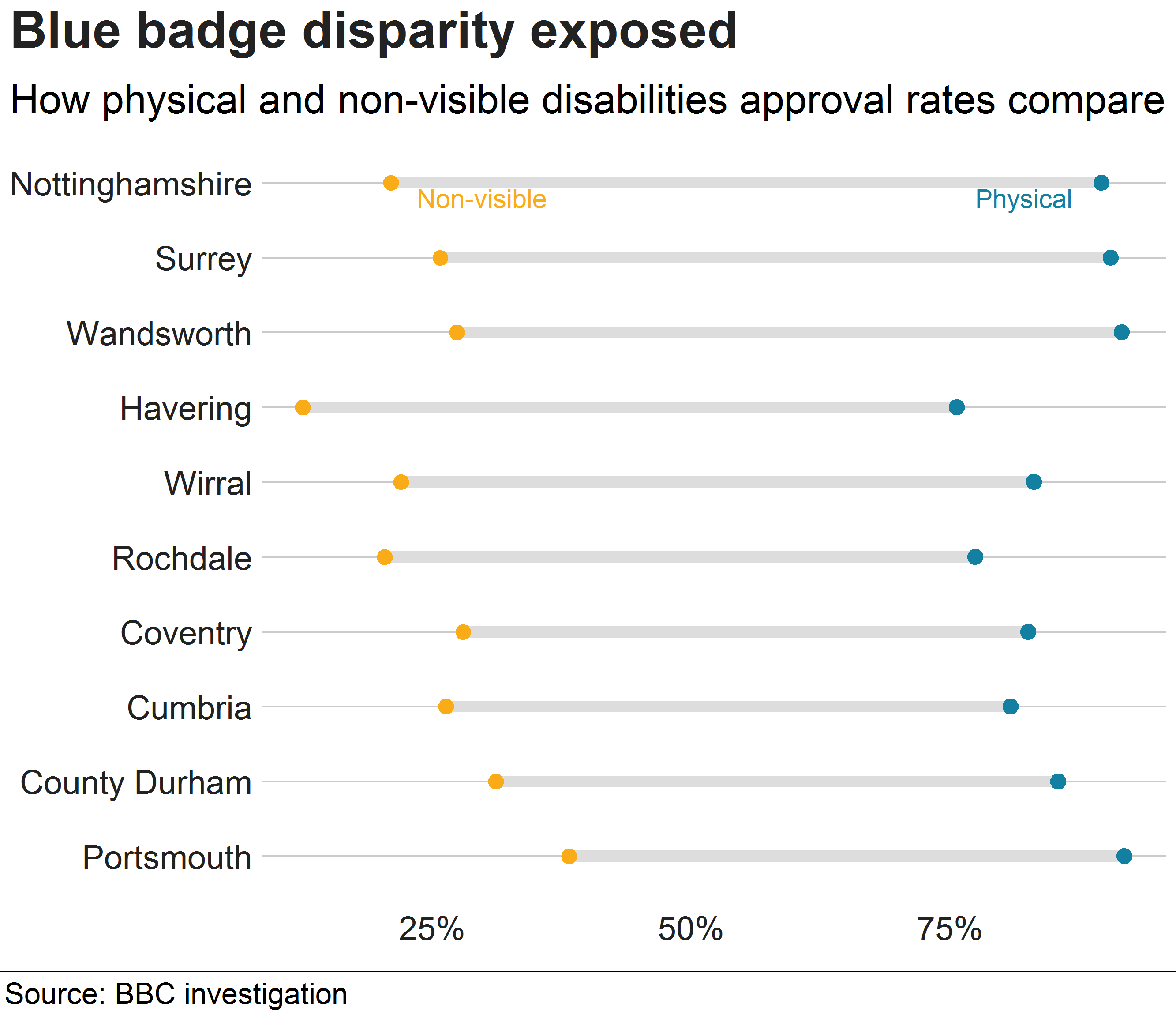
How was the scheme extended?
Blue badge permits help disabled people to access goods and services, by allowing them to park close to their destination.
The new rules, described as “the biggest change to the scheme in nearly 50 years” when introduced by the Transport Secretary Grant Shapps, widened the eligibility criteria to ensure people with non-visible disabilities were not disadvantaged.
The scheme was changed to include disabilities such as autism, dementia and anxiety.
‘I found it very difficult’
Former magistrates’ court manager Michelle Woodward, who has relapsing remitting multiple sclerosis (MS), had her application for a blue badge and an appeal refused by Oxfordshire County Council in February 2019 before non-visible disabilities applications were introduced.
“It was outrageous at first,” she said.
“Someone must have said to me it would be straight forward, otherwise I wouldn’t have put myself through that stress.
“When I originally applied the guidance said not to mention any toilet issues.
“This was impossible for me because MS has affected my bladder as well as my walking and endurance.
“So when I hit the send button of my online application I instantly received a refusal email.”
She could not re-apply for six months but when she did, she successfully did so under the new guidance.
She said: “I found it very difficult navigating the whole online application system.
“Unfortunately, MS affects your brain power. So I had trouble working my way round the form, trying to attach it. Sometimes I have to get my husband to do it.
“It’s not friendly.
“How many disabled customers are the shops losing because we can’t we can’t use them?
“I feel like I’m not being incorporated with the town. I’ve lived in Oxford for two years but I can’t really familiarise myself with the city.
“There are people worse off than me, how do they cope?”

Tim Nicholls, head of policy and public affairs at the National Autistic Society, said: “These figures highlight the postcode lottery that has developed around blue badges.
“This must change. Getting a blue badge when you need one shouldn’t depend on where you live.”
The removal of accessible parking bays next to shops and amenities “overnight, without any consultation” to allow for social distancing during the Covid-19 pandemic had also had a “massive impact” on disabled people, Scope said.
The DfT said its review of the new criteria would include considering feedback from users of the online application service.
But people who had applied online told the BBC of the “trauma” of having to produce evidence of their disabilities to be scrutinised, and the difficulty of completing the form. In addition, they spoke of their reluctance to send original personal identity documents such as birth certificates in the post.
Mr Nicholls said a blue badge could facilitate journeys with a carer for someone with autism who may not be able to understand or react to the dangers of the road.
The permit could also help someone with autism overcome their anxiety over not finding a parking space or things going wrong on a trip, which could stop them from leaving the house entirely, he said.
What do councils say?
Councils with the largest disparity between approval rates said they had followed government guidance and helped applicants provide supporting medical evidence.
Councillor David Renard, transport spokesperson for the Local Government Association, which represents councils’ interests, said local authorities wanted to make sure services and communities were as accessible as possible.
About 2.3 million disabled people in England have a blue badge, according to latest data.
Some 28,000 blue badges were issued to people with non-visible disabilities in England in the first 12 months, our investigation found.
Paul Jameson was diagnosed with motor neurone disease (MND) three years ago, and is quickly losing his voice.
But with the help of professional baritone, Roderick ‘Roddy’ Williams, he’s performing his own opera, called Paul’s Aria.
This video was filmed before lockdown.
A guide dog charity has expressed “disappointment” that assistance dogs have not been made exempt from new rules for bringing pets to NI from GB.
The new Irish Sea border means paperwork and certain vaccines are now needed for pets entering NI from GB.
This is posing issues both for training puppies in NI and for the lives of existing guide dog users.
The Guide Dogs organisation said the new barrier for assistance dog owners was a “massive disappointment”.
“They now have to make the same preparations to travel to Northern Ireland as if they were going to France, Germany or another European country,” a spokesman said.
He called for “the [UK] government and the EU to come to an agreement which gives assistance dog owners the same freedoms they enjoyed under the Pet Passport Scheme.”
A Department for Environment, Food and Rural Affairs (Defra) spokeswoman said the department was “working closely with the assembly to ensure a long-term solution which supports pet owners and assistance dog users entering Northern Ireland.”
The Guide Dog National Breeding Centre in Leamington Spa in England works with volunteers all over the UK, including Northern Ireland.
Since 2010, 250 pups have been trained, through reward-based training methods, in NI.
However the charity has had to suspend the process of sending pups to NI.
‘Very frustrating’
They are usually sent at about eight weeks so the key socialisation window in a dog’s life may be taken advantage of.
But under the new Irish sea border rules dogs need to have a rabies vaccination to enter NI, which cannot take place until 12 weeks.
They then cannot travel for a further three weeks, meaning the earliest pups could come to NI from GB would be 15 weeks.
Operations manager for Guide Dogs NI James Copeland said “between nine and 16 weeks are the time when dogs and puppies are sponges”.
He added that for a puppy to travel when they were going through this period would not be best for its welfare.
He said the new rules and subsequent suspension of the scheme was “very frustrating”.
“It is of intrinsic value to NI,” he said, adding that the pet passport scheme was “already strong enough”.
“Our puppy walking scheme is a group of dedicated volunteers led by a staff member,” Mr Copeland told BBC News NI.
It is a core group of about 20-30 volunteers in NI.
Each dog stays with the volunteer for up to 18 months and their carers help with development, go through socialisation and the basic tenets of being a good guide dog.
It will still be possible for trained adult assistance dogs to be supplied to NI, but Mr Copeland expressed concern for existing guide dog owners travelling back and forth to GB or those who live in border areas.
“How feasible is it for someone who lives in Belfast to go to see family and friends in Liverpool and come back to get paperwork for a journey of maybe only three days?” he said
He cited concerns for those who are partially sighted travelling to their vets during Covid to get the form.
“There must be some sort of derogation,” he added.
What are the current rules?
From 1 January 2021 onwards, the UK has Part 2 listed status under the EU Pet Travel Scheme, meaning that people travelling from GB with their pets and assistance dogs will need to follow new requirements in order to travel to the EU and Northern Ireland.
If you want to take your pet from England, Scotland or Wales to Northern Ireland, you will have to obtain an AHC, as if you were going on holiday to the EU.
The AHC confirms your pet is microchipped and vaccinated against rabies – pets must be at least 12 weeks old before they can be vaccinated and then wait 21 days after the primary vaccination before travel.
The certificate will have to be presented to a designated travellers’ point of entry in order to undergo the necessary compliance checks.
For entry from Great Britain into Northern Ireland (as well as into the Republic of Ireland, Finland, Norway and Malta), pet dogs will have to be treated against a type of tapeworm (Echinococcus multilocularis), one to five days before arrival.
The government website says: “The UK government recognises that pet owners and assistance dog users will need time to adjust to these changes. It’s working with the Department of Agriculture, Environment and Rural Affairs (Daera) on an enforcement approach that takes these challenges into account.”
An EU pet passport issued in a member state is still valid to enter GB from NI.
Pets travelling from GB to NI will not be subject to routine compliance checks until 1 February 2021.
There will be no changes to the current pet travel health requirements for entry into Great Britain.

A Defra spokeswoman said the department recognised the vital work of “Guide Dogs UK and continue to work closely with assistance dog organisations and their members to ensure they have the latest advice and guidance”.
“We have ensured there are no changes to the current pet travel rules for entry into Great Britain from Northern Ireland, and are working closely with the Northern Ireland Assembly to ensure a long-term solution which supports pet owners and assistance dog users entering Northern Ireland,” she added.
Tributes have been paid to the husband from one of Britain’s first married couples with Down’s syndrome, who has died with Covid-19.
Tommy Pilling, 62, from Shoeburyness, Essex, died on 1 January, two weeks after contracting the virus.
Mr Pilling and his wife Maryanne marked their 25th wedding anniversary in July and had been shielding since March.
Mr Pilling’s sister-in-law Lindi Newman wrote, on Facebook: “I will cherish the thousands of memories I have with him.”
In the statement, on the couple’s Facebook page, Ms Newman said: “Thank you for making Maryanne so happy and for being the best uncle my children could ever ask for.
“Thank you for being you and making the world a better place, touching the lives of millions just by being you.
“Marriage made you my brother-in-law, love made you my brother.”
The family said Maryanne and Tommy – who met at a training centre for people with learning disabilities in Southend-on-Sea in 1990 – had only spent 24 hours apart in 30 years before Mr Pilling required hospital treatment in December.
A previous update on their Facebook page added Mrs Pilling was “absolutely lost” without her husband.
They said he tested positive for Covid on 16 December, days after he was admitted to hospital with suspected pneumonia.
Linda Martin, Maryanne’s mother, said she had considered Mr Pilling her son.
She thanked staff at Southend Hospital, Thurrock Community Hospital and Basildon Hospital for their care of him.
The Yungblud Podcast: Saryna
Saryna is 19 and has Ehlers Danlos syndrome which affects her entire body causing chronic pain and chronic fatigue. She loves drag performance and was inspired by RuPaul’s Drag Race. Now she performs drag as Peachy Ray, and has found herself through it.
Yungblud chats to Saryna about finding your passion in life and the people who support it.
Social distancing rules, one-way systems and signs imposing customer limits in shops – while many of us have adapted to the new way of life brought on by the coronavirus pandemic, those with visual impairments say the changes have left them feeling “totally disorientated” and more needs to be done to ensure new systems are suitable to all.
The BBC has spoken to three visually impaired people living in Essex about their experiences.
‘I keep away from shops’
Graham Routledge, of Little Canfield, has found the new rules difficult to adjust to – so much so he avoids going out often.
“When you go out, there is a one-way system in shopping centres and people were telling me I was going the wrong way round,” he said.
“You can’t see the stickers on the floor or the signs on the door – it has made me keep away from shops.”
Mr Routledge says he hopes there is a change and that places introduce a person at the entrance or a voice recording to inform people of the rules.
“If the signs stay, it is going to cause a problem with visually impaired people,” he said.
“You need a voice telling you which way to go, there is no good having writing up on the walls or signs, I wouldn’t see it and the dog can’t read.”
The 67-year-old said he was a very social person and that it was “hard to not be able to meet other people”.
“I’ve spoken to several people and they have had the same problem, they don’t go out on their own,” he said.
‘It has been horrendous’
Samantha Fox, who lives in Hadleigh, said new signs on pavements and different layouts in supermarkets made her feel “totally disorientated”.
“It has been pretty horrendous actually,” she said.
“When I first went to a supermarket after lockdown, I couldn’t feel my way round as so much had changed and because of social distancing, no-one was near to me to help.
“I can’t stand social distancing because I don’t know where the person is in front of me. It is really hard. Winston my guide dog doesn’t understand social distancing either.
“My family are amazing but it is horrible for me to keep asking for help. It takes away your independence.
“I am only 50 and to be reliant on others is awful. Before coronavirus hit, I thought I had a purpose. Everything has changed.”
Ms Fox agreed with Mr Routledge that there should be voice instructions to help people with visual impairments.
“Now Essex is in tier three, there are more signs giving guidance – but that doesn’t mean anything to me,” she said.
“There should be someone standing by the door to explain what the procedure is.”
‘I get really worried’
Pamela Little recently moved to Old Harlow from Wimbledon and said the new rules had made it more difficult to learn her way around.
“All of the signs and new regulations in place make it very difficult,” the 59-year-old said.
“I don’t know what the rules are in any of the places I go to, I get really worried.
“With every shop, they have the paper on the windows telling you how you are supposed to behave, but what if you can’t see? You can’t read them.
“Some shops you are supposed to have two people in there, I can’t see through the glass to see who is in there. I can’t see how many people are in the queues, I can’t work out the distances either.”
Ms Little said she also struggled with technology many people have relied on during the pandemic, such as Zoom, and found it “really frustrating”.
“The independence that I had strived to maintain since I lost my sight has been getting worse and worse,” she said.
“It has diminished so much and I am reliant on everyone else. For me that is very hard.”
A girl whose body was found in a jungle during a holiday in Malaysia died by misadventure, a coroner has recorded.
Nóra Quoirin, 15, from Balham, south-west London, was discovered dead nine days after she went missing from an eco-resort in August 2019.
The family said they were “utterly disappointed” with the verdict, which ruled out any criminal involvement.
They believe “layers of evidence” that were heard at the inquest point towards Nora having been abducted.
The family were staying in Sora House in Dusun eco-resort near Seremban, about 40 miles (65km) south of Kuala Lumpur, when they reported Nóra missing, the day after they had arrived.
Nóra, who was born with holoprosencephaly – a disorder which affects brain development – was eventually found by a group of civilian volunteers in a palm-oil plantation less than two miles from the holiday home nine days after vanishing.
The Quoirins, whose lawyers had asked the coroner to record an open verdict, said in a statement after the ruling that they have a number of reasons for the abduction theory. These include:
- Professionally trained canines were unable to follow Nóra’s scent.
- There was an opened window to the chalet with unidentified fingerprints found on the outside.
- Nóra had “neither the cognitive, nor physical means” to leave the chalet by the window on her own.
- Hundreds of people relentlessly searched the surrounding area, including where Nóra was found, on the day of or immediately preceding the day of her death. They found no signs of human life.
- There was a “lack of major physical damage” to Nóra’s body despite her “inability to handle terrain as complex as the Seremban jungle”.
In the statement, issued through the Lucie Blackman Trust, the family said they witnessed 80 slides presented in court as the verdict was given, adding that none of them “engaged with who Nóra really was – neither her personality nor her intellectual abilities”.
They said: “The coroner made mention several times of her inability to rule on certain points due to not knowing Nóra enough.
“It is indeed our view that to know Nóra would be to know that she was simply incapable of hiding in undergrowth, climbing out a window and making her way out of a fenced resort in the darkness unclothed.”
The statement added: “We believe we have fought not just for Nóra but in honour of all the special needs children in this world who deserve our most committed support and the most careful application of justice.
“This is Nóra’s unique legacy and we will never let it go.”
Fom the outset Meabh Quoirin believed her daughter had been abducted but Malaysian police insisted Nóra’s disappearance had always been a missing persons case and ruled out any criminal involvement.
The authorities closed the case in January 2020, and Nóra’s parents pushed for the inquest.https://emp.bbc.co.uk/emp/SMPj/2.36.7/iframe.htmlmedia captionPolice played the sound of Nóra’s mother’s voice through a loudspeaker in the jungle
During the inquest, a British pathologist who carried out a second post-mortem examination said Nóra’s body had no injuries to suggest she was attacked or restrained.
On the final day of evidence, an investigating officer who was on duty the morning Nóra was reported missing said he was confident there were no criminal elements involved in her disappearance.
Following the coroner’s verdict, the Quoirins’ legal team have discussed the family’s rights moving forward, which include the possibility of applying for a revision of the misadventure verdict at the High Court of Seremban.
Louise Azmi, one lawyer for the family, said they had pressed for an open verdict to reflect the lack of positive evidence in the case regarding what happened to Nora.
An open verdict would leave open the possibility that a criminal element was involved in Nora’s death, Mrs Azmi said.
She told the BBC based on everything the family know of Nora, “they continue to believe it is impossible she would have willingly walked away into the jungle”.


The family’s legal team say parents Meabh and Sebastien Quoirin are “disappointed” with today’s verdict.
But, Coroner Maimoonah Aid said her verdict was made not on “theories” and “speculation” surrounding the case, but on the balance of probabilities of the evidence presented before her.
With no evidence to the contrary she ruled out foul play.
Moving forward, the Quoirin family now have the possibility to apply for a revision of the verdict with the High Court of Seremban.
There is precedent of a verdict being overturned in Malaysia before.
In 2019, following an appeal, a Malaysian coroner’s verdict of misadventure concerning the death of 18-year-old model Ivana Smit was overturned in Kuala Lumpur and reopened as a murder investigation.
According to Quoirin family lawyer Sakthy Vell, the family say they now need time to consider their next course of action.
Krayz-Legz Launches Wheelchair-Friendly Music Studio
A disabled rapper who has worked with Snoop Dogg is to run workshops from his accessible music studio to help “overlooked” artists.
Krayz-Legz launched Kidmenace Studios in Shepton Mallet, Somerset, which has been designed with wheelchair access.
The artist, who was born with spina bifida, has also launched a crowdfunding campaign to pay for musical equipment.
His workshops will start in January 2021.
They will include practical advice on songwriting and music production.
In 2019, Glastonbury Festival founder, Michael Eavis presented the Krayz-Legz with a gold award from Spotify for reaching 100,000 streams.
Krayz-Legz said there wasn’t anything to support him when he started out as a rapper which made performing on stage and recording music in small studios difficult.
He has been performing at Boomtown Fair Festival for the last five years and said organisers are “great” at supporting disabled artists.
He said: “After many years being lifted up onto stages from my wheelchair, I want people who have a disability to come into my studio and feel comfortable to make music and not be overlooked.
“The studio is everything I would have appreciated when I started out as a rapper and I couldn’t have done it without my girlfriend.”
Krayz-Legz and his partner Elly Bull have used their own money to create the space.
He added: “I’m all self-taught and I’m so grateful I’ve been able to make music with big American rappers like Snoop Dog and now I want to give back everything I’ve built up over the years.”
Krayz-Legz recorded a song with rapper Wiz Khalifa in Kidmenace Studios which was released 7 November and hopes to connect more with disabled artists.
Head of music for Boomtown Fair Festival, Kaptin Barrett, has been supporting Krayz-Legz in his music career and says he is “proud” to see the artist’s dreams for an accessible future for disabled people come to life.
He said: “There are so many creative souls that have accessibility needs and need to be heard but in order to do that there needs to be somewhere they can go to create.
“This studio is that place and support for his crowdfunder is so needed so he can get more equipment so that more people can benefit.”
Mr Eavis said: “This is a very special place for musicians who have disability problems and need to be encouraged to make full use of their amazing skills.”
One in two deaf children in England are not getting necessary specialist teaching support since returning to school in September, The Independent can reveal, amid warnings that pupils with hearing loss are at risk of falling behind.
Before the pandemic, about two-thirds (67 per cent) of deaf children usually had visits from a teacher of the deaf (ToD), but only half of these pupils (51 per cent) are currently receiving the support they need during the pandemic’s second wave, according to a national poll of parents by the National Deaf Children’s Society (NDCS).
Since going into year 2, six-year-old Liam has been asking his mother, Brodie Kingston, when his teacher will be coming in to see him. She’s had to explain that she won’t be able to come to his school – an academy in Stoke-on-Trent where he’s the only deaf child – because of the pandemic; the school told her they were informed that social distancing rules meant she would not be able to visit.
The visits have been stopped across the country for a range of reasons, according to the NDCS, who clarified that they did not have data on how many schools versus local authorities were making the decision. The charity said that several local authorities have said the decision lies with individual schools, while some schools will only allow the teacher to come if it is the only school they’re visiting that day. Additionally, some specialist teachers have not been able to make appointments because they have been self-isolating.Advertisement
The specialist teacher’s support has been hugely important for Liam, both socially and educationally.
“Sadly, deaf children are bullied a lot,” Brodie says. “His ToD has been brilliant. Last year she spoke to an assembly about inclusivity, explained how hearing aids work, told the kids they shouldn’t touch them or pull them out – things like that.” She thinks the talk had a really positive impact on Liam’s experience at the mainstream school.
Brodie says Liam’s ToD was crucial in helping to instruct teachers how to make their classes inclusive of pupils with hearing loss.
Since she hasn’t been able to come in this year, Brodie says the teachers haven’t been properly trained in how to use Liam’s radio set, which allows him to hear the teacher clearly above classroom noise. about:blankabout:blankjavascript:void(0)javascript:void(0)about:blankabout:blank
“He’s had to show them how it works himself, but as you can imagine, six-year-olds aren’t the best at training teachers how to use a bit of tech,” she says.
Liam’s mum is worried that he’s already falling behind: his reading has dropped a level and, at a recent parent-teachers meeting, his teacher said she felt he seems less confident than he did last year.
“This is such a key time for him to be learning, especially with his reading, and he’s missing out on all of that because the teachers haven’t had the correct training,” Brodie says when we speak over the phone. “I think it’s going to make him struggle for the rest of his school life.”
Before the pandemic, a ToD would visit Linda Goodwin’s 14-year-old daughter, Jessica, once a term at her grammar school in Kent. They would assess her progress together, as well as discuss any issues she might have be having.
“She looks after her socially as well – that’s a hugely important part of what the ToD does, making sure she’s socially included, not suffering any bullying or any issues, which is fantastic,” Linda says. She also worries that her daughter, who relies on lip-reading in loud environments, is feeling excluded by the need for face masks in the school corridors.
Since returning to school, Jess has not received a visit from the teacher because of social distancing concerns. The school said that they have made efforts to allow the appointment, but as a result of the school’s learning bubble arrangements, the teacher said the room available for the meeting was too small.
Linda says the impact on her daughter’s school experience has been immediately obvious, stressing the importance of the visits in reminding and advising teachers about how they can make their lessons fully inclusive.
Earlier this term, Jessica failed a German language listening test because her teacher, forgetting he had a pupil who needed an adjustment, didn’t give her a transcript.
“Jess is just a typical teenager – she didn’t want to speak up in class and draw attention to herself,” Linda tells The Independent. She says the school, who have always been very supportive, were apologetic about the incident and the parent says she appreciates that teachers have a lot to deal with at the moment.
In light of the poll, the NDCS highlighted serious concerns that 13,000 deaf children – who already achieve less than hearing children at every stage of school and an entire grade less at GCSE on average – will fall even further behind in their education because of this lack of support.
Allison Allan’s 12-year-old daughter, Holly, who attends a special school in Derbyshire, normally only sees her ToD once a term. Now the only contact she has with the specialist teacher is over video call, as the local authority has advised peripatetic staff to work remotely where possible. For Holly, who has Down’s syndrome, this substitution doesn’t offer much support – her mum says she’s unable to concentrate for long when the session is delivered through a screen.
“Holly’s a sociable person. Having the in-person interaction is so important to her,” Allison explains. “Having a hearing difficulty, so much comes down to body language and expression and tone for her … There’s so much more going on that she can pick up on.”
Physical communication is a key form of interaction for Holly. “Her favourite thing to watch on the telly is Mr Bean because it’s all physical comedy – there’s very little dialogue and she can follow what’s going on,” Allison says. “There are so many more ways to communicate than just verbally.”
Allison worries that the lack of in-person support will have a long-term impact on her daughter’s development; she says Holly has been struggling with pronouncing words.
“Holly’s never really done lip-reading. She’s just a lot better face-to-face with someone,” she adds.
Ian Noon, head of policy at the NDCS, said: “Schools and local authorities are working hard to adjust in difficult times, but they have a legal responsibility to make reasonable adjustments and stop any deaf children falling through the cracks.”
He emphasised that deaf children already achieve lower grades on average than hearing children throughout school – without the crucial visits from specialist teachers, “many will be left to struggle on alone”.
He said: “The government has made it very clear that specialist teachers should continue to support deaf children, so we expect every school and every local authority up and down the country to make sure this is happening.
“We cannot have a situation where any child is abandoned by the very system that should be providing for them, but this is very much the reality thousands of deaf children are now facing.”
A spokesperson for the Department for Education said: “Our guidance is clear that schools should accommodate visiting specialists, and that specialists, therapists, clinicians and other support staff should provide interventions as usual for all children and young people with special educational needs and disabilities, including deaf children.”
Peter White’s Love For Braille Books
The need for last year’s resolution started in my childhood. (Don’t they all?) By the age of six, I was reading braille at an unheard-of speed, to the point where the teacher at my blind school accused me of lying when I said I had finished the three books she had given me that morning. It was the start of a lifelong problem: braille books were scarce, but I could not get enough of them.
The school had devised a particularly cruel and subtle form of torture for someone like me: they kept just one title of a child’s favourite author in the school library; for example, just one Famous Five book, one Billy Bunter, one Just William. As I grew older and my tastes changed, the problem remained the same: one Raymond Chandler, one PG Wodehouse, just one even mildly dirty book when puberty hit.
But don’t feel sorry for me, because this story has a kind of happy ending. The digital revolution hit. Suddenly, through the agency of talking laptops and braille note-taking machines, it became possible to turn print books into braille books; not just the books the braille libraries thought you ought to have, but the ones you actually wanted. It required certain computer skills that I struggle with, but it was possible. Through the generosity of friends and relatives, a trickle of such books began to turn into a stream – and then a flood.
The bookshop that used to be a place of torture had become a treasure trove; I began to buy, borrow, steal any book I could lay my hands on and get it scanned into braille. And here lay my need for a resolution.
The rational part of me finally admitted that, unless I were to defy all known rules of longevity, I would never be able to read all the digital books I’d already accrued – let alone any that I might acquire in future.Advertisementhttps://c660bb9b1414c9e34e4e7bd97f6285c9.safeframe.googlesyndication.com/safeframe/1-0-37/html/container.html
I was also coming close to exhausting the tolerance of those – usually my spouse or offspring – who, in variable states of willingness, accompanied me on these ill-thought-out book searches. At the peak of my mania, I was acquiring as many as 40, sometimes 50, books a week (thank God for the secondhand bookshop, or we would have had to give up eating).
An added problem was where to put them. There was no room left in our existing bookshelves (have you seen the size of the average braille book? War and Peace alone comes in 21 volumes). So my new print books began to pile up in every conceivable space: tottering heaps stacked against any vacant wall, from the loft to the loo, the garage to the shed.
It was at the beginning of this year that I realised I would have to stop. I decided to limit myself to books I needed for my work as a broadcaster, or for minimal keeping up with like-minded friends, or books that I could say were “essential reading”. Books I would not just start, but might actually finish, too.
So far, I reckon I am doing all right. After all, that book I discovered the other day on a rather obscure Danish battle in 1864 is sure to come in handy when I meet my friend from the local history society. The job lot of four cricket books I could not resist will oil the wheels should any cricket-obsessed acquaintances drop in for dinner after the pandemic – and then there is Build Your Own Gym, which, in these days of self-managed exercise, is surely an absolute must. I mean, when it comes to books, who is to say what is essential reading?
Restrictions have come to define many people’s lives this year – understandably frustration has been vented over cancelled plans or the inability to travel. But for me, this was business as usual. For the past two and a half years, I had been unable to walk due to a condition called functional neurological disorder, which blocks messages from the brain to certain body parts. My left leg wasn’t listening, leaving me stuck and immobile.
That was, until it all changed. From September this year I was to be enrolled in a five-week treatment programme that could help me regain my mobility. Treatment would mean travelling into London every week by train during the pandemic, staying in a hotel two nights a week and interacting closely with others, taking me away from my small, low-risk Essex village. I hesitated, but my boyfriend encouraged me before I could let the doubt take hold. That was the first lesson: trusting my gut wholeheartedly.
My treatment was multifaceted: a mixture of occupational therapy, intense physiotherapy and neuropsychiatry based on a CBT method. The days involved three one-hour sessions, assessing everything from my balance and gait to my mood and negative automatic thoughts.
I’d expected learning to walk again would involve overcoming physical barriers, but my treatment taught me that only played a small part in treating my condition. Rather than being caused by a structural disease in the nervous system, functional neurological disorder is a problem with how the system works. Essentially, my software was broken, as opposed to my hardware.
Patients can find they’re more prone to functional neurological disorder due to past traumatic experiences or a highly stressful life. In my case, I suffered a stressful lumbar puncture when I was diagnosed with meningitis and sepsis. Coupled with a hectic lifestyle, it led to my brain becoming overwhelmed, and the subconscious act of moving my legs to stand or walk became a conscious one.When I had to walk or stand, I had to put thought and effort into each movement, creating a sense of fear. My brain, in its over-stressed state, began to block messages to my left leg causing numbness, which in turn led to even more fear. Learning to understand what situations and experiences were likely to cause a neurological reaction would be key to my recovery.
This was made more difficult as I was also diagnosed with chronic fatigue syndrome caused by meningitis. Even if I felt I wanted to move, I couldn’t because extreme fatigue held me back. Over time, I learned how to manage it better by pacing my hours, days and weeks. Luckily, my hospital treatment for functional neurological disorder incorporated my diagnosis and I was given plenty of time to rest between sessions, both mentally and physically.
Ihad to face fears that could hinder this journey. From anxiety caused by the possibility of falling over in the middle of the street, to dealing with mourning years lost to an illness. Everything needed to be put on the table so my brain could focus solely on walking.
Despite all the reading I’d done, little prepared me for week one of treatment. From learning about every part of the brain to filling out forms to try and connect how my emotional state might impact my condition, I came away with my head spinning but full of hope.
By the second week, there was incredible progress. I walked 40 steps and regained my ability to get in and out the bath by focusing on an inanimate object such as a bottle of shower gel. This worked by making my brain focus on the shape, colour and size of the object instead of on anxieties about mobility or failure.
Elated from my success, I challenged myself further. Week three saw me take my first steps outside, walking at a snail’s pace in the sunshine with my physio beside me. A world of different textures, such as gravel and autumn leaves, unfurled beneath my feet.
As the treatment continued, I sobbed down the phone to my boyfriend out of pure exhaustion. During week four, I managed seven minutes on a treadmill one day, and 14 the next. I stood up in front of a mirror to do my makeup, standing now coming entirely naturally to me and without the fear of falling. By the end of the programme, I walked half a mile to a coffee shop and back, my legs almost giving way with pride.
Before this journey, I thought that when I learned to walk again, I’d be taking flights to Nordic countries for long weekends to make up for lost time. With the pandemic, I was forced to take it easy: taking baby steps around my village as the sun shone and sparkled on the river. I became more thankful than ever for being exactly where I was, and how I was, at that moment in time.
Following the treatment, I continue to practise mental and physical activities every day. A key part is focusing on my breathing: I now very consciously learn to “reset”, and focus on nothing but breathing in and out, if I find myself struggling to walk or stand. To be able to move forward, I have had to learn to simply exist in the moment.
I’ve taken this into every aspect of my life by being kinder to myself and acknowledging I’m on a path to recovery; not everything needs to go at a million miles per hour. During my CBT sessions, I realised my inner monologue was putting way too much pressure on myself. It would berate me for not being further along in my career, not being as financially secure as I’d like, and for not meeting a whole host of other self-assigned goals. I’ve learned since to note this voice when it arises, acknowledge it, and then to reinforce positive affirmations about my life.
We have so much going on in our minds; it can’t all possibly live at the forefront. As with functional neurological disorder, I was fighting with myself to do everything at once, causing my brain to shut off completely. Since treatment, I’ve learned to literally take things one step at a time.
Chippenham’s Dave Walsh Second In World’s Strongest Disabled Man
A British man who came second in a competition to find the world’s strongest disabled man says it feels “great” if a little “sore”.
Dave Walsh, 34, from Chippenham, Wiltshire, used to take part in able-bodied strongman competitions until he was diagnosed with Multiple Sclerosis.
He now competes in his wheelchair in the seated category and took part in the virtual competition from Somerset.
“I came first out of Britain and second in the world, which is great,” he said.
Mr Walsh joked: “It feels sore, but quite great really.
“When I was diagnosed with MS I kind of thought that had taken everything away from me, I’d have to stop, and I couldn’t do it any more.
“So to be able to continue the sport in the disabled category was everything to me.
“There is always that goal to get as high as I can, without thinking about the worlds too much, but when it came along, I really wanted it.”
The World’s Strongest Disabled Man competition was able to take place during the coronavirus pandemic with events filmed for a live feed and watched by judges Magnus ver Magnusson and Arnar Mar Johnson, who are based in Iceland.
Events took place on Sunday from around the world including in Germany, America and Australia, with the British men competing from Nailsea in Somerset.
Each location had their own referees, but competing in this way had its own challenges, Mr Walsh said.
“You’re not going head to head in front of people, so there is no guidance about how many reps you might need to beat someone else,” he said.
“Usually when you have a crowd or you’re going alongside your peers you get a bit more adrenaline going, a bit more of a rush, but the people who were there all made it, cheering you along.”
‘A monster’
Mr Walsh said they were also limited to more “basic events” – rather than pulling large vehicles – to ensure everyone had access to the same equipment.
He added his favourite event was the seated deadlift, in which he came second.
“The chap who won is from Germany, and if I’m totally honest the guy is a monster,” he said.
“We did the seated deadlift for maximum weight, I pulled 480kg, the winner pulled 555kg which is a new world record, so he did really well on that.”
Competing alongside Mr Walsh, in a different category, was Gary Clarke, the UK’s first ever disabled strongman and founder of Britain’s Disabled Strongman Competition.
Mr Clarke, 43, who is from Chard and has cerebral palsy, said: “I was pleased they were able to find a way to carry on, obviously it has been different this year, but it was a good show, all the safety precautions were put in place and fair play to them for putting it together.
“We’ve got a strong contingent in Britain and I am so proud of all our athletes…we certainly gave a good account of ourselves [at the worlds].”
2020: Same Difference Year In Review
January seemed almost normal
We met a young boy called Veer
While the world was meeting a virus called Corona
Mostly for the first time and mostly without fear
February seemed almost normal too
We met Quayden Bayles
Corona was in the news now
But still no one was blue
March started out with rising hits
But then things all got a bit
Mad. Corona came to stay
And soon Lockdown was on it’s way
April arrived. No one was fooled
Home had become both office and school
Captain Tom brought us a smile
Walked many miles, for money and lasting fame
May and June passed us by
Thanking God for videocalls, we met Zoom and had to try
To get to know it.
There was some relief in July and August too
September saw kids celebrating going back to school!
We had a little hope in October
Although that Halloween witch, Corona, still wasn’t sober.
November saw hope explode like rockets
Lockdown returned and we sat with hands in pockets.
December saw Christmas bubbles planned
But Tier 4 came instead as hope ran
Out once again.
There’s a vaccine now, on it’s way to one and all
So we can hope to be happier next time Christmas calls.
We have no words to make this bit rhyme so we’ll just come out and say it. Same Difference was with you from the start, readers, and we hope to be with you till the end, covering disability issues big, small and Corona related.
We wish you all the happiest possible 2021.
When Greta Thunberg Met Margaret Atwood… On Zoom
This is what happened when teenage climate activist Greta Thunberg and veteran author and environmentalist Margaret Atwood were brought together by Radio 4’s Today Programme.
Covid-19 Guidance For Blind People ‘Breaches Equality Laws’
A blind woman is taking legal action against the government claiming it has failed to keep her properly informed during the pandemic.
Sarah Leadbetter, who is clinically extremely vulnerable, said she has not been sent any shielding information she can access.
The 45-year-old added she only found out she is on the shielding list through her mother.
The government has said guidance is available in “alternative formats”.
Ms Leadbetter, from Narborough, Leicestershire, said vital information was not sent in accessible formats such as email or files compatible with a voice-reader.
Her solicitors said this breaches duties under the Equality Act 2010 and the Accessible Information Standard.
They have applied for permission for judicial review of the Secretary of State Matt Hancock’s “failure to provide accessible correspondence regarding shielding to blind/sight impaired people”.
Ms Leadbetter has a genetic condition that affects her immune system, is in remission from cancer and lives with her elderly parents who also have health issues.
She said she only discovered she is on the Shielded Patients List because her mother, who is also shielding, received the same letter and told Ms Leadbetter.
“Large type does not work for me, nor does Braille, I need it on an audio CD or just a simple email that can be read out on an iPhone with voiceover,” she said.
“It is like being treated like a child. I want to be able to do this myself, to be able to look after myself as much as possible.
“Without this information I could be out there with other vulnerable people doing the wrong thing.
“The banks can do this, so why can’t the Department of Health?”
In earlier correspondence, the Department of Health and Social Care (DHSC) told Ms Leadbetter generic versions of the shielding letters are available on the internet.
But she said this is not adequate as people might not know they are shielding, or could struggle to access the internet.
Solicitor Kate Egerton, who is acting for Ms Leadbetter, said: “The Secretary of State’s position means that sight-impaired people are required to have access to the internet and check the government’s website for guidance every time they leave the house.
“This is far from the position afforded to sighted people and is, in our view, discriminatory.”
A Department of Health and Social Care spokesperson said: “We remain focused on protecting the most vulnerable, and have been committed to supporting disabled people throughout this pandemic.
“We have issued guidance for the clinically extremely vulnerable with information on how they can keep themselves safe during the restrictions, and an array of public health guidance has been made available in alternative formats, including Easy Read, British Sign Language and Audio.”
June Brown Stars In Audio Drama About Disability And The Pandemic
Therapy Pony Spreads Christmas Cheer On Coventry Doorsteps
An out-of work therapy pony has been spreading Christmas cheer among children.
The American miniature horse called Boo normally visits care homes, special schools and hospitals.
Unable to carry out those visits due to Covid-19 restrictions, she has instead been doing doorstep visits in Coventry.
Owner Yvette Colson said “people would just light up when they saw her”.
“My mum used to have Alzheimer’s and was in a care home and as she deteriorated I used to take Boo in to visit her, and it was the only thing that would make her eat and drink and smile on the odd occasion.”
The paid-for visits were now “fully booked” over the Christmas period, she added, “and when Covid has subsided we’ll be able to get back out there and make the [care home] residents smile again.”
The Guardian View On Disability Rights: A Deficit Of Attention
There should have been a feature film, or a primetime TV series. Maybe one day there will be. But this year, the 25th anniversary of the Disability Discrimination Act – a landmark piece of legislation outlawing discrimination by service providers and mandating “reasonable adjustments” by employers – passed quietly. The BBC screened The Disability Paradox, a thoughtful and introspective documentary by the Northern Irish film-maker Chris Lynch. On Netflix, Crip Camp documented the disability rights movement in the US. But the high drama of the parallel struggle in Britain, which saw hundreds of activists chaining themselves to buses and blocking streets, is still waiting for such high-profile treatment.
Instead, at the end of an extraordinarily difficult year, people with disabilities have been among the hardest hit. Ministers have asked the Scientific Advisory Group for Emergencies (Sage) to review figures showing that people with learning difficulties are dying from Covid-19 at six times the rate of the general population. The Care Quality Commission is investigating why do-not-resuscitate orders were allocated to some care home residents without consultation, causing potentially avoidable deaths.
At the same time, in common with other minority groups whose members are disproportionately poor, disabled people have suffered acute economic hardships. Flaws in the design of benefits and years of cuts to local services were among the causes of rising extreme poverty before this year. With 2 million families predicted to have problems feeding themselves or keeping clean and warm as the recession deepens, that picture is expected to darken.Advertisement
Disability covers a vast range of experiences and conditions, some of which are lifelong but many of which are temporary or linked to old age. Research has found that many of the nearly 14 million disabled people in the UK think the equalities framework does not serve their needs well, and that things were better when they had their own watchdog, the Disability Rights Commission.
In a speech last week, the women and equalities minister, Liz Truss, said the government’s new approach to equalities would emphasise practical issues such as “getting to work” – often a problem for disabled people who find themselves trapped at home because of inaccessible transport. Her emphasis on the enforcement of fair treatment should be welcomed; legislation outlawing discrimination is no use without it. But without new resources, such commitments are meaningless. Cuts to social security, local government and legal aid budgets are a key reason why, despite positive developments such as increased awareness of neurodiversity, progress towards equality for disabled people has, broadly speaking, gone into reverse.
Until the worst of the pandemic is behind us, it’s hard to feel optimistic about the prospects for improvement, with low levels of representation of disabled people in public life another persistent problem. Priority access to the Covid-19 vaccine would signal that the government is serious about removing obstacles to participation – as would restoration of funds for the “access to work” scheme that used to help with transport costs. As the country starts to recover from this year of illness, policymakers must be pressed to ensure that their ambitions for levelling up do not overlook people with disabilities. Instead, addressing their needs should form part of the social infrastructure transformation that is long overdue – with an accompanying recognition that care, interdependency and difference are facts of human life. Twenty-five years after discrimination against disabled people was outlawed, the ongoing failures are as striking as the progress.
The Stand: Anger Over Actor Cast In Deaf Role For Stephen King TV Series
Members of Hollywood’s deaf community are boycotting CBS’s new mini-series The Stand, based on Stephen King’s novel, after a hearing actor was selected to play a deaf character.
More than 70 people signed a letter saying it was “not acceptable” that the CBS All Access series cast Henry Zaga as deaf character Nick Andros.
“We will not endorse, watch or support your mini-series… We will share our displeasure,” they said.
The BBC has asked CBS for comment.
The show is about a flu epidemic that wipes out 99% of the population, with the remaining few immune to the disease.
In June, CBS signed a commitment to audition actors with disabilities, according to Deadline, which said it was the first entertainment company to sign the Ruderman Family Foundation’s pledge for this cause.
But the protest letter said “not one deaf professional actor was called in to audition for the role”, and “the decision was made without respect to and for deaf professionals”.
It added: “There was no acknowledgement given to the psyche of a deaf character, being deaf is more than just not hearing.”
The Hollywood Reporter said CBS is meeting people from the deaf artists’ community to discuss the issue.
The first episode of The Stand, which also stars Whoopi Goldberg and Amber Heard, was released on Thursday. Last August, deaf actor Nyle DiMarco tweeted in protest at the casting.
The letter’s signatories include Antoinette Abbamonte, whose work include Curb Your Enthusiasm; and Dickie Hearts, who has appeared in Tales of the City and Grace and Frankie.
It adds: “We will share our displeasure of the casting decision and airing of the mini-series on CBS All Access with our deaf community, signing community, friends, and family of deaf individuals; together we make up 466 million worldwide.”
There are about 466 million people worldwide with disabling hearing loss, according to the World Health Organization.
In 2018, Rachel Shenton and Chris Overton, two former stars of British soap Hollyoaks won an Oscar for The Silent Child, their short film which tells the story of a profoundly deaf girl who struggles to communicate. It starred Maisie Sly, who they found after advertising on the websites of deaf organisations and then auditioning 100 children.
Last January, The Good Place star Jameela Jamil, who was born partially deaf but regained her hearing after surgery, said she had turned down an opportunity to play a deaf woman because she felt the role should go to a deaf actress.
“I said it wouldn’t be appropriate for me to take that role and they should find a brilliant deaf woman to play that role,” she told the Press Association.
“I think you have to make those choices and not be too greedy and make space rather than take space,” she added. “I don’t want to be part of erasure.”
Terminally Ill Woman Calls For Christmas Bubble Allowance
The story below is one of the saddest I’ve heard this year. And readers, we’ve all heard some terrible things this year. I fully agree with Lesley Nelson- there should be an exception made for terminally ill people to be able to have a Christmas bubble, wherever they are- just like the exception that allowed terminally ill people to get married while other weddings were banned during the full national lockdown.
Rules are rules and I have kept all the rules all through. I would never encourage rules made for public health and safety to be broken. However, I am also all for reasonable exemptions, and as someone who has lost a terminally ill family member in the past, I believe that terminal illness is a very reasonable exemption.
I would be very happy to see the Government consider this very important point and publicly make this exemption as soon as possible.
The last-minute change to Covid rules for Christmas has affected millions.
Large parts of south-east England will not have the rules relaxed at all, and the rest of England, Scotland and Wales will see them relaxed for just Christmas Day.
For some people, this news is an inconvenience. For others, it is a disaster.
For Lesley Nelson, who has terminal cancer, it is simply “not fair”.
“I am terminally ill,” she said. “This is likely to be my last Christmas.”
“I’ve spent the last two Christmases in hospital. I have a small family. We had planned a quiet Christmas as normal – just me, my two sons, my mum and my sister.
“They are all taking care not to mix for the week before. I only see my sister two or three times a year, so this Christmas is important.”
While she will still be able to see her mum and two sons, Lesley says this may have been her last chance to spend Christmas with her sister.
“I cannot say ‘never mind, there’s always next year’ because there may not be for me.
“I have no idea when I will see my sister again. She was in my Christmas bubble.
“She lives in a tier four area and is on her own. She’s been isolating for a week, so there’s no risk at all.
“I understand what the government is doing to stop the virus, but sure they must be able to make exceptions?”
Property Site Listings Exclude Renters On Benefits
Leading UK property websites are hosting rental listings that may unlawfully discriminate against people who claim benefits, a BBC investigation has found.
The majority of adverts on SpareRoom and OpenRent say people on benefits will not be considered as tenants.
“It’s very demoralising,” said Emma, a single mother from London. “Everyone deserves housing.”
The rental platforms said they were working to address the issues.
In July, a judge ruled that blanket bans on renting properties to benefits claimants are unlawful and discriminatory, breaking the 2010 Equality Act on grounds of sex and disability.
But the practice is still widespread on SpareRoom and OpenRent. More than 80% of 59,000 listings we analysed on these websites were not open to benefits claimants.
Both platforms currently offer landlords a tick-box option to exclude people on benefits, although SpareRoom plans to remove the option.
‘Painful problem’
Other websites have policies to remove discriminatory wording from adverts. This includes language such as “professionals only”, “no housing benefit” or “no DSS”, a reference to the old Department of Social Security.
Fewer than 1% of 335,000 listings we analysed on Zoopla and Rightmove contained such phrases.
However, the BBC found thousands of listings on these websites that seemed open to benefits claimants, where the same property advertised on OpenRent did exclude them.
OpenRent founder Adam Hyslop said: “We know that access to suitable properties for benefit claimants is a real and painful problem, and we want to solve the root causes of these issues.
“We’ve raised these issues in Parliament and with industry lobby groups and are working hard to address the root causes – as well as trying to combat prejudice by educating OpenRent users.
“OpenRent does not ban any group of tenants, and in the past year we have let over 25,000 properties where applications from benefit claimants were explicitly welcomed by the landlord.”
SpareRoom director Matt Hutchinson said: “After the July ruling we changed the way SpareRoom works, so landlords can only list rooms as unavailable to benefit claimants if their mortgage or insurance specifically forbid it. However, we’ve seen far more rooms still being listed as unavailable than the small number we expected.
“The reality is that there are almost no buy to let mortgages left with those clauses in them, so we’re currently in the process of removing the option to list as unavailable to benefit claimants completely.”
‘It’s very traumatising’
Emma lives in a privately rented one-bedroom flat with her son. “I pay my rent on time every month,” she said, “I have references to prove that as well as a guarantor.”
Despite this, she has been unable to find a larger flat for two years. “I’m in receipt of benefits, so landlords won’t take [me].” she explained. “They’ll gaslight you, ignore you.”
Her housing situation has taken a toll on her mental health and stress levels. “It’s made me quite angry,” she said. “It’s very traumatising.”
Emma said landlords should not assume that benefit claimants will be unreliable tenants. “In this economy, my benefits are more stable than your job,” she added.
Since the start of the coronavirus pandemic, the number of households in Great Britain in receipt of the Housing Entitlement of Universal Credit grew 62% to 1.2 million, according to the Department for Work and Pensions. A further 746,314 private renters claim Housing Benefit.
‘Constant hurdle’
Recent housing statistics gathered from official sources by Shelter show women and disabled people are disproportionally affected by policies that ban benefits claimants.
Disabled households are almost three times as likely to use Housing Benefit as non-disabled households.
Women in the private rented sector are more than 1.5 times more likely to receive Housing Benefit than men.
One man, who asked to remain anonymous, said: “DSS discrimination has been a constant hurdle in me even being able to secure a viewing.”
The 49-year-old, who has learning disabilities and mental health problems, is in receipt of Housing Benefit, Employment and Support Allowance and Disability Living Allowance.
“As soon as I tell the letting agents that I’m not able to work as I’m disabled, either I don’t hear back from them at all or I phone them up and they tell me the person I need to speak to isn’t available,” he said.
Polly Neate, chief executive of housing charity Shelter, said: “Property portals should be reminding landlords and letting agents of their duty not to discriminate – they should not be contributing to the problem.”
Otherwise, she said, landlords and agents risk serious legal action.
She said insurance policies covering landlords who rented to housing benefit tenants were easily available and that all major lenders had removed their “no DSS” clauses, including from historic contracts.
A survey conducted by YouGov on behalf of Shelter suggests that landlords’ main reasons for not letting to benefits claimants include “I do not want to let to this type of person or household” and “my letting agent advised against it”.
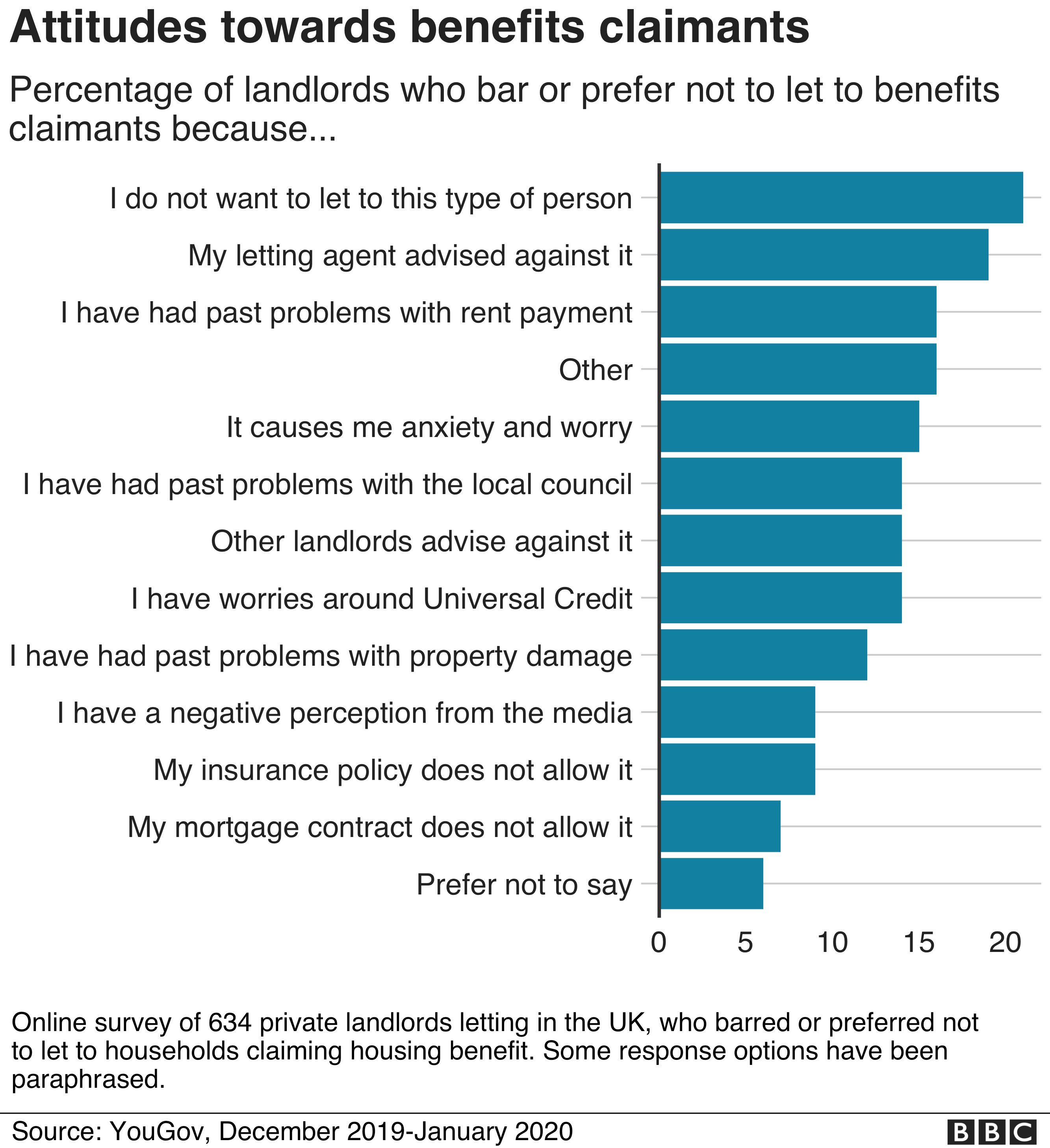
Zoopla said: “While we are happy that the BBC’s research showed over 99% of our listings are compliant we recognise even one listing with discriminatory wording is too much. We are constantly updating our systems to ensure any attempts by agents to circumvent our rules are caught and, while we have made strong progress on this, the process is ongoing.
“Any agent we do find attempting to breach our rules on this can face a variety of sanctions including the removal of their ability to list properties on our site.”
A Rightmove spokesperson said “We believe that all prospective tenants should have equal access to the widest possible selection of properties possible irrespective of how their rent is paid.”
Methods
We analysed over 300,000 rental listings across Great Britain that were advertised between the 1st and 15th of December.
On OpenRent and SpareRoom, discriminatory listings were identified by a tick box option that excludes people on benefits from renting a property.
On Zoopla and Rightmove, we searched for language such as “no housing benefits” and “No DSS”, using a list obtained from Shelter.
UK Designer’s Wheelchair Innovation Wins $1m Toyota Prize
A British designer has won $1m (£753,000) to fund the manufacture of his innovative smart-wheelchair.
Andrew Slorance, who uses a wheelchair himself, won the Toyota-run global Mobility Unlimited Challenge.
Inventors were invited to submit smart technologies to improve the lives of people with lower-limb paralysis.
The Phoenix I uses smart sensors to detect if the user is leaning forward or backwards and adjusts its centre of gravity to prevent tipping or falling.
Phoenix Instinct chief executive Mr Slorance said winning was “out of this world… incredible”.
And he was “thrilled to be leading the smart-wheelchair revolution”.
Mr Slorance started using a wheelchair 37 years ago after injuring his spinal chord falling from a “gigantic” tree as a 14-year-old.
“I remember having an extraordinary feeling of disbelief that this was actually happening,” he said.
“Then I remember branches breaking across my face as I fell towards the ground.”
Having to use a wheelchair he describes as “25kg [four stone] of steel”, he felt “devastated” and “judged as disabled” when he had to use it.
“Since then, nothing has really happened in wheelchairs,” he said.
“They’ve made them smaller or more compact.
“But the technology hasn’t changed for nearly four decades.”
The team of five at Phoenix Instinct used a “mammoth” amount of 3D printing to perfect the winning design, an ultra-lightweight manual wheelchair made from carbon fibre.
“You 3D print it, hold it and look at it,” Mr Slorance said.
“You can sit in it and if it doesn’t feel right, you print another one.
“Then, you make mould tools. We can fine-tune and tweak it.”
‘Good buy’
The company, based in Forres, Moray, will produce the Phoenix I in-house to keep it cost-effective.
The aim is for it to cost £4,000-£5,000 and be on the market within two years.
“It’s still a lot of money for a wheelchair,” Mr Slorance said.
“But for what it can do compared to the other brands that are still using 1980s technology, I think it’s a good buy.”
More than 80 teams from 28 countries entered the competition, launched in 2017.
The winner was set to be announced at the Tokyo Paralympics this summer.
But the Games have been postponed to 2021 because of the coronavirus pandemic.
Rugby And Brain Injuries: World Cup Winner Kat Merchant Has Lower Cognitive Capacity
World Cup winner Kat Merchant wants better care for retired players, saying she has “lower cognitive capacity” following numerous concussions.
Brain injury charity Headway is calling for more research into whether women are more prone to concussion than men.
Merchant retired on medical advice aged 28 in 2014 after 11 confirmed concussions in 14 seasons and still suffers with symptoms.
“I have a lower cognitive capacity,” she told BBC Radio 5 Live.
“I can’t do a hundred things at once without getting a headache or getting flustered or without forgetting my words.”
Fellow England World Cup winner Steve Thompson and seven other players are preparing a negligence claim against the game’s authorities.
Merchant is not currently considering legal action, but wants more support for players once they are finished with the professional game.
“For retired players it’s a bit like, ‘Thanks for your time, thanks for putting your body on the line for however many years, goodbye,'” Merchant, now 35, continued.
“I really suffered because I retired on medical grounds at 28, before my time. I really struggled with a loss of identity so I would have appreciated more help mentally as well.”
‘I sat in a dark room crying’
A year after retirement Merchant was still struggling with strong symptoms and anxiety and was unable to get an MRI scan through her insurance company.
She turned to the Rugby Players’ Association, which quickly sorted a scan and consultation with a neurologist.
“It took me a year to reach out to the RPA, and it was because I was sat in a room in the dark and burst out crying and I was just like, I can’t do this any more,” Merchant explained.
Merchant was a professional rugby player on a full-time England contract in the build-up to the 2014 World Cup and was offered a sevens contract to work towards the 2016 Rio Olympics. But she decided to retire after one doctor told her: “We don’t know what the next knock will do to you.” A friend also asked her: “Will it all be worth it, if you can’t remember it?”
Merchant continued: “My main concern is, am I going to get early onset dementia? If I do, how am I going to earn money, how am I going to get support, who’s going to put me in care?”
Are women more susceptible to concussion than men?
Whether women suffer from concussion more easily than men is yet to be proved, but some research indicates this could be the case.
Headway is calling for more studies, with deputy chief executive Luke Griggs saying there is “emerging evidence”.
“There is potentially a link there that women may be more susceptible to suffering from concussions and the effects of them,” he said. “What is less clear is the reason why.
“Different studies have indicated that a physiological difference in women’s necks along with links to women’s biology and the menstrual cycle could all play a role in making them susceptible to concussion.”
But Headway says the link could be because women may be better at reporting symptoms and episodes of concussion than men.
“If it is the case that women are better at reporting this, are more honest, less prone to taking chances on their health, then it’s up to males to step up and actually learn from this and improve their behaviours so they are taking fewer chances,” Griggs said.
The Rugby Football Union told the BBC: “The RFU takes player welfare incredibly seriously. As a result of our focus in welfare and specifically concussion, we have been able to develop our approach to concussion surveillance, concussion education, concussion management and concussion prevention across the whole game.
“The introduction of the Premier 15s three years ago and the 28 full-time England contracts has allowed us to improve concussion surveillance, education and management specifically within the women’s game.
“We will continue to work with World Rugby and external academic institutions and other sports to develop targeted research programmes across all areas of the game.”
Dr Elisabeth Williams is a senior lecturer in forensic biomechanics and a research scientist at Swansea University.
She is involved in research into injuries in women’s rugby and told BBC Radio Wales: “I think there needs to be a lot more attention given to the women’s game, a lot more resources dedicated to coaching.
“The women’s game needs to be taken more seriously. It needs to be actually focused on as its own sport. It’s a great sport for women and women need to be trained to play it in a way that’s going to be safe for them, which might not be the same for them as it is for men.
“It needs a lot more focus from medics, a lot more resourcing, a lot more thought given to training equipment.”
In the latest episode of The Archers it was revealed that three men, kept as slaves on the outskirts of Ambridge, have a learning or mental health disability. It is a side to modern slavery that experts have described as “hidden”, as Mike Lambert explores.
Like other listeners to Radio 4’s The Archers, I’ve been gripped by the latest twists in its modern slavery storyline.
Since March, we’ve known about three British-born men – Blake, Jordan and Kenzie – who have been enslaved by builders and kept at a secret location near Ambridge.
Last night, we heard the men talk amongst themselves for the first time and it was revealed they all have a learning or mental health disability.
According to the Global Slavery Index it is thought there are up to 136,000 victims of modern slavery in the UK.
This is the appalling reality that The Archers’ editor, Jeremy Howe, has chosen to confront and he also wants to challenge some of the stereotypes about this trade in human misery.
“It’s not simply a problem involving immigrant labour,” explains Howe. “It can be a British problem involving British slaves and British gang-masters.”
In so doing, he has posed the question of what mind-forg’d manacles keep three, British-born, young men enslaved to a pair of unscrupulous builders.
My interest in the connection between disability and modern slavery began in 2017, after a chance meeting with a former victim.
At that time, there had been a crop of news stories about the Rooney gang – a Lincolnshire-based family convicted of trafficking 18 men into hard labour for their driveway resurfacing company.
I had read how these victims were regularly beaten, subjected to mental cruelty and “institutionalised” into slavery – one of them for 26 years.
Then, one Sunday, on a train from Doncaster to London, I met a 23-year-old man called Chris (not his real name).
At first, as Chris described his difficult life and recent trip to visit his abusive, alcoholic mother, I was struck by his chatty and trusting nature. But, as he continued detailing some of the calamities that had befallen him, the penny dropped. Having spent over 25 years supporting disabled students, I was sure Chris had a mild learning disability.
Sitting on that train, I listened aghast as Chris told me how he had once worked for a “bad man” called John Rooney who had kept him in a dilapidated caravan and only fed him when he worked. Chris eventually “escaped”.
In 2019, the number of potential victims of modern slavery rescued and referred to the Home Office reached 10,627.
It would be good to know what percentage of this total had learning or mental health disabilities. But, surprisingly, nobody knows. Although most agencies that fight modern slavery keep data on gender and country of origin, no-one is counting victims with a disability.
The one exception I found is Nottingham City Council, which reports almost 60% of its clients had a disability and/or mental health/cognitive impairment in 2019 and 2020.
‘Statistically hidden form of abuse’
Other agencies acknowledge a significant overlap between modern slavery and disability.
The Anti-Slavery Coordinator at The Passage, a London-based homelessness organisation, told me: “At least 13 of the 73 potential victims we’ve identified in the last two years show clear signs of a learning or mental health disability – and the actual number may be even higher.”
The coordinator added: “Disabilities may sometimes be hard to spot, as these clients present with complex traumas related to both their exploitation and homelessness.”
At the Ann Craft Trust, a national charity combating the abuse of disabled children and adults, Deputy CEO, Lisa Curtis, believes “the modern slavery of people with learning disabilities is a statistically hidden form of abuse”.
She says: “Data-capture needs to include learning disability to highlight the scale of the problem. More research, training and work are required to ensure that people with learning disabilities are protected from modern slavery and supported in their recovery from its traumatic effects.”
Mencap defines a learning disability as “a reduced intellectual ability and difficulty with everyday activities,” such as household tasks, managing money or socialising, “which affects someone for their whole life”.
Thus, victims may already have been struggling to take adequate physical and emotional care of themselves, before being lured into exploitation by promises of food, shelter and emotional support.
Some may already have been abused as children, making them susceptible to trauma-bonding – a process in which victims are alternately praised and made to feel worthless. Others may have reduced communication skills, making it impossible for them to describe their situation to the police.
The Passage, told me how “on cold, wet nights, vans cruise well-known gathering points for London’s homeless” and “well-dressed men emerge, offering kind words, bottles of wine, food and promises of accommodation and work for cash-in-hand”.
Traffickers are often psychologically astute in how they groom victims and Curtis describes how, “grooming often mimics a genuine relationship”.
She says: “Early in the process, the groomer may appear friendly, whilst sizing-up the psychological vulnerabilities that’ll get a victim on board. For example, by saying they’ll treat him like a son, they may play on a victim’s emotional needs and create a sense of dependency and loyalty.
“Later – even if the victim realises they’re being mistreated – they don’t leave because they’re emotionally dependent, fearful of repercussions or feel embarrassed that this has happened to them.”
For years, Archers’ slave-master Philip Moss has successfully deceived everyone in Ambridge, including his new wife.
He is a respected member of the community and when Philip’s conscience bothers him, he deceives himself with the idea that he’s “doing those lads a favour by taking them off the streets”.
But, like other traffickers, Philip specifically targeted people who were rendered homeless by their disabilities and a failure of support services. And, in March, due to a lack of supervision, one of the men broke his back in a workplace accident.
‘Odd hours’
It is a situation The Passage is familiar with. Its Anti-Slavery Coordinator told me about the case of a 55-year-old man with schizophrenia who had been homeless since he was 18.
“A family approached him when he was sleeping rough in London, offering him food, shelter and work in construction and farming. He was exploited for decades by this family, who mentally and physically abused him and moved him around the country to avoid detection.
“One day, he suffered a serious workplace injury, which led to the family abandoning him in a parking lot because he could no longer work.”
Experts agree that increased public awareness is crucial in combating such practices.
Curtis advises looking out for “groups of people accommodated at unusual locations and being picked up and dropped off at odd hours”.
And, when having building work done, she asks householders to watch out for labourers who “appear neglected and malnourished, have untreated injuries and who are either uncommunicative or not allowed to speak for themselves”.
The Archers’ modern slavery story has more surprises in store for 2021. But, for now, it’s created a space to think about an extremely hidden group of individuals who are failed by society before being further devalued and traumatised by criminals.
When Margaret Keenan became the first person in the UK to receive the coronavirus vaccine last week, the nation breathed a sigh of relief. But it is crucial we do not forget those who have constantly been at the back of the queue: people with learning disabilities and autism.
Throughout the pandemic, people with learning disabilities and autism have consistently been let down. A lack of clear, easy-to-understand guidance, unequal access to care and illegal “do not resuscitate” instructions have exacerbated the inequalities many people have long faced.
The impact cannot be ignored: our research shows that 76% of people with learning disabilities feel they do not matter to the government, compared with the general public, during the pandemic. And data shows the danger of contracting Covid-19 for people with learning disabilities and autism is much higher than for the wider population.
Public Health England has said the registered Covid-19 death rate for people with learning disabilities in England is more than four times times higher than the general population.But experts estimate the true rateis likely to be even higher, since not all deaths of people with learning disabilities are registered in the databases used to collate the findings.Covid-19 deaths must prompt better healthcare for people with learning disabilitiesRead more
Even more alarming, people with a learning disability are dying from Covid-19 at a much younger age than the general population. Learning disabled 18- to 34-year-olds are 30 times more likely to die from coronavirus than their non-learning disabled counterparts. And while in the UK population as a whole, the age group at greatest risk of dying is the over-75s, for those with learning disabilities, the largest number of deaths is among 55- to 64-year-olds.Advertisement
The reasons the pandemic has impacted people with learning disabilities so disproportionately are systemic, and a result of inequalities in healthcare services experienced for generations. Yes, some individuals are more clinically vulnerable, on account of the co-morbidities and complications associated with their learning disability. For many people, however, poorer outcomes after contracting the virus are due to non-clinical issues and inequalities in accessing healthcare services. This is inexcusable.
The government must prioritise vaccinations for the1.5 million people with learning disabilities and 700,000 with autism. Puttingthis long-overlooked group at the top of the vaccine queue would help address the systemic health inequalities learning disabled people face.
Records kept by GPs and social care providers of learning disabled people would enable an effective and accelerated vaccine rollout.
But the government does not include all people with learning disabilities on its priority list for the vaccine. So unless they qualify on the grounds of age or an underlying health condition, learning-disabled people will be inoculated alongside the rest of the working-age population.
One of the key issues exacerbating health inequalities throughout the Covid-19 crisis has been the inadequate provision of accessible information for people with learning disabilities. Our research revealed that 97% of people with learning disabilities and autism felt the government needed to do more during the pandemic to address their specific needs.
Information about the vaccination programme must be accessible to those with learning disabilities, to ensure they understand the need to be inoculated and what to expect. This must include easy-read materials and specific resources to support decision-making for people who may lack capacity to make a decision about a vaccine, and who may struggle to tolerate an injection due to their learning disability.
This year, many people supported in care homes and supported living settings have had only limited contact with loved ones. With 93% of people with learning disabilities and autism saying they feel more isolated from society because of the pandemic, the detrimental impact of prolonged isolation among those who may not understand the reasons for it cannot be underestimated. We anticipate a long-term impact on some people’s health.
Putting people with learning disabilities near the top of the list for a Covid vaccine would allow them not only to see, but spend quality time with loved ones. For those in care settings, it would allow restrictions on visits and activities to be relaxed or lifted altogether. After all, this is a cohort of people who have already experienced limitations and injustices far greater than the general population. The pandemic should be a catalyst for change in how we as a society treat people with learning disabilities – we have an opportunity to start today.
• Steve Scown is chief executive of Dimensions, a not-for-profit support provider for people with learning disabilities and autism.
New business aims to help those with autism
A press release:
A new business aims to boost employment prospects in the creative industries for those with autism.
Karl Mulgrew, who has just completed a masters in Project Management in the Business School at the University of Salford, realised there was an employment gap for autistic people in the music and performance industry. To help solve the problem he created Autistic Musicians and Performers Society (AMPS). And he has even assisted his own brother on his first steps to a career in the arts.
The aim of AMPS is to provide those with autism an equal opportunity in the music and performance industry. This is done through a tailored approach, depending on an individual’s place on the autism spectrum and their choice of job role.
Karl said “It’s such a hard and fast industry, there’s not a lot of time for worrying about things like this, and I don’t think that’s fair. People with autism get little or no support in these industries.”
As a person with autism having a bachelor’s degree in Music Business and experience as a music manager, Karl has the knowledge needed to envision what support those with autism in the music and performance industry would need.
“No two clients will be the same, so we help people on their terms, at their speed and with their responsive techniques,” Karl said. “In some cases where talent needs developing, we will provide a mentor in that instrument field and they can work together to improve instrumental or vocal abilities to an industry level standard.
“The first person I wanted to help was my brother. He’s autistic and he’s always been outwardly creative, but he didn’t understand how he could do it. I was in education at the time and I said ‘look, the best route for you is education’.
“With about six to eight weeks on a custom design programme I put him through, he’s now studying his Bachelors of Honours at Lincoln which is very strange from my perspective. I never would have thought he’d be able to do it, but he’s moved away from home, he’s outside his comfort zone and he’s doing really well.
“Autistic people don’t need a lot of money spent on them to be employed,” he continued. “We don’t need special equipment, we don’t need expensive equipment, we just need understanding, a bit of patience and a change of attitude, that’s it.”
Karl is part of the University of Salford business incubator, Launch @Salforduni. Launch was set up in 2018 with the idea of aiding students and alumni in developing their own business. As part of a six-month support programme, users get access to a plethora of support from the team, including training, guidance, office space and financial aid.
Justyna Turner, who runs the Launch @Salforduni incubator said: “Karl is very passionate about his business plan and will be making a huge difference by providing those with autism equal opportunities. I believe his business will be a great success and I’m looking forward to seeing how his ideas progress throughout his time with Launch.”
Karl, who wants to do a PhD in Health and Social care, wants to develop AMPS to reach out to potential employers, agencies and his target demographic – people with autism. With hopes of gaining funding from Launch, Karl wants to spend the money on buying music recording equipment so AMPS can generate income that will be reinvested into the business.
Applications are open to join Cohort 6 of the Launch Business Incubator.
Medical appointments and COVID-19: Research reveals difficulties in arranging medical/doctor appointments during the Coronavirus crisis
A press release:
New research (1) from Zegami, an Oxford based medical image analysis platform, reveals that 15% of people say they have a known medical condition that requires treatment or proper diagnosis, but they have not been able to go to hospital to get this because of the Coronavirus crisis.
In terms of the conditions these people have, 9% say they have a heart problem, and 3% say they have cancer.
The findings reveal that overall since the Coronavirus crisis started, 43% of people say they have tried to make an appointment to see their GP or doctor, 40% said they got one quickly, but 26% said they couldn’t get one. Some 19% said they had to wait a few days for one, and 16% said they waited over a week to see a doctor.
Zegami, which has recently developed a system to analyse large numbers of mammograms and identify abnormalities, which is the first stage of breast cancer screening, says its research reveals that 5% of the adult population say they or a member of their family have had treatment for cancer delayed or cancelled during the Coronavirus crisis, with 53% saying this made them feel more anxious. One in three (33%) said it made it more difficult to carry on with everyday life, and 31% said it made them depressed.
Roger Noble, CEO and founder of Zegami said: “The NHS has done a brilliant job during the crisis under very difficult circumstances. However, if you have a medical condition you need to liaise closely with your doctor regarding your treatment, and if you suspect you may have developed something, you should seek medical advice.”
Zegami’s newly developed system for analysing large numbers of mammograms and identify abnormalities uses the recently announced Medical Imaging Server for DICOM from Microsoft. The system also allows scientists to develop Machine Learning models to automate this analysis, making it faster and more accurate.
Initial mammogram data for the system has been sourced from The Cancer Imaging Archive (TCIA) and consists of 3486 DICOM (Digital Imaging and Communications in Medicine) images, which while anonymised, includes pathology data, allowing this to be factored into the analysis. One example of the analysis is a map of the “Calcification” breast cancer abnormalities – the system highlights regions distinctly containing examples with little light areas, which are typically the benign (without a callback) instances.
Following our recent coverage of Leonard Cheshire Disability’s new TV advertising campaign, Possibility With Disability, our editor was honoured to be asked to interview their Trustee, Dr Stephen Duckworth OBE.
Dr Duckworth very kindly spoke to Same Difference about how the campaign came to be what it is today, as well as the general work of Leonard Cheshire Disability, in the UK and internationally.
First of all, we asked Dr Duckworth about the inspiration behind the Possibility With Disability campaign.
Leonard Cheshire Disability have been working with disabled people for 70 years. This year, the organisation felt that they needed a refresh. Dr Duckworth explained how the organisation’s disabled Trustees wanted to “achieve more outcomes for more people.” They carried out some research with disabled people, to find out the key messages they wanted to put across. They came up with Live, Learn, Earn which has become the main slogan for the campaign.
The advert has three disabled people in it. One is shown living, one learning and one earning.
We also asked Dr Duckworth about his own life. A wheelchair user since 1981, he is about to enter his 40th year as a disabled person. He believes that disabled people are fighting against a “howling gale” of low expectations which “limits opportunity and makes us dependent.” He humorously told us how, when he started needing to use a wheelchair, “I was the first disabled person I met.”
We hope that few disabled people today, at least in Western countries, will be able to make such a statement in 40 years’ time, precisely because of the great improvements over the last 40 years for disabled people in education, employment and life in general.
Dr Duckworth briefly explained Leonard Cheshire Disability’s other three main campaigns.
‘Can Do’ provides activities for disabled people in schools which allow them to focus on what they can do, rather than what they can’t.
‘Digital Inclusion’ empowers disabled people through technology.
‘Change 100’ matches talented disabled people with employers and paid jobs for a year, and funds employment support so that those disabled people can keep paid jobs.
Of course, no interview in 2020 would be complete without discussing Covid-19. Dr Duckworth said that as a result of the pandemic, “severely able bodied people” are getting a taste of negative attitudes and low expectations that disabled people have experienced for years.
Leonard Cheshire Disability runs what Dr Duckworth described as “traditional” care homes, providing accomodation for 2500 disabled people. Their care homes, he said, have had 15 deaths. Human tragedies, of course, but a lower toll than many other care homes in the UK.
Like most care homes, they have faced a large extra cost this year- £5 million on personal protective equipment. Sadly, like all charities, they have also lost fundraising revenue because of cancelled events.
Dr Duckworth said Leonard Cheshire Disability recognises the need to provide all service users with their own front door, and the need to open that front door to opportunity. He believes there is nothing disabled people can’t achieve if we are determined.
Dr Duckworth also spoke about Leonard Cheshire Disability’s international work, particularly in Africa and Asia. The organisation has been supporting disabled people internationally through Covid-19. However, internationally, education for disabled people is very limited. Internationally, things have to be done as cheaply as possible. Leonard Cheshire Disability are learning from this for their work in the UK too.
Finally, Dr Duckworth made clear that any international work carried out by Leonard Cheshire Disability was being done “not as imperial masters” but to support and empower local disabled people.
Clearly, both Leonard Cheshire Disability and Dr Duckworth have done great work for the Disability Rights Movement. Same Difference wishes them continued success.
The New Podcast ‘Smashing The Box’ Of Disabled Feminism
It sounds like the beginning of a vaguely inappropriate joke: what do the silent film actress, the suffragette and the most famous deaf-blind woman in history have in common?
But it’s no joke. And in this case, fact is probably stranger than fiction because these three women – Charlie Chaplin’s mentor, a brick-throwing activist and a revolutionary – were all disabled feminist pioneers of the early twentieth century.
Now, the inner lives of Mabel Normand, Rosa May Billinghurst and Helen Keller have been laid bare with a new “unsanitised” and fictionalised retelling of true events for a podcast.
Writer Louise Page, 27, from Northumberland, who has complex mental health conditions including bipolar disorder and post-traumatic stress disorder, said she wanted to learn more about disabled early feminists after discovering how radically left-wing Helen Keller was.
Keller remains one of the most famous deaf-blind people in history, known for her activism, lecturing, writing and for being the first deaf-blind person to earn a bachelor of arts degree – but her radical political beliefs are often left out of the narrative.
Page says: “I already knew about the widely told, sanitised, version of Helen Keller’s life – which tends to focus on her progress after meeting her teacher Anne Sullivan, and then cuts out before her radical left-wing phase.
“But she was actually part of the Industrial Workers of the World [an international labour union], who were thoroughly socialist and had connections to anarchism.”
Page says she was inspired to write about the three women after she spotted connections between them and wanted to give an “honest” account of their lives – including “what some people would see as their faults”.
She says: “I think we, as disabled people, are often viewed through a sanitised lens. Society doesn’t want to see disabled people, as messy, full beings. The focus is on putting disability, and disabled people, into neat boxes.
“I think that’s why people disregard Helen Keller’s history of being a radical – because it doesn’t fit in the sanitised ‘disability’ box. That was one of the big motivations when I was writing this piece. Smash the box! No-one belongs in a box.”
She pitched her idea to Disability Arts Online as part of their Covid Commissions call-out and it was made into the fictionalised podcast series, New Women.
For Keller’s story, Page directly addressed the myth of her “salvation” by her teacher.
In the podcast, she has Keller say: “I hope to never tell that old and worn childhood story of Anne Sullivan teaching me to communicate ever again. I still love Anne, she continues to be a great friend and assistant – but she isn’t the miracle worker which some claim she is. She helped to put me on a certain path – but only I could mould myself into the person I am. We are all what we make of ourselves not what others say we are. I am a revolutionary!”
Page says she used factual events as the basis for each of the women’s fictionalised sections.
While Keller might be the best known of the three women, thanks to numerous biopics, books and television shows, actor Mabel Normand was hugely famous at the time and remains a pioneer for women in the film industry.
She was a movie star, director and producer and even mentored and worked alongside a then little-known actor called Charlie Chaplin. She protested against the censorship of women’s stories in film, and experienced mental health conditions and drug addiction throughout her life.
She was also the first “damsel in distress” to be tied to train tracks in the now iconic film trope, and one of the first actors to have her name in the title of her films – including Hello, Mabel, Wished on Mabel and Mabel Lost and Won.
Throughout the podcast series, Page has Normand talk candidly about issues with men, sex and her film career before expressing her happiness at finally starting her own production company.
“No more bathing beauties. No more pretending to be stupid. I will make the films I want to make, I will make them my way. About lady adventurers, tomboys with no regard for decorum, and I will tell stories about all the women who don’t fit into a box.”
Normand starred in 167 film shorts and 23 full-length features (including 12 with Chaplin and 17 with Roscoe “Fatty” Arbuckle) and was one of the first silent film stars to also work as her own director, although her short-lived production company, the Mabel Normand Feature Film Company, only made one film.
Although she is thought to have directed at least 26 films, she was hugely underpaid compared to her male colleagues and her successful film career was later eclipsed by her drug addiction and links to several high-profile Hollywood scandals, including two murders. She died of tuberculosis aged 37 in 1930.
While Normand was leading the way for women in Hollywood, suffragette and wheelchair-user Rosa May Billinghurst used her adapted hand-tricycle to ram her way through police lines in London.
A staunch social campaigner, Billinghurst had contracted polio as a child, leaving her partially paralysed.
Her use of a wheelchair soon gained her the nickname “the cripple suffragette” in the national press, particularly after her arrest and imprisonment at Holloway Prison.
“An account, from a fellow suffragette, of her hiding bricks to smash windows with, in her wheelchair, was what made me know I absolutely had to write about her,” says Page.
In one episode Billinghurst speaks to the audience while vomiting and bleeding in hospital after a hunger strike in prison, which actually happened to her in 1913. In another, she describes the police officers attempting to surround the protesting suffragettes: “In these situations I am invaluable. Being in a wheelchair is highly useful… the hard metal of this clumsy thing is no match against policemens’ shins.”
To create the series, Page says she undertook “a lot” of research – mostly book-based, and where possible from primary sources, and she also used documentaries and some silent film footage from the period.
But it was personal experience that led Page to make the connection between the women, their disabilities and their feminism.
“I often feel that my views and work on those two areas, feminism and disability, are often not welcome in the same forum,” Page says. “For example, I am often commissioned to write about feminism, or about disability, but rarely about them both together – unless it’s a project I’ve pitched myself.
“I think that these experiences echo something that is a wider issue within feminism – that intersectionality in general is rarely considered top of the to-do list for feminism.”
The term “intersectionality” was coined by American academic Kimberlé Crenshaw in the late 1980s and examines how race, class, gender, disability and other personal characteristics “intersect” with one another and overlap.
“So much of feminism is still inaccessible to disabled people,” Page says. “So I wanted to show three women who experienced disability, and held feminist views, right at the beginning of the movement – to show that it is something that has always existed and that there needs to be room made for disabled feminists today.”
You can listen to the New Women podcast series at Disability Arts Online.
Great Britain’s seven-time world Para-swimming champion Tully Kearney fears she may have to choose between protecting herself from Covid-19 and competing at Tokyo 2020.
Kearney, who won three gold medals at the 2019 World Para-swimming Championships, said she is “shocked” athletes have not yet been told whether vaccines could breach doping rules.
UK Anti-Doping (Ukad) says the World Anti-Doping Agency is yet to confirm if vaccines contain banned constituents or could cause detection “complications”.
“I’m actually shocked being in the ‘clinically extremely vulnerable’ group and likely to be called for vaccination soon that this has not been dealt with sooner!” Kearney tweeted.
“So do I risk potential serious illness/death from Covid or a doping ban and miss out on going to Tokyo?!”
The NHS has begun a mass vaccination campaign with a Pfizer-BioNTech jab that protects against Covid-19.
It has been found to be safe and effective by the UK medicines regulator and has been approved for mass use in over-16s, with the most vulnerable groups receiving it first.
In a statement on Thursday Ukad said it was “too early to make a definitive statement on any particular vaccine”.
However, it added Wada had confirmed it is “extremely unlikely” the vaccines would violate anti-doping regulations, with the risk posed to clean sport considered “small”.
Ukad added: “We await further updates from Wada on the matter before being able to advise athletes on the anti-doping status of any specific vaccine.”
POSSIBILITY WITH DISABILITY – LEONARD CHESHIRE LAUNCH BOLD NEW AD
A press release:
- Possibility with Disability: supporting disabled people to live, learn and earn
- 14.1m people in the UK are disabled, and 1 in 5 of us will become disabled in our lifetime
- Leonard Cheshire’s bold new campaign aims to fight for the rights of disabled people and showcase their potential to live, learn and earn.
London, Monday 14th December, 2020 – Disabled people represent the fastest-growing minority group in the UK, yet face some of the most significant challenges regarding education, employment and wellbeing. Paving the way for a new age of disability awareness and acceptance, the UK’s leading disability charity, Leonard Cheshire, has this week launched a brave, new approach to fight for the rights of disabled people and showcase their potential.
With 14.1 million disabled people currently living in the UK1; with one in five of us set to become disabled in our lifetime2 and disabled people being one of the groups hardest hit by the pandemic, there has never been a more pressing time to educate the nation. Leonard Cheshire’s Possibility with Disability campaign aims to shine a light on the potential of disabled people, and in turn, draw attention to the limiting effects of societal attitudes toward people with disabilities. It is not an individual’s disability that can hold disabled people back, but rather outdated societal barriers and attitudes.
The daring TV ad launches this week alongside digital, social and DRTV. It features three disabled actors on their journey to live, learn and earn, demonstrating the real possibility with disability at the heart of the campaign. A voiceover explains that while pain, confusion and struggle can be experienced, it’s actually the way in which the world sees disabled people that represents the ‘real problem’. By contrast, the characters are then shown thriving in these environments, with Leonard Cheshire supporting them to ‘live’, ‘learn’ and ‘earn’ to their full potential. The ad closes with the actors asking viewers directly, “Can you see the possibility beyond my disability?”.
Viewers are invited to support Leonard Cheshire by texting ‘YES’ to 70773 to donate £5 or alternatively they can visit www.leonardcheshire.org/possibility
Stephen Duckworth OBE, Trustee, Leonard Cheshire, said: “Leonard Cheshire’s ‘Possibility with Disability’ campaign comes at a pivotal time for disabled people, given the challenges 2020 has presented and the 25 year anniversary of the Disability Discrimination Act. By working with disabled people in the development of the campaign, it is all too apparent that while there has been progress in some areas, there is still a lack of recognition of the power and potential that disabled people possess, something that this campaign aims to change.
“Leonard Cheshire has worked to support disabled people to live, learn and earn for over 70 years, so we’re proud that this will be our biggest ever integrated communications campaign to date. The benefit of having a more inclusive society is immeasurable.”
To help disabled people livelife to their fullest, funds raised can go towards Leonard Cheshire’s ‘Can Do’ youth activities, which involve disabled community members in fun, confidence-building activities. Donations can also contribute to helping disabled people learn, through Leonard Cheshire’s Digital Inclusion Programmes, where internet access, and the provision of training and support together with the latest in accessible tech are the sole focus. Funds raised can also go towards helping disabled people earn, through Leonard Cheshire’s Change 100 initiative, working with employers to make them more accessible, and Employment Support programmes in regions around the UK, helping disabled people earn a living on their independence journey.
For more information, visit: https://www.leonardcheshire.org
Barbara Windsor: How She Inspired Dementia Sufferers
After her diagnosis with Alzheimer’s six years ago, actress Dame Barbara Windsor became a campaigner for those living with dementia. Following the star’s death at the age of 83, charities have praised her for helping bring the disease out into the open. So, how did she help others in the UK?
Helen Marshall, from Halifax, says Dame Barbara’s campaigning made it easier to speak to her mum, Audrey, about her dementia, after she was diagnosed in 2015.
Helen, 50, says she “vividly” remembers how they watched Dame Barbara visiting the prime minister at No 10, where she delivered a letter signed by 100,000 people pleading for better care for sufferers.
“She was such an icon, in their generation as well as ours. For somebody so famous to come out and talk about it – it was a shift for my mum,” she says, explaining that until that point Audrey, 88, never discussed her diagnosis.
“I don’t know if she forgot or was in denial, with dementia you don’t know.”
But after seeing the footage, Audrey acknowledged her condition.
“It was quite visible, the effect [Alzheimer’s] had had on [Dame Barbara]. I think that was what resonated with mum.”
Helen also believes attitudes towards those with dementia have changed since Dame Barbara shared “candid” details of the effects of dementia on “every aspect of life”.
“I’ve noticed mum’s peers are more able to talk about it,” she says.
“There’s still a lot more to do though.
“It can be a long time before people are diagnosed so the more awareness people have and the less stigma there is, it might mean diagnoses come quicker.”
‘I raised £10,000’
Katie Thomas, 48, from Goddington, Oxfordshire, says campaigning by Dame Barbara and her husband Scott Mitchell, was “so important” in the effort to raise awareness and encourage funding to find a cure for dementia.
“They were instrumental in trying to get awareness and out, and in their openness about the disease,” she says.
Katie ran two marathons this year, including the virtual London Marathon, in memory of her father, Ceri Peach – an Oxford University professor who was diagnosed with Alzheimer’s in 2015 and died aged 78 in October 2018.
She raised £10,000 for dementia research through the two events – the first completed in her village during the spring lockdown, and the second in Oxford, where her dad lectured in geography at St Catherine’s College, this autumn.
Katie says she was inspired to take on the fundraising challenges after cheering on runners taking part in the 2019 London Marathon – in a team called Barbara’s Revolutionaries.
“I joined their Facebook page, which [Dame Barbara’s husband] Scott was a massive part of, and got to know a lot of people, and started running.”
The training has since helped with her grief.
“Just getting out. Especially when the lockdown happened, it’s just being able to get out in the fresh air and run,” she says.
“It’s my own time, and time to think things through and think about dad. It’s really helped in that way.
“I feel very close to him when I run.”
Dementia campaign
Dame Barbara Windsor and her husband, Scott, went public with her condition in 2018, four years after her diagnosis.
The same year, she appeared on a video in aid of a campaign to raise funds and change attitudes towards the condition.
“I’m asking you to make a stand against dementia,” she said.
Her husband and former EastEnders co-stars raised more than £150,000 by running the London Marathon in aid of a dementia campaign.
Dame Barbara was credited by her friend and former Albert Square co-star Ross Kemp, who made an ITV documentary on dementia, for helping to change the way people thought about the condition.
Robert Beattie was diagnosed with Alzheimer’s three years ago, and says he takes living with the disease “day by day”.
He will often forget what room he is in, won’t know where the bedroom or bathroom is, and his wife Karen will have to guide him through the process of getting changed.
Karen says Dame Barbara going public about her diagnosis has been important “to get the government talking about it and hopefully do something about it”.
“Hopefully the momentum won’t stop,” she adds.
“And we’ll get more people like Rob and me that will go out and talk.
“People inside the houses that have shame, we need you to do the same thing and get this on the platform so that we can get the help that we need.”
Downing Street says the government has committed to “significantly increasing research funding, over a number of years to help improve detection and care for people living with dementia”.
Claimants To Be Told About PIP Extensions By Early 2021
With many thanks to Benefits And Work.
Claimants still waiting to hear if their PIP award has been extended because of the pandemic should be told by early 2021, the government has said.
According to Justin Tomlinson, minister for disabled people, the DWP plans to have decided who will get extensions and informed them of the decision by an unspecified date early next year. This includes claimants whose award was made by a tribunal rather than the DWP.
In answer to a written question on the subject, Tomlinson stated:
“The Department has been automatically applying extension of awards of Personal Independence Payment (PIP) for all decisions in scope of the Covid-19 easements including those decisions first instated at First Tier Tribunals. All customers receiving an extension will be notified of their new award end date early 2021, the planned completion date for all extension activity.”
Care Worker Kerry Claridge Sentenced For Stealing From 81-Year-Old
A care worker who was secretly filmed stealing from an 81-year-old woman has been handed a suspended sentence.
Kerry Claridge, 32, admitted taking money and cigarettes from widow Joyce Cooper who was recovering from a stroke at her home in Portsmouth.
She was caught on a hidden camera installed by Mrs Cooper’s grandson after he became suspicious.
Claridge was given a 12-month suspended sentence and ordered to pay £250 compensation.
She pleaded guilty to three counts of theft at an earlier hearing at Portsmouth Magistrates Court.
The video footage, secretly recorded by Mrs Cooper’s grandson Stuart Vaizey, showed Claridge, of St Paul’s Square, Southsea, riding on an electric wheelchair and appearing to take money from a purse.
Speaking after the sentencing, he said: “It was disgraceful, disgusting – you don’t expect someone to do that to an elderly person like that, especially with a medical condition.”
In a statement, Claridge’s employer Mayfair Homecare confirmed she had been dismissed from her job.
“This behaviour not only falls far below the standards we expect of our team members, but is especially upsetting given the position of trust this person was in at the time of the offence,” it said.
BREAKING: Dame Barbara Windsor Dies Aged 83
The news has just broken. Dame Barbara Windsor, legend of Carry On and Eastenders, died yesterday (Thursday) evening.
She had dementia but long before that, she was an amazing actress, known to millions as Peggy Mitchell.
That is how she was best known to me. I wasn’t an Eastenders fan when Peggy was a regular character but even then, the character was an institution that everyone had heard of.
This post is my little tribute to Dame Barbara Windsor, who was Mrs Mitchell both as Peggy and in real life.
You are more than welcome to leave your tributes in the comments below.
Disabled teen who got tens of thousands of people learning British Sign Language, returns for one-off Christmas special
A press release:
A disabled teen, who has been celebrated for getting tens of thousands of people learning British Sign Language (BSL), has returned for what he says will be his final outing, offering one final lesson, in time for the festive season.
15-year-old Tyrese Dibba, from Birmingham, made headlines earlier in the year, when he launched a series of free, online BSL lessons, during Spring’s national lockdown. The videos were produced as part of the ‘Sense Sign School’ campaign, developed by the disability charity Sense, in partnership with the GOOD agency, and aimed to get more people to learn BSL.
Led by the charismatic teen, the lessons, which attracted over fifty thousand people to sign up, covered a variety of Tyrese’s favourite subjects, from family to holidays.
Tyrese, who has CHARGE syndrome and is Deaf and partially sighted, has been supported by Sense since he was 6 months old. He uses BSL to communicate and is keen for more people to learn the method, because he feels it will help tackle social isolation amongst disabled people.
Now, Tyrese has returned to offer one final lesson, teaching his students how to talk about the Christmas holidays in BSL, so that it can be a more inclusive period.
Tyrese Dibba, said: “I absolutely love Christmas! I love getting presents and eating pigs in blankets. But there are things I don’t like about it, such as being given socks – they’re so boring! Hopefully, this lesson will help others to feel more confident talking to Deaf people like me, so we can all feel more included.”
Sense Chief Executive, Richard Kramer, said: “It’s been such a challenging year for us all, and we hope this Christmas gift from Tyrese will raise some much-needed cheer. If more people can go into the New Year knowing how to use BSL – it will mean less people will be left out.”
GOOD Executive Creative Director, Reuben Turner, said: “Christmas isn’t Christmas until everyone’s included. So we hope to get thousands of families around the UK swapping charades for signs this year. Whether they’re having Christmas remotely or in-person, it’s time for Tyrese to bring people together again.”
Loneliness is disproportionately high amongst disabled people, with one in two experiencing it every day, rising to three quarters for young disabled people. In a recent study by Sense, one in four Brits admitted to avoiding conversations with disabled people because they didn’t feel confident about how to communicate.
It is estimated that over one hundred and fifty thousand people in the UK use BSL.
You can take part in Tyrese’s free Christmas BSL lesson here:
Technology that can describe the environment around it can be life-changing for blind people or those who have sight loss.
Apple’s iPhone 12, uses a Lidar (light detection and ranging) and artificial intelligence to enable users to identify objects and detect how close people are to other people around them.
In the age of the coronavirus pandemic where maintaining social distancing is important, such technology could prove particularly useful.
Blind reporter Lucy Edwards tries the technology on her local high street for BBC Click.
See more at Click’s website and @BBCClickPublished13 hours agoSectionBBC NewsSubsectionTechnology
Rugby World Cup winner Steve Thompson and seven other former players claim the sport has left them with permanent brain damage – and are in the process of starting a claim against the game’s authorities for negligence.
Every member of the group has recently been diagnosed with the early signs of dementia, and they say repeated blows to the head are to blame.
Thompson, 42, played in every England match when they won the 2003 World Cup, but says: “I can’t remember any of those games. It’s frightening.”
It is understood a letter of claim, amounting to millions of pounds in damages, will be sent next week to the governing bodies for English and Welsh rugby and World Rugby – and a group class action could follow.
It is the first legal move of its kind in world rugby and, if successful, could force change to the way the game is played.
Lawyers for the group suggest another 80 former players between the ages of 25 and 55 are showing symptoms and have serious concerns.
Global governing body World Rugby told BBC Sport: “While not commenting on speculation, World Rugby takes player safety very seriously and implements injury-prevention strategies based on the latest available knowledge, research and evidence.”
The Rugby Football Union (RFU), which runs the sport in England, said: “The RFU has had no legal approach on this matter. The Union takes player safety very seriously and implements injury prevention and injury treatment strategies based on the latest research and evidence.
“The Union has played an instrumental role in establishing injury surveillance, concussion education and assessment, collaborating on research as well as supporting law changes and law application to ensure proactive management of player welfare.”
The Welsh Rugby Union (WRU) said it “supported and endorsed the World Rugby comment on the subject”.
World Cup memories have just gone – Thompson
Former hooker Thompson played 195 times for Northampton Saints before moving to France to play for Brive. He won 73 England caps, and three for the British and Irish Lions, in a nine-year international career.
He first retired in 2007 because of a serious neck injury but was given the all-clear to return, before being forced to retire again in December 2011 with the same problem.
Thompson, former England team-mate Michael Lipman, ex-Wales international Alix Popham and five other retired players are the first group to agree to – and have – testing.
Thompson says his condition is so progressed he cannot remember anything that happened in those 2003 World Cup games.
“It’s like I’m watching the game with England playing and I can see me there – but I wasn’t there, because it’s not me,” he said.
“It’s just bizarre. People talk about stories, and since the World Cup I’ve talked to the lads that were there, and you pick up stories, and then you can talk about it, but it’s not me being there, it’s not me doing it, because it’s just gone.”
Thompson is convinced constant head knocks during matches and training are to blame.
“When we first started going full-time in the mid-1990s, training sessions could quickly turn into full contact,” he said.
“There was one session when the scrummaging hadn’t gone quite right and they made us do a hundred live scrums. When it comes to it, we were like a bit of meat, really.
“The whole point of us doing this is to look after the young players coming through. I don’t want rugby to stop. It’s been able to give us so much, but we just want to make it safer. It can finish so quickly, and suddenly you’ve got your whole life in front of you.”
Thompson, who has four children, is frank about his fears for the future and open about some dark thoughts.
“When you are there alone, the number of times you just think to yourself it’s probably easier if you go, if I’m not here,” he said.
“You start to think, it’s not right to put them through that. That’s the difficult side to it.”https://emp.bbc.co.uk/emp/SMPj/2.36.6/iframe.htmlI don’t want to be a burden on my family – Popham
What is CTE & how can it be diagnosed?
All eight players to have come forward so far have been diagnosed by neurologists at King’s College, London, with early onset dementia and probable Chronic Traumatic Encephalopathy (CTE).
CTE is the disease discovered by Dr Bennet Omalu in American football player Mike Webster, and the subject of the film Concussion starring Will Smith. In 2011, a group of former American football players started a class action against the NFL and won a settlement worth about $1bn (£700m).
CTE can develop when the brain is subjected to numerous small blows or rapid movements – sometimes known as sub-concussions – and is associated with symptoms such as memory loss, depression and progressive dementia.
The disease can only be diagnosed in a brain after death, but some experts believe if history of exposure is evaluated, it is reasonable to conclude that the risk increases. The embryonic nature of the science around the issue could play a key part in the success or failure of the overall case.
It has been found in the brains of dozens of former NFL players, as well as a handful of deceased footballers, including former West Bromwich Albion and England player Jeff Astle. A re-examination of his brain in 2014 found he had died from CTE.
Sub-concussions cannot be detected on the pitch or in any post-match examination.
Dr Ann McKee, from Boston University, is the leading neurologist in CTE and was instrumental in bringing about change in the NFL.
She and others have faced scepticism within sport, from those who believe more research is needed before further changes are introduced.
“There’s clearly a problem,” she told the BBC.
“We don’t know the magnitude of the problem, but as long as we insist that there is no problem, we’ll never get to the bottom of it.
“We’re just denying it and prolonging it and making sure that as many rugby players as possible get CTE.”
So how could the claim be proved?
If the case progresses to court, the group must prove the governing bodies have been guilty of negligence.
Richard Boardman, from law firm Rylands, is leading the action.
“We are now in a position where we believe the governing bodies across the rugby world are liable for failing to adequately protect their players on this particular issue,” he said.
“Depending on how many people come forward, the case could be worth tens of millions, maybe even hundreds of millions.
“Right now we’re representing over 100 former players but we expect many more to get in contact.”
Dr Willie Stewart, who with his team at Glasgow University has been leading research around dementia in football, is confident there is an issue in rugby union.
“There is no question if you look at the data across all the sports in all the regions whether they be football, rugby, American football, I’ve looked at brains from people from all these different sports.
“The difficulty we have is gathering enough experience from former rugby players to be able to say with certainty, but I think you would be foolish to ignore it. “
The issue of concussion in sport has been debated extensively over the past few years. The links between heading a football and degenerative brain disease have even forced rule changes at youth level.
In England, Scotland and Northern Ireland, children aged 11 and under are no longer allowed to head the ball in training. There are also limits to heading frequency at higher age group levels.
At senior level, former professionals have called for more research and better player welfare after the recent death of England World Cup winner Nobby Stiles, and following the news that Stiles’ 1966 team-mate and Manchester United legend Sir Bobby Charlton is suffering from the disease.
First news and entertainment hub for visually impaired people launches on smart speakers
A press release:
Launching today, the new RealSAM Smart Speaker solution is the first dedicated hub for blind and visually impaired people offering its subscribers access to thousands of books, newspapers, podcasts, radio stations and information from a range of UK sight loss charities.
The RealSAM Smart Speaker is a fully voice-controlled media player tool that once subscribed to, is available to use on your existing Google Home or Alexa product. Utilising the latest in AI technology, the new RealSAM Smart Speaker is designed to improve the independence of those living with visual impairments and sight loss.
Hosting content from leading UK sight loss charities such as Henshaws, Galloways and Torch Trust, the platform is the world’s first smart speaker information hub for people with sight loss. Advanced sign-up is available now for £9.95 for an annual subscription for existing RealSAM customers, and an annual launch offer deal of £19.90 for new customers*. Users can search for information by category, title or keyword, then further search for articles, chapters, or specific episodes of their favourite podcast.
To access the Real SAM Smart Speaker content, a customer simply signs up to the subscription service to access either an Action that that is added to your Google Home or a Skill that is added to your Amazon Alexa.
Louise Humphreys, UK Country Manager RealSAM said:
“We are committed to working with those with sight loss to build solutions that make a real difference to their day-to-day lives. The development of our new smart speaker solution was a direct result of customers telling us of their frustrations of needing multiple devices or applications to meet their needs. Utilising our clever technology and working with our charity partners we are now the world’s first news entertainment and advice platform for anyone with sight loss seeking accessible audio content on smart speakers.”
In addition to targeting customers with visual impairments, the team at RealSAM is encouraging UK disability charities to get in touch to discuss how their content could also be made available to a wider audience and placed within the home speaker skill or action. Any charities who are publishing, podcasts, web-based newsletters (then text to speech), upcoming events or general information and advice are encouraged to get in touch to discuss how their content can be added to the RealSAM Speaker subscription to reach the visually impaired community.
Humphreys added “we recognise that sight loss charities have limited resources and have had to adapt how they deliver support in 2020 and beyond, increasingly using digital means. Charities who are eager to access their supporters and beneficiaries through audio content can partner with us.
RealSAM AI technology goes beyond the voice controls normally used on smart speakers through its ability to be multi command controlled. This allows a user to ask a series of building questions – not just a single question and answer, a tool that is particularly useful for anyone needing to operate technology fully by voice.
The RealSAM Smart Speaker is the latest product to launch from RealSAM. The global leader in developing artificial intelligence powered solutions for the Blind and visually impaired community and the business behind the established accessible smartphone “RealSAM In Your Pocket” launched with the RNIB and O2 in 2017.
The RealSAM Smart Speaker subscription is available with advanced sign-up now for £9.95 for an annual subscription for existing RealSAM customers, and an annual launch offer deal of £19.90 for new customers. Currently available on Google Home, and on Alexa devices from Feb 2021. Ask your Google device to ‘Talk to RealSAM’.
Charities looking to find out more about the content partner programme should visit www.inyourpocket.net/meet-pocket/become-a-content-partner
Chippenham Man Training To Be The World’s Strongest Disabled Man
Dave Walsh from Chippenham used to take part in able-bodied strongman competitions until he was diagnosed with Multiple Sclerosis.
Now he competes in his wheelchair and is vying to be the World’s Strongest Disabled Man.
The Disabled Activist Who Led A Historic 24-Day Sit-In
The UK is marking 25 years of the Disability Discrimination Act, while this year is also the 30th anniversary of the Americans with Disabilities Act. But the US law owes much to a group of disabled people who staged a sit-in more than a decade earlier – led by a determined young activist, Judy Heumann.
Judy Heumann was being pushed in her wheelchair to the sweet shop by a friend, when a boy approached and asked if Judy was sick.
She was about eight at the time, and had been a wheelchair user for as long as she could remember, after contracting polio when she was 18 months old.
“I think that was really the first time I ever realised that people saw me as different,” she says.
“I felt very upset and I didn’t really know how to handle my emotions. I didn’t yell at him, but I did say, No, I wasn’t sick. I remember it very vividly.”
As a child she played with her friends in the street, went to Brownies, and had piano lessons, but the boy’s flippant remark caused her to realise something important: “The world thought I was sick.”
But, if she was seen as sick, she writes in a book about her life, then she would be expected to stay at home, not go to school, and not be “part of the world”.
“All the things that were happening – from the most basic of having to get pulled up steps all the time, to not being able to go to school. All these things began to make me realise that, although my parents had expectations that I would be like my brothers, the system itself did not.”
Everything began to fall into place says Judy.
Her mother and father, Ilse and Werner Heumann, had been among 1,400 Jewish children and teenagers sent by their parents from Germany to the US to escape the horrors of the Holocaust. Neither of them ever saw their parents again.
The couple had met in America, got married and were united in their belief that you should always speak up if you see any wrongdoing and treat everyone in the world equally. Mealtimes at their home in Brooklyn were daunting for some visitors.
“If we invited people over, my friends would always say afterwards, ‘How come you didn’t tell me what your table was like?'” she says.
“Because I guess people were very used to sitting down and having a meal and having little chitty chatty discussions. That never happened in our house. The table at our house was always heavily engaged in discussions, what was going on politically, analysing things.
“When my cousin got engaged, he told his fiancée, ‘When you come to the house of my uncle, don’t ask questions, because if you ask a question and you don’t know the answer he will send you to the encyclopaedia and have you write a report.'”
In the 1950s, educational opportunities for disabled children were limited.
Judy had not been allowed to attend pre-school, because her wheelchair was considered a “fire-hazard”.
And when her mother attempted to get her into a Jewish day school at the age of five, the principal refused on the grounds that Judy didn’t know enough Hebrew.
Fiercely determined, Judy’s mother responded by arranging private lessons.
“Every day she took me to someone’s house who tutored me in Hebrew, and then she called the principal at the end of the summer and said I could pass whatever test they wanted,” says Judy.
“Of course she never realised that he had no intention of letting me in the school.”
Judy was taught at home for four years. Then, when she was nine, her tenacious mother finally managed to get her into a school. The classes for disabled children were taught in the basement, though, and she only got to mix with the non-disabled children once a week at assembly.
“At that age you don’t use the term ‘second-class citizens’, but it was quite clear that we were not being treated the same,” she says.
Judy had aspirations to be a teacher, but had been cautioned that she might not get the funding to study education because, at the time, teaching for a disabled person was not considered a “realistic” career.
Instead she got a place at Long Island University in New York to study speech therapy. But one incident in her student dormitory brought back painful reminders of the past.
“It was a Friday evening and someone knocked on the door and said there were three guys and two women, and they were looking for another woman to join the group [for a triple date] and did I know anybody,” says Judy. “I remember just looking at this guy and again, the same thing, ‘Are you sick?’ came back into my mind. I didn’t cry. I didn’t yell. I just said, ‘No.’
“But then when I closed the door, it was this whole thing again of clearly not being seen as someone who could be sexual or that a guy could be interested in.”
Judy, who is now 72, says the prejudice she encountered is still really painful to think about even now.
Just like her mother, Judy wanted to stand up against discrimination and not let it go unchallenged. At university, she began to become more politicised and won a place on the student council, but her biggest fight came later.
Due to rising demand for teachers in the 1960s, after the post-war baby boom, Judy discovered that she could after all be considered for a teaching post, even though her degree had not been in education. Up to that point, however, the New York City Board of Education had never employed any teacher who used a wheelchair.
Judy soon passed all the tests required to gain her teaching credentials. The final medical examination should have been routine, but the doctor’s tests and questions quickly changed from the routine to the impertinent.
“She asked me a question, like, ‘Could I show her how I went to the bathroom?'” says Judy. “Honestly, at the age of 22, I was completely speechless, and I was thinking, ‘Who is ever going to believe me that this is a question that someone asked me?'”
Angry and flustered, Judy completed the medical examination, but three months later received a letter in the post – she had not been awarded a teaching licence. The reason given was: “paralysis of both lower extremities”.
“I didn’t automatically think I’m going to sue, because I was really worried,” says Judy.
“What if I got the teaching licence, and I didn’t do a good job, was that going to be a bad mark for disabled individuals?
“Because while non-disabled people fail at things all the time, and nobody thinks, ‘I’m not going to hire another non-disabled person,’ in the area of disability, when it comes to employment – you’ll hear this all around the world – if they hire someone with a disability and they don’t do a good job, frequently they’ll think, ‘I can’t hire any more of them.'”
By chance, a friend of Judy’s had been working with the New York Times who alerted the paper to her story. An article about Judy’s experience was published and she was contacted by a civil rights lawyer who took up her case.
Her father ran a butcher’s shop and one of his customers also asked if he could represent Judy.
“I had a team of lawyers that were going to provide services for free,” she says. “Then I was invited on a major national television programme, and for about a year there were stories in all the major newspapers in New York, and other parts of the country.”
The New York City Board of Education settled out of court and Judy subsequently became the first wheelchair user to teach in the city.
With her new-found fame, Judy began to be approached with other stories of discrimination and in 1970, set up an organisation called Disabled in Action which aimed to protect the civil rights of disabled people.
Around that time, the group took particular interest in a piece of legislation called the Rehabilitation Act, which was going through Congress. A clause in the act, called Section 504, had the power to change the lives of disabled people.
“It was a very important provision, because it would mean, for example, that you could not discriminate against someone with a disability in pre-school, in elementary school, in high school, at universities, in hospitals, in government,” says Judy. “Any entity that got one penny of federal money would not be able to discriminate, and if in fact discrimination occurred, you would have a remedy. You could go to court. You could file a complaint.”
The Act was vetoed by President Richard Nixon, but Judy and her colleagues knew Nixon was attempting to get re-elected, and with four days to go until the election in November 1972, travelled to his campaign headquarters in Madison Avenue, New York, to protest.
The New York Police Department did not remove the protesters and even helped them find the exact location of Nixon’s offices.
“The police that day were really very friendly,” says Judy. “Obviously, we were completely disrupting the city. But it turned out that there had been a number of shootings of police officers and some of the police officers who were with us were involved with helping their friends get physical therapy, or they really understood things that we were talking about.
“So they were actually in their own quiet way, supportive of what we were doing, and that was also very telling, to realise that disability really does impact everybody.”
Although the Act was finally signed in 1973, Section 504 was still not enforced. In practice, federal buildings could be inaccessible to disabled people, and they still could not go to court to prevent this, or other forms of discrimination.
By the time Jimmy Carter was elected president in 1976, Judy was living in Berkeley, on the West Coast; she had given up teaching and activism was taking up more of her time.
During his presidential campaign, Carter had vowed to enforce Section 504, but two months into his term of office, the secretary of health, education and welfare, Joseph Califano, announced he needed additional time to review it.
“We were very, very concerned that they were going to make drastic changes to the rules,” says Judy.
“We had been fighting very hard for many years to get the rules [to] where they were. So we said, if the regulations were not signed by a certain day there would be demonstrations around the country in nine or 10 cities.”
The deadline given by the American Coalition of Citizens with Disabilities (ACCD), which Judy had helped to found, was 5 April 1977.
But the date came, and nothing had happened. So the protests began. “Blind people, deaf people, wheelchair users, disabled veterans, people with developmental and psychiatric disabilities and many others, all came together,” as Judy has described it.
Judy was among 150 who staged a sit-in at the Health, Education and Welfare building in San Francisco, refusing to leave until Califano signed the regulations. There were no showers and no means of communication, as the phone lines had been cut.
People began to get creative. Messages were relayed to people outside the building using sign language. Judy remembers a fridge being fashioned from an air conditioning unit and duct-tape. Hoses were attached to sinks in the bathrooms so people could wash their hair. Food was donated by restaurants and groups sympathetic to the cause; members of the Black Panthers, a black power organisation, also delivered hot meals every night.
As there were no beds, the protesters slept on mattresses provided by supporters.
The sit-in was long and arduous and for various reasons the protests in other cities, from Atlanta to Seattle, came to an end. The longest of them, in Los Angeles, lasted four days.
But the protesters in San-Francisco kept going. They kept their spirits up with singing, games, wheelchair races in the hallways and even an Easter egg hunt on Easter day, and by helping each other, says Judy.
“At the very minimum, we were really forming a closer-knit group of people,” says Judy. “People were getting tired, we didn’t know what would happen, but I personally felt like what we were doing was going to achieve something.”
Eleven days had passed when a representative from Califano’s office arrived to meet the protesters. As Judy spoke to him, she became tearful with emotion.
“We will no longer allow the government to oppress disabled individuals,” she said in a speech recorded on camera. “We want the law enforced. We want no more segregation. We will accept no more discussion of segregation, and I would appreciate it if you would stop shaking your head in agreement when I don’t think you understand what we are talking about.”
Judy remembers that it was the visitor’s silence that made her most upset.
“I felt that he was just nodding his head because he didn’t know what else to do, and I was very emotional about it, because I think it [is] a real glaring point that when people don’t know what to do, frequently, or don’t understand, they don’t necessarily ask a question.”
Two weeks into the protest, Judy and a delegation of some of the activists from the sit-in travelled to Washington DC to put even more pressure on Califano. They held candlelit vigils outside his home and even rammed their wheelchairs into the doors of his office building after being refused entry.
But it had no effect, and after more than a week in Washington things looked really bleak, as Judy sat in a bar on Capitol Hill.
“I had stopped smoking and I started smoking again,” she says, describing her state of agitation.
But then a report was broadcast on the television in the bar with the news Judy had been waiting so long for. Califano had finally signed the legislation.
It was 28 April 1977, and victory had been achieved after 24 days, making this the longest sit-in of a federal building in American history, a record that holds even today.
Although they could now return home, people were hesitant to leave.
“When you live together you really get to know people in a different way, and one of the issues with leaving was it wasn’t going to be the same, and these relationships were going to change” says Judy. “This group of what one could have defined as a ragtag group of people really made an amazing difference.”
Section 504 paved the way for the Americans with Disabilities Act (ADA) in 1990, which borrowed some of the same wording, but extended the anti-discrimination rules to private sector workplaces, and resulted in significant changes to accessibility.
Judy’s fight for equal rights for disabled people did not stop there. She went on to serve in the Clinton administration from 1993 to 2001 as an assistant secretary in the Office of Special Education and Rehabilitation Services in the Department of Education, and was appointed special adviser on International Disability Rights by Barack Obama.
That eight-year-old girl who stared in disbelief as a boy asked if she was “sick”, has not stopped challenging misconceptions associated with disability.
“I do a lot of public speaking and when I talk to parents, I tell people how important it was for me that my parents, my mother in particular, really fought for me,” says Judy. “She would have these spurts, kind of like I do, where something would happen and she would go for it.”
She urges all parents to do the same.
Judy’s book about her life is entitled Being Heumann: An Unrepentant Memoir of a Disability Rights Activist.
Outstanding effort recognised in Boccia England annual award
A press release:
On Saturday 5th December, six boccia players and officials as well as a local boccia Club were announced winners of the 2020 Boccia England annual competition. During the Facebook Live ceremony which was watched by over 70 active on social media, the commitment and determination to play boccia throughout the pandemic was a central theme of the evening.
Boccia is an international target ball game played from a seated position and is ideal for wheelchair users. It tests muscle control and accuracy as players propel balls to land close to a white marker ball. Over 54,000 people in England played the game in 2020, and for over half the regular players it is the only sporting option open to them.
Saturday’s award ceremony was held virtually on Zoom and hosted by Boccia England’s CEO Chris Ratcliffe and Competition Manager Sarah Wooding. Boccia England’s Chair, Mike Walker, opened the event before introducing a video showing highlight’s of the year. This illustrated the many creative ways people had found to stay engaged in the sport throughout 2020, despite being a very difficult year for many in the boccia sporting community.
The awards and special commendations were given to:
Club of the Year winner: Greenbank Giants Boccia Club (Liverpool).
Coach of the Year winner: Barry Bowden (Hampshire) with a special mention for Mark Dolan.
Players’ Performance Athlete of the Year winner: Rafael Young (Manchester).
The Rainbow Cup Award winner: Gareth Stafford (Conwy, Wales) with a special thank-you to Richard and Natalie Mann.
Official of the Year winner: Steve Furber (West Yorkshire).
Boccia Lockdown Champion winner: James Pink and the volunteers at Henbury Boccia Club (Bristol) with a special thank-you to Bob and Vivienne Lathbury.
Unsung Hero of Boccia Award winner: Shelia Appleton (Kent)
After the ceremony, CEO of Boccia England, Chris Ratcliffe, reflected on the event: “It has been a privilege to celebrate our outstanding players and volunteers through these Awards. We have heard about the innovative ways people have found to play boccia at home, and about how important boccia has been for them, particularly in this most unusual year. Boccia truly is a sport that changes lives!”
According to the findings of the Boccia England ‘Big Boccia Survey 2020’, the game contributes significantly to the improvement of players’ mental and physical health. 81% of those who took part in the survey say playing boccia is having a positive impact on their daily lives, and for 76%, participating in the game has improved their confidence. Many speak of the social element of boccia in overcoming loneliness and inactivity.
Santa and his elves to be more deaf aware this Christmas!
A press release:
RNID is working with Great Grottos to help support customers with hearing loss
RNID, the national charity making life fully inclusive for deaf people and those with hearing loss or tinnitus has teamed up with leading grotto management company, Great Grottos, to help train their Santas and elves to be more deaf aware in the run up to Christmas.
The company, which operates Christmas grottos in over 200 shopping and garden centres across the country, is offering deaf awareness training to over 400 Santas and elves using RNID’s communication tips, which includes advice on how to communicate effectively with face coverings and about face mask exemptions.
Face coverings have a huge impact on the 1 in 5 adults in the UK who are deaf or have hearing loss, the 1 in 8 who have tinnitus, and the 50,000 children who are deaf in the UK, many who rely on lip reading or visual cues for communication. Being able to see lip patterns and facial expressions is also vital for those who communicate through British Sign Language. In accordance with guidelines, Great Grotto Santas will not be required to wear a face covering as long as they operate in a Covid-secure way. However all elves and all customers will be required to wear a face covering in the grottos.
Mark Atkinson, Chief Executive, RNID said: “Face coverings are everywhere now and impacting heavily on everyone’s lives. However they can have an even bigger impact on those who are deaf or have hearing loss. So we are delighted to have teamed up with Great Grottos this Christmas to help make this festive activity magical – and accessible for everybody.”
Matthew Wise, Managing Director at Great Grottos said: “Visiting Father Christmas should be a fantastic experience for everyone – young or old and the safety and comfort of all our customers and colleagues is of paramount importance to us. So we are delighted to be working with RNID to make sure we can communicate effectively and safely and offer the best experience to our customers with hearing loss. We are closely following government guidelines at all our grottos to make sure that we are operating in a Covid-secure way, and strongly encourage all of our customers to wear a face covering where required, while recognising too that there may be some exemptions.”
If you are concerned about your hearing or want more information please contact RNID by calling 0808 808 0123 or emailing information@rnid.org.uk.
Kevin Sinfield has completed seven marathons in seven days and raised over £1m for the Motor Neurone Disease Association.
The tally had passed £1.1m when the Leeds Rhinos director of rugby Sinfield completed his seventh and final marathon on Monday morning in a time of three hours and 41 minutes.
Sinfield is raising money in support of his former Rhinos colleague Rob Burrow, who is fighting the disease. His original target was £77,777.
The pair played together played alongside at Leeds in Super League for 15 seasons before Burrow, 38, was diagnosed with the disease 12 months ago.
The number seven features prominently due to it being the one most associated with Burrow throughout his playing career.ARTICLE CONTINUES BELOW THIS ADVERT
Speaking before he set off on the first of his seven marathons last week, Sinfield said: “You miss challenges when you finish playing and I’ve been fortunate enough to run a few marathons for charity, but this is obviously very close to all of us.
“This means we get keep Rob in the forefront of everyone’s minds, especially with it being in the run-up to Christmas. We hope to raise lots of money and raise plenty of awareness.
“Any way we can make sure he’s at the forefront of people’s minds, we will. We’ve all got the No. 7 on our backs and he is so overwhelmed by the support he’s had.”
Sky Sports rugby league pundit Terry O’Connor on his admiration for what Kevin Sinfield is doing to raise money and awareness for Rob Burrow and the Motor Neurone Disease Association:
“I think Kevin Sinfield has always been a leader – a clean-living lad on and off the field. He’s a person who inspires everybody around him. For me, he’s Leeds Rhinos’ greatest ever captain – a champion in every sense of the word.
“I remember talking to him a few months ago when he decided to take on this challenge and I was flabbergasted with what he was intending to do. I even questioned whether it would be too much.
“Kevin’s response? “A challenge isn’t a challenge, unless it’s challenging”. I’ll never forget that response, which is a mark of the man.
“The strapline for this challenge should be ‘One in a Million’. After all, how many other people would be able to complete this challenge? If anyone spoke to Sir Mo Farah or any long-distance runners, I’ll bet the house that their training would not enable them to do seven marathons in seven days.”
We’re very impressed! The JustGiving page for this challenge is here, in case anyone wants to follow it.
You might have heard the big news – a new vaccine has been more than 90% effective in preventing COVID-19 in its trial. Once the vaccine is approved, the Government has said that the NHS stands ready to begin a vaccination programme for those most at risk.
This could be the light at the end of the tunnel of the coronavirus pandemic – but it’s crucial that we get it right. The current list of who will get the vaccine first does not prioritise people with learning disabilities, even though they are six times more likely to die of coronavirus according to Public Health England.
I’ve started a petition for people with learning disabilities to be included in the vaccine priority list. Please will you sign my petition?
As the manager of a care home for people with learning disabilities, I have seen first hand how hard people have been hit by this pandemic. This group has suffered not only from the virus itself but the isolation and loneliness too. It’s just not right that people with learning disabilities are at such a higher risk dying of coronavirus but aren’t going to be prioritised for the vaccine.
I agree that older people and care home workers should be vaccinated first, but adults under 65 who are at high risk from the virus are only sixth on the list of priorities – surely this can’t be right? Please join me in urging the Government to re-think this strategy.
Over and over the Government has failed to protect one of society’s most vulnerable. Now they must take this opportunity to make it right. This vaccine could be ground breaking, but we must ensure it’s distributed fairly and protect those who need it the most.
Please sign my petition so that people with learning disabilities are not forgotten in this pandemic and please remember to use #VaccinePriority on all social media
Mark


 Same Difference