Skip to content

UK Disability Rights Are ‘A Badge Of Shame’ Says New EHRC Chair

July 20, 2016

David Isaac the new chair of the Equality and Human Rights Commission has described disability rights in the UK as “a badge of shame.”

He says disabled people are being discriminated against in every area of life – from transport to housing and employment.

In an exclusive interview for the BBC he told our Disability Correspondent, Nikki Fox, the government needs to strengthen equality legislation and businesses made to abide by it.

Double Wimbledon Wheelchair Champion Gordon Reid Hopes Wheelchair Pay Gap Will Narrow

July 20, 2016

Double Wimbledon champion Gordon Reid hopes the prize money gap will narrow at the All England Club championships.

Reid won £25,000 for his wheelchair singles title, the first time the event featured at SW19, and shared £12,000 with Alfie Hewett in the doubles.

Fellow Scot Andy Murray collected £2m for his second singles title.

“We’ve got to be realistic – it’s going to be a smaller percentage that goes to us, but I’d like to see it close a little bit at least,” Reid, 24, said.

“Definitely with all the interest we’ve had this year and the amount of support we had and the amount of entertainment we provided as well, hopefully we’ll be rewarded for that in the future.

“It’s not what I do this for. It’s not what I play the sport for. It’s not what I train for. It’s just kind of a nice bonus on the side.

“We’re very new, wheelchairs to the Grand Slams. We’ve only had an official tournament at Wimbledon for 10 years.”

Wheelchair tennis has been played at Wimbledon for a decade but this was the first year men’s and women’s singles featured.

This year’s event featured eight top players, with Reid beating Frenchman Nicolas Peifer in the quarter-finals, Belgian Joachim Gerard in the semi-final, and Sweden’s Paralympic champion Stefan Olsson in the final.

‘Some people think I’m a fraud’

Next on the agenda for the Glaswegian is his third Paralympic Games. He suffers from a neurological condition called transverse myelitis and is aware the public are confused when they see he can walk.

“Some people think I’m a fraud sometimes when I walk in,” he told BBC Scotland.

“The thing with wheelchair tennis and a lot of disability sport is you see a lot of different types of disability.

“You’ve got amputees who play our sport, who obviously need the chair to play sport but when they’ve got their prosthetic on and it’s covered and they are walking down the street, you wouldn’t be able to notice anything.

“For me, I can walk, I can stand but I can’t run, so that’s why I need to use the chair to get around the court.

“In [wheelchair] tennis, we’ve only got two categories – the open division, which I play in, which is for anyone with a lower limb disability, and then the quad division, which is for players with their upper body affected as well, three or more limbs.

“If you compare that to swimming, cycling, athletics, they’ve got so many more categories. It’s a tough debate that we have a lot but it’s probably going to be impossible to have a fully level playing field.

“You could say somebody’s born six feet tall and somebody’s born five feet tall. It’s the same sort of thing.”

‘Dream is two gold medals in Rio’

Eight years on from his first Paralympics in Beijing, Reid is determined his experience will count at this year’s Games in Rio, which start on 7 September, having gone out in the quarter-finals in London four years ago.

“My dream would be to come home with two gold medals in the singles and doubles,” he added.

“That’s what we’re working towards now, that’s what we’ve been working towards ever since London 2012.

“I’ll be doing everything I can to try and make that possible. It’s going to be really tough. There are a lot of good players just now at the top of the men’s game. It’s a really competitive division so nothing’s guaranteed, but I’ll be leaving everything out there on the court to try and make it possible.

“Beijing, when I went there, I was just 16 and I just had a great experience. Even though I lost in the first round in singles and doubles, just being there and living in the village and seeing what that kind of life was like really helped me for London.

“London, I went a little bit further. I had that experience of playing a few more matches in front of big crowds and in that pressure situation.

“For sure, that’s going to help me a lot going into Rio and just also the experience of the Grand Slams as well, that’s going to be a big help.”

Can We Talk About that Paralympics Ad?

July 20, 2016

crippledscholar's avatarcrippledscholar

British Broadcaster Channel 4 (which has the broadcasting rights for the 2016 Paralympics in Rio) recently released their trailer for the games and it’s getting a lot of positive attention.

Here it is

Here’s a version audio described by Australian comedian Adam Hills

I’ve actually been trying to write this piece for several days and have been having difficulty. Not because I don’t know how I feel about this ad but because I don’t know how to articulate it. I’m still not sure that I do. I have found that when I criticize the media representation of disabled people. I am often accused of criticizing the disabled people in that media.

I want to make it clear that this is not what I’m trying to do. I am trying to talk about the implications of how disabled people and their accomplishments are framed and disseminated for a majority nondisabled audience.

View original post 880 more words

Why Is Theresa May Thanking People In The WRAG?

July 20, 2016

PIP Investigation

July 19, 2016

A Tribute Post For Suselle Boffey

July 19, 2016

Readers, campaigner Catherine Garrod shares some sad news with her Facebook friends tonight. Our mutual Facebook friend and fellow campaigner against Assisted Suicide, Suselle Boffey, recently sadly passed away.

Catherine knew her offline, so I’ll share her lovely tribute here:

Very sad to hear the news about Suselle Boffey I first met Suselle 17 years ago when I started working for the Coalition of Disabled People. She was an inspirational lady who loved travelling, campaigned for Independent Living and promoted disabled people’s rights whereever she went. She had a great sense of humour, a real determination and zest for life. But I will remember her most for her involvement in the campaign against Assisted Suicide. A couple of years ago Suselle took part in a debate in the Scottish Parliament against Margo Macdonald and spoke with such dignity and eloquence about why disabled people should be assisted to live not die. Suselle won the hearts and minds of everyone in the room that day including several MSPs. She will be greatly missed by so many. xxx

RIP Suselle Boffey. Thank you for your Facebook friendship and for all you did for Disability Rights.

My thoughts are with all affected by Suselle’s sad death.

What Do You Think Of Channel 4’s We’re The Superhumans Advert?

July 18, 2016

Here’s the advert:


Here’s what I News thinks of it.

Same Difference agrees. We’ve always found the word ‘superhuman’ more than a little patronising.

But we want to know what you think of the advert, readers.

Amy Conachan Joins Hollyoaks Cast

July 18, 2016

Same Difference is very pleased to read that Scottish disabled actress Amy Conachan is soon to join the cast of Hollyoaks.


It looks like Hollyoaks has a new star in its midst as it is revealed that Amy Conachan is joining the cast.

The Scottish actress will play play Courtney Campbell, the rebellious cousin of Cameron Campbell.

Conachan’s Courtney will join the Lomax household later this year, and begin a new job teaching science at Hollyoaks High.

She will attempt to find her cousin Lockie, who unbeknownst to her was murdered by Cameron.

Conachan will make her first appearance on the show in August 2016.

Talking about her new role, Amy said: “I’m so excited to be a part of Hollyoaks and finally be able to talk about it. Coming in as a new character to a show that’s been successful for many years is something I’m really proud of.

“Everyone has been very welcoming and I’m looking forward to seeing how much trouble Courtney will cause in the village. I hope Cameron is ready for my arrival…”

Our editor recently saw Amy Conachan in Scottish production Wendy Hoose. Conachan’s talent is obvious and Same Difference wishes her a successful transfer from stage to small screen.

Research Into Young Disabled People’s Participation In The Disabled People’s Movement

July 18, 2016

From the latest Disability Rights UK Email Newsletter:

My name is Miro Griffiths and I am a PhD Researcher at Liverpool John Moores University. 

I am currently conducting research into young disabled people’s participation within the Disabled People’s Movement. 

I am wondering whether you would like to take part in the study? 

I intend to interview fifteen people across the UK who meet the following criteria:

  •   You identify as a young disabled person, aged between 18-30 and consider yourself interested in the Disabled People’s Movement
  •   Participants are born and living in the United Kingdom

If you decide to participate, we can arrange an interview that will last up to two hours approximately, at a time and place which is convenient for both of us.  Before taking part, I am more than happy to answer any questions you might have and there is an information sheet attached to this letter.  There is no requirement for you to participate so if you would rather not be involved then it is absolutely fine and you do not need to contact me at all!

If you have any questions or would like to take part in the study, could you please contact me (details are above).

I look forward to hearing from you.

Yours faithfully, Mr Miro Griffiths

View participation sheet

If you require the information sheet, consent form or any other material relating to this study, in an alternative format then please contact Miro Griffiths.

Documents are in ‘Word Doc Formats’ to ensure they are accessible to screen reader technology; however, a voice recording of the text can be provided.

Unfortunately, due to resource limitations, Braille and easy read versions are not available; nevertheless, if you require such formats then please contact Miro Griffiths who will discuss your access requirements and attempt to meet them as best as possible.

Pokemon Go And Mental Health

July 18, 2016

Oxford Street To Be Completely Pedestrianised By 2020 Says Mayor’s Office

July 15, 2016

When Sadiq Khan was first elected as mayor of London, Britain First went crazy about the fact that he is a Muslim man. Our editor, a woman who happens to share his religion, was upset by their views. She strongly feels that religion is not at all relevant to anyone’s ability to do a high profile job.

She decided to wait and see what Sadiq Khan’s political policies and ideas for London would be before complimenting or criticising him.

Unfortunately, yesterday our editor discovered that Sadiq Khan has an idea for London that she will never agree with. He plans to completely pedestrianise Oxford Street by 2020. The BBC reports:

All traffic including buses and taxis will be banned from the shopping street – one of the most famous in the world – as part of Sadiq Khan’s plans to tackle air pollution.

The report goes on to say:

Cars are already banned on most of Oxford Street between 07:00 and 19:00 every day apart from Sunday.

As a disabled woman, our editor strongly feels that this policy will make Oxford Street, a world famous shopping area, landmark and tourist attraction, completely inaccessible to disabled people whose disability makes them unable to use tubes independently to reach the location. At best, it will mean that such visitors to Oxford Street will need the company of a non-disabled person before they can visit Oxford Street. This will remove spontaneity from the experience of shopping, which may particularly be a problem for disabled tourists.

Our editor can understand the reasons behind London’s Congestion Charge, which she is glad that Blue Badge holders are exempt from. She can understand the reasons behind banning cars from Oxford Street in working hours. However, extending the ban to buses and taxis seems a ‘step’ too far.

It is to be hoped that the ban will not apply to wheelchairs, either manual or electric, although reports have not clarified this possible exemption.

Pollution control is important. However, to our editor, accessibility always comes first.

It is to be hoped that before these plans become reality, an exemption for all types of wheelchair will be clarified. Also, our editor would like to see an exemption granted for wheelchair accessible vehicles and cars carrying Blue Badge holders, similar to the one which currently applies for the Congestion Charge.

It is to be hoped that such an exemption will be considered, and clarified to the public at the earliest opportunity.

Phone App For Benefit Claimants Raises Fears Of Spending Control

July 15, 2016

The DWP is trialling a new app based on bitcoin software as a way of paying benefits, Lord Freud has announced, raising fears that claimants spending could be closely monitored and controlled.

Blockchain is the technology which powers the virtual currency Bitcoin and it is now being incorporated into many other applications. The DWP have begun a six month, small scale trial of the system under the name GovCoin.

The trial was announced by Lord Freud, who told a technology conference:

“Claimants are using an app on their phones through which they are receiving and spending their benefit payments. With their consent, their transactions are being recorded on a distributed ledger to support their financial management.”

A former member of the Government Digital Service has told the BBC that he has serious concerns about putting highly sensitive data on a shared ledger, which can never be changed even if it is inaccurate.

He also told the BBC that the technology could be used to monitor benefit spending and force claimants to only spend their benefits on approved items.

The DWP have denied that there any plans to replace current payments systems and describe the trial as an attempt to find ways of offering budgeting help.

You can read the full story on the BBC website.

Theresa May’s First DWP Secretary Is Damian Green

July 15, 2016

Damian has been the Member of Parliament for Ashford since 1997, being re-elected four times, most recently in 2015. 

He is currently a Board Member of the Britain Stronger in Europe Campaign, and Chairman of Conservative European Mainstream. He is also a member of the European Scrutiny Committee, Chairman of the All-Party Parliamentary BBC Group, and Chairman of the Conservative Backbench Education Committee. 

After the 2010 Election he became Minister of State for Immigration at the Home Office, and from 2012-14 was Minister of State for Policing, Criminal Justice and Victims, a role covering both the Home Office and the Ministry of Justice. In October 2012 he was made a member of the Privy Council.  

He was a Conservative Spokesman on Education and Employment from 1998-99, Conservative Environment Spokesman from 1999-2001, Shadow Secretary of State for Education and Skills from 2001-2003, and Shadow Secretary of State for Transport from 2003-2004. From July 2004-2005 he was a member of the Home Affairs Select Committee; from July to December 2005 he was a member of the Treasury Select Committee. 

In December 2005, he was appointed Shadow Minister for Immigration. 

He is a former financial journalist and worked in the Prime Minister’s Policy Unit from 1992-94. Damian contested Brent East in the 1992 General Election. He was educated at Reading School and Balliol College, Oxford. He was President of the Oxford Union in 1977.

Here is his voting record on Welfare and Benefits. It’s not good news, readers.

State-regulated cryptocurrency and micro-managing people claiming welfare

July 14, 2016

Kitty S Jones's avatarPolitics and Insights

blockchain_2-large_trans++LNxyO0DwVu6AfV8OD9VhqByRWR8tXKJRXAf-JOaUjFA


Context

I’ve writtenmorethanone critical pieceabout the Government’s part-privatisedBehavioural Insights Team (Nudge Unit), particularly  with regard to its insidious and malevolent influence on the range of psychocratic policies aimed at “behavioural changes” which are being imposed on the poorest citizens. Technocracy is the “science of social engineering.” Nudge is a technocratic approach to fulfilling the requirements of neoliberalism. It’s about maintaining an established socioeconomic order, rather than advancing progressive change.

In 1932, Howard Scott and Marion King Hubbert founded Technocracy Incorporated, and proposed that money be replaced by energy certificates. The group argued that “apolitical, rational engineers should be vested with authority to guide an economy into a thermodynamically balanced load of production and consumption, thereby doing away with unemployment and debt.” Sounds like tosh, and of course it was. Bear with me, because there’s a couple of contemporary parallels I want to discuss.

The Conservatives prefer…

View original post 2,586 more words

Mental Health Charity Says Shoppers Should Be Given 24 Hours To Cancel Orders

July 13, 2016

Shoppers should be given 24 hours to cancel orders, mental health campaigners have said, as research shows millions of depressed people are buying expensive items they can’t afford in order to make themselves feel better. 

The Money and Mental Health Policy Institute, a charity set up by Martin Lewis, is calling on retailers and financial institutions to adopt new policies to help people suffering from mental health issues stay in control of their finances. 

Under the proposals shoppers would be able to opt into a service which would delay expensive purchases by a day, allowing them to change their mind if they regret their actions. 

It comes as research shows more than nine in 10 people with mental health issues spend more money when they’re unwell, while a similar number said they were at least two months behind in paying bills.

The relationship between money and mental health is toxic. Every day I hear from people who struggle to control their spending in periods of poor mental health.Martin Lewis, founder and chair at the Money and Mental Health Policy Institute

The survey of 5,000 people, which was conducted by the charity, also found eight out of 10 respondents said online shopping was particularly hard to resist, while four in 10 found buying goods from mail order catalogues, which can be paid for in installments, were the most tempting way to borrow money.

The worry is that people suffering highs and lows as a result of a mental health condition are running into financial difficulties and even being charged “rip-off” overdraft fees as a result of their illness. For example, if they spend excessively during a period of mania or feel compelled to buy items to comfort themselves when experiencing low mood.

Last week research by Which? the consumer group, warned unarranged overdrafts exploit vulnerable groups as they can be more costly than borrowing money from payday lenders over the short-term. The cost of borrowing £100 for 28 days at some banks costs costs £90, up to four times higher than the maximum cost of a payday loan.

According to current estimates a quarter of the UK population, or around 17 million people, experience a mental health problem each year.

In one case dealt with by the charity, Paul Scates, who has bipolar disorder, ended up in £60,000 of debt after shopping for cars, luxury holidays and buying rounds of drinks for other people in expensive bars. And in another case Kris Ambler, a depression sufferer, took out two high-cost loans from doorstep lenders to pay for a holiday, building up £5,000 debt in a month. 

Mr Lewis said: “The relationship between money and mental health is toxic. Every day I hear from people who struggle to control their spending in periods of poor mental health. While there is general demand from consumers for everything to get faster and easier – including shopping and accessing credit, for those with mental health conditions that make them prone to crisis spending this can be dangerous. 

Polly Mackenzie, director of the Money and Mental Health Policy Institute, added: “Today we invite retailers and those working in financial services and mental health to join the conversation, to respond to our ideas and to show their commitment to a retail and financial environment that people need to stay in control.”

Teach Disabled Children To Read And Write #TeachUsToo

July 13, 2016

Here’s one I signed earlier, from Change.org.

My name is Jonathan Bryan and I am 10 years old. Until last year I was unable to communicate, as I am in a wheelchair with Cerebral Palsy and my voice does not work. 

Learning to spell, using only my eyes, has totally transformed my life, but it is only possible because my mother taught me to read and write. 

What brings me incredible sorrow is watching my non-verbal friends in wheelchairs miss out on the fullness of life because no-one believes that they are worth teaching literacy to, and waiting locked in for someone to give them a chance to have a voice.

In my experience, non-verbal children like me can’t be described as having Profound and Multiple Learning Difficulties (PMLD) when they have never been taught. At the age of 4, I entered the special education system yoked with the label PMLD despite no-one having taught me; or having found a way for me to communicate.

I believe children like me should be reclassified as having Profound and Multiple Access to Learning Difficulties. 

Special needs teachers must believe in the potential of their pupils, take the time to find out how the different children will access literacy, and then teach them. 

Disabled children with communication issues are not being taught in special schools.  They are being babysat!

If literacy was taught to children in special schools more children would be unlocked like me. 

My dream is that every non-verbal child is taught to read and write. 

Underestimating special needs children is robbing them of their right to education and communication.  Until this is seen as the abuse it is, nothing will change. 

Reforming the special needs curriculum must be a priority.

#TeachUsToo

You can read more about my story on my blog: eyecantalk.net

Twitter: @eyecantalk

Facebook: Eye Can Talk

The unrecognised intelligence of nonverbal disabled people, and their right to express themselves and their intelligence, is an issue very close to my heart. I sincerely hope that this campaign is a success.

Sense, the national deafblind charity, launches new service to help with benefit application forms

July 12, 2016

A press release:

Sense, the national deafblind charity, has launched a new service to assist deafblind individuals and their families and carers, with queries that they have in relation to the completion of benefit claim forms.

The service, which has been developed specifically for individuals with multi-sensory impairments and complex needs, will offer tailored support and assistance in relation to queries that arise whilst individuals and their supporters are completing applications for benefits such as Personal Independence Payment, Attendance Allowance and Employment and Support Allowance.

Kari Gerstheimer, Head of Legal Support Service at Sense said: “This brand new service will ensure deafblind individuals, their families and supporters receive accurate advice and information to help ensure they get the right result from their benefit application first time around. We hope this service will reduce the possibility of claimants having to appeal decisions and the delays they would consequently face getting the benefits they are entitled to.”

This specialist service is run by highly qualified staff who are experts in deafblindness and complex needs. For further information visit https://www.sense.org.uk/content/advice-and-support or call 0300 330 9256.

Message To Disabled People Regarding Owen Smith MPs Leadership Bid

July 12, 2016

Spotted here.

Liza Van Zyl, a disability rights activist has made this statement:

‘Owen Smith needs to be challenged robustly on his position on the Work Capability Assessment and on his commitment to disabled people’s rights. I was a Labour Party activist who had no choice but to resign from the party after a very unpleasant encounter with Mr Smith. I am recounting it now because I believe it is very important that his views are robustly challenged if he stands for the Labour leadership.

On Saturday 7th March 2015 I attended a Labour meeting in Pontypridd at which the guest speaker was Owen Smith MP, then shadow secretary of state for Wales. When questions were invited from the floor, I asked Mr Smith why, given that the Work Capability Assessment (WCA) has been responsible for a great many more deaths than the Bedroom Tax, Labour had pledged to scrap the Bedroom Tax but had said nothing about pledging to scrap the WCA. Mr Smith replied that Labour could not pledge to scrap the WCA because this would make Labour appear weak on benefits in the eyes of the media and compromise Labour’s general-election chances.

I posted this on Facebook and a journalist took it up and posted the story online. Subsequently the journalist was threatened with legal action by Mr Smith if he did not take the story down. I was very intimidated by the prospect of defending myself in court, and I had no money for a legal defence. In addition my Labour colleagues were terribly keen to maintain good relations with Mr Smith and would probably have backed Mr Smith and not me if it came to a court case (one of them had even contacted the journalist and briefed against me). So I asked the journalist to pull the story and I deleted references to it on Facebook.

I am publicising this incident now because I am very concerned about Mr Smith’s attitude toward disabled people and particularly to his views that the deaths of disabled people are less important than Labour’s “tough on benefits” standing in the right wing press. If he threatens me with legal action again it will be incredibly stressful and will probably exacerbate my disability-related ill-health. But I believe it is important that Mr Smith’s attitudes to the WCA and to disability rights (and freedom of speech!) be robustly challenged if he stands for the Labour leadership. And because we should be able to discuss things that profoundly impact on us, like the WCA, without being intimidated into silence by threats of legal action. I am happy to provide more details to journalists who can contact me at lvanzyl55@gmail.com

NAO Report Discovers JobCentre Staff Misusing Funds To Cut Claimant Numbers

July 12, 2016

With many thanks to Benefits And Work.

In a report produced last week, the National Audit Office (NAO) has found that staff at Plaistow jobcentre were involved in misusing the flexible support fund in order to inflate the number of claimants they had forced off benefits.

The support fund was used to replace the benefits of claimants who had been falsely signed off jobseeker’s allowance.

Two staff were dismissed after the allegations were made public. The staff argued that they had been put under pressure by their managers to use “aggressive measures” to cut claimant numbers and that using the support fund in this way was widespread. They also claimed that managers pressured them to use other practices such as deliberately booking jobcentre appointments at inconvenient times of day to increase missed appointments and trigger sanctions

The DWP investigated and found six other staff at the jobcentre were also involved in misuse of support funds in this way.

However, the DWP also claimed that it had found no evidence of similar practices at other jobcentres and that “its use of targets for off-flow is appropriate and that they create no significant perverse incentives.”

You can download the full NAO report from this link.

PIP Second Independent Review Calls For Evidence

July 12, 2016

Consultation On The Abolition Of Attendance Allowance Begins

July 11, 2016

With many thanks to Benefits And Work.

The government has begun a consultation on abolishing attendance allowance (AA) for new claims in order to pads the responsibility on to local councils.

Back in January we warned readers that the Conservatives had quietly released an announcement over Christmas about a future consultation, saying:

“The Government will also consider giving more responsibility to councils in England, and to Wales, to support older people with care needs – including people who, under the current system, would be supported through Attendance Allowance. This will protect existing claimants, so there will be no cash losers, and new responsibilities will be matched by the transfer of equivalent spending power. The Government is planning to consult in the New Year on this proposal, including on the right model of devolution and the level of flexibility that councils would need in order to effectively deliver this additional responsibility.”

The consultation proper began on 5 July and runs until 26 September 2016.

It is an open consultation, so anyone who wishes can respond.

One concern for may claimants is that once the principle of AA being abolished is established, how long will it be before awards of personal independence payment also end at 65?

The full consultation document is available from this link.

Trailer- I, Daniel Blake

July 11, 2016

Bus Driver’s Refusal To Lower Wheelchair Ramp Leads To Viral Video

July 11, 2016

A young disabled man’s Facebook complaint about a bus driver he says refused to lower a ramp for him has gone viral.

Wheelchair user Christopher Browne, from Kirkby , said he was getting the bus home from work at Alder Hey Hospital on Saturday and asked the driver of the Arriva service if he could use the ramp to get on the bus.

Christopher, 21, who has cerebral palsy, said: “I asked for the ramp, but he refused to get it out. I had to then risk my health and safety to get on the bus and getting off it without the ramp.

“He didn’t really give a reason why he didn’t get the ramp down.

“He just pulled the bus closer and said, ‘You can get on that’ and wasn’t very pleasant at all.

“To be honest, it left me very scared and upset about getting on and off the bus.”

Christopher posted a video on Facebook explaining what happened to him on the number 61 service.

The video has been viewed 45,000 times and shared 1,500 times since it was posted on July 2.

Arriva North West said they had seen the video and are looking into what happened.

Christopher said this isn’t the first time this has happened. He has suffered similar situations with other bus companies and heard of the same thing happening to other people.

He told the ECHO: “I have complained about it before, but this time I didn’t want to follow normal protocol.

“I thought I am going to put it out there because there might be other people who it has happened to and they may not be able to speak up.

“I am used to this sort of behaviour now, but I am so happy about the support from the community for the video.”

Christopher said he spoke to a local councillor about what happened and they have since been in contact with Arriva.
X Factor’s Chico signing clocks with Christopher Browne, then aged 11, from Kirkby & play specialist Pat Devine, 2005

A spokesperson for Arriva North West said: “We are aware of the video, but unfortunately there’s no way of knowing when the video took place.

“Obviously, we are taking this very seriously and at the minute we are making every attempt to get in touch with the person involved.

“We can’t do much more until we get the specifics of the timings so once we get in touch with those involved we can look into this further.”

Will Blind People Be Allowed To Access Driverless Cars?

July 11, 2016

Ouch! raise a very interesting question in their latest podcast.

Blind, visually impaired and other disabled people could benefit hugely from the new breed of automated cars that we hear such a lot about. But will this group of people be automatically permitted to drive them when the cars are legally allowed on the roads? (a transcript will appear on this page soon)

We discovered in the last week that the first death has happened which involves driverless technology, a man using autopilot mode on a Tesla car. Does this change the desire of some blind and disabled people to want to travel in a computer controled car and gain that much-needed independence? Might the tragic incident put lawmakers off?

These and other questions are discussed in this edition of Inside Ouch featuring AbilityNet’s Robin Christopherson and Hugh Huddy who considers policy at a big charity which supports visually impaired people.

Hearing loss charity encourages people to be proactive about their communication needs

July 11, 2016

A press release:


The UK’s largest hearing loss charity Action on Hearing Loss is urging the 9million people in England who are deaf or have hearing loss to tell their GP what support they need to help them communicate


The call to the public comes as the charity launches its new campaign, ‘On the Record’, just under three weeks before the NHS England’s mandatory Accessible Information Standard comes into full force.


The charity’s Access All Areas research found that most people with hearing loss surveyed were forced to struggle with the phone or go in person to book appointments for lack of other options such as online booking. One in seven had missed an appointment because they hadn’t heard their name called out in the waiting room.  Furthermore, more than a quarter had said they didn’t understand their diagnosis after seeing their GP, and two thirds of those needing a British Sign Language (BSL) interpreter didn’t get one.


NHS England estimates that missed appointments for people with all levels of hearing loss costs the NHS at least £14 million every year.


Dr Roger Wicks, Director of Policy and Campaigns at Action on Hearing Loss, said: “This is a huge step forward for people who are deaf or have a hearing loss. From simply booking appointments to fully understanding what has been said in the consulting room, many have struggled to enjoy full, equal access to healthcare.


“This Standard now means that the 9million people in England who are deaf or have hearing loss must be provided with the support they need to communicate when they visit the GP or other NHS services. We urge anyone who hasn’t had their needs recorded to use one of our free resources to contact their GP and make their needs known.”


The Standard, which becomes a legal requirement in England by 31st Jul 2016, establishes a clear administrative process for providers of NHS care or publicly funded adult social care to follow to make sure people with disabilities and sensory loss can contact services when they need to, communicate well during appointments and understand information they are given.


The charity has created a template letter for patients to send to their GP practice manager or a card for patients to give to the receptionist the next time they’re at the surgery. Patients can use one of these two resources to explain what support they need.


To find about more about how the Accessible Information Standard will affect you, and to download the template letter or card, please visit: www.actiononhearingloss.org.uk/get-involved/campaign/access-to-healthcare/on-the-record.aspx. All information on the Standard and how to use the template letter are available in BSL on the page.

More Government Commitment Needed On Implementing Equality Act Says Charity

July 11, 2016

Our view on the Government Response to the House of Lords Select Committee Report on the Equality Act 2010’s impact on disabled people.

Disability Rights UK – based on our members’ experience and testimony – gave extensive evidence to the House of Lords on how the Equality Act is and is not working for disabled people. The Government has now responded

We are disappointed that on many of the Lords’ sensible recommendations, the Government’s response is either non-committal or negative. For instance:

  • On the recommendation to consider the UN Convention on the Rights of Persons with Disabilities in all new policy, the Government’s response is essentially that this is already in hand (when we know policy is repeatedly passed without proper consideration of what it will mean for disabled people’s rights under the Convention – for instance, preventing people from participating in the community, under Article 19, through restricting social care support and changes to mobility support via PIP)
  • The Lords made powerful arguments on the Public Sector Equality Duty, stating that ‘a public authority can make no progress towards the aims of the general duty and yet be judged compliant with it by the courts’. They recommended that these authorities should have to take ‘proportionate steps’ to act on their plans (not just have plans). The Government responded only by saying that they would consider a future review of the PSED

We welcome however the decision by Government to implement sections of the Equality Act on taxis that have never been implemented.

Our organisations have campaigned for many years for implementation of these parts of the Act.

This should mean that wheelchair users will be provided with the assistance they need to access taxis and private hire vehicles, and that they can no longer be charged extra.

The House of Lords rightly commented on this issue that ‘Ministers should be considering the burden on disabled people trying to take taxis, not the burden on taxi owners or drivers’.

Frank Gardner Gave The 2016 Jack Ashley Memorial Lecture

July 11, 2016

The 2016 Jack Ashley Memorial Lecture was given by Frank Gardner, BBC Security Correspondent.

It was co-hosted by the Ashley family, the All-Party Parliamentary Disability Group and Disability Rights UK.

After opening words from Baroness Tanni Grey Thompson and John Bercow MP, the Speaker of the House of Commons, Frank Gardner gave a great talk about what it had meant to him to acquire an impairment during his working life.

He talked of how important it was that some people encouraged him to think about what he could do in the future (rather than focus only on what he had lost). He said a letter confirming that his job would be kept open for him was crucial. He conveyed the utter frustration of day to day life – when people start to ‘help’ him without even asking him, or when jobsworth staff quote rules that stop him doing simple things like going to the loo on a plane – and talked eloquently about how he and people around him got over and round the barriers, including in countries from Papua New Guinea to Afghanistan.    

Caroline Ashley thanked Frank on behalf of the Ashley family. Liz Sayce ended by saying that the changes that Jack Ashley led (with others) were as profound as those led by the Suffragettes; we have films like Suffragette and Selma, but where is our blockbuster on securing the first rights for disabled people?

She noted that we should not forget that Britain has been a disability rights leader in Europe and in the wake of the Referendum result, DR UK with others will be working strenuously to ensure our rights continue to advance.

We want a society where everyone who becomes disabled – like Frank Gardner, like Jack Ashley – can pursue the life and career they want; but for far too many people that is utterly not the case. That is why this week we gave evidence to the Work and Pensions Select Committee arguing for significant changes so that people can trust in employment support.

Is DRUK Trying To Silence Disability Researcher?

July 11, 2016

BlueAnnoyed's avatarblueannoyed

disabilityrightsuk

Disability Rights UK (DRUK) have been around a long time, helping disabled people navigate the benefits system with their informative fact sheets available to download from their website.

Like many other charities, gradually, DRUK have been sitting at the table with government officials in the designing of the WCA since 2010, offering both critique and praise alike.

Many will know that DRUK have recently been afforded Government contracts to supply Disability Equality Training to the new contractor, Maximus, for the WCA assessments to ensure disabled people get better treated  within the process. I am sure that DRUK think they are trying to ease the stress these flawed assessments cause many disabled claimants. However, how can you offer help to disabled people then, with the same breath, support the oppressive regime the WCA has become?  This smacks of conflict of interest.

As many disability campaigners know one of their own, Sue Marsh (Spartacus…

View original post 1,143 more words

Gordon Reid Wins Wimbledon’s First Ever Wheelchair Singles Final

July 10, 2016

Great Britain’s Gordon Reid won his second Wimbledon title in as many days by adding the men’s wheelchair singles to the doubles title he won alongside Alfie Hewett on Saturday.

The 24-year-old Scot beat Sweden’s Paralympic champion Stefan Olsson 6-1 6-4 on a packed-out court 17.

Reid, who was runner-up in the French Open, adds Wimbledon to the Australian Open title he won in January.

“It’s incredible,” said Reid. “I’ll never forget this moment.”

Wheelchair tennis has been played at Wimbledon since 2001 but this year is the first time men’s and women’s singles have featured.

“To have the opportunity to play singles here is something I’ve dreamed of for a long time,” added Reid.

“And to come here and win it in front of all the people I love: my friends, my family, my coaches, with so much support. It’s great.”

‘Breaking down barriers’

Reid, who was ranked third in the world at the beginning of the week, hopes his continued success will inspire the next generation of wheelchair tennis players.

“I said at the start of the week I wanted to achieve two things,” he told BBC Sport. “First if there were any kids with disabilities for this to inspire them to take up the sport.

“And second was to continue to break down the barriers when it comes to disability sport, to showcase the talent in the sport. The coverage and interest we’ve had this week, it’s been a big milestone and hopefully we can build on that.”

Gordon Reid And Alfie Hewitt Win Wimbledon Wheelchair Doubles

July 9, 2016

o

Have You Been Told You Can’t Get PIP Enhanced Mobility If You Can Go To A Familiar Place?

July 8, 2016

Jobcentre Staff Broke Rules To Hit Targets

July 8, 2016

Jobcentre staff were told to meet targets for getting people off benefits by using “aggressive” tactics and breaking the rules, it has been claimed.

The shock allegations appear in a report on claimants who were taken off jobseekers’ allowance – only to be slipped cash from another fund to plug the gap.

Two Jobcentre workers were sacked in 2013 for misusing the Flexible Support Fund, designed for travel, childcare and clothes, to make up for five claimants’ lost benefits.

The Department for Work and Pensions said the employees in Plaistow, east London, were an exception and a review of 1,834 cases found little other misuse of the fund.

But the two workers said they behaved the way they did because “managers encouraged aggressive approaches” to meet targets, “including falsely signing claimants off benefits and using the Fund to cover gaps”, the National Audit Office report reveals.

The sacked workers’ local MP Stephen Timms warned they were victims of a culture of “great pressure” to get people off benefits “by hook or by crook”.

The Labour MP told the Mirror: “This report makes public what was going on as a result of the great pressure being imposed on Jobcentres by hook or by crook to get people off jobseekers’ allowance.

“I will not be happy until the two dedicated members of staff are reinstated.”

The report showed how eight of 66 staff in Plaistow Jobcentre claimed they were “under pressure” to meet new higher targets for getting people off benefits.

“The staff reported that, from March 2013, the culture in the jobcentre changed, with a greater focus on targets,” the NAO report said.

“Some staff were reported to have been placed on or threatened with being placed on action plans for performance improvement.”

When the DWP probed the claims it asked the district manager – who “recalled no evidence of management pressure or unapproved working practices.”

But the damning NAO report said: “Pressure to achieve targets inherently increases the risk of unapproved practices”.

New Shadow Work and Pensions Secretary Debbie Abrahams said: “The culture and leadership in the DWP are driving targets to get claimants ‘off-flow’ at all costs and this is having an adverse effect on the functioning of Jobcentre Plus as well as on claimants.

“I have repeatedly called for a change in DWP targets and the new Secretary of State should now listen.”
Gareth Fuller/PA Job Centre Plus branch
People are being forced off benefits

The DWP’s probe, on which the NAO report is based, did not investigate pressure to meet targets more widely because it looked at misuse of the Flexible Support Fund instead.

A DWP spokesman said: “The report contains no new evidence, and simply summarises the results of our own extensive investigation which found that this was an isolated incident in a network of over 700 jobcentres.

“Our work coaches do a great job supporting people into work and contributing to the record levels of employment.”

MS Diagnosis Scarier Than War Zone Says Caroline Wyatt

July 8, 2016

Veteran BBC correspondent Caroline Wyatt has stepped down from her post as religious affairs correspondent after revealing that she suffers from Multiple Sclerosis.

Caroline is best known to listeners for reporting from war zones and was embedded with British troops during the 2003 Iraq invasion.

She spoke to BBC 5 live’s Peter Allen about how frightening MS can be because of its unpredictable nature.

“It’s probably the scariest thing ever because you have no control over it and don’t know where it’s going to go.”

#FindingDory Is About Living With A Disability

July 7, 2016

Prepaid Cards For Benefit Claimants Move A Step Closer

July 6, 2016

With many thanks to Benefits And Work.

The DWP have published the results of a new study which supports the introduction of prepaid cards for vulnerable benefits claimants.

The DWP carried out a pilot using prepaid cards in Kent. The experiment has been assessed by the Centre for Social and Economic Research at Sheffield Hallam University.

The prepaid cards can be used to withdraw cash and to make payments, set up direct debits and buy items online. Statements and balances can also be checked online.

In the pilot there were no restrictions on what could be purchased using the cards.

The study found that the cards were particularly useful for “people in debt whose benefits were otherwise being swallowed up by overdrafts or credit debt payments in their current bank account.”

The cards also provided “greater financial safety for a few participants who had been exploited by previous or current partners or peers in the past.”

For some claimants, the cards allowed them to buy cheaper products and services online and set up direct debits to reduce costs on utility bills in a way they had not been able to before.

You can download a copy of the full evaluation of prepaid cards report from this link.

Are prepaid cards a good idea or the start of a slippery slope towards preventing claimants decide how they spend their cash? Let us know what you think in the comments section below.

Oscar Pistorius Jailed For 6 Years For Murder

July 6, 2016

An open thread for your re\actions and comments on Oscar Pistorius’ 6 year sentence.

DBC Seek 20 Metre Case Studies

July 6, 2016

The Disability Benefits Consortium (DBC), of which Disability Rights UK is a member, is collating a dossier of anonymised case studies on PIP to support its calls for the 20 metre  mobility criterion to be extended to 50 metres.

Whereas under DLA those who can only reliably walk up to 50 metres were awarded the highest mobility rate, the enhanced mobility rate of PIP is restricted to those who can only reliably walk up to 20 metres.

Case studies where disabled people have been denied the enhanced rate of mobility component of PIP, either following reassessment from DLA or, as a new claim will be especially useful.

While the DBC remains concerned about the accuracy and consistency of PIP assessments, it wants to demonstrate that the 20 metre mobility criterion is inappropriate.

Because of this case studies where individuals who can reliably walk over 20 metres and there aren’t major concerns that the mobility criterion have been applied incorrectly would be especially welcome.

You can complete our PIP 20 metre survey here

You can find out more information about the DBC on their website

For more information about PIP see our PIP Guide

Notes On Blindness- A Review

July 6, 2016

Notes on Blindness is the true story of academic and theologian John Hull. After losing his sight in the early 1980s, Hull began to record his observations and memories of life, blindness and life with blindness on hundreds of audio cassettes.

This documentary, in which actors lip-synch extracts from those recordings- and from more recent interviews with Hull, gives viewers a small insight into one family’s experience of losing eyesight and learning to live without it. At its heart, Notes on Blindness is a love story- the story of three very different kinds of love. First, the love between man and wife, second, the love between father and child, and third, the love between a man and his eyesight.

Hull (Dan Skinner) and his wife, Marylin (Simone Kirby) often seem to compare the experience of him going blind to death. She often says that she feels like he is going to a new world and she can’t come along. At one point Hull describes a Christmas where he struggled to keep his spirits up as he watched his five children opening presents. He gives the impression that he felt like a ghost- he couldn’t stay in the house, so he goes out but wonders “How could I walk out on Christmas Day?” and turns back and comes home again.

The documentary starts out with dark, depressing images- an eye operation, a flooded supermarket in which John and Marylin become separated, and sets dark enough to make viewers themselves feel like closing their eyes. However, as Hull slowly begins to accept blindness, the images become brighter and clearer- husband and wife dancing a slow dance, sitting talking, or walking on a beach.

At the time when Hull finds it difficult to accept blindness, he says that he loves being outside in the rain because he feels that the inside of his house is isolating. He even wishes that the rain would come inside so that he could hear and feel things!

Hull also stops smiling at the time when he cannot accept blindness, because, he says, he feels like he gets nothing back for his smiles, which take effort.

He gives the impression that even at the time when accepting blindness is difficult, he still enjoys teaching. He says that when he is teaching, his students are in his world of ideas.

Hull and Marylin take what they both agree was their last trip to Australia, where Hull grew up. Hull finds Australia totally different and unfamiliar to what he remembered. In contrast, when they return to England, he says he finds familiarity, because he knows, in his mind, where everything is in his home. He is able to do simple things in England, like play hide and seek with his child and make his wife a cup of tea.

In the end, Hull describes going into a church and feeling divine intervention. There he realises that blindness is a gift. He says that it is not a gift that he would choose for himself or his children, but still a gift, and that his question now was not why but what to do with it.

The film ends with a powerful quote from Hull, which can easily apply to people with all disabilities and none: “To find our whole humanity, blind people and sighted people need each other.”

Perhaps people who have acquired blindness, or some other disability, will be able to understand John Hull on a slightly deeper level than other viewers. However, overall, the film is highly recommended to anyone who enjoys non fiction and/or has an interest in disability issues.

Taxi Driver Refuses Couple And Guide Dog For ‘Religious Reasons’

July 5, 2016

A blind man was barred from using a taxi by a driver who took religious exception to his guide dog.

Charles Bloch, 22, was with his girlfriend and dog Carlo on Friday when he was told by a taxi driver he could not take the dog for religious reasons.

It is the second time this year Mr Bloch has been refused a taxi because of his dog but this time his girlfriend shared a video of it on social media.

ADT Taxis admitted its driver broke the law and he has since been sacked.

Commenting on the case, Leicester City Council said religion was “not a sensible excuse” and drivers are told about the law on their licence and during exams.

“It’s extremely frustrating,” said Mr Bloch, a student at De Montfort University in Leicester. “But, it’s a very common thing and happens a lot.”

Mr Bloch has deteriorating eyesight due to glaucoma and in April was refused a ride by an Uber driver who also cited religious reasons.

“I have no hatred towards the driver and his religion, and I would respect that if the law wasn’t there, but the law is there to help people be more integrated into the community,” he said.

Guide dogs and the law

Under the Disability Discrimination Act, it is illegal for a private hire vehicle to refuse to take a disabled person because they have an assistance dog, nor can they charge more.

Anyone found guilty of an offence under the act is liable to a fine.

Assistance dogs are defined as dogs trained to guide someone who is blind, deaf, epileptic or suffers a condition which affects mobility.

Drivers can apply to a licensing authority for exemption from carrying assistance dogs, but only on medical grounds.

Source: UK Government

ADT Taxis posted a statement on its Facebook page, saying it was “deeply ashamed” by the driver’s conduct.

A city council spokesman said: “Drivers are legally required to accept bookings from passengers with assistance dogs unless the driver has a medical exemption certificate.

“We’re not aware of any taxi drivers in Leicester to which this applies.”

He said they were considering whether to revoke the driver’s licence and had contacted Mr Bloch with regards to legal action being taken.

When Friends Forget You’re Still Alive- the life of a sick person

July 5, 2016

lucybottomface's avatarbottomfacedotcom

Every day I lie in bed. The TV chatters in the background telling stories I do not even listen to. The curtains swell like the sails of a yacht and the noises of the outside world drift in in a jazz breeze. Car doors slam, children holler and laugh, a mum scolds her child, a lawn mower hums in the distance. The noises of lives lived, so unlike my own it’s almost absurd that they should be so near. And I lie and I half listen, and I drift in and out of sleep.

I barely see friends anymore. Too many invites unaccepted, so the invitations stopped. Too many stairs, and hills and bumpy pathways on the journeys once-upon-a –time-friends take. Mostly I’m alone. Yesterday I spoke to a friend I haven’t seen lately. She told me a dozen stories about people she’s spent time with whilst she was too…

View original post 481 more words

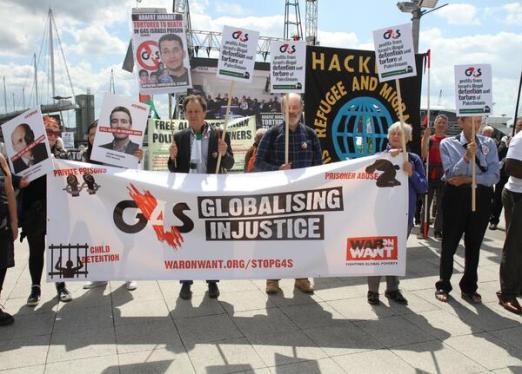
G4S are employing Cognitive Behavioural Therapists to deliver “get to work therapy”

July 4, 2016

Kitty S Jones's avatarPolitics and Insights

BpXsHmOIAAEHmBe

Background

Last April, more than 400 psychologists, counsellors and academics signed an open letter condemning the profoundly disturbing psychological implications of the government’s austerity and welfare reform measures. The group of professionals said that over the past five years the types of issues causing clients distress had shifted dramatically and now include increasing inequality, outright poverty and benefits claimants being subjected  a “new, intimidatory kind of disciplinary regime”.

The signatories of the letter, published in The Guardian, express concern over chancellor George Osborne’s plans, laid out in the latest budget, to embed psychological therapy in a coercive back-to-work agenda. Osborne said the government will aim to give online CBT to 40,000 recipients of Jobseeker’s Allowance, Employment and Support Allowance, people on the Fit for Work programme, as well as putting therapists in more than 350 job centres.

The letter stated that the government’s proposed policy of linking social security…

View original post 3,777 more words

Rent To Own Firms Like BrightHouse Are Selling To Disabled People Finds BBC Investigation

July 4, 2016

Rent-to-own companies are selling products to vulnerable people with mental health problems and learning disabilities, the BBC has found.

The firms allow customers to pay for a household item in instalments, with high interest rates, until they own it.

Citizens Advice worries that vulnerable people are being “pushed into further financial difficulty”.

BrightHouse – the biggest company – denies exploiting consumers in vulnerable circumstances.

During an investigation for the BBC’s Victoria Derbyshire programme, former Labour leader Ed Miliband called for better and clearer regulation of the rent-to-own sector.

“It seems to me that too often rent-to-own companies are taking advantage of people who feel they have nowhere else to go. The regulator needs to stop the most vulnerable people in our society, like those with learning difficulties, being taken advantage of,” he said.

“Paul”, who has asked us to hide his identity, has learning difficulties and mental health problems. At one stage, he was paying BrightHouse for five items – including furniture and electrical goods – using his welfare payments.

Asked how he had taken out the five items, he said: “I think I must have started paying off one… I don’t know how it worked really, I don’t know.”

As Paul wished to remain anonymous, BrightHouse were not provided with sufficient information to comment on his individual case, but the firm has denied exploiting consumers in vulnerable circumstances and selling items to people who cannot afford them.

It said it has sufficient policies and procedures in place to prevent these practices from happening.


Craig’s story

Craig, 38 – whose surname we have withheld – has autism and cerebral palsy.

He signed an agreement with BrightHouse for a games console, but his mother Betty Ward said he did not understand the original contract.

“He understood it was a PlayStation 4, that was about it. He’ll pay, but then he’s got nothing for himself for food, electric, gas, things like that.

“I kept seeing it in the house and I didn’t really twig… when he said where it was from I was like, ‘How many times have I said don’t touch them with a bargepole?'”

She said it would have been obvious to staff that her son was vulnerable, although BrightHouse disputed this and said a member of staff judged Craig to be capable of making his own decisions and had no reason to believe he was not aware of what he was doing.

As soon as Ms Ward told the firm about Craig’s situation and the console was returned, she says, BrightHouse stopped taking payments from his account.


Citizens Advice said it receives thousands of complaints every year about the sector, and has evidence suggesting affordability checks were not always being properly conducted by firms.

It said it encountered people with up to several thousand pounds’ worth of debt, with six or seven items.

Its chief economist, Hugh Stickland, said it sees “people in vulnerable situations pushed into further financial difficulty – and then, of course, emotional stress and worry.

“Too often we think the [rent-to-own] firms offer them very little in terms of protection, don’t do decent enough affordability checks.”

‘Costs can spiral’

The Financial Conduct Authority, which has regulated the sector since 2014, says if companies have reason to believe a customer has a learning disability they must take reasonable steps to assist them in making an informed decision, and decide whether it is appropriate to lend.

But Mr Miliband, who has campaigned against rent-to-own companies and supports credit unions, thinks this does not go far enough. He wants the firms to be regulated in a similar way to payday loan companies, and see a cap on the total amount they can charge for a product.

“I have been told customers can end up paying three times the worth of the item, or if they miss a payment or are late, the costs can spiral,” he said.

The difference in an item’s worth and the amount customers pay overall is due to additional costs for delivery and installation, a mandatory warranty and high interest rates.

One mid-range washing machine on BrightHouse’s website costs £358. But the firm’s customers must also pay £55 for delivery and installation, and £136 for a warranty. With interest rates on this product of 69.9% a year, if the payment was spread over three years – as the firm’s own price model sets out – the washing machine would cost a total of £1,092.


Rent-to-own

  • Rent-to-own firms are often used by people who cannot afford to buy a product outright, or cannot get credit.
  • Consumers take out an agreement to buy a product and then pay weekly instalments until they own it – similar to a hire purchase agreement.
  • But customers could pay much more than the actual cost of the product due to high rates of interest and extra costs such as a mandatory warranty.
  • More than 400,000 households use the sector, a 131% increase on 2008.
  • The biggest firms are BrightHouse and Perfect Home.

But Kate Andrews from the Institute of Economic Affairs, a right-of-centre think tank, believes the rent-to-own companies provide a valuable service. “It is an injustice to tell people at the bottom that because they’re poor they can’t have things that in 2016 we would consider necessities,” she said.

She believes it is fair that if rent-to-own companies make “huge profits” because they are “taking on a lot of risk – taking on people with no credit score.

“They don’t always know if they’re going to get their payments,” she adds.

BrightHouse said in a statement: “[Mr Miliband] consistently misrepresents our business. BrightHouse serves those lower-income families who are excluded from mainstream credit. Rent-to-own is a very different proposition to other forms of retail.

“We undertake extensive affordability assessments before lending and seek to support all those customers who find themselves in difficulty.”

Life And Deaf- BBC 4, 9pm

July 4, 2016

Hands dancing in front of her, her face mobile and expressive, Tina is full flow – ignoring her husband who is tapping his fingers to get her attention. So when she explains how he needs to be the centre of attention, while she is “more reserved”, it’s hard not to laugh.

Despite their confidence and photogenic looks, it wasn’t hunger for the limelight that propelled the couple to star in an innovative documentary airing on BBC4. Subtitled without a soundtrack or narration, Life and Deaf follows four members of the St John’s Deaf Club as they go about their daily lives. All four are profoundly deaf and communicate using British Sign Language (BSL). Tina Costi and her husband, Marios, are expecting a baby – and waiting to see if it will follow the Costi family “tradition” of deaf sons and hearing daughters. Then there is Memnos, Marios’s football-mad brother, who is intent on taking the St John’s team to the final of the English Deaf Cup. And finally there is Abigail, facing a decision over whether to have a cochlear implant to improve her hearing – much to the disquiet of her deaf mother.

The film is a celebration of a community too seldom on our screens. What comes across is the pride all four feel in their deaf identity. It was this, says Tina, that convinced her to take part in the filming, despite feeling that pregnancy was a “private time”.


The 31-year-old outreach worker says too many people make the assumption that deaf people cannot live independently. “I don’t want hearing people to see deaf people as lower-class citizens, who can’t work or drive, or need carers. We can look after ourselves. Marios and I both have good jobs, we have children, we have good lives.”

It’s something she experiences even walking down the street, she says. “People panic when you say you are deaf! It’s really annoying. If someone asks me for directions, and I say I am deaf, they just walk off or say: ‘It doesn’t matter.’ If they had been patient for a moment, I could have told them the way – if they had given me a chance.”

The film is also a showcase for deaf culture, which is, in part, based on its unique language. Marios and Tina agree that, in the deaf community, people tend to be surprisingly direct – something we see most clearly in the arguments between Abigail and her mother. Tina says that this could be because: “Growing up, some deaf people have been dismissed and pushed to the side, so when they enter the deaf world, they are so much more confident.” Marios points out: “You have to be careful not to be too blunt – because we can be offensive!”

The lively, broad humour radiates from the film. The four spar and tease each onscreen relentlessly. Tina, who grew up in “the hearing world”, says there is a difference in the humour of deaf and hearing people. While she will watch standup comedians and laugh, Marios, who has always been part of the deaf community, will be blankfaced. “We are so much more visual – we use our facial expressions more,” he says. “We have deaf standup comedians and I don’t think hearing people would laugh at them, because it is about the linguistics of BSL.”


At the heart of the community are social clubs such as St John’s – but many are closing, in part because technology such as FaceTime has made it easier for deaf friends to arrange to meet up elsewhere in smaller groups. Yet it is also, Tina says, because the deaf community is shrinking, thanks to the increasing prevalence of cochlear implants. We see Abigail trying to overcome her mother’s opposition to them, reassuring her that her choice is not a rejection of the deaf community.

Tina explains that while cochlear implants can be a useful aide for some people, there is a feeling that they are offered as a miracle cure suitable for everyone. This is for her another sign that the hearing world sees deaf people as a problem to be solved, rather than altering its behaviour, for instance by encouraging more people to use sign language. “In hospitals, they push cochlear implants and trying to make children talk – it’s a medical approach. Some need to sign and some need cochlear implants. At the moment they just try to ‘fix’ the child, not society itself.”

This refusal of the hearing world to adapt to deafness is something Tina feels strongly about. “Although my mother is deaf, I grew up in the hearing world. I had to make so much effort to fit in. I struggled to lip read and no one would meet me halfway. At deaf school, it was so easy and I felt so relaxed. So, when I went back to the hearing world, I thought, ‘How did I manage all that time?’ I can lip read and speak, but I would rather just be immersed in the deaf world.”


The inability of the hearing world to see deafness as anything other than a calamity is captured on film during an antenatal appointment. Marios expects that if they have a son he will be born deaf, like all the males in his family. Tina worries that, if this is the case, the nurse will console them “as though it is a negative thing”.

Following Tina to her antenatal appointments, the documentary also highlights problems of access. We see her explaining that during labour she will not be able to lip read and will need an interpreter. She tells me that, for the birth of her first child, Ollie (now a sweet 11-year-old), she – like many deaf women – had no one to interpret the instructions of the medical staff. As lip reading can be imprecise at the best of times, let alone when you are in pain – and because English for some deaf people is a second language after BSL – it was worrying.

“I didn’t understand anything. They gave me medication, and I didn’t know what it was for. How could I consent to things? I couldn’t. It’s hard to even know when to push – it depends on the midwife being confident enough to be visual. I wanted to breastfeed and they passed him to me, but no one explained to me how to do it, and so I panicked and gave him a bottle.”

Ten years on from having Ollie, Tina was determined her second birth would be different. After six frustrating months, she finally met the hospital’s head midwife, who was “brilliant, very proactive and organised”. Thanks to having an interpreter, her second birth was completely different, “wonderful”.

Marios says such experiences show the importance of improving access for deaf people and not underestimating them. “If I was hearing … there would be more doors open. But I am very proud of being deaf. Hearing people think we can’t do anything – but we are equal.”

Cardiff Creates Thalidomide Memorial

July 4, 2016

Readers, we don’t usually share photos with written articles, but we hope you understand why we felt it was important to share this one.

Thalidomide memorial Cardiff

A memorial to those affected by the thalidomide drug scandal has been unveiled in Cardiff.

Thousands of babies worldwide were born with deformities in the 1960s after the drug was given to pregnant women to combat morning sickness.

Thalidomide-impaired people, their families and supporters attended the unveiling in the city’s Cathays Park.

It follows a seven-year battle by campaigners to establish a permanent memorial made of Welsh stone.

Lead campaigner Rosie Moriarty-Simmonds said: “After seven years of campaigning and persuasion, we are delighted that the memorial will be sited in the heart of Cardiff’s Civic Centre, in the shadow of the National War Memorial, the City Hall and the Welsh Office.

“It is a fitting location to remember all those who have been and continue to be affected by a medical disaster which, but for the desire for profit, should never have happened.”

People travelled from all over the country to attend the memorial.

Geraldine Freeman, from Swindon, said: “It’s important to remember those that have gone, and our parents that are no longer with us, to know that we are going to be remembered.”

Jacqueline Harper, from Wakefield, said: “It’s for the people that have lost their babies and what we went through when we were little. It’s a reminder of who we are today.

“It’s emotional with everyone here – it’s puts everything into perspective, that there’s something here so that what happened is never forgotten.”

UN Women Statement On The Committee On The Rights Of Persons With Disabilities

July 4, 2016

UN Women recognizes the unique and intersecting challenges that women with disabilities face. This makes it all the more critical that women with disabilities are fully represented on panels, committees, human rights treaty bodies and across all areas of leadership so that their voices are heard.

It is therefore regrettable that the Committee on the Rights of Persons with Disabilities (CRPD) will have just one female representative. The recent election process for nine positions resulted in all-male appointments for 2017, despite the candidature of three women for the positions and despite the terms of Article 34.4 of the Convention on the Rights of Persons with Disabilities that “The members of the Committee shall be elected by States Parties, consideration being given to … balanced gender representation.”

UN Women joins the many voices that have expressed concern regarding the new composition of the Committee on the Rights of Persons with Disabilities, in which the diverse voices and experiences of women with disabilities have been diminished. UN Women calls for no panel or committee to be assembled without the representation of women. The UN Global Compact made important advances in this area during the 60th session of the Commission on the Status of Women in March 2016, with the introduction of the UN Global Compact Panel Pledge, which urges men who are asked to serve on all-male panels to decline or to suggest a woman colleague instead.

The upholding of the principle of balanced gender representation is especially vital for women with disabilities, who often encounter multiple and intersecting forms of discrimination. It is estimated that one in five women lives with disability, and that the prevalence rate of disability for women (19.2 per cent) is higher than for men (12 per cent). These women are two to three times more likely to experience early and forced marriage, early pregnancy and female genital mutilation. Women and girls with disabilities also face unique educational, economic and political barriers.

UN Women hopes that States Parties, in close consultation with persons with disabilities and their representative organizations, will support the nomination of women to the CRPD to redress the current situation and achieve balanced gender representation in 2019. Additionally, UN Women invites the CRPD to continue to explore the intersectionality of gender and disability, including through the general recommendations of the Committee on the Elimination of Discrimination against Women.

Without adequate representation of women on panels and committees, the voices of half of the population are not being heard. Due to the inextricable nature of human rights and women’s rights, a balanced gender representation remains crucial to ensuring balanced and sustainable outcomes.

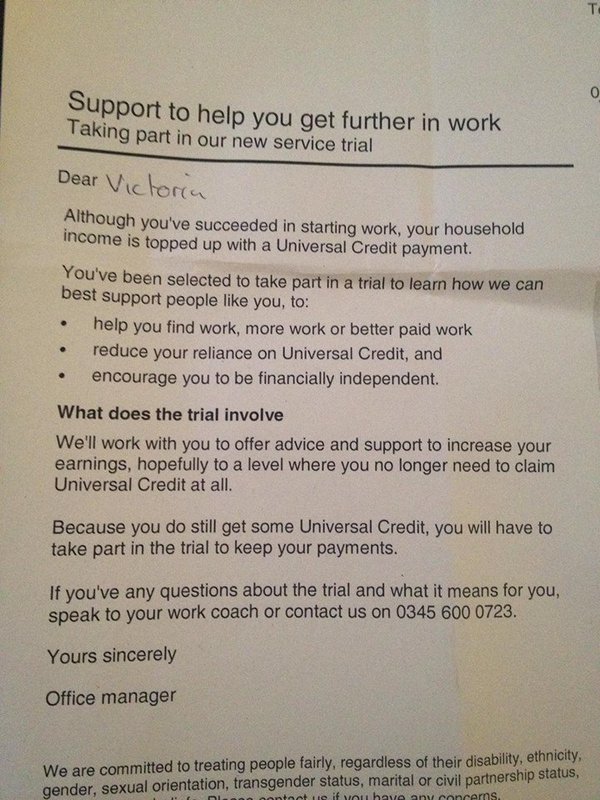
No Rest From The DWP For UC Claimants Even After They Find Work

July 4, 2016

Suggests this letter we spotted on Facebook.

ucwork

Trailer- Notes On Blindness

July 1, 2016

Stephen Crabb Tells AGM- No PIP Cuts

July 1, 2016

Stephen Crabb Secretary of State at DWP addresses All Party Parliamentary Group on Disability AGM.

Over seventy observers, MPs and peers heard the Secretary of State at DWP Stephen Crabb repeat his commitment that the planned saving in personal independence payment would not be sought from cuts in welfare payments elsewhere affecting more disabled people.

He outlined his plans for a green paper to be published later this year that would set out how the Government intends to achieve its ambition of halving the disability employment gap.

The paper would be the subject of a consultation exercise. His presentation was followed by the Minister of Disabled People Justin Tomlinson MP responding to questions from the audience.

Tomlinson Admits He Doesn’t Know What BPS Model Is

June 30, 2016

Life: Animated

June 30, 2016

The transformative power of Disney animation is illustrated in the new documentary Life, Animated which shows how the family of an isolated autistic boy began to communicate with him through cartoon characters.

The film, from Oscar-winning director Roger Ross Williams, has been winning awards and earning good reviews.

Talking Movies’ Tom Brook reports.

Inventor Of Carbon Black Wheelchair Now Designing Luggage For Wheelchair Users

June 30, 2016

An inventor is making luggage for people with disabilities after leaving the company he had set up to create a new type of wheelchair.

Andrew Slorance, who was paralysed by a spinal injury when he was 14, launched wheelchair design business Carbon Black almost 10 years ago.

In June last year, investors in the venture terminated his role.

Nairn-based Mr Slorance has now started Phoenix Instinct. Wheelchair luggage is the new business’s first product.

The inventor and entrepreneur hopes Paralympians travelling to Brazil for the Rio Games this summer will be among the first to use the items.

‘Rude awakening’

Mr Slorance founded Carbon Black to design, develop and put on the market a new type of wheelchair, also called Carbon Black.

The business said, for legal reasons, it could not comment on Mr Slorance’s departure from Carbon Black.

Mr Slorance, who accepted a settlement from the company following negotiations, said investors took a business decision to take control.

He said: “I guess I had a rude awakening.

“When you bring investors into your company, even one that you were the founder of, they have all the control and it is no longer your baby and they call the shots.

“2015 was a very tough year, but I pulled myself together and started a new company and developed a new product.”

This month, Mr Slorance won £50,000 from business competition Scottish Edge for his new venture.

He secured £100,000 from the same competition last year but because of what happened at Carbon Black the funding had to be withdrawn.

Entrepreneurial Scotland and Highlands and Islands Enterprise have also been providing support to Phoenix Instinct.

‘Starting again’

Paralysed following a fall from a tree when he was a teenager, Mr Slorance is keenly aware of the challenges faced by wheelchair users.

He said: “My situation means I am always trying to think of solutions to overcome problems.

“With luggage, it is difficult for those with spinal injuries to move it by themselves.

“My new product, wheelchair luggage, is a brand new invention that allows wheelchair users to transport their luggage while pushing their wheelchair at the same time.”

He is also working on other product designs, though at this stage he is not ready to reveal what they are.

Mr Slorance said: “At the age of 47 I have found myself starting all over again, but I do feel I have the freedom now to develop my ideas.”

63 year old lady in tears. Stories the government don’t like to tell you. 

June 30, 2016

Charlotte Hughes's avatarThe poor side of life

Our Thursday demo last week fell on the day of voting for the referendum. Lots of bickering was happening on the streets, people saying I’m voting out, people saying I’m voting in, but it was just another ordinary day at Ashton Under Lyne Jobcentre.

To say Thursday overwhelmed me is a bit of an understatement. It completely overwhelmed me like it does sometimes. I’m not heartless, or have grown a rock in the place of my heart, nor have I become immune to the goings on inside that Jobcentre. Sometimes I feel it, and it hurts like nothing else because I cannot stand any kind of injustice, and I was reminded of injustice that day. And it hurt.

A lady who looked to be of around pensionable age was slowly walking into the Jobcentre. She was a small, slight lady and I could see that she was very worried, something…

View original post 534 more words

DPAC Call On Corbyn NOT To Resign

June 29, 2016

A message from DPAC. Please share widely.

DPAC and disabled people have had unstinting support from Jeremy Corbyn and John McDonnell. Both have spoken out and voted against every horror the Tories have imposed on disabled people. So when we had a message from John McDonnell we knew we’d pass it on to you.

“please send out to all DPAC members and supporters urging them to support Jeremy if there is a leadership election, we will need Labour Party members to vote for Jeremy if they are not members we will urge them to join ”

See Corbyn’s statement issued after the ‘no confidence’ vote

“In the aftermath of last week’s referendum, our country faces major challenges. Risks to the economy and living standards are growing. The public is divided.

“The Government is in disarray. Ministers have made it clear they have no exit plan, but are determined to make working people pay with a new round of cuts and tax rises.

“Labour has the responsibility to give a lead where the Government will not. We need to bring people together, hold the Government to account, oppose austerity and set out a path to exit that will protect jobs and incomes.

“To do that we need to stand together. Since I was elected leader of our party nine months ago, we have repeatedly defeated the Government over its attacks on living standards.

“Last month, Labour became the largest party in the local elections. In Thursday’s referendum, a narrow majority voted to leave, but two thirds of Labour supporters backed our call for a remain vote.

“I was democratically elected leader of our party for a new kind of politics by 60% of Labour members and supporters, and I will not betray them by resigning. Today’s vote by MPs has no constitutional legitimacy.

“We are a democratic party, with a clear constitution. Our people need Labour party members, trade unionists and MPs to unite behind my leadership at a critical time for our country.”

See some of the ways Corbyn and McDonnell have supported DPAC and disabled people

http://dpac.uk.net/2015/07/make-labour-awesome-again-vote-corbyn-jezwecan/

http://dpac.uk.net/2015/07/the-labour-party-needs-a-leader-not-a-jobsworth-thats-why-dpac-are-supporting-jeremy-corbyn/

Corbyn and McDonnell have done more than any other politicians to speak out and act against what’s happening to disabled people

And if you want to know the real story of why the Labour party seems to be against its own members see the excellent Steve Topple’s piece in the Canary: The Truth behind the Labour Coup, when it began and who manufactured it. http://www.thecanary.co/2016/06/28/truth-behind-labour-coup-really-began-manufactured-exclusive/

Car Boots Cornwall Owner’s Outrageous Facebook Post Mocks Blue Badge Holders

June 29, 2016

We spotted this piece of madness here.


geoffsays

Vicar Says Son Lauri Love Would Be Likely To Kill Himself If Extradited To US

June 29, 2016

A vicar says his son would be likely to kill himself if he were to be extradited to the US to face cyber-crime charges.

The US wants to prosecute Lauri Love, 31, of Stradishall, for allegedly stealing details from the FBI, the Missile Defence Agency and Nasa.

Mr Love, who has Asperger syndrome, says he will not go to the US “under any condition whatsoever”.

A two-day extradition case is being heard by Westminster magistrates.

Rev Alexander Love, a prison chaplain who works with vulnerable people at risk of suicide, told the court that some people he had counselled saw killing themselves as their only solution to a future they could not see.

He said: “In regard to my son … Lauri is somebody who strikes me as somebody who will do this. The probability is quite high.”

Mr Love said the “bitter experience” of leading funerals for people who had killed themselves led to the regret that everyone has, “that they didn’t see it coming”.

“In Lauri’s case,” he said, “we do see it coming, that is the big difference.

“At times Lauri is in utter despair. At other times he’s frustrated with the world. We have become his carers. His ability to grasp the real world is impaired.”

Psychologist Prof Simon Baron Cohen told the court “about two thirds of people with Asperger’s have suicidal thoughts… the overwhelming priority is to keep him (Lauri Love) alive”.

“About a third go on to make suicide plans like Lauri has,” he said.

“I think it would be a risk to think this is all fantasy.”

The hearing continues.

Why Are The Police Failing Victims Of Disability Hate Crime?

June 29, 2016

It was clear something was very seriously wrong when Daniel Smith arrived at his father Owen’s house in the early hours of the morning on 18 October last year visibly bruised and shaken. Owen Smith had spent the previous few hours anxiously looking for his 25-year-old son, who has autism, after he failed to turn up to meet him as planned.

“I looked at his face and I thought ‘oh my God, what’s happened?,’” Smith recalls. At first he thought his son might have knocked himself out and been at a hospital. But it was much worse than he feared. Smith believes Daniel had been the victim of a brutal disability hate crime where he was repeatedly beaten and punched while trying to defend himself against two attackers, but it was his son who was then charged with assault and detained in a police station, alone and vulnerable for nine hours.
To combat disability hate crime, we must understand why people commit it
Katharine Quarmby
Read more

In April, six “distressing” months after first being arrested, Daniel was finally acquitted of both assault charges at a court in Corby. It was accepted that he had acted in self-defence.

However, Smith says that while the family is relieved the court ordeal has ended, the justice system needs to be held to account for failing Daniel. The “staggering incompetence” and mistreatment of his son by officers from Northamptonshire police and a failure by the courts to support Daniel during proceedings left the family with no choice but to complain to both the police and the Crown Prosecution Service (CPS), Smith says.

According to Smith, the incident that triggered Daniel’s arrest took place when he was visiting his father in Rushden, Northants, for the weekend. On the Saturday afternoon, while sitting in a local park Daniel, who according to his father is naturally friendly and talkative, allegedly approached two teenage girls and asked a couple of innocuous questions. One girl phoned her father claiming – wrongly, says Smith – that Daniel had been taking photos of the girls. The girl’s father told the police that he arrived “to sort him out for being weird,” says Smith.

Reeling and frightened from injuries after being punched to the ground, Daniel says in his written complaint: “I ran to the police station because I felt safe to do so. It was a major shock when I was handcuffed tightly so I could not move. I felt very scared and upset. I told the police I had autism. I wanted to speak to my Dad but I was not allowed to and my phone was taken. [No photos were found on his phone]. I felt no one was listening. When I was locked up, I held my head and cried. I felt like dying.”

The family’s complaint against Northants police is now being investigated by the Independent Police Complaints Commission (IPCC). It outlines an alleged litany of egregious errors on the part of officers. These include a failure to recognise and act upon the fact that Daniel was mentally vulnerable, even after he explained twice that he had autism, or to investigate that he was the victim of a hate crime, not a perpetrator. It also alleges that despite his evident physical injuries officers did not arrange for Daniel to be examined by a medic.
The stories you need to read, in one handy email
Read more

At no point during his estimated nine hours in custody were reasonable adjustments made for Daniel’s mental vulnerabilities. This would include seeking an “appropriate adult” (AA) who could advocate for him and help him navigate the system, says Owen. This is despite guidelines stipulating that once someone is being treated as a suspect a number of steps must be followed.

The codes of practice require that police locate an AA as soon as practicable, (this could be a guardian, relative or others including volunteer AAs from established networks around the country). Appropriate adults are widely recognised as having a key role to play in safeguarding the rights and welfare of children (for whom AAs are mandatory) and vulnerable adults in custody. They have specific responsibilities, such as ensuring people understand their rights and observing police behaviour.

The Smith family’s IPCC complaint documents that they were not contacted by police, even after Daniel requested to speak to his father, that police ignored his pleas for help after running away from the “bullies”, and disregarded the fact that there were no photographs of the girls, as alleged, on Daniel’s phone. Had an AA or someone else been called, Smith believes the situation would have been handled very differently. “They should have first phoned me, appointed a suitable adult straight away, waited until they’d collated all the information and evidence of what had happened – and listened to Daniel. This was a hate crime. Daniel was the victim. The whole system is merciless,” he says.

Daniel’s treatment has echoes of other recent cases involving disabled people such as that of Bijan Ebrahimi who asked for protection from a man who accused him of being a paedophile but was instead arrested by Avon and Somerset police. The man would later go on to murder Ebrahimi outside his home in Bristol in 2013. Officers have since been sacked and two jailed. The full findings of a probe by the IPCC into Ebrahimi’s case are expected imminently.

There are similarities, too, with the case of an 11-year-old girl with a neurological disability who was detained under the Mental Health Act, handcuffed and restrained with a mesh hood by Sussex police. An IPCC report published earlier this month found that the child was held overnight twice in police cells, without any appropriate adult being present.

According to access to justice campaigners and disability rights advocates, Daniel’s alleged experience exposes glaring fault lines throughout the criminal justice system. Stephen Brookes, co-ordinator of the Disability Hate Crime Network, suggests Northants police “got it so wrong, it’s incredible” in Daniel’s case. The number of disability hate crimes recorded by police has skyrocketed (up by 25% between 2013-14 and 2014-15 in England and Wales). This is in part because more people are reporting them, but Brookes argues that police need to be much better trained at spotting disability hate crimes and engaging with people who have mental impairments.

“We’ve got some forces who lack understanding of the nuances [of disability hate crimes]. Too often people are accused of being a perpetrator,” says Brookes. DHCN and others work closely with forces, police chiefs and policymakers to improve procedures, and what is striking, he says, is that “where forces are getting it right, they’re really good”.

Chris Bath, chief executive of the National Appropriate Adult Network (Naan) says the issue of criminal justice and mentally vulnerable people needs to be seen “in a human rights context”. He points to Naan’s recent research estimating that around a quarter of a million mentally ill, learning disabled and autistic people are detained annually by police without an AA present, leaving them wide open to injustices.

The report, commissioned by the home secretary, Theresa May, after Naan raised the issue with the Home Office, found that in some places there are no AA schemes, meaning that even when police try to access help it’s often not available. Where there are AA schemes, the research found, police are better at identifying hate crimes. Another problem, Bath suggests, is that many are under pressure due to local authority budget cuts.

An IPCC report in March revealed that people with mental health problems were more likely to be restrained and four times more likely to die after being subjected to police force. Next month the College of Policing will roll out a new training programme for officers on engaging with mentally vulnerable people.

Northants police says that it made a mandatory referral to the IPCC after assessing the incident with Daniel. A spokeswoman for the IPCC says it will take a “number of months” to fully investigate Daniel’s case.

Asked what is he hoping for, Owen replies: “Justice for Daniel.” As for Daniel, he has told the IPCC: “I can’t trust the police any more. I am frightened of the police.”

Why Same Difference Hopes Stephen Crabb Won’t Be David Cameron’s Replacement

June 29, 2016

Reportedly, Stephen Crabb will announce today that he plans to stand for the Conservative Party leadership. This would, of course, make him the UK’s new Prime Minister, for at least the next four years.

When Stephen Crabb replaced IDS as DWP Secretary of State, it didn’t take Same Difference long to realise that he wasn’t much better suited to the job than IDS.

Here are five reasons why Same Difference hopes Stephen Crabb won’t replace David Cameron as Prime Minister of the UK:

  • He thought people in the ESA WRAG are able to work immediately.
  • He thought quadriplegics were fit for work.
  • There were reports that he could have briefed Tory MPs incorrectly about the WRAG before the recent vote to cut it. If true, this would of course be very serious.
  • Just last month, he said that disability benefit cuts are changing things for the better.
  • He had links to Care, an organisation that openly hates LGBT people.

Same Difference will join the whole of the UK in following the selection of David Cameron’s replacement with great interest. However, we will be hoping the winner is Anyone But Crabb.

Yes, readers, even Boris Johnson would be better than Crabb.

UN Slams Tories Over Human Rights Abuses In UK Welfare Acts

June 29, 2016
While the country is entrenched in the mire of the EU referendum fallout, the Tories have just been slammed by the United Nations (UN) – for human rights abuses.

But not abroad. Here, in the UK.

As The Canary previously reported, on the 15 and 16 June the UN Human Rights committee on economic, social and cultural affairs publicly reported its questioning of the Tories, after more than two years of evidence-gathering concerning the impact of their policies on society.

report was submitted by the UK government, from which the final conclusions and recommendations, which were released on Monday night, have been drawn. And the UN pulls no punches in its assessment.

Failed policies

The criticisms are overarching, and in some cases staggering – covering nearly every area of government policy. It appears the UN have three levels of disdain: “regret”, “concerned” and “seriously or deeply concerned” – and the latter, worryingly, comes up relating to two specific areas.

The committee spoke at length about asylum seekers; specifically, that our government is failing them “due to restrictions in accessing employment and the insufficient level of support provided”. It goes further and says that they are, basically, being denied the health care that they are entitled to under international law. The UN also slams the government over its treatment of migrant workers, in terms of exploitation, low pay and health care access – specifically citing the fact the Tories ignored its last set of recommendations.

The government comes under criticism for its sales of weapons to foreign countries and lack of legislation surrounding this. A pertinent issue at present, with the Tories coming under increasing pressure to block arms sales to Saudi Arabia, who are currently accused of committing war crimes in Yemen.

The UN is also critical of the practices surrounding government-backed private companies’ conduct in foreign countries. This specifically relates to an investigation by Global Justice Now, surrounding the Department for International Development ploughing money into private education companies in Uganda and Kenya – at the cost of their free education systems. It seems the Tories not only want a profit from the UK’s schools, they want it from other countries’ schools as well.

There were numerous other areas in which the Tories came under fire: their failure to tackle tax avoidance; the 2016 Trade Union Act and blacklisting of workers; the reductions in the corporate tax rate; the decimation of the legal aid system; the failure to introduce the 2010 Equality Act in Northern Ireland and the continued illegality of abortion; the gender pay gap; the under-funding of mental health services; worsening of social care for the elderly; the lowly minimum wage; violence against women, and the lack of female representation in high-profile public roles.

However, the most damning indictments and truly staggering ones were surrounding austerity, unemployment, living standards and welfare reforms. And the majority of the barrage of criticisms were aimed at the impact these had on the vulnerable and the disabled.

Forgetting the most vulnerable

In short, criticisms were fired at the Tories over:

  • the number of self-employed, part-time and zero hours contracts jobs, and the effect on marginalised people.
  • the housing crisis in the UK, including the lack of social housing, sky-high rental prices and rogue landlords.
  • the “exceptionally high” levels of homelessness and the Conservatives’ inadequate response to this.
  • the government’s record on education and failure to address inequality affecting pupils attainment levels.
  • a failure to address food poverty and the heavy reliance by millions on food banks.
  • the rising levels of poverty among marginalised groups, and the government’s failure to tackle child poverty.

But perhaps the two most astonishing sections were those dedicated to what the UN described itself as having “seriously” and “deeply” concerned views on – the effects of austerity, and welfare reforms on the disabled and most vulnerable in society.

The UN said of the Conservatives’ austerity measures:

the Committee is seriously concerned about the disproportionate adverse impact that austerity measures, introduced since 2010, are having on […] disadvantaged and marginalized individuals and groups. The Committee is concerned that the State party has not undertaken a comprehensive assessment of the cumulative impact of such measures […] in a way that is recognized by civil society and national independent monitoring mechanisms.

Translated? The UN is saying that the government has forced through austerity measures without bothering to think or care how they would affect the poor, the disabled and the vulnerable – and that in doing so, they have flouted agreed international standards. The government had already been warned once by the UN in 2012 regarding this – but the Tories chose to ignore it. They were told that (regarding austerity):

such measures must be temporary, necessary, proportionate, and not discriminatory and must not disproportionately affect the rights of disadvantaged and marginalized individuals and groups and respect the core content of rights.

The UN said the government now must review all austerity measures since 2010 and the impact they have had on the marginalised groups they refer to.

However, the severest criticisms were of the 2012 Welfare Reform Act and the Welfare Reform and Work Act of 2016 – and the language and recommendations from the UN were unprecedented.

Unparalleled human rights criticisms

In no uncertain terms, the UN said that it was:

deeply concerned about the various changes in the entitlements to, and cuts in, social benefits, introduced [in the two acts] such as the reduction of the household benefit cap, the […] spare-room subsidy (bedroom tax), the four year freeze on certain benefits and the reduction in child tax credits. The Committee is particularly concerned about the adverse impact on […] disadvantaged and marginalized individuals and groups, including women, children, persons with disabilities, low-income families and families with two or more children. The Committee also is concerned about the extent to which the State party has made use of sanctions in relation to social security benefits and the absence of due process and access to justice for those affected by the use of sanctions.

This is exceptionally strong language from the UN. Having compared the report on the UK to that of Angola, nowhere in Angola’s does the phrase “deeply/seriously concerned” appear.

Nor does it in the reports for Burkina Faso, France, Sweden or Macedonia. The only report that ours is comparable to is that of Honduras – a country with one of the highest murder rates in the world, and one which is subject to tourist travel warnings from both the US and the UK.

The recommendations from the UN are even more far-reaching.

It says the government should:

restore the link between the rates of state benefits and the costs of living and guarantee that all social benefits provide a level of benefits sufficient to ensure an adequate standard of living, including access to health care, adequate housing and food; Review the use of sanctions in relation to social security benefits and ensure that they are used proportionately and are subject to prompt and independent dispute resolution mechanisms.

But the most staggering part is that it says, without hesitation, that the government needs to reverse all benefit cuts that were introduced in both the 2012 and 2016 acts. It also stipulates that it expects the government to provide “disaggregated data” on the impact of the welfare reforms, specifically in marginalised groups.

Sadly, there is an inherent flaw with everything that the UN has stipulated – none of it is legally binding.

The UN state in their report that they are “disappointed” that this, and previous, governments have not taken the “covenant” (agreement & rules) of the committee and written them into domestic law. It urges the government “to fully incorporate the covenant rights into its domestic legal order and ensure that victims of violations of economic, social and cultural rights have full access to effective legal remedies”. That is, if a person feels that the government has breached its human rights under the UN’s covenant – it can take them to court.

The likelihood of this government, or any future one for that matter, adopting the UN’s rule is slim to say the least. But it is sorely needed.

Broken Britain? Again?

Speaking to The Canary, Disabled People Against Cuts (DPAC) said:

The response and recommendations of the report provide a damning declaration of the catalogue of the removal of rights that the Tories have imposed in their heartless regime. The report is to be welcomed for its forthright language and its recommendations. It contains everything that DPAC and campaigners have pointed out time and time again. For example, the call for a cumulative assessment of the cuts, the withdrawal of legal aid cuts, the targeting of funds to alleviate increasing poverty, reversal of welfare reform cuts, linking of cost of living to social security payments and a review of sanction procedures. If this report were a political party, it would win the next election. Labour – keep your elected leader and take note.

The report is one of the most damning assessments of a Western government in modern times. But to those who have been at the sharp end of recent policy changes, it will come as no surprise.

The government has to report back to the UN on certain aspects immediately, otherwise, the next review will take place in 2021.

Sadly, with a Tory government looking set to lurch even further to the right, and a Labour party in a state of implosion, things may well become even more precarious.

It seems, as always, that it will be down to us, the public, to try and force meaningful change.

And meaningful change must come – because already, for many, it is too late.

Every Single Labour MP Who Has Resigned This Week Has One Thing In Common

June 29, 2016

Spotted on Facebook. Well worth remembering for Same Difference and our readers.

TIP: Always Get A Copy Of DWP Correspondence

June 28, 2016

This might seem obvious but we think it’s worth sharing…

“If This Does Not Prove There Are Targets, Nothing Will”

June 28, 2016

Seen on ATOS Miracles.

Well for all those folk who think the dwp are just doing there jobs hopefuly this will change yr minds today i handed in letters from my doctor my consultant and my counciler all saying the same that im not one of these fackers that chanel 5 always like to show ..that my illnises are for real and there in no magic pill that will make me better ……i do not want to be like this i wud take if there was ….anyway i get a phonecall this afternoon saying that the letters to be forwarded to a diffrent department .and saying they contacted my doctors in april for information on my illness in which they went on to say they recieved back from my doctors in may ……Well hear is the kicker i have just come from my doctors and they have all the way back to march just to be positive …..there has been no contact either by email.letter or evem phone call .basicly the dwp have basicly 100% lied to me ……if this does not prove that there are targets they do nothing .will …….if this was the other way round and i were to lie .i would be dragged up in front of a judge and be given a crimanal record …….complete double standerds ……………rant over

Urgent – An Appeal To Labour MPs From Disability Campaigners

June 27, 2016

Seen on Facebook.

An Appeal To Labour MPs From Disability Campaigners

As three of the disabled people and the parent of a fourth who in 2013 and 2014 brought legal challenges to the decisions by Conservative ministers to close the UK-wide Independent Living Fund, we are concerned by the developments in the Labour Party over the weekend and the threat to Jeremy Corbyn’s leadership.

Throughout our campaign to save the Independent Living Fund, Jeremy Corbyn was unstinting in his support for the continuation of the Fund, and issued a statement on the day of closure in June 2015 pledging to campaign for its reinstatement.

The democratic election of Jeremy Corbyn last September instilled hope among many disabled people and their families that the Labour Party had turned a corner, and would campaign hard to stop further austerity and cuts to public services and benefits.

A number of Judicial Reviews brought in recent years reflect the impact public service cuts are having on the lives of disabled people and their families. While legal challenges are sometimes successful, they cannot achieve the impact and change an effective political campaign can.

Rather than sow further division, we would urge Labour MPs to remember who austerity and public sector cuts are hitting the hardest, and the lives now being destroyed by them.

There is a desperate need for unity among working class people of all ages and backgrounds, and we need the Labour Party and its MPs to consider their responsibility and duty of care towards those who will continue to face the consequences if we fail to end austerity now.

This is only possible if the Labour Party unites behind Jeremy Corbyn’s leadership and works in unity with the trade unions and disability campaigners to build a political movement to achieve this.

Anne Pridmore, Gabriel Pepper, Paul Taylforth and Stuart Bracking

Claimant Threatened With Sanction If they Didn’t Accept Private Number Call From DWP

June 27, 2016

Or travel from Wales to London for an assessment! Spotted on ATOS Miracles.

Can someone give me pointers who too seek ive been forced to mk a journey to a place id never been to b assesed i currently live n wales yet from london four times i asked for home visit an got refused was threatened with sanctions if didnt attend last appointment so had no choice made to travel bout 5 miles had assesment received a call last wednesday told if i didnt accept private number call on friday id b sanctioned took the call to b told my esa has been stooped some days i struggle getting out bed an excuse me probs with toilet now been told i have to claim jobseekers but as im not fit to search for work i will b sanctioned an if i got a job an couldnt complete a full week i would get the sack plz any advice is greatfull

“You Might Have Been Assessed On The Wrong Interview”

June 27, 2016

From ATOS Miracles.

My son went for a medical assessment 3 weeks ago, he got a letter saying he was fit for work now, they sent him the interview on paper and it isn’t even his, he called them and they said sorry it was a mistake but you are still fit for work. Anyway he requested a call back and she has called him this morning, the first thing she said was we had to send it elsewhere because we are so busy, she then went on to say well they must have put the wrong name on, my son said no because this other person has not got the same health problems, to which he was told well maybe you have been assessed on his interview! My question is is there anything that can be done about this and if so who does he contact? Sorry for the long post and thanks in advance

This is the first time Same Difference has heard of a story like this one. We would be very interested to hear from anyone who might have had a similar experience.

Protest Against Work Cure Therapy, 5th July, London

June 27, 2016

With many thanks to Disabled People Against Cuts.

Mental health activists, workfare campaigners and therapists protest against work cure therapy for benefit claimants with mental health disabilities

  It’s time for the psy professional bodies to stop colluding with the DWP 

Join the protest against the professional bodies supporting work cure therapy for benefit claimants with mental health disabilities

Tuesday 5th July at 9 am at the New Savoy Conference

Hallam Conference Centre, 44 Hallam Street, London W1W 6JJ

Central London @ Great Portland Street tube (Map here)

See the conference programme here


For a decade or more, the Government has been deploying psychotherapy to get people with mental health difficulties off benefits, back to work and mapped into the neoliberal labour market. Since 2010, austerity policies of welfare reform – punitive Work Capability Assessments, benefit cuts, workfare, sanctioning – have intensified government strategies of psycho-compulsion and work cure for welfare claimants. IAPT therapists are being co-located in Jobcentres, DWP mental health advisers and employment coaches in GP surgeries, food banks, schools and libraries.

The big five national organisations representing the professions of counselling, psychotherapy and clinical psychology* have welcomed these policies and the state funding of back-to-work therapy.

As members of the New Savoy Partnership, they have been major players in The New Savoy Conference, an annual jamboree and market stall for state therapies in the NHS. The NSC frequently stages opening addresses by DWP and Health ministers to assert the close relationship between the professional bodies, MH charities and Government mental health and work-cure policies and funding. Hundreds of mental health workers accredited by the psy professional bodies have been hired by the DWP to provide “support into work”. These are jobs that are experienced as deeply unethical by many of the professionals being steered into this kind of work.

In March this year, the Mental Wealth Foundation (see below) wrote to the five professional organisations challenging their support of the government’s use of psychological therapies to put pressure on people with mental health disabilities to get into work. You can read the exchange of letters between us and the professional bodies here.

So far, all but one of these organisations are refusing to speak to us and continue to argue that they have had private reassurances from the DWP that “work cure” therapy will not be mandatory for claimants, and will not involve setting entry into employment as a therapeutic outcome. This claim defies the reality of the DWP’s record of punitive and coercive policies of workfare, Work Capability Assessment and sanctioning and its growing determination through its Work and Health initiatives to prioritise work as the therapy of choice for long-term mental health disability.

British Association for Behavioural and Cognitive Psychotherapies; British Association for Counselling and Psychotherapy; British Psychoanalytic Council; British Psychological Society; United Kingdom Council for Psychotherapy

Come and join the protest against work cure therapy for benefit claimants with mental health disabilities. All welcome. Gather at 9am on Tuesday 5th July outside the Hallam Conference Centre, 44 Hallam Street, London W1W 6JJ. For more info contact eventsatfpn@yahoo.com

Disabled People Are Still Waiting For Their Sexual Revolution

June 27, 2016

Born with a debilitating spinal disability, 53-year- old Frenchman Marcel Nuss, met his first wife, Gaby, in hospital as he battled for his life at the age of 22. Now divorced, he lives with his partner, Marie, and his two children in the leafy suburbs of Strasbourg.

“I often had comments like ‘Oh, he’s a bit ugly’,” Marie reveals in Disability and Sexuality: Exploring the Intimacy Option, a documentary exploring the interplay between disability and sexual liberation.

Yet ableism would not drive a wedge between the two: “If you’re drawn to someone they must be attractive to you, so they cannot be ugly. I was fascinated by his vitality, his desire to move forward, the look in his eyes, his enthusiasms, and his love for life. It’s beautiful, really.”

Marie and Marcel’s relationship is one example of how love can be marred by stigma and ridicule. Kirsty Liddiard at the University of Warwick argues [pdf] that “disabled people have a sexual history marked by oppression, prejudice, discrimination, and violence”.

As someone with a visual disability, even my largely unexciting sex life has been the butt of a few jokes. During my first year at university, a rumour spread like wildfire that I had got lucky the night before. (Regrettably, that’s all it was: a rumour.) Nevertheless, the usual questions – Who? Where? When? Are they going out? – were never asked. Surprise, shock and laughter were the typical reactions.

Soon enough, people were shamed for having had a raunchy rendezvous with the same person as me: “Drink if you and Allan Hennessy got with the same person” made its way into the drinking games. The best one, however, was the boy who gossiped a bit too loud in the cafe: “How did he even know where to put it in?” (I’ve always wondered since what said boy knows about mood lighting? Bright lampshades are almost as unsexy as socks in bed. Get back to me on that one, Henry.)

At least I didn’t have it as bad as Hannah, one of Liddiard’s research interviewees: “A lot of friends will ask, ‘Does Shaun’s willy work?’” Or Kadeem: “Family members made comments like, ‘We pray you get better so you can and have kids’ … that broke my heart.”

People sometimes forget – or try not to remember – that disabled people love, lust and desire. The stereotype foisted upon us is one of passivity: defeated, damaged, immobile and, most inaccurately, asexual.

Yet what people don’t realise is that it’s easier for the blind to recreate some of the kinky scenes from EL James’s Fifty Shades of Grey than our sighted counterparts. We don’t need to make the embarrassing trip to Soho to get the gear. We’ve got our canes at home, trialled and tested; nothing like a good ol’ white stick to get ’em going!

I do not apologise for my crassness; I’d rather laugh than be laughed at. The dehumanisation and asexualisation of disabled people, or the fetishisation of their sexual relationships (midget porn, anyone?), comes against a backdrop of largely futile changes to human rights law.

Ten years ago, the first international human rights treaty of the 21st century, the Convention on the Rights of Persons with Disabilities (CRPD), was negotiated in New York. To date, 160 countries have signed it.

One such country is Indonesia, where people like Rafi are regularly chained up for days on end because the community believes that their psychosocial disorders are in fact possessive evil spirits. To my mind, that is a clear breach of article 17, which calls on states to respect the “integrity” of disabled people.

The Committee on the Rights of Disabled Person’s April 2016 report on the implementation of the treaty expressed serious concerns about potential breaches in Thailand, Uganda (which has recently discussed legislation criminalising homosexuality), Chile and Slovakia.

Even ostensibly liberal democracies such as Australia, were found to have breached the rights of its deaf nationals. And EU member states are no better: the committee was “deeply concerned” that Portugal is neglecting disabled women’s “rights to vote, to marry, to found a family, and to manage assets and properties”.

The problem with law is that it lags behind social change. Law is rather like a sheep: it follows rather than drives change. Forced, premature legal change doesn’t work. The social milieu must change, the law responds afterwards. Unfortunately, CRPD is one such case of prematurity: the treaty is way ahead of its time – social attitudes towards the interaction between disability and sexuality have not changed. Sadly, 50 articles in an international treaty, which even lawyers struggle to make sense of, won’t change hearts and minds. And even if they could, it is lamentable that the word “sexuality” does not feature in the convention once.

Perceptions about disability and sexuality need to change outside the courtroom. The end of the ban on Lady Chatterley’s Lover and the first Beatle’s album marked the start of the sexual revolution for the “able”. That was the early 1960s. Today, in 2016, the disabled community is yet to be sexually liberated. And as the long walk to freedom is yet to even begin, we – the asexualised or fetishised – know that neither the UN nor ageing judges can give us the sexual revolution we yearn for. Our fate is in your hands. Give it to me, baby!


PIP- Rotten To The Core

June 26, 2016

Texas Mum Woke Up With British Accent

June 25, 2016

An American mum of three has woken up from surgery with a British accent. Lisa Alamia from Texas, had an operation on her jaw to correct an overbite 6 months ago, but when she came round she’d developed a distinct British twang. After being treated by neurologist Dr Toby Yaltho, she was diagnosed with a condition known as foreign accent syndrome. Fewer than 100 people worldwide are thought to have the condition.

Lisa told 5 live Drive “I went through about two months of an identify crisis type depression. I would just ask my husband why is this happening to me? I just want my old voice back, this isn’t me”. “But I learnt to just deal with it. This doesn’t define who I am, I’m still the same person”

This clip is originally from Drive on 23rd June 2016

Brexit’s Impact On Disability Employment In The UK

June 24, 2016

A press release:

Opportunities for disabled people in the workplace are likely to come under threat unless government prioritises the recreation of EU safeguards into British statute. That is according to diversity consultancy, The Clear Company, which contributes to the government’s Disability Confident campaign.

The EU and its Member States have a strong mandate to improve the social and economic situation of people with disabilities.

The EU promotes the active inclusion and full participation of disabled people in society, in line with the EU human rights approach to disability issues, through priorities including accessibility, participation, social protection and external action. It works around a firm ethos that disability is a rights issue rather than a matter for discretion.

From an employment perspective, the objective of the European Commission’s European Disability Strategy 2010-2020 is to significantly raise the number of people with disabilities working in the open labour market. They represent one-sixth of the EU’s overall working-age population, but their employment rate is comparatively low at around 50%.

Commenting on this morning’s revelation, Kate Headley, Development Director at The Clear Company, said:

“As long as the UK was part of the EU, disabled people had the benefit of EU frameworks and directives to act as a safety-net against British government and any power it may exert. Now, the future of policy which most affects disabled people is in the hands of Whitehall alone.”

“There is no doubt that EU-derived laws, and EU-led initiatives, have had a largely positive impact on the disabled community. This may explain why Miro Griffiths, a former government adviser and project officer for the European Network on Independent Living, recently went on record to say he believed that Britain’s exit from the EU “would have dire consequences for disabled people”. Our priority now is to help ensure that the rights disabled people currently hold are protected post-Brexit.”

“Aside from the issues of how the UK’s decision to exit will impact the NHS and wider care services, the European Health Insurance Card, and EU Air Passengers Regulation – all of which disproportionately affect those with disabilities – we must also look at the effect on disabled people in the workplace.”

“The EU’s record on assisting disabled workers is strong. Its Employment Equality Directive 2000, for example, led to the removal of the original exemption in the Disability Discrimination Act (DDA) for employers with fewer than 20 staff in the UK, so that in 2004 it became unlawful for any UK employer to discriminate against disabled people. The employment directive also led to the DDA being changed to make direct discrimination by employers against disabled people unlawful.”

“The TUC has identified employment rights that could well be under threat from a government no longer required to comply with EU legislation. Many of these promote health and well-being at work and home, such as the Working Time Directive, which protects from stress and ill-health that arise from working excessive hours including health service workers.”

“I would urge the government, post Article 50, to recreate the safeguards that disabled people have benefited from under EU membership into British statute. We will gladly continue to support the government in the development of strategy and stand by our commitment to support employers and employees alike. Amid the avalanche of new legislation which will almost certainly flood Whitehall in the coming months, laws that safeguard and support disabled workers must be prioritised as EU law recedes.”

Disability Rights UK Reacts To EU Referendum Result

June 24, 2016

DR UK will fight for disabled people’s rights following the Referendum.

After a long night of Referendum results, we understand the depth of feeling about the Referendum, on all sides of the debate. There are hugely different views in different regions of England, different nations of the UK, different communities, different age groups.  DR UK has members everywhere from Tyneside to Cornwall, Blackpool to East Anglia (and more) – and we work closely with our sister organisations Disability Wales, Inclusion Scotland and Disability Action Northern Ireland. Many disabled people, on all sides of the debate, are angry that they have been left out of opportunities, left living in poverty – and we want to enable more people to have a bigger voice.  

For us as a network of disabled people and our organisations, what is important next is to make sure that:

  • Disabled people’s hard won rights are not eroded as the UK negotiates its way out of the European Union. For instance, there are proposals for new European Accessibility legislation covering accessibility of public sector websites and accessibility of a range of products and services. We need to make sure that as the UK de-links itself from EU law this isn’t at the expense of important new rights like that – and not at the expense of existing rights, like the protections in the European Convention on Human Rights, which have helped families to stay together and individuals to improve their care and support. We will press Government to ensure international rights are enshrined in UK law
  • We put the full and equal participation of disabled people at the heart of the thinking of the new leadership of the UK. We profoundly believe that if all disabled people can participate fully it benefits everyone. We will press Government to ensure that in a potentially changed economic environment there is a commitment to support and income for independent living, and no further squeeze on funding of the supports that disabled people need
  • We stand up to intolerance of difference and ‘othering’ of disabled people whenever and however it occurs

We will be inviting comments from members on specific things we should do together post-Referendum – and there will be an opportunity for debate at our AGM and event Equal Participation for All on 7th November – save the date.

BREAKING: Britain Votes To Leave EU- What Does This Mean For Disabled People?

June 24, 2016


BREAKING UPDATE: David Cameron has just announced he will step down as PM by October.

Disabled people and carers strongly dislike David Cameron, but whether or not this will really be a positive thing for us remains to be seen. It will of course depend on Cameron’s replacement, and their record and opinions on our issues.

Wheelchair Racer John Smith’s Chair Stolen From His Home

June 23, 2016


Disability Campaigner ‘Disgusted’ With Channel 4 After EU Debate Appearance

June 23, 2016

I’m BAAACK! I’m so pissed off, and loads of strangers on Twitter are cross on my behalf too. I’m disgusted with Channel Four. Everyone nicey-nicey in inviting you etc, but no attempt was made to make the process accessible – I can neither shout or lift up my arms – and I got to alert the audience that in both the remain and the leave, disabled people have been largely ignored.

Tokenistic crap. I will make a a complaint and if any of you can too, would help. It’s like I was there to show ‘a disabled’. Grrrrrrrrr. Need a bloody sleeping pill now…..


Petition: Make Autistic ‘Cures’ Illegal In The UK

June 22, 2016

From Change.org:

When both my son and I were diagnosed with autism, I did everything to research the condition and learn how to handle it best. I was shocked to discover online dozens of UK non-medical professionals claiming to sell autism “cures”. 

Currently there’s nothing to stop people marketing the false idea that autism is something that can be or needs to be cured. I think it’s time we change that.

Autism is a neurological condition, it’s not something you can cure like an injury or illness. With the right professional therapies, people with autism can thrive, but there’s no product that can offer a magical “fix.”

It’s not only offensive that cures are being sold for people like me and my kids, it’s dangerous too. These treatments are unproven and some can be lethal — the most famous MMS (essentially bleach by another name) is fed to children, given as an enema or even put into babies’ bottles. It can cause seizures, stripping of the bowel and severe dehydration along with respiratory problems and there is some evidence up to 8,000 parents are buying and using it.

I know that parents want to help their kids but they are being misled and misinformed. Marketers are exploiting these parents, profiting from their vulnerability and endangering children’s lives.

We have a law, the cancer act, that makes it illegal for people to sell cures for cancer. I think it’s about time we get a law that protects people with Autism too.

Please help me by calling on the UK government to introduce a law that stops people selling cures for autism.

Thank you, Emma Dalmayne.

Sanctioned while waiting to be sanctioned

June 22, 2016

Chaminda Jayanetti's avatarSentinel News

British one penny coins. Image shot 2009. Exact date unknown.By Kate Belgrave

Yesterday, I spent god knows how long on the phone to the Department for Work and Pensions (a charged-for call, if you don’t mind), having the most ridiculous conversation that I (and probably anyone) has ever had with them.

I was calling on behalf of Sam, a 22-year-old who signs on at East Ham jobcentre in London. A week or so ago, Sam saw a different jobcentre adviser from her usual one. The adviser at that meeting decided that Sam’s jobsearch record for the fortnight wasn’t up to a standard that the adviser had in mind and that the jobcentre would think about imposing a sanction. Advisers told Sam that she’d have to wait a week or two for a decision-maker to decide whether or not the sanction would go ahead.

But in the meantime, to all intents and purposes, Sam has been sanctioned. I say this…

View original post 423 more words

Julian Worricker On His Arthritis

June 22, 2016

BBC TV news and radio presenter Julian Worricker wonders if his reactions to arthritic pain might sometimes give studio guests the wrong impression.

I wonder to this day what the Chancellor, George Osborne thought when his handshake caused me to wince. Maybe he is living under the illusion that he is stronger than he thinks, in which case I might have done him a favour.

He had come in to the News Channel studio to be interviewed on a day when I was having a bad outbreak of arthritis. Any movement in my right hand or wrist was extremely painful.

In my job, you have to do quite a lot of glad-handing. I have to welcome guests into the studio and make them feel comfortable, even if I know I am about to ask them some searching questions. That means a friendly smile and a polite indication as to where I would like them to sit. In addition, of course, it means a warm shake of the hand. These are all gestures which most of us take for granted, and do not have to plan for unless, like me, you have to deal with the pain of arthritis.

I have had the condition for more than 15 years in its present form. In my teens and early 20s I had the skin condition psoriasis. The red, scaly patches associated with it were mainly on my knees, elbows and scalp. It runs in my family so it was not an enormous surprise when I got it too.

When joint pain followed several years later, I was told that in roughly a fifth of cases of people with psoriasis, arthritis can develop later in life. According to the NHS website, both conditions are thought to occur because of the immune system mistakenly attacking healthy tissue, but it is not clear why some people with psoriasis develop psoriatic arthritis and others do not.

Stupid little everyday tasks became an issue. These, I stress, are not life-changing, nor am I in any way overlooking the fact that many people with arthritis have it far worse than I do, but when you’ve been used to getting dressed, cleaning your teeth and combing your hair without giving it a second thought it’s not great when that trio of morning essentials suddenly hurts.

On bad nights, I would struggle to sleep due to pins and needles. I could wear a splint if I chose to but I resisted it if at all possible because it was as uncomfortable as the condition I was trying to alleviate.

The condition quickly developed as a problem affecting my wrists, hands and fingers. It gave me near constant pain – dull some days, sharp on others. My fingers would change shape too, sometimes over the course of only a few days.

These visible signs helped, in a way, because they were evidence of a condition and not me just talking about pain. To put it crudely, if something is hurting, then people want to be able to see physical signs that it’s hurting.

For years, I had played golf (very badly) but now could no longer grip the club because it either hurt too much or my fingers simply could not wrap themselves around the shaft properly. Yes, I now had an excuse for some eye-wateringly bad scores, but it was an excuse I could have done without.

More troubling was the piano. I have played since I was five, reached a pretty good standard in my teens, and was genuinely anxious that I might not be able to play it any more. On bad days, it was painful to use my little finger – the striking of a loud bass note is not supposed to be accompanied by the kind of wince I displayed to George Osborne.

However, recently things have improved, and I am virtually pain-free.

I remember the conversation with my specialist vividly. “How do you feel about self-injecting?” he asked. I have never had a problem with needles, so I tried to reply with casual confidence. He promised I would be given a quick lesson. I don’t use a bare needle, I have a plastic pen-type gadget which I hold against a fatty piece of skin, and then press a button. A drug called Humira then goes into my system.

I should stress that, a) I am not a doctor, b) Humira does not, I am told, work for everyone and c) it can have side effects. I still combine the fortnightly injections with a very small dose of methotrexate which helps with inflammation, taken in tablet form, and that combination means I need to have regular blood tests to make sure my liver is not being adversely affected. My immune system is slightly less robust as a result of Humira, so that needs watching, and I have had cellulitis – a troublesome infection.

On a day-to-day basis now though I barely suffer arthritic pain any more. I can get washed and dressed without having to think about awkward hand and wrist movements, I can play a loud chord on the piano and risk only upsetting the neighbours, and I can even take on a round of golf, still with eye-wateringly high scores, obviously, but no longer with a medical excuse for them.

So the next time the chancellor pops in to a TV or radio studio and I am there to greet him, I can promise him a relaxed and grimace-free hello. Viewers and listeners may choose to wince, depending on their political persuasions, but for me it will be an enjoyably painless encounter.

Nine Years!!!!

June 21, 2016

Nine years ago, a University student sat at a desk and wanted to start a blog on disability.

Two million hits and over 8000 posts later, a journalist sits at a desk and writes a blog post to thank every single reader she has ever had.

Because that blog was Same Difference and that student was me!

In celebration, I wanted to share a link to a poem I posted a while ago.

I hand you over to Sue Napolitano to hopefully explain why this job means what it does to me.

I hope you continue to find the site useful today, tomorrow and for the next 9 years!

With best wishes

Samedifference1


BBC Journalist Caroline Wyatt ‘Determined To Make Most Of Life’ After MS Diagnosis

June 21, 2016

BBC journalist Caroline Wyatt has said she is determined to make the most of her life after being diagnosed with multiple sclerosis (MS).

In her first interview since revealing the news last week, Wyatt told the Radio Times: “It is what it is.”

“I am not angry, and I don’t want bitterness to start eating away at me.”

One of the best known faces of BBC News, Wyatt recently stepped down as the corporation’s religious affairs correspondent due to her condition.

‘Incredibly blessed’

“I feel really sad now because I’m not going to be a correspondent full-time anymore – I physically can’t.”

Wyatt had been struggling with undiagnosed symptoms for 25 years but was only diagnosed with MS last July after she was paralysed down her left side.

Wyatt, who was also the BBC’s defence correspondent, said she has had moments where she has questioned her own mortality.

“Reporting news is often about reporting death, particularly in the places I have been. But it’s less terrifying to me to think of being blown up and dying than to think ‘gosh, I might decline slowly day by day, losing a little bit of capability every day’.”

At the moment, she is a bit unsteady on her feet and is struggling with her vision but still says she is “incredibly lucky and incredibly blessed”.

She is currently on a long summer break but is hoping to return to radio broadcasting later in the year, along with covering the canonisation of Mother Teresa in Rome.

Former ILF User Takes Council To Court Over Care Cuts

June 21, 2016

From the Disability Rights UK e-newsletter:

A severely disabled man who needs 24-hour care has been given permission to bring a legal challenge Oxfordshire County Council’s decision to reduce his care package in the High Court.

The care package was previously joint funded by the Council and the Independent Living Fund (ILF) but when the ILF was closed by the government in June 2015 the responsibility and funding was transferred to the local authorities, in this case Oxfordshire County Council.

Luke Davey, 39, is quadriplegic and has cerebral palsy, disabilities caused due to a virus he contracted as a child, which means he has significant needs for care and support which are the responsibility of Oxfordshire County Council under the Care Act 2014.

Luke lives in his own adapted home and is supported by a team of carers to live independently.

Despite an assessment in April 2015 stating he needs 24-hours care a day and a stable care package for over 20 years the council took steps to reduce Luke’s funding over the past 12 months down to 17.5 hours which his family, and an independent report said would have a negative effect on his wellbeing.

DR UK’s legal partners, Irwin Mitchell Solicitors, challenged the decision in the High Court stating that the Council is in breach of the Care Act in not making sufficient payments to meet Luke’s care needs.

The High Court has granted permission for Mr Davey to bring a Judicial Review of the reductions to Luke’s care plan.

Irwin Mitchell has also secured an interim court order for Luke at the recent court hearing meaning that the Council needs to continue paying for the full cost of his current care package until the final hearing which is expected to take place later this year.

At first the council continued to fund the care package but then later decided to reduce the care that would be funded to only 17.5 hours of care per day, leaving Luke by himself for 6 hours during the day.

However, an independent occupational therapist was critical of the decisions to reduce his funding and said it would give rise to significant risks to Luke’s wellbeing and independence.

A further argument in the case is that a reduction in the rates of pay for skilled carers and assistants would be unreasonable and unlawful.

A judicial review hearing will be heard in the High Court later this year.

Jo Cox On The #ESACut

June 21, 2016

Kirsty Aitchison: Thousands Raised After Body Found In Clyde

June 21, 2016

Thousands of pounds have been raised online for the family of deaf mother-of-four Kirsty Aitchison, whose body was recovered from the River Clyde a week after she went missing.

A family fund set up by friends passed its £2,000 target within hours of confirmation of her death.

The 30-year-old had disappeared last Sunday after leaving a social event for deaf people in Glasgow city centre.

Police are not treating her death as suspicious.

Friends of Kirsty launched an online fundraising drive, asking for contributions towards her funeral service costs and “supporting Kirsty’s children future”.

By Sunday evening, more than £7,000 had been raised.

‘Fantastic mum’

The JustGiving page reads: “We have lost a beautiful lady – Kirsty Aitchison. A lovely mum to four beautiful children. She was only 30 years old.

“Kirsty was a fantastic mum to her four children, they were her world. She always had something positive and funny to say about her children. They will be truly devastated.

“Kirsty is well known and loved by her many friends and family members. It’s kinda like one of our own who has been taken away from us.

“Our heart breaks for her family and most importantly her four children. They’ve lost a daughter, sister, cousin, mum, a best friend and someone they could have fun with.

“Kirsty’s death is a great shock, it was unexpected.

“She always had a smile on her face and she will be solely missed by everyone. She was young so no provision had been made for a funeral at this time in her life. Any contributions will help greatly.

Condolences have been pouring in to Kirsty’s family via social media.

First Minister Nicola Sturgeon was among many who expressed their sorrow.

She wrote on Twitter: “A sad end to a very sad week. My deepest condolences to Kirsty Aitchison’s family and friends.”

One Facebook user wrote: “God bless kirsty, may you fly free angel, love and condolences to your family, may they find peace in time x.”

Another said: “So sorry to hear the tragic news of such a beautiful girl. i cannot begin to think how ur family r feeling. Rip Angel.”

Kirsty’s body was recovered by the Scottish Fire and Rescue Service near to the Kingston Bridge on Saturday afternoon, close to where she went missing.

After leaving the Campus bar in Sauchiehall Street at about 03:00 last Sunday, Kirsty was seen on CCTV images heading towards the Broomielaw, holding her high-heeled black sandals and walking barefoot.

It had been reported she may have been planning to meet friends at a casino moored on the river.

During the week, police divers were brought in to search the river, and an air support unit was used to assist community policing officers as they conducted inquiries.

DLA To PIP Transfers: 30% Of Claimants Get No Award

June 17, 2016

With many thanks to Benefits And Work.

The latest personal independence payment figures released by the DWP this week show a fall in success rates across the board. The percentage of new claimants who get an award of any sort currently stands at 42%, while 70% of disability living allowance to PIP reassessment claimants get an award.

PIP award rates
Overall the percentage of PIP fresh claims, excluding terminal illness, which have resulted in an award of any sort is 47%.

However, this has fallen dramatically from a high of 62% in March 2014 to the current rate of 42% in April 2016.

Overall, the percentage of DLA to PIP reassessments, excluding terminal illness, which have resulted in an award of any sort is 72%.

Award rates were at their highest, at 80%, in March 2014 but had fallen to 70% in April 2016.

Award components
For claims excluding terminal illness, of those who received an award:

  • 37% received daily living only
  • 7% received mobility only
  • 56% received both
  • 54% received a component at the enhanced rate
  • 21% received both components at the enhanced rate

35% of those with an award received it because of ‘Psychiatric disorders’ (which includes ‘Mixed anxiety and depressive disorders’ and ‘Mood disorders’) as the primary disability condition

20% of those with an award received it because of ‘Musculoskeletal disease (general)’ (which includes ‘Osteoarthritis’) as the primary disability condition.

PIP to DLA reassessment components
Of those DLA claimants who got an award when reassessed for PIP:

  • 173,300 (66%) received an award at the enhanced rate.
  • 87,100 (33%) received the highest level of award i.e. both enhanced rate for daily living and enhanced rate for mobility.

You can download the complete set of PIP statistics from this link.

A Statement From The Disability Hate Crime Network On The Murder Of Jo Cox MP

June 17, 2016

A statement from the Disability Hate Crime Network:

We are all saddened and shocked by the killing of Jo Cox and we would like to extend our sympathies to her family, to her constituency and to all those who knew her.

A local man has been named as her alleged attacker and his family has made it clear that he may have had a long-standing mental health condition. In addition, it is being reported that he may have had links with extremist groups.

As co-ordinators of the Disability Hate Crime Network, we would urge, as we would always do, pre-trial, caution in reporting, on social media and in the press generally. This is so that there is a fair trial and that it does not break down. The family of Jo Cox deserve nothing less.

The alleged attacker, also, deserves a fair trial. As a person who may have a disability, he may need, and be given, extra support during the trial process. Reporting of his disability should be done within the usual reporting guidelines of mental health.

“I Just Cannot Exist Without My PIP”

June 17, 2016

Pornhub Launches Explicit Audio For Visually Impaired Visitors

June 16, 2016

For the around 285 million people worldwide who are visually impaired, pornography can seem like an acoustic blur of heavy breathing, squelches, slaps and Maria Sharapova-esque grunts.

To help them find some sexual inspiration, the video-sharing site Pornhub has launched a “described video” category, in which professional voice actors explain what’s going on in the scene. The section has launched with a collection of 50 of the site’s most popular videos, and there’s something for everyone: straight, gay, female friendly, bi and transexual.

Pornhub launched in 2007, and claims 60 million daily views to its professional and amateur adult content.

The new narrated videos include descriptions of the settings, models, what they are wearing and the positions they are getting into, combined with the original audio of the video. Many of the explicitly titled clips have already attracted more than 20,000 views.

The accessibility initiative is being championed by the adult entertainment company’s philanthropic division (yes, really), Pornhub Cares, which has previously launched a clothing line to fight against domestic violence and a breast cancer awareness campaign called “Save the Boobs”, where it donated 1 cent for every 30 videos viewed within its “big tit” and “small tit” categories.

“It’s our goal to service all of our users’ needs, which begins with making content accessible to every individual,” said Pornhub vice-president Corey Price. “We selected some of the videos that were better suited for narration and could be best described in detail. We wanted to describe all that we could to provide the user with the best possible experience while not taking away from the video’s original audio.”

Price added that Pornhub wants to encourage its users to create and upload more audio descriptive clips with the differently abled in mind.

“People who are blind have every right to access porn as they do classical Shakespeare or any other kind of video,” says Joel Snyder, director of the audio description project at the American Council of the Blind.

Snyder welcomes Pornhub’s efforts to make its content more accessible, but suggests the move isn’t entirely altruistic. “There are more than 21 million people in this country who are either blind or have trouble seeing even with eye correction. The community is large and has buying power, so this smacks of something that just economically makes good sense.”

Pornhub isn’t the first organization to make porn accessible for the visually impaired. Back in 2006, a website called Pornfortheblind.org recruited volunteers to record graphic descriptions of popular adult videos, which were uploaded as MP3 files. The site became a cult hit, attracting as many as 150,000 visitors per month.

Offline, an artist called Lisa Murphy has created a book of tactile photographs of nudes, embossed on white plastic pages along with a braille description.

Cherylee Houston Slams Government Over Abuse Of Disabled People

June 16, 2016

The government are facing accusations of possible human rights violations as they are grilled by a United Nations committee this week – and Coronation Street star Cherylee Houston tells The Canary “people are dying” because of Tory policies.

On Wednesday and Thursday in Geneva, the UN Human Rights committee on economic, social and cultural affairs will be publicly reporting on its conclusions after more than two years of evidence gathering. A report has been submitted from the UK government and a representative invited, but it is unclear whether one will be in attendance.

The concerns of the UN relate to the state of the nation up to 2014, and are overarching: the blacklisting of trade union workers; the inadequacy of measures to prevent forced marriage and FGM; protection of asylum seekers; modern slavery; homelessness and tackling the gender pay gap are just some listed.

But the biggest area of criticism has centred around austerity and the Welfare Reform Act (2012). Specifically its impact on “disadvantaged and marginalised individuals and groups” in society.

Most notably the disabled.

Speaking exclusively to The Canary, actress Cherylee Houston who plays the character Izzy Armstrong in Coronation Street, and is a staunch campaigner for disability rights, told us:

I really hope the UN find that the Government have breached the rights of disabled people – I don’t understand how they cannot. This Government has systematically stripped disabled people of the independence that generations have fought for. Disabled people in certain postcodes have no care outside of their homes – for help with such basics as food shopping and [at home] tidying and clothes washing.

The UN has asked the government to report on several key areas. One area states:

Please provide concrete information on how current housing policies and welfare reform are contributing to addressing the housing deficit in the [UK]. Please provide statistical information on the supply of social and affordable housing, especially for the most disadvantaged and marginalized individuals and groups, including middle- and low income individuals and households, young people and persons with disabilities.

As of April 2015, 1.2 million households (not people – households) were languishing on social housing waiting lists. At the same time, tenant evictions rocketed to 42,728 households – 53% higher than in 2010. Campbell Robb, the chief executive of housing charity Shelter, said the figures were:

clear proof of the devastating impact that welfare cuts and the chronic shortage of affordable homes are having on hundreds of [tenants] every day […] short-sighted welfare cuts are only making things tougher.

One such “short-sighted” welfare cut is the bedroom tax – and it has hit disabled people the hardest. 63% of households who have been penalised by the “Spare Room Subsidy” have someone classed as disabled living in them. Furthermore, in April 2013 the government slashed £500 million from means-tested council tax funding and told local authorities to basically “sort it”. This meant 670,000 of the most vulnerable households faced a rise in their bill of £120 – and this, again, hit the disabled and their carers the hardest.

The UN also asked the government to comment on:

how they have improved access to work opportunities among the most disadvantaged and marginalized individuals and groups, including persons with disabilities

“Remploy” factories were set up to provide employment for people living with disabilities. But the government closed the last of them in 2013. Of the 1,500 employees made redundant half were still unemployed as of 2015.

Another area of concern expressed by the UN is the poverty rate in the UK, especially amongst the most vulnerable. Figures show that 19% of households that include a disabled person live in relative income poverty (below 60% of median income), compared to 14% of households without a disabled person. Furthermore, 40% of disabled children in the UK live in poverty even though the annual cost of bringing up a disabled child is three times greater than that of bringing up a non-disabled child.

But the most damning aspect of the UN’s analysis was surrounding austerity. The committee requested evidence to show:

that austerity measures introduced through the Welfare Reform Act of 2012 do not disproportionately affect […] economic, social and cultural rights, in particular disadvantaged and marginalized individuals and groups [and how the government] will ensure a minimum amount of social assistance benefits that provides an adequate standard of living for the system’s beneficiaries and their families.

Joint research by the London School of Economics and the Universities of Manchester and York showed that spending on social care for vulnerable adults had been slashed by a third and that the poorest twentieth of the population lost an average of nearly three percent of their incomes over the period – while individuals in the top half were actually better off. Some might say a “class war” is being waged in the UK.

International bodies such as the IMF have repeatedly criticised the government’s austerity measures. However, this has seemingly fallen on deaf (or uncaring) ears.

The abolition of the Independent Living Fund (ILF) in 2015 has exacerbated this situation. Nearly 18,000 of people with high-support needs were stripped of around £300 per week. This is despite the DWP’s own research saying it’s “almost certain that closure of the ILF will mean that the majority of users will face changes to the way their support is delivered, including the real possibility of a reduction to the funding they currently receive [and] the loss of a carer or personal assistant”

As Cherylee told us:

People have gone from 24hr care to 10 hours a week. People are being washed, dressed, fed ready meals, made to wear incontinence pads when they are not incontinent and put to bed at a prescribed time by their local councils.

When the government closed the ILF, they said that the solution would be increased social care. What they forgot to mention was that they had already stripped over £3.5 billion from these budgets. Services were already at breaking point, and are now nearly broken with local authorities are struggling to cope. Furthermore, the forthcoming cuts to Employment and Support Allowance (ESA) of £30 a week for new applicants will add even more pressure to the most vulnerable in society.

Cherylee asserted that:

People are dying as a result. Where is our right to independence, education, to work, to contribute to the society around us? The system that was set up to protect us, to enable us to live our lives’ to their full potential; now our disabled children will never live independently, they’re building Super Care Homes. It’s terrifying. We only escaped the institutions in the 80’s, we are 20% of the population.

The UN committee will report on its findings on the 24 June. Cherylee concluded with a sentiment so many must feel:

Please, please the UN – find them culpable, give us our rights back as human beings.

But that’s not the end of the story.

A second investigation is being conducted by the UN. The first of it’s kind in the world, the investigation is for possible “grave or systemic” breaches of the rights of disabled people by the UK government. The fact that the country with the fifth largest economy in the world is subject to this is staggering.

Speaking to The Canary, Disabled People Against Cuts (DPAC) said:

At the same time as the UN Disability Committee are carrying out an unprecedented investigation into the UK’s violations of disabled people’s human rights it is doubly shocking that yet another UN committee are also investigating them for further violations of rights of the vulnerable.

On 2 May 2010, David Cameron said on The Andrew Marr Show that:

The test of a good society is you look after the elderly, the frail, the vulnerable, the poorest in our society. And that test is even more important in difficult times, when difficult decisions have to be taken, than it is in better times.

How’s that test going, Mr Cameron?

Because judging by the criticisms and concerns from the UN, you have been failing.

Miserably.

Police Appeal For Witnesses After Attack On Homeless Disabled Man In Glastonbury

June 15, 2016

We are appealing for witnesses following an attack on a vulnerable man in St John’s Car Park in Glastonbury during the early evening of Sunday 5 June 2016.

During the evening the victim, who is a disabled and uses a wheelchair, was under the shelter in the car park where he had been residing due to being homeless. A man in a hooded top approached him and stole a bag, which contained clothes and other personal items of property. The man then left the scene

He returned shortly after, accompanied by another man, and tried to steal a leather money bag the victim had tied around his waist. The victim tried to defend his property and fought back. As a result the men pulled him from his wheelchair on to the floor and struck him on the face with a glass bottle. He sustained injuries to his face and leg due to the broken glass.  

Can you help with our enquiries?

The two men left the scene in what we believe to have been a silver Focus. The victim was taken to hospital due to his injuries.

Male 1 is described as in his early twenties and wearing a grey hooded anorak top, with a hood that appeared to be in three parts (stitching).

Male 2 is described as in his mid-twenties wearing a dark blue top.

Local Beat Manager, PC Neil Wolstenholme said: “It appears that this victim was targeted due to his vulnerability and disability and this incident has disgusted the community as a whole.

“I very much want to hear from anyone has information that could help us bring these people to justice! Did you see or hear anything? Did you see two men in a small silver hatchback in the vicinity of St John’s Car park during the afternoon or evening of the 5 June? Do you know who they are? They might have had blood on their clothes. Protecting the most vulnerable in our communities is very much a priority for both the Constabulary and the PCC, Sue Mountstevens. This was such a cowardly attack

“If you have information about this, please call me on the 101 number and quote reference number 5216122605. Alternatively you can call the independent charity Crimestoppers on 0800 555 111. They never ask your name or trace your call and you could earn yourself a cash reward.”

Alf Actor Dies Aged 76

June 15, 2016

Michu Meszaros, the actor who played Alf in the popular 1980s US sitcom of the same name, has died aged 76.

His manager, Dennis Varga, said he died on Sunday having been in a coma for several days.

Standing at 2ft 9ins (0.84m), he was billed as the “smallest man in the world” while he worked in the circus before heading to TV.

Alf aired from 1986 to 1990, in which Meszaros wore a full-body suit to portray the titular alien character.

Although the role was voiced by Paul Fusco, Meszaros’ diminutive size allowed him to perform in costume, rather than use puppets.

The sitcom followed the friendly alien who crash-landed in the garage of a suburban middle-class family in America.

Born in Budapest, Hungary, Meszaros began his career in his teens, performing in circuses including Ringling Brothers and Barnum & Bailey.

He performed for US Presidents Jimmy Carter and Ronald Reagan and became good friends with Michael Jackson.

He also appeared in films including Big Top Pee-wee, Look Who’s Talking and Freaked.

Mr Varga has set up a fund raising page to help pay for Meszaros’ funeral costs and medical expenses.

Cassette Recorders Can Be Used For PIP Medicals

June 15, 2016

DWP minister Baroness Altmann confirmed in a written statement last month that personal independence payment (PIP) claimants can ask to record their medical assessment. However, they must let the provider know in advance and provide a complete copy of the CD or cassette at the end of the assessment.

Baroness Altmann’s full answer to the question “To ask Her Majesty’s Government what plans they have for recording proceedings at Personal Independence Payment assessments” was:

“The recording of Personal Independence Payment (PIP) consultations by assessment providers is not currently part of the contractual specification for PIP assessments.

“However, claimants can ask to record their own assessment, provided they comply with the conditions put in place: they must:

  • Inform the provider in advance;
  • Be able to provide a complete and accurate copy (CD / audio cassette only) of the recording to the health professional at the end of the consultation; and
  • Sign a declaration agreeing that they will not use the recording for any unlawful purpose.”

It is not clear how long in advance Atos or Capita need to be informed, nor what happens if the provider refuses to allow a recording, though it is known that many individual health professionals refuse to carry out recorded interviews.

The conditions appear to rule out the use of digital recorders, which would be the simplest and lowest cost option for many claimants.

Baroness Altmann’s full written answer can be found here

DWP Minister Baroness Altmann Forced To Apologise Over PIP Mobility Criteria

June 15, 2016

DWP minister Baroness Altmann has been forced to issue a humiliating written apology after entirely misleading the House of Lords about the criteria for the mobility component of personal independence payment (PIP).

Baroness Altmann repeatedly claimed in a debate in the House of Lords on 4 May that claimants who cannot walk 50 metres would be guaranteed to receive the enhanced rate of the mobility component of PIP:

“Under PIP, if a claimant cannot walk up to 20 metres safely, reliably, repeatedly and in a timely manner, they are guaranteed to receive the enhanced rate of the mobility component. If a claimant cannot walk up to 50 metres safely, reliably, repeatedly and in a timely manner, then they are guaranteed to receive the enhanced rate of the mobility component.” (<href=”#contribution-16050467000068″>See Hansard)

In fact, a claimant who is able to walk more than 20 metres but less than 50 metres is only entitled to the standard rate of the mobility component, not the enhanced rate, unless they also score points for planning and following journeys.

It was the change from 50 metres to 20 metres for the enhanced rate that has caused such misery to the many thousands of higher rate DLA mobility claimants who are transferred to PIP and lose their Motability vehicles.

After the debate Baroness Altmann had to write a letter of apology to all the Lords who had spoken and place a copy of the letter on the record.

The letter admits Baroness Altmann’s mistake, which even a badly briefed DWP minister should never have made, and ends with a handwritten note stating:

“I am truly sorry that I need to correct this, please accept my apologies.”

You can download a copy of Baroness Altmann’s letter here.

The #OrlandoShooting Wasn’t About Mental Illness

June 14, 2016

EHRC Criticises Airlines Over Payouts For Damaged Wheelchairs

June 14, 2016

Britain’s equality watchdog has criticised British airlines and British Airways (BA) in particular – for their treatment of disabled customers as legal action is taken by an actor over alleged damage to her wheelchair.

Chris Holmes, the disability commissioner on the Equality and Human Rights Commission and a highly successful Paralympic athlete, said carriers should cover the full cost of damage they cause to wheelchairs and mobility devices.

Lord Holmes, who represented Great Britain for 17 years at swimming and won nine gold medals, specifically mentioned the case of disabled actor Athena Stevens. Stevens is taking legal action against BA and London City airport over damage she says happened when she was trying to make a working trip to Glasgow in October last year.

She has previously said that the £25,000 chair – which she alleges was damaged beyond repair – was not insured because no company was willing to cover it.

It is understood neither the airline nor the airport have admitted liability for the damage. BA said it was seeking a suitable resolution with Stevens and told the Guardian it took the needs of those with reduced mobility extremely seriously, and exceeded international rules over compensation where it was responsible for damage.

Holmes questioned whether BA, official airline of both Team GB for the Olympics and the national Paralympic team in Rio de Janeiro this summer, would treat athletes in the same way as they did other disabled customers.

Holmes said: “Disabled people are often deterred from flying for fear of loss, damage or destruction of their mobility equipment. Athena’s story is a case in point.

“She has been left without a replacement chair for eight months. We’re not talking about a suitcase or a set of golf clubs – this is a person’s mobility and independence.

“Considering that BA is a main sponsor of Team GB, I think it’s fair to ask whether this practice would equally apply to competing athletes, and if so, whether the Paralympic team been made aware that British Airways will not cover the full cost if their equipment is damaged.”

Holmes said air carriers could “hide behind” the Montreal convention, a series of rules for international air carriers, to avoid paying fully for damaged equipment vital for those with disabilities. The convention calculates compensation for damaged equipment by weight rather than value.

Holmes said: “This unfair policy is trapping disabled people in a cycle of disadvantage, and British air carriers have the moral responsibility to stop applying it to disabled customers’ mobility equipment, as it’s clearly unfit for purpose.”

The UK’s Civil Aviation Authority warns people with disabilities that amounts paid for damaged equipment “may be limited to around £1,300”.

The EHRC , which has its own guide for disabled passengers, says airlines such as Lufthansa and Air Canada make clear they go beyond the provisions of the Montreal convention, while the European commission encourages carriers to go beyond the liability limits.

In the US, the Air Carrier Access Act (ACAA) states that for domestic flights the “criterion for calculating the compensation for a lost, damaged or destroyed wheelchair or other assistive device shall be the original purchase price of the device”.

British Airways said in a statement: “More than 426,000 people with reduced mobility travelled with us last year and we take their needs extremely seriously.

“We always take great care when transporting wheelchairs. However, there are rare occasions when damage occurs,” the airline said.

“In those circumstances when we are responsible, we pay compensation to the value of the damage caused over and above the limits of the Montreal agreement.

“We are speaking with Ms Stevens and her legal representatives to reach a suitable resolution.”

London City airport said: “We have been in communication with Ms Stevens from the outset and the airport has made every effort to assist her in resolving this situation. We are awaiting a response. Because this is a legal matter we are unable to provide further comment.”

The British Paralympic Association said: “We’re pleased that BA have made the commitment to ParalympicsGB and are confident they are making great plans to ensure our Paralympic athletes are given a world class service.”

Appeal Launched In Sign Language To Try To Find Missing Deaf Mum Kirsty Aitchison

June 14, 2016

AN appeal to find a missing woman who is deaf has been released in sign language.

Police are hoping the video will encourage more people to come forward who may be able to help them trace Kirsty Aitchison, a mother-of-four who disappeared after attending an event for the deaf community at a Glasgow nightclub.

Kirsty, 30, who is from the Royston area, was last seen on Saturday night at 3am in Glasgow City centre after attending Scotland Deaf Booze Crew event in Campus nightclub.

The young mother can only communicate in sign language.

A dedicated email address has been set up at kirstyenquiry@scotland.pnn.police.uk Anyone who has any information is asked to email the dedicated address or contact police through Contact Scotland BSL or at the 101 number.

G4S security guards taking personal information yet again! 

June 13, 2016

Charlotte Hughes's avatarThe poor side of life

I really don’t know what sort of unofficial arrangement G4S has with the DWP, but they seem to have forgotten the rules regarding the data protection act. It comes as no surprise, maybe that’s why they had the Windows blocked at Ashton Under Lyne Jobcentre so we could no longer see their unlawful actions. Nothing fails to surprise me though, and it seems that today they have excelled themselves in being rude and uncooperative.

I was made aware of a post put on my personal page on Facebook. I have kept it anonymous to protect the identity of the claimant. This is important, because the DWP can be vindictive at times and I don’t wish to put anyone at risk of being possibly targeted by them. This is also in their own words, so please no criticism of grammar etc, as they obviously wrote it in anger and disbelief over…

View original post 423 more words

DWP Goes Back To The Age Of Cassettes For Recording ESA And PIP Assessments

June 13, 2016

With many thanks to Benefits And Work.

The DWP have gone back to the future and taken to using old fashioned cassette recorders for taping of medical assessments, our members have revealed.

One of our members was astonished to find a cassette deck being used to record their employment and support allowance assessment (ESA), they told us:

“I thought I’d stepped back in time as the dual recording equipment was an audio cassette deck not CD, just thought you’d like to know of this happening in 2016.”

Another member told us that he’d been advised by his personal independence payment (PIP) health professional that claimants can use two cassette recorders to tape their PIP medical, so long as both are running at the same time. Certainly, if Maximus are using cassette recorders to tape ESA assessments then it seems reasonable to argue that claimants can do the same for PIP assessments.

Our member, who says they have a lot of experience in evidence gathering suggested the following:

This might seem like overkill but considering what is at stake:

“1 use 3 recorders

2 Buy brand new sealed cassettes and open them in front of the interviewer.

3 Set up the machines and have all 3 recording at once

4 At the end mark your name and national insurance number on each cassette.

5 Invite the interviewer to choose 1 cassette.

6 With that cassette seal it with tape or label over the cassette so if its opened it will show.

7 Pop that cassette into an envelope addressed to yourself and post via recorded delivery.

8 When you get the package DO NOT OPEN IT.

Should you have to go to tribunal and there is any dispute what has been said you have the one copy which has not been touch since it was recorded and take it to tribunal and hand over to person running it so they can listen to the cassette.”

We’re not sure how easy it is to get hold of either cassette recorders or cassette tapes nowadays, but we have also heard from a member in the past who recorded his assessment using two low cost digital recorders. After the assessment they simply gave one of the digital recorders to the health professional and took the other one home.

We can’t guarantee that any of these methods will be acceptable to the DWP or to Atos, Capita or Maximus – so it’s vital that you get their agreement in advance, preferably in writing.

The truth is that it shouldn’t be necessary for claimants to come up with their own DIY solutions to recording medicals.

But, given the increased waiting time and the number of cancellations members wishing to have their ESA assessment recorded seem to experience, and given that there are no facilities for recording PIP assessments, DIY solutions may be the only ones on offer.

PIP Appeal Success Rate Hits All Time High

June 13, 2016

The latest statistics from the Tribunals Service reveal that almost two thirds of personal independence payment (PIP) appeals are successful.

The success rate for PIP appeals in the last quarter of 2015-16 stands at 63%. This is up from 53% in the same quarter last year. Appeals success rates for PIP claimant have gone up every quarter since they first began.

The number of appeals that were heard has also risen in the last year from 3,826 to 15,971.

It will be a source of huge embarrassment to the DWP that even after the introduction of mandatory reconsideration before appeal, the majority of claimant who go to tribunal win their case.

Employment and support allowance (ESA) appeal success rates also remain high. There were 14,691 ESA appeals in the last quarter of 2015/16 with a success rate of 58%. This compares with 11,202 in the last quarter of 2014/15, when the success rate was 59%.

As you would expect with the introduction of PIP, the number of disability living allowance (DLA) appeals is now much lower than at its height in 2012, when there were over 22,000 appeals in a single quarter. There were 1,720 DLA appeals in the last quarter of 2015/16 compared with 1,577 in the last quarter of 2014/15.

However, the success rate is now at an all-time high of 58% compared with 52% a year ago.

The total number of social security appeals is also on the increase. There were 131,315 for the year 2015/16, compared with 124,602 in 2014/15.

However, they are still very far below the peak of 453,555 in 2013/14.

You can download the Tribunals Service statistics from this link.

PIP Fails Those With Progressive Conditions Finds Muscular Dystrophy UK Report

June 13, 2016

From The Disability Rights UK Newsletter:

New report, from DR UK member Muscular Dystrophy UK, says welfare assessments inadequate for people with progressive conditions.

Muscular Dystrophy UK, new Focus on Disability Benefits report highlights the problems people with progressive conditions face when claiming PIP. They conducted a survey which found:

  • more than 30 percent of individuals felt they were not treated with dignity or respect by benefits assessors
  • some individuals have had their Motability cars taken away from them owing to changes in mobility award criteria under PIP, compared to that of DLA, which it has replaced.
  • nearly 40 percent of people experienced delays in the process, some as a result of application papers being lost by assessment companies
  • more than 30 percent of people with muscle-wasting conditions have encountered financial hardship as a result of delays in receiving a disability benefit
  • around 40 percent of respondents had an assessment for a disability benefit at a centre that was not accessible for people with limited mobility
  • nearly 20 percent had to wait over six months for an appointment to assess their eligibility for a benefit.

Muscular Dystrophy are calling for:

  1. the DWP to assess the impact of the 20 metre rule
  2. allow claimants to keep Motability cars until a final decision is reached
  3. all claimants to be prompted to consider the ‘reliability’ criteria of assessment
  4. PIP claims to be processed within 13 weeks
  5. assessor training should include knowledge of progressive conditions
  6. medical evidence to be available free for claimants
  7. assessment premises to be fully accessible

Help Boys In Scotland Get New Duchenne Drug

June 13, 2016

An email from Change.org:

My name is Michael. I am 9 years old, I live in Falkirk and I have Duchenne muscular dystrophy. 

There is a new medicine called Translarna which I get as part of a drugs trial.  Translarna keeps me well and helps me to walk.

The Scottish Medicines Consortium have said that they will not let boys living in Scotland have the medicine on NHS Scotland. That means when the drug trial finishes, I could lose my medicine.  I know other boys – including Cormac Fegan and Ross Munro – who also need the medicine and could lose it because of the SMC.

If my medicine is stopped, I will need a wheelchair and will become very ill. I also won’t be allowed to try other new medicines that could help me once I’ve stopped walking. This scares me

I am asking for help from the First Minister, Nicola Sturgeon, to change the SMC’s mind to make sure that me, Cormac, Ross and the other boys with Duchenne can get the medicine in Scotland like lots of other boys do in Europe.

Update 19/04/2016 

Dear First Minister,

I have heard that boys in England like Archie Hill and Harry Barnley have been told they will be able to get Translarna. I am very happy for them, but me and my friends in Scotland still cannot have the drug on the NHS. Please please help boys in Scotland get Translarna. 

From Michael 

Can You Be Sanctioned For Not Attending WRAG Activities?

June 13, 2016

Spotted at ATOS Miracles.


A Tribute Post For The Victims Of The #OrlandoShooting

June 13, 2016

The thoughts of all at Same Difference are with all the family members and friends of those who tragically lost their lives in the Orlando nightclub shooting.

They were sons and daughters, brothers and sisters, friends and partners. They were nieces, nephews, aunts and uncles.

Murderers don’t realise this, but the real crime of murder is not the lives that they end through their actions. The real crime of murder is the shattered relationships- the shattered hearts- that their victims leave behind, through the actions of their killers.

RIP the Orlando 50.

Our thoughts are also with the worldwide LGBT community. As most know by now, the nightclub where the shooting took place was an LGBT one. Tonight, the LGBT community would be forgiven for feeling that their whole community has been attacked for being different. Their community have lost 50 members for no good reason. And we cannot forget that many members of the worldwide LGBT community are disabled, too.

We at Same Difference know how we feel every time we hear of the death of a disabled person. Every single one hits us hard.

From the members of one minority community to the members of another, we send solidarity, thoughts, prayers and this little blog post as a tribute to those your community has lost.

RIP the Orlando 50.

lgbtflag_2873116baccesssymbol