Skip to content

JobCentre Sends Letter Calling Man For Interview- On The Day Of His Funeral

March 20, 2015

A DISTRAUGHT Burntwood mother who informed Lichfield Job Centre Plus that her son was in intensive care and too ill to attend an interview has told the Mercury how she received another letter from them after his death, calling him for an interview on the day of his funeral.

Gregory Sproston, who suffered from the rare condition Idiopathic Pulmonary Arterial Hypertension, died on February 8.

The 38-year-old had been asked to attend a “work-focused interview” at Lichfield Job Centre Plus, part of the Department for Work and Pensions, on February 5 but his mum Rose phoned beforehand to tell staff that this would not be possible as he was in intensive care at the Royal Hallamshire Hospital in Sheffield.

She also asked that no more letters be sent due to the seriousness of Gregory’s condition but Job Centre Plus sent a letter for a rescheduled interview on February 26, the day of his funeral.


“They don’t listen to what they are being told,” said Rose, of Rochester Avenue.

“Do they not understand what an intensive care ward is? I called to explain Gregory’s condition and I wrote to them but they did not have the decency to reply.

“They did not even acknowledge that I had written, which I think is really, really bad.”

Rose said that prior to his illness Gregory was an energetic, fit person who loved life enjoying swimming, badminton, judo and squash, playing the organ and the clarinet.

Gregory’s health started to decline in 2010. He contracted pneumonia and his body began to blow up with fluid.

After collapsing at home the following year he was diagnosed.

The Idiopathic Pulmonary Arterial Hypertension left him with very little energy.

He had to sleep downstairs propped up on pillows in an effort to keep his lungs clear and had oxygen supplied to help him breathe at night.

Doctors said he needed a heart and lung transplant.

Gregory worked for as long as he could, latterly as a chef, claiming benefits to supplement money earned from 16 hours a week employment.

However as his illness progressed Gregory worked less and less hours and by December last year he was hospitalised.

Rose believes her son was unfairly treated by the DWP and has written to Michael Fabricant MP for help.

“The system needs to change,” said Rose.

“People who are ill with a health problem that is not going to go away should not be hounded until they die – where is their compassion? I don’t want anyone else to suffer as my son suffered.”

A Department for Work and Pensions spokesman said:

“Jobcentre Plus staff aimed to provide the right support to Mrs Sproston’s son at all times.

“We have written to express our condolences for her loss and give a full explanation.”

Update From Military Man Forced Into Unpaid Work By JobCentre

March 19, 2015

An update on this post, readers.

Sack Esther McVey- The Song

March 19, 2015

Smile, readers, and sing along! By Alun Parry courtsey of Wirral TUC.


Budget Funds Enforced Mental Health Treatment For Benefit Claimants

March 19, 2015

Thanks to reader Rick B TenPerCent.

I have no words, readers.

DWP Attempts To Increase Welfare-to-Work Companies’ Power To Snoop On Claimants

March 18, 2015

johnny void's avatarthe void

careless-talkPrivate sector Work Programme busy-bodies like A4e and G4S are to be encouraged to snoop on agreements made between unemployed people and the Jobcentre.

From 25th March 2015  the DWP sent out a memo declaring that:“it would be beneficial for Work Programme Providers to potentially have sight of the Claimant Commitment at the first point of contact.”

The companies running the Work Programme will be expected to encourage participants to share this document, whilst Jobcentre staff will “ensure they highlight to claimants the importance of sharing their Claimant Commitment with their provider at first contact.”

The Claimant Commitment is the agreement that everyone is now forced to sign as a condition of claiming the main out of work benefits.  It details the endless pointless activity that unemployed people are expected to carry out as punishment for being out of work.  Any breach of this commitment can result in benefits…

View original post 186 more words

Can Ingeus Threaten Home Visits?

March 18, 2015

I’ve just spotted this through Facebook:

So my situation is this: Today, to my surprise, I received a letter to my house from Ingeus *shudders*. I have officially been off Ingeus for a year now, after completing their 2 year “programme” by April 2014. In this letter they are telling me that “we have a duty to contact you periodically” and that they’ve been “unable to reach you on the contact details we currently hold” so “therefore we are writing to you today to notify you that we intend to visit you at home to obtain an update”.

Are you serious?! I haven’t heard anything from these people for over a year and now they’re going to visit my house? Can anybody tell me what rights I have because I feel that this is harassment.

I actually signed off welfare early when I was with them because of their harassment (I’m back on now) but this is a step further in coming to visit my house. They’ve left a number to call to “let us know whether you are looking for work and if you would like support, or if you are already working”.

I would call this number but I feel that I shouldn’t be obliged to tell them anything and that they have no right to know my business, since I’m not even on their programme. Do they expect to be on my case for the rest of my life? And can anyone here offer advice as to the best course of action to take?

Have you heard of this happening

RIP Sheila Holt

March 18, 2015

Readers, I have just read that Sheila Holt, who had severe bipolar and a heart attack which left her in a coma, after being pushed into the Work Programme, died last Monday.

Sheila Holt’s was perhaps one of the most high profile cases of what I like to call ‘DWP madness.’ The Mirror had been following the case for some time.

Same Difference has also been following the case for over a year. It is a case that stayed with me. I think it is a case that will always stay with me.

I often thought of Sheila Holt after I first heard of her case. I often wondered what happened to her.

Readers, now I know. Now we all know.

Hers is another life lost to DWP madness. Hers is another life that was made much more stressful and much less pleasant at its end because of DWP madness.

I have no further words- except these three- RIP Sheila Holt.

Unemployed Gay Man Claims He Was ‘Shamed’ For Wearing ‘Nobody Knows I’m Gay’ T-Shirt To JobCentre

March 18, 2015

I own a T-shirt that says ‘I’m not drunk, I have Cerebral Palsy.’ I’d like to think that no one would look twice if I wore it into a JobCentre, but now I’m starting to wonder…

An unemployed gay man has claimed he was discriminated against by staff at a job centre after he wore a ‘Nobody Knows I’m Gay’ T-shirt.

Shaun Clark, 28, claims staff were unhappy by the slogan and told him he should not wear it at the JobCentre Plus in Burnley, Lancashire.

‘I am proud to be gay and I don’t think there is anything wrong with the T-shirt,’ he told SWNS.

‘I have always worn a shirt and tie to an interview but I feel there is nothing wrong in wearing the T-shirt to the Jobcentre.

‘It is discrimination.’

Clark said the top was not ‘scruffy’ and he will continue to wear it at future appointments as an act of protest.

He has been on Job Seekers Allowance for the past four years.

A Department for Work and Pensions said staff advise job-seekers on the best possible ways to find work.

‘Our Jobcentre Plus advisers up and down the country work hard every day supporting people into jobs and treating everyone fairly,’ the spokesman said.

‘Staff in our Burnley branch encourage all job-seekers to dress in smart interview attire, as employers regularly attend and recruit directly from the Jobcentre.’

Petition To Stop Unfair Changes To Motability Scheme

March 18, 2015

Readers, please sign this at Change.org:

Motability policy changes mean that eligibility for grants from the Special Vehicle Fund now discriminates against those who cannot work, not volunteer, are not in education for at least 12 hours a week or who do not have sole responsibility to care for a child under 14 years of age.

Motability have, without any consultation or even any public announcement, changed their grant making conditions for funding for drive-from-wheelchair and Internal transfer wheelchair vehicles. Motability claim these changes are necessary as funding is limited and financial assistance can only be offered for the best value solution.

We are shocked that severely disabled people who rely on access to such vehicles will no longer be eligible for grants from the scheme and therefore unable to replace vehicles which are essential to their independence.

For those deemed ‘undeserving and unworthy’ for such funding it is a massive blow to independence and will, as most cuts seem to, prevent disabled people getting an education, getting and keeping employment and being able to take part in society in the same way non-disabled people can.

In addition, Motability are continuing to operate in an underhand way by offering to extend a disabled person’s contract for 2 years without providing the information that by accepting the extension the disabled person’s eligibility for a grant is then cancelled.

Yet Motability is a publicly funded body operating on behalf of the government which claims to be “Providing disabled people and their families with the real benefits of freedom.”

Such vehicles are not provided free of charge – disabled people in the UK contribute the Motability component of their DLA/PIP awards towards the cost.


Lost Voice Guy Interviewed On BBC World Service Radio

March 18, 2015

Lee Ridley is a comedian with a difference. He has cerebral palsy and as a result, isn’t able to speak. He has to tell his jokes through a communication aid – rather like the one used by the scientist Professor Stephen Hawking. Speaking to Outlook’s Joel Cox from his hometown of Newcastle, England, Lee started by telling a story from a time before his comedy took off. Despite having no singing voice, he auditioned for the popular TV talent show The X Factor.

IMPORTANT Changes To ESA From 30 March 2015

March 17, 2015

Important information from Disability Online, please share widely:

From 30th March 2015  there will be changes to repeat claims for Employment Support Allowance if you are refused Employment Support Allowance after being assessed for capability for work.

Currently you can claim for Employment Support Allowance after 6 months even if your condition hasn’t changed or you haven’t got a new illness from the date of the refusal or you can claim before if your health conditions has got worse or you have an new illness that prevents you from working.

From 30th March 2015 you will not be able to apply after 6 months as this regulation will no longer apply, you can only claim if your illness got considerably worse or you have a new illness that prevents you from working.

You can read the new regulations made by the Department for Work and Pensions here

A Drop In The Ocean… A JobCentre Story

March 17, 2015

An extract from here.

I am a student with Open University. That means I am a full time student, but only considered part time by the government because Open University does not qualify for any student maintenance.

I am mentally ill, and my doctor agrees that I am mentally disabled by this as it affects my day-to-day life and ability to function.

I was made redundant on 28th March 2014 from the Civil Service. Before this, ATOS had declared me unfit to work. After this, they said otherwise.

I work a minimum of 4 hours a week with a new employer. I do not often get overtime. I am paid minimum wage. My mother works in the same place.

I am also self-employed, and run my own business, but have made no money in over a year. The business has no losses.

Man Out Of Work For 25 Years Smashes Up JobCentre And Shows Knife When Threatened With Benefits Being Stopped

March 16, 2015

A benefits claimant who has not worked for 25 years trashed a Job Centre and brandished a knife after being told he would lose his payments if he didn’t try harder to get a job.

Gerald Taylor, 40, was locked in a 90-minute stand-off with police after being told his benefits could be axed at Fleetwood Job Centre in Lancashire.

Preston Crown Court heard Taylor was ‘aggressive and argumentative’ at an appointment on January 26 after advisors raised concerned about his efforts to find employment.

Taylor, from South Shore, Blackpool, threatened that the centre should be torched and stormed out of the building, before returning 45 minutes later with a hammer and smashing two windows.

The jobseeker, whose 59 previous convictions include burglary and arson, was disarmed by a passer-by, but later pulled out the knife as officers arrived at the scene.

Harry Pepper, prosecuting, said: ‘He was holding the knife to his wrist.

‘When not doing that officers saw he was waving it around and demanding to speak to a Job Centre employee about his benefits.’

The court heard Taylor told police he had been out of work for 25 years due to his lengthy list of convictions and his lack of experience.

David Traynor, defending, said: ‘He had no funds to make phone calls to get jobs.

‘In the week before this incident he had found five jobs he wanted to apply for, but had no credit or money to make those phone calls.’

Taylor was sentenced to 42 weeks in prison after pleading guilty to threatening behaviour, criminal damage and possessing a bladed article.

Judge Christopher Cornwall told Taylor: ‘You are a man with no self control.

Taylor smashed windows with a hammer before pulling out the knife at Fleetwood Job Centre in Lancashire. The jobseeker, who has 59 previous convictions, was jailed for 42 weeks at Preston Crown Court

‘If thwarted as you were, or perceived you were, you react in this wholly unacceptable way.’

The judge added his actions were a ‘complete waste of police time’ 

‘It is a pretty remarkable feature of this case that you held however many police officers at bay for over one and a half hours – a complete waste of police time,’ he said.

‘Those officers really were not to know just exactly how an unpredictable man was actually going to behave.

‘Was he suddenly going to make a run at them or not?’

A spokesman for the Department for Work and Pensions (DWP) said: ‘If you are claiming Jobseekers Allowance the rules are that you have got to be available for work and actively looking for work.

‘If you don’t do that you could be sanctioned. Whether his case is exceptional or not it is almost impossible to say.’


Ten New PIP Areas From 30 March

March 16, 2015


The DWP have announced that 10 new postcode areas will be subject to personal independence payment (PIP) for renewals as well as new claims from 30 March 2015.

The PIP reassessment areas extend to postcodes beginning: BL, CW, FK, FY, HU, OL, SK, TN, TQ and TR

If you are  in one of these areas and your fixed term DLA award is due to end on or after 17 August 2015 you will receive a PIP claim form rather than a DLA renewal claim form.

Any DLA claimant reporting a change in circumstances which might affect their award will be assessed for PIP rather than DLA from 30 March 2015 in these postcode districts, any existing DLA claimant who turns 16 years old may also be assessed for PIP.

The full PIP timetable is available here.

Thousands Losing Motability Cars As DLA Becomes PIP

March 16, 2015

Figures obtained by ITV News have revealed that around 100 disability claimants are losing their car benefit every week.

According to Motability, who lease cars and powered wheelchairs to the disabled, 3,000 out of 8,000 of their customers who have so far been reassessed have lost their eligibility for the scheme and have therefore had to give up their vehicles.

And this could rise to more than 100,000.

Those affected have been left angry, isolated and confused. They feel nothing about their condition has improved – but the way they are being treated has worsened.

The charity Motability says it has seen drivers having to leave their car leasing scheme as their Disability Living Allowance (DLA) is replaced with a new benefit called Personal Independent Payment (PIP).


What is PIP?

PIP is the new non means tested benefit for people aged between 16 and 64 with long term health conditions or impairments whether physical or mental. It replaces Disability Living Allowance.

According to DWP’s latest figures, about 208,000 were claiming PIP in October 2014. More than 3 million others still claim DLA and have yet to switch but it’s hoped everyone will have done so by October 2017.

How has it come about?

It’s predicted that the proportion of people living with long term health problems or disabilities in their 50s will have increased from 43% in 2004 to 58% in 2020.

The Government said it needs to find £12 billion of savings from welfare.

Some can manage without cars but others have had their lives turned upside down.

Of the 3,000 vehicles returned to Motability only three so far were wheel chair adapted.

No one with a terminal illness has had any of their allowances reduced or withdrawn according to DWP figures up to October 2014.

But nevertheless, Disability Rights campaigners say that there is now evidence of significant collateral damage to some who really depend on their vehicles.

Student Charlotte Cureton, who is 18 and a wheel chair user because of spina bifida, told me that without her car she has no independence at all.

She is studying for her A levels and learnt to drive on a specially adapted Motability car.

Without any face-to-face contact, she heard by letter that her DLA would be stopped and that she wouldn’t be getting PIP instead.

She lost her car as a result and with it her ability to get to and from college on her own.

She says the increased walking she has to do causes her pain and makes her symptoms worse. She is heartbroken and feels her chance of a future at university has been jeopardised.

Others, like disabled mother of three Michelle Barrow, have managed to buy a second hand replacement vehicle using a donation from the charitable arm of Motability to help cushion the blow.

She has complex medical conditions including agoraphobia and fibromyalgia, but when reassessed for PIP lost the higher rate mobility allowance – and so her car.

She has kept PIP but at a lower level so no longer qualifies for a car.

Candia McCullogh still qualifies for her car. But she has been told twice officially that she would lose her PIP payments and therefore her car.

The DWP have apologised to her for previous mistakes, but recently cut back the care package that comes alongside her enhanced Mobility allowance with PIP.

With a deteriorating spinal condition and fibromyalgia she says she needs to have her carers come to visit her every day and so she now faces an impossible dilemma. “Car or Care?”

A statement from the Department of Work and Pensions said: “Clearly we are unable to comment on anonymous cases which we have not been given the opportunity to look into.

“By the end of Oct 14, 74,000 new claimants had been awarded PIP Enhanced Rate Mobility. In addition 11,700 people previously in receipt of DLA were awarded the enhanced rate of mobility having been reassessed under PIP.

“We have worked closely with Motability to ensure that support is available to people leaving the Scheme following PIP reassessment.

“Motability have agreed that the majority of people will be eligible for a one-off payment of £2,000, which will help ensure their mobility needs continue to be met.”

LightScores-The Therapy Encouraging Blind Children To Get Active

March 16, 2015

A new type of therapy – Lightscores – aims to help blind and visually impaired children become more active.

Light sensitive sensors placed on different parts of the body trigger sounds as the child moves, encouraging play in more adventurous ways.

The system is part of the “Health Tech and You” exhibition at the Design Museum in London. It is open to the public between 10 March and 26th April.

BBC Click’s Jen Copestake reports.

Toto’s Mike Porcaro Dies Aged 59 From MND

March 16, 2015

Mike Porcaro, bass-player of US rock band Toto which had hits with Africa and Rosanna, has died at 59 after a long battle with Motor neurone disease.

Toto keyboardist Steve Porcaro said in a statement that his brother had died peacefully in his sleep at home, surrounded by family.

Toto, which broke up in 2008, reformed in 2010 to raise money for Porcaro and raise awareness of his illness.

Also known for the hit Hold the Line, the band sold 35m albums.

Toto guitarist Steve Lukather wrote on Facebook that Mike was “now at peace”.

Motor neurone disease, also known as amyotrophic lateral sclerosis (ALS), is a rare condition which attacks the nervous system.

As the condition progresses sufferers find basic activities such as walking, speaking and breathing increasingly difficult.

To place blame at the feet of the person who is ill and disabled when they have absolutely no option and no choice is disheartening and hell.

March 16, 2015

argotina1's avatarBenefit tales

Posted today on the facebook page ‘The People Vs The Government, DWP and Atos’

Lets be honest here, the only way that potential employers are going to employ disabled people willingly is if there is an extra incentive.
If you have the option of two people. One who is perfectly healthy, physically fit and capable; and the other who is hypothetically in a wheelchair, joints popping in and out of location, bruises easily, throws up a lot, problems focusing, energy lacking, memory issues, can’t do simple tasks without repetition and support from someone else; who are you really going to choose?


I have a lot of the disabilities that I’ve listed in the second paragraph. I wouldn’t choose me.
The only way that disabled people are going to face equality in the work place in the job market is if the Government/council offer them a financial incentive to…

View original post 229 more words

Job Centre Forced Military Man Into Unpaid Work

March 15, 2015

The views expressed in this video on the Prime Minister are those of Jonathon Smith and not those of Same Difference.


Comic Relief Little Britain Sketch

March 14, 2015

David Walliams’ Little Britain character Lou meets Professor Stephen Hawking. Also starring Catherine Tate.

An Honest Tory Election Poster

March 14, 2015

With thanks to Justice4JobSeekers.

Abnormally Funny People And Comic Relief

March 14, 2015

A couple of funny disability-related Comic Relief ads for some weekend fun, readers. Thanks to Simon Minty.


Sanctioned for not writing long enough sentences and new shiny windows at the Jobcentre.

March 13, 2015

Charlotte Hughes's avatarThe poor side of life

Yesterday when I arrived at the Ashton Under Lyne Jobcentre I thought I was seeing things. They had taken down the paper that was covering the windows. Great I thought, the claimants will feel much more secure knowing that they can see outside now. I would have thought that they would have felt very intimidated upon entering a building that you can’t see out of. I walked. Up to the building and I noticed that they had placed some kind of reflective film on the glass, presumably so we can’t see inside. We don’t look inside anyway we are too busy helping people and handing leaflets out. My question is this. At what expense was this decision to put up reflective coatings on the glass? And who’s decision was this? Once again we come in peace and this is not needed at all.

Whilst standing outside a young woman approached…

View original post 589 more words

Yelling At A Disabled JSA Claimant

March 13, 2015

An extract from Kate Belgrave:


I was at a jobcentre this week with a man who has learning difficulties. First, he signed on (that took a grand total of about four minutes, including a brief interlude of about ten seconds when Security called out to stop me accompanying this man. I decided to ignore Security on this occasion and kept walking). Then, we went to find the disability adviser to talk about people or organisations or someone somewhere who might be able to help this man into work, or to understand his support needs, at least. I had talked with the adviser about this briefly earlier in the week. The aim was to have a discussion about options and then take things from there.

We found the adviser. The adviser was not in a good mood. At all. There was no chance to talk. Before we even sat down, the adviser had signed this guy up to a work course – one which he had no idea how to get to. We were only told where it was when I asked. He’d been signed up on the computer by then. That was the end of the story as far as details or any negotiations went. The rest he’ll have to try and figure out. Travel was definitely a worry. If this man gets the tube, he’ll need to make a change at Green Park, possibly at rush hour. Bus options might work, but seemed complex. The point is that absolutely none of this was raised or canvassed before the course was chosen. This guy I was with is physically unwell, struggles to read and write and to follow complicated directions, and may need someone to help him negotiate the journey, especially the first time that he goes. He clearly felt stressed at the thought of it. I told the adviser that I might be able to accompany him to his first session now that he was signed up. “That’d be good,” the adviser said. I assumed that was the extent of the “help” that disabled people got if they struggled to travel, at least on this day.

The adviser made it very clear that if this man doesn’t get to this course, he’d be sanctioned. “They’re strict,” the adviser said of the provider. For Christ’s sake, I thought. It would’ve been nice to talk about the travel requirements and any potential problems before the place was selected. Perhaps another provider closer to home could have been found. There followed next a very heated exchange about this man’s most recent experience on so-called work choice (which I’ve just noticed seems to be voluntary) and whether or not he’d taken full advantage of the “help” he was supposedly offered by a previous provider. The adviser said he hadn’t. The man said that the “help” hadn’t been helpful at all. The adviser lost patience. This man shouted as well. He was obviously struggling to get his point over. I just sat there and wondered again why we were doing this, and whether the best way to handle someone with learning difficulties was to lose your temper and shriek.

Andrea Annear, Half Of Britain’s First Married Couple With Downs, Dies Aged 45

March 13, 2015

The wife of Britain’s first ever married Down’s Syndrome couple has died aged 45.

Andrea and Paul Annear, 54, were childhood sweethearts who warmed the hearts of the nation when they tied the knot in 2004 – making history as the first Down’s Sydrome Couple to do so.

Sadly Andrea, who had a known heart condition related to her disability, has died at the age of 45.

The couple first met when they were both sent to Ormerod Children’s Home in the Lancashire resort of St Annes on Sea.

Andrea was just three years old and Paul, who had been raised in a foster home, arrived at Ormerod when he was 13, when his elderly foster mother was unable to cope.

The couple became good friends and eventually fell in love.

Andrea doted on Paul but in 1996 she was moved out to a secure community care house, while Paul remained at Ormerod.

They fought to keep seeing each other.

Social workers were stunned when Andrea announced they wanted to marry.

They believed the duo were both “too innocent” to understand marriage vows and the legalities of marriage and were also worried about the implications of a pregnancy.

The childhood sweethearts persisted with their dream, however, and would not be fobbed off with a blessing – they were determined to have a full white wedding.

A blessing was held for the couple in 1996, but that was not enough for Andrea and Paul, who are committed Christians.

They continued to save for gold rings, a suit and wedding dress for a full church wedding.

For months social workers would not relent but an intervention by the Ormerod director Sue Sharples worked.

She said at the time: “We had long talks with Andrea and Paul and the vicar. They were both in love- that was obvious.

“Andrea had birth control injections because there were fears her weak heart could not stand the rigours of any pregnancy.”

The couple married in September 2004 amid massive publicity.

Andrea, then aged 37, told the Daily Mail in 2006 after the wedding: “I love Paul this much. Now he is my husband I am so proud.

“I know that some people say we should not have got married, but why not? We love each other very much and we look after each other.”

The couple relied on a daily carer to check they were coping with domestic tasks, but lived together as any other couple.

Lancaster MP Mark Menzies a patron of a local trust which supports adults with learning difficulties – The Ormerod Trust- said: “I a very sad to hear of the death of Andrea who was a well known figure in the town.

“She and Paul were the first couple with Down’s to marry in this country.

“I know they were inseparable ever since the wedding and this must a difficult time for Paul.”

It is understood Andrea died from heart problems which she had suffered from since birth.

Lord Freud Confirms Getting ESA Support Group Has Been Made Harder For Women

March 13, 2015

With many thanks to Benefits And Work.

In a written parliamentary answer, Lord Freud has confirmed last week’s revelation by Benefits and Work that it has now been deliberately made harder for women claimants to qualify for the support group of employment and support allowance (ESA).

In our newsletter last month, we warned readers that:

“ . . . a new scoring system has been created to decide if claimants with mental health issues can get into the support group because of a risk of harm to themselves or someone else. The system has been deliberately designed to make it more difficult for women to qualify than men.

“For example, a man with a diagnosis of depression and a history of deliberate self-harm who is unemployed – generally the case for ESA claimants – will be eligible for the support group, according to the guidance.

“But a woman in the same situation will not be eligible for the support group. Instead, she will have to also show that an additional factor – such as being homeless or divorced –applies to her.”

This has now been confirmed by Lord Freud following a parliamentary question from the Countess of Mar:

To ask Her Majesty’s Government whether the scoring for Work Capability Assessment applicants with mental health problems has been loaded to make it more difficult for women to qualify for the support group than it is for men; and, if so, why.

Lord Freud replied:

“The criteria for eligibility for the support group in Employment and Support Allowance remains the same for men and women.

“The updated guidance for healthcare professionals on the assessment of risk in claimants with a Mental Health condition was developed with input from senior psychiatrists. It differentiates between men and women in relation to suicide risk because the suicide rate in men is significantly higher than in women.

“The guidance makes clear that the assessment of risk needs to focus both on the claimant’s health and whether the claimant could cope with work-related activity.”

Still Alice Filmmaker Richard Glatzer Dies From MND At 63

March 12, 2015

Richard Glatzer, the co-writer and director of the Oscar-winning film Still Alice, has died aged 63.

Glatzer was diagnosed with motor neurone disease in 2011, soon after he and his husband, Wash Westmoreland, began adapting Still Alice.

He was too unwell to attend last month’s Academy Awards, when Julianne Moore picked up the best actress Oscar for her leading role in the film.

Westmoreland said Glatzer’s courage “inspired me and all who knew him”.

“I am devastated,” Westmoreland said, in a statement. “Rich was my soulmate, my collaborator, my best friend and my life.”

“In this dark time, I take some consolation in the fact that he got to see Still Alice go out into the world. He put his heart and soul into that film, and the fact that it touched so many people was a constant joy to him.”

Moore simply tweeted: “I love you Richard.”

The actress paid tribute to Glatzer in her speech at the Oscars on 22 February.

“When Richard was diagnosed with ALS, Wash asked him what he wanted to do. Did he want to travel? Did he want to see the world? And he said that he wanted to make movies, and that’s what he did.”

Glatzer and Westmoreland met in 1995 and married in 2013.

Glatzer had previously taught screen-writing in New York and worked as a TV producer on shows including America’s Next Top Model.

As film-makers the pair’s first notable project was 2001’s The Fluffer, set in the porn industry.

Quinceanera, the 2006 film about a pregnant 14-year-old growing up in Los Angeles’ Echo Park neighbourhood (where the film-makers then lived), earned them the Audience Award and Grand Jury Prize at Sundance.

In 2013, they directed Kevin Kline, Susan Sarandon and Dakota Fanning in The Last of Robin Hood, about the final days of Hollywood star Errol Flynn.

But it was Still Alice, the tale of a linguistics professor coping with early on-set Alzheimer’s, that was to bring the film-makers award glory.

Glatzer told NPR (National Public Radio) that reading Lisa Genova’s novel – on which the film is based – “cut too close to the bone”.

“But once I’d finished it, I felt determined to make Still Alice into a movie. It really resonated with me.”

During the 23-day shoot, Glatzer communicated by typing with one finger on an iPad, but said he “felt very much heard by everyone, every day. And it’s so very important if you’re struggling with a disease like this to feel you still matter”.

“It’s ironic that in my deteriorated state I’d be able to make a film that was creatively everything I’d ever wished for,” he told the Associated Press last year.

Michael Barker and Tom Bernard, of Sony Pictures Classics – which distributed the film, called the death of Glatzer “a profound loss for all of us who worked with him and know him as an exceptional human being”.

Westmoreland thanked everyone for “this huge outpouring of love”. “Richard was a unique guy – opinionated, funny, caring, gregarious, generous and so, so smart. A true artist and a brilliant man.

“I treasure every day of the short 20 years we had together.”

Sir Terry Pratchett- Tribute Open Thread

March 12, 2015

From Sir Terry Pratchett’s official Facebook page:

It is with immeasurable sadness that we announce that author Sir Terry Pratchett has died.

The world has lost one of its brightest, sharpest minds. Rest in peace Sir Terry Pratchett.

I never personally agreed with Sir Terry’s views on assisted death. His books are not of a type I personally find interesting- I never read one.

However, readers, he was a disabled person who came to the attention of our community when he revealed his views on assisted death and made Choosing To Die.

News of death is never pleasant, whatever views you did or did not share during life.

This is an open thread for you to share your thoughts and tributes.


Amputee Impersonates Celebrities With Her Stump

March 12, 2015

An amputee who dresses her stump up to resemble celebrities says it helps her “own” her disability.

In the summer of 2013, comedian and performance poet Jackie Hagan was writing a one-woman comedy show about how she didn’t feel like a grown-up, when a series of blood clots and infections led to a lengthy hospital stay and the amputation of her right leg.

She first had her foot removed, then a higher leg amputation was needed. Maggots were put on to her stump to eat away any lasting infection, and all the time she faced further clots and perhaps death. She said these life-changing, unpleasant events helped her to gain perspective – and finally grow up.

“In the bed next to me was this old woman called Edna, who was 72 and looked like a threadbare tennis ball with eyes – she hated the world, she hated me, she hated nurses, she hated compassion, says Hagan who, despite the negativity, grew to adore Edna, through whom she soaked up 72 years of experience she otherwise wouldn’t have had.

The comedy piece Hagan was writing changed course as she underwent surgery, and endured a lengthy stay in hospital.

What emerged was a show about Hagan’s journey from the initial embarrassment she felt about her new prosthetic leg, to accepting it, putting glitter on it and, she says, “genuinely loving it”.

In her chatty Liverpool accent she told Ouch’s talk show that her residual limb, or stump, “healed really weird” and had a scar that looks a bit like the “miserable gob” of the character Tracey from Birds of a Feather.

She says she felt ashamed of her stump and was “gutted” that it wasn’t going to be beautiful. But now, 18 months later, she takes photos of the residual limb dressed up to look like celebrities and asks followers on social media to guess who they are.

Among many different guises, her stump has sported glasses and a lightning bolt scar to look like Harry Potter. It has sported the blonde hair and trademark mole of Marilyn Monroe. She has also grown a moustache on it to resemble the singer in a TV insurance advert.

In her 20s, Hagan spent time in a psychiatric ward with a diagnosis of bipolar disorder and has a number of other difficulties like dyslexia and an eye disease called Fuchs’ dystrophy.

“I consciously decided that [the amputation] was going to be a good thing, because I thought this could half break me and I’m already half broken,” she says

Now, at the prosthetist where she gets her leg adjusted, she feels she has to act “fabulous” so as not to fall in with everybody else, who she says are all “grey scale and falling apart”. She dresses up in fancy clothes for appointments and says she hates conversations in the waiting room which start: “How high up is your amputation?”

Doctors have told Hagan she could have more blood clots in the future which has helped adjust her attitude to life. “If I’m going to die any minute”, she reasons, “I just can’t be bothered listening to boring conversations.”

Jackie Hagan’s show Some People have Too Many Legs is on tour in England until 9 May, finishing at Manchester’s Contact Theatre where it’ll be part of their Flying Solo season.

Benefits And Work Survey On Sanctions

March 11, 2015

With many thanks to Benefits And Work.

This is a very short survey – just 7 multiple choice questions and an optional comments box.

In the last week Conservative business minister Nick Boles told charity volunteers that some benefits sanctions were ‘inhuman’ – then changed his mind .

Meanwhile, Despatches revealed that that more than 30 secret reviews carried out following the deaths of benefit claimants called for improvements by the DWP.

We’d like to know what Benefits and Work readers think about sanctions, deaths and whether you can trust the DWP.

Confidentiality
This survey is entirely anonymous, we do  not know who you are and we do not collect any information about you. But, please note that if you add a comment at the end we may publish this, so please don’t include any information that you would not be happy to see published.

You can start the survey here

You can see the survey results here

A selection of recent comments from the survey

“I go hungry regularly and can no longer afford to heat my flat. I’m terrified of sanctions and have got very close to the end of my tether countless times. I have been turned down for PIP although my conditions have worsened, mainly caused by the stress of being on benefits. I feel embarrassed to let my family know how bad it is and rarely see friends anymore as I feel socially excluded. It is a daily living hell and looks as if it could get a lot worse.”

“Last election I voted ‘tactically’ for the Lib Dems, normally I would vote Labour. I feel very concerned that if the Tory government get elected that this will be more propaganda against claimants, serious cuts , and marginalisation of the poor and sick. i don’t have much faith in the Labour Party either, feeling that they are the lesser of 2 evils really. I want to vote Green, as I feel that they would be the only party who would care for claimants but am terrified if I do that the Conservatives would get in again. It’s a dilemma! I think people’s wellbeing has significantly decreased under the coalition and think it very likely people have died , many of them, due to not just cuts. It the pejorative way they are viewed, it’s very debilitating.”

“I am very worried about the future for several vulnerable people I know who are literally unable to negotiate the madness of our benefits bureaucracy. One sanctioned man would probably not have survived without being fed and financially supported by his neighbours. He was terrified, lost several stone in weight and started to become demented. It went on for months and he was taken to court and threatened with eviction. It is utterly disgraceful that sanctions include stopping housing benefit payments. Such heartless treatment of vulnerable people is unforgivable.”

“I was sanctioned and it was 14 months before i had a tribunal appeal which i one this affected me on all levels apart from no money it put me in debt with rent and council tax as not on hb as no benefit to be awarded it i got into debt with bills i had no food for me or my son the treatment was disgusting the staff were so rude and unhelpful things must change.”

“I believe this government is trying to kill me and take my home. I’m a disabled insulin dependent diabetic and forced to go without meals in order to pay bedroom tax and council tax. This time last year I was in credit with my landlord by over £600 but from 1/1/2015 I’m now in arrears. This government is inhuman!”

“Jobcentre plus for the past few days have been using a recorded message at contact centres explaining they can only offer a limited service. They also claim to operate digital offices.”

“These are leading questions, aimed at achieving a particular response, based on limited information provided by an interested party. I do not know the full facts of any of the particular issues raised in the questions and will certainly not give a response based on a one-sided argument. I think that UKIP would be the harshest party for benefit claimants, but any change of party in government could cause additional problems as the system is likely to be changed again to fit with their political views.”

“The survey is a bit biased. It starts by reporting on inhuman sanctions, then moves directly to asking if sanctions are inhuman. Of course they’re inhuman but leading the participant toward the answer you want is a bit dodgy.”

“I have begged the DWP to re-assess my wife who is suicidal about her money being stopped, “nothing heard” for a year after numerous letters, wife is on pills now for her mental state, but still nothing.. I struggle to keep her going, we have had no money for a year now for her.. Labour introduced this awful situation, conservative implemented this and now it reminds me of 1932 Germany when all disabled were made to feel parasites in the public eye and were allowed to be removed from society into camps!”

“I had my ESA Health Medical last week and have been a wreck waiting for the decision. I hope to be placed in the Support Group, because of my condition. If not, I don’t think I have the strength or will to put up a fight. I know for a fact that ‘MY LIFE’ depends on whether I am able to cope with harsh and unfair decisions/sanctions.”

“I work with clients with mental health issues and lots have been very distressed when they have fallen foul of the bedroom tax. Also many clients on ESA have been removed from the support group and placed in the WRAG group which has caused them further distress and anxiety/depression.”

“It is a national disgrace that sanctions are causing claimants to commit suicide, also children suffering because parents are sanctioned, and having to rely on food banks. It is about time the opposition condemn this practice, whilst I would rather they won the election, they are too quiet about this very serious issue.”

“I have a physical health condition that is known to be progressively disabling. I already need round-the-clock support. The transition to ESA last year and the fear of losing essential income when “invited” to claim PIP has hit me mentally. In short, I’m twice as ill as I was prior to the “reforms” of the current government.”

“This tory goverment has left me more ill then i have ever been in my life now i have to find £55 a month for a bedroom my partner/carer uses but they still say it is a spare room HOW is this FAIR SYSTEM”

JobCentre Appointment? Or Your Life?

March 11, 2015

This is one of 9 ridiculous reasons for sanctioning that the Mirror have picked up on.

A London man missed his Jobcentre appointments for two weeks because he was in hospital after being hit by a car. He was sanctioned.

The others include funerals and asthma attacks. I kid you not.

Missing Forms And Missing Medicals

March 11, 2015

With many thanks to Benefits And Work.

Benefits and Work is receiving disturbing reports that assessments for both PIP and ESA are not being carried out in the way that the DWP claims they should be.

We have heard from a number of members recently who have been required to attend a work capability assessment without first being given an opportunity to complete an ESA50 claim form.

The ESA50 is vital because it gives claimants their first opportunity to set out in their own word the effects of their condition. It also allows them to gather together and submit supporting evidence.

At this stage we don’t know whether the failure to send an ESA50 is due to incompetence or something more alarming. We would be interested to hear from readers who have had a similar experience. You can either leave a comment below or email us at office@benefitsandwork.co.uk

In relation to PIP, we have heard from one reader who was initially asked to do a six hour round trip for his face-to-face assessment . He was then given a series of inappropriate appointments before a paper-based assessment was used to deny him any award at all, as he explains:

“After being invited for assessment in Leicester, which is three hours from where I live and an impossible journey, Capita gave me a home assessment on a day when they had already been told I wasn’t available.

“They then promised to re-schedule the home visit but instead passed the claim to a physiotherapist based 130 miles away in Leeds who passed it to another physiotherapist 200 miles away in North Wales for a paper assessment.

“My claim was refused despite the fact that my GP (who described the assessment process as medically indefensible) has never been contacted and nobody at Capita has even spoken to me let alone conducted an examination.”


Disabled Travellers Put Off Trains By Booking Confusion, Says Charity

March 11, 2015

Disabled travellers are deterred from taking the train by poorly trained staff, confusion over booking requirements and inaccessible stations, according to a charity, which says targets to provide accessible trains could be rendered meaningless.

Only one in five train stations in England is fully accessible, research by the Papworth Trust found, while two-thirds of disabled people say the need to book assistance rather than turn up and go means they use trains less than they otherwise would.

The charity found that one in five disabled passengers was not aware that additional help, through a service called Passenger Assist, was available, while one in six had been mistakenly told by rail staff that advance booking was essential for them to travel on a train.

Only 404 stations out of 1,967 in England are fully accessible, according to train operators’ own assessment of their provision of four basic requirements – step-free access, audio announcements, visual display boards and station staff to assist. The Papworth Trust said improving access at just 67 of the busiest stations would mean that three-quarters of rail journeys would have accessible stops.

The trust called on train operators to introduce a “turn up and go” service, and on the Department for Transport to make accessibility a condition of future rail franchise contracts and to properly monitor and publish performance.

Vicky McDermott, the trust’s chief executive, said: “People’s experiences of rail travel vary hugely depending on accessibility and the attitudes and training of staff. We have identified some small and easy changes which could make a big difference to disabled people.”

A common finding among the survey’s respondents was that many rail staff could be very helpful but the variability in assistance undermined disabled passengers’ confidence in using the train.

One reported that on three occasions in the last two months the lack of staff or ramps meant they could not alight at their destination. Another, the Paralympic equestrian gold-medallist Sophie Christiansen, said: “I have represented my country for 10 years; I’ve got a good job in finance in the City, but every time the assistance doesn’t come it does really knock my confidence.”

The trust said some progress had been made, with the number of accessible stations doubling in the past 12 years. Southern Trains was singled out for having made particular improvements, having made almost 39% of its stations accessible, compared with 5% in 2002.

The government said that more than 1,100 stations would have seen some improvements under its Access for All programme by the end of this year. By law, all trains will have to meet modern accessibility standards by 2020, and the DfT said 60% were already at that level.

The transport minister Lady Kramer said: “Making all our stations accessible is a huge task as many of our stations date from the Victorian era, but we are committed to do the best we can to help disabled passengers. That’s why we have spent more than £400m on improvements so that more than 70% of journeys now involve step-free stations, and we are spending another £160m to give 68 more stations step-free routes by 2019.

“As well as investing in stations, we are encouraging more operators to introduce ‘turn up and go’ service for disabled passengers, and reiterating legal requirements for accessibility in franchise agreements.”

Army Seen Recruiting In JobCentres

March 10, 2015

From JobSeekers UK:

Sanction Regime Flawed, Shows Map

March 10, 2015

A map showing how benefits sanctions are enforced unevenly around the country is evidence of a ‘flawed’ and ‘punitive’ regime, a charity said today.

Jon Sparkes: ‘Evidence is mounting [the sanctions regime is] punitive and deeply flawed.’

A report conducted for Crisis by the Centre for Regional Economic and Social Research at Sheffield Hallam University said benefit claimants were subject to a ‘postcode lottery’ on whether or not their benefits would be reduced as a penalty for not finding work.

The report also argued that frequent overturning of job centre sanction decisions following appeals shows that the system was unfair.

‘Around half of all “reconsidered” decisions are overturned and many JCP (Job Centre Plus) advisor referrals for sanction do not result in an adverse decision, suggesting that, on the front line, unfair and inappropriate decisions are being made,’ the report said.

The study suggested that homeless people are disproportionately hit by benefit sanctions.

Sanctions only currently apply to JSA claims and employment and support allowance (ESA) claims, not housing benefit. However under universal credit, JSA, housing benefit and other benefits will be merged into one payment made direct to households in most circumstances. This means sanctions could have an impact on social landlord rent arrears in the future.

According to statistics from the Department for Work and Pensions (DWP), jobseeker allowance (JSA) sanctions under the coalition government rose to a high of 91,457 in October 2013 – the highest figure in any month since 2000. This was more than double the 44,218 figure in October 2009.

However, since this date there is also evidence that the number of JSA sanctions has dropped dramatically – there were 51,142 decisions to apply sanction in September last year.

The report’s authors said the variations in the distribution of sanctions was ‘startling’.

Jon Sparkes, chief executive of Crisis, said: ‘The government has assured us that benefit sanctions are only for those who refuse to play by the rules. But evidence is mounting of a punitive and deeply flawed regime.’

Map showing the distribution of sanctions across Britain

Source: Crisis

Map showing the distribution of sanctions across Britain

Undercover Channel 4 Reporter Told That When Sanctioned, Claimants Have ‘Got To Suffer’

March 10, 2015


There were many terrible things about Universal Credit exposed on Channel 4’s Dispatches last night (9 March) but below, readers, is the line I will never forget.

The undercover reporter was told this in training:


Embedded image permalink

It just sums it all up, doesn’t it? This can never be forgotten and must go viral.

I spotted the image above on Twitter.

Southampton Police Seek Man Who Assaulted Woman In Wheelchair

March 10, 2015

Please share widely.

POLICE are appealing for witnesses after a woman in a wheelchair was assaulted in Southampton.

The 48-year-old victim was near McDonalds and Tesco Express in Shirley High Street when she was approached by a man who made a gun gesture with his fingers and pointed at her.

He then pushed his fingers against her head, still in the form of a gun, but walked off towards Foyes Corner after she shouted at him, drawing the attention of passers-by.

The woman was left “extremely distressed and shaken” by the incident but was unharmed.

Officers are looking for a white man, around 5ft 10ins tall, aged around 30, who wore dark blue jeans, a khaki green bomber jacket and a khaki green beanie hat.

He was also described as very skinny and clean shaven.

PC Phil Deeprose said: “The victim has been left extremely upset and distressed by what has happened to her. She is disabled and uses a wheelchair, and she believes that the man targeted her because of her disability.

“She was assisted by passers-by after the incident, including a group of young girls who were in McDonalds.”

Anyone with information should call PC Deeprose at Southampton Police Station on 101 or call Crimestoppers anonymously on 0800 555 111.


Work Programme Provider Admits He Knows Jobsearch And Jobmatch Are Pointless

March 10, 2015

An extract from Kate Belgrave:

Here’s a little more evidence that the DWP and its work programme providers are perfectly aware that JSA jobsearch and signing-on regimes are not about helping people into work. At all. Those regimes exist only to force people through more and more hoops to keep claiming JSA.

In the recording below (made in mid-2014), you’ll hear a Reed work programme adviser tell me and Angela Smith that Angela needn’t worry too much about the jobs she selected to apply for in Universal Jobmatch, or whether or not those jobs were right for her. (Angela has a Master’s degree and now works as a support officer. She has cerebral palsy. She was signing on for JSA at the time of this meeting). Anyway – the adviser said Angela needn’t worry about the jobs she applied for in Jobmatch, because getting work wasn’t really the point of the Jobmatch exercise. The DWP didn’t care whether or not people got interviews and actual jobs when they selected jobs posted in Jobmatch.

“That’s not part of the remit at all,” the adviser said. All the DWP cared about was evidence that a JSA claimant had fulfilled their jobsearch requirements – that is, applied for an agreed number of jobs every week, or fortnight, or however often it was. You can even hear the guy say that he knew that another JSA claimant applied for a job as a sushi chef just to meet jobsearch requirements. The man had no training, or history in catering, but “he put it on there [chose the job in Jobmatch], because he was at his wits’ end as to what to put on there.” Cute. And you get the picture. It doesn’t matter if the person has a hope in hell of getting any of the jobs they find on Jobmatch, or even a job interview. That’s not the aim of the jobsearch and Jobmatch exercise. The aim of these exercises is to force people who claim JSA to go through the motions of applying for jobs to keep them in fear and in line.

There Is No Such Thing As A Fair Benefit Sanction And They Are Not A Tory Invention

March 9, 2015

johnny void's avatarthe void

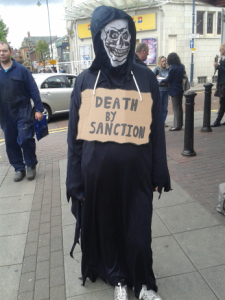
sanction-deaths A pregnant women who was sanctioned in disguise at a recent protest so Jobcentre staff don’t recognise her. From The Poor Side Of Life

Iain Duncan Smith’s mass use of benefit sanctions is driving people to their deaths.  But it began under Labour, and was not opposed by most trade unions or charities established to support people living in poverty.

In 2008 the Labour government published a green paper entitled ‘No one written off: reforming welfare to reward responsibility’ (PDF).  Gordon Brown himself wrote the forward to the document pledging “tough responsibilities that respect tax payers” for all of those on some form of out of work benefit.

Even for a Government which had already introduced workfare and the despised Work Capability Assessment, some of the measures proposed were shocking.  These included mandatory work related activity – a vague term that often means workfare – for both sick and…

View original post 985 more words

Terminally Ill People And Support Group: The Government E-Petition

March 9, 2015

Readers, if you have seen this and if you are even half as shocked by it as I am, please sign this Government Epetition by Becky Lindley. I just did.

Any terminally ill person should automatically be eligible for placement in ESA “Support” group.

Responsible department: Department for Work and Pensions

Currently, terminal ill people with a life expectancy of potentially more than 6 months claiming ESA are still expected to take part in work-related activity groups, I recently discovered.
The government should allow anyone with a terminal illness to claim benefits without having to waste what precious time they have on yet more appointments and assessments, that can only serve to remind them of their condition. They should be free to tend to their affairs, and make the most of their lives.

Datiing Websites For Disabled People

March 9, 2015

Did you know there were specific dating websites for disabled people, readers? I didn’t, until I read this round-up of the best of ’em, at Disability Horizons.

Holiday While On IR ESA, Support Group: FOI Response

March 9, 2015

This is old, but hopefully still  relevant and useful, readers.

Dear Department for Work and Pensions,

Under the Freedom of Information Act (FOI)(2000), please could you
provide me with the following information:

If a claimant is in the support group of esa income related and was
wanting to go on a holiday abroad for upto 4 weeks would the
claimant have to make the DWP aware of this?

Also would this effect the claimants claim in any way??

Yours faithfully,

Mr Ahmed


Dear Mr Ahmed,

Thank you for your Freedom of Information request of 26 June 2011.

You requested the following information:

If a claimant is in the support group of ESA income related and was
wanting to go on a holiday abroad for up to 4 weeks would the claimant
have to make the DWP aware of this?
Also would this affect the claimants claim in any way??

Anyone in receipt of Employment and Support Allowance must report any
relevant change in their circumstances to DWP. This includes going on
holiday abroad.

Income Related Employment and Support Allowance is normally payable for
the first 4 weeks of a temporary absence abroad, providing the claimant
continues to meet all the other conditions of entitlement during the
absence, including the requirement to submit medical evidence. If the
conditions of entitlement continue to be satisfied, the claim should not
be affected.

If you have any queries about this letter please contact me quoting the
reference number above.

Yours sincerely,

DWP Central FoI Team

DWP Staff Told In Training ‘Not To Mention Hardship Payments’ Finds C4 Reporter

March 9, 2015

GOVERNMENT workers are being trained to avoid giving benefit claimants details of hardship payments and other emergency funds, an undercover investigation has found.

A reporter from Channel 4’s Dispatches programme who joined a training course at a call centre in Bolton, Greater Manchester, was told not to volunteer information about same-day advance payments or other funds intended to tide claimants over until their benefits are paid.

At one point a trainer said the Department for Work and Pensions (DWP), which administers the government’s new universal credit benefits scheme, was trying to restrict same-day payments because they “cost the department more money to do”. The trainer added: “It costs us 1p to do a five-day [payment] and costs us about £6 to do the [same-day].”

The reporter was also told that flexible support funds were “not advertised” and should not be mentioned unless the claimant specifically asked. “If we did [advertise], everyone would want one,” the trainer said.

The programme, to be broadcast tomorrow, also discovered a series of disruptive computer mishaps and quotes an instructor as apologising because the training is “all higgledy-piggledy”.

The findings are likely to fuel criticism of the ambitious but long-delayed universal credit scheme aimed at streamlining benefit payments and accelerating claimants’ return to work. Iain Duncan Smith, the work and pensions secretary, claimed last week that universal credit would “bring an end to the something-for-nothing culture that trapped people for too long”.

The new payment, which claimants apply for online, combines six different working age benefits into one payment, which is paid monthly. The introduction of the universal benefit has been described as the biggest shakeup of the welfare state since the 1940s.

The system is eventually intended to help up to 7m people but government figures show only 64,000 people have used universal credit to make claims so far.

A DWP spokesman said call centre workers were trained to provide “administrative support over the phone”. He said conversations about emergency payments would normally take place in a Jobcentre. The spokesman said the DWP was making “every effort to ensure staff are aware of guidance” on hardship payments. He added that IT problems were fixed as and when they arose and that the universal credit system was “on track and . . . making good progress”.

Call The Midwife- Series 4, Episode 8

March 9, 2015

Last night’s Call The Midwife was the last in Seres 4. I am sad to see one of my favourite programmes leave my screen for another year, but more than that, I am pleased and proud.

Because the episode covered disability, from the perspective of a pregnant woman who ‘uses sign language to communicate-‘ and at the prenatal class, other parents cared more about her husband being in the room than about her method of communication!

Another thing that impressed me was that her husband could both hear and speak sign language. I’ve always said more hearing people should learn it- and this is 2015. Call The Midwife is currently set in the 60s.

The episode also ended with what I would consider to be a disability-related bang- as a mother-to-be with very severe morning sickness was prescribed Thalidomide. My mother and I looked at each other, knowing how that story ended, and wondered whether the Thalidomide storyline would be continued when the programme returns next year. The programme doesn’t usually continue stories from previous episodes, but in this case, we would love to see an exception made.

If you missed the episode, you can watch it on Iplayer here for a month.


Ann Pugh: Funeral Arrangements

March 9, 2015

Liz Crow has asked me to share funeral arrangements for Ann Pugh.

Ann’s funeral will be held on Saturday 14th of March in her home village of Nantmel in Wales.
After a private cremation, there will be a funeral service at 2pm at Dolau Chapel, Nantmel LD6 5PE.

The service will end with a trip to the top of the hill on the family farm to scatter her ashes.

After the service everyone is invited to tea at Rhayader Museum & Gallery, East Street, Rhayader,

Guests are encouraged to wear a colourful item or a flower.

No floral tributes please. We will be taking donations for Artists First, a collective group of disabled artists with learning difficulties based in Bristol. They work together to challenge and change people’s ideas about what disabled people can do. Ann was chair of the trustees.

Dolau Chapel (pronounced ‘dolly’) stands about half a mile outside the village at the side of the A44, between Nantmel and Rhayader It is on a junction with a side road signposted for Abbeycwmhir.

You can find up-to-date information and links to accommodation at www.annpugh.co.uk

Access

The route into the chapel is step-free, with a gentle slope down.

Access information for Rhayader Museum and Gallery: http://www.disabledholidayinfo.org.uk/…/searchdetail…

At a later date, family and friends are planning to organise a celebration of her life and work to be held in Bristol, for all the people who don’t come to Wales.

EDF CALLS FOR EQUALITY & FULL INCLUSION OF WOMEN WITH DISABILITIES

March 8, 2015

A press release:

On the occasion of the International Women’s Day on 8 March, EDF calls for equality and the full inclusion of women and girls with disabilities in all actions that European Union and its Member States undertake.

This year is special. 2015 is not only the year the world will agree a new international development framework, it is also the 20th anniversary of the Beijing Platform for Action; this platform aimed to bring to light the structural inequalities and human rights violations faced by all women and girls, and to prepare the ground for concrete action to realise gender equality.

Today, when we look at this platform for action, we stand together with women’s organisations across the world in calling for a reinforced commitment to women’s rights and gender equality. We would also like to highlight why it is essential to make the platform inclusive, and to address the rights of women and girls, of all ages, and with particular attention to women who face multiple discrimination, such as women and girls with disabilities and female informal carers of persons with disabilities.

EDF would like to mark this day by asking for the full inclusion of women and girls with disabilities in all actions to address gender inequality and urges the European Union and its Member States to undertake comprehensive reviews on progress and difficulties encountered in this regard.

Read more on EDF’s website

Mentioning Suicide To The DWP Makes You Suicidal

March 7, 2015

Police officers smashed down the front door of a Mansfield man’s flat after the DWP tipped them off he could be suicidal.

Kevan Ramsdale was settling down for the night in front of his TV with his headphones on when two policemen walked into his bedroom.

Kevan 52, said he was shocked and surprised to see the two men.

Mr Ramsdale who is in the process of making a claim with the Department of Work and Pensions (DWP), said: “I was talking to someone about my claim being delayed and I asked the woman on the phone if she had seen a Channel 4 Dispatches TV programme the night before showing how many people had committed suicide after having their benefits cut.

“I said it was no wonder people did it because the DWP make life so difficult for them. I didn’t think any more about it.”

He said at 8pm on Monday he had been watching TV in his bedroom with his headphones on. “I heard some noise and the next thing I know there were two men standing above me,” said Mr Ramsdale.

“They smashed my front door to smithereens and forced their way into my bedroom.

“They weren’t in uniform and said they had called to see me after DWP contacted the police and told them I was suicidal. “

Fromhttp://www.chad.co.uk/news/local/police-break-down-door-of-mansfield-man-s-flat-after-dwp-told-them-he-could-be-suicidal-1-7142688

Are The DWP Following Their Own Safeguarding Rules When They Sanction Sick and Disabled Claimant’s Benefits?

March 7, 2015

johnny void's avatarthe void

sanction-sabs1People with a mental health condition claiming out of work sickness benefits may have had their benefits wrongly sanctioned due to the DWP not carrying out correct ‘safeguarding’ procedures.

Over 100,000 sick and disabled people claiming Employment Support Allowance have had their benefits stopped or reduced for not carrying some form of ‘work related activity’.  A report released recently by the Methodist Church found that around 100 people a day with a mental health problems are currently having their benefits sanctioned in this way.  There is growing concern however that many of these sanctions could have been incorrectly applied due to the DWP failing to carry out home visits to assess the impact on the claimant of stopping their only source of income.

The Jobcentre guidelines are clear“If a claimant has a condition that could affect their ability to understand and comply with conditionality, a Core Visit to their home must…

View original post 338 more words

Love Has No Labels

March 6, 2015

This is the latest viral video to hit the old net, readers…

ELECTION CANDIDATES: TAKE TO WHEELCHAIR OR CRUTCHES TO SWAY 27% OF THE ELECTORATE.‏

March 6, 2015

A press release:

More than 12 million votes could be swayed in the general election dependent upon politicians’ understanding of disability issues – and one disability sector business leader says politicians should get on their crutches and into wheelchairs to get a clear understand of the challenges faced by mobility equipment users.


Mark Effenberg, Chief Executive of Blue Badge Mobility (BBM)– mobility equipment rescue, recovery and insurance – whose son is a wheelchair user, says politicians have a massive opportunity to sway disabled voters by simply “going disabled” for a day.


“We understand disability issues more than most businesses, but we keep our finger on the pulse anyway: our most recent research indicates that nearly 95% of mobility equipment users say businesses of all types would be far more appreciative of the challenges faced by disabled people if able-bodied employees took part in a ‘be in a wheelchair for a day’ experience as part of company employment policy,” said Mark.


“That got us to thinking about how much policymakers and politicians really understand about mobility issues for disabled people – and we looked at how many disabled voters, partners and carers there are: it’s an astonishing 12.5 million. There’s around 46 million voters in the UK, so that’s 27% of the electorate.


“To truly appreciate those mobility issues, we believe politicians should take to crutches or a wheelchair for a day, and get a user-eye-view and experience of mobility equipment.


“That would also have a huge impact on the able-bodied public’s understanding of the issues facing mobility equipment users – our previous surveys and research indicate that able-bodied people perhaps think they understand disability issues, but in reality not many do.”


Hampshire-based Blue Badge Mobility provides mobility equipment rescue and recovery, insurance covering use, protection and liability relating to scooter, wheelchair and home equipment, care-related insurance products, as well as advice on sourcing and use of mobility equipment.


http://www.BlueBadgeMobilityInsurance.co.uk/


Ruben Reuter

March 6, 2015

Ruben Reuter is no stranger to the screen. In 2012 the 14-year-old starred in a CBBC documentary about three children with Down’s syndrome, and then went on to present short films for Newsround about what life is like for young people with disabilities similar to his own.

But, from Friday 6 March, Ruben can be seen playing Finn, the first returning character with a learning disability, in popular CBBC show The Dumping Ground.

With filming taking place in Newcastle, over 120 miles (190km) from his home in Huddersfield, the young actor had to live away from his family. His mum, Kim, says she had initially been worried about how her son would cope. “It would be a big deal for any 14-year-old, but it’s a bigger deal for one with Down’s syndrome to live independently,” she says.

With a chaperone, his own teacher and the other boys from the show to mess around with, it has all turned out well. “It’s a bit good,” says Ruben. “I don’t miss my Mum and Dad. I do see them every weekend you know.”

The Cost of PIP – Decision Makers – A Law unto themselves

March 6, 2015

jaynel62's avatarjaynelinney

In November last year I reported I’d received my PIP award and disagreeing with it I’d contacted the DWP;  due to the closeness to Christmas, the Call Centre staff member had put in my request for the assessment report and noted  it was “my intention to ask for a Mandatory Consideration” (MR), this was so as I would not run out of time if post was caught up in the Mail.  I duly waited for my copy of the assessment report, which arrived on December 23rd and  submitted my formal request for a MR along with the evidence on January 10th.  Five days later I received a letter dated January 11th, it had clearly crossed with my own submission in the post, it informed me the DMs had already carried out a MR and had, of course, upheld the original decision!

I duly phoned, well actually my daughter phoned for me as…

View original post 389 more words

DWP To Terminally Ill Claimant: If You Don’t Die Within Six Months, We’ll Prosecute You

March 6, 2015

A shocking post from The People Vs The Government, DWP And ATOS.

Linda Cox

A lady came in to see me today. She was beside herself as the DWP had treated her very badly over numerous different aspects of her claim. She had been misled and lied to, but this is the thing that’s making me want to roll some heads…

Her phone call to DWP last year….

Lady: I am calling to inform you of changes to my health; I now have cancer.
DWP: Well?
Lady: I was told to inform you of any changes to my health.
DWP: Well, are you going to die?
Lady: I’m not sure. I’ve only just been diagnosed.
DWP: Well, I can put you through on the special rules for terminal claimants, but if you don’t die within six months we will prosecute you.

She was so taken aback, she didn’t get any names.

WTF are these creatures they employ?

I’m going to enjoy writing this letter of complaint. Bastards.


Benefit Sanctions briefing: DWP’s Mandatory Reconsiderations have “effectively destroyed” independent Tribunals

March 5, 2015

www.refuted.org.uk's avatarwww.refuted.org.uk

Benefit Sanctions Briefing – 18 February 2015: The DWP’s latest release updates the sanctions statistics to the end of September 2014. For the first time it includes the results of mandatory reconsiderations.

Download briefing – view online

Highlight:  “The Mandatory Reconsideration system, introduced on 28 October 2013, has fundamentally changed the whole appeal process, introducing additional steps and a new Jobcentre Plus structure. MR has cut the proportion of JSA sanctions which are challenged by claimants from about one third (33%) to about 20-25%. ESA sanction challenges have returned to below their pre-MR level, at about 45%. The independent element in the system offered by Tribunals has been effectively destroyed, completely in the case of ESA and almost completely for JSA, where only 0.14% of sanction decisions are now being taken to…

View original post 91 more words

New UC ‘Six Month Earnings’ Rules Will Hit 200000

March 5, 2015

New universal credit rules which could leave 200,000 claimants waiting six months for their benefit have sparked fresh fears over increased tenant rent arrears.

The new regulations, which were quietly laid in parliament last week, have been described by social landlords as likely to lead to increased hardship and evictions.

Currently, the Department for Work and Pensions (DWP) calculates a claimant’s universal credit monthly. If they earn above a certain threshold in that month, their entitlement is reduced or removed. Under the new rules, the DWP will take into account earnings the claimant has made in the six months previously.

This means a person who earns a larger amount in one month, but nothing the following month, may find they are unable to claim universal credit for up to six months. The change only applies to people making repeated claims within six months of a previous claim ending.

The DWP expects up to 200,000 universal credit claimants to be hit by the change after it comes into force on 6 April 2016 – nearly 10 times the number hit by the £26,000-a-year benefit cap.

The change means claimants who receive an irregular income will have to plan and set aside savings for when they are not in work, as they may not be able to fall back on benefit.

In response to a previous consultation on the change, the National Housing Federation said: ‘Any additional delay in tenants’ ability to access the right support will further increase the possibility of poverty.’

London landlord Peabody said an ‘obvious area of hardship’ would be when claimants took up additional seasonal work. The housing association added: ‘With the accruing rent arrears, there is every chance of people facing eviction.’

Community Housing Cymru, the Scottish Federation of Housing Associations (SFHA), Golden Gates Housing Trust and Wheatley Group have also expressed concern.

The government announced last week it had changed the finalised regulations to allow claimants to earn up to £300 more in one month than the next without being hit, halving the number of people estimated to be effected. The change is designed to prevent people who have an option on when they get paid from maximising universal credit.

Jobcentre Manager Demands More Referrals For Sanctions

March 5, 2015

I just spotted the above image on Facebook.

2015: DWP staff say targets for sanctions STILL EXIST

March 5, 2015

Lee Jefferson's avatarStop UK lies & corruption

2015: DWP staff say targets for sanctions STILL EXIST (subtitled video)

DWP staff say sanction targets still exist. Ian Wright was a DWP work coach. Alan Davies was a DWP personal adviser. Both men had key roles in the sanctions process. Both men say they were disciplined for not referring enough people for sanctions.

Mark Serwotka who is the General Secretary for the Public and Commercial Services Union also states there is a target for sanctions referrals and the Government denies it.

He states one of those is 80% of all referrals must result in a sanction. Individuals have to compete against other individuals. Offices have to compete against other offices.  Which side is more credible – the staff expected to implement these targets or the Ministers who live in a world of their own?

2015 DWP staff say targets for sanctions STILL EXIST 2015 DWP staff say targets for sanctions STILL EXIST

This is what a Personal Improvement…

View original post 66 more words

A Tribute To Lynda Phillips

March 5, 2015

More sad news, unfortunately, readers. This time it comes from campaigner Debbie Sayers who shared it in the Disability Community UK Facebook group.

Sorry to be the bearer of bad news, but is my sad duty to inform you all that one of our members Lynda Phillips has passed away. She was an amazing lady and a campaigner fighting against the unfair so called reforms often more than was good for her… Her contribution will not be forgotten RIP Lynda… Dxxx

As with Lotte Ryan, I didn’t know Lynda Phillips. However, with Lynda Phillips I shared membership of the Disability Community UK Facebook group, as well as over 50 Facebook friends.

My thoughts are with her family and all her offline connections, as well as the friends we shared.

Our community is a strong one in which personal connections are unnecessary. In this community we feel every loss as strongly as the last. Every name is remembered, every contribution, however small, is valued forever.

With great sadness, readers, I have written two tribute posts in two days. I have been reminded that in our strong, special community, tributes and deaths and the loss of friends are things we must get used to. Death and loss are the hardest things, for me, about being disabled- but in our little world, they are very ‘normal’ things.

We need to dry our tears of sadness and dust off our broken hearts, readers, and carry on fighting to make things better for those who are left in our community- and for those yet to join it.

RIP Lynda Phillips.

A Tribute To Lotte Ryan

March 4, 2015

Keith Lindsay-Cameron shares some sad news on Facebook today:

Lotte Ryan was being hounded by the DWP in December. Lotte has passed away and has left this beautiful message, a message for the living. How beautiful, caring and thoughtful. Rest in peace Lotte. Perhaps you are seeing us now with wiser, clearer, eyes than life gives us, if so, thank you for this stunning message.

“Dear Friendlings Don’t be spooked now, my cousin Chris, sisters Lis and Lucie, brother Jago and my Mum are writing this for me because I had to leave you all last week as you know. Sorry to go missing from here too for a while. My family have had a few things to do and wanted to get things right for me before informing you all of what’s happening.

My bash will be on Monday 16th March at 1.30 at Mendip Crematorium near Wells. You can google it to get directions because it’s not easy to find being up by the Glasto festival site and all.

Now I don’t want you spending your hard earned cash on flowers because I’ll have plenty of those from my family. If you want to bring me a rose and write me a message there will be a time and place for you to give those to me and I think I’d really like that. Nothing too ostentatious mind. You know I don’t do that stuff.

Cousin Chris has been getting a collection going for my charity of Caring in Bristol. If you want to donate and leave a message for me just go to justgiving.com/Lotte-Ryan and all will be revealed.

Share lots of happy memories and thoughts of me on this page, no arguing with anyone now or doing any naughty stuff. I’ve been hearing things (tut) and don’t forget to download any photies you may want to keep.

I love you all dear friendlings. My diary of a Mong is over. My journey is ended and I am at peace. Lottekins”

I didn’t know Lotte Ryan, but we had several mutual Facebook friends. I’m sharing Keith’s tribute in case any of you knew her, readers.

My thoughts are with everyone who has been affected by her very sad death.

Updated 1145pm: I have just realised that I shared Lotte Ryan’s story here in December. However, it was a reblog so her name doesn’t show up on the post.

Maximarse- The Movie

March 4, 2015

A three-minute round-up of Monday’s protests…

Firms Promise To Act On Access After BBC London Investigation

March 4, 2015

Some of the UK’s biggest firms have begun urgent improvement schemes after a BBC London investigation exposed failures to serve disabled people.

A blind person and a wheelchair user wore secret cameras to document cafes without ramps, missing station staff and minicabs that refused guide dogs.

More than 100 restaurants are now being audited for accessibility. Training is being launched and equipment installed.

It comes after the government ordered the companies to explain their actions.

Last autumn, BBC researchers found unusable tables, or ramps missing or broken, at branches of Itsu, Costa Coffee, Eat, Caffé Nero, Caffé Concerto, Chipotle and the Post Office.

Of 20 minicab firms tested in east London, five refused to take a clearly-marked guide dog.

On four occasions, the wheelchair user got temporarily stuck on a train when staff booked to help did not arrive on time. She was also unable to board a bus due to a faulty ramp.

More accessibleMark Harper MP, Minister for Disabled People, highlighted Eat’s response as particularly praiseworthy.

New training has been put in place and 113 of its stores are being audited to make sure they are accessible.

Sarah Doyle, brand director at Eat, said of the problems highlighted at their restaurants: “We were mortified. Therefore when we saw that footage we took it very seriously and undertook to investigate.

“We’ve asked all our shop teams to check the equipment is there and we have put in place replacement equipment if it was required.”

In further responses as a result of the investigation:

  • Caffé Concerto said it had now assessed all its branches and was changing some to make them more accessible.
  • Itsu acknowledged improvements to staff training and accessibility were needed. It said accessibility had been agreed as one of the chain’s focuses for 2015 and an external accessibility firm would be employed.
  • Caffé Nero said its initial response to the BBC was not as sensitive to the issue as it should have been, and apologised to members of the public who subsequently contacted them.
  • Costa Coffee said ramp problems highlighted in the investigation have been fixed.
  • Southeastern Rail expressed concern with the issues uncovered and said relevant station managers had been made aware of them.

Mr Harper, who wrote to the organisations ordering them to improve, said: “Having watched the footage, there were some companies that clearly weren’t doing what the law says they should be doing – but also not doing what a modern business should do in terms of the way it treats its customers.”

The minister said he was encouraged by the organisations’ responses – except that of Chipotle, which did not reply to his letter.

He said: “I am very disappointed Chipotle didn’t even have the courtesy to reply. It does make you wonder [about their] compliance with the law and customer service.”

A Chipotle spokesman told the BBC: “We believe we have addressed the concerns initially brought to our attention and are now exploring the possibility of retaining consultants to do an assessment of our restaurants to be sure they are up to standard, and to help us better understand requirements in this area.”

‘Weak’ responseNigel Holness, operations director for Transport for London, said of problems highlighted during the investigation: “I don’t think they’re acceptable, but sometimes in life these things happen. What I can say is we are very committed to providing support and assistance to people with disabilities.

“We’ve restated our commitment to working with disability groups. A third of our stations already have step free access, and over the next ten years another 40 will be added to that network.

The Equality Act obliges organisations to make reasonable adjustments for disabled people.

But Reshi Ramlakhan, the visually impaired man who documented the problems, said the government’s response was “weak”.

He explained: “I think ministers should be making simple, clear, concise, easy to understand legislation which makes this kind of offence a criminal offence, not a civil offence.

“I have to take it upon myself to take that person [denying me a service] to court.”

Mr Ramlakhan added: “I walked down the road the other day and saw a sign that said if your dog fouls the pavement you’ll be given a fine.

“Straight away, that’s an immediate penalty – whereas if somebody commits an act of discrimination against me, I have to go through this long-winded process to get justice.

“It made me think that people with disabilities are worth less than dogs’ mess on the street.”


Production Of Blood Wedding With Disabled/Deaf Actors

March 4, 2015

A play featuring a number of disabled actors is set to take to the stage in Dundee.

Thousands of pounds has been spent improving disabled access at the city’s Rep Theatre for the new production of Blood Wedding.

The cast includes deaf actors and wheelchair users, and is backed by the Graeae Theatre Company, which promotes the work of disabled thespians.

Blood Wedding runs at the Dundee Rep until 14 March.

The contemporary re-imagining of Spanish dramatist Federico Garcia Lorca’s tragedy tells a story of young love, rebellion and revenge.

The production by Dundee Rep Ensemble, Graeae and Derby Theatre, written by David Ireland, features a mix of disabled and non-disabled actors, and has subtitles projected on the backdrop for any members unfamiliar with sign language as well as audio descriptions.

Director Jenny Sealey, of the Graeae Theatre, is herself deaf. Her previous work includes co-directing the London 2012 Paralympic Games opening ceremony.

She said she was inspired to get involved in the production after being told that Lorca had never intended for his story to be told by deaf and disabled actors.

“Graeae, Dundee Rep and Derby Theatre beg to differ, and challenge that statement with our adaption, placing a glorious diversity of people centre stage, all of whom have a right to be there to claim their stake in the narrative,” she said.

While an investment had to be made to make the Dundee theatre accessible for disabled actors, the director believes the biggest obstacles standing in their way are not physical.

She said: “The physical access is crucial but the biggest barrier in theatre is attitude.

“It’s 2015 now and there’s sometimes that attitude that we don’t have the right to be on stage, and I think, yes we do.

“We are part of society, and we come with the richness of experience of having had to smash through barriers.”

A total of £12,000 has been spent upgrading the 30-year-old venue, creating a new doorway onto the stage and creating better disabled access.

Nils den Hertog, head of production at the theatre, said the modifications had been a challenge, but would help with all future productions.

He said: “We had to create a larger entrance to the stage from the dressing room corridor.

“In the past when we’ve worked with disabled actors they had to be on stage before the audience came in. With this being such a big production that wouldn’t work.

“There are quite a few theatre companies touring around the country and this will help access for all of them. It’s a win/win situation for everybody.”

Amy Conachan plays the Bride in Blood Wedding, and she said opportunities for fellow disabled actors are getting better.

She said: “I feel like it’s definitely improving.

“So far the parts I’ve played have been written disabled, but there is more opportunity for disabled actors with companies like Graeae.

“It could be better, you could have disabled actors cast more in non-disabled parts, but I haven’t found so far that it’s a major distress to me. I kind of feel I’ve been more in demand because of it.”

The play runs at Dundee Rep until March 14, and then travels to Derby Theatre, the Beacon Arts Centre in Greenock, Edinburgh’s Traverse Theatre, New Wolsey Theatre in Ipswich and the Everyman Playhouse in Liverpool.

Sanctioned? Call This Number And You May Get Your Money Back

March 4, 2015

Spotted on Facebook. Sharing in good faith.

‘Using The JobCentre Exposed Me To Institutionalised Bullying’

March 4, 2015

I’ve been using the job centre for the past four years. I’ve had four years of incompetence. My life was put on hold as the job centre lost my forms and then denied all responsibility. I had to wait months for the money I needed to live and support my family. I applied for ESA because I have a lifelong congenital heart defect, anxiety and depression, and was assessed by lifting a box, bending my knees, and raising my arms above my head. This was done by a doctor, who – rather than knowing about heart conditions – was a cancer specialist.

I’ve had four years of discrimination and intimidation, with door staff who made me feel like I’d committed a crime simply by setting foot in the job centre. Door staff who have made me explain my illnesses and personal circumstances in front of crowds of strangers.

I’ve had four years of unhelpful advisors, who didn’t know how to help me in the one thing I really wanted them to help me with: to find a job. There weren’t even computers or phones that I could use to do it myself.

This is my experience of my local job centre in Great Yarmouth. But the story is similar for other job seekers across the country, as job centres come under fire for their attitudes towards the people that they are there to support.

It seems to me that in many cases job centres have mutated into places to guard benefits, rather than to help the jobless into work.

Those that use the job centres are often sick, and our illnesses have a barrier to work. Despite this, we are treated as criminals.

Our heavy reliance on them for survival tips the balance of power unhealthily towards those who run the centre.

In Yarmouth, we’ve had enough of the hostility of the job centre and the problems it creates. We’re taking action, for ourselves, in our community – that’s what Just Jobs is all about.

It’s made up of job centre users, working with Movement for Change to use the tools of community organising to make change happen.

We have worked tirelessly to try to find a solution. We have listened to the stories of hundreds of job centre users like ourselves, have spoken to councils, food banks and unions and have repeatedly requested meetings with the managers of our local job centre centre. Our requests have so far been refused.

When these meetings were refused, we took action, and delivered a letter from concerned people and organisations in our town, explaining the need for change – to the doorstep of the job centre. We were met half a dozen security guards threatening and intimidating us and refusing to let us even enter the building to hand it to the manager. Some people in our group had been so afraid of reprisals that they didn’t add their name to the letter – and from the response we were met with, maybe they were right.

This demonstrates the desperate position we are in. It is a Catch-22 situation – we need better treatment yet people fear to take the risk of demanding change, as it may result in losing the small amount of money we do have. 

We want a job centre which is open and accessible to all, with proper provision of services, which is locally accountable, empathetic, professional, respectful and inclusive.

We hope that by organising ourselves, we will change the way job centres are run. We hope that we can show that we are not the ‘lazy’ individuals we are often portrayed as.

We are people who want to work. Often the reason we can’t is due to illness. We need the support that job centres should be offering us to make it happen. We want to work and that is why we won’t be backing down.

Gary Boyd is a Job Centre user and Just Jobs campaigner with Movement for Change.

Savings From Sanctions- This Is More Proof Of Targets

March 3, 2015

This was taken in a Jobcentre, therefore exposing that there certainly are targets for benefit sanctions, something which the government has always denied. Apparently the Jobcentre where it was taken isn’t being named at this point, presumably to protect the whistleblower, but the photo has already been passed on to a parliamentary select committee. Let’s hope the committee acts on this.

sanction savings

This Is What Being Disabled And On The Housing Register Looks Like

March 3, 2015

A mother with leukaemia. A five-year old daughter so disabled she can’t even throw an arm around the shoulders of someone carrying her up the stairs to her flat. Over two years on the housing register and no chance of even being shortlisted for a property.

This is the reality of being disabled and living in housing completely inadequate for your needs.

Our family rents privately; the top-floor flat in a house that we moved to because it was easier to care for May there than carry her up the four-floors up we previously lived in.

There was no disabled housing when we needed to move. Landlords aren’t keen to make expensive and unmarketable adjustments to their properties that would make them accessible to us. We need things like a hoist to lift our daughter into the bath. We need a ramp into the house. A stairlift if there is more than one level. 

So, we make do – in a flat with stairs leading up to the front door, internal stairs leading up to the flat and then internal stairs within the flat as well. May’s wheelchair is kept in a cupboard attached the porch – there is no chance of carrying it up as well. Instead, we lift her everywhere she needs to go.

May is five and growing. She can’t sit, let alone walk. She has epilepsy with seizures that come on suddenly and every day – so, yes, they can happen on those stairs. A very dangerous situation for a little girl.

Full story here.


John McDonnell MP Speaking At London #Maximus Demo

March 3, 2015

Huge Success For Campaigners As Rage Against Maximus Explodes Onto The Streets Across The UK

March 3, 2015

johnny void's avatarthe void

Disabled protesters block Victoria Street bringing traffic chaos. Disabled protesters block Victoria Street bringing traffic chaos.

Over 30 towns and cities held protests yesterday against the involvement of sinister US based outsourcing company Maximus in the despised Work Capability Assessments.

Maximus take over from Atos this week carrying out the tests used to strip benefits from sick and disabled people by finding them ‘fit for work’.  Atos were chased out of their lucrative contract with the DWP after a string of protests destroyed their carefully crafted corporate identity and campaigners have vowed to do the same to Maximus.

In London up to a hundred disabled people and supporters descended on their non-descript London offices where a noisy and determined protest took place outside their front door.  Protesters then took to the streets and occupied a roundabout where a Work Capability Assessment circus was held with events including a jumping through hoops display and a box lifting competition –…

View original post 299 more words

Senior Tory Minister Criticises ‘Inhuman Inflexibility’ Of Benefit Sanctions

March 3, 2015

A senior Conservative minister has criticised the “inhuman” application of benefit sanctions, despite the government’s official position that there is no need for a further review of the penalty system.

Nick Boles, a business and education minister, told constituents the way sanctions were used in some cases did need to be looked at but acknowledged that change was not likely until after the general election.

The remarks to a group of charity volunteers concerned about sanctions were reported by his local newspaper, the Grantham Journal. Boles agreed to take case studies of hardship caused by sanctions to the government, after being told about a claimant who was penalised after staying overnight at a hospital when their newborn baby was in intensive care.

“With some of these cases it seems to me that there is an inhuman inflexibility that is imposed on them … The sanctions are a worry, and do need to be looked at,” he said.

Asked about what changes could be made, Boles said: “In the runup to the election there is not a lot we can do, but we can get the case studies together where the sanctions seem to be most unreasonable … The beginning of a parliamentary term, when people are looking at things afresh, is the best time to make a change.”

He added: “I do understand why there needs to be a disciplined system and there needs to be a process they go through, but I do think there are too many of these cases where it does seem inhumanly inflexible.”

Over the last few months many of Boles’s Conservative colleagues have defended the benefit sanction system against criticism from charities and Labour.

Esther McVey, an employment minister, has argued that the system is effective, and Downing Street has ruled out any fresh review of the system. In December, a spokesman for No 10 said the government was willing to look at speeding up the payment of benefits, but saw no need to undertake further reform of sanction decisions.
Under the sanctions regime, which began in October 2012, claimants are denied their benefit for a month or more if they do not meet government conditions for actively seeking work.

After the Oakley review last July found systematic failings in the process, including disproportionate burdens placed on the most vulnerable, the Department for Work and Pensions said it would change the way it communicated with claimants hit by sanctions. However, criticism has continued since then.

Late last year a cross-party report endorsed by the archbishop of Canterbury suggested the penalties were partly to blame for the growing use of food banks in the UK, and the Lib Dem leader, Nick Clegg, backed calls for a rethink of the way sanctions are administered.

This week a group of churches called for an urgent overhaul of the regime, describing it as inhumane. The Church of Scotland, the Church in Wales, the Methodist church, the Baptist Union of Great Britain and the United Reformed church, as well the charity Church Action on Poverty, called for the immediate suspension of sanctions on claimants who are mentally ill or have dependent children.

Asked by the Guardian whether his comments meant he supported a review of the system, Boles said: “Benefit sanctions are an essential part of our reforms to end the something-for-nothing culture and they have helped record numbers of people back into work since 2010. I am a strong supporter of them in both principle and practice – those who can work should work.

“Of course, we need to make sure that the decision to impose sanctions is properly applied and employment advisers work hard to make sure special circumstances are taken into account.”

Almost 500,000 people have had their benefits suspended for a period of time, including 2,000 who have been barred from claiming for three years.

Mosaic Science Project On Disability And Sexuality

March 3, 2015

Mosaic Science magazine, published by the Wellcome Trust, has done a project on disability and sexuality.

It includes work from several UK campaigners and friends of Same Difference including Katherine Quarmby, Penny Pepper, and Mik Scarlet.

It’s official, Maximus Inc has changed it’s name to Maximarse – with maximarse.com!

March 3, 2015

Sometimes we have to laugh…

www.refuted.org.uk's avatarwww.refuted.org.uk

Today, March 2nd 2015, has been the day of action against Maximus Inc, led by Disabled People Against Cuts (DPAC).  At this time, it is worth noting that recent copyright reforms means creators and artists are more free to parody existing work.

Domain Name:MAXIMARSE.COM
Registrar Registration Expiration Date: 2020-01-26T20:24:11Z
Registrant Name: Christine Graham
Registrant Organization:MAXIMUS Inc.
Registrant Street: 1891 Metro Center Drive
Registrant City: Reston
Registrant State/Province: Virginia
Registrant Postal Code: 20190
Registrant Country: United States
Registrant Phone: +1.7032518498
Registrant Email: corporatecommunications@maximus.com
http://www.networksolutions.com/whois/results.jsp?domain=maximarse.com

View original post

Autistic Man Gains Masters Degree

March 2, 2015

A press release I was very pleased to receive. This is what inclusion can do.

A graduate with autism has gained his masters degree from the University of Brighton.

Logan Osborne’s proud parents praised their son for winning what was a “real battle” for him.

His father Christopher, said: “It has not been easy for him, as all parents with autistic children will realise. Their little habits, rituals, lack of contact with others and anxieties have all had to be overcome. But it shows it can be done.”

Logan said he received “excellent” support from the university’s Disability and Dyslexia team: “I didn’t encounter any prejudice from any students that I know of. I found my tutors were very helpful and I always felt that I could talk things over with them and help check my work if help was needed.”

Logan first gained a BSc(Hons) in Geography in 2013 and now has an MSc in Geographical Information Systems and Environmental Management. He is now looking for a job in geographical information systems.

Logan’s father added: “It may come as some comfort to other parents who have autistic children that, with the right support and a supportive family, nothing is impossible.”

More Sanctions Than Court Fines 2002-2013

March 2, 2015

Graph thanks to Joe Halewood and Centre For Crime And Justice Studies:

benefitfines

JobCentre To Man With LD: Do As We Say Or Sign On More Often

March 2, 2015

An extract from Kate Belgrave’s blog:

Now isn’t this charming.

On Thursday, I went again to one of the northwest London jobcentres to meet up with Eddie (named changed), the 51-year-old man with learning and literacy difficulties who I’ve accompanied to JSA signon sessions for coming up to six months. Eddie’s signon time changed last week and I met him at the jobcentre just as he came down the stairs from his appointment.

He was furious. He felt that he’d been threatened. He said the jobcentre had told him that his next sign on appointment would take place at 2pm on a Thursday afternoon, rather than in the morning as usual. Eddie told the jobcentre that he preferred morning appointments. It suits him. He finds that routine easier to manage. But that is too bad, it seems. Eddie said he was told off for arguing the toss about the new afternoon signon plan. He said the jobcentre made it clear that if he kicked up a fuss about afternoon signon times, he’d be forced to attend every week to sign on instead of every fortnight. No matter that absolutely nothing ever happens at his signon meetings. He’d just be forced to attend more of them and get no help more often. Great.

Coalition Condemned Over Sanctions Regime That ‘Tortures Children’

March 2, 2015

An extract from Mike Sivier:

Around 100,000 children were affected by benefit sanctions between the beginning of April 2013 and the end of March 2014, according to a new report.

In the same period, nearly seven million weeks’ worth of sanctions were handed out to benefit claimants.

The data, obtained under the Freedom of Information Act, will feature in this evening’s episode of Channel 4’s Dispatches, entitled Britain’s Benefits Crackdown.

The report – Time to Rethink Benefit Sanctions – is published today by the Baptist Union of Great Britain, Church Action on Poverty, the Church in Wales, the Church of Scotland, the Methodist Church and the United Reformed Church. It contains new data on the severity and length of sanctions under ‘welfare reform’, and on how sanctions affect vulnerable groups such as children and those with mental health problems.

Band With LD Will Represent Finland At EuroVision

March 2, 2015

I’m thrilled to read that Finnish learning disabled punk band PKN will represent their country at Eurovision.

I hope they win!

Sell, Sell, Sell! Maximus Share Prices Could Tumble After Welfare To Work Scandal Rocks Australia

March 2, 2015

johnny void's avatarthe void

share-collapse1A damning documentary exposing the shoddy behaviour of Maximus and the welfare-to-work sector in Australia could lead to a drop in the company’s share price according to one stockmarlet analyst.

The programme, produced by ABC (and still viewable here), tells a story which will be familiar to all those in the UK forced to attend outsourced schemes such as Iain Duncan Smith’s Work Programme.  Claimants had their benefits stopped for no reason, signatures on paperwork were faked and the most marginalised claimants were parked – meaning abandoned completely by the companies who saw no profit in helping them.  Maximus dominate the welfare-to-work sector in Australia, and have several contracts running similar schemes in the UK.

According to an analyst on finance website Seeking Alpha, Maximus earn 10% of their revenue in Australia and that could now be under threat due to a ‘short term negative news cycle’. …

View original post 612 more words

The Work Capability Assessment Is About To Get Worse, Less People To Be Placed In Support Group Say DWP

March 2, 2015

johnny void's avatarthe void

wca-review5 Recommendations made by Paul Litchfield in the latest review into the Work Capability Assessment

More sick and disabled people will face sanctions and workfare when Maximus take over running running the despised assessments for sickness benefits say the DWP who have promised the number of people placed in the Support Group is expected to fall.

The department’s comments come in their response to the latest review into the Work Capability Assessment, the shoddy computer based test used to find sick and disabled people ‘fit for work’ and stop their benefits.  Sinister US based outsourcing firm Maximus will take over the assessments from next week after ferocious campaigning by disabled people and benefit claimants led to the notorious Atos ending their involvement with the tests early.

The most recent review was carried out by Paul Litchfield, presumably in his spare time as he is also Chief Medical Officer at BT. …

View original post 608 more words

A Tribute To Disabled Filmmaker Ann Pugh

February 28, 2015

Campaigner Micheline Mason informs her Facebook friends of some sad news tonight. Disabled filmmaker Ann Pugh unfortunately passed away this week.

Micheline posted the following lovely tribute on Facebook:

Anne Pugh has left us.
This week we have suffered a big loss with the untimely death of the wonderful Anne Pugh on Wednesday. I have known Anne for many years as she has helped make many of the films which have been a crucial part of our progress with the struggle for inclusive education.

Ann Pugh was a partner in Redweather, an independent production company based in Bristol. She was a disabled film Producer and Director. Although not exclusively, much of her work was about disability issues, education, social history and the arts. Education films include twenty films for the DfES promoting good inclusive practice and illustrating how the Disability Discrimination Act can be effectively implemented in schools.(The Reasonable Adjustments Project with Richard Rieser). Television credits include productions for Channel Four, ITV and Discovery. One series was a groundbreaking set of films of disabled adults talking about their experiences of segregation as children. These films helped change the perception of ‘Special School’ forever.

A particular fond memory was when she came and filmed an amazing weekend for the Alliance for Inclusive Education in Norfolk. We had bought together twelve young people with high-level support needs who were all in mainstream schools. She helped make a powerful film about the kind of support they really wanted. This film ‘The Inclusion Assistant’, like so many of Annes, has been used thousands of times over the years to teach professionals, through the voices of disabled people themselves, how to create services which empower the user.

Anne was an extraordinarily modest person, preferring to show her brilliant mind through the lens of her camera, her skillful editing and her deep understanding of the message which needed to be communicated. She will live on through her work, and in the hearts of all who knew her.
My condolences to Frank and all her family.

I remember watching a documentary titled Developing Inclusive Education in South Africa which Ann Pugh made along with campaigner Richard Rieser. I wrote about this film briefly here and have always remembered it.

I extend my condolences and thoughts to all who knew Ann Pugh.

Sexually Frustrated Retards

February 27, 2015

Storme Toolis on Kill Me Now…

storme92x's avatartheatrerambler

Dear people of the world

On Tuesday evening I had a little moment. My mum took me to watch ‘Kill Me Now’ at the Park Theatre and I realised how much of a big deal my life is.

Things I learned from Kill Me Now

  • DIsabled people constantly call ourselves ugly. Actually I spend quite a lot of my time putting effort into my appearance. I love all that comes with being a girl. Especially 1950’s fashion and men who play guitars. Yes, self image is a problem sometimes but my ugliness in the morning has more to do with messy hair and bad breath than the fact I use a wheelchair.
  • We love going to the toilet: actually – it isn’t the nicest place to hang out. When I’m out clubbing with friends I tinkle in two’s after a few too many but that’s what everybody does, it has…

View original post 302 more words

Kill Me Now- A Review By Dea Birkett

February 27, 2015

The brilliant writer, mother of the brilliant actress Storme Toolis, has written a brilliant review all about why she thinks new play Kill Me Now is not brilliant.

I say the review is brilliant because through it, Dea Birkett stands up strongly for her own daughter, and for all ‘children’ with disabilities.

Deaf Stand Up Comedy- John Smith And Rinkoo Barpaga

February 27, 2015

Deaf humour is gaining pace with a new breed of stand-up comedians. But is it possible to get the jokes across to a hearing audience if they are performed in sign language?

Rinkoo Barpaga and John Smith are deaf comedians who both perform using sign language, but they have very different approaches to comedy.

Barpaga hasn’t been doing stand-up for long, but has been making friends laugh for as long as he can remember. He jokes mostly about his experience of growing up deaf, or “just funny stuff that happens that I’d tell my mates about at the pub.”

He chooses to sign his performances and so Barpaga relies on an interpreter to voice his act for hearing crowds. This means it’s the interpreter who needs to have the right pacing, intonation and translation skills to convey the humour. As he can’t hear what the interpreter is saying, Barpaga only has a certain amount of creative control – it’s risky but when it works, it really pays off. The evidence can be seen at a gig filmed at the famous Gotham Comedy Club in New York, where he had a hearing audience in stitches at how his deaf school unexpectedly lost a game of football against a team from a blind school.

John Smith is from Mansfield and is probably the best-known signing deaf comedian in the UK. He started out in 2005, and has honed his act to the point where he now performs to deaf audiences all over the world. His humour is mostly visual and slapstick, using exaggerated storytelling and signing to describe the similarities and differences between deaf and hearing people. In one routine he acts out the delicate and quiet mannerisms of a hearing person using a public toilet, then re-enacts the same sequence as a deaf person, with slamming toilet seats, loud grunting, straining, and repeated flushing.

Smith occasionally gets his wife to provide a live voiceover – so hearing audiences can also enjoy the comedy – but he mostly likes to perform for deaf people. After all, he argues, hearing people can go and watch hundreds of different comedians at any time.

So is there any chance of deaf comedy breaking out into the mainstream? Barpaga thinks so. He argues that in the same way that black comedians such as Richard Pryor and Eddie Murphy drew on their own life experiences as young black people four decades ago, deaf comedians are doing the same now. They too have the possibility, he says, to build their acts and gain a wider appeal.

In their work, Smith and Barpaga want to reflect what it’s like to be deaf rather than make jokes about poor hearing.

If we look at mainstream gags about deafness, they tend to use lack of hearing ability to gain laughs. That old joke about the hard of hearing genie accidentally giving a man a 12-inch pianist instead of the body enhancement requested, can just perpetuate negative stereotypes. Deaf people often say that kind of joke doesn’t come from an authentic place. They say a white comedian can’t make lazy jokes about black people anymore and argue the same rules should apply for jokes about deafness.

In his early days of doing stand-up, Smith would rail against those with cochlear implants and hearing aids – a sensitive subject in the deaf world with some believing deaf people should embrace their deaf heritage and not use such devices. Some performances would end with him calling a volunteer on stage to donate a hearing aid, which he would then smash with a hammer. That routine ended when a young boy with an implant came up to him after a show to ask why he was being singled out.

Deaf comedy may not be breaking out into mainstream venues just yet – but maybe it doesn’t need to. Deaf people need to laugh, just as much as anyone else, and perhaps the best way to do that is to get it raw and uncompromised, and not attempt to make it universally accessible.

Change.org Petition To Free Sam Barlow

February 26, 2015

Some of you have asked if there was one. I’ve just found it.

Sheriff Philip Mann has sentenced a 16-year-old autistic boy to 3 years in jail.

A few months ago, Sam suffered a breakdown. As a result of his autism, the nature of the breakdown was severely amplified and culminated in a regrettably dangerous situation.

While sentencing is acceptable for some, it will inevitably be an isolating and counterproductive experience for a 16 year old with autism. This is a draconian decision that has evidently overlooked the complexity of a very young person’s health and wellbeing, and will exacerbate the problem.

Rather than tackling the underlying causes of the incident, this decision has made an example of a powerless young person.

As a highly vulnerable individual, Sam needs a supportive network of professionals around him. For this to happen, our community needs to act now to ensure that this decision is re-evaluated.

Share this petition far and wide, and contact your representatives in Parliament to make them aware of this injustice before we present the petition to Scotland’s Cabinet Secretary for Justice, Michael Matheson.

How The DWP Bribed Employers To Break Age Discrimination Laws With A ‘Golden Ticket’ Worth £2,275

February 26, 2015

johnny void's avatarthe void

wage-incentive-goldenticketJobcentres bribed employers with ‘golden tickets’ worth up to £2,275 to hire young people over older workers despite warnings from lawyers that this Wage Incentive scheme was probably illegal.

Figures released this week show that over one hundred thousand ‘Wage Incentive’ payments were doled out to employers before the scheme was quietly abandoned last Summer.  These payments could be claimed from the DWP every time an employer recruited someone under 25 who had previously been on benefits.  An early evaluation of the scheme found that it was riddled with abuse, with employers making backdated claims for workers they had already hired, or even using Wage Incentives as a tax-payer funded rolling stock of temporary staff.  This report came alongside warning from the DWP’s own lawyers that companies who took these payments faced the risk of legal challenges under age discrimination laws from older workers denied jobs .

Despite these…

View original post 519 more words

Watchdog’s Chilling Threat To The Elderly And Disabled- Pay Carers A Pension Or Be Fined

February 26, 2015

More than 100,000 elderly and disabled people have been warned they face a £400 fine or prosecution if they don’t set up a pension for their carer.

Charities say they have been flooded with calls from the frail and vulnerable who have been left terrified by the threatening tone of letters sent out by watchdog The Pensions Regulator.

It demands they have a legal duty to pay into a pension for their employees or face penalties.

Those affected all receive money from their local council to pay for their care, but have been unwittingly caught up in an overhaul to pensions.

Since October 2012, all employers have had to automatically sign up staff members into a pension and pay contributions on their behalf. Initially just big businesses had to do this, but now smaller firms are being included.

Those who might not consider themselves as employers at all are now being told they have to pay into a pension for workers aged over 22 who earn more than £10,000 a year.

This includes families who take on full-time cleaners or nannies and also tens of thousands of disabled and elderly people who receive cash directly from the local council in order to employ a carer.

This system is known as direct payments. The scheme is popular because it allows councils to reduce their costs, but also helps the elderly or disabled find a carer who suits their specific needs.

Technically, it means they are an employer and, as such, must provide a pension to their carer under the new rules.

But many have no idea they are classed as a business and have no knowledge of pensions.

Rob Wilson, chief executive of charity The Rowan Organisation, which helps those who receive direct payments, says: ‘We are getting a lot of calls from people who are very worried about this. They are looking for help, but there seems to be no advice for them out there.

‘The tone of the letter from The Pensions Regulator is also quite threatening. It would be daunting for the chief executive of a big company to receive, let alone someone elderly in need of care.’

One Money Mail reader, a disabled 78-year-old man who is terminally ill with the lung condition emphysema, received one of the letters last month. It told him he must set up a pension for his three carers by February next year.

The letter is addressed to ‘Dear Chief Executive/Business owner’ and goes on in complicated language to advise him of a date by which he must start the pensions.

It continues in bold type: ‘If you fail to comply with your duties you may be fined or prosecuted.’

The letter adds that he can nominate someone to deal with the administration of the scheme, but that he is legally responsible for it. He has less than two months to find someone to do this task and tell the watchdog his choice.

The reader told us: ‘I went into a blind panic when I opened the letter. I saw the bit where it threatened legal action and said I had to do things by March. It seems completely crazy. I’m someone in need of care; I’m not a business.’

He says he asked his local authority for help and a local charity, but no one was able to tell him what he should do next. He adds: ‘The doctor says I shouldn’t get stressed because it will make my illness worse, but I can’t help but do so.’

It was only later he realised that, in fact, none of his three carers were eligible because they all earn less than £10,000.

An estimated 100,000 people receive direct payments, which are available to the elderly and disabled who have been assessed by their local council as needing care and support services.

The direct payment allows them to buy in and arrange help themselves instead of getting it directly from social services. The money is often paid on to a cash card or into a bank account.

How much someone receives is decided after an assessment with the local authority.

The way carers are paid lies at the heart of the complication. Many carers who look after one person are effectively an employee of the person they’re looking after. In many cases, they are paid their wages directly by the household they’re helping.

Alternatively, the carer may be paid by a third-party that takes care of income tax and National Insurance payments.

But the cared-for person — who usually pays a fee for such a service — still remains the employer, and will receive the letter.

A few carers are also self-employed, and many work via an agency; they won’t be affected.

People receiving direct payments must account for how their money is spent to their local authority. This can involve providing timesheets or receipts.

They are generally barred from employing a spouse or a close relative living in the same house, although relatives living elsewhere are usually permitted.

There is no set amount that people in need of care can receive from their local authority. But they will have to go through an assessment where the hours they will need is worked out by council staff.

There are also further concerns that the additional cost of supplying the pension might have to come directly from the elderly or disabled person since there are no promises that their direct payment would rise to meet it.

Experts say some local authorities will hike payments to cover these costs, but others won’t — leaving a shortfall.

By 2018, someone employing a carer earning £16,000 a year would have to find roughly another £25 a month or £306 annually to pay for the pension contributions.

The Pensions Regulator says employers are generally given a year to set up a pension. Those who fail to comply face an initial fine of £400, though this could rise for persistent offenders.

Charles Counsell, executive director of automatic enrolment at the regulatory body, says: ‘We recognise the particular challenges automatic enrolment raises for people with carers and have been working to ensure our communications help meet the needs of this unique group of employers.

‘The letters we are sending to all employers are factual and a call to action. If an employer needs support in understanding and complying with their duties, we’re here to help.’ 


New Scoring System To Decide Support Group For MH Claimants

February 26, 2015

With many thanks to Benefits And Work.

A new scoring system has been created to decide if claimants with mental health issues can get into the support group because of a risk of harm to themselves or someone else. The system has been deliberately designed to make it more difficult for women to qualify than men.

There have also been important changes to the way health professionals estimate how far claimants can walk or ‘mobilise’.

SUBSTANTIAL RISK
The substantial risk regulations are now one of the most important ways of getting into the support group.

According to the independent reviewer of the WCA, Dr Paul Litchfield, 38% of all new support group entries are on substantial risk grounds . Two thirds of these are decided on the papers alone, without the need for a medical assessment.

The regulations apply where a claimant has not qualified for the support group, but where it is then decided that there would be a substantial risk to the claimant or to someone else unless they are found to be incapable of work-related activity.

HARDER FOR WOMEN
Until now there has been no difference in how men and women are assessed.

However, Benefits and Work can reveal that a new scoring system deliberately makes it harder for women to qualify for the support group than for men.

For example, a man with a diagnosis of depression and a history of deliberate self-harm who is unemployed – generally the case for ESA claimants – will be eligible for the support group, according to the guidance.

But a woman in the same situation will not be eligible for the support group. Instead, she will have to also show that an additional factor – such as being homeless or divorced –applies to her.

The gender difference is likely to be based on the fact that more males than females commit suicide.

Indeed, figures released by the Office for National Statistics just last week showed that suicide rates are now at their highest in over a decade and most of the increase is amongst men. Organisations such as Mind are linking the rise to benefits cuts.

However, many people would question whether a difference in suicide rates is sufficient to justify different treatment for men and women in relation to claiming benefits. This is particularly the case because substantial risk is not just about deliberate self-harm or suicide, but also about issues such as unintentional self-neglect.

SCORE YOURSELF OR YOUR CLIENTS
But, as the guidance is already in use, we’ve created a step-by-step method for scoring yourself or your clients in relation to substantial risk.

Understanding how the system works may make it very much easier to present targeted evidence showing that you meet the substantial risk criteria. Conversely, if the guidance doesn’t cover your circumstances you have more information about how the decision was reached in order to challenge it.

You can find the step-by-step method in the updated ESA mental health guide in the members area of the Benefits and Work website.

MOBILITY CHANCES BOOSTED
There is better news for ESA claimants with mobility issues, however.

The new guidance has dramatically reduced the estimates of how far claimants can ‘mobilise’ based on their everyday activities. For example, claimants who can only move around at home have had their estimated mobility reduced from less than 200 metres to less than 50 metres.

This is the difference between getting into the support group or only scoring 6 points for mobility.

You can read further details in the ESA physical health guide in the members area, which also has details of improvements in assessing continence issues for people who also have mobility problems.

The new guidance is included in the latest edition of the WCA Handbook.

The Ongoing Embarrassment Of St Mary’s House

February 25, 2015

This is a guest post by Stephen Springer MBE, Lead Officer, User Involvement & Independent Living at Livability. Published with thanks.

In 2012 campaigners first raised the issue of the accessibility of St. Mary’s House assessment centre in Norwich, which is used by Atos to assess the ability of disabled people to work.

It’s a hardly believable irony at first glance, but the assessment centre is based on the second floor, making, in the words of the Department for Work and Pensions, “evacuation in the event of a fire difficult.” An MP said it was unacceptable, DWP said they were investigating and Atos (the assessor) said the building was the government’s responsibility.

Fast forward two and a half years and the situation is no less murky. In mid-2014, the then minister for disabled people said the centre would be shut down entirely, whilst DWP said they hoped to secure ground floor access by the new year (2015, that is), Atos all the while pointing the finger back at DWP.
And all of this is without mentioning the difficulties people can face in the assessments themselves, once they actually make it into the building.

And here we are, in a drizzly grey February and the centre still very much exists and is still very much on the second floor. After over two years of declaratory galumphing nothing has moved.

This includes the letter sent by disability rights campaigner and Equal Lives chief exec. Mark Harrison to the new disabilities minister Mark Harper complaining about the situation – which, it seems, has not been responded to since he sent it in October 2014.

These assessments are essential to the independence and wellbeing of the disabled people in the area. They should be made as simple, precise and accessible as possible. Sending somebody to a centre miles away in Ipswich is not acceptable. It is massively inconvenient, often expensive and, most of all, degrading. Being assessed is not a pleasant procedure in itself, and having to be shipped around the country in order to do it is only going to make it worse.
In the work I do for Livability I understand the enormous value of independence. Quality care is essential, but providing people with the space and freedom to make their own decisions and live their life in their own way is vital – it is a human right. This issue is emblematic of a wider problem of how accessibility is becoming a tin can people are happy to kick down the road. Organisations have had since 1995 and the Disability Discrimination Act to make their buildings accessible and so it is embarrassing to say the least to find that, 20 years on, a government agency continues to use an inaccessible building. I hope that swift and effective action is taken here to resolve this issue which, on the face of it, can and should be easily resolved.

Free Sam Barlow

February 25, 2015

THE mother of an autistic teenager jailed for three years after aiming an air rifle at police has broken her silence to plead for
 his release.

Ruth Barlow wants her 16-year-old son Sam freed from a young offenders’ institute more than 400 miles from the family’s home on Shetland while his appeal against sentence goes through court.

His family believe first offender Sam, who has a history of mental health problems, brandished the air rifle while trying to get himself shot by police.

He had previously been
 tormented by bullies who are still being investigated by police and was diagnosed with Asperger’s syndrome after the incident on September 23 – in which no one was injured.

Community nurse Ruth asked for judges to pay more attention to a detailed psychological report which highlighted her son’s extreme vulnerability.

She is backed by her MSP Tavish Scott and former Labour justice minister Hugh Henry, who both say the sentence is excessive.

Her campaign has also been
 supported by three mental health charities and more than 1800
people in Shetland.

Ruth, 43, told the Sunday Mail: “Sam is a child with learning difficulties and
 mental health issues who has
 been pushed too far.

“He just wants to come home and be with his mum and dad and his brothers and sisters. We are a large family and very close.

“I have only seen my son once in the flesh since he was arrested six months ago. That was when he appeared in court, and then only for a few minutes.”

Ruth Barlow ..Mother of Samuel Barlow

Sam is being held at Polmont Young Offenders Institute near Falkirk. To get there would need a 14-hour trip by ferry to Aberdeen and another 135 miles by road.

Instead, the family have to make do with going once every six weeks to council offices in Lerwick, where they can speak to Sam on a video link from the prison.

Sam was diagnosed with
learning difficulties when he was four. He also has dyspraxia – a condition that affects his
 co-ordination – and dyslexia.

Ruth added: “We spoke to him by video on Wednesday but it
 was only the fourth time since he
went inside last September.

“It is not how a mother wants to see her son, on a TV screen. He is bearing up, considering – but he should not be in prison.

“Sam should be outside getting the help that he needs. He has no previous convictions and has never been in trouble with the police.

“After his arrest, he was remanded in prison and was refused bail. which we are told is very unusual now.

“There are very serious violent
 criminals out there who have not been treated with the same severity as
 Sam.

“People with mental health issues
like my son should not be in prison –
 they should be at home getting help.”

Ruth says her son suffered serious bullying at school for several years.

More recently, he was targeted
by adults who were trying to take
advantage of him through Facebook.

Troubled: Sam Barlow carries an air rifle as he approaches police during the incident in Lerwick

Sam had also become involved in
 an online relationship with a girl,
 which went badly wrong on the
day of the incident.

Sam blamed himself for this and left his home in Wester Skeld, setting off a chain of events culminating in the armed stand-off with police.

He took his family’s airgun from
 their home and sailed several miles
 in an inflatable dinghy to Scalloway. Two unarmed officers had to take
 cover when he pointed the gun at them.

He then hiked six miles across
 country to Lerwick, where he tried to get into houses and threatened two residents with the gun.

He then repeatedly pointed the weapon at two armed officers but the police did not fire. Instead, they
 persuaded Sam to give himself up.

Earlier this month at Lerwick Sheriff Court, he was sentenced to three
 years’ detention after admitting
 four charges of assault and one of
 threatening and abusive behaviour.

Sheriff Philip Mann said he had to
 cage Sam to protect the public – but
 he admitted it was a very difficult
 decision because of his age and
 mental health problems.

Since his conviction, Sam has penned an open letter to the Shetland islanders apologising for his behaviour.

He wrote: “Dear Shetland, I am sorry for the alarm I have caused.

“I was not in a happy or enjoyable
 state of mind due to a long-distance relationship that ended in sorrow and heartbreak.

“This affected my state of mind on
 the day of the incident.”

The Daily Record covered the case Campaign: The Daily Record has highlighted Sam’s shocking story

Ruth said: “Sam suffered bullying
at school but because of his autism,
 he did not realise he was being
 bullied.

“For the same reasons, he did not mix well with other pupils and that was why he was being picked on.

“Sam is very interested in all things to so with the sea and spent a lot of time down on the harbour at Scalloway helping local
 fishermen with their mussel lines and doing odd jobs for them.

“He had also completed a
 two-year seamanship course at the local marine centre.

“Sam did not hang about street corners but was always helping people and keeping busy.

“He had passed his National 4 exams and wanted to do his National 5 qualification.

“Sam is a bright boy but found English and maths hard.

“We never felt that the Shetland schools did enough to help him with his learning difficulties.”

The family moved to Shetland from Bury, Lancashire, in 2006. Sam’s dad Paul Barlow, 47, runs a croft and keeps chickens, geese and sheep.

Sam will not be eligible for release until March 2016 at the earliest. After he is freed, he becomes subject to a supervised release order for one year.

Paul, 47, added: “We would love it if Sam were set free and back home.

“We don’t want to see other autistic persons being jailed when there are better alternatives.

“We think the punishment is too harsh.

“My son had no intention of
 hurting anybody that day apart from himself.”

Samuel Barlow points his rifle at police officers Rampage: Sam points his airgun at police

A government spokesman said: “The independence of Scotland’s judiciary is a fundamental part
of the Scottish legal system
and Scottish Ministers cannot intervene in individual cases.

“Because of this, it would be inappropriate for the Scottish
 Government to comment on
specific cases.

“In Scotland, anyone dissatisfied with the outcome of a trial or with the sentence imposed has the right to appeal.

“It is for the Appeal Court to determine if the conviction or
sentence is inappropriate in all
the circumstances.

“Again, ministers have no
 powers to intervene.”

Charities and politicians yesterday backed the
 Barlows’ campaign to get Sam home and questioned the length of his sentence.

Shetland MSP Tavish Scott, a former leader of the Scottish Lib Dems, said: “Three years certainly looks too much.

“The family can only hope 
that facts about his mental
well-being will be taken
properly into account by the appeal judges.

“But my primary concern is about Sam’s well-being and the medical issues he faces.

“The distance from his home is enormous and in the current system there is no alternative.”

Labour justice spokesman Hugh Henry added: “While
 sentencing is a matter for the court and not politicians, I’m sure most people would think a 16-year-old boy with autism and mental health issues shouldn’t be locked up in Polmont.

“What alternatives were
 considered? We need a
 root-and-branch review of alternatives to imprisonment to come up with solutions that the judiciary and public have confidence in.”

Jenny Paterson, director of
 the National Autistic Society Scotland, said: “Courts need
 to understand the impact of autism on someone’s actions
and to take into account the
support they will need if given a custodial sentence.

“We support the family’s call to have the sentence reviewed and will be assisting them with their campaign.

“It is essential that understanding of autism is improved across the criminal justice system.”

Scottish Autism director Charlene Tait added: “This highlights that there are still far too many instances where individuals like Sam can fall through the system.

“There continues to be a lack of broad understanding about people who are on the autism spectrum.”

DWP Has Made ‘Little Progress On UC’ Says Report

February 25, 2015

Little progress has been made on the roll-out of universal credit with just 0.3% of the eligible population receiving it by October last year, concludes a damning report out today.

This is despite the £700m spent on the programme since it began in 2010, says the government’s spending watchdog the Public Accounts Committee (PAC).

‘We hope the [Work and Pensions] department’s expectation that this number will rise significantly by February 2016 proves to be accurate,’ the chair of the committee Margaret Hodge stated.

Fewer than 18,000 people were claiming universal credit by October 2014, the committee report explains, out of about seven million expected in the longer term.

The watchdog was also critical of the IT infrastructure for the programme, which it says is of ‘particular concern’.

It has cost the Department for Work and Pensions [DWP] £344m so far to develop its ‘live’ service systems for claimants.

‘Yet it expects to re-use just £34m worth of this IT in the longer term,’ said Ms Hodge. 

The chair also explained she was ‘disappointed that the department chose to fight a protracted legal battle to prevent the publication of its programme milestones schedules against which it could be held to account publicly’.

Although, she notes the department now appears to have improved its governance of the programme and become more open recently.

The report recommends the DWP publically sets out its current milestones for universal credit, and clearly explains any future changes to scope, cost and timings of these.

Landlords reported earlier this month their IT systems were limiting their ability to prepare for universal credit.

Four in 10 universal credit claimants also said universal credit did not make it easier to claim benefits, according to a survey published by the Department for Work and Pensions this month.

A DWP spokesperson said: ‘Universal credit is on track and we are making good progress – almost 64,000 people have made a claim, and this time next year, universal credit will be in every Jobcentre in the country.’

Evidence shows it is ‘transforming lives’ and using existing IT ‘ensures value for money and will save the taxpayer over £2bn’, he added.


What Do Blind People See?

February 25, 2015

BBC journalist Damon Rose completely lost his sight as a child, but he says his world isn’t pitch black. So what exactly does he see?

It’s often assumed that blind people experience complete darkness, but in my experience this is far from the truth.

I appreciate this is going to sound odd coming from a blind person but when people ask me what I miss most about not being able to see, my answer is always “darkness”.

Let me explain. I am one of a very small number of people who have no sight whatsoever. I’m properly blind. A “total” as we used to say at school.

I lost my sight 31 years ago thanks to ill-advised surgery, and on my blind person’s registration certificate it has three, now very faded letters – NLP, no light perception.

The logical assumption is that when sight is snuffed out, a person must be left in darkness. If you dive under the bed covers you can’t see anything at all. If you close your eyes then everything turns to black. So, blind equals black? It make sense, right? Apparently not.

Though I’ve had the cord cut between my eyes and my brain, it seems that the world has not turned black. All metaphors, similes, analogies, and literary flourishes about blindness and darkness should henceforth cease to be used because I’m saying it’s far from dark. It is, in fact, quite the opposite.

So what replaces 3D technicolour vision once it’s gone? The answer – at least in my case – is light. Lots of it. Bright, colourful, ever-changing, often terribly distracting, light.

How do I even begin to describe it? Let me have a go. Right now I’ve got a dark brown background, with a turquoise luminescence front and centre. Actually it’s just changed to green… now it’s bright blue with flecks of yellow, and there’s some orange threatening to break through and cover the whole lot.

The rest of my field of vision is taken up by squashed geometric shapes, squiggles and clouds I couldn’t hope to describe – and not before they all change again anyway. Give it an hour, and it’ll all be different.

If I try to block out all this distraction by closing my eyes it doesn’t work. It never goes away.

I miss those peaceful moments of near darkness: walking at night-time while focusing on the streetlights ahead, the atmospheric shadows in a room with a real fire burning, or travelling home late in the back of my dad’s car glimpsing cat’s eyes lighting up in the middle of the road.

For me, dark has come to signify quiet, and because my built-in fireworks never go away I describe what I’ve got as a kind of visual tinnitus.

When I first went blind I thought the brightly coloured lights were a sign my eyes were trying to work again. It gave me some hope and I was quite fascinated by it. I used to sit and stare at it. Now I know that it’s my brain making up for the fact that it no longer receives any pictures.

Some people of faith have occasionally tried to tell me that I’m seeing the after-life, and I never know how to respond to that. But what I have never been able to find out is whether other people who have no light perception also see what I see.

And, assuming that full vision and driving a car are not on offer, do they also long for a bit of darkness?

Unemployed Are ‘Less Considerate And Sympathetic’ Says New Study

February 25, 2015

Thanks to Welfare Weekly. Same Difference joins Welfare Weekly in finding the results insulting!

Unemployment can cause significant psychological damage to an individuals personality, according to a new study.

Behavioural scientists from the University of Stirling found that unemployment causes a persons well-being to worsen, possibly leading to “large changes” in their “core personality”.

While personality normally remains relatively constant over time, negative experiences – such as unemployment – reduces a person’s levels of “conscientiousness, agreeableness, and openness”.

According to the study, funded by the Economic and Social Research Council, the longer people are out of work the less motivated, considerate and sympathetic they become. A claim which will undoubtedly be rejected and regarded as deeply offensive by some, if not all job seekers struggling to find work.

Lead researcher Dr Christopher Boyce, from the University of Stirling’s Behavioural Science Centre, said:

“The results challenge the idea that our personalities are ‘fixed’ and show that the effects of external factors such as unemployment can have large impacts on our basic personality.”

Behavioural scientists carried out two separate tests in a four-year study. All participants were in work when the study began.

A second test was carried out after four years; when participants were either still in a job, had been unemployed for one to four years, or had re-entered employment after a period of unemployment.

Researchers say the study suggests unemployed people are often “unfairly stigmatised” due to “unavoidable personality change”, leading to potential difficulties in helping them back into work and causing a negative impact on the UK labour market.

Those who had moved back into work after losing their jobs experienced only “limited change”, the study says.

Experts say policy making has a “key role” in preventing personality changes and urged politicians to create more policies designed to support unemployed people into work.

Dr Boyce said: “A high national unemployment rate may have significant implications across society.

“For example, high unemployment may hinder the development of desirable social and economic behaviours, such as participation in social activities and better health behaviours.

He added: “Policies to reduce unemployment are therefore vital not only to protect the economy but also to enable positive personality growth in individuals.”

Down’s Syndrome Football Chant “Distressing” Says Kevin Kilbane

February 25, 2015

Kevin Kilbane has made a complaint to the Football Association, after claims West Ham fans mocked disabled people in an offensive chant.

The former Everton and Sunderland midfielder, who has a daughter with Down’s Syndrome and is patron of the Down’s Syndrome Association, said he felt “compelled” to speak out about the chants witnessed by friends.

“I felt compelled [to complain] as a father, first and foremost, and to someone who takes his daughters to football matches further down the line,” he said.

Kilbane also said he had received criticism on social media for raising the complaint.

This clip is originally from 5 live Afternoon Edition on Tuesday 24 February 2015.

Unspoken Project Seeks Disabled Actor

February 25, 2015

From Facebook:

Hi
Unspoken CIC is looking for a disabled actor to play Rex King! We are holding a read through for our production Speechless! The read through is on 9th March in Hackney. We would like to have a disabled actor to play Rex King (this character could be ether gender)
Rex King runs a gang of disabled criminals that steals assistive technology(wheelchairs, communication aids and blue badges) he or she has more front than blackpool!!!!!!
Can you make a fantastic Rex or do you know a guy that can. Please contact us on kate.unspoken@gmail.com
Please note, this project takes some what of an “in ya face” attitude to disability.
Thank you we look forward to hearing from you.
The Unspoken Project CIC team

A Sad Upsetting Morning

February 24, 2015

From Carl Green on Facebook:

Well the press as usual decided to demonize those on benefits, the Mirror – yes The Mirror – ran a story of a young lady with a baby who lived with Mummy & Daddy and saved £3000 benefit money to travel the World………. with baby. Of course Mum & Dad look after her every need but she doesn’t know why poor people complain……She has loads !

Meanwhile elsewhere……..

A Sad Upsetting Morning by Lauren Hopkins

Sad upsetting morning. Elderly man knocks on my door with no shoes and socks on saying he lived here. Clearly cold and confused and luckily a neighbour knew where he lived. He has terminal cancer and clearly vulnerable so I gave him slippers and took him round the corner to his flat. The place was filthy, unsanitary and a hazard.i saw a rat the size of a cat in his kitchen. He was screaming of pain and had to wait for over an hour for an ambulance. Stacks of unopened post which I read and found a letter for DWP reducing his benefits to £20.63 a week, then to reduce further to £16.53 a week in April. No family..no one looking after him except his amazing neighbours who have been feeding him. Amazing ambulance crew took one look and off he went to hospital with unbelievably high blood pressure.

I am so ashamed of our society that we allow extremely vulnerable people to experience this absolute nightmare. It only takes One person to get a local voluntary group going, just to check on those you know you are vulnerable in your street or local area. His neighbour Pat and I are starting this just for our few little streets here, and we have a lot of elderly and disabled in our area so I’m hoping we can at least show our local community we care about them. Times are tough for everyone, but more for some than others. If you are fortunate enough to be able to do anything, then please do. No one else will.

Man, 25, Pleads Guilty To Alan Barnes Attack

February 24, 2015

A man has pleaded guilty to assaulting disabled pensioner Alan Barnes, for whom more than £300,000 was subsequently raised in donations.

The 67-year-old suffered a broken collarbone when he was knocked to the ground outside his Gateshead home on 25 January.

An online appeal set up on his behalf raised £330,135.

Richard Gatiss, 25, from Gateshead, pleaded guilty to assault with intent to rob at Newcastle Crown Court.

He will be sentenced at a later date.

line

Danny Savage, North of England Correspondent

Richard Gatiss cut a sorry figure when he originally appeared before magistrates. He sat weeping in the dock as the court was told his DNA linked him to the assault.

Newcastle Crown Court heard that Gatiss is “shocked , horrified and deeply ashamed of what he did”. He is also conscious of being in the public eye, the judge was told.

line

Mr Barnes was putting out his wheelie bin when he was attacked by Gatiss.

Moved by Mr Barnes’s plight, an online appeal to raise £500 was set up by Gateshead beautician Katie Cutler.

It attracted donations from across the globe and quickly passed the initial target.

Mr Barnes has lived with disabilities from birth, after his mother contracted German measles when she was pregnant.


What would you do?

February 24, 2015

rantingtony's avatarRanting Tony

I have been working with a client for the past few months who has numerous medical conditions. This person also looks after his wife who also has numerous medical conditions.

When I first started working with this gentleman it was to advise him on the ESA tribunal that he was going to attend. As I was unable to go to the tribunal with him that I had to arrange for one of our support team to go with him, which also meant introducing him at another meeting.

The tribunal was a success and our client was extremely happy. After a few weeks I had a phone call from this client in reference to three letters he had received from the Job Centre informing him that he had to attend these mandatory interviews.

This gentleman has like numerous other people has developed “Brown Envelope Phobia” and was in a state of…

View original post 242 more words

Scientists Building Fingertip Sensors For Bionic Hands

February 24, 2015

Scientists at the University of Newcastle are using microchips as fine as human hair to produce a prosthetic hand.

If successful the £1.4m project would enable much higher levels of function for people who have lost their limbs.

The team will build fingertip sensors to give the prosthesis a realistic sense of touch.

Sharon Barbour reports.

Maximus Will Do One Million WCAs This Year

February 24, 2015

Thanks to Benefits And Work.

Maximus has told the BBC it will do one million assessments this year.

Maximus is being paid £595m over three years to carry out work capability assessments for people applying for employment and support allowance.

The Department of Work and Pensions cut short a contract with Atos last year after “significant quality failures”.

Maximus is promising to clear a backlog of around 600,000 claims.

It is also planning to reduce the time people wait for their results from at least 120 days to the recommended 90 days.

President of health services, Leslie Wolfe, told BBC Radio 4’s You and Yours programme: “Part of what Atos didn’t have was a [big] enough team to keep up with the wait times.

“That’s one of our first priorities. We need to clear about one million [work capability assessment] claims this year.

Read the full story on the BBC website

RBS and NatWest launch first ever accessible debit and savings cards for partially sighted and blind customers

February 23, 2015

A press release:

• New cards have tactile markings to identify the card, a notch to show what direction to insert the card into an ATM and large print phone number on reverse • The new cards are the first banking product to be accredited by The Royal National Institute of Blind People (RNIB) and are the first cards to be designed specifically for blind and partially sighted customers • RNIB estimate that almost two million people in the UK are living with sight loss
In the UK alone there are over 2 million people living with sight loss making lots of everyday tasks, including banking, difficult and frustrating. A year ago, one of our partially sighted customers asked us what we were going to do to make banking easier for our blind and partially sighted customers. Today we are proud to announce the launch of our new accessible debit and savings cards which have been specifically designed for blind and partially sighted customers.
Addressing some of the common problems that blind and partially sighted customers face, the cards feature tactile markings to identify which card is debit and which card is savings. They also have a notch cut out on the right hand side of the card to help customers insert their card into ATMs and PIN pads correctly. The reverse of the card has also been adapted with the needs of partially sighted customers in mind. The telephone numbers have been placed where no embossing will be on the front of the card and the font has been increased by more than 50% to make it easier to read.

All other features of the card remain the same – this card can be used in ATMs, at point of sale and for Contactless transactions home or abroad. The cards can be ordered in all RBS and NatWest branches, online or through telephone banking and will be issued within 48 hours.
Ross McEwan, CEO of RBS, said: “We want to be recognised as a bank that listens to its customers and responds to their issues. It’s really important to me that we make banking as simple and easy as possible for all of our customers and our accessible cards are another step towards us earning back trust.”
This is the first banking product designed specially for blind and partially sighted people. RBS has worked closely with the RNIB in the development of this card and in recognition of this work the new debit and savings cards will be the first banking products to be awarded the new national quality assurance mark ‘RNIB approved’.
Steve Tyler, Head of Solutions, Strategy and Planning at RNIB said, “We are delighted to have worked with RBS on making debit and savings cards more accessible. The very basic requirement of identifying the right card and quickly determining which way the card slots in to a machine or payment system has been solved by this development. Simple as it is, creating a card with tactile indicators that identify the card type as well as the way in which it should be used, is an engineering challenge, particularly to ensure that it doesn’t disrupt machinery. We look forward to working with RBS in to the future and enhancing even more of the daily payment challenges that blind and partially sighted customers experience.”


http://personal.natwest.com/personal/current-accounts/accessible-debit-card.html
http://personal.rbs.co.uk/personal/current-accounts/accessible-debit-card.html

Daniel Biddle’s Access Push

February 23, 2015

A man who lost both his legs in the 7 July bombings in London in 2005 wants to use his experience as a disabled person to improve access to buildings.

Daniel Biddle also lost an eye, hearing in one ear, lost his job and broke up with his partner.

He retrained as an access consultant and has set up a business service to advise companies on making changes.

Mr Biddle moved to Abergavenny from Essex and also runs an accessibility project in the town with his fiancee.

“When I acquired a disability my life changed forever but just because you’re disabled it doesn’t mean you can’t do things,” he said.

“The perception of disability is the biggest stumbling block yet my inspiration and goals are no different to anyone else.”

He spent a year in hospital after the bombings, which killed 52 people in four attacks.

He added: “I witnessed six people on the same Circle Line train die in the most horrific circumstances. To know that I survived and they didn’t fills me with guilt.

“I’m very lucky to be alive and it would be a huge injustice to the victims’ families if I didn’t do something with this opportunity I have been given.”