Love Island’s Tasha: ‘A Little Sign Language Goes A Long Way’
Tasha Ghouri was Love Island’s first deaf contestant. Now her time on the show is over, she wants to use her on-screen fame to make a real-life impact for other deaf people.
“I never had anyone to look up to that’s like me on websites or TV,” says Tasha – who finished fourth in the ITV competition this summer.
Before the villa, the 24-year-old modelled – for websites such as ASOS – with her cochlear implant visible, yet she was a rare example.
But according to Tasha, the depiction of the deaf community on TV is “moving in a very positive direction”.
“I think representation is really coming a long way from where it was a couple of years ago,” she tells Radio 1 Newsbeat.
“For example, Rose [Ayling-Ellis] on Strictly, and then I’m on Love Island,” she says.
Eastenders actress Rose, Strictly Come Dancing’s first deaf contestant, won the show last year.
“That’s a massive thing for the deaf community, and in terms of representation, [it] doesn’t happen enough in my opinion,” says Tasha.
‘Don’t cover your mouth!’
But away from the screen, Tasha says there is still work to do – something she wants to help to address.
“A lot of people never know how to approach people that are deaf or hearing impaired because they don’t know how to communicate,” Tasha tells Newsbeat.
“[You can be deaf-friendly] by learning basic British Sign Language, because if you just learn basic conversation, that really does go a long way.”
“Always make sure your lips are based on them, because a lot of deaf [and] hearing-impaired people lip-read. Especially me, I’ll always look for you 24/7. Another thing is don’t cover your mouth!”
She also encourages others to “be open and not to be judgmental”.
“Don’t say comments like, ‘I never knew you were deaf’, or ‘I couldn’t tell because you’re quiet’. I find it quite offensive.”
Tasha is encouraging others to learn BSL, and to become more deaf-friendly.
‘Left out of conversations’
A month since the final, Tasha is still with her Love Island boyfriend, Andrew Le Page.
But for fans to understand their latest announcement on social media, they’ll have to know BSL, as they talk about their search for a house.
The islander says this is to highlight how deaf people can sometimes feel left out of conversations.
Tasha wears a cochlear implant, a small electronic device that electrically stimulates the nerve for hearing.
While Tasha was on Love Island, her dad explained in a social media post how Tasha’s cochlear implant can make day-to-day life more difficult.
“Not many people are educated on how cochlear implants work and the side effects they come with, so it can be very draining for me,” says Tasha.
https://emp.bbc.co.uk/emp/SMPj/2.45.0/iframe.htmlMedia caption,
‘I’m very proud of Tasha’
She says wearing the device can take a physical toll, with the magnet and coil inside the device sometimes giving her bad migraines.
“I’m socially active and I’m constantly having to lip-read. Being in group situations, I’m having to really focus on one person’s voice, so I can miss out on many conversations.”
“Even [on Love Island] when somebody said, ‘I’ve got a text’, and read out the message, the amount of times I missed out on what was said,” she adds.
“So it can really strain, there were days in the villa where I was absolutely drained and exhausted.”
But Tasha tells Newsbeat that the response to her time on the show has been better than she expected.
“It’s honestly been so overwhelming, but in the most positive way, seeing all the beautiful messages from so many people in the deaf community.
“I did not expect it at all.”
Lewis Capaldi Reveals Tourettes
Lewis Capaldi has told fans he has Tourette’s Syndrome (TS), speaking about its day-to-day effects in an Instagram Live video.
The 25-year-old explained that due to his twitches, people mistakenly think he takes drugs before concerts.
TS is a condition that “causes a person to make involuntary sounds and movements called tics”, according to the NHS.
“I have Tourette’s, I’ve always had it, apparently,” the Scottish singer said.
He recently mentioned on stage that he has the condition, explaining why his shoulders sometimes twitch.
“I do the shoulder twitch quite a lot. And you see underneath every TikTok and stuff, people are like, ‘why is he twitching?’, which is fine. Curiosity is fine.”
“Do you think before performing [in front of] 20,000 people, as an anxious person, I’m going to take a big line of cocaine? Never going to happen.”
‘Refreshing’
There has been a positive reaction to Lewis’s honesty from fans with the condition.
“It’s good that someone of that calibre is able to feel comfortable enough to say, ‘Yeah, I’ve got Tourette’s syndrome’,” Holly Ann Maria tells Radio 1 Newsbeat.
“I think it’s really important because it shows that yes, he has a debilitating disability. However, he is still very talented.”
The 23-year-old from Essex says Lewis’s attitude is “really quite refreshing”.
“A lot of people don’t like to talk about controversial topics, but he literally talks about anything and everything and doesn’t care.”
Lewis also spoke about how he has had Botox in his shoulder to try to limit the tics.
“It’s a new thing, I haven’t really learned much about it – I’m learning. I had Botox on my shoulder to stop it moving. It worked for a bit.”
He told fans that he didn’t think it was a big deal, but that when he got the diagnosis, it made sense to him.
Earlier this year, Billie Eilish spoke about having the condition, telling American host David Letterman that the condition can be “exhausting”.
Cost Of Living: Disabled People Need Heating Costs Help, MS Society Says
An “urgent increase” in financial support is needed to help people with disabilities to get through the winter, according to a charity.
The MS Society said disabled people faced extra living costs, with some already being forced to choose between essentials like fuel and medication.
“I feel really anxious,” said Alexandra Osborne, who was diagnosed with multiple sclerosis (MS) in 2019.
The UK government said it was “phasing in” £37bn in support this year.
And last month the Welsh government announced more households would receive help with fuel bills.
Ms Osborne, from Caerphilly, said her condition meant she felt the cold, so she was already keeping a close eye on her energy bills ahead of winter.
“It is already becoming quite hard to afford the heating bills that keep going up and the idea that this is going to go up by 80% in October is really scary,” she said.
“I don’t feel like I have the choice to turn off my heating because I can’t regulate my body temperature so I don’t feel I have the choice to use less energy.
“If I become really cold I become really stiff, and I get tired quicker.
“Everything is an extra effort if I am cold and it is a real big worry how I am going to afford all this.”
‘Between a rock and a hard place’
And she said she was not alone.
“I was speaking to one lady who is already going in to debt.
“If her bills go up by 80% will she get into worse debt which will result in her energy being turned off which will have a massive impact on her health,” she said.
“People are just stuck between a rock and a hard place at the moment.”
Ms Osborne said she was preparing for the cold weather by stocking up on blankets.
“The UK government really need to to do something to help,” she said.
The MS Society said a quarter of people living with MS would not be able to heat their home this winter, prompting its call for the next prime minister to introduce a new “cost of living package”.
The two contenders, Rishi Sunak and Liz Truss, will find out which of them has won the ballot of Tory members on Monday.
The charity said: “People living with MS are telling us they are already skipping meals, falling into crushing debt and are being forced to make devastating choices between essentials like fuel and medication.”
A disabled member of the House of Lords says she “fears” disabled people could end up living in care homes if a “severe” shortage in personal assistants is not addressed.
Baroness Jane Campbell, a cross-party peer, and others have been struggling to recruit PAs in recent years.
Personal assistants, known as PAs, help with care and general tasks to enable individuals to live independently.
The government said £500m will be used to “develop the existing workforce”.
Veteran disability campaigner Baroness Campbell contacted the BBC’s Access All podcast to say: “The situation is so bad I fear disabled people will be forced back into living in instructional settings.
“Most of us escaped from them in the 1970s to live independent lives. We don’t want to go back.”
The Baroness is a wheelchair user with the muscle wasting condition spinal muscular atrophy (SMA).
According to the Local Government Association (LGA) about 70,000 people in England use PAs. It described the current lack of workers as “severe” in a recent report.
PAs are recruited after someone is given a care needs assessment by the local authority. If someone doesn’t pay for the care privately, the authority considers and allocates the number of hours they need support for and assigns a budget to pay for it.
This is either managed by the local authority as home help or the individual can opt for direct payments where money goes into a bank account and the disabled person arranges their own assistance.
The latter gives the individual more control over who cares for them and the jobs they do, but it also turns them into an employer with all the legal and practical issues that involves, including recruitment.
Anna, who uses a wheelchair due to an energy impairment, has been awarded a budget for 35 hours a week of PA support, but after her last PA left in June, she’s found no-one to replace her.
“You’re putting up adverts and it’s just tumbleweed,” she says.
She describes her PAs as “my hands”.
“They help if I cook a meal or I make my Christmas cake. They’ll open the door that I can’t open because it’s too heavy.”
There are other, incidental, tasks they help with too. Like the weeks of frustration she felt when her bedroom clock stopped and she couldn’t reach the battery.
But it has knock on effects for personal care and wellbeing too with Anna saying she can only shower once a week currently without support from a PA because she doesn’t have the energy to do more for herself.
Without that support, Anna says it feels like she’s living a “temporary life” having to stop lots of activities she enjoys because she can’t manage them alone.
She continues to try and recruit assistants but feels she’s been let down one too many times, and recently turned to Twitter to vent her frustration.
“Had a new PA start and she was terrible and then quit with no notice after a week and a half,” she tweeted.
Anna believes something has happened to the market and availability of people who want or value this kind of job.
Many people point to one particular moment in recent history which they feel changed the landscape of PA work and availability – Brexit.
PAs are not currently recognised as “skilled workers” and, after Brexit, are no longer eligible to work in the UK.
Baroness Campbell said: “We need workers from Europe to be able to return to this country to make up the shortage of personal assistants.”
In 2021, the government’s Migration Advisory Committee recommended care workers were added to the occupation shortage list. But as individuals are unable to sponsor workers for a visa, only organisations can, this isn’t a quick fix either.
Katy Etherington also has SMA and uses a wheelchair. She works as a graphic designer and was motivated to set-up PA Pool in 2007 because PA recruitment was the “bane of my life”.
Like a dating site, PA Pool matches PAs with clients who have compatible personalities. It currently has about 22,000 members nationwide, but the number of people needing a PA now far outweighs available assistants.
She said that prior to Brexit, a third of her PAs came from Europe who would often commute over every few weeks to do a block of work with her.
The job requires a particular kind of person. It can feel as though you’re living someone else’s life and so the career span can be quite short. Europeans would often choose to do it to learn English whilst also getting paid.
Katy says: “British people aren’t quite so suited to this kind of work because they have their own life here. It’s very difficult to distance yourself from your life when it’s literally just down the road.”
The LGA found low pay or a lack of sick and holiday pay were some of the main reasons people leave the job. Regular turnover means recruitment can be an ongoing process – but there is little interest in becoming a PA.
Katy says: “We’ve seen PAs say that they’ve left to go and work in a coffee house or as a dog walker because they earn more.”
In July, the LGA recommended the budgets should take local market conditions into consideration rather than only offering the minimum wage of £9.50 an hour to a PA, to alleviate this kind of problem.
The Department of Health and Social Care said it has plans to “bolster recruitment and retention” of personal assistants.
“We have also delivered a national recruitment campaign highlighting different adult social care roles, with planning for the next campaign underway,” it said.
But Katy thinks there are more simple ways to improve the situation. She says the job comes with great opportunities that need to be shouted about.
“It’s not just about helping someone get up in the morning. It could be going on a four month cruise around the world, which is what I did with my PA.
“We need to inspire people to become PAs. You get to do things that you never would normally do.”
Anna believes disabled people need to become better at selling the idea of what a PA is so people understand, rather than assume, what the role involves.
“If there were genuine voices of disabled people at every level [of policy making], then I think we would be in a better position to try and find solutions together.”
Anna has had some good news herself in recent days. Someone has come forward and might be available to support her for two mornings a week.
She’s trying not to raise her hopes, but even this will make a huge difference to her life.
Miss GB: Black Country Finalist With Cerebral Palsy Looks To Inspire Other Disabled Competitors
A woman living with cerebral palsy, after being starved of oxygen at birth, says she hopes to inspire people with disabilities by competing for the title of Miss Great Britain.
Shannon McNally’s condition affects her mobility, sometimes leaving parts of her body “just unable to work”.
The 22-year-old finalist, crowned Miss Black Country in July, said she was “proud and honoured” to be competing for the national title.
“It’s all very exciting,” she added.
She was diagnosed with a form of the condition known as asymmetric diplegia as a child, meaning “one day only my left arm could work and my right leg won’t, and then vice versa”.
The former beauty therapy student from Coseley also suffers from fibromyalgia, which can cause pain and fatigue.
“You get different symptoms day-to-day. I get a lot of muscle weakness or the opposite, muscle tightness, and just feeling generally unwell,” she said.
As a youngster she found it hard to fit in at school, she said, sometimes feeling like an “outcast”.
“I’ve had to wear every type of cast and splint and all the different aids which the disabled community will know of,” she explained.
“I was judged or looked at differently – whereas now I just think my disability is a part of me and it’s never going to go away.
“So rather than try and hide it, I want to embrace it and this is what my message is to others, to hopefully inspire them to do the same.”
Although not the first person with cerebral palsy to be shortlisted for Miss Great Britain, Ms McNally aims to change the wider pageant industry and reduce the stigma of disabled people competing.
“I want to be one of the first Miss GB winners to have cerebral palsy and achieve something, not only for myself but for the disabled community to show we can achieve things that maybe years ago people would have never thought a disabled contestant would have been able to enter.”
She said she had been working with charities and was in the process of setting up her own, aimed at helping young people with hidden disabilities.
The Miss GB competition will take place in Leicester from 21 October.
Automatic 12 Month PIP Extensions Begin
With many thanks to Benefits And Work.
The DWP is to increase the length of automatic extensions of PIP awards awaiting a review from their current three months to ‘up to twelve months’ from 6 September, the Rightsnet website has revealed. Statements will also be sent out confirming the award to make it easier for claimants to get blue badges.
Although there has yet to be an official announcement, Rightsnet – a highly trusted website for welfare rights workers – is reporting that organisations belonging to a DWP stakeholder group were informed of the change by email on 1 September.
At the moment, many thousands of PIP claimants are awaiting a decision on a planned review of their PIP award. The backlog appears to have been largely caused by an increase in the number of fresh PIP claims and a shortage of assessors.
Where a PIP award is about to run out before a review has happened the DWP has been granting a series of rolling three month extensions of awards, often without even telling the claimant they have done so.
As we revealed back in May, the uncertainty about what is happening with their award has caused enormous distress to many PIP claimants. It has also resulted in problems with issues like getting a blue badge, getting a bus or freedom pass or leasing a Motabilty vehicle. In addition, other benefits have been affected for some claimants, including carer’s allowance, pension credit, council tax and housing benefit.
However, the DWP now say that from 6 September:
‘… we will automatically be extending existing claims awaiting review by up to 12 months and will do this 35 days before their end date. The longer extension provides greater certainty for claimants and in particular helps with continuing to access other support for example a blue badge.’
The DWP also plan to issue a letter confirming the length of the continuing award to help with difficulties with blue badges and other services.
Letters will be sent out automatically to claimants from 31 October. However, the DWP also say that:
‘Anyone needing a statement before 31 October can contact the helpline 0800 1214433 and we will issue a statement. Otherwise, claimants do not need to contact us unless their circumstances change.’
If awards have still not been reviewed by the new end date they will be extended again.
This sounds like an improvement for PIP claimants awaiting a review.
But the reality is that many of these are claimants who will be moved to much longer term awards once their review is carried out. Until that happens, however, they are faced with potentially years of uncertainty about what the outcome of their review will be.
The situation also further underlines how broken the whole PIP assessment system is and the need to change to a much more paper-based method of deciding eligibility which puts claimants own evidence and the evidence of their health professionals at the heart of the system.
The fact that companies which can’t carry out PIP assessments on time will soon be doing both PIP assessments and work capability assessments in the same geographical area makes the whole situation even more worrying.
Blind Man From Stoke-On-Trent In Bid To Fund Guide Dogs
A man who “lost the will to live” after losing his sight at the age of 28 is trying to raise money to help others in his situation.
Wayne Pugh, from Stoke-on-Trent, said he “wanted to give up” when he went blind following a series of health complications.
But his life changed when he took on his guide dog Vince a few months later.
Now aged 40 he has done a number of challenges for the Guide Dog Charity, most recently on a Scottish cliff face.
Mr Pugh said losing his sight “destroyed me”.
“I wanted to give up, I really did,” he said.
He said getting Vince changed his life for the better, and now wants to do what he can to help others.
His most recent challenge, on 23 August, saw him walking 10m off the ground, as he made his way along a tiny ledge to complete the Elie Chain Walk challenge in Fife.
Mr Pugh said he wanted to raise money to help more blind people get guide dogs, and has raised over £1,600 from his latest adventure.
“I was petrified but I trusted the support team I had with me wholeheartedly,” he said.
“I don’t think people understand what [guide dogs] really do for you,” Mr Pugh added.
“I just want to give people who are in my position the chance to live an independent life as I do with Vince by my side.
“It has changed my life in such a huge way.”
‘My Daughter In Wheelchair Was Abandoned By School Taxis’
A mother has told the BBC her daughter has been left “abandoned” outside her high school in South Lanarkshire because of transport failures.
The 11-year-old uses a wheelchair and is entitled to a taxi pick-up after each school day.
But her mother Lisa Harland said she has only been picked up twice this term and staff have not waited with her.
South Lanarkshire Council said pupils could wait inside the school if transport was unavailable.
However, Ms Harland said she had to leave work to pick up her daughter and found the school office shutters down.
Because the family live in Glasgow, the girl’s transport is organised by Glasgow City Council and Strathclyde Partnership for Transport (SPT), and provided by Glasgow Taxis.
Ms Harland said she had called the taxi company and SPT but had been unable to find out who is in charge.
She said: “It doesn’t matter who I speak to, somebody tells me it’s somebody else’s responsibility.
“But at the end of the day my child is left alone, outside, vulnerable. It’s not like she can run away from danger.
“Anything could happen to her in the time she’s sat outside that school and I’m petrified and it’s caused us no end of worry and stress and anxiety.”
‘Anxiety and distress’
Since the school term began on 16 August, the first year pupil has been picked up twice. She is entitled to a taxi to and from school.
According to Ms Harland, teachers and a janitor had asked the girl if she was ok at the end of the school day – and she responded she was waiting on her taxi.
Ms Harland said she has missed hours of work to collect her daughter, who had been phoning her in tears.
She added: “She’s a very responsible young girl but still she’s just moved from a very tiny primary school with a couple of hundred kids at most to 1,400 kids. She’s been there two weeks.
“It’s causing her great anxiety and distress on what’s already a really difficult situation.”
A spokesperson for South Lanarkshire Council said: “Any issues reported to [the school] with regards Ms Harland’s daughter have been reported through the normal process to Strathclyde Partnership for Transport (SPT).
“Provision is in place within the school building in the event of the unavailability of transport.”
An SPT spokesperson said: “Ms Harland’s daughter was allocated space on a school bus however no information was sent to us regarding her wheelchair and we were not aware of any issues with the transport provided.
“SPT does not provide school transport for children who require additional assistance to travel – this is the responsibility of individual councils.”
A spokeswoman for Glasgow City Council said: “We are very sorry that this situation has arisen and as a matter of urgency will be continuing discussions with the supplier to resolve the situation as quickly as possible.
“We know that since the pandemic there has been a reduction in drivers but the health and safety of our young people is crucial and we will apologise to the family.”
Glasgow Taxis said it could not discuss individual cases, but said it was sorry for the problem being experienced.
It said there had been problems caused by many drivers leaving the trade during the pandemic – but that “time-critical discussions” had begun to mitigate the girl’s issue as quickly as possible.
‘Urgent investigation’
Earlier this month a number of school bus routes in North Lanarkshire were cancelled the night before local children returned to school.
The cuts affected 26 primary and secondary schools in the area.
Bin lorry drivers were redeployed to drive school buses which resulted in the suspension of recycling bin collections.
The constituency’s SNP MSP, Clare Haughey, said many pupils in South Lanarkshire had also been impacted by transport problems and still had not received bus or taxi provision.
She said: “Local school transport provision over the past few weeks has been shambolic. The matter raised by Ms Harland is deeply concerning.
“Ms Harland rightly expected that her daughter continued to be in the care of South Lanarkshire Council or their transport partner until she was safely home.
“South Lanarkshire Council must resolve the transport issues without delay, and an urgent investigation is needed into how this situation at [the school] arose.”
Labour MSP Pam Duncan-Glancy said it was deeply worrying to hear the pupil was not getting the transport she was entitled to.
She said: “As a wheelchair user, the fact that she is not getting the taxi transport she needs is denying her access to a full education.
“I encourage all involved to get together and make sure this important issue is sorted out.”
Scottish Conservative Shadow Transport Minister Graham Simpson called the situation completely unacceptable.
He added: “Pupils and parents across the region have been let down by the council and operators since schools returned after the summer break and it appears the situation is only getting worse.”
DWP Refuses To Contact Over 100,000 ESA Claimants Owed Compensation Totaling Many Millions
With many thanks to Benefits And Work.
The DWP has refused to follow a recommendation by the Parliamentary and Health Service Ombudsman (PHSO) to contact over 100,000 ESA claimants who are owed compensation totalling many millions for DWP errors. However, one claimant has been awarded £7,500 in compensation and we explain below how you can begin a claim if you were affected.
The issue relates to mistakes made by the DWP which began over a decade ago.
In 2011 the DWP began transferring claimants from incapacity benefit to employment and support allowance (ESA). However, in many thousands of cases the DWP only assessed claimants for contribution based ESA and failed to check whether they should also have been awarded income-based ESA.
Eventually, after many complaints and awards to claimants who had missed out, the DWP reluctantly launched a LEAP exercise to identify claimants who had been victims of their error.
This resulted in 118,000 claimants getting backdated awards of ESA, in many cases amounting to thousands of pounds. Others also got awards outside of the LEAP scheme.
However, these claimants were not told that they might also be entitled to special payments because they had missed out on other benefits or undergone hardship as a result of the DWP’s maladministration.
Indeed, the DWP specifically told claimants that they could not complain to the Independent Case Examiner and did not tell them about the Parliamentary and Health Service Ombudsman (PHSO).
However, one claimant – known as Ms U – had advice from a welfare rights worker. As a result, she did complain the PHSO after the DWP refused to pay her compensation in addition to £19, 832 in backdated ESA.
The PHSO found that Ms U had suffered considerable hardship and her health had suffered as a result of the DWP’s failures. She had also missed out on free prescriptions, warm home discount payments and other help such as paying for a washing machine.
The PHSO recommended that the DWP pay Ms U £7,500 as compensation and also pay interest on the back payment of ESA.
The DWP paid Ms U, but refused to follow another recommendation of the PHSO.
This was that they contact claimants both within the LEAP exercise and outside it who had been given ESA arrears due to their maladministration, look into their circumstances and award them any appropriate compensation.
Instead the DWP argued that: “should a claimant feel that they should receive compensation due to their individual circumstances, they can contact the Department and set out their reasons. All requests received will be considered on a case by case basis.”
The DWP know very well that almost none of the affected claimants will ever discover that they might be entitled to compensation and thus they will never know to ask for it.
In a recently released letter dated 10 May 2022, the PHSO said that they were “extremely disappointed” with the DWP’s decision not to follow their recommendations.
Unfortunately the PHSO has no power to force the DWP to do so.
We know that only a small proportion of Benefits and Work readers will have been affected by this issue.
But if you are one of them, we have a downloadable letter, complete with instructions, that you can use to begin the process of applying for compensation.
It comes with no guarantees that it will work, but waiting for the DWP to act seems to guarantee that you will not get a penny of what you may be owed.
If you are not personally affected but know someone who may be, please send them a link to this article.
And if you regularly post in a forum or belong to a group that might include affected people, again please give them a link to this page.
Who is affected
Affected claimants are those who were transferred from incapacity benefit to ESA, a process that began as far back as 2011, and who later received a lump sum payment of arrears because the DWP had failed to award you income-based ESA as well as contribution-based ESA.
Many claimants who received such a lump sum will have missed out on passporting to other benefits, such as free prescriptions and warm home discount payments.
What you can do
If you think you were affected you can write to the office which administers, or used to administer, your claim for ESA to ask for compensation.
We have created a simple, downloadable letter which you can use as the basis for your own.
We have kept this letter as simple as possible, with instructions for you in italics. If you know the dates of any award of back-dated ESA or the amounts that you may have missed out on then by all means add them. But, at this point, the most important thing is to begin your claim.
If you don’t receive a reply, do as the letter says and make a formal complaint as well as contacting your MP’s office and asking them to pursue the matter
Download the letter in rich text format
Download the letter as a .pdf
You can read the PHSO’s original findings on the case of Ms U here
You can read the correspondence between the PHSO and the DWP here
Scotland’s New Disability Benefits System Comes Into Force
The Scottish government has begun taking over adult disability benefits from the UK government.
Until now, personal independence payments (PIP) or disability living allowance (DLA) have been provided by the UK government.
They are being replaced in Scotland by the new adult disability payment.
The process of automatically transferring recipients over is now under way, and the Scottish system is open to new applicants.
Scottish ministers have said that the process of applying for the new benefit will be “more compassionate”.
The changes have been welcomed by disability groups, although opposition politicians described them as “a missed opportunity”.
About 300,000 people in Scotland receive PIPs, while about 39,000 people are in receipt of DLA.
PIPs help people aged 16 to 64 cope with the extra costs they face due to ill health or disability, and are gradually replacing the DLA.
People already receiving either of those benefits will be automatically transferred onto the new adult disability payment over the coming years. That process is expected to be completed by the end of 2025.
The Scottish system has indefinite awards, where people with a long-term health condition or disability which is unlikely to change will not need to reapply or be re-assessed for their benefits.
There will also be short-term financial assistance to people awaiting appeals, and the criteria for terminal illness has been changed so that anyone with a terminal diagnosis will be eligible.
Under current rules, terminally ill people are only eligible for PIP if their death is “reasonably expected” within six months.
People who are not already receiving disability benefits, but believe they might be entitled to them, can apply by filling out a application form.
Helen Stevenson, a welfare rights officer at Deafblind Scotland, said the new payment should be a “big improvement” and “a lot fairer”.
She said the application form was much bigger than under the old system, and predicted that people would need help to complete it.
However, she said the application booklet also contained “much more information” in a bid to make the process accessible.
“It will give us a bit more work but we’re happy to do that to make it fairer and easier to access for people,” she added.
‘Fairness and trust’
Social Security Minister Ben Macpherson acknowledged that the application process may mean it takes “a little longer” for people to receive benefits.
He said this was because they wanted to “get it right the first time”.
Mr Macpherson added that the Scottish system will not ask claimants to undergo “undignified physical and mental assessments” and will remove the private sector from the process entirely.
The application process for PIP has been controversial with many disability campaigners and charities over the years. It has faced accusations that the process is complicated and that the medical assessments claimants are asked to undergo are “inhumane”.
Mr Macpherson told BBC Scotland: “We will treat people with dignity, fairness and trust from the beginning.”
The new system has been welcomed by disability groups.
Jackie Robertson, who has significant sight loss after a brain haemorrhage, described applying for PIP as “a complete nightmare from day one”.
“At one point, I was so upset by it that I thought I’m giving up,” she said.
“But then anger kicked in, because I thought, I’ve never claimed for anything in my life.”
She also welcomed the changes, although she said had not been aware that they were taking place.
Citizens Advice Scotland said the new system was a “huge change” because medical assessments would be a last resort.
‘Meaningful changes’
But it added that the benefit “largely replicates PIP and uses the same points system”, so was still working within a system which disadvantages claimants.
Scottish Labour branded the new payment a missed opportunity and said the SNP was “tinkering around the edges”.
“Even once these long-awaited payments are finally in place, disabled people will still be waiting years for any meaningful changes,” said Pam Duncan-Glancy, the party’s social security spokeswoman.
A Department for Work and Pensions spokesman said: “We support millions of people every year and our priority is they get the benefits to which they are entitled as soon as possible, and to ensure they receive a supportive and compassionate service.
“Reviews are a key feature of the benefit and ensure that payments accurately match the current needs of claimants.”
Autistic Kidney-Row Teen’s Transplant ‘A Success’
The mother of an autistic teenager who went to court to secure him a life-saving kidney transplant has said the operation has been a success.
Ami McLennan said her son, William, had “defied all odds”, after a donor was found just over three weeks ago.
A Court of Protection judge had ruled a transplant essential for his “long-term survival”, despite doctors arguing it was not in his best interests.
William is now sitting up in bed, after being on a ventilator for 17 days.
“He is doing amazing – he has proven everyone wrong,” Ms McLennan told BBC News.
“I can’t believe he was sedated for so long – it was terrifying watching them taking the ventilator out, not knowing how he would react, how he would feel.
“He just looked at me and gave me the biggest smile.”
‘William’s shoes’
The 17-year-old, who also has attention deficit hyperactivity disorder (ADHD), had been told he had just 12 months to live without a transplant.
His kidney function was at just 5% and the time his veins could continue to cope with the haemodialysis treatment he had been having for nearly a year was limited.
But Royal Manchester Children’s Hospital said the chance of his disease – steroid resistant nephrotic syndrome – recurring in a new kidney was very high.
Doctors also warned William would struggle to cope with all the wires and lines attached to his body as well as the after-effects of being sedated for so long.
But, in February, Ms McLennan secured his place on the donor list.
Mrs Justice Arbuthnot said the case was extremely complex and doctors had “agonised over what was in William’s best interests” but she had put herself in “William’s shoes” and he should have a transplant.
A deceased donor was found in early August and when Ms McLennan received the call, William was at Blackpool Pleasure Beach with his brother.
She “dropped her glasses in shock” and had told him he was “going on an adventure”, she said.
“He was a bit nervous when we got to the hospital but the surgeon was so lovely,” Ms McLennan.
“He said, “I’ll look after your boy like he’s my boy and I’ll bring him back, don’t you worry.'”
When William awoke, he asked her where he had been on his “adventure”.
“We’ve been to find you a new kidney,” Ms McLennan told him.
‘So proud’
After 23 days, there has been no sign of disease recurrence – although, William is still being monitored.
If his new kidney remains healthy, his life expectancy will have increased by at least 15 to 20 years.
He is still in intensive care but has been able to sit up, chat with his mother and siblings and play on his Xbox.
“He keeps asking when he can go back to work,” Ms McLennan said.
“He’s desperate to get back into all the things he loves doing, playing golf, snooker, and just being back at home.
“Despite all the odds stacked against him, and being told that he wouldn’t be able to cope with all the lines and wires attached to him, he’s kept going – and I’m so proud of him.”
Energy Crisis: Charity Sense Gives Cash To Disabled Families And Urges Others To Do The Same
The disability charity Sense will give 1,000 families cash handouts to help them weather the cost of living crisis and says other charities should follow suit.
Grants of £500 will be given to families who live with someone with complex needs.
CEO Richard Kramer, told the Access All podcast: “What people want now is money in their hands to pay their bills.”
The government said it had “a strong financial support system in place”.
Mr Kramer said Sense took the unusual step because “families were telling us they couldn’t pay their energy bills, they were cutting down on essentials and they were getting into debt.”
He said: “We needed to do something positive and practical to put more resources into the hands of disabled people.”
The charity supports those who are deafblind or have complex impairments and traditionally provided community outreach projects, virtual support and campaigning.
It is the first time in its 60-year history that it has given money directly to families.
The grants will be available to families in England, Wales and Northern Ireland with families put forward by professionals working with them.
Mr Kramer said disabled households often had a greater need for energy from charging electric wheelchairs to using more heating and water for clothes washing.
“Families are now saying ‘we’re going to have to leave clothes soiled because we need to save on energy’,” he said.
Other families had told him they had to keep their son or daughter in one room because they could no longer afford to heat the whole house.
Pensioner Keith Butler and his partner Helen, from Worcestershire, are full-time carers for their 21-year-old son Geordie and received the grant. Geordie is deafblind and autistic.
“One of our biggest expenses is electricity,” Mr Butler says. “Geordie is fed through an electric pump, which has to be on charge from lunch through to the evening, every single day. You can’t miss a day, otherwise he can’t eat.”
Mr Kramer said he hopes other charities would follow Sense’s lead.
“There is a responsibility for all charities to do more and fill that gap. That’s not saying ‘government you’re off the hook’, but actually we all need to come together to help the people we all support.
“It’s for the government to provide that long-term support.”
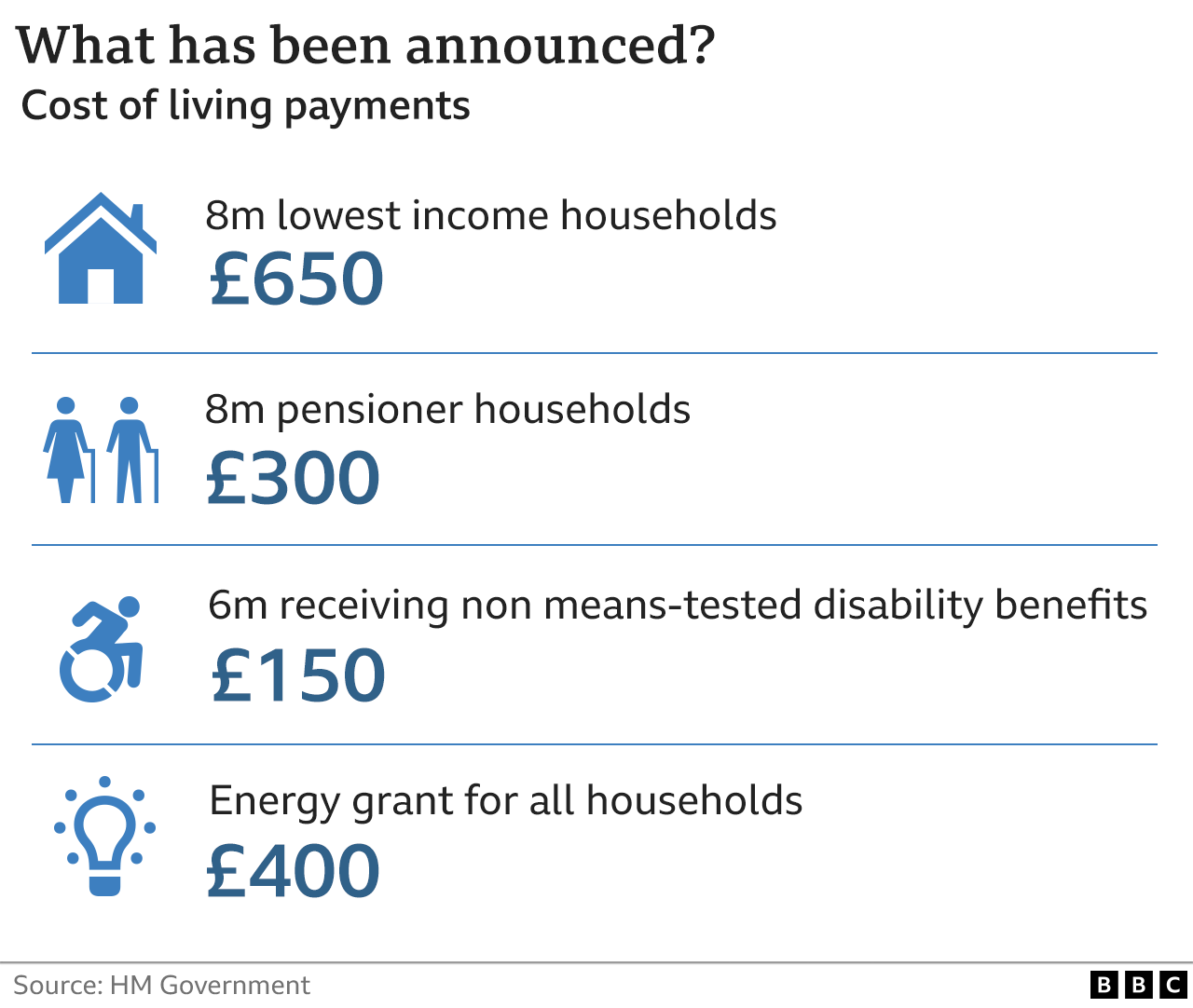
Earlier this week it was confirmed that about six million disabled people will get a one-off payment of £150 in September to help with any additional costs they face such as increased transport costs.
A spokesperson from the Department for Work and Pensions said: “Eight million low-income households will also be receiving at least £1,200 of direct payments this year.
“We urge people to check they are getting all the help to which they are entitled.”
Guide Dog Left Squashed On Canada Flights, Owner Says
A blind woman has criticised an airline after her dog was left “squashed” in a cramped space for two transatlantic flights.
Chloe McBratney’s labrador Emily was confined to a footwell on her flight from London to Canada and back.
WestJet apologised, but said special arrangements were not made with the required notice of 48 hours in advance.
The airline said the third party the flight was booked through had not contacted it to make the arrangements.
Ms McBratney, a goalkeeping coach at Barry Town United’s pan-disability team in south Wales in the UK, said she was “incredibly worried” for Emily’s welfare.
“Emily was at my feet the entire time, however for anyone travelling on a plane it’s not enough space anyway and then put a dog at your feet it’s even less space,” she said.
She said that when she sat Emily down on the outbound flight she “couldn’t turn around properly, when I took her harness off I could tell by her demeanour that she just wasn’t comfortable at all”.
The pair were then placed in a similar seat on the way home on Wednesday.
Ms McBratney said she was told the airline could only help if she cancelled her booking with a third party and rebooked a full-price ticket.
“I booked my ticket five months ago and then rang the airline… I requested there and then for extra leg room,” she said.
Ms McBratney said the airline told her they could not provide this at the time and was told closer to the time there was nothing it could do because she booked through a third party.
“It was an eight-hour flight, which for anybody is a really long time. It made it incredibly hard for both her and me as well.”
John Welsman from Guide Dogs UK said it was a “very complex” situation, as there were various regulations airlines have to comply with.
However, he added, it was “at the airline’s discretion” if they provide additional floor space for guide dogs.
“But they do need to demonstrate that they have done due diligence in the booking process to show that they’ve gone through all the things they need to.”
“It’s down to the airline what they think is adequate space for the dog when they are booking me on to the flight.”
While there is no obligation for airlines, the Civil Aviation Authority said “many airlines” would seat passengers with guide dogs in the front row, when possible.
Westjet said “all guests travelling with service dogs provide us with at least 48 hours advance notice before their flight departs”.
It said the third party the flight was booked through did not contact it to make special arrangements, meaning Ms McBratney’s options were limited to “purchasing an additional seat or upgrading to a seat with additional leg room”.
The company apologised “for any confusion or inconvenience this guest experienced during their travel”.
Mother Says Aer Lingus ‘Abandoned’ Autistic Son
An airline “abandoned” a 24-year-old autistic man who was flying to Heathrow from Dublin, his mother has said.
Jane Atkinson said she was told by multiple Aer Lingus staff that her son George Stookes would be cared for before, during and after his flight.
But she said he was not helped at the terminal in Ireland, was ignored on the flight and left on arrival at Heathrow.
Aer Lingus told the BBC it was investigating the matter with its assistance provider at both airports.
A spokesperson for the airline said: ”When a customer requests special assistance, Aer Lingus notifies departure and arrival airports to arrange contracted assistance providers, which was the case in this instance.
“They are responsible for providing necessary support to our customers.”
Mrs Atkinson, from Sway in the New Forest, Hampshire, said although her son was high-functioning, “there’s still a huge vulnerability”.
Mr Stooke’s stepfather, Martin Atkinson, usually travels with him to and from Dublin but was unable to as his own flight had been cancelled.
His mother said she had been assured someone would stay with her son at all times and make sure he was put on the plane safely.
But she told the BBC: “He was taken through security at Dublin – then he was abandoned.
“George is very stoic and he managed to go into a sort of robotic mode so luckily on this occasion he managed to make the journey safely.”
“But if a stranger had come up to him and asked him if he needed help, he would have just gone with them.”
Heathrow has apologised and said it had been sent information about a number of passengers on the flight requiring assistance less than one hour before it landed.
“We will clarify with the airline how information is shared to ensure any passenger requiring assistance on arrival has their individual needs met,” it added.
Dublin Airport said in a statement it was “committed to providing accessibility and assistance for passengers with reduced mobility”.
‘Keeping My Disabled Son Warm Will Put Me In Debt’
The father of a disabled five-year-old boy has admitted he is feeling panicked about the rising cost of energy bills.
Tristan, from Creswell in Derbyshire, has a condition called dystonia that causes his muscles to contract involuntarily.
If he gets too hot or too cold it can cause him severe pain.
His father Adrian said it was likely energy costs this winter would put him in debt, but he was not prepared to compromise the health of his son.
The typical gas and electricity bill could increase to as much as £3,554 a year from October.
Adrian, 41, a single father with two children, said: “Come winter I am panicking about the rising price of gas.
“I need to have my heating on all the time to keep him at a level where he doesn’t get cold.
“He can’t be cold – cold will flare up his condition.”
Adrian said it was not just heating that his son needed.
He also has an electric bed with a mattress pump and hoist, a fan, a bubble tube and a television.
He said it was unlikely he would be able to afford his bills this year.
“If debt is the only way his health needs can be met, then debt it is.
“There’s no other way about it,” he said.
The government said disabled people would be given £150 from 20 September to help with the rising cost of living.
The charity Scope, said that “isn’t going to touch the sides” with energy bills predicted to reach more than £4,000 a year by January.
Disabled People Need More Help, Charities Tell Truss And Sunak
Fifty disability charities have joined forces to call on Tory leadership rivals Liz Truss and Rishi Sunak for more cost of living support.
The charities, including Mind and Carers UK, urge the next PM to tackle the inequalities faced by “disabled children, adults and their families”.
Many are “at breaking point” over rising prices, according to a survey.
Disabled people are due get £150 on top of £1.200 for low income benefit claimants.
The one-off payment, exempt from tax, will be made in September.
It is meant to help with additional costs faced by disabled people, such as specialist equipment, specialist food and increased transport costs.
The 50 charities welcomed the extra support in an open letter to Ms Truss and Mr Sunak, who are entering the final stages of the contest to be the next Tory leader and prime minister,
But they say it is a “short term” solution for a “long-term issue” faced by more than 14 million disabled people in the UK.
“Without more support, many disabled people could be driven to cut back on essentials like food, heating and life-saving equipment.”
More than 2,000 people were surveyed by the disability charity Sense, including 1,000 disabled adults and 1,000 families caring for a disabled child or adult in their household.
The survey suggested 74% of family carers say that if prices continue to increase “they will be unable able to cope”.
One-in-four carers are taking on, or are looking for, additional work with 68% saying the pressure is affecting their mental health.
Minister for Disabled People, Health and Work Chloe Smith said: “We know disabled people can face additional costs, which is why we are acting to help reduce the financial pressures on the most vulnerable.
“This £150 disability payment is on top of the £1,200 most low income benefit claimants will also receive and alongside wider support targeted at disabled people, including help with transport and prescription costs.”
Mr Sunak and Ms Truss have not responded to requests for a statement regarding the letter.
A full list of the 50 charities that signed the open letter can be found here.
Disabled People To Get Cost Of Living £150 From September
Up to six million disabled people will begin to receive £150 from 20 September to help with the rising cost of living.
The government said within a couple of weeks of the roll-out date, the majority of eligible people will be sent the cash to their bank accounts.
The payment is part of a package of measures introduced to help with soaring cost of energy and food.
However, critics say the support will not go far enough with household bills set to rise further this winter.
The one-off £150 payment for disabled people is intended to help them with rising prices and the extra costs they face, such as for care and specialist equipment.
Tom Marsland, policy manager at disability equality charity Scope, said the support “isn’t going to touch the sides in the face of energy bills predicted to reach more than £4,000 a year by January”.
“Many disabled people have no choice but to use more energy to charge vital equipment and keep warm,” he said.
“Disabled people need much more financial support. This cannot wait – the government must double the support package now.”
The typical gas and electricity bill has been forecast to hit £4,650 a year in January by consultancy Cornwall Insight. It has also estimated bills will go up to £3,554 a year from October from a current £1,971.
Research by Scope earlier this year found disabled people in England and Wales were twice as likely to live in poverty, more than twice as likely to live in a cold house they could not afford to heat, and three times more likely to be unable to afford food.
Rising food costs pushed UK inflation to 10.1% in the 12 months to July, with prices continuing to rise at their fastest rate for more than 40 years.
Meanwhile, economists have predicted rocketing energy prices could push inflation to as high as 18% next year, its highest rate in nearly 50 years.
Citizens Advice chief executive Dame Clare Moriarty welcome the payment but said: “The support announced so far is rapidly being gobbled up by spiralling prices. More must be done to prevent desperate situations this winter, like people turning off vital equipment or wrapping themselves in blankets to keep warm.”
Chole Smith, minister for disabled people, health and work, said the government was providing the £150 because it understood disabled people could face additional costs.
“This £150 disability payment is on top of the £1,200 most low-income benefit claimants will also receive and alongside wider support targeted at disabled people, including help with transport and prescription costs,” she said.
“We know it’s a worrying time for some people and I’d urge them to check they are getting all the support on offer.”
The government has previously said there would be no new policies before a new prime minister is in place. The new Conservative Party leader – and prime minister – is set to be announced on 5 September.
As well as the disability cost-of-living payment, eight million low-income households have already begun to get support, with the first instalment of payments totalling £650 hitting bank accounts in July.
From October, all UK households will see their energy bill reduced by £400 through monthly instalments over six months, with a reduction of £66 in October and November, and of £67 a month from December to March 2023.
Nicky Clark’s Delight As Emily’s Booster Jab Confirmed
A mother says she is “absolutely delighted” her daughter, who has a learning disability, will get an autumn booster vaccine.
Nicky Clark had been worried after her daughter Emily did not have a booster jab in spring.
Health Secretary Steve Barclay confirmed people with learning disabilities “will have access to the Covid booster vaccine this autumn”.
“This is exactly what needed to happen,” Mrs Clark said.
Emily, 25, receives 24-hour care as she has a severe learning disability and lives in a home near where Mrs Clark lives in Shrewsbury, Shropshire.
But, after receiving a Covid booster in November, she missed out in the spring.
At the time, Mrs Clark said doctors had told her their guidance had changed.
In July, a report estimated excess deaths among people with a learning disability in 2021 compared with before the pandemic was double that of the general population and Covid was the leading cause.
Mrs Clark said the lack of a vaccine for nine months meant her daughter had “lost access to any of the key things she does in her life”.
She raised the issue on social media and the Shadow Health Secretary Wes Streeting wrote to Mr Barclay on her behalf.
In his reply, seen by the BBC, the health secretary said to “avoid any doubt” the wording of guidance to medics has been clarified ahead of the autumn campaign.
They will be vaccinated in the second priority group alongside people aged 65-74 or anyone aged five or over in a clinical risk group, Mr Barclay said.
“I am absolutely delighted, this will mean Emily can go out and she can go to a cafe and hopefully start swimming,” Mrs Clark said.
“For Emily, this will be crucial for her mental wellbeing and physical wellbeing – it is everything.”
NI Employment Rate For Disabled People Is Lowest In UK
Northern Ireland has the lowest rate of employment for people with disabilities in the UK, according to new research.
Just over a third of disabled people in Northern Ireland are in work, compared with over half in the rest of the UK.
Those are key findings from a report from Ulster University’s Economic Policy Centre (UUEPC).
The report said that progress on helping more disabled people into work had been “glacially slow despite numerous government interventions”.
It also found one in three young disabled people aged from 16 to 24 was not in education, employment or training (NEET).
“A young disabled person is almost five times more likely to be NEET than a non-disabled person,” the report said.
Disabled people in work were also likely to earn less and be in less secure employment.
“Failure to address the barriers to work that disabled people face is a failure to recognise the contribution that disabled people make and represents a huge opportunity cost to Northern Ireland’s economy and society,” the report concluded.
Disability employment gap
The UUEPC research looks at the how employment prospects for disabled people in Northern Ireland compare to those in the rest of the UK and to non-disabled people.
By almost all metrics their prospects are worse.
That also means that disabled people in Northern Ireland are at increased risk of living in poverty.
“Almost two-fifths (38%) of people living in households experiencing poverty in Northern Ireland include a person living with a disability,” according to the UUEPC report.
Almost a quarter of a million (243,000) working-age adults in Northern Ireland are disabled – just over one-fifth of the working-age population.
Depression, anxiety or musculoskeletal conditions, which affect joints, bones and muscles, are the most common conditions suffered by people with disabilities in Northern Ireland.
The UUEPC report found that only 36% of disabled people in Northern Ireland were in work.
Four-fifths (80%) of people without a disability in Northern Ireland are in work.
That means there is a “disability employment gap” in Northern Ireland of 44% – the highest in the UK by a significant margin.

‘Please give us a chance’
Jenny Dolan was diagnosed with tuberous sclerosis as a one-year-old baby.
The rare genetic condition causes benign tumours to grow on different parts of the body and can cause a range of health problems.
“It’s been quite difficult growing up in a place like Northern Ireland where there’s a lot of restriction around disability,” she told the BBC’s Good Morning Ulster programme.
She left school 10 years ago and spent the first two years training for the catering industry in a facility called Dr B’s Kitchen, which has since lost its funding and closed.
Ms Dolan then got a full-time job in a restaurant in west Belfast where she worked for eight years.
“It was brilliant. The employer was very supportive, very helpful and I had a key worker that helped as well,” she said.
However, she added that disabled people still face lots of barriers when applying for jobs, including the very drawn out process of having to declare a significant disability which she finds “very discouraging and frustrating”.
“What I would say to future employers and anybody that’s looking at a potential person with a disability to employ them – please give us a chance – because everybody out there that applies for a job wants to be there and wants to have a job and wants to make a contribution to your business.
“So please give us a chance and you won’t regret it.”
Claire Burke has a law degree from Queen’s University Belfast but is currently out of work.
She was diagnosed with autism 15 years ago and often struggles with the job application and interview process.
“I would also say to employers – you have to look further than the autism. You have to look beyond it because neuro-typical people have a certain way of acting and doing things, autistic people have a totally different way of acting and doing things,” she said.
“We’re very meticulous; we’re very good at problem-solving; we’re very loyal employees and we tend to stick to the one [employer] because it’s good routine for us. So we’re not just going to up and leave after a few months.
“I think if employers could see what qualities and advantages autistic people bring to the workplace they would actually welcome and encourage autistic people applying to their company.”
Four-fifths (80%) of people without a disability in Northern Ireland are in work.
That means there is a “disability employment gap” in Northern Ireland of 44% – the highest in the UK by a significant margin.
The disability employment gap is the difference between employment rates for people with disabilities and people without disabilities.
“Failures to achieve better employment outcomes for disabled people in the Northern Ireland labour market relative to the UK contribute to a range of personal and societal issues,” the report said.
Those include “increased risk of poverty, financial difficulty, loss of human capital, social exclusion and a much higher dependence on income replacement benefits related to illness and disability.”
The UUEPC report also concluded that the pandemic and restrictions also had a “disproportionate” impact on disabled people.
“A higher likelihood of working in sectors shut down by the pandemic and a higher likelihood of being classed ‘clinically vulnerable’ meant higher proportions of disabled were furloughed,” it said.
The pandemic and restrictions also affected the opportunities for young disabled people aged from 16 to 24 to find work.
Previous research by Ulster University suggested that wider support services for people with learning disabilities “disappeared or were markedly reduced” during the pandemic.
‘Key component of employment’
The UUEPC report’s authors conclude that Northern Ireland should try to match the UK’s disability employment rate over the next decade.
This would mean that over half of disabled people in Northern Ireland would be in work by 2031.
The authors said meeting that target would lead to fewer disabled people in poverty, would add an additional £1.3bn to the Northern Ireland economy and lead to savings of £400m from the public purse.
Two deaf students who struggled to continue studying when face masks were made compulsory in colleges say they are proud of their A-level results.
Dinah Mandell and Holly Sanchez-Rosemurgey also had to battle with trying to understand teachers in Zoom classes when the pandemic struck.
Holly says she thought about dropping out “because I didn’t feel like there was any point”.
And Dinah says getting her results is a “real sense of achievement”.
At the height of the Covid pandemic, pupils had to be taught from home because schools and colleges were closed.
And even when they were allowed back, they were often made to wear face masks as part of the government’s guidelines.
‘It’s been a long journey’
Dinah, whose hearing loss started as she finished her GCSEs, says she struggled with online learning because of the automated subtitles, which posed particular challenges for complex words used in subjects like chemistry and biology.
In 2021, the 18-year-old campaigned for schools to better support deaf and hard of hearing students – with her petition to provide clear masks gathering more than 75,000 signatures.
Dinah, who wears a hearing aid, tells Radio 1 Newsbeat she relied “heavily on seeing people’s faces and lips to work out what someone is saying” so having a clear face mask in school would’ve been a big benefit.
But she says she received “massive support” from the the National Deaf Children’s Society and is now off to her first choice, Leicester University, to study medicine.
“I’ve done sort of an extra year of A-levels as I took a gap year between my GCSEs and A-levels,” says Dinah, who lives in London.
“So when I started I was navigating Covid and also being a student with hearing loss at the same time, which had its challenges.
“It’s been a long journey and though I didn’t take the normal route, I am really happy with the end of it, it’s a real sense of achievement.”
‘I essentially just wasn’t learning’
Holly, 18, has severe to profound hearing loss and was so impacted by the introduction of masks and remote learning that she had to re-take a year of sixth form.
She was studying languages and says she found it “really difficult during lockdown” because of a “lack of awareness”.
“There were no sign language interpreters because obviously it would have to be interpreted into a different sign language,” she says.
“On Zoom, there were no subtitles so I essentially just wasn’t learning at all as I couldn’t understand.
“In terms of confidence, the pandemic knocked me really badly and because of that my grades plummeted.”
Holly, who lives in Nottingham, is now heading to university to study languages and philosophy.
She also has plans to do a masters in internal politics or relations and says she is proud of how far she has come.
“To get from there to get from there to actually getting good A-levels and getting into university. That’s a journey that I’m really proud of.”
EastEnders bosses have announced that Rose Ayling-Ellis will be bowing out from her role as Frankie Lewis.
Rose joined the show in 2020 and is the first deaf actor to play a regular deaf character on the BBC soap.
Frankie has been part of a number of big storylines, including the discovery that she is Mick’s daughter after he was abused as a child.
Frankie will bow out this autumn as part of an “important” new storyline. Rose has already filmed her final scenes.
Speaking about her exit, Rose said: “It’s been incredibly special to be EastEnders‘ first regular deaf actor.
“I have loved my time on the show and Frankie has been such an awesome character to play. However, now feels like the right time for me to move on and I am excited and ready for new challenges.
“I will always treasure my time on the show and all the incredible people I have worked with, who have supported my growth as an actor these last two years and given me so many amazing memories. I am excited for viewers to see Frankie’s exit storyline; I think it’s a really important one that will hit home for lots of people.”
EastEnders executive producer Chris Clenshaw said: “I have only had the pleasure to work with Rose for a short time but she has always been an incredible asset to EastEnders – not just as a phenomenal actor, but as an amazing company member too.
“As part of the Carter family, Rose has shone in important narratives such as discovering she’s Mick Carter’s daughter as a result of child abuse; and she will soon tackle the important issue highlighting women’s safety on the streets.
“We at EastEnders are incredibly proud of everything Rose has achieved – she’s a real trailblazer, and we wish her every success.”
Fundraiser For Permanent Gympanzees Gym For Disabled Children
A pop-up leisure centre for children with disabilities has launched a fundraising appeal to build a permanent base.
Physiotherapist Stephanie Wheen set up Gympanzees four years ago when she saw the lack of facilities in Bristol.
She said she gets “desperate calls” from parents asking them to run all year round.
“It can be the only time families leave their house over the summer holidays,” she said.
“So it is vital we get this open.”
Ms Wheen said they have had 2,200 children coming through the centre over 24 days this summer, with the equipment helping to develop co-ordination, core strength and sensory awareness.
Nine-year-old Isabella has cerebral palsy and cannot walk or speak but communicates using her eyes.
She said: “My favourite place to go is Gympanzees, I have lots of fun.”
Her mum Emma Louise, from north Somerset, said the facility allows Isabella to “have physio, play and exercise while having fun and being a typical child”.
“I can’t imagine being Isabella at 9-years-old sat in the play park or at my local soft play watching my peers play around me. It’s heartbreaking.
“Every child deserves the opportunity to have fun, play and exercise in a safe and welcoming environment and that’s something Gympanzees has in abundance,” she added.
Ms Wheen said parents are “desperate” for the facility to run year-round but “we just can’t because we need this enormous space to be able to run”.
They need to raise £2.2m to secure a building and equip the centre, believed to be the first of its kind in the UK.
‘Inclusive Barbies Are A Major Step In My Life’
“It’s a major step in the toy industry and in my life. It made me feel proud of who I was.”
James Stewart is among those celebrating the new Barbie dolls that are being released today.
Mattel, the company that makes them, has released a range of more diverse dolls.
For the first time, Barbie is seen with a hearing aid, a prosthetic limb and a wheelchair, while a Ken doll has the skin condition vitiligo.
James, who has the skin condition, says it “felt quite surreal” to hold.
‘A perfect moment’
“I had to sit there and breathe,” he tells Radio 1 Newsbeat, describing the moment he saw the photo of himself with the doll.
“It just felt almost like a perfect moment [after] I’d been through all of that.”
The 17-year-old – who is now a model – was bullied at school because of vitiligo, where white patches of skin appear on different parts of the body.
James says it took him “a while to regain my self-confidence”, but he hopes more representation will benefit future generations.
For Eloise Pennycott, who has a hearing aid, it’s “a great step forward” that will help normalise different conditions.
The 17-year-old became deaf aged 13. She now wears a cochlear implant, which helps her hear.
But she wishes “the doll was around when I was younger”.
“If, when I lost my hearing, I could’ve remembered playing with a Barbie who needs the same technology as I do, it would’ve made the idea of needing that technology so much less daunting,” she says.
“Barbies were always meant to be these cool, fashionable dolls. I’ve always considered my implants to be one of my coolest accessories.”
James agrees. He says he couldn’t relate to the dolls when he was younger, and that growing up with one that looked like him would’ve made him feel less lost.
But he’s always believed there would be a moment where “diversity would become normalised”.
He hopes toy companies “keep pushing with the differences and diversity”.
“When [a] kid picks up a doll, they know it’s OK to look the way they do and that is an incredible thing.”
Eastenders star Rose Ayling-Ellis worked with Barbie on the production of its first doll with behind-the-ear hearing aids.
The actor and Strictly Come Dancing winner, who is deaf, describes it as “really important and such a big deal”.
This is echoed by Eloise, who says “the deaf generation will finally be able to see themselves represented”.
“It makes you feel better about yourself,” James adds, “knowing that vitiligo and all other differences are becoming included into the world”.
999 BSL: ‘Emergency Video Service Saved My Life’
A deaf man who was injured when a gas bottle exploded said a service allowing people to make 999 calls using British Sign Language (BSL) saved his life.
999 BSL was launched in June to enable deaf people to make emergency calls using an app or website by connecting callers with a BSL interpreter.
Gordon Evans, of Chester, Cheshire, suffered burns when the blast happened in his campervan in Wales last month.
The 75-year-old said he had luckily already downloaded the “amazing” app.
The 999 BSL service connects deaf people to BSL interpreters who relay the conversation to a 999 operator.
“I lit the stove and it just exploded and went all over my head and my legs,” he told BBC North West Tonight via an interpreter.
“I just didn’t know what to do. There wasn’t any people around but luckily I realised I had a 999 BSL app on my phone.”
Mr Evans said the app had made him feel safe.
“I really do think it’s amazing. It saved my life,” he said.
BSL interpreter Rachael Davies said: “Deaf people face so many barriers in everyday life and you have got this app on your phone which is not only very visual but it is very quick and sufficient and it will save deaf people’s lives.”
David Horrocks, chief executive of the DSN, formerly the Deafness Support Network, which helped launched the service, said it was a huge step forward for the deaf community.
John Dwyer, Cheshire’s police and crime commissioner, said he was hoping the 101 non-emergency call system would follow suit.
“Deaf people are being disadvantaged. They can’t make those calls,” he said.
“We do need to work better at this and in the very near future I hope the 101 system will be available to the deaf community to use.”
Rose Ayling-Ellis has teamed up with Barbie to release their first doll with hearing aids.
The EastEnders actor made history as the first deaf contestant to win Strictly Come Dancing in 2021.
This new Barbie doll has behind-the-ear hearing aids.
Rose, who has been deaf since birth, said: “It’s so important for children to be able to see themselves represented in the toys they play with.”
Rose added: “When I was little, I would draw hearing aids on to my Barbie dolls to make them look like me.”
Mattel, the company that make Barbie, are bringing out a new line of dolls which include the first Ken doll with vitiligo, one with a prosthetic limb and another with a wheelchair.
Rose Ayling-Ellis with a cast of diverse models who represent the new line of Barbie dolls
The company worked with experts to make sure the doll accurately portrayed the hearing aids.
Educational audiologist Dr Jen Richardson worked with the team and said: “It’s inspiring those who experience hard of hearing reflected in a doll.”
Mattel announced the new dolls were being made earlier this year. It’s all part of a drive to make the dolls more inclusive and ensure children from lots of different backgrounds feel represented.
Student Launches Inclusive Blue Badge Campaign
A student is trying to make the blue disabled badge more inclusive.
Gloucestershire student Sam Vestey has been lobbying local MPs to include a standing figure on the badge to represent unseen disabilities.
The 20-year-old has a chromosomal condition and said he was often challenged by people over how disabled he really is.
“People can’t see my disability, they don’t understand how much pain I am in and how fatigued I get,” he said.
Mr Vestey has a chromosomal condition called DiGeorge syndrome and survived a pineoblastoma brain tumour as a child.
He has a disability badge.
‘We don’t look disabled’
“There are many people like me with disabilities that affect our mobility over time which means we need wheelchairs for when we are tired,” he said.
“However, because we can walk a lot or a little of the time, we get many people questioning our need for a disabled badge asking if we are disabled or not, especially if we don’t look disabled on the outside.
“DiGeorge syndrome gives me a cleft pallet which affects my speech and scoliosis which affects my back.”
Mr Vestey said he had no learning disabilities.
“If we had a stick figure standing up as well as one in a wheelchair, people would understand that there are people with hidden disabilities who get worse over time or hidden disabilities in general.
“I would also like more information talking about this on the sign as well,” he added.
National Star, a Gloucestershire-based charity which supports young people with complex disabilities and learning difficulties, is backing Mr Vestey and his campaign.
“National Star is passionate about helping young people with disabilities become equal and active citizens in control of their own lives,” said chief executive David Ellis.
“We applaud his determination.”
‘I Lost My Left Ear To My Tanning Addiction’
A woman who had her left ear amputated after developing skin cancer says she hopes others will learn from her mistakes.
Anthea Smith, 44, from Bolton, told the BBC’s Staffordshire reporter Laura Mcmullan, herself a former tanning addict who developed melanoma, that she didn’t realise the dangers.
The cancer charity, Melanoma UK, is calling for a ban on sunbeds.
According to Cancer Research UK, melanoma skin cancer incidence rates have more than doubled in the UK since the early-1990s. There are about 16,000 new melanoma skin cancer cases in the UK every year.
A mother says it is “horrific” her daughter who has a learning disability has not had a Covid jab since November 2021.
Nicky Clark said Emily had not had a booster jab in spring and doctors had told her guidance had changed.
“It has caused her untold distress as she does not understand what has been going on,” Mrs Clark said.
A government spokesperson said it was important people with learning disabilities got Covid vaccines.
Emily, 25, has a severe learning disability and receives 24-hour care from a team in a home near where Mrs Clark lives in Shrewsbury, Shropshire.
She had her initial Covid vaccine after the government was advised everyone on the GP learning disability register should be prioritised in February 2021.
Emily had a booster in the November rollout and Mrs Clark said it “felt like a corner had been turned”, but then she was not called for one in spring.
“It has been horrific – it has meant she has lost access to any of the key things she does in her life,” she said.
In July, a report estimated excess deaths among people with a learning disability in 2021 compared to before the pandemic was double that of the general population and Covid was the leading cause.
The Learning Disabilities Mortality Review said people with a learning disability should be prioritised for vaccinations and boosters for Covid-19.
Mrs Clark said, given the report, she did not understand why her daughter had not been offered a spring booster jab.
“Covid hasn’t developed a conscience, it is still very much in our lives, especially those with learning disabilities,” she added.
A Department of Health and Social Care spokesperson said it held regular calls over issues for people with learning disabilities and Covid-19.
“Everyone aged five and over on the Learning Disabilities Register and adults with severe or profound and multiple learning disabilities will be eligible for a booster this autumn,” they added.
Student Naomi Stenning uses a wheelchair to get around and has been struggling to access parts of the campus buildings of King’s College London.
For the past two years, she has been campaigning for better access but has been met with challenges along the way due to some King’s buildings being listed.
King’s College London said it required listed building consent to make adaptations, but the process can be slow and has been made worse by supply chain issues and Covid.
“The university takes the needs of our disabled students extremely seriously. We are continually developing our campuses to be as accessible as possible and have invested over £450,000 in building improvements”, it said.
However, accessibility experts say there are always adaptations that can be made to historic buildings and with an ageing population, building owners and designers need to rethink access for the future.
Should The Olympics And Paralympics Integrate?
The Commonwealth Games in Birmingham have seen more para-sport events than ever sharing the stage with non-disability sports. So back into the mainstream comes the debate about whether the Paralympics and Olympics could one day combine. Would that be the ultimate symbol of equality or lead to para-sports losing their spotlight?
Ellie Simmonds and Baroness Tanni Grey-Thompson, two legends of Paralympics GB, share their thoughts, and Martin Dougan and the BBC’s para-sport reporter Kate Grey pin down the International Paralympic Committee on their plans for the future of the competition.
Carer Relieved At Securing Autistic Ukrainian Teen’s Visa
A woman who has been trying to bring a boy with severe autism from Ukraine to the UK for months has said finally securing his visa was “a great relief”.
Julie Elliot applied to help 16-year-old Timothy through the government’s Homes for Ukraine (HfU) scheme in March, but his age made him ineligible.
She was so determined to help him that she and her husband adopted him to try and cut through red tape.
She said she was thrilled he would now be joining her family in Lancashire.
The HfU scheme, which was set up shortly after the conflict broke out in Ukraine, requires strict sponsor checks before unaccompanied children can travel to the UK.
The 62-year-old, who is from the Ribble Valley and has four biological and 10 adopted children, was first put in touch with the teenager’s mother Anna in Kyiv by the Chernobyl Children’s Lifeline charity.
She said Timothy, who is non-verbal, had become distressed at his home in Kyiv when it was bombed as he “couldn’t process what was going on”.
He was later evacuated to Poland.
‘A lot more hoops’
Mrs Elliot, who met Timothy in Poland, said he was living in “heartbreaking filthy conditions” and struggling to care for himself.
She said she was moved to apply to help him through the HfU scheme in March, but was told two week after applying that he was not eligible for a visa as he was under the age of 18 and travelling alone.
In a bid to try and speed things up, the couple returned to Poland in May and legally adopted Timothy.
She said there had then been “a lot more hoops to jump through”, which included proving they were committed to caring for and financially supporting Timothy for three years.
Mrs Elliot said she and Timothy’s birth mother Anna were “absolutely thrilled to bits” about his visa and it was “a great relief” to both women.
Timothy will now travel to the UK in the coming days.
A spokeswoman for the Department for Levelling Up, Housing and Communities said the initial HfU scheme was not open to those aged under 18 if they were unaccompanied and the processing of such applications, which required thorough checks of individual homes and local authority capacity, began in June.
A mother has hit out at poor wheelchair access after her disabled son was barely able to see a basketball match at the Commonwealth Games.
Amy Ryan branded access an “afterthought” after her son Bobby was unable to watch the 3×3 basketball at Birmingham’s Smithfield venue because court-side railings were too high.
The six-year-old was pictured craning his neck to try and watch it.
Games organisers said it was the first to have a dedicated accessibility team.
Ms Ryan, from Sutton Coldfield, was attending the event on Monday with her partner Robert Sproston and two children, Bobby, who has had a spinal injury since birth, and seven-year-old Leo who has cerebral palsy and a brain injury and uses an electric wheelchair.
The viewing area for those using wheelchairs at the venue was at ground level behind railings and Ms Ryan said it was too high for Bobby. Leo’s electric wheelchair meant he was higher up and able to watch the event.
Stewards gave them two giant foam hands for Bobby to sit on but he still had to pull himself up to the railings to try and see the competition.
He ended up sitting on his mother’s lap for the three-hour match which she said “was not ideal” for her.
“I checked that my tickets were for accessibility seating, because you often have to do that to know it’s going to be alright,” she said.
“I couldn’t really get through to anyone to check and I thought it was a big event, it can’t go wrong, but it did.”
Ms Ryan’s photos of her son trying to view the basketball were spotted online by Helene Raynsford, Chair of the Paralympics GB Athletes’ Commission who shared it on social media.
She said it was a situation she had faced herself and called for change.
British Paralympian Tully Kearney MBE, who has volunteered at the Games, has previously said she was disappointed by the accessibility of venues and parking for people with disabilities.
Ms Ryan said it was a common issue.
“This happens all the time at big events, access is an afterthought,” she said. “They need to consult parents and wheelchair users more.
“It’s not easy to go out with two disabled children and it’s disheartening to think my children are going to face this for the rest of their lives.”
Games organisers have since contacted Ms Ryan to say they were aware of her issues and appreciated her raising her concerns. She has been offered free tickets to an event of her choice.
A spokesman said: “Our Games is the first to have a dedicated accessibility team and we have also worked with our Accessibility Advisory Forum to provide feedback to us in planning.
“We work with our venues to continually improve the experience for everyone, and we would encourage spectators to speak to our team to see how we can enhance their visit.”
Emergency services and disabled motorists could be able to travel through restrictions installed in controversial traffic-calming schemes.
Low Traffic Neighbourhoods (LTNs) were made permanent in Cowley in Oxford in July and others are being trialled.
But bollards and planters used to block roads have been routinely vandalised.
Oxfordshire County Council’s leader Liz Leffman said it is “committed” to using number plate recognition cameras to allow some people through barriers.
Mrs Leffman confirmed there are no further plans for any new LTNs in Oxford or Oxfordshire, in an interview with the BBC.
“We see now there are people with disability badges who want to access their homes so one of the things we are looking at is number plate recognition,” she said.
“That will help enormously because it means that people will then register their cars with us and will be allowed to drive through these areas.”
She said the public would be consulted about the potential use of cameras in the coming months.
“There will be consultation, there will be engagement with the local community before we put that in but it’s something we’re committed to doing,” she added.
LTNs are designed to allow residential access to roads but prevent them being used as shortcuts.
They have been in place in Church Cowley, Temple Cowley and Florence Park since March 2021 and were confirmed as permanent last month.
A six-month trial for Divinity Road, St Clement’s and St Mary’s started in May.
A weightlifter with Multiple Sclerosis (MS) says he turned to sport to cope with his depression.
Dave Walsh started competing in able-bodied Strongman events after leaving the Army in 2010, and was diagnosed with the condition in 2014.
The father-of-three now takes part in disabled events and won World’s Strongest Disabled Man in June.
“Family aside, Strongman is all I feel I’ve got. I put so much into it and get so much from it,” said Mr Walsh.
Before turning to the sport, Mr Walsh, from Chippenham, said he struggled with his mental health.
“Strongman brought me out of that depression and it kind of gave me back a bit of confidence.
“It made me focus more on what I can do, rather than what I can’t do,” he said.
In addition to being unable to walk or stand, he has issues with his hands and sometimes struggles with speech.
“With MS, you never know what’s around the corner. For as long as I can I’m going continue to do Strongman.
“Even if I start to lose the competitions, I still need to be involved with it somehow,” he added.
Mr Walsh won the World’s Strongest Disabled Man event held in Ottawa, Canada, which was held between 17-19 June and intends to defend his title next year.
In order to win the event he had to pull trucks, complete deadlifts, log-lifts and shift sandbags weighing up to 115kg.
“Strongman for me is everything. Obviously family aside, I feel it’s all I’ve got,” he said.
In September, Mr Walsh will be competing in an event in Birmingham called The Arnolds, with Arnold Schwarzenegger and Sylvester Stallone due to be in attendance.
“The fact there will be a crowd of over 60,000 makes it that much more special,” he said.
Wheelchair Football
Were you inspired by the England Lionesses’ brilliant victory on Sunday?
Would you need a wheelchair to access playing football?
If the answer to both of those questions is ‘yes,’ this information is for you:
Here at the WFA, we believe everyone can play a part in changing lives through the power of football.
Powerchair Football is a unique sport that provides opportunities for people with a high level of impairment to access the game of football. It is the only active team participation sport for people who use electric wheelchairs.
The sport is fast-paced, dynamic and very enjoyable to watch. Due to the unique nature of the Powerchair Football, it allows all ages, disabilities and both genders to compete together. Powerchair Football enables disabled people to take part in regular activity and provides them with competition – something that the majority will never have, or rarely, experienced before due to their impairment. As a result, it builds key life skills such as teamwork and communication.
However it doesn’t just provide sporting opportunity – powerchair football creates a great social opportunity for the players and their families as they experience the highs and lows of participating in the nation’s favourite sport. It brings strangers together, many of whom have similar stories and life experiences, creating friendships and bonds which last a lifetime.
Beyoncé is facing criticism for using an ableist slur in some lyrics on her new album, Renaissance.
The derogatory term, often used to demean people with spastic cerebral palsy, occurs twice in the song Heated, co-written by Canadian star Drake.
It comes just a couple of weeks after US pop star Lizzo apologised for using the same word in her song GRRRLS.
After that incident, Beyoncé’s new song “feels like a slap in the face”, says disability advocate Hannah Diviney.
“I’m tired and frustrated that we’re having this conversation again so soon after we got such a meaningful and progressive response from Lizzo,” she tells the BBC.
Disability charity Scope are asking Beyoncé to re-record the song, omitting the insult.
“Words matter because they reinforce the negative attitudes disabled people face every day,” says media manager Warren Kirwan.
“Beyoncé has long been a champion of inclusivity and equality, so we’d urge her to remove this offensive lyric.”
The BBC has contacted Beyoncé’s team for a response.
“It’s so annoying because it’s so catchy,” says BBC disability correspondent Nikki Fox. “But it’s a horrible word.
“It’s a word we would never, ever use in the UK – although we recognise it’s sometimes used differently in the US.”
Fox notes that the track has 11 writers, and would have been cleared by several people at Beyoncé’s record label.
“If you think of how many people that song will go through and not one of them thought, ‘Hang on a minute’, and not one person was not aware of the hoo-hah when Lizzo used the same word. It’s very disappointing.”
Similar comments spread across social media after Renaissance was released last Friday.
“What was the point of Lizzo changing her lyrics if Beyoncé could just casually drop a song that has the same exact words in it?” asked epilepsy campaigner @theblackgirlwarrior on TikTok (warning – video contains expletives).
Her video also addressed Beyoncé fans who claimed the insult has different connotations in the US – where it is often used to mean “freaking out” or “going crazy” (although those terms can themselves be insensitive to people with mental health conditions).
“The s-word will forever be harmful to people in the disability community… that’s not going away,” she said in her video.
“After the outcry from Lizzo… I can’t believe that nobody in Beyoncé’s team was aware of how hurtful the word is to many within the disabled community,” agreed autism advocate Callum Stephen on Twitter.
“Language is such a complex thing and words can validly mean different things to different people, but I don’t see why any artist would use a word in their song that causes so much upset to millions worldwide.”
Clarinet player Tara Allen recalled how the word had been used against her as a child, in a message directed towards Beyoncé’s official Twitter account.
“As a disabled [person] who grew up being called a sp@z… to diminish my NeuroDivergent experiences, belittle me, and bully me, I am beyond words hurt you have chosen to use this word in your song,” she wrote.
“You’ve hurt the community, apologise and change.”
In June, Lizzo faced a similar outcry over her song, GRRRLS. Within days, she apologised and re-recorded the song, removing the offensive lyric.
“Let me make one thing clear: I never want to promote derogatory language,” she wrote in a statement posted to social media.
“As a fat black woman in America, I’ve had many hurtful words used against me so I understand the power words can have (whether intentionally or in my case, unintentionally).”
Hannah Diviney acknowledged it might be harder to elicit an apology from Beyoncé, “because of how much more elevated she is, culturally-speaking.
“But equally, that makes me more determined for a response.”
Heated is not the only song on Beyonce’s seventh studio album to attract criticism.
Last week, R&B star Kelis accused the star of “theft” after learning her anthem Milkshake had been interpolated on a song called Energy (interpolation is when one song references another, without directly sampling it).
Kelis said she had not been informed in advance, and that her “mind is blown” by the “level of disrespect”.
“It’s not hard. She can contact me, right?” Kelis said on Instagram. “It’s common decency.”
However, Beyoncé would not have had to seek Kelis’s permission to reference Milkshake, as she is not a credited writer on the song and does not own the copyright.
Instead, permission would have been sought from writer/producers Pharrell Williams and Chad Hugo – who duly receive a share of the royalties from Energy.
It appears that the basis of Kelis’s disagreement lies with them. She has previously accused the duo, professionally known as the Neptunes, of “lying and tricking” her into a bad deal, which gave them the rights to her music instead of splitting the royalties three ways.
In an Instagram video about Beyoncé’s song, she confirmed that they were the source of her frustration.
“Publishing was stolen, people were swindled out of rights. It happens all the time, especially back then. So it’s not about me being mad about Beyoncé.
“Pharrell knows better,” she added. “This is a direct hit at me [and] he does this stuff all the time. The reason I’m annoyed is because I know it was on purpose.”
Neither Pharrell Williams nor Chad Hugo could be reached for comment.
Update: She’s going to re-record the lyric but she doesn’t say when.
Neighbours: Disability Representation
Neighbours aired it’s last ever episode in the UK on Friday, leaving behind heartbroken superfans.
Same Difference decided to celebrate the end of an era by reminding ourselves of all the disability representation Neighbours has ever done, well or badly.
This year Neighbours has been excellent at representing disability very well, with Freya’s brother wheeling in for visits in a chair that was hardly mentioned and only noticed by those who really cared, a fashion photographer on wheels at Lassiters Fashion Week and an office assistant with Down’s Syndrome, also working at Lassiters. Then there was Curtis Perkins, the teacher who heard through a cochlear implant that was also hardly mentioned.
Long gone are the days when mother-in-laws didn’t want son-in-laws in wheelchairs.
Long gone are the days when daughters didn’t want velcro.
These days Susan Kennedy has MS and Paul is an amputee. If anyone in Neighbours was to discover a blind biological daughter today, this fan would like to think the character wouldn’t disappear after 10 episodes.
This post is a little thank you to Neighbours for the joy it brought me personally but also and more importantly it is a thank you to Neighbours for learning with time and representing disability and attitudes to it so well in the end.
This viewer signs off feeling that everyone truly was welcome on Ramsay Street and that is something that truly should be celebrated forever!
You Know We Belong Together to play its UK Premiere at the Southbank Centre this August
A press release:

Julia Hales – You Know We Belong Together Credit: Toni Wilkinson
Following sold-out seasons in the 2018 Perth Festival and Black Swan’s 2019 season, award-winning play You Know We Belong Together brings its celebrated portrayal of living with Down syndrome to the Southbank Centre’s Purcell Room from Thursday 18 – Saturday 20 August for its UK Premiere. Julia Hales leads a cast of six Western Australian actors to draw on their lived experience and tell this joyful celebration of community spirit, calling for better representation of disability on screen and stage.
Julia Hales has watched every single episode of Australian soap opera Home and Away since it first aired in 1988, but she’s never seen another person with Down syndrome in the cast. She dreams of landing a role in her favourite show and finding love. Family, friends, dreams and lovers are all part of Julia Hales’ deeply personal account of her experiences as a daughter, actor and person with Down syndrome. She brings with her the voices and aspirations of a community rarely seen on stage. Part-play, part-live documentary, You Know We Belong Together is an uplifting show about love, loss, family, friendships and the frustrations and aspirations of living with Down syndrome.
The cast put their own lives on stage, mixing their experiences and personal day-to-day realities with monologues, video, scenes, dance and song. Julia Hales is joined on stage by Joshua Bott, Patrick Carter, Tina Fielding, Mark Junor, Melissa Junor and Lauren Marchbank. Set in the famous diner at Summer Bay regularly seen in Home and Away, the cast bring their talents to help Julia “make a show to help remind non-disabled people that people with Down syndrome are complex and emotional people, like them. That they also have regular desires like love and acceptance.”
Co-writer Finn O’Branagáin said:
“Some of the magic of You Know We Belong Together – sorry, the magic of Julia Hales – is that I have
been able to do all this with her – researching and conversing and piecing it together, with Julia as both
subject and performer. Having Julia as the lead artist has meant that at all times she’s in control of the documentation and presentation of her own story.”
Julia Hales began developing as a performing artist and writer in 1996, performing in a range of self-devised works with Australian theatre companies including DADAA, Hydrapoesis and pvi collective ltd. In 2016, Julia began researching what love meant to other people with Down syndrome and in 2017 received Australia Council support to research and co-write You Know We Belong Together.
Heather Ruck, Senior Performance Programmer at the Southbank Centre, says:
“We’re excited to be welcoming Julia Hales and the company of You Know We Belong Together to present the UK premiere of this unique and heartwarming play. It’s fantastic that this talented cast are bringing their work from Australia to the UK and we can’t wait to welcome audiences to the Southbank Centre to see this truly joyous show. We’d like to thank Black Swan State Theatre Company for their continued efforts and determination to help bring this show to the UK and to Edinburgh International Festival for jointly hosting the play.”
Previous praise for You Know We Belong Together:
★★★★★ – ArtsHub
“Julia’s passion shines through in a collaborative work that is…clever, poignant and funny.”
★★★★ – The West Australian
“A shared, joyous experience of the rarest kind.”
You Know We Belong Together runs at the Southbank Centre’s Purcell Room from Thursday 18 – Saturday 20 August before a run at the Edinburgh International Festival from Wednesday 24 – Saturday 27 August at the Royal Lyceum Theatre.
Ukraine Orphanages: Children Tied Up And Men In Cots
Vasyl Velychko has been tied to a bench on a baking hot day for hours, but no-one hearing his screams will untie him.
The 18-year-old is one of thousands of disabled people living in Ukraine’s orphanages. BBC News has gained access to five institutions and found widespread abuse and mistreatment – including teenagers restrained and adults left lying in cots for years.
Human rights investigators say Ukraine should not join the European Union until it closes these institutions.
Before the war with Russia, the Ukrainian government said it would reform the system.
Readers may find some details and images in this report distressing.
Vasyl, who has epilepsy and learning disabilities, lives in an orphanage on the outskirts of the city of Chernivtsi in south-west Ukraine.
The teenager is wearing a nappy. He rocks back and forth, intermittently giving out a long high-pitched scream, but the staff don’t react.
They are tired, overworked and it is clear that it is easier – and accepted – to keep an eye on the children and young people by restraining them.
An influx of evacuees from the east has put further pressure on the system, but the ways people like Vasyl are treated in Ukraine’s institutions long pre-date the Russian invasion.
Next to Vasyl lies another young man. His hands are bound together with the sleeves of his jumper. His vacant eyes stare into the distance and a pool of urine has collected beneath him.
These disabled boys are among 100,000 children and young people who live in Ukrainian orphanages – but many of them aren’t even orphans.
The majority have families but end up living in these places due to a lack of community services and support.
Vasyl’s family felt they had no choice but to give him up.
They had tried to get a diagnosis when he was very young – even consulting a neurosurgeon from the UK – to help him get the support he needed.
But a poor health and social care system meant they struggled to provide for him at home, as he has regular seizures and can become aggressive.
In the end, when he was five years old, the local authorities told them an institution was the best place for him.
“It’s very hard to be a parent of a disabled child,” Vasyl’s mum, Maryna says as she gently holds her son’s hand. She doesn’t question or seem perturbed by Vasyl being tied down.
“I am proud to be a Ukrainian, but we do need to have more support from the state.
“If we lived in the UK our son would probably live with us.”
She says the first few years of visiting Vasyl were difficult – “we would come home in tears” – but they have now learned to live with the situation.
Ukraine has the largest number of children living in institutions in Europe.
They are casualties of a Soviet-era system that made the process easy for parents to give their child up to the state.
There was, and still is, a belief by many in Ukrainian society that disabled children receive better care in an institution.
Neighbouring Romania has closed many of its orphanages since children were discovered living in appalling conditions in the aftermath of the 1989 revolution.
But in Ukraine, before the Russian invasion in February, an estimated 250 children a day were being signed up to a life in an institution.
The network of nearly 700 facilities receives more than £100m a year from the state and employs 68,000 staff.
https://emp.bbc.co.uk/emp/SMPj/2.45.0/iframe.htmlMedia caption,
BBC footage reveals abuse of disabled Ukrainians
The Ukrainian government has promised a series of reforms over the past few years, acknowledging that its system of institutionalisation needs to change.
Until the war led plans to grind to a halt, the government had begun moving thousands of “orphans” into family-style group homes. But disabled people are excluded from these plans.
The Ukrainian government did not respond to a request for further comment.
Eric Rosenthal, CEO of human rights group Disability Rights International (DRI), says disabled people are now commodities in “factories of disability”.
He has visited hundreds of these facilities and says he is always shocked and devastated by what he finds.
We are shown around another institution, about an hour’s drive from Vasyl’s orphanage, where disabled men in their 20s and 30s live in children’s cots.
They rarely leave these cots, even to eat – staff spoon-feed them through the bars.
Eric says one man’s bony, warped ankles, and a young boy’s protruding ribs, are a sign of “malnutrition over a lifetime”.
He says the war cannot be used as an excuse for such appalling care, as disabled people have been neglected for decades.
Standing by the man, Eric says: “He is dying a slow death in this bed.”
The wooden beds are lined up next to each other, row after row. The brightly painted walls jar with the bleakness of these young men’s lives.
They don’t try to break free – they are just desperate for some attention.
In the next room, Oleh has been lying in bed for decades. The 43-year-old was sent to this institution as a young child.
He has cerebral palsy, a condition which affects movement and co-ordination. With the right care, people with cerebral palsy are able to live full and independent lives.
Oleh understands everything about the world around him – and his face lights up when he sees Halyna Kurylo, one of the investigators from DRI.
He recognises her from her last visit, seven years ago.
Oleh greets her with a warm smile and she introduces us. He expresses surprise and excitement when he finds out we are journalists, smiling and asking our names.
Holding his emaciated arm, Halyna says it’s clear from his poor physical condition that he spends most of his time in bed.
“I just am concerned about the potential that he hasn’t lived up to, because he has been in here for his whole life,” Halyna says.
Before the war, Ukraine was already one of the poorest countries in Europe.
Poverty and a lack of support for struggling families contribute to a mindset that these facilities are necessary.
That’s what the director of Oleh’s institution, Mykola Sukholytkyi, believes.
“It is better for children with disabilities to live here, rather than with their families,” he says.
“Instead of being in dysfunctional families where they can be uncared for, without food, here they can benefit from all the essentials.”
Eric says the billions of dollars of international aid being pumped into Ukraine during the war should also be used to shut down orphanages, support families to care for their children and build a community that accepts disability.
“We know orphanages do not need to exist,” he says.
He fears some of the money could be spent on maintaining institutions – and that after the war ends, “the international attention to Ukraine will end and the orphanages will continue as they are”.
After a long hot day in the yard of his orphanage, it’s time for Vasyl to say goodbye to his parents.
He is still tied up. He is still screaming.
Maryna says as she leaves that she is “very grateful to the institution”.
But she adds: “Our children with disabilities should not be hidden away from society, behind these high walls.”
Assessment Dirty Tricks To Be Urgently Investigated
With many thanks to Benefits And Work.
A government minister has committed themselves to ‘urgently investigating’ alleged assessment tricks used by PIP and WCA assessors after they were raised by MPs at a meeting of the work and pensions committee last week. We’re asking if you have had a similar experience?
Chloe Smith, minister for disabled people gave the undertaking to investigate after Dr Ben Spencer gave three examples of “covert assessment” raised by claimants at public meetings he had attended.
The first involved missing water cups, Spencer explained:
“One was there was water available at the assessment centre, the water cooler did not have any cups, but one down the corridor did. It was deliberate that the water cooler was broken or cups were not available to see if a person was able to walk beyond the first water cooler to get some water.”
“Another one was that lifts were broken deliberately, seemingly to assess that people were able to use the stairs.”
The third suspected ruse was a pen drop:
“One person described the assessor dropping a pen in front of them—I think it was a pen or something like that—to see if the person would pick it up as part of a covert assessment effectively of their mobility.”
Spencer asked the minister “Would you commit to urgently investigating this to confirm whether this is indeed an accurate reflection of practices that are going on at the assessments?”
Smith responded: “Yes, and if I may add on the example of the lift, I am also keen that all of our facilities are properly accessible. It would be unacceptable to have a deliberately broken lift so, yes, we will look into those.”
Of course, all of these may be perfectly innocent. It may be that the nearest water cooler ran out of cups first, that the lift really was broken and that the assessor genuinely dropped their pen.
The real proof that these were dirty tricks is if they were used in assessment reports where the claimant was supposedly caught out by them.
But anything connected with the DWP is treated with such suspicion by many claimants that innocent explanations are the least likely to be accepted.
Other issues raised by MPS included what was described as the widespread practice whereby claimants with a “severe visual impairment have to read letters off a chart at their assessment? Do you think that is acceptable? Do you think it builds trust?”
Another complaint was the lack of specialist knowledge displayed by some assessors. One complaint received by MPS was that:
“The assessment was completed by a nurse that had never heard of my condition. She said she Googled it 5 minutes before seeing me. You cannot understand a complex condition with a 5 min
Google.”
Have you experienced something that you thought was a dirty trick or particularly bad practice at an assessment. Let us know in the comments below.
You can watch the full committee hearing or read the transcript here.
Blue Badges May Be Rejected In Europe, Drivers Warned
Disabled drivers are being warned that their blue badges may not be accepted in popular European holiday destinations this summer due to Brexit.
Ministers are negotiating the status of the badges – which were recognised when the UK was in the EU – with 11 nations.
France, Spain, Portugal, Greece and Italy are among those “undecided” on recognising the discs, which help people park closer to a destination.
The AA said keeping blue badge users in “limbo” was “simply unacceptable”.
Bulgaria, Lithuania, Luxembourg, Romania and Slovenia are also undecided on the issue, but all other EU nations accept UK badges.
The government website tells badge-holders to check with the embassy of their destination country for the latest guidance.
But the AA said most embassies were unable to provide them with any assurances or advice.
The motoring group said disabled drivers may leave themselves open to parking fines if they use their permits in undecided countries, saying it was “simply unacceptable” that the issue had not been resolved.
Jack Cousens, head of roads policy for the AA, said: “Blue badges are issued because of specific health reasons, and to not have their status confirmed two years down the line [after the UK left the EU] is simply outrageous.”
Mr Cousens advised badge-holders to use drop-off and collection zones where possible, adding: “While problematic, it reduces the risk of a vehicle being given a ticket or towed away.”
A Department for Transport spokesperson said: “Negotiations on blue badge recognition are ongoing between the UK and individual EU states, and motorists should check our guidance to find out where the blue badge is recognised in the EU.”
From tipping people out of their wheelchairs to patronising comments and taking unwanted snaps, the reality of everyday behaviour towards disabled people is revealed in Scope’s largest attitude survey.
Naomi Baker had just bought a coffee in Eastbourne town centre and was waiting for a friend when a group of teenagers approached.
“They surrounded me in my wheelchair and started screaming at me,” she recounts. “There were threats to tip me out of my wheelchair.”
Naomi, 24, chose not to talk to or look at the group in the hope they would leave her alone.
“There was a level of panic. I thought: ‘Are they actually about to tip me out?’
“Because if they try to do that, there is nothing I can do to stop them.”
A passer-by intervened and the teenagers moved on, but the experience stayed with Naomi.
She is not alone. Disability charity Scope has revealed to BBC Access All that three out of four disabled people it surveyed had experienced negative attitudes and behaviour towards them in the last five years.

Listen to Access All on BBC Sounds
In the latest Access All podcast, Naomi Baker and Shani Dhanda talk more about the negative things people say and do to them and how it affects their self esteem.
And with record temperatures bearing down on London, wheelchair-user Adam Gabsi talks about the frustration of being stuck in his sixth-floor flat for 12 days due to broken lifts.
Scope’s research involved more than 4,000 disabled people talking about the negative attitudes they had experienced from strangers or family. That includes behaviour from judgement on their perceived ability to being patronised or discriminated against.
Like Naomi, one in 25, or 4%, also reported physical abuse against them while 25% of those surveyed said they had been accused of faking their disability.
Naomi believes that might have been a factor in her encounter.
“There was kind of an implication I was faking it,” she says. “They were almost keen to see, if they tipped the wheelchair would I be able to get up by myself?”
Scope’s research found that younger people experienced the greatest amount of abuse with one in two disabled people having experienced negative attitudes and behaviours towards them in the past 12 months.
Of those aged 18-34, 22% had experienced verbal abuse, compared to 10% of those aged 55 or older in the past five years.
Shani Dhanda, a disability activist, isn’t surprised that younger people are getting more negative behaviour.
She has osteogenesis imperfecta, better known as brittle bones, is short of stature and uses a wheelchair.
“I’ve had lots of different negative experiences out in public with strangers,” she says.
It started when she was 16 and began going out on her own “and I’m really sad to say that it hasn’t stopped”. She is now 35.
Shani has experienced everything from people asking whether she really is disabled to accusing her of wrongfully using disabled parking bays.
But the biggest discrimination she faces is being photographed without consent.
“A lot of people take pictures and videos of me for Snapchat – not in a nice way,” she laughs, saying it is because she’s small and looks different.
Shani believes younger people face poorer attitudes and behaviour towards them because people have a “certain level of expectation” of young people, without looking beyond their age.
“When disabled people share their needs, they’re not being believed – [they think] you’re young and fit, but that may not be the case,” she says.
And these comments have a tangible impact.
Almost a third of young disabled people who took part in the survey reported that they avoid socialising following a negative experience, compared to 14% of those aged over 55.
And 41% said these careless assumptions both reduced their confidence and self-belief and left 44% feeling that they were less equal to non-disabled people.
Naomi says, beyond the physical attack, she experiences a “constant drip, drip of microaggressions” whenever she’s out, from people manhandling her wheelchair to being “treated like a child”.
“I laugh a lot of them off,” she says. Then admits: “It makes me much more anxious about going out.”
Scope’s survey gathered incidents from the past five years so that it included the affects of the pandemic.
While many of us might remember communities rallying together, some of the testimony received in the survey points to far more distressing moments.
One respondent revealed they were “spat at, pushed and abused” and “blamed” for the lockdown because of their disability. Lockdown was often talked about in terms of protecting those at risk, like disabled or chronically ill people.
Shani also says she noticed the number of incidents she faced worsen during lockdown which left her feeling “vulnerable”.
Scope said its research confirmed that “disabled people still face huge barriers to full inclusion and equality in society”.
It added: “The pandemic’s brought to light the huge divide that we have and the huge lack of care for disabled people that exists within society.”
Over the next five years it hopes to tackle this stigma by sharing its research with disability and campaign groups to “find common ground” and to “collectively put an end to negative attitudes”.
In the short term, Shani has found her own way of gaining ownership over unwanted incidents.
When she clocks someone filming her without permission she now approaches them and asks them what they are doing. If they deny filming her she asks them to show her the last image in their camera roll
“And you know what, nobody ever does,” she says, hoping that in some way it might be the start of them reflecting on their behaviour.
Bristol Disability-Led Café ‘Breaking Down Barriers’
A café that is staffed by adults with learning disabilities is trying to “break down barriers” in the workplace.
The Vassall Centre Café, in Bristol, has been giving its new trainees the opportunity to gain skills in hospitality.
It is part of a growing network of businesses that charity, Props, is opening to support people with disabilities into work.
“We are just blown away by their progress,” said manager, Bella.
Props signed the lease on the café in June, becoming the second business, alongside a brewery, that the charity own.
Scott, 23, is a trainee at the café, and he has “really enjoyed” every aspect of the job.
His roles have included serving customers at the till, making hot food and drinks, and cleaning down.
But his favourite job is making the blueberry cake which has proven to be a “huge hit” with customers.
“I have learnt so much since I started here, and had a go at things that I never thought I would get the chance to try,” said Scott.
Bella Peatfield, from Props, has been part of the team launching the training programme.
She said she is “incredibly proud” of the trainees in their commitment.
“It’s a huge leap for them to go from not working with the public to jumping on a till and being at the very front of the business and they have just done so well,” said Ms Peatfield.
“Best of all, their baking skills are just amazing, and there is no doubt we have all been putting on a few pounds. The cakes are too delicious!”
Props have been supporting adults with learning disabilities to gain work skills for around 20 years.
The Bristol charity provide access to practical learning, skills development and accessible work-based experiences.
However, they have a new vision, and this comes in the form of “complete ownership”.
“We will soon be opening another, much bigger, café in Fishponds.
“This is part of a growing network of disability-led enterprises,” added Ms Peatfield.
“We want accessibility to be at the core of every business, breaking down barriers between disabilities and work.”
Headlining a festival is huge for any musician, but for one unique set of performers, topping the bill this summer could prove to be a landmark moment for an under-represented group of artists.
Paraorchestra describe themselves as “the world’s first ensemble of virtuoso professional disabled and non-disabled musicians”.
The Bristol-based orchestra, who played The Park stage at Glastonbury in June, will join Mercury Prize-nominated Hannah Peel on the opening night of Bluedot in Cheshire.
The eclectic festival brings together music, science and innovation under the gaze of the iconic Lovell Telescope at Jodrell Bank.
Chief executive Jonathan Harper believes it will be a “defining moment” for Paraorchestra.
“We have had to work so hard to get to this point”, he said, having overcome a wide range of challenges from “a lack of access provision” to event programmers “having outdated opinions on whether disabled artists will be good enough”.
“Progress in general for artists that identify as disabled continues to be at a snail’s pace and I sincerely hope it is the start of serious change,” he continued.
“The music sector is, quite rightly, pushing themselves to ensure their line-ups are increasingly balanced by gender and ethnic diversity, but the disabled community hasn’t yet had its ‘moment’ where it feels that real change is happening.
“It’s about time that disability is no longer marginalised when talking about diversity.”
Hattie McCall Davies plays cello in the orchestra and says it gave her her “voice as a musician back”.
“I lost my career due to my disability and not being able to perform full time in a professional symphony orchestra; Paraorchestra has given it back,” she says.
“To be performing on a stage again and bringing music to appreciative audiences… is both a dream come true and one of the most enriching and rewarding experiences.”
She says that “across the board, it feels like the musicians on stage are gradually becoming more representative of society”, but there is “still so far to go”.
“Visibility is so important and there still aren’t enough opportunities for disabled musicians to prosper.
“If I had been able to see a professional orchestra like Paraorchestra headlining a major festival when I was studying at the Royal Academy of Music, I might have felt like there was a place for me within the industry.
“As it was, I saw no-one like me and felt like I didn’t belong for several years.”
Steve Varden, who plays a wide range of electronic instruments in the orchestra, agrees that producers, promoters and venues “are becoming more open and accepting towards musicians and performers with disabilities, but we need the access awareness and physical provision to go along with this”.
“I know that fully wheelchair accessible stages and dressing rooms are certainly possible, because I have had the relief of experiencing such facilities,” he says.
“However, far too many music venue stages and backstage areas are not wheelchair accessible and that really taints the respect that I am able to afford to such places and organisations.”
The Musicians’ Union (MU) says research is lacking into disability inclusion in the music industry, but steps are being made to change this.
Head of equality, inclusion and diversity John Shortell says an “industry-wide conversation” is ongoing and the union is working hard with disabled musicians and the industry “to create a culture where disabled musicians can ask for the things they need to do their jobs without fear”.
“A lot of disabled musicians do not disclose their disability for fear of rejection and discrimination and some impairments are not visible, so we hear of musicians compromising their health and well-being to carry on performing,” he says.
Dandy, who has been championed by BBC Music Introducing and the Guardian, recorded her first album from her bed after becoming “frustrated at the lack of representation and visibility of disabled people in the mainstream music industry”.
She says the orchestra’s performance will be a “really positive sign that things are shifting in the right direction”.
“The very fact that Paraorchestra are headlining demonstrates that their inclusion is not tokenistic – it will have taken dedicated planning from the organisers,” she says.
However, she says accessibility is still a main barrier for her and other disabled musicians and audiences.
“Right now, disabled musicians are seen as a bothersome afterthought,” she says.
“Why book a musician with access needs when you can book one without and save the time and expense?
“No-one will say that out loud but it is what it boils down to.”
McCall Davies says until that “lazy and short-sighted” approach is removed and things that are fundamental to disabled musicians are addressed, such as “their ability to access a stage or their need for reasonable adjustments during their training”, a “diverse set of musical voices and contributions” to will remain lost to the cultural landscape.
“We actively need to not be discriminating against talented musicians who have a different and unique voice that represents a huge proportion of audiences,” she says.
“Until disabled musicians have the access to the stage – both physically and symbolically – and are regularly playing the big time slots… then we won’t have achieved equality.
“There’s a whole tranche of highly skilled musicians with so much to contribute.
“We just sometimes need a bit of help and good will to make that happen.”
Hannah Peel, Paraorchestra and Charles Hazlewood headline Bluedot on 21 July.
Staying Cool In Heatwave Hell
As the UK braces for record temperatures how do disabled people cool down in a heatwave?
Jo Southall talks about the “body armour” she wears to keep her core cool while Dr Katherine Fletcher says the UK’s infrastructure needs to be improved to cope with rising temperatures.
Tim Renkow, comedian and writer of BBC Three’s Jerk, talks to us about his character who likes nothing better than winding up non-disabled people – big time.
With Nikki Fox and Emma Tracey.
Uber To Pay $2.2m To Disabled Riders Over Wait Fees
Uber has agreed to pay more than $2m (£1.68m) to settle claims brought by the US government that its wait time fees discriminated against customers with disabilities.
The firm also agreed to waive charges for disabled users in the future.
More than 1,000 people had complained about the fees, which often kick in if it takes more than two minutes to get into the car.
Uber said its policy was to refund wait fees for disabled riders.
In resolving the lawsuit, the ride-hailing company denied wrongdoing.
“It has long been our policy to refund wait time fees for riders with a disability when they alerted us that they were charged,” the company said, adding that it had made changes before the lawsuit to have disabled riders’ wait time fees waived automatically when Uber is notified that they were charged.
Uber started charging wait time fees in some cities in 2016, eventually expanding the practice, according to the lawsuit, which the US Department of Justice filed in November.
The average fee was less than 60 cents, the company said at the time.
Under the terms of the deal, Uber agreed to pay more than $1.7m to about 1,000 riders who complained, as well as $500,000 more to some people identified by the Department of Justice.
Officials said the settlement would also yield “hundreds of thousands or millions of dollars in compensation” for the more than 65,000 people who have signed up for the waivers.
“People with disabilities should not be made to feel like second-class citizens or punished because of their disability, which is exactly what Uber’s wait time fee policy did,” Assistant Attorney General Kristen Clarke said in a statement.
It is not the first time that Uber has found itself in hot water over disability issues.
Last year, it was ordered to pay a blind woman in San Francisco $1.1m after she was refused rides on 14 occasions. In the UK, Paralympic medallist Jack Hunter-Spivey said that Uber and other taxi drivers regularly drove off when they saw that he was a wheelchair user.
Frances Ryan’s Heatwave Advice
People with disabilities: ‘Don’t assume you know someone’s needs just by looking at them’
People with disabilities face a range of additional complications as a result of extreme heat that might not be obvious to other people. Guardian columnist Frances Ryan, who frequently writes about the issues facing people with disabilities, adds: “You’re more likely to be in poor housing and poverty if you’re disabled, as well as isolated, so that can also add to the dangers in heat.”
Frances suggests checking in on friends or neighbours who might be vulnerable, and advises employers: “Don’t force people into work or the commute. A lot of disabilities that are impacted by heat are invisible disabilities – such as heart conditions or fatigue – so don’t assume that you know someone’s needs just by looking at them.” For her own part, she will be following advice to stay out of the sun and stay cool by “lying in a darkened room for three days like an infirm Jane Austen character”.
Disability And The Heatwave: Cooling Solutions And Disability As Weather Alert Goes Red
The current heatwave is causing all sorts of challenges to daily life from difficulties in sleeping to sweating through the commute, but for disabled people and those with mental ill-health, the heat can add many more serious complications and frustrations, but there are also solutions.
BBC Access All podcast presenter Emma Tracey has been blind since birth. She has some light perception and while the heat doesn’t directly affect her, protecting herself from the sun’s rays can be difficult when she wants to get out and about.
“I don’t wear sunglasses because they dim my light perception,” she says. “I normally look at the darkness of objects either side of me to keep myself in a straight line, that’s less easy with sunglasses on. “
Emma also uses echolocation – listening to sounds bouncing off nearby hard surfaces to judge where she is, spatially.
But, in order to hear those echoes, she also has to give up another piece of vital sun protection.
“I don’t wear a hat because it messes up my sound shadows. When I wear a sunhat, with a brim or a peak, that changes the sounds I hear and makes it more difficult to get the information I need from my surroundings.”
Emma doesn’t currently use a guide dog, but for those who do, Guide Dogs UK has some advice about when and when not to work them.
“Test out a pavement by putting your hand on it for a few seconds. If it’s too hot for your hand, then it’s too hot for your dog.”
While Emma’s experience is quite unique, thousands of people with Multiple Sclerosis (MS) have been struggling in this heat.
The MS Society says about 130,000 people have MS in the UK with 60% experiencing heat sensitivity.
MS stops messages from your brain and spinal chord reaching other parts of your body meaning that important instructions don’t get through.
It occurs when the immune system attacks the sheath surrounding nerves.
As temperatures rise, so messages are further disrupted.
Dr Sarah Rawlings, from the society, says: “For many people, their symptoms get worse – balance, fatigue and changes to vision – which can be difficult to deal with.”
Sabrina Fox, 31, from Scunthorpe, has primary progressive MS and says she has “struggled” these last few days with painful muscle spasms.
“The spasms in my legs are more intense when it’s really hot. They increase when I’m in bed because I’m not mobile so I stiffen up overnight and the medication can cause me to overheat.”
As much as she enjoys the summer days it has made going out difficult and has affected her sleep at night which in turn exacerbates her brain fog and fatigue.
“I’ll be in the middle of a sentence and I’ll completely lose my train of thought,” she says. “My top tip would be to pace yourself.”
The Met Office has issued a red extreme heat weather warning for parts England and Wales between Sunday and Tuesday due to the potential high temperatures and the impact it could have on health and transport.
But Dr Rawlings says once the temperature cools, any exacerbation in symptoms will ease. “We don’t believe there are any long-term affects, but some people might feel fatigued for a few hours or days from over-heating.”
Tips from the MS Society
- Have a cold bath or fill a hot bottle with ice
- Run a cold tap and let the water flow over the inside of the wrists
- Wear a cooling vest
Jo Southall, an occupational therapist, relies on her cooling vest to get through these sweaty days.
“I would quite like to be in the Arctic Circle right now,” she laughs. “But I’ve got a lot of strategies in place.”
Jo has hypermobile Ehlers-Danlos syndrome which affects her connective tissue and postural tachycardia syndrome, better known as PoTS, which is an abnormal increase in heart rate that occurs when she sits up or stands.
She says her sweat function goes awry in hot weather too and, as a result, causes dizziness, dehydration and “a massive increase in heart rate”.
She says the cooling vest “looks like body armour” and is worn over her clothes. The vest has slots in the front and back where cool packs -which freeze at 14 to 16 degrees – are inserted keeping her core cool.
She also uses a technique she calls “evaporation cooling”.
“One of the benefits of sweating is that it cools you down,” she says. “The downside of sweating is that you don’t just sweat out fluids you sweat out all of those useful electrolytes which help with circulation and your nervous system.”
To minimise the loss of electrolytes, which are useful minerals, Jo carries a spray bottle of water with her – “mist your clothes and your skin and let that evaporate instead,” she says.
One of the reasons this heatwave has felt so intense these past few days compared to foreign holidays is because the UK’s infrastructure isn’t built for for such hot temperatures.
Dr Katherine Fletcher, from Parkinson’s UK, says most people think of the neurological condition as just involving tremors, but patients are “also prone to struggling with their mental health” and fatigue.
“We know heatwaves are here to stay,” she says. “I think there are lots of things that can be done.”
Katherine says it’s about calling on the government to make changes and to adapt the infrastructure.
“That comes down to things like making sure people are financially able to buy fans and air con units – we all have lived in houses and flats that are just unbearable in heat.”
She also wants public transport to be upgraded.
“People still need to be encouraged to get out and about and I think, making sure public transport is adapted and has air con and is comfortable during the heat wave is really important.”
It’s not just those with a physical disability. Those living with mental illness can also be adversely affected with the heat impacting mood, sleep and medication.
Gemma Thickett from the charity Rethink Mental Illness, says certain medications affect temperature regulation “which means you might be more prone to overheating”.
She says this is often the case for those on antipsychotic medication – often prescribed for bipolar disorder or schizophrenia – and SSRIs – which alleviate symptoms of anxiety and depression.
“Now is a good time to check the information leaflet that comes with your medication, or look online, to see if you need to be extra careful in this hot weather,” but adds, “there’s no need to panic”.
The heatwave is “another important reminder to prioritise your mental wellbeing and know what you need to do to stay well”.
Tips from Rethink Mental Illness
- Some medications might mean you sweat more, so drink little and often, before you feel thirsty
- A lack of sleep can be a trigger – try and keep your home cool by keeping windows open but shielded from sunlight
- Adjust your routine by working from home or somewhere cooler, like a library, and avoid a sweaty journey
- If you feel like your mental health is dipping, don’t hesitate to contact your GP or mental health team
A disabled woman faces fines of more than £1,000 for using a disabled car parking space outside her flat.
Cerys Gemma, who lives in Cardiff Bay, said the space allocated to her flat is inaccessible for her.
Instead, she has been using one of the parking spaces reserved for visitors with disabilities.
New Generation Parking Management, which manages the bays said the spaces have to be kept free for disabled visitors, not residents.
34-year-old Ms Gemma, said she cannot use the space allocated to her waterside flat in Prospect Place.
She explained that there is a pillar on one side, and another car parking space close on the other side.
Ms Gemma said she had been in contact with the property management and parking companies, trying to explain why she needed to use a wheelchair accessible space.
“This has plagued me for two years and I just can’t go on like this.
“I’m at breaking point and I’ve had conversations with people, and I’ve said this is the end, because I can’t do this anymore – something has to change.
“I’m not willing to be pushed out of my home because I’m in a wheelchair,” she said.
Ms Gemma has now been ordered to pay the fines by the County Court.
‘Breach of Equality Act’
Cerys Gemma has been using a wheelchair since sustaining serious spinal injuries following a car accident when she was 17.
She said the situation with the fines was now “desperate” and she is seeing a counsellor.
“It’s hard enough anyway, and I try and be as graceful and patient with people who don’t have accessible buildings, and I understand that it’s hard, but I’m not being pushed out of my home because of a parking space when they’ve got eight accessible bays,” she added.
Disability rights lawyer Chris Fry, from legal firm Scott Montcrieff & Associates said there is an obligation to make reasonable adjustments under the Equality Act.
“The reality is that if the space allocated to her is inaccessible to her because of her disability, then they’re under obligation to make a reasonable adjustment, to maybe move that space or change it to a closer spot to the front door.
“If they don’t, they’re in breach of the Equality Act.”
Mr Fry said a breach of the act could result in a company having to pay compensation for “impact of the injury to feelings that the tenant has faced”, and that could mean fines of more than £1,000.
New Generation Parking Mangement, which manages the bays for the property management firm Ringley Group said: “We want to make clear, if we allow one resident to utilise a disabled visitor space as their own, we would need to allow all requests from residents, which we have received over the years.
“This would no doubt reduce the availability of disabled spaces for disabled visitors.”
Mr Fry thinks the firm may have misunderstood the Equality Act.
“That sounds like a typical misinterpretation of what equality means, it doesn’t mean applying the same policy to everybody – equality means providing the same opportunity for outcomes.
“There is no disadvantage to them changing their policy, and prioritising, in fact legally, prioritising disabled people above other people is legal.
“It is within their gift to cancel those fines, that should be the first step they should take in terms of trying to rebuild the relationship,” he said.
‘Live happily’
New Generation Parking Management said they were simply enforcing the rules to which Prospect Place agreed to when they were instructed to manage the site.
It said: “We cannot make changes to these rules unless agreed by the board of directors, therefore in light of the continued distress that this is causing Ms Gemma we will take steps to ensure this is discussed at the next board meeting”.
Ms Gemma said she simply wants to be able to live happily in her flat with the knowledge that she is able to park in an accessible space without the worry of more fines.
“Literally every day when I come down to my car I think ‘here we go, is there going to be another ticket?’, and it’s awful”.
Ringley Group have not responded to the BBC’s request for a comment.
Down’s Syndrome Campaigner Fights Abortion Ruling
Abortion law, which allows foetuses with Down’s syndrome to be aborted up until birth, affects the self-worth of disabled people, a court has heard.
Heidi Crowter, from Coventry, who has the condition, has challenged the legislation, saying it was unlawfully discriminatory.
Judges previously found the section of the Abortion Act pertaining to the condition to not be unlawful.
On Wednesday, the case was reconsidered by the Court of Appeal.
In England, Wales and Scotland, there is a 24-week time limit on having an abortion, but terminations are allowed up until birth if there is “a substantial risk that if the child were born it would suffer from such physical or mental abnormalities as to be seriously handicapped”. This includes Down’s syndrome.
Jason Coppel QC, representing Ms Crowter and others, said the effect was to stereotype life as a disabled or seriously handicapped person as not worth living and as having less life value than an able-bodied person.
He said the language used in the act was considered by some to be offensive and unacceptable.
Speaking to Sky News ahead of the hearing, Ms Crowter, 27, said: “In 2022, we live in a society where disabled people are valued equally after birth but not in the womb.
“I hope that the judges will agree with me that this law is discrimination and needs to be changed.”
The case was initially brought by Ms Crowter with Maire Lea-Wilson, 33, from west London, whose son Aidan has Down’s syndrome, and a child with the coindition, identified only as A.
Mr Coppel said: “In modern days, Down’s syndrome is not a barrier to living a happy and fulfilled existence as Heidi and Aidan demonstrate.”
He said the act interfered with the rights of disabled people to a private and family life, under the Human Rights Act 1998.
Julia Smyth, representing the Secretary of State for Health and Social Care, said: “The ultimate question which underlies this appeal is where society should set the limits in criminalising women for the choices they make in deciding whether or not to have an abortion.
“Obviously that raises profound social, moral and ethical questions and there are irreconcilable views on all sides of the debate.”
The appeal hearing, before Lord Justice Underhill, Lady Justice Thirlwall and Lord Justice Peter Jackson, was adjourned on Wednesday afternoon and a judgment is expected at a later date.
A deaf student playwright has seen her play performed at the National Theatre after winning a national competition.
Eloise Pennycott, a 17-year-old Southend High School for Girls’ pupil, beat more than 400 entries from around 100 schools to claim the prize.
Her play Barrier(s) tells the story of two women who fall in love, one of whom uses sign language.
Ms Pennycott said after seeing the performances: “I still can’t believe it to be honest.”
The play won New Views, the National Theatre’s nationwide playwriting programme and competition for 14-19-year-olds.
It was performed at the National Theatre’s Dorfman Theatre in a full production with professional actors earlier this month.
As well as the communication barriers the two women in the play face, the work also explores a hostility facing those using sign language.
Ms Pennycott said: “I went deafened at 11 and when I was 13 I became profoundly deaf.
“Thank God I did because it has been the best thing that’s happened to me.
“The doctors don’t know why or how but I feel lucky that I’m deaf because it’s amazing and I love being deaf.”
She said she was inspired after seeing refugees coming to the UK who speak another language “and there is a lot of negativity around that”.
“It can be strange to imagine a world where people are hostile to sign language as well, that’s why I wanted to explore it in the play,” she said.
Ms Pennycott said she identifies herself as queer, which “just means I’m not heterosexual”.
She said: “I think it’s really important to me to see a lesbian love story on stage because you don’t see that very much in theatres.”
The 17-year-old said she had written plays before but Barrier(s) “was different, it was about my culture, deaf culture, queer culture”.
Deaf actress Lara Steward took one of the roles in the play and said it “resonated” with her.
She added: “What’s really beautiful about this play is it is bilingual, it uses English and British Sign Language.”
Nadya Bettioui, from the National Theatre, said the play was “absolutely outstanding”.
She said: “The judging panel were so impressed by the maturity and quality of [Eloise Pennycott’s] writing and just the bravery and courage of her play and how important it is to highlight issues facing the deaf community.
“This play has so much potential, Eloise has so much potential to go on do so many amazing things, I think the sky’s the limit for Eloise she’s so talented.”
‘Disability Fashion Line Was A Lightbulb Moment’
A young Londoner with chronic health conditions is helping to change the lives of people with disabilities.
Victoria Jenkins founded a socially responsible, adaptive fashion brand in her basement flat in Islington.
She set up the clothing line Unhidden after a stint in hospital dealing with her own journey with disability. The clothes are customisable and made to order, to cater for people with different access needs.
Now she has big plans to extend the brand and make adaptive wear for kids too.
Family Of Woman With Down’s Syndrome Denied Intensive Care Seek Answers From Covid-19 Inquiry
When Susan Sullivan died from Covid-19, her parents’ world fell quiet.
She would no longer burst into her dad’s room at dawn to say: “Morning, chief! Sun’s shining!” And when songs would play by Abba, Queen or Kylie, she was no longer there to blast out the words.
But as John and Ida Sullivan battled the pain of losing their eldest, they were comforted by doctors’ assurance that they had done all they could.
It was not until more than a year later, when they received her medical records, that the family made a crushing discovery. These suggested that, despite Susan being in good health and responding well to initial treatments, doctors at Barnet hospital had concluded she wouldn’t pull through.
When Susan was first admitted on 27 March 2020, a doctor had written in her treatment plan: “ITU (Intensive therapy unit) review if not improving”, indicating he believed she might benefit from a higher level of care.
But as her oxygen levels fell and her condition deteriorated, the 56-year-old was not admitted to the intensive unit. Instead she died in her bed on the ward without access to potentially life-saving treatment others received.
In the hospital records, seen by the Observer, the reason Susan was excluded is spelled out: “ITU declined in view of Down’s syndrome and cardiac comorbidities.” A treatment plan stating she was not to be resuscitated also cites her disability.
For John, 79, a retired builder, that realisation was “like Susan dying all over again”. “The reality is that doctors gave her a bed to die in because she had Down’s syndrome,” he said. “To me it couldn’t be clearer: they didn’t even try.”
Susan is one of thousands of disabled people in Britain killed by Covid-19. Last year, a report by the Learning Disabilities Mortality Review Programme found that almost half those who died from Covid-19 did not receive good enough treatment, including problems accessing care. Of those who died from Covid-19, 81% had a do-not-resuscitate decision, compared with 72% of those who died from other causes.
The Covid public inquiry will examine triage processes used in the NHS and allegations that, amid pressures on staffing, beds and PPE, access to intensive care in some areas was rationed.
The government and NHS deny that ever happened, but testimony from families such as Susan’s suggest otherwise. Elkan Abrahamson, the human rights lawyer representing Covid-19 Bereaved Families for Justice, which knows of many similar cases, said: “Our concern is that some disabled people were written off.”
For Susan’s parents it is the fear that medics made a snap judgment because of her disability that plays most on their minds. Her records say her disability and “cardiac comorbidities” – a pacemaker that had been implanted for a heart valve condition diagnosed at 16 – meant CPR was “unlikely to be successful”.
But Susan’s family, from Edgware, say she had “no physical problems” and the pacemaker was preventive. By itself it would not rule out resuscitation and, they say, it shouldn’t have excluded her from care for Covid.
For years John and Ida backed Susan when others didn’t. At her birth they were told she would never walk or talk. But with their encouragement she learned to do both, and later to dance, sing and swim, going on to compete in the Special Olympics.
“We decided: we’re going to ignore what they’ve told us and treat her as normal,” John said.
Before contracting the virus, she was as active as ever. But by the end of March 2020, at the height of the first wave, her spark began to dim.
Susan’s symptoms – a cough, headache and tiredness – had initially been mild. But on 26 March, she began suffering stomach pains. “She was saying: ‘Mummy mummy mummy, my tummy hurts’,” Ida said. At 4.50am on 27 March, they dialled 999.
What followed was a “nightmare”. The London Ambulance Service (LAS) was overwhelmed, with 187 calls in the hour Susan’s family called 999 – three times the usual volume. The family say they were told the ambulance was diverted twice. In all, it took more than seven hours to come.
“All Susan kept saying was: ‘Where are they? I’m waiting, Chief.’ I don’t know how many times I said to her: ‘They won’t be long, darling’,” John said.
When the paramedics arrived at lunchtime, they gave Susan oxygen and rushed her to hospital.
Ida accompanied her daughter but was told she couldn’t stay. In the five minutes she was allowed, she says a doctor asked if Susan had anything in place for resuscitation. “I said: ‘No, it’s never come up. And if she needed it, we would want you to’,” Ida, 77, said.
After Ida left, Susan deteriorated. The next day, the hospital called to say she kept removing her oxygen mask. “Patient desaturates to 82% without mask, however if held then oxygen improves,” her notes say.
Susan’s family repeatedly asked if a relative could sit with her to hold the mask but were told it wasn’t possible.
In a frantic phone call, Ida tried to soothe Susan. “I said to her: ‘It’s Mummy, sweetie. Please keep your mask on, it’ll help you get better.’ And she just said: ‘Mummy, Mummy, I don’t like it.’ The next phone call was to say she was critical.”
At 3.10pm on 28 March, Susan died. Her brother Clifford, who had been allowed into the hospital in her final moments, was by her side.
John and Ida were unable to attend her funeral due to government restrictions so they paid tribute to Susan at home, joined by neighbours who stood on their doorsteps to sing and share memories. Today, Ida still cannot face going into Susan’s bedroom and John, who has late-stage neuroendocrine cancer, is reduced to tears when describing the impact of Susan’s loss.
As well as grief, Susan’s family feel anger. They believe the hospital’s refusal to let a relative stay amounts to a failure to make “reasonable adjustments” – which are legally required to ensure health services are accessible for disabled people – and that the decision to deny her ICU was because of her disability.
“Had that adjustment been made, and had she been given access to intensive care, there’s a chance she could have survived,” John said. “She wasn’t given a fair crack. That will haunt us until the day we die.”
In a statement, the LAS apologised “unreservedly” for the delays and said it was experiencing “unprecedented levels of demand”. “All triaging decisions were based entirely on clinical need,” David Macklin, deputy chief medical officer, said.
Royal Free London NHS Foundation Trust said it took the concerns raised “very seriously” and offered its “deepest condolences” to Susan’s family, whom it invited to make a formal complaint. John and Ida hope the public inquiry leads to answers about decisions made behind hospital doors, but they don’t blame the doctors and nurses. Instead they want the government held to account – for its decision making around pandemic preparation, management of NHS resources, and treatment of disabled people since austerity measures began in 2010.
“When Boris Johnson says: ‘We put our arms around everybody’, that wasn’t the case with disabled people,” John said. “They never put their arms around my Susan.”
A press release from Motability:
Disabled motorists and their friends, families and carers can find out all they need to know about getting mobile with the Motability Scheme at its One Big Day event at Westpoint, Exeter on 23 July 2022.
Free to attend and with free parking, One Big Day Exeter will continue the Motability Scheme’s programme of events taking place throughout the UK this summer.
There will be a range of over 40 cars at the event from 20 leading manufacturers including Ford, Nissan and Hyundai. In addition, over 35 scooters and powered wheelchairs will be on display, as well as over 30 adapted cars and Wheelchair Accessible Vehicles (WAVs). Visitors can get advice from Motability Scheme advisors and gather useful information from Scheme partners – Kwik Fit, RAC and RSA Motability.
For the first time, Exeter’s One Big Day will feature the Electric Vehicle Info Hub – a one-stop shop for those interested in learning more about electric vehicles (EVs). Experts from Scheme charging partners Ohme and Easee will offer charging demonstrations and information on the free home charging point installation service available to those leasing an EV with the Motability Scheme for the first time. Visitors will also be able to discover the latest EV app technology, designed to help drivers find the most convenient EV charging points available while out and about.
At the event, customer’s will be able to test drive a range of cars including many fitted with popular driving adaptations. Guests can book a test drive on the day by presenting their full driving licence to the test drive team. Visitors can also use the indoor scooter test drive track to try out different powered wheelchairs & scooters in a safe space.
Louise Vranic, One Big Day organiser, Motability Operations Ltd, said:
“After the success of The Big Event at the NEC in May, we are looking forward to returning to Exeter for our first One Big Day event since 2019. We are excited to showcase our new Electric Vehicle Info Hub, and to once again give visitors the opportunity to test drive a range of cars. Plus, there will be plenty of Scheme experts and advisors on hand to help visitors find out more about worry-free motoring with the Motability Scheme.”
For families visiting the event, there is a children’s play area including a bouncy castle, balloon modelling and face painting. A drink token is also available on arrival for all visitors which can be exchanged for a free tea, coffee or soft drink.
Find out more about One Big Day Exeter online at: motabilityonebigday.co.uk/one-big-day-exeter/
Full programme of 2022 One Big Day events:
- Exeter, Westpoint – Saturday 23 July 2022
- Harrogate, Yorkshire Event Centre – Saturday 13 August 2022
- Edinburgh, Royal Highland Centre – Saturday 17 September 2022
For more information on leasing a car, scooter or powered wheelchair through the Motability Scheme, visit motability.co.uk or call 0800 953 7000.
July is Disability Pride month which is all about recognising and celebrating what being disabled means. Actor, Melissa Johns, reveals the moment she reclaimed control over her body when her worst fears were realised and intimate photographs of her were stolen.
“Growing up, I absolutely hated my body,” the former Coronation Street actress told the BBC Access All podcast.
Melissa was born without her right arm below the elbow and did everything she could to hide it.
“I would get to dates early so I could plan which side I would be sitting on, I would choreograph sex.
“I literally became this master of manipulation, and it was very draining.”
For Melissa, who’s best known for her roles in BBC One drama, Life, and ITV’s Granchester it was watching a home video from the 1990s which was the start of accepting her body.
“My grandad bought his first video camera in 1990 – the year I was born. We were watching some childhood footage and I just saw this little girl on the screen and she was dancing and she was so free.
“I remember sitting and watching her and thinking, ‘I’m not giving you the life you deserve’. That was a massive turning point.”
Melissa had just started to come to terms with being disabled – dancing at parties, rather than sitting where she wouldn’t stand out – when her “worst fear” was realised.
In 2018, Melissa had just completed her stint as Imogen Pascoe in Coronation Street when she glanced at her phone. She had 21 missed calls from her agent.
She thought it might be about her next job, “maybe it was Spielberg calling?”. Excited, she called her agent.
“That’s when she told me,” Melissa says. “The worst thing that could have happened to me would have been for my iCloud to have been hacked and my intimate, explicit photos released online.
“And that is exactly what had happened.”
Listen to Access All on BBC Sounds
In the latest Access All podcast, listen to Melissa talk more about her experience of having her personal photographs stolen.
Plus, Nikki Fox and Emma Tracey chat about their high street habits and why it’s hard to be a shopaholic if shops are inaccessible.
A newspaper had made contact to say nude images of Melissa had been leaked online and were quickly spreading across pornographic sites – including those which fetishize disability.
“It felt like my life was about to be over.”
Not only did she fear for her career and work she does with young disabled people, but the body she was working hard to accept was being scrutinised by the world and she had no time to brace for it.
“Suddenly I had to become Ok with my body essentially being cast as public property,” she says.
Melissa turned to the internet to see for herself. She clocked that she was in photos next to Jennifer Lawrence, which had also been stolen. Melissa quipped on the Access All podcast that for a fraction of a second she thought, “wow, I’ve made it,” before the “realisation crashed down”.
Then she saw the comments.
“I’d never seen anything like it,” she says. “My body had been ripped apart as a disabled woman.
“It wouldn’t have got as much traction, I don’t think, had it not been because it was this blond haired actress with one arm.”
She says there is often an unwanted, unfounded, curiosity around sex and disability and this fuelled those corners of the internet.
But the situation is more nuanced than most people think, Melissa says. She had wanted to take the photographs and had done so in good faith that they would remain private. She doesn’t want people to stop that because of other peoples’ actions.
“If you want to send someone a photo, send someone a photo. Do what makes you feel good. I sent photos of a body that actually, in that moment, I felt quite good about it. Therefore, I’m not the one to blame here.
“Get angry if you have your privacy disrespected, but what we don’t need on top of that is shame for our bodies.”
Melissa did get angry. Then she got creative. Later, she got funny.
She had always been good at telling stories and “clowning around” and she slowly began to realise here was a story to tell, which could help her reclaim that violation and her body. “It has to come from a place of empowerment,” she says.
Just before the pandemic, Melissa won a place on Bafta Elevate, a scheme which supports those from underrepresented backgrounds in their careers.
With experts around her, she started to write about her experience for the theatre.
An early script was described by Phoebe Waller-Bridge as “exhilaratingly honest”. It went on to become the one-woman show, Snatched, which has just finished its first UK-wide tour.
The show delves deep into her life and insecurities and of course her darkest moment, but it’s funny and accompanied by 90s music hits.
It also got her back on track to accepting her body and what she went through.
“Doing a one woman show is the best therapy,” she says. “I can talk about it so confidently, in the sense that it doesn’t hurt me anymore.”
It has been quite the uplifting year for Melissa who also won Bafta’s The Special Award for her work with TripleC which supports deaf, disabled and neurodivergent artists to work in the arts and media.
The team includes comedian Laurence Clarke, who has cerebral palsy, and fellow Coronation Street alumni, Cherrylee Houston, who played Izzy Armstrong, and is a wheelchair-user.
As much as it is a gateway for disabled artists to break into the industry, it is also about the industry learning about disability and inclusion.
Melissa believes this lack of understanding around disability is also the root cause of some of the trolling she faced when her photos were leaked. Rather than showing hatred at the name-callers, she tries to understand and empathise with their lack of knowledge.
“If I don’t have that, I will scream, I’ll be upset, I’ll be angry.
“If we battled with anger every single day, we’d just be exhausted,” she says.
Melissa is currently playing Miss Scott in Granchester, a British detective drama set in the 1950s. It’s seventh series is about to be released in America where it’s a big hit.
It means even more people will see the person Melissa has worked so hard to love.
She says facing her “worst fear” has not only helped her accept herself, but also taught her how to face other unexpected situations.
“Most of the time in life, you can’t change what happens to you. But the one thing that we can have freedom over is the way that we respond to it.
“Sometimes that’s the only thing we’ve got ownership over.”
You can listen to the podcast and find information and support on the Access All page.
Hundreds of thousands of disabled and chronically ill people in the UK are missing out on cash payments worth up to £157 a week because bureaucratic delays have driven up processing times for disability benefit claims to an average of five months.
The Citizens Advice charity said the backlog in personal independence payment (Pip) claims processing was causing widespread stress and hardship. Roughly 150 people an hour were contacting its advisers for one-to-one help with the delays.
It urged the welfare secretary, Thérèse Coffey, to “get a grip” on the crisis and relieve the pressure in the system. About 327,000 people, many on low incomes, were waiting for a Pip application to be processed, with the delays holding up nearly £300m of benefit payments.
“Delays in getting money to people who’re entitled to it can wreck lives. With costs rising all the time, people need this regular support now, not a backdated payment months or years in the future,” said Dame Clare Moriarty, chief executive of Citizens Advice.
The delays meant many new claimants eligible for the £150 disability benefit cost of living support payment announced by the government in May were unlikely to get it before energy prices increased again in October, Citizens Advice said.
Lynne Baker, a businesswoman and former NHS nurse, who has a degenerative condition that causes severe pain, problems with mobility, and fatigue, told the Guardian she had waited nine months for her Pip application to be processed last year, causing her fury, resignation and despair.
She could not afford to hire anyone to clean her house or help her with day-to-day tasks, forcing her to take on tasks her body could not handle. “Those nine months were mentally and physically exhausting and have had an adverse effect on my health,” she said.
Personal independence payment is a non-means tested benefit designed to support recipients with the extra daily living and mobility costs associated with disability. People with mental health as their main disabling condition make up nearly half of all working-age Pip claimants.
Citizens Advice believes the growing backlogs are caused by workforce shortages, the post-pandemic release of pent-up demand for Pip, and the emergence of Covid-related long-term health conditions.
Labour called the delays another example of “backlog Britain”. Jonathan Ashworth, the shadow welfare secretary, said: “In the middle of a cost of living crisis, it is unacceptable that disabled people are being made to wait an average of five months to receive vital social security.”
The current Pip delays are the latest in a series of controversies to dog the benefit, which was introduced as one of a series of welfare reforms in 2013 by the coalition government to slash the number of claimants and save billions by cutting spending by 20%.
In 2015, a court admonished the Department for Work and Pensions (DWP) after average Pip processing times soared to 42 weeks a year earlier, pushing claimants into hardship. After hundreds more staff were hired, average Pip waits reduced to 12 weeks. Since 2018, however, processing times have steadily increased.
A separate analysis, published on Wednesday by the Institute for Fiscal Studies, concluded that spending on disability benefits had soared, and at a faster rate than before the introduction of Pip, not least because of a long-term growth in disability benefits claims driven by an increase in mental heath conditions.
Heidi Karjalainen, an IFS research economist said: “Over the past three decades, the fraction of working-age people claiming disability benefits has increased from 2% to 6%. This reflects an increasing rate of mental health conditions across society as a whole. If this trend continues – or is even hastened by the pandemic – it will add further pressure to disability benefit spending.”
A DWP spokesperson said: “We continue to improve our service to the millions of disabled people claiming benefits, with process times now down by six weeks on last year, and we are supporting those who can work to find fulfilling employment, with 1.3 million more disabled people moving into work over the past five years.”
BREAKING: Former Japanese PM Shinzo Abe Assassinated
Usually the news of an international political assassination, sad as it always is, would not be relevant to Same Difference but Mr Abe had ulcerative colitis.
So we have a small disability link which we can use to pay him a small tribute.
Guns are terrible things which are too often used to commit terrible, senseless crimes. Their use leads to senseless injury and senseless death, all too often of innocent people.
All human lives are extremely and equally valuable. Assassination and murder are irreversible tragedies which leave those left behind in a pain that can only be understood if it has been personally experienced.
Same Difference sends sincere thoughts and condolences to Mr Abe’s family, friends and to the people of Japan.
Please use this as an open thread for tributes.
RIP Sir.


Actress Vicky McClure will take to the stage at Splendour Festival as she performs with Our Dementia Choir.
The Nottingham-born Line of Duty star’s grandmother Iris died from dementia in 2015.
She will perform a half-hour set with the choir and alongside Brit Award nominee Tom Grennan in front of an audience of thousands at Wollaton Park on 24 July.
Richard Ashcroft and Anne-Marie are headlining the festival.
In 2019 Ms McClure presented BBC documentary Our Dementia Choir, which earned a Bafta TV nomination, and in 2021 she took part in a Memory Walk in Nottingham to raise money for the Alzheimer’s Society.
She said she was “delighted” by the invite to perform at Splendour.
“We should never underestimate the transformative and healing power of music,” she said.
“Music can uplift people living with dementia, change their mood and bring them joy.
“This is the reason why I started our Dementia Choir and why it remains so close to my heart.”
A national charity supporting children with disabilities says more than 90% of the families it helps are struggling to pay bills due to rising living costs.
Half of carers looking after disabled youngsters have skipped meals in the past 12 months to cut back on spending, a survey by Family Fund suggests.
A West Yorkshire family supported by the charity say they are “scared” they won’t be able to afford winter heating.
The government said it was helping families with disabled children.
York-based Family Fund said many families with seriously ill or disabled children faced higher energy bills due to the need to power home medical equipment.
Frequent GP or hospital appointments mean regular car journeys for many, including the family of 11-year-old Charlie, from Bingley in West Yorkshire.
“We can’t go on as many car trips because of how much the price of fuel has risen,” said Charlie, who has autism and learning disabilities.
“I wish none of this would have happened because I absolutely love going on car trips.”
His mother Katie Conway has a chronic lung condition and relies on home medical equipment, with Charlie using a sensory bubble tube to help him feel calm.
Mrs Conway, whose electricity bill has doubled in 2022, said: “We’re really affected by the cost of electricity because we use a lot with medical equipment, we’ve got less to spend on food.
“It’s really quite limiting, we’ve got lots of hospital appointments and, come winter, I’m scared we won’t be able to afford to have the heating on as and when we need.”
More than 1,060 families raising disabled children took part in the Family Fund survey, with participants reporting an average household bill increase of £1,500 during the past 12 months.
Two in five of the families surveyed reported they could not afford to keep their accommodation warm, with concerns the situation would only worsen.
Richard Hughes, from Family Fund, said: “They’re in a situation where it’s not even a choice between heating or eating, many families are telling us they’re going without both.
“We’re seeing an increasing number of families having to go without food or skip meals in order to provide for their children.”
In a statement, a government spokesperson said: “We know that living with a long-term illness or disability can impact on living costs, which is why financial support is available to those with disabilities or caring responsibilities and we urge people to check they are getting all the help to which they are entitled.
“We are helping low-income families with seriously ill or disabled children with £27.3m this year to help pay for equipment, goods or services.”
Disabled ticketholders have described their experience at Wireless Festival as “disheartening and a waste of time and money”.
The three-day event at Crystal Palace over the weekend featured the likes of A$AP Rocky and J. Cole.
But wheelchair users were faced with steep hills, rough gravel and obscured views of the stage.
“I just am really tired of feeling like a second-class citizen,” Katouche Goll tells Radio 1 Newsbeat.
“We were stuck on the platform. It was windy, it was cold and it took them an hour to provide seating for us up there on the first day.”
The ticket cost the 25-year-old – who has cerebral palsy – more than £200 and she feels it was “a waste”.
‘Sad and upsetting’
Katouche was there with her friend Lexi who says “it felt like a struggle” trying to navigate the “potholes, gravel and steep hills”.
She describes “bad pathways and flooring” throughout, which were “mostly for go karts, not wheelchair users”, and not “a very good ramp” when she got to the viewing platform.
The music fans say the more they got on to the festival site, “the worse the access was”.
Lexi’s wheelchair has an attachment which makes it easier to go through rough and bad surfaces, but she was still unable “to go up the ramp because it didn’t have grip”.
And at a second viewing platform, her view was obscured by “a tree right in front of us”.
Lexi credits a security guard for making “a little area for us so we can see the stage”, but feels provisions should have been there “in the first instance”.
“It’s very sad and upsetting. We wanted to celebrate together with our friends, so for us to go there and be so far away from other people, it wasn’t an enjoyable experience at all for us.”
Katouche says staff members were not able to give directions towards the accessible entrance.
She feels most of the workers were “completely unbothered, incompetent, somewhat hostile to any sort of request we have”.
Lexi says previous Wireless Festivals were “well-organised” with access guides and information sent beforehand.
But the pair feel organisers need “consultations with people who are disabled”.
Both Lexi and Katouche will be at Finsbury Park for Wireless next weekend, and are hoping things will improve.
The festival’s organisers Live Nation and Festival Republic have not yet responded to Newsbeat’s request for comment, but they have offered a refund to Lexi.
In an email to her, they say they “fell below” normal standards and apologised for the experience.
“We do hope this experience does not put you off attending one of our festivals in the future where hopefully you are able to have a more positive experience and judge us in a better light.”
Novelist and former journalist Susie Steiner, best known for writing the Manon Bradshaw detective series, has died from a brain tumour aged 51.
Steiner wrote three DS Bradshaw books including 2016’s Missing, Presumed, which was shortlisted for the Theakston crime novel award and picked for the Richard and Judy Book Club.
It has sold 250,000 copies in the UK.
Marian Keyes led the tributes, writing: “Her books were absolutely wonderful, Manon Bradshaw was a great character.”
Steiner had previously been a journalist for 20 years, writing for The Guardian, Evening Standard, Daily Telegraph and The Times.
In May 2019, she was diagnosed with brain cancer, a grade 4 glioblastoma, and her website said she spent most of 2019 having treatment comprising six hours of brain surgery, chemo radiation, and six cycles of chemotherapy.
Her first novel, 2013’s Homecoming, was well received by critics. That was followed by Missing, Presumed, which was a Sunday Times bestseller and chosen as a standout book for The Guardian and Wall Street Journal.
The sequel, Persons Unknown, along with the third book in the DS Bradshaw series, 2020’s Remain Silent, were both longlisted for the Theakstons prize.
She told the Guardian in 2020 that she had written Remain Silent with a “nine-centimetre tumour pushing my brain over its midline. But I didn’t know about it”.
She was also registered blind after losing her eyesight to retinitis pigmentosa.
She wrote in the Independent in 2016: “My sight loss, which has begun to limit me only in the last five years, has accompanied an increase in my creative output as a novelist. The two seem intertwined, as if the less I can see of the world, the more I can focus inwardly.”
Following her death, her agent Sarah Ballard told the Guardian that Steiner’s “glorious talent as a writer was rooted in her deep appreciation of the undercurrents of human nature”, adding: “Her special insight made her not just a critically acclaimed and bestselling writer, but also a generous and sharply funny friend who will be missed by everyone who knew her.”
Her publisher, Suzie Dooré, told the newspaper: “Susie was an extraordinary person and a wonderful writer. Personally, I am proud to have also counted her as a friend, and will always remember and cherish her quick wit and brutal honesty, both attributes she was able to pass on to her series character Manon Bradshaw.
“A train trip to a festival with Susie was guaranteed to bring hilarity, oversharing, Percy Pigs and mini bottles of wine. She was truly unique, full of warmth and incredibly perceptive.”
Steiner leaves her husband and two children.
TikToker’s Wheelchair-Airport Ruse Sparks Anger
A TikTok video creator who feigned injury to use a wheelchair to help him skip airport queues has sparked anger.
The post was shared by user @wolfjenko from Leeds and has had more than 1.6m views. It shows him being wheeled to the front of a queue by Jet2 staff.
He flew from Milas-Bodrum Airport in Turkey to Bristol Airport in June, where he filmed himself admitting the ruse, then walking away once outside.
A Disability Rights UK spokesperson has condemned his actions.
Fazilet Hadi, the charity’s head of policy, said: “If non-disabled people think that being a disabled person gets you a better service, they are sadly mistaken.”
The now viral video, first posted on 21 June, shows the user taking off a sock.
In the video he can then be seen saying: “Faked hurting my leg to get through security faster.”
His friends and airport staff push him through the airport and his friends are seen laughing as he jumps a queue.
“New low”
The group enters a wheelchair only area and @wolfjenko is given extra seats on the plane to rest his leg.
Once he has wheeled himself out of Bristol Airport he puts his shoes and socks back on and walks off.
While some on social media agreed with his actions, the video attracted other comments such as: “This really isn’t funny, there are some of us that really need this!!!”
Another user said: “Wow, new low…”
Ms Hadi said there had recently been “a number of high profile cases” where disabled people were forced to wait hours for passenger assistance without any communication.
“Things are so bad that the Civil Aviation Authority has written to airports asking them to dramatically improve their support to disabled passengers,” she added.
A Jet2 spokesperson said they did not condone his behaviour.
“It is extremely disappointing to see customers who do not require special assistance using this service and taking valuable resources away from those who genuinely need it,” the spokesperson added.
TAV Airports, the company in charge of Milas-Bodrum airport, said it could not comment as the service was provided by the airlines themselves and not by the airport operators.
Bristol Airport also declined to comment as it said the “alleged behaviour” only took place at Milas-Bodrum airport.
Disabled And LGBT
Heading to university is often seen as a time to become your own person. According to new figures from UCAS, more students than ever are identifying as disabled and LGBT, so what are the challenges and intricacies of belonging to both communities?
Lucy King couldn’t wait to start her Speech and Language Therapy degree at Essex University last September.
The first-year student has spina bifida and is paralysed below the knees and uses a wheelchair full-time. She also jokes about being a “female disabled lesbian who’s also a feminist and Christian” and was worried about finding her community.
Lucy isn’t alone. UCAS – the Universities and Colleges Admissions Service – revealed to the BBC Access All podcast that last year’s disabled cohort were twice as likely to identify as LGBT compared to non-disabled applicants.
It found 15% of disabled applicants share an LGBT identity, compared to 8% of non-disabled.
The complexities of this go a lot further than just a paper exercise, it raises considerations about accessible venues, reasonable adjustments and inclusion.
Lucy says moving to university was “very difficult”. As well as all the usual administration and loan application she also had to arrange a care package for help with tasks including showering.
But she says the hardest part was finding her disabled community.
“You need people to complain to, like when the lift is broken down. I found it very helpful to be able to have people who relate to me.”
With no Disabled Society, Lucy joined the LGBT society where she also found many disabled people – and says the UCAS figures ring true. But, she says, it would be so much better if ticking the “disabled” box on her UCAS form led to social connections as well as reasonable adjustments.
This is something UCAS is hoping to address following its latest research, which revealed a record 83,220 disabled people applied last year – up from 77,000 in 2021
CEO Clare Marchant says UCAS is “investing” in information to enable potential students to be able to talk to current students which she says will help people, like Lucy, find their communities more quickly.
When Lucy did settle in she says societies and groups were all very accepting, but she faced discrimination in other ways.
‘Kick in the teeth’
At an LGBT Christmas party she “did everything I could” to inform the host and nightclub that she used a wheelchair.
“But I turned up and you had to go up these very steep stairs. In the end, my dad carried me up the stairs,” Lucy says.
The event was held in a private room and “for no reason” there was a single step into it, meaning Lucy couldn’t get to the bar although “I didn’t let it stop me” having a good time.
With London Pride taking place on Saturday and July being Disability Pride Month, Dr Ju Gosling, a disabled lesbian who is co-chair of Regard the LGBTQI+disabled peoples’ organisation, says such incidents are a “real kick in the teeth”.
She’s knows of another event for LGBT people of colour where organisers thought they had “ticked the intersectionality box”. But it was at an upstairs venue with no accessible toilet and “completely inaccessible to disabled LGBT people of colour”.
She says incidents like this highlight how important it is to consider “people” rather than the minorities they might represent.
“It’s not about having more than one identity, it’s about having one unified identity and if people don’t see all of those things about me, they don’t know who I am.”
Dr Gosling says UCAS’s figures reflect what she has seen in her own research although she believes the stats could be higher as many disabled people choose not to declare their sexuality in case it impacts on their care or support network.
She says one of the reasons the number is higher than the general population is because discrimination can lead to disability or mental health problems due to the isolation and violence. She experienced a brain injury 20 years ago in a discriminatory attack.
She also thinks long covid will change the picture again, which means adequate support and information is needed to ensure people don’t face double discrimination – disability and sexual.
Connor Scott-Gardner, a blind trans man studying at the University of Leeds, says he has experienced double discrimination at university.
While his faculty has been “amazing”, when he wanted to change his name he hit an administrative stumbling block.
The university would only issue an inaccessible PDF form which he was unable to fill in because “I can’t write or read”. It took several stressful months before this was resolved.
He says “toilets are another big one”. If someone is unsure if Connor meant to enter the men’s bathroom, instead of thinking it was his choice, they think “oh no, a blind person has gone in the wrong bathroom,” and guide him out.
“You have to laugh,” he says, but it’s a serious and personal matter.
Connor says recognising that people can belong to more than one group “goes a long way” and “means we plan better for everyone”.
Lucy, who has been appointed Disabled Student Officer, agrees. “Disability just needs to part of that conversation,” she says. “Ensuring that events are held at accessible places.”
Clare at UCAS says it is hoping to improve its own planning by connecting with disabled students long before they apply to ensure their needs are met and offer reassurances.
She says some students start to think about university from the age of 10 and 56% of last year’s disabled applicants specifically researched support before applying showing how “super important” it is.
UCAS has called on the government to extend its Adjustment Passports to schools.
Currently being trialled at the University of Wolverhampton and Manchester Metropolitan University the passports are a way to collate student information which can then be passed onto future employees without further assessments.
“We know if a transition is a good transition than they’re more likely to continue in their studies and be successful,” Clare says, while the government adds it is “considering its next steps”.
Although some people may not want to disclose their disability to UCAS, Clare says it opens up lots of support options.
“It’s not just about access arrangements once you get to university. Think about open days and interviews and auditions – universities can help with that.”
Dr Ju agrees planning is important, but says it’s also about thinking more deeply about the people around you, especially if they require some level of care.
“I’ve come across situations where everybody thinks so-and-so is unsociable, but they’re not. They just have to be back in their room at 20:00 because they’re put into bed by 21:00 and they might not want to disclose that.”
She says for visually impaired students it might be a case of knocking on their door to “offer an elbow” to guide them to a function.
“Don’t just assume, ask people what they need to take part.”
You can listen to the podcast and find information and support on the Access All page
The BBC journalist Frank Gardner has expressed outrage at being left on a plane after it landed at Gatwick.
The security correspondent, who uses a wheelchair, was stranded on the aircraft after flying to the West Sussex airport with Iberia Express on Thursday night.
A passenger with restricted mobility died at Gatwick on 15 June. He fell while going up an escalator after leaving an aircraft without a helper.
Gardner has been left on planes at UK airports several times in recent years.
During the latest incident, he posted an image on Twitter from inside the aircraft with no other passengers in sight.
He wrote: “FFS not again! Just back from exhausting week covering Nato summit in Madrid and quelle surprise, I’m still stuck on the plane at Gatwick.
“Iberia crew are gone and a new crew has come onboard.
“Just WHY are UK airports so consistently crap at getting disabled people off planes?”
He added: “It never happens abroad, only in UK.”
Once he was able to leave the aircraft, Gardner wrote: “Off the plane now – only a 20-minute delay which is mild – but ground handlers said ‘nobody told us there was a disabled passenger onboard’.
“Airline, Iberia, insist they did.
“All in all, so tedious and boring!”
A Gatwick spokesperson said: “We apologise for the delay Mr Gardner experienced on this occasion.
“We have been working closely with our assistance provider, Wilson James, to establish the reasons for this.
“At this stage, it appears there was no special assistance booking from the airline for Mr Gardner.
“However, as soon as we were made aware, the team responded and Mr Gardner received assistance within 20 minutes.
“We strive to provide the best possible service to all passengers so will continue to look into this with Wilson James and the airline concerned.
“We apologise again for any delay Mr Gardner experienced returning from the Nato summit in Madrid.”
Gardner was left partially paralysed after al-Qaida gunmen shot him in Saudi Arabia in 2004.
What’s it like living with an invisible disability in London? In the UK one in 100 people are on the autism spectrum and there are around 700,000 autistic adults and children. (Source: National Autistic Society)
Barrington Campbell received an autism diagnosis at 30 years old. He said he had struggles making friends while growing up and felt isolated.
Five years later he’s created Kagai Games, designed to provide tabletop games and events for people with social anxiety.
He said: “I wanted to provide a space that was inclusive for everyone with social anxiety.”
Living With IBD
What’s it like living with an invisible disability in London? About 540,000 people have inflammatory bowel disease (IBD) in the UK and more than 69,000 of them are in the capital.
Some sufferers say the lack of toilets is the worst thing about living in the city.
Bethany Jacobs has Crohn’s disease and lives with a permanent stoma bag.
She said: “I think you do need to break down those barriers and open up these conversations where we talk about invisible illnesses such as Crohn’s disease.”
Forced to Beg: Tanzania’s Trafficked Kids
A BBC undercover investigation has exposed a human trafficking network smuggling disabled children from Tanzania to Kenya.
Many are taken from their parents with the promise of a better life. Instead, the children are forced to beg on the streets – often for years – while their captors take all of the profits.
BBC Africa Eye helped one victim escape.
Njeri Mwangi reports from Nairobi.
Scope’s Lets Play Fair Campaign
When blind comedian Chris McCausland appears on Have I Got News For You complaints often follow.
The Liverpudlian says viewers get very frustrated on his behalf and regularly turn to Twitter to vent their frustration.
“It’s appalling that the BBC are still using photographs and visual jokes’,” he says they tweet.
“But that’s what the show is, and I want to do that show,” he tells the BBC Access All podcast.
It’s a refreshing take on inclusivity and accessibility that people often tie themselves in knots over. Many of the panel shows he appears on, including Would I Lie To You, rely on visual cues such as pictures, items or missing word rounds.
He says it’s not a slight that they continue to play such games in his presence, it’s just part of the format which he doesn’t want changed just because he is visually impaired
“I do the News Quiz on Radio Four, but I don’t want Have I Got News For You to be morphed into the News Quiz just because I’m on it. They’re both great shows.”
The production effort behind these decisions relies on “far fewer” meetings than you might think and adjustments are made swiftly and without much fuss.
“They meet me halfway,” he says of the production teams. “They change one of the rounds to an audio round or something similar.”
He also lets his team mates know: “If there’s something you want to tell me, describe it. And if they want to leave it in the edit, they will. And if they don’t, they won’t.”
It’s something that cropped-up when he filmed the 2022 QI Christmas special, in February.
During the recording there was a visual magic trick without description.
Afterwards, QI team captain Alan Davies apologised that McCausland hadn’t been accommodated.
“It’s cool mate,” McCausland told him. “The world is visual, it’s television and not everything has to be for me.”
McCausland is more “comfortable” with himself and his impairment these days, but he found it difficult when he lost his sight in his 20s, due to a genetic condition called retinitis pigmentosa. Even now, “I still have a hatred of a white stick,” he says referring to learning how to use a cane.
“You think that everybody’s looking at you blundering your way along and you become very self-conscious. You want to be normal, you want to be a cool 20-odd year-old and you don’t feel like that.”
When he started his comedy back in 2003, a hobby away from his “soul destroying” call centre job, he would gloss over being blind.
“I’d do a joke at the beginning and I literally wouldn’t mention it again. I wanted them to forget that I was blind.”
He says at the time he was trying to “challenge preconceptions” about blind people and the low expectations people might foist on them. “That was my clumsy way of doing it by not talking about it,” he says.
But as he approaches 20 years on the comedy circuit he’s beginning to appreciate the unique insight he can offer.
He’s currently on a summer break from his mammoth 100-date tour, Speaky Blinder, in which he talks about his blindness more than ever. And while challenging preconceptions remains his “driving force”, his approach has changed.
“I’m a big believer in achieving in the mainstream and so to be doing this tour in big venues and people paying their money to come along and watch, it’s really lovely to see.”
He really did “achieve in the mainstream” a few weeks ago when he and fellow comedian Lee Mack created a comedy sketch around the pitfalls of a visual world for the Bafta TV Awards. It went viral, clocking up 6m views on the BBC Facebook account alone.
The duo, who are good friends, had spent the previous Wednesday at Mack’s house drinking “too many cups of coffee” thinking up a sketch. They started playing around with who would say what and when being McCausland can’t see an autocue and the farce of the situation made them both laugh.
“We thought: ‘This is the one’. We wanted to do something a bit riskier.”
https://www.youtube-nocookie.com/embed/CLhy0Zq95HU?feature=oembedFigure caption,
Warning: Third party content may contain adverts
It seemed “hilarious” on the Wednesday but by the Sunday, when they were backstage at the awards, they were beginning to wonder if they’d made a terrible mistake and were about to offend the entire nation.
“We’d never tried it in front of people and we were doing it on live TV in front of everybody that could ever give us a job in the TV industry. It was a bit of a gamble.”
It opens with McCausland telling the celebrity-filled audience that it’s the first time a blind person has presented at the Baftas, “so Lee is going to tell me my bits from the autocue,” and so follows a skit of crossed-wires, repeating each other’s line and culminates with McCausland saying: “So let’s take a look, apparently, or a listen, I suppose..” at the nominations.
Their gamble paid off and it turned out to be the stand-out moment of the night.
The joke was also popular with the blind community who laughed because it was so close to the truth.
“If you strip the jokes out of it, then it is just the normal things that people would say,” Chris says, alluding to the sometimes clumsy way sighted-people might try to be helpful.
But life as a comedian, which has included hosting the BBC’s prestigious Live At The Apollo show three times and appearing at the Royal Variety Performance, could have turned out very differently.
McCausland graduated with a degree in software engineering in 2000, but found it difficult to get a job in an industry which was yet to get to grips with accessibility.
He started applying for “mad stuff”, including MI5 and made it to the final 30 applicants – “I was in the top 1% of potential spies. It’s astonishing.”
He says “discrimination” ultimately held him back from being a spook, but there was one occasion of discrimination which he was, ironically, pleased about and “wholeheartedly” believes in.
During an assessment day he was asked to sift information to identify potential threats within a limited time. In most other professions it’s a task he would request a reasonable adjustment for – such as having more time to complete it.
“But you can’t have Waterloo blowing up and then them going, ‘well, this guy needed extra time’ can you? There are certain things where you go, ‘thank God someone’s had the guts to stand up and go, ‘this bloke can’t do this…’.
There were also concerns that he might not blend in if he was on a mission to meet an informant to trade information with them.
“What’s more undercover than a blind bloke meeting his mate in the pub for a pint?’,” McCausland asked.
“Good point,” the assessor replied and wrote something down.
“I’ve always loved to think, to this day, that he just wrote down ’employ more blind people’.”
Billie Eilish will become Glastonbury’s youngest ever solo headliner when she plays the Pyramid Stage on Friday.
The 20-year-old tops the bill just three years after her Glastonbury debut at a jam-packed Other Stage in 2019.
That year, her set had been upgraded from the much smaller John Peel tent after the phenomenal success of her breakout hit, Bad Guy.
Speaking from the stage, she lamented that she would never be able to experience the festival as a fan.
“This looks fun to go to,” she said. “I would love to go to this… My God.”
But the star’s early evening set was plagued by technical issues that overshadowed the experience for her, if not the crowd.
“Thank you for not leaving. I know you could have,” she said towards the end of her performance.
https://www.youtube-nocookie.com/embed/mWgUNsjy8-Q?feature=oembedFigure caption,
Warning: Third party content may contain adverts
Friday’s show should be less problematic, as Eilish has been fine-tuning her live show over months of intensive touring in the US and Europe.
The star is currently in the middle of a sold out, six-show run at London’s O2 Arena, where she’s been playing her second album, Happier Than Ever, almost in its entirety.
The Grammy-nominated record comments on the difficulties of her sudden and extreme fame, including its effects on her mental health and relationships.
On the opening track, Getting Older, she adopts a weary sigh as she sings: “Things I once enjoyed, just keep me employed now.”
Eilish says the songs reflect on a period of depression that led to suicidal thoughts during the early stages of her career.
“I don’t want to be too dark but I genuinely didn’t think I’d make it to 17,” she told CBS news in 2020.
The singer eventually sought help from her mother, Maggie Baird, who helped her access therapy. Making her second album during the pandemic also helped her combat the feelings of “joylessness” she’d experienced in her teens.
“All I can say now is, for anybody who isn’t doing well, it will get better,” she said. “Have hope. I did this with fame riding on my shoulders.
“Now I love what I do and I’m me again. The good me.
“And I love fame… I love the eyes on me.”
That’s been apparent at her recent UK shows, where she has been greeted with the sort of mania once reserved for the Beatles and Michael Jackson.
In London two weeks ago, she called one of her concerts to a halt after several fans passed out, overwhelmed at being in their idol’s presence.
When she plays Glastonbury, the audience will be a mixture of those diehard fans and casual onlookers – but Eilish is guaranteed to leave an impression.
Despite a teenage dance injury, which affected the growth plate in her femur, she bounds across the stage with wild abandon – her legs taped up to avoid further damage.
“I love movement,” she told the BBC in 2017. “I love moshing.
“I always head right for the front and dig in there and mosh really hard with all the guys. None of the girls want to mosh so I’m, like, the only girl getting punched in the face.”
Eilish tops the bill on the first full day of music at Glastonbury, after performances from the likes of Sam Fender, Crowded House and Robert Plant & Alison Kraus.
People with disabilities must be helped more by health providers to access information, a report has found.
Over 300 people in North Yorkshire were asked about communication from GPs, hospitals, and healthcare providers in a survey by watchdog Healthwatch.
The report said there is “some good practice” but many patients are not being contacted in their preferred format.
This leads to missed appointments which “costs time and money”.
Since 2016, the Accessible Information Standard means health and care organisations must legally provide a “consistent approach to identifying, recording, flagging, sharing, and meeting the information and communication support needs of patients, service users, carers and parents with a disability, impairment, or sensory loss,” Healthwatch said.
But the report said some people receive printed letters which they are unable to read meaning they have to ask for private and confidential information to be relayed.
Scarborough respondent Ian said it was “amazing” that in the 21st Century many are still facing such issues.
“The [GP booking] system doesn’t anticipate that not everyone can use the phone,” he said.
“The problem is a lot of organisations haven’t moved with the times”.
Siân Balsom, of Healthwatch York, said the legally-binding accessibility requirement has been in place for six years but evidence shows many people still struggle to access information in a suitable format.
“We hope this report will be a first step in improving this situation and making sure that those with lived experiences are listened to and supported,” she said.
“This is just the beginning of a long-term project in which we hope to work with health and care providers to make accessible information normal practice.”
Healthwatch North Yorkshire urged health and care providers to adopt the report’s recommendations.
“It is essential that organisations ask people what format they need and then act on this information,” Healthwatch said.
“Unfortunately, on many occasions, the responsibility is still on the person to ask for information in their preferred format. However, even when it is raised many times, respondents said their needs are often still not taken into account,” it added.
The BBC has contacted the NHS for comment.
Ultimate Thunder- The Band With Learning Disabilities
The best live bands are the most unpredictable, with every performance teetering between triumph and disaster. But even the most chaotic acts usually have some sort of set list.
Not Ultimate Thunder. This seven-piece post-punk outfit from Leeds amble on stage without even the vaguest running order, nor any confidence that their vocalist, Matthew Watson, will actually sing a note.
“We did one gig where he didn’t say a word the whole time and just stood staring at Scott, our drummer. The first the audience heard from him was right at the end when he said: ‘Isn’t the drummer amazing?!’” remembered guitarist James Heselwood this week, before the launch of Bring The Science, Ultimate Thunder’s debut single.
That particular manoeuvre is described by the band’s producer, Napoleon IIIrd, as “The most Mark E Smith thing ever”, a reference to the famously unpredictable frontman of Manchester’s The Fall. Until his death in 2018, Smith stalked the stage like a belligerent tiger, twiddling with the amps and berating his bandmates, the audience never sure if he was going to start a fight or deliver the best gig of their lives.
It is a fitting comparison: though sunnier natured than Smith, Watson specialises in sometimes aggressive, always surreal stream-of-consciousness lyrics that make surprising juxtapositions: one track on their eponymous debut album is called Holiday Camp Holiday Inn.
Everyone in Ultimate Thunder except Heselwood has learning disabilities. He founded the band 11 years ago as an art project with the help of Leeds charity People In Action. Like The Fall, who went through 66 members in their 40-year existence, Ultimate Thunder has had a revolving lineup, with Watson now at the helm after the band’s original singer, Dan Milligan, died.
Now supported by Pyramid, another Leeds-based arts charity, the band received a £43,000 grant from the Arts Council to make their debut LP and have it professionally mixed, pressed and promoted. The album artwork is by bassist John Greaves, another founding member, who gives off an air of supreme indifference. “Sometimes I wonder what’s going on with the basslines and I look over and see John playing a note with one hand and looking up anime comics on his phone with the other,” said Heselwood.
With several members of the band almost or exclusively non-verbal, and the others communicating in often non-linear fashion, they are less interested in being interviewed than jamming in their rehearsal space. Improvisation is their speciality. Someone tinkles a few notes on the piano or makes up a guitar riff, Anderson’s ferocious drums kick in, Watson begins to recite whatever is on his mind and they are off.
There is just one rule in Ultimate Thunder: no covers. They have done just one in 11 years, a festive rant called Jingle Bloody Bells which bore no relation to the festive original.
None of the band is particularly into The Fall: their music just comes out like that, with an added sweep of Hawkwind-esque bombast. Despite delivering most of Ultimate Thunder’s lyrics as beat poetry meets rap, Watson, a big Tom Jones fan with perfect pitch, can effortlessly switch between genres when crooning around the piano. John Densley, on bongos, only really likes one song (Silent Night … any time of the year). Alex Sykes on keys has eclectic taste ranging from Kiss to Scooter, the German happy hardcore band.
“Who is the most rock’n’roll member?” mused Heselwood. “Tough question.” He looked over at Scott Anderson, the drummer, who is paying no attention to the conversation. “Sometimes I look over and see Scott spitting in the air and catching it again in his mouth. That’s pretty rock’n’roll.”
Wannabe rock stars study for years to project the nonchalance of their heroes. It comes naturally to Ultimate Thunder, who seem less interested in talking about their first album than getting back into their Leeds rehearsal studio to jam. Talking is not their speciality: guitarist Kenneth Stainburn, the baby of the band, hands over a piece of paper on which someone has handwritten his band bio.
“My name is Kenneth Stainburn. I am 22 years old and I live in Castleford and I have learning disabilities. I like music, singing and making my own songs. I like most music and I play drums and guitar. In my spare time I play learning disability rugby league and I play for Castleford Tigers LD team.”
Playing live requires a lot of coordination of support workers and helpers, but they have gigged in Leeds and Bradford, sometimes alongside non-disabled bands such as That Fucking Tank. On 21 July they launch their album at Sheaf Street/Duke Studios in Leeds. Just don’t expect them to actually play any of the album tracks. Or for their singer to sing. Anything could happen.
Accessibility For Disabled Chefs
Louis Makepeace, who is very passionate about cooking, thinks there are lots of simple things restaurants and kitchens can do to make the profession more accessible.
“You’ve got to understand the person you’re taking on, and understand what the person needs and how they feel comfortable,” Louis, who has a form of dwarfism, says. “Then adapt around it. There’s a million things you can do to adapt to any circumstance.”
This year’s Accessibility in Hospitality survey from a UK hospitality research company, which questioned 250 people, suggests 71% believe more should be done to bring attention to the lack of accessibility for disabled people in the hospitality industry.
Mark Reynolds, vice chair of the Craft Guild of Chefs – the main professional association for chefs in the UK – says: “My brigade [kitchen staff], like all of them, is a family and we are very protective of the team at every level, from first job to head chef.
“The unique thing about our industry is that we have the flexibility to embrace every walk of life, and with the right training and support, the kitchen can be a great place for everyone to thrive and build a rewarding career.”
‘Everyone adapted really well’
“It was a brilliant experience,” says Louis, about competing on the BBC Three cooking show Hungry For It. The show, hosted by Stacey Dooley alongside mentors and judges Big Zuu and Kayla Greer, gives aspiring cooks a chance to skill up and put their talent to the test.
Louis, from Worcester, has achondroplasia a genetic condition that is the most common type of dwarfism – or restricted growth – in the UK.
Louis says he’s faced discrimination because of the condition. When he was younger, Louis was allegedly told he was a “safety risk” when he was applying to attend a catering course.
“Every day I wake up, I’m going to face some form of discrimination. Every time I walk out my door, I’ll get either abuse or some form of negativity thrown my way.
“I’ve had people try and beat me up. I’ve had attacks. I’ve had marks on my arm because people have been grabbing me. I’ve been scared for my life at points.”
But Louis says he always tries to have a positive approach to life. “Dwarfism was thrown at me. I have to just learn to deal with it and get the most positive energy out of it. I’ve always just wanted people to just treat me like everyone else.”
Louis, who is especially inspired by Italian cooking, found that the Hungry For It kitchen could be easily adapted to his needs.
“Everyone at Hungry For It adapted really well and treated me like a contestant, like everyone else.
“In my case, I just needed a little bit more height, so they got a block which took about 10 minutes to build and then I was raised up a little bit. Then I had a station I could work at so I could reach everything on the countertop.
“I’m still at the same standard as everyone else in the kitchen regardless of if I’m small or tall. I still was doing knockout dishes. I didn’t need anyone’s help.”
‘There are people that don’t entirely understand my autism’
Outside of the Hungry For It kitchen, Jeremiah Josey’s love for cooking started with his grandmother. “She’s what inspired me to want to cook and bake because I would always go over to her house and make some scrumptious pastries and goodies with her,” he says.
Jeremiah – who attends the Culinary Institute of America in New York – is autistic and although he says he hasn’t faced any discrimination because of it, he worries that some people won’t understand him.
“I love being a pastry chef so much because I just love pastries and sweets. I have a huge sweet tooth. And I really enjoy the techniques and learning everything I can.
“But honestly I do feel that there are people in this world that don’t entirely understand my autism and how certain things work a little differently for me because I have autism.”
Some of the adaptations Jeremiah has at the culinary school include: extra tutoring so he can practise his techniques, more time for taking tests, a peer mentor and more education about autism for the chefs to help them understand how Jeremiah can perform best in the kitchen.
Jeremiah adds: “My advice for people with disabilities is, ‘Don’t let autism or any disability stop you from pursuing your dreams or achieving anything you set your mind to.'”
Jeremiah, who has written a book about his experiences as a black man with autism, says his favourite things to bake are cheesecakes, pumpkin pies, blueberry pies and cookies.
He adds: “One day in the future, I would like to open up my own pastry shop that will be famous for cakes, milkshakes, cheesecake and cookies. And I also hope to have my own cooking show.”
‘Gained confidence and independence’
“I’ve been into cooking for quite a few years now,” William, from Paignton, Devon, says. “I just really enjoy it and especially now because of all the pieces of equipment that we can use as well.”
William is living with cerebral palsy – the name for a group of lifelong conditions that affect movement and coordination – and is a wheelchair user. He says he’s gained a lot of independence through assistive technology, especially in the kitchen.
“I like cooking all sorts of things. I can cut up a lot of the ingredients that I couldn’t do quite so easily before.”
Some of the assistive technology he uses includes: a cooking hob and a sink that can be raised up and down to allow his wheelchair underneath, sticky mats and a cutting machine.
Rob, who manages the service called United Response that supports William, says: “We’ve got lots of equipment here for Will and others to use who may not have mobility or use of both hands, so it’s great to see Will building that confidence in the kitchen.
“Will has gained so much: his skills, his confidence, his enthusiasm to try new things again.”
William, who enjoys making homemade lasagne with fresh pasta, says he’d be keen to volunteer or work in a kitchen.
“I know Will’s got the enthusiasm and the dedication and the commitment to cook and have a go at anything in life,” Rob adds.
Dementia Patients Not Allowed To Use Toilet
Heather Lawrence was shocked at the state she found her 90-year-old mother, Violet, in when she visited her in hospital.
“The bed was soaked in urine. The continence pad between her legs was also soaked in urine, the door wide open, no underwear on. It was a mixed ward as well,” Heather says.
“I mean there were other people in there that could have been walking up and down seeing her, with the door wide open as well. My mum, she was a very proud woman, she wouldn’t have been wanted to be seen like that at all.”
Violet, who had dementia, was taken to Tameside General Hospital, in Greater Manchester, in May 2021, after a fall. Her health deteriorated in hospital and she developed an inflamed groin with a nasty rash stretching to her stomach – due to prolonged exposure to urine. She died a few weeks later.
Heather tells BBC News: “I don’t really know how to put it into words about the dignity of care. I just feel like she wasn’t allowed to be given that dignity. And that’s with a lot of dementia patients. I think they just fade away and appear to be insignificant, when they’re not.”
Tameside has not resolved Heather’s concerns but officials have offered to meet her.
New research, shown exclusively to BBC Radio 4’s File on 4 programme, has found other dementia patients have had to endure similar indignity.
Dr Katie Featherstone, from the Geller Institute of Ageing and Memory, at the University of West London, observed the continence care of dementia patients in three hospitals in England and Wales over the course a year for a study funded by the National Institute for Health and Care Research.
She found patients who were not helped to go to the toilet and instead left to wet and soil themselves.
“We identified what we call pad cultures – the everyday use of continence pads in the care of all people with dementia, regardless of their continence but also regardless of their independence, as a standard practice,” Dr Featherstone says.
She found some good practice – but time pressures and too few staff meant many felt compelled to use pads as a “workaround”.
When Bessie, 86, was taken into Rotherham General Hospital, in 2019, after falling at home, she had been continent. Despite this, her daughters Janine Ward and Susan Nurden say, staff were not responsive when Bessie asked to go to the toilet. Unknown to her daughters, the hospital had also placed her in continence pads.
“There was no way that my mum would soil herself,” Janine says. “She knew what she was doing. She would make a fuss she wanted to go to the toilet – and if you don’t respond in time, she’s going to get distressed and she’s going to shout for someone to come.”
Bessie should have been referred to the Rotherham NHS Foundation Trust’s continence team but never was.
Janine and Susan felt their mother’s continence and frail mobility put her at risk of another fall at home. They wanted her moved to a care home near them – but the hospital and social services disagreed. They said Bessie was incontinent and put in place a care plan to discharge her home with additional carers, commodes and continence pads (although, those never materialised.)
On Bessie’s first night back, Janine was with her when the carers arrived with the commode for the living room.
Janine says: “They sat her on it. The lounge curtains were still open, a big full picture window. I can’t explain how I felt.
“I said, ‘You have just put my mum on that commode with the curtains wide open, why didn’t you close them up?’ at which point they closed them. I would have thought that closing the curtains would have showed some respect for dignity, wouldn’t you?”
Contacted by BBC News, the trust and Rotherham council offered an apology to Bessie’s family and said patient care had subsequently been improved.
‘Become institutionalised’
Dr Featherstone says people with dementia often forget how to go to the toilet once they have been made to use pads.
“We do know that a lot of people living with dementia who go into hospital continent, leave the hospital with incontinence,” she says. “So just wearing a pad and those practices surrounding it can mean that people start to lose their continence.
“And that can have real implications for people later on. It might be difficult for families to care for somebody if they have to care for incontinence as well. And it might mean that people become institutionalised.”
Prof June Andrews, who has worked in dementia care for over 30 years, says rigorous continence assessments are essential to prevent assumptions being made.
“I certainly see paperwork where someone has asked the question perhaps of the relatives as to whether or not the patient is continent. And that’s the entire extent of the assessment that has taken place,” she says.
“It’s absolutely vital for families to know that they should ask whether or not a continence assessment has taken place and who has done it. It’s the kind of thing that will get missed if nobody’s asking questions about it.”
Dementia UK’s Director of Research and Publication Dr Karen Harrison Dening, who co-authored the report, said: “People, whatever their underlying conditions and whatever age, do not go into hospital expecting to become incontinent.
“Staff not only require targeted education on the specific ways they can promote an individual’s independence but health care organisations should be mandated and responsible for maintaining an older person’s autonomy.”
File on 4 – Dignity in Dementiais on BBC Radio 4 on Tuesday, 21 June, at 20:00, and Sunday, 26 June, at 17:00, and on demand on BBC Sounds.
A wheelchair user was forced to drag himself up stairs at a railway station platform, saying staff refused to help him owing to health and safety policy.
Chris Nicholson, an athlete and spokesperson for the Myprotein sports brand, was travelling to address an event in London on Friday when the incident took place at Milton Keynes station.
The former rugby player needed to cross to the other side of the station for a connecting train but the lift was broken, forcing him to pull himself up the stairs in 31C (88F) heat.
Nicholson said staff refused to help him use the stairs, saying they told him they couldn’t assist him because of “health and safety policies and they would be at risk if they helped me”.
“I decided to get up the stairs, how? By dragging my chair with one arm, pushing off one arm and collecting my legs each step of the way!” he wrote in a post on Instagram. He described being “in agony and tears halfway up”.
Nicholson said that another man had seen him struggling and helped him carry his wheelchair, before an assistant manager stepped in to carry his bags.
“We are in 2022, access should be a given not a privilege,” Nicholson said. He called for policies to change “to support everyone collectively”, adding: “Things like this happen daily to people with different types of disabilities.”
In a video, also posted on Instagram, Nicholson spoke in detail about why he shared his experience on social media. “People like myself who have different varying abilities to an able-bodied person should have the rights to access all amenities, like anyone else. Doesn’t matter if you are in a wheelchair, if you are on crutches – you should be able to access it,” he said.
“The fact that people aren’t making things readily available to those who are from different backgrounds, different abilities is wrong. The fact that things aren’t in place to cater for those is wrong, and the fact that people are getting treated differently is also wrong.”
Nicholson, who has more than 28,000 followers on Instagram, said that almost 3,000 people had messaged him saying that they had had similar experiences. “It’s absolutely shocking,” he said.
An Avanti West Coast spokesperson said: “We have been made aware of this incident and are sorry to hear about the customer’s experience.
“We have since been in contact with the customer – who has arrived at their destination safely on Friday night.
“We are also liaising with London Northwestern Railway – the train operating company responsible for managing Milton Keynes station – as they investigate the circumstances of what happened.”
London Northwestern Railway declined to comment.
Down’s Couple Marry After Shielding For Two Years
A couple with Down’s syndrome who stayed apart as they shielded through Covid are finally getting married.
Chris Miller popped the question to girlfriend Ffion Martin during the first national lockdown in 2020.
Thankfully Ffion said yes – only for Covid restrictions and the fact they were both shielding to put the wedding on hold.
However the wait is over for the happy pair from Carmarthen when they tie the knot in nearby Llansteffan on Saturday.
Professional actors Ffion, 22, and Chris, 39, met at Hijinx theatre company, which works with actors who have learning disabilities.
After two years of dating, Chris proposed, but during the second lockdown they were asked to shield as they were both considered clinically vulnerable.
‘Very big party’
It meant they were kept apart, using the phone as their only means of communication until lockdown rules were eased.
Ffion believes this weekend’s wedding is a cause for a double celebration.
“We’re going to have a very big party and I’m having a red carpet. I’m really looking forward to it,” she said.
“We’ve had a difficult period, but we got through it.”
Family and friends have been busy making final preparations for the service at Llansteffan Memorial Hall.
The tables are laid, with balloons blown up and wedding favours for guests on each seat.
“We’ve had lots of time to prepare,” said mother of the bride Janice Martin.
“Really we just want them to have a gorgeous wedding. All they want to do is get married and have a party. They don’t care what’s on the table.
“But we just wanted it to be special, so we’ve worked hard.”
Being Disabled And Gay In Pride Month
“I am gay, disabled and from the valleys – of course I’ve faced barriers.”
Paul Davies was the first Mr Gay Universe who had a physically disability and was often told he could not follow his dreams.
He said while he grew up with support, other people were not as lucky and young people needed to be empowered to ensure they are not forgotten.
One charity said 40% of LGBTQ+ people in the UK identified as disabled.
The most recent figures showed the amount of people in Wales who did not identify as heterosexual was about 5.6%.
Co-founder of the charity ParaPride, Daniele Lul, said “cultural barriers” had a real impact on people.
Paul, from Treherbert, Rhondda Cynon Taf, was born without a left hand and said before becoming Mr Gay Wales and Mr Gay Universe he did not realise how severe sexual discrimination was.
He said he always wanted to be a performer and is a former Red Coat at Butlins, a drag artist and TV presenter, alongside campaigning for disability and LGBTQ+ rights.
“I am gay from the Welsh valleys, from a mining community, and born in the 80s amongst a group of people that were fighting for their right to work, but I was also a disabled young man as well,” he said.
“I think, without realising, I was facing a lot of barriers.”
He said while he had a supportive family and school, people did assume he was less capable than he was, which did knock his confidence.
“Growing up was difficult sometimes, and I’ve faced my share of discrimination and stereotyping,” he said.
“One moment that has stuck with me was a teacher telling me that my disability would hold me back from achieving my life and career ambitions.
“For me, I’m a very confident person now, but I wasn’t always like that and having specialised support would have really helped me when I was starting out.”
He wants to empower young people who are also both LGBTQ+ and disabled but said other people needed to make effort to support then and investments needed to be made to make training and workplace environments more inclusive.
He said programmes such as ReAct, which helps people out of work gain new skills, was one way to make a difference as disabled and LGBTQ+ people were more likely to struggle at work.
“For an LGBTQ+ disabled person the constant stresses, anxieties and pressure associated to constantly proving their ability and breaking stigmas is heightened and this can become tiring if you consider their disability and fact that they are continually having to adapt to the world around them every day.”
He said it was common knowledge that people with disabilities faced more barriers in the workplace but LGBTQ+ people also struggle, particularly as they are more likely to suffer from mental health issues.
He said: “Investing in more LGBTQ+ training can help remove stigmas and barriers faced by individuals and help improve workplace culture to be more open and inclusive.
“By striving to be more inclusive in our workplaces, surroundings and our communities we can show that every person belongs.”
‘People assume you’re asexual if you have a disability’
For Daniele, who had both legs amputated at 40 after having meningitis, a lot of the stigma that falls on to LGBTQ+ people who are also disabled comes from people thinking they do not feel and function in the same way as everyone else.
“LGBTQ+ is an umbrella term but with disability it’s just that one word and it can mean so many different things, so for many people who identify as both it can be tough.”
He said there was an “obvious need” for a charity like ParaPride as even in physically inclusive spaces there were still “cultural barriers” that meant people were treated differently, such as people talking down or assuming they needed aid.
He said because gay communities in general could often be quite image-focused, he in particular found it difficult to adjust after his amputation and finding his place.
https://emp.bbc.co.uk/emp/SMPj/2.44.15/iframe.htmlMedia caption,
“People assume I can’t be gay because I am disabled”
“It is very interesting because sex is a favourite topic among the LGBTQ+ society but disabilities are often left out of these conversations and considered incompatible to sex-related topics,” he said.
“People are still very uncomfortable and it’s also almost easier to think of disabled people as asexual.”
Asexuality means people who experience little or no sexual attraction to others.
He said more support needed to go into education and having discussions around intersectional LGBTQ+ people but also people within the community needed to be educated.
He said while attitudes would not change overnight, having the conversations would help make “us feel and be included”.
“People are disabled only by the barriers that are presented by society and it’s really important to put that message across.”
Deaf Teaching Assistant’s Pride At Landmark Job
A deaf teaching assistant is to work with a deaf pupil for the first time in a mainstream school in Wales.
Emma Day, 21, said she felt proud to have been appointed at Ysgol Clydau in Tegryn, Pembrokeshire.
There she will work with 11-year-old Evelyn who also has lessons translated by British Sign Language interpreters.
“The most rewarding thing is seeing Evelyn’s confidence grow and how she enjoys learning through her first language, sign language,” Emma said.
Emma has previously volunteered in schools in Pembrokeshire and was awarded Student of the Year at Pembrokeshire College in 2021.
Now she believes her experiences as a deaf learner will help Evelyn and hopes it will be an example of the “next step” in education for deaf children.
“I love my job. It’s really important for deaf students, deaf children, to have education in their first language and also working with adults like myself,” she said.
“I’ve got experience of the barriers I faced at that time and I got through them. Hopefully I’ve passed on to Evelyn that you can break down those barriers and learn.”
Emma’s role is funded by Pembrokeshire council, but has extra support from a sign language interpreter in the classroom to translate lessons and access all other aspects of her role within the school.
“She helps me with my English and my maths and my sign language as well. She knows what I’m saying when I communicate,” said Evelyn.
Her father, Chris, said the support was worth the struggle to secure it.
“It’s really important, especially in a rural setting, if you are deaf. You need that exposure to deaf culture,” he said.
“There are a lot of barriers that deaf people face and Emma is well aware of what those are and she’s helping Evelyn navigate what those might be in her future as well.
“You can really see how Evelyn’s confidence has increased. She signs more at home, which is really beneficial to me as Evelyn gets older I expect to get left behind somewhat in being able to understand her level of British Sign Language.
“So it’s just lovely to see Evelyn blossom, especially with the move up to secondary school coming soon it’s just going to benefit her so much.”
Same Difference Is 15!
Same Difference is 15 today!
It’s hard to believe but as a THANK YOU to every single reader for every single hit, we are linking to our top 15 posts of all time.
2. DWP To Terminally Ill Claimant: If You Don’t Die Within Six Months, We’ll Prosecute You
3. Finding A Job When Colour Blind
5. New PIP Descriptors For ‘Planning And Following Journeys’ From 16 March Will Exclude MH Claimants
6. Father Takes Son With Mental Age 5 To No 10 To Tell PM ‘If He Can Work, You Give Him A Job’
7. Jono Lancaster Follow Up: So What If My Baby Is Born Like Me?
8. Inspirational Music Videos For DisAbled Music Fans
9. Why People With Learning DisAbilities Shouldn’t Have Children
10. Some 2016 And 2017 PIP Awards Being Assessed Early
11. YouGov Are Asking Whether Benefit Claimants Should Be Allowed To Vote
12. What PIP Telephone Assessments Are Really Like, Part Two
13. On Universal Credit? No Allowances For Holidays
14. DVLA Website Lets Visitors Check On Neighbours Benefits
15. Flowers For The Fallen Of ATOS
Readers, here’s to the next 15 years!
One week after a Manchester Arena survivor conquered Mount Kilimanjaro in a wheelchair, poet Tony Walsh has penned a poem to recognise his achievement.
Martin Hibbert from Chorley, Lancashire, was one of the closest people to the bomb to survive the 2017 blast but was left paralysed from the waist down.
He used a specially-adapted wheelchair as he spent five days scaling Africa’s highest mountain in Tanzania.
Sign Language 999 BSL Service Launched For Deaf People
A new service has launched to allow people to make 999 calls using British Sign Language (BSL) for the first time.
The new service, 999 BSL, will allow deaf people to make emergency calls using an app or website, connecting callers with a BSL interpreter.
It is free to use and operates 24 hours a day, seven days a week.
Ofcom announced telephone and broadband companies must carry the service last June, estimating it would save two lives a year.
The system, which launched on Friday, is the first time a 999 emergency service will be available in British Sign Language, though a similar process exists for the NHS 111 number.
People who use the service will be put through to a BSL interpreter, who will then relay the conversation to a 999 operator.
A text service for 999 already exists, though users have had to register for that prior to use.
The new sign language-based service does not require registration, meaning callers can use it as long as the app or webpage is open.
To make a call with 999 BSL, users need to open the app or webpage, then press a red button that will connect them to an interpreter.
A number of charities and organisations have been campaigning for the service.
Abigail Gorman, public affairs and policy manager at SignHealth, the deaf health charity, said: “This is a breakthrough for deaf people that will save lives and means one more step forward towards equality.
“We won’t be satisfied until deaf people have full and equal access, particularly to life saving health services.”
James Watson-O’Neill, the chief executive of SignHealth, said the service was important for everyone and not just the deaf community.
“Deaf people can now contact emergency services directly and assist anyone in need of help. This is a huge breakthrough in terms of access and a moment worth celebrating,” he said.
Sir Antony Sher, Robert Lindsay, Ian Richardson and Christopher Plummer are just a few of the consummate actors to have played one of the most prized roles in English drama, Shakespeare’s deliciously evil Richard III.
But although the Machiavellian anti-hero had scoliosis, a curved spine, none of the esteemed actors to have played Richard at the Royal Shakespeare Company (RSC) has had a physical impairment themself.
The days of “cripping up” – a term disabled actors regularly use to describe those with no physical impairment playing disabled characters – appear numbered now, though, with Arthur Hughes taking on the coveted role later this month.
He is not the first disabled actor to do so – Mat Fraser played Richard at Hull Truck, in 2017, and Daniel Monks took on the role in Dick at the Donmar, in 2019 – but it is a first for the RSC.
“We need to have more disabled Richards. This is a big gesture from the RSC… taking disability representation seriously,” Hughes says.
“Richard is one of the most famous disabled characters in the English language. I’ve always wanted to play him. I think a lot of disabled actors will think playing Richard is their birthright.
“Every time a disabled actor plays Richard, it’s an important step for representation.”
Hughes, who has radial dysplasia and identifies as “limb different”, clearly cannot wait to get his teeth into arguably his most challenging role to date.
Since leaving drama school, his experience of landing acting work has been largely positive, he tells BBC News, with roles in plays such as One Flew Over the Cuckoo’s Nest, at Sheffield’s The Crucible, and Saint Joan, at London’s Donmar Warehouse.
His TV credits include British Academy of Film and Television Arts (Bafta) award-winning Channel 4 drama Help and Netflix’s The Innocents.
Hughes is currently undergoing the ideal preparation for his upcoming role – playing a younger Richard in the RSC production of War of the Roses.
But the actor, from Buckinghamshire, was not always so confident.
While at drama school, in Wales, he noted “there wasn’t much of a precedent” in terms of disabled actors he could look up to.
“It was only after I graduated that I saw Ruth Madeley [who uses a wheelchair] in BBC One’s Years and Years,” he says. “Here was an actor with a disability and no-one’s referencing it. It’s not a part of the story. She is just there.”
Earlier this year, Hughes played a disability-rights campaigner in BBC Two’s Then Barbara Met Alan, opposite Madeley, who has spina bifida.
But while he feels a responsibility to play roles where disability takes centre stage, Hughes also wants to be seen in productions where the character just happens to have a physical impairment.
“I think it’s good to play those parts [where disability is a key part of the role] but it’s also good for disabled actors to play characters where it’s incidental and disability is not specified,” he says.
“That’s the next step, where representation will be really ubiquitous and powerful. Disability is obviously an important part of your identity, but not the only part.
“Why not have a disabled Macbeth?”
Othello syndrome
Like the RSC’s outgoing artistic director, Greg Doran, Hughes believes “disabled characters should be played by disabled actors”, with the days of those with no mobility impairment hunched over a cane to portray Richard presumably numbered.
“You don’t have white actors playing Othello anymore. Time has moved on,” he says.
Doran’s late husband, Sir Antony Sher, took the role of Richard at the RSC back in 1984 – but last month the director told the Times: “Tony’s performance now would probably not be acceptable.
“It’s the Othello syndrome isn’t it? That moment when white actors stopped thinking of Othello in their repertoire, because it was not acceptable to have blackface any more, at least until the level playing field is achieved.
“It’s the same with disabled actors and Richard.”
Actor Simon Callow, in a letter to the Times in response, disagreed over disabled casting, writing: “The theatre is a gymnasium of the imagination. Both actors and audiences stretch their imaginations there. Remove that element and you have a mere moving photograph”.
The debate rages on but while directors can choose to move with the times, Shakespeare’s script will always be stuck somewhere around 1592.
‘Drunk on power’
In the play, Richard calls himself “I that am rudely stamped… deformed, unfinished, sent before my time”.
How did Hughes handle the language?
“I’ve said openly in the rehearsal room that when we are talking, we have to make a real distinction with the language we use and the language that is used in the play – because it is horrible. We put a moratorium on the word ‘deformity’ unless it was in the text,” he says.
Matthew Duckett, who plays Catesby, one of Richard’s acolytes, is also disabled.
“We’ve got two disabled people in the room. We need to be open about this… and just make it safe, that we know the rules. But you need disabled voices in the room to do that,” Hughes says.
And having a physical impairment brings an understanding to the role an actor without one could never have.
“Not often, but people can judge me, or I will be stared at or underestimated… and maybe pigeonholed. It is ingrained in some people that there is a hierarchy and if you are disabled you are at the lower end of that hierarchy. All those things, Richard experiences,” Hughes says.
“To draw on that is a different thing to manufacturing it, to putting on a hump and a limp.
“It’s a disabled body on stage playing Richard. Immediately, the work is done. I understand what it is to be in this body.”
And Richard turns his physical impairment to his advantage.
“People can’t pin him down. Throughout the play, he deals in rumours, lies, gossip, duplicity, and to live as this weird changing shadow is useful to him,” Hughes says.
“He’s existing outside this society that doesn’t fully accept him. And that’s where I think he makes the decision, ‘If I’m not going to be accepted in society, I might as well play by my own rules. If these are the rules of this club, I don’t want to be in it.'”
At the same time, there are many other aspects of Richard’s personality and motivations Hughes is looking forward to showcasing.
“The main character may be disabled but one of the more tantalising things about the play is the rise of a tyrant, someone who wants power but is not fit for it,” he says.
“It’s about leaders who are frightening and paranoid and drunk on power and will do anything to… keep it. That’s the timeless thing about this play.”
Richard III will run at the Royal Shakespeare Theatre from Thursday 23 June to Saturday 8 October.
A passenger with restricted mobility has died at Gatwick Airport after leaving an aircraft.
Gatwick said staff were helping to disembark three passengers with restricted mobility at the time, including the man’s partner.
He decided to leave the EasyJet plane rather than wait for staff to return and fell while going up an escalator, an airport spokesman said.
The airline confirmed the death of the man on Wednesday.
The Gatwick spokesman said the passenger made a short walk to the escalator from the runway to the Skybridge, which takes passengers to the north terminal.
He said EasyJet cabin crew were closest to the man, so provided medical attention before the airport’s medical staff arrived.
An airline spokesman said: “A number of our cabin crew provided medical assistance to a passenger at Gatwick Airport whilst waiting for paramedics to arrive.
“However the passenger sadly later passed away.”
Gatwick said a formal investigation was under way.
It said when the aircraft arrived a member of staff was deployed from Wilson James, a company which provides assistance for passengers with restricted mobility.
The staff member “was in the process of disembarking the three PRM [passengers with restricted mobility] passengers when the incident occurred,” it said.
“Staff shortages were not a factor in this incident.
“It is normal for one staff member to disembark three passengers who require assistance by taking them one at a time the short distance to the waiting buggy.”
Letter to Editor: It’s time to make a stand
Dear Editor,
It’s time to make a stand.
Did you know that one in seven diagnosed with ovarian cancer each year die within two months after diagnosis? We are being failed. Enough is enough.
On Tuesday 28 June I am marching to No 10 Downing Street, alongside Target Ovarian Cancer campaigners, to hand in our open letter signed by 20,000 people. Together, we’re demanding the government takes action on the awareness crisis in ovarian cancer.
In 2019 I was working long hours in the City of London. With a daily commute, busy lifestyle and regularly visiting my sick mum, I was tired. But, like many women, I ignored this and continued on. Then one night, I felt a painful lump in my tummy. It was a tumour. I was later diagnosed with stage IIIa ovarian cancer.
For me, ovarian cancer affected my whole body. My right leg bloated due to deep vein thrombosis and a clot on my lung was discovered. I had intense surgery to drain my kidneys and remove the tumour, as well as a total hysterectomy and many other procedures. I then underwent six rounds of chemotherapy.
Ovarian cancer changed my life, and with no screening in place it is essential that we are all armed with awareness of symptoms. This means the cancer can be found earlier, and outcomes are significantly improved. No one should die because of a late diagnosis.
Four out of five women cannot name the key symptom of ovarian cancer, bloating. This needs to change.
I’m writing to ask your readers to take just two minutes of their time to learn the symptoms and spread the word to their families and friends: persistent bloating, feeling full or having difficulty eating, tummy pain, and needing to wee more often or more urgently.
Become part of this movement to make change happen in government today by campaigning to improve the lives of people affected by ovarian cancer.
With best wishes,
Catherine Hunt
30 Angel Gate, City Road, London EC1V 2PT
Wheels And Wheelchairs
Roller skating isn’t necessarily an activity a lot of wheelchair users might expect to take part in, but Wheels and Wheelchairs is helping to change that.
The group brings together wheelchair users and skaters to speed around London and enjoy the sensory rush, collaboration and fun that accessible sport can bring.
They meet every Saturday to skate around Battersea Park. There are other routes, distances and speeds as well, like the fast Friday Night Skate and the slower Sunday Stroll. And they also organise longer routes for keen enthusiasts, like Bath to Bristol, and even roller marathons abroad.
Some of the members spoke to the BBC’s Jenna Abaakouk about why they enjoy it so much.
A gospel singer who wants to be Kenya’s first disabled presidential candidate has brought a case in the country’s courts after being barred from the electoral race.
Reuben Kigame, who is blind, filed against Kenya’s Electoral Commission (IEBC) last Tuesday, claiming he had been blocked from entering the 9 August election.
Kigame’s campaign team claims the IEBC discriminated against him and that the commission had provided no credible explanation for his disqualification.
They allege that commission officials gave Kigame the runaround when he tried to submit his paperwork and kept him waiting for hours before declaring he had missed the deadline.
Kigame said he had met the requirements to stand as an independent candidate, gathering 48,000 signatures and voter IDs from across the country. “It was like I was a non-entity,” he said. “It’s really sad that I’d have to fight for inclusion like this.”
Kigame said the head of the commission, Wafula Chebukati, admitted to him in a meeting on Sunday that there were no systems in place to accommodate candidates with a disability.
Gitobu Imanyara, a Kenyan human rights lawyer present at the meeting, said Chebukati’s admission “was an outright acknowledgment of the commission’s breach of its obligations as a public body, for which they should be held accountable”. Imanyara said Kigame had been placed at a disadvantage and that his constitutional rights had been violated. The IEBC did not respond to the Guardian’s requests for comment.
Kigame has received muted support from Kenyans, although a group of young people camped outside the Electoral Commission’s building in a silent protest last week. They draped white cloths over their eyes as a symbol of Kigame’s blindness and political vulnerability and held placards that read: “No Kigame, no elections”.
Kigame, a former schoolteacher, is known for many different things, said Sungu Oyoo, a writer and social activist. He is a veteran gospel singer whose music is famous in churches across the country. He is also known for his support of young talent through his music academy and work with #LindaKatiba, a citizen movement to defend the constitution. He is also considered a trailblazer in disability activism through his presidential bid.
He first entered national politics in 2013, when he ran for a gubernatorial seat in Kenya’s western Vihiga county and came in fourth. He says people discouraged him from going into politics, saying it was too “dirty” for a Christian leader. “But that’s the reason I want to go into it – because it needs a clean-up,” said Kigame, whose politics are influenced by Martin Luther King Jr.
“In Kenya, 59 years of doing things the same way have not delivered economic stability – or dealt with the three issues we faced at independence: ignorance, poverty, and disease,” he said. His campaign pledges to prioritise the basic needs and rights of Kenyans, calling out the current government’s focus on infrastructural development over the welfare of citizens.
Despite Kigame’s accomplishments, some still struggle to see beyond his disability. His campaign team have faced such questions as: “How would he be able to inspect the presidential guard?”
“There’s a poor cultural perception around people with disabilities,” Kigame said. “Many people only know blind people as people in need.” At least 900,000 Kenyans are disabled, according to the 2019 census, yet the country has little to no infrastructural accommodation for them, leaving people socially and economically marginalised.
Caroline Pereina, of Kenya’s Society for the Blind, said that since Kigame began his campaign, she had seen people show more interest in what it is like to live with a disability. “His candidacy was historic for the disabled community. It felt like we were finally being seen and heard, so it was a really sad day for us when we heard that he was disqualified,” she said. For her, his exclusion from the race mirrored her daily experiences.
August’s election is considered a two-horse race between the populist candidate and current deputy president, William Ruto, and the longtime opposition leader, Raila Odinga. Mark Bichachi, a political analyst, said: “For those of us in the city, we may understand that Kigame’s candidacy was a big step in terms of Kenya coming of age. But if you’re in politics, you also know that there’s no possibility of a fringe candidate getting the 50%-plus votes needed to clinch the presidency.
“Around elections, you’ll hear the common Kenyan sentiment ‘Sitaki kutupa kura’ – Swahili for ‘I don’t want to waste my vote’,” said Bichachi. “Kigame just didn’t have the numbers.”
However, Wanja Njuguna, a Kigame supporter, said discussions about his chances were not the issue “It’s not about whether or not he would win,” said Njuguna. “It’s about whether he met the requirements for running – which he did.”
With his name not on the ballot, Kigame said his sponsors were pulling out, but he has carried on, holding town-hall meetings and sharing his plans for the country as he waits for the court’s judgment.
The National Deaf Children’s Society has written to every NHS trust in England urging them to start using transparent face masks because standard ones create a “serious communication barrier” for deaf patients.
The letters, co-signed by the British Academy of Audiology, said deaf patients could “miss vital information about their health” as opaque masks make lip reading impossible and facial expressions difficult to read.
It is likely that face masks will remain widespread in the NHS, as new guidance issued at the start of June states they will still be required in a number of settings, including cancer wards and critical care units, and staff may wear them in other areas depending on personal preference and local risk assessments.
Advertisement
Susan Daniels, the chief executive of the National Deaf Children’s Society, said: “Transparent face masks are fully approved and they could transform the healthcare experience for deaf people. However they communicate, almost all deaf people rely on lip reading and facial expressions. Opaque face masks make these techniques much more difficult and this could seriously affect communication at a time when they might need it the most.”
The charity has written to each NHS trust’s CEO saying clear masks could be considered “a reasonable adjustment under the Equality Act”, and reminding them there are about 9 million people who are deaf or living with hearing loss in England. It said deaf people were struggling to communicate in medical appointments and at risk of serious consequences as a result.
Their call comes after a planned pilot of transparent masks by the Department of Health and Social Care was cancelled.
Three types of transparent masks, designed not to fog up, are now approved for use as PPE in healthcare settings, and although they are not currently available on the NHS supply chain, they can be bought direct from suppliers. The government previously delivered 250,000 clear masks to frontline NHS and social care workers in September 2020.
“Medical appointments can already be very stressful, so no one should have to endure an exhausting struggle just to understand the advice they’re being given,” Daniels said. “Every trust in the country needs to make the investment now because it really could be gamechanging.”
The Department of Health and Social Care has been contacted for comment.
A man left paralysed by the Manchester Arena bomb has conquered the summit of Africa’s highest mountain in his wheelchair.
Martin Hibbert, 45, broke into singing and dancing as he reached the peak of Mount Kilimanjaro with his support team of helpers and local guides.
Hibbert and his daughter Eve, then aged 14, were 5 metres away from suicide bomber Salman Abedi when he detonated his device five years ago last month.
Hibbert’s spinal cord was severed by shrapnel in the bombing, which left 22 dead and hundreds injured.
Hibbert launched the mission to scale Mount Kilimanjaro as he wanted to “move mountains” for disabled people. He has already raised around half of the £1m target of donations for the Spinal Injuries Association.
Speaking after reaching the 5,895-metre-high summit, he said: “I could just see the sign at the top. I didn’t know whether to laugh, cry … It was such a relief to get there and know that we had done it. Something I will always remember. Just so proud.
“I said we will all come back as different people and I certainly will do, just the love and that. I’m definitely a different person going home and I think everyone else will be as well.”
At the summit Hibbert spread some of his mother’s ashes while playing her favourite song, For All We Know by the Carpenters. She died in November last year, and Martin said: “I said she was going to be with me. Love you, mum.”
In January, the former football agent told the Guardian he wanted to inspire a “revolution” in how Britain thinks about people with disabilities.
He said he had been shocked by the everyday hurdles that people in wheelchairs must overcomes in public spaces such as restaurants, hotels and shops.
Speaking after the Kilimanjaro ascent, he added: “You know it doesn’t stop here. We’ve climbed a mountain but we now need to move mountains to get what we need in terms of social care change, changes in accessibility, things like that, so I’m going to need all these people to continue giving me that love and support.
“That’s why I’m doing this to show, don’t write off somebody because they’re in a wheelchair, look at what they can do when they’ve got the right help and support. They can climb Mount Kilimanjaro.”
Lizzo Changes Derogatory Lyric After Backlash
Pop star Lizzo has changed the lyrics to her latest song after fans complained it used an ableist slur.
Grrrls, which was released last week, originally contained a derogatory term for a form of cerebral palsy known as spastic diplegia, in the first verse.
Fans said they were “shocked” and “disappointed”, and asked her to re-record the song with alternative words.
The star took the criticism to heart and released a new version omitting the “harmful word” on Monday night.
“Let me make one thing clear: I never want to promote derogatory language,” she wrote in a statement posted to social media.
“As a fat black woman in America, I’ve had many hurtful words used against me so I understand the power words can have (whether intentionally or in my case, unintentionally).”
The hastily reworked version of Grrrls now includes the lyric “hold me back” in place of the original. Lizzo said the change was “the result of me listening and taking action”.
“As an influential artist I’m dedicated to being part of the change I’ve been waiting to see in the world.”
The new version has already replaced the original on streaming services including Apple Music, Spotify and YouTube, the BBC has confirmed.
Over the weekend, fans criticised the singer for her choice of lyrics, pointing out that the offensive term had often been used to attack people with disabilities.
Among them was Hannah Diviney, who contacted Lizzo on Twitter to explain why the word had upset people.
“Cerebral palsy is literally classified as spastic diplegic cerebral palsy, which basically means that I have spasticity, or tightness, in my legs specifically,” she told the BBC.
“It’s something I can’t control and it makes my life quite difficult and painful. Seeing that word used to suggest someone has lost control or had an emotional outburst is really weird because that’s not at all what it’s like; and that’s not at all what my life as a disabled person is.”
Diviney posted a message on Twitter after Lizzo changed the lyric, describing her as a “real true ally”.
Other disability advocates praised the singer for her actions.
“Proud of Lizzo for listening to the disabled community and amending her song,” wrote Calum Stephen. “Everyone makes mistakes – what is important is how we respond to them.
“She could’ve said and done nothing, or gaslit the disabled community and vanished, but she didn’t. This should be the precedent.”
“This is the Lizzo I know and love,” added screenwriter Daneka Etchells. “True accountability and allyship here. Thank you for listening and just recognising our hurt and anguish.”
UK Doctors With Long Covid Denied PIP
With many thanks to Benefits And Work.
The Guardian is reporting that doctors who contracted Long Covid whilst working in the health service are being denied PIP, with some saying they will have to sell their house as a result.
A respiratory consultant who contracted Covid working on a ward in November 2020 applied for PIP in June 2021 after developing Long Covid. They were refused PIP despite having urinary incontinence, difficulty standing, preparing food, eating, washing, dressing or engaging with people face to face.
“I thought that I had illustrated quite clearly what my disability was,” they said. “When I got the report back, I thought ‘is this about me?’”
They also said that the process of making the claim was so taxing it made them ill. They have now used almost all their savings on private treatment and are now considering selling their home.
An infectious disease expert who developed long covid had their claim rejected in part because they can drive a car, which the assessor said showed they had “significant physical function” and “substantial cognitive powers”.
In fact, the healthcare worker had been obliged to sell their manual car and get an automatic with additional assistive features because Long Covid had affected their ability to drive.
The Benefits and Work guide to claiming PIP includes advice on how to anticipate and challenge the claim that being able to drive a car is evidence that you aren’t eligible for PIP.
Th expert has now requested a mandatory reconsideration of the decision that they are not entitled to PIP.
You can read the full story in the Guardian.
With many thanks to Benefits And Work.
Nurses, occupational therapists, pharmacists, and physiotherapists will be able to issue fit notes from 1 July, as the government tries to reduce pressure on overstretched GPs.
However, the DWP stressed that fit notes can only be issued following an assessment of a person’s fitness for work, so cannot be issued on request or via over-the-counter services.
This change, along with the introduction in April of digital fit notes which do not have to be physically signed in ink, should make the process of getting a fit note simpler for some claimants at least.
You can read the full press release on the changes to fit note certification here.
Atos Employ Just 3 Doctors To Carry Out PIP Assessments
With many thanks to Benefits And Work.
Atos employ just three doctors out of a total of 2,000 health professionals who carry out PIP assessments, the company revealed in evidence from the three main assessment providers given to MPs last week.
Atos and Capita carry out PIP assessments, whilst Maximus are responsible for the work capability assessment (WCA) for ESA and universal credit.
All three companies were giving evidence to the work and pensions committee last month.
Dr Barrie McKillop, Clinical Director at Independent Assessment Services (Atos) told the committee
“We have about 2,000 health professionals in the IAS team, including those directly employed by ourselves and some from our partners.”
He went on to say that:
67% are registered general nurses,
17% are either registered mental health nurses or registered learning disability nurses
15% are occupational therapists, physiotherapists or paramedics, in roughly equal proportion
He added “We also have three doctors working in the service.”
Capita said they have “1,000 ex-NHS professionals” but gave no breakdown of their specialisms.
Maximus said they have 1,100 health professionals, down from a peak of 1,200 before the pandemic.
Many readers will be astonished that so few doctors are employed as part of the team that carries out PIP assessments, given the proportion of claimants who have multiple, complex and often variable conditions.
The fact that adverts for doctors to carry out assessments currently offer starting salaries of £77,000 plus private health insurance and other perks does suggest though, that doctors are an expensive commodity.
You can read the full transcript of the evidence sessions here.
Airports Told To Stop Failing Disabled Passengers
Airports must stop failing disabled passengers or they could face legal action, the UK regulator has warned.
The Civil Aviation Authority (CAA) said it understood the recruitment challenges facing the industry but some recent incidents were “unacceptable”.
In some cases disabled passengers had been left waiting hours on planes for help to get off, it said.
The industry has been struggling with staff shortages in recent months.
Airlines and airports cut thousands of jobs during the pandemic, when Covid restrictions virtually shut down international travel.
However, since the demand for flights has returned they have found it difficult to recruit and train new staff quick enough, leading to delays and cancellations.
In a letter to airports, the CAA said assistance was continuing to be provided in a timely manner “for the vast majority of passengers”.
But the regulator said it was “disappointing” there had been a “dip in performance at some airports” in recent months, with more disabled and less mobile passengers having to wait longer for assistance than usual.
It said it was “very concerned” about increased reports of “significant service failings”, including passenger’s wheelchairs not being unloaded in a timely manner and disabled individuals being helped off planes hours after other flyers.
The CAA added that a higher proportion of passengers at some airports were also using assistance services, although the cause of this increase in demand was not clear.
The regulator said it would be asking all airports with a high number of passengers using assistance services to set out by 21 June what measures they had taken to stop “significant service failures happening in the future”.
“We will continue to closely monitor the quality of service provided and if these significant service failures continue, we will consider what further action is needed, including using enforcement powers,” it added.
The CAA has powers to investigate and prosecute breaches of aviation rules and some breaches of consumer protection requirements.
Earlier this week, one disabled passenger, Victoria Brignell, said she was left on a plane at Gatwick for more than an hour and a half after it had landed, despite booking assistance three months in advance.
Another wheelchair user said he waited more than two hours for someone to help him disembark at Manchester Airport.
Both airports apologised, with Manchester blaming staff shortages.
BBC security correspondent Frank Gardner, who uses a wheelchair, said such situations were becoming “depressingly familiar”.
“The airports seem to be slipping back. The level of investment and effort that goes into making money at these airports isn’t matched by the effort and money that needs to go into getting disabled passengers off the plane at the same time as everybody else,” he said earlier this week.
With many thanks to Benefits And Work.
Claimants are being illegally forced to repay their entire universal credit (UC) award even though they were fully entitled to it, the Child Poverty Action Group (CPAG) has revealed. Third party debt collectors are even being used to carry out the unlawful recoveries.
According to CPAG, the DWP relaxed some of the evidence rules for UC claims during the pandemic.
But in January 2021 the DWP began a process of reverification, looking again at those claims and making a decision about whether they were legitimate.
This process is to be ramped up dramatically, with the DWP announcing it will establish a team of 2,000 staff to look again at 2 million claims over the next five years including, but not limited to, claims made during the pandemic.
CPAG says that they are hearing from an increasing number of people who have had their UC stopped, have been ordered to repay all the UC they received in the past and who often don’t understand the reasons for the DWP’s decision or how they can challenge it.
CPAG say that they have serious concerns about the process, including:
Claimants who appear to be fully entitled to what they received being ordered to repay all their UC.
The DWP’s approach to retrospectively deciding claimants were not entitled and beginning recovery is unlawful.
Claimants are not given enough information to understand why the DWP think they have been overpaid or how they can challenge the decision.
The DWP asked for evidence of entitlement via the online journal, even from claimants who were no longer getting UC and would have no reason to check their journal.
Some claimants only finding out about the alleged overpayment when they received a letter from DWP Debt Management, therefore missing the one month deadline for challenging a decision and not knowing that they could make a late challenge if they have good cause.
Some claimants who do challenge the decision make repayments they do not need to make whilst waiting many months for the DWP to carry out a mandatory reconsideration or may face demands from third party debt collectors.
CPAG are asking the DWP to make a range of changes, including pausing the recovery of overpayments whilst a decision is being challenged, as happens with other benefit,s and making decisions that actually comply with the law.
CPAG have been around for over 50 years. They write handbooks that are relied upon by anyone connected with welfare rights and take numerous cases to court on behalf of claimants. They are not headline seekers or sensationalists.
If they say that the DWP is acting unlawfully, you can rely on it being true.
The thought that a government department that behaves like this is to be given powers of search, seizure and arrest, along with the right to impose fines where there isn’t sufficient evidence for a criminal trial, is truly frightening.
You can read the full story on CPAG’s website
Benfleet Wheelchair User And Family ‘Trapped’ On Train
A wheelchair user was trapped on a train after staff failed to turn up with a ramp despite him booking assistance.
Josh Hamilton ended up travelling on the service until it terminated when he could not get off at his stop at Benfleet in Essex.
Mr Hamilton said he was “dreading” travelling by rail again.
Train operator c2c has apologised but said staff were not available because of disruption at the station.
The IT worker, his wife and their two young children were on the 18:37 from Upminster in east London on 29 May after a shopping trip when the train arrived at Benfleet.
“The doors opened and everybody’s running off the train and there was no-one standing there with the ramp for me,” he said.
“There was no-one there to talk to or to do anything and before you know it, the train starts leaving and then you realise that you don’t know where you’re getting off because no-one knows that you’re coming.”
He said his wife was panicking and his children, aged two and three, became “hysterical”.
The family were forced to remain on the train until it reached Shoeburyness, at the eastern end of the line beyond Southend, where his wife Alana went to speak to the driver.
‘Scared to go back on a train’
Mr Hamilton, who has been in a wheelchair since contracting meningitis and sepsis in 2019, said they were then told their attempts to hold the door open at Benfleet had caused a delay.
This meant the train which would have taken them back had already left and it was several hours before the family got home.
He said the experience had made him “feel really small”.
“You’re fighting for your independence when you’ve had such a big disability hit you, and then you can’t even get on and off a train without help,” he said.
“It makes you scared of going back on the train again.”
Once they got to Benfleet railway station, the couple said they were told there had been a problem with children running around the track, but that they were told different versions of events by other staff.
A c2c spokesperson said: “We apologise for any inconvenience that was caused to Mr Hamilton.
“We can confirm there was an incident at Benfleet station when Mr Hamilton arrived, which was being dealt with by two police officers.
“Unfortunately, due to this disruption, station staff were unable to assist Mr Hamilton disembarking from the train and we sincerely apologise for any upset and disruption this caused him.”
The company said it had provided “additional briefings” to the staff involved to ensure an incident such as this “doesn’t happen again” and that they were arranging a meeting with Mr Hamilton.
Mr Hamilton said he would like to see ramps fitted to train carriage exits.
C2c said its trains did not have automatic ramps but it would be replacing and adding new ramps at its stations in the next two months.
The DWP have underpaid benefits claimants – including people on Universal Credit, Housing Benefit, and those receiving state pension – a staggering £2.6 billion.
Recent figures published by the Department for Work and Pensions show it underpaid 1.2 per cent of benefits in the year to April 2022. While some claimants got too little in benefits, some had the opposite issue. DWP also overpaid benefits by £8.6billion in the period – the highest rate ever.
Underpayments and overpayments happen due to mistakes by DWP, councils, HMRC, fraud, and claimants making errors. DWP underpaid £410million in Universal Credit in the period but overpaid £5.9billion.
It underpaid state pensioners £540million but also overpaid £110million. Housing Benefit was overpaid by £950million but underpaid by £210million.
Pension Credit was overpaid by £350million but there were £100million of underpayments too. Normally, DWP will spot the problem and pay you what you are owed as a lump sum.
But if you think you have been underpaid and the DWP has not contacted you or corrected the issue, you can contact them to enquire. For example, Universal Credit claimants can call a helpline on 0800 328 5644 or use their online account.
If you think you have not had the correct state pension amount, you should contact the Pensions Service arm of the DWP directly. You can call on 0800 731 0469, but be aware that the lines are only open from 9.30am to 3.30pm Monday to Friday.
If you have been overpaid benefits, the DWP can recover any extra from you. If the DWP has paid you too much Universal Credit, it will take back the money from your future payments.
‘It Is All About Raising The Profile Of Carers’
It was early evening, and Rebekah Zammett was about to leave her north Oxfordshire home to work a nightshift looking after teenagers at a local residential institution.
But then a thud came from the bedroom of her son Jack, who has cerebral palsy.
The then eight-year-old was having a seizure – one of dozens he experienced every day. Critical questions ran through her mind as his convulsions ebbed and flowed.
“Has it really ended? Is this one for the ambulance? Do we need to administer emergency medication,” remembers Rebekah.
“No-one knows his medical history and the intricacies of his needs like I do. Not even my husband.”
As the anxious minutes ticked by, Rebekah was acutely aware that people at her workplace – both staff and teenagers – were relying on her to turn up for her shift.
“I just felt really torn,” she says. “The staff caring for the children at the home wouldn’t be able to clock-off until I got there. And they would have done at least 12 hours with kids who had very high-level, complex needs.
“But if I did go to work, how on earth could I concentrate on that?”
Thankfully, Jack’s seizure didn’t require hospitalisation, and after waiting an hour to satisfy herself that he was stable, Rebekah went to work.
But there’s been no let up in the pressure: Jack, now 13, needs help to eat, dress and go to the toilet, and must attend many regular hospital appointments.
This year’s Carers Week, which is currently running across the UK until Sunday, 12 June, aims to throw a spotlight on the pressures facing the estimated 10.5 million people who are now supporting an elderly, disabled, or seriously ill relative or other loved one.
Charity Carers UK, one of the main organisers of the annual event, says that this 10.5 million figure equates to one adult in five having such unpaid caring duties.
For many, like Rebekah, it can be very tricky to balance this work with their paid, day job.
Her breaking point came when a previous employer wanted her to work extra hours to make up for the time she had taken off to care for Jack as he recovered from major surgery.
“I just couldn’t go back in there knowing what they thought of me… that I’ve taken liberties. I felt completely broken.” She quit the next day.
An increasing number of carers are making the tough decision to leave the workforce.
Carers UK says that just before the pandemic hit, 600 people a day were quitting work to look after a loved one. That figure is thought to be even higher now.
However, falling off the work-carer tightrope can have devastating financial consequences, especially in light of the current cost of living crisis.
That’s been the experience of Kim Harry-Young from Newport, Wales, who had to stop working as a nightclub DJ three years ago to care for both her autistic 16-year-old son Logan, and her wife Michelle, who suffers from epilepsy.
“Financially it’s a problem,” says Kim. “You have to cut your spending.”
She is relying on benefits to survive. But it’s not just the money she’s missing.
“I miss [performing] in front of people, being with people. But it’s impossible to go back to work. You do feel alone sometimes, because it’s just you doing it.”
To compound matters further, Kim developed breast cancer since quitting work – but is now in remission.
“We’re lucky,” she says. “Family and friend support is everything. Without them, I don’t know what we’d do.”
Carers UK says that around 2.2 million carers are now worried about being able to cope financially, and the Joseph Rowntree Foundation reports a quarter of carers have slipped into poverty.
But it’s not just the carers who suffer if they’re not part of the workforce. The wider economy takes a hit as well.
An academic study in 2018 estimated that the annual cost of carers leaving the workforce was about £2.9bn in benefit payments and lost tax revenues.
Furthermore, the UK is in the grip of a recruitment crisis. There are now more job vacancies than there are unemployed people to fill them. Disruption in the travel industry, hospitality sector and healthcare are all blamed on chronic staff shortages.
The economy can ill-afford to have more people leave the workforce.
The UK government and campaigners agree that flexible working and time off to deal with emergencies, are key to making workplaces more carer-friendly. But plans to improve those rights failed to make it into the legislative programme announced in May.
Some companies have already taken matters into their own hands.
Big firms like Natwest and British Gas are part of the Employers for Carers network, which currently comprises 245 member organisations from the public, private and voluntary sectors. Together they aim to boost carer-friendly employment policies.
Insurance giant, Aviva, is part of the network. Its 22,000 staff can take up to 35 hours per year paid leave to deal with planned caring events and 35 hours for emergencies. The company also actively encourages flexible working to fit in around caring duties.
Danielle Harmer, the company’s chief people officer, believes most big companies should be able to introduce similar policies.
“I don’t think you do it just because it makes commercial sense,” she says. “But of course it makes commercial sense to keep your talented people, and enable them to work out [the balance between] caring and work.
“If someone leaves, you have to replace them, maybe using a search firm and there are costs associated with that.” She also estimates it can take up to six months for replacements to get fully up to speed.
“The retention of talent is a strong business case for what is actually doing the right thing,”
Meanwhile, Rebekah Zammett continues to care for her son Jack, and is balancing that with studying for an Open University degree from home.
She’s adamant that the UK must place more value on its army of carers and the contribution they make.
“At the moment you’re seen as low-skilled, and not a particularly desirable person to have around, ” she says.
She wants carers to be protected by equality legislation, and is urging the introduction of a new government payment for carers taking time off to deal with emergencies.
“It’s about raising the profile of carers and saying ‘these people are really valuable to our workforce, they are committed and do care about their jobs’. Investing in [them] is investing in future generations.”
A UK government Department of Health and Social Care spokesperson said: “Carers play a vital role in our communities and we recognise their hard work and the huge contribution they make.
“We are investing up to £25m to work with the sector to kick start a change in the services provided to support unpaid carers – which could include respite and breaks, peer group and wellbeing support, and new ways to combine these to maximise their impact.”
A man seriously injured in the Manchester Arena bombing has started his charity climb up Mount Kilimanjaro.
Martin Hibbert from Chorley, Lancashire, was one of the closest people to the bomb to survive the 2017 blast but was left paralysed from the waist down.
He is using a specially-adapted wheelchair and is raising funds for the Spinal Injury Association.
Mr Hibbert said he was “ready to smash it”.
Speaking to BBC Breakfast as he was about to start climbing Africa’s highest mountain, he said: “I’ve always wondered why we survived being so close [to the blast].
“It occurred to me when I saw Kilimanjaro up close; it’s for this moment.
“This is the reason why I survived; to change perception of disability, to actually show if we embrace or celebrate disability look at what we can do.
“We can literally climb mountains.”
He added: “I’m ready to smash it now.”
Mr Hibbert has been preparing for the climb for more than two years, including altitude training and preparing for freezing conditions.
He is joined on the climb by two of the nurses who cared for him.
The trek comes after the city marked five years since the atrocity, on 22 May 2017, at the end of an Ariana Grande concert, which killed 22 people and injured hundreds more.
Among events to remember those who died, the Duke and Duchess of Cambridge officially opened a memorial for the victims.
Mother Told Deaf Son Had Normal Hearing
Carrie-Ann Farquhar was told that her son Jamie was deaf at birth – so it was a huge relief when he passed a hearing test eight months later.
The 39-year-old was told that Jamie had “normal hearing” after the assessment at the NHS Lothian paediatric audiology department in Edinburgh.
Carrie-Ann and and her son went straight to her favourite restaurant to celebrate with Jamie’s father, Gary Farquhar.
The mother-of-two from West Lothian said: “I thought brilliant, that he was ok. It was such a huge relief after worrying for eight months.”
But as time went on she began to worry that something wasn’t right, and before Jamie turned four years old he had been diagnosed as being profoundly deaf.
Carrie-Ann has come forward to tell her son’s story after it emerged that more than a dozen families are seeking compensation following “significant failures” at NHS Lothian’s hearing service for children.
The health board apologised to more than 155 families in December after an independent investigation found serious problems diagnosing and treating hearing loss.
Deaf support group, Flaag, said Jamie’s experience showed more children had been affected by the “significant failures” than had been highlighted in the report.
NHS Lothian said Jamie’s hearing loss could have been diagnosed earlier but that his condition was now being “appropriately managed”.
Carrie-Ann, a primary school teacher from West Calder, told BBC Scotland about the hearing test which Jamie passed at eight months of age.
She said there had been two large boxes – as “tall as a fridge” – opposite her son.
“They were about two metres apart and the idea was to watch if he turned towards the box which was making a noise,” she said.
“The trouble, I noticed, was the picture also lit up so he was turning his head at that instead of the noise – but they still passed him.”
‘He wouldn’t flinch’
The family initially felt great relief – but by the time Jamie reached the age of one, Carrie-Ann thought he should be “responding a bit better”.
She did not take him back to the hospital straight away so that he would have more time to develop.
But she began to feel suspicious that something was not right during a farm outing when she became separated from him, and Jamie could not hear his mother shouting at the top of her voice.
“Then we noticed even if he was standing right next to his step-dad, who plays the snare drum, he wouldn’t flinch,” she said.
So she took Jamie back to the doctor and he was referred to a speech and language therapist.
Carrie-Ann said the therapist had suggested that Jamie might be autistic, or that she might be a neurotic first-time mum.
“I was very upset and angry, and because I was so emotionally charged I didn’t voice at the time that he was lip-reading,” she said.
“I knew he was an intelligent, curious boy.”
She was “unhappy” with the therapist’s diagnosis, so went to her GP again and Jamie was referred back to audiology.
For the next test, he had to put an object in a box when he heard a noise.
“They gave instructions only with words, so because he couldn’t hear he didn’t know what to do,” Carrie-Ann said.
“The audiologist said he’s bored, has a lack of concentration and he’s not listening to the instructions.
“I was frustrated because I know he’s eager to please so this didn’t ring true with me, I knew it was more a case that he didn’t understand the spoken instructions.”
Carrie-Ann said she was ready to accept she might be wrong when Jamie’s step-dad, Callum Firth, queried the test and they “reluctantly” tested him again.
She said: “The woman then physically held her hands up and said she didn’t know what was wrong with him.”
At a further appointment Jamie was diagnosed as severely deaf. He also had glue ear – when the middle part of the ear canal fills up with fluid – which gave him even more hearing loss.
He was fitted with hearing aids just as he started nursery, aged three-and-a-half.
Carrie-Ann said Jamie only had a vocabulary of 20 words at the age of four, when he should have been speaking full sentences. Three-year-olds are expected to have a vocabulary of more than 1,000 words.
She said she deferred his entry to school for a year because he had to play catch-up.
“It is lucky I am a primary teacher because I was able to support him, as otherwise he might have struggled more,” she said.
Mike Henderson, co-founder of deaf support group Flaag, said he feared there were many more children who had experiences like Jamie’s but who were not part of the report which was published in December 2021.
“We want to increase the awareness of this catastrophic failing because we know there have been more than 155 children affected,” he said.
The independent investigation by the British Academy of Audiology (BAA) found “significant failures” over nine years at NHS Lothian.
The report said there was “no evidence” national guidelines and protocols on hearing tests for children had been followed or consistently applied “at any point since 2009”.
It said NHS Lothian staff were deviating from professional standards and that several profoundly deaf children were diagnosed too late for vital implant surgery.
The report highlighted that the average age of diagnosis of hearing loss at NHS Lothian was 4.5 years, compared with an average of 109 days in England.
Working through cases
Dr Tracey Gillies, NHS Lothian’s medical director, repeated the board’s “sincere apology” and said lessons had been learned.
“Unfortunately, in Jamie’s particular case there was a delay in the detection of his condition,” she said.
“Jamie is not completely deaf but had a mixed pattern of deafness with both congestion and an underlying sensorineural hearing loss which could have been diagnosed earlier.”
Dr Gillies said Jamie was now being “appropriately managed” and remained under long-term review.
“As part of its findings, the audit recommended we needed to work with our teams to change and improve the way they interact with families and children during assessments,” she added.
“We will review all children where the audit and reviews by BAA have raised concerns and will share any identified assessments that were not carried out to the required standard.
“We are working through these cases in order of priority and will also continue to work with other patients at their regular appointments.”
A blind woman has been told she could not have a guide dog because the pavements nearby were unsuitable.
Janice Parker, from near Chelmsford, Essex, was registered blind in November 2020 and referred to a guide dog charity by her GP.
The 68-year-old said, however, the charity found her illegible for a guide dog because of the damaged and blocked pavements near where she lives.
Essex County Council has apologised and said it was investigating the issue.
Mrs Parker said she was “disappointed” the charity could not recommend a guide dog for her.
She said her “freedom and independence” were at stake due to the paths which she said were reduced by the overgrowth and were in a poor state of repair.
Chris Theobald, from Guide Dogs UK, said although the charity could not comment on Mrs Parker’s case specifically, “blocked and damaged pavements are sadly all too common a problem for people with sight loss around the country”.
“Guide dogs need space to work, and very narrow pavements combined with obstacles such as masts or other street clutter can force guide dogs and their owner out into road repeatedly, potentially causing a real risk to their safety,” he said.
He said in cases where the charity was unable to offer a guide dog partnership, it would try to find other solutions.
Essex Highways has apologised for the inconvenience caused to Mrs Parker and said the area was recently inspected.
It said it was looking into whether the vegetation fell under its jurisdiction or was on privately owned land.
“If the land is owned by us we will prioritise the matter accordingly, however, if the vegetation is from privately owned land it will be the landowner’s responsibility to cut it back,” it said.


