Skip to content

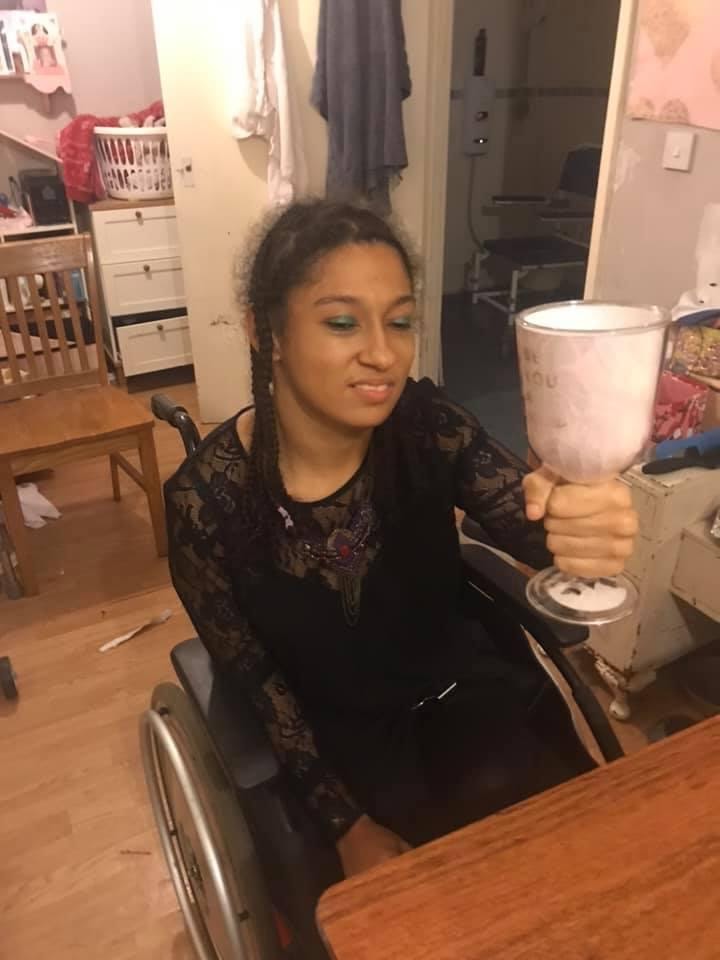
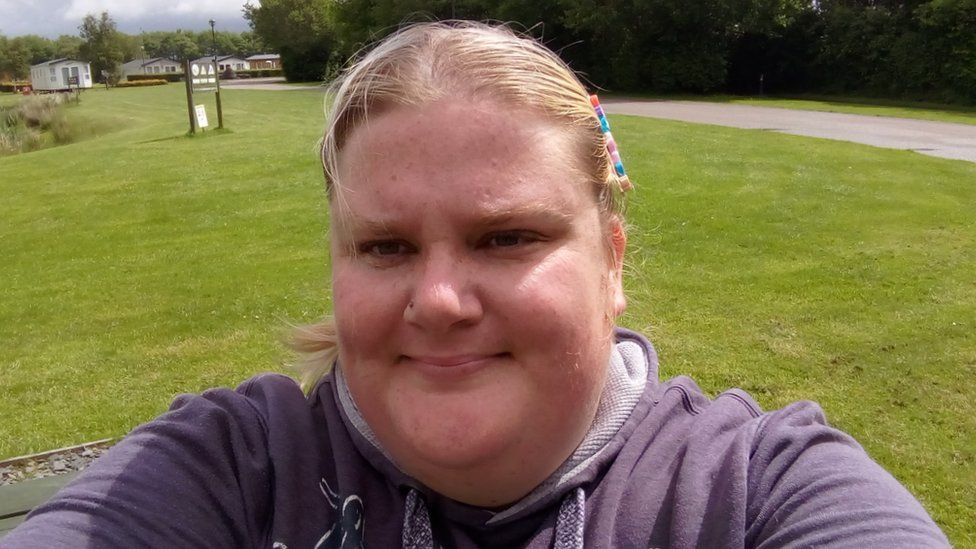
silly photos of me relaxing after choir and cookery content from my pizza making on Monday

November 17, 2022

Open photo

Open photo

picture of me of me enjoying a respite care break last time I can break for it and pictures of me chilling at home after choir pictures of cookery on Monday

November 17, 2022

pictures of me at peacock when I went to nutley edge next to a statue or elephant to find a wheelchair accessible carousel and go on it this is what good West bike needs to meet and why I am fundraising and feel very passionate about respite care because this is what restaurant should be and will be in the future is mine I won’t have anything to do with it also include pictures of me ME2 at home after quiet today day thank you more pictures to come in the next post

all ready for choir this morning

November 17, 2022

getting ready for our Christmas show at the moment at kettles I am a participant in the choir there and I’m part of a family and a very supportive one at that alongside my own family if you are interested in my story please donate donate using my just giving link thank you this will be going towards my DVD and the trailer for it thank you I’m proud to put on my t-shirt each week represent and the hard work they do down at crystal clear data I also love being so very much looking forward to the Christmas shows and the songs and carols we will spend there this means a lot to me and look to the other participant switch everything wrong it gives me the confidence to be seen and heard even though some of our singing is not the best but we all enjoy it as a group and as the collective ☃️☃️☃️☃️☃️☃️🏗️🤩🤩🐱🐱

Accessibility Improvements On The Jubilee Line

November 17, 2022

An email from Transport For London:


We are starting a trial to improve access between the train and platform at our London Underground stations which are already step-free.

We know at our step-free stations, some customers find the small gap between the platform and the train a barrier to getting on and off with confidence.

To help with this, we have developed a bridging device which is laid over the gap between the platform and the train. It is the same width as the existing ramps widely in use across the network, but only 200mm long. 

The trial will be taking place from Monday 14 November until spring 2023 on the Jubilee line platforms at Bermondsey, Canary Wharf, Canada Water, Canning Town, Green Park, London Bridge, North Greenwich and Stratford stations. Colleagues working at these stations have been trained in using the bridging device to assist customers. 

If you would like to use the bridging device when travelling on the Jubilee line, you can ask a member of staff to deploy it for you when you arrive at the station.

If you need to use it to get off the train at one of the trial stations, speak to staff at your starting stations to ask them to arrange for this to happen at your destination. There is no need to book in advance. 

You can find more information about this bridging device on our website.

We’re keen to hear what you think about the bridging device, whether you use it as part of the trial, or if you would like to share your thoughts about the initiative. You can give us your feedback using this link.  

Yours sincerely,

Mark Evers
Chief Customer Officer

Ellie Simmonds: “Strictly Gave Me Confidence”

November 17, 2022

The Access All team were shocked when Ellie Simmonds left this year’s season of Strictly Come Dancing – the first person with dwarfism to compete on the show.

But the dancing competition’s loss is this episode’s gain, as Ellie chats all things representation, ballroom, skydiving and her plans for the future.

Why do we only ever hear about disabled dating, and never about long-term relationships? Presenters Nikki Fox and Emma Tracey talk about their experiences, plus provide some tips and advice.

Billionaire Elon Musk might have bought Twitter, but he also reportedly sacked half of its staff including the entire accessibility team. So what does this mean for disabled people? BBC Click’s Paul Carter and accessibility consultant Leonie Watson help us make sense of a wild week in social media.

my graduation from health and social care and my kitchen the bowling alley when we were first allowed out and about I graduated from health and social care level 1 1-in 2020 T2 +23 but because of covid they didn’t do the maths.

November 16, 2022

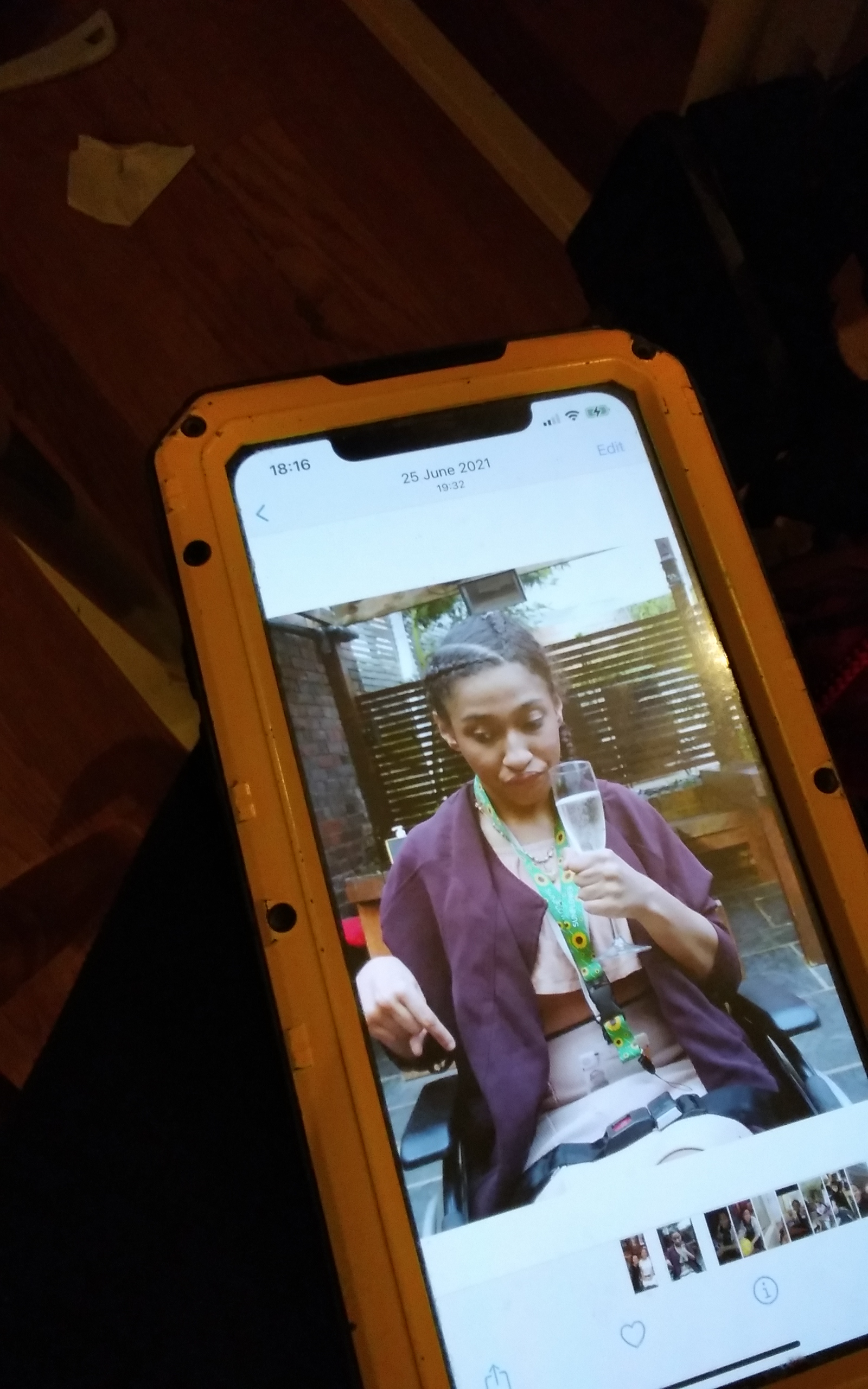
They Didn’t do the normal graduation that year they were concerned about covid spreading so me and my friend and my support work at the time went to a bar instead brand prosecco cocktails and here is a picture of me posing with my prosecco so proud that despite the pandemic challenges that home study I was able to graduate from the core still and also complete my placement actually this world more difficult for me as it wasn’t allowed to be supported by my normal classroom helpers meaning that I was more relying on my personal assistant than ever be able this was because they they possibly message to ordered work that actually even with those with special educational needs like me at the beginning and then we were allowed to go back in in small study group to those of our course and other courses that had disability these challenges were unique and different for everyone 1as will will changing all the time I’m but I believe that if I wasn’t special needs and in education at the time I would be brought and stimulated and very reluctant to you something I believe that my course skill made me remain focused despite all the news that we were hearing at the time from very Johnson and number 10 downing Street because although they had to say things about covered in news reports is forever changing their minds and just be bleak not shining positivity when actually I believe that is disabled people we can so many things from a pandemic such as be able to work more virtually and flexibly from home whether that be in a volunteering role like it is to me or those of us that are employed like I plan to be in the future I may be disabled but this made me more determined than ever to celebrate my son just broke not having Uma graduation don’t we would have had hers covod not be present in England and all around the world this is showing people that they can make reasonable adjustments and they can adapt because it talks them too which for me and those of us that require reasonable adjustments this show them what is reasonable and how unreasonable people and services were being before the pandemic so in a way I believe this tore us all a very valuable lesson how to study without sitting face to face with a tutor even though we can find it difficult perseverance do you study portals more effectively and for me it was showing me how much I could achieve despite the lack of face-to-face in the beginning from a tutor or a teacher you deserve I have now gave my house to social care level 1 children’s only young people suffering me this show me how much I couldn’t leave and how did her I was is well as many other young disabled people in education that I know because yes there was a pandemic but that didn’t mean our disabilities ready to way we were more in we were more dependant drug the more independent because we didn’t have that structure of college day centres and many more services that we were accessed by the pandemic but we gave you so much more and it made us value and that they provide for us activities education and training and placement opportunities I believe that people that use health and social care like myself who are disabled need to be able to get together in the support agency just like we used to and have Christmas parties and things like that because that’s the one that has been spoilt and ruined by the pandemic because CQC are a bit behind on the X and y the rest of the world moves on health and social care and CQC stuck and are not moving on very fast or very effectively at all in terms of letting service users and people that providers support socialise together again which use a a really good networking opportunity for those that use services this is one thing that covered and Boris and his silly rules to the care quality commission created in a way we have more opportunities mystic ones in terms of meeting our needs as well but we have also lost a lot so even though he gained not that I am any other young people I know no would want that from the service provisions like our Christmas parties which we still have not yet had since the pandemic it is now 2 years since we were all ordered to lockdown they need to realise but yes it is still around yes they want to keep her safe but life new song just like any other mainstream person tomorrow moves on it’s just time to move on and stop stop living in the past when it comes to the rulings with the pandemic but here is a picture of me making the most of and still having to wear them today as we speak here is a picture of me making the best of it going bowling and celebrating my graduation with the glasses as deco just like I would if we weren’t go into lockdown and various things like that just enjoying being me enjoying a game of bowley and enjoying a glass of prosecco memories that will last a lifetime graduation that meant a lot to me can you check that I feel like we should be able to take our own now understand what the pandemic is including whether we attend parties but they hold it’s really weird me because groups can do party disability groups but anybody that’s the care agency or a data centre provider can’t this doesn’t mean it’s her one and another rule for another really really doesn’t make them traceable than the rest of the world because we have care so in terms of track and trace they are able to do this more easily the ruling just doesn’t make sense and may need to see common sense in the government to let her have our party acceptor back because I service users of any agency support and care you look forward to and remember come when we’re young to when we’re old and herb memories photographs and and awards that we were given on various events such as may be nominated a couple of years ago for the two of you I still have the certificate for that and still remember the experience treasure the certificate and we plan to put it up on my wall I think rules need to move on with the rest of the world regardless of whether we’re disabled or not this shouldn’t matter we may be disabled and may have to be careful but we should be able to decide how careful we want to be such as if we return leave the rent because at the end of the day yes yes if so put them on people are going to attend but that’s up to people because mentally people may suffer more if they don’t go then they would if they got coded and that should be something that should be assessed trying to client person may support a person they support and the adventures still happen in my opinion for those that live alone especially not just in schemes with the people that they live with because at the moment all that happening is places that are agency run do it in schemes that do assisted living for the people that live there but in terms of service users that live in our communities for many different agencies we do not get our parties anymore this is not fair as to me personally I used to enjoy giving out Christmas cards to the team that supported me that year in terms of in headquarters and and out in the community and this was a central place where we would all meet at which I would give out Christmas cards and was able to assist planning them for many places are used to help mate decorations for parties for many agency but not so much anymore it’s only the carers support charities that tell you to do event anymore it’s not the actual agency or company it’s more the charity that I understand that yes you about but people still want their social events to continue and put an emphasis on that this is because they believe if there are people which use the charity other made of support people happy they will recover properly from covid if they were computer active or at least more properly then if they were mentally depressed or unhappy so please CQC move on with the times. So I think this year agencies that support work showed spread Christmas cheer again and do something else today which rest up at many of my agencies health days with an elf hat elf costume and the lot it used to be anything that me and my support coordinator is used to all grown up in head office as elves for a photo each year for the website things like this need to be brought back I missed elf day so much of the Christmas time is approaching even though I have many more Christmas events coming up making with wacky wheels youth group but I still miss our health days Christmas parties and many more things such as decorating for the Halloween bingo that they normally do for more elderly service user population decorating the agencies training room with spiders pumpkins and many more halloween anything and making all my team dress up in witch hat the craziness that I used to love that has now just been taken away allow us to celebrate like we always did is my message to CQC and local social services life is all about a celebration for us with disability

My pets and parties

November 16, 2022
A nearly 23-year old woman🍾🌺👩‍🦼👩‍🦼pets dogs and many other animals I especially like going out to party some pictures of the nightlife experience of a 22 year old woman with disabilities, I also studied biology last year which I will go back to next year and complete along with wanting to start studying forensic science level 2. eventually I want to study biomedical science at Newham college this is y goal and dream so that I can eventually go to uni and study end of life care, please see my pictures underneath to have an insight into my life and disability which is obviously Cerebral palsy which will always be apart of me but will not stop me including doing gardening as a hobby.

PIP And DLA Will Not Be Means-Tested, Minister Finally Confirms

November 16, 2022

With many thanks to Benefits And Work.


The DWP “have no plans” to means test DLA or PIP, a DWP minister stated yesterday, ending weeks of doubt on the issue and following many MPs receiving emails on the issue from Benefits and Work members.

As Benefits and Work reported on 2 November, Mel Stride, the secretary of state for work and pensions refused to give an assurance that DLA and PIP would not be means tested

In answer to a question on the subject, he would only say:

“The right honourable gentleman is inviting me to break with what has been a very, very long-standing and quite correct convention that when it comes to a major fiscal event, ministers simply do not provide a running commentary as to what may or may not be in that fiscal event.”

We alerted our readers to the possibility and urged them to contact their MP on the subject. From your comments and emails we know that hundreds of you did so.

Yesterday the question was asked again in writing by Labour MP Marsha De Cordova

“To ask the Secretary of State for Work and Pensions, whether he plans to means test the (a) Disability Living Allowance and (b) Personal Independence Payment.

In answer, Tom Pursglove minister for disabled people at the DWP, replied:

“We have no plans to means test Disability Living Allowance (DLA) and Personal Independence Payment (PIP).

“Both DLA and PIP are intended to act as a contribution towards the extra costs that arise as a result of a long-term health condition, or disability, and have been non-means tested since they were introduced.”

So, it seems that the “very, very long-standing and quite correct convention” that ministers do not comment on fiscal events can, in reality, be broken – if enough people email their MPs on the subject.

Night life I have enjoyed this week.

November 15, 2022

Yesterday I enjoyed making pizza with my friends at youth group for disabled adults.

We got to choose our own toppings and got to grate cheese getting some kitchen skills.

I had pineapple, mozzarella, salami on my pizza,in the afternoon I enjoyed a game of bowls.

Nightlife I have done karaoke on zoom and a rock concert at my local pub enjoying a glass of wine.

i enjoy the things I do and this has been a really good month.

If you like my stories please donate to my JustGiving page to help to support me in my dofe expedition.

Thanks samedifference and all my supporters reading my stories.

Roberta Flack Is Unable To Sing After ALS Diagnosis

November 15, 2022

Grammy-winning musician Roberta Flack has been left unable to sing after being diagnosed with ALS, also known as Lou Gehrig’s disease.

The “Killing Me Softly with His Song” performer is also having difficulty speaking, her manager said on Monday.

Flack, 85, has won four Grammy awards and received 14 nominations.

A documentary about her life is set to premier next week in New York. She also has plans to publish a children’s book in January.

In addition to Killing Me Softly – which was later covered by musician Lauryn Hill – Flack is known for songs including “The First Time Ever I Saw Your Face”, which launched her to stardom after it was used in Clint Eastwood film Play Misty for Me, and “Feel Like Makin’ Love”.

Her condition – Amyotrophic lateral sclerosis (ALS) – “has made it impossible to sing and not easy to speak,” her management said in a statement.

“But it will take a lot more than ALS to silence this icon,” they said, adding that she “plans to stay active in her musical and creative pursuits”.

There is no known cure for ALS, which is also known as motor neurone disease (MND). It is caused by the death of the nerves that carry messages from the brain to people’s muscles. It affects their ability to move, talk and even breathe.

The timing of Flack’s film and book release next year coincide with the 50th anniversary of her fourth album “Killing Me Softly With His Song”, which was released in 1973.

After the singer suffered a stroke in 2016, she told the Associated Press news agency that wants her songs to be remembered as “classics” and and not just an “old hit”.

“I could sing any number of songs that I’ve recorded through the years, easily, I could sing them, but I’m going to pick those songs that move me,” Flack said.

“Now that’s hard to do. To be moved, to be moved constantly by your own songs.”

Automatic 12 Month Extensions Of PIP Not Happening Yet

November 15, 2022

In a sign of continuing chaos, the DWP has gone back on its undertaking to automatically extend PIP awards by 12 months when a review is due, the welfare rights workers site Rightsnet has reported.

Back in September, we reported that the DWP had officially confirmed that PIP claims awaiting a review would be automatically extended by ‘up to 12 months’ and that, from 31 October, claimants would receive a letter confirming their continued entitlement.  The news was announced in the DWP’s official stakeholders bulletin Touchbase.

However, Rightsnet has now revealed that in a further email to stakeholders the DWP has now said that the scheme will not be up and running until ‘early to mid-December’.

The DWP did say that “’Anyone needing a statement before this can contact the helpline 0800 1214 433 and we will issue a certification of entitlement for proof of their PIP award. Otherwise, claimants do not need to contact us unless their circumstances change.”

The announcement is further evidence of the DWP’s inability to manage its current workload and casts even more doubt on the likelihood of it being capable of safely managing the forced transfer of 2.6 million legacy benefits claimants to universal credit by the end of 2024.

Blind Woman And Guide Dog Kicked Out Of London Premier Inn

November 14, 2022
 

A blind woman and her guide dog were thrown out of a London Premier Inn in the night after she was accused of lying about her assistance dog.

Angharad Paget-Jones, 29, said she was woken up and asked for “proof” her dog Tudor was a registered guide dog.

She claimed that after providing a Guide Dogs ID booklet, security staff accused Tudor of being a “fake” guide dog.

Premier Inn said it was urgently investigating the allegations.

It is usually illegal to refuse access to disabled people with guide dogs.

Ms Paget-Jones, a data analyst and disability rights campaigner from Port Talbot, said she was “forced to leave the Premier Inn at Enfield, in the middle of the night” during a stay on Saturday.
‘No dogs’

She posted about her experience on Twitter, saying that despite checking into the hotel smoothly at about 20:00 GMT with her guide dog Tudor in a fluorescent guiding harness, the problem arose when her boyfriend went to walk him after she had fallen asleep in the evening.

Ms Paget-Jones claimed hotel staff stopped her boyfriend on his way back by saying “no dogs”, and “was asked for proof” that Tudor was a guide dog.

“My boyfriend said he was a guide dog, and said he was sure that I would be able to provide ID for him and I would be able to get this to them in the morning,” she explained.

“They wouldn’t drop it and came up to the room and ended up disturbing me as I was half asleep. No one was telling me what was going on, I asked for a manager to help resolve the situation.

“I closed the door for my own modesty as I was just in a T-shirt and underwear, but the staff continued to demand evidence Tudor was a guide dog.”

Ms Paget-Jones added that “a male security guard joined the hotel staff”, and “they continued to tell me to leave the hotel” and saying Tudor “looked like a fake guide dog”.

“The staff used a master key to open the door, barging in demanding proof Tudor was a guide dog,” she said.

“I showed them the yellow book which outlines a guide dog and Tudor’s harness, which has Guide Dogs branding on, but they said this wasn’t sufficient evidence and told us to leave.

“My partner ended up calling the police, but they did nothing, and we got thrown out.”

The BBC has seen a video clip of part of the incident, which appears to show Ms Paget-Jones’s yellow ID book on the bed in the hotel room.

In the footage her boyfriend can be heard on the phone to police, while a young female staff member tells them to “leave”, saying “if you have a guide dog you would know to bring documentation”.

Ms Paget-Jones said: “I felt discriminated against, harassed and as though my privacy had been invaded. We ended up staying with my partner’s parents, but I ended up having a panic attack that night.”

She added she would be taking legal action against Premier Inn.

The hotel firm issued a statement saying it was “shocked and appalled” to hear about the allegations.

A spokesperson said: “An urgent investigation is already under way with that site to find out exactly what’s happened, and we’ve reached out to the Twitter user to fully understand the circumstances of what has taken place and apologise for the upset caused.”

The business added it takes “a zero tolerance policy towards discrimination”, and “all team members receive disability awareness training”.

The Equality and Human Rights Commission says displaying an ID booklet for assistance dogs “is not a legal requirement, and assistance dog users should not be refused a service simply because they do not possess an ID book”.

Blanche Shackleton from Guide Dogs said: “Guide dog owners deserve to be able to live their lives the way they want and feel confident, independent, and supported in the world.”

She added: “The law needs to be stronger, so we’re calling on the government to end access refusals and ensure that, unless there is a valid legal reason, that guide dog owners are welcome with open doors when they use businesses, shops and taxis.”

second log of the weekend good quality respite looks like when I managed to fundraise for it.

November 12, 2022

what it could look like as a disabled woman receiving it is concerts attending awards and different corporate events for different volunteer jobs attending a Christmas party attending a bowling game or or just going to see a show show or play of your choice or going to Butlins just to list some of the things that I have done today with the funds I managed to raise this allows me to have the same experiences talking quotes as many of my non-disabled friend has believe it or not I have friends that aren’t disabled because as disabled adults we are allowed to do that we don’t just have cab grand that are only disabled we can have a mix of mainstream and disabled friend that understands our conditions but I pound if your friends friends they will embrace you wholeheartedly and understand your differences even though so they may be more restricting and there’s as a mainstream student can walk run etc this can include things like Butlins going to concerts events at just awards e.t.c. volunteering in my community and joining in in with mainstream people as well as disabled people it is believe it or not we’re not just a wheelchair we are person our life isn’t our wheelchair or wheelchair is our legs and joining in in projects for mainstream people as well as disabled people because believe it or not I like isn’t her wheelchair I will chair is our legs and our freedom and so are our personal assistant so this is why I am fundraising to give me freedom anywhere I go now and in the future especially when it comes to education training or holiday as I love to travel like any adults my age I am not the same as you but I like the same things as adults in my age group and adults which I study with we have things in common I’m no different because I’m in a wheelchair they just use legs and have to worry about the highest high heels if this is what they choose to where where where where is I going to have to worry about these things we have different priorities but the same hobbies we have different measures we have to put in place for our independent but we can still have it just may need a little extradition to aid our independent we like make-up for me that are bright colours such as neon pink especially when I went to a Butlins big Weekender 1-year ago I love spring my hair neon green last Halloween 2 and wearing bright coloured high heels and dresses at the weekend. When i went in the clubs and see the Artist. Respite means to me please be my colouring videos that I have together to spray how much is a brand new restaurant to my life when I have storage in the path beyond stay tuned for next week about my last TV expedition thank you.

nightlife on a Friday night with cerebral palsy.

November 12, 2022

Like many young people whether they are disabled or enabled body Friday night is party central in England anyway and I’m sure many other countries around the world or people with cerebral palsy this is no different we to make a Friday night party night too even if that is just with karaoke with our friend or a trip to the pub to see a punk concert like I did recently we are are just people that end up going out on wheels of some kind whether that be a walker or a wheelchair which has some benefits to it as we can wear heels as high as we like and don’t have to worry about walking in them Mr as a lot of us don’t walk or only walk short distances with cerebral palsy meaning that we enjoy high heels more than people who are main stream ladies because we can wear them higher than the mainstream ladies can because we don’t have to consider walking them because a lot of us either have a wheelchair that we can use or have a wheelchair that we use all the time for mobilising we can also get drunk without worrying about stumbling into a taxi because all we do is have to get weld into a taxi for people with cerebral palsy that may walk they definitely would still have access to a wheelchair meaning they don’t have to consider this either this is why you will see us in retail stores and shops buying the the most high shoes we can find with the most crazy patterns being proud of our disability and of course our high heels this is what funding support can make possible we want this possible wherever we decide to travel to we don’t want to be restricted with funds just because of our needs if we are travelling somewhere which is why I am fundraising to make the impossible possible for me whether I am on holiday or at home with my support please see my tiktok video link down below 2 to find out what I get up to on a Friday night as a 22-year old disabled woman and if you like my story as always the message is donate donate donate to my JustGiving page.

@wheelchairdiva101

Friday night in the life of someone with cerebral palsy

♬ Forever Young – UNDRESSD

Lora And Neil Fachie: From Paralympians To Parents

November 11, 2022

    Paralympic cycling champions Lora and Neil Fachie have been talking about putting their own spin on parenthood after the birth of their baby son.

    The visually-impaired cyclists, based in Altrincham, Greater Manchester, became parents to Fraser on 31 October.

    Lora, who was still training three days before Fraser was born, said she thought her fitness definitely helped her get to grips with being a new mum.

    They were learning how much they could do on “so little sleep”, Lora added.

    The golden couple, who were both appointed an OBE earlier this year, told BBC North West Tonight they had found “ways to get around things”.

    Neil, previously dubbed “Mr Unbeatable“, said: “It’s a case of we do things in a different way.

    “I’ve got some sight, but I see better when it’s light. I’ve actually got a few clip-on lights around our nappy-changing area, so it almost resembles a football stadium, going to the arena for combat.”

    Prior to giving birth to Fraser, Lora said she was most nervous about changing his nappy, but has since discovered it was the easiest thing to negotiate.

    Meanwhile, Lora got to practise reading bedtime stories last month when she became the first ever person to read a CBeebies Bedtime Story in braille.

    However, she said that initially breastfeeding had felt more of a challenge.

    “The midwives were brilliant, but they know how to support people who can see,” she said.

    “So all the advice, especially for getting a good latches [was] nipple to nose and then look for their open mouth.

    “I can’t see when his mouth’s open, so I needed to feel – and no one knew how to support me.”

    ‘Very lucky’

    The couple said one health visit had caused them distress, but it had been a “blip” in the support they had received.

    Lora said that after she had finished breastfeeding Fraser, a health visitor asked her if she thought he was a bit red.

    She said she told the visitor she was visually-impaired so could not see.

    “So she said, ‘What about you, then, Daddy?’ and Neil said, ‘I can’t see properly’,” Lora said, adding that the response was: “‘Well, that doesn’t stop you seeing colour, though, does it?'”

    The pair said they had been “very lucky” to have great support from family and friends with Fraser, including maternal grandparents Anthony and Sue Turnham, who were also visually-impaired.

    Neil said: “We’ve seen the perfect roles models of Lora’s parents bringing up visually-impaired children who have gone up to lead incredible lives.”

    Comedian Adam Hills Receives MBE

    November 10, 2022

      Comedian Adam Hills has said he is “addicted” to helping disability sport after receiving an MBE.

      The host of Channel 4’s The Last Leg was honoured for services to Paralympic sport and disability awareness.

      Hills, who has a prosthetic foot, joined the Warrington Wolves’ Physical Disability Rugby League team for a 2019 documentary.

      He has previously spoken about his affection for the Cheshire club, saying it is “the heart of the town”.

      Hills has co-hosted The Last Leg since it started alongside the London 2012 Paralympics as a show covering the week’s topical news but also shining a light on conversations around disability.

      In 2019 he made the Channel 4 documentary Adam Hills: Take His Legs, which saw him embark on his childhood dream of playing competitive rugby league and join the Warrington Wolves’ Physical Disability Rugby League team as they journeyed to his home country, emerging as champions.

      At the Windsor Castle investiture ceremony, he said the MBE was “like a reward for eating chocolate. I’d be doing it anyway.”

      Speaking about Wolves and the Cheshire town, he said the club “is the heart of the town and the veins go throughout everything else”.

      “Whether it’s community outreach, dance classes, disability rugby or dementia friendly cafes, what I love about Warrington is the town feeds into the club and then the club feeds back into the town.”

      Hills said after the ceremony: “I feel like all I do is put the spotlight on the Paralympics once every four years.

      “But I guess also I’ve been promoting disability Rugby League, and disability cricket through the Lord’s Taverners – I think most people who come into contact with disability sport become addicted to it and I’m definitely one of those.”

      The Australian also revealed the Princess Royal told him at the ceremony that her favourite comedy show is the BBC series Would I Lie to You?

      Hills said about his chat with Anne: “We talked about comedy for five minutes… I don’t think I’m breaking royal protocol by saying she said her favourite comedy show was Would I Lie to You?

      “Then asked if I’d been on it and I said no, and she seemed quite disappointed.

      “I’ll now call Lee Mack and tell him the Princess Royal watches him.”

      Pilot scheme for dementia-friendly signage at railway station unveiled by Northern

      November 9, 2022

      A press release:

      Train operator, Northern has unveiled the first ‘dementia-friendly’ signage at one of its stations in Derbyshire.

      It has worked with the Friends of Buxton Station and local dementia support groups on the pilot scheme, which is designed to make signs much easier for someone with dementia to understand.

      This includes fewer signs to avoid ‘information overload’, strategic placement of signs at important ‘decision points’ and wider use of symbols to reinforce the wording chosen.

      The pilot follows an approach by the Friends of Buxton Station chairman, Dave Carlisle, to Northern for funding from the operator’s Accessibility Fund.

      Mr Carlisle, who has personal experience of Alzheimer’s in his family, says he was compelled to act having seen so many rail users struggle to understand some of the signs and instructions at railway stations.

      Chris Jackson, regional director for Northern, said: “We’re really pleased to get this pilot scheme off the ground – which has already been recognised by the Community Rail Network for influencing positive change.

      “Small alterations can make a huge difference to someone living with dementia and the feedback from rail users at Buxton Station will help inform future station improvements across the network.

      “I’d like to thank the Friends of Buxton Station for championing this issue and working so closely with us on this pilot scheme.”

      Northern and the Friends of Buxton Station are now encouraging feedback from local dementia support groups and individuals on the deployment of the scheme.

      Northern is the second largest train operator in the UK, with nearly 2,000 services a day to more than 500 stations across the North of England.

      Strictly Come Dancing 2022: Ellie Simmonds Bouncing Back After Exit

      November 8, 2022

      Ellie Simmonds’s mum says her daughter has gained so much through Strictly Come Dancing, despite being disappointed to leave the show.

      Val Simmonds said she had gained confidence by doing something “so out of her comfort zone”.

      “She never ever assumes she can do anything, but she’s always willing to try and is always a bit surprised when she can,” she told BBC Radio WM.

      On Sunday, the Paralympian became the sixth celebrity to leave the show.

      Simmonds, from Walsall in the West Midlands, performed a Charleston with dance partner Nikita Kuzmin, which brought them their highest score yet of 33 and was widely praised.

      But they lost out to singer and actress Molly Rainford and her partner Carlos Gu in the dance-off.

      Afterwards, the 27-year-old told presenter Tess Daly she had had the “time of her life”.

      “It’s been the most incredible experience – life changing really,” she said.

      Her mother Val said: “I thought it was a superb dance, but in some ways I’d rather her go out on a good dance, and Molly is very good – so it was always going to be tough.”

      Simmonds, who was as born with achondroplasia, which reduces growth in arms and legs, achieved huge success as a swimmer before retiring last year.

      Although she was a confident in the pool, her mother said she overcame a “lot of reservations” to go on the BBC One show, including whether she could dance and how dances would be adapted.

      However, Val added her daughter had “just gelled” with Kuzmin and they had worked through each dance together.

      “After retiring I think you are in a void of ‘what am I going to do next?’ She said all along I’ll take a year to see how things go before I start to try and develop where I’m going next,” she said.

      “And this is very much part of it and I think it has made her realise whatever doors open you can look inside and think ‘yes I am going to have a go at that’.”

      Kuzmin said Simmonds had taught him “empathy”, which her mother said was probably because of her strength and caring nature.

      “I think he started seeing the world from her eyes and the daily challenges that you deal with… she doesn’t take anything for granted, but she’s so caring and looking out for others.”

      Coronation Street Star Cherylee Houston Collects MBE At Buckingham Palace

      November 7, 2022

      Coronation Street star Cherylee Houston has received an MBE at Buckingham Palace for her services to drama and to people with disabilities.

      She received her title at the Palace from Anne, Princess Royal. It was announced that she would be receiving this honour back on New Year’s Eve 2021, when the New Year Honours List was released.

      The actor has been part of Coronation Street for 12 years and was the first actor to use a wheelchair among the cast of the ITV soap.

      Talking about how important it is to see disabled people represented on screen, she said: “If you think when you were growing up who your role models were, who influenced you, if you as a disabled child don’t have that, how do you know what you can do?”

      She also spoke about how the looming cost of living crisis would affect disabled people, and she believes that more on screen representation can cause viewers to be more empathetic.

      “That’s why I firmly believe the more we’re on our screens, the more we’re going to be understood, the more people care and empathise and will ensure that we will have equal rights and equal opportunity, because it’s about equality,” she said, adding, “It would be nice if the world was a bit more physically accessible.”

      Oliver McGowan: NHS Autism Training Mandatory After Teen’s Death

      November 7, 2022

        Mandatory training for treating people with autism and learning disabilities is being rolled out for NHS health and care staff after a patient died.

        It comes after Oliver McGowan, from Bristol, died following an epileptic seizure.

        At the time, in November 2016, he was given an anti-psychotic drug he was allergic to despite repeated warnings from his parents.

        His mother Paula lobbied for mandatory training to potentially “save lives”.

        The training is for all NHS staff who work with the public.

        An independent review found Oliver’s death at Southmead Hospital was potentially avoidable.

        The 18-year-old, who was mildly autistic and had epilepsy and learning difficulties, was being treated for a seizure when he was given olanzapine to sedate him.

        Oliver, from Bristol, died in intensive care 17 days later after a rare side effect caused his brain to swell.

        ‘Staff didn’t understand’

        Mrs McGowan said: “He was a young teenager, who was very active.

        “He was playing for England FA and he went into hospital having… partial seizures.

        “Because staff didn’t understand his autism and how it affected him, he was chemically restrained.

        “Oliver wasn’t mentally ill and this caused Oliver’s death.”

        A spokesman for the NHS said the training had been developed with expertise from people with a learning disability and autistic people as well as their families and carers.

        The first part of the Oliver McGowan Mandatory Training is being rolled out following a two-year trial involving more than 8,300 health and care staff across England.

        Mark Radford, chief nurse at Health Education England said: “Following the tragedy of Oliver’s death, Paula McGowan has tirelessly campaigned to ensure that Oliver’s legacy is that all health and care staff receive this critical training.

        “Paula and many others have helped with the development of the training from the beginning.

        “Making Oliver’s training mandatory will ensure that the skills and expertise needed to provide the best care for people with a learning disability and autistic people is available right across health and care.”

        Saturday’s blog about respite

        November 5, 2022

        They should consider what we feel about it and not just what they are going to pay for respite, it should be about activities for everybody Please see my crowd funding page underneath. If you like my stories then donate, donate, donate. This Saturday’s blog is about respite and cerebral palsy and the quality that respite should be. Today we need appropriate respite rather than some that is good and some that is bad.  Remember to take respite provision seriously not just sending us to the one that is deemed appropriate by you as local social services professionals. Not just sending us to somewhere where there is no activity at all to stimulate us, and not considering what we wish to get out of our respite stays, and not giving us staff that care about our needs and we’ll being. I would like to reform this by 2028. I would like every respite place to open activities I would like to ask you please what “we” see as good respite provision and be able to timetable the one “we” choose whether it be in county or not. It should not matter as some of the ones out of county are less money for better value for money. It is unless when they send us to somewhere that doesn’t have activities and doesn’t have any games for us to participate in. We should not have to play a post code lottery for the services we attend. The local authorities just care about where they spend the least money and not about the quality of the service for that money. People who are disabled have to fight to be the leaders of there own life  whereas people who are not disabled can always illustrate there own lives. They should have a star scoring system and J system to allow us to understand what actives that are good and included in there service provision so that we can choose the right placement for our interests, needs and hobbies. 😀😂👩‍🎓☹️☹️🎓😁🛌👩‍🎓😂🛌

        Why I think respite and support should be supported by social services.

        November 4, 2022

        The call I am making for disability respite care and residential courses for the support to become the norm in2023 because anybody could become disabled at any time. Anywhere from car accident to broken legs or brittle bones. As the population gets older they are more likely to become disabled. As a disabled person right now it means that we need to put in the infrastructure to make people not feel bad for having disability and you needing change because of the lack of support and respite. Disabled people who need someone to stay over with them on a residential course for example like me and many other young people in their 20’s in this day and age is going to double if not triple. I believe as there are more courses available there will be more disabled people wanting to do them. We as disabled people deserve to be seen it shouldn’t be a privilege that we are able to access the same things as everybody else we should just be able to accept it like we could if we were not disabled or had different needs to other people needing someone to stay with them this is not because we want to be watched over this is because we need it because of our disability our mobility may be decreased because of a disability we were born with therefore we cannot change it. Some people may have had accidents that they also cannot change.As accidents happen as accidents do happen I believe that 2023 should be the year that respite should be offered to anyone who is disabled ànd cannot look after themselves

        The government needs to grow up and open their eyes to see what it’s like for other members of the society and to see that as well as having the support to do so without having to pay the amount of fees that would be the equivalent of n buying a house just to have you our support needs met. As many support places charge into the thousands. This has to be given to you by the government without having to repeat your story again and again.As it hasn’t changed we had it from birth. I often think of ways to improve the experience for people with Cerebral Palsy but there is no choice. The miracle is that they think that Cerebral Palsy will just go away. I often tell them that if you know of a cure please tell me because there isn’t one.

        DWP Call Centres Will Cause Life-Threatening Destitution

        November 4, 2022

        With many thanks to Benefits And Work.


        The shocking level of service at DWP call centres will lead to life-threatening destitution for some claimants when the forced migration from legacy benefits to universal credit (UC) begins in earnest, the experience of Benefits and Work readers shows. 

        In particular, claimants who need an extension of time for their UC claim will face losing all their legacy benefits if they are unable to get through to the DWP on the phone.

        In the spring, Benefits and Work published two pages asking readers for their experiences of calling the DWP. 

        The first is entitled ‘Which DWP number are you struggling to get through on?’ and asks for readers experiences of trying to get through to a range of DWP numbers, including the UC helpline, the PIP enquiry line and the Jobcentre Plus for ESA change of circumstances line.

        The second article followed on from this and asked specifically for readers experiences of calling the ‘0800 121 4433 PIP Enquiry Line’.

        What we’ve learnt from the hundreds of responses that continue to come in is that callers can be left waiting literally hours without being answered, not just once, but day after day.  They can be repeatedly cut-off after they have answered AI bot security questions.  Sometimes callers get through and can briefly hear human voices in the background before being cut-off.  And sometimes they have actually begun speaking to a human being before being cut-off.

        Under any circumstances, and for any benefits issue, this would be distressing.

        But in relation to a forced moved to UC, this could lead to sudden and disastrous poverty.

        The DWP have published a web page specifically for claimants who have been contacted and told they must move from legacy benefits to UC.  On it, claimants are warned:

        To continue receiving financial support you must claim Universal Credit by the deadline date given in your letter. This is 3 months from the date the letter was sent out.

        This gives you time to gather any information and evidence, such as identity documents that you need to make your claim.

        It may take time to gather all your documents and evidence to make your claim online, so you need to act as soon as possible.

        If you cannot claim Universal Credit by the deadline date given on your letter, you should contact the Universal Credit Migration Notice helpline as soon as possible.

        We can only give you more time to make a claim if you have a good reason. You must request this before the deadline date on your letter.

        And there’s the issue.  If the DWP stick to their current timetable, they will attempt to move 2.5 million claimants from legacy benefits onto UC in the space of a single year.

        Many of those claimants are likely to have problems meeting all the DWP’s requirements.   

        Some will struggle with paperwork because of mental health issues or learning difficulties. Some will find it hard to engage with the process because of anxiety. Some will be too physically unwell to respond.  Some will have their health conditions made significantly worse by the process itself.

        As a result, many thousands of claimants will need to ask for an extension by phoning the helpline.

        But with the dreadful level of service that the DWP provide, and with desperate and confused claimants calling multiple times every day about problems with migration, it’s virtually unavoidable that the phone lines will be overwhelmed. 

        People who are unable to get through to ask for an extension are likely to see their benefits stopped altogether. It’s a situation that scarcely bears thinking about, but unless something is done it is one which will happen repeatedly.

        We are urging readers to contact their MP, talk to disability charities that they have connections with and begin to raise awareness of this issue, before it’s too late.

        With 2.5 million claimants being migrated to UC in a year, we need to know how many calls the DWP expect to have to deal with. How many new call centres will they open to cope with the vast number of enquiries they are likely to receive?  How many extra staff will they employ?  What training will they receive?  What targets will they have for how long callers are left on hold?  How long they will spend on average talking to each caller?  Will they make calls out to claimants who fail to meet the deadline to find out why?

        The Scottish government are managing to move all their PIP claimants over to adult disability payment without threatening any of them with having their money stopped. 

        The DWP could do the same for legacy benefit claimants – they are simply choosing not to.

        And, in case you imagine we are exaggerating the difficulties people encounter trying to talk to the DWP on the phone, we’ve published some readers experiences below.

        Members can download a copy of our 21 page guide to moving from ESA to UC from the ESA guides page.

         If you want to stay informed about UC migration, sign up for our free ‘My UC Alerts’ and we’ll email you when there’s important news.

        Joe Powell-Main

        November 3, 2022

        A young ballet dancer who uses a wheelchair is hoping to create more opportunities for differently abled dancers with a special performance.

        Welsh-born Joe Powell-Main is the star of Sleepwalker – a show put on by the Royal Ballet which sees him take centre-stage.

        The 25-year-old suffered life-changing injuries after a complication with knee surgery and a car accident at the age of 15, leaving him to think he would never dance again.

        But now, Joe and his ballet partner Issy have adapted moves to incorporate his wheelchair.

        Joe will be streaming a preview of his performance as part of World Ballet Day, and hopes to open up ballet for more people with disabilities.

        25 Fold Increase In PIP Long Covid Awards, One In Five Getting Maximum Amount

        November 2, 2022

        With many thanks to Benefits And Work.


        There has been a 25 fold increase in awards of personal independence payment (PIP) for Long Covid in just one year, DWP statistics have revealed.  Over one in five successful claimants is receiving the enhanced rates of both components, totalling £156.90 a week

        In July 2021 there were just 108 PIP awards for Long Covid, but by July 2022 – the most recent month for which figures are available – that number had leapt to 2,794.

        The success rate for claims based on Long Covid is 47%.

        Of those who get an award, 1,233 are receiving the enhanced rate of the mobility component and 722 are getting the enhanced rate of the daily living component.

        633 (23%) are getting the enhanced rate for both components.

        Yet the level of awards is still tiny compared to the number of people likely to be eligible.

        According to the Office for National Statistics (ONS) 1.1 million people have had self-reported Long Covid for at least one year and 514,000 for at least two years.

        Long Covid symptoms adversely affect the day-to-day activities of 1.6 million people, with 342,000 reporting that their ability to undertake day-to-day activities had been “limited a lot”.

        It is very likely that many of these people would be eligible for an award of PIP.

        Fatigue is the most common symptom reported in connection with Long Covid (69%), followed by difficulty concentrating (45%), shortness of breath (42%) and muscle ache (40%).

        All of these symptoms would be highly relevant to a PIP claim and would be likely to lead to points being scored for in relation to activities such as:

        • Preparing food
        • Managing therapy and monitoring a health condition
        • Washing and bathing
        • Dressing and undressing
        • Engaging with others face-to-face
        • Planning and following a journey
        • Moving around

        It is more than a little surprising then, that in spite of the large increase in the number of awards, there are still so few people claiming PIP for Long Covid

        You can read more about PIP for Long Covid and the fact that many thousands of people are likely to be missing out on an award.

        Benefits and Work members can download a 7-page, Long Covid PIP supplement, to be used in conjunction with our Guide to PIP Claims and Reviews.

        Benefits and Work have also published a short, introductory video on the subject.

        The UK Terror Survivors Tracked Down By ‘Disaster Trolls’

        November 1, 2022

          Conspiracy theorists, who claim UK terror attacks have been staged, are tracking down survivors to their homes and workplaces to see if they are lying about their injuries, a BBC investigation has found.

          Martin Hibbert, who was paralysed from the waist down when he and his daughter Eve were caught in the 2017 Manchester Arena blast, told the BBC he is now preparing to bring libel action against a conspiracy theorist based in Wales.

          Richard D Hall has described how he physically tracks down survivors of the attack – in which 22 people were killed and more than 100 injured – to determine whether it was faked. He says he spied on Eve from a vehicle parked outside her home.

          In a video shared with his followers online, Mr Hall demonstrates setting up a camera to film Eve, now profoundly disabled and in a wheelchair, to see whether she can in fact walk.

          “I’m all for freedom of speech,” Martin Hibbert told me. “But it crosses the line when you’re saying I’m an actor or I’ve not got a spinal cord injury or Eve’s not disabled, she’s not in a wheelchair.

          “You don’t know how far he’s going to go to get answers.”

          Mr Hall suggests that those who were killed in the attack are really alive and living abroad. He also promotes theories that several other UK terror attacks were staged. A former engineer and website designer, he makes money from selling books and DVDs outlining his theories, as well as speaking at events and posting videos online. As recently as mid-October, he had more than 16 million views and 80,000 subscribers on YouTube.

          When I confronted Mr Hall at a market stall he runs, he insisted I’m wrong about how he operates.

          For the past five months I’ve been looking into conspiracy theorists who target UK terror survivors, for BBC Panorama and a Radio 4 podcast. My investigations and new research, along with the testimony of those affected, show that conspiracy theories and tactics like those deployed by Mr Hall are emblematic of a wider phenomenon that survivors and bereaved families are experiencing.

          A victim of the 2017 Westminster Bridge terror attack, who has been harassed by online conspiracy trolls, told the BBC that surviving a terror attack now seems to inevitably lead to being abused.

          These types of conspiracy theories, and the abuse they inspire, echo those of Alex Jones, the US host of the conspiracist show and website Infowars, who this month was ordered to pay nearly $1bn (£861,805,000) to families of the US Sandy Hook school shooting after falsely claiming the 2012 attack was a hoax.

          Online abuse describing terror attacks as hoaxes, and those who were injured as so-called “crisis actors”, appear to be on the rise since the pandemic, according to survivors who have spoken to the BBC.

          Most of the abuse has been perpetrated online, but people I have spoken to say they fear for their safety because the abuse has also begun to affect their lives offline.

          Nearly one in five people in the UK think terror survivors are not telling the truth about what happened to them, new research for the BBC suggests. A third say the pandemic has made them more suspicious of official explanations of UK terror attacks.

          The survey of more than 4,000 people, weighted to be representative of the UK population and carried out earlier this month by King’s College London, also suggests that 14% believe the 2017 Manchester Arena attack probably involved “crisis actors” who pretended to be injured.

          Research from BBC Monitoring found that dozens of videos promoting false claims about the Manchester attack – accumulating more than 300,000 views – were still on YouTube five years after the incident. After the BBC flagged this to YouTube, the company removed Mr Hall’s channel and one other that had promoted his content.

          “Targeting the victims and families of these atrocious attacks is abhorrent,” said a spokesperson for the company. “YouTube’s hate speech policy outlines clear guidelines prohibiting content that denies, trivialises or minimises violent historical events, and we will remove flagged videos that violate these guidelines.”

          Martin Hibbert’s lawyer, Neil Hudgell, who is preparing a libel case against Mr Hall, told the BBC: “Martin’s got to the point of enough is enough. This needs tackling and to be silenced in legitimate ways.”

          Mr Hall’s claims and tactics also include:

          • Entering the workplace of Manchester Arena survivor Lisa Bridgett, posing as a customer, with the aim of secretly recording her to discover whether she’s lying about her injuries
          • Visiting the homes of other Manchester survivors to try to question them about whether the attack was a hoax
          • Publicising the names and locations of dozens of Manchester survivors and bereaved relatives of victims in a video – appealing to his followers to send him any information they have about them

          Martin Hibbert first became aware of Mr Hall’s tactics when police alerted the family to allegations that he had put a camera outside the home of his daughter Eve. Mr Hall had shared a video of himself preparing a small camera strapped to a stake which he said he would use to check whether Eve really was hurt in the Manchester Arena bombing.

          “I’ve sharpened the spike on the end so I can just stick that into the ground in order to surveil our subjects,” he told his viewers, holding up a camera attached to a stick with fake foliage wrapped around it.

          Eve, who is now 20, was left severely disabled after the bombing. She experienced a serious brain injury and has lost the use of her left arm and leg.

          Mr Hall later said online that Eve left the house in a wheelchair, but added, “There’s no evidence” that the injury was as a result of the attack.

          He also documented his attempt to prove that Lisa Bridgett, who lost a finger in the bombing, was not injured either, by taking a hidden camera to the boatyard where she works.

          Ms Bridgett told me: “It makes you feel very security conscious, because you just don’t know who’s out there and who might be lurking in a garden or standing round a corner with a hidden camera on.”

          Messages seen by the BBC show how online abuse, citing conspiracies that Mr Hall and others promote, have also been sent to the grieving relatives of those killed in the Manchester Arena bombing, as well as survivors of other UK terror attacks. There have been attempts by trolls online to identify where terror survivors live and work.

          Mr Hall requests donations on his website and promotes an online shop where he sells branded merchandise. He also has a market stall where he sells his book and DVD about the Manchester Arena attack, along with other books and DVDs promoting conspiracy theories.

          I visited the market stall to ask him questions after multiple attempts to get answers to survivors’ questions.

          He told me he didn’t want to talk to me about the “evidence” he says he has to back up his claims, and that he doesn’t trust the BBC. I asked how he feels to be profiting from the worst day of these survivors’ lives.

          “If you read my book, all the answers are in there,” he said. When I told him there is no evidence in his book, he told me I’m wrong.

          He refused to address questions about whether he really believes UK terror attacks were staged and if he understands the harm his conspiracy theories and tactics cause to the survivors of these attacks.

          After my visit, I wrote to Mr Hall again but he didn’t respond. Since then he has added a series of disclaimers on his website saying that he does not “advocate that viewers of this website make contact with alleged terror attack victims, either online or in person”.

          He has also posted a new video, in which he says he did not put a camera outside the home of Eve Hibbert, but admitted to leaving “a camera rolling” in his van which was “parked in a public place”.

          He says he has made “polite door to door inquiries in order to gather evidence, which is a perfectly legitimate activity when doing research”, and that his appeal for information from the public does not make him “responsible for hateful messages sent by people”.

          But he held firm to his “opinion [that] there has been no satisfactory evidence presented to the public, which proves that the Manchester arena incident was not staged”.

          Subsequent to the publication of this article, Mr Hall removed several videos from his website. A comment added to his homepage said: “In response to recent media coverage, if any person is upset by what they have seen, Richard D Hall apologises for any upset caused.”

          To try to find out more about Mr Hall and what motivates the people who push these conspiracy theories, I spoke to an insider who used to appear in Mr Hall’s videos. He has insight into how this conspiracy industry works.

          Neil Sanders said he doesn’t share Mr Hall’s views on the Manchester Arena attack. He believes it is the fans who are shaping the trajectory of a conspiracy theorist like Mr Hall, who used to focus on theories about UFOs before starting to push claims about “fabricated terror”. In fact, Mr Sanders said he is sure that when he and Mr Hall had discussed the conspiracy theories that took off after the Sandy Hook school shooting, Mr Hall had dismissed them as nonsense.

          But he said the more Mr Hall has become embroiled in this world, the more he appears to have bought into these conspiracies. It is the more sensational theories which are the ones that “sell”, Mr Sanders explained, adding that Mr Hall’s talks in pubs and other venues up and down the UK in recent years have been packed.

          Mr Sanders says he doesn’t support conspiracy theories that UK terror attacks were staged.

          The King’s College research suggests that four in five people do recognise that serious terror attacks have occurred in the UK.

          But, when asked specifically about the Manchester and 7/7 bombings, a significant minority – one in seven people surveyed – have doubts about whether those attacks even happened at all.

          And more than one in 10 of those surveyed think the Manchester Arena attack was a hoax.

          “This not only disengages people from society generally. For that small minority who get really caught up in conspiracies, it can actually affect their behaviour,” explained Prof Bobby Duffy, who led the research. He feared that those who believe these theories are more likely to target survivors with abuse.

          The research distinguishes between those who believe terror attacks, such as the Manchester Arena bombing, were a hoax, and those who aren’t sure about the truth of these attacks.

          Prof Duffy describes how anxiety, uncertainty and social media habits can all tip someone from simply questioning events, to arriving at more extreme beliefs.

          Of the 14% of those surveyed who believe “crisis actors” were involved in the Manchester Arena attack, just under half say the messaging app Telegram is a key source of information on news and events for them. They were also more likely to be under 24 years old and not to have voted in the last election.

          The research suggests that the pandemic has created a “gateway” for these conspiracies, with a third of people surveyed saying it has made them more suspicious of official explanations of terror attacks. Prof Duffy said he expects the current economic climate to exacerbate this tendency.

          One of those who admits to engaging with such online conspiracy theories is Alicia, who said she lost faith in the government during the pandemic. She said she struggled during lockdown and now she’s struggling with the cost-of-living crisis. Social media is the main place she turns to for updates and information.

          The mental health worker had said online that she was looking forward to visiting his stall.

          “People don’t feel safe any more because they’ve got nobody to look to who tells us the truth. That’s quite scary, actually.”

          She told me that she doesn’t want it to be true that the Manchester Arena bombing was a hoax, but it really frightens her that it could be – and she’s not sure what’s true any more.

          When I told her how I’ve interviewed survivors who were injured in the attacks, and how they have been deeply hurt by Mr Hall’s false claims, she appears genuinely shocked.

          Alicia says she has never sent out online abuse based on these kinds of conspiracy theories. But there are plenty who have.

          Travis Frain was trolled by online conspiracists after he was filmed just after being hit by a car during the 2017 Westminster Bridge terror attack. Mobile phone footage of him standing on the bridge after breaking his leg – adrenaline delaying the pain – inspired a wave of online abuse.

          He received the first message about the attack in hospital the next day.

          “We know the attack was staged. I hope they hang you,” it read.

          In the months after the attack, Mr Frain flagged videos and posts to social media sites using their reporting tools, but he said nothing happened until his lawyer wrote to them.

          YouTube did then take down various videos which promoted the theory that he was a “crisis actor”, but he said he has had only varying degrees of success with other major social media sites.

          Mr Frain reported the abuse to the Metropolitan Police. No-one has been charged.

          He said he felt “powerless” because people don’t realise how viciously and frequently terror survivors are trolled online.

          It’s for that reason these survivors have decided to speak up – and that some are looking to the courts to hold the conspiracy world to account.

          Bristol Inclusive Cheerleading Team In World Championships

          October 31, 2022

          following on from yesterday’s blog about respite and qualification

          October 29, 2022

          I believe that was more feasible feasible option as the cost of living wasn’t the high meaning that more people donate to causes that mattered today again disabled people have signed signed in the cost of living meaning that people like me you have cerebral palsy and other conditions that they were born with end up with respite seen as a holiday it’s rusty stable people you are in need of respite it isn’t a holiday it is opportunity to recharge people want to donate or can afford with the cost of bills and inflation to donate to the causes that matter to them as a result to this many people with disability do not get many donation if any nearly that respite is unattainable more than ever before because the government don’t see that as a necessity well yes we may have fun on me extra qualifications and residential for qualification and also travelling it is fun it is a necessity for goes that need respite care for the carers and anybody that help Priscilla Tate support as it is not just about living with a bill over your head there’s many other challenges such as who will take us to the toilet will shower we will go as disabled people that most of the government and don’t have any immediate relatives who are they do not understand me sit and unimaginable if you are not disabled or know someone who is to that extent although they may not have relatives that visibly disabled I bet you there is some relatives of people in parliament who have any visible disability such as ADHD autism and mental health issues or challenges because disability doesn’t have just one look we don’t look disabled we are not disabled we are people there is not a look to disability but people forget that many of us have a disability without people knowing it as many disabilities don’t mean you have to use walking sticks wheelchairs mobility scooters etc they might be learning mental health extreme phobias eating disorders and many more but for many of those that choose to be employed geyser government or choose to be in power in the government don’t understand what it is like for people with disabilities generally and don’t support them or people who have disabilities or at least don’t know that they may have a disability because some people don’t is they are of the older generation such as learning needs they don’t appreciate having a disability and what things you may struggle with but just learn to get on with it show me people that may see my holiday or just a nice place to travel to where we can have fun be us and not argue stability just give our care people and people with tortoise a break from the daily demand after especially those who are not employed to do this family members if you feel passionate about my story you can find my gofundme and crowd from details on stage different I would very much be welcomed and appreciated by myself so that I can complete my my most recent goal of completing my DV expedition and training residential in 2023 so that I can qualify with my DAB silver all thank you 😊💰 if you would like me to delete like page in a future blog comment and let me know but it is on the same night thank you you everybody for showing interest in my story and I would love to see how many people show in test in the future thank you for listenin

          Disibility discrimination when it comes to accessing support for completion of these courses and respite care.

          October 28, 2022

          And the challenges that I face as a young disabled woman who just wants to access the things to improve my mental and physical well-being.

          I face many barriers when it comes to courses that include residentials as the sociatal expectation is that all disabled people are rich. And charge extortionate amounts for disability services because they know that we rely on them meaning that travel and respite care and anything that requires support that you would not normally receive in your home is often financially unobtainable.

          This makes us reliant on fundraising or grants in the hope that we will be able to travel or go on the course that we want to do. Whilst fundraising can be fun and rewarding at some points of it government and local social services for adults with needs or disability try to exclude us from society. This ends up being indirect discrimination because they know that if we do not have funding we cannot better ourselves and map out our future in terms of careers and travel.

          Many of us with disabilities like me will be capable of future employment after education with the right support system in place. So we may cost the government now while we are in education but we will be able to contribute to it later when we have completed education and we won’t cost the government because we will have the financial means to employ our own staff and pay our own service fees.


          Welcoming Myah Richards- Findtheability23

          October 28, 2022

          Same Difference has a very special announcement to make. We are very excited to welcome our new writer and team member Myah Richards, who will be sharing her fundraising journey under the username Findtheability23.

          We hope you enjoy her story and wish her every success.

          Welcome Myah!

          Cost Of Living: ‘I May Have To Put My Child In Care Due To Bills’

          October 28, 2022

          A mother said she was considering whether she would have to put her disabled daughter in care due to rising energy bills.

          Yvette Clements, 58, from Norwich, is a carer for her daughter Rosey, who cannot regulate her body temperature.

          Their heating has to be on most of the time and their bills have risen to £300 a month.

          “If this carries on I will have to think about putting her in care, which is heartbreaking,” she said.

          “We belong together but I need to make sure she gets what she needs.”

          Rosey, 23, who has cerebral palsy and epilepsy, needs an electric bed, an electric bath, an electric hoist, a feeding machine and CCTV to monitor her in the night due to her seizures.

          The only time her mother can turn off the heating is when Rosey is out of the house at Sense College, a specialist school for young people with complex disabilities.

          “I will happily sit in the cold when she’s not here, but I don’t have that option most of the time, because Rosey might have a seizure if she gets cold,” she said.

          “I never turn my oven on anymore, and I am cutting back in every way possible, but I still can’t afford my energy bills.

          “I’m also terrified about the potential power cuts. It simply isn’t an option for Rosey’s equipment to be off.”

          Ms Clements gets universal credit, which includes a carer’s allowance and housing costs, while Rosey receives personal independent payment (PIP).

          Rosey was one of about six million disabled people who recently received a £150 lump sum cost of living payment from the government.

          But Ms Clements said it did not even cover one month’s worth of electricity, which is provided by Scottish Power. Her bill recently increased from £122 to £295 a month. When this happened she cancelled her direct debit and now sends in monthly meter readings.

          Rosey might not have long left to live, her mother said, and the situation is preventing them from making memories together.

          “This might be Rosey’s last Christmas, we don’t know how long she will live, but I can’t afford to take her anywhere or buy her presents.

          “Although she is registered blind, she can see lights and that is her favourite thing. We have a sensory room but I have to limit her time in there because it is too expensive.

          “She absolutely loves Christmas lights but I don’t know if we will be able to afford to turn them on this year.

          “Our life is hard enough, I shouldn’t have to be making these choices,” she said.

          A Scottish Power spokesperson said: “We are sorry to hear about Mrs Clements’ situation. Scottish Power is committed to supporting our customers through difficult times. We have specially trained customer service advisors who can help manage customers’ individual situations sensitively and support them to access the advice and support that best meets their needs.

          “That includes working with Citizens’ Advice and our debt advice charity partner, StepChange, as well as offering flexible payment options. We also provide financial support through the warm homes discount and our dedicated hardship fund.”

          Sense gave the family a £500 grant as part of emergency financial support. It is the first time in the charity’s 60-year history that it has handed out direct cash payments, which it said reflected the urgency of the situation.

          Sense chief executive Richard Kramer said: “The current cost of living crisis has worsened an already precarious financial situation for disabled people across the country – with those with more complex needs, and their families, facing the hardest time.

          “While the government decides whether or not to increase benefits, disabled people and their families struggle with spiralling bills and face agonising decisions, like choosing between heating and eating.

          “The government must recognise the scale of the crisis and impact on disabled people and commit to increasing benefits in line with inflation.”

          A spokesperson for the Department for Business, Energy and Industrial Strategy said: “The government’s energy price guarantee will save the typical household around £700 this winter, based on what energy prices would have been under the current price cap – reducing bills by roughly a third. This comes in addition to £1,200 direct payments to vulnerable households.

          “A Treasury-led review will consider how to support households from April 2023, focusing support for those in need while reducing costs for the taxpayer.”

          New DWP Secretary Warned Against Benefits Uprating Cut

          October 27, 2022

          The new secretary of state for work and pensions, Mel Stride, is on record as saying he thought it would be ‘extraordinarily difficult’ for the government to persuade MPs to link benefits uprating to wage rises instead of inflation.Stride has been named as the new secretary of state for work and pensions by prime minister Rishi Sunak, He replaces Chloe Smith, who lasted for just one month and nineteen days in the post.Since Iain Duncan Smith was replaced in 2016, there have now been eight people at the head of the DWP. Apart from Therese Coffey, who lasted a few days short of three years, not one secretary of state has been in place for a full year.Stride was educated at Portsmouth grammar school and went on to read philosophy, politics and economics (PPE) at Oxford, a standard degree for those wishing to pursue a career in politics.Other Oxford PPE graduates include:  Rishi Sunak, Elizabeth Truss, David Cameron, Jeremy Hunt, Ed Balls, Ed Miliband, Nick Robinson, Robert Peston and Paul Johnson.Stride went on to become paymaster general in May’s government and was chair of the treasury select committee until yesterday.His voting record on welfare benefits is as unsympathetic as might be expected.  According to TheyWorkForYou Stride voted in favour of a reduction in spending on welfare benefits 52 times and against only twice.Stride is a strong supporter of Sunak and appeared frequently in the media in the run up to the latest conservative leadership election.On 4 October, 11 days after Kwasi Kwarteng’s disastrous mini-budget, Stride told Sky News’ Kay Burley that he thought it would be ‘extraordinarily difficult’ for the government to link benefits uprating to average wages rather than inflation.Kay Burley:  A suggestion now is that they [benefits] might go up with wages and that’s the difference between a 5.5% and a 10% increase in benefits.  One wonders what backbenchers might do about that?Mel Stride:  I think they are going to find that extraordinarily difficult.  I think colleagues are going to struggle with this. It could be one of those areas where the government is going to have to think again.Kay Burley:  So you mean a U-turn?Mel Stride:  Potentially.  I think that’s potentially the case. . . I think the pressure on this is going to be very difficult from the backbenches towards government.So, whilst Stride did not express a personal preference one way or the other, Stride made it clear that cutting benefits uprating was something that was unlikely to be supported by enough back benches to be viable.We will hope that this remains his belief now that welfare benefits is his responsibility.

          First SWAN Clinic Opens In Wales

          October 26, 2022

          As a teenager, Debbie Schwartz felt humiliated as doctors said her illnesses were all in her head.

          “It was soul destroying,” said the 47-year-old former teacher. “I felt hopeless, isolated and humiliated.”

          Debbie has an illness so rare, experts have not been able to identify it – and she is among thousands of people looking for answers.

          Now, she is among the first at the UK’s first specialist clinic of its type for patients with syndromes without a name.

          Debbie spent many of her teenage years being taken the length and breadth of the country by her worried parents who were trying to figure out what was wrong with their only daughter.

          “I felt like I was letting my parents down,” she recalled. “They were traipsing me around back and forth to hospitals in Newcastle and London.

          “As an 11-year-old being told the tests aren’t showing anything and your parents are hearing that, there’s no thoughts the doctors are wrong because they’ve done all these tests, they are the doctors, they know. So the diagnosis must be that I’ve made it up.

          “The onus was very much on me and I felt pressured by that. I was in school and just a child. It was difficult.”

          Debbie felt the medical experts had been “very dismissive” and then, in her late teens, her eyesight, speech, hearing and mobility deteriorated.

          It did not stop her, however, completing a biochemistry degree in London and qualifying to become a science teacher.

          But Debbie collapsed in 2000, spent 10 months in hospital and has not walked – or worked – since.

          “It was then decided it wasn’t asthma and I started having a lot of different tests with different doctors,” she recalled.

          “They would start off excited because I was a unique case and thought it was interesting but they’d lose interest when they did the tests and they still couldn’t come to a diagnosis.

          “They didn’t find much wrong so put everything down to being psychosomatic or depression and anxiety.

          “The soul destroying part was just because they said there was nothing wrong, I didn’t go home and everything became good… I kept deteriorating.

          “I felt like a failure – and the doctors were quite humiliating.”

          After years of fighting, Debbie finally got a partial diagnosis in 2005 of mitochondrial disease – a group of conditions caused by defects in key parts of the body’s cells.

          Subsequently she has also been diagnosed with three more “very rare disorders” – a neurological condition, another affecting her immunology and movement disorder dystonia.

          She has hearing loss, is partially sighted, struggled with balance and has no feeling in her hands and below her knees and needs the help of carers three times a day and her quality of life is “getting worse.”

          One of the things that frustrates Debbie most is although she is convinced her conditions are linked, until now they have been looked at in isolation.

          Now, with the help of consultants at the UK’s first national all-Wales syndromes without a name clinic in her home city of Cardiff, Debbie hopes can get closer to identifying what her underlying condition might be.

          It has been set up by specialists because Debbie is not alone in having such a rare condition.

          Although individually these conditions are very rare, all together they can affect thousands of people.

          Previously Debbie had to rely on several specialists to manage her various conditions.

          “But they’re different teams that stick within their specialty,” she said.

          “They don’t look at me as a whole person and my symptoms as a whole, which is what this new clinic will do.”

          Now, after a 35-year battle, she is hoping she will get the one overall diagnosis that she believes has had a “profound effect” on her life for so long.

          “I’m hoping that with a team of multi-disciplinary doctors looking at me as one, they might come to one conclusion that it is one disorder instead of all of these separate ones.”

          It is estimated that 6,000 babies are born every year with an illness so rare it does not have a name – an estimated 350,000 people in the UK.

          Experts estimate there could be more than 8,000 rare diseases and children are disproportionally affected with 50% of rare diseases affecting children – and almost a third of them will die before the age of five.

          The new SWAN (syndromes without a name) clinic at Cardiff’s University Hospital of Wales can be accessed by adults and children across Wales through a referral by a hospital doctor – with an estimated 150,000 people in Wales affected.

          “Rare diseases are a significant health problem that are unfortunately associated with poor outcomes,” said Dr Graham Shortland, clinical lead for the new clinic.

          “The impact on patients and their families is considerable, with the majority of patients who do receive a diagnosis waiting an average of four years.

          “A diagnosis brings hopes and reassurance to families and the goal of the clinic is to shorten the diagnostic journey, improve access to specialist care and support those who continue to await a diagnosis.”

          As many of these diseases often have a genetic cause, it is hoped the clinic will also be able to give advice to families about the risks of a child inheriting rare conditions.

          Medical experts in Wales said the clinic is another example of Wales leading the way in the field of rare illnesses after becoming the first UK nation to offer whole genome genetic tests to very ill children.

          “The SWAN clinic is the first commissioned clinic of its type in the UK and as far as we’re aware there are no others in Europe,” said Prof Iolo Doull, chairman of the Rare Diseases Implementation Group.

          “It’ll be a one stop shop. You can look at Wales as being either very small place or big enough to do important things. In this case Wales has been big enough to do this which perhaps in other places would have fallen under the radar.”

          Young Woman With CP Myah Richards Fundraising To Take PA On Duke Of Edinburgh Trip

          October 25, 2022

          Cover-Up And Incompetence Mark ‘Scary’ Forced UC Transition Process

          October 25, 2022

          With many thanks to Benefits And Work.


          Evidence of DWP cover-up and incompetence in relation to the forced transition from legacy benefits to universal credit (UC) were revealed, as the social security advisory committee called for external scrutiny of the “scary” process this month.

          Members of the social security advisory committee gave evidence to the commons work and pensions committee earlier this month as part of the committee’s inquiry into managed migration to UC.

          One MP on the committee revealed the bizarre degree to which a report on the initial Harrogate pilot for managed migration has been covered-up.

          The Harrogate pilot started in summer 2019 on a very small scale and was abandoned in March 2020 because of the pandemic.

          MP Steve McCabe revealed that copies of the report on the pilot had been deposited in the House of Commons and the House of Lords Libraries, but they were entirely redacted with the exception of the words “moved to Universal Credit” and “user research”.

          McCabe told the committee : “I do not want to get into conspiracy fantasies and start accusing Ministers of cover-ups or anything like that, but what on earth can be in the Harrogate report that means that we are not allowed to see it?”

          In reality, redacting all but 5 words from a report is, by definition, a cover-up. 

          Whether there was anything in the report that actually needed to be covered-up or whether it is simply that under former DWP secretary of state Therese Coffey, the DWP became addicted to secrecy for its own sake, is something we cannot know at this point.

          McCabe went on to illustrate the dangers of the transfer to UC and the degree of DWP incompetence using two examples from his own caseload.

          “One was a woman who had a series of illnesses and was awaiting the result of various tests. She was both physically in a very bad way and psychologically quite distressed. At that point, she failed to respond properly to a migration notice. She did not have a computer at home. She attempted to phone the Department. She could not get to speak to anyone. She sent a recorded delivery letter, but Department thinks it did not receive it. She went weeks and weeks without money.

          “The second was a 19-year-old boy who had severe learning difficulties and autism. After he left school and his tax credits and disability element ended, he was required to apply for Universal Credit. His mum attempted to register him. That seemed to take several weeks. They omitted to tell her that she needed to complete a work capability form. That resulted in a further 16-week delay. Then the staff at the DWP insisted on speaking directly to her son on the phone, except he is non-verbal. Surely, we need a better service to cater for these kinds of eventualities.”

          Charlotte Pickles, a member of SSAC, told the MPs how important SSAC believed some sort of external scrutiny of the “scary” migration process is.

          “Our view is that external scrutiny—so independent, transparent and open scrutiny—is absolutely essential to the success of the programme. That is for two reasons that I think we made clear in our report.

          “First, that sort of scrutiny will support an effective programme. If the only thing the Department can rely on is internal management data and that feedback loop that should be, and we hope will be, very effective, they are going to have gaps in the insights. They are going to have gaps in their understanding of how it is landing with claimants and the different groups that we have already discussed this morning. If you want to be as successful as possible—which the Department does want to be—external scrutiny and input is an important part of delivering a successful programme.

          “Secondly, why it is so important is because we are all very aware that for some groups, in particular, UC is quite a scary proposition. If you are sitting on a legacy benefit or you are a tax credit claimant, you possibly, likely, in certain groups, are very nervous and possibly reluctant to make that move to UC. By having the external input, you get a greater public assurance that the system is working and operating and it does have the best interests of claimants at heart. Both for effectiveness and public confidence in the programme, that external input and oversight is important.”

          At this point, however, there is no indication that the DWP will be any more open to external scrutiny of the managed migration process than they are to any other part of their secretive machinations.

          You can read the full transcript of the oral evidence hearing on the parliament website.

          Universal Credit WCA Success Rates – The Secret Is Finally Out

          October 24, 2022

          With many thanks to Benefits And Work.


          For years the DWP has been refusing to publish statistics on how many universal credit (UC) claimants are found fit for work and how many have limited capability for work (LCW) or limited capability for work-related activity (LCWRA). 

          However, the secret is finally out following a parliamentary question which actually got a response.

          In January 2022 there were 51,600 UC decisions and 6,985 ESA decisions:

          62% had LCWRA for UC and 66% for ESA

          20% had LCW for UC and 14% for ESA.

          18% were FFW for UC and 20% for ESA.

          In February 2022 there were 55,600 UC decisions and 7,008 ESA decisions:

          61% had LCWRA for UC and 65% for ESA

          17% had LCW for UC and 14% for ESA.

          22% were FFW for UC and 21% for ESA.

          In March 2022 there were 66,200 UC decisions and 7,745 ESA decisions:

          59% had LCWRA for UC and 66% for ESA

          17% had LCW for UC and 13% for ESA.

          24% were FFW for UC and 21% for ESA.

          So, the percentage of claimants found fit for work over the three month period was very similar, with 21.3% of UC claimants found fit and 20.6% of ESA claimants.  

          The percentage of claimants placed in the limited capability for work category was 18% for UC and 13.6% for ESA.  These claimants have some work-related conditions attached to receiving benefit.

          But over the whole quarter, on average only 60.6% of UC claimants were placed in the limited capability for work-related activity as opposed to 65.6% of ESA claimants.  Claimants in this group are eligible for a higher rate of benefits without any work conditionality attached

          If UC LCWRA rates had been the same as ESA rates then over 8,500 additional claimants would have been found to have LCWRA over this quarter.

          In the course of a year that’s over 34,000 claimants who are missing out on being found to have LCWRA.

          Of equal concern is the fact that 1.2 million ESA claimants are waiting to be forcibly transferred from ESA to UC.  There will be no WCA imposed at the point at which claimants are transferred, but they are likely to face a further assessment at some point in the future.

          And whilst the WCA for both benefits is virtually identical, it seems clear that there is a difference in the way the tests are applied. 

          You can read the full written answer on the parliament website.

          Mum Faces £17,000 Energy Bill To Keep Disabled Daughter Alive

          October 21, 2022

          A mother is facing a £17,000 home energy bill to operate the life-support equipment her disabled daughter needs to stay alive.

          Freya Hunter, 12, has severe cerebral palsy and relies on receiving oxygen for chronic breathing problems.

          Her mother Carolynne told BBC Scotland it costs £6,500 a year to run the kit and heat their home in Tillicoultry.

          But Clackmannanshire Council warned her this bill could hit £17,000 next year due to Freya’s “hospital at home”.

          Carolynne, 49, fears her family will face further fuel poverty amid the UK’s economic turmoil.

          She also worries that possible winter power cuts in the event of reduced gas supply could put Freya’s care at risk.

          “My situation is quite unbearable now,” said Carolynne, 49. “I’ve been worrying how to afford to pay for the amount of energy I need for the past seven months.

          “The level of care Freya is having is probably on par with what would be happening in an intensive care ward.

          “She needs constant heat and the staff need to be comfortable in the room.”

          In addition to cerebral palsy, Freya relies on receiving oxygen for her breathing problems – particularly through the night.

          The family require help from at least two NHS nurses or staff from self-directed support (SDS) – a form of social care.

          Staff monitor Freya’s heart rate as well as oxygen levels and carry out frequent suctioning to keep her airways clear.

          ‘We freeze to heat Freya’s room’

          The family lives in a large council house – which is not energy efficient – so there is space for Freya’s equipment.

          And Carolynne, who works full time on a moderate wage, does not receive the same support as those on low incomes.

          “Our situation is very complex, it’s like we don’t fit in,” she said. “Our energy is way above average but I don’t earn enough to pay for it.

          “And we’ve cut back on everything that we can. My older daughter and I historically have lived in fuel poverty as we don’t use the heating in the rest of the house.

          “We freeze so I could afford to pay for what’s needed for Freya.”

          Earlier this year, Clackmannanshire Council’s Energy Advice Service told Carolynne that if the energy price cap rose by 88% in January, her energy bill could reach £17,700.

          This was prior to the Energy Price Guarantee being announced, which will now end in April 2023.

          And a recent forecast by Cornwall Insight suggested the energy price cap could rise by 73% for average consumers – although the prediction could be significantly affected by changing wholesale prices.

          It means the family still face a possible five-figure bill.

          ‘Should I take her to hospital?’

          The Hunters are among the families whose financial futures have been rewritten after Chancellor Jeremy Hunt dismantled policies from the mini-budget.

          Anyone on the major benefits – such as universal credit – should expect a rise in what they receive. However, that will not come until April.

          There is no clarity yet on whether this rise will be in line with rising prices, or the lower increase in average wages.

          Carolynne, who does not get universal credit, does not know whether she will qualify for additional support on top of Freya’s disability payment.

          Mr Hunt said there would be “difficult decisions” to come on tax and spending – but support for the most vulnerable would be prioritised.

          Carolynne added: “I’m struggling to pay what I have to pay just now. Having to wait until April to see whether I would qualify for targeted support is detrimental to my mental health.

          “We’re not the only family in Scotland or in the UK suffering like this.”

          In sharing Freya’s story, Carolynne hopes governments will be encouraged to direct support to families that provide a high level of medical care for loved ones at home.

          She said this should include being prioritised for solar panels and battery storage – particularly in light of the National Grid warning that households could lose power for up to three hours this winter.

          She said: “If I don’t have power how can I keep Freya alive? How on earth am I supposed to manage a team of staff? How are they meant to look after Freya safely if there’s not any power?

          “Have I to phone an ambulance every day and take her to hospital? This is a massive problem and there’s not been anybody from the government thinking about how do we address this.”

          Clackmannanshire Council has been approached for comment.

          Plea Over Wheelchair Taken From Birmingham Garden

          October 20, 2022

            A woman has appealed for the return of her wheelchair after it was taken from her front garden.

            Laura Birchenough said she had been left “trapped at home and devastated” without the chair.

            It was taken from the front garden of her home in Kings Heath, Birmingham, on Sunday after accidentally being left on the drive by her husband, James.

            The 29 year old said she would have to pay around £2,500 to replace the wheelchair and wait up to six weeks.

            “I’m getting all emotional because it’s an extension of my body,” she said.

            “I feel like I’ve lost a leg.”

            Mrs Birchenough said she suffered from a chronic condition that makes her tired and leaves her dizzy and shaky if she has to stand up for more than a minute.

            She said she would not be able to go out with her two sons, aged four and five, without the wheelchair.

            “I got it in the first place for them,” she said.

            “I can normally take them around the park and things like that, but obviously that’s going to be a bit of a problem now.”

            She said she believed whoever took the wheelchair and her sons’ bikes, which were also left on the drive in Topsham Croft, did not steal them deliberately.

            “In my mind, it was just an accident and someone thought it was being given away,” she said.

            ‘People have rallied’

            After posting an appeal on social media she said she had received huge support.

            “People have really rallied around, which has been lovely,” she said.

            Anyone with information about the missing wheelchair can contact her through her business’s website.

            Cost Of Living Crisis: ‘I Am Shivering While I’m On Dialysis’

            October 19, 2022

              While the cost of living is soaring, millions of people are coping with the uncertainty of whether their benefits will rise with inflation.

              In Sunderland, where one in 13 of the working-age population claims out-of-work benefits, Nicky and Alison are struggling to survive.

              “I’m freezing right now, I’m shivering while I’m on dialysis, but I won’t put the heating on because it’s too expensive,” says Nicky Telford.

              The 43-year-old, who used to work in a factory, has to have kidney dialysis for five hours every other day, since suffering a blood clot.

              The cost of Nicky’s groceries and utilities bills have gone up sharply, and news that the government may not raise his benefits in line with inflation has hit him hard.

              “I’m on benefits because obviously I can’t work, [but] things are getting dearer and benefits aren’t going up,” he says.

              The cost of living is increasing at nearly its fastest rate in 40 years, with prices in August almost 10% higher than a year earlier.

              Nicky’s younger daughter, a trainee paramedic who lives with him, recently turned 18, meaning he no longer receives child benefit.

              He has also been hit with the “bedroom tax” – which reduces the housing benefit available to social housing tenants with spare bedrooms – since his older daughter moved out. He says he’s put three bids in for smaller houses, but hasn’t heard back.

              Nicky has been supported through patient advocacy and financial grants from charity Kidney Care UK. But he says his dialysis room at home already feels “like a fridge” and his biggest fear is that financial pressures are going to force him to go to hospital for the treatment.

              “With electric bills going up I don’t know how long I can actually do dialysis at home. I just live day by day at the moment, I don’t see a future,” he says.

              “There’s nothing more frustrating than a man who wants to go out to work, who can’t, who feels like he can’t support his family.”

              Nicky and his daughter live in a suburb of Sunderland, where about one in five households is on a low income. That’s compared to one in seven nationally.

              The percentage of working-age population who claim out-of-work benefits is also much higher than the national average.

              Nicky receives personal independence payments (Pip) – which are designed to help cover things like transport for disabled people – as well as employment and support allowance, and universal credit.

              The government has not confirmed whether it will stand by its manifesto commitment to raise all benefits in line with September’s inflation figure, which is due to be published on 19 October.

              By law, benefits such as Pip and the disability living allowance must rise in line with prices.

              But other benefits, such as universal credit, are not protected in this way and have not gone up at the same rate as inflation for nine out of the past 12 years.

              Some people have suggested it makes more sense for benefits to rise at the same rate as wages, which went up by 5.4% in the three months to August 2022.

              Conservative MP Lee Anderson said it “does not seem fair” for those on benefits to get “inflation-busting” increases of as much as 10%, while public and private sector workers are offered pay rises of 2-4%.

              ‘You daren’t go out every day’

              Alison Bailey, 57, is always trying to come up with ways to make the money go further, but it’s a stretch at the moment.

              The Sunderland native left her previous job at an energy firm due to ill health and is now a carer for her mother, who suffered a stroke five years ago.

              She receives £69.70 a week in carer’s allowance – which will go up in line with inflation – and around £500 in universal credit. Her rent is £450 a month, leaving her about £100 a week for food and bills.

              “Prices are just so beyond anybody’s means at the moment. You’re spending the same amount but you’re not getting the same amount of stuff,” she says.

              Like Nicky, Alison wraps up in blankets rather than putting on the heating, while her beloved dogs Poppy and Charlie also keep her warm.

              “I’ve started to use an air fryer, and I put stuff in the slow cooker or microwave, I don’t use the gas now.

              “You try to keep to a healthy diet but it’s just impossible to do. Fruit prices have gone up – everything has, and you just feel as if your world is shrinking in on you. And you daren’t go out every day because you end up spending money that you haven’t got to spend,” she says.

              “The only enjoyment I get now is when I’m out with my dogs.”

              She is urging the government to raise benefits by “as much as they possibly can” as “people just can’t survive on what they’ve got”.

              Self-disconnecting from utilities

              Unfortunately, these are the kinds of money problems Denise Irving hears about every day. She is the manager of Citizens Advice Sunderland, and has seen demand for its services skyrocket.

              During the whole of October 2021, 323 people attended the centre’s drop in. But this October, 206 have used it in the past seven days, she says.

              The most common issue is benefits, followed by debts, energy prices and the struggles with the cost of living in general.

              “On the whole it’s simply that they haven’t got enough to live on so they want to make sure they are on the right benefits and there’s nothing else they are entitled to.

              “We do have high levels of unemployment in Sunderland but we also have high levels of disability and sickness. Most of the people that come to see us are disabled, have caring responsibilities or are on long-term sickness.”

              There’s also been a 45% increase in the number of working families using the service, she adds.

              “We’ve been hearing about heat-or-eat for the past two years, now they don’t really have a choice of either – what we’re finding is that people are self-disconnecting from their utilities to save money.

              “We’ve always seen issues with affording Christmas and the like but now it’s that they simply can’t afford to pay the council tax, pay gas and electric bills and buy enough groceries to last them the week,” she says.

              The government says it will begin its statutory annual review of benefits and pensions from late October.

              A spokesperson for the Department for Work and Pensions said the government was “committed to looking after the most vulnerable” and had demonstrated this through the package of support measures it had made available, including the energy price guarantee.

              What Is Disability Hate Crime?

              October 18, 2022

              A charity has teamed up with Somerset County Council to raise awareness about disability hate crime.

              OpenStoryTellers, based in Frome, has created a series of videos about it after researchers found victims often failed to recognise it was a crime.

              It said people with disabilities were also vulnerable to “mate crime” when victims are befriended by someone who later exploits or manipulates them.

              The videos are available to view on the council’s website.

              Avon and Somerset Police recorded 473 disability hate crimes between April 2021 and March, but it said the true figure could be considerably higher, because of underreporting issues.

              Charlotte Woodall, from OpenStoryTellers, told BBC Radio Somerset: “Some of our members didn’t really know very much about hate crime and disability hate crime and actually we did a lot of research with our members to find out what people did know.”

              ‘Nothing will happen’

              The charity said it hoped the campaign would empower people with disabilities, whether that was a physical or a learning disability, to understand hate crime.

              “Quite often people are targeted and they are victims and they don’t do anything about it – possibly because they’re scared, possibly because they think ‘well nothing is going to happen anyway’, or possibly because they don’t recognise it is an actual crime,” she said.

              Ben Harris, from Frome, who has both hearing and sight loss, described an incident where someone had thrown a drink at him from a moving car.

              He said it had not occurred to him at the time to report it, adding: “I was able to brush it off, but it did make me angry”.

              Ali Gunn, from the south London-based charity United Response, which supports people with learning difficulties, said: “The experience of ‘is this a hate crime?’ is something that we hear quite often.”

              There was a 41% rise in recorded hate crimes between 2021 and 2022 in England and Wales according to figures released earlier this month.

              Ms Gunn said: “Either reporting procedures have got better, people are more aware of how and when to report a hate crime or it indicates that hate crime is on the rise, but either way it does indicate there is a problem there that needs addressing.”

              Cost Of Living: ‘I’ve Been Left Without Carers For Five Months’

              October 17, 2022

              High petrol prices this year have been driving carers from the profession, leaving the people who rely on them without vital support, an exclusive survey shared with the BBC suggests. Natalie Rowley lost access to care five months ago.

              Short presentational grey line

              Natalie Rowley woke as usual on Wednesday 20 April and waited for the first of her three daily carers to arrive.

              The 32-year-old has needed support since complications in her pregnancy almost four years ago left her with a joint disorder and other complex health issues, which mean she is in chronic pain and unable to walk.

              The previous night’s homecare visit had gone as planned. Natalie had been helped to bed and given medication. But after hours of waiting that morning, a text message appeared on her phone letting her know her care had ended.

              “Sadly I don’t have [other] clients in your area and staff are complaining about fuel costs. Good luck with everything in the future,” the text from the manager of the homecare company read.

              Fuel prices were high in April and then hit a record peak this summer. And while they have since come down slightly, Natalie has been left without a carer ever since.

              In the following months, her husband, Jason, has cared for her, while also looking after their three-year-old son, and battling his own health condition.

              “He helps me in and out of the shower, [with] moving from one room to another, he helps me put cream on my back, changing my pad, supporting me through seizures… he does everything basically,” Natalie tells the BBC from a bed, set up in the living room of her home in Shropshire.

              “It’s really hard and sometimes I do feel like he’s more of a carer than a husband.”

              Presentational grey line

              LISTEN: You can hear more from Natalie on the BBC Access All podcast

              Plus, businesswoman Caroline Casey, who topped the Disability Power List in 2021, reveals why she didn’t realise she was blind until she booked a driving lesson for her 17th birthday.

              Presentational grey line

              Most of Natalie’s days are now spent in bed. Without professional care, things like taking a shower or getting a hot water bottle to relieve her pain sometimes get forgotten, or delayed.

              The situation has also put a strain on family life, and Natalie says she feels guilty asking loved ones for help. “If [my husband] goes out to do the shopping sometimes I have to phone him to say ‘I’m having a seizure, can you come back now?’

              “And he’s literally left the trolley full of shopping in the middle of the supermarket and jumped in the car and come home,” she says. “Going from the life that I had to my life now, it’s so incredibly frustrating.”

              Natalie’s former care agency, Silverbell, told the BBC it was “mortified” by her situation but said it had “no alternative but to downscale our operation”.

              It said funding from the local council was “no longer sufficient to cover the carers’ petrol costs and travelling time” to reach more distant clients.

              Homecare ‘exodus’

              The BBC has spoken to other people around the country who have also lost access to care. One woman said she had gone a week without “a proper wash” earlier this year, while another said she was left with no care at all during her husband’s working hours.

              With the cost of living crisis surging and food costs spiralling, a survey of 509 care providers – employing more than 69,300 care workers and supporting about 118,000 people in their own homes – has revealed how petrol price rises have affected them.

              More than half said some staff had handed in notice or left because they could not afford to pay for petrol or diesel for their cars, while 59% said they had staff who intended to seek work elsewhere.

              And more than three-quarters of the providers who responded to the survey said staff had requested a fuel allowance raise. “The fuel amount we now have to pay means we are literally working on the brink of closing the company,” one provider said.

              The Homecare Association, which represents providers across the UK and conducted the survey, says high fuel prices have led to an “exodus of homecare workers”.

              It said the responses raised “significant worry about the long-term sustainability of care businesses” in a sector already facing major staff shortages, and that it should be a “wake-up call to the government”.

              “High fuel costs are exacerbating an already difficult situation. Homecare workers cannot afford petrol or diesel for their cars, which they need to drive to the people they support, so they are leaving for jobs that do not require travel,” CEO Jane Townson said.

              ‘Another nail in the coffin’

              Carers supporting people in their own homes often spend substantial periods of the day travelling between clients. Most companies offer fuel mileage reimbursement for work travel, but rates vary.

              The majority of the providers who responded to the survey said they paid between 21p and 45p per mile. Some – 2% of those who responded – said they did not pay mileage rates at all. By comparison, NHS staff currently receive 56p per mile.

              Louise, a carer from the Midlands, is among those considering changing careers because of petrol costs. She uses her own car and says she can visit up to 16 clients a day, with trips often taking between 15 and 30 minutes.

              “I get 30p a mile. The 30p covers it if the journey is smooth but if I get stuck in traffic it doesn’t and that’s about 90% of the time,” she explains.

              Louise describes the struggle over fuel prices as “another nail in the coffin” in an already lowly-paid job and amid a cost of living crisis. “I love my job, I love the work I’m doing, I love going into people’s houses but I just can’t afford it,” she says.

              The Homecare Association has called on the government to introduce a temporary annual grant of £107m as an allowance to cover the increased fuel costs.

              And Disability Rights UK said the “central and local government must act on the serious findings” of the survey and address the “catastrophic impact” of the cost of living crisis on disabled people. “Care workers should not have to pay for fuel costs or for driving to and from visits,” it said.

              A spokesperson said the government was “taking action to support people – including by cutting fuel duty – and [had] urged petrol retailers and others in the supply chain to pass on this historic cut on forecourts”.

              Natalie says living without professional care for five months has been “tiring, stressful and upsetting”. But her situation may finally soon be resolved.

              Since BBC News visited, Natalie’s case has been reassessed by the Shropshire council. A spokesperson said the council was “very concerned” about her situation and was “actively working” to restore her care.

              Natalie said her “cheeks hurt from smiling” after being told that she may soon have her care restored, but says the situation needs to be resolved for others, too.

              “I have a family but there are a lot of people that don’t have families and their carers are the only people they see that day, and that’s heartbreaking.”

              FOCUS ON THE UNSEEN VICTIMS OF DOMESTIC ABUSE FOR WORLD SIGHT DAY

              October 14, 2022

              A press release:

              One in 12 blind and partially sighted people experience domestic violence according to new Vision Foundation research

              Esme never knew when her ex-husband was following her. He could be right behind her, the unseen stalker who frightened her children and brought back memories of years of domestic abuse. “My children were scared,” she explains. “‘You can’t take us to school Mum because you can’t protect us,’ my daughter said. ‘You’re blind.’”

              Esme is one of 188,000 blind and partially sighted men and women in the UK who are victims or survivors of domestic abuse, according to shocking a new report, The Unseen, published this week by sight loss charity, the Vision Foundation.

              The findings have been made public this week to coincide with World Sight Day, Thursday 13 October 2022.

              Esme is one of dozens of people with vision impairment who took part in research carried out by the domestic abuse charity SafeLives, for the Vision Foundation, to establish the scale and prevalence of this particularly insidious abuse, which so far has only been anecdotal.

              “Until now there were no data, discussions or dedicated services addressing this issue in the sight loss community, one of the most excluded sectors of society,” explains Vision Foundation chief executive Olivia Curno. “We suspected but we couldn’t prove it. Now we have the evidence.”

              Victims and survivors spoke of how perpetrators would exploit their disability by moving objects to create trip hazards, hiding medication, white sticks and mobile phones. They would follow victims without their knowledge and insist on staying in the room during hospital visits, thus preventing them from being able to disclose abuse. There were many reports of gaslighting, physical attacks and enforced isolation from friends and families. 

              Participants in the research described how difficult it is to get help. Some are simply not believed, or encouraged to stay in an abusive relationship by friends and family. Many feared having to move to a new and unfamiliar area or their children being taken away.

              The research found a serious gap between need and specific help available among organisations and professionals working in the field of sight loss. Domestic abuse services, police, health, housing and education professionals often don’t understand the specific needs of someone with vision impairment and how to access appropriate support on their behalf.

              “Our team found a stark contrast between the lack of information on domestic abuse in relation to blind and partially sighted people and the very high number of people with personal experience who wanted to take part in this research. Their experiences confirm the urgent need for action. says Suzanne Jacob, chief executive of SafeLives.

              “Some simple measures could make a huge difference,” says Olivia Curno. “For example, if hospital appointments were conducted one-to-one and prefaced with the question, ‘Are you safe at home?’, this would be an effective way of safe disclosure. A useful first step.”

              Other measures include targeted and tailored training, domestic abuse champions for visual impairment organisations, a ‘survivors’ network’ to share experiences and a ‘toolkit’ for practitioners with a quick guide to support.

              Key to this is a funding mechanism to enable organisations to drive change and a special domestic abuse round of the Vision Foundation’s Vision Fund will be launched in the coming weeks.

              With the right support, survivors have inspiring stories to tell of being able to move onto happy and fulfilling lives. Last word goes to Esme, now living free of abuse for two years, “I’m now much more confident, I have found my voice. I’m now not afraid to speak out, I’m happy as a single parent with disabilities.” Esme attributes the newfound confidence to Dance Dosti, an organisation which offers accessible dance sessions to visually impaired people and has received Vision Foundation funding. She’s now also a social media cook with many thousands of followers.

              Rob Burrow BBC Documentary: ‘I’m A Prisoner In My Own Body’

              October 14, 2022
               

              One of Great Britain’s greatest rugby league players, Rob Burrow, is being helped into a swimming pool by his wife, Lindsey.

              It is the only way that the former England, Great Britain and Leeds Rhinos player can manage to walk without suffering debilitating pain in his joints caused by Motor Neurone Disease (MND).

              “I know when you get married you say, ‘in sickness and in health’. I did not think she signed up to look after me so soon,” he jokes.

              In another scene, his mum, Irene, spoon-feeds him.

              “I need my parents for everything. It’s like I’m their kid again.”

              Burrow is characteristically jolly and cheeky throughout, joking with the camera crew as they document his life since his diagnosis for a new BBC documentary, ‘Rob Burrow: Living With MND’.

              But his demeanour makes his situation no less desperate.

              In 2019, two years after retiring from a glittering 17-year career that saw him win eight Grand Finals, three World Club Challenges and two Challenge Cups, Burrow was diagnosed with MND. It is a degenerative condition for which there is no cure.

              In this heart-breaking 30-minute BBC Two film, viewers get unparalleled access to his life.

              ‘I’m a prisoner in my own body’

              In the opening scenes, Burrow explains a little about MND.

              “I’m a prisoner in my own body. The lights are on, but no-one’s home. I think like you, but my mind doesn’t work right. I can’t move my body.”

              The 40-year-old has to speak via a computer, using recorded samples of his voice.

              His consultant, Dr Agam Jung, calls MND “an extremely cruel condition,” explaining: “You may not be able to speak, you may not be able to swallow, you may not be able to breathe independently, you have weakness in your arms and legs. This leads to dependency and a reduced life span.”

              While Burrow jokes with the doctors and tries to maintain a positive attitude, the question of end-of-life care hangs in the air.

              “How do I have the conversation around death?” asks Dr Jung. “It’s there in the patient’s mind. It’s there in the family’s mind. If I do not bring the topic up, that conversation will never happen.”

              Wife Lindsey says: “I can’t imagine a world without Rob.”

              ‘I was such a hands-on dad’

              Alongside looking after their three young children and working as a physio in the NHS, Lindsey has had to take on the role of Rob’s primary carer.

              “It kills me seeing Lindsey juggling everything,” says Burrow, adding: “I was such a hands-on dad.”

              Lindsey and Rob met as teenagers. There are incredibly emotional scenes when she talks about the prospect of life after Rob.

              “He always says, ‘find somebody else, you’re still young’,” she explains tearfully. “There will never be anyone else. No-one can ever take Rob’s place.”

              ‘Kev is like a brother’

              Kevin Sinfield was Burrow’s captain at Leeds Rhinos.

              After Burrow was diagnosed with MND in 2019, Sinfield began a series of fundraising challenges. He completed seven marathons in seven days in 2020, and then in 2021 he ran 101 miles in 24 hours, raising millions of pounds for MND research and support.

              Describing his former team-mate, Sinfield, 42, says: “Pound for pound, he was probably the strongest player we had in the squad. I’m honoured to have played alongside him.”

              “Kev is like a brother,” says Burrow. “The stress he puts on his body for me, it’s unbelievable.”

              How Do Visually Impaired People Play Video Games?

              October 13, 2022

                Ben Breen was born without sight but video games have been part of his life for as long as he can remember.

                He started off playing games on his PC without any of the technology that may have helped him understand them.

                Since then he has seen more developers add features to games which improve the experience of visually impaired people.

                But now he wants to see all big gaming studios consider people with sight loss when developing games.

                “I started out with games like Fighter Pilot on PC not really understanding how anything worked because I didn’t know about screen readers at the time, or any of the tech,” he said.

                “So I was just pressing buttons, seeing what happens, and literally nosediving a plane.”

                He began playing audio games with basic graphics designed for people with low or no vision.

                Once developers started adding some features specifically for blind people, Ben was able to play more mainstream games for people of all abilities.

                Studios have recently been creating games with more embedded features for those with sight loss, such as The Last Of Us Part 1 for PS5 which was released in September.

                “I still do play audio-only games occasionally,” Ben said. “But I prefer stuff when it’s enjoyable for more people.”

                Helpful features include creating short-cuts on the handset, and lock-on aim in fighting games.

                Screen narration tells the user what is happening visually on the screen, while navigation assistance tools allow the player to determine their distance from objects and enemies.

                https://www.youtube-nocookie.com/embed/LINKh60I8CY?feature=oembedFigure caption,

                Warning: Third party content may contain adverts

                Now an accessible games and immersive technologies research officer with the Royal National Institute of Blind People (RNIB), Ben is sharing his experiences with the billion-dollar gaming industry.

                He was among those at a recent symposium in Dunde who spoke to representatives of Google, EA Games and Microsoft about how videogames could be improved.

                The event was hosted by Abertay University – the first in the world to launch a computer games degree – with the RNIB.

                By working with the university, Ben hopes future developers will create all of their games with accessibility in mind from the start.

                He said: “As much as we’ve had games released on a couple of platforms that are fully playable, we need to see all the companies stepping up.

                “Even just at a basic level, increased accessibility equals increased sales.”

                Ben added: “Sight loss is a spectrum and gaming can still happen, but more needs to be done in terms of making games accessible.

                “Whatever games I can play, I will play.”

                He said studios need to accept that accessibility is important and he wants to see people with sight loss consulted during the development of games.

                “I’ve had people say to me that they wouldn’t want to game if they woke up without sight, but they would,” he said.

                “You’d want to continue, and the way you’re going to be able to continue is if games actually start adding the features in.”

                Abertay’s Dr Robin Sloan, who has been teaching and researching game design for 15 years, said designing the interactive aspects of games with inclusivity in mind and testing them on people with low or no vision was essential.

                “That can be things like using high contrast, larger fonts and less complexity in the scene,” he said.

                “Beyond that, you get much more challenging things like making decisions around something that’s happening that’s really visual.”

                He said standardising design models and codes with accessible features could help smaller games companies improve their inclusivity.

                This is because smaller companies often buy in the foundational code for their designs.

                “If the model is already accessible, this can allow the developers to just focus on the game,” he added.

                Adapt games and devices

                A spokesperson from the Association for UK Interactive Entertainment, the trade body for the UK games industry, said accessibility was a key priority.

                She added: “The UK games industry has a strong track record of working with charities like SpecialEffect to adapt games and devices such as the Microsoft adaptive controller.

                “Meanwhile organisations like Many Cats work with studios on a recruitment and culture level to encourage thinking about accessibility at every stage of the development process.

                “The games industry equality, diversity and inclusion initiative #RaiseTheGame has worked with the Royal National Institute of Blind People to help provide a perspective on the sector as well as to promote fundraiser and awareness events such as Gaming for RNIB.

                “RNIB has consulted with our education initiative Digital Schoolhouse, reviewing materials and providing training on making content accessible for visually impaired learners.”

                Dundee is a major hub in the industry, launching some of the world’s biggest titles including Lemmings and Grand Theft Auto.

                Pay PIP Now Campaign Launched By MacMillan

                October 12, 2022

                With many thanks to Benefits And Work.


                MacMillan has now launched its campaign on PIP waiting times and they are asking Benefits and Work readers to help out by signing their petition and highlighting it on social media..

                MacMillan say that:

                Pay PIP Now is calling for the UK Government to reduce distressing waiting times for PIP.

                “The current average waiting time for PIP for people making a new claim in England and Wales is 18 weeks. It’s unacceptable that people living with cancer are facing a such a long wait to receive the financial support they need, and are entitled to.   

                “Each week their claim is delayed, those affected can miss out on up to £156.90. This shortfall comes at a time when people with cancer face potentially catastrophic increases to the cost of living, on top of a significant financial impact from their diagnosis. 

                “We’re calling for the UK Government to reduce PIP waiting times to 12 weeks, so that people with cancer get this support when they need it the most.”

                As well as signing their petition, MacMillan are asking people to like and share posts about the campaign that you see from @macmillancancer on Twitter, Facebook and Instagram

                Share the campaign on your social media accounts using the text:

                I’m supporting Macmillan’s campaign calling on the UK Government to cut distressing waiting times for Personal Independence Payment (PIP) down to 12 weeks. PIP must reach people quicker at a time when they’re struggling with the cost of living crisis. Sign the petition now: https://bit.ly/3SD0ZFn.

                Charity Research Finds That Only 1% Of Disability Hate Crimes End With A Charge

                October 11, 2022

                Of the thousands of disability hate crimes reported to the police last year, just 1% resulted in criminal charges, two charities have revealed.

                Leonard Cheshire and United Response submitted Freedom of Information requests to 43 police forces in England and Wales and 36 responded.

                It found that out of more than 11,000 reports, 99% of cases went no further.

                The National Police Chiefs’ Council said it wanted “to understand the reasons” behind the low number.

                A hate crime is an offence which targets a victim’s protected characteristics, including their race, religion, sexual orientation or disability.

                PhD student, Cassie Lovelock from London, told the BBC Access All podcast she has experienced physical and verbal abuse because of her disability many times.

                She has hereditary neuropathy with a liability for pressure palsies (HNPP), a rare condition with similar symptoms to MS, and often uses a wheelchair.

                On one occasion, while waiting for her boyfriend outside a shop, two drunk men grabbed her wheelchair and pushed her down the road while making sexual comments.

                Despite screaming for help, she claims passers-by ignored her. She eventually escaped by rolling her wheelchair into the road.

                On the latest episode of Access All, Cassie talks more about her experiences of disability hate crime and the team look at the support available.

                And a month into Prime Minister Liz Truss’s premiership there’s still no confirmation about who the new Minister of State for Disabled People will be…or is there?

                On another occasion, Cassie was pushed out of her wheelchair by a woman who wanted to use the wheelchair space on a London bus for her pushchair.

                “It was very humiliating,” Cassie says. The bus driver witnessed the incident, helped Cassie and refused to let the other woman travel.

                Cassie says the incidents she has endured – including being shouted at on the street and accused of faking her disability – have all been “intrinsically tied” to her disability.

                But, she admits, she hasn’t always reported her experiences immediately because she wasn’t sure they would be considered hate crimes.

                Ali Gunn, policy lead for United Response, which was involved in the research, says Cassie’s experience is common.

                “A lot of the time victims don’t even know they’ve been a victim of a disability hate crime” and, as a result, the number of reported incidents could be the “tip of the iceberg”.

                She says a disability hate crime is classed as “any criminal offence that is motivated by a person’s disability or perceived disability”.

                Of those hate crimes that were reported but went no further, Ali says: “We found that around 50% of the no-charge outcomes were a result of either the victim withdrawing support, evidential difficulties despite there being a named suspect, or that the police were unable to find a suspect.”

                She says its “really important for the victim to capture as much information as possible – what they hear, what they see, or what’s happening and the date, the time, the location”.

                But she adds that the whole community should play its part.

                “If you witness a crime you might feel uncomfortable or nervous to go up at the time, but afterwards please support the victim. Give your phone number, give any information that you were able to record at that point in time about what happened.”

                The two charities – Leonard Cheshire and United Response – which conducted the research have called for police forces to appoint Disability Liaison Officers.

                “They would be able to support a disabled victim from the point of reporting all the way through,” Ali says, hopefully resulting in a higher charge rate.

                This week, the Home Office also released its statistics on hate crimes. It reported that 14,242 disability hate crimes had been recorded in the year ending March 2022 – an increase of 43% on the previous year.

                That figure has doubled since 2017/2018 with stalking and harassment offences the most commonly recorded disability hate crimes.

                A Home Office spokesperson described hate crime as a “scourge on communities” and said that “while the rise is likely to be largely driven by improvements in police recording, we cannot be complacent.”

                They added: “[We] expect the police to fully investigate these hateful attacks and make sure the cowards who commit them feel the full force of the law.”

                After thinking about the incident with the men, Cassie did report it to the police. She received a call from an officer and a case number, but says she never heard from them again, putting Cassie’s case in the 99% that result in no charge. The force was unable to corroborate this information.

                Cassie is getting on with her PhD, but says the “terrifying” experiences have stayed with her and she has changed where she shops and which public transport she uses as a result.

                “Even now, I get this anxiety – what if something happens?” she says.

                Tommy Jessop: Why I Investigated Care For Patients Like Me

                October 10, 2022

                    People with a learning disability are more than twice as likely to die from avoidable causes than the rest of the population. Actor Tommy Jessop and BBC Panorama investigated some of the stories of families who say they were let down by their medical care.

                    Tommy Jessop is an actor and campaigner who wants to use his voice to make sure people with a learning disability are heard.

                    He’s known to millions for his role as Terry Boyle on the TV series Line of Duty. He also has Down’s syndrome, which puts him among the 1.5 million people with a learning disability in the UK at risk of having their lives cut short by illnesses that can be treated or prevented.

                    For a BBC Panorama, he has been investigating the failures of healthcare which contribute to people with a learning disability having a life expectancy 20 years shorter than non-disabled people.

                    He found cases where disabled people were not listened to, where they were neglected, and where families had to fight for appropriate treatment instead of their loved ones being allowed to die.

                    “Being in Line of Duty made people listen more and I had lots of invitations to speak up. It is about time people really should start listening to us and see how we really feel,” Tommy says.

                    “People with a learning disability used to be hidden away, because people didn’t believe in us. But our lives truly are worth living and medical care should be better for all of us.”

                    Tommy says he has always had good care from the NHS but that’s not always the case for other people like him.

                    An NHS report found that in nearly half of cases where a person with a learning disability died before the age of 75, the cause was a preventable or treatable illness. For everyone else, that figure was 22%.

                    Reviewing more than 3,500 deaths of people with a learning disability, the NHS found that in nearly a third of cases there was no evidence of good practice.

                    Tommy and Panorama examined thousands of coroners’ reports from the past nine years. They also heard the stories of four people with a learning disability who had been affected by poor care.

                    Chloe died in hospital at the age of just 27. She had a learning disability and lived with a serious muscle condition called myotonic dystrophy.

                    In April 2019, she became very ill and was admitted to Queen’s Hospital in Romford, where a scan revealed possible signs of cancer. Chloe was agitated and in pain, and struggled to communicate how she felt, her aunt Lisa told Tommy.

                    Chloe was given morphine, which can cause breathing problems for people with her muscle condition. Three days later, she went into cardiac arrest and was resuscitated.

                    After five more days, she was moved into a general ward. Specialist learning disability nurses were not involved in her care there. She died in the early hours of the morning.

                    An independent investigation found the transition to morphine may have contributed to her collapse and that doctors failed to recognise that her health was getting worse. “Chloe’s voice was not always heard during her stay,” the report found.

                    Barking, Havering and Redbridge University Hospitals NHS Trust, which runs the hospital where Chloe died, said it was extremely sorry she did not receive the high level of care she deserved, but that it did not find evidence that the morphine caused her cardiac arrest.

                    It said it had made improvements to ensure patients with learning disabilities are listened to and cared for better.

                    Tommy says many of the stories were about a failure of health professionals to listen to and understand disabled people.

                    He met the family of a woman with Down’s syndrome, Julie Taylor, who was admitted to Stepping Hill Hospital in Stockport. Before arriving in hospital, she had stopped eating and drinking, and lost nearly three stone.

                    It took two days before the hospital adjusted their care to take account of her disability.

                    Her brother, Peter, visited and found her bed soiled and dry vomit in her hair. Julie lost another two stone in hospital and was at high risk of malnutrition. But she was never referred to the nutritional team.

                    She caught chickenpox and, too weak to fight the infection, Julie died days later, aged 58.

                    “I think she was a nuisance to them and they hadn’t got the facilities or the trained staff to deal with people with a learning disability,” Peter tells Tommy.

                    The number of learning disability nurses in the NHS has fallen from 5,500 in 2009 to approximately 3,200.

                    Cat McIntosh, a community learning disability nurse who cared for Julie before she went into hospital, said she thought she had experienced discrimination.

                    “It felt to me as though people weren’t prepared to make the effort or show her the same level of care that we would if maybe she didn’t have the diagnosis and the labels,” she says.

                    Stockport NHS Foundation Trust offered its “sincere condolences” to Julie’s family and accepted there were lapses in procedures in her care, but it strongly denied that staff discriminated against her.

                    Tommy also met a mother who had to fight to get life-saving care for her son.

                    Robert, who has the genetic disorder Fragile X syndrome, was treated for testicular cancer two years ago. The tumour was removed but the cancer had spread and the recommended treatment required 72 hours of chemotherapy.

                    His mother, Sharon, says it was impossible for him to sit still long enough for any invasive treatment, but the hospital at this point offered no alternative.

                    They said Robert would have to go into end of life care.

                    “They kept saying there was nothing that they could give him,” Sharon says. “I was pleading.”

                    Watch Panorama: Will the NHS Care for Me on BBC One on 22 October at 20:00

                    She put out a call for help on social media and got a lawyer and a second medical opinion. At that point, the hospital convened a meeting and suggested a different course of chemotherapy.

                    Robert has now made a full recovery, but his treatment by the hospital left Sharon “heartbroken”.

                    “Is it because I’ve kicked up a fuss? Is it because I’ve got a solicitor involved? You’re dealing with people’s lives,” she says.

                    Sharon was only able to tell her story openly because the BBC went to court to challenge an order protecting her identity.

                    Newcastle Upon Tyne Hospitals NHS Foundation Trust said it worked hard to support Robert and his family.

                    It said that it held a “best interests” meeting for Robert, where agencies formally decide the best options for someone who does not have the capacity to decide themselves, as soon as concerns were raised. But it acknowledged the meeting should have been held earlier.

                    Treating people with a learning disability can be challenging for doctors and nurses in a busy environment like a hospital because it can take a little longer, says Tommy.

                    After investigating these cases, he says some hospitals might benefit from staff who understand the issues of people with a learning disability and can communicate when people can’t explain very well.

                    Tommy says that staff would be more likely to get the right diagnosis and not just attribute the symptoms to their disability. Doctors and nurses should ask disabled people about their symptoms directly and not just talk to their parents or carers, he says.

                    “Now more than ever people with a learning disability want to be heard,” Tommy says. “And we say we should be treated like everyone else.”

                    Strictly Come Dancing: Ellie Simmonds’ ‘Heart Touched’ By Support

                    October 10, 2022

                    Paralympian swimmer turned Strictly Come Dancing contestant Ellie Simmonds says her heart has been touched by the public’s support.

                    She says messages in the street have meant “so, so much” as she goes on a journey not just with her dance partner but the “dwarfism community, disability community, or anyone different”.

                    Nikita Kuzmin, with whom the West Midlands sports star performs on BBC One, says their dancing is challenging the concept of normal, and “normality’s whatever we make it”.

                    Strictly Come Dancing continues at 18:30 BST on Saturday on BBC One and on iPlayer.

                    Research Call Over MND Risk To Elite Rugby Players

                    October 7, 2022

                    An expert has called for “immediate research” after a study suggested that elite rugby union players could be at increased risk of brain conditions like motor neurone disease.

                    The study examined a link between sport and neurodegenerative diseases such as Parkinson’s, MND and dementia.

                    The MND Association said the study raised “more questions than answers”.

                    Scientists said the study should encourage “dramatic changes” in rugby to reduce the risks of brain injury.

                    Rugby authorities have been told they should look to minimise contact training and reduce the global calendar.

                    The research team was led by consultant neuropathologist Professor Willie Stewart, honorary professor at the University of Glasgow.

                    It looked at former Scotland rugby international players from both the amateur and the professional period.

                    The research team compared health outcomes among 412 former Scotland international male rugby players with more than 1,200 individuals from the general population.

                    The results showed that the rugby players, all of whom were born before 1991, were more likely to die at a slightly older age than peers of similar age and socioeconomic status.

                    Urgent action needed

                    While they had a higher risk of death overall from neurodegenerative disease, they were less likely to die of respiratory disease.

                    Their chances of being diagnosed with a neurodegenerative disease were 2.67 times higher.

                    By far the biggest risk was for MND, with rugby players 15.17 times more likely to be diagnosed than people of the same age range in the general population.

                    The overall number of MND cases in the study is not known, although it is understood to be small.

                    Former internationalists were also three times more likely to develop Parkinson’s and two times more likely to develop dementia.

                    Presentational grey line

                    The debate on brain health and contact sports such as rugby and football is gathering momentum.

                    There are no definitive answers but a series of research studies, including this latest one from the University of Glasgow, add weight to the suspicion that elite players are more at risk than those in the wider population.

                    Care has to be taken about drawing firm conclusions especially if the numbers of players surveyed is relatively small.

                    But the research team, led by Professor Willie Stewart, having previously carried out a landmark study of the dementia risk among former professional footballers, has now further underlined the need for further research on the impact of concussion and other head injuries on the longer-term health of rugby players.

                    Presentational grey line

                    The results have been published as part of the FIELD study, which was funded by the Football Association and the Professional Footballers Association.

                    Prof Stewart – who led previous research that found former footballer professionals are three-and-a-half times more likely to die of dementia than the general population – called for further investigation.

                    “Of particular concern are the data on motor neurone disease risk among our rugby players, which is even higher than that for former professional footballers,” he said.

                    “This finding requires immediate research attention to explore the specific association between rugby and the devastating condition of motor neurone disease.”

                    At at briefing ahead of the study’s publication, the academic said urgent action was needed by rugby authorities.

                    He welcomed moves to reduce high-impact training between matches, but said the pace of change was “slow”.

                    “This should be a stimulus to them to really pick up their heels and start making pretty dramatic changes as quickly as possible to try and reduce risk,” Prof Stewart said.

                    “Instead of talking about extending seasons and introducing new competitions and global seasons, they should be talking about restricting it as much as possible.

                    “So cutting back on the amount of rugby we’re seeing, getting rid of as much training as possible. Things like that have to be addressed pretty, pretty rapidly.”

                    The study, published in the Journal of Neurology, Neurosurgery and Psychiatry, showed about three out of four of the rugby players with dementia had chronic traumatic encephalopathy, a specific pathology linked to brain injury exposure.

                    It also found that unlike in football, there was no sign of increased risk depending on position on the field.

                    Dr Brian Dickie, director of research development at the Motor Neurone Disease Association, said the new study added weight to previous reports from the FIELD team on increased risk of neurodegeneration in football players, although the new study was considerably smaller.

                    However, he said it raised “more questions than answers”.

                    “For example, it is not clear exactly how many players were diagnosed with MND, though from the information provided, that absolute number will be small,” he said.

                    “It is also surprising that there were no cases reported in the larger control group, as MND is the most common neurodegenerative disease of mid-life and the study population appears to include people in the ‘high risk’ age range of 50-80 years.

                    “Moreover, we know that the vast majority of cases of MND involve a complex mix of genetic and environmental risk factors, so the level of genetic risk may be different in high-performance athletes compared with the general population.”

                    Dr Jane Haley, director of research at MND Scotland, said: “We welcome this very interesting piece of research. While the initial results do seem concerning, the study is based on a small sample size which means that, because MND is a relatively uncommon condition, larger studies will be needed to determine whether this result can be confirmed more widely.

                    “A connection between elite level sports and MND has been proposed before, but this is the first time an increased risk has been indicated for rugby players. The reasons for these apparent increases are not yet known and need to be explored further.”

                    Dr James Robson, chief medical officer for the Scottish Rugby Union, said: “Work continues in Scotland, on and off the field, to address player safety, taking the issues involved seriously.”

                    He added: “Rugby continues to have many health and social benefits. Important research like this can help us continue to improve safety and mitigate risks associated with contact sport.”

                    Improving Physiotherapy Services For Adults With Cerebral Palsy

                    October 6, 2022

                    For some time now, I have been quietly involved with a group of researchers, and adults with CP, who have been creating the animated videos below.

                    The researchers wanted to know what adults wanted from physiotherapy services and they have released this animation today to mark World Cerebral Palsy Day.

                    The video is available in English, Welsh and Irish with appropriate BSL.

                    It’s World Cerebral Palsy Day!

                    October 6, 2022

                    Millions of Reasons
                    for accessible
                    technology solutions

                    There are over 1 billion people around the world who live with a disability. Yet we still navigate a world that is not designed to be accessible.

                    This World Cerebral Palsy Day, help us find the next breakthrough in accessible technology. The cerebral palsy community is made up of over 17 million individuals who have creative ideas and lived experience. The world needs your expertise!

                    text that says World Cerebral Palsy Day and a green ribbon

                    Tony Hickmott: Autistic Man To Be Released After 21 Years In Hospital

                    October 5, 2022

                      An autistic man who has been held in a secure hospital for 21 years has been told he can finally go home.

                      Tony Hickmott, 45, was sectioned after he had a mental health crisis in 2001, and despite a long fight by his family, he has not been released since.

                      Last year, a judge criticised his detention, telling authorities to find a home near his parents, in Brighton.

                      A care team for Mr Hickmott is now being assembled and he is expected in a new home in his home town, next month.

                      “He’s coming home, I can’t believe it,” his mum Pam told BBC News. “It will be a real home. We’ll get him home and every day will be a bonus.”

                      Mr Hickmott has been held in a secure Assessment and Treatment Unit (ATU) designed to be a short-term safe space used in a crisis. It’s a two-hour drive for his parents, Pam, 78 and Roy, 82.

                      There are about 2,000 people with learning disabilities or autism detained in specialist hospitals across England and a BBC investigation revealed 100 of them, including Mr Hickmott, have been held for longer than 20 years.

                      Last year, a select committee of MPs backed calls from campaigners to end the scandal of autistic people being wrongly detained, saying such hospitals should be closed by 2024.

                      In 2013, psychiatrists agreed Mr Hickmott was “fit for discharge” but authorities failed to create a care package with appropriate support in the community. Last December, Pam and Roy took the case to the Court of Protection.

                      There, a senior judge ordered managers at the NHS and Brighton & Hove City Council to stick to a rigorous timetable to find Mr Hickmott a home, condemning their “egregious” delays and “glacial” progress.

                      A whistleblower who worked at the ATU as a support worker between 2015 and 2017 also told the BBC Mr Hickmott was the “loneliest man in the hospital”, living in segregation with little or no stimulation.

                      Mr Hickmott has to speak to staff through a hatch, the paint worn thin from countless knocks and bangs.

                      A photo taken on his birthday shows his TV encased in a Perspex box, his cards lined up on top. Mr Hickmott isn’t allowed to use the remote control and has to ask carers to change channel.

                      This year, the Care Quality Commission (CQC) said Mr Hickmott’s hospital – which we are not naming for his care and wellbeing – was failing to meet people’s needs.

                      Inspectors halted further admissions because they believed “people would or may be exposed to significant risk of harm”.

                      The report highlighted staff shortages, a lack of training and an increase in restrictive interventions. It reported how relatives of patients said their loved ones were heavily medicated and had few meaningful activities to enjoy.

                      Robert Persey, Brighton & Hove Council’s executive director for health and adult social care admitted there had been unacceptable delays in Mr Hickmott’s case – but said the process was both complicated and costly. Care in the community must be funded by the local authority.

                      “It has taken far too long. It’s complicated trying to get all the elements like housing and carers all ready at the right time,” he said.

                      “Local government [funding] is continually being cut. Yet we have a responsibility to look after these people to the optimum level we can, and the funding is really challenging to find and achieve that.”

                      The hospital’s owners have been approached for comment.

                      In June, the government published draft reforms to the Mental Health Act to redefine “mental disorder” so that it no longer included autism.

                      If enacted, the changes will also require authorities and the NHS to provide sufficient resources to prevent autistic people reaching crisis point and then having to stay in an institution because there is nowhere else to go.

                      A government spokesman told the BBC: “Ministers accept that there must be credible alternatives to inpatient facilities, allowing people to live independent and fulfilled lives in their community.”

                      Broken promises

                      Chris Lucas, who is part of the care team supporting Mr Hickmott, has been meeting him each week for the last few months.

                      He said he loves talking about old TV game shows, singing the theme tunes. “I think his world is quite small at the moment. But now, I think there’s so much opportunity for him. I think there’s a whole world out there that can really help him become the person he is meant to be.”

                      Mr Hickmott is expected to move into his new home on 1 November, but Pam and Roy remain fearful of further delays. “We can’t give him any more broken promises. He says ‘no more Christmases here, mum. No more birthdays here’. I’ve lost count of the broken promises. We can’t do it to him again.”

                      But they are looking forward to seeing their son living freely again – with support – in a bungalow close to where they live. “I can’t wait for him to make us a cup of tea,” Pam added.

                      “He wants to go to the pub with me,” said Roy. “I’ll have a pint and he’ll have a half and he says he’ll have a cheese roll. That’s what he wants, a cheese roll. I can’t wait. It’ll be heaven.”

                      Missing £150 Payment Report Form

                      October 4, 2022

                      With many thanks to Benefits And Work.


                      The DWP have now published an online form for disability benefits claimants who have not yet received their £150 disability cost of living payment.  A number of our readers have already posted to say they have still not received the payment.

                      The ‘Report a missing Cost of Living Payment’ report form says it should be used if you were expecting the £150 Disability Cost of Living Payment but have not received it for:

                      • Personal Independence Payment
                      • Disability Living Allowance for adults
                      • Disability Living Allowance for children
                      • Adult Disability Payment
                      • Child Disability Payment
                      • Attendance Allowance
                      • Constant Attendance Allowance
                      • Armed Forces Independence Payment
                      • War Pensioners’ Mobility Supplement

                      You will need your NI number to complete the form and one reader who has done so reports that at the end it says that the DWP will get back to you within two weeks.

                      The form should not be used to report a missing £326 Cost of Living Payment.

                      You can access tte missing cost of living payment report form here.

                      Disabled Author – ‘Making of Elements’ an Epic Fantasy Adventure

                      October 3, 2022

                      A press release:

                      Joseph Doliczny’s Making of Elements tells the story of the last true kingdom in a world blighted by a deadly curse. With its motley heroes trying to survive rather than seeking glory, as a cult tries to harvest the power that gave birth to the curse, is another nightmare awaiting the Borrowed Lands?

                      Media Contact:

                      Joseph Doliczny

                      Email: jdoliczny@hotmail.co.uk

                      PRESS REVIEW COPIES ARE AVAILABLE FROM THE MEDIA CONTACT

                      FOR IMMEDIATE RELEASE

                      UNITED KINGDOM – Joseph Doliczny’s Making of Elements, and the first book in his planned The Borrowed Lands series, not only showcases his expertise as a creative and compelling storyteller but proclaims from the rooftops that his disability is not what defines him.

                      Fast-paced and with a flowing narrative and characters that draw you in from the start, this author’s decision to ensure his protagonists don’t replicate the standard glory seeking persona seen in most fantasy fiction makes for a welcome departure. It also provides an opportunity for key characters to explore paths and plot twists and turns, that wouldn’t work when applied to a stereotypical hero.

                      Sharing with readers details of his disability and that his own personal experiences have shaped his representation of the ‘curse’ that is dominant throughout, adds a further authenticity to his tale and resonance to the reader’s appreciation of the adversity Joseph Doliczny has faced on his journey to become a published novelist. From being told he would die by age 25, to now having his own family and book published.

                      An accomplished and polished debut work of fiction written to inspire others;fans of fantasy literature will be delighted to welcome this newcomer to their fold. They will also be queuing up for future instalments and to learn whether the last true kingdom is heading for happier times.

                      In a message to disabled readers, the author says:

                      “Many of the characters are inflicted with a curse, which I have drawn on my own experiences of living with a ‘curse’.  Having developed a rare brain condition during my teenage years, much of the emotional impact on the characters is a reflection of how I have felt. As A disabled writer I’ve included this message in the book in a hope to inspire others.

                      “I have generalised Dystonia. It is a movement disorder which causes part of my body to spasm. For many years, my condition consumed me. It was all I thought about every day. It became so bad I eventually withdrew from ‘normal’ life completely, until I didn’t leave the house.

                      “Through spending a long time on my mind set, plus tones of support from friends and family, I became more than my condition.

                      “I set myself realistic goals to work towards. The first was to walk to the end of my drive, until it became to publish my first novel. Now I am not saying you have to publish a book, but try to focus on the things that make you happy. Do not let your disability define you, as you are so much more.”

                      Hear more about Joseph’s experiences with his latest podcast – available on Spotify.

                      Synopsis:

                      The world has been ravaged by a deadly curse. The last true kingdom is on the brink of existence. Can a band of misfits find a cure before all is lost? Embark on an epic adventure with the fantasy novel ‘Making of Elements’. Follow the dark twists and turns as the characters fight for their survival. A once-great union of kingdoms is no more, with the last of the leaders looking to wage war. King Vidal clings to his position as he receives a message from the Collector, a madman who claims to have a cure. He sends his only son across the Borrowed Lands. Prince Zander must succeed if the kingdom is to survive, but also to save himself.

                      Others from Eldertude are dragged into the Prince’s quest. Erica and Kantra have seen first-hand what the curse can do. Although they despise their kingdom’s rulers, they must help the Prince in order to give their families hope. All the while, a sadistic cult alone in the desert tries to open the tomb of a demon. They believe they can harvest the power which first gave birth to the curse. If the tomb is open the world will be plunged into a new nightmare. Making of Elements is a gripping and immersive story.

                      Making of Element is the first book of the Borrowed Lands series.

                      Published by Press Dionysus, Making of Elements is available in paperback, ebook and kindle

                      IBAN No: 9781913961183 – Available at:

                      About the author:

                      Joseph Doliczny was born in West Germany into a forces family. When his parents split he moved to South West England to the countryside. Without much to do, Joseph spent a lot of his time reading and writing short stories. His primary school teacher wrote ‘most likely to be the next Philip Pullman’ on his certificate when he graduated.

                      Although maintaining a keen interest in creative writing, Joseph went on to study Sociology at University. His desire to better understand different societies and their make-up, drove him to throw himself into his academic work. When he left university, he then travelled the world, visiting over four continents to see his studies in practice. Since then he has had a goal to visit every country in Europe, which he is now 65% through.

                      His wife Georgina has always accompanied him on his travels and is also a keen reader. When Joseph started writing Making of Elements, she both encouraged and helped him develop his writing (especially with his grammar). Joseph is also supported by his mother, an established author amongst many other things. She has helped give him the belief that he can follow in her footsteps.

                      Joseph has always had interests in many different genres, but fantasy has always been his true love in the literature world. As a teenager, he developed a rare brain condition named Dystonia. At one point it was thought to be terminal. It took all the support of his family to get him through, but also his passion for reading. Being able to pick up a book in the waiting room or hospital bed and disappear to another world is why he loves writing. He now looks to create that escapism for others through his first book. Also with the introduction of his first daughter, Olivia, he wants to be able to make her proud.

                      ‘Toxic Culture’ Of Abuse At Mental Health Hospital Revealed By BBC Secret Filming

                      October 3, 2022

                      Humiliated, abused and isolated for weeks – patients were put at risk due to a “toxic culture” at one of the UK’s biggest mental health hospitals, BBC Panorama can reveal.

                      An undercover reporter at the Edenfield Centre filmed staff using restraint inappropriately and patients enduring long seclusions in small, bare rooms.

                      Staff swore at patients and were seen slapping or pinching them on occasion.

                      Hospital bosses said they have taken immediate action to protect patients.

                      Greater Manchester Mental Health NHS Foundation Trust, which runs the medium secure unit, said it was taking the allegations “very seriously”.

                      A number of staff members have been suspended, and the trust said it was working with Greater Manchester Police, the independent healthcare regulator the Care Quality Commission, and NHS England “to ensure the safety of these services”.

                      Greater Manchester Police said it has opened a criminal investigation.

                      The BBC’s undercover reporter, Alan Haslam, spent three months as a support worker inside the Edenfield Centre in Prestwich, near Manchester.

                      With capacity for more than 150 patients, it is intended to care for people held under the Mental Health Act who are at serious risk of harming themselves or others, including some patients from the criminal justice system.

                      Whistleblowers had made allegations about poor staff behaviour and patient safety at the hospital.

                      Wearing a hidden camera, the reporter saw:

                      • Staff swearing at patients, taunting and mocking them in vulnerable situations – such as when they were undressing – and joking about their self-harm
                      • Patients being unnecessarily restrained – according to experts who reviewed the footage – as well as being slapped or pinched by staff on some occasions
                      • Some female staff acting in a sexualised way towards male patients
                      • 10 patients being held in small seclusion rooms – designed for short-term isolation to prevent immediate harm – for days, weeks or even months, with only brief breaks
                      • Patient observations, a crucial safety measure, being regularly missed and records falsified

                      Dr Cleo Van Velsen, a consultant psychiatrist, said the BBC’s footage showed a “toxic culture” among staff of “corruption, perversion, aggression, hostility, lack of boundaries”, which was undermining patient recovery.

                      Prof John Baker, an expert in mental health nursing at the University of Leeds, said: “It doesn’t feel safe. You’re quite clearly seeing toxic staff. There’s an awful lot of hostility towards patients across all of the wards, which is really concerning.”

                      Warning: This story contains repeated use of highly offensive language

                      Claire – not her real name – has a history of self-harm and was filmed being humiliated by a female support worker for needing help with going to the toilet.

                      The staff member complained to her face about “having to look at your arsehole where biohazard fucking waste comes out”.

                      In a sign that boundaries between patients and staff had broken down, on another occasion Claire sat on the lap of the same support worker, who said: “If you fart I will actually kill you.” The support worker then pulled aside the patient’s clothing and repeatedly slapped her bare skin.

                      A senior nurse was among those who watched, laughed and jeered as Claire was slapped. Most of the time nurses are in charge of the wards.

                      One nurse was filmed refusing to check on a crying patient named Olivia, who self-harms and has repeatedly tried to kill herself. The BBC is only identifying patients where they and their families have given consent.

                      Staff members laughed and joked that Olivia was “only crying” and “if she slit her throat you’d know it” because “she’d tell everybody about it”.

                      When talking to patients about their bodies, staff used demeaning language, often passing it off as a joke. But patients told the undercover reporter they felt bullied and dehumanised.

                      Olivia said staff had called her a “fat cunt”, before claiming they had been joking. The 22-year-old’s mother said Olivia had in the past stopped eating and drinking because she believed she was overweight. “It’s not funny, it’s not a joke,” Olivia said.

                      Another time, when Claire was due for a weekly injection, she hid her head under a blanket. Support workers and the senior nurse with them did not try to persuade her to comply, but instead were filmed dragging her by the wrist from a chair and into a room down the corridor.

                      One of the support workers mocked Claire again as staff held her down on a bed and exposed her body for the needle, saying “as if we’d choose to see your arse” and calling her a “cheeky bitch” as she protested.

                      After giving the injection, the staff locked Claire in the room, telling her they would keep her there for an hour as they laughed at her through the glass in the door – before letting her out a few moments later.

                      Dr Van Velsen said the members of staff acted “like a gang, not a group of health care professionals”. “It’s against any policy I’ve ever seen about restraint in doing this,” she said.

                      The code of practice for mental health workers says restraint and other “restrictive interventions” should only be used to take control of dangerous situations and stop anyone being hurt – not for punishment.

                      A BBC Panorama undercover investigation has found evidence that a secure NHS psychiatric hospital is failing to protect some of its vulnerable patients.

                      But the BBC filmed one patient being restrained after hospital managers said she had been shouting and verbally abusive.

                      Harley, a 23-year-old autistic woman who was at Edenfield due to self-harm, was sitting on the floor when at least eight members of staff picked her up and dragged her away, screaming.

                      Harley was being restrained to take her back into seclusion, where she had already spent more than two weeks.

                      At one point a nurse was filmed saying staff wanted her kept in seclusion because they “need a break from her”.

                      Reviewing footage of the incident, Dr Van Velsen said: “You cannot deprive somebody of their liberties because staff are fed up of her.”

                      Patients are only supposed to be confined to one room and isolated from others for short periods when there is an “immediate necessity” because they are likely to harm other people. It should not be used as a punishment or threat, or because of staff shortages, guidelines say.

                      Staff told the BBC’s undercover reporter that Alice (not her real name), a patient who had attacked staff, had been in seclusion for more than a year.

                      Guidelines for psychiatric hospitals say they can keep patients segregated for long periods to protect others on the wards. But the hospital must have the approval of a team of experts, consult the patient’s family where possible and give the patient additional space, including access to an outside area.

                      Edenfield’s seclusion rooms are small, with a bed, shower and toilet, all of which can be observed by staff from an adjoining room. Some have mould, peeling paint, a smell of sewage and windows that don’t open.

                      During one 30-minute break from seclusion, Alice asked for her blanket and teddy bears, comforts which she had been allowed before her isolation began. A support worker refused, saying: “You’re lucky you’ve not got a straw fucking bed in there. I’d give you a straw bed like cows have to sleep on.”

                      On another occasion, staff were filmed trying to give Alice her anti-psychotic medication Clozapine twice, because of an apparent breakdown in communication.

                      Asked what would happen if she had too much of the drug, a nurse said: “She’d probably just die.”

                      While the majority of patients filmed being mistreated by staff were women who had been sectioned and had self-harmed, some patients held in Edenfield have been convicted of violent crimes.

                      Experts said staff showed a worrying lack of boundaries even with these patients.

                      One patient, a man serving a life sentence for murder, was filmed writhing on the floor and on a bed as a female support worker grappled with him and tickled him.

                      Afterwards, she said: “You get away with murder here, don’t we? Can you imagine if I got caught by bosses?”

                      A different female support worker was filmed dancing up against another male patient.

                      “As well as making herself vulnerable she’s also increasing the vulnerability of the patients,” Dr Van Velsen said. “The one thing you should not do with patients is have a kind of sexualised relationship with them.”

                      Vulnerable female patients were also seen being mistreated by male staff. A male support worker taunted a woman with a history of self-harm as she undressed, saying he would turn his back because “I don’t want to be mentally scarred again”.

                      The support worker was also filmed pinching her twice, the second time while bending her arm backwards.

                      “It’s an assault,” said Dr Van Velsen when she viewed the footage.

                      Among the staff’s most important duties are patient observations, or “obs”. These are checks to ensure patients are safe, made every 15 minutes – or more frequently for patients at higher risk.

                      Records of the observations affect decisions about care and can show that patients were being properly looked after, in the event that they hurt themselves or anyone else.

                      Observations were frequently missed or carried out poorly. A nurse was filmed telling a support worker to falsify the records. “Here, sign some of these things, say you’ve done them,” he said.

                      He also asked the reporter to join in the falsification. “Want to pretend you were doing obs?” he asked.

                      Hospital employees complained of understaffing and burnout. Sometimes support workers were left on their own, with no nurse on the ward.

                      There was a shortage of nurses for adult secure wards on 58 occasions during one five-week period, according to records from the trust which runs Edenfield, seen by Panorama.

                      Prof Baker said there should never be a shift without a registered nurse on the ward, but added that recruitment problems in mental health care were “no excuse for the abuse we’ve been seeing in the footage”.

                      Seven members of staff were seen sleeping on shift by the BBC’s undercover reporter. One nurse went to sleep outside in the sun for about an hour while on duty, in full view of other staff and patients.

                      The BBC has reported the findings of its undercover investigation to hospital management and the Care Quality Commission.

                      Greater Manchester Mental Health Foundation Trust said senior doctors have undertaken clinical reviews of the patients affected and it had also commissioned an independent clinical review of services at the Edenfield Centre.

                      “We owe it to our patients, their families and carers, the public and our staff that these allegations are fully investigated to ensure we provide the best care, every day, for all the communities we serve,” the trust said.

                      The Care Quality Commission, which had previously rated the Edenfield centre as “good”, says that rating is “currently suspended” and it is “reviewing the information” provided by Panorama.

                      Thalidomide Survivors In Wales To Get Lifelong Support

                      September 30, 2022

                      Survivors of thalidomide in Wales will receive financial help for the rest of their lives, ministers have announced.

                      Thousands of babies worldwide were born with limb deformities after pregnant mothers took thalidomide to treat morning sickness between 1958 and 1961.

                      There are about 30 known survivors of the drug in Wales, many aged 60 years or older.

                      Health Minister Eluned Morgan said she hoped news on the funding would provide reassurance to survivors.

                      A 10-year funding agreement for the Thalidomide Trust Health Grant was due to end in March 2023.

                      The grant’s distribution to survivors is overseen by the trust, which has received more than £8m from the Welsh government since 2013.

                      The money is used for help that includes pain management, personal assistance and personal care.

                      ‘Vital assistance’

                      “I hope the announcement today reassures thalidomide survivors that continued financial support will be available to them,” Ms Morgan said.

                      “Providing support with their ongoing and future health needs to enable them to maintain independence and wellbeing for as long as possible.

                      “I want to thank the Thalidomide Trust for their work in helping to oversee the grant and providing vital assistance to thalidomide survivors.”

                      The Welsh government said it had agreed with the trust that there would be regular reviews of the funding to ensure the needs of survivors continued to be met.

                      Trust executive director Deborah Jack said: “Most of our beneficiaries are now in their 60s and the years of using their bodies in ways that were never intended has really taken its toll.

                      “Almost all of them are living with persistent pain and most are now experiencing multiple health problems. The costs of meeting their complex needs are significant and growing.

                      “Many of them have been really anxious about the prospect of this much-needed funding coming to an end so this is really welcome news.”

                      Thalidomide was withdrawn in December 1961 and banned as a morning sickness drug, but is still used in the UK to treat certain cancers.

                      It is heavily regulated to ensure it is not used during pregnancy and only prescribed by specialists.

                      The Family Inspired By Ellie Simmonds On Strictly

                      September 29, 2022

                      When the Davidson family sat down to watch Strictly last weekend, it was a watershed moment.

                      For the first time, Hailey and her daughter Skye saw someone like themselves on a prime time show.

                      They both have the same dwarfism as Strictly celebrity Ellie Simmonds.

                      And for Hailey, it was more than watching someone who has already inspired them to enjoy sport – it was representation.

                      Hailey, 43, said: “It makes a huge difference, because we don’t get to see ourselves very often, especially on something as big a scale as Strictly Come Dancing.

                      “You can see people on the Paralympics but here it’s seven o’clock on Saturday night and we’ve got Ellie representing us.

                      “It’s hugely important.”

                      Ellie Simmonds is best known as a gold medal-winning Paralympic swimmer. At 13, she was the youngest British athlete at the 2008 Summer Paralympics in Beijing, winning two gold medals.

                      In 2012 Ellie added two golds at the London Games and she won her fifth in Rio 2016. The former BBC Young Sports Personality of the Year also boasts 14 World Championship titles.

                      Like Paralympian Ellie, Hailey, her daughter Skye, 12, and her son Finlay, 17, were born with achondroplasia, which stunts growth in arms and legs.

                      And the family, from Inverkeithing in Fife, has already been influenced by her shining example.

                      The Davidsons joined the Dwarf Sports Association (DSA) ten years ago.

                      Hailey helped develop the association in Scotland and both Skye and Finlay enjoyed training and competing in a range of sports including track and field, football, basketball, hockey, boccia, curling, archery, swimming and badminton.

                      Taking part in its games events encouraged the children and built their confidence.

                      It is also where they first met Ellie.

                      Hailey said: “Ellie is patron of the DSA. We met her for the first time at a national games.

                      “She comes along and helps with scoring, organising, with the children’s warm-ups. Since then we have had a great friendship with her because she has the same dwarfism as us.

                      “She speaks to all the kids, and is a fantastic role model and a huge inspiration. Everything she has achieved, whether it’s being a Paralympian, five gold medals or commentating on the Commonwealth games, everything she does, she is a really positive role model to all the members within the dwarfism community.”

                      Skye added: “She is great, just hyper and helping out and she just brings a table with all her swimming things to give away to us, water bottles from Tokyo or a swimsuit.”

                      And she loved watching her on the Strictly stage.

                      “She was pretty good at it. She only learned for a little time and she was pretty awesome. I liked the sassy bits.”

                      For Hailey, it is more than that. It is helping people to understand what her life is like.

                      She told BBC Scotland’s The Nine programme she was glad she was paired with average height professional Nikita Kuzmin.

                      Hailey added: “My husband Scott is just under 6ft and within the community and the DSA we have all variations of relationships.

                      “Quite a few members with dwarfism with average height husbands and wives and we also have quite a few that are the same size.

                      “A lot of the kids with dwarfism – 80% of them – are from average height parents who can be so apprehensive and scared about what the future will hold for their child.

                      “It means everything when we are getting represented in real life.”

                      She cannot wait to see how the programme handles the partnership.

                      She said: “My husband and I had a first dance at our wedding – people do look, people do take the mickey but I think Ellie showcasing it in this way with Nikita and the way they are going to have to adapt is going to be interesting.

                      “Because we have to adapt. We can’t reach things, we can’t do certain moves. It is going to be interesting to see how they fulfil that and just fill everyone who has dwarfism with confidence.”

                      She also believes the show’s inclusivity will help young children.

                      “When you have dwarfism you can be on your own – the only one in the school, the only one in the town.

                      “But when you have somebody as big and vibrant on Strictly showing that maybe we have to adapt but we are still good, still able, it really does help the community to see that and for others to appreciate it.”

                      Swimmer Ellie addressed the height difference ahead of her first show.

                      She said: “Yes, I’m nervous about what it’s going to be like. Nikita and I were chatting about it yesterday and we’re going to just see.

                      “It might look different, and my partner’s going to be tall and we’re probably not going to be able to hold the same poses, but I’m sure it’s going to work.”


                      DWP Officially Confirms Automatic 12 Month PIP Extensions

                      September 28, 2022

                      With many thanks to Benefits And Work.

                      The DWP has today officially confirmed that PIP claims awaiting a review will be automatically extended by ‘up to 12 months’, as Benefits and Work revealed at the beginning of this month.

                      The official confirmation came in the latest edition of the DWP newsletter, Touchbase.

                      The full text of the announcement is as follows:

                      “This month we have started automatically extending existing PIP claims awaiting review by up to 12 months. This will happen 35 days before the award end date. 

                      “The extension provides greater certainty for claimants and in particular help with continuing to access other support, e.g. a blue badge for parking. 

                      “From 31 October, a letter will be sent automatically to claimants confirming continuing entitlement for up to 12 months. Until then, we will update claimants by text message that their award reviews have been extended and will remain in payment.

                      “Anyone needing written confirmation before 31 October can contact the helpline on 0800 121 4433 and we will issue a notification of entitlement. Otherwise, claimants do not need to contact us unless their circumstances change. 

                      “In line with our usual process, we may review claims before their new end date and if so, will write to claimants to inform them. PIP payments will be received as normal until we complete the review of a claim. If we have not completed the review by the extended award date, we may extend the end date of the PIP award again and will write to claimants to tell them about this. 

                      “Please share this information within your organisations.”

                      Family Of Man Who Waves At M6 Traffic Keen To Meet Toy Giver

                      September 27, 2022

                      A family said they would love to thank a lorry driver in person after he left a gift for a disabled man who likes to wave at traffic.

                      The toy postal lorry was left by a Royal Mail worker for Alex Chesters who he regularly saw waving at him from a bridge over the M6 near Stafford.

                      Mr Chesters’ father, Darren, said they have thanked the driver online but they would like to meet him.

                      “I don’t think he realises what a difference he’s made to Alex’s life,” he said.

                      £150 Cost Of Living Payments – Vast Majority To Go Out This Week

                      September 27, 2022

                      With many thanks to Benefits And Work.


                      The DWP have announced late on Friday 23 September that most people will receive their £150 cost of living payment next week, rather than this week as had originally been expected.

                      When the DWP originally announced their timetable for payments they said that they would begin paying from 20 September. 

                      However, whilst the department claims ‘some people have been paid this week’ Benefits and work has heard from just one person that they have received the payment and the story seems to be the same across many online forums.

                      The DWP still say that the vast majority of claimants will be paid by early October.

                      The latest announcement by the DWP was made in their Touchbase newsletter sent out at around 5pm.  It reads:

                      “Over the next few weeks, six million disabled people in the UK will receive a one-off £150 Disability Cost of Living Payment as part of the Government’s Help for Households support.  Those who had confirmed payment of their disability benefit for 25 May don’t need to do anything and will receive the £150 automatically by their usual payment method, with the vast majority to be paid by early October. While some people have been paid this week, the majority of people will be paid next week. Anyone who is awaiting a payment should therefore wait until early October before getting in touch with the Department.

                      “Our Disability Cost of Living Payment toolkit for stakeholders includes everything organisations need to communicate the Disability Cost of Living Payment with a range of resources such as easy read information sheets, suggested newsletter and social media copy, FAQs and a British Sign Language information video and wider Help for Households information.” 

                      Claimants likely to be eligible for the £150 payment are those who, on 25 May, were eligible for:

                      • Disability Living Allowance,
                      • Personal Independence Payment,
                      • Attendance Allowance,
                      • Adult Disability Payment (Scotland),
                      • Child Disability Payment (Scotland),
                      • Armed Forces Independence Payment,
                      • Constant Attendance Allowance,
                      • War Pension Mobility Supplement.

                      Why I Left A Toy Royal Mail Gift On A Motorway Bridge’

                      September 26, 2022

                      A lorry driver who left a gift on a motorway bridge for a disabled man who likes to wave at traffic said he was simply returning a kindness.

                      The Royal Mail worker, who wished to be identified only as Richard, left a toy postal lorry for Alex Chesters whom he would see from the M6 near Stafford.

                      He came forward after the gesture overwhelmed Mr Chesters’ family, whose online post on the surprise went viral.

                      Richard said being waved at from the bridge would brightened his day.

                      The driver, who was regularly acknowledged by Mr Chesters during his route between Chorley and Bristol, said: “It can be a bit lonely and boring when you’re driving on your own.

                      “When you see him, it can just put a smile on your face – it really lifts your mood.

                      “All he’s doing is standing on a bridge waving, I don’t think he realises how much he changes other people’s moods.”

                      The 33-year-old saw Mr Chesters, 27, waving from the bridge at the same time each day for a week.

                      When a family trip to Gloucester meant he would be passing the bridge off shift, Richard ordered a toy replica of his Royal Mail lorry and left it tied to the spot with a handwritten note.

                      “I dropped it off on Monday [last week] and they found it on the Saturday,” Richard said. “I could see it strapped to the fence all week.”

                      It turned out Richard’s gift was left during the only week Mr Chesters had not visited the bridge, leaving the family amazed by its appearance when they returned.

                      They said they were brought to tears by the act and wanted to shake the mystery gift-giver’s hand.

                      “I wasn’t expecting anything of it,” Richard said. “But I forgot the power of Facebook.”

                      Before long, the story was being shared far and wide and that was when Richard came forward to explain his gesture. He said it was “nice to see some of the comments” online.

                      Richard said he had been neither aware of Mr Chesters’ disability, quadriplegic cerebral palsy, or that the vehicle was the lorry fan’s favourite colour – red.

                      He added he was working different shifts over the coming weeks so would not be heading past Stafford, but when he returned to the route, he would be keeping an eye out for his waving friend.

                      Ellie Simmonds Wants To Prove That Dancing Is For Everyone

                      September 23, 2022

                      Ahead of her upcoming run on Strictly:

                      The Paralympic swimming star has been finding her feet both on set and behind the scenes.

                      “With [having] dwarfism, I was able to go down to the studio just to make sure that things can work for me, even something simple like they’ve given me lower rails so I can put my outfits on. We get physio support and psychology support, too.

                      She says she and her [yet to be announced] dance partner will be learning together.

                      “He’s never danced with anyone with dwarfism before. And I’ve never danced before in my life. We’re just… going to adapt. Like if I have to hold him differently, I’ll hold him differently… but I think if I can do it… people watching from home can realise they can adapt. Dancing is for all.”

                      Gig Buddies: Volunteer Plea For Disabled People’s Social Lives

                      September 23, 2022

                      Gig Buddies: Volunteer plea for disabled people’s social lives

                      By Gemma Dunstan
                      BBC News

                      • Published
                      • 3 hours ago

                      https://emp.bbc.co.uk/emp/SMPj/2.46.1/iframe.htmlMedia caption,

                      Sophie and Gareth enjoy going to the pub, wrestling and drag shows

                      A scheme matching people who have learning disabilities with volunteers to go to concerts and social events is struggling to recruit enough volunteers.

                      Gig Buddies Cymru is currently able to help only half of its 129 clients.

                      Sophie Scheeres, from Cardiff, who has Down’s syndrome, said losing support would leave her “lost and upset”.

                      Sophie, 30, who has a buddy in Gareth Pahl, from Powys, said: “I meet more people and get to be more confident”.

                      The group said people who deserve a normal social life at night are being left out.

                      “It’s so normal for people to stay up and out past 9 o’clock and it’s important we make it normal for people with learning disabilities to do the same,” said Heather Graham, a Gig Buddies ambassador from Denbighshire.

                      Loneliness and isolation

                      Research from the charity Stay Up Late found that by 8:30pm on a typical Friday, 69% of people with learning disabilities were either in bed or ready for bed. Only 7% were actually out.

                      Gig Buddies was set up in 2018 by the charity Learning Disability Wales to try to reduce loneliness and isolation for those who may face challenges when going out.

                      It has doubled in size since 2019 but as a result, is struggling to keep up with demand, with 39 on a waiting list to join the already oversubscribed service.

                      Heather Graham head shot in park
                      Image caption, Heather Graham, a Gig Buddies ambassador, is frustrated people who need the support can not get it

                      “We desperately need more volunteers,” Ms Graham said. “It’s frustrating that we can’t provide our service to everyone who wants to be a part of it.”

                      She said the scheme is “about friendship not paid support”, allowing those with learning disabilities to go out and have a good time.

                      Gareth Pahl, 39, has been a gig buddy to Sophie for three years.

                      Sophie and Gareth in a cafe
                      Image caption, Gig buddies Gareth and Sophie have developed a strong bond and friendship

                      They enjoy going to the pub, wrestling and drag shows – which is something they both take part in on stage.

                      Sophie said without the scheme she would feel “lost, upset and a little bit confused”.

                      “It’s not like being matched with a person,” Gareth said, “it’s like being given a new best mate.

                      “My biggest worry was about time, but it’s only one night a month, but as our relationship grew we tend to do everything together now,” he added.

                      Both called the scheme “amazing” and encouraged others to give it a go.

                      Applicants may need to provide references and undergo police checks and training.

                      ‘Less social’ since the pandemic

                      Wayne Crocker, head of Mencap Cymru, which also provides personalised support to people with learning disabilities, said there was a “critical” need for projects like this since the pandemic.

                      “As we come out of Covid 9/10 parents tell us their sons and daughters are less social,” he said.

                      Research from Mencap indicated 88% of families and carers said their loved one always, or very often, felt sad. Some 82% felt lonely because they were rarely able to leave their homes.

                      There’s an issue with day services still not reopening,” Mr Crocker said, “so they’re not socialising and losing lots of people skills they had developed.

                      The Family Of Six In A One-Bedroom Flat Due To Inaccessible Social Housing

                      September 22, 2022

                      A family of six have been living in a one-bedroom flat because the social housing they were assigned was inaccessible to their disabled child.

                      Seven-year-old Joel Verala uses a wheelchair and is fed by a tube due to quadriplegic cerebral palsy.

                      The house has three bedrooms but the family have been told the adaptations he needs could take a year.

                      Croydon Council said it had always informed the family the work would take “some months to complete”.

                      Joel’s mum, Souskay Verala, describes her son as a “happy boy” on the BBC Access All podcast.

                      “He likes stories read to him, he loves his siblings playing around him, as well as walks outside,” she says.

                      The family – Souskay, her husband and three children – were excited to be offered the three-bedroom council property in March having lived in a small flat for the previous six years.

                      But, though the new house was described as “suitable” for their needs, they maintain it needs adapting before Joel can live there. That includes a lift between floors, widened doors to enable his wheelchair to move through rooms, ramps into the property and hoists.

                      The planning application for the work is yet to be approved and the Veralas have been told it could take at least another 12 months for the work to be completed.

                      The council said the family could move in as Joel could stay on the ground floor.

                      It said: “We worked closely with this family, their doctors, and our children’s social care and housing teams to find them the right home. We continue to work with them so they can make full use of their new home and are committed to progressing necessary works.”

                      2px presentational grey line

                      Listen to Access All on BBC Sounds

                      In the latest Access All podcast, Nikki Fox discusses Joel’s access needs and the family’s difficult housing situation with mum Souskay Verala.

                      Paralympic skier Millie Knight talks about her new sporting venture – making the England team in karate. She explains how she tackles both sports with 5% vision.

                      And Nikki goes to the blue badge queue where disabled people are queuing to see the Queen lying in state.

                      Souskay says the family felt they had no choice but to accept the new bigger house and move out of their original small home. “We didn’t want to go there, but we have been waiting for so long [for a house],” she says.

                      But despite already paying rent and council tax on the property given to them, the family felt they could not move in while it remained inaccessible to their son and would prevent him from thriving.

                      Instead, the family of five moved in to the one-bedroom flat where Souskay’s mother lives.

                      As well as having six people in the small property, space is further compromised by Joel’s sizeable medical equipment, including wheelchair and specialist bed.

                      “It’s very difficult for me to see my mum like that. She has a bad back and knees and she’s sleeping on the sofa,” Souskay says. “It’s very stressful and I’m very anxious.”

                      Christina McHale, from housing association Habinteg which specialises in accessible and adaptable properties for disabled people, says living in an accessible property is crucial to someone’s quality of life and development.

                      “Frequently we hear about the transformational effect that it has on people’s health and wellbeing at whatever age they are, and the independence and dignity which comes from having a home that meets their needs.”

                      Souskay is also worried about the impact their housing situation is having on her two other, younger, children. She had moved them to a school closer to the new property but, as they don’t yet live there, it presently means a journey of more than 30 minutes each way. And while her husband works full-time, Souskay is Joel’s main carer.

                      Christina says when it comes to children’s access requirements, not enough thought is always given to the fact children grow and their needs change rapidly.

                      Souskay is not alone in facing such predicaments. While Croydon Council is footing the bill for Joel’s adaptations, lots of disabled people use a Disabled Facilities Grant (DFG) to fund necessary enabling changes. Grants of up to £30,000 can be awarded in England.

                      Legally, the work should be completed within 12 months, but for many the process takes far longer.

                      In 2020, national disability charity Leonard Cheshire found 67% of councils failed to complete the work within a year while 23% took longer than two years.

                      And in 2018, the Equality and Human Rights Commission found that the average waiting time for an accessible property was 25 months.

                      Habinteg has been working with Homefinder UK, a non-profit organisation focused on matching social housing with the right people to try and improve the current situation.

                      They have recently developed the Accessible Now register which Homefinder’s CEO, Ninesh Muthiah, describes as a way “to improve access to either fully wheelchair accessible social housing or partially adapted housing”.

                      It uses occupational therapists to assess the properties before they are advertised and matched with people who need the adaptations available, although it can mean relocating out of area which is not always welcome, especially if you have a well established support network.

                      But Ninesh says, nationally, there are currently big “barriers” to accessing adequate social housing.

                      “Supply is the biggest challenge,” he says. “There’s been a lot of issues post-Covid and post-Brexit because organisations can’t do repairs ‘as quickly as possible’ and they can’t get materials or labour.”

                      But changes are on the horizon.

                      Earlier this year the government announced that all newly built properties must meet the “accessible and adaptable” criteria, sometimes known as the Lifetime Home Standard.

                      This includes building properties with wider doorframes for wheelchairs to get through, strong bathroom walls for rails to be fitted as residents age and in larger properties the ability to convert the downstairs toilet into a wet room.

                      But for Souskay the changes have come too late and the situation is having a huge impact on her entire family.

                      “I love my mum. But we need our space. I want to feel that I have a family and I have a place on my own, and I enjoy being there.”

                      What Cost-Of-Living Help Are Disabled People Getting?

                      September 21, 2022

                      Up to six million disabled people are starting to receive cost-of-living payments worth £150.

                      This is the latest part of a support package which was announced in May.

                      The government has also said energy bills for a typical household will be limited to £2,500 for two years, from 1 October.

                      What is the payment for disabled people?

                      Up to six million people on the following disability benefits are receiving £150 from 20 September – potentially on top of an earlier £650 payment:

                      • Disability Living Allowance
                      • Personal Independence Payment
                      • Attendance Allowance
                      • Scottish Disability Payments
                      • Armed Forces Independence Payment
                      • Constant Attendance Allowance
                      • War Pension Mobility Supplement

                      None of these cost-of-living payments affect the tax you pay, or the benefits or tax credits you receive.

                      Who is getting other cost-of-living payments and when?

                      Two payments totalling £650 are also being made to more than eight million low-income households who receive the following benefits:

                      • Universal Credit
                      • income-based Jobseekers Allowance
                      • income-related Employment and Support Allowance
                      • Income Support
                      • working tax credit
                      • child tax credit
                      • pension credit

                      The first instalment of £326 was paid to about seven million of these people between 14 and 31 July. The payments were made automatically into bank accounts – usually marked “DWP Cost of Living”.

                      The 1.1 million people who only receive tax credits, rather than any of the other benefits, had to wait longer.

                      Their first payment was also automatic, and was paid straight into bank accounts by HM Revenue and Customs (HMRC) between 2 and 7 September. This was identified differently, with the letters CL and their National Insurance number.

                      All eight million will receive their second instalment of £324 later in the year. The first group will receive the money in the autumn, and the smaller group of 1.1 million in the winter. No exact dates have yet been confirmed.

                      https://emp.bbc.co.uk/emp/SMPj/2.45.0/iframe.htmlMedia caption,

                      Worried about energy bills? The BBC’s Colletta Smith tells you – in a minute – about four discounts and payments that could help

                      People are not eligible for these payments if they receive New Style Employment and Support Allowance, contributory Employment and Support Allowance, or New Style Jobseeker’s Allowance – unless they get Universal Credit.

                      Anyone who thinks they are entitled to the help, but has not received it by the middle of September, should contact the office that pays their benefit or tax credits.

                      Those who could miss out include the 850,000 pensioner households which the government says do not claim Pension Credit, which is a gateway to these extra payments.

                      Other eligibility details are outlined here for people in England, Wales and Scotland, and here for people in Northern Ireland.

                      Cost of living support graphic

                      How will the £400 energy discount be paid?

                      All UK households will get a grant which will reduce energy bills by £400 from October.

                      In other words, from October, everyone’s energy bill will be cut by £400. This will be applied over six months, with a reduction of £66 in October and November, and £67 every month between December and March 2023.

                      The discount will be made automatically by energy suppliers in England, Scotland and Wales. There is no need to apply.

                      Chart showing how you get your £400

                      Direct debit and credit customers will have the money added to their account. Customers with pre-payment meters will have the amount applied to their meter, or receive a voucher.

                      Separate arrangements are being made for households in Northern Ireland, which has its own energy market, but details are not yet confirmed.

                      What extra help will pensioners get for winter fuel bills?

                      Households that receive the Winter Fuel Payment – which is worth £200-£300 and is paid to nearly all homes with at least one person of pension age – will receive an extra £300 in November or December.

                      That should cover nearly all pensioners across the UK.

                      Lower-income pensioners who claim pension credit, will receive the money in addition to the £650 support for those on benefits which is mentioned above.

                      This means a small group of pensioners with disabilities will receive a total of £1,500 when all the payments and discounts are combined.

                      What else is the government doing to tackle energy prices?

                      At the beginning of September, Prime Minister Liz Truss outlined plans to limit the 80% rise in domestic energy bills that had been due in October when the latest energy cap took effect.

                      Customers will still pay for the gas and electricity they use. But the government’s new Energy Price Guarantee will limit the price that suppliers can charge for each unit of energy.

                      For a typical household – one that uses 12,000 kWh (kilowatt hours) of gas a year, and 2,900 kWh of electricity a year – it means an annual bill will not rise above £2,500 from October.

                      Without this intervention, that annual bill would have been £3,549 a year. Last winter it was £1,277 a year.

                      This guarantee will last for two years.

                      The government has pledged to provide the same level of support to households in Northern Ireland, which has a separate energy market.

                      It is also due to set out measures to protect businesses from steep energy price rises for six months.

                      What other payments have already been made?

                      About 80% of households are already receiving a £150 energy rebate, often through their council tax bill.

                      How it is paid depends whether you pay your council tax by direct debit and where you live in the UK.

                      Some people were given fuel vouchers through the Household Support Fund which is distributed by local councils.

                      Councils had until September to make the payment, but BBC research found that more than three million households in Britain were still waiting on 1 July, including many lower-income households.

                      How is the extra support being funded?

                      The government has not yet said how much the new price guarantee will cost. However, industry analysis suggests the bill could be between £130bn and £150bn.

                      The money to cover the cost will be borrowed by the government,

                      The support package which was previously announced is being funded through a windfall tax – officially called a temporary levy – on energy companies (not your domestic supplier). It is expected to raise about £5bn over the next year.

                      Companies which extract oil and gas are making much more money than they were last year.

                      This is partly because demand has increased as the world emerges from Covid, and partly because of supply concerns due to Russia’s invasion of Ukraine.

                      Firms which generate electricity may also be taxed more in the future.

                      The levy will cover some, but not all, of the bill for the government.

                      Will the cost of living keep going up?

                      Prices have been rising at a faster rate than at any time in the last 40 years, largely driven by soaring energy costs.

                      Official forecasters say that the rate is set to accelerate. Prices are not expected to fall next year, but the rate of increase is expected to slow.

                      The government’s energy plan offers two years of certainty for households, but only six months for business.

                      What happens to inflation in the long-term depends to a great extent on the war in Ukraine, and its wider impact on energy supplies.

                      Queen Elizabeth II: Pupils Sign National Anthem

                      September 20, 2022

                      Children at a school visited by the Queen have signed the national anthem as a tribute to her.

                      Pupils at the Royal School for the Deaf Derby, which the late Queen visited in 1997, also wrote in a book of condolence.

                      The Queen watched students at the school sign the national anthem during her visit 25 years ago.

                      EastEnders – Frankie Lewis’s Attack Storyline Will Help Disabled Women Everywhere

                      September 20, 2022

                      EastEnders’ Frankie Lewis (Rose Ayling-Ellis) was terrified when she was accosted by a stranger while walking home after a night out – telling the story from the perspective of a Deaf woman is a critical piece of representation for often discounted disabled women.

                      In her words, we hear the echoes of the voices of generations of women, both disabled and non-disabled.

                      “I had the key in my hand the whole time. I walked the safe way. I even walked past this place just in case he was following me. I didn’t argue with him. I didn’t lead him on. I said no. I did every single thing that I am meant to do to stay safe.”

                      It’s a scene which is alarming, raw in its twisted ordinariness.

                      These teachings are carved into our consciousness: keep the key in your hand, walk the safe way, and don’t lead him on.

                      These are commonplace practices and everyday experiences. The perspectives, words and expressions differ, but all women know the fear that seeps in slowly on the walk home, fist twisted around a makeshift weapon — detailing an experience of violation in your living room.

                      Being disabled women doesn’t alter the experience of sexual assault – it dehumanises us, others us. It doesn’t protect us.

                      From the year ending March 2018 to the year ending March 2020, combined official statistics show that 2.8% of non-disabled women experienced sexual assault. Many believe that the actual number is far higher. But even that official figure almost doubles to 5% for disabled women. We can’t claim to know the full scope of the problem when so many remain unable or unwilling to report the crimes committed against them.

                      As Frankie’s experience unfolds and the human cost is reflected, remember: disabled women are almost twice as likely to experience sexual assault.

                      As Dr Kirsty Liddiard from the University of Sheffield explains, disabled and Deaf women can not only face “greater levels of sexual violence as marginalised communities, but their avenues for support, escape and protection, not to mention the criminal justice system, are often inaccessible and littered with forms of ableism and audism [the attitude that results in discrimination against the d/Deaf] that put women at further risk.”

                      Disabled women aren’t protected from reality – we’re told that it won’t happen to us even as it does.

                      We’re told not to discuss it – we live by the same rules: walk the safe way, don’t lead him on, but we’re told more forcefully that our instincts are wrong, that we shouldn’t shrink or flinch at unwanted contact or plan our method of escape because there is no need. We’re the bearers of open, invisible wounds.

                      For generations, disabled women have lived in quiet trauma and hushed distress. Finally, the next generation of disabled women will see Frankie’s experience, discuss it plainly, and feel its repercussions and reverberations. Its impact can’t be overstated.

                      After all, we’re still told that when we, as disabled women, experience it, it can’t be sexual assault.

                      When a stranger took control of my wheelchair, without my consent, as a cover to deliberately move my bra strap, I was told I had mistaken the action; it was innocent, harmless. The disbelief didn’t surprise me.

                      After all, perpetrators have long calculated these acts to lean into decades of stigma and ignorance: disabled women are not quite women; we must rely on others, and our consent is irrelevant.

                      “I did everything I was meant to do, and it didn’t matter.”

                      It illustrates a broader problem: if we complain, we’re told it didn’t happen. Disabled women are not at risk. Men are just trying to help.

                      As women and disabled women, we’re conditioned to accept these instructions and ordinary pieces of violence.

                      The question, ‘How did you know you had been sexually assaulted?’ is not unpredictable. We’re taught not to believe our senses, instincts and emotions at moments that leave us at our most exposed.

                      As Frankie remarks, “They don’t see me as a person. They see me as a… thing.”

                      Dr Liddiard continues, “it’s really important that EastEnders is making space for audiences to learn about the intersections of disability and Deaf communities and forms of violence, especially as it’s not common knowledge and is often seldom discussed, even in disability and Deaf communities.”

                      Disabled women in particular who have experienced so much unspoken violence need to see their experiences reflected on television and see that they are not alone. For generations, we’ve lived with the reality of Frankie’s disbelieving question: “You think the police are going to take me seriously?”

                      We don’t.

                      Frankie continues: “Do you want to know why the police won’t do anything about it? Because it’s happening to millions of us! Women and girls. The constant low-level sexual harassment, every single day! And it’s much easier to just dismiss us than to face it! Because that is half of the population!”

                      It’s happening to disabled women daily, in shadowy dark corners and complete daylight. The onus has always been on women, and disabled women, to live with the burden that sexual assault has become ordinary, and if we complain or protest it, we are in the wrong.

                      Frankie insists, “So no. I don’t want to HAVE to fight it! I don’t want to ‘do something about it!’ Because I am not the problem here, am I? AM I?” It’s not our fault: we’re fed up, worn down, exhausted.

                      Disabled women have been told to fight it quietly, without much fuss, for generations, or we’ve been taught to accept it as a normal part of life. We’re amongst the millions who live, represented in those statistics tarnished by those experiences.

                      As disabled women see their experiences reflected in Frankie’s words and her perspective, it may heal some of the harm done to us – we were never the problem. But, we’re not alone – all women will feel a collective tug of recognition.

                      Queen Elizabeth II Lying In State: Disabled Access

                      September 16, 2022

                      This information from BBC News is being shared in case it might be useful to any disabled people who might wish to go to the lying-in-state of Queen Elizabeth II.

                      This thread can be used as a place to pay respectful tribute to HM The Queen, however we politely request readers not to share any political opinions on this topic at this time.

                      Is there disabled access?

                      The queue has step-free access and there is a separate accessible route, for those who need it, beginning at Tate Britain. Timed entry slots will be issued to join a queue along Millbank.

                      Step-free access is available to Westminster Hall for those who need it, and guide dogs and other assistance dogs will be allowed. British Sign Language interpreters will also be available.

                      Visitor assistants in Parliament will guide wheelchair users and any people with mobility issues (and their carers) along a route to access Westminster Hall.

                      Disabled ABBA superfan streamer gets WHILL powerchair through 96-hour Twitch fundraiser

                      September 15, 2022

                       A press release:

                      Jess Smith, 31, from Weston-Super-Mare with Ehlers-Danlos syndrome (EDS), has been able to purchase a ‘game changing’ WHILL powered wheelchair by organising a 4-day, non-stop fundraising video streaming event on Twitch.

                      Having walking difficulties due to EDS, ME (chronic fatigue) and Postural orthostatic tachycardia syndrome (PoTS), Jess needed a way to get around more easily. She had an existing powered wheelchair however it was cumbersome, unsteady and did not fit her needs or in a car boot. Jess researched online and discovered on Instagram how the WHILL C2 from TGA was changing peoples’ lives both indoors and out.

                      Jess contacted TGA and Anna came out to assess whether a WHILL was exactly what she needed. The WHILL proved ideal as Jess explains: ”You know when you try something for the first time, and you instantly realise this will improve your life forever? Well, that was the WHILL. I immediately felt more confident… actually, to a level I’d never felt before. I was not sitting in a bulky looking medical advice; it was sleek and modern. However, it was something I couldn’t afford so needed a way to raise some money.”

                      As an avid disability blogger and social media streamer, Jess is part of a ‘stream team’ of likeminded creators called ‘Occasionally Bears’. After hearing about the WHILL and how Jess needed this chair, the team suggested a ‘mutual aid fundraiser’ on the video broadcasting platform Twitch. Jess and 16 of her teammates ‘raided’ one another’s streams continuously for a 96-hour event – ending with Jess’ own stream. Their worldwide followers got involved by spreading awareness, tuning in and donating to raise funds for Jess’ new powerchair. Many of these users understood disability so were delighted to get involved by tag-teaming in shifts, to continually stream sharable video games, virtual art, music and topical conversation.

                      Jess’ fundraising target was reached on day four which was overwhelming as she says: “Everyone involved was incredible, thank you so much from the bottom of my heart. The generosity, including from complete strangers, was unbelievable and the shared experience will never be forgotten. I was so emotional about the joint achievement of getting the WHILL, I kept crying at the end, it will boost my confidence and is clearly a life changing product.”

                      In the short space of time since getting her WHILL, Jess has already used her new powerchair to visit London, fly to Edinburgh and spend more time walking her dog Umbro. As a life-long ABBA superfan, the highlight of being in the capital was going to the ABBA Voyage Arena as Jess continues: “The concert was awesome, and the ‘ABBAtar’ holograms were so realistic. My WHILL got me independently into the venue and it was handy that there was a lowered bar so I could roll up for a drink. Moving around busy London had a few challenges but on the whole, it wasn’t too bad. My feet and ankles were protected from getting bashed plus I didn’t tip up going up small kerbs like I used to in my old powerchair. Even on the Tube’s accessible stations I only needed a ramp and staff assistance once as the WHILL’s wheels were big enough to bridge the gap between platform and train.”

                      Jess’ trip to Edinburgh was equally as successful: “As I’m going to be a bridesmaid shortly, I needed to go to Scotland to sort out dresses with my friend. Flying from Bristol was all ok as they loaded me and my WHILL onto the plane using an Ambulift. When in Edinburgh I was able to get round with stability on the old cobbled streets and turn on the spot, which would have been impossible before. Plus, simple things like having no castors on my WHILL makes moving about so much easier and I know my long dress at the wedding will not get caught and ruined. It’s simple features like these and others such as fold away armrests for sitting comfortably at tables that make all the difference.”

                      Jess wraps up by adding: “I really feel like I’ve actually got my freedom back. The WHILL ­C2 – what a confidence booster and genuine game changer.”

                      Deafblind UK hosts virtual Deafblind Convention featuring world class speakers

                      September 14, 2022

                      A press release:

                      The virtual Deafblind Convention, hosted by Deafblind UK is back for its second year on 6th October. The event will comprise many well know international and UK based speakers who will focus on the topic of ‘Embracing Change’.

                      Like last year, this event will feature world class speakers who have a professional or personal interest in sight and hearing loss. CEO Steve Conway said: “It’s a real pleasure to bring you this event once again. Being deafblind means living with constant change; it’s an ever-evolving cycle that has no end point. From experiencing first symptoms to adapting to a global pandemic, sight and hearing loss changes lives. This event will explore how deafblindness forces change and how a changing world impacts deafblindness.”

                      Deafblind UK hosted the UK’s very first Deafblind Convention last year and over 700 delegates attended. This year is set to be no different, bringing people together to share thoughts, opinions, research, and experiences of living better with sight and hearing loss.

                      Delegates will be able to personalise their day by choosing from a wide range of insightful talks, giving a truly unique experience to all who attend.

                      Speakers include deafblind specialists such as Dr Peter Simcock and Dr Athur Theil from Birmingham City University, as well as global experts Kolbein Lyng, Else-Marie Svingen and Ishan Chakraborty.

                      Delegates have the chance to hear from the BBC’s research and development team about the work they are doing around accessibility, and from the Deafblind UK team themselves who will explore the affects of change on mental health, among many more. 

                      The keynote, by disability advocate Catarina Rivera, addresses three myths that block leaders from focusing on disability. It explores the emotions surrounding disability, and articulates a vision for the future of work that centers on disability inclusion. Catarina will also share tips for how you can influence other stakeholders to care about disability inclusion and accessibility.

                      This year’s event will include Deafblind UK’s ‘Stepping Forwards’ commendations; official recognition and thanks to certain people and organisations who have made gone over and above the call of duty to support Deafblind UK, and therefore the wider deafblind community, this year.

                      The event is free to join and is available to book online at: www.deafblind.org.uk/convention

                      DWP Refuses To Help Claimants During Cost Of Living Crisis

                      September 13, 2022

                      With many thanks to Benefits And Work.


                      The DWP has refused to follow any recommendations by the Commons work and pensions committee designed to help claimants through the cost of living crisis.

                      The simplest suggestions made by MPs was that the DWP pause making deductions from benefits where a claimant owes the department money, perhaps because of an overpayment or loan.

                      This would have cost the DWP very little, but made a dramatic difference to claimants struggling to make ends meet as prices rocket.  It is a measure that was introduced during the pandemic and one which would be very easy to reinstate.

                      The DWP’s bizarre excuse for not doing so is that it is not ‘in the claimant’s best interest’ because if debt recovery was reintroduced after next April’s benefits uprating claimants ‘may feel no better off as a result’.

                      In other words, it’s better to make claimants repay debts whilst they cannot possibly afford to than to wait until their benefits have been increased.

                      Other measures recommended by the committee and rejected by the DWP included changing the way benefits are uprated so that it can be done more quickly when there is spiralling inflation.  They also suggested a formal review of whether current benefit levels are adequate and a review of the benefit cap.

                      The chair of the committee, Stephen Timms MP, issued a statement saying:

                      “The Government’s rejection of our recommendations at a time when so many families are continuing to feel real pain from rising prices is disappointing. While a package of support on energy bills is promised, the appointment of a new Secretary of State presents a fresh opportunity to consider whether a change of approach at the DWP could also offer extra help for people through the benefits system.”

                      You can read the full story on the parliament website.

                      UN: Ukraine Must Give Disabled People ‘Family Life’

                      September 12, 2022

                      Ukraine must urgently release the thousands of disabled people living in its network of orphanages, a UN committee has warned.

                      The human rights body is calling for rapid de-institutionalisation, and investment in community services.

                      The recommendations come after a BBC News investigation exposed widespread abuse of disabled people.

                      We found severely malnourished children neglected and in pain, teenagers tied to benches and adults existing in cots.

                      The BBC has been given an early sighting of some of the recommendations from the UN Committee on the Rights of Persons with Disabilities, because it gave evidence at one of the hearings into the experiences of disabled people at a time of war in Ukraine last month.

                      Olena Zelenska, the First Lady of Ukraine, admitted there should be an “overhaul of the entire system”.

                      She was pressed on the BBC’s findings earlier in the week during an interview with Laura Kuenssberg on her new politics show.

                      “We will have to rebuild the infrastructure. We want kids to stay in foster families and adopted families, in family-type setting. There should be no more orphanages around.”

                      https://emp.bbc.co.uk/emp/SMPj/2.45.0/iframe.htmlMedia caption,

                      BBC footage reveals abuse of disabled Ukrainians

                      Soviet-era system

                      Before the Russian invasion, 100,000 children and young people were housed in these kind of facilities, with around half having a disability. It was estimated 250 children a day were entering the system, a network of 700 orphanages.

                      When war broke out in February, many institutions were evacuated, with thousands fleeing to neighbouring countries.

                      Mrs Zelenska said she wanted those children to come back to Ukraine and a different way of life, but admitted the whole process of de-institutionalisation would be a “challenging thing”.

                      And major reform will be difficult, as her country has the largest number of children living in institutions in Europe. They are casualties of a Soviet-era system which encouraged parents to give their disabled child up to the state.

                      There is still a belief in parts of Ukrainian society, that an institution is the best place for a person with a disability. The majority of children and young people in orphanages have families, but due to a lack of community support, many end up spending their lives in an institution.

                      The committee also highlighted concerns about the way funding – from the European Union and other international agencies – is being used to support disabled people during the war. It stressed that money should not be spent on expanding or renovating institutions, but should be used on ensuring people could live independently in their own communities rather than in residential care.

                      The committee’s report will be released in full later.

                      Love Island’s Tasha: ‘A Little Sign Language Goes A Long Way’

                      September 9, 2022

                      Tasha Ghouri was Love Island’s first deaf contestant. Now her time on the show is over, she wants to use her on-screen fame to make a real-life impact for other deaf people.

                      “I never had anyone to look up to that’s like me on websites or TV,” says Tasha – who finished fourth in the ITV competition this summer.

                      Before the villa, the 24-year-old modelled – for websites such as ASOS – with her cochlear implant visible, yet she was a rare example.

                      But according to Tasha, the depiction of the deaf community on TV is “moving in a very positive direction”.

                      “I think representation is really coming a long way from where it was a couple of years ago,” she tells Radio 1 Newsbeat.

                      “For example, Rose [Ayling-Ellis] on Strictly, and then I’m on Love Island,” she says.

                      Eastenders actress Rose, Strictly Come Dancing’s first deaf contestant, won the show last year.

                      “That’s a massive thing for the deaf community, and in terms of representation, [it] doesn’t happen enough in my opinion,” says Tasha.

                      ‘Don’t cover your mouth!’

                      But away from the screen, Tasha says there is still work to do – something she wants to help to address.

                      “A lot of people never know how to approach people that are deaf or hearing impaired because they don’t know how to communicate,” Tasha tells Newsbeat.

                      “[You can be deaf-friendly] by learning basic British Sign Language, because if you just learn basic conversation, that really does go a long way.”

                      “Always make sure your lips are based on them, because a lot of deaf [and] hearing-impaired people lip-read. Especially me, I’ll always look for you 24/7. Another thing is don’t cover your mouth!”

                      She also encourages others to “be open and not to be judgmental”.

                      “Don’t say comments like, ‘I never knew you were deaf’, or ‘I couldn’t tell because you’re quiet’. I find it quite offensive.”

                      Tasha is encouraging others to learn BSL, and to become more deaf-friendly.

                      ‘Left out of conversations’

                      A month since the final, Tasha is still with her Love Island boyfriend, Andrew Le Page.

                      But for fans to understand their latest announcement on social media, they’ll have to know BSL, as they talk about their search for a house.

                      The islander says this is to highlight how deaf people can sometimes feel left out of conversations.

                      Tasha wears a cochlear implant, a small electronic device that electrically stimulates the nerve for hearing.

                      While Tasha was on Love Island, her dad explained in a social media post how Tasha’s cochlear implant can make day-to-day life more difficult.

                      “Not many people are educated on how cochlear implants work and the side effects they come with, so it can be very draining for me,” says Tasha.

                      https://emp.bbc.co.uk/emp/SMPj/2.45.0/iframe.htmlMedia caption,

                      ‘I’m very proud of Tasha’

                      She says wearing the device can take a physical toll, with the magnet and coil inside the device sometimes giving her bad migraines.

                      “I’m socially active and I’m constantly having to lip-read. Being in group situations, I’m having to really focus on one person’s voice, so I can miss out on many conversations.”

                      “Even [on Love Island] when somebody said, ‘I’ve got a text’, and read out the message, the amount of times I missed out on what was said,” she adds.

                      “So it can really strain, there were days in the villa where I was absolutely drained and exhausted.”

                      But Tasha tells Newsbeat that the response to her time on the show has been better than she expected.

                      “It’s honestly been so overwhelming, but in the most positive way, seeing all the beautiful messages from so many people in the deaf community.

                      “I did not expect it at all.”

                      Lewis Capaldi Reveals Tourettes

                      September 8, 2022

                      Lewis Capaldi has told fans he has Tourette’s Syndrome (TS), speaking about its day-to-day effects in an Instagram Live video.

                      The 25-year-old explained that due to his twitches, people mistakenly think he takes drugs before concerts.

                      TS is a condition that “causes a person to make involuntary sounds and movements called tics”, according to the NHS.

                      “I have Tourette’s, I’ve always had it, apparently,” the Scottish singer said.

                      He recently mentioned on stage that he has the condition, explaining why his shoulders sometimes twitch.

                      “I do the shoulder twitch quite a lot. And you see underneath every TikTok and stuff, people are like, ‘why is he twitching?’, which is fine. Curiosity is fine.”

                      “Do you think before performing [in front of] 20,000 people, as an anxious person, I’m going to take a big line of cocaine? Never going to happen.”

                      ‘Refreshing’

                      There has been a positive reaction to Lewis’s honesty from fans with the condition.

                      “It’s good that someone of that calibre is able to feel comfortable enough to say, ‘Yeah, I’ve got Tourette’s syndrome’,” Holly Ann Maria tells Radio 1 Newsbeat.

                      “I think it’s really important because it shows that yes, he has a debilitating disability. However, he is still very talented.”

                      The 23-year-old from Essex says Lewis’s attitude is “really quite refreshing”.

                      “A lot of people don’t like to talk about controversial topics, but he literally talks about anything and everything and doesn’t care.”

                      Lewis also spoke about how he has had Botox in his shoulder to try to limit the tics.

                      “It’s a new thing, I haven’t really learned much about it – I’m learning. I had Botox on my shoulder to stop it moving. It worked for a bit.”

                      He told fans that he didn’t think it was a big deal, but that when he got the diagnosis, it made sense to him.

                      Earlier this year, Billie Eilish spoke about having the condition, telling American host David Letterman that the condition can be “exhausting”.

                      Cost Of Living: Disabled People Need Heating Costs Help, MS Society Says

                      September 7, 2022

                      An “urgent increase” in financial support is needed to help people with disabilities to get through the winter, according to a charity.

                      The MS Society said disabled people faced extra living costs, with some already being forced to choose between essentials like fuel and medication.

                      “I feel really anxious,” said Alexandra Osborne, who was diagnosed with multiple sclerosis (MS) in 2019.

                      The UK government said it was “phasing in” £37bn in support this year.

                      And last month the Welsh government announced more households would receive help with fuel bills.

                      Ms Osborne, from Caerphilly, said her condition meant she felt the cold, so she was already keeping a close eye on her energy bills ahead of winter.

                      “It is already becoming quite hard to afford the heating bills that keep going up and the idea that this is going to go up by 80% in October is really scary,” she said.

                      “I don’t feel like I have the choice to turn off my heating because I can’t regulate my body temperature so I don’t feel I have the choice to use less energy.

                      “If I become really cold I become really stiff, and I get tired quicker.

                      “Everything is an extra effort if I am cold and it is a real big worry how I am going to afford all this.”

                      ‘Between a rock and a hard place’

                      And she said she was not alone.

                      “I was speaking to one lady who is already going in to debt.

                      “If her bills go up by 80% will she get into worse debt which will result in her energy being turned off which will have a massive impact on her health,” she said.

                      “People are just stuck between a rock and a hard place at the moment.”

                      Ms Osborne said she was preparing for the cold weather by stocking up on blankets.

                      “The UK government really need to to do something to help,” she said.

                      The MS Society said a quarter of people living with MS would not be able to heat their home this winter, prompting its call for the next prime minister to introduce a new “cost of living package”.

                      The two contenders, Rishi Sunak and Liz Truss, will find out which of them has won the ballot of Tory members on Monday.

                      The charity said: “People living with MS are telling us they are already skipping meals, falling into crushing debt and are being forced to make devastating choices between essentials like fuel and medication.”

                      Disabled People Fear Shortage Of Personal Assistants And The Loss Of Independence

                      September 6, 2022

                      A disabled member of the House of Lords says she “fears” disabled people could end up living in care homes if a “severe” shortage in personal assistants is not addressed.

                      Baroness Jane Campbell, a cross-party peer, and others have been struggling to recruit PAs in recent years.

                      Personal assistants, known as PAs, help with care and general tasks to enable individuals to live independently.

                      The government said £500m will be used to “develop the existing workforce”.

                      Veteran disability campaigner Baroness Campbell contacted the BBC’s Access All podcast to say: “The situation is so bad I fear disabled people will be forced back into living in instructional settings.

                      “Most of us escaped from them in the 1970s to live independent lives. We don’t want to go back.”

                      The Baroness is a wheelchair user with the muscle wasting condition spinal muscular atrophy (SMA).

                      According to the Local Government Association (LGA) about 70,000 people in England use PAs. It described the current lack of workers as “severe” in a recent report.

                      PAs are recruited after someone is given a care needs assessment by the local authority. If someone doesn’t pay for the care privately, the authority considers and allocates the number of hours they need support for and assigns a budget to pay for it.

                      This is either managed by the local authority as home help or the individual can opt for direct payments where money goes into a bank account and the disabled person arranges their own assistance.

                      The latter gives the individual more control over who cares for them and the jobs they do, but it also turns them into an employer with all the legal and practical issues that involves, including recruitment.

                      Anna, who uses a wheelchair due to an energy impairment, has been awarded a budget for 35 hours a week of PA support, but after her last PA left in June, she’s found no-one to replace her.

                      “You’re putting up adverts and it’s just tumbleweed,” she says.

                      She describes her PAs as “my hands”.

                      “They help if I cook a meal or I make my Christmas cake. They’ll open the door that I can’t open because it’s too heavy.”

                      There are other, incidental, tasks they help with too. Like the weeks of frustration she felt when her bedroom clock stopped and she couldn’t reach the battery.

                      But it has knock on effects for personal care and wellbeing too with Anna saying she can only shower once a week currently without support from a PA because she doesn’t have the energy to do more for herself.

                      Without that support, Anna says it feels like she’s living a “temporary life” having to stop lots of activities she enjoys because she can’t manage them alone.

                      She continues to try and recruit assistants but feels she’s been let down one too many times, and recently turned to Twitter to vent her frustration.

                      “Had a new PA start and she was terrible and then quit with no notice after a week and a half,” she tweeted.

                      Anna believes something has happened to the market and availability of people who want or value this kind of job.

                      Many people point to one particular moment in recent history which they feel changed the landscape of PA work and availability – Brexit.

                      PAs are not currently recognised as “skilled workers” and, after Brexit, are no longer eligible to work in the UK.

                      Baroness Campbell said: “We need workers from Europe to be able to return to this country to make up the shortage of personal assistants.”

                      In 2021, the government’s Migration Advisory Committee recommended care workers were added to the occupation shortage list. But as individuals are unable to sponsor workers for a visa, only organisations can, this isn’t a quick fix either.

                      Katy Etherington also has SMA and uses a wheelchair. She works as a graphic designer and was motivated to set-up PA Pool in 2007 because PA recruitment was the “bane of my life”.

                      Like a dating site, PA Pool matches PAs with clients who have compatible personalities. It currently has about 22,000 members nationwide, but the number of people needing a PA now far outweighs available assistants.

                      She said that prior to Brexit, a third of her PAs came from Europe who would often commute over every few weeks to do a block of work with her.

                      The job requires a particular kind of person. It can feel as though you’re living someone else’s life and so the career span can be quite short. Europeans would often choose to do it to learn English whilst also getting paid.

                      Katy says: “British people aren’t quite so suited to this kind of work because they have their own life here. It’s very difficult to distance yourself from your life when it’s literally just down the road.”

                      The LGA found low pay or a lack of sick and holiday pay were some of the main reasons people leave the job. Regular turnover means recruitment can be an ongoing process – but there is little interest in becoming a PA.

                      Katy says: “We’ve seen PAs say that they’ve left to go and work in a coffee house or as a dog walker because they earn more.”

                      In July, the LGA recommended the budgets should take local market conditions into consideration rather than only offering the minimum wage of £9.50 an hour to a PA, to alleviate this kind of problem.

                      The Department of Health and Social Care said it has plans to “bolster recruitment and retention” of personal assistants.

                      “We have also delivered a national recruitment campaign highlighting different adult social care roles, with planning for the next campaign underway,” it said.

                      But Katy thinks there are more simple ways to improve the situation. She says the job comes with great opportunities that need to be shouted about.

                      “It’s not just about helping someone get up in the morning. It could be going on a four month cruise around the world, which is what I did with my PA.

                      “We need to inspire people to become PAs. You get to do things that you never would normally do.”

                      Anna believes disabled people need to become better at selling the idea of what a PA is so people understand, rather than assume, what the role involves.

                      “If there were genuine voices of disabled people at every level [of policy making], then I think we would be in a better position to try and find solutions together.”

                      Anna has had some good news herself in recent days. Someone has come forward and might be available to support her for two mornings a week.

                      She’s trying not to raise her hopes, but even this will make a huge difference to her life.

                      Miss GB: Black Country Finalist With Cerebral Palsy Looks To Inspire Other Disabled Competitors

                      September 6, 2022

                        A woman living with cerebral palsy, after being starved of oxygen at birth, says she hopes to inspire people with disabilities by competing for the title of Miss Great Britain.

                        Shannon McNally’s condition affects her mobility, sometimes leaving parts of her body “just unable to work”.

                        The 22-year-old finalist, crowned Miss Black Country in July, said she was “proud and honoured” to be competing for the national title.

                        “It’s all very exciting,” she added.

                        She was diagnosed with a form of the condition known as asymmetric diplegia as a child, meaning “one day only my left arm could work and my right leg won’t, and then vice versa”.

                        The former beauty therapy student from Coseley also suffers from fibromyalgia, which can cause pain and fatigue.

                        “You get different symptoms day-to-day. I get a lot of muscle weakness or the opposite, muscle tightness, and just feeling generally unwell,” she said.

                        As a youngster she found it hard to fit in at school, she said, sometimes feeling like an “outcast”.

                        “I’ve had to wear every type of cast and splint and all the different aids which the disabled community will know of,” she explained.

                        “I was judged or looked at differently – whereas now I just think my disability is a part of me and it’s never going to go away.

                        “So rather than try and hide it, I want to embrace it and this is what my message is to others, to hopefully inspire them to do the same.”

                        Although not the first person with cerebral palsy to be shortlisted for Miss Great Britain, Ms McNally aims to change the wider pageant industry and reduce the stigma of disabled people competing.

                        “I want to be one of the first Miss GB winners to have cerebral palsy and achieve something, not only for myself but for the disabled community to show we can achieve things that maybe years ago people would have never thought a disabled contestant would have been able to enter.”

                        She said she had been working with charities and was in the process of setting up her own, aimed at helping young people with hidden disabilities.

                        The Miss GB competition will take place in Leicester from 21 October.

                        Automatic 12 Month PIP Extensions Begin

                        September 6, 2022

                        With many thanks to Benefits And Work.


                        The DWP is to increase the length of automatic extensions of PIP awards awaiting a review from their current three months to ‘up to twelve months’ from 6 September, the Rightsnet website has revealed.  Statements will also be sent out confirming the award to make it easier for claimants to get blue badges.

                        Although there has yet to be an official announcement, Rightsnet – a highly trusted website for welfare rights workers – is reporting that organisations belonging to a DWP stakeholder group were informed of the change by email on 1 September.

                        At the moment, many thousands of PIP claimants are awaiting a decision on a planned review of  their PIP award.  The backlog appears to have been largely caused by an increase in the number of fresh PIP claims and a shortage of assessors.

                        Where a PIP award is about to run out before a review has happened the DWP has been granting a series of rolling three month extensions of awards, often without even telling the claimant they have done so.

                        As we revealed back in May, the uncertainty about what is happening with their award has caused enormous distress to many PIP claimants.  It has also resulted in problems with issues like getting a blue badge, getting a bus or freedom pass or leasing a Motabilty vehicle.  In addition, other benefits have been affected for some claimants, including carer’s allowance, pension credit, council tax and housing benefit.

                        However, the DWP now say that from 6 September:

                        ‘… we will automatically be extending existing claims awaiting review by up to 12 months and will do this 35 days before their end date. The longer extension provides greater certainty for claimants and in particular helps with continuing to access other support for example a blue badge.’

                        The DWP also plan to issue a letter confirming the length of the continuing award to help with difficulties with blue badges and other services.

                        Letters will be sent out automatically to claimants from 31 October.  However, the DWP also say that:

                        ‘Anyone needing a statement before 31 October can contact the helpline 0800 1214433 and we will issue a statement. Otherwise, claimants do not need to contact us unless their circumstances change.’

                        If awards have still not been reviewed by the new end date they will be extended again.

                        This sounds like an improvement for PIP claimants awaiting a review.

                        But the reality is that many of these are claimants who will be moved to much longer term awards once their review is carried out.  Until that happens, however, they are faced with potentially years of uncertainty about what the outcome of their review will be.

                        The situation also further underlines how broken the whole PIP assessment system is and the need to change to a much more paper-based method of deciding eligibility which puts claimants own evidence and the evidence of their health professionals at the heart of the system.

                        The fact that companies which can’t carry out PIP assessments on time will soon be doing both PIP assessments and work capability assessments in the same geographical area makes the whole situation even more worrying.

                        Blind Man From Stoke-On-Trent In Bid To Fund Guide Dogs

                        September 5, 2022

                        A man who “lost the will to live” after losing his sight at the age of 28 is trying to raise money to help others in his situation.

                        Wayne Pugh, from Stoke-on-Trent, said he “wanted to give up” when he went blind following a series of health complications.

                        But his life changed when he took on his guide dog Vince a few months later.

                        Now aged 40 he has done a number of challenges for the Guide Dog Charity, most recently on a Scottish cliff face.

                        Mr Pugh said losing his sight “destroyed me”.

                        “I wanted to give up, I really did,” he said.

                        He said getting Vince changed his life for the better, and now wants to do what he can to help others.

                        His most recent challenge, on 23 August, saw him walking 10m off the ground, as he made his way along a tiny ledge to complete the Elie Chain Walk challenge in Fife.

                        Mr Pugh said he wanted to raise money to help more blind people get guide dogs, and has raised over £1,600 from his latest adventure.

                        “I was petrified but I trusted the support team I had with me wholeheartedly,” he said.

                        “I don’t think people understand what [guide dogs] really do for you,” Mr Pugh added.

                        “I just want to give people who are in my position the chance to live an independent life as I do with Vince by my side.

                        “It has changed my life in such a huge way.”

                        ‘My Daughter In Wheelchair Was Abandoned By School Taxis’

                        September 2, 2022

                          A mother has told the BBC her daughter has been left “abandoned” outside her high school in South Lanarkshire because of transport failures.

                          The 11-year-old uses a wheelchair and is entitled to a taxi pick-up after each school day.

                          But her mother Lisa Harland said she has only been picked up twice this term and staff have not waited with her.

                          South Lanarkshire Council said pupils could wait inside the school if transport was unavailable.

                          However, Ms Harland said she had to leave work to pick up her daughter and found the school office shutters down.

                          Because the family live in Glasgow, the girl’s transport is organised by Glasgow City Council and Strathclyde Partnership for Transport (SPT), and provided by Glasgow Taxis.

                          Ms Harland said she had called the taxi company and SPT but had been unable to find out who is in charge.

                          She said: “It doesn’t matter who I speak to, somebody tells me it’s somebody else’s responsibility.

                          “But at the end of the day my child is left alone, outside, vulnerable. It’s not like she can run away from danger.

                          “Anything could happen to her in the time she’s sat outside that school and I’m petrified and it’s caused us no end of worry and stress and anxiety.”

                          ‘Anxiety and distress’

                          Since the school term began on 16 August, the first year pupil has been picked up twice. She is entitled to a taxi to and from school.

                          According to Ms Harland, teachers and a janitor had asked the girl if she was ok at the end of the school day – and she responded she was waiting on her taxi.

                          Ms Harland said she has missed hours of work to collect her daughter, who had been phoning her in tears.

                          She added: “She’s a very responsible young girl but still she’s just moved from a very tiny primary school with a couple of hundred kids at most to 1,400 kids. She’s been there two weeks.

                          “It’s causing her great anxiety and distress on what’s already a really difficult situation.”

                          A spokesperson for South Lanarkshire Council said: “Any issues reported to [the school] with regards Ms Harland’s daughter have been reported through the normal process to Strathclyde Partnership for Transport (SPT).

                          “Provision is in place within the school building in the event of the unavailability of transport.”

                          An SPT spokesperson said: “Ms Harland’s daughter was allocated space on a school bus however no information was sent to us regarding her wheelchair and we were not aware of any issues with the transport provided.

                          “SPT does not provide school transport for children who require additional assistance to travel – this is the responsibility of individual councils.”

                          A spokeswoman for Glasgow City Council said: “We are very sorry that this situation has arisen and as a matter of urgency will be continuing discussions with the supplier to resolve the situation as quickly as possible.

                          “We know that since the pandemic there has been a reduction in drivers but the health and safety of our young people is crucial and we will apologise to the family.”

                          Glasgow Taxis said it could not discuss individual cases, but said it was sorry for the problem being experienced.

                          It said there had been problems caused by many drivers leaving the trade during the pandemic – but that “time-critical discussions” had begun to mitigate the girl’s issue as quickly as possible.

                          ‘Urgent investigation’

                          Earlier this month a number of school bus routes in North Lanarkshire were cancelled the night before local children returned to school.

                          The cuts affected 26 primary and secondary schools in the area.

                          Bin lorry drivers were redeployed to drive school buses which resulted in the suspension of recycling bin collections.

                          The constituency’s SNP MSP, Clare Haughey, said many pupils in South Lanarkshire had also been impacted by transport problems and still had not received bus or taxi provision.

                          She said: “Local school transport provision over the past few weeks has been shambolic. The matter raised by Ms Harland is deeply concerning.

                          “Ms Harland rightly expected that her daughter continued to be in the care of South Lanarkshire Council or their transport partner until she was safely home.

                          “South Lanarkshire Council must resolve the transport issues without delay, and an urgent investigation is needed into how this situation at [the school] arose.”

                          Labour MSP Pam Duncan-Glancy said it was deeply worrying to hear the pupil was not getting the transport she was entitled to.

                          She said: “As a wheelchair user, the fact that she is not getting the taxi transport she needs is denying her access to a full education.

                          “I encourage all involved to get together and make sure this important issue is sorted out.”

                          Scottish Conservative Shadow Transport Minister Graham Simpson called the situation completely unacceptable.

                          He added: “Pupils and parents across the region have been let down by the council and operators since schools returned after the summer break and it appears the situation is only getting worse.”

                          DWP Refuses To Contact Over 100,000 ESA Claimants Owed Compensation Totaling Many Millions

                          September 1, 2022

                          With many thanks to Benefits And Work.


                          The DWP has refused to follow a recommendation by the Parliamentary and Health Service Ombudsman (PHSO) to contact over 100,000 ESA claimants who are owed compensation totalling many millions for DWP errors.  However, one claimant has been awarded £7,500 in compensation and we explain below how you can begin a claim if you were affected.

                          The issue relates to mistakes made by the DWP which began over a decade ago.

                          In 2011 the DWP began transferring claimants from incapacity benefit to employment and support allowance (ESA).  However, in many thousands of cases the DWP only assessed claimants for contribution based ESA and failed to check whether they should also have been awarded income-based ESA.

                          Eventually, after many complaints and awards to claimants who had missed out, the DWP reluctantly launched a LEAP exercise to identify claimants who had been victims of their error. 

                          This resulted in 118,000 claimants getting backdated awards of ESA, in many cases amounting to thousands of pounds.  Others also got awards outside of the LEAP scheme.

                          However, these claimants were not told that they might also be entitled to special payments because they had missed out on other benefits or undergone hardship as a result of the DWP’s maladministration.

                          Indeed, the DWP specifically told claimants that they could not complain to the Independent Case Examiner and did not tell them about the Parliamentary and Health Service Ombudsman (PHSO).

                          However, one claimant – known as Ms U – had advice from a welfare rights worker. As a result, she did complain the PHSO after the DWP refused to pay her compensation in addition to £19, 832 in backdated ESA.

                          The PHSO found that Ms U had suffered considerable hardship and her health had suffered as a result of the DWP’s failures.  She had also missed out on free prescriptions, warm home discount payments and other help such as paying for a washing machine.

                          The PHSO recommended that the DWP pay Ms U £7,500 as compensation and also pay interest on the back payment of ESA.

                          The DWP paid Ms U, but refused to follow another recommendation of the PHSO.

                          This was that they contact claimants both within the LEAP exercise and outside it who had been given ESA arrears due to their maladministration, look into their circumstances and award them any appropriate compensation.

                          Instead the DWP argued that:  “should a claimant feel that they should receive compensation due to their individual circumstances, they can contact the Department and set out their reasons. All requests received will be considered on a case by case basis.”

                          The DWP know very well that almost none of the affected claimants will ever discover that they might be entitled to compensation and thus they will never know to ask for it.

                          In a recently released letter dated 10 May 2022, the PHSO said that they were “extremely disappointed” with the DWP’s decision not to follow their recommendations.

                          Unfortunately the PHSO has no power to force the DWP to do so.

                          We know that only a small proportion of Benefits and Work readers will have been affected by this issue. 

                          But if you are one of them, we have a downloadable letter, complete with instructions, that you can use to begin the process of applying for compensation. 

                          It comes with no guarantees that it will work, but waiting for the DWP to act seems to guarantee that you will not get a penny of what you may be owed.

                          If you are not personally affected but know someone who may be, please send them a link to this article.

                          And if you regularly post in a forum or belong to a group that might include affected people, again please give them a link to this page.

                          Who is affected

                          Affected claimants are those who were transferred from incapacity benefit to ESA, a process that began as far back as 2011, and who later received a lump sum payment of arrears because the DWP had failed to award you income-based ESA as well as contribution-based ESA.

                          Many claimants who received such a lump sum will have missed out on passporting to other benefits, such as free prescriptions and warm home discount payments.

                          What you can do

                          If you think you were affected you can write to the office which administers, or used to administer, your claim for ESA to ask for compensation.

                          We have created a simple, downloadable letter which you can use as the basis for your own.

                          We have kept this letter as simple as possible, with instructions for you in italics.  If you know the dates of any award of back-dated ESA or the amounts that you may have missed out on then by all means add them.  But, at this point, the most important thing is to begin your claim. 

                          If you don’t receive a reply, do as the letter says and make a formal complaint as well as contacting your MP’s office and asking them to pursue the matter

                          Download the letter in rich text format 

                          Download the letter as a .pdf 

                          You can read the PHSO’s original findings on the case of Ms U here

                          You can read the correspondence between the PHSO and the DWP here

                          Scotland’s New Disability Benefits System Comes Into Force

                          August 31, 2022

                          The Scottish government has begun taking over adult disability benefits from the UK government.

                          Until now, personal independence payments (PIP) or disability living allowance (DLA) have been provided by the UK government.

                          They are being replaced in Scotland by the new adult disability payment.

                          The process of automatically transferring recipients over is now under way, and the Scottish system is open to new applicants.

                          Scottish ministers have said that the process of applying for the new benefit will be “more compassionate”.

                          The changes have been welcomed by disability groups, although opposition politicians described them as “a missed opportunity”.

                          About 300,000 people in Scotland receive PIPs, while about 39,000 people are in receipt of DLA.

                          PIPs help people aged 16 to 64 cope with the extra costs they face due to ill health or disability, and are gradually replacing the DLA.

                          People already receiving either of those benefits will be automatically transferred onto the new adult disability payment over the coming years. That process is expected to be completed by the end of 2025.

                          The Scottish system has indefinite awards, where people with a long-term health condition or disability which is unlikely to change will not need to reapply or be re-assessed for their benefits.

                          There will also be short-term financial assistance to people awaiting appeals, and the criteria for terminal illness has been changed so that anyone with a terminal diagnosis will be eligible.

                          Under current rules, terminally ill people are only eligible for PIP if their death is “reasonably expected” within six months.

                          People who are not already receiving disability benefits, but believe they might be entitled to them, can apply by filling out a application form.

                          Helen Stevenson, a welfare rights officer at Deafblind Scotland, said the new payment should be a “big improvement” and “a lot fairer”.

                          She said the application form was much bigger than under the old system, and predicted that people would need help to complete it.

                          However, she said the application booklet also contained “much more information” in a bid to make the process accessible.

                          “It will give us a bit more work but we’re happy to do that to make it fairer and easier to access for people,” she added.

                          ‘Fairness and trust’

                          Social Security Minister Ben Macpherson acknowledged that the application process may mean it takes “a little longer” for people to receive benefits.

                          He said this was because they wanted to “get it right the first time”.

                          Mr Macpherson added that the Scottish system will not ask claimants to undergo “undignified physical and mental assessments” and will remove the private sector from the process entirely.

                          The application process for PIP has been controversial with many disability campaigners and charities over the years. It has faced accusations that the process is complicated and that the medical assessments claimants are asked to undergo are “inhumane”.

                          Mr Macpherson told BBC Scotland: “We will treat people with dignity, fairness and trust from the beginning.”

                          The new system has been welcomed by disability groups.

                          Jackie Robertson, who has significant sight loss after a brain haemorrhage, described applying for PIP as “a complete nightmare from day one”.

                          “At one point, I was so upset by it that I thought I’m giving up,” she said.

                          “But then anger kicked in, because I thought, I’ve never claimed for anything in my life.”

                          She also welcomed the changes, although she said had not been aware that they were taking place.

                          Citizens Advice Scotland said the new system was a “huge change” because medical assessments would be a last resort.

                          ‘Meaningful changes’

                          But it added that the benefit “largely replicates PIP and uses the same points system”, so was still working within a system which disadvantages claimants.

                          Scottish Labour branded the new payment a missed opportunity and said the SNP was “tinkering around the edges”.

                          “Even once these long-awaited payments are finally in place, disabled people will still be waiting years for any meaningful changes,” said Pam Duncan-Glancy, the party’s social security spokeswoman.

                          A Department for Work and Pensions spokesman said: “We support millions of people every year and our priority is they get the benefits to which they are entitled as soon as possible, and to ensure they receive a supportive and compassionate service.

                          “Reviews are a key feature of the benefit and ensure that payments accurately match the current needs of claimants.”

                          Autistic Kidney-Row Teen’s Transplant ‘A Success’

                          August 31, 2022

                          The mother of an autistic teenager who went to court to secure him a life-saving kidney transplant has said the operation has been a success.

                          Ami McLennan said her son, William, had “defied all odds”, after a donor was found just over three weeks ago.

                          A Court of Protection judge had ruled a transplant essential for his “long-term survival”, despite doctors arguing it was not in his best interests.

                          William is now sitting up in bed, after being on a ventilator for 17 days.

                          “He is doing amazing – he has proven everyone wrong,” Ms McLennan told BBC News.

                          “I can’t believe he was sedated for so long – it was terrifying watching them taking the ventilator out, not knowing how he would react, how he would feel.

                          “He just looked at me and gave me the biggest smile.”

                          ‘William’s shoes’

                          The 17-year-old, who also has attention deficit hyperactivity disorder (ADHD), had been told he had just 12 months to live without a transplant.

                          His kidney function was at just 5% and the time his veins could continue to cope with the haemodialysis treatment he had been having for nearly a year was limited.

                          But Royal Manchester Children’s Hospital said the chance of his disease – steroid resistant nephrotic syndrome – recurring in a new kidney was very high.

                          Doctors also warned William would struggle to cope with all the wires and lines attached to his body as well as the after-effects of being sedated for so long.

                          But, in February, Ms McLennan secured his place on the donor list.

                          Mrs Justice Arbuthnot said the case was extremely complex and doctors had “agonised over what was in William’s best interests” but she had put herself in “William’s shoes” and he should have a transplant.

                          A deceased donor was found in early August and when Ms McLennan received the call, William was at Blackpool Pleasure Beach with his brother.

                          She “dropped her glasses in shock” and had told him he was “going on an adventure”, she said.

                          “He was a bit nervous when we got to the hospital but the surgeon was so lovely,” Ms McLennan.

                          “He said, “I’ll look after your boy like he’s my boy and I’ll bring him back, don’t you worry.'”

                          When William awoke, he asked her where he had been on his “adventure”.

                          “We’ve been to find you a new kidney,” Ms McLennan told him.

                          ‘So proud’

                          After 23 days, there has been no sign of disease recurrence – although, William is still being monitored.

                          If his new kidney remains healthy, his life expectancy will have increased by at least 15 to 20 years.

                          He is still in intensive care but has been able to sit up, chat with his mother and siblings and play on his Xbox.

                          “He keeps asking when he can go back to work,” Ms McLennan said.

                          “He’s desperate to get back into all the things he loves doing, playing golf, snooker, and just being back at home.

                          “Despite all the odds stacked against him, and being told that he wouldn’t be able to cope with all the lines and wires attached to him, he’s kept going – and I’m so proud of him.”

                          Energy Crisis: Charity Sense Gives Cash To Disabled Families And Urges Others To Do The Same

                          August 30, 2022

                          The disability charity Sense will give 1,000 families cash handouts to help them weather the cost of living crisis and says other charities should follow suit.

                          Grants of £500 will be given to families who live with someone with complex needs.

                          CEO Richard Kramer, told the Access All podcast: “What people want now is money in their hands to pay their bills.”

                          The government said it had “a strong financial support system in place”.

                          Mr Kramer said Sense took the unusual step because “families were telling us they couldn’t pay their energy bills, they were cutting down on essentials and they were getting into debt.”

                          He said: “We needed to do something positive and practical to put more resources into the hands of disabled people.”

                          The charity supports those who are deafblind or have complex impairments and traditionally provided community outreach projects, virtual support and campaigning.

                          It is the first time in its 60-year history that it has given money directly to families.

                          The grants will be available to families in England, Wales and Northern Ireland with families put forward by professionals working with them.

                          Mr Kramer said disabled households often had a greater need for energy from charging electric wheelchairs to using more heating and water for clothes washing.

                          “Families are now saying ‘we’re going to have to leave clothes soiled because we need to save on energy’,” he said.

                          Other families had told him they had to keep their son or daughter in one room because they could no longer afford to heat the whole house.

                          Pensioner Keith Butler and his partner Helen, from Worcestershire, are full-time carers for their 21-year-old son Geordie and received the grant. Geordie is deafblind and autistic.

                          “One of our biggest expenses is electricity,” Mr Butler says. “Geordie is fed through an electric pump, which has to be on charge from lunch through to the evening, every single day. You can’t miss a day, otherwise he can’t eat.”

                          Mr Kramer said he hopes other charities would follow Sense’s lead.

                          “There is a responsibility for all charities to do more and fill that gap. That’s not saying ‘government you’re off the hook’, but actually we all need to come together to help the people we all support.

                          “It’s for the government to provide that long-term support.”

                          Earlier this week it was confirmed that about six million disabled people will get a one-off payment of £150 in September to help with any additional costs they face such as increased transport costs.

                          A spokesperson from the Department for Work and Pensions said: “Eight million low-income households will also be receiving at least £1,200 of direct payments this year.

                          “We urge people to check they are getting all the help to which they are entitled.”

                          Guide Dog Left Squashed On Canada Flights, Owner Says

                          August 30, 2022

                          A blind woman has criticised an airline after her dog was left “squashed” in a cramped space for two transatlantic flights.

                          Chloe McBratney’s labrador Emily was confined to a footwell on her flight from London to Canada and back.

                          WestJet apologised, but said special arrangements were not made with the required notice of 48 hours in advance.

                          The airline said the third party the flight was booked through had not contacted it to make the arrangements.

                          Ms McBratney, a goalkeeping coach at Barry Town United’s pan-disability team in south Wales in the UK, said she was “incredibly worried” for Emily’s welfare.

                          “Emily was at my feet the entire time, however for anyone travelling on a plane it’s not enough space anyway and then put a dog at your feet it’s even less space,” she said.

                          She said that when she sat Emily down on the outbound flight she “couldn’t turn around properly, when I took her harness off I could tell by her demeanour that she just wasn’t comfortable at all”.

                          The pair were then placed in a similar seat on the way home on Wednesday.

                          Ms McBratney said she was told the airline could only help if she cancelled her booking with a third party and rebooked a full-price ticket.

                          “I booked my ticket five months ago and then rang the airline… I requested there and then for extra leg room,” she said.

                          Ms McBratney said the airline told her they could not provide this at the time and was told closer to the time there was nothing it could do because she booked through a third party.

                          “It was an eight-hour flight, which for anybody is a really long time. It made it incredibly hard for both her and me as well.”

                          John Welsman from Guide Dogs UK said it was a “very complex” situation, as there were various regulations airlines have to comply with.

                          However, he added, it was “at the airline’s discretion” if they provide additional floor space for guide dogs.

                          “But they do need to demonstrate that they have done due diligence in the booking process to show that they’ve gone through all the things they need to.”

                          “It’s down to the airline what they think is adequate space for the dog when they are booking me on to the flight.”

                          While there is no obligation for airlines, the Civil Aviation Authority said “many airlines” would seat passengers with guide dogs in the front row, when possible.

                          Westjet said “all guests travelling with service dogs provide us with at least 48 hours advance notice before their flight departs”.

                          It said the third party the flight was booked through did not contact it to make special arrangements, meaning Ms McBratney’s options were limited to “purchasing an additional seat or upgrading to a seat with additional leg room”.

                          The company apologised “for any confusion or inconvenience this guest experienced during their travel”.

                          Mother Says Aer Lingus ‘Abandoned’ Autistic Son

                          August 26, 2022

                          An airline “abandoned” a 24-year-old autistic man who was flying to Heathrow from Dublin, his mother has said.

                          Jane Atkinson said she was told by multiple Aer Lingus staff that her son George Stookes would be cared for before, during and after his flight.

                          But she said he was not helped at the terminal in Ireland, was ignored on the flight and left on arrival at Heathrow.

                          Aer Lingus told the BBC it was investigating the matter with its assistance provider at both airports.

                          A spokesperson for the airline said: ”When a customer requests special assistance, Aer Lingus notifies departure and arrival airports to arrange contracted assistance providers, which was the case in this instance.

                          “They are responsible for providing necessary support to our customers.”

                          Mrs Atkinson, from Sway in the New Forest, Hampshire, said although her son was high-functioning, “there’s still a huge vulnerability”.

                          Mr Stooke’s stepfather, Martin Atkinson, usually travels with him to and from Dublin but was unable to as his own flight had been cancelled.

                          His mother said she had been assured someone would stay with her son at all times and make sure he was put on the plane safely.

                          But she told the BBC: “He was taken through security at Dublin – then he was abandoned.

                          “George is very stoic and he managed to go into a sort of robotic mode so luckily on this occasion he managed to make the journey safely.”

                          “But if a stranger had come up to him and asked him if he needed help, he would have just gone with them.”

                          Heathrow has apologised and said it had been sent information about a number of passengers on the flight requiring assistance less than one hour before it landed.

                          “We will clarify with the airline how information is shared to ensure any passenger requiring assistance on arrival has their individual needs met,” it added.

                          Dublin Airport said in a statement it was “committed to providing accessibility and assistance for passengers with reduced mobility”.

                          ‘Keeping My Disabled Son Warm Will Put Me In Debt’

                          August 26, 2022

                          The father of a disabled five-year-old boy has admitted he is feeling panicked about the rising cost of energy bills.

                          Tristan, from Creswell in Derbyshire, has a condition called dystonia that causes his muscles to contract involuntarily.

                          If he gets too hot or too cold it can cause him severe pain.

                          His father Adrian said it was likely energy costs this winter would put him in debt, but he was not prepared to compromise the health of his son.

                          The typical gas and electricity bill could increase to as much as £3,554 a year from October.

                          Adrian, 41, a single father with two children, said: “Come winter I am panicking about the rising price of gas.

                          “I need to have my heating on all the time to keep him at a level where he doesn’t get cold.

                          “He can’t be cold – cold will flare up his condition.”

                          Adrian said it was not just heating that his son needed.

                          He also has an electric bed with a mattress pump and hoist, a fan, a bubble tube and a television.

                          He said it was unlikely he would be able to afford his bills this year.

                          “If debt is the only way his health needs can be met, then debt it is.

                          “There’s no other way about it,” he said.

                          The government said disabled people would be given £150 from 20 September to help with the rising cost of living.

                          The charity Scope, said that “isn’t going to touch the sides” with energy bills predicted to reach more than £4,000 a year by January.

                          Disabled People Need More Help, Charities Tell Truss And Sunak

                          August 25, 2022

                          Fifty disability charities have joined forces to call on Tory leadership rivals Liz Truss and Rishi Sunak for more cost of living support.

                          The charities, including Mind and Carers UK, urge the next PM to tackle the inequalities faced by “disabled children, adults and their families”.

                          Many are “at breaking point” over rising prices, according to a survey.

                          Disabled people are due get £150 on top of £1.200 for low income benefit claimants.

                          The one-off payment, exempt from tax, will be made in September.

                          It is meant to help with additional costs faced by disabled people, such as specialist equipment, specialist food and increased transport costs.

                          The 50 charities welcomed the extra support in an open letter to Ms Truss and Mr Sunak, who are entering the final stages of the contest to be the next Tory leader and prime minister,

                          But they say it is a “short term” solution for a “long-term issue” faced by more than 14 million disabled people in the UK.

                          “Without more support, many disabled people could be driven to cut back on essentials like food, heating and life-saving equipment.”

                          More than 2,000 people were surveyed by the disability charity Sense, including 1,000 disabled adults and 1,000 families caring for a disabled child or adult in their household.

                          The survey suggested 74% of family carers say that if prices continue to increase “they will be unable able to cope”.

                          One-in-four carers are taking on, or are looking for, additional work with 68% saying the pressure is affecting their mental health.

                          Minister for Disabled People, Health and Work Chloe Smith said: “We know disabled people can face additional costs, which is why we are acting to help reduce the financial pressures on the most vulnerable.

                          “This £150 disability payment is on top of the £1,200 most low income benefit claimants will also receive and alongside wider support targeted at disabled people, including help with transport and prescription costs.”

                          Mr Sunak and Ms Truss have not responded to requests for a statement regarding the letter.

                          A full list of the 50 charities that signed the open letter can be found here.

                          Disabled People To Get Cost Of Living £150 From September

                          August 24, 2022

                          Up to six million disabled people will begin to receive £150 from 20 September to help with the rising cost of living.

                          The government said within a couple of weeks of the roll-out date, the majority of eligible people will be sent the cash to their bank accounts.

                          The payment is part of a package of measures introduced to help with soaring cost of energy and food.

                          However, critics say the support will not go far enough with household bills set to rise further this winter.

                          The one-off £150 payment for disabled people is intended to help them with rising prices and the extra costs they face, such as for care and specialist equipment.

                          Tom Marsland, policy manager at disability equality charity Scope, said the support “isn’t going to touch the sides in the face of energy bills predicted to reach more than £4,000 a year by January”.

                          “Many disabled people have no choice but to use more energy to charge vital equipment and keep warm,” he said.

                          “Disabled people need much more financial support. This cannot wait – the government must double the support package now.”

                          The typical gas and electricity bill has been forecast to hit £4,650 a year in January by consultancy Cornwall Insight. It has also estimated bills will go up to £3,554 a year from October from a current £1,971.

                          Research by Scope earlier this year found disabled people in England and Wales were twice as likely to live in poverty, more than twice as likely to live in a cold house they could not afford to heat, and three times more likely to be unable to afford food.

                          Rising food costs pushed UK inflation to 10.1% in the 12 months to July, with prices continuing to rise at their fastest rate for more than 40 years.

                          Meanwhile, economists have predicted rocketing energy prices could push inflation to as high as 18% next year, its highest rate in nearly 50 years.

                          Citizens Advice chief executive Dame Clare Moriarty welcome the payment but said: “The support announced so far is rapidly being gobbled up by spiralling prices. More must be done to prevent desperate situations this winter, like people turning off vital equipment or wrapping themselves in blankets to keep warm.”

                          Cost of living support graphic

                          Chole Smith, minister for disabled people, health and work, said the government was providing the £150 because it understood disabled people could face additional costs.

                          “This £150 disability payment is on top of the £1,200 most low-income benefit claimants will also receive and alongside wider support targeted at disabled people, including help with transport and prescription costs,” she said.

                          “We know it’s a worrying time for some people and I’d urge them to check they are getting all the support on offer.”

                          The government has previously said there would be no new policies before a new prime minister is in place. The new Conservative Party leader – and prime minister – is set to be announced on 5 September.

                          As well as the disability cost-of-living payment, eight million low-income households have already begun to get support, with the first instalment of payments totalling £650 hitting bank accounts in July.

                          From October, all UK households will see their energy bill reduced by £400 through monthly instalments over six months, with a reduction of £66 in October and November, and of £67 a month from December to March 2023.

                          Nicky Clark’s Delight As Emily’s Booster Jab Confirmed

                          August 23, 2022

                          A mother says she is “absolutely delighted” her daughter, who has a learning disability, will get an autumn booster vaccine.

                          Nicky Clark had been worried after her daughter Emily did not have a booster jab in spring.

                          Health Secretary Steve Barclay confirmed people with learning disabilities “will have access to the Covid booster vaccine this autumn”.

                          “This is exactly what needed to happen,” Mrs Clark said.

                          Emily, 25, receives 24-hour care as she has a severe learning disability and lives in a home near where Mrs Clark lives in Shrewsbury, Shropshire.

                          But, after receiving a Covid booster in November, she missed out in the spring.

                          At the time, Mrs Clark said doctors had told her their guidance had changed.

                          In July, a report estimated excess deaths among people with a learning disability in 2021 compared with before the pandemic was double that of the general population and Covid was the leading cause.

                          Mrs Clark said the lack of a vaccine for nine months meant her daughter had “lost access to any of the key things she does in her life”.

                          She raised the issue on social media and the Shadow Health Secretary Wes Streeting wrote to Mr Barclay on her behalf.

                          In his reply, seen by the BBC, the health secretary said to “avoid any doubt” the wording of guidance to medics has been clarified ahead of the autumn campaign.

                          They will be vaccinated in the second priority group alongside people aged 65-74 or anyone aged five or over in a clinical risk group, Mr Barclay said.

                          “I am absolutely delighted, this will mean Emily can go out and she can go to a cafe and hopefully start swimming,” Mrs Clark said.

                          “For Emily, this will be crucial for her mental wellbeing and physical wellbeing – it is everything.”

                          NI Employment Rate For Disabled People Is Lowest In UK

                          August 22, 2022

                          Northern Ireland has the lowest rate of employment for people with disabilities in the UK, according to new research.

                          Just over a third of disabled people in Northern Ireland are in work, compared with over half in the rest of the UK.

                          Those are key findings from a report from Ulster University’s Economic Policy Centre (UUEPC).

                          The report said that progress on helping more disabled people into work had been “glacially slow despite numerous government interventions”.

                          It also found one in three young disabled people aged from 16 to 24 was not in education, employment or training (NEET).

                          “A young disabled person is almost five times more likely to be NEET than a non-disabled person,” the report said.

                          Disabled people in work were also likely to earn less and be in less secure employment.

                          “Failure to address the barriers to work that disabled people face is a failure to recognise the contribution that disabled people make and represents a huge opportunity cost to Northern Ireland’s economy and society,” the report concluded.

                          Disability employment gap

                          The UUEPC research looks at the how employment prospects for disabled people in Northern Ireland compare to those in the rest of the UK and to non-disabled people.

                          By almost all metrics their prospects are worse.

                          That also means that disabled people in Northern Ireland are at increased risk of living in poverty.

                          “Almost two-fifths (38%) of people living in households experiencing poverty in Northern Ireland include a person living with a disability,” according to the UUEPC report.

                          Almost a quarter of a million (243,000) working-age adults in Northern Ireland are disabled – just over one-fifth of the working-age population.

                          Depression, anxiety or musculoskeletal conditions, which affect joints, bones and muscles, are the most common conditions suffered by people with disabilities in Northern Ireland.

                          The UUEPC report found that only 36% of disabled people in Northern Ireland were in work.

                          Four-fifths (80%) of people without a disability in Northern Ireland are in work.

                          That means there is a “disability employment gap” in Northern Ireland of 44% – the highest in the UK by a significant margin.

                          line

                          ‘Please give us a chance’

                          Jenny Dolan was diagnosed with tuberous sclerosis as a one-year-old baby.

                          The rare genetic condition causes benign tumours to grow on different parts of the body and can cause a range of health problems.

                          “It’s been quite difficult growing up in a place like Northern Ireland where there’s a lot of restriction around disability,” she told the BBC’s Good Morning Ulster programme.

                          She left school 10 years ago and spent the first two years training for the catering industry in a facility called Dr B’s Kitchen, which has since lost its funding and closed.

                          Ms Dolan then got a full-time job in a restaurant in west Belfast where she worked for eight years.

                          “It was brilliant. The employer was very supportive, very helpful and I had a key worker that helped as well,” she said.

                          However, she added that disabled people still face lots of barriers when applying for jobs, including the very drawn out process of having to declare a significant disability which she finds “very discouraging and frustrating”.

                          “What I would say to future employers and anybody that’s looking at a potential person with a disability to employ them – please give us a chance – because everybody out there that applies for a job wants to be there and wants to have a job and wants to make a contribution to your business.

                          “So please give us a chance and you won’t regret it.”

                          Claire Burke has a law degree from Queen’s University Belfast but is currently out of work.

                          She was diagnosed with autism 15 years ago and often struggles with the job application and interview process.

                          “I would also say to employers – you have to look further than the autism. You have to look beyond it because neuro-typical people have a certain way of acting and doing things, autistic people have a totally different way of acting and doing things,” she said.

                          “We’re very meticulous; we’re very good at problem-solving; we’re very loyal employees and we tend to stick to the one [employer] because it’s good routine for us. So we’re not just going to up and leave after a few months.

                          “I think if employers could see what qualities and advantages autistic people bring to the workplace they would actually welcome and encourage autistic people applying to their company.”

                          line

                          Four-fifths (80%) of people without a disability in Northern Ireland are in work.

                          That means there is a “disability employment gap” in Northern Ireland of 44% – the highest in the UK by a significant margin.

                          The disability employment gap is the difference between employment rates for people with disabilities and people without disabilities.

                          “Failures to achieve better employment outcomes for disabled people in the Northern Ireland labour market relative to the UK contribute to a range of personal and societal issues,” the report said.

                          Those include “increased risk of poverty, financial difficulty, loss of human capital, social exclusion and a much higher dependence on income replacement benefits related to illness and disability.”

                          The UUEPC report also concluded that the pandemic and restrictions also had a “disproportionate” impact on disabled people.

                          “A higher likelihood of working in sectors shut down by the pandemic and a higher likelihood of being classed ‘clinically vulnerable’ meant higher proportions of disabled were furloughed,” it said.

                          The pandemic and restrictions also affected the opportunities for young disabled people aged from 16 to 24 to find work.

                          Previous research by Ulster University suggested that wider support services for people with learning disabilities “disappeared or were markedly reduced” during the pandemic.

                          ‘Key component of employment’

                          The UUEPC report’s authors conclude that Northern Ireland should try to match the UK’s disability employment rate over the next decade.

                          This would mean that over half of disabled people in Northern Ireland would be in work by 2031.

                          The authors said meeting that target would lead to fewer disabled people in poverty, would add an additional £1.3bn to the Northern Ireland economy and lead to savings of £400m from the public purse.

                          A-Level Results: Deaf Students ‘Proud’ After Covid Mask Struggles

                          August 19, 2022

                          Two deaf students who struggled to continue studying when face masks were made compulsory in colleges say they are proud of their A-level results.

                          Dinah Mandell and Holly Sanchez-Rosemurgey also had to battle with trying to understand teachers in Zoom classes when the pandemic struck.

                          Holly says she thought about dropping out “because I didn’t feel like there was any point”.

                          And Dinah says getting her results is a “real sense of achievement”.

                          At the height of the Covid pandemic, pupils had to be taught from home because schools and colleges were closed.

                          And even when they were allowed back, they were often made to wear face masks as part of the government’s guidelines.

                          ‘It’s been a long journey’

                          Dinah, whose hearing loss started as she finished her GCSEs, says she struggled with online learning because of the automated subtitles, which posed particular challenges for complex words used in subjects like chemistry and biology.

                          In 2021, the 18-year-old campaigned for schools to better support deaf and hard of hearing students – with her petition to provide clear masks gathering more than 75,000 signatures.

                          Dinah, who wears a hearing aid, tells Radio 1 Newsbeat she relied “heavily on seeing people’s faces and lips to work out what someone is saying” so having a clear face mask in school would’ve been a big benefit.

                          But she says she received “massive support” from the the National Deaf Children’s Society and is now off to her first choice, Leicester University, to study medicine.

                          “I’ve done sort of an extra year of A-levels as I took a gap year between my GCSEs and A-levels,” says Dinah, who lives in London.

                          “So when I started I was navigating Covid and also being a student with hearing loss at the same time, which had its challenges.

                          “It’s been a long journey and though I didn’t take the normal route, I am really happy with the end of it, it’s a real sense of achievement.”

                          ‘I essentially just wasn’t learning’

                          Holly, 18, has severe to profound hearing loss and was so impacted by the introduction of masks and remote learning that she had to re-take a year of sixth form.

                          She was studying languages and says she found it “really difficult during lockdown” because of a “lack of awareness”.

                          “There were no sign language interpreters because obviously it would have to be interpreted into a different sign language,” she says.

                          “On Zoom, there were no subtitles so I essentially just wasn’t learning at all as I couldn’t understand.

                          “In terms of confidence, the pandemic knocked me really badly and because of that my grades plummeted.”

                          Holly, who lives in Nottingham, is now heading to university to study languages and philosophy.

                          She also has plans to do a masters in internal politics or relations and says she is proud of how far she has come.

                          “To get from there to get from there to actually getting good A-levels and getting into university. That’s a journey that I’m really proud of.”


                          EastEnders Exit Confirmed For Frankie Lewis As Rose Ayling-Ellis Bows Out

                          August 19, 2022

                          EastEnders bosses have announced that Rose Ayling-Ellis will be bowing out from her role as Frankie Lewis.

                          Rose joined the show in 2020 and is the first deaf actor to play a regular deaf character on the BBC soap.

                          Frankie has been part of a number of big storylines, including the discovery that she is Mick’s daughter after he was abused as a child.

                          Frankie will bow out this autumn as part of an “important” new storyline. Rose has already filmed her final scenes.

                          Speaking about her exit, Rose said: “It’s been incredibly special to be EastEnders‘ first regular deaf actor.

                          “I have loved my time on the show and Frankie has been such an awesome character to play. However, now feels like the right time for me to move on and I am excited and ready for new challenges.

                          “I will always treasure my time on the show and all the incredible people I have worked with, who have supported my growth as an actor these last two years and given me so many amazing memories. I am excited for viewers to see Frankie’s exit storyline; I think it’s a really important one that will hit home for lots of people.”

                          EastEnders executive producer Chris Clenshaw said: “I have only had the pleasure to work with Rose for a short time but she has always been an incredible asset to EastEnders – not just as a phenomenal actor, but as an amazing company member too.

                          “As part of the Carter family, Rose has shone in important narratives such as discovering she’s Mick Carter’s daughter as a result of child abuse; and she will soon tackle the important issue highlighting women’s safety on the streets.

                          “We at EastEnders are incredibly proud of everything Rose has achieved – she’s a real trailblazer, and we wish her every success.”


                          Fundraiser For Permanent Gympanzees Gym For Disabled Children

                          August 19, 2022

                          A pop-up leisure centre for children with disabilities has launched a fundraising appeal to build a permanent base.

                          Physiotherapist Stephanie Wheen set up Gympanzees four years ago when she saw the lack of facilities in Bristol.

                          She said she gets “desperate calls” from parents asking them to run all year round.

                          “It can be the only time families leave their house over the summer holidays,” she said.

                          “So it is vital we get this open.”

                          Ms Wheen said they have had 2,200 children coming through the centre over 24 days this summer, with the equipment helping to develop co-ordination, core strength and sensory awareness.

                          Nine-year-old Isabella has cerebral palsy and cannot walk or speak but communicates using her eyes.

                          She said: “My favourite place to go is Gympanzees, I have lots of fun.”

                          Her mum Emma Louise, from north Somerset, said the facility allows Isabella to “have physio, play and exercise while having fun and being a typical child”.

                          “I can’t imagine being Isabella at 9-years-old sat in the play park or at my local soft play watching my peers play around me. It’s heartbreaking.

                          “Every child deserves the opportunity to have fun, play and exercise in a safe and welcoming environment and that’s something Gympanzees has in abundance,” she added.

                          Ms Wheen said parents are “desperate” for the facility to run year-round but “we just can’t because we need this enormous space to be able to run”.

                          They need to raise £2.2m to secure a building and equip the centre, believed to be the first of its kind in the UK.

                          ‘Inclusive Barbies Are A Major Step In My Life’

                          August 18, 2022

                          “It’s a major step in the toy industry and in my life. It made me feel proud of who I was.”

                          James Stewart is among those celebrating the new Barbie dolls that are being released today.

                          Mattel, the company that makes them, has released a range of more diverse dolls.

                          For the first time, Barbie is seen with a hearing aid, a prosthetic limb and a wheelchair, while a Ken doll has the skin condition vitiligo.

                          James, who has the skin condition, says it “felt quite surreal” to hold.

                          ‘A perfect moment’

                          “I had to sit there and breathe,” he tells Radio 1 Newsbeat, describing the moment he saw the photo of himself with the doll.

                          “It just felt almost like a perfect moment [after] I’d been through all of that.”

                          The 17-year-old – who is now a model – was bullied at school because of vitiligo, where white patches of skin appear on different parts of the body.

                          James says it took him “a while to regain my self-confidence”, but he hopes more representation will benefit future generations.

                          For Eloise Pennycott, who has a hearing aid, it’s “a great step forward” that will help normalise different conditions.

                          The 17-year-old became deaf aged 13. She now wears a cochlear implant, which helps her hear.

                          But she wishes “the doll was around when I was younger”.

                          “If, when I lost my hearing, I could’ve remembered playing with a Barbie who needs the same technology as I do, it would’ve made the idea of needing that technology so much less daunting,” she says.

                          “Barbies were always meant to be these cool, fashionable dolls. I’ve always considered my implants to be one of my coolest accessories.”

                          James agrees. He says he couldn’t relate to the dolls when he was younger, and that growing up with one that looked like him would’ve made him feel less lost.

                          But he’s always believed there would be a moment where “diversity would become normalised”.

                          He hopes toy companies “keep pushing with the differences and diversity”.

                          “When [a] kid picks up a doll, they know it’s OK to look the way they do and that is an incredible thing.”

                          Eastenders star Rose Ayling-Ellis worked with Barbie on the production of its first doll with behind-the-ear hearing aids.

                          The actor and Strictly Come Dancing winner, who is deaf, describes it as “really important and such a big deal”.

                          This is echoed by Eloise, who says “the deaf generation will finally be able to see themselves represented”.

                          “It makes you feel better about yourself,” James adds, “knowing that vitiligo and all other differences are becoming included into the world”.

                          999 BSL: ‘Emergency Video Service Saved My Life’

                          August 18, 2022

                          A deaf man who was injured when a gas bottle exploded said a service allowing people to make 999 calls using British Sign Language (BSL) saved his life.

                          999 BSL was launched in June to enable deaf people to make emergency calls using an app or website by connecting callers with a BSL interpreter.

                          Gordon Evans, of Chester, Cheshire, suffered burns when the blast happened in his campervan in Wales last month.

                          The 75-year-old said he had luckily already downloaded the “amazing” app.

                          The 999 BSL service connects deaf people to BSL interpreters who relay the conversation to a 999 operator.

                          “I lit the stove and it just exploded and went all over my head and my legs,” he told BBC North West Tonight via an interpreter.

                          “I just didn’t know what to do. There wasn’t any people around but luckily I realised I had a 999 BSL app on my phone.”

                          Mr Evans said the app had made him feel safe.

                          “I really do think it’s amazing. It saved my life,” he said.

                          BSL interpreter Rachael Davies said: “Deaf people face so many barriers in everyday life and you have got this app on your phone which is not only very visual but it is very quick and sufficient and it will save deaf people’s lives.”

                          David Horrocks, chief executive of the DSN, formerly the Deafness Support Network, which helped launched the service, said it was a huge step forward for the deaf community.

                          John Dwyer, Cheshire’s police and crime commissioner, said he was hoping the 101 non-emergency call system would follow suit.

                          “Deaf people are being disadvantaged. They can’t make those calls,” he said.

                          “We do need to work better at this and in the very near future I hope the 101 system will be available to the deaf community to use.”

                          Rose Ayling-Ellis: Strictly Star Unveils First Barbie With Hearing Aids

                          August 17, 2022

                          Rose Ayling-Ellis has teamed up with Barbie to release their first doll with hearing aids.

                          The EastEnders actor made history as the first deaf contestant to win Strictly Come Dancing in 2021.

                          This new Barbie doll has behind-the-ear hearing aids.

                          Rose, who has been deaf since birth, said: “It’s so important for children to be able to see themselves represented in the toys they play with.”

                          Rose added: “When I was little, I would draw hearing aids on to my Barbie dolls to make them look like me.”

                          Mattel, the company that make Barbie, are bringing out a new line of dolls which include the first Ken doll with vitiligo, one with a prosthetic limb and another with a wheelchair.

                          Rose Ayling-Ellis with a cast of diverse models who represent the new line of Barbie dolls

                          The company worked with experts to make sure the doll accurately portrayed the hearing aids.

                          Educational audiologist Dr Jen Richardson worked with the team and said: “It’s inspiring those who experience hard of hearing reflected in a doll.”

                          Mattel announced the new dolls were being made earlier this year. It’s all part of a drive to make the dolls more inclusive and ensure children from lots of different backgrounds feel represented.

                          Student Launches Inclusive Blue Badge Campaign

                          August 16, 2022

                          A student is trying to make the blue disabled badge more inclusive.

                          Gloucestershire student Sam Vestey has been lobbying local MPs to include a standing figure on the badge to represent unseen disabilities.

                          The 20-year-old has a chromosomal condition and said he was often challenged by people over how disabled he really is.

                          “People can’t see my disability, they don’t understand how much pain I am in and how fatigued I get,” he said.

                          Mr Vestey has a chromosomal condition called DiGeorge syndrome and survived a pineoblastoma brain tumour as a child.

                          He has a disability badge.

                          ‘We don’t look disabled’

                          “There are many people like me with disabilities that affect our mobility over time which means we need wheelchairs for when we are tired,” he said.

                          “However, because we can walk a lot or a little of the time, we get many people questioning our need for a disabled badge asking if we are disabled or not, especially if we don’t look disabled on the outside.

                          “DiGeorge syndrome gives me a cleft pallet which affects my speech and scoliosis which affects my back.”

                          Mr Vestey said he had no learning disabilities.

                          “If we had a stick figure standing up as well as one in a wheelchair, people would understand that there are people with hidden disabilities who get worse over time or hidden disabilities in general.

                          “I would also like more information talking about this on the sign as well,” he added.

                          National Star, a Gloucestershire-based charity which supports young people with complex disabilities and learning difficulties, is backing Mr Vestey and his campaign.

                          “National Star is passionate about helping young people with disabilities become equal and active citizens in control of their own lives,” said chief executive David Ellis.

                          “We applaud his determination.”

                          ‘I Lost My Left Ear To My Tanning Addiction’

                          August 15, 2022

                          A woman who had her left ear amputated after developing skin cancer says she hopes others will learn from her mistakes.

                          Anthea Smith, 44, from Bolton, told the BBC’s Staffordshire reporter Laura Mcmullan, herself a former tanning addict who developed melanoma, that she didn’t realise the dangers.

                          The cancer charity, Melanoma UK, is calling for a ban on sunbeds.

                          According to Cancer Research UK, melanoma skin cancer incidence rates have more than doubled in the UK since the early-1990s. There are about 16,000 new melanoma skin cancer cases in the UK every year.


                          Covid Booster Jab Wait ‘Horrific’ For Woman With Learning Disability

                          August 12, 2022

                          A mother says it is “horrific” her daughter who has a learning disability has not had a Covid jab since November 2021.

                          Nicky Clark said Emily had not had a booster jab in spring and doctors had told her guidance had changed.

                          “It has caused her untold distress as she does not understand what has been going on,” Mrs Clark said.

                          A government spokesperson said it was important people with learning disabilities got Covid vaccines.

                          Emily, 25, has a severe learning disability and receives 24-hour care from a team in a home near where Mrs Clark lives in Shrewsbury, Shropshire.

                          She had her initial Covid vaccine after the government was advised everyone on the GP learning disability register should be prioritised in February 2021.

                          Emily had a booster in the November rollout and Mrs Clark said it “felt like a corner had been turned”, but then she was not called for one in spring.

                          “It has been horrific – it has meant she has lost access to any of the key things she does in her life,” she said.

                          In July, a report estimated excess deaths among people with a learning disability in 2021 compared to before the pandemic was double that of the general population and Covid was the leading cause.

                          The Learning Disabilities Mortality Review said people with a learning disability should be prioritised for vaccinations and boosters for Covid-19.

                          Mrs Clark said, given the report, she did not understand why her daughter had not been offered a spring booster jab.

                          “Covid hasn’t developed a conscience, it is still very much in our lives, especially those with learning disabilities,” she added.

                          A Department of Health and Social Care spokesperson said it held regular calls over issues for people with learning disabilities and Covid-19.

                          “Everyone aged five and over on the Learning Disabilities Register and adults with severe or profound and multiple learning disabilities will be eligible for a booster this autumn,” they added.